For all the children to come • Tjitji malatja tjutaku
Mimili Maku
DU MERCREDI 6 MARS AU SAMEDI 6 AVRIL 2019 INCLUS, AU SEIN DE LA GALERIE ABORIGINAL SIGNATURE ESTRANGIN À BRUXELLES
Vernissage le mercredi 6 mars de 14h30 à 22h.
Ouverture du Mercredi au Samedi de 14h30 à 19h, à la galerie : 101 rue Jules Besme, 1081 Bruxelles.
Et sur RDV tous les autres jours au (+32 (0) 475 55 08 54).

Vue de l’exposition d’art Aborigène “For all the children to come” à la galerie Aboriginal Signature Estrangin, à Bruxelles. Œuvres des artistes Marina Pumani Brown, Tuppy Goodwin, Puna Yamina. © Photo : Aboriginal Signature with the courtesy of the artists and Mimili Maku.
Nous sommes très honorés d'accueillir en Belgique l’exposition « For all the children to come • Tjitji malatja tjutaku » avec les artistes Pitjantjatjara de Mimili. Ici nous sommes aux bordures du grand désert du Victoria dans l’état de South Australia. Les artistes Aborigènes y peignent pour cristalliser les histoires qu’ils souhaitent transmettre aux nouvelles générations d’enfants, qui à leur tour deviendront des leaders culturels et porteront la mémoire de leurs ancêtres avec eux.
Des peintures comme une bibliothèque à ciel ouvert
Bien avant la naissance de l’écriture en Mésopotamie, les Aborigènes vont transcrire leurs histoires avec des signes tracés dans le sable. Leur bibliothèque évoque la naissance du monde, la formation géologique du territoire, la loi qui structure la vie sociale. En revanche, cette bibliothèque indigène ne comportera jamais de référence liée à l’économie, à l’inverse des premiers pas de l'écriture dans le monde occidental autour du Tigre et de l’Euphrate. Aujourd’hui encore, cette vision radicalement différente du monde constitue une clef importante pour appréhender leur culture des antipodes.
L'écriture Aborigène est gestuelle, physique, monumentale, sonore, dans les grottes ou sur des surfaces cérémonielles quelque fois de plus de 300 m2. Leur mémoire est ainsi sollicitée et encouragée par tous les sens disponibles, des danses aux chants, jusqu’aux scarifications qui marquent le corps et les esprits pour construire un savoir encyclopédique et traverser le temps.
Que voulons nous transmettre aux prochaines générations ?
Depuis l’accession des Aborigènes à la citoyenneté Australienne en 1967, des sensibilités antagonistes sont encouragées et se télescopent, comme par exemple se fondre ou reprendre pied sur leurs territoires.
Dans une dynamique puissante de réappropriation culturelle et de défense de leur identité, ils vont utiliser la loi du "Native Act Title", pour récupérer une partie des terres habitées par leur peuple. A travers leurs peintures et leurs histoires, pour arriver à leurs fins, ils vont démontrer que les endroits figurant sur leurs cartes spirituelles et émotionnelles furent bien occupées de façon continue avant et après l’arrivée des occidentaux. Aujourd’hui, ce processus exemplaire a tout de même permis aux Aborigènes de récupérer sous forme d'Indigenous Protected area (IPA), déjà plus de 55 fois la taille de la Belgique.
Les anciens ayant vécu dans ces immensités vont activement participer à cette dynamique de restitution et de ré-ancrage, en favorisant des implantations de petits villages dans le désert, proches des lieux sacrés et aux carrefours des pistes chantées.
Avant que les histoires de certains lieux ne soient oubliés à tout jamais, avec un réel niveau d'urgence, les anciens vont tout faire pour que soit préservé la mémoire, en invitant par exemple les plus jeunes dans des camps itinérants afin de renouer le lien à la terre et aux pratiques et aux valeurs fondatrices à transmettre.
Les peintures des grands artistes de Mimili portent toutes cette dynamique culturelle extraordinaire. Avec audace, ces grands mères transmettent ici dans leurs œuvres le relais aux plus jeunes, pour que jamais ne s’éteignent les fondations de leur héritage transmis à travers des milliers de générations.
Depuis 65 000 ans ces femmes et ces hommes, ont pris soin de la terre, sans aucun esprit de lucre, afin que leur peuple puisse y vivre en harmonie et pour toujours. Aujourd’hui en tant que grands artistes célébrés autour du globe, ils nous invitent avec leurs peintures à un voyage intérieur autour des fondamentaux qui portent la vie des enfants à venir.
Peintures ABORIGènes dES Artistes de Mimili maku, proposées dans le cadre de l'exposition :

Artiste : Marina Pumani Brown (1984)
Titre de l'œuvre : Ngayuku Ngura Kuwari (My Home Now)
Format : 198 cm x 122 cm
Provenance et certificat : centre d'art aborigène de Mimili Maku
Référence de cette peinture aborigène : 97-18
Vendue
Explications pour cette peinture d'art Aborigène :
My name is Marina Pumani Brown, I am a 35-year-old Anangu woman. My family has lived around the present day location of Mimili Community on the APY lands of South Australia forever. My work captures a long line of cultural knowledge, knowledge that I am proud to be the custodian of, responsible for keeping it safe and passing it on to the next generation.
Whilst my mother strictly paints Antara, a sacred ceremonial site close to Mimili, I have broadened my practice to include other knowledge that is important to me. This knowledge speaks of traditions that are very much part of our day-to-day life out here in Mimili, traditions that are eternally old but ever present. My paintings are about trips to the area around Antara and Paralpii (Victory Well), where we collect Mingkulpa (bush tobacco) and care for the local tjukula (rock holes). Particularly after kapi pulka (big rains), the land becomes so fertile, and we harvest bush foods like the gnurru (lollie tree) and camp out on country like the old people used to.
My paintings are both literal maps of the landscape and objects of meaning removed from any physical representation. Though not always depicted, the importance of Antara is never lost in my work. The site has been integral to the existence of Anangu culture since the beginning of time. Today my life is different to that of my ancestors and my work is a tool to document my part in a story that spreads across timespans bigger than our imagination.

Artiste : Marina Pumani Brown (1984)
Titre de l'œuvre : Ngayuku Ngura Kuwari (My Home Now)
Format : 152 cm x 122 cm
Provenance et certificat : centre d'art aborigène de Mimili Maku
Référence de cette peinture aborigène : 360-18
Explications pour cette peinture d'art Aborigène :
My name is Marina Pumani Brown, I am a 35-year-old Anangu woman. My family has lived around the present day location of Mimili Community on the APY lands of South Australia forever. My work captures a long line of cultural knowledge, knowledge that I am proud to be the custodian of, responsible for keeping it safe and passing it on to the next generation.
Whilst my mother strictly paints Antara, a sacred ceremonial site close to Mimili, I have broadened my practice to include other knowledge that is important to me. This knowledge speaks of traditions that are very much part of our day-to-day life out here in Mimili, traditions that are eternally old but ever present. My paintings are about trips to the area around Antara and Paralpii (Victory Well), where we collect Mingkulpa (bush tobacco) and care for the local tjukula (rock holes). Particularly after kapi pulka (big rains), the land becomes so fertile, and we harvest bush foods like the gnurru (lollie tree) and camp out on country like the old people used to.
My paintings are both literal maps of the landscape and objects of meaning removed from any physical representation. Though not always depicted, the importance of Antara is never lost in my work. The site has been integral to the existence of Anangu culture since the beginning of time. Today my life is different to that of my ancestors and my work is a tool to document my part in a story that spreads across timespans bigger than our imagination.

Artiste : Marina Pumani Brown (1984)
Titre de l'œuvre : Ngayuku Ngura Kuwari (My Home Now)
Format : 198 cm x 122 cm
Provenance et certificat : centre d'art aborigène de Mimili Maku
Référence de cette peinture aborigène : 46-18
Vendue
Explications pour cette peinture d'art Aborigène :
My name is Marina Pumani Brown, I am a 35-year-old Anangu woman. My family has lived around the present day location of Mimili Community on the APY lands of South Australia forever. My work captures a long line of cultural knowledge, knowledge that I am proud to be the custodian of, responsible for keeping it safe and passing it on to the next generation.
Whilst my mother strictly paints Antara, a sacred ceremonial site close to Mimili, I have broadened my practice to include other knowledge that is important to me. This knowledge speaks of traditions that are very much part of our day-to-day life out here in Mimili, traditions that are eternally old but ever present. My paintings are about trips to the area around Antara and Paralpii (Victory Well), where we collect Mingkulpa (bush tobacco) and care for the local tjukula (rock holes). Particularly after kapi pulka (big rains), the land becomes so fertile, and we harvest bush foods like the gnurru (lollie tree) and camp out on country like the old people used to.
My paintings are both literal maps of the landscape and objects of meaning removed from any physical representation. Though not always depicted, the importance of Antara is never lost in my work. The site has been integral to the existence of Anangu culture since the beginning of time. Today my life is different to that of my ancestors and my work is a tool to document my part in a story that spreads across timespans bigger than our imagination.

Artiste : Ngupulya Pumani (1948)
Titre de l'œuvre : Antara
Format : 244 cm x 152 cm
Provenance et certificat : centre d'art aborigène de Mimili Maku
Référence de cette peinture aborigène : 333-18
Vendue
Explications pour cette peinture d'art Aborigène :
Ngupulya Pumani paints Antara, an extremely important site for Ngupulya and her family. Antara is Ngupulya’s mother’s country. This place, and its significant Maku (witchetty grub) Tjukurpa were a constant in the paintings of the late Milatjari
Pumani. Today Ngupulya and her younger sister Betty Kuntiwa Pumani are proud custodians of this country; they map its significance and hold its stories strong in their paintings of Antara.
"Antara is my mother's country. She taught me the stories, and showed me the places, like one special rockhole where women would have inma (ceremony). Now I remember her when I paint Antara."

Artiste : Puna Yanima (1955)
Titre de l'œuvre : Antara
Format : 200 cm x 183 cm
Provenance et certificat : centre d'art aborigène de Mimili Maku
Référence de cette peinture aborigène : 112-18
Explications pour cette peinture d'art Aborigène :
Antara is an important women’s ceremonial site near Mimili community. Many of the senior women at Mimili Maku Arts represent Antara and its significant Maku Tjukurpa (Witchetty Grub Dreaming) in their paintings. Puna Yanima has utilised the immediacy and loose fluidity of ink to map the ngura (country) of this sacred place, marking its kapi tjukula (rock holes), apu and murpu (rocks and mountains).

Artiste : Ngupulya Pumani (1948)
Titre de l'œuvre : Antara
Format : 200 cm x 150 cm
Provenance et certificat : centre d'art aborigène de Mimili Maku
Référence de cette peinture aborigène : 333-18
Vendue
Explications pour cette peinture d'art Aborigène :
Ngupulya Pumani paints Antara, an extremely important site for Ngupulya and her family. Antara is Ngupulya’s mother’s country. This place, and its significant Maku (witchetty grub) Tjukurpa were a constant in the paintings of the late Milatjari
Pumani. Today Ngupulya and her younger sister Betty Kuntiwa Pumani are proud custodians of this country; they map its significance and hold its stories strong in their paintings of Antara.
"Antara is my mother's country. She taught me the stories, and showed me the places, like one special rockhole where women would have inma (ceremony). Now I remember her when I paint Antara."

Artiste : Tuppy Ngintja Goodwin (1952)
Titre de l'œuvre : Antara
Format : 200 cm x 200 cm
Provenance et certificat : centre d'art aborigène de Mimili Maku
Référence de cette peinture aborigène : 633-17
Vendue
Explications pour cette peinture d'art Aborigène :
When I paint, it’s like inma (ceremonial dance and song). This is Antara, a sacred place for Anangu, and the Maku (witchetty grub) Tjukurpa. There’s a special rock hole at Antara where women perform inma – ‘inmaku pakani’ – and afterwards there’s enough maku to feed everyone. Antara and Maku Tjukurpa is really important for Mimili women, we paint this place and its stories, keeping them strong.

Artiste : Puna Yanima (1955)
Titre de l'œuvre : Antara
Format : 200 cm x 200 cm
Provenance et certificat : centre d'art aborigène de Mimili Maku
Référence de cette peinture aborigène : 658-17
Explications pour cette peinture d'art Aborigène :
Antara is an important women’s ceremonial site near Mimili community. Many of the senior women at Mimili Maku Arts represent Antara and its significant Maku Tjukurpa (Witchetty Grub Dreaming) in their paintings. Puna Yanima has utilised the immediacy and loose fluidity of ink to map the ngura (country) of this sacred place, marking its kapi tjukula (rock holes), apu and murpu (rocks and mountains).

Artiste : Tuppy Ngintja Goodwin (1952)
Titre de l'œuvre : Antara
Format : 152 cm x 122 cm
Provenance et certificat : centre d'art aborigène de Mimili Maku
Référence de cette peinture aborigène : 333-18
Indisponible
Explications pour cette peinture d'art Aborigène :
When I paint, it’s like inma (ceremonial dance and song). This is Antara, a sacred place for Anangu, and the Maku (witchetty grub) Tjukurpa. There’s a special rock hole at Antara where women perform inma – ‘inmaku pakani’ – and afterwards there’s enough maku to feed everyone. Antara and Maku Tjukurpa is really important for Mimili women, we paint this place and its stories, keeping them strong.

Artiste : Puna Yanima (1955)
Titre de l'œuvre : Antara
Format : 152 cm x 122 cm
Provenance et certificat : centre d'art aborigène de Mimili Maku
Référence de cette peinture aborigène : 335-18
Vendue
Explications pour cette peinture d'art Aborigène :
Antara is an important women’s ceremonial site near Mimili community. Many of the senior women at Mimili Maku Arts represent Antara and its significant Maku Tjukurpa (Witchetty Grub Dreaming) in their paintings. Puna Yanima has utilised the immediacy and loose fluidity of ink to map the ngura (country) of this sacred place, marking its kapi tjukula (rock holes), apu and murpu (rocks and mountains).

Artiste : Judy Martin (1963)
Titre de l'œuvre : Ngayuku Mamaku Ngura (My Father's Country)
Format : 122cm x 82cm
Provenance et certificat : centre d'art aborigène de Mimili Maku
Référence de cette peinture aborigène : 10-19
Vendue
Explications pour cette peinture d'art Aborigène :
Judy paints her father's country, Wakura. Wakura is near Nyapari, on the Anangu Pitjantjatjara Yankunytjatjara (APY) Lands in remote North-Western South Australia.
Even though Judy lives in Mimili Community now, she is still a custodian of the land around Wakura. Her focus lies on the importance of the water sources in the area, which have been guarded and cared for by her father's family since the beginning of time. Judy maps the kapi tjukula amongst the puli (mountain ranges) and tali (sand hills) of Wakura.

Artiste : Puna Yanima (1955)
Titre de l'œuvre : Antara
Format : 152 cm x 122 cm
Provenance et certificat : centre d'art aborigène de Mimili Maku
Référence de cette peinture aborigène : 420-18
Explications pour cette peinture d'art Aborigène :
Antara is an important women’s ceremonial site near Mimili community. Many of the senior women at Mimili Maku Arts represent Antara and its significant Maku Tjukurpa (Witchetty Grub Dreaming) in their paintings. Puna Yanima has utilised the immediacy and loose fluidity of ink to map the ngura (country) of this sacred place, marking its kapi tjukula (rock holes), apu and murpu (rocks and mountains).

Artiste : Tuppy Ngintja Goodwin (1952)
Titre de l'œuvre : Antara
Format : 152 cm x 122 cm
Provenance et certificat : centre d'art aborigène de Mimili Maku
Référence de cette peinture aborigène : 334-18
Explications pour cette peinture d'art Aborigène :
When I paint, it’s like inma (ceremonial dance and song). This is Antara, a sacred place for Anangu, and the Maku (witchetty grub) Tjukurpa. There’s a special rock hole at Antara where women perform inma – ‘inmaku pakani’ – and afterwards there’s enough maku to feed everyone. Antara and Maku Tjukurpa is really important for Mimili women, we paint this place and its stories, keeping them strong.

Artiste : Pauline Minmila Wangin (1970)
Titre de l'œuvre : Kapi Tjukula (Water Hole)
Format : 122cm x 122cm
Provenance et certificat : centre d'art aborigène de Mimili Maku
Référence de cette peinture aborigène : 12-19
Explications pour cette peinture d'art Aborigène :
Pauline is painting tjukurpa (story) about the journey of water, explaining how to care for kapi tjukula (water holes), particularly in the area around paralpii (Victory Well). This tjukurpa was passed on to her by her mother.
“One time when I was a little girl, my mother and me went out driving to collect bush tucker. It was a very hot day, and our car broke down. We didn't have any water with us, and I was scared, but my mother led me away from the car to kapi tjukula really closeby. She taught me how to find it, and how to care for it. After emptying the kapi (water) with mara munu punu (hands and sticks) the empty tjukula is cleaned. We place punu tjuta (many sticks and branches) over the top of the tjukula and use puli pulka (big rock) to stop them blowing away. Now no animals can dirty the new water that will soon collect."

Artiste : Judy Martin (1963)
Titre de l'œuvre : Ngayuku Mamaku Ngura (My Father's Country)
Format : 152cm x 122cm
Provenance et certificat : centre d'art aborigène de Mimili Maku
Référence de cette peinture aborigène : 11-19
Vendue
Explications pour cette peinture d'art Aborigène :
Judy paints her father's country, Wakura. Wakura is near Nyapari, on the Anangu Pitjantjatjara Yankunytjatjara (APY) Lands in remote North-Western South Australia.
Even though Judy lives in Mimili Community now, she is still a custodian of the land around Wakura. Her focus lies on the importance of the water sources in the area, which have been guarded and cared for by her father's family since the beginning of time. Judy maps the kapi tjukula amongst the puli (mountain ranges) and tali (sand hills) of Wakura.

Artiste : Robert Fielding Punnagka
Titre de l'œuvre : Palawa Pakata Tjukurpa (The flour bucket holds many stories)
Format : 140 x 90 cm
Provenance et certificat : centre d'art aborigène de Mimili Maku Arts
Référence de cette peinture aborigène : 111-17
Explications pour cette peinture Aborigène :
"The flour bucket holds many stories These objects speak of their life-cycle - cycles of life, death and rebirth. These objects are part of our customs and rituals, both new and old. They tell stories about our struggle, our resilience, our hunger, our sustenance, our survival.
I've used silver to show the power and energy of the country. To show what lies beneath the surface: the culture, the stories, songs and dances. The objects I chose - old, rusted flour buckets - speak of their history, their use, their life-cycle. The land and its energy gives light and life to something long thought dead. Ngura nyangatja wanka ngaranyi (This country is alive)"

Artiste : Robert Fielding Punnagka
Titre de l'œuvre : Mutaka Katalypa (Car Wreck)
Format : 140 x 90 cm
Provenance et certificat : centre d'art aborigène de Mimili Maku Arts
Référence de cette peinture aborigène : 155-17
Vendue
Explications pour cette peinture Aborigène :
Silver Enamel and screenprint on linen
I've used silver to show the power and energy of the country. To show what lies beneath the surface: the culture, the stories, songs and dances.
The objects I chose - old tyres, discarded and forgotten - speak of their history, their use, their life-cycle. The land and its energy gives life to something long thought dead. Ngura nyangatja wanka ngaranyi (This country is alive)

Artiste : Marina Pumani Brown (1984)
Titre de l'œuvre : Ngayuku Ngura Kuwari (My Home Now)
Format : 152 cm x 122 cm
Provenance et certificat : centre d'art aborigène de Mimili Maku
Référence de cette peinture aborigène : 331-18
Explications pour cette peinture d'art Aborigène :
My name is Marina Pumani Brown, I am a 35-year-old Anangu woman. My family has lived around the present day location of Mimili Community on the APY lands of South Australia forever. My work captures a long line of cultural knowledge, knowledge that I am proud to be the custodian of, responsible for keeping it safe and passing it on to the next generation.
Whilst my mother strictly paints Antara, a sacred ceremonial site close to Mimili, I have broadened my practice to include other knowledge that is important to me. This knowledge speaks of traditions that are very much part of our day-to-day life out here in Mimili, traditions that are eternally old but ever present. My paintings are about trips to the area around Antara and Paralpii (Victory Well), where we collect Mingkulpa (bush tobacco) and care for the local tjukula (rock holes). Particularly after kapi pulka (big rains), the land becomes so fertile, and we harvest bush foods like the gnurru (lollie tree) and camp out on country like the old people used to.
My paintings are both literal maps of the landscape and objects of meaning removed from any physical representation. Though not always depicted, the importance of Antara is never lost in my work. The site has been integral to the existence of Anangu culture since the beginning of time. Today my life is different to that of my ancestors and my work is a tool to document my part in a story that spreads across timespans bigger than our imagination.

Artiste : Pauline Minmila Wangin (1970)
Titre de l'œuvre : Kapi Tjukula (Water Hole)
Format : 152cm x 122cm
Provenance et certificat : centre d'art aborigène de Mimili Maku
Référence de cette peinture aborigène : 559-23
Explications pour cette peinture d'art Aborigène :
Pauline is painting tjukurpa (story) about the journey of water, explaining how to care for kapi tjukula (water holes), particularly in the area around paralpii (Victory Well). This tjukurpa was passed on to her by her mother.
“One time when I was a little girl, my mother and me went out driving to collect bush tucker. It was a very hot day, and our car broke down. We didn't have any water with us, and I was scared, but my mother led me away from the car to kapi tjukula really closeby. She taught me how to find it, and how to care for it. After emptying the kapi (water) with mara munu punu (hands and sticks) the empty tjukula is cleaned. We place punu tjuta (many sticks and branches) over the top of the tjukula and use puli pulka (big rock) to stop them blowing away. Now no animals can dirty the new water that will soon collect."
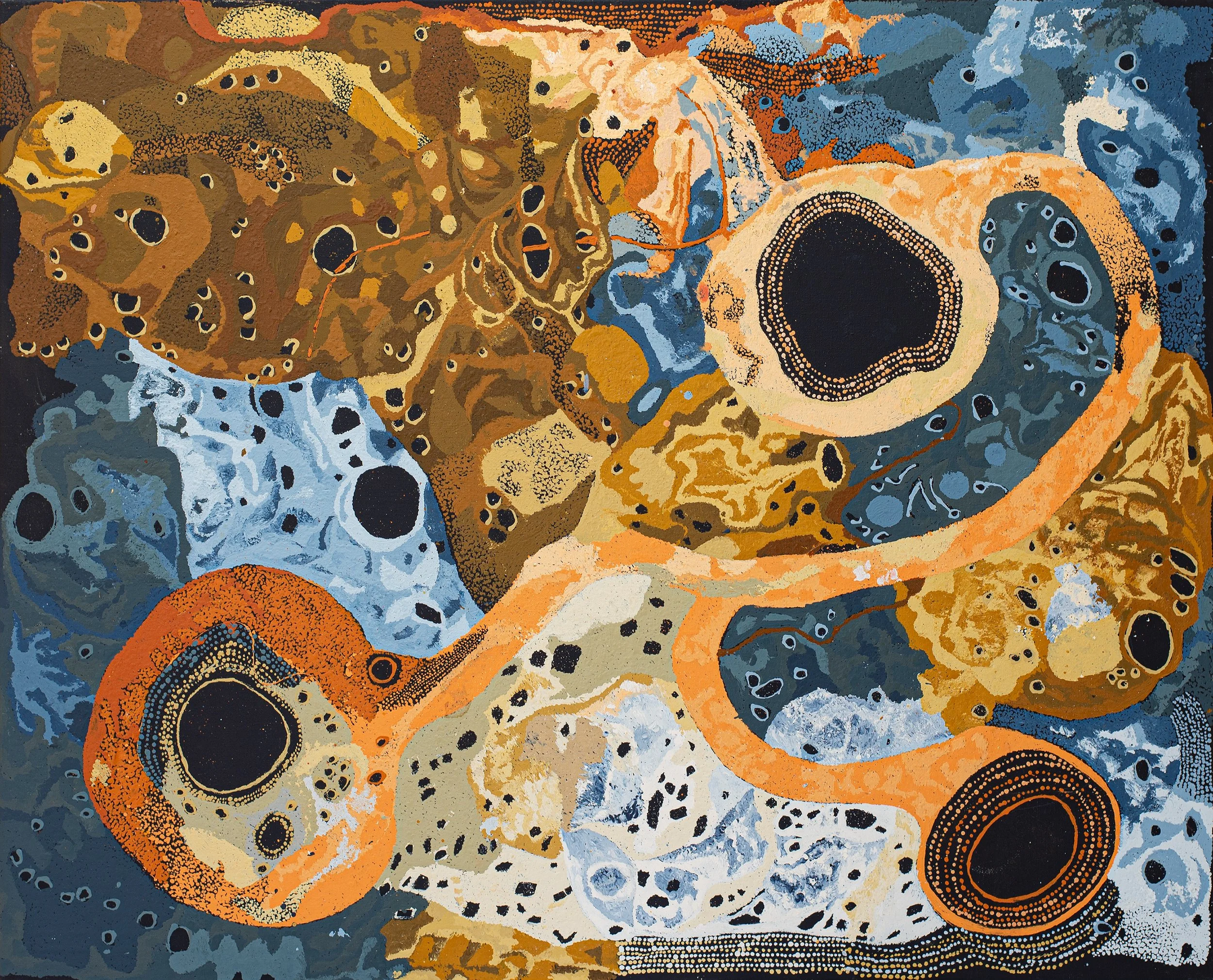
Artiste : Pauline Minmila Wangin (1970)
Titre de l'œuvre : Kapi Tjukula (Water Hole)
Format : 152cm x 122cm
Provenance et certificat : centre d'art aborigène de Mimili Maku
Référence de cette peinture aborigène : 737-24
Explications pour cette peinture d'art Aborigène :
Pauline is painting tjukurpa (story) about the journey of water, explaining how to care for kapi tjukula (water holes), particularly in the area around paralpii (Victory Well). This tjukurpa was passed on to her by her mother.
“One time when I was a little girl, my mother and me went out driving to collect bush tucker. It was a very hot day, and our car broke down. We didn't have any water with us, and I was scared, but my mother led me away from the car to kapi tjukula really closeby. She taught me how to find it, and how to care for it. After emptying the kapi (water) with mara munu punu (hands and sticks) the empty tjukula is cleaned. We place punu tjuta (many sticks and branches) over the top of the tjukula and use puli pulka (big rock) to stop them blowing away. Now no animals can dirty the new water that will soon collect."

Artiste : Pauline Minmila Wangin (1970)
Titre de l'œuvre : Kapi Tjukula (Water Hole)
Format : 152cm x 122cm
Provenance et certificat : centre d'art aborigène de Mimili Maku
Référence de cette peinture aborigène : 967-24
Explications pour cette peinture d'art Aborigène :
Pauline is painting tjukurpa (story) about the journey of water, explaining how to care for kapi tjukula (water holes), particularly in the area around paralpii (Victory Well). This tjukurpa was passed on to her by her mother.
“One time when I was a little girl, my mother and me went out driving to collect bush tucker. It was a very hot day, and our car broke down. We didn't have any water with us, and I was scared, but my mother led me away from the car to kapi tjukula really closeby. She taught me how to find it, and how to care for it. After emptying the kapi (water) with mara munu punu (hands and sticks) the empty tjukula is cleaned. We place punu tjuta (many sticks and branches) over the top of the tjukula and use puli pulka (big rock) to stop them blowing away. Now no animals can dirty the new water that will soon collect."
Cette exposition est organisée en partenariat avec la communauté artistique de Mimili Maku, et fut montée avec l’aide des artistes et équipes de management des centres d’art cette année afin de vous présenter l’excellence de leurs réalisations.
En tant que partenaire et représentant des centres d’art Aborigène soutenus par le gouvernement Australien, la galerie Aboriginal Signature Estrangin vous permet d’avoir un accès privilégié en Europe (primary market) à des oeuvres recherchées, disposant des meilleures provenances éthiques reconnues par les grandes institutions et collections privées ou publiques. A travers notre programme d’exposition en Europe, nous vous invitons à voyager à travers le temps et les immensités Aborigènes pour apprivoiser toute l’amplitude et l’excellence de ce mouvement artistique contemporain.
Artiste : Tuppy Ngintja Goodwin (1952)
Titre de l'œuvre : Antara
Format : 152 cm x 152 cm
Provenance et certificat : centre d'art aborigène de Mimili Maku
Référence de cette peinture aborigène : 417-18
Demander le prix de l'œuvre
Explications pour cette peinture d'art Aborigène :
When I paint, it’s like inma (ceremonial dance and song). This is Antara, a sacred place for Anangu, and the Maku (witchetty grub) Tjukurpa. There’s a special rock hole at Antara where women perform inma – ‘inmaku pakani’ – and afterwards there’s enough maku to feed everyone. Antara and Maku Tjukurpa is really important for Mimili women, we paint this place and its stories, keeping them strong.