
«Tjungungku Walkatjunanyu— Painting Together»
Présentation des artistes Aborigènes de Tjala Arts
Du 27 octobre au 21 novembre 2020 au sein de la galerie Aboriginal Signature Estrangin à Bruxelles
Ouverture le mardi 27 octobre de 11h à 21h.
Notre magasin vous reçoit sur RDV du mardi au samedi de 11h à 19h.
Afin de vous accueillir dans ce contexte particulier, tout en respectant les règles de sécurité recommandées par le Conseil Fédéral et la région Bruxelloise nous vous invitons à réserver votre visite dans notre agenda ici.
Les mesures telles que le port du masque et une seule personne (accompagnée d’un mineur) sont requises par la région Bruxelloise afin de lutter contre la propagation du virus.
Nous vous remercions pour votre compréhension.

Vue d’une des pièces de la galerie Aboriginal Signature Estrangin avec les magnifiques œuvres de l’exposition Tjala 2020. © Aboriginal Signature Estrangin gallery, avec l’autorisation des artistes et de Tjala Art Center.
“Célébration de notre culture”
Nous sommes très honorés d’accueillir à Bruxelles, l’exposition remarquable des artistes de Tjala, de la communauté Aborigène Anangu d’Amata, au coeur d’un vaste territoire de 102 000 km2 habité par moins de 2500 habitants, au centre-sud désertique de l’Australie.
Près de 30 œuvres ont été sélectionnées, dont plusieurs oeuvres collaboratives magistrales, réalisées par les femmes. Ces oeuvres collaboratives représentent le leadership des dames d’Amata et le rôle central de la création artistique dans leur vie. «Lorsque les ancêtres ont peint notre Tjukurpa (rêver) sur les grottes et sur leurs corps, c’était une célébration de notre culture, une façon d’identifier les personnes et les lieux, et une façon de continuer nos histoires», raconte Tjungkara Ken.
«Aujourd’hui, nous avons de nouveaux matériaux et de nouvelles méthodes, mais la célébration et l’engagement envers Tjukurpa et l’identité culturelle sont toujours les mêmes.»
Leurs œuvres magistrales souvent collaboratives, sont récompensées chaque année au Musée National de Darwin (NATSIAA award) et exposées à travers le monde de New York au Musée des Beaux Arts de Rennes actuellement en 2020.

Vue d’une des pièces de la galerie Aboriginal Signature Estrangin avec les magnifiques œuvres de l’exposition Tjala 2020. © Aboriginal Signature Estrangin gallery, avec l’autorisation des artistes et de Tjala Art Center.
“Ces histoires que les aînés partagent avec nous sont les mêmes que celles qui sont peintes sur les rochers, les grottes et sur leurs corps», explique Sharon Adamson. “Même si nous avons de nouveaux matériaux et que nous dessinons sur de la toile et du papier, ces histoires sont les mêmes. Ces dessins nous aident à célébrer nos cultures et à les vivre chaque jour”.”
Une sélection de 30 oeuvres exceptionnelles de Tjala à Bruxelles
Les peintures évoquent des lieux ancestraux dont chaque artiste est le gardien, à la fois de l’espace et de l’histoire sacrée rattachée. Cette autorité et légitimité de l’artiste sur le sujet, va lui permettre d’exprimer une individualité spécifique signant son geste. Il donne ainsi vie sur la toile aux lieux auxquels il est connecté par ses liens de parenté, son lieu de naissance, tel un prince qui règne sur les milliers de kilomètres des songlines.
Les 30 oeuvres réunies à Bruxelles ont été réalisées par plus 12 artistes différents, âgés de 95 ans à 35 ans. Entre les anciens les plus importants, jusqu’aux nouvelles stars émergentes, une transmission du savoir s’effectue par le processus de création artistique. Cette transmission du flambeau entre les époques et les générations d’artistes est essentielle, souvent fragile, et contribue à perpétuer les connaissances dans les communautés.
“Il y a longtemps, lorsque nous étions petits enfants, nous courions autour de Puta Puta et Ilitjata, la terre de notre grand-père et de notre père, et grâce à cela, nous avons grandi fort”, dit Wawiriya Burton. Pourquoi? “Parce que c’est le pays Anangu - le pays des peuples autochtones - de leur esprit”.”
La place de l’art Aborigène d’Australie se distingue de plus en plus à travers le monde dans le cadre de l’art contemporain avec les expositions à New York, San Francisco et Hong Kong de la galerie Gagosian. Le MET est également en train de constituer une très belle collection d’art Aborigène grâce à des donations de grands collectionneurs américains.
Un nouvel élan est en marche en Australie avec les artistes du APY land qui gagnent bien souvent les grands prix artistiques (awards) centenaires des musées de Melbourne ou de Sydney. Des fondations privées remarquables entièrement dédiées à l’art Aborigène contemporain d’Australie se sont montées en Suisse comme la Fondation Opale, ou en Australie, afin d’enrichir leurs collections avec ces œuvres fortes aux résonances ancestrales mais ancrées dans le présent.
Pour ce mois d’octobre 2020, nous nous réjouissons particulièrement de vous accueillir à nouveau au sein de la Galerie Aboriginal Signature.
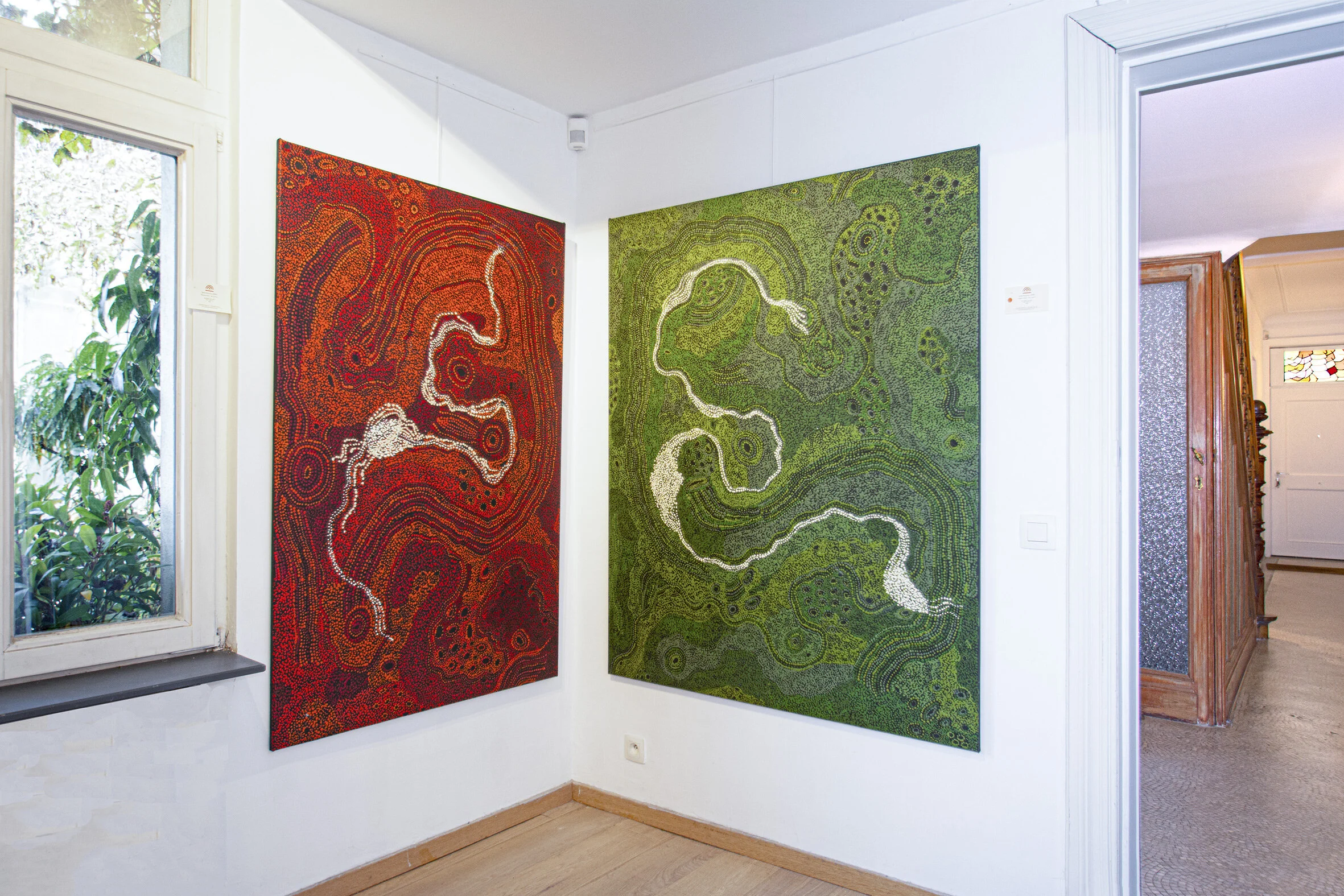
Vue d’une des pièces de la galerie Aboriginal Signature Estrangin avec les magnifiques œuvres de l’exposition Tjala 2020. © Aboriginal Signature Estrangin gallery, avec l’autorisation des artistes et de Tjala Art Center.
Œuvres de Tjala proposées dans le cadre de l'exposition :

Artiste : Wawiriya Burton (1925)
Titre de l'œuvre : Ngayuku ngura - My Country
Format : 198 x 197 cm
Provenance et certificat : centre d'art aborigène de Tjala Arts
Référence de cette peinture aborigène : 592-18
Explication sur cette œuvre :
In this painting Wawiriya has depicted her country. The different colours and designs represent variations in the landscape along the sacred song lines.

Artiste : Mitakiki Women's Collaborative
Titre de l'œuvre : Seven Sisters
Format : 152,5 x 122 cm
Provenance et certificat : centre d'art aborigène de Tjala
Référence de cette peinture : ID1496
Explications pour cette œuvre :
This is a Tjukurpa Story (Creation Story) about the constellations of Pleiades and Orion. The sisters are the constellaton of Pleiades and the other star Orion is said to be Nyiru or Nyirunya (described as a lusty or bad man). Nyiru is forever chasing the sisters known as the Kunkarunkara women as it is said he wants to marry the eldest sister. The seven sisters travel again and again from the sky to the earth to escape Nyiru’s unwanted attentions. They turn into their human form to escape from the persistent Nyiru, but he always finds them and they flee back to the sky. As Nyiru is chasing the sisters he tries to catch them by using magic to turn into the most tempting kampurarpra (bush tomatoes) for the sisters to eat and the most beautiful Ili (fig) tree for them to camp under. However, the sisters are too clever for Nyiru and outwit him as they are knowledgeable about his magic. They go hungry and run through the night rather than be caught by Nyiru. Every now and again one of the women fall victim to his ways. It is said that he eventually captures the youngest sister, but with the help of the oldest sister, she escapes back to her sisters who are waiting for her.
Eventually the sisters fly back into the sky to escape Nyiru, reforming the constellation.
Demander le prix de l'œuvre / Enquiry
© Photo : Aboriginal Signature Estrangin gallery with the courtesy of the artists and Tjala.

Artiste : Mitakiki Women's Collaborative
Titre de l'œuvre : Seven Sisters
Format : 198 x 122 cm
Provenance et certificat : centre d'art aborigène de Tjala
Référence de cette peinture : 283-19
Explications pour cette œuvre :
This is a Tjukurpa Story (Creation Story) about the constellations of Pleiades and Orion. The sisters are the constellaton of Pleiades and the other star Orion is said to be Nyiru or Nyirunya (described as a lusty or bad man). Nyiru is forever chasing the sisters known as the Kunkarunkara women as it is said he wants to marry the eldest sister. The seven sisters travel again and again from the sky to the earth to escape Nyiru’s unwanted attentions. They turn into their human form to escape from the persistent Nyiru, but he always finds them and they flee back to the sky. As Nyiru is chasing the sisters he tries to catch them by using magic to turn into the most tempting kampurarpra (bush tomatoes) for the sisters to eat and the most beautiful Ili (fig) tree for them to camp under. However, the sisters are too clever for Nyiru and outwit him as they are knowledgeable about his magic. They go hungry and run through the night rather than be caught by Nyiru. Every now and again one of the women fall victim to his ways. It is said that he eventually captures the youngest sister, but with the help of the oldest sister, she escapes back to her sisters who are waiting for her.
Eventually the sisters fly back into the sky to escape Nyiru, reforming the constellation.
Demander le prix de l'œuvre / Enquiry
© Photo : Aboriginal Signature Estrangin gallery with the courtesy of the artists and Tjala.

Artiste : Mitakiki Women's Collaborative
Titre de l'œuvre : Seven Sisters
Format : 198 x 197 cm
Provenance et certificat : centre d'art aborigène de Tjala
Référence de cette peinture : 236-20
Explications pour cette œuvre :
This is a Tjukurpa Story (Creation Story) about the constellations of Pleiades and Orion. The sisters are the constellaton of Pleiades and the other star Orion is said to be Nyiru or Nyirunya (described as a lusty or bad man). Nyiru is forever chasing the sisters known as the Kunkarunkara women as it is said he wants to marry the eldest sister. The seven sisters travel again and again from the sky to the earth to escape Nyiru’s unwanted attentions. They turn into their human form to escape from the persistent Nyiru, but he always finds them and they flee back to the sky. As Nyiru is chasing the sisters he tries to catch them by using magic to turn into the most tempting kampurarpra (bush tomatoes) for the sisters to eat and the most beautiful Ili (fig) tree for them to camp under. However, the sisters are too clever for Nyiru and outwit him as they are knowledgeable about his magic. They go hungry and run through the night rather than be caught by Nyiru. Every now and again one of the women fall victim to his ways. It is said that he eventually captures the youngest sister, but with the help of the oldest sister, she escapes back to her sisters who are waiting for her.
Eventually the sisters fly back into the sky to escape Nyiru, reforming the constellation.
Demander le prix de l'œuvre / Enquiry
© Photo : Aboriginal Signature Estrangin gallery with the courtesy of the artists and Tjala.

Artiste : Nyunmiti Burton (1964)
Titre de l'œuvre : Ngayuku ngura - My Country
Format : 198cm x 152cm
Provenance et certificat : centre d'art aborigène de Tjala Arts
Référence de cette peinture aborigène : 856-16
Explication sur cette œuvre :
In this painting Nyumiti has depicted her country. The different colours and designs represent variations in the landscape along the sacred song lines.

Artiste : Collaborative women Work
Titre de l'œuvre : Ngayuku ngura - My Country
Format : 197 x 150 cm
Provenance et certificat : centre d'art aborigène de Tjala
Référence de cette peinture : 394-19
Explications pour cette œuvre :
In this painting the women of Tjala have depicted their country. The different colours and designs represent variations in the landscape and the existing spirits.
Demander le prix de l'œuvre / Enquiry
© Photo : Aboriginal Signature Estrangin gallery with the courtesy of the artists and Tjala.

Artiste : Barbara Mbitjana Moore
Titre de l'œuvre : Ngayuku ngura - My Country
Format : 198 x 197 cm
Provenance et certificat : centre d'art aborigène de Tjala Arts
Référence de cette peinture aborigène : 524-19

Artiste : Sharon Adamson
Titre de l'œuvre : Wanampi Tjukurpa
Format : 198 x 122 cm
Provenance et certificat : centre d'art aborigène de Tjala Arts
Référence de cette peinture aborigène : 88-19
Description de cette œuvre :
Wanampi Tjukurpa - Mythical Rainbow Snake Creation StoryThis story tells of two Snake brothers and their wives, who are sisters, that lived near Piltati, west of Amata. Every day the women went out hunting, and every evening they bought home kuka (meat for cooking) for the men, who didn’t do anything but perform ceremonies. After a while the sisters became annoyed at the men’s laziness and decided to eat all the food they caught, leaving the men to fend for themselves. The Snake brothers were angry, and decided to punish the women for their insubordination. After lots of talking, the brothers agreed to change themselves into a Wanampi (a giant mythical water serpent, which also had the power to travel above and below ground) and play a practical joke upon the women that would cause them a great deal of hard useless labour.
They went to a marsupial rat hole where the women had been digging and imitated the tracks of a large snake by rubbing the back of a spear thrower on the ground. Then they entered the hole, and one of them le out enough of his tail for the women to see. The younger sister became very excited when she saw the tracks of such a large snake and its tail popping out. She begun to pull the snake from its burrow, but the tail kept slipping from her grasp. The Wanampi teased the younger sister by allowing himself to be dragged out a few feet before wriggling himself free. Again and again he let himself be caught before wriggling free once more. Eventually the younger sister became tired, gave up and returned to her sister.In evening, when they were eating dinner, the younger sister told her elder sister how she had almost caught a carpet snake as big as a Wanampi, but couldn’t pull it from its burrow as it was too strong. The big sister said she would help her to catch it the next day.The next morning the women set off with their wana (digging sticks) and piti (large wooden bowl). They dug all day long, then the next day and the next, occasionally glimpsing the snake.
Sometimes they caught a small carpet snake enough for their evening meal. The small carpet snakes were created by the Snake men so the women wouldn’t loose heart or grow hungry. They continued to dig after the Wanampi, but they never caught him. In their pursuit the women dug a trench from Aparatjara to Piltati, now a watercourse, approximately 25km long. Their burrow became deeper, and the women dug many subsidiary branches in their pursuit, creating the gorge at Piltati, with its creeks and piles of rock that clufter the valley floor.Finally the elder sister changed her tactics. She dug a pit ahead of the entrance to the burrow (now the largest rock hole at Piltati), uncovering the Wanampi before he could get away. She was so frightened by his huge coils slithering around her feet that she threw her digging stick, piercing the side of the Wanampi. The younger Wanampi left the burrow, chased and swallowed his wife, the younger sister. The injured snake (big brother) was angry and in great pain, so he caught, killed and ate the elder sister at the mouth of Piltati gorge.The big brother Wanampi is now a bloodwood tree with a dry limb sticking out at one side, and the trunk is covered with lumps and excrescences. The dead limb is the digging stick with which the snake is speared; the lumps and excrescences are the body of the woman still showing through the skin of the snake.

Artiste : Janie Kulyuru Lewis
Titre de l'œuvre : Ngayuku ngura - My Country
Format : 153 x 102 cm
Provenance et certificat : centre d'art aborigène de Tjala Arts
Référence de cette peinture aborigène : 152-20

Artiste : Collaborative women Work
Titre de l'œuvre : Seven Sisters
Format : 197 x 150 cm
Provenance et certificat : centre d'art aborigène de Tjala
Référence de cette peinture : 203-20
Explications pour cette œuvre :
Freda and Tanya have depicted the Seven Sisters Story. This is a Tjukurpa Story (Creation Story) about the constellations of Pleiades and Orion. The sisters are the constellaton of Pleiades and the other star Orion is said to be Nyiru or Nyirunya (described as a lusty or bad man). Nyiru is forever chasing the sisters known as the Kunkarunkara women as it is said he wants to marry the eldest sister.The seven sisters travel again and again from the sky to the earth to escape Nyiru’s unwanted attentions.
They turn into their human form to escape from the persistent Nyiru, but he always finds them and they flee back to the sky. As Nyiru is chasing the sisters he tries to catch them by using magic to turn into the most tempting kampurarpra (bush tomatoes) for the sisters to eat and the most beautiful Ili (fig) tree for them to camp under. However, the sisters are too clever for Nyiru and outwit him as they are knowledgeable about his magic. They go hungry and run through the night rather than be caught by Nyiru. Every now and again one of the women fall victim to his ways. It is said that he eventually captures the youngest sister, but with the help of the oldest sister, she escapes back to her sisters who are waiting for her. Eventually the sisters fly back into the sky to escape Nyiru, reforming the constellation. (In some cases the artist will secretly depict sexual elements as Nyiru is really only after one thing -sex).
Demander le prix de l'œuvre / Enquiry
© Photo : Aboriginal Signature Estrangin gallery with the courtesy of the artists and Tjala.

Artiste : Janie Kulyuru Lewis
Titre de l'œuvre : Ngayuku ngura - My Country
Format : 153 x 122 cm
Provenance et certificat : centre d'art aborigène de Tjala Arts
Référence de cette peinture aborigène : 348-20

Artiste : Muna Kulyuru
Titre de l'œuvre : Ngayuku ngura - My Country
Format : 151 x 121 cm
Provenance et certificat : centre d'art aborigène de Tjala Arts
Référence de cette peinture aborigène : 371-20

Artiste : Sandra Ken
Titre de l'œuvre : Seven Sisters
Format : 121 x 100 cm
Provenance et certificat : centre d'art aborigène de Tjala Arts
Référence de cette peinture aborigène : 285-20

Artiste : Maringka Tunkin
Titre de l'œuvre : Seven Sisters
Format : 152 x 121 cm
Provenance et certificat : centre d'art aborigène de Tjala Arts
Référence de cette peinture aborigène : 323-20

Artiste : Muna Kulyuru
Titre de l'œuvre : Ngayuku ngura - My Country
Format : 151 x 121 cm
Provenance et certificat : centre d'art aborigène de Tjala Arts
Référence de cette peinture aborigène : 319-20
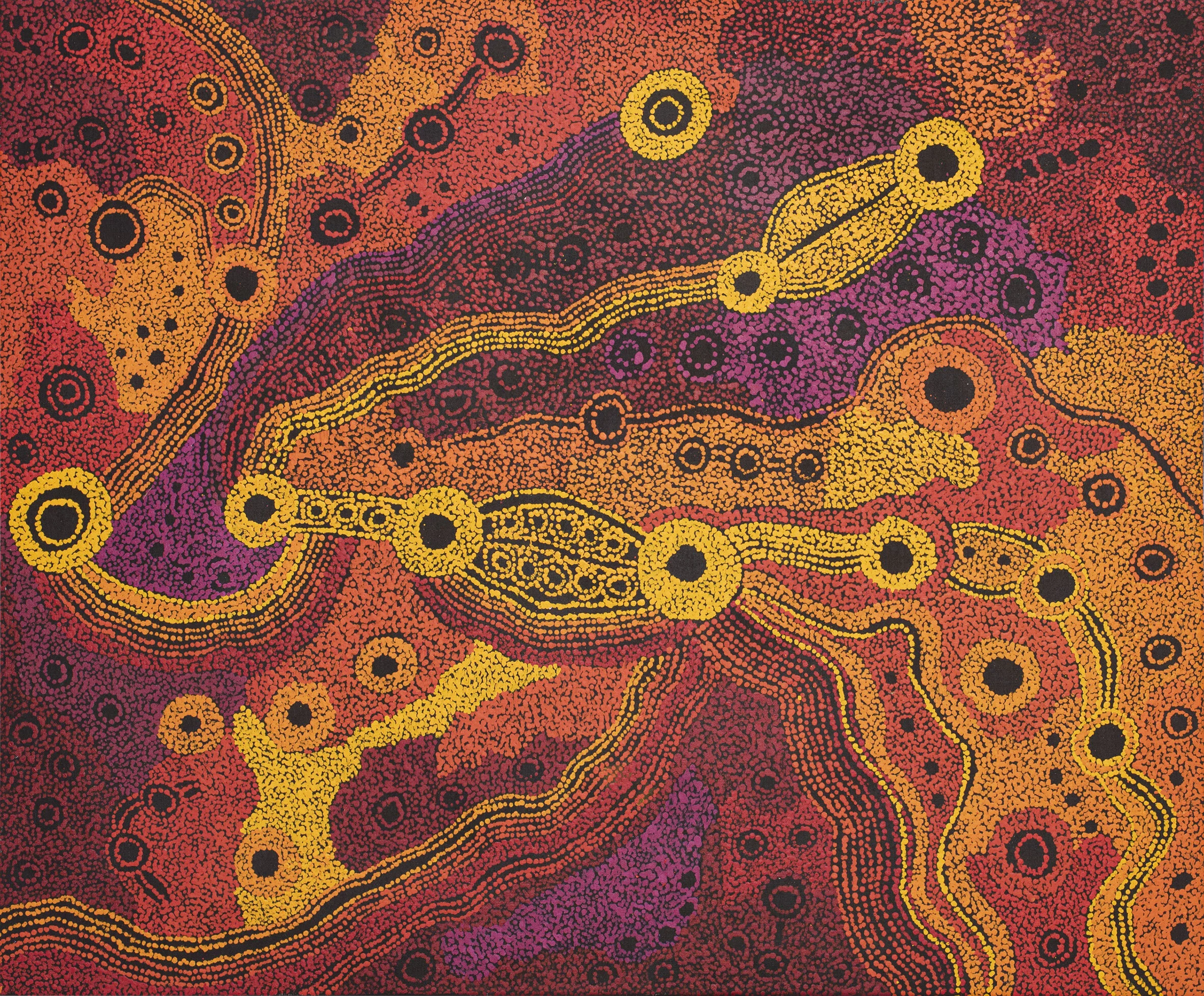
Artiste : Sandra Ken
Titre de l'œuvre : Seven Sisters
Format : 121 x 100 cm
Provenance et certificat : centre d'art aborigène de Tjala Arts
Référence de cette peinture aborigène : 287-20

Artiste : Maureen Douglas
Titre de l'œuvre : Ngayuku ngura - My Country
Format : 152 x 121 cm
Provenance et certificat : centre d'art aborigène de Tjala Arts
Référence de cette peinture aborigène : 324-20

Artiste : Maureen Douglas
Titre de l'œuvre : Ngayuku ngura - My Country
Format : 150 x 120 cm
Provenance et certificat : centre d'art aborigène de Tjala Arts
Référence de cette peinture aborigène : 307-20
Peintures également présentées dans l’espace stock room de la galerie durant cette exposition :
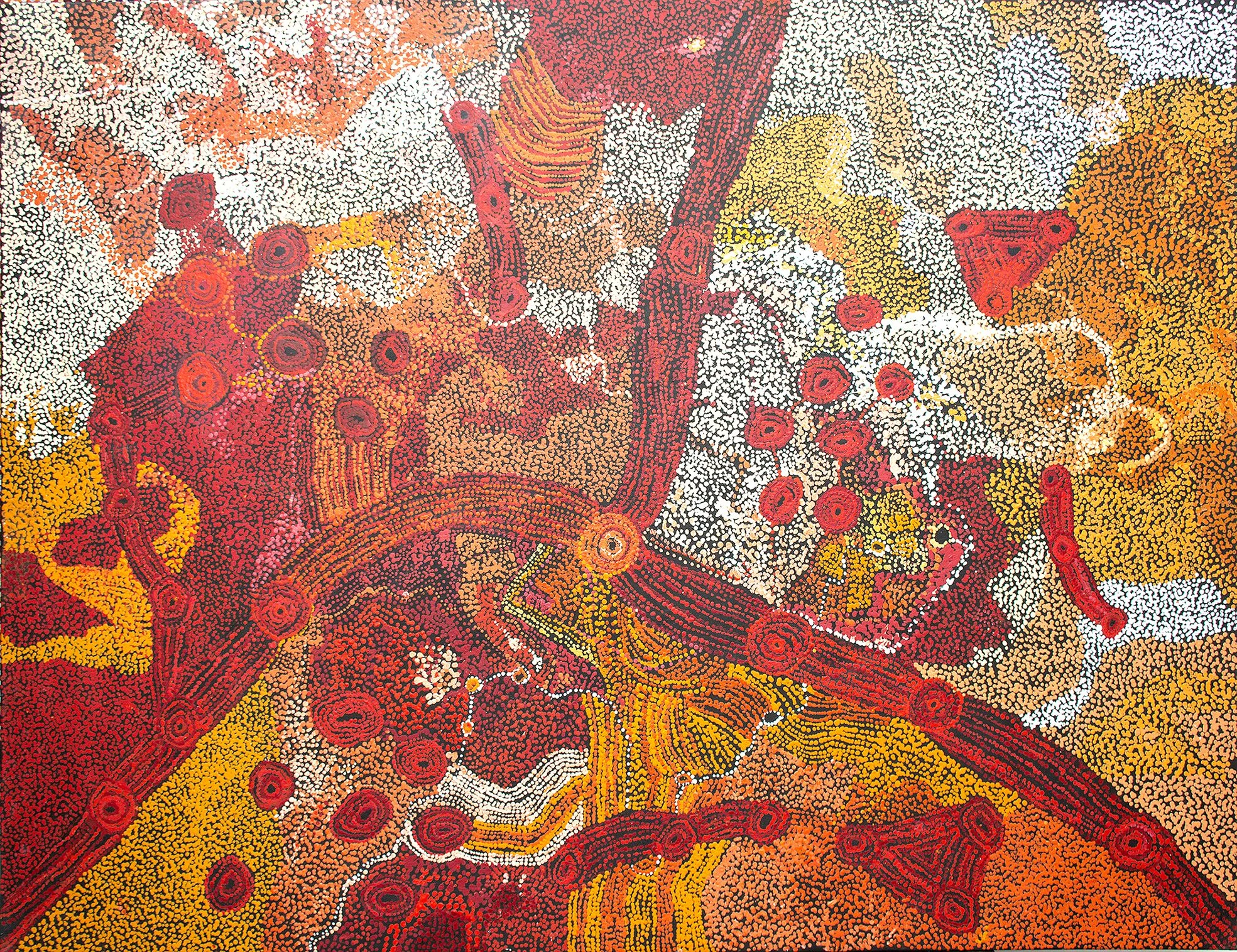
Artiste : Sylvia Kanytjupai Ken
Titre de l'œuvre : Seven Sister Dreaming Time stories
Format : 198 x 152,5 cm
Provenance et certificat : centre d'art de Tjala
Référence de la peinture : 830-16
Explication sur la signification de cette peinture d'art Aborigène :
Sylvia has depicted the Seven Sisters Story. This is a Tjukurpa Story (Creation Story) about the constellations of Pleiades and Orion. The sisters are the constellaton of Pleiades and the other star Orion is said to be Nyiru or Nyirunya (described as a lusty or bad man).
Nyiru is forever chasing the sisters known as the Kunkarunkara women as it is said he wants to marry the eldest sister. The seven sisters travel again and again from the sky to the earth to escape Nyiru’s unwanted attentions. They turn into their human form to escape from the persistent Nyiru, but he always finds them and they flee back to the sky.
As Nyiru is chasing the sisters he tries to catch them by using magic to turn into the most tempting kampurarpra (bush tomatoes) for the sisters to eat and the most beautiful Ili (fig) tree for them to camp under. However, the sisters are too clever for Nyiru and outwit him as they are knowledgeable about his magic...
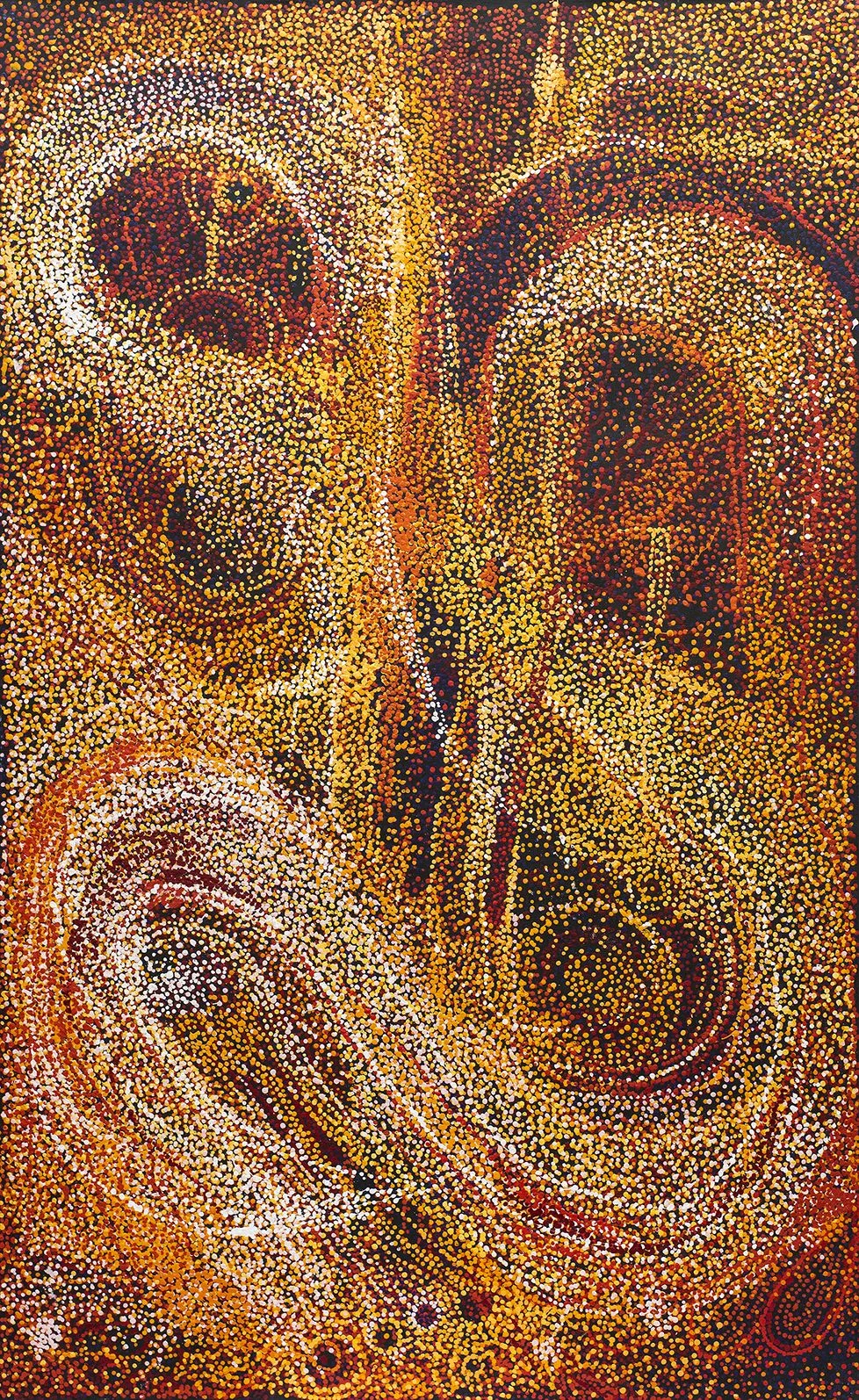
Artiste : Nyunmiti Burton (1964)
Titre de l'œuvre : Ngayuku ngura - My Country
Format : 198cm x 122cm
Provenance et certificat : centre d'art aborigène de Tjala Arts
Référence de cette peinture aborigène : 426-18
Indisponible
Explication sur cette œuvre :
In this painting Nyumiti has depicted her country. The different colours and designs represent variations in the landscape along the sacred song lines.

Artiste : Ray Ken
Titre de l'œuvre : Tali - Sand dune
Format : 198 x 122 cm
Provenance et certificat : centre d'art de Tjala
Référence de la peinture : 520-15
Explication sur la signification de cette peinture d'art Aborigène :
Ray has depicted Tali - Sand dune - an important hunting place for the men.

Artiste : Ray Ken
Titre de l'œuvre : Tali - Sand dune
Format : 152 x 100 cm
Provenance et certificat : centre d'art de Tjala
Référence de la peinture : 452-15
Explication sur la signification de cette peinture d'art Aborigène :
Ray has depicted Tali - Sand dune - an important hunting place for the men.
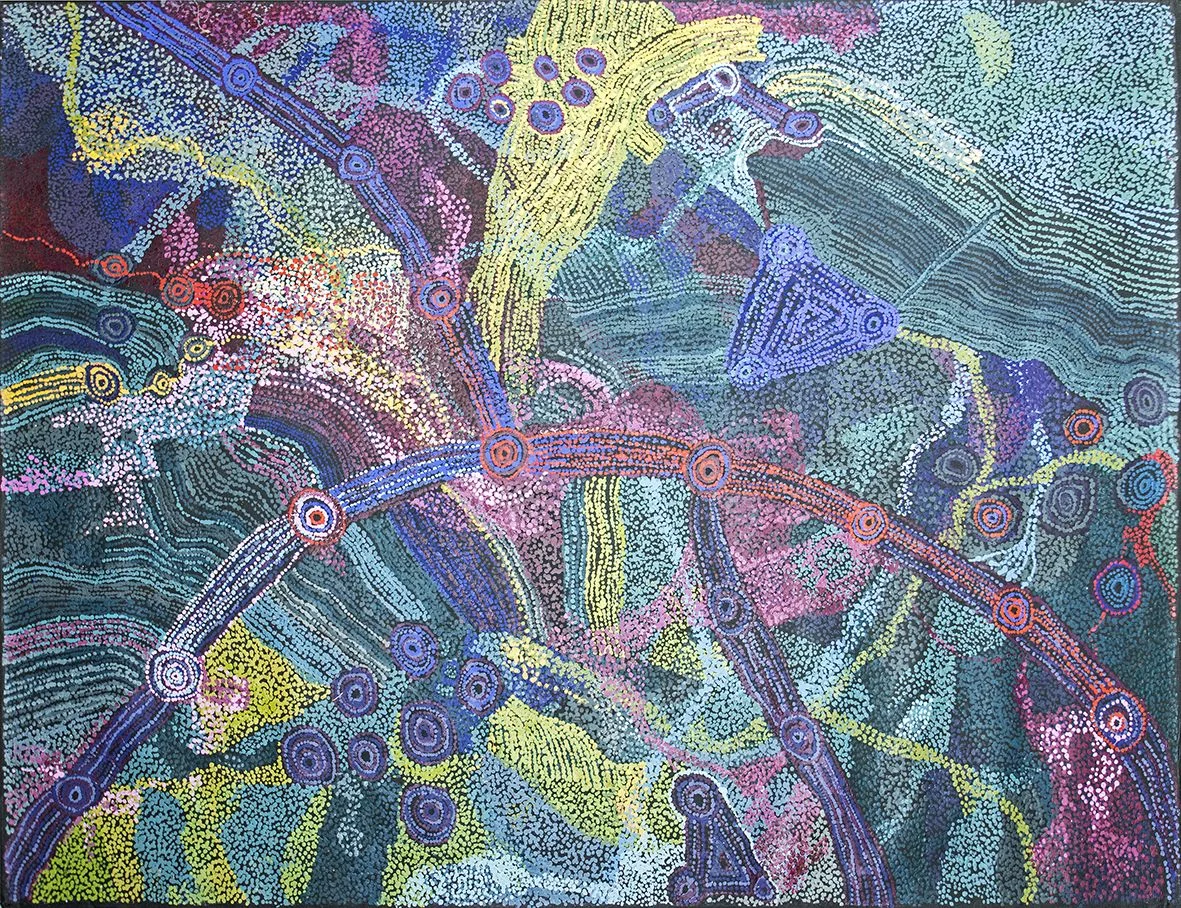
Artiste : Sylvia Kanytjupai Ken
Titre de l'œuvre : Seven Sister Dreaming Time stories
Format : 198 x 152,7 cm
Provenance et certificat : centre d'art de Tjala
Référence de la peinture : 827-16
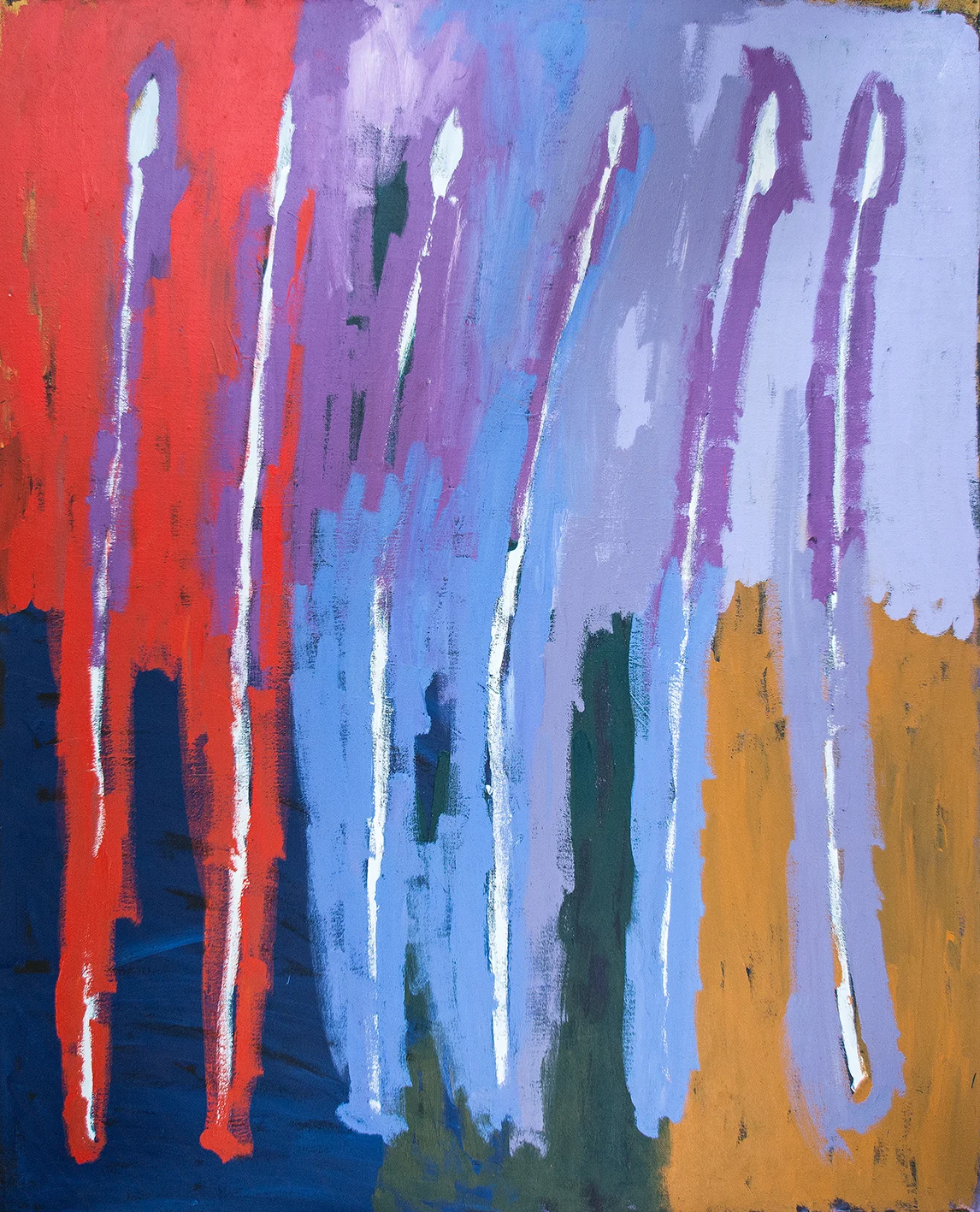
Artiste : Freddy Ken
Titre de l'œuvre : Kulata Tjuta
Format : 152 x 122 cm
Provenance et certificat : centre d'art aborigene de Tjala
Référence de cette peinture aborigene : 183-15
Œuvre vendue. Découvrez notre collection de peintures Aborigènes disponibles ici

Artiste : Mick Wikilyiri (1940)
Titre de l'œuvre : Tjala Tjukurpa, Honey Ant story
Format : 122cm x 101,5cm
Provenance et certificat : centre d'art aborigène de Tjala Arts
Référence de cette peinture aborigène : 457-18
Explication sur cette œuvre :
Mick is telling the story of the Tjala or Honey Ants which are found about a metre underground beneath Mulga trees. The Honey Ant tunnels that lead down to the ant's nests are called nyinantu. The Honey Ant larvae are called ipilyka-ipilyka. Honey Ants are a highly favoured food source. When the Pitjantjatjara go looking for Honey Ants they look for the drill holes under the trees. When they see them, they shovel and dig down, following the tunnels to find the Honey Ants inside. They suck the honey-like liquid from the abdomen of the Honey Ant. The story of the Honey Ant is told across the Northern Territory into South Australia. The Honey Ant is an important link between Anangu mythology and inter-dependence on the environment. The Honey Ant Ancestors are related to the country around Amata.
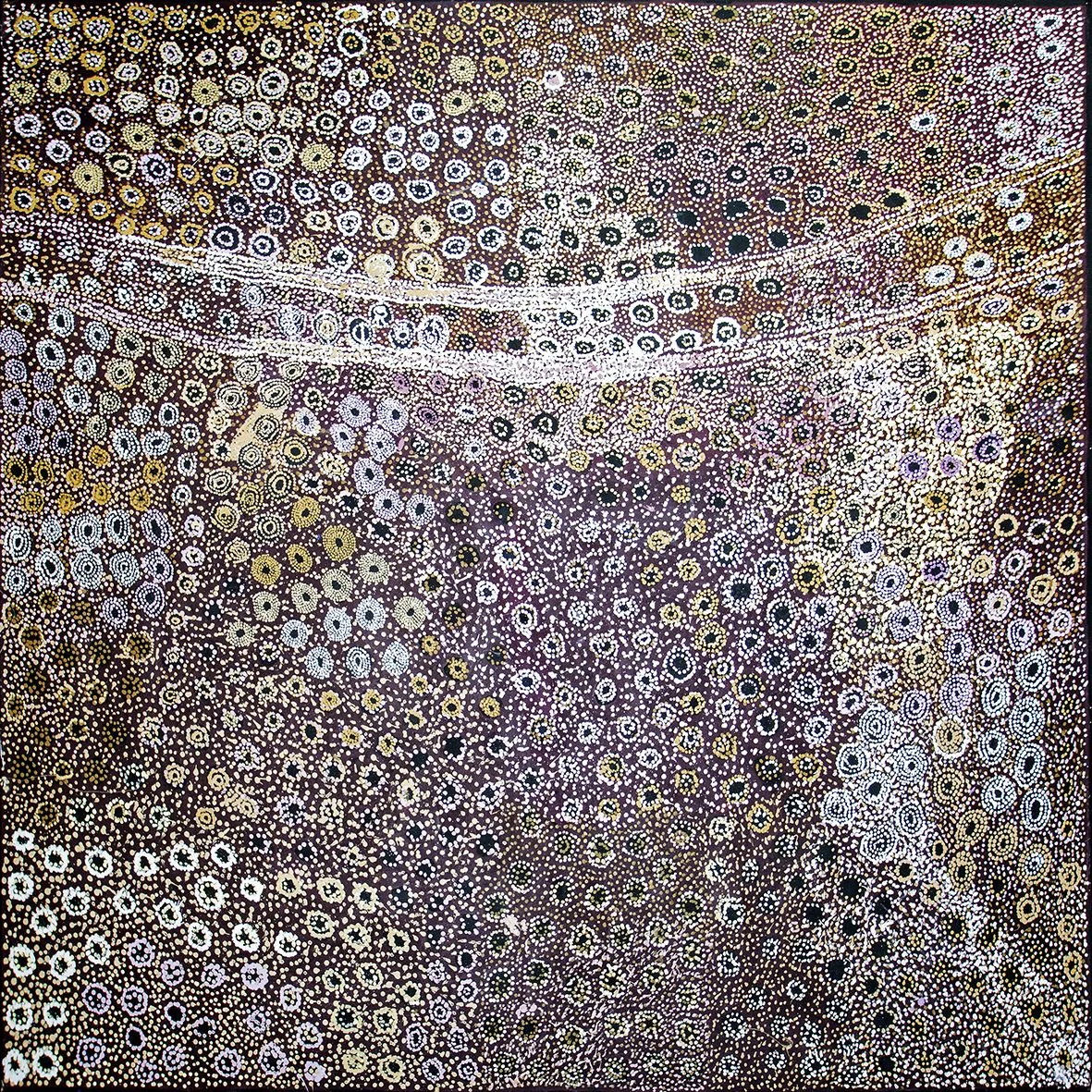
Artiste : Mona Mitakiki Shepherd
Titre de l'œuvre : Kapi Tjukula tjuta - many rock holes
Format : 198 x 197 cm
Provenance et certificat : centre d'art de Tjala
Référence de la peinture : 978-16
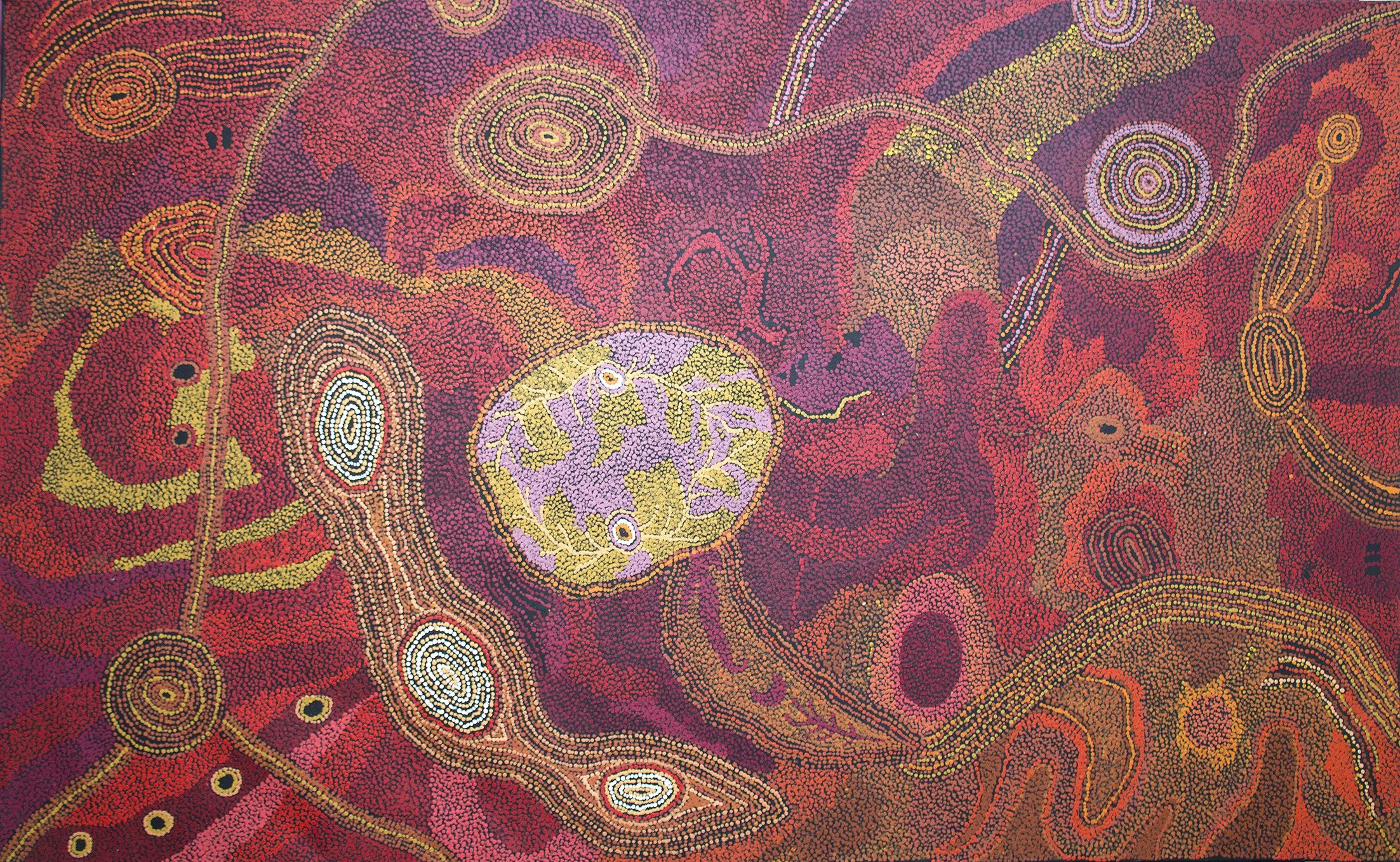
Artiste : Tjungkara Ken
Titre de l'œuvre : Seven Sisters Dreaming Time stories
Format : 198 x 122 cm
Provenance et certificat : centre d'art de Tjala
Référence de la peinture : 474-15
Exposition organisée
par la Galerie Aboriginal Signature Estrangin
en partenariat avec les artistes et le centre d'art
de Tjala Art dans le APY land.
Artiste : Collaborative women Work
Titre de l'œuvre : Ngayuku ngura - My Country
Format : 198 x 197 cm
Provenance et certificat : centre d'art aborigène de Tjala
Référence de cette peinture : 644-19
Explications pour cette œuvre :
In this painting the women of Tjala have depicted their country. The different colours and designs represent variations in the landscape and the existing spirits.
Demander le prix de l'œuvre / Enquiry
© Photo : Aboriginal Signature Estrangin gallery with the courtesy of the artists and Tjala.