Résilience - la puissance du passé résonne aujourd'hui
Art Aborigène de Maningrida - Terre d’Arnhem
Du 16 septembre au 10 octobre 2020 inclus au sein de la galerie Aboriginal Signature Estrangin à Bruxelles
Vernissage le mercredi 16 septembre de 11h à 21h
Ensuite, nous sommes ouverts sur RDV du mardi au samedi de 11h à 19h.
Afin de de mieux vous accueillir, tout en respectant les règles de sécurité recommandées par le Conseil Fédéral, nous vous invitons à réserver votre visite dans notre agenda ici.

© Photo : Aboriginal Signature Estrangin Gallery with the courtesy of the artists et Maningrida Art and Culture.
Resilience – the power of the past reverberates today
Pour la première fois à Bruxelles, cette exposition présente les œuvres d'artistes de premier plan et émergents de Maningrida Arts & Culture dans le grand nord tropical de l’Australie. Elle témoigne de la résilience féroce des habitants de la région à maintenir avec force leurs langues, leur pays et leurs pratiques artistiques vivantes dans un monde contemporain.
Les artistes de la région de Maningrida veulent raconter l'histoire de la puissance de leur système de croyance, essentiel pour véhiculer le djang *: le pouvoir transformateur permanent, éternel et porteur de vie qui rend compte de tous les aspects de l'existence. Le mot djang fait également référence aux ancêtres de la création, au pays où réside leur esprit, et aux dessins et chants cérémoniels qui représentent cet être.
Pendant des millénaires, les gens se sont appuyés sur des images associées pour peindre les surfaces rocheuses, les abris d'écorce et les corps pour les cérémonies. La sculpture était également courante sous la forme d'objets sacrés, de vêtements corporels de cérémonie, de contenants tissés tels que des sacs d'aneth et de ficelle et de technologies aquacoles telles que des pièges à poissons coniques et des clôtures, qui se sont tous manifestés dès la création.
La création artistique est un puissant outil de résistance politique
Malgré la colonisation britannique de la région à la fin des années 1800, l'activité créative a continué à prospérer, s'adaptant et innovant en réponse aux nouveaux intérêts et influences de l'économie des colons. La création artistique est un puissant outil de résistance politique pour réfuter les théories impériales, telles que la terra nullius et le darwinisme social. L’art contemporain d’aujourd’hui continue de défier les publics extérieurs, subvertissant les tropes et lieux communs autour de la notion d’Aboriginalité comme x y z et les concepts binaires tels que la tradition et le contemporain, le sacré et le laïque, le naturel et le spirituel.
Les artistes de la communauté artistique de Maningrida sont répartis sur un vaste territoire sur 7000 kilomètres carrés, avec 12 groupes linguistiques distincts et 112 groupes claniques. Maningrida (1000 habitants) est considérée comme très éloignée, même selon les normes australiennes, étant à plus d’une heure de vol de la ville la plus proche de Darwin ( population de 135 000 habitants). Les artistes vivent bien souvent plus loin que Maningrida dans leur propre pays à 2, 3 ou 4 heures de pistes à travers la forêt tropicale, dans des stations très éloignées, également appelées « homeland ». Une « outstation » typique peut avoir juste 4 maisons, et une structure pour garder en sécurité les objets de cérémonie, avec 20 à 60 personnes vivant et s'occupant de la terre, des sites sacrés à proximité et du maintien des rituels et des pratiques culturelles.
Les artistes donnent vie au savoir
Au cours des dernières décennies, Maningrida Arts & Culture a accompagné les carrières d'artistes renommés, dont une bonne partie figurent de façon exceptionnelle dans l’exposition à la galerie Aboriginal Signature Estrangin à Bruxelles, comme John Mawurndjul, Lena Yarinkura, Bob Burruwal, Samuel Namundjda, Crusoe Kuningbal et Mick Kubbarrku. Ils ont encadré la prochaine génération de jeunes artistes, dont Paul Nabulumo, David Brian, Rosina Gunjarrwanga, Deborah Wurrkidj et Kenan Namundjda.
Des artistes de Maningrida, notamment des chanteurs, des danseurs et des interprètes, ont exposé et voyagé bien souvent au Japon, au Royaume-Uni, aux États-Unis, en France, en Allemagne et en Italie. Plus récemment, John Mawurndjul s'est rendu à Berlin pour l'exposition Indigenous Australia Masterworks de la National Gallery of Australia et cinq femmes de Babbarra Designs se sont rendues à Paris pour le vernissage de l'exposition textile Jarracharra - Dry Season Winds, à l'ambassade d'Australie.
Les artistes jouent dans la communauté un rôle prédominant à chaque génération, reflétant le contexte contemporain changeant, pour donner vie au savoir, à partir des relations sociales définies et des pratiques culturelles complexes. Cette intersection d'intégrité culturelle inébranlable et d'expérimentations ambitieuses a créé un pôle de créativité unique et résilient au bord du monde.
Tels des interprètes, dans une démarche d’exégèse, les artistes participent avec leur propre individualité et sens de l’innovation, à la diffusion des systèmes de savoirs codifiés sous la forme d’images puissantes en résilience, manifestant la puissance du passé aujourd’hui.
* Djang est un mot de la langue Kuninjku. Le mot diffère selon les groupes linguistiques régionaux, mais le sens est le même.
Merci à Maningrida Arts and Culture, aux voix et analyses académiques ayant permis de préparer ce texte, dont celle de Luke Taylor.
Œuvres de Maningrida proposées dans le cadre de l'exposition :

Artiste : Paul Nabulumo Namarinjmak
Titre de l'œuvre : Waterholes (Kubumi)
Pigments naturels sur tronc d’eucalyptus
Format : 156 x 19cm
Référence de la peinture : 46-19
Explications pour cette œuvre :
Kubumi is a sacred site on the Mann River. This is its story, as told by a ritual manager of the site, Lulu Laradjbi, with the authority of her husband Mick Kubarkku, a land owner of that country. Nabulumo is their son. Ngalyod the Rainbow Serpent pierced the rock at a place called Bolerrhlerrh and journeyed downstream from there to Ngalmalanj. The camping place Kubumi is downstream from there but at Ngalmalanj the serpent was blocked. It pushed down into the riverbed, pushed into the earth, sinking down forever. Now it lives under the rocky riverbed. That site continues downstream. Upstream is the site Molerrhlerrh, which has a waterfall and a big waterhole. There the serpent moved inside, downstream, to the lower region.
During the dry season at Kubumi, the Mann River shrinks to a series of deep waterholes, exposing the tunnels through the rocky outcrop that interconnect the pools.
© Photo & text : Aboriginal signature with the courtesy of the artist & Maningrida Arts

Artiste : Susan Marawarr
Titre de l'œuvre : Wak Wak
Pigments naturels sur écorce
Format : 146 x 67 cm
Référence de la peinture : 1581-12
Explications pour cette œuvre :
This painting depicts a sacred site at 'Kurrurldul', an outstation south of Maningrida. The 'rarrk', or abstract crosshatching, on this work represents the design for the crow totem ancestor called 'Djimarr'.
Today this being exists in the form of a rock, which is permanently submerged at the bottom of Kurrurldul Creek. The 'Djimarr' rock in the stream at Kurrurldul is said to move around and call out in a soft hooting tone at night. Both the stone itself and the area around it are considered sacred.
The imagery represents the rock mentioned above at the bottom of Kurrurldul creek, which is the final transmutation of the dreaming ancestor 'Djimarr'. Finally, the pattern used here is also the crow design used in the sacred 'Mardayin' ceremony, which is a large regional patri-moiety ceremony now rarely conducted in central and eastern Arnhem Land.
© Photo & text : Aboriginal signature with the courtesy of the artist & Maningrida Arts

Artiste : Deborah Wurrkidj
Titre de l'œuvre : Wak Wak
Pigments naturels sur écorce
Format : 175x46cm
Référence de la peinture : 831-18
Explications pour cette œuvre :
This painting depicts a sacred site at 'Kurrurldul', an outstation south of Maningrida. The 'rarrk', or abstract crosshatching, on this work represents the design for the crow totem ancestor called 'Djimarr'. Today this being exists in the form of a rock, which is permanently submerged at the bottom of Kurrurldul Creek. The 'Djimarr' rock in the stream at Kurrurldul is said to move around and call out in a soft hooting tone at night. Both the stone itself and the area around it are considered sacred.
The imagery represents the rock mentioned above at the bottom of Kurrurldul creek, which is the final transmutation of the dreaming ancestor 'Djimarr'. Finally, the pattern used here is also the crow design used in the sacred 'Mardayin' ceremony, which is a large regional patri-moiety ceremony now rarely conducted in central and eastern Arnhem Land.
© Photo & text : Aboriginal signature with the courtesy of the artist & Maningrida Arts

Artiste : Paul Nabulumo Namarinjmak
Titre de l'œuvre : Namarrkon the Lightning Spirit
Pigments naturels sur écorce
Format : 99cm x 50cm
Référence de la peinture : 1429-16
Explications pour cette œuvre :
This painting depicts a sacred site at 'Kurrurldul', an outstation south of Maningrida. The 'rarrk', or abstract crosshatching, on this work represents the design for the crow totem ancestor called 'Djimarr'.
Today this being exists in the form of a rock, which is permanently submerged at the bottom of Kurrurldul Creek. The 'Djimarr' rock in the stream at Kurrurldul is said to move around and call out in a soft hooting tone at night. Both the stone itself and the area around it are considered sacred.
The imagery represents the rock mentioned above at the bottom of Kurrurldul creek, which is the final transmutation of the dreaming ancestor 'Djimarr'. Finally, the pattern used here is also the crow design used in the sacred 'Mardayin' ceremony, which is a large regional patri-moiety ceremony now rarely conducted in central and eastern Arnhem Land.
© Photo & text : Aboriginal signature with the courtesy of the artist & Maningrida Arts

Artiste : Deborah Wurrkidj
Titre de l'œuvre : Wak Wak
Pigments naturels sur écorce
Format : 159x55.5cm
Référence de la peinture : 1079-19
Explications pour cette œuvre :
This painting depicts a sacred site at 'Kurrurldul', an outstation south of Maningrida. The 'rarrk', or abstract crosshatching, on this work represents the design for the crow totem ancestor called 'Djimarr'. Today this being exists in the form of a rock, which is permanently submerged at the bottom of Kurrurldul Creek. The 'Djimarr' rock in the stream at Kurrurldul is said to move around and call out in a soft hooting tone at night. Both the stone itself and the area around it are considered sacred.
The imagery represents the rock mentioned above at the bottom of Kurrurldul creek, which is the final transmutation of the dreaming ancestor 'Djimarr'. Finally, the pattern used here is also the crow design used in the sacred 'Mardayin' ceremony, which is a large regional patri-moiety ceremony now rarely conducted in central and eastern Arnhem Land.
© Photo & text : Aboriginal signature with the courtesy of the artist & Maningrida Arts

Artiste : Paul Nabulumo Namarinjmak
Titre de l'œuvre : Mimih Spirit
Pigments naturels sur écorce
Format : 149x56cm
Référence de la peinture : 1241-18
Explications pour cette œuvre :
Aboriginal people in the rocky environments of western and south-western Arnhem Land tell of the existence of tall slender spirits which they call Mimih. The name Mimih is well known throughout the top end of the Northern Territory. Aboriginal groups living in the rocky environments of western and southern Arnhem Land share mythology which relates to the beings known as Mimih. These groups include the Kunwok chain of languages, and also Rembarrnga, Dalabon and Djawoyn language groups. Other groups of people with familial and ceremonial links to rock country inhabitants are also familiar with the idea of the Mimih.
In recent years the Mimih has become a topic in the repertoires of some artists among the Kunibídji people, speakers of the Ndjébbana language and the traditional landowners of the Maningrida area. The people of western Arnhem Land believe that Mimih spirits live in a social organisation similar to Aboriginal people and that Mimih society existed before humans. Mimih are credited with instructing the first people with knowledge relating to survival in the rocky environment of the Arnhem Land plateau. Mimih are said to have taught the first humans how to hunt and butcher game and also how to dance, sing and paint. The song and dance style of western Arnhem Land Aboriginal people is still known today as Mimih style. This term is also used by Aboriginal people further to the east in Central Arnhem Land when describing the dance and song of their western neighbours.
Despite the usual descriptions of Mimih as being benign towards humans, sometimes however they are attributed with mischievous and dangerous qualities, capable of kidnapping and even killing humans. 'Clever' men, or Aboriginal men with supernatural powers, sometimes befriend the Mimih and are taught their songs and dances and shown their secret places. The Mimih are like people using the same kinship terms and speaking the same language as the local Aboriginal group. They live in families like humans and it is said that some of these Aboriginal men with mystical knowledge have spent time living with them in their camps.
Mimih are however, terribly thin, having necks so slender that a stiff breeze would be fatal. For this reason they emerge only on windless days and nights to hunt. As soon as a breeze develops, the Mimih are said to run back to their rocky caverns and disappear inside.
© Photo & text : Aboriginal signature with the courtesy of the artist & Maningrida Arts

Artiste : Jack Nawilil
Titre de l'œuvre : Mandjabu
Pigments naturels sur écorce
Format : 110x50cm
Référence de la peinture : 614-18
Explications pour cette œuvre :
This painting depicts manjabu (conical fish trap). It is placed in the river with fish fences on either side and the fish swim in and get trapped. They after often made from a thick jungle vine called milil, but sometimes softer fibres are used, such as sedge grass, to make smaller traps.
© Photo & text : Aboriginal signature with the courtesy of the artist & Maningrida Arts

Artiste : Jack Nawilil
Titre de l'œuvre : Kunkarninj (yam stick)
Pigments naturels sur écorce
Format : 104x45cm
Référence de la peinture : 1352-19
Explications pour cette œuvre :
This is kunkaninj (digging stick) from my country at Koenidjangka. Kunkaninj is used to dig yams, but is also an important Duwa moiety totemic ancestor. It shares the same songline as barlangu (shark) and wankurr (sacred Mardayin ceremonial dilly bag).
© Photo & text : Aboriginal signature with the courtesy of the artist & Maningrida Arts

Artiste : John Bulunbulun
Titre de l'œuvre : Bakarra
Pigments naturels sur écorce
Format : 114x66cm
Provenance et certificat : centre d'art aborigène de Maningrida
Référence de la peinture : 1114-09
Explications pour cette œuvre :
Johnny Bulunbulun (1945-2009) was a senior member of the Ganalbingu group and one of the most important singers and ceremonial men in north-central Arnhem Land. His clan lands lie in the Arafura swamp area, although he lived with the Burarra people at Wurdeja. This painting depicts a set of sacred stones, called bakarra, at a site called Gutijwirrka. The bars at the top and bottom edges of the painting represent the expansiveness of Ganalbingu country. Bakarra is in the middle of a flowing river. "They always there." Warrnyu, the flying fox, passes over it and alights. "He go to stone. Sit down on the stone." The round flower-like clusters of dots represent bat excrements.
© Photo & text : Aboriginal signature with the courtesy of the artist & Maningrida Arts

Artiste : Raphael Wurrkidj
Titre de l'œuvre : Djulng
Pigments naturels sur écorce
Format : 132.5x32cm
Référence de la peinture : 838-19
Explications pour cette œuvre :
The bones are Djulng at Naborlkabotme. Djulng refers to the bones of dead Ancestral beings. There are some in a hole in the rock at this place.
© Photo & text : Aboriginal signature with the courtesy of the artist & Maningrida Arts

Artiste : Kay Lindjuwanga
Titre de l'œuvre : Milmilngkan
Pigments naturels sur écorce
Format : 195 x 63 cm
Provenance et certificat : centre d'art aborigène de Maningrida
Référence de la peinture : 2168-08
© Photo : Aboriginal signature with the courtesy of the artist & Maningrida Arts
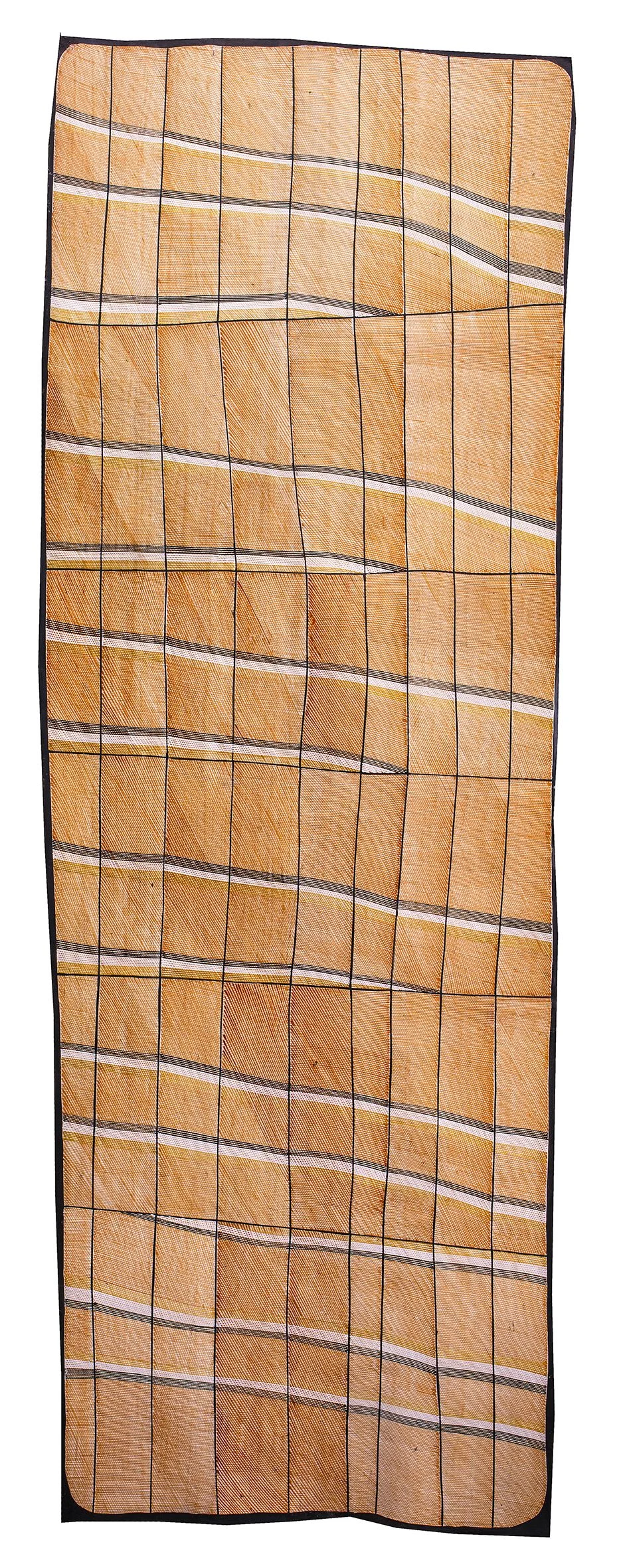
Artiste : Kay Lindjuwanga
Titre de l'œuvre : Milmilngkan
Pigments naturels sur écorce
Format : 202 x 73 cm
Provenance et certificat : centre d'art aborigène de Maningrida
Référence de la peinture : 2515-08
© Photo : Aboriginal signature with the courtesy of the artist & Maningrida Arts

Artiste : Kay Lindjuwanga
Titre de l'œuvre : Milmilngkan
Pigments naturels sur écorce
Format : 148 x 54 cm
Provenance et certificat : centre d'art aborigène de Maningrida
Référence de la peinture : 6007-10
© Photo : Aboriginal signature with the courtesy of the artist & Maningrida Arts

Artiste : Kay Lindjuwanga
Titre de l'œuvre : Buluwana at Dilebang
Pigments naturels sur écorce
Format : 143 x 65 cm
Provenance et certificat : centre d'art aborigène de Maningrida
Référence de la peinture : 368-10
© Photo : Aboriginal signature with the courtesy of the artist & Maningrida Arts

Artiste : Rosina Gunjarrwanga
Titre de l'œuvre : Wak Wak
Pigments naturels sur écorce
Format : 112x50cm
Référence de la peinture : 353-19
Explications pour cette œuvre :
This painting depicts a sacred site at 'Kurrurldul', an outstation south of Maningrida. The 'rarrk', or abstract crosshatching, on this work represents the design for the crow totem ancestor called 'Djimarr'. Today this being exists in the form of a rock, which is permanently submerged at the bottom of Kurrurldul Creek. The 'Djimarr' rock in the stream at Kurrurldul is said to move around and call out in a soft hooting tone at night. Both the stone itself and the area around it are considered sacred.
The imagery represents the rock mentioned above at the bottom of Kurrurldul creek, which is the final transmutation of the dreaming ancestor 'Djimarr'. Finally, the pattern used here is also the crow design used in the sacred 'Mardayin' ceremony, which is a large regional patri-moiety ceremony now rarely conducted in central and eastern Arnhem Land.
© Photo & text : Aboriginal signature with the courtesy of the artist & Maningrida Arts

Artiste : Deborah Wurrkidj
Titre de l'œuvre : Lorrkon (Hollow Log)
Pigments naturels sur tronc d’eucalyptus
Format : 202 x 18 x 19
Référence de la peinture : 54-20
Explications pour cette œuvre :
The Lorrkon or bone pole coffin ceremony was the final ceremony in a sequence of mortuary rituals celebrated by the people of Arnhem Land. This ceremony involves the placing of the deceased’s bones into a hollow log which was decorated with painted clan designs and ceremonially placed into the ground where it remained until it slowly decayed over many years.
The log is made from a termite hollowed Stringybark tree (Eucalyptus tetradonta) and is decorated with totemic emblems. The western Arnhem Land version of the Lorrkon ceremony involves the singing of sacred songs to the accompaniment of karlikarli, a pair of sacred boomerangs used as rhythm instruments. During the final evening of the ceremony, dancers decorate themselves with kapok down, or today, cotton wool and conduct much of the final segments of the ceremony in the secrecy of a restricted mens’ camp. The complete ceremony may stretch over a period of two weeks, but on the last night the bones of the deceased, which have been kept in a bark container or today wrapped in cloth and kept in a suitcase are taken out, are painted with red ochre and placed inside the hollow log. This ceremony may take place many years after the person has died.
At first light on the final morning of the Lorrkon ceremony, the men appear, coming out of their secret bush camp carrying the pole towards the women’s camp. The two groups call to each other using distinct ceremonial calls. The women have prepared a hole for the pole to be placed into and when it is stood upright, women in particular kinship relationships to the deceased dance around the pole in a jumping/shuffling motion.
The Lorrkon is then often covered with a tarpaulin and left to slowly decay.
The design depicted on this lorrkkon is wak (Black Crow Ancestor), which relates to a sacred site at 'Kurrurldul', an outstation south of Maningrida. The 'rarrk', or abstract crosshatching, on this work represents the design for the crow totem ancestor called 'Djimarr'. Today this being exists in the form of a rock, which is permanently submerged at the bottom of Kurrurldul Creek. The 'Djimarr' rock in the stream at Kurrurldul is said to move around and call out in a soft hooting tone at night. Both the stone itself and the area around it are considered sacred.
The imagery represents the rock mentioned above at the bottom of Kurrurldul creek, which is the final transmutation of the dreaming ancestor 'Djimarr'. Finally, the pattern used here is also the crow design used in the sacred 'Mardayin' ceremony, which is a large regional patri-moiety ceremony now rarely conducted in central and eastern Arnhem Land
© Photo & text : Aboriginal signature with the courtesy of the artist & Maningrida Arts

Artiste : Kenan Namunjdja
Titre de l'œuvre : Kunkurra (spiral wind)
Pigments naturels sur tronc d’eucalyptus
Format : 142x18.5x17cm
Référence de la peinture : 321-20
Explications pour cette œuvre :
'Kunkurra', the spiralling wind is associated with several sites in the Kardbam clan estate. On one level, this painting can be interpreted as a depiction of the kinds of mini-cyclones common during the wet season in Arnhem Land, where the artist lives. In this painting, Kunkurra also relates specifically to a site called Bilwoyinj, near Mankorlod.
At this site, two of the most important Kuninjku creation beings, a father and son known as na-korrkko, are believed to have hunted and eaten a goanna. They left some of the goanna fat behind at the site, which turned into the rock that still stands there today. The word Bilwoyinj, which is the name of this site, also refers to the fat of the goanna. Bilwoyinj site is also a ceremonial ground for a ceremony called Yabbaduruwa, a major ceremony owned by the Yirridja patrimoiety. The Yabbaduruwa ceremony is primarily concerned with initiation, land ownership and promoting the cyclical regeneration of the human and natural worlds.
© Photo & text : Aboriginal signature with the courtesy of the artist & Maningrida Arts
Artiste : Paul Nabulumo Namarinjmak
Titre de l'œuvre : Waterholes (Kubumi)
Pigments naturels sur tronc d’eucalyptus
Format : 156 x 19cm
Référence de la peinture : 46-19
Explications pour cette œuvre :
Kubumi is a sacred site on the Mann River. This is its story, as told by a ritual manager of the site, Lulu Laradjbi, with the authority of her husband Mick Kubarkku, a land owner of that country. Nabulumo is their son. Ngalyod the Rainbow Serpent pierced the rock at a place called Bolerrhlerrh and journeyed downstream from there to Ngalmalanj. The camping place Kubumi is downstream from there but at Ngalmalanj the serpent was blocked. It pushed down into the riverbed, pushed into the earth, sinking down forever. Now it lives under the rocky riverbed. That site continues downstream. Upstream is the site Molerrhlerrh, which has a waterfall and a big waterhole. There the serpent moved inside, downstream, to the lower region.
During the dry season at Kubumi, the Mann River shrinks to a series of deep waterholes, exposing the tunnels through the rocky outcrop that interconnect the pools.
© Photo & text : Aboriginal signature with the courtesy of the artist & Maningrida Arts

Artiste : Sylvia Marrgawaidj
Titre de l'œuvre : Mat
Pandanus Fibre and Natural Dyes
Format : 200cm diameter fringe, 121 diameter woven area
Référence de la peinture : 3093-18
Explications pour cette œuvre :
Mats can vary greatly. Artists commonly use a mix of naturally dyed and undyed fibre to create a striking variation of coloured bands. Some artists also incorporate different types of looping to produce different patterns and textured finishes. Each type of mat, fibre bag, basket and dilly bag has its own name in the various languages spoken in the Maningrida region.
© Photo & text : Aboriginal signature with the courtesy of the artist & Maningrida Arts
Artiste : Deborah Wurrkidj
Titre de l'œuvre : Lorrkon (Hollow Log)
Pigments naturels sur tronc d’eucalyptus
Format : 202 x 18 x 19
Référence de la peinture : 54-20
Explications pour cette œuvre :
The Lorrkon or bone pole coffin ceremony was the final ceremony in a sequence of mortuary rituals celebrated by the people of Arnhem Land. This ceremony involves the placing of the deceased’s bones into a hollow log which was decorated with painted clan designs and ceremonially placed into the ground where it remained until it slowly decayed over many years.
The log is made from a termite hollowed Stringybark tree (Eucalyptus tetradonta) and is decorated with totemic emblems. The western Arnhem Land version of the Lorrkon ceremony involves the singing of sacred songs to the accompaniment of karlikarli, a pair of sacred boomerangs used as rhythm instruments. During the final evening of the ceremony, dancers decorate themselves with kapok down, or today, cotton wool and conduct much of the final segments of the ceremony in the secrecy of a restricted mens’ camp. The complete ceremony may stretch over a period of two weeks, but on the last night the bones of the deceased, which have been kept in a bark container or today wrapped in cloth and kept in a suitcase are taken out, are painted with red ochre and placed inside the hollow log. This ceremony may take place many years after the person has died.
At first light on the final morning of the Lorrkon ceremony, the men appear, coming out of their secret bush camp carrying the pole towards the women’s camp. The two groups call to each other using distinct ceremonial calls. The women have prepared a hole for the pole to be placed into and when it is stood upright, women in particular kinship relationships to the deceased dance around the pole in a jumping/shuffling motion.
The Lorrkon is then often covered with a tarpaulin and left to slowly decay.
The design depicted on this lorrkkon is wak (Black Crow Ancestor), which relates to a sacred site at 'Kurrurldul', an outstation south of Maningrida. The 'rarrk', or abstract crosshatching, on this work represents the design for the crow totem ancestor called 'Djimarr'. Today this being exists in the form of a rock, which is permanently submerged at the bottom of Kurrurldul Creek. The 'Djimarr' rock in the stream at Kurrurldul is said to move around and call out in a soft hooting tone at night. Both the stone itself and the area around it are considered sacred.
The imagery represents the rock mentioned above at the bottom of Kurrurldul creek, which is the final transmutation of the dreaming ancestor 'Djimarr'. Finally, the pattern used here is also the crow design used in the sacred 'Mardayin' ceremony, which is a large regional patri-moiety ceremony now rarely conducted in central and eastern Arnhem Land
© Photo & text : Aboriginal signature with the courtesy of the artist & Maningrida Arts
Artiste : Kenan Namunjdja
Titre de l'œuvre : Kunkurra (spiral wind)
Pigments naturels sur tronc d’eucalyptus
Format : 142x18.5x17cm
Référence de la peinture : 321-20
Explications pour cette œuvre :
'Kunkurra', the spiralling wind is associated with several sites in the Kardbam clan estate. On one level, this painting can be interpreted as a depiction of the kinds of mini-cyclones common during the wet season in Arnhem Land, where the artist lives. In this painting, Kunkurra also relates specifically to a site called Bilwoyinj, near Mankorlod.
At this site, two of the most important Kuninjku creation beings, a father and son known as na-korrkko, are believed to have hunted and eaten a goanna. They left some of the goanna fat behind at the site, which turned into the rock that still stands there today. The word Bilwoyinj, which is the name of this site, also refers to the fat of the goanna. Bilwoyinj site is also a ceremonial ground for a ceremony called Yabbaduruwa, a major ceremony owned by the Yirridja patrimoiety. The Yabbaduruwa ceremony is primarily concerned with initiation, land ownership and promoting the cyclical regeneration of the human and natural worlds.
© Photo & text : Aboriginal signature with the courtesy of the artist & Maningrida Arts

Artiste : Jack Nawilil
Titre de l'œuvre : Ngalkodjek (daluk) woman ceremonial object
Paperbark (Melaleuca Quinquenervia) with Natural Dyes
Format : 176x8x8cm
Référence de la peinture : 978-19
Explications pour cette œuvre :
The following information comes from an interview with Jack Nawilil transcribed by linguists Murray Garde and Margaret Carew in December 2017. The narratives represented in Nawilil’s artworks are extremely complex and often antithetical to Western knowledge systems. His artworks reference and manifest multiple places, clans and events that span vast distances and timeframes. To audiences who are not initiated and socialised in the local practices and history, the true and complete meaning of these artworks cannot be fully grasped. His artworks challenge the viewer to grapple with a different way of being in, and understanding, the world.
This one here [ceremonial object], I have drawn my own personal designs on it. This represents a woman, she travelled a long way, all the way from Elcho Island. This ceremonial object is one of the women, her name is Ngalkodjek. She came this way, to the west from north-east Arnhem Land. She has many things: kunkaninj (digging stick) that she walked with across the land, and kunmadj (dilly bags). She named and created the country as she walked.
There is another one however. Same story, but it is a different one and represents a food plant, it’s from the saltwater country. In my country at Koenidjangka way. I made the plant food emblem, and the name of that plant is manbingkanj. It is a sacred thing from the Mardayin ceremony, but I have adapted it to make it a secular version. This thing here, I made it, this object is called karlanj and it represents a plant food, manme.
© Photo Aboriginal signature with the courtesy of the artist & Maningrida Arts
© Text : Maningrida Arts

Artiste : Jack Nawilil
Titre de l'œuvre : Ngalkodjek (daluk) woman ceremonial object
Fibre Sculpture, plumes d’oiseau, cheveux
Format : 175 x 100cm
Référence de la peinture : 1402-19
Explications pour cette œuvre :
The following information comes from an interview with Jack Nawilil transcribed by linguists Murray Garde and Margaret Carew in December 2017. The narratives represented in Nawilil’s artworks are extremely complex and often antithetical to Western knowledge systems. His artworks reference and manifest multiple places, clans and events that span vast distances and timeframes. To audiences who are not initiated and socialised in the local practices and history, the true and complete meaning of these artworks cannot be fully grasped. His artworks challenge the viewer to grapple with a different way of being in, and understanding, the world.
This one here [ceremonial object], I have drawn my own personal designs on it. This represents a woman, she travelled a long way, all the way from Elcho Island. This ceremonial object is one of the women, her name is Ngalkodjek. She came this way, to the west from north-east Arnhem Land. She has many things: kunkaninj (digging stick) that she walked with across the land, and kunmadj (dilly bags). She named and created the country as she walked.
There is another one however. Same story, but it is a different one and represents a food plant, it’s from the saltwater country. In my country at Koenidjangka way. I made the plant food emblem, and the name of that plant is manbingkanj. It is a sacred thing from the Mardayin ceremony, but I have adapted it to make it a secular version. This thing here, I made it, this object is called karlanj and it represents a plant food, manme.
© Photo Aboriginal signature with the courtesy of the artist & Maningrida Arts
© Text : Maningrida Arts

Artiste : Jack Nawilil
Titre de l'œuvre : Ngalkodjek (daluk) woman ceremonial object
Fibre Sculpture, plumes d’oiseau, cheveux
Format : 184x8x8cm
Référence de la peinture : 979-19
Explications pour cette œuvre :
The following information comes from an interview with Jack Nawilil transcribed by linguists Murray Garde and Margaret Carew in December 2017. The narratives represented in Nawilil’s artworks are extremely complex and often antithetical to Western knowledge systems. His artworks reference and manifest multiple places, clans and events that span vast distances and timeframes. To audiences who are not initiated and socialised in the local practices and history, the true and complete meaning of these artworks cannot be fully grasped. His artworks challenge the viewer to grapple with a different way of being in, and understanding, the world.
This one here [ceremonial object], I have drawn my own personal designs on it. This represents a woman, she travelled a long way, all the way from Elcho Island. This ceremonial object is one of the women, her name is Ngalkodjek. She came this way, to the west from north-east Arnhem Land. She has many things: kunkaninj (digging stick) that she walked with across the land, and kunmadj (dilly bags). She named and created the country as she walked.
There is another one however. Same story, but it is a different one and represents a food plant, it’s from the saltwater country. In my country at Koenidjangka way. I made the plant food emblem, and the name of that plant is manbingkanj. It is a sacred thing from the Mardayin ceremony, but I have adapted it to make it a secular version. This thing here, I made it, this object is called karlanj and it represents a plant food, manme.
© Photo Aboriginal signature with the courtesy of the artist & Maningrida Arts
© Text : Maningrida Arts

Exposition organisée par la Galerie Aboriginal Signature Estrangin en partenariat avec les artistes et le centre d'art de Maningrida Art and Culture.
Maningrida Arts & Culture est une organisation multi-arts composée d'un grand groupe d'artistes, d'interprètes et de chanteurs, des designers qui travaillent à travers Babbarra Designs, doté d’un musée et d’une riche collections de pratiques et matériaux liés à l'art et aux cultures de la région. Cette organisation artistique unique et complexe est située sur les terres côtières du nord de l'Australie du peuple Kunibidji qui vivent ici depuis des temps immémoriaux. Depuis plus de 50 ans, le public de toute l'Australie et du monde entier est captivé par le travail des grands artistes de cette région.
Artiste : David Brian
Titre de l'œuvre : Barlangu (Shark)
Pigments naturels sur écorce
Format : 132x70cm
Référence de la peinture : 1129-19
Explications pour cette œuvre :
Barlangu (shark) is one of the most important ancestors for Balngarra clan. During the creation period, barlangu travelled with barrangu (Saratoga). It journeyed from Yirrkala in east Arnhem Land and transformed into a rock at Malnjangarnak, which is also called bulmaji (hammerhead shark). Barlangu shares a song line with wankurr, a sacred mardayin ceremonial dilly bag and also kunkaninj (digging stick), which is used to dig yams. These totemic ancestors are all duwa moiety and share the same songline. Barlangu connects coastal and inland country. “It’s the same saltwater from the Blyth River to Kinoedjanga”, Balang explains. “It can be really dangerous to get too close to that water. If you’re in a plane or boat, it’ll suck up that water and try and kill you. You must always go around.”
© Photo & text : Aboriginal signature with the courtesy of the artist & Maningrida Arts
Demander le prix de l'œuvre