
Exposition d’art Aborigène “Desert Voices: Painting the Martu Memory” - Aboriginal art from Australia
En partenariat avec les artistes du centre d’art de Martumili.
A la galerie Aboriginal Signature Estrangin : 101 rue Jules Besme, 1081 Bruxelles.
Vernissage sur RDV le mardi 21 janvier 2025 de 14h à 21h30.
A 20h - discours du directeur de la galerie et drink.
RSVP - réserver votre visite
Ensuite la galerie vous reçoit sur RDV jusqu’au samedi 15 février 2025, du mardi au samedi, de 11h à 19h : vous pouvez réserver votre visite dés à présent dans notre agenda ici.
“Desert Voices: Painting the Martu Memory”
Nous sommes très honorés d’accueillir à Bruxelles l’exposition “Desert Voices: Painting the Martu Memory” avec les œuvres des grands artistes de Martumili situés dans les territoires éloignés du Great Sandy Desert de Western Australia.
Cette exposition montée en partenariat avec la communauté artistique de Martumili est assez rare en Europe et vous propose 30 œuvres réalisées par 14 artistes, hommes et femmes, nées entre 1919 et 1994. Peintres de tous premiers plans. ils traversent ensemble trois générations, des grands artistes seniors Nora Nungabar (1919-dec), Mabel Mitutu Wakarta (1929-dec), Jakayu Biljabu (1936-dec), Bugai Whyoulter (1939), Yikartu Bumba (1939), et la plus jeune garde avec Marlene Anderson (1974), Cyril Whyoulter (1985), Wilson Mandijalu (1985), Corban Clause Williams (1994).
Dans leurs œuvres, ils célèbrent leur connexion au territoire, honorent leurs lieux mémoriels éloignés du Great Sandy Desert, et traduisent leur savoir ancestral avec profondeur et densité.
Deux peintures magistrales des artistes Bugai Whyoulter (1939) et Yikartu Bumba également née en 1939, de 300 x 125 cm évoquent pour l’une le lieu sacré de Wantili et ses dunes de sable à perte de vue. Wantili est un site culturel fondamental aux temps de la Création. Il est tout proche du trou d’eau numéro 25 de la Canning Stock Road.

Peinture de l’artiste Bugai Whyoulter (1939) - Wantili (near Well 25) - 300 x 125 cm - 23-1290 © Photo Aboriginal Signature Estrangin Gallery with the courtesy of the artist and Martumili.
La peinture magistrale de Yikartu Bumba évoque l’histoire du marais Yirtal, situé dans la région des lacs Percival. Le site est entouré d’une végétation difficile qui doit être défrichée avant d'accéder à l’eau et en particulier aux sources de Jupurl et Jakapinka.
Yirkartu a hérité de l’autorité sur ces lieux ancestraux, par l'intermédiaire de son père, qui le tenait lui-même de l’ancien Wirnpa, l'un des plus puissants des hommes ancestraux jila (serpents), qui fut le dernier à traverser le désert durant le Jukurrpa ou Temps de la Création. Dans ses voyages épiques, Wirnpa rencontra et festoya avec de nombreux autres êtres ancestraux, échangea des objets cérémoniels, et créa une série de lois et de cérémonies différentes. Lorsqu'il revint enfin chez lui, il chercha ses nombreux enfants, mais découvrit qu'ils étaient déjà morts. Ils s'étaient allongés et étaient devenus les sources salées des lacs Percival. Wirnpa pleura la perte de ses enfants avant de se transformer lui-même en serpent et de pénétrer dans le marais où il réside encore.

Peinture de l’artiste Yikartu Bumba (1939) - Jupurrl Warla - 300 x 125 cm - 19-921 © Photo Aboriginal Signature Estrangin Gallery with the courtesy of the artist and Martumili.
Premiers contacts de 1901 à 1960
Les premiers contacts entre les Martus et le monde occidental, tel un choc de deux civilisations, débutèrent avec l’établissement entre 1901 et 1907 d’une barrière de 3200 km à travers le pays Martu pour éviter la dissémination des lapins.
Puis entre 1906 et 1907 avec la création de la Canning Stock Route pour acheminer des bovins à travers le désert. Cette route de transhumance est la plus longue au monde, et engendrera dans leurs déserts de difficiles confrontations autour dés le départ le jusqu'aux années 1920.

Bivouac lors d’une expédition dans le pays Martu en 2018, proche du Lake Disappointment sur le Talawana Track © Photo with the courtesy of Bertrand Estrangin.
DERNIERS NOMADES de Western Australia en 1977
Martumili Artists représente les locuteurs des clans de Manyjilyjarra, Warnman, Kartujarra, Pultjarra et Martu Wangka dans l’Etat de Western Australia.
Les œuvres de nombreux artistes sont ainsi imprégnées d’un savoir incommensurable, certains ayant rencontré pour la première fois le monde occidental en 1960.
Et jusqu’en 1977 lors d’une expédition conduite dans leur désert par un médecin pour retrouver Warri et Yatungka, un couple d’Aborigènes vivant depuis plusieurs décennies dans une autarcie de plus en plus précaire face aux sécheresses itératives.
Cette épopée et le sauvetage de ce couple fera l’objet d’un livre « Les derniers nomades d’Australie », soulignant la vie ancestrale multi-millénaires de leur clan.

Peinture de l’artiste Bugai Whyoulter (1939) - Wantili (near Well 25) - 150 x 150 cm - 22-1244. © Photo Aboriginal Signature Estrangin Gallery with the courtesy of the artist and Martumili.
Récupération de leur territoire en 2002
Après plus de 20 ans de lutte, les Aborigènes Martu ont récupéré en 2002 un des territoires les plus vastes d’Australie dans le cadre de la loi du Native Act Title.
Aujourd’hui, de part le monde, les œuvres des artistes de Matumili sont accrochées aussi bien aux cimaises des grands musées Australiens, que de l’Université de Virginie aux USA, et de nombreuses collections privées dont celle de la Reine d’Angleterre, Elisabeth II.

Le puit n°37 de la Canning Stock Rock, considéré comme un puit hanté suite aux évènements du conflit entre les Martus et les occidentaux conducteurs de troupeaux. © Photo : Bertrand Estrangin - 2018.
Découvrez les peintures de l’exposition :
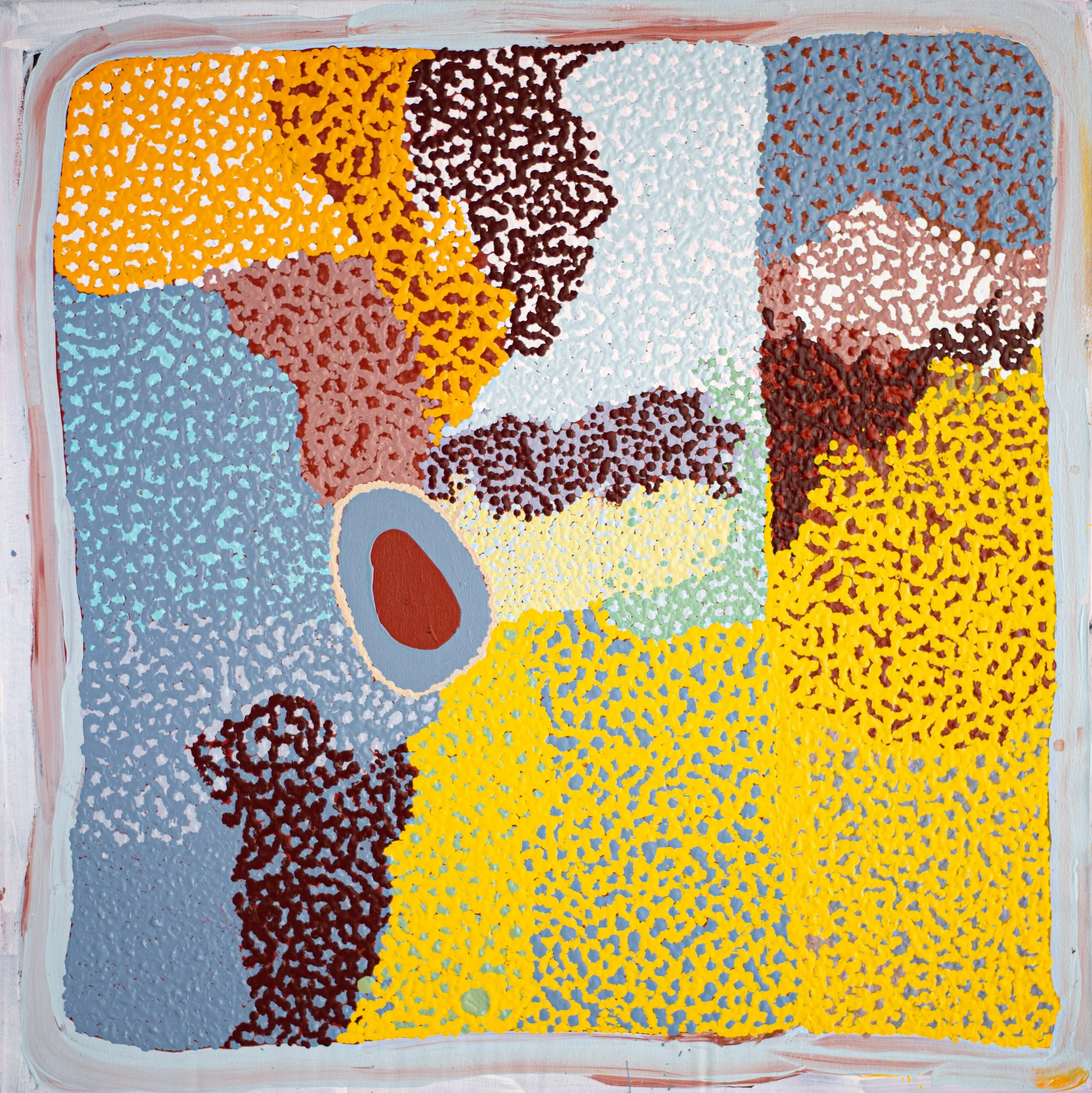
Artiste : Yikartu Bumba (1939)
Titre de l'œuvre : Laripuka Water Hole
Format : 91 x 91 cm
Provenance et certificat : centre d'art aborigène de Martumili
Référence de cette peinture : 24-766
Demander le prix de l'œuvre / Enquiry
Explications pour cette œuvre :
Laripuka is a waterhole kayili (north) of the Percival Lakes region of Western Australia's Great Sandy desert. This is Yikartu’s ngurra (home Country, camp); she was born here. Yikartu recalls travelling here with her family and Grandmother in the pujiman (traditional, desert dwelling) days.
The Western Desert term ‘ngurra’ is hugely versatile in application. Broadly denoting birthplace and belonging, ngurra can refer to a body of water, a camp site, a large area of Country, or even a modern house. People identify with their ngurra in terms of specific rights and responsibilities, and the possession of intimate knowledge of the physical and cultural properties of one’s Country. This knowledge is traditionally passed intergenerationally through family connections. Painting ngurra, and in so doing sharing the Jukurrpa (Dreaming) stories and physical characteristics of that place, has today become an important means of cultural maintenance. Physical maintenance of one’s ngurra, like cultural maintenance, ensures a site’s wellbeing, and is a responsibility of the people belonging to that area.
© Photo Aboriginal Signature Estrangin Gallery, and text with the courtesy of the Artist and Martumili Arts

Artiste : Yikartu Bumba (1939)
Titre de l'œuvre : Untitled
Format : 91 x 91 cm
Provenance et certificat : centre d'art aborigène de Martumili
Référence de cette peinture : 23-1064
Demander le prix de l'œuvre / Enquiry
Explications pour cette œuvre :
This is Yikartu’s Country- her ‘ngurra’ (home Country, camp). People identify with their ngurra in terms of specific rights and responsibilities, and the possession of intimate knowledge of the physical and cultural properties of one’s Country. Painting ngurra, and in so doing sharing the Jukurrpa (Dreaming) stories and physical characteristics of that place, has today become an important means of cultural maintenance.
Yikartu’s ngurra encompasses the Country that she and her family walked in the pujiman (traditional, desert-dwelling) era. Yikartu was born at Lalyipuka. She grew up, walked and hunted primarily within Yulparija Country, north of Manyjilyjarra Country, and through to the Percival Lakes area, at the northern boundary of the Martu homelands. She continued to live nomadically before eventually deciding to move to Jigalong Mission along with many other relatives following an extreme and prolonged drought in the 1960s.
Portrayed in this work are features of Yikartu’s ngurra, such as the dominant permanent red tali (sandhills), warta (trees, vegetation), and the individually named water sources she and her family camped at. These include Yulpu, Yimiri, Kupankurlu,Kurturrara, Wirnpa, Jurnpanja, Rulu-rulu, Taparl-taparl, Wirrkujapayi, Tayiku and Puntita. Rock holes, waterholes, soaks and springs were all extremely important sites for Martu people during the pujiman period, and are generally depicted with circular forms.
The encyclopaedic knowledge of the location, quality and seasonal availability of the hundreds of water bodies found in one’s Country sustained Martu as they travelled across their Country, hunting and gathering, visiting family, and fulfilling ceremonial obligations. They would traverse very large distances annually, visiting specific areas in the dry and wet season depending on the availability of water and the corresponding cycles of plant and animal life on which hunting and gathering bush tucker was reliant.
As they travelled and hunted they would also burn areas of Country, generating a greater diversity of plant and animal life.
© Photo Aboriginal Signatrure Estrangin Gallery, and text with the courtesy of the Artist and Martumili Arts
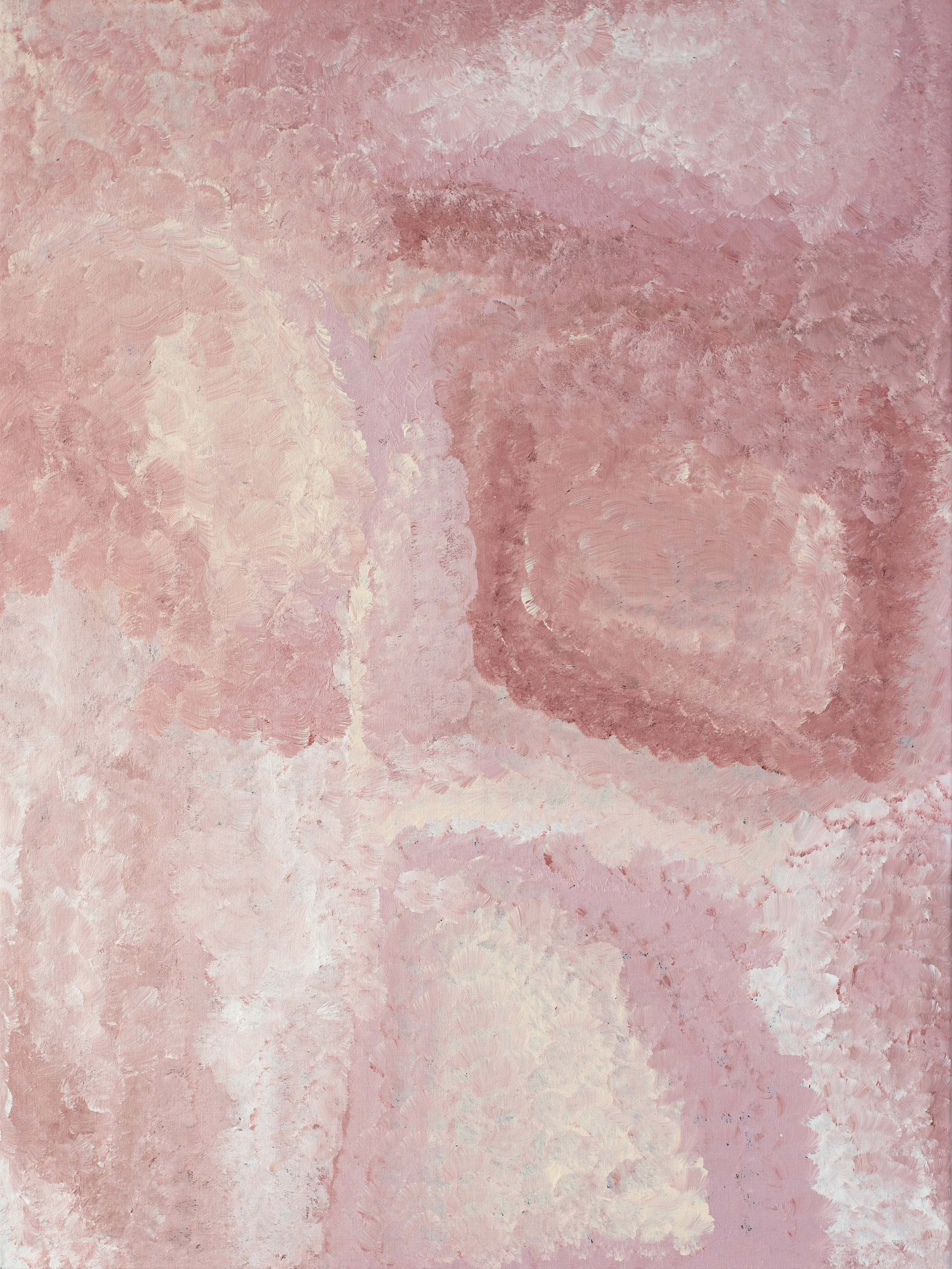
Artiste : Bugai Whyoulter (1939)
Titre de l'œuvre : Parnngurr
Format : 91 x 122 cm
Provenance et certificat : centre d'art aborigène de Martumili
Référence de cette peinture : 24-556
Demander le prix de l'œuvre / Enquiry
Explications pour cette œuvre :
"We were climbing Parnngurr hill; we were frightened. Kartiya (Europeans) would walk around, trying to catch Martu people. We would run up the hill and hide. We watched them catch people. We were eating flour that white people gave us. It was horrible.
From [Parnngurr rockhole], we got in the truck and went with the white people to Jigalong. Kumpaya [Girgirba], Jakayu [Biljabu] and Ngamaru [Bidu], we were all on top of the hill looking at the white people."
- Bugai Whyoulter
Parnngurr rockhole is located 370km east of Newman. This site lies within Bugai’s ngurra (home Country, camp), the area which she knew intimately and travelled extensively with her family in her youth. For many Martu, including Bugai, Parnngurr also signifies the location at which their nomadic bush life came to an end. Poignantly described here by Bugai, it was here that a group of 29 Martu were picked up by the Native Welfare Department to be taken to Jigalong Mission in 1963. Collectively the group had come to the decision to move to the mission as a result of an extended drought, which had caused a scarcity in food and water resources.
The group also wanted to join their families, who had already moved to Jigalong.
At the junction of three linguistic groups; Manyjilyjarra, Kartujarra, and Warnman, Parnngurr rockhole was a critical and permanent source of water during the pujiman (traditional, desert born) era, supporting many ritual large gatherings. During this nomadic period families stopped and camped here depending on the seasonal availability of water and the corresponding cycles of plant and animal life on which hunting and gathering bush tucker was reliant. At Parnngurr and other similarly important camp sites families would meet for a time before moving to their next destination. Parnngurr rockhole and its surrounds are physically dominated by distinctively red tali (sandhills), covered sparingly with spinifex and low lying shrub.
Parnngurr community, just north of Parnngurr rockhole, was created during the Return to Country movement of the 1980s, coinciding with the recognition of Aboriginal land rights and native title. The community was named aer its’ original primary water source. Until recently the community was widely known as Coon Creek, aer the European name for the ephemeral creek running alongside the community.
© Photo Aboriginal Signature Estrangin Gallery, and text with the courtesy of the Artist and Martumili Arts
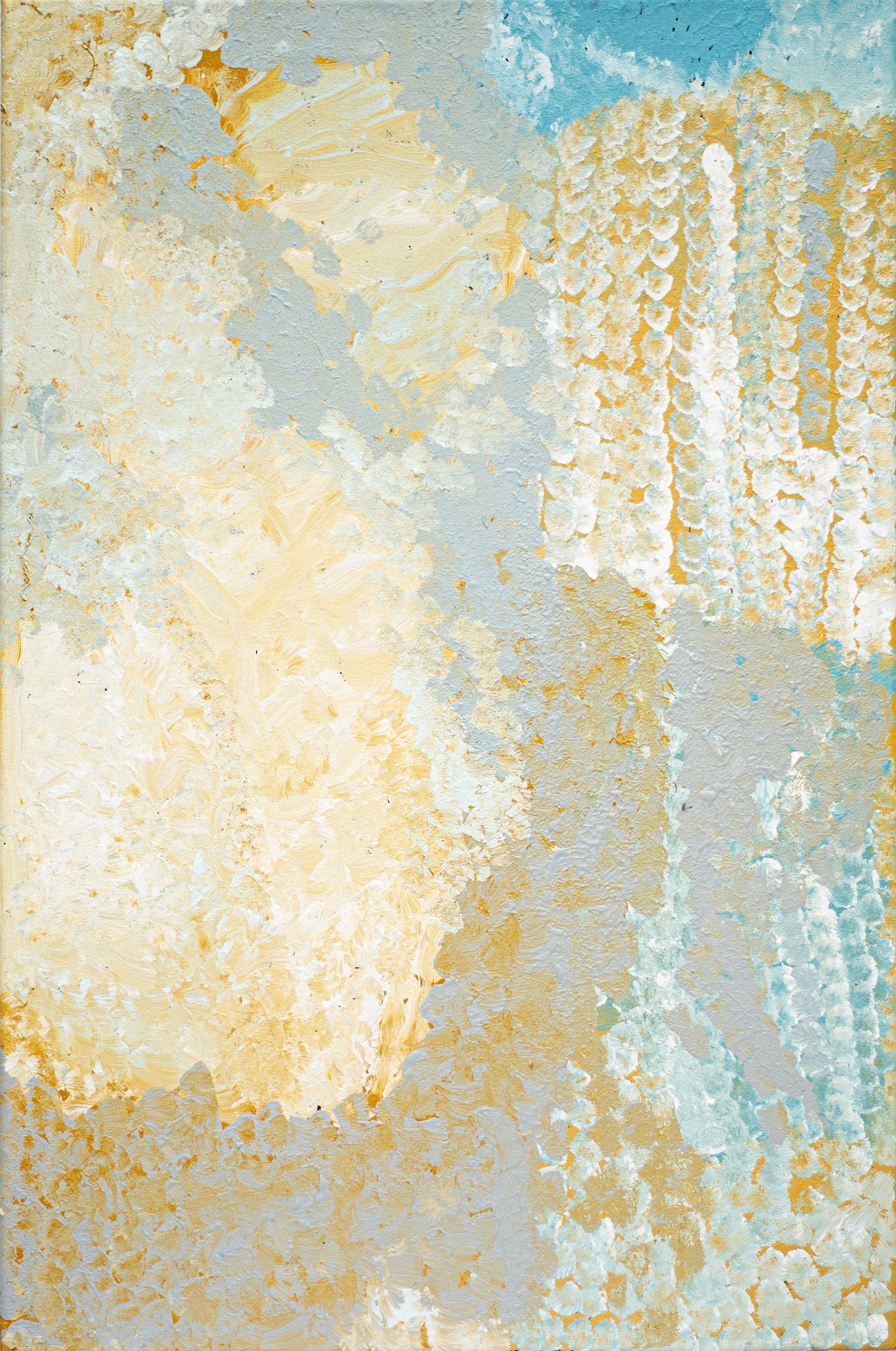
Artiste : Bugai Whyoulter (1939)
Titre de l'œuvre : Punmu
Format : 61 x 91 cm
Provenance et certificat : centre d'art aborigène de Martumili
Référence de cette peinture : 24-1111
Demander le prix de l'œuvre / Enquiry
Explications pour cette œuvre :
"This is daddy's ngurra (home Country, camp), mummy's ngurra. I used to go to Punmu to visit people there."
- Bugai Whyoulter
Punmu refers to a region and an Aboriginal community within its vicinity, located 670km North-East of Newman. Created during the return to Country movement of the 1980s, with the recognition of Martu land rights and native title, the community was named after a nearby Jukurrpa (Dreaming) story. Punmu community sits on the edge of a large salt lake known as Nyayartakujarra, or Lake Dora. The lake runs south into Karlamilyi River (Rudall River). Surrounding Punmu are numerous fresh water soaks and the red tali (sandhills) typical of the area. The most frequently visited yinta (permanent springs) around Punmu include Wirlarra, Rawa, Yilyara, Jila-jila and Tuu-tuu.
Bugai grew up in and travelled through this Country during the pujiman (traditional, desert-dwelling) era. At Punmu, Bugai and her family would collect minyarra (bush onions) and hunt jipuku (rabbit). Bugai recalls a specific time when she travelled here with her mama (father) as a juri (beautiful, good) time. She paints the Country around Punmu, paying special aention to the many yenta and tuwa (sandhills), and to the pastel palette characteristic to the expansive white plains of Nyayartakujarra.
The Country around Punmu features in several Jukurrpa (Dreaming) stories. Of particular importance is the story of the Jila Kujarra (Two Snakes), one of the key Jukurrpa narratives for the Martu. Though the story belongs to Warnman people, it is shared across the Western Desert with several other language groups. The narrative centres on the travels of two snakes as they are pursued by the Niminjarra, spiritual ancestors of the Warnman people.
© Photo Aboriginal Signature Estrangin Gallery, and text with the courtesy of the Artist and Martumili Arts

Artiste : Bugai Whyoulter (1939)
Titre de l'œuvre : Wantili (near Well 25)
Format : 300 x 125 cm
Provenance et certificat : centre d'art aborigène de Martumili
Référence de cette peinture : 23-1290
Demander le prix de l'œuvre / Enquiry
Explications pour cette œuvre :
(As translated by Bugai’s grandson, Cyril Whyoulter) “Bugai always tells about Wantili because she grew up around Wantili. Her family would travel between Wantili, Kaalpa, Juntujuntu, Raarki, and Wuranu Wells along the Canning Stock Route. She paints around Wantili. She saw whitefellas there for the first time, Canning mob when they were travelling up and down the stock route with the bullock. She was a young girl walking around at Wantili. Big mob of people they been walking around there. They were travelling making the road, Canning and his drovers. They were running away from those whitefellas, watching them from a long distance. She was a teenager when she was travelling around there with her four mothers and one daddy. Her mummy and daddy passed away in Jigalong. They used to travel around in family groups, Bugai and Jakayu (Biljabu), and Jakayu’s nyupa (partner) Phillip Biljabu. They met Kumpaya (Girgaba) coming from Kunkun (Kunawarritji) area.”
Bugai returned to the Wantili area as a young woman, when she worked driving cattle along the Stock Route.
Wantili is a large jurnu (soak) and lyinji (clay pan) near Well 25 on the Canning Stock Route. It lies close to Bugai’s birthplace, and is her ngurra (home country). The area is dominated by claypans surrounded by tuwa (sandhills). Following rain the claypans are filled with water, with the overflow from nearby waterholes flowing to Wantili. At that time, Wantili becomes an important place for obtaining fresh water for drinking and bathing. Wantili is significant for the fact that at this site Kartujarra, Manyjilyjarra, Putujarra and Warnman people would all come together for ceremonies. Many jiwa (stones used by women for grinding seeds) from these times can still be found there today.
Wantili is one of the many sites featured in the epic Minyipuru (Seven Sisters) jukurrpa (dreamtime) narrative. The story follows the movement of seven sisters travelling all the way across the desert, beginning at Roebourne on the coast of Western Australia, as they are pursued by a lusful old man, Yurla. As the women travel they stop to rest at many sites to eat, dance, rest and sing, on the way leaving behind an assortment of articles that become formations in the land.
The Seven Sisters rested at Wantili before throwing seeds, then continuing their journey on to Tiwa, Juntujuntu, and then onward to Pangkapini, where they finally escaped Yurla by flying into the sky to become the Pleaides constellation of stars.
© Photo Aboriginal Signature Estrangin Gallery, and text with the courtesy of the Artist and Martumili Arts

Artiste : Yikartu Bumba (1939)
Titre de l'œuvre : Jupurrl
Format : 91 x 91 cm
Provenance et certificat : centre d'art aborigène de Martumili
Référence de cette peinture : 24-1054
Demander le prix de l'œuvre / Enquiry
Explications pour cette œuvre :
“This one a yinta (permanent springs) in my ngurra (home Country, camp), Jupurrl. It's kakarra (east) of Kulyakartu and kayili (north) side of Wirnpa. I was a married woman when I was walking around this place, pujiman (traditional, desert dwelling) time. I married a good man. There’s lots of kapi (water) there. Lots of yukari (green grass, vegetation). Plenty of bushtucker, pussycat and goanna.
There’s no kapi when you first get there, but you dig him up and then there’s lots of kapi. We’ve got to take all the kids to that ngurra. Show them my daddy’s ngurra. There’s another waterhole, not far from there called Jakapinka. A jila (snake) made that kapi. It’s my brother’s Country.”
- Yikartu Bumba
© Photo Aboriginal Signature Estrangin Gallery, and text with the courtesy of the Artist and Martumili Arts

Artiste : Yikartu Bumba (1939)
Titre de l'œuvre : Jutupa ngurra (home/Country)
Format : 76 x 122 cm
Provenance et certificat : centre d'art aborigène de Martumili
Référence de cette peinture : 24-547
Demander le prix de l'œuvre / Enquiry
Explications pour cette œuvre :
"This is Taparl-taparl soak. The story is about an eagle who had two wives. He became jealous and he built the biggest fire. He put more and more wood on the fire until it was really enormous. The eagle turned into a rock, a black rock. One day I might show you this place, it’s really nice, you can clearly see the eagle in the rock, you can see the story.
Right next to the fire, the eagle’s two wives were fighting. The older wife was fighting the younger one and she fell into the fire and was burnt up. The eagle left with the younger wife. That was Taparl-taparl wanti (woman)."
- Yikartu Bumba, as translated by Ngalangka Nola Taylor Taparl-taparl lies within Yikartu’s ngurra (home Country, camp), the area which she knew intimately and travelled extensively with her family in her youth. Yikartu walked around this Country with her grandmother, mother, father and grandfather all together. In her account, Yikartu describes part of a Jukurrpa (Dreaming) narrative occurring at this site; here the Taparl-taparl wanti argued with her sister-wife and their mutual husband.
Taparl-taparl is a soak located northeast of the Percival Lakes area, and at the northernmost boundary of Martu Country. Soaks, or soakwaters, derive their name from the manner in which their waters generally seep into the sand from below stores, sometimes as part of an ephemeral river or creek. Soaks were an especially important source of water during the pujiman (traditional, desert dwelling) era, being the most dependable water source in times of drought. Water was obtained from soaks by scooping away the sand with a piti (timber bowls used for carrying food and water) until clear water gathered at the base of the hole, sometimes at a depth of several metres. water source to water source, and hunting and gathering bush tucker as they went. At this time knowledge of water sources was critical for survival, and today Martu Country is still defined in terms of the location and type of water. Each of the hundreds of claypans, rockholes, waterholes, soaks and springs found in the Martu desert homelands is known by name, location, quality and seasonal availability through real life experience and the recounting of Jukurrpa narratives.
© Photo Aboriginal Signature Estrangin Gallery, and text with the courtesy of the Artist and Martumili Arts
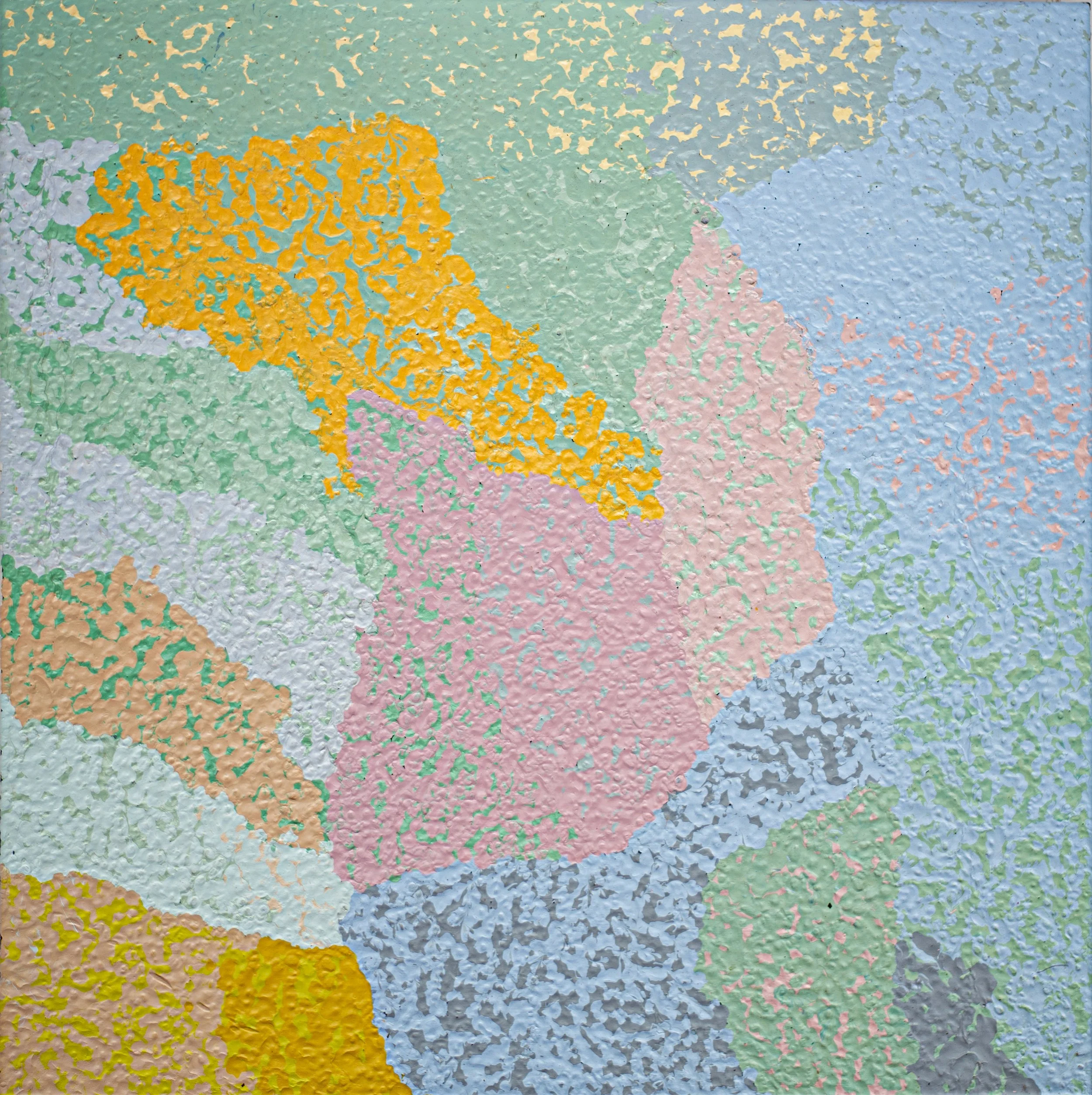
Artiste : Yikartu Bumba (1939)
Titre de l'œuvre : Jupurrl
Format : 91 x 91 cm
Provenance et certificat : centre d'art aborigène de Martumili
Référence de cette peinture : 24-1053
Demander le prix de l'œuvre / Enquiry
Explications pour cette œuvre :
“This one a yinta (permanent springs) in my ngurra (home Country, camp), Jupurrl. It's kakarra (east) of Kulyakartu and kayili (north) side of Wirnpa. I was a married woman when I was walking around this place, pujiman (traditional, desert dwelling) time. I married a good man. There’s lots of kapi (water) there. Lots of yukari (green grass, vegetation). Plenty of bushtucker, pussycat and goanna.
There’s no kapi when you first get there, but you dig him up and then there’s lots of kapi. We’ve got to take all the kids to that ngurra. Show them my daddy’s ngurra. There’s another waterhole, not far from there called Jakapinka. A jila (snake) made that kapi. It’s my brother’s Country.”
- Yikartu Bumba
© Photo Aboriginal Signature Estrangin Gallery, and text with the courtesy of the Artist and Martumili Arts
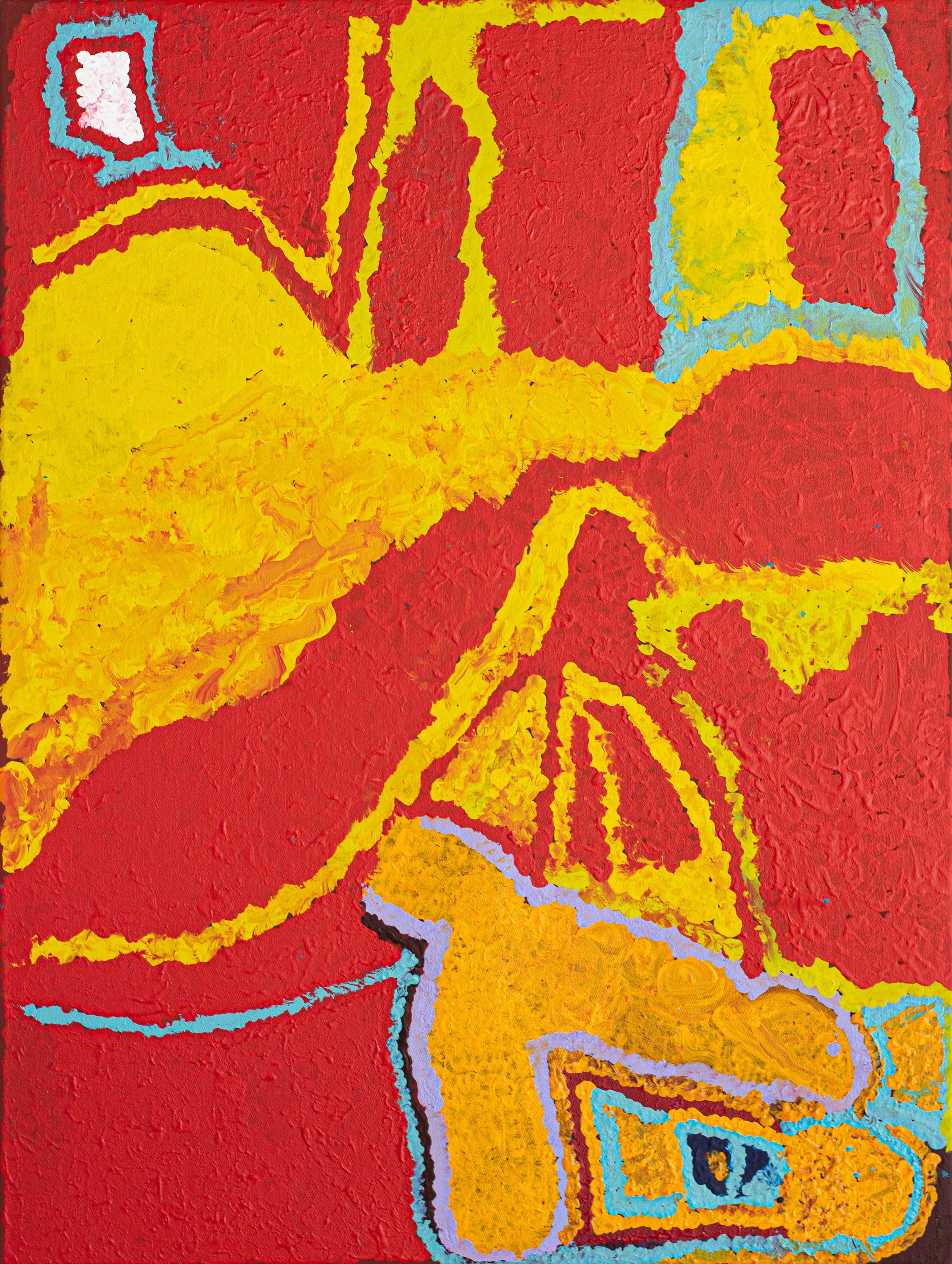
Artiste : Mabel Wakarta (1929)
Titre de l'œuvre : Yirajarra Home country
Format : 122 x 91 cm
Provenance et certificat : centre d'art aborigène de Martumili
Référence de cette peinture : 14-535
Demander le prix de l'œuvre / Enquiry
Explications pour cette œuvre :
“Yirajarra, that’s my camp, that’s my place, that’s my country”. Yirajarra is the artists Ngurra (home); it is where the artist was born and is her place. It is a soak situated on the Canning Stock Route, there is Good fresh water there all year round and shade which makes it a decent camp spot. During the Pujiman (bush) days the artist was walking all of this country with her family.
Yirrajarra comprises of two soaks situated near Lake Auld, and north of Tiwa (Canning Stock Route Well 26). As the site of a continuous source of good fresh water, surrounded by plentiful puri (shade), Yirrajarra was an important semi-permanent camping ground during the pujiman (traditional, desert dwelling) era.
Yirrajarra is Mabel Mitutu’s birthplace, and as such an integral part of her ngurra (home Country, camp). Having walked all of this country with her family in her youth, Mabel Mitutu here depicts her knowledge of the region and its features in detail. Physical characteristics of the land and the location of its resources are portrayed alongside the Jukurrpa (Dreaming) narratives associated with this area.
During the pujiman period, Martu would traverse very large distances annually in small family groups, moving seasonally from water source to water source, and hunting and gathering bush tucker as they went. At this time knowledge of water sources was critical for survival, and today Martu Country is still defined in terms of the location and type of water. Each of the hundreds of claypans, rockholes, waterholes, soaks and springs found in the Martu desert homelands is known by name, location, quality and seasonal availability through real life experience and the recounting of Jukurrpa (dreaming) narratives.
© Photo : Aboriginal Signature Estrangin gallery with the courtesy of the artists and Martumili
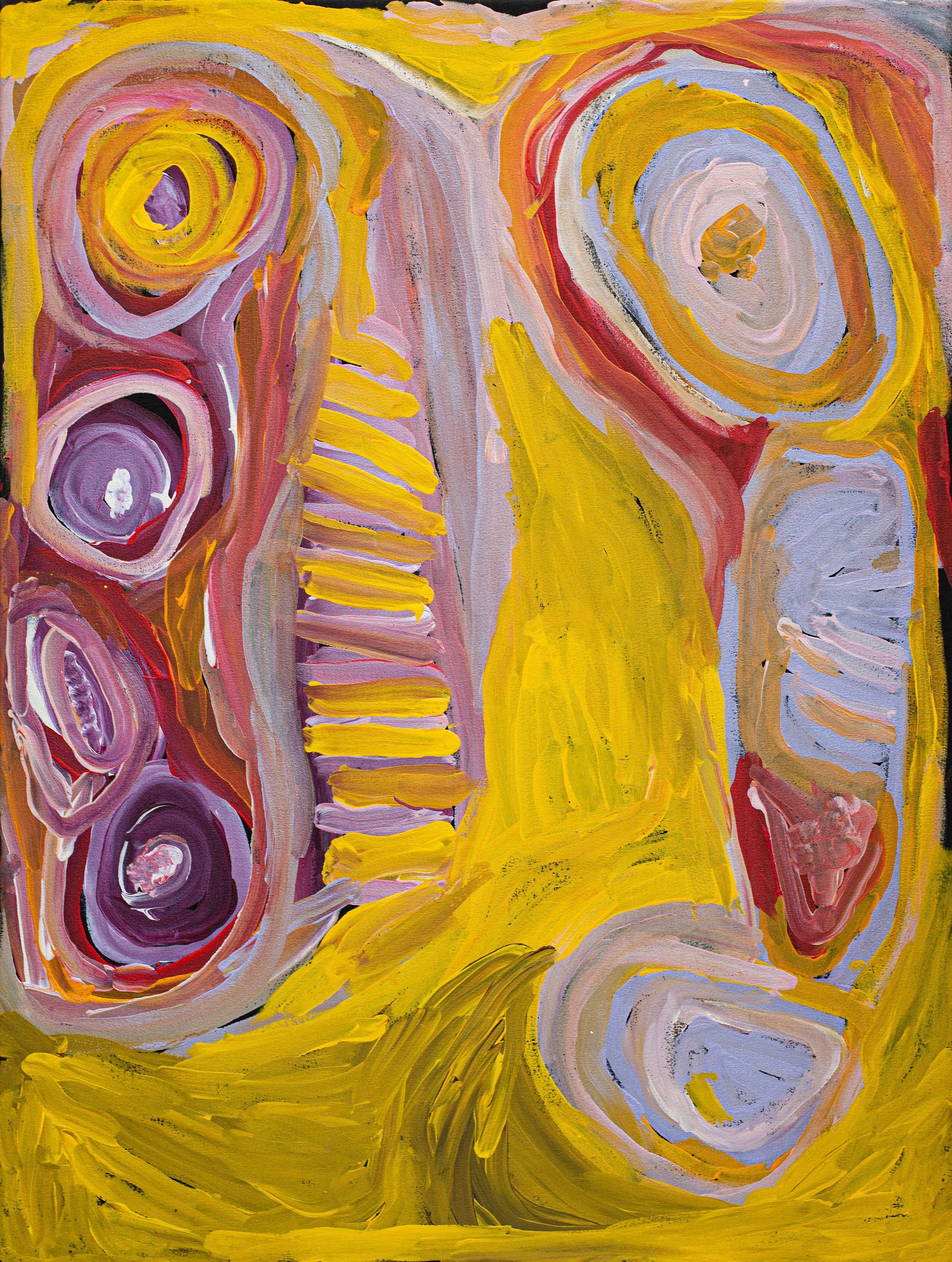
Artiste : Nora Nungabar (1920)
Titre de l'œuvre : Kunawarritji (well 33 of the Canning stock road)
Format : 122 x 91 cm
Provenance et certificat : centre d'art aborigène de Martumili
Référence de cette peinture : 13-414
Demander le prix de l'œuvre / Enquiry
Explications pour cette œuvre :
Kunawarritji is an important site in the Great Sandy Desert where multiple stories and histories intersect. In the Jukurrpa (dreamtime) period, the Seven Sisters stopped here and shaped a number of landforms before continuing on their long journey east. During the pujiman (nomadic desert dweller) era, the site was an important yinta (permanent water source), where families stopped and camped for long periods each year.
At the turn of the 20th century Kunawarritji was converted into a well (Well 33) along the 1850km long Canning Stock Route, created as a means to drove cattle through the harsh Western Australian desert. Each year throughout the 1930-50s, the well became a site of contact between drovers, their cattle, and desert families.
Today, Kunawarritji community is a site of return, a place where Martu people have come back to continue making their life in the desert.
Nungabar grew up in the country that became Wells 33-38 on the Canning Stock Route. From an early age she and her family had encounters with the white men who drove cattle along the route. As a young woman, together with her close friend Nora Wompi, Nungabar followed the drovers north to Balgo Mission, where she settled and raised a family. She eventually
relocated to her homelands at Kunawarritji, where she was considered a custodian of a great deal of cultural knowledge about the Kunawarritji area.
© Photo : Aboriginal Signature Estrangin gallery with the courtesy of the artists and Martumili
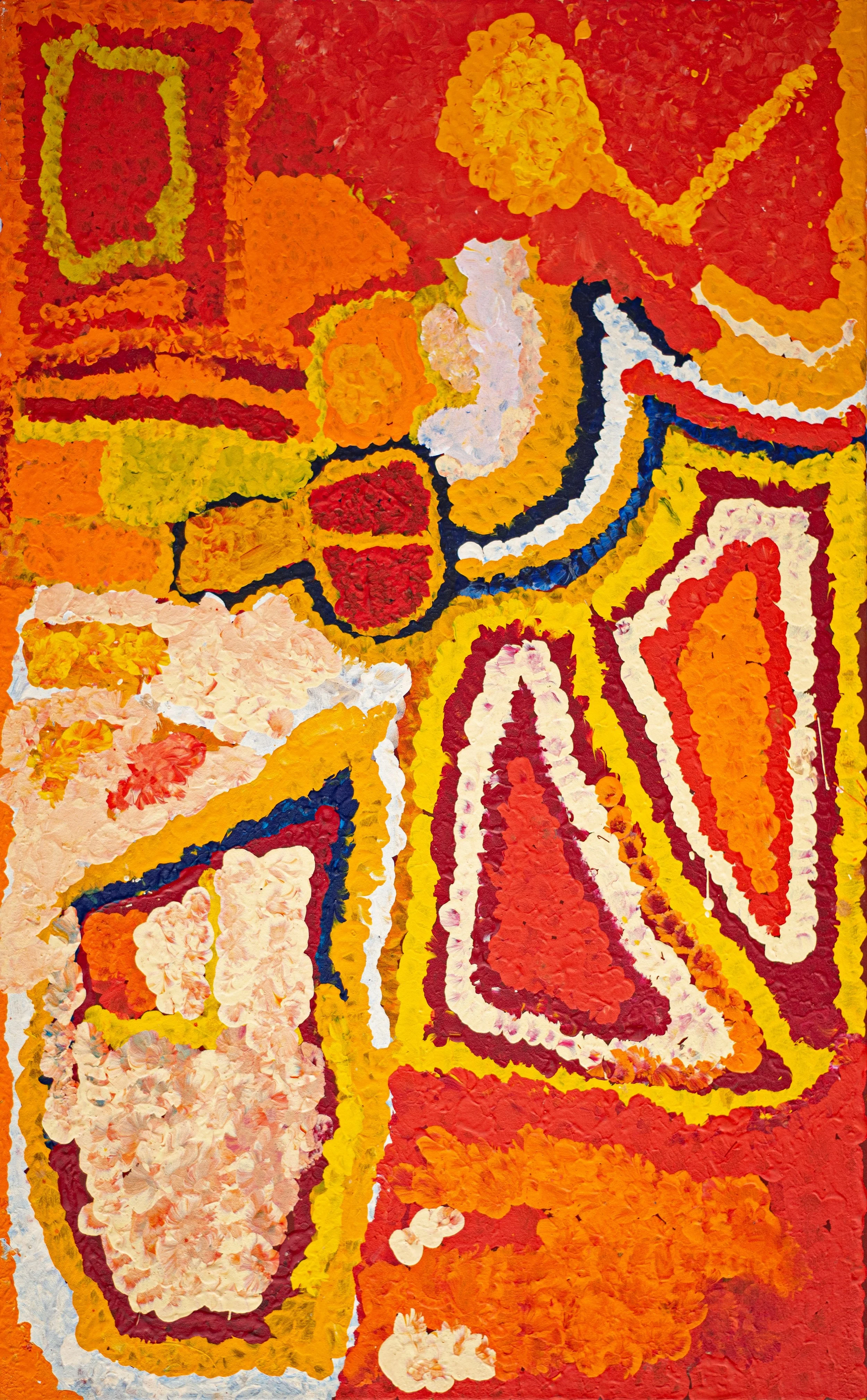
Artiste : Mabel Wakarta (1929)
Titre de l'œuvre : Karlamilyi
Format : 122 × 76 cm
Provenance et certificat : centre d'art aborigène de Martumili
Référence de cette peinture : 15-246
Demander le prix de l'œuvre / Enquiry
Explications pour cette œuvre :
Karlamilyi (Rudall River region) is Warnman Country, located in the very heart of the Martu homelands. The Karlamilyi region forms part of Mabel Mitutu’s ngurra (home Country, camp), the area which she knew intimately and travelled extensively with her family in her youth.
Karlamilyi is situated southwest of the Great Sandy Desert and northeast of the Little Sandy Desert. Spanning through the region is the epic Karlamilyi River, which runs north into Nyayartakujarra (Lake Dora), a large salt lake. The Broadhurst and Fingoon Ranges extend diagonally across the river’s path. The landscape is striking for its abundance of gorges and valleys carved by ice age glaciers, rugged cliffs, red tali (sand dunes), grasslands, sandstone and quartz rocky outcrops, and salt lakes.
Across the whole region are hundreds of water sources; including waterholes, creeks, soaks, lakes, pools and rockholes. Lining the rivers are coolabah, walyji (river gum), yulbah (bats wing coral tree), and several species of acacia and hakea. Jalkuran (paperbark), kurrulyu/ mijarrpa (bloodwood) and jawirli (quandong) are found in the region’s valleys, and wikirrpa (desert oaks) and grasses in the sandplains. The area is abundant with bird species, jila (snakes), maruntu (goannas), red kangaroos and warlpaju (rock wallabies). The region is also home to remote aboriginal communities Punmu and Parnngurr.
According to two of the central Martu Jukurrpa (Dreaming) narratives, the Karlamilyi River and its surrounds were created by the ancestral beings Jila Kujarra (Two Snakes) and the Wati Kujarra (Two Goanna Men) as they travelled across the lands.
© Photo : Aboriginal Signature Estrangin gallery with the courtesy of the artists and Martumili
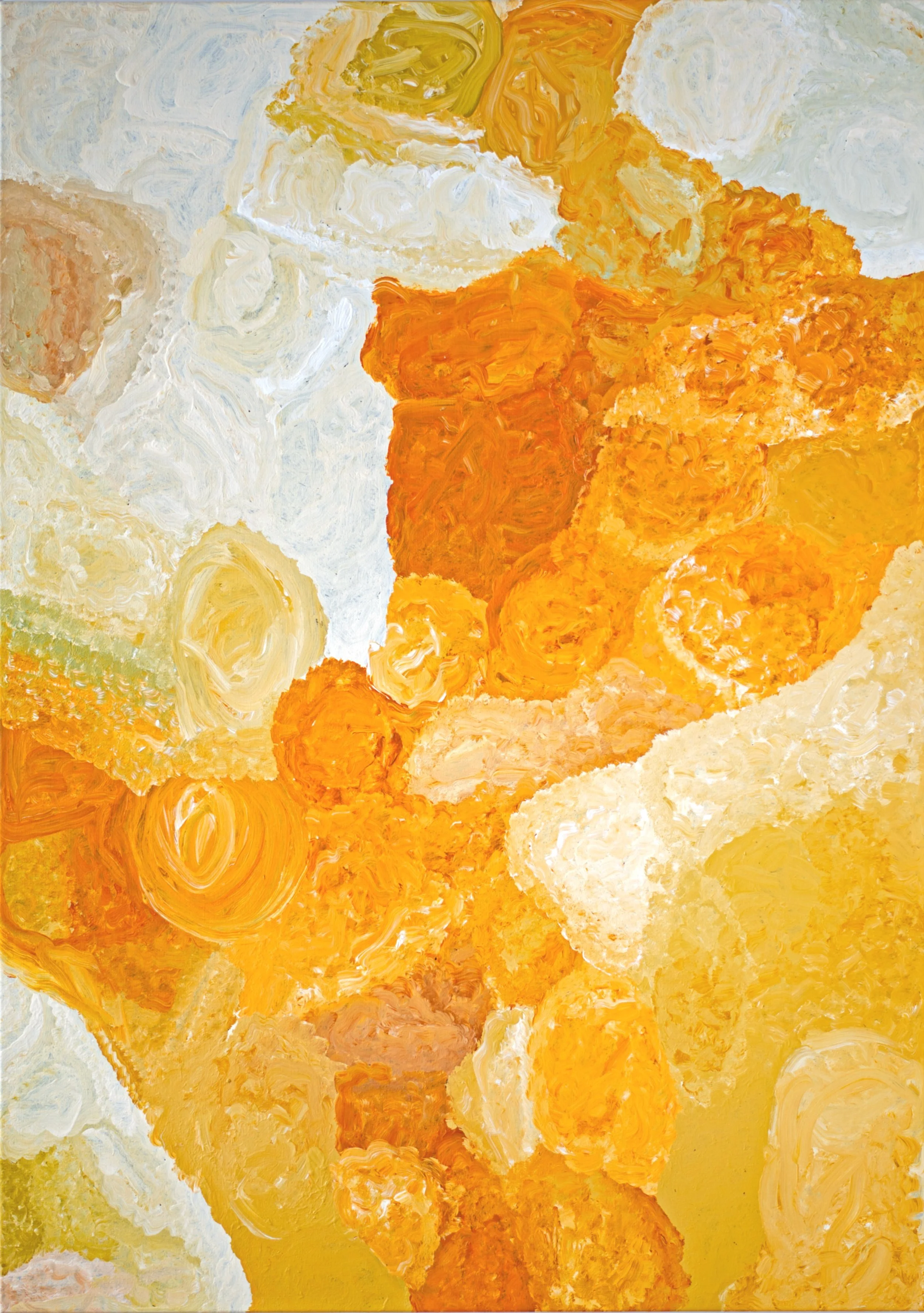
Artiste : Bugai Whyoulter (1939)
Titre de l'œuvre : Parnngurr
Format : 106 x 152 cm
Provenance et certificat : centre d'art aborigène de Martumili
Référence de cette peinture : 24-580
Demander le prix de l'œuvre / Enquiry
Explications pour cette œuvre :
"We were climbing Parnngurr hill; we were frightened. Kartiya (Europeans) would walk around, trying to catch Martu people. We would run up the hill and hide. We watched them catch people. We were eating flour that white people gave us. It was horrible.
From [Parnngurr rockhole], we got in the truck and went with the white people to Jigalong. Kumpaya [Girgirba], Jakayu [Biljabu] and Ngamaru [Bidu], we were all on top of the hill looking at the white people."
- Bugai Whyoulter
Parnngurr rockhole is located 370km east of Newman. This site lies within Bugai’s ngurra (home Country, camp), the area which she knew intimately and travelled extensively with her family in her youth. For many Martu, including Bugai, Parnngurr also signifies the location at which their nomadic bush life came to an end. Poignantly described here by Bugai, it was here that a group of 29 Martu were picked up by the Native Welfare Department to be taken to Jigalong Mission in 1963. Collectively the group had come to the decision to move to the mission as a result of an extended drought, which had caused a scarcity in food and water resources.
The group also wanted to join their families, who had already moved to Jigalong.
At the junction of three linguistic groups; Manyjilyjarra, Kartujarra, and Warnman, Parnngurr rockhole was a critical and permanent source of water during the pujiman (traditional, desert born) era, supporting many ritual large gatherings. During this nomadic period families stopped and camped here depending on the seasonal availability of water and the corresponding cycles of plant and animal life on which hunting and gathering bush tucker was reliant. At Parnngurr and other similarly important camp sites families would meet for a time before moving to their next destination. Parnngurr rockhole and its surrounds are physically dominated by distinctively red tali (sandhills), covered sparingly with spinifex and low lying shrub.
Parnngurr community, just north of Parnngurr rockhole, was created during the Return to Country movement of the 1980s, coinciding with the recognition of Aboriginal land rights and native title. The community was named aer its’ original primary water source. Until recently the community was widely known as Coon Creek, aer the European name for the ephemeral creek running alongside the community.
© Photo Aboriginal Signature Estrangin Gallery, and text with the courtesy of the Artist and Martumili Arts
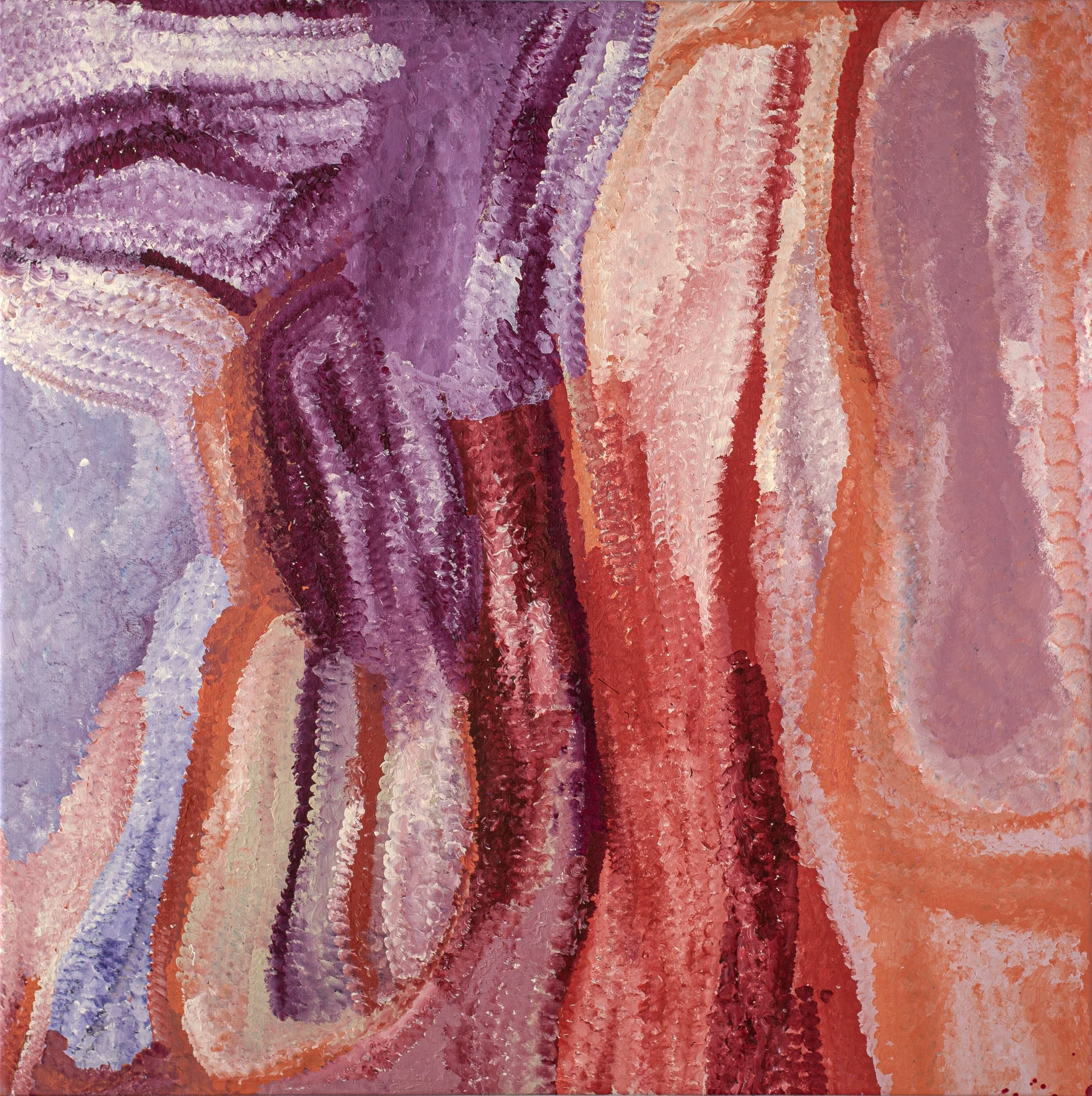
Artiste : Bugai Whyoulter (1939)
Titre de l'œuvre : Wantili (near Well 25)
Format : 150 x 150 cm
Provenance et certificat : centre d'art aborigène de Martumili
Référence de cette peinture : 22-1244
Demander le prix de l'œuvre / Enquiry
Explications pour cette œuvre :
(As translated by Bugai’s grandson, Cyril Whyoulter) “Bugai always tells about Wantili because she grew up around Wantili. Her family would travel between Wantili, Kaalpa, Juntujuntu, Raarki, and Wuranu Wells along the Canning Stock Route. She paints around Wantili. She saw whitefellas there for the first time, Canning mob when they were travelling up and down the stock route with the bullock. She was a young girl walking around at Wantili. Big mob of people they been walking around there. They were travelling making the road, Canning and his drovers. They were running away from those whitefellas, watching them from a long distance. She was a teenager when she was travelling around there with her four mothers and one daddy. Her mummy and daddy passed away in Jigalong. They used to travel around in family groups, Bugai and Jakayu (Biljabu), and Jakayu’s nyupa (partner) Phillip Biljabu. They met Kumpaya (Girgaba) coming from Kunkun (Kunawarritji) area.”
Bugai returned to the Wantili area as a young woman, when she worked driving cattle along the Stock Route.
Wantili is a large jurnu (soak) and lyinji (clay pan) near Well 25 on the Canning Stock Route. It lies close to Bugai’s birthplace, and is her ngurra (home country). The area is dominated by claypans surrounded by tuwa (sandhills). Following rain the claypans are filled with water, with the overflow from nearby waterholes flowing to Wantili. At that time, Wantili becomes an important place for obtaining fresh water for drinking and bathing. Wantili is significant for the fact that at this site Kartujarra, Manyjilyjarra, Putujarra and Warnman people would all come together for ceremonies. Many jiwa (stones used by women for grinding seeds) from these times can still be found there today.
Wantili is one of the many sites featured in the epic Minyipuru (Seven Sisters) jukurrpa (dreamtime) narrative. The story follows the movement of seven sisters travelling all the way across the desert, beginning at Roebourne on the coast of Western Australia, as they are pursued by a lusful old man, Yurla. As the women travel they stop to rest at many sites to eat, dance, rest and sing, on the way leaving behind an assortment of articles that become formations in the land.
The Seven Sisters rested at Wantili before throwing seeds, then continuing their journey on to Tiwa, Juntujuntu, and then onward to Pangkapini, where they finally escaped Yurla by flying into the sky to become the Pleaides constellation of stars.
© Photo Aboriginal Signature Estrangin Gallery, and text with the courtesy of the Artist and Martumili Arts

Artiste : Bugai Whyoulter (1939)
Titre de l'œuvre : Kaalpa (Kalypa, Canning Stock Route Well 23)
Format : 91 x 122 cm
Provenance et certificat : centre d'art aborigène de Martumili
Référence de cette peinture : 23-1020
Demander le prix de l'œuvre / Enquiry
Explications pour cette œuvre :
"From Tiwa (Canning Stock Route Well 26) we used to travel to Kaalpa (Kalypa, Canning Stock Route Well 23), mummy and daddy used to take us around there, [my sister] Pinyirr and me. From Kaalpa we would go to Jilkupuka (Canning Stock Route Well 21), then to Wangkakalu."
- Bugai Whyoulter, as translated by Ngalangka Nola Taylor
Kaalpa is a permanent water source located northeast of Kumpupirntily (Kumpupintily, Lake Disappointment). This site lies within Bugai’s ngurra (home Country, camp), the area which she travelled extensively around with her family as a young woman. Kaalpa is also Bugai’s mother’s Country. In her account, Bugai describes the seasonal movement of Martu family groups from water source to water source during the pujiman (traditional, desert dwelling) era. At this time knowledge of water sources was critical for survival, and today Martu Country is still defined in terms of the location and type of water. Each of the hundreds of claypans, rockholes, waterholes, soaks and springs found in the Martu desert homelands is known by name, location, quality and seasonal availability through real life experience and the recounting of Jukurrpa (Dreaming) narratives.
Kaalpa is a place of great cultural significance, and is also known for good hunting. Adjacent to the waterhole is a hill of the same name. The landscape around Kaalpa is parlkarra (flat country), bordered by tali (sandhills) stretching as far as Windy Corner, northeast and towards the border of Western Australia and the Northern Territory. The Jukurrpa mosquito and fly beings partially created the landforms in this area and continue to live underground. These beings are very large and dangerous; it is imperative that this area is not mined since the consequences may be severe.
Kaalpa also features in the Minyipuru (Jakulyukulyu, Seven Sisters) Jukurrpa, a central creation narrative for Martu, Ngaanyatjarra, Pitjantjatjara and Yankunytjatjara people that is associated with the seasonal Pleiades star constellation. At Kaalpa the Minyipuru met a group of men; it was the first time either group had seen members of the opposite sex. The men tried to grab the women, but the Minyipuru chased them, hittng them with their digging sticks and leaving them lying there as they continued travelling east.
Relayed in song, dance, stories and paintings, Minyipuru serves as a creation narrative, a source of information relating to the physical properties of the land, and an embodiment of Aboriginal cultural laws. Beginning in Roebourne on the west coast of Western Australia, the story morphs in its movement eastward across the land, following the women as they walk, dance, and even fly from waterhole to waterhole. As they travel the women camp, sing, wash, dance and gather food, leaving markers in the landscape and creating landforms that remain to this day, such as groupings of rocks and trees, grinding stones and seeds. During the entirety of their journey the women are pursued by a lustful old man, Yurla, although interactions with other animals, groups of men, and spirit beings are also chronicled in the narrative.
The intersection of the Canning Stock Route with Kaalpa also made this a site of early contact with Europeans for many Martu then living a pujiman life in the desert. Following the route's construction, Martu encountered Europeans and other Martu working as cattle drovers as they would travel up and down the Stock Route from water source to water source. Increasingly, pujimanpa (desert dwellers) followed the route to newly established ration depots, mission and pastoral stations. They were drawn to the route in search of food, by a sense of curiosity, or by loneliness. By the late 1950s and early 1960s, most of the desert family groups had left the desert. Eventually, these factors combined with an extreme and prolonged drought in the 1960s to prompt the few remaining pujimanpa to move in from the desert.
© Photo Aboriginal Signature Estrangin Gallery, and text with the courtesy of the Artist and Martumili Arts

Artiste : Wilson Mandijalu (1985)
Titre de l'œuvre : Untitled
Format : 122 x 152 cm
Provenance et certificat : centre d'art aborigène de Martumili
Référence de cette peinture : 24-1458
Demander le prix de l'œuvre / Enquiry
Explications pour cette œuvre :
Martumili Artists work with over three hundred artists from remote Martu Aboriginal communities, including Punmu, Parnngurr, Kunawarritji, Jigalong, Irrungadji (Nullagine), and Warralong, as well as from the Parnpajinya (Newman) gallery and studio spaces.
Known for their diverse, energetic, and unmediated painting styles, their works reflect the dramatic geography and scale of their homelands. Each artist, however, brings a unique approach to their craft.
Younger Martu artists often start painting alongside their parents, grandparents, and extended family, which fosters an organic learning process. This not only involves mastering painting techniques but also understanding specific locations, family histories, traditional ways of life, bush tucker, and Jukurrpa (Dreaming). Over time, with encouragement from their peers, they develop their own distinct styles and explore unique painting techniques and subject matter. In this work the artist brings a contemporary, evolving perspective to their work.
© Photo Aboriginal Signature Estrangin Gallery, and text with the courtesy of the Artist and Martumili Arts
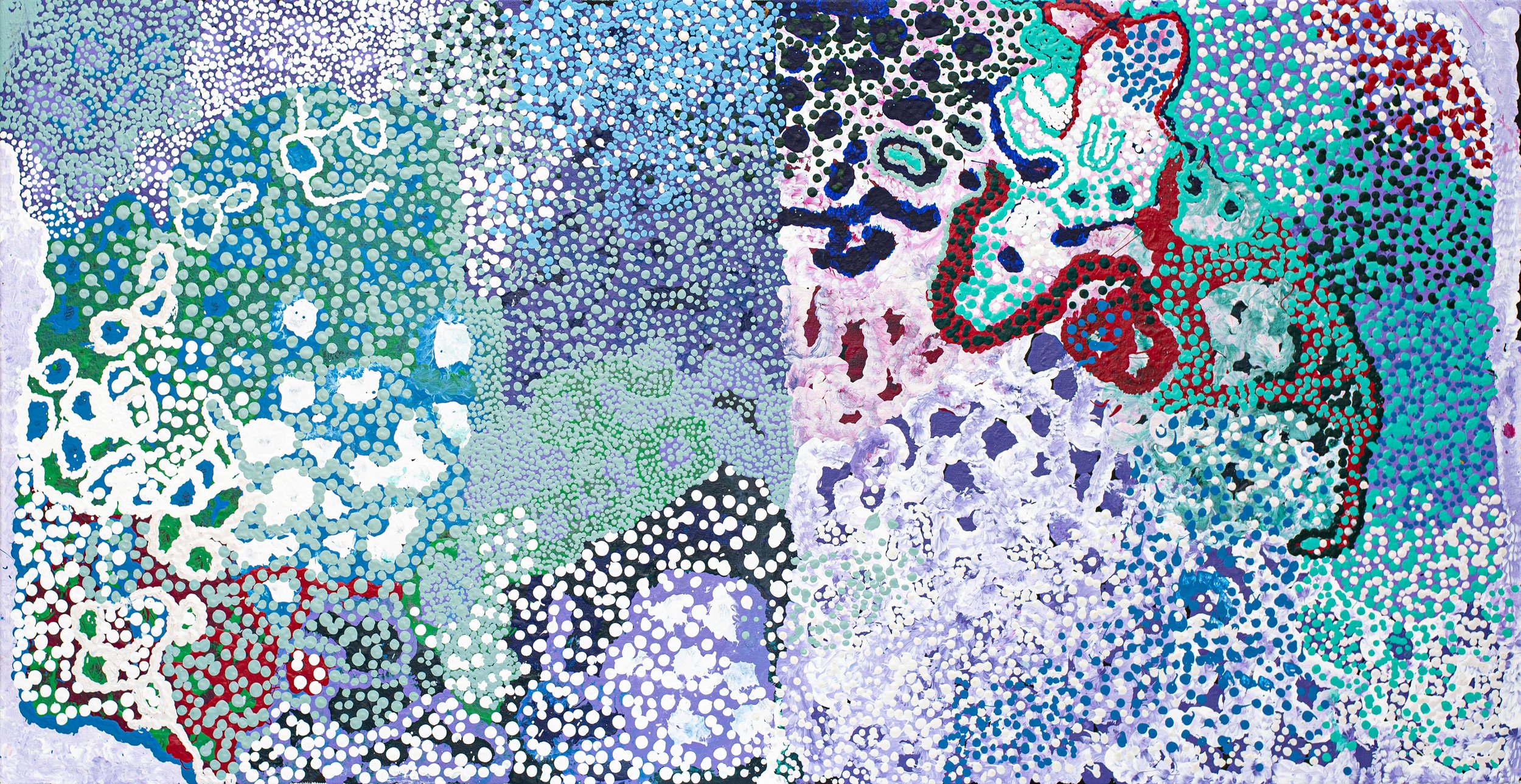
Artiste : Yikartu Bumba (1939)
Titre de l'œuvre : Jutupa ngurra (home/Country)
Format : 76 x 152 cm
Provenance et certificat : centre d'art aborigène de Martumili
Référence de cette peinture : 23-1068
Demander le prix de l'œuvre / Enquiry
Explications pour cette œuvre :
Jutupa is a waterhole located yulparirra (south) of Punmu Aboriginal Community, and at the southern edge of Nyayartakujarra (Ngayarta Kujarra, Lake Dora). The site falls within the Karlamilyi (Rudall River) region, an area created by the Jila Kujarra (Two Snakes) as they journeyed north east to Nyayartakujarra. Surrounding Jutupa are the distinctive long tali (sandhills) of Martu Country. Other nearby water sources include Pinjupinya, Wawul, Tarl, and Jarntinti.
© Photo Aboriginal Signature Estrangin Gallery, and text with the courtesy of the Artist and Martumili Arts
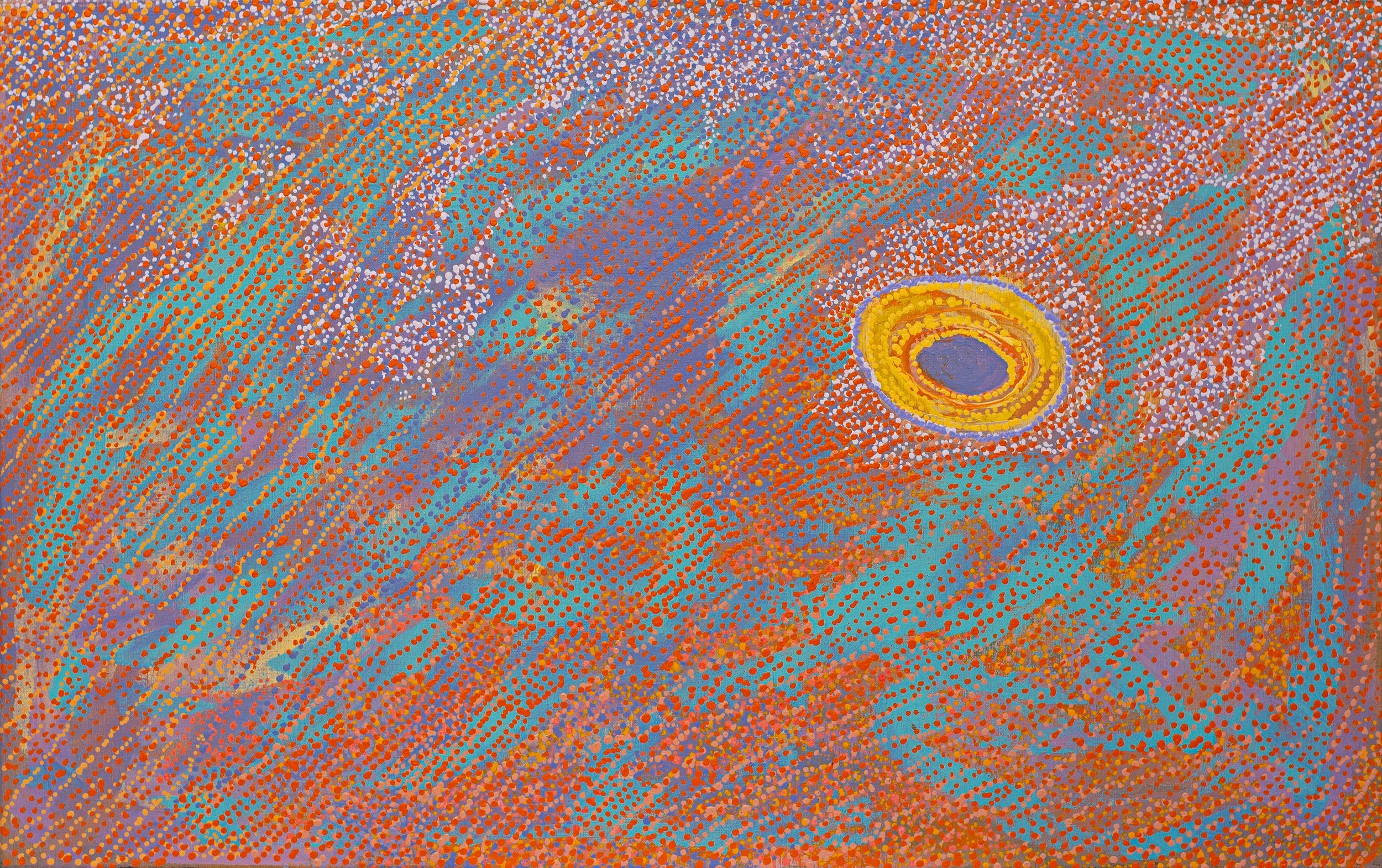
Artiste : Derrick Butt (1976)
Titre de l'œuvre : Kulyakartu (near Percival Lake)
Format : 76 x 122 cm
Provenance et certificat : centre d'art aborigène de Martumili
Référence de cette peinture : 24-702
Demander le prix de l'œuvre / Enquiry
Explications pour cette œuvre :
"Long time ago I been there. It is my grandmother’s, grandfather’s, father’s, [and] mother’s country, Kulyakartu. I am painting this particular place. It keeps me connected, [gives me a] sense of belonging [to] tell my grandmother’s story through my art. Where she was born, I'm a part of that.
It makes me feel proud painting. Most important is telling the story behind the painting so people can understand where I am coming from. Kulyakartu is our ngurra (home Country, camp). I will continue telling the story through my art."
- Derrick Butt
This painting depicts Kulyakartu; an area in the far north of the Martu homelands, near the Percival Lakes in the northern Great Sandy Desert. The artist's elders has extensive knowledge of the Country in this region, where she grew up living traditionally during the pujiman (traditional, desert dwelling). Kulyakartu is mostly grass Country where there is very good hunting. There is no permanent water source in Kulyakartu, so the families would walk here annually following the wet season.
© Photo Aboriginal Signature Estrangin Gallery, and text with the courtesy of the Artist and Martumili Arts

Artiste : Derrick Butt (1976)
Titre de l'œuvre : Kulyakartu (near Percival Lake)
Format : 91 x 91 cm
Provenance et certificat : centre d'art aborigène de Martumili
Référence de cette peinture : 23-533
Demander le prix de l'œuvre / Enquiry
Explications pour cette œuvre :
"Long time ago I been there. It is my grandmother’s, grandfather’s, father’s, [and] mother’s country, Kulyakartu. I am painting this particular place. It keeps me connected, [gives me a] sense of belonging [to] tell my grandmother’s story through my art. Where she was born, I'm a part of that.
It makes me feel proud painting. Most important is telling the story behind the painting so people can understand where I am coming from. Kulyakartu is our ngurra (home Country, camp). I will continue telling the story through my art."
- Derrick Butt
This painting depicts Kulyakartu; an area in the far north of the Martu homelands, near the Percival Lakes in the northern Great Sandy Desert. The artist's elders has extensive knowledge of the Country in this region, where she grew up living traditionally during the pujiman (traditional, desert dwelling). Kulyakartu is mostly grass Country where there is very good hunting. There is no permanent water source in Kulyakartu, so the families would walk here annually following the wet season.
© Photo Aboriginal Signature Estrangin Gallery, and text with the courtesy of the Artist and Martumili Arts
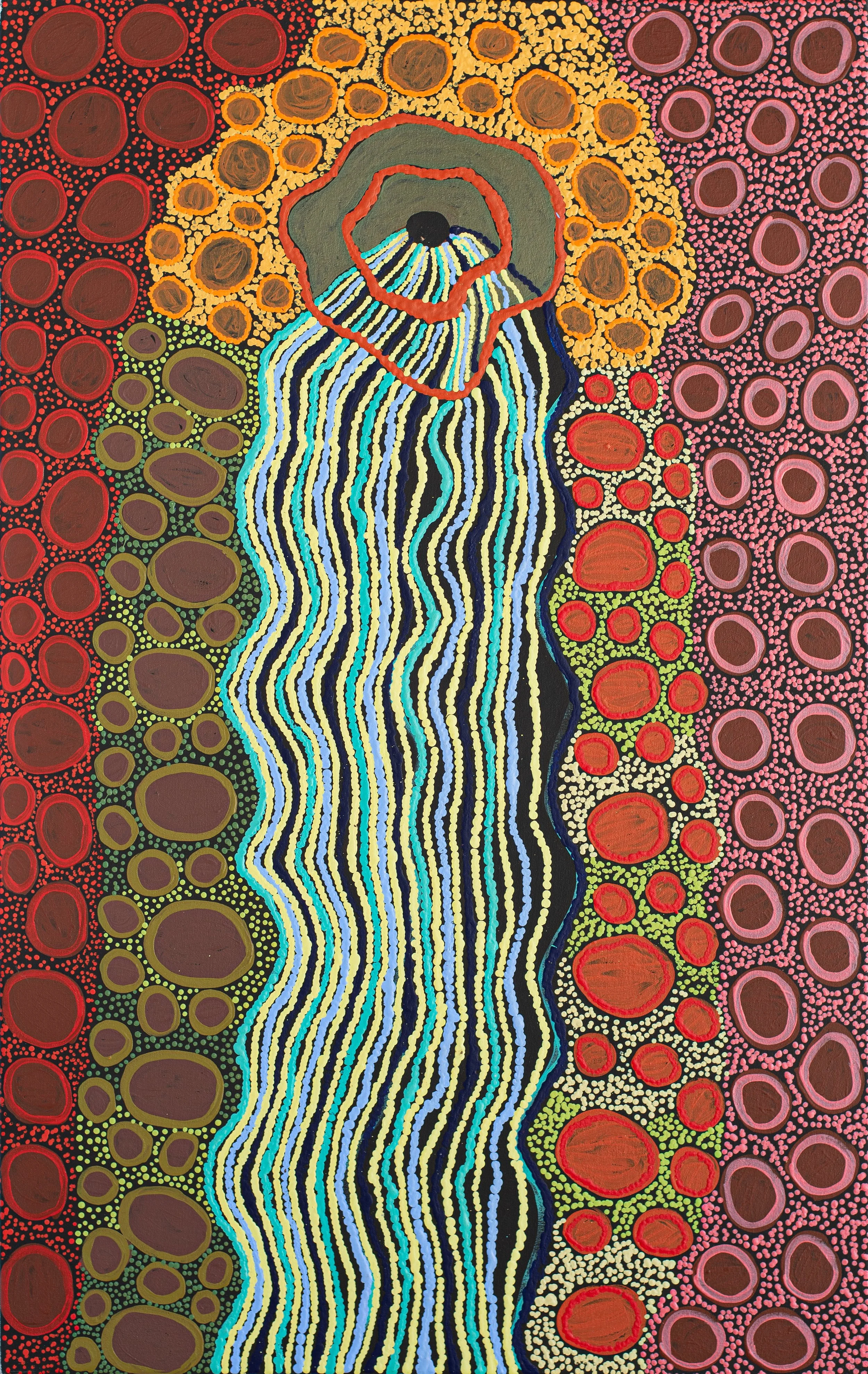
Artiste : Marlene Anderson (1974)
Titre de l'œuvre : Mungili Waterholes and Rock Holes
Format : 76 x 122 cm
Provenance et certificat : centre d'art aborigène de Martumili
Référence de cette peinture : 24-905
Demander le prix de l'œuvre / Enquiry
Explications pour cette œuvre :
“I was swimming there. Yeah, we go visit them a long time [ago]. We drink it, rain water from the rain. Big waterhole. It’s a fresh water, when the rain comes, fills it up. One for swimming and another rock hole for drinking."
- Marlene Anderson
In this work Marlene depicts a waterhole and rock hole located in Mungili, the small outstation community located just off the Eagle Highway in Western Australia, approximately 430 kilometres northeast of Wiluna and 250 kilometres north of Warburton.
Marlene grew up in Mungili, and as such it forms a significant part of her ‘ngurra’ (home Country, camp). Typically Marlene depicts this site with a central large circular form that represents the main waterhole, surrounded by smaller circular forms representing satellite water bodies.
During the pujiman (traditional, desert dwelling) period, knowledge of water sources was critical for survival, and today Martu Country is still defined in terms of the location and type of water. Each of the hundreds of claypans, rockholes, waterholes, soaks and springs found in the Martu desert homelands is known through real life experience and the recounting of Jukurrpa (Dreaming) narratives by name, location, quality and seasonal availability. This encyclopedic knowledge extends even to the nature and movement of arterial waterways, and sustained Martu as they travelled across their Country, hunting and gathering, visiting family, and fulfilling ceremonial obligations. They would traverse very large distances annually, visiting specific areas in the dry and wet season depending on the availability of water and the corresponding cycles of plant and animal life on which hunting and gathering bush tucker was reliant.
© Photo Aboriginal Signature Estrangin Gallery, and text with the courtesy of the Artist and Martumili Arts

Artiste : Derrick Butt (1976)
Titre de l'œuvre : Waru (fire)
Format : 76 x 152 cm
Provenance et certificat : centre d'art aborigène de Martumili
Référence de cette peinture : 24-701
Demander le prix de l'œuvre / Enquiry
Explications pour cette œuvre :
This work depicts the practice of fire burning as it continues to be used today through the Martu homelands. Over thousands of years, as Martu travelled and hunted on foot they would burn tracts of land, using waru (fire) as a means to assist with hunting and to encourage regenerative growth. Whilst fire burning practices have modernised in recent times, with Martu burning areas close to Aboriginal communities and along roads, or else further afield using helicopters and 4WDs with Indigenous ranger group Karnyirninpa Jukurrpa (KJ), the same objectives are met as those during pujiman (traditional, desert dwelling) times.
Targeted waru is an important tool in animal tracking. Small burns are lit to clear vegetation, expose burrows, and to allow for access to walk and track readily in exposed sands. Fires are typically burnt during cooler weather in small, controlled areas, reducing the risk of unmanageable, spontaneous bush fires whilst simultaneously providing diverse regenerating habitats.
Remaining is a defined mosaic fire scar pattern in the land, across tali (sand dunes), linyji (clay pans), parulyukurru (spinifex country) and pila (sandy plains). This paerning is clearly visible from an aerial perspective, and becomes even more defined as new growth emerges.
The patchwork nature of regrowth is aligned with the Martu cycle of burning and regrowth and its five distinct phases. First is nyurnma (freshly burnt Country), followed aer the rains by waru-waru, when young, bright green plants start to grow. Nyukura occurs between one and three years aer burning, when plants have matured and are fruiting and seeding. Manguu is four to six years post burning, when spinifex has matured to the point that it can be burned once again. Finally, kunarka signifies the time when spinifex and other plant species have become old growth, and pose a risk of destructive bushfires.
© Photo Aboriginal Signature Estrangin Gallery, and text with the courtesy of the Artist and Martumili Arts

Artiste : Cyril Whyoulter (1985)
Titre de l'œuvre : Wantili (Well 25)
Format : 76 x 122 cm
Provenance et certificat : centre d'art aborigène de Martumili
Référence de cette peinture : 24-1060
Demander le prix de l'œuvre / Enquiry
Explications pour cette œuvre :
“This is my Grandmother’s [Bugai Whyoulter’s] Country, my Country. Wantili (Warntili, Canning Stock Route Well 25) is old Law Grounds from Dreaming days and very important to Martu people. My grandmother always tells me about Wantili because she grew up around Wantili. It is close to her birthplace and is her ngurra (home Country, camp). She was a young girl walking around at Wantili. Her family would travel between Wantili, Kaalpa, Juntu-juntu, Raarki, and Wuranu Wells along the Canning Stock Route.
Big mob of people they been walking around there. She saw whitefellas there for the first time, Canning mob when they were traveling up and down the stock route with the bullock. They were running away from those whitefellas, watching them from a distance. She was a teenager when she was travelling around there with her four mothers and one daddy. They used to travel around in family groups, Bugai and Jakayu [Biljabu], and Jakayu’s nyupa (partner) Phillip Biljabu. They met Kumpaya [Girgirba] coming from Kun Kun (Kuny-Kuny), Kunawarritji area. Bugai returned to the Wantili area as a young woman, when she worked driving cattle along the Stock Route.
Wantili is good for painting and telling stories. Our stories are still strong. I wanted to take Bugai back to Wantili. It is an important place; she hadn’t been there for a long time. My nana [Pinyirr] Nancy took me there as a young boy. Bugai is the older sister of Nancy. I been... three times going there. It’s important that place, out a long way from Newman… Those old people like going to Wantili, where the creation started. Jakayu and Kumpaya… them two aunties told me a story about Dreamtime, and how important Wantili was. People from different tribes…from all over the place could come there for the initiation ceremony. The Jukurrpa (Dreaming) stories from Wantili are just for Martu but the site is open, and anyone can go there.
It’s a lovely part of the Country to take the kids for a swim. The place has changed. The water used to be muddy like chocolate, now the water is clear. Maybe from climate change, maybe from mining, maybe from something else. The changes don’t have to be bad; the landscape is always changing, same way as Martu people. It’s good to make work sitting out in Country, but I can make these paintings anywhere, just like those old people. Wherever I am, painting Country takes me back there in my head, back to Jukurrpa times, back to pujiman (traditional, desert dwelling) days when my grandmother walked around there, and back to days going there for a swim as a kid. I hope this painting carries people there too. I’m proud to be able to share my culture and stories with younger Martu people and whitefellas."
© Photo Aboriginal Signatrure Estrangin Gallery, and text with the courtesy of the Artist and Martumili Arts
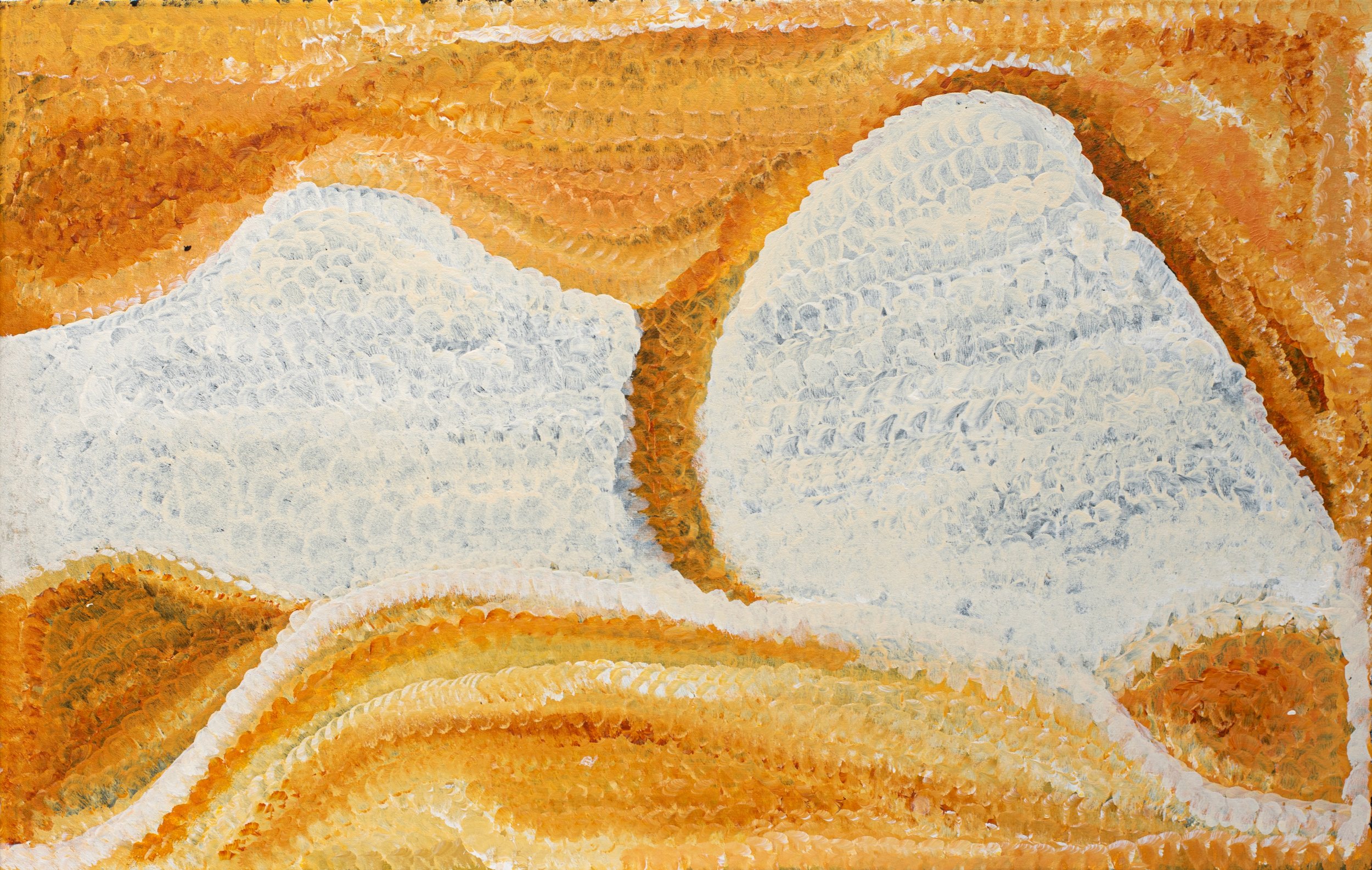
Artiste : Cyril Whyoulter (1985)
Titre de l'œuvre : Kumpupirntily (Kumpupintily, Lake Disappointment)
Format : 76 x 122 cm
Provenance et certificat : centre d'art aborigène de Martumili
Référence de cette peinture : 24-942
Demander le prix de l'œuvre / Enquiry
Explications pour cette œuvre :
“This is my Grandmother’s [Bugai Whyoulter’s] Country, my Country. Wantili (Warntili, Canning Stock Route Well 25) is old Law Grounds from Dreaming days and very important to Martu people. My grandmother always tells me about Wantili because she grew up around Wantili. It is close to her birthplace and is her ngurra (home Country, camp). She was a young girl walking around at Wantili. Her family would travel between Wantili, Kaalpa, Juntu-juntu, Raarki, and Wuranu Wells along the Canning Stock Route.
Big mob of people they been walking around there. She saw whitefellas there for the first time, Canning mob when they were traveling up and down the stock route with the bullock. They were running away from those whitefellas, watching them from a distance. She was a teenager when she was travelling around there with her four mothers and one daddy. They used to travel around in family groups, Bugai and Jakayu [Biljabu], and Jakayu’s nyupa (partner) Phillip Biljabu. They met Kumpaya [Girgirba] coming from Kun Kun (Kuny-Kuny), Kunawarritji area. Bugai returned to the Wantili area as a young woman, when she worked driving cattle along the Stock Route.
Wantili is good for painting and telling stories. Our stories are still strong. I wanted to take Bugai back to Wantili. It is an important place; she hadn’t been there for a long time. My nana [Pinyirr] Nancy took me there as a young boy. Bugai is the older sister of Nancy. I been... three times going there. It’s important that place, out a long way from Newman… Those old people like going to Wantili, where the creation started. Jakayu and Kumpaya… them two aunties told me a story about Dreamtime, and how important Wantili was. People from different tribes…from all over the place could come there for the initiation ceremony. The Jukurrpa (Dreaming) stories from Wantili are just for Martu but the site is open, and anyone can go there.
It’s a lovely part of the Country to take the kids for a swim. The place has changed. The water used to be muddy like chocolate, now the water is clear. Maybe from climate change, maybe from mining, maybe from something else. The changes don’t have to be bad; the landscape is always changing, same way as Martu people. It’s good to make work sitting out in Country, but I can make these paintings anywhere, just like those old people. Wherever I am, painting Country takes me back there in my head, back to Jukurrpa times, back to pujiman (traditional, desert dwelling) days when my grandmother walked around there, and back to days going there for a swim as a kid. I hope this painting carries people there too. I’m proud to be able to share my culture and stories with younger Martu people and whitefellas."
© Photo Aboriginal Signatrure Estrangin Gallery, and text with the courtesy of the Artist and Martumili Arts
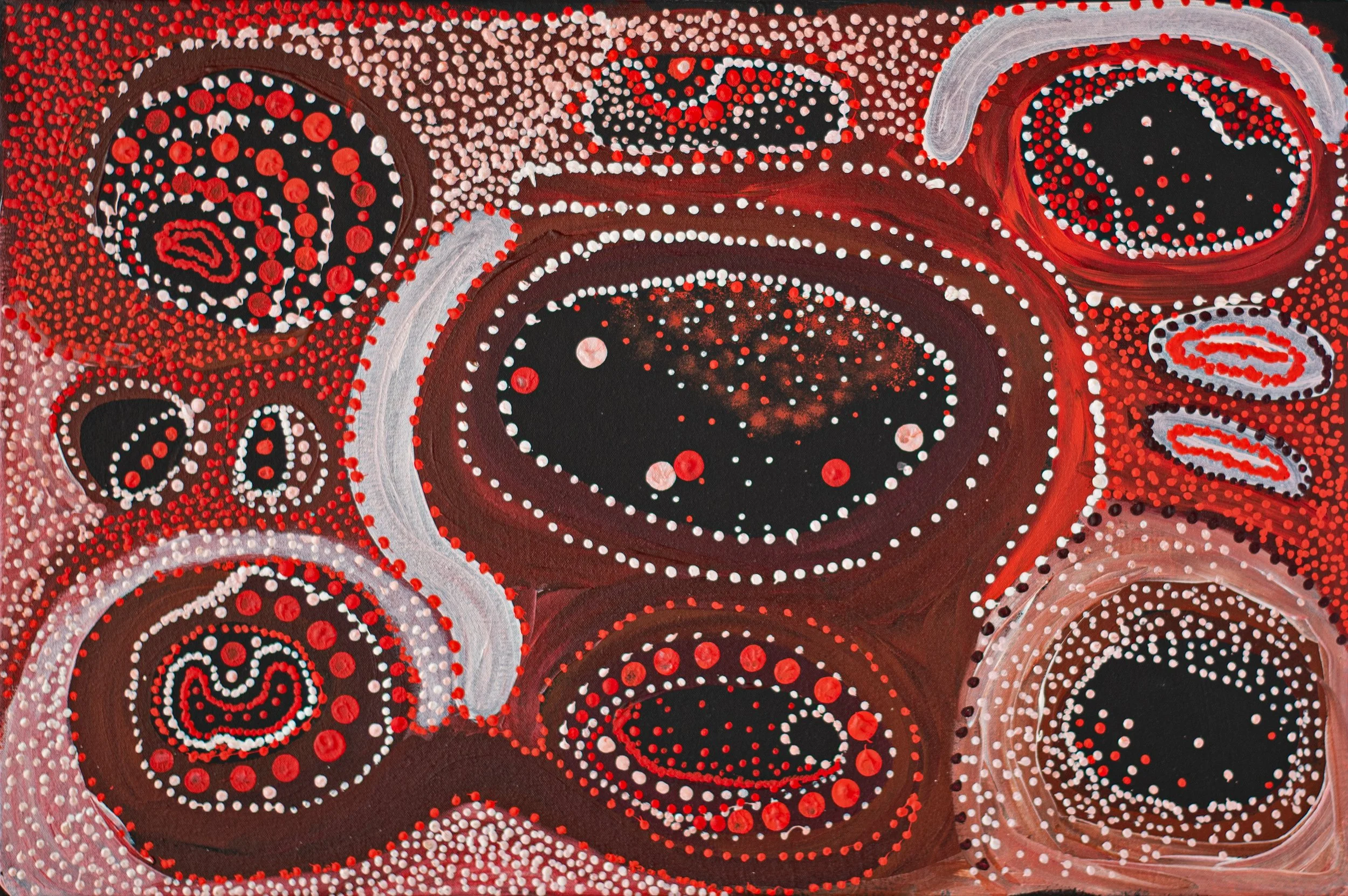
Artiste : Cyril Whyoulter (1985)
Titre de l'œuvre : Wantili (Well 25)
Format : 61 x 91 cm
Provenance et certificat : centre d'art aborigène de Martumili
Référence de cette peinture : 21-647
Demander le prix de l'œuvre / Enquiry
Explications pour cette œuvre :
“This is my Grandmother’s [Bugai Whyoulter’s] Country, my Country. Wantili (Warntili, Canning Stock Route Well 25) is old Law Grounds from Dreaming days and very important to Martu people. My grandmother always tells me about Wantili because she grew up around Wantili. It is close to her birthplace and is her ngurra (home Country, camp). She was a young girl walking around at Wantili. Her family would travel between Wantili, Kaalpa, Juntu-juntu, Raarki, and Wuranu Wells along the Canning Stock Route.
Big mob of people they been walking around there. She saw whitefellas there for the first time, Canning mob when they were traveling up and down the stock route with the bullock. They were running away from those whitefellas, watching them from a distance. She was a teenager when she was travelling around there with her four mothers and one daddy. They used to travel around in family groups, Bugai and Jakayu [Biljabu], and Jakayu’s nyupa (partner) Phillip Biljabu. They met Kumpaya [Girgirba] coming from Kun Kun (Kuny-Kuny), Kunawarritji area. Bugai returned to the Wantili area as a young woman, when she worked driving cattle along the Stock Route.
Wantili is good for painting and telling stories. Our stories are still strong. I wanted to take Bugai back to Wantili. It is an important place; she hadn’t been there for a long time. My nana [Pinyirr] Nancy took me there as a young boy. Bugai is the older sister of Nancy. I been... three times going there. It’s important that place, out a long way from Newman… Those old people like going to Wantili, where the creation started. Jakayu and Kumpaya… them two aunties told me a story about Dreamtime, and how important Wantili was. People from different tribes…from all over the place could come there for the initiation ceremony. The Jukurrpa (Dreaming) stories from Wantili are just for Martu but the site is open, and anyone can go there.
It’s a lovely part of the Country to take the kids for a swim. The place has changed. The water used to be muddy like chocolate, now the water is clear. Maybe from climate change, maybe from mining, maybe from something else. The changes don’t have to be bad; the landscape is always changing, same way as Martu people. It’s good to make work sitting out in Country, but I can make these paintings anywhere, just like those old people. Wherever I am, painting Country takes me back there in my head, back to Jukurrpa times, back to pujiman (traditional, desert dwelling) days when my grandmother walked around there, and back to days going there for a swim as a kid. I hope this painting carries people there too. I’m proud to be able to share my culture and stories with younger Martu people and whitefellas."
© Photo Aboriginal Signatrure Estrangin Gallery, and text with the courtesy of the Artist and Martumili Arts

Artiste : Mabel Wakarta (1929)
Titre de l'œuvre : Yirajarra country
Format : 198 x 198 cm
Provenance et certificat : centre d'art aborigène de Martumili
Référence de cette peinture : 13-1012
Demander le prix de l'œuvre / Enquiry
Explications pour cette œuvre :
“Yirajarra, that’s my camp, that’s my place, that’s my country”. Yirajarra is the artists Ngurra (home); it is where the artist was born and is her place. It is a soak situated on the Canning Stock Route, there is Good fresh water there all year round and shade which makes it a decent camp spot. During the Pujiman (bush) days the artist was walking all of this country with her family.
© Photo : Aboriginal Signature Estrangin gallery with the courtesy of the artists and Martumili
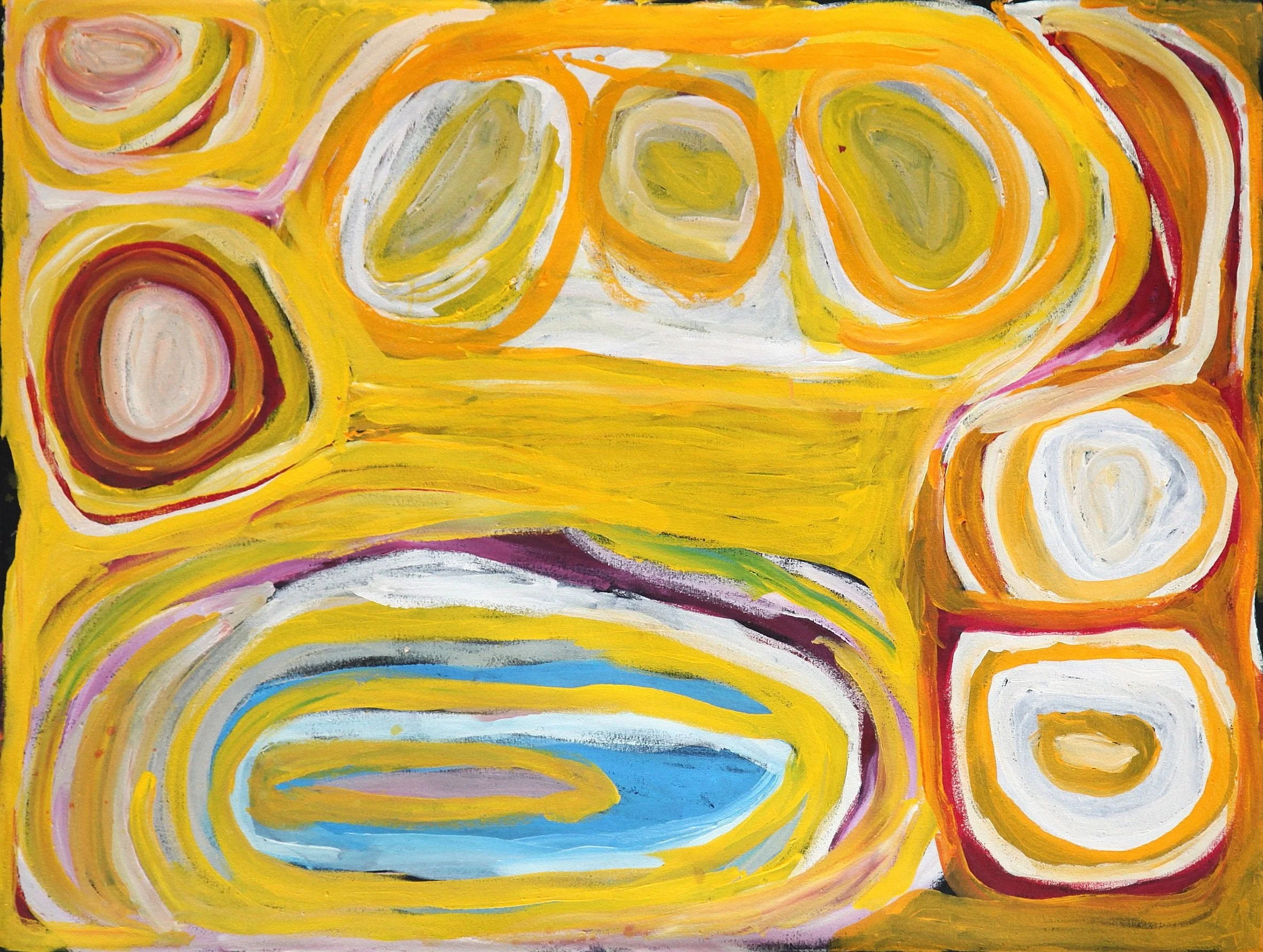
Artiste : Nora Nungabar (1920)
Titre de l'œuvre : Pangkapirni Minyipuru (Seven Sisters Dreaming)
Format : 122 x 91 cm
Provenance et certificat : centre d'art aborigène de Martumili
Référence de cette peinture : 13-35
Demander le prix de l'œuvre / Enquiry
Explications pour cette œuvre :
This painting portrays the Minyipuru (Seven Sisters) when they travelled to Pangkapirni, a site close to Kunawarritji community. Minyipuru is an important Jukurrpa (dreamtime) story about seven sisters that are travelling through the desert as they run away from a lustful old man called Yurla. The man chases the wantis (women) all the way from Roebourne on the west coast right through Martu country before flying east.
Along the way they stop at many significant sites to camp, sing, dance and collect bush tucker. There are also many interactions with Yurla when he catches up with them along the way, creating an amazing abundance of stories and meaning with this culturally rich narrative.
The Seven Sisters rested at Pangkapirni during their journey from Pangkaringka. While the sisters slept Yurla caught one of them, and forced her to sleep with him. The women rescued their sister, and together they flew above the man. From the sky the women teased Yurla, telling him to come and get them. Yurla tried to reach the women using a janga (ladder made of wood), but the women just floated higher, and pushed the ladder over when he got too close. He eventually tired and went to sleep, and the women flew away, continuing their journey across the desert.
Pangkapirni was also a very significant site to Nungabar, forming part of her ngurra (home) country, where she lived and travelled throughout the pujiman (bush) days with her family. The area is sandy country with water sources all around in the form of rockholes, soaks, and claypans.
The artist primarily paints her country in the Canning Stock Route area. As a younger woman the artist lived and travelled traditionally with her family during the pujiman (bush) days. They travelled up and down the Stock Route from well 33 to well 38 and as far as Balgo. Well 33 is now known as Kunawarritji Community and is the artist's ngurra (home).
© Photo : Aboriginal Signature Estrangin gallery with the courtesy of the artists and Martumili

Artiste : Mabel Wakarta (1929)
Titre de l'œuvre : Parnngurr Ngurra
Format : 122 x 91 cm
Provenance et certificat : centre d'art aborigène de Martumili
Référence de cette peinture : 11-1329
Demander le prix de l'œuvre / Enquiry
Explications pour cette œuvre :
“Yirajarra, that’s my camp, that’s my place, that’s my country”. Yirajarra is the artists Ngurra (home); it is where the artist was born and is her place. It is a soak situated on the Canning Stock Route, there is Good fresh water there all year round and shade which makes it a decent camp spot. During the Pujiman (bush) days the artist was walking all of this country with her family.
© Photo : Aboriginal Signature Estrangin gallery with the courtesy of the artists and Martumili
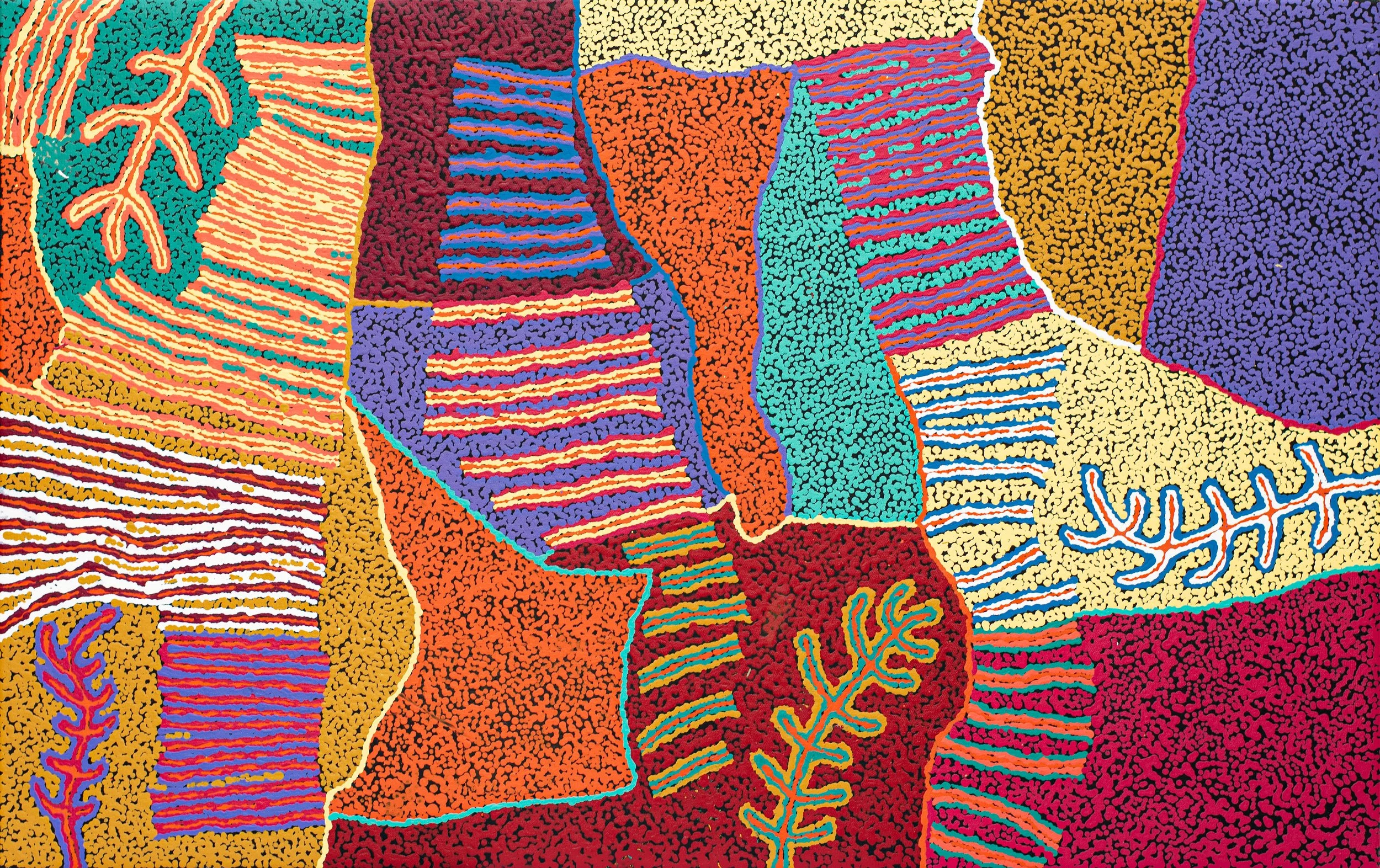
Artiste : Wilson Mandijalu (1985)
Titre de l'œuvre : Kulyakartu
Format : 76 x 122 cm
Provenance et certificat : centre d'art aborigène de Martumili
Référence de cette peinture : 23-463
Demander le prix de l'œuvre / Enquiry
Explications pour cette œuvre :
Kulyakartu is a large area in the far north of the Martu homelands, near the Percival Lakes region of Western Australia's Great Sandy Desert. Kulyakartu is mostly flat grass Country, and is known as a good hunting area. In particular, parnajarrpa (goanna), wild cats, and lunki (witchetty grub) are found in abundance here. In the wantajarra (wet season) the dry lakes in the region fill with water.
© Photo Aboriginal Signature Estrangin Gallery, and text with the courtesy of the Artist and Martumili Arts
Artiste : Yikartu Bumba (1939)
Titre de l'œuvre : Jupurrl Warla
Format : 300 x 125 cm
Provenance et certificat : centre d'art aborigène de Martumili
Référence de cette peinture : 19-921
Demander le prix de l'œuvre / Enquiry
Explications pour cette œuvre :
“Two yintas (permanent springs) in my ngurra (home Country, camp); the yintas are Yirtal and Jupurrl. They are kakarra (east) of Kulyakartu and kayili (north) side of Wirnpa. I was a married woman when I was walking around this place, pujiman (traditional, desert dwelling) time. I married a good man. There’s lots of kapi (water) there. Lots of yukari (green grass, vegetation). Plenty of bushtucker, pussycat and goanna. There’s no kapi when you first get there, but you dig him up and then there’s lots of kapi. We’ve got to take all the kids to that ngurra. Show them my daddy’s ngurra. There’s another waterhole, not far from there called Jakapinka. A jila (snake) made that kapi. It’s my brother’s Country. Not far from these yintas.”
- Yikartu Bumba
Yirtal is a soak located within the Percival Lakes region. The site is surrounded by a vegetation that needs to be cleared before accessing the water there. Yirtal is Yikartu’s ngurra through her father. As she recount, nearby water sources include Jupurl and Jakapinka.
During the pujiman (traditional, desert dwelling) days, Yikartu and her family travelled extensively through this Country. At this time Martu would traverse very large distances annually in small family groups, moving seasonally from water source to water source, and hunting and gathering bush tucker as they went. Knowledge of water sources was critical for survival, and today Martu Country is still defined in terms of the location and type of water. Each of the hundreds of claypans, rockholes, waterholes, soaks and springs found in the Martu desert homelands is known by name, location, quality and seasonal availability through real life experience and the recounting of Jukurrpa (dreaming) narratives.
The region surrounding Yurlpu was formed by Wirnpa, one of the most powerful of the ancestral jila (snake) men and the last to travel the desert during the Jukurrpa. Wirnpa is a rainmaking jila who lived and hunted in the Percival Lakes area. His travels are described in the songs and stories of many language groups across the Western Desert, even those far removed from his home site.
In his epic travels, Wirnpa met and feasted with many other ancestral beings, exchanged ceremonial objects, and created a series of different laws and ceremonies. When he finally returned home, he searched for his many children only to discover that they had already died. They had laid down and become the salt springs of the Percival Lakes. Wirnpa wept for his children before himself transforming into a snake and entering the soak where he still resides.
© Photo Aboriginal Signature Estrangin Gallery, and text with the courtesy of the Artist and Martumili Arts