"Our country keeps us" • Art Aborigène d'Australie avec les grands artistes de Mangkaja Arts
Exposition-vente de peintures Aborigènes d'Australie : du 11 avril jusqu'au samedi 5 mai 2018.
Vernissage le mercredi 11 avril de 14h30 à 22h - discours d'inauguration à 20h30.
A la galerie Aboriginal Signature • Estrangin, 101 rue Jules Besme, 1081 Bruxelles.
Horaires : du mercredi au samedi, de 14h30 à 19h
A d'autres moments sur RDV au +32 (0)475 55 08 54.
Nous sommes très honorés d'accueillir à Bruxelles les grands artistes Aborigènes de Mangkaja Arts pour cette exposition "Our Country keeps us" sur la région spécifique du Kimberley, au nord ouest de l'Australie.
La terre des Aborigènes Walmajarri et Wangkajunga est assez spécifique en Australie. Elle est située aux frontières entre le Great Sandy Desert très aride et les premières rivières du Kimberley plus au nord. Au fil des générations et des saisons, leurs périples nomades les conduisait à travers ces immenses territoires, à la recherche de nourriture pour subsister en ces lieux éloignées.
Le message des Aborigènes d'Australie continue d'être d'une extrême actualité pour notre monde. Pendant 65 000 ans en ces lieux, au gré des changements climatiques importants, ils vont développer un lieu unique à la terre. Il la voit comme une partie d'eux-mêmes, avec une véritable intimité, un lien personnel presque ombilical. Quand en occident, des parents et une famille se projettent souvent sur leur époque et celles de leurs enfants et petits-enfants... ils considèrent souvent qu'ensuite advienne que pourra...
Chez les Aborigènes, l'échelle de temps est bien plus vaste et le lien à la nature intrinsèque et respectueux. Celle-ci doit avant tout être préservée pour assurer le prochain passage annuel après les périples codifiés nomades, et honorée pour garantir la subsistance des générations futures.
Ils sont l'ADN de la terre, la terre est leur ADN
"Grand savant" l'homme occidental a bien souvent oublié ce lien unique à la terre. Depuis une rupture consommée au Néolithique, nos cultures exploitent celle-ci sans réelle vision long terme dans une sorte de course sans fin, de plus en plus risquée.
Dans cette exposition "Our country keeps us", les artistes indigènes de Mangkaja ont souhaité nous envoyer un message pour souligner que leur pays, leur territoire, prend soin d'eux et de nous par la même occasion pour peu que l'on respecte la terre. Peu d'êtres humains ici bas ont une vision millénaire destinée à la préservation du territoire comme les Aborigènes d'Australie. Ils sont l'ADN de la terre, la terre est leur ADN.
La peinture comme un acte politique
Dés la fin des années 1990, les Aborigènes Walmajarri, Wangkajunga, Juwaliny et Mangala vont s'inscrire politiquement dans un processus de récupération de leur terre ancestrale en réalisant deux œuvres collaboratives monumentales de plus de 10x8m de long, avec 30 artistes : Ngurrara I (1996) and Ngurrara II (1997). Dans le cadre du Native Act Title, cette peinture prouvera leur lien à la terre auprès des tribunaux australiens et leur permettra de récupérer en 2007, 77 814 km2 de terre dans le Great Sandy Desert et sur une partie de la Canning Stock Route. Une partie de ce territoire, sur 5 000 km2 est partagé avec le peuple Martu et les artistes de Martumili présentés dans notre dernière exposition à la galerie à Bruxelles. En 2012, deux nouvelles demandes seront introduites par les Aborigènes Ngurrara pour récupérer 20 000 km2 supplémentaires dans les régions désertiques.

"The Ngurrara Canvas II is our heritage. It is the map of our country. It tells about the strong lines of our traditional knowledge. It tells us the important places that we need to manage. And it tells the rangers what they need to do on country to keep country healthy. Our caring for country activities need to be linked to this important knowledge" souligne Annette Kogolo en 2013 à de "World Indigenous Conference" à Darwin.
Photo : Ngurrara Canvas II published in the Koori Mail, the Fortnightly National Indigenous Newspaper
La création de cette œuvre monumentale constituera également un ciment solide pour les artistes rassemblés au sein du centre d'art de Mangkaja, cristallisant leurs trous d'eau ancestraux, les pistes chantées, les lieux de collecte, les espaces cérémoniels...
Des œuvres frontières qui conjuguent l'espace
Le style de Mangkaja est unique dans le mouvement de l'art Aborigène, avec des palettes chromatiques associées aux régions aussi diverses que ces lieux connectés aux rivières émergentes du Kimberley, qu'aux zones adjacentes du désert. Nous pourrions qualifier les œuvres des artistes de Mangkaja, comme celles d'une peinture frontière qui conjugue l'espace.
Ainsi dans cette exposition à Bruxelles, l'énergique et brillante artiste Sonia Kurarra (b. 1951) nous conduit dans un autre univers, au delà des rivières, dans une célébration d'un monde visible végétalisé et sous-jacent aquatique. Elle convoque dans ses peintures dans un bouillonnement de vie primordial, les plantes et la faune souvent fantasmagorique des rivières du Kimberley qui s'entrelacent, se fondent dans des couleurs pastels éclairant avec délicatesse toutes les nuances de gris.

Peinture de l'artiste Aborigène Sonia Kurarra. Titre : MARTUWARRA. Format : 240 x 120 cm. © Photo Aboriginal Signature Estrangin gallery with the courtesy of the artist and Mangkaja Arts.
Chanter la nature du Kimberley
De son côté l'artiste Lisa Uhl (b. 1976), va chanter les plantes et les arbres du Kimberley, avec une palette vive et des formes évanescentes dont les contours vibrent sous la chaleur de cette région ancestrale. Tels des personnages incarnés ces végétaux seront repris par l'artiste sous la forme de sculpture en aluminium, tels des sentinelles tutélaires et vigilantes pour préserver la terre.
Célébrer l'incandescence mystérieuse du désert
L'incandescence des lumières du désert chez l'immense artiste Wakartu Cory Surprise (b. 1928-2011) s'exprime à travers des à-plats ourlés de points puis de lignes tenues, où les énergies telluriques du territoire sont perceptibles, avec des effets de profondeur et de transparence signifiants, nous rappelant des artistes occidentaux plus dans l'abstraction.
Les hommes gardiens des traditions
Les hommes sont aussi à l'honneur dans l'exposition. Les peintures de l'artiste Jimmy Mawukura Nerrimah (b. 1929-2013) nous conduisent loin dans le Great Sandy Desert avec une identité visuelle propre aux Aborigènes de cette vaste région désertique. Il sera profondément marqué par sa culture ancestrale dont il utilisera les signes et symboles dans sa peinture, tout en s'ouvrant à d'autres teintes audacieuses comme le vert qui fera césure dans son immense territoire traditionnel. Jeune adulte il quittera avec son père le désert soumis à une extrême sécheresse, au début des années 60.
Des armes de chasse en 3D de l'artiste Hanson Pompirla Boxer (b. 1958), explorent avec son savoir traditionnel les boomerangs sculptés dans du bois de sang, huilé avec de la graisse de goanna ou de kangourou. Ils sont utilisés par l'artiste pour les cérémonies, la chasse ou le jeu et révèlent toute sa maîtrise de la matière, par les fines incisions et les peintures rituelles. Dans une sorte de trait d'union entre passé et présent, l'artiste réveille les pratiques anciennes et les fait élégamment embrasser l'art contemporain.

Boomerang/Jarrangarr de l'artiste Boxer Pompirla Hanson. Formats de 45 à 78 cm. © Photo Aboriginal Signature Estrangin gallery with the courtesy of the artist and Mangkaja Arts.
Gardiens de la terre, les Aborigènes honorent leurs lieux ancestraux indispensables à la vie. Installés depuis toujours en ces espaces infinis désertiques, ils sont de véritables vigies du territoire. Ils le chantent et le célèbrent dans leurs peintures spirituelles à travers leurs mythes signifiants du Temps du Rêve, porteurs de la mémoire de leur peuple millénaire.
Peintures proposées dans le cadre de l'exposition :
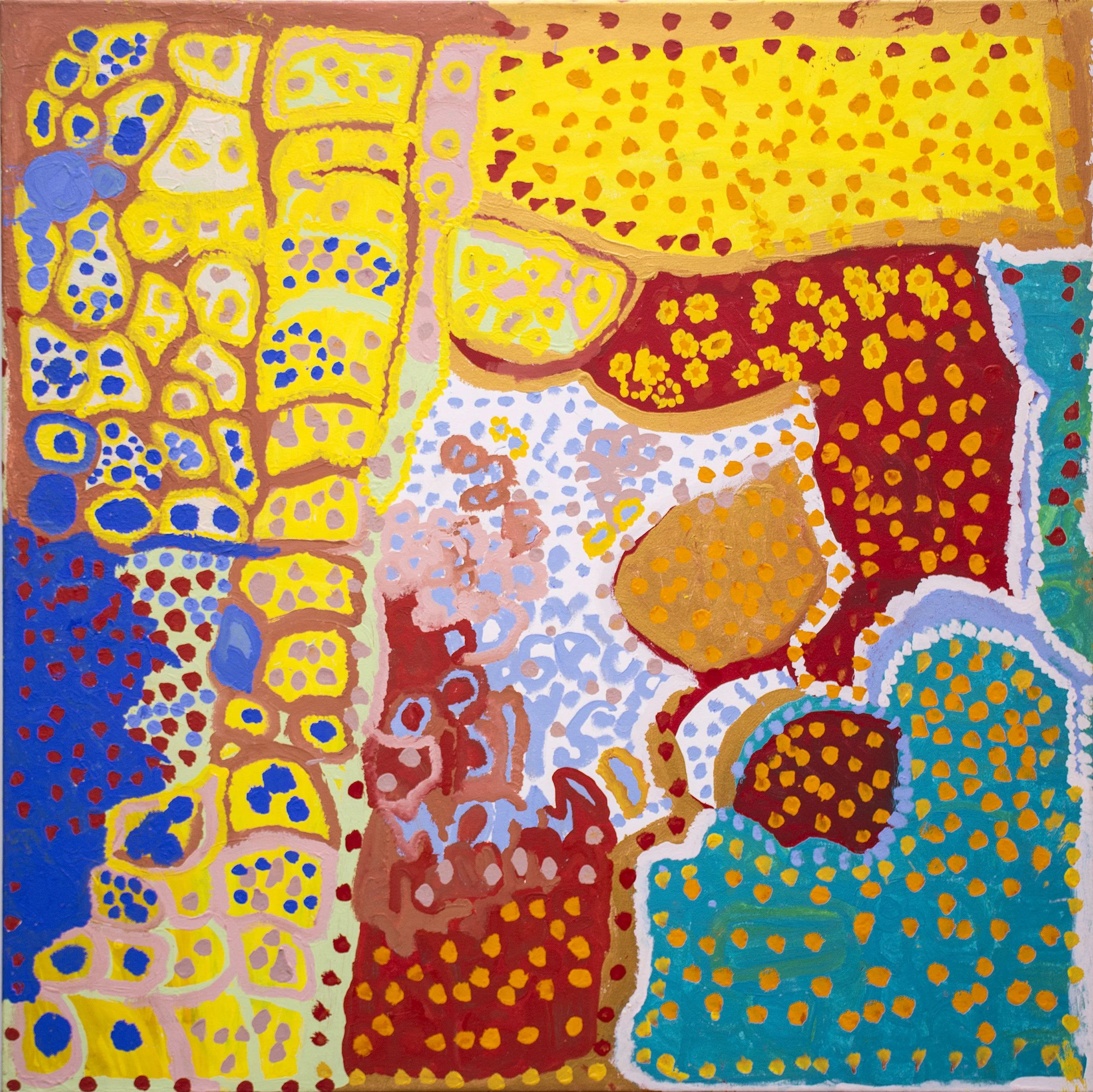
Artiste : Daisy Japulja
Titre de l'œuvre : Billabongs
Format : 120 x 120 cm
Provenance et certificat : centre d'art de Mangkaja
Référence de cette peinture Aborigène d'Australie : 345/16
Explications sur cette œuvre :
Daisy Japulja (1948) paints images of both Martuwarra (river country) and her parent's Jilji (sand hill) country. In these works Daisy relives the stories told of her mothers and fathers country, and retells those of her own river country. Daisy uses lively colours and a thick brush to cover the canvas with a confident hand. The beautiful simplicity of her desert images are matched by her bold colour pallet as she portrays important Jila (waterholes) and Jumu (soak waters) from the Great Sandy Desert. Closer to home, her cheeky sense of humour rises from the canvas through her beautiful depictions of river country like Martuwarra in this artwork, and the various animals that dwell within it.
Collection :
private collections in Australia
Vendue

Artiste : Jimmy Nerrimah
Titre de l'œuvre : Purrahala, Myilapul and Kartallala
Format : 120 x 60 cm
Provenance et certificat : centre d'art de Mangkaja
Référence de cette peinture Aborigène d'Australie : pc039/05
Explications sur cette œuvre :
Jimmy (Mawukura) Nerrimah (1929-2011) is a Walmajarri man. His country is around Wayampajarti, a waterhole in the north western area of the Great Sandy Desert. He was born near a waterhole called Wili, at a swamp called Miyitinynanguwu. He calls the names of places such as Tapu, Kurrjalpartu, Kayalijarti, Kurraly Kurraly, Walypa, Wayampajarti, Kumpujarti and Witikarrijarti as the main waterholes in his country. He grew up in the desert moving around these waterholes. Mawukura was nearly a man when his father brought him to the station country to escape a very large fire that was burning in his country around Tapu. He went through law at Lumpu Lumpu and then went back to the desert with his father in law where he lived for around five more years. The police came around there once he says but they did not pick him up, they gave him food. The police continued on but they were frightened by kalpurtu so they kept gong, straight back to town. The same police picked up Huey Bent and took him to Cherrabun Station not long after.
Collection :
Levy Kaplan Collection, Seattle USA
Thomas Vroom Collection, Amsterdam
National Gallery of Australia
Art Gallery of Western Australia

Artiste : Sonia Kurarra
Titre de l'œuvre : MARTUWARRA
Format : 180 x 120 cm
Provenance et certificat : centre d'art de Mangkaja
Référence de cette peinture Aborigène d'Australie : 10/18
Explications sur cette œuvre :
Sonia Kurrara (1951) grew up in the river country at Noonkanbah (Yungngnora), south-west of Fitzroy Crossing in the Kimberley region of Western Australia. She has worked through Mangkaja Arts since its establishment in the early 1990s and in recent years has become known for her vibrant, energetic paintings that celebrate her riverland home.
"Martuwarra is my river country; this painting is all about the Fitzroy River which flows down through Nookanbah where I live. All kinds of fish live in the water, we catch big mob of fish here. I like Parlka (barrumundi). We catch catfish and brim here too. Nganku(shark), wirritunany (sawfish) and stingray also live here. These fish live in these waters long after the flood has gone."
Collection & awards :
Winner of the Hedland Art Awards 2012
Winners of the best Indigenous Artwork - WA Art Award & Hedland Award 2010
Art Gallery NSW. The Lepley Collection, Perth
Kerry Stokes. Holmes a Court Collection. Brocard - Estrangin Collection. The Art Gallery of NSW. The Lepley Collection

Artiste : Sonia Kurarra
Titre de l'œuvre : MARTUWARRA
Format : 150 x 150 cm
Provenance et certificat : centre d'art de Mangkaja
Référence de cette peinture Aborigène d'Australie : 355/16
Explications sur cette œuvre :
Sonia Kurrara (1951) grew up in the river country at Noonkanbah (Yungngnora), south-west of Fitzroy Crossing in the Kimberley region of Western Australia. She has worked through Mangkaja Arts since its establishment in the early 1990s and in recent years has become known for her vibrant, energetic paintings that celebrate her riverland home.
"Martuwarra is my river country; this painting is all about the Fitzroy River which flows down through Nookanbah where I live. All kinds of fish live in the water, we catch big mob of fish here. I like Parlka (barrumundi). We catch catfish and brim here too. Nganku(shark), wirritunany (sawfish) and stingray also live here. These fish live in these waters long after the flood has gone."
Collection & awards :
Winner of the Hedland Art Awards 2012
Winners of the best Indigenous Artwork - WA Art Award & Hedland Award 2010
Art Gallery NSW. The Lepley Collection, Perth
Kerry Stokes. Holmes a Court Collection. Brocard - Estrangin Collection. The Art Gallery of NSW. The Lepley Collection
Indisponible
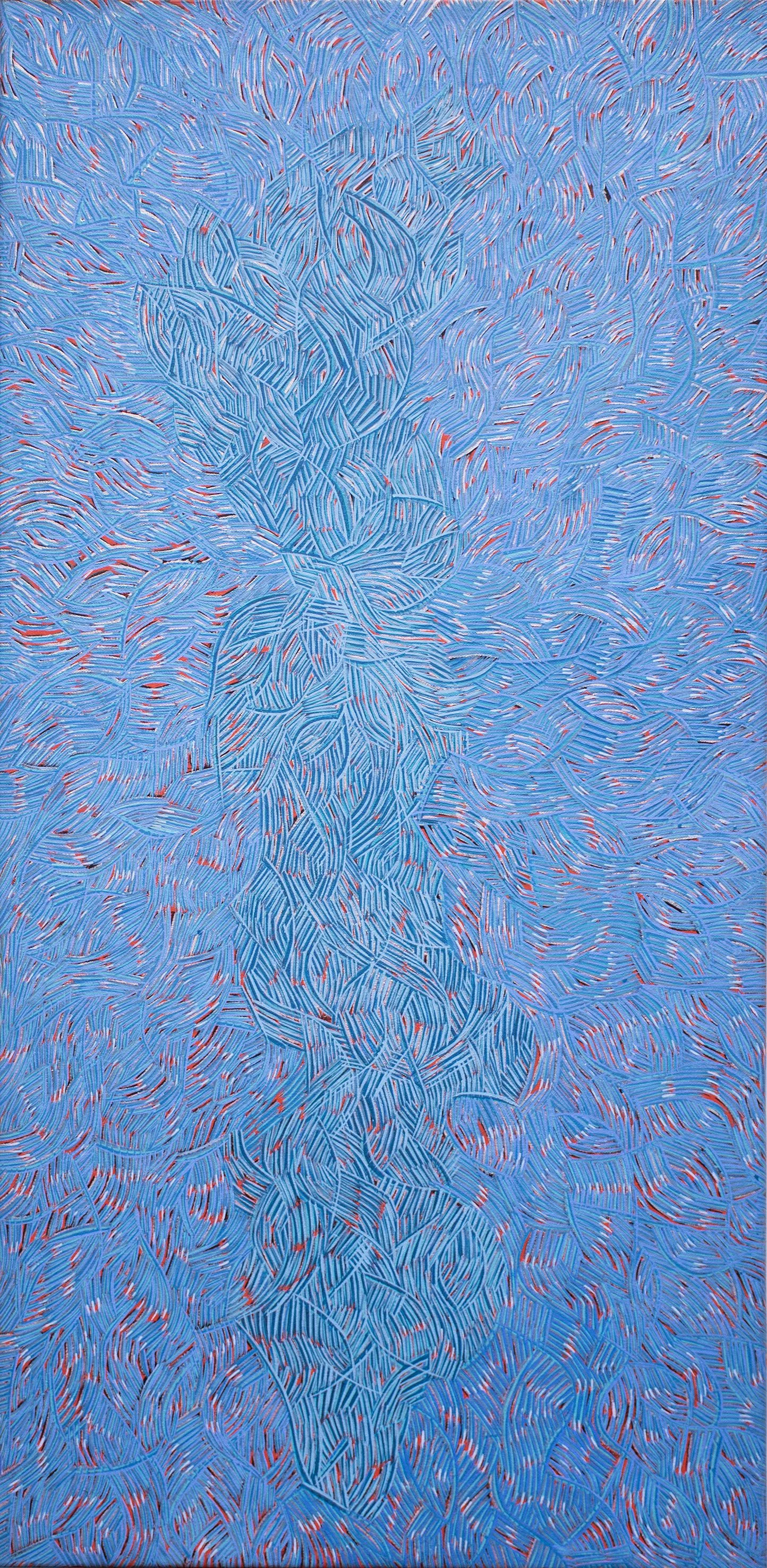
Artiste : Eva Nargoodah
Titre de l'œuvre : Yitilarl Ngapa (Winter Rain)
Format : 120 x 60 cm
Provenance et certificat : centre d'art de Mangkaja
Référence de cette peinture Aborigène d'Australie : 341/17
Explications sur cette œuvre :
I was born on Christmas Creek Station in 1954 and grew up with my parents until the age of six. My dad was a stockman and my mother worked in the house. I was taken away to GoGo Station where my great-grandmother lived. We moved there with the manager from Christmas Creek. His name was Vic Johns. At GoGo Station my father worked at the stock camp again and my mother in the house. Next we shifted to Cherrabun Station where I went to school in 1965 at the men's quarter. I moved to many different places. From Cherrabun we went back to Christmas Creek. I did my next years at school in Derby and worked at Christmas Creek school as a teacher. In 1984 I was married. I have nine children and nine grandchildren. I started painting after my kids grew up. I paint my grandmother's country and what she has taught me. I paint my style of seasons, bush tucker paintings and my childhood memories of winter rains and cold weather.
This painting evokes the Winter rain, the cold weather and all kinds of birds flying around looking for food. We call that season Yitilarl
Collection :
National Gallery of Victoria
Fitzroy Crossing High School
Fitzroy Crossing Hospital
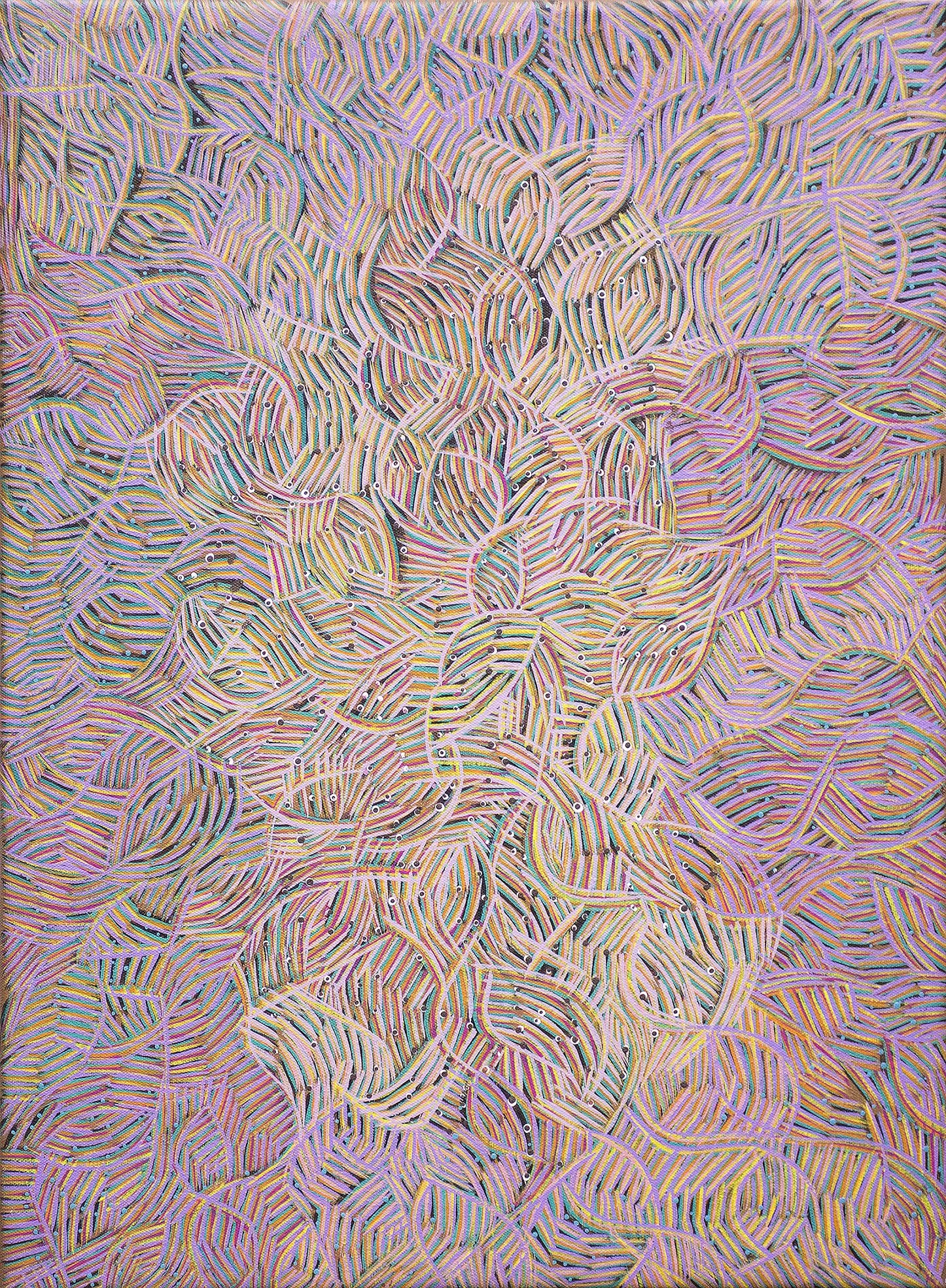
Artiste : Eva Nargoodah
Titre de l'œuvre : Bush Flowers
Format : 45 x 60 cm
Provenance et certificat : centre d'art de Mangkaja
Référence de cette peinture Aborigène d'Australie : 333/17
Explications sur cette œuvre :
I was born on Christmas Creek Station in 1954 and grew up with my parents until the age of six. My dad was a stockman and my mother worked in the house. I was taken away to GoGo Station where my great-grandmother lived. We moved there with the manager from Christmas Creek. His name was Vic Johns. At GoGo Station my father worked at the stock camp again and my mother in the house. Next we shifted to Cherrabun Station where I went to school in 1965 at the men's quarter. I moved to many different places. From Cherrabun we went back to Christmas Creek. I did my next years at school in Derby and worked at Christmas Creek school as a teacher. In 1984 I was married. I have nine children and nine grandchildren. I started painting after my kids grew up. I paint my grandmother's country and what she has taught me. I paint my style of seasons, bush tucker paintings and my childhood memories of winter rains and cold weather.
This painting evokes the Winter rain, the cold weather and all kinds of birds flying around looking for food. We call that season Yitilarl
Collection :
National Gallery of Victoria
Fitzroy Crossing High School
Fitzroy Crossing Hospital
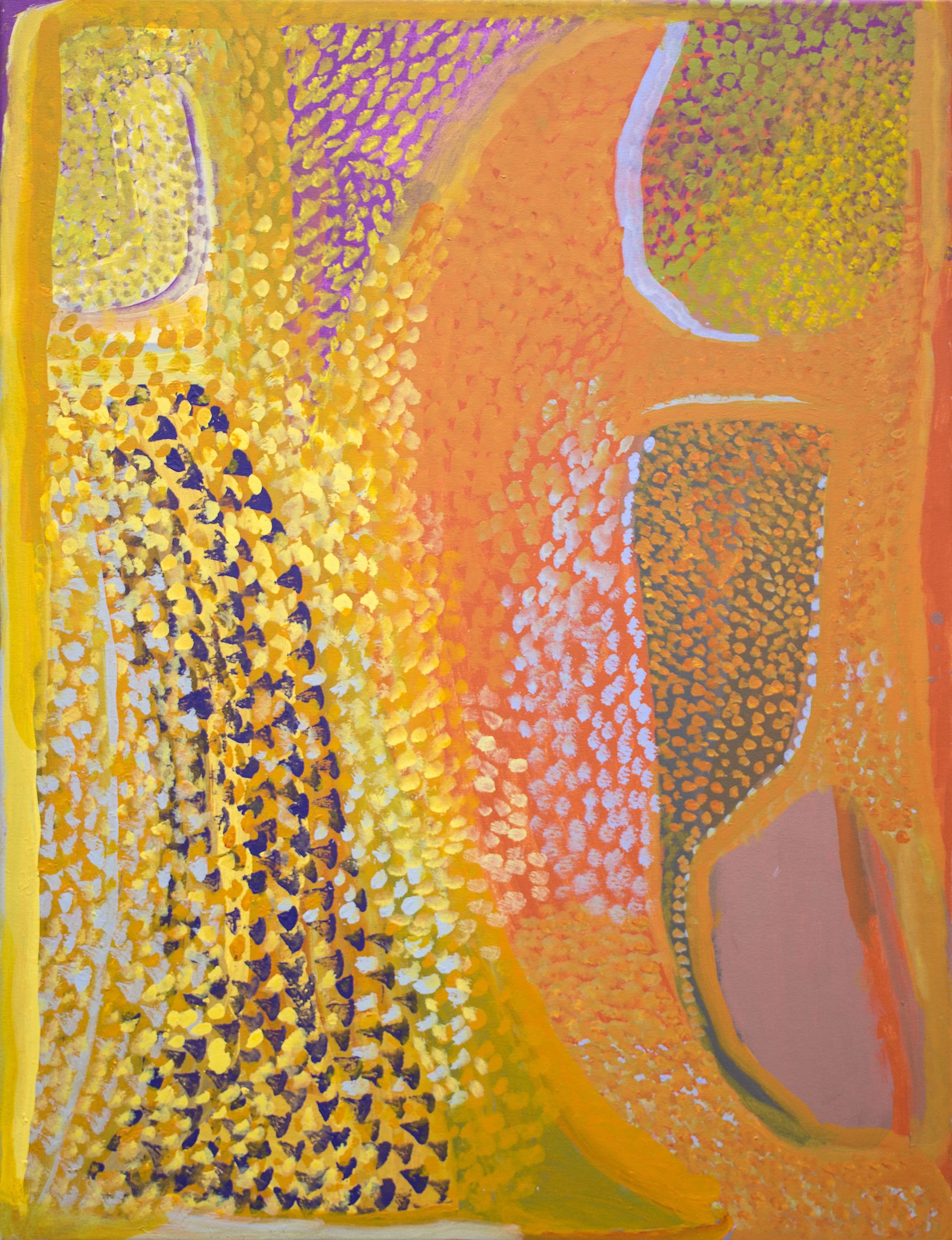
Artiste : Nada Tjigila Rawlins
Titre de l'œuvre : LINJALANGU
Format : 120 x 60 cm
Provenance et certificat : centre d'art de Mangkaja
Référence de cette peinture Aborigène d'Australie : 46/16
Explications sur cette œuvre :
Tjigila Nada Rawlins (1936) is a Wangkajungka woman from the Great Sandy Desert. She is a founding member of Karrayili Adult Education Centre and began painting in 1994 at the Karrayili annexe established in Wangkajungka community, 100km southeast of Fitzroy Crossing. Today Nada paints at Mangkaja Arts. This is Tjigila’s story:
I was born in the Great Sandy Desert. My mother never put me in a blanket. I never saw my father. We walked from the desert along the Canning Stock Route. We walked through Billiluna. One kartiya [European] called Len Brown picked us up early in the morning in a truck. He took us to Moola Bulla. I had a sore on my arm and they took me to the clinic. They gave me lots of needles. When my arm was better I lived with my family at Moola Bulla. Then we walked alongside the river to Christmas Creek. We walked becuase we had no motorcar. We carried our swags on our heads.
This painting evokes Linjalangu next to Kiriwirri, with spring water but it is salty. The Jilji (sandhills) follow the edge of the Warla (salt lake). I was walking there with my parents when I was young.
Collection :
National Gallery of Victoria
Art Gallery of New South Wales
Charles Darwin University
Holmes a Court Collection, Perth
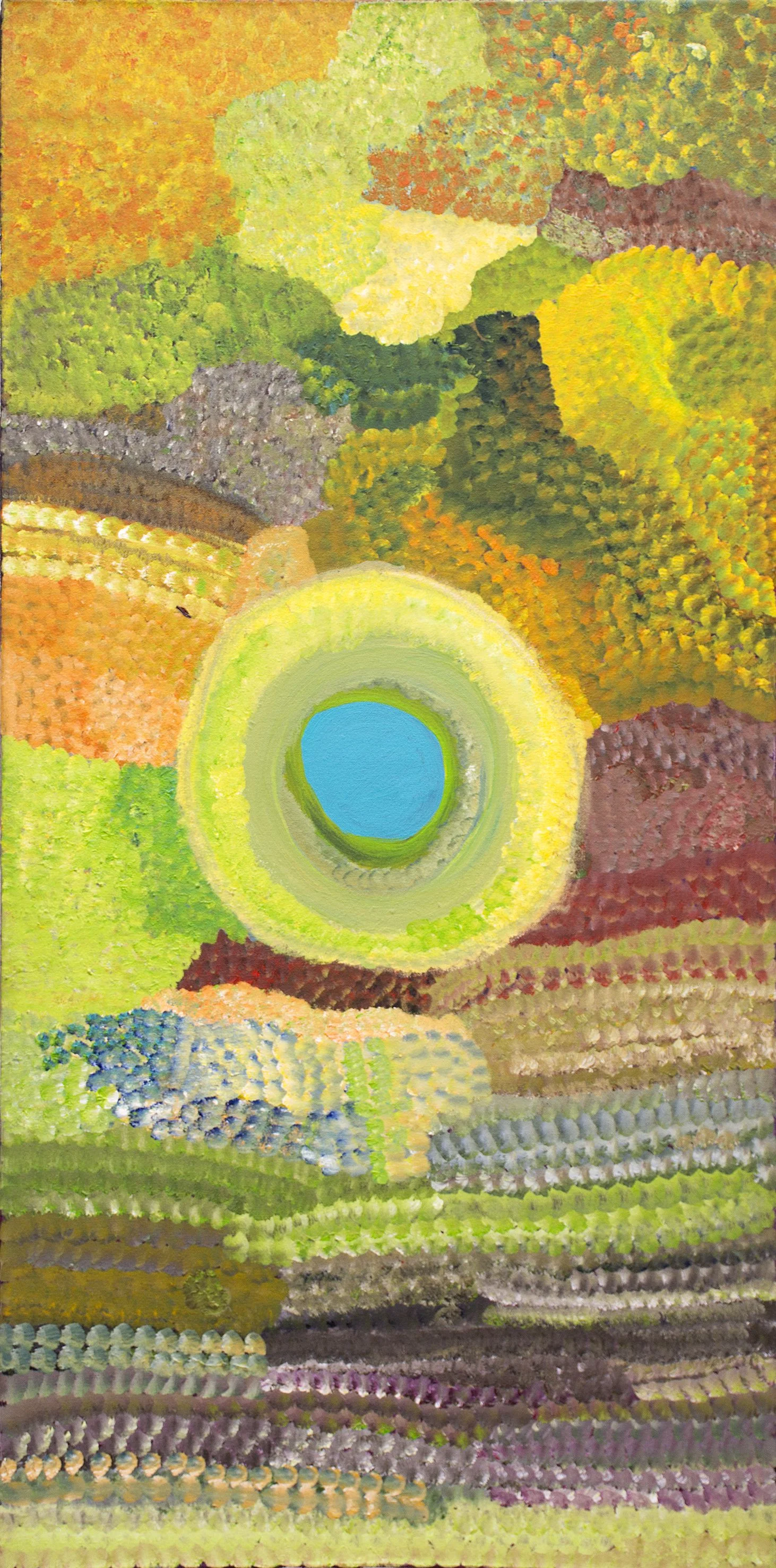
Artiste : Purlta Maryanne Downs
Titre de l'œuvre : This is my country
Format : 120 x 60 cm
Provenance et certificat : centre d'art de Mangkaja
Référence de cette peinture Aborigène d'Australie : 52/08
Explications sur cette œuvre :
"I was born at Kurtal Jila in 1945. There is living water there. Kurtal is near Billiluna. When I was a young girl, I walked with my mother a long way to Lake Gregory. After this, when I was still young, I walked again with my parents to Louisa Downs station. We walked all morning and afternoon. We ate bush tucker. Billy Goat Cox was the manager of the station when I was there. I saw a motor car for the first time at Lousia Downs Station. I was frightened of it. I thought that it would shoot me!".
This painting evokes her country Yurralmural, a rocky country with a crek running throught, and with a beautiful Jila (Water Hole).
Collection :
Art Gallery of New South Wales
National Gallery of Australia
National Gallery of Victoria
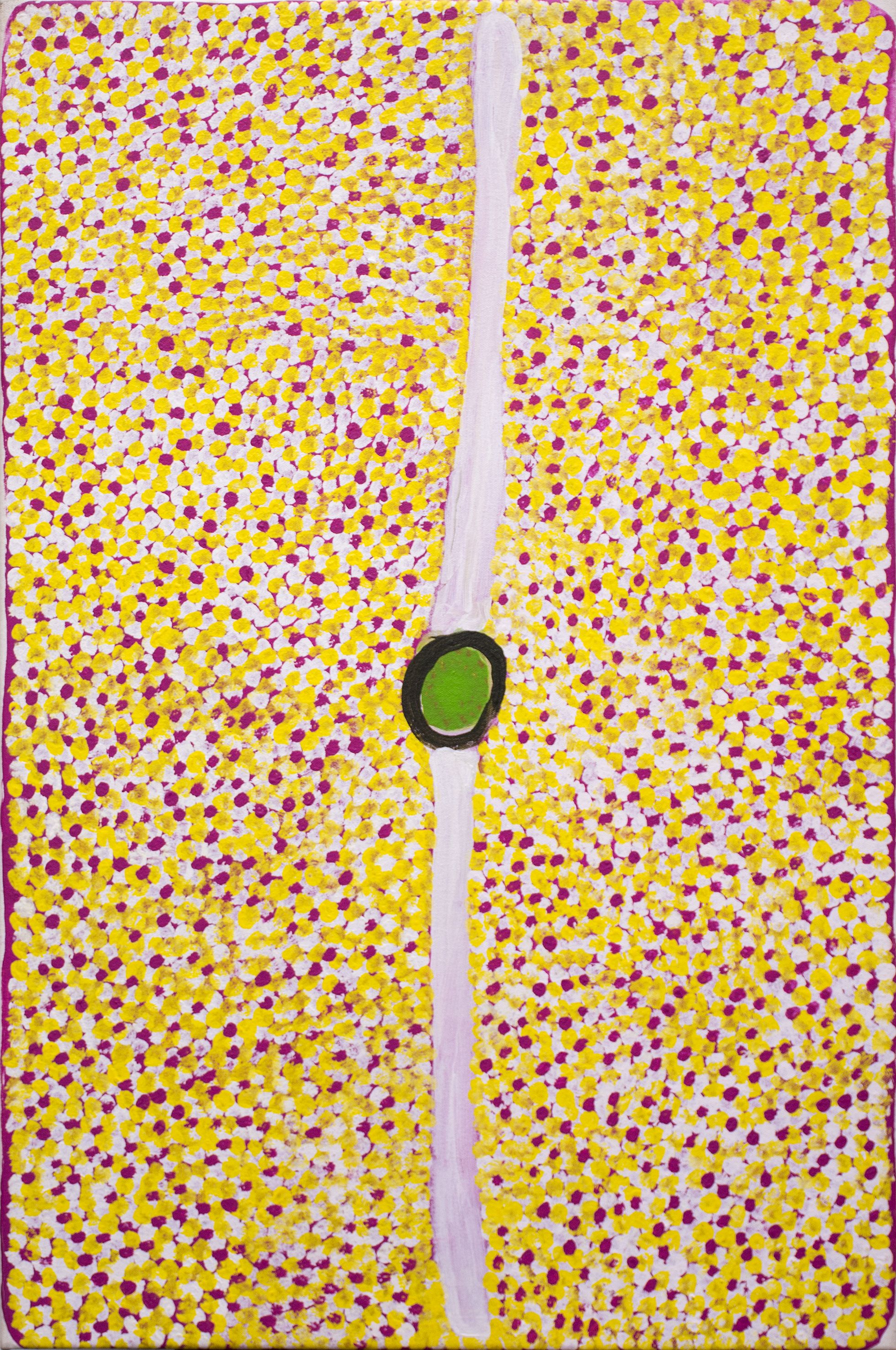
Artiste : Penny K-Lyons Nyangkarni
Titre de l'œuvre : Kunajatti
Format : 90 x 60 cm
Provenance et certificat : centre d'art de Mangkaja
Référence de cette peinture Aborigène d'Australie : 397/10
Explications sur cette œuvre :
This painting by the artist Penny K-Lyons Nyangkarni (1932) is all about little river creeks. the white lines represent creek (palma) south of wakartu country Tarpu. The round circle in the middle represent jumu called (walypa). And their's pretty Flowers all around the jumu waterhole and their's rabbits (mirtuluju) use to roam a round that area many years ago.
Collection :
Fitzroy Crossing Hospital
National Gallery of Victoria
National museum of Australia
Vendue
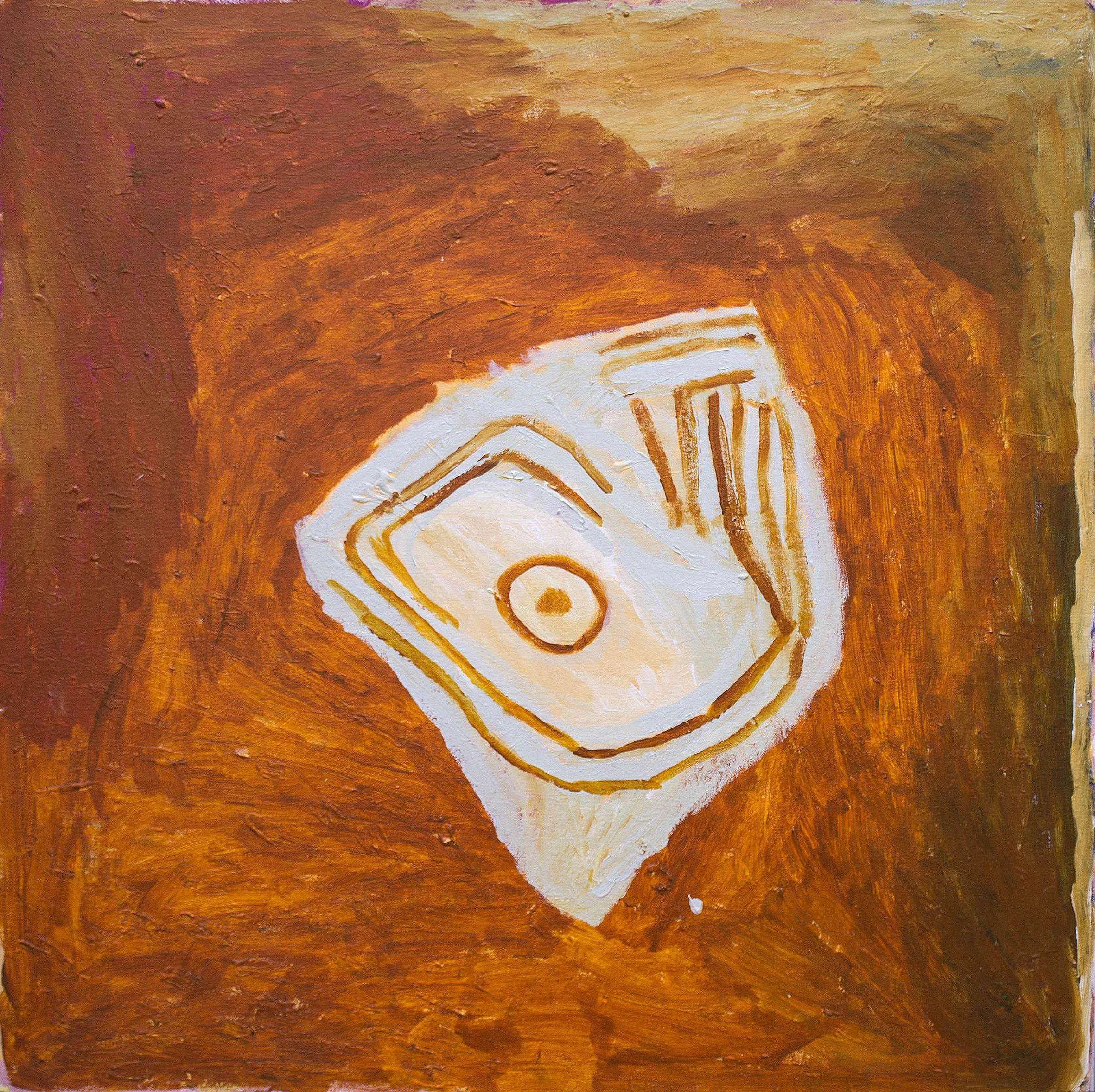
Artiste : Rosie King Tarku
Titre de l'œuvre : Japirnka
Format : 90 x 90 cm
Provenance et certificat : centre d'art de Mangkaja
Référence de cette peinture Aborigène d'Australie : 344/17
Explications sur cette œuvre :
Rosie King Tarku born in 1934 at a Jumu called Pyinjarra in the Great Sandy Desert. When she left the desert, they walked for a long time with her husband and older sister. It was a very long way to arrive at Old Bililluna. I did not know english at that time. We had no shoes, we were wearing yakapiri (old people long ago in the desert they used to make sandals to protect feet from the hot ground).
This painting evokes my country call Jairnka where I grow up there with my families mother and father. The snake lives under neath. The waterhole gives us water every year every month.
Collection :
National Museum of Australia
Fitzroy Crossing Hospital
Private collections
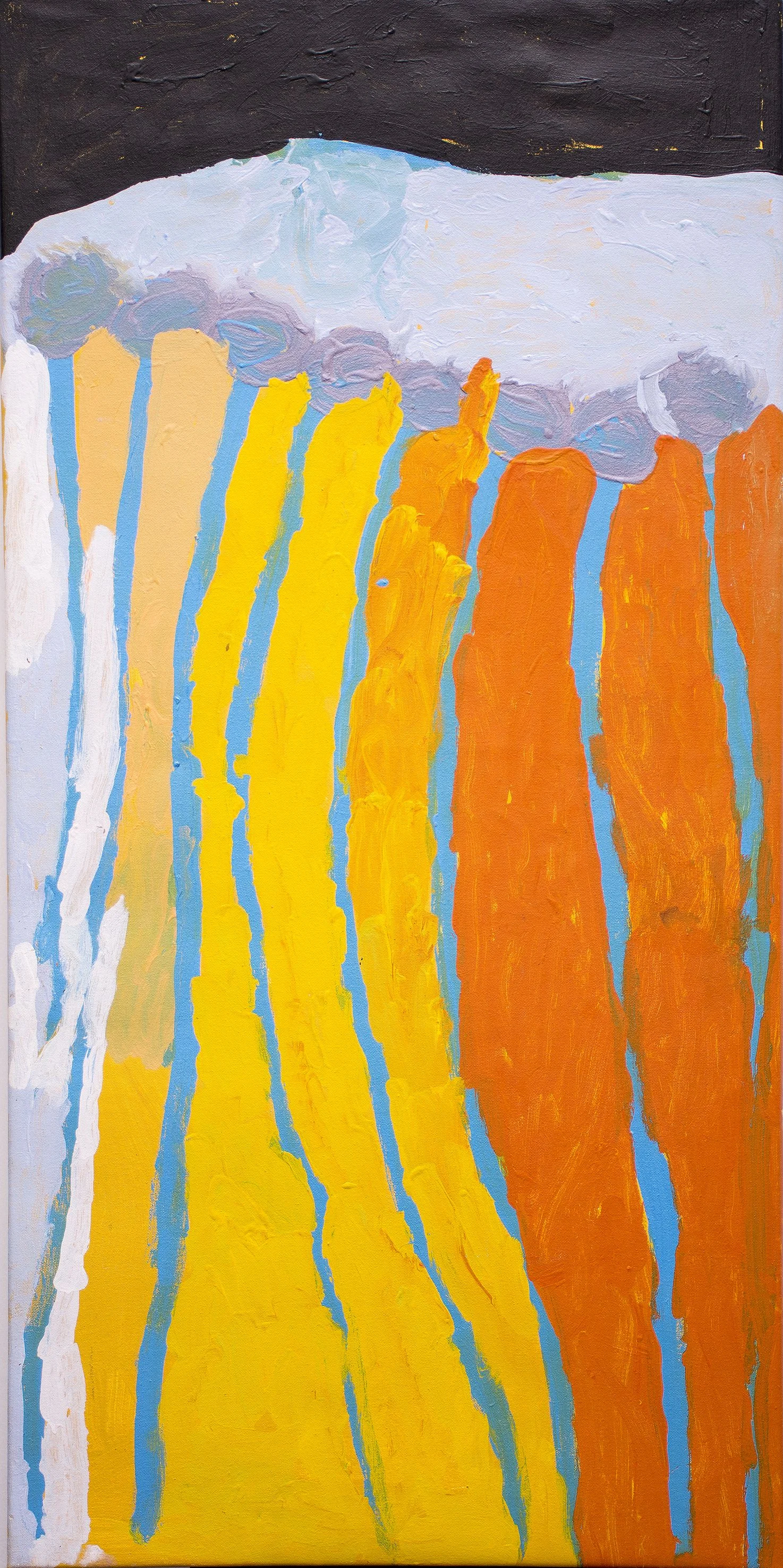
Artiste : Lisa Uhl
Titre de l'œuvre : TURTUJARTI
Format : 120 x 60 cm
Provenance et certificat : centre d'art de Mangkaja
Référence de cette peinture Aborigène d'Australie : 433/17
Explications sur cette œuvre :
Lisa UHL (1976) is living in Fitzroy Crossing in the West berley area of Western Australia. Her language group is Wangkajunga and she has lived all of her life in Fitzroy Crossing. Lisa represents her love for her family's country through her abstract paintings. She displays her unique cultural connection to place through art, and whilst never actually having seen Turtujarti, walnut trees from the Great Sandy Desert. She diplays with mesmerizing effect her love of this country which she recalls from the stories she has been told by her eiders and more specifically by Jukuja Dolly Snell, her aunty who raised her from an infant. Lisa's layering of colours creates an atmospheric rhythm within her works which speaks of the humidity and expanse of the Kimberley. Her work is represented by Mangkaja Art Centre and has been shown locally and nationally in group and solo exhibitions.
Collection :
Artbank, Patrick Corrigan, Murdoch University collection, private collections...

Artiste : Lisa Uhl
Titre de l'œuvre : This small tree is useful
Format : 120 x 90 cm
Provenance et certificat : centre d'art de Mangkaja
Référence de cette peinture Aborigène d'Australie : 365/17
Explications sur cette œuvre :
Lisa UHL (1976) is living in Fitzroy Crossing in the West berley area of Western Australia. Her language group is Wangkajunga and she has lived all of her life in Fitzroy Crossing. Lisa represents her love for her family's country through her abstract paintings. She displays her unique cultural connection to place through art, and whilst never actually having seen Turtujarti, walnut trees from the Great Sandy Desert. She diplays with mesmerizing effect her love of this country which she recalls from the stories she has been told by her eiders and more specifically by Jukuja Dolly Snell, her aunty who raised her from an infant. Lisa's layering of colours creates an atmospheric rhythm within her works which speaks of the humidity and expanse of the Kimberley. Her work is represented by Mangkaja Art Centre and has been shown locally and nationally in group and solo exhibitions.
Collection :
Artbank, Patrick Corrigan, Murdoch University collection, private collections...
Vendue
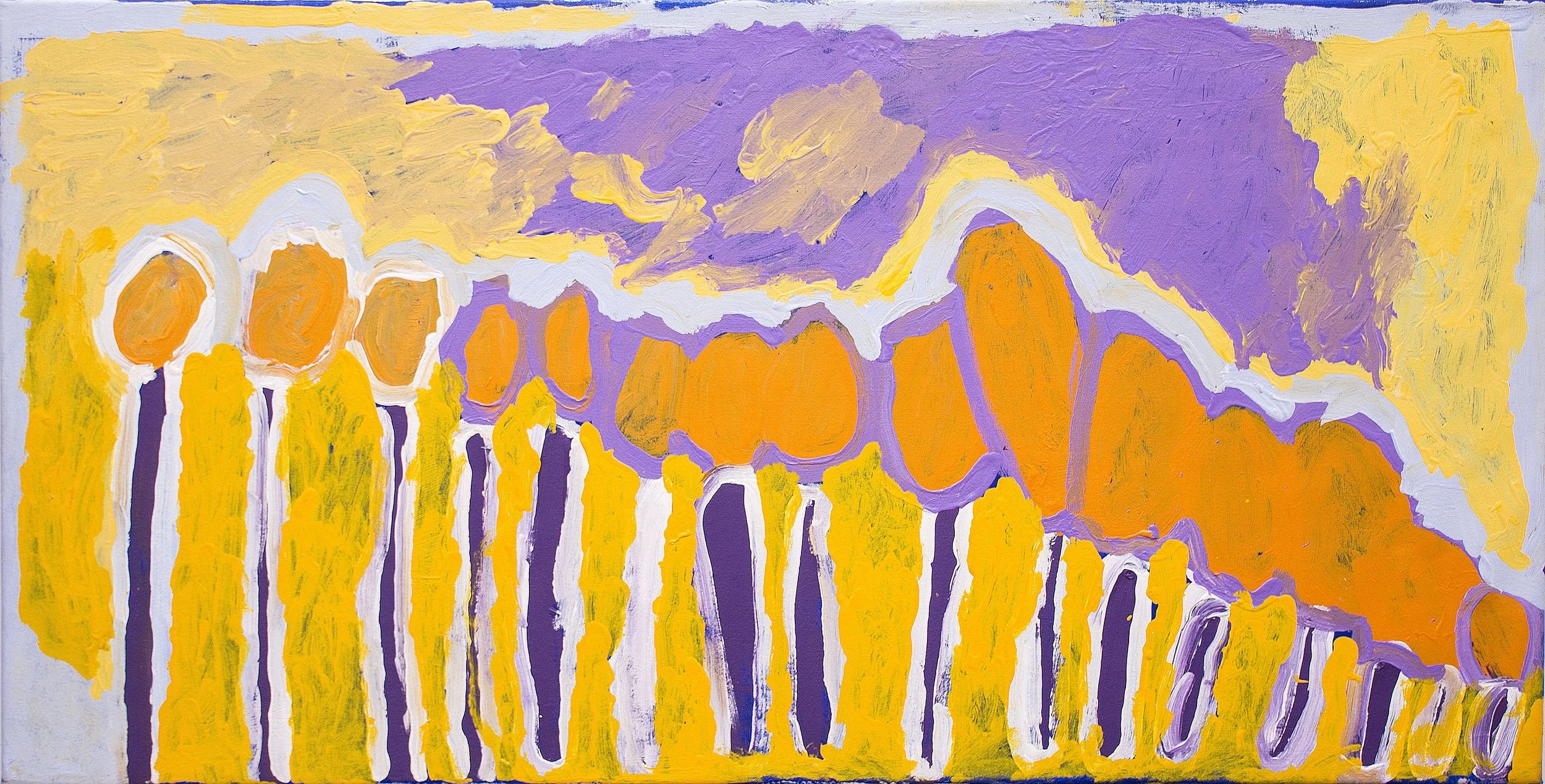
Artiste : Lisa Uhl
Titre de l'œuvre : I was born in fitzroy crossing hospital
Format : 120 x 60 cm
Provenance et certificat : centre d'art de Mangkaja
Référence de cette peinture Aborigène d'Australie : 364/17
Explications sur cette œuvre :
Lisa UHL (1976) is living in Fitzroy Crossing in the West berley area of Western Australia. Her language group is Wangkajunga and she has lived all of her life in Fitzroy Crossing. Lisa represents her love for her family's country through her abstract paintings. She displays her unique cultural connection to place through art, and whilst never actually having seen Turtujarti, walnut trees from the Great Sandy Desert. She diplays with mesmerizing effect her love of this country which she recalls from the stories she has been told by her eiders and more specifically by Jukuja Dolly Snell, her aunty who raised her from an infant. Lisa's layering of colours creates an atmospheric rhythm within her works which speaks of the humidity and expanse of the Kimberley. Her work is represented by Mangkaja Art Centre and has been shown locally and nationally in group and solo exhibitions.
Collection :
Artbank, Patrick Corrigan, Murdoch University collection, private collections...
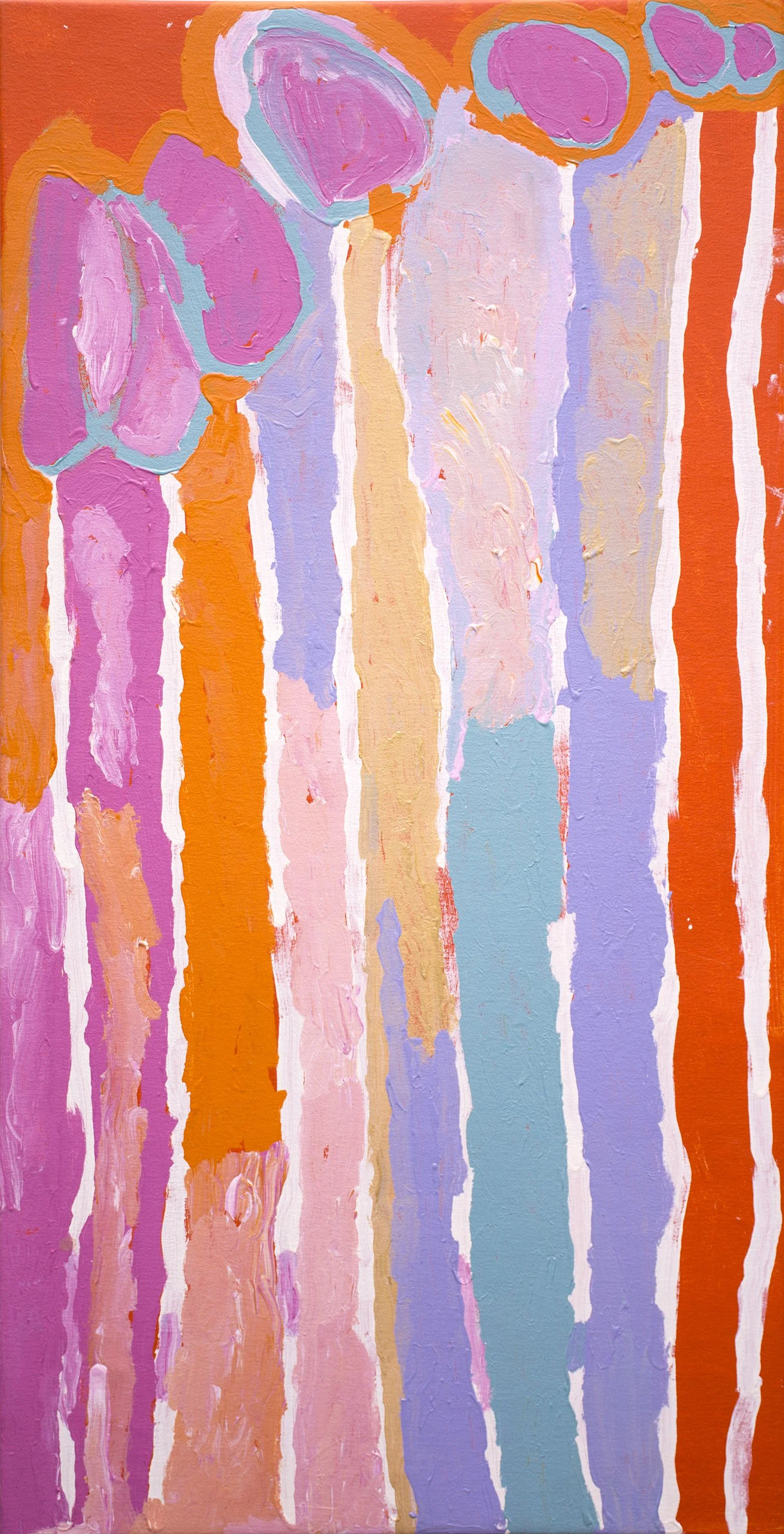
Artiste : Lisa Uhl
Titre de l'œuvre : TURTUJARTI
Format : 120 x 60 cm
Provenance et certificat : centre d'art de Mangkaja
Référence de cette peinture Aborigène d'Australie : 448/17
Explications sur cette œuvre :
Lisa UHL (1976) is living in Fitzroy Crossing in the West berley area of Western Australia. Her language group is Wangkajunga and she has lived all of her life in Fitzroy Crossing. Lisa represents her love for her family's country through her abstract paintings. She displays her unique cultural connection to place through art, and whilst never actually having seen Turtujarti, walnut trees from the Great Sandy Desert. She diplays with mesmerizing effect her love of this country which she recalls from the stories she has been told by her eiders and more specifically by Jukuja Dolly Snell, her aunty who raised her from an infant. Lisa's layering of colours creates an atmospheric rhythm within her works which speaks of the humidity and expanse of the Kimberley. Her work is represented by Mangkaja Art Centre and has been shown locally and nationally in group and solo exhibitions.
Collection :
Artbank, Patrick Corrigan, Murdoch University collection, private collections...

Artiste : Rosie King Tarku
Titre de l'œuvre : Desert From The Air
Format : 100 x 80 cm
Provenance et certificat : centre d'art de Mangkaja
Référence de cette peinture Aborigène d'Australie : 388/19
Explications sur cette œuvre :
Rosie King Tarku born in 1934 at a Jumu called Pyinjarra in the Great Sandy Desert. When she left the desert, they walked for a long time with her husband and older sister. It was a very long way to arrive at Old Bililluna. I did not know english at that time. We had no shoes, we were wearing yakapiri (old people long ago in the desert they used to make sandals to protect feet from the hot ground).
This painting is all about waterholes jilas and jumus way out in the desert. You can see salt lakes dry with out water some jilas and little billabongs with little water, sand hills, red sands, dry grass and trees.
Collection :
National Museum of Australia
Fitzroy Crossing Hospital
Private collections

Artiste : Jimmy NERRIMAH
Titre de l'œuvre : Wili ancestral place
Format : 90 x 90 cm
Provenance et certificat : centre d'art de Mangkaja
Référence de cette peinture Aborigène d'Australie : 317/07

Artiste : Daisy Japulja
Titre de l'œuvre : MARTUWARRA
Format : 1115 x 70 cm
Provenance et certificat : centre d'art de Mangkaja
Référence de cette peinture Aborigène d'Australie : 117/17
Explications sur cette œuvre :
Daisy Japulja (1948) paints images of both Martuwarra (river country) and her parent's Jilji (sand hill) country. In these works Daisy relives the stories told of her mothers and fathers country, and retells those of her own river country. Daisy uses lively colours and a thick brush to cover the canvas with a confident hand. The beautiful simplicity of her desert images are matched by her bold colour pallet as she portrays important Jila (waterholes) and Jumu (soak waters) from the Great Sandy Desert. Closer to home, her cheeky sense of humour rises from the canvas through her beautiful depictions of river country like Martuwarra in this artwork, and the various animals that dwell within it.
Collection :
private collections in Australia
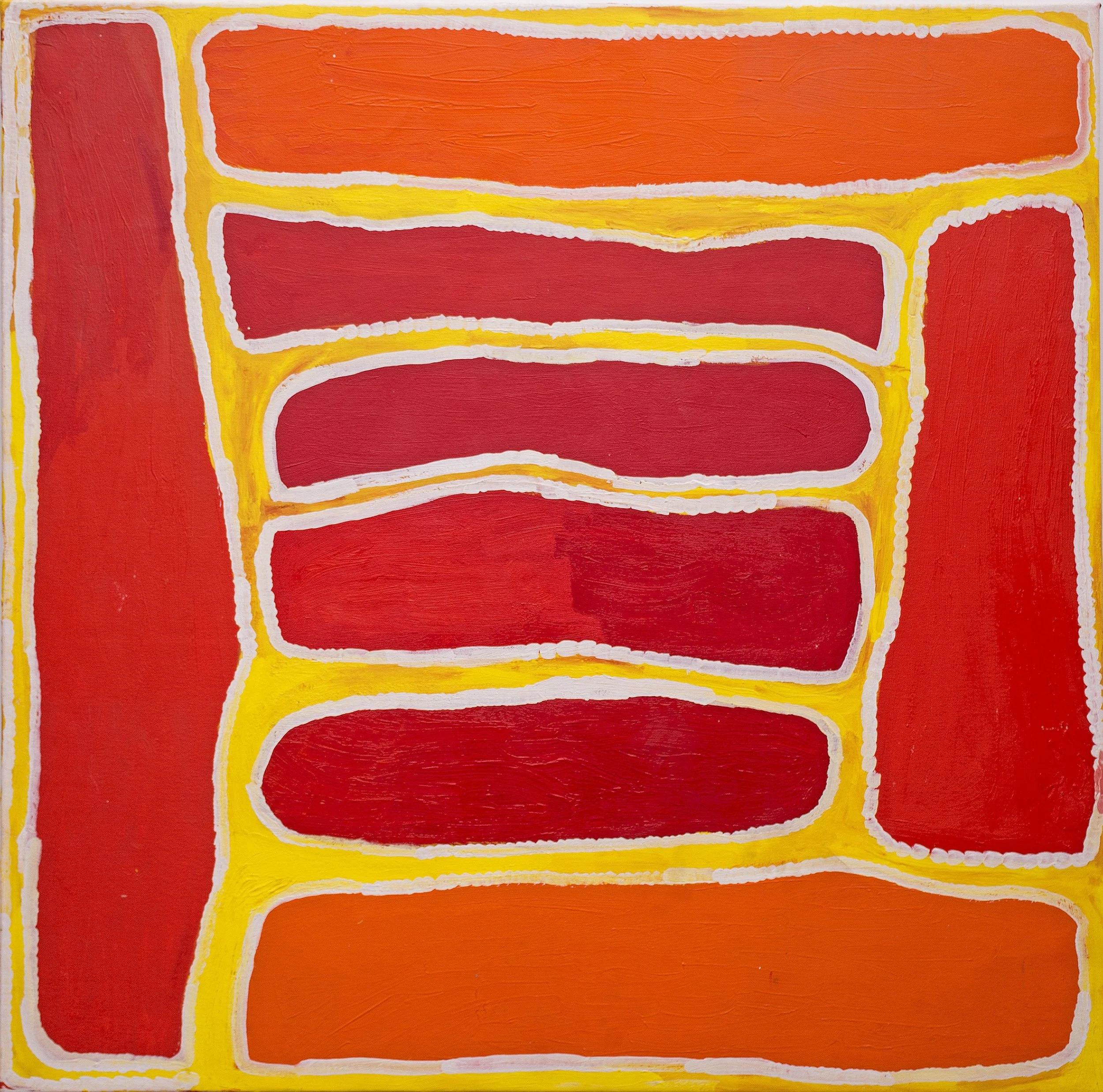
Artiste : Wakartu Cory Surprise
Titre de l'œuvre : Big One Jila
Format : 120 x 120 cm
Provenance et certificat : centre d'art de Mangkaja
Référence de cette peinture Aborigène d'Australie : 1373/08
Explications sur cette œuvre :
Wakartu Cory Surprise born about 1929 and died 2011. Wakartu was born at Tapu. After the death of her parents she travelled with her brothers to Kaningarra and Wayampajirti where she grew up. As a married woman, she and her husband ran away from Christmas Creek Station, and the police brought her husband back in chains. Wakartu raised seven children while working for the police, on stations, and collecting minerals for rations.
This painting evokes an important place called Big one Jila within her traditional country.
Collection :
National museum of Canberra
National Gallery of Victoria
Charles Darwin University
Laverty Collection Steve Luzco collection, San Francisco USA
European collections
Indisponible.
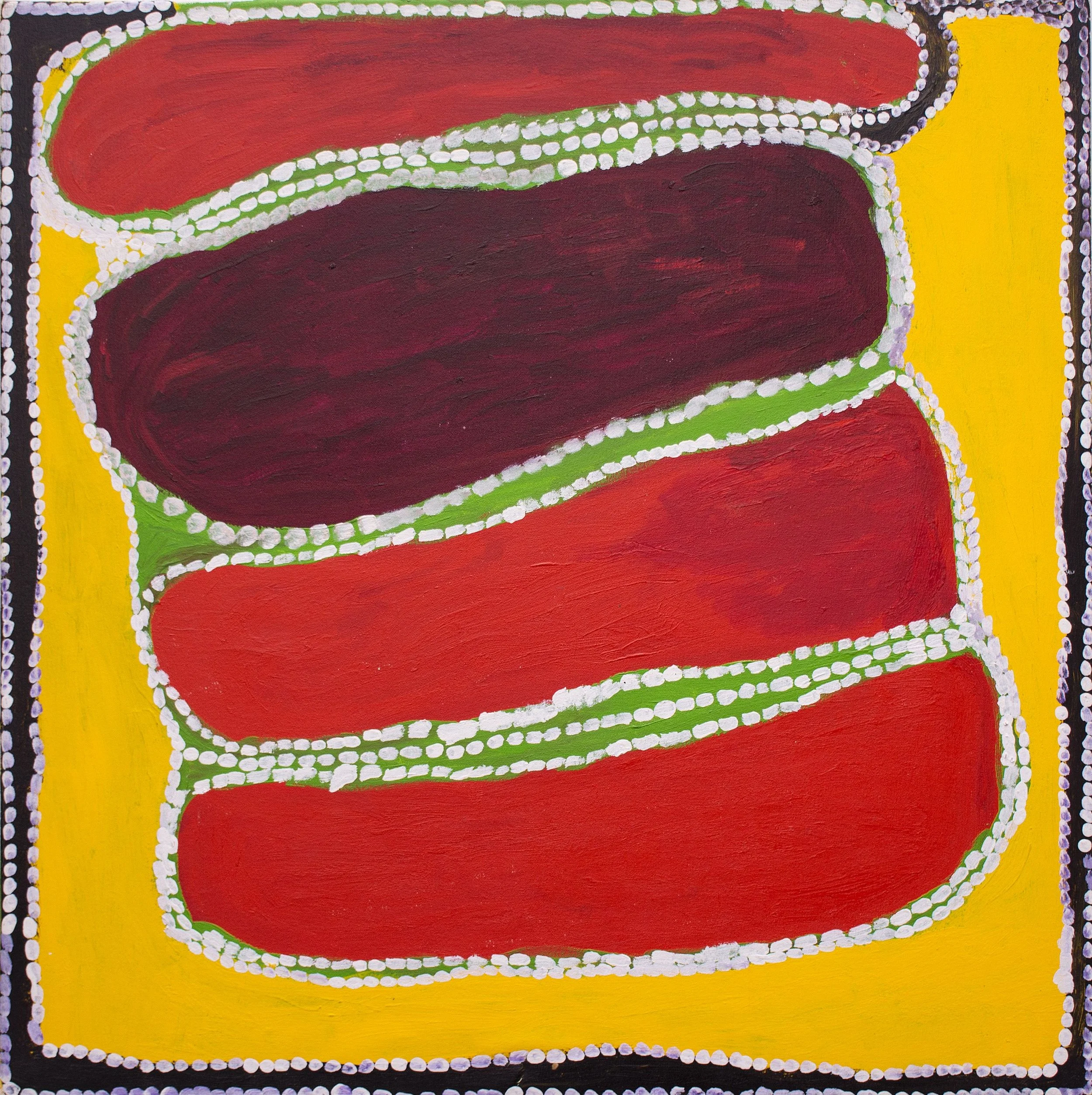
Artiste : Wakartu Cory Surprise
Titre de l'œuvre : Pamarr Mens ceremonies business
Format : 90 x 90 cm
Provenance et certificat : centre d'art de Mangkaja
Référence de cette peinture Aborigène d'Australie : 406/06
Explications sur cette œuvre :
Wakartu Cory Surprise born about 1929 and died 2011. Wakartu was born at Tapu. After the death of her parents she travelled with her brothers to Kaningarra and Wayampajirti where she grew up. As a married woman, she and her husband ran away from Christmas Creek Station, and the police brought her husband back in chains. Wakartu raised seven children while working for the police, on stations, and collecting minerals for rations.
This painting evokes Pamarr hill dedicated to a resticted part of the territory for mens business.
Collection :
National museum of Canberra
National Gallery of Victoria
Charles Darwin University
Laverty Collection Steve Luzco collection, San Francisco USA
European collections
Indisponible.
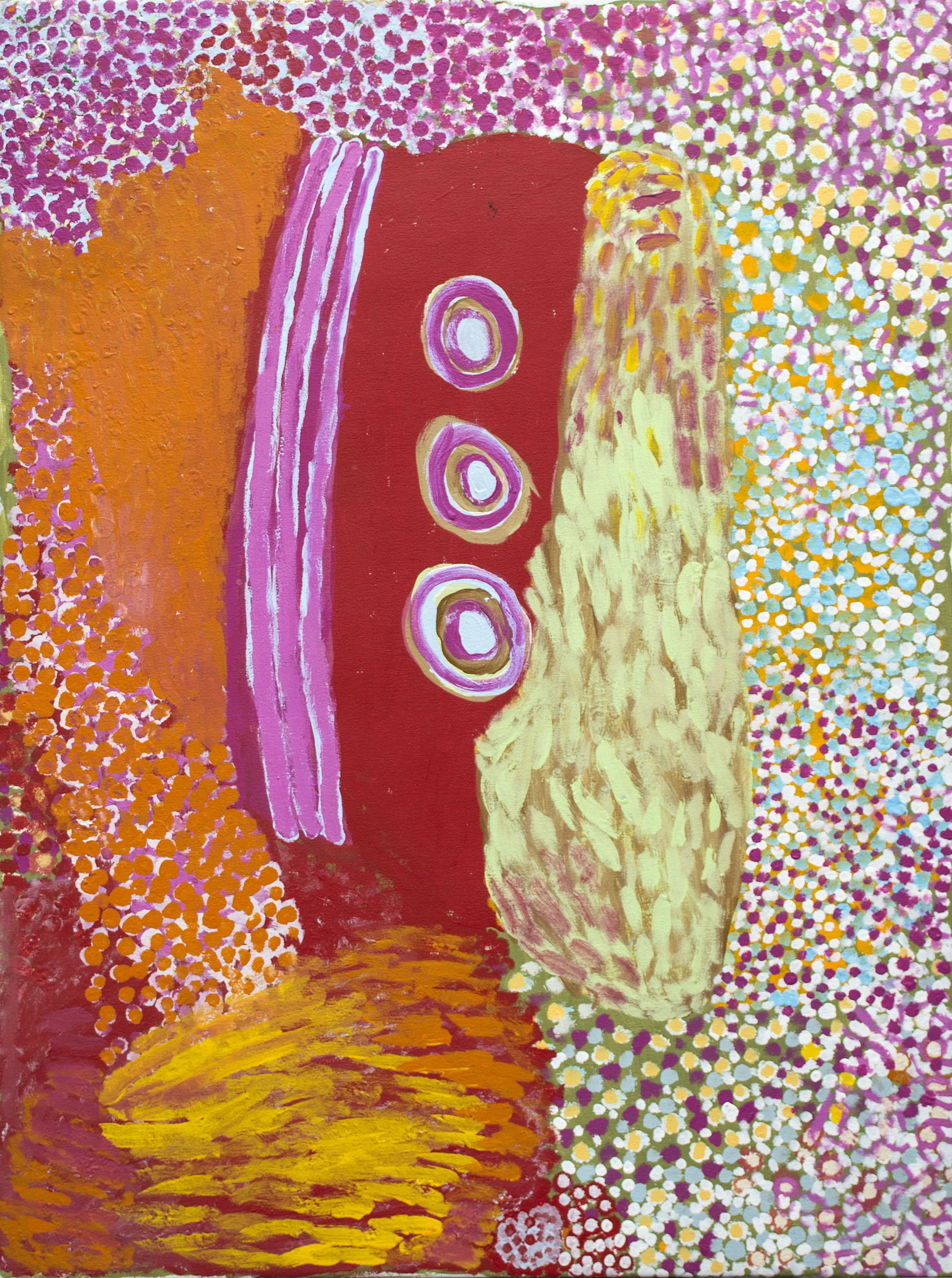
Artiste : Rosie King Tarku
Titre de l'œuvre : Japirnka
Format : 120 x 90 cm
Provenance et certificat : centre d'art de Mangkaja
Référence de cette peinture Aborigène d'Australie : 126/16
Explications sur cette œuvre :
Rosie King Tarku born in 1934 at a Jumu called Pyinjarra in the Great Sandy Desert. When she left the desert, they walked for a long time with her husband and older sister. It was a very long way to arrive at Old Bililluna. I did not know english at that time. We had no shoes, we were wearing yakapiri (old people long ago in the desert they used to make sandals to protect feet from the hot ground).
This painting evokes my country call Jairnka where I grow up there with my families mother and father. The snake lives under neath. The waterhole gives us water every year every month.
Collection :
National Museum of Australia
Fitzroy Crossing Hospital
Private collections
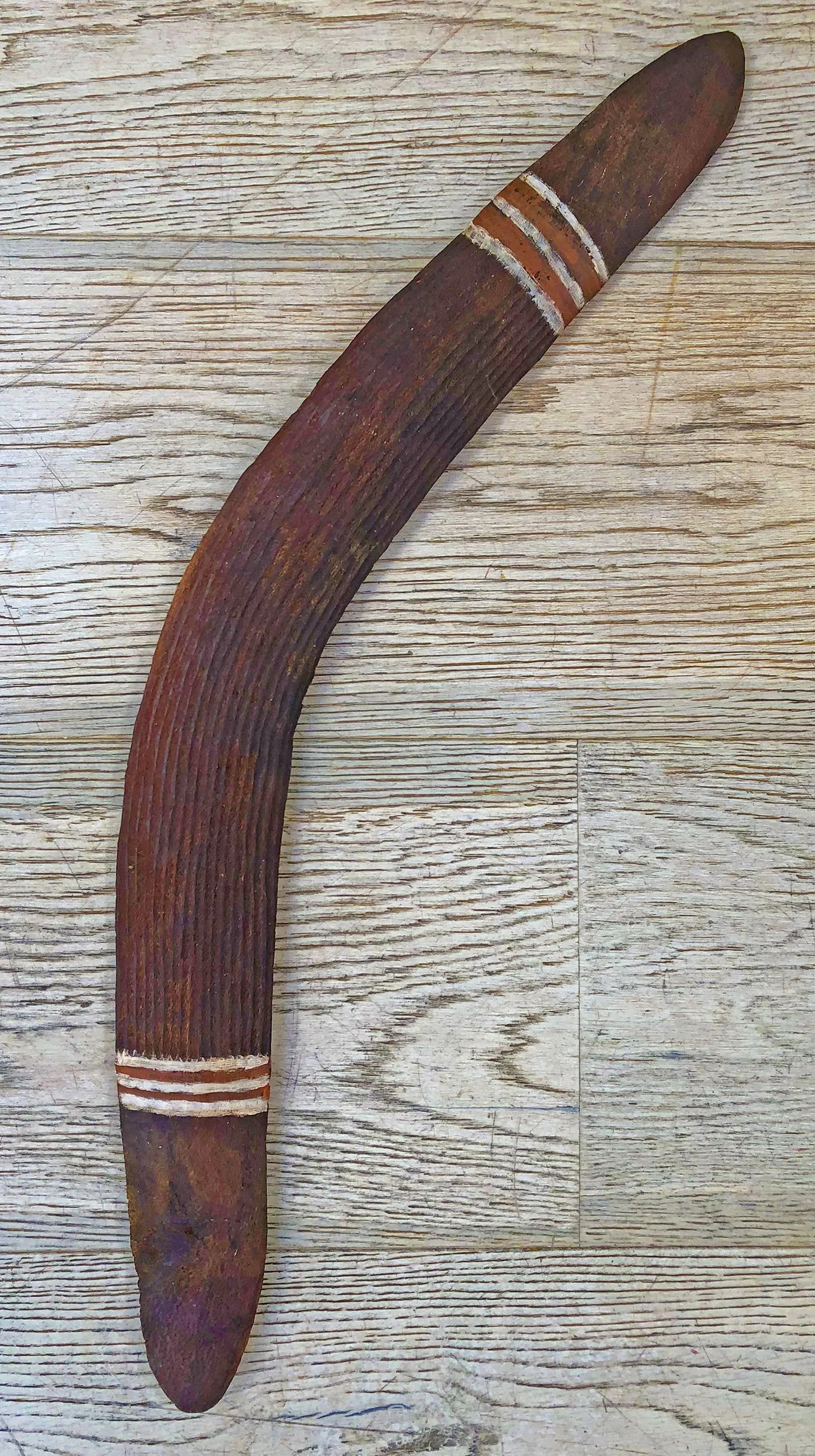
Artiste : Boxer Pompirla Hanson
Titre de l'œuvre : Boomerang/Jarrangarr/Bloodwood Tree
Format : 54 x 1 cm
Pigments naturels sur bois de sang
Provenance et certificat : centre d'art aborigène de Mangkaja
Référence de la sculpture : 395/17
© Photo : Aboriginal signature with the courtesy of the artist Mangkaja Arts
Explication sur cette œuvre :
Pampirla, pronounced Bombala, also uses the name Hanson Boxer. Pampirla's artefacts are highly sought after. His repertoire includes carved wooden figures of Walmajarri men in traditional dance head-dress trom the Majarrka Corroboree, boomerangs (karli) and clapping sticks. The karli may be watarka (hunting), wilgin ('number 7' hunting/fighting) or yilbidi/jarangarr (singing), and are generally carved from Bloodwood.
Goanna or kangaroo fat is usually used to oil the boomerangs, though bullock fat may also be used. Pampirla is the son of the famous Fitzroy artist Boxer Yanker who married Paji Honeychild Child.
Pampirla calls her Mummy One. His father had walked in from Kaningara, in the Great Sandy Desert as a Child in the 1920's. Pampirla grew up on Cherrabun Station where he learnt to be stockman from the age of 12. He worked on Old Cherrabun and other West Kimberley stations for 20 years, until the implementation of award wages for aboriginal stockmen caused most of them to lose their jobs. In 1989, after almost 10 years of letter writing and talkss with federal politicians and government departments, Pampirla was successful in acquiring a 99 year lease on an excision from Old Cherabun Station.
During the ext 15 years he and the other famillies who had grown up on the station established Yakanarra community, which today has over 200 residents, 40 houses and operate its own.
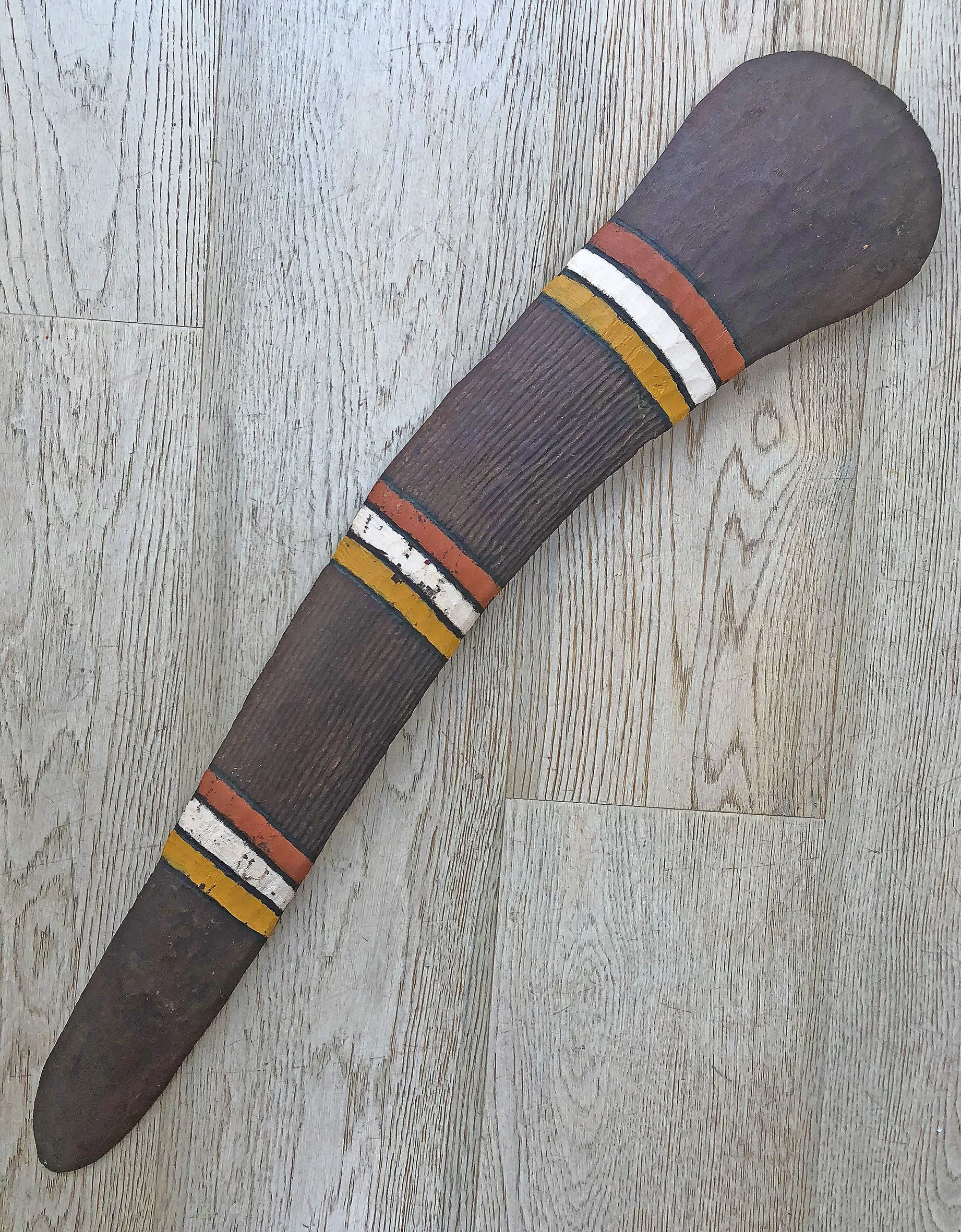
Artiste : Boxer Pompirla Hanson
Titre de l'œuvre : Boomerang/Jarrangarr/Bloodwood Tree
Format : 77 x 1 cm
Pigments naturels sur bois de sang
Provenance et certificat : centre d'art aborigène de Mangkaja
Référence de la sculpture : 390/17
© Photo : Aboriginal signature with the courtesy of the artist Mangkaja Arts
Explication sur cette œuvre :
Pampirla, pronounced Bombala, also uses the name Hanson Boxer. Pampirla's artefacts are highly sought after. His repertoire includes carved wooden figures of Walmajarri men in traditional dance head-dress trom the Majarrka Corroboree, boomerangs (karli) and clapping sticks. The karli may be watarka (hunting), wilgin ('number 7' hunting/fighting) or yilbidi/jarangarr (singing), and are generally carved from Bloodwood.
Goanna or kangaroo fat is usually used to oil the boomerangs, though bullock fat may also be used. Pampirla is the son of the famous Fitzroy artist Boxer Yanker who married Paji Honeychild Child.
Pampirla calls her Mummy One. His father had walked in from Kaningara, in the Great Sandy Desert as a Child in the 1920's. Pampirla grew up on Cherrabun Station where he learnt to be stockman from the age of 12. He worked on Old Cherrabun and other West Kimberley stations for 20 years, until the implementation of award wages for aboriginal stockmen caused most of them to lose their jobs. In 1989, after almost 10 years of letter writing and talkss with federal politicians and government departments, Pampirla was successful in acquiring a 99 year lease on an excision from Old Cherabun Station.
During the ext 15 years he and the other famillies who had grown up on the station established Yakanarra community, which today has over 200 residents, 40 houses and operate its own.
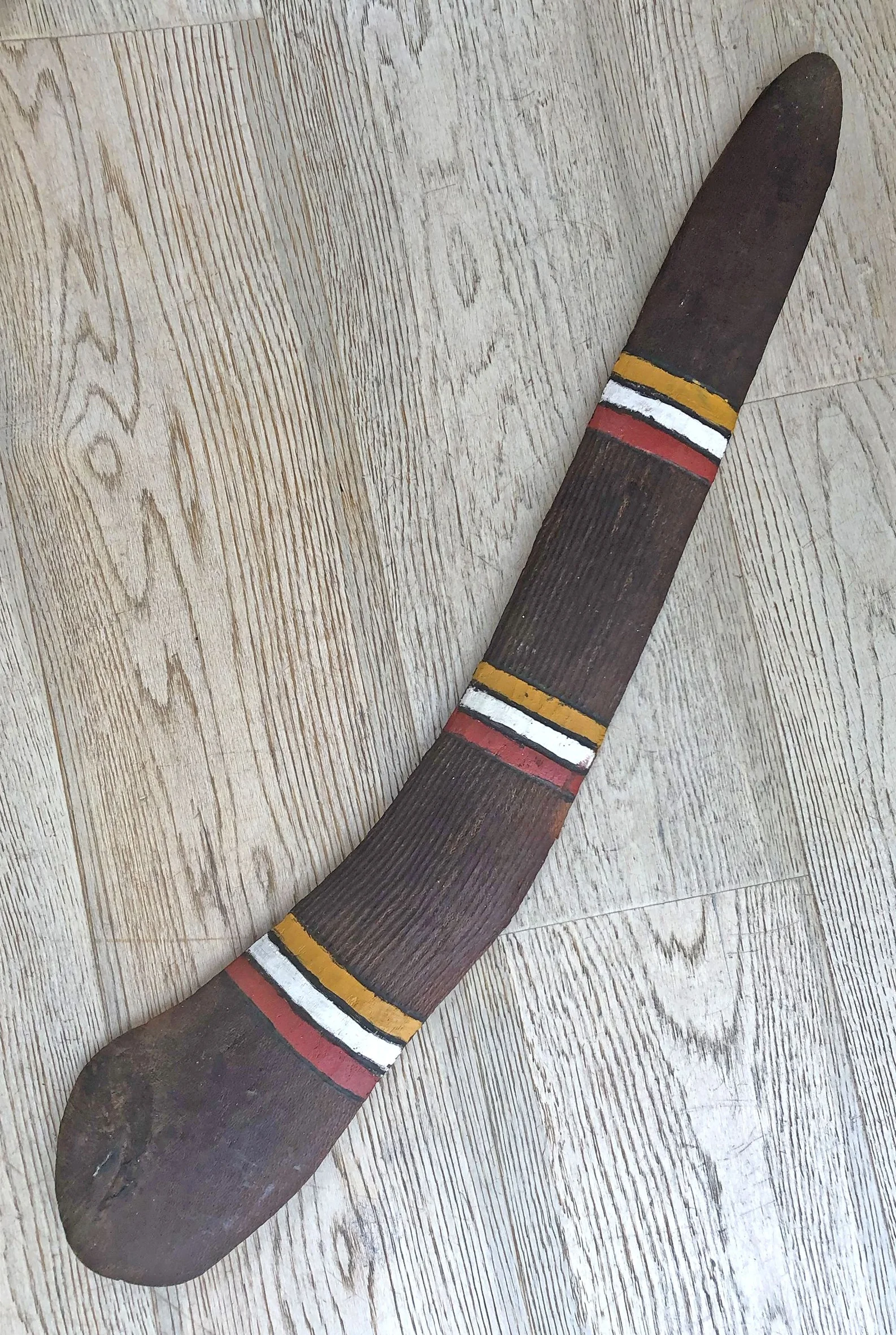
Artiste : Boxer Pompirla Hanson
Titre de l'œuvre : Boomerang/Jarrangarr/Bloodwood Tree
Format : 72 x 1 cm
Pigments naturels sur bois de sang
Provenance et certificat : centre d'art aborigène de Mangkaja
Référence de la sculpture : 386/17
© Photo : Aboriginal signature with the courtesy of the artist Mangkaja Arts
Explication sur cette œuvre :
Pampirla, pronounced Bombala, also uses the name Hanson Boxer. Pampirla's artefacts are highly sought after. His repertoire includes carved wooden figures of Walmajarri men in traditional dance head-dress trom the Majarrka Corroboree, boomerangs (karli) and clapping sticks. The karli may be watarka (hunting), wilgin ('number 7' hunting/fighting) or yilbidi/jarangarr (singing), and are generally carved from Bloodwood.
Goanna or kangaroo fat is usually used to oil the boomerangs, though bullock fat may also be used. Pampirla is the son of the famous Fitzroy artist Boxer Yanker who married Paji Honeychild Child.
Pampirla calls her Mummy One. His father had walked in from Kaningara, in the Great Sandy Desert as a Child in the 1920's. Pampirla grew up on Cherrabun Station where he learnt to be stockman from the age of 12. He worked on Old Cherrabun and other West Kimberley stations for 20 years, until the implementation of award wages for aboriginal stockmen caused most of them to lose their jobs. In 1989, after almost 10 years of letter writing and talkss with federal politicians and government departments, Pampirla was successful in acquiring a 99 year lease on an excision from Old Cherabun Station.
During the ext 15 years he and the other famillies who had grown up on the station established Yakanarra community, which today has over 200 residents, 40 houses and operate its own.
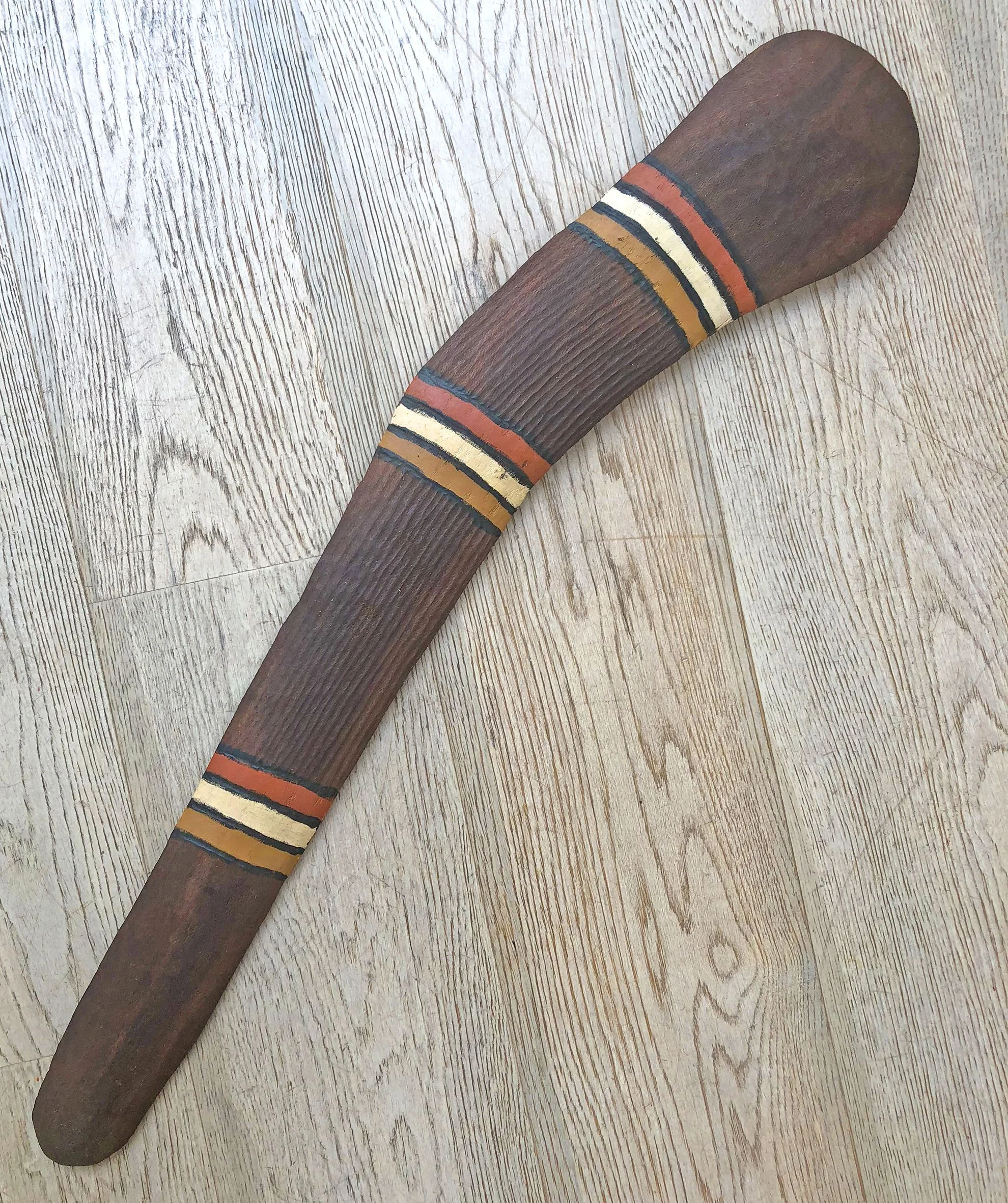
Artiste : Boxer Pompirla Hanson
Titre de l'œuvre : Boomerang/Jarrangarr/Bloodwood Tree
Format : 80 x 1 cm
Pigments naturels sur bois de sang
Provenance et certificat : centre d'art aborigène de Mangkaja
Référence de la sculpture : 394/17
© Photo : Aboriginal signature with the courtesy of the artist Mangkaja Arts
Explication sur cette œuvre :
Pampirla, pronounced Bombala, also uses the name Hanson Boxer. Pampirla's artefacts are highly sought after. His repertoire includes carved wooden figures of Walmajarri men in traditional dance head-dress trom the Majarrka Corroboree, boomerangs (karli) and clapping sticks. The karli may be watarka (hunting), wilgin ('number 7' hunting/fighting) or yilbidi/jarangarr (singing), and are generally carved from Bloodwood.
Goanna or kangaroo fat is usually used to oil the boomerangs, though bullock fat may also be used. Pampirla is the son of the famous Fitzroy artist Boxer Yanker who married Paji Honeychild Child.
Pampirla calls her Mummy One. His father had walked in from Kaningara, in the Great Sandy Desert as a Child in the 1920's. Pampirla grew up on Cherrabun Station where he learnt to be stockman from the age of 12. He worked on Old Cherrabun and other West Kimberley stations for 20 years, until the implementation of award wages for aboriginal stockmen caused most of them to lose their jobs. In 1989, after almost 10 years of letter writing and talkss with federal politicians and government departments, Pampirla was successful in acquiring a 99 year lease on an excision from Old Cherabun Station.
During the ext 15 years he and the other famillies who had grown up on the station established Yakanarra community, which today has over 200 residents, 40 houses and operate its own.
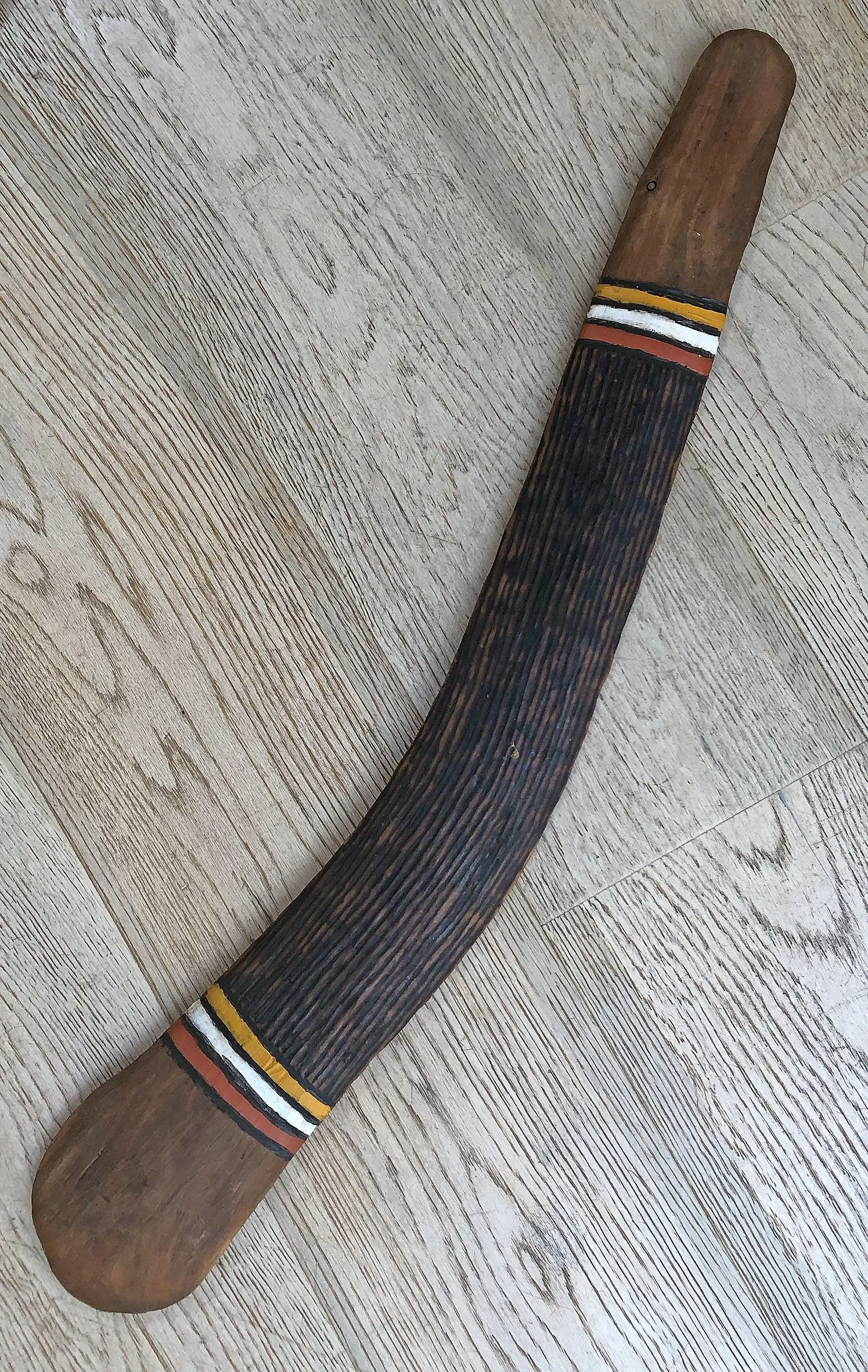
Artiste : Boxer Pompirla Hanson
Titre de l'œuvre : Boomerang/Jarrangarr/Bloodwood Tree
Format : 76 x 1 cm
Pigments naturels sur bois de sang
Provenance et certificat : centre d'art aborigène de Mangkaja
Référence de la sculpture : 385/17
© Photo : Aboriginal signature with the courtesy of the artist Mangkaja Arts
Explication sur cette œuvre :
Pampirla, pronounced Bombala, also uses the name Hanson Boxer. Pampirla's artefacts are highly sought after. His repertoire includes carved wooden figures of Walmajarri men in traditional dance head-dress trom the Majarrka Corroboree, boomerangs (karli) and clapping sticks. The karli may be watarka (hunting), wilgin ('number 7' hunting/fighting) or yilbidi/jarangarr (singing), and are generally carved from Bloodwood.
Goanna or kangaroo fat is usually used to oil the boomerangs, though bullock fat may also be used. Pampirla is the son of the famous Fitzroy artist Boxer Yanker who married Paji Honeychild Child.
Pampirla calls her Mummy One. His father had walked in from Kaningara, in the Great Sandy Desert as a Child in the 1920's. Pampirla grew up on Cherrabun Station where he learnt to be stockman from the age of 12. He worked on Old Cherrabun and other West Kimberley stations for 20 years, until the implementation of award wages for aboriginal stockmen caused most of them to lose their jobs. In 1989, after almost 10 years of letter writing and talkss with federal politicians and government departments, Pampirla was successful in acquiring a 99 year lease on an excision from Old Cherabun Station.
During the ext 15 years he and the other famillies who had grown up on the station established Yakanarra community, which today has over 200 residents, 40 houses and operate its own.
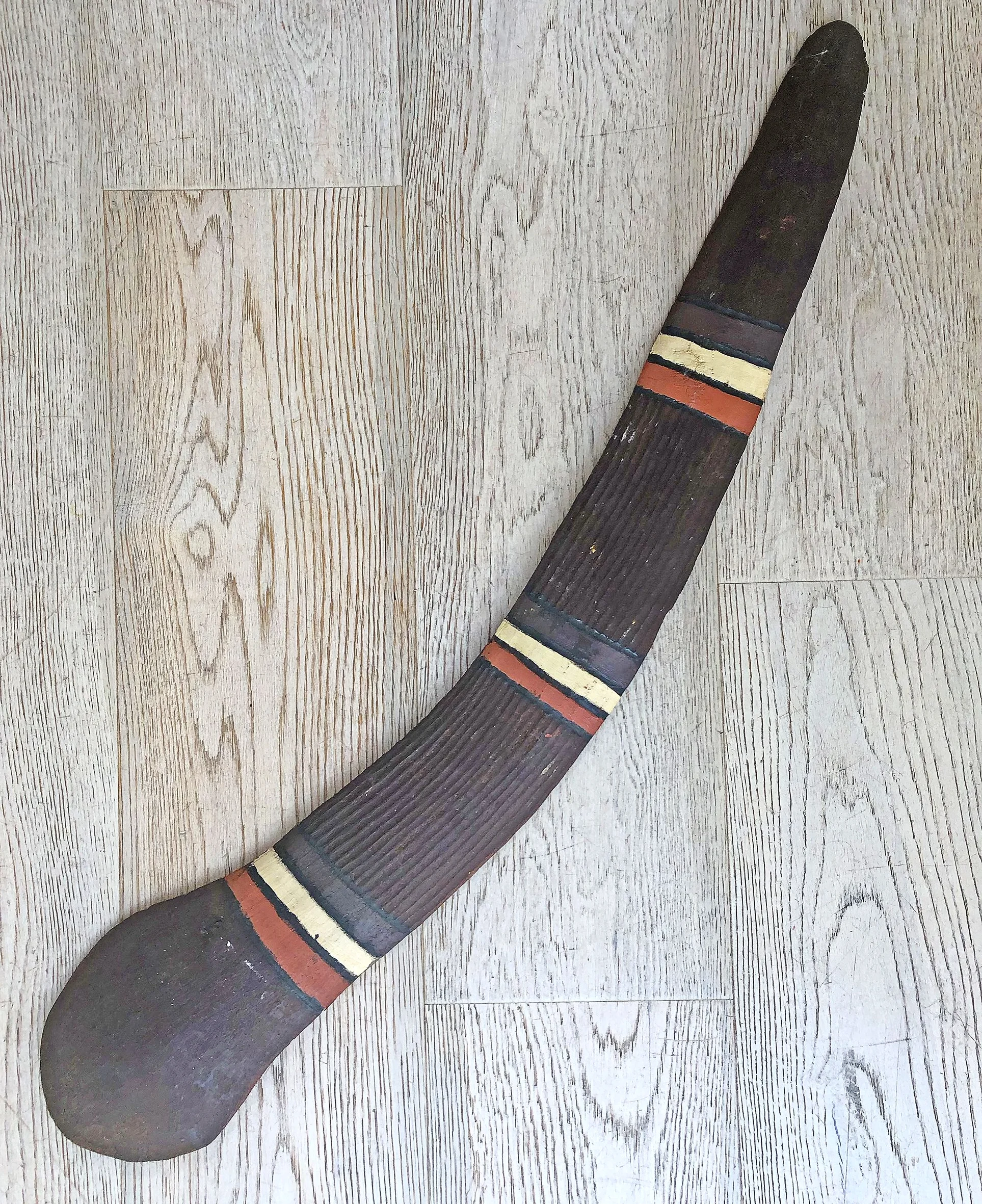
Artiste : Boxer Pompirla Hanson
Titre de l'œuvre : Boomerang/Jarrangarr/Bloodwood Tree
Format : 80 x 1 cm
Pigments naturels sur bois de sang
Provenance et certificat : centre d'art aborigène de Mangkaja
Référence de la sculpture : 388/17
© Photo : Aboriginal signature with the courtesy of the artist Mangkaja Arts
Explication sur cette œuvre :
Pampirla, pronounced Bombala, also uses the name Hanson Boxer. Pampirla's artefacts are highly sought after. His repertoire includes carved wooden figures of Walmajarri men in traditional dance head-dress trom the Majarrka Corroboree, boomerangs (karli) and clapping sticks. The karli may be watarka (hunting), wilgin ('number 7' hunting/fighting) or yilbidi/jarangarr (singing), and are generally carved from Bloodwood.
Goanna or kangaroo fat is usually used to oil the boomerangs, though bullock fat may also be used. Pampirla is the son of the famous Fitzroy artist Boxer Yanker who married Paji Honeychild Child.
Pampirla calls her Mummy One. His father had walked in from Kaningara, in the Great Sandy Desert as a Child in the 1920's. Pampirla grew up on Cherrabun Station where he learnt to be stockman from the age of 12. He worked on Old Cherrabun and other West Kimberley stations for 20 years, until the implementation of award wages for aboriginal stockmen caused most of them to lose their jobs. In 1989, after almost 10 years of letter writing and talkss with federal politicians and government departments, Pampirla was successful in acquiring a 99 year lease on an excision from Old Cherabun Station.
During the ext 15 years he and the other famillies who had grown up on the station established Yakanarra community, which today has over 200 residents, 40 houses and operate its own.
Exposition organisée
en partenariat avec
le management
et les artistes
du centre d'art
de Mangkaja Arts
Artiste : Sonia Kurarra
Titre de l'œuvre : MARTUWARRA
Format : 240 x 120 cm
Provenance et certificat : centre d'art de Mangkaja
Référence de cette peinture Aborigène d'Australie : 28/17
Explications sur cette œuvre :
Sonia Kurrara (1951) grew up in the river country at Noonkanbah (Yungngnora), south-west of Fitzroy Crossing in the Kimberley region of Western Australia. She has worked through Mangkaja Arts since its establishment in the early 1990s and in recent years has become known for her vibrant, energetic paintings that celebrate her riverland home.
"Martuwarra is my river country; this painting is all about the Fitzroy River which flows down through Nookanbah where I live. All kinds of fish live in the water, we catch big mob of fish here. I like Parlka (barrumundi). We catch catfish and brim here too. Nganku(shark), wirritunany (sawfish) and stingray also live here. These fish live in these waters long after the flood has gone."
Collection & awards :
Winner of the Hedland Art Awards 2012
Winners of the best Indigenous Artwork - WA Art Award & Hedland Award 2010
Art Gallery NSW. The Lepley Collection, Perth
Kerry Stokes. Holmes a Court Collection. Brocard - Estrangin Collection. The Art Gallery of NSW. The Lepley Collection
Demander le prix de l'œuvre