Exposition d’art Aborigène “Born in 1930s - Entre deux souffles” L’art de ceux qui ont vu le monde basculer en Australie
A la galerie Aboriginal Signature Estrangin : 101 rue Jules Besme, 1081 Bruxelles.
Vernissage sur RDV le mardi 10 juin 2025 de 14h30 à 21h30.
A 20h - discours du directeur de la galerie et drink.
RSVP - réserver votre visite
Ensuite la galerie vous reçoit sur RDV jusqu’au samedi 12 juillet 2025, du mardi au samedi, de 11h à 19h : vous pouvez réserver votre visite dés à présent dans notre agenda ici.
L’art de ceux qui ont vu le monde basculer
Nés entre 1925 et 1940, ils ont vu l’Australie ancestrale avant les routes, les clôtures, les écoles des missions.
Ils ont grandi dans le bush, marchant de campement en campement, suivant les songlines et les points d’eau sacrés.
Aujourd’hui, à travers leur art, ils nous parlent d’un monde encore vivant — fait de sable, de silence, de chants et de présence.
Leurs peintures redonnent souffle et espace à ces terres habitées.
Dans le Great Sandy Desert et le long de la Canning Stock Route (Jakayu Biljabu, Mary Meribida, Spider Kalbybidi, Margaret Baragurra, Tjigila Rawlins, Ngarralja Tommy May), ces artistes ont grandi dans un environnement semi-nomade, suivant les points d’eau sacrés et les lignes du rêve (Songlines), avant d’être confrontés dans les années 1950 à la sédentarisation dans les missions, ou à l’arrivée des routes construites pour la transhumance du bétail.
Dans les Kimberley, au nord-ouest (Rammey Ramsey, Peggy Patrick), d’autres ont vécu le quotidien des stations d’élevage, parfois marqués par les violences de la colonisation, comme la mémoire des massacres ou la lutte pour les droits fonciers. Malgré cela, ils ont préservé une profonde connexion à leur Country, faite de paysages escarpés, de lieux de pêche, de mémoire rituelle et de luttes partagées.
Dans le Centre australien, notamment sur les terres Pitjantjatjara et Yankunytjatjara (Tjariya Stanley, Taylor Cooper, Paniny Mick, Imatjala Curley, Witjiti George, Wawiriya Burton, Angkuna Baker), les artistes ont grandi entre communautés traditionnelles, missions comme Ernabella ou Fregon, et premiers centres artistiques des années 1970. Ils ont été au cœur du renouveau culturel aborigène porté par les femmes et les ngangkari (guérisseuses traditionnelles), en lien avec les grandes figures du Tjukurpa : les Sept Sœurs, le Serpent arc-en-ciel ou les Deux Hommes.
Dans les Terres d’Arnhem (Nord-Est), l’artiste Nongirrŋa Marawili est issue du clan Madarrpa. Son art, à la croisée de l’eau et du feu, évoque les pouvoirs du crocodile ancestral Bäru dans les estuaires du Golfe de Carpentarie. Née au bord de la mer, elle mêle l’héritage du miny’tji sacré aux échos de l’histoire maritime, dans un style puissamment épuré.
Enfin, au sud-ouest, dans les Spinifex Lands (région de Maralinga et Warburton), Lawrence Pennington et Simon Hogan racontent par la peinture les récits du Wati Kutjara (Deux Hommes), qu’ils ont appris en marchant dans les pas des Ancêtres, avant d’être déplacés suite aux essais nucléaires britanniques dans les années 1950.
Chacun de ces artistes incarne à sa manière un pont entre deux mondes, entre deux souffles : celui des savoirs millénaires, transmis à voix nue autour du feu, et celui d’un XXe siècle qui les a vus traverser les politiques d’assimilation, la disparition de langues, les déplacements, mais aussi les renaissances culturelles et artistiques portées par les communautés elles-mêmes.

© Photo Bertrand Estrangin - Juin 2014 - Aux frontières du Grand Désert du Victoria - South Australia.
Par l’art, ils ont tracé des chemins de retour vers leurs territoires. À travers formes, pigments et symboles, ils nous offrent une autre carte du continent. Une carte où chaque lieu est mémoire, chaque couleur est récit.
Leurs œuvres chantent les lieux sacrés, les traces des ancêtres, les points d’eau, les deuils, les résistances. Elles portent une valeur patrimoniale, esthétique et politique exceptionnelle. Elles font le lien entre un temps cosmologique régi par les lois ancestrales, et une modernité postcoloniale marquée par la dépossession, la lutte pour la reconnaissance (Native Title) et la souveraineté culturelle.
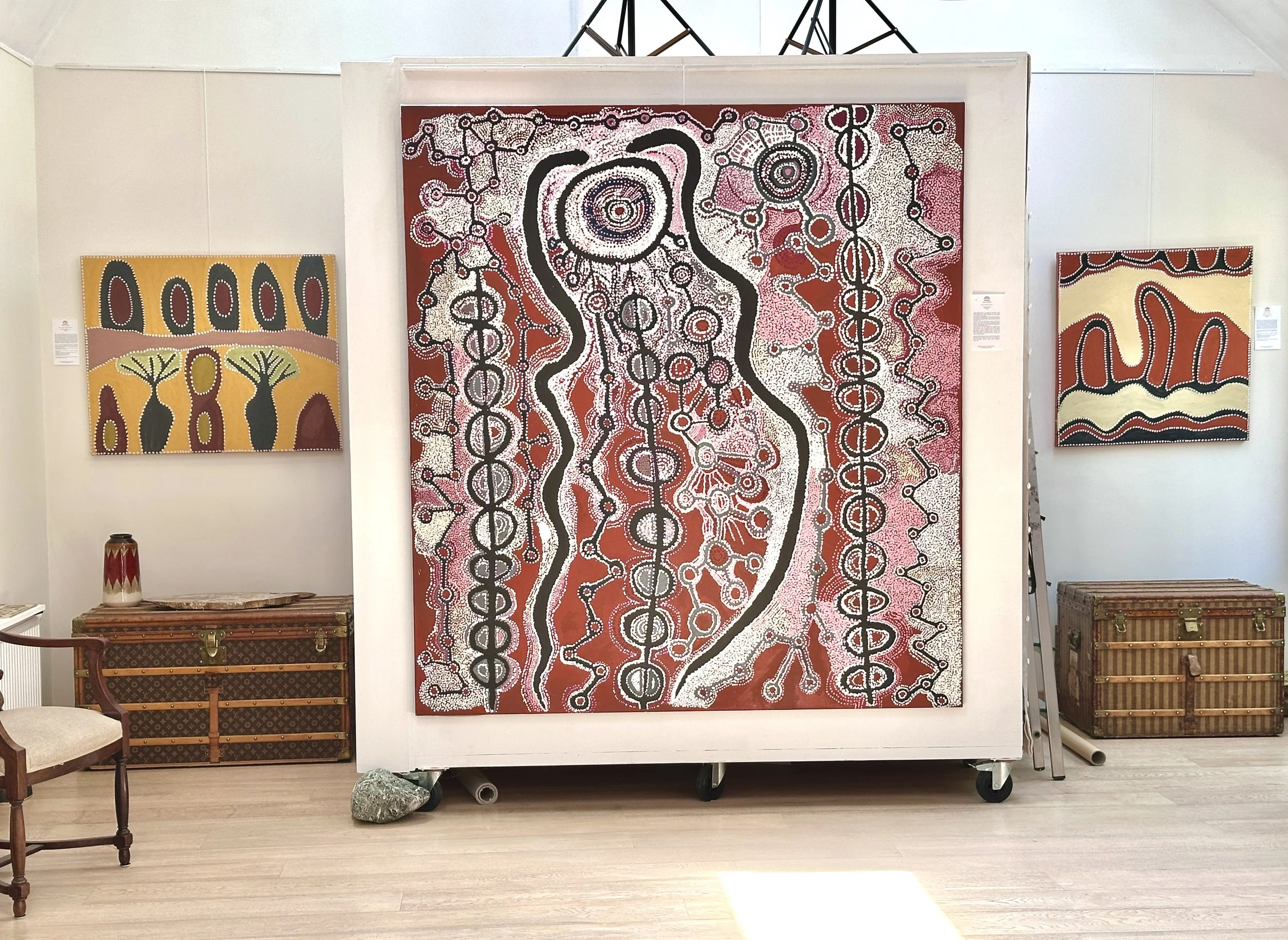
Vue de l’exposition “Born in 1930s - Entre deux souffles”, jusqu’au 12 juillet 2025 à Bruxelles © Photo Aboriginal Signature with the courtesy of the artists
Ces œuvres ne sont pas seulement des objets plastiques : elles sont des vecteurs de narration, d’éducation, de diplomatie culturelle. Elles traduisent des cosmologies actives, incarnées, et structurées par la relation au pays, au collectif, et aux esprits.
Howard Morphy (1998) analyse ce basculement dans son ouvrage Aboriginal Art, en montrant comment l’art est utilisé pour articuler mémoire culturelle et engagement dans le monde contemporain.
Ian McLean (2011) souligne que ce déplacement de perspective est au cœur de ce qu’il appelle une « invention aborigène de l’art contemporain », où les artistes définissent eux-mêmes les critères de leur modernité.
Fred Myers (2002), dans Painting Culture, documente précisément cette transformation du statut des artistes Pintupi, passés du statut de « témoins d’un monde » à celui de créateurs d’un art global.
C’est ce que montre également la collection Everywhen (Harvard Art Museums, 2016, commissariat de Stephen Gilchrist), où l’art aborigène est présenté comme une temporalité propre, non linéaire, qui dialogue avec la contemporanéité mondiale.
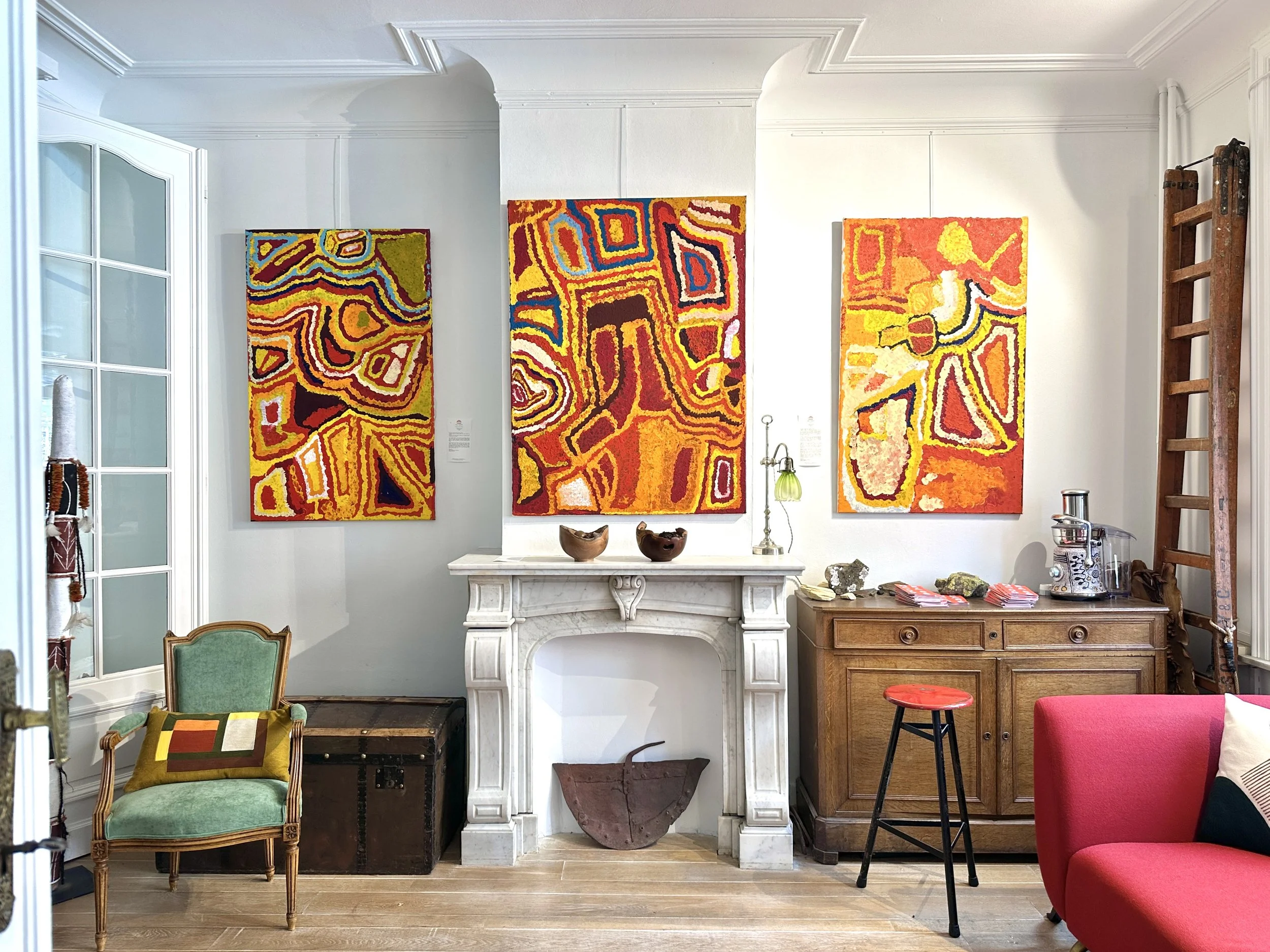
Vue de l’exposition “Born in 1930s - Entre deux souffles”, jusqu’au 12 juillet 2025 à Bruxelles © Photo Aboriginal Signature with the courtesy of the artists
Exposés à la Art Gallery of New South Wales, à la National Gallery of Victoria, au Kluge-Ruhe Aboriginal Art Collection (USA), à la Fondation Opale, à la Tate Modern, au Musée du Quai Branly – Jacques Chirac, ils sont aujourd’hui présentés à Bruxelles, dans l’intimité de la galerie Aboriginal Signature – Estrangin.
Loin de tout exotisme, leur art est pleinement contemporain. Par sa densité conceptuelle, sa force formelle et sa portée politique, il déplace les frontières de l’histoire de l’art. Ses cercles, ses lignes, ses géométries vibrantes ne sont pas des motifs décoratifs, mais des chants, des itinéraires, des mémoires.
Ces artistes nés dans les années 1930 n’ont pas seulement transmis un héritage : ils ont ouvert une brèche dans notre regard sur la modernité. Ils nous rappellent que l’art contemporain peut aussi être un art ancien qui continue — un souffle venu de loin, et qui parle encore.
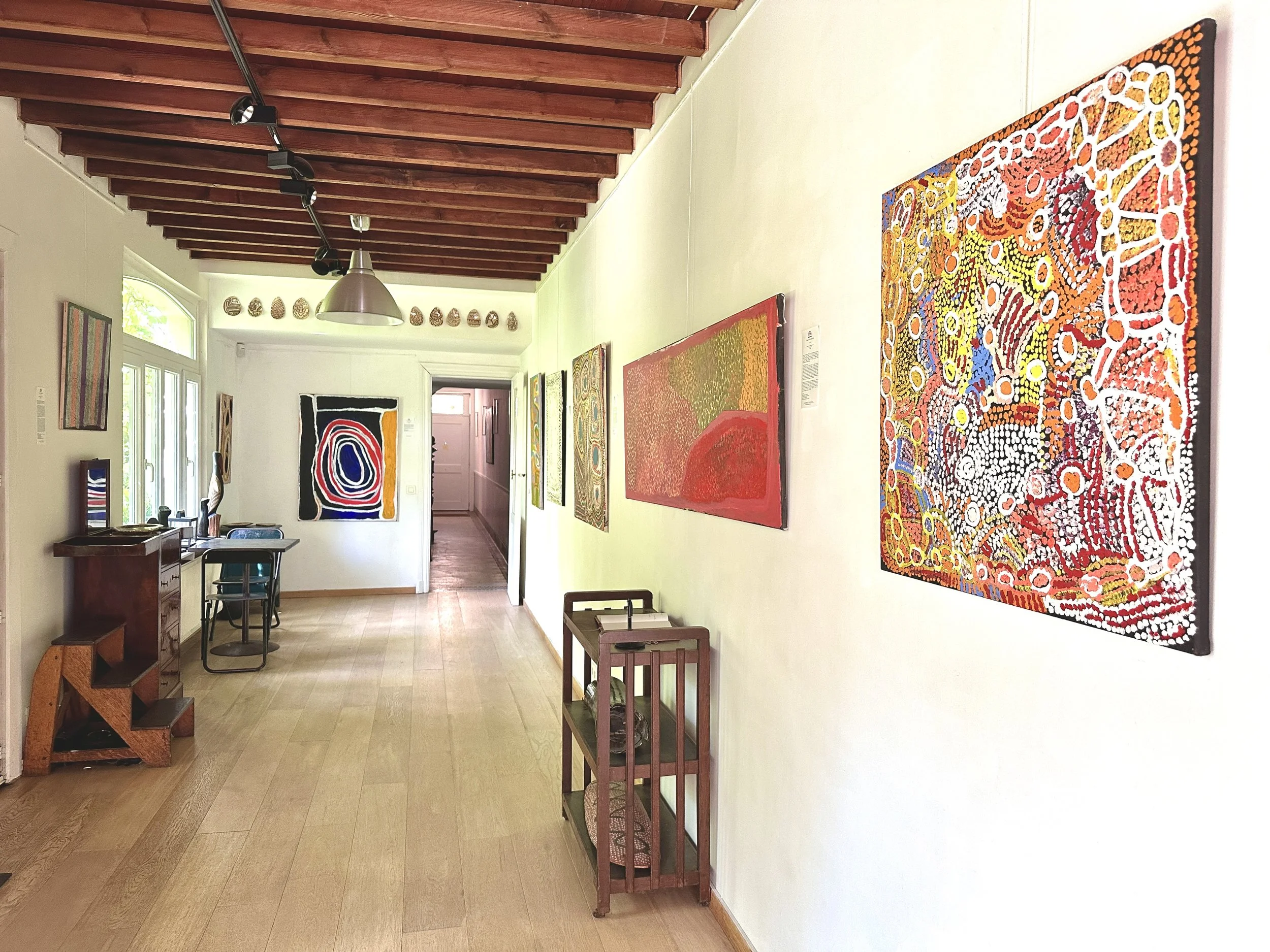
Vue de l’exposition “Born in 1930s - Entre deux souffles”, jusqu’au 12 juillet 2025 à Bruxelles © Photo Aboriginal Signature with the courtesy of the artists
À la galerie Aboriginal Signature Estrangin, nous attachons une grande importance à l’approche communautaire solidaire dans nos expositions. En réunissant à chaque fois plusieurs artistes d’une même communauté, nous souhaitons souligner la force de la transmission entre générations, des artistes seniors aux plus jeunes, dans une dynamique de partage du savoir millénaire australien.
Ici dans la capitale de l’Europe, nous vous convions pour célébrer la puissance de ces artistes qui perpétuent une tradition ancestrale tout en la réinventant pour le monde moderne. Les œuvres sélectionnées vibrent d'une énergie connectée, reflétant la beauté préservée de leur territoire, et la résilience de ces peuples premiers, gardiens de la terre.
Bertrand Estrangin
Fondateur et Directeur de la Galerie Aboriginal Signature à Bruxelles

Œuvre de l’artiste Nonggirrnga Marawili. Titre : Gurtha. Pigments naturels sur écorce. Format : 111 x 61 cm. Ref : 1753-17. © Photo Aboriginal Signature Estrangin Gallery with the courtesy of the artist and Buku Arts.
Découvrez les peintures de l’exposition :
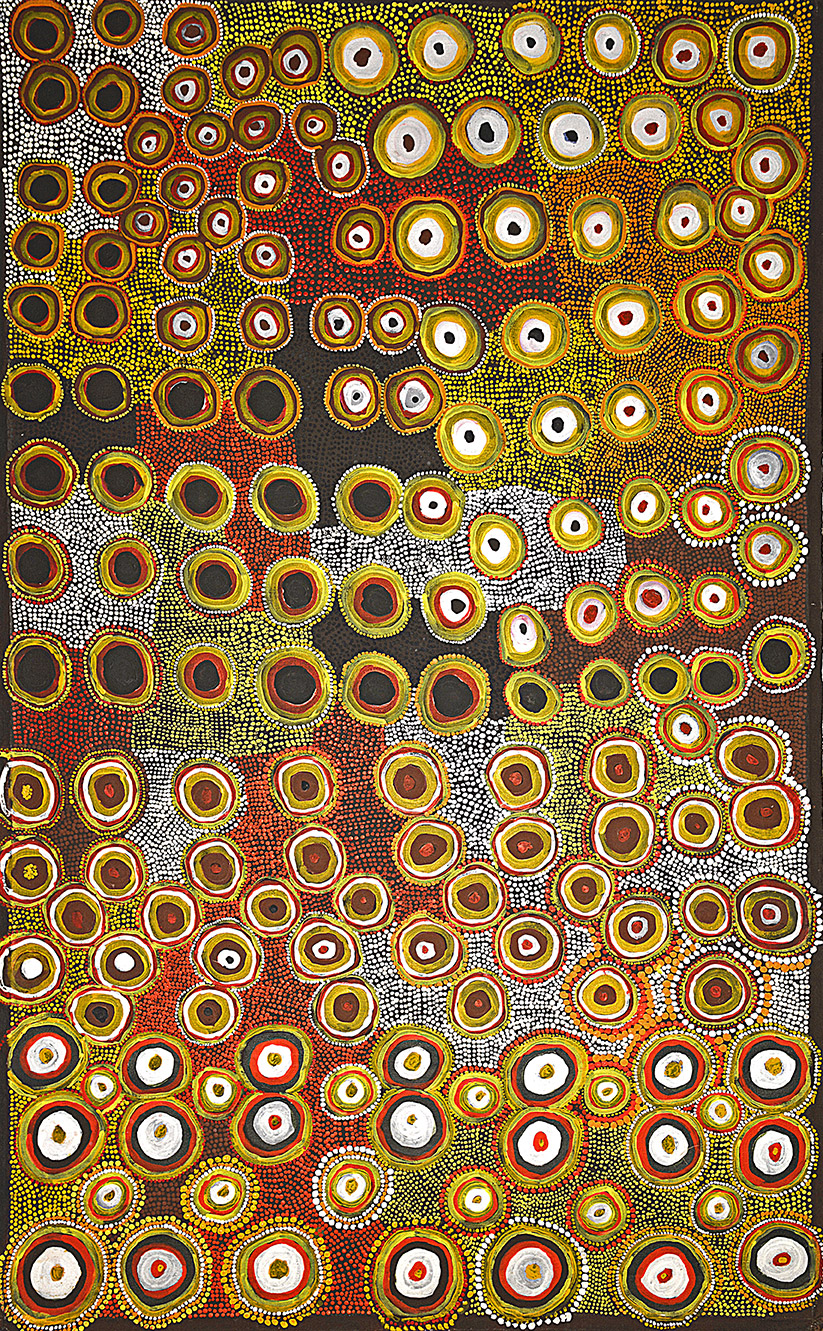
Artiste : Taylor Cooper
Titre de l'œuvre : Malara Tjurkurpa (dreaming)
Format : 200x122 cm
Provenance et certificat : centre d'art de Kaltjiti
Référence de la peinture : 8230
Demander le prix de l'œuvre
Explications pour cette œuvre :
Taylor Cooper (1939-40...) began painting at the Kaltjiti Arts centre in 2009. It was soon recognised that his paintings contained a strong representation of Tribal knowledge. His painting refers to the creation stories or Tjukurpa associated with the traditional homelands of his mother and father. An expert craftsman, Taylor continues to make the traditional hunting weapons of aboriginal men, particularly kulata (spears) and kulata miru (spear throwers).
Malara is the place of the Wanampi Tjukurpa - Water Serpent Dreaming - in the far west of the APY Lands. Taylor was born at this important site making the Malara Wanampi his Tjukurpa totemic ancestor. Taylor is Nguraritja, a traditional custodian of this story.
Taylor explains: “That Wanampi came from Malara. He went to Kunytjanu near Pipalyatjara. From Kunytjanu that Wanampi kept walking, walking. He came to Tjuntun (Kutjupa – different to Tjuntun at Fregon.) near Watarru. He threw one spear and made that rockhole. He went right in that rockhole and then he travelled back to Malara."
Taylor is an important senior tribesman and he is a recognised custodian of traditional Aboriginal law and culture. He has never married and his disposition reflects a quiet dignity of a senior man. Taylor holds a responsibility as uncle to his two sisters’ children.
His work has been acquired by major institutions and private collections across Australia and the world, as :
National Gallery of Victoria
Private Collections
Harriett & Richard England Collection, Sydney
Laverty Collection
Artbank Collection
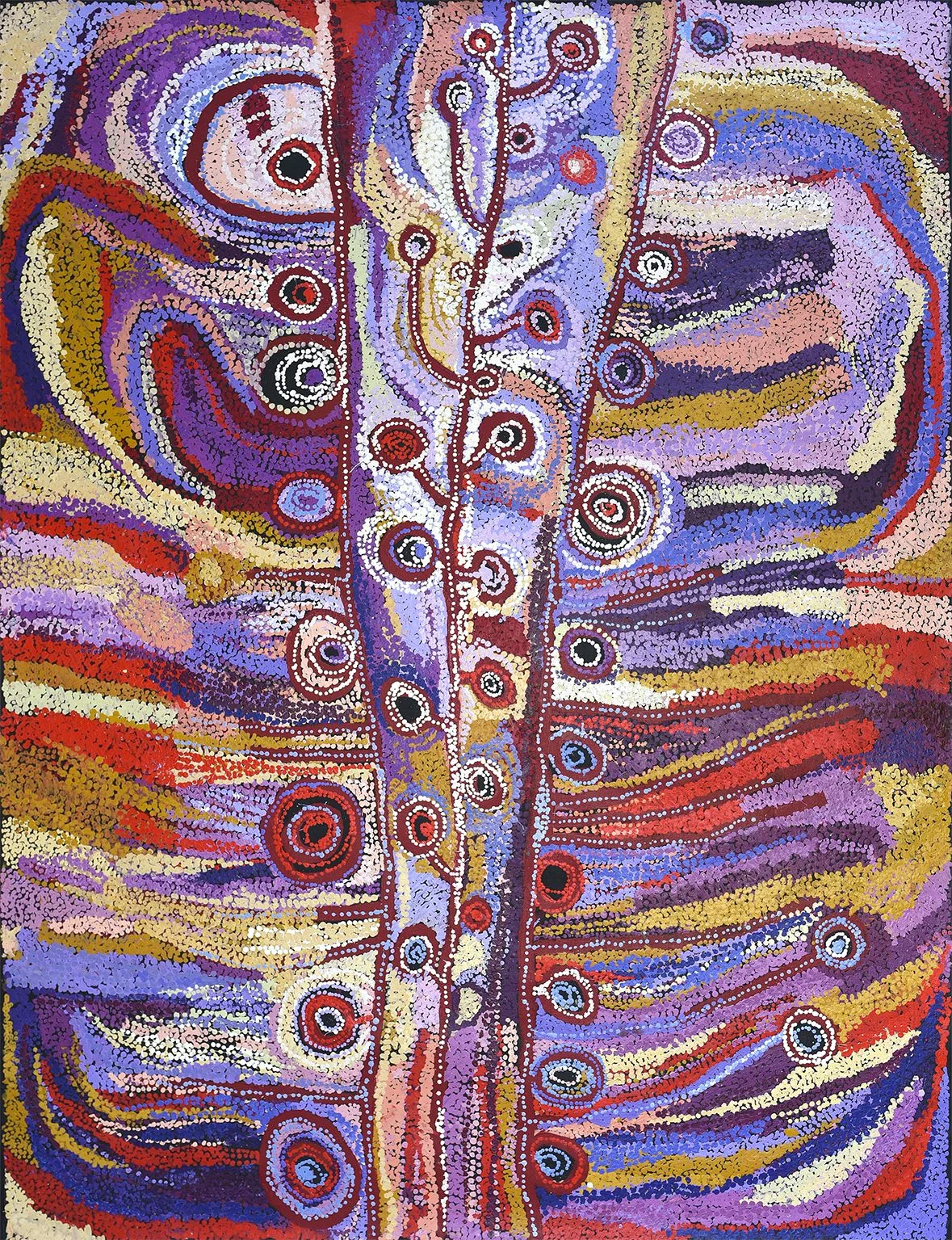
Artiste : Wawiriya Burton (1925)
Titre de l'œuvre : Ngayuku ngura - My Country
Format : 198cm x 153cm
Provenance et certificat : centre d'art aborigène de Tjala Arts
Référence de cette peinture aborigène : 301-17
Explication sur cette œuvre :
In this painting Wawiriya has depicted her country. The different colours and designs represent variations in the landscape along the sacred song lines.
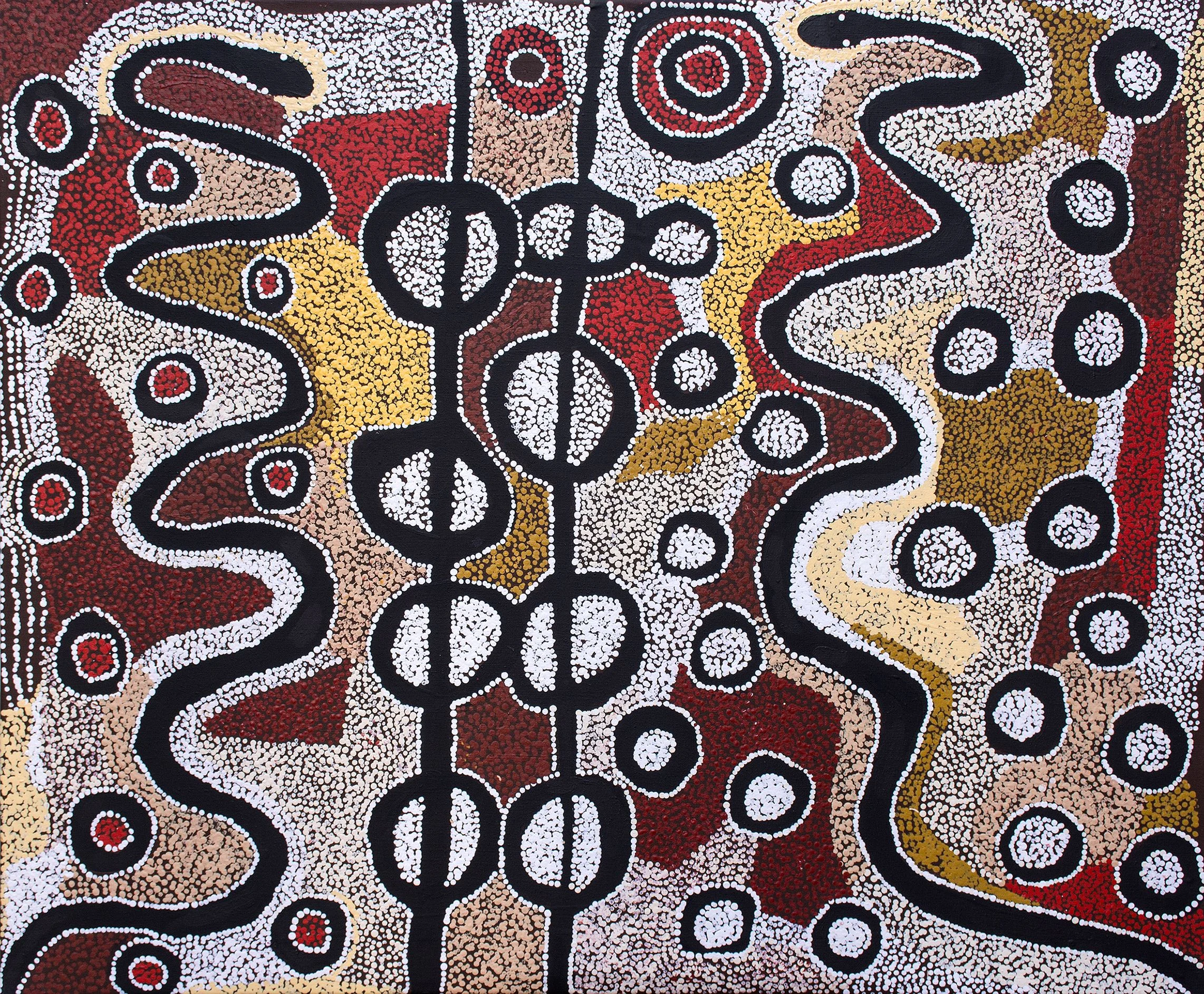
Artiste : Witjiti George
Titre : Wanampi Tjukurpa
Format : 122 x 102 cm
Provenance et certificat : centre d'art de Kaltjiti
Ref : 18-26
Explications de l'œuvre :
Witjiti George (1938) is from Mulga Bore Homeland on the Anangu Pitjantjatjara/ Yankunytjatjara (APY) Lands, 350km SE of ULURU. He is a senior traditonal elder, and holders extensive cultural knowledge.
He was born at Lambina/Granite Downs (cattle station) in the far north of South Australia. His family were travelling east as there was drought and no food forced them east to the railway line.
He went to school at Oodnadatta as a tjitji - small boy in primary school. Then they moved to Ernabella where he grew up. They went on the truck from Oodnadata to Mimili, Kenmore and Ernabella. When Fregon was established in 1961, he started doing cattle work.
Tjangili, his wife, came from Mt Ebeneza to Ernabella. They were married in the old tradition way. Witjiti started painting in 2007. He is a relatively new artist at the Kaltjiti Arts centre. A senior traditional man, he hold much traditional knowledge. His mother's country is Piltati in the Mann Ranges where the dreaming story is located. His father, Old Georgie, came from Coffin Hill ( sacred men's country) south of Kaltjiti.
His work has been acquired by major institutions and private collections across Australia and the world, as : Art Gallery of New South Wales, Australia. Artbank, Sydney Australia. Primat Fondation, Genève. Arnaud Serval Collection, Switzerland...
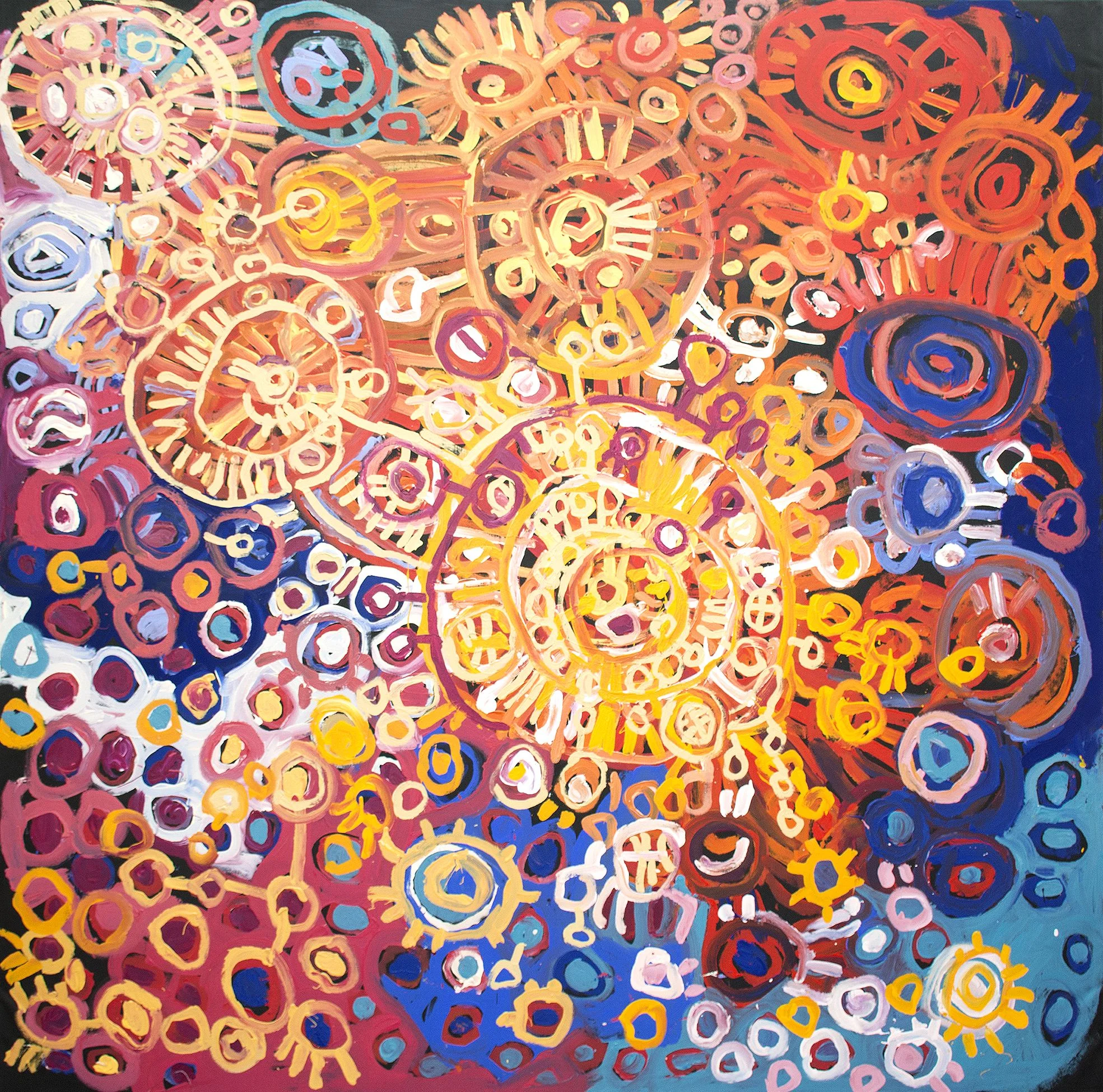
Artiste : Imatjala Curley and Paniny Mick kapi Tjukurla
Titre de l'œuvre : Women collaborative
Format : 198 x 197 cm
Provenance et certificat : centre d'art de Tjala
Référence de la peinture : 397-17
Explication sur la signification de cette peinture d'art Aborigène :
Imatjala and Paniny are family. They have painted a story of rock holes together. Water is very important for Anangu.
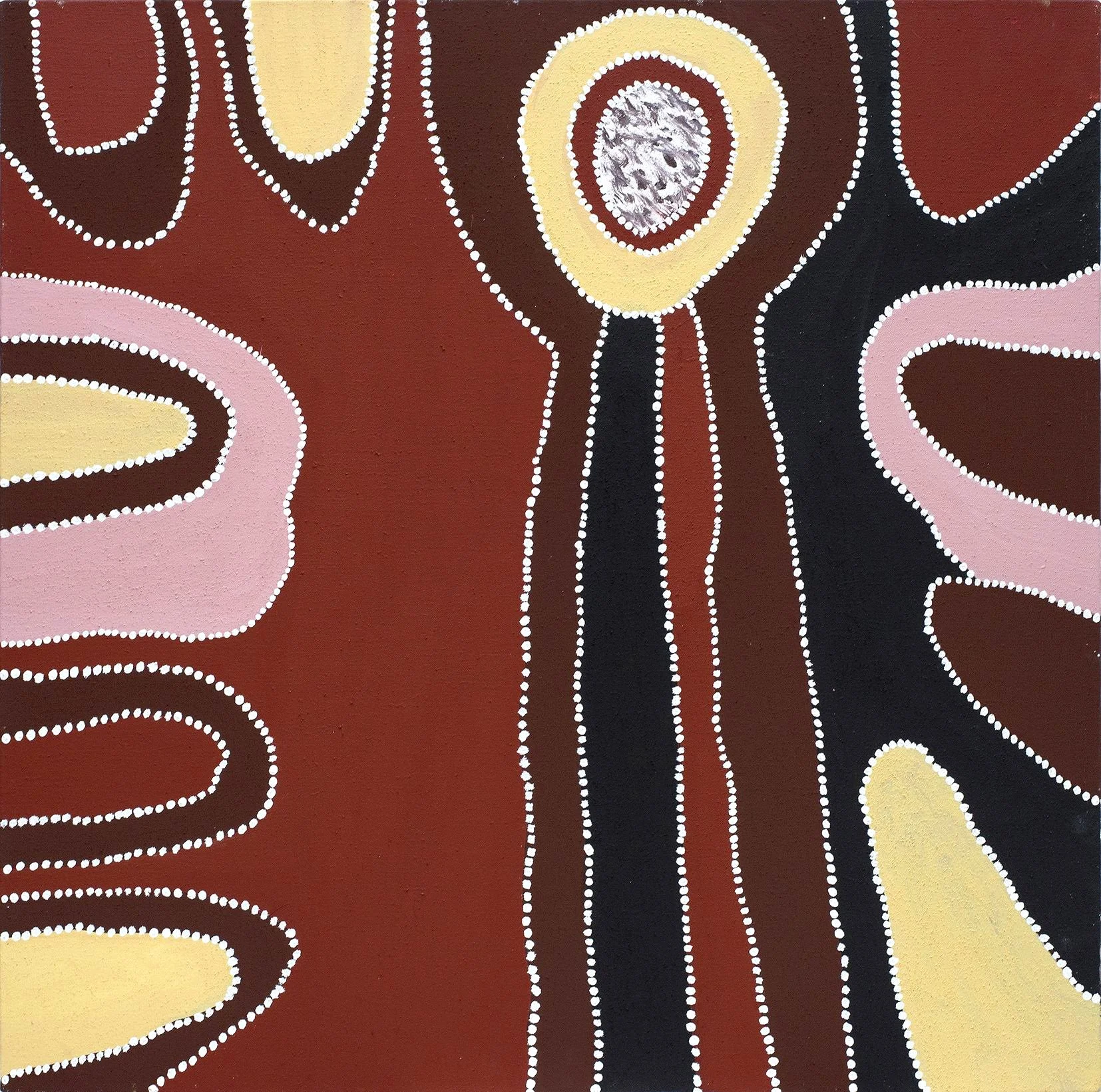
Titre de l'œuvre : Rugun - Crocodile Hole
Artiste : Peggy Patrick
Format : 100 x 100 cm
Provenance et certificat : centre d'art aborigène de Warmun - Jirrawun
Référence de cette peinture d'art indigène d’Australie : JA037/08
© Photo : Aboriginal Signature Estrangin gallery with the courtesy of the artist and Warmun Arts.
Explanations related to this Aboriginal painting :
Peggy Patrick has painted here a region close to Warmun restricted and not open to the public.
'This is the bottom side of Rugun [Crocodile Hole]. This good country for fishing.'
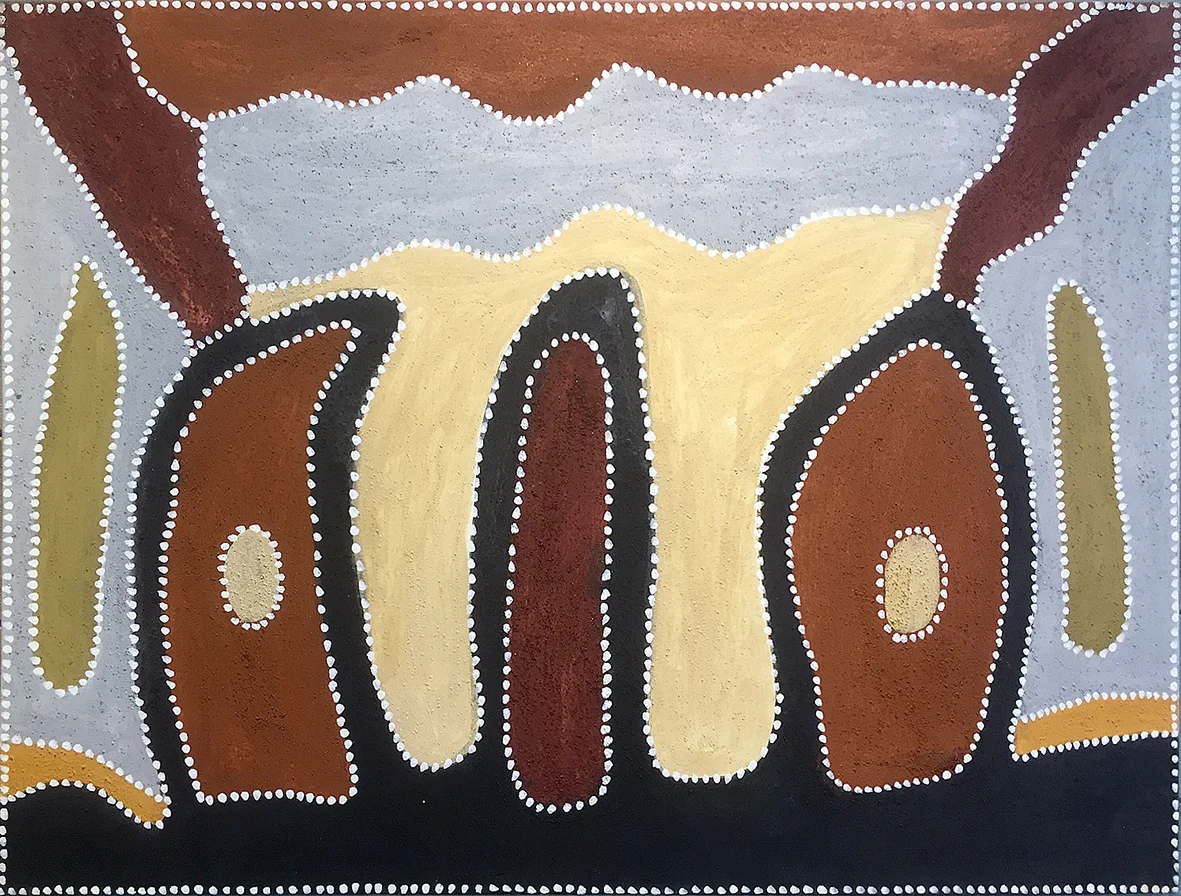
Titre de l'œuvre : Gija country
Artiste : Phyllis Thomas
Format : 120 x 90 cm
Provenance et certificat : centre d'art aborigène de Warmun
Référence de cette peinture d'art indigène d’Australie : 36/14
© Photo : Aboriginal Signature Estrangin gallery with the courtesy of the artist and Warmun Arts.
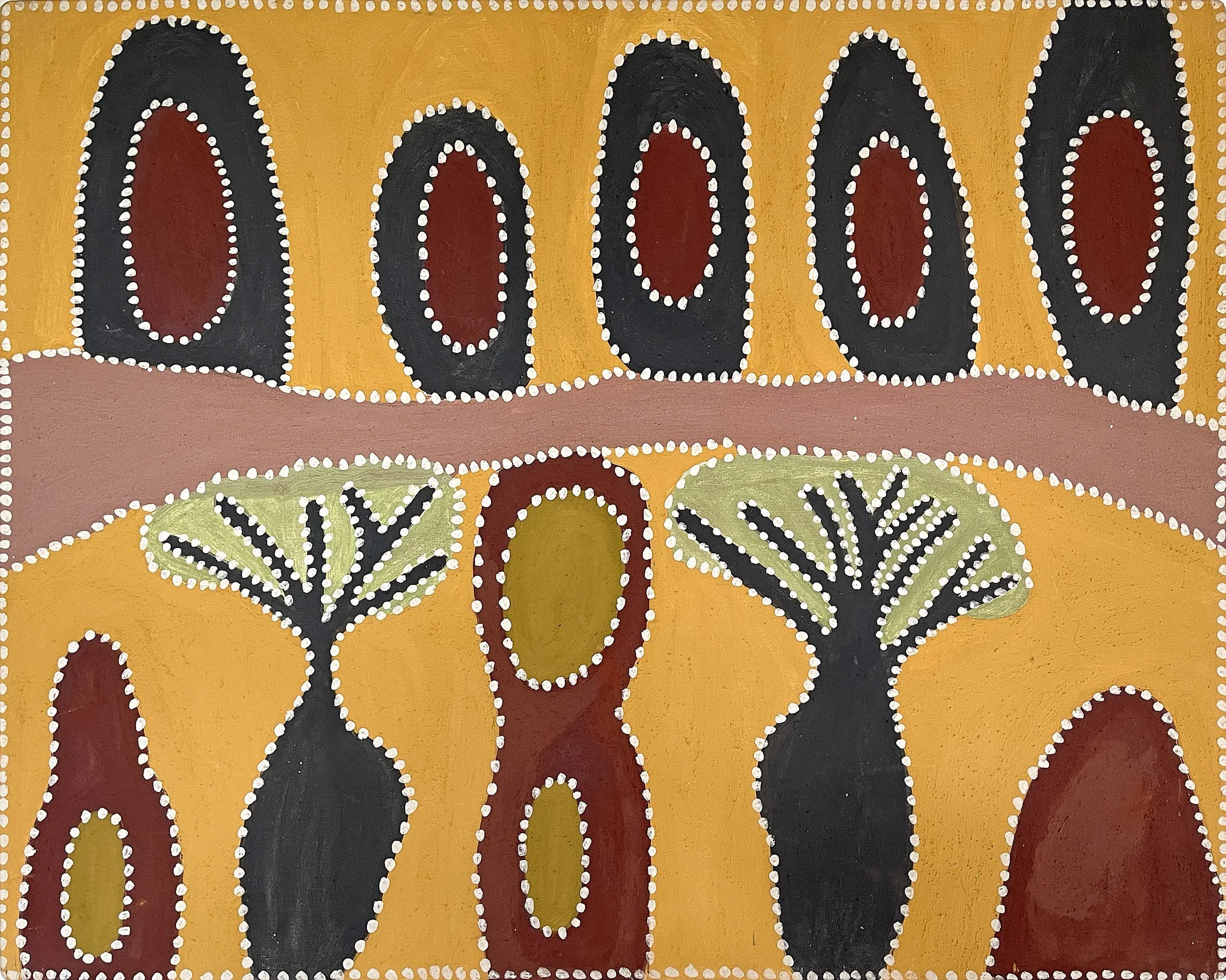
Titre de l'œuvre : Dingo Dreaming
Artiste : Phyllis Thomas
Format : 100 x 80 cm
Provenance et certificat : centre d'art aborigène de Warmun
Référence de cette peinture d'art indigène d’Australie : 249/13
© Photo : Aboriginal Signature Estrangin gallery with the courtesy of the artist and Warmun Arts.
Explanations of this Aboriginal painting :
In the top section of this painting can be seen the 5 language groups of the East Kimberley. The Wurrara (Wyndham), Mirrawong (Kununurra), Wula (Doon-Doon), Gija (Warmun), and Djarru, (Hall's Creek).
In the bottom section are the rocks, the boab trees and the dingo singing out for his wife.
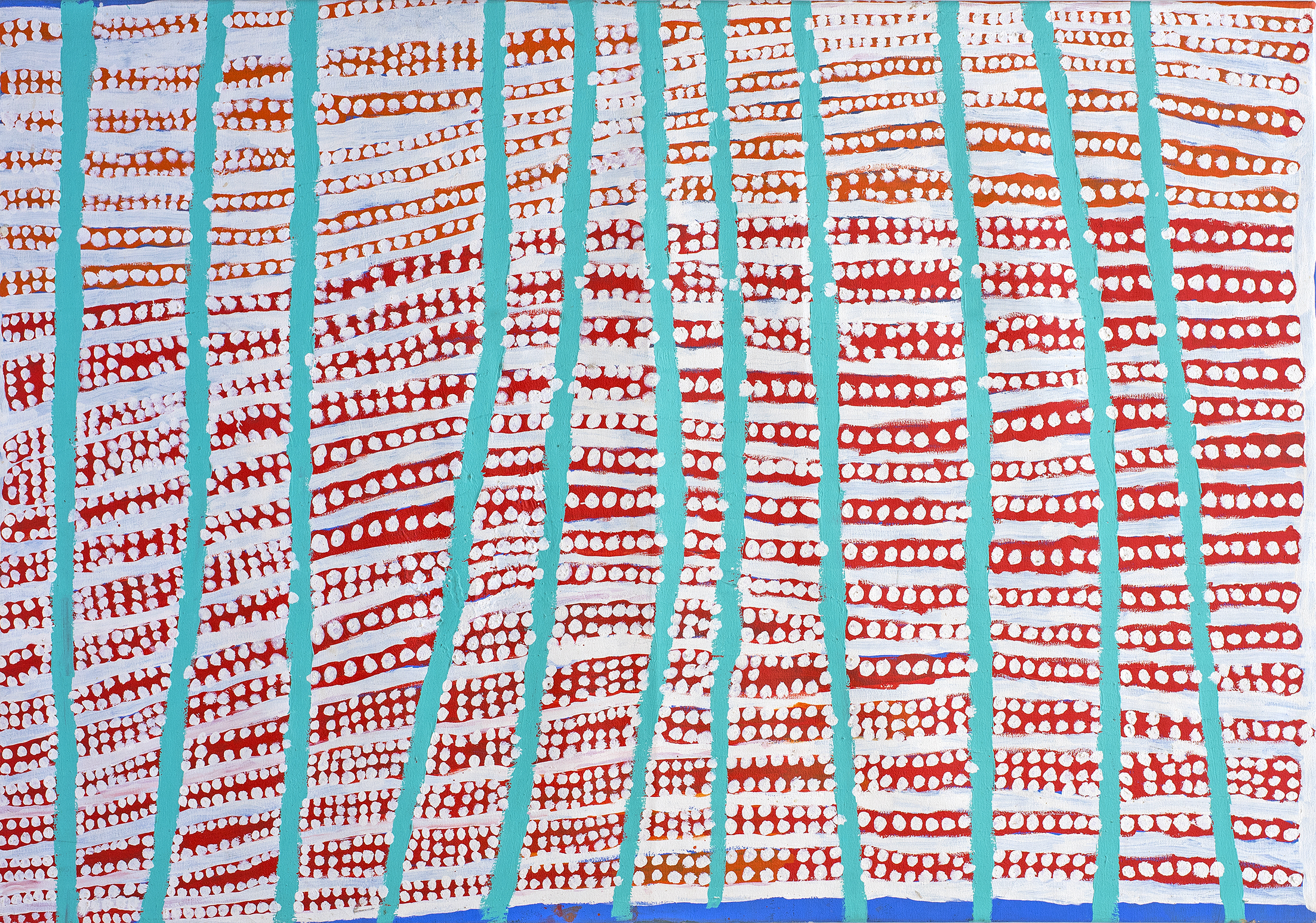
Artiste : Spider Kalbybidi
Titre de l'œuvre : Naru
Format : 168 x 112 cm
Provenance et certificat : Short Street opérant pour les artistes Yulparija de Bidyadanga
Référence de cette peinture aborigène : 781698
Explications sur cette peinture d’art Aborigène :
Spider Kalbybidi (1928-2008) was born near the Canning Stock Route at Unjada and was initiated into manhood at Naru. He walked in from the desert near Well 33 to Bidyadanga in the late 1960s with other members of the Yulparija people whose land was threatened by severe drought. Spider was a senior lawman from the Western Desert.
Spider says of his country, "He belong to me. We call him Naru. This is where they make me man,Spider. We been walking around but that boys country now. This is good bush country with green grass and plenty mayi (bush tucker)."
Painted in 2005.
Collections :
Myer Collection,
Flea from Red Hot Chilli Pepper's private collection,
National Gallery of Victoria,
Felton Collection
© Photo : Aboriginal Signature Estrangin gallery with the courtesy of Short Street and the artist
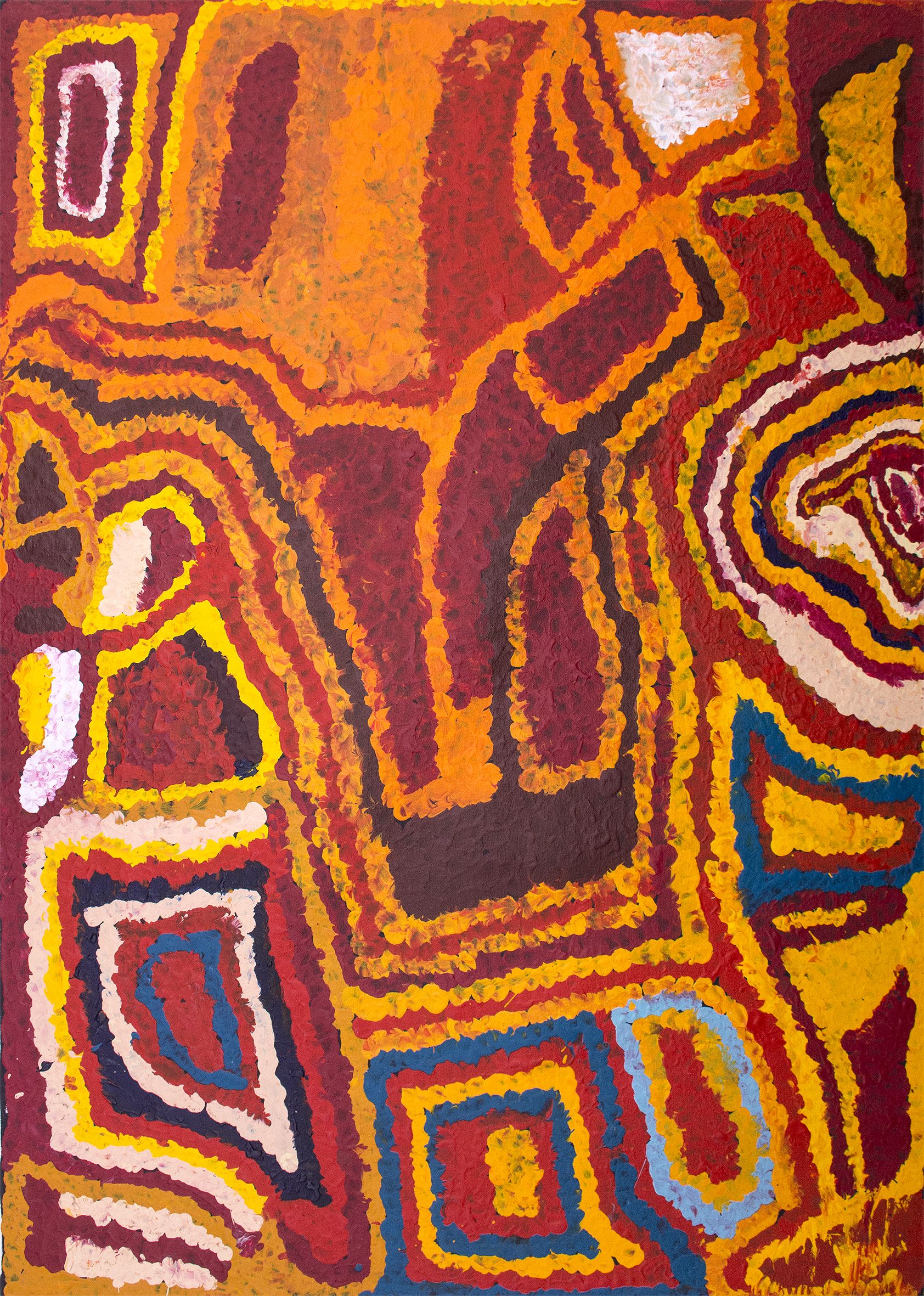
Artiste : Marie Meribida
Titre de l'œuvre : Martakulu
Format : 90 x 60 cm
Provenance et certificat : Short Street opérant pour les artistes Yulparija de Bidyadanga
Référence de cette peinture aborigène : 786415
Explications sur cette peinture d’art Aborigène :
Mary Meribida (1938) was born at Ilyara (Punmu) and lived there throughout her childhood. She travelled around her country with her family. Until the early 1970s, she lived a traditional life and says, "We been walk 'em, no clothes, nothing. We proper bush people, no English." Mary is a part of the Yulparija people who walked out of the desert to the coastal town of Bidyadanga in search of water after severe drought had plagued their land.
Martakulu is a soak out near Punmu near the Canning Stock Route in the Great Sandy Desert in Western Australia. It is strong womans country, it is part of the women's law line. Long time ago a law man he come up to this country, he went home and left his wife and baby. They make him fire and sit down, cook mayi (bush food) and then started to cry for her husband. Her tears made that soak. It is important country this one. Mary says "I been young girl walked all around here with my mummy and daddy. We camp and hunt here." This painting shows the rockhole with king brown snakes and their eggs.
Collections :
Canning Stock Route Project Collection
Notre Dame University
Laverty collection
Sam Barry collection
National Gallery of Australia
Parliament House Collection, Canberra
Kluge-Ruhe Aboriginal Art Collection of the University of Virginia
© Photo : Aboriginal Signature Estrangin gallery with the courtesy of Short Street and the artist
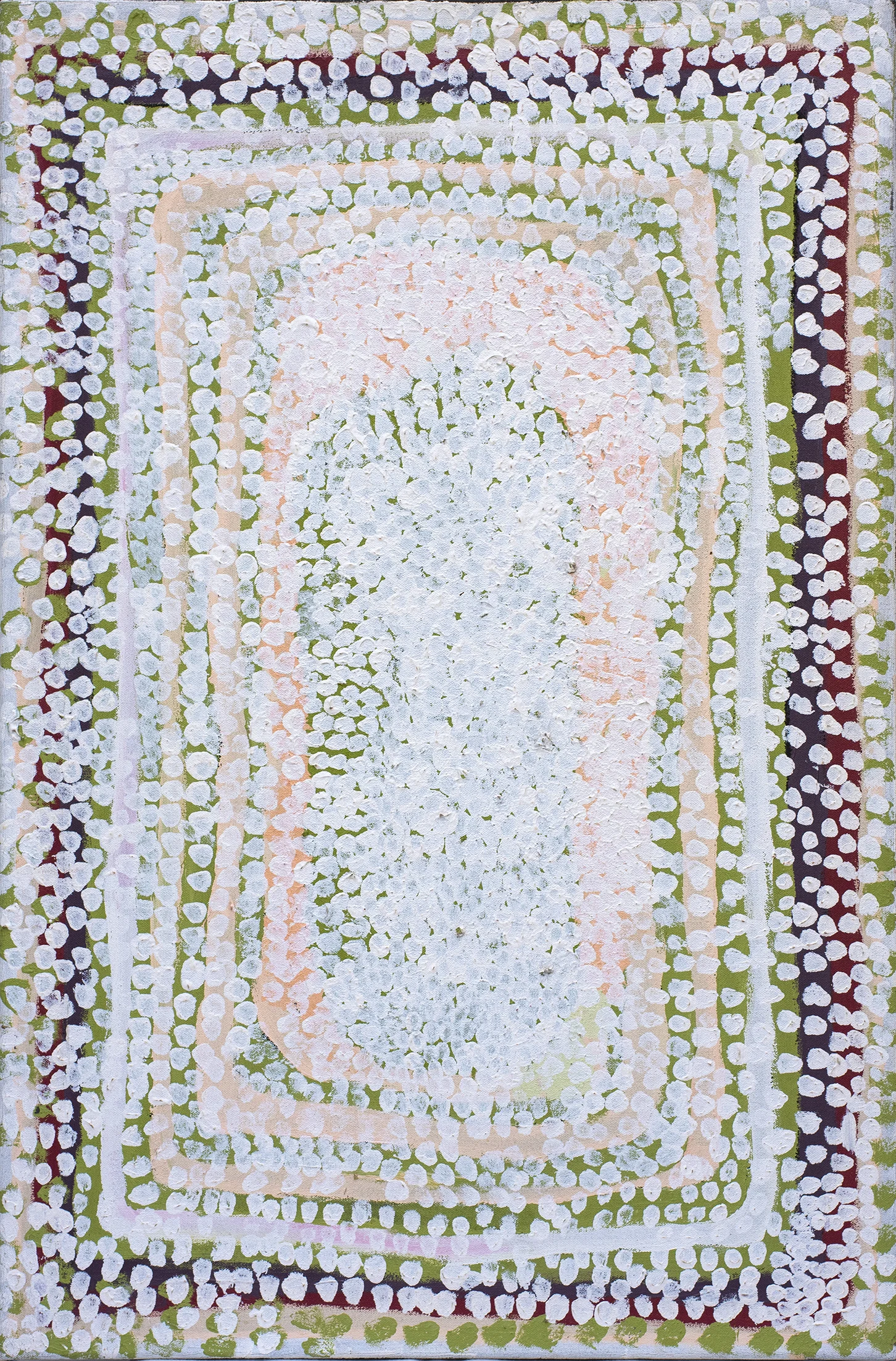
Artiste : Mabel Wakarta (1929)
Titre de l'œuvre : Karlamilyi
Format : 122 x 91 cm
Provenance et certificat : centre d'art aborigène de Martumili
Référence de cette peinture : 15-245
Demander le prix de l'œuvre / Enquiry
Explications pour cette œuvre :
“Yirajarra, that’s my camp, that’s my place, that’s my country”. Yirajarra is the artists Ngurra (home); it is where the artist was born and is her place. It is a soak situated on the Canning Stock Route, there is Good fresh water there all year round and shade which makes it a decent camp spot. During the Pujiman (bush) days the artist was walking all of this country with her family.
© Photo : Aboriginal Signature Estrangin gallery with the courtesy of the artists and Martumili
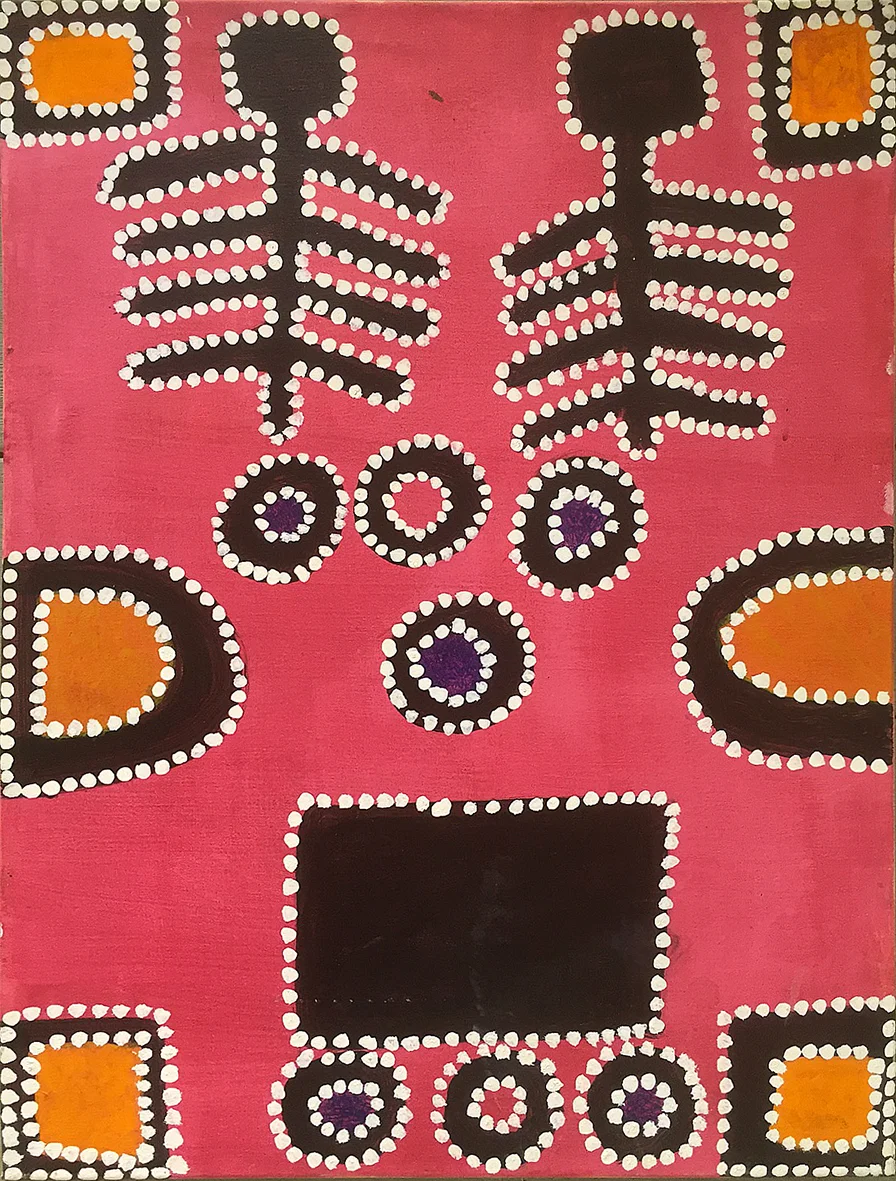
Titre de l'œuvre : JWARLAWOON COUNTRY
Artiste : Rammey Ramsey
Format : 80 x 60 cm
Provenance et certificat : centre d'art aborigène de Warmun
Référence de cette peinture d'art indigène d’Australie : 146/16
© Photo : Aboriginal Signature Estrangin gallery with the courtesy of the artist and Warmun Arts.
Explanations related to this Aboriginal painting :
Rammey Ramsey is a senior Gija man of Joongoora skin, whose ancestral Country lies to the west of Bedford Downs near Elgee Cliffs. Ramsey says:
“This is my place called Warlawoon. They named me Warlawoon for my Country here. There is a Dreamtime waterhole there, a place where many fish live.
This is my mother and father’s Country. I own that Country from my mother and father. Lots of people used to live here with my parents.”
Ramsey now lives in Bow River. His work is forever infused with the memory of Warlawoon Country together with a longing for
Country his work teases out the complexities of Gija world-views and the impact of pastoral occupation on his land.
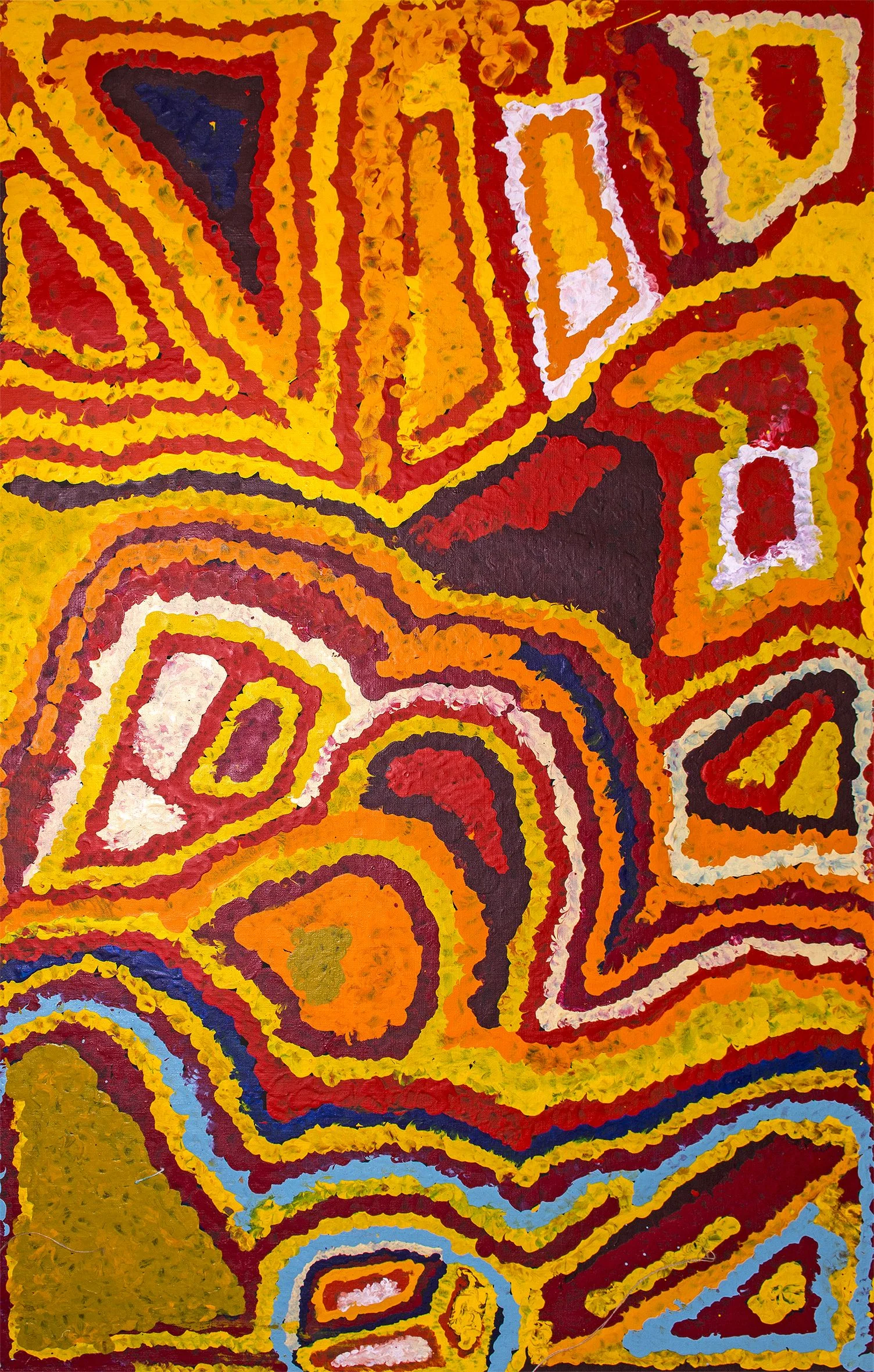
Artiste : Mabel Wakarta (1929)
Titre de l'œuvre : Yirajarra home country
Format : 122 x 76 cm
Provenance et certificat : centre d'art aborigène de Martumili
Référence de cette peinture : 15-646
Demander le prix de l'œuvre / Enquiry
Explications pour cette œuvre :
“Yirajarra, that’s my camp, that’s my place, that’s my country”. Yirajarra is the artists Ngurra (home); it is where the artist was born and is her place. It is a soak situated on the Canning Stock Route, there is Good fresh water there all year round and shade which makes it a decent camp spot. During the Pujiman (bush) days the artist was walking all of this country with her family.
© Photo : Aboriginal Signature Estrangin gallery with the courtesy of the artists and Martumili
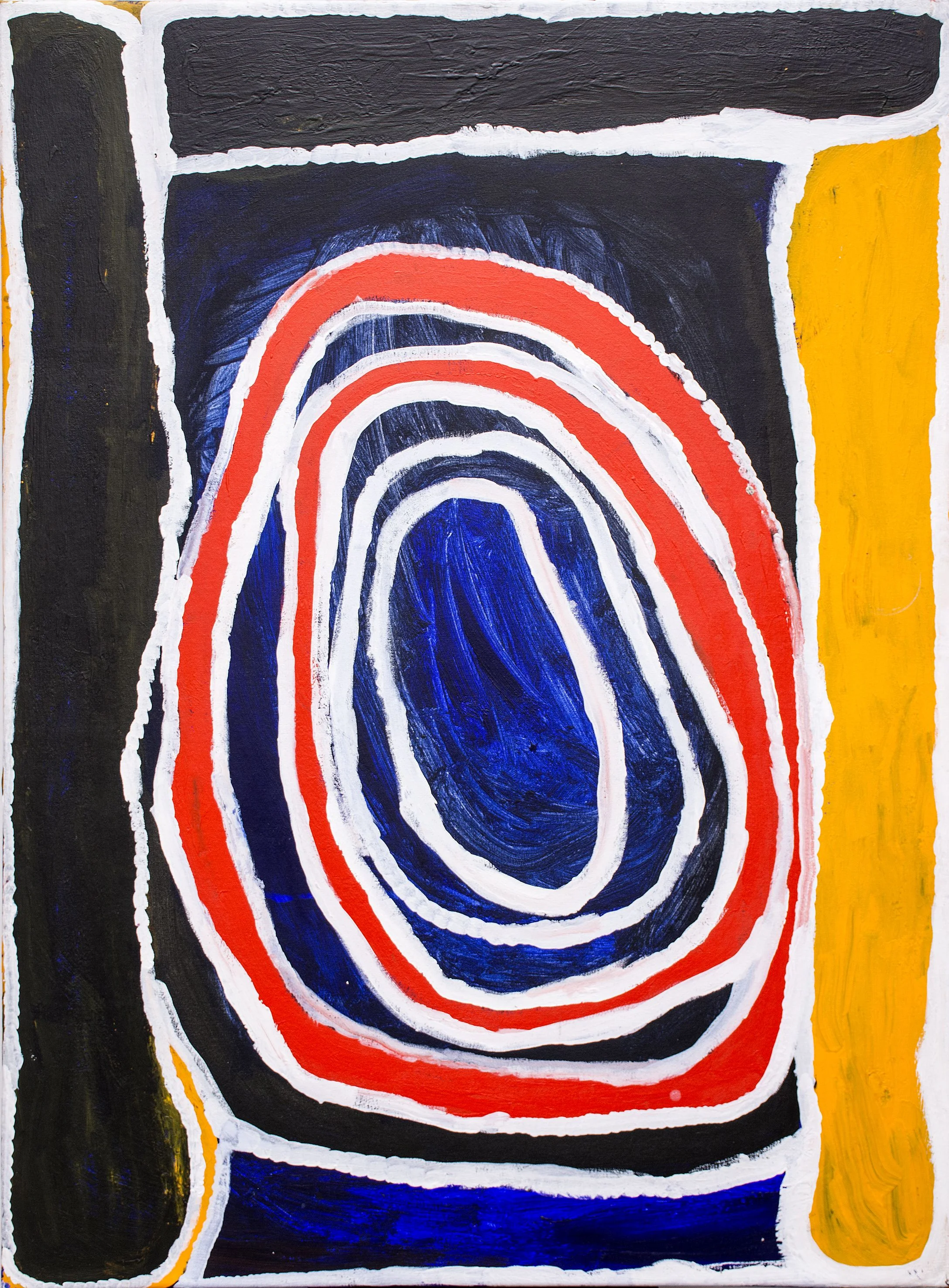
Artiste : Wakartu Cory Surprise
Titre de l'œuvre : Jila Jumu (Waterhole)
Format : 120 x 90 cm
Provenance et certificat : centre d'art de Mangkaja
Référence de cette peinture Aborigène d'Australie : 1182/08
Explications sur cette œuvre :
Wakartu Cory Surprise born about 1929 and died 2011. Wakartu was born at Tapu. After the death of her parents she travelled with her brothers to Kaningarra and Wayampajirti where she grew up. As a married woman, she and her husband ran away from Christmas Creek Station, and the police brought her husband back in chains. Wakartu raised seven children while working for the police, on stations, and collecting minerals for rations.
This painting evokes an important place called Jila Jumu (Waterhole) within her traditional country. This one its way out in the Great Sandy Desert where my people used to go and visit this waterhole.
Collection :
National museum of Canberra
National Gallery of Victoria
Charles Darwin University
Laverty Collection Steve Luzco collection, San Francisco USA
European collections
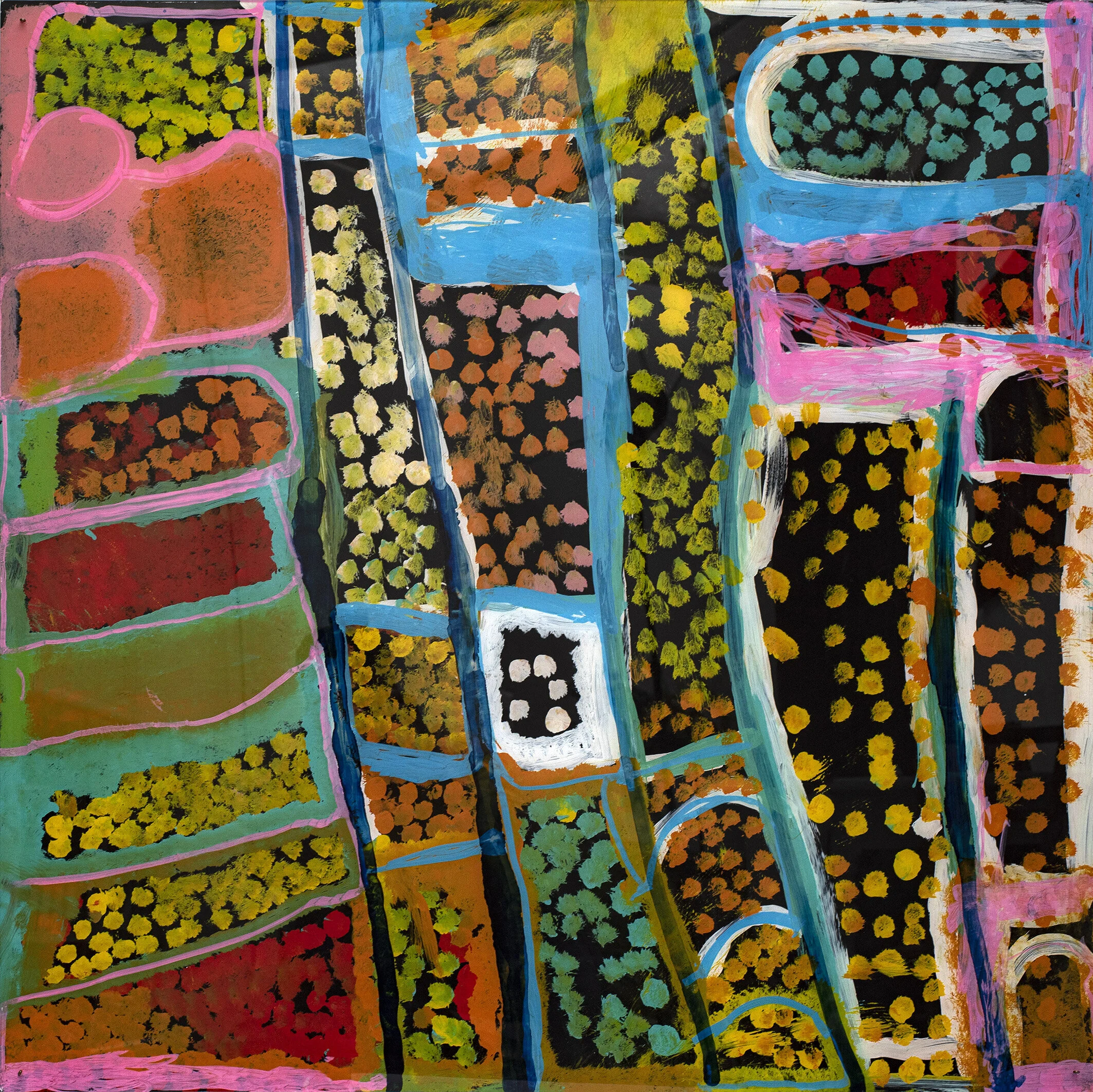
Artiste : Mrs Japulija
Titre de l'œuvre : Billabongs _Daisy
Format : 90 x 90 cm
Provenance et certificat : centre d'art de Mangkaja
Référence de cette peinture Aborigène d'Australie : 331/18
Acrylic paint on polycarbonate.
Explications sur cette œuvre :
Daisy Japulja (1948) paints images of both Martuwarra (river country) and her parent's Jilji (sand hill) country. In these works Daisy relives the stories told of her mothers and fathers country, and retells those of Billabongs. Daisy uses lively colours and a thick brush to cover the canvas with a confident hand. The beautiful simplicity of her desert images are matched by her bold colour pallet as she portrays important Jila (waterholes) and Jumu (soak waters) from the Great Sandy Desert. Closer to home, her cheeky sense of humour rises from the canvas through her beautiful depictions of river country like Martuwarra in this artwork, and the various animals that dwell within it.
Collection :
private collections in Australia
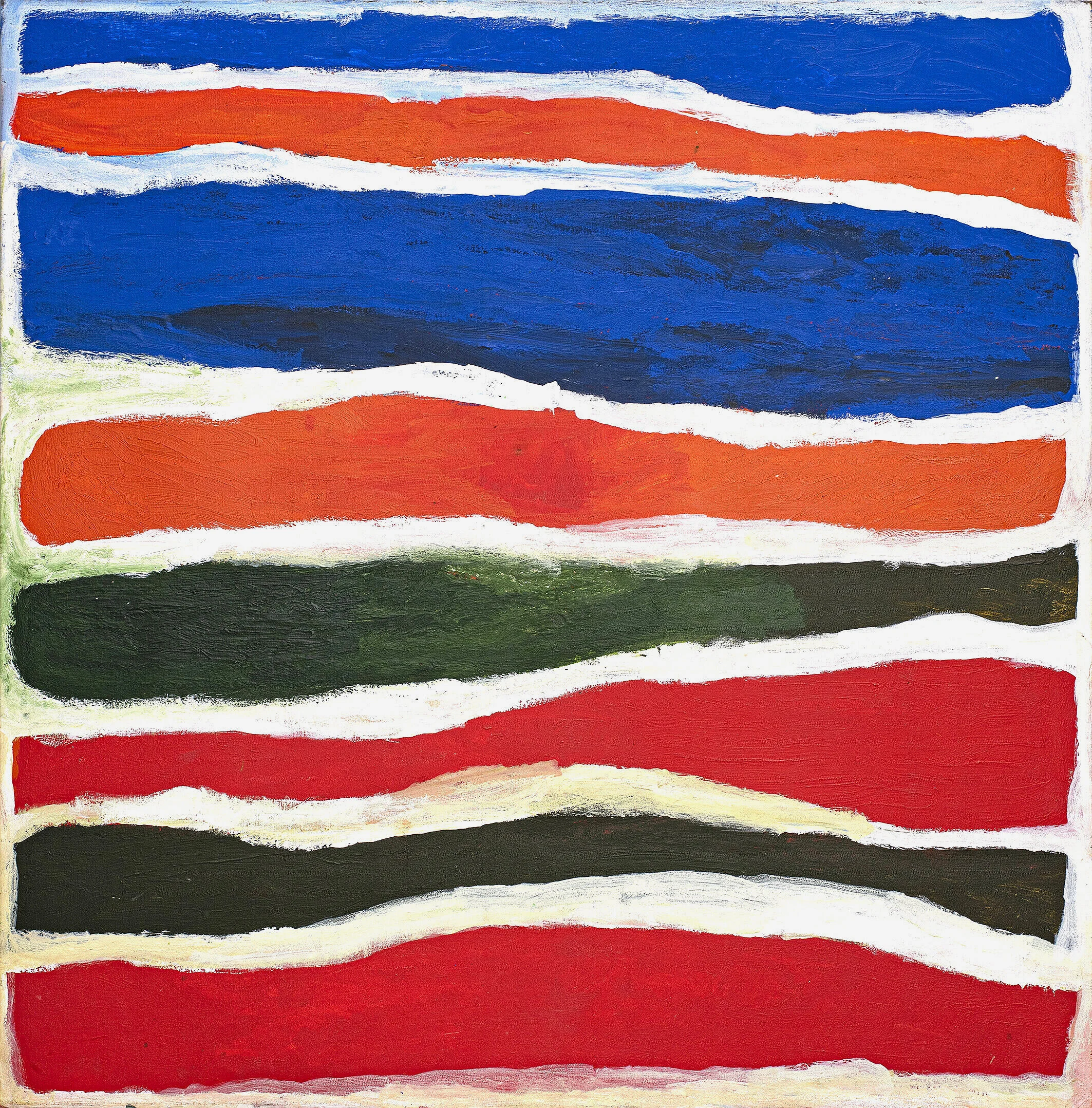
Artiste : Wakartu Cory Surprise
Titre de l'œuvre : Ngapa Purlka
Format : 120 x 120 cm
Provenance et certificat : centre d'art de Mangkaja
Référence de la peinture : 869/09
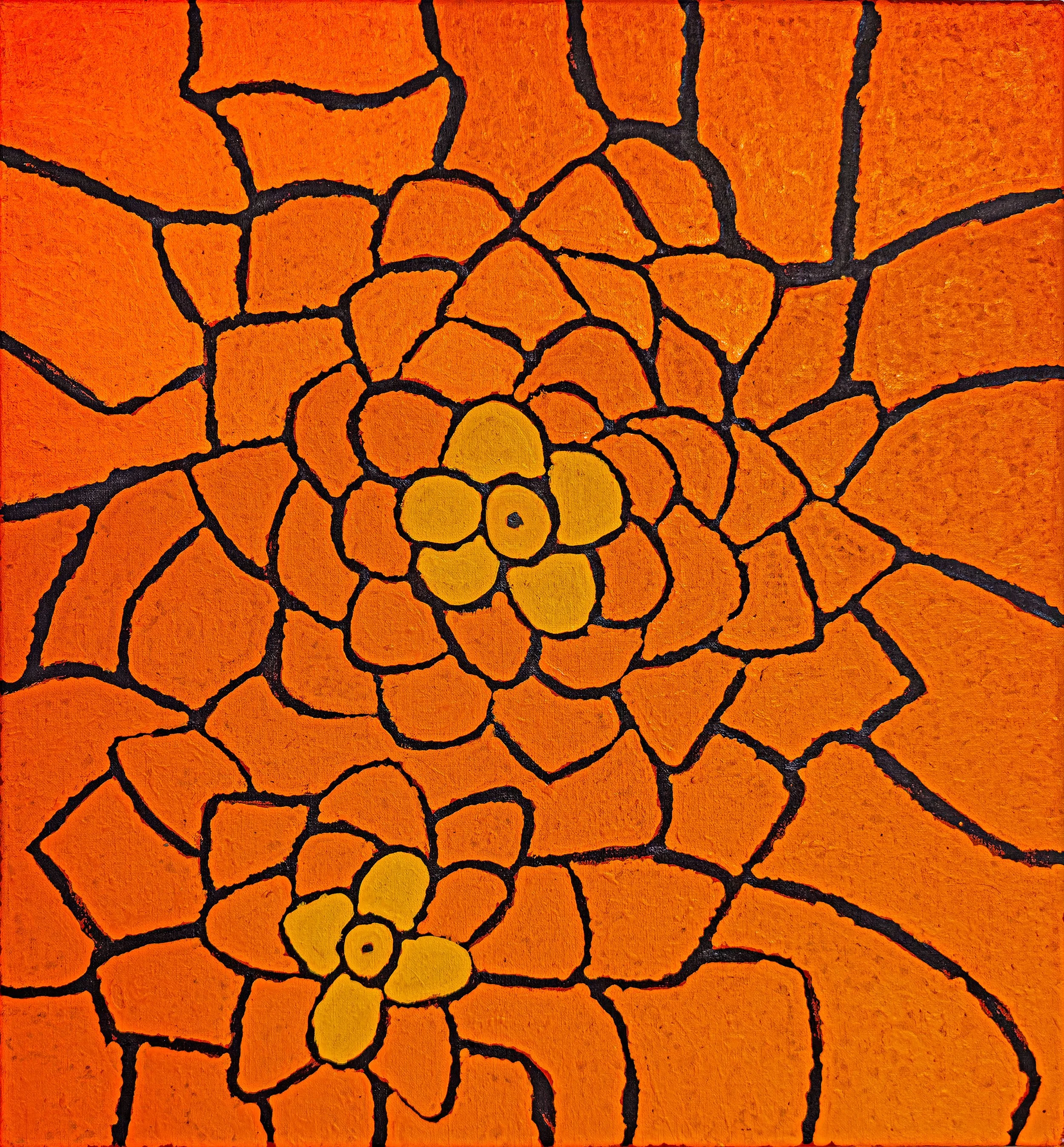
Artiste : Mike Tjakamarra
Titre de l'œuvre : Sans titre
Format : 61 x 55 cm
Provenance : centre d'art de Papunya Tula
Le certificat original du centre d'art Aborigène de Papunya Tula sera remis avec l'œuvre.
Référence de cette peinture : MT0210017
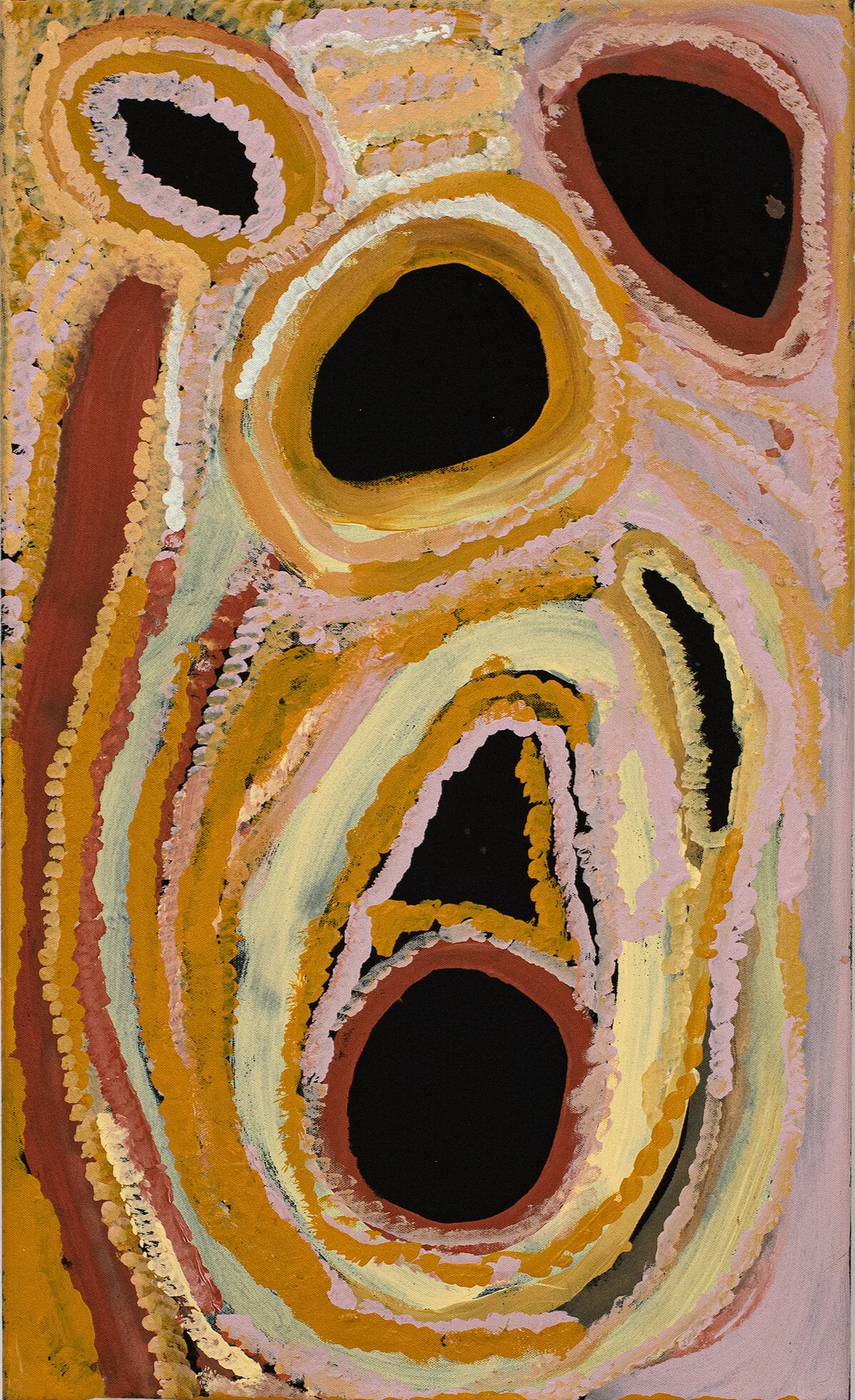
Artiste : Jakayu Biljabu (1936)
Titre de l'œuvre : Pitu (Separation Well)
Format : 76 x 46 cm
Provenance et certificat : centre d'art aborigène de Martumili
Référence de cette peinture : 19-1154
Demander le prix de l'œuvre / Enquiry
Explications pour cette œuvre :
Jakayu primarily paints her country around the Canning Stock Route. In the pujiman (nomadic bush) era, she travelled with her family through the land collecting wilyki (seeds). The circular forms depicted here represent special areas where grasses and wiylki can be found, or they symbolise different waterholes or camps.
Rock holes, waterholes, soaks and springs were all extremely important sites for Martu people during the pujiman era, with many important jukurrpa (dreamtime stories) chronicling the creation of these landmarks. In the past the Martu lived nomadically, moving from water source to water source, and hunting and gathering bush tucker as they went. They would traverse very large distances annually, visiting specific areas in the dry and wet season depending on the availability of water.
© Photo Aboriginal Signatrure Estrangin Gallery, and text with the courtesy of the Artist and Martumili Arts
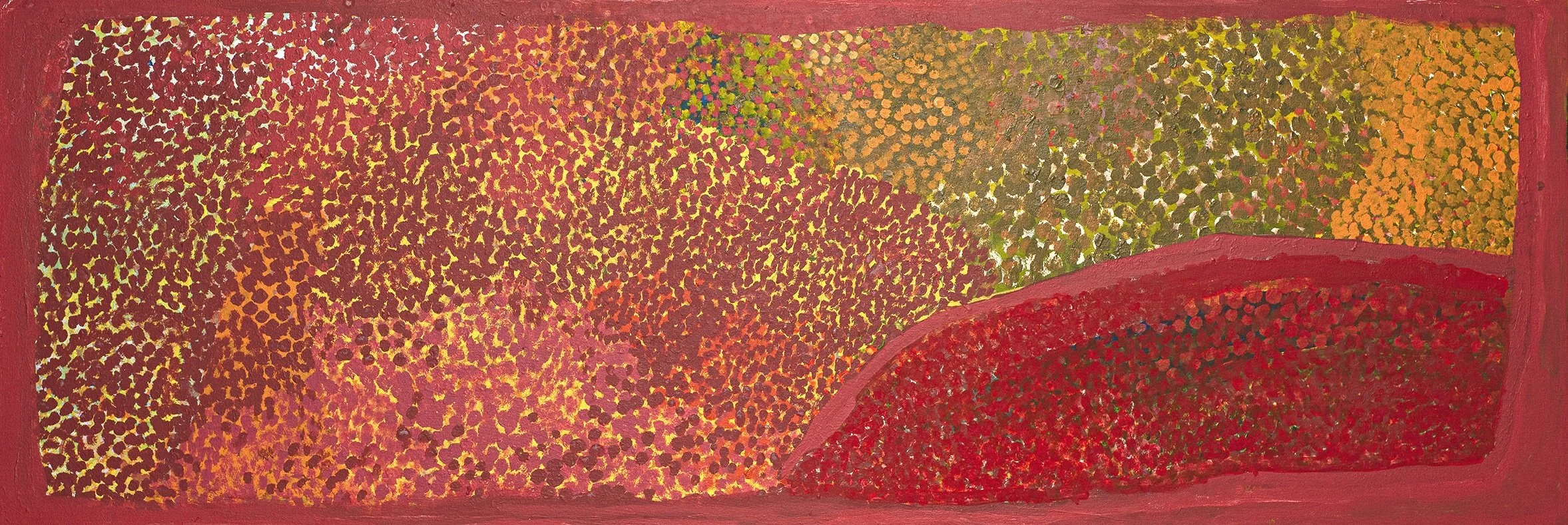
Artiste : Mrs Rawlins
Titre de l'œuvre : Yimirri
Format : 180 x 60 cm
Provenance et certificat : centre d'art de Mangkaja
Référence de cette peinture Aborigène d'Australie : 349/14
Enquiry / Demander le prix de l'œuvre
Explications sur cette œuvre :
Tjigila Nada Rawlins (1936) is a Wangkajungka woman from the Great Sandy Desert. She is a founding member of Karrayili Adult Education Centre and began painting in 1994 at the Karrayili annexe established in Wangkajungka community, 100km southeast of Fitzroy Crossing. Today Nada paints at Mangkaja Arts. This is Tjigila’s story:
I was born in the Great Sandy Desert. My mother never put me in a blanket. I never saw my father. We walked from the desert along the Canning Stock Route. We walked through Billiluna. One kartiya [European] called Len Brown picked us up early in the morning in a truck. He took us to Moola Bulla. I had a sore on my arm and they took me to the clinic. They gave me lots of needles. When my arm was better I lived with my family at Moola Bulla. Then we walked alongside the river to Christmas Creek. We walked becuase we had no motorcar. We carried our swags on our heads.
This painting evokes Linjalangu next to Kiriwirri, with spring water but it is salty. The Jilji (sandhills) follow the edge of the Warla (salt lake). I was walking there with my parents when I was young.
Collection :
National Gallery of Victoria
Art Gallery of New South Wales
Charles Darwin University
Holmes a Court Collection, Perth
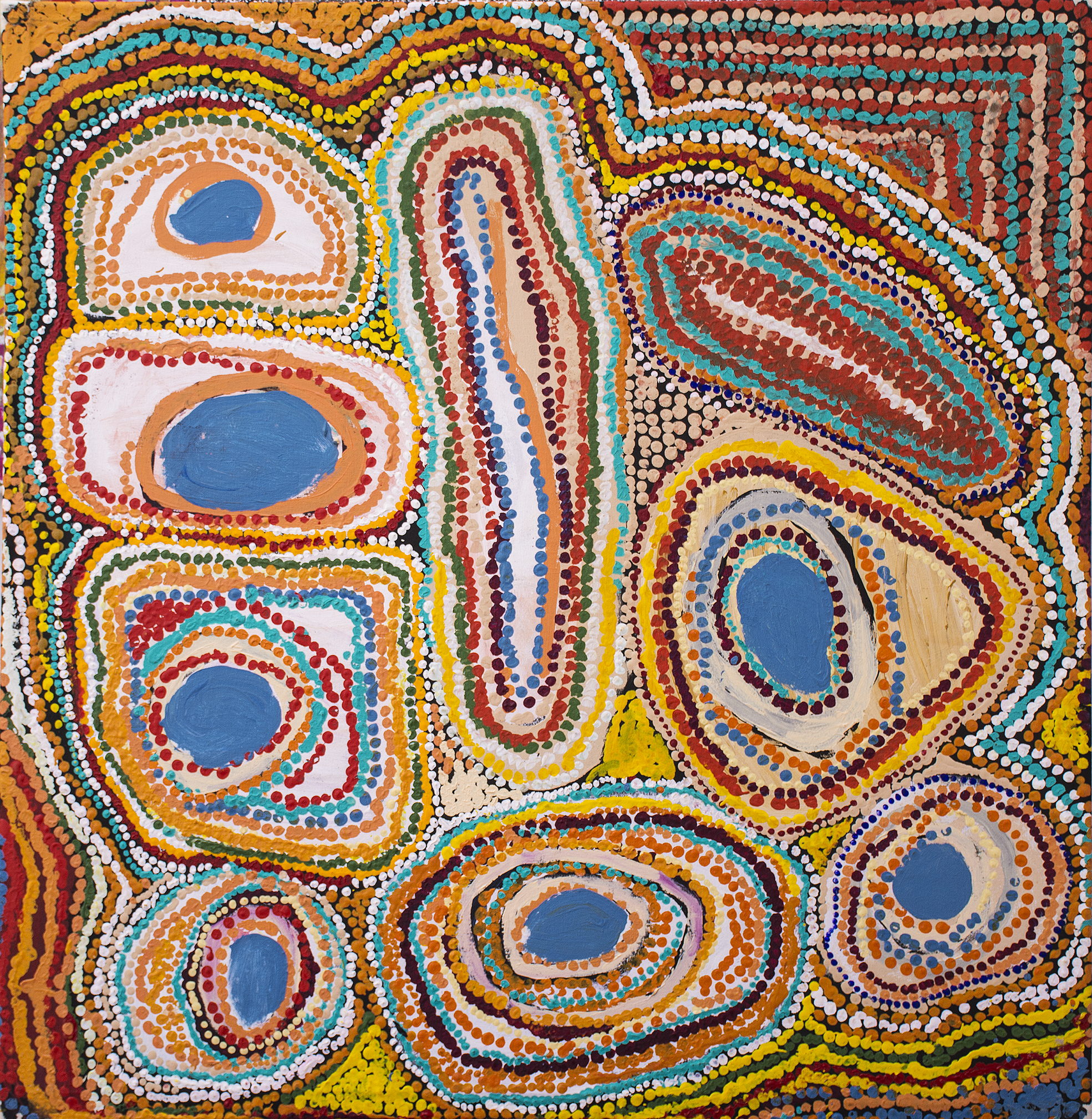
Artiste : Jakayu Biljabu (1936)
Titre de l'œuvre : Permanent waterholes close to the Canning Stock Route
Format : 91 x 91 cm
Provenance et certificat : centre d'art aborigène de Martumili
Référence de cette peinture : 08-622
Demander le prix de l'œuvre / Enquiry
Découvrez notre collection de peintures Aborigènes disponibles ici
Explications pour cette œuvre :
“Ngurra me, my ngurra (this is my country, my home). Mummy mili Pitu and Kulilu (my mother's home country is around the permanent waterholes of Pitu and Kulilu).
This painting depicts Pitu (Separation Well), an area east of Parnngurr in the Western Desert, not far from the Canning Stock Route (in between wells 27 & 28).
Jakayu was born at Pitu. It is her country, as well as the site of a warla (lake) and large jurnu (rockhole). Also depicted is the nearby soak, Kulilu, Jakayu’s mother’s Country. Jakayu and her family travelled throughout this country extensively during the pujiman (bush dwelling) era.
The painter primarily paints her country around the Canning Stock Route. In the Pujiman time (Bush days) the artist travelled with her family through the land collecting wiylki (seeds) just as the Minyi Puru (Seven Sisters) did in the Jukurrpa (Dreamtime). Now they collect grass for baskets as well, Puntayarra and Minarri are two of the names for grasses that the artists use to make baskets. Some of the special places the grasses grow in the artist’s country are Wangkakarlu, Turngul, Matilirri, Wantili, Nyilangkurr and Warrki.
© Photo : Aboriginal Signature Estrangin gallery with the courtesy of the artists and Martumili
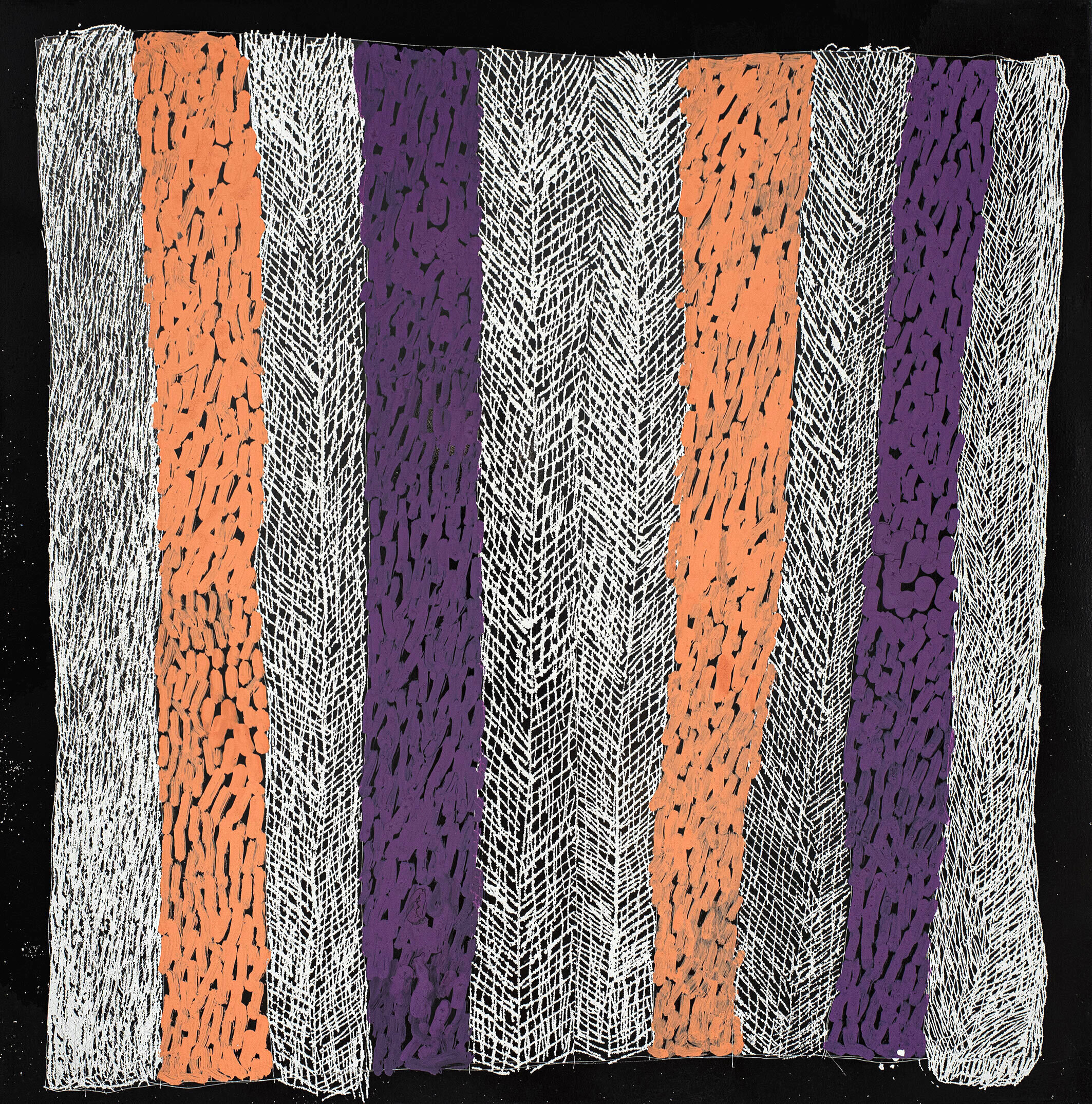
Artiste : Ngarralja Tommy May (1935)
Titre de l'œuvre : JILJI AND BILA
Format : 60 x 60 cm
Provenance et certificat : centre d'art de Mangkaja
Référence de cette peinture Aborigène d'Australie : 340/19
Etching on metal/ Enamel spray paint and acrylic on Metal.
Enquiry / Demander le prix de l'œuvre
Explications sur cette œuvre :
This painting by Ngarralja Tommy May (1935) deals about the sandhill country, jilji, on and on they go. In between the jilji, that is called bila, flat country. The jilji can be close, or the bila might be really wide, a few hundred metres. Someone might have burnt that country before. You burn it, and its easier to catch a feed like lizard, and the bush turkeys fly in from everywhere to eat the exposed insects. Bush turkey, that’s good tucker! After fire, grasses grow back and the trees regenerate. We travel in this country, wurna juwal, always travelling from place to place! As you move through country, the type of trees and grasses change, and that determines what you will find, in terms of foods and medicine, or other plants we don’t use. At different times of the year you’ll find beautiful fields of flowers too. On cool mornings you can suck out the nectar of some flowers, before the birds do. Desert oaks are best for shade, they grow together in big numbers, but you don’t find them everywhere. This is an easy story, this is not a story about law. I can tell you.
Collection :
Kluge Ruhe Museum of Aboriginal Art -Charlottesville USA
National Museum of Australia
National Gallery of Victoria
Curtin University Collection, Perth
Queensland State Art Gallery
Berndt Museum of Anthropology Australian
Flinders University Art Museum, Adelaide
Carleton College Art Collection, Northfield Minnesota
Kennesaw State University
Fitzroy Crossing High School
Fitzroy Crossing Hospital
Leewuin Estate Collection
Awards2018
Finalist Alice Price 2017
Finalist Port Headland Art Award 2017
Finalist NATSIAA -General Painting 2017
Finalist Bunbury Art Prize2017
Finalist, NATSIAA, MAGNT, Darwin, NT2015
Port Hedland Art Award, Best work in a medium other than painting 2010
Regional Arts Australia Volunteer Awards, sustained contribution
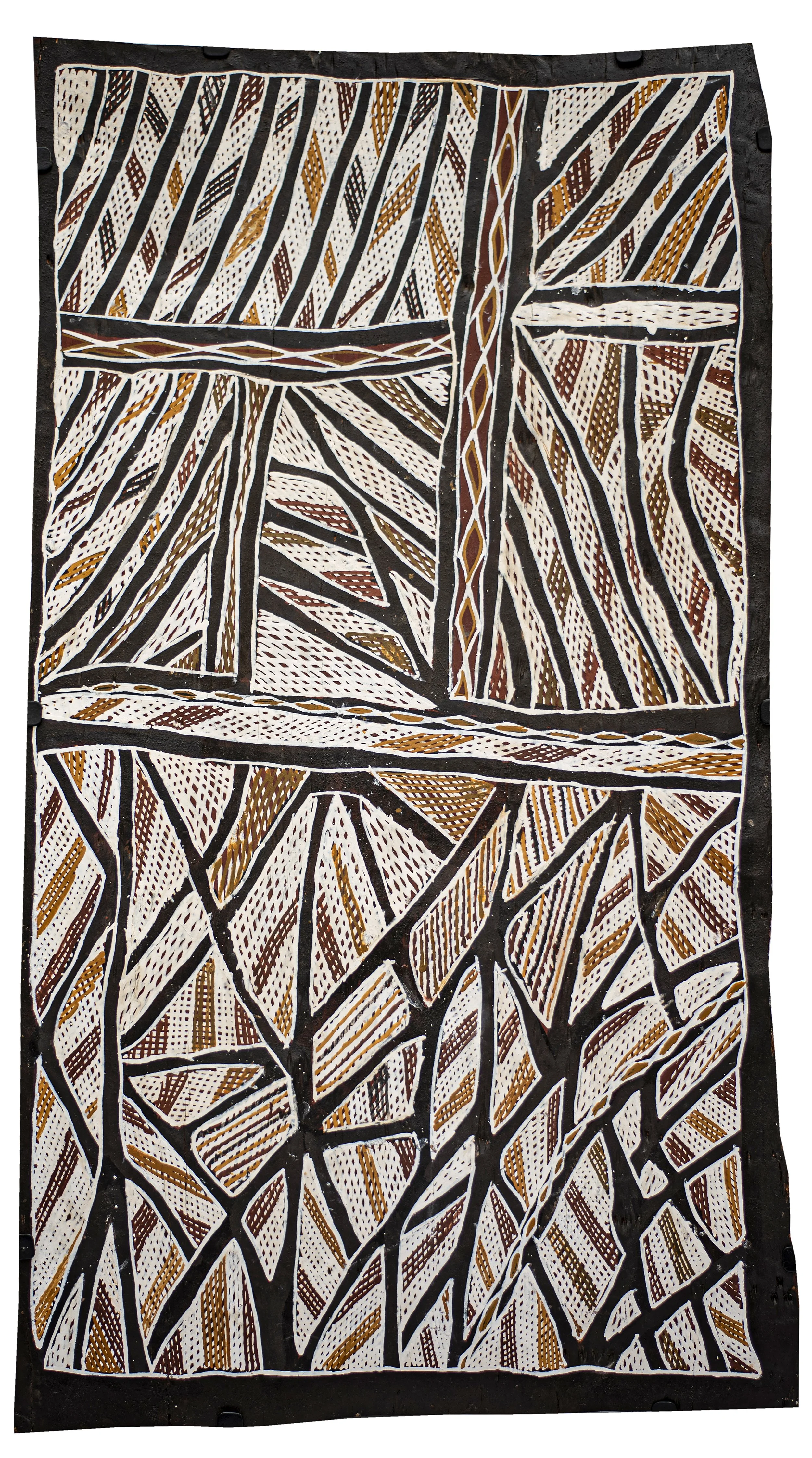
Artiste : Noŋgirrŋa Marawili
Titre de l'œuvre : Gurtha
Pigments naturels sur écorce
Format : 111 x 61cm
Provenance et certificat original : centre d'art aborigène de Yirrkala
Référence de la peinture : 1753-17
© Photo & text : Aboriginal signature with the courtesy of the artist & Buku-Larrngay Mulka.
Explication de l’œuvre :
This Bark painting by Noŋgirrŋa Marawili (1938), depicts the strings of diamonds marks the classic miny’tji of the saltwater estate of Yathikpa. Here Bäru the ancestral crocodile, carrying and being burnt by the Ancestral fire crossed the beach from Garraŋali (crocodile’s nest) and entered the saltwater. Bäru decided after being soothed of his burns that he would stay in these waters. His sacred powers in line with that of the fire imbues the water there today.
Later from the same beach Ancestral Hunters on seeing Dugong took their hunting harpoon and canoe out to the sea of Yathikpa in pursuit. The hunters were lured too close to a dangerous rock by the dugong seeking shelter. The dugong here feed on the Gamata, a sea grass that is a manifestation of flames on the sea bed. Wavy ribbons of seagrass sway in the sunlit water. Fire at this sacred site boiled the water capsizing the canoe. This is sometimes called an ancestral tide and it is speculated that this is the oral tradition of an ancient tsunami.
The parallel wavy lines take the flow of water to the open ocean, Muŋurru. It is here on the horizon that the waters from other Yirritja clans, the Dhalwaŋu, Manggalili and Munyuku merge and mingle. The hunter’s harpoon floats incessantly between the various coastal saltwater estates of these clans. It is also here that the feminine thunderclouds take up life-giving water to rain back over the hinterlands, thence to flow through the river systems and meet the saltwater tidal surge. The transformation of saltwater into fresh and back into salt mirrors the soul as it changes its outward form from corporeal to ethereal and so on.
This is a painting of fire but also simultaneously of water. It is a raw rendition of Madarrpa clan sacred design for the ocean at Yathikpa which is melting and crashing to the horizon. Noŋgirrŋa mentioned that this work includes reference to the dark leaf stained mangrove water that is pushed out into the ocean in the first floods.
Her artworks are in the following prestigious collections :
Art Gallery of New South Wales, Sydney NSW
Art Gallery of South Australia, Adelaide SA
Berndt Museum, University of Western Australia, Perth WA
Charles Darwin University Art Collection
Chartwell Collection, Auckland Art Gallery, Auckland, New Zealand
Debra and Dennis Scholl Collection
Kluge-Ruhe Aboriginal Art Collection of the University of Virginia. USA
Museum and Art Gallery of the Northern Territory, Darwin NT
Museum Kunstwerk, Germany
Museum of Contemporary Art, Sydney NSW
National Gallery of Australia, Canberra ACT
National Gallery of Victoria, Melbourne VIC
National Maritime Museum, Saltwater Collection. Darling Harbour, Sydney NSW
Sammlung Klein, Eberdingen-Nussdorf, Germany
Tandanya National Aboriginal Institute, Adelaide SA
TATE Modern, London UK
The Metropolitan Museum of Art, New York, USA
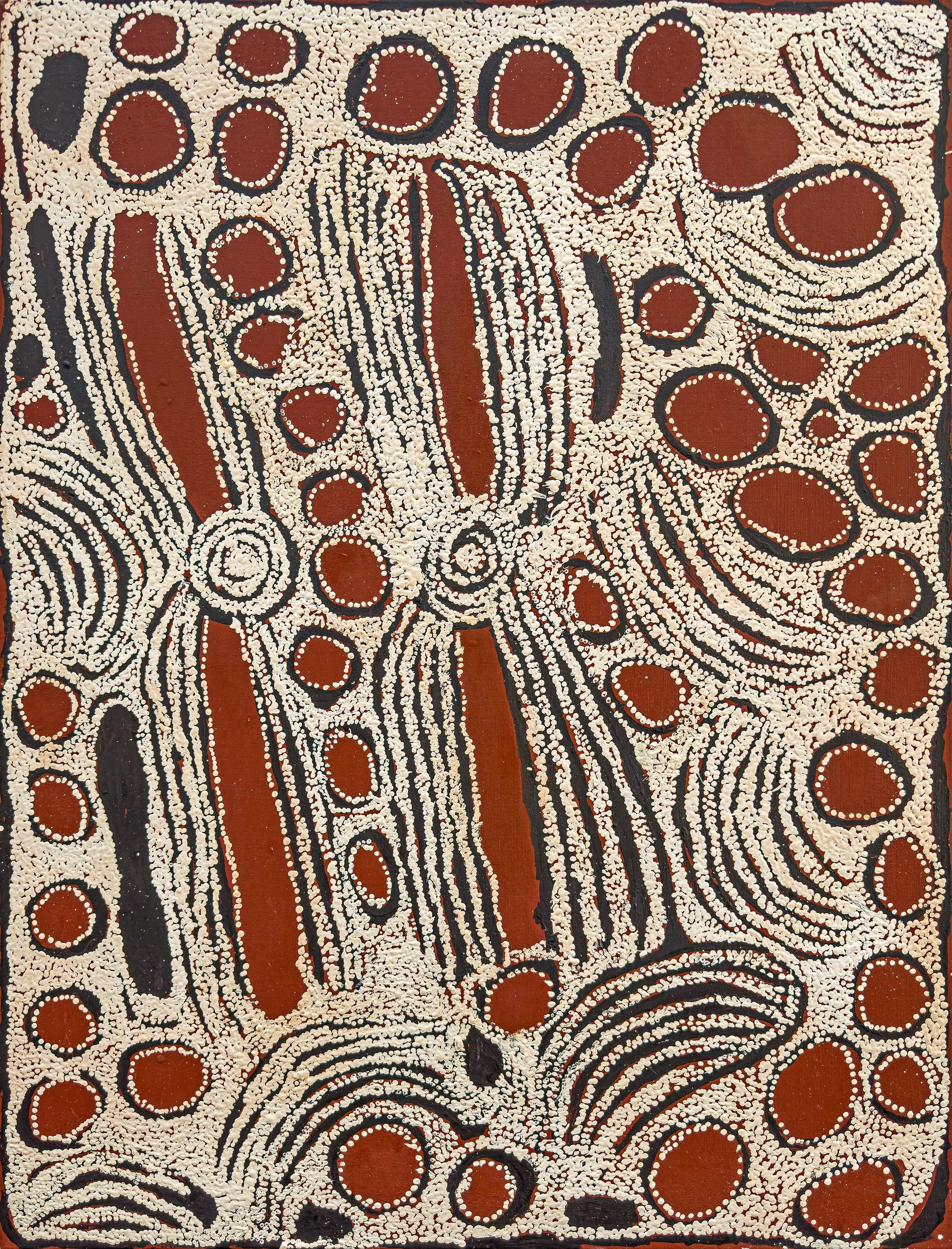
Artiste : Ningura Napurrula
Titre de l'œuvre : Ancestral women ceremonies - Wirrulnga rockhole
Format : 122 x 91 cm
Provenance : centre d'art de Papunya Tula
Le certificat original du centre d'art Aborigène de Papunya Tula sera remis avec l'œuvre.
Référence de la peinture : NN1204052
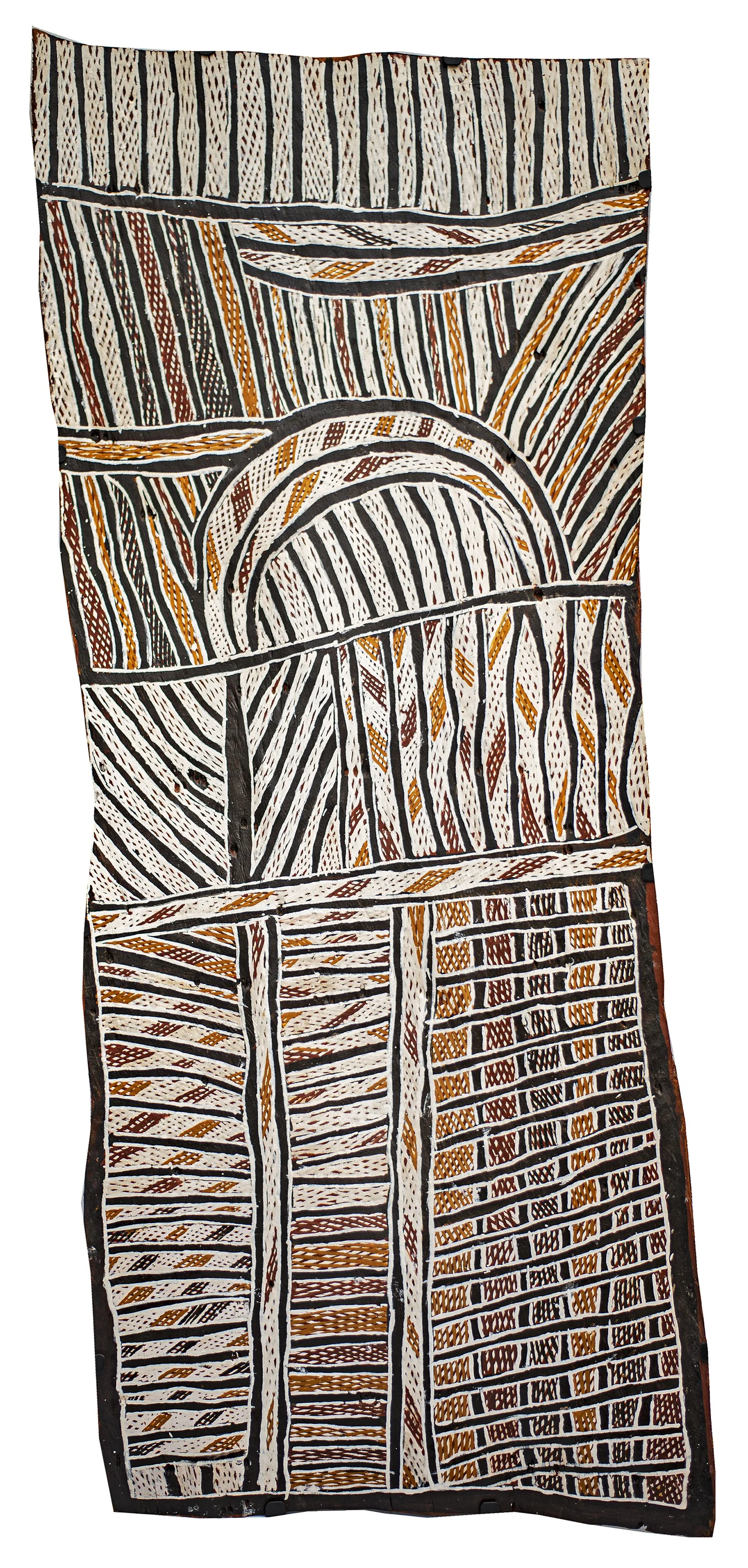
Artiste : Noŋgirrŋa Marawili
Titre de l'œuvre : Bol’ŋu
Pigments naturels sur écorce
Format : 159 x 62cm
Provenance et certificat original : centre d'art aborigène de Yirrkala
Référence de la peinture : 4992M
© Photo & text : Aboriginal signature with the courtesy of the artist & Buku-Larrngay Mulka.
Explication de l’œuvre :
This Bark painting by Noŋgirrŋa Marawili (1938), depicts a long time ago, two spirit men called Djirrawit and Nyåluŋ made a fish trap (dhawurr) in the Gurriyalayala River at Waṉḏawuy. The fish trap was made of upright posts forked at the top with a long crosspiece sitting in the forks. The space between was filled in with more upright sticks (dharpa) interwoven with horizontal sticks. Then Djirrawit and Nyåluŋ cut pieces of bark from the dhaŋgi tree, pounded them to release the poison, and threw them into the river. The poison in the bark turned the water black and stunned the catfish (gaṉŋal). To collect all the stunned fish they used their fishing spears (gara) and double-sided triangular fishing nets (ganybu) made of bush string (raki’). Djirrawit and Nyåluŋ got the idea for the special shape of these nets from watching pelicans (galumay) catching fish in their big bills. Yolŋu people learned from the two spirit men how to catch fish this way, and still do sometimes when there is a big gathering of people needing much food. The squared background design called gapu (meaning water) which is used in paintings of this story is a special clan design belonging to the Djapu clan from Wandawuy and represents that country (wåŋa). Several other Dhuwa moiety clans own small parcels of land/water (riŋgitj) in this area and this is represented by the squared design, but the design itself belongs to Djapu people. The dhaŋgi story is told in the sacred songs (manikay) of Djapu people and danced at ceremonies (buŋgul). When Yolŋu dance galumay, they open and close their arms as though opening and closing these fishing nets. Wandawuy is also associated with the Thunderman, Bol’ŋu. In ancestral times, Bol'ngu travelled from Wessel Islands south through various Dhuwa moiety clans' country. He was both man and cloud, the heavy cloud wolma which brings the first rains of the wet season. He travelled in the clouds, and rain fell when he urinated. As Bol'ngu travelled through the country, the Dhuwa clouds and the rain followed him. Rivers and creeks and springs with freshwater for the dry season formed. And he said to himself, let it be like this always. As he passed by Bol'ngu named the rivers and springs at the sites he visited. He named trees and antbeds, and these are still the names for all these things at these places. In each clans' country Bol'ngu gave ceremony and law to the people. He taught songs and dances and the designs that belong to each of the clans, and he taught initiation ceremony to make the young boys men. The song cycle describing his travels is sung at these ceremonies.
Her artworks are in the following prestigious collections :
Art Gallery of New South Wales, Sydney NSW
Art Gallery of South Australia, Adelaide SA
Berndt Museum, University of Western Australia, Perth WA
Charles Darwin University Art Collection
Chartwell Collection, Auckland Art Gallery, Auckland, New Zealand
Debra and Dennis Scholl Collection
Kluge-Ruhe Aboriginal Art Collection of the University of Virginia. USA
Museum and Art Gallery of the Northern Territory, Darwin NT
Museum Kunstwerk, Germany
Museum of Contemporary Art, Sydney NSW
National Gallery of Australia, Canberra ACT
National Gallery of Victoria, Melbourne VIC
National Maritime Museum, Saltwater Collection. Darling Harbour, Sydney NSW
Sammlung Klein, Eberdingen-Nussdorf, Germany
Tandanya National Aboriginal Institute, Adelaide SA
TATE Modern, London UK
The Metropolitan Museum of Art, New York, USA
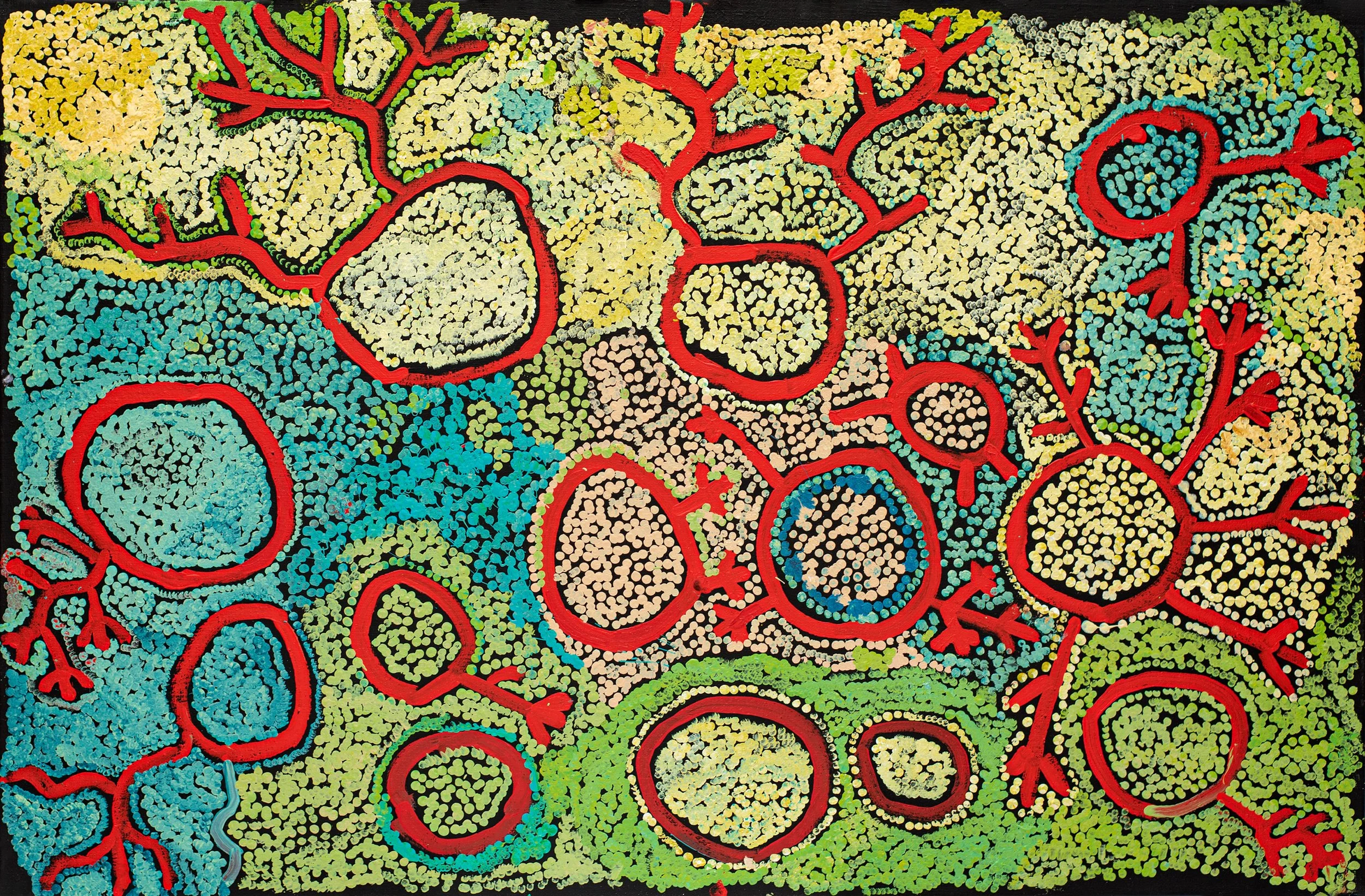
Artiste : Simon Hogan
Titre de l'œuvre : Lingka
Format : 137 x 90 cm
Provenance et certificat : centre d'art aborigène du Spinifex Art Project
Référence de cette peinture : 21-363
Enquiry / Demander le prix de l'œuvre
Explications pour cette œuvre :
Simon Hogan (1930) manifests his site of Lingka onto the two dimensional plane. When he paints, he transcends this world and is taken over soft sand ridges and vast Spinifex plains to the significant sites that formed him from birth. For Simon was born into a spiritual society where religion manifested in the immediate environment and where creation beings could move through different realms at will. It is these beings who shaped the landscape that Simon depicts and who left a moral compass that is still followed today. They gave to people the life giving water sites that were held with such reverence in an arid and remote land. It is these sites that were the means of survival and where religion unfolded in the form of sacred song and performance.
Simon Hogan was born circa 1930 in mid-western Spinifex between Paltju and Lingka. Simon’s exact age is unknown as dates of birth were estimated by the A.E.M. missionaries when the Spinifex people, on arrival at Cundeelee, were “sorted” into family groups, given English names and approximate dates of birth. During childhood two fathers, one born at Warakunu and the other at Munki raised Simon. Simon’s mother’s country is around Tjulya. The Spinifex people were a relatively discreet southern Pitjantjatjara tribal group with es to the north and east that lived a fully traditional hunter-gatherer life until the late1950’s to early 1960s when most people either walked in to Ooldea and Cundeelee or were taken by AEM missionaries to Cundeelee Mission…
From 1995 Simon Hogan was a prominent member of a group of senior traditional owners from Spinifex country who lobbied the WA State Government for Native Title. Although Simon spoke no English he was a confident, initiated Pitjantjatjara man who spoke to senior government officials regarding ownership of country and culture. Exclusive Native Title rights were granted to Simon Hogan and the Spinifex people in 2000 of over 55 000 sq kms of the Great Victoria Desert in WA.
His artworks are in the following prestigious collections :
Art Gallery Of South Australia, Adelaide, South Australia
British Museum, London, England.
Harriet And Richard England Collection
National Gallery Of Australia, Canberra, Act.
National Gallery Of Victoria, Melbourne, Victoria.
Seattle Art Museum, Seattle, Usa. (Mens Collaborative)
Staatliches Museum Fur Volkerkunde, Munich, Germany
The Lepley Collection, Perth, Western Australia.
The Patrick Corrigan Collection, Sydney, New South Wales.
W. & V. Mcgeoch Collection
Western Australian Museum, Perth, W.A.
Artbank, Australian Government Collection. Australia.
Art Gallery Of Western Australia, Perth, Western Australia.
The Art Gallery Of New South Wales, Sydney, Nsw (Mens Collaborative)
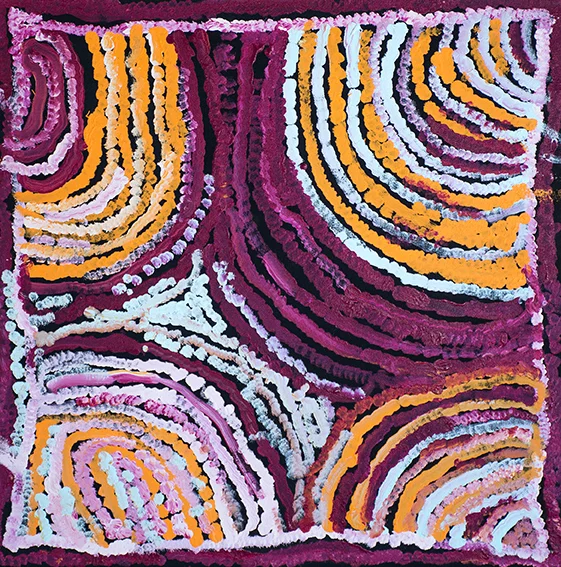
Titre de l'œuvre : Top of the hills at Lirrun
Format : 76 x 76 cm
Provenance et certificat : centre d'art de Warakurna Artists
Référence de cette peinture d'art indigène d’Australie : 273-14
© The artists, with the courtesy of Warakurna Arts
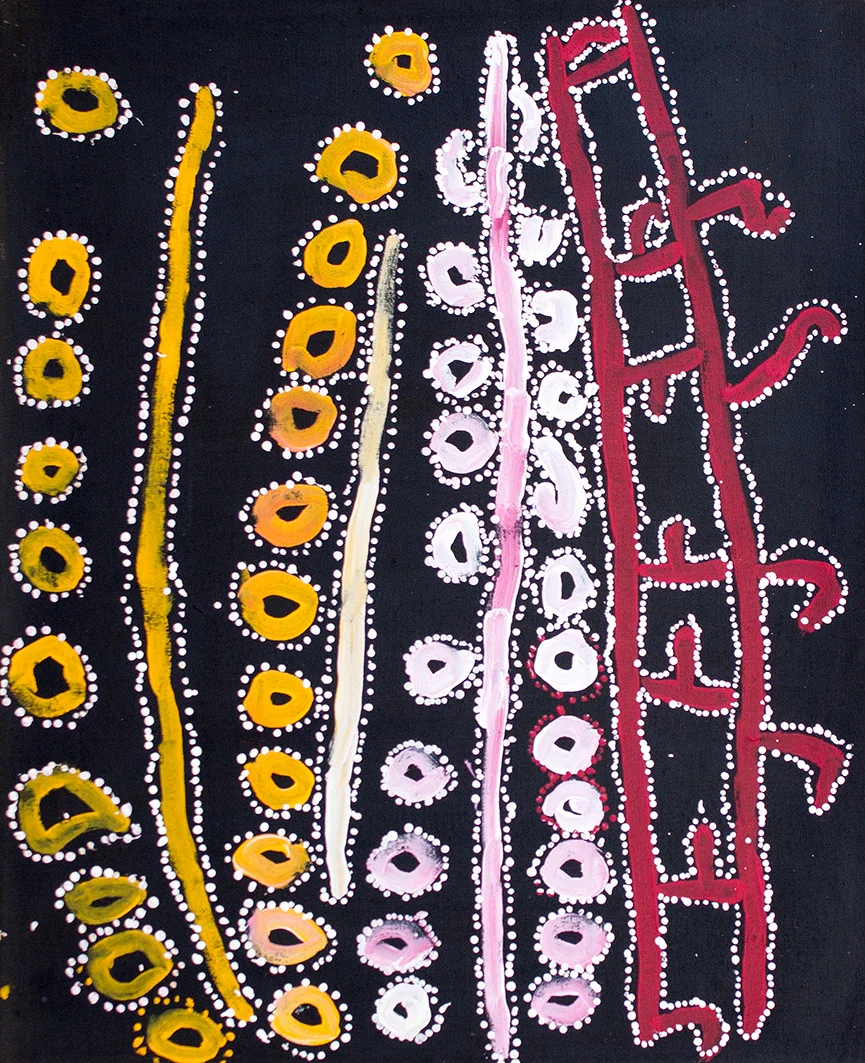
Artiste : Lawrence Pennington
Titre de l'œuvre : Pukaralanguru
Format : 75 x 60 cm
Provenance et certificat : centre d'art aborigene du Spinifex Art Project
Référence de cette peinture aborigene : 15-132
Indisponible
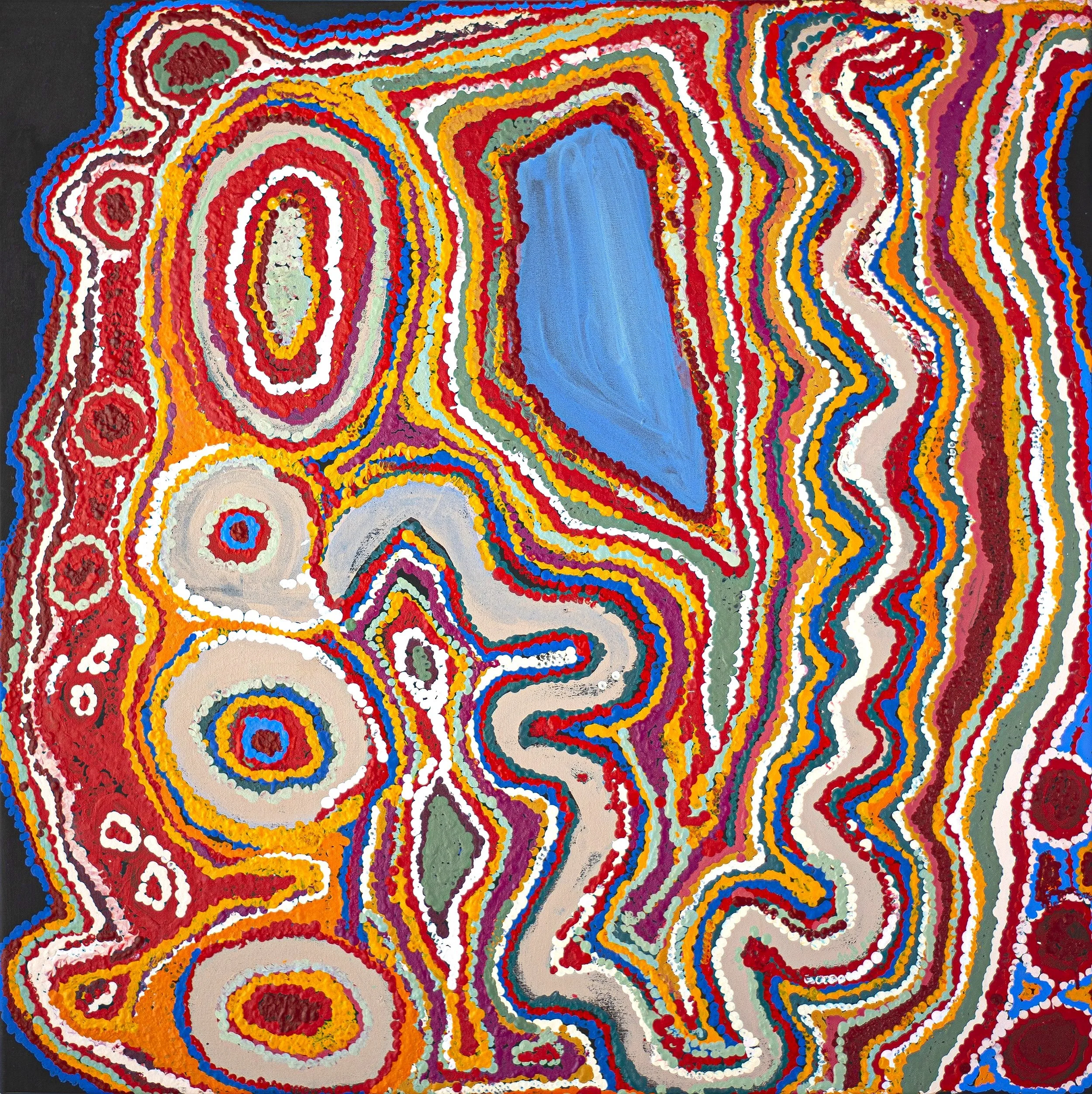
Artiste : Jimmy Yanyatjari Donegan
Titre de l'œuvre : Pukara
Format : 91 x 91 cm
Provenance et certificat : centre d'art aborigène de Ninuku Arts
Référence de cette toile aborigène : 19-435
Explications pour cette peinture d'art Aborigène :
This is a story about kaliny-kalinypa (honey grevillea plant), which Anangu (the term for people in Pitjantjatjara) use as a type of bush lolly, sucking the nectar out of the plant. In the Tjukurpa (Dreaming story) a father and son, Wati Kutjara Wanampi (two male water snakes), are living at Pukara, an important waterhole site near Irrunytju (Wingellina). Because of the kaliny-kalinypa which is found at the site the water there has a sweet taste and lots of people go there to access it. But father Wati Wanampi doesn’t like this and he tells them to go back to their own country. The people leave and the father and son travel to Willuna, where they camp for weeks.
When they return to Pukara, they are awoken by a buzzing sound. Minyma Punpunpa (the female flies) are making lots of noise as they buzz around the honey bush. This prompts the father and son to get up to go and collect honey. While they are doing this, a Wati Mututa (black ant) finds the father and son, and spears the son in his side. The young son starts sping and he spits up the yellow and orange seeds of all the different types of honey grevillea. These plants can still be found at this site today. There is a big variety of honey grevillea plants including kaliny-kalinypa, ultunkunpa, piruwa and witjinti.
Artiste : Witjiti George (1938)
Titre de l'œuvre : Malara: Wanampi Tjukurpa
Format : 200cm x 183cm
Provenance et certificat : centre d'art aborigène de Kaltjiti Arts
Référence de cette peinture aborigène : 18-226
Demander le prix de l'œuvre
Explications pour cette peinture d'art Aborigène :
Malara is the place of the Water Serpent Dreaming. Taylor was born at this important site of the Wanampi Tjukurpa, the Rainbow Serpent or water snake Dreaming. The Malara Wanampi is his Tjukurpa totemic ancestor. Taylor is Nguraritja, a tradional custodian of this tjukurpa. There were many water holes that the Wanapmi travelled through.
“That Wanampi came from Malara. He went to Kunytjanu near Pipalyatjara From Kunytjanu that Wanampi kept walking, walking. He came to Tjuntun (kutjupa -different to Tjuntun at Fregon.) near Watarru. He threw one spear and made that rockhole. He went right in that rockhole and then he travelled back to Malara. This is a conflict story. This region is located far west of the *APY Lands.