
Exposition “INSIDE”
A la galerie Aboriginal Signature Estrangin : 101 rue Jules Besme, 1081 Bruxelles.
Du mardi 27 avril au dimanche 30 mai 2021.
Vernissage le mardi 27 avril de 11h à 21h.
Dans le contexte actuel, notre galerie est ouverte et vous reçoit sur RDV du mardi au dimanche, de 11h à 19h.
Nous nous réjouissons de vous accueillir dans le respect des principes de sécurité recommandées par le Conseil Fédéral pour les magasins et galeries d’art, et vous invitons à réserver votre visite dans notre agenda ici.

L’artiste Alec Baker (1932), devant une de ses œuvres. © Photo : Meg Hansen with the courtesy of Iwantja Arts.
« "I teach my grandchildren the stories and knowledge about our culture, our land, Yankunytjatjara land. I paint my memories of country, I try to make the paintings strong, holding all the memories and keeping it strong." Alec Baker (1932), senior man from Iwantja.
INSIDE
Nous sommes très honorés d’accueillir à Bruxelles 45 œuvres sublimes réalisées par 20 grands artistes aborigènes Anangu nées entre 1932 et 1984, habitants au centre du continent Australien, dans le nord du Grand Désert du Victoria. Au sein de ce vaste territoire du APY land, grand comme trois fois la Belgique avec 103 000 km2, la densité humaine est la plus faible de la planète avec juste 2 276 résidents – soit 0,02 habitants/km2 – de loin inférieure au Groenland. En 1981, cette région a été restituée aux Aborigènes du APY land, et leur conseil exécutif élu rend compte directement au Premier ministre de l’Australie du sud.

Œuvres de l’exposition INSIDE the APY lands, avec de gauche à droite : Watarru Women collaborative - Ipili 2021, Jimmy Donnegan, Monica Watson, Alec Baker, Monica Watson, Alec Baker. © Photo : Aboriginal Signature Estrangin Gallery with the courtesy of the artists, and Tjungu Palya, Ninuku Arts, Monica Watson, Iwantja Arts.
INSIDE : l’art d’une nation
L’art est au cœur de la vie culturelle, économique et sociale des Anangus avec 7 centres d’art prestigieux établis au cœur des communautés disséminées sur ce vaste territoire, tous représentés dans cette importante exposition à Bruxelles.
Depuis plusieurs années, le APY land est une des régions artistiques parmi les plus dynamiques, reconnues et célébrées en Australie.
Entre 2017 et 2020, plus de 20 artistes du APY étaient finalistes du prestigieux Wynne prize organisé depuis 1897 au Musée de Sydney (Art Gallery of New South Wales), et du NATSIAA Telstra Award au Musée de Darwin, dont les grands artistes de l’exposition INSIDE actuellement présentés à Bruxelles : Witjiti Georges, Barbara Moore, Mona Mitakiki, Béryl Jimmy, Alec Baker, Taylor Cooper, Tuppy Ngintja Goodwin, Tjala Women's Collaborative, Elizabeth Dunn, Ken Sisters Collaborative…
Ces artistes écrivent ensemble un chapitre de l’histoire de l’art, à travers la vitalité de leur travail de transmission dans le temps long.

Œuvres de l’exposition INSIDE the APY lands, avec de gauche à droite : Sandra Ken, Elisabeth Dunn, Tjala Women collaborative. © Photo : Aboriginal Signature Estrangin Gallery with the courtesy of the artists, and Tjala Arts, Kaltjiti art.
INSIDE : étincelles de la mémoire
Face à ces œuvres nous contemplons les étincelles émises par les mémoires de myriades de générations, dans un feu d’artifice qui embrase la toile, des lieux de vie sur terre, aux constellations des étoiles, des histoires de la Création fondamentales comme celle des Seven Sisters.
Avec les artistes, nous traversons l’espace et les saisons, accompagnés par le Temps du Rêve qui ne cesse de s’accomplir ici et maintenant lors des cérémonies et sur ces œuvres monumentales.
“When I paint, it’s like inma (ceremonial dance and song)”, souligne Tuppy Goodwin (1952)

Œuvre Watarru - Women collaborative à gauche et à droite. Au centre œuvre collaborative des artistes Witjiti Georges et Taylor Cooper © Photo : Aboriginal Signature Estrangin Gallery with the courtesy of the artists and Tjungu Palya and Kaltjiti Arts.
INSIDE : intimité d’un territoire
Nous sommes invités en ces lieux visibles dans les peintures et pourtant très peu accessibles au public en Australie. Les artistes y célèbrent leurs lieux sacrés qu’ils souhaitent préserver des convoitises du monde moderne. Ils ont ainsi refusé l’exploitation de la chaîne montagneuse des Musgraves disposant de très importants gisements minéraux et de pétrole, étant plus préoccupés par l'impact potentiel sur les sites sacrés et l'environnement.
Dans l’exposition à Bruxelles, nous suivons les pistes chantées inventées par les grands ancêtres créateurs et célébrées dans l’intimité par ce peuple. Les songlines traduites par l’écrivain britannique Bruce Chatwin, chantre de la pensée nomade, structurent leurs peintures, irradient avec leurs couleurs solaires révélées par un pointillisme délicat.
INSIDE : empreinte identitaire
Chaque œuvre est telle une immense empreinte identitaire, dans une sorte de portrait révélé qui raconte l’histoire d’un peuple. Dans les peintures individuelles nous sommes conviés à l’intérieur de la mémoire de l’artiste, où se rencontrent différents espaces temps : empiriques, cartographiques, mythologiques.
Dans les peintures collectives, les égo des artistes s’effacent, pour laisser la place à un dialogue des mémoires et des identités. Nous assistons à un concert des individualités, où les émotions créatrices sont guidées par les anciens. Avec les plus jeunes, tous ensemble, ils enseignent, transmettent et célèbrent ces lieux et ces messages dont ils sont les gardiens aujourd’hui.

Œuvre des artistes Tuppy Goodwin et Barbara Moore au centre © Photo : Aboriginal Signature Estrangin Gallery with the courtesy of the artists and Tjala Arts, Mimili Maku.
Nous nous réjouissons de vous accueillir au sein de la galerie à Bruxelles, dans notre espace de 250 m2 tout entier dédié à ces grands et petits trésors du bout du monde.
Cette exposition exceptionnelle en Europe a été montée en partenariat avec les communautés et centres d’art de Tjala, Iwantja, Kaltjiti, Ernabella, Tjungu Palya, Mimili Maku, Ninuku, dans le APY land en Australie, que je tiens particulièrement ici à remercier.
A bientôt,
Bertrand Estrangin
Découvrez les œuvres disponibles à Bruxelles durant l’exposition :

Artiste : Marina Pumani Brown (1984)
Titre de l'œuvre : Ngayuku Ngura Kuwari (My Home Now)
Format : 152 cm x 152 cm
Provenance et certificat : centre d'art aborigène de Mimili Maku
Référence de cette peinture aborigène : 242-20
Explications pour cette peinture d'art Aborigène :
My name is Marina Pumani Brown, I am a 35-year-old Anangu woman. My family has lived around the present day location of Mimili Community on the APY lands of South Australia forever. My work captures a long line of cultural knowledge, knowledge that I am proud to be the custodian of, responsible for keeping it safe and passing it on to the next generation.
Whilst my mother strictly paints Antara, a sacred ceremonial site close to Mimili, I have broadened my practice to include other knowledge that is important to me. This knowledge speaks of traditions that are very much part of our day-to-day life out here in Mimili, traditions that are eternally old but ever present. My paintings are about trips to the area around Antara and Paralpii (Victory Well), where we collect Mingkulpa (bush tobacco) and care for the local tjukula (rock holes). Particularly after kapi pulka (big rains), the land becomes so fertile, and we harvest bush foods like the gnurru (lollie tree) and camp out on country like the old people used to.
My paintings are both literal maps of the landscape and objects of meaning removed from any physical representation. Though not always depicted, the importance of Antara is never lost in my work. The site has been integral to the existence of Anangu culture since the beginning of time. Today my life is different to that of my ancestors and my work is a tool to document my part in a story that spreads across timespans bigger than our imagination.

Artiste : Tuppy Ngintja Goodwin (1952)
Titre de l'œuvre : Antara
Format : 152cm x 122cm
Provenance et certificat : centre d'art aborigène de Mimili Maku
Référence de cette peinture aborigène : 327-20
Explications pour cette peinture d'art Aborigène :
When I paint, it’s like inma (ceremonial dance and song). This is Antara, a sacred place for Anangu, and the Maku (witchetty grub) Tjukurpa. There’s a special rock hole at Antara where women perform inma – ‘inmaku pakani’ – and afterwards there’s enough maku to feed everyone. Antara and Maku Tjukurpa is really important for Mimili women, we paint this place and its stories, keeping them strong.

Artiste : Tuppy Ngintja Goodwin (1952)
Titre de l'œuvre : Antara
Format : 152cm x 122cm
Provenance et certificat : centre d'art aborigène de Mimili Maku
Référence de cette peinture aborigène : 371-20
Explications pour cette peinture d'art Aborigène :
When I paint, it’s like inma (ceremonial dance and song). This is Antara, a sacred place for Anangu, and the Maku (witchetty grub) Tjukurpa. There’s a special rock hole at Antara where women perform inma – ‘inmaku pakani’ – and afterwards there’s enough maku to feed everyone. Antara and Maku Tjukurpa is really important for Mimili women, we paint this place and its stories, keeping them strong.

Artiste : Tuppy Ngintja Goodwin (1952)
Titre de l'œuvre : Antara
Format : 122cm x 122cm
Provenance et certificat : centre d'art aborigène de Mimili Maku
Référence de cette peinture aborigène : 406-20
Explications pour cette peinture d'art Aborigène :
When I paint, it’s like inma (ceremonial dance and song). This is Antara, a sacred place for Anangu, and the Maku (witchetty grub) Tjukurpa. There’s a special rock hole at Antara where women perform inma – ‘inmaku pakani’ – and afterwards there’s enough maku to feed everyone. Antara and Maku Tjukurpa is really important for Mimili women, we paint this place and its stories, keeping them strong.

Artiste : Judy Martin (1963)
Titre de l'œuvre : Ngayuku Mamaku Ngura (My Father's Country)
Format : 101 cm x 101 cm
Provenance et certificat : centre d'art aborigène de Mimili Maku
Référence de cette peinture aborigène : 87-20
Demander le prix de cette œuvre
Explications pour cette peinture d'art Aborigène :
Judy paints her father's country, Wakura. Wakura is near Nyapari, on the Anangu Pitjantjatjara Yankunytjatjara (APY) Lands in remote North-Western South Australia.
Even though Judy lives in Mimili Community now, she is still a custodian of the land around Wakura. Her focus lies on the importance of the water sources in the area, which have been guarded and cared for by her father's family since the beginning of time. Judy maps the kapi tjukula amongst the puli (mountain ranges) and tali (sand hills) of Wakura.

Artiste : Puna Yanima (1955)
Titre de l'œuvre : Antara
Format : 101 cm x 101 cm
Provenance et certificat : centre d'art aborigène de Mimili Maku
Référence de cette peinture aborigène : 373-20
Explications pour cette peinture d'art Aborigène :
Antara is an important women’s ceremonial site near Mimili community. Many of the senior women at Mimili Maku Arts represent Antara and its significant Maku Tjukurpa (Witchetty Grub Dreaming) in their paintings. Puna Yanima has utilised the immediacy and loose fluidity of ink to map the ngura (country) of this sacred place, marking its kapi tjukula (rock holes), apu and murpu (rocks and mountains).

Artiste : Judy Martin (1963)
Titre de l'œuvre : Ngayuku Mamaku Ngura (My Father's Country)
Format : 101 cm x 101 cm
Provenance et certificat : centre d'art aborigène de Mimili Maku
Référence de cette peinture aborigène : 125-20
Demander le prix de cette œuvre
Explications pour cette peinture d'art Aborigène :
Judy paints her father's country, Wakura. Wakura is near Nyapari, on the Anangu Pitjantjatjara Yankunytjatjara (APY) Lands in remote North-Western South Australia.
Even though Judy lives in Mimili Community now, she is still a custodian of the land around Wakura. Her focus lies on the importance of the water sources in the area, which have been guarded and cared for by her father's family since the beginning of time. Judy maps the kapi tjukula amongst the puli (mountain ranges) and tali (sand hills) of Wakura.

Artiste : Judy Martin (1963)
Titre de l'œuvre : Ngayuku Mamaku Ngura (My Father's Country)
Format : 122 cm x 122 cm
Provenance et certificat : centre d'art aborigène de Mimili Maku
Référence de cette peinture aborigène : 300-20
Demander le prix de cette œuvre
Explications pour cette peinture d'art Aborigène :
Judy paints her father's country, Wakura. Wakura is near Nyapari, on the Anangu Pitjantjatjara Yankunytjatjara (APY) Lands in remote North-Western South Australia.
Even though Judy lives in Mimili Community now, she is still a custodian of the land around Wakura. Her focus lies on the importance of the water sources in the area, which have been guarded and cared for by her father's family since the beginning of time. Judy maps the kapi tjukula amongst the puli (mountain ranges) and tali (sand hills) of Wakura.

Artiste : Puna Yanima (1955)
Titre de l'œuvre : Antara
Format : 122 cm x 122 cm
Provenance et certificat : centre d'art aborigène de Mimili Maku
Référence de cette peinture aborigène : 408-20
Explications pour cette peinture d'art Aborigène :
Antara is an important women’s ceremonial site near Mimili community. Many of the senior women at Mimili Maku Arts represent Antara and its significant Maku Tjukurpa (Witchetty Grub Dreaming) in their paintings. Puna Yanima has utilised the immediacy and loose fluidity of ink to map the ngura (country) of this sacred place, marking its kapi tjukula (rock holes), apu and murpu (rocks and mountains).

Artistes : Alec Baker (1932)
Titre de l'œuvre : Ngura (Country)
Format : 198 x 162 cm
Provenance et certificat : centre d'art aborigène d’Iwantja
Référence de cette peinture aborigène : 862-18
Explications pour cette peinture d'art Aborigène :
Alec Baker's paintings and drawings map out the experienced story of his country. Alec draws on ancestry tjukurpa (stories), personal memories, and a rich lifetime spent travelling across vast desert lands as a stock man and cultural law man.
Alec’s detailed works reflects topographic map like imagery, utilising traditional doting techniques and a tactile palette to highlight and define forms and spaces within the landscape, outlining a strong sense of place within Alec's drawings.
"I teach my grandchildren the stories and knowledge about our culture, our land, Yankunytjatjara land. I paint my memories of country, I try to make the paintings strong, holding all the memories and keeping it strong."

Artistes : Alec Baker (1932)
Titre de l'œuvre : Ngura (Country)
Format : 152 x 76 cm
Provenance et certificat : centre d'art aborigène d’Iwantja
Référence de cette peinture aborigène : 477-20
Explications pour cette peinture d'art Aborigène :
Alec Baker's paintings and drawings map out the experienced story of his country. Alec draws on ancestry tjukurpa (stories), personal memories, and a rich lifetime spent travelling across vast desert lands as a stock man and cultural law man.
Alec’s detailed works reflects topographic map like imagery, utilising traditional doting techniques and a tactile palette to highlight and define forms and spaces within the landscape, outlining a strong sense of place within Alec's drawings.
"I teach my grandchildren the stories and knowledge about our culture, our land, Yankunytjatjara land. I paint my memories of country, I try to make the paintings strong, holding all the memories and keeping it strong."

Artistes : Alec Baker (1932)
Titre de l'œuvre : Ngura (Country)
Format : 198 x 112 cm
Provenance et certificat : centre d'art aborigène d’Iwantja
Référence de cette peinture aborigène : 525-19
Explications pour cette peinture d'art Aborigène :
Alec Baker's paintings and drawings map out the experienced story of his country. Alec draws on ancestry tjukurpa (stories), personal memories, and a rich lifetime spent travelling across vast desert lands as a stock man and cultural law man.
Alec’s detailed works reflects topographic map like imagery, utilising traditional doting techniques and a tactile palette to highlight and define forms and spaces within the landscape, outlining a strong sense of place within Alec's drawings.
"I teach my grandchildren the stories and knowledge about our culture, our land, Yankunytjatjara land. I paint my memories of country, I try to make the paintings strong, holding all the memories and keeping it strong."

Artistes : Alec Baker (1932)
Titre de l'œuvre : Ngura (Country)
Format : 198 x 167 cm
Provenance et certificat : centre d'art aborigène d’Iwantja
Référence de cette peinture aborigène : 869-18
Explications pour cette peinture d'art Aborigène :
Alec Baker's paintings and drawings map out the experienced story of his country. Alec draws on ancestry tjukurpa (stories), personal memories, and a rich lifetime spent travelling across vast desert lands as a stock man and cultural law man.
Alec’s detailed works reflects topographic map like imagery, utilising traditional doting techniques and a tactile palette to highlight and define forms and spaces within the landscape, outlining a strong sense of place within Alec's drawings.
"I teach my grandchildren the stories and knowledge about our culture, our land, Yankunytjatjara land. I paint my memories of country, I try to make the paintings strong, holding all the memories and keeping it strong."

Artiste : Witjiti George (1938)
Titre de l'œuvre : Malara: Wanampi Tjukurpa
Format : 153cm x 122cm
Provenance et certificat : centre d'art aborigène de Kaltjiti Arts
Référence de cette peinture aborigène : 20-265
Explications pour cette peinture d'art Aborigène :
Piltati is the well known tjukurpa story of the two water serpents who live in the Piltati Rockhole with their two wives. This is Witjiti's mother's country near Kanpi on the Anangu Pitjantjatjara/Yankunytjatjara Lands (APY Lands) in far north South Australia.
Wtitjiti fondly refers to this Tjurkurpa as a love story. "This is a story about two brothers and two sisters. The two 'wati's' (brothers) - two water snakes, are at the Piltati rockhole waiting for two sisters.
The two women had gone to find 'mai' ( food), they were gone a long time and the men were hungry. They all live there in this rockhole". - Witjiti George.
The rabbit burrows are depicted as lines with semi circles either side. Underground water flows through these channels and the connected circles are places where the sisters travelled looking for bushtucker.
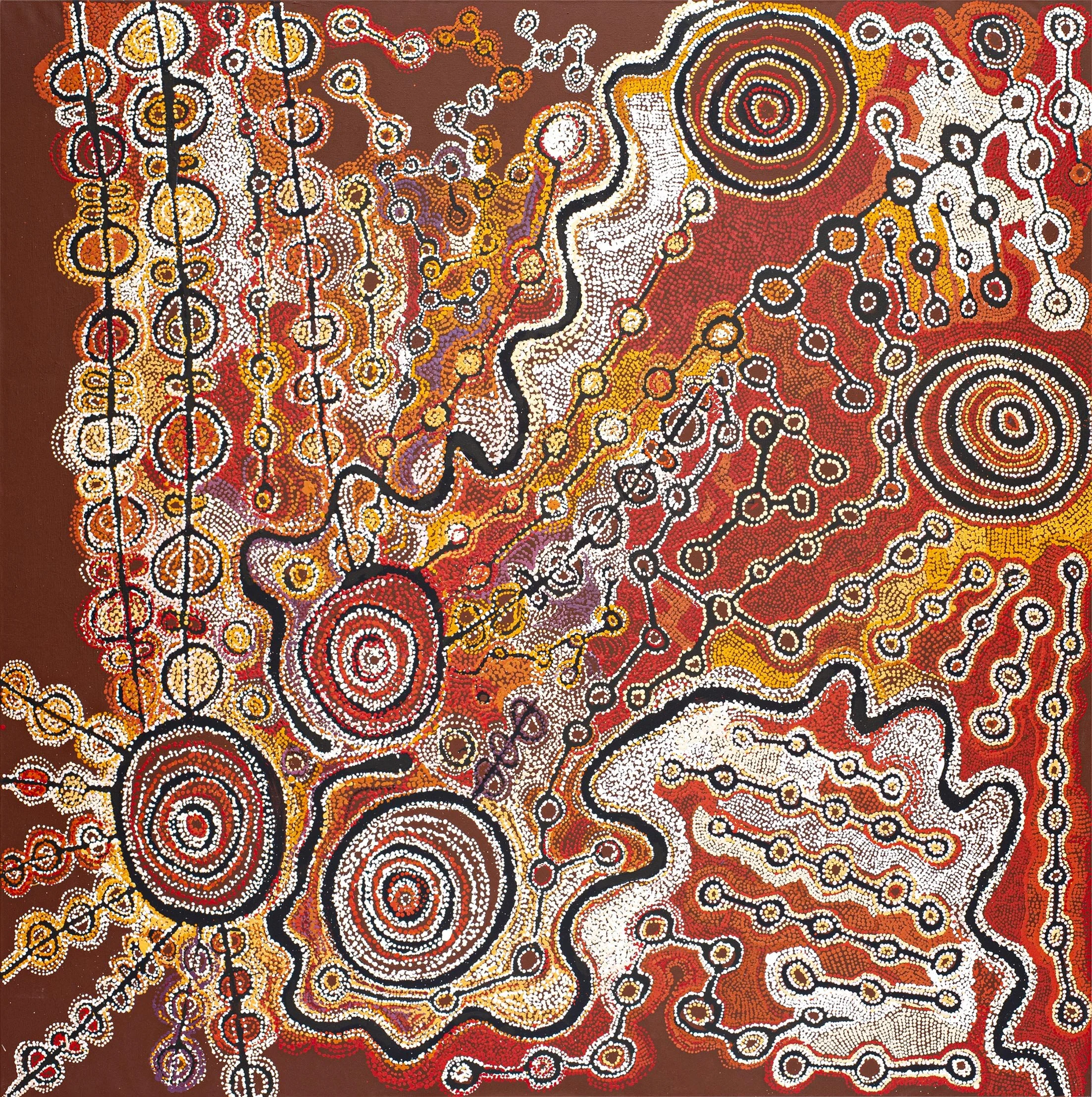
Artiste : Witjiti George (1938) & Taylor Cooper (1940)
Titre de l'œuvre : Malara: Wanampi Tjukurpa
Format : 200cm x 198cm
Provenance et certificat : centre d'art aborigène de Kaltjiti Arts
Référence de cette peinture aborigène : 20-266
Explications pour cette peinture d'art Aborigène :
Piltati is the well known tjukurpa story of the two water serpents who live in the Piltati Rockhole with their two wives. This is Witjiti's mother's country near Kanpi on the Anangu Pitjantjatjara/Yankunytjatjara Lands (APY Lands) in far north South Australia.
Wtitjiti fondly refers to this Tjurkurpa as a love story. "This is a story about two brothers and two sisters. The two 'wati's' (brothers) - two water snakes, are at the Piltati rockhole waiting for two sisters.
The two women had gone to find 'mai' ( food), they were gone a long time and the men were hungry. They all live there in this rockhole". - Witjiti George.
The rabbit burrows are depicted as lines with semi circles either side. Underground water flows through these channels and the connected circles are places where the sisters travelled looking for bushtucker.

Artiste : Muna Kulyuru
Titre de l'œuvre : Ngayuku ngura - My Country
Format : 120 x 100 cm
Provenance et certificat : centre d'art aborigène de Tjala Arts
Référence de cette peinture aborigène : 320-20

Artiste : Mitakiki Women's Collaborative
Titre de l'œuvre : Seven Sisters
Format : 198 x 152 cm
Provenance et certificat : centre d'art aborigène de Tjala
Référence de cette peinture : 760-20
Explications pour cette œuvre :
Mona, Tjimpayi and Naomi have depicted the Seven Sisters Story. This is a Tjukurpa Story (Creation Story) about the constellations of Pleiades and Orion. The sisters are the constellaton of Pleiades and the other star Orion is said to be Nyiru or Nyirunya (described as a lusty or bad man). Nyiru is forever chasing the sisters known as the Kunkarunkara women as it is said he wants to marry the eldest sister. The seven sisters travel again and again from the sky to the earth to escape Nyiru’s unwanted attentions. They turn into their human form to escape from the persistent Nyiru, but he always finds them and they flee back to the sky. As Nyiru is chasing the sisters he tries to catch them by using magic to turn into the most tempting kampurarpra (bush tomatoes) for the sisters to eat and the most beautiful Ili (fig) tree for them to camp under. However, the sisters are too clever for Nyiru and outwit him as they are knowledgeable about his magic. They go hungry and run through the night rather than be caught by Nyiru. Every now and again one of the women fall victim to his ways. It is said that he eventually captures the youngest sister, but with the help of the oldest sister, she escapes back to her sisters who are waiting for her.
Eventually the sisters fly back into the sky to escape Nyiru, reforming the constellation.
Demander le prix de l'œuvre / Enquiry
© Photo : Aboriginal Signature Estrangin gallery with the courtesy of the artists and Tjala.

Artiste : Stanley Douglas
Titre de l'œuvre : Seven Sisters
Format : 152,5 x 122 cm
Provenance et certificat : centre d'art aborigène de Tjala
Référence de cette peinture : 248-19
Explications pour cette œuvre :
This is a Tjukurpa Story (Creation Story) about the constellations of Pleiades and Orion. The sisters are the constellaton of Pleiades and the other star Orion is said to be Nyiru or Nyirunya (described as a lusty or bad man). Nyiru is forever chasing the sisters known as the Kunkarunkara women as it is said he wants to marry the eldest sister. The seven sisters travel again and again from the sky to the earth to escape Nyiru’s unwanted attentions. They turn into their human form to escape from the persistent Nyiru, but he always finds them and they flee back to the sky. As Nyiru is chasing the sisters he tries to catch them by using magic to turn into the most tempting kampurarpra (bush tomatoes) for the sisters to eat and the most beautiful Ili (fig) tree for them to camp under. However, the sisters are too clever for Nyiru and outwit him as they are knowledgeable about his magic. They go hungry and run through the night rather than be caught by Nyiru. Every now and again one of the women fall victim to his ways. It is said that he eventually captures the youngest sister, but with the help of the oldest sister, she escapes back to her sisters who are waiting for her.
Eventually the sisters fly back into the sky to escape Nyiru, reforming the constellation.
Demander le prix de l'œuvre / Enquiry
© Photo : Aboriginal Signature Estrangin gallery with the courtesy of the artists and Tjala.

Artiste : Maringka Tunkin
Titre de l'œuvre : Seven Sisters
Format : 196 x 122 cm
Provenance et certificat : centre d'art aborigène de Tjala Arts
Référence de cette peinture aborigène : 362-20

Artiste : Mitakiki Women's Collaborative
Titre de l'œuvre : Seven Sisters
Format : 300 x 122 cm
Provenance et certificat : centre d'art aborigène de Tjala
Référence de cette peinture : 759-20
Explications pour cette œuvre :
Mona, Tjimpayi and Naomi have depicted the Seven Sisters Story. This is a Tjukurpa Story (Creation Story) about the constellations of Pleiades and Orion. The sisters are the constellaton of Pleiades and the other star Orion is said to be Nyiru or Nyirunya (described as a lusty or bad man). Nyiru is forever chasing the sisters known as the Kunkarunkara women as it is said he wants to marry the eldest sister. The seven sisters travel again and again from the sky to the earth to escape Nyiru’s unwanted attentions. They turn into their human form to escape from the persistent Nyiru, but he always finds them and they flee back to the sky. As Nyiru is chasing the sisters he tries to catch them by using magic to turn into the most tempting kampurarpra (bush tomatoes) for the sisters to eat and the most beautiful Ili (fig) tree for them to camp under. However, the sisters are too clever for Nyiru and outwit him as they are knowledgeable about his magic. They go hungry and run through the night rather than be caught by Nyiru. Every now and again one of the women fall victim to his ways. It is said that he eventually captures the youngest sister, but with the help of the oldest sister, she escapes back to her sisters who are waiting for her.
Eventually the sisters fly back into the sky to escape Nyiru, reforming the constellation.
Demander le prix de l'œuvre / Enquiry
© Photo : Aboriginal Signature Estrangin gallery with the courtesy of the artists and Tjala.

Artiste : Collaborative women Work
Titre de l'œuvre : Ngayuku ngura - My Country
Format : 300 x 122 cm
Provenance et certificat : centre d'art aborigène de Tjala
Référence de cette peinture : 17-21
Explications pour cette œuvre :
In this painting the young women of Tjala have depicted their country. The different colours and designs represent variations in the landscape and the existing spirits.
Demander le prix de l'œuvre / Enquiry
© Photo : Aboriginal Signature Estrangin gallery with the courtesy of the artists and Tjala.

Artiste : Collaborative women Work
Titre de l'œuvre : Seven Sisters
Format : 198 x 122 cm
Provenance et certificat : centre d'art aborigène de Tjala
Référence de cette peinture : 35-21
Explications pour cette œuvre :
Freda and Tanya Brady have depicted the Seven Sisters Story. This is a Tjukurpa Story (Creation Story) about the constellations of Pleiades and Orion. The sisters are the constellaton of Pleiades and the other star Orion is said to be Nyiru or Nyirunya (described as a lusty or bad man). Nyiru is forever chasing the sisters known as the Kunkarunkara women as it is said he wants to marry the eldest sister. The seven sisters travel again and again from the sky to the earth to escape Nyiru’s unwanted attentions. They turn into their human form to escape from the persistent Nyiru, but he always finds them and they flee back to the sky. As Nyiru is chasing the sisters he tries to catch them by using magic to turn into the most tempting kampurarpra (bush tomatoes) for the sisters to eat and the most beautiful Ili (fig) tree for them to camp under. However, the sisters are too clever for Nyiru and outwit him as they are knowledgeable about his magic. They go hungry and run through the night rather than be caught by Nyiru. Every now and again one of the women fall victim to his ways. It is said that he eventually captures the youngest sister, but with the help of the oldest sister, she escapes back to her sisters who are waiting for her. Eventually the sisters fly back into the sky to escape Nyiru, reforming the constellation.
Demander le prix de l'œuvre / Enquiry
© Photo : Aboriginal Signature Estrangin gallery with the courtesy of the artists and Tjala.

Artiste : Sandra Ken
Titre de l'œuvre : Seven Sisters
Format : 122 x 101,5 cm
Provenance et certificat : centre d'art aborigène de Tjala Arts
Référence de cette peinture aborigène : 27-21
Explication pour cette œuvre :
This is a Tjukurpa Story (Creation Story) about the constellations of Pleiades and Orion. The sisters are the constellaton of Pleiades and the other star Orion is said to be Nyiru or Nyirunya (described as a lusty or bad man). Nyiru is forever chasing the sisters known as the Kunkarunkara women as it is said he wants to marry the eldest sister. The seven sisters travel again and again from the sky to the earth to escape Nyiru’s unwanted attentions. They turn into their human form to escape from the persistent Nyiru, but he always finds them and they flee back to the sky. As Nyiru is chasing the sisters he tries to catch them by using magic to turn into the most tempting kampurarpra (bush tomatoes) for the sisters to eat and the most beautiful Ili (fig) tree for them to camp under. However, the sisters are too clever for Nyiru and outwit him as they are knowledgeable about his magic. They go hungry and run through the night rather than be caught by Nyiru. Every now and again one of the women fall victim to his ways. It is said that he eventually captures the youngest sister, but with the help of the oldest sister, she escapes back to her sisters who are waiting for her. Eventually the sisters fly back into the sky to escape Nyiru, reforming the constellation.

Artiste : Sandra Ken
Titre de l'œuvre : Seven Sisters
Format : 152 x 122 cm
Provenance et certificat : centre d'art aborigène de Tjala Arts
Référence de cette peinture aborigène : 39-21
Explication pour cette œuvre :
This is a Tjukurpa Story (Creation Story) about the constellations of Pleiades and Orion. The sisters are the constellaton of Pleiades and the other star Orion is said to be Nyiru or Nyirunya (described as a lusty or bad man). Nyiru is forever chasing the sisters known as the Kunkarunkara women as it is said he wants to marry the eldest sister. The seven sisters travel again and again from the sky to the earth to escape Nyiru’s unwanted attentions. They turn into their human form to escape from the persistent Nyiru, but he always finds them and they flee back to the sky. As Nyiru is chasing the sisters he tries to catch them by using magic to turn into the most tempting kampurarpra (bush tomatoes) for the sisters to eat and the most beautiful Ili (fig) tree for them to camp under. However, the sisters are too clever for Nyiru and outwit him as they are knowledgeable about his magic. They go hungry and run through the night rather than be caught by Nyiru. Every now and again one of the women fall victim to his ways. It is said that he eventually captures the youngest sister, but with the help of the oldest sister, she escapes back to her sisters who are waiting for her. Eventually the sisters fly back into the sky to escape Nyiru, reforming the constellation.
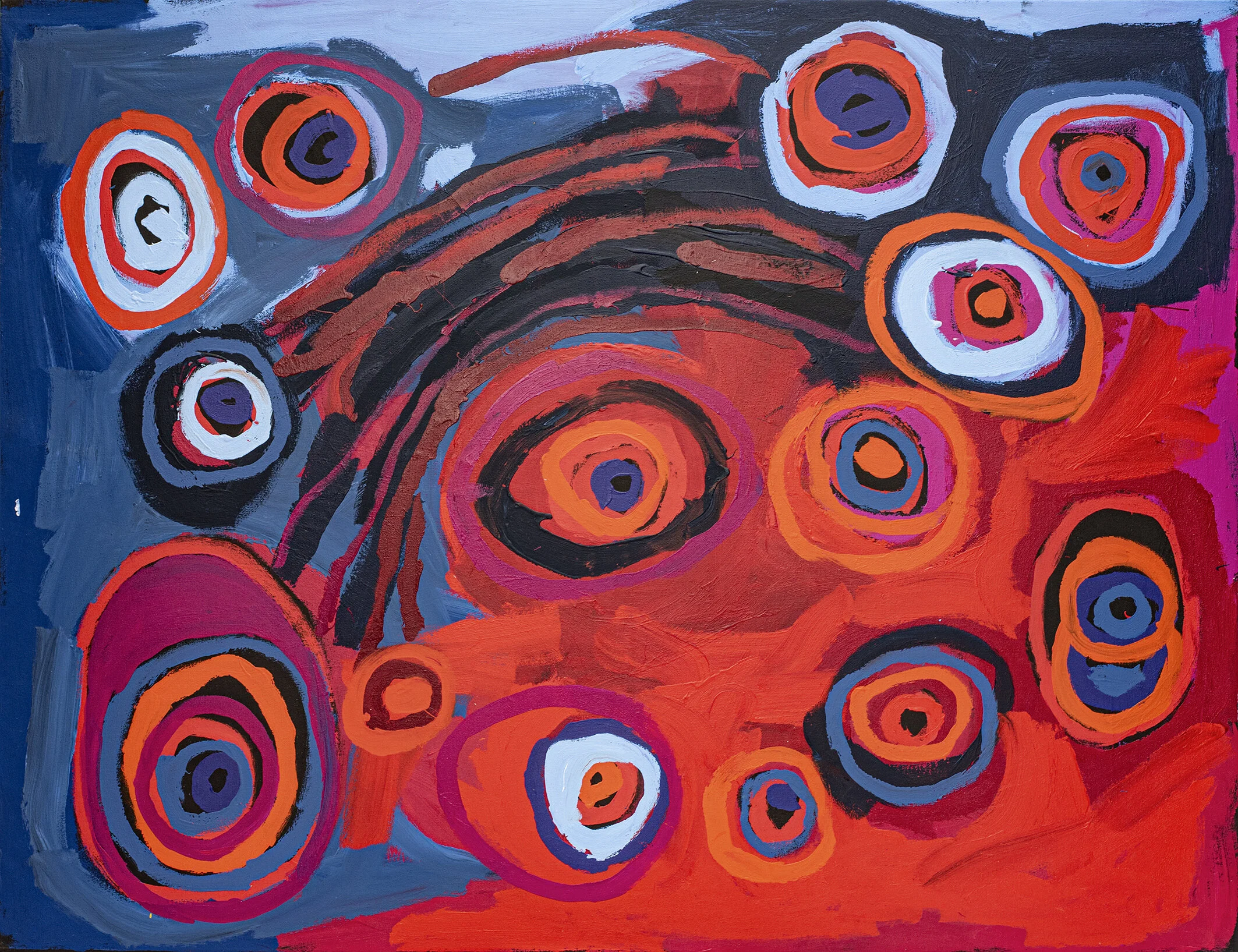
Artiste : Barbara Moore
Titre de l'œuvre : Ngayuku ngura - My Country
Format : 152,5 x 198 cm
Provenance et certificat : centre d'art aborigene de Tjala
Référence de cette peinture aborigene : 7- 21

Artiste : Janie Kulyuru Lewis
Titre de l'œuvre : Ngayuku ngura - My Country
Format : 120 x 120 cm
Provenance et certificat : centre d'art aborigène de Tjala Arts
Référence de cette peinture aborigène : 772-20

Artiste : Janie Kulyuru Lewis
Titre de l'œuvre : Ngayuku ngura - My Country
Format : 152,5 x 122 cm
Provenance et certificat : centre d'art aborigène de Tjala Arts
Référence de cette peinture aborigène : 700-20

Artiste : Lynette Lewis
Titre de l'œuvre : Womikata Walka Tali / Sand dune
Format : 169 x 83 cm
Provenance et certificat : centre d'art d'Ernabella
Référence de la peinture : 516-22
Explications sur cette peinture Aborigène :
Lynette's design is inspired by the ripples created by wind in the sand at the large, red sand dune named Wornikata near Ernabella. Womikata is a popular place for looking for maku (witchetty grubs) and also for teaching Milpatjunanyi (telling stories in the sand) to children.

Artiste : Tjulyata Kulyuru
Titre de l'œuvre : Tjukula/Waterholes
Format : 180 x 100 cm
Provenance et certificat : centre d'art aborigène d’Ernabella
Référence de cette peinture aborigène : 558-22
Explication sur cette œuvre :
For the Pitjantjatjara people living in the desert, knowledge of their water sources was critical to their survival.
This resulted in an intimate understanding of the landscape which continues today. Deep familiarity with the topography of their country and the way rain would interact with the land ensured constant sources of water could be found. 'Tjukula' means rock-holes, which are found with surprising frequency in the Musgrave ranges.
Between visits, Anangu (people) would use rocks and spinifex construction to guard these from spoilage by animals and, particularly in more recent times, from feral and stock animals, cattle, camels, horses and donkeys.

Artiste : Lynette Lewis
Titre de l'œuvre : Womikata Walka Tali / Sand dune
Format : 127 x 61 cm
Provenance et certificat : centre d'art d'Ernabella
Référence de la peinture : 640-22
Explications sur cette peinture Aborigène :
Lynette's design is inspired by the ripples created by wind in the sand at the large, red sand dune named Wornikata near Ernabella. Womikata is a popular place for looking for maku (witchetty grubs) and also for teaching Milpatjunanyi (telling stories in the sand) to children.

Artiste : Elizabeth Dunn
Titre de l'œuvre : Piltati
Format : 160cm x 150cm
Provenance et certificat : centre d'art aborigène d’Ernabella
Référence de cette peinture aborigène : 406-20
Explication sur cette œuvre :
Two brothers were married to two sisters and they all lived together. One day the two men go out hunting, looking for malu (kangaroo). They travel everywhere and find nothing. They start to worry. “What are we going to do, there is no meat on this land? One brother says, “maybe we should turn into something?”. They start to think about what they should turn into.
“Maybe firewood?”“No, the firewood burns.”
“Maybe emu or a bird?”.
“No, people eat them.”
They do a lot of talking and decide they should turn into Wanampi (rainbow serpents). A lot of smoke starts to come out of the ground, it is very scary and then the men become Wanampi. They travel into the land, towards a rockhole.
Meanwhile, the two women are waiting for their husbands to return from their hunting trip. They wait a very long time. They keep going on with their lives, collecting bush tucker, waiting…but the men never come back. So, they decide to set out to find their husbands. One day, they come across a hole in the ground. They start digging. Digging, digging, digging, they follow the tunnel inside the ground. They are so frantically digging they accidently hit one of the Wanampi in the back. The Wanampi chase the ladies and eat one of them, one women gets away.
Now, the Wanampi still live in the waterhole called Piltati. The Wanampi still live their today and provide rain for the bush tucker to grow and provide meat on the land. Piltati is Elizabeth’s great-grandfathers country and her dreaming story.

Artiste : Michelle Lewis
Titre de l'œuvre : Michelle's tjala dreaming (honey ant dreaming)
Format : 200 cm x 120cm
Provenance et certificat : centre d'art aborigène d’Ernabella
Référence de cette peinture aborigène : 435-20
Explication sur cette œuvre :
Michelle’s father's country is a place called Makiri located east of Ernabella near the Fregon community. This is country is tjala tjukurpa (honey ant dreaming). Michelle and her family still visit this country where she draws special attention to the natural elements on the land which are then represented in her paintings:
I am painting the landscape from above, as you might see it from an airplane or as a bird looking down. It is beautiful country both from on the ground and up above. When Michelle created her work, ngayuku mamku ngura ini Makiri (my father's country, a place called Makiri) she was thinking of Makiri and how the tjala (honeyants) tunnel though the sandy soil as well as about the waterholes, the assemblages of trees and shrubs and the country that is “quiet” (empty).
Tjala or Honey Ants are found about a metre underground beneath Mulga trees. The Honey Ant tunnels that lead down to the ant's nests are called nyinantu. The Honey Ant larvae are called ipilyka-ipilyka. When the Pitjantjatjara go looking for Honey Ants they look for the drill holes under the trees. When they see them, they shovel and dig down following the tunnels to find the Honey Ants inside. Honey Ants are a highly favoured food source. They suck the honey-like liquid from the abdomen of the Honey Ant. The story of the Honey Ant is told across the Northern Territory into South Australia. The Honey Ant is an important link between their mythology and inter-dependence on the environment.

Artiste : Tjulyata Kulyuru
Titre de l'œuvre : Tjukula/Waterholes
Format : 120 x 100cm
Provenance et certificat : centre d'art aborigène d’Ernabella
Référence de cette peinture aborigène : 455-20
Explication sur cette œuvre :
For the Pitjantjatjara people living in the desert, knowledge of their water sources was critical to their survival.
This resulted in an intimate understanding of the landscape which continues today. Deep familiarity with the topography of their country and the way rain would interact with the land ensured constant sources of water could be found. 'Tjukula' means rock-holes, which are found with surprising frequency in the Musgrave ranges.
Between visits, Anangu (people) would use rocks and spinifex construction to guard these from spoilage by animals and, particularly in more recent times, from feral and stock animals, cattle, camels, horses and donkeys.

Artiste : Lynette Lewis
Titre de l'œuvre : Womikata Walka Tali / Sand dune
Format : 150 x 99 cm
Provenance et certificat : centre d'art d'Ernabella
Référence de la peinture : 295-20
Explications sur cette peinture Aborigène :
Lynette's design is inspired by the ripples created by wind in the sand at the large, red sand dune named Wornikata near Ernabella. Womikata is a popular place for looking for maku (witchetty grubs) and also for teaching Milpatjunanyi (telling stories in the sand) to children.

Artiste : Tjulyata Kulyuru
Titre de l'œuvre : Tjukula/Waterholes
Format : 150 x 99cm
Provenance et certificat : centre d'art aborigène d’Ernabella
Référence de cette peinture aborigène : 116-22
Explication sur cette œuvre :
For the Pitjantjatjara people living in the desert, knowledge of their water sources was critical to their survival.
This resulted in an intimate understanding of the landscape which continues today. Deep familiarity with the topography of their country and the way rain would interact with the land ensured constant sources of water could be found. 'Tjukula' means rock-holes, which are found with surprising frequency in the Musgrave ranges.
Between visits, Anangu (people) would use rocks and spinifex construction to guard these from spoilage by animals and, particularly in more recent times, from feral and stock animals, cattle, camels, horses and donkeys.

Artiste : David Miller
Titre de l'œuvre : wati tjilpi & minyma pampa hunting story
Format : 91 x 91 cm
Provenance et certificat : centre d'art aborigène de Ninuku
Référence de cette peinture : 21-117
Demander le prix de l'œuvre / Enquiry
Explications pour cette œuvre :
In the old days Anangu got up in the morning and sat down together to talk about a good place to hunt. They made a plan, drawing it in the sand. This is an old hunting plan.
© Photo : Aboriginal Signature Estrangin gallery with the courtesy of the artists and Ninuku.

Artiste : David Miller
Titre de l'œuvre : Perentie man Tjukurrpa
Format : 196 x 110 cm
Provenance et certificat : centre d'art aborigène de Ninuku
Référence de cette peinture : 18-340
Demander le prix de l'œuvre / Enquiry
Explications pour cette œuvre :
The Perentie man went on a journey and then came back and created a beautiful place (David Millers's grandfather's homeland). He stayed there for a few days and went hunting. When he left again only 5-6 miles out of the camp he was followed and then killed by Lizardmen.
© Photo : Aboriginal Signature Estrangin gallery with the courtesy of the artists and Ninuku.

Artiste : David Miller
Titre de l'œuvre : Perentie man Tjukurrpa
Format : 122 x 122 cm
Provenance et certificat : centre d'art aborigène de Ninuku
Référence de cette peinture : 18-444
Demander le prix de l'œuvre / Enquiry
Explications pour cette œuvre :
The Perentie man went on a journey and then came back and created a beautiful place (David Millers's grandfather's homeland). He stayed there for a few days and went hunting. When he left again only 5-6 miles out of the camp he was followed and then killed by Lizardmen.
© Photo : Aboriginal Signature Estrangin gallery with the courtesy of the artists and Ninuku.

Artiste : David Miller
Titre de l'œuvre : Wati Ngintaka munu Minyma Tjirilya
Format : 61 x 45 cm
Provenance et certificat : centre d'art aborigène de Ninuku
Référence de cette peinture : 20-500
Demander le prix de l'œuvre / Enquiry
Explications pour cette œuvre :
This is the story about Wati Ngintaka (goanna man) and Minyma tjirilya (female Echidna). One day the Porcupine saw Ngintaka tracks in her country, 'Tjilikan', Western Australia. She followed these tracks slowly, as she was not a fast animal. They met and became partners. They travelled togeth to another rockhole, looking for another place to stay. 'Tjilikan' is Nampitjin Miller's Aunty's place.
© Photo : Aboriginal Signature Estrangin gallery with the courtesy of the artists and Ninuku.

Artiste : David Miller
Titre de l'œuvre : Wati Ngintaka munu Minyma Tjirilya
Format : 61 x 45 cm
Provenance et certificat : centre d'art aborigène de Ninuku
Référence de cette peinture : 20-565
Demander le prix de l'œuvre / Enquiry
Explications pour cette œuvre :
This is the story about Wati Ngintaka (goanna man) and Minyma tjirilya (female Echidna). One day the Porcupine saw Ngintaka tracks in her country, 'Tjilikan', Western Australia. She followed these tracks slowly, as she was not a fast animal. They met and became partners. They travelled togeth to another rockhole, looking for another place to stay. 'Tjilikan' is Nampitjin Miller's Aunty's place.
© Photo : Aboriginal Signature Estrangin gallery with the courtesy of the artists and Ninuku.

Artiste : David Miller
Titre de l'œuvre : Wati Ngintaka munu Minyma Tjirilya
Format : 60,5 x 60,5 cm
Provenance et certificat : centre d'art aborigène de Ninuku
Référence de cette peinture : 20-582
Demander le prix de l'œuvre / Enquiry
Explications pour cette œuvre :
This is the story about Wati Ngintaka (goanna man) and Minyma tjirilya (female Echidna). One day the Porcupine saw Ngintaka tracks in her country, 'Tjilikan', Western Australia. She followed these tracks slowly, as she was not a fast animal. They met and became partners. They travelled togeth to another rockhole, looking for another place to stay. 'Tjilikan' is Nampitjin Miller's Aunty's place.
© Photo : Aboriginal Signature Estrangin gallery with the courtesy of the artists and Ninuku.

Artiste : Jimmy Yanyatjari Donegan
Titre de l'œuvre : Pukara - Jimmy
Format : 153 x 122 cm
Provenance et certificat : centre d'art aborigène de Ninuku Arts
Référence de cette toile aborigène : 19-343
Explications pour cette peinture d'art Aborigène :
This is a story about kaliny-kalinypa (honey grevillea plant), which Anangu (the term for people in Pitjantjatjara) use as a type of bush lolly, sucking the nectar out of the plant. In the Tjukurpa (Dreaming story) a father and son, Wati Kutjara Wanampi (two male water snakes), are living at Pukara, an important waterhole site near Irrunytju (Wingellina). Because of the kaliny-kalinypa which is found at the site the water there has a sweet taste and lots of people go there to access it. But father Wati Wanampi doesn’t like this and he tells them to go back to their own country. The people leave and the father and son travel to Willuna, where they camp for weeks. When they return to Pukara, they are awoken by a buzzing sound. Minyma Punpunpa (the female flies) are making lots of noise as they buzz around the honey bush. This prompts the father and son to get up to go and collect honey. While they are doing this, a Wati Mututa (black ant) finds the father and son, and spears the son in his side.
The young son starts spiting and he spits up the yellow and orange seeds of all the different types of honey grevillea. These plants can still be found at this site today. There is a big variety of honey grevillea plants including kaliny-kalinypa, ultunkunpa, piruwa and witjinti.

Artiste : Monica Puntjina Watson
Titre de l'œuvre : Pukara
Format : 120 x 91 cm
Provenance et certificat : centre d'art aborigène de Ninuku Arts
Référence de cette toile aborigène : 20-558
Explications pour cette peinture d'art Aborigène :
Cette œuvre évoque une histoire ancestrale du Temps du Rêve associée au lieu de Pukara, un trou d'eau très important dans le APY land. Ici un père et son fils, deux serpents d'eau mythologiques Wanampi, sont les gradiens des lieux.
L'eau à Pukara a une saveur particulière en raison du nectar d'une plante du bush qui s'y mélange, ce qui conduisait des Aborigènes à déborder de leurs frontières pour venir y boire.
Ces comportements déplaisaient profondément au serpent Wanampi père, qui devait souligner les droits à respecter en invitant les personnes à quitter ces lieux.
Le Père et son fils poursuivent ensuite leur périple vers Willuna dans le APY land. Quand ils reviendront par la suite à Pukara, le lieu sera envahi par des mouches femelles attirées à leur tour par le miel sauvage.
Le père et son fils s'empressent alors de récolter le miel, mais la fourmis noire les attaque et va blesser avec une lance les flancs du fils.

Artiste : Jimmy Yanyatjari Donegan
Titre de l'œuvre : Papa Tjukurpa
Format : 91 x 91 cm
Provenance et certificat : centre d'art aborigène de Ninuku Arts
Référence de cette toile aborigène : 20-484
Explications pour cette peinture d'art Aborigène :
Papa Tjukurpa; Dingo Dreaming. "Ngayuku mamaku ngura Dulu", my father's country rockhole called Dulu. At this place there are lots of women and men dingo's living there, digging up the water and hunting at Pilantjara rockhole in the country area of Dulu. This is papa walka, dog design.

Artiste : Monica Puntjina Watson
Titre de l'œuvre : Pukara
Format : 91 x 91 cm
Provenance et certificat : centre d'art aborigène de Ninuku Arts
Référence de cette toile aborigène : 21-112
Explications pour cette peinture d'art Aborigène :
Cette œuvre évoque une histoire ancestrale du Temps du Rêve associée au lieu de Pukara, un trou d'eau très important dans le APY land. Ici un père et son fils, deux serpents d'eau mythologiques Wanampi, sont les gradiens des lieux.
L'eau à Pukara a une saveur particulière en raison du nectar d'une plante du bush qui s'y mélange, ce qui conduisait des Aborigènes à déborder de leurs frontières pour venir y boire.
Ces comportements déplaisaient profondément au serpent Wanampi père, qui devait souligner les droits à respecter en invitant les personnes à quitter ces lieux.
Le Père et son fils poursuivent ensuite leur périple vers Willuna dans le APY land. Quand ils reviendront par la suite à Pukara, le lieu sera envahi par des mouches femelles attirées à leur tour par le miel sauvage.
Le père et son fils s'empressent alors de récolter le miel, mais la fourmis noire les attaque et va blesser avec une lance les flancs du fils.
Artiste : Marina Pumani Brown (1984)
Titre de l'œuvre : Ngayuku Ngura Kuwari (My Home Now)
Format : 168 cm x 152 cm
Provenance et certificat : centre d'art aborigène de Mimili Maku
Référence de cette peinture aborigène : 720-21
Demander le prix de l'œuvre
Explications pour cette peinture d'art Aborigène :
My name is Marina Pumani Brown, I am a 35-year-old Anangu woman. My family has lived around the present day location of Mimili Community on the APY lands of South Australia forever. My work captures a long line of cultural knowledge, knowledge that I am proud to be the custodian of, responsible for keeping it safe and passing it on to the next generation.
Whilst my mother strictly paints Antara, a sacred ceremonial site close to Mimili, I have broadened my practice to include other knowledge that is important to me. This knowledge speaks of traditions that are very much part of our day-to-day life out here in Mimili, traditions that are eternally old but ever present. My paintings are about trips to the area around Antara and Paralpii (Victory Well), where we collect Mingkulpa (bush tobacco) and care for the local tjukula (rock holes). Particularly after kapi pulka (big rains), the land becomes so fertile, and we harvest bush foods like the gnurru (lollie tree) and camp out on country like the old people used to.
My paintings are both literal maps of the landscape and objects of meaning removed from any physical representation. Though not always depicted, the importance of Antara is never lost in my work. The site has been integral to the existence of Anangu culture since the beginning of time. Today my life is different to that of my ancestors and my work is a tool to document my part in a story that spreads across timespans bigger than our imagination.