«Incandescence - the remote Australian deserts»
Du 1er décembre au 13 décembre 2020 au sein de la galerie Aboriginal Signature Estrangin à Bruxelles
Ouverture le mardi 1er décembre de 11h à 21h.
Dans le cadre du déconfinement, notre magasin vous reçoit sur RDV du mardi au dimanche, de 11h à 19h.
Afin de vous accueillir dans ce contexte particulier, tout en respectant les règles de sécurité recommandées par le Conseil Fédéral et la région Bruxelloise nous vous invitons à réserver votre visite dans notre agenda ici.
Nous nous réjouissons de vous accueillir à nouveau.

Œuvre de l’artiste Jennifer Connelly. Titre : Seven sisters Dreaming time story - Format : 182 x 110 cm. © Photo : Aboriginal Signature Estrangin Gallery with the courtesy of the artist and Ninuku Art.
Pour fêter ce déconfinement et l’ouverture progressive des espaces d’art, nous nous réjouissons de vous accueillir à nouveau à la galerie, avec une somptueuse exposition “Incandescence” toute entière dédiée aux communautés des déserts éloignés Australiens.
Une lumière incandescente habite ces immenses espaces et resplendit dans leurs œuvres par des couleurs solaires entre terre et ciel, des histoires gravées par les anciens dans la roche aux chemins poursuivis au cœur des constellations.
Dans des tonalités chaudes réjouissantes, les formes rayonnent au delà des œuvres dans cette démarche unique de transmission de la mémoire de ce peuple à travers ce mouvement pictural.
Les voix de 25 artistes, nés entre 1920 et 1970, s’expriment avec intensité dans ses peintures issues des grands déserts éloignés Australiens. Nous traversons cet immense continent du nord au sud sur plusieurs milliers de kilomètres, des derniers nomades d’Australie à la jeune génération du désert central.
Ils nous invitent à embrasser les océans de sable, à ressentir les vibrations de leur chant et gestes, à cheminer en leur compagnie dans ces lieux préservés, à la découverte de leur histoire cristallisée sur la toile.
A très bientôt.
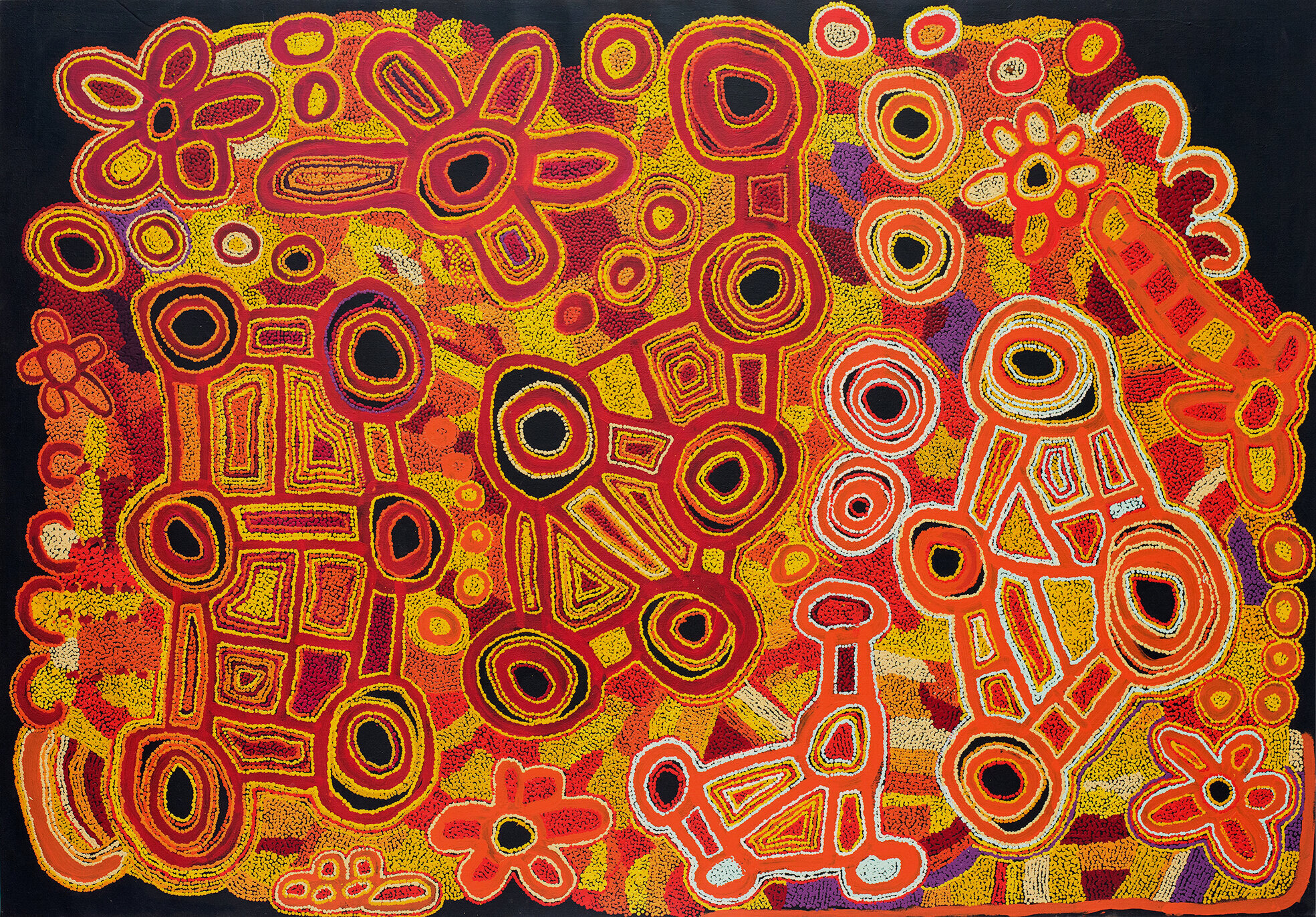
Œuvre de l’artiste Ngalpingka Simms. Titre : Kungkarungkalpa. Format : 200 x 137 cm - 19-11. © Photo : Aboriginal Signature Estrangin Gallery with the courtesy of the artist and Spinifex Art Centre.
Œuvres proposées dans le cadre de l'exposition :

Artiste : Ngalpingka Simms
Titre de l'œuvre : Kungkarungkalpa
Format : 200 x 137 cm
Provenance et certificat : centre d'art aborigène du Spinifex Art Project
Référence de cette peinture : 19-11
Demander le prix de l'œuvre / Enquiry
Explications pour cette œuvre :
Ngalpingka Simms (1945) depicts here Wayiyul, a very sacred womens place. Only ladies can visit this place. It belongs to the Seven Sisters -Minyma Tjuta Tjukurpa.
It was in this country that the women were travelling when the man Nyiru came apon them. He hit the ladies with a rock. They (women) looked around for somewhere to hide, but there were no trees only rocks. They made wiltja's (traditional shelters) from the rocks, like Ayres Rock. These standing structures form the rocky outcrops at Wayiyul. These are still here - forever, really one.
Ngalpingka Simms was born at a place in Western Australia known to Anangu (Aboriginal people) as Wayiyul. Wayiyul is a Seven Sister's site, situated to the north of Warburton Community, and is therefore a sacred site. Ngalpingka spent her early days living a traditional lifestyle with her small family group and later moved into Warburton Mission where many Ngaanyatjarra people settled. She spent many years at Warburton living a semi nomadic lifestyle and participating in traditional ceremony. Now living at Tjuntjuntjara and married to Spinifex elder Lennard Walker Ngalpingka paints with the Spinifex Arts Project. She has participated with the Spinifex Artists since 1998 and is a valuable and knowledgeable member of the group who paints her homeland area associated with the Minyma Tjuta (Seven Sisters) as well as collaborative paintings.
Her artworks are in the following prestigious collections :
Art Gallery Of South Australia, Adelaide Sa (Women’s Collaborative)
Collection Prince Stefan Of Liechtenstein, Embassy Of Liechtenstein In Germany.(Womens Collaborate)
Seattle Art Museum, Seattle Usa (Women’s Collaborative)
The British Museum, London, England.(Womens Collaborative)
The National Gallery Of Victoria, Melbourne, Vic. (As Part Of The Womens Collaborative)
The Sims Dickson Collection, Nsw (Collaborative With Kathleen Donnegan)
University Of Queensland Art Museum, Brisbane, Qld.
Artbank, Australian Government Collection. Australia.
Parliament House Art Collection, Canberra, Act (Womens Collaborative)
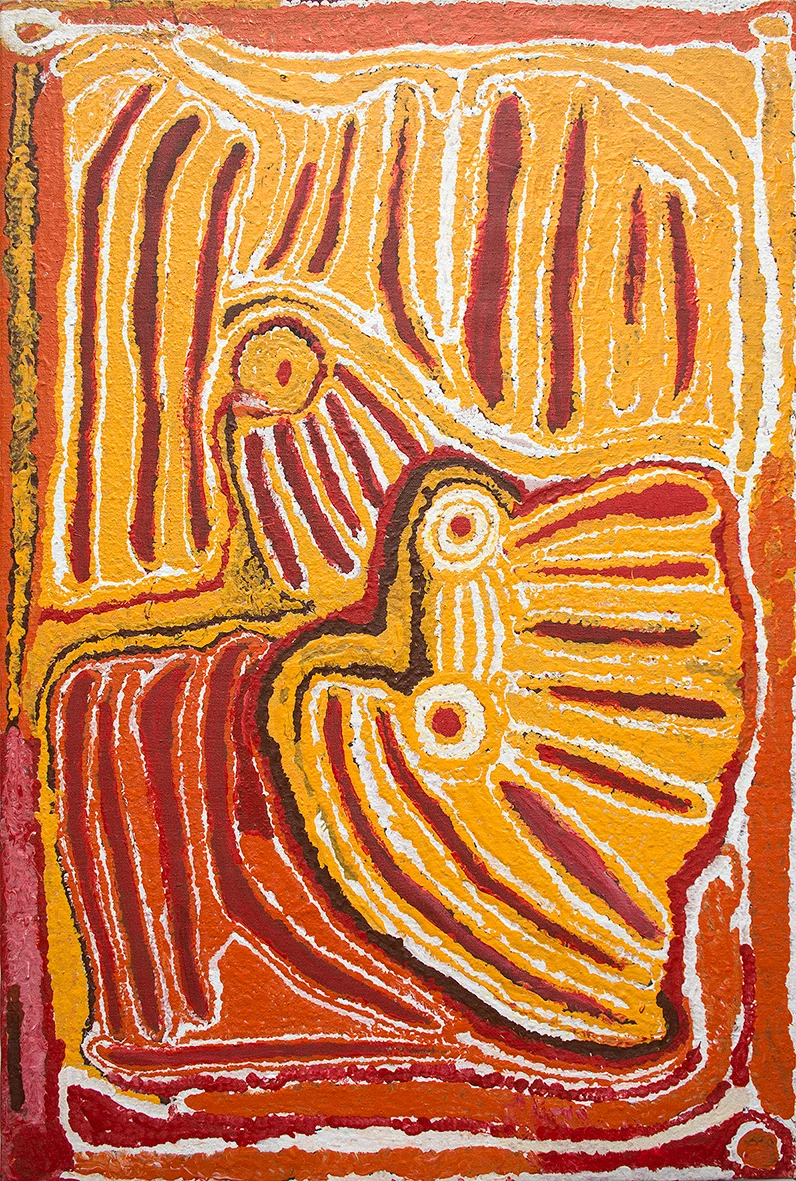
Titre de l'œuvre : Yabanu, Canning stock road in the great Sandy Desert
Artiste : Eubena Nampitjin
Format : 120 x 80 cm
Provenance et certificat : centre d'art aborigène de Balgo - Warlayiriti Artists Aboriginal Corporation
Référence de cette peinture aborigene : 921/95
© with the courtesy of the artist & the Aboriginal art centre. Photo : Aboriginal Signature

Artiste : Ngamaru Bidu (1950)
Titre de l'œuvre : Waru fire & regeneration
Format : 122 x 91 cm
Provenance et certificat : centre d'art aborigène de Martumili
Référence de cette peinture : 14-873
Demander le prix de l'œuvre / Enquiry
Explications pour cette œuvre :
This is my country after yunma (burning). The waru waru (trees) become dry and charred like skeletons and the land changes colour. The sky lights up with colour as the sun sets and the ground is dark and charred. After burning when the rain comes, green starts to grow again.
There is plenty bush tomatoes, bush onions and other bush tucker. This area is part of the artist's country where their family lived traditionally during the pujiman (bush) days. The Martu lived very nomadically moving from water source to water source hunting and gathering bush tucker as they went. They would traverse very large distances visiting some areas in the dry and some in the wet season depending on the availability of water.
As they travelled and hunted they would also burn areas of country creating a larger diversity of plant and animal life.
She now lives at Parnngurr and is part of the Martu Women’s Ranger program involving waru (fire) work, yintakaja (waterhole) mapping, and kalyuku ninti (return to country) trips taking school children out on to country.
© Photo : Aboriginal Signature Estrangin gallery with the courtesy of the artists and Martumili

Artiste : Tjulkiwa Atira Atira
Titre de l'œuvre : Arulya
Format : 187 x 167 cm
Provenance et certificat : centre d'art aborigène de Ninuku Arts
Référence de cette toile aborigène : 16-1
Explications pour cette peinture d'art Aborigène :
Cette œuvre évoque deux histoires ancestrales du temps du Rêve attachées au lieu d'Arulya. C'est un endroit très marquant avec une grotte du nom de Kuruyiti. Les enfants se cachaient dans cet endroit car une pluie intense arrivait. Le grand frère restait à l'extérieur, mangeant et dormant sans pourtant rentrer à l'intérieur. Quand la tempête arriva, des pierres se détachèrent et blessèrent le grand frère, ce qui affecta de façon définitive la naissance du paysage aux temps de la création.

Artiste : Nora Nungabar
Titre : Kunawarritji
Format : 122 x 76 cm
Provenance et certificat : centre d'art de Martumili
Ref : 08-59

Artiste : Yurpiya Lionel
Titre de l'œuvre : Anumara
Format : 100 x 150 cm
Provenance et certificat : centre d'art d'Ernabella
Référence de la peinture : 494-14
Demander le prix de l'œuvre / Enquiry
Explications sur cette peinture Aborigène :
Yurpiya is painting a place called Anumara, which is a place near Irrunytju (Wingellina) in WA. This is Yurpiya's family's country. Anumara is also the name for a kind of caterpillar and Anumara is the tjukurpa (dreaming) place for this caterpillar. This caterpillar lives in the grass and can be eaten if the grass it eats is removed. The place shares the same colours of the caterpillar - brown, yellow and pale green. Keeping this place safe will ensure that the caterpillars multiply.

Artiste : Jennifer Connelly
Titre de l'œuvre : Kungkarangkalpa (Seven Sisters Story)
Format : 182 x 110 cm
Provenance et certificat : centre d'art aborigène de Ninuku Arts
Référence de cette toile aborigène : 17-304
Enquiry / Demander le prix de l’œuvre
Explications pour cette peinture d'art Aborigène :
Le site de Kuru Ala dans le APY land est un endroit Aborigène sacré pour le mythe du Temps du Rêve associé à l'histoire des Sept Sœurs.
Ici les Sept Sœurs étaient assisses autour d'un interstice dans le bloc rocheux, au sein duquel se cachait le serpent python Kuniya.
La Sœur la plus âgée a considéré le serpent comme bon à consommer et elles l'ont cuit sur le feu. Mais il ne s'agissait pas d'un serpent. Derrière cette image emblématique figurait l'homme Wati Nyiru qui s'était transformé en cet animal.
Il a accompagné ces femmes au fil de leurs pérégrinations dans le désert afin de convaincre la plus âgée de devenir sa femme, dans une histoire de séduction sublimée.

Titre de l'œuvre : Winpurpurla (desert ancestral stories)
Artiste : Christine Yukenbarri
Format : 150 x 75 cm
Provenance et certificat : centre d'art aborigène de Balgo - Warlayiriti Artists Aboriginal Corporation
Référence de cette peinture aborigene : 508/09
© with the courtesy of the artist & the Aboriginal art centre. Photo : Aboriginal Signature

Artiste : Nancy Chapman
Titre de l'œuvre : Pirkily Claipan
Format : 149 x 77 cm
Provenance et certificat : centre d'art aborigène de Martumili
Référence de cette peinture : 08-930
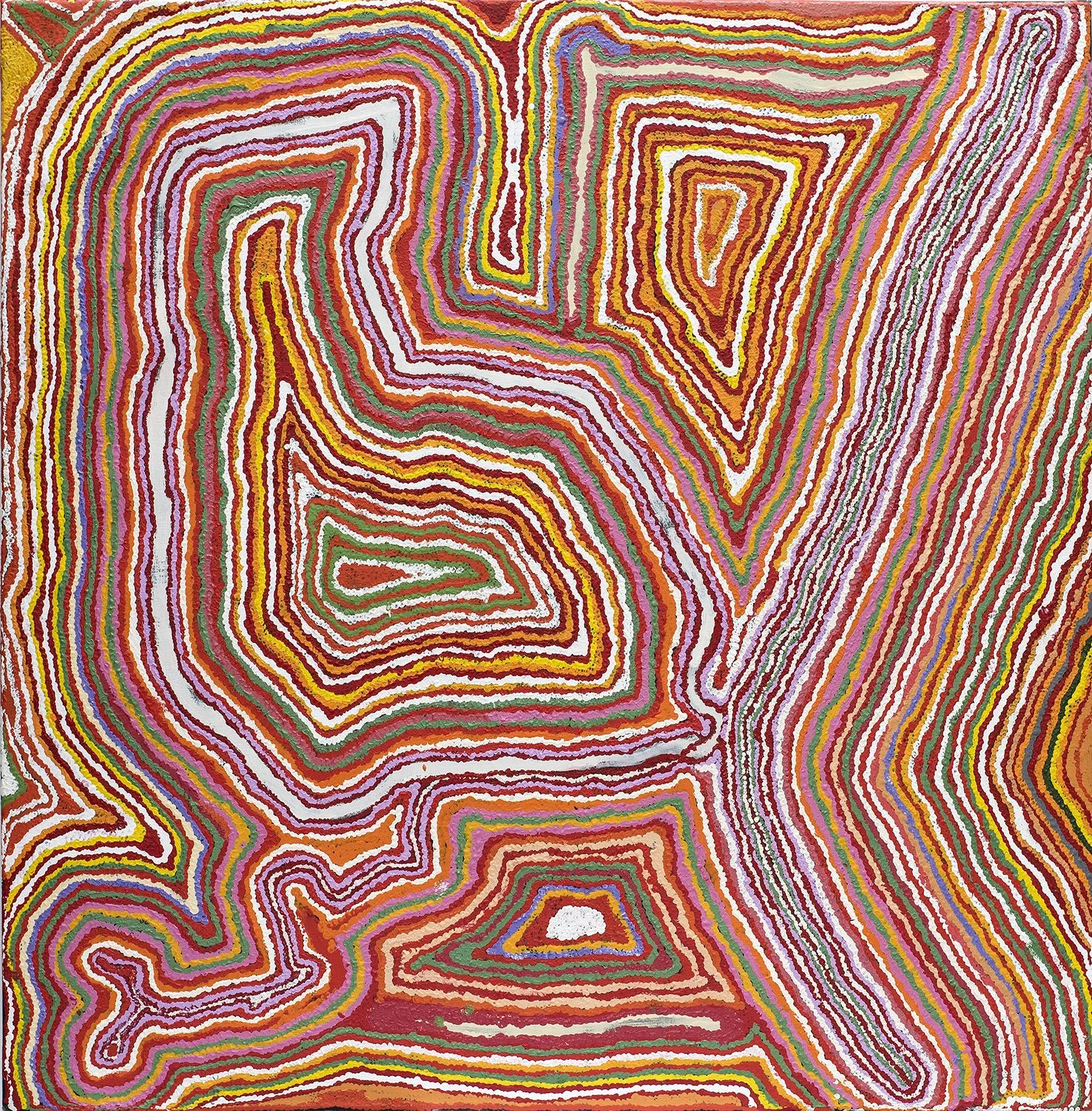
Artiste : Jimmy Donegan
Titre de l'œuvre : Pukara - Dreaming Time story of a father and son
Format : 122 x 122 cm
Provenance et certificat : centre d'art aborigène de Ninuku Arts
Référence de cette toile aborigène : 15-293
Explications pour cette peinture d'art Aborigène :
Cette œuvre évoque une histoire ancestrale du Temps du Rêve associée au lieu de Pukara, un trou d'eau très important dans le APY land. Ici un père et son fils, deux serpents d'eau mythologiques Wanampi, sont les gradiens des lieux.
L'eau à Pukara a une saveur particulière en raison du nectar d'une plante du bush qui s'y mélange, ce qui conduisait des Aborigènes à déborder de leurs frontières pour venir y boire.
Ces comportements déplaisaient profondément au serpent Wanampi père, qui devait souligner les droits à respecter en invitant les personnes à quitter ces lieux.
Le Père et son fils poursuivent ensuite leur périple vers Willuna dans le APY land. Quand ils reviendront par la suite à Pukara, le lieu sera envahi par des mouches femelles attirées à leur tour par le miel sauvage.
Le père et son fils s'empressent alors de récolter le miel, mais la fourmis noire les attaque et va blesser avec une lance les flancs du fils.

Artiste : Jakayu Biljabu (1936)
Titre de l'œuvre : Wantili (Well 25)
Format : 152 x 106 cm
Provenance et certificat : centre d'art aborigène de Martumili
Référence de cette peinture : 18-389
Demander le prix de l'œuvre / Enquiry
Explications pour cette œuvre :
Wantili is a large jurnu (soak) and lyinji (clay pan) near Well 25 on the Canning Stock Route. Wantili lies within Jakyu's ngurra (home country), and she travelled extensively around this site as a young girl.
The area is dominated by claypans surrounded by tuwa (sandhills). Following rain the claypans are filled with water, with the overflow from nearby waterholes flowing to Wantili. At that time, Wantili becomes an important place for obtaining fresh water for drinking and bathing. Wantili is significant for the fact that at this site Kartujarra, Manyjilyjarra, Putujarra and Warnman people would all come together for ceremonies. Many jiwa (stones used by women for grinding seeds) from these times can still be found there today.
Wantili is one of the many sites featured in the epic Minyipuru (Seven Sisters) jukurrpa (dreamtime) narrative. The story follows the movement of seven sisters travelling all the way across the desert, beginning at Roebourne on the coast of Western Australia, as they are pursued by a lustful old man, Yurla. As the women travel they stop to rest at many sites to eat, dance, rest and sing, on the way leaving behind an assortment of articles that become formations in the land.
The Seven Sisters rested at Wantili before throwing seeds, then continuing their journey on to Tiwa, Juntujuntu, and then onward to Pangkapini, where they finally escaped Yurla by flying into the sky to become the Pleaides constellation of stars.
© Photo Aboriginal Signatrure Estrangin Gallery, and text with the courtesy of the Artist and Martumili Arts

Artiste : Nora Wompi (1939)
Titre de l'œuvre : Kunawarritji Ngurra (wells 32 to 34) - Seven Sisters
Format : 121 x 76 cm
Provenance et certificat : centre d'art aborigène de Martumili
Référence de cette peinture : 14-59
Demander le prix de l'œuvre / Enquiry
Explications pour cette œuvre :
"This is a rock hole that was made in the Jukurrpa. These Kanaputa [ancestral beings] are the stars in the sky. The Seven Sisters are standing up as a group of trees between Nyipil [Well 34] and Kunawarritji [Well 33].
I was a little baby here at the rock holes of Kunawarritji and Nyarruri [Well 32]. I painted all the little hills around that area. In the Jukurrpa, they were all squeezed out of the soft earth. People made them."
Wompi paints the Country around her homelands of Kunawarritji, a place associated with the Minyipuru Jukurrpa (Seven Sister Dreaming). In 1906, Kunawarrtiji also became a well on the Canning Stock Route, and from an early age Wompi and her family had encounters with the white men who drove cattle along the route. As a young woman, Wompi followed the drovers north to Balgo Mission, where she stayed for many years. She learnt to paint there with her close friend, Eubena Nampitjin, and returned to Kunawarritji, where she lives and paints today, when it became a community in its own right.
© Photo : Aboriginal Signature Estrangin gallery with the courtesy of the artists and Martumili

Titre de l'œuvre : Minyma Kutjara Wingellina
Format : 100 x 100 cm
Provenance et certificat : centre d'art d'Ernabella
Référence de la peinture : 188-15

Artiste : Valmayi Nampitjinpa (1936)
Titre de l'œuvre : Karrkurinkinjta
Format : 120x90cm
Provenance et certificat : centre d'art aborigène de Tjarlirli
Référence de cette peinture : 17-841

Artiste : Carolanne Ken (1971)
Titre de l'œuvre : Minyma Makuli
Format : 150cm x 150cm
Provenance et certificat : centre d'art aborigène de Kaltjiti Arts
Référence de cette peinture aborigène : 18-183
Explications pour cette peinture d'art Aborigène :
This is the cave of Minyma Makuli (also known as Minyma Malilu) minyma nyumpu- the crippled woman. During the raintime she dug out this cave with her pitt, to be her big wiltja, shelter. She camped here at Kanypi with her kungkawara kutjara, two daughters, young women. She left and moved on south to Kunumata and then further on to Tankaanu. This is Carolanne's grandmother's country. The underground cave at Kanypi is a permanent water supply. Carolanne is from Fregon on the *APY Lands. Precise, fine brushwork are characteristics of her work. Carolanne is a keen story teller and combining a traditional style with a contemporary edge to her work, reflects a keen sense of place retaining the importance of traditional country as inspiration for her work. *Anangu Pitjantjatjara/Yankunytjatjara Lands, in the far north-west of South Australia.

Artiste : Angelina Tjaruwa Woods
Titre de l'œuvre : Waratata Dreaming Time story
Format : 110x90 cm
Provenance et certificat : centre d'art aborigène du Spinifex Art Project
Référence de cette peinture : 13330

Artiste : Angelina Tjaruwa Woods
Titre de l'œuvre : Watani Dreaming Time story
Format : 110x83 cm
Provenance et certificat : centre d'art aborigène du Spinifex Art Project
Référence de cette peinture : 14244
Demander le prix de l'œuvre / Enquiry
Explications pour cette œuvre :
In this painting Tjaruwa Woods has painted Watani, an area in the northern section of the Spinifex Lands. It is sand hill country, with Spinifex and Mulga trees and very sparse water deposits usually in the form of rockholes which are quite small or soak water which you have to dig for.
Tjanpi or Spinifex grasses were used to filter the water for drinking. To survive in this Western Desert area it is essential to know where to find the water and this knowledge has been passed down over thousands of years from generation to generation.
In the Tjukurpa the Emu Creator Beings possess great creative powers. They created numerous topographical features in the landscape as they passed through this area.

Artiste : Yaritji Young
Titre de l'œuvre : Ngayuku ngura - My Country
Format : 198 x 127 cm
Provenance et certificat : centre d'art de Tjala
Référence de la peinture : 759-13
Explication sur la signification de cette peinture d'art Aborigène :
Ray has depicted Tali - Sand dune - an important hunting place for the men.

Artiste : Lydia Balbal
Titre de l'œuvre : Martakulu
Format : 107 x 106 cm
Provenance et certificat : Short Street opérant pour les artistes Yulparija de Bidyadanga
Référence de cette peinture aborigène : 785452
Explications sur cette peinture d’art Aborigène :
Lydia Balbal (1958) is a Mangala woman. Lydia's country is near Punmu in the Great Sandy Desert of W.A. Her people's existence was threatened by severe drought so that they had little choice but to leave their traditional country. Her family were some of the last to walk out to the coastal town of Bidyadanga (then La Grange Mission) located two hours south of Broome in the early 70s. Lydia first began painting in 2007 but has already received significant attention from collectors and the media alike.
Martakulu is a soak out near Punmu near the Canning Stock Route in the Great Sandy Desert in Western Australia. It is strong womans country, it is part of the women's law line. Long time ago a law man he come up to this country, he went home and left his wife and baby. They make him fire and sit down, cook mayi (bush food) and then started to cry for her husband. Her tears made that soak. It is important country this one. Lydia says "I been young girl walked all around here with my mummy and daddy. We camp and hunt here." This painting shows the rockhole with king brown snakes and their eggs.
Collections : Murdoch University Art Collection. Aboriginal Art Museum, The Netherlands. Thomas Vroom Collection, The Netherlands. National Gallery of Victoria Felton Collection. Queensland Art Gallery. Laverty Collection. Monash University Art Collection. Lepley Collection. Western Australian Art Gallery. National Gallery of Australia. Wesfarmers Collection. Australia Parliament House Collection. Brocard - Estrangin Collection. Kluge-Ruhe Aboriginal Art Collection of the University of Virginia…
© Photo : Aboriginal Signature Estrangin gallery with the courtesy of Short Street and the artist
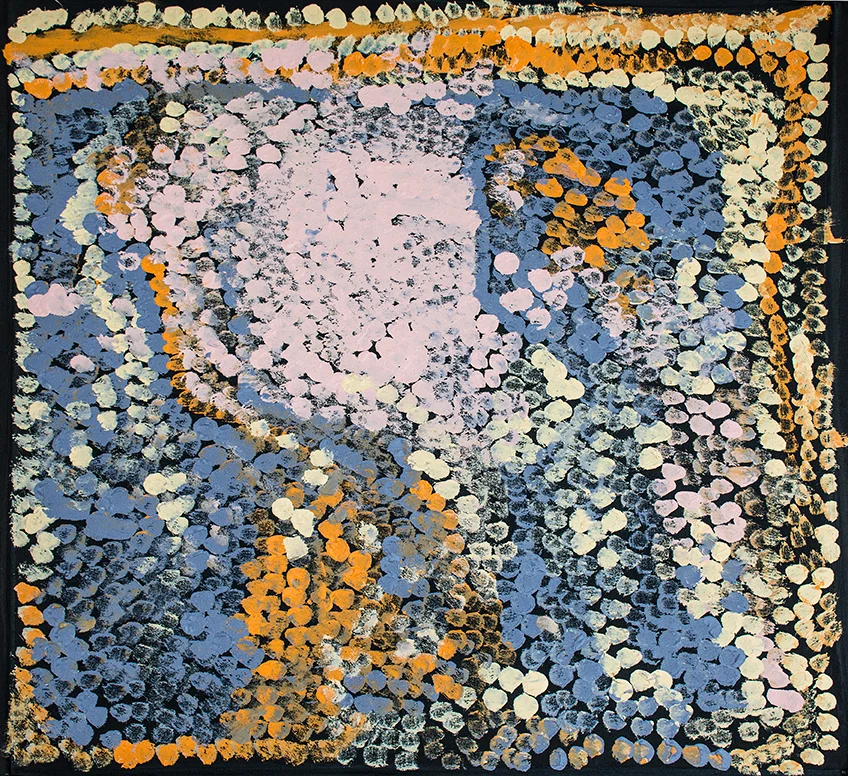
Titre de l'œuvre : Lirrun
Format : 76,2 x 76,2 cm
Provenance et certificat : centre d'art de Warakurna
Référence de la peinture : 244-14
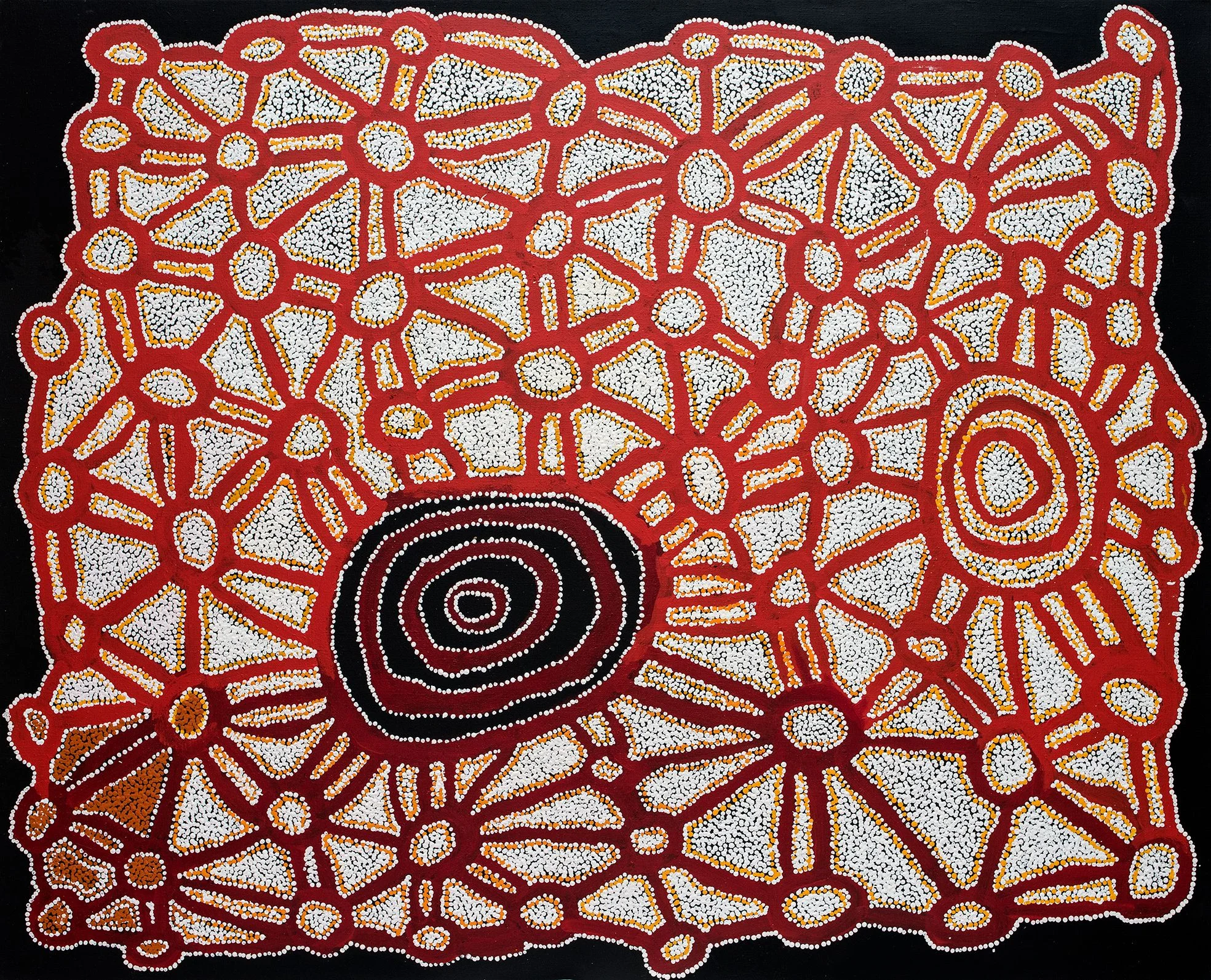
Artiste : Fred Grant
Titre de l'œuvre : Pirilyi
Format : 137 x 110 cm
Provenance et certificat : centre d'art aborigène du Spinifex Art Project
Référence de cette peinture : 18-228
Demander le prix de l'œuvre / Enquiry
Explications pour cette œuvre :
Fred Grant (1943) has depicted the significant site of Pirilyi situated in the heart of traditional Spinifex country. This site forms part of the Minyma Tjuta Tjukurpa (Seven Sisters Creation Line) which traces the journey of a group of women as they traverse the country evading the pursuit of an older lustful man (Nyiru) who wishes to take the oldest as his wife. At Pirilyi, Nyiru throws a heavy piece of wood and injurers the woman before grabbing and returning to his camp with her. She eventually makes her escape whilst Nyiru sleeps and the pursuit continues.
These are creation beings who shaped the landscape as they moved through it. Leaving indelible monolithic reminders of their power and presence and a moral code that still guides Anangu on a daily basis.
His artworks are in the following prestigious collections :
Harriett & Richard England Collection
National Gallery Of Australia, Canberra, Act (Mens Collaborative)
Seattle Art Museum, Seattle, Usa. (Mens Collaborative)
The Corrigan Collection, Australia (Mens Collaborative)
The Lepley Collection, Perth, Western Australia.
W. & V. Mcgeoch Collection, Melbourne, Vic.
Queensland Art Gallery Of Modern Art, Brisbane, Qld.
The Art Gallery Of New South Wales, Sydney, Nsw
Art Gallery Of South Australia, Adelaide, South Australia (Mens Collaborative)

Œuvre de l’artiste Yaritji Young - Titre : Nagayuku kura - Format : 198 x 127 cm. - ref : 759-13. © Photo : Aboriginal Signature Estrangin Gallery with the courtesy of the artists & Tjala Art.
Artiste : Nyankulya Watson
Titre de l'œuvre : Ngura Tjuta: Big Country - Rockholes in the traditional land
Format : 129 x 96 cm
Provenance et certificat : centre d'art aborigène de Ninuku Arts
Référence de cette toile aborigène : 16-309
Demander le prix de l'œuvre
Explications pour cette peinture d'art Aborigène :
Cette œuvre évoque avec un sens de la composition tout à fait unique, les différentes pistes chantées - songlines - qui traversaient le territoire ancestral de l'artiste , entre les différents rockholes - trous d'eau dans la roche - ponctuant les étapes essentielles de la communauté des temps de la Création à nos jours. En ces lieux résident les grands ancêtres du Temps du Rêve.