
Exposition “The Pintupi Lifeline” in partnership with Papunya Tula
Du mardi 9 mars au dimanche 11 avril 2021 au sein de la galerie Aboriginal Signature Estrangin à Bruxelles
Vernissage le mardi 9 février de 11h à 21h.
Dans le cadre du confinement, notre galerie reste ouverte et vous reçoit sur RDV (2 personnes du même foyer max) du mardi au dimanche, de 11h à 19h.
Nous nous réjouissons de vous accueillir dans ce contexte particulier. Dans le respect des principes de sécurité recommandées par le Conseil Fédéral pour les magasins, nous vous invitons à réserver votre visite dans notre agenda ici.
A bientôt
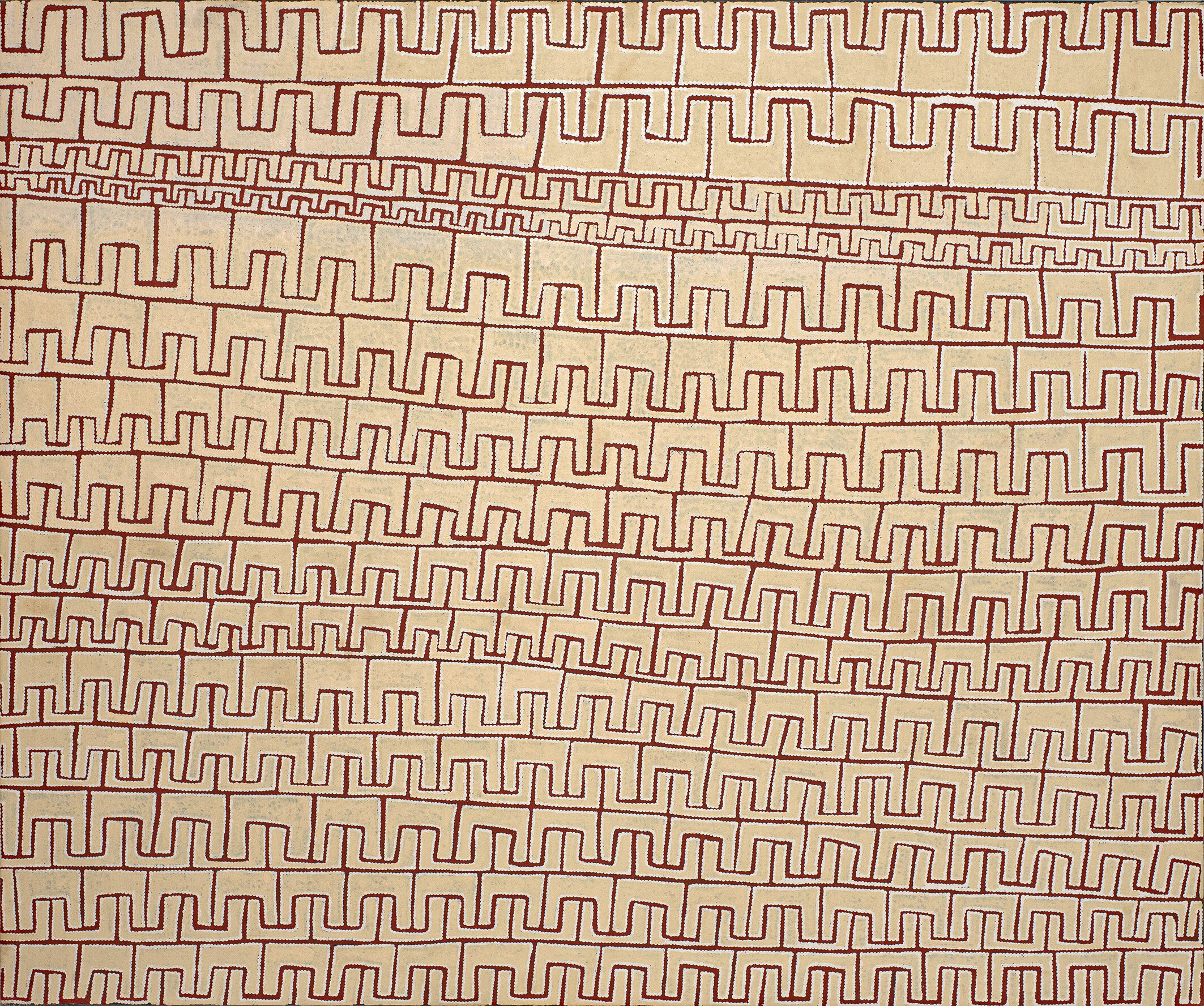
Œuvre de l’artiste Ray James Tjangala - Site of Yunala ( Ancestral storie of Tingari cycle) - 183x153cm - RJ0408001. © Photo : Aboriginal Signature Estrangin Gallery with the courtesy of the artist, and Papunya Tula Artists.
The Pintupi Lifeline
L’exposition à Bruxelles réunit 12 artistes du peuple Aborigène Pintupi, nés entre 1943 et 1961. Issus de la prestigieuse communauté artistique de Papunya Tula, eux-mêmes ou leurs pères ont lancé ce mouvement artistique il y a 50 ans en 1971, dans cet endroit isolé du centre de l’Australie.
Pendant un demi-siècle ces grands artistes ont contribué à écrire une page de l’histoire de l’art. En 2021 c’est l’anniversaire des 50 ans de ce big bang artistique qui changera la ligne de vie de ce peuple, lui permettra d’entrer dans les plus grands musées du globe, et de porter haut leur identité comme un étendard culturel, social et politique.
Anniversaire des 50 ans de Papunya Tula (1971 - 2021)
Les artistes présentés dans la capitale de l’Europe sont tous des « bush babies », anciens nomades dans leur enfance et adolescence, confrontés à une rencontre avec le monde occidental entre les années 1963 et 1984. Cette dernière date est marquante pour l’artiste Yalti Napangati, car elle fit partie avec son frère et son mari, du dernier groupe des nomades Pintupi du désert central Australien. Les bouleversements de vie, l’accélération du temps, le saut dans un autre monde, auraient pu se réaliser en perdant tous ses repères. Dans une étonnante capacité de résilience, d’énergie et de puissance de transmissions, il n’en fut rien pour ces fières hommes et femmes nomades.
La solidité des liens familiaux, l’importance de l’ancrage sur le territoire, l’autorité sur ces espaces préservés, la profondeur de leurs racines, leur ont permis de passer le pas sans trop d’ambages.

Peinture de l’artiste Yalti Napangati - Marapinti ceremonies - 153x122cm - YN1907049 © Photo : Aboriginal Signature Estrangin Gallery with the courtesy of the artist and Papunya Tula Artists.
Un pan entier de l’histoire de l’art
L’histoire officielle a retenu que c’est un occidental comme Gœffrey Bardon qui lancera ce mouvement artistique. La réalité est un peu différente.
En 1967 les Aborigènes d’Australie accèdent à la nationalité Australienne suite à un référendum ! Le risque de se fondre dans cette nouvelle culture occidentale est considérable. Les grands anciens seront convaincus qu’il faut préserver à tout prix la culture. Que ce patrimoine intangible et structurant est le ciment de leur peuple, leur richesse, leur raison d’être.
En 1969, dans le lieu de sédentarisation installé à Papunya après Haast Bluff, les hommes initiés vont emprunter la peinture acrylique utilisée par les enfants à l’école, pour cristalliser leur mémoire sur les matériaux disponibles comme le contre-plaqué en provenance des baraquements.
Les recherches menées par le conservateur Luke Scholes, du Musée de Darwin, ont montré la naissance collaborative de ce mouvement artistique, à la fois du côté Aborigène et avec les contributions occidentales.
En effet, Geoffrey Bardon n’arrive quant à lui à Papunya que deux ans plus tard en 1971. Il y restera d’ailleurs moins de deux ans, mais y jouera un rôle clef dans la reconnaissance et dans la promotion de cet art. Il est fasciné par ces peintures qu’il découvre dans un hangar en tôle ondulée. Il encourage les artistes, sélectionne une petite centaine d’œuvres en 1971 qu’il présentera à Alice Spring au Dr. Colin Jack-Hinton, nouveau directeur du Musée de Darwin (MAGNT) de 1970 à 1993. Ces œuvres sont aujourd’hui des trésors nationaux qui ne peuvent quitter l’Australie.

Œuvre de l’artiste Ray James Tjangala - Site of Yunala ( Ancestral storie of Tingari cycle) - 183x153cm - RJ1803013. © Photo : Aboriginal Signature Estrangin gallery with the courtesy of the artist and Papunya Tula Artists.
Profondeur des racines
A Bruxelles, nous retrouvons les acteurs fondateurs de ce mouvement artistique comme Ronnie Tjampitjinpa (1940) ou leurs enfants témoins directs comme Yinarupa Nangala (fille de Anatjari Tjampitjinpa et épouse de Yala Yala Gibbs Tjungurrayi), comme Payu Napaltjarri (épouse de Freddy West Tjakamarra), Mary Napangati (épouse de Ronnie Tjampitjinpa).
Nous y découvrons également la puissance des lignées, avec les fratries d’artistes importants comme Charlie Tjapangati (1949) et sa soeur Nanyuma Napangati (1944), Yuyuya Napangati (1946) et son frère Ronnie Tjampitjinpa (1940), Ray James Tjangala (1958) et sa sœur aînée Yinarupa Nangala (1955), Richard Yukenbarri Tjakamarra (1960) et sa sœur Takariya Napaltjarri.

Œuvre de Yinarupa Nangala - Rockhole of Mukula (ancestral travel stories) - 183 x 152 cm. © Photo : Aboriginal Signature Estrangin Gallery with the courtesy of the artist and Papunya Tula Artists.
Résonance institutionnelle
L’artiste George Tjungurrayi (1943) est né dans le désert près de Kiwirrkura. George a marché jusqu’à Papunya avec un autre jeune homme, après avoir vécu tout un temps à Mukula, un lieu de cérémonie important. Il commença à peindre pour Papunya Tula Artists au début des années 1980. Aujourd’hui il est dans le top 50 des “Australia’s Most Collectable Artists” de l’Australian Art Collector Issue 23.
Les différents artistes de l’exposition à Bruxelles, ont des œuvres qui figurent dans de nombreux musées et institutions prestigieuses. Pour en citer quelques-uns. Aux USA : The Seattle Art Museum, USA. The University of Virginia, USA. Cornell University New-York, Hood Museum USA. Carnegie Museums of Pittsburgh, U.S.A. Toledo Musuem of Art, Toledo, Ohio, USA. Harvard Art Museum, Cambridge, Massachusetts, USA.
En Australie : National Gallery of Australia. Art Gallery of NSW. National Gallery of Victoria (Sydney). Charles Darwin University. Museum of Contemporary Art, Sydney. The Museums and Art Galleries of the Northern Territory. Adelaide Art Gallery.
En Europe : Musée du Quai Branly – Jacques Chirac. Groninger Museum, The Netherlands. Aboriginal Art Museum, Holland, The Netherlands, la Fondation Opale en Suisse…
Leurs histoires convoquent dans la capitale de l’Europe la mémoire de myriades de générations, avec une audace sans cesse renouvelée, dont les formes géométriques, les signes ancestraux semblent si anciens et si modernes à la fois, quitte à faire de l’ombre aux chapitres de l’art cinétique occidental.
Ces peintures nous racontent leurs histoires, leur attachement à ces lieux traversés, célèbrent 50 ans d’un mouvement artistique, et ne cesseront de nous questionner avec leur art signifiant qui porte un message profond.
La galerie Aboriginal Signature Estrangin réprésente officiellement et directement en Europe Papunya Tula artists. Nous sommes extrêmement honorés de présenter ici près de 40 œuvres sublimes de cette communauté artistique historique.
Et nous nous réjouissons de vous accueillir dans notre espace de 250 m2 pour découvrir ces grands et petits trésors du bout du monde.
A bientôt,
Bertrand Estrangin

Découvrez les œuvres disponibles de l’exposition à Bruxelles

Artiste : Georges Tjungurrayi
Titre de l'œuvre : Tingari Dreaming Time stories
Format : 122 x 61 cm
Provenance : centre d'art aborigène de Papunya Tula
Le certificat original du centre d'art Aborigène de Papunya Tula sera remis avec l'œuvre.
Référence de cette peinture aborigene : GT1605046

Titre de l'œuvre : Rockhole of Mukula (ancestral travel stories)
Format : 183 x 152 cm
Provenance : centre d'art aborigene de Papunya Tula
Le certificat original du centre d'art Aborigène de Papunya Tula sera remis avec l'œuvre.
Référence de cette peinture aborigene : YN1310045

Artiste : Mary Napangati
Titre de l'œuvre : Rockhole site of Tjutalpi
Format : 153x122cm
Provenance : centre d'art de Papunya Tula
Le certificat original du centre d'art Aborigène de Papunya Tula sera remis avec l'œuvre.
Référence de cette peinture : MN2007041
Enquiry/ Demander le prix de l'œuvre
Explications sur cette œuvre et l’artiste :
Mary Brown Napangati (Napangardi) was born near Wilkinkarra (Lake Mackay) circa 1955. Her family lived in the vicinity of Lappi Lappi, located towards the northern area of Lake Mackay, until they walked into the Mt Doreen cattle station west of Yuendumu, in the Northern Territory. She later moved to Yuendumu, married there and later moved further west to Nyirrpi. After her first husband passed away, Mary remarried the well known artist Ronnie Tjampitjinpa and moved to Kintore, where she now lives and paints.
This painting evokes the rockhole site of Tjutalpi. In ancestral times a group of men and women travelled to this site. While at Tjutalpi they performed the dances and songs associated with the area. During their travels the men and women gathered a variety of bush foods including pura or bush tomatoes (Solanum chippendalei) and kampurarrpa or desert raisins (Solanum centrale). They also gathered wood for the manufacture of wana (digging sticks). The roundels in the work represent the soakage waters found at this site, while the lines represent the tali (sandhills).
Collections :
Private collections in Australia and Europe.

Artiste : Mary Napangati
Titre de l'œuvre : Rockhole site of Tjutalpi
Format : 122x122cm
Provenance : centre d'art de Papunya Tula
Le certificat original du centre d'art Aborigène de Papunya Tula sera remis avec l'œuvre.
Référence de cette peinture : MN2011057
Enquiry/ Demander le prix de l'œuvre
Explications sur cette œuvre et l’artiste :
Mary Brown Napangati (Napangardi) was born near Wilkinkarra (Lake Mackay) circa 1955. Her family lived in the vicinity of Lappi Lappi, located towards the northern area of Lake Mackay, until they walked into the Mt Doreen cattle station west of Yuendumu, in the Northern Territory. She later moved to Yuendumu, married there and later moved further west to Nyirrpi. After her first husband passed away, Mary remarried the well known artist Ronnie Tjampitjinpa and moved to Kintore, where she now lives and paints.
This painting evokes the rockhole site of Tjutalpi. In ancestral times a group of men and women travelled to this site. While at Tjutalpi they performed the dances and songs associated with the area. During their travels the men and women gathered a variety of bush foods including pura or bush tomatoes (Solanum chippendalei) and kampurarrpa or desert raisins (Solanum centrale). They also gathered wood for the manufacture of wana (digging sticks). The roundels in the work represent the soakage waters found at this site, while the lines represent the tali (sandhills).
Collections :
Private collections in Australia and Europe.
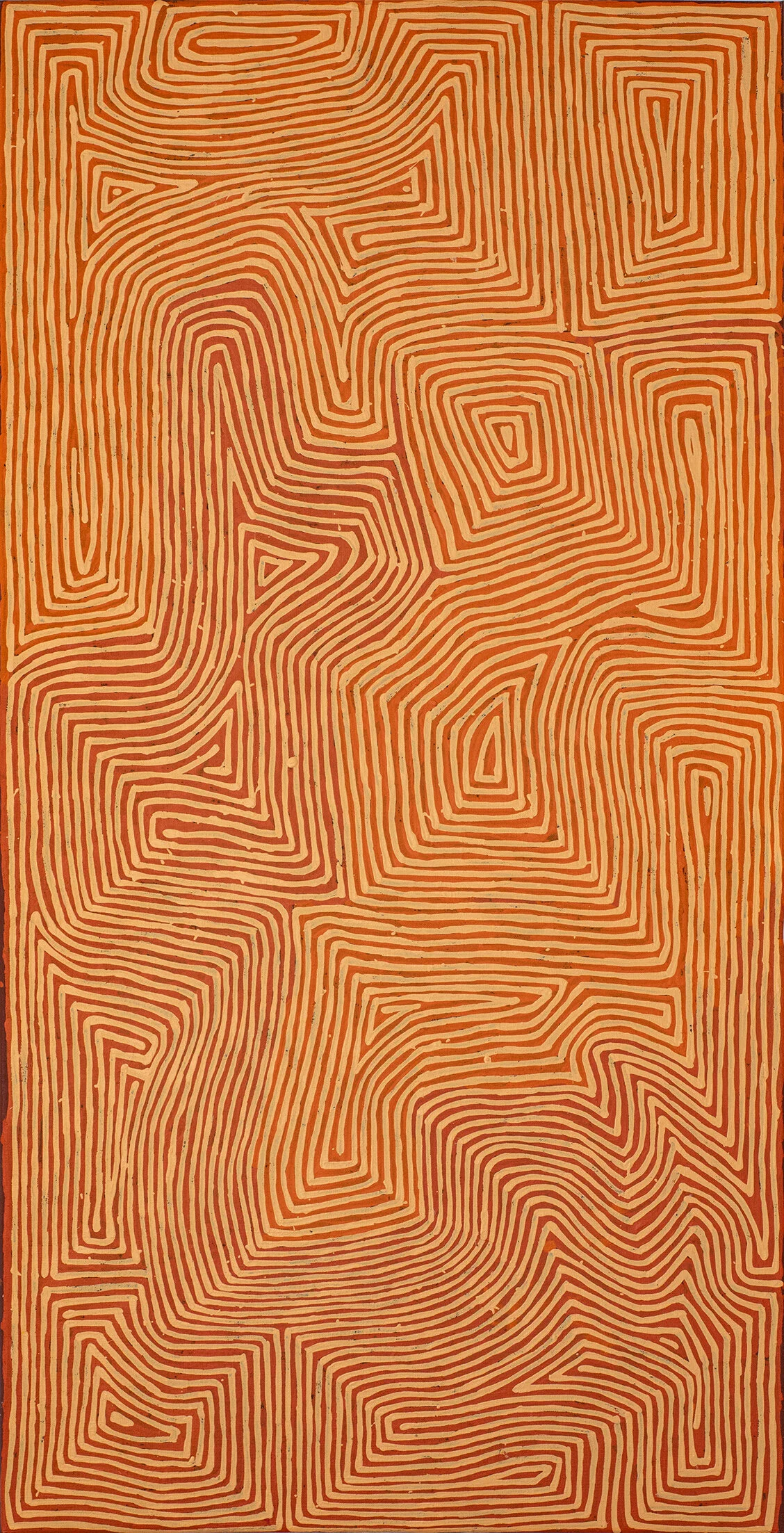
Artiste : Georges Tjungurrayi
Titre de l'œuvre : Claypan site Mamultjulkulnga - Tingari stories
Format : 122 x 61 cm
Provenance : centre d'art aborigène de Papunya Tula
Le certificat original du centre d'art Aborigène de Papunya Tula sera remis avec l'œuvre.
Référence de cette peinture aborigene : GT2008037
Enquiry / Demander le prix de l'œuvre
Informations sur l’œuvre et l’artiste :
George Tjungurrayi (1943) was born in the desert in at Kiwirrkura and is the younger brother of Naata Nungurrayi. George walked into Papunya with another young man along a freshly graded road, after living at Mukula, west of Kiwirrkura. He commenced painting for Papunya Tula Artists in the early 1980’s. “ George Tjungurrayi paints in his own adaptation of the Tingari style. Deceptively delicate lines of loosely-joined dots create networks or webs over the entire surface of the canvas. This gives his paintings a distinct energy. Multi-layered representations of country such as this painting reflect the central concerns of the Papunya Tula artists”. (AGNSW)
Mamultjulkulnga is of great importance to the artist as his father passed away at this site. After rain this claypan becomes a large shallow freshwater lake, which provides ideal conditions for the prolific growth of the small fleshy sub-shrub Tecticornia verrucosa, k.nown in Pintupi as Mungilypa. In ancestral times two Tingari Men oftbe Tjungurrayi and Tjapaltjarri kinship subsections camped at this site and gathered mungilypa. The seeds from this plant are ground into a paste whicb is then cooked in the coals to form a type of unleavened bread.
The Tingari are a group of ancestral beings of the Dreaming who travelled over vast stretches of the country, performing rituals and creating and shaping particular sites. The Tingari men were usually followed by Tingari women and were accompanied by novices, and their travels and adventures are enshrined in a number of song cycles. These ancestral stories form part of the teachings of the post initiatory youths today as well as providing explanations for contemporary customs.
Collections : Groninger Museum, The Netherlands. Museum of Contemporary Art, Sydney. Art Gallery of New South Wales. National Gallery of Australia. Seattle Art Museum, USA...

Artiste : Yinarupa Nangala
Titre de l'œuvre : Rockhole of Mukula ( Ancestral travel stories )
Format : 153 x 122 cm
Provenance : centre d'art de Papunya Tula
Le certificat original du centre d'art Aborigène de Papunya Tula sera remis avec l'œuvre.
Référence de cette peinture : YN1306076

Artiste : Yalti Napangati
Titre de l'œuvre : Marapinti ceremonies
Format : 107x91cm
Provenance : centre d'art de Papunya Tula
Le certificat original du centre d'art Aborigène de Papunya Tula sera remis avec l'œuvre.
Référence de cette peinture : YN1906026
Enquiry/ Demander le prix de l'œuvre
Explications sur cette œuvre et l’artiste :
Yalti Napangati (born around 1970) is an Australian Aboriginal artist. She is a painter of the Western Desert style of art, and paints for the Papunya Tula school.
Her husband, Warlimpirrnga, is also a well-known artist. They were both members of the famous Pintupi Nine, the last group of Aborigines living a traditional way of life in Australia. Yalti was born in the Great Sandy Desert, sometime around 1970. She and her family lived as nomads in the desert, travelling along the western side of Lake Mackay.Most other Pintupi families had moved into settlements during the 1950s, but Yalti's father kept the family away from these. Her parents were Lanti (or "Joshua") and Nanu.[4] She has an older brother, Tamayinya, and a younger sister, Yukultji. She married Warlimpirrnga sometime during the early 1980s, possibly when she was as young as 12. She and her family came out of the desert in 1984.
This painting depicts designs associated with the rockhole and soakage water site of Marrapinti, west of the Kiwirrkura Community in Western Australia. The lines in this work represent the large tali (sandhills) that surround Marrapinti and the nearby puli (rocky bills). During ancestral times a large group of women gathered at tbis site during tbeir travels east. While at the site the women made the nose bones, also known as marrapinti, which are wom through a hole made in the nose web. These nose bones were originally used by both men and women but are now only inserted by the older generation on ceremonial occasions. Upon completion of the ceremonies at Marrapinti the women continued their travels east to Ngaminya and then onto Wilkinkarra (Lake Mackay).

Artiste : Yalti Napangati
Titre de l'œuvre : Marapinti ceremonies
Format : 153x122cm
Provenance : centre d'art de Papunya Tula
Le certificat original du centre d'art Aborigène de Papunya Tula sera remis avec l'œuvre.
Référence de cette peinture : YN1907049
Enquiry/ Demander le prix de l'œuvre
Explications sur cette œuvre et l’artiste :
Yalti Napangati (born around 1970) is an Australian Aboriginal artist. She is a painter of the Western Desert style of art, and paints for the Papunya Tula school.
Her husband, Warlimpirrnga, is also a well-known artist. They were both members of the famous Pintupi Nine, the last group of Aborigines living a traditional way of life in Australia. Yalti was born in the Great Sandy Desert, sometime around 1970. She and her family lived as nomads in the desert, travelling along the western side of Lake Mackay.Most other Pintupi families had moved into settlements during the 1950s, but Yalti's father kept the family away from these. Her parents were Lanti (or "Joshua") and Nanu.[4] She has an older brother, Tamayinya, and a younger sister, Yukultji. She married Warlimpirrnga sometime during the early 1980s, possibly when she was as young as 12. She and her family came out of the desert in 1984.
This painting depicts designs associated with the rockhole and soakage water site of Marrapinti, west of the Kiwirrkura Community in Western Australia. The lines in this work represent the large tali (sandhills) that surround Marrapinti and the nearby puli (rocky bills). During ancestral times a large group of women gathered at tbis site during tbeir travels east. While at the site the women made the nose bones, also known as marrapinti, which are wom through a hole made in the nose web. These nose bones were originally used by both men and women but are now only inserted by the older generation on ceremonial occasions. Upon completion of the ceremonies at Marrapinti the women continued their travels east to Ngaminya and then onto Wilkinkarra (Lake Mackay).

Artiste : Yalti Napangati
Titre de l'œuvre : Marapinti ceremonies
Format : 122x91cm
Provenance : centre d'art de Papunya Tula
Le certificat original du centre d'art Aborigène de Papunya Tula sera remis avec l'œuvre.
Référence de cette peinture : YN2010056
Enquiry/ Demander le prix de l'œuvre
Explications sur cette œuvre et l’artiste :
Yalti Napangati (born around 1970) is an Australian Aboriginal artist. She is a painter of the Western Desert style of art, and paints for the Papunya Tula school.
Her husband, Warlimpirrnga, is also a well-known artist. They were both members of the famous Pintupi Nine, the last group of Aborigines living a traditional way of life in Australia. Yalti was born in the Great Sandy Desert, sometime around 1970. She and her family lived as nomads in the desert, travelling along the western side of Lake Mackay.Most other Pintupi families had moved into settlements during the 1950s, but Yalti's father kept the family away from these. Her parents were Lanti (or "Joshua") and Nanu.[4] She has an older brother, Tamayinya, and a younger sister, Yukultji. She married Warlimpirrnga sometime during the early 1980s, possibly when she was as young as 12. She and her family came out of the desert in 1984.
This painting depicts designs associated with the rockhole and soakage water site of Marrapinti, west of the Kiwirrkura Community in Western Australia. The lines in this work represent the large tali (sandhills) that surround Marrapinti and the nearby puli (rocky bills). During ancestral times a large group of women gathered at tbis site during tbeir travels east. While at the site the women made the nose bones, also known as marrapinti, which are wom through a hole made in the nose web. These nose bones were originally used by both men and women but are now only inserted by the older generation on ceremonial occasions. Upon completion of the ceremonies at Marrapinti the women continued their travels east to Ngaminya and then onto Wilkinkarra (Lake Mackay).

Artiste : Ray James Tjangala
Titre de l'œuvre : Site of Yunala ( Ancestral storie of Tingari cycle)
Format : 183x153cm
Provenance et certificat : centre d'art de Papunya Tula
Référence de la peinture : RJ1803013
Informations sur cette œuvre et l’artiste :
Ray James Tjangala (1958) was born at Yunala rockhole, west of Kiwirrkura. He is the son of Anatjari Tjampitjinpa, one of the original Papunya Tula artists, and Tjungkaya Napangati. Tjangala was encountered by Jeremy Long's Northern Territory Welfare Branch patrols in 1963 at Wudungunya rockhole north-west of Puntujarrpa (Jupiter Well). The family subsequently moved to Papunya in April 1964 where Tjangala attended school. By the late 1990s he had moved further west to Kiwirrkura and this return to his home country, along with the passing of many of the senior artists, invigorated his art, making him one of the most recognisable artists of Papunya Tula.
Generally, the Tingari are a group of ancestral beings of the Dreaming who travelled over vast stretches of the country, performing rituals and creating and shaping particular sites. The Tingari men were usually followed by Tingari women and were accompanied by novices, and their travels and adventures are enshrined in a number of song cycles. These ancestral stories form part of the teachings of the post initiatory youths today as well as providing explanations for contemporary customs.
His work has been acquired by major institutions and private collections across Australia and the world, as : Adelaide Art Galery of New South Wales, Sydney, Australia.
Flinders University Art Museum, Australia
National Gallery of Victoria, Melbourn, Australia
Aboriginal Art Museum, Holland, The Netherlands...

Artiste : Mary Napangati
Titre de l'œuvre : Rockhole site of Tjutalpi
Format : 91x91cm
Provenance : centre d'art de Papunya Tula
Le certificat original du centre d'art Aborigène de Papunya Tula sera remis avec l'œuvre.
Référence de cette peinture : MN1911001
Enquiry/ Demander le prix de l'œuvre
Explications sur cette œuvre et l’artiste :
Mary Brown Napangati (Napangardi) was born near Wilkinkarra (Lake Mackay) circa 1955. Her family lived in the vicinity of Lappi Lappi, located towards the northern area of Lake Mackay, until they walked into the Mt Doreen cattle station west of Yuendumu, in the Northern Territory. She later moved to Yuendumu, married there and later moved further west to Nyirrpi. After her first husband passed away, Mary remarried the well known artist Ronnie Tjampitjinpa and moved to Kintore, where she now lives and paints.
This painting evokes the rockhole site of Tjutalpi. In ancestral times a group of men and women travelled to this site. While at Tjutalpi they performed the dances and songs associated with the area. During their travels the men and women gathered a variety of bush foods including pura or bush tomatoes (Solanum chippendalei) and kampurarrpa or desert raisins (Solanum centrale). They also gathered wood for the manufacture of wana (digging sticks). The roundels in the work represent the soakage waters found at this site, while the lines represent the tali (sandhills).
Collections :
Private collections in Australia and Europe.

Titre de l'œuvre : Rockhole site of Palipalintja - Dreaming Time story
Format : 107 x 91 cm
Provenance : centre d'art aborigene de Papunya Tula Artists
Le certificat original du centre d'art Aborigène de Papunya Tula sera remis avec l'œuvre.
Référence de cette peinture aborigene : BW2002095
Enquiry/Demander le prix de l'œuvre
Explications sur cette œuvre et l’artiste :
Bobby West Tjupurrula (1958) is the son of Freddy West Tjakamarra, one of the founding shareholders of Papunya Tula Artists, and comes from an impressive family of established painters. Born at the rockhole site of Tjammu Tjammu near Kiwirrkura around 1958, Bobby’s family was later met by Jeremy Long’s welfare patrol at a rockhole further east in 1963. He commenced painting for Papunya Tula Artists in the late 1980s but it wasn’t until 1993 that he began painting regularly. Since then he has become an integral part of the company, not just as an artist, but also as the company Chairman on several occasions. Bobby is also strong advocate and voice on behalf of the Western Desert Dialysis unit, an organisation close to his heart given he too suffers renal failure and now receives dialysis.
This painting depicts designs associated with the rockhole site of Palipalintja, west of Jupiter Well. In mythological times a large group of Tingari Men came to this site from Jigalong. Generally, the Tingari are a group of mythical characters of the Dreaming who travelled over vast stretches of the country, performing rituals and creating and shaping particular sites. The Tingari Men were usually followed by Tingari Women and accompanied by novices.
Collections : National Gallery of Victoria (Sydney), Cornell University New-York, Hood Museum USA, Charles Darwin University, Private collections in Europe and Australia....

Titre de l'œuvre : Rockhole site of Palipalintja - Dreaming Time story
Format : 91 x 91 cm
Provenance : centre d'art aborigene de Papunya Tula Artists
Le certificat original du centre d'art Aborigène de Papunya Tula sera remis avec l'œuvre.
Référence de cette peinture aborigene : BW2003104
Enquiry/Demander le prix de l'œuvre
Explications sur cette œuvre et l’artiste :
Bobby West Tjupurrula (1958) is the son of Freddy West Tjakamarra, one of the founding shareholders of Papunya Tula Artists, and comes from an impressive family of established painters. Born at the rockhole site of Tjammu Tjammu near Kiwirrkura around 1958, Bobby’s family was later met by Jeremy Long’s welfare patrol at a rockhole further east in 1963. He commenced painting for Papunya Tula Artists in the late 1980s but it wasn’t until 1993 that he began painting regularly. Since then he has become an integral part of the company, not just as an artist, but also as the company Chairman on several occasions. Bobby is also strong advocate and voice on behalf of the Western Desert Dialysis unit, an organisation close to his heart given he too suffers renal failure and now receives dialysis.
This painting depicts designs associated with the rockhole site of Palipalintja, west of Jupiter Well. In mythological times a large group of Tingari Men came to this site from Jigalong. Generally, the Tingari are a group of mythical characters of the Dreaming who travelled over vast stretches of the country, performing rituals and creating and shaping particular sites. The Tingari Men were usually followed by Tingari Women and accompanied by novices.
Collections : National Gallery of Victoria (Sydney), Cornell University New-York, Hood Museum USA, Charles Darwin University, Private collections in Europe and Australia....

Artiste : Charlie Tjapangati
Titre de l'œuvre : Rockhole site of Tjiparitjarra - Tingari sacred story
Format : 91 x 91 cm
Provenance : centre d'art de Papunya Tula
Le certificat original du centre d'art Aborigène de Papunya Tula sera remis avec l'œuvre.
Référence de cette peinture : CT2010004
Enquiry/Demander le prix de l'œuvre
Explications sur cette œuvre et l’artiste :
Charlie Tjapangati (1949) commenced painting for Papunya Tula Artists in 1977, after having observed the older men painting while living in West Camp, Papunya. Stories from the Tingari cycle were the usual subject of his paintings, including the monumental canvas now in the collection of the National Museum of Australia, which was shown in Australian Perspecta 81 at the Art Gallery of NSW, one of the first institutional acts of acknowledgement of Papunya Tula paintings by the Australian contemporary art world. (Vivien Johnson, 2008).
This painting depicts designs associated with the rockhole site of Tjiparitjarra, near rock:y outcrops and a large sandhill west of Jupiter Weil in Western Australia. ln ancestral times a large group of Tingari men visited this site before travelling east, passing through IGwirrkura, and then north-east to Tarkul and Wilkinkarra (Lake Mackay). The lines in this work represent the nearby tali (sandhills). Since events associated with the Tingari Cycle are of a secret nature no further detail was given. Generally, the Tingari are a group of ancestral beings of the Dreaming who travelled over vast stretches of the country, performing rituals and creating and shaping particular sites. The Tingari men were usually followed by Tingari women and were accompanied by novices, and their travels and adventures are enshrined in a number of song cycles. These ancestral staries form part of the teachings of the post initiatory youths today as well as providing explanations for contemporary customs.
In 2000 Charlie travelled to Sydney with a group of four men from Kiwirrkurra to make a ground painting at the Art Gallery of New South Wales for the opening of Papunya Tula: Genesis and Genius.
This painting evokes the rockole site of Manakurranya and the associated secret Tingari stories
Collections : National Gallery of Australia. the University of Virginia, USA. the Museums and Art Galleries of the Northern Territory. Private collections in Europe and Australia...

Titre de l'œuvre : Body paint designs associated with a Water Dreaming (Tingari)
Format : 122 x 91 cm
Provenance : centre d'art de Papunya Tula
Le certificat original du centre d'art Aborigène de Papunya Tula sera remis avec l'œuvre.
Référence de la peinture : RT0501042

Artiste : Nanyuma Napangati
Titre de l'œuvre : Rockhole site of Ngaminya - women ceremonies
Format : 122 x 61 cm
Provenance : centre d'art de Papunya Tula
Le certificat original du centre d'art Aborigène de Papunya Tula sera remis avec l'œuvre.
Référence de cette peinture : NN1707074
Enquiry / Demander le prix de l'œuvre
Explications sur cette œuvre et l’artiste :
Nanyuma Napangati was born c.1940 in Kiwirrkurra country. She lost her father Mamutja (b.1899-1964) soon after one of Jeremy Long's Welfare branch patrols brought them to Papunya in 1964. Nanyuma's mother Nangatji Napurrula died in the early 70's. Nanyuma began painting for Papunya Tula Artists in June 1996.
She is the sister of Charlie Tjapangati.
This painting depicts designs associated with the rockhole site of Ngaminya, just to the south-west of the Kiwirrkura Community in Western Australia. A group of ancestral women made camp at this site before travelling to the rockhole site ofWirrulnga, east of the Kiwirrkura Community. The lines in the work are spun haïr-string which is used to make nyimparra (haïr-string skirts) which are worn during the ceremonies associated with the area. The other lines are the tali
(sandhills) surrounding the area.
In 1999, Nanyuma was one of the artists involved in the Kiwirrkurra Women's Painting project, which was auctioned to raise money for the Renal Unit at Kintore, an Aboriginal Community in the Western Desert. Nanyuma was one of a dozen women from Kiwirrkurra who travelled to Sydney in 2000 to dance in the opening ceremony of the Olympic Games.
Nanyuma is a Pintupi senior law woman and depicts designs associated with women's Ceremony at Marrapinti, organizing there the creation of nose bones.
Collections :
Art Gallery of NSW.
Artbank.
The University of Western Sydney Art Collection

Artiste : Payu Napaltjarri
Titre de l'œuvre : Rockhole site of Marrapinti - Dreaming Time story
Format : 122 x 61 cm
Provenance : centre d'art de Papunya Tula
Le certificat original du centre d'art Aborigène de Papunya Tula sera remis avec l'œuvre.
Référence de cette peinture : PN2005035
Enquiry / Demander le prix de l'œuvre
Explications sur cette œuvre :
This painting depicts designs associated with the rockhole site of Marrapinti, west of the Pollock Hills in Western Australia. In ancestral times a group ofwomeo of the Nangala and Napangati kinship subsectioos camped at this site duriog their travels towards the east. While at the site the women made nose bones, also known as marrapinti, which are wom through a hole made in the nose web. During ceremonies relating to Marrapinti the older women pierced the nasal septums of the youoger womeo who were participating in the ceremooy. Nose bones were originally used by both men and women but are oow only inserted by the older generation on ceremonial occasions. Upon completion of the ceremonies at Marrapinti the women continued their travels east, passing through Wala Wala, Ngaminya and Wirrulnga before heading north-east to Wtlkinkarra (Lake Mackay).

Artiste : Richard Yukenbarri
Titre de l'œuvre : Water site of Nogunyama : Tingari dreaming
Format : 91 x 61 cm
Provenance et certificat : centre d'art de Papunya Tula Artists
Référence de la peinture : RY1907042
Enquiry / Demander le prix de l'œuvre
Explications sur cette œuvre :
Since events associated with the Tingari Cycle are of a secret nature, no further detail was given. Generally, the Tingari are a group of ancestral beings of the Dreaming who travelled over vast stretches of the country, performing rituals and creating and shaping particular sites. The Tingari men were usually followed by Tingari women and were accompanied by novices, and their travels and adventures are enshrined in a number of song cycles. These ancestral stories form part of the teachings of the post initiatory youths today as well as providing explanations for contemporary customs.

Artiste : Richard Yukenbarri
Titre de l'œuvre : Water site of Nogunyama : Tingari dreaming
Format : 91 x 61 cm
Provenance et certificat : centre d'art de Papunya Tula Artists
Référence de la peinture : RY1902094
Enquiry / Demander le prix de l'œuvre
Explications sur cette œuvre :
Since events associated with the Tingari Cycle are of a secret nature, no further detail was given. Generally, the Tingari are a group of ancestral beings of the Dreaming who travelled over vast stretches of the country, performing rituals and creating and shaping particular sites. The Tingari men were usually followed by Tingari women and were accompanied by novices, and their travels and adventures are enshrined in a number of song cycles. These ancestral stories form part of the teachings of the post initiatory youths today as well as providing explanations for contemporary customs.

Artiste : Elizabeth Marks Nakamarra
Titre de l'œuvre : Rockhole of Kalipinpa : storm and ceremonies
Format : 107x91cm
Provenance et certificat : centre d'art de Papunya Tula Artists
Référence de la peinture : EM1103023
Enquiry / Demander le prix de l'œuvre
Explications sur cette œuvre :
This painting depicts designs associated with the rockbole of Kalipinpa, a major water dreaming site north of Sandy Blight Junction. In ancestral times a huge storm erupted in this area causing the lighthing to flash and the water to rush across the land. filling the rockholes and forming small creeks. The painting represents the ceremonial country of the area with various landforms such as sandhills, hills, rockholes, soakages and creeks. There are many dreamings associated with the site including water, lightning and bush potato. A group of ancestral men and women also once gathered at this rockhole to perform the dances and sing the songs associated with the area.
Découvrez les small gems également disponibles dans l’exposition :

Artiste : Bobby West Tjupurrula
Titre de l'œuvre : Rockhole site of Palipalintja - Dreaming Time story
Format : 61 x 31 cm
Provenance : centre d'art aborigene de Papunya Tula Artists
Le certificat original du centre d'art Aborigène de Papunya Tula sera remis avec l'œuvre.
Référence de cette peinture aborigene : BW1711062
Enquiry/Demander le prix de l'œuvre
Explications sur cette œuvre et l’artiste :
Bobby West Tjupurrula (1958) is the son of Freddy West Tjakamarra, one of the founding shareholders of Papunya Tula Artists, and comes from an impressive family of established painters. Born at the rockhole site of Tjammu Tjammu near Kiwirrkura around 1958, Bobby’s family was later met by Jeremy Long’s welfare patrol at a rockhole further east in 1963. He commenced painting for Papunya Tula Artists in the late 1980s but it wasn’t until 1993 that he began painting regularly. Since then he has become an integral part of the company, not just as an artist, but also as the company Chairman on several occasions. Bobby is also strong advocate and voice on behalf of the Western Desert Dialysis unit, an organisation close to his heart given he too suffers renal failure and now receives dialysis.
This painting depicts designs associated with the rockhole site of Palipalintja, west of Jupiter Well. In mythological times a large group of Tingari Men came to this site from Jigalong. Generally, the Tingari are a group of mythical characters of the Dreaming who travelled over vast stretches of the country, performing rituals and creating and shaping particular sites. The Tingari Men were usually followed by Tingari Women and accompanied by novices.
Collections : National Gallery of Victoria (Sydney), Cornell University New-York, Hood Museum USA, Charles Darwin University, Private collections in Europe and Australia....

Titre de l'œuvre : Ancestral Dreaming Tingari stories
Format : 91 x 61 cm
Provenance : centre d'art aborigene de Papunya Tula Artists
Le certificat original du centre d'art Aborigène de Papunya Tula sera remis avec l'œuvre.
Référence de cette peinture aborigene : BW1604124

Artiste : Bobby West Tjupurrula
Titre de l'œuvre : Rockhole site of Palipalintja - Dreaming Time story
Format : 61 x 31 cm
Provenance : centre d'art aborigene de Papunya Tula Artists
Le certificat original du centre d'art Aborigène de Papunya Tula sera remis avec l'œuvre.
Référence de cette peinture aborigene : BW1904090
Enquiry/Demander le prix de l'œuvre
Explications sur cette œuvre et l’artiste :
Bobby West Tjupurrula (1958) is the son of Freddy West Tjakamarra, one of the founding shareholders of Papunya Tula Artists, and comes from an impressive family of established painters. Born at the rockhole site of Tjammu Tjammu near Kiwirrkura around 1958, Bobby’s family was later met by Jeremy Long’s welfare patrol at a rockhole further east in 1963. He commenced painting for Papunya Tula Artists in the late 1980s but it wasn’t until 1993 that he began painting regularly. Since then he has become an integral part of the company, not just as an artist, but also as the company Chairman on several occasions. Bobby is also strong advocate and voice on behalf of the Western Desert Dialysis unit, an organisation close to his heart given he too suffers renal failure and now receives dialysis.
This painting depicts designs associated with the rockhole site of Palipalintja, west of Jupiter Well. In mythological times a large group of Tingari Men came to this site from Jigalong. Generally, the Tingari are a group of mythical characters of the Dreaming who travelled over vast stretches of the country, performing rituals and creating and shaping particular sites. The Tingari Men were usually followed by Tingari Women and accompanied by novices.
Collections : National Gallery of Victoria (Sydney), Cornell University New-York, Hood Museum USA, Charles Darwin University, Private collections in Europe and Australia....

Artiste : Yuyuya Nampitjinpa
Titre de l'œuvre : Rockhole site of Umari (Ancestral travel stories)
Format : 87 x 28 cm
Provenance : centre d'art aborigene de Papunya Tula
Le certificat original du centre d'art Aborigène de Papunya Tula sera remis avec l'œuvre.
Référence de cette peinture aborigene : YN1903078
Explications sur cette œuvre et l’artiste :
This painting depicts designs associated with the rockhole site of Umari, situated in sandhill country, east of Mt Webb in Western Australia. A large group of ancestral women travelled east from Umari to the rockhole site of Pinari, which is north west of the Kintore community. As they travelled the women gathered the edible berries known as kampurarrpa or desert raisin from the small shrub Solanum centrale. These berries can be eaten straight from the bush but are sometimes ground into a paste and cooked in the coals to form a type of damper. From Pinari the women continued their travels towards the east to the site of Kalipinpa, a major water dreaming site north of Sandy Blight Junction.

Nom de l’artiste : Numida Nampitjinpa
Titre de l'œuvre : Site of Winparku
Format : 107 x 28 cm
Provenance : centre d'art aborigene de Papunya Tula
Le certificat original du centre d'art Aborigène de Papunya Tula sera remis avec l'œuvre.
Référence de cette peinture aborigene : NN2009001
Explications sur cette œuvre et l’artiste :
This painting depicts designs associated with the site Winparku in Western Australia. The lines in this work depic the tali (sandhills) surrounding this site. A group of senior women camped at this site gathering various bushfoods such as bush onions, and the small seeds known as wangunu or woollybutt, from the perennial grass Eragrostis eriopoda. The husks are removed and the seeds ground into flour, water added and the paste cooked in hot coals and ashes. The resultant loaves can be stored for considerable periods.

Nom de l’artiste : Numida Nampitjinpa
Titre de l'œuvre : Site of Winparku
Format : 107 x 28 cm
Provenance : centre d'art aborigene de Papunya Tula
Le certificat original du centre d'art Aborigène de Papunya Tula sera remis avec l'œuvre.
Référence de cette peinture aborigene : NN2010026
Explications sur cette œuvre et l’artiste :
This painting depicts designs associated with the site Winparku in Western Australia. The lines in this work depic the tali (sandhills) surrounding this site. A group of senior women camped at this site gathering various bushfoods such as bush onions, and the small seeds known as wangunu or woollybutt, from the perennial grass Eragrostis eriopoda. The husks are removed and the seeds ground into flour, water added and the paste cooked in hot coals and ashes. The resultant loaves can be stored for considerable periods.

Artiste : Josephine Nangala
Titre de l'œuvre : Rockhole site of Nyilla (Ancestral travel stories)
Format : 87 x 28 cm
Provenance : centre d'art aborigene de Papunya Tula
Le certificat original du centre d'art Aborigène de Papunya Tula sera remis avec l'œuvre.
Référence de cette peinture aborigene : JN2007049
Enquiry / Demander le prix de l'œuvre
Explications sur cette œuvre et l’artiste :
Josephine Nangala (1950) grew up in the country north of Jupiter Well in Western Australia. Her first contact with European people was with cattlemen in the same area, who provided her family with meat. Josephine lived in Balgo before moving to Kiwirrkura community with her husband Charlie Walabi Tjungurrayi.
This painting depicts designs associated with the rockhole site of Nyilla, north of Jupiter Weil in Western Australia. There is a series of rockholes at this site, which is situated in sandhill country. A group of ancestral women once gathered at this site to perform the dances and sing the
songs associated with the area. They later continued their travels further east eventually passing through the Kiwirrkura area. During their journey they gathered edible berries and seeds including the edible fruit known as pura or bush tomato from the small shrub Solanum chippendalei, and desert raisins from the plant Solanum centrale. These berries can be eaten straight from the bush but are sometimes ground into a paste and cooked in the coals to form a type of damper.
Collections : Art gallery of New South Wales. Private collections in Europe and Australia...

Artiste : Bobby West Tjupurrula
Titre de l'œuvre : Rockhole site of Palipalintja - Dreaming Time story
Format : 61 x 31 cm
Provenance : centre d'art aborigene de Papunya Tula Artists
Le certificat original du centre d'art Aborigène de Papunya Tula sera remis avec l'œuvre.
Référence de cette peinture aborigene : BW2008060
Enquiry/Demander le prix de l'œuvre
Explications sur cette œuvre et l’artiste :
Bobby West Tjupurrula (1958) is the son of Freddy West Tjakamarra, one of the founding shareholders of Papunya Tula Artists, and comes from an impressive family of established painters. Born at the rockhole site of Tjammu Tjammu near Kiwirrkura around 1958, Bobby’s family was later met by Jeremy Long’s welfare patrol at a rockhole further east in 1963. He commenced painting for Papunya Tula Artists in the late 1980s but it wasn’t until 1993 that he began painting regularly. Since then he has become an integral part of the company, not just as an artist, but also as the company Chairman on several occasions. Bobby is also strong advocate and voice on behalf of the Western Desert Dialysis unit, an organisation close to his heart given he too suffers renal failure and now receives dialysis.
This painting depicts designs associated with the rockhole site of Palipalintja, west of Jupiter Well. In mythological times a large group of Tingari Men came to this site from Jigalong. Generally, the Tingari are a group of mythical characters of the Dreaming who travelled over vast stretches of the country, performing rituals and creating and shaping particular sites. The Tingari Men were usually followed by Tingari Women and accompanied by novices.
Collections : National Gallery of Victoria (Sydney), Cornell University New-York, Hood Museum USA, Charles Darwin University, Private collections in Europe and Australia....

Artiste : Bobby West Tjupurrula
Titre de l'œuvre : Rockhole site of Palipalintja - Dreaming Time story
Format : 61 x 31 cm
Provenance : centre d'art aborigene de Papunya Tula Artists
Le certificat original du centre d'art Aborigène de Papunya Tula sera remis avec l'œuvre.
Référence de cette peinture aborigene : BW2001056
Enquiry/Demander le prix de l'œuvre
Explications sur cette œuvre et l’artiste :
Bobby West Tjupurrula (1958) is the son of Freddy West Tjakamarra, one of the founding shareholders of Papunya Tula Artists, and comes from an impressive family of established painters. Born at the rockhole site of Tjammu Tjammu near Kiwirrkura around 1958, Bobby’s family was later met by Jeremy Long’s welfare patrol at a rockhole further east in 1963. He commenced painting for Papunya Tula Artists in the late 1980s but it wasn’t until 1993 that he began painting regularly. Since then he has become an integral part of the company, not just as an artist, but also as the company Chairman on several occasions. Bobby is also strong advocate and voice on behalf of the Western Desert Dialysis unit, an organisation close to his heart given he too suffers renal failure and now receives dialysis.
This painting depicts designs associated with the rockhole site of Palipalintja, west of Jupiter Well. In mythological times a large group of Tingari Men came to this site from Jigalong. Generally, the Tingari are a group of mythical characters of the Dreaming who travelled over vast stretches of the country, performing rituals and creating and shaping particular sites. The Tingari Men were usually followed by Tingari Women and accompanied by novices.
Collections : National Gallery of Victoria (Sydney), Cornell University New-York, Hood Museum USA, Charles Darwin University, Private collections in Europe and Australia....

Artiste : Richard Yukenbarri
Titre de l'œuvre : Water site of Nogunyama : Tingari dreaming
Format : 107 x 28 cm
Provenance et certificat : centre d'art de Papunya Tula Artists
Référence de la peinture : RY2008050
Enquiry / Demander le prix de l'œuvre
Explications sur cette œuvre :
This painting depicts designs associated with the claypan and soakage water site of Ngunyama, south of Jupiter Well. A large group of Tingari men camped at this site before travelling towards the north-east, passing through Kiwirrkura, Tarkul and on to Lake Mackay. Since events associated with the Tingari Cycle are of a secret nature no further detail was given. Generally, the Tingari are a group of ancestral beings of the Dreaming who travelled over vast stretches of the country, performing rituals and creating and shaping particular sites. The Tingari men were usually followed by Tingari women and were accompanied by novices, and their travels and adventures are enshrined in a number of sang cycles. Tbese ancestral staries form part of the teachings of the post initiatory youths today as well as providing explanations for contemporary customs.

Artiste : Yuyuya Nampitjinpa
Titre de l'œuvre : Rockhole site of Umari (Ancestral travel stories)
Format : 61 x 55 cm
Provenance : centre d'art aborigene de Papunya Tula
Le certificat original du centre d'art Aborigène de Papunya Tula sera remis avec l'œuvre.
Référence de cette peinture aborigene : YY2010011
Enquiry / Demander le prix de l'œuvre
Explications sur cette œuvre et l’artiste :
This painting depicts designs associated with the rockhole site of Umari, situated in sandhill country, east of Mt Webb in Western Australia. A large group of ancestral women travelled east from Umari to the rockhole site of Pinari, which is north west of the Kintore community. As they travelled the women gathered the edible berries known as kampurarrpa or desert raisin from the small shrub Solanum centrale. These berries can be eaten straight from the bush but are sometimes ground into a paste and cooked in the coals to form a type of damper. From Pinari the women continued their travels towards the east to the site of Kalipinpa, a major water dreaming site north of Sandy Blight Junction.

Artiste : Nanyuma Napangati
Titre de l'œuvre : Rockhole site of Marrapinti - women ceremonies
Format : 107 x 28 cm
Provenance : centre d'art de Papunya Tula
Le certificat original du centre d'art Aborigène de Papunya Tula sera remis avec l'œuvre.
Référence de cette peinture : NN1707074
Enquiry / Demander le prix de l'œuvre
Explications sur cette œuvre et l’artiste :
Nanyuma Napangati was born c.1940 in Kiwirrkurra country. She lost her father Mamutja (b.1899-1964) soon after one of Jeremy Long's Welfare branch patrols brought them to Papunya in 1964. Nanyuma's mother Nangatji Napurrula died in the early 70's. Nanyuma began painting for Papunya Tula Artists in June 1996.
She is the sister of Charlie Tjapangati.
This painting depicts designs associated with the rockhole site of Marrapinti, west of the Pollock Hills in Western Australia. A large group of ancestral women camped at this rockhole before continuing their travels further east, passing through Wala Wala, Kiwirrkura and Ngaminya. While at the site the women made the nose bones, also known as marrapinti, which are worn through a hole made in the nose web. These nose booes were originally used by botb men and women but are now only inserted by the older generation on ceremonial occasions. As the women continued their travels towards the east they gathered the edible berries known as kampurarrpa or desert raisin from the small shrub Solanum centrale.
In 1999, Nanyuma was one of the artists involved in the Kiwirrkurra Women's Painting project, which was auctioned to raise money for the Renal Unit at Kintore, an Aboriginal Community in the Western Desert. Nanyuma was one of a dozen women from Kiwirrkurra who travelled to Sydney in 2000 to dance in the opening ceremony of the Olympic Games.
Nanyuma is a Pintupi senior law woman and depicts designs associated with women's Ceremony at Marrapinti, organizing there the creation of nose bones.
Collections :
Art Gallery of NSW.
Artbank.
The University of Western Sydney Art Collection

Titre de l'œuvre : Rockhole of Mukula (ancestral travel stories)
Format : 107 x 28 cm
Provenance : centre d'art aborigene de Papunya Tula
Le certificat original du centre d'art Aborigène de Papunya Tula sera remis avec l'œuvre.
Référence de cette peinture aborigene : YN2009010
Explications sur cette œuvre et l’artiste :
Yinarupa Nangala (1955) is one of Australia’s leading indigenous artist. Taking out the most prestigious art award in 2009 winning the 26th National Aboriginal & Torres Strait Islander Art Award in Darwin.
She is the daughter of famous artist Anatjari Tjampitjinpa (deceased) and has been painting since the late 90’s. Her sister Mantua Nangala, and her brother Ray James Tjangala also paint for Papunya Tula Artists. She lives in Kiwirrikurra. A highly collectable artist; Yinarupa stories relate mainly to women’s stories. Yinarupa’s painting depicts designs associated with the rockhole site of Mukala, east of Jupiter Well in Western Australia.
She has received several awards for her artworks and she is also in major private collections and museums : 2009 26th Winner Telstra National Aboriginal and Torres Strait Islander Art Award, Darwin. 2009 Finalist - Western Australian Art Prize, Perth.
2010 Finalist - Western Australian Art Prize, Perth. 2014 Finalist - Wynne Prize, AGNSW
2015 Finalist 32nd Telstra National Aboriginal and Torres Strait Islander Art Award, Darwin
2016 Finalist 33rd Telstra National Aboriginal and Torres Strait Islander Art Award, Darwin

Titre de l'œuvre : Rockhole of Mukula (ancestral travel stories)
Format : 91 x 61 cm
Provenance : centre d'art aborigene de Papunya Tula
Le certificat original du centre d'art Aborigène de Papunya Tula sera remis avec l'œuvre.
Référence de cette peinture aborigene : YN2002069
Explications sur cette œuvre et l’artiste :
Yinarupa Nangala (1955) is one of Australia’s leading indigenous artist. Taking out the most prestigious art award in 2009 winning the 26th National Aboriginal & Torres Strait Islander Art Award in Darwin.
She is the daughter of famous artist Anatjari Tjampitjinpa (deceased) and has been painting since the late 90’s. Her sister Mantua Nangala, and her brother Ray James Tjangala also paint for Papunya Tula Artists. She lives in Kiwirrikurra. A highly collectable artist; Yinarupa stories relate mainly to women’s stories. Yinarupa’s painting depicts designs associated with the rockhole site of Mukala, east of Jupiter Well in Western Australia.
She has received several awards for her artworks and she is also in major private collections and museums : 2009 26th Winner Telstra National Aboriginal and Torres Strait Islander Art Award, Darwin. 2009 Finalist - Western Australian Art Prize, Perth.
2010 Finalist - Western Australian Art Prize, Perth. 2014 Finalist - Wynne Prize, AGNSW
2015 Finalist 32nd Telstra National Aboriginal and Torres Strait Islander Art Award, Darwin
2016 Finalist 33rd Telstra National Aboriginal and Torres Strait Islander Art Award, Darwin
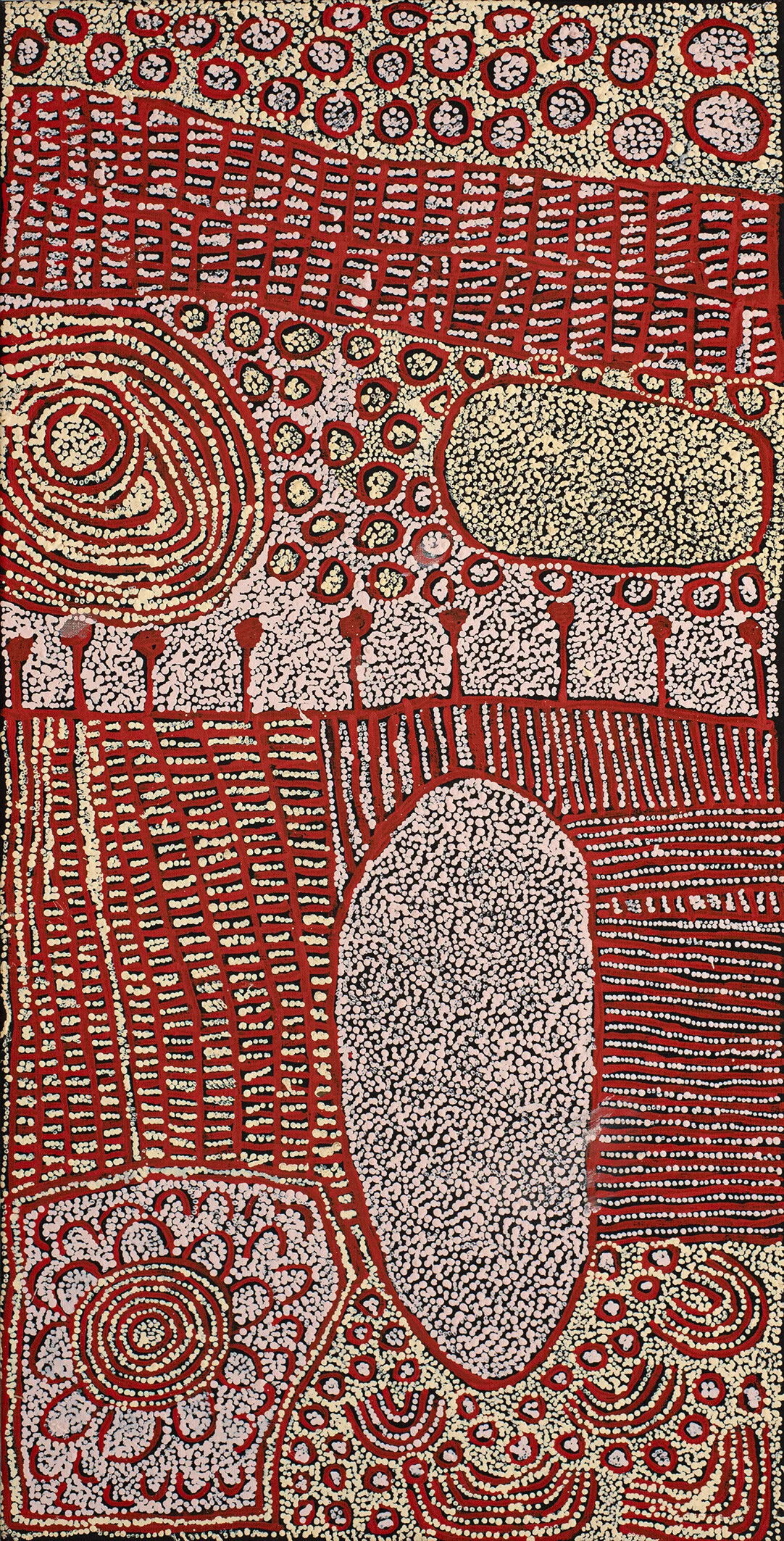
Titre de l'œuvre : Rockhole of Mukula (ancestral travel stories)
Format : 91 x 61 cm
Provenance : centre d'art aborigene de Papunya Tula
Le certificat original du centre d'art Aborigène de Papunya Tula sera remis avec l'œuvre.
Référence de cette peinture aborigene : YN2002069
Explications sur cette œuvre et l’artiste :
Yinarupa Nangala (1955) is one of Australia’s leading indigenous artist. Taking out the most prestigious art award in 2009 winning the 26th National Aboriginal & Torres Strait Islander Art Award in Darwin.
She is the daughter of famous artist Anatjari Tjampitjinpa (deceased) and has been painting since the late 90’s. Her sister Mantua Nangala, and her brother Ray James Tjangala also paint for Papunya Tula Artists. She lives in Kiwirrikurra. A highly collectable artist; Yinarupa stories relate mainly to women’s stories. Yinarupa’s painting depicts designs associated with the rockhole site of Mukala, east of Jupiter Well in Western Australia.
She has received several awards for her artworks and she is also in major private collections and museums : 2009 26th Winner Telstra National Aboriginal and Torres Strait Islander Art Award, Darwin. 2009 Finalist - Western Australian Art Prize, Perth.
2010 Finalist - Western Australian Art Prize, Perth. 2014 Finalist - Wynne Prize, AGNSW
2015 Finalist 32nd Telstra National Aboriginal and Torres Strait Islander Art Award, Darwin
2016 Finalist 33rd Telstra National Aboriginal and Torres Strait Islander Art Award, Darwin
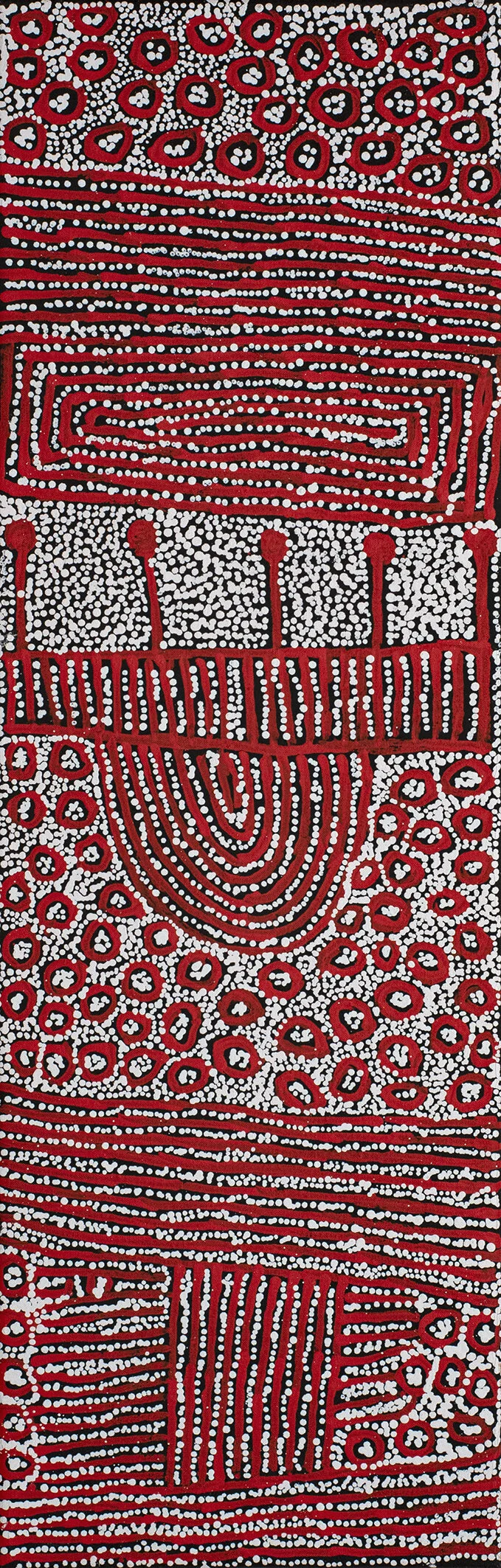
Titre de l'œuvre : Rockhole of Mukula (ancestral travel stories)
Format : 87 x 28 cm
Provenance : centre d'art aborigene de Papunya Tula
Le certificat original du centre d'art Aborigène de Papunya Tula sera remis avec l'œuvre.
Référence de cette peinture aborigene : YN2008043
Explications sur cette œuvre et l’artiste :
Yinarupa Nangala (1955) is one of Australia’s leading indigenous artist. Taking out the most prestigious art award in 2009 winning the 26th National Aboriginal & Torres Strait Islander Art Award in Darwin.
She is the daughter of famous artist Anatjari Tjampitjinpa (deceased) and has been painting since the late 90’s. Her sister Mantua Nangala, and her brother Ray James Tjangala also paint for Papunya Tula Artists. She lives in Kiwirrikurra. A highly collectable artist; Yinarupa stories relate mainly to women’s stories. Yinarupa’s painting depicts designs associated with the rockhole site of Mukala, east of Jupiter Well in Western Australia.
She has received several awards for her artworks and she is also in major private collections and museums : 2009 26th Winner Telstra National Aboriginal and Torres Strait Islander Art Award, Darwin. 2009 Finalist - Western Australian Art Prize, Perth.
2010 Finalist - Western Australian Art Prize, Perth. 2014 Finalist - Wynne Prize, AGNSW
2015 Finalist 32nd Telstra National Aboriginal and Torres Strait Islander Art Award, Darwin
2016 Finalist 33rd Telstra National Aboriginal and Torres Strait Islander Art Award, Darwin

Artiste : Yalti Napangati
Titre de l'œuvre : Marapinti ceremonies
Format : 87x28cm
Provenance : centre d'art de Papunya Tula
Le certificat original du centre d'art Aborigène de Papunya Tula sera remis avec l'œuvre.
Référence de cette peinture : YN2010016
Enquiry/ Demander le prix de l'œuvre
Explications sur cette œuvre et l’artiste :
Yalti Napangati (born around 1970) is an Australian Aboriginal artist. She is a painter of the Western Desert style of art, and paints for the Papunya Tula school.
Her husband, Warlimpirrnga, is also a well-known artist. They were both members of the famous Pintupi Nine, the last group of Aborigines living a traditional way of life in Australia. Yalti was born in the Great Sandy Desert, sometime around 1970. She and her family lived as nomads in the desert, travelling along the western side of Lake Mackay.Most other Pintupi families had moved into settlements during the 1950s, but Yalti's father kept the family away from these. Her parents were Lanti (or "Joshua") and Nanu.[4] She has an older brother, Tamayinya, and a younger sister, Yukultji. She married Warlimpirrnga sometime during the early 1980s, possibly when she was as young as 12. She and her family came out of the desert in 1984.
This painting depicts designs associated with the rockhole and soakage water site of Marrapinti, west of the Kiwirrkura Community in Western Australia. The lines in this work represent the large tali (sandhills) that surround Marrapinti and the nearby puli (rocky bills). During ancestral times a large group of women gathered at tbis site during tbeir travels east. While at the site the women made the nose bones, also known as marrapinti, which are wom through a hole made in the nose web. These nose bones were originally used by both men and women but are now only inserted by the older generation on ceremonial occasions. Upon completion of the ceremonies at Marrapinti the women continued their travels east to Ngaminya and then onto Wilkinkarra (Lake Mackay).
Artiste : Ray James Tjangala
Titre de l'œuvre : Site of Yunala ( Ancestral storie of Tingari cycle)
Format : 183x153cm
Provenance et certificat : centre d'art de Papunya Tula
Référence de la peinture : RJ0408001
Demander le prix de l'œuvre/enquiry
Informations sur cette œuvre et l’artiste :
Ray James Tjangala (1958) was born at Yunala rockhole, west of Kiwirrkura. He is the son of Anatjari Tjampitjinpa, one of the original Papunya Tula artists, and Tjungkaya Napangati. Tjangala was encountered by Jeremy Long's Northern Territory Welfare Branch patrols in 1963 at Wudungunya rockhole north-west of Puntujarrpa (Jupiter Well). The family subsequently moved to Papunya in April 1964 where Tjangala attended school. By the late 1990s he had moved further west to Kiwirrkura and this return to his home country, along with the passing of many of the senior artists, invigorated his art, making him one of the most recognisable artists of Papunya Tula.
Generally, the Tingari are a group of ancestral beings of the Dreaming who travelled over vast stretches of the country, performing rituals and creating and shaping particular sites. The Tingari men were usually followed by Tingari women and were accompanied by novices, and their travels and adventures are enshrined in a number of song cycles. These ancestral stories form part of the teachings of the post initiatory youths today as well as providing explanations for contemporary customs.
His work has been acquired by major institutions and private collections across Australia and the world, as : Adelaide Art Galery of New South Wales, Sydney, Australia.
Flinders University Art Museum, Australia
National Gallery of Victoria, Melbourn, Australia
Aboriginal Art Museum, Holland, The Netherlands...