
Peintures d'art Aborigène du Spinifex, dans le désert de l’ouest
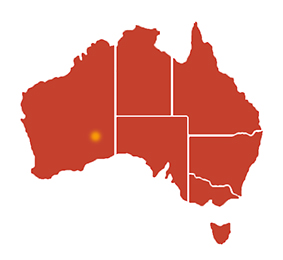
Le Spinifex Art Project a débuté en 1990, et a réellement pris son envol en 2000 avec la reconnaissance par les tribunaux de leurs terres ancestrales et le retour sur place d’une partie de la communauté Aborigène.
C’est un des endroits les plus éloignés d’Australie, à 800 km de tout espace habité sur cet aride continent. Cependant ce pays est riche et porteur de nombreuses ressources.
(suite du texte ci-dessous).
Peintures des artistes Aborigènes du Spinifex Art Project disponibles au sein de la galerie :

Artiste : Tjaruwa Woods
Titre de l'œuvre : Watani
Format : 137 x 110 cm
Provenance et certificat : centre d'art aborigène du Spinifex Art Project
Référence de cette peinture : 14071
Demander le prix de l'œuvre / Enquiry
Explications pour cette œuvre :
Tjaruwa (1954) paints with a knowledge and a devotion to the country that formed her. She was a young woman when she and her immediate family 'walked in' from the Great Victoria Desert in the remote east of Western Australia. This was deemed inhospitable country by the encroaching 'new world' and perceived as so vast and uninhabited, that it made the ideal site to detonate and observe the new wave of nuclear explosions conducted as part of the British Atomic Testing during the 1950's.
Tjaruwa and her family were there, living, breathing, hunting, walking over the soft red carpet of sand, learning the paths of the creation beings who shaped this landscape and made the moral world possible. She slept under a vast expanse by campfire and drank water from tree roots. She learnt the fine art of survival in an arid but spiritual world and how to navigate an environment full of meaning. Tjaruwa paints like she breathes, an almost innate required constant. As she depicts the significant site of Kamanti, she is well aware of the creation manifestation of the Wati Kutjara (Two Men Creation Line) and that these Two Men still reside in the well-formed water cavities that penetrate deep into middle earth. She knows with all her learned experience that these Two Men are to be feared but treated with reverence all the same, for they can travel underground as the enormous water serpents that they are, or walk the landscape in the form of mortal men. And as she sings the sites onto the two dimensional plane, let us appreciate through the panoramic composition that comes from a lifetime of breathing in this country.
Tjaruwa was born in 1954 outside the Spinifex Determination Area at Warutjara, the place of Minyma Tjilkamata - the Echidna Woman, near the current community of Jamieson (Manta Maru) within the Ngaanyatjarra Lands. Except for possession of a few pieces of iron, fashioned into implements and tin bowls Tjaruwa lived traditionally until the winter of 1986 when her family group of seven was located in northern Spinifex by a group of Spinifex people making a sortie into country to re-visit important Men’s sites after some 25 years of absence. Tjaruwa came in with a small son on her hip and camped with her family firstly at Yakatunya, 90 kilometres south of Tjuntjuntjara, joined the moving camp which accompanied the construction of a road, 300 kilometres through the length of the Spinifex Lands, before settling permanently at Tjuntjuntjara in 1989. Tjaruwa was adjudged to be about 32 years old in 1986 and was given the birth date 1/7/1954. At this point in time (2014),Tjaruwa’s family remains the last Aboriginal group in the country to make first contact with contemporary Australia.
It is difficult to even imagine the changes Tjaruwa was to encounter living in her new world. She had acquired an extended network of kin to establish relationships with, the daily activity of hunting and gathering was essentially replaced by the community store and water was abundant.
Tjaruwa’s immediate priority was to care for her mother and uncle living in their new circumstances and it was not until her mother passed away that she took up an interest in painting. At first she tended to paint as she observed other women painting and then the accumulated experience of her other life and her mother’s stories/designs poured out and Tjaruwa’s unique Spinifex perspective was translated with spectacular style and technique on to canvas.
In this painting Tjaruwa Woods has painted Watani, an area in the northern section of the Spinifex Lands. It is sand hill country, with Spinifex and Mulga trees and very sparse water deposits usually in the form of rockholes which are quite small or soak water which you have to dig for. Tjanpi or Spinifex grasses were used to filter the water for drinking. To survive in this Western Desert area it is essential to know where to find the water and this knowledge has been passed down over thousands of years from generaon to generation. In the Tjukurpa the Emu Creator Beings possess great creative powers. They created numerous topographical features in the landscape as they passed through this area.
Her artworks are in the following prestigious collections :
Art Gallery Of South Australia, Adelaide Sa (Women’s Collaborative)
National Gallery Of Australia, Canberra
National Gallery Of Victoria, Melbourne Vic (Women’s Collaborative)
Richard And Harriet England Collection
Seattle Art Museum, Seattle Usa (Women’s Collaborative)
The British Museum, London, England.(Womens Collaborative)
The Corrigan Collection, Australia
The Lepley Collection, Perth, Western Australia.
The Sims Dickson Collection, Nsw
Parliament House Art Collection, Canberra, Act (Womens Collaborative)
W. & V. Mcgeoch Collection, Melbourne, Vic.
The Berndt Collection, University Of Western Australia.

Artiste : Tjaruwa Woods
Titre de l'œuvre : Kamanti
Format : 200 x 137 cm
Provenance et certificat : centre d'art aborigène du Spinifex Art Project
Référence de cette peinture : 18-150
Demander le prix de l'œuvre / Enquiry
Explications pour cette œuvre :
Tjaruwa (1954) paints with a knowledge and a devotion to the country that formed her. She was a young woman when she and her immediate family 'walked in' from the Great Victoria Desert in the remote east of Western Australia. This was deemed inhospitable country by the encroaching 'new world' and perceived as so vast and uninhabited, that it made the ideal site to detonate and observe the new wave of nuclear explosions conducted as part of the British Atomic Testing during the 1950's.
Tjaruwa and her family were there, living, breathing, hunting, walking over the soft red carpet of sand, learning the paths of the creation beings who shaped this landscape and made the moral world possible. She slept under a vast expanse by campfire and drank water from tree roots. She learnt the fine art of survival in an arid but spiritual world and how to navigate an environment full of meaning. Tjaruwa paints like she breathes, an almost innate required constant. As she depicts the significant site of Kamanti, she is well aware of the creation manifestation of the Wati Kutjara (Two Men Creation Line) and that these Two Men still reside in the well-formed water cavities that penetrate deep into middle earth. She knows with all her learned experience that these Two Men are to be feared but treated with reverence all the same, for they can travel underground as the enormous water serpents that they are, or walk the landscape in the form of mortal men. And as she sings the sites onto the two dimensional plane, let us appreciate through the panoramic composition that comes from a lifetime of breathing in this country.
Tjaruwa was born in 1954 outside the Spinifex Determination Area at Warutjara, the place of Minyma Tjilkamata - the Echidna Woman, near the current community of Jamieson (Manta Maru) within the Ngaanyatjarra Lands. Except for possession of a few pieces of iron, fashioned into implements and tin bowls Tjaruwa lived traditionally until the winter of 1986 when her family group of seven was located in northern Spinifex by a group of Spinifex people making a sortie into country to re-visit important Men’s sites after some 25 years of absence. Tjaruwa came in with a small son on her hip and camped with her family firstly at Yakatunya, 90 kilometres south of Tjuntjuntjara, joined the moving camp which accompanied the construction of a road, 300 kilometres through the length of the Spinifex Lands, before settling permanently at Tjuntjuntjara in 1989. Tjaruwa was adjudged to be about 32 years old in 1986 and was given the birth date 1/7/1954. At this point in time (2014),Tjaruwa’s family remains the last Aboriginal group in the country to make first contact with contemporary Australia.
It is difficult to even imagine the changes Tjaruwa was to encounter living in her new world. She had acquired an extended network of kin to establish relationships with, the daily activity of hunting and gathering was essentially replaced by the community store and water was abundant.
Tjaruwa’s immediate priority was to care for her mother and uncle living in their new circumstances and it was not until her mother passed away that she took up an interest in painting. At first she tended to paint as she observed other women painting and then the accumulated experience of her other life and her mother’s stories/designs poured out and Tjaruwa’s unique Spinifex perspective was translated with spectacular style and technique on to canvas.
Tjaruwa comes from an area of many sandhills and rock holes which is what she paints in this painting. Kamanti is a major rockhole and within this vicinity are the water holes and significant sites of Nyuman, Kuru Ala and Tuwan. This area also has the presence of the Seven Sisters Tjukurpa running through it, an epic song line which traverses the Western Desert. The circles represent the rockholes whilst the lines of colour show the many sandhills and travelling tracks. Water sources are a precious resource in the desert and feature strongly in the Tjukurpa and thus the paintings of the Spinifex artists. These stories of Creation beings with magical powers forming country as the lived their lives criss cross over the desert landscape. These beings are alive in the country today.
Her artworks are in the following prestigious collections :
Art Gallery Of South Australia, Adelaide Sa (Women’s Collaborative)
National Gallery Of Australia, Canberra
National Gallery Of Victoria, Melbourne Vic (Women’s Collaborative)
Richard And Harriet England Collection
Seattle Art Museum, Seattle Usa (Women’s Collaborative)
The British Museum, London, England.(Womens Collaborative)
The Corrigan Collection, Australia
The Lepley Collection, Perth, Western Australia.
The Sims Dickson Collection, Nsw
Parliament House Art Collection, Canberra, Act (Womens Collaborative)
W. & V. Mcgeoch Collection, Melbourne, Vic.
The Berndt Collection, University Of Western Australia.

Artiste : Mick Rictor
Titre de l'œuvre : untitled
Format : 110 x 85 cm
Provenance et certificat : centre d'art aborigène du Spinifex Art Project
Référence de cette peinture : 22-349
Demander le prix de l'œuvre / Enquiry
Explications pour cette œuvre :
Mick Rictor (1957) was around thirty years of age when he walked into modern civilisation for the first time from deep in the heart of the Great Victoria Desert in1986. A very remote and special place holding true wilderness character, like Mick himself. Other Anangu (Aboriginal people) refer to Mick as a wild man, ferocious like the old men used to be before people were softened by modern living.
Mick Rictor gives us freedom to contemplate. His compositions are both painterly and sparse leaving form and space intertwined and suspended. He is not quick to paint and peruses the blank canvas with hand on chin like Rodin's 'The Thinker' for a long period before selecting colour and brush to begin. But still it is a slow rhythmic placement of individual 'dots' that build up sometimes as a single colour, sometimes as multiple colours, one blanketing the other. His works reference the landscapes and changing colours of the Spinifex Country, the sweeping plains nestled in between parallel lines of sand dunes, the red rocky granite outcrops on the northern boundary, the sacred water holes and their ‘wanampi’ serpent guardians and 'mamu tjina' or scorer footprints from the Tjukurpa.
Mick was born at Kulpinya situated south of the significant site of Miramiratjara in the Great Victoria Desert sometime around 1956. This puts him in close proximity to the British Atomic Testing at Emu Fields and Maralinga during the '50s and '60s. Mick and his immediate family were living a nomadic life in and around traditional Spinifex Country up until 1986 when the family was located by relatives searching the area and taken to a then small settlement of Yakadunya and later Coonana. Mick is the eldest sibling of four with his other three siblings Ian and Noli Rictor and Tjaruwa Woods already established artists.
He started painting in 2016 and has a natural aesthetic with a painterly quality about his work.
Mick Rictor gives us freedom to contemplate. His compositions are both painterly and sparse, leaving form and space intertwined and suspended. He is not quick to paint and peruses the blank canvas with hand on chin like Rodin’s The Thinker for a long period before selecting colour and brush to begin. But still it is a slow rhythmic placement of individual ‘dots’ that build up somemes as a single colour, somemes as multiple colours, one blanketing the other. His works reference the landscapes and changing colours of the Spinifex Country, the sweeping plains nestled in between parallel lines of sand dunes, the red rocky granite outcrops on the northern boundary, the sacred waterholes and their wanampi (serpent guardians) and mamu tjina(sorcerer’s footprints) from the Tjukurpa.
His artworks are in the following prestigious collections :
Museum And Art Gallery Of The Northern Territory, Darwin, Australia.
Art Gallery Of South Australia, Adelaide, South Australia
Artbank, Australian Government Collection. Australia.
Araluen Gallery, Alice Springs, Northern Territory.
Charles Darwin University Art Collection, Darwin,Northern Territory
Richard And Harriett Collection, Australia
Arthur Roe Collection, Australia
The Sims Dickson Collection, Nsw

Artiste : Men collaborative
Titre de l'œuvre : Pila Ngura
Format : 290 x 200 cm
Provenance et certificat : centre d'art aborigène du Spinifex Art Project
Référence de cette peinture : 21-316
Enquiry / Demander le prix de l'œuvre
Explications pour cette œuvre :
Six senior Spinifex Men have painted their way into country filled with meaning, depicting a sum of the parts to encompass much more than the whole. Each has emphasised their significant sites and brought them into focus on a bold collaborative scale. The men work in harmony, often singing and rhythmically tapping the associated songs into color upon the canvas.
Simon Hogan leads us into the hidden intricacies of Lingka; a significant site strewn with white stones and giving life to the wanari (mulga tree) that springs forth from the sacred water source. Nearby, Lawrence Pennington effortlessly moves the color to fill the sites of Mituna and Nyuman: flying the Walawuru Tjukurpa (Wedge Tailed Eagle Creation Line) over the vastness of the country. Meanwhile, Fred Grant takes us down the many well walked travels of his longest past and places Ukuratjara, his place of childhood, for all to see. And Ned Grant uses his knowledge and insight to intertwine the ngalta (desert kurrajong) and the life giving water it provides, into the fabric of the story: weaving Wati Kutjara Tjukurpa (Two Men Creation Line) underground and into the very trees he depicts.
Patju Presley shimmers close by as his myriad of dots allow the site of Kalaya Piti to push the boundaries of the composition. And Ian Rictor lays the subtle sites, depicting Kamanti, Tuwan and Wayara in grace and unison to form his story. These sites, this country was created by the first beings who shaped the landscape as they moved through it. And left a land brimming with meaning and ritual that the men embrace on a daily basis but also leave upon a grand composition such as this.
Their artworks are in the following prestigious collections :
Aboriginal Art Museum, Utrecht, The Netherlands
Art Gallery Of South Australia, Adelaide. Sa
National Gallery Of Australia, Canberra, Act
Prince Stefan Von Und Zu Liechtenstein, The Ambassador Of Liechtenstein In Germany
Seattle Art Museum, Seattle, Usa
Staatliches Museum Fur Volkerkunde, Munich, Germany
The British Museum, London, England.
The Corrigan Collection, Australia.
The Lepley Collection, Perth, Western Australia.
The Luczo Collection, Usa
Western Australian Museum, Perth, Western Australia
W. & V. Mcgeoch Collection, Melbourne, Vic.
The Art Gallery Of New South Wales, Sydney, Nsw…

Artiste : Kanta Donnegan
Titre de l'œuvre : Kapi Piti Dreaming Time story
Format : 137 x 90 cm
Provenance et certificat : centre d'art aborigène du Spinifex Art Project
Référence de cette peinture : 21-35
Enquiry / Demander le prix de l'œuvre
Explications pour cette œuvre :
Kanta (1944) was born at Kapi Piti Kutjara, the place where Wati Kutjara (Two Serpent Men) emerged and headed for Pukara. The Wati Kutjara story is one of the most important and wide ranging stories in Spinifex country. Although much of the specific detail is dangerous and secret the general actions and directions of the father and son are well known and understood to have been essential to the formation and activation of much of the country.
Water is a precious resource and thus permanent waterholes have sacred associations. They are guarded by their creators, Wanampis (Dreaming Serpent Beings) who have magical abilities. These Dreaming Beings are powerful and often dangerous so Anangu must approach them with respect and perform certain ritual according to the Law. Kathleen paints many such sacred water sources including Ilkurlka, Pirapi, Upi, Tjawanya, Karnka, Warurungka, Urnpun, Takari, Mulyaya, Talitjulpul, Mamatju and Wangalritja, an area collectively dense with Spinifex lore. Typically in Spinifex life, Tjukurpa and the everyday often converge bringing together the sacred and the secular.
Her artworks are in the following prestigious collections :
Art Gallery Of South Australia, Adelaide.
South Australia (womens Collaborative).
Artbank, Australian Government Collection.
Collection Prince Stefan Of Liechtenstein, Embassy Of Liechtenstein ln Germany.(womens Collaborate).
Museum Of Western Australia.
The Corrigan Collection, Australia. (womens Collaborative).
The Lepley Collection, Perth, Western Australia. (womens Collaborative).
The National Gallery Of Victoria, Melbourne, Vic. (womens Collaborative).
The Sims Dickson Collection, Nsw...

Artiste : Fred Grant
Titre de l'œuvre : Kupanya
Format : 200 x 137 cm
Provenance et certificat : centre d'art aborigène du Spinifex Art Project
Référence de cette peinture : 21-154
Enquiry / Demander le prix de l'œuvre
Explications pour cette œuvre :
Fred Grant (1943) knows the boundless sandhills, the endless skies and extensive forests of Spinifex Country. He's walked the rich cultural fabric that embraces his land wherever he looks and he has intimate knowledge of the life sustaining water sources that are its foundation of survival in an arid environment. Fred paints with the passive authority of someone that knows they belong to the intimacy of a landscape with a powerful religion at its heart. Here he depicts the country associated with Minyma Tjuta Tjukurpa (Many Women Creation Line) at the significant site of Pirilyi.
This is a women's creation line that follows the journey of a group of women (seven sisters) who traverse the Spinifex Lands and beyond whilst evading the lecherous pursuit of a lustful man, Nyiru who wishes the eldest women for his wife. These are creation beings and as such shaped the landscape as they moved through it.
His artworks are in the following collections :
Harriett & Richard England Collection
National Gallery Of Australia, Canberra, Act (Mens Collaborative)
Seattle Art Museum, Seattle, Usa. (Mens Collaborative)
The Corrigan Collection, Australia (Mens Collaborative)
The Lepley Collection, Perth, Western Australia.
W. & V. Mcgeoch Collection, Melbourne, Vic.
Queensland Art Gallery Of Modern Art, Brisbane, Qld.
The Art Gallery Of New South Wales, Sydney, Nsw
Art Gallery Of South Australia, Adelaide, South Australia (Mens Collaborative)
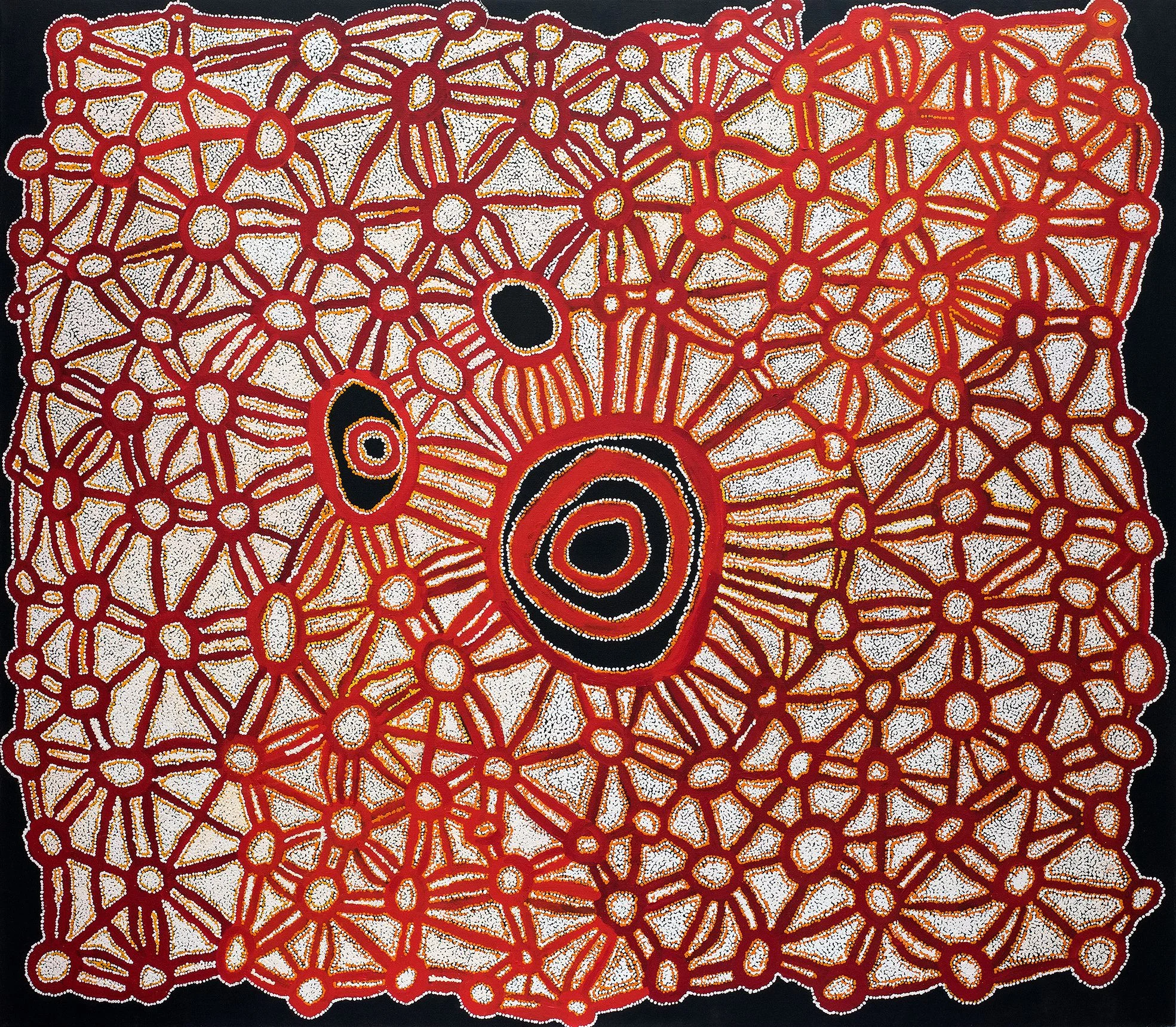
Artiste : Fred Grant
Titre de l'œuvre : Puutulu
Format : 230 x 200 cm
Provenance et certificat : centre d'art aborigène du Spinifex Art Project
Référence de cette peinture : 19-6
Demander le prix de l'œuvre / Enquiry
Explications pour cette œuvre :
Fred has depicted the significant site of Puutulu situated in the heart of traditional Spinifex Country. This site holds the Minyma Kaanka Tjukurpa (Crow Women Creation Line) and Fred tells of the creation events that unfolded here. Minyma Kaanka had a son who was married to a young girl. One day when Minyma Kaanka was out flying and her son went off hunting, the young girl’s mother, Minyma Mamu turned herself into a tree stump and waited for the son to return from hunting. Upon seeing the boy, she killed him and threw him in the fire. When Minyma Kaanka returned, she looked for her son before being offered some meat from the fire by Minyma Mamu. When she began chewing on the meat she had a strange sensation, thinking something is wrong and the meat smells funny. She left and went home and realised it was her son who Minyma Mamu had killed and cooked. Minyma Kaanka was so angry she grabbed a sharp spear and placed it in the ground pointing up. She then made the strongest most ferocious wind that picked up Minyma Mamu and her daughter and threw them down on the spear, impaling them.
His artworks are in the following prestigious collections :
Harriett & Richard England Collection
National Gallery Of Australia, Canberra, Act (Mens Collaborative)
Seattle Art Museum, Seattle, Usa. (Mens Collaborative)
The Corrigan Collection, Australia (Mens Collaborative)
The Lepley Collection, Perth, Western Australia.
W. & V. Mcgeoch Collection, Melbourne, Vic.
Queensland Art Gallery Of Modern Art, Brisbane, Qld.
The Art Gallery Of New South Wales, Sydney, Nsw
Art Gallery Of South Australia, Adelaide, South Australia (Mens Collaborative)

Artiste : Myrtle Pennington
Titre de l'œuvre : Wayul
Format : 110 x 83 cm
Provenance et certificat : centre d'art aborigene du Spinifex Art Project
Référence de cette peinture aborigene : 15-95
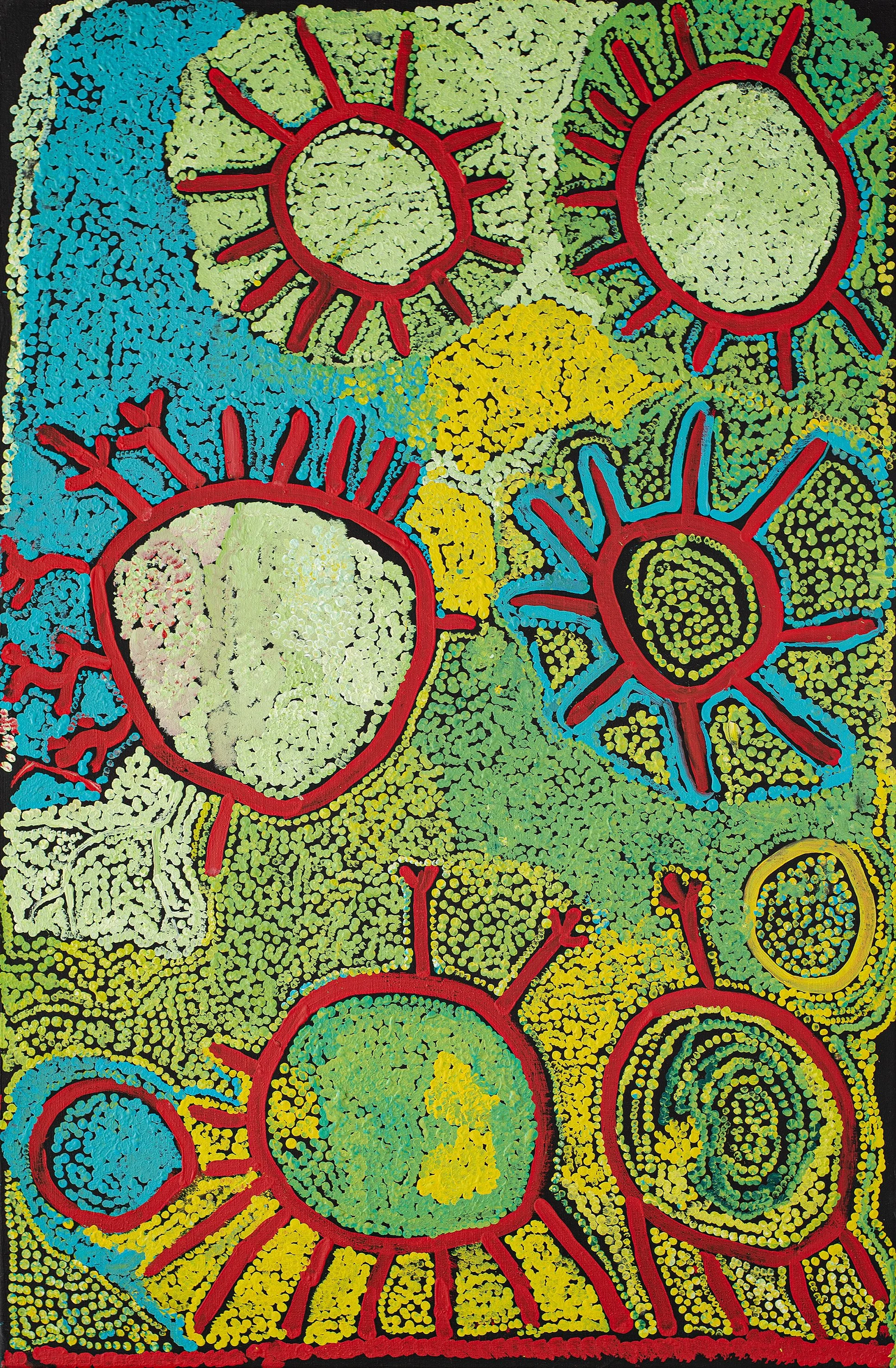
Artiste : Simon Hogan
Titre de l'œuvre : Lingka
Format : 137 x 90 cm
Provenance et certificat : centre d'art aborigène du Spinifex Art Project
Référence de cette peinture : 23-147
Enquiry / Demander le prix de l'œuvre
Explications pour cette œuvre :
Simon Hogan (1930) manifests his site of Lingka onto the two dimensional plane. When he paints, he transcends this world and is taken over soft sand ridges and vast Spinifex plains to the significant sites that formed him from birth. For Simon was born into a spiritual society where religion manifested in the immediate environment and where creation beings could move through different realms at will. It is these beings who shaped the landscape that Simon depicts and who left a moral compass that is still followed today. They gave to people the life giving water sites that were held with such reverence in an arid and remote land. It is these sites that were the means of survival and where religion unfolded in the form of sacred song and performance.
Simon Hogan was born circa 1930 in mid-western Spinifex between Paltju and Lingka. Simon’s exact age is unknown as dates of birth were estimated by the A.E.M. missionaries when the Spinifex people, on arrival at Cundeelee, were “sorted” into family groups, given English names and approximate dates of birth. During childhood two fathers, one born at Warakunu and the other at Munki raised Simon. Simon’s mother’s country is around Tjulya. The Spinifex people were a relatively discreet southern Pitjantjatjara tribal group with es to the north and east that lived a fully traditional hunter-gatherer life until the late1950’s to early 1960s when most people either walked in to Ooldea and Cundeelee or were taken by AEM missionaries to Cundeelee Mission…
From 1995 Simon Hogan was a prominent member of a group of senior traditional owners from Spinifex country who lobbied the WA State Government for Native Title. Although Simon spoke no English he was a confident, initiated Pitjantjatjara man who spoke to senior government officials regarding ownership of country and culture. Exclusive Native Title rights were granted to Simon Hogan and the Spinifex people in 2000 of over 55 000 sq kms of the Great Victoria Desert in WA.
His artworks are in the following prestigious collections :
Art Gallery Of South Australia, Adelaide, South Australia
British Museum, London, England.
Harriet And Richard England Collection
National Gallery Of Australia, Canberra, Act.
National Gallery Of Victoria, Melbourne, Victoria.
Seattle Art Museum, Seattle, Usa. (Mens Collaborative)
Staatliches Museum Fur Volkerkunde, Munich, Germany
The Lepley Collection, Perth, Western Australia.
The Patrick Corrigan Collection, Sydney, New South Wales.
W. & V. Mcgeoch Collection
Western Australian Museum, Perth, W.A.
Artbank, Australian Government Collection. Australia.
Art Gallery Of Western Australia, Perth, Western Australia.
The Art Gallery Of New South Wales, Sydney, Nsw (Mens Collaborative)
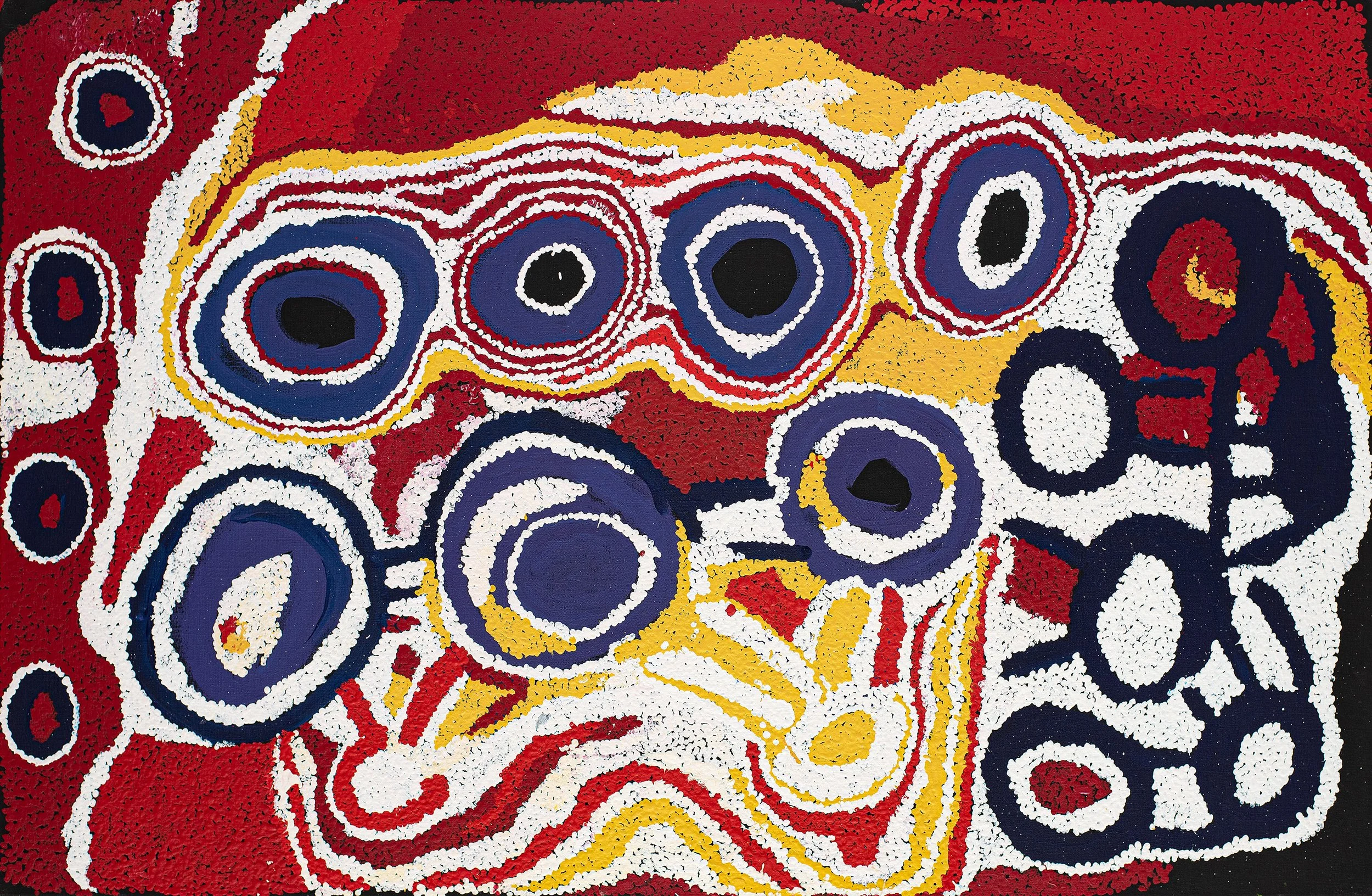
Artiste : Tjaruwa Woods
Titre de l'œuvre : Purpurnya
Format : 137 × 90 cm
Provenance et certificat : centre d'art aborigène du Spinifex Art Project
Référence de cette peinture : 15-006
Demander le prix de l'œuvre / Enquiry
Explications pour cette œuvre :
Tjaruwa (1954) paints with a knowledge and a devotion to the country that formed her. She was a young woman when she and her immediate family 'walked in' from the Great Victoria Desert in the remote east of Western Australia. This was deemed inhospitable country by the encroaching 'new world' and perceived as so vast and uninhabited, that it made the ideal site to detonate and observe the new wave of nuclear explosions conducted as part of the British Atomic Testing during the 1950's.
Tjaruwa and her family were there, living, breathing, hunting, walking over the soft red carpet of sand, learning the paths of the creation beings who shaped this landscape and made the moral world possible. She slept under a vast expanse by campfire and drank water from tree roots. She learnt the fine art of survival in an arid but spiritual world and how to navigate an environment full of meaning. Tjaruwa paints like she breathes, an almost innate required constant. As she depicts the significant site of Kamanti, she is well aware of the creation manifestation of the Wati Kutjara (Two Men Creation Line) and that these Two Men still reside in the well-formed water cavities that penetrate deep into middle earth. She knows with all her learned experience that these Two Men are to be feared but treated with reverence all the same, for they can travel underground as the enormous water serpents that they are, or walk the landscape in the form of mortal men. And as she sings the sites onto the two dimensional plane, let us appreciate through the panoramic composition that comes from a lifetime of breathing in this country.
Tjaruwa was born in 1954 outside the Spinifex Determination Area at Warutjara, the place of Minyma Tjilkamata - the Echidna Woman, near the current community of Jamieson (Manta Maru) within the Ngaanyatjarra Lands. Except for possession of a few pieces of iron, fashioned into implements and tin bowls Tjaruwa lived traditionally until the winter of 1986 when her family group of seven was located in northern Spinifex by a group of Spinifex people making a sortie into country to re-visit important Men’s sites after some 25 years of absence. Tjaruwa came in with a small son on her hip and camped with her family firstly at Yakatunya, 90 kilometres south of Tjuntjuntjara, joined the moving camp which accompanied the construction of a road, 300 kilometres through the length of the Spinifex Lands, before settling permanently at Tjuntjuntjara in 1989. Tjaruwa was adjudged to be about 32 years old in 1986 and was given the birth date 1/7/1954. At this point in time (2014),Tjaruwa’s family remains the last Aboriginal group in the country to make first contact with contemporary Australia.
It is difficult to even imagine the changes Tjaruwa was to encounter living in her new world. She had acquired an extended network of kin to establish relationships with, the daily activity of hunting and gathering was essentially replaced by the community store and water was abundant.
Tjaruwa’s immediate priority was to care for her mother and uncle living in their new circumstances and it was not until her mother passed away that she took up an interest in painting. At first she tended to paint as she observed other women painting and then the accumulated experience of her other life and her mother’s stories/designs poured out and Tjaruwa’s unique Spinifex perspective was translated with spectacular style and technique on to canvas.
Tjaruwa has painted her homeland of Yampil, an area in northern Spinifex. This is sandhill country, with Spinifex and Mulga trees and very sparse water deposits usually in the form of rockholes, which are quite small or soak water which you have to dig for. To survive in the Western Desert area it is essential to know where to find the water and this knowledge has been passed down over thousands of years from generation to generation. Tjaruwa has painted the rockholes of Kamanti, Waltjipi, Pur Purnya, Kapi Wiratjara and Tjiwara.
Her artworks are in the following prestigious collections :
Art Gallery Of South Australia, Adelaide Sa (Women’s Collaborative)
National Gallery Of Australia, Canberra
National Gallery Of Victoria, Melbourne Vic (Women’s Collaborative)
Richard And Harriet England Collection
Seattle Art Museum, Seattle Usa (Women’s Collaborative)
The British Museum, London, England.(Womens Collaborative)
The Corrigan Collection, Australia
The Lepley Collection, Perth, Western Australia.
The Sims Dickson Collection, Nsw
Parliament House Art Collection, Canberra, Act (Womens Collaborative)
W. & V. Mcgeoch Collection, Melbourne, Vic.
The Berndt Collection, University Of Western Australia.

Artiste : Tjaruwa Woods
Titre de l'œuvre : Yampil
Format : 140 x 137 cm
Provenance et certificat : centre d'art aborigène du Spinifex Art Project
Référence de cette peinture : 14149
Demander le prix de l'œuvre / Enquiry
Explications pour cette œuvre :
Tjaruwa (1954) paints with a knowledge and a devotion to the country that formed her. She was a young woman when she and her immediate family 'walked in' from the Great Victoria Desert in the remote east of Western Australia. This was deemed inhospitable country by the encroaching 'new world' and perceived as so vast and uninhabited, that it made the ideal site to detonate and observe the new wave of nuclear explosions conducted as part of the British Atomic Testing during the 1950's.
Tjaruwa and her family were there, living, breathing, hunting, walking over the soft red carpet of sand, learning the paths of the creation beings who shaped this landscape and made the moral world possible. She slept under a vast expanse by campfire and drank water from tree roots. She learnt the fine art of survival in an arid but spiritual world and how to navigate an environment full of meaning. Tjaruwa paints like she breathes, an almost innate required constant. As she depicts the significant site of Kamanti, she is well aware of the creation manifestation of the Wati Kutjara (Two Men Creation Line) and that these Two Men still reside in the well-formed water cavities that penetrate deep into middle earth. She knows with all her learned experience that these Two Men are to be feared but treated with reverence all the same, for they can travel underground as the enormous water serpents that they are, or walk the landscape in the form of mortal men. And as she sings the sites onto the two dimensional plane, let us appreciate through the panoramic composition that comes from a lifetime of breathing in this country.
Tjaruwa was born in 1954 outside the Spinifex Determination Area at Warutjara, the place of Minyma Tjilkamata - the Echidna Woman, near the current community of Jamieson (Manta Maru) within the Ngaanyatjarra Lands. Except for possession of a few pieces of iron, fashioned into implements and tin bowls Tjaruwa lived traditionally until the winter of 1986 when her family group of seven was located in northern Spinifex by a group of Spinifex people making a sortie into country to re-visit important Men’s sites after some 25 years of absence. Tjaruwa came in with a small son on her hip and camped with her family firstly at Yakatunya, 90 kilometres south of Tjuntjuntjara, joined the moving camp which accompanied the construction of a road, 300 kilometres through the length of the Spinifex Lands, before settling permanently at Tjuntjuntjara in 1989. Tjaruwa was adjudged to be about 32 years old in 1986 and was given the birth date 1/7/1954. At this point in time (2014),Tjaruwa’s family remains the last Aboriginal group in the country to make first contact with contemporary Australia.
It is difficult to even imagine the changes Tjaruwa was to encounter living in her new world. She had acquired an extended network of kin to establish relationships with, the daily activity of hunting and gathering was essentially replaced by the community store and water was abundant.
Tjaruwa’s immediate priority was to care for her mother and uncle living in their new circumstances and it was not until her mother passed away that she took up an interest in painting. At first she tended to paint as she observed other women painting and then the accumulated experience of her other life and her mother’s stories/designs poured out and Tjaruwa’s unique Spinifex perspective was translated with spectacular style and technique on to canvas.
Tjaruwa has painted her homeland of Yampil, an area in northern Spinifex. This is sandhill country, with Spinifex and Mulga trees and very sparse water deposits usually in the form of rockholes, which are quite small or soak water which you have to dig for. To survive in the Western Desert area it is essential to know where to find the water and this knowledge has been passed down over thousands of years from generation to generation. Tjaruwa has painted the rockholes of Kamanti, Waltjipi, Pur Purnya, Kapi Wiratjara and Tjiwara.
Her artworks are in the following prestigious collections :
Art Gallery Of South Australia, Adelaide Sa (Women’s Collaborative)
National Gallery Of Australia, Canberra
National Gallery Of Victoria, Melbourne Vic (Women’s Collaborative)
Richard And Harriet England Collection
Seattle Art Museum, Seattle Usa (Women’s Collaborative)
The British Museum, London, England.(Womens Collaborative)
The Corrigan Collection, Australia
The Lepley Collection, Perth, Western Australia.
The Sims Dickson Collection, Nsw
Parliament House Art Collection, Canberra, Act (Womens Collaborative)
W. & V. Mcgeoch Collection, Melbourne, Vic.
The Berndt Collection, University Of Western Australia.
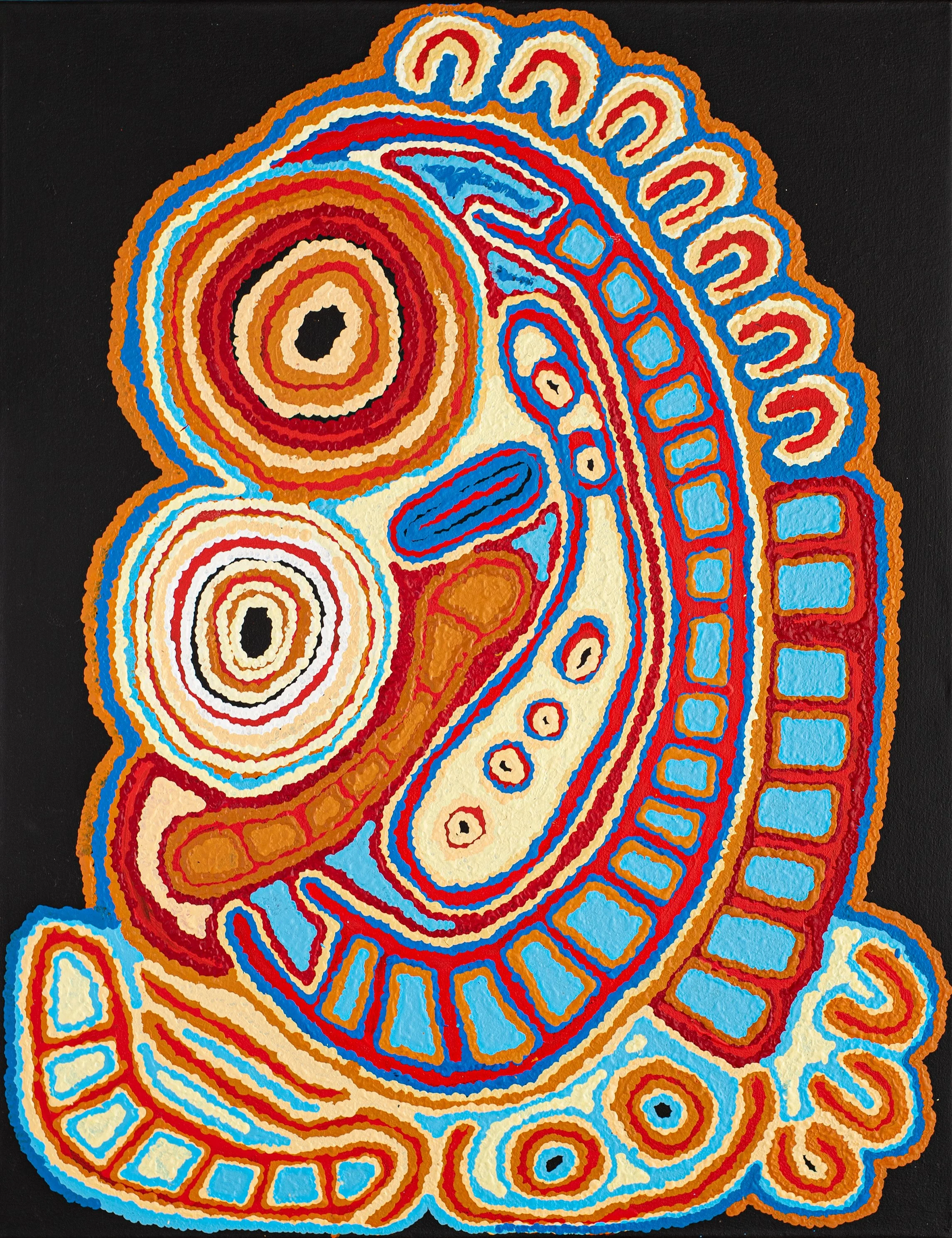
Artiste : Jessica Veronica Brown
Titre de l'œuvre : Seven Sisters
Format : 110 × 85 cm
Provenance et certificat : centre d'art aborigène du Spinifex Art Project
Référence de cette peinture : 23-171
Enquiry / Demander le prix de l'œuvre
Explications pour cette œuvre :
Kungkarangkalpa is a major Western Desert Tjukurpa also known as the Seven Sisters). Tjukurpa is the Pitjantjatjara concept for describing the formative creation where ancestral beings create the world. These beings are Anangu ancestors, who can take the form of people, plants or animals. They traverse the country; forming the world we live in, creating the waterholes, the trees, the clay pans, the rocky outcrops, the sand hills and the Spinifex plains. These land formations are the physical manifestation of the creation energy and tangible evidence that this Tjukurpa is true. This Tjukurpa of the Seven Sisters is an epic songline in the Western Desert and tells the story of many women traveling throughout the desert hunting and carrying out ritual obligations all the while being pursued by a cheeky old man in pursuit of a wife. Nyiru the man, is capable of changing form and does this on occasion in order to trick the women. Many parts of the story are secret and involve a sexual element. Only the public details of this story are allowed to be put down in paint.
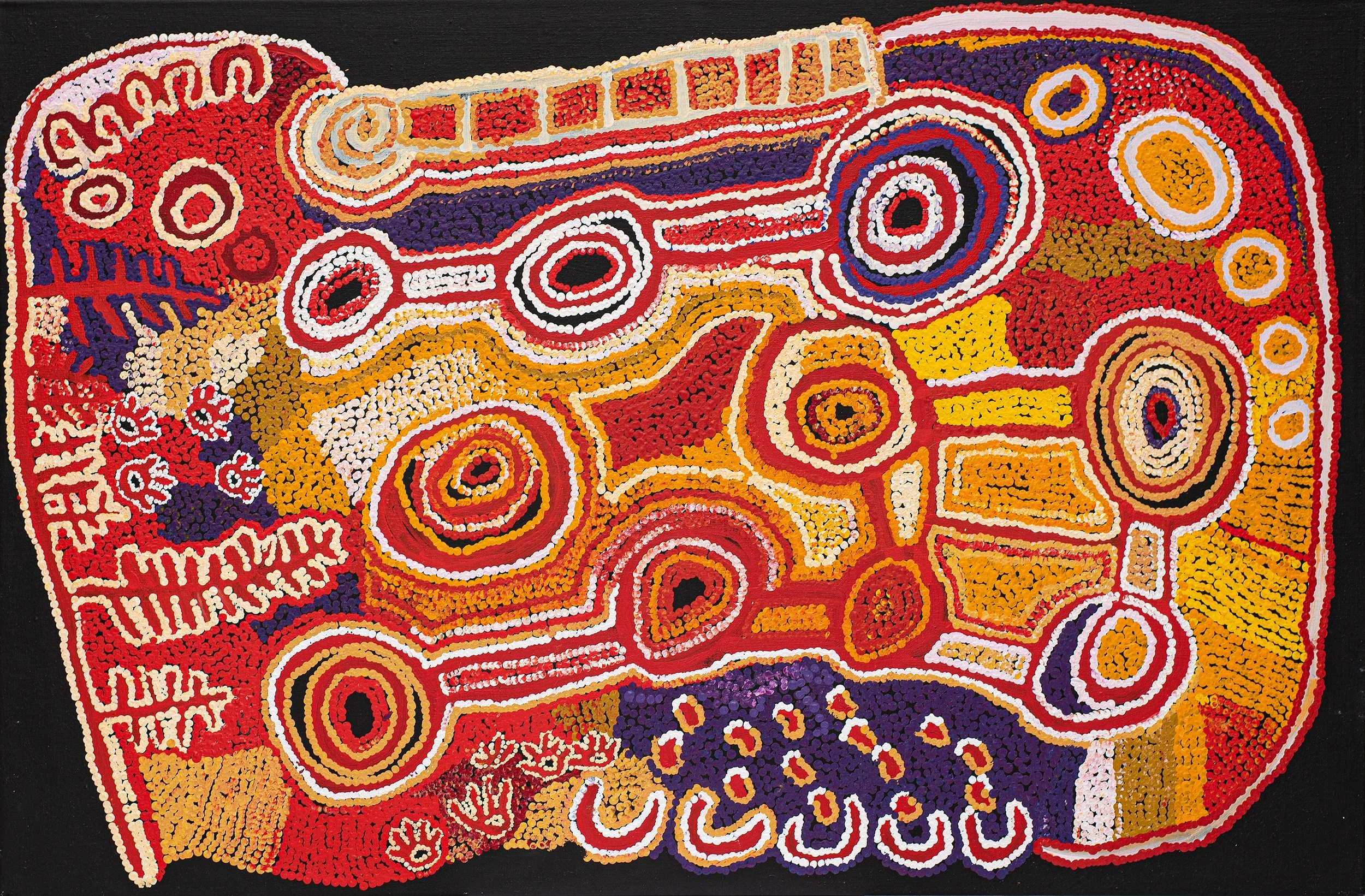
Artiste : Ngalpingka Simms (1945)
Titre de l'œuvre : Wayiyul
Format : 137 x 90 cm
Provenance et certificat : centre d'art aborigène du Spinifex Art Project
Référence de cette peinture : 23-27
Enquiry / Demander le prix de l'œuvre
Explications pour cette œuvre :
Ngalpingka has painted Wayiyul country associated with Minyma Tjuta Tjukurpa (Many Women Creation Line) and is a major women’s songline that traverses vast tracts of traditional Spinifex Land and beyond. This is a Creation narrative with a man at the center but it is truly a women’s story, full of spiritual insight and knowledge for the journey into adulthood. It recounts the long and arduous journey that a group of young women make whilst under constant pursuit of a lustful man (Wati Nyiru) who wishes to take the eldest girl (Kampukurta), for his wife.
Ngalpingka Simms (1945) is a senior artist whose country is Wayilul near present day Patjarr community in the north of Ngaanyatjarra Lands and the northern reaches of the Gibson Desert. Here, she depicts the significant site of Wayilul and nearby Tika-Tika where the women encounter footprints belonging to Wati Nyiru.
Her artworks are in the following prestigious collections :
Collection Prince Stefan Of Liechtenstein, Embassy Of Liechtenstein In Germany.(Women's Collaborate)
Seattle Art Museum, Seattle Usa (Women’s Collaborative)
The British Museum, London, England.(Women's Collaborative)
The National Gallery Of Victoria, Melbourne, Vic. (As Part Of The Women's Collaborative)
The Sims Dickson Collection, Nsw (Collaborative With Kathleen Donnegan)
University Of Queensland Art Museum, Brisbane, Qld.
Art Gallery Of South Australia, Adelaide Sa (Women’s Collaborative)
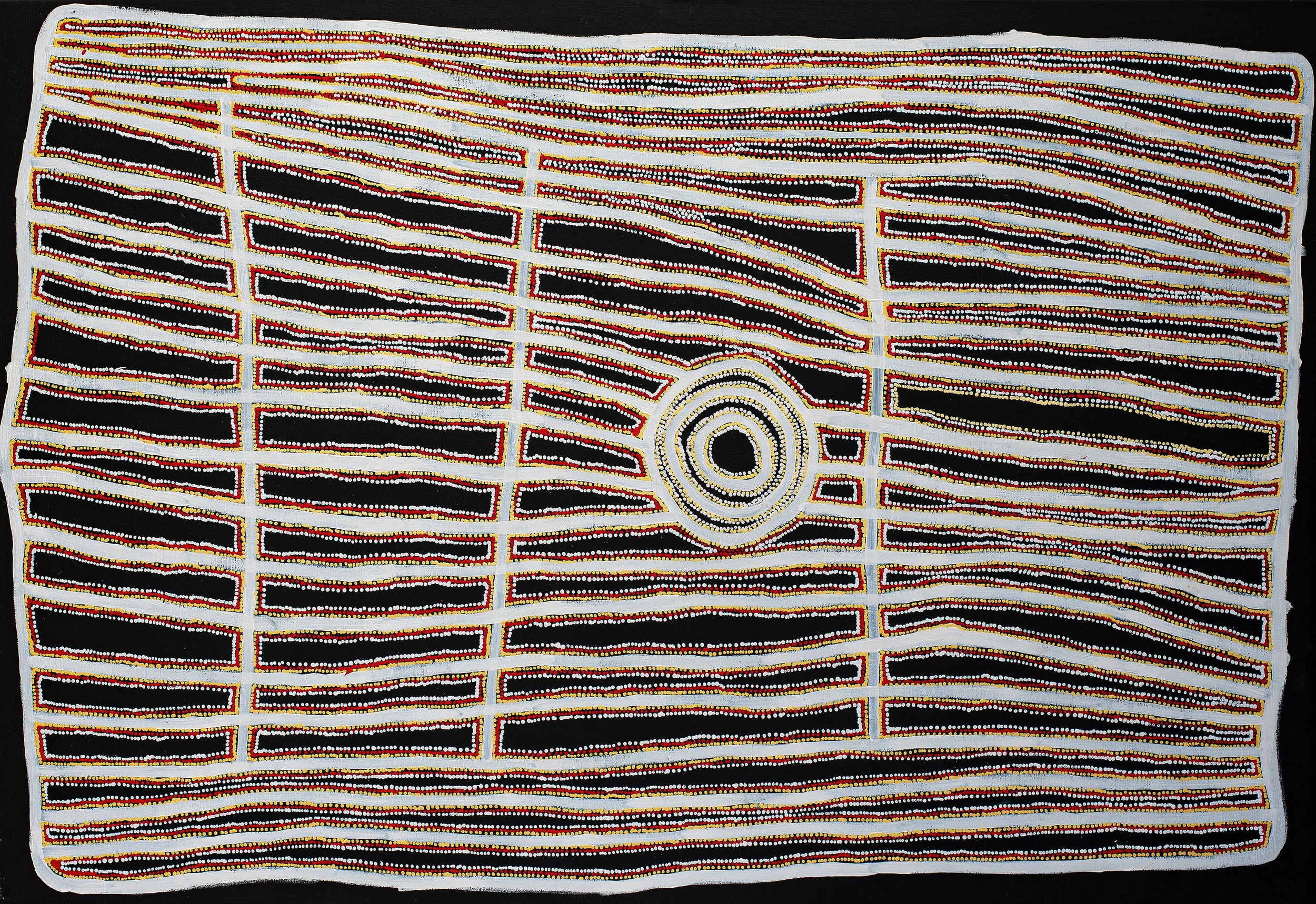
Artiste : Ian Rictor
Titre de l'œuvre : Wati Nyii-Nyii
Format : 200 x 137 cm
Provenance et certificat : centre d'art aborigène du Spinifex Art Project
Référence de cette peinture : 21-252
Enquiry / Demander le prix de l'œuvre
Explications pour cette œuvre :
Ian Rictor (1962) paints with a quiet reverence for the country that he depicts, from his relatively recent nomadic movements over the endless interior that makes up Spinifex Lands. Ian walked from water source to food source and beyond, this was a cultural and family existence for survival in an arid land before his family were found and' brought in' by relatives in 1986, making them the last known hunter gatherer in Australia. Ian's compositions center on the life affirming sites he depicts and each are multi layered with meaning. Many are surrounded with secrecy and only surface details can be recorded. Here he paints the significant site Tuwan, situated in the heart of traditional Spinifex Country and where Ian holds birth connection and custodial obligation. Tuwan is a significant site that holds the Nyii-Nyii Tjukurpa (Zebra Finch Creation Line), a Mens narrative of high sensitivity. It is from here at Tuwan, where a group of powerful Wati Nyii-Nyii (Zebra Finch Men) depart for the southern coast to save the world from the rising seas and eventually using their many spears as a barrier to the inundating water.
His artworks are in the following prestigious collection :
Collection Prince Stefan Of Liechtenstein, Embassy Of Liechtenstein In Germany. (Mens Collaborate)
National Gallery Of Australia, Canberra, Act (Mens Collaborative)
Seattle Art Museum, Seattle, Usa. (Mens Collaborative)
The Aboriginal Art Museum, Utrecht
The British Museum, London. (Mens Collaborative)
The Corrigan Collection, Australia (Mens Collaborative)
Wagner And Owen Collection, Usa.
W. & V. Mcgeoch Collection, Melbourne, Vic. (Mens Collaborative)
Art Gallery Of South Australia, Adelaide, South Australia (Mens Collaborative)

Artiste : Fred Grant
Titre de l'œuvre : Tuwan
Format : 137 × 90 cm
Provenance et certificat : centre d'art aborigène du Spinifex Art Project
Référence de cette peinture : 20-92
Enquiry / Demander le prix de l'œuvre
Explications pour cette œuvre :
Fred Grant (1943) knows the boundless sandhills, the endless skies and extensive forests of Spinifex Country. He's walked the rich cultural fabric that embraces his land wherever he looks and he has inmate knowledge of the life sustaining water sources that are its foundation of survival in an arid environment. Fred paints with the passive authority of someone that knows they belong to the intimacy of a landscape with a powerful religion at its heart.
Here he depicts the site of Tuwan, situated in the heart of Spinifex Country. Tjaltunya holds the powerful Wati Kutjara Tjukurpa (Two Men Creation Line). This is a far reaching narrative that follows two brothers: a black nosed monitor lizard and a sand goanna- as they journey through Spinifex Country. These are creation beings who shaped the landscape as they moved through it leaving the guiding story etched in monolithic physical reminders of their power and presence.
His artworks are in the following collections :
Harriett & Richard England Collection
National Gallery Of Australia, Canberra, Act (Mens Collaborative)
Seattle Art Museum, Seattle, Usa. (Mens Collaborative)
The Corrigan Collection, Australia (Mens Collaborative)
The Lepley Collection, Perth, Western Australia.
W. & V. Mcgeoch Collection, Melbourne, Vic.
Queensland Art Gallery Of Modern Art, Brisbane, Qld.
The Art Gallery Of New South Wales, Sydney, Nsw
Art Gallery Of South Australia, Adelaide, South Australia (Mens Collaborative)

Artiste : Ian Rictor
Titre de l'œuvre : Tuwan
Format : 200 x 137 cm
Provenance et certificat : centre d'art aborigène du Spinifex Art Project
Référence de cette peinture : 21-251
Enquiry / Demander le prix de l'œuvre
Explications pour cette œuvre :
Ian Rictor (1962) paints with a quiet reverence for the country that he depicts, from his relatively recent nomadic movements over the endless interior that makes up Spinifex Lands. Ian walked from water source to food source and beyond, this was a cultural and family existence for survival in an arid land before his family were found and' brought in' by relatives in 1986, making them the last known hunter gatherer in Australia. Ian's compositions center on the life affirming sites he depicts and each are multi layered with meaning. Many are surrounded with secrecy and only surface details can be recorded. Here he paints the significant site Tuwan, situated in the heart of traditional Spinifex Country and where Ian holds birth connection and custodial obligation. Tuwan is a significant site that holds the Nyii-Nyii Tjukurpa (Zebra Finch Creation Line), a Mens narrative of high sensitivity. It is from here at Tuwan, where a group of powerful Wati Nyii-Nyii (Zebra Finch Men) depart for the southern coast to save the world from the rising seas and eventually using their many spears as a barrier to the inundating water.
His artworks are in the following prestigious collection :
Collection Prince Stefan Of Liechtenstein, Embassy Of Liechtenstein In Germany. (Mens Collaborate)
National Gallery Of Australia, Canberra, Act (Mens Collaborative)
Seattle Art Museum, Seattle, Usa. (Mens Collaborative)
The Aboriginal Art Museum, Utrecht
The British Museum, London. (Mens Collaborative)
The Corrigan Collection, Australia (Mens Collaborative)
Wagner And Owen Collection, Usa.
W. & V. Mcgeoch Collection, Melbourne, Vic. (Mens Collaborative)
Art Gallery Of South Australia, Adelaide, South Australia (Mens Collaborative)
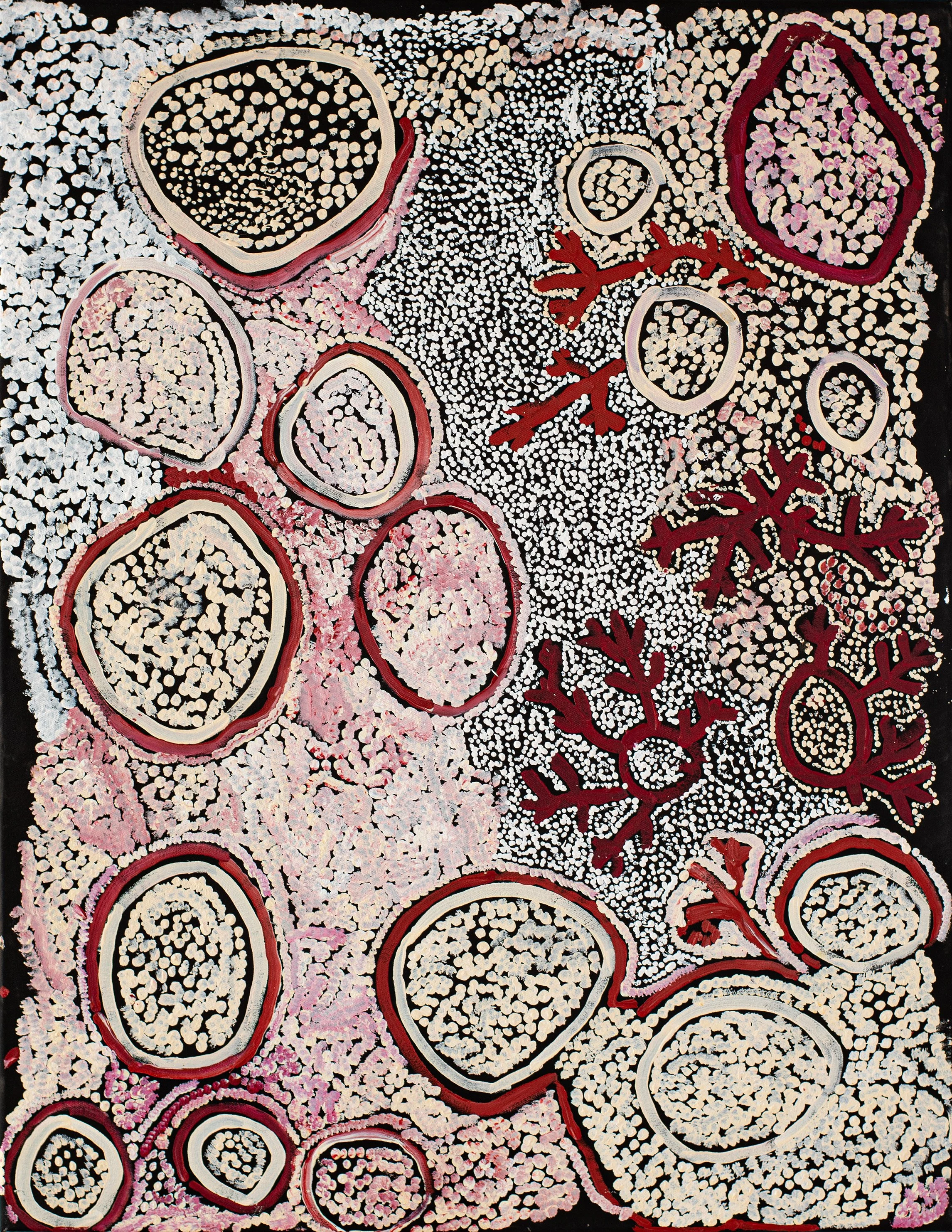
Artiste : Simon Hogan
Titre de l'œuvre : Lingka
Format : 110 × 85 cm
Provenance et certificat : centre d'art aborigène du Spinifex Art Project
Référence de cette peinture : 21-176
Enquiry / Demander le prix de l'œuvre
Explications pour cette œuvre :
Simon Hogan (1930) manifests his site of Lingka onto the two dimensional plane. When he paints, he transcends this world and is taken over soft sand ridges and vast Spinifex plains to the significant sites that formed him from birth. For Simon was born into a spiritual society where religion manifested in the immediate environment and where creation beings could move through different realms at will. It is these beings who shaped the landscape that Simon depicts and who left a moral compass that is still followed today. They gave to people the life giving water sites that were held with such reverence in an arid and remote land. It is these sites that were the means of survival and where religion unfolded in the form of sacred song and performance.
Simon Hogan was born circa 1930 in mid-western Spinifex between Paltju and Lingka. Simon’s exact age is unknown as dates of birth were estimated by the A.E.M. missionaries when the Spinifex people, on arrival at Cundeelee, were “sorted” into family groups, given English names and approximate dates of birth. During childhood two fathers, one born at Warakunu and the other at Munki raised Simon. Simon’s mother’s country is around Tjulya. The Spinifex people were a relatively discreet southern Pitjantjatjara tribal group with es to the north and east that lived a fully traditional hunter-gatherer life until the late1950’s to early 1960s when most people either walked in to Ooldea and Cundeelee or were taken by AEM missionaries to Cundeelee Mission…
From 1995 Simon Hogan was a prominent member of a group of senior traditional owners from Spinifex country who lobbied the WA State Government for Native Title. Although Simon spoke no English he was a confident, initiated Pitjantjatjara man who spoke to senior government officials regarding ownership of country and culture. Exclusive Native Title rights were granted to Simon Hogan and the Spinifex people in 2000 of over 55 000 sq kms of the Great Victoria Desert in WA.
His artworks are in the following prestigious collections :
Art Gallery Of South Australia, Adelaide, South Australia
British Museum, London, England.
Harriet And Richard England Collection
National Gallery Of Australia, Canberra, Act.
National Gallery Of Victoria, Melbourne, Victoria.
Seattle Art Museum, Seattle, Usa. (Mens Collaborative)
Staatliches Museum Fur Volkerkunde, Munich, Germany
The Lepley Collection, Perth, Western Australia.
The Patrick Corrigan Collection, Sydney, New South Wales.
W. & V. Mcgeoch Collection
Western Australian Museum, Perth, W.A.
Artbank, Australian Government Collection. Australia.
Art Gallery Of Western Australia, Perth, Western Australia.
The Art Gallery Of New South Wales, Sydney, Nsw (Mens Collaborative)
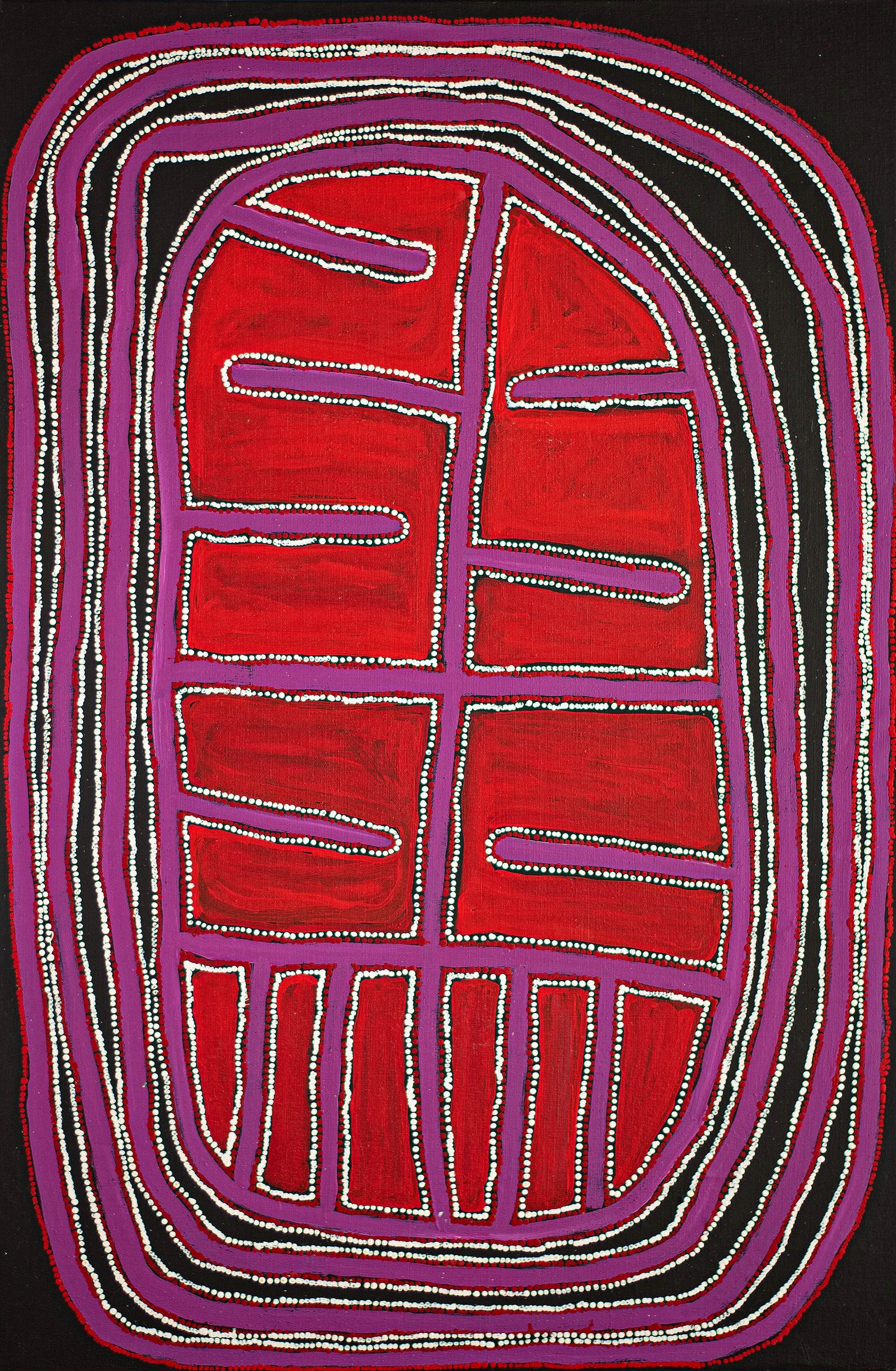
Artiste : Ian Rictor
Titre de l'œuvre : Tuwan munu Kamanti
Format : 137 × 90 cm
Provenance et certificat : centre d'art aborigène du Spinifex Art Project
Référence de cette peinture : 24-170
Enquiry / Demander le prix de l'œuvre
Explications pour cette œuvre :
Ian Rictor (1962) paints with a quiet reverence for the country that he depicts, from his relatively recent nomadic movements over the endless interior that makes up Spinifex Lands. Ian walked from water source to food source and beyond, this was a cultural and family existence for survival in an arid land before his family were found and' brought in' by relatives in 1986, making them the last known hunter gatherer in Australia. Ian's compositions center on the life affirming sites he depicts and each are multi layered with meaning. Many are surrounded with secrecy and only surface details can be recorded. Here he paints the significant site Tuwan, situated in the heart of traditional Spinifex Country and where Ian holds birth connection and custodial obligation. Tuwan is a significant site that holds the Nyii-Nyii Tjukurpa (Zebra Finch Creation Line), a Mens narrative of high sensitivity. It is from here at Tuwan, where a group of powerful Wati Nyii-Nyii (Zebra Finch Men) depart for the southern coast to save the world from the rising seas and eventually using their many spears as a barrier to the inundating water.
His artworks are in the following prestigious collection :
Collection Prince Stefan Of Liechtenstein, Embassy Of Liechtenstein In Germany. (Mens Collaborate)
National Gallery Of Australia, Canberra, Act (Mens Collaborative)
Seattle Art Museum, Seattle, Usa. (Mens Collaborative)
The Aboriginal Art Museum, Utrecht
The British Museum, London. (Mens Collaborative)
The Corrigan Collection, Australia (Mens Collaborative)
Wagner And Owen Collection, Usa.
W. & V. Mcgeoch Collection, Melbourne, Vic. (Mens Collaborative)
Art Gallery Of South Australia, Adelaide, South Australia (Mens Collaborative)
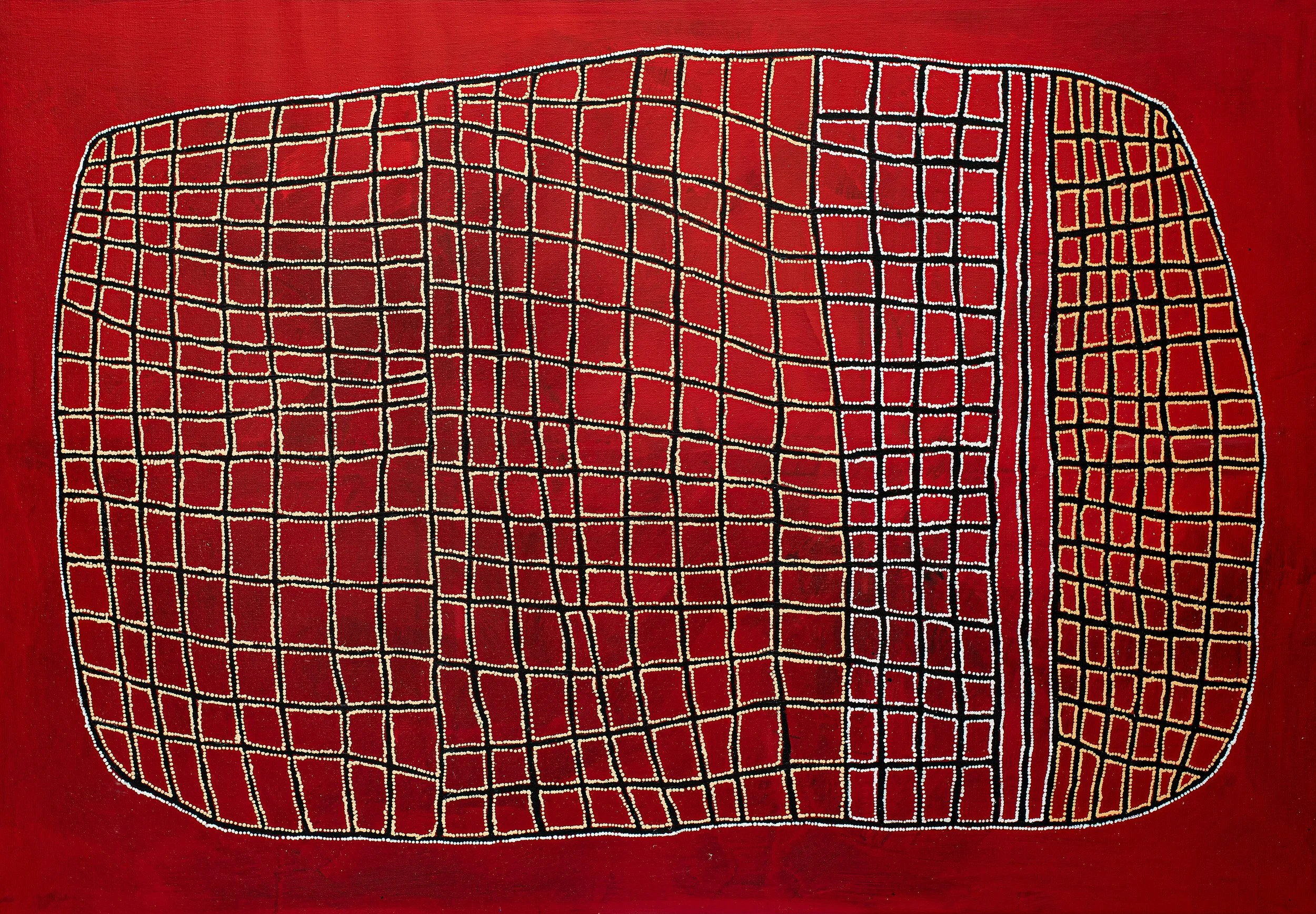
Artiste : Ian Rictor
Titre de l'œuvre : Kupanya
Format : 200 x 137 cm
Provenance et certificat : centre d'art aborigène du Spinifex Art Project
Référence de cette peinture : 24-193
Enquiry / Demander le prix de l'œuvre
Explications pour cette œuvre :
Ian Rictor (1962) paints with a quiet reverence for the country that he depicts, from his relatively recent nomadic movements over the endless interior that makes up Spinifex Lands. Ian walked from water source to food source and beyond, this was a cultural and family existence for survival in an arid land before his family were found and' brought in' by relatives in 1986, making them the last known hunter gatherer in Australia. Ian's compositions center on the life affirming sites he depicts and each are multi layered with meaning. Many are surrounded with secrecy and only surface details can be recorded.
Here he has painted the significant site of Kupanya. It is here that the Punyu Tjukurpa (a small marsupialprobably extinct). Ian states that he lives in the rocks around the site of Kupanya and there are numerous rock depressions that hold water.
His artworks are in the following prestigious collection :
Collection Prince Stefan Of Liechtenstein, Embassy Of Liechtenstein In Germany. (Mens Collaborate)
National Gallery Of Australia, Canberra, Act (Mens Collaborative)
Seattle Art Museum, Seattle, Usa. (Mens Collaborative)
The Aboriginal Art Museum, Utrecht
The British Museum, London. (Mens Collaborative)
The Corrigan Collection, Australia (Mens Collaborative)
Wagner And Owen Collection, Usa.
W. & V. Mcgeoch Collection, Melbourne, Vic. (Mens Collaborative)
Art Gallery Of South Australia, Adelaide, South Australia (Mens Collaborative)
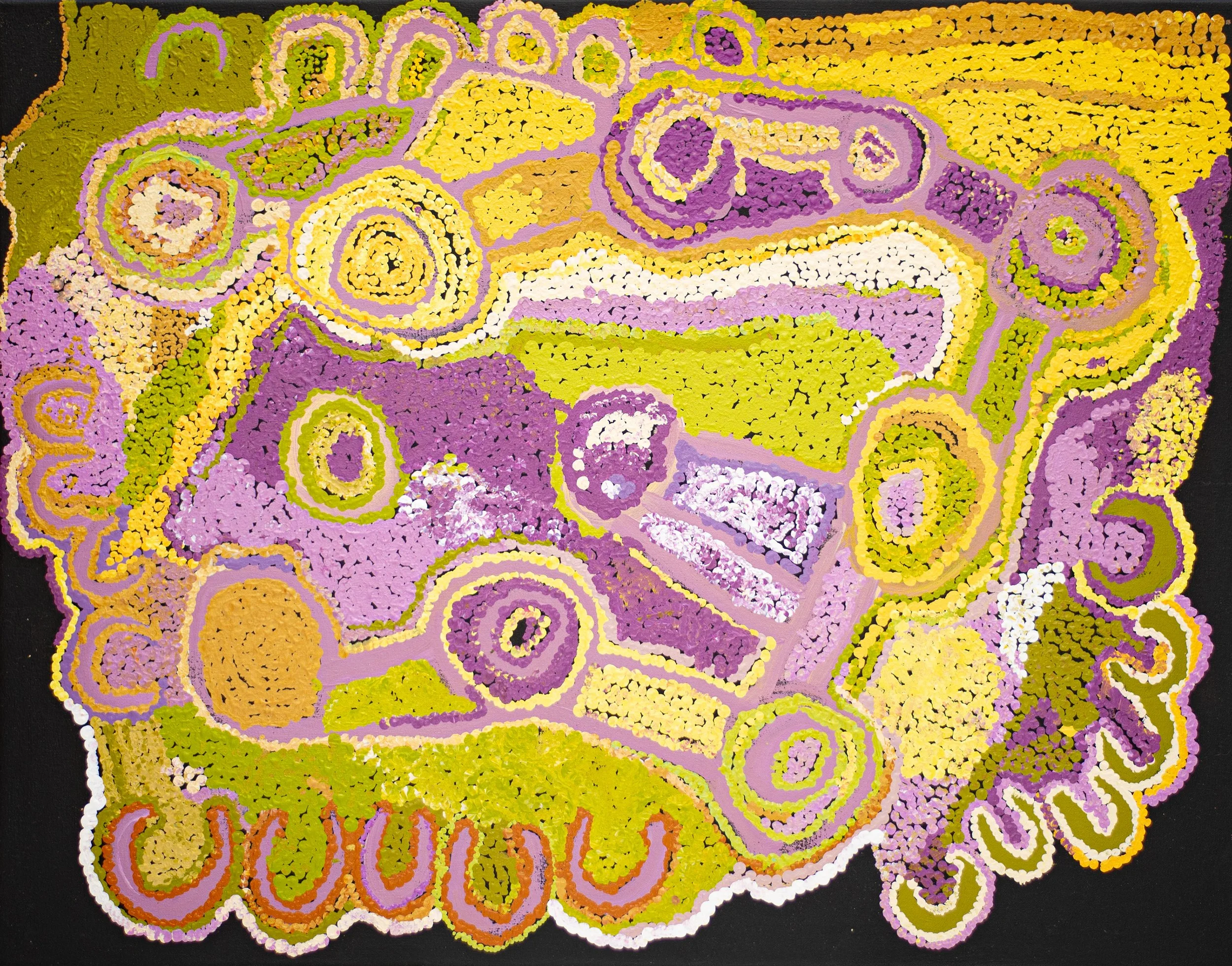
Artiste : Ngalpingka Simms (1945)
Titre de l'œuvre : Wayiyul
Format : 110 × 85 cm
Provenance et certificat : centre d'art aborigène du Spinifex Art Project
Référence de cette peinture : 25-427
Enquiry / Demander le prix de l'œuvre
Explications pour cette œuvre :
Ngalpingka (1945) has painted Wayiyul country associated with Minyma Tjuta Tjukurpa (Many Women Creation Line) and is a major women’s songline that traverses vast tracts of traditional Spinifex Land and beyond. This is a Creation narrative with a man at the center but it is truly a women’s story, full of spiritual insight and knowledge for the journey into adulthood. It recounts the long and arduous journey that a group of young women make whilst under constant pursuit of a lustful man (Wati Nyiru) who wishes to take the eldest girl (Kampukurta), for his wife.
Ngalpingka Simms (1945) is a senior artist whose country is Wayilul near present day Patjarr community in the north of Ngaanyatjarra Lands and the northern reaches of the Gibson Desert. Here, she depicts the significant site of Wayilul and nearby Tika-Tika where the women encounter footprints belonging to Wati Nyiru.
Her artworks are in the following prestigious collections :
Collection Prince Stefan Of Liechtenstein, Embassy Of Liechtenstein In Germany.(Women's Collaborate)
Seattle Art Museum, Seattle Usa (Women’s Collaborative)
The British Museum, London, England.(Women's Collaborative)
The National Gallery Of Victoria, Melbourne, Vic. (As Part Of The Women's Collaborative)
The Sims Dickson Collection, Nsw (Collaborative With Kathleen Donnegan)
University Of Queensland Art Museum, Brisbane, Qld.
Art Gallery Of South Australia, Adelaide Sa (Women’s Collaborative)
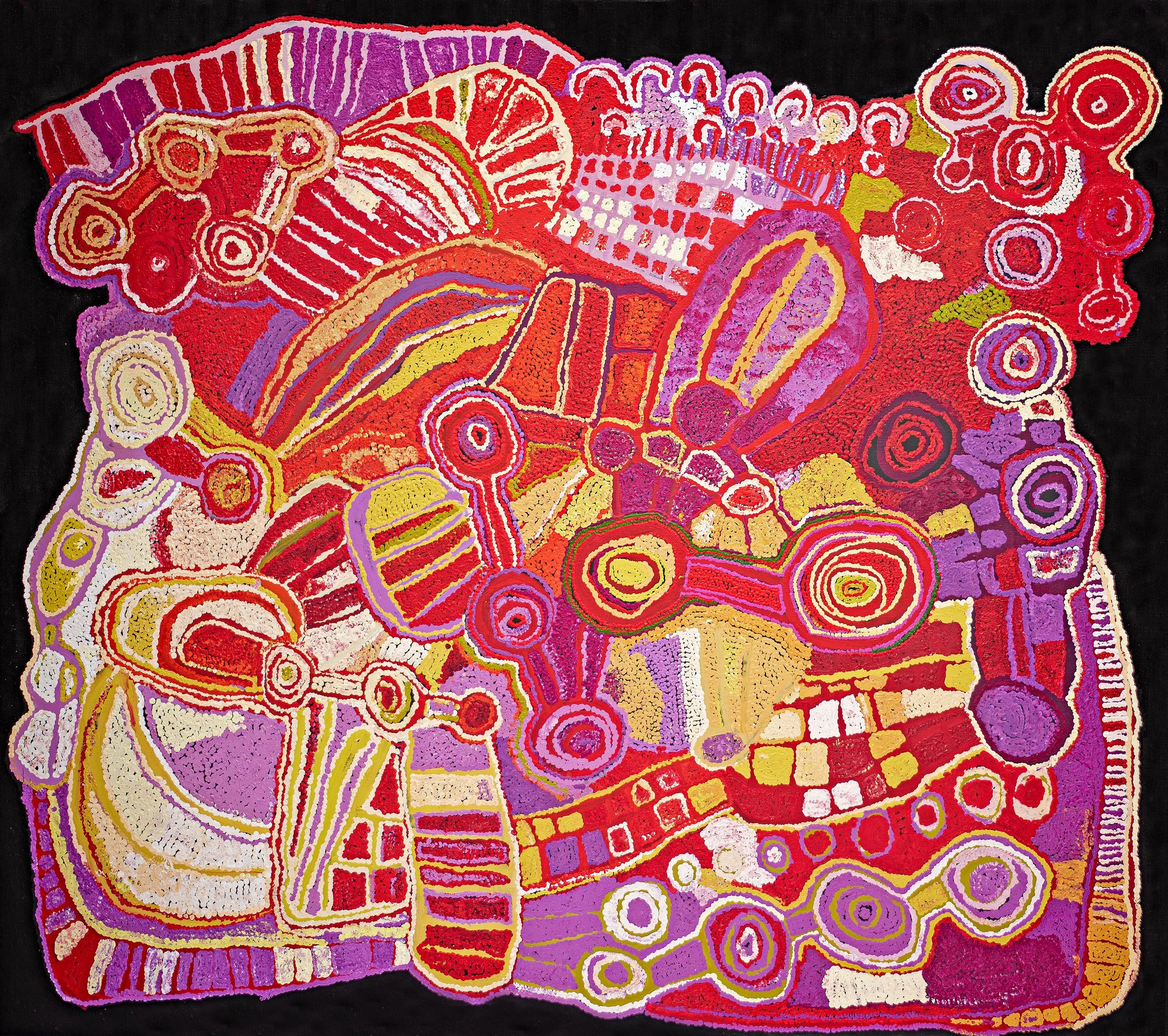
Artiste : Ngalpingka Simms (1945)
Titre de l'œuvre : Wayiyul
Format : 230 × 200 cm
Provenance et certificat : centre d'art aborigène du Spinifex Art Project
Référence de cette peinture : 25-442
Enquiry / Demander le prix de l'œuvre
Explications pour cette œuvre :
Ngalpingka (1945) has painted Wayiyul country associated with Minyma Tjuta Tjukurpa (Many Women Creation Line) and is a major women’s songline that traverses vast tracts of traditional Spinifex Land and beyond. This is a Creation narrative with a man at the center but it is truly a women’s story, full of spiritual insight and knowledge for the journey into adulthood. It recounts the long and arduous journey that a group of young women make whilst under constant pursuit of a lustful man (Wati Nyiru) who wishes to take the eldest girl (Kampukurta), for his wife.
Ngalpingka Simms (1945) is a senior artist whose country is Wayilul near present day Patjarr community in the north of Ngaanyatjarra Lands and the northern reaches of the Gibson Desert. Here, she depicts the significant site of Wayilul and nearby Tika-Tika where the women encounter footprints belonging to Wati Nyiru.
Her artworks are in the following prestigious collections :
Collection Prince Stefan Of Liechtenstein, Embassy Of Liechtenstein In Germany.(Women's Collaborate)
Seattle Art Museum, Seattle Usa (Women’s Collaborative)
The British Museum, London, England.(Women's Collaborative)
The National Gallery Of Victoria, Melbourne, Vic. (As Part Of The Women's Collaborative)
The Sims Dickson Collection, Nsw (Collaborative With Kathleen Donnegan)
University Of Queensland Art Museum, Brisbane, Qld.
Art Gallery Of South Australia, Adelaide Sa (Women’s Collaborative)
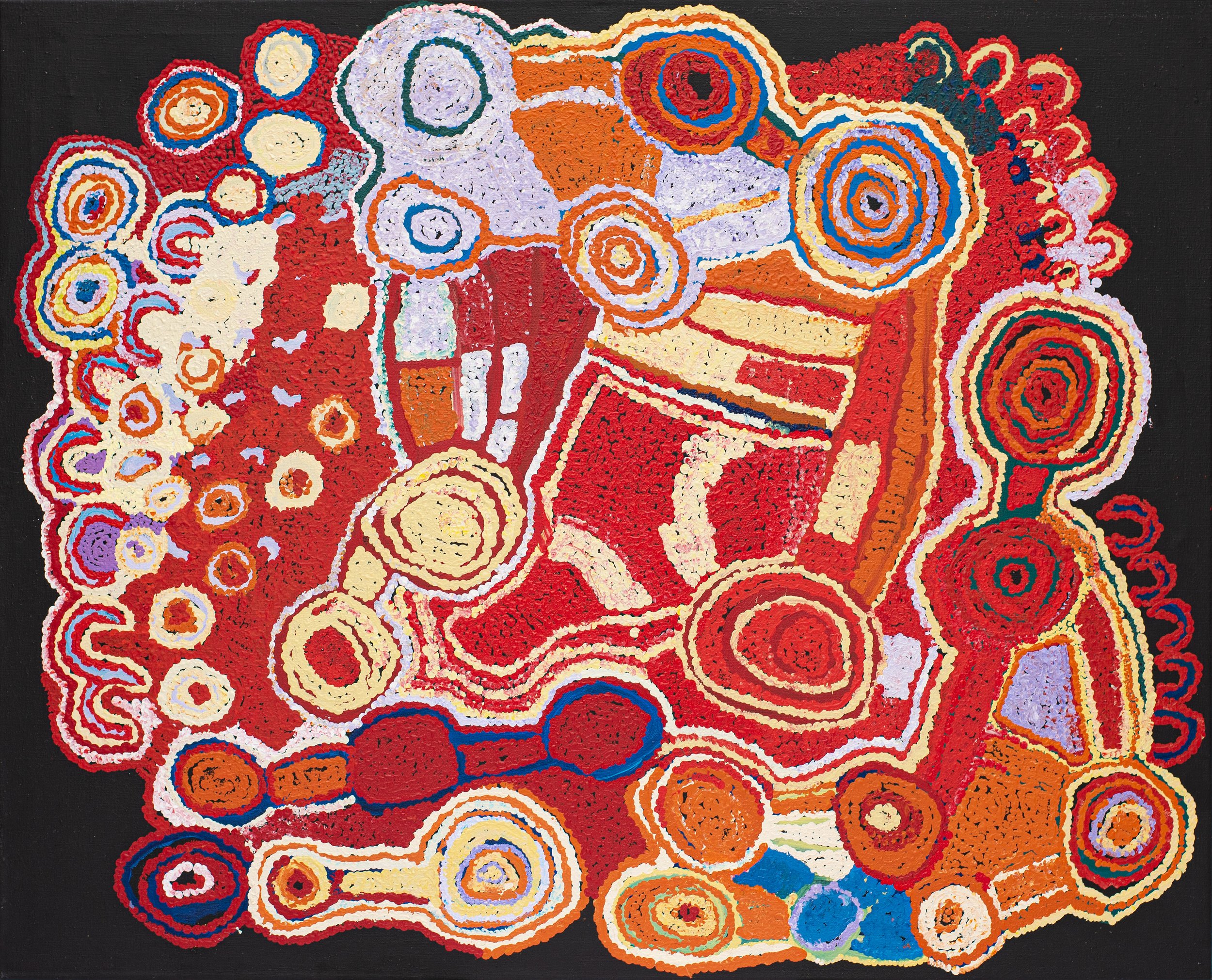
Artiste : Ngalpingka Simms (1945)
Titre de l'œuvre : Wayiyul
Format : 137 × 110 cm
Provenance et certificat : centre d'art aborigène du Spinifex Art Project
Référence de cette peinture : 25-461
Enquiry / Demander le prix de l'œuvre
Explications pour cette œuvre :
Ngalpingka (1945) has painted Wayiyul country associated with Minyma Tjuta Tjukurpa (Many Women Creation Line) and is a major women’s songline that traverses vast tracts of traditional Spinifex Land and beyond. This is a Creation narrative with a man at the center but it is truly a women’s story, full of spiritual insight and knowledge for the journey into adulthood. It recounts the long and arduous journey that a group of young women make whilst under constant pursuit of a lustful man (Wati Nyiru) who wishes to take the eldest girl (Kampukurta), for his wife.
Ngalpingka Simms (1945) is a senior artist whose country is Wayilul near present day Patjarr community in the north of Ngaanyatjarra Lands and the northern reaches of the Gibson Desert. Here, she depicts the significant site of Wayilul and nearby Tika-Tika where the women encounter footprints belonging to Wati Nyiru.
Her artworks are in the following prestigious collections :
Collection Prince Stefan Of Liechtenstein, Embassy Of Liechtenstein In Germany.(Women's Collaborate)
Seattle Art Museum, Seattle Usa (Women’s Collaborative)
The British Museum, London, England.(Women's Collaborative)
The National Gallery Of Victoria, Melbourne, Vic. (As Part Of The Women's Collaborative)
The Sims Dickson Collection, Nsw (Collaborative With Kathleen Donnegan)
University Of Queensland Art Museum, Brisbane, Qld.
Art Gallery Of South Australia, Adelaide Sa (Women’s Collaborative)
Cet été 2014 et 2017, lors de nos visites sur place nous avons eu la chance de découvrir un lac naturel éphémère, généré juste le temps de fortes et rares pluies. Les oiseaux migrateurs faisaient halte dans ce havre de paix perdu au milieu de nulle part.
Leurs artistes ont reçu depuis 10 ans une reconnaissance à la fois en Australie mais également à l’international par les plus grands musées du monde. Le British Museum vient d’acquérir en 2013 et 2014 des œuvres collaboratives de femmes et d’hommes.
La créativité des artistes s’inscrit dans le rayonnement que leur apporte ce retour à la terre traditionnelle, cet ancrage dans leur propre histoire. Ils innovent avec audace, en utilisant le terreau fertile des mythes et rêves traditionnels pour composer des toiles contemporaines complexes remarquables en terme de composition et d’évocation de leur mémoire millénaire.
Artiste : Tjaruwa Woods
Titre de l'œuvre : Anumarapiti
Format : 233 x 197 cm
Provenance et certificat : centre d'art aborigène du Spinifex Art Project
Référence de cette peinture : 13234
Demander le prix de l'œuvre / Enquiry
Explications pour cette œuvre :
Tjaruwa (1954) paints with a knowledge and a devotion to the country that formed her. She was a young woman when she and her immediate family 'walked in' from the Great Victoria Desert in the remote east of Western Australia. This was deemed inhospitable country by the encroaching 'new world' and perceived as so vast and uninhabited, that it made the ideal site to detonate and observe the new wave of nuclear explosions conducted as part of the British Atomic Testing during the 1950's.
Tjaruwa and her family were there, living, breathing, hunting, walking over the soft red carpet of sand, learning the paths of the creation beings who shaped this landscape and made the moral world possible. She slept under a vast expanse by campfire and drank water from tree roots. She learnt the fine art of survival in an arid but spiritual world and how to navigate an environment full of meaning. Tjaruwa paints like she breathes, an almost innate required constant. As she depicts the significant site of Kamanti, she is well aware of the creation manifestation of the Wati Kutjara (Two Men Creation Line) and that these Two Men still reside in the well-formed water cavities that penetrate deep into middle earth. She knows with all her learned experience that these Two Men are to be feared but treated with reverence all the same, for they can travel underground as the enormous water serpents that they are, or walk the landscape in the form of mortal men. And as she sings the sites onto the two dimensional plane, let us appreciate through the panoramic composition that comes from a lifetime of breathing in this country.
Tjaruwa was born in 1954 outside the Spinifex Determination Area at Warutjara, the place of Minyma Tjilkamata - the Echidna Woman, near the current community of Jamieson (Manta Maru) within the Ngaanyatjarra Lands. Except for possession of a few pieces of iron, fashioned into implements and tin bowls Tjaruwa lived traditionally until the winter of 1986 when her family group of seven was located in northern Spinifex by a group of Spinifex people making a sortie into country to re-visit important Men’s sites after some 25 years of absence. Tjaruwa came in with a small son on her hip and camped with her family firstly at Yakatunya, 90 kilometres south of Tjuntjuntjara, joined the moving camp which accompanied the construction of a road, 300 kilometres through the length of the Spinifex Lands, before settling permanently at Tjuntjuntjara in 1989. Tjaruwa was adjudged to be about 32 years old in 1986 and was given the birth date 1/7/1954. At this point in time (2014),Tjaruwa’s family remains the last Aboriginal group in the country to make first contact with contemporary Australia.
It is difficult to even imagine the changes Tjaruwa was to encounter living in her new world. She had acquired an extended network of kin to establish relationships with, the daily activity of hunting and gathering was essentially replaced by the community store and water was abundant.
Tjaruwa’s immediate priority was to care for her mother and uncle living in their new circumstances and it was not until her mother passed away that she took up an interest in painting. At first she tended to paint as she observed other women painting and then the accumulated experience of her other life and her mother’s stories/designs poured out and Tjaruwa’s unique Spinifex perspective was translated with spectacular style and technique on to canvas.
In this painting : Nyangatja ngura ini Anumarapi ka Kuru Ala munkara ka Pukara munkara ka iriti Anangula tjina ankupai ngura winki. This site is called Anumarapiti it is beyond Kuru Ala and Pukara. We would walk all around this country when I was young. This painting is showing the country around where Tjaruwa Woods was born and grew up. Her family were the last people to emerge from the Great Victoria Desert in 1986 where she maintained a traditional hunter gatherer lifestyle until the wider Spinifex group decided to "bring them in." Water sources are a precious resource in the desert and feature strongly in the Tjukurpa and thus the paintings of the Spinifex artists. These stories of Creation beings with magical powers forming country as the lived their lives criss cross over the desert landscape. These beings are alive in the country today. Wanampis (mythical water serpents) still guard the water holes. Anangu know to approach such places with reverance according to cultural law.
Her artworks are in the following prestigious collections :
Art Gallery Of South Australia, Adelaide Sa (Women’s Collaborative)
National Gallery Of Australia, Canberra
National Gallery Of Victoria, Melbourne Vic (Women’s Collaborative)
Richard And Harriet England Collection
Seattle Art Museum, Seattle Usa (Women’s Collaborative)
The British Museum, London, England.(Womens Collaborative)
The Corrigan Collection, Australia
The Lepley Collection, Perth, Western Australia.
The Sims Dickson Collection, Nsw
Parliament House Art Collection, Canberra, Act (Womens Collaborative)
W. & V. Mcgeoch Collection, Melbourne, Vic.
The Berndt Collection, University Of Western Australia.