
Exposition d’art Aborigène “The Past is always Present” Aboriginal art from Australia
En association avec le centre d’art de Tjungu Palya et les estates des artistes.
A la galerie Aboriginal Signature Estrangin : 101 rue Jules Besme, 1081 Bruxelles.
Ensuite la galerie vous reçoit sur RDV, du jeudi 15 janvier au samedi 14 février 2026, du mardi au samedi, de 11h à 19h : vous pouvez également réserver votre visite dés à présent dans notre agenda ici.
C’est avec un immense honneur et une profonde gratitude que nous vous accueillons à cette exposition dédiée à la communauté artistique de Tjungu Palya. Situé au cœur des Anangu Pitjantjatjara Yankunytjatjara Lands dans le désert du sud de l’Australie, à Nyapari, ce centre d’art autochtone incarne une vision collective où les artistes, issus des communautés de Nyapari, Kanpi et Watarru, travaillent et créent ensemble dans l’harmonie et la joie—comme l’exprime le nom même de Tjungu Palya, signifiant littéralement « bien ensemble » dans la langue pitjantjatjara.
Depuis sa fondation en 2006, Tjungu Palya s’est affirmé comme un lieu de créativité et de transmission culturelle, rassemblant des artistes de plusieurs générations qui puisent dans leur mémoire ancestrale et leur lien intime à la terre pour produire des œuvres d’une force expressive unique. Leur art, profondément ancré dans les récits du Tjukurpa (le Temps du Rêve), incarne à la fois un acte de mémoire culturelle et un pont vivant entre tradition et monde contemporain.
L’exposition que vous découvrez ici est rendue possible grâce à une collaboration étroite entre la galerie Aboriginal Signature Estrangin à Bruxelles—reconnue comme l’une des plus importantes galeries d’art aborigène contemporain en Europe — et les créateurs de Tjungu Palya qui ont généreusement partagé leurs œuvres et leurs histoires.
À travers ces peintures vibrantes, vous serez invité·e·s à ressentir la présence vivante du territoire, à entendre les récits des ancêtres et à percevoir la manière dont le passé vit toujours dans le présent, non seulement comme source d’inspiration mais comme force active dans la continuité de l’existence culturelle. Chaque toile est un témoignage de résilience, de créativité, et de cette riche identité qui continue d’évoluer à travers le temps et l’espace.
Nous vous souhaitons une immersion profonde et respectueuse dans cet univers artistique, là où chaque œuvre résonne comme un appel à voir, à comprendre, et à célébrer l’art et la culture vivants d’Anangu.
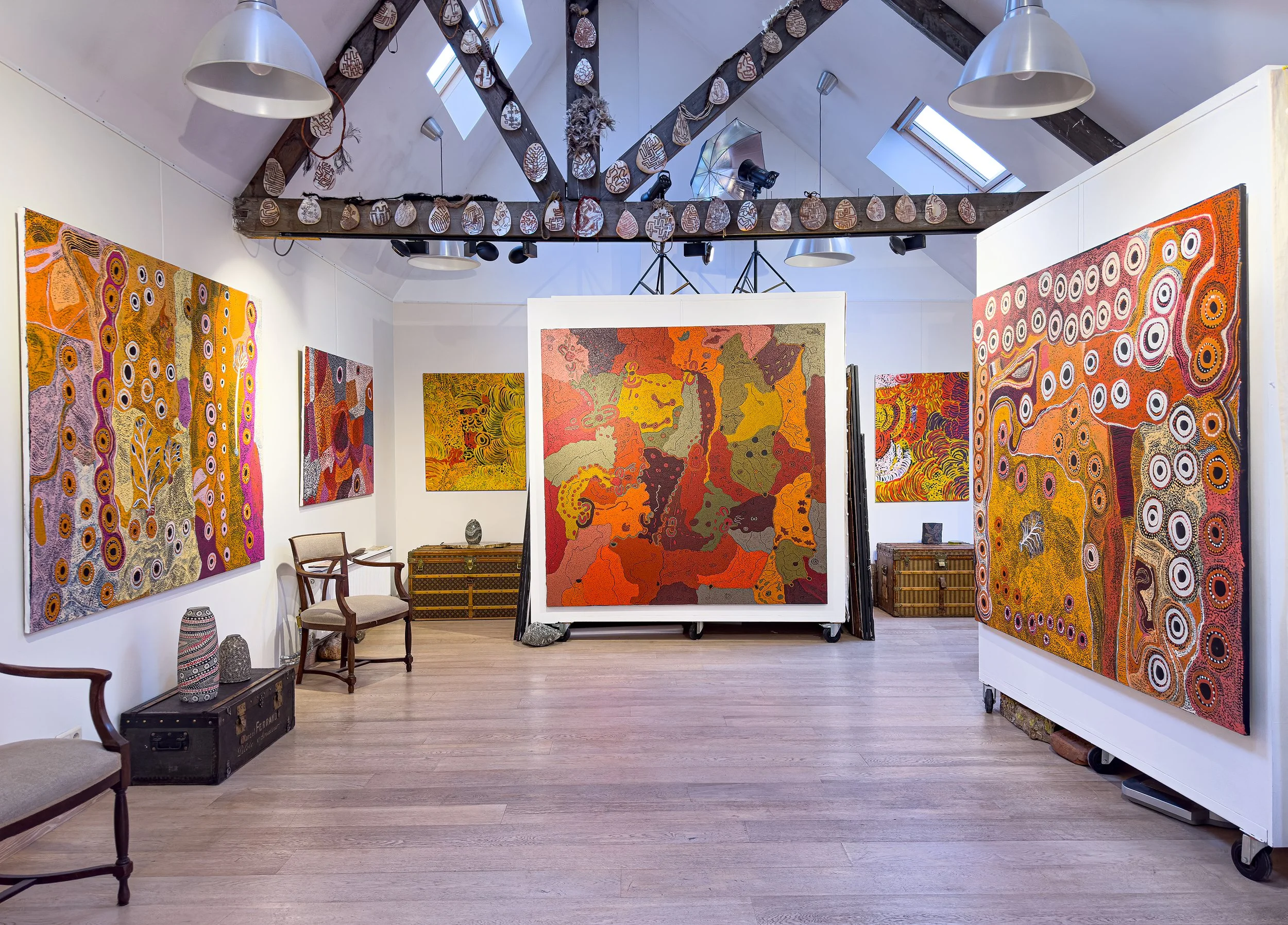
Vue de l’exposition d’art Aborigène “The Past is always Present” © Photo : Aboriginal Signature Estrangin Gallery with the courtesy of the artist and Tjungu Palya.
Essai de Brian Hallet pour l’expOsItion à Bruxelles
Le passé est toujours présent
“Lorsque l’on contemple l’art autochtone australien contemporain, les marques de l’histoire qui se cachent derrière chaque composition ne sont pas toujours aussi évidentes que ce que l’on voit au premier regard. Pourtant, chaque peinture porte souvent une histoire identifiable : celle d’artistes du passé qui ont ouvert une voie nouvelle à travers des territoires interculturels alors inexplorés et inconnus, et qui ont pris sur eux de montrer au monde de l’art de nouvelles manières de voir, de nouvelles façons d’être, ainsi que des perceptions profondes d’un paysage culturel.
Tjungu Palya a vu le jour grâce à la persévérance de ses artistes engagés, dont beaucoup ont vécu le premier contact et n’avaient jamais tenu un pinceau avant de commencer leur carrière artistique tard dans leur vie. Cela ne signifie pas pour autant qu’ils n’étaient pas artistes ; bien au contraire, ils étaient d’extraordinaires interprètes du récit et de sa mise en place sur la toile. Tjungu Palya est devenu un exemple majeur de ce qui est possible dans les centres d’art éloignés lorsque des éléments uniques se rejoignent pour créer un ensemble plus grand que la somme de ses parties…”
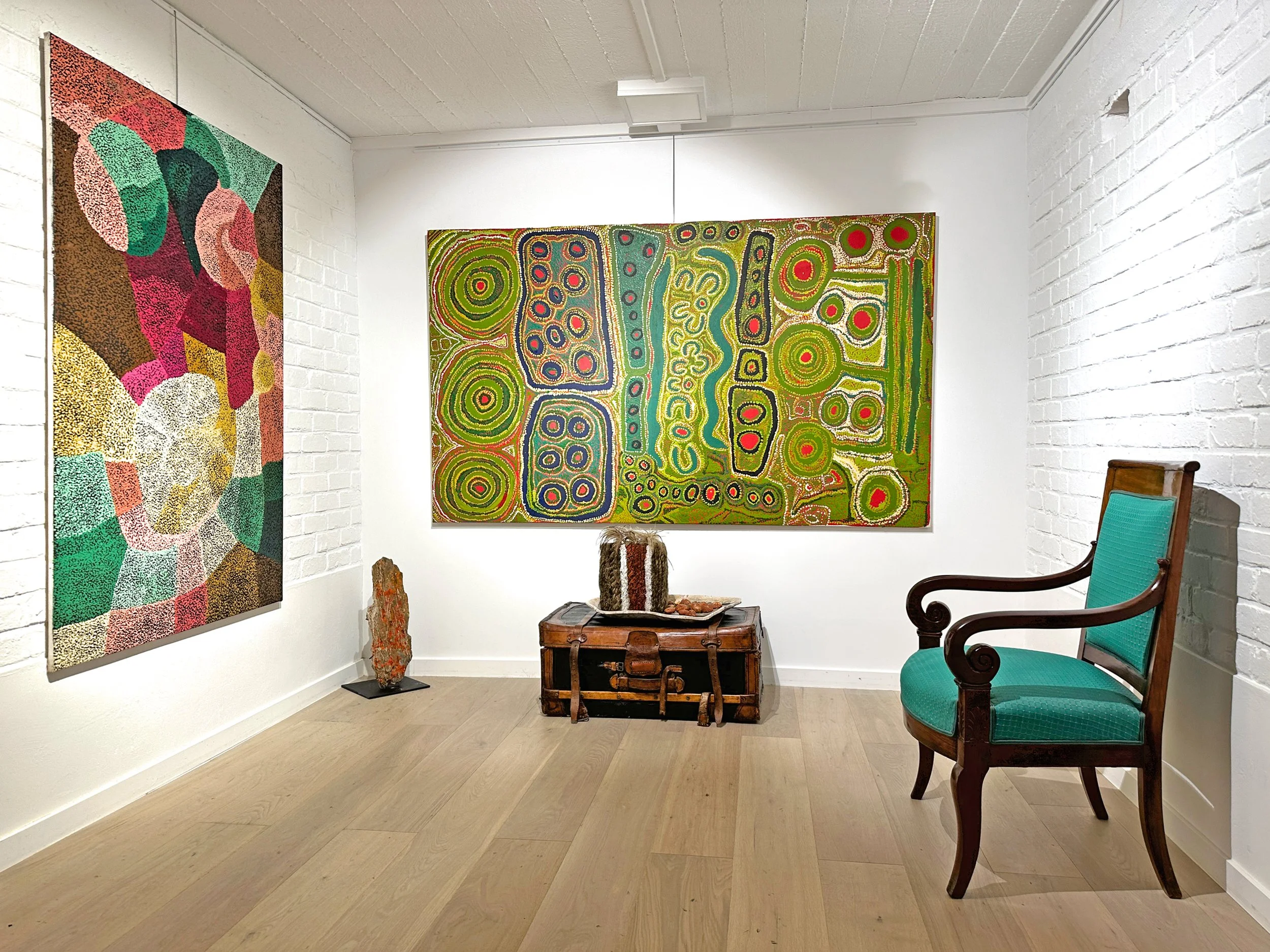
Vue de l’exposition d’art Aborigène “The Past is always Present” © Photo : Aboriginal Signature Estrangin Gallery with the courtesy of the artist and Tjungu Palya.
“Fondé en 2006 pour servir les artistes des communautés de Nyapari, Kanpi et Watarru, Tjungu Palya est rapidement devenu un atelier de production artistique dynamique, dans lequel les artistes eux-mêmes excellaient. En repoussant les limites artistiques et personnelles, les œuvres évoquaient un passé culturel toujours présent dans la vie des gens et subtilement transposé sur la surface bidimensionnelle. La couleur, le récit et la personnalité jouaient tous un rôle central dans le processus créatif. Le monde de l’art y a prêté attention.
Au fil des changements d’équipe et de trop nombreux « sorry business » (deuils), la réserve de Tjungu Palya s’est transformée en un véritable trésor d’archives. De nombreuses œuvres avaient été volontairement conservées en vue d’expositions personnelles, ou bien n’ont plus été montrées après le décès de l’artiste. D’autres artistes ont simplement produit plus d’œuvres qu’il n’était possible d’en traiter sur place. Quoi qu’il en soit, les fruits de ce patrimoine sont aujourd’hui les nôtres à partager…”
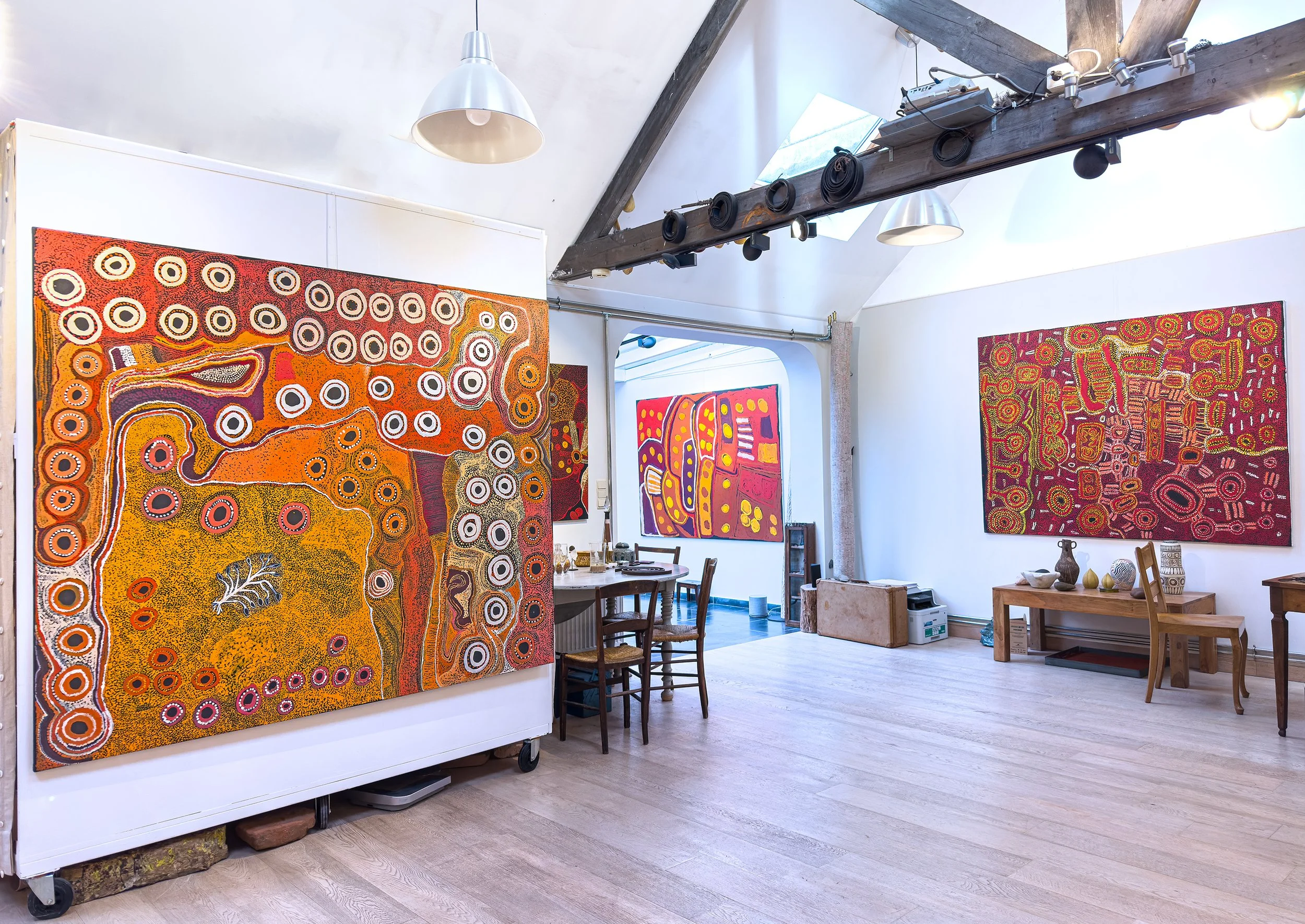
Vue de l’exposition d’art Aborigène “The Past is always Present” © Photo : Aboriginal Signature Estrangin Gallery with the courtesy of the artist and Tjungu Palya.
Maringka Baker vit désormais en maison de soins et ne peint plus, mais quel privilège de pouvoir ramener ses œuvres passées à la lumière d’aujourd’hui. Ginger Wikilyiri, Angkaliya Curtis, Nellie Stewart et Beryl Jimmy ne sont plus parmi nous, mais les noms de ces artistes fondateurs sont à juste titre reconnus pour la singularité de leurs compositions et sont indissociables du succès de Tjungu Palya.
Keith Stevens est également présenté ici, tout comme sa célèbre mère des toutes premières années, Eileen Yaratja Stevens.
C’est comme un voyage de retour vers un jardin abondant, rempli de fruits exotiques que l’on désirait autrefois et que l’on désire encore davantage aujourd’hui. Nous sommes véritablement bénis que ces peintures existent, quelles que soient les circonstances de leur création. Avoir l’opportunité d’être en leur présence, en connaissant pleinement leur origine et le miracle qui les a vues naître, ne fait que rendre leur histoire encore plus pertinente.
Brian Hallett
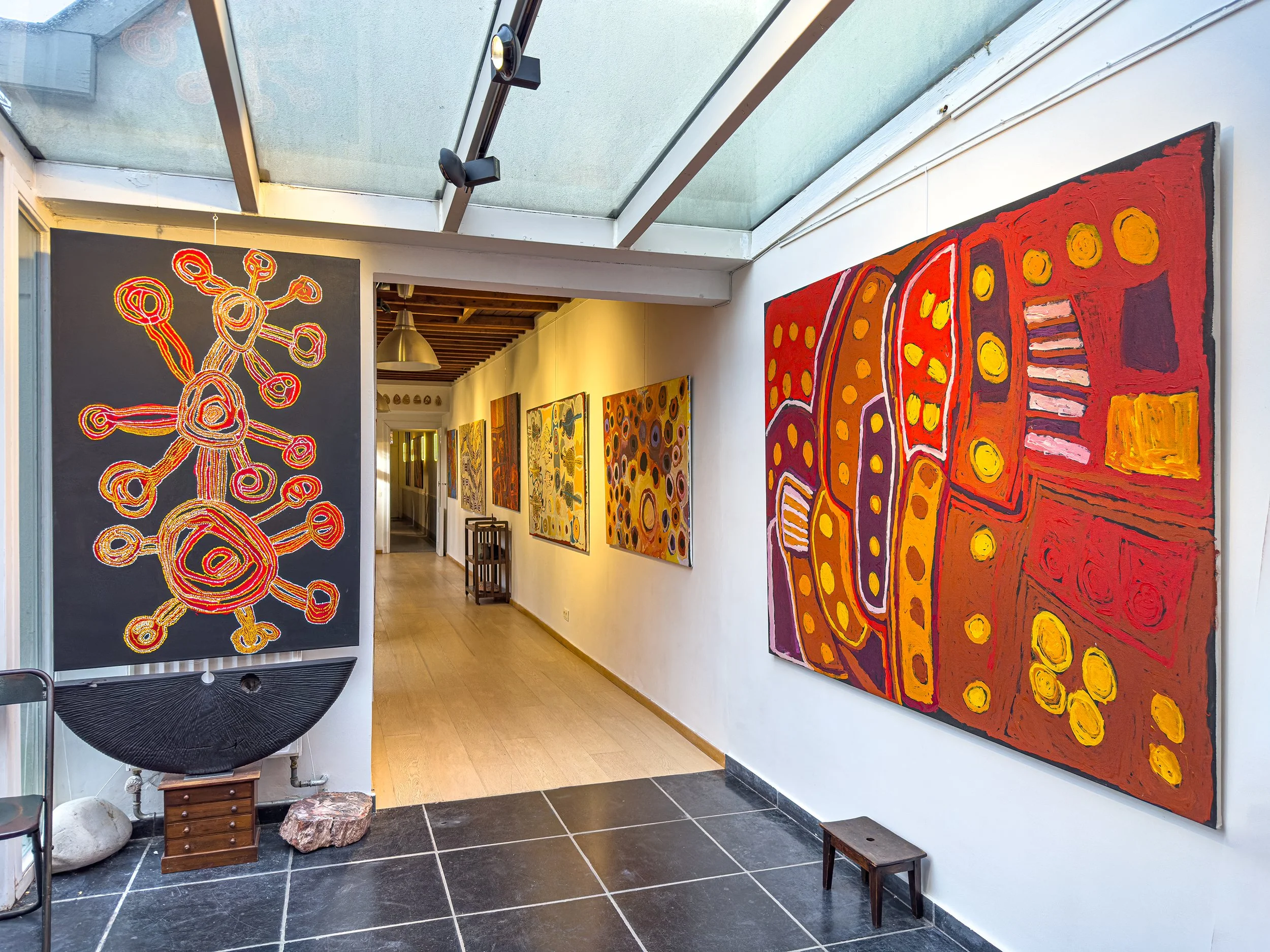
Vue de l’exposition d’art Aborigène “The Past is always Present” © Photo : Aboriginal Signature Estrangin Gallery with the courtesy of the artist and Tjungu Palya.
Découvrez les peintures DISPONIBLES dANS l’exposition :
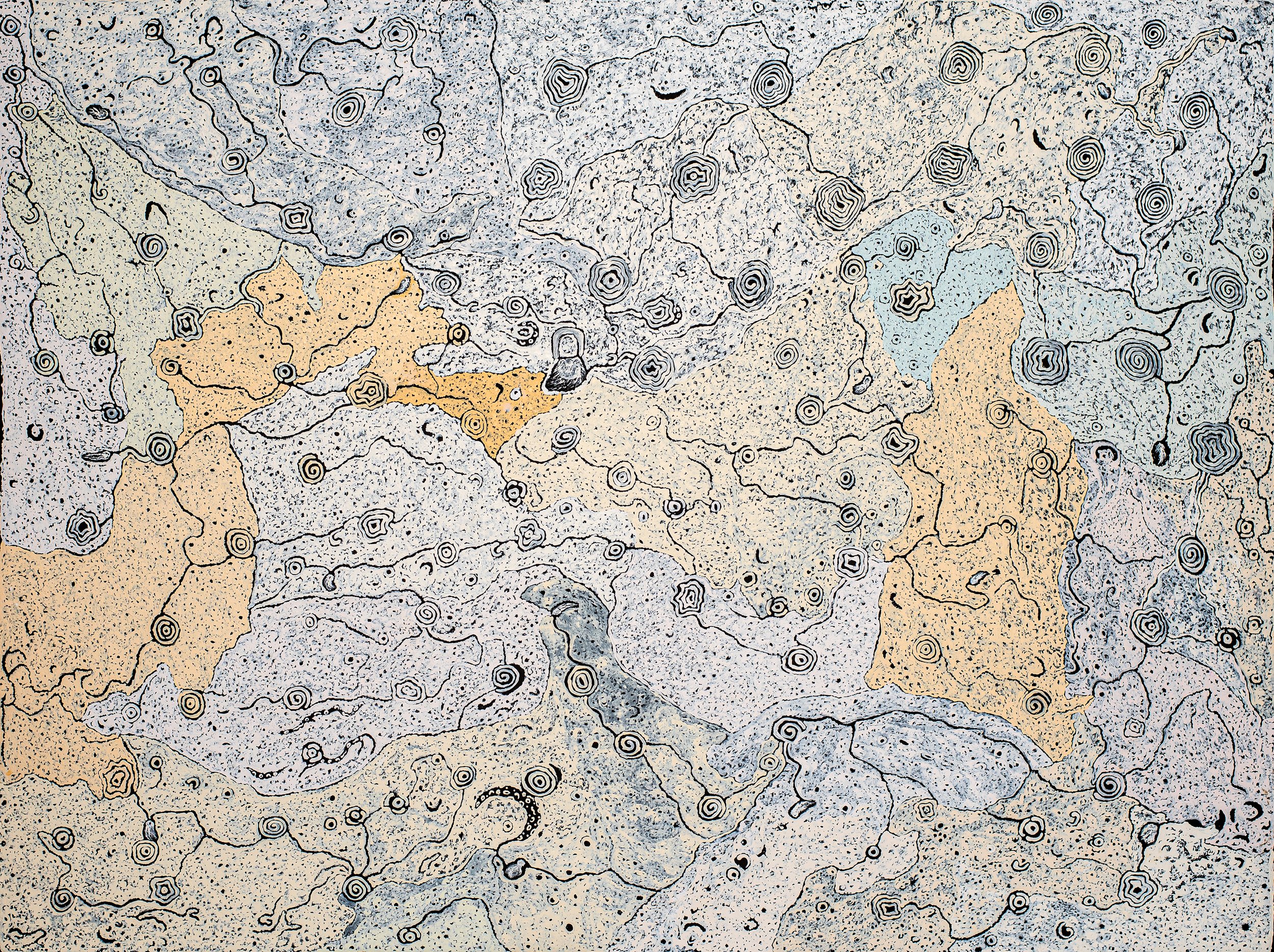
Artiste : Keith Stevens
Titre de l'œuvre : Piltati - Dreaming Time stories
Format : 200 × 150 cm
Provenance et certificat : centre d'art aborigène de Tjungu Palya
Référence de cette peinture aborigène : 25-50
Demander le prix de l'œuvre / Enquiry
Explications pour cette œuvre :
Keith Stevens is a senior Pitjantjatjara man born in the far north of SA at Granite Downs station where his parents were working in the 1940's. Following in his parents footsteps he was mustering at an early age and had no schooling until moving to Ernabella mission. Keith's family would travel for weekends to their traditional homelands of Piltati and Iwarrawarra.
Keith's father eventually sat down with his family close to Piltati creek at what is now Nyapari Community. Keith is a respected senior man in traditional law and a strong community leader. "Today Keith is a man of both worlds. A highly respected traditional law man and a skilled painter of the Tjukurpa in the modern medium of acrylics. His careful application of thick rich colour in intricate patterning creates a three dimensional moulded topography of the Piltati plateau and gully.
This artworks refers to a Tjurkurpa as a love story. This is a story about two brothers and two sisters. The two 'watis' (brothers) - two water snakes, are at the Piltati rockhole waiting for two sisters.
The two sisters who married two brothers and they all lived together.
One day the women went wandering and they went such a long way that they forgot about their husbands. Back at the camp, the two husbands were thinking, 'Where are our wives?' and they decided to go looking for them. One brother said to the other, 'What should we become to go looking for them?' and the other brother said 'Why don't we become Rainbow Serpents?' And they travelled in the sky looking down for their wives. Finally they see them hunting for carpet snakes and they put something in the hole where the women were digging. The women find it and then dig another hole and once again the men have put something in there. And this is how the men lure the women back to Piltati where the men make the sisters transform into Wanampi, swallow them and keep them in their throats. All four of them live together in the waterhole and still live there today.
His artworks are in the following prestigious collections :
Australian War Memorial
Art Gallery of South Australia, Adelaide, SA
National Gallery of Victoria, Melbourne, VIC
Artbank, Australian Government National Contemporary Art Rental
Arthur Roe Collection, Melbourne, VIC
W & W McGeoch Collection, Melbourne, VIC
The Lepley Collection, Perth, WA
The Collection of Berengere Primat, Geneva, Switzerland
The Kennedy Collection, Sydney, NSW
© Photo : Aboriginal Signature Estrangin gallery with the courtesy of the artists and Tjungu Palya.
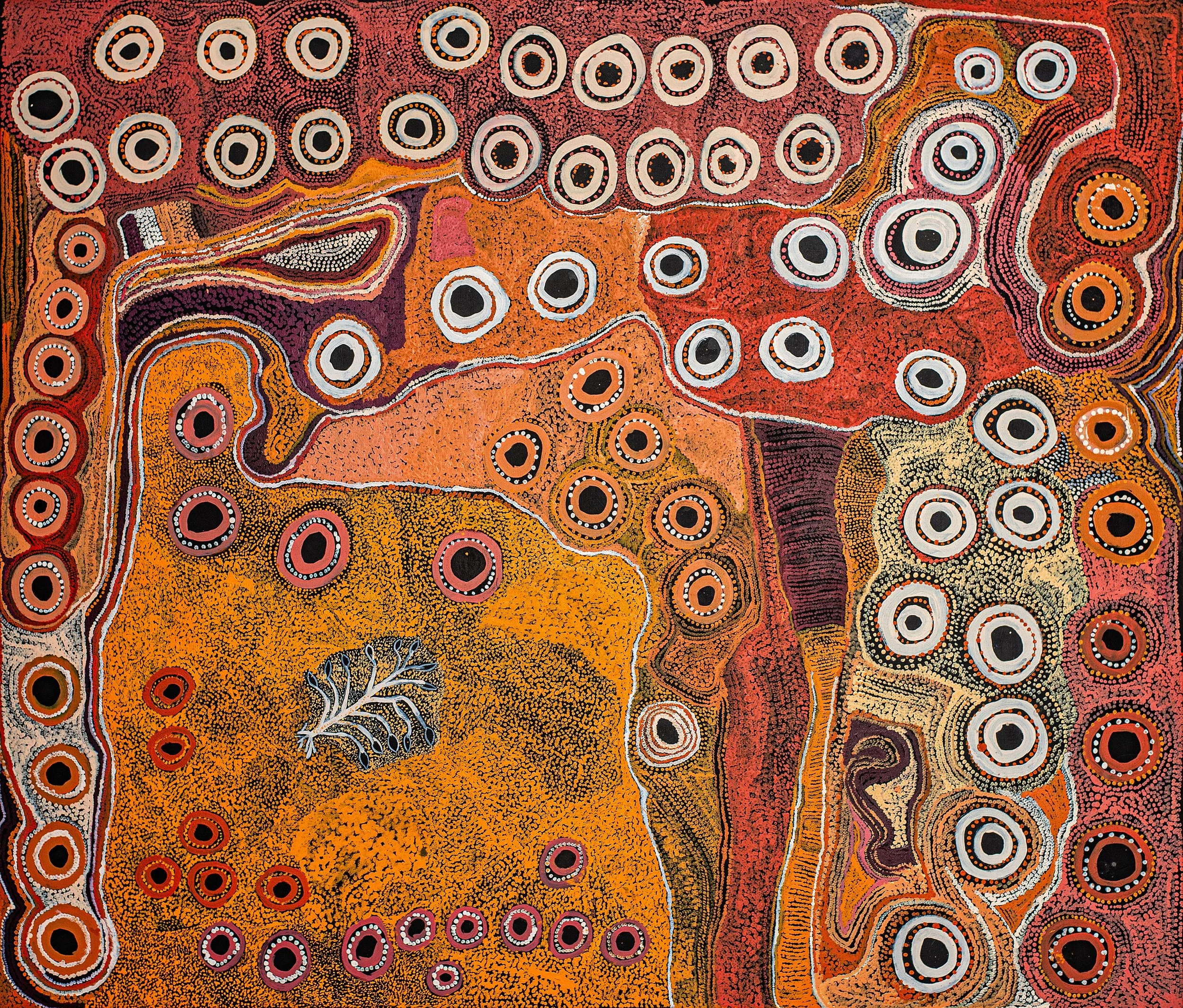
Artiste : Ginger Wikilyiri
Titre de l'œuvre : Kunamata - Dreaming Time stories
Format : 200 × 168 cm
Provenance et certificat : centre d'art aborigène de Tjungu Palya
Référence de cette peinture aborigène : 21-012
Demander le prix de l'œuvre / Enquiry
Explications pour cette peinture Aborigène :
Ginger was born at Kunamata a rock hole south of Nyapari in 1930. His father had three wives. Wingu Tingima is the daughter of the first wife and Ginger the son of the second. Ginger is a senior law man and has cultural responsibilities for both Kunamata and Piltati.His passion for land management and horticulture has taken him to Israel where he learnt about arid land techniques and Mutijulu where he worked for many years as a ranger for Uluru-Kata Tjuta National Park. Ginger Wikilyiri's marvellously expressive and vibrantly coloured works embody a wealth of traditional knowledge. His works feature in major public institutions and private collections both locally and internationally. In terms of formal artistic properties, Ginger Wikilyiri's works are tours de force.
This artwork is dealing about Kunamata. Tis is my ngura (homeland). There are many different plants, animals and landforms at Kunamata. There is karu pulka (a big creek) that runs from the apu (rocky hills). Itjulu is on the other side and apu tjuta (rocky hills) are everywhere with different manta (ground) and different punu (trees). There is Ili (native fig) growing at Kunamata and underneath is Minkulpa Tjuta (lots of native tobacco). Kunamata is a very special place for my family.
The snake is panakura (desert death adder). Each day he ventures out to the cave to paint sacred designs on the cave walls, before returning home again. His home is in the sand hills close to Kunamata. Somemes I also paint two Liru's (snakes) kunga and wati (female and male), coming from Kunamata. Along the way they hunt for mingkiri (mice) at night. In my paintings you will somemes see the mingkiri tracks. They are going out collecting food and water and returning to their cave. The mingkiri always hide underground in their warren.
Meanwhile, during the dayme, that tjalku (bilby) was looking for tjala (honey ant) inside the tjala's nest. Walawuru (eagle) was waiting for him to appear out in the open. Eventually tjalku did so and walawuru eats him. This country where this story is, is called Ilpin. There are sand hills, rock holes and rock boulders. This country is sacred country.
His artworks are in the following prestigious collections :
Araluen Art Collection, Department of Natural Resources, Environment, The Arts and Sport
The Parliament House Collection, Canberra, ACT
Artbank, Australian Government National Contemporary Art Rental
Macquarie Bank Flinders University, Adelaide South Australia
Lagerberg-Swift Collection, Perth Western Australia
Marshall Collection, Adelaide, South Australia
Merenda Collection, Perth Western Australia
The Beat Knoblacuch Collection , Switzerland
Flinders university, Adelaide, SA
University of Canberra, ACT
The Lepley Collection,Perth, WA
Dr. Ian Bernadt Collection, Perth Western Australia
National Gallery of Victoria, NGV. Melbourne, VIC
Australian National University, Canberra, ACT
The Corrigan Collection, Perth Western Australia
Art Gallery of South Australia, Adelaide, SA
National Gallery of Australia , NGA. Canberra, ACT
Deakin University, Melbourne,
VIC W & V McGeoch, Melbourne, VIC
The Collection of Berengere Primat, Geneva Switzerland
The Kennedy Collection, Sydney NSW
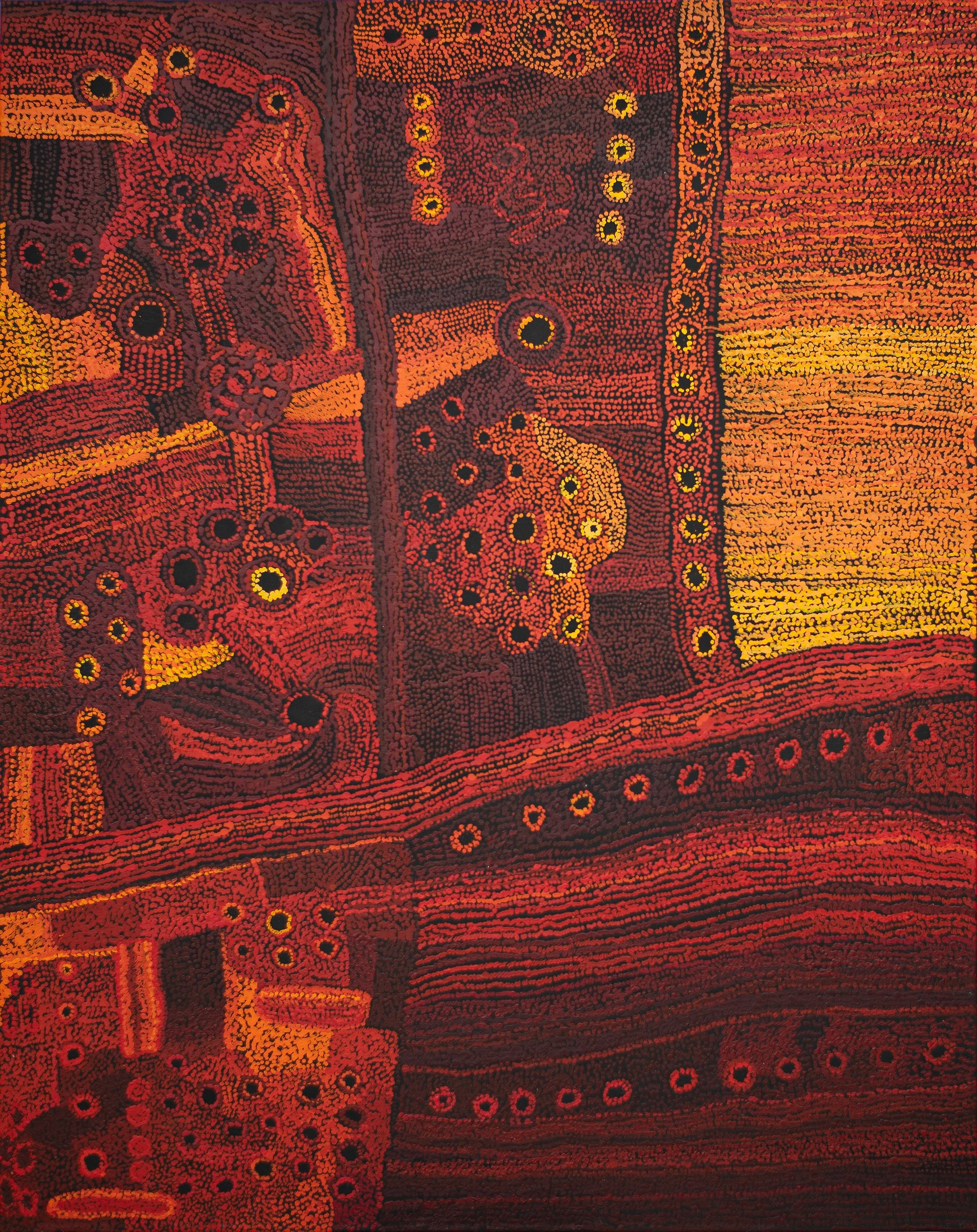
Artiste : Maringka Baker
Titre de l'œuvre : Minyma Kutjara Dreaming stories
Format : 150 x 120 cm
Provenance et certificat : centre d'art aborigène de Tjungu Palya
Référence de cette peinture aborigène : 16-123
Demander le prix de l'œuvre / Enquiry
Explications pour cette peinture d'art Aborigène :
Maringka is a senior Pitjantjatjara woman living in the remote community settlement of Kanpi, 100kms east of the tri-state borders of WA, SA, and the NT. Maringka was born c1952. at Kaliumpil rock hole, a traditional camp site in Western Australia. Maringka's parents died when she was young and she was raised by Anmanari Brown and other members of her extended family. She went to the mission schools of Warburton in WA and Ernabella in SA. Maringka married a man from Papulankatja and they had two children. Their younger daughter passed away in childhood. Elaine Woods the elder daughter married a Docker River man and they had four daughters, Julie Woods, Janice Woods, Venita Woods and Casseyanne Woods.
Maringka has three great grandchildren. Maringka remarried Douglas Baker (Jimmy Baker's cousin) later in life and settled in Kanpi community, Douglas's country. Maringka has a deep connection to country and a spiritual connection with the land. These powerful links to the desert are expressed with beauty and integrity in her paintings and her work is highly sought after. Maringka was selected as one of thirty one artists from every state and territory in Australia to participate in the 'National Indigenous Art Triennial 07 - Culture Warriors'. Maringka continues to paint powerful and alluring prize-winning paintings through which she has gained notoriety nationally and internationally.
In this artwork she is dealing about Minyma Kutjara Tjukurpa (the creaon story of the two sisters). The big sister was travelling with her younger sister back to their homeland. The little sister was reluctant to head further and further north as she had been living with a different family near the ocean to the south. She had been lost for a long me and was unfamiliar with the landscape the big sister was showing her.
Eventually the older sister gave her a piggyback and tried to comfort her. She continued to teach her all about the country they travelled through. Somemes when they stopped they performed Inma (sacred singing and dancing). They camped at Punuwara and Irrunytju rockhole before heading further north to Docker River.
In my paintings you can see all the different parts of these landscapes as they were shown to the younger sister and as they change into each other.
Her artworks are in the following prestigious collections :
Araluen Collection, Alice Springs, Northern Territory
Artbank, Australian Government National Contemporary Art Rental
Australian National University, Canberra, Australian Capital Territory.
Deakin University, Melbourne, Victoria.
Flinders University, Adelaide, South Australia.
Harriett And Richard England Collection,
Hassall Collection, Sydney, New South Wales.
Lagerberg-Swift Collection, Perth, Western Australia.
Levi And Kaplan Collection, Seattle, Usa
Marshall Collection, Adelaide, South Australia.
National Gallery Of Australia, Canberra, Australian Capital Territory.
South Australian Art Gallery, Adelaide, South Australia.
The Beat Knoblacuch Collection, Switzerland.
The Corrigan Collection, Sydney, New South Wales.
The Lepley Collection, Perth, Western Australia.
The Parliament House Collection, Canberra, Australian Capital Territory.
University Of Canberra, Australian Capital Territory
W & V Mcgeoch, Melbourne, Victoria
Art Gallery Of South Australia, Adelaide, South Australia
The Authur Roe Collection, Melbourne, Vic
The Peter & Agnes Cooke Collection, Brisbane, Qld
Alison And Peter W. Klein Collection, Ludwigsburg, Badenwurttemberg, Germany
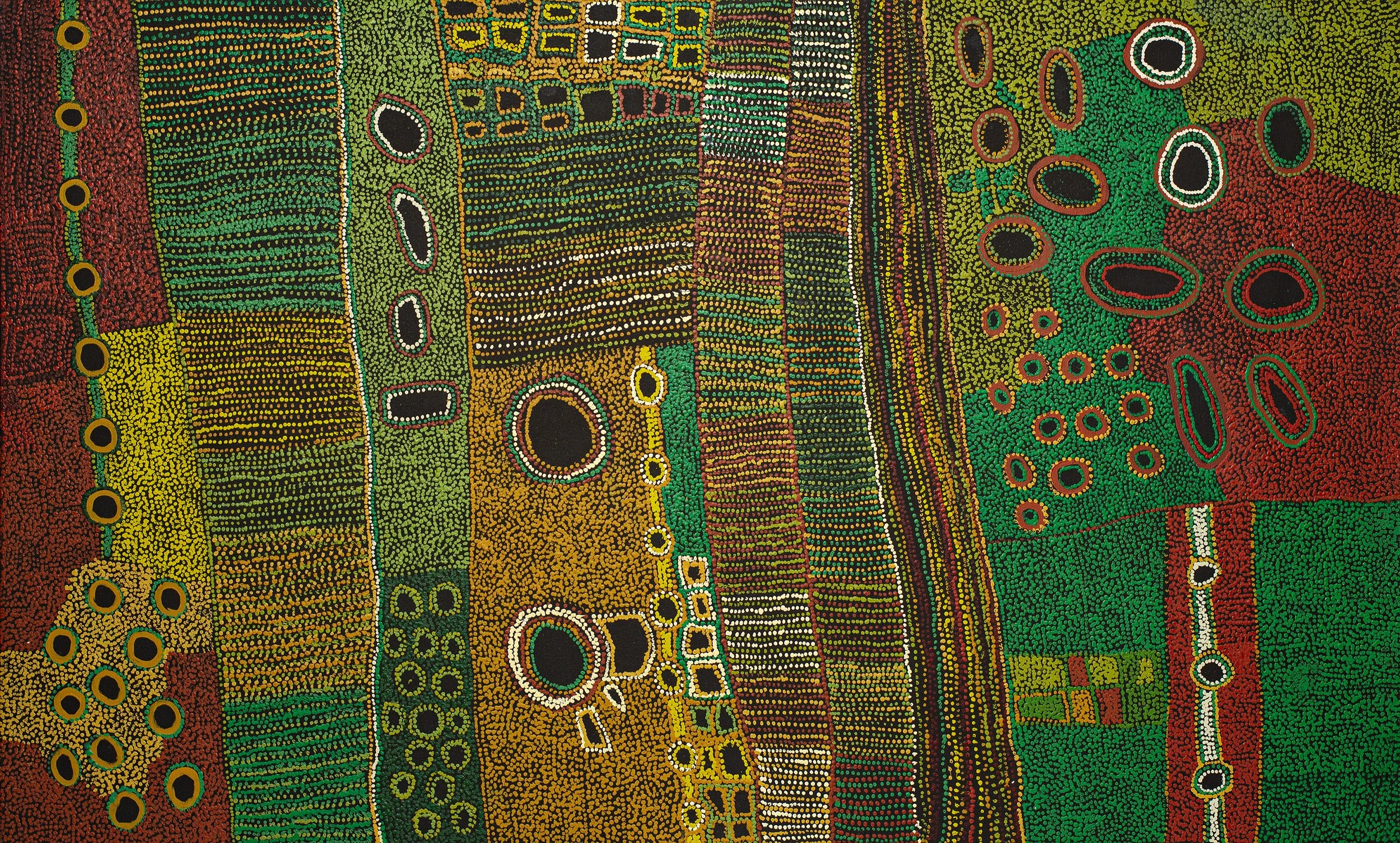
Artiste : Maringka Baker
Titre de l'œuvre : Minyma Kutjara Dreaming stories
Format : 200 x 120 cm
Provenance et certificat : centre d'art aborigène de Tjungu Palya
Référence de cette peinture aborigène : 13377
Demander le prix de l'œuvre / Enquiry
Explications pour cette peinture d'art Aborigène :
Maringka is a senior Pitjantjatjara woman living in the remote community settlement of Kanpi, 100kms east of the tri-state borders of WA, SA, and the NT. Maringka was born c1952. at Kaliumpil rock hole, a traditional camp site in Western Australia. Maringka's parents died when she was young and she was raised by Anmanari Brown and other members of her extended family. She went to the mission schools of Warburton in WA and Ernabella in SA. Maringka married a man from Papulankatja and they had two children. Their younger daughter passed away in childhood. Elaine Woods the elder daughter married a Docker River man and they had four daughters, Julie Woods, Janice Woods, Venita Woods and Casseyanne Woods.
Maringka has three great grandchildren. Maringka remarried Douglas Baker (Jimmy Baker's cousin) later in life and settled in Kanpi community, Douglas's country. Maringka has a deep connection to country and a spiritual connection with the land. These powerful links to the desert are expressed with beauty and integrity in her paintings and her work is highly sought after. Maringka was selected as one of thirty one artists from every state and territory in Australia to participate in the 'National Indigenous Art Triennial 07 - Culture Warriors'. Maringka continues to paint powerful and alluring prize-winning paintings through which she has gained notoriety nationally and internationally.
In this artwork she is dealing about Minyma Kutjara Tjukurpa (the creaon story of the two sisters). The big sister was travelling with her younger sister back to their homeland. The little sister was reluctant to head further and further north as she had been living with a different family near the ocean to the south. She had been lost for a long me and was unfamiliar with the landscape the big sister was showing her.
Eventually the older sister gave her a piggyback and tried to comfort her. She continued to teach her all about the country they travelled through. Somemes when they stopped they performed Inma (sacred singing and dancing). They camped at Punuwara and Irrunytju rockhole before heading further north to Docker River.
In my paintings you can see all the different parts of these landscapes as they were shown to the younger sister and as they change into each other.
Her artworks are in the following prestigious collections :
Araluen Collection, Alice Springs, Northern Territory
Artbank, Australian Government National Contemporary Art Rental
Australian National University, Canberra, Australian Capital Territory.
Deakin University, Melbourne, Victoria.
Flinders University, Adelaide, South Australia.
Harriett And Richard England Collection,
Hassall Collection, Sydney, New South Wales.
Lagerberg-Swift Collection, Perth, Western Australia.
Levi And Kaplan Collection, Seattle, Usa
Marshall Collection, Adelaide, South Australia.
National Gallery Of Australia, Canberra, Australian Capital Territory.
South Australian Art Gallery, Adelaide, South Australia.
The Beat Knoblacuch Collection, Switzerland.
The Corrigan Collection, Sydney, New South Wales.
The Lepley Collection, Perth, Western Australia.
The Parliament House Collection, Canberra, Australian Capital Territory.
University Of Canberra, Australian Capital Territory
W & V Mcgeoch, Melbourne, Victoria
Art Gallery Of South Australia, Adelaide, South Australia
The Authur Roe Collection, Melbourne, Vic
The Peter & Agnes Cooke Collection, Brisbane, Qld
Alison And Peter W. Klein Collection, Ludwigsburg, Badenwurttemberg, Germany
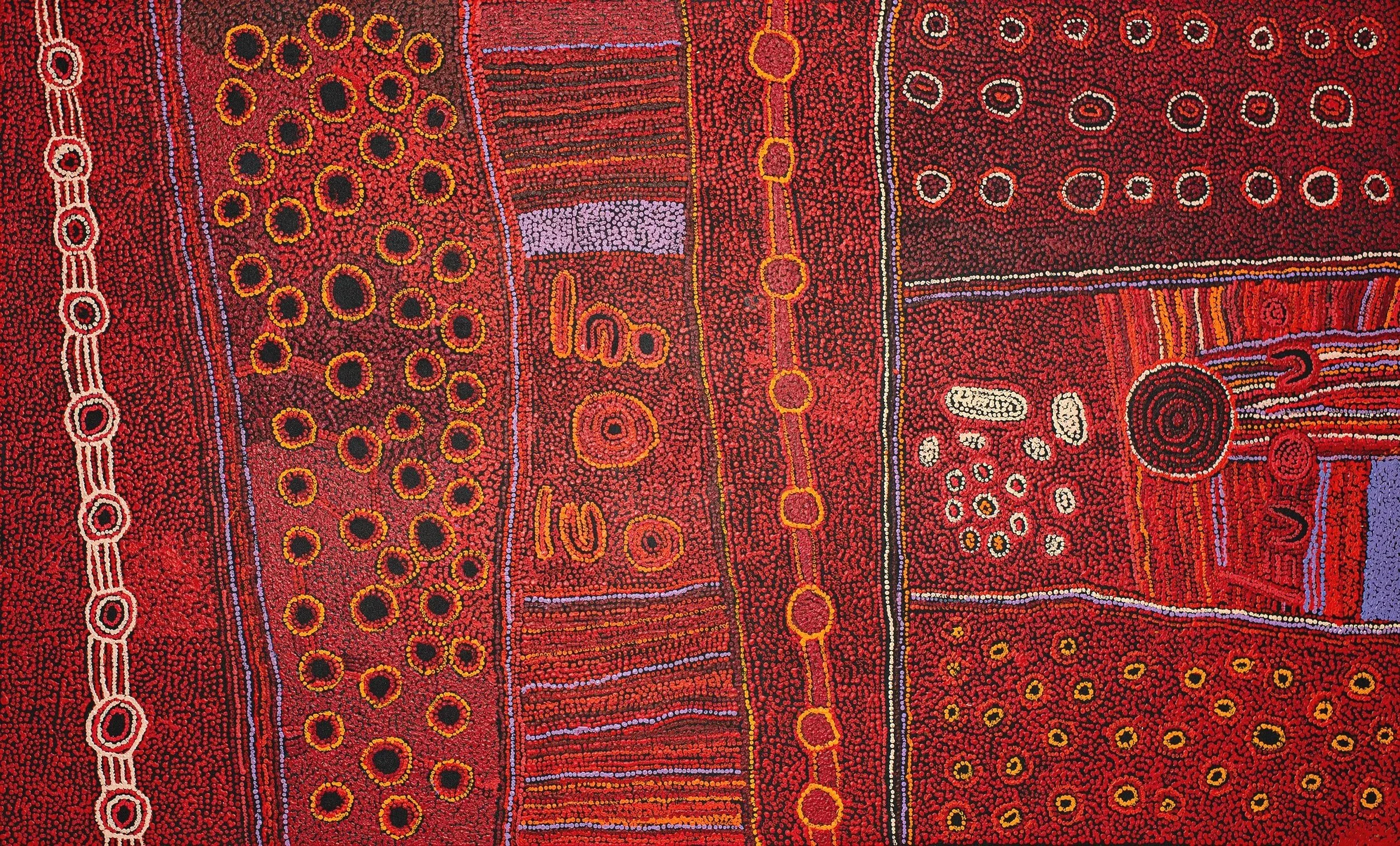
Artiste : Maringka Baker
Titre de l'œuvre : Minyma Kutjara Dreaming stories
Format : 200 x 120 cm
Provenance et certificat : centre d'art aborigène de Tjungu Palya
Référence de cette peinture aborigène : 12041
Demander le prix de l'œuvre / Enquiry
Explications pour cette peinture d'art Aborigène :
Maringka is a senior Pitjantjatjara woman living in the remote community settlement of Kanpi, 100kms east of the tri-state borders of WA, SA, and the NT. Maringka was born c1952. at Kaliumpil rock hole, a traditional camp site in Western Australia. Maringka's parents died when she was young and she was raised by Anmanari Brown and other members of her extended family. She went to the mission schools of Warburton in WA and Ernabella in SA. Maringka married a man from Papulankatja and they had two children. Their younger daughter passed away in childhood. Elaine Woods the elder daughter married a Docker River man and they had four daughters, Julie Woods, Janice Woods, Venita Woods and Casseyanne Woods.
Maringka has three great grandchildren. Maringka remarried Douglas Baker (Jimmy Baker's cousin) later in life and settled in Kanpi community, Douglas's country. Maringka has a deep connection to country and a spiritual connection with the land. These powerful links to the desert are expressed with beauty and integrity in her paintings and her work is highly sought after. Maringka was selected as one of thirty one artists from every state and territory in Australia to participate in the 'National Indigenous Art Triennial 07 - Culture Warriors'. Maringka continues to paint powerful and alluring prize-winning paintings through which she has gained notoriety nationally and internationally.
In this artwork she is dealing about Minyma Kutjara Tjukurpa (the creaon story of the two sisters). The big sister was travelling with her younger sister back to their homeland. The little sister was reluctant to head further and further north as she had been living with a different family near the ocean to the south. She had been lost for a long me and was unfamiliar with the landscape the big sister was showing her.
Eventually the older sister gave her a piggyback and tried to comfort her. She continued to teach her all about the country they travelled through. Somemes when they stopped they performed Inma (sacred singing and dancing). They camped at Punuwara and Irrunytju rockhole before heading further north to Docker River.
In my paintings you can see all the different parts of these landscapes as they were shown to the younger sister and as they change into each other.
Her artworks are in the following prestigious collections :
Araluen Collection, Alice Springs, Northern Territory
Artbank, Australian Government National Contemporary Art Rental
Australian National University, Canberra, Australian Capital Territory.
Deakin University, Melbourne, Victoria.
Flinders University, Adelaide, South Australia.
Harriett And Richard England Collection,
Hassall Collection, Sydney, New South Wales.
Lagerberg-Swift Collection, Perth, Western Australia.
Levi And Kaplan Collection, Seattle, Usa
Marshall Collection, Adelaide, South Australia.
National Gallery Of Australia, Canberra, Australian Capital Territory.
South Australian Art Gallery, Adelaide, South Australia.
The Beat Knoblacuch Collection, Switzerland.
The Corrigan Collection, Sydney, New South Wales.
The Lepley Collection, Perth, Western Australia.
The Parliament House Collection, Canberra, Australian Capital Territory.
University Of Canberra, Australian Capital Territory
W & V Mcgeoch, Melbourne, Victoria
Art Gallery Of South Australia, Adelaide, South Australia
The Authur Roe Collection, Melbourne, Vic
The Peter & Agnes Cooke Collection, Brisbane, Qld
Alison And Peter W. Klein Collection, Ludwigsburg, Badenwurttemberg, Germany
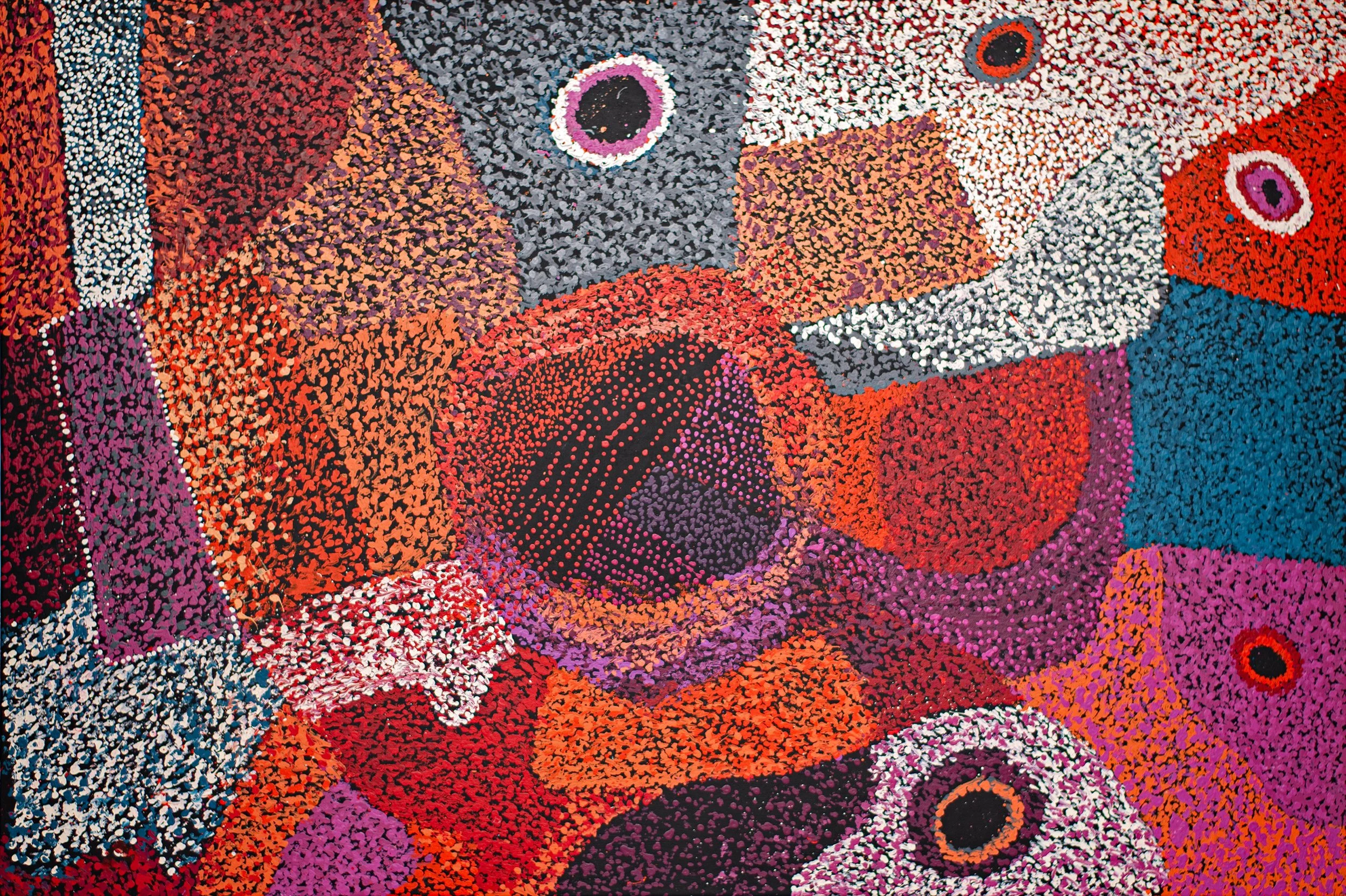
Artiste : Tjampawa Stevens
Titre de l'œuvre : Piltati Dreaming stories
Format : 151 × 101 cm
Provenance et certificat : centre d'art aborigène de Tjungu Palya
Référence de cette peinture : 20-013
Explications pour cette peinture d'art Aborigène :
Tjampawa Stevens was born in the Western Desert at Areyonga in the Northern Territory around 1947. Areyonga is her father's country and her mother's place is Waltytjara. She came to Nyapari with her husband, Keith Stevens, and their five children to establish a community on their own lands.
This painting deals about the site of Piltati. Piltati is a very important story about the two wanampi (ancestoral serpents) and their two wives. The two women travelled everywhere digging for food. Each day they would dig for kuka upupilypa (tadpoles) or collect wild berries like kampurarpa.
They always took food back to their two husbands. One day they got red of working so hard and thought to themselves "we might not take all this food to the men, maybe we'll eat some first". The men got angry with the women for taking so long to bring the food back and decided to trick the women by turning into water snakes.
Her artworks are in the following prestigious collections :
Museum Art Gallery of NSW
Museums Victoria Collections
Harriet And Richard Collection, Sydney, New South Wales.
Lagerberg-Swift Collection, Perth, Western Australia.
The Arthur Roe Collection, Melbourne, Victoria
The Marshall Collection, Adelaide, South Australia.
W & V Mcgeoch, Melbourne, Victoria
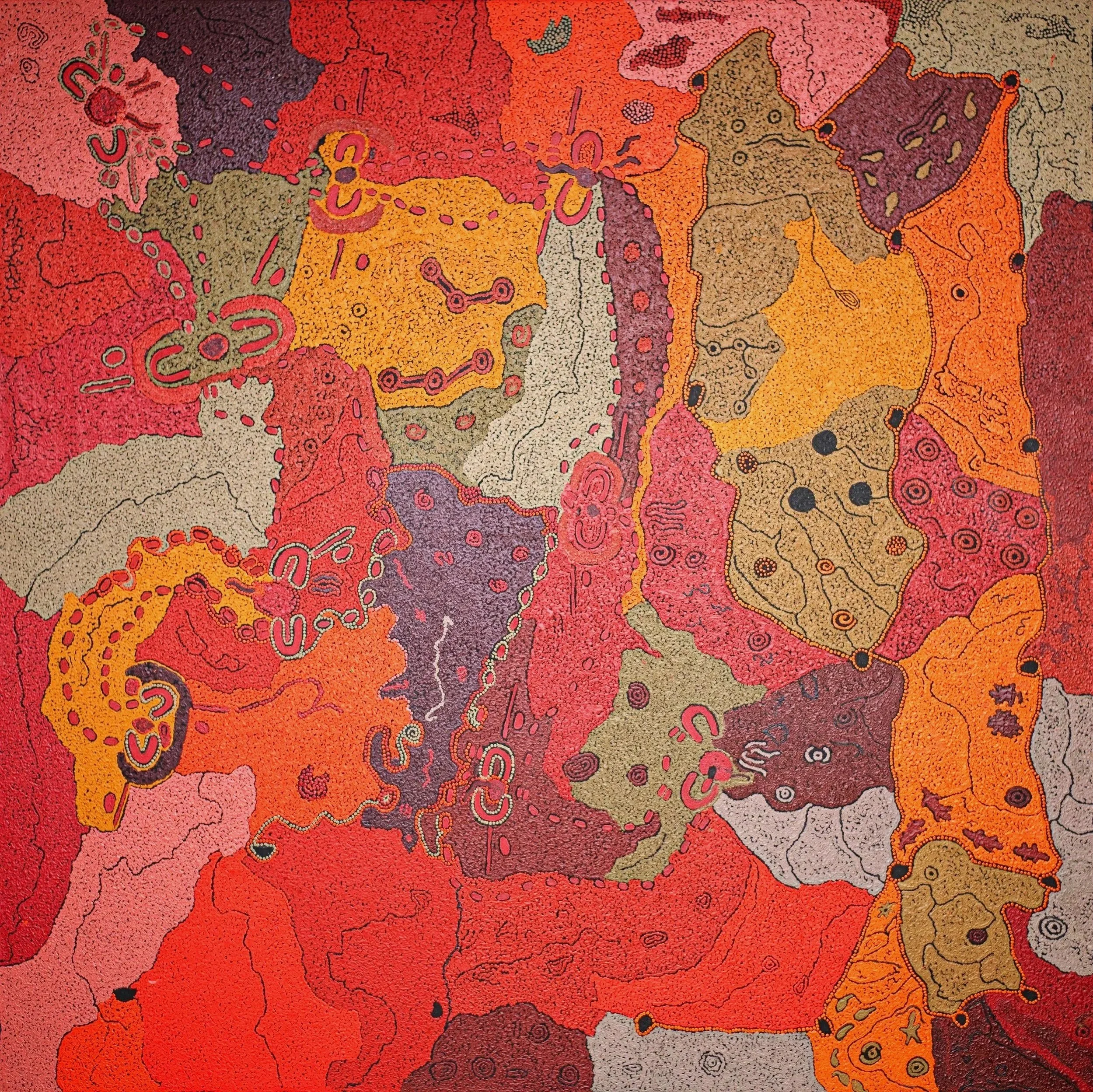
Artiste : Keith & Tjampawa Stevens
Titre de l'œuvre : Nyapari Collaborative - Tjukurpa
Format : 200 × 200 cm
Provenance et certificat : centre d'art aborigène de Tjungu Palya
Référence de cette peinture aborigène : 12188b
Explications pour cette peinture Aborigène :
My father told me to look after this area. It is Nyapari area. This is my wife and I, painting together, we drawn it like a map. A longtime ago, Anagnu ate Kuka Malu (Kangaroo Meat), Turkey, Rabbit, Ngintaka (Lizard), Figs and Bush Tomato tjuta. No flour or sugar. We were strong then. The men were strong for hunting. The women would get mai from under the ground.
You can see them travelling everywhere searching for the food and hiting the ground with a stone and digging down to get the tjamata (bush onions). There is a fire close by where they put the mai and then a wiera (bowl) where they put the mai after it has been in the fire. They take it back to the familly. You can see the creeks everywhere, and Nyapari rockhole and Iwarawra rockhole and Pilta rockhole.
Sometimes when you hit the ground near a special tree and water comes up, you collect it and then squeeze it into the rockhole. It is a special substance so that when the emu drinks from the rockhole the water kills him for us and we can give it to all the family around.
The water is very good in Nyapari area. When it ran out we'd go to Pilta. The spirals are Kinara tjuta (many snails) that Wanumpi eats. You can find those Kinara everywhere, Western Australia, Northern Territory, everywhere.
© Photo : Aboriginal Signature Estrangin gallery with the courtesy of the artists and Tjungu Palya.
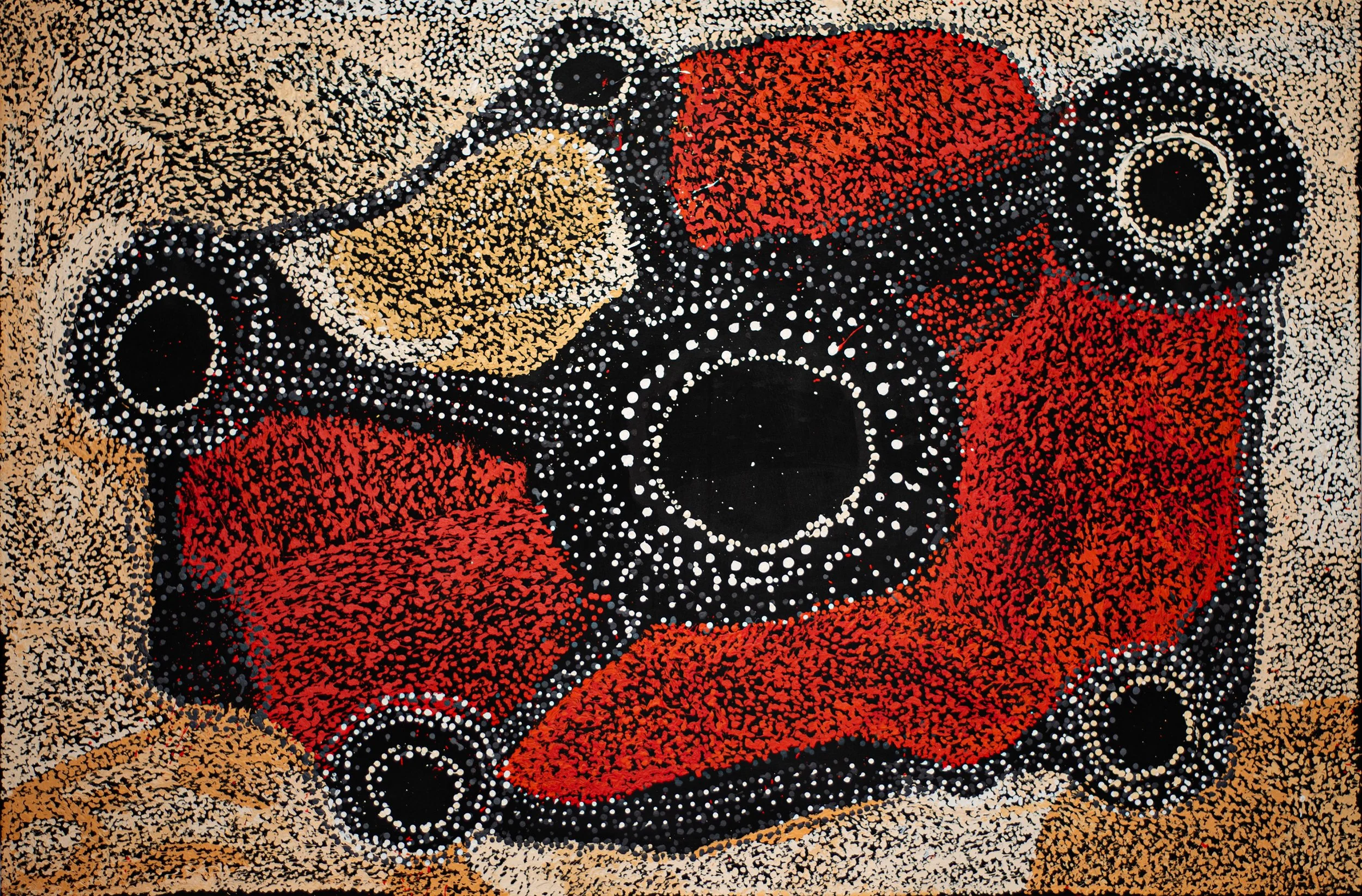
Artiste : Tjampawa Stevens
Titre de l'œuvre : Piltati Dreaming stories
Format : 115 × 99 cm
Provenance et certificat : centre d'art aborigène de Tjungu Palya
Référence de cette peinture : 23-080
Explications pour cette peinture d'art Aborigène :
Tjampawa Stevens was born in the Western Desert at Areyonga in the Northern Territory around 1947. Areyonga is her father's country and her mother's place is Waltytjara. She came to Nyapari with her husband, Keith Stevens, and their five children to establish a community on their own lands.
This painting deals about the site of Piltati. Piltati is a very important story about the two wanampi (ancestoral serpents) and their two wives. The two women travelled everywhere digging for food. Each day they would dig for kuka upupilypa (tadpoles) or collect wild berries like kampurarpa.
They always took food back to their two husbands. One day they got red of working so hard and thought to themselves "we might not take all this food to the men, maybe we'll eat some first". The men got angry with the women for taking so long to bring the food back and decided to trick the women by turning into water snakes.
Her artworks are in the following prestigious collections :
Museum Art Gallery of NSW
Museums Victoria Collections
Harriet And Richard Collection, Sydney, New South Wales.
Lagerberg-Swift Collection, Perth, Western Australia.
The Arthur Roe Collection, Melbourne, Victoria
The Marshall Collection, Adelaide, South Australia.
W & V Mcgeoch, Melbourne, Victoria

Artiste : Watarru collaborative
Titre de l'œuvre : Ilpili 2016 - Dreaming Time stories
Format : 120 x 100 cm
Provenance et certificat : centre d'art aborigène de Tjungu Palya
Référence de cette peinture : 16-119
Œuvre vendue.
Découvrez notre collection de peintures Aborigènes disponibles ici
Explications pour cette peinture d'art Aborigène :
.... Cette œuvre évoque une histoire de la Création des Deux Soeurs associées à Ilpili. Ces deux femmes escaladaient différents blocs rocheux pendant que l'Homme Wati était à leur recherche sans pouvoir les apercevoir. La jeune femme était enceinte et se cachait avec sa sœur dans une grotte aux pieds d'une colline.
L'homme grimpa tout en haut pour les appeler : Yaltji, minyma kutjara? "Où êtes-vous ?"
.. This is the creation story for Ilpili about the Two Sister creation beings. The women were hiding in Tjukulas (rockholes)
and one Wati (man) was searching for them but he could not see them. The younger sister was pregnant. Her older sister was looking after her. As they hid in a cave at the base of the hill the man climbed up high to look for them called out "Yaltji, minyma kutjara?"(where are you two women)? ....
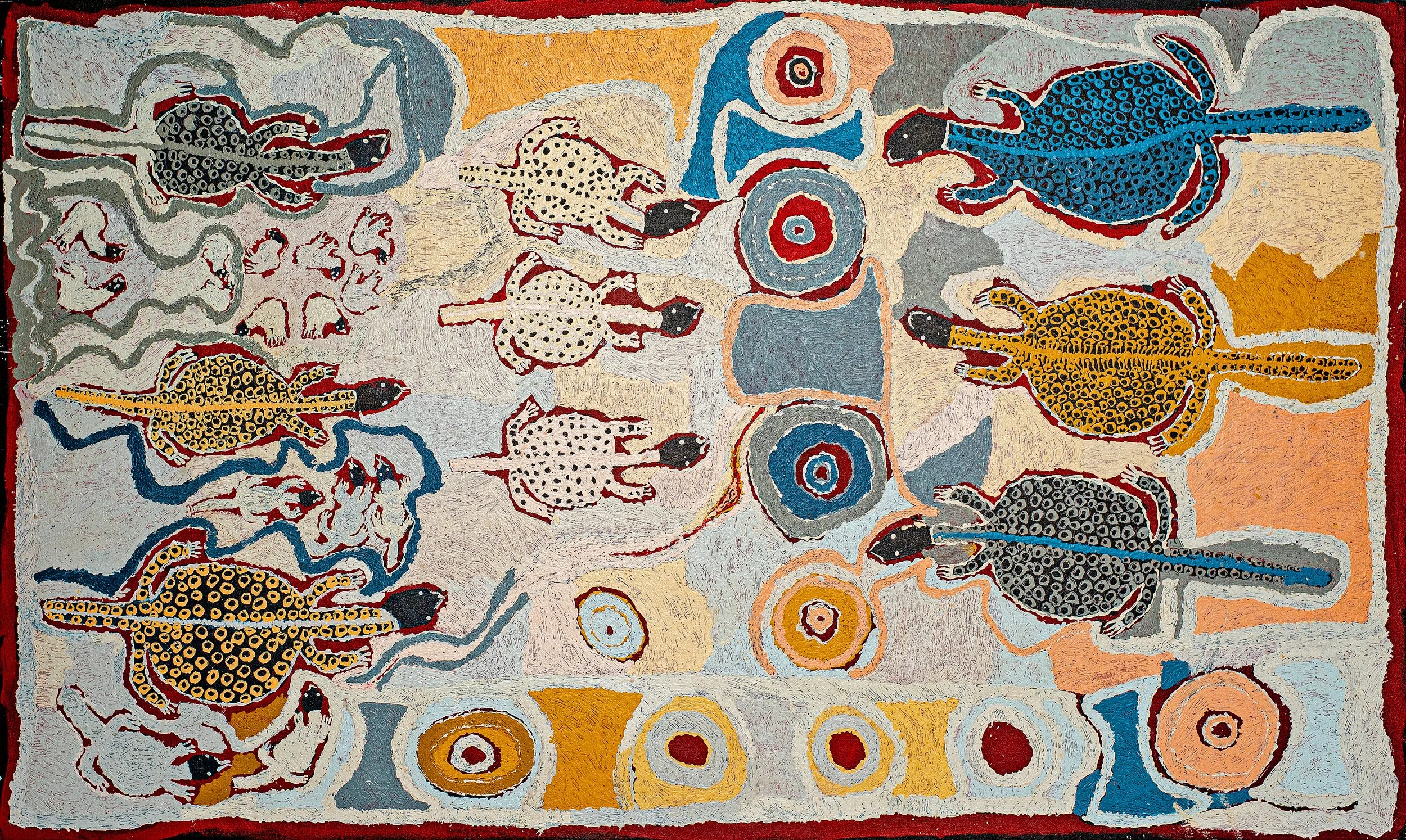
Artiste : Angkaliya Curtis
Titre de l'œuvre : Cave hill - Ancestral country
Format : 200 × 120 cm
Provenance et certificat : centre d'art aborigène de Tjungu Palya
Référence de cette peinture : 12152
Demander le prix de l'œuvre / Enquiry
Explications pour cette peinture Aborigène :
Angkaliya was born in 1928 at Miti in the South Australian Pitjantjatjara Lands. When she was small she travelled with her mother to Watarru (her mother's country). The family spent time at Ernabella mission and cattle station properties exchanging animal skins (dingoes and rabbits) for flour and sugar. She married and lived at the Ernabella where she worked in the craftroom spinning wool and making rugs. In the 1960's she moved closer to her traditional homeland when the community of Amata began. She used to live and works at Nyapari Community. Angkaliya lived a semi nomadic lifestyle often walking long distances in the desertwhere traditional knowledge of the country, its water holes and food supplies are vital to survival. She learned from her mother and grandmother the secrets of the land and aquired an intimate understanding of the environment and the ancestoral creation stories associated with it.
Ngayuku mitaku ngurangka (this is the country I have inherited from my husband) a wonderful place called Cave Hill. Cave Hill is an important site for the Seven Sisters dreaming story. When you come here you can see in the rock formations the story of seven sisters as they ran from Wati Nyiru (the cheeky man). The sisters hid in the darkness of the big cave and the oldest sister used her wana (digging stick) to make a hole to escape through the back of the cave, you can still see the scratching marks she made. Cave Hill ta tjukurla tjuta ngaranyi. There is a lot of water here too, many rock holes and connecting creeks and water courses. The abundance of water, food and tjurkupa makes Cave Hill a precious place. My husband Billynya and I travelled on a camel from the mission in Ernabella to this magical home.
Collections
Artbank, Australian Government National Contemporary Art Rental
Australian National University, Canberra,
Australian Capital Territory.
Deakin University, Melbourne, Victoria.
Flinders University, Adelaide, South Australia.
Harriett And Richard England Collection, Sydney, New South Wales
Lagerberg-Swift Collection, Perth, Western Australia
Marshall Collection, Adelaide, South Australia
Museum And Art Gallery Of Northern Territory.
National Gallery Of Australia, Canberra, Australian Capital Territory
National Gallery Of Victoria, Melbourne, Victoria.
Queensland Art Gallery, Brisbane,
The Beat Knoblacuch Collection, Switzerland.
The Lepley Collection, Perth, Western Australia.
The Parliament House Collection, Canberra,
University Of Canberra, Australian Capital Territory
W & V Mcgeoch, Melbourne, Victoria
The Sims Dickson Collection
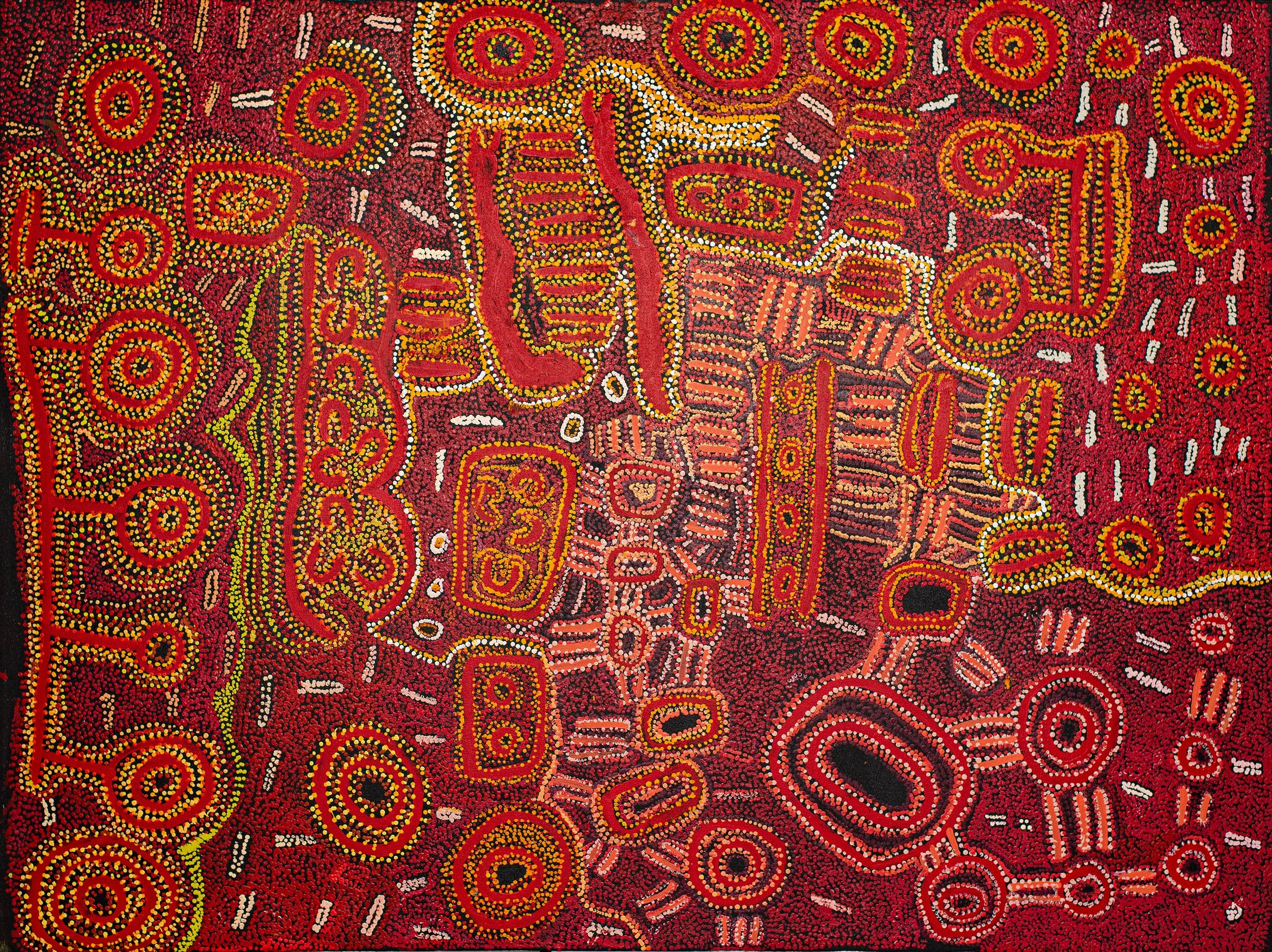
Artiste : Iyawi Wikilyiri
Titre de l'œuvre : Pukara
Format : 200 × 150 cm
Provenance et certificat : centre d'art aborigene de Tjungu Palya
Référence de cette peinture d'art indigène d’Australie : 12049
Demander le prix de l'œuvre / Enquiry
Explications pour cette œuvre :
Iyawi was born in the bush near Ernabella in the Anangu Pitjantjatjara Yankunytjatjara Lands c1945. She attended the mission school at Ernabella before finding employment in the craft room, where traditional spinning skills were combined with new techniques to develop a small scale carpet making industry. Iyawi's mother was a Yankunytjatjara women from Ernabella and her father was a Pitjantjatjara man from Pukara. Iyawi now lives in Nyapari with her husband Ginger Wikilyiri.
Iyawi Wikilyiri paints Pukara, an important Tjukurpa for Wati Kutjara, the two serpent men. These wanampi's are involved in creating landmarks across vast tracts of the desert from Pukara in the tri state border region of Western Australia. South Australia and the Northern Territory to the Western Australian coast.
Wati Kutjara Tjukurpa ( the creation story for the two serpent men). The two wanampi, father and his son travel from rockhole to rockhole in country around Wingellina. The father travelled away to another country and left his son behind at the rockhole Pukara. The people living there didn't like the son. They thought that the son was sneaking around their camps at night while they slept and stealing their food. They thought he looked strange and could not be trusted. When the son grew up he came back to Pukara and ate all the people there. Tjuratja tjuta (lots of sweet nectar) grows at Pukara. Kaliny-kalinypa (honey grevillea). The flowers can be sucked for the sweet honey like nectar or soaked in water to make a sweet drink.
The artworks of the artist could be find in the following prestigious collections :
Araluen Art Collection, Department Of Natural Resources, Environment, The Arts
Artbank, Australian Government National
Harriet And Richard England Collection
Voituron Collection - Belgique
National Gallery Of Australia, Canberra, Australia
University Of Queensland Art Museum, Brisbane, Qld
Bertrand Estrangin collection - France - Belgique
© Photo : Aboriginal Signature Estrangin gallery with the courtesy of the artists and Tjungu Palya
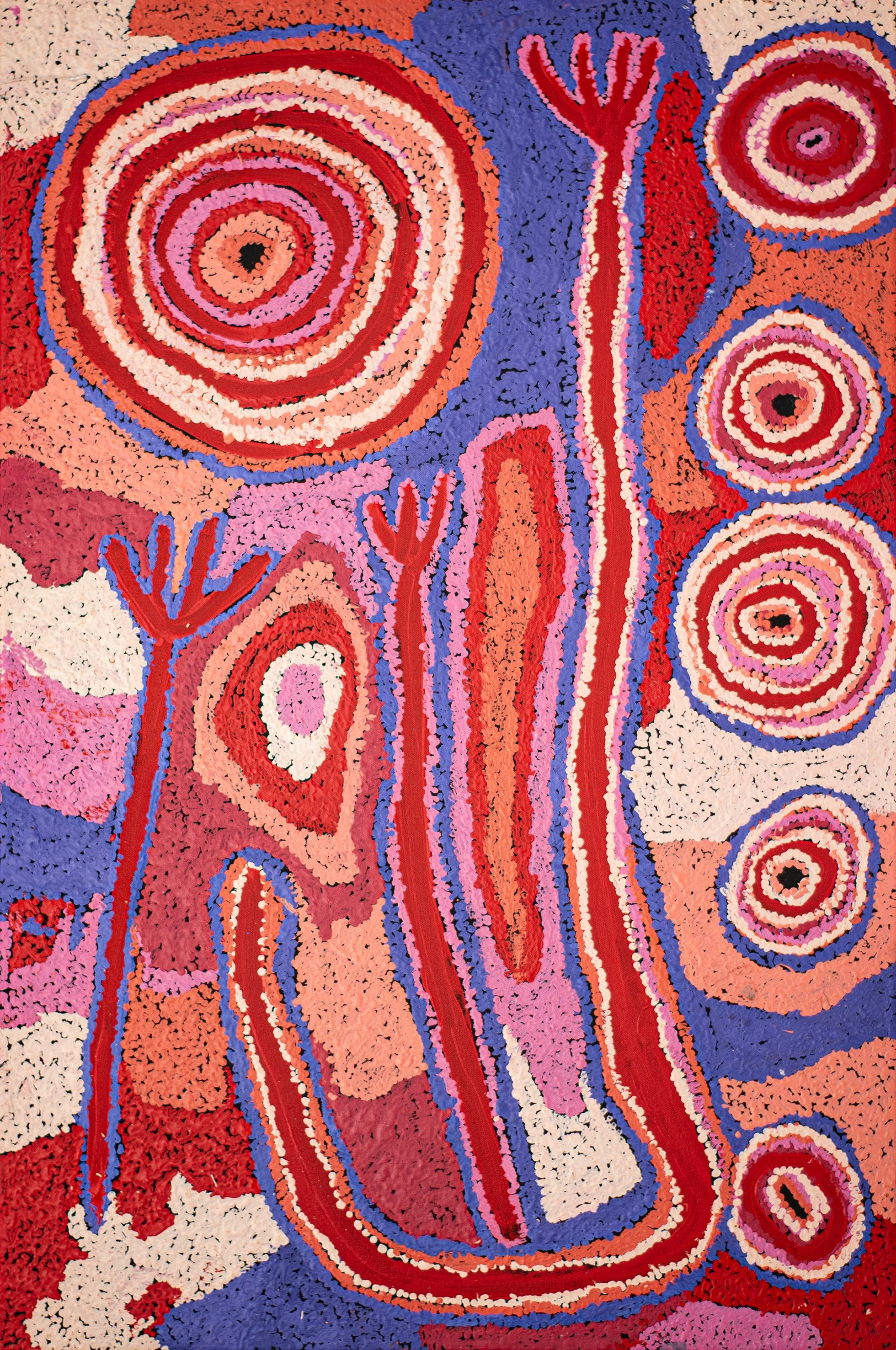
Artiste : Iyawi Wikilyiri
Titre de l'œuvre : Punu Tjuta
Format : 99 × 66 cm
Provenance et certificat : centre d'art aborigene de Tjungu Palya
Référence de cette peinture d'art indigène d’Australie : 15-112
Demander le prix de l'œuvre / Enquiry
Explications pour cette œuvre :
Iyawi was born in the bush near Ernabella in the Anangu Pitjantjatjara Yankunytjatjara Lands c1945. She attended the mission school at Ernabella before finding employment in the craft room, where traditional spinning skills were combined with new techniques to develop a small scale carpet making industry. Iyawi's mother was a Yankunytjatjara women from Ernabella and her father was a Pitjantjatjara man from Pukara. Iyawi now lives in Nyapari with her husband Ginger Wikilyiri.
Iyawi Wikilyiri paints Pukara, an important Tjukurpa for Wati Kutjara, the two serpent men. These wanampi's are involved in creating landmarks across vast tracts of the desert from Pukara in the tri state border region of Western Australia. South Australia and the Northern Territory to the Western Australian coast.
In this artwork, she is dealing about Punu tjuta (many trees) at a place called Ngarutjara, near Ernabella. The trees grow near water. Tjuna-tjuna (many reeds) It's the same country as the Wanampi (Water snake). Can be dangerous country. Apu kulupa tjuta (many small boulders and rocks). Wiltja (shade structure) built by the people making camp. The women use the tree roots to make the wana (digging stick) that they use for digging for food.
The artworks of the artist could be find in the following prestigious collections :
Araluen Art Collection, Department Of Natural Resources, Environment, The Arts
Artbank, Australian Government National
Harriet And Richard England Collection
Voituron Collection - Belgique
National Gallery Of Australia, Canberra, Australia
University Of Queensland Art Museum, Brisbane, Qld
Bertrand Estrangin collection - France - Belgique
© Photo : Aboriginal Signature Estrangin gallery with the courtesy of the artists and Tjungu Palya
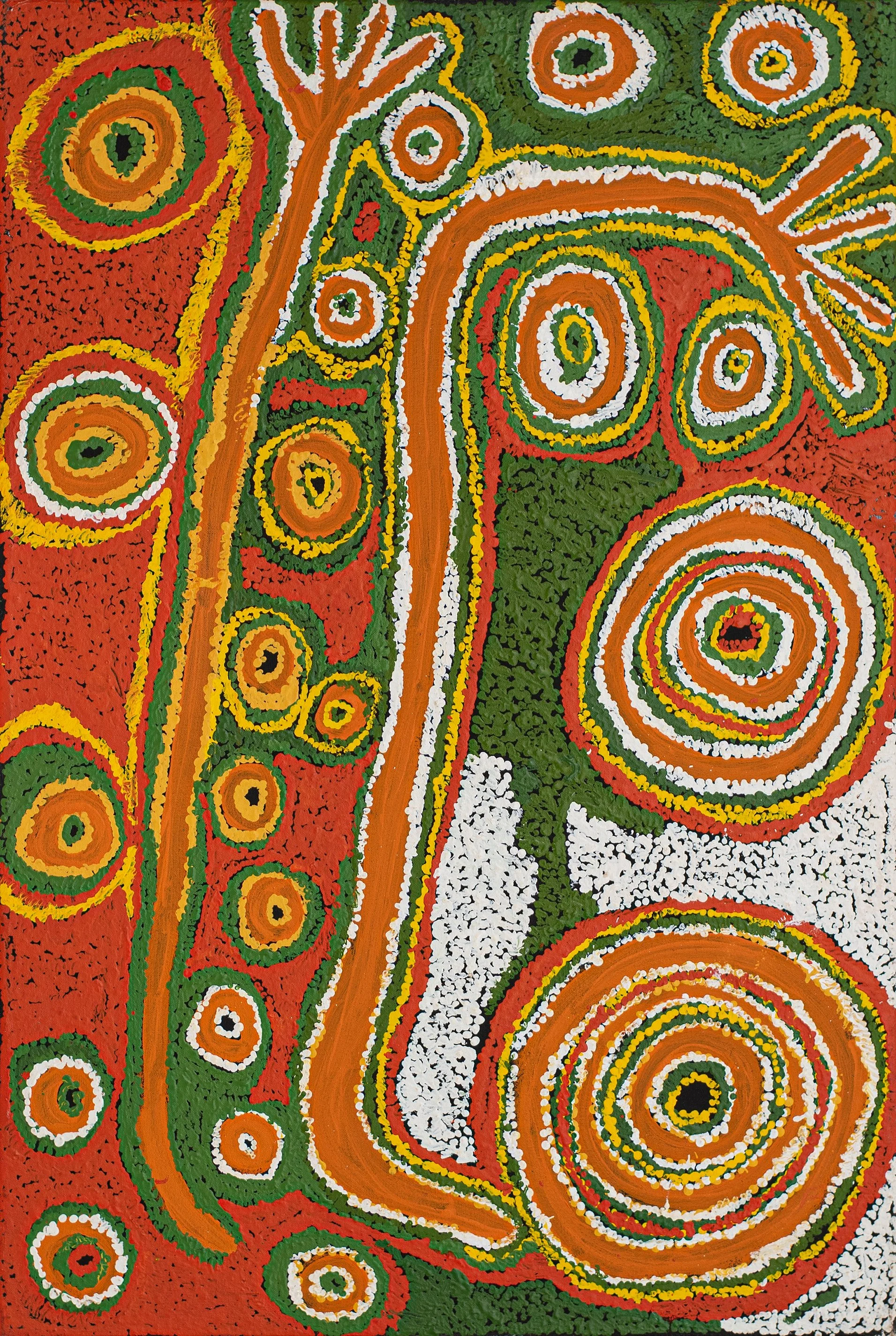
Artiste : Iyawi Wikilyiri
Titre de l'œuvre : Punu Tjuta
Format : 92 x 61 cm
Provenance et certificat : centre d'art aborigene de Tjungu Palya
Référence de cette peinture d'art indigène d’Australie : 15-120
Demander le prix de l'œuvre / Enquiry
Explications pour cette œuvre :
Iyawi was born in the bush near Ernabella in the Anangu Pitjantjatjara Yankunytjatjara Lands c1945. She attended the mission school at Ernabella before finding employment in the craft room, where traditional spinning skills were combined with new techniques to develop a small scale carpet making industry. Iyawi's mother was a Yankunytjatjara women from Ernabella and her father was a Pitjantjatjara man from Pukara. Iyawi now lives in Nyapari with her husband Ginger Wikilyiri.
Iyawi Wikilyiri paints Pukara, an important Tjukurpa for Wati Kutjara, the two serpent men. These wanampi's are involved in creating landmarks across vast tracts of the desert from Pukara in the tri state border region of Western Australia. South Australia and the Northern Territory to the Western Australian coast.
In this artwork, she is dealing about Punu tjuta (many trees) at a place called Ngarutjara, near Ernabella. The trees grow near water. Tjuna-tjuna (many reeds) It's the same country as the Wanampi (Water snake). Can be dangerous country. Apu kulupa tjuta (many small boulders and rocks). Wiltja (shade structure) built by the people making camp. The women use the tree roots to make the wana (digging stick) that they use for digging for food.
The artworks of the artist could be find in the following prestigious collections :
Araluen Art Collection, Department Of Natural Resources, Environment, The Arts
Artbank, Australian Government National
Harriet And Richard England Collection
Voituron Collection - Belgique
National Gallery Of Australia, Canberra, Australia
University Of Queensland Art Museum, Brisbane, Qld
Bertrand Estrangin collection - France - Belgique
© Photo : Aboriginal Signature Estrangin gallery with the courtesy of the artists and Tjungu Palya
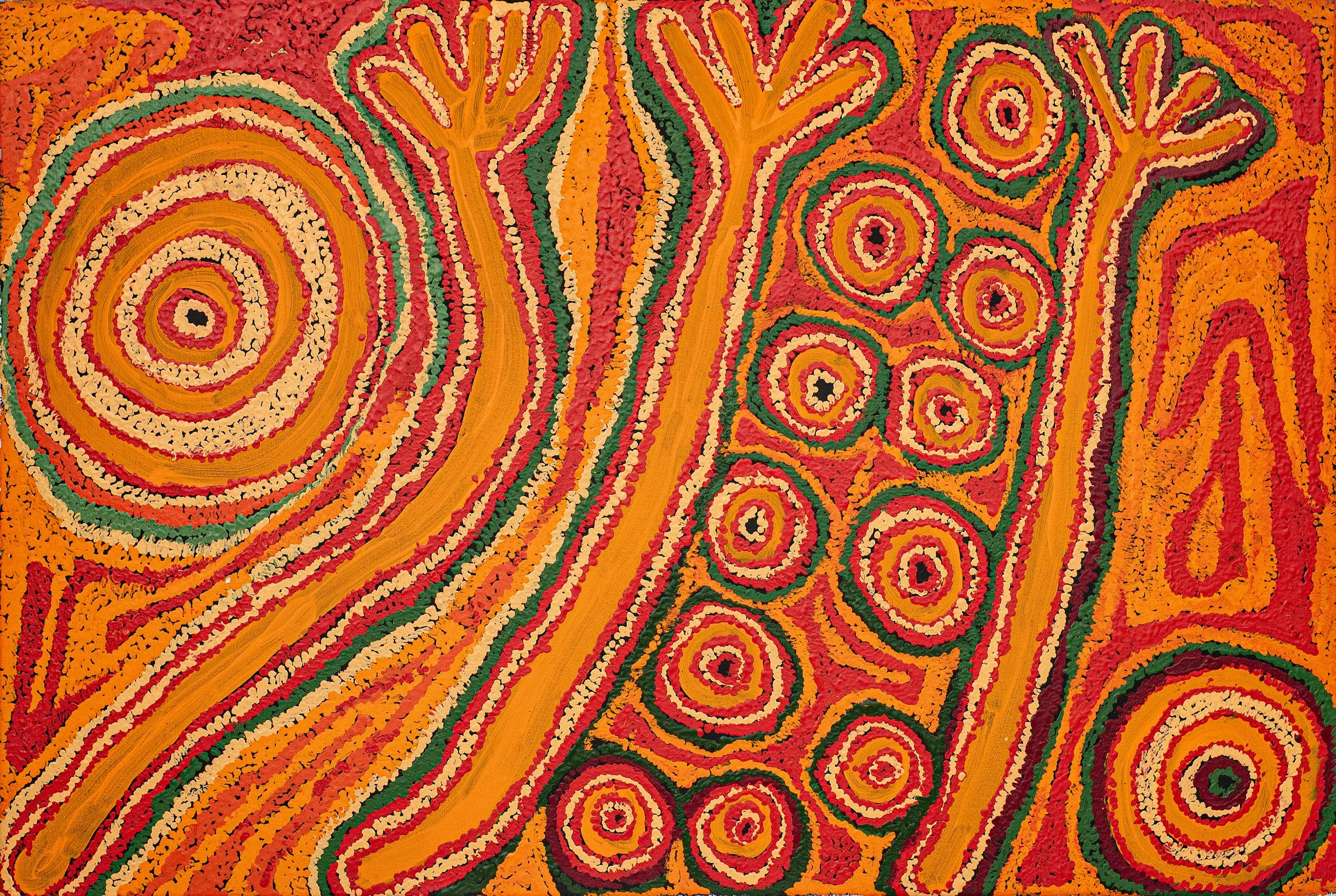
Artiste : Iyawi Wikilyiri
Titre de l'œuvre : Punu Tjuta
Format : 99 × 66 cm
Provenance et certificat : centre d'art aborigene de Tjungu Palya
Référence de cette peinture d'art indigène d’Australie : 15-113
Demander le prix de l'œuvre / Enquiry
Explications pour cette œuvre :
Iyawi was born in the bush near Ernabella in the Anangu Pitjantjatjara Yankunytjatjara Lands c1945. She attended the mission school at Ernabella before finding employment in the craft room, where traditional spinning skills were combined with new techniques to develop a small scale carpet making industry. Iyawi's mother was a Yankunytjatjara women from Ernabella and her father was a Pitjantjatjara man from Pukara. Iyawi now lives in Nyapari with her husband Ginger Wikilyiri.
Iyawi Wikilyiri paints Pukara, an important Tjukurpa for Wati Kutjara, the two serpent men. These wanampi's are involved in creating landmarks across vast tracts of the desert from Pukara in the tri state border region of Western Australia. South Australia and the Northern Territory to the Western Australian coast.
In this artwork, she is dealing about Punu tjuta (many trees) at a place called Ngarutjara, near Ernabella. The trees grow near water. Tjuna-tjuna (many reeds) It's the same country as the Wanampi (Water snake). Can be dangerous country. Apu kulupa tjuta (many small boulders and rocks). Wiltja (shade structure) built by the people making camp. The women use the tree roots to make the wana (digging stick) that they use for digging for food.
The artworks of the artist could be find in the following prestigious collections :
Araluen Art Collection, Department Of Natural Resources, Environment, The Arts
Artbank, Australian Government National
Harriet And Richard England Collection
Voituron Collection - Belgique
National Gallery Of Australia, Canberra, Australia
University Of Queensland Art Museum, Brisbane, Qld
Bertrand Estrangin collection - France - Belgique
© Photo : Aboriginal Signature Estrangin gallery with the courtesy of the artists and Tjungu Palya
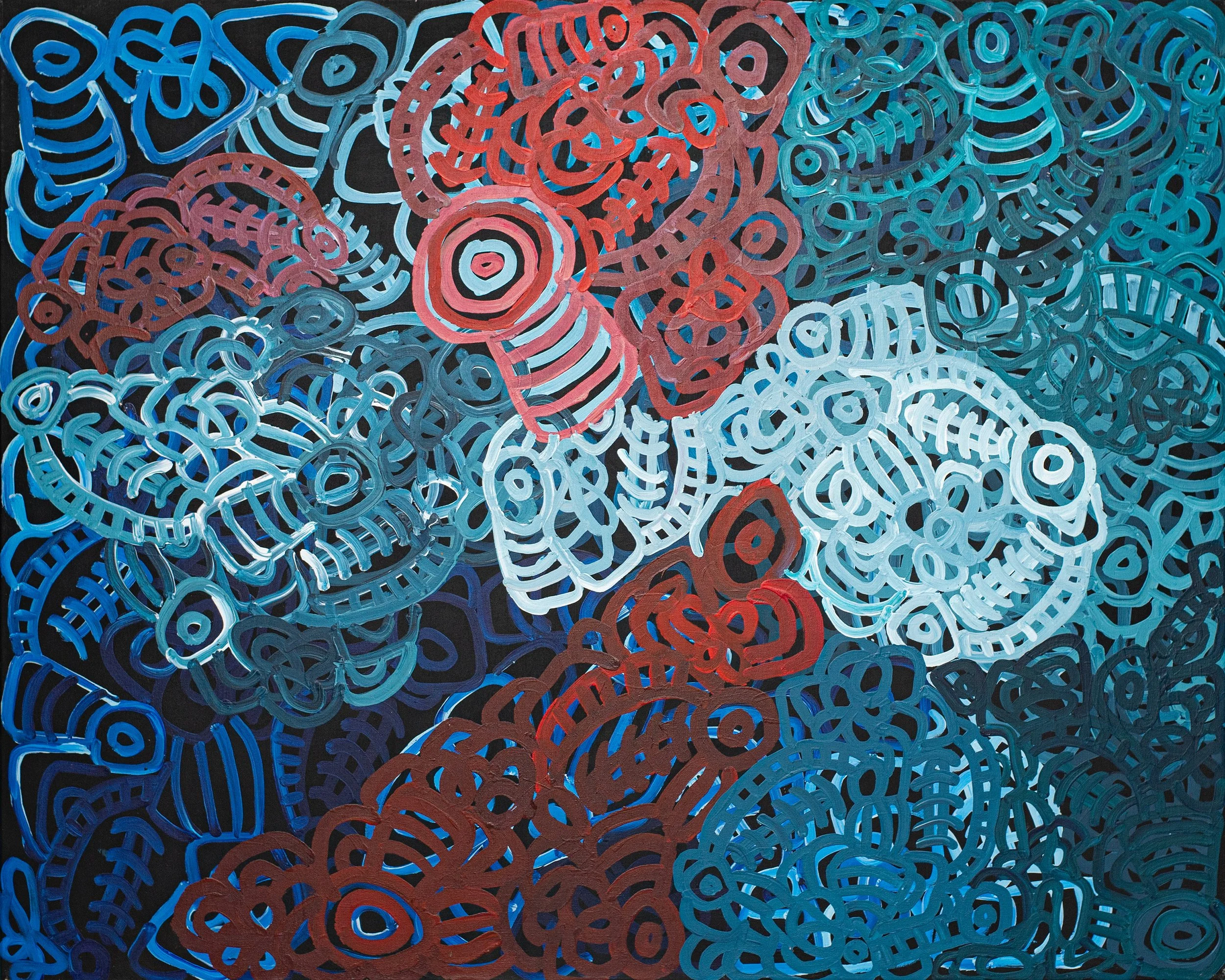
Titre de l'œuvre : Digging for Tjala
Format : 150 × 120 cm
Provenance et certificat : centre d'art aborigene de Tjungu Palya
Référence de cette peinture : 17-145
Demander le prix de l'œuvre / Enquiry
Explications pour cette œuvre :
These are the tjala (honey ants) of my grandmother's (Eileen Stevens) country near Fregon. They are going back and forth on top of the earth and under the earth in their holes. I used to go digging for tjala with my grandmother and she would tell me stories and show me where to dig.
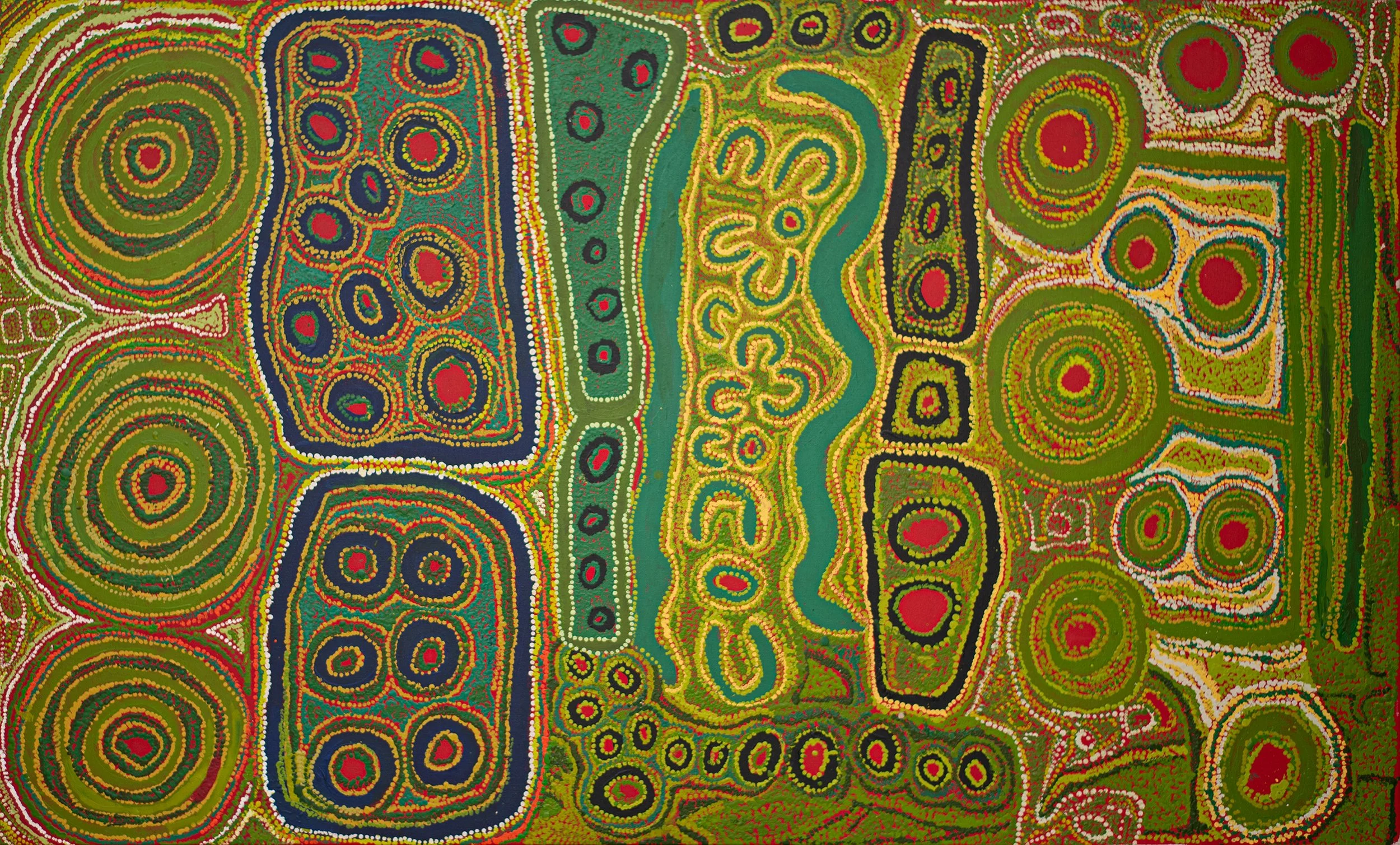
Artiste : Iyawi Wikilyiri
Titre de l'œuvre : Pukara
Format : 200 × 120 cm
Provenance et certificat : centre d'art aborigene de Tjungu Palya
Référence de cette peinture d'art indigène d’Australie : 11487b
Demander le prix de l'œuvre / Enquiry
Explications pour cette œuvre :
Iyawi was born in the bush near Ernabella in the Anangu Pitjantjatjara Yankunytjatjara Lands c1945. She attended the mission school at Ernabella before finding employment in the craft room, where traditional spinning skills were combined with new techniques to develop a small scale carpet making industry. Iyawi's mother was a Yankunytjatjara women from Ernabella and her father was a Pitjantjatjara man from Pukara. Iyawi now lives in Nyapari with her husband Ginger Wikilyiri.
Iyawi Wikilyiri paints Pukara, an important Tjukurpa for Wati Kutjara, the two serpent men. These wanampi's are involved in creating landmarks across vast tracts of the desert from Pukara in the tri state border region of Western Australia. South Australia and the Northern Territory to the Western Australian coast.
Wati Kutjara Tjukurpa ( the creation story for the two serpent men). The two wanampi, father and his son travel from rockhole to rockhole in country around Wingellina. The father travelled away to another country and left his son behind at the rockhole Pukara. The people living there didn't like the son. They thought that the son was sneaking around their camps at night while they slept and stealing their food. They thought he looked strange and could not be trusted. When the son grew up he came back to Pukara and ate all the people there. Tjuratja tjuta (lots of sweet nectar) grows at Pukara. Kaliny-kalinypa (honey grevillea). The flowers can be sucked for the sweet honey like nectar or soaked in water to make a sweet drink.
The artworks of the artist could be find in the following prestigious collections :
Araluen Art Collection, Department Of Natural Resources, Environment, The Arts
Artbank, Australian Government National
Harriet And Richard England Collection
Voituron Collection - Belgique
National Gallery Of Australia, Canberra, Australia
University Of Queensland Art Museum, Brisbane, Qld
Bertrand Estrangin collection - France - Belgique
© Photo : Aboriginal Signature Estrangin gallery with the courtesy of the artists and Tjungu Palya
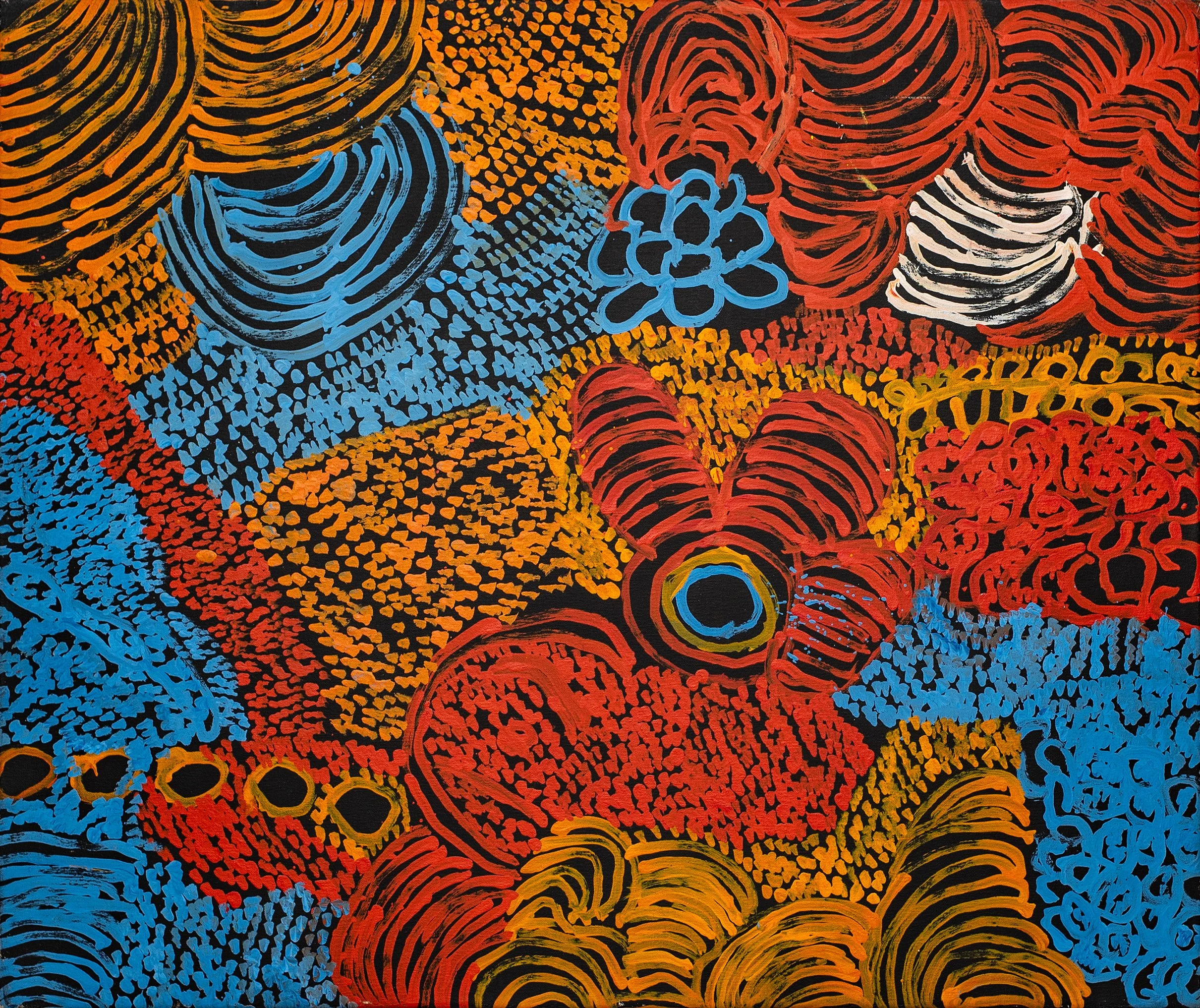
Artiste : Eileen Yaritja Stevens
Titre de l'œuvre : Piltati
Format : 105 x 89 cm
Provenance et certificat : centre d'art aborigene de Tjungu Palya
Référence de cette peinture d'art indigène d’Australie : 08754
Demander le prix de l'œuvre / Enquiry
Explications pour cette œuvre :
Eileen was born in the bush at Makiri, Tjala Minyma Tjukurpa (Honeyant Women's sacred place) c1919. Her father was a Yangkunytjatjara man and her mother a Pitjantjatjara woman. When Eileen was a young woman she worked at Ernabella mission milking goats. "I was a hard worker at the mission, but it was good." Her husband also worked at Ernabella chopping trees for building projects. Later they came to Nyapari, Eileen's husbands country. Eileen passed away in February 2008, she was 89 and still singing and painting with a passion and energy
Wati kutjara nyinanyi (two men are sitting). Kunkunpa (sleeping). They were painting inside the cave. When they woke up they were looking for the two women. The eldest is called Wanyinta and the younger Alartjatjarra. The two brothers are really wanampi (snakes men). The women had travelled a long way, east of Yalata. The men were searching everywhere for them. Tjukurpa pulkana mulapa. (This is a very important true story). This rockhole is close up to Nyapari.
The artworks of the artist could be find in the following prestigious collections :
The National Gallery Of Australia, Canberra, Act
The National Gallery Of Victoria, Melbourne, Vic
W & V Mcgeoch, Melbourne, Victoria
Araluen Gallery, Alice Springs, Northen Territory
Ian Berndt Collection, Perth, Western Australia
Kaplan-Levi Collection, Seattle, Usa
The Art Gallery Of South Australia, Adelaide,Sa
The Art Gallery Of Western Australia, Perth, Wa
The Lepley Collection, Perth, Western Australia.
The Marshall Colllection Adelaide, South Australia
The Merenda Collection
© Photo : Aboriginal Signature Estrangin gallery with the courtesy of the artists and Tjungu Palya
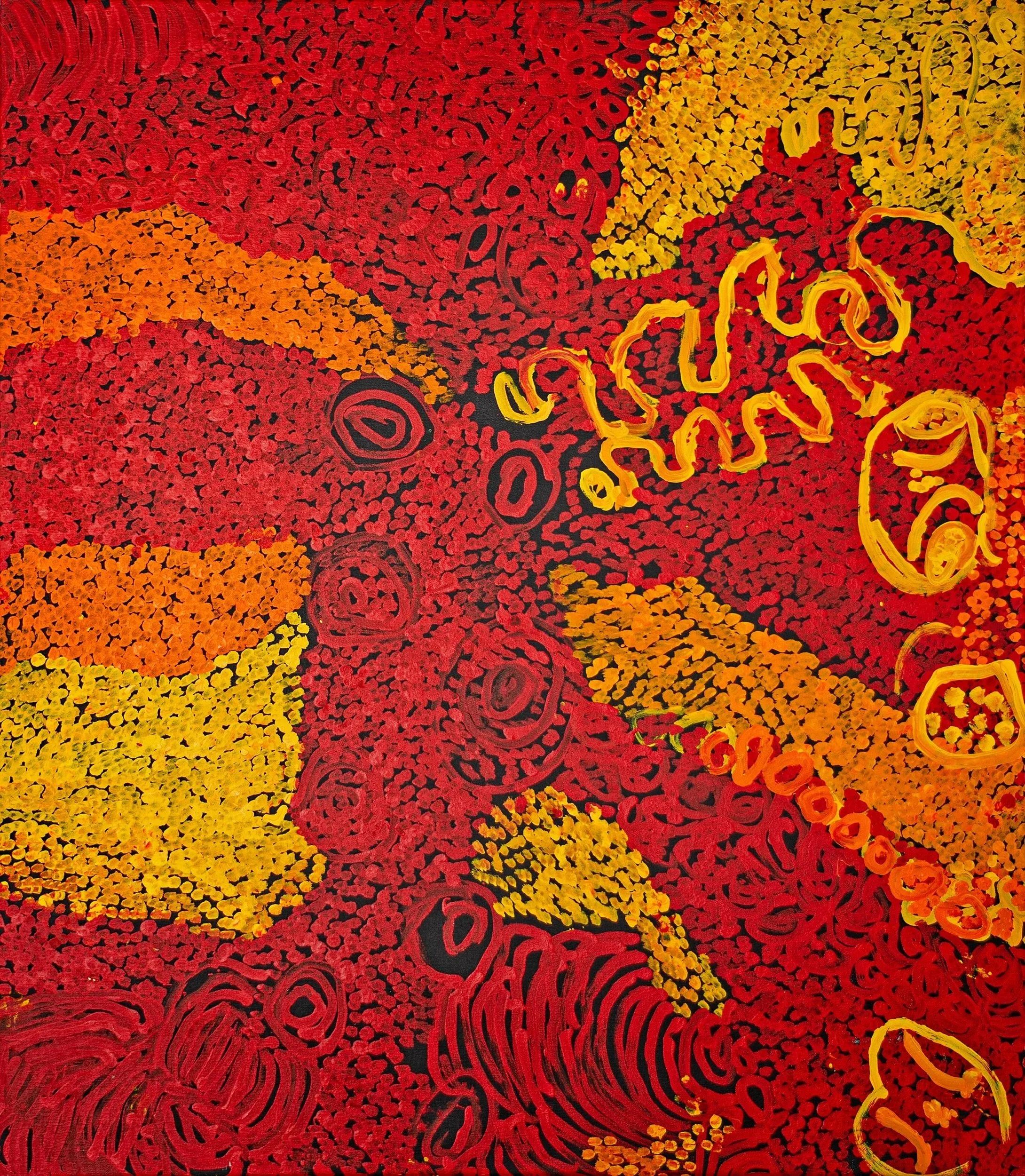
Artiste : Eileen Yaritja Stevens
Titre de l'œuvre : Piltati
Format : 120 x 102 cm
Provenance et certificat : centre d'art aborigene de Tjungu Palya
Référence de cette peinture d'art indigène d’Australie : 08208
Demander le prix de l'œuvre / Enquiry
Explications pour cette œuvre :
Eileen was born in the bush at Makiri, Tjala Minyma Tjukurpa (Honeyant Women's sacred place) c1919. Her father was a Yangkunytjatjara man and her mother a Pitjantjatjara woman. When Eileen was a young woman she worked at Ernabella mission milking goats. "I was a hard worker at the mission, but it was good." Her husband also worked at Ernabella chopping trees for building projects. Later they came to Nyapari, Eileen's husbands country. Eileen passed away in February 2008, she was 89 and still singing and painting with a passion and energy
Wati kutjara nyinanyi (two men are sitting). Kunkunpa (sleeping). They were painting inside the cave. When they woke up they were looking for the two women. The eldest is called Wanyinta and the younger Alartjatjarra. The two brothers are really wanampi (snakes men). The women had travelled a long way, east of Yalata. The men were searching everywhere for them. Tjukurpa pulkana mulapa. (This is a very important true story). This rockhole is close up to Nyapari.
The artworks of the artist could be find in the following prestigious collections :
The National Gallery Of Australia, Canberra, Act
The National Gallery Of Victoria, Melbourne, Vic
W & V Mcgeoch, Melbourne, Victoria
Araluen Gallery, Alice Springs, Northen Territory
Ian Berndt Collection, Perth, Western Australia
Kaplan-Levi Collection, Seattle, Usa
The Art Gallery Of South Australia, Adelaide,Sa
The Art Gallery Of Western Australia, Perth, Wa
The Lepley Collection, Perth, Western Australia.
The Marshall Colllection Adelaide, South Australia
The Merenda Collection
© Photo : Aboriginal Signature Estrangin gallery with the courtesy of the artists and Tjungu Palya
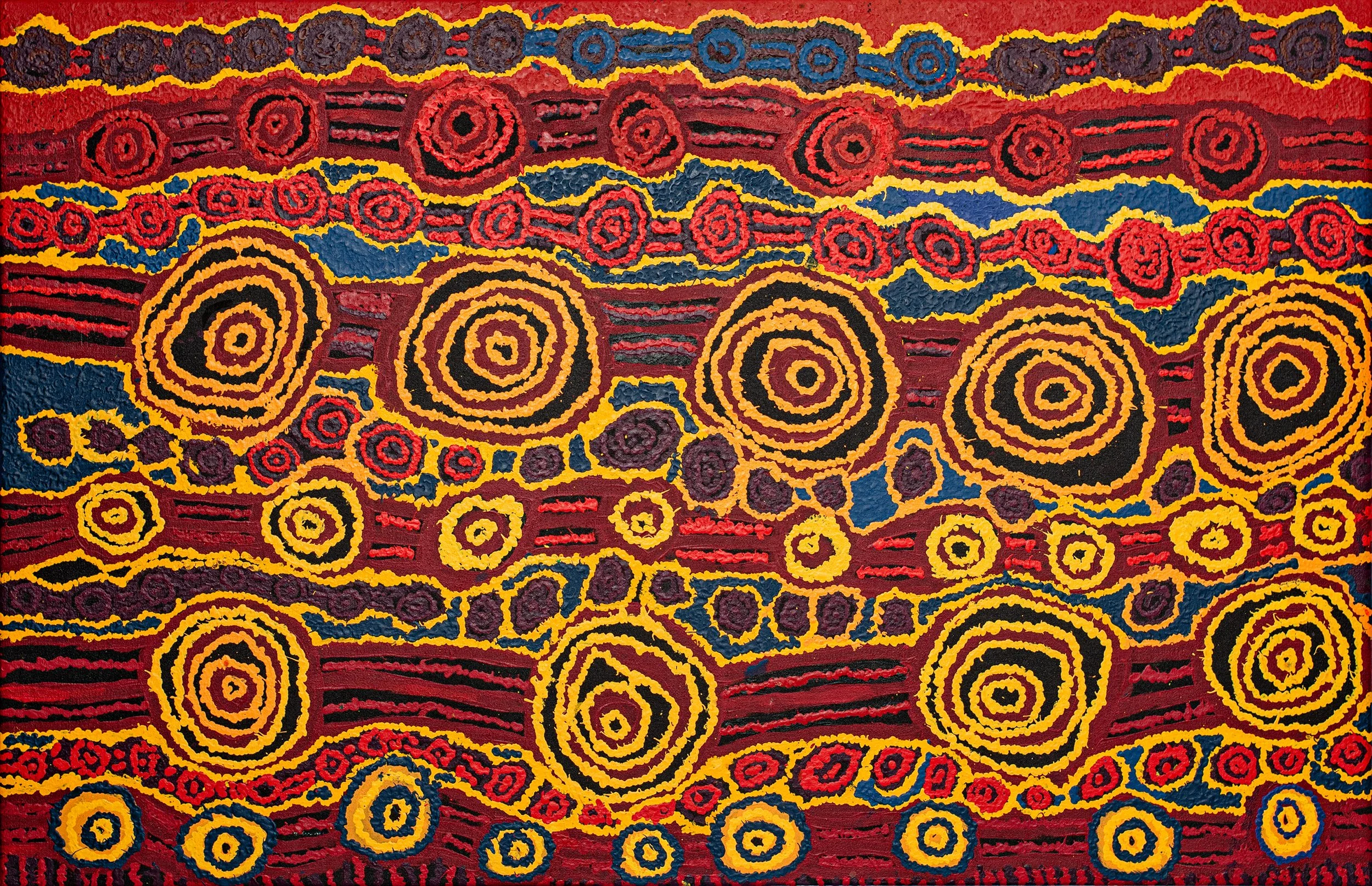
Artistes : Beryl Jimmy
Titre de l'œuvre : Kapi Tjukula
Format : 145 × 94 cm
Provenance et certificat : centre d'art aborigène de Tjungu Palya
Référence de cette peinture aborigène : 12053
Demander le prix de l'œuvre
Explications pour cette peinture d'art Aborigène :
Beryl Jimmy is a Pitjantjatjara woman living at the community settlement of Watarru, in the far northwest of South Australia, part of an area referred to as the Western desert. She was born in 1970. Beryl's work is inspired by a deep connection to country, and her spiritual links to the desert are expressed with integrity, beauty and creativity. Traditional knowledge of food collection and water sources were vital for survival in this dynamic desert landscape and is a prominent theme in her work. This cultural knowledge is handed down orally in the retelling of the Tjukurpa (traditional stories of the ancestor's journeys), which not only sustains Anangu (Aboriginal people) physically, but socially and spiritually.
Her Tjukurpa painting depicts a fragment of a larger story, a living history where an ancestor was involved in creating country. Individuals have authority and ownership of this land and the associated sites and stories. The maintenance of this country is paramount to artists of Watarru and they continue to care and manage the land with respect and responsibility.
Beryl Jimmy paints her vast country of Watarru, an important area in the Great Victoria Desert. It is marked by the large granite range that can be seen from a great distance and is an arid but beauful environment full of meaning for the people who have populated this area for millennia. Beryl depicts rock holes and travelling lines that signify greater meaning to her.
She applies the paint generously with a quiet gusto and freedom, that leaves her composions looking and feeling wild and raw in their mark making. Beryl is a true arst who is a joy to watch as she paints. She says ‘This is country close to Watarru. There are deep rockoles and traveling tracks. In the early days Anangu (Aboriginal ) people would travel from waterhole to waterhole collecting bush foods and setting up camp’.
Her artworks are in the following prestigious collections :
Deakin University, Melbourne,
VIC Flinders University, Adelaide SA
National Gallery of Australia, Canberra, ACT
The Beat Knoblacuch Collection, Switzerland
The Lepley Collection, Perth,
WA Parliament House, Adelaide,
SA Primary Industry and Resources, Adelaide,
SA Department of Environment and Heritage,
SA Australian National University, Canberra,
ACT The Parliament House Collection, Canberra,
ACT University of Canberra, Canberra, ACT
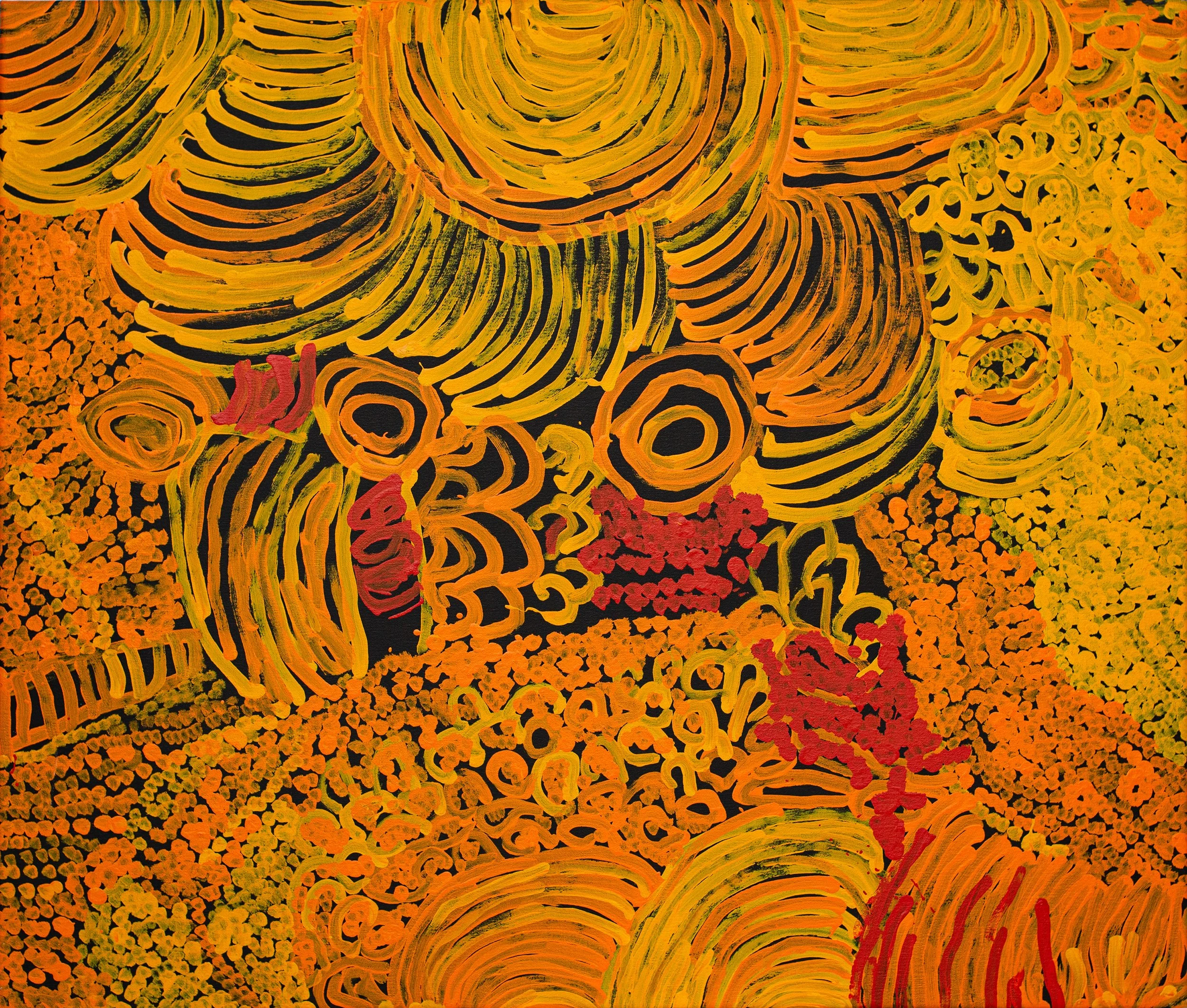
Artiste : Eileen Yaritja Stevens
Titre de l'œuvre : Wanampi Tjukurpa
Format : 103 x 89 cm
Provenance et certificat : centre d'art aborigene de Tjungu Palya
Référence de cette peinture d'art indigène d’Australie : 08116
Demander le prix de l'œuvre / Enquiry
Explications pour cette œuvre :
Eileen was born in the bush at Makiri, Tjala Minyma Tjukurpa (Honeyant Women's sacred place) c1919. Her father was a Yangkunytjatjara man and her mother a Pitjantjatjara woman. When Eileen was a young woman she worked at Ernabella mission milking goats. "I was a hard worker at the mission, but it was good." Her husband also worked at Ernabella chopping trees for building projects. Later they came to Nyapari, Eileen's husbands country. Eileen passed away in February 2008, she was 89 and still singing and painting with a passion and energy.
This is the Wanampi Tjukurpa (water snake men dreaming) for Nyapari. This place is called Pilta. Pilta rockhole is just in the hills, really close to the community. The two men are water snakes. The two women went off to get some food. They headed to Pilki, kapi pulka (a big rock hole) for honey ants. They were digging for kuka mitika (burrowing beong). Irititja kuka (food from the early days).
The artworks of the artist could be find in the following prestigious collections :
The National Gallery Of Australia, Canberra, Act
The National Gallery Of Victoria, Melbourne, Vic
W & V Mcgeoch, Melbourne, Victoria
Araluen Gallery, Alice Springs, Northen Territory
Ian Berndt Collection, Perth, Western Australia
Kaplan-Levi Collection, Seattle, Usa
The Art Gallery Of South Australia, Adelaide,Sa
The Art Gallery Of Western Australia, Perth, Wa
The Lepley Collection, Perth, Western Australia.
The Marshall Colllection Adelaide, South Australia
The Merenda Collection
© Photo : Aboriginal Signature Estrangin gallery with the courtesy of the artists and Tjungu Palya
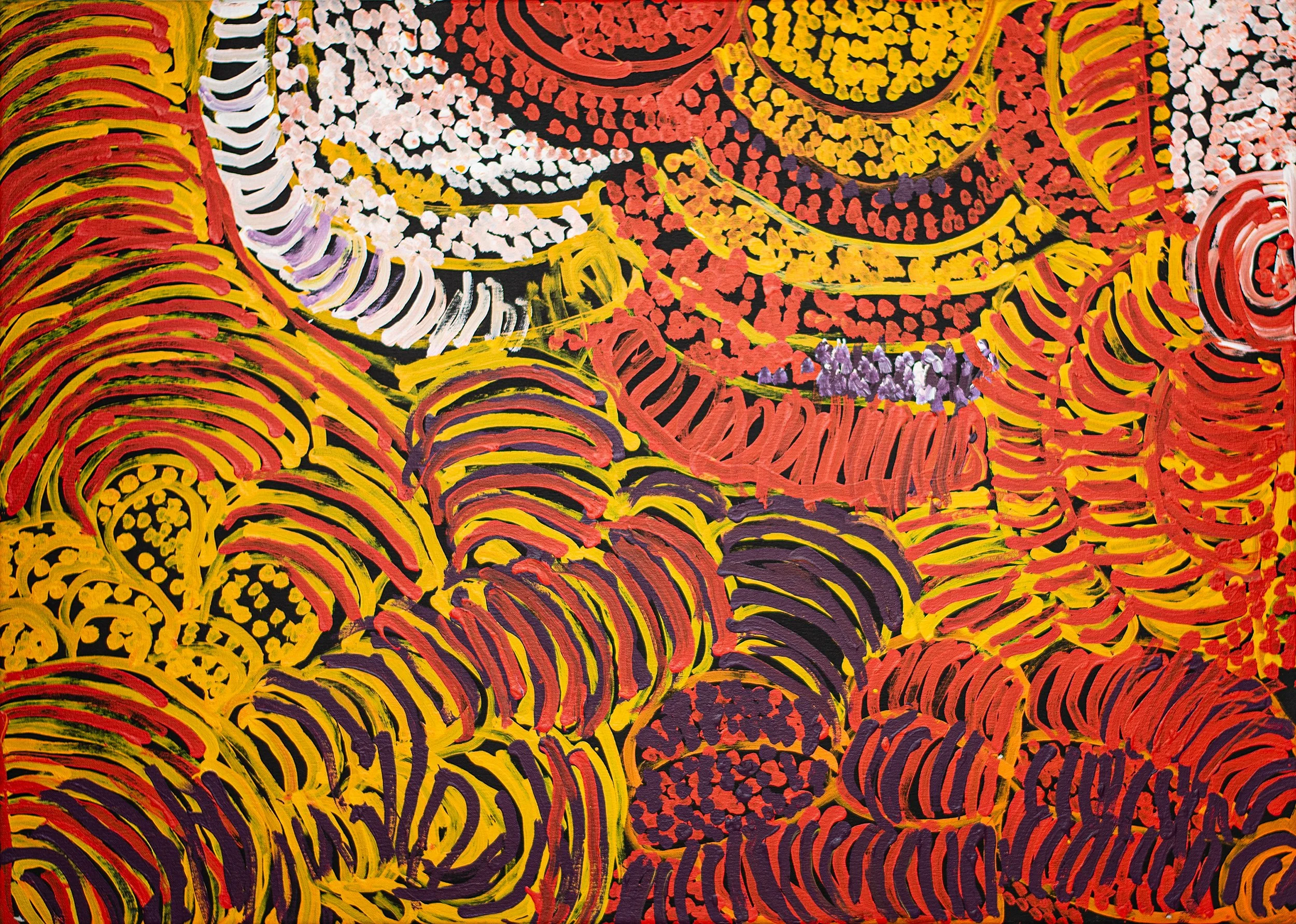
Artiste : Eileen Yaritja Stevens
Titre de l'œuvre : Minyma Kutjara munu Wati Kutjara
Format : 113 x 81 cm
Provenance et certificat : centre d'art aborigene de Tjungu Palya
Référence de cette peinture d'art indigène d’Australie : 07696
Demander le prix de l'œuvre / Enquiry
Explications pour cette œuvre :
Eileen was born in the bush at Makiri, Tjala Minyma Tjukurpa (Honeyant Women's sacred place) c1919. Her father was a Yangkunytjatjara man and her mother a Pitjantjatjara woman. When Eileen was a young woman she worked at Ernabella mission milking goats. "I was a hard worker at the mission, but it was good." Her husband also worked at Ernabella chopping trees for building projects. Later they came to Nyapari, Eileen's husbands country. Eileen passed away in February 2008, she was 89 and still singing and painting with a passion and energy
This artwork deals about :
Minyma kutjara munu wa kutjara Tjukurpa (the story of the two men and the two women). The two men were sitting inside the cave walkatja (painting on the cave walls). They were talking and decided to turn themselves into snakes. Later these two snake men swallowed the two women and they also turned into wananpi’s (water snakes) .
The artworks of the artist could be find in the following prestigious collections :
The National Gallery Of Australia, Canberra, Act
The National Gallery Of Victoria, Melbourne, Vic
W & V Mcgeoch, Melbourne, Victoria
Araluen Gallery, Alice Springs, Northen Territory
Ian Berndt Collection, Perth, Western Australia
Kaplan-Levi Collection, Seattle, Usa
The Art Gallery Of South Australia, Adelaide,Sa
The Art Gallery Of Western Australia, Perth, Wa
The Lepley Collection, Perth, Western Australia.
The Marshall Colllection Adelaide, South Australia
The Merenda Collection
© Photo : Aboriginal Signature Estrangin gallery with the courtesy of the artists and Tjungu Palya
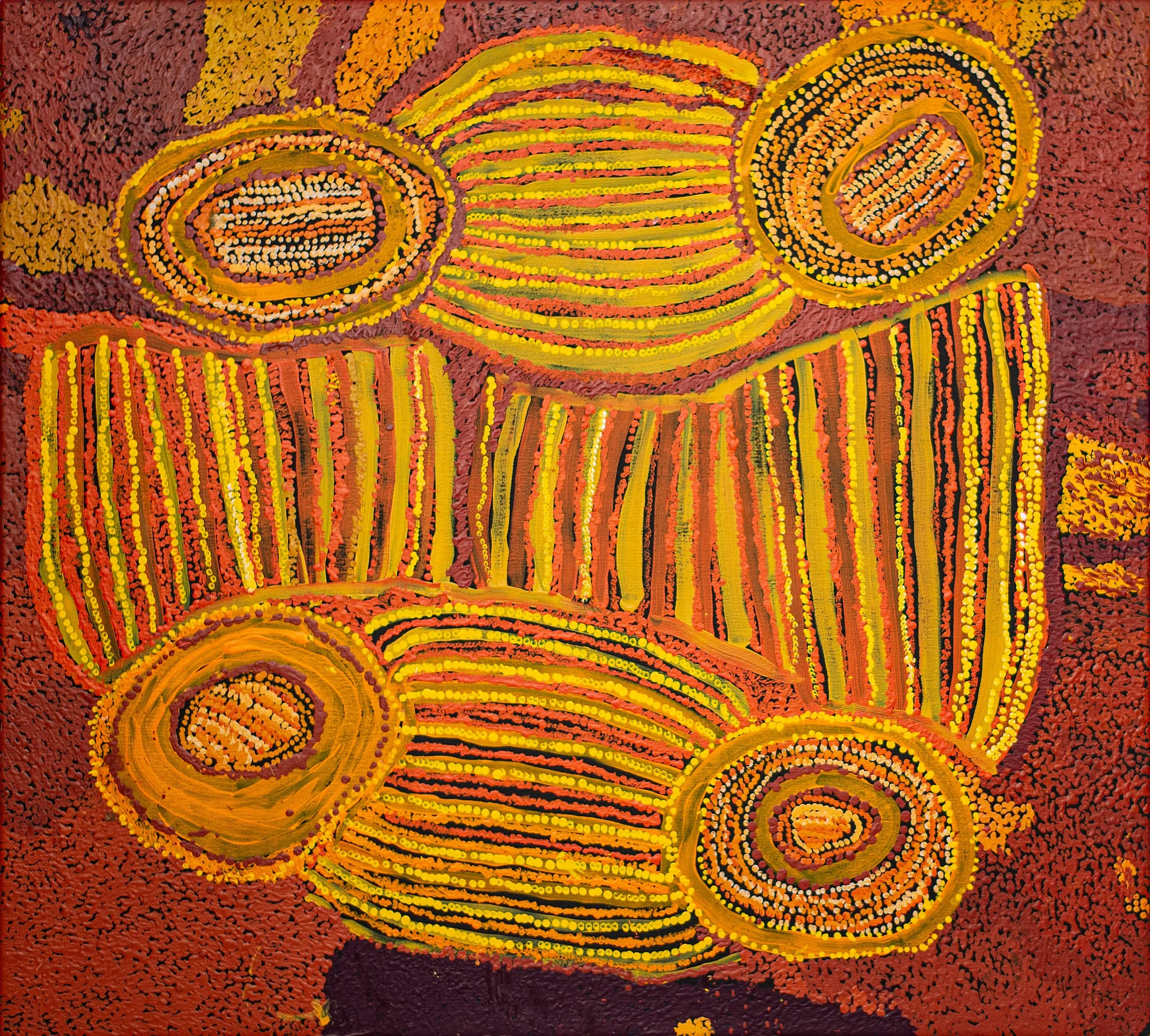
Artiste : Wingu Tingima
Titre de l'œuvre : Minyma Kutjara Dreaming stories
Format : 100 × 90 cm
Provenance et certificat : centre d'art aborigène de Tjungu Palya
Référence de cette peinture aborigène : 11509
Demander le prix de l'œuvre / Enquiry
Explications pour cette peinture d'art Aborigène :
Wingu Tingima was born in the late 1910s or early 1920s (she died 8 March 2010). She was an Aboriginal artist from central Australia. She was born in Great Victoria Desert, and grew up living a traditional way of life in the bush, without any contact with Western civilization. A member of the Pitjantjatjara people, she painted spiritual stories from her Dreaming. Along with her friend and colleague Eileen Yaritja Stevens, Wingu became one of the most well-known artists to paint in the style of the Western Desert.
Although she only began painting less than 10 years before her death, Wingu's work is now held in many of Australia's major art collections, including the National Gallery of Australia and the state galleries of New South Wales, Victoria, South Australia, the Northern Territory and Western Australia.
In this artwork she is dealing about Minyma Kutjara Tjukurpa (the creaon story of the two sisters). The big sister was travelling with her younger sister back to their homeland. The little sister was reluctant to head further and further north as she had been living with a different family near the ocean to the south. She had been lost for a long me and was unfamiliar with the landscape the big sister was showing her.
Eventually the older sister gave her a piggyback and tried to comfort her. She continued to teach her all about the country they travelled through. Somemes when they stopped they performed Inma (sacred singing and dancing). They camped at Punuwara and Irrunytju rockhole before heading further north to Docker River.
Her artworks are in the following prestigious collections :
Art Gallery of Western Australia,
The Art Gallery of South Australia,
The Museum and Art Gallery of the Northern Territory,
Art Gallery of New South Wales,
The National Gallery of Victoria,
The National Gallery of Australia,
The Australian National University…
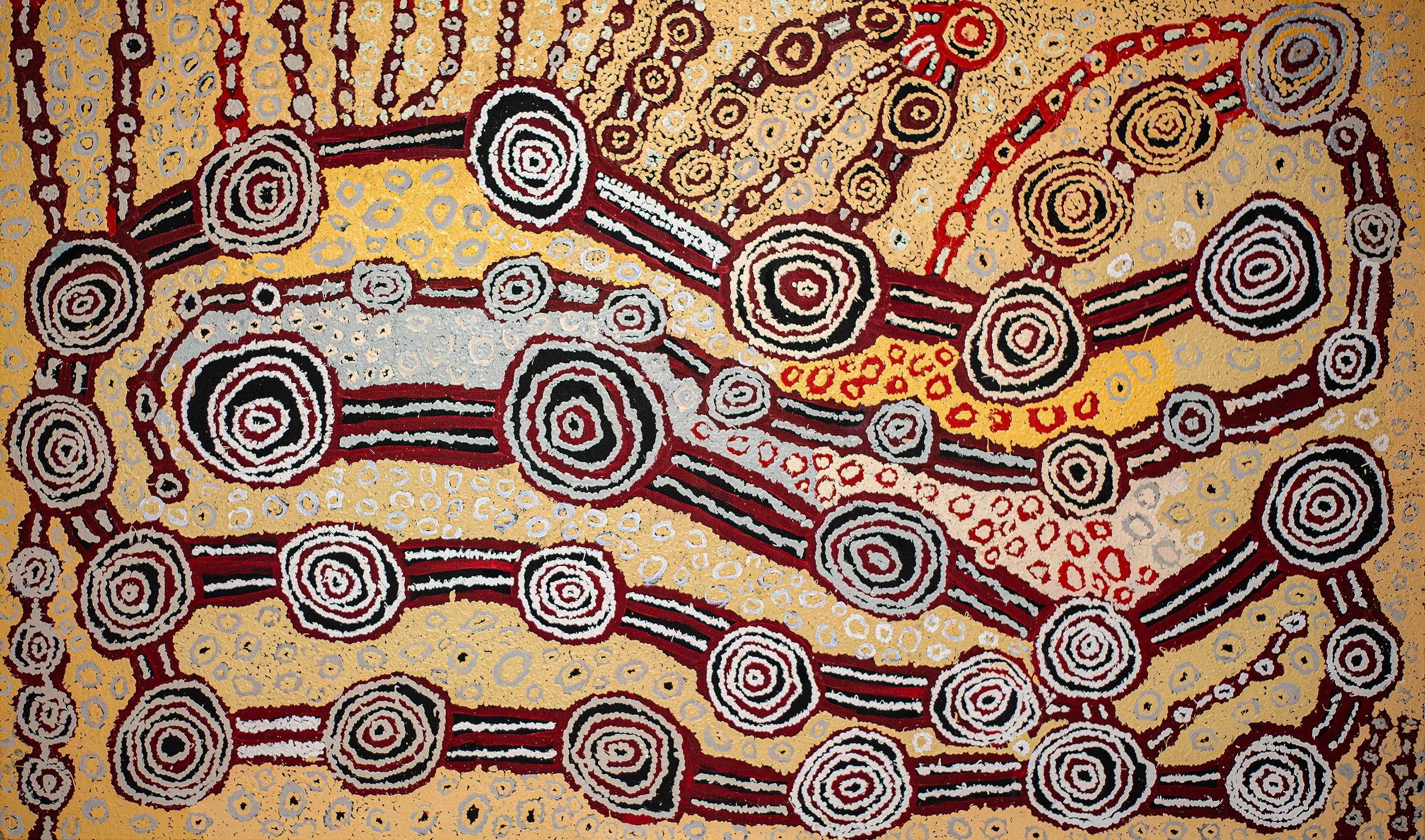
Artistes : Beryl Jimmy
Titre de l'œuvre : Kapi Tjukula
Format : 200 × 120 cm
Provenance et certificat : centre d'art aborigène de Tjungu Palya
Référence de cette peinture aborigène : 12174
Demander le prix de l'œuvre
Explications pour cette peinture d'art Aborigène :
Beryl Jimmy is a Pitjantjatjara woman living at the community settlement of Watarru, in the far northwest of South Australia, part of an area referred to as the Western desert. She was born in 1970. Beryl's work is inspired by a deep connection to country, and her spiritual links to the desert are expressed with integrity, beauty and creativity. Traditional knowledge of food collection and water sources were vital for survival in this dynamic desert landscape and is a prominent theme in her work. This cultural knowledge is handed down orally in the retelling of the Tjukurpa (traditional stories of the ancestor's journeys), which not only sustains Anangu (Aboriginal people) physically, but socially and spiritually.
Her Tjukurpa painting depicts a fragment of a larger story, a living history where an ancestor was involved in creating country. Individuals have authority and ownership of this land and the associated sites and stories. The maintenance of this country is paramount to artists of Watarru and they continue to care and manage the land with respect and responsibility.
Beryl Jimmy paints her vast country of Watarru, an important area in the Great Victoria Desert. It is marked by the large granite range that can be seen from a great distance and is an arid but beauful environment full of meaning for the people who have populated this area for millennia. Beryl depicts rock holes and travelling lines that signify greater meaning to her.
She applies the paint generously with a quiet gusto and freedom, that leaves her composions looking and feeling wild and raw in their mark making. Beryl is a true arst who is a joy to watch as she paints. She says ‘This is country close to Watarru. There are deep rockoles and traveling tracks. In the early days Anangu (Aboriginal ) people would travel from waterhole to waterhole collecting bush foods and setting up camp’.
Her artworks are in the following prestigious collections :
Deakin University, Melbourne,
VIC Flinders University, Adelaide SA
National Gallery of Australia, Canberra, ACT
The Beat Knoblacuch Collection, Switzerland
The Lepley Collection, Perth,
WA Parliament House, Adelaide,
SA Primary Industry and Resources, Adelaide,
SA Department of Environment and Heritage,
SA Australian National University, Canberra,
ACT The Parliament House Collection, Canberra,
ACT University of Canberra, Canberra, ACT
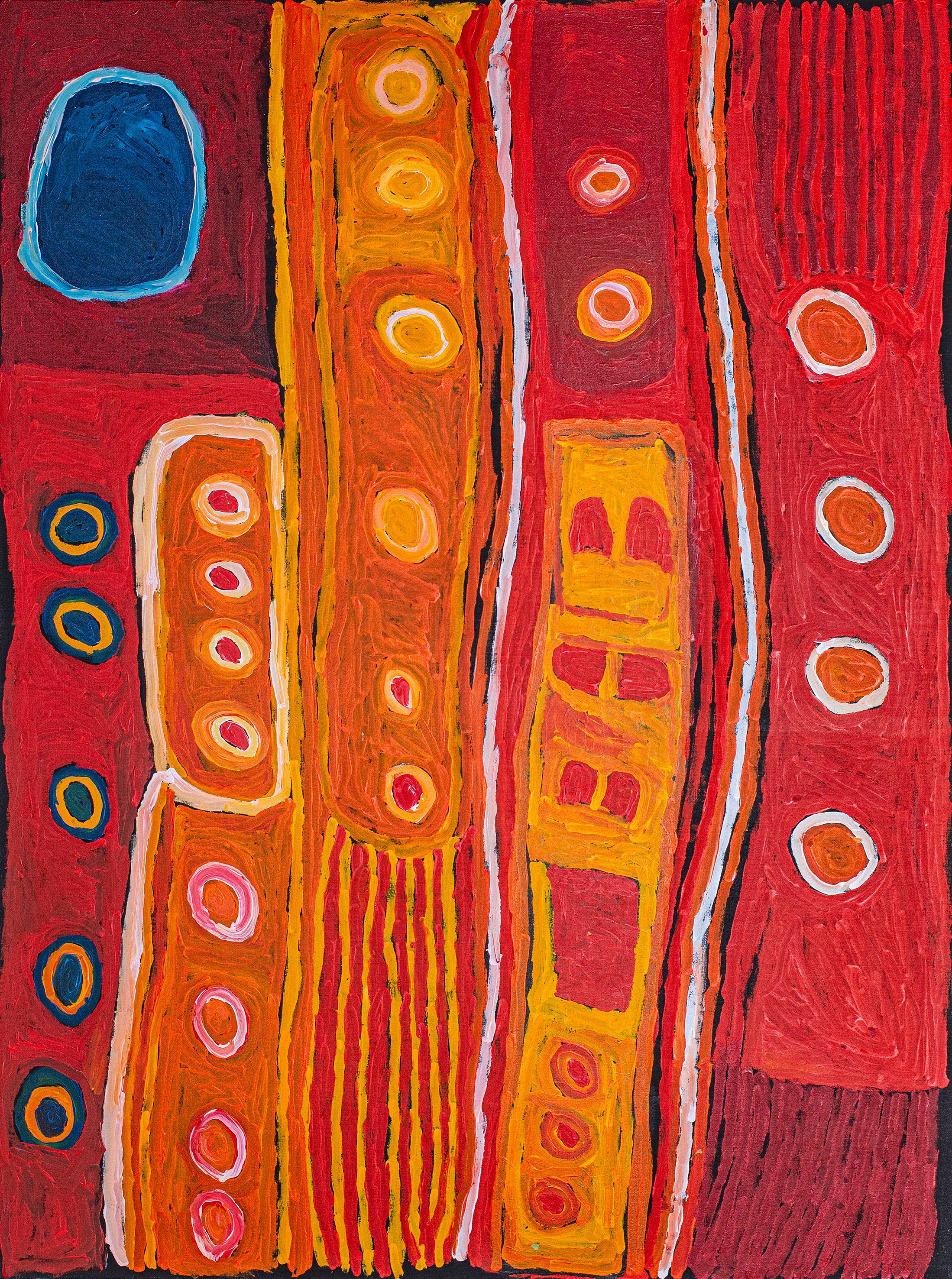
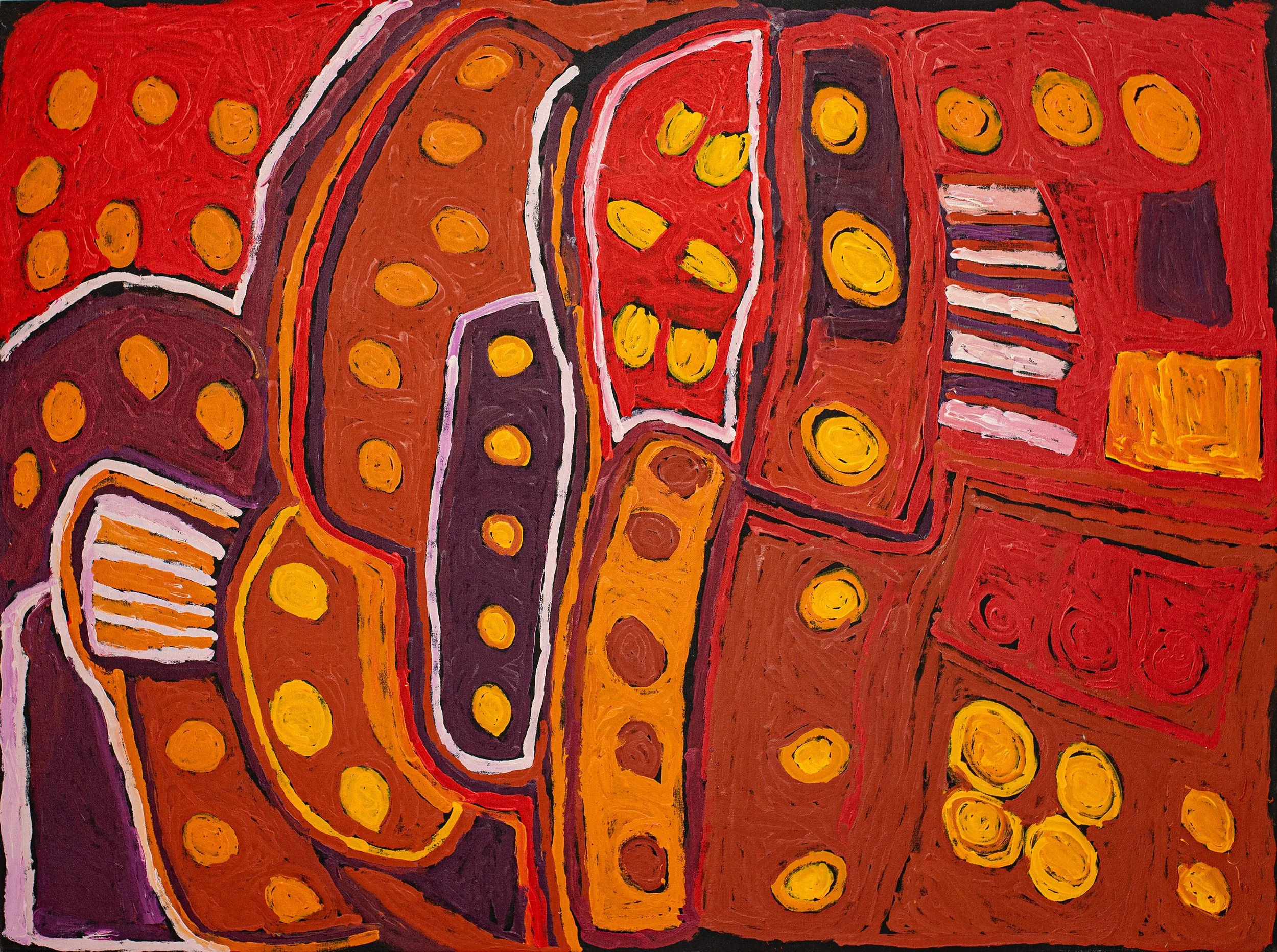
Artiste : Nellie Stewart
Titre de l'œuvre : Wana Wani
Format : 200 × 150 cm
Provenance et certificat : centre d'art aborigène de Tjungu Palya
Référence de cette peinture aborigène : 11174
Explications pour cette peinture Aborigène :
Nellie Stewart (1930-2011) was born in the bush at Pipalyatjara, her father's country. Her mother is from Irrunytju. As a girl she attended school at Ernabella Mission and later worked in Alice Springs teaching Pitjantjatjara language with her husband. She began painting in 2007 when she moved to Nyapari with her family.
This painting is connected to the Minyma Tutjara Tjukurpa (The Two Sisters creation story). When the little sister was very small she was blown by a big wind far to the south, to another country, where the people spoke another language and performed different Inma (ceremonies).
Many years later the big sister heard where her sister was and went to bring her back home. They travelled together for many days. The lile sister was frightened and crying. "I don't want to go on. I want to go back" she wailed. The elder sister taught her ceremonial knowledge as they travelled through the desert. Close to Irrunytju the sisters made hair belts for Inma (ceremonial song and dance). From there the big sister threw her digging stick and made the rock hole Wana Wani.
As stressed by the Dr Christine Nicholls : “Typically Nellie Stewart uses a technique of over-painting a dark background, using brushstrokes in ways that evoke ceremonial body painting designs onto dark skin. Stewart uses her brush in ways akin to women using their fingers to smear layers of paint onto the darker background, in preparation for women-only ceremonies (inma). The mark making, such an integral part of women's body painting, also plays a decisive role in Nellie Stewart's artwork”.
You can find artworks by the artist in the prestigious following collections :
National Gallery Victoria, Melbourne. VIC
The Corrigan Collection, NSW
Maroondah Art Gallery, Ringwood, Victoria
Queensland Art Gallery, Brisbane, QLD
Marchall Collection, Adelaide, SA
Lagerburg-Swift Collection, Perth, WA
W & V McGeoch Collection, Melbourne VIC
Artbank, Australian Government National Contemporary Art
© Photo : Aboriginal Signature Estrangin gallery with the courtesy of the artists and Tjungu Palya.
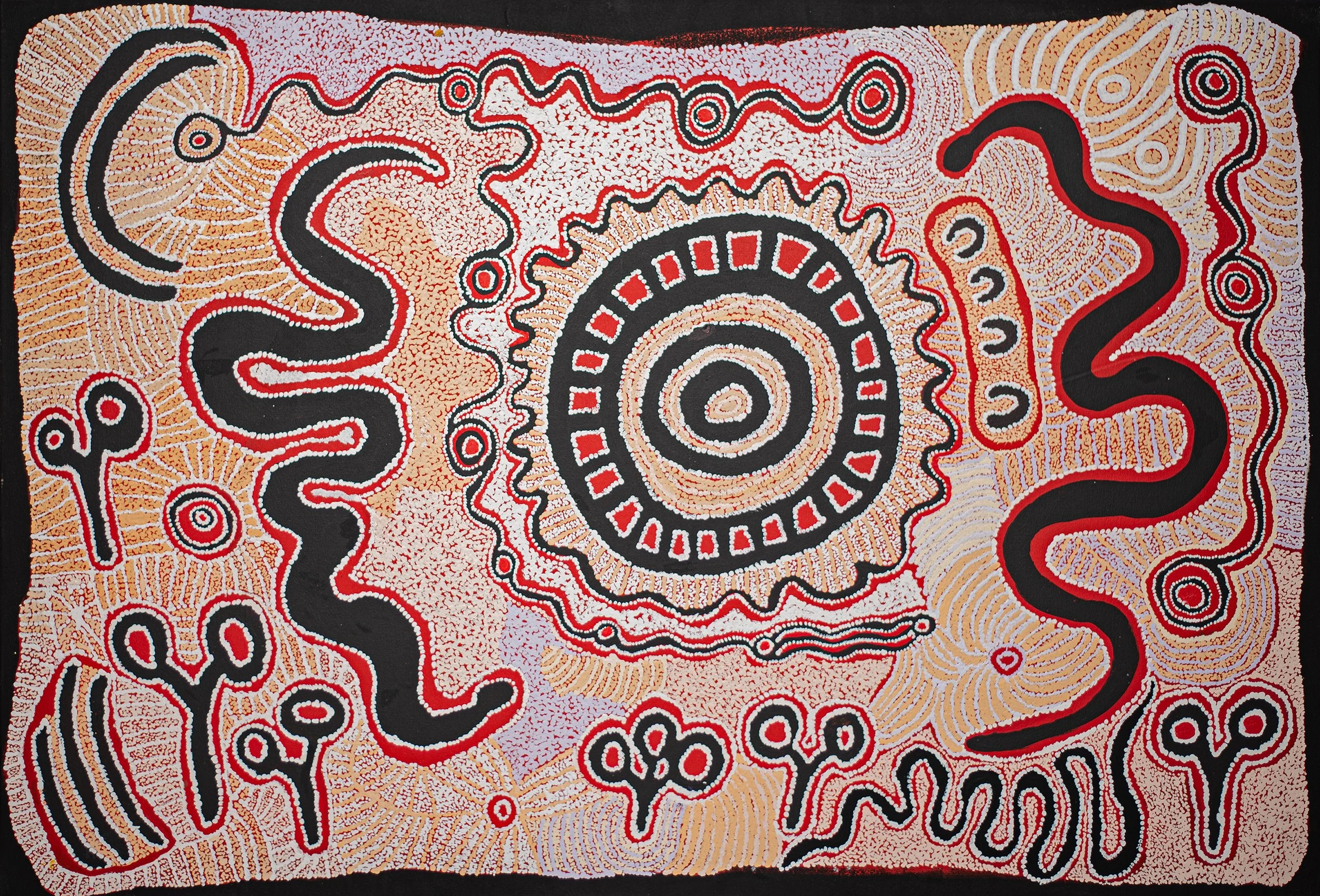
Artiste : Ruth Fatt
Titre de l'œuvre : Kuru Ala - Seven Sisters’ story
Format : 147 x 100 cm
Provenance et certificat : centre d'art aborigène de Tjungu Palya
Référence de cette peinture aborigène : 16-043
Explications pour cette œuvre :
Ruth was born in the bush at Granite Downs cattle station around 1960 where her parents were working as station hands. Her father' s country is Kampurarpapi in Western Australia and her mother's place is Tjalinyla close to Tjuntjuntjara ( Spinifex Country) also in Western Australia. Ruth's grandfather had three wives, as was common for traditional Pitjantjatjara men. Ruth's grandmother was the first wife. Wingu Tingima was the third wife and culturally one of Ruth's grandmothers. She passed away in 2021.
This painting is dealing about Kuru Ala a sacred place for the Kungkarrakalpa (Seven Sisters’ story). Minyma tjuta kapiku nyinanyi. The sisters were sitting around the rockhole. There was a kuniya (python) inside. "Kwarila ngalkunyi kuka wiru mulapa" kangkuru wankangu.
Warungka kampanyi kuka paluru palya. The elder sister said "that's good food to eat" and they cooked the kuniya on the fire. But that wasn't really a kuniya but the man Wati Nyiru who had changed his form into that of a snake. He chased the women all across the desert trying to get the elder sister to be his wife.
Her artworks are in the following prestigious collections :
Artbank, Australian Government National Contemporary Art Rentral
W & V McGeoch Collection, Melbourne, Victoria
The Lepley Collection, Perth, Western Australia
Artiste : Nellie Stewart
Titre de l'œuvre : Wana Wani
Format : 200 × 150 cm
Provenance et certificat : centre d'art aborigène de Tjungu Palya
Référence de cette peinture aborigène : 11350
Explications pour cette peinture Aborigène :
Nellie Stewart (1930-2011) was born in the bush at Pipalyatjara, her father's country. Her mother is from Irrunytju. As a girl she attended school at Ernabella Mission and later worked in Alice Springs teaching Pitjantjatjara language with her husband. She began painting in 2007 when she moved to Nyapari with her family.
This painting is connected to the Minyma Tutjara Tjukurpa (The Two Sisters creation story). When the little sister was very small she was blown by a big wind far to the south, to another country, where the people spoke another language and performed different Inma (ceremonies).
Many years later the big sister heard where her sister was and went to bring her back home. They travelled together for many days. The lile sister was frightened and crying. "I don't want to go on. I want to go back" she wailed. The elder sister taught her ceremonial knowledge as they travelled through the desert. Close to Irrunytju the sisters made hair belts for Inma (ceremonial song and dance). From there the big sister threw her digging stick and made the rock hole Wana Wani.
As stressed by the Dr Christine Nicholls : “Typically Nellie Stewart uses a technique of over-painting a dark background, using brushstrokes in ways that evoke ceremonial body painting designs onto dark skin. Stewart uses her brush in ways akin to women using their fingers to smear layers of paint onto the darker background, in preparation for women-only ceremonies (inma). The mark making, such an integral part of women's body painting, also plays a decisive role in Nellie Stewart's artwork”.
You can find artworks by the artist in the prestigious following collections :
National Gallery Victoria, Melbourne. VIC
The Corrigan Collection, NSW
Maroondah Art Gallery, Ringwood, Victoria
Queensland Art Gallery, Brisbane, QLD
Marchall Collection, Adelaide, SA
Lagerburg-Swift Collection, Perth, WA
W & V McGeoch Collection, Melbourne VIC
Artbank, Australian Government National Contemporary Art
© Photo : Aboriginal Signature Estrangin gallery with the courtesy of the artists and Tjungu Palya.
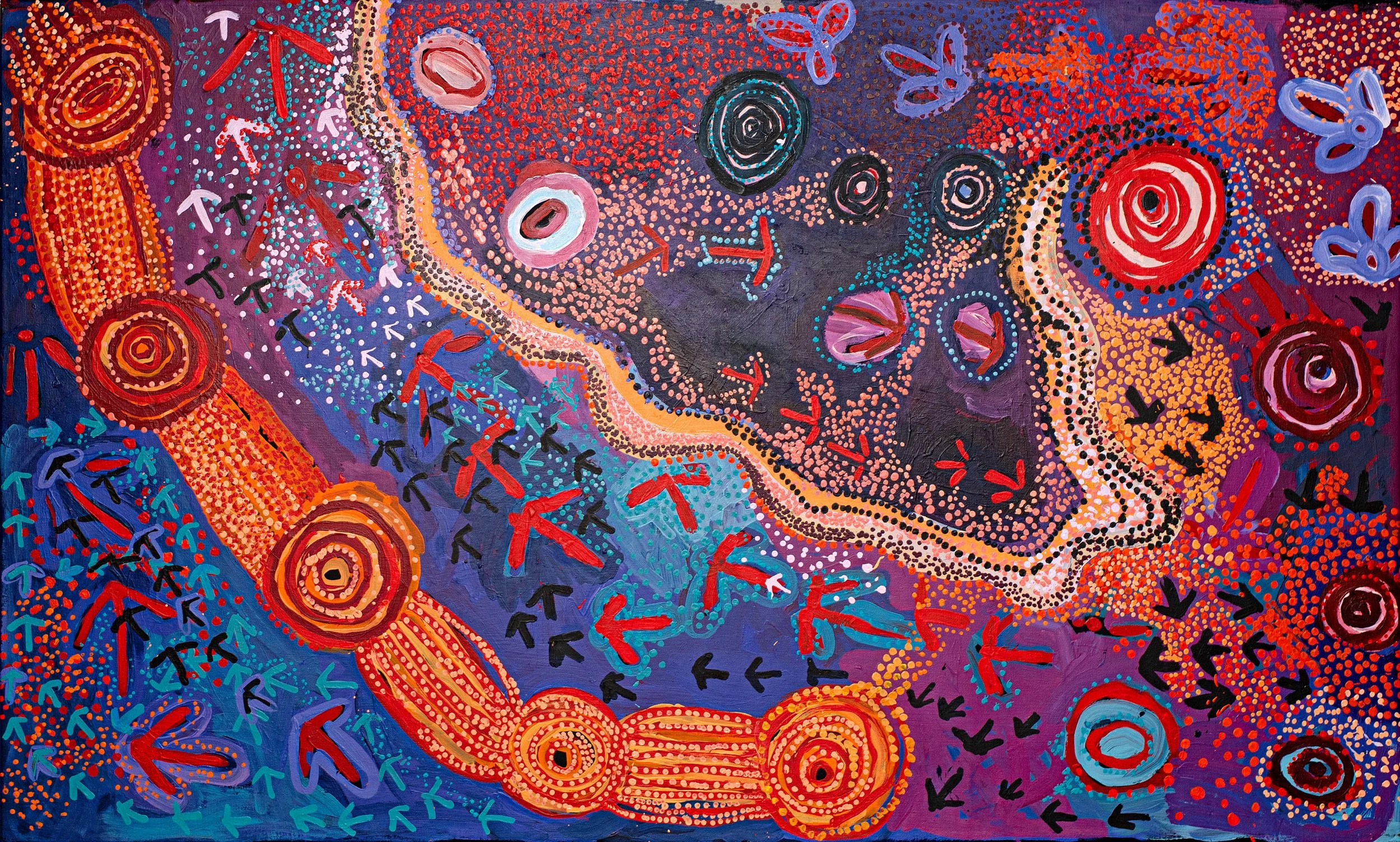
Artiste : Kaye Baker
Titre de l'œuvre : Malilu munu Kalaya Dreaming stories
Format : 198 × 117 cm
Provenance et certificat : centre d'art aborigène de Tjungu Palya
Référence de cette peinture aborigène : 16-016
Demander le prix de l'œuvre / Enquiry
Explications pour cette peinture d'art Aborigène :
Kaye was born at Ernabella c1955. She spent her early years at the mission before her family moved to Fregon community. At Fregon Kaye worked in the craft room. She moved to Kanpi, the traditional country of her father Jimmy Baker in the1980's and helped set up a small art and crafts room there. She worked, lived and worked closely with her father until his passing in 2010, caring for him in his last years when he was ill. She talks of their conversations about how to translate the stories of their homeland into works on canvas and the importance of continuing the tradition of painting as cultural maintenance. Kaye has adopted a style quite unlike Jimmy's, even though their stories are shared, and a style unique to the wider Indigneous art market. She is also a desert weaver and an expert carver.
“This painting evokes my country around Kanpi. This is the home and story for Malilu. She has been travelling all around collecting wild foods. She has gone into her cave, which is underground and is siting with here wana and wira (collecting bowl and digging stick). She has all the wild foods she's collected:; kampurarpa, kunakan, waka, and ngapari. Mai tjuta (lots of wild foods). This area is also home to the Kalaya (emu). There are rockholes and creek lines crossing over this place. The Kalaya mai (emu foods) are abundant. They are travelling around eating kampurarpa, ili, wayanu, kunakan, tjulpulpa and puli tjuta. All the small stones they gather from the creek bed and eat them too. Tjukurpa mulapa. This is important country with strong Dreaming. This is the story for that old man (Jimmy Baker), my father.
You can find artworks by the artists in the following prestigious collections :
Art Gallery of South Australia
Thomas Vroom Collection, Netherlands
© Photo : Aboriginal Signature Estrangin gallery with the courtesy of the artists and Tjungu Palya.
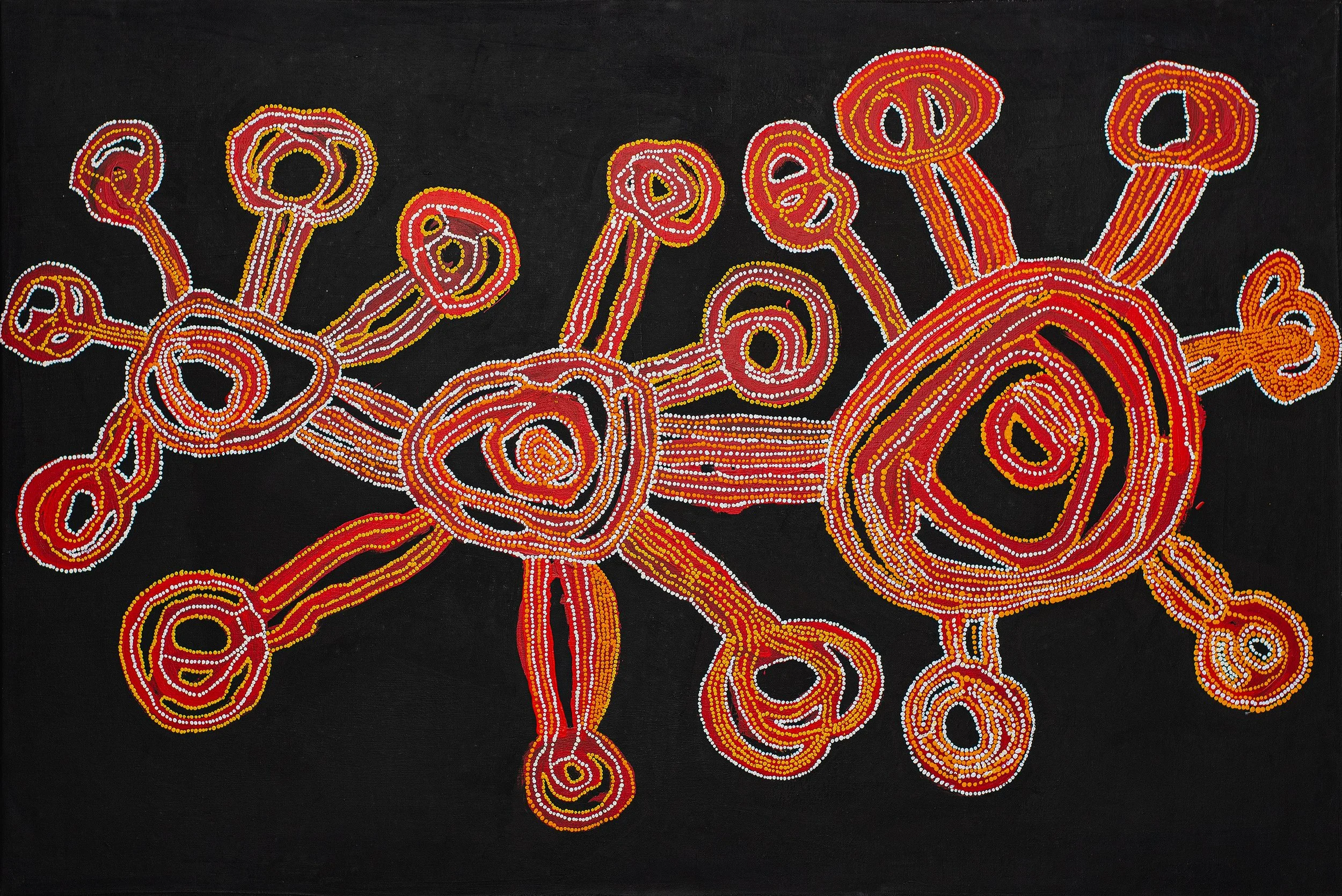
Artiste : Winmati Roberts
Titre de l'œuvre : Angura
Format : 150 × 100 cm
Provenance et certificat : centre d'art aborigène de Tjungu Palya
Référence de cette peinture aborigène : 25-49
Demander le prix de l'œuvre / Enquiry
Explications pour cette peinture d'art Aborigène :
Winmati is the son of Wingu Tingima and was born in the bush close to Fregon Community in the 1950's. He has strong family ties with Tjuntjuntjarra and spends his time between the two communities. As was common for traditional people, Winmahas three wives. He has eight children and two grandchildren.
In this artwork he is dealing with a plant called angura, a bloodwood apple tree. A type of maku, (witchery grub) can be found, not in the roots as is normal, but in the trunk and larger branches. These trees are prevalent in the desert and are found to the north, south, east and west, everywhere. While the surface iconography is of wild plant foods each of these are associated with the Tjukurpa and they play an important role in the ancestral stories. Plant foods and water sources have sacred and spiritual dimensions which are readily appreciated by Anangu knowledgeable in the Law. Increase ceremonies where relevant rituals are performed to ensure abundance of foods vital for survival played an important part in ceremonial life.
© Photo : Aboriginal Signature Estrangin gallery with the courtesy of the artists and Tjungu Palya.
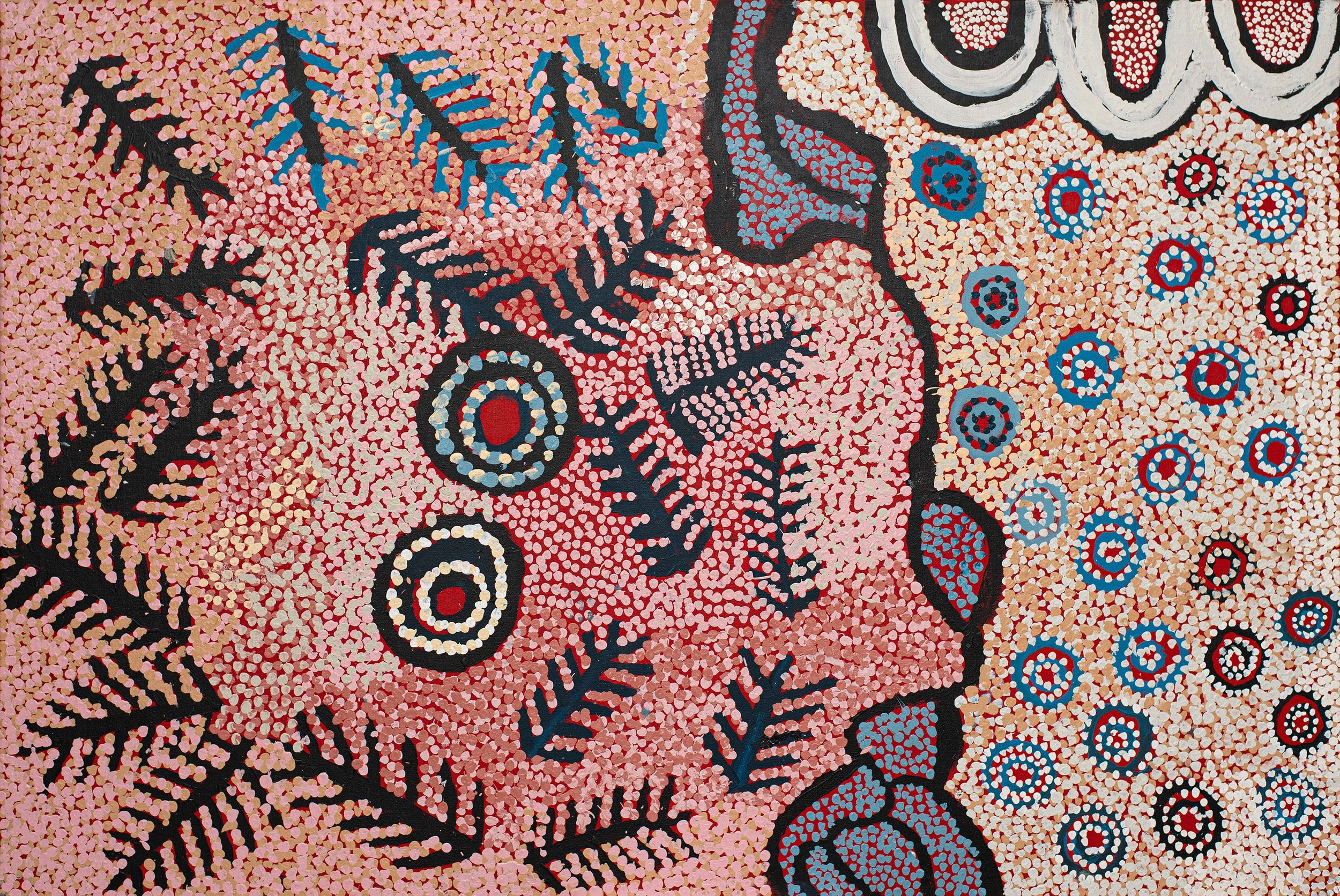
Artiste : Helen Curtis
Titre de l'œuvre : Kapi tjukula
Format : 150 x 100 cm
Provenance et certificat : centre d'art aborigène de Tjungu Palya
Référence de cette peinture aborigène : 12193
Demander le prix de l'œuvre / Enquiry
Explications de cette peinture Aborigène :
Helen was born in 1973 in Alice Springs hospital over 600kms from her traditional country Cave Hill, near Amata, where she grew up. Cave Hill is the songline of the Seven Sisters' Tjukurpa; an important Dreaming site for the central desert people. Her family moved to Mutjitjulu at Uluru (Ayres Rock) where she worked as a guide for Anangu Tours. She taught visitors about Aboriginal culture and traditional food collection and preparation. Today Helen lives with her mother Angkaliya Curtis at Nyapari Community. Located about 100kms south of Uluru, Nyapari is set at the base of the majestic Mann Ranges in the heart of country traditionally owned by the Pitjantjatjara people.
These ranges known to Anangu as Murputja, likening the mountain to the bony ridge of a person’s spine, are the source of many water holes and traditional camping places. The homelands of Kanpi, Nyapari, Angatja, Umpukulu and Tjankanu have grown from these seasonal camping places into permanent settlements.
This painting deals about kapi tjukula (the deep rockholes) and karu (the creek lines) in my country Cave Hill. This is a sacred place for the Seven Sisters Dreaming. Minyma tjuta (the sisters) are sitting inside the cave, they have been collecting bush tucker, desert rain and bush tomatoes. They wait inside the cave, hiding from the cheeky man Wati Nyiru. This country is from my father.
Artiste : Ginger Wikilyiri
Titre de l'œuvre : Kunamata - Dreaming Time stories
Format : 200 x 148 cm
Provenance et certificat : centre d'art aborigène de Tjungu Palya
Référence de cette peinture aborigène : 21-013
Demander le prix de l'œuvre / Enquiry
Explications pour cette peinture Aborigène :
Ginger was born at Kunamata a rock hole south of Nyapari in 1930. His father had three wives. Wingu Tingima is the daughter of the first wife and Ginger the son of the second. Ginger is a senior law man and has cultural responsibilities for both Kunamata and Piltati.His passion for land management and horticulture has taken him to Israel where he learnt about arid land techniques and Mutijulu where he worked for many years as a ranger for Uluru-Kata Tjuta National Park. Ginger Wikilyiri's marvellously expressive and vibrantly coloured works embody a wealth of traditional knowledge. His works feature in major public institutions and private collections both locally and internationally. In terms of formal artistic properties, Ginger Wikilyiri's works are tours de force.
This artwork is dealing about Kunamata. Tis is my ngura (homeland). There are many different plants, animals and landforms at Kunamata. There is karu pulka (a big creek) that runs from the apu (rocky hills). Itjulu is on the other side and apu tjuta (rocky hills) are everywhere with different manta (ground) and different punu (trees). There is Ili (native fig) growing at Kunamata and underneath is Minkulpa Tjuta (lots of native tobacco). Kunamata is a very special place for my family.
The snake is panakura (desert death adder). Each day he ventures out to the cave to paint sacred designs on the cave walls, before returning home again. His home is in the sand hills close to Kunamata. Somemes I also paint two Liru's (snakes) kunga and wati (female and male), coming from Kunamata. Along the way they hunt for mingkiri (mice) at night. In my paintings you will somemes see the mingkiri tracks. They are going out collecting food and water and returning to their cave. The mingkiri always hide underground in their warren.
Meanwhile, during the dayme, that tjalku (bilby) was looking for tjala (honey ant) inside the tjala's nest. Walawuru (eagle) was waiting for him to appear out in the open. Eventually tjalku did so and walawuru eats him. This country where this story is, is called Ilpin. There are sand hills, rock holes and rock boulders. This country is sacred country.
His artworks are in the following prestigious collections :
Araluen Art Collection, Department of Natural Resources, Environment, The Arts and Sport
The Parliament House Collection, Canberra, ACT
Artbank, Australian Government National Contemporary Art Rental
Macquarie Bank Flinders University, Adelaide South Australia
Lagerberg-Swift Collection, Perth Western Australia
Marshall Collection, Adelaide, South Australia
Merenda Collection, Perth Western Australia
The Beat Knoblacuch Collection , Switzerland
Flinders university, Adelaide, SA
University of Canberra, ACT
The Lepley Collection,Perth, WA
Dr. Ian Bernadt Collection, Perth Western Australia
National Gallery of Victoria, NGV. Melbourne, VIC
Australian National University, Canberra, ACT
The Corrigan Collection, Perth Western Australia
Art Gallery of South Australia, Adelaide, SA
National Gallery of Australia , NGA. Canberra, ACT
Deakin University, Melbourne,
VIC W & V McGeoch, Melbourne, VIC
The Collection of Berengere Primat, Geneva Switzerland
The Kennedy Collection, Sydney NSW