Exposition d’art Aborigène “Ngura Wintjiri – Expansive Country” - Aboriginal art from Australia
En association avec les artistes du centre d’art d’Iwantja.
A la galerie Aboriginal Signature Estrangin : 101 rue Jules Besme, 1081 Bruxelles.
Vernissage sur RDV le mardi 2 avril de 11h30 à 21h30.
A 20h - discours du directeur de la galerie et drink.
RSVP - réserver votre visite
Ensuite la galerie vous reçoit sur RDV, du mercredi 3 avril au samedi 27 avril 2024, du mardi au samedi, de 11h à 19h : vous pouvez également réserver votre visite dés à présent dans notre agenda ici.
Ngura Wintjiri – Expansive Country
La galerie Aboriginal Signature Estrangin est fière de vous présenter l’exposition «Expansive country», réunissant 30 peintures sur toile réalisées par 12 artistes Aborigènes d’Australie de la communauté artistique d’Iwantja, des anciens nés comme Alec Baker (1932), Nelly Ngampa Coulthard (1947), Maringka Burton (1950), René Sundown et Emily Culinan (1952), à la plus jeune génération issue des années 1970 comme Priscilla Singer (1968), Julie Yatjitja (1969), Yatjiki Cullinan (1970), Rosalind Tjanyari (1971), Eric Munti Riley (1973), et 80 comme Sallyane Roberts (1986), sélectionnées suite à de longs périples en Australie.
Après quelques 650 km de route asphaltée, puis de terre rouge en tôle ondulée, me voilà aux portes du désert rouge dans le APY Land.À l’arrivée au centre d’art d’Iwantja en 2018, je vois deux voitures de police à l’entrée et deux grands gaillards des services spéciaux. Ils me jaugent sans poser de question et me laissent entrer dans le bâtiment.

Œuvre de l’artiste Nellie Ngampa Coulthard - Tjuntala Ngurangka (Country with Acacia Wattle) - 198 x 167 cm - 684-22. © Photo : Aboriginal Signature Estrangin Gallery with the courtesy of the artist and Iwantja Arts.
Le Premier ministre de South Australia visite la communauté. Les artistes sont presque tous là. Quel plaisir de les rencontrer à nouveau. La presse, les photographes sont aussi de la partie et les flashes palpitent autour d’eux avec les œuvres en préparation d’où émanent des odeurs d’acrylique fraîche.
J’échange quelques mots forts sympathiques avec le Premier, The Hon Steven Marshall MP, qui porte un vif intérêt à ce mouvement artistique et collectionne leurs œuvres. Il a rencontré Emmanuel Macron il y a quelques semaines, la France ayant signé un gros contrat de vente de sous-marins avec l’Australie, qui sera bien plus tard annulé.
Il souligne que les liens y compris culturels sont forts entre l’Australie et la France, avec par exemple plus de 140 œuvres du Musée d’Orsay actuellement exposées à Adelaide comme des œuvres de Monet... nous échangeons même quelques mots en français. Et j’immortalise sa visite sur la pellicule, avec le grand artiste Alec Baker née en 1932, actuellement présenté en 2024 à Bruxelles dans l’exposition « Expansive country ».
Les journalistes présents m’interviewent également pour avoir le point de vue d’un galeriste européen, sur ces artistes célébrés en Australie et à travers le monde. Beth et Heath, les deux managers, tiennent la barre du beau navire Iwantja avec la présidente et le board des directeurs, tous Anangu Aborigènes. Cette structure communautaire accomplit ici encore des merveille avec des œuvres fortes, connectées, embrasant l’espace et le temps. Leurs habits tachetés de jets de peintures, reflètent l’éclat des pigments et l’intensité créative propre à ce lieu et aux peintures à venir. Nous avons en fin de journée le temps d’un bel échange sur des projets futurs en commun.
En fin de journée je me rend à Mimili, un peu plus loin, où je dormirai ce soir. J’y retrouve un bébé kangaroo à qui je donnais le biberon il y a juste un an. Il est un peu lourd sur mes genoux. Mais il continue de téter goulûment le biberon que je lui offre ce soir. Peut-être me reconnaît-il ? Quel contraste.

Peinture de l’artiste Rene Sundown - Ngura Tali - Sand dune Country - 152 x 122 cm - 283-23. © Photo Aboriginal Signature Estrangin Gallery with the courtesy of the artist and Iwantja Arts.
Cinq ans plus tard, ce 14 juillet 2023, il n’y a qu’en France que c’est la fête.
Ici règne la tristesse dans la communauté. Ce matin vers 8h je reçois un message du centre d’art d’Iwantja où je devais me rendre pour la journée. Une jeune femme vient de mourir dans la nuit d’une crise cardiaque. La communauté est fermée et ne peut plus accueillir y compris dans les jours qui viennent. C’est si soudain. En ville on aurait sans doute pu la sauver. Ici c’est si éloigné que les secours restent critiques.
Le sorry business (activité de deuil) va commencer, avec la famille disséminée sur des milliers de km. Ils vont maintenant rejoindre le village puis organiser pendant des semaines les cérémonies et l’au-revoir dans son homeland, ce lieu où elle est née, sa terre ancestrale, plus loin encore dans le bush.
Il faut organiser le voyage, le campement souvent à des centaines de km pour 50 à 100 personnes : couchages, tentes, nécessaires de cuisine, eau, nourriture, médicaments pour les personnes âgées… c’est une expédition coûteuse.
De mon côté faire 20 000 km pour une porte close est un peu rude. Mais il en va ainsi par ici. Nous ferons la sélection des œuvres un peu plus tard pour l’exposition « Expansive country » du mois d’avril 2024 à Bruxelles.
Changement de programme. Je vais me promener sur les sommets des collines de pierre de Mimili où la vue est prodigieuse au matin et le soir pour admirer les lumières rasantes du soleil couchant. Elles révèlent les formes, les distinguent et érigent ces pierres d’ailleurs en sculptures improbables des grands ancêtres, comme des empreintes des temps de la Création, comme autant d’éléments conjugués dans le paysage qui aident à comprendre les œuvres d’art de ce grand peuple.

Peinture de l’artiste Trisha Singer - Tali Ngura (Sandhill Country) - 167 x 152 cm - 214-23 © Photo : Aboriginal Signature Estrangin Gallery with the courtesy of the artist and Iwantja arts.
Les peintures de l’exposition « Expansive country » offrent un aperçu du lien profond entre les artistes de la communauté d'Iwantja et la terre qu'ils habitent. Chaque coup de pinceau est une révérence aux histoires du Tjukurpa ou temps du Rêve, imprégné d'un sentiment d'appartenance unique à une terre modelée par le geste des ancêtres créateurs.
Ces 12 hommes et femmes qui exposent ici leurs œuvres à Bruxelles sont bien plus que des artistes. Ils sont les gardiens de ces lieux sacrés. Ils sont les témoins d’une histoire transmise depuis les origines sans interruption par les miracles de l’oralité et de leurs systèmes d’initiation.
Dans cet univers de couleur, avec ces jeux de textures sur les toiles, ces structures aux formes ondulées vectrices de signes signifiants, les artistes manifestent un profond respect de la terre, comme poutre faîtière de leur société et culture, qui transcende le temps et continue d’inspirer les générations à venir.
Nous nous réjouissons de vous accueillir au sein de la galerie à Bruxelles, dans notre espace de 250 m2 tout entier dédié à ces grands et petits trésors d’Australie.
Bertrand Estrangin
Directeur de la galerie

Peinture de l’artiste Eric (Mungi) Barney (1973) - Ngura (Country) - 152 x 122 cm - 192-23 © Photo : Aboriginal Signature Estrangin Gallery with the courtesy of the artists and Iwantja arts.
Découvrez les peintures disponibles à Bruxelles durant l’exposition :
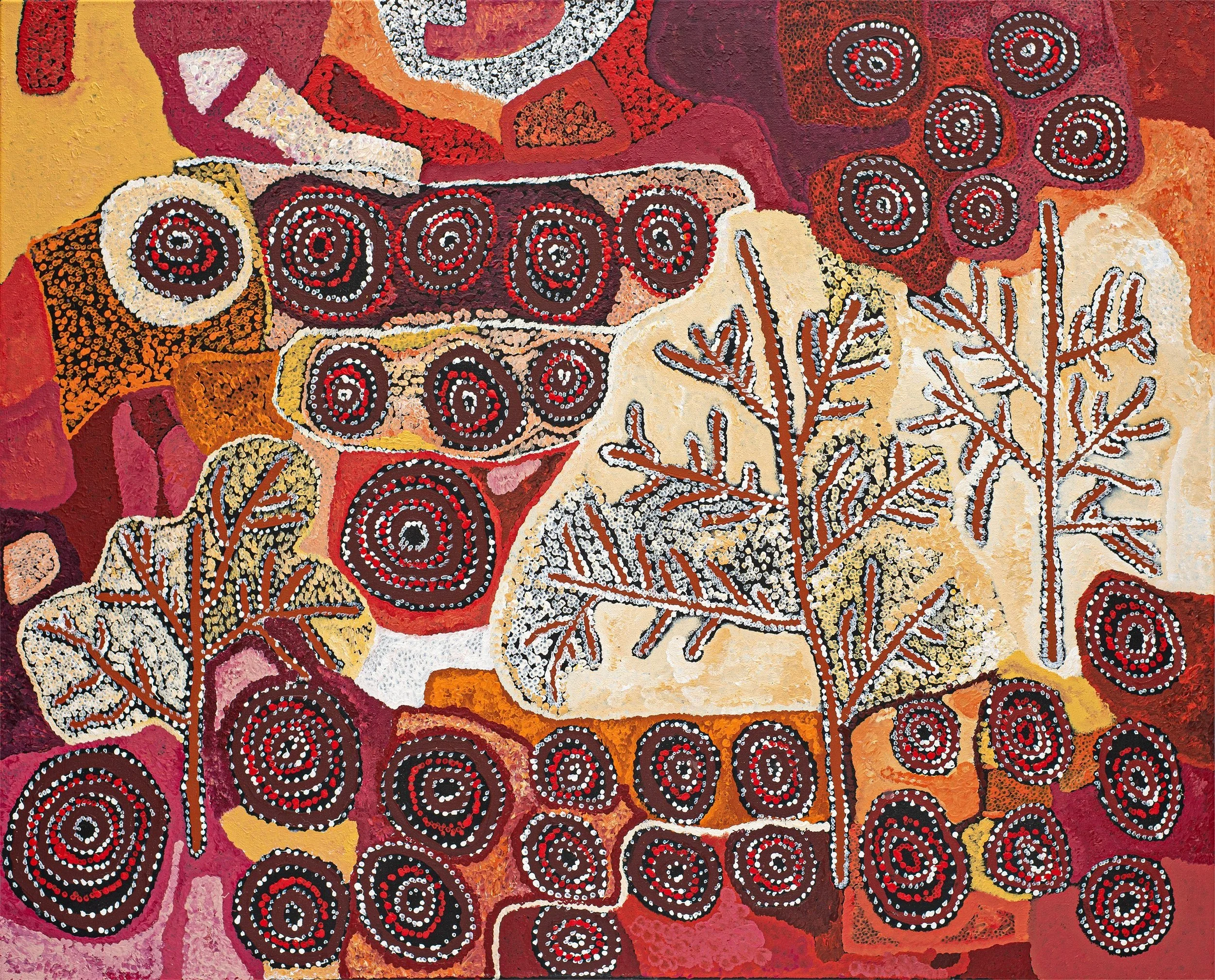
Artistes : Eric (Mungi) Barney (1973)
Titre de l'œuvre : Ngura (Country)
Format : 152 x 122 cm
Provenance et certificat : centre d'art aborigène d’Iwantja
Référence de cette peinture aborigène : 192-23
Explications pour cette peinture d'art Aborigène :
In Eric Barney’s paintings of Yankunytjatjara Country, mark-making is a form of mapping. Barney defines the terrain of his country by carving out sections of colour, the paint energetically applied to the canvas with a sense of rhythm and purpose. Barney interprets the rocky desert country around Indulkana Community through colour, tone and form. His powerfully understated paintings depict Tjukula (rock-holes), and the knowledge of these vitally important water sources that have sustained Anangu for generations.

Artistes : Nellie Ngampa Coulthard (1947)
Titre de l'œuvre : Tjuntala Ngurangka (Country with Acacia Wattle)
Format : 198 x 122 cm
Provenance et certificat : centre d'art aborigène d’Iwantja
Référence de cette peinture aborigène : 470-22
Explications pour cette peinture d'art Aborigène :
"I was born near the Wintinna Homestead close to Oodnadatta. When I was young my family and I would walk everywhere. That’s how I know this country so well. My paintings are about my beautiful country that I grew up on and the Tjuntala (native Acacia Wattle) that grows there.
Tjuntula grows everywhere near Oodnadatta and the far east of Indulkana. The flowers are bright yellow and are very beautiful. When the flowers come out, it is my favourite time of year, they are so special. The flowers are sweet to taste, my parents taught me how to grind the Tjuntala flowers with a little sand and ashes into a paste to eat, it’s very sweet and delicious!"

Artistes : Nellie Ngampa Coulthard (1947)
Titre de l'œuvre : Tjuntala Ngurangka (Country with Acacia Wattle)
Format : 198 x 167 cm
Provenance et certificat : centre d'art aborigène d’Iwantja
Référence de cette peinture aborigène : 684-22
Explications pour cette peinture d'art Aborigène :
"I was born near the Wintinna Homestead close to Oodnadatta. When I was young my family and I would walk everywhere. That’s how I know this country so well. My paintings are about my beautiful country that I grew up on and the Tjuntala (native Acacia Wattle) that grows there.
Tjuntula grows everywhere near Oodnadatta and the far east of Indulkana. The flowers are bright yellow and are very beautiful. When the flowers come out, it is my favourite time of year, they are so special. The flowers are sweet to taste, my parents taught me how to grind the Tjuntala flowers with a little sand and ashes into a paste to eat, it’s very sweet and delicious!"

Artistes : Julie Yatjitja (1969)
Titre de l'œuvre : Iwantja Tjukitji (Iwantja Soakage)
Format : 152 x 167cm
Provenance et certificat : centre d'art aborigène d’Iwantja
Référence de cette peinture aborigène : 128-23
Explications pour cette peinture d'art Aborigène :
Julie’s paintings shimmer with exuberant energy. She captures the intensity and power of country where the Iwantja Tjukitji (Iwantja Soakage) is located, and which holds the story of the Tjurki (native owl.)
Julie was born in the cool waters of the Iwantja creek, next to the large Tjukitji. The area is shaded by large gum trees, and the banks of the creek nestle close to large boulders. As a child she and her family lived here in a hand-built wiltja (shelter).
Yankunytjatjara families played in the creek waters and drank from the soakage. The water gave vitality and life to the area, and provided a cool place for the families to live during the hot summers.
This special Tjukitji is where the Indulkana community first began. This place also holds the tjukurpa of the Tjurki who travelled across the desert and came to live in a large gum tree by the creek, to watch over the Anangu and keep them safe.

Artistes : Trisha Singer (1973)
Titre de l'œuvre : Tali Ngura (Sandhill Country)
Format : 152 x 122 cm
Provenance et certificat : centre d'art aborigène d’Iwantja
Référence de cette peinture aborigène : 106-23
Explications pour cette peinture d'art Aborigène :
"This is Yankunytjatjara Country. I paint this Country that is my home, Iwantja is a good place. It is an important place to me and my family. There are many rockholes and caves here, there is also sandhills and dry plains that stretch out very far. I paint the important places that I know well, that my mother shared with me. My mother started this art centre, I feel close to her when I am painng here amongst my aunties.
Trish Singer is a Yankunytjatjara woman and cultural leader within the Indulkana community. Her mother Kumanara (Sadie) Singer worked with fellow artist Alec Baker to petition the Australian government for assistance and funding in establishing the Iwantja Art arts centre where Trish continues to paint today.

Artistes : Julie Yatjitja (1969)
Titre de l'œuvre : Iwantja Tjukitji (Iwantja Soakage)
Format : 198 x 167cm
Provenance et certificat : centre d'art aborigène d’Iwantja
Référence de cette peinture aborigène : 444-23
Explications pour cette peinture d'art Aborigène :
Julie’s paintings shimmer with exuberant energy. She captures the intensity and power of country where the Iwantja Tjukitji (Iwantja Soakage) is located, and which holds the story of the Tjurki (native owl.)
Julie was born in the cool waters of the Iwantja creek, next to the large Tjukitji. The area is shaded by large gum trees, and the banks of the creek nestle close to large boulders. As a child she and her family lived here in a hand-built wiltja (shelter).
Yankunytjatjara families played in the creek waters and drank from the soakage. The water gave vitality and life to the area, and provided a cool place for the families to live during the hot summers.
This special Tjukitji is where the Indulkana community first began. This place also holds the tjukurpa of the Tjurki who travelled across the desert and came to live in a large gum tree by the creek, to watch over the Anangu and keep them safe.

Artistes : Eric (Mungi) Barney (1973)
Titre de l'œuvre : Ngura (Country)
Format : 167 x 152 cm
Provenance et certificat : centre d'art aborigène d’Iwantja
Référence de cette peinture aborigène : 273-23
Explications pour cette peinture d'art Aborigène :
In Eric Barney’s paintings of Yankunytjatjara Country, mark-making is a form of mapping. Barney defines the terrain of his country by carving out sections of colour, the paint energetically applied to the canvas with a sense of rhythm and purpose. Barney interprets the rocky desert country around Indulkana Community through colour, tone and form. His powerfully understated paintings depict Tjukula (rock-holes), and the knowledge of these vitally important water sources that have sustained Anangu for generations.

Artistes : Priscilla Singer (1968)
Titre de l'œuvre : Tali Tjitin-tjitinpa (Glowing Red Sand)
Format : 152 x 122 cm
Provenance et certificat : centre d'art aborigène d’Iwantja
Référence de cette peinture aborigène : 209-23
Explications pour cette peinture d'art Aborigène :
"I paint my ngura (Country) and its red sand. This land is my grandfather’s country, he stood on this ground before me. I feel that connection to my family as I paint. This land that has held its many generations. This land is always changing, the rains come, and the winds shift. The red sand never changes, it is always here. I love the strong colours of the sand. When the sun sets, you can see the glow of the earth. I paint this country so people can see my land, they can appreciate its beauty and understand its power.
Our culture is very strong here, we teach our children in the community school, and we also teach them through our paintings, and through our time spent on Country. It is very important that the next generation understands by heart the Tjukurpa that has been passed down to us from our ancestors over many years. We tell the young people, you must listen and learn. It is important to keep our culture alive and strong long into the future.
My mother Kunmanara (Sadie) Singer, started Iwantja Arts many years ago with Alec Baker. She had a strong vision for the future of our community and also for sharing our stories and keeping our culture strong through the art centre. I think about her when I make my paintings. When I paint my Country, when I dance and sing the songs of my Country, I feel the spirit of my family and ancestors close to me. Their presence continues to watch over us and keep us strong.”
Priscilla Singer is a Yankunytjatjara woman and senior Cultural Leader within the Indulkana community. The Yankunytjatjara Principle at the Indulkana Anangu School, Priscilla has played a significant role with bilingual learning strategies, and the integration of cultural activities into the school curriculum.

Artistes : Trisha Singer (1973)
Titre de l'œuvre : Tali Ngura (Sandhill Country)
Format : 167 x 152 cm
Provenance et certificat : centre d'art aborigène d’Iwantja
Référence de cette peinture aborigène : 214-23
Explications pour cette peinture d'art Aborigène :
"This is Yankunytjatjara Country. I paint this Country that is my home, Iwantja is a good place. It is an important place to me and my family. There are many rockholes and caves here, there is also sandhills and dry plains that stretch out very far. I paint the important places that I know well, that my mother shared with me. My mother started this art centre, I feel close to her when I am painng here amongst my aunties.
Trish Singer is a Yankunytjatjara woman and cultural leader within the Indulkana community. Her mother Kumanara (Sadie) Singer worked with fellow artist Alec Baker to petition the Australian government for assistance and funding in establishing the Iwantja Art arts centre where Trish continues to paint today.

Artistes : Priscilla Singer (1968)
Titre de l'œuvre : Tali Tjitin-tjitinpa (Glowing Red Sand)
Format : 152 x 167 cm
Provenance et certificat : centre d'art aborigène d’Iwantja
Référence de cette peinture aborigène : 408-23
Explications pour cette peinture d'art Aborigène :
"I paint my ngura (Country) and its red sand. This land is my grandfather’s country, he stood on this ground before me. I feel that connection to my family as I paint. This land that has held its many generations. This land is always changing, the rains come, and the winds shift. The red sand never changes, it is always here. I love the strong colours of the sand. When the sun sets, you can see the glow of the earth. I paint this country so people can see my land, they can appreciate its beauty and understand its power.
Our culture is very strong here, we teach our children in the community school, and we also teach them through our paintings, and through our time spent on Country. It is very important that the next generation understands by heart the Tjukurpa that has been passed down to us from our ancestors over many years. We tell the young people, you must listen and learn. It is important to keep our culture alive and strong long into the future.
My mother Kunmanara (Sadie) Singer, started Iwantja Arts many years ago with Alec Baker. She had a strong vision for the future of our community and also for sharing our stories and keeping our culture strong through the art centre. I think about her when I make my paintings. When I paint my Country, when I dance and sing the songs of my Country, I feel the spirit of my family and ancestors close to me. Their presence continues to watch over us and keep us strong.”
Priscilla Singer is a Yankunytjatjara woman and senior Cultural Leader within the Indulkana community. The Yankunytjatjara Principle at the Indulkana Anangu School, Priscilla has played a significant role with bilingual learning strategies, and the integration of cultural activities into the school curriculum.

Artistes : Yatjiki Cullinan
Titre de l'œuvre : Ngura (Country)
Format : 152 x 122 cm
Provenance et certificat : centre d'art aborigène d’Iwantja
Référence de cette peinture aborigène : 331-23
Explications pour cette peinture d'art Aborigène :
I am a Yankunytjatjara woman from Indulkana Community on the Anangu Pitjantjatjara Yankunytjatjara (APY) Lands in South Australia. I’m an artist at Iwantja Arts, where I started painting over 20 years ago.
My paintings are of Tjukurpa (ancestral stories) and ngura (country) that have cultural significance for me and my family. They are a combination of landscape – specific locations and landmarks - and representations of the sky and stars. For Anangu the stars hold Tjukurpa (Ancestral cultural stories) just like the country - the rockholes, hills and creeks – have Tjukurpa. One main one is the Kungkarangkalpa (Seven Sisters) Tjukurpa where a specific constellation represents the sisters and the cheeky man chasing after them.
I’m proud to be an artist and a leader in my community, working to keep our culture strong and passing on important knowledge to the next generations.

Artistes : Yatjiki Cullinan
Titre de l'œuvre : Ngura (Country)
Format : 167 x 152 cm
Provenance et certificat : centre d'art aborigène d’Iwantja
Référence de cette peinture aborigène : 379-23
Explications pour cette peinture d'art Aborigène :
I am a Yankunytjatjara woman from Indulkana Community on the Anangu Pitjantjatjara Yankunytjatjara (APY) Lands in South Australia. I’m an artist at Iwantja Arts, where I started painting over 20 years ago.
My paintings are of Tjukurpa (ancestral stories) and ngura (country) that have cultural significance for me and my family. They are a combination of landscape – specific locations and landmarks - and representations of the sky and stars. For Anangu the stars hold Tjukurpa (Ancestral cultural stories) just like the country - the rockholes, hills and creeks – have Tjukurpa. One main one is the Kungkarangkalpa (Seven Sisters) Tjukurpa where a specific constellation represents the sisters and the cheeky man chasing after them.
I’m proud to be an artist and a leader in my community, working to keep our culture strong and passing on important knowledge to the next generations.

Artistes : Rene Sundown (1952)
Titre de l'œuvre : Ngura Tali - Sand dune Country
Format : 152 x 122 cm
Provenance et certificat : centre d'art aborigène d’Iwantja
Référence de cette peinture aborigène : 283-23
Explications pour cette peinture d'art Aborigène :
Rene was born in the bush land that surrounds Mt Ebenezer. Rene and her two older brothers were raised in the bush by her mother while her father worked as a stockman between Mt Ebenezer Station and Erldunda Station, which are both located along the Lasseter Hwy towards Uluru.
“I was raised at Erldunda Station, where my father was working. That’s where we lived. No school at all, I just grew up on the stations.
That place is all sand dune country. We would play in the sand dunes. We would just run around and roll down the sand dunes, down we would tumble, down the sand dune and roll down arriving at the bottom. it was really nice back then, playing. we would swim in the claypans after rain time and we would eat lots of bush onions.
These are the paintings I have been doing. This is my thinking and painting (sand dune) memories. Memories of what I saw, sand dunes that we played on. When I’m painting my feelings became strong. and all my memories come back. I’m thinking of those sand dunes and then painting them. This is the sand dunes and spinifex grass. Sand dune country was our home.”
Rene began painting at Iwantja Arts in the year 2000, painting memories of the long walks she would take along the sandhills and the salty river water near Erldunda Station that she played in as a child. Her paintings use a simple colour palette and gain complexity through her confident brush marks and intriguing iconography. Rene’s paintings evoke images of desert grasses, hidden pathways and sun-cracked riverbeds.

Artistes : Rosalind Tjanyari (1971)
Titre de l'œuvre : Ngura Kuuti (Spirit Country)
Format : 167 x 152 cm
Provenance et certificat : centre d'art aborigène d’Iwantja
Référence de cette peinture aborigène : 238-23
Explications pour cette peinture d'art Aborigène :
Both Rosalind’s mother and grandmother were famous Ngangkari’s (traditional healers) in the western country of the APY Lands, she has many family members in the Amata community. Rosalind spent a life time outdoors with her mother and grandmother traveling to visit family and friends in need of healing.
Rosalind's' paintings allude to a healing energy and strive to encompass the desert landscape. Her artworks speak to a deep history of connection to both country and people. Richly coloured, her paintings reference hidden pathways across the lands, and subtly hint at the fluidity of movement and of journeys. Her painterly marks weave colour through the canvas, flickering with an energy and excitement.
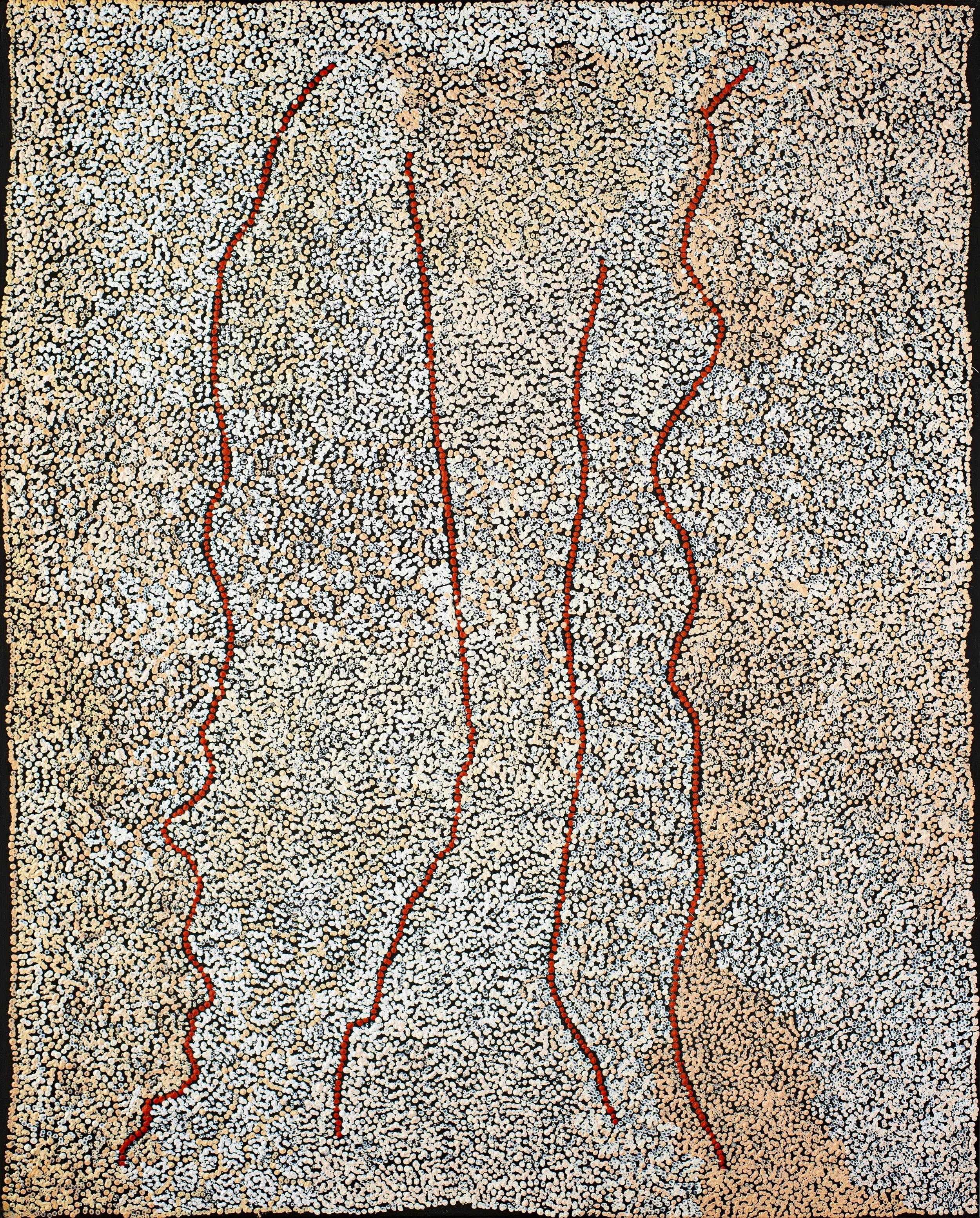
Artistes : Rene Sundown (1952)
Titre de l'œuvre : Ngura Tali - Sand dune Country
Format : 152 x 122 cm
Provenance et certificat : centre d'art aborigène d’Iwantja
Référence de cette peinture aborigène : 521-23
Explications pour cette peinture d'art Aborigène :
Rene was born in the bush land that surrounds Mt Ebenezer. Rene and her two older brothers were raised in the bush by her mother while her father worked as a stockman between Mt Ebenezer Station and Erldunda Station, which are both located along the Lasseter Hwy towards Uluru.
“I was raised at Erldunda Station, where my father was working. That’s where we lived. No school at all, I just grew up on the stations.
That place is all sand dune country. We would play in the sand dunes. We would just run around and roll down the sand dunes, down we would tumble, down the sand dune and roll down arriving at the bottom. it was really nice back then, playing. we would swim in the claypans after rain time and we would eat lots of bush onions.
These are the paintings I have been doing. This is my thinking and painting (sand dune) memories. Memories of what I saw, sand dunes that we played on. When I’m painting my feelings became strong. and all my memories come back. I’m thinking of those sand dunes and then painting them. This is the sand dunes and spinifex grass. Sand dune country was our home.”
Rene began painting at Iwantja Arts in the year 2000, painting memories of the long walks she would take along the sandhills and the salty river water near Erldunda Station that she played in as a child. Her paintings use a simple colour palette and gain complexity through her confident brush marks and intriguing iconography. Rene’s paintings evoke images of desert grasses, hidden pathways and sun-cracked riverbeds.

Artistes : Rene Sundown (1952)
Titre de l'œuvre : Ngura Tali - Sand dune Country
Format : 122 x 91 cm
Provenance et certificat : centre d'art aborigène d’Iwantja
Référence de cette peinture aborigène : 576-23
Explications pour cette peinture d'art Aborigène :
Rene was born in the bush land that surrounds Mt Ebenezer. Rene and her two older brothers were raised in the bush by her mother while her father worked as a stockman between Mt Ebenezer Station and Erldunda Station, which are both located along the Lasseter Hwy towards Uluru.
“I was raised at Erldunda Station, where my father was working. That’s where we lived. No school at all, I just grew up on the stations.
That place is all sand dune country. We would play in the sand dunes. We would just run around and roll down the sand dunes, down we would tumble, down the sand dune and roll down arriving at the bottom. it was really nice back then, playing. we would swim in the claypans after rain time and we would eat lots of bush onions.
These are the paintings I have been doing. This is my thinking and painting (sand dune) memories. Memories of what I saw, sand dunes that we played on. When I’m painting my feelings became strong. and all my memories come back. I’m thinking of those sand dunes and then painting them. This is the sand dunes and spinifex grass. Sand dune country was our home.”
Rene began painting at Iwantja Arts in the year 2000, painting memories of the long walks she would take along the sandhills and the salty river water near Erldunda Station that she played in as a child. Her paintings use a simple colour palette and gain complexity through her confident brush marks and intriguing iconography. Rene’s paintings evoke images of desert grasses, hidden pathways and sun-cracked riverbeds.

Artistes : Rene Sundown (1952)
Titre de l'œuvre : Ngura Tali - Sand dune Country
Format : 152 x 122 cm
Provenance et certificat : centre d'art aborigène d’Iwantja
Référence de cette peinture aborigène : 644-23
Explications pour cette peinture d'art Aborigène :
Rene was born in the bush land that surrounds Mt Ebenezer. Rene and her two older brothers were raised in the bush by her mother while her father worked as a stockman between Mt Ebenezer Station and Erldunda Station, which are both located along the Lasseter Hwy towards Uluru.
“I was raised at Erldunda Station, where my father was working. That’s where we lived. No school at all, I just grew up on the stations.
That place is all sand dune country. We would play in the sand dunes. We would just run around and roll down the sand dunes, down we would tumble, down the sand dune and roll down arriving at the bottom. it was really nice back then, playing. we would swim in the claypans after rain time and we would eat lots of bush onions.
These are the paintings I have been doing. This is my thinking and painting (sand dune) memories. Memories of what I saw, sand dunes that we played on. When I’m painting my feelings became strong. and all my memories come back. I’m thinking of those sand dunes and then painting them. This is the sand dunes and spinifex grass. Sand dune country was our home.”
Rene began painting at Iwantja Arts in the year 2000, painting memories of the long walks she would take along the sandhills and the salty river water near Erldunda Station that she played in as a child. Her paintings use a simple colour palette and gain complexity through her confident brush marks and intriguing iconography. Rene’s paintings evoke images of desert grasses, hidden pathways and sun-cracked riverbeds.

Artistes : Alec Baker (1932)
Titre de l'œuvre : Ngura (Country)
Format : 152 x 76 cm
Provenance et certificat : centre d'art aborigène d’Iwantja
Référence de cette peinture aborigène : 337-23
Explications pour cette peinture d'art Aborigène :
Alec Baker's paintings and drawings map out the experienced story of his country. Alec draws on ancestry tjukurpa (stories), personal memories, and a rich lifetime spent travelling across vast desert lands as a stock man and cultural law man.
Alec’s detailed works reflects topographic map like imagery, utilizing traditional doting techniques and a tactile palette to highlight and define forms and spaces within the landscape, outlining a strong sense of place within Alec's drawings.
"I teach my grandchildren the stories and knowledge about our culture, our land, Yankunytjatjara land. I paint my memories of country, I try to make the paintings strong, holding all the memories and keeping it strong."
I paint all the rocky hills and paint the Tjukurpa (ancestral story) of the woman near the rock holes, the women living nearby. I like to I paint everything that makes that place. All the emu tracks coming and going across the country. That emu track is the story of that place. It is an important place, one of their sacred places.
I was born at Shirley Well on Officer Creek. My Father was working there. His English name was Moorilyanna George, given because Moorilyanna was his country. My father was very well known in the old days. He worked at all the Old stations - Moorilyanna, Ernabella, Shirley Well, Amaruna, and right through to Oodnadatta. My mother was born at Kunamata and yes, this area here, right around Indulkana was my father’s place. My father gave me this place to look after, I’ve got that responsibility now.
We know the country, know where the all rock holes to look aer and to live by. They are important places with water that kept us alive.

Artistes : Maringka Burton (1950)
Titre de l'œuvre : Anumara Piti
Format : 152 x 122 cm
Provenance et certificat : centre d'art aborigène d’Iwantja
Référence de cette peinture aborigène : 575-23
Explications pour cette peinture d'art Aborigène :
Maringka’s country is in the far western region of the APY Lands, close to the West Australian border. The dreaming story of the caterpillar is special to that area and Maringka often paints themes of this story into her canvas.
"I really always paint this Country, Anumara Piti. I paint the big rockholes with the linking paths taken by the green Anumara caterpillars, creating the Country, travelling in their long lines as always. Really, as I say, I have painted my Tjukurpa [ancestral creaon story] for a long time, the ‘Caterpillar Dreaming’ at Anumara Piti."

Artistes : Alec Baker (1932)
Titre de l'œuvre : Ngura (Country)
Format : 152 x 76 cm
Provenance et certificat : centre d'art aborigène d’Iwantja
Référence de cette peinture aborigène : 338-23
Explications pour cette peinture d'art Aborigène :
Alec Baker's paintings and drawings map out the experienced story of his country. Alec draws on ancestry tjukurpa (stories), personal memories, and a rich lifetime spent travelling across vast desert lands as a stock man and cultural law man.
Alec’s detailed works reflects topographic map like imagery, utilizing traditional doting techniques and a tactile palette to highlight and define forms and spaces within the landscape, outlining a strong sense of place within Alec's drawings.
"I teach my grandchildren the stories and knowledge about our culture, our land, Yankunytjatjara land. I paint my memories of country, I try to make the paintings strong, holding all the memories and keeping it strong."
I paint all the rocky hills and paint the Tjukurpa (ancestral story) of the woman near the rock holes, the women living nearby. I like to I paint everything that makes that place. All the emu tracks coming and going across the country. That emu track is the story of that place. It is an important place, one of their sacred places.
I was born at Shirley Well on Officer Creek. My Father was working there. His English name was Moorilyanna George, given because Moorilyanna was his country. My father was very well known in the old days. He worked at all the Old stations - Moorilyanna, Ernabella, Shirley Well, Amaruna, and right through to Oodnadatta. My mother was born at Kunamata and yes, this area here, right around Indulkana was my father’s place. My father gave me this place to look after, I’ve got that responsibility now.
We know the country, know where the all rock holes to look aer and to live by. They are important places with water that kept us alive.

Artistes : Emily Cullinan (1952)
Titre de l'œuvre : Ananyi Ngura (Traveling Country)
Format : 91 x 67 cm
Provenance et certificat : centre d'art aborigène d’Iwantja
Référence de cette peinture aborigène : 465-23
Explications pour cette peinture d'art Aborigène :
Emily was born in rugged bush land, close to the Eastern APY community of Mimili. Her father was a respected cultural law man, and taught her and her two young sisters to live a traditional life. Emily did not encounter European settlers until she was a teenager.
Emily and her family used to travel long distances by walking or occasionally hitching wagons to camels and donkeys, they would camp at night inside hand built wiltjas (shelters) in the bush, sleeping in the warm sand.
The walk between Indulkana and Mimili regions took her 5 days, she recalls traveling this route many times to visit family. Emily’s powerful paintings depict the iconic waterholes, majestic boulders, and river beds she would cross on her journey.

Artistes : Rosalind Tjanyari (1971)
Titre de l'œuvre : Ngura Kuuti (Spirit Country)
Format : 198 x 198 cm
Provenance et certificat : centre d'art aborigène d’Iwantja
Référence de cette peinture aborigène : 357-23
Explications pour cette peinture d'art Aborigène :
Both Rosalind’s mother and grandmother were famous Ngangkari’s (traditional healers) in the western country of the APY Lands, she has many family members in the Amata community. Rosalind spent a life time outdoors with her mother and grandmother traveling to visit family and friends in need of healing.
Rosalind's' paintings allude to a healing energy and strive to encompass the desert landscape. Her artworks speak to a deep history of connection to both country and people. Richly coloured, her paintings reference hidden pathways across the lands, and subtly hint at the fluidity of movement and of journeys. Her painterly marks weave colour through the canvas, flickering with an energy and excitement.

Artistes : Emily Cullinan (1952)
Titre de l'œuvre : Ananyi Ngura (Traveling Country)
Format : 91 x 67 cm
Provenance et certificat : centre d'art aborigène d’Iwantja
Référence de cette peinture aborigène : 466-23
Explications pour cette peinture d'art Aborigène :
Emily was born in rugged bush land, close to the Eastern APY community of Mimili. Her father was a respected cultural law man, and taught her and her two young sisters to live a traditional life. Emily did not encounter European settlers until she was a teenager.
Emily and her family used to travel long distances by walking or occasionally hitching wagons to camels and donkeys, they would camp at night inside hand built wiltjas (shelters) in the bush, sleeping in the warm sand.
The walk between Indulkana and Mimili regions took her 5 days, she recalls traveling this route many times to visit family. Emily’s powerful paintings depict the iconic waterholes, majestic boulders, and river beds she would cross on her journey.

Artistes : Sallyanne Roberts (1986)
Titre de l'œuvre : Kuru Ala
Format : 152 x 167cm
Provenance et certificat : centre d'art aborigène d’Iwantja
Référence de cette peinture aborigène : 239-23
Explication pour cette œuvre :
Sallyanne Roberts (1986) said : “I grew up in my grandmothers country close to Nyapari, my grandmothers name is Wingu Tingima; she was a Ngangkari (traditional healer) and a famous painter. When she was getting very old, she taught me her stories, and how to paint them in our special family’s way. She taught me how to paint the pictures of Kuru Ala country – it’s a special place just for women. My paintings are about the country called Kura Ala, I’ve been there with my grandmother and other women before – it’s a special country only for women. My grandmother Wingu would say; “You can go there and travel through the area, but you shouldn’t stop there or you might get sick. It’s a special place where young girls go to become women, they can have special inma (ceremonies) there and have a time for healing.” In my paintings I show all the women out at Kura Ala gathering food from the bush to eat after the inma. The large curved shapes link colourful rings patterns and pathways together, they are the patterns made by the ladies footsteps from their special inma dance. The circles with thin lines reaching out of them are the wiltja’s (camp houses) the women have made from tree branches and sticks. Some areas of the canvas depict the special rock hole – but it’s not for swimming in, only the little yellow round rock holes shown in the middle of the canvas are for swimming. The ladies are shown by the semi circle shape, gathering together for dancing and teaching the young girls lessons.
This site forms part of the Kungkarankalpa Tjukurpa or Seven Sister's Creation Line that follows a group of women as they traverse the country evading the pursuit of a lustful older man, Nyiru. Nyiru has metamorphic powers of transformation and changes into different flora and fauna to trick the women.
These are creation beings and as such shape the landscape as they move through it. At Kuru Ala there is the physical reminders of their presence in the form of monolithic rock formations depicting the characters. From Kuru Ala the women chase a Kuniya (Carpet Python) through Tjukaltjara to the site of Kulyuru.

Artistes : Emily Cullinan (1952)
Titre de l'œuvre : Ananyi Ngura (Traveling Country)
Format : 91 x 67 cm
Provenance et certificat : centre d'art aborigène d’Iwantja
Référence de cette peinture aborigène : 494-23
Explications pour cette peinture d'art Aborigène :
Emily was born in rugged bush land, close to the Eastern APY community of Mimili. Her father was a respected cultural law man, and taught her and her two young sisters to live a traditional life. Emily did not encounter European settlers until she was a teenager.
Emily and her family used to travel long distances by walking or occasionally hitching wagons to camels and donkeys, they would camp at night inside hand built wiltjas (shelters) in the bush, sleeping in the warm sand.
The walk between Indulkana and Mimili regions took her 5 days, she recalls traveling this route many times to visit family. Emily’s powerful paintings depict the iconic waterholes, majestic boulders, and river beds she would cross on her journey.
Artistes : Trisha Singer (1973)
Titre de l'œuvre : Tali Ngura (Sandhill Country)
Format : 152 x 122 cm
Provenance et certificat : centre d'art aborigène d’Iwantja
Référence de cette peinture aborigène : 59-23
Demander le prix de l'œuvre
Explications pour cette peinture d'art Aborigène :
"This is Yankunytjatjara Country. I paint this Country that is my home, Iwantja is a good place. It is an important place to me and my family. There are many rockholes and caves here, there is also sandhills and dry plains that stretch out very far. I paint the important places that I know well, that my mother shared with me. My mother started this art centre, I feel close to her when I am painng here amongst my aunties.
Trish Singer is a Yankunytjatjara woman and cultural leader within the Indulkana community. Her mother Kumanara (Sadie) Singer worked with fellow artist Alec Baker to petition the Australian government for assistance and funding in establishing the Iwantja Art arts centre where Trish continues to paint today.