Yalininga, Ngaripantingija, Ngirramini •
Art Aborigène de l’Ile Melville - Tiwi
Du 13 Mai au 6 Juin 2020 au sein de la galerie Aboriginal Signature Estrangin à Bruxelles
Vernissage le mercredi 13 mai de 11h à 21h
Ensuite, dans le cadre du déconfinement, nous sommes ouverts sur RDV du mardi au samedi de 11h à 19h.
Afin de de mieux vous accueillir, tout en respectant les règles de sécurité recommandées par le Conseil Fédéral, nous vous invitons à réserver votre visite dans notre agenda ici.
Le titre de l’exposition à Bruxelles souligne l’essence même du peuple Aborigène des Iles Tiwi. Avec trois mots fondamentaux, choisis par les leaders Pedro Wonaeamirri et Carol Puruntatameri, nous traversons le temps et l’espace. Avec leurs communautés artistiques de Munupi et Jilamara, ils nous invitent, au cœur des cérémonies spirituelles de l’Ile Melville, dans le grand Nord de l’Australie.
Yilaninga
Le temps est venu de rassembler toute la communauté et de préparer ensemble les cérémonies. Les cris des enfants résonnent tout autour. L’excitation partagée par toutes les générations est à son comble. Les adultes et jeunes adolescents se parent le visage et le corps pour les cérémonies pukumani and kulama, avec des couleurs ocres, comme le yalinga (rouge), l’arrikininga (jaune) et le tutyangini (blanc).
Certaines tonalités vont au-delà de l'utilisation des pigments primordiaux, en adoptant la pratique du mélange des ocres pour créer des roses et des violets subtils comme chez les grands artistes Alison Puruntatameri et Delores Tipuamantumirri.
Ngaripantingija
Les motifs géométriques posés sur les corps forcent l’admiration de tous. Les très jeunes enfants demandent aussi à être de la partie, dans une dynamique de transmission attractive et émouvante. Les formes peintes vont bientôt prendre vie sur leur peau lors des danses rituelles. A leur tour, les initiés sont prêts à embrasser la scène au son des voix graves et des pas séquencés dans la poussière rouge qui s’élève tout autour. Leur peau souple vibre, brille, et sublime les formes codifiées sous la lumière du soir.
Ngirramini
La procession se rapproche maintenant des grands poteaux funéraires (Tutinis), sculptés dans le bois de fer, pour les cérémonies de Pukumani, point culminant du deuil rituel d'une personne décédée. Le sommet fourchu représente la lutte entre Purukuparli et son frère Taparra l'homme lunaire. Les rectangles, les structures en diamant et les ondulations courbes, illustrent une forme de réalisation féminine, dans la quintessence des symboles cultuels.
Maintenant, les danseurs se rapprochent et portent des plumes de cacatua warra dans leurs cheveux, avec des bracelets d’écorce et de fausses barbes. Avec les anciens ils entonnent tous ensemble les cycles des chants immémoriaux, dont les sonorités profondes évoquent avec révérence les totems et rêves cérémoniels des participants, telle une empreinte sonore portée depuis la nuit des temps.
Nous sommes très honorés d'accueillir à Bruxelles 40 peintures et sublimes sculptures Tiwi, patiemment sélectionnées pour cette exposition par la galerie, en partenariat avec les communautés artistiques de Munupi et de Jilamara.
Des antipodes, résonnent ici en Europe les chants et danses cérémonielles des 20 artistes de l’exposition, à travers leurs motifs corporels posés sur le lin des toiles et le bois de fer des Tutinis. Ces derniers avec leur 600 kg, ont traversé 17 000 km pour arriver jusqu’à nous dans la capitale de l’Europe. Quelques mois plus tôt, ils étaient exposés en Australie, au sein du Musée d’Adelaïde dans le cadre du grand festival Tarnanthi.
Pour ce mois de mai 2020, nous nous réjouissons particulièrement de vous accueillir à nouveau au sein de la Galerie Aboriginal Signature.
Œuvres de MUNUPI proposées dans le cadre de l'exposition :
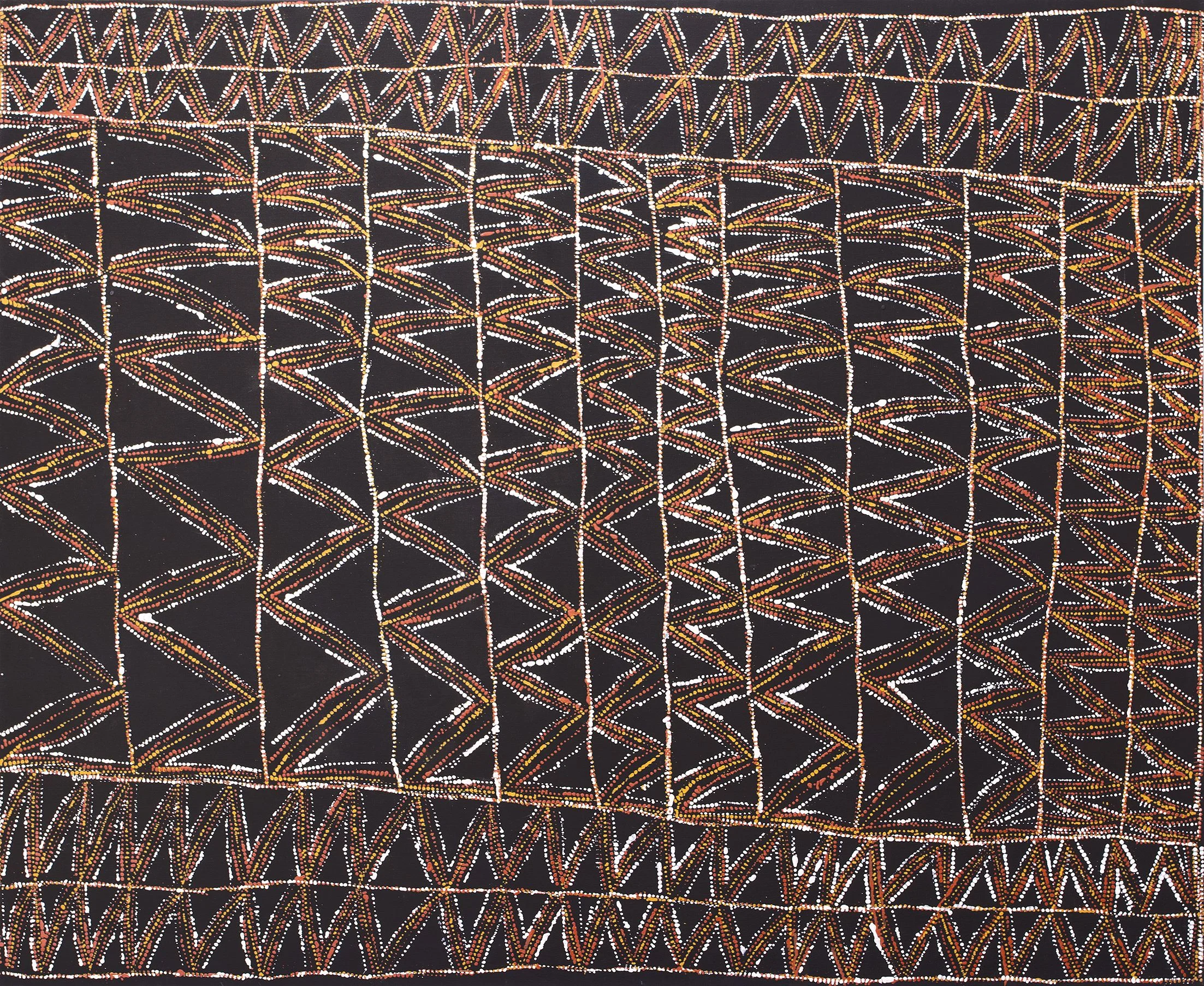
Artiste : Cornelia Tipuamantumirri
Titre de l'œuvre : Jilamara dances
Pigments naturels sur toile de lin Belge
Format : 180 x 150 cm
Provenance et certificat : centre d'art aborigène de Munupi (Tiwi Island)
Référence de la peinture : 14-317
© Photo : Aboriginal signature with the courtesy of the artist & Munupi Art centre (Tiwi Island)
Explications sur cette œuvre :
During ceremony on the Tiwi Islands a series of 'yoi' (dances), are performed; some are totemic (inherited from the person's Mother) and some serve to act out the narrative of newly composed songs.
Participants in these ceremonies are painted with turtiyanginari (the different natural ochre colours) in varying designs, transforming the dancers and, in some cases, providing protection against recognition by mapurtiti (spirits).
These designs can be applied in different ways. Ochre is applied to the body and face. These significant artistic designs collectively are called 'Jilamara'.

Artiste : Alison Puruntatameri
Titre de l'œuvre : Winga (Tidal Movement / Waves)
Pigments naturels sur toile de lin Belge
Format : 180 x 120 cm
Provenance et certificat : centre d'art aborigène de Munupi (Tiwi Island)
Référence de la peinture : 20-53
© Photo : Aboriginal signature with the courtesy of the artist & Munupi Art centre (Tiwi Island)
Explications sur cette œuvre :
Alison born in 1984 and has grown up in Pirlangimpi Commumnity on Melville Island which is the big island of the Tiwi's. She went to the local school and worked in child care. She has one daughter, Anette Orsto known locally as Sugar Plum who is a great favourite at the art centre studio where Alison paints with her mother Paulina (Jedda) sharing the care of Sugar while one or the other paints. It
was Alison’s grandfather, Justin Puruntatameri (dec) a senior law man that knew all the songs and remembered visits by the Macassans as a boy that told Alison she should have a go at painting- she would listen to his stories of his paintings at the art centre and in the village.. He used to take the family hunting when she was little. Alison started painting with Munupi Arts in late 2011.
This work depicts the tidal movement of waters in and around the seas and creeks of the Tiwi Islands. Not just influencing fishing and hunting opportunities, the movement of water carries masses of silt and sand, transforming the land and changing the coastal landscape. Winga can also be translated as 'waves', just one part of the changing tides. Tidal surges are at their most powerful when a king tide occurs during the Wet Season, especially during a full moon.Cornelia has a strong bond to the waters surrounding the Tiwi Islands, forged by a lifetime of memories living encircled within the tides of the Arafura Sea.
Awards
2015 Primavera Veolia Acquisitive Prize

Artiste : Alison Puruntatameri
Titre de l'œuvre : Takaringuwi (Scaly Mullet)
Pigments naturels sur toile de lin Belge
Format : 180 x 150 cm
Provenance et certificat : centre d'art aborigène de Munupi (Tiwi Island)
Référence de la peinture : 19-466
© Photo : Aboriginal signature with the courtesy of the artist & Munupi Art centre (Tiwi Island)
Explications sur cette œuvre :
Pupuni Jilamara During ceremony on the Tiwi Islands a series of ‘yoi’ (dances), are performed; some are totemic (inherited from the person's Mother) and some serve to act out the narrative of newly composed songs. Participants in these ceremonies are painted with turtiyanginari (the different natural ochre colours) in varying designs, transforming the dancers and, in some cases, providing protection against recognition by mapurtiti (spirits). These designs can be applied in different ways, one of which is using the finger, or in this case a brush. Painting of the face also occurs. These significant artistic designs collectively are called ‘Jilamara’.

Artiste : Alison Puruntatameri
Titre de l'œuvre : Winga (Tidal Movement / Waves)
Pigments naturels sur toile de lin Belge
Format : 180 x 120 cm
Provenance et certificat : centre d'art aborigène de Munupi (Tiwi Island)
Référence de la peinture : 20-76
© Photo : Aboriginal signature with the courtesy of the artist & Munupi Art centre (Tiwi Island)
Explications sur cette œuvre :
This work depicts the tidal movement of waters in and around the seas and creeks of the Tiwi Islands. Not justinfluencing fishing and hunting opportunities, the movement of water carries masses of silt and sand, transforming the land and changing the coastal landscape. Winga can also be translated as 'waves', just one part of the changing tides. Tidal surges are at their most powerful when a king tide occurs during the Wet Season, especially during a full moon.Cornelia has a strong bond to the waters surrounding the Tiwi Islands, forged by a lifetime of memories living encircled within the tides of the Arafura Sea.

Artiste : Paulina Puruntatameri
Titre de l'œuvre : Winga (Tidal Movement / Waves)
Pigments naturels sur toile de lin Belge
Format : 120 x 80 cm
Provenance et certificat : centre d'art aborigène de Munupi (Tiwi Island)
Référence de la peinture : 20-83
© Photo : Aboriginal signature with the courtesy of the artist & Munupi Art centre (Tiwi Island)
Explications sur cette œuvre :
This work depicts the tidal movement of waters in and around the seas and creeks of the Tiwi Islands. Not just influencing fishing and hunting opportunities, the movement of water carries masses of silt and sand, transforming the land and changing the coastal landscape. Winga can also be translated as 'waves', just one part of the changing tides. Tidal surges are at their most powerful when a king tide occurs during the Wet Season, especially during a full moon.Cornelia has a strong bond to the waters surrounding the Tiwi Islands, forged by a lifetime of memories living encircled within the tides of the Arafura Sea.

Artiste : Thecla Bernadette Puruntatameri
Titre de l'œuvre : Pupuni Jilamara
Pigments naturels sur toile de lin Belge
Format : 150 x 80 cm
Provenance et certificat : centre d'art aborigène de Munupi (Tiwi Island)
Référence de la peinture : 19-469
© Photo : Aboriginal signature with the courtesy of the artist & Munupi Art centre (Tiwi Island)
Explications sur cette œuvre :
Pupuni Jilamara During ceremony on the Tiwi Islands a series of ‘yoi’ (dances), are performed; some are totemic (inherited from the person's Mother) and some serve to act out the narrative of newly composed songs. Participants in these ceremonies are painted with turtiyanginari (the different natural ochre colours) in varying designs, transforming the dancers and, in some cases, providing protection against recognition by mapurtiti (spirits). These designs can be applied in different ways, one of which is using the finger, or in this case a brush. Painting of the face also occurs. These significant artistic designs collectively are called ‘Jilamara’.
Vendue

Artiste : Christine Daisy Puruntatameri
Titre de l'œuvre : Wurnataka
Pigments naturels sur toile de lin
Format : 120 x 60 cm
Provenance et certificat : centre d'art aborigène de Munupi (Tiwi Island)
Référence de la peinture : 20-14
© Photo : Aboriginal signature with the courtesy of the artist & Munupi Art centre (Tiwi Island)
Explications sur cette œuvre :
Impressive composition related to the Tiwi name for wild winds during the storm season.
Vendue

Artiste : Francesca Puruntatameri
Titre de l'œuvre : Pupuni Jilamara
Pigments naturels sur toile de lin
Format : 120 x 40 cm
Provenance et certificat : centre d'art aborigène de Munupi (Tiwi Island)
Référence de la peinture : 19-322
© Photo : Aboriginal signature with the courtesy of the artist & Munupi Art centre (Tiwi Island)
Explications sur cette œuvre :
Pupuni JilamaraDuring ceremony on the Tiwi Islands a series of ‘yoi’ (dances), are performed; some are totemic (inherited from the person's Mother) and some serve to act out the narrative of newly composed songs. Participants in these ceremonies are painted with turtiyanginari (the different natural ochre colours) in varying designs, transforming the dancers and, in some cases, providing protection against recognition by mapurtiti (spirits). These designs can be applied in different ways, one of which is using the finger, or in this case a brush. Painting of the face also occurs. These significant artistic designs collectively are called ‘Jilamara’.

Artiste : Alberta Puruntatameri
Titre de l'œuvre : Kulama Design
Pigments naturels sur toile de lin
Format : 120 x 50 cm
Provenance et certificat : centre d'art aborigène de Munupi (Tiwi Island)
Référence de la peinture : 19-344
© Photo : Aboriginal signature with the courtesy of the artist & Munupi Art centre (Tiwi Island)
Explications sur cette œuvre :
The Kulama design depicts this important ceremony of the Tiwi people; the dancers and singers create a circle and prepare the poisonous yam for eating, as indicated by the circles in the painting. The Kulama ceremony was given to the Tiwi people by the Nyingawi, who are little spirit people (as depicted in Tiwi mythology). It is a celebration of life and food, occurring at the end of the wet season. The Tiwi know when to perform Kulama when the last full moon of the wet season has a yellow halo surrounding it, which tells them that Japarra (the moon man) is ready for it to begin.

Artiste : Miriam Stassi
Titre de l'œuvre : Pupuni Jilamara
Pigments naturels sur toile de lin
Format : 120 x 80 cm
Provenance et certificat : centre d'art aborigène de Munupi (Tiwi Island)
Référence de la peinture : 19-356
© Photo : Aboriginal signature with the courtesy of the artist & Munupi Art centre (Tiwi Island)
Explications sur cette œuvre :
Pupuni JilamaraDuring ceremony on the Tiwi Islands a series of ‘yoi’ (dances), are performed; some are totemic (inherited from the person's Mother) and some serve to act out the narrative of newly composed songs. Participants in these ceremonies are painted with turtiyanginari (the different natural ochre colours) in varying designs, transforming the dancers and, in some cases, providing protection against recognition by mapurtiti (spirits). These designs can be applied in different ways, one of which is using the finger, or in this case a brush. Painting of the face also occurs. These significant artistic designs collectively are called ‘Jilamara’.

Artiste : Miriam Stassi
Titre de l'œuvre : Pupuni Jilamara
Pigments naturels sur toile de lin
Format : 120 x 40 cm
Provenance et certificat : centre d'art aborigène de Munupi (Tiwi Island)
Référence de la peinture : 19-418
© Photo : Aboriginal signature with the courtesy of the artist & Munupi Art centre (Tiwi Island)
Explications sur cette œuvre :
Pupuni JilamaraDuring ceremony on the Tiwi Islands a series of ‘yoi’ (dances), are performed; some are totemic (inherited from the person's Mother) and some serve to act out the narrative of newly composed songs. Participants in these ceremonies are painted with turtiyanginari (the different natural ochre colours) in varying designs, transforming the dancers and, in some cases, providing protection against recognition by mapurtiti (spirits). These designs can be applied in different ways, one of which is using the finger, or in this case a brush. Painting of the face also occurs. These significant artistic designs collectively are called ‘Jilamara’.

Artiste : Rebekah Yunipingu
Titre de l'œuvre : Pupuni Jilamara
Pigments naturels sur toile de lin Belge
Format : 150 x 80 cm
Provenance et certificat : centre d'art aborigène de Munupi (Tiwi Island)
Référence de la peinture : 19-469
© Photo : Aboriginal signature with the courtesy of the artist & Munupi Art centre (Tiwi Island)
Explications sur cette œuvre :
Interesting composition related to Pamajini : Tiwi name for Armband - worn when we dance at ceremony.
Vendue
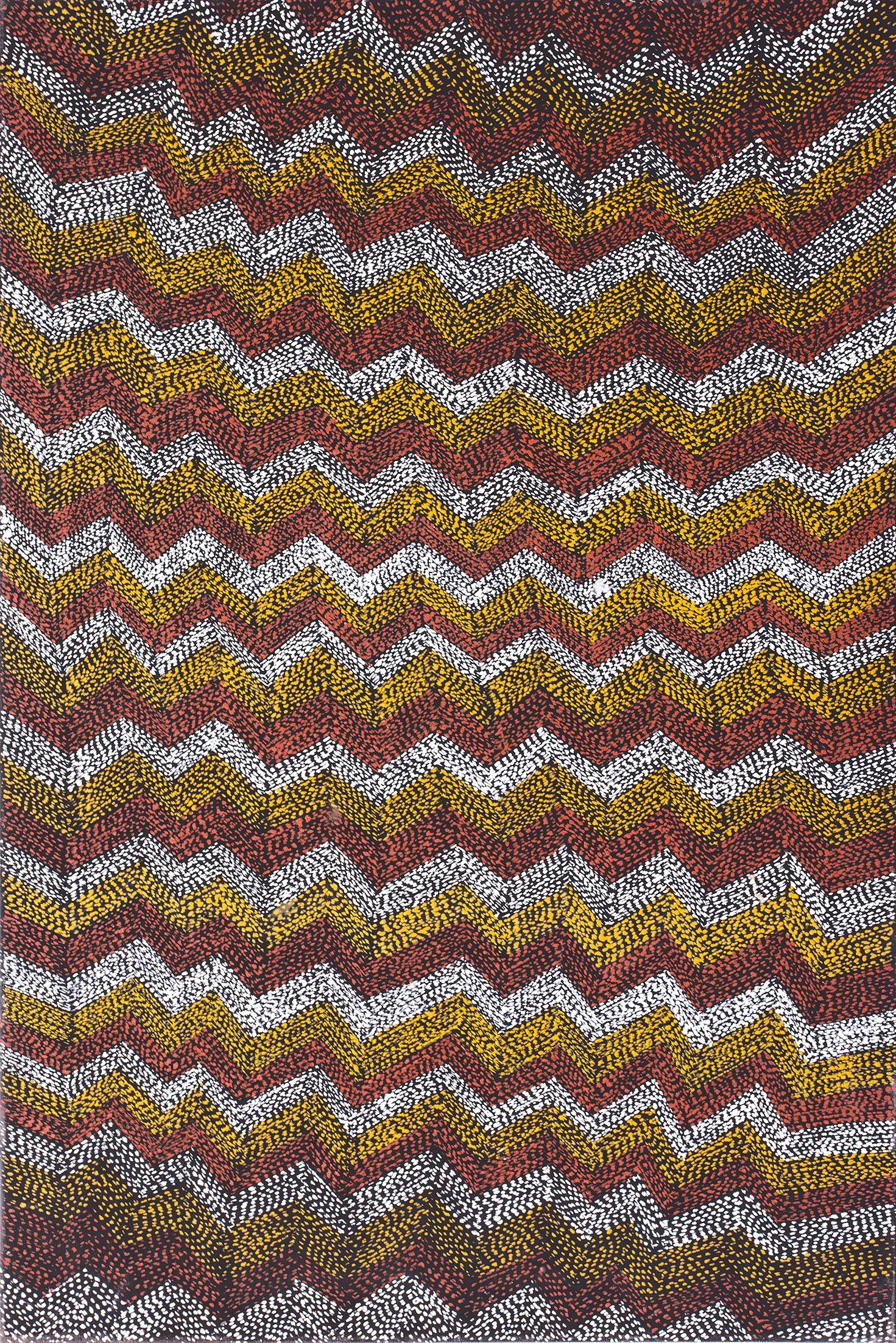
Artiste : Alison Puruntatameri
Titre de l'œuvre : Pwoja Jilamara
Pigments naturels sur toile de lin Belge
Format : 120 x 80 cm
Provenance et certificat : centre d'art aborigène de Munupi (Tiwi Island)
Référence de la peinture : 17-102
© Photo : Aboriginal signature with the courtesy of the artist & Munupi Art centre (Tiwi Island)
Explications sur cette œuvre :
During ceremony on the Tiwi Islands a series of ‘yoi’ (dances), are performed; some are totemic (inherited from the person's Mother) and some serve to act out the narrative of newly composed songs. Participants in these ceremonies are painted with turtiyanginari (the different natural ochre colours) in varying designs, transforming the dancers and, in some cases, providing protection against recognition by mapurtiti (spirits). These designs can be applied in different ways, one of which is using the pwoja (or kayimwagakimi), a traditional Tiwi ‘comb’ carved with a single row of teeth on one or both ends, usually made using ironwood or bloodwood. After being dipped in ochre and applied to the body a straight row of dots is imprinted. Once completed, these dots are then collectively called yirrinkiripwoja (body painting).
Painting of the face also occurs. These significant artistic designs collectively are called ‘Jilamara’.

Artiste : Josephine Burak
Titre de l'œuvre : Jilamara Design
Pigments naturels sur toile de lin Belge
Format : 160 x 100 cm
Provenance et certificat : centre d'art aborigène de Munupi (Tiwi Island)
Référence de la peinture : 15-414
© Photo : Aboriginal signature with the courtesy of the artist & Munupi Art centre (Tiwi Island)
Explications sur cette œuvre :
The Kulama design depicts this important ceremony of the Tiwi people; the dancers and singers create a circle and prepare the poisonous yam for eating, as indicated by the circles in the painting. The Kulama ceremony was given to the Tiwi people by the Nyingawi, who are little spirit people (as depicted in Tiwi mythology). It is a celebration of life and food, occurring at the end of the wet season. The Tiwi know when to perform Kulama when the last full moon of the wet season has a yellow halo surrounding it, which tells them that Japarra (the moon man) is ready for it to begin.

Artiste : Susan Wanji Wanji
Titre de l'œuvre : Jilamara Design
Pigments naturels sur toile de lin Belge
Format : 160 x 100 cm
Provenance et certificat : centre d'art aborigène de Munupi (Tiwi Island)
Référence de la peinture : 13sww127
© Photo : Aboriginal signature with the courtesy of the artist & Munupi Art centre (Tiwi Island)
Explications sur cette œuvre :
The Kulama design depicts this important ceremony of the Tiwi people; the dancers and singers create a circle and prepare the poisonous yam for eating, as indicated by the circles in the painting. The Kulama ceremony was given to the Tiwi people by the Nyingawi, who are little spirit people (as depicted in Tiwi mythology). It is a celebration of life and food, occurring at the end of the wet season. The Tiwi know when to perform Kulama when the last full moon of the wet season has a yellow halo surrounding it, which tells them that Japarra (the moon man) is ready for it to begin.

Artiste : James Orsto
Titre de l'œuvre : Tutini (Pukamani Pole)
Pigments naturels sur toile de lin
Format : 212 x 19 cm
Provenance et certificat : centre d'art aborigène de Munupi (Tiwi Island)
Référence de la peinture : 19-288
© Photo : Aboriginal signature with the courtesy of the artist & Munupi Art centre (Tiwi Island)
Explications sur cette œuvre :
This Tutini has an oustanding provenance, as it was exhibited at the Museum of South Australia in Adelaïde (2019-2020), within the Tarnanthi exhibition.
Relating to the passing of a Tiwi person, the Pukamani pole (or Tutini) is a ceremonial carving/sculpture positioned around the grave site of the deceased that tells the story of, and celebrates, the person's life. The burial ceremonies of the Tiwi, based on the Pukamani of the mythical man Purrukapali are by far the most important events in ceremonial life. These ceremonies allow full expression of grief and provide at the same time a complete cultural outlet for philosophical beliefs, through music, art and dance.

Artiste : Osmond Pangiraminni
Titre de l'œuvre : Tutini (Pukamani Pole)
Pigments naturels sur toile de lin
Format : 224 x 24 cm
Provenance et certificat : centre d'art aborigène de Munupi (Tiwi Island)
Référence de la peinture : 18-154
© Photo : Aboriginal signature with the courtesy of the artist & Munupi Art centre (Tiwi Island)
Explications sur cette œuvre :
This Tutini has an oustanding provenance, as it was exhibited at the Museum of South Australia in Adelaïde (2019-2020), within the Tarnanthi exhibition.
Relating to the passing of a Tiwi person, the Pukamani pole (or Tutini) is a ceremonial carving/sculpture positioned around the grave site of the deceased that tells the story of, and celebrates, the person's life. The burial ceremonies of the Tiwi, based on the Pukamani of the mythical man Purrukapali are by far the most important events in ceremonial life. These ceremonies allow full expression of grief and provide at the same time a complete cultural outlet for philosophical beliefs, through music, art and dance.

Artiste : Mario Walarmerpui
Titre de l'œuvre : Pupuni Jilamara
Pigments naturels sur toile de lin
Format : 120 x 80 cm
Provenance et certificat : centre d'art aborigène de Munupi (Tiwi Island)
Référence de la peinture : 20-25
© Photo : Aboriginal signature with the courtesy of the artist & Munupi Art centre (Tiwi Island)
Explications sur cette œuvre :
Pupuni JilamaraDuring ceremony on the Tiwi Islands a series of ‘yoi’ (dances), are performed; some are totemic (inherited from the person's Mother) and some serve to act out the narrative of newly composed songs. Participants in these ceremonies are painted with turtiyanginari (the different natural ochre colours) in varying designs, transforming the dancers and, in some cases, providing protection against recognition by mapurtiti (spirits). These designs can be applied in different ways, one of which is using the finger, or in this case a brush. Painting of the face also occurs. These significant artistic designs collectively are called ‘Jilamara’.

Artiste : Lucinta Puruntatameri
Titre de l'œuvre : Pupuni Jilamara
Pigments naturels sur toile de lin Belge
Format : 80 x 50 cm
Provenance et certificat : centre d'art aborigène de Munupi (Tiwi Island)
Référence de la peinture : 20-86
© Photo : Aboriginal signature with the courtesy of the artist & Munupi Art centre (Tiwi Island)
Explications sur cette œuvre :
Pupuni JilamaraDuring ceremony on the Tiwi Islands a series of ‘yoi’ (dances), are performed; some are totemic (inherited from the person's Mother) and some serve to act out the narrative of newly composed songs. Participants in these ceremonies are painted with turtiyanginari (the different natural ochre colours) in varying designs, transforming the dancers and, in some cases, providing protection against recognition by mapurtiti (spirits). These designs can be applied in different ways, one of which is using the finger, or in this case a brush. Painting of the face also occurs. These significant artistic designs collectively are called ‘Jilamara’.
Œuvres de JILAMARA proposées dans le cadre de l'exposition :

Artiste : Timothy Cook
Titre de l'œuvre : Kulama Piyapiya II
Pigments naturels sur toile de lin Belge
Format : 120 x 90 cm
Provenance et certificat : centre d'art aborigène de Jalimara (Tiwi Island)
Référence de la peinture : 130-18
© Photo : Aboriginal signature with the courtesy of the artist & Jilamara Art centre (Tiwi Island)
Explications sur cette œuvre :
Kulama Piyapiya II (Kulama Dream II). The Kulama Ceremony is performed in the late wet season (March-April) when a ring appears around the moon. Kulama is a traditional initiation for young men which coincides with the harvest of a certain wild yam species. Elders of both sexes sing and
dance for three days welcoming the boys into adulthood. The boy is then renamed with his true man's name.

Artiste : Gerry Mungatopi
Titre de l'œuvre : Tutini (Pukumani Pole)
Pigments naturels sur bois de fer.
Format : 180 cm
Provenance et certificat : centre d'art aborigène de Jilamara (Tiwi Island)
Référence de la peinture : 398-18
© Photo : Aboriginal signature with the courtesy of the artist & Jilamara Art centre (Tiwi Island)
Explications sur cette œuvre :
The Pukumani ceremony is the culmination of ritual mourning for a deceased person. Several months after the burial, family commission in-laws of the deceased to carve and decorate elaborate tutini. These are then placed at the gravesite during a showy performance of song and dance, and tunga (bark bags) are placed upside down on top of the poles to signify the end of life. These sculpturally beautiful 'artworks' are left to the elements, returning to the bush from which they are made.
Traditionally Tiwi use bloodwood for tutini, but cured ironwood is the prefered timber for commercial carvings thanks to its durability. Current practice of carving pukumani poles is an expression of the artist's cultural heritage through contemporary art. They are created as an artistic form of expression to be viewed and appreciated by a broader public with the intention to maintain and share Tiwi cultural knowledge. Tutini carved with a pronged or forked apex represents the fight between Purukuparli and his brother Taparra the moon man. Diamond and curved shapes are a female embodiment, but each pole represents all and everything that is Tiwi culture.
Vendue

Artiste : Timothy Cook
Titre de l'œuvre : Kulama
Pigments naturels sur toile de lin Belge
Format : 90 x 90 cm
Provenance et certificat : centre d'art aborigène de Jalimara (Tiwi Island)
Référence de la peinture : 173-19
© Photo : Aboriginal signature with the courtesy of the artist & Jilamara Art centre (Tiwi Island)
Explications sur cette œuvre :
The Kulama Ceremony is performed in the late wet season (March-April) when a ring appears around the moon. Kulama is a traditional initiation for young men which coincides with the harvest of a certain wild yam species. Elders of both sexes sing and dance for three days welcoming the boys into adulthood. The boy is then renamed with his true man's name.
Vendue
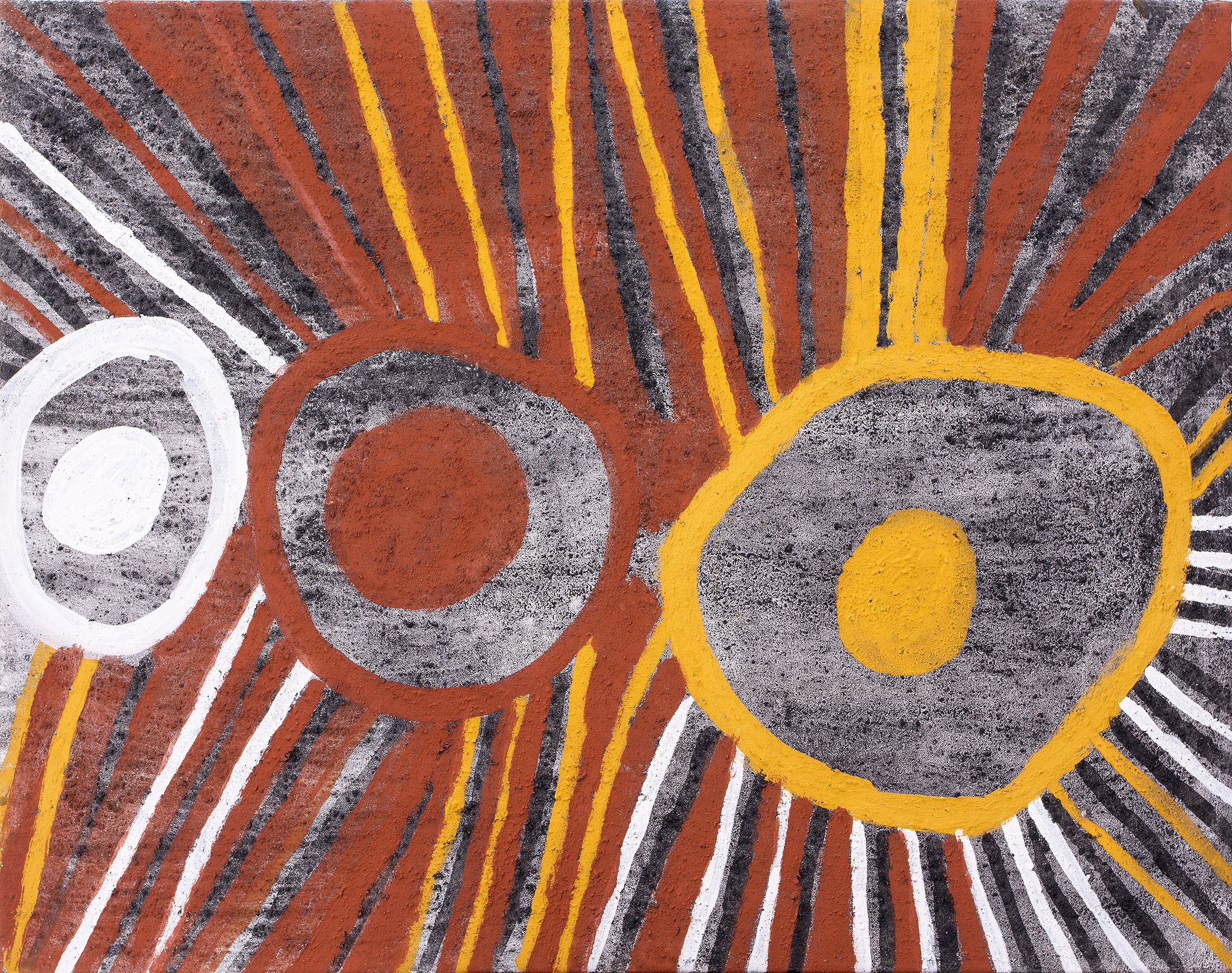
Artiste : Timothy Cook
Titre de l'œuvre : Japarra (Moon Man)
Pigments naturels sur toile de lin Belge
Format : 90 x 70 cm
Provenance et certificat : centre d'art aborigène de Jalimara (Tiwi Island)
Référence de la peinture : 412-17
© Photo : Aboriginal signature with the courtesy of the artist & Jilamara Art centre (Tiwi Island)
Explications sur cette œuvre :
Japarra the moon man is central to the Tiwi Creation Story. Purukapali's younger brother ran away with his wifwe Bima, her baby Jinani left alone to die from heat and neglect, a bitter struggle ensued between the brothers and the king proclaimed all life would be subject to mortality. Japarra escaped up into the moon where his body changed into a pale half moon.

Artiste : Jacinta Lorenzo
Titre de l'œuvre : Jilamara - body painting
Pigments naturels sur toile de lin Belge
Format : 180 x 60 cm
Provenance et certificat : centre d'art aborigène de Jalimara (Tiwi Island)
Référence de la peinture : 207-19
© Photo : Aboriginal signature with the courtesy of the artist & Jilamara Art centre (Tiwi Island)
Explications sur cette œuvre :
All jilamara (design) are originally drawn from the body painting which accompanied the pukumani (funeral) and kulama (initiation/yam) ceremonies. An individual design and aesthetic is highly valued by Tiwi artists and is representative of their personal interpretation of the traditional Tiwi design or jilamara.

Artiste : Bernadette Mungatopi
Titre de l'œuvre : Jilamara - body painting
Pigments naturels sur toile de lin Belge
Format : 180 x 80 cm
Provenance et certificat : centre d'art aborigène de Jalimara (Tiwi Island)
Référence de la peinture : 69-19
© Photo : Aboriginal signature with the courtesy of the artist & Jilamara Art centre (Tiwi Island)
Explications sur cette œuvre :
All jilamara (design) are originally drawn from the body painting which accompanied the pukumani (funeral) and kulama (initiation/yam) ceremonies. An individual design and aesthetic is highly valued by Tiwi artists and is representative of their personal interpretation of the traditional Tiwi design or jilamara.
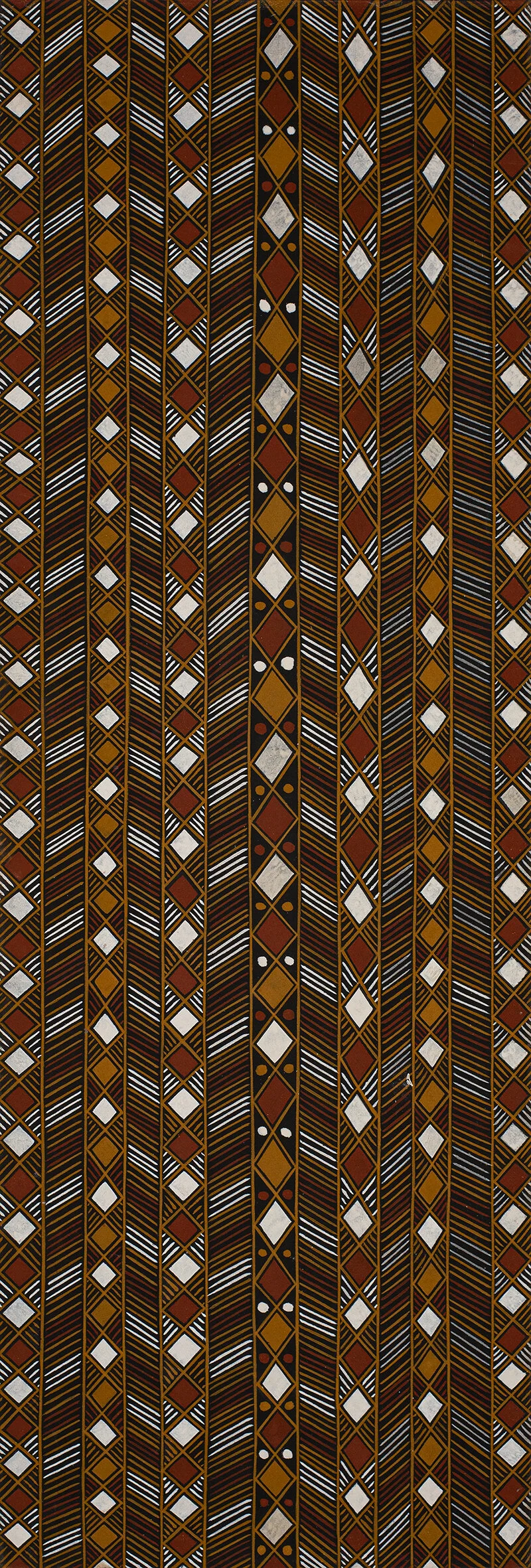
Artiste : Nicholas Mario
Titre de l'œuvre : Jilamara - body painting
Pigments naturels sur toile de lin Belge
Format : 180 x 60 cm
Provenance et certificat : centre d'art aborigène de Jalimara (Tiwi Island)
Référence de la peinture : 71-17
© Photo : Aboriginal signature with the courtesy of the artist & Jilamara Art centre (Tiwi Island)
Explications sur cette œuvre :
All jilamara (design) are originally drawn from the body painting which accompanied the pukumani (funeral) and kulama (initiation/yam) ceremonies. An individual design and aesthetic is highly valued by Tiwi artists and is representative of their personal interpretation of the traditional Tiwi design or jilamara.
Vendue

Artiste : Tina Patlas
Titre de l'œuvre : Jilamara
Pigments naturels sur toile de lin Belge
Format : 80 x 80 cm
Provenance et certificat : centre d'art aborigène de Jalimara (Tiwi Island)
Référence de la peinture : 383-19
© Photo : Aboriginal signature with the courtesy of the artist & Jilamara Art centre (Tiwi Island)
Explications sur cette œuvre :
All jilamara (design) are originally drawn from the body painting which accompanied the pukumani (funeral) and kulama (initiation/yam) ceremonies. An individual design and aesthetic is highly valued by Tiwi artists and is representative of their personal interpretation of the traditional Tiwi design or jilamara.

Artiste : Michelle Bush
Titre de l'œuvre : Jilamara
Pigments naturels sur toile de lin Belge
Format : 150 x 75 cm
Provenance et certificat : centre d'art aborigène de Jalimara (Tiwi Island)
Référence de la peinture : 93-18
© Photo : Aboriginal signature with the courtesy of the artist & Jilamara Art centre (Tiwi Island)
Explications sur cette œuvre :
All jilamara (design) are originally drawn from the body painting which accompanied the pukumani (funeral) and kulama (initiation/yam) ceremonies. An individual design and aesthetic is highly valued by Tiwi artists and is representative of their personal interpretation of the traditional Tiwi design or jilamara.

Artiste : Nicola Miller Mungatopi
Titre de l'œuvre : Jilamara
Pigments naturels sur toile de lin Belge
Format : 60 x 60 cm
Provenance et certificat : centre d'art aborigène de Jalimara (Tiwi Island)
Référence de la peinture : 466-19
© Photo : Aboriginal signature with the courtesy of the artist & Jilamara Art centre (Tiwi Island)
Explications sur cette œuvre :
All jilamara (design) are originally drawn from the body painting which accompanied the pukumani (funeral) and kulama (initiation/yam) ceremonies. An individual design and aesthetic is highly valued by Tiwi artists and is representative of their personal interpretation of the traditional Tiwi design or jilamara.

Artiste : Jacinta Lorenzo
Titre de l'œuvre : Jilamara - body painting
Pigments naturels sur toile de lin Belge
Format : 150 x 120 cm
Provenance et certificat : centre d'art aborigène de Jalimara (Tiwi Island)
Référence de la peinture : 71-18
© Photo : Aboriginal signature with the courtesy of the artist & Jilamara Art centre (Tiwi Island)
Explications sur cette œuvre :
All jilamara (design) are originally drawn from the body painting which accompanied the pukumani (funeral) and kulama (initiation/yam) ceremonies. An individual design and aesthetic is highly valued by Tiwi artists and is representative of their personal interpretation of the traditional Tiwi design or jilamara.

Artiste : Nicola Miller Mungatopi
Titre de l'œuvre : Jilamara
Pigments naturels sur toile de lin Belge
Format : 60 x 60 cm
Provenance et certificat : centre d'art aborigène de Jalimara (Tiwi Island)
Référence de la peinture : 450-19
© Photo : Aboriginal signature with the courtesy of the artist & Jilamara Art centre (Tiwi Island)
Explications sur cette œuvre :
All jilamara (design) are originally drawn from the body painting which accompanied the pukumani (funeral) and kulama (initiation/yam) ceremonies. An individual design and aesthetic is highly valued by Tiwi artists and is representative of their personal interpretation of the traditional Tiwi design or jilamara.
Vendue

Artiste : Jacinta Lorenzo
Titre de l'œuvre : Jilamara - body painting
Pigments naturels sur toile de lin Belge
Format : 200 x 60 cm
Provenance et certificat : centre d'art aborigène de Jalimara (Tiwi Island)
Référence de la peinture : 127-19
© Photo : Aboriginal signature with the courtesy of the artist & Jilamara Art centre (Tiwi Island)
Explications sur cette œuvre :
All jilamara (design) are originally drawn from the body painting which accompanied the pukumani (funeral) and kulama (initiation/yam) ceremonies. An individual design and aesthetic is highly valued by Tiwi artists and is representative of their personal interpretation of the traditional Tiwi design or jilamara.

Artiste : Michelle Bush
Titre de l'œuvre : Pwoja
Pigments naturels sur toile de lin Belge
Format : 150 x 60 cm
Provenance et certificat : centre d'art aborigène de Jalimara (Tiwi Island)
Référence de la peinture : 536-19
© Photo : Aboriginal signature with the courtesy of the artist & Jilamara Art centre (Tiwi Island)
Explications sur cette œuvre :
Traditional Tiwi Culture placed special significance on the Pukumani (funeral) ceremony. Mourners are decorated using natural ochres to disguise themselves from the spirit of the deceased and song and dance is performed to honour the dead.
Yirrinkiripwoja (bodypaint) is the source of many contemporary Tiwi designs and performance of the pukumani as ritual helps to reinvigorate the imagery. The shortening of the word to Pwoja - also refers to 'best'.
Vendue

Artiste : Michelle Bush
Titre de l'œuvre : Pwoja
Pigments naturels sur toile de lin Belge
Format : 60 x 60 cm
Provenance et certificat : centre d'art aborigène de Jalimara (Tiwi Island)
Référence de la peinture : 538-19
© Photo : Aboriginal signature with the courtesy of the artist & Jilamara Art centre (Tiwi Island)
Explications sur cette œuvre :
Traditional Tiwi Culture placed special significance on the Pukumani (funeral) ceremony. Mourners are decorated using natural ochres to disguise themselves from the spirit of the deceased and song and dance is performed to honour the dead.
Yirrinkiripwoja (bodypaint) is the source of many contemporary Tiwi designs and performance of the pukumani as ritual helps to reinvigorate the imagery. The shortening of the word to Pwoja - also refers to 'best'.

Artiste : Johnathon Bush
Titre de l'œuvre : Jilamara
Pigments naturels sur toile de lin Belge
Format : 150 x 150cm
Provenance et certificat : centre d'art aborigène de Jalimara (Tiwi Island)
Référence de la peinture : 361-17
© Photo : Aboriginal signature with the courtesy of the artist & Jilamara Art centre (Tiwi Island)
Explications pour cette œuvre :
All jilamara (design) are originally drawn from the body painting which accompanied the pukumani (funeral) and kulama (initiation/yam) ceremonies. An individual design and aesthetic is highly valued by Tiwi artists and is representative of their personal interpretation of the traditional Tiwi design or jilamara.
In this work Johnathon has explored the use of charcoal which was traditionally used by his ancestors when painting onto the body or pukamani poles, instead of black gesso as a base colour. Johnathon discovered Jackson Pollocks work in early 2017 and was really taken by the chaos of the splattered and dripped paint marks over the painted surface.

Artiste : Patrick Freddy Puruntatameri
Titre de l'œuvre : Tutini (Pukumani Pole)
Pigments naturels sur bois de fer.
Format : 223 cm
Provenance et certificat : centre d'art aborigène de Jilamara (Tiwi Island)
Référence de la peinture : 142-19
© Photo : Aboriginal signature with the courtesy of the artist & Jilamara Art centre (Tiwi Island)
Explications sur cette œuvre :
The Pukumani ceremony is the culmination of ritual mourning for a deceased person. Several months after the burial, family commission in-laws of the deceased to carve and decorate elaborate tutini. These are then placed at the gravesite during a showy performance of song and dance, and tunga (bark bags) are placed upside down on top of the poles to signify the end of life. These sculpturally beautiful 'artworks' are left to the elements, returning to the bush from which they are made.
Traditionally Tiwi use bloodwood for tutini, but cured ironwood is the prefered timber for commercial carvings thanks to its durability. Current practice of carving pukumani poles is an expression of the artist's cultural heritage through contemporary art. They are created as an artistic form of expression to be viewed and appreciated by a broader public with the intention to maintain and share Tiwi cultural knowledge. Tutini carved with a pronged or forked apex represents the fight between Purukuparli and his brother Taparra the moon man. Diamond and curved shapes are a female embodiment, but each pole represents all and everything that is Tiwi culture.

Artiste : Michelle Bush
Titre de l'œuvre : Jilamara
Pigments naturels sur toile de lin Belge
Format : 90 x 70 cm
Provenance et certificat : centre d'art aborigène de Jalimara (Tiwi Island)
Référence de la peinture : 358-19
© Photo : Aboriginal signature with the courtesy of the artist & Jilamara Art centre (Tiwi Island)
Explications sur cette œuvre :
All jilamara (design) are originally drawn from the body painting which accompanied the pukumani (funeral) and kulama (initiation/yam) ceremonies. An individual design and aesthetic is highly valued by Tiwi artists and is representative of their personal interpretation of the traditional Tiwi design or jilamara.

Artiste : Raymond Bush
Titre de l'œuvre : Mantuwujini (Dugong)
Pigments naturels sur toile de lin Belge
Format : 180 x 60 cm
Provenance et certificat : centre d'art aborigène de Jalimara (Tiwi Island)
Référence de la peinture : 241-19
© Photo : Aboriginal signature with the courtesy of the artist & Jilamara Art centre (Tiwi Island)
Explications sur cette œuvre :
Known alternatively in English as Sea Cow, Mantuwujini are hunted with harpoon spears along the northern coast of the Tiwi Islands, found in areas of sea grass, where they graze. A gentle and sadly endangered mammal, the animal is prized for it's tender rich flavoured meat and the fat produces oil which is reputed to be good for the hair.
Exposition organisée par la Galerie Aboriginal Signature en partenariat avec et les artistes et les centres d'art de Munupi et Jilamara
Artiste : Delores Tipuamantumirri
Titre de l'œuvre : Winga (Tidal Movement / Waves)
Pigments naturels sur toile de lin
Format : 180 x 120 cm
Provenance et certificat : centre d'art aborigène de Munupi (Tiwi Island)
Référence de la peinture : 20-52
© Photo : Aboriginal signature with the courtesy of the artist & Munupi Art centre (Tiwi Island)
Explications sur cette œuvre :
This work depicts the tidal movement of waters in and around the seas and creeks of the Tiwi Islands. Not just influencing fishing and hunting opportunities, the movement of water carries masses of silt and sand, transforming the land and changing the coastal landscape. Winga can also be translated as 'waves', just one part of the changing tides. Tidal surges are at their most powerful when a king tide occurs during the Wet Season, especially during a full moon. Delores has a strong bond to the waters surrounding the Tiwi Islands, forged by a lifetime of memories living encircled within the tides of the Arafura Sea.
Demander le prix de l'œuvre