Miny’tji - Essence of the Land • Art Aborigène de Yirrkala - Arnhem Land
Du 26 septembre au 20 octobre 2018 au sein de la galerie Aboriginal Signature Estrangin à Bruxelles
Ouverture du Mercerdi au Samedi de 14h30 à 19h, à la galerie : 101 rue Jules Besme, 1081 Bruxelles.
Et sur RDV tous les autres jours (+32 (0) 475 55 08 54).

Trois œuvres magistrales de l'artiste Noŋgirrŋa-Marawili (1938). Titres de gauche à droite : Gurtha (189 x 86 cm), Djapu (203 x 91 cm), Yathikpa (190 x 78 cm). Media : natural ochres on bark. © Photo : Aboriginal Signature Estrangin gallery with the courtesy of the artist and Yirrkala community.
Pour ce mois de Septembre, nous sommes très honorés d'accueillir en Belgique pour la première fois, une magnifique exposition entièrement dédiée à 20 grands artistes Aborigènes de la communauté de Yirrkala tout à fait au nord de l’Australie. A base de pigments naturels apposés sur des écorces d’eucalyptus, leurs peintures traditionnelles reflètent avec une saisissante intimité et sensibilité l'univers spirituel si particulier de la Terre d’Arnhem.
40 écorces peintes et 12 pôles de cérémonie (Larrakitj) sont réunies pour l’occasion, avec des œuvres remarquables de l’artiste Barrupu Yunupiŋu (1947 - dec.), Napuwarri Marawili (1967) gagnant cette année 2018 du grand prix sur écorce au Musée de Darwin (NATSIAA-TELSTRA Award), Noŋgirrŋa Marawili (1938) avec plusieurs peintures fondamentales et rétrospectives sur sa carrière, Wukun Wanambi (1962) finaliste cette année du Telstra - Natsiaa Award, et une rare œuvre de l’artiste Gulumbu Yunupingu (1942 - 2012) qui fut invité par l’architecte Jean Nouvel et le gouvernement Français à peindre un des plafonds du Musée du Quai Branly à Paris. Très attachée à la transmission du savoir entre les générations, la galerie présentera également de magnifiques écorces des artistes parmi les plus jeunes de la communauté, nés entre 1970 et 1990. Dignes héritiés de leurs pairs, ils expriment la savoir dont ils sont les gardiens avec une infini finesse comme dans les œuvres de Djurrayun Murrinyina (1974) et Rerrkirrwaŋa Munuŋgurr (1971).
Peintures de Yirrkala proposées dans le cadre de l'exposition :

Artiste : Barrupu Yunupiŋu Rita
Titre de l'œuvre : Gurtha
Pigments naturels sur écorce
Format : 132 x 83 cm
Provenance et certificat original : centre d'art aborigène de Yirrkala
Référence de la peinture : 3525Q
© Photo : Aboriginal signature with the courtesy of the artist & Buku-Larrngay Mulka.
Explication de l’œuvre :
The Gumatj clan sacred design which Barrupu Yunupiŋu Rita (1947 - 2012) paints is gurtha or fire. But not just any fire. This is a Fire of supernatural intensity. So powerful that it transforms the land it touched for all time.
This work is solely the miny’tji of the Gumatj embodying gurtha or fire. The diamond patterning is the ‘miny’tji’, motif or sacred clan design, of this clan and this place. It summons the theme of this fire. The Gumatj clan design associated with these events, a diamond design, represents fire; the red flames, the white smoke and ash, the black charcoal and the yellow dust.
The totemic significance of fire to the Yunupiŋu family of the Gumatj clan is paramount. It is said that the Gumatj clan language, Dhuwalandja, is itself the tongue of flame. This language, or tongue, like the flame, cuts through all artifice. It
incinerates dishonesty leaving only the bones of the truth.
Collections :
Art Gallery of New South Wales, Sydney NSW
Charles Darwin University Art Collection
National Gallery of Victoria, Melbourne VIC
Non available

Artiste : Barrupu Yunupiŋu Rita
Titre de l'œuvre : Gurtha
Pigments naturels sur écorce
Format : 140 x 75 cm
Provenance et certificat original : centre d'art aborigène de Yirrkala
Référence de la peinture : 4042Q
© Photo : Aboriginal signature with the courtesy of the artist & Buku-Larrngay Mulka.
Explication de l’œuvre :
The Gumatj clan sacred design which Barrupu Yunupiŋu Rita (1947 - 2012) paints is gurtha or fire. But not just any fire. This is a Fire of supernatural intensity. So powerful that it transforms the land it touched for all time.
This work is solely the miny’tji of the Gumatj embodying gurtha or fire. The diamond patterning is the ‘miny’tji’, motif or sacred clan design, of this clan and this place. It summons the theme of this fire. The Gumatj clan design associated with these events, a diamond design, represents fire; the red flames, the white smoke and ash, the black charcoal and the yellow dust.
The totemic significance of fire to the Yunupiŋu family of the Gumatj clan is paramount. It is said that the Gumatj clan language, Dhuwalandja, is itself the tongue of flame. This language, or tongue, like the flame, cuts through all artifice. It
incinerates dishonesty leaving only the bones of the truth.
Collections :
Art Gallery of New South Wales, Sydney NSW
Charles Darwin University Art Collection
National Gallery of Victoria, Melbourne VIC

Artiste : Noŋgirrŋa Marawili
Titre de l'œuvre : Yathikpa
Pigments naturels sur écorce
Format : 190 x 78 cm
Provenance et certificat original : centre d'art aborigène de Yirrkala
Référence de la peinture : 4405Z
© Photo : Aboriginal signature with the courtesy of the artist & Buku-Larrngay Mulka.
Explication de l’œuvre :
This Bark painting by Noŋgirrŋa Marawili (1938), represents a shift from the Djapu works of her first solo show and into her Madarrpa clan works from her second major solo show in 2013. The strings of diamonds marks the classic miny’tji of the saltwater estate of Yathikpa. Here Baru the ancestral crocodile, carrying and being burnt by the Ancestral fire crossed the beach from Garraŋali (crocodile’s nest) and entered the saltwater. Baru decided after being soothed of his burns that he would stay in these waters. His sacred powers in line with that of the fire imbues the water there today. Later from the same beach Ancestral Hunters on seeing Dugong took their hunting harpoon and canoe out to the sea of Yathikpa in pursuit.
This is a painting of fire but also simultaneously of water. It is a raw rendition of Madarrpa clan sacred design for the ocean at Yathikpa which is melting and crashing to the horizon.
Collections : Art Gallery of New South Wales, Sydney NSW. Berndt Museum, University of Western Australia, Perth WA. Chartwell Collection, Auckland Art Gallery, Auckland, New Zealand. Kluge-Ruhe Aboriginal Art Collection of the University of Virginia. USA Museum and Art Gallery of the Northern Territory, Darwin NT. Museum of Contemporary Art, Sydney NSW. National Gallery of Australia, Canberra ACT. National Gallery of Victoria, Melbourne VIC. The Metropolitan Museum of Art.
Vendue

Artiste : Noŋgirrŋa Marawili
Titre de l'œuvre : Gurtha
Pigments naturels sur écorce
Format : 99 x 69 cm
Provenance et certificat original : centre d'art aborigène de Yirrkala
Référence de la peinture : 4318-18
© Photo : Aboriginal signature with the courtesy of the artist & Buku-Larrngay Mulka.
Explication de l’œuvre :
This Bark painting by Noŋgirrŋa Marawili (1938), depicts Their special spot on the mainland was Baratjula. A place to which she only returned after the creation of these paintings. Ṉoŋgirrŋa started life as one of the numerous children of Mundukul the Madarrpa warrior (c.1890-c.1950). He was a famed leader/warrior with uncountable wives of the Marrakulu, Dhudi Djapu and Galpu clans.
Baratjula is a Madarrpa clan estate adjacent to Cape Shield where the artist camped with her father and his many wives as a young girl. It is of the essence of Madarrpa but does not hold the high order sites that Yathikpa does. She lived nomadically as
part of a clan group with a flotilla of canoes between Groote Eyelandt and the mainland. This journey from the sacred to the descriptive shifts in these works. She has reduced the Law to its elements unclothed in sacred design. Her identity cannot be separated from her art and so although she disavows any sacred intent the echo of miny’tji persists.
Collections : Art Gallery of New South Wales, Sydney NSW. Berndt Museum, University of Western Australia, Perth WA. Chartwell Collection, Auckland Art Gallery, Auckland, New Zealand. Kluge-Ruhe Aboriginal Art Collection of the University of Virginia. USA Museum and Art Gallery of the Northern Territory, Darwin NT. Museum of Contemporary Art, Sydney NSW. National Gallery of Australia, Canberra ACT. National Gallery of Victoria, Melbourne VIC. The Metropolitan Museum of Art
Vendue

Artiste : Nongirrna Marawili
Titre de l'œuvre : Yathikpa
Format : 142 x 60 cm
Pigments naturels sur écorce d'eucalyptus
Provenance et certificat : centre d'art aborigène de Yirrkala
Référence de la peinture : 4314H
© Photo : Aboriginal signature with the courtesy of the artist & Buku-Larrngay Mulka.
vendue
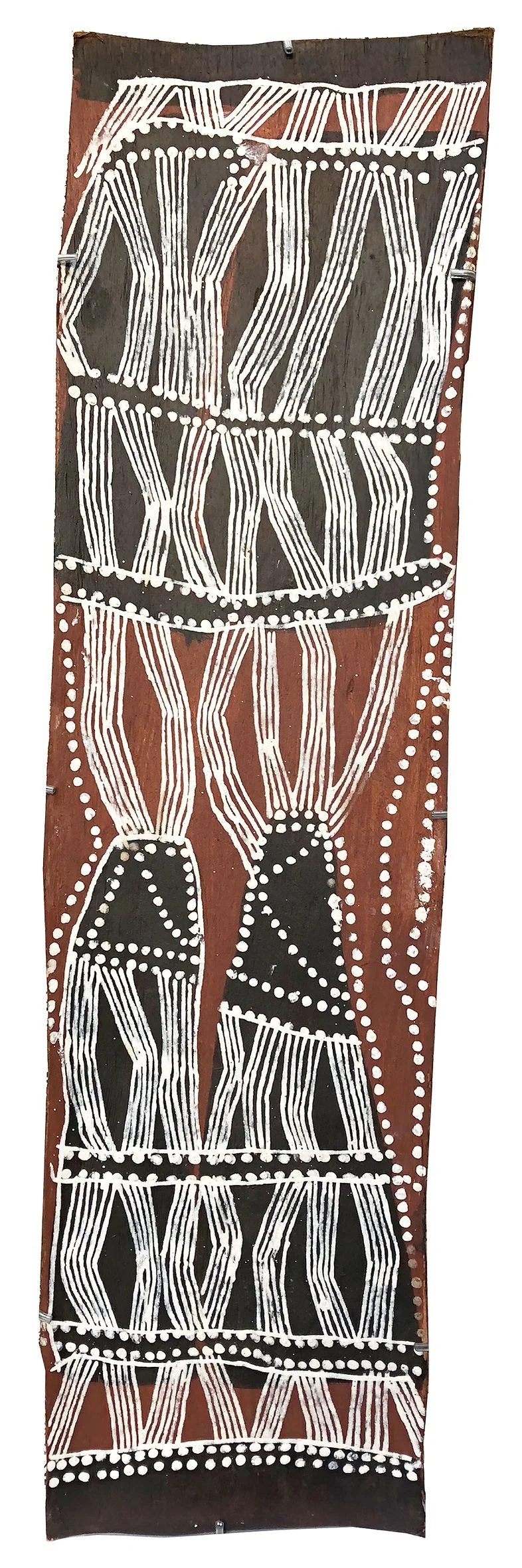
Artiste : Noŋgirrŋa Marawili
Titre de l'œuvre : Lightning
Pigments naturels sur écorce
Format : 98 x 27 cm
Provenance et certificat original : centre d'art aborigène de Yirrkala
Référence de la peinture : 6300-17
© Photo : Aboriginal signature with the courtesy of the artist & Buku-Larrngay Mulka.
Explication de l’œuvre :
This Bark painting by Noŋgirrŋa Marawili (1938), represents Some of the designs show the rock set in deep water between the electric ‘curse’ that the snake spits into the sky in the form of lightning, and the spray of the sea trying to shift the immovable rock foundation of the Maḏarrpa. Yurr’yunna is the word used to describe the rough waves overtopping the rock and the spray flying into the sky. It is said that the serpents ‘spit’ lightning - ‘guykthun’. The extended meaning of ‘guykthun' though includes “make something sacred or taboo through saying magic words’. In our language we ‘swear’ an ‘oath’ which sanctifies the speech but both words can also mean to utter profanities. We also understand that ‘curse’ can mean bad language but also a spell. The Top End has one of the world’s greatest number of lightning strikes at this time of year. These works show the sanctifying words being spat across the sky in lightning form. The lightning’s sacred power hits the seaspray rising from where it has just smashed into the rock. The energies captured in this painting are almost a match for those in the real life of a Top End Wet Season.
Collections : Art Gallery of New South Wales, Sydney . Chartwell Collection, Auckland Art Gallery, Auckland. Kluge-Ruhe Aboriginal Art Collection of the University of Virginia. USA. Museum and Art Gallery of the Northern Territory, Darwin.. Museum of Contemporary Art, Sydney NSW. National Gallery of Australia, Canberra ACT. National Gallery of Victoria, Melbourne VIC. The Metropolitan Museum of Art
Vendue

Artiste : Noŋgirrŋa Marawili
Titre de l'œuvre : Djapu
Pigments naturels sur écorce
Format : 203 x 91 cm
Provenance et certificat original : centre d'art aborigène de Yirrkala
Référence de la peinture : 4231J
© Photo : Aboriginal signature with the courtesy of the artist & Buku-Larrngay Mulka.
Explication de l’œuvre :
This Bark painting by Noŋgirrŋa Marawili (1938), depicts The cross hatching grid pattern is the sacred design for the freshwaters of the Djapu clan at their homeland Wandawuy now an outstation about 150 kilometres south of Yirrkala and inland from Blue Mud Bay. This Djapu clan outstation (and spiritual residence for Ancestral Beings Mäna the Shark and Bol’ŋu the Thunderman) is surrounded by permanent freshwater. Rains inspired by the actions of Bol’ŋu feed the rivers and fill the billabongs. Catfish and mussels, freshwater crayfish and others feed the Yolŋu and wild life.
The grid lines having reference to the trap, the cross hatched squares referring to differing states of the freshwater - the source of Djapu soul. At ceremony appropriate participants for mortuary rites enter the shelter (woven together like the unsuccessful trap) where the deceased has been lying in state. Sacred spears tipped with stingray barbs, ,manifestations of Mäna’s teeth, stand up alongside the shelter.
Collections : Art Gallery of New South Wales, Sydney NSW. Berndt Museum, University of Western Australia, Perth WA. Chartwell Collection, Auckland Art Gallery, Auckland, New Zealand. Kluge-Ruhe Aboriginal Art Collection of the University of Virginia. USA Museum and Art Gallery of the Northern Territory, Darwin NT. Museum of Contemporary Art, Sydney NSW. National Gallery of Australia, Canberra ACT. National Gallery of Victoria, Melbourne VIC. The Metropolitan Museum of Art.

Artiste : Buwathay Munyarryun
Titre de l'œuvre : Limin
Pigments naturels sur écorce
Format : 84 x 26 cm
Provenance et certificat original : centre d'art aborigène de Yirrkala
Référence de la peinture : 5613-17
© Photo : Aboriginal signature with the courtesy of the artist & Buku-Larrngay Mulka.
Explication de l’œuvre :
This bark Painting by Buwathay Munyarryun (1962), identifies Ŋuykal the ancestral Kingfish is a totemic fish shared by the Maŋgalili and the Wangurri clans of the Yirritja moiety. Buwathay is the eldest son of Mathuḻu, a senior clan leader for the Wangurri.
Ŋuykal travelled in both salt and fresh water country and is associated with androgyny and metamorphism. This piece has been covered with the Wangurri clan design for an area of saltwater covering the country called Wulwala - close to the
peninsula known as Cape Wilberforce. Here the saltwater is flat and calm and 'shimmers' to the horizon, a condition called Gunbiḻk.
Emphasising his knowledge as a senior man amongst the ranks of other traditional lawmen, in disclosing the subject of the painting, Hidden under this water is the rock Dhukururra, its foundation cemented into the sea bed. The totem giant clam Dhalimbu' is also here. In this part of the ocean also lives Limin, the squid as shown here.
The painting proclaims knowledge and ownership of the life source: subterranean rivers fresh water from land which surface under the sea at this place, Wulwala.
Vendue
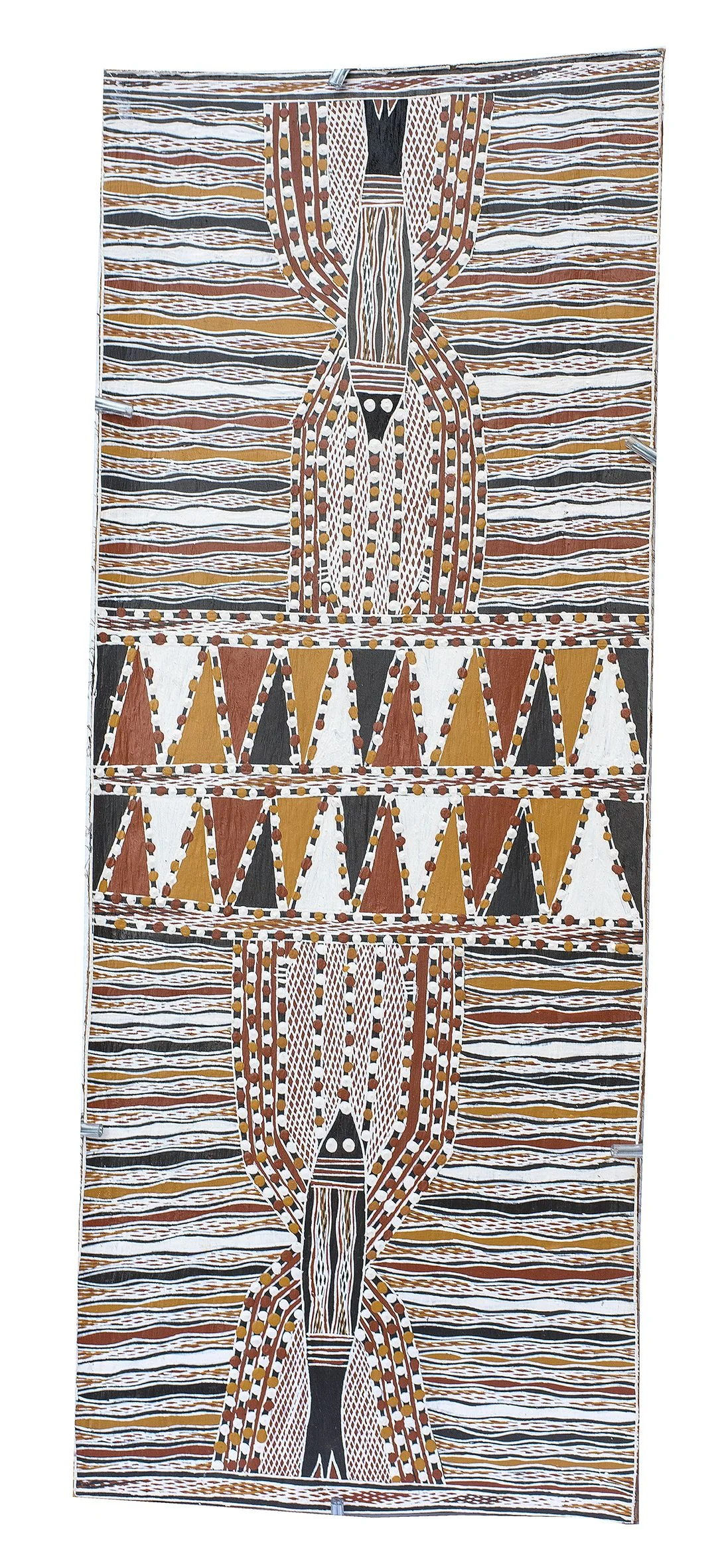
Artiste : Buwathay Munyarryun
Titre de l'œuvre : Mädi
Pigments naturels sur écorce
Format : 61 x 24 cm
Provenance et certificat original : centre d'art aborigène de Yirrkala
Référence de la peinture : 2938-18
© Photo : Aboriginal signature with the courtesy of the artist & Buku-Larrngay Mulka.
Explication de l’œuvre :
This bark Painting by Buwathay Munyarryun (1962), belongs to the Wangurri clan. This is recognised by the fact that miny’tji (sacred clan design- the detailed cross hatching ‘behind’ the figurative imagery) belonging to the Wangurri covers the piece. This piece shows disguised representations of a mangrove log washed in from saltwater Maŋgalili country into the Wangurri clan freshwater area of Gularri, the Cato River. Mädi is the female Rock Lobster. It contained Milka or mangrove worms which died once it washed into the fresh water.
is here repeated as the Wangurri sacred clan design which appears throughout. The songs of the Wangurri invest this log with sacred power allowing it to make paths that other beings and landscape features could follow.
It is also a representation of the ‘mangrove worm’ with its wood eating jaws shut. Here the log has completed a journey through the tidal interplay of fresh, salt and brackish to the fresh waters of Gularri near Dhalinybuy - the actual residence of
the artist and homeland for the Waŋgurri. The log also has reference to the canoe used by the ancestral hunters who were the first Maŋgalili people to die, having drowned at sea, and the hollow log used for final mortuary rites.
Vendue

Artiste : Buwathay Munyarryun
Titre de l'œuvre : Limin ga Mädi
Pigments naturels sur écorce
Format : 104 x 28 cm
Provenance et certificat original : centre d'art aborigène de Yirrkala
Référence de la peinture : 813-18
© Photo : Aboriginal signature with the courtesy of the artist & Buku-Larrngay Mulka.
Explication de l’œuvre :
This bark Painting by Buwathay Munyarryun (1962), belongs to the Wangurri clan. This is recognised by the fact that miny’tji (sacred clan design- the detailed cross
hatching ‘behind’ the figurative imagery) belonging to the Wangurri covers the piece. This piece shows disguised representations of a mangrove log washed in from saltwater Maŋgalili country into the Wangurri clan freshwater area of Gularri, the Cato River. Mädi is the female Rock Lobster. It contained Milka or mangrove worms which died once it washed into the fresh water. This pattern was etched in the log and is here repeated as the Wangurri sacred clan design which appears throughout. The songs of the Wangurri invest this log with sacred power allowing it to make paths that other beings and landscape features could follow.
It is also a representation of the ‘mangrove worm’ with its wood eating jaws shut. Here the log has completed a journey through the tidal interplay of fresh, salt and brackish to the fresh waters of Gularri near Dhalinybuy - the actual residence of the artist and homeland for the Waŋgurri.
The painting proclaims knowledge and ownership of the life source: subterranean rivers f fresh water from land which surface under the sea at this place, Wulwala.
Vendue

Artiste : Mulkun Wirrpanda
Titre de l'œuvre : irrkuda
Pigments naturels sur écorce
Format : 106 x 42 cm
Provenance et certificat original : centre d'art aborigène de Yirrkala
Référence de la peinture : 4011V
© Photo : Aboriginal signature with the courtesy of the artist & Buku-Larrngay Mulka.
Explication de l’œuvre :
This bark painting by Mulkun Wirrpanda (1942), evokes the Dhudi Djapu clan land on this estate is country associated with Dhalwaŋu clan lore. It is a Honey site of Ancestral times sung by the Yirritja. Icons of the sugar bag, a manifestation of this deep seated knowledge is depicted.
The events that took place here give the Dhalwaŋu and associates spiritual rites of country. This image shows the honey at the place known as Gawarratja belonging to the clan of Mandawuy Yunupingu’s mother-in-law who recently deceased leaving her sister as the only surviving member of this clan. Their clan was decimated by a massacre in the early 1900’s which is retailed in the Yothu Yindi CD Birrkuda. The sensitiviities of this history have meant that this design is not often reproduced. In this instance this elderly Dhudi-Djapu woman has painted her mother’s pattern.
Collections : Art Gallery of New South Wales, Sydney NSW. Art Gallery of South Australia, Adelaide SA. Berndt Museum, University of Western Australia, Perth WA. British Museum, London, UK. Buku-Larrnggay Mulka - Saltwater - Yirrkala Bark Paintings of Sea Country. Holmes a Court Collection. Kerry Stokes Larrakitj Collection, WA. National Maritime Museum, Darling Harbour, Sydney NSW. National Museum of Australia, Canberra ACT
Vendue

Artiste : Mulkun Wirrpanda
Titre de l'œuvre : Birrkuda
Pigments naturels sur écorce
Format : 76 x 34 cm
Provenance et certificat original : centre d'art aborigène de Yirrkala
Référence de la peinture : 3622L
© Photo : Aboriginal signature with the courtesy of the artist & Buku-Larrngay Mulka.
Explication de l’œuvre :
This bark painting by Mulkun Wirrpanda (1942), evokes the Dhudi Djapu clan land on this estate is country associated with Dhalwaŋu clan lore. It is a Honey site of Ancestral times sung by the Yirritja. Icons of the sugar bag, a manifestation of this deep seated knowledge is depicted.
The events that took place here give the Dhalwaŋu and associates spiritual rites of country. This image shows the honey at the place known as Gawarratja belonging to the clan of Mandawuy Yunupingu’s mother-in-law who recently deceased leaving her sister as the only surviving member of this clan. Their clan was decimated by a massacre in the early 1900’s which is retailed in the Yothu Yindi CD Birrkuda. The sensitiviities of this history have meant that this design is not often reproduced. In this instance this elderly Dhudi-Djapu woman has painted her mother’s pattern.
Collections : Art Gallery of New South Wales, Sydney NSW. Art Gallery of South Australia, Adelaide SA. Berndt Museum, University of Western Australia, Perth WA. British Museum, London, UK. Buku-Larrnggay Mulka - Saltwater - Yirrkala Bark Paintings of Sea Country. Holmes a Court Collection. Kerry Stokes Larrakitj Collection, WA. National Maritime Museum, Darling Harbour, Sydney NSW. National Museum of Australia, Canberra ACT
Vendue
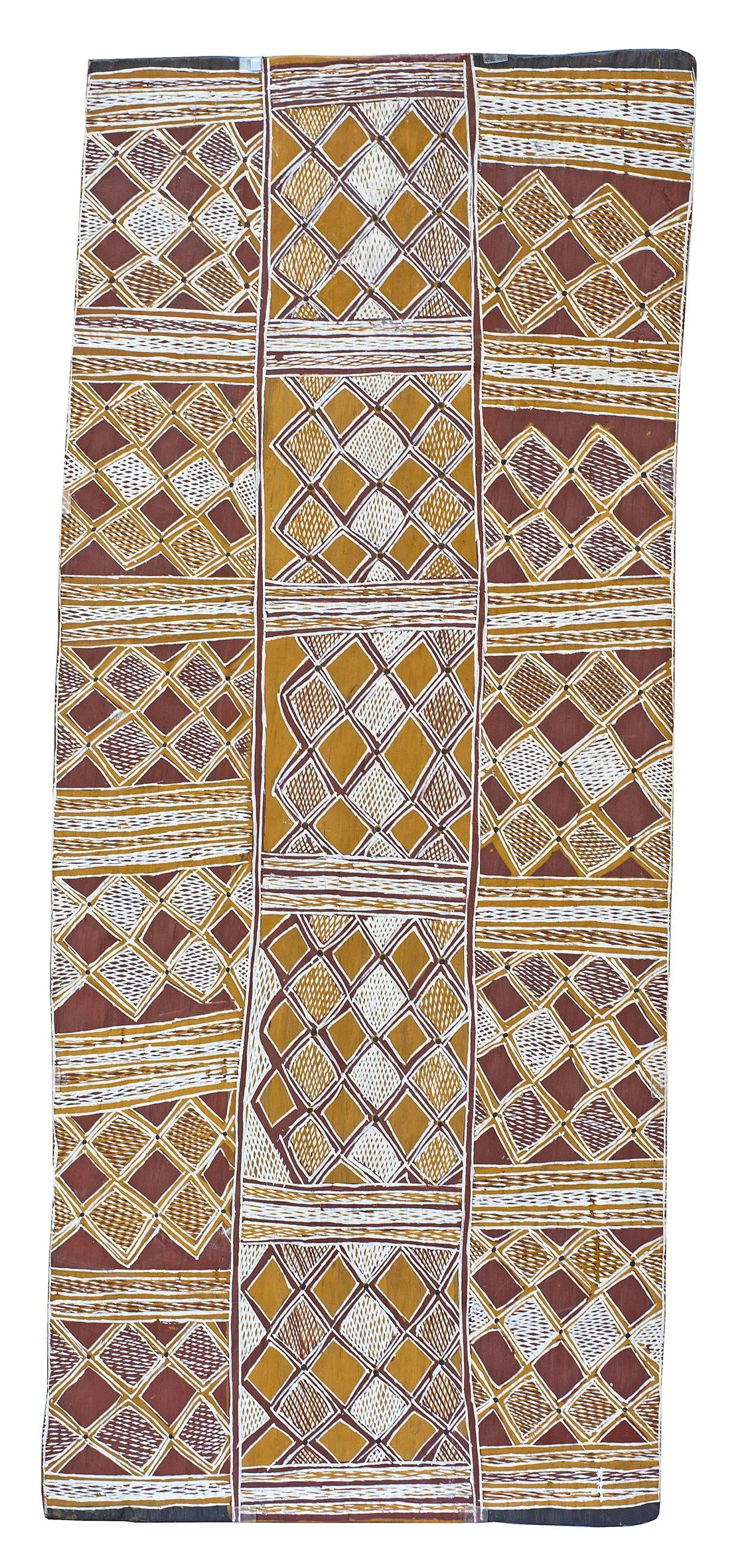
Artiste : Mulkun Wirrpanda
Titre de l'œuvre : Birrkuda
Pigments naturels sur écorce
Format : 108 x 46 cm
Provenance et certificat original : centre d'art aborigène de Yirrkala
Référence de la peinture : 3605W
© Photo : Aboriginal signature with the courtesy of the artist & Buku-Larrngay Mulka.
Explication de l’œuvre :
This bark painting by Mulkun Wirrpanda (1942), evokes the Dhudi Djapu clan land on this estate is country associated with Dhalwaŋu clan lore. It is a Honey site of Ancestral times sung by the Yirritja. Icons of the sugar bag, a manifestation of this deep seated knowledge is depicted.
The events that took place here give the Dhalwaŋu and associates spiritual rites of country. This image shows the honey at the place known as Gawarratja belonging to the clan of Mandawuy Yunupingu’s mother-in-law who recently deceased leaving her sister as the only surviving member of this clan. Their clan was decimated by a massacre in the early 1900’s which is retailed in the Yothu Yindi CD Birrkuda. The sensitiviities of this history have meant that this design is not often reproduced. In this instance this elderly Dhudi-Djapu woman has painted her mother’s pattern.
Collections : Art Gallery of New South Wales, Sydney NSW. Art Gallery of South Australia, Adelaide SA. Berndt Museum, University of Western Australia, Perth WA. British Museum, London, UK. Buku-Larrnggay Mulka - Saltwater - Yirrkala Bark Paintings of Sea Country. Holmes a Court Collection. Kerry Stokes Larrakitj Collection, WA. National Maritime Museum, Darling Harbour, Sydney NSW. National Museum of Australia, Canberra ACT
Vendue

Artiste : Dhuwarrwarr Marika
Titre de l'œuvre : Yambirrpa
Pigments naturels sur écorce
Format : 139 x 55 cm
Provenance et certificat original : centre d'art aborigène de Yirrkala
Référence de la peinture : 3631-18
© Photo : Aboriginal signature with the courtesy of the artist & Buku-Larrngay Mulka.
Explication de l’œuvre :
This bark painting by Dhuwarrwarr Marika (1945), evokes Yambirrpa. 'The guṉḏa (rock) at the top is Nhulun or Mount Saunders, and the other guṉḏa below joins together to make a fish trap.
You can see this from Nhulun. This fish trap, we call it yambirrpa. The yambirrpa fills up when the gapu (water) comes in and out with the tides. The yambirrpa is built of gunda and when the gapu comes in the guya (fish) swim into the yambirrpa, when the tides goes out the guya are trapped and we can go there and catch the guya.
This yambirrpa was shown to us by the old people and years later now, it’s still there. One yambirrpa is Rirratjiŋu and one is Bararrŋu (Rarrakalawuy) and one is Djambarrpuyŋu and they are all still there.
Collections :
Art Gallery of New South Wales, Sydney NSW. Australian Capital Equity Collection, Perth WA. Berndt Museum, University of Western Australia, Perth WA. Kluge-Ruhe Aboriginal Art Collection of the University of Virginia. USA. Melbourne South Australian Museum. Adelaide SA. Museum and Art Gallery of the Northern Territory, Darwin NT. Nahum Gutman Museum of Art, London UK. National Gallery of Australia, Canberra ACT. National Gallery of Victoria, Melbourne VIC. The Kelton Foundation Collection, Santa Monica, USA

Artiste : Dhuwarrwarr Marika
Titre de l'œuvre : Yambirrpa
Pigments naturels sur écorce
Format : 96 x 62 cm
Provenance et certificat original : centre d'art aborigène de Yirrkala
Référence de la peinture : 2161-18
© Photo : Aboriginal signature with the courtesy of the artist & Buku-Larrngay Mulka.
Explication de l’œuvre :
This bark painting by Dhuwarrwarr Marika (1945), evokes Rulyapa, the rough saltwater country between Nhulunbuy and the large island of Dhambaliya (Bremer Island), ballooning up from the secret depths, around the sacred rock Manhala, which can be a manifestation of Daymirri. Daymirri is the whale (or perhaps sea monster) that according to Rirratjiŋu and Djambarrpuyŋu clan manikay (sacred song) pertains to the saltwater country close to Yirrkala.
The dome-shaped rock Manhala exposes itself at the low tide, above the raŋ (tide marks), bleached white, a patina of brine and weather. Manhala is one of many names given to the rock. Djambarrpuyŋu and Rirratjiŋu clans have many ‘deep’ names that are intoned by the ritual specialists at the culmination of appropriate ceremony.
Collections :
Art Gallery of New South Wales, Sydney NSW. Australian Capital Equity Collection, Perth WA. Berndt Museum, University of Western Australia, Perth WA. Kluge-Ruhe Aboriginal Art Collection of the University of Virginia. USA. Melbourne South Australian Museum. Adelaide SA. Museum and Art Gallery of the Northern Territory, Darwin NT. Nahum Gutman Museum of Art, London UK. National Gallery of Australia, Canberra ACT. National Gallery of Victoria, Melbourne VIC. The Kelton Foundation Collection, Santa Monica, USA
Vendue

Artiste : Dhuwarrwarr Marika
Titre de l'œuvre : Yambirrpa
Pigments naturels sur écorce
Format : 127 x 53 cm
Provenance et certificat original : centre d'art aborigène de Yirrkala
Référence de la peinture : 3615-18
© Photo : Aboriginal signature with the courtesy of the artist & Buku-Larrngay Mulka.
Explication de l’œuvre :
This bark painting by Dhuwarrwarr Marika (1945), evokes Yambirrpa. 'The guṉḏa (rock) at the top is Nhulun or Mount Saunders, and the other guṉḏa below joins together to make a fish trap.
You can see this from Nhulun. This fish trap, we call it yambirrpa. The yambirrpa fills up when the gapu (water) comes in and out with the tides. The yambirrpa is built of gunda and when the gapu comes in the guya (fish) swim into the yambirrpa, when the tides goes out the guya are trapped and we can go there and catch the guya.
This yambirrpa was shown to us by the old people and years later now, it’s still there. One yambirrpa is Rirratjiŋu and one is Bararrŋu (Rarrakalawuy) and one is Djambarrpuyŋu and they are all still there.
Collections :
Art Gallery of New South Wales, Sydney NSW. Australian Capital Equity Collection, Perth WA. Berndt Museum, University of Western Australia, Perth WA. Kluge-Ruhe Aboriginal Art Collection of the University of Virginia. USA. Melbourne South Australian Museum. Adelaide SA. Museum and Art Gallery of the Northern Territory, Darwin NT. Nahum Gutman Museum of Art, London UK. National Gallery of Australia, Canberra ACT. National Gallery of Victoria, Melbourne VIC. The Kelton Foundation Collection, Santa Monica, USA
Vendue

Artiste : Napuwarri Marawili
Titre de l'œuvre : Yathikpa
Pigments naturels sur écorce
Format : 65 x 60 cm
Provenance et certificat original : centre d'art aborigène de Yirrkala
Référence de la peinture : 4090Y
© Photo : Aboriginal signature with the courtesy of the artist & Buku-Larrngay Mulka.
Explication de l’œuvre :
This bark painting by Napuwarri Marawili (1967) depicts Baraltja, the residence of Burrut’tji (also known as Mundukul) the lightning serpent. It is an area of flood plains that drain into northern Blue Mud Bay. It is on country belonging to the Madarrpa and denotes an area of special qualities pertaining to fertility and the mixing of waters. From Madarrpa (and Dhalwaŋu clan) land freshwater spreads onto the Baraltja flood plains with the onset of the Wet. A tidal creek into the Bay flows with the freshwater flushing the brackish mix into the sea over an ever shifting sandbar (the snake manifest).
So as a harpoon travels or does lightning the estates are connected spiritually in a multi directional way - both to and from, a cyclic phenomenon which is chronicled in the sacred songs that narrate these Ancestral actions over land, through the sea and ether. It is worth noting that Yolŋu ‘science’ portrays this energy burst as coming up from the land which is now recognised by Western science as the precursor to downward lightning ‘strikes’...
Collections : Winner of the 2018 Tesltra Award (Museum of Darwin. Art Gallery of Ballarat, Ballarat VIC. Artbank, Sydney NSW. Holmes a Court Collection, Perth WA. Kerry Stokes Collection, Perth WA. National Gallery of Australia, Canberra ACT...
Vendue
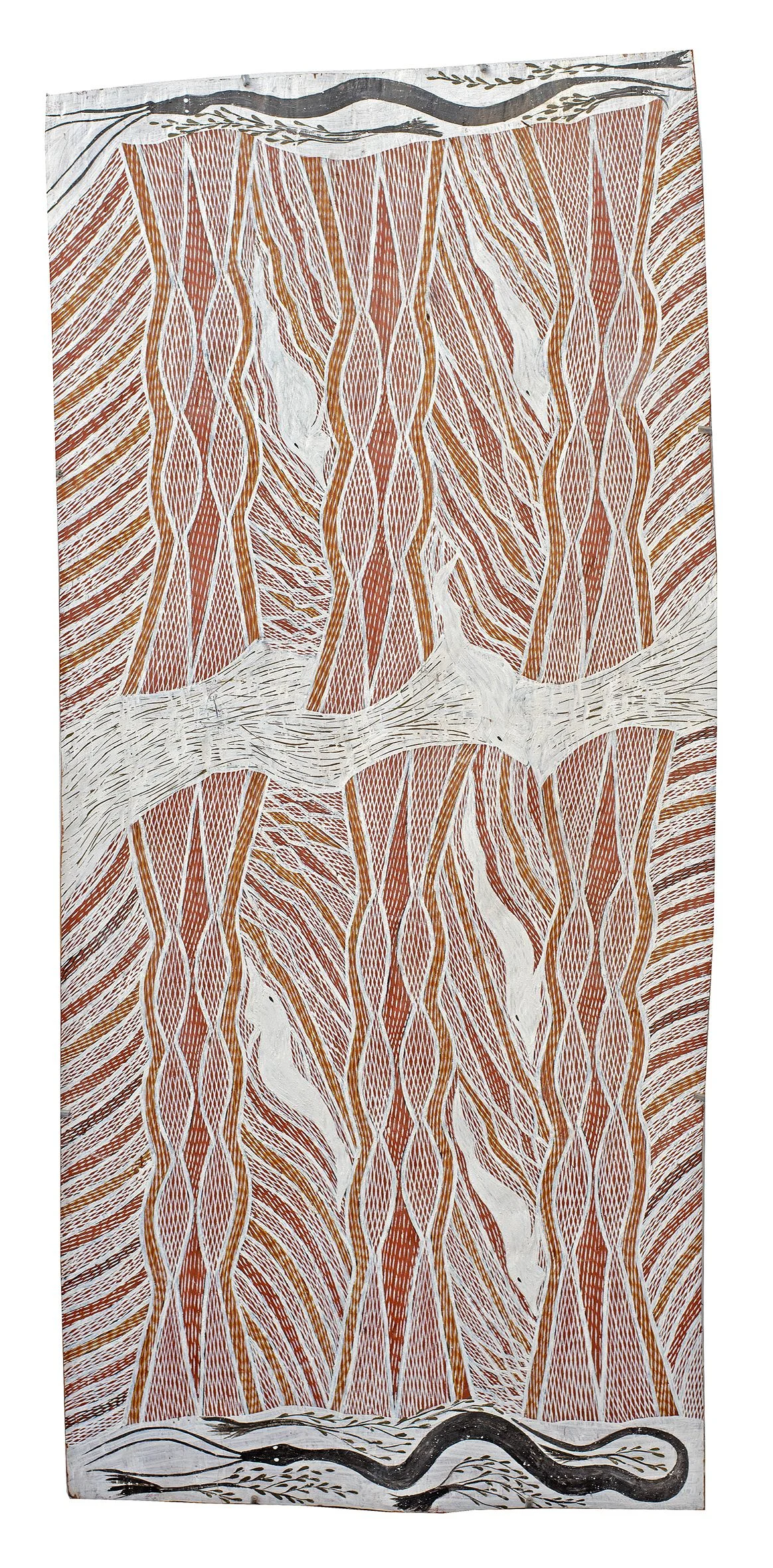
Artiste : Napuwarri Marawili
Titre de l'œuvre : Yathikpa
Pigments naturels sur écorce
Format : 113 x 51 cm
Provenance et certificat original : centre d'art aborigène de Yirrkala
Référence de la peinture : 3941F
© Photo : Aboriginal signature with the courtesy of the artist & Buku-Larrngay Mulka.
Explication de l’œuvre :
This bark painting by Napuwarri Marawili (1967) depicts Baraltja, the residence of Burrut’tji (also known as Mundukul) the lightning serpent. It is an area of flood plains that drain into northern Blue Mud Bay. It is on country belonging to the Madarrpa and denotes an area of special qualities pertaining to fertility and the mixing of waters. From Madarrpa (and Dhalwaŋu clan) land freshwater spreads onto the Baraltja flood plains with the onset of the Wet. A tidal creek into the Bay flows with the freshwater flushing the brackish mix into the sea over an ever shifting sandbar (the snake manifest).
So as a harpoon travels or does lightning the estates are connected spiritually in a multi directional way - both to and from, a cyclic phenomenon which is chronicled in the sacred songs that narrate these Ancestral actions over land, through the sea and ether. It is worth noting that Yolŋu ‘science’ portrays this energy burst as coming up from the land which is now recognised by Western science as the precursor to downward lightning ‘strikes’...
Collections : Winner of the 2018 Tesltra Award (Museum of Darwin. Art Gallery of Ballarat, Ballarat VIC. Artbank, Sydney NSW. Holmes a Court Collection, Perth WA. Kerry Stokes Collection, Perth WA. National Gallery of Australia, Canberra ACT...
Vendue

Artiste : Napuwarri Marawili
Titre de l'œuvre : Baraltja Dugong Yathikpa
Pigments naturels sur écorce
Format : 68 x 48 cm
Provenance et certificat original : centre d'art aborigène de Yirrkala
Référence de la peinture : 34942P
© Photo : Aboriginal signature with the courtesy of the artist & Buku-Larrngay Mulka.
Explication de l’œuvre :
This bark painting by Napuwarri Marawili (1967) depicts Baraltja, the residence of Burrut’tji (also known as Mundukul) the lightning serpent. It is an area of flood plains that drain into northern Blue Mud Bay. It is on country belonging to the Madarrpa and denotes an area of special qualities pertaining to fertility and the mixing of waters. From Madarrpa (and Dhalwaŋu clan) land freshwater spreads onto the Baraltja flood plains with the onset of the Wet. A tidal creek into the Bay flows with the freshwater flushing the brackish mix into the sea over an ever shifting sandbar (the snake manifest).
So as a harpoon travels or does lightning the estates are connected spiritually in a multi directional way - both to and from, a cyclic phenomenon which is chronicled in the sacred songs that narrate these Ancestral actions over land, through the sea and ether. It is worth noting that Yolŋu ‘science’ portrays this energy burst as coming up from the land which is now recognised by Western science as the precursor to downward lightning ‘strikes’...
Collections : Winner of the 2018 Tesltra Award (Museum of Darwin. Art Gallery of Ballarat, Ballarat VIC. Artbank, Sydney NSW. Holmes a Court Collection, Perth WA. Kerry Stokes Collection, Perth WA. National Gallery of Australia, Canberra ACT...
Vendue
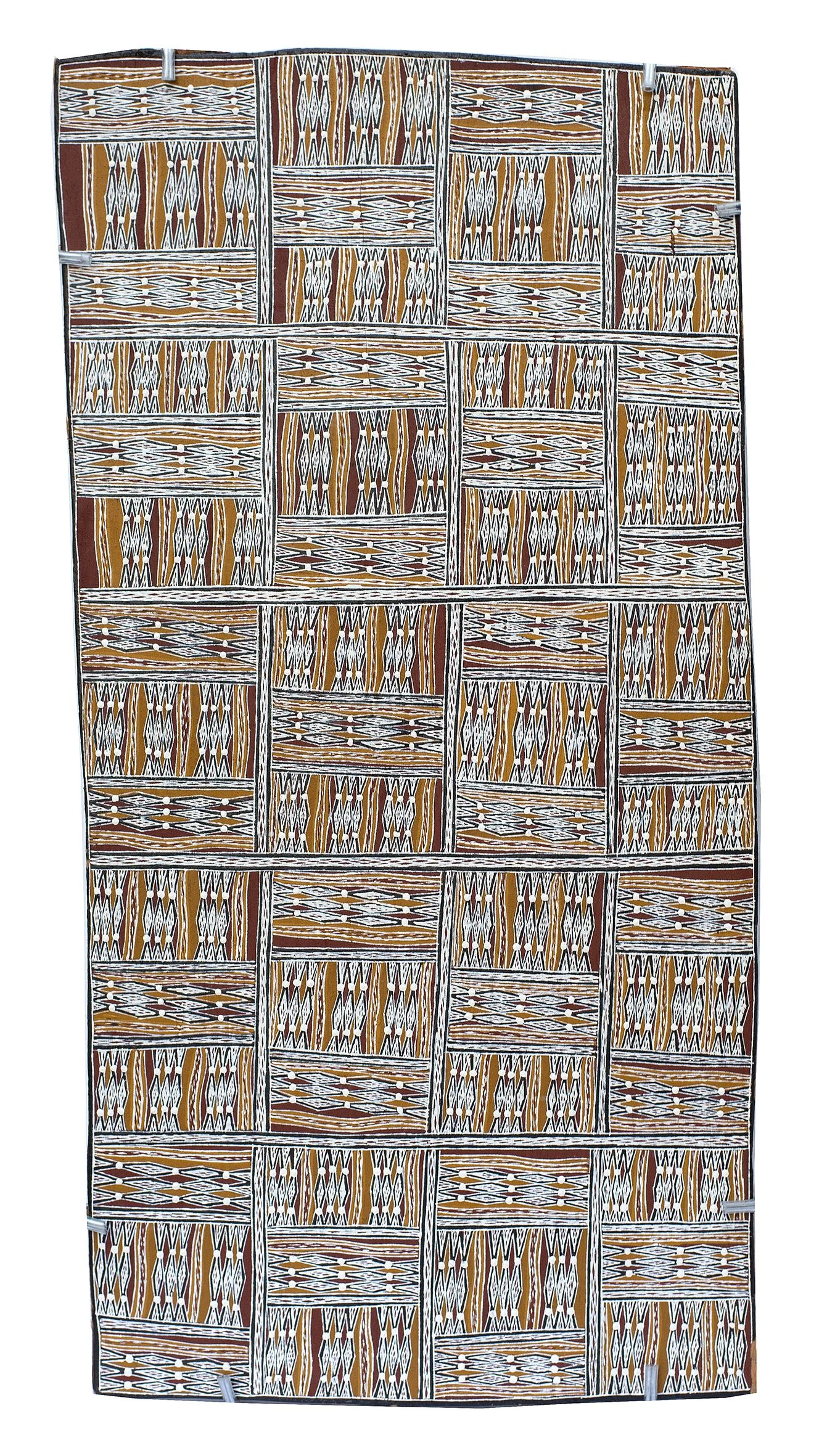
Artiste : Rerrkirrwaŋa Munuŋgurr
Titre de l'œuvre : Gumatj
Pigments naturels sur écorce
Format : 56 x 23 cm
Provenance et certificat original : centre d'art aborigène de Yirrkala
Référence de la peinture : 4096H
© Photo : Aboriginal signature with the courtesy of the artist & Buku-Larrngay Mulka.
Explication de l’œuvre :
This bark painting by Rerrkirrwaŋa Munuŋgurr (1971) has painted her husband’s clan minytji - that of the Gumatj clan. The totemic significance of fire to the Yunupiŋu
family of the Gumatj clan is paramount. It is said that the Gumatj clan language, Dhuwalandja, is itself the tongue of flame.
This language, or tongue, like the flame, cuts through all artifice. It incinerates dishonesty leaving only the bones of the truth. In the initial interface between Yolŋu sacred art and the Western art world an early decision was made on the Yolŋu side to use figurative imagery to cover the miny’tji in paintings. This ‘miny’tji’ is the source and record of the sacred identity of the law and the land portrayed.
The Gumatj clan design associated with these events, a diamond design, represents fire; the red flames, the white smoke and ash, the black charcoal and the yellow dust. Clans owning connected parts of this sequence of ancestral events share variations of this diamond design.
Collections :
2009 Telstra National Aboriginal and Torres Strait Islander Art Awards, Darwin NT Winner Best Bark Painting.
Private collections.

Artiste : Rerrkirrwaŋa Munuŋgurr
Titre de l'œuvre : Gurtha
Pigments naturels sur écorce
Format : 41 x 21 cm
Provenance et certificat original : centre d'art aborigène de Yirrkala
Référence de la peinture : 799-18
© Photo : Aboriginal signature with the courtesy of the artist & Buku-Larrngay Mulka.
Explication de l’œuvre :
This bark painting by Rerrkirrwaŋa Munuŋgurr (1971) depicts Gurtha. In ancestral times, the leaders of Yirritja moiety clans used fire for the first time during a ceremony at Ŋalarrwuy in Gumatj country. This came about as fire brought to the Madarrpa clan country by Bäru the ancestral crocodile, spread north and swept through the ceremonial ground. From this ceremonial ground the fire spread further to other sites. Various ancestral animals were affected and reacted in different ways. These animals became sacred totems of the Gumatj people and the areas associated with these events became important sites.
The creatures as cockatoo & Dugong are all associated with named sites which were burnt as the ancestral fire spread across the land. Where the sites described occur outside Gumatj clan country, the path of the fire represents important relationships held between these clans. The Gumatj clan design associated with these events, a diamond design, represents fire; the red flames, the white smoke and ash, the black charcoal and the yellow dust. Also the black skin, yellow fat, white bone and red blood of Gumatj people. Clans owning connected parts of this sequence of ancestral events share variations of this diamond design.
Collections :
2009 Telstra National Aboriginal and Torres Strait Islander Art Awards, Darwin NT - Winner Best Bark Painting.
Private collections.
Vendue

Artiste : Napurrawuy #2 Wunuŋmurra
Titre de l'œuvre : Buyku
Pigments naturels sur écorce
Format : 85 x 22 cm
Provenance et certificat original : centre d'art aborigène de Yirrkala
Référence de la peinture : 961-18
© Photo : Aboriginal signature with the courtesy of the artist & Buku-Larrngay Mulka.
Explication de l’œuvre :
This bark painting by Napurrawuy #2 Wunuŋmurra (1977), depicts the miny’tji (sacred clan design) of the Dhalwaŋu clan which is one of the eight or so clans belonging to
the Yirritja moiety (half) in North East Arnhem land. The sacred diamond design for the Dhalwaŋu clan reflects the patterning of the water streaming from the body of Ancestral Creator Being Barama as he emerged from these waters at Gäṉgaṉ, with weed hanging from his arms.
The sacred diamond design generally refers to the waters around Gangan but the triangles also show the structure of the fishtrap made during Mirrawarr (early Dry Season) with Rangan (paperbark) and wooden stakes. This is the Buyku or fishtrap area which is ‘company’ land (ie. shared by all the people who live by/sing the river). The Dhalwaŋu and allied groups who participate in this song cycle and fishing activity are hunting Baypinŋa (Saratoga) as does the Gany’tjurr (Reef Heron) which they identify with as the archetypal Yirritja hunter.
Vendue

Artiste : Napurrawuy #2 Wunuŋmurra
Titre de l'œuvre : Buyku
Pigments naturels sur écorce
Format : 133 x 58 cm
Provenance et certificat original : centre d'art aborigène de Yirrkala
Référence de la peinture : 2135-18
© Photo : Aboriginal signature with the courtesy of the artist & Buku-Larrngay Mulka.
Explication de l’œuvre :
This bark painting by Napurrawuy #2 Wunuŋmurra (1977), depicts the miny’tji (sacred clan design) of the Dhalwaŋu clan which is one of the eight or so clans belonging to
the Yirritja moiety (half) in North East Arnhem land. The sacred diamond design for the Dhalwaŋu clan reflects the patterning of the water streaming from the body of Ancestral Creator Being Barama as he emerged from these waters at Gäṉgaṉ, with weed hanging from his arms.
The sacred diamond design generally refers to the waters around Gangan but the triangles also show the structure of the fishtrap made during Mirrawarr (early Dry Season) with Rangan (paperbark) and wooden stakes. This is the Buyku or fishtrap area which is ‘company’ land (ie. shared by all the people who live by/sing the river). The Dhalwaŋu and allied groups who participate in this song cycle and fishing activity are hunting Baypinŋa (Saratoga) as does the Gany’tjurr (Reef Heron) which they identify with as the archetypal Yirritja hunter.

Artiste : Napurrawuy #2 Wunuŋmurra
Titre de l'œuvre : Buyku
Pigments naturels sur écorce
Format : 106 x 33 cm
Provenance et certificat original : centre d'art aborigène de Yirrkala
Référence de la peinture : 5383-17
© Photo : Aboriginal signature with the courtesy of the artist & Buku-Larrngay Mulka.
Explication de l’œuvre :
This bark painting by Napurrawuy #2 Wunuŋmurra (1977), depicts the miny’tji (sacred clan design) of the Dhalwaŋu clan which is one of the eight or so clans belonging to
the Yirritja moiety (half) in North East Arnhem land. The sacred diamond design for the Dhalwaŋu clan reflects the patterning of the water streaming from the body of Ancestral Creator Being Barama as he emerged from these waters at Gäṉgaṉ, with weed hanging from his arms.
The sacred diamond design generally refers to the waters around Gangan but the triangles also show the structure of the fishtrap made during Mirrawarr (early Dry Season) with Rangan (paperbark) and wooden stakes. This is the Buyku or fishtrap area which is ‘company’ land (ie. shared by all the people who live by/sing the river). The Dhalwaŋu and allied groups who participate in this song cycle and fishing activity are hunting Baypinŋa (Saratoga) as does the Gany’tjurr (Reef Heron) which they identify with as the archetypal Yirritja hunter.
Vendue

Artiste : Djurrayun Murrinyina
Titre de l'œuvre : Wukili
Pigments naturels sur écorce
Format : 107 x 43 cm
Provenance et certificat original : centre d'art aborigène de Yirrkala
Référence de la peinture : 2733-18
© Photo : Aboriginal signature with the courtesy of the artist & Buku-Larrngay Mulka.
Explication de l’œuvre :
This bark painting by Djurrayun Murrinyina (1974), evokes The area of sea country belonging to the Djarrwark clan is known as Wukili. It is between Baraltja and Garrapara on Blue Mud Bay.
During the time of the first morning, the Dhuwa Waŋarr, or creator ancestors, the Djaŋ’kawu paddled their canoe Malili (paddles Matiny) into this country. They saw catfish Balwaltja and ‘sheridan’s threadfin’ Malmuŋa and sang them as Dhuwa totems associated with the special qualities of the saltwater country of Wukili.
The miny’tji (sacred clan design) represents the Djarrwark saltwater itself. The Dhuwa saltwater country is marked by the straight and parallel ribbons of miny’tji of the Djarrwark. It is read to be water affected by the Ancestral presence of the Djaŋ’kawu Creators, the forebears of all Dhuwa people who laid down the law in the ancient past, including all the songs, dances, designs and deeds to land and water.

Artiste : Djurrayun Murrinyina
Titre de l'œuvre : Wukili
Pigments naturels sur écorce
Format : 106 x 33 cm
Provenance et certificat original : centre d'art aborigène de Yirrkala
Référence de la peinture : 1555-18
© Photo : Aboriginal signature with the courtesy of the artist & Buku-Larrngay Mulka.
Explication de l’œuvre :
This bark painting by Djurrayun Murrinyina (1974), evokes The area of sea country belonging to the Djarrwark clan is known as Wukili. It is between Baraltja and Garrapara on Blue Mud Bay.
During the time of the first morning, the Dhuwa Waŋarr, or creator ancestors, the Djaŋ’kawu paddled their canoe Malili (paddles Matiny) into this country. They saw catfish Balwaltja and ‘sheridan’s threadfin’ Malmuŋa and sang them as Dhuwa totems associated with the special qualities of the saltwater country of Wukili.
The miny’tji (sacred clan design) represents the Djarrwark saltwater itself. The Dhuwa saltwater country is marked by the straight and parallel ribbons of miny’tji of the Djarrwark. It is read to be water affected by the Ancestral presence of the Djaŋ’kawu Creators, the forebears of all Dhuwa people who laid down the law in the ancient past, including all the songs, dances, designs and deeds to land and water.
Vendue

Artiste : Djurrayun Murrinyina
Titre de l'œuvre : Wukili
Pigments naturels sur écorce
Format : 95 x 37 cm
Provenance et certificat original : centre d'art aborigène de Yirrkala
Référence de la peinture : 2175-18
© Photo : Aboriginal signature with the courtesy of the artist & Buku-Larrngay Mulka.
Explication de l’œuvre :
This bark painting by Djurrayun Murrinyina (1974), evokes The area of sea country belonging to the Djarrwark clan is known as Wukili. It is between Baraltja and Garrapara on Blue Mud Bay.
During the time of the first morning, the Dhuwa Waŋarr, or creator ancestors, the Djaŋ’kawu paddled their canoe Malili (paddles Matiny) into this country. They saw catfish Balwaltja and ‘sheridan’s threadfin’ Malmuŋa and sang them as Dhuwa totems associated with the special qualities of the saltwater country of Wukili.
The miny’tji (sacred clan design) represents the Djarrwark saltwater itself. The Dhuwa saltwater country is marked by the straight and parallel ribbons of miny’tji of the Djarrwark. It is read to be water affected by the Ancestral presence of the Djaŋ’kawu Creators, the forebears of all Dhuwa people who laid down the law in the ancient past, including all the songs, dances, designs and deeds to land and water.
Vendue

Artiste : Noŋgirrŋa Marawili
Titre de l'œuvre : Gurtha
Pigments naturels sur écorce
Format : 189 x 86 cm
Provenance et certificat original : centre d'art aborigène de Yirrkala
Référence de la peinture : 3540-18
© Photo : Aboriginal signature with the courtesy of the artist & Buku-Larrngay Mulka.
Explication de l’œuvre :
This Bark painting by Noŋgirrŋa Marawili (1938), depicts Their special spot on the mainland was Baratjula. A place to which she only returned after the creation of these paintings. Ṉoŋgirrŋa started life as one of the numerous children of Mundukul the Madarrpa warrior (c.1890-c.1950). He was a famed leader/warrior with uncountable wives of the Marrakulu, Dhudi Djapu and Galpu clans.
Baratjula is a Madarrpa clan estate adjacent to Cape Shield where the artist camped with her father and his many wives as a young girl. It is of the essence of Madarrpa but does not hold the high order sites that Yathikpa does. She lived nomadically as
part of a clan group with a flotilla of canoes between Groote Eyelandt and the mainland. This journey from the sacred to the descriptive shifts in these works. She has reduced the Law to its elements unclothed in sacred design. Her identity cannot be separated from her art and so although she disavows any sacred intent the echo of miny’tji persists.
Collections : Art Gallery of New South Wales, Sydney NSW. Berndt Museum, University of Western Australia, Perth WA. Chartwell Collection, Auckland Art Gallery, Auckland, New Zealand. Kluge-Ruhe Aboriginal Art Collection of the University of Virginia. USA Museum and Art Gallery of the Northern Territory, Darwin NT. Museum of Contemporary Art, Sydney NSW. National Gallery of Australia, Canberra ACT. National Gallery of Victoria, Melbourne VIC. The Metropolitan Museum of Art

Artiste : Rerrkirrwaŋa Munuŋgurr
Titre de l'œuvre : Gurtha
Pigments naturels sur écorce
Format : 88 x 23 cm
Provenance et certificat original : centre d'art aborigène de Yirrkala
Référence de la peinture : 2101-18
© Photo : Aboriginal signature with the courtesy of the artist & Buku-Larrngay Mulka.
Explication de l’œuvre :
This bark painting by Rerrkirrwaŋa Munuŋgurr (1971) depicts Gurtha. In ancestral times, the leaders of Yirritja moiety clans used fire for the first time during a ceremony at Ŋalarrwuy in Gumatj country. This came about as fire brought to the Madarrpa clan country by Bäru the ancestral crocodile, spread north and swept through the ceremonial ground. From this ceremonial ground the fire spread further to other sites. Various ancestral animals were affected and reacted in different ways. These animals became sacred totems of the Gumatj people and the areas associated with these events became important sites.
The creatures as cockatoo & Dugong are all associated with named sites which were burnt as the ancestral fire spread across the land. Where the sites described occur outside Gumatj clan country, the path of the fire represents important relationships held between these clans. The Gumatj clan design associated with these events, a diamond design, represents fire; the red flames, the white smoke and ash, the black charcoal and the yellow dust. Also the black skin, yellow fat, white bone and red blood of Gumatj people. Clans owning connected parts of this sequence of ancestral events share variations of this diamond design.
Collections :
2009 Telstra National Aboriginal and Torres Strait Islander Art Awards, Darwin NT - Winner Best Bark Painting.
Private collections.

Artiste : Noŋgirrŋa #2 Marawili
Titre de l'œuvre : Djapu design for Waṉḏawuy
Pigments naturels sur écorce
Format : 61 x 38 cm
Provenance et certificat original : centre d'art aborigène de Yirrkala
Référence de la peinture : 2493-18
© Photo : Aboriginal signature with the courtesy of the artist & Buku-Larrngay Mulka.
Explication de l’œuvre :
This bark paitning by Noŋgirrŋa #2 Marawili (1994) depicts throught the cross hatching grid pattern, the sacred design for the fresh waters of the Djapu clan at their homeland Wandawuy now an outstation about 150 kilometres south of Yirrkala and inland from Blue Mud Bay. This Djapu clan outstation (and spiritual residence for Ancestral Beings Mäna the Shark and Bol’ŋu the Thunderman) is surrounded by permanent freshwater. Rains inspired by the actions of Bol’ŋu feed the rivers and fill the billabongs. Catfish and mussels, freshwater crayfish and others feed the Yolŋu and wild life. The waters are home for the shark Mäna. The grid refers to the landscape of Wandawuy; a network of billabongs surrounded by ridges and high banks. Its structure also having reference at one level to woven fish traps. Ancestral Hunters set a trap here to snare the Shark but to no avail.
The grid lines having reference to the trap, the cross hatched squares referring to differing states of the freshwater - the source of Djapu soul. The arst is ‘playing’ with the sacred design to create a completely new pattern suggested by the swirling combinations of different elements of this water.
Private collections.
Vendue
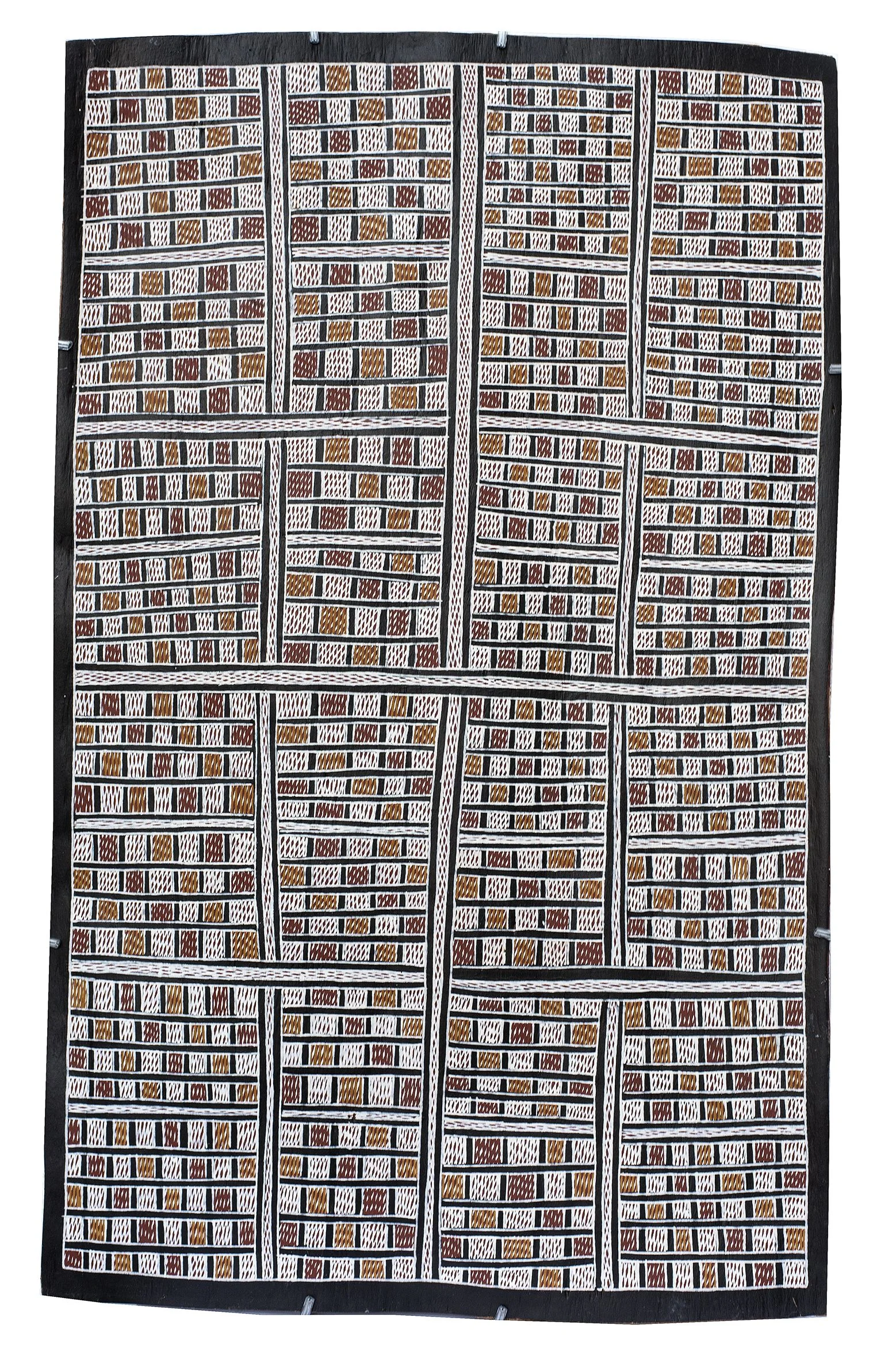
Artiste : Djawuluku Munuŋgurr
Titre de l'œuvre : Djapu Design
Pigments naturels sur écorce
Format : 77 x 48 cm
Provenance et certificat original : centre d'art aborigène de Yirrkala
Référence de la peinture : 1607-18
© Photo : Aboriginal signature with the courtesy of the artist & Buku-Larrngay Mulka.
Explication de l’œuvre :
This bark painting by Djawuluku Munuŋgurr (1964) evokes with the cross hatching grid pattern, the sacred design for the freshwaters of the Djapu clan at their homeland Wandawuy now an outstation about 150 kilometres south of Yirrkala and inland from Blue Mud Bay. This Djapu clan outstation (and spiritual residence for Ancestral Beings Mäna the Shark and Bol’ŋu the Thunderman) is surrounded by permanent freshwater.
Rains inspired by the actions of Bol’ŋu feed the rivers and fill the billabongs. Catfish and mussels, freshwater crayfish and others feed the Yolŋu and wild life. The waters are home for the shark Mäna. The grid refers to the landscape of Wandawuy - a network of billabongs surrounded by ridges and high banks. Its structure also
having reference at one level to woven fish traps. Ancestral Hunters who set a trap here are called Bärngbarng and Monu'a who came to cut the trees named Gu'uwu, Gathurrmakarr, Nyenyi, Rulwirrika and Gananyarra - all Dhuwa trees. They used straight young trees. And cut them with their axes called Gayma'arri, Bitjutju. Areas of the river are staked by the Yolŋu and branches interwoven through them.
Collections : Private collections.
Vendue

Artiste : Yimula Munuŋgurr
Titre de l'œuvre : Djapu Design
Pigments naturels sur écorce
Format : 54 x 40 cm
Provenance et certificat original : centre d'art aborigène de Yirrkala
Référence de la peinture : 2927-18
© Photo : Aboriginal signature with the courtesy of the artist & Buku-Larrngay Mulka.
Explication de l’œuvre :
This bark painting by Yimula Munuŋgurr (1974) depicts with this cross hatching grid pattern, the sacred design for the freshwaters of the Djapu clan at their homeland Wandawuy now an outstation about 150 kilometres south of Yirrkala and inland from Blue Mud Bay. This Djapu clan outstation (and spiritual residence for Ancestral Beings Mäna the Shark and Bol’ŋu the Thunderman) is surrounded by permanent freshwater. Rains inspired by the actions of Bol’ŋu feed the rivers and fill the billabongs. Catfish and mussels, freshwater crayfish and others feed the Yolŋu and wild life. The waters are home for the shark Mäna.
The grid refers to the landscape of Wandawuy - a network of billabongs surrounded by ridges and high banks. Its structure also having reference at one level to woven fish traps. Ancestral Hunters set a trap here to snare the Shark but to no avail. These Yolngu people are called Bärngbarng and Monu'a who came to cut the trees named Gu'uwu, Gathurrmakarr, Nyenyi, Rulwirrika and Gananyarra - all Dhuwa trees. They used straight young trees nd cut them with their axes called Gayma`arri, Bitjutju.
Private collections.
Vendue

Artiste : Buwathay Munyarryun
Titre de l'œuvre : Darra (Ŋoŋu)
Pigments naturels sur écorce
Format : 76 x 24 cm
Provenance et certificat original : centre d'art aborigène de Yirrkala
Référence de la peinture : 3418-18
© Photo : Aboriginal signature with the courtesy of the artist & Buku-Larrngay Mulka.
Explication de l’œuvre :
This bark Painting by Buwathay Munyarryun (1962), identifies the reservoirs of the Ŋaymil/Datiwuy clan. Ŋalkan is an area on Ŋaymil land and sea between the
Gurrumuru and Cato Rivers that run into the Arnhem Bay. Within this area is another watercourse that leads up into a sacred area of a freshwater spring or Milŋurr with special qualities called Darrawuy. Here Djanda the sacred goanna swim in the
lagoon created by the spring, their actions as they swim causing patterns to be made on the surface that is covered by the totemic water weed Darra. The sacred clan design is a manifestation of these patterns created at Darrawuy lagoon.
Others inhabit these waters. Warrukay or Murrukula the Barracuda, the power totem for the Ŋaymil. It spends most of its time in the salt waters. At certain times Warrukay will make its way up to Darrawuy bringing the ‘contamination’ of saltwater (the
mother) with it. The mixing of this saltwater with the fresh has connotations of fertility. Darrawuy is a place of fertility. Souls of Ŋaymil are both delivered to and from this point between worlds real and spiritual. As the sacred songs used in mortuary
are cyclic, narrating the Ancestral Events of the original Creator Beings, so is the journey of the Yolŋu soul.
Vendue

Artiste : Buwathay Munyarryun
Titre de l'œuvre : Darra (Ŋoŋu)
Pigments naturels sur écorce
Format : 47 x 17 cm
Provenance et certificat original : centre d'art aborigène de Yirrkala
Référence de la peinture : 4578-17
© Photo : Aboriginal signature with the courtesy of the artist & Buku-Larrngay Mulka.
Explication de l’œuvre :
This bark Painting by Buwathay Munyarryun (1962), identifies the reservoirs of the Ŋaymil/Datiwuy clan. Ŋalkan is an area on Ŋaymil land and sea between the
Gurrumuru and Cato Rivers that run into the Arnhem Bay. Within this area is another watercourse that leads up into a sacred area of a freshwater spring or Milŋurr with special qualities called Darrawuy. Here Djanda the sacred goanna swim in the
lagoon created by the spring, their actions as they swim causing patterns to be made on the surface that is covered by the totemic water weed Darra. The sacred clan design is a manifestation of these patterns created at Darrawuy lagoon.
Others inhabit these waters. Warrukay or Murrukula the Barracuda, the power totem for the Ŋaymil. It spends most of its time in the salt waters. At certain times Warrukay will make its way up to Darrawuy bringing the ‘contamination’ of saltwater (the
mother) with it. The mixing of this saltwater with the fresh has connotations of fertility. Darrawuy is a place of fertility. Souls of Ŋaymil are both delivered to and from this point between worlds real and spiritual. As the sacred songs used in mortuary
are cyclic, narrating the Ancestral Events of the original Creator Beings, so is the journey of the Yolŋu soul.
Vendue
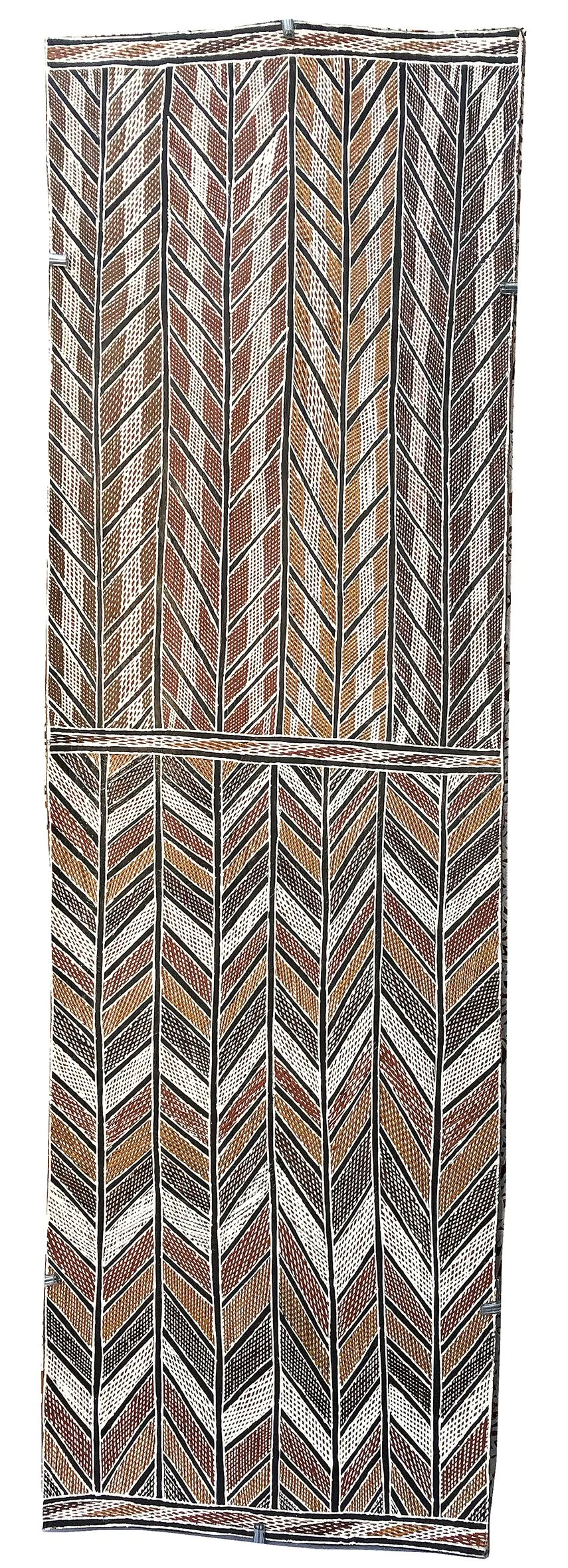
Artiste : Buwathay Munyarryun
Titre de l'œuvre : Darra (Ŋoŋu)
Pigments naturels sur écorce
Format : 77 x 23 cm
Provenance et certificat original : centre d'art aborigène de Yirrkala
Référence de la peinture : 3417-18
© Photo : Aboriginal signature with the courtesy of the artist & Buku-Larrngay Mulka.
Explication de l’œuvre :
This bark Painting by Buwathay Munyarryun (1962), identifies the reservoirs of the Ŋaymil/Datiwuy clan. Ŋalkan is an area on Ŋaymil land and sea between the
Gurrumuru and Cato Rivers that run into the Arnhem Bay. Within this area is another watercourse that leads up into a sacred area of a freshwater spring or Milŋurr with special qualities called Darrawuy. Here Djanda the sacred goanna swim in the
lagoon created by the spring, their actions as they swim causing patterns to be made on the surface that is covered by the totemic water weed Darra. The sacred clan design is a manifestation of these patterns created at Darrawuy lagoon.
Others inhabit these waters. Warrukay or Murrukula the Barracuda, the power totem for the Ŋaymil. It spends most of its time in the salt waters. At certain times Warrukay will make its way up to Darrawuy bringing the ‘contamination’ of saltwater (the
mother) with it. The mixing of this saltwater with the fresh has connotations of fertility. Darrawuy is a place of fertility. Souls of Ŋaymil are both delivered to and from this point between worlds real and spiritual. As the sacred songs used in mortuary
are cyclic, narrating the Ancestral Events of the original Creator Beings, so is the journey of the Yolŋu soul.
Vendue

Artiste : Wukun Wanambi
Titre de l'œuvre : Trial Bay
Pigments naturels sur écorce
Format : 100 x 28 cm
Provenance et certificat original : centre d'art aborigène de Yirrkala
Référence de la peinture : 4730C
© Photo : Aboriginal signature with the courtesy of the artist & Buku-Larrngay Mulka.
Explication de l’œuvre :
This painting by Wukun Wanambi (1962) refers to Bamurrungu, a sacred and solitary rock in Trial Bay. It is a white dome in the Bay - a round lump of granite its top coloured white by roosting birds, in the painting by the molmulpa or white sea foam associated with turbulent and agitating waters created by particular tide and wind.
Trial Bay is located between Caledon bay to the north and above the larger Blue Mud Bay on the western side of the Gulf of Carpentaria. Deep inside Trial Bay the Marrakulu clan claim ownership to land and sea though the actions and events of Ancestor Beings as they travelled into this country imbuing both land and sea.
The mark of ownership is sung, danced and painted in Marrakulu ritual through the stringybark woodlands and stony country, through the freshwaters running into the Gurka’wuy River into trial Bay. Mixing with the saltwaters through sacred mangroves and froth and bubble and out deeper into the Bay with the outgoing tide, past boulders and rocky islets the power and knowledge associated with Marrakulu Rom (law) washes back to shore.
Collections :
Art Gallery of New South Wales, Sydney NSW. Art Gallery of South Australia, Adelaide SA. Musee de Lyon, Lyon France. Museum of the Northern Territory, Darwin. Museum Fünf Kontinente in Munich, Germany. Museum of Contemporary Art, Sydney. National Gallery of Australia, Canberra ACT. National Maritime Museum...
Vendue

Artiste : Garawan Wanambi
Titre de l'œuvre : Marraŋu
Pigments naturels sur écorce
Format : 92 x 60 cm
Provenance et certificat original : centre d'art aborigène de Yirrkala
Référence de la peinture : 3946S
© Photo : Aboriginal signature with the courtesy of the artist & Buku-Larrngay Mulka.
Explication de l’œuvre :
This bark painting by Garawan Wanambi (1965) depicts country close to Raymangirr, on the coast of Arnhem Bay. It is a sacred and restricted area where freshwater is known to spring to the surface of the beach at the low tide region. Garawan a Marrakulu clansman says that “Wayuŋga brought me up so I’m also adopted to the Marraŋu clan” The Marrakulu and Marraŋu are closely related clans through madayin (sacred clan mythologies and law). Both tell of the felling of monumental trees by the honey ancestor Wuyal, the scouring out of a river course by the fallen log on its way to sea, deluge of honey, floods and other apocalyptic events.
For the Marraŋu at a site close to coastal Raymangirr is the mouth of this river and places of non secular danger where freshwater fonts spring up into this tidal region.
The designs represent the different character of the waters moving from anger and turbulence to the calm of resolution, bathed in the warmth of the sun’s rays. Manifest and central to the painting is the fallen trunk, this sacred larrakitj a manifestation of the same.
Collections :
Art Gallery of New South Wales, Sydney NSW. Kerry Stokes Larrakitj Collection, WA. The Kluge-Ruhe Aboriginal Art Collection of the University of Virginia. USA
Vendue

Artiste : Wukun Wanambi
Titre de l'œuvre : Trial Bay
Pigments naturels sur écorce
Format : 115 x 37 cm
Provenance et certificat original : centre d'art aborigène de Yirrkala
Référence de la peinture : 4617D
© Photo : Aboriginal signature with the courtesy of the artist & Buku-Larrngay Mulka.
Explication de l’œuvre :
This painting by Wukun Wanambi (1962) refers to Bamurrungu, a sacred and solitary rock in Trial Bay. It is a white dome in the Bay - a round lump of granite its top coloured white by roosting birds, in the painting by the molmulpa or white sea foam associated with turbulent and agitating waters created by particular tide and wind.
Trial Bay is located between Caledon bay to the north and above the larger Blue Mud Bay on the western side of the Gulf of Carpentaria. Deep inside Trial Bay the Marrakulu clan claim ownership to land and sea though the actions and events of Ancestor Beings as they travelled into this country imbuing both land and sea.
The mark of ownership is sung, danced and painted in Marrakulu ritual through the stringybark woodlands and stony country, through the freshwaters running into the Gurka’wuy River into trial Bay. Mixing with the saltwaters through sacred mangroves and froth and bubble and out deeper into the Bay with the outgoing tide, past boulders and rocky islets the power and knowledge associated with Marrakulu Rom (law) washes back to shore.
Collections :
Art Gallery of New South Wales, Sydney NSW. Art Gallery of South Australia, Adelaide SA. Musee de Lyon, Lyon France. Museum of the Northern Territory, Darwin. Museum Fünf Kontinente in Munich, Germany. Museum of Contemporary Art, Sydney. National Gallery of Australia, Canberra ACT. National Maritime Museum...
Exposition organisée en partenariat avec les artistes, la communauté Aborigène et le management du centre d'art de Yirrkala
Artiste : Barrupu Yunupiŋu Rita
Titre de l'œuvre : Gurtha
Pigments naturels sur écorce
Format : 182 x 97 cm
Provenance et certificat original : centre d'art aborigène de Yirrkala
Référence de la peinture : 3533I
© Photo : Aboriginal signature with the courtesy of the artist & Buku-Larrngay Mulka.
Explication de l’œuvre :
The Gumatj clan sacred design which Barrupu Yunupiŋu Rita (1947 - 2012) paints is gurtha or fire. But not just any fire. This is a Fire of supernatural intensity. So powerful that it transforms the land it touched for all time.
This work is solely the miny’tji of the Gumatj embodying gurtha or fire. The diamond patterning is the ‘miny’tji’, motif or sacred clan design, of this clan and this place. It summons the theme of this fire. The Gumatj clan design associated with these events, a diamond design, represents fire; the red flames, the white smoke and ash, the black charcoal and the yellow dust.
The totemic significance of fire to the Yunupiŋu family of the Gumatj clan is paramount. It is said that the Gumatj clan language, Dhuwalandja, is itself the tongue of flame. This language, or tongue, like the flame, cuts through all artifice. It
incinerates dishonesty leaving only the bones of the truth.
Collections :
Art Gallery of New South Wales, Sydney NSW
Charles Darwin University Art Collection
National Gallery of Victoria, Melbourne VIC
Vendue