
Peintures d'art Aborigène de Mimili Maku, APY land
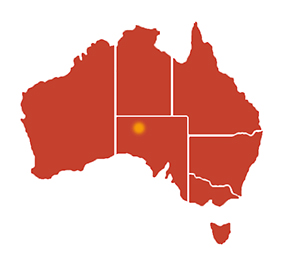
La communauté de Mimili est située au nord-ouest du sud de l’Australie à 645 km d’Alice Springs, aux pieds des Everard Ranges, dans les territoires du APY.
Sur le site de Mimili vivent 350 personnes. Cette petite communauté parle différentes langues du Yankunytjatjara, Pitjantjatjara, Ngaanyatjarra et Luritja.
La communauté s’est établie sur place en 1970, à la suite de la restitution des terres aux propriétaires traditionnels. Cet ancrage fort sur le territoire permet aux artistes de continuer à célébrer le temps du rêve dans toutes ses dimensions mythologiques, sociétales, dans une dynamique de partage de la connaissance et de transmission aux plus jeunes... (suite du texte ci-dessous).
Peintures des artistes Aborigènes de Mimili Maku disponibles au sein de la galerie :

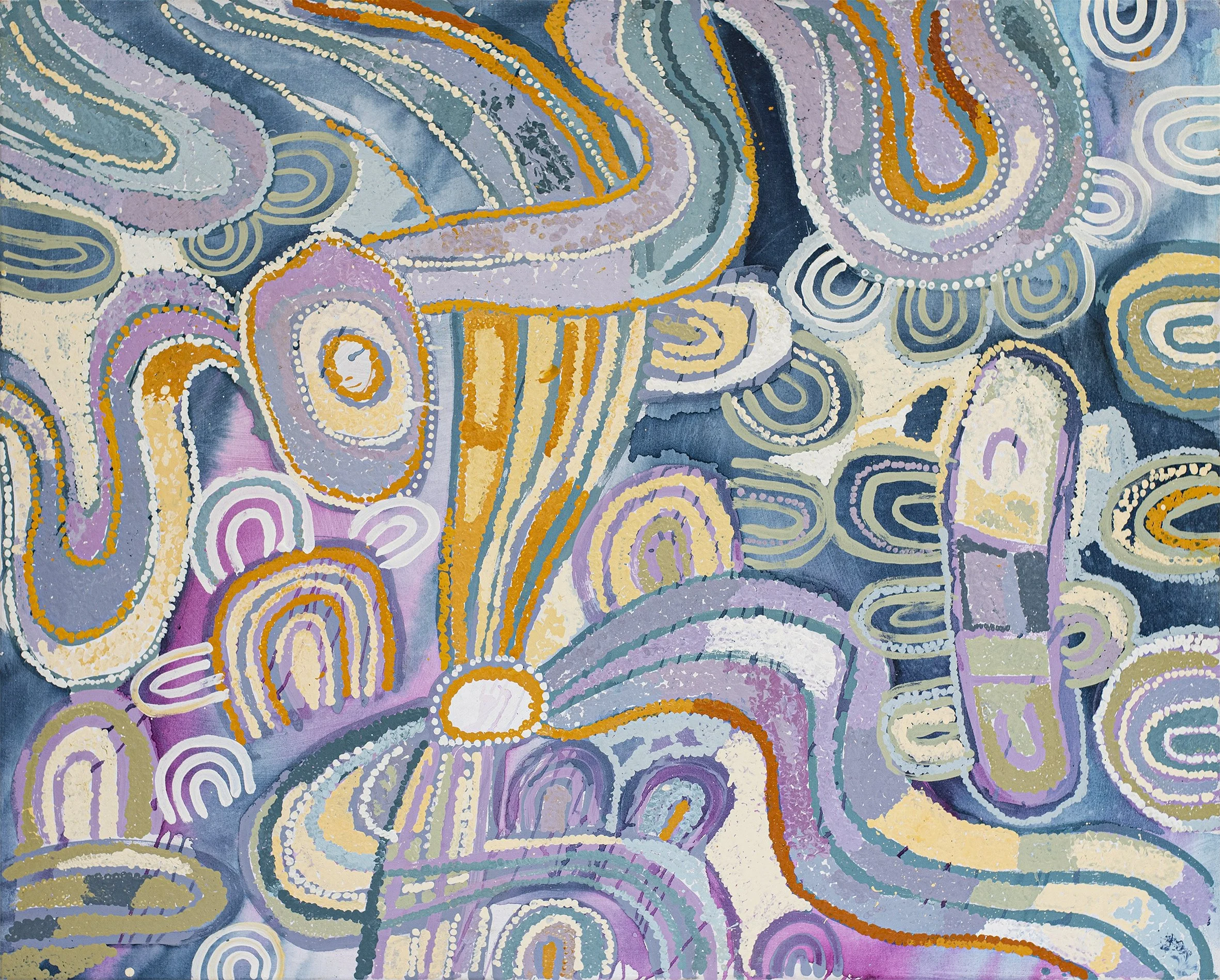
Artistes : Pauline Wangin, Emma Singer, Betty Campbell
Titre de l'œuvre : Walytja - Family Collaboration
Format : 200cm x 240cm
Provenance et certificat : centre d'art aborigène de Mimili Maku
Référence de cette peinture aborigène : 332-23
Demander le prix de cette œuvre
Explications pour cette peinture d'art Aborigène :
This is a collaborative canvas between Emma Singer, her mother Pauline Wangin and Pauline's sister Betty Campbell. Pauline says about the work : "We’ve painted this big canvas together as a family.
This canvas is about kapi tjukula and soakages around Kinara Mimi, Mimili. Our families would move between rock holes, they’d know them all. They would always be looking for clear drinking water. They lived around Antara and many other named places between Kinara Mimi, Antara, Artutja, Paralpi and Iwantja. All those places are connected, and they used to walk far distances every day. We remember the paths by the songlines that still run through those places. They’d sing the songs, dig for water, and know where to travel. The water was underground, and they’d dig till it seeped upwards. They’d always know. I remember going to Iwantja Soakage with our mother and her showing us how it’s done. We remember this from when we were young, and we want to keep sharing this story for our children and grandchildren. It’s important to remember what we’ve always known."
Pauline Wangin, 2023
Mimili Community is home to 300 Pitjantjatjara and Yankunytjatjara people who have been living in the area for millennia in harmony with nature and acting as custodians of the land and the Tjukurpa (creation stories). Mimili was formerly known as Everard Park, which was a cattle station that was returned to Aboriginal ownership through the 1981 APY Lands Act. Mimili Community was incorporated as an Aboriginal Community in 1975.

Artiste : Robert Fielding (1969)
Titre de l'œuvre : Tjukurpa Miil Miilpa
Format : 152 cm x 122 cm
Provenance et certificat : centre d'art aborigène de Mimili Maku
Référence de cette peinture aborigène : 119-21
Demander le prix de cette œuvre
Explications pour cette peinture d'art Aborigène :
Anangu culture has many layers of secrecy. Not all knowledge is to be held by each member of our community, some knowledge is only to be held by few. These paintings are also layered with much secrecy, things we share and things we choose not to share.
Some truths are so strong and important they shine through the veils and complex systems of sacred storylines. These are the foundations of our culture, the sacredness of our land, and the depth of our knowledge.
Like our culture these paintings cover the secret and sacred, whilst celebrating the strong cornerstones of what it is to be Anangu.
Ngurkantananma - Recognise.
Nganampa Manta Miil Miilpa - our land is sacred.
Nganampa Tjukurpa Miil Miilpa - our culture is sacred.
Mimili Community is home to 300 Pitjantjatjara and Yankunytjatjara people who have been living in the area for millennia in harmony with nature and acting as custodians of the land and the Tjukurpa (creation stories). Mimili was formerly known as Everard Park, which was a cattle station that was returned to Aboriginal ownership through the 1981 APY Lands Act. Mimili Community was incorporated as an Aboriginal Community in 1975.
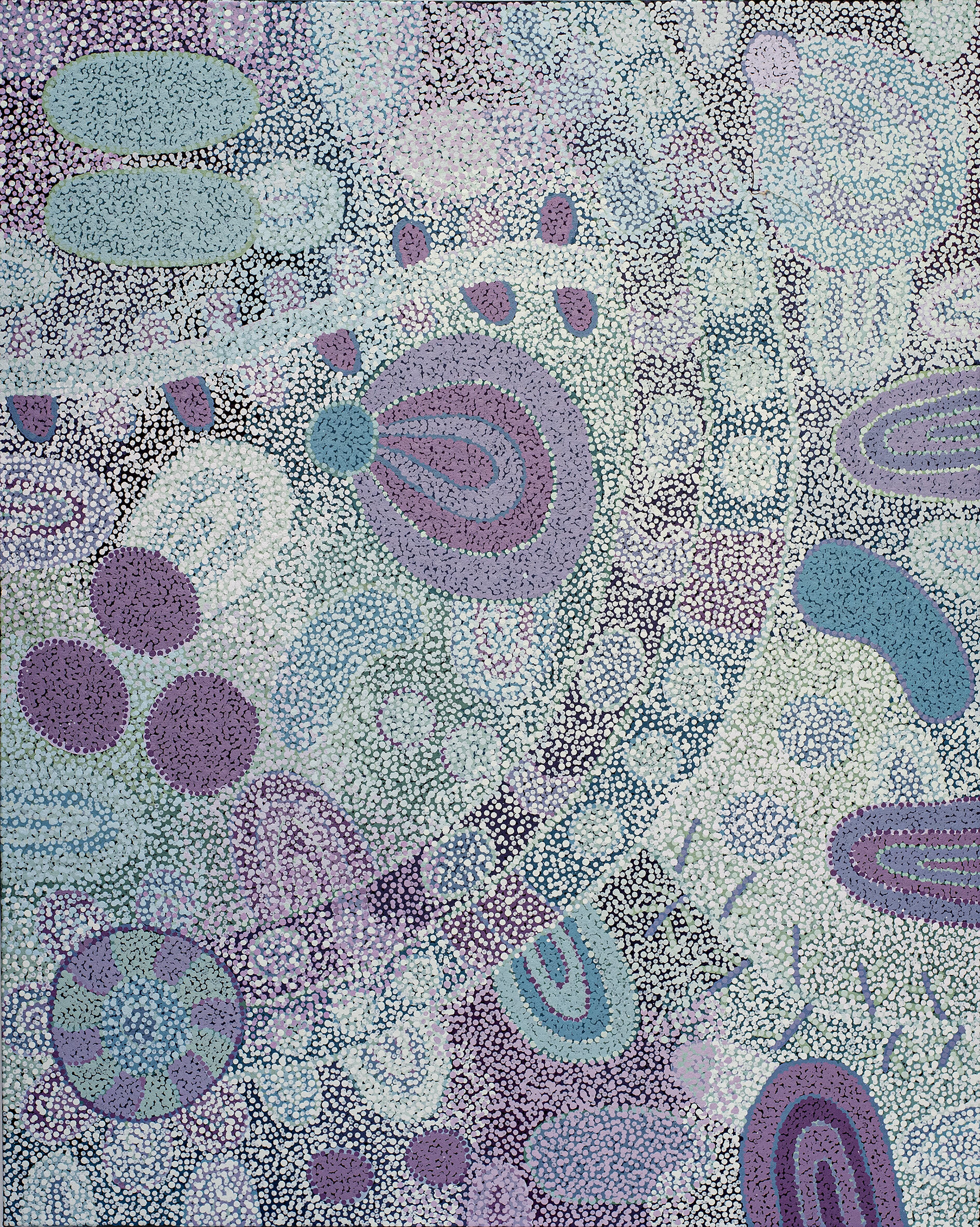
Artiste : Puna Yanima (1955)
Titre de l'œuvre : Antara
Format : 152 cm x 122 cm
Provenance et certificat : centre d'art aborigène de Mimili Maku
Référence de cette peinture aborigène : 95-22
Explications pour cette peinture d'art Aborigène :
Antara is an important women’s ceremonial site near Mimili community. Many of the senior women at Mimili Maku Arts represent Antara and its significant Maku Tjukurpa (Witchetty Grub Dreaming) in their paintings. Puna Yanima has utilised the immediacy and loose fluidity of ink to map the ngura (country) of this sacred place, marking its kapi tjukula (rock holes), apu and murpu (rocks and mountains).

Artiste : Tuppy Ngintja Goodwin (1952)
Titre de l'œuvre : Antara
Format : 152cm x 152cm
Provenance et certificat : centre d'art aborigène de Mimili Maku
Référence de cette peinture aborigène : 59-21
Explications pour cette peinture d'art Aborigène :
When I paint, it’s like inma (ceremonial dance and song). This is Antara, a sacred place for Anangu, and the Maku (witchetty grub) Tjukurpa. There’s a special rock hole at Antara where women perform inma – ‘inmaku pakani’ – and afterwards there’s enough maku to feed everyone. Antara and Maku Tjukurpa is really important for Mimili women, we paint this place and its stories, keeping them strong.

Artiste : Marina Pumani Brown (1984)
Titre de l'œuvre : Ngayuku Ngura Kuwari (My Home Now)
Format : 150 cm x 150 cm
Provenance et certificat : centre d'art aborigène de Mimili Maku
Référence de cette peinture aborigène : 181-21
Explications pour cette peinture d'art Aborigène :
My name is Marina Pumani Brown, I am a 35-year-old Anangu woman. My family has lived around the present day location of Mimili Community on the APY lands of South Australia forever. My work captures a long line of cultural knowledge, knowledge that I am proud to be the custodian of, responsible for keeping it safe and passing it on to the next generation.
Whilst my mother strictly paints Antara, a sacred ceremonial site close to Mimili, I have broadened my practice to include other knowledge that is important to me. This knowledge speaks of traditions that are very much part of our day-to-day life out here in Mimili, traditions that are eternally old but ever present. My paintings are about trips to the area around Antara and Paralpii (Victory Well), where we collect Mingkulpa (bush tobacco) and care for the local tjukula (rock holes). Particularly after kapi pulka (big rains), the land becomes so fertile, and we harvest bush foods like the gnurru (lollie tree) and camp out on country like the old people used to.
My paintings are both literal maps of the landscape and objects of meaning removed from any physical representation. Though not always depicted, the importance of Antara is never lost in my work. The site has been integral to the existence of Anangu culture since the beginning of time. Today my life is different to that of my ancestors and my work is a tool to document my part in a story that spreads across timespans bigger than our imagination.
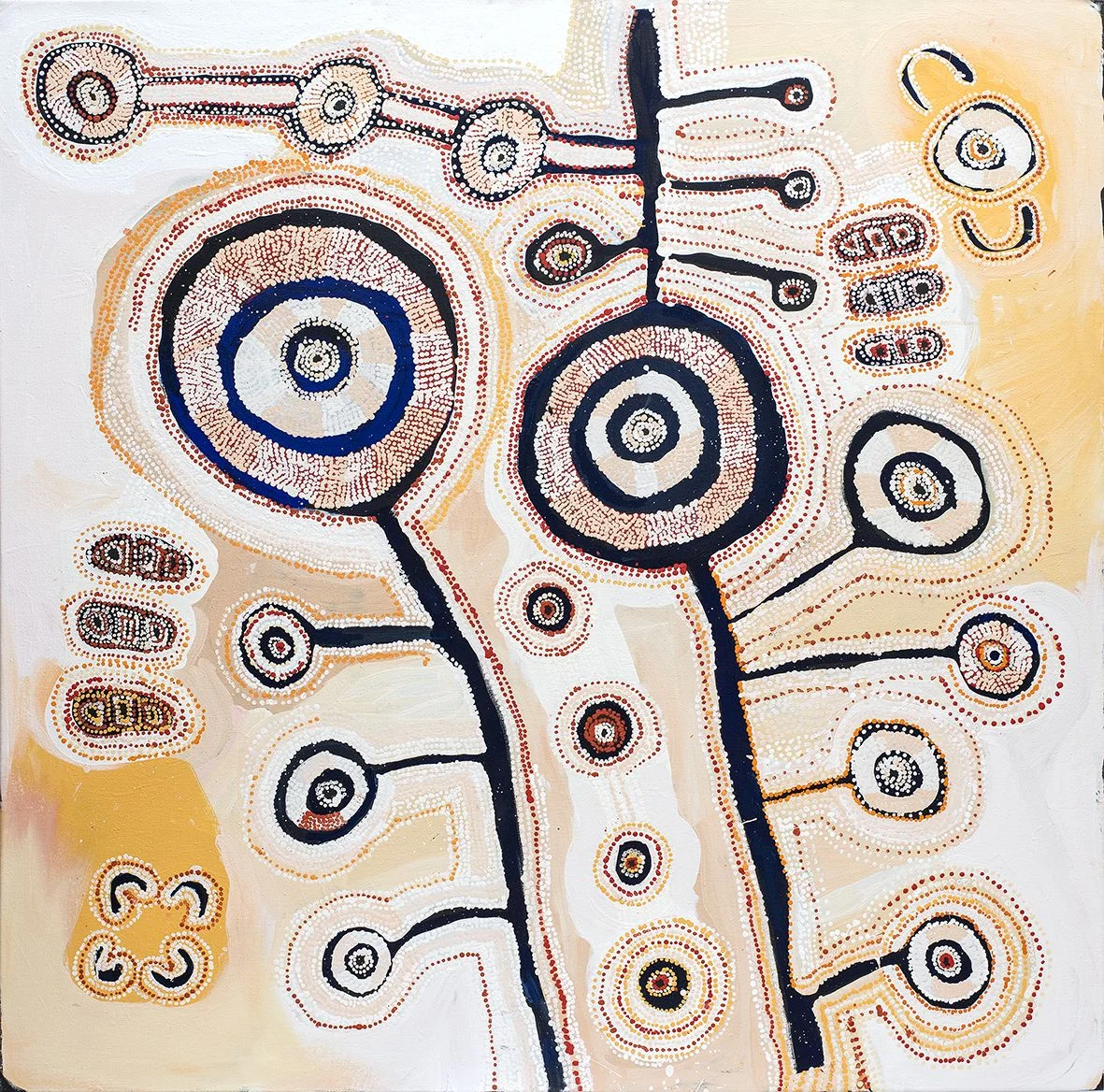
Artiste : Josina Nyarpingku Pumani (1984)
Titre de l'œuvre : Ngura Walytja, Antara
Format : 152 cm x 122 cm
Provenance et certificat : centre d'art aborigène de Mimili Maku
Référence de cette peinture aborigène : 238-21
Demander le prix de cette œuvre
Explications pour cette peinture d'art Aborigène :
This painting is about Josina's home, family and culture. The country is Antara, a is a place not far from Mimili Community. Antara country belonged to Josina's grandmother, Milatjari. All women in Josina's family paint Antara. They hold its stories strong, particularly the Maku Tjukurpa, which is a significant songline for this area.
The women from Mimili would go to the waterhole north of Mimili. They would clean it out, then wait for the rain to come. When the waterhole was full with water they would tap on the waters surface and sing inma for Maku tjuta (enough Maku for everyone). The rock holes, hills and country are depicted in this painting.
Mimili Community is home to 300 Pitjantjatjara and Yankunytjatjara people who have been living in the area for millennia in harmony with nature and acting as custodians of the land and the Tjukurpa (creation stories). Mimili was formerly known as Everard Park, which was a cattle station that was returned to Aboriginal ownership through the 1981 APY Lands Act. Mimili Community was incorporated as an Aboriginal Community in 1975.

Artiste : Puna Yanima (1955)
Titre de l'œuvre : Antara
Format : 198 cm x 122 cm
Provenance et certificat : centre d'art aborigène de Mimili Maku
Référence de cette peinture aborigène : 41-21
Explications pour cette peinture d'art Aborigène :
Antara is an important women’s ceremonial site near Mimili community. Many of the senior women at Mimili Maku Arts represent Antara and its significant Maku Tjukurpa (Witchetty Grub Dreaming) in their paintings. Puna Yanima has utilised the immediacy and loose fluidity of ink to map the ngura (country) of this sacred place, marking its kapi tjukula (rock holes), apu and murpu (rocks and mountains).

Artiste : Emma Singer (1986)
Titre de l'œuvre : Ngayuku Ngura
Format : 152 cm x 122 cm
Provenance et certificat : centre d'art aborigène de Mimili Maku
Référence de cette peinture aborigène : 352-21
Demander le prix de cette œuvre
Explications pour cette peinture d'art Aborigène :
Emma Singer is one of the strong emerging painters in Mimili. She works alongside her mother Pauline Wangin, and has collaborated with her on several paintings. Through the visual language passed from generation to generation, she explores her connection to manta (country) and Tjukurpa (an ongoing, eternal, life-giving transformative power that accounts for every aspect of existence).
This painting depicts the kapi tjukula (water holes), murpu and apu (mountains and rocks), tali (sand hills) and punu (trees) that surround Emma's home of Mimili Community. Mimili has many ancestral songlines that criss-cross the land. A really important place for Anangu from Mimili is Antara, a cermeonial site on top of a hill. This is a place for inma (ceremonial song and dance) relating to the Maku (witchetty grub) Tjukurpa.
Mimili Community is home to 300 Pitjantjatjara and Yankunytjatjara people who have been living in the area for millennia in harmony with nature and acting as custodians of the land and the Tjukurpa (creation stories). Mimili was formerly known as Everard Park, which was a cattle station that was returned to Aboriginal ownership through the 1981 APY Lands Act. Mimili Community was incorporated as an Aboriginal Community in 1975.

Artiste : Tuppy Ngintja Goodwin (1952)
Titre de l'œuvre : Antara
Format : 152 cm x 152 cm
Provenance et certificat : centre d'art aborigène de Mimili Maku
Référence de cette peinture aborigène : 417-18
Explications pour cette peinture d'art Aborigène :
When I paint, it’s like inma (ceremonial dance and song). This is Antara, a sacred place for Anangu, and the Maku (witchetty grub) Tjukurpa. There’s a special rock hole at Antara where women perform inma – ‘inmaku pakani’ – and afterwards there’s enough maku to feed everyone. Antara and Maku Tjukurpa is really important for Mimili women, we paint this place and its stories, keeping them strong.
Artiste : Tuppy Ngintja Goodwin (1952)
Titre de l'œuvre : Antara
Format : 150cm x 150cm
Provenance et certificat : centre d'art aborigène de Mimili Maku
Référence de cette peinture aborigène : 188-18
Explications pour cette peinture d'art Aborigène :
When I paint, it’s like inma (ceremonial dance and song). This is Antara, a sacred place for Anangu, and the Maku (witchetty grub) Tjukurpa. There’s a special rock hole at Antara where women perform inma – ‘inmaku pakani’ – and afterwards there’s enough maku to feed everyone. Antara and Maku Tjukurpa is really important for Mimili women, we paint this place and its stories, keeping them strong.

Artiste : Puna Yanima (1955)
Titre de l'œuvre : Antara
Format : 200 cm x 183 cm
Provenance et certificat : centre d'art aborigène de Mimili Maku
Référence de cette peinture aborigène : 112-18
Explications pour cette peinture d'art Aborigène :
Antara is an important women’s ceremonial site near Mimili community. Many of the senior women at Mimili Maku Arts represent Antara and its significant Maku Tjukurpa (Witchetty Grub Dreaming) in their paintings. Puna Yanima has utilised the immediacy and loose fluidity of ink to map the ngura (country) of this sacred place, marking its kapi tjukula (rock holes), apu and murpu (rocks and mountains).

Artiste : Puna Yanima (1955)
Titre de l'œuvre : Antara
Format : 200 cm x 200 cm
Provenance et certificat : centre d'art aborigène de Mimili Maku
Référence de cette peinture aborigène : 658-17
Explications pour cette peinture d'art Aborigène :
Antara is an important women’s ceremonial site near Mimili community. Many of the senior women at Mimili Maku Arts represent Antara and its significant Maku Tjukurpa (Witchetty Grub Dreaming) in their paintings. Puna Yanima has utilised the immediacy and loose fluidity of ink to map the ngura (country) of this sacred place, marking its kapi tjukula (rock holes), apu and murpu (rocks and mountains).

Artiste : Robert Fielding Punnagka
Titre de l'œuvre : Palawa Pakata Tjukurpa (The flour bucket holds many stories)
Format : 140 x 90 cm
Provenance et certificat : centre d'art aborigène de Mimili Maku Arts
Référence de cette peinture aborigène : 111-17
Explications pour cette peinture Aborigène :
"The flour bucket holds many stories These objects speak of their life-cycle - cycles of life, death and rebirth. These objects are part of our customs and rituals, both new and old. They tell stories about our struggle, our resilience, our hunger, our sustenance, our survival.
I've used silver to show the power and energy of the country. To show what lies beneath the surface: the culture, the stories, songs and dances. The objects I chose - old, rusted flour buckets - speak of their history, their use, their life-cycle. The land and its energy gives light and life to something long thought dead. Ngura nyangatja wanka ngaranyi (This country is alive)"
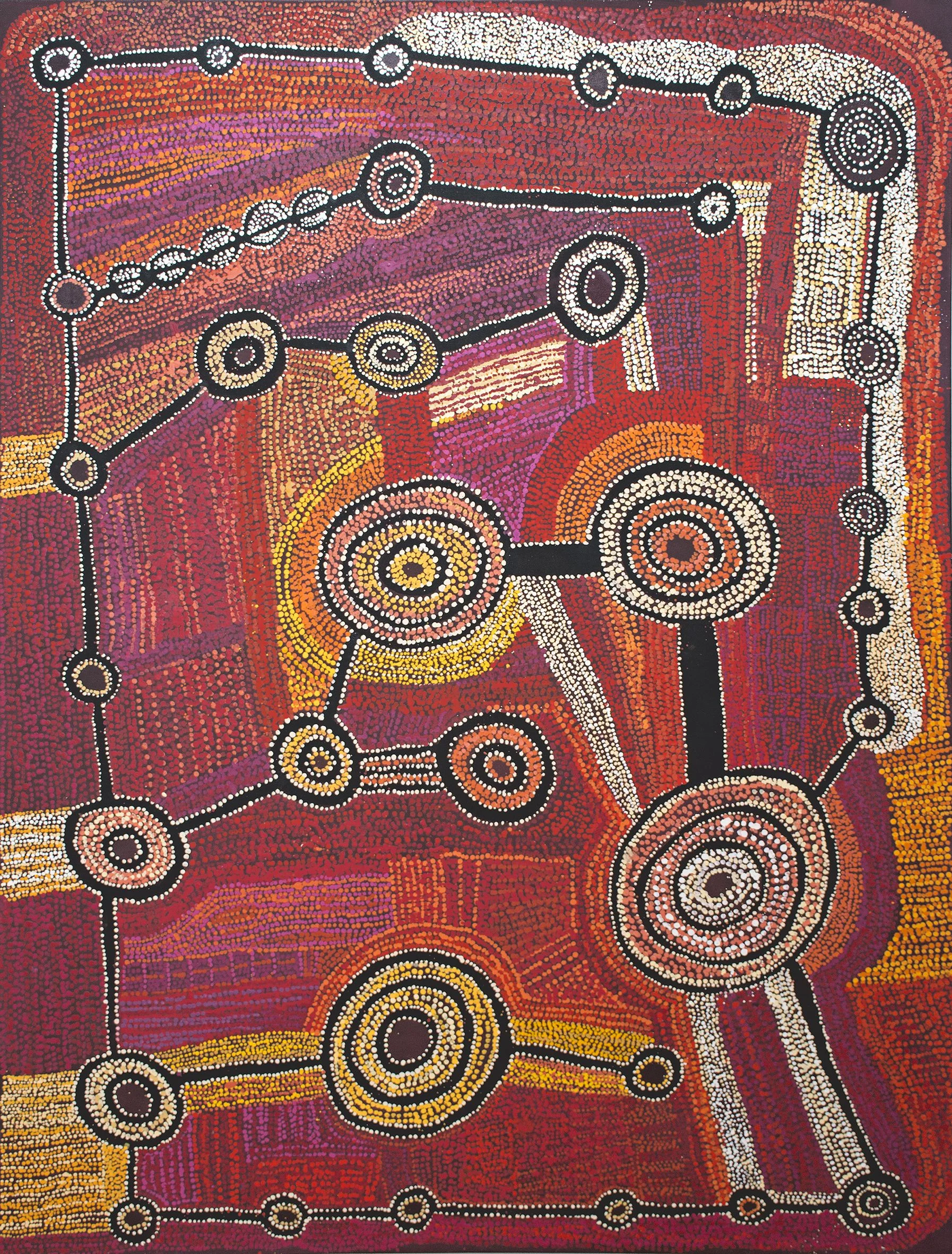
Artiste : Willy Mutjantji Martin
Titre de l'œuvre : Wanampi tjukurpa
Format : 200x150cm
Provenance et certificat : centre d'art aborigène de Mimili Maku Arts
Référence de cette peinture aborigène : 147-17
Explications pour cette peinture Aborigène :
I paint the Wanampi Tjukurpa, or Water snake Dreaming. This is a story from Piltati, near Nyapari (on the Anangu Pitjantjatjara Yankunytjatjara {APY} Lands in the remote north-west of South Australia). There’s a special rockhole at Piltati where this creation story takes place. There’s two wati (men), brothers and their wives. There’s trickery and conflict, and the men change themselves into wanampi (water snakes). The story tells how the land was shaped and formed. It’s important that we hold our culture, our stories, our connection to country strong for malatja-malatja (future generations) – that’s why I make paintings.
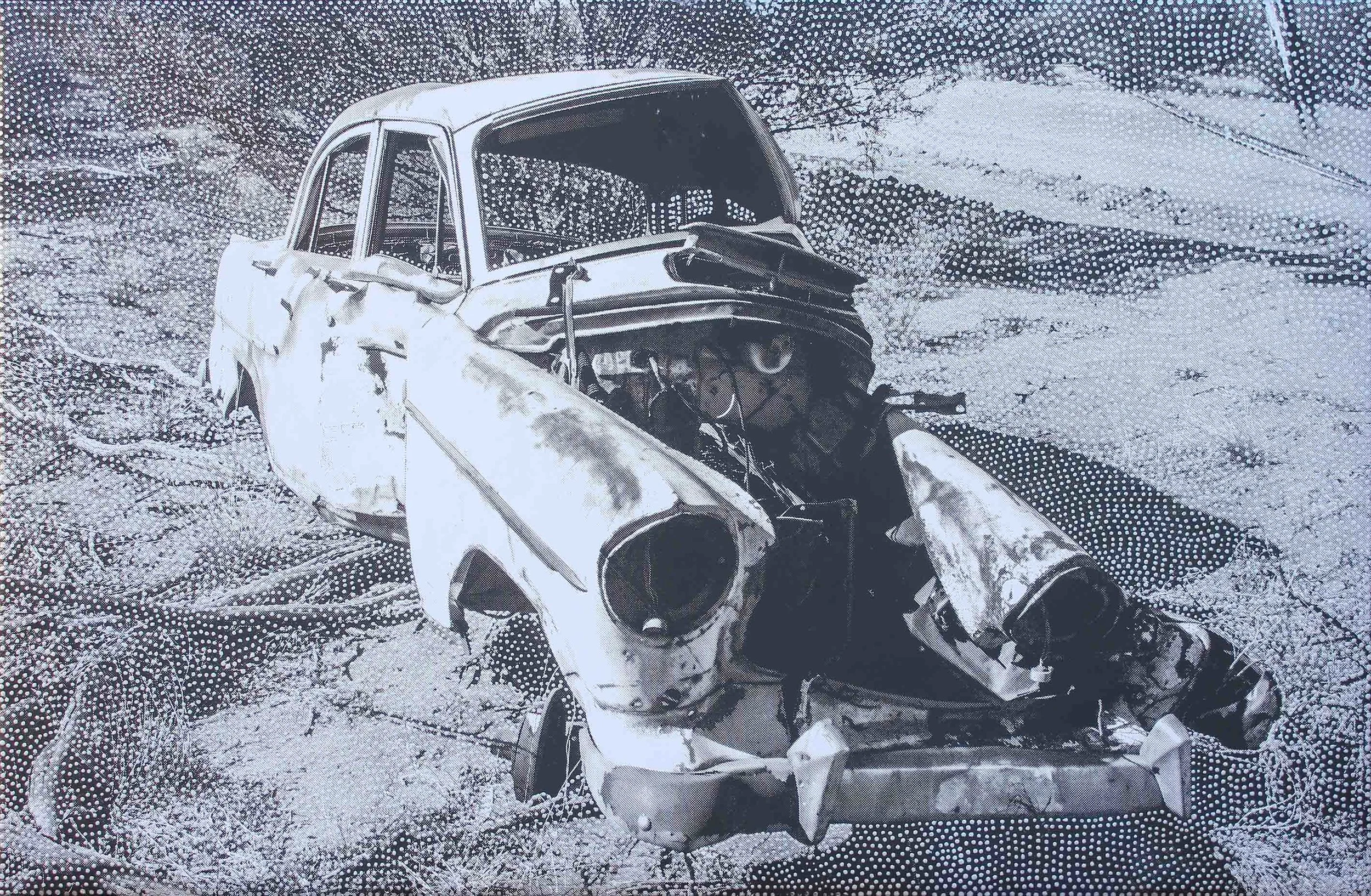
Artiste : Robert Fielding Punnagka
Titre de l'œuvre : Mutaka Katalypa (Car Wreck)
Format : 140 x 90 cm
Provenance et certificat : centre d'art aborigène de Mimili Maku Arts
Référence de cette peinture aborigène : 156-17
Explications pour cette peinture Aborigène :
Silver Enamel and screenprint on linen
I've used silver to show the power and energy of the country. To show what lies beneath the surface: the culture, the stories, songs and dances.
The objects I chose - old tyres, discarded and forgotten - speak of their history, their use, their life-cycle. The land and its energy gives life to something long thought dead. Ngura nyangatja wanka ngaranyi (This country is alive)
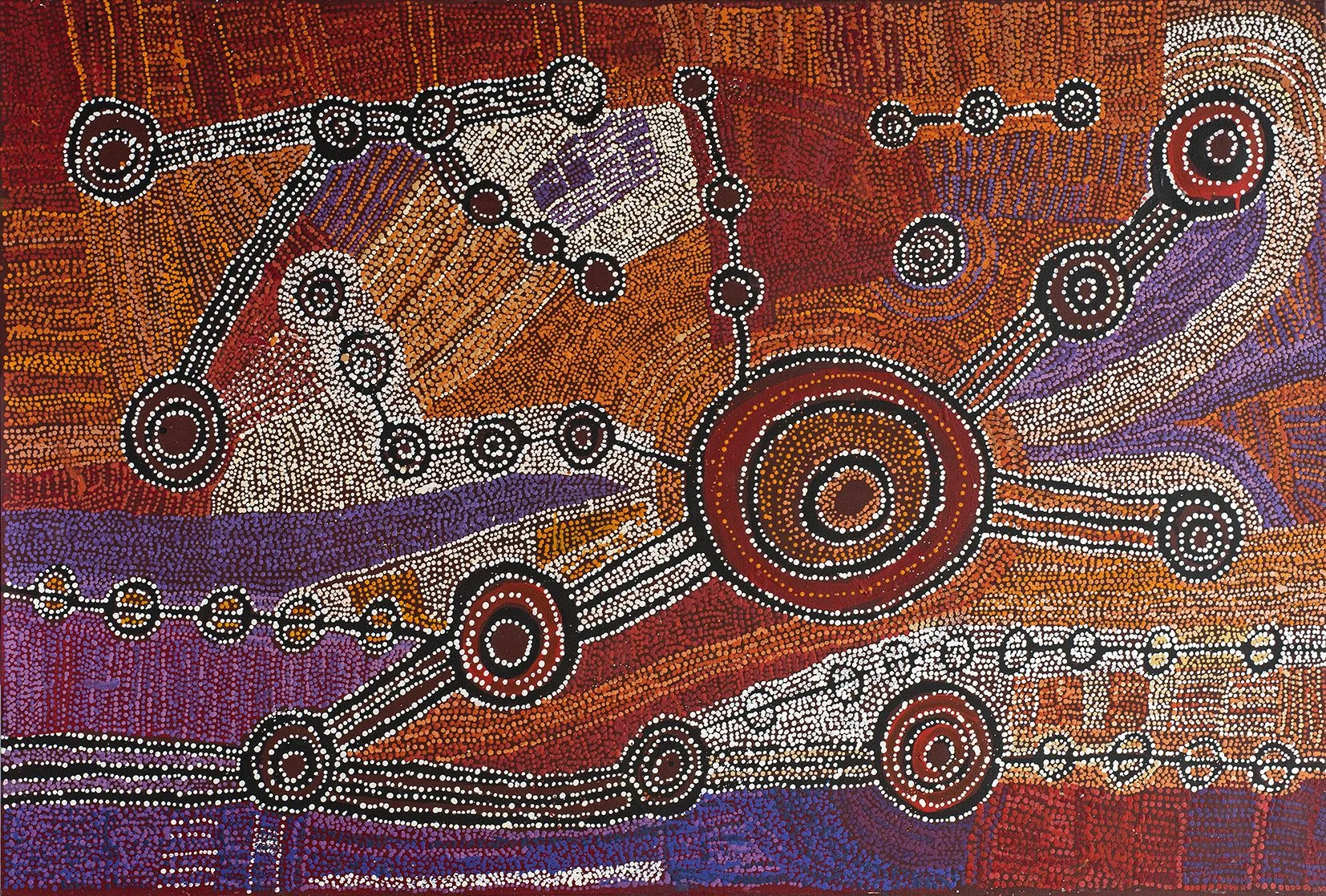
Artiste : Willy Muntjantji Martin (1951-2018)
Titre de l'œuvre : Wanampi Tjukurpa
Format : 183cm x 122cm
Provenance et certificat : centre d'art aborigène de Mimili Maku
Référence de cette peinture aborigène : 98-18
Explications pour cette peinture d'art Aborigène :
“I paint the Wanampi Tjukurpa, or Water snake Dreaming. This is a story from Piltati, near Nyapari (on the Anangu Pitjantjatjara Yankunytjatjara {APY} Lands in the remote north-west of South Australia). There’s a special rockhole at Piltati where this creaon story takes place. There’s two wati (men), brothers and their wives. There’s trickery and conflict, and the men change themselves into wanampi (water snakes). The story tells how the land was shaped and formed.
It’s important that we hold our culture, our stories, our connection to country strong for malatja-malatja (future generations) – that’s why I make paintings.”

Artiste : Marina Pumani Brown (1984)
Titre de l'œuvre : Ngayuku Ngura Kuwari (My Home Now)
Format : 152 cm x 122 cm
Provenance et certificat : centre d'art aborigène de Mimili Maku
Référence de cette peinture aborigène : 331-18
Explications pour cette peinture d'art Aborigène :
My name is Marina Pumani Brown, I am a 35-year-old Anangu woman. My family has lived around the present day location of Mimili Community on the APY lands of South Australia forever. My work captures a long line of cultural knowledge, knowledge that I am proud to be the custodian of, responsible for keeping it safe and passing it on to the next generation.
Whilst my mother strictly paints Antara, a sacred ceremonial site close to Mimili, I have broadened my practice to include other knowledge that is important to me. This knowledge speaks of traditions that are very much part of our day-to-day life out here in Mimili, traditions that are eternally old but ever present. My paintings are about trips to the area around Antara and Paralpii (Victory Well), where we collect Mingkulpa (bush tobacco) and care for the local tjukula (rock holes). Particularly after kapi pulka (big rains), the land becomes so fertile, and we harvest bush foods like the gnurru (lollie tree) and camp out on country like the old people used to.
My paintings are both literal maps of the landscape and objects of meaning removed from any physical representation. Though not always depicted, the importance of Antara is never lost in my work. The site has been integral to the existence of Anangu culture since the beginning of time. Today my life is different to that of my ancestors and my work is a tool to document my part in a story that spreads across timespans bigger than our imagination.

Artiste : Tuppy Ngintja Goodwin (1952)
Titre de l'œuvre : Antara
Format : 200 cm x 150 cm
Provenance et certificat : centre d'art aborigène de Mimili Maku
Référence de cette peinture aborigène : 239-22
Enquiry / Demander le prix de l'œuvre
Explications pour cette peinture d'art Aborigène :
When I paint, it’s like inma (ceremonial dance and song). This is Antara, a sacred place for Anangu, and the Maku (witchetty grub) Tjukurpa. There’s a special rock hole at Antara where women perform inma – ‘inmaku pakani’ – and afterwards there’s enough maku to feed everyone. Antara and Maku Tjukurpa is really important for Mimili women, we paint this place and its stories, keeping them strong.
Tuppy lives in Mimili Community, home to 300 Pitjantjatjara and Yankunytjatjara people who have been living in the area for millennia in harmony with nature and acting as custodians of the land and the Tjukurpa (creation stories). Mimili was formerly known as Everard Park, which was a cattle station that was returned to Aboriginal ownership through the 1981 AP Lands Act.
Mimili Community was incorporated as an Aboriginal Community in 1975.

Artiste : Puna Yanima (1955)
Titre de l'œuvre : Antara
Format : 122 cm x 122 cm
Provenance et certificat : centre d'art aborigène de Mimili Maku
Référence de cette peinture aborigène : 408-20
Explications pour cette peinture d'art Aborigène :
Antara is an important women’s ceremonial site near Mimili community. Many of the senior women at Mimili Maku Arts represent Antara and its significant Maku Tjukurpa (Witchetty Grub Dreaming) in their paintings. Puna Yanima has utilised the immediacy and loose fluidity of ink to map the ngura (country) of this sacred place, marking its kapi tjukula (rock holes), apu and murpu (rocks and mountains).

Artiste : Tuppy Ngintja Goodwin (1952)
Titre de l'œuvre : Antara
Format : 152 cm x 122 cm
Provenance et certificat : centre d'art aborigène de Mimili Maku
Référence de cette peinture aborigène : 646-22
Explications pour cette peinture d'art Aborigène :
When I paint, it’s like inma (ceremonial dance and song). This is Antara, a sacred place for Anangu, and the Maku (witchetty grub) Tjukurpa. There’s a special rock hole at Antara where women perform inma – ‘inmaku pakani’ – and afterwards there’s enough maku to feed everyone. Antara and Maku Tjukurpa is really important for Mimili women, we paint this place and its stories, keeping them strong.
Tuppy lives in Mimili Community, home to 300 Pitjantjatjara and Yankunytjatjara people who have been living in the area for millennia in harmony with nature and acting as custodians of the land and the Tjukurpa (creation stories). Mimili was formerly known as Everard Park, which was a cattle station that was returned to Aboriginal ownership through the 1981 AP Lands Act.
Mimili Community was incorporated as an Aboriginal Community in 1975.

Artiste : Betty Campbell (1961)
Titre de l'œuvre : Minymaku Tjukurpa (Women's Story)
Format : 198 cm x 198 cm
Provenance et certificat : centre d'art aborigène de Mimili Maku
Référence de cette peinture aborigène : 831-22
Demander le prix de cette œuvre
Explications pour cette peinture d'art Aborigène :
Betty is a senior cultural leader in Mimili Community. She knows a lot of storylines and the corresponding inma (song & dance). A lot of the inma is to be known by initiated women only, others can be celebrated by all. Betty loves to dance and teach the kids these stories that hold important lessons about the land and our relationship to it.
In her artwork, Betty paints Women's Story. This is a story that cannot be spoken about. The lines and markings on the canvas are the markings used as body painting in traditional song and dance. When inma is performed, there is separate songs, dances and paintings for men and women. Whilst the women dance, the men sit, sing and watch, and the other way around.
Mimili Community is home to 300 Pitjantjatjara and Yankunytjatjara people who have been living in the area for millennia in harmony with nature and acting as custodians of the land and the Tjukurpa (creation stories). Mimili was formerly known as Everard Park, which was a cattle station that was returned to Aboriginal ownership through the 1981 APY Lands Act. Mimili Community was incorporated as an Aboriginal Community in 1975.

Artiste : Puna Yanima (1955)
Titre de l'œuvre : Antara
Format : 152 cm x 122 cm
Provenance et certificat : centre d'art aborigène de Mimili Maku
Référence de cette peinture aborigène : 647-22
Explications pour cette peinture d'art Aborigène :
Antara is an important women’s ceremonial site near Mimili community. Many of the senior women at Mimili Maku Arts represent Antara and its significant Maku Tjukurpa (Witchetty Grub Dreaming) in their paintings. Puna Yanima has utilised the immediacy and loose fluidity of ink to map the ngura (country) of this sacred place, marking its kapi tjukula (rock holes), apu and murpu (rocks and mountains).

Artiste : Betty Campbell (1961)
Titre de l'œuvre : Minymaku Tjukurpa (Women's Story)
Format : 122 cm x 122 cm
Provenance et certificat : centre d'art aborigène de Mimili Maku
Référence de cette peinture aborigène : 637-22
Demander le prix de cette œuvre
Explications pour cette peinture d'art Aborigène :
Betty is a senior cultural leader in Mimili Community. She knows a lot of storylines and the corresponding inma (song & dance). A lot of the inma is to be known by initiated women only, others can be celebrated by all. Betty loves to dance and teach the kids these stories that hold important lessons about the land and our relationship to it.
In her artwork, Betty paints Women's Story. This is a story that cannot be spoken about. The lines and markings on the canvas are the markings used as body painting in traditional song and dance. When inma is performed, there is separate songs, dances and paintings for men and women. Whilst the women dance, the men sit, sing and watch, and the other way around.
Mimili Community is home to 300 Pitjantjatjara and Yankunytjatjara people who have been living in the area for millennia in harmony with nature and acting as custodians of the land and the Tjukurpa (creation stories). Mimili was formerly known as Everard Park, which was a cattle station that was returned to Aboriginal ownership through the 1981 APY Lands Act. Mimili Community was incorporated as an Aboriginal Community in 1975.

Artiste : Betty Campbell (1961)
Titre de l'œuvre : Minymaku Tjukurpa (Women's Story)
Format : 122 cm x 122 cm
Provenance et certificat : centre d'art aborigène de Mimili Maku
Référence de cette peinture aborigène : 665-22
Enquiry / Demander le prix de cette œuvre
Explications pour cette peinture d'art Aborigène :
Betty is a senior cultural leader in Mimili Community. She knows a lot of storylines and the corresponding inma (song & dance). A lot of the inma is to be known by initiated women only, others can be celebrated by all. Betty loves to dance and teach the kids these stories that hold important lessons about the land and our relationship to it.
In her artwork, Betty paints Women's Story. This is a story that cannot be spoken about. The lines and markings on the canvas are the markings used as body painting in traditional song and dance. When inma is performed, there is separate songs, dances and paintings for men and women. Whilst the women dance, the men sit, sing and watch, and the other way around.
Mimili Community is home to 300 Pitjantjatjara and Yankunytjatjara people who have been living in the area for millennia in harmony with nature and acting as custodians of the land and the Tjukurpa (creation stories). Mimili was formerly known as Everard Park, which was a cattle station that was returned to Aboriginal ownership through the 1981 APY Lands Act. Mimili Community was incorporated as an Aboriginal Community in 1975.

Artiste : Puna Yanima (1955)
Titre de l'œuvre : Antara
Format : 152 cm x 122 cm
Provenance et certificat : centre d'art aborigène de Mimili Maku
Référence de cette peinture aborigène : 648-22
Enquiry / Demander le prix de l'œuvre
Explications pour cette peinture d'art Aborigène :
Antara is an important women’s ceremonial site near Mimili community. Many of the senior women at Mimili Maku Arts represent Antara and its significant Maku Tjukurpa (Witchetty Grub Dreaming) in their paintings. Puna Yanima has utilised the immediacy and loose fluidity of ink to map the ngura (country) of this sacred place, marking its kapi tjukula (rock holes), apu and murpu (rocks and mountains).

Artiste : Tuppy Ngintja Goodwin (1952)
Titre de l'œuvre : Antara
Format : 198cm x 152cm
Provenance et certificat : centre d'art aborigène de Mimili Maku
Référence de cette peinture aborigène : 80-21
Explications pour cette peinture d'art Aborigène :
When I paint, it’s like inma (ceremonial dance and song). This is Antara, a sacred place for Anangu, and the Maku (witchetty grub) Tjukurpa. There’s a special rock hole at Antara where women perform inma – ‘inmaku pakani’ – and afterwards there’s enough maku to feed everyone. Antara and Maku Tjukurpa is really important for Mimili women, we paint this place and its stories, keeping them strong.

Artiste : Tuppy Ngintja Goodwin (1952)
Titre de l'œuvre : Antara
Format : 152cm x 152cm
Provenance et certificat : centre d'art aborigène de Mimili Maku
Référence de cette peinture aborigène : 168-21
Explications pour cette peinture d'art Aborigène :
When I paint, it’s like inma (ceremonial dance and song). This is Antara, a sacred place for Anangu, and the Maku (witchetty grub) Tjukurpa. There’s a special rock hole at Antara where women perform inma – ‘inmaku pakani’ – and afterwards there’s enough maku to feed everyone. Antara and Maku Tjukurpa is really important for Mimili women, we paint this place and its stories, keeping them strong.

Artiste : Tuppy Ngintja Goodwin (1952)
Titre de l'œuvre : Antara sacred valley
Format : 198cm x 189cm
Provenance et certificat : centre d'art aborigène de Mimili Maku
Référence de cette peinture aborigène : 374-23
Explications pour cette peinture d'art Aborigène :
When I paint, it’s like inma (ceremonial dance and song). This is Antara, a sacred place for Anangu, and the Maku (witchetty grub) Tjukurpa. There’s a special rock hole at Antara where women perform inma – ‘inmaku pakani’ – and afterwards there’s enough maku to feed everyone. Antara and Maku Tjukurpa is really important for Mimili women, we paint this place and its stories, keeping them strong.

Artiste : Betty Campbell (1961)
Titre de l'œuvre : Minymaku Tjukurpa (Women's Story)
Format : 198cm x 198cm
Provenance et certificat : centre d'art aborigène de Mimili Maku
Référence de cette peinture aborigène : 91-23
Demander le prix de cette œuvre
Explications pour cette peinture d'art Aborigène :
Betty is a senior cultural leader in Mimili Community. She knows a lot of storylines and the corresponding inma (song & dance). A lot of the inma is to be known by initiated women only, others can be celebrated by all. Betty loves to dance and teach the kids these stories that hold important lessons about the land and our relationship to it.
In her artwork, Betty paints Women's Story. This is a story that cannot be spoken about. The lines and markings on the canvas are the markings used as body painting in traditional song and dance. When inma is performed, there is separate songs, dances and paintings for men and women. Whilst the women dance, the men sit, sing and watch, and the other way around.
Mimili Community is home to 300 Pitjantjatjara and Yankunytjatjara people who have been living in the area for millennia in harmony with nature and acting as custodians of the land and the Tjukurpa (creation stories). Mimili was formerly known as Everard Park, which was a cattle station that was returned to Aboriginal ownership through the 1981 APY Lands Act. Mimili Community was incorporated as an Aboriginal Community in 1975.
Des « rêves » importants comme le Maku Tjukurpa se trouvent exprimé avec une large diversité créative par les différents artistes. Chez Ngupulya Pumani par exemple, un design complexe, sacré, se retrouve partiellement caché sur la toile par des jeux subtils de points feutrés. La poésie de la composition est saisissante.
Chez d’autres artistes comme Betty Pumani l’évocation du temps du rêve prend la forme de cheminement plus spatial dans une palette réduite entre le blanc nacré et un rouge profond. Chez Tuppy Goodwin, le design est clairement perceptible. Il embrasse de façon visible l’ensemble de la toile, tout en étant ourlée d’une palette vibrante de points colorés associée aux variations du lieu.
Artistes : Pauline Wangin, Emma Singer, Betty Campbell
Titre de l'œuvre : Walytja - Family Collaboration
Format : 168cm x 152cm
Provenance et certificat : centre d'art aborigène de Mimili Maku
Référence de cette peinture aborigène : 432-24
Demander le prix de cette œuvre
Explications pour cette peinture d'art Aborigène :
This is a collaborative canvas between Emma Singer, her mother Pauline Wangin and Pauline's sister Betty Campbell. Pauline says about the work : "We’ve painted this big canvas together as a family.
This canvas is about kapi tjukula and soakages around Kinara Mimi, Mimili. Our families would move between rock holes, they’d know them all. They would always be looking for clear drinking water. They lived around Antara and many other named places between Kinara Mimi, Antara, Artutja, Paralpi and Iwantja. All those places are connected, and they used to walk far distances every day. We remember the paths by the songlines that still run through those places. They’d sing the songs, dig for water, and know where to travel. The water was underground, and they’d dig till it seeped upwards. They’d always know. I remember going to Iwantja Soakage with our mother and her showing us how it’s done. We remember this from when we were young, and we want to keep sharing this story for our children and grandchildren. It’s important to remember what we’ve always known."
Pauline Wangin, 2023
Mimili Community is home to 300 Pitjantjatjara and Yankunytjatjara people who have been living in the area for millennia in harmony with nature and acting as custodians of the land and the Tjukurpa (creation stories). Mimili was formerly known as Everard Park, which was a cattle station that was returned to Aboriginal ownership through the 1981 APY Lands Act. Mimili Community was incorporated as an Aboriginal Community in 1975.