
Exposition d’art Aborigène Caress the Earth II - Manta Ngura Atuntju Kanyini II - Aboriginal art from Australia – Ernabella
A la galerie Aboriginal Signature Estrangin : 101 rue Jules Besme, 1081 Bruxelles.
Vernissage sur RDV le mardi 21 février 2023 de 11h à 21h30.
Visites sur RDV ensuite du mercredi 22 février au samedi 18 mars 2023.
Notre galerie est ouverte à tous et vous reçoit sur RDV du mardi au samedi, de 11h à 19h.
Nous nous réjouissons de vous y accueillir et vous invitons à réserver votre visite dans notre agenda ici.
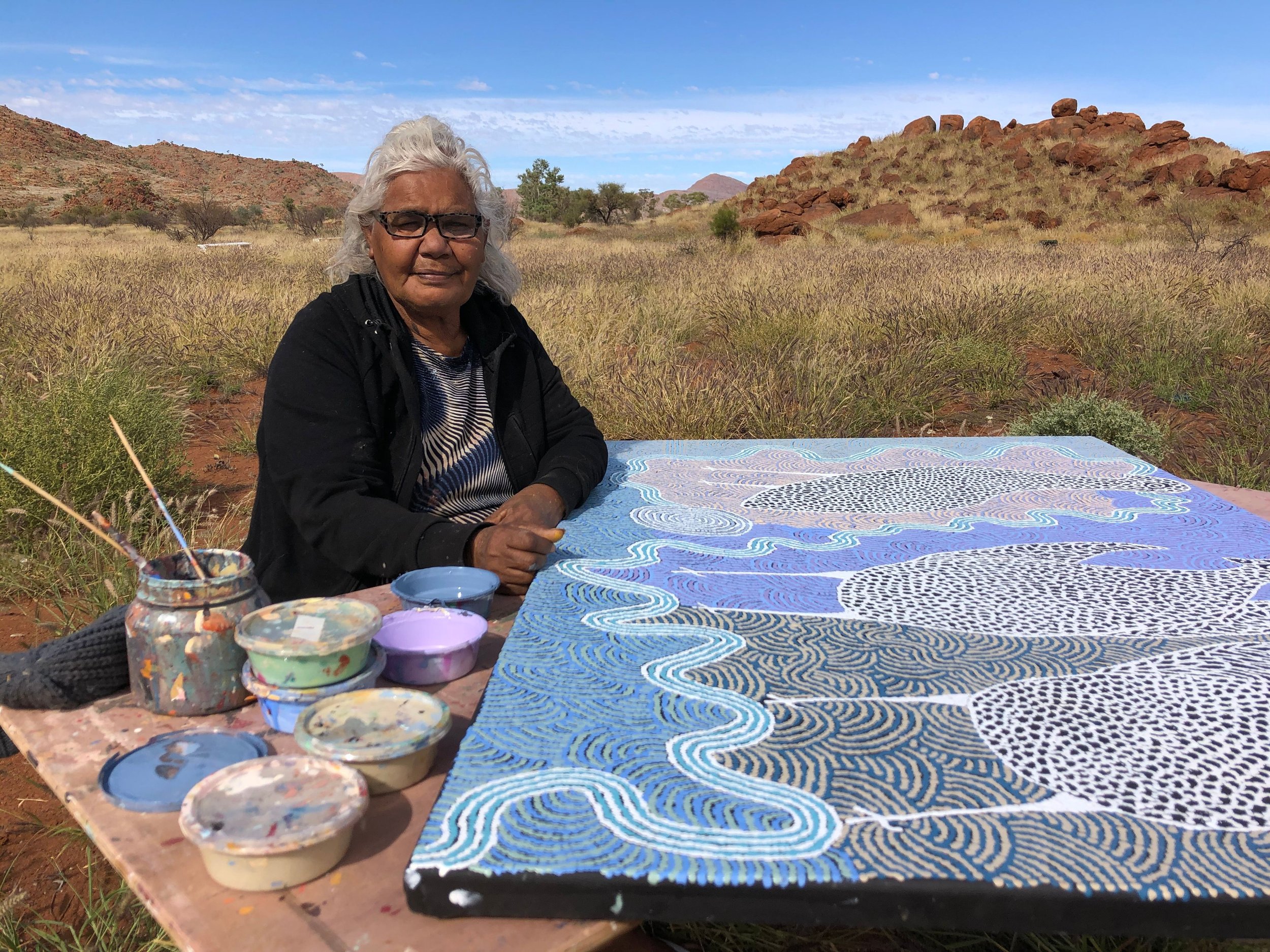
L’artiste Carlene Thompson qui présente dans son œuvre les lieux de sa famille ancestrale à côté de Kanypi à l’ouest du APY Lands dans le désert central Australien.
© Photo with the courtesy of Ernabella Art.
Caress the Earth II
Nous vous invitons au cœur de l'Australie centrale, dans l’exposition « Caress the Earth II » en partenariat avec la communauté artistique d’Ernabella dans les Musgraves Ranges au nord du Grand Désert du Victoria..
Dans un magnifique dialogue des matières, 25 peintures et 18 céramiques ont été réalisées par 21 artistes Aborigènes talentueux de la communauté à 18 000 km d’ici. Sur la toile ou dans la glaise les mêmes artistes y « caressent la terre », et traduisent en écho ce titre dans leur langue rare Pitjantjatjarra « Manta Ngura Atuntju Kanyini ».
Leurs mains dessinent sur le sable, enseignent, transmettent, disent les histoires du Temps du Rêve.
Leurs mains glissent et virevoltent sur les toiles, ponctuent de signes et symboles les marches épiques de ce peuple qui traverse la terre.
Leurs mains évoquent les lieux de campements, caressent les pierres lustrées des espaces de vie habités depuis la nuit des temps.
Leurs mains racontent les collectes et les chasses, la vie sociale et spirituelle guidée par la loi des grands ancêtres : le Tjukurpa et Temps du Rêve.
Tribut à kunmanara Carroll (1950-2021)
C’est avec une grande émotion que nous accueillons deux des dernières œuvres de l’artiste kunmanara Jangala Carroll (1950-2021) qui nous a quitté et que nous avions eu la joie de représenter à Bruxelles depuis 2015, avec sa première et mémorable solo exhibition en Europe en 2017. Son sourire et la générosité du partage de ses connaissances restent dans nos mémoires.
Sur une de ses œuvres de la présente exposition il évoque le site de Yumari situé à l'ouest de Walungurru ou Kintore (NT). Un lieu essentiel qu’il a avait quitté il y a 48 ans, lors du décès de ses parents. En avril 2017 il y est revenu en pèlerinage pour se reconnecter à sa terre : "Je suis allé à l’endroit de Kiwirrkurra pour voir le pays de mon père et de ma grand-mère, et me reconnecter au long épanchement d’eau dans la roche, appelé Yumari. C’est celui-là que j’ai peint ici ». Ses œuvres ont depuis atteint quelques records lors de dernières ventes aux enchères chez Sotheby’s ou ses peintures continuent d’intégrer des collections publiques ou privées prestigieuses en Europe, Australie et USA, comme les Musées de Melbourne et d’Adelaïde, le Parlement à Canberra, la Charles Darwin University, la Fondation Opale en Suisse, la collection de Steve Martin aux USA…
l’essentiel dans l’infime
Leurs mains collectent l’ocre, modèlent l’argile, sculptent et gravent dans les céramiques au service de la mémoire.
Leurs mains connectent, rassemblent, sont les médiatrices du lien à la terre. Les doigts en étoile, elles sont posées sur les fronts et sur les toiles pour ressentir avec émotion la force des hommes et des lieux.
Leurs mains veillent, empruntent à la terre sans la consumer, modèlent l’espace sans le transformer, guident les pas de l’homme pour l’éternité.
Aux antipodes, l’énergie du coup de pinceau est habitée par la mémoire des espaces qui guide et inspire l’artiste. Là où nous ne voyons rien, lui distingue l’épopée des peuples et voit l’importance spirituelle des lieux. Il révèle et souligne d’autres dimensions au-delà des traces visibles sur le sol. Il ouvre un champ artistique nouveau favorable à la perception de l’essentiel dans l’infime.
Par leurs œuvres, les artistes Aborigènes d’Australie nous invitent à un voyage au loin au delà des océans. Par leurs œuvres ils nous convient à caresser, à aimer et à respecter la terre, leur terre, qu’ils chérissent depuis tant de millénaires.
A bientôt,
Bertrand Estrangin
Nous sommes très honorés d’accueillir cette grande exposition à Bruxelles, en partenariat avec le centre d’art d’Ernabella dans le APY land créé en 1948, pour cette exposition également dédiée aux céramiques de la communauté artistique.

Découvrez les peintures disponibles à Bruxelles durant l’exposition :

Artiste : Pepai Jangala Carroll (1950-2021)
Titre de l'œuvre : Yumari
Format : 180 x 170 cm
Provenance et certificat : centre d'art d'Ernabella
Référence de cette peinture d'art Aborigène : 87-21
Explanations of this Aboriginal painting :
Yumari literally means mother in law in Luritja, the language of Pepai's father. A site named Yumari is located west of Walungurru or Kintore (NT) and east of Kiwirrkurra (WA). Pepai visited this site for the first time on a recent trip back to his custodial country in April 2017, having left this region as a 19 year old after his parents passed away. Pepai has spent the last 40 years living and working in Ernabella. On the trip he travelled with fellow Ernabella artist Derek Jungarrayi Thompson to visit sites between Kintore, Kiwirrkurra and Lake Mackay (Wilkinkarra). "I went to that place Kiwirrkurra and I was returning and we came half way to see my father’s country, to see my father’s and grandmother’s country and the big rock hole, it’s really long. I was looking at it and after seeing it I thought, well, I might paint this one. The name of the place is Yumari. That place Yumari. I’m painting that one now."
The artworks of the artist could be find in the following prestigious collections :
Araluen Arts Centre, 2015
Araluen Arts Centre, 2020
Art Gallery Of New South Wales 2018
Art Gallery Of South Australia, 2011, 2015, 2016
Artbank, 2011
Artbank, 2018
Ballarat Regional Gallery, 2020
Charles Darwin University, 2011
Harriet & Richard England, 2010, 2014
National Gallery Of Victoria, 2013, 2015
Parliament House Collection, Canberra
Fondation Opale, Suisse

Artiste : Mukayi Baker
Titre de l'œuvre : Piltati
Format : 200 x 120 cm
Provenance et certificat : centre d'art aborigène d’Ernabella
Référence de cette peinture aborigène : 519-22
Explication sur cette œuvre :
There were two sisters who married two brothers and they all lived together. One day the women went wandering and they went such a long way that they forgot about their husbands. Back at the camp, the two husbands were thinking, 'Where are our wives?' and they decided to go looking for them. One brother said to the other, 'What should we become to go looking for them?' and the other brother said 'Why don't we become Rainbow Serpents?' And they travelled in the sky looking down for their wives. Finally they see them hunting for carpet snakes and they put something in the hole where the women were digging. The women find it and then dig another hole and once again the men have put something in there. And this is how the men lure the women back to Piltati where the men make the sisters transform into Wanampi, swallow them and keep them in their throats. All four of them live together in the waterhole and still live there today.

Artiste : Pepai Jangala Carroll (1950-2021)
Titre de l'œuvre : Ilpili
Format : 198 x 150 cm
Provenance et certificat : centre d'art d'Ernabella
Référence de cette peinture d'art Aborigène : 140-21
Explanations of this Aboriginal painting :
Ilpili is near Kintore on the way to Mount Leibig and Papunya. This is a minimya kutjarra (two women) story.
Two women are sitting down at a rock hole telling stories. A wati (man) was sitting down behind a puli (boulder) watching the women. This is part of the Seven Sisters story. In April 2017, on a recent journey back to that country, Pepai visited this site and the rock hole.
The artworks of the artist could be find in the following prestigious collections :
Araluen Arts Centre, 2015
Araluen Arts Centre, 2020
Art Gallery Of New South Wales 2018
Art Gallery Of South Australia, 2011, 2015, 2016
Artbank, 2011
Artbank, 2018
Ballarat Regional Gallery, 2020
Charles Darwin University, 2011
Harriet & Richard England, 2010, 2014
National Gallery Of Victoria, 2013, 2015
Parliament House Collection, Canberra
Fondation Opale, Suisse

Artiste : Lynette Lewis
Titre de l'œuvre : Womikata Walka Tali / Sand dune
Format : 169 x 83 cm
Provenance et certificat : centre d'art d'Ernabella
Référence de la peinture : 516-22
Explications sur cette peinture Aborigène :
Lynette's design is inspired by the ripples created by wind in the sand at the large, red sand dune named Wornikata near Ernabella. Womikata is a popular place for looking for maku (witchetty grubs) and also for teaching Milpatjunanyi (telling stories in the sand) to children.

Artiste : Yurpiya Lionel
Titre de l'œuvre : Anumara
Format : 170 x 84 cm
Provenance et certificat : centre d'art d'Ernabella
Référence de la peinture : 393-22
Explications sur cette peinture Aborigène :
Yurpiya is painting a place called Anumara, which is a place near Irrunytju (Wingellina) in WA. This is Yurpiya's family's country. Anumara is also the name for a kind of caterpillar and Anumara is the tjukurpa (dreaming) place for this caterpillar. This caterpillar lives in the grass and can be eaten if the grass it eats is removed. The place shares the same colours of the caterpillar - brown, yellow and pale green. Keeping this place safe will ensure that the caterpillars multiply.
Awards
2020 Waterhouse Natural Science Art Prize, Finalist
2018 Wynne Prize, Finalist
2015 National Aboriginal and Torres Strait Islander Art Award, Finalist
2007 Special Mention, Alice Springs Beanie Festival, Araluen Cultural Precinct, Alice Springs
Her artworks are in the following collections :
Museum of the UNIVERSITY OF NEWCASTLE, 2011
Private collections in Switzerland, Germany, Australia, Belgium

Artiste : Mukayi Baker
Titre de l'œuvre : Piltati
Format : 180 x 99 cm
Provenance et certificat : centre d'art aborigène d’Ernabella
Référence de cette peinture aborigène : 607-22
Explication sur cette œuvre :
There were two sisters who married two brothers and they all lived together. One day the women went wandering and they went such a long way that they forgot about their husbands. Back at the camp, the two husbands were thinking, 'Where are our wives?' and they decided to go looking for them. One brother said to the other, 'What should we become to go looking for them?' and the other brother said 'Why don't we become Rainbow Serpents?' And they travelled in the sky looking down for their wives. Finally they see them hunting for carpet snakes and they put something in the hole where the women were digging. The women find it and then dig another hole and once again the men have put something in there. And this is how the men lure the women back to Piltati where the men make the sisters transform into Wanampi, swallow them and keep them in their throats. All four of them live together in the waterhole and still live there today.

Artiste : Atipalku Intjalki (1955)
Titre de l'œuvre : Tjukurpa Mulayangu
Format : 150 x 90 cm
Provenance et certificat : centre d'art aborigène d’Ernabella
Référence de cette peinture aborigène : 603-22
Explication sur cette œuvre :
Tjukurpa Mulayangu is a men’s law place. They made this place and campsite. Mulayangu made this place. Over in the west is the other side of Amata which is my father’s country. This is a sacred place called Tankalanya. This is all I can say.

Artiste : Langaliki Lewis
Titre : Tali / Sand dune
Format : 149 x 89 cm
Provenance et certificat : centre d'art aborigène d’Ernabella
Référence de cette peinture aborigène : 511-22
Explication sur cette œuvre :
Painting by Langaliki Lewis (1973). For the Pitjantjatjara people living in the desert, knowledge of their water sources was critical to their survival.
This is a depiction of the artists' country. The different colours and designs represent variations in the landscape.This resulted in an intimate understanding of the landscape which continues today.
This design is inspired by the red sand dunes that are found throughout the central desert. There is a large red sand dune near Ernabella named Wamikata which is a popular place for looking for maku (witchetty grubs) and for teaching Milpatjunanyi (telling stories in the sand) to children.

Artiste : Atipalku Intjalki (1955)
Titre de l'œuvre : Tjukurpa Mulayangu
Format : 179 x 98 cm
Provenance et certificat : centre d'art aborigène d’Ernabella
Référence de cette peinture aborigène : 495-22
Explication sur cette œuvre :
Tjukurpa Mulayangu is a men’s law place. They made this place and campsite. Mulayangu made this place. Over in the west is the other side of Amata which is my father’s country. This is a sacred place called Tankalanya. This is all I can say.

Artiste : Langaliki Lewis
Titre de l'œuvre : Ngayuku ngura
Format : 153 x 81 cm
Provenance et certificat : centre d'art d'Ernabella
Référence de cette peinture d'art Aborigène : 444-22
Vendue
Explanations of this Aboriginal painting :
For the Pitjantjatjara people living in the desert, knowledge of their water sources was critical to their survival. This resulted in an intimate understanding of the landscape which continues today. Water is an essential element in the desert. These rock holes were particularly important during the dry season when most of the water holes and creeks dried up. Deep familiarity with the topography of their country and the way rain would interact with the land ensured constant sources of water could be found. Knowledge of rock hole sites is passed on from generation to generation and revered by all Anangu (people).
Tjukula means rock-holes, which are found with surprising frequency in the Musgrave Ranges and country around Ernabella. Between visits, Anangu would use a construction of rocks and spinifex to guard these important water sources from spoilage by feral and stock animals such as cattle, camels, horses and donkeys.

Artiste : Mark Morris
Titre de l'œuvre : Waru/Fire
Format : 100 x 100 cm
Provenance et certificat : centre d'art d'Ernabella
Référence de cette peinture d'art Aborigène : 470-22
Demander le prix de l'œuvre / Enquiry
Explanations of this Aboriginal painting :
Fire is very significant in Anangu Pitjantjatjara life. It is the central 'hub' where the people gather; it is used to burn off the land which then brings regeneration. Fire gives protection and warmth during the harsh winters and of course is used for all cooking as well as making weapons. The ash is used for chewing tobacco.
People still use fire today when camping to keep away spirits and 'bush people' who make a habit of taking people and running away with them!

Artiste : Yurpiya Lionel
Titre de l'œuvre : Anumara
Format : 149 x 98 cm
Provenance et certificat : centre d'art d'Ernabella
Référence de la peinture : 510-22
Explications sur cette peinture Aborigène :
Yurpiya is painting a place called Anumara, which is a place near Irrunytju (Wingellina) in WA. This is Yurpiya's family's country. Anumara is also the name for a kind of caterpillar and Anumara is the tjukurpa (dreaming) place for this caterpillar. This caterpillar lives in the grass and can be eaten if the grass it eats is removed. The place shares the same colours of the caterpillar - brown, yellow and pale green. Keeping this place safe will ensure that the caterpillars multiply.
Awards
2020 Waterhouse Natural Science Art Prize, Finalist
2018 Wynne Prize, Finalist
2015 National Aboriginal and Torres Strait Islander Art Award, Finalist
2007 Special Mention, Alice Springs Beanie Festival, Araluen Cultural Precinct, Alice Springs
Her artworks are in the following collections :
Museum of the UNIVERSITY OF NEWCASTLE, 2011
Private collections in Switzerland, Germany, Australia, Belgium

Artiste : Umatji Tjitayi
Titre de l'œuvre : Honey Grevillea
Format : 99 x 83 cm
Provenance et certificat : centre d'art d'Ernabella
Référence de cette peinture d'art Aborigène : 528-22
Demander le prix de l'œuvre / Enquiry
Explanations of this Aboriginal painting :
Stories are told of the Kaliny-kaliny or Honey Grevillea flower which is a favourite bush food of the Anangu Pitjantjatjara (people). Ultukunpa grows in the sandy soils on the plains. The flowers can be picked and placed in a billycan of water to create 'honeywater' (cordial) or they can be sucked for their sweet honey dew.

Artiste : Umatji Tjitayi
Titre de l'œuvre : Honey Grevillea
Format : 100 x 76 cm
Provenance et certificat : centre d'art d'Ernabella
Référence de cette peinture d'art Aborigène : 560-22
Demander le prix de l'œuvre / Enquiry
Explanations of this Aboriginal painting :
Stories are told of the Kaliny-kaliny or Honey Grevillea flower which is a favourite bush food of the Anangu Pitjantjatjara (people). Ultukunpa grows in the sandy soils on the plains. The flowers can be picked and placed in a billycan of water to create 'honeywater' (cordial) or they can be sucked for their sweet honey dew.

Artiste : Yurpiya Lionel
Titre de l'œuvre : Anumara
Format : 152 x 81 cm
Provenance et certificat : centre d'art d'Ernabella
Référence de la peinture : 577-22
Explications sur cette peinture Aborigène :
Yurpiya is painting a place called Anumara, which is a place near Irrunytju (Wingellina) in WA. This is Yurpiya's family's country. Anumara is also the name for a kind of caterpillar and Anumara is the tjukurpa (dreaming) place for this caterpillar. This caterpillar lives in the grass and can be eaten if the grass it eats is removed. The place shares the same colours of the caterpillar - brown, yellow and pale green. Keeping this place safe will ensure that the caterpillars multiply.
Awards
2020 Waterhouse Natural Science Art Prize, Finalist
2018 Wynne Prize, Finalist
2015 National Aboriginal and Torres Strait Islander Art Award, Finalist
2007 Special Mention, Alice Springs Beanie Festival, Araluen Cultural Precinct, Alice Springs
Her artworks are in the following collections :
Museum of the UNIVERSITY OF NEWCASTLE, 2011
Private collections in Switzerland, Germany, Australia, Belgium

Artiste : Tjulyata Kulyuru
Titre de l'œuvre : Tjukula/Waterholes
Format : 180 x 100 cm
Provenance et certificat : centre d'art aborigène d’Ernabella
Référence de cette peinture aborigène : 558-22
Explication sur cette œuvre :
For the Pitjantjatjara people living in the desert, knowledge of their water sources was critical to their survival.
This resulted in an intimate understanding of the landscape which continues today. Deep familiarity with the topography of their country and the way rain would interact with the land ensured constant sources of water could be found. 'Tjukula' means rock-holes, which are found with surprising frequency in the Musgrave ranges.
Between visits, Anangu (people) would use rocks and spinifex construction to guard these from spoilage by animals and, particularly in more recent times, from feral and stock animals, cattle, camels, horses and donkeys.

Artiste : Renita Stanley
Titre de l'œuvre : Minyma Kutjara Wingellina
Format : 97 x 97 cm
Provenance et certificat : centre d'art aborigène d’Ernabella
Référence de cette peinture aborigène : 612-22
Explication sur cette œuvre :
This is the story of the older sister going a long way to get her younger sister and bring her back. They went through many places on the way, but I will only talk about a short bit of their journey at Wingellina. Two women who both came from up high and stayed awhile. They both could see that Docker River was close.
And as they were sitting there they performed ceremony, inma. After they both threw away their weapons, they threw them away. Their head-rings, they threw away their head-rings. Then they got up and left. They went to another place, a hollow called Kantarangkutjara and then they travelled on to Docker River. The story of their travels after Docker River belongs to the Docker River people and others in distant country. My part of the story is short.

Artiste : Yanyi Dunn
Titre de l'œuvre : Tjukula/Waterholes
Format : 149 x 80 cm
Provenance et certificat : centre d'art aborigène d’Ernabella
Référence de cette peinture aborigène : 631-22
Explication sur cette œuvre :
Tjukurpa Mulayangu is a men’s law place. They made this place and campsite. Mulayangu made this place. Over in the west is the other side of Amata which is my father’s country. This is a sacred place called Tankalanya. This is all I can say.

Artiste : Atipalku Intjalki (1955)
Titre de l'œuvre : Piltati
Format : 150 x 81 cm
Provenance et certificat : centre d'art aborigène d’Ernabella
Référence de cette peinture aborigène : 634-22
Explication sur cette œuvre :
There were two sisters who married two brothers and they all lived together. One day the women went wandering and they went such a long way that they forgot about their husbands. Back at the camp, the two husbands were thinking, 'Where are our wives?' and they decided to go looking for them. One brother said to the other, 'What should we become to go looking for them?' and the other brother said 'Why don't we become Rainbow Serpents?' And they travelled in the sky looking down for their wives. Finally they see them hunting for carpet snakes and they put something in the hole where the women were digging. The women find it and then dig another hole and once again the men have put something in there. And this is how the men lure the women back to Piltati where the men make the sisters transform into Wanampi, swallow them and keep .them in their throats. All four of them live together in the waterhole and still live there today.

Artiste : Carlene Thompson (1950)
Titre de l'œuvre : Kalaya ngura
Format : 150 x 100 cm
Provenance et certificat : centre d'art d'Ernabella
Référence de cette peinture d'art Aborigène : 637-22
Explanations of this Aboriginal painting :
Emu Country. This painting depicts Carlene's family's country, near Kanypi in the Western APY Lands. It is the country of the emu, meaning the emu (kalaya) is the ancestral being who formed that part of the country.
That Kalaya travelled from Kanpi to Watarru. It is very typical for the Kalaya to have many children, like Carlene, who had six children.
Her artworks are in the prestigious following collections :
Goulburn Regional Art Gallery, 2016
Queensland Art Gallery, Brisbane, Qld
Awards :
2019 National Aboriginal and Torres Strait Islander Art Award, Finalist
2019 Australia Council for the Art: Art project for individuals recipient
2018 Quick Response Grant Country Arts SA: Contact, Connection and Conversation
2018 National Aboriginal and Torres Strait Islander Art Award, Finalist
2016 Finalist (collaborative), National Aboriginal and Torres Strait Islander Art Award

Artiste : Lynette Lewis
Titre de l'œuvre : Womikata Walka Tali / Sand dune
Format : 127 x 61 cm
Provenance et certificat : centre d'art d'Ernabella
Référence de la peinture : 640-22
Explications sur cette peinture Aborigène :
Lynette's design is inspired by the ripples created by wind in the sand at the large, red sand dune named Wornikata near Ernabella. Womikata is a popular place for looking for maku (witchetty grubs) and also for teaching Milpatjunanyi (telling stories in the sand) to children.

Artiste : Carlene Thompson (1950)
Titre de l'œuvre : Kalaya ngura
Format : 150 x 100 cm
Provenance et certificat : centre d'art d'Ernabella
Référence de cette peinture d'art Aborigène : 407-21
Explanations of this Aboriginal painting :
Emu Country. This painting depicts Carlene's family's country, near Kanypi in the Western APY Lands. It is the country of the emu, meaning the emu (kalaya) is the ancestral being who formed that part of the country.
That Kalaya travelled from Kanpi to Watarru. It is very typical for the Kalaya to have many children, like Carlene, who had six children.
Her artworks are in the prestigious following collections :
Goulburn Regional Art Gallery, 2016
Queensland Art Gallery, Brisbane, Qld
Awards :
2019 National Aboriginal and Torres Strait Islander Art Award, Finalist
2019 Australia Council for the Art: Art project for individuals recipient
2018 Quick Response Grant Country Arts SA: Contact, Connection and Conversation
2018 National Aboriginal and Torres Strait Islander Art Award, Finalist
2016 Finalist (collaborative), National Aboriginal and Torres Strait Islander Art Award

Artiste : Janice Stanley
Titre de l'œuvre : Pantu (Salt lake)
Format : 150 x 150 cm
Provenance et certificat : centre d'art aborigène d’Ernabella
Référence de cette peinture aborigène : 439-22
Explication sur cette œuvre :
Painting by the artist Janice Stanley (1987).
Janice Stanley is the third generation of Stanley women to create artwork at Ernabella Arts. She is an early career painter and ceramic artist showing greatpromise.Her grandmother is founding artist and traditional healer Tjariya Stanley and her aunts are senior artists, Alison Milyika Carroll and Renita Stanley.Janice is part of a group of young women leading the Ernabella ceramics studio, despite only commencing work in late 2015. She has been exhibitedaround Australia and internationally, in Darwin, Alice Springs, Broome, Sydney and Brussels.
A very significant tjurkurpa (story) to Anangu is Kungkarangkalpa (Seven Sisters) which is an extensive creation story relating to the Pleiades constellation. The story traverses Australia taking different forms, but local women are privy to the part of the story which takes place in the country near Ernabella. In her paintings Janice is depicting a salt lake near Attila (Mt Connor), a landmark in the Seven Sisters story.
The artworks of the artist are in the following collections :
Australian Embassy in Zagreb
Private collection

Artiste : Yurpiya Lionel
Titre de l'œuvre : Anumara
Format : 169 x 83 cm
Provenance et certificat : centre d'art d'Ernabella
Référence de la peinture : 86-22
Explications sur cette peinture Aborigène :
Yurpiya is painting a place called Anumara, which is a place near Irrunytju (Wingellina) in WA. This is Yurpiya's family's country. Anumara is also the name for a kind of caterpillar and Anumara is the tjukurpa (dreaming) place for this caterpillar. This caterpillar lives in the grass and can be eaten if the grass it eats is removed. The place shares the same colours of the caterpillar - brown, yellow and pale green. Keeping this place safe will ensure that the caterpillars multiply.
Her artworks are included in the following collections :
- University Of Newcastle, 2011
- Private collections in Europe and Australia

Artiste : Janice Stanley
Titre de l'œuvre : Pantu (Salt lake)
Format : 150 x 120 cm
Provenance et certificat : centre d'art aborigène d’Ernabella
Référence de cette peinture aborigène : 583-22
Explication sur cette œuvre :
Painting by the artist Janice Stanley (1987).
Janice Stanley is the third generation of Stanley women to create artwork at Ernabella Arts. She is an early career painter and ceramic artist showing greatpromise.Her grandmother is founding artist and traditional healer Tjariya Stanley and her aunts are senior artists, Alison Milyika Carroll and Renita Stanley.Janice is part of a group of young women leading the Ernabella ceramics studio, despite only commencing work in late 2015. She has been exhibitedaround Australia and internationally, in Darwin, Alice Springs, Broome, Sydney and Brussels.
A very significant tjurkurpa (story) to Anangu is Kungkarangkalpa (Seven Sisters) which is an extensive creation story relating to the Pleiades constellation. The story traverses Australia taking different forms, but local women are privy to the part of the story which takes place in the country near Ernabella. In her paintings Janice is depicting a salt lake near Attila (Mt Connor), a landmark in the Seven Sisters story.
The artworks of the artist are in the following collections :
Australian Embassy in Zagreb
Private collection
Artiste : Yurpiya Lionel
Titre de l'œuvre : Anumara
Format : 150 × 79 cm
Provenance et certificat : centre d'art d'Ernabella
Référence de la peinture : 128-25
Demander le prix de l'œuvre
Explications sur cette peinture Aborigène :
Yurpiya is painting a place called Anumara, which is a place near Irrunytju (Wingellina) in WA. This is Yurpiya's family's country. Anumara is also the name for a kind of caterpillar and Anumara is the tjukurpa (dreaming) place for this caterpillar. This caterpillar lives in the grass and can be eaten if the grass it eats is removed. The place shares the same colours of the caterpillar - brown, yellow and pale green. Keeping this place safe will ensure that the caterpillars multiply.
Awards
2020 Waterhouse Natural Science Art Prize, Finalist
2018 Wynne Prize, Finalist
2015 National Aboriginal and Torres Strait Islander Art Award, Finalist
2007 Special Mention, Alice Springs Beanie Festival, Araluen Cultural Precinct, Alice Springs
Her artworks are in the following collections :
Museum of the UNIVERSITY OF NEWCASTLE, 2011
Private collections in Switzerland, Germany, Australia, Belgium