
Exposition d’art Aborigène “Aluni Résonance” - Aboriginal art from Australia – Spinifex Art Project
A la galerie Aboriginal Signature Estrangin : 101 rue Jules Besme, 1081 Bruxelles.
Sur RDV du mardi 18 janvier au samedi 19 février 2022.
Vernissage sur RDV le mardi 18 janvier de 11h à 21h30.
Dans le contexte actuel, notre galerie est ouverte et vous reçoit sur RDV du mardi au dimanche, de 11h à 19h.
Nous nous réjouissons de vous accueillir dans le respect des principes recommandés par le Conseil Fédéral (masque et gel à l’entrée) et vous invitons à réserver votre visite dans notre agenda ici.
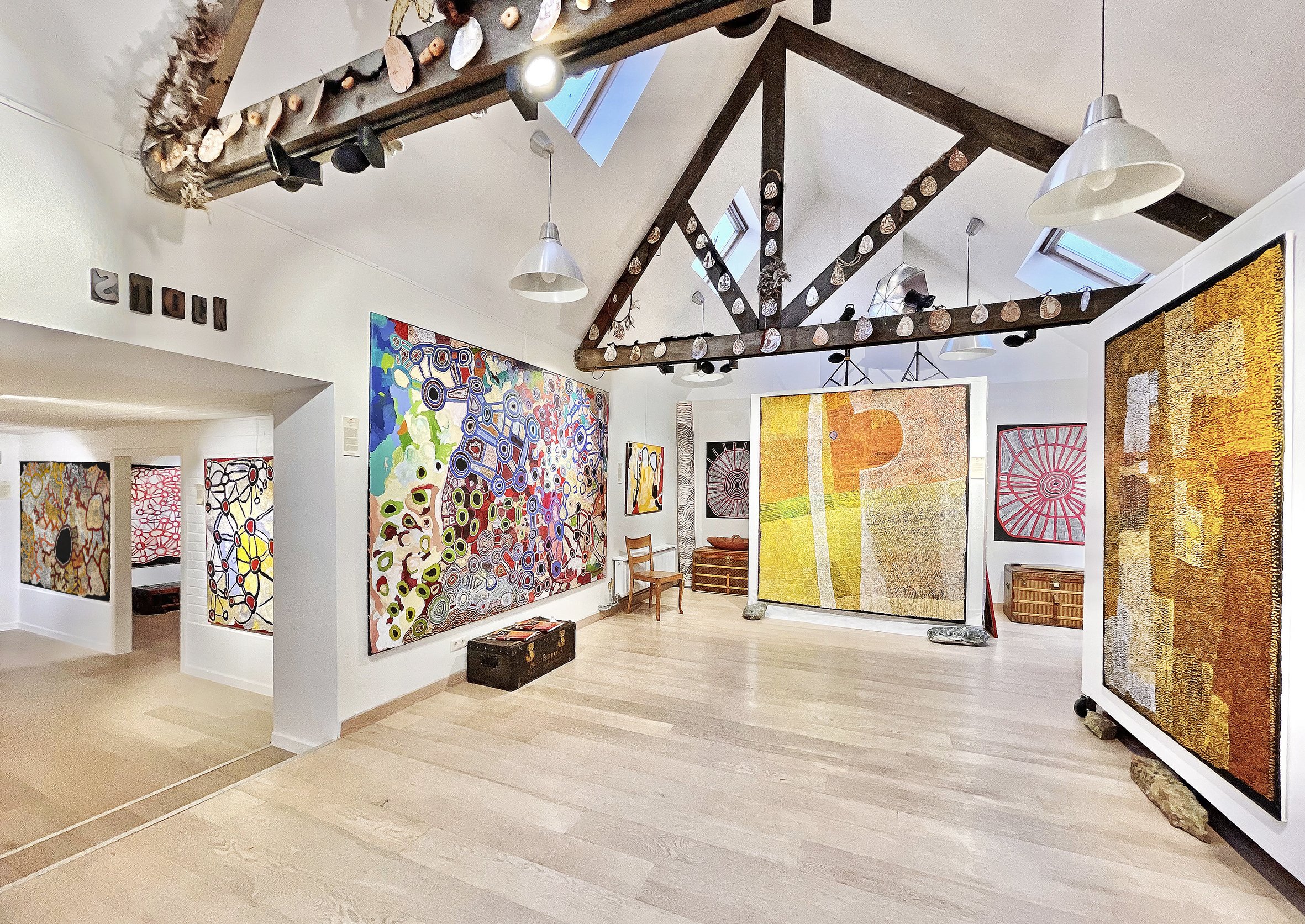
Vue de l’exposition Alune Resonance en 2022 à la galerie Aboriginal Signature Estrangin à Bruxelles © Photo : Aboriginal Signature Estrangin Gallery with the courtesy of the artists and Spinifex Art Project.
“Aluni” - Résonance
Nous vous invitons à l’autre bout du monde, dans le grand désert du Victoria au sud de l’Australie, pour une exposition sublime et rare à la galerie Aboriginal Signature, en partenariat avec la communauté artistique du Spinifex Art Project.
L’explosion d’une bombe atomique dans le désert du Grand Victoria en 1950, résonnera à jamais dans la mémoire des artistes Aborigènes du Spinifex présentés à Bruxelles. Cette empreinte sonore assourdissante et effrayante fut leur première confrontation au monde occidental. Un premier contact sous le signe de l’effroi qui bouleversera à la fois leur territoire, les zones désormais inaccessibles, et leurs histoires fondatrices. Avec une résilience à nulle autre pareille, ces hommes et femmes affrontèrent les obstacles sur le chemin de la modernité. Aujourd’hui ils continuent d’inventer leur destin et de porter l’écho de leurs ancêtres au sein de leurs œuvres remarquables.
Résonance et empreinte
En 1986 sur cette terre parmi les plus isolée du globe, des traces de pas repérés près d’un lieu sacré, laissent penser qu’un clan a survécu aux cataclysmes des essais nucléaires britanniques dans ce désert.
Les Aborigènes installés dans la petite communauté de Tjuntjunjara, montent alors une expédition dans le désert pour partir à leur recherche. Ils retrouvent quelques jours plus tard les derniers nomades d’Australie, grâce à leur connaissance des pistes chantées. Les retrouvailles sont émouvantes et résonnent jusqu’ici à Bruxelles avec Ian Rictor (1960), qui deviendra artiste à son tour, à travers un parcours artistique unique, de ces dernières empreintes de pas en 1986 aux cimaises des plus grands musées du monde.
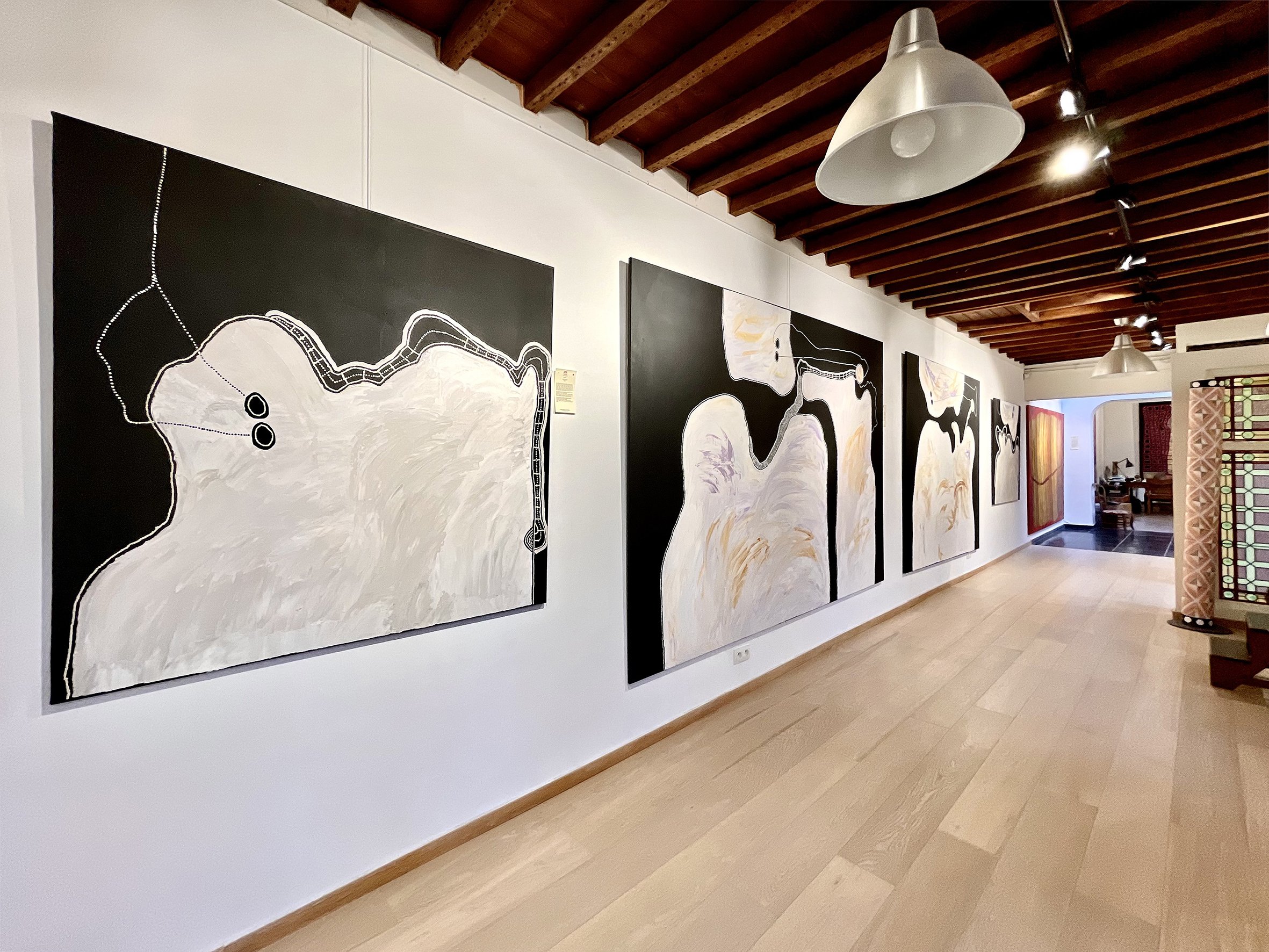
Vue de l’exposition Alune Resonance en 2022 à la galerie Aboriginal Signature Estrangin à Bruxelles © Photo : Aboriginal Signature Estrangin Gallery with the courtesy of the artists and Spinifex Art Project.
Résonances politiques
Dix ans plus tard en 1997, les Aborigènes Pitjantjara du Spinifex réalisent deux œuvres collaboratives masculine et féminine, pour démontrer la continuité d’occupation de leurs lieux sacrés, sans interruption durant la colonisation. Face aux tribunaux Australiens, dans le cadre de la loi du Native Act Title, ils vont récupérer 76 000 kilomètres carrés de leurs territoires ancestraux dans le grand désert du Victoria.
Ces hommes et ces femmes vont ainsi peindre pour le première fois, non pas pour le monde de l’art, mais pour défendre leurs droits inaliénables et immémoriaux. Ensemble ils vont écrire une nouvelle page de l’histoire de l’art et faire partie des plus grands artistes de cette île continent.

Vue de l’exposition Alune Resonance en 2022 à la galerie Aboriginal Signature Estrangin à Bruxelles © Photo : Aboriginal Signature Estrangin Gallery with the courtesy of the artists and Spinifex Art Project.
Résonances spirituelles
Dans ce lieu improbable, constitué de 20 maisons en plein centre de ce grand désert, va émerger le mouvement artistique du Spinifex Art Project à la fin des années 90. Tous les artistes nés avant les années 50 et la dernière famille des nomades d’Australie de 1986, ont tous vécu la vie traditionnelle du désert, avec une lecture unique et profonde de la terre.
Le silence est omniprésent sur leur terre minérale, sans âme qui vive, dans le froid mordant du soir et le soleil éclatant du jour. Dans ce dénuement apparent s’éveille le souffle de l’esprit, une présence continue dans chaque lieu traversé, tant ceux-ci ont été vénéré depuis toujours, chantés par les anciens, comme une révérence pour annoncer sa visite. Ils ne sont point de simples rochers, excavations, grottes, chemins, ondulation des dunes… Tous portent un nom depuis les origines. Ils sont l’émanation tangible du sacré, l’incarnation religieuse des premiers pas des ancêtres.
« Le Tjukurpa a été créé par les actions des êtres puissants et magiques qui ont vécu la première vie et l'ont gravé dans le paysage. Ils l'ont fait naturellement, mais plus encore, ils ont vécu l'expérience de vie nécessaire afin de partager la boussole morale fondamentale nécessaire pour enrichir la place d'une personne dans la société ». Pour les artistes comme Ned Grant, son frère Fred Grant, les aînés Simon Hogan et Lawrence Pennington : peindre, c’est créer, représenter le pays Spinifex qui s'est manifesté pour eux par les premiers êtres : ceux qui avaient des pouvoirs métamorphiques de transformation, pas seulement d'eux-mêmes mais de l'environnement dans lequel ils se déplaçaient, dramatisant le voyage des événements avec une doctrine orale qui était ensuite enveloppée de chants et de danses », souligne Brian Hallet, co-manager du centre d’art du Spinifex art project.

Vue de l’exposition Alune Resonance en 2022 à la galerie Aboriginal Signature Estrangin à Bruxelles © Photo : Aboriginal Signature Estrangin Gallery with the courtesy of the artists and Spinifex Art Project.
Résonances mémorielles
Rencontrer les artistes in situ est un moment de vie unique et essentiel d’une rare intensité bien que nous ne parlions par la même langue. Quelques mots de part et d’autres permettent de faire un premier pas. Mes rencontres avec les artistes Simon Hogan (1930), Lennard Walker (1946), Lawrence Pennington (1934) furent inoubliables. Quand ils peignent, le temps s’arrête. Avec leurs pinceaux et bâtonnets, ils relient avec une délicatesse infinie les lieux spirituels de leur naissance comme entre Lingka et Paltju dans le grand désert du Victoria.
Le mot Peindre prend chez eux un immense P majuscule, tant leur geste concentré, attentionné, consiste en une véritable célébration du territoire et des histoires sacrées de leurs ancêtres, à une époque encore récente où la spiritualité irriguait toute l’humanité.
Sur leurs toiles, à l’aide de tracés et points conjugués, ils offrent une texture et redonnent vie au cycle immuable du Tjukurpa (Temps du Rêve). Je les vois sourire en peignant, comme des moines en méditation. Ils lèvent les yeux et m’aperçoivent, ravis que je regarde leur œuvres avec fascination. Spontanément Simon Hogan m’offrit le cadeau d’expliquer sa peinture. Quelques mots d’anglais comme « water hole », « trees » servirent de charpente à un dialogue de presque 30 mn en Pitjantjatjara. La barrière de la langue était presque infranchissable. Cependant avec ses gestes, tel un danseur, il donnait du corps aux mots essentiels que l’on retrouve dans sept œuvres exceptionnelles exposées à Bruxelles. Son regard perçant et bienveillant portait également ses paroles au-delà des frontières du langage comme lors de sa rencontre il y a quelques années à Londres avec le Prince Charles d’Angleterre au British Museum.

Vue de l’exposition Alune Resonance en 2022 à la galerie Aboriginal Signature Estrangin à Bruxelles © Photo : Aboriginal Signature Estrangin Gallery with the courtesy of the artists and Spinifex Art Project.
Résonance et immersion
Pour monter cette exposition à Bruxelles, nous avons réalisé plusieurs visites dans ce lieu si éloignée de l’Australie, dont une expédition en 4x4 à travers ce territoire immense protégé et fermé au public. La piste traversait sur 700 km plus de 180 dunes de sable de 10 m de haut, sans possibilité de trouver des ressources en eau ou en carburant. Isolé, bivouaquant dans leur désert si froid la nuit tombé, là où la terre craquelée semble pulvérisée, j’y ressentais la fragilité de la vie, les dimensions plus invisibles de la terre, et les capacités de résistance incroyables de ce peuple à travers les millénaires.
Avec leur pinceau, ces grands artistes, dont les œuvres rayonnent dans les plus grands musées du monde, du MET au British Museum, révèlent leurs connaissances rares et précieuses qui résonnent dans leurs peintures. Ils cristallisent leur savoir et le transmettent aux générations à venir. Ils tissent le lien avec le territoire. Leur geste devient le prolongement de la terre, et leurs œuvres des monuments de la mémoire.
Nous nous réjouissons de vous accueillir à la galerie en ce début d’année.
Bertrand Estrangin
Nous sommes très honorés d’accueillir cette grande exposition à Bruxelles, en partenariat avec le centre d’art du Spinifex Art Project.

Découvrez les peintures disponibles à Bruxelles durant l’exposition :

Artiste : Women collaborative
Titre de l'œuvre : Minyma Tjuta
Format : 290 x 200 cm
Provenance et certificat : centre d'art aborigène du Spinifex Art Project
Référence de cette peinture : 21-198
Enquiry / Demander le prix de l'œuvre
Explications pour cette œuvre :
Five senior Spinifex Artists; Myrtle Pennington, Kanta Donnegan, Ngalpingka Simms, Sophia Brown, Katie Brown and Tracey Simms have collaborated in the process of this painting depicting Minyma Tjuta Tjukurpa (Seven Sisters Creation Line). This Creation Line follows the movements of a group of sisters who traverse the country evading the clutches of a lustful older man known as Nyiru. Nyiru is pursuing the women to satisfy his desire for the eldest sister who he wishes to take for his wife. He is a sorcerer of sorts and can metamorphose into animals or plants and does this on several occasions in an attempt to capture the women but always they seem to narrowly escape. It is within these involved actions that the landscape is created and formations left as ever present reminders of the power and presence of the creation beings.
The women take a path north and eventually fly into the sky to become the Pleiades Constellation: one of the closest star clusters to earth. Although each women knows this major Tjukurpa, they are bound by cultural protocol and custodial responsibility as to which country they can depict. As the country and Tjukurpa unfolds during the creation of a major work like this, the women ‘sing the place’ into reality. Traditional inma (singing and dancing) is triggered as the depictions of places, that the women may not have physically seen for many years, begin to manifest onto the canvas.
Their major collaborative paintings are in the following prestigious collections : Aboriginal Art Museum, Utrecht. Art Gallery Of South Australia, Adelaide,S.A.. Prince Stefan Von Und Zu Liechtenstein, The Ambassador Of Liechtenstein In Germany. Seattle Art Museum, Seattle, Usa. Staatliches Museum Fur Volkerkunde, Munich, Germany. The British Museum, London, England. The National Gallery Of Victoria, Melbourne, Vic. Western Australian Museum, Perth. The Opale Fondation.

Artiste : Timo Hogan
Titre de l'œuvre : Lake Baker
Format : 230 x 200 cm
Provenance et certificat : centre d'art aborigène du Spinifex Art Project
Référence de cette peinture : 21-308
Enquiry / Demander le prix de l'œuvre
Explications pour cette œuvre :
Timo Hogan (1973) does not paint the picture. He paints the story. And the story is the big picture. For here at Lake Baker, Timo tells of the religion within the landscape and the inhabitants that made it so. Wati Kutjara Tjukurpa (Two Men Creation Line) is present for all to see. These two men watch carefully as the resident Wanampi (magical water serpent) departs his kapi ngura (home in the rock hole) and becomes the fearful, the all powerful, as he skirts the edge of the lake, always watching, aware of the Two Men.
These characters that Timo talks of are the Creation beings. Those that came before and shaped the
environment as they moved through it, leaving indelible physical reminders of their power and presence for all to see. But they also intertwined a religious moral framework within the habitat and covered it with song and dance.
His artworks are in the following prestigious collections :
Art Gallery of New South Wales, Sydney.
Art Gallery of South Australia, Adelaide
In 2017 He was the Finalist of the Hedland Art Awards
In 2021, Timo Hogan, was the winner of the 2021 Telstra Art Award at the Museum of Darwin

Artiste : Men collaborative
Titre de l'œuvre : Pila Ngura
Format : 290 x 200 cm
Provenance et certificat : centre d'art aborigène du Spinifex Art Project
Référence de cette peinture : 21-316
Enquiry / Demander le prix de l'œuvre
Explications pour cette œuvre :
Six senior Spinifex Men have painted their way into country filled with meaning, depicting a sum of the parts to encompass much more than the whole. Each has emphasised their significant sites and brought them into focus on a bold collaborative scale. The men work in harmony, often singing and rhythmically tapping the associated songs into color upon the canvas.
Simon Hogan leads us into the hidden intricacies of Lingka; a significant site strewn with white stones and giving life to the wanari (mulga tree) that springs forth from the sacred water source. Nearby, Lawrence Pennington effortlessly moves the color to fill the sites of Mituna and Nyuman: flying the Walawuru Tjukurpa (Wedge Tailed Eagle Creation Line) over the vastness of the country. Meanwhile, Fred Grant takes us down the many well walked travels of his longest past and places Ukuratjara, his place of childhood, for all to see. And Ned Grant uses his knowledge and insight to intertwine the ngalta (desert kurrajong) and the life giving water it provides, into the fabric of the story: weaving Wati Kutjara Tjukurpa (Two Men Creation Line) underground and into the very trees he depicts.
Patju Presley shimmers close by as his myriad of dots allow the site of Kalaya Piti to push the boundaries of the composition. And Ian Rictor lays the subtle sites, depicting Kamanti, Tuwan and Wayara in grace and unison to form his story. These sites, this country was created by the first beings who shaped the landscape as they moved through it. And left a land brimming with meaning and ritual that the men embrace on a daily basis but also leave upon a grand composition such as this.
Their artworks are in the following prestigious collections :
Aboriginal Art Museum, Utrecht, The Netherlands
Art Gallery Of South Australia, Adelaide. Sa
National Gallery Of Australia, Canberra, Act
Prince Stefan Von Und Zu Liechtenstein, The Ambassador Of Liechtenstein In Germany
Seattle Art Museum, Seattle, Usa
Staatliches Museum Fur Volkerkunde, Munich, Germany
The British Museum, London, England.
The Corrigan Collection, Australia.
The Lepley Collection, Perth, Western Australia.
The Luczo Collection, Usa
Western Australian Museum, Perth, Western Australia
W. & V. Mcgeoch Collection, Melbourne, Vic.
The Art Gallery Of New South Wales, Sydney, Nsw…

Artiste : Simon Hogan
Titre de l'œuvre : Lingka
Format : 200 x 137 cm
Provenance et certificat : centre d'art aborigène du Spinifex Art Project
Référence de cette peinture : 21-79
Enquiry / Demander le prix de l'œuvre
Explications pour cette œuvre :
Simon Hogan (1930) manifests his site of Lingka onto the two dimensional plane. When he paints, he transcends this world and is taken over soft sand ridges and vast Spinifex plains to the significant sites that formed him from birth. For Simon was born into a spiritual society where religion manifested in the immediate environment and where creation beings could move through different realms at will. It is these beings who shaped the landscape that Simon depicts and who left a moral compass that is still followed today. They gave to people the life giving water sites that were held with such reverence in an arid and remote land. It is these sites that were the means of survival and where religion unfolded in the form of sacred song and performance.
Simon Hogan was born circa 1930 in mid-western Spinifex between Paltju and Lingka. Simon’s exact age is unknown as dates of birth were estimated by the A.E.M. missionaries when the Spinifex people, on arrival at Cundeelee, were “sorted” into family groups, given English names and approximate dates of birth. During childhood two fathers, one born at Warakunu and the other at Munki raised Simon. Simon’s mother’s country is around Tjulya. The Spinifex people were a relatively discreet southern Pitjantjatjara tribal group with es to the north and east that lived a fully traditional hunter-gatherer life until the late1950’s to early 1960s when most people either walked in to Ooldea and Cundeelee or were taken by AEM missionaries to Cundeelee Mission…
From 1995 Simon Hogan was a prominent member of a group of senior traditional owners from Spinifex country who lobbied the WA State Government for Native Title. Although Simon spoke no English he was a confident, initiated Pitjantjatjara man who spoke to senior government officials regarding ownership of country and culture. Exclusive Native Title rights were granted to Simon Hogan and the Spinifex people in 2000 of over 55 000 sq kms of the Great Victoria Desert in WA.
His artworks are in the following prestigious collections :
Art Gallery Of South Australia, Adelaide, South Australia
British Museum, London, England.
Harriet And Richard England Collection
National Gallery Of Australia, Canberra, Act.
National Gallery Of Victoria, Melbourne, Victoria.
Seattle Art Museum, Seattle, Usa. (Mens Collaborative)
Staatliches Museum Fur Volkerkunde, Munich, Germany
The Lepley Collection, Perth, Western Australia.
The Patrick Corrigan Collection, Sydney, New South Wales.
W. & V. Mcgeoch Collection
Western Australian Museum, Perth, W.A.
Artbank, Australian Government Collection. Australia.
Art Gallery Of Western Australia, Perth, Western Australia.
The Art Gallery Of New South Wales, Sydney, Nsw (Mens Collaborative)

Artiste : Ngalpingka Simms (1945)
Titre de l'œuvre : Kungkarangkalpa
Format : 200 x 137 cm
Provenance et certificat : centre d'art aborigène du Spinifex Art Project
Référence de cette peinture : 21-72
Enquiry / Demander le prix de l'œuvre
Explications pour cette œuvre :
Kungkarangkalpa is Minyma Tjuta Tjukurpa (Many Women Creation Line) and is a major women’s songline that traverses vast tracts of traditional Spinifex Land and beyond. This is a Creation narrative with a man at the center but it is truly a women’s story, full of spiritual insight and knowledge for the journey into adulthood. It recounts the long and arduous journey that a group of young women make whilst under constant pursuit of a lustful man (Wati Nyiru) who wishes to take the eldest girl (Kampukurta), for his wife.
Ngalpingka Simms (1945) is a senior artist whose country is Wayilul near present day Patjarr community in the north of Ngaanyatjarra Lands and the northern reaches of the Gibson Desert. Here, she depicts the significant site of Wayilul and nearby Tika-Tika where the women encounter footprints belonging to Wati Nyiru.
Her artworks are in the following prestigious collections :
Collection Prince Stefan Of Liechtenstein, Embassy Of Liechtenstein In Germany.(Women's Collaborate)
Seattle Art Museum, Seattle Usa (Women’s Collaborative)
The British Museum, London, England.(Women's Collaborative)
The National Gallery Of Victoria, Melbourne, Vic. (As Part Of The Women's Collaborative)
The Sims Dickson Collection, Nsw (Collaborative With Kathleen Donnegan)
University Of Queensland Art Museum, Brisbane, Qld.
Art Gallery Of South Australia, Adelaide Sa (Women’s Collaborative)

Artiste : Lawrence Pennington
Titre de l'œuvre : Pukara Dreaming Time story
Format : 137 x 110 cm
Provenance et certificat : centre d'art aborigène du Spinifex Art Project
Référence de cette peinture : 21-54
Enquiry / Demander le prix de l'œuvre
Explications pour cette œuvre :
Lawrence Pennington (1934) touches the deepest qualities of the Tjukurpa in the unseen, taking the broad brush to minimal resemblance of the characters that inhabited the first journey. He guides the significant site of Pukara effortlessly onto the canvas, channelling the essence of Wati Kutjara Tjukurpa (Two Men Creation Line) from a time before when Lawrence walked throughout Spinifex Country. A time when he walked with the Song, following the physical manifestation left by the creation beings in the landscape, of the stories that made it so and of the characters that played out the journey. It is from Pukara that the Two Men, a father and son powerful water serpent, depart on a significant ceremonial journey throughout Spinifex Country.
His artworks are in the following prestigious collections :
Araluen Gallery, Alice Springs, Northern Territory.
National Gallery Of Australia, Canberra, Act (Mens Collaborative)
Richard And Harriet England Collection
Seattle Art Museum, Seattle, Usa. (Mens Collaborative)
The Corrigan Collection, Australia (Mens Collaborative)
The National Gallery Of Victoria, Melbourne, Vic.
W. & V. Mcgeoch Collection, Melbourne, Vic.
Wagner And Owen Collection (Usa)
The Art Gallery Of New South Wales, Sydney, Nsw (Mens Collaborative)
Art Gallery Of South Australia, Adelaide, South Australia (Mens Collaborative)

Artiste : Lennard Walker (1946)
Titre de l'œuvre : Kulyuru
Format : 230 x 200 cm
Provenance et certificat : centre d'art aborigène du Spinifex Art Project
Référence de cette peinture : 21-347
Enquiry / Demander le prix de l'œuvre
Explications pour cette œuvre :
Lennard Walker (1945) is the cultural ambassador, the elder statesman, the missing link between past and present who depicts his lived environment brimming with meaning. he allows us the insights into a world we can scarily perceive. He is a senior custodian for the site of Kuru Ala and Kulyuru. Here, Lennard has depicted the significant site of Kulyuru associated with the Minyma Tjuta Tjukurpa (Seven Sisters Creation Line) This is a major womens narrative that follows a group of young women as they traverse Spinifex Country and beyond, always evading the amorous pursuit of the lustful older man Nyiru.
At Kulyuru, the women a tricked into digging for a prized Kuniya (carpet python) only to find, after digging a major water course, that it was Nyiru in disguise.
These are creation beings who shape the narrative within the landscape as they move through it. The 'sisters' eventually flee into the sky to become the Pelides constellation where Lennard says you can see them at sunrise in the morning sky.
His artworks are in the following prestigious collections :
Artbank Australian Government, Canberra. A.C.T.
Collection Prince Stefan Of Liechtenstein, Embassy Of Liechtenstein In Germany. (Mens Collaborate)
Kuntswerk Sammlung Alison Und Peter W. Klein, Germany Sammlung Alison Und Peter W. Klein, Germany
National Gallery Of Australia, Canberra, Act (Mens Collaborative)
Seattle Art Museum, Seattle, Usa. (Mens Collaborative)
The British Museum, London. (Mens Collaborative)
The Corrigan Collection, Australia (Mens Collaborative)
The Kaplan-Levi Collection, Usa
W. & V. Mcgeoch Collection, Melbourne, Vic.
Wagner And Owen Collection, Usa.
Queensland Art Gallery Of Modern Art, Brisbane, Qld.
The Art Gallery Of New South Wales, Sydney, Nsw (Mens Collaborative)
Art Gallery Of South Australia, Adelaide, South Australia (Mens Collaborative)

Artiste : Lawrence Pennington
Titre de l'œuvre : Pukara Dreaming Time story
Format : 137 x 110 cm
Provenance et certificat : centre d'art aborigène du Spinifex Art Project
Référence de cette peinture : 21-36
Enquiry / Demander le prix de l'œuvre
Explications pour cette œuvre :
Lawrence Pennington (1934) touches the deepest qualities of the Tjukurpa in the unseen, taking the broad brush to minimal resemblance of the characters that inhabited the first journey. He guides the significant site of Pukara effortlessly onto the canvas, channelling the essence of Wati Kutjara Tjukurpa (Two Men Creation Line) from a time before when Lawrence walked throughout Spinifex Country. A time when he walked with the Song, following the physical manifestation left by the creation beings in the landscape, of the stories that made it so and of the characters that played out the journey. It is from Pukara that the Two Men, a father and son powerful water serpent, depart on a significant ceremonial journey throughout Spinifex Country.
His artworks are in the following prestigious collections :
Araluen Gallery, Alice Springs, Northern Territory.
National Gallery Of Australia, Canberra, Act (Mens Collaborative)
Richard And Harriet England Collection
Seattle Art Museum, Seattle, Usa. (Mens Collaborative)
The Corrigan Collection, Australia (Mens Collaborative)
The National Gallery Of Victoria, Melbourne, Vic.
W. & V. Mcgeoch Collection, Melbourne, Vic.
Wagner And Owen Collection (Usa)
The Art Gallery Of New South Wales, Sydney, Nsw (Mens Collaborative)
Art Gallery Of South Australia, Adelaide, South Australia (Mens Collaborative)

Artiste : Lawrence Pennington
Titre de l'œuvre : Pukara Dreaming Time story
Format : 110 x 85 cm
Provenance et certificat : centre d'art aborigène du Spinifex Art Project
Référence de cette peinture : 21-59
Enquiry / Demander le prix de l'œuvre
Explications pour cette œuvre :
Lawrence Pennington (1934) touches the deepest qualities of the Tjukurpa in the unseen, taking the broad brush to minimal resemblance of the characters that inhabited the first journey. He guides the significant site of Pukara effortlessly onto the canvas, channelling the essence of Wati Kutjara Tjukurpa (Two Men Creation Line) from a time before when Lawrence walked throughout Spinifex Country. A time when he walked with the Song, following the physical manifestation left by the creation beings in the landscape, of the stories that made it so and of the characters that played out the journey. It is from Pukara that the Two Men, a father and son powerful water serpent, depart on a significant ceremonial journey throughout Spinifex Country.
His artworks are in the following prestigious collections :
Araluen Gallery, Alice Springs, Northern Territory.
National Gallery Of Australia, Canberra, Act (Mens Collaborative)
Richard And Harriet England Collection
Seattle Art Museum, Seattle, Usa. (Mens Collaborative)
The Corrigan Collection, Australia (Mens Collaborative)
The National Gallery Of Victoria, Melbourne, Vic.
W. & V. Mcgeoch Collection, Melbourne, Vic.
Wagner And Owen Collection (Usa)
The Art Gallery Of New South Wales, Sydney, Nsw (Mens Collaborative)
Art Gallery Of South Australia, Adelaide, South Australia (Mens Collaborative)

Artiste : Lawrence Pennington
Titre de l'œuvre : Mituna
Format : 200 x 137 cm
Provenance et certificat : centre d'art aborigène du Spinifex Art Project
Référence de cette peinture : 21-76
Enquiry / Demander le prix de l'œuvre
Explications pour cette œuvre :
Lawrence Pennington (1934) touches the deepest qualities of the Tjukurpa in the unseen, taking the broad brush to minimal resemblance of the characters that inhabited the first journey. He guides the significant site of Mituna effortlessly onto the canvas, channelling the essence of Wati Kutjara Tjukurpa (Two Men Creation Line) from a time before when Lawrence walked throughout Spinifex Country. A time when he walked with the Song, following the physical manifestation in the landscape left by the creation beings, of the stories that made it so, of the characters that played out the journey.
The Two Men are a father and son Wanampi (powerful water serpent) who traverse the vast tracts of Spinifex Country on ceremonial business. The son is forever becoming embroiled in conflict and the father must keep watchful eye and resolves his sons problems. These are creation beings who changed the landscape with their moral actions, as moved through it, leaving indelible physical reminders of their power and presence of transformation.
His artworks are in the following prestigious collections :
Araluen Gallery, Alice Springs, Northern Territory.
National Gallery Of Australia, Canberra, Act (Mens Collaborative)
Richard And Harriet England Collection
Seattle Art Museum, Seattle, Usa. (Mens Collaborative)
The Corrigan Collection, Australia (Mens Collaborative)
The National Gallery Of Victoria, Melbourne, Vic.
W. & V. Mcgeoch Collection, Melbourne, Vic.
Wagner And Owen Collection (Usa)
The Art Gallery Of New South Wales, Sydney, Nsw (Mens Collaborative)
Art Gallery Of South Australia, Adelaide, South Australia (Mens Collaborative)

Artiste : Patju Presley
Titre de l'œuvre : Kultukira
Format : 200 x 137 cm
Provenance et certificat : centre d'art aborigène du Spinifex Art Project
Référence de cette peinture : 18-177
Enquiry / Demander le prix de l'œuvre
Explications pour cette œuvre :
Patju has depicted the significant site of Kultukira, a place belonging to the Wati Kutjara Tjukurpa or the Two Serpent Ancestral Beings, that forms part of the Wati Kutjara Tjukurpa (Two Men Creation Line). This is an epic songline that follows the trials of a father and son Wanampi (Water Serpent) who are traversing the Spinifex Lands on Law ceremony.
These are creation beings who shaped the landscape as they moved through it. Powerful beings who left indelible reminders of their power and presence within the terrain and overlaid with a moral compass to follow.
Patju Presley paints with a passion for country as he evokes his 'early days' nomadic wanderings with his immediate family throughout the vast country he calls home. He is a master story teller of the Tjukurpa - creation events that shaped the environment we see today and is knowledgeable on many inma (traditional dancing and singing) for site specific ceremony.
Patju Presley (1945) was born in the 1940s at Itaratjara, an important site between to the community settlement of Watarru and Kalayapiti in the Great Victoria Desert.
His artworks are in the following prestigious collections : Art Gallery Of Western Australia, Perth, Wa. The National Gallery Of Australia, Canberra, Act. National Gallery Of Victoria, Melbourne. The Art Gallery Of New South Wales, Sydney, Nsw. The Kaplan-Levi Collection, Usa. University Of Queensland Art Museum, Brisbane, Qld. Art Gallery Of South Australia, Adelaide, South Australia (Mens Collaborative). Queensland Art Gallery, Brisbane...

Artiste : Lennard Walker (1946)
Titre de l'œuvre : Kuru Ala
Format : 290 x 200 cm
Provenance et certificat : centre d'art aborigène du Spinifex Art Project
Référence de cette peinture : 21-233
Enquiry / Demander le prix de l'œuvre
Explications pour cette œuvre :
"This is the road north from Tjuntjuntjara. Tali tjuta (sand dunes) all along here. As you travel north past Ilkurlka you reach the country I am responsible for around Kuru Ala (located in the Great Victoria Desert of WA). There are small rock holes and the ridges of sand dunes".
Lennard was born at Kuru Ala making him the senior custodian for this place. It is a ‘Women’s SiteÓ holding the Kungkarangkalpa Tjukurpa – Seven Sisters story. This is an epic songline, which follows a group of young women as they traverse Spinifex country all the while evading the lustful attention of a powerful sorcerer man named Nyiru. Nyiru has metamorphic powers of transformation. He is a quandong tree at one site and at another a kunyia (woma python). The women make their way north, eventually flying into the night sky to become the star constellation of Pleiades the Seven Sisters. These characters are creation beings who transform the landscape as they move through it leaving indelible physical reminders of their power and presence for Anangu to follow.
As a man, there are places that Lennard cannot go but he still holds authority and cultural responsibilities for Kuru Ala. Before reaching Kuru Ala there are many sand dunes to pass over. Lennard has great knowledge for this country and lists the following rock holes; Purpurnya, Kapi Wiyatjara, Nyuman, Kamanti, Tuwan and Wayatji.
His artworks are in the following prestigious collections :
Artbank Australian Government, Canberra. A.C.T.
Collection Prince Stefan Of Liechtenstein, Embassy Of Liechtenstein In Germany. (Mens Collaborate)
Kuntswerk Sammlung Alison Und Peter W. Klein, Germany Sammlung Alison Und Peter W. Klein, Germany
National Gallery Of Australia, Canberra, Act (Mens Collaborative)
Seattle Art Museum, Seattle, Usa. (Mens Collaborative)
The British Museum, London. (Mens Collaborative)
The Corrigan Collection, Australia (Mens Collaborative)
The Kaplan-Levi Collection, Usa
W. & V. Mcgeoch Collection, Melbourne, Vic.
Wagner And Owen Collection, Usa.
Queensland Art Gallery Of Modern Art, Brisbane, Qld.
The Art Gallery Of New South Wales, Sydney, Nsw (Mens Collaborative)
Art Gallery Of South Australia, Adelaide, South Australia (Mens Collaborative)

Artiste : Dora Parker
Titre de l'œuvre : Pukara
Format : 110 x 85 cm
Provenance et certificat : centre d'art aborigène du Spinifex Art Project
Référence de cette peinture : 21-343
Enquiry / Demander le prix de l'œuvre
Explications pour cette œuvre :
Dora (1962) remembers visiting Pukara with her father as a child. It made a huge impression on her as she witnessed the Wanampi (water serpent ancestral being) raising from the rock hole.
Pukara, the Wati Kutjara Tjukurpa is one of the most important and extensive stories from the Western Desert region and has played a major role in the formation, character and religious significance of the entire Spinifex area. Two wanampi (serpent beings), a father and a son are travelling together on initiation and ceremonial business. The father is accompanying his son as he sets out on what will be the most significant and powerful journey of his life in a tribal seting.
As the two snakes pass across the country they are involved in a range of actions and events that have given rise to the geographical and mythological landscape present and maintained to this day. At Pukara while the father was sleeping the Anangu children from the area crept into the camp. They called out relentlessly taunting the son. Teasing him saying his eyes were bulging like eggs. The son who was already unstable got wild and hit out at the children.

Artiste : Patju Presley
Titre de l'œuvre : Karatjara
Format : 230 x 200 cm
Provenance et certificat : centre d'art aborigène du Spinifex Art Project
Référence de cette peinture : 19-2
Enquiry / Demander le prix de l'œuvre
Explications pour cette œuvre :
Patju has depicted the significant site of Karatjara situated to the north of traditional Spinifex Lands. This site forms part of the Wati Kinara Tjukurpa or Moon Man Creation Line and there is a large rocky outcrop here with a cave that wati pira made his own. Inside the cave are paintings that wati pira etched during creation time, with footprints of all the animals painted within the cave. At the base of the rocky formation is where the rockhole Karatjara lays.
These are creation beings who shaped the landscape as they moved through it leaving indelible monolithic reminders of their power and presence. Beings capable of metamorphic transformation that made the moral compass that still guides Anangu on a daily basis.
Patju Presley paints with a passion for country as he evokes his 'early days' nomadic wanderings with his immediate family throughout the vast country he calls home. He is a master story teller of the Tjukurpa - creation events that shaped the environment we see today and is knowledgeable on many inma (traditional dancing and singing) for site specific ceremony.
Patju Presley (1945) was born in the 1940s at Itaratjara, an important site between to the community settlement of Watarru and Kalayapiti in the Great Victoria Desert.
His artworks are in the following prestigious collections : Art Gallery Of Western Australia, Perth, Wa. The National Gallery Of Australia, Canberra, Act. National Gallery Of Victoria, Melbourne. The Art Gallery Of New South Wales, Sydney, Nsw. The Kaplan-Levi Collection, Usa. University Of Queensland Art Museum, Brisbane, Qld. Art Gallery Of South Australia, Adelaide, South Australia (Mens Collaborative). Queensland Art Gallery, Brisbane...

Artiste : Dora Parker
Titre de l'œuvre : Pukara
Format : 110 x 85 cm
Provenance et certificat : centre d'art aborigène du Spinifex Art Project
Référence de cette peinture : 21-344
Enquiry / Demander le prix de l'œuvre
Explications pour cette œuvre :
Dora (1962) remembers visiting Pukara with her father as a child. It made a huge impression on her as she witnessed the Wanampi (water serpent ancestral being) raising from the rock hole.
Pukara, the Wati Kutjara Tjukurpa is one of the most important and extensive stories from the Western Desert region and has played a major role in the formation, character and religious significance of the entire Spinifex area. Two wanampi (serpent beings), a father and a son are travelling together on initiation and ceremonial business. The father is accompanying his son as he sets out on what will be the most significant and powerful journey of his life in a tribal seting.
As the two snakes pass across the country they are involved in a range of actions and events that have given rise to the geographical and mythological landscape present and maintained to this day. At Pukara while the father was sleeping the Anangu children from the area crept into the camp. They called out relentlessly taunting the son. Teasing him saying his eyes were bulging like eggs. The son who was already unstable got wild and hit out at the children.

Artiste : Patju Presley
Titre de l'œuvre : Tolu
Format : 137 x 90 cm
Provenance et certificat : centre d'art aborigène du Spinifex Art Project
Référence de cette peinture : 21-342
Enquiry / Demander le prix de l'œuvre
Explications pour cette œuvre :
Patju Presley paints with such spiritual confidence, as someone who knows their place in the Creation, often singing the associated songs of particular sites whilst rhythmically placing his myriad of dots to form his striking compositions. Here he depicts the significant site of Ilu that holds the Minyma Mankurpa Tjukurpa (Three Women Creation Line) and follows the journey of three women minyma Ikarka (spotted bower bird woman), minyma mutjurara (goanna woman) and minyma ngiyari (thorny devil women) as they traverse the vast interior near the significant site of Waltjitjara. This is a sensitive story that Patju says he cannot elaborate on.
These characters that Patju depicts within a living, breathing landscape are the creation beings who shaped the immediate environment as they moved through it, leaving a moral narrative etched into the physical domain as testament to their power and presence. It is this physical, spiritual and religious existence that cannot be separated for Patju and is what gives his work the transcendent quality we experience from it.
Patju Presley (1945) was born in the 1940s at Itaratjara, an important site between to the community settlement of Watarru and Kalayapiti in the Great Victoria Desert.
His artworks are in the following prestigious collections : Art Gallery Of Western Australia, Perth, Wa. The National Gallery Of Australia, Canberra, Act. National Gallery Of Victoria, Melbourne. The Art Gallery Of New South Wales, Sydney, Nsw. The Kaplan-Levi Collection, Usa. University Of Queensland Art Museum, Brisbane, Qld. Art Gallery Of South Australia, Adelaide, South Australia (Mens Collaborative). Queensland Art Gallery, Brisbane...

Artiste : Timo Hogan
Titre de l'œuvre : Lake Baker
Format : 140 x 137 cm
Provenance et certificat : centre d'art aborigène du Spinifex Art Project
Référence de cette peinture : 21-158
Enquiry / Demander le prix de l'œuvre
Explications pour cette œuvre :
Timo Hogan (1973) does not paint the picture. He paints the story. And the story is the big picture. For here at Lake Baker, Timo tells of the religion within the landscape and the inhabitants that made it so. Wati Kutjara Tjukurpa (Two Men Creation Line) is present for all to see. These two men watch carefully as the resident Wanampi (magical water serpent) departs his kapi ngura (home in the rock hole) and becomes the fearful, the all powerful, as he skirts the edge of the lake, always watching, aware of the Two Men.
These characters that Timo talks of are the Creation beings. Those that came before and shaped the
environment as they moved through it, leaving indelible physical reminders of their power and presence for all to see. But they also intertwined a religious moral framework within the habitat and covered it with song and dance.
His artworks are in the following prestigious collections :
Art Gallery of New South Wales, Sydney.
Art Gallery of South Australia, Adelaide
In 2017 He was the Finalist of the Hedland Art Awards
In 2021, Timo Hogan, was the winner of the 2021 Telstra Art Award at the Museum of Darwin

Artiste : Timo Hogan
Titre de l'œuvre : Lake Baker
Format : 140 x 137 cm
Provenance et certificat : centre d'art aborigène du Spinifex Art Project
Référence de cette peinture : 21-159
Enquiry / Demander le prix de l'œuvre
Explications pour cette œuvre :
Timo Hogan (1973) does not paint the picture. He paints the story. And the story is the big picture. For here at Lake Baker, Timo tells of the religion within the landscape and the inhabitants that made it so. Wati Kutjara Tjukurpa (Two Men Creation Line) is present for all to see. These two men watch carefully as the resident Wanampi (magical water serpent) departs his kapi ngura (home in the rock hole) and becomes the fearful, the all powerful, as he skirts the edge of the lake, always watching, aware of the Two Men.
These characters that Timo talks of are the Creation beings. Those that came before and shaped the
environment as they moved through it, leaving indelible physical reminders of their power and presence for all to see. But they also intertwined a religious moral framework within the habitat and covered it with song and dance.
His artworks are in the following prestigious collections :
Art Gallery of New South Wales, Sydney.
Art Gallery of South Australia, Adelaide
In 2017 He was the Finalist of the Hedland Art Awards
In 2021, Timo Hogan, was the winner of the 2021 Telstra Art Award at the Museum of Darwin

Artiste : Simon Hogan
Titre de l'œuvre : Lingka
Format : 110 x 85 cm
Provenance et certificat : centre d'art aborigène du Spinifex Art Project
Référence de cette peinture : 21-27
Enquiry / Demander le prix de l'œuvre
Explications pour cette œuvre :
Simon Hogan (1930) manifests his site of Lingka onto the two dimensional plane. When he paints, he transcends this world and is taken over soft sand ridges and vast Spinifex plains to the significant sites that formed him from birth. For Simon was born into a spiritual society where religion manifested in the immediate environment and where creation beings could move through different realms at will. It is these beings who shaped the landscape that Simon depicts and who left a moral compass that is still followed today. They gave to people the life giving water sites that were held with such reverence in an arid and remote land. It is these sites that were the means of survival and where religion unfolded in the form of sacred song and performance.
Simon Hogan was born circa 1930 in mid-western Spinifex between Paltju and Lingka. Simon’s exact age is unknown as dates of birth were estimated by the A.E.M. missionaries when the Spinifex people, on arrival at Cundeelee, were “sorted” into family groups, given English names and approximate dates of birth. During childhood two fathers, one born at Warakunu and the other at Munki raised Simon. Simon’s mother’s country is around Tjulya. The Spinifex people were a relatively discreet southern Pitjantjatjara tribal group with es to the north and east that lived a fully traditional hunter-gatherer life until the late1950’s to early 1960s when most people either walked in to Ooldea and Cundeelee or were taken by AEM missionaries to Cundeelee Mission…
From 1995 Simon Hogan was a prominent member of a group of senior traditional owners from Spinifex country who lobbied the WA State Government for Native Title. Although Simon spoke no English he was a confident, initiated Pitjantjatjara man who spoke to senior government officials regarding ownership of country and culture. Exclusive Native Title rights were granted to Simon Hogan and the Spinifex people in 2000 of over 55 000 sq kms of the Great Victoria Desert in WA.
His artworks are in the following prestigious collections :
Art Gallery Of South Australia, Adelaide, South Australia
British Museum, London, England.
Harriet And Richard England Collection
National Gallery Of Australia, Canberra, Act.
National Gallery Of Victoria, Melbourne, Victoria.
Seattle Art Museum, Seattle, Usa. (Mens Collaborative)
Staatliches Museum Fur Volkerkunde, Munich, Germany
The Lepley Collection, Perth, Western Australia.
The Patrick Corrigan Collection, Sydney, New South Wales.
W. & V. Mcgeoch Collection
Western Australian Museum, Perth, W.A.
Artbank, Australian Government Collection. Australia.
Art Gallery Of Western Australia, Perth, Western Australia.
The Art Gallery Of New South Wales, Sydney, Nsw (Mens Collaborative)

Artiste : Simon Hogan
Titre de l'œuvre : Lingka
Format : 110 x 85 cm
Provenance et certificat : centre d'art aborigène du Spinifex Art Project
Référence de cette peinture : 21-33
Enquiry / Demander le prix de l'œuvre
Explications pour cette œuvre :
Simon Hogan (1930) manifests his site of Lingka onto the two dimensional plane. When he paints, he transcends this world and is taken over soft sand ridges and vast Spinifex plains to the significant sites that formed him from birth. For Simon was born into a spiritual society where religion manifested in the immediate environment and where creation beings could move through different realms at will. It is these beings who shaped the landscape that Simon depicts and who left a moral compass that is still followed today. They gave to people the life giving water sites that were held with such reverence in an arid and remote land. It is these sites that were the means of survival and where religion unfolded in the form of sacred song and performance.
Simon Hogan was born circa 1930 in mid-western Spinifex between Paltju and Lingka. Simon’s exact age is unknown as dates of birth were estimated by the A.E.M. missionaries when the Spinifex people, on arrival at Cundeelee, were “sorted” into family groups, given English names and approximate dates of birth. During childhood two fathers, one born at Warakunu and the other at Munki raised Simon. Simon’s mother’s country is around Tjulya. The Spinifex people were a relatively discreet southern Pitjantjatjara tribal group with es to the north and east that lived a fully traditional hunter-gatherer life until the late1950’s to early 1960s when most people either walked in to Ooldea and Cundeelee or were taken by AEM missionaries to Cundeelee Mission…
From 1995 Simon Hogan was a prominent member of a group of senior traditional owners from Spinifex country who lobbied the WA State Government for Native Title. Although Simon spoke no English he was a confident, initiated Pitjantjatjara man who spoke to senior government officials regarding ownership of country and culture. Exclusive Native Title rights were granted to Simon Hogan and the Spinifex people in 2000 of over 55 000 sq kms of the Great Victoria Desert in WA.
His artworks are in the following prestigious collections :
Art Gallery Of South Australia, Adelaide, South Australia
British Museum, London, England.
Harriet And Richard England Collection
National Gallery Of Australia, Canberra, Act.
National Gallery Of Victoria, Melbourne, Victoria.
Seattle Art Museum, Seattle, Usa. (Mens Collaborative)
Staatliches Museum Fur Volkerkunde, Munich, Germany
The Lepley Collection, Perth, Western Australia.
The Patrick Corrigan Collection, Sydney, New South Wales.
W. & V. Mcgeoch Collection
Western Australian Museum, Perth, W.A.
Artbank, Australian Government Collection. Australia.
Art Gallery Of Western Australia, Perth, Western Australia.
The Art Gallery Of New South Wales, Sydney, Nsw (Mens Collaborative)

Artiste : Simon Hogan
Titre de l'œuvre : Lingka
Format : 137 x 90 cm
Provenance et certificat : centre d'art aborigène du Spinifex Art Project
Référence de cette peinture : 21-45
Enquiry / Demander le prix de l'œuvre
Explications pour cette œuvre :
Simon Hogan (1930) manifests his site of Lingka onto the two dimensional plane. When he paints, he transcends this world and is taken over soft sand ridges and vast Spinifex plains to the significant sites that formed him from birth. For Simon was born into a spiritual society where religion manifested in the immediate environment and where creation beings could move through different realms at will. It is these beings who shaped the landscape that Simon depicts and who left a moral compass that is still followed today. They gave to people the life giving water sites that were held with such reverence in an arid and remote land. It is these sites that were the means of survival and where religion unfolded in the form of sacred song and performance.
Simon Hogan was born circa 1930 in mid-western Spinifex between Paltju and Lingka. Simon’s exact age is unknown as dates of birth were estimated by the A.E.M. missionaries when the Spinifex people, on arrival at Cundeelee, were “sorted” into family groups, given English names and approximate dates of birth. During childhood two fathers, one born at Warakunu and the other at Munki raised Simon. Simon’s mother’s country is around Tjulya. The Spinifex people were a relatively discreet southern Pitjantjatjara tribal group with es to the north and east that lived a fully traditional hunter-gatherer life until the late1950’s to early 1960s when most people either walked in to Ooldea and Cundeelee or were taken by AEM missionaries to Cundeelee Mission…
From 1995 Simon Hogan was a prominent member of a group of senior traditional owners from Spinifex country who lobbied the WA State Government for Native Title. Although Simon spoke no English he was a confident, initiated Pitjantjatjara man who spoke to senior government officials regarding ownership of country and culture. Exclusive Native Title rights were granted to Simon Hogan and the Spinifex people in 2000 of over 55 000 sq kms of the Great Victoria Desert in WA.
His artworks are in the following prestigious collections :
Art Gallery Of South Australia, Adelaide, South Australia
British Museum, London, England.
Harriet And Richard England Collection
National Gallery Of Australia, Canberra, Act.
National Gallery Of Victoria, Melbourne, Victoria.
Seattle Art Museum, Seattle, Usa. (Mens Collaborative)
Staatliches Museum Fur Volkerkunde, Munich, Germany
The Lepley Collection, Perth, Western Australia.
The Patrick Corrigan Collection, Sydney, New South Wales.
W. & V. Mcgeoch Collection
Western Australian Museum, Perth, W.A.
Artbank, Australian Government Collection. Australia.
Art Gallery Of Western Australia, Perth, Western Australia.
The Art Gallery Of New South Wales, Sydney, Nsw (Mens Collaborative)

Artiste : Simon Hogan
Titre de l'œuvre : Lingka
Format : 200 x 137 cm
Provenance et certificat : centre d'art aborigène du Spinifex Art Project
Référence de cette peinture : 21-71
Enquiry / Demander le prix de l'œuvre
Explications pour cette œuvre :
Simon Hogan (1930) manifests his site of Lingka onto the two dimensional plane. When he paints, he transcends this world and is taken over soft sand ridges and vast Spinifex plains to the significant sites that formed him from birth. For Simon was born into a spiritual society where religion manifested in the immediate environment and where creation beings could move through different realms at will. It is these beings who shaped the landscape that Simon depicts and who left a moral compass that is still followed today. They gave to people the life giving water sites that were held with such reverence in an arid and remote land. It is these sites that were the means of survival and where religion unfolded in the form of sacred song and performance.
Simon Hogan was born circa 1930 in mid-western Spinifex between Paltju and Lingka. Simon’s exact age is unknown as dates of birth were estimated by the A.E.M. missionaries when the Spinifex people, on arrival at Cundeelee, were “sorted” into family groups, given English names and approximate dates of birth. During childhood two fathers, one born at Warakunu and the other at Munki raised Simon. Simon’s mother’s country is around Tjulya. The Spinifex people were a relatively discreet southern Pitjantjatjara tribal group with es to the north and east that lived a fully traditional hunter-gatherer life until the late1950’s to early 1960s when most people either walked in to Ooldea and Cundeelee or were taken by AEM missionaries to Cundeelee Mission…
From 1995 Simon Hogan was a prominent member of a group of senior traditional owners from Spinifex country who lobbied the WA State Government for Native Title. Although Simon spoke no English he was a confident, initiated Pitjantjatjara man who spoke to senior government officials regarding ownership of country and culture. Exclusive Native Title rights were granted to Simon Hogan and the Spinifex people in 2000 of over 55 000 sq kms of the Great Victoria Desert in WA.
His artworks are in the following prestigious collections :
Art Gallery Of South Australia, Adelaide, South Australia
British Museum, London, England.
Harriet And Richard England Collection
National Gallery Of Australia, Canberra, Act.
National Gallery Of Victoria, Melbourne, Victoria.
Seattle Art Museum, Seattle, Usa. (Mens Collaborative)
Staatliches Museum Fur Volkerkunde, Munich, Germany
The Lepley Collection, Perth, Western Australia.
The Patrick Corrigan Collection, Sydney, New South Wales.
W. & V. Mcgeoch Collection
Western Australian Museum, Perth, W.A.
Artbank, Australian Government Collection. Australia.
Art Gallery Of Western Australia, Perth, Western Australia.
The Art Gallery Of New South Wales, Sydney, Nsw (Mens Collaborative)

Artiste : Myrtle Pennington
Titre de l'œuvre : Kanpala
Format : 110 x 85 cm
Provenance et certificat : centre d'art aborigène du Spinifex Art Project
Référence de cette peinture : 21-26
Enquiry / Demander le prix de l'œuvre
Explications pour cette œuvre :
The Spinifex People inhabited the Great Victoria Desert long before Europeans landed on this continent’s shoreline. They survived in an arid but beautiful environment, equipped with the necessary skills required for such a life. A spiritual people guided by cultural law were able to exist virtually unchallenged and unchanged until the 1950’s when the British atomic testing began at Emu Fields and later at Maralinga. These tests directly displaced the Spinifex People and it would be over thirty years before their traditional lands were finally returned to them in the form of native title and they were able to once again access the country that formed them from birth. For the landscape holds the culture of the Spinifex People and their
daily interactions are governed by the moral compass of the first beings who created the physical realm. With story interwoven in song and dance, the country maps a tangible way forward for the people to reflect and learn upon.
It is this country, this spiritual landscape that defines and permeates Myrtle Pennington’s (1939) work. Although abstract in appearance each piece holds part history, part ceremony and part country. Myrtle assumes the vastness of the landscape imbued with the colourful light in profound yet simple compositions. She recalls the places that sustained her during those early formative years and gives rise to the sites of Mulpulya and Kanpa, surrounding them with sandhills and salt lakes or plains that lead to rocky escarpments. She reads the scene from a sense of belonging, of being interwoven into the fabric of the landscape she creates. All this Myrtle captures and conveys with ease, moving the brush and colour freely, building a textural quality that prompts one to walk with her through this vast Country.
The artworks of the artist are in the following collections :
National Gallery of Victoria, Melbourne.
Art Gallery of New South Wales, Sydney.
Art Gallery of South Australia, Adelaide.
The Parliament House Art Collection, Canberra.
Kluge Ruhe Collection, Charlottesville, USA.
The British Museum, London.
Museum Fünf Kontinente, München, Deutschland.

Artiste : Ned Grant
Titre de l'œuvre : Palpatatjara
Format : 140 x 137 cm
Provenance et certificat : centre d'art aborigène du Spinifex Art Project
Référence de cette peinture : 21-70
Enquiry / Demander le prix de l'œuvre
Explications pour cette œuvre :
Ned Grant (1941) intertwines himself within the landscape, unable to separate. He is a manifestation of the enormity of place that is Spinifex Land. With all of its labyrinthine religion within the physical, the flora, the fauna, the manta (ground). He moves under it, through it, above it, encompassing all. Religion is everywhere, it is sung, it is danced by firelight and it resides in and drives Ned Grant to paint.
Here he depicts the Ngalta (Desert Kurrajong) in its spiritual incarnation and the embodiment of his religion at the significant site of Palpatatjara. It is at this site that holds the Tjulpu Tjuta Tjukurpa (Many Birds Creation Line), a narrative that follows a group of Nyii- Nyii (Zebra Finch) as they journey south to the coast to save the world from rising seas.
These are creation beings who shape the immediate landscape as they move through it. It is they who made the physical and the moral compass that still guides Spinifex People today.
The artworks by Ned Grant are in the following prestigious collections :
National Gallery of Australia, Canberra
Art Gallery of New South Wales, Sydney
The Corrigan Collection, Sydney , Australien
W . & V. McGeoch Collection, Sydney , Australien
Seattle Art Museum, Seattle, USA
Greg Castillo Collection, Berkeley , USA
The British Museum, London
Museum Fünf Kontinente, München, Allemagne
Sammlung Alison und Peter W . Klein, Nussdorf, Allemagne

Artiste : Myrtle Pennington
Titre de l'œuvre : Kanpala
Format : 110 x 85 cm
Provenance et certificat : centre d'art aborigène du Spinifex Art Project
Référence de cette peinture : 21-29
Enquiry / Demander le prix de l'œuvre
Explications pour cette œuvre :
The Spinifex People inhabited the Great Victoria Desert long before Europeans landed on this continent’s shoreline. They survived in an arid but beautiful environment, equipped with the necessary skills required for such a life. A spiritual people guided by cultural law were able to exist virtually unchallenged and unchanged until the 1950’s when the British atomic testing began at Emu Fields and later at Maralinga. These tests directly displaced the Spinifex People and it would be over thirty years before their traditional lands were finally returned to them in the form of native title and they were able to once again access the country that formed them from birth. For the landscape holds the culture of the Spinifex People and their
daily interactions are governed by the moral compass of the first beings who created the physical realm. With story interwoven in song and dance, the country maps a tangible way forward for the people to reflect and learn upon.
It is this country, this spiritual landscape that defines and permeates Myrtle Pennington’s (1939) work. Although abstract in appearance each piece holds part history, part ceremony and part country. Myrtle assumes the vastness of the landscape imbued with the colourful light in profound yet simple compositions. She recalls the places that sustained her during those early formative years and gives rise to the sites of Mulpulya and Kanpa, surrounding them with sandhills and salt lakes or plains that lead to rocky escarpments. She reads the scene from a sense of belonging, of being interwoven into the fabric of the landscape she creates. All this Myrtle captures and conveys with ease, moving the brush and colour freely, building a textural quality that prompts one to walk with her through this vast Country.
The artworks of the artist are in the following collections :
National Gallery of Victoria, Melbourne.
Art Gallery of New South Wales, Sydney.
Art Gallery of South Australia, Adelaide.
The Parliament House Art Collection, Canberra.
Kluge Ruhe Collection, Charlottesville, USA.
The British Museum, London.
Museum Fünf Kontinente, München, Deutschland.

Artiste : Lennard Walker (1946)
Titre de l'œuvre : Kulyuru
Format : 137 x 110 cm
Provenance et certificat : centre d'art aborigène du Spinifex Art Project
Référence de cette peinture : 21-52
Enquiry / Demander le prix de l'œuvre
Explications pour cette œuvre :
Lennard Walker (1946) is the cultural ambassador, the elder statesman, the missing link between past and present who depicts his lived environment brimming with meaning. he allows us the insights into a world we can scarily perceive. He is a senior custodian for the site of Kuru Ala and Kulyuru. Here, Lennard has depicted the significant site of Kulyuru associated with the Minyma Tjuta Tjukurpa (Seven Sisters Creation Line) This is a major womens narrative that follows a group of young women as they traverse Spinifex Country and beyond, always evading the amorous pursuit of the lustful older man Nyiru.
At Kulyuru, the women a tricked into digging for a prized Kuniya (carpet python) only to find, after digging a major water course, that it was Nyiru in disguise.
These are creation beings who shape the narrative within the landscape as they move through it. The 'sisters' eventually flee into the sky to become the Pelides constellation where Lennard says you can see them at sunrise in the morning sky.
His artworks are in the following prestigious collections :
Artbank Australian Government, Canberra. A.C.T.
Collection Prince Stefan Of Liechtenstein, Embassy Of Liechtenstein In Germany. (Mens Collaborate)
Kuntswerk Sammlung Alison Und Peter W. Klein, Germany Sammlung Alison Und Peter W. Klein, Germany
National Gallery Of Australia, Canberra, Act (Mens Collaborative)
Seattle Art Museum, Seattle, Usa. (Mens Collaborative)
The British Museum, London. (Mens Collaborative)
The Corrigan Collection, Australia (Mens Collaborative)
The Kaplan-Levi Collection, Usa
W. & V. Mcgeoch Collection, Melbourne, Vic.
Wagner And Owen Collection, Usa.
Queensland Art Gallery Of Modern Art, Brisbane, Qld.
The Art Gallery Of New South Wales, Sydney, Nsw (Mens Collaborative)
Art Gallery Of South Australia, Adelaide, South Australia (Mens Collaborative)

Artiste : Lennard Walker (1946)
Titre de l'œuvre : Kulyuru
Format : 200 x 137 cm
Provenance et certificat : centre d'art aborigène du Spinifex Art Project
Référence de cette peinture : 21-94
Enquiry / Demander le prix de l'œuvre
Explications pour cette œuvre :
Lennard Walker (1946) is the cultural ambassador, the elder statesman, the missing link between past and present who depicts his lived environment brimming with meaning. he allows us the insights into a world we can scarily perceive. He is a senior custodian for the site of Kuru Ala and Kulyuru. Here, Lennard has depicted the significant site of Kulyuru associated with the Minyma Tjuta Tjukurpa (Seven Sisters Creation Line) This is a major womens narrative that follows a group of young women as they traverse Spinifex Country and beyond, always evading the amorous pursuit of the lustful older man Nyiru.
At Kulyuru, the women a tricked into digging for a prized Kuniya (carpet python) only to find, after digging a major water course, that it was Nyiru in disguise.
These are creation beings who shape the narrative within the landscape as they move through it. The 'sisters' eventually flee into the sky to become the Pelides constellation where Lennard says you can see them at sunrise in the morning sky.
His artworks are in the following prestigious collections :
Artbank Australian Government, Canberra. A.C.T.
Collection Prince Stefan Of Liechtenstein, Embassy Of Liechtenstein In Germany. (Mens Collaborate)
Kuntswerk Sammlung Alison Und Peter W. Klein, Germany Sammlung Alison Und Peter W. Klein, Germany
National Gallery Of Australia, Canberra, Act (Mens Collaborative)
Seattle Art Museum, Seattle, Usa. (Mens Collaborative)
The British Museum, London. (Mens Collaborative)
The Corrigan Collection, Australia (Mens Collaborative)
The Kaplan-Levi Collection, Usa
W. & V. Mcgeoch Collection, Melbourne, Vic.
Wagner And Owen Collection, Usa.
Queensland Art Gallery Of Modern Art, Brisbane, Qld.
The Art Gallery Of New South Wales, Sydney, Nsw (Mens Collaborative)
Art Gallery Of South Australia, Adelaide, South Australia (Mens Collaborative)

Artiste : Kanta Donnegan
Titre de l'œuvre : Kapi Piti Dreaming Time story
Format : 137 x 90 cm
Provenance et certificat : centre d'art aborigène du Spinifex Art Project
Référence de cette peinture : 21-35
Enquiry / Demander le prix de l'œuvre
Explications pour cette œuvre :
Kanta (1944) was born at Kapi Piti Kutjara, the place where Wati Kutjara (Two Serpent Men) emerged and headed for Pukara. The Wati Kutjara story is one of the most important and wide ranging stories in Spinifex country. Although much of the specific detail is dangerous and secret the general actions and directions of the father and son are well known and understood to have been essential to the formation and activation of much of the country.
Water is a precious resource and thus permanent waterholes have sacred associations. They are guarded by their creators, Wanampis (Dreaming Serpent Beings) who have magical abilities. These Dreaming Beings are powerful and often dangerous so Anangu must approach them with respect and perform certain ritual according to the Law. Kathleen paints many such sacred water sources including Ilkurlka, Pirapi, Upi, Tjawanya, Karnka, Warurungka, Urnpun, Takari, Mulyaya, Talitjulpul, Mamatju and Wangalritja, an area collectively dense with Spinifex lore. Typically in Spinifex life, Tjukurpa and the everyday often converge bringing together the sacred and the secular.
Her artworks are in the following prestigious collections :
Art Gallery Of South Australia, Adelaide.
South Australia (womens Collaborative).
Artbank, Australian Government Collection.
Collection Prince Stefan Of Liechtenstein, Embassy Of Liechtenstein ln Germany.(womens Collaborate).
Museum Of Western Australia.
The Corrigan Collection, Australia. (womens Collaborative).
The Lepley Collection, Perth, Western Australia. (womens Collaborative).
The National Gallery Of Victoria, Melbourne, Vic. (womens Collaborative).
The Sims Dickson Collection, Nsw...

Artiste : Fred Grant
Titre de l'œuvre : Kupanya
Format : 200 x 137 cm
Provenance et certificat : centre d'art aborigène du Spinifex Art Project
Référence de cette peinture : 21-154
Enquiry / Demander le prix de l'œuvre
Explications pour cette œuvre :
Fred Grant (1943) knows the boundless sandhills, the endless skies and extensive forests of Spinifex Country. He's walked the rich cultural fabric that embraces his land wherever he looks and he has intimate knowledge of the life sustaining water sources that are its foundation of survival in an arid environment. Fred paints with the passive authority of someone that knows they belong to the intimacy of a landscape with a powerful religion at its heart. Here he depicts the country associated with Minyma Tjuta Tjukurpa (Many Women Creation Line) at the significant site of Pirilyi.
This is a women's creation line that follows the journey of a group of women (seven sisters) who traverse the Spinifex Lands and beyond whilst evading the lecherous pursuit of a lustful man, Nyiru who wishes the eldest women for his wife. These are creation beings and as such shaped the landscape as they moved through it.
His artworks are in the following collections :
Harriett & Richard England Collection
National Gallery Of Australia, Canberra, Act (Mens Collaborative)
Seattle Art Museum, Seattle, Usa. (Mens Collaborative)
The Corrigan Collection, Australia (Mens Collaborative)
The Lepley Collection, Perth, Western Australia.
W. & V. Mcgeoch Collection, Melbourne, Vic.
Queensland Art Gallery Of Modern Art, Brisbane, Qld.
The Art Gallery Of New South Wales, Sydney, Nsw
Art Gallery Of South Australia, Adelaide, South Australia (Mens Collaborative)

Artiste : Kanta Donnegan
Titre de l'œuvre : Kapi Tjukurla
Format : 140 x 137 cm
Provenance et certificat : centre d'art aborigène du Spinifex Art Project
Référence de cette peinture : 21-62
Enquiry / Demander le prix de l'œuvre
Explications pour cette œuvre :
Kanta (1944) was born at Kapi Piti Kutjara, the place where Wati Kutjara (Two Serpent Men) emerged and headed for Pukara. The Wati Kutjara story is one of the most important and wide ranging stories in Spinifex country. Although much of the specific detail is dangerous and secret the general actions and directions of the father and son are well known and understood to have been essential to the formation and activation of much of the country.
Water is a precious resource and thus permanent waterholes have sacred associations. They are guarded by their creators, Wanampis (Dreaming Serpent Beings) who have magical abilities. These Dreaming Beings are powerful and often dangerous so Anangu must approach them with respect and perform certain ritual according to the Law. Kathleen paints many such sacred water sources including Ilkurlka, Pirapi, Upi, Tjawanya, Karnka, Warurungka, Urnpun, Takari, Mulyaya, Talitjulpul, Mamatju and Wangalritja, an area collectively dense with Spinifex lore. Typically in Spinifex life, Tjukurpa and the everyday often converge bringing together the sacred and the secular.
Her artworks are in the following prestigious collections :
Art Gallery Of South Australia, Adelaide.
South Australia (womens Collaborative).
Artbank, Australian Government Collection.
Collection Prince Stefan Of Liechtenstein, Embassy Of Liechtenstein ln Germany.(womens Collaborate).
Museum Of Western Australia.
The Corrigan Collection, Australia. (womens Collaborative).
The Lepley Collection, Perth, Western Australia. (womens Collaborative).
The National Gallery Of Victoria, Melbourne, Vic. (womens Collaborative).
The Sims Dickson Collection, Nsw...

Artiste : Fred Grant
Titre de l'œuvre : Ukaratjara
Format : 140 x 137 cm
Provenance et certificat : centre d'art aborigène du Spinifex Art Project
Référence de cette peinture : 21-260
Enquiry / Demander le prix de l'œuvre
Explications pour cette œuvre :
Fred Grant (1943) knows the boundless sandhills, the endless skies and extensive forests of Spinifex Country. He's walked the rich cultural fabric that embraces his land wherever he looks and he has intimate knowledge of the life sustaining water sources that are its foundation of survival in an arid environment.
Fred paints with the passive authority of someone that knows they belong to the intimacy of a landscape with a powerful religion at its heart. In this composition, Fred depicts the significant site of Ukatatjara, a site that holds the sensitive Tjitji Nyatatjiri Tjukurpa, a creation story that deals with the injustice of a young boy at the hands of a man. The boy is subsequently taken as a special boy on Mens Business and after becoming initiated he is killed by the original man who had wronged him.
His artworks are in the following collections :
Harriett & Richard England Collection
National Gallery Of Australia, Canberra, Act (Mens Collaborative)
Seattle Art Museum, Seattle, Usa. (Mens Collaborative)
The Corrigan Collection, Australia (Mens Collaborative)
The Lepley Collection, Perth, Western Australia.
W. & V. Mcgeoch Collection, Melbourne, Vic.
Queensland Art Gallery Of Modern Art, Brisbane, Qld.
The Art Gallery Of New South Wales, Sydney, Nsw
Art Gallery Of South Australia, Adelaide, South Australia (Mens Collaborative)

Artiste : Ian Rictor
Titre de l'œuvre : Kamanti Dreaming Time story
Format : 200 x 137 cm
Provenance et certificat : centre d'art aborigène du Spinifex Art Project
Référence de cette peinture : 21-117
Enquiry / Demander le prix de l'œuvre
Explications pour cette œuvre :
Ian Rictor (1960) paints with a quiet reverence for the country that he depicts, from his relatively recent nomadic movements over the endless interior that makes up Spinifex Lands. Ian walked from water source to food source and beyond, this was a cultural and family existence for survival in an arid land before his family were found and 'brought in' by relatives in 1986: making them the last known hunter gatherer in Australia.
Ian's compositions center on the life affirming sites he depicts and each are multi layered with meaning. Many are surrounded with secrecy and only surface details can be recorded.
Here, Ian depicts country associated with the Wati Kutjara Tjukurpa (Two Men Creation Line). This is an immense narrative that follows two Wanampi (Water Serpent), a father and son, as they traverse the Spinifex Lands on ceremonial business and the significant site of Kamanti situated in the heart of Spinifex country and where the two men stayed for a period. These characters are creation beings who shaped the narrative within the landscape as they journeyed through it, leaving indelible physical reminders of their power and presence.
His artworks are in the following prestigious collection :
Collection Prince Stefan Of Liechtenstein, Embassy Of Liechtenstein In Germany. (Mens Collaborate)
National Gallery Of Australia, Canberra, Act (Mens Collaborative)
Seattle Art Museum, Seattle, Usa. (Mens Collaborative)
The Aboriginal Art Museum, Utrecht
The British Museum, London. (Mens Collaborative)
The Corrigan Collection, Australia (Mens Collaborative)
Wagner And Owen Collection, Usa.
W. & V. Mcgeoch Collection, Melbourne, Vic. (Mens Collaborative)
Art Gallery Of South Australia, Adelaide, South Australia (Mens Collaborative)

Artiste : Ian Rictor
Titre de l'œuvre : Tuwan Dreaming Time story
Format : 110 x 85 cm
Provenance et certificat : centre d'art aborigène du Spinifex Art Project
Référence de cette peinture : 21-303
Enquiry / Demander le prix de l'œuvre
Explications pour cette œuvre :
Ian Rictor (1960) paints with a quiet reverence for the country that he depicts. From his relatively recent nomadic movements over the endless interior that makes up Spinifex Lands, Ian walked from water source to food source and beyond. This was a cultural and family existence for survival in an arid land before his family were found and ‘brought in' by relatives in 1986: making them the last known hunter gatherer in Australia.
Ian's compositions center on the life affirming sites he depicts and each are multi layered with meaning. Many are surrounded with secrecy and only surface details can be recorded. Here he paints the significant site of Tuwan, situated in the heart of traditional Spinifex Country and where Ian has birth connection and custodial obligation to.
Tuwan is a site that holds the Tjulpu Tjuta Tjukurpa (Many Birds Creation Line), a highly sensitive Mens narrative of epic proportions. It is from here at Tuwan, where a group of powerful Wati Nyii-Nyii (Zebra Finch Men) depart for the southern coast to save the world from the rising seas.
His artworks are in the following prestigious collection :
Collection Prince Stefan Of Liechtenstein, Embassy Of Liechtenstein In Germany. (Mens Collaborate)
National Gallery Of Australia, Canberra, Act (Mens Collaborative)
Seattle Art Museum, Seattle, Usa. (Mens Collaborative)
The Aboriginal Art Museum, Utrecht
The British Museum, London. (Mens Collaborative)
The Corrigan Collection, Australia (Mens Collaborative)
Wagner And Owen Collection, Usa.
W. & V. Mcgeoch Collection, Melbourne, Vic. (Mens Collaborative)
Art Gallery Of South Australia, Adelaide, South Australia (Mens Collaborative)

Artiste : Lawrence Pennington
Titre de l'œuvre : Pukara Dreaming Time story
Format : 200 x 137 cm
Provenance et certificat : centre d'art aborigène du Spinifex Art Project
Référence de cette peinture : 21-307
Enquiry / Demander le prix de l'œuvre
Explications pour cette œuvre :
Lawrence Pennington (1934) touches the deepest qualities of the Tjukurpa in the unseen, taking the broad brush to minimal resemblance of the characters that inhabited the first journey. He guides the significant site of Mituna effortlessly onto the canvas, channelling the essence of Wati Kutjara Tjukurpa (Two Men Creation Line) from a time before when Lawrence walked throughout Spinifex Country. A time when he walked with the Song, following the physical manifestation in the landscape left by the creation beings, of the stories that made it so, of the characters that played out the journey.
The Two Men are a father and son Wanampi (powerful water serpent) who traverse the vast tracts of Spinifex Country on ceremonial business. The son is forever becoming embroiled in conflict and the father must keep watchful eye and resolves his sons problems. These are creation beings who changed the landscape with their moral actions, as moved through it, leaving indelible physical reminders of their power and presence of transformation.
His artworks are in the following prestigious collections :
Araluen Gallery, Alice Springs, Northern Territory.
National Gallery Of Australia, Canberra, Act (Mens Collaborative)
Richard And Harriet England Collection
Seattle Art Museum, Seattle, Usa. (Mens Collaborative)
The Corrigan Collection, Australia (Mens Collaborative)
The National Gallery Of Victoria, Melbourne, Vic.
W. & V. Mcgeoch Collection, Melbourne, Vic.
Wagner And Owen Collection (Usa)
The Art Gallery Of New South Wales, Sydney, Nsw (Mens Collaborative)
Art Gallery Of South Australia, Adelaide, South Australia (Mens Collaborative)

Artiste : Kanta Donnegan
Titre de l'œuvre : Kapi Piti Dreaming Time story
Format : 137 x 90 cm
Provenance et certificat : centre d'art aborigène du Spinifex Art Project
Référence de cette peinture : 21-60
Enquiry / Demander le prix de l'œuvre
Explications pour cette œuvre :
Kanta (1944) was born at Kapi Piti Kutjara, the place where Wati Kutjara (Two Serpent Men) emerged and headed for Pukara. The Wati Kutjara story is one of the most important and wide ranging stories in Spinifex country. Although much of the specific detail is dangerous and secret the general actions and directions of the father and son are well known and understood to have been essential to the formation and activation of much of the country.
Water is a precious resource and thus permanent waterholes have sacred associations. They are guarded by their creators, Wanampis (Dreaming Serpent Beings) who have magical abilities. These Dreaming Beings are powerful and often dangerous so Anangu must approach them with respect and perform certain ritual according to the Law. Kathleen paints many such sacred water sources including Ilkurlka, Pirapi, Upi, Tjawanya, Karnka, Warurungka, Urnpun, Takari, Mulyaya, Talitjulpul, Mamatju and Wangalritja, an area collectively dense with Spinifex lore. Typically in Spinifex life, Tjukurpa and the everyday often converge bringing together the sacred and the secular.
Her artworks are in the following prestigious collections :
Art Gallery Of South Australia, Adelaide.
South Australia (womens Collaborative).
Artbank, Australian Government Collection.
Collection Prince Stefan Of Liechtenstein, Embassy Of Liechtenstein ln Germany.(womens Collaborate).
Museum Of Western Australia.
The Corrigan Collection, Australia. (womens Collaborative).
The Lepley Collection, Perth, Western Australia. (womens Collaborative).
The National Gallery Of Victoria, Melbourne, Vic. (womens Collaborative).
The Sims Dickson Collection, Nsw...

Artiste : Ian Rictor
Titre de l'œuvre : Kamanti Dreaming Time story
Format : 200 x 137 cm
Provenance et certificat : centre d'art aborigène du Spinifex Art Project
Référence de cette peinture : 21-310
Enquiry / Demander le prix de l'œuvre
Explications pour cette œuvre :
Ian Rictor (1960) paints with a quiet reverence for the country that he depicts, from his relatively recent nomadic movements over the endless interior that makes up Spinifex Lands. Ian walked from water source to food source and beyond, this was a cultural and family existence for survival in an arid land before his family were found and 'brought in' by relatives in 1986: making them the last known hunter gatherer in Australia.
Ian's compositions center on the life affirming sites he depicts and each are multi layered with meaning. Many are surrounded with secrecy and only surface details can be recorded.
Here, Ian depicts country associated with the Wati Kutjara Tjukurpa (Two Men Creation Line). This is an immense narrative that follows two Wanampi (Water Serpent), a father and son, as they traverse the Spinifex Lands on ceremonial business and the significant site of Kamanti situated in the heart of Spinifex country and where the two men stayed for a period. These characters are creation beings who shaped the narrative within the landscape as they journeyed through it, leaving indelible physical reminders of their power and presence.
His artworks are in the following prestigious collection :
Collection Prince Stefan Of Liechtenstein, Embassy Of Liechtenstein In Germany. (Mens Collaborate)
National Gallery Of Australia, Canberra, Act (Mens Collaborative)
Seattle Art Museum, Seattle, Usa. (Mens Collaborative)
The Aboriginal Art Museum, Utrecht
The British Museum, London. (Mens Collaborative)
The Corrigan Collection, Australia (Mens Collaborative)
Wagner And Owen Collection, Usa.
W. & V. Mcgeoch Collection, Melbourne, Vic. (Mens Collaborative)
Art Gallery Of South Australia, Adelaide, South Australia (Mens Collaborative)

Artiste : Fred Grant
Titre de l'œuvre : Kupanya
Format : 200 x 137 cm
Provenance et certificat : centre d'art aborigène du Spinifex Art Project
Référence de cette peinture : 21-78
Enquiry / Demander le prix de l'œuvre
Explications pour cette œuvre :
Fred Grant (1943) knows the boundless sandhills, the endless skies and extensive forests of Spinifex Country. He's walked the rich cultural fabric that embraces his land wherever he looks and he has intimate knowledge of the life sustaining water sources that are its foundation of survival in an arid environment. Fred paints with the passive authority of someone that knows they belong to the intimacy of a landscape with a powerful religion at its heart. Here he depicts the country associated with Minyma Tjuta Tjukurpa (Many Women Creation Line) at the significant site of Pirilyi.
This is a women's creation line that follows the journey of a group of women (seven sisters) who traverse the Spinifex Lands and beyond whilst evading the lecherous pursuit of a lustful man, Nyiru who wishes the eldest women for his wife. These are creation beings and as such shaped the landscape as they moved through it.
His artworks are in the following collections :
Harriett & Richard England Collection
National Gallery Of Australia, Canberra, Act (Mens Collaborative)
Seattle Art Museum, Seattle, Usa. (Mens Collaborative)
The Corrigan Collection, Australia (Mens Collaborative)
The Lepley Collection, Perth, Western Australia.
W. & V. Mcgeoch Collection, Melbourne, Vic.
Queensland Art Gallery Of Modern Art, Brisbane, Qld.
The Art Gallery Of New South Wales, Sydney, Nsw
Art Gallery Of South Australia, Adelaide, South Australia (Mens Collaborative)

Artiste : Ian Rictor
Titre de l'œuvre : Tuwan Dreaming Time story
Format : 137 x 110 cm
Provenance et certificat : centre d'art aborigène du Spinifex Art Project
Référence de cette peinture : 21-341
Enquiry / Demander le prix de l'œuvre
Explications pour cette œuvre :
Ian Rictor (1960) paints with a quiet reverence for the country that he depicts. From his relatively recent nomadic movements over the endless interior that makes up Spinifex Lands, Ian walked from water source to food source and beyond. This was a cultural and family existence for survival in an arid land before his family were found and ‘brought in' by relatives in 1986: making them the last known hunter gatherer in Australia.
Ian's compositions center on the life affirming sites he depicts and each are multi layered with meaning. Many are surrounded with secrecy and only surface details can be recorded. Here he paints the significant site of Tuwan, situated in the heart of traditional Spinifex Country and where Ian has birth connection and custodial obligation to.
Tuwan is a site that holds the Tjulpu Tjuta Tjukurpa (Many Birds Creation Line), a highly sensitive Mens narrative of epic proportions. It is from here at Tuwan, where a group of powerful Wati Nyii-Nyii (Zebra Finch Men) depart for the southern coast to save the world from the rising seas.
His artworks are in the following prestigious collection :
Collection Prince Stefan Of Liechtenstein, Embassy Of Liechtenstein In Germany. (Mens Collaborate)
National Gallery Of Australia, Canberra, Act (Mens Collaborative)
Seattle Art Museum, Seattle, Usa. (Mens Collaborative)
The Aboriginal Art Museum, Utrecht
The British Museum, London. (Mens Collaborative)
The Corrigan Collection, Australia (Mens Collaborative)
Wagner And Owen Collection, Usa.
W. & V. Mcgeoch Collection, Melbourne, Vic. (Mens Collaborative)
Art Gallery Of South Australia, Adelaide, South Australia (Mens Collaborative)

Artiste : Fred Grant
Titre de l'œuvre : Pirilyi
Format : 137 x 90 cm
Provenance et certificat : centre d'art aborigène du Spinifex Art Project
Référence de cette peinture : 21-58
Enquiry / Demander le prix de l'œuvre
Explications pour cette œuvre :
Fred Grant (1943) knows the boundless sandhills, the endless skies and extensive forests of Spinifex Country. He's walked the rich cultural fabric that embraces his land wherever he looks and he has intimate knowledge of the life sustaining water sources that are its foundation of survival in an arid environment. Fred paints with the passive authority of someone that knows they belong to the intimacy of a landscape with a powerful religion at its heart. Here he depicts the country associated with Minyma Tjuta Tjukurpa (Many Women Creation Line) at the significant site of Pirilyi.
This is a women's creation line that follows the journey of a group of women (seven sisters) who traverse the Spinifex Lands and beyond whilst evading the lecherous pursuit of a lustful man, Nyiru who wishes the eldest women for his wife. These are creation beings and as such shaped the landscape as they moved through it.
His artworks are in the following collections :
Harriett & Richard England Collection
National Gallery Of Australia, Canberra, Act (Mens Collaborative)
Seattle Art Museum, Seattle, Usa. (Mens Collaborative)
The Corrigan Collection, Australia (Mens Collaborative)
The Lepley Collection, Perth, Western Australia.
W. & V. Mcgeoch Collection, Melbourne, Vic.
Queensland Art Gallery Of Modern Art, Brisbane, Qld.
The Art Gallery Of New South Wales, Sydney, Nsw
Art Gallery Of South Australia, Adelaide, South Australia (Mens Collaborative)

Artiste : Fred Grant
Titre de l'œuvre : Kupanya
Format : 140 x 137 cm
Provenance et certificat : centre d'art aborigène du Spinifex Art Project
Référence de cette peinture : 21-46
Enquiry / Demander le prix de l'œuvre
Explications pour cette œuvre :
Fred Grant (1943) paints the well-worn paths of his upbringing, interweaving them into a myriad composition of linear harmony. Here, he depicts country associated with Wati Kutjara Tjukurpa (Two Men Creation Line) at the significant site of Kupanya. This is a far reaching narrative that follows two brothers, a sand goanna and a black nosed monitor lizard as they traverse Spinifex Country.
These are creation beings and as such created the landscape as they moved through it. They left the indelible physical reminders of the dramatic events that accompanied them on their journey and the moral framework that still guides Anangu today.
His artworks are in the following collections :
Harriett & Richard England Collection
National Gallery Of Australia, Canberra, Act (Mens Collaborative)
Seattle Art Museum, Seattle, Usa. (Mens Collaborative)
The Corrigan Collection, Australia (Mens Collaborative)
The Lepley Collection, Perth, Western Australia.
W. & V. Mcgeoch Collection, Melbourne, Vic.
Queensland Art Gallery Of Modern Art, Brisbane, Qld.
The Art Gallery Of New South Wales, Sydney, Nsw
Art Gallery Of South Australia, Adelaide, South Australia (Mens Collaborative)

Artiste : Ian Rictor
Titre de l'œuvre : Tuwan Dreaming Time story
Format : 137 x 90 cm
Provenance et certificat : centre d'art aborigène du Spinifex Art Project
Référence de cette peinture : 18-153
Enquiry / Demander le prix de l'œuvre
Explications pour cette œuvre :
Ian Rictor (1960) paints with a quiet reverence for the country that he depicts. From his relatively recent nomadic movements over the endless interior that makes up Spinifex Lands, Ian walked from water source to food source and beyond. This was a cultural and family existence for survival in an arid land before his family were found and ‘brought in' by relatives in 1986: making them the last known hunter gatherer in Australia.
Ian's compositions center on the life affirming sites he depicts and each are multi layered with meaning. Many are surrounded with secrecy and only surface details can be recorded. Here he paints the significant site of Tuwan, situated in the heart of traditional Spinifex Country and where Ian has birth connection and custodial obligation to.
Tuwan is a site that holds the Tjulpu Tjuta Tjukurpa (Many Birds Creation Line), a highly sensitive Mens narrative of epic proportions. It is from here at Tuwan, where a group of powerful Wati Nyii-Nyii (Zebra Finch Men) depart for the southern coast to save the world from the rising seas.
His artworks are in the following prestigious collection :
Collection Prince Stefan Of Liechtenstein, Embassy Of Liechtenstein In Germany. (Mens Collaborate)
National Gallery Of Australia, Canberra, Act (Mens Collaborative)
Seattle Art Museum, Seattle, Usa. (Mens Collaborative)
The Aboriginal Art Museum, Utrecht
The British Museum, London. (Mens Collaborative)
The Corrigan Collection, Australia (Mens Collaborative)
Wagner And Owen Collection, Usa.
W. & V. Mcgeoch Collection, Melbourne, Vic. (Mens Collaborative)
Art Gallery Of South Australia, Adelaide, South Australia (Mens Collaborative)
Artiste : Timo Hogan
Titre de l'œuvre : Lake Baker
Format : 290 x 200 cm
Provenance et certificat : centre d'art aborigène du Spinifex Art Project
Référence de cette peinture : 21-317
Enquiry / Demander le prix de l'œuvre
Explications pour cette œuvre :
Timo Hogan (1973) does not paint the picture. He paints the story. And the story is the big picture. For here at Lake Baker, Timo tells of the religion within the landscape and the inhabitants that made it so. Wati Kutjara Tjukurpa (Two Men Creation Line) is present for all to see. These two men watch carefully as the resident Wanampi (magical water serpent) departs his kapi ngura (home in the rock hole) and becomes the fearful, the all powerful, as he skirts the edge of the lake, always watching, aware of the Two Men.
These characters that Timo talks of are the Creation beings. Those that came before and shaped the
environment as they moved through it, leaving indelible physical reminders of their power and presence for all to see. But they also intertwined a religious moral framework within the habitat and covered it with song and dance.
His artworks are in the following prestigious collections :
Art Gallery of New South Wales, Sydney.
Art Gallery of South Australia, Adelaide
In 2017 He was the Finalist of the Hedland Art Awards
In 2021, Timo Hogan, was the winner of the 2021 Telstra Art Award at the Museum of Darwin