
Exposition d’art Aborigène “Tribute to Our Elders” - Aboriginal art from Australia
En association avec les artistes du centre d’art d’Ernabella.
A la galerie Aboriginal Signature Estrangin : 101 rue Jules Besme, 1081 Bruxelles.
Vernissage sur RDV le mardi 18 juin de 11h30 à 21h30.
A 20h - discours du directeur de la galerie et drink.
RSVP - réserver votre visite
Ensuite la galerie vous reçoit sur RDV, du mercredi 17 juin au vendredi 12 juillet 2024, du mardi au samedi, de 11h à 19h : vous pouvez également réserver votre visite dés à présent dans notre agenda ici.
“tribute to our elders”
La galerie Aboriginal Signature est ravie de vous inviter à découvrir l’exposition exceptionnelle «Tribute to Our Elders». Cette collection unique réunit 27 peintures sur toile et 20 céramiques peintes et gravées, créées par 23 artistes femmes et un homme, tous membres de la communauté artistique Anangu d’Ernabella, Australie. Sélectionnées après notre périple en 2023, ces œuvres sont une véritable célébration de l’héritage et de la culture ancestrale aborigène.
Les artistes nés entre 1950 et 1980 nous emmènent sur les traces des ancêtres créateurs.

Avec les œuvres de Carlene Thompson, nous suivons le chemin de l'oiseau Emeu, créateur des vastes territoires aux origines. Atipalku Intjalki, Yanyi Dunn, et Makinti Minutjukur nous dévoilent les secrets des trous d’eau sacrés dans les paysages arides. Tjunkaya Tapaya et Amy Scotty nous font vivre les pistes chantées des Seven Sisters, traversant les régions centrales de l’Australie rouge. Freddy Ken nous entraîne dans une chasse spectaculaire, ses longues lances presque incandescentes prenant vie sur la toile, avec ce geste ample du pinceau comme avec un propulseur.
Avec Tjulyata Kulyuru, nous découvrons les vibrations de l’eau des nappes phréatiques du désert, créant un effet cinétique éblouissant. Lynette et Langaliki Lewis, accompagnées de Yurpiya Lionel, nous montrent les crêtes des dunes de sable dessinées par les chenilles ancestrales et habitées par les succulents makus, larves grignotant le bois tendre des rares arbres.
Mukayi Baker et Janet Tjitayi nous mènent à Piltati, un lieu emblématique où les esprits des deux frères et deux sœurs ancestraux se transforment en serpents Wanampi. Enfin, avec Janice Stanley nous nous envolons tel un oiseau lointain, pour embrasser les nuances poétiques infinis des grands lacs salés du désert.
Tous ces lieux, toutes ces histoires résonnent de la présence des esprits et des anciens, de leurs grands-parents proches souvent artistes eux-mêmes, mais également de toute leurs lignées depuis les origines, à qui ils rendent hommage en perpétuant la mémoire, en enseignant la culture, importante poutre faîtière de leur très ancienne et grande civilisation.
Immersion avec les artistes
Le 11 juillet 2023, j’arrive à Pukatja, un lieu emblématique lié aux racines de l’art Aborigène d’Australie contemporain. En 1948, des religieux y établissent une mission et invitent les femmes à réaliser des broderies sur les plantes et symboles liés à leur culture. Le centre d’art d’Ernabella se met en place, ce qui le positionne parmi les plus anciens d’Australie.
Puis les hommes décident à leur tour de participer à ce mouvement artistique et conviennent avec leurs épouses de révéler dans leurs peintures les histoires jusqu’ici secrètes, du Tjukurpa ou Temps de la Création.
Un four pour céramique rejoint bientôt les artistes pour élargir le champ des créations. Sur un nouveau support en cohérence avec leurs plus anciennes traditions, les artistes peuvent y modeler la terre, y dessiner leurs histoires, y graver des signes, qu’ils cristallisent pour l’éternité après cuisson dans de magnifiques vases et coupes.
Depuis 81 années, leurs broderies, peintures et céramiques, rayonnent dans les collections des musées et portent leurs histoires comme des enseignements et messages pour les générations futures.

Les artistes grave et peignent sur les céramiques au sein du centre d’art d’Ernabella. © Photo Aboriginal Signature Gallery with the courtesy of the artists and Ernabella Arts..

Vue de l’exposition “Tribute to the Elders” en partenariat avec Ernabella Arts © Photo : Aboriginal Signature Estrangin Gallery with the courtesy of the artist and Ernabella Arts.
La journée d’aujourd’hui sera incroyablement marquante
Nous partons en bush trip avec six artistes femmes sur les dunes rouges à 1h de pistes en 4x4, vers le lieu de Womikata. Nous allons préparer le feu pour le lunch et cuisiner des queues grillées de Kangourous sur la braise, avec des patates douces.
Le lieu est sublime, avec une vue sur deux vallées en haut de la crête de la dune de sable rouge. Le lieu prisé depuis fort longtemps comme en attestent les silex taillés disséminés un peu tout autour avec quelques restes de meules cassées et polies. La cuisson est très lente, étape par étape pour carboniser les poils et réduire l’épaisseur de la peau.
Tout le monde s’active pour préparer ce plat. Collecte du bois. Réduction en petits morceaux. Confection d’un lit de braise. Ajustements savants des 5 queue de Kangourous avec les patates tout autour pour garantir une cuisson équilibrée. Puis on recouvre l’ensemble de braises et de sable chaud en attendant une bonne heure.
Ce geste ancestral renouvelés depuis des lustres s’accomplit dans une sorte de concert collaboratif entre ces 5 femmes.

Céramique de l’artiste Elizabeth Dunn - Kampurarpa Tjukurpa - Elizabeth's Story - 40 x 35,5 cm - 368C-23. © Photo Aboriginal Signature Gallery with the courtesy of the artist and Ernabella arts.

Céramique de l’artiste Carlene Thompson - Kalaya Ngura - Emu Country - 52 x 27,5 cm - 360C-23. © Photo Aboriginal Signature Gallery with the courtesy of the artist and Ernabella arts.
Je tente de donner un coup de main, en apportant les allumettes, en creusant le trou pour le feu, en collectant le bois, et en retirant les aliments des braises avec ma pelle en métal.
Yani Dunn, une artiste me demande de l’aider pour deux petites blessures. J’apporte ma pharmacie de campagne, avec pansements et alcool pour désinfecter.
Puis nous passons à table. J’ai droit à un tout petit morceau, juste le bas de la queue. Sans doute pour éviter que je le gâche si je n’aime pas.
Je retire les poils et la peau qui se détachent tout seul. L’odeur est intense et musquée. En dessous on distingue quelques morceaux de chair tendrement cuits, et beaucoup de gélatine, tendons et cartilages. J’attaque avec mes mains et grignote le tout jusqu’à l’os. Finalement c’est un peu comme un pied de cochon en beaucoup plus savoureux et complexe au niveau des senteurs d’ailleurs.

Vue de l’exposition “Tribute to the Elders” en partenariat avec Ernabella Arts © Photo with the courtesy of Ernabella Arts. © Photo : Aboriginal Signature Estrangin Gallery with the courtesy of the artists and Ernabella Arts.
Elles me demandent d’où je viens. Je raconte une part de mon histoire. C’est ensuite à leur tour de m’expliquer les lieux tout autour et les noms des collines perlées de pierres arrondies ocres sur un fond intense de ciel bleu.
Le soleil tombe bientôt. Et le froid va s’installer. Nous plions bagage.
Sur le chemin du retour nous nous arrêtons près d’un rockhole. Les trois femmes dans ma voiture, évoquent les lieux clefs que nous traversons avec ici dans le creux une magnifique piscine naturelle pour les enfants, là des figuiers sauvages avec du Mikulpa (tabac sauvage rare et très recherché) qui pousse en dessous.
Arrivée à la communauté je joue le rôle de taxi pour raccompagner une partie de ces dames chez elles derrière l’école.

Peinture de l’artiste Lynette Lewis - Tali / Sand dune - 170 x 100 cm - 71-24. © Photo : Aboriginal Signature Estrangin Gallery with the courtesy of the artists and Ernabella Arts.

Photo de l’artiste Lynette Lewis avec son œuvre au coeur du territoire aride © Photo : Ernabella Arts.
Durant cette journée, des découvertes furent marquantes comme celle de nouveaux talents sur céramique ou en peinture au centre d’art d’Ernabella, un des plus anciens d’Australie, mis en place par des missionnaires en 1948.
Depuis toujours son approche éthique est exemplaire, respectueuse des artistes et de la culture avec une équipe remarquable constituée d’une manager, de deux studio managers, d’un céramique studio manager, au service des artistes et des familles.
Des instants magiques qui reconnectent aux lieux, aux valeurs essentielles de partage, à une approche collective et plus participative du monde.
Bertrand Estrangin
Directeur

Peinture de l’artiste Atipalku Intjalki - Tjukurpa Mulayangu - 150 x 90 cm - 28-24. © Photo : Aboriginal Signature Estrangin Gallery with the courtesy of the artists and Ernabella Arts.
Découvrez les peintures de l’exposition :

Artiste : Carlene Thompson (1950)
Titre de l'œuvre : Kalaya ngura
Format : 169 x 120 cm
Provenance et certificat : centre d'art d'Ernabella
Référence de cette peinture d'art Aborigène : 507-23
Explanations of this Aboriginal painting :
Emu Country. This painting depicts Carlene's family's country, near Kanypi in the Western APY Lands. It is the country of the emu, meaning the emu (kalaya) is the ancestral being who formed that part of the country.
That Kalaya travelled from Kanpi to Watarru. It is very typical for the Kalaya to have many children, like Carlene, who had six children.
Her artworks are in the prestigious following collections :
Goulburn Regional Art Gallery, 2016
Queensland Art Gallery, Brisbane, Qld
Awards :
2019 National Aboriginal and Torres Strait Islander Art Award, Finalist
2019 Australia Council for the Art: Art project for individuals recipient
2018 Quick Response Grant Country Arts SA: Contact, Connection and Conversation
2018 National Aboriginal and Torres Strait Islander Art Award, Finalist
2016 Finalist (collaborative), National Aboriginal and Torres Strait Islander Art Award

Artiste : Tjulyata Kulyuru
Titre de l'œuvre : Tjukula/Waterholes
Format : 180 x 170 cm
Provenance et certificat : centre d'art aborigène d’Ernabella
Référence de cette peinture aborigène : 162-24
Explication sur cette œuvre :
For the Pitjantjatjara people living in the desert, knowledge of their water sources was critical to their survival.
This resulted in an intimate understanding of the landscape which continues today. Deep familiarity with the topography of their country and the way rain would interact with the land ensured constant sources of water could be found. 'Tjukula' means rock-holes, which are found with surprising frequency in the Musgrave ranges.
Between visits, Anangu (people) would use rocks and spinifex construction to guard these from spoilage by animals and, particularly in more recent times, from feral and stock animals, cattle, camels, horses and donkeys.

Artiste : Atipalku Intjalki (1955)
Titre de l'œuvre : Tjukurpa Mulayangu
Format : 150 x 90 cm
Provenance et certificat : centre d'art aborigène d’Ernabella
Référence de cette peinture aborigène : 28-24
Explication sur cette œuvre :
Tjukurpa Mulayangu is a men’s law place. They made this place and campsite. Mulayangu made this place. Over in the west is the other side of Amata which is my father’s country. This is a sacred place called Tankalanya. This is all I can say.

Artiste : Umatji Tjitayi
Titre de l'œuvre : Kaliny-kaliny / Honey Grevillea
Format : 150 x 119 cm
Provenance et certificat : centre d'art aborigène d’Ernabella
Référence de cette peinture aborigène : 80-24
Explication sur cette œuvre :
Tjukurpa Mulayangu is a men’s law place. They made this place and campsite. Mulayangu made this place. Over in the west is the other side of Amata which is my father’s country. This is a sacred place called Tankalanya. This is all I can say.

Artiste : Tjulyata Kulyuru
Titre de l'œuvre : Tjukula/Waterholes
Format : 152 x 122 cm
Provenance et certificat : centre d'art aborigène d’Ernabella
Référence de cette peinture aborigène : 211-24
Explication sur cette œuvre :
For the Pitjantjatjara people living in the desert, knowledge of their water sources was critical to their survival.
This resulted in an intimate understanding of the landscape which continues today. Deep familiarity with the topography of their country and the way rain would interact with the land ensured constant sources of water could be found. 'Tjukula' means rock-holes, which are found with surprising frequency in the Musgrave ranges.
Between visits, Anangu (people) would use rocks and spinifex construction to guard these from spoilage by animals and, particularly in more recent times, from feral and stock animals, cattle, camels, horses and donkeys.
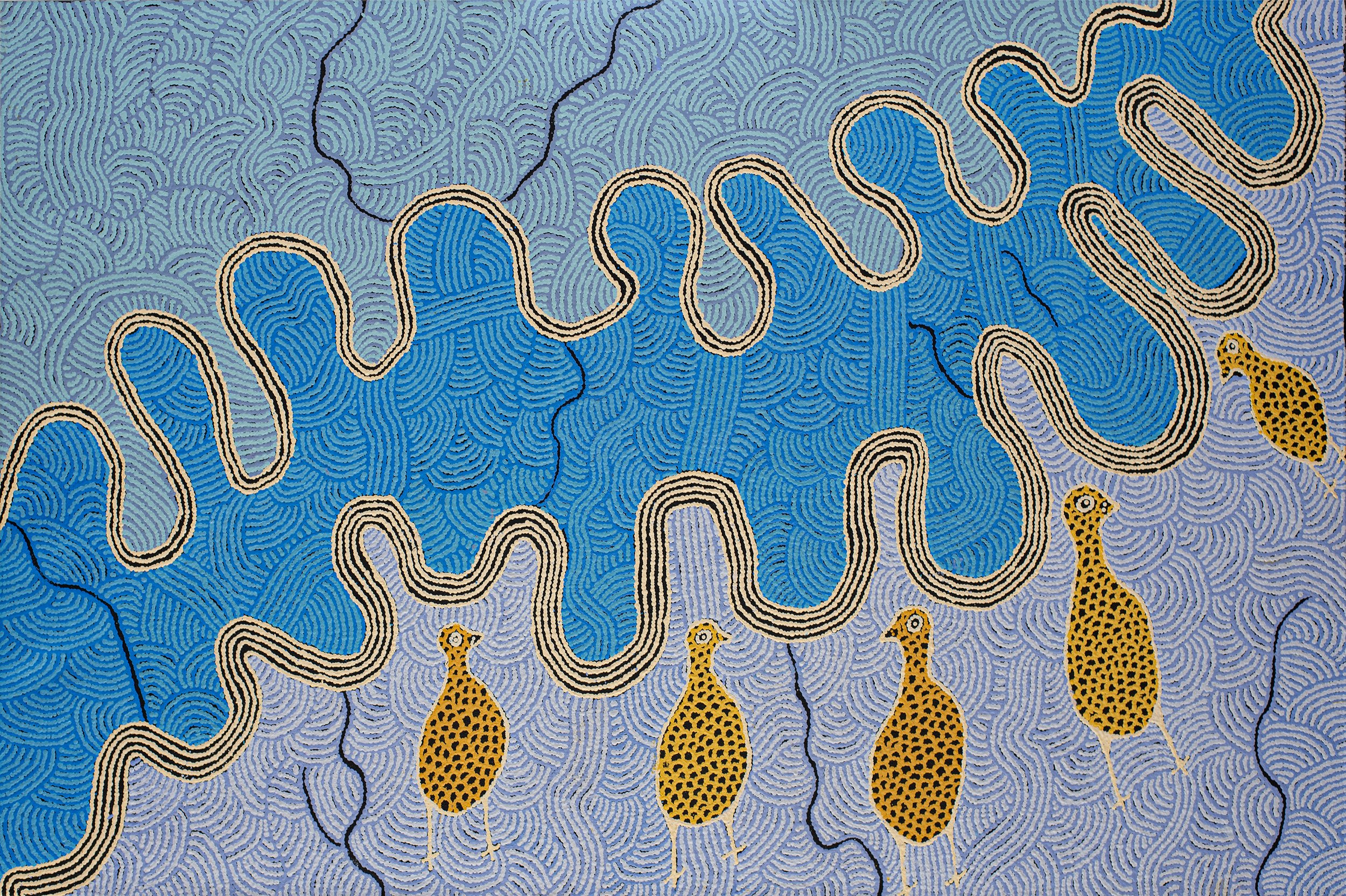
Artiste : Carlene Thompson (1950)
Titre de l'œuvre : Kalaya ngura
Format : 183 x 120 cm
Provenance et certificat : centre d'art d'Ernabella
Référence de cette peinture d'art Aborigène : 567-23
Explanations of this Aboriginal painting :
Emu Country. This painting depicts Carlene's family's country, near Kanypi in the Western APY Lands. It is the country of the emu, meaning the emu (kalaya) is the ancestral being who formed that part of the country.
That Kalaya travelled from Kanpi to Watarru. It is very typical for the Kalaya to have many children, like Carlene, who had six children.
Her artworks are in the prestigious following collections :
Goulburn Regional Art Gallery, 2016
Queensland Art Gallery, Brisbane, Qld
Awards :
2019 National Aboriginal and Torres Strait Islander Art Award, Finalist
2019 Australia Council for the Art: Art project for individuals recipient
2018 Quick Response Grant Country Arts SA: Contact, Connection and Conversation
2018 National Aboriginal and Torres Strait Islander Art Award, Finalist
2016 Finalist (collaborative), National Aboriginal and Torres Strait Islander Art Award

Artiste : Margaret Inyika Wells
Titre de l'œuvre : Margaret’s Father’s Country
Format : 101 x 50 cm
Provenance et certificat : centre d'art aborigène d’Ernabella
Référence de cette peinture aborigène : 203-24
Explication sur cette œuvre :
My father’s place is Mt. Liebe, sandhill country. The Wanapi rests there under the surface of the creek. When we go to visit that country, the Wanapi stirs underneath the ground and bubbles rise up in the water. He is there to protect that place. We speak to that Wanapi in our language and he knows then that it is us. It’s okay for us to be there and the bubbles settle back down. Close to this creek is where the Arkaryi women are sitting. This is an important women’s site. I can’t speak too much about that, as it would be dangerous to disturb those women.

Artiste : Atipalku Intjalki (1955)
Titre de l'œuvre : Tjukurpa Mulayangu
Format : 150 x 92 cm
Provenance et certificat : centre d'art aborigène d’Ernabella
Référence de cette peinture aborigène : 123-24
Explication sur cette œuvre :
Tjukurpa Mulayangu is a men’s law place. They made this place and campsite. Mulayangu made this place. Over in the west is the other side of Amata which is my father’s country. This is a sacred place called Tankalanya. This is all I can say.

Artiste : Yanyi Dunn
Titre de l'œuvre : Tjukurpa Mulayangu
Format : 120 x 90 cm
Provenance et certificat : centre d'art aborigène d’Ernabella
Référence de cette peinture aborigène : 125-24
Explication sur cette œuvre :
For the Pitjantjatjara people living in the desert, knowledge of their water sources was critical to their survival. This resulted in an intimate understanding of the landscape which continues today. Water is an essential element in the desert. These rock holes were particularly important during the dry season when most of the water holes and creeks dried up. Deep familiarity with the topography of their country and the way rain would interact with the land ensured constant sources of water could be found. Knowledge of rock hole sites is passed on from generation to generation and revered by all Anangu (people).
Tjukula means rock-holes, which are found with surprising frequency in the Musgrave Ranges and country around Ernabella. Between visits, Anangu would use a construction of rocks and spinifex to guard these important water sources from spoilage by feral and stock animals such as cattle, camels, horses and donkeys.
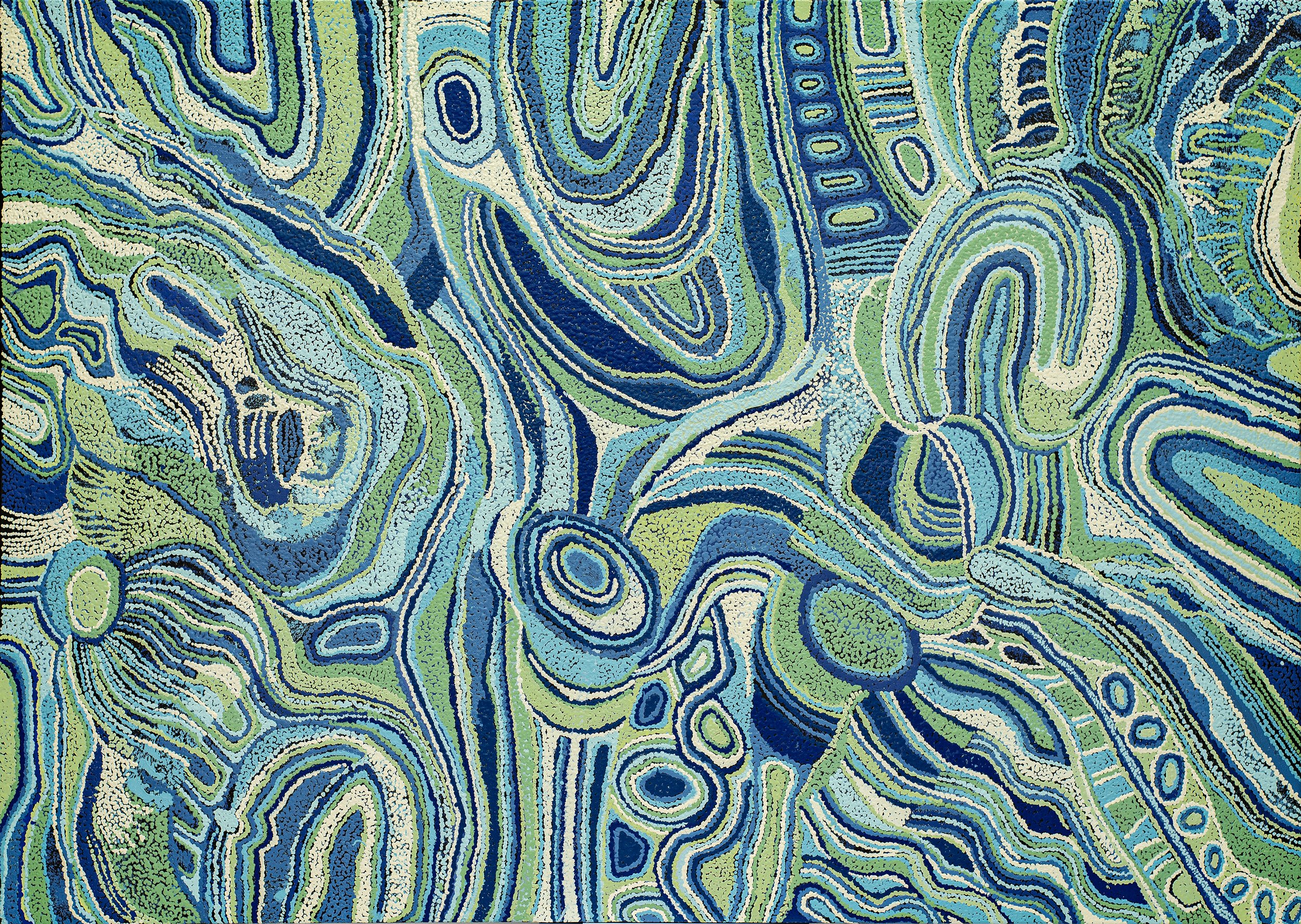
Artiste : Langaliki Lewis
Titre : Tali / Sand dune
Format : 175 x 124 cm
Provenance et certificat : centre d'art aborigène d’Ernabella
Référence de cette peinture aborigène : 110-24
Explication sur cette œuvre :
Painting by Langaliki Lewis (1973). For the Pitjantjatjara people living in the desert, knowledge of their water sources was critical to their survival.
This is a depiction of the artists' country. The different colours and designs represent variations in the landscape.
This resulted in an intimate understanding of the landscape which continues today. Deep familiarity with the topography of their country and the way rain would interact with the land ensured constant sources of water could be found. 'Tjukula' means rock-holes, which are found with surprising frequency in the Musgrave ranges.
Between visits, Anangu (people) would use rocks and spinifex construction to guard these from spoilage by animals and, particularly in more recent times, from feral and stock animals, cattle, camels, horses and donkeys.

Artiste : Mukayi Baker
Titre de l'œuvre : Piltati
Format : 200 x 121 cm
Provenance et certificat : centre d'art aborigène d’Ernabella
Référence de cette peinture aborigène : 566-22
Explication sur cette œuvre :
There were two sisters who married two brothers and they all lived together. One day the women went wandering and they went such a long way that they forgot about their husbands. Back at the camp, the two husbands were thinking, 'Where are our wives?' and they decided to go looking for them. One brother said to the other, 'What should we become to go looking for them?' and the other brother said 'Why don't we become Rainbow Serpents?' And they travelled in the sky looking down for their wives. Finally they see them hunting for carpet snakes and they put something in the hole where the women were digging. The women find it and then dig another hole and once again the men have put something in there. And this is how the men lure the women back to Piltati where the men make the sisters transform into Wanampi, swallow them and keep them in their throats. All four of them live together in the waterhole and still live there today.

Artiste : Katrina Tjitayi
Titre de l'œuvre : Pukara Tjukurpa - Katrina's Story
Format : 188 x 153 cm
Provenance et certificat : centre d'art aborigène d’Ernabella
Référence de cette peinture aborigène : 70-24
Explication sur cette œuvre :
Tjukurpa Mulayangu is a men’s law place. They made this place and campsite. Mulayangu made this place. Over in the west is the other side of Amata which is my father’s country. This is a sacred place called Tankalanya. This is all I can say.

Artiste : Elizabeth Dunn
Titre de l'œuvre : Elizabeth Dunn's story
Format : 198 x 152 cm
Provenance et certificat : centre d'art aborigène d’Ernabella
Référence de cette peinture aborigène : 165-24
Explication sur cette œuvre :
Piltati is Elizabeth’s great-grandfather's country and her dreaming story. Two brothers were married to two sisters and they all lived together. One day the two men go out hunting, looking for malu (kangaroo). They travel everywhere and find nothing. They start to worry - what are we going to do, there is no meat on this land. One brother says, maybe we should turn into something. They start to think about what they should turn into. Maybe firewood? No, the firewood burns. Maybe emu or a bird? No, people eat them.
They do a lot of talking and decide they should turn into wanampi (rainbow serpents). A lot of smoke starts to come out of the ground, it is very scary and then the men become wanampi. They travel into the land, towards a rockhole.
Meanwhile, the two women are waiting for their husbands to return from their hunting trip. They wait a very long time. They keep going on with their lives, collecting bush tucker, waiting…but the men never come back. So they decide to set out to find their husbands. One day they come across a hole in the ground. They start digging. Digging, digging, digging they follow the tunnel inside the ground. They are so frantically digging they accidently hit one of the wanampi in the back.
The wanampi chase the ladies and eat one of them and one woman gets away. Now the wanampi still live in the waterhole called Piltati. The wanampi live there today and provide rain for the bush tucker to grow and provide meat on the land.

Artiste : Janet Tjitayi
Titre de l'œuvre : Piltati
Format : 170 x 84 cm
Provenance et certificat : centre d'art aborigène d’Ernabella
Référence de cette peinture aborigène : 196-24
Explication sur cette œuvre :
There were two sisters who married two brothers and they all lived together. One day the women went wandering and they went such a long way that they forgot about their husbands. Back at the camp, the two husbands were thinking, 'Where are our wives?' and they decided to go looking for them. One brother said to the other, 'What should we become to go looking for them?' and the other brother said 'Why don't we become Rainbow Serpents?' And they travelled in the sky looking down for their wives. Finally they see them hunting for carpet snakes and they put something in the hole where the women were digging. The women find it and then dig another hole and once again the men have put something in there. And this is how the men lure the women back to Piltati where the men make the sisters transform into Wanampi, swallow them and keep them in their throats. All four of them live together in the waterhole and still live there today.

Artiste : Lynette Lewis
Titre de l'œuvre : Womikata Walka Tali / Sand dune
Format : 170 x 100 cm
Provenance et certificat : centre d'art d'Ernabella
Référence de la peinture : 71-24
Vendue
Explications sur cette peinture Aborigène :
Lynette's design is inspired by the ripples created by wind in the sand at the large, red sand dune named Wornikata near Ernabella. Womikata is a popular place for looking for maku (witchetty grubs) and also for teaching Milpatjunanyi (telling stories in the sand) to children.

Artiste : Janice Stanley
Titre de l'œuvre : Pantu (Salt lake)
Format : 150 x 100 cm
Provenance et certificat : centre d'art aborigène d’Ernabella
Référence de cette peinture aborigène : 541-23
Explication sur cette œuvre :
Painting by the artist Janice Stanley (1987).
Janice Stanley is the third generation of Stanley women to create artwork at Ernabella Arts. She is an early career painter and ceramic artist showing greatpromise.Her grandmother is founding artist and traditional healer Tjariya Stanley and her aunts are senior artists, Alison Milyika Carroll and Renita Stanley.Janice is part of a group of young women leading the Ernabella ceramics studio, despite only commencing work in late 2015. She has been exhibitedaround Australia and internationally, in Darwin, Alice Springs, Broome, Sydney and Brussels.
A very significant tjurkurpa (story) to Anangu is Kungkarangkalpa (Seven Sisters) which is an extensive creation story relating to the Pleiades constellation. The story traverses Australia taking different forms, but local women are privy to the part of the story which takes place in the country near Ernabella. In her paintings Janice is depicting a salt lake near Attila (Mt Connor), a landmark in the Seven Sisters story.
The artworks of the artist are in the following collections :
Australian Embassy in Zagreb
Private collection

Artiste : Alison Lionel
Titre de l'œuvre : Tjutirangu Punu - Rainbow Tree
Format : 150 x 100 cm
Provenance et certificat : centre d'art d'Ernabella
Référence de cette peinture d'art Aborigène : 44-24
Explanations of this Aboriginal painting :
Alison is a quiet observer. She often walks gently around the community with her daughter on her shoulders looking at nature. Something she has been paying attention to is the movement of light on the trees. “I see the colour on the tree and I see it is always changing. When the sun is going down, colour is moving all over the tree”.
Her paintings are inspired by the light catching the shifts and wandering lines of the bark.

Artiste : Daisybell Kulyuru
Titre de l'œuvre : Minyma Kutjara (Two Women Near Ernabella)
Format : 120 x 100 cm
Provenance et certificat : centre d'art d'Ernabella
Référence de cette peinture d'art Aborigène : 569-23
Explanations of this Aboriginal painting :
There are many stories about the two sisters (Minyma Kutjara). This part of the story is siginificant to the women of Ernabella. There was a gathering of minyma mingkiri (mouse women) at a hill called Yunanpa, which is near Ngarutjara (to the north of Ernabella). They are all collecting bushfoods together when the two sisters decide to go travelling. They travel to several water places to the north and east of Ernabella including Alalka. They keep going until they get to Wamitjara, a waterhole near Kenmore park. Here they come across a man sleeping. They hit him over the head with their wana (digging stick) and knock him unconscious. Then they tie up his arms and legs and head towards Alice Springs, carrying him between them. They sing and dance sacred women's stories all the way. They leave him at Stuart's Well, and continue on to Alice Springs to meet up with a large group of women.

Artiste : Yurpiya Lionel
Titre de l'œuvre : Anumara - Caterpillar
Format : 125 x 70 cm
Provenance et certificat : centre d'art d'Ernabella
Référence de la peinture : 117-24
Explications sur cette peinture Aborigène :
Yurpiya is painting a place called Anumara, which is a place near Irrunytju (Wingellina) in WA. This is Yurpiya's family's country. Anumara is also the name for a kind of caterpillar and Anumara is the tjukurpa (dreaming) place for this caterpillar. This caterpillar lives in the grass and can be eaten if the grass it eats is removed. The place shares the same colours of the caterpillar - brown, yellow and pale green. Keeping this place safe will ensure that the caterpillars multiply.
Her artworks are included in the following collections :
- University Of Newcastle, 2011
- Private collections in Europe and Australia

Artiste : Carlene Thompson (1950)
Titre de l'œuvre : Kalaya Ngura - Emu Country
Format : 197 x 121 cm
Provenance et certificat : centre d'art d'Ernabella
Référence de cette peinture d'art Aborigène : 160-24
Explanations of this Aboriginal painting :
Emu Country. This painting depicts Carlene's family's country, near Kanypi in the Western APY Lands. It is the country of the emu, meaning the emu (kalaya) is the ancestral being who formed that part of the country.
That Kalaya travelled from Kanpi to Watarru. It is very typical for the Kalaya to have many children, like Carlene, who had six children.
Her artworks are in the prestigious following collections :
Goulburn Regional Art Gallery, 2016
Queensland Art Gallery, Brisbane, Qld
Awards :
2019 National Aboriginal and Torres Strait Islander Art Award, Finalist
2019 Australia Council for the Art: Art project for individuals recipient
2018 Quick Response Grant Country Arts SA: Contact, Connection and Conversation
2018 National Aboriginal and Torres Strait Islander Art Award, Finalist
2016 Finalist (collaborative), National Aboriginal and Torres Strait Islander Art Award

Artiste : Makinti Minutjukur
Titre de l'œuvre : Waterholes Makinti’s Story
Format : 152 x 122 cm
Provenance et certificat : centre d'art aborigène d’Ernabella
Référence de cette peinture aborigène : 132-24
Explication sur cette œuvre :
Makinti is painting the country around Ernabella featuring tjukuḻa (rockholes), kapi (water), tjanpi (grass), puli (hills) and karu (creek). She is depicting ngura tjuta, lots of places, including Wamikata (a large red sand dune) and Itjinpiri (a local waterhole).

Artiste : Freddy Ken
Titre de l'œuvre : Kulata Tjuta - Many Spears
Format : 121 x 50 cm
Provenance et certificat : centre d'art aborigène d’Ernabella
Référence de cette peinture aborigène : 476-23
Explication sur cette œuvre :
Freddy is painting his grandfather's country in far west South Australia. He depicts kulata tjuta (many spears) travelling through the sky to catch wati wanampi (snake man). Those wati wanampi are moving fast through the sky. There was one woman waiting there with a baby and she said there was a wati who was nearby hiding in a bush, ready to duck down and go and then throw those spears.

Artiste : Freddy Ken
Titre de l'œuvre : Kungkarangkalpa - Rainbow Story
Format : 150 x 100 cm
Provenance et certificat : centre d'art aborigène d’Ernabella
Référence de cette peinture aborigène : 209-24
Explication sur cette œuvre :
Kungkarangkalpa means the Seven Sisters. This is an extensive creation story that relates to the Pleiades constellation in the southern hemisphere. The story traverses Australia taking on different forms, however local Aṉangu are privy to the part of the story which takes place in the country near Ernabella.
For this part of the story, a man called Nyiru is chasing the sisters as he wants to sleep with the oldest sister. All the younger sisters are deeply afraid of him. Nyiru uses magic to create a rainbow in the sky and the younger sisters are in awe looking at it. But the eldest sister is ninti (clever) and knows that it is that wati kura (bad man) and tells the sisters – ara! (run away!) so that he doesn’t catch them.
Eventually, to escape Nyiru, the sisters fly into the sky where they turn into stars and form the constellation.

Artiste : Freddy Ken
Titre de l'œuvre : Kulata Tjuta - Many Spears
Format : 90 x 75 cm
Provenance et certificat : centre d'art aborigène d’Ernabella
Référence de cette peinture aborigène : 521-23
Explication sur cette œuvre :
Freddy is painting his grandfather's country in far west South Australia. He depicts kulata tjuta (many spears) travelling through the sky to catch wati wanampi (snake man). Those wati wanampi are moving fast through the sky. There was one woman waiting there with a baby and she said there was a wati who was nearby hiding in a bush, ready to duck down and go and then throw those spears.

Artiste : Rachael Mipantjiti Lionel
Titre de l'œuvre : Kapi Wankanya
Format : 197 x 86 cm
Provenance et certificat : centre d'art aborigène d’Ernabella
Référence de cette peinture aborigène : 166-24
Explication sur cette œuvre :
Rachael comes from the third generation of Lionel women painting at Ernabella Arts. Rachael draws inspiration for her paintings from the stories and messages she receives through her dreams. Kapi Wankanya represents one of these dreams and tells a story of living water, sacred water. In the context of the dream, Rachael speaks of the sensation of floating in water and also feeling its healing force inside her body. “Kapi Wankanya is a powerful water story."
Découvrez les céramiques de l’exposition

Artiste : Elizabeth Dunn
Titre de l'œuvre : Kampurarpa Tjukurpa - Elizabeth's Story
Format : 40 x 35,5 cm
Provenance et certificat : centre d'art d'Ernabella
Référence de la céramique : 368C-23
Explications sur cette céramique Aborigène :
Kampurarpa are bush tomatoes. Elizabeth’s work comments on the environmental change that has occurred on her country due to the introduction of non-native fauna such as cattle, and flora, notably weeds like buffel grass. Buffel grass is so widespread and destructive that it is commonly known in and around Pukatja as tjanpi mamu or devil grass.
From the very start of Elizabeth’s artistic practice she has drawn her kampurarpa tjukurpa (bush tomato story) in clay. In the old times kampurarpa were one of the main foods for Anangu.
I’ve seen the land change. We used to have a lot of flowers. We used to go out to the bush to collect bush tucker, like kampurarpa (bush tomatoes). And now there’s a lot of buffel grass everywhere. The land is changed by the buffel grass.
Now there’s no more flowers – no purple flowers, yellow flowers, white or pink flowers. I’ve seen it. When all the cattle and the sheep and the goats came, the kangaroos left and went a long way away. They saw the strange animals and they left.
That’s a true story. Today, sometimes we still go out and collect kampurarpa but not like we did before. Our country has been changed by cattle and weeds like buffel grass, so we can’t find all the old foods like we once did. I’ll keep telling the kampurarpa story in my work, that keeps the stories, songs and dances about these important foods alive and strong.

Artiste : Yaritji Jack
Titre de l'œuvre : Putipulawa Putitja - Wildflowers
Format : 22 x 14 cm
Provenance et certificat : centre d'art d'Ernabella
Référence de la céramique : 467C-23
Explications sur cette céramique Aborigène :
This design is based on the many native flowers that grow locally in Pukatja and through the Musgrave Ranges. When we go out to the bush, we see all the different colours from many plants growing. Flowers are important to the women and the health of the land, and much excitement is felt as they burst into life.

Artiste : Melissa Lewis
Titre de l'œuvre : Ngayuku Walka / My Design
Format : 14,5 x 13 cm
Provenance et certificat : centre d'art d'Ernabella
Référence de la céramique : 734C-23
Explications sur cette céramique Aborigène :
Walka means design or pattern. Artists use this title to describe artworks that are pattern based rather than descriptive or telling a story.

Artiste : Carlene Thompson
Titre de l'œuvre : Kalaya Ngura - Emu Country
Format : 52 x 27,5 cm
Provenance et certificat : centre d'art d'Ernabella
Référence de la céramique : 360C-23
Explications sur cette céramique Aborigène :
This artwork depicts Carlene's family's country which is near Kanpi in the Western APY Lands. The emu (kalaya) is the ancestral being who formed that part of the country as it travelled from Kanpi to Watarru.
Carlene is a senior artist and woman in the Ernabella community. Her artworks are about tjulpu tjuta (birds). It is very typical for the kalaya to have many children, like Carlene who had six children when she was a younger woman. People call her Tjulpu Thompson, and she says ‘like I did with my children, I now raise chicks every day on canvas and in clay in my work’.

Artiste : Carlene Thompson
Titre de l'œuvre : Kalaya Ngura - Emu Country
Format : 27,5 x 18,5 cm
Provenance et certificat : centre d'art d'Ernabella
Référence de la céramique : 111C-24
Explications sur cette céramique Aborigène :
This artwork depicts Carlene's family's country which is near Kanpi in the Western APY Lands. The emu (kalaya) is the ancestral being who formed that part of the country as it travelled from Kanpi to Watarru.
Carlene is a senior artist and woman in the Ernabella community. Her artworks are about tjulpu tjuta (birds). It is very typical for the kalaya to have many children, like Carlene who had six children when she was a younger woman. People call her Tjulpu Thompson, and she says ‘like I did with my children, I now raise chicks every day on canvas and in clay in my work’.

Artiste : Anne Nginyangka Thompson
Titre de l'œuvre : Strong Family Connection
Format : 20 x 16,5 cm
Provenance et certificat : centre d'art d'Ernabella
Référence de la céramique : 159C-24
Explications sur cette céramique Aborigène :
This is a story of how life was before. It’s a beautiful landscape without problems like we have today. There were no problems then, people were happy. They were connected as families. It shows what life was like for our people in the past before we had houses. Everything was silent, and all the animals were close by to the people. Everyone looked after the animals and the environment. People don’t have that life anymore.

Artiste : Marissa Angapiya Thompson
Titre de l'œuvre : Ikarka - Spotted Bowerbird
Format : 15 x 12,5 cm
Provenance et certificat : centre d'art d'Ernabella
Référence de la céramique : 76C-24
Explications sur cette céramique Aborigène :
When I was a little kid me and my family used to go hunting for tjala (honey ants) in the bush and we used to see a lot of ikarka under the mulga trees. The birds were collecting snails and little shiny things like glass, necklace, anything that shines, sometimes even money. Those birds collect anything and everything that’s pretty.
Ikarka have a big nest in the long grass and they sit in the middle. They hide the shiny things under the snail shells. We used to move the snails and find the things they’ve hidden. Dad always said ‘go and play in the bush and you might get lucky’ and I did, I found $1 and $2 coins.

Artiste : Carlene Thompson
Titre de l'œuvre : Kalaya Ngura - Emu Country
Format : 32 x 16,5 cm
Provenance et certificat : centre d'art d'Ernabella
Référence de la céramique : 144C-24
Explications sur cette céramique Aborigène :
This artwork depicts Carlene's family's country which is near Kanpi in the Western APY Lands. The emu (kalaya) is the ancestral being who formed that part of the country as it travelled from Kanpi to Watarru.
Carlene is a senior artist and woman in the Ernabella community. Her artworks are about tjulpu tjuta (birds). It is very typical for the kalaya to have many children, like Carlene who had six children when she was a younger woman. People call her Tjulpu Thompson, and she says ‘like I did with my children, I now raise chicks every day on canvas and in clay in my work’.

Artiste : Marissa Angapiya Thompson
Titre de l'œuvre : Ikarka - Spotted Bowerbird
Format : 32,5 x 14,5 cm
Provenance et certificat : centre d'art d'Ernabella
Référence de la céramique : 170C-24
Explications sur cette céramique Aborigène :
When I was a little kid me and my family used to go hunting for tjala (honey ants) in the bush and we used to see a lot of ikarka under the mulga trees. The birds were collecting snails and little shiny things like glass, necklace, anything that shines, sometimes even money. Those birds collect anything and everything that’s pretty.
Ikarka have a big nest in the long grass and they sit in the middle. They hide the shiny things under the snail shells. We used to move the snails and find the things they’ve hidden. Dad always said ‘go and play in the bush and you might get lucky’ and I did, I found $1 and $2 coins.

Artiste : Nicole Rupert
Titre de l'œuvre : Nicole's Tjitji Tjuta Inkunyi / Many Children Playing
Format : 13 x 16,5 cm
Provenance et certificat : centre d'art d'Ernabella
Référence de la céramique : 153C-24
Explications sur cette céramique Aborigène :
Nicole’s grandmother, Nura Rupert, was a highly regarded Ernabella artist who passed away in 2016. Nura had a great sense of humour and wild imagination, and her artistic style was uniquely quirky. Nicole is inspired by her grandmother’s style and wants to keep her very original interpretation of the world alive in her own artworks.
Tjitji Tjuta Inkunyi depicts lots of children playing together.

Artiste : Tjimpuna Williams
Titre de l'œuvre : Kapi Wala - Spring
Format : 17,5 x 16,5 cm
Provenance et certificat : centre d'art d'Ernabella
Référence de la céramique : 779C-22
Explications sur cette céramique Aborigène :
Nicole’s grandmother, Nura Rupert, was a highly regarded Ernabella artist who passed away in 2016. Nura had a great sense of humour and wild imagination, and her artistic style was uniquely quirky. Nicole is inspired by her grandmother’s style and wants to keep her very original interpretation of the world alive in her own artworks.
Tjitji Tjuta Inkunyi depicts lots of children playing together.

Artiste : Bernadine Lewis
Titre de l'œuvre : Ngayuku Walka / My Design
Format : 25 x 12 cm
Provenance et certificat : centre d'art d'Ernabella
Référence de la céramique : 359C-23
Explications sur cette céramique Aborigène :
Walka means design or pattern. Artists use this title to describe artworks that are pattern based rather than descriptive or telling a story.
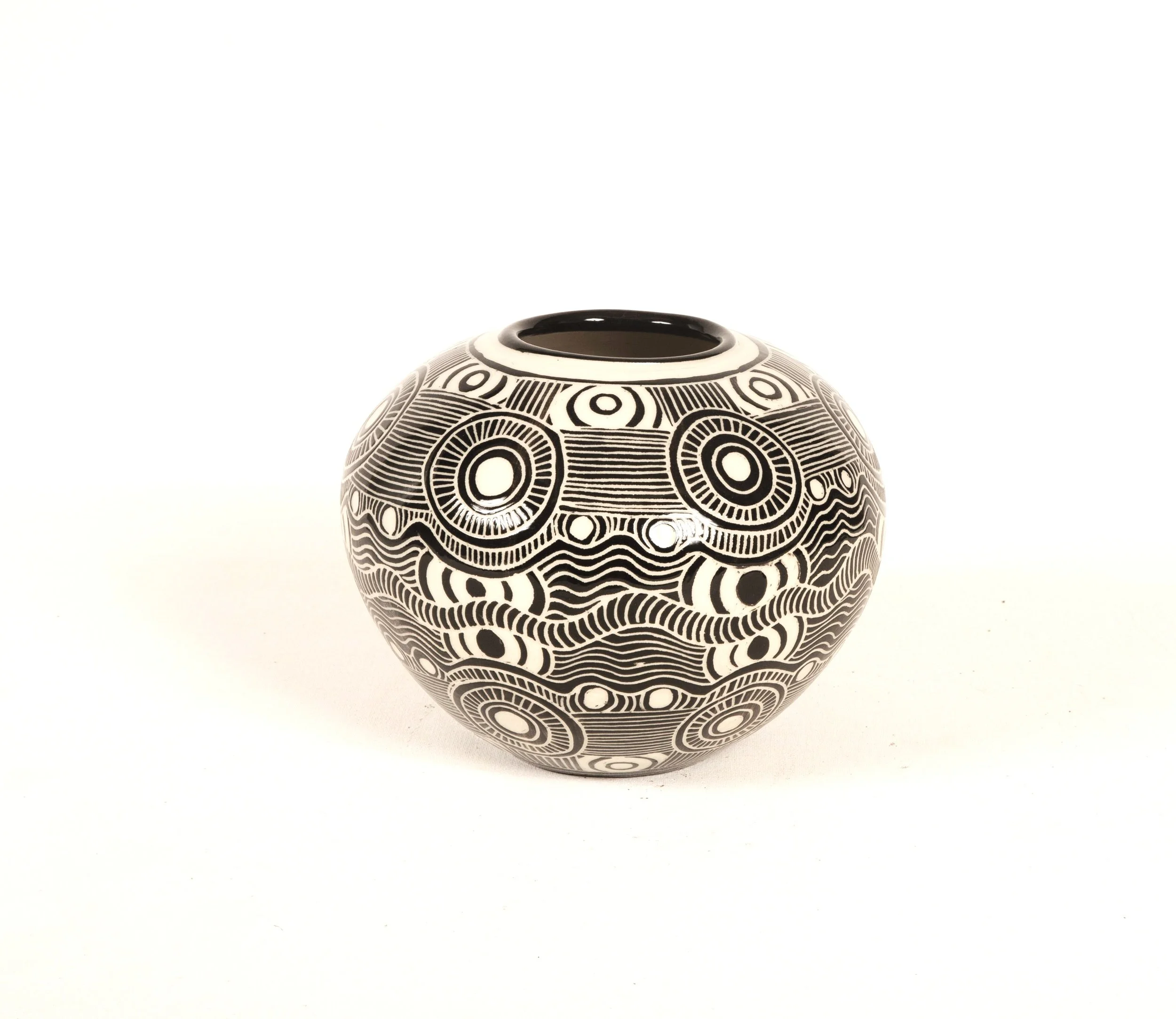
Artiste : Tjimpuna Williams
Titre de l'œuvre : Tjulpun-tjulpunpa / Wild or desert flower
Format : 23 x 18,5 cm
Provenance et certificat : centre d'art d'Ernabella
Référence de la céramique : 823C-22
Explications sur cette céramique Aborigène :
This is a design based on the many native flowers which grow locally in the Musgrave ranges. Flowers are important to the women and much excitement is felt as they burst into life in the country. The arrival of flowers indicates abundance and that various bush foods and medicines will now be available.

Artiste : Melissa Lewis
Titre de l'œuvre : Ngayuku Ngura – My Country
Format : 24 x 13 cm
Provenance et certificat : centre d'art d'Ernabella
Référence de la céramique : 361C-23
Explications sur cette céramique Aborigène :
Artists use this title when they are depicting their Country. It might be a representation of a particular place or of different aspects of that area. The artist uses a combination of colour and design to indicate variations in the landscape. Inspiration is drawn from all elements of Country and might include bush tucker, water holes, meeting places, rock formation, birds or animals.

Artiste : Melissa Lewis
Titre de l'œuvre : Ngayuku Ngura – My Country
Format : 21 x 14 cm
Provenance et certificat : centre d'art d'Ernabella
Référence de la céramique : 206C-23
Explications sur cette céramique Aborigène :
This is a design based on the many native flowers which grow locally in the Musgrave ranges. Flowers are important to the women and much excitement is felt as they burst into life in the country. The arrival of flowers indicates abundance and that various bush foods and medicines will now be available.

Artiste : Jayanna Andy
Titre de l'œuvre : Tjukula/Waterholes
Format : 18 x 17,5 cm
Provenance et certificat : centre d'art d'Ernabella
Référence de la peinture : 716C-22
Explications sur cette céramique Aborigène :
For the Pitjantjatjara people living in the desert, knowledge of their water sources was critical to their survival. This resulted in an intimate understanding of the landscape which continues today. Deep familiarity with the topography of their country and the way rain would interact with the land ensured constant sources of water could be found. 'Tjukula' means rock-holes, which are found with surprising frequency in the Musgrave ranges.
Between visits, Anangu (people) would use rocks and spinifex construction to guard these from spoilage by animals and, particularly in more recent times, from feral and stock animals, cattle, camels, horses and donkeys.

Artiste : Tjunkaya Tapaya OAM
Titre de l'œuvre : Kungkarangkalpa / Seven Sisters
Format : 23,5 x 25,5 cm
Provenance et certificat : centre d'art d'Ernabella
Référence de la peinture : 729C-22
Explications sur cette céramique Aborigène :
Kungkarangkalpa means the Seven Sisters. This is an extensive creation story that relates to the Pleiades constellation in the southern hemisphere. The story traverses Australia taking on different forms, however local women are privy to the part of the story which takes place in the country near Ernabella. For this part of the story, the man called Nyiru is chasing the sisters as he wants to sleep with the oldest sister. All the younger sisters are deeply afraid of him. As Nyiru is chasing the sisters, he tries to catch them by using magic to turn himself into the most tempting bush tomatoes for the sisters to eat and the most beautiful ili (fig) tree for the sisters to camp under. However, the sisters are aware of his magic and go hungry and run through the night rather than be caught by Nyiru. Eventually, to escape Nyiru, the sisters fly into the sky where they turn into stars and form the constellation.

Artiste : Jayanna Andy
Titre de l'œuvre : Tjukula/Waterholes
Format : 20,5 x 18,5 cm
Provenance et certificat : centre d'art d'Ernabella
Référence de la peinture : 714C-22
Explications sur cette céramique Aborigène :
For the Pitjantjatjara people living in the desert, knowledge of their water sources was critical to their survival. This resulted in an intimate understanding of the landscape which continues today. Deep familiarity with the topography of their country and the way rain would interact with the land ensured constant sources of water could be found. 'Tjukula' means rock-holes, which are found with surprising frequency in the Musgrave ranges.
Between visits, Anangu (people) would use rocks and spinifex construction to guard these from spoilage by animals and, particularly in more recent times, from feral and stock animals, cattle, camels, horses and donkeys.

Artiste : Rupert Jack
Titre de l'œuvre : Maku Maku - Mr Jack's Story
Format : 18,5 x 18 x 8,5 cm
Provenance et certificat : centre d'art d'Ernabella
Référence de la peinture : 516C-22
Explications sur cette céramique Aborigène :
The story about maku (witchetty grub) is as vast and winding as their tracks depicted in my artwork. It’s a story that I need to hold onto, to keep it safe. It’s important for me to keep some of these stories a secret, so I will tell a safe version that isn’t dangerous for you to hear. I will tell it from another perspective.
These important stories like this maku tjukurpa (story) inform my artwork and help Anangu to understand our history. Maku is important for Anangu as a source of good food and also shows us an example of how beings can evolve and grow in positive ways. If the Maku travel underground for a long time they eventually make it out of the root systems of those trees and grow nyalpi (wings) and start a new way of being. They evolve. They shed their old ways and become new again.
As a pastor, I can see strong connections between our tjukurpa and the Bible. Long before Jesus, there was Tjukurpa and God together. I can see that God was always with us, in our stories; Jesus came later. I am trying to pass all this knowledge on to our young people to keep our stories alive. We need to hold on tight to tjukurpa; to keep it safe.

Artiste : Rupert Jack
Titre de l'œuvre : Maku Maku - Mr Jack's Story
Format : 18,5 x 17 x 10 cm
Provenance et certificat : centre d'art d'Ernabella
Référence de la peinture : 565C-22
Explications sur cette céramique Aborigène :
The story about maku (witchetty grub) is as vast and winding as their tracks depicted in my artwork. It’s a story that I need to hold onto, to keep it safe. It’s important for me to keep some of these stories a secret, so I will tell a safe version that isn’t dangerous for you to hear. I will tell it from another perspective.
These important stories like this maku tjukurpa (story) inform my artwork and help Anangu to understand our history. Maku is important for Anangu as a source of good food and also shows us an example of how beings can evolve and grow in positive ways. If the Maku travel underground for a long time they eventually make it out of the root systems of those trees and grow nyalpi (wings) and start a new way of being. They evolve. They shed their old ways and become new again.
As a pastor, I can see strong connections between our tjukurpa and the Bible. Long before Jesus, there was Tjukurpa and God together. I can see that God was always with us, in our stories; Jesus came later. I am trying to pass all this knowledge on to our young people to keep our stories alive. We need to hold on tight to tjukurpa; to keep it safe.

Artiste : Rupert Jack
Titre de l'œuvre : Maku Maku - Mr Jack's Story
Format : 18 x 16 x 7,5 cm
Provenance et certificat : centre d'art d'Ernabella
Référence de la peinture : 566C-22
Explications sur cette céramique Aborigène :
The story about maku (witchetty grub) is as vast and winding as their tracks depicted in my artwork. It’s a story that I need to hold onto, to keep it safe. It’s important for me to keep some of these stories a secret, so I will tell a safe version that isn’t dangerous for you to hear. I will tell it from another perspective.
These important stories like this maku tjukurpa (story) inform my artwork and help Anangu to understand our history. Maku is important for Anangu as a source of good food and also shows us an example of how beings can evolve and grow in positive ways. If the Maku travel underground for a long time they eventually make it out of the root systems of those trees and grow nyalpi (wings) and start a new way of being. They evolve. They shed their old ways and become new again.
As a pastor, I can see strong connections between our tjukurpa and the Bible. Long before Jesus, there was Tjukurpa and God together. I can see that God was always with us, in our stories; Jesus came later. I am trying to pass all this knowledge on to our young people to keep our stories alive. We need to hold on tight to tjukurpa; to keep it safe.

Artiste : Nicole Rupert
Titre de l'œuvre : Nicole's Papa Tjuta Tjukurpa (Camp Dog Story)
Format : 20 x 12 cm
Provenance et certificat : centre d'art d'Ernabella
Référence de la peinture : 647C-22
Explications sur cette céramique Aborigène :
Nicole’s grandmother, Nura Rupert, was a highly regarded Ernabella artist who passed away in 2016. Nura had a great sense of humour and wild imagination, and her artistic style was uniquely quirky. Nicole is inspired by her grandmother’s style and wants to keep her very original interpretation of the world alive in her own artworks.
One of Nura's favourite stories to paint was about all the camp dogs in Ernabella. ‘Papa tjuta ngura uwankara’ she used to say ‘there are many dogs everywhere!’. Some people have as many as ten dogs each as companions.
This is Nicole’s depiction of the Ernabella camp dogs.

Artiste : Tjulyata Kulyuru
Titre de l'œuvre : Maku Maku - Mr Jack's Story
Format : 18 x 11,5 cm
Provenance et certificat : centre d'art d'Ernabella
Référence de la peinture : 601C-22
Explications sur cette céramique Aborigène :
For the Pitjantjatjara people living in the desert, knowledge of their water sources was critical to their survival.
This resulted in an intimate understanding of the landscape which continues today. Water is an essential element in the desert. These rock holes were particularly important during the dry season when most of the water holes and creeks dried up. Deep familiarity with the topography of their country and the way rain would interact with the land ensured constant sources of water could be found. Knowledge of rock hole sites is passed on from generation to generation and revered by all Anangu (people).
Tjukula means rock-holes, which are found with surprising frequency in the Musgrave Ranges and country around Ernabella. Between visits, Anangu would use a construction of rocks and spinifex to guard these important water sources from spoilage by feral and stock animals such as cattle, camels, horses and donkeys.

Artiste : Tjunkaya Tapaya OAM
Titre de l'œuvre : Kungkarangkalpa / Seven Sisters
Format : 26 x 20 cm
Provenance et certificat : centre d'art d'Ernabella
Référence de la peinture : 730C-22
Explications sur cette céramique Aborigène :
Kungkarangkalpa means the Seven Sisters. This is an extensive creation story that relates to the Pleiades constellation in the southern hemisphere. The story traverses Australia taking on different forms, however local women are privy to the part of the story which takes place in the country near Ernabella. For this part of the story, the man called Nyiru is chasing the sisters as he wants to sleep with the oldest sister. All the younger sisters are deeply afraid of him. As Nyiru is chasing the sisters, he tries to catch them by using magic to turn himself into the most tempting bush tomatoes for the sisters to eat and the most beautiful ili (fig) tree for the sisters to camp under. However, the sisters are aware of his magic and go hungry and run through the night rather than be caught by Nyiru. Eventually, to escape Nyiru, the sisters fly into the sky where they turn into stars and form the constellation.

Artiste : Nicole Rupert
Titre de l'œuvre : Nicole's Tjitji Tjuta Inkunyi / Many Children Playing
Format : 18 x 15 cm
Provenance et certificat : centre d'art d'Ernabella
Référence de la peinture : 648C-22
Explications sur cette céramique Aborigène :
Nicole’s grandmother, Nura Rupert, was a highly regarded Ernabella artist who passed away in 2016. Nura had a great sense of humour and wild imagination, and her artistic style was uniquely quirky. Nicole is inspired by her grandmother’s style and wants to keep her very original interpretation of the world alive in her own artworks.
Tjitji Tjuta Inkunyi depicts lots of children playing together.

Artiste : Lynette Lewis
Titre de l'œuvre : Tjala / Honey Ants
Format : 20,5 x 15 cm
Provenance et certificat : centre d'art d'Ernabella
Référence de la peinture : 592C-22
Explications sur cette céramique Aborigène :
Tjala or honey ants live in nests about a metre underground beneath mulga trees, and they are a highly favoured food source. The tjala tunnels that lead down to the ants’ nests are called nyinantu, and the larvae are called ipilyka-ipilyka . After the rain when the ground is soft the women go digging for tjala by looking for the drill holes under the trees. They then use shovels and crowbars to dig down following the tunnels to find the tjala inside. Anangu suck the delicious rich honey-like liquid from the distended abdomen of the tjala . The story of the tjala is told across the Northern Territory into South Australia and is an important link between Anangu mythology and inter-dependence on the environment.

Artiste : Lynette Lewis
Titre de l'œuvre : Tjala / Honey Ants
Format : 18,5 x 14,5 cm
Provenance et certificat : centre d'art d'Ernabella
Référence de la peinture : 645C-22
Explications sur cette céramique Aborigène :
Tjala or honey ants live in nests about a metre underground beneath mulga trees, and they are a highly favoured food source. The tjala tunnels that lead down to the ants’ nests are called nyinantu, and the larvae are called ipilyka-ipilyka . After the rain when the ground is soft the women go digging for tjala by looking for the drill holes under the trees. They then use shovels and crowbars to dig down following the tunnels to find the tjala inside. Anangu suck the delicious rich honey-like liquid from the distended abdomen of the tjala . The story of the tjala is told across the Northern Territory into South Australia and is an important link between Anangu mythology and inter-dependence on the environment.

Artiste : Jayanna Andy
Titre de l'œuvre : Tjukula/Waterholes
Format : 21 x 13 cm
Provenance et certificat : centre d'art d'Ernabella
Référence de la peinture : 709C-22
Explications sur cette céramique Aborigène :
For the Pitjantjatjara people living in the desert, knowledge of their water sources was critical to their survival. This resulted in an intimate understanding of the landscape which continues today. Deep familiarity with the topography of their country and the way rain would interact with the land ensured constant sources of water could be found. 'Tjukula' means rock-holes, which are found with surprising frequency in the Musgrave ranges.
Between visits, Anangu (people) would use rocks and spinifex construction to guard these from spoilage by animals and, particularly in more recent times, from feral and stock animals, cattle, camels, horses and donkeys.

Artiste : Jayanna Andy
Titre de l'œuvre : Tjukula/Waterholes
Format : 22 x 19,5 cm
Provenance et certificat : centre d'art d'Ernabella
Référence de la peinture : 712C-22
Explications sur cette céramique Aborigène :
For the Pitjantjatjara people living in the desert, knowledge of their water sources was critical to their survival. This resulted in an intimate understanding of the landscape which continues today. Deep familiarity with the topography of their country and the way rain would interact with the land ensured constant sources of water could be found. 'Tjukula' means rock-holes, which are found with surprising frequency in the Musgrave ranges.
Between visits, Anangu (people) would use rocks and spinifex construction to guard these from spoilage by animals and, particularly in more recent times, from feral and stock animals, cattle, camels, horses and donkeys.

Artiste : Jayanna Andy
Titre de l'œuvre : Tjukula/Waterholes
Format : 19 x 18 cm
Provenance et certificat : centre d'art d'Ernabella
Référence de la peinture : 713C-22
Explications sur cette céramique Aborigène :
For the Pitjantjatjara people living in the desert, knowledge of their water sources was critical to their survival. This resulted in an intimate understanding of the landscape which continues today. Deep familiarity with the topography of their country and the way rain would interact with the land ensured constant sources of water could be found. 'Tjukula' means rock-holes, which are found with surprising frequency in the Musgrave ranges.
Between visits, Anangu (people) would use rocks and spinifex construction to guard these from spoilage by animals and, particularly in more recent times, from feral and stock animals, cattle, camels, horses and donkeys.
Artiste : Mukayi Baker
Titre de l'œuvre : Piltati
Format : 150 x 120cm
Provenance et certificat : centre d'art aborigène d’Ernabella
Référence de cette peinture aborigène : 187-24
Demander le prix de l'œuvre
Explication sur cette œuvre :
There were two sisters who married two brothers and they all lived together. One day the women went wandering and they went such a long way that they forgot about their husbands. Back at the camp, the two husbands were thinking, 'Where are our wives?' and they decided to go looking for them. One brother said to the other, 'What should we become to go looking for them?' and the other brother said 'Why don't we become Rainbow Serpents?' And they travelled in the sky looking down for their wives. Finally they see them hunting for carpet snakes and they put something in the hole where the women were digging. The women find it and then dig another hole and once again the men have put something in there. And this is how the men lure the women back to Piltati where the men make the sisters transform into Wanampi, swallow them and keep them in their throats. All four of them live together in the waterhole and still live there today.