
Exposition d’art Aborigène “Breath of country - Clay & Painted Gestures from Ernabella” - Aboriginal art from Australia
En association avec les artistes du centre d’art d’Ernabella.
A la galerie Aboriginal Signature Estrangin : 101 rue Jules Besme, 1081 Bruxelles.
Vernissage sur RDV le jeudi 18 septembre de 14h30 à 21h30.
A 20h - discours du directeur de la galerie et drink.
RSVP - réserver votre visite
Ensuite la galerie vous reçoit sur RDV, du vendredi 19 septembre au samedi 11 octobre 2025, du mardi au samedi, de 11h à 19h : vous pouvez également réserver votre visite dés à présent dans notre agenda ici.
“Breath of country - Clay & Painted Gestures”
L’exposition réunit 35 peintures acryliques sur toile et 20 céramiques réalisées à Ernabella (Pukatja), au cœur des APY Lands. Deux familles d’œuvres, une même respiration : celle du Country et du Tjukurpa, la Loi ancestrale qui relie lieux, êtres et récits. Ici, on peint et l’on façonne pour activer — non pour dévoiler ; l’éthique Anangu est claire : ce qui doit rester couvert demeure couvert, et pourtant tout vibre.
La terre entre les mains. L’argile est prélevée, réveillée à l’eau, pétrie jusqu’à trouver sa juste plasticité. Les doigts tirent des colombins, la paume polit les courbes ; une lèvre naît, puis une autre, comme on élève un bord de paysage. Sur ces formes encore tièdes de souffle viennent les motifs et les signes — chemins, empreintes de pas, vents et dunes. Au four, le feu prolonge celui du campement : la matière durcit, la couleur s’ancre, la mémoire prend corps. Une aînée initie le rythme, une plus jeune ajoute sa cadence : les pièces portent plusieurs mains, plusieurs temps.
La toile comme champ d’écoute. Avant le geste, on apprête le silence : la toile est tendue, enduite, posée à plat ou dressée sur tréteau. Vient ensuite la gamme qui répond au désert — rouges ferreux, blancs crayeux, ocres, noirs profonds, parfois un bleu d’aube ou un vert d’après-pluie. Les symboles s’écrivent en traits souples, en réseaux denses, en couches rapides que le séchage acrylique autorise. Le point n’est pas décor : il pulse, rappelle la marche, tisse une profondeur où l’œil circule. La composition n’est pas une carte occidentale : c’est une mémoire active de sources, de dunes (tali), de passages — une manière d’être en relation avec le lieu, sans trahir ce qui relève du savoir protégé.
Entre argile et toile, une même grammaire du geste : reprendre, recouvrir, laisser apparaître. Les œuvres naissent à plusieurs — générations côte à côte, voix basses, rires, bruits de pinceaux qui tapotent, four qui se tait puis s’ouvre. Chaque pièce est un moment de relation plutôt qu’un objet isolé : elle engage celles et ceux qui l’ont faite, le pays qui l’accueille, les récits qui l’habitent. “Argiles modelées, gestes peints” célèbre cette continuité inventive : un art contemporain enraciné, où la terre devient écriture et la peinture, hospitalité.
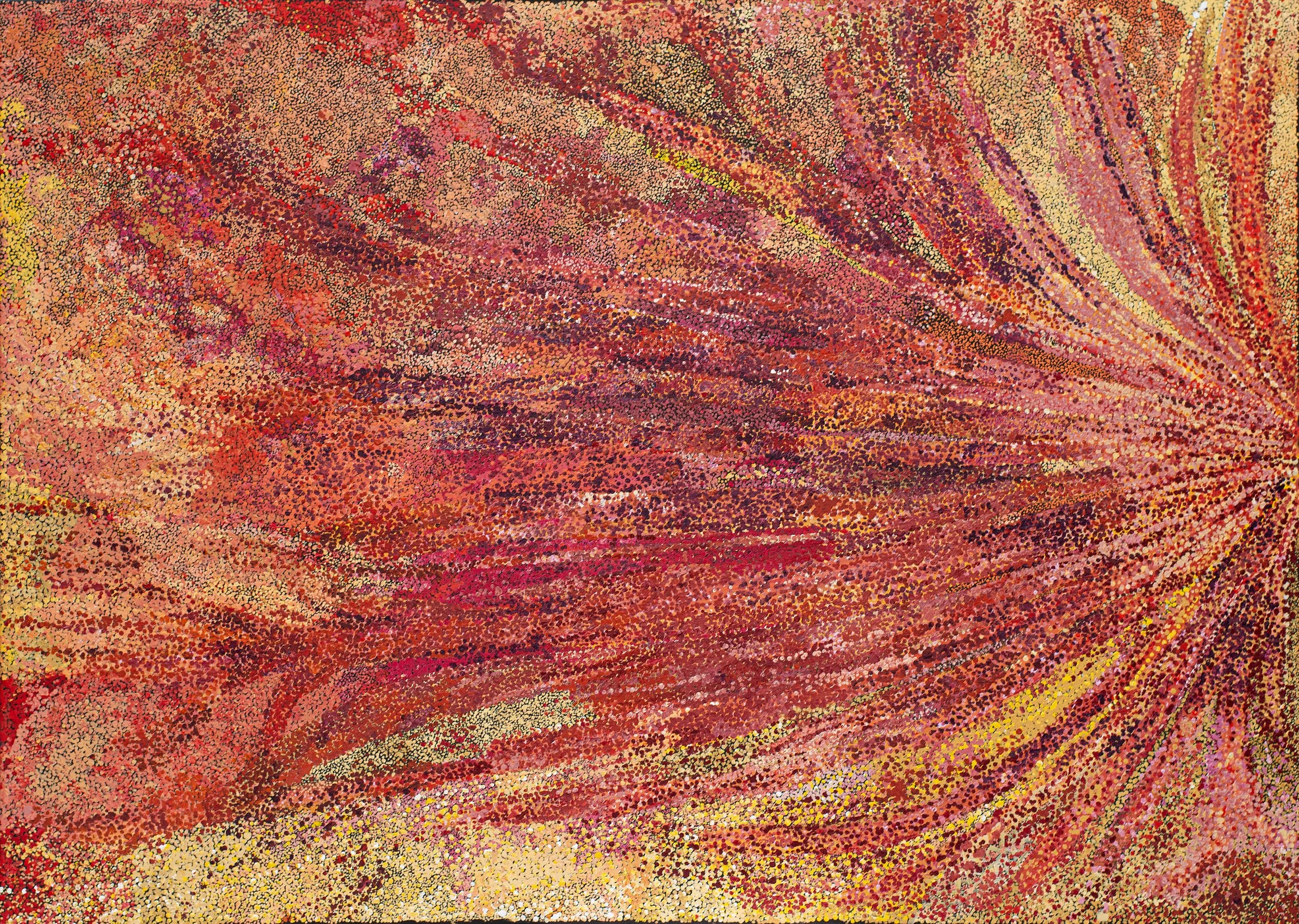
Toutes et tous partagent une même grammaire de ce geste graphique — points, lignes, cercles et silences — qui active le Country plutôt qu’elle ne l’illustre, mais chacun en porte une signification singulière : Rachael Mipantjiti Lionel, troisième génération de femmes Lionel à Ernabella, peint les messages reçus en rêve ; ici la tempête de poussière qui roule vers elle dans le désert, vision d’alerte et d’endurance. Atipalku Intjalki (1955) traite du Tjukurpa Mulayangu, lieu de Loi des hommes lié au pays de son père, à l’ouest d’Amata, avec le site sacré Tankalanya — ce qu’il peut en dire s’arrête là, par respect du secret.
Cassyanne Woods évoque un récit majeur de femmes, à la portée métaphorique sur les cycles féminins : deux femmes en route vers le nord, la rencontre d’un wanampi (serpent) près de Mantaruta près d’Uluru, les gestes pour l’attirer (jusqu’au manguri, anneau de port de tête), la blessure et la résilience qui s’ensuit — couches de sens relevant de la Loi des femmes. Carlene Thompson peint le pays de l’émeu (Kalaya), de Kanypi à Watarru : pistes ancestrales, abondance des petits, et conte moral où la dinde des broussailles trompée venge son deuil à l’aide du miru/woomera (propulseur).
Tjulyata Kulyuru rappelle la connaissance vitale des tjukula (rochers-puits) dans les Musgrave Ranges : lecture fine des reliefs et des pluies, protection des points d’eau (pierres, spinifex) contre bétail et animaux, mémoire d’un soin toujours actuel. Ainsi, une écriture commune devient voix plurielles : rêve, Loi, morale et survie se répondent dans les gestes, sans franchir ce qui doit rester protégé par le Tjukurpa.
Découvrez les peintures de l’exposition :
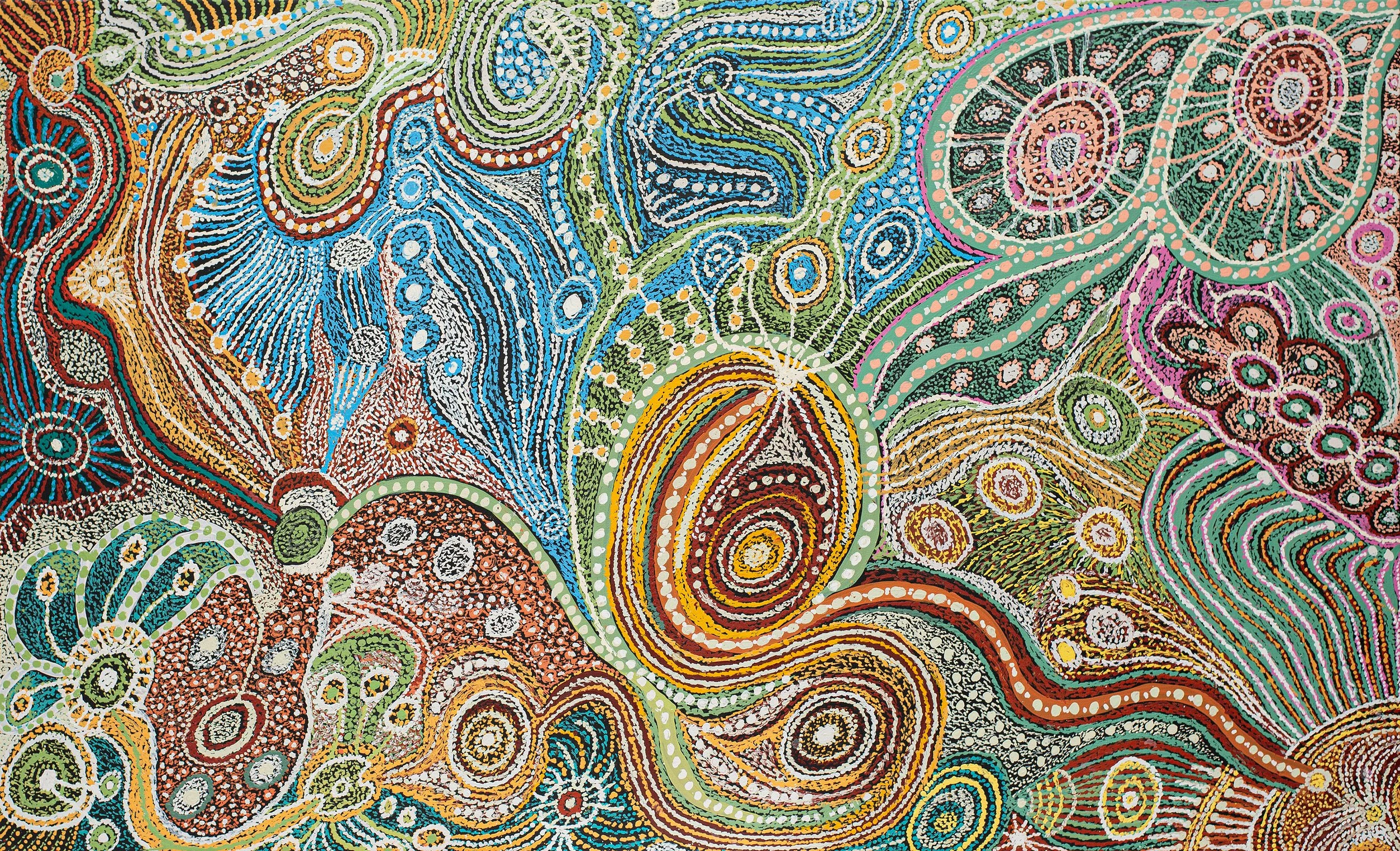
Artiste : Atipalku Intjalki (1955)
Titre de l'œuvre : Tjukurpa Mulayangu
Format : 200 × 121 cm
Provenance et certificat : centre d'art aborigène d’Ernabella
Référence de cette peinture aborigène : 62-25
Explication sur cette œuvre :
Atipalku Intjalki (1955), deals within this artwork about the Tjukurpa Mulayangu is a men’s law place. They made this place and campsite. Mulayangu made this place. Over in the west is the other side of Amata which is my father’s country. This is a sacred place called Tankalanya. This is all I can say.

Artiste : Rachael Mipantjiti Lionel
Titre de l'œuvre : Kapi Wankanya
Format : 181 × 122 cm
Provenance et certificat : centre d'art d'Ernabella
Référence de cette peinture d'art Aborigène : 414-25
Explanations of this Aboriginal art painting :
Rachael comes from the third generation of Lionel women painting at Ernabella Arts. Rachael draws inspiration for her paintings from the stories and messages she receives through her dreams. This painting is a dream she has about a dust storm. She was out in the desert and could see the dust storm rolling towards her.
Her artworks are in the prestigious following collections :
Artbank, 2018
Museum And Art Gallery Of The Northern Territory, 2016
National Museum Of Australia, 2016
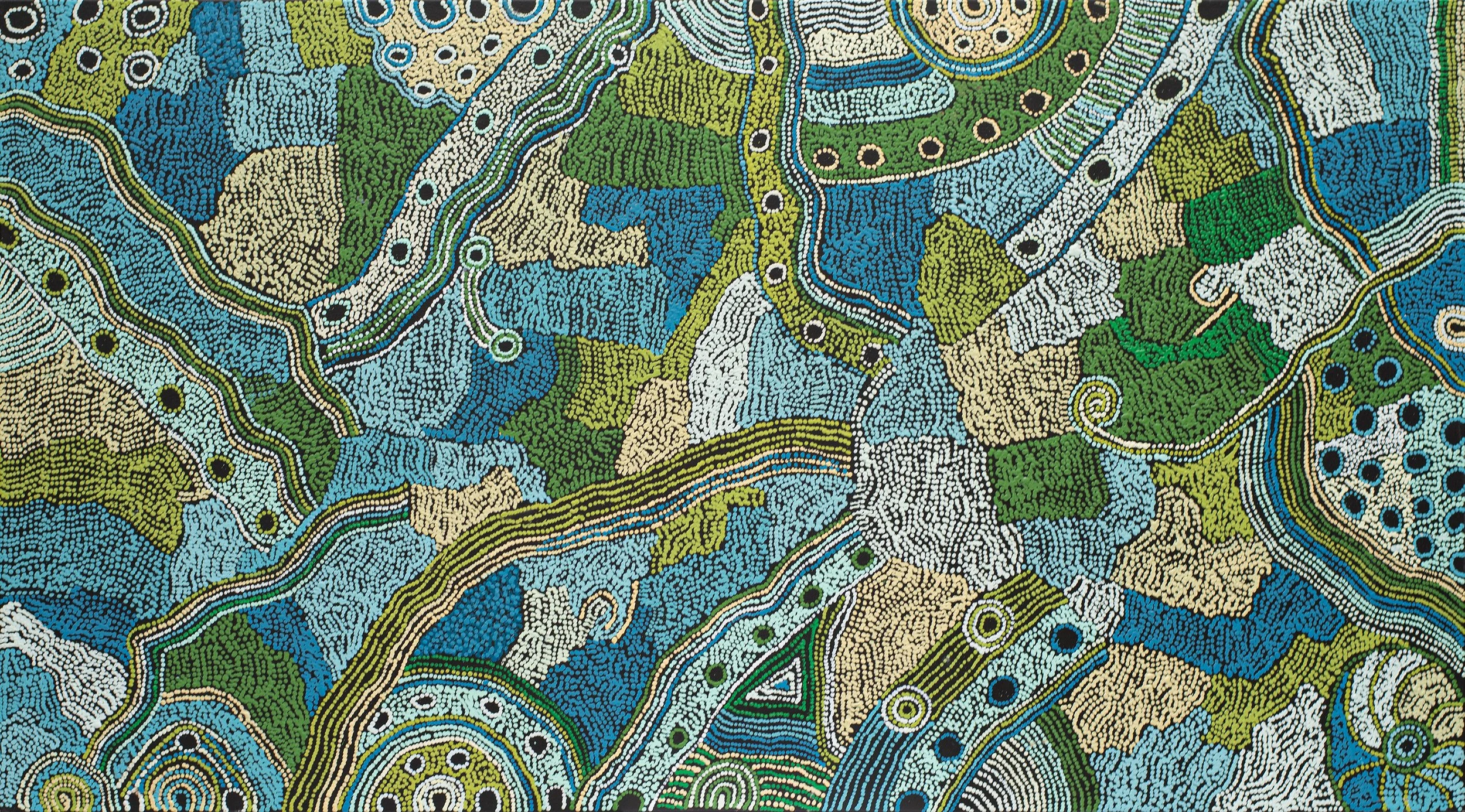
Artiste : Cassyanne Woods
Titre de l'œuvre : Minyma Kutjara
Format : 179 × 98 cm
Provenance et certificat : centre d'art aborigène d’Ernabella
Référence de cette peinture aborigène : 283-25
Explication sur cette œuvre :
Cassyanne Woods evokes here a story of deep significance to women which contains metaphorical references to female cycles. It tells of two women travelling north. The pair meet with a group of women, including Kutungu, who are caring for a man who then passes away. They then travel to the area known as Mantaruta, near Uluru, where they chase a curious wanampi (serpent) deep into the ground while trying to catch him. They burn their body hair to attract him and hit him on the head and run away. From afar they throw a manguri/traditional head-ring for carrying which also hits him. He then comes and hits the women who travel on bleeding and hurt.
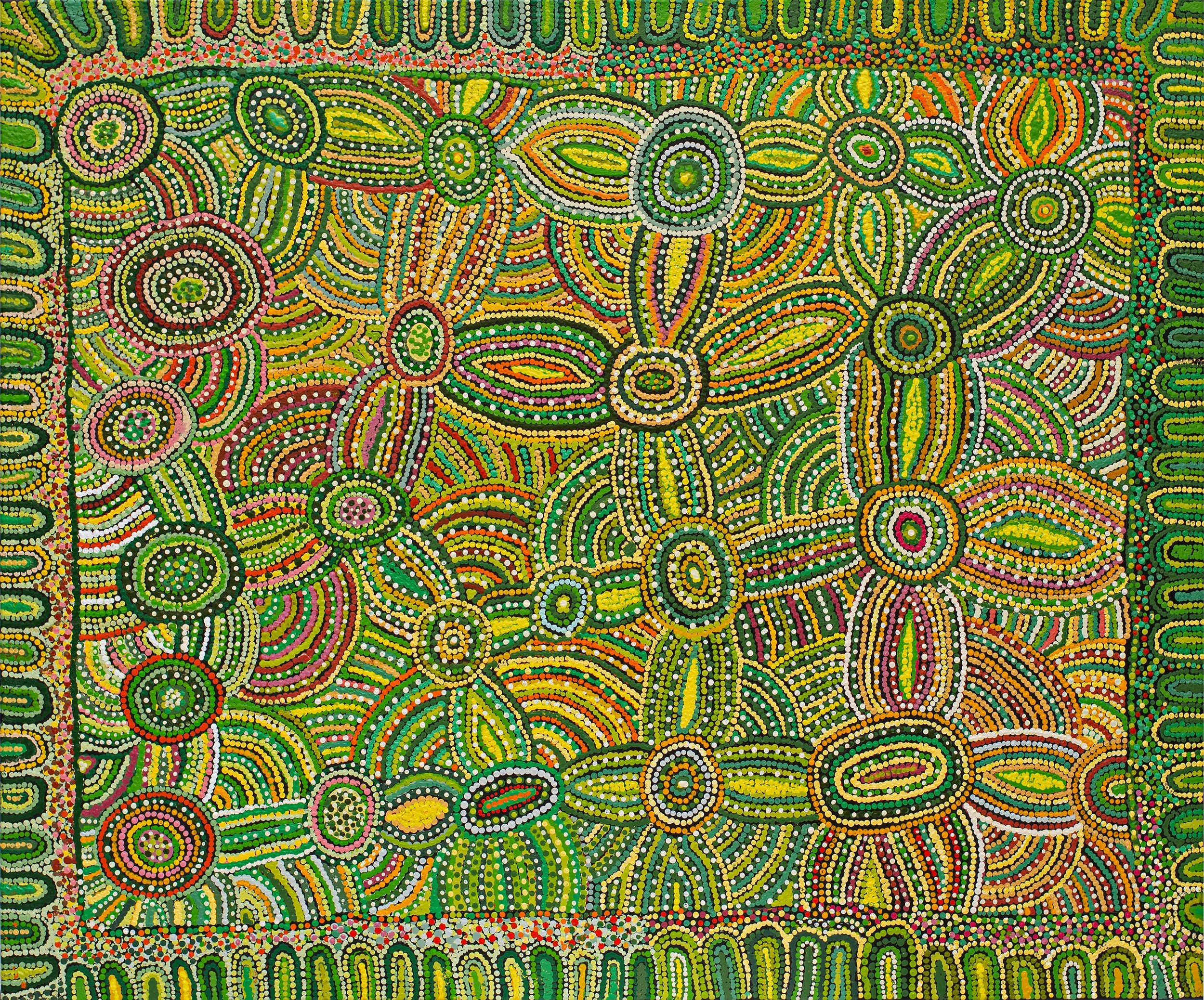
Artiste : Yanyi Dunn
Titre de l'œuvre : Tjukula/Waterhole
Format : 120 × 99 cm
Provenance et certificat : centre d'art aborigène d’Ernabella
Référence de cette peinture aborigène : 317-25
Explication sur cette œuvre :
For the Pitjantjatjara people living in the desert, knowledge of their water sources was critical to their survival. This resulted in an intimate understanding of the landscape which continues today. Water is an essential element in the desert. These rock holes were particularly important during the dry season when most of the water holes and creeks dried up. Deep familiarity with the topography of their country and the way rain would interact with the land ensured constant sources of water could be found. Knowledge of rock hole sites is passed on from generation to generation and revered by all Anangu (people).
Tjukula means rock-holes, which are found with surprising frequency in the Musgrave Ranges and country around Ernabella. Between visits, Anangu would use a construction of rocks and spinifex to guard these important water sources from spoilage by feral and stock animals such as cattle, camels, horses and donkeys.
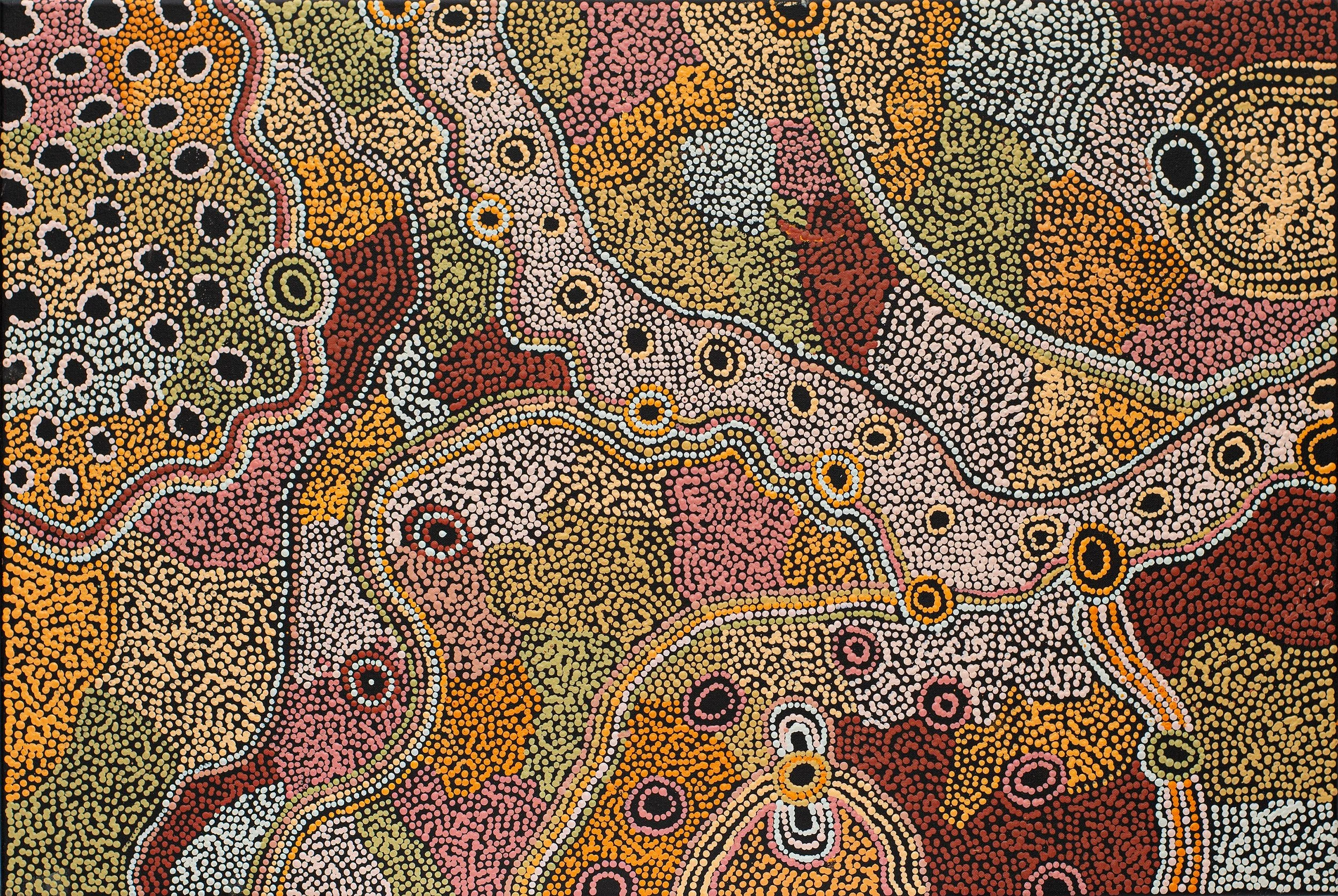
Artiste : Cassyanne Woods
Titre de l'œuvre : Minyma Kutjara
Format : 88 × 59 cm
Provenance et certificat : centre d'art aborigène d’Ernabella
Référence de cette peinture aborigène : 318-25
Explication sur cette œuvre :
There is a story of deep significance to women which contains metaphorical references to female cycles. It tells of two women travelling north. The pair meet with a group of women, including Kutungu, who are caring for a man who then passes away. They then travel to the area known as Mantaruta, near Uluru, where they chase a curious wanampi (serpent) deep into the ground while trying to catch him. They burn their body hair to attract him and hit him on the head and run away. From afar they throw a manguri/traditional head-ring for carrying which also hits him. He then comes and hits the women who travel on bleeding and hurt.
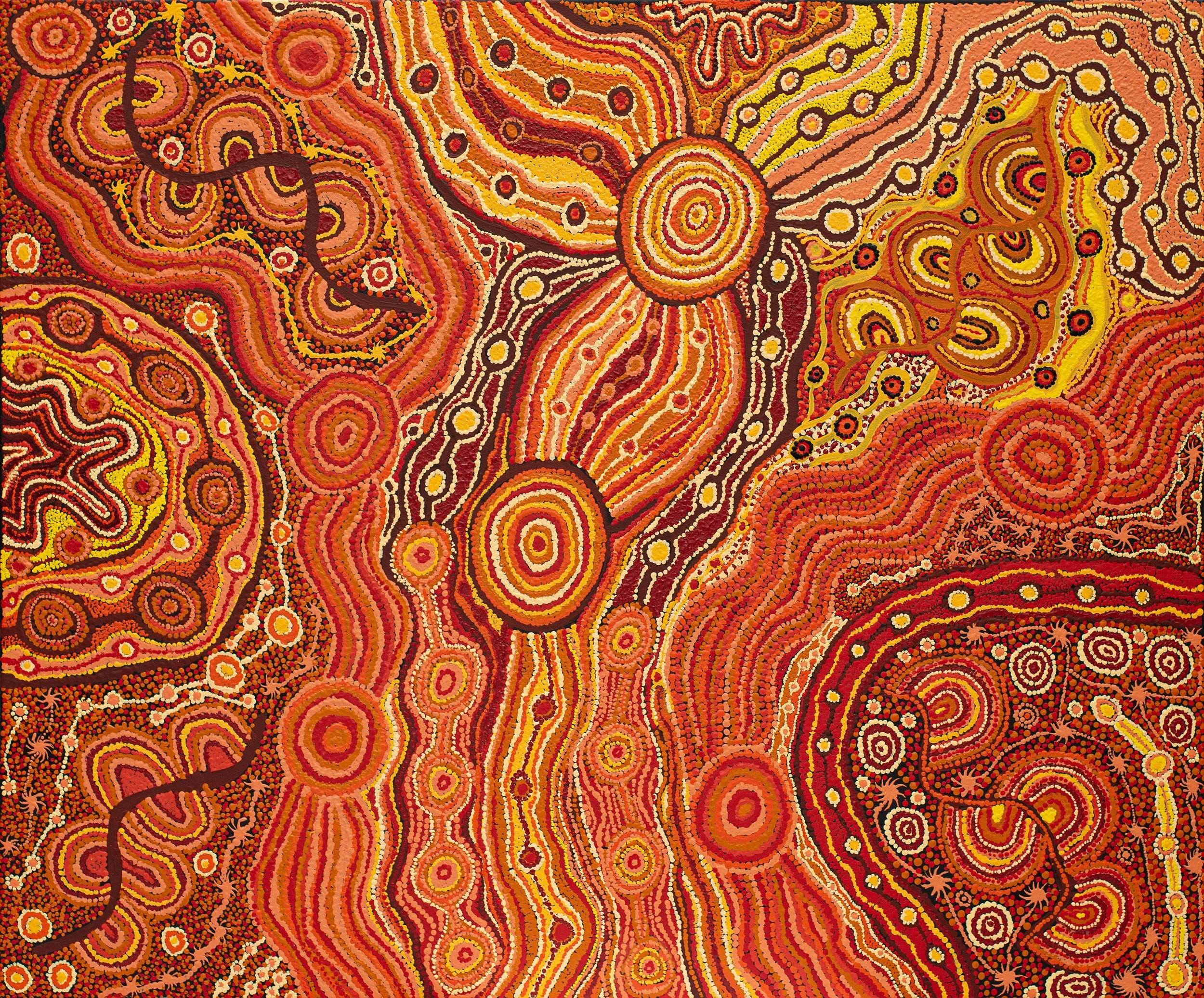
Artiste : Umatji Tjitayi
Titre de l'œuvre : Kaliny-kaliny / Honey Grevillea
Format : 120 × 99 cm
Provenance et certificat : centre d'art aborigène d’Ernabella
Référence de cette peinture aborigène : 319-25
Explication sur cette œuvre :
Stories are told of the Kaliny-kaliny or Honey Grevillea flower which is a favourite bush food of the Anangu Pitjantjatjara (people). Ultukunpa grows in the sandy soils on the plains. The flowers can be picked and placed in a billycan of water to create 'honeywater' (cordial) or they can be sucked for their sweet honey dew.
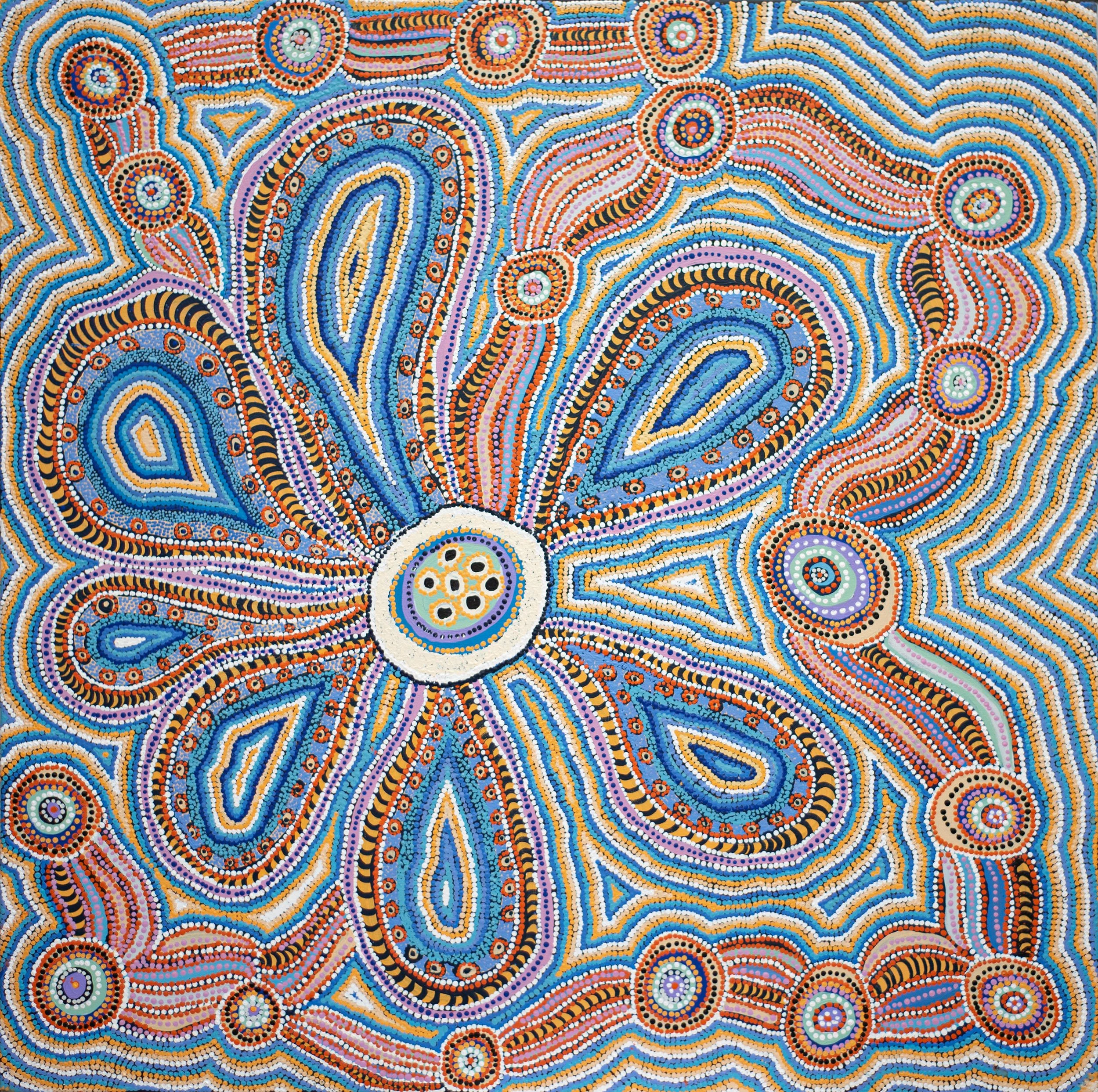
Artiste : Imiyari (Yilpi) Adamson
Titre de l'œuvre : Tjitji Tjuta Walytjata
Format : 121,5 × 121,5 cm
Provenance et certificat : centre d'art aborigène d’Ernabella
Référence de cette peinture aborigène : 256-25
Explication sur cette œuvre :
This Tjukurpa is from a place called Walytjata near Pipalyatjara. It’s a true story. You can see all the kids sitting there in the cave. The mother left and told the kids to stay there, but she never came back. It’s a sad story. The older brother, he was looking after everyone. He would go out hunting for malu (kangaroo), kalaya (emu) and bring back the kuka (meat) for all the kids.
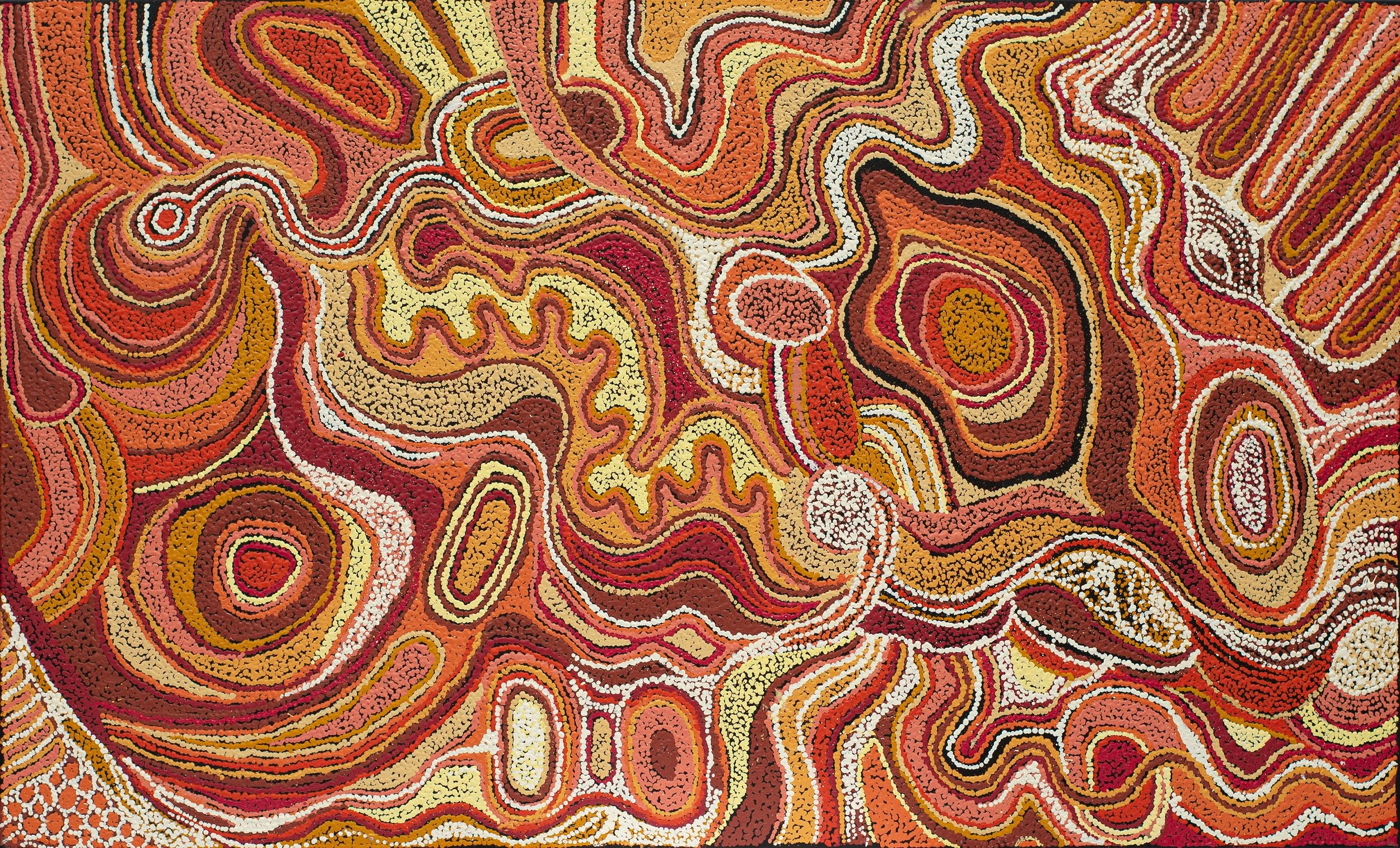
Artiste : Langaliki Lewis
Titre : Tjukula/Waterholes
Format : 148 × 99 cm
Provenance et certificat : centre d'art aborigène d’Ernabella
Référence de cette peinture aborigène : 210-25
Explication sur cette œuvre :
Painting by Langaliki Lewis (1973). For the Pitjantjatjara people living in the desert, knowledge of their water sources was critical to their survival.
This is a depiction of the artists' country. The different colours and designs represent variations in the landscape.
This design is inspired by the red sand dunes that are found throughout the central desert. There is a large red sand dune near Ernabella named Wamikata which is a popular place for looking for maku (witchetty grubs) and for teaching Milpatjunanyi (telling stories in the sand) to children.
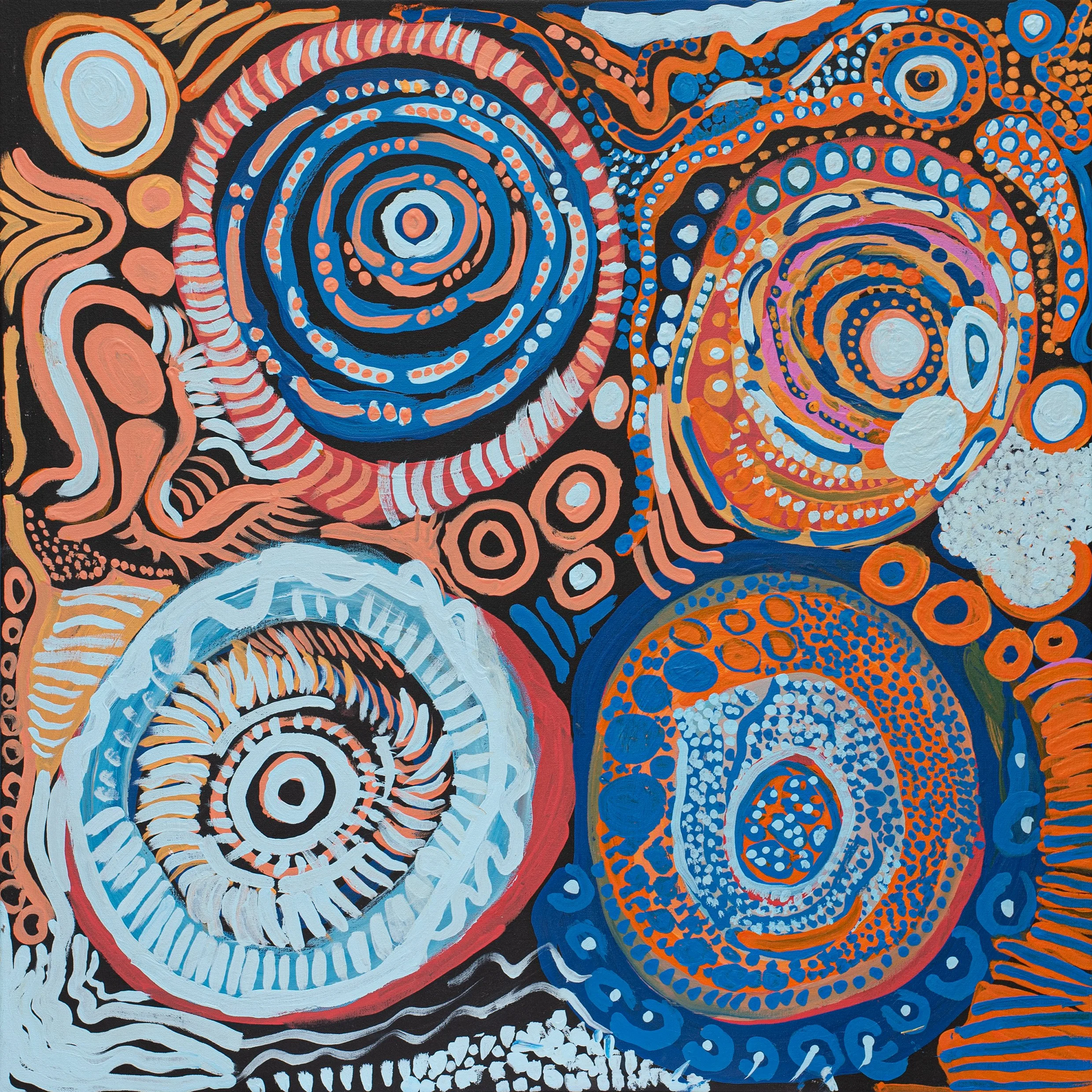
Artiste : Margaret Inyika Wells
Titre de l'œuvre : Margaret’s Father’s Country
Format : 81 × 81 cm
Provenance et certificat : centre d'art d'Ernabella
Référence de la peinture : 280-25
Explications sur cette peinture Aborigène :
My father’s place is Mt. Liebe, sandhill country. The Wanapi rests there under the surface of the creek. When we go to visit that country, the Wanapi stirs underneath the ground and bubbles rise up in the water. He is there to protect that place. We speak to that Wanapi in our language and he knows then that it is us. It’s okay for us to be there and the bubbles settle back down. Close to this creek is where the Arkaryi women are sitting. This is an important women’s site. I can’t speak too much about that, as it would be dangerous to disturb those women.
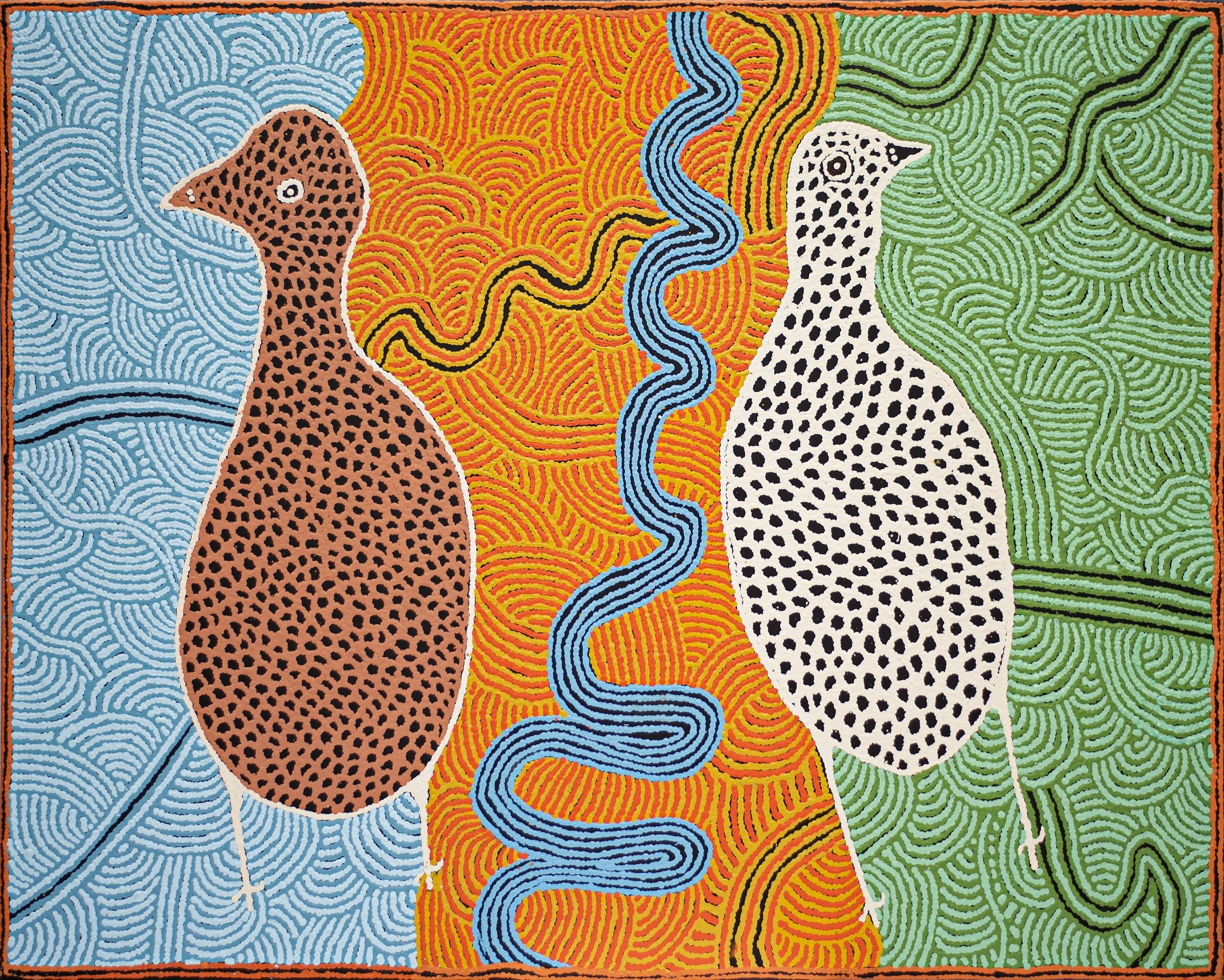
Artiste : Carlene Thompson (1950)
Titre de l'œuvre : Kalaya ngura
Format : 152 × 121 cm
Provenance et certificat : centre d'art d'Ernabella
Référence de cette peinture d'art Aborigène : 230-25
Explanations of this Aboriginal painting :
Emu Country. This painting depicts Carlene's family's country, near Kanypi in the Western APY Lands. It is the country of the emu, meaning the emu (kalaya) is the ancestral being who formed that part of the country.
That Kalaya travelled from Kanpi to Watarru. It is very typical for the Kalaya to have many children, like Carlene, who had six children.
A tale of deceit! Emu, a father, had many children as is typical of emu. Bush Turkey was father to only one child. While out hunting they came across one another. Mournfully, Emu told Turkey that he had killed all his children and that Turkey should do the same. Turkey's son protested! "No father! I am a good son! Don't kill me!" But Turkey, feeling sorry for Emu, killed his only child. Later Turkey again saw Emu, but with his many children in tow. He was wild with anger and sadness.
He told Emu that they should go hunting together. And when this came to pass he used his miru/woomera to hit and kill Emu. Then he chased Emu's children for miles until they became exhausted and died.
Her artworks are in the prestigious following collections :
Goulburn Regional Art Gallery, 2016
Queensland Art Gallery, Brisbane, Qld
Awards :
2019 National Aboriginal and Torres Strait Islander Art Award, Finalist
2019 Australia Council for the Art: Art project for individuals recipient
2018 Quick Response Grant Country Arts SA: Contact, Connection and Conversation
2018 National Aboriginal and Torres Strait Islander Art Award, Finalist
2016 Finalist (collaborative), National Aboriginal and Torres Strait Islander Art Award
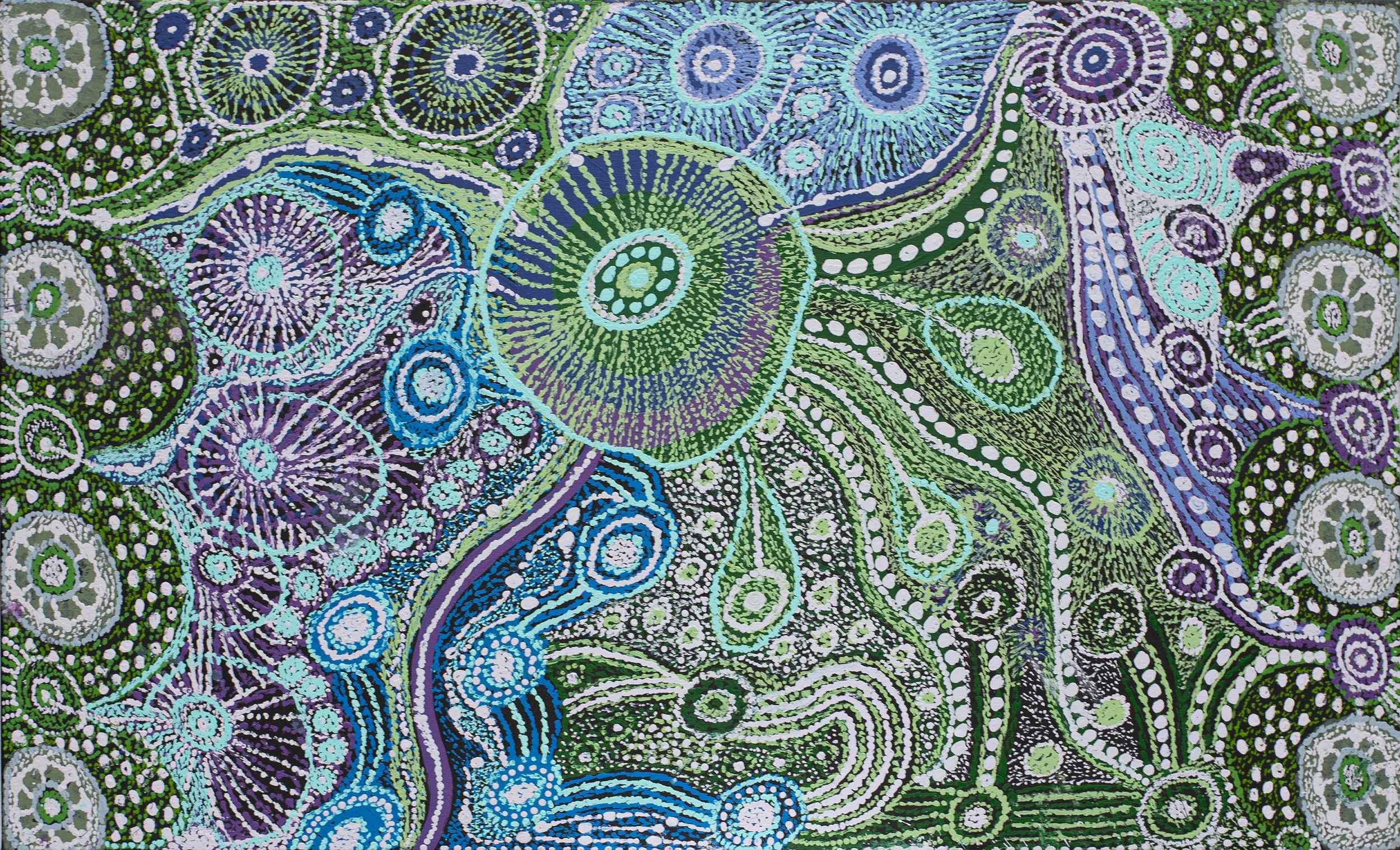
Artiste : Atipalku Intjalki (1955)
Titre de l'œuvre : Tjukurpa Mulayangu
Format : 151 × 91 cm
Provenance et certificat : centre d'art aborigène d’Ernabella
Référence de cette peinture aborigène : 323-25
Explication sur cette œuvre :
Tjukurpa Mulayangu is a men’s law place. They made this place and campsite. Mulayangu made this place. Over in the west is the other side of Amata which is my father’s country. This is a sacred place called Tankalanya. This is all I can say.
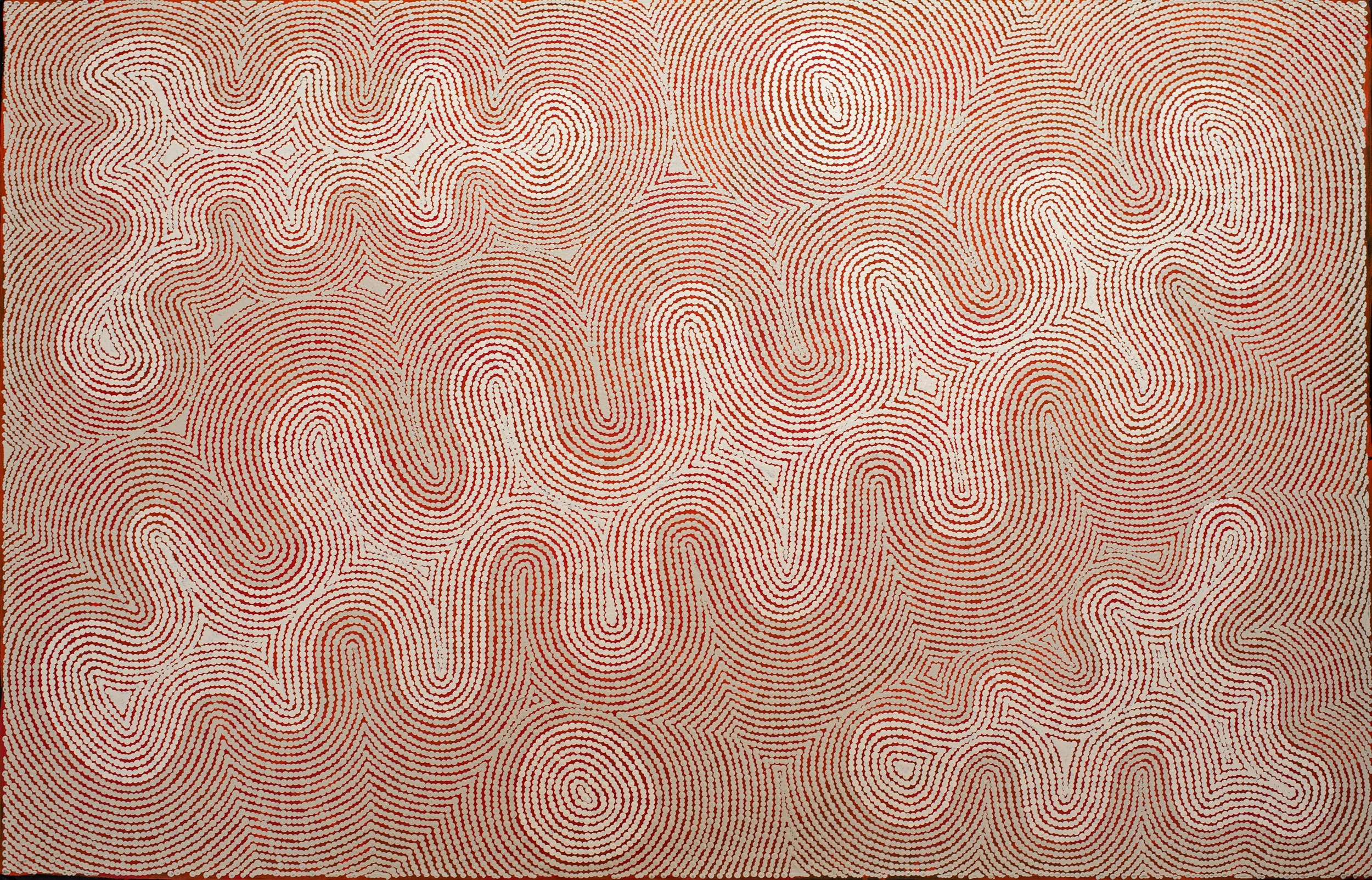
Artiste : Tjulyata Kulyuru
Titre de l'œuvre : Tjukula/Waterholes
Format : 182 × 121 cm
Provenance et certificat : centre d'art aborigène d’Ernabella
Référence de cette peinture aborigène : 361-25
Explication sur cette œuvre :
For the Pitjantjatjara people living in the desert, knowledge of their water sources was critical to their survival.
This resulted in an intimate understanding of the landscape which continues today. Deep familiarity with the topography of their country and the way rain would interact with the land ensured constant sources of water could be found. 'Tjukula' means rock-holes, which are found with surprising frequency in the Musgrave ranges.
Between visits, Anangu (people) would use rocks and spinifex construction to guard these from spoilage by animals and, particularly in more recent times, from feral and stock animals, cattle, camels, horses and donkeys.
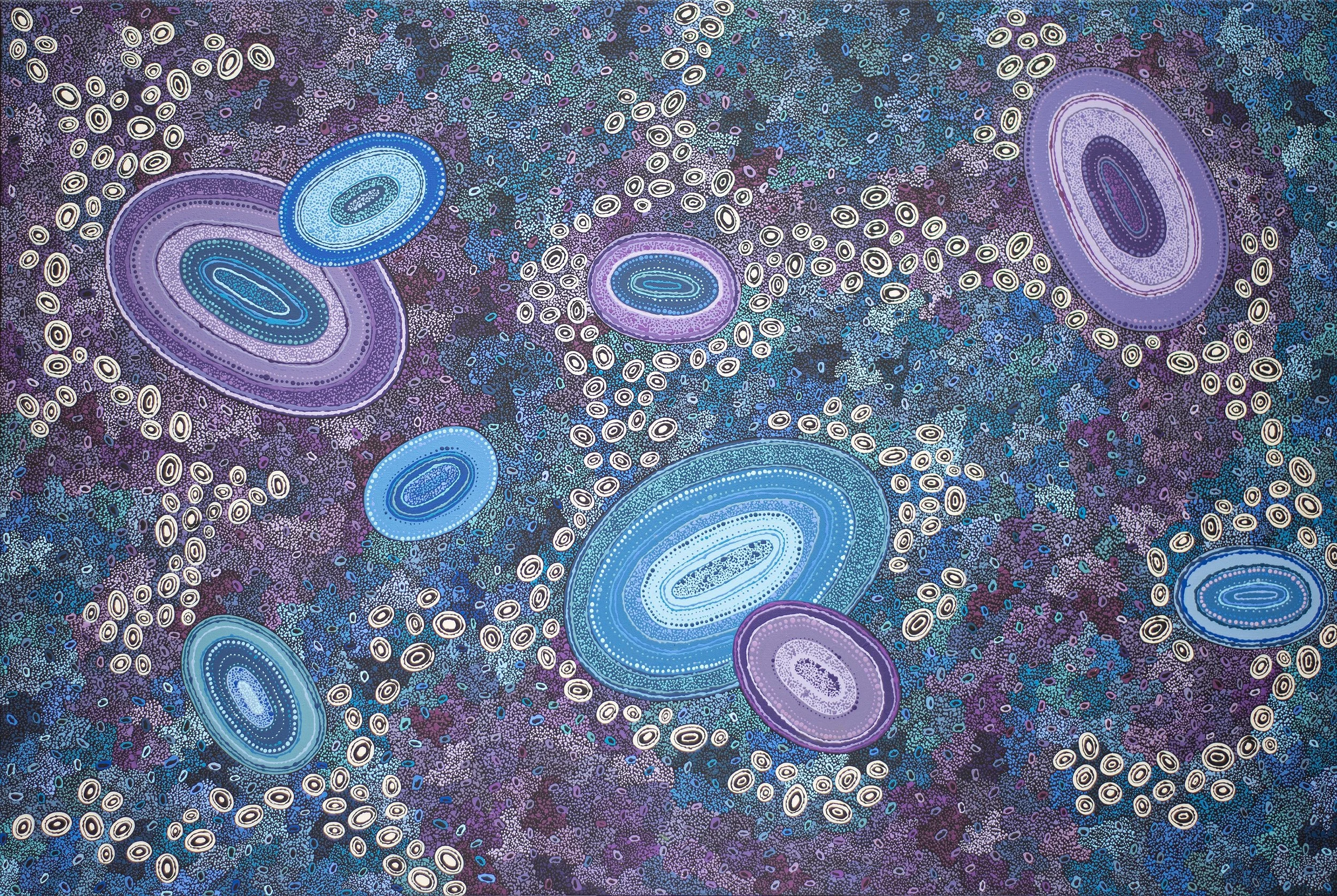
Artiste : Michelle Lewis
Titre de l'œuvre : Michelle's tjala dreaming (honey ant dreaming)
Format : 180 cm x 120cm
Provenance et certificat : centre d'art aborigène d’Ernabella
Référence de cette peinture aborigène : 265-25
Explication sur cette œuvre :
Michelle’s father's country is a place called Makiri located east of Ernabella near the Fregon community. This is country is tjala tjukurpa (honey ant dreaming). Michelle and her family still visit this country where she draws special attention to the natural elements on the land which are then represented in her paintings:
I am painting the landscape from above, as you might see it from an airplane or as a bird looking down. It is beautiful country both from on the ground and up above. When Michelle created her work, ngayuku mamku ngura ini Makiri (my father's country, a place called Makiri) she was thinking of Makiri and how the tjala (honeyants) tunnel though the sandy soil as well as about the waterholes, the assemblages of trees and shrubs and the country that is “quiet” (empty).
Tjala or Honey Ants are found about a metre underground beneath Mulga trees. The Honey Ant tunnels that lead down to the ant's nests are called nyinantu. The Honey Ant larvae are called ipilyka-ipilyka. When the Pitjantjatjara go looking for Honey Ants they look for the drill holes under the trees. When they see them, they shovel and dig down following the tunnels to find the Honey Ants inside. Honey Ants are a highly favoured food source. They suck the honey-like liquid from the abdomen of the Honey Ant. The story of the Honey Ant is told across the Northern Territory into South Australia. The Honey Ant is an important link between their mythology and inter-dependence on the environment.

Artiste : Tjulyata Kulyuru
Titre de l'œuvre : Tjukula/Waterholes
Format : 176 × 124 cm
Provenance et certificat : centre d'art aborigène d’Ernabella
Référence de cette peinture aborigène : 241-25
Explication sur cette œuvre :
For the Pitjantjatjara people living in the desert, knowledge of their water sources was critical to their survival.
This resulted in an intimate understanding of the landscape which continues today. Deep familiarity with the topography of their country and the way rain would interact with the land ensured constant sources of water could be found. 'Tjukula' means rock-holes, which are found with surprising frequency in the Musgrave ranges.
Between visits, Anangu (people) would use rocks and spinifex construction to guard these from spoilage by animals and, particularly in more recent times, from feral and stock animals, cattle, camels, horses and donkeys.
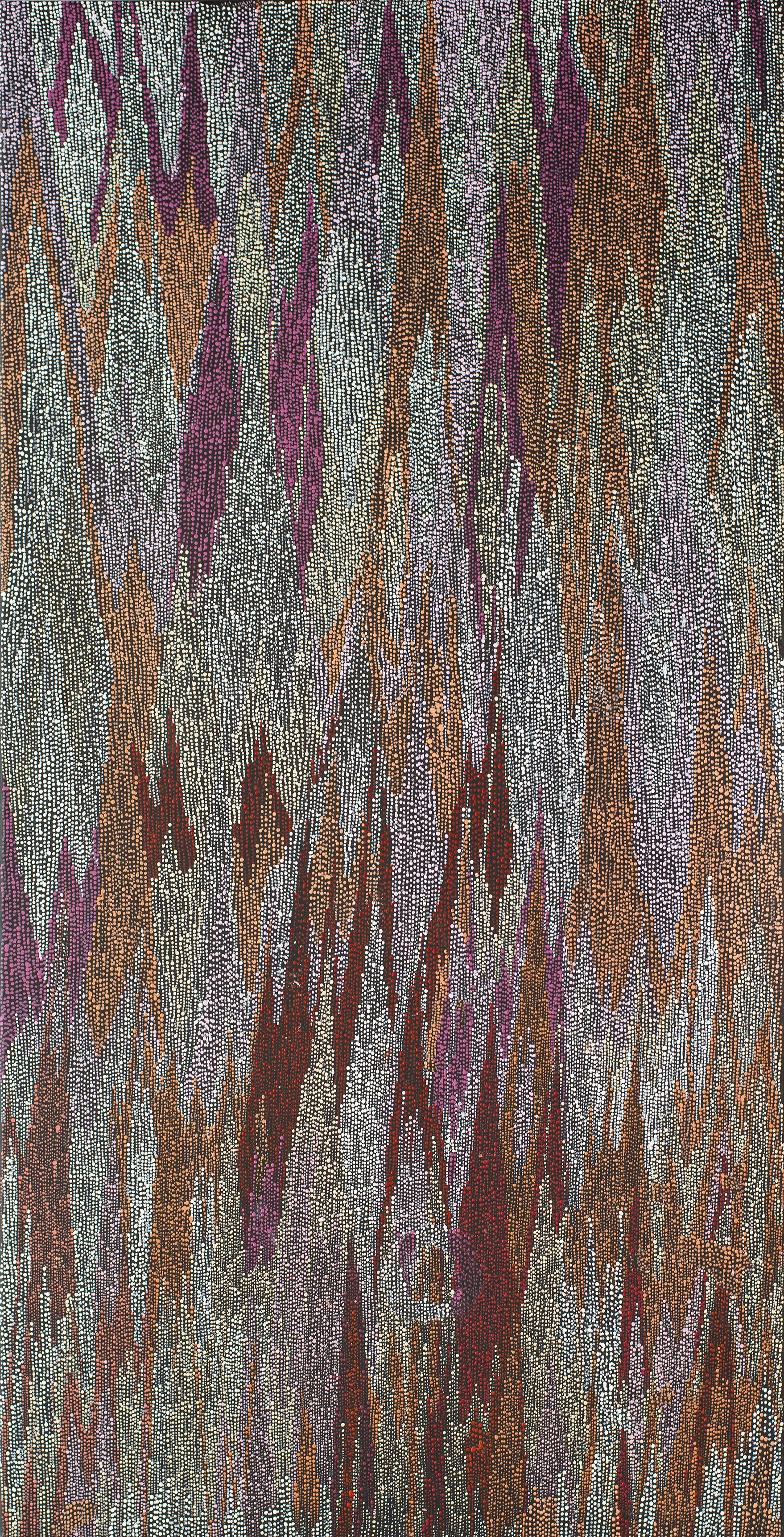
Artiste : Lynette Lewis
Titre de l'œuvre : Wamikata Walka Tali / Sand dune
Format : 149 × 75 cm
Provenance et certificat : centre d'art d'Ernabella
Référence de la peinture : 330-25
Explications sur cette peinture Aborigène :
Lynette's design is inspired by the ripples created by wind in the sand at the large, red sand dune named Wornikata near Ernabella. Womikata is a popular place for looking for maku (witchetty grubs) and also for teaching Milpatjunanyi (telling stories in the sand) to children.
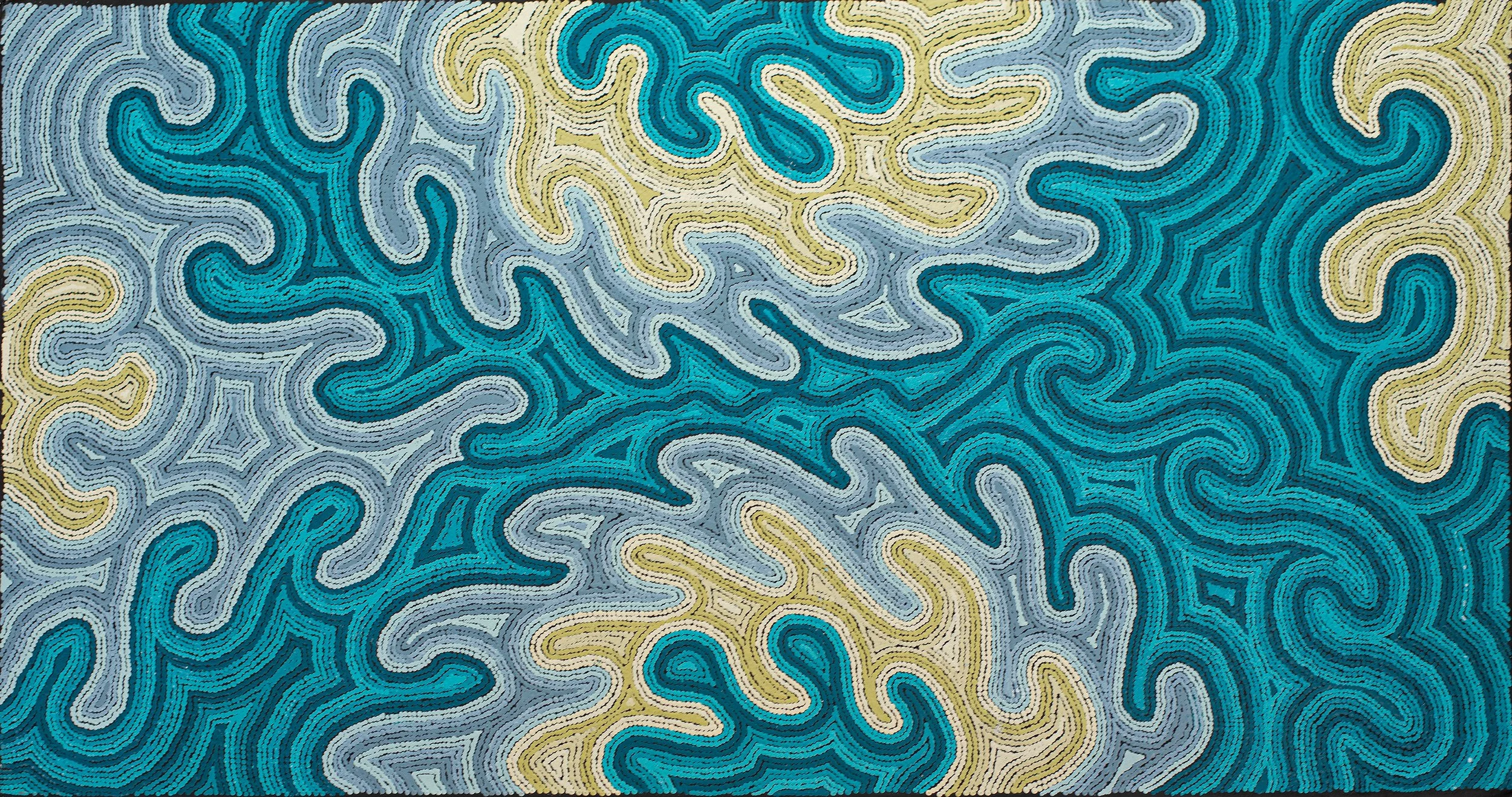
Artiste : Mukayi Baker
Titre de l'œuvre : Piltati
Format : 152 x 81cm
Provenance et certificat : centre d'art aborigène d’Ernabella
Référence de cette peinture aborigène : 356-25
Explication sur cette œuvre :
There were two sisters who married two brothers and they all lived together. One day the women went wandering and they went such a long way that they forgot about their husbands. Back at the camp, the two husbands were thinking, 'Where are our wives?' and they decided to go looking for them. One brother said to the other, 'What should we become to go looking for them?' and the other brother said 'Why don't we become Rainbow Serpents?' And they travelled in the sky looking down for their wives. Finally they see them hunting for carpet snakes and they put something in the hole where the women were digging. The women find it and then dig another hole and once again the men have put something in there. And this is how the men lure the women back to Piltati where the men make the sisters transform into Wanampi, swallow them and keep them in their throats. All four of them live together in the waterhole and still live there today.
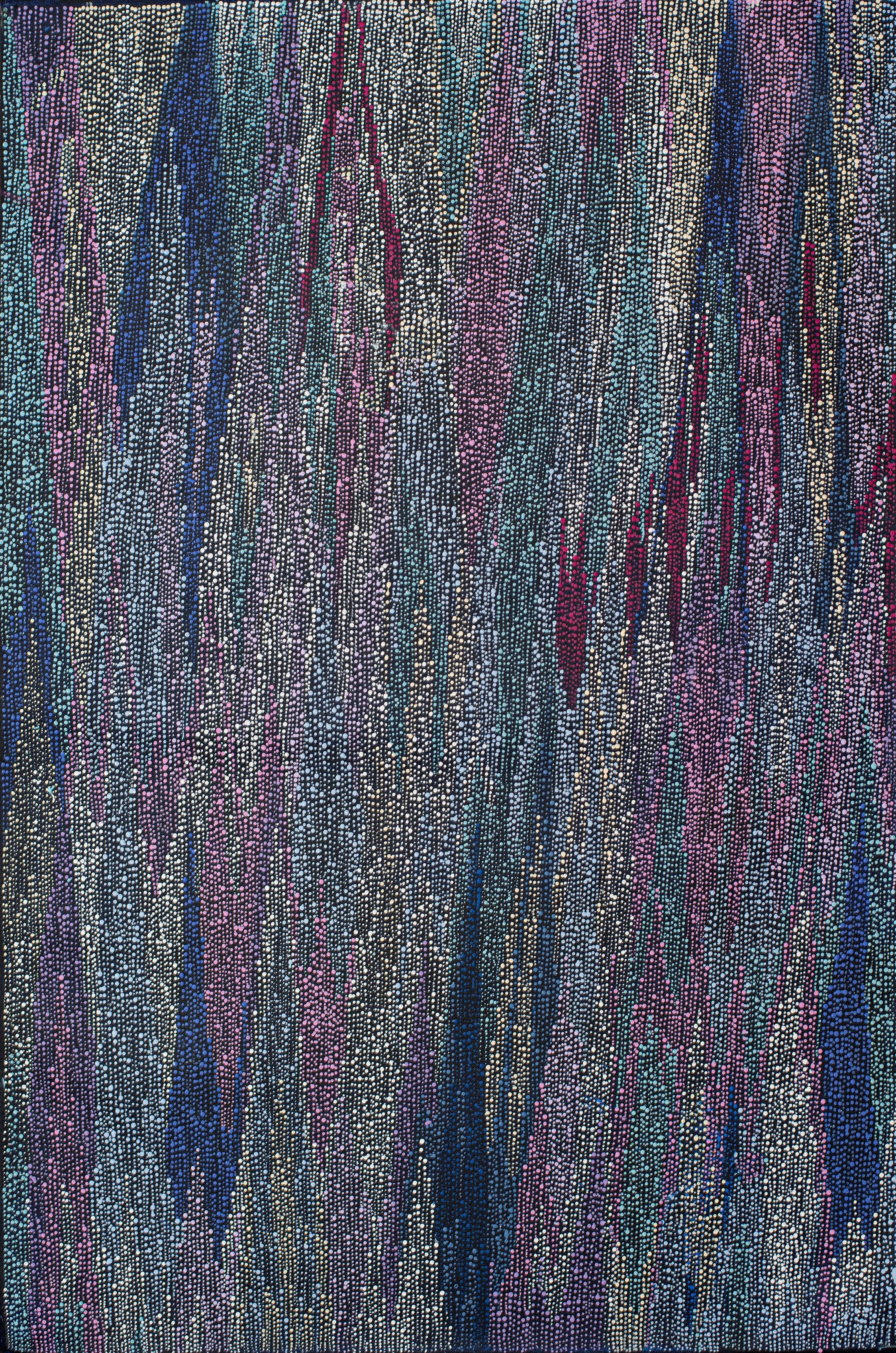
Artiste : Lynette Lewis
Titre de l'œuvre : Wamikata Walka Tali / Sand dune
Format : 100 × 66 cm
Provenance et certificat : centre d'art d'Ernabella
Référence de la peinture : 395-25
Explications sur cette peinture Aborigène :
Lynette's design is inspired by the ripples created by wind in the sand at the large, red sand dune named Wornikata near Ernabella. Womikata is a popular place for looking for maku (witchetty grubs) and also for teaching Milpatjunanyi (telling stories in the sand) to children.
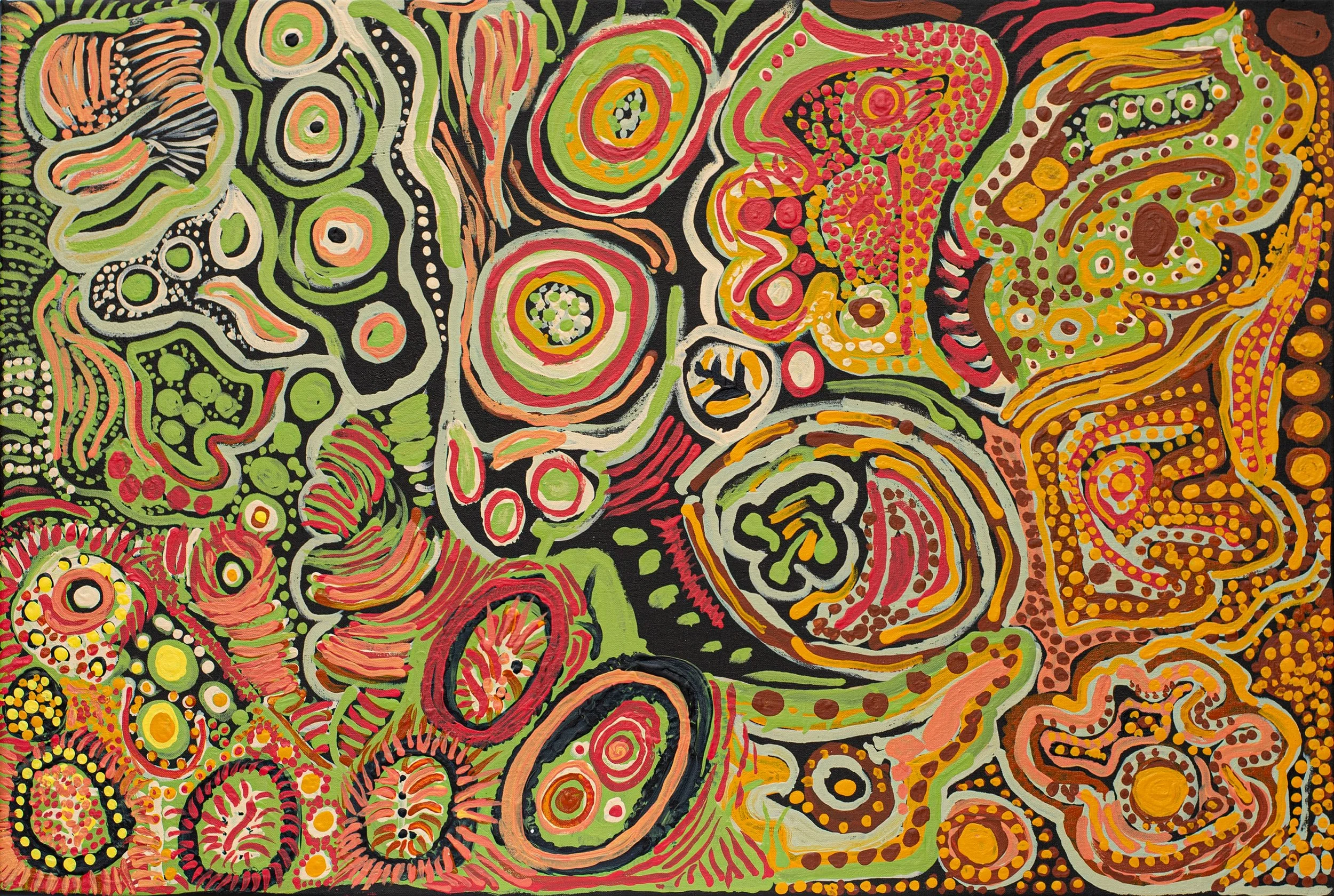
Artiste : Margaret Inyika Wells
Titre de l'œuvre : Margaret’s Father’s Country
Format : 89 x 60 cm
Provenance et certificat : centre d'art d'Ernabella
Référence de la peinture : 146-25
Explications sur cette peinture Aborigène :
My father’s place is Mt. Liebe, sandhill country. The Wanapi rests there under the surface of the creek. When we go to visit that country, the Wanapi stirs underneath the ground and bubbles rise up in the water. He is there to protect that place. We speak to that Wanapi in our language and he knows then that it is us. It’s okay for us to be there and the bubbles settle back down. Close to this creek is where the Arkaryi women are sitting. This is an important women’s site. I can’t speak too much about that, as it would be dangerous to disturb those women.
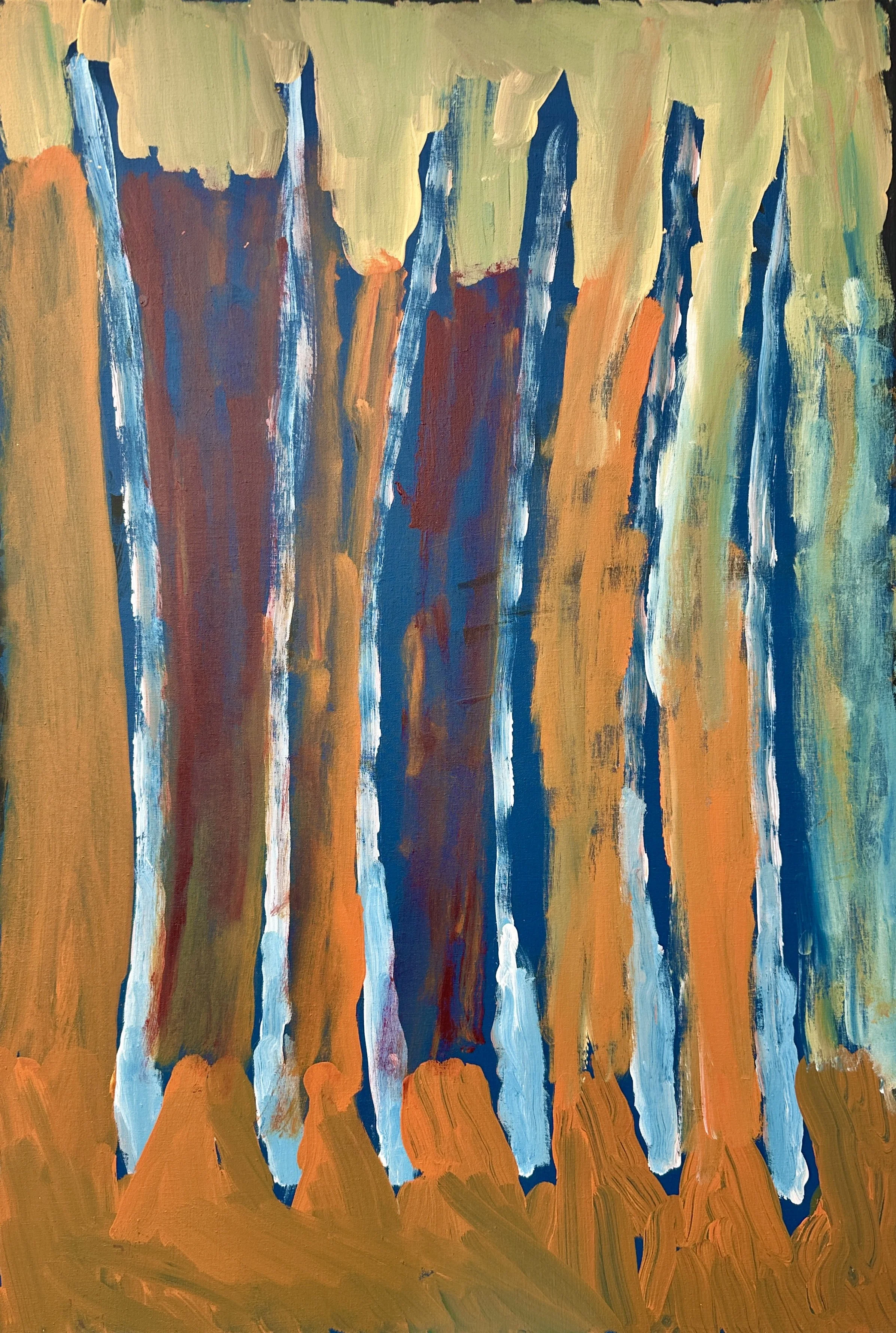
Artiste : Freddy Ken
Titre de l'œuvre : Many Spears
Format : 100 × 68 cm
Provenance et certificat : centre d'art aborigène d’Ernabella
Référence de cette peinture aborigène : 217-25
Explication sur cette œuvre :
Freddy is painting his grandfather's country in far west South Australia. He depicts kulata tjuta (many spears) travelling through the sky to catch wati wanampi (snake man). Those wati wanampi are moving fast through the sky. There was one woman waiting there with a baby and she said there was a wati who was nearby hiding in a bush, ready to duck down and go and then throw those spears.

Artiste : Lexie Michael
Titre de l'œuvre : Tjakura Tjukurpa - Lexie's Story
Format : 116 x 60 cm
Provenance et certificat : centre d'art d'Ernabella
Référence de la peinture : 11-25
Explications sur cette peinture Aborigène :
This Tjukurpa is from Lexie's grandfather's homeland called Kunytjanu, located just south of Pipalyatjara near the SA border with WA. It's a story about tjakura, the great desert skink, a small orange lizard found across the APY Lands.
Tjakura has a lot of grandchildren looking after him. One day, a long time ago, he saw too many strangers, an army coming from Mutitjulu. They came and found the tjakura and they killed him. All the kids made a cemetery there for the tjakura. This is a really big story that goes from Kunytjanu to Aralya.
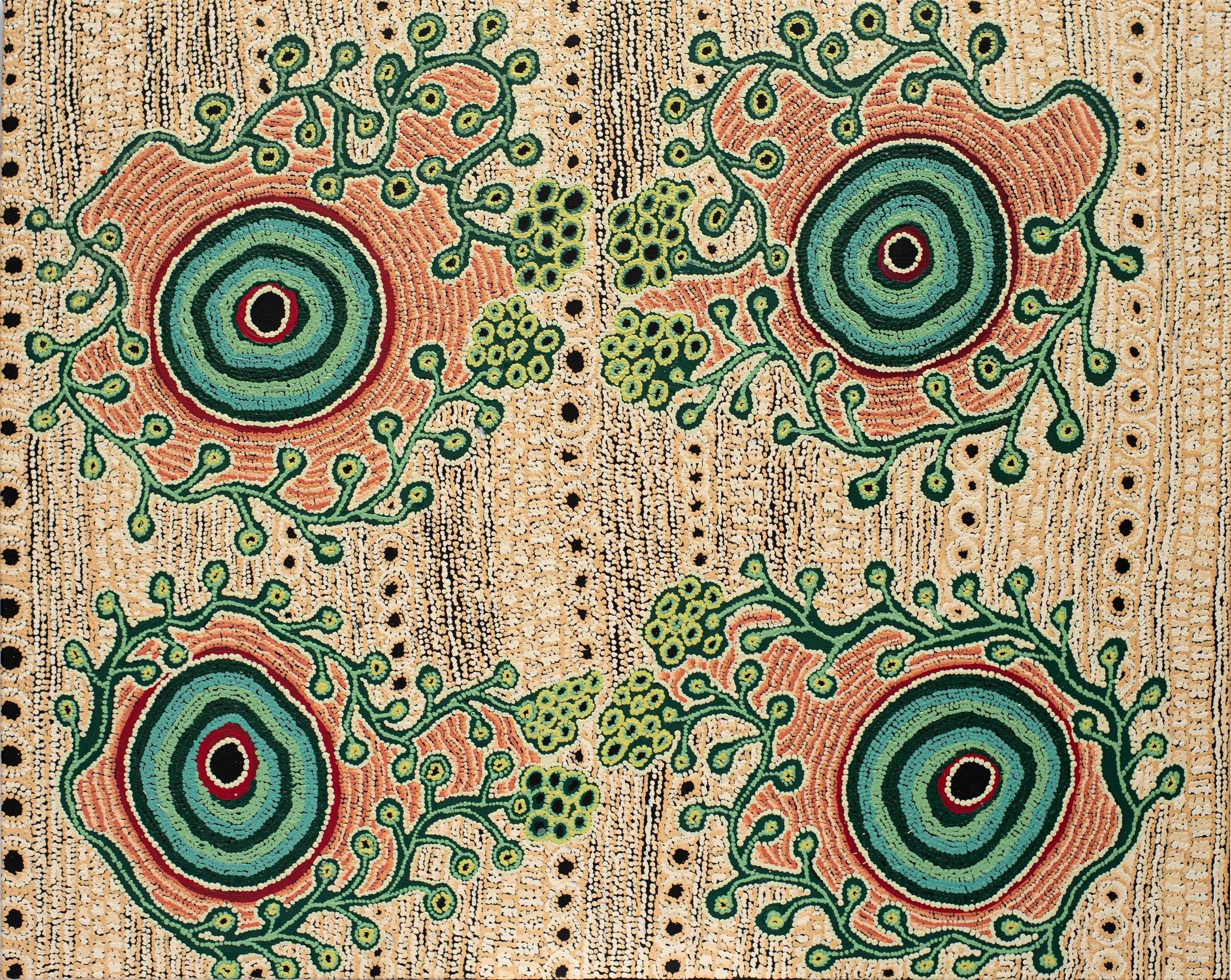
Artiste : Daisybell Kulyuru
Titre de l'œuvre : Mai – Bush Tucker Daisybell’s Story
Format : 151 x 120cm
Provenance et certificat : centre d'art aborigène d’Ernabella
Référence de cette peinture aborigène : 58-25
Explication sur cette œuvre :
Travelling around getting bush tucker near my home. From when I was a tjitji (child) collecting mai (food). Travelling from home, not today but a long time ago. I would go with my family, friends, with tjitji tjuta (many children).
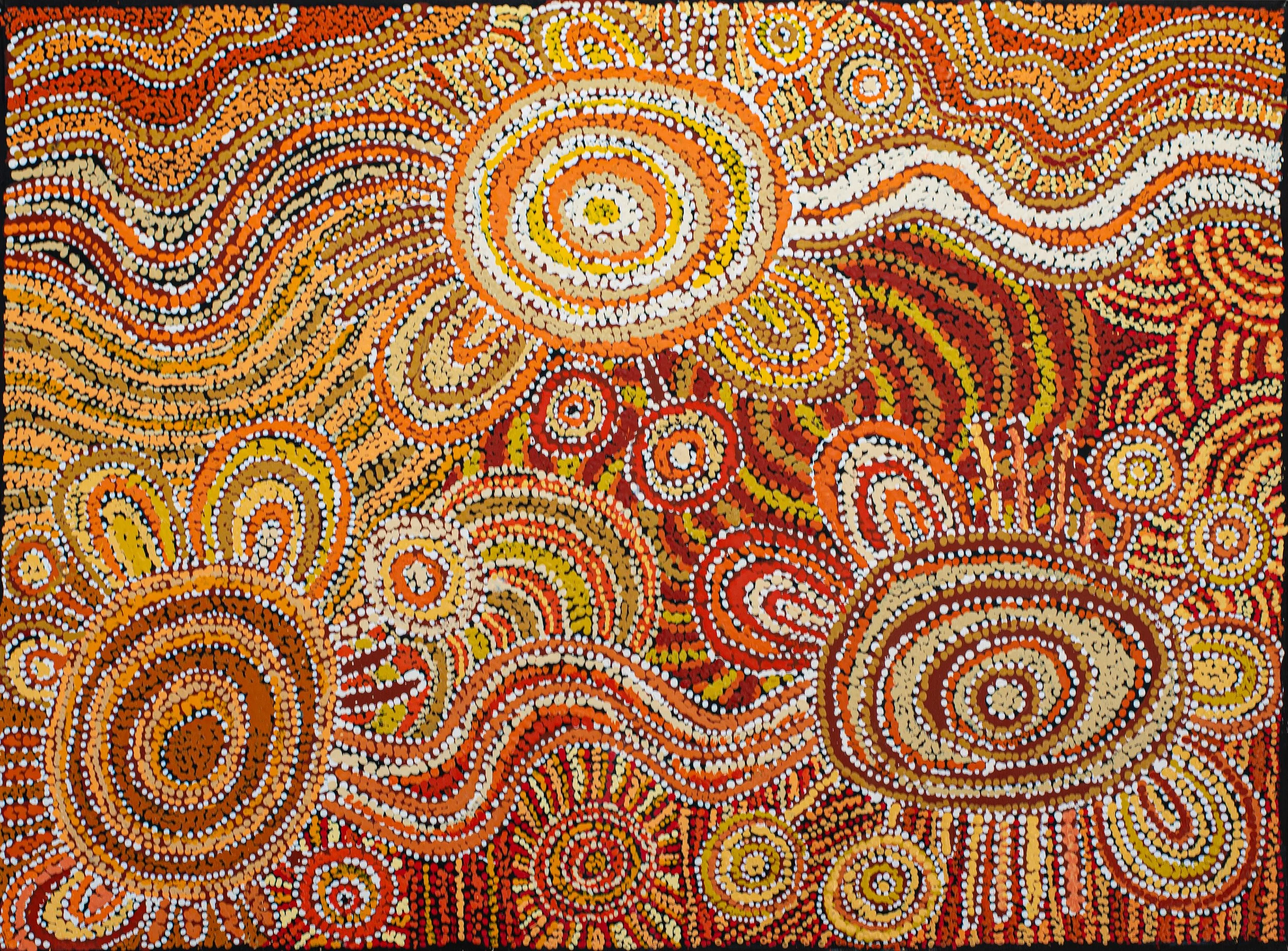
Artiste : Atipalku Intjalki (1955)
Titre de l'œuvre : Piltati
Format : 120 × 89 cm
Provenance et certificat : centre d'art aborigène d’Ernabella
Référence de cette peinture aborigène : 373-25
Explication sur cette œuvre :
There were two sisters who married two brothers and they all lived together. One day the women went wandering and they went such a long way that they forgot about their husbands. Back at the camp, the two husbands were thinking, 'Where are our wives?' and they decided to go looking for them. One brother said to the other, 'What should we become to go looking for them?' and the other brother said 'Why don't we become Rainbow Serpents?' And they travelled in the sky looking down for their wives. Finally they see them hunting for carpet snakes and they put something in the hole where the women were digging. The women find it and then dig another hole and once again the men have put something in there. And this is how the men lure the women back to Piltati where the men make the sisters transform into Wanampi, swallow them and keep .them in their throats. All four of them live together in the waterhole and still live there today.
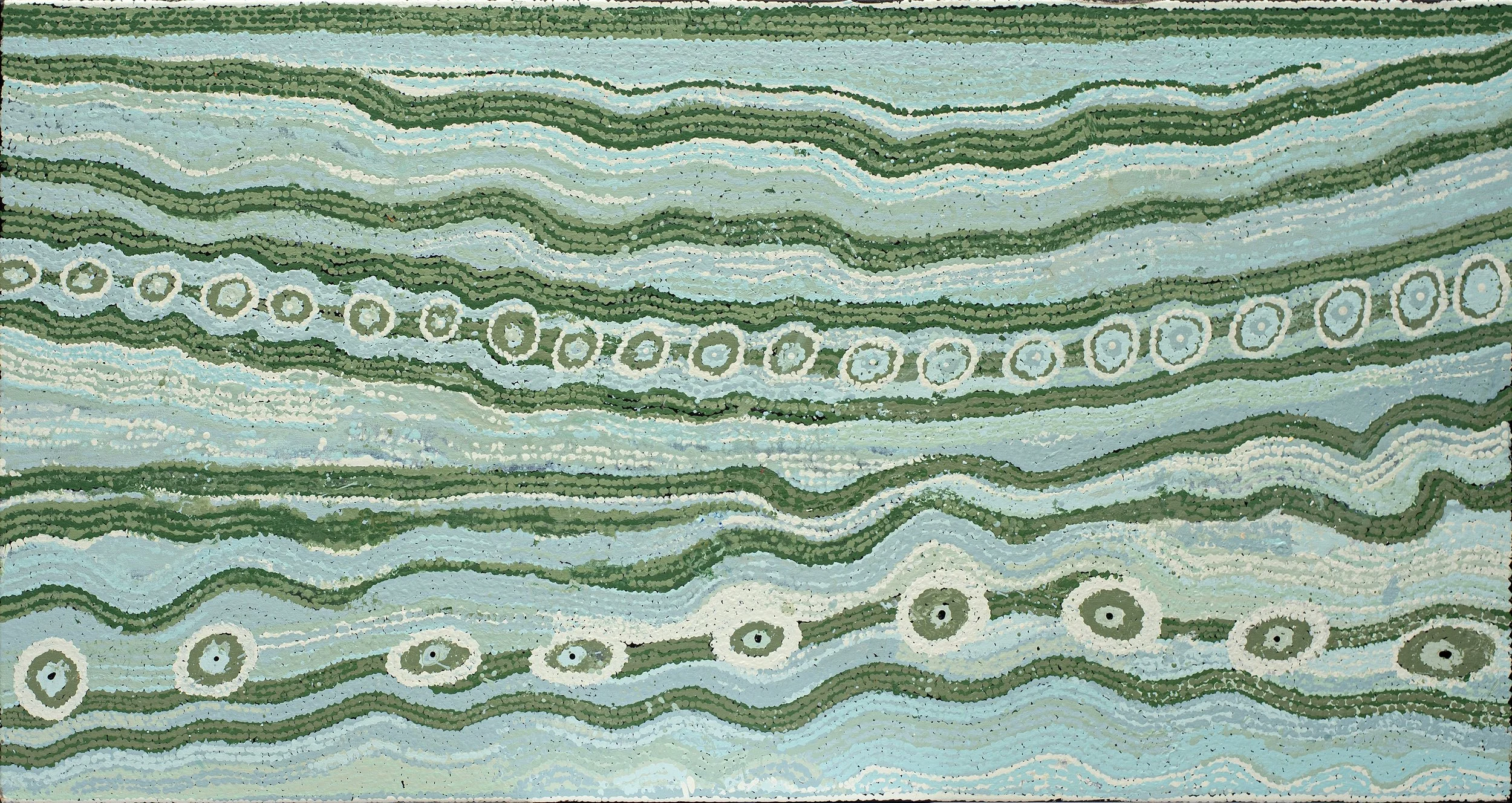
Artiste : Yurpiya Lionel
Titre de l'œuvre : Anumara
Format : 150 × 79 cm
Provenance et certificat : centre d'art d'Ernabella
Référence de la peinture : 128-25
Explications sur cette peinture Aborigène :
Yurpiya is painting a place called Anumara, which is a place near Irrunytju (Wingellina) in WA. This is Yurpiya's family's country. Anumara is also the name for a kind of caterpillar and Anumara is the tjukurpa (dreaming) place for this caterpillar. This caterpillar lives in the grass and can be eaten if the grass it eats is removed. The place shares the same colours of the caterpillar - brown, yellow and pale green. Keeping this place safe will ensure that the caterpillars multiply.
Awards
2020 Waterhouse Natural Science Art Prize, Finalist
2018 Wynne Prize, Finalist
2015 National Aboriginal and Torres Strait Islander Art Award, Finalist
2007 Special Mention, Alice Springs Beanie Festival, Araluen Cultural Precinct, Alice Springs
Her artworks are in the following collections :
Museum of the UNIVERSITY OF NEWCASTLE, 2011
Private collections in Switzerland, Germany, Australia, Belgium

Artiste : Mukayi Baker
Titre de l'œuvre : Piltati
Format : 180 × 100cm
Provenance et certificat : centre d'art aborigène d’Ernabella
Référence de cette peinture aborigène : 570-24
Explication sur cette œuvre :
There were two sisters who married two brothers and they all lived together. One day the women went wandering and they went such a long way that they forgot about their husbands. Back at the camp, the two husbands were thinking, 'Where are our wives?' and they decided to go looking for them. One brother said to the other, 'What should we become to go looking for them?' and the other brother said 'Why don't we become Rainbow Serpents?' And they travelled in the sky looking down for their wives. Finally they see them hunting for carpet snakes and they put something in the hole where the women were digging. The women find it and then dig another hole and once again the men have put something in there. And this is how the men lure the women back to Piltati where the men make the sisters transform into Wanampi, swallow them and keep them in their throats. All four of them live together in the waterhole and still live there today.
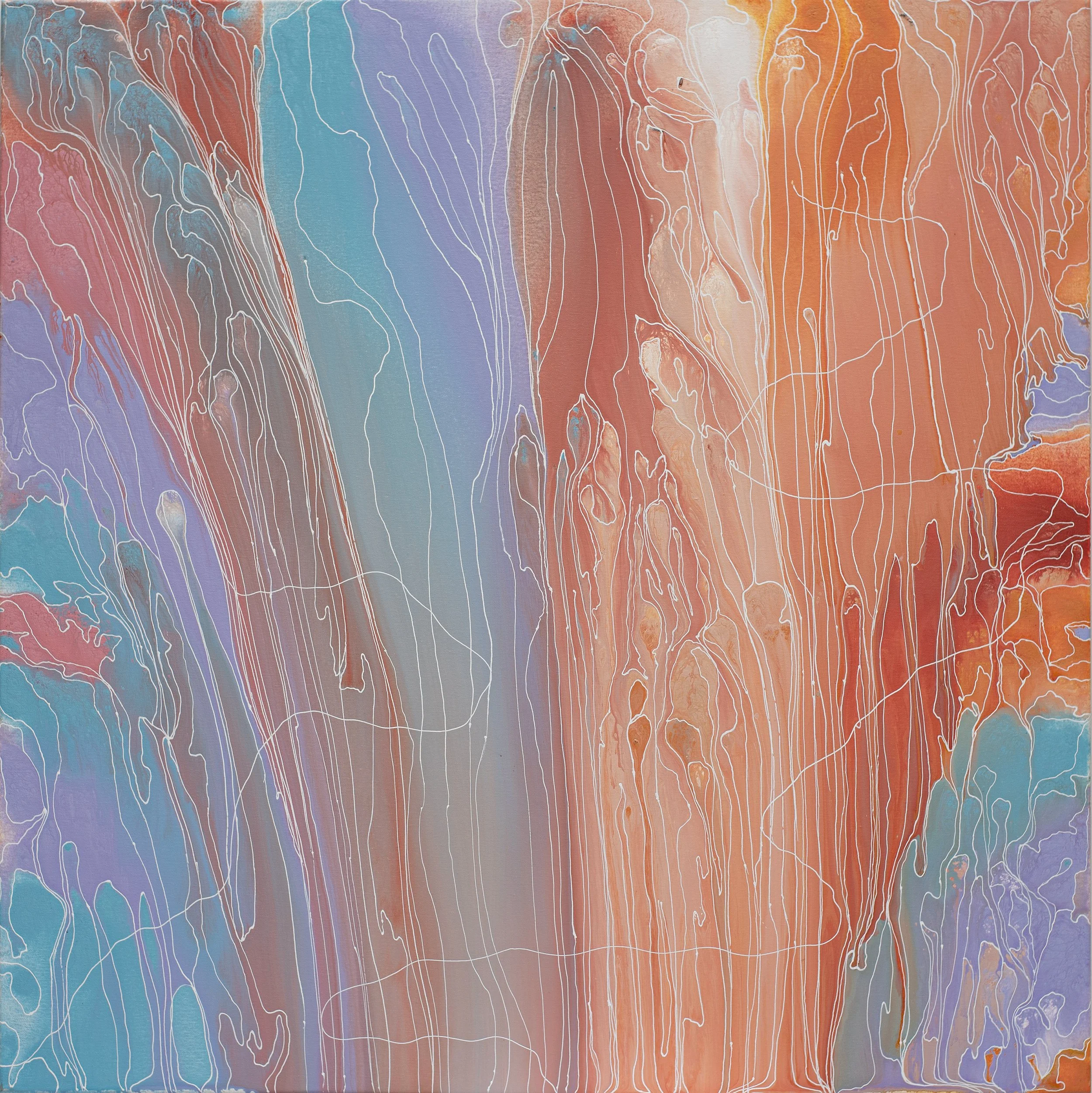
Artiste : Janice Stanley
Titre de l'œuvre : Pantu (Salt lake)
Format : 121 × 121 cm
Provenance et certificat : centre d'art aborigène d’Ernabella
Référence de cette peinture aborigène : 328-25
Explication sur cette œuvre :
Painting by the artist Janice Stanley (1987).
Janice Stanley is the third generation of Stanley women to create artwork at Ernabella Arts. She is an early career painter and ceramic artist showing greatpromise.Her grandmother is founding artist and traditional healer Tjariya Stanley and her aunts are senior artists, Alison Milyika Carroll and Renita Stanley.Janice is part of a group of young women leading the Ernabella ceramics studio, despite only commencing work in late 2015. She has been exhibitedaround Australia and internationally, in Darwin, Alice Springs, Broome, Sydney and Brussels.
A very significant tjurkurpa (story) to Anangu is Kungkarangkalpa (Seven Sisters) which is an extensive creation story relating to the Pleiades constellation. The story traverses Australia taking different forms, but local women are privy to the part of the story which takes place in the country near Ernabella. In her paintings Janice is depicting a salt lake near Attila (Mt Connor), a landmark in the Seven Sisters story.
The artworks of the artist are in the following collections :
Australian Embassy in Zagreb
Private collection
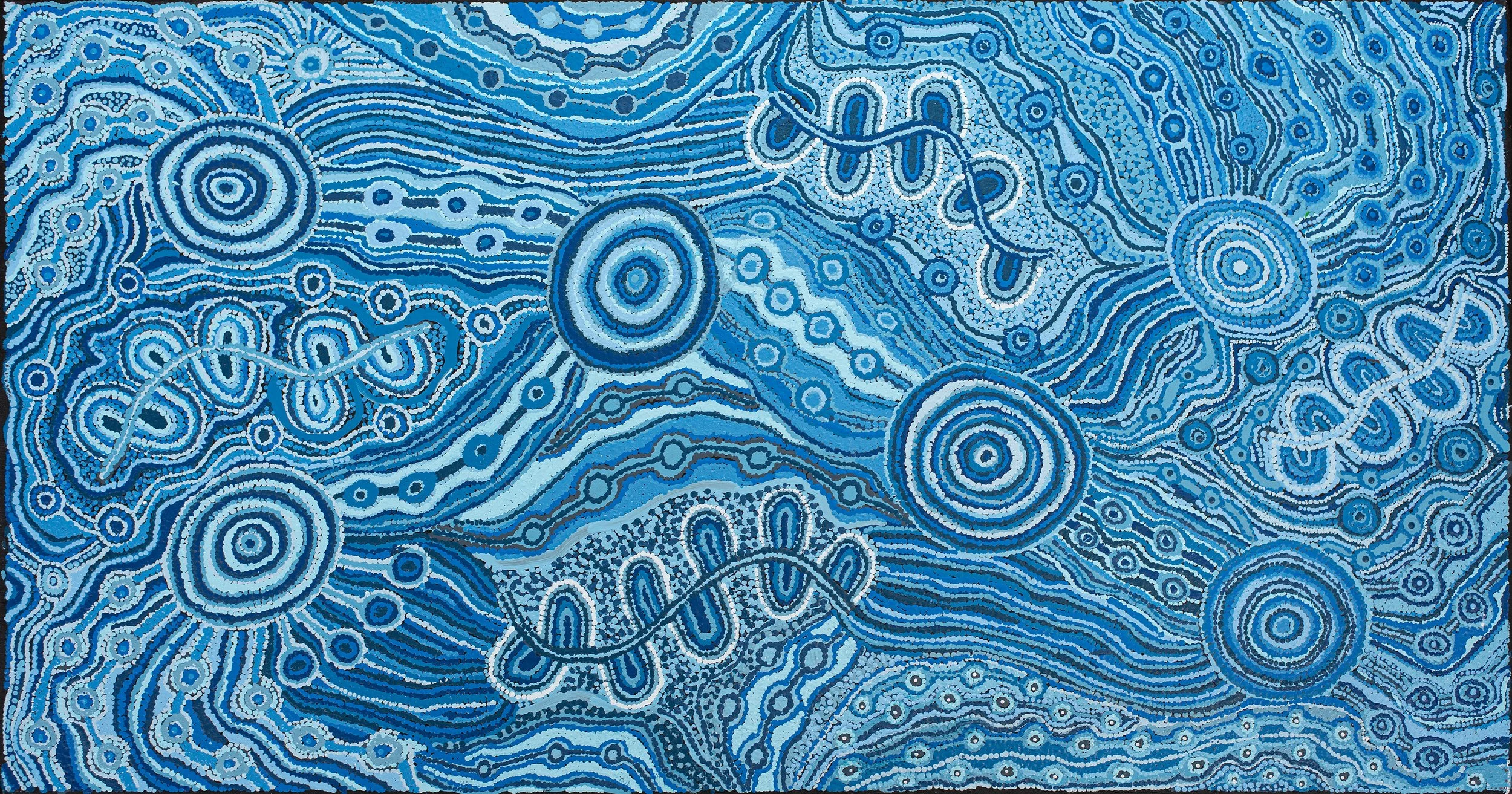
Artiste : Umatji Tjitayi
Titre de l'œuvre : Kaliny-kaliny / Honey Grevillea
Format : 149 × 79 cm
Provenance et certificat : centre d'art aborigène d’Ernabella
Référence de cette peinture aborigène : 342-25
Explication sur cette œuvre :
Stories are told of the Kaliny-kaliny or Honey Grevillea flower which is a favourite bush food of the Anangu Pitjantjatjara (people). Ultukunpa grows in the sandy soils on the plains. The flowers can be picked and placed in a billycan of water to create 'honeywater' (cordial) or they can be sucked for their sweet honey dew.
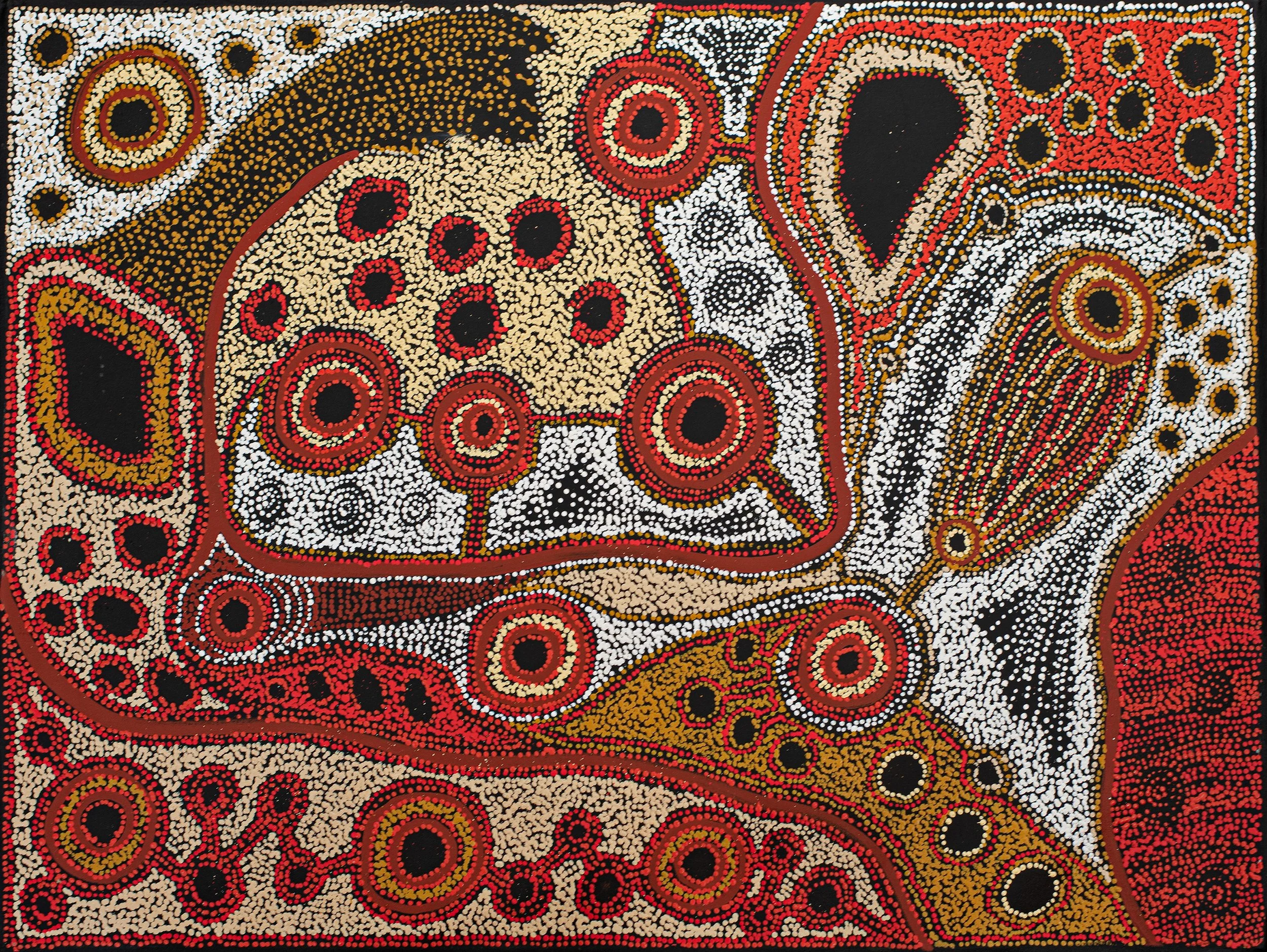
Artiste : Amy Scotty
Titre de l'œuvre : Kungkarangkalpa / Seven Sisters
Format : 121 × 90 cm
Provenance et certificat : centre d'art d'Ernabella
Référence de la peinture : 368-25
Explications sur cette peinture Aborigène :
My father’s place is Mt. Liebe, sandhill country. The Wanapi rests there under the surface of the creek. When we go to visit that country, the Wanapi stirs underneath the ground and bubbles rise up in the water. He is there to protect that place. We speak to that Wanapi in our language and he knows then that it is us. It’s okay for us to be there and the bubbles settle back down. Close to this creek is where the Arkaryi women are sitting. This is an important women’s site. I can’t speak too much about that, as it would be dangerous to disturb those women.
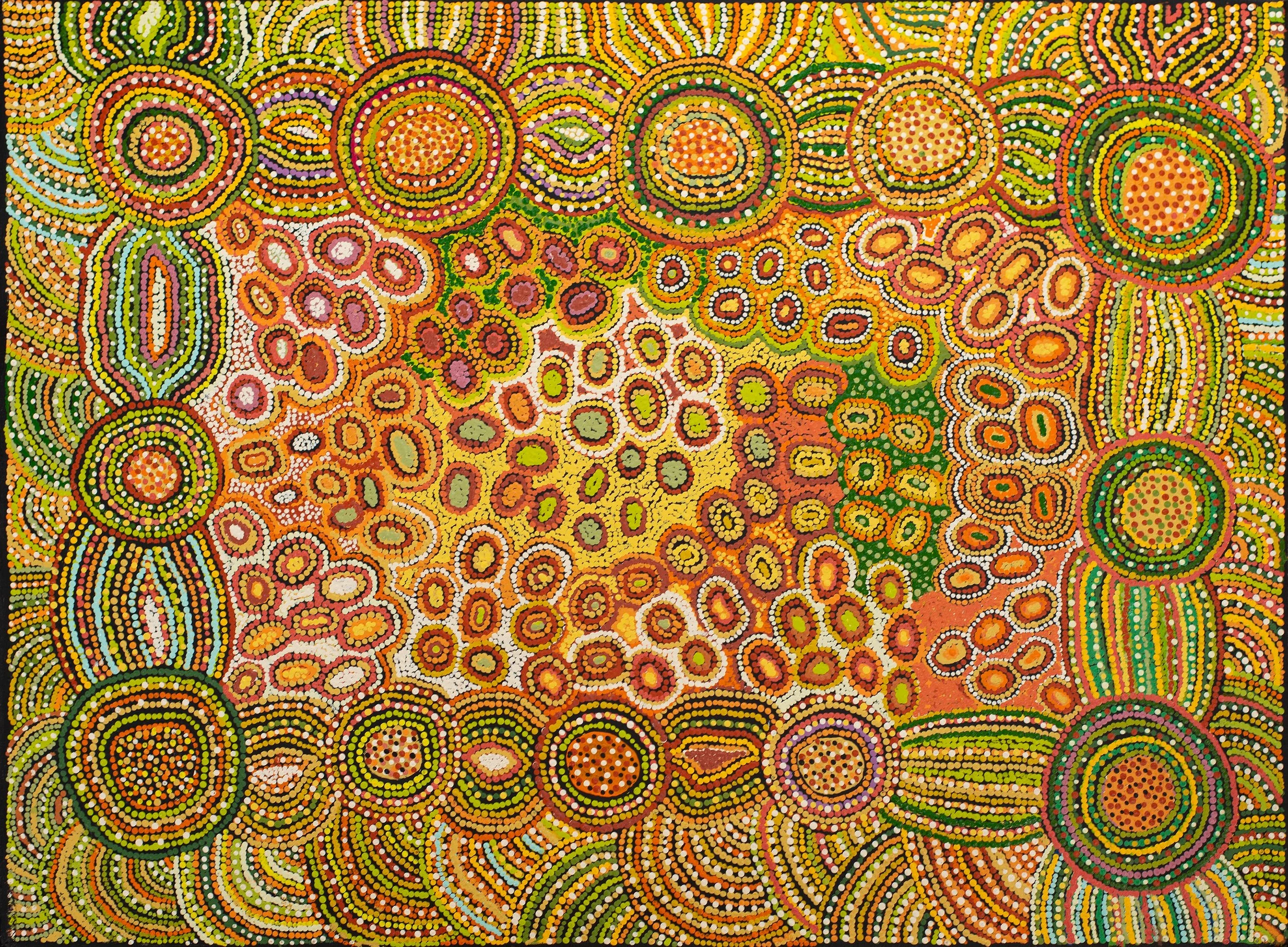
Artiste : Yanyi Dunn
Titre de l'œuvre : Tjukula/Waterhole
Format : 121 × 91 cm
Provenance et certificat : centre d'art aborigène d’Ernabella
Référence de cette peinture aborigène : 339-25
Explication sur cette œuvre :
For the Pitjantjatjara people living in the desert, knowledge of their water sources was critical to their survival. This resulted in an intimate understanding of the landscape which continues today. Water is an essential element in the desert. These rock holes were particularly important during the dry season when most of the water holes and creeks dried up. Deep familiarity with the topography of their country and the way rain would interact with the land ensured constant sources of water could be found. Knowledge of rock hole sites is passed on from generation to generation and revered by all Anangu (people).
Tjukula means rock-holes, which are found with surprising frequency in the Musgrave Ranges and country around Ernabella. Between visits, Anangu would use a construction of rocks and spinifex to guard these important water sources from spoilage by feral and stock animals such as cattle, camels, horses and donkeys.
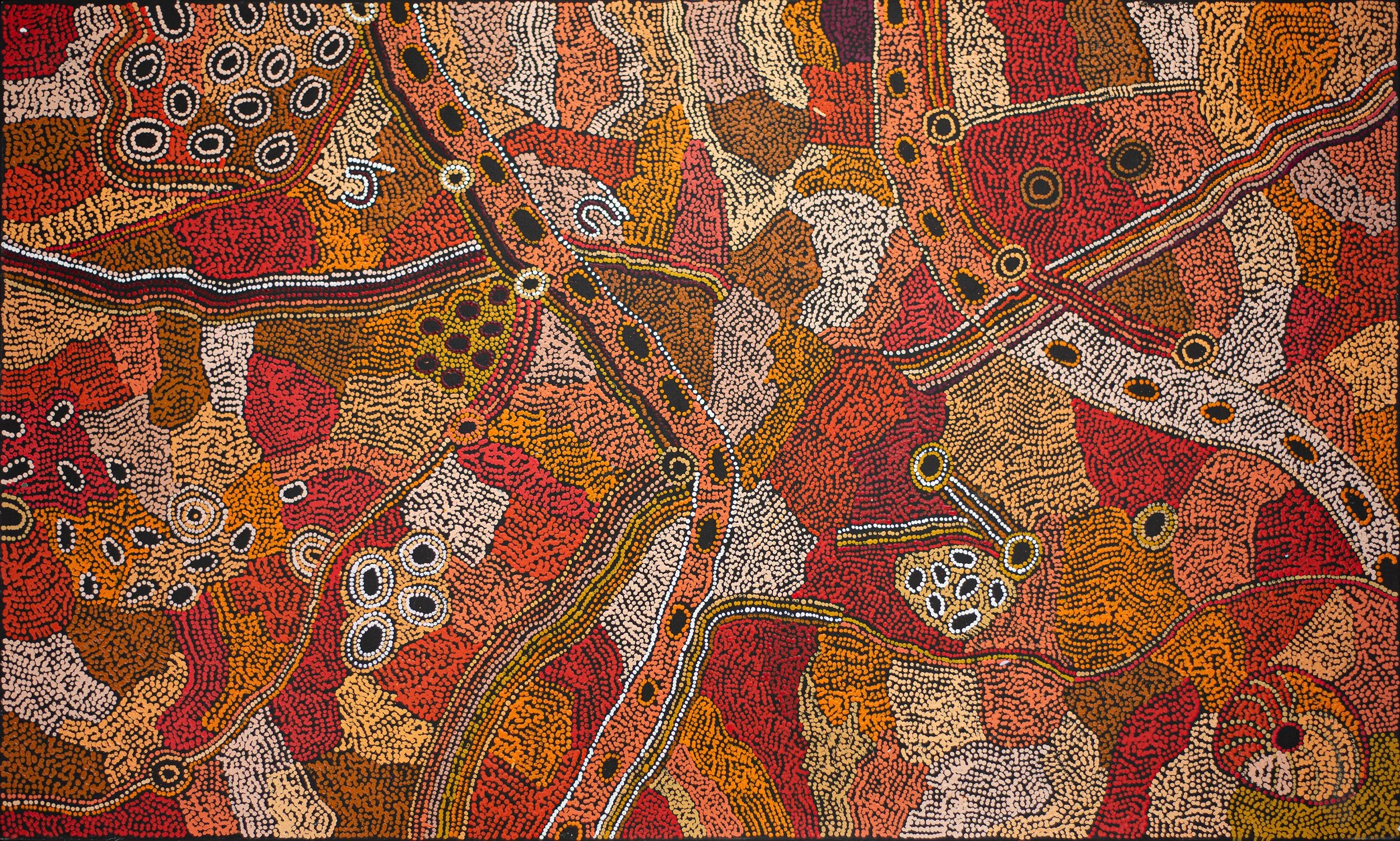
Artiste : Cassyanne Woods
Titre de l'œuvre : Minyma Kutjara
Format : 151 x 92 cm
Provenance et certificat : centre d'art aborigène d’Ernabella
Référence de cette peinture aborigène : 340-25
Explication sur cette œuvre :
There is a story of deep significance to women which contains metaphorical references to female cycles. It tells of two women travelling north. The pair meet with a group of women, including Kutungu, who are caring for a man who then passes away. They then travel to the area known as Mantaruta, near Uluru, where they chase a curious wanampi (serpent) deep into the ground while trying to catch him. They burn their body hair to attract him and hit him on the head and run away. From afar they throw a manguri/traditional head-ring for carrying which also hits him. He then comes and hits the women who travel on bleeding and hurt.
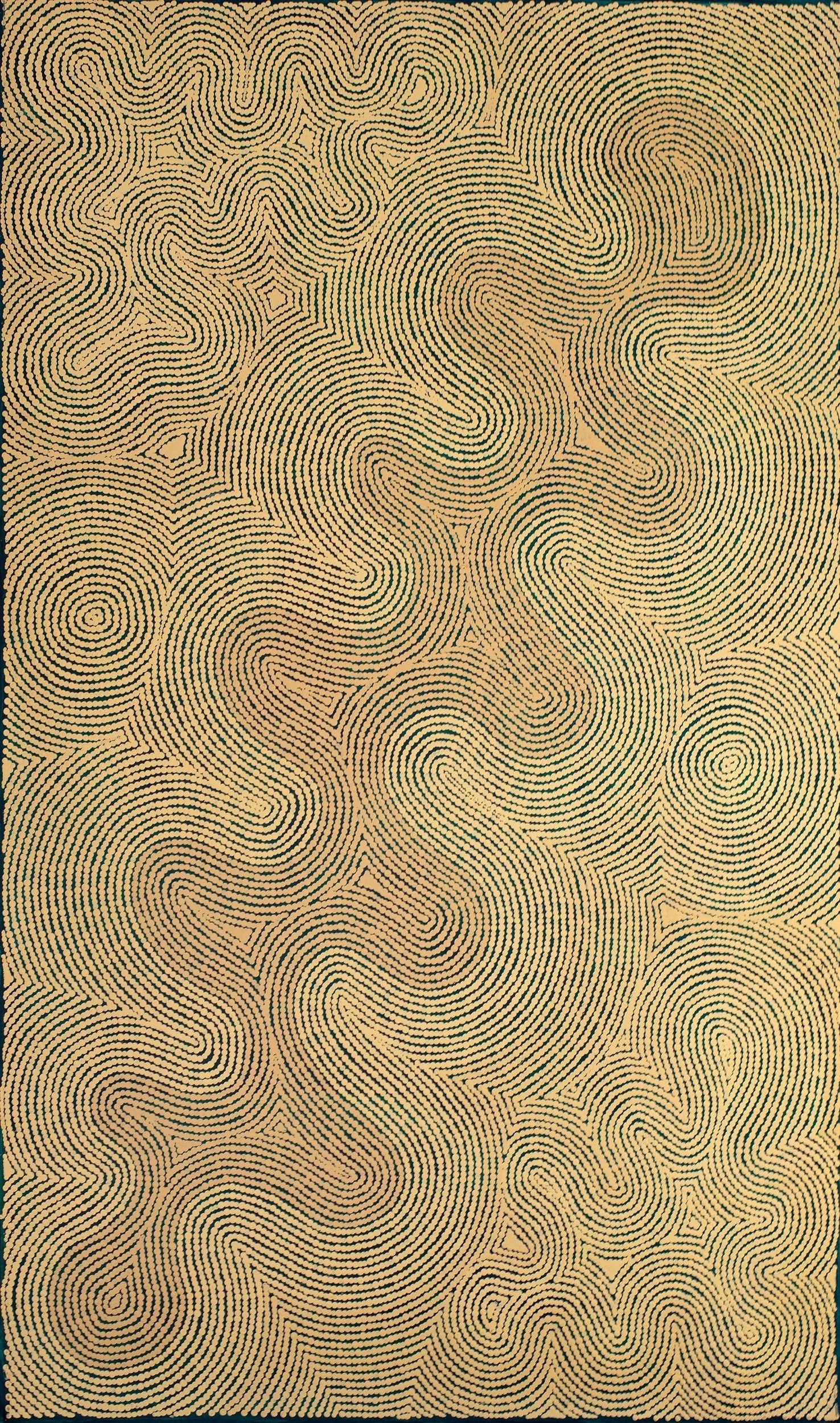
Artiste : Tjulyata Kulyuru
Titre de l'œuvre : Tjukula/Waterholes
Format : 182 × 111 cm
Provenance et certificat : centre d'art aborigène d’Ernabella
Référence de cette peinture aborigène : 286-25
Explication sur cette œuvre :
For the Pitjantjatjara people living in the desert, knowledge of their water sources was critical to their survival.
This resulted in an intimate understanding of the landscape which continues today. Deep familiarity with the topography of their country and the way rain would interact with the land ensured constant sources of water could be found. 'Tjukula' means rock-holes, which are found with surprising frequency in the Musgrave ranges.
Between visits, Anangu (people) would use rocks and spinifex construction to guard these from spoilage by animals and, particularly in more recent times, from feral and stock animals, cattle, camels, horses and donkeys.
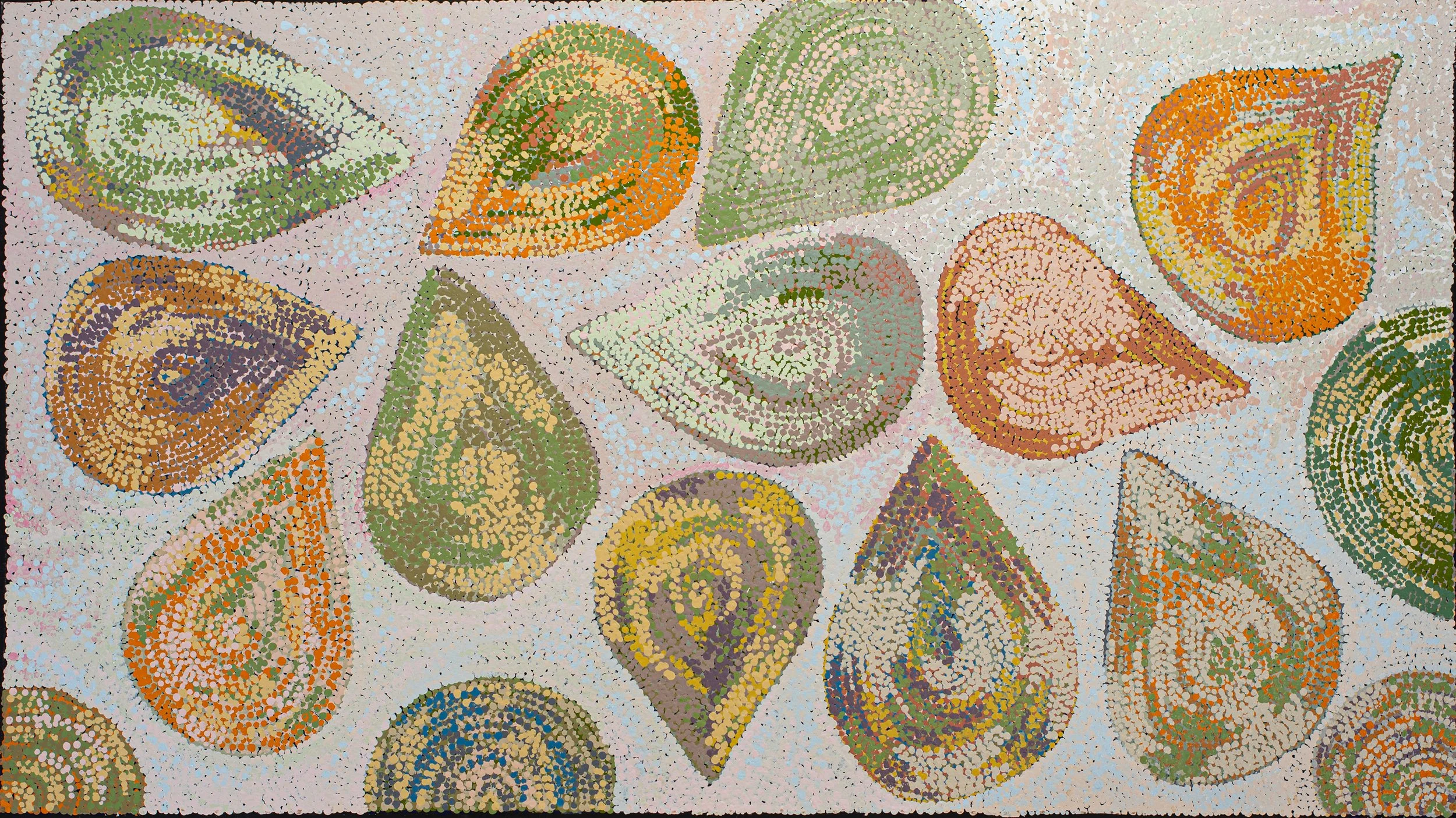
Artiste : Alison Lionel
Titre de l'œuvre : Likara (bark)
Format : 152 × 85 cm
Provenance et certificat : centre d'art d'Ernabella
Référence de cette peinture d'art Aborigène : 359-25
Explanations of this Aboriginal painting :
Tree story. A depiction of the bark of the trees in the Ernabella creek
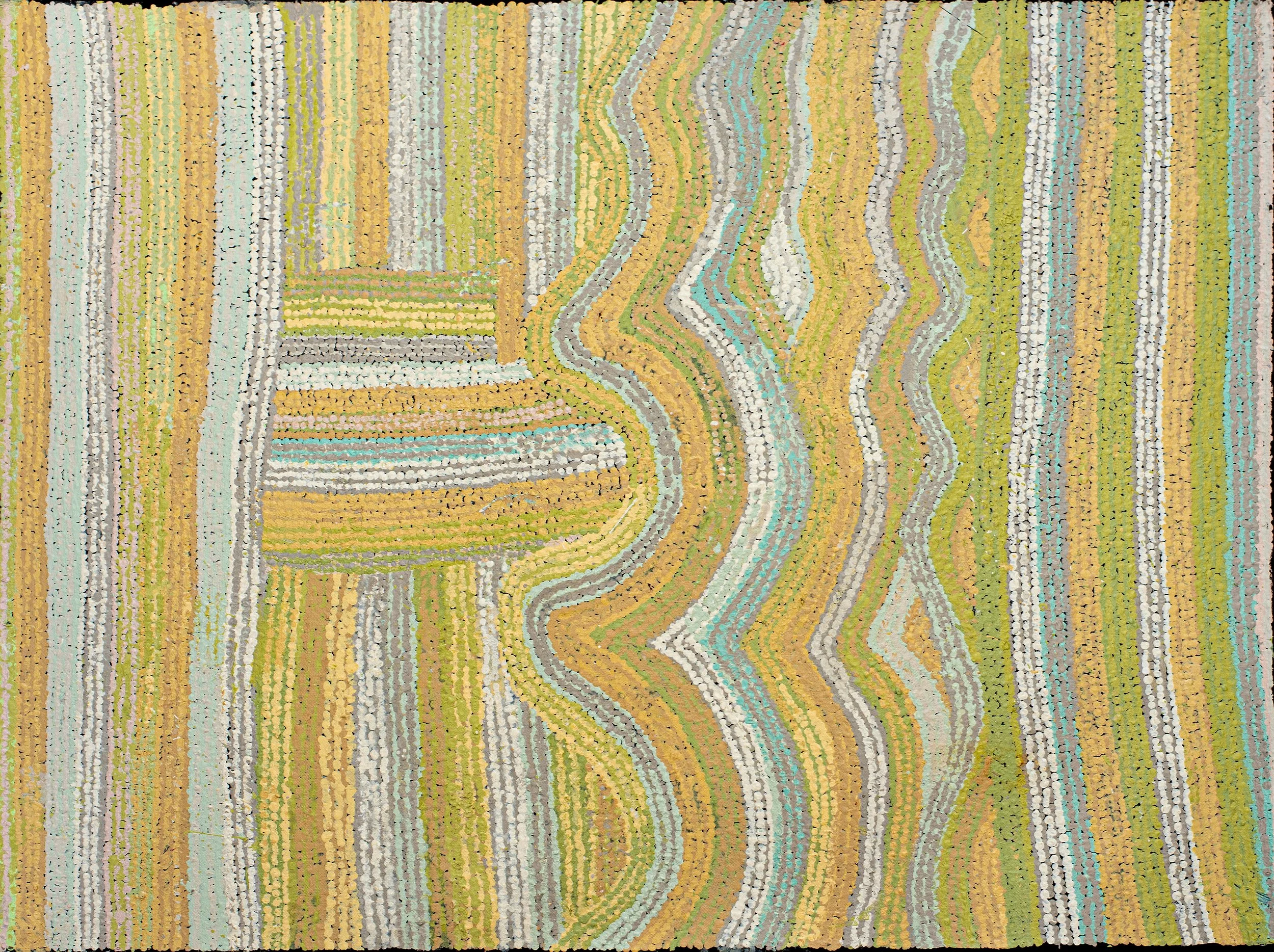
Artiste : Yurpiya Lionel
Titre de l'œuvre : Anumara
Format : 101 × 76 cm
Provenance et certificat : centre d'art d'Ernabella
Référence de la peinture : 419-25
Explications sur cette peinture Aborigène :
Yurpiya is painting a place called Anumara, which is a place near Irrunytju (Wingellina) in WA. This is Yurpiya's family's country. Anumara is also the name for a kind of caterpillar and Anumara is the tjukurpa (dreaming) place for this caterpillar. This caterpillar lives in the grass and can be eaten if the grass it eats is removed. The place shares the same colours of the caterpillar - brown, yellow and pale green. Keeping this place safe will ensure that the caterpillars multiply.
Awards
2020 Waterhouse Natural Science Art Prize, Finalist
2018 Wynne Prize, Finalist
2015 National Aboriginal and Torres Strait Islander Art Award, Finalist
2007 Special Mention, Alice Springs Beanie Festival, Araluen Cultural Precinct, Alice Springs
Her artworks are in the following collections :
Museum of the UNIVERSITY OF NEWCASTLE, 2011
Private collections in Switzerland, Germany, Australia, Belgium

Artiste : Janice Stanley
Titre de l'œuvre : Pantu (Salt lake)
Format : 150 x 120 cm
Provenance et certificat : centre d'art aborigène d’Ernabella
Référence de cette peinture aborigène : 583-22
Explication sur cette œuvre :
Painting by the artist Janice Stanley (1987).
Janice Stanley is the third generation of Stanley women to create artwork at Ernabella Arts. She is an early career painter and ceramic artist showing greatpromise.Her grandmother is founding artist and traditional healer Tjariya Stanley and her aunts are senior artists, Alison Milyika Carroll and Renita Stanley.Janice is part of a group of young women leading the Ernabella ceramics studio, despite only commencing work in late 2015. She has been exhibitedaround Australia and internationally, in Darwin, Alice Springs, Broome, Sydney and Brussels.
A very significant tjurkurpa (story) to Anangu is Kungkarangkalpa (Seven Sisters) which is an extensive creation story relating to the Pleiades constellation. The story traverses Australia taking different forms, but local women are privy to the part of the story which takes place in the country near Ernabella. In her paintings Janice is depicting a salt lake near Attila (Mt Connor), a landmark in the Seven Sisters story.
The artworks of the artist are in the following collections :
Australian Embassy in Zagreb
Private collection
Découvrez les céramiques de l’exposition
Mise en ligne dans quelques jours de l’ensemble des céramiques de l’exposition.
Si vous désirez être informés en primeur, vous pouvez envoyer un mail à info@aboriginalsignature.com

Artiste : Rupert Jack
Titre de l'œuvre : Tjaḻa - Mr Jack's Story
Format : 24,5 x 16,5 cm
Provenance et certificat : centre d'art d'Ernabella
Référence de la peinture : 548C-24
Explications sur cette céramique Aborigène :
This ceramic is about the bush food tjaḻa (honey ants). When I was a young boy and my uncle brought me a tjaḻa for the first time I was thinking, Ai! Nyaaku? (Ah, what’s this for?) and then he showed me how to eat it and I said, Ai, Rikina! (Wow – delicious!).

Artiste : Fiona Wells
Titre de l'œuvre : Ngayuku Walka / My Design
Format : 26,5 × 12,5 cm
Provenance et certificat : centre d'art d'Ernabella
Référence de la peinture : 104C-25
Explications sur cette céramique Aborigène :
Walka means design or pattern. Artists use this title to describe artworks that are pattern based rather than descriptive or telling a story.

Artiste : Rupert Jack
Titre de l'œuvre : Wintjalangu Football Team
Format : 29,5 x 16,5 cm
Provenance et certificat : centre d'art d'Ernabella
Référence de la peinture : 549C-24
Explications sur cette céramique Aborigène :
Wintjalangu is my team. When I was younger I got the jumper for that team, I was the Chairman of the club. Wintjalangu is the name of the karu (creek) that runs through Pukatja community. This year Wintjalangu is playing in the final against Amata.
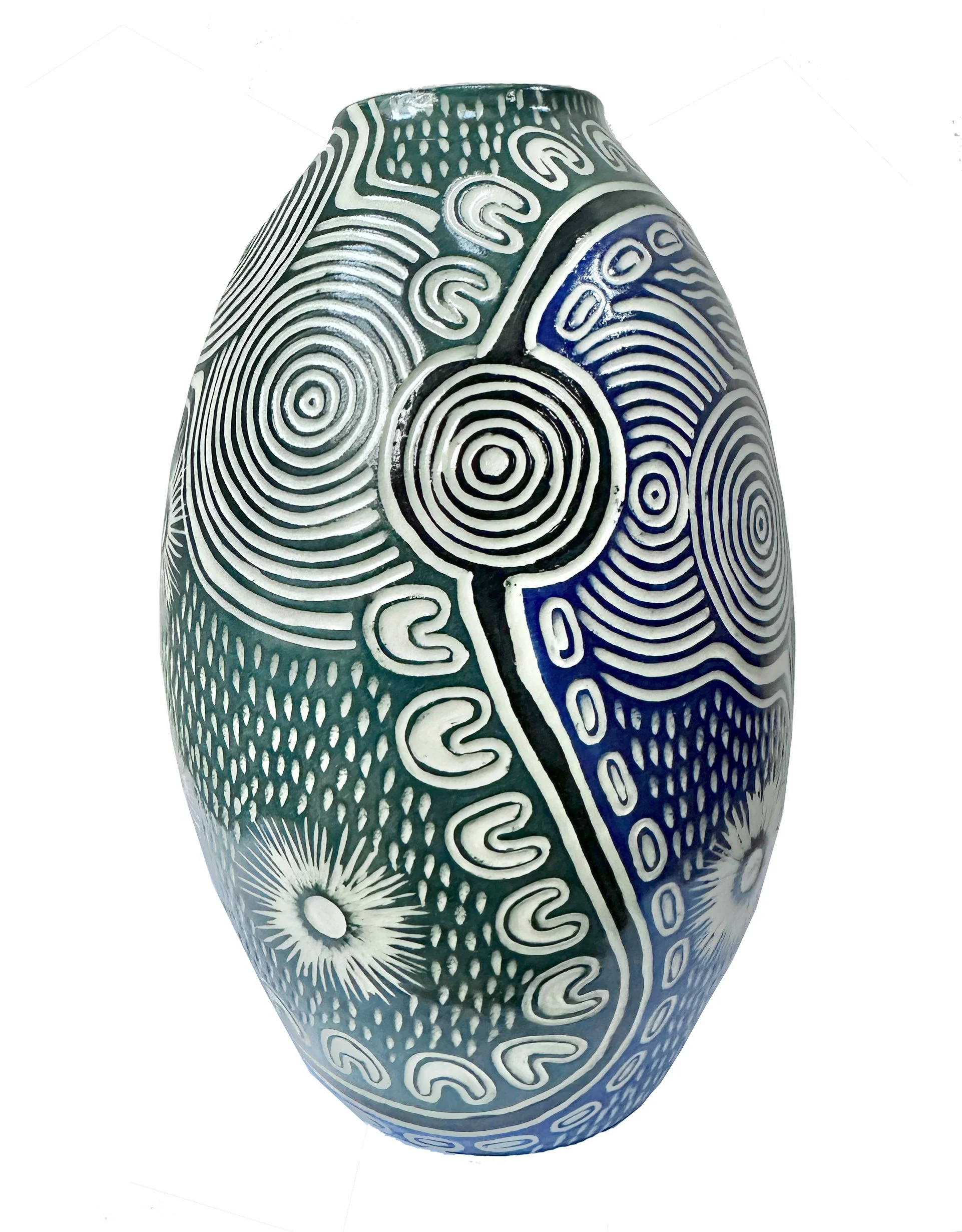
Artiste : Fiona Wells
Titre de l'œuvre : Ngayuku Walka / My Design
Format : 24 × 15,5 cm
Provenance et certificat : centre d'art d'Ernabella
Référence de la peinture : 105C-25
Explications sur cette céramique Aborigène :
Walka means design or pattern. Artists use this title to describe artworks that are pattern based rather than descriptive or telling a story.
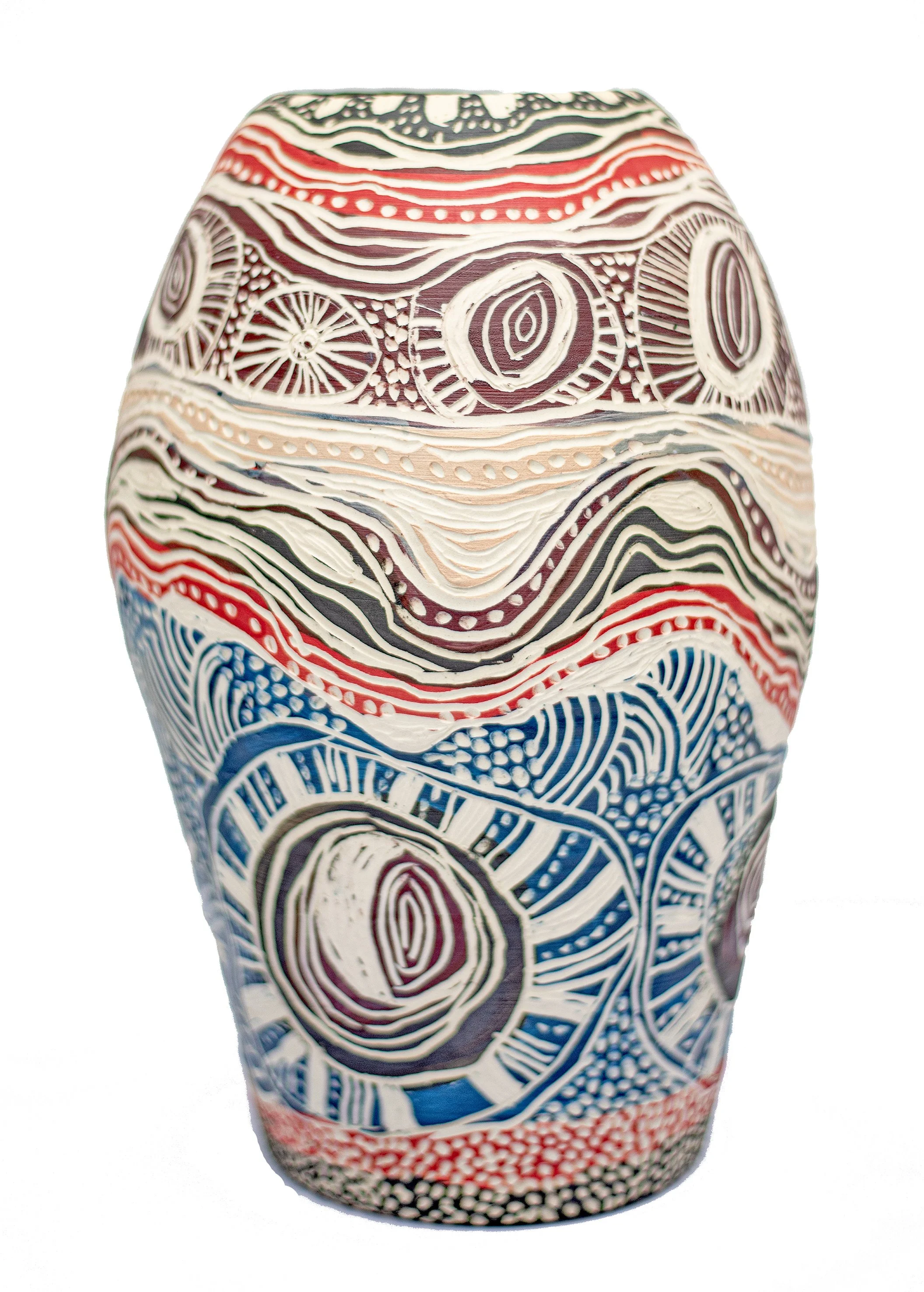
Artiste : Elizabeth Dunn
Titre de l'œuvre : Piltati - Elizabeth Dunn's story
Format : 31 × 20 cm
Provenance et certificat : centre d'art d'Ernabella
Référence de la céramique : 196C-25
Explications sur cette céramique Aborigène :
Piltati is Elizabeth’s great-grandfather's country and her dreaming story. Two brothers were married to two sisters and they all lived together. One day the two men go out hunting, looking for malu (kangaroo). They travel everywhere and find nothing. They start to worry - what are we going to do, there is no meat on this land. One brother says, maybe we should turn into something. They start to think about what they should turn into. Maybe firewood? No, the firewood burns. Maybe emu or a bird? No, people eat them.
They do a lot of talking and decide they should turn into wanampi (rainbow serpents). A lot of smoke starts to come out of the ground, it is very scary and then the men become wanampi. They travel into the land, towards a rockhole.
Meanwhile, the two women are waiting for their husbands to return from their hunting trip. They wait a very long time. They keep going on with their lives, collecting bush tucker, waiting…but the men never come back. So they decide to set out to find their husbands. One day they come across a hole in the ground. They start digging. Digging, digging, digging they follow the tunnel inside the ground. They are so frantically digging they accidently hit one of the wanampi in the back.
The wanampi chase the ladies and eat one of them and one woman gets away.
Now the wanampi still live in the waterhole called Piltati. The wanampi live there today and provide rain for the bush tucker to grow and provide meat on the land.
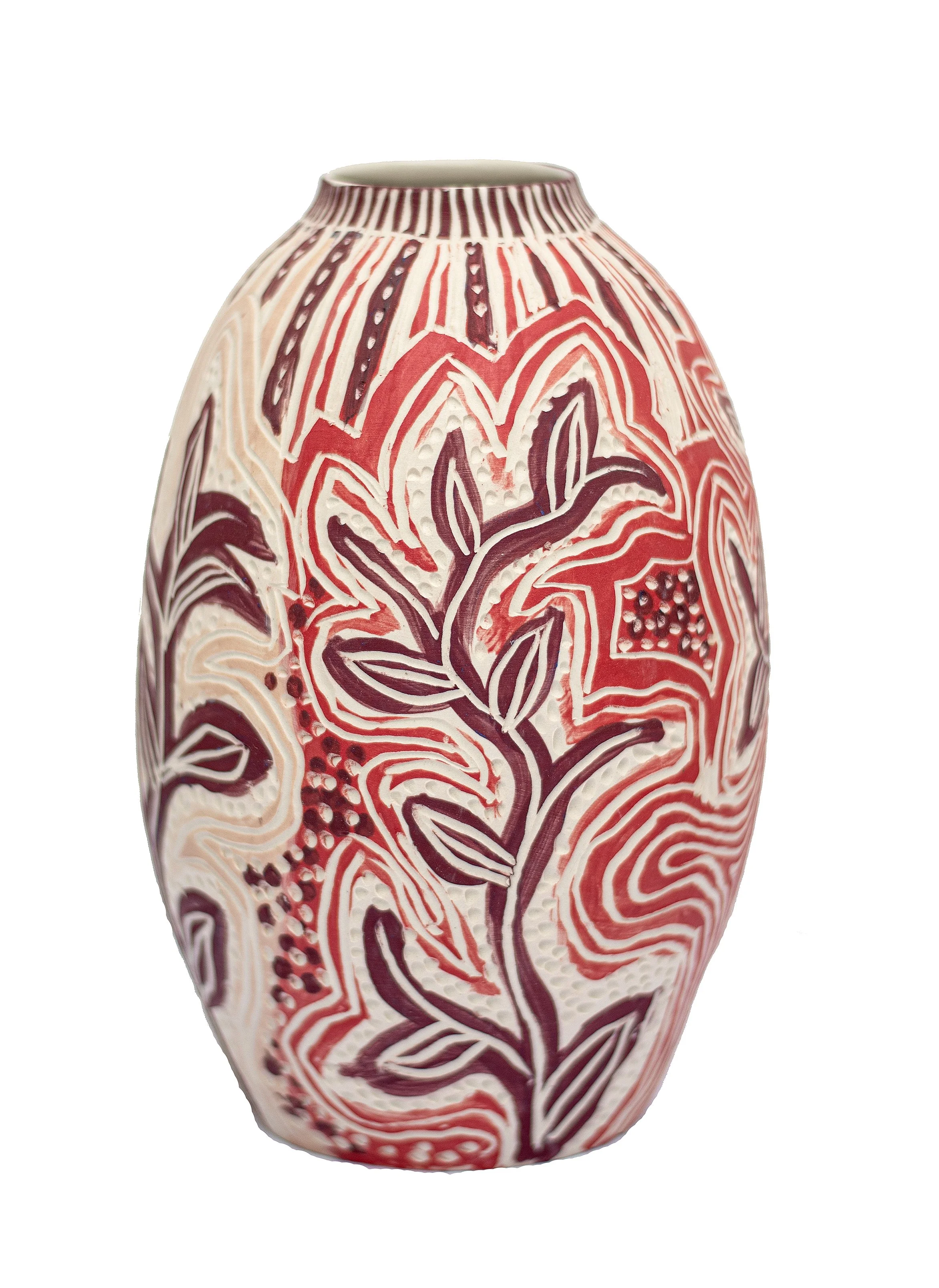
Artiste : Elizabeth Dunn
Titre de l'œuvre : Kampurarpa Tjukurpa - Elizabeth's Story
Format : 23 × 16 cm
Provenance et certificat : centre d'art d'Ernabella
Référence de la céramique : 229C-25
Explications sur cette céramique Aborigène :
Kampurarpa are bush tomatoes. Elizabeth’s work comments on the environmental change that has occurred on her country due to the introduction of non-native fauna such as cattle, and flora, notably weeds like buffel grass. Buffel grass is so widespread and destructive that it is commonly known in and around Pukatja as tjanpi mamu or devil grass.
From the very start of Elizabeth’s artistic practice she has drawn her kampurarpa tjukurpa (bush tomato story) in clay. In the old times kampurarpa were one of the main foods for Anangu.
I’ve seen the land change. We used to have a lot of flowers. We used to go out to the bush to collect bush tucker, like kampurarpa (bush tomatoes). And now there’s a lot of buffel grass everywhere. The land is changed by the buffel grass.
Now there’s no more flowers – no purple flowers, yellow flowers, white or pink flowers. I’ve seen it. When all the cattle and the sheep and the goats came, the kangaroos left and went a long way away. They saw the strange animals and they left.
That’s a true story. Today, sometimes we still go out and collect kampurarpa but not like we did before. Our country has been changed by cattle and weeds like buffel grass, so we can’t find all the old foods like we once did. I’ll keep telling the kampurarpa story in my work, that keeps the stories, songs and dances about these important foods alive and strong.
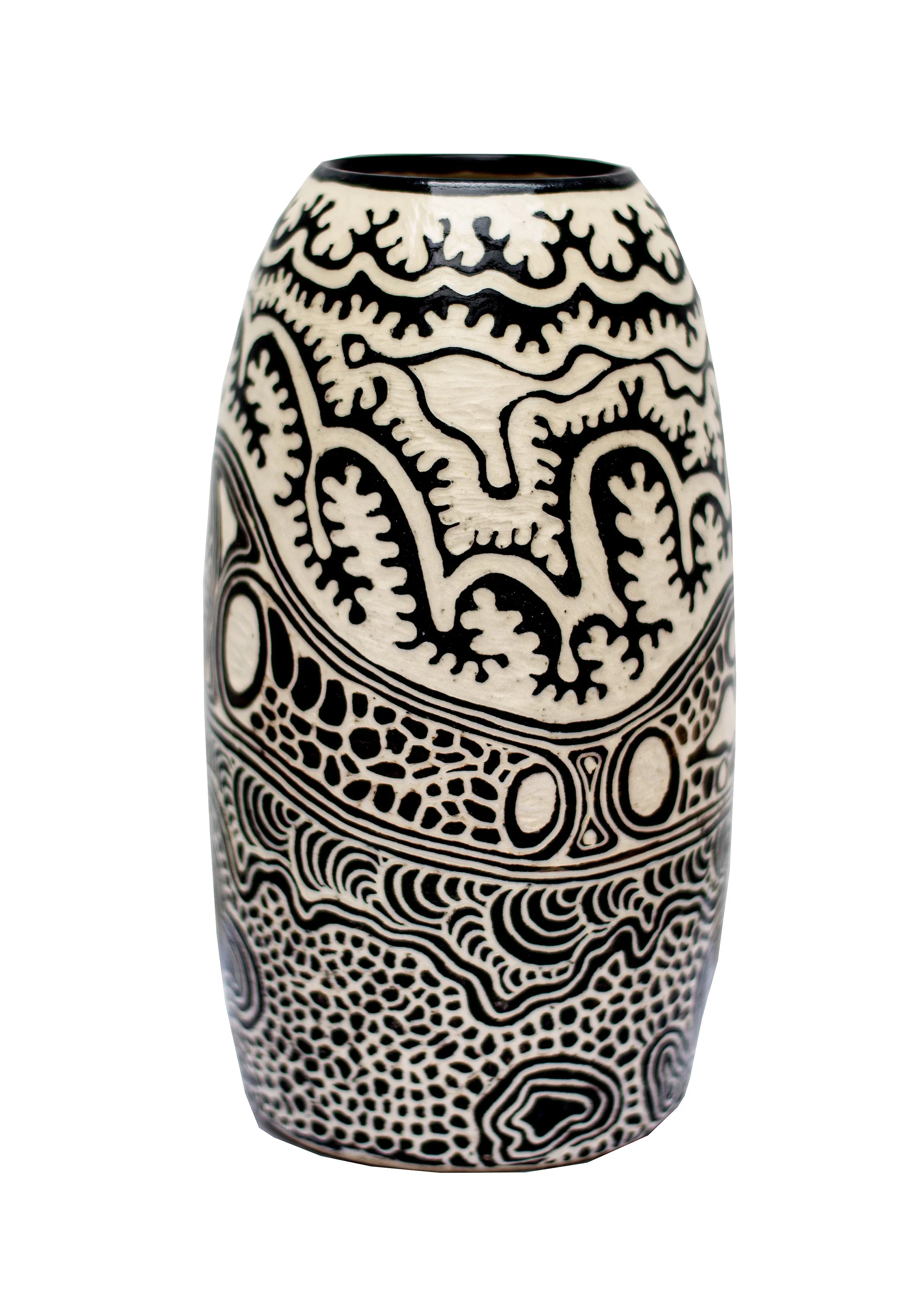
Artiste : Langaliki Lewis
Titre de l'œuvre : Ngayuku Walka
Format : 24 × 13 cm
Provenance et certificat : centre d'art d'Ernabella
Référence de la peinture : 236C-25
Explications sur cette céramique Aborigène :
Ngayuku Walka means 'my design' and artists use this to describe paintings that are pattern based rather than descriptive or story based.
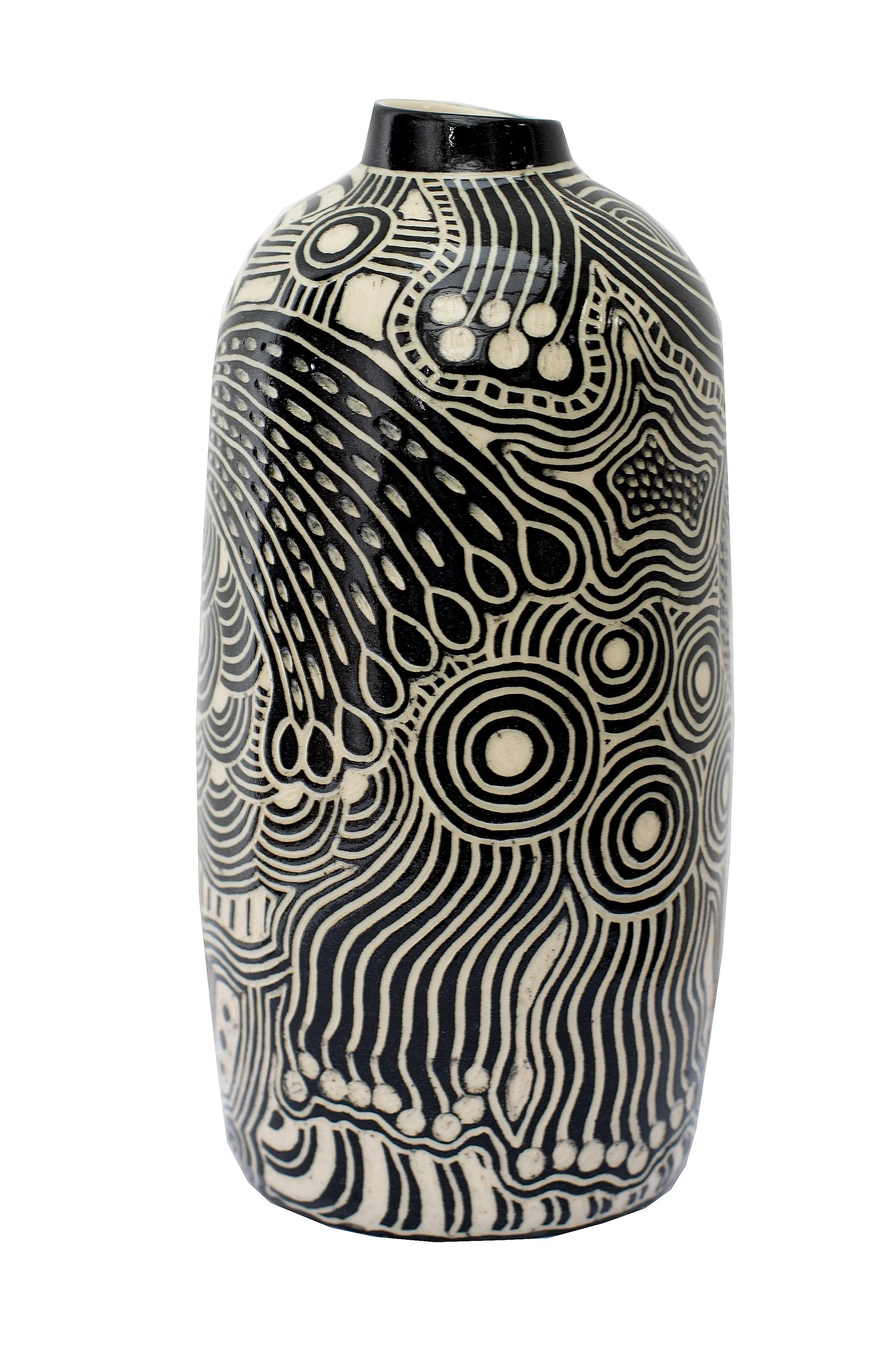
Artiste : Vivian Pingkayi Thompson
Titre de l'œuvre : Kungkarangkalpa / Seven Sisters
Format : 25 × 12 cm
Provenance et certificat : centre d'art d'Ernabella
Référence de la peinture : 237C-25
Explications sur cette céramique Aborigène :
Kungkarangkalpa means the Seven Sisters. This is an extensive creation story that relates to the Pleiades constellation in the southern hemisphere. The story traverses Australia taking on different forms, however local women are privy to the part of the story which takes place in the country near Ernabella. For this part of the story, the man called Nyiru is chasing the sisters as he wants to sleep with the oldest sister. All the younger sisters are deeply afraid of him. As Nyiru is chasing the sisters, he tries to catch them by using magic to turn himself into the most tempting bush tomatoes for the sisters to eat and the most beautiful ili (fig) tree for the sisters to camp under. However, the sisters are aware of his magic and go hungry and run through the night rather than be caught by Nyiru. Eventually, to escape Nyiru, the sisters fly into the sky where they turn into stars and form the constellation.

Artiste : Alison Milyika Carroll
Titre de l'œuvre : Wira Walka
Format : 40 x 16 cm
Provenance et certificat : centre d'art d'Ernabella
Référence de la céramique : 249C-25
Explications sur cette céramique Aborigène :
Wira is a small cup-like digging bowl or multi-purpose object. In the early days this walka (design) was burnt with wire on to wooden carvings, particularly onto the wira. This association with women has seen the wira walka take on an identity as a female design. It is also highly reminiscent of the marks made in ochre or paint on a woman's breasts during inma (ceremony). This design has become an iconic element in art from the Anangu Pitjantjatjara Yangkantjatjara Lands.
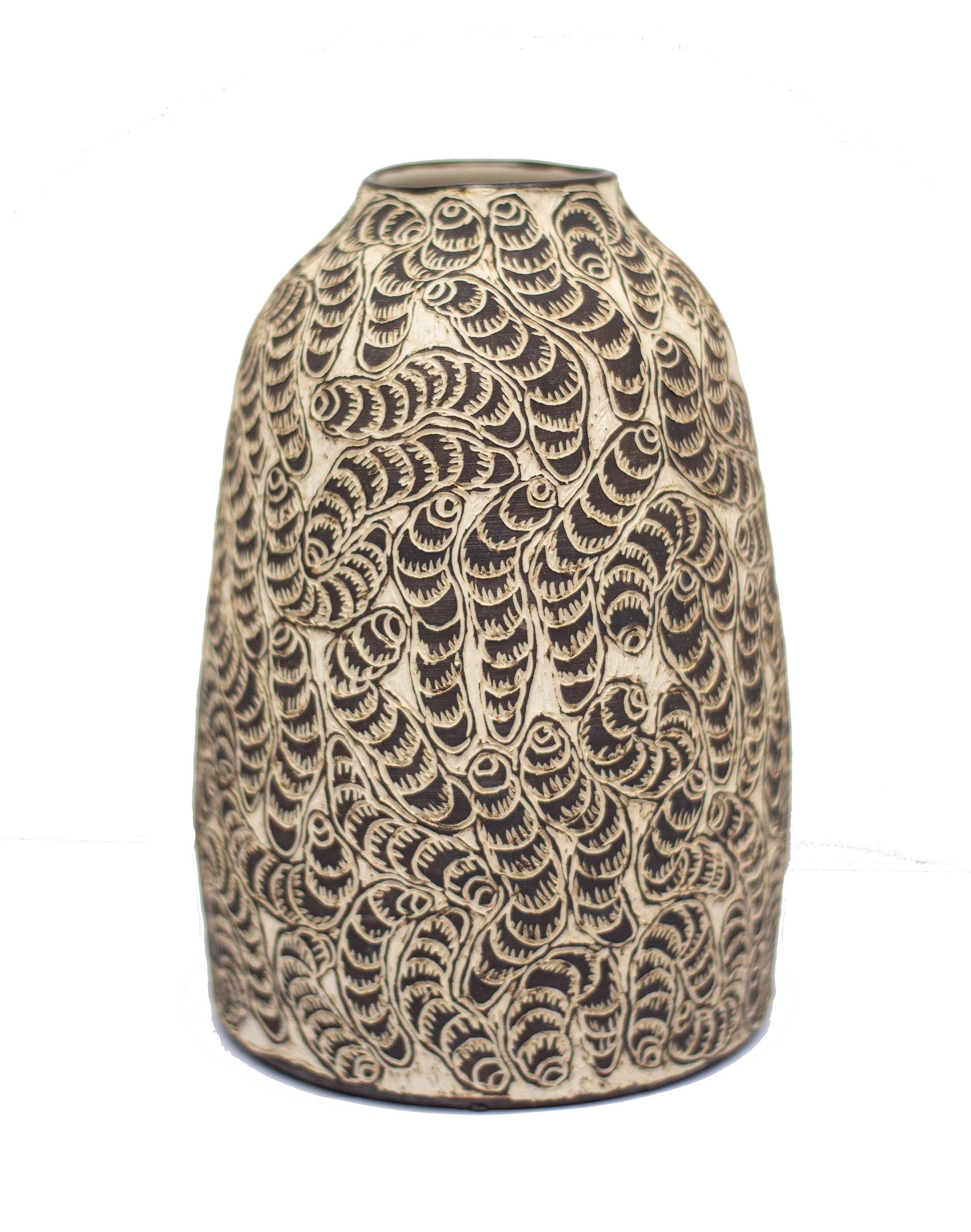
Artiste : Derek Jungarrayi Thompson
Titre de l'œuvre : Maku (Witchetty Grub) Derek’s Story
Format : 21 x 14,5 cm
Provenance et certificat : centre d'art d'Ernabella
Référence de la céramique : 258C-25
Explications sur cette céramique Aborigène :
This is a tjukurpa (story) from near Mimili on the Aṉangu Pitjantjatjara Yankunytjatjara (APY) Lands from when Aṉangu (people) came here a long time ago. When the maku (witchetty grub) was finished, people sang the maku to make them come back. They sang and danced and scattered leaves to make the maku come out of the ground. This is Derek’s grandmother’s story. She used to dance to these songs when she lived in Mimili and she's now buried there.
Derek’s cousin says: ‘So when they dance to that maku song, that song develops all the bush food - maku under the ground to grow more bigger and to have more maku in the roots. So when the ladies dig it they can see it really close in the roots as well. They can be like five of them but they have to be really, really big’.
Until relatively recently bush foods were the primary source of sustenance for Aṉangu and maku is still one of the favourites. Many bush foods are still gathered regularly almost exclusively by women, and they feature strongly in artistic mark making. Women learn the art of gathering each of the foods from a young age and much inma (ceremony) relates to these practices and the maintenance of supply.
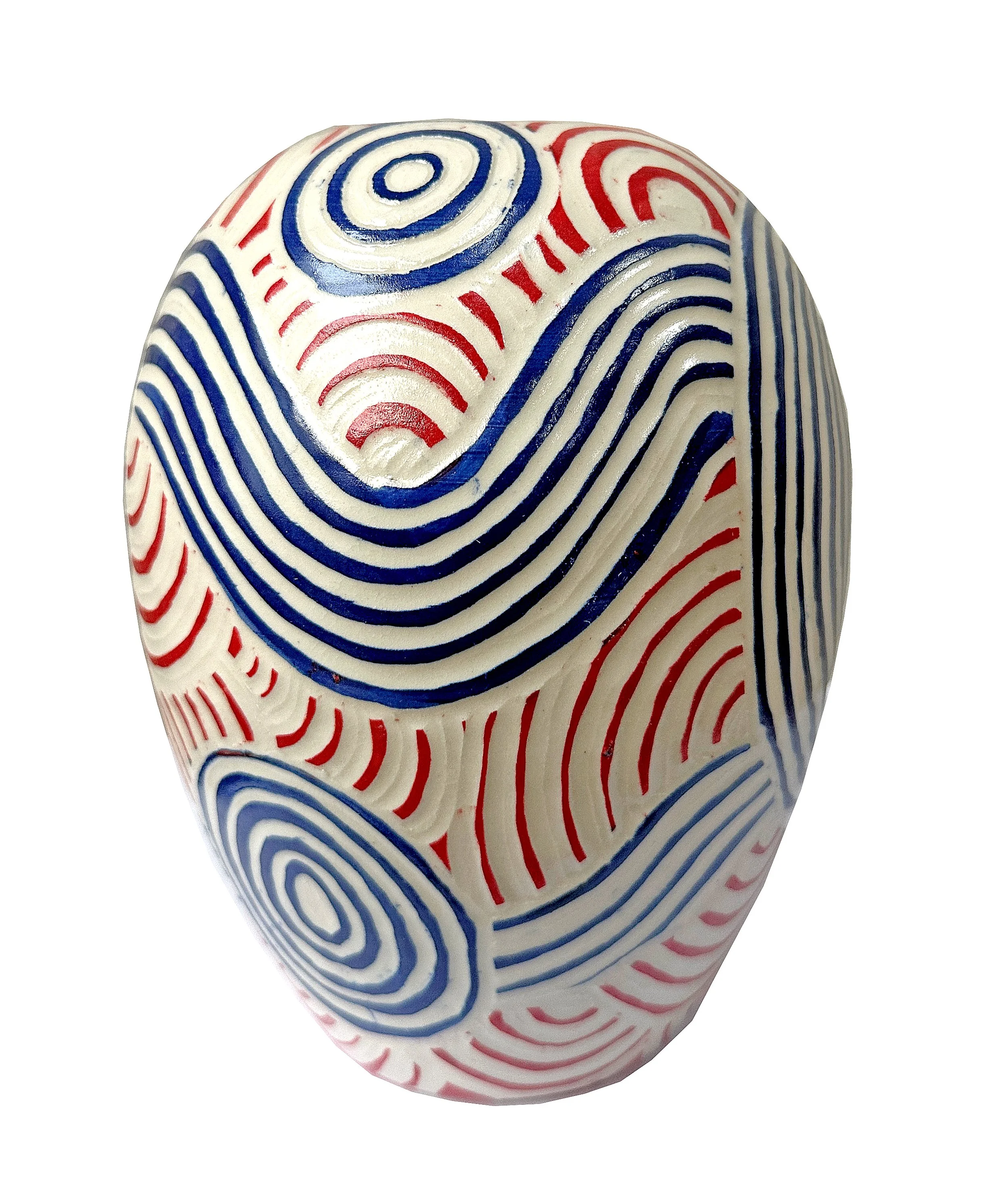
Artiste : Marceena Jack
Titre de l'œuvre : Ngayuku Walka / My Design
Format : 20 x 15 cm
Provenance et certificat : centre d'art d'Ernabella
Référence de la peinture : 326C-24
Explications sur cette céramique Aborigène :
Walka means design or pattern. Artists use this title to describe artworks that are pattern based rather than descriptive or telling a story.
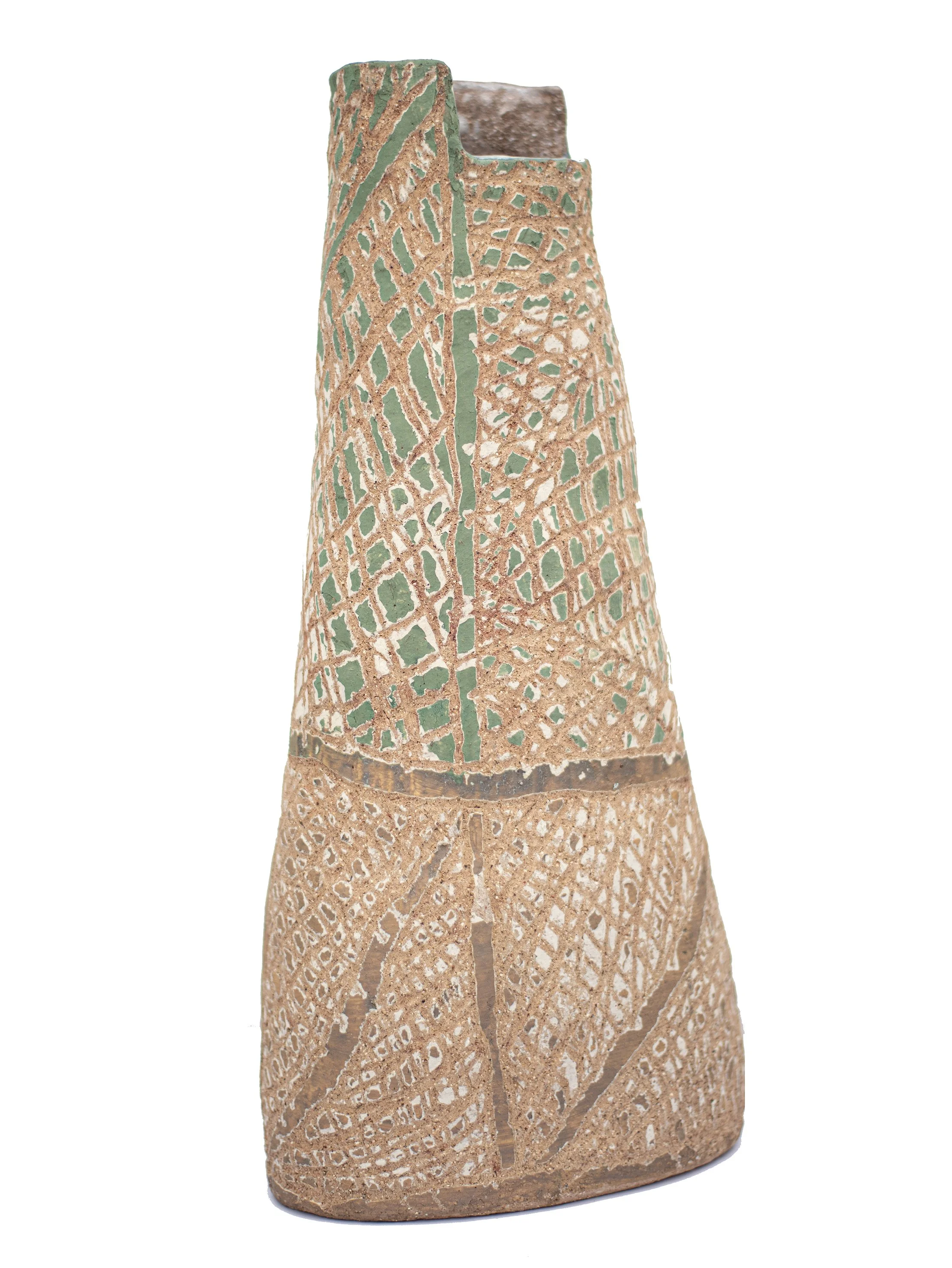
Artiste : Renita Stanley
Titre de l'œuvre : Minyma Kutjara Wingellina
Format : 47 × 21,5 cm
Provenance et certificat : centre d'art d'Ernabella
Référence de la peinture : 680C-24
Explications sur cette céramique Aborigène :
This is the story of the older sister going a long way to get her younger sister and bring her back. They went through many places on the way, but I will only talk about a short bit of their journey at Wingellina. Two women who both came from up high and stayed awhile. They both could see that Docker River was close. And as they were sitting there they performed ceremony, inma. After they both threw away their weapons, they threw them away. Their head-rings, they threw away their head-rings. Then they got up and left. They went to another place, a hollow called Kantarangkutjara and then they travelled on to Docker River. The story of their travels after Docker River belongs to the Docker River people and others in distant country. My part of the story is short.

Artiste : Elizabeth Dunn
Titre de l'œuvre : Kampurarpa Tjukurpa - Elizabeth's Story
Format : 23,5 x 21 cm
Provenance et certificat : centre d'art d'Ernabella
Référence de la céramique : 295C-25
Explications sur cette céramique Aborigène :
Kampurarpa are bush tomatoes. Elizabeth’s work comments on the environmental change that has occurred on her country due to the introduction of non-native fauna such as cattle, and flora, notably weeds like buffel grass. Buffel grass is so widespread and destructive that it is commonly known in and around Pukatja as tjanpi mamu or devil grass.
From the very start of Elizabeth’s artistic practice she has drawn her kampurarpa tjukurpa (bush tomato story) in clay. In the old times kampurarpa were one of the main foods for Anangu.
I’ve seen the land change. We used to have a lot of flowers. We used to go out to the bush to collect bush tucker, like kampurarpa (bush tomatoes). And now there’s a lot of buffel grass everywhere. The land is changed by the buffel grass.
Now there’s no more flowers – no purple flowers, yellow flowers, white or pink flowers. I’ve seen it. When all the cattle and the sheep and the goats came, the kangaroos left and went a long way away. They saw the strange animals and they left.
That’s a true story.
Today, sometimes we still go out and collect kampurarpa but not like we did before. Our country has been changed by cattle and weeds like buffel grass, so we can’t find all the old foods like we once did. I’ll keep telling the
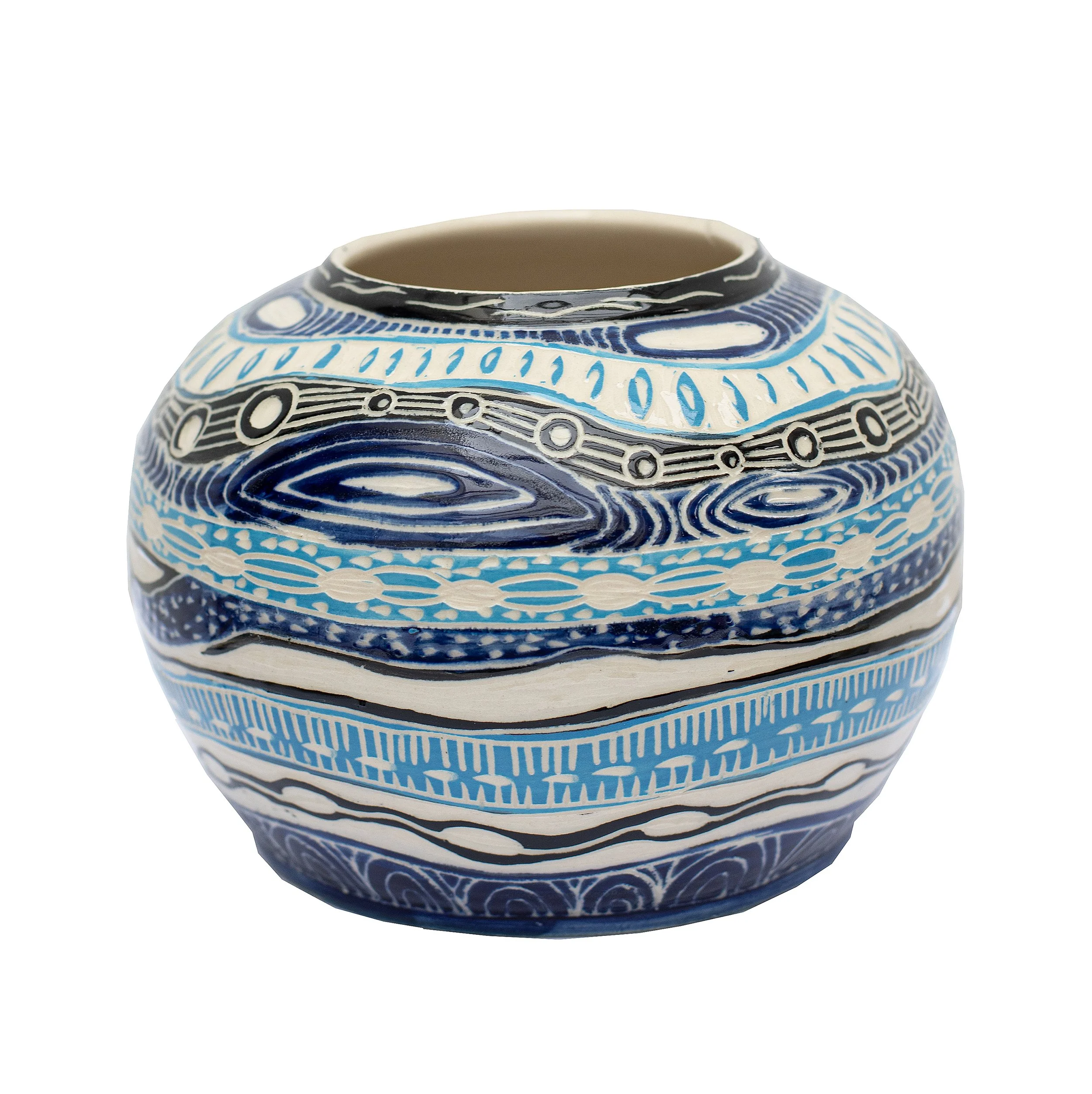
Artiste : Lynette Lewis
Titre de l'œuvre : Tjala / Honey Ants
Format : 17 × 12,5 cm
Provenance et certificat : centre d'art d'Ernabella
Référence de la peinture : 327C-25
Explications sur cette céramique Aborigène :
Tjala or honey ants live in nests about a metre underground beneath mulga trees, and they are a highly favoured food source. The tjala tunnels that lead down to the ants’ nests are called nyinantu, and the larvae are called ipilyka-ipilyka . After the rain when the ground is soft the women go digging for tjala by looking for the drill holes under the trees. They then use shovels and crowbars to dig down following the tunnels to find the tjala inside. Anangu suck the delicious rich honey-like liquid from the distended abdomen of the tjala . The story of the tjala is told across the Northern Territory into South Australia and is an important link between Anangu mythology and inter-dependence on the environment.
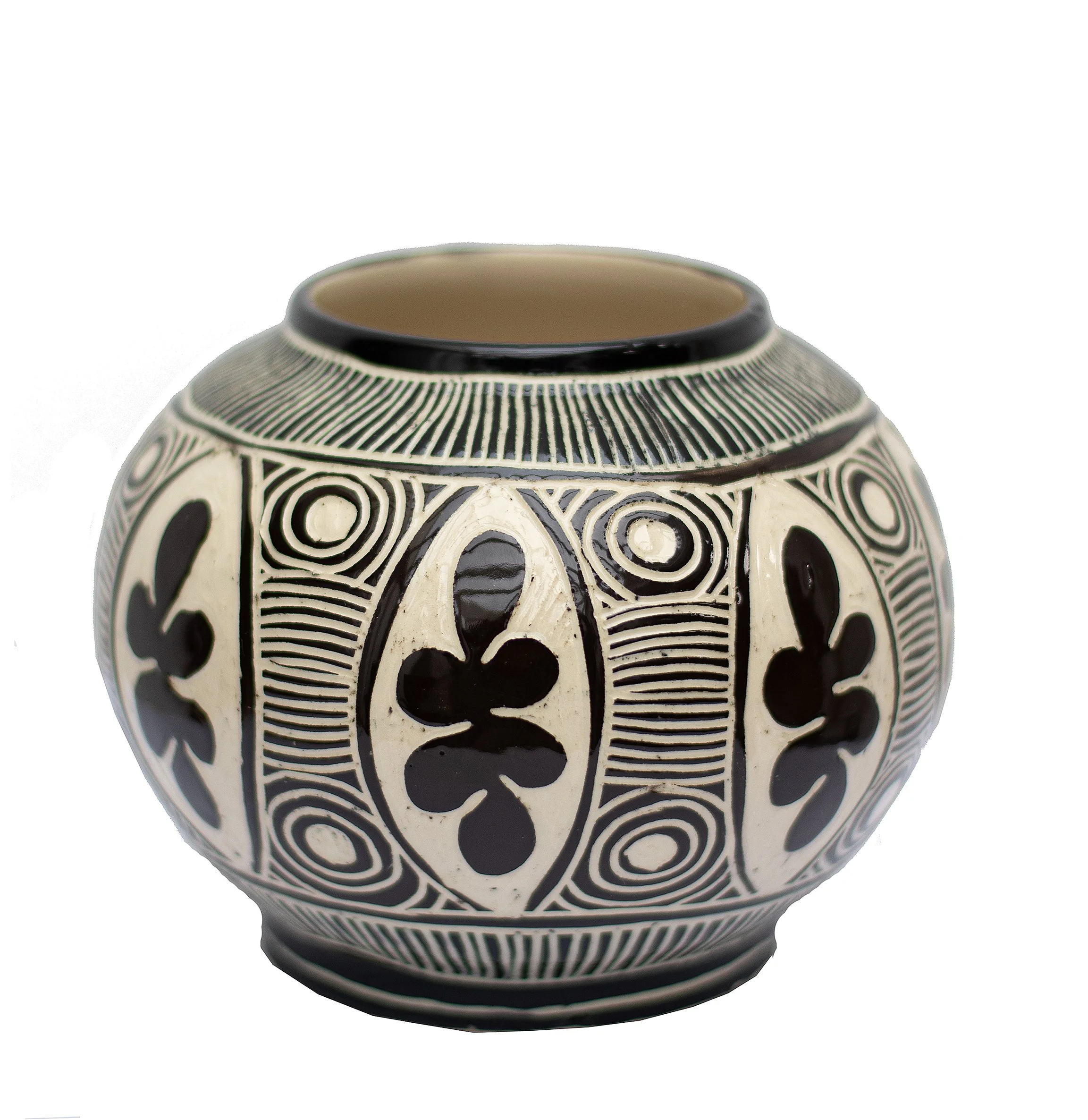
Artiste : Tjimpuna Williams
Titre de l'œuvre : Piltati
Format : 16,5 × 13 cm
Provenance et certificat : centre d'art d'Ernabella
Référence de la céramique : 328C-25
Explications sur cette céramique Aborigène :
There were two sisters who married two brothers and they all lived together. One day the women went wandering and they went such a long way that they forgot about their husbands. Back at the camp, the two husbands were thinking, 'Where are our wives?' and they decided to go looking for them. One brother said to the other, 'What should we become to go looking for them?' and the other brother said 'Why don't we become Rainbow Serpents?' And they travelled in the sky looking down for their wives. Finally they see them hunting for carpet snakes and they put something in the hole where the women were digging. The women find it and then dig another hole and once again the men have put something in there.
And this is how the men lure the women back to Piltati where the men make the sisters transform into Wanampi, swallow them and keep them in their throats. All four of them live together in the waterhole and still live there today.
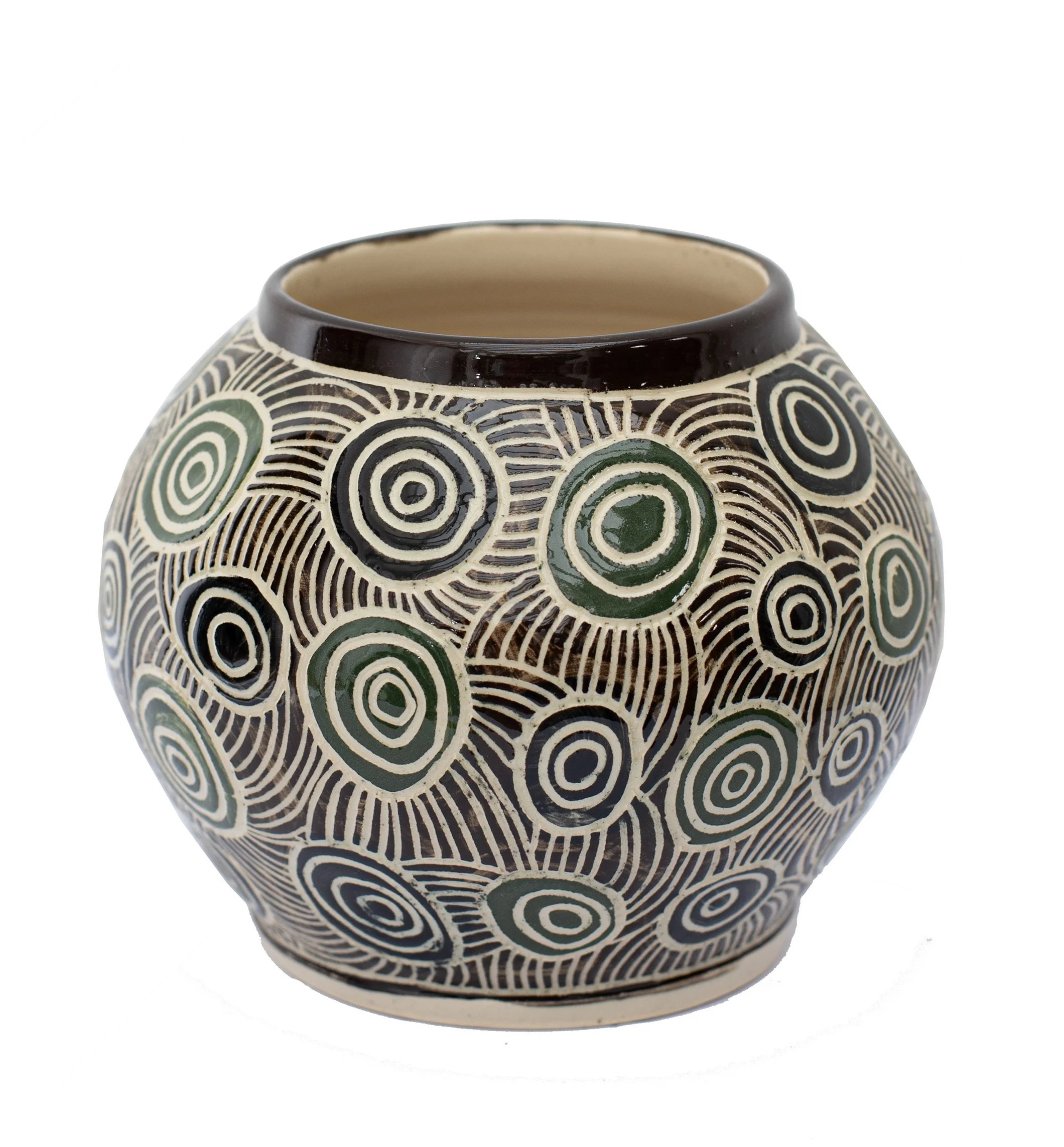
Artiste : Tjimpuna Williams
Titre de l'œuvre : Piltati
Format : 15 × 12 cm
Provenance et certificat : centre d'art d'Ernabella
Référence de la céramique : 330C-25
Explications sur cette céramique Aborigène :
There were two sisters who married two brothers and they all lived together. One day the women went wandering and they went such a long way that they forgot about their husbands. Back at the camp, the two husbands were thinking, 'Where are our wives?' and they decided to go looking for them. One brother said to the other, 'What should we become to go looking for them?' and the other brother said 'Why don't we become Rainbow Serpents?' And they travelled in the sky looking down for their wives. Finally they see them hunting for carpet snakes and they put something in the hole where the women were digging. The women find it and then dig another hole and once again the men have put something in there.
And this is how the men lure the women back to Piltati where the men make the sisters transform into Wanampi, swallow them and keep them in their throats. All four of them live together in the waterhole and still live there today.

Artiste : Carlene Thompson
Titre de l'œuvre : Kalaya Ngura - Emu Country
Format : 26 x 18,5 cm
Provenance et certificat : centre d'art d'Ernabella
Référence de la céramique : 346C-25
Explications sur cette céramique Aborigène :
This artwork depicts Carlene's family's country which is near Kanpi in the Western APY Lands. The emu (kalaya) is the ancestral being who formed that part of the country as it travelled from Kanpi to Watarru.
Carlene is a senior artist and woman in the Ernabella community. Her artworks are about tjulpu tjuta (birds). It is very typical for the kalaya to have many children, like Carlene who had six children when she was a younger woman. People call her Tjulpu Thompson, and she says ‘like I did with my children, I now raise chicks every day on canvas and in clay in my work’.
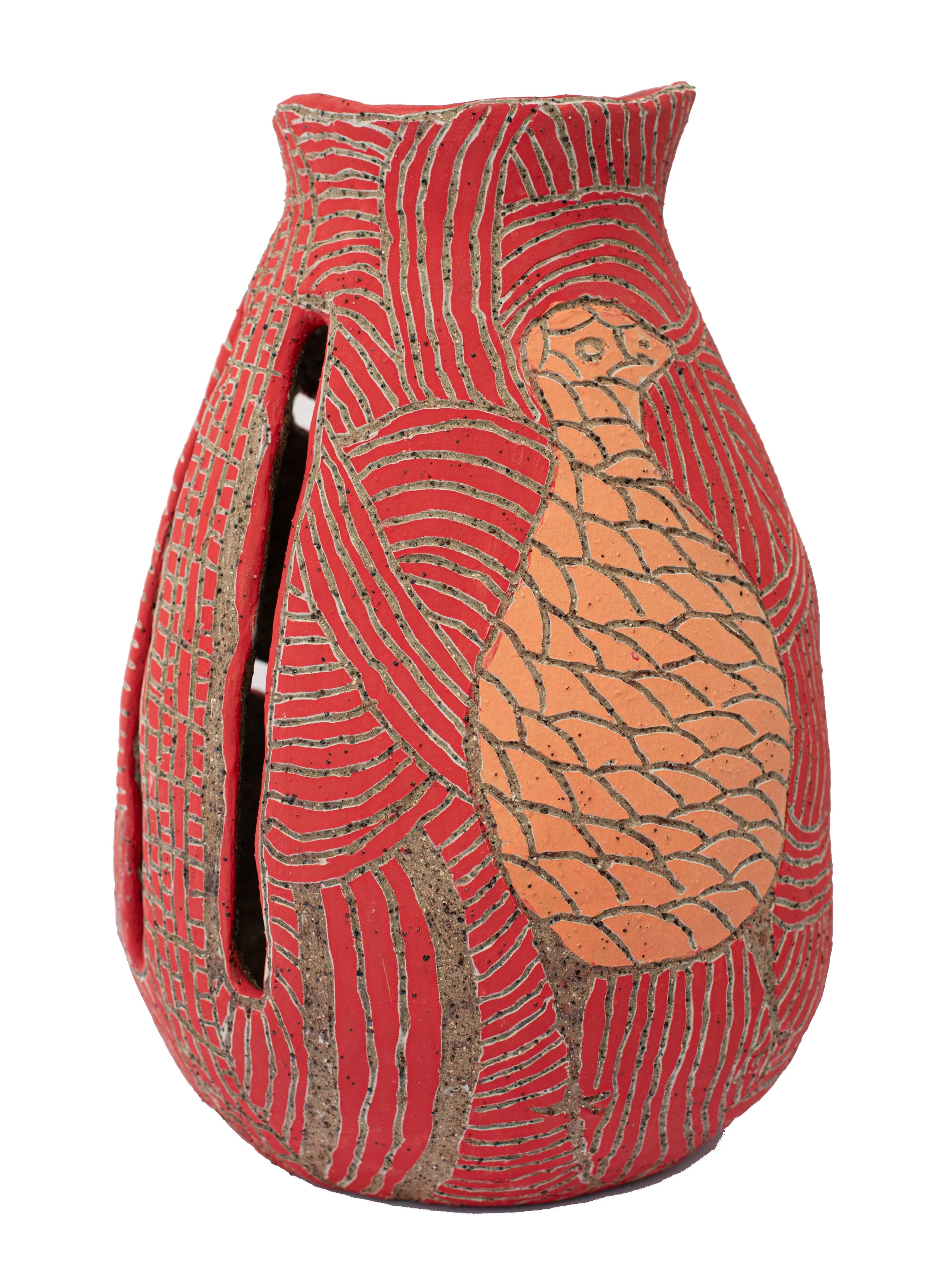
Artiste : Carlene Thompson
Titre de l'œuvre : Kalaya Ngura - Emu Country
Format : 30 × 20 cm
Provenance et certificat : centre d'art d'Ernabella
Référence de la céramique : 347C-25
Explications sur cette céramique Aborigène :
This artwork depicts Carlene's family's country which is near Kanpi in the Western APY Lands. The emu (kalaya) is the ancestral being who formed that part of the country as it travelled from Kanpi to Watarru.
Carlene is a senior artist and woman in the Ernabella community. Her artworks are about tjulpu tjuta (birds). It is very typical for the kalaya to have many children, like Carlene who had six children when she was a younger woman. People call her Tjulpu Thompson, and she says ‘like I did with my children, I now raise chicks every day on canvas and in clay in my work’.
Artiste : Rachael Mipantjiti Lionel
Titre de l'œuvre : Dust Storm
Format : 176 × 124,5 cm
Provenance et certificat : centre d'art d'Ernabella
Référence de cette peinture d'art Aborigène : 129-25
Demander le prix de l'œuvre
Explanations of this Aboriginal art painting :
Rachael comes from the third generation of Lionel women painting at Ernabella Arts. Rachael draws inspiration for her paintings from the stories and messages she receives through her dreams. This painting is a dream she has about a dust storm. She was out in the desert and could see the dust storm rolling towards her.
Her artworks are in the prestigious following collections :
Artbank, 2018
Museum And Art Gallery Of The Northern Territory, 2016
National Museum Of Australia, 2016