Exposition d’art Aborigène “Coming up, Pakani : the Art of Rising Voices” - Aboriginal art from Australia
A la galerie Aboriginal Signature Estrangin : 101 rue Jules Besme, 1081 Bruxelles.
Vernissage sur RDV le mercredi 16 avril 2025 de 14h30 à 21h30.
A 20h - discours du directeur de la galerie et drink.
RSVP - réserver votre visite
Ensuite la galerie vous reçoit sur RDV jusqu’au samedi 17 Mai 2025, du mardi au samedi, de 11h à 19h : vous pouvez réserver votre visite dés à présent dans notre agenda ici.
Pakani – Coming Up
Une exposition d’art aborigène contemporain
En partenariat avec les artistes de la communauté artistique de Mimili Maku.
Pakani, en Pitjantjatjara, signifie « se lever, s’élever ». Cette exposition est une célébration vibrante de la montée en puissance collective d’une nouvelle génération d’artistes aborigènes issus de la communauté de Mimili, au cœur des terres Anangu Pitjantjatjara Yankunytjatjara (APY), dans le centre de l’Australie. C’est une histoire de transmission, de transformation et d’affirmation artistique, où les voix émergentes rejoignent les figures établies pour composer ensemble une symphonie visuelle unique.
Au cœur de cette montée en puissance, des artistes comme Rhonda Young, Betty Mula et Beverly Downs font leur entrée remarquée sur la scène artistique nationale. Leurs œuvres puissantes et instinctives témoignent d’un regard neuf, tout en restant enracinées dans la richesse culturelle et spirituelle de leurs ancêtres. Elles rejoignent ainsi leurs aînés et inspirateurs au sein de Mimili Maku Arts, dans un dialogue intergénérationnel fertile.

The Senior artist Puna Yanima with her paintings in Mimili Community. © with the courtesy of the artist and Mimili Maku-Arts
Parmi ces figures établies, Pauline Wangin et Puna Yanima repoussent les frontières de leur pratique en réinventant constamment leur langage pictural. Leur travail témoigne d’une évolution esthétique forte, où chaque toile affirme une identité propre, audacieuse, libre.
Autrefois considérées comme artistes émergentes, Umatji et Betty Campbell ont, en quelques années, su imposer leur voix avec éclat. Présentes désormais dans les plus grandes foires et prix d’art contemporain en Australie, leurs œuvres parlent d’elles-mêmes : expressives, ancrées et puissantes, elles incarnent le souffle nouveau de Mimili.
À la tête de cette dynamique collective, la figure emblématique de Tuppy Goodwin s’impose avec ses œuvres saisissantes. Peintre chevronnée et leader respectée, Tuppy offre une profondeur essentielle à l’ensemble. Son univers, centré autour du site sacré Antara, rayonne de confiance, de maîtrise de la couleur et de force spirituelle. Son travail insuffle à toute la communauté cette assurance qui permet à chacun d’embrasser pleinement sa propre marque.

Painting by the artist Rhonda Young with her work in Mimili Community. © with the courtesy of the artists and Mimili Maku-Arts.
Cette audace créative se manifeste de manière spectaculaire dans les Collaborations Familiales Atutja, où trois styles artistiques distincts se rencontrent pour créer quelque chose de totalement inédit. Cette fusion intergénérationnelle incarne à la fois l’ancrage et l’innovation, la tradition et le renouvellement.
Pakani – Coming Up est plus qu’une exposition : c’est un mouvement. Un témoignage vivant de l’élan collectif d’une communauté qui, en s’élevant ensemble, redéfinit les contours de l’art contemporain aborigène.

Peinture de l’artiste Tuppy Goodwin, Titre : Antara. 198 x 152 cm © Photo Aboriginal Signature Estrangin Gallery with the courtesy of Mimili Maku.
À la galerie Aboriginal Signature Estrangin, nous attachons une grande importance à l’approche communautaire solidaire dans nos expositions. En réunissant à chaque fois plusieurs artistes d’une même communauté, nous souhaitons souligner la force de la transmission entre générations, des artistes seniors aux plus jeunes, dans une dynamique de partage du savoir millénaire australien.
Ici dans la capitale de l’Europe, nous vous convions pour célébrer la puissance de ces artistes qui perpétuent une tradition ancestrale tout en la réinventant pour le monde moderne. Les œuvres sélectionnées vibrent d'une énergie connectée, reflétant la beauté préservée de leur territoire, et la résilience de ces peuples premiers, gardiens de la terre.
Bertrand Estrangin
Directeur de la Galerie Aboriginal Signature à Bruxelles
Découvrez les peintures de l’exposition :
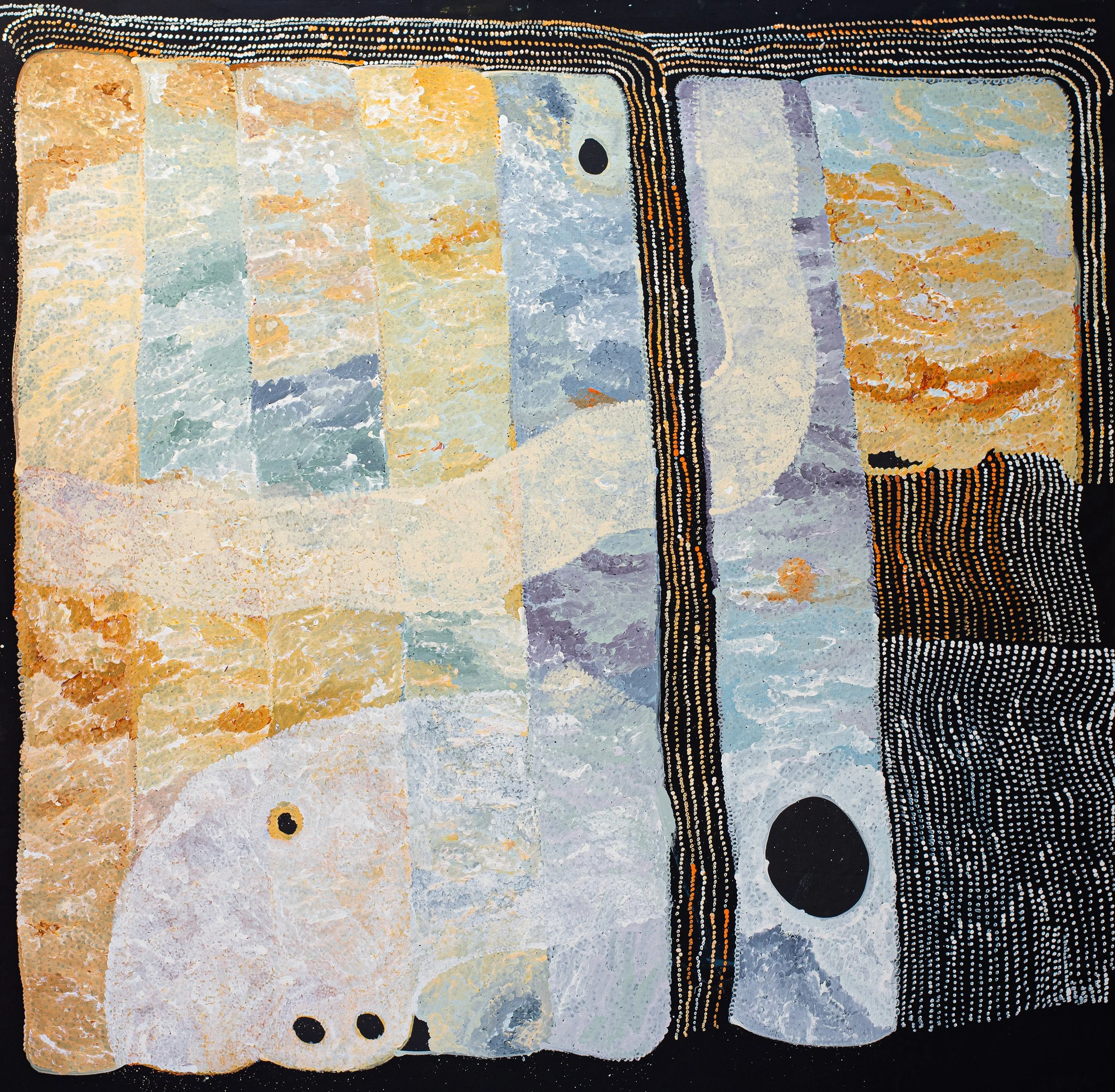
Artiste : Betty Campbell (1961)
Titre de l'œuvre : Minymaku Tjukurpa (Women's Story)
Format : 198cm x 189cm
Provenance et certificat : centre d'art aborigène de Mimili Maku
Référence de cette peinture aborigène : 502-23
Demander le prix de cette œuvre
Explications pour cette peinture d'art Aborigène :
Betty is a senior cultural leader in Mimili Community. She knows a lot of storylines and the corresponding inma (song & dance). A lot of the inma is to be known by initiated women only, others can be celebrated by all. Betty loves to dance and teach the kids these stories that hold important lessons about the land and our relationship to it.
In her artwork, Betty paints Women's Story. This is a story that cannot be spoken about. The lines and markings on the canvas are the markings used as body painting in traditional song and dance. When inma is performed, there is separate songs, dances and paintings for men and women. Whilst the women dance, the men sit, sing and watch, and the other way around.
Mimili Community is home to 300 Pitjantjatjara and Yankunytjatjara people who have been living in the area for millennia in harmony with nature and acting as custodians of the land and the Tjukurpa (creation stories). Mimili was formerly known as Everard Park, which was a cattle station that was returned to Aboriginal ownership through the 1981 APY Lands Act. Mimili Community was incorporated as an Aboriginal Community in 1975.
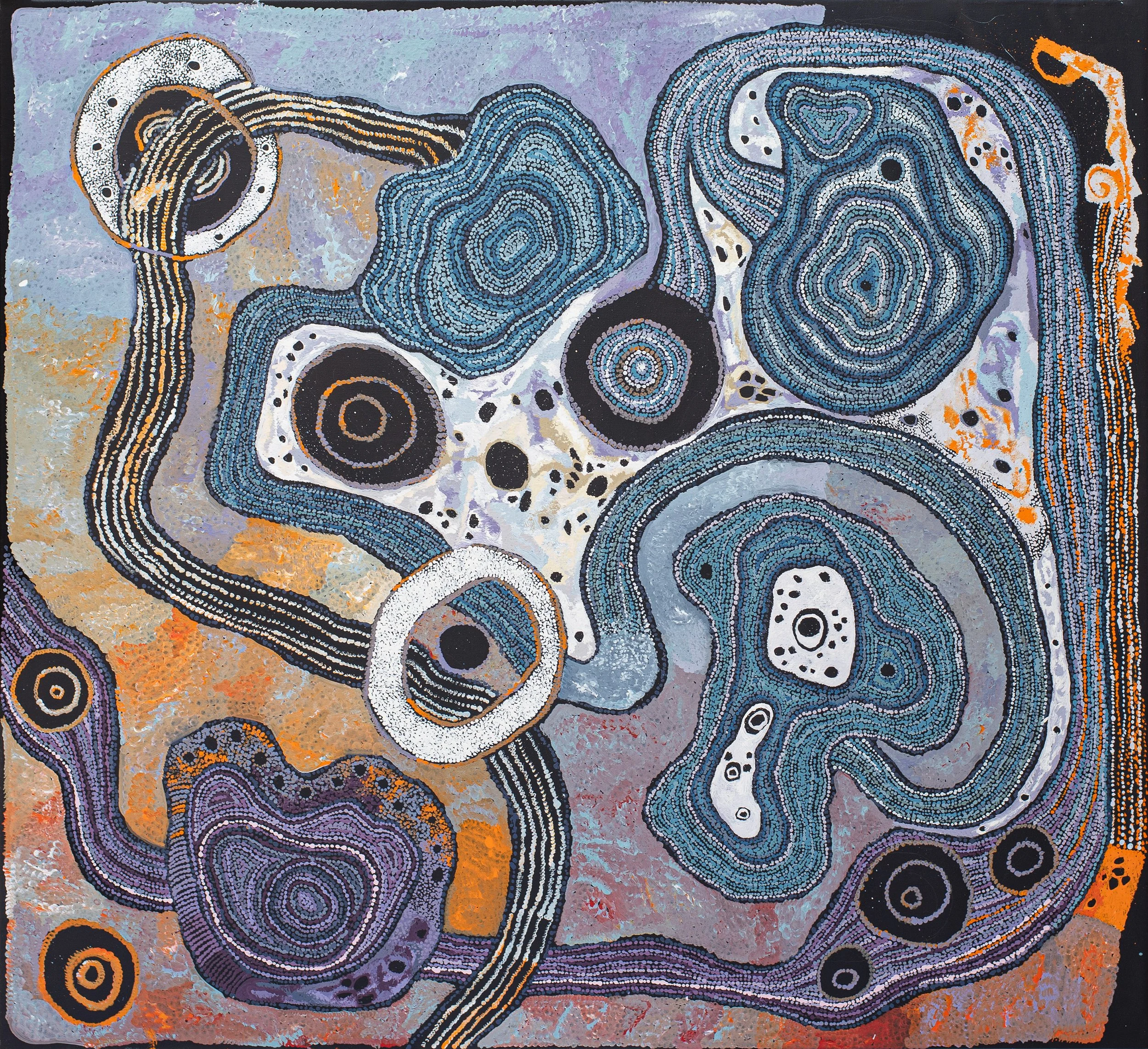
Artistes : Pauline Wangin, Emma Singer, Betty Campbell
Titre de l'œuvre : Walytja - Family Collaboration
Format : 168cm x 152cm
Provenance et certificat : centre d'art aborigène de Mimili Maku
Référence de cette peinture aborigène : 512-24
Demander le prix de cette œuvre
Explications pour cette peinture d'art Aborigène :
This is a collaborative canvas between Emma Singer, her mother Pauline Wangin and Pauline's sister Betty Campbell. Pauline says about the work : "We’ve painted this big canvas together as a family.
This canvas is about kapi tjukula and soakages around Kinara Mimi, Mimili. Our families would move between rock holes, they’d know them all. They would always be looking for clear drinking water. They lived around Antara and many other named places between Kinara Mimi, Antara, Artutja, Paralpi and Iwantja. All those places are connected, and they used to walk far distances every day. We remember the paths by the songlines that still run through those places. They’d sing the songs, dig for water, and know where to travel. The water was underground, and they’d dig till it seeped upwards. They’d always know. I remember going to Iwantja Soakage with our mother and her showing us how it’s done. We remember this from when we were young, and we want to keep sharing this story for our children and grandchildren. It’s important to remember what we’ve always known."
Pauline Wangin, 2023
Mimili Community is home to 300 Pitjantjatjara and Yankunytjatjara people who have been living in the area for millennia in harmony with nature and acting as custodians of the land and the Tjukurpa (creation stories). Mimili was formerly known as Everard Park, which was a cattle station that was returned to Aboriginal ownership through the 1981 APY Lands Act. Mimili Community was incorporated as an Aboriginal Community in 1975.

Artiste : Tuppy Ngintja Goodwin (1952)
Titre de l'œuvre : Antara sacred valley
Format : 198 cm x 152 cm
Provenance et certificat : centre d'art aborigène de Mimili Maku
Référence de cette peinture aborigène : 593-23
Explications pour cette peinture d'art Aborigène :
Tuppy (1952) is a senior Pitjantjatjara woman committed to fostering traditional law and culture, dance and painting. Tuppy’s father’s name was Nguyarangu (dec) and his country was near Docker River. Her mother’s name was Emily Nyanyanta and her country was Wintutjuru, west of Fregon on the APY Lands.
Tuppy Goodwin was born in the bush near Bumbali Creek and she moved to Mimili with her family when she was a baby. At the time Mimili was called Everard Park, it was a cattle station, which was eventually returned to the Yankunytjatjara people in the mid-‐1960s.
When I paint, it’s like inma (ceremonial dance and song).
This is Antara, a sacred place for Anangu, and the Maku (witchetty grub) Tjukurpa. There’s a special rock hole at Antara where women perform inma – ‘inmaku pakani’ – and afterwards there’s enough maku to feed everyone.
Antara and Maku Tjukurpa is really important for Mimili women, we paint this place and its stories, keeping them strong.
Her artwoks are in the public Australian collection at the South Australian Museum and several private collections.
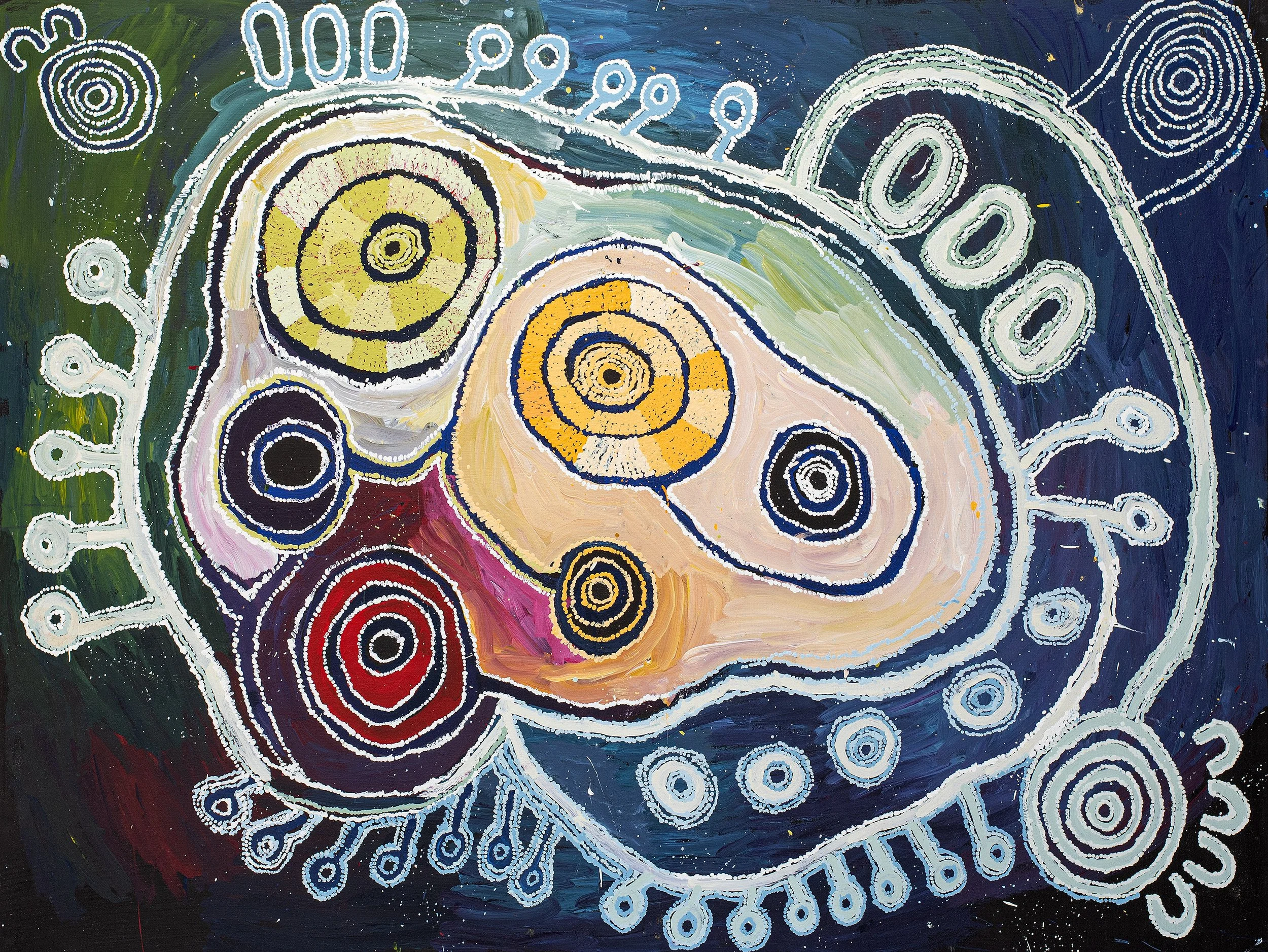
Artiste : Tuppy Ngintja Goodwin (1952)
Titre de l'œuvre : Antara sacred valley
Format : 198 cm x 152 cm
Provenance et certificat : centre d'art aborigène de Mimili Maku
Référence de cette peinture aborigène : 552-23
Explications pour cette peinture d'art Aborigène :
Tuppy (1952) is a senior Pitjantjatjara woman committed to fostering traditional law and culture, dance and painting. Tuppy’s father’s name was Nguyarangu (dec) and his country was near Docker River. Her mother’s name was Emily Nyanyanta and her country was Wintutjuru, west of Fregon on the APY Lands.
Tuppy Goodwin was born in the bush near Bumbali Creek and she moved to Mimili with her family when she was a baby. At the time Mimili was called Everard Park, it was a cattle station, which was eventually returned to the Yankunytjatjara people in the mid-‐1960s.
When I paint, it’s like inma (ceremonial dance and song).
This is Antara, a sacred place for Anangu, and the Maku (witchetty grub) Tjukurpa. There’s a special rock hole at Antara where women perform inma – ‘inmaku pakani’ – and afterwards there’s enough maku to feed everyone.
Antara and Maku Tjukurpa is really important for Mimili women, we paint this place and its stories, keeping them strong.
Her artwoks are in the public Australian collection at the South Australian Museum and several private collections.
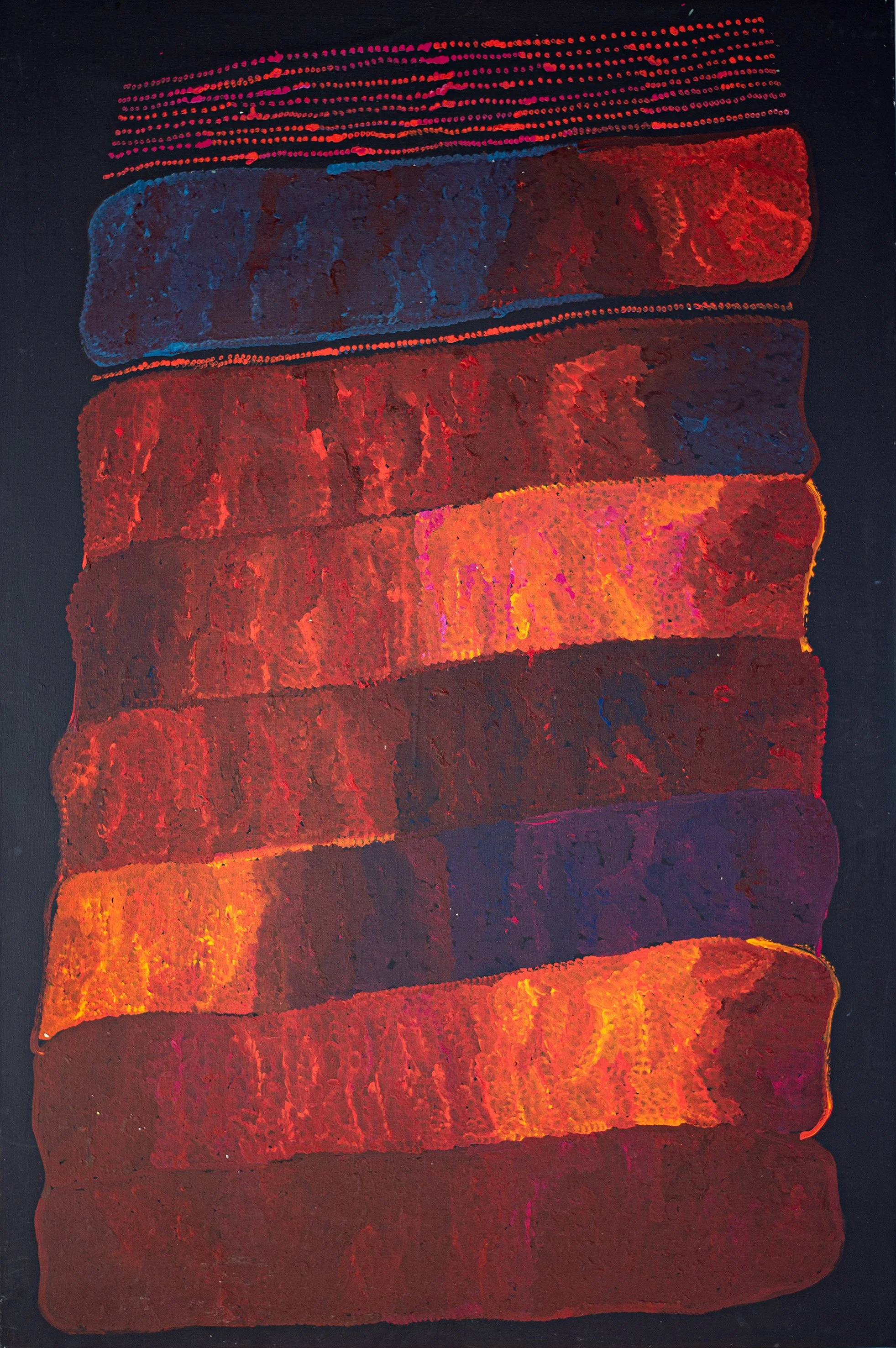
Artiste : Betty Campbell (1961)
Titre de l'œuvre : Minymaku Tjukurpa (Women's Story)
Format : 183cm x 122cm
Provenance et certificat : centre d'art aborigène de Mimili Maku
Référence de cette peinture aborigène : 639-23
Demander le prix de cette œuvre
Explications pour cette peinture d'art Aborigène :
Betty is a senior cultural leader in Mimili Community. She knows a lot of storylines and the corresponding inma (song & dance). A lot of the inma is to be known by initiated women only, others can be celebrated by all. Betty loves to dance and teach the kids these stories that hold important lessons about the land and our relationship to it.
In her artwork, Betty paints Women's Story. This is a story that cannot be spoken about. The lines and markings on the canvas are the markings used as body painting in traditional song and dance. When inma is performed, there is separate songs, dances and paintings for men and women. Whilst the women dance, the men sit, sing and watch, and the other way around.
Mimili Community is home to 300 Pitjantjatjara and Yankunytjatjara people who have been living in the area for millennia in harmony with nature and acting as custodians of the land and the Tjukurpa (creation stories). Mimili was formerly known as Everard Park, which was a cattle station that was returned to Aboriginal ownership through the 1981 APY Lands Act. Mimili Community was incorporated as an Aboriginal Community in 1975.
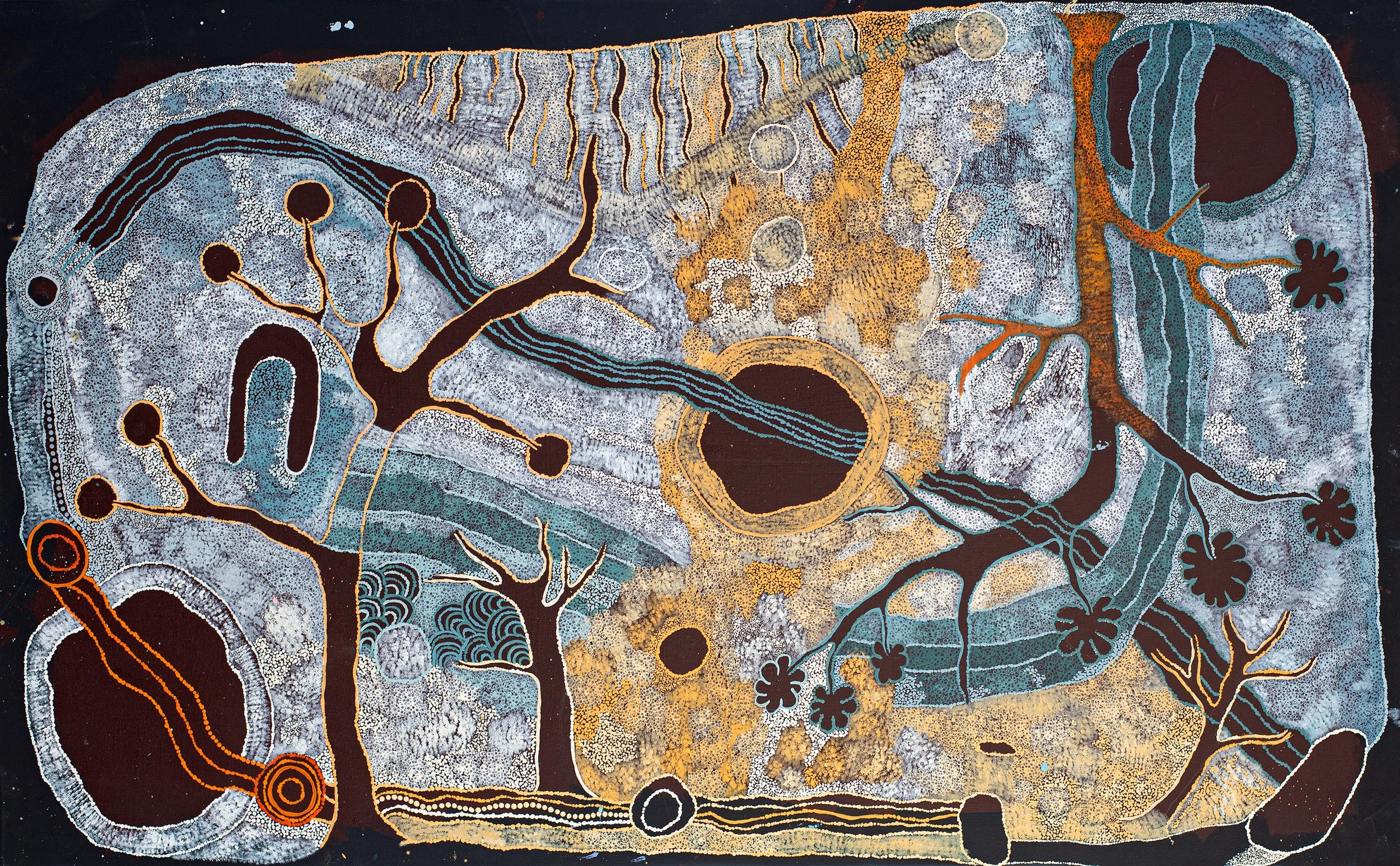
Artiste : Tanya Umatji Tjapalyi (1974)
Titre de l'œuvre : Ngayuku Ngunytjunku Tjukurpa (My Mother’s story)
Format : 198cm x 122cm
Provenance et certificat : centre d'art aborigène de Mimili Maku
Référence de cette peinture aborigène : 777-23
Demander le prix de cette œuvre
Explications pour cette peinture d'art Aborigène :
Umatji is a Yankunytjatjara woman born in Indulkana Community on the Anangu Pitjantjatjara Yankunytjatjara (APY) Lands in the far north west of South Australia. Umatji’s mother, Kunmanara (Kathleen Injiki) Tjapalyi was one of the founders and senior artists at Mimili Maku Arts. Growing up, Umatji learned from her mother and father about their country and their storylines. Today, Umatji paints her mother’s country, which forms part of the Antara storyline, and is celebrated in Women’s Ceremony.
“I am proud to share what I was taught when I was a little girl. I am keeping my mother’s knowledge strong, keeping her country healthy and well. I was watching for a long time, watching country, watching my mother paint. Now I am ready to tell my own story.”
Mimili Community is home to 300 Pitjantjatjara and Yankunytjatjara people who have been living in the area for millennia in harmony with nature and acting as custodians of the land and the Tjukurpa (creation stories). Mimili was formerly known as Everard Park, which was a cattle station that was returned to Aboriginal ownership through the 1981 APY Lands Act. Mimili Community was incorporated as an Aboriginal Community in 1975.

Artiste : Tuppy Ngintja Goodwin (1952)
Titre de l'œuvre : Antara sacred valley
Format : 122 cm x 122 cm
Provenance et certificat : centre d'art aborigène de Mimili Maku
Référence de cette peinture aborigène : 376-24
Explications pour cette peinture d'art Aborigène :
Tuppy (1952) is a senior Pitjantjatjara woman committed to fostering traditional law and culture, dance and painting. Tuppy’s father’s name was Nguyarangu (dec) and his country was near Docker River. Her mother’s name was Emily Nyanyanta and her country was Wintutjuru, west of Fregon on the APY Lands.
Tuppy Goodwin was born in the bush near Bumbali Creek and she moved to Mimili with her family when she was a baby. At the time Mimili was called Everard Park, it was a cattle station, which was eventually returned to the Yankunytjatjara people in the mid-‐1960s.
When I paint, it’s like inma (ceremonial dance and song).
This is Antara, a sacred place for Anangu, and the Maku (witchetty grub) Tjukurpa. There’s a special rock hole at Antara where women perform inma – ‘inmaku pakani’ – and afterwards there’s enough maku to feed everyone.
Antara and Maku Tjukurpa is really important for Mimili women, we paint this place and its stories, keeping them strong.
Her artwoks are in the public Australian collection at the South Australian Museum and several private collections.
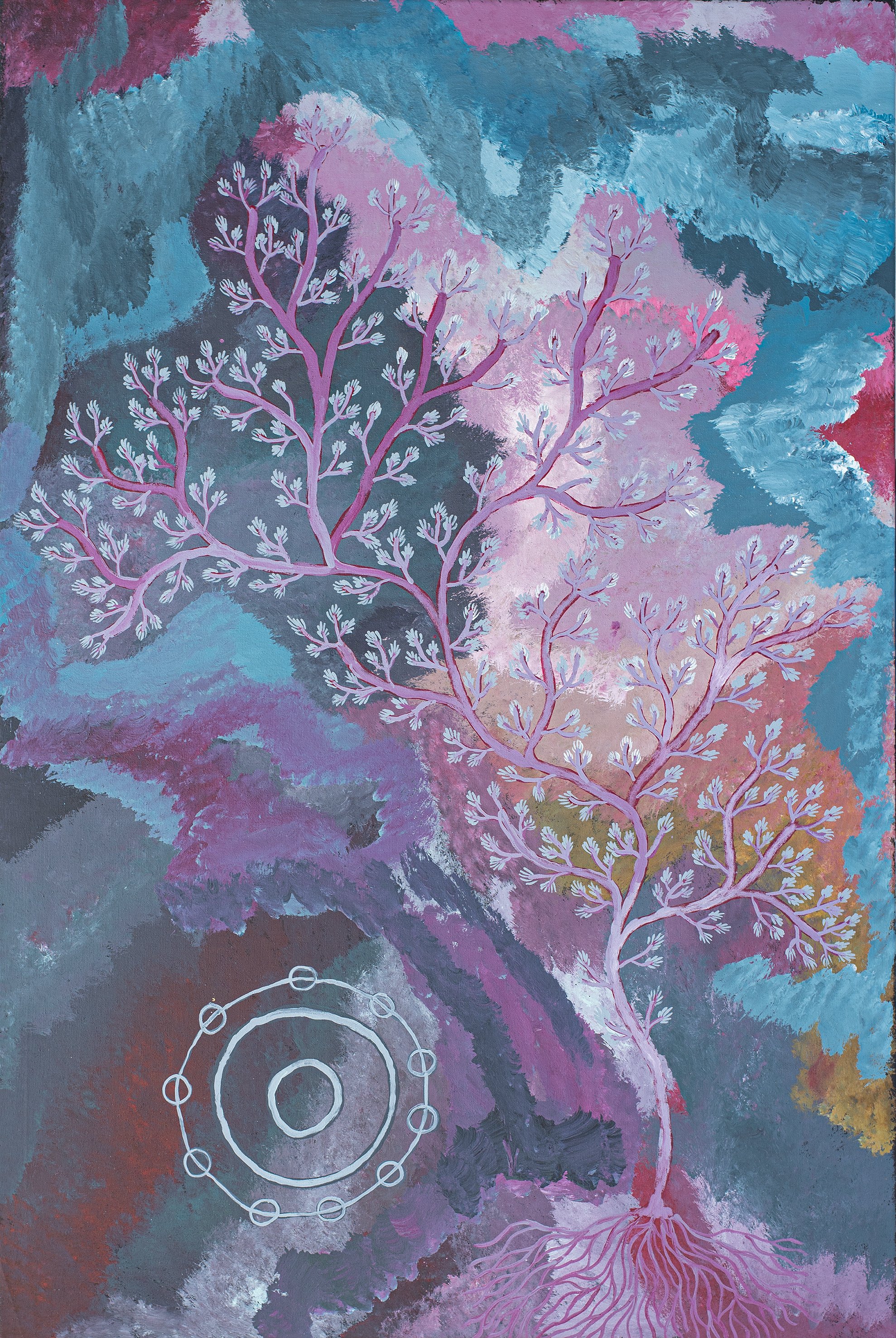
Artiste : Beverly Downs (1966)
Titre de l'œuvre : Yankunytjatjara Wapar
Format : 152 cm x 101 cm
Provenance et certificat : centre d'art aborigène de Mimili Maku
Référence de cette peinture aborigène : 399-24
Explications pour cette peinture d'art Aborigène :
This work is about my culture and language, Yankunytjatjara culture. I am a proud Yankunytjatjara woman. My family has been Yankunytjatjara people. Our language is different to Pitjantjatjara. Most people speak Pitjantjatjara these days, and I like spending time with the few family members that still speak Yankunytjatjara and teaching the young ones about our language. I am painting a lot of the trees, grasses and their seeds that are specific my language and region. There are many words in Yankunytjatjara that come directly from the trees, and I want to paint them to keep them strong and alive for the next generation. Palya.
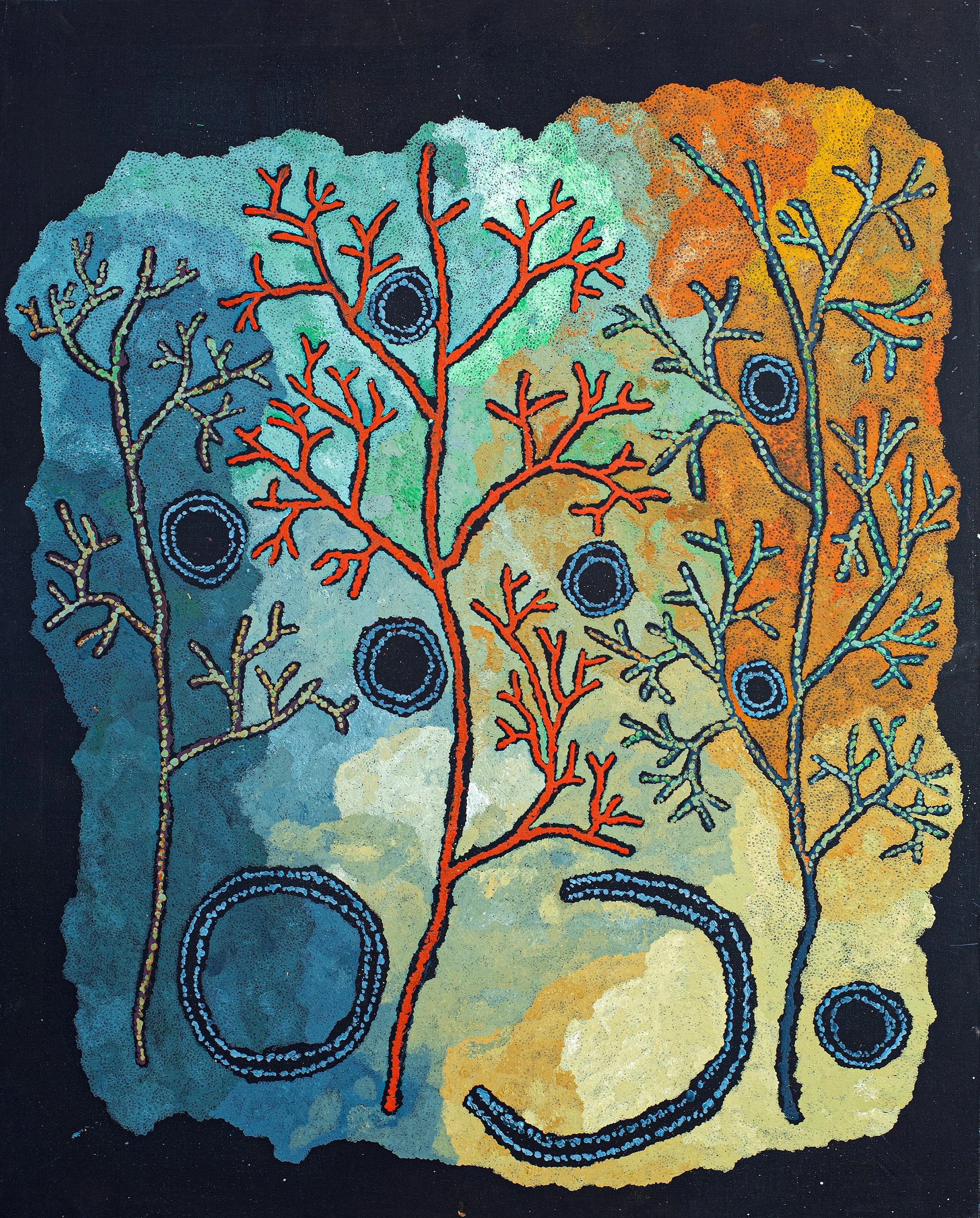
Artiste : Betty Mula (1973)
Titre de l'œuvre : Punu tjuta (many trees)
Format : 152 cm x 122 cm
Provenance et certificat : centre d'art aborigène de Mimili Maku
Référence de cette peinture aborigène : 573-24
Enquiry / Demander le prix de cette œuvre
Explications pour cette peinture d'art Aborigène :
This painting is about the many different trees I have grown up with. Each tree, bush and flower has its own story. In recent years we've had big rains and many trees that we hadn't seen in many years were flowering again for the first time.
With it came many birds we haven't heard here in many years. Whenever I travel away from country, I miss the trees and flowers the most. They show us the changes in seasons, show us where there are soakages, river beds, foods - we can read those signs from far away, it's like my country's own language that I'm sharing in my painting.
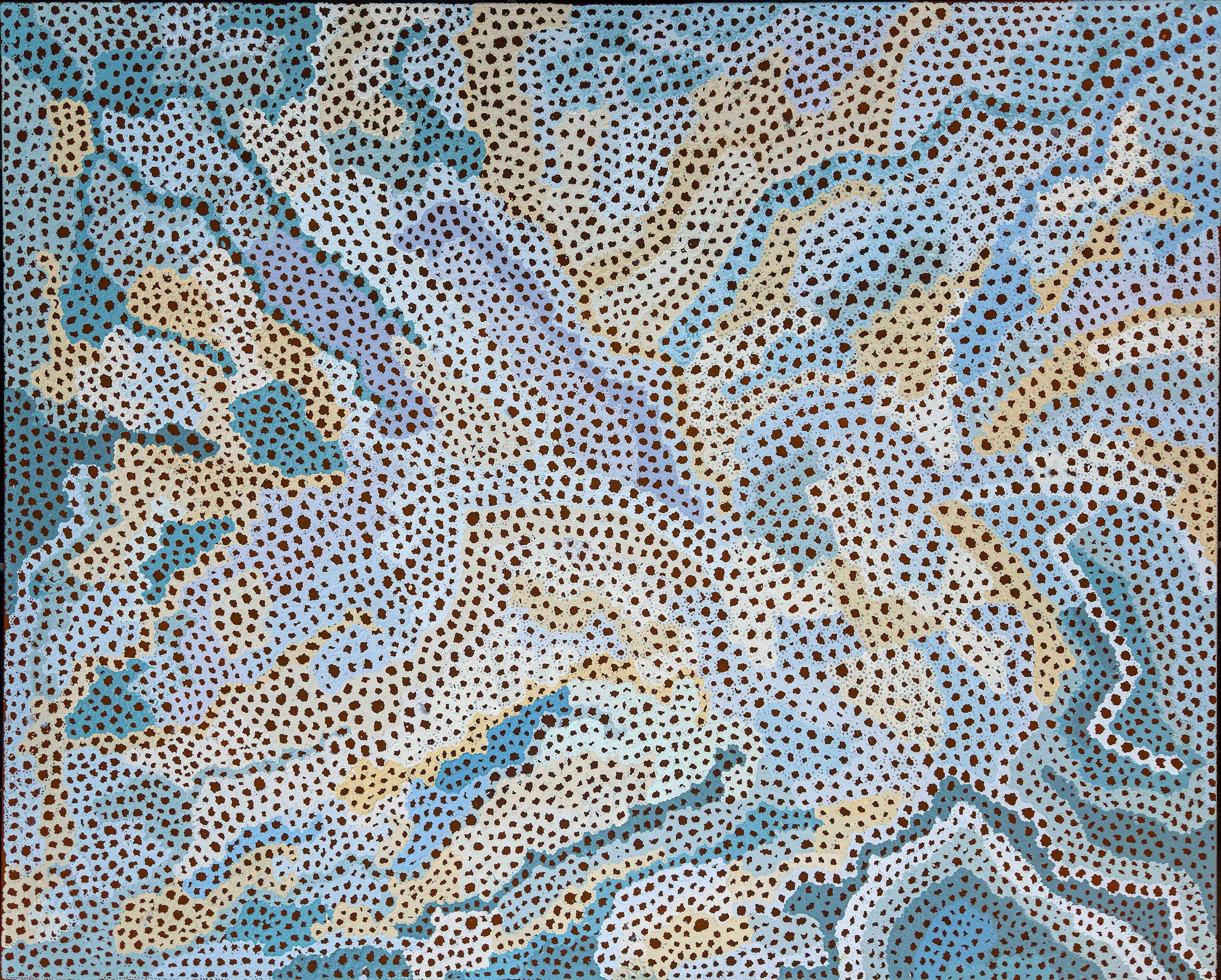
Artiste : Rhonda Young (1975)
Titre de l'œuvre : Salt Lakes
Format : 152 cm x 122 cm
Provenance et certificat : centre d'art aborigène de Mimili Maku
Référence de cette peinture aborigène : 656-24
Enquiry / Demander le prix de cette œuvre
Explications pour cette peinture d'art Aborigène :
Rhonda is one of the talented emerging painters at Mimili Maku Arts. Rhonda's mother is from Inmampa in the Northern Territory, and Rhonda is proud to paint her mother's country:
"There's many salt lakes around my mothers country. They change colours with the seasons: pink, white, blue, everything! Sometimes the lakes are big, somemes they are small, it always changes and there's storylines around all of this. Long long time ago they were all connected by rivers, and my ancestors walked between them, always following the riverbeds. I paint those journeys as remember my old people with every painting I make."
Rhonda lives and paints in Mimili Community. Mimili is home to 300 Pitjantjatjara and Yankunytjatjara people who have been living in the area for millennia in harmony with nature and acting as custodians of the land and the Tjukurpa (creaon stories). Mimili was formerly known as Everard Park, which was a cattle station that was returned to Aboriginal ownership through the 1981 APY Lands Act. Mimili Community was incorporated as an Aboriginal Community in 1975.
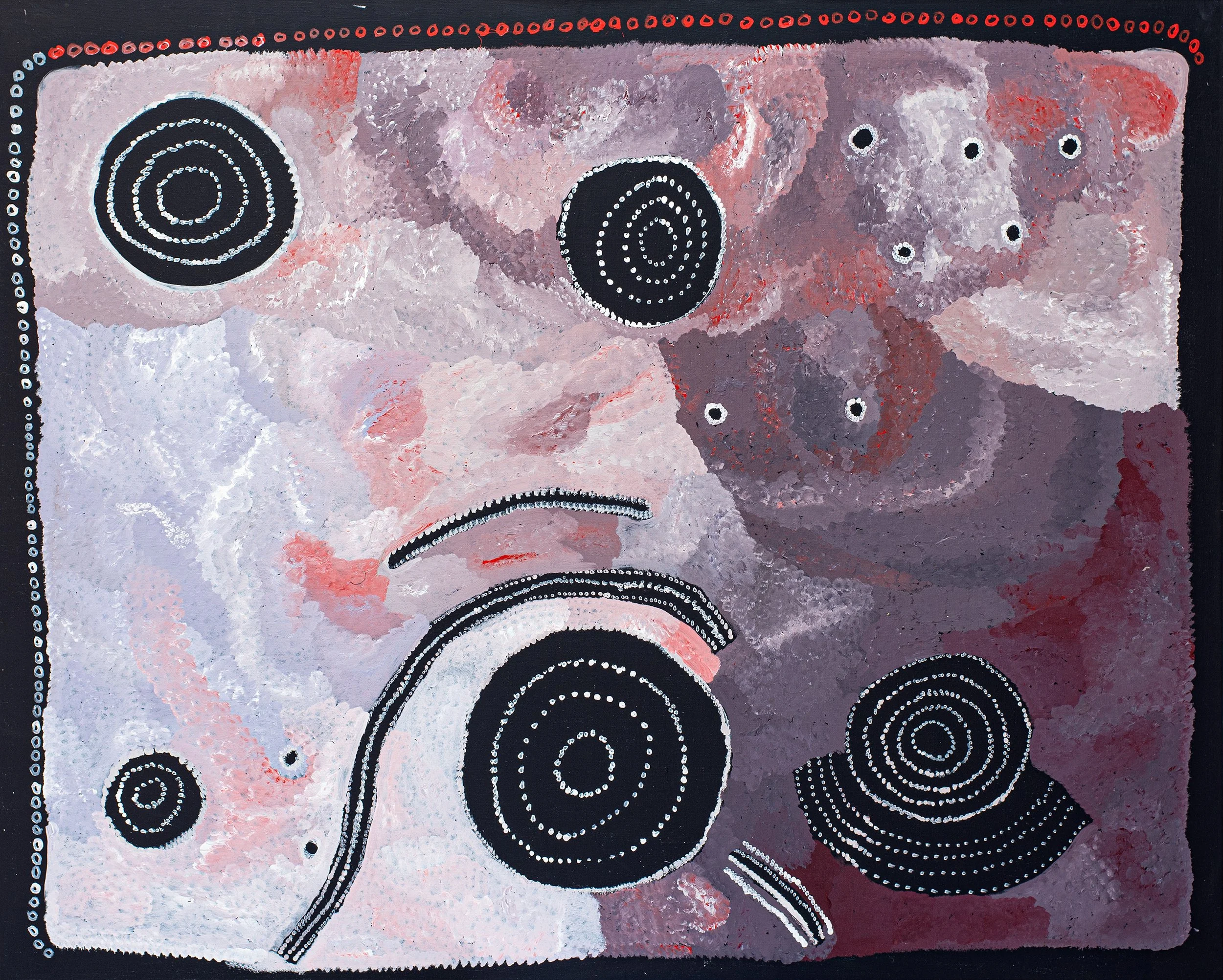
Artiste : Betty Campbell (1961)
Titre de l'œuvre : Minymaku Inma (Women's Song)
Format : 152cm x 122 cm
Provenance et certificat : centre d'art aborigène de Mimili Maku
Référence de cette peinture aborigène : 659-24
Demander le prix de cette œuvre
Explications pour cette peinture d'art Aborigène :
Bey is a senior cultural leader in Mimili Community. She knows a lot of storylines and the corresponding inma (song & dance). A lot of the inma is to be known by initiated women only, others can be celebrated by all. Betty loves to dance and teach the kids these stories that hold important lessons about the land and our relationship to it. She says about her work:
Inma inkapai ngayulu. Ngayuku tjukurpa nyanga palunya kutju ngaranyi. Nyanga palunya kutju ngayuku tjukurpa ngaranyi. Ngayulu inma rawangku inkapai munu ngayuku tjukurtjara ngayulu palyalpai canvas nyaratja. Rawangku. Uwa palyo.
I sing ceremony. That’s the message that I would really like to impart. I’d like to leave it at that. I practice ceremony, consistently, and I record the tjukurpa related to me on canvas. This is a consistent practice. Yes, that’s it.
Mimili Community is home to 300 Pitjantjatjara and Yankunytjatjara people who have been living in the area for millennia in harmony with nature and acting as custodians of the land and the Tjukurpa (creation stories). Mimili was formerly known as Everard Park, which was a cattle station that was returned to Aboriginal ownership through the 1981 APY Lands Act. Mimili Community was incorporated as an Aboriginal Community in 1975.
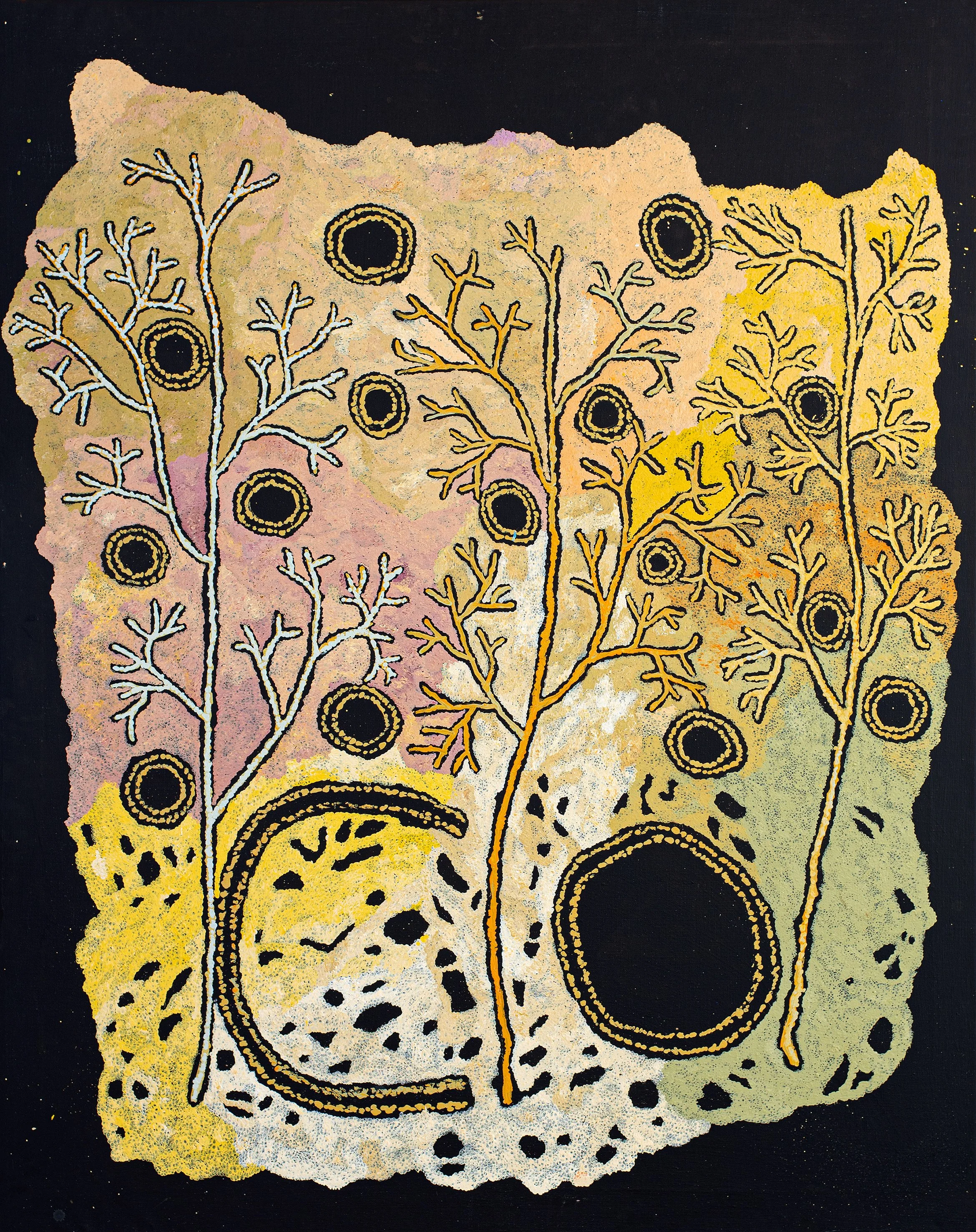
Artiste : Betty Mula (1973)
Titre de l'œuvre : Punu tjuta (many trees)
Format : 152 cm x 122 cm
Provenance et certificat : centre d'art aborigène de Mimili Maku
Référence de cette peinture aborigène : 734-24
Enquiry / Demander le prix de cette œuvre
Explications pour cette peinture d'art Aborigène :
This painting is about the many different trees I have grown up with. Each tree, bush and flower has its own story. In recent years we've had big rains and many trees that we hadn't seen in many years were flowering again for the first time.
With it came many birds we haven't heard here in many years. Whenever I travel away from country, I miss the trees and flowers the most. They show us the changes in seasons, show us where there are soakages, river beds, foods - we can read those signs from far away, it's like my country's own language that I'm sharing in my painting.
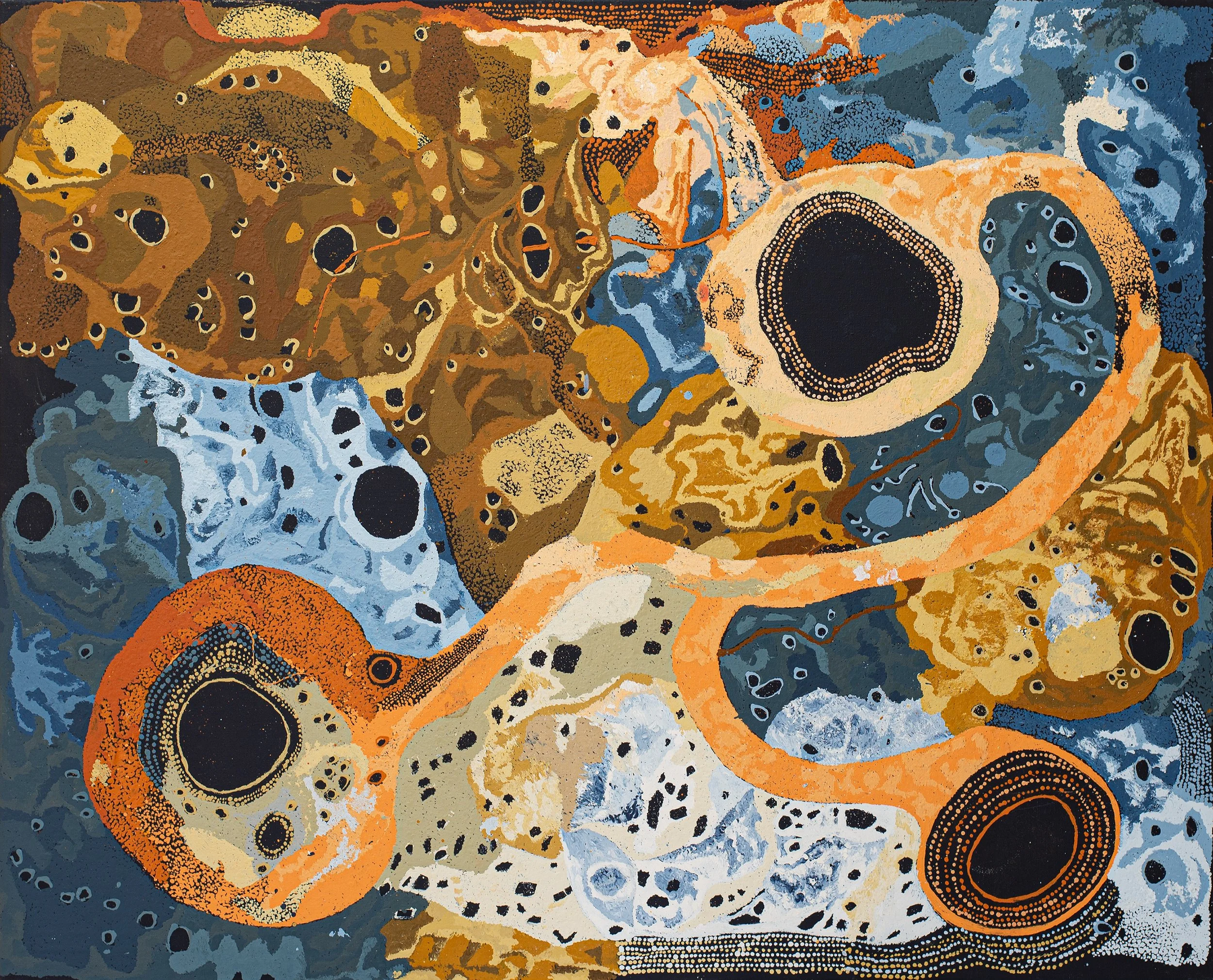
Artiste : Pauline Minmila Wangin (1970)
Titre de l'œuvre : Kapi Tjukula (Water Hole)
Format : 152cm x 122cm
Provenance et certificat : centre d'art aborigène de Mimili Maku
Référence de cette peinture aborigène : 737-24
Explications pour cette peinture d'art Aborigène :
Pauline is painting tjukurpa (story) about the journey of water, explaining how to care for kapi tjukula (water holes), particularly in the area around paralpii (Victory Well). This tjukurpa was passed on to her by her mother.
“One time when I was a little girl, my mother and me went out driving to collect bush tucker. It was a very hot day, and our car broke down. We didn't have any water with us, and I was scared, but my mother led me away from the car to kapi tjukula really closeby. She taught me how to find it, and how to care for it. After emptying the kapi (water) with mara munu punu (hands and sticks) the empty tjukula is cleaned. We place punu tjuta (many sticks and branches) over the top of the tjukula and use puli pulka (big rock) to stop them blowing away. Now no animals can dirty the new water that will soon collect."
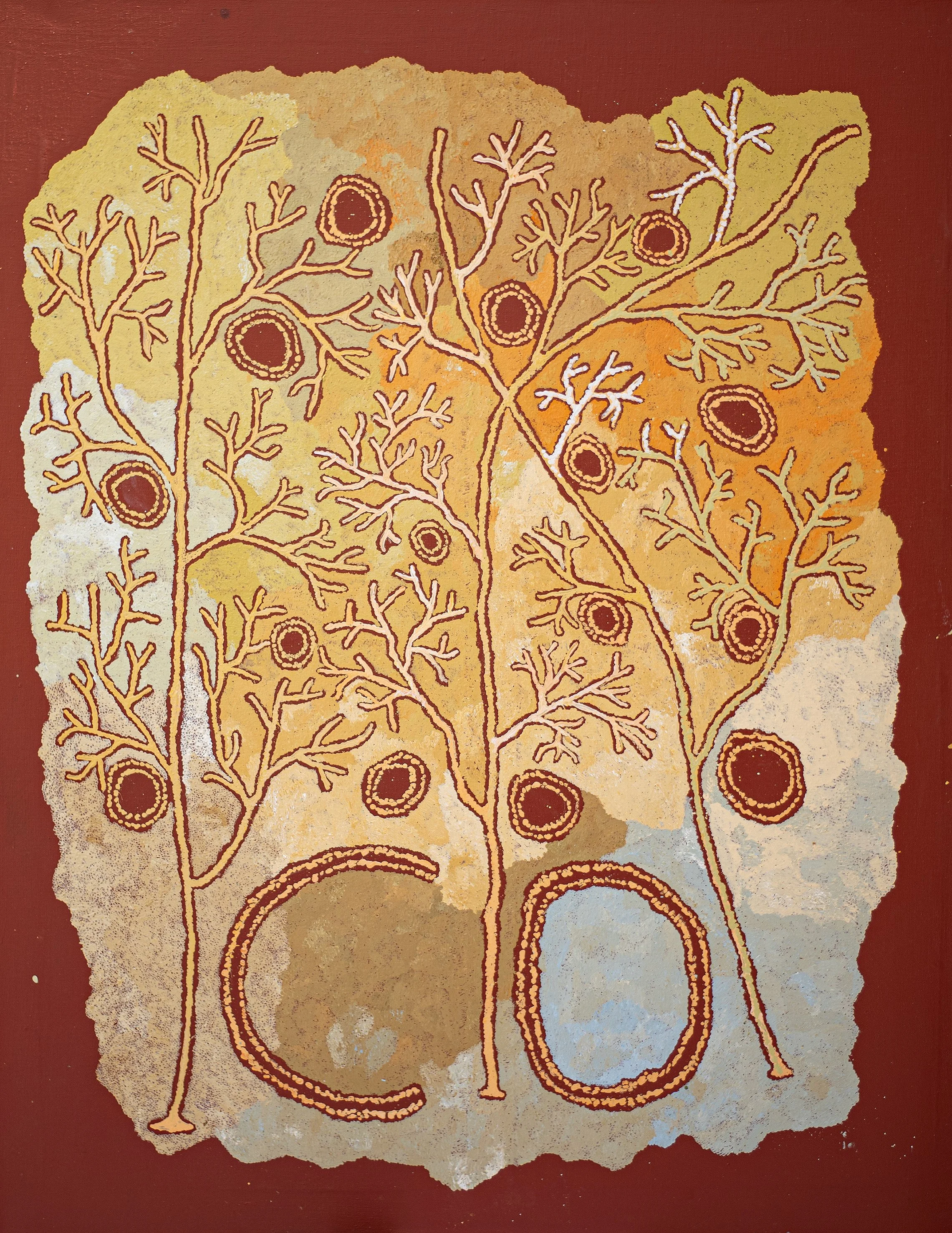
Artiste : Betty Mula (1973)
Titre de l'œuvre : Punu tjuta (many trees)
Format : 152 cm x 122 cm
Provenance et certificat : centre d'art aborigène de Mimili Maku
Référence de cette peinture aborigène : 751-24
Enquiry / Demander le prix de cette œuvre
Explications pour cette peinture d'art Aborigène :
This painting is about the many different trees I have grown up with. Each tree, bush and flower has its own story. In recent years we've had big rains and many trees that we hadn't seen in many years were flowering again for the first time.
With it came many birds we haven't heard here in many years. Whenever I travel away from country, I miss the trees and flowers the most. They show us the changes in seasons, show us where there are soakages, river beds, foods - we can read those signs from far away, it's like my country's own language that I'm sharing in my painting.
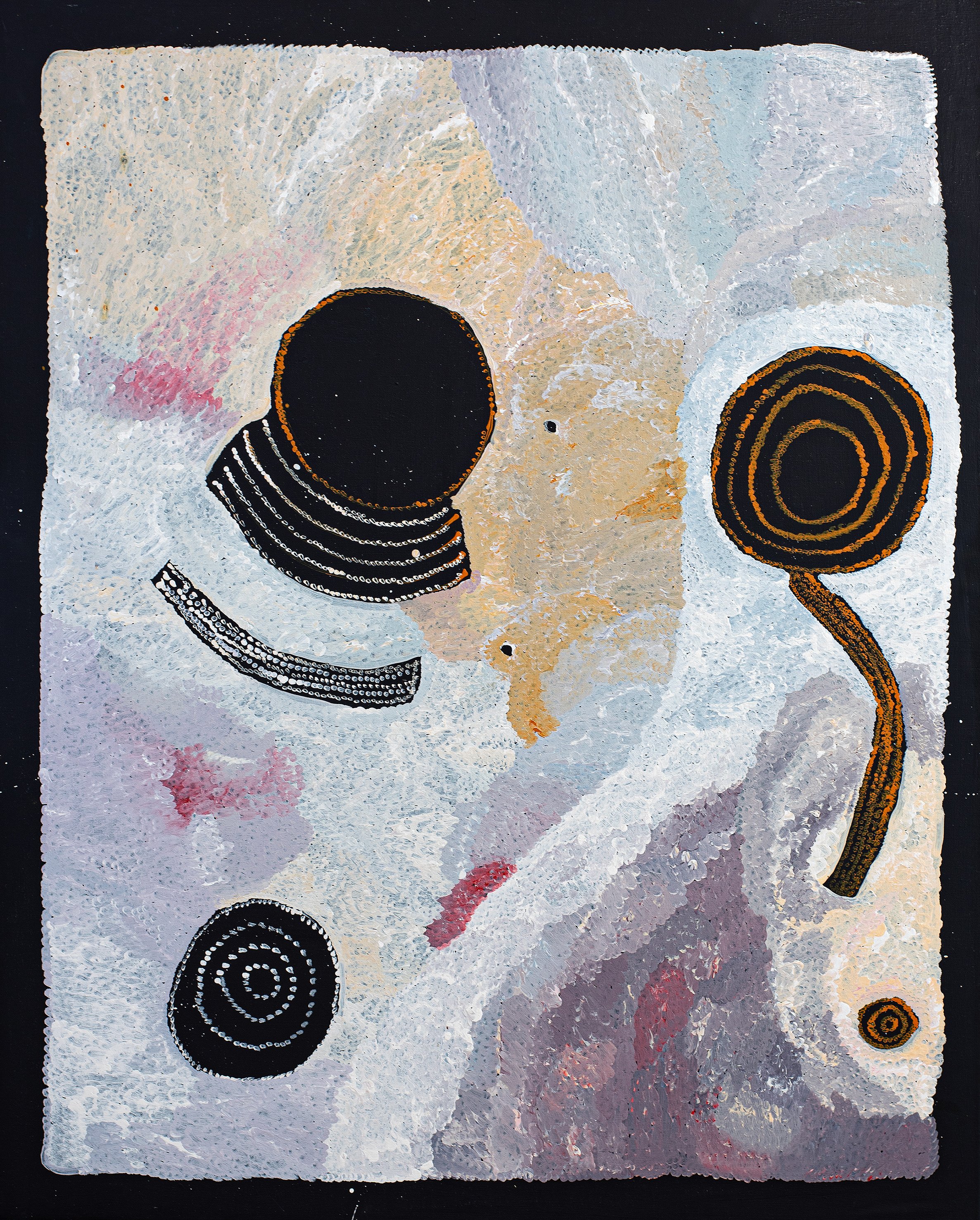
Artiste : Betty Campbell (1961)
Titre de l'œuvre : Minymaku Inma (Women's Song)
Format : 152cm x 122 cm
Provenance et certificat : centre d'art aborigène de Mimili Maku
Référence de cette peinture aborigène : 770-24
Demander le prix de cette œuvre
Explications pour cette peinture d'art Aborigène :
Betty is a senior cultural leader in Mimili Community. She knows a lot of storylines and the corresponding inma (song & dance). A lot of the inma is to be known by initiated women only, others can be celebrated by all. Betty loves to dance and teach the kids these stories that hold important lessons about the land and our relationship to it. She says about her work:
Inma inkapai ngayulu. Ngayuku tjukurpa nyanga palunya kutju ngaranyi. Nyanga palunya kutju ngayuku tjukurpa ngaranyi. Ngayulu inma rawangku inkapai munu ngayuku tjukurtjara ngayulu palyalpai canvas nyaratja. Rawangku. Uwa palyo.
I sing ceremony. That’s the message that I would really like to impart. I’d like to leave it at that. I practice ceremony, consistently, and I record the tjukurpa related to me on canvas. This is a consistent practice. Yes, that’s it.
Mimili Community is home to 300 Pitjantjatjara and Yankunytjatjara people who have been living in the area for millennia in harmony with nature and acting as custodians of the land and the Tjukurpa (creation stories). Mimili was formerly known as Everard Park, which was a cattle station that was returned to Aboriginal ownership through the 1981 APY Lands Act. Mimili Community was incorporated as an Aboriginal Community in 1975.

Artiste : Betty Campbell (1961)
Titre de l'œuvre : Minymaku Inma (Women's Song)
Format : 152cm x 122 cm
Provenance et certificat : centre d'art aborigène de Mimili Maku
Référence de cette peinture aborigène : 786-24
Demander le prix de cette œuvre
Explications pour cette peinture d'art Aborigène :
Bey is a senior cultural leader in Mimili Community. She knows a lot of storylines and the corresponding inma (song & dance). A lot of the inma is to be known by initiated women only, others can be celebrated by all. Betty loves to dance and teach the kids these stories that hold important lessons about the land and our relationship to it. She says about her work:
Inma inkapai ngayulu. Ngayuku tjukurpa nyanga palunya kutju ngaranyi. Nyanga palunya kutju ngayuku tjukurpa ngaranyi. Ngayulu inma rawangku inkapai munu ngayuku tjukurtjara ngayulu palyalpai canvas nyaratja. Rawangku. Uwa palyo.
I sing ceremony. That’s the message that I would really like to impart. I’d like to leave it at that. I practice ceremony, consistently, and I record the tjukurpa related to me on canvas. This is a consistent practice. Yes, that’s it.
Mimili Community is home to 300 Pitjantjatjara and Yankunytjatjara people who have been living in the area for millennia in harmony with nature and acting as custodians of the land and the Tjukurpa (creation stories). Mimili was formerly known as Everard Park, which was a cattle station that was returned to Aboriginal ownership through the 1981 APY Lands Act. Mimili Community was incorporated as an Aboriginal Community in 1975.
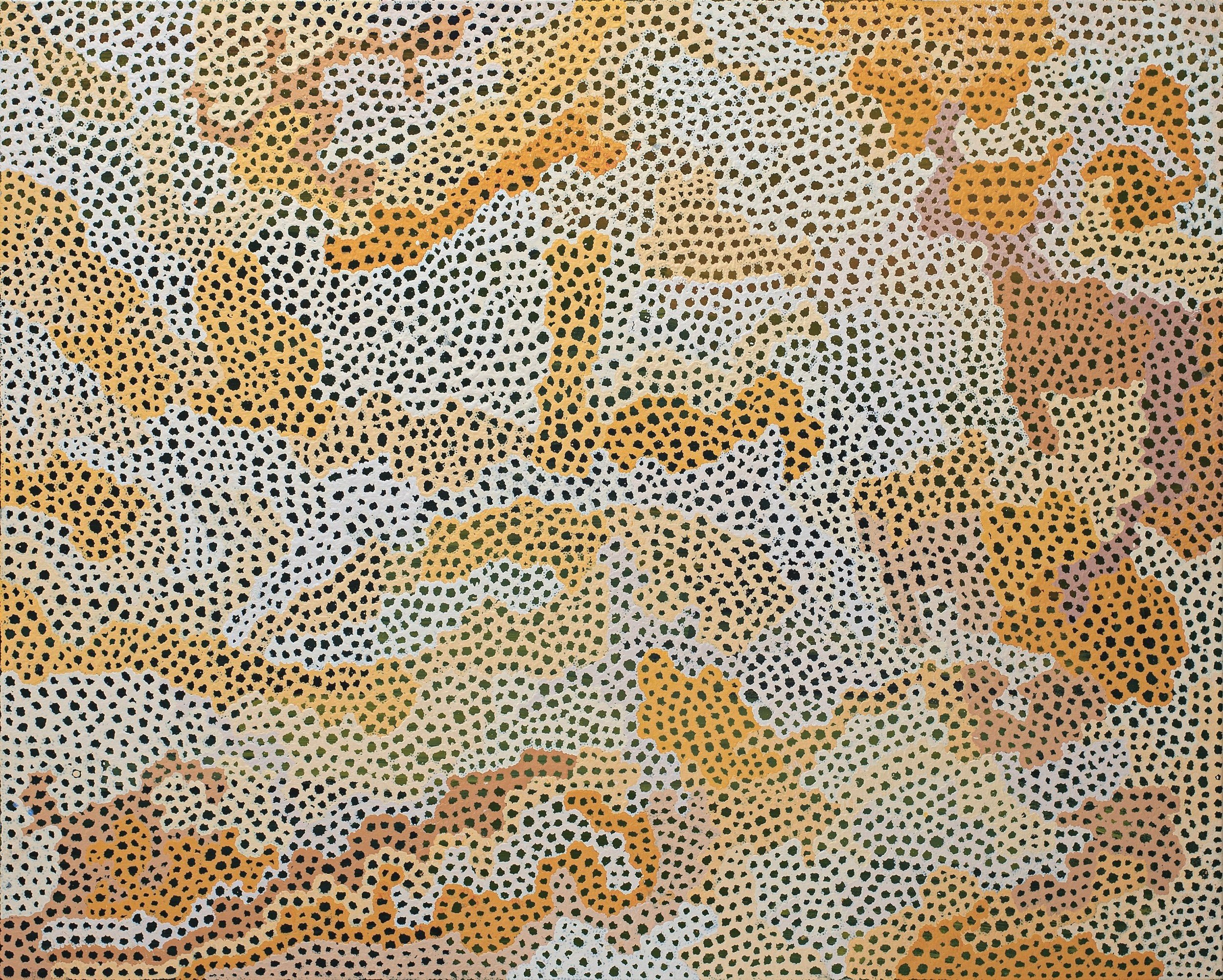
Artiste : Rhonda Young (1975)
Titre de l'œuvre : Salt Lakes
Format : 152 cm x 122 cm
Provenance et certificat : centre d'art aborigène de Mimili Maku
Référence de cette peinture aborigène : 788-24
Enquiry / Demander le prix de cette œuvre
Explications pour cette peinture d'art Aborigène :
Rhonda is one of the talented emerging painters at Mimili Maku Arts. Rhonda's mother is from Inmampa in the Northern Territory, and Rhonda is proud to paint her mother's country:
"There's many salt lakes around my mothers country. They change colours with the seasons: pink, white, blue, everything! Sometimes the lakes are big, somemes they are small, it always changes and there's storylines around all of this. Long long time ago they were all connected by rivers, and my ancestors walked between them, always following the riverbeds. I paint those journeys as remember my old people with every painting I make."
Rhonda lives and paints in Mimili Community. Mimili is home to 300 Pitjantjatjara and Yankunytjatjara people who have been living in the area for millennia in harmony with nature and acting as custodians of the land and the Tjukurpa (creaon stories). Mimili was formerly known as Everard Park, which was a cattle station that was returned to Aboriginal ownership through the 1981 APY Lands Act. Mimili Community was incorporated as an Aboriginal Community in 1975.
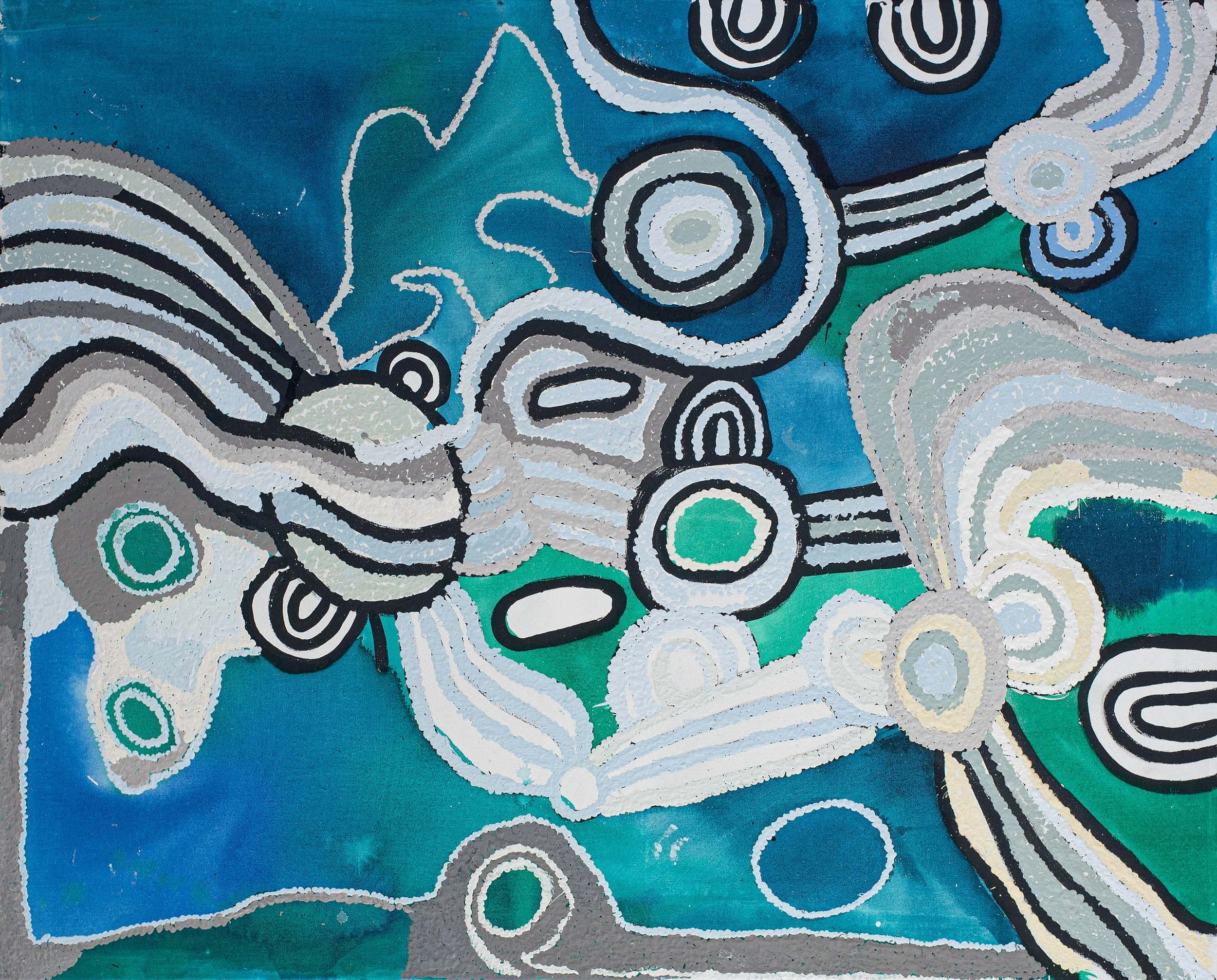
Artiste : Puna Yanima (1955)
Titre de l'œuvre : Antara
Format : 152 cm x 122 cm
Provenance et certificat : centre d'art aborigène de Mimili Maku
Référence de cette peinture aborigène : 891-24
Enquiry / Demander le prix de l'œuvre
Explications pour cette peinture d'art Aborigène :
Antara is an important women’s ceremonial site near Mimili community. Many of the senior women at Mimili Maku Arts represent Antara and its significant Maku Tjukurpa (Witchetty Grub Dreaming) in their paintings. Puna Yanima has utilised the immediacy and loose fluidity of ink to map the ngura (country) of this sacred place, marking its kapi tjukula (rock holes), apu and murpu (rocks and mountains).

Artiste : Pauline Minmila Wangin (1970)
Titre de l'œuvre : Kapi Tjukula (Water Hole)
Format : 152cm x 122cm
Provenance et certificat : centre d'art aborigène de Mimili Maku
Référence de cette peinture aborigène : 967-24
Explications pour cette peinture d'art Aborigène :
Pauline is painting tjukurpa (story) about the journey of water, explaining how to care for kapi tjukula (water holes), particularly in the area around paralpii (Victory Well). This tjukurpa was passed on to her by her mother.
“One time when I was a little girl, my mother and me went out driving to collect bush tucker. It was a very hot day, and our car broke down. We didn't have any water with us, and I was scared, but my mother led me away from the car to kapi tjukula really closeby. She taught me how to find it, and how to care for it. After emptying the kapi (water) with mara munu punu (hands and sticks) the empty tjukula is cleaned. We place punu tjuta (many sticks and branches) over the top of the tjukula and use puli pulka (big rock) to stop them blowing away. Now no animals can dirty the new water that will soon collect."
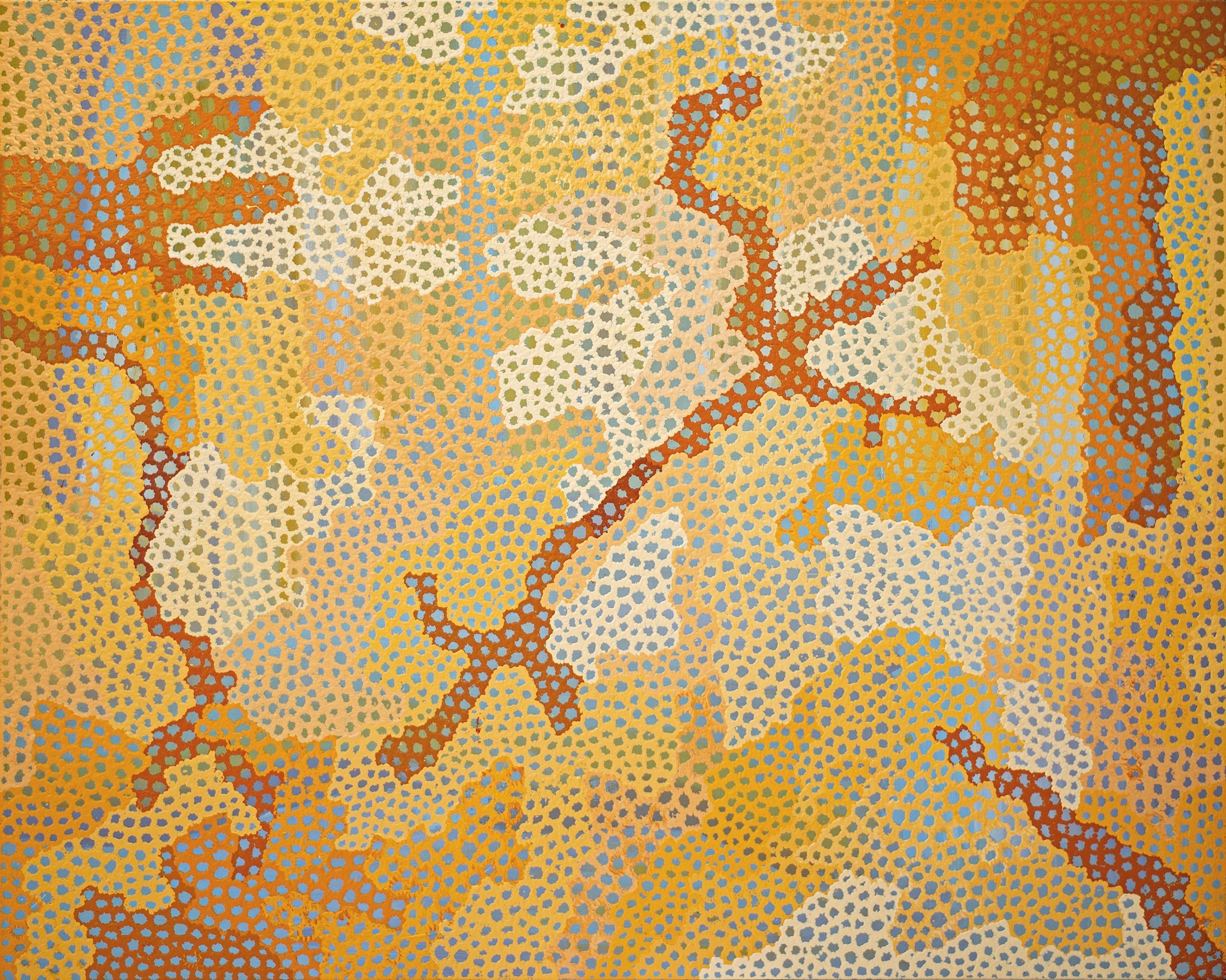
Artiste : Rhonda Young (1975)
Titre de l'œuvre : Salt Lakes
Format : 152 cm x 122 cm
Provenance et certificat : centre d'art aborigène de Mimili Maku
Référence de cette peinture aborigène : 1007-24
Enquiry / Demander le prix de cette œuvre
Explications pour cette peinture d'art Aborigène :
Rhonda is one of the talented emerging painters at Mimili Maku Arts. Rhonda's mother is from Inmampa in the Northern Territory, and Rhonda is proud to paint her mother's country:
"There's many salt lakes around my mothers country. They change colours with the seasons: pink, white, blue, everything! Sometimes the lakes are big, somemes they are small, it always changes and there's storylines around all of this. Long long time ago they were all connected by rivers, and my ancestors walked between them, always following the riverbeds. I paint those journeys as remember my old people with every painting I make."
Rhonda lives and paints in Mimili Community. Mimili is home to 300 Pitjantjatjara and Yankunytjatjara people who have been living in the area for millennia in harmony with nature and acting as custodians of the land and the Tjukurpa (creaon stories). Mimili was formerly known as Everard Park, which was a cattle station that was returned to Aboriginal ownership through the 1981 APY Lands Act. Mimili Community was incorporated as an Aboriginal Community in 1975.
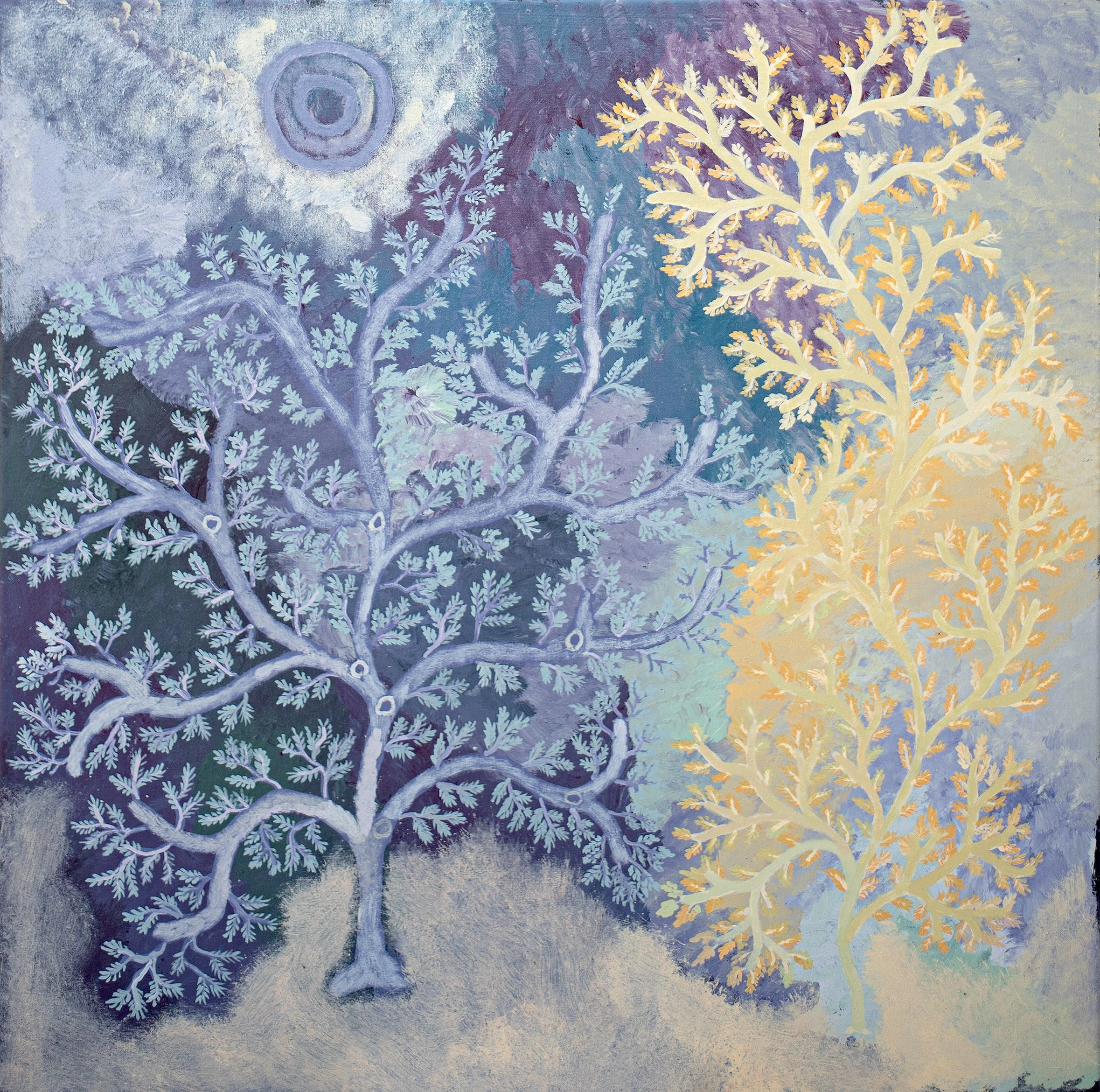
Artiste : Beverly Downs (1966)
Titre de l'œuvre : Yankunytjatjara Wapar
Format : 101 cm x 101 cm
Provenance et certificat : centre d'art aborigène de Mimili Maku
Référence de cette peinture aborigène : 1010-24
Explications pour cette peinture d'art Aborigène :
This work is about my culture and language, Yankunytjatjara culture. I am a proud Yankunytjatjara woman. My family has been Yankunytjatjara people. Our language is different to Pitjantjatjara. Most people speak Pitjantjatjara these days, and I like spending time with the few family members that still speak Yankunytjatjara and teaching the young ones about our language. I am painting a lot of the trees, grasses and their seeds that are specific my language and region. There are many words in Yankunytjatjara that come directly from the trees, and I want to paint them to keep them strong and alive for the next generation. Palya.
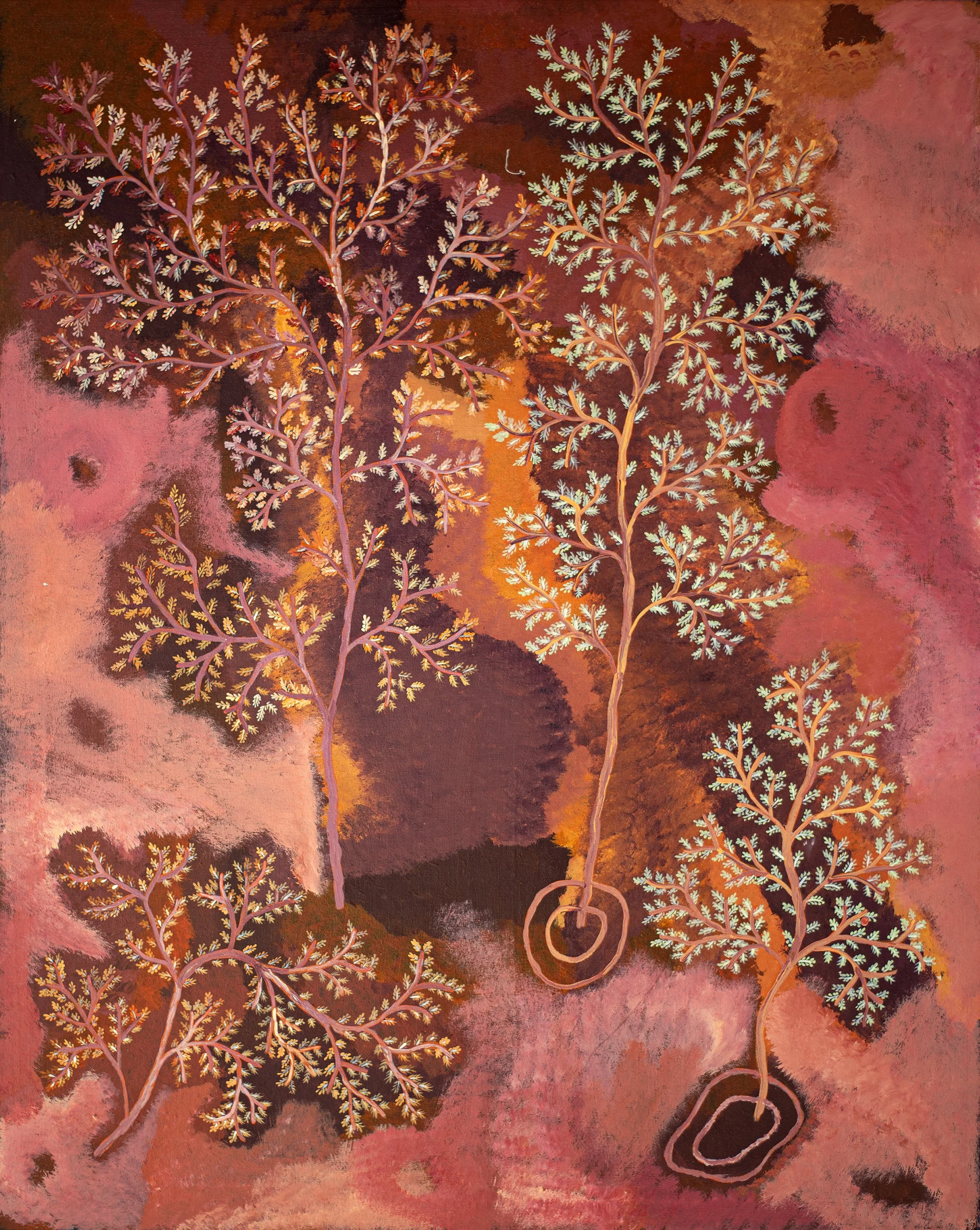
Artiste : Beverly Downs (1966)
Titre de l'œuvre : Yankunytjatjara Wapar
Format : 152 cm x 101 cm
Provenance et certificat : centre d'art aborigène de Mimili Maku
Référence de cette peinture aborigène : 1011-24
Explications pour cette peinture d'art Aborigène :
This work is about my culture and language, Yankunytjatjara culture. I am a proud Yankunytjatjara woman. My family has been Yankunytjatjara people. Our language is different to Pitjantjatjara. Most people speak Pitjantjatjara these days, and I like spending time with the few family members that still speak Yankunytjatjara and teaching the young ones about our language. I am painting a lot of the trees, grasses and their seeds that are specific my language and region. There are many words in Yankunytjatjara that come directly from the trees, and I want to paint them to keep them strong and alive for the next generation. Palya.
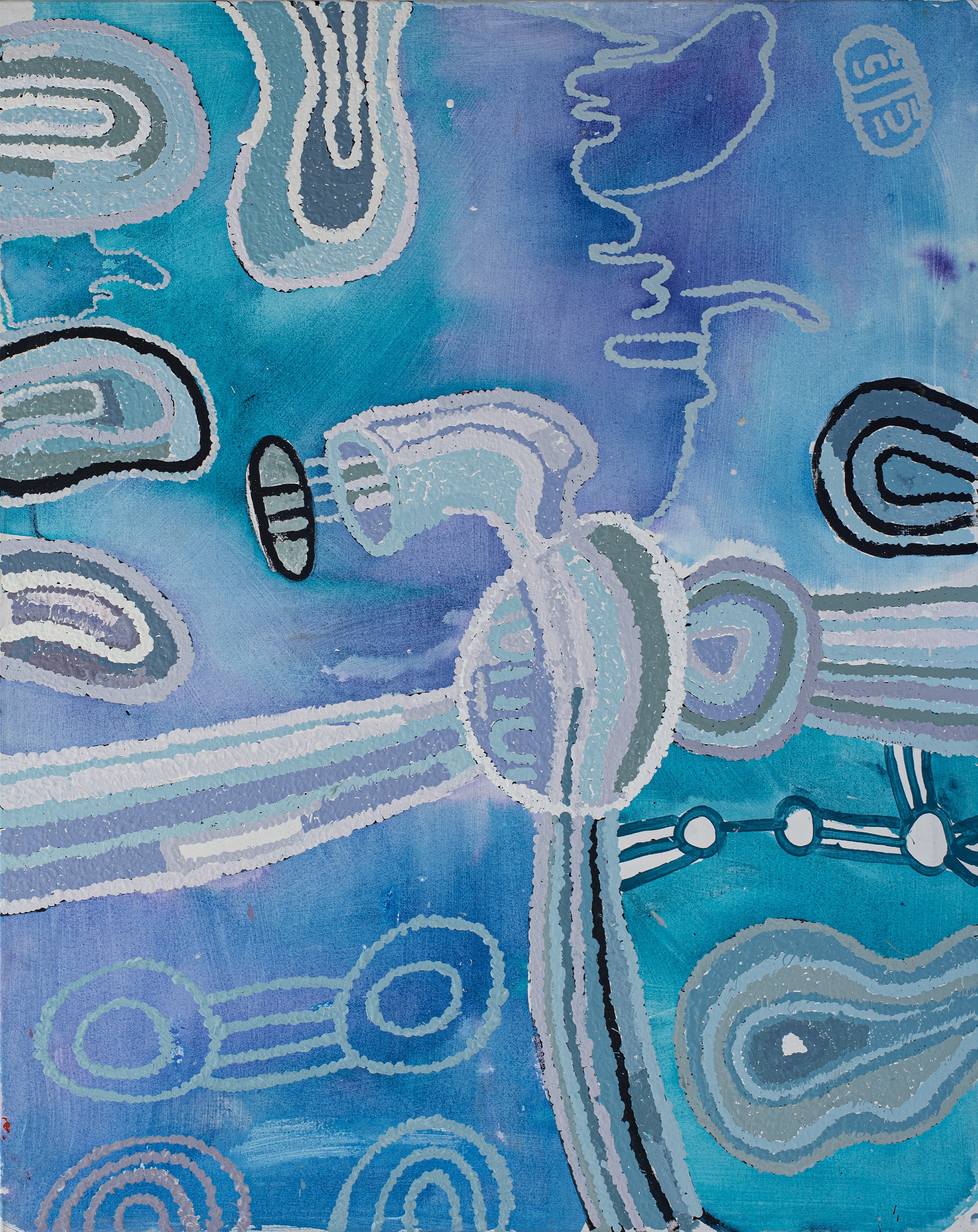
Artiste : Puna Yanima (1955)
Titre de l'œuvre : Antara
Format : 152 cm x 122 cm
Provenance et certificat : centre d'art aborigène de Mimili Maku
Référence de cette peinture aborigène : 1012-24
Enquiry / Demander le prix de l'œuvre
Explications pour cette peinture d'art Aborigène :
Antara is an important women’s ceremonial site near Mimili community. Many of the senior women at Mimili Maku Arts represent Antara and its significant Maku Tjukurpa (Witchetty Grub Dreaming) in their paintings. Puna Yanima has utilised the immediacy and loose fluidity of ink to map the ngura (country) of this sacred place, marking its kapi tjukula (rock holes), apu and murpu (rocks and mountains).

Artiste : Betty Campbell (1961)
Titre de l'œuvre : Minymaku Inma (Women's Song)
Format : 152cm x 122 cm
Provenance et certificat : centre d'art aborigène de Mimili Maku
Référence de cette peinture aborigène : 1014-24
Demander le prix de cette œuvre
Explications pour cette peinture d'art Aborigène :
Bey is a senior cultural leader in Mimili Community. She knows a lot of storylines and the corresponding inma (song & dance). A lot of the inma is to be known by initiated women only, others can be celebrated by all. Betty loves to dance and teach the kids these stories that hold important lessons about the land and our relationship to it. She says about her work:
Inma inkapai ngayulu. Ngayuku tjukurpa nyanga palunya kutju ngaranyi. Nyanga palunya kutju ngayuku tjukurpa ngaranyi. Ngayulu inma rawangku inkapai munu ngayuku tjukurtjara ngayulu palyalpai canvas nyaratja. Rawangku. Uwa palyo.
I sing ceremony. That’s the message that I would really like to impart. I’d like to leave it at that. I practice ceremony, consistently, and I record the tjukurpa related to me on canvas. This is a consistent practice. Yes, that’s it.
Mimili Community is home to 300 Pitjantjatjara and Yankunytjatjara people who have been living in the area for millennia in harmony with nature and acting as custodians of the land and the Tjukurpa (creation stories). Mimili was formerly known as Everard Park, which was a cattle station that was returned to Aboriginal ownership through the 1981 APY Lands Act. Mimili Community was incorporated as an Aboriginal Community in 1975.
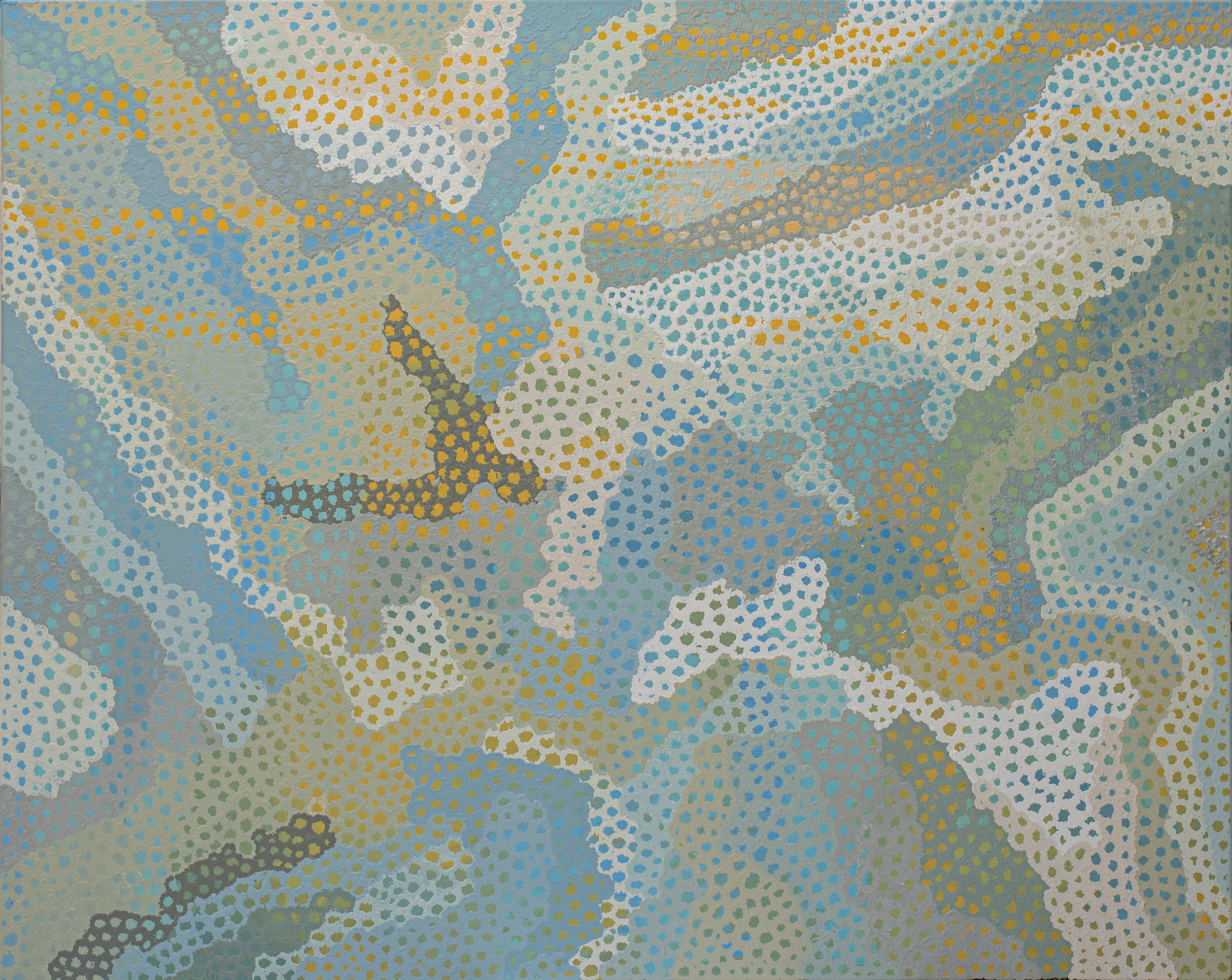
Artiste : Rhonda Young (1975)
Titre de l'œuvre : Salt Lakes
Format : 152 cm x 122 cm
Provenance et certificat : centre d'art aborigène de Mimili Maku
Référence de cette peinture aborigène : 1021-24
Enquiry / Demander le prix de cette œuvre
Explications pour cette peinture d'art Aborigène :
Rhonda is one of the talented emerging painters at Mimili Maku Arts. Rhonda's mother is from Inmampa in the Northern Territory, and Rhonda is proud to paint her mother's country:
"There's many salt lakes around my mothers country. They change colours with the seasons: pink, white, blue, everything! Sometimes the lakes are big, somemes they are small, it always changes and there's storylines around all of this. Long long time ago they were all connected by rivers, and my ancestors walked between them, always following the riverbeds. I paint those journeys as remember my old people with every painting I make."
Rhonda lives and paints in Mimili Community. Mimili is home to 300 Pitjantjatjara and Yankunytjatjara people who have been living in the area for millennia in harmony with nature and acting as custodians of the land and the Tjukurpa (creaon stories). Mimili was formerly known as Everard Park, which was a cattle station that was returned to Aboriginal ownership through the 1981 APY Lands Act. Mimili Community was incorporated as an Aboriginal Community in 1975.
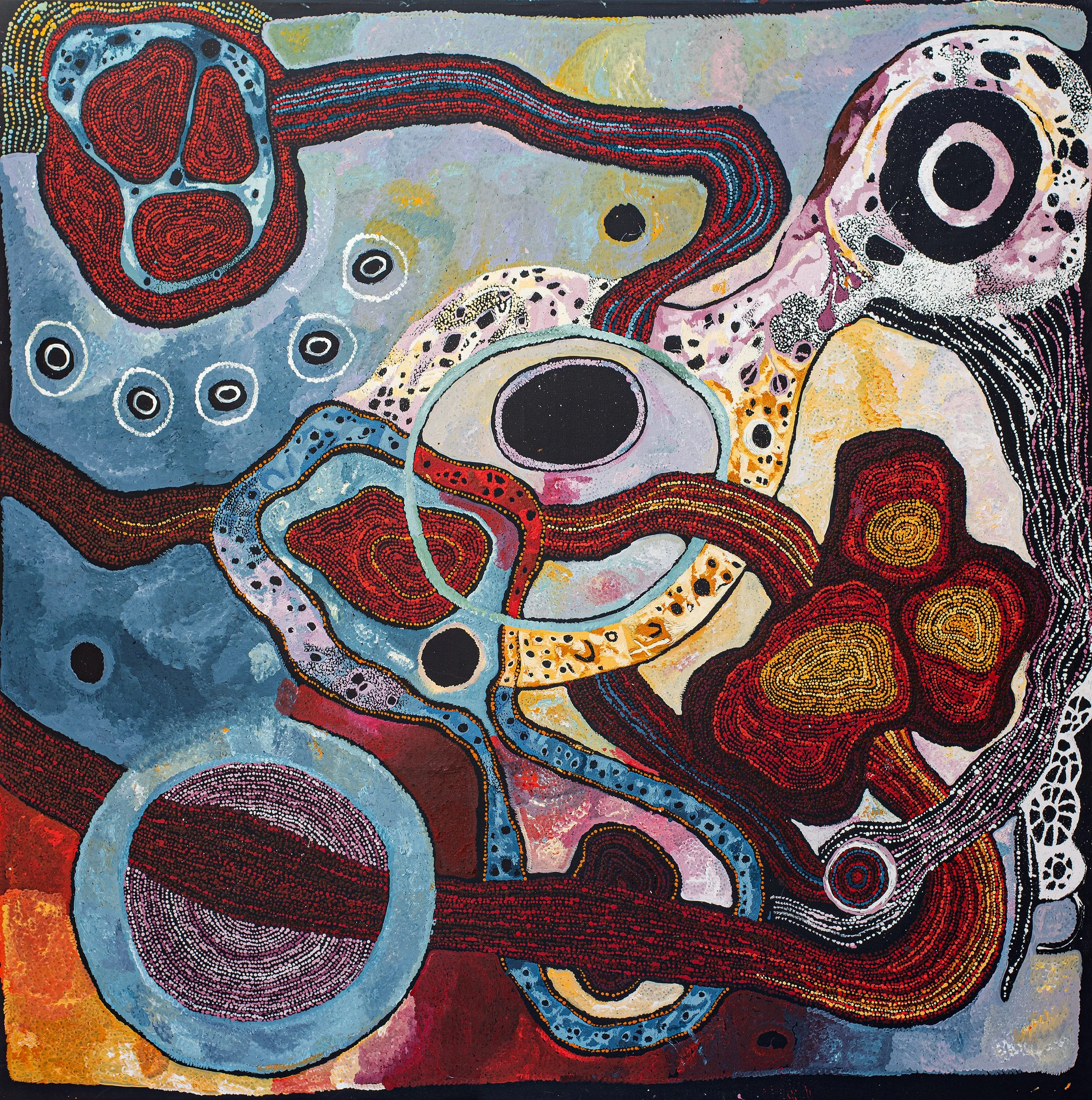
Artistes : Pauline Wangin, Emma Singer, Betty Campbell
Titre de l'œuvre : Walytja - Family Collaboration
Format : 198cm x 189cm
Provenance et certificat : centre d'art aborigène de Mimili Maku
Référence de cette peinture aborigène : 367-24
Demander le prix de cette œuvre
Explications pour cette peinture d'art Aborigène :
This is a collaborative canvas between Emma Singer, her mother Pauline Wangin and Pauline's sister Betty Campbell. Pauline says about the work : "We’ve painted this big canvas together as a family.
This canvas is about kapi tjukula and soakages around Kinara Mimi, Mimili. Our families would move between rock holes, they’d know them all. They would always be looking for clear drinking water. They lived around Antara and many other named places between Kinara Mimi, Antara, Artutja, Paralpi and Iwantja. All those places are connected, and they used to walk far distances every day. We remember the paths by the songlines that still run through those places. They’d sing the songs, dig for water, and know where to travel. The water was underground, and they’d dig till it seeped upwards. They’d always know. I remember going to Iwantja Soakage with our mother and her showing us how it’s done. We remember this from when we were young, and we want to keep sharing this story for our children and grandchildren. It’s important to remember what we’ve always known."
Pauline Wangin, 2023
Mimili Community is home to 300 Pitjantjatjara and Yankunytjatjara people who have been living in the area for millennia in harmony with nature and acting as custodians of the land and the Tjukurpa (creation stories). Mimili was formerly known as Everard Park, which was a cattle station that was returned to Aboriginal ownership through the 1981 APY Lands Act. Mimili Community was incorporated as an Aboriginal Community in 1975.
Artistes : Pauline Wangin, Emma Singer, Betty Campbell
Titre de l'œuvre : Walytja - Family Collaboration
Format : 168cm x 152cm
Provenance et certificat : centre d'art aborigène de Mimili Maku
Référence de cette peinture aborigène : 432-24
Demander le prix de cette œuvre
Explications pour cette peinture d'art Aborigène :
This is a collaborative canvas between Emma Singer, her mother Pauline Wangin and Pauline's sister Betty Campbell. Pauline says about the work : "We’ve painted this big canvas together as a family.
This canvas is about kapi tjukula and soakages around Kinara Mimi, Mimili. Our families would move between rock holes, they’d know them all. They would always be looking for clear drinking water. They lived around Antara and many other named places between Kinara Mimi, Antara, Artutja, Paralpi and Iwantja. All those places are connected, and they used to walk far distances every day. We remember the paths by the songlines that still run through those places. They’d sing the songs, dig for water, and know where to travel. The water was underground, and they’d dig till it seeped upwards. They’d always know. I remember going to Iwantja Soakage with our mother and her showing us how it’s done. We remember this from when we were young, and we want to keep sharing this story for our children and grandchildren. It’s important to remember what we’ve always known."
Pauline Wangin, 2023
Mimili Community is home to 300 Pitjantjatjara and Yankunytjatjara people who have been living in the area for millennia in harmony with nature and acting as custodians of the land and the Tjukurpa (creation stories). Mimili was formerly known as Everard Park, which was a cattle station that was returned to Aboriginal ownership through the 1981 APY Lands Act. Mimili Community was incorporated as an Aboriginal Community in 1975.