
Aboriginal Kunst uit Australië “Seven Sisters Dreaming” - Aboriginal art from Australia
Met de kunstenaars uit de artistieke gemeenschappen van Tjungu Palya, Martumili, Balgo, Ernabella, Spinifex Art Project, en Ninuku.
Galerij Aboriginal Signature Estrangin in Brussel (Koekelberg) : 101 Jules Besme straat, 1081 Brussel
Vernissage op dinsdag 4 maart 2025 (op afspraak van 14.00 tot 21.30u)
(Speech en drink om 20u).
RSVP (Antwoord alstublieft) - reserveer uw bezoek
Vervolgens ontvangt de galerie u op afspraak tot en met zaterdag 29 maart 2025, van dinsdag tot zaterdag, van 11u tot 19u:
u kunt uw bezoek nu al reserveren in onze agenda hier
Van de Oude Grieken tot de volkeren van Australië: de Seven Sisters
Sinds onheuglijke tijden loopt het verhaal van de Seven Sisters door de mythen van volkeren over de hele wereld. Deze sterren, bekend als de Pleiaden, schitteren aan de hemel en inspireren verhalen vol overdracht, veerkracht en de zoektocht naar vrijheid.
In de Griekse mythologie zijn zij de dochters van Atlas en Pleione, die door Zeus in sterren zijn veranderd om te ontsnappen aan de jager Orion, die zo veroordeeld is om hen eeuwig te achtervolgen. In Noord-Amerika vertellen de Sioux dat ze door een geest naar de hemel zijn gebracht om aan het gevaar te ontsnappen. Bij de Sumeriërs en Babyloniërs symboliseerden de Pleiaden de vruchtbaarheid en ritmeerden zij landbouw- en rituele kalenders.
In Australië is het verhaal van de Seven Sisters een van de oudste en heiligste mythen van de Aboriginals. Het is verankerd in het landschap van het continent en verhaalt zich in vele variaties naargelang de territoria, de talen en de tradities.
Voor de Euahlayi van New South Wales zijn de Seven Sisters rechtstreeks verbonden met de aardse elementen. Hun vader, een gerespecteerde oude wijze, werd omgevormd tot een ijskoude berg: Mount Kosciuszko, de hoogste top van Australië. Om dicht bij hem te blijven, werd hun moeder de Snowy River, die van de met sneeuw bedekte toppen naar de vlakte stroomt. Maar deze link tussen hemel en aarde stopt daar niet: op de hoogten van de berg vertegenwoordigen zeven heilige meren de Seven Sisters zelf.

Schilderij van de kunstenaressen Women collaborative - Seven sisters - 230 x 200 cm - 21-21 © Photo Aboriginal Signature Estrangin Gallery with the courtesy of the artist and Spinifex Art Project.
Deze meren worden gezien als toegangspoorten tussen de geestenwereld en de aarde, die elk de essentie van een van de zusters in zich dragen. Hun water verandert van kleur afhankelijk van het licht en de seizoenen, wat doet denken aan het fonkelen van de sterren aan de nachtelijke hemel. Tijdens ceremonies leren ouderen de jongere generaties hoe ze de lucht kunnen lezen door deze waterreflecties, omdat de Melkweg wordt beschouwd als de spiegel van landschappen op aarde.
Verder naar het noorden, in de regio Lake Narran, krijgt een nieuwe episode van de mythe vorm. Nadat ze door het land zijn gereisd, komen de Seven Sisters er aan om rituele ceremonies uit te voeren. Ze houden van plezier maken in het water, maar de jongste, aangetrokken door een verboden hoek van het meer, wordt gevangen door een oude man, verborgen in het riet. Hieruit wordt een vreemd wezen geboren: een wezen met eendenpoten en met een rattenpels: het eerste vogelbekdier, symbool van de fusie tussen de water- en landwereld. Gedwarsboomd en achtervolgd door ongewenste vrijers met de verkeerde huidband, worden de zussen gedwongen de lucht in te vluchten om zich te beschermen. Daar schitteren ze vandaag nog steeds.
De informatie over de geschiedenis van de Seven Sisters onder het Euahlayi-volk is een samenvatting van een Franse vertaling waaraan ik (Bertrand Estrangin) heb bijgedragen voor een documentaire "Stars of the Dreaming", vertoond door ABC TV in Australië. De reportage bevat het buitengewone interview met Ghillar (Michael Anderson), een groot ingewijde van het Euahlayi-volk, verhalenverteller, kunstenaar en tevens advocaat die betrokken was bij het herwinnen van hun territorium. Dankzij hem ontdekken we andere onbekende hoofdstukken van het verhaal.
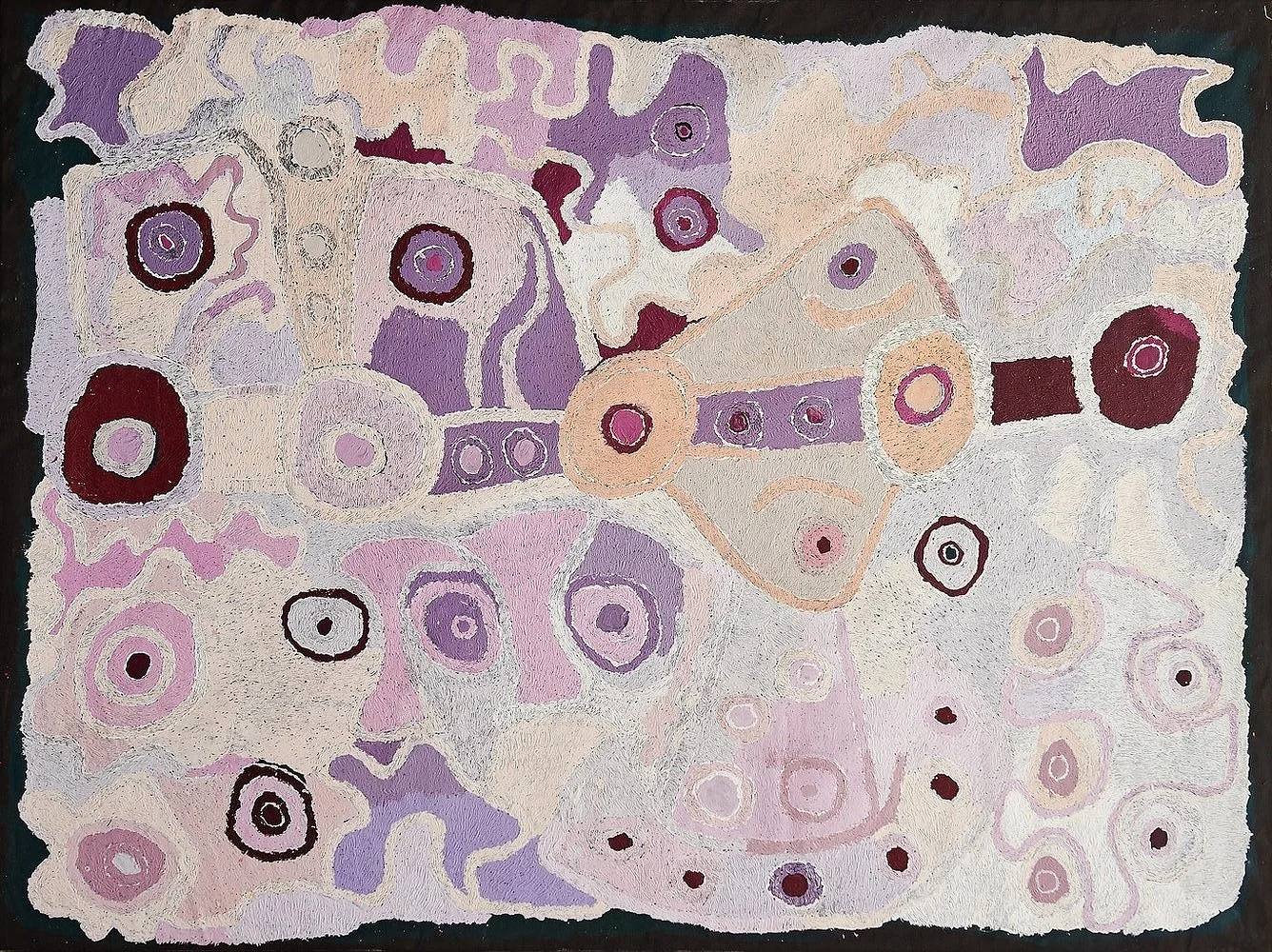
Schilderij van de artiest Angkaliya Curtis - Seven sisters dreaming - 200 x 150 cm - 13149. © Photo Aboriginal Signature Estrangin Gallery with the courtesy of the artist and Tjungu Palya.


Seven Sisters in Zealand © Photo : with the courtesy of Bertrand Estrangin
ontdek de 30 voorhanden zijnde schilderijen van de 5 Australische kunstencentra van noord tot zuid

Artiste : Kanta Donnegan
Titre de l'œuvre : Minyma Tjuta Dreaming Time story
Format : 200 x 137 cm
Provenance et certificat : centre d'art aborigène du Spinifex Art Project
Référence de cette peinture : 21-115
Enquiry / Demander le prix de l'œuvre
Explications pour cette œuvre :
Kanta was born around the 1940's at a place called Kapi Piti Kutjara. Kanta, a senior Spinifex woman is knowledgeable about many areas in Spinifex country including the Minyma Tjuta (Seven Sisters) Tjukurpa, a central theme in the lives of Western Desert women. In this story seven women, all sisters are travelling through the country on a vast journey which takes them from Coolgardie right across the desert to Port Augusta in SA. Along the way the sisters are being pursued by Wati Nyiru, the cheeky old man in pursuit of a wife, preferably the oldest sister, Kampukurtja. During his pursuit, Nyiru disguises himself in various ways to trick the sisters but is eventually outsmarted by them. The women fly up into the sky to form the constellation of Pleiades seen in the southern sky.
Her artworks are in the following prestigious collections :
Art Gallery Of South Australia, Adelaide.
South Australia (womens Collaborative).
Artbank, Australian Government Collection.
Collection Prince Stefan Of Liechtenstein, Embassy Of Liechtenstein ln Germany.(womens Collaborate).
Museum Of Western Australia.
The Corrigan Collection, Australia. (womens Collaborative).
The Lepley Collection, Perth, Western Australia. (womens Collaborative).
The National Gallery Of Victoria, Melbourne, Vic. (womens Collaborative).
The Sims Dickson Collection, Nsw...

Artiste : Angkaliya Nelson
Titre de l'œuvre : Kungkarangkalpa (Seven Sisters Story)
Format : 153 x 91 cm
Provenance et certificat : centre d'art aborigène de Ninuku
Référence de cette peinture : 22-276
Demander le prix de l'œuvre / Enquiry
Explications pour cette œuvre :
This is a major Tjukurpa for Irrunytju (Wingellina) and across the central Australian deserts. The seven sisters travelled from Kaliwarra to Wannan in Western Australia, stopping at significant sites and rockholes including Kuru Ala, a sacred place for women. They encountered a lustful man named Wati Nyiru, who chased them around the desert. Some of the details of this Tjukurpa (Dreaming story) are sacred and can’t be repeated.
© Photo : Aboriginal Signature Estrangin gallery with the courtesy of the artists and Ninuku.

Artiste : Angkaliya Nelson
Titre de l'œuvre : Kungkarangkalpa (Seven Sisters Story)
Format : 108 x 105 cm
Provenance et certificat : centre d'art aborigène de Ninuku
Référence de cette peinture : 23-014a
Demander le prix de l'œuvre / Enquiry
Explications pour cette œuvre :
This is a major Tjukurpa for Irrunytju (Wingellina) and across the central Australian deserts. The seven sisters travelled from Kaliwarra to Wannan in Western Australia, stopping at significant sites and rockholes including Kuru Ala, a sacred place for women. They encountered a lustful man named Wati Nyiru, who chased them around the desert. Some of the details of this Tjukurpa (Dreaming story) are sacred and can’t be repeated.
© Photo : Aboriginal Signature Estrangin gallery with the courtesy of the artists and Ninuku.
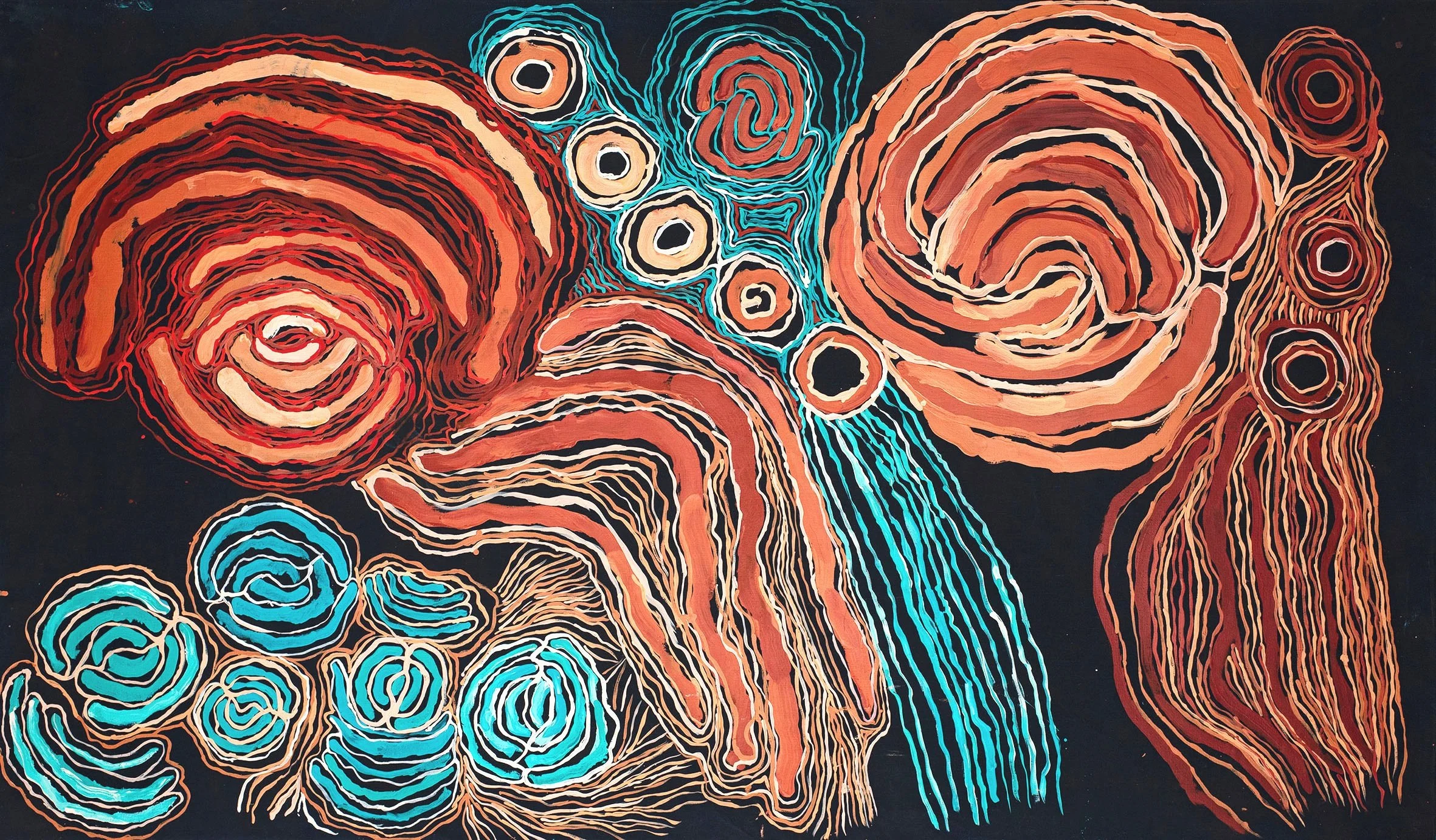
Artiste : Ruth Fatt
Titre de l'œuvre : Kuru Ala - Seven Sisters’ story
Format : 200 x 120 cm
Provenance et certificat : centre d'art aborigène de Tjungu Palya
Référence de cette peinture aborigène : 18-059
Explications de cette peinture Aborigène :
Le site de Kuru Ala dans le APY land est un endroit Aborigène sacré pour le mythe du Temps du Rêve associé à l'histoire des Sept Sœurs.
Ici les Sept Sœurs étaient assisses autour d'un interstice dans le bloc rocheux, au sein duquel se cachait le serpent python Kuniya.
La Sœur la plus âgée a considéré le serpent comme bon à consommer et elles l'ont cuit sur le feu. Mais il ne s'agissait pas d'un serpent. Derrière cette image emblématique figurait l'homme Wati Nyiru qui s'était transformé en cet animal.
Il a accompagné ces femmes au fil de leurs pérégrinations dans le désert afin de convaincre la plus âgée de devenir sa femme, dans une histoire de séduction sublimée.
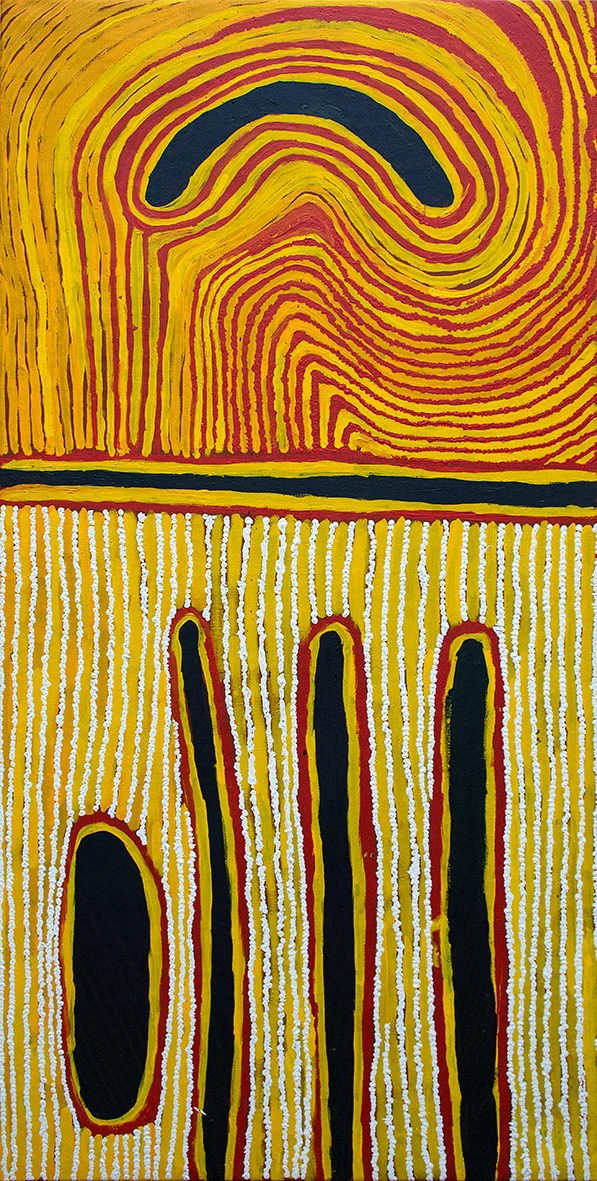
Titre de l'œuvre : Mulupuku (ancestral stories)
Artiste : Bai Bai Napangardi
Format : 150 x 75 cm
Provenance et certificat : centre d'art aborigène de Balgo - Warlayiriti Artists Aboriginal Corporation
Référence de cette peinture aborigene : 83/14
© with the courtesy of the artist & the Aboriginal art centre. Photo : Aboriginal Signature
Vendue
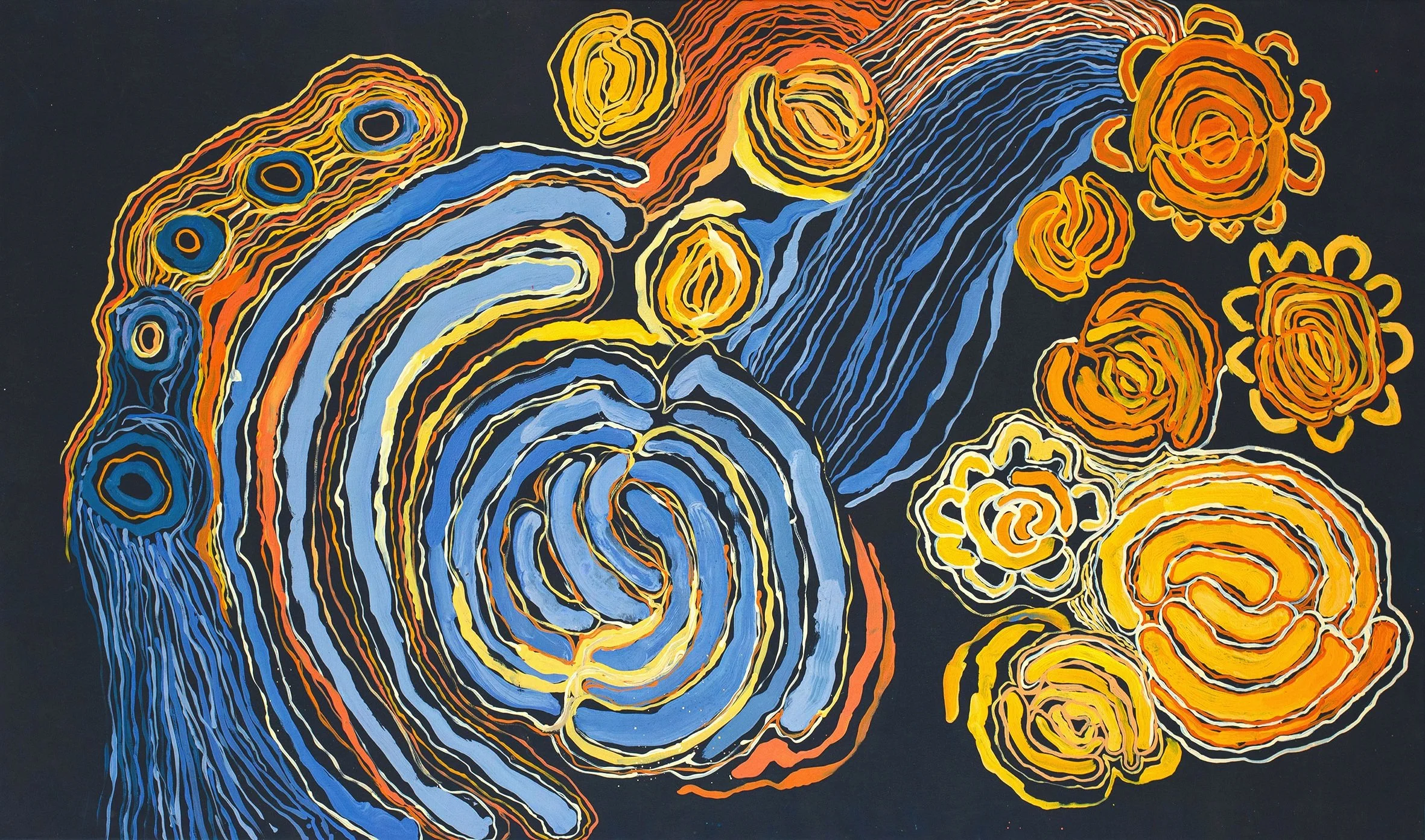
Artiste : Ruth Fatt
Titre de l'œuvre : Kuru Ala - Seven Sisters’ story
Format : 200 x 120 cm
Provenance et certificat : centre d'art aborigène de Tjungu Palya
Référence de cette peinture aborigène : 18-058a
Explications de cette peinture Aborigène :
Le site de Kuru Ala dans le APY land est un endroit Aborigène sacré pour le mythe du Temps du Rêve associé à l'histoire des Sept Sœurs.
Ici les Sept Sœurs étaient assisses autour d'un interstice dans le bloc rocheux, au sein duquel se cachait le serpent python Kuniya.
La Sœur la plus âgée a considéré le serpent comme bon à consommer et elles l'ont cuit sur le feu. Mais il ne s'agissait pas d'un serpent. Derrière cette image emblématique figurait l'homme Wati Nyiru qui s'était transformé en cet animal.
Il a accompagné ces femmes au fil de leurs pérégrinations dans le désert afin de convaincre la plus âgée de devenir sa femme, dans une histoire de séduction sublimée.
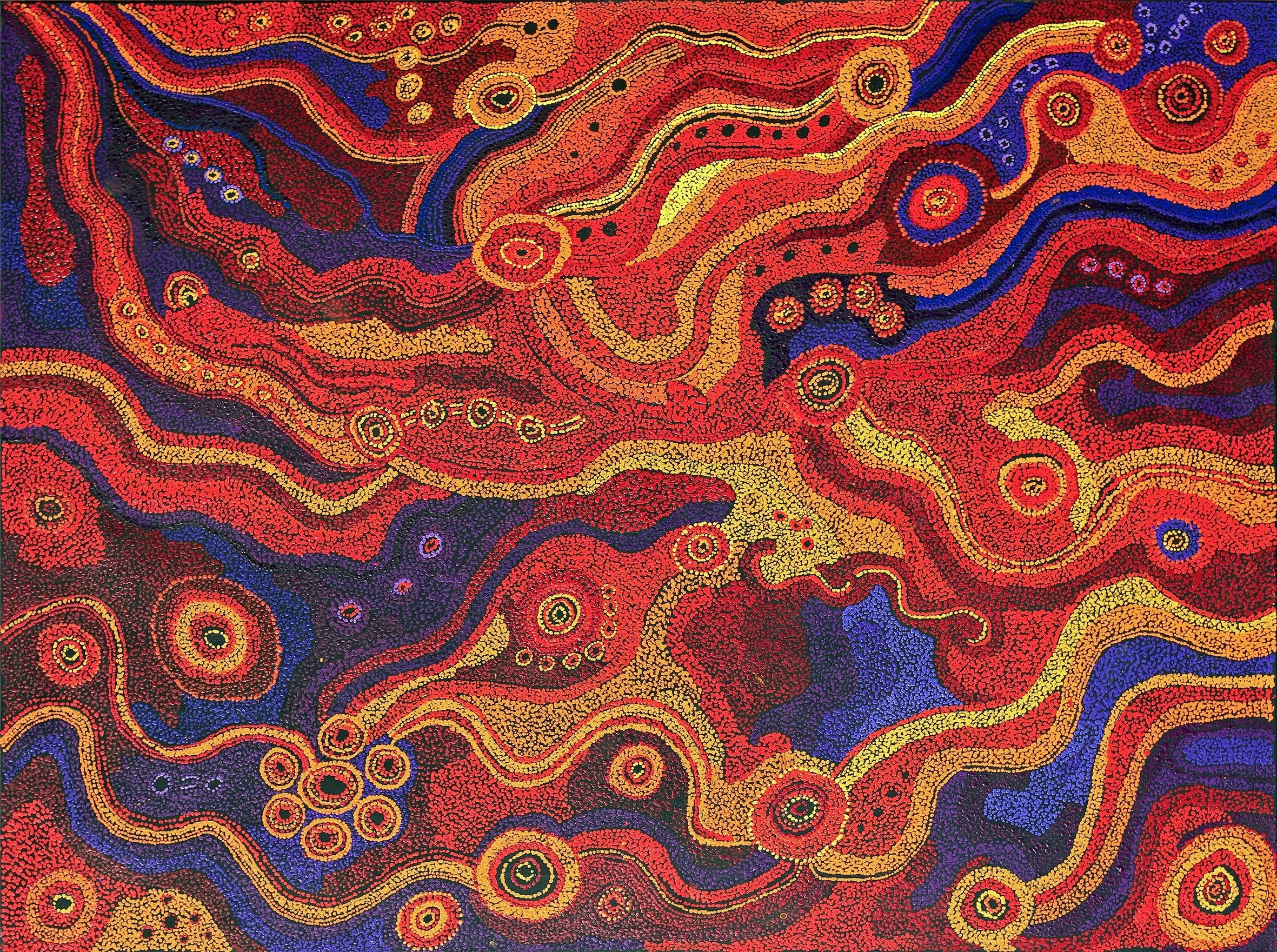
Artiste : Sandra Ken
Titre de l'œuvre : Seven Sisters
Format : 198 x 152,5 cm
Provenance et certificat : centre d'art aborigène de Tjala Arts
Référence de cette peinture aborigène : 253-22
Enquiry / Demander le prix de l'œuvre
Explication pour cette œuvre :
This is a Tjukurpa Story (Creation Story) about the constellations of Pleiades and Orion. The sisters are the constellaton of Pleiades and the other star Orion is said to be Nyiru or Nyirunya (described as a lusty or bad man). Nyiru is forever chasing the sisters known as the Kunkarunkara women as it is said he wants to marry the eldest sister. The seven sisters travel again and again from the sky to the earth to escape Nyiru’s unwanted attentions. They turn into their human form to escape from the persistent Nyiru, but he always finds them and they flee back to the sky. As Nyiru is chasing the sisters he tries to catch them by using magic to turn into the most tempting kampurarpra (bush tomatoes) for the sisters to eat and the most beautiful Ili (fig) tree for them to camp under. However, the sisters are too clever for Nyiru and outwit him as they are knowledgeable about his magic. They go hungry and run through the night rather than be caught by Nyiru. Every now and again one of the women fall victim to his ways. It is said that he eventually captures the youngest sister, but with the help of the oldest sister, she escapes back to her sisters who are waiting for her. Eventually the sisters fly back into the sky to escape Nyiru, reforming the constellation.

Artiste : Tjunkaya Tapaya OAM
Titre de l'œuvre : Kungkarangkalpa / Seven Sisters
Format : 179 x 100 cm
Provenance et certificat : centre d'art aborigène d’Ernabella
Référence de cette peinture aborigène : 326-23
Explication sur cette œuvre :
Kungkarangkalpa means the Seven Sisters. This is an extensive creation story that relates to the Pleiades constellation in the southern hemisphere. The story traverses Australia taking on different forms, however local women are privy to the part of the story which takes place in the country near Ernabella. For this part of the story, the man called Nyiru is chasing the sisters as he wants to sleep with the oldest sister. All the younger sisters are deeply afraid of him. As Nyiru is chasing the sisters, he tries to catch them by using magic to turn himself into the most tempting bush tomatoes for the sisters to eat and the most beautiful ili (fig) tree for the sisters to camp under. However, the sisters are aware of his magic and go hungry and run through the night rather than be caught by Nyiru. Eventually, to escape Nyiru, the sisters fly into the sky where they turn into stars and form the constellation.

Artiste : Tanya Brady
Titre de l'œuvre : Seven Sisters
Format : 198 x 122 cm
Provenance et certificat : centre d'art aborigène de Tjala Arts
Référence de cette peinture aborigène : 287-22
Enquiry / Demander le prix de l'œuvre
Explication pour cette œuvre :
This is a Tjukurpa Story (Creation Story) about the constellations of Pleiades and Orion. The sisters are the constellaton of Pleiades and the other star Orion is said to be Nyiru or Nyirunya (described as a lusty or bad man). Nyiru is forever chasing the sisters known as the Kunkarunkara women as it is said he wants to marry the eldest sister. The seven sisters travel again and again from the sky to the earth to escape Nyiru’s unwanted attentions. They turn into their human form to escape from the persistent Nyiru, but he always finds them and they flee back to the sky. As Nyiru is chasing the sisters he tries to catch them by using magic to turn into the most tempting kampurarpra (bush tomatoes) for the sisters to eat and the most beautiful Ili (fig) tree for them to camp under. However, the sisters are too clever for Nyiru and outwit him as they are knowledgeable about his magic. They go hungry and run through the night rather than be caught by Nyiru. Every now and again one of the women fall victim to his ways. It is said that he eventually captures the youngest sister, but with the help of the oldest sister, she escapes back to her sisters who are waiting for her. Eventually the sisters fly back into the sky to escape Nyiru, reforming the constellation.
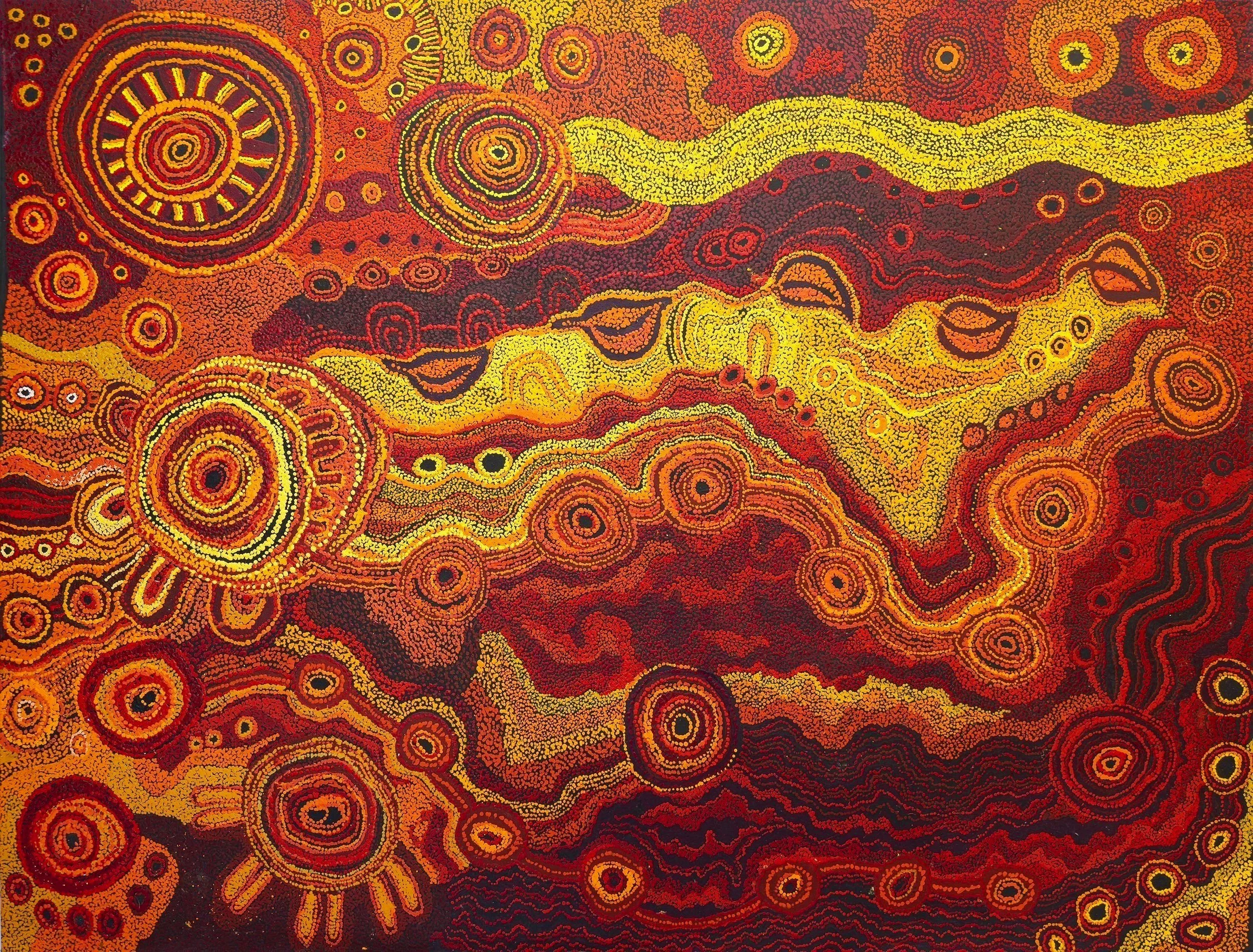
Artiste : Collaborative Work
Titre de l'œuvre : Seven Sisters Dreaming Time story
Format : 198x152 cm
Provenance et certificat : centre d'art de Tjala
Référence de la peinture : 22-23
Demander le prix de l'œuvre / Enquiry
Explication sur la signification de cette peinture d'art Aborigène :
The artists have depicted the Seven Sisters Story. This is a Tjukurpa Story (Creation Story) about the constellations of Pleiades and Orion. The sisters are the constellaton of Pleiades and the other star Orion is said to be Nyiru or Nyirunya (described as a lusty or bad man).
Nyiru is forever chasing the sisters known as the Kunkarunkara women as it is said he wants to marry the eldest sister.The seven sisters travel again and again from the sky to the earth to
escape Nyiru’s unwanted attentions. They turn into their human form to escape from the persistent Nyiru, but he always finds them and they flee back to the sky. As Nyiru is chasing the sisters he tries to catch them by using magic to turn into the most tempting kampurarpra (bush tomatoes) for the sisters to eat and the most beautiful Ili (fig) tree for them to camp under.
However, the sisters are too clever for Nyiru and outwit him as they are knowledgeable about his magic. They go hungry and run through the night rather than be caught by Nyiru. Every now and again one of the women fall victim to his ways. It is said that he eventually captures the youngest sister, but with the help of the oldest sister, she escapes back to her sisters who are waiting for her. Eventually the sisters fly back into the sky to escape Nyiru, reforming the constellation. (In some cases the artist will secretly depict sexual elements as Nyiru is really only after one thing -sex).

Artiste : Mona Mitakiki, Tjimpayi Presley and Naomi Kantjuriny
Titre de l'œuvre : Seven Sisters Dreaming Time story
Format : 198 x 187 cm
Provenance et certificat : centre d'art de Tjala
Référence de la peinture : 659-19
Explication sur la signification de cette peinture d'art Aborigène :
Mona Mitakiki, Tjimpayi Presley and Naomi Kantjuriny have depicted the Seven Sisters Story. This is a Tjukurpa Story (Creation Story) about the constellations of Pleiades and Orion. The sisters are the constellaton of Pleiades and the other star Orion is said to be Nyiru or Nyirunya (described as a lusty or bad man).
Nyiru is forever chasing the sisters known as the Kunkarunkara women as it is said he wants to marry the eldest sister.The seven sisters travel again and again from the sky to the earth to
escape Nyiru’s unwanted attentions. They turn into their human form to escape from the persistent Nyiru, but he always finds them and they flee back to the sky. As Nyiru is chasing the sisters he tries to catch them by using magic to turn into the most tempting kampurarpra (bush tomatoes) for the sisters to eat and the most beautiful Ili (fig) tree for them to camp under.
However, the sisters are too clever for Nyiru and outwit him as they are knowledgeable about his magic. They go hungry and run through the night rather than be caught by Nyiru. Every now and again one of the women fall victim to his ways. It is said that he eventually captures the youngest sister, but with the help of the oldest sister, she escapes back to her sisters who are waiting for her. Eventually the sisters fly back into the sky to escape Nyiru, reforming the constellation. (In some cases the artist will secretly depict sexual elements as Nyiru is really only after one thing -sex).

Artiste : Amy Scotty
Titre de l'œuvre : Kungkarangkalpa / Seven Sisters
Format : 90 x 60 cm
Provenance et certificat : centre d'art aborigène d’Ernabella
Référence de cette peinture aborigène : 119-24
Explication sur cette œuvre :
Kungkarangkalpa means the Seven Sisters. This is an extensive creation story that relates to the Pleiades constellation in the southern hemisphere. The story traverses Australia taking on different forms, however local women are privy to the part of the story which takes place in the country near Ernabella. For this part of the story, the man called Nyiru is chasing the sisters as he wants to sleep with the oldest sister. All the younger sisters are deeply afraid of him. As Nyiru is chasing the sisters, he tries to catch them by using magic to turn himself into the most tempting bush tomatoes for the sisters to eat and the most beautiful ili (fig) tree for the sisters to camp under. However, the sisters are aware of his magic and go hungry and run through the night rather than be caught by Nyiru. Eventually, to escape Nyiru, the sisters fly into the sky where they turn into stars and form the constellation.
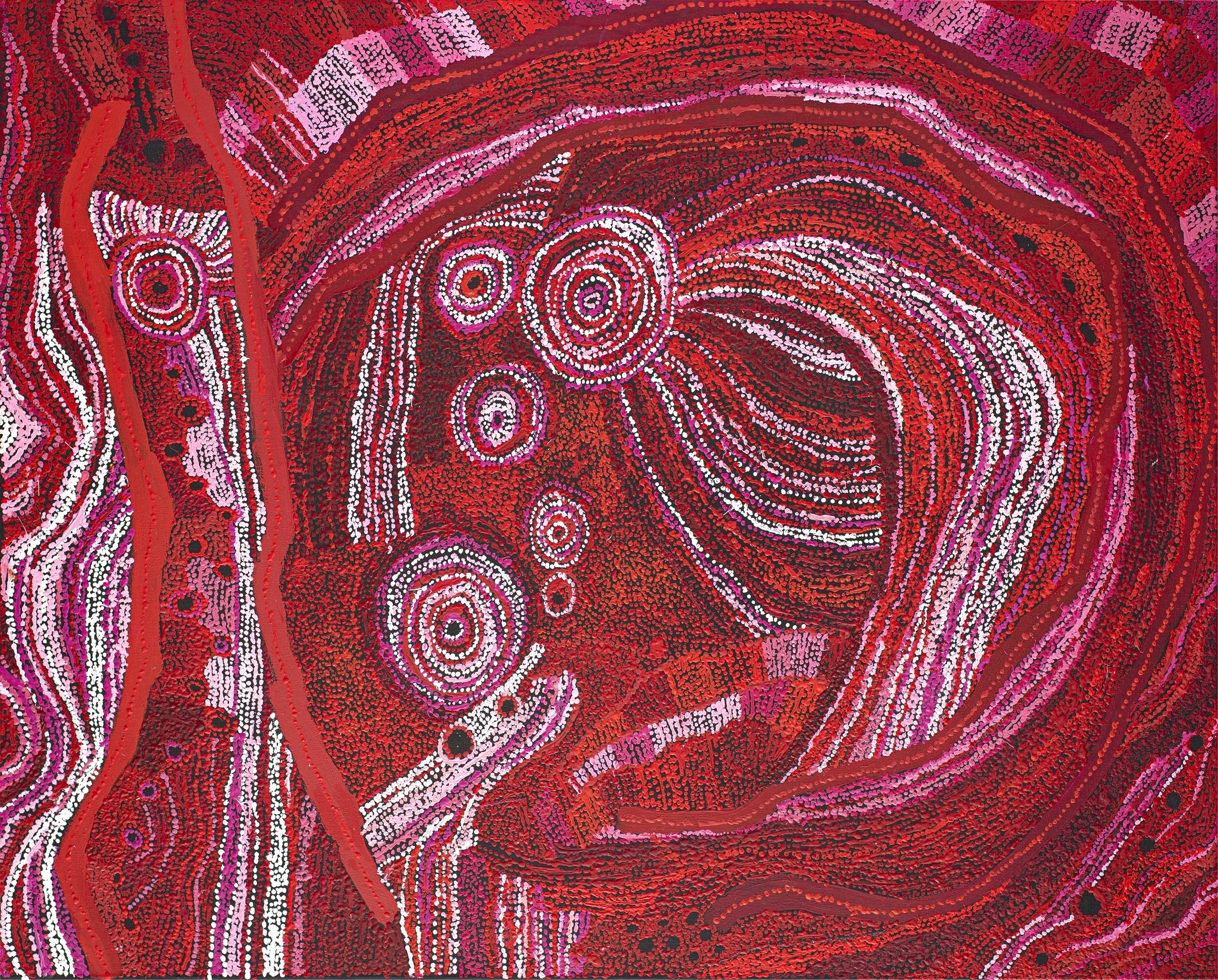
Artistes : Yatjiki Cullinan
Titre de l'œuvre : Ngura (Country)
Format : 152 x 122 cm
Provenance et certificat : centre d'art aborigène d’Iwantja
Référence de cette peinture aborigène : 224-23
Explications pour cette peinture d'art Aborigène :
I am a Yankunytjatjara woman from Indulkana Community on the Anangu Pitjantjatjara Yankunytjatjara (APY) Lands in South Australia. I’m an artist at Iwantja Arts, where I started painting over 20 years ago.
My paintings are of Tjukurpa (ancestral stories) and ngura (country) that have cultural significance for me and my family. They are a combination of landscape – specific locations and landmarks - and representations of the sky and stars. For Anangu the stars hold Tjukurpa (Ancestral cultural stories) just like the country - the rockholes, hills and creeks – have Tjukurpa. One main one is the Kungkarangkalpa (Seven Sisters) Tjukurpa where a specific constellation represents the sisters and the cheeky man chasing after them.
I’m proud to be an artist and a leader in my community, working to keep our culture strong and passing on important knowledge to the next generations.

Artiste : Amy Scotty
Titre de l'œuvre : Kungkarangkalpa / Seven Sisters
Format : 168 x 119 cm
Provenance et certificat : centre d'art aborigène d’Ernabella
Référence de cette peinture aborigène : 161-24
Explication sur cette œuvre :
Kungkarangkalpa means the Seven Sisters. This is an extensive creation story that relates to the Pleiades constellation in the southern hemisphere. The story traverses Australia taking on different forms, however local women are privy to the part of the story which takes place in the country near Ernabella. For this part of the story, the man called Nyiru is chasing the sisters as he wants to sleep with the oldest sister. All the younger sisters are deeply afraid of him. As Nyiru is chasing the sisters, he tries to catch them by using magic to turn himself into the most tempting bush tomatoes for the sisters to eat and the most beautiful ili (fig) tree for the sisters to camp under. However, the sisters are aware of his magic and go hungry and run through the night rather than be caught by Nyiru. Eventually, to escape Nyiru, the sisters fly into the sky where they turn into stars and form the constellation.

Artistes : Angkuna Baker (1934)
Titre de l'œuvre : Areyonga
Format : 76 x 51 cm
Provenance et certificat : centre d'art aborigène d’Iwantja
Référence de cette peinture aborigène : 12-21
Explications pour cette peinture d'art Aborigène :
Angkuna paints her powerful country Areyonga, nestled between mountainous terrains which back the West MacDonnell Ranges. The community is surrounded by picturesque waterholes and soakages, and is abundant with native wildlife. Angkuna was born in the bush at a special women’s country site, which has strong ties to the Seven Sisters songline.
Angkuna spent many hours learning inma (traditional songs and dances) from the older people in her community. Living in wiltja’s (hand built shelters) close to missions and cattle stations, friends and family constantly surrounded Angkuna; she recalls her childhood loaded with memories of exploration and adventure. When she was a young women she started the first school at the Indulkana community.
“When I was young there were lots of kids near Areyonga; our games were in the bush, climbing hills and looking for good swimming. We had a lot of friends and family when we moved to the Iwantja Tjukitji (soakage), we were living next to the lovely creek in a wiltja. There was no school then, but we made a big humpie and inside I was teaching chi chi’s (children.) This was the first school at Indulkana.”
Angkuna’s paintings are highly considered in their content and storytelling of old stories and songs which were passed down to her as a young child, combined with her personal memories. Angkuna uses the canvas as a means to communicate her lived experiences of Anangu culture and tjukurpa (stories) with the viewing public.
Iwantja Arts is an artist studio located within the remote Indigenous community of Indulkana, on the Anangu Pitjantjatjara Yankunytjatjara (APY) Lands. Iwantja Arts is an Aboriginal corporation owned and governed by a board of directors. The art centre aims to encourage and support artistic excellence and cultural development within the community by providing opportunities, career development, and economic independence for practicing artists.

Titre de l'œuvre : Kunawarritji
Artiste : Nora Nganapa (1935-dec)
Format : 120 x 60 cm
Provenance et certificat : centre d'art aborigène de Balgo - Warlayiriti Artists Aboriginal Corporation
Référence de cette peinture aborigene : 24/11
Explications de l’œuvre de l’artiste Nora Nganapa (1935) :
Nora Wompi and Nora Nganapa. These two women who shared a grandfather were connected by skin, country and circumstance and their art and lives were intrinsically entwined. Sharing a history shaped by the intrusion of the Canning Stock Route on their traditional lands and way of life, they were from the generation of Aboriginal people in the Kimberley who grew up in the desert and came to old Balgo mission with their families seeking refuge.
Nora Nganapa’s works are highly contemplative and her deliberate application of strokes of colour in a restricted palette are applied with measured assurance.
This artwork represents the traditional country near Kunawarritji Community (Well 33), far to the south west of Balgo along the middle stretches of the Canning Stock Route. While the lineal patterns in the painting represent the tali (sand hills) that dominate this country, the circular shapes represent the scarce rockholes (waterholes) dotted throughout the desert.
© with the courtesy of the artist & the Aboriginal art centre. Photo : Aboriginal Signature
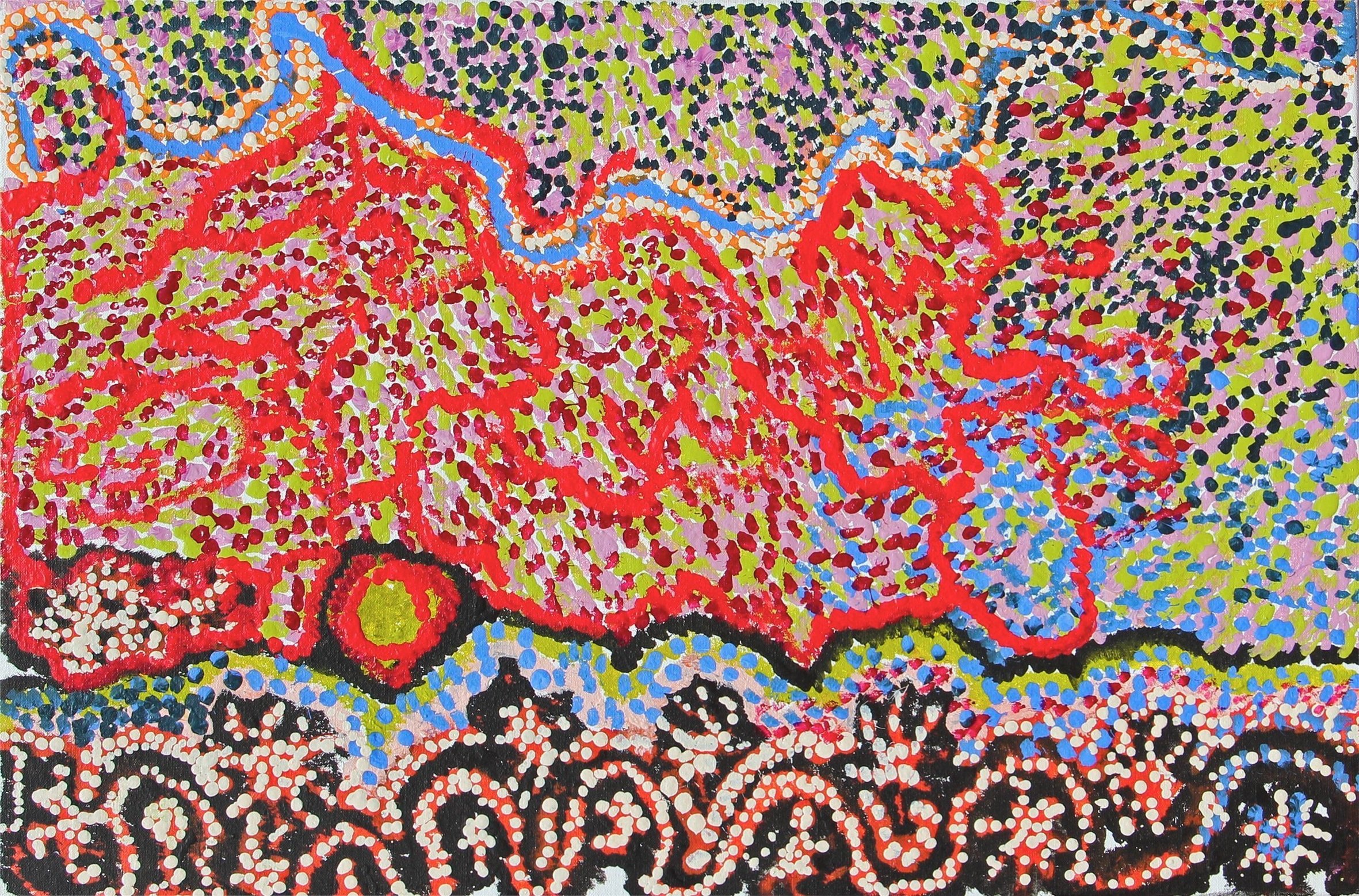
Artistes : Angkuna Baker (1934)
Titre de l'œuvre : Areyonga
Format : 76 x 51 cm
Provenance et certificat : centre d'art aborigène d’Iwantja
Référence de cette peinture aborigène : 13-21
Explications pour cette peinture d'art Aborigène :
Angkuna paints her powerful country Areyonga, nestled between mountainous terrains which back the West MacDonnell Ranges. The community is surrounded by picturesque waterholes and soakages, and is abundant with native wildlife. Angkuna was born in the bush at a special women’s country site, which has strong ties to the Seven Sisters songline.
Angkuna spent many hours learning inma (traditional songs and dances) from the older people in her community. Living in wiltja’s (hand built shelters) close to missions and cattle stations, friends and family constantly surrounded Angkuna; she recalls her childhood loaded with memories of exploration and adventure. When she was a young women she started the first school at the Indulkana community.
“When I was young there were lots of kids near Areyonga; our games were in the bush, climbing hills and looking for good swimming. We had a lot of friends and family when we moved to the Iwantja Tjukitji (soakage), we were living next to the lovely creek in a wiltja. There was no school then, but we made a big humpie and inside I was teaching chi chi’s (children.) This was the first school at Indulkana.”
Angkuna’s paintings are highly considered in their content and storytelling of old stories and songs which were passed down to her as a young child, combined with her personal memories. Angkuna uses the canvas as a means to communicate her lived experiences of Anangu culture and tjukurpa (stories) with the viewing public.
Iwantja Arts is an artist studio located within the remote Indigenous community of Indulkana, on the Anangu Pitjantjatjara Yankunytjatjara (APY) Lands. Iwantja Arts is an Aboriginal corporation owned and governed by a board of directors. The art centre aims to encourage and support artistic excellence and cultural development within the community by providing opportunities, career development, and economic independence for practicing artists.
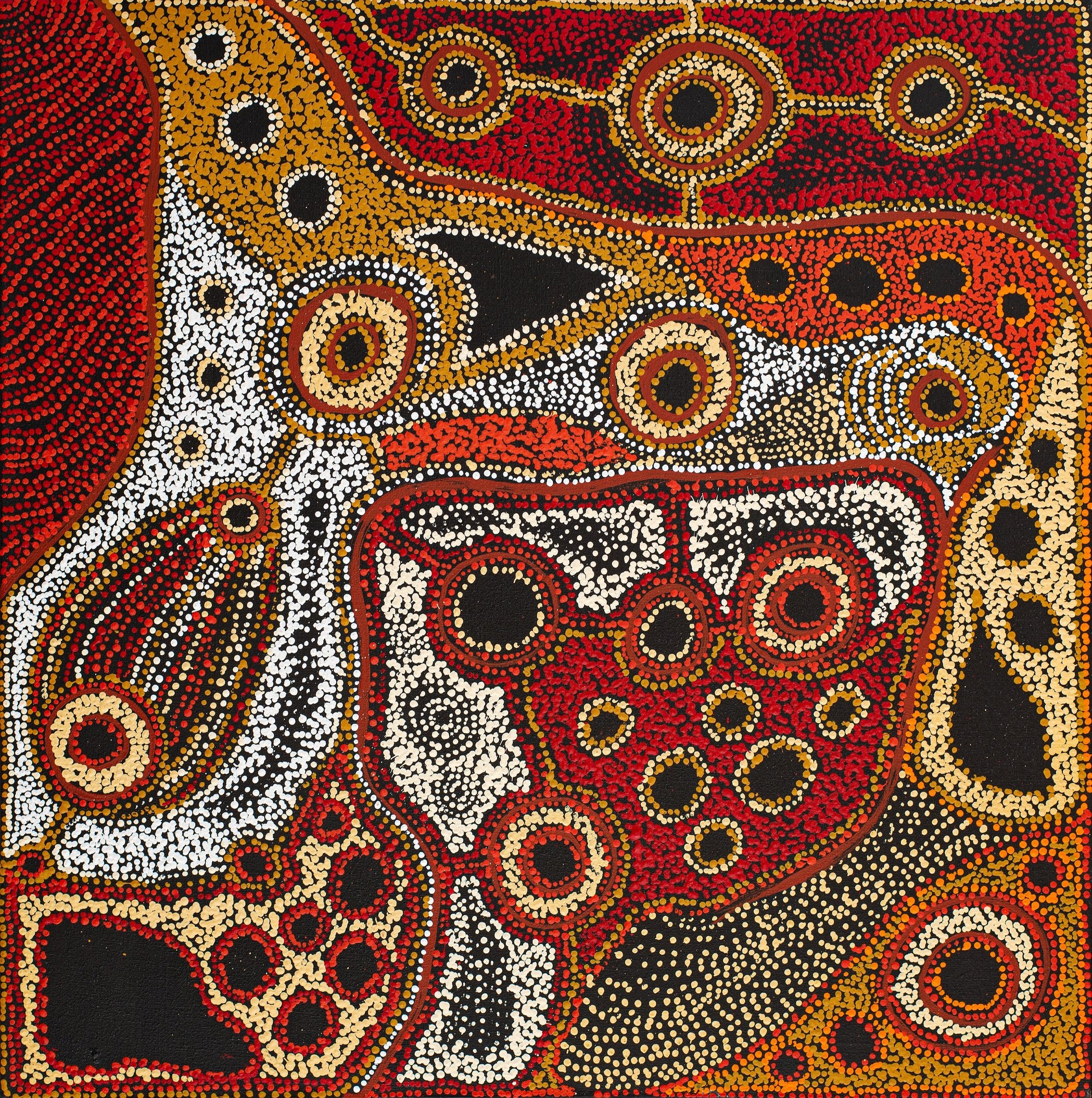
Artiste : Amy Scotty
Titre de l'œuvre : Kungkarangkalpa / Seven Sisters
Format : 80 x 80 cm
Provenance et certificat : centre d'art aborigène d’Ernabella
Référence de cette peinture aborigène : 134-24
Explication sur cette œuvre :
Kungkarangkalpa means the Seven Sisters. This is an extensive creation story that relates to the Pleiades constellation in the southern hemisphere. The story traverses Australia taking on different forms, however local women are privy to the part of the story which takes place in the country near Ernabella. For this part of the story, the man called Nyiru is chasing the sisters as he wants to sleep with the oldest sister. All the younger sisters are deeply afraid of him. As Nyiru is chasing the sisters, he tries to catch them by using magic to turn himself into the most tempting bush tomatoes for the sisters to eat and the most beautiful ili (fig) tree for the sisters to camp under. However, the sisters are aware of his magic and go hungry and run through the night rather than be caught by Nyiru. Eventually, to escape Nyiru, the sisters fly into the sky where they turn into stars and form the constellation.

Artistes : Yatjiki Cullinan
Titre de l'œuvre : Ngura (Country)
Format : 152 x 122 cm
Provenance et certificat : centre d'art aborigène d’Iwantja
Référence de cette peinture aborigène : 253-23
Explications pour cette peinture d'art Aborigène :
I am a Yankunytjatjara woman from Indulkana Community on the Anangu Pitjantjatjara Yankunytjatjara (APY) Lands in South Australia. I’m an artist at Iwantja Arts, where I started painting over 20 years ago.
My paintings are of Tjukurpa (ancestral stories) and ngura (country) that have cultural significance for me and my family. They are a combination of landscape – specific locations and landmarks - and representations of the sky and stars. For Anangu the stars hold Tjukurpa (Ancestral cultural stories) just like the country - the rockholes, hills and creeks – have Tjukurpa. One main one is the Kungkarangkalpa (Seven Sisters) Tjukurpa where a specific constellation represents the sisters and the cheeky man chasing after them.
I’m proud to be an artist and a leader in my community, working to keep our culture strong and passing on important knowledge to the next generations.
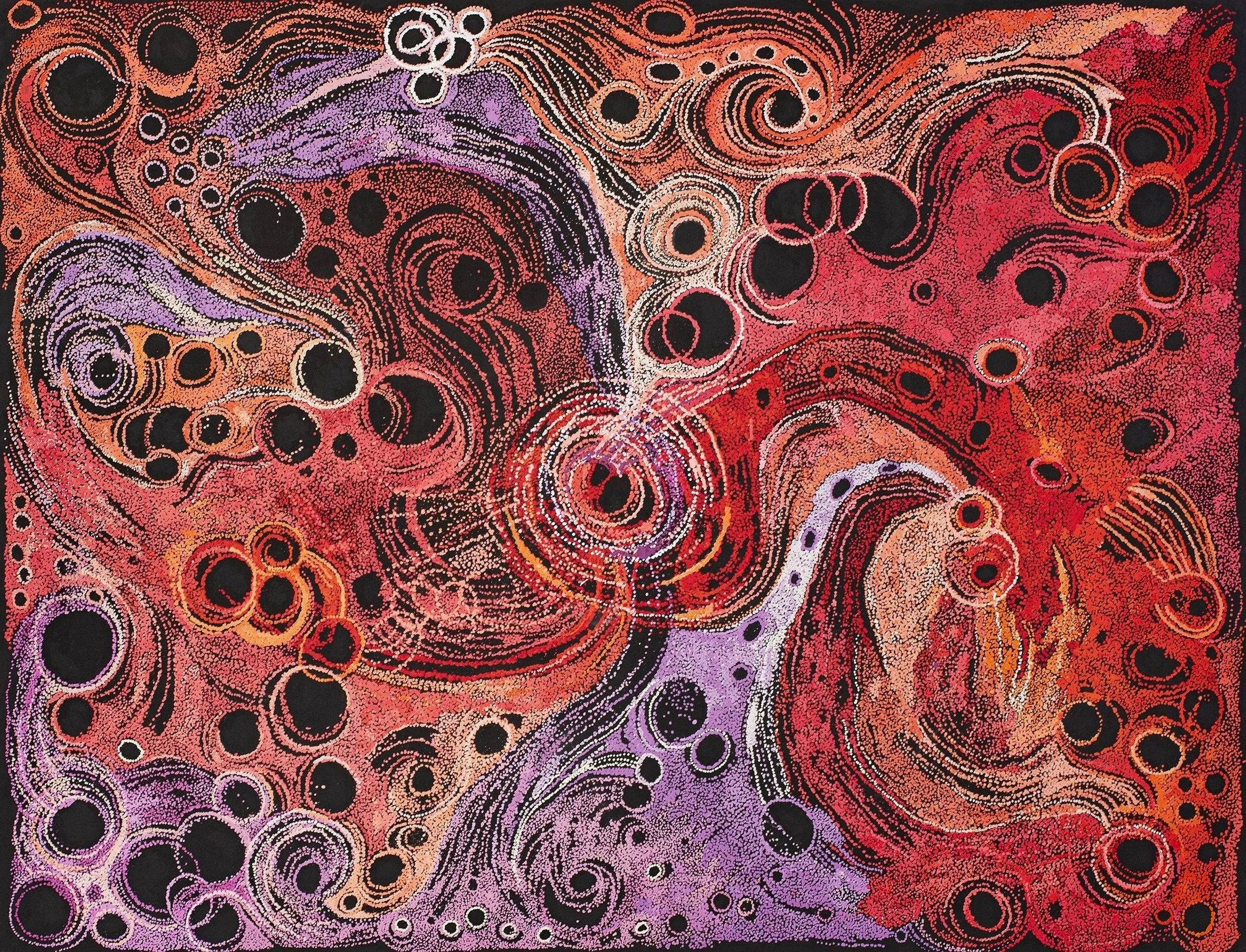
Artiste : Madeline Curley
Titre : Seven Sisters
Format : 193 x 148cm
Provenance et certificat : centre d'art de Kaltjiti
Ref : 64-22
Explication de l’œuvre :
Seven Sisters
Those Kungas were travelling and saw the rockhole at ‘Kuli’.
They sat down and had a rest and drank the water from the rockhole.
That Nyiru was hiding behind the little rock on the hill, they didn’t see him but they knew he was there. After their rest they travelled toward Punti and Ililya (Minyma’s place), Alkara and kept travelling Port Augusta way.
This is a big Tjurkurpa story and is Madeline’s Tjamu (Grandfather’s) story. Madeline has been passed this story by her father David Curley (dec).

Artistes : Sallyanne Roberts (1986)
Titre de l'œuvre : Kuru Ala
Format : 152 x 167cm
Provenance et certificat : centre d'art aborigène d’Iwantja
Référence de cette peinture aborigène : 212-23
Demander le prix de l'œuvre / Enquiry
Explication de l’œuvre :
Sallyanne Roberts (1986) said : “I grew up in my grandmothers country close to Nyapari, my grandmothers name is Wingu Tingima; she was a Ngangkari (traditional healer) and a famous painter. When she was getting very old, she taught me her stories, and how to paint them in our special family’s way. She taught me how to paint the pictures of Kuru Ala country – it’s a special place just for women. My paintings are about the country called Kura Ala, I’ve been there with my grandmother and other women before – it’s a special country only for women. My grandmother Wingu would say; “You can go there and travel through the area, but you shouldn’t stop there or you might get sick. It’s a special place where young girls go to become women, they can have special inma (ceremonies) there and have a time for healing.” In my paintings I show all the women out at Kura Ala gathering food from the bush to eat after the inma. The large curved shapes link colourful rings patterns and pathways together, they are the patterns made by the ladies footsteps from their special inma dance. The circles with thin lines reaching out of them are the wiltja’s (camp houses) the women have made from tree branches and sticks. Some areas of the canvas depict the special rock hole – but it’s not for swimming in, only the little yellow round rock holes shown in the middle of the canvas are for swimming. The ladies are shown by the semi circle shape, gathering together for dancing and teaching the young girls lessons.
This site forms part of the Kungkarankalpa Tjukurpa or Seven Sister's Creation Line that follows a group of women as they traverse the country evading the pursuit of a lustful older man, Nyiru. Nyiru has metamorphic powers of transformation and changes into different flora and fauna to trick the women.
These are creation beings and as such shape the landscape as they move through it. At Kuru Ala there is the physical reminders of their presence in the form of monolithic rock formations depicting the characters. From Kuru Ala the women chase a Kuniya (Carpet Python) through Tjukaltjara to the site of Kulyuru.

Titre de l'œuvre : Kunawarritji (dreaming stories of spirit men, & love)
Artiste : Nora Wompi
Format : 150 x 80 cm
Provenance et certificat : centre d'art aborigène de Balgo - Warlayiriti Artists Aboriginal Corporation
Référence de cette peinture aborigene : 64/13
© with the courtesy of the artist & the Aboriginal art centre. Photo : Aboriginal Signature
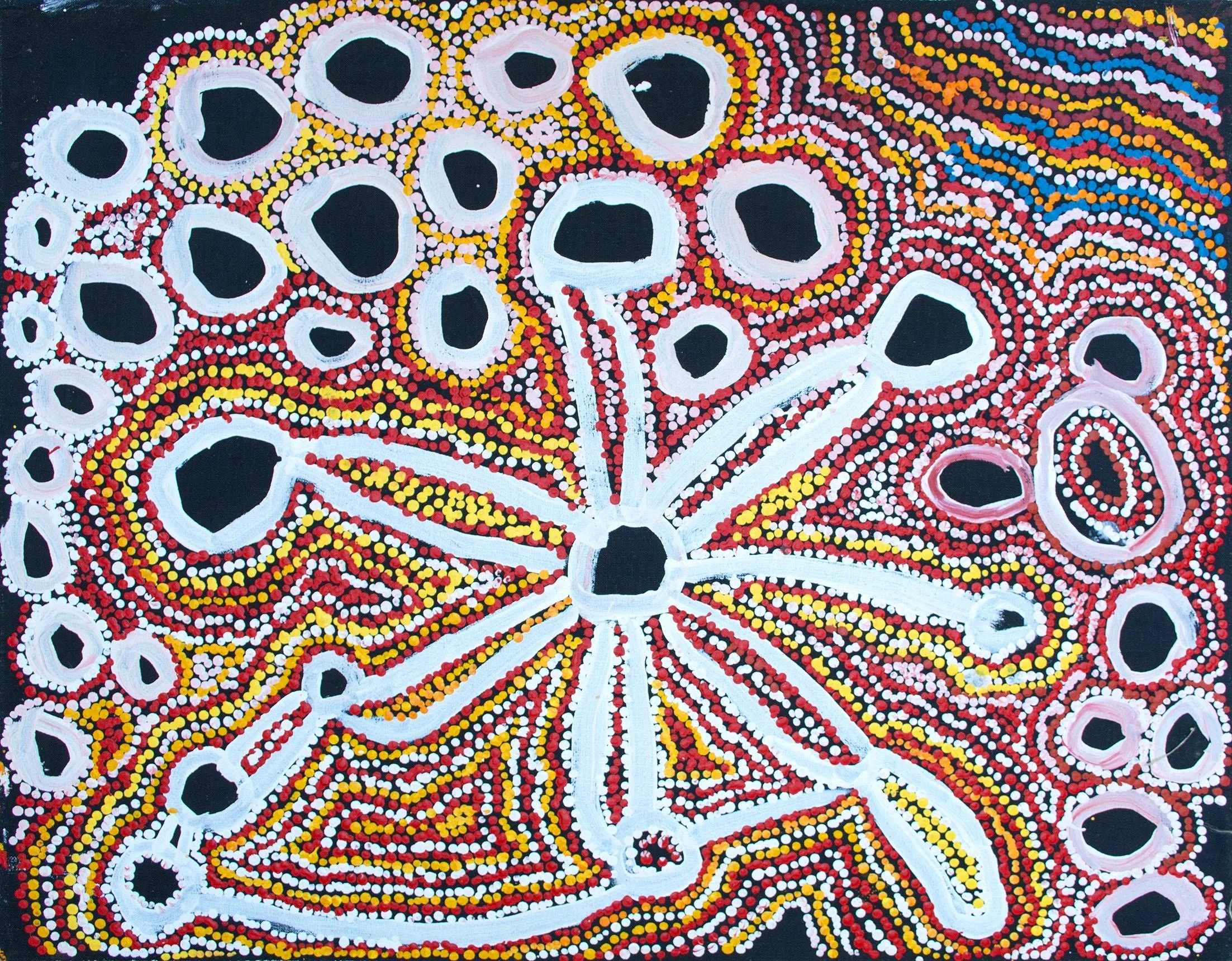
Artiste : Estelle Hogan
Titre de l'œuvre : Paltatatjara Dreaming Time story
Format : 75x60 cm
Provenance et certificat : centre d'art aborigène du Spinifex Art Project
Référence de cette peinture : 14020
Demander le prix de l'œuvre / Enquiry
Explications pour cette œuvre :
Estelle is a senior Spinifex artist whose country is Paltatatjara. Paltatatjara is an important place not only for the Minyma Tjuta (Seven Sisters) story but also a number of other Dreaming stories that cannot be elaborated in detail but include the Wati Kutjara (Two Serpent Men) and Kalaya (Emu) story.
Because Estelle is the senior owner of a place that has special significance for both men and women, documentation and detail of the paintings is carefully defined and public interpretation involves a level of ‘assumed’ knowledge.
The Kungkarangkalpa or Minyma Tjuta (Seven Sisters) Tjukurpa is an epic story, Here Estelle has depicted several Minyma Tjuta sites where she travelled around on foot before contact including Paltatatjara,
Minga, Tjuntjun and Tulu.
Like many Spinifex artists estelle clearly remembers her nomadic life in the desert. Estelle passed away in 2017, early this year.
Artiste : Women collaborative
Titre de l'œuvre : Seven Sisters
Format : 230 x 200 cm
Provenance et certificat : centre d'art aborigène du Spinifex Art Project
Référence de cette peinture : 21-21
Enquiry / Demander le prix de l'œuvre
Explications pour cette œuvre :
Kungkarangkalpa is a major Western Desert Tjukurpa also known as the Seven Sisters). Tjukurpa is the Pitjantjatjara concept for describing the formative creation where ancestral beings create the world. These beings are Anangu ancestors, who can take the form of people, plants or animals. They traverse the country; forming the world we live in, creating the waterholes, the trees, the clay pans, the rocky outcrops, the sand hills and the Spinifex plains. These land formations are the physical manifestation of the creation energy and tangible evidence that this Tjukurpa is true. This Tjukurpa of the Seven Sisters is an epic songline in the Western Desert and tells the story of many women traveling throughout the desert hunting and carrying out ritual obligations all the while being pursued by a cheeky old man in pursuit of a wife. Nyiru the man, is capable of changing form and does this on occasion in order to trick the women.
Many parts of the story are secret and involve a sexual element. Only the public details of this story are allowed to be put down in paint.
The women take a path north and eventually fly into the sky to become the Pleiades Constellation: one of the closest star clusters to earth. Although each women knows this major Tjukurpa, they are bound by cultural protocol and custodial responsibility as to which country they can depict. As the country and Tjukurpa unfolds during the creation of a major work like this, the women ‘sing the place’ into reality. Traditional inma (singing and dancing) is triggered as the depictions of places, that the women may not have physically seen for many years, begin to manifest onto the canvas.
Their major collaborative paintings are in the following prestigious collections : Aboriginal Art Museum, Utrecht. Art Gallery Of South Australia, Adelaide,S.A.. Prince Stefan Von Und Zu Liechtenstein, The Ambassador Of Liechtenstein In Germany. Seattle Art Museum, Seattle, Usa. Staatliches Museum Fur Volkerkunde, Munich, Germany. The British Museum, London, England. The National Gallery Of Victoria, Melbourne, Vic. Western Australian Museum, Perth. The Opale Fondation.