
Peintures d'art Aborigène d'Ernabella, APY land
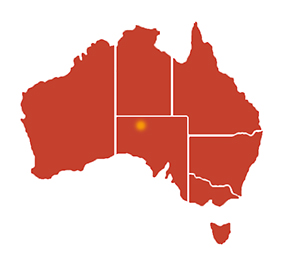
La communauté artistique d’Ernabella est située dans les Musgrave Ranges à 300 km au sud-ouest de la ville d’Alice Springs, sur les territoires du APY land. Il s’agit d’une des communautés artistiques les plus anciennes d’Australie. Dés 1939, un atelier créatif est crée et commence à réaliser des paniers décorés avec les herbes de Spinifex tressées.
En 1940 les enfants commencent à dessiner des témoignages de designs ancestraux dans la classe de Mr Trudinger à l’école de la communauté.
Après une terrible épidémie en 1948, l’activité artistique reprend en 1949 autour de tapis tressés, puis de dessins et de toiles plus conséquentes dés 1952. Sous l’impulsion de Winifried Hilliard, la communauté artistique se développe et prend de l’ampleur.
La réputation de la communauté artistique n’a cessé depuis de prendre de l’ampleur, avec leurs œuvres présentes dans les grandes collections à la fois privées et nationales en Australie et à travers le monde, comme les musées de la National Gallery of Australia, the Art Gallery of New South Wales, the Art Gallery of South Australia and the British Museum à Londres.
Peintures Aborigènes d'Ernabella disponibles au sein de la galerie :
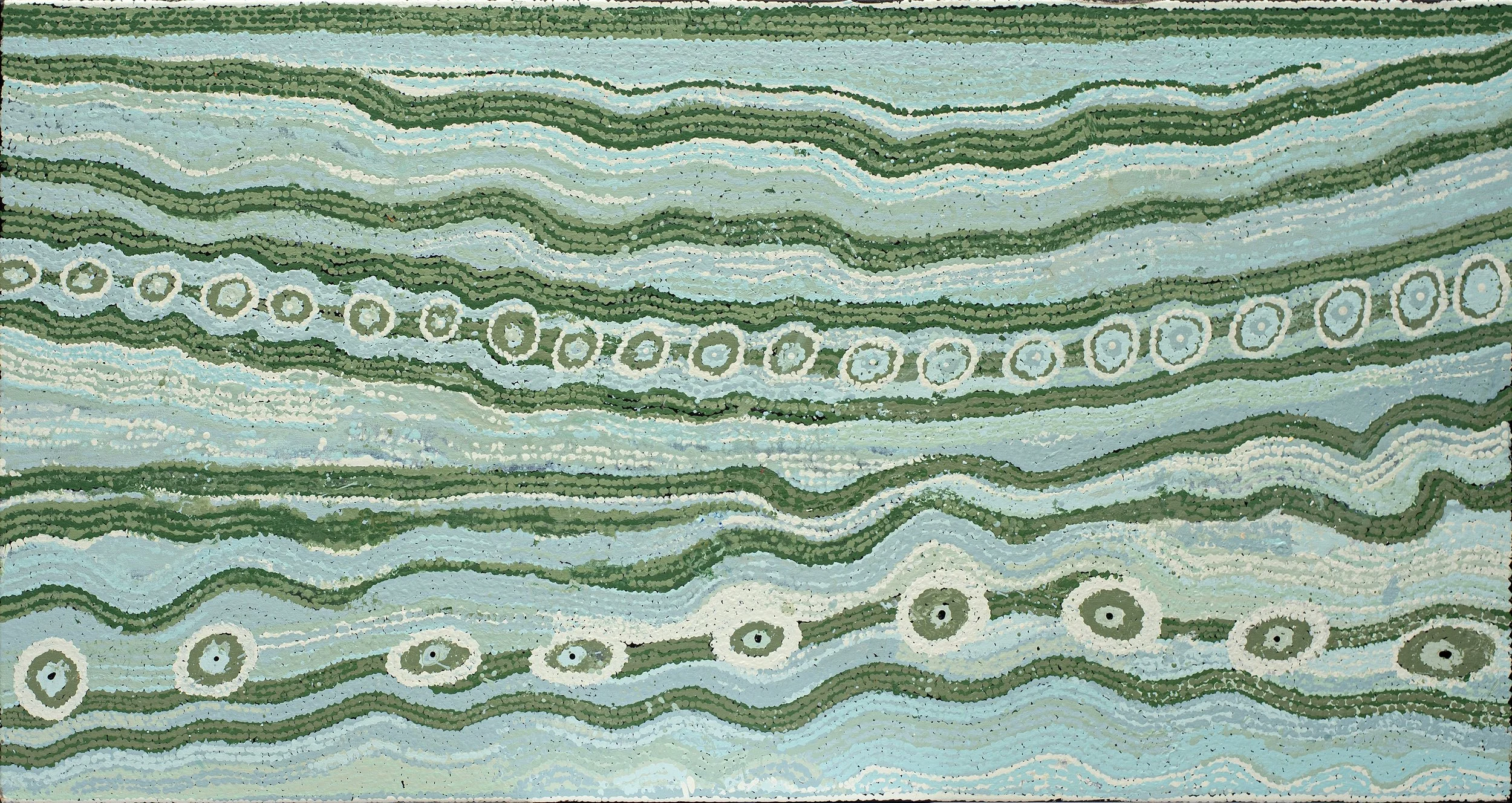
Artiste : Yurpiya Lionel
Titre de l'œuvre : Anumara
Format : 150 × 79 cm
Provenance et certificat : centre d'art d'Ernabella
Référence de la peinture : 128-25
Explications sur cette peinture Aborigène :
Yurpiya is painting a place called Anumara, which is a place near Irrunytju (Wingellina) in WA. This is Yurpiya's family's country. Anumara is also the name for a kind of caterpillar and Anumara is the tjukurpa (dreaming) place for this caterpillar. This caterpillar lives in the grass and can be eaten if the grass it eats is removed. The place shares the same colours of the caterpillar - brown, yellow and pale green. Keeping this place safe will ensure that the caterpillars multiply.
Awards
2020 Waterhouse Natural Science Art Prize, Finalist
2018 Wynne Prize, Finalist
2015 National Aboriginal and Torres Strait Islander Art Award, Finalist
2007 Special Mention, Alice Springs Beanie Festival, Araluen Cultural Precinct, Alice Springs
Her artworks are in the following collections :
Museum of the UNIVERSITY OF NEWCASTLE, 2011
Private collections in Switzerland, Germany, Australia, Belgium
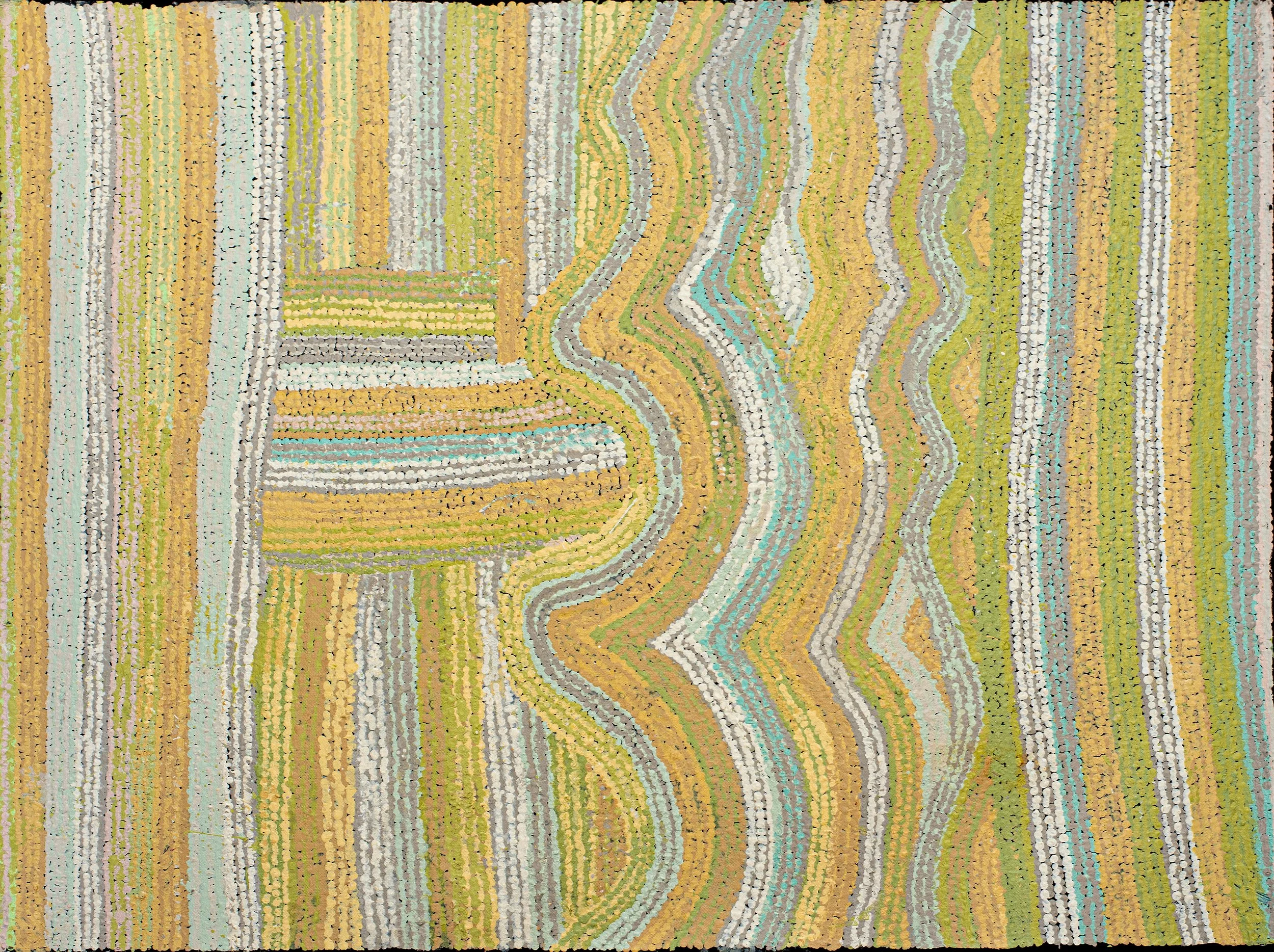
Artiste : Yurpiya Lionel
Titre de l'œuvre : Anumara
Format : 101 × 76 cm
Provenance et certificat : centre d'art d'Ernabella
Référence de la peinture : 419-25
Explications sur cette peinture Aborigène :
Yurpiya is painting a place called Anumara, which is a place near Irrunytju (Wingellina) in WA. This is Yurpiya's family's country. Anumara is also the name for a kind of caterpillar and Anumara is the tjukurpa (dreaming) place for this caterpillar. This caterpillar lives in the grass and can be eaten if the grass it eats is removed. The place shares the same colours of the caterpillar - brown, yellow and pale green. Keeping this place safe will ensure that the caterpillars multiply.
Awards
2020 Waterhouse Natural Science Art Prize, Finalist
2018 Wynne Prize, Finalist
2015 National Aboriginal and Torres Strait Islander Art Award, Finalist
2007 Special Mention, Alice Springs Beanie Festival, Araluen Cultural Precinct, Alice Springs
Her artworks are in the following collections :
Museum of the UNIVERSITY OF NEWCASTLE, 2011
Private collections in Switzerland, Germany, Australia, Belgium

Artiste : Yurpiya Lionel
Titre de l'œuvre : Anumara
Format : 170 x 84 cm
Provenance et certificat : centre d'art d'Ernabella
Référence de la peinture : 393-22
Explications sur cette peinture Aborigène :
Yurpiya is painting a place called Anumara, which is a place near Irrunytju (Wingellina) in WA. This is Yurpiya's family's country. Anumara is also the name for a kind of caterpillar and Anumara is the tjukurpa (dreaming) place for this caterpillar. This caterpillar lives in the grass and can be eaten if the grass it eats is removed. The place shares the same colours of the caterpillar - brown, yellow and pale green. Keeping this place safe will ensure that the caterpillars multiply.
Awards
2020 Waterhouse Natural Science Art Prize, Finalist
2018 Wynne Prize, Finalist
2015 National Aboriginal and Torres Strait Islander Art Award, Finalist
2007 Special Mention, Alice Springs Beanie Festival, Araluen Cultural Precinct, Alice Springs
Her artworks are in the following collections :
Museum of the UNIVERSITY OF NEWCASTLE, 2011
Private collections in Switzerland, Germany, Australia, Belgium

Artiste : Langaliki Lewis
Titre : Tali / Sand dune
Format : 149 x 89 cm
Provenance et certificat : centre d'art aborigène d’Ernabella
Référence de cette peinture aborigène : 511-22
Explication sur cette œuvre :
Painting by Langaliki Lewis (1973). For the Pitjantjatjara people living in the desert, knowledge of their water sources was critical to their survival.
This is a depiction of the artists' country. The different colours and designs represent variations in the landscape.This resulted in an intimate understanding of the landscape which continues today.
This design is inspired by the red sand dunes that are found throughout the central desert. There is a large red sand dune near Ernabella named Wamikata which is a popular place for looking for maku (witchetty grubs) and for teaching Milpatjunanyi (telling stories in the sand) to children.

Artiste : Langaliki Lewis
Titre de l'œuvre : Ngayuku ngura
Format : 153 x 81 cm
Provenance et certificat : centre d'art d'Ernabella
Référence de cette peinture d'art Aborigène : 444-22
Vendue
Explanations of this Aboriginal painting :
For the Pitjantjatjara people living in the desert, knowledge of their water sources was critical to their survival. This resulted in an intimate understanding of the landscape which continues today. Water is an essential element in the desert. These rock holes were particularly important during the dry season when most of the water holes and creeks dried up. Deep familiarity with the topography of their country and the way rain would interact with the land ensured constant sources of water could be found. Knowledge of rock hole sites is passed on from generation to generation and revered by all Anangu (people).
Tjukula means rock-holes, which are found with surprising frequency in the Musgrave Ranges and country around Ernabella. Between visits, Anangu would use a construction of rocks and spinifex to guard these important water sources from spoilage by feral and stock animals such as cattle, camels, horses and donkeys.

Artiste : Yurpiya Lionel
Titre de l'œuvre : Anumara
Format : 152 x 81 cm
Provenance et certificat : centre d'art d'Ernabella
Référence de la peinture : 577-22
Explications sur cette peinture Aborigène :
Yurpiya is painting a place called Anumara, which is a place near Irrunytju (Wingellina) in WA. This is Yurpiya's family's country. Anumara is also the name for a kind of caterpillar and Anumara is the tjukurpa (dreaming) place for this caterpillar. This caterpillar lives in the grass and can be eaten if the grass it eats is removed. The place shares the same colours of the caterpillar - brown, yellow and pale green. Keeping this place safe will ensure that the caterpillars multiply.
Awards
2020 Waterhouse Natural Science Art Prize, Finalist
2018 Wynne Prize, Finalist
2015 National Aboriginal and Torres Strait Islander Art Award, Finalist
2007 Special Mention, Alice Springs Beanie Festival, Araluen Cultural Precinct, Alice Springs
Her artworks are in the following collections :
Museum of the UNIVERSITY OF NEWCASTLE, 2011
Private collections in Switzerland, Germany, Australia, Belgium

Artiste : Tjulyata Kulyuru
Titre de l'œuvre : Tjukula/Waterholes
Format : 180 x 100 cm
Provenance et certificat : centre d'art aborigène d’Ernabella
Référence de cette peinture aborigène : 558-22
Explication sur cette œuvre :
For the Pitjantjatjara people living in the desert, knowledge of their water sources was critical to their survival.
This resulted in an intimate understanding of the landscape which continues today. Deep familiarity with the topography of their country and the way rain would interact with the land ensured constant sources of water could be found. 'Tjukula' means rock-holes, which are found with surprising frequency in the Musgrave ranges.
Between visits, Anangu (people) would use rocks and spinifex construction to guard these from spoilage by animals and, particularly in more recent times, from feral and stock animals, cattle, camels, horses and donkeys.

Artiste : Atipalku Intjalki (1955)
Titre de l'œuvre : Piltati
Format : 150 x 81 cm
Provenance et certificat : centre d'art aborigène d’Ernabella
Référence de cette peinture aborigène : 634-22
Explication sur cette œuvre :
There were two sisters who married two brothers and they all lived together. One day the women went wandering and they went such a long way that they forgot about their husbands. Back at the camp, the two husbands were thinking, 'Where are our wives?' and they decided to go looking for them. One brother said to the other, 'What should we become to go looking for them?' and the other brother said 'Why don't we become Rainbow Serpents?' And they travelled in the sky looking down for their wives. Finally they see them hunting for carpet snakes and they put something in the hole where the women were digging. The women find it and then dig another hole and once again the men have put something in there. And this is how the men lure the women back to Piltati where the men make the sisters transform into Wanampi, swallow them and keep .them in their throats. All four of them live together in the waterhole and still live there today.

Artiste : Elizabeth Dunn
Titre de l'œuvre : Piltati
Format : 152cm x 120cm
Provenance et certificat : centre d'art aborigène d’Ernabella
Référence de cette peinture aborigène : 385-18
Explication sur cette œuvre :
Two brothers were married to two sisters and they all lived together. One day the two men go out hunting, looking for malu (kangaroo). They travel everywhere and find nothing. They start to worry. “What are we going to do, there is no meat on this land? One brother says, “maybe we should turn into something?”. They start to think about what they should turn into.
“Maybe firewood?”“No, the firewood burns.”
“Maybe emu or a bird?”.
“No, people eat them.”
They do a lot of talking and decide they should turn into Wanampi (rainbow serpents). A lot of smoke starts to come out of the ground, it is very scary and then the men become Wanampi. They travel into the land, towards a rockhole.
Meanwhile, the two women are waiting for their husbands to return from their hunting trip. They wait a very long time. They keep going on with their lives, collecting bush tucker, waiting…but the men never come back. So, they decide to set out to find their husbands. One day, they come across a hole in the ground. They start digging. Digging, digging, digging, they follow the tunnel inside the ground. They are so frantically digging they accidently hit one of the Wanampi in the back. The Wanampi chase the ladies and eat one of them, one women gets away.
Now, the Wanampi still live in the waterhole called Piltati. The Wanampi still live their today and provide rain for the bush tucker to grow and provide meat on the land. Piltati is Elizabeth’s great-grandfathers country and her dreaming story.

Artiste : Rachael Mipantjiti Lionel
Titre de l'œuvre : Kapi Wankanya
Format : 220 x 200 cm
Provenance et certificat : centre d'art d'Ernabella
Référence de cette peinture d'art Aborigène : 60-17
Explanations of this Aboriginal painting :
One night more than a year ago I had a dream. I dreamt of Kapi Wankanya, sacred living water. I dreamt that living water was being poured in my hands and that I was floating in water, feeling its healing force inside
my body. I began to paint this powerful water story. More recently I have started to think about the importance of water to my people, Anangu. How in the old days knowledge of water sources was key to survival, how without water we were, and still are, nothing. Kapi Wankanya is salvation. It is healing and cleansing but also our life blood. In a lot of ways painting and telling this story has been powerful for me as an artist and mother, it has made me strong.

Artiste : Tjariya (Nungalka) Stanley
Titre de l'œuvre : Minyma Kutjara Wingellina
Format : 180 x 100 cm
Provenance et certificat : centre d'art d'Ernabella
Référence de cette peinture d'art Aborigène : 61-17
Explanations of this Aboriginal painting :
This is the story of the older sister going a long way to get her younger sister and bring her back. They went through many places on the way, but I will only talk about a short bit of their journey at Wingellina.
Two Women. They both came from up high and they stayed a while. They both could see that Docker River was close, those two women. And as they were sitting there they performed ceremony, inma.After this they both
threw away their weapons, they threw them away. Their head-rings, they threw away their head-rings.
Then they got up and left.They went to another place, a hollow called Kantarangkutjara, in the middle there and then they travelled on to Docker River. The story of their travels after Docker River belongs to the Docker River people and others in distant country.My part of the story is short.

Artiste : Yurpiya Lionel
Titre de l'œuvre : Anumara
Format : 118 x 100 cm
Provenance et certificat : centre d'art d'Ernabella
Référence de la peinture : 370-21
Explications sur cette peinture Aborigène :
Yurpiya is painting a place called Anumara, which is a place near Irrunytju (Wingellina) in WA. This is Yurpiya's family's country. Anumara is also the name for a kind of caterpillar and Anumara is the tjukurpa (dreaming) place for this caterpillar. This caterpillar lives in the grass and can be eaten if the grass it eats is removed. The place shares the same colours of the caterpillar - brown, yellow and pale green. Keeping this place safe will ensure that the caterpillars multiply.
Her artworks are included in the following collections :
- University Of Newcastle, 2011
- Private collections in Europe and Australia

Artiste : Carlene Thompson (1950)
Titre de l'œuvre : Kalaya ngura
Format : 150 x 100 cm
Provenance et certificat : centre d'art d'Ernabella
Référence de cette peinture d'art Aborigène : 407-21
Explanations of this Aboriginal painting :
Emu Country. This painting depicts Carlene's family's country, near Kanypi in the Western APY Lands. It is the country of the emu, meaning the emu (kalaya) is the ancestral being who formed that part of the country.
That Kalaya travelled from Kanpi to Watarru. It is very typical for the Kalaya to have many children, like Carlene, who had six children.
Her artworks are in the prestigious following collections :
Goulburn Regional Art Gallery, 2016
Queensland Art Gallery, Brisbane, Qld
Awards :
2019 National Aboriginal and Torres Strait Islander Art Award, Finalist
2019 Australia Council for the Art: Art project for individuals recipient
2018 Quick Response Grant Country Arts SA: Contact, Connection and Conversation
2018 National Aboriginal and Torres Strait Islander Art Award, Finalist
2016 Finalist (collaborative), National Aboriginal and Torres Strait Islander Art Award
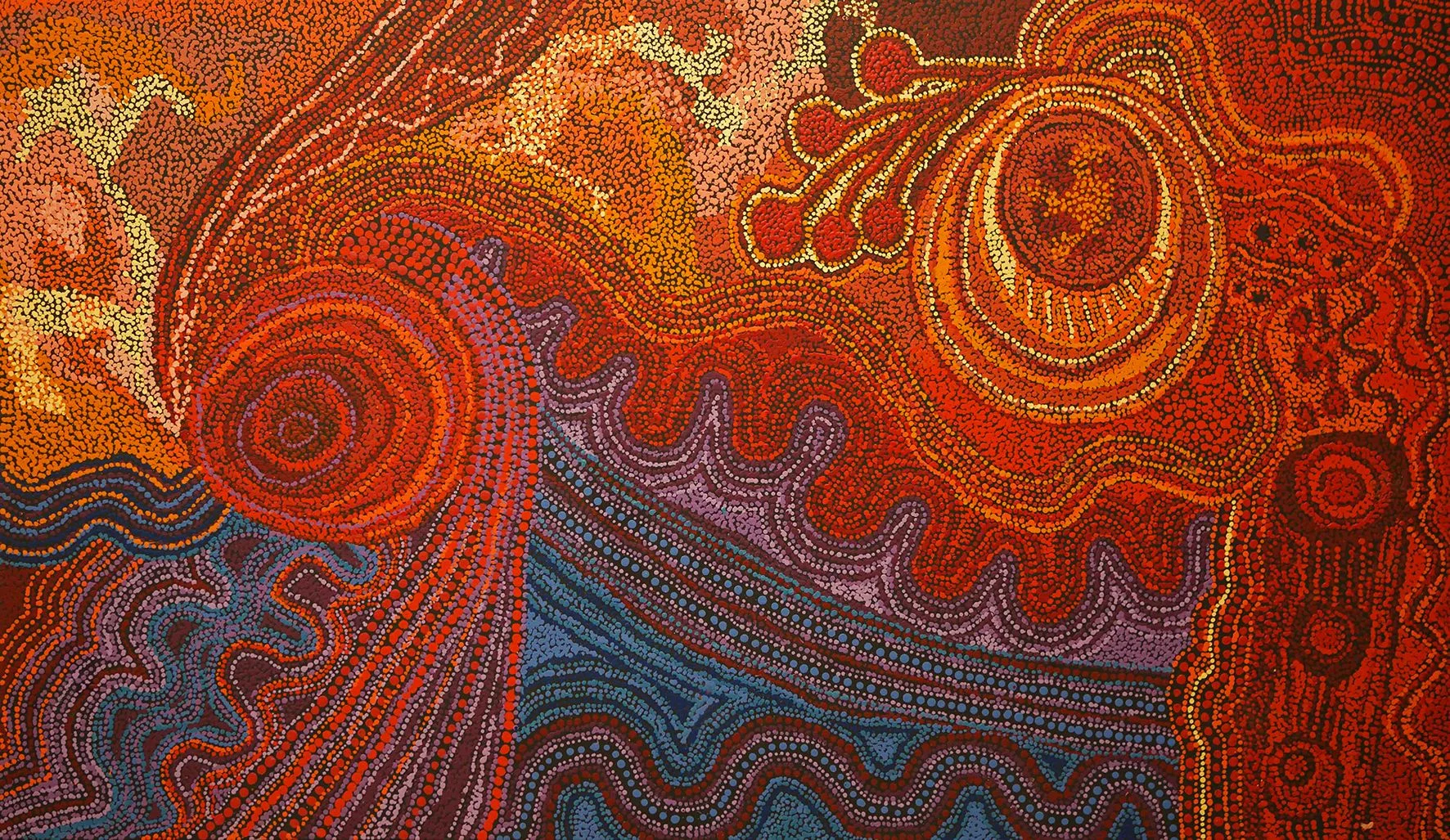
Artiste : Alison Munti Riley
Titre de l'œuvre : Ara Irititja, Nganampa Ngura
Format : 170cm x 100cm
Provenance et certificat : centre d'art aborigène d’Ernabella
Référence de cette peinture aborigène : 331-18
Explication sur cette œuvre :
This is a depiction of the artists' country, in older days. It shows people living in the old way, with strong culture, strong country, and strong law. People lived in wiltjas and were nomadic. There were many beautiful waterholes, grasses, plants, flowers, birds and animals, and plenty of mai putija - bush food. Then strangers came, and introduced changes like buffle grass. This plant has been bad for the native grasses, flowers and fruit. It is changing the country and making people sad for the old days. 'Our country use to have all good flowers, when we walked in the bush looking for tucker, our feet would be covered in yellow and green, purple, lots of colours you know. When we go out now we look for those good flowers, we think back and it makes us sad. Even the birds are still looking for those good flowers, and the ants are looking for those good flowers.' This country is the backdrop here for Tjitjiku Tjukurpa, a story which takes place in the country north of Uluru. Kutungu is a woman about which many stories are told. In this particular part of the tale, Kutungu, now the mother of many children, is travelling with them on a long journey by foot. On the way she has gathered vast amounts of bush foods, particularly kampurarpa (bush tomatoes), and is carrying them in her piti on her head. The children become very homesick on this journey far from familiar places and refuse to continue on.
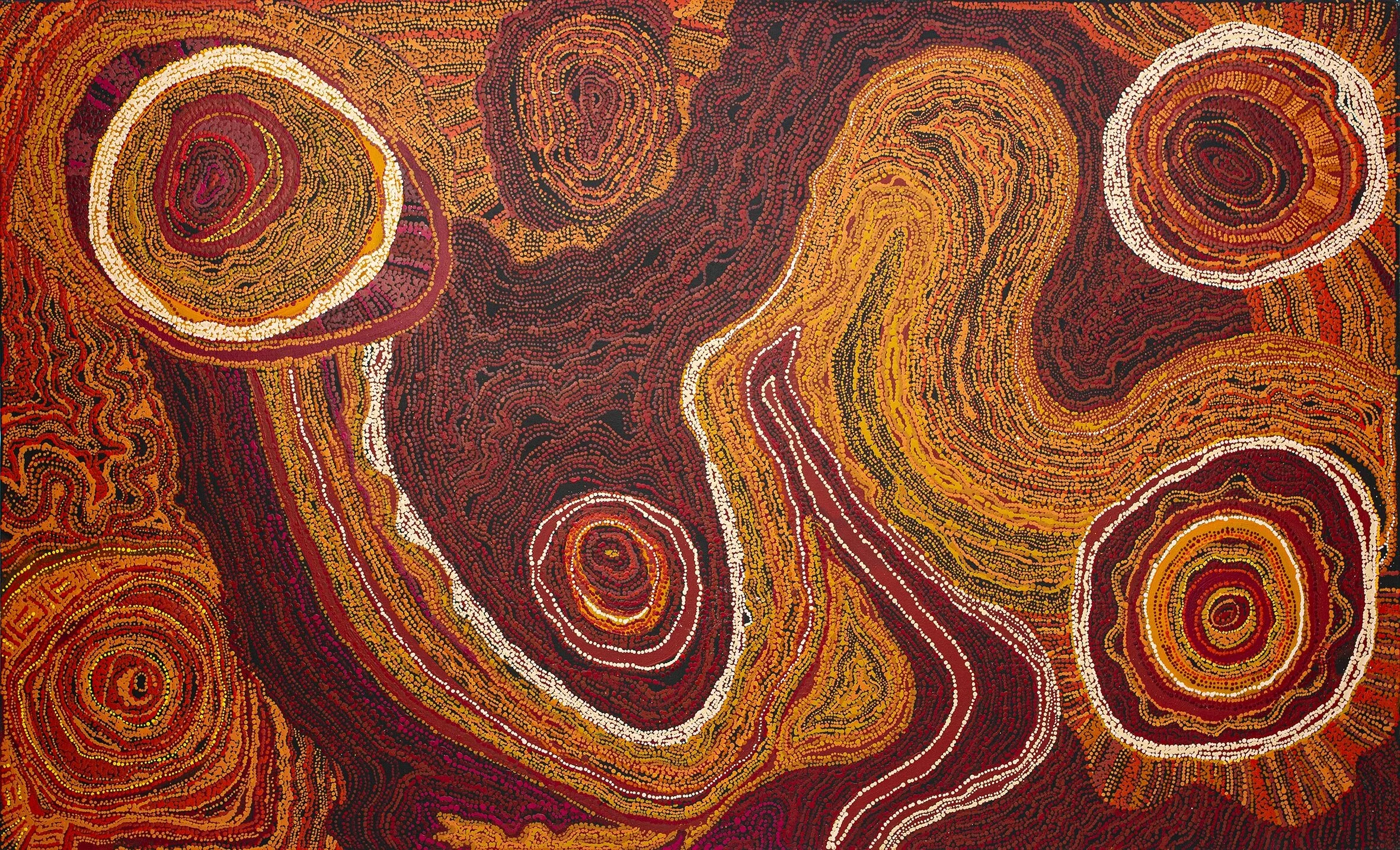
Artiste : Elizabeth Dunn
Titre de l'œuvre : Piltati, Elizabeth Dunn's story
Format : 202 x 122cm
Provenance et certificat : centre d'art aborigène d’Ernabella
Référence de cette peinture aborigène : 422-19
Explication sur cette œuvre :
Two brothers were married to two sisters and they all lived together. One day the two men go out hunting, looking for malu (kangaroo). They travel everywhere and find nothing. They start to worry. “What are we going to do, there is no meat on this land? One brother says, “maybe we should turn into something?”. They start to think about what they should turn into.
“Maybe firewood?”“No, the firewood burns.”
“Maybe emu or a bird?”.
“No, people eat them.”
They do a lot of talking and decide they should turn into Wanampi (rainbow serpents). A lot of smoke starts to come out of the ground, it is very scary and then the men become Wanampi. They travel into the land, towards a rockhole.
Meanwhile, the two women are waiting for their husbands to return from their hunting trip. They wait a very long time. They keep going on with their lives, collecting bush tucker, waiting…but the men never come back. So, they decide to set out to find their husbands. One day, they come across a hole in the ground. They start digging. Digging, digging, digging, they follow the tunnel inside the ground. They are so frantically digging they accidently hit one of the Wanampi in the back. The Wanampi chase the ladies and eat one of them, one women gets away.
Now, the Wanampi still live in the waterhole called Piltati. The Wanampi still live their today and provide rain for the bush tucker to grow and provide meat on the land. Piltati is Elizabeth’s great-grandfathers country and her dreaming story.

Artiste : Janice Stanley
Titre de l'œuvre : Pantu (Salt lake)
Format : 150 x 150 cm
Provenance et certificat : centre d'art aborigène d’Ernabella
Référence de cette peinture aborigène : 439-22
Explication sur cette œuvre :
Painting by the artist Janice Stanley (1987).
Janice Stanley is the third generation of Stanley women to create artwork at Ernabella Arts. She is an early career painter and ceramic artist showing greatpromise.Her grandmother is founding artist and traditional healer Tjariya Stanley and her aunts are senior artists, Alison Milyika Carroll and Renita Stanley.Janice is part of a group of young women leading the Ernabella ceramics studio, despite only commencing work in late 2015. She has been exhibitedaround Australia and internationally, in Darwin, Alice Springs, Broome, Sydney and Brussels.
A very significant tjurkurpa (story) to Anangu is Kungkarangkalpa (Seven Sisters) which is an extensive creation story relating to the Pleiades constellation. The story traverses Australia taking different forms, but local women are privy to the part of the story which takes place in the country near Ernabella. In her paintings Janice is depicting a salt lake near Attila (Mt Connor), a landmark in the Seven Sisters story.
The artworks of the artist are in the following collections :
Australian Embassy in Zagreb
Private collection

Artiste : Yurpiya Lionel
Titre de l'œuvre : Anumara
Format : 169 x 83 cm
Provenance et certificat : centre d'art d'Ernabella
Référence de la peinture : 86-22
Explications sur cette peinture Aborigène :
Yurpiya is painting a place called Anumara, which is a place near Irrunytju (Wingellina) in WA. This is Yurpiya's family's country. Anumara is also the name for a kind of caterpillar and Anumara is the tjukurpa (dreaming) place for this caterpillar. This caterpillar lives in the grass and can be eaten if the grass it eats is removed. The place shares the same colours of the caterpillar - brown, yellow and pale green. Keeping this place safe will ensure that the caterpillars multiply.
Her artworks are included in the following collections :
- University Of Newcastle, 2011
- Private collections in Europe and Australia

Artiste : Yurpiya Lionel
Titre de l'œuvre : Anumara - Caterpillar
Format : 125 x 70 cm
Provenance et certificat : centre d'art d'Ernabella
Référence de la peinture : 117-24
Explications sur cette peinture Aborigène :
Yurpiya is painting a place called Anumara, which is a place near Irrunytju (Wingellina) in WA. This is Yurpiya's family's country. Anumara is also the name for a kind of caterpillar and Anumara is the tjukurpa (dreaming) place for this caterpillar. This caterpillar lives in the grass and can be eaten if the grass it eats is removed. The place shares the same colours of the caterpillar - brown, yellow and pale green. Keeping this place safe will ensure that the caterpillars multiply.
Her artworks are included in the following collections :
- University Of Newcastle, 2011
- Private collections in Europe and Australia
Artiste : Atipalku Intjalki (1955)
Titre de l'œuvre : Piltati
Format : 120 × 89 cm
Provenance et certificat : centre d'art aborigène d’Ernabella
Référence de cette peinture aborigène : 373-25
Demander le prix de l'œuvre
Explication sur cette œuvre :
There were two sisters who married two brothers and they all lived together. One day the women went wandering and they went such a long way that they forgot about their husbands. Back at the camp, the two husbands were thinking, 'Where are our wives?' and they decided to go looking for them. One brother said to the other, 'What should we become to go looking for them?' and the other brother said 'Why don't we become Rainbow Serpents?' And they travelled in the sky looking down for their wives. Finally they see them hunting for carpet snakes and they put something in the hole where the women were digging. The women find it and then dig another hole and once again the men have put something in there. And this is how the men lure the women back to Piltati where the men make the sisters transform into Wanampi, swallow them and keep .them in their throats. All four of them live together in the waterhole and still live there today.