
From the past to the present • Exposition d'art Aborigène avec les artistes de NINUKU Arts
Exposition-vente de peintures Aborigènes d'Australie : du jeudi 6 avril jusqu'au samedi 29 avril 2017.
Vernissage le mercredi 5 avril à partir de 20h, à la galerie Aboriginal Signature • Estrangin, 101 rue Jules Besme, 1081 Bruxelles.
Horaires : du mercredi au samedi, de 14h30 à 19h.
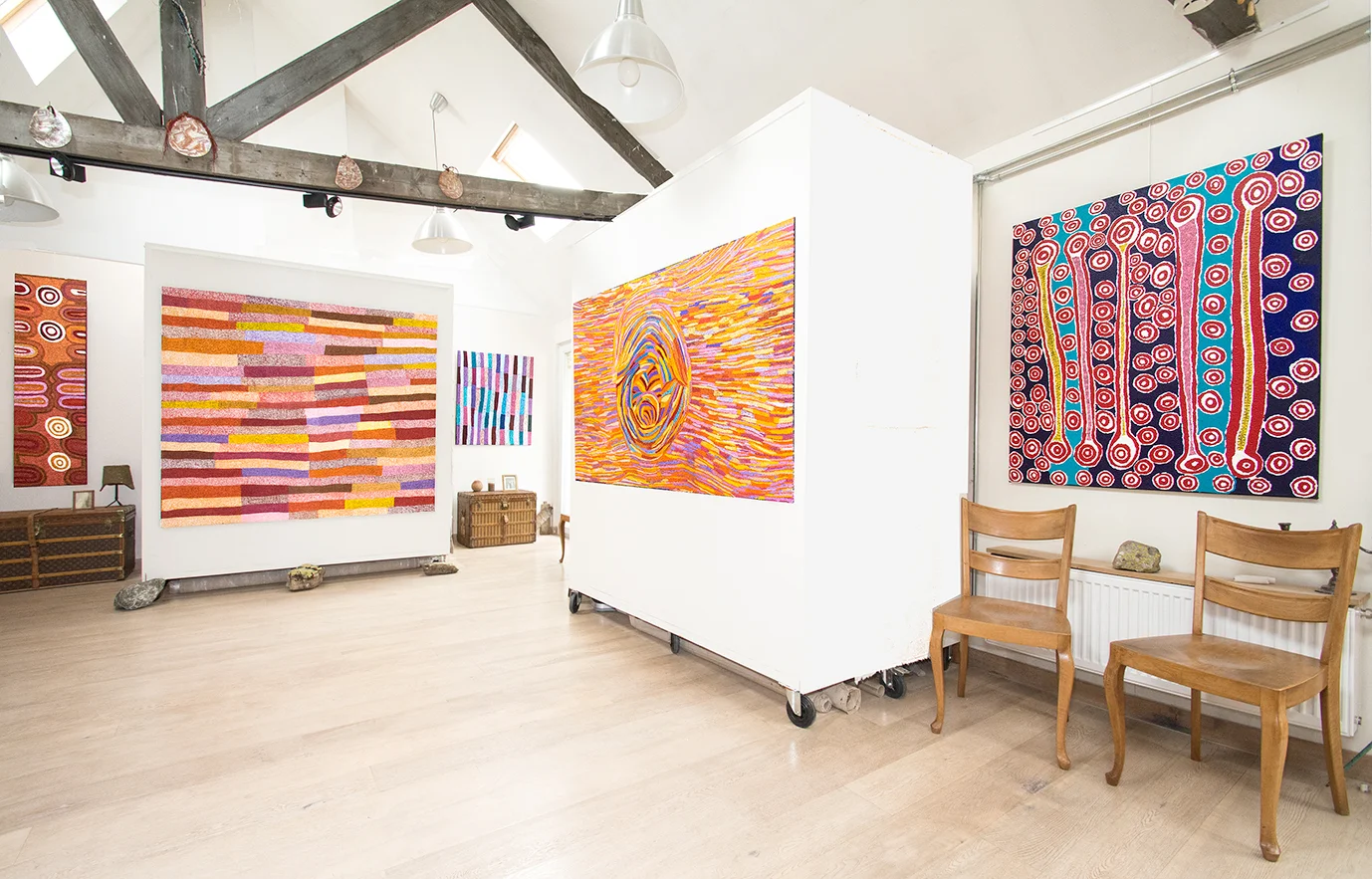
Vue de l'exposition d'art Aborigène "From the past to the present with Ninuku art". Au fond de la pièce, trois œuvres de l'artiste Tjulkiwa Atira Atira. A droite une œuvre de l'artiste Jennifer Connelly, puis au premier plan une peinture de l'artiste Jennifer Forbes. Photo : Aboriginal Signature • Estrangin gallery with the courtesy of the artists and Ninuku Arts.
Après 2000 km sur les pistes de sable rouge du bush central Australien, j'arrivais dans le petit village de Kalka, habité par une petite communauté Aborigène dont quelques artistes remarquables. Avec juste 20 maisons égarées au milieu d’immensités désertiques, nous nous trouvons dans une outstation. Je vais y rester plusieurs jours en juillet 2016, afin de préparer l'exposition "From the past to the present" avec les artistes Aborigènes de Ninuku.
Dans cette région éloignée, émerge depuis l'érection du centre d'art en 2006, un art tout à fait spécifique et éclectique. Les artistes encore habités par le sens du voyage des nomades, se partagent souvent entre plusieurs communautés et centres d'art. Certains quittent pour un temps le APY lands et traversent la frontière vers l'état de Western Australia où d'autres membres de leur famille résident.
En fonction des lieux où les artistes vont s'exprimer, leur individualité développera des itinéraires spécifiques, avec un style inventif en quelque sorte cristallisé par l'attachement géographique et des nuances propres à leurs connaissances et influences territoriales.
Les 30 œuvres réunies à Bruxelles ont été réalisées au sein du centre d'art de Ninuku par 10 artistes différents, entre les anciens les plus importants jusqu'aux nouvelles stars émergentes. Cette transmission du flambeau entre les époques et les générations d'artistes est essentielle, souvent fragile, et contribue à perpétuer pour l'entremise de l'art, le savoir ancestral Aborigène. A travers cette exposition Bruxelloise - une première à nouveau dans la capitale de l'Europe - nous couvrirons ainsi 9 ans de création à Ninuku Arts.
On remarquera deux œuvres de l'artiste Aborigène Jimmy Donnegan, récompensé en 2010 au Musée National de Darwin dans le cadre du prestigieux Natsiaa award. Une peinture magistrale de 180 x 150 cm confine au chef d'œuvre pour ses dernières années de création. Elle souligne une individualité exemplaire immédiatement reconnaissable : sinuosité et ondulations des formes, vibrations électriques des teintes, matière avec la granularité des points conjugués, contours de la toile en lignes juxtaposées forment un effet d'écho, et renforcent la densité de ses histoires essentielles du Temps du Rêve.

Œuvre magistrale de l'artiste Jimmy Donnegan. Format : 180 x 150 cm. Année : 2016. © Photo : Aboriginal Signature gallery, with the courtesy of the artist and Ninuku Arts.
En plongeant dans les archives cachées du centre d'art, nous avons également sélectionné 6 œuvres importantes de l'artiste Kunmanara (Nyankulya Walayampari) Watson (1938-2012), souhaitant donnant une vue complète de la création au sein de ce centre d'art. Les blocs rocheux sacrés présentés de façon abstraite dans ses œuvres, y ondulent, interjettent, se contre-balancent et finissent par embrasser l'espace avec des codes couleurs incandescents comme la terre rouge du désert du APY land.
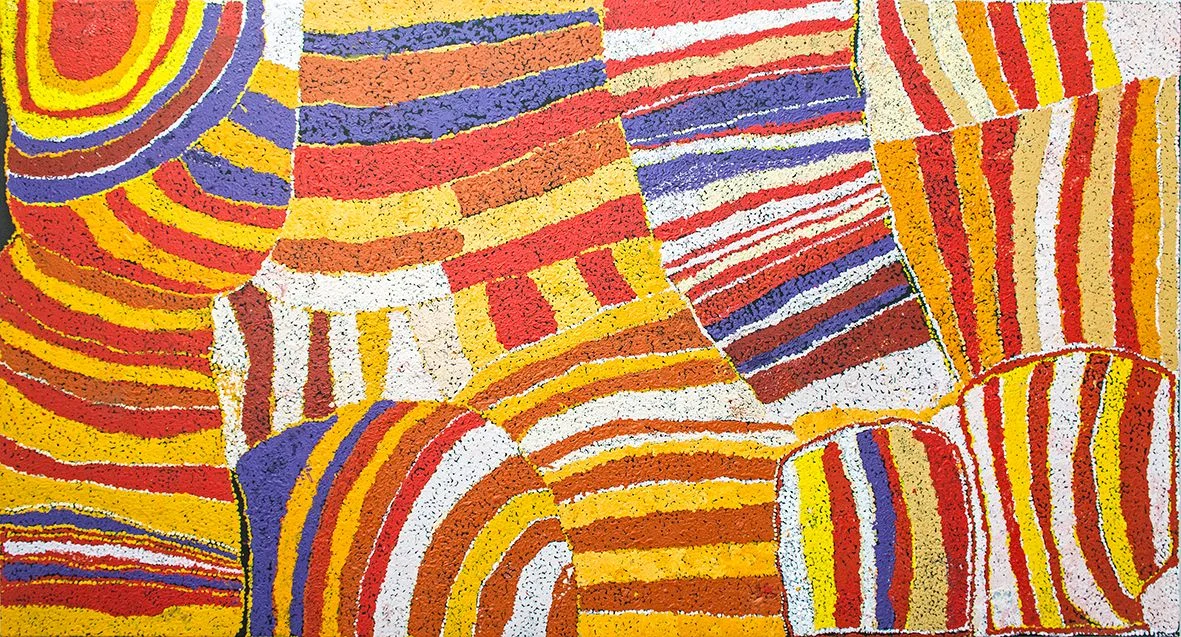
Œuvre de l'artiste Kunmanara (Nyankulya Walayampari) Watson (1938-2012). Format : 200 x 100 cm. © Photo : Aboriginal Signature gallery, with the courtesy of the artist and Ninuku Arts.
Dans la galerie nous présenteront également trois œuvres de l'artiste Harry Tjutjuna (1930), qui a commencé à peindre en 2005. Il a tenu sa première exposition solo en 2007, à Darwin. Il peint des histoires associées à son principal totem personnel : l'araignée (wanka), et à son histoire ancestrale qui tourne autour du Wati Wanka Tjukurpa (Spider Man Dreaming). Cette créature a créé le pays de Tjutjuna au Temps du Rêve. Son style est immédiatement identifiable avec des effets de brosse généreux, des couleurs chatoyantes comme des champs de coquelicots et ses figures ancestrales enveloppant avec puissance et majesté le territoire. Ses œuvres figurent dans plusieurs musées importants en Australie, comme la Nationale art gallery de Nouvelle-Galles du Sud, la Nationale Gallery de Victoria, et la National Gallery of Australia à Canberra. Il a été finaliste du prestigieux Togard Contemporary Art Award en 2009. En 2010 et 2011, une autre des peintures de Tjutjuna, Wati Nyiru munu Wati Wanka, a été choisie comme finaliste à la fois dans les Prix des Arts Indigènes de l'Australie de l'Ouest, et le Prix national des artistes aborigènes et insulaires du détroit de Torres (NATSIAA) à Darwin.

Vue de l'installation en cours. Deux œuvres de l'artiste Harry Tjutjuna (1930). Titre : Spider Man Dreaming Time stories. Format : 120 x 90 cm. © Photo : Aboriginal Signature gallery, with the courtesy of the artist and Ninuku Arts.
La galerie Aboriginal Signature • Estrangin continue son voyage à travers le temps et les immensités Australiennes pour vous permettre d’apprivoiser toute l’amplitude et l’excellence de ce mouvement artistique contemporain, à travers un programme d'expositions unique en Europe.
Sélection des peintures proposées dans le cadre de l'exposition "From the past to the present" :
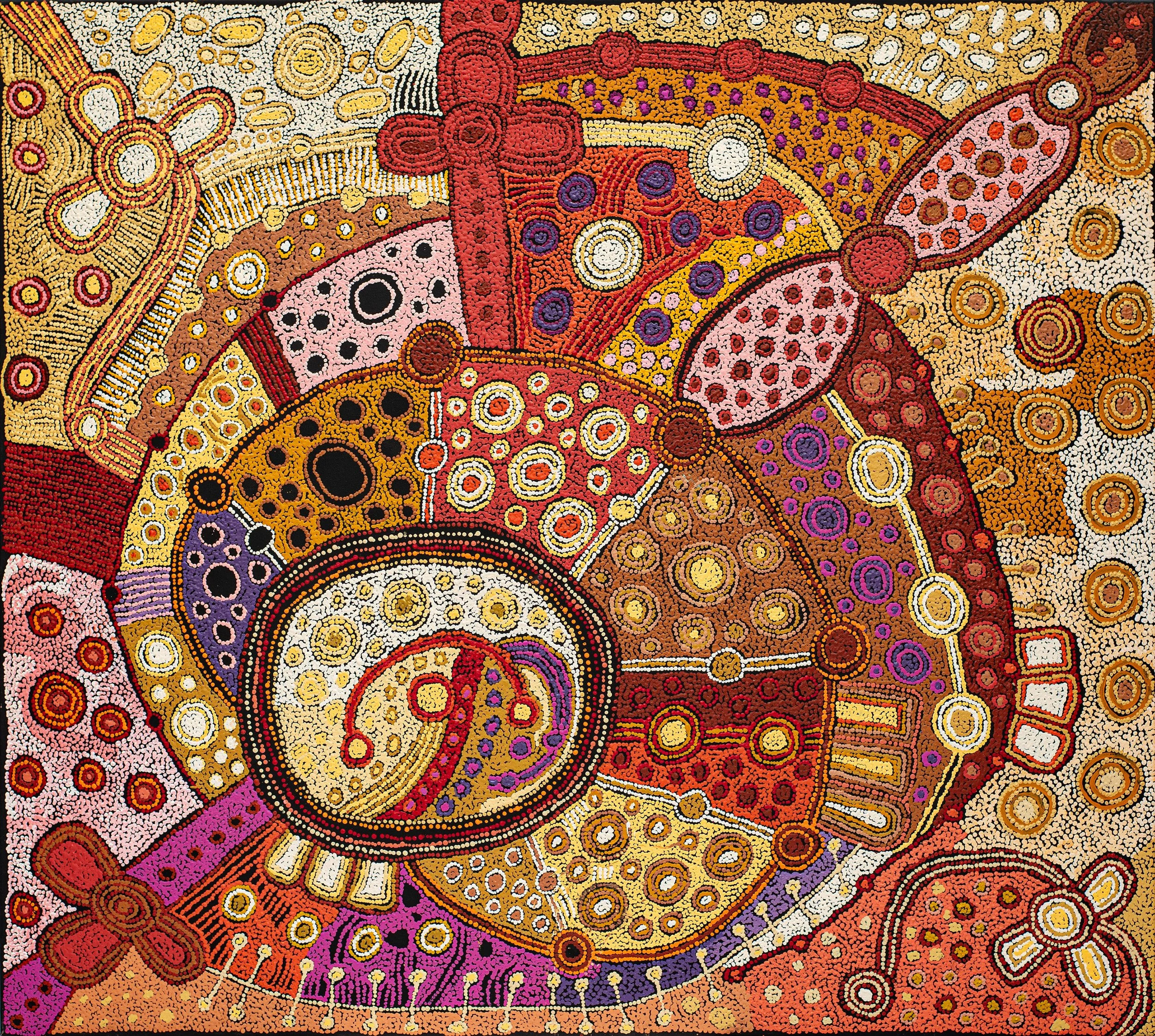
Artiste : Angela Watson
Titre de l'œuvre : Mamu Story
Format : 137 x 121 cm
Provenance et certificat : centre d'art aborigène de Ninuku
Référence de cette peinture : 25-211
Demander le prix de l'œuvre / Enquiry
Explications pour cette œuvre :
Mamu is a rockhole site southwest of Pipalyatjara, about one hour. Alkuwari was travelling with her jamu (grandson) and her grandfather (also called jamu). They made a camp with fire and big wiltja. Alkuwari was worried that her grandson was going to harm her grandfather, and she needed to go hunting. So, she hid her grandfather on top of the wiltja and went. The boy put the waru (fire) inside the wiltja and burned the grandfather. Alkuwari saw the smoke and she ran and ran to the wiltja but the grandfather had died.
The jamu had run away so she went and got all her family to follow him, to kill him. They became the mamu and turned into the seven rockholes of Mamu.
© Photo : Aboriginal Signature Estrangin gallery with the courtesy of the artists and Ninuku.
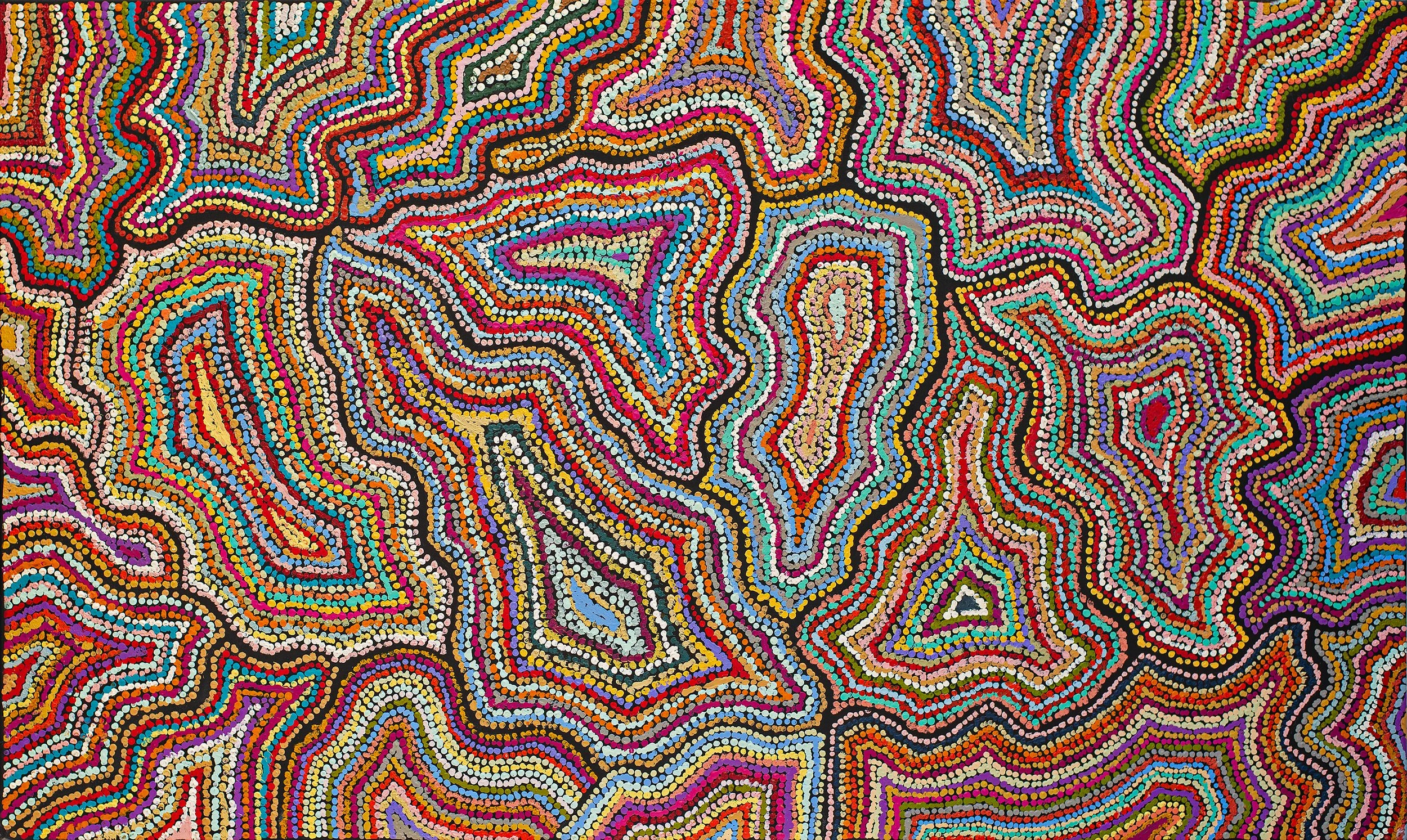
Artiste : Samuel Miller
Titre de l'œuvre : Ngayuku Ngura
Format : 183 × 109cm
Provenance et certificat : centre d'art aborigène de Ninuku
Référence de cette peinture : 22-430
Demander le prix de l'œuvre / Enquiry
Explications pour cette œuvre :
Ngayuku Ngura means ‘My Place’. Samuel uses an extensive palee of colours to paint the country surrounding Kalka and Pipalyatjara. His paintings feature the various land formations from that area - rockholes, creeks and hills. His land is a sacred men’s rockhole, so sacred that the name is not allowed to be written down or spoken about.
© Photo : Aboriginal Signature Estrangin gallery with the courtesy of the artists and Ninuku.
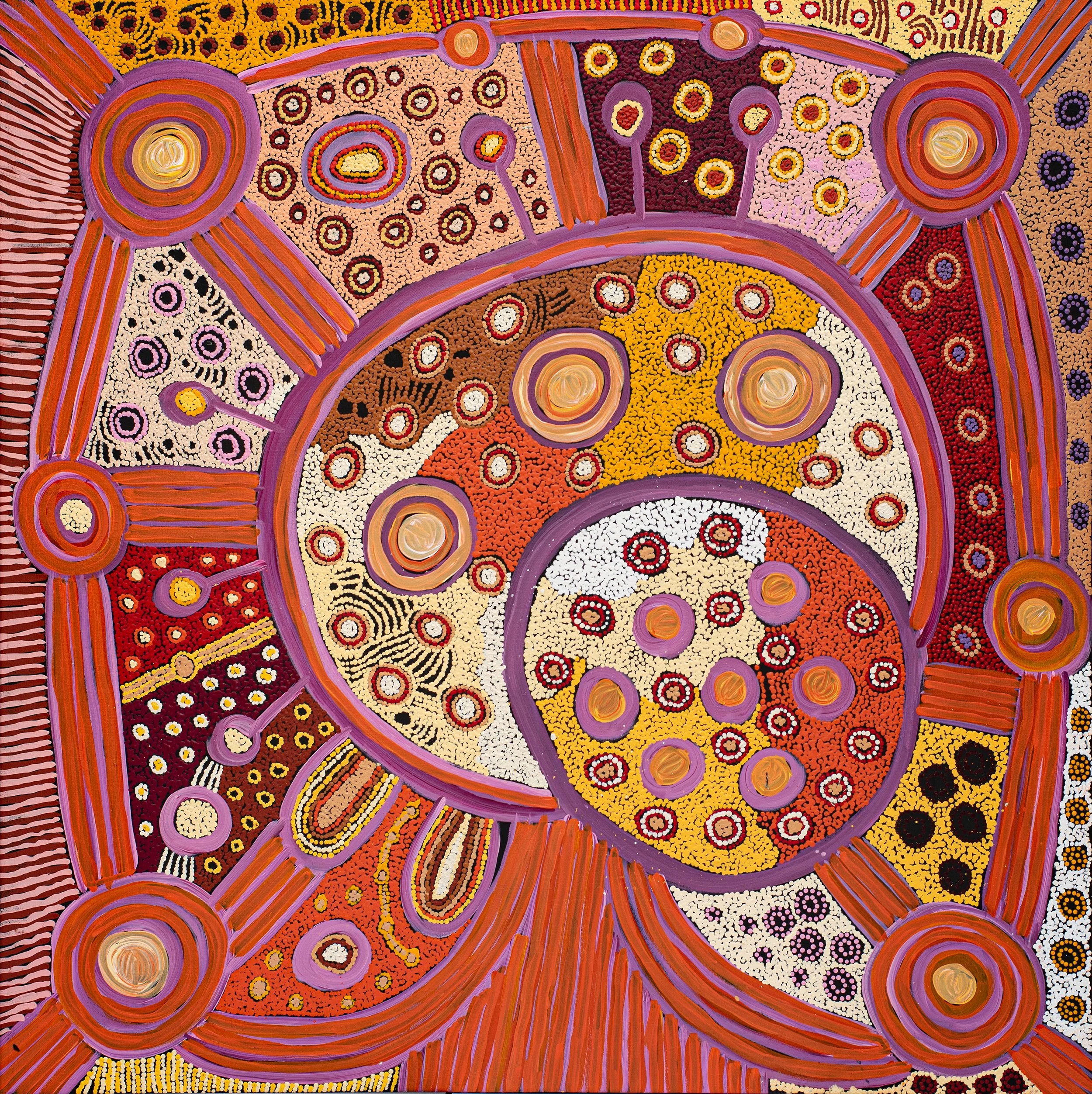
Artiste : Angela Watson
Titre de l'œuvre : Kungkarangkalpa (Seven Sisters Story)
Format : 127 × 127 cm
Provenance et certificat : centre d'art aborigène de Ninuku
Référence de cette peinture : 24-297
Demander le prix de l'œuvre / Enquiry
Explications pour cette œuvre :
This is a major Tjukurpa for Irrunytju (Wingellina) and across the central Australian deserts. The seven sisters travelled from Kaliwarra to Wannan in Western Australia, stopping at significant sites and rockholes including Kuru Ala, a sacred place for women. They encountered a lusul man named Wa Nyiru, who chased them around the desert. Some of the details of this Tjukurpa (Dreaming story) are sacred and can’t be repeated.
© Photo : Aboriginal Signature Estrangin gallery with the courtesy of the artists and Ninuku.
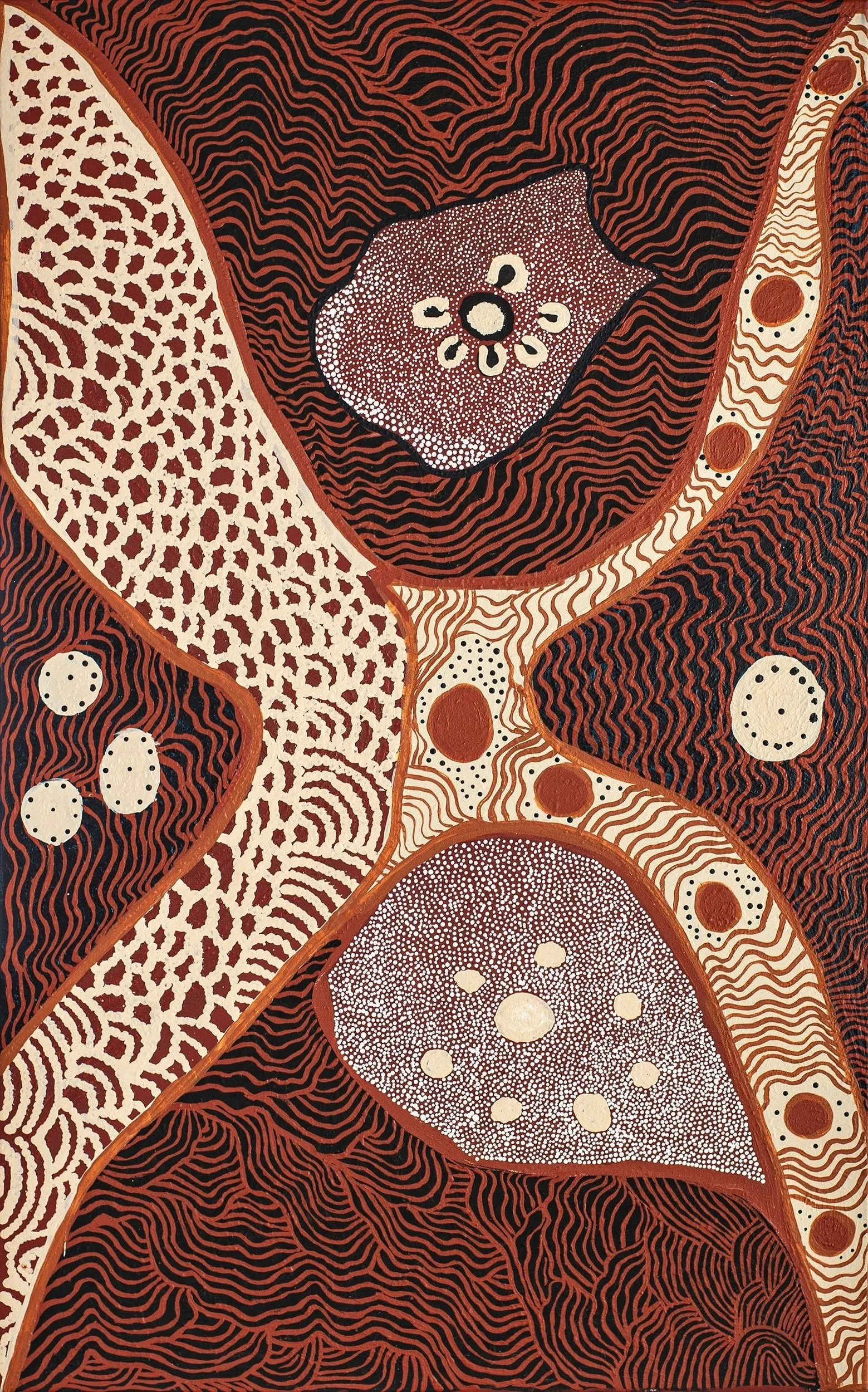
Artiste : Angkaliya Nelson
Titre de l'œuvre : Kungkarangkalpa (Seven Sisters Story)
Format : 122 × 77 cm
Provenance et certificat : centre d'art aborigène de Ninuku
Référence de cette peinture : 24-147
Demander le prix de l'œuvre / Enquiry
Explications pour cette œuvre :
This is a major Tjukurpa for Irrunytju (Wingellina) and across the central Australian deserts. The seven sisters travelled from Kaliwarra to Wannan in Western Australia, stopping at significant sites and rockholes including Kuru Ala, a sacred place for women. They encountered a lustful man named Wati Nyiru, who chased them around the desert. Some of the details of this Tjukurpa (Dreaming story) are sacred and can’t be repeated.
© Photo : Aboriginal Signature Estrangin gallery with the courtesy of the artists and Ninuku.
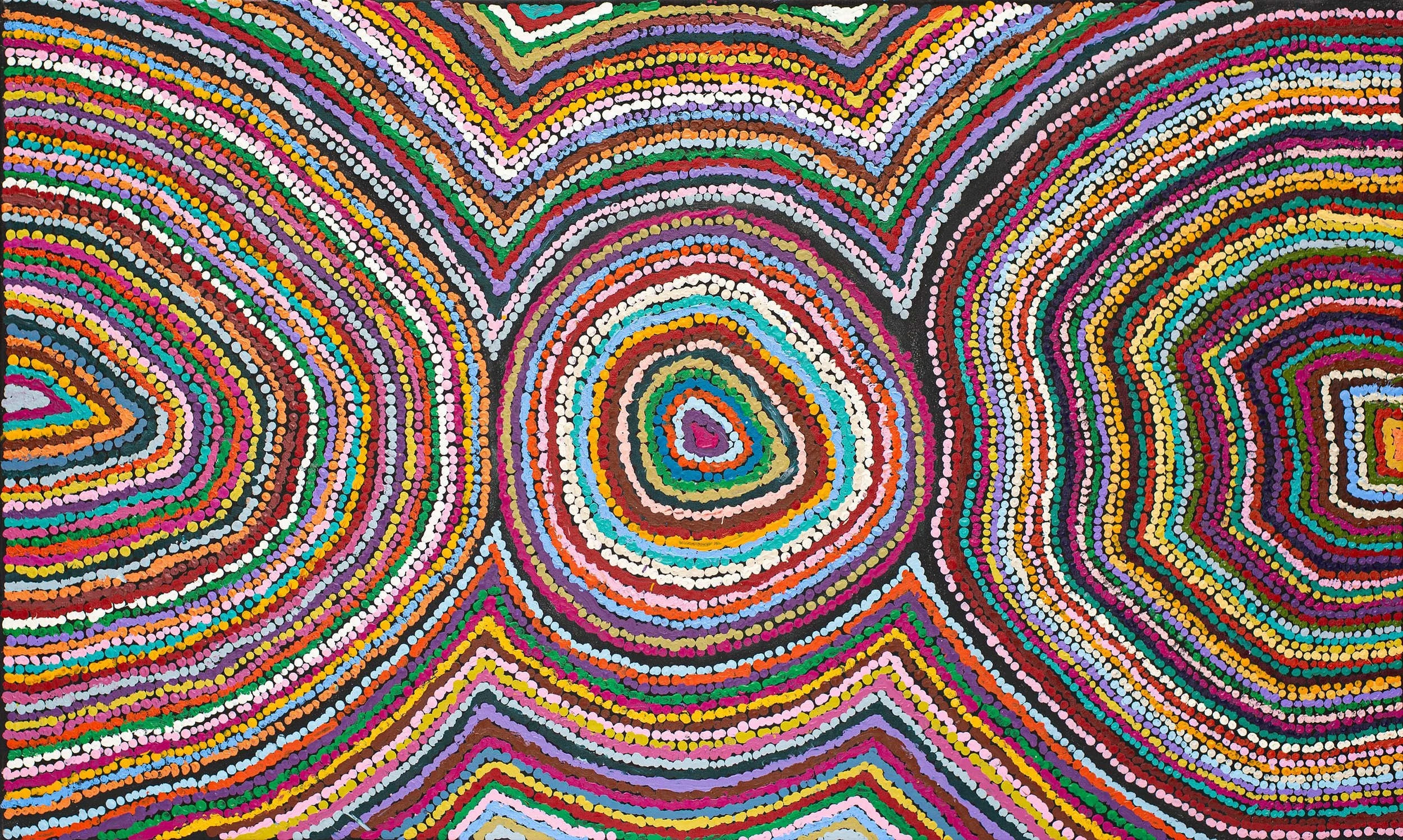
Artiste : Samuel Miller
Titre de l'œuvre : Ngayuku Ngura
Format : 153 × 91 cm
Provenance et certificat : centre d'art aborigène de Ninuku
Référence de cette peinture : 23-019
Demander le prix de l'œuvre / Enquiry
Explications pour cette œuvre :
Ngayuku Ngura means ‘My Place’. Samuel uses an extensive palee of colours to paint the country surrounding Kalka and Pipalyatjara. His paintings feature the various land formations from that area - rockholes, creeks and hills. His land is a sacred men’s rockhole, so sacred that the name is not allowed to be written down or spoken about.
© Photo : Aboriginal Signature Estrangin gallery with the courtesy of the artists and Ninuku.
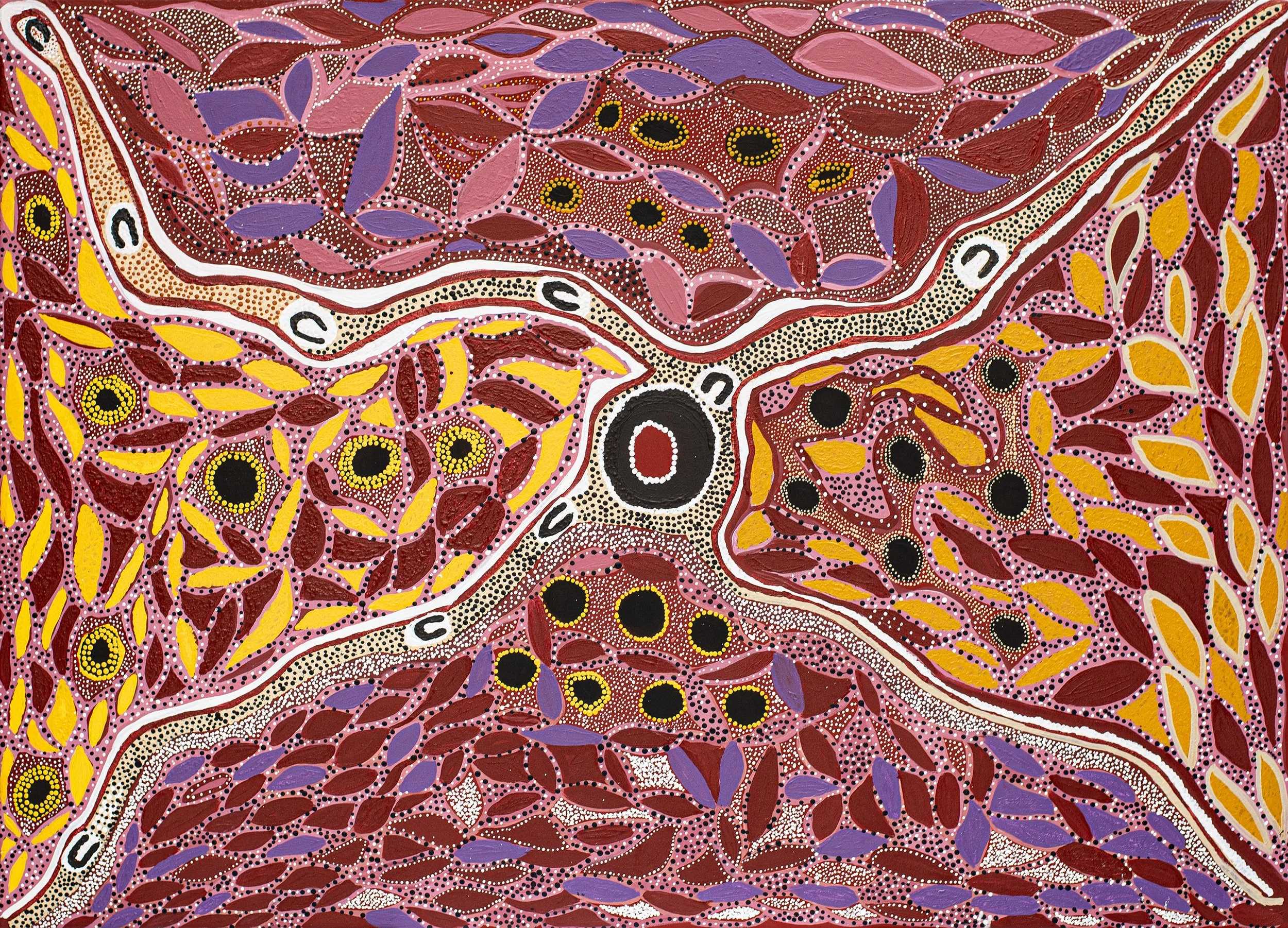
Artiste : Angkaliya Nelson
Titre de l'œuvre : Kungkarangkalpa (Seven Sisters Story)
Format : 127 × 92 cm
Provenance et certificat : centre d'art aborigène de Ninuku
Référence de cette peinture : 24-146
Demander le prix de l'œuvre / Enquiry
Explications pour cette œuvre :
This is a major Tjukurpa for Irrunytju (Wingellina) and across the central Australian deserts. The seven sisters travelled from Kaliwarra to Wannan in Western Australia, stopping at significant sites and rockholes including Kuru Ala, a sacred place for women. They encountered a lustful man named Wati Nyiru, who chased them around the desert. Some of the details of this Tjukurpa (Dreaming story) are sacred and can’t be repeated.
© Photo : Aboriginal Signature Estrangin gallery with the courtesy of the artists and Ninuku.
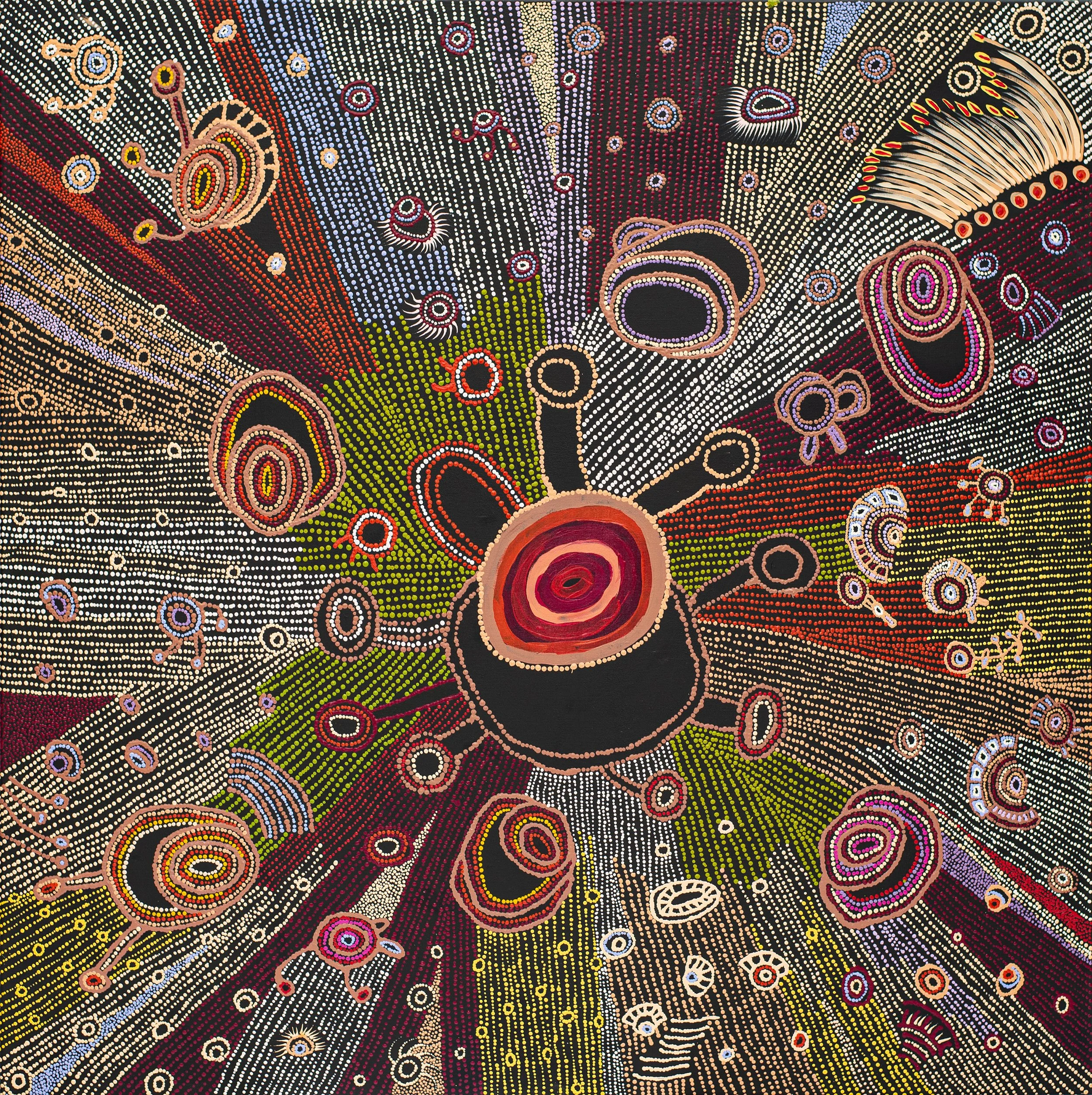
Artiste : Anyupa Nelson
Titre de l'œuvre : Kungkarangkalpa (Seven Sisters Story)
Format : 122 × 122 cm
Provenance et certificat : centre d'art aborigène de Ninuku
Référence de cette peinture : 24-296
Demander le prix de l'œuvre / Enquiry
Explications pour cette œuvre :
This is a major Tjukurpa for Irrunytju (Wingellina) and across the central Australian deserts. The seven sisters travelled from Kaliwarra to Wannan in Western Australia, stopping at significant sites and rockholes including Kuru Ala, a sacred place for women. They encountered a lustful man named Wati Nyiru, who chased them around the desert. Some of the details of this Tjukurpa (Dreaming story) are sacred and can’t be repeated.
© Photo : Aboriginal Signature Estrangin gallery with the courtesy of the artists and Ninuku.
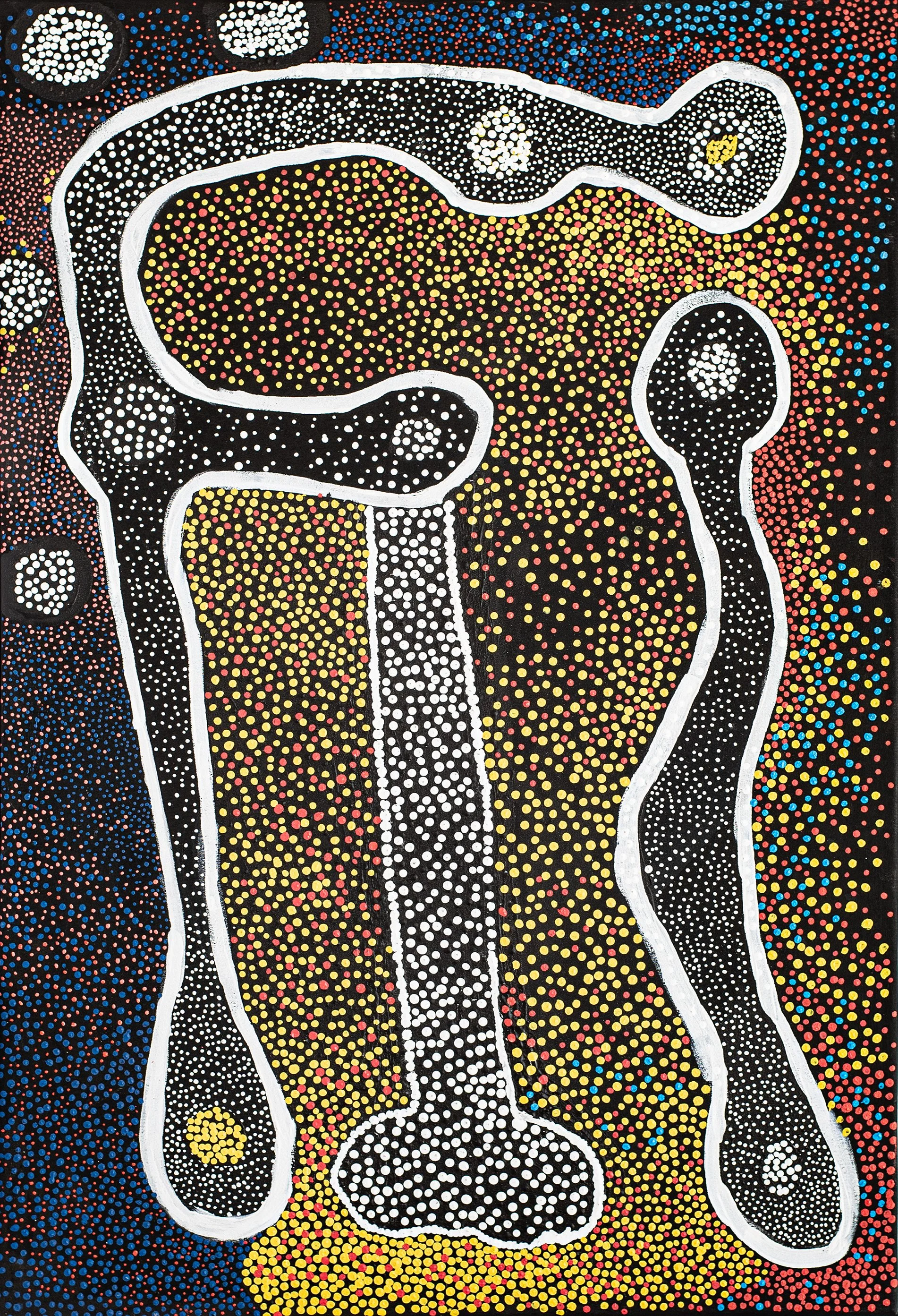
Artiste : Rowena Nelson
Titre de l'œuvre : Wati Ngintaka Tjukurpa
Format : 61 × 91 cm
Provenance et certificat : centre d'art aborigène de Ninuku
Référence de cette peinture : 24-089
Demander le prix de l'œuvre / Enquiry
Explications pour cette œuvre :
Tjukurpa minyma ninu palampa tjitji kutjara (this is the dreamtime story about the bilby woman and her two little boys). This is the story for Kalka. That minyma ninu (bilby woman) and her family were eating all the maku (witchety grubs). There are a lot of different maku, tjilka-tjilka, punti, ngarkalya and kanturangu. She ate so much that there wre only ngingirpa left (little immature ones). The wati mututa (ant men) got really angry and they chased the bilby family, husband, wife and kids and speared them. They finished off close to Pipalytjara at Iririiriri.
© Photo : Aboriginal Signature Estrangin gallery with the courtesy of the artists and Ninuku.
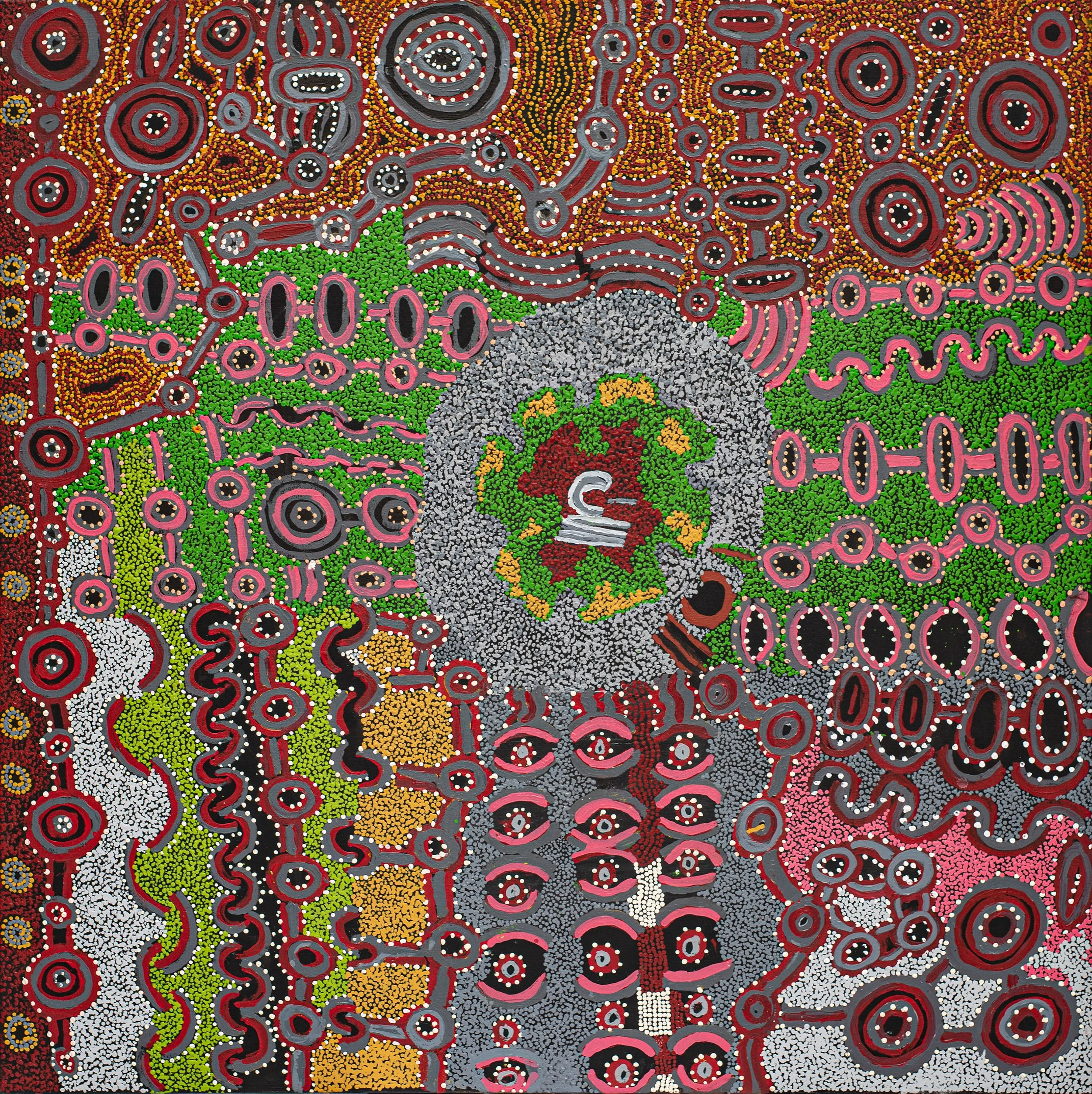
Artiste : David Miller
Titre de l'œuvre : Wati Ngintaka Tjukurpa
Format : 121 × 121 cm
Provenance et certificat : centre d'art aborigène de Ninuku
Référence de cette peinture : 25-044
Demander le prix de l'œuvre / Enquiry
Explications pour cette œuvre :
This is a story about Wati Ngintaka Tjukurpa (perentie lizard man creation story). That Wati Ngintaka (lizard man) heard the clapping sound of a beautiful grinding stone - a traditional tool used for grinding mai (food). He wanted that stone for himself, so he travelled from Arang’nga a long way east towards Wayatina, looking for the stone. He spotted Anangu tjuta (lots of Aboriginal people) at a camp. Some of the people gave him mai (food) in the form of a seed cake, but it was dry and he didn’t like it. Then one lady gave him delicious food and he knew that it had been made with seeds ground on the special grinding stone. He spied the grinding stone and stole it, hiding it in under his tail. When they all went hunting the next day, Wati Ngintaka stayed in camp, saying he had sore feet. Once they were gone, it was safe and he left, stealing the grinding stone. All the people were angry with the Wati Ngintaka and chased him. When they caught him they felt all over his body to see where he was hiding the grinding stone, but couldn’t find it. Wati Ngintaka held up his arms and claimed he didn’t have it, but they saw he was hiding it, wipungka (in his tail). They speared the Wati Ngintaka and retrieved the grinding stone. He passed away at a place called Aran’nga in the Northern Territory. Ngaltutjara (poor thing).
© Photo : Aboriginal Signature Estrangin gallery with the courtesy of the artists and Ninuku.
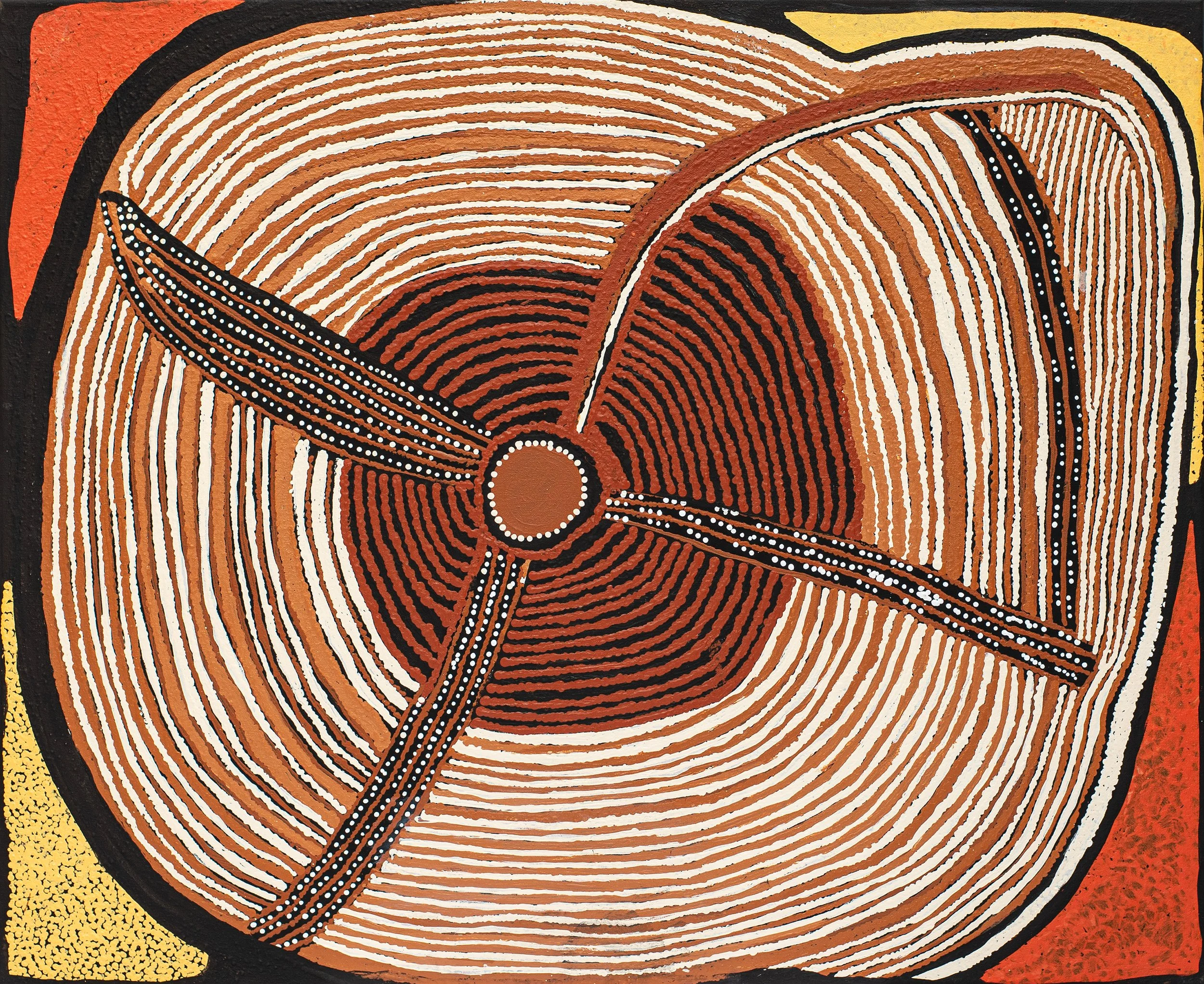
Artiste : Angkaliya Nelson
Titre de l'œuvre : Kungkarangkalpa (Seven Sisters Story)
Format : 92 × 76 cm
Provenance et certificat : centre d'art aborigène de Ninuku
Référence de cette peinture : 25-127
Demander le prix de l'œuvre / Enquiry
Explications pour cette œuvre :
This is a major Tjukurpa for Irrunytju (Wingellina) and across the central Australian deserts. The seven sisters travelled from Kaliwarra to Wannan in Western Australia, stopping at significant sites and rockholes including Kuru Ala, a sacred place for women. They encountered a lustful man named Wati Nyiru, who chased them around the desert. Some of the details of this Tjukurpa (Dreaming story) are sacred and can’t be repeated.
© Photo : Aboriginal Signature Estrangin gallery with the courtesy of the artists and Ninuku.
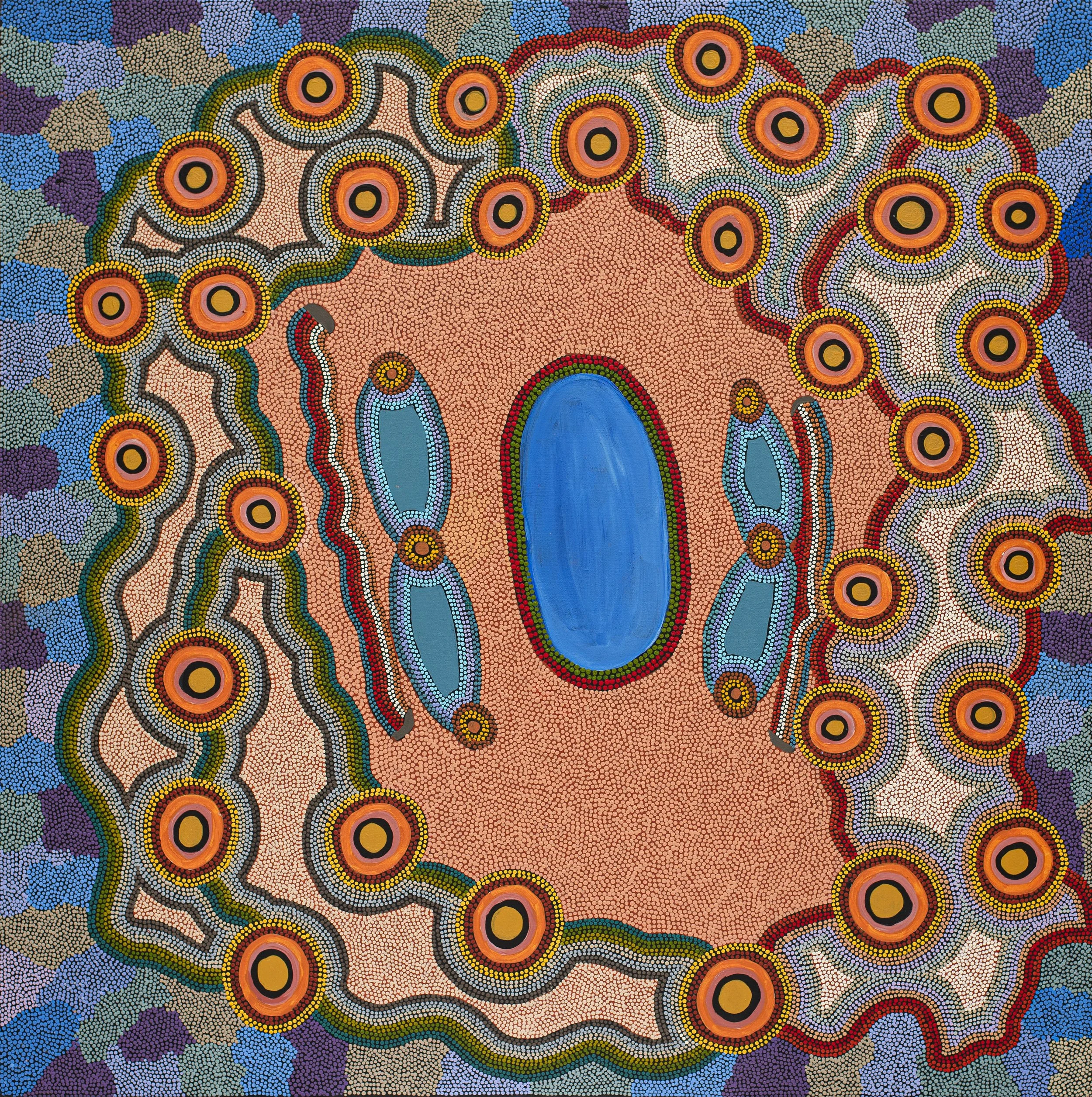
Artiste : Margaret Donegan
Titre de l'œuvre : Wati Kutjara Wanampi
Format : 122 x 122 cm
Provenance et certificat : centre d'art aborigène de Ninuku
Référence de cette peinture : 25-172
Demander le prix de l'œuvre / Enquiry
Explications pour cette œuvre :
Margaret is painting her father, the late Mr. Donegan's tjukurpa (Dreaming story) from an important site known as Pukara, south-west of Irrunytju (Wingellina community) in Western Australia. It is a story of Wati Kutjara Wanampi (two male water serpents) - a father and son - who are living at a waterhole. According to the story, Anangu tjuta (lots of people) went to that rockhole for the kapi (water), which is said to taste sweet. This upset the father and he told them to go back to their own country. Once the people left, the father and son travelled to Willuna, where they camped for weeks. They then return to Pukara. One day they were sleeping, but were awoken by a loud buzzing sound. The Minyma Punpunpa (the female flies) had been attracted to the honey grevillea plants found near the waterhole. It prompted the father and son to get up and go to collect the honey from the plants. It is there that the Wati Mututa (male black ants) appeared. They speared the son in his side. When the son started vomiting, he produced the seeds of all the different varieties of honey grevillea plants that are still found there today. They include kaliny-kalinypa, ultukunpa, piruwa and witjinti.
© Photo : Aboriginal Signature Estrangin gallery with the courtesy of the artists and Ninuku.
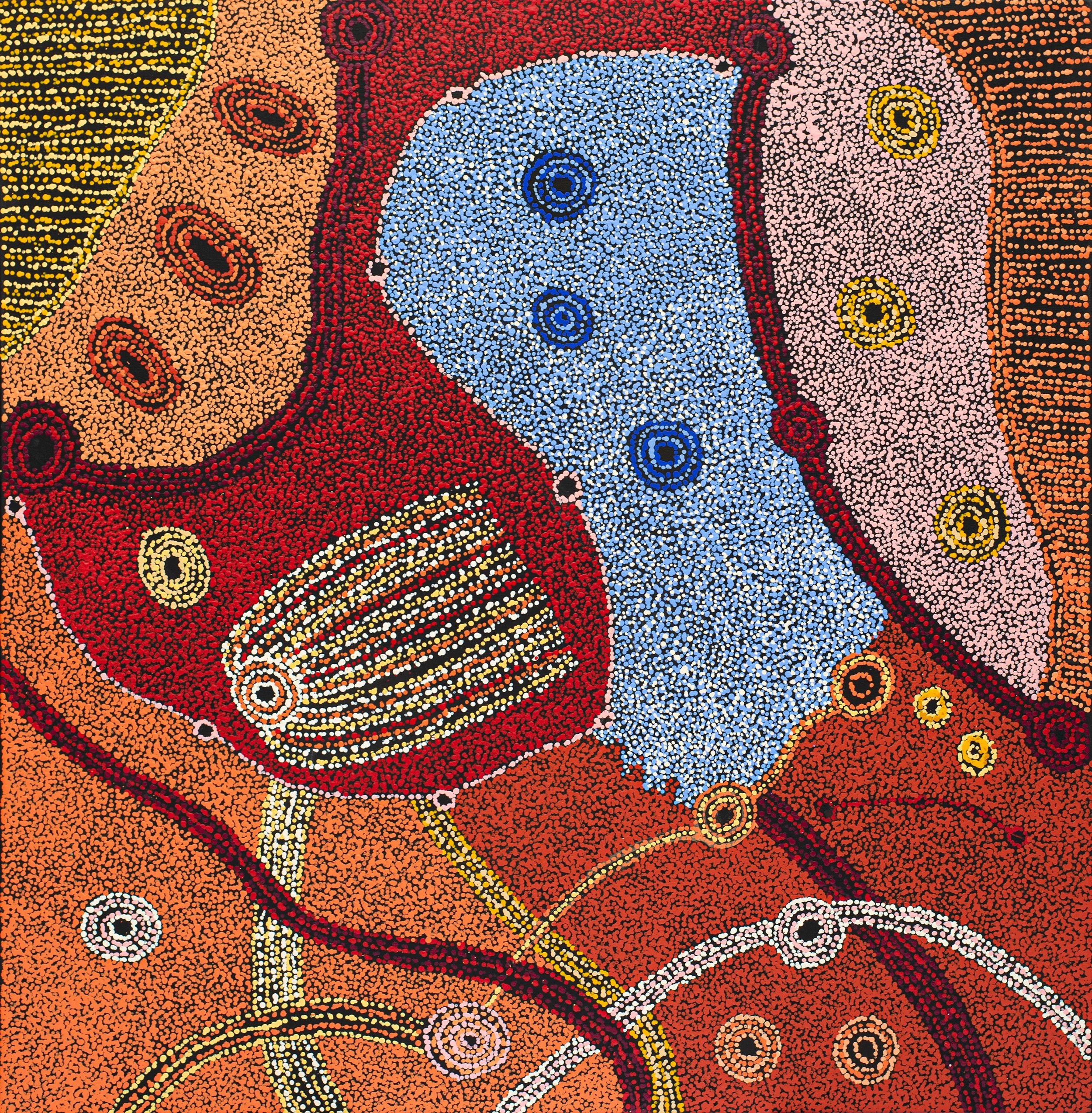
Artiste : Carol Young
Titre de l'œuvre : Waru Dreaming
Format : 107 x 91 cm
Provenance et certificat : centre d'art aborigène de Ninuku
Référence de cette peinture : 25-160
Demander le prix de l'œuvre / Enquiry
Explications pour cette œuvre :
At Watarru, there are many large and beautiful rocks. In these rocks lived the bush turkey. Anangu had no waru (fire) as the bush turkey stole the fire, and ran all the way to the sea with it.
© Photo : Aboriginal Signature Estrangin gallery with the courtesy of the artists and Ninuku.
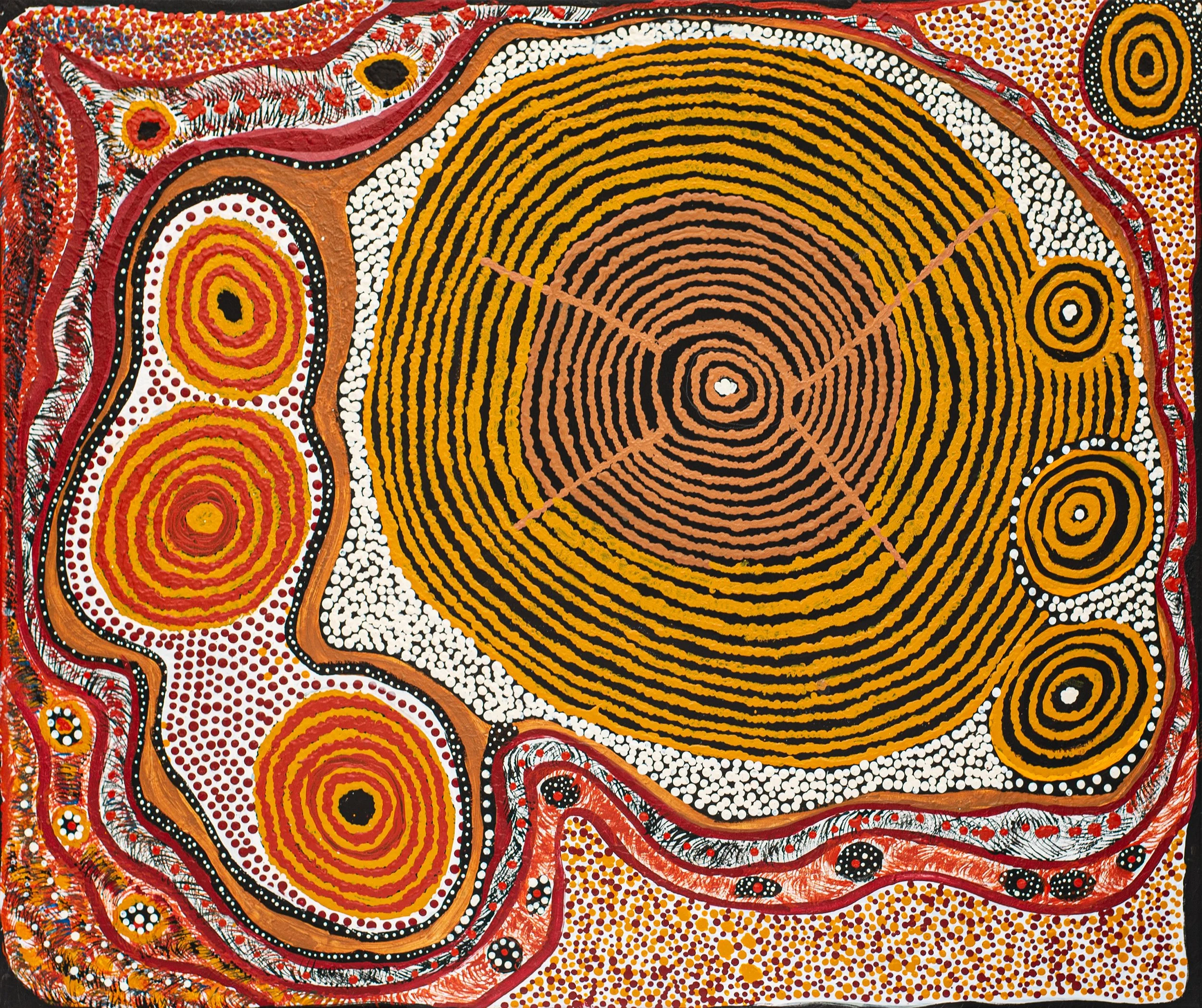
Artiste : Angkaliya Nelson
Titre de l'œuvre : Kungkarangkalpa (Seven Sisters Story)
Format : 92 × 76 cm
Provenance et certificat : centre d'art aborigène de Ninuku
Référence de cette peinture : 25-209
Demander le prix de l'œuvre / Enquiry
Explications pour cette œuvre :
This is a major Tjukurpa for Irrunytju (Wingellina) and across the central Australian deserts. The seven sisters travelled from Kaliwarra to Wannan in Western Australia, stopping at significant sites and rockholes including Kuru Ala, a sacred place for women. They encountered a lustful man named Wati Nyiru, who chased them around the desert. Some of the details of this Tjukurpa (Dreaming story) are sacred and can’t be repeated.
© Photo : Aboriginal Signature Estrangin gallery with the courtesy of the artists and Ninuku.
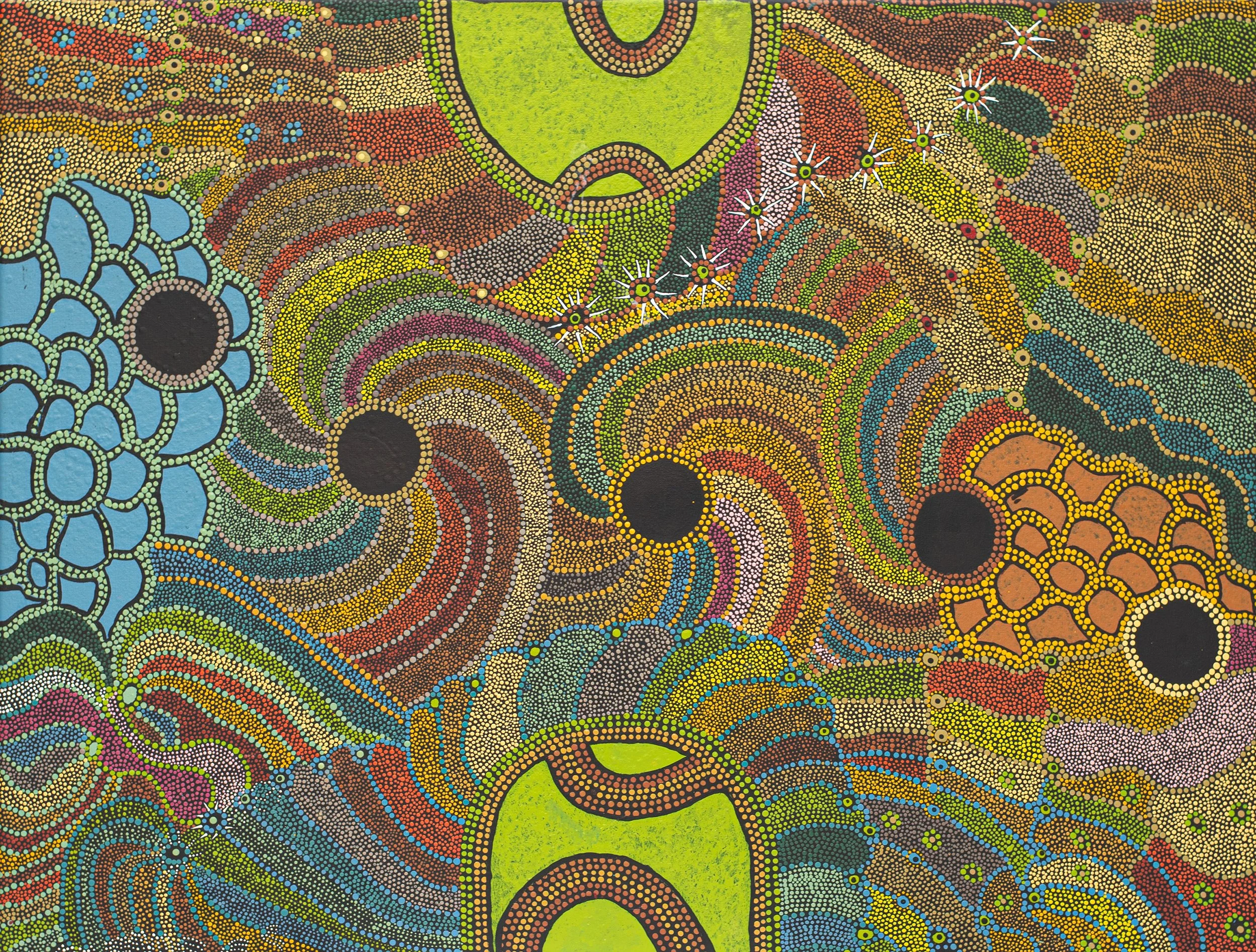
Artiste : Delores Miller
Titre de l'œuvre : Kungkarangkalpa (Seven Sisters Story)
Format : 102 × 76 cm
Provenance et certificat : centre d'art aborigène de Ninuku
Référence de cette peinture : 25-054
Demander le prix de l'œuvre / Enquiry
Explications pour cette œuvre :
This is a major Tjukurpa for Irrunytju (Wingellina) and across the central Australian deserts. The seven sisters travelled from Kaliwarra to Wannan in Western Australia, stopping at significant sites and rockholes including Kuru Ala, a sacred place for women. They encountered a lustful man named Wati Nyiru, who chased them around the desert. Some of the details of this Tjukurpa (Dreaming story) are sacred and can’t be repeated.
© Photo : Aboriginal Signature Estrangin gallery with the courtesy of the artists and Ninuku.
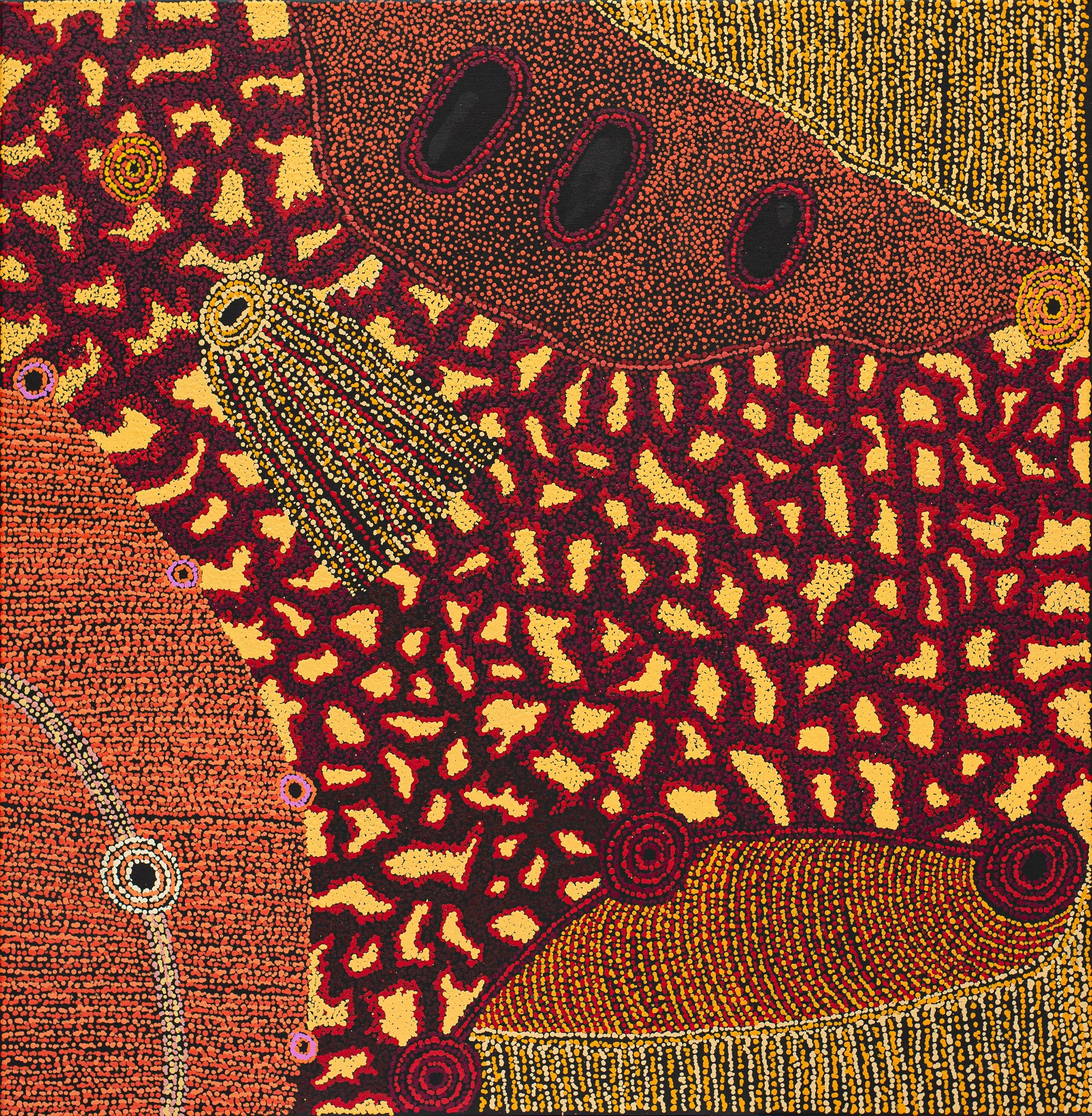
Artiste : Carol Young
Titre de l'œuvre : Waru Dreaming
Format : 105 × 103 cm
Provenance et certificat : centre d'art aborigène de Ninuku
Référence de cette peinture : 25-212
Demander le prix de l'œuvre / Enquiry
Explications pour cette œuvre :
At Watarru, there are many large and beautiful rocks. In these rocks lived the bush turkey. Anangu had no waru (fire) as the bush turkey stole the fire, and ran all the way to the sea with it.
© Photo : Aboriginal Signature Estrangin gallery with the courtesy of the artists and Ninuku.
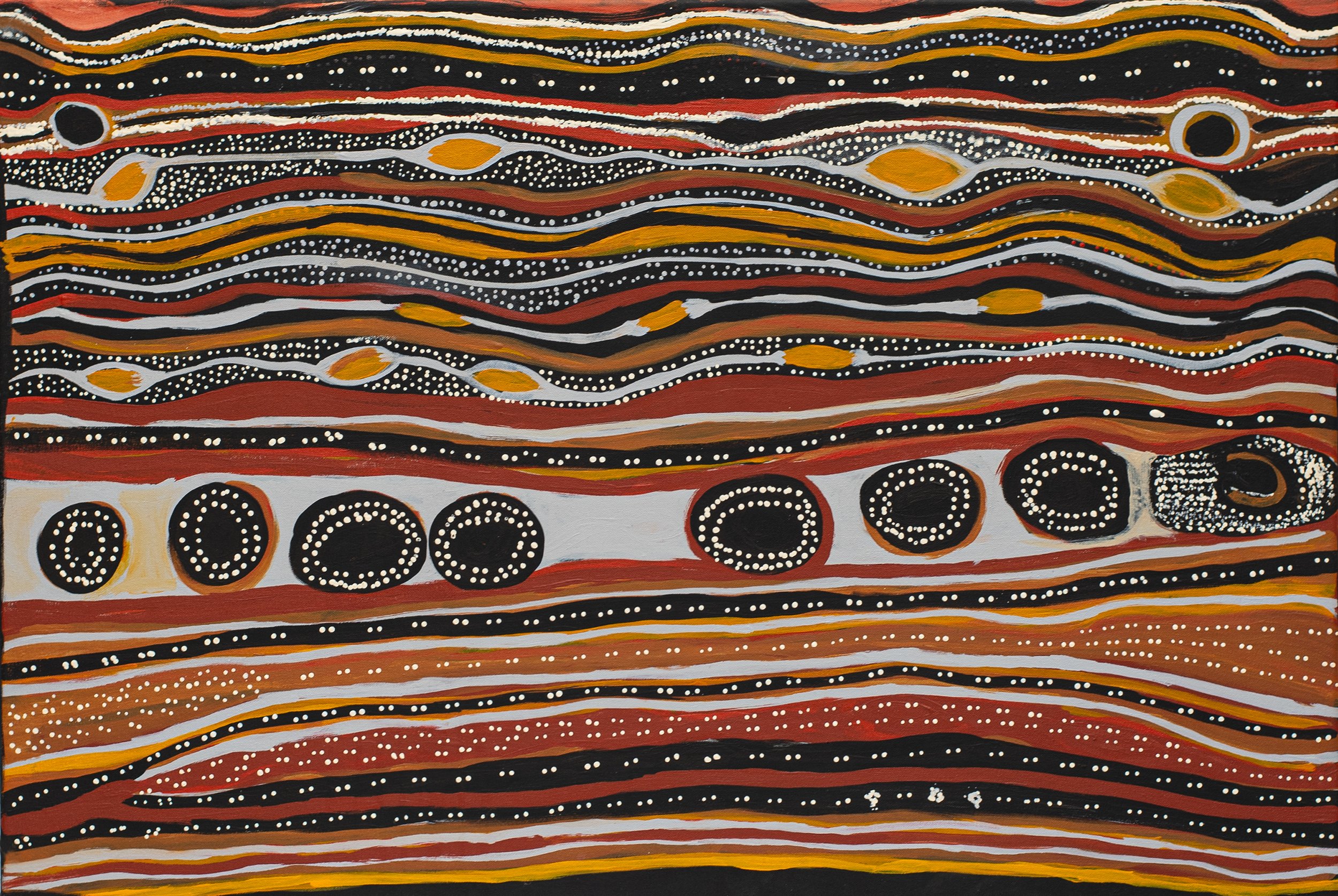
Artiste : Angkaliya Nelson
Titre de l'œuvre : Kungkarangkalpa (Seven Sisters Story)
Format : 91 × 61 cm
Provenance et certificat : centre d'art aborigène de Ninuku
Référence de cette peinture : 25-057
Demander le prix de l'œuvre / Enquiry
Explications pour cette œuvre :
This is a major Tjukurpa for Irrunytju (Wingellina) and across the central Australian deserts. The seven sisters travelled from Kaliwarra to Wannan in Western Australia, stopping at significant sites and rockholes including Kuru Ala, a sacred place for women. They encountered a lustful man named Wati Nyiru, who chased them around the desert. Some of the details of this Tjukurpa (Dreaming story) are sacred and can’t be repeated.
© Photo : Aboriginal Signature Estrangin gallery with the courtesy of the artists and Ninuku.
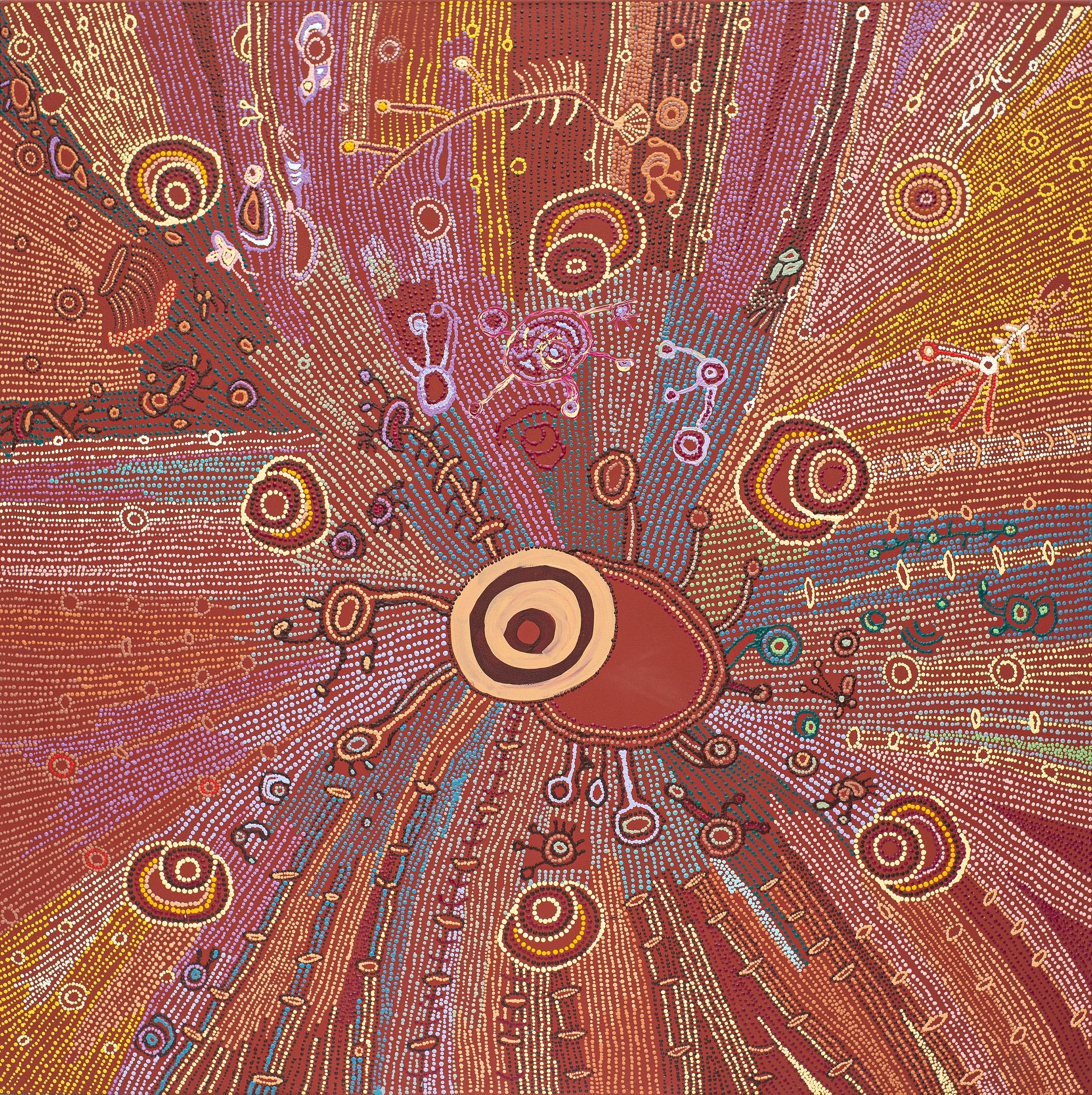
Artiste : Anyupa Nelson
Titre de l'œuvre : Kungkarangkalpa (Seven Sisters Story)
Format : 122 × 122 cm
Provenance et certificat : centre d'art aborigène de Ninuku
Référence de cette peinture : 24-257
Demander le prix de l'œuvre / Enquiry
Explications pour cette œuvre :
This is a major Tjukurpa for Irrunytju (Wingellina) and across the central Australian deserts. The seven sisters travelled from Kaliwarra to Wannan in Western Australia, stopping at significant sites and rockholes including Kuru Ala, a sacred place for women. They encountered a lustful man named Wati Nyiru, who chased them around the desert. Some of the details of this Tjukurpa (Dreaming story) are sacred and can’t be repeated.
© Photo : Aboriginal Signature Estrangin gallery with the courtesy of the artists and Ninuku.
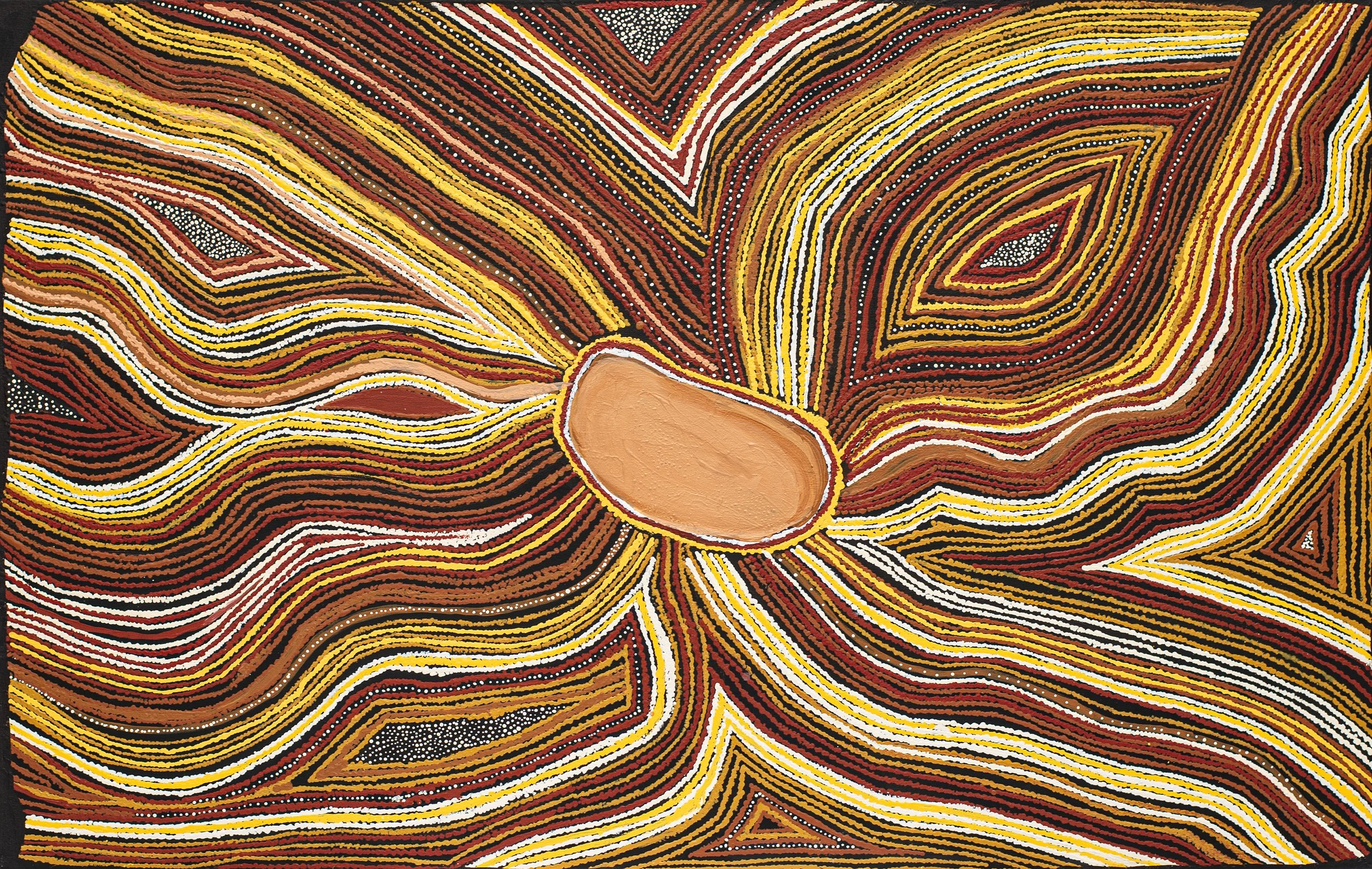
Artiste : Angkaliya Nelson
Titre de l'œuvre : Kungkarangkalpa (Seven Sisters Story)
Format : 122 × 76 cm
Provenance et certificat : centre d'art aborigène de Ninuku
Référence de cette peinture : 24-256
Demander le prix de l'œuvre / Enquiry
Explications pour cette œuvre :
This is a major Tjukurpa for Irrunytju (Wingellina) and across the central Australian deserts. The seven sisters travelled from Kaliwarra to Wannan in Western Australia, stopping at significant sites and rockholes including Kuru Ala, a sacred place for women. They encountered a lustful man named Wati Nyiru, who chased them around the desert. Some of the details of this Tjukurpa (Dreaming story) are sacred and can’t be repeated.
© Photo : Aboriginal Signature Estrangin gallery with the courtesy of the artists and Ninuku.

Artiste : Janice Miller
Titre de l'œuvre : Mrs Miller's Country
Format : 91 x 91 cm
Provenance et certificat : centre d'art aborigène de Ninuku
Référence de cette peinture : 25-087
Demander le prix de l'œuvre / Enquiry
Explications pour cette œuvre :
After Mrs. Miller's funeral I had a dream and in it I saw Mrs. Miller and her country - I decided to paint the country after that dream as a tribute to her.
© Photo : Aboriginal Signature Estrangin gallery with the courtesy of the artists and Ninuku.
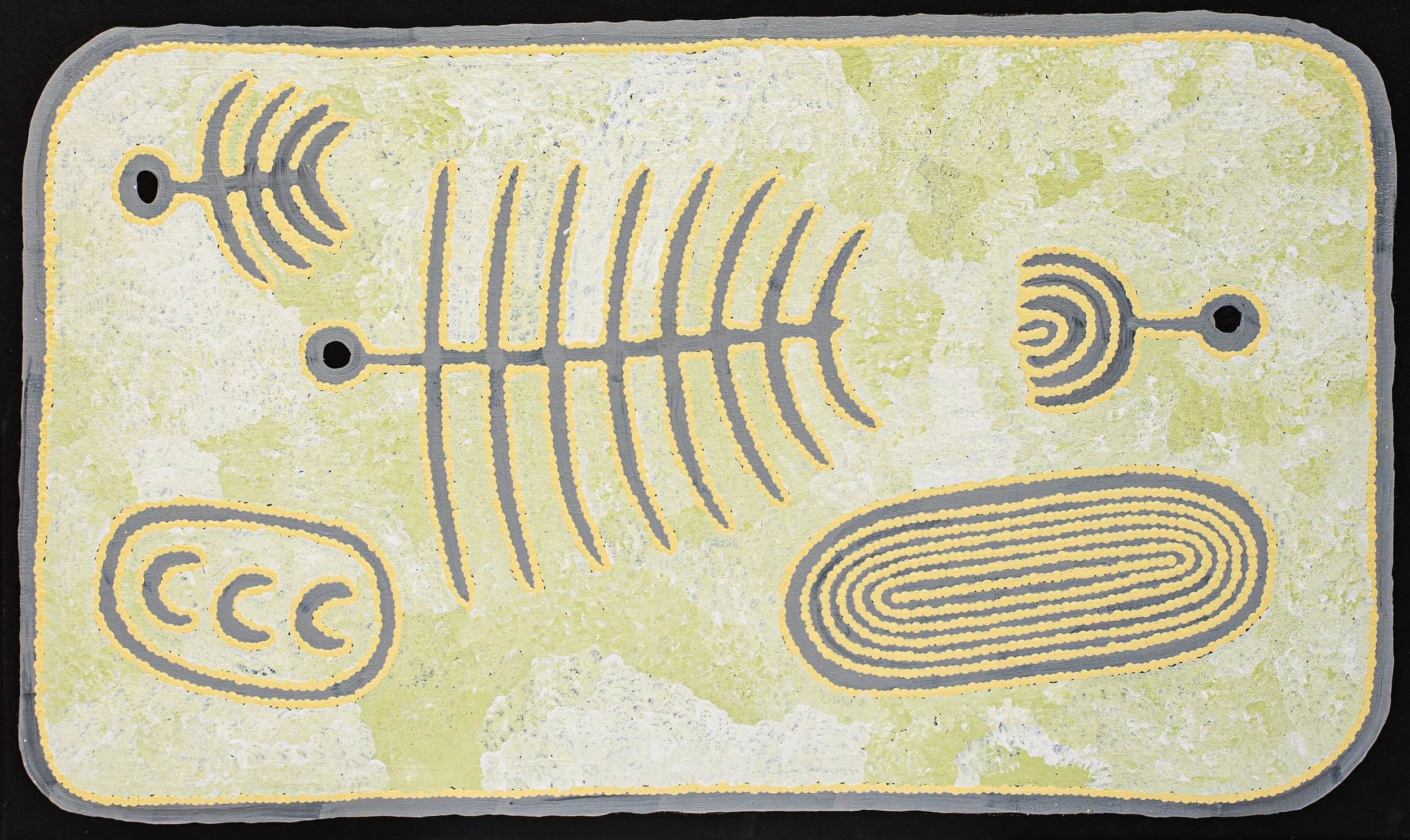
Artiste : Rita Watson
Titre de l'œuvre : Irlupa
Format : 102 x 61 cm
Provenance et certificat : centre d'art aborigène de Ninuku
Référence de cette peinture : 24-151
Demander le prix de l'œuvre / Enquiry
Explications pour cette œuvre :
This is a story about Irlupa, a site near Papulankatja in Western Australia, a place where Western Ngaayatjara and east earn Pitjantjatjara dielects diverge.This is Rita's father's ngurra (camp and country) where she spent time as young person and is home to many important tjukurpa (dreaming) sites and stories and inma (songs) for Anangu in this area.
Rita paints the features of his camp such as tjukula (rockholes), kalyan kalyan (Honey grevilla plant), tjanpi (spinifex), Kampurarpa (Bush Tomatoes), Anangu (people), punu (trees) and wiltja (windbreaks) in an iconographic milpajunanyi (traditional sand drawing) style.
© Photo : Aboriginal Signature Estrangin gallery with the courtesy of the artists and Ninuku.
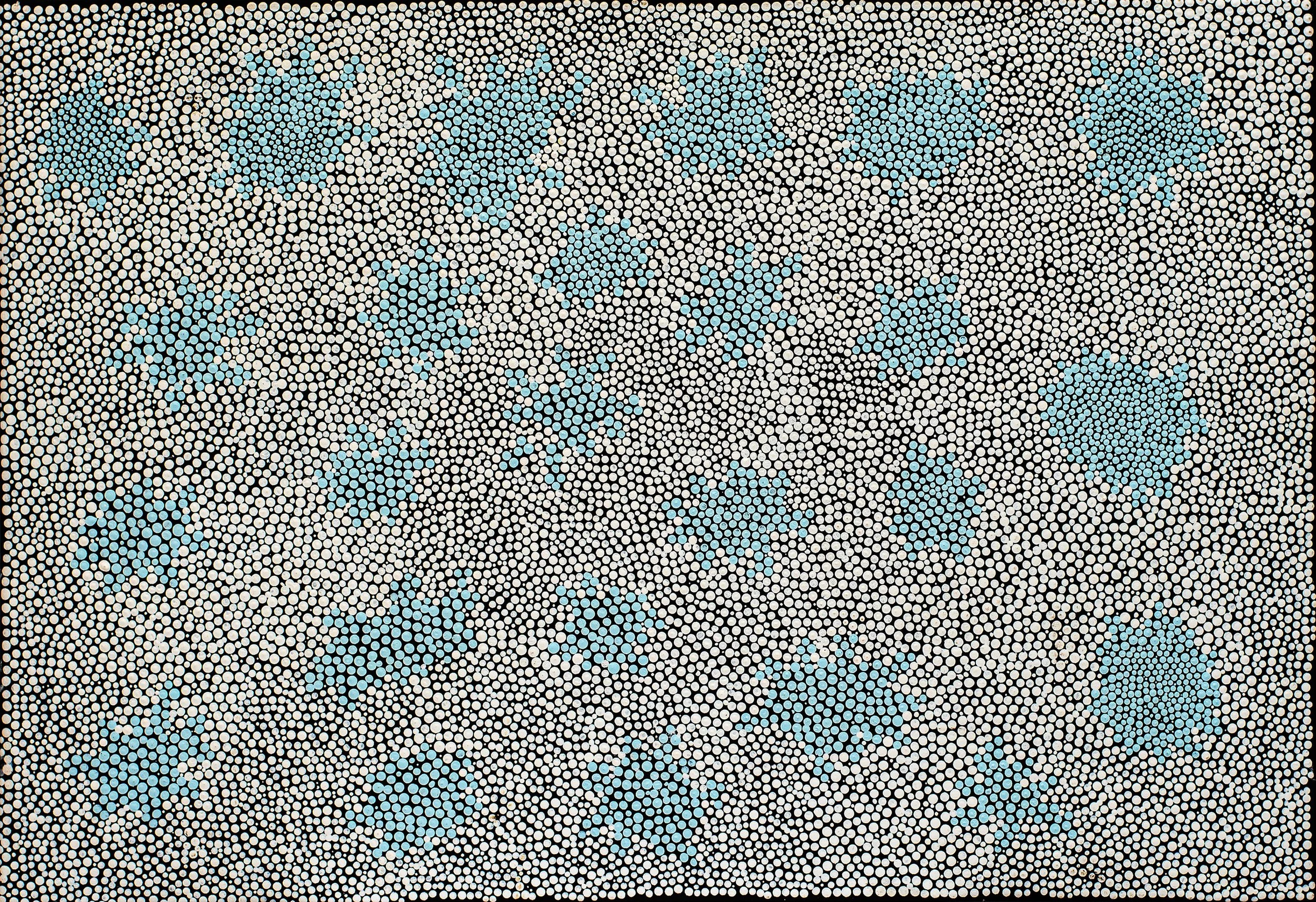
Artiste : Janice Miller
Titre de l'œuvre : Mrs Miller's Country
Format : 87 x 59 cm
Provenance et certificat : centre d'art aborigène de Ninuku
Référence de cette peinture : 25-047
Demander le prix de l'œuvre / Enquiry
Explications pour cette œuvre :
After Mrs. Miller's funeral I had a dream and in it I saw Mrs. Miller and her country - I decided to paint the country after that dream as a tribute to her.
© Photo : Aboriginal Signature Estrangin gallery with the courtesy of the artists and Ninuku.
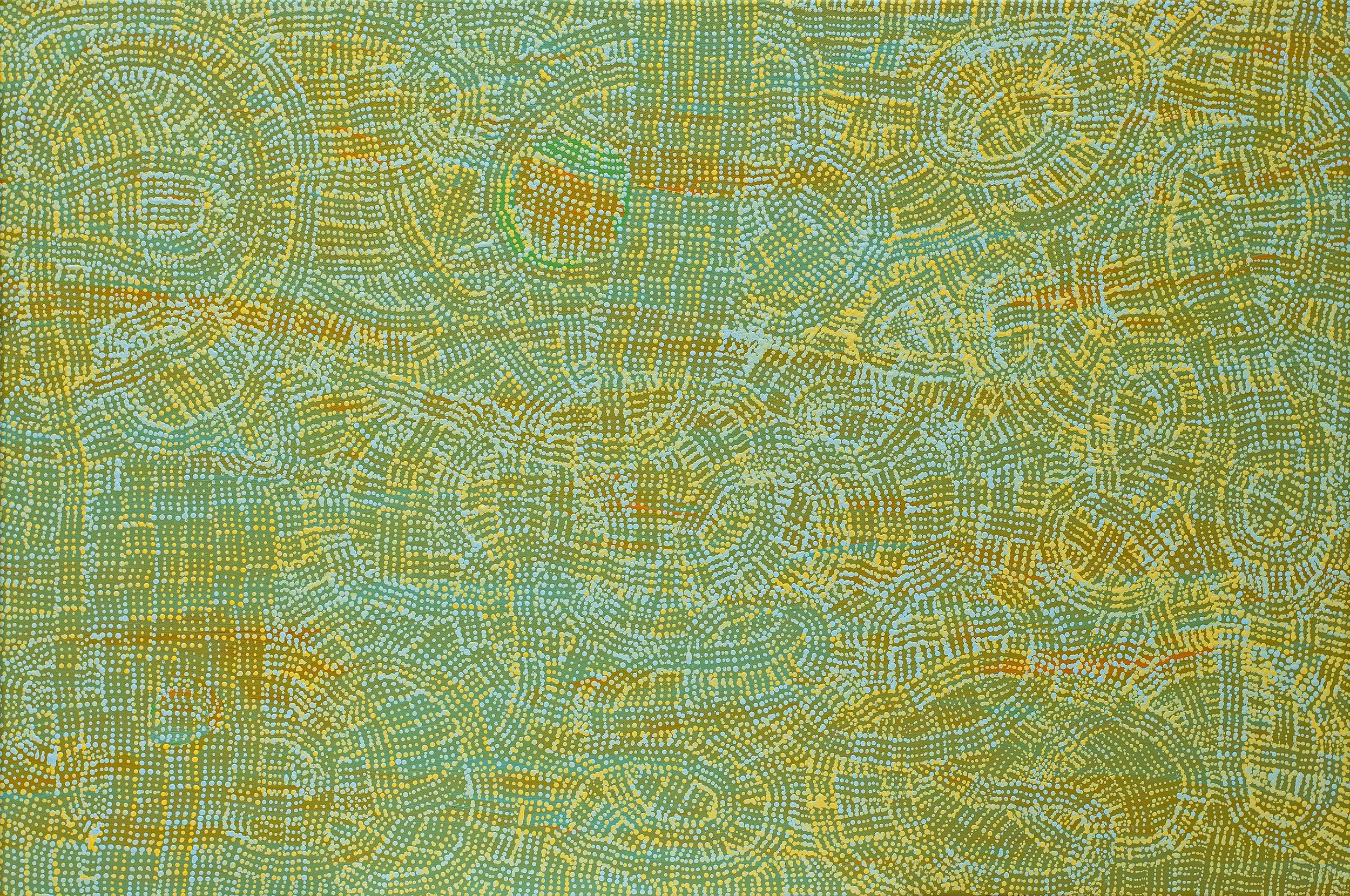
Artiste : Jennifer Mintaya Connelly Ward
Titre de l'œuvre : Kungkarangkalpa (Seven Sisters Story)
Format : 100 × 66 cm
Provenance et certificat : centre d'art aborigène de Ninuku Arts
Référence de cette toile aborigène : 25-171
Demander le prix de l'œuvre / Enquiry
Explications pour cette peinture d'art Aborigène :
This is a major Tjukurpa for Irrunytju (Wingellina) and across the central Australian deserts. The seven sisters travelled from Kaliwarra to Wannan in Western Australia, stopping at significant sites and rockholes including Kuru Ala, a sacred place for women. They encountered a lusul man named Wa Nyiru, who chased them around the desert. Some of the details of this Tjukurpa (Dreaming story) are sacred and can’t be repeated.
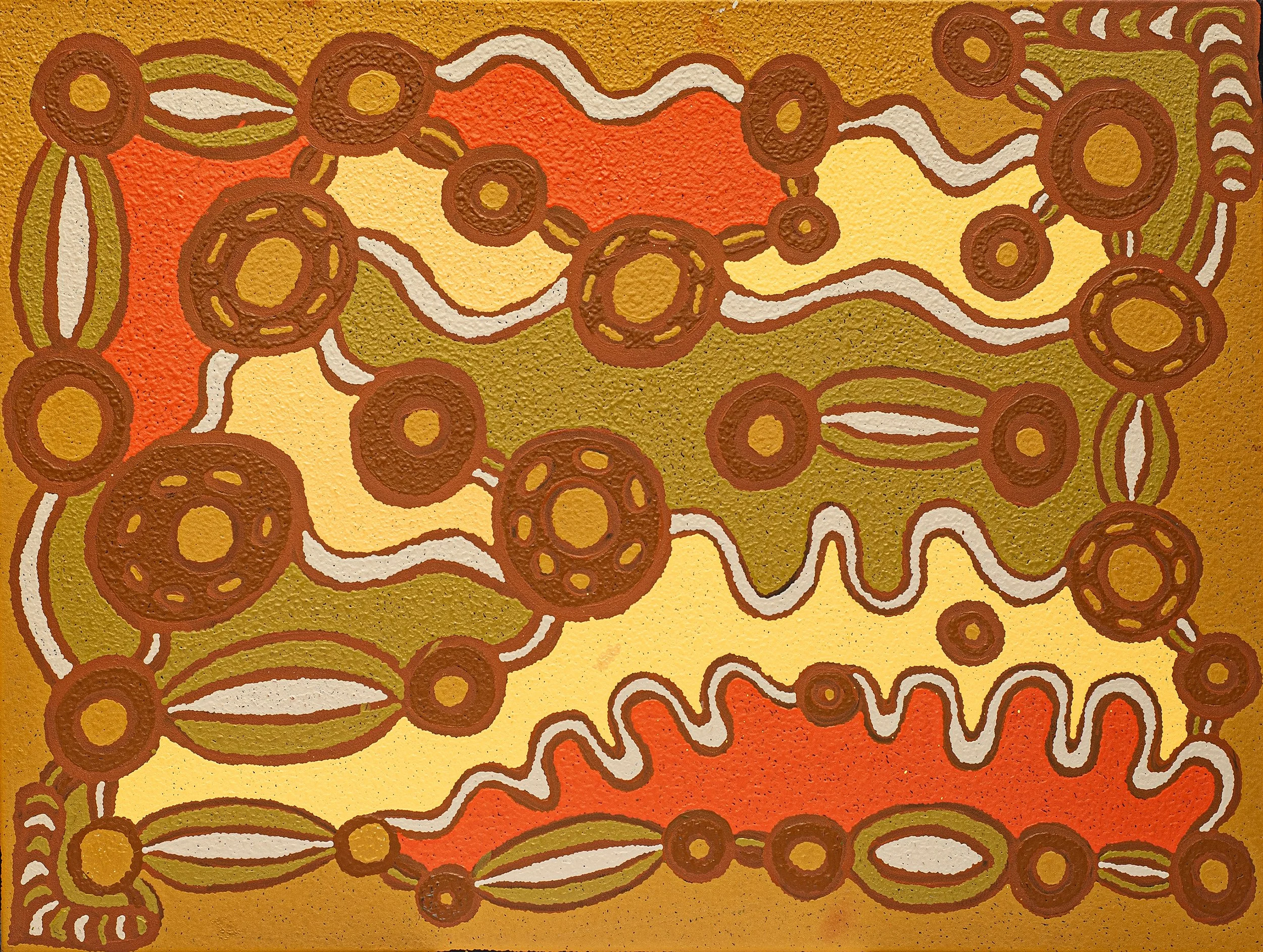
Artiste : Phyllis Watson
Titre de l'œuvre : Walka Wiru Ngura Wiru
Format : 122 × 92 cm
Provenance et certificat : centre d'art aborigène de Ninuku
Référence de cette peinture : 25-151
Demander le prix de l'œuvre / Enquiry
Explications pour cette œuvre :
Walka Wiru Ngura Wiru means lovely country, lovely drawing. This is a painting is a composition of dot patterns inspired by the sandy desert features around the Tompkinson ranges of Pipalyatjara, Kalka, and Irrunytju communities where Ninuku artists work.
© Photo : Aboriginal Signature Estrangin gallery with the courtesy of the artists and Ninuku.
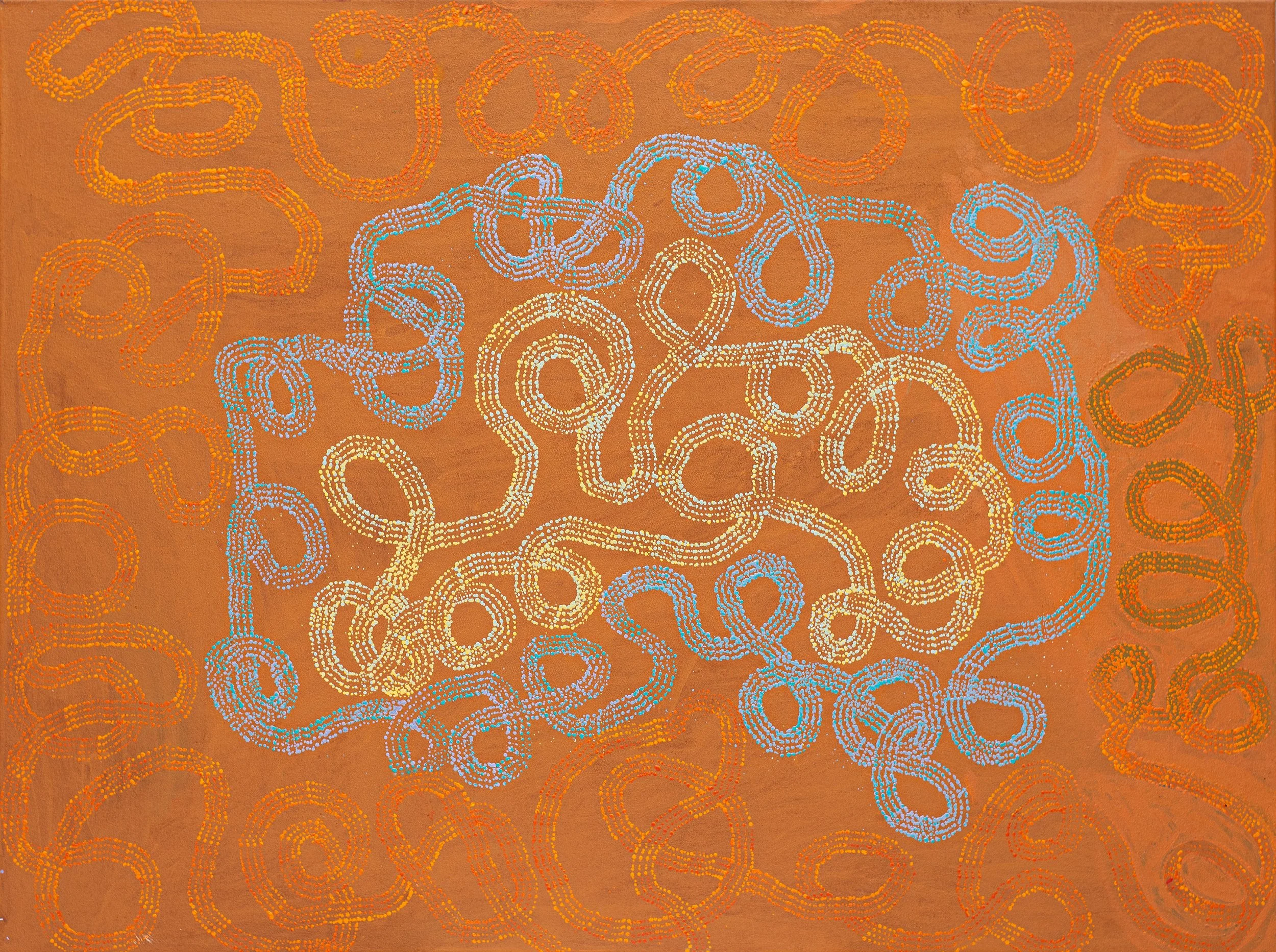
Artiste : Jennifer Mintaya Connelly Ward
Titre de l'œuvre : Kungkarangkalpa (Seven Sisters Story)
Format : 122 × 91 cm
Provenance et certificat : centre d'art aborigène de Ninuku Arts
Référence de cette toile aborigène : 25-197
Demander le prix de l'œuvre / Enquiry
Explications pour cette peinture d'art Aborigène :
This is a major Tjukurpa for Irrunytju (Wingellina) and across the central Australian deserts. The seven sisters travelled from Kaliwarra to Wannan in Western Australia, stopping at significant sites and rockholes including Kuru Ala, a sacred place for women. They encountered a lusul man named Wa Nyiru, who chased them around the desert. Some of the details of this Tjukurpa (Dreaming story) are sacred and can’t be repeated.
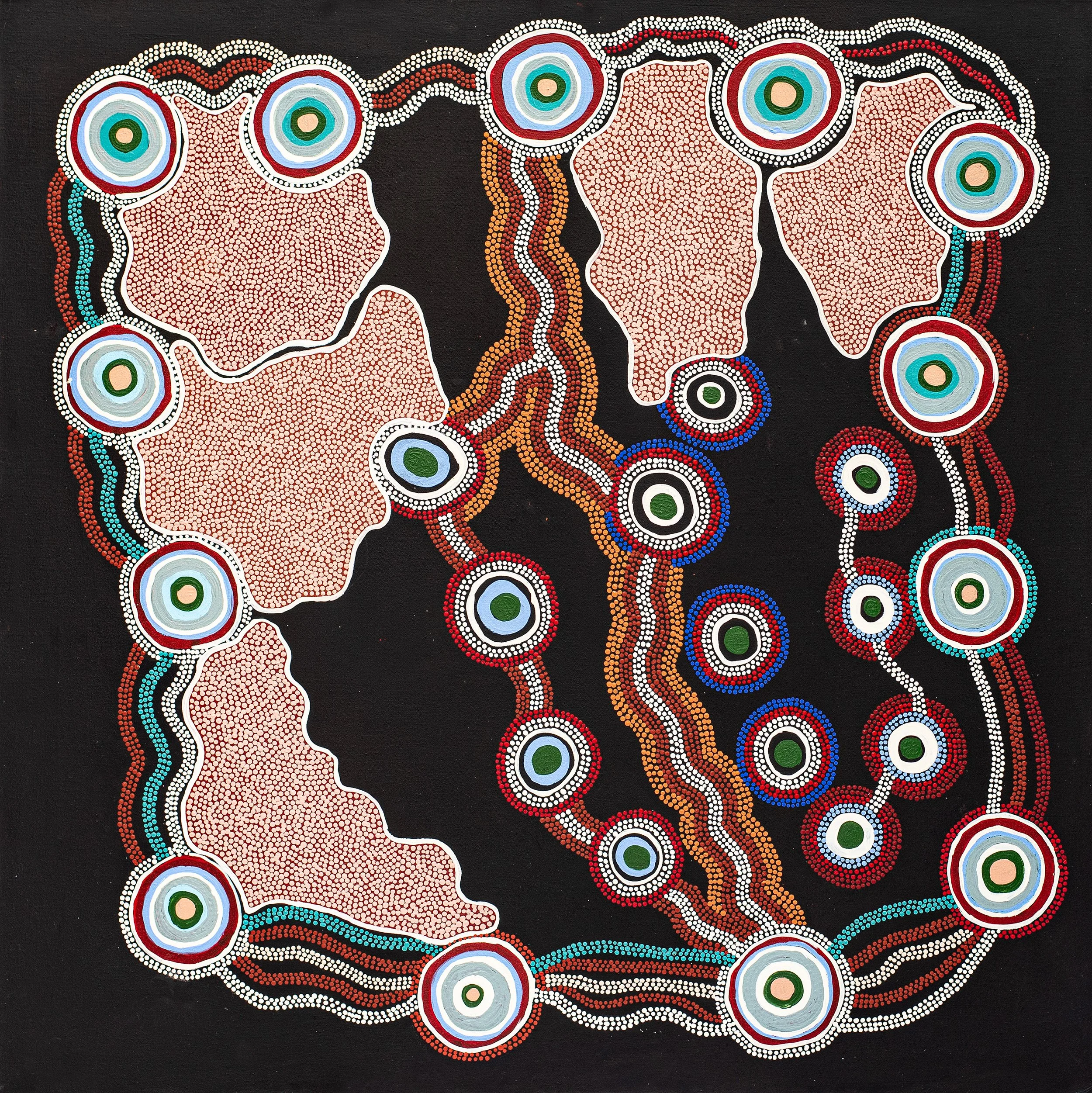
Artiste : Margaret Donegan
Titre de l'œuvre : Wati Kutjara Wanampi
Format : 107 × 91 cm
Provenance et certificat : centre d'art aborigène de Ninuku
Référence de cette peinture : 25-183
Demander le prix de l'œuvre / Enquiry
Explications pour cette œuvre :
Margaret is painting her father, the late Mr. Donegan's tjukurpa (Dreaming story) from an important site known as Pukara, south-west of Irrunytju (Wingellina community) in Western Australia. It is a story of Wati Kutjara Wanampi (two male water serpents) - a father and son - who are living at a waterhole. According to the story, Anangu tjuta (lots of people) went to that rockhole for the kapi (water), which is said to taste sweet. This upset the father and he told them to go back to their own country. Once the people left, the father and son travelled to Willuna, where they camped for weeks. They then return to Pukara. One day they were sleeping, but were awoken by a loud buzzing sound. The Minyma Punpunpa (the female flies) had been attracted to the honey grevillea plants found near the waterhole. It prompted the father and son to get up and go to collect the honey from the plants. It is there that the Wati Mututa (male black ants) appeared. They speared the son in his side. When the son started vomiting, he produced the seeds of all the different varieties of honey grevillea plants that are still found there today. They include kaliny-kalinypa, ultukunpa, piruwa and witjinti.
© Photo : Aboriginal Signature Estrangin gallery with the courtesy of the artists and Ninuku.
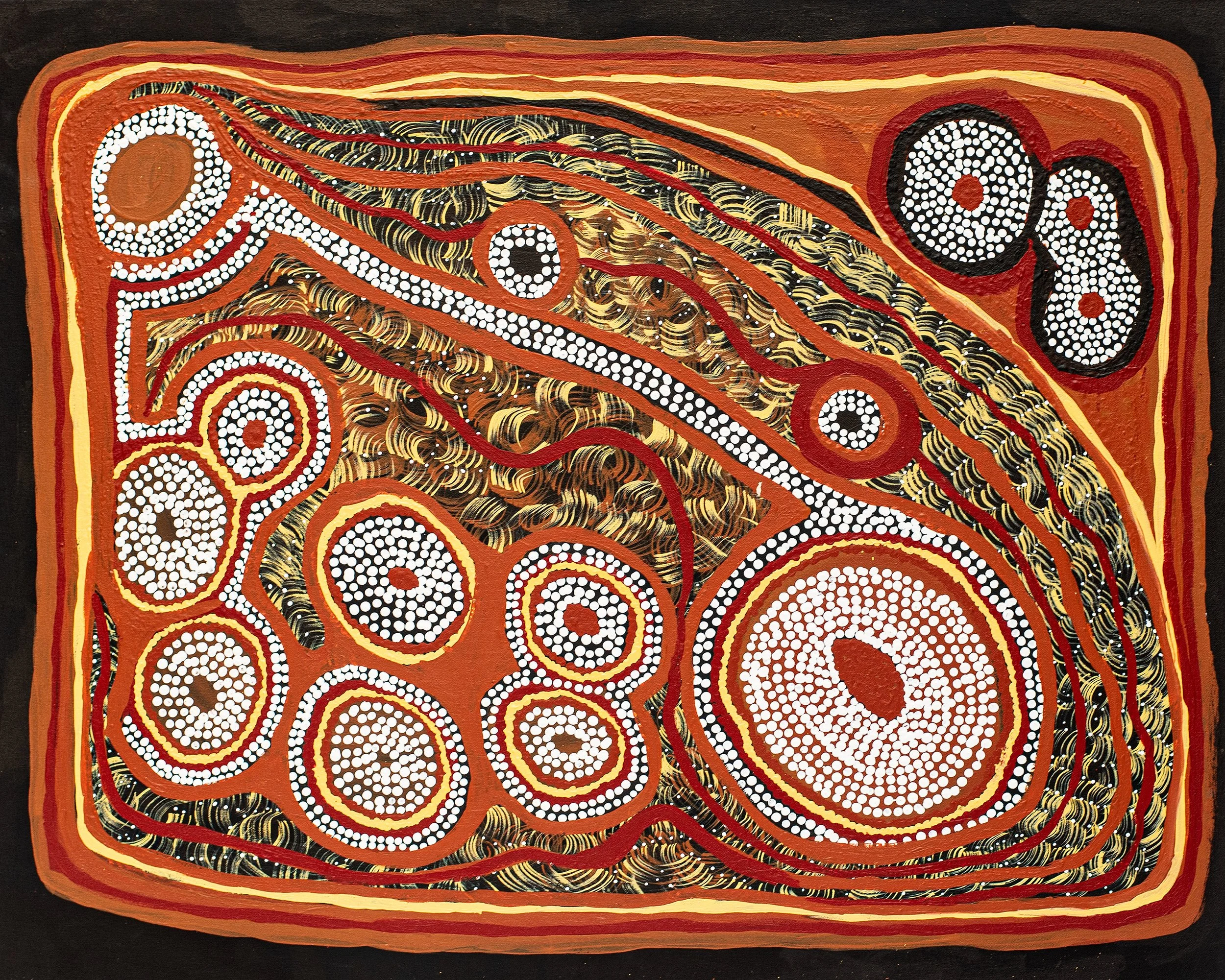
Artiste : Angkaliya Nelson
Titre de l'œuvre : Kungkarangkalpa (Seven Sisters Story)
Format : 92 x 76 cm
Provenance et certificat : centre d'art aborigène de Ninuku
Référence de cette peinture : 25-164
Demander le prix de l'œuvre / Enquiry
Explications pour cette œuvre :
This is a major Tjukurpa for Irrunytju (Wingellina) and across the central Australian deserts. The seven sisters travelled from Kaliwarra to Wannan in Western Australia, stopping at significant sites and rockholes including Kuru Ala, a sacred place for women. They encountered a lustful man named Wati Nyiru, who chased them around the desert. Some of the details of this Tjukurpa (Dreaming story) are sacred and can’t be repeated.
© Photo : Aboriginal Signature Estrangin gallery with the courtesy of the artists and Ninuku.
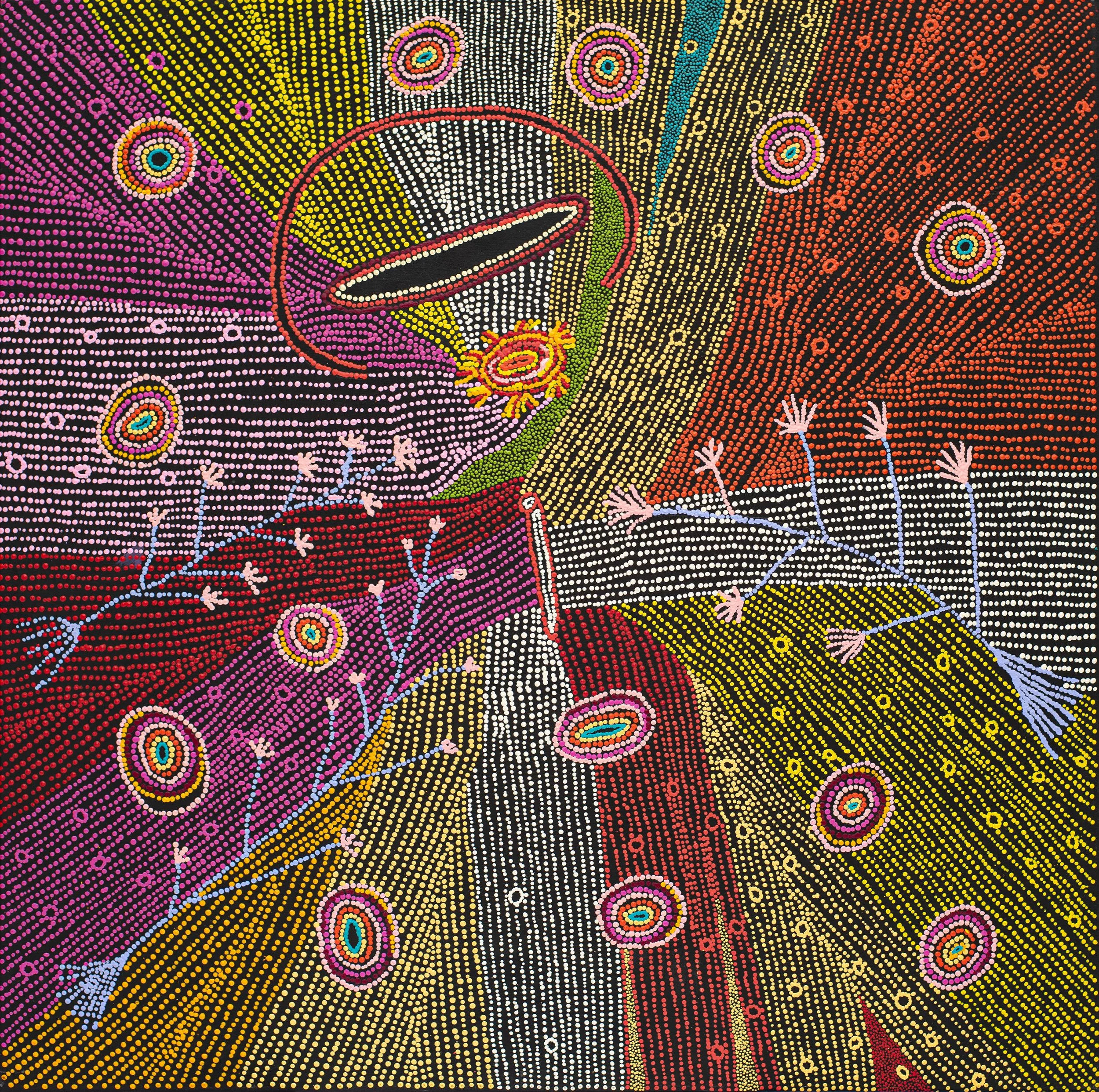
Artiste : Anyupa Nelson
Titre de l'œuvre : Kungkarangkalpa (Seven Sisters Story)
Format : 107 x 107 cm
Provenance et certificat : centre d'art aborigène de Ninuku
Référence de cette peinture : 25-042
Demander le prix de l'œuvre / Enquiry
Explications pour cette œuvre :
This is a major Tjukurpa for Irrunytju (Wingellina) and across the central Australian deserts. The seven sisters travelled from Kaliwarra to Wannan in Western Australia, stopping at significant sites and rockholes including Kuru Ala, a sacred place for women. They encountered a lustful man named Wati Nyiru, who chased them around the desert. Some of the details of this Tjukurpa (Dreaming story) are sacred and can’t be repeated.
© Photo : Aboriginal Signature Estrangin gallery with the courtesy of the artists and Ninuku.
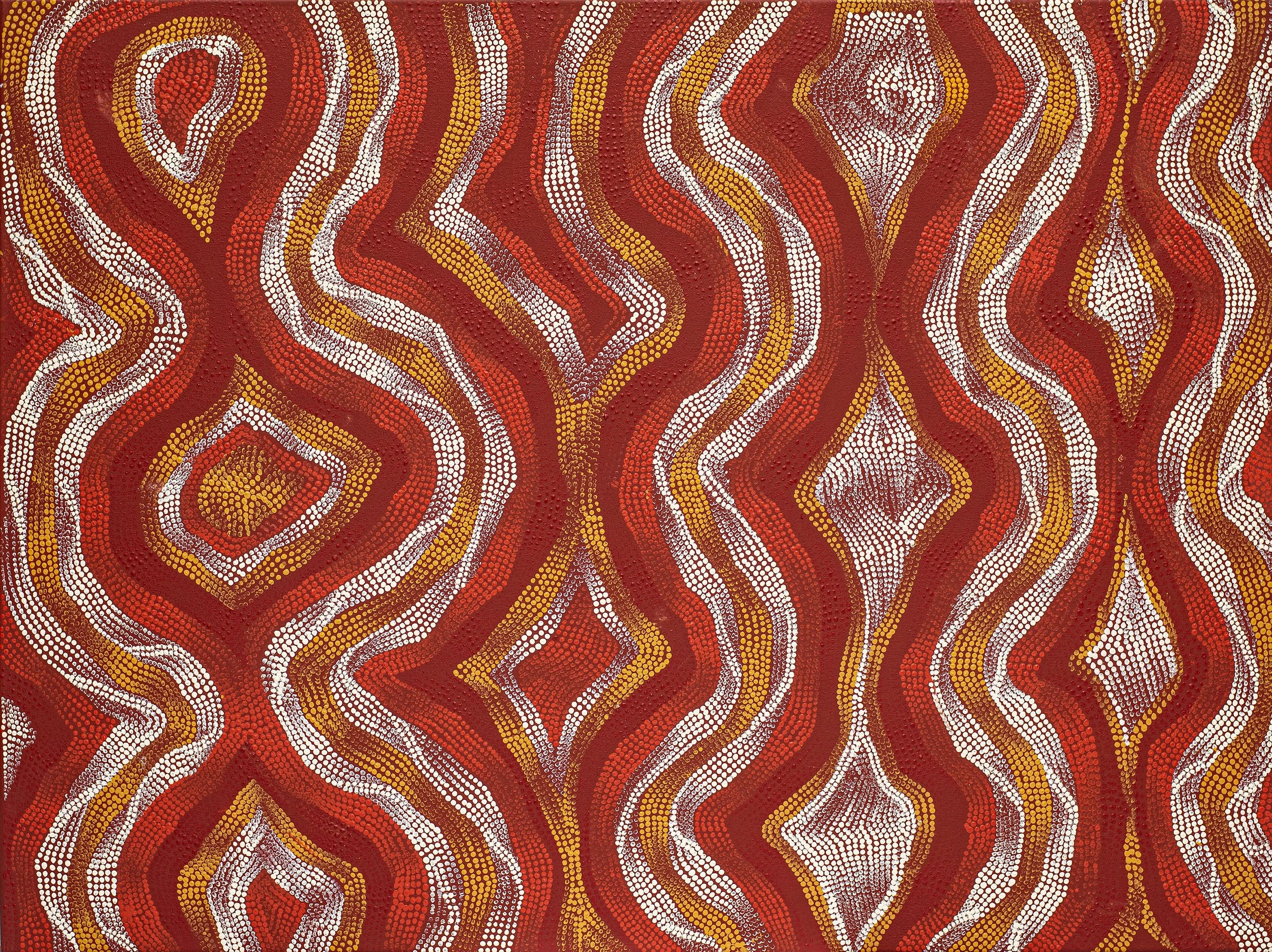
Artiste : Yangi Yangi Fox
Titre de l'œuvre : Wati Ngintaka Tjukurpa
Format : 92 x 92 cm
Provenance et certificat : centre d'art aborigène de Ninuku
Référence de cette peinture : 25-162
Demander le prix de l'œuvre / Enquiry
Explications pour cette œuvre :
This is a story about Wati Ngintaka Tjukurpa (perentie lizard man creation story). That Wati Ngintaka (lizard man) heard the clapping sound of a beautiful grinding stone - a traditional tool used for grinding mai (food). He wanted that stone for himself, so he travelled from Arang’nga a long way east towards Wayatina, looking for the stone. He spotted Anangu tjuta (lots of Aboriginal people) at a camp. Some of the people gave him mai (food) in the form of a seed cake, but it was dry and he didn’t like it. Then one lady gave him delicious food and he knew that it had been made with seeds ground on the special grinding stone. He spied the grinding stone and stole it, hiding it in under his tail. When they all went hunting the next day, Wati Ngintaka stayed in camp, saying he had sore feet. Once they were gone, it was safe and he left, stealing the grinding stone. All the people were angry with the Wati Ngintaka and chased him. When they caught him they felt all over his body to see where he was hiding the grinding stone, but couldn’t find it. Wati Ngintaka held up his arms and claimed he didn’t have it, but they saw he was hiding it, wipungka (in his tail). They speared the Wati Ngintaka and retrieved the grinding stone. He passed away at a place called Aran’nga in the Northern Territory. Ngaltutjara (poor thing).
© Photo : Aboriginal Signature Estrangin gallery with the courtesy of the artists and Ninuku.
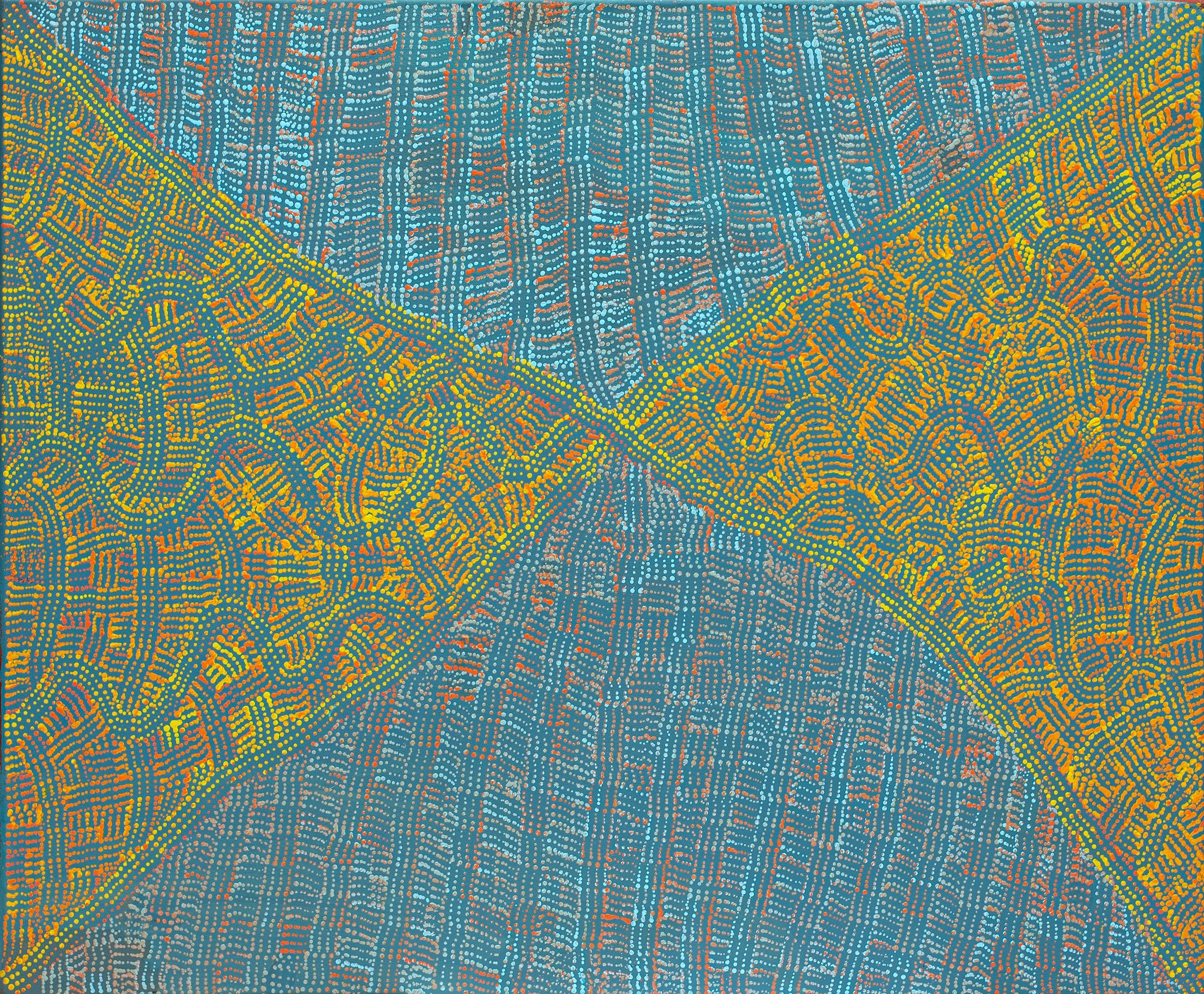
Artiste : Jennifer Mintaya Connelly Ward
Titre de l'œuvre : Kungkarangkalpa (Seven Sisters Story)
Format : 92 x 76 cm
Provenance et certificat : centre d'art aborigène de Ninuku Arts
Référence de cette toile aborigène : 25-182
Demander le prix de l'œuvre / Enquiry
Explications pour cette peinture d'art Aborigène :
This is a major Tjukurpa for Irrunytju (Wingellina) and across the central Australian deserts. The seven sisters travelled from Kaliwarra to Wannan in Western Australia, stopping at significant sites and rockholes including Kuru Ala, a sacred place for women. They encountered a lusul man named Wa Nyiru, who chased them around the desert. Some of the details of this Tjukurpa (Dreaming story) are sacred and can’t be repeated.
Horaires
Vernissage le mercredi 5 avril à partir de 20h à la galerie. RSVP.
Ouverture du mercredi au samedi de 14h30 à 19h durant les expositions.
A d'autres moments sur simple RDV au 00 32 (0) 475 55 08 54.
A la galerie Aboriginal Signature • Estrangin,
101 rue Jules Besme, 1081 Bruxelles.
Métro : Simonis ou Elisabeth
Tel : +32 (0) 475 55 08 54
Mail : info@aboriginalsignature.com
Artiste : Anyupa Nelson
Titre de l'œuvre : Mamu Story
Format : 122 × 122 cm
Provenance et certificat : centre d'art aborigène de Ninuku
Référence de cette peinture : 25-205
Demander le prix de l'œuvre / Enquiry
Explications pour cette œuvre :
Mamu is a rockhole site southwest of Pipalyatjara, about one hour. Alkuwari was travelling with her jamu (grandson) and her grandfather (also called jamu). They made a camp with fire and big wiltja. Alkuwari was worried that her grandson was going to harm her grandfather, and she needed to go hunting. So, she hid her grandfather on top of the wiltja and went. The boy put the waru (fire) inside the wiltja and burned the grandfather. Alkuwari saw the smoke and she ran and ran to the wiltja but the grandfather had died.
The jamu had run away so she went and got all her family to follow him, to kill him. They became the mamu and turned into the seven rockholes of Mamu.
© Photo : Aboriginal Signature Estrangin gallery with the courtesy of the artists and Ninuku.