Exposition d’art Aborigène “Wiltja – Shelter - L’abri” - Aboriginal art from Australia – Iwantja
A la galerie Aboriginal Signature Estrangin : 101 rue Jules Besme, 1081 Bruxelles.
Sur RDV du mercredi 27 Avril au samedi 28 mai 2022.
Vernissage sur RDV le mardi 26 Avril de 11h à 21h30.
Notre galerie vous reçoit sur RDV, du mardi au dimanche, de 11h à 19h : vous pouvez réserver votre visite dans notre agenda ici.

Vue de l’exposition ““Wiltja – Shelter - L’abri” avec les œuvres des artistes Alec Baker (1932) et Angkuna Baker (1934) © Photo : Aboriginal Signature Estrangin Gallery with the courtesy of the artists and Iwantja Art.
Wiltja – Shelter - l’abri
Nous invitons au cœur du désert rouge Australien à la découverte d’un couple légendaire né au début des années 1930.
Le titre de l'exposition sélectionné par les artistes fait référence aux wiltja (des abris montés manuellement) qui furent construits près du ruisseau Iwantja au début de la communauté d'Indulkana, sur le site fondateur de l’hibou indigène (Tjurki Tjukurpa), une histoire fondamentale du Temps du Rêve.

Peinture de l’artiste Alec Baker. Titre ; Ngura (Country) - 198 x 167 cm - Ref : 505-18 © Photo : Aboriginal Signature Estrangin Gallery with the courtesy of the artists and Iwantja Art.
Des aînés et grands initiés comme Alec Baker (1932) et Angkuna Baker (1934) faisaient partie de ceux qui ont créé cette communauté et ont joué un rôle central dans la création de nouveaux bâtiments et services comme le centre d'art et l'école.
L’exposition à Bruxelles rend hommage de façon exceptionnelle à ces deux grands artistes témoins vivants, avec une exposition solo ici en Europe des œuvres de ce couple légendaire.
Celle-ci est accompagnée dans une autre partie de la galerie par une deuxième exposition des peintures de la jeune génération d’Iwantja qui poursuit avec talent et puissance leur œuvre.
Wiltja évoque l'abri, l'ombre, la sécurité et un endroit calme et paisible. Le titre fait également référence à la façon dont le savoir des Aînés d’Iwantja, la culture, le Territoire Ancestral, ont été un abri protecteur au fil du temps et durant les difficiles dernières années de la pandémie de Covid-19.
Iwantja Arts est un centre d'art aborigène détenu et géré par les Aborigènes, dans le pays rocheux et désertique de la communauté d’Indulkana sur les terres Anangu Pitjantjatjara Yankunytjatjara dans le nord-ouest reculé de l'Australie du Sud.
Le centre d'art a été créé au début des années 1980 par les artistes et directeurs Alec Baker et Sadie Singer. Depuis Iwantja Arts soutient le cheminement artistique de ses 40 membres, principalement des artistes Yankunytjatjara, en leur offrant un accès au développement artistique. Iwantja Arts est réputé pour ses projets innovants et culturellement riches avec des résultats prestigieux qui célèbrent la force culturelle et l'excellence artistique du peuple Anangu.
Nous nous réjouissons de vous accueillir très bientôt à la galerie.
Bertrand Estrangin
Directeur de la galerie

Le couple légendaire Alec Baker (1932) et Angkuna Baker (1934) devant leurs œuvres © Photo : Meg Hansen with the courtesy of the artists and Iwantja Art.
Découvrez les peintures disponibles à Bruxelles durant l’exposition :

Artistes : Alec Baker (1932)
Titre de l'œuvre : Ngura (Country)
Format : 152 x 122 cm
Provenance et certificat : centre d'art aborigène d’Iwantja
Référence de cette peinture aborigène : 331-19
Explications pour cette peinture d'art Aborigène :
Alec Baker's paintings and drawings map out the experienced story of his country. Alec draws on ancestry tjukurpa (stories), personal memories, and a rich lifetime spent travelling across vast desert lands as a stock man and cultural law man.
Alec’s detailed works reflects topographic map like imagery, utilising traditional doting techniques and a tactile palette to highlight and define forms and spaces within the landscape, outlining a strong sense of place within Alec's drawings.
"I teach my grandchildren the stories and knowledge about our culture, our land, Yankunytjatjara land. I paint my memories of country, I try to make the paintings strong, holding all the memories and keeping it strong."

Artistes : Alec Baker (1932)
Titre de l'œuvre : Ngura (Country)
Format : 198 x 167 cm
Provenance et certificat : centre d'art aborigène d’Iwantja
Référence de cette peinture aborigène : 505-18
Explications pour cette peinture d'art Aborigène :
Alec Baker's paintings and drawings map out the experienced story of his country. Alec draws on ancestry tjukurpa (stories), personal memories, and a rich lifetime spent travelling across vast desert lands as a stock man and cultural law man.
Alec’s detailed works reflects topographic map like imagery, utilising traditional doting techniques and a tactile palette to highlight and define forms and spaces within the landscape, outlining a strong sense of place within Alec's drawings.
"I teach my grandchildren the stories and knowledge about our culture, our land, Yankunytjatjara land. I paint my memories of country, I try to make the paintings strong, holding all the memories and keeping it strong."

Artistes : Alec Baker (1932)
Titre de l'œuvre : Ngura (Country)
Format : 122 x 91 cm
Provenance et certificat : centre d'art aborigène d’Iwantja
Référence de cette peinture aborigène : 372-19
Explications pour cette peinture d'art Aborigène :
Alec Baker's paintings and drawings map out the experienced story of his country. Alec draws on ancestry tjukurpa (stories), personal memories, and a rich lifetime spent travelling across vast desert lands as a stock man and cultural law man.
Alec’s detailed works reflects topographic map like imagery, utilising traditional doting techniques and a tactile palette to highlight and define forms and spaces within the landscape, outlining a strong sense of place within Alec's drawings.
"I teach my grandchildren the stories and knowledge about our culture, our land, Yankunytjatjara land. I paint my memories of country, I try to make the paintings strong, holding all the memories and keeping it strong."

Artistes : Alec Baker (1932)
Titre de l'œuvre : Ngura (Country)
Format : 122 x 91 cm
Provenance et certificat : centre d'art aborigène d’Iwantja
Référence de cette peinture aborigène : 450-19
Explications pour cette peinture d'art Aborigène :
Alec Baker's paintings and drawings map out the experienced story of his country. Alec draws on ancestry tjukurpa (stories), personal memories, and a rich lifetime spent travelling across vast desert lands as a stock man and cultural law man.
Alec’s detailed works reflects topographic map like imagery, utilising traditional doting techniques and a tactile palette to highlight and define forms and spaces within the landscape, outlining a strong sense of place within Alec's drawings.
"I teach my grandchildren the stories and knowledge about our culture, our land, Yankunytjatjara land. I paint my memories of country, I try to make the paintings strong, holding all the memories and keeping it strong."

Artistes : Alec Baker (1932)
Titre de l'œuvre : Ngura (Country)
Format : 122 x 91 cm
Provenance et certificat : centre d'art aborigène d’Iwantja
Référence de cette peinture aborigène : 464-19
Explications pour cette peinture d'art Aborigène :
Alec Baker's paintings and drawings map out the experienced story of his country. Alec draws on ancestry tjukurpa (stories), personal memories, and a rich lifetime spent travelling across vast desert lands as a stock man and cultural law man.
Alec’s detailed works reflects topographic map like imagery, utilising traditional doting techniques and a tactile palette to highlight and define forms and spaces within the landscape, outlining a strong sense of place within Alec's drawings.
"I teach my grandchildren the stories and knowledge about our culture, our land, Yankunytjatjara land. I paint my memories of country, I try to make the paintings strong, holding all the memories and keeping it strong."

Artistes : Alec Baker (1932)
Titre de l'œuvre : Ngura (Country)
Format : 122 x 91 cm
Provenance et certificat : centre d'art aborigène d’Iwantja
Référence de cette peinture aborigène : 636-19
Explications pour cette peinture d'art Aborigène :
Alec Baker's paintings and drawings map out the experienced story of his country. Alec draws on ancestry tjukurpa (stories), personal memories, and a rich lifetime spent travelling across vast desert lands as a stock man and cultural law man.
Alec’s detailed works reflects topographic map like imagery, utilising traditional doting techniques and a tactile palette to highlight and define forms and spaces within the landscape, outlining a strong sense of place within Alec's drawings.
"I teach my grandchildren the stories and knowledge about our culture, our land, Yankunytjatjara land. I paint my memories of country, I try to make the paintings strong, holding all the memories and keeping it strong."

Artistes : Alec Baker (1932)
Titre de l'œuvre : Ngura (Country)
Format : 152 x 122 cm
Provenance et certificat : centre d'art aborigène d’Iwantja
Référence de cette peinture aborigène : 541-19
Explications pour cette peinture d'art Aborigène :
Alec Baker's paintings and drawings map out the experienced story of his country. Alec draws on ancestry tjukurpa (stories), personal memories, and a rich lifetime spent travelling across vast desert lands as a stock man and cultural law man.
Alec’s detailed works reflects topographic map like imagery, utilising traditional doting techniques and a tactile palette to highlight and define forms and spaces within the landscape, outlining a strong sense of place within Alec's drawings.
"I teach my grandchildren the stories and knowledge about our culture, our land, Yankunytjatjara land. I paint my memories of country, I try to make the paintings strong, holding all the memories and keeping it strong."

Artistes : Angkuna Baker (1934)
Titre de l'œuvre : Areyonga
Format : 76 x 51 cm
Provenance et certificat : centre d'art aborigène d’Iwantja
Référence de cette peinture aborigène : 364-20
Explications pour cette peinture d'art Aborigène :
Angkuna paints her powerful country Areyonga, nestled between mountainous terrains which back the West MacDonnell Ranges. The community is surrounded by picturesque waterholes and soakages, and is abundant with native wildlife. Angkuna was born in the bush at a special women’s country site, which has strong ties to the Seven Sisters songline.
Angkuna spent many hours learning inma (traditional songs and dances) from the older people in her community. Living in wiltja’s (hand built shelters) close to missions and cattle stations, friends and family constantly surrounded Angkuna; she recalls her childhood loaded with memories of exploration and adventure. When she was a young women she started the first school at the Indulkana community.
“When I was young there were lots of kids near Areyonga; our games were in the bush, climbing hills and looking for good swimming. We had a lot of friends and family when we moved to the Iwantja Tjukitji (soakage), we were living next to the lovely creek in a wiltja. There was no school then, but we made a big humpie and inside I was teaching chi chi’s (children.) This was the first school at Indulkana.”
Angkuna’s paintings are highly considered in their content and storytelling of old stories and songs which were passed down to her as a young child, combined with her personal memories. Angkuna uses the canvas as a means to communicate her lived experiences of Anangu culture and tjukurpa (stories) with the viewing public.
Iwantja Arts is an artist studio located within the remote Indigenous community of Indulkana, on the Anangu Pitjantjatjara Yankunytjatjara (APY) Lands. Iwantja Arts is an Aboriginal corporation owned and governed by a board of directors. The art centre aims to encourage and support artistic excellence and cultural development within the community by providing opportunities, career development, and economic independence for practicing artists.

Artistes : Rene Sundown (1952)
Titre de l'œuvre : Amarouna
Format : 152 x 122 cm
Provenance et certificat : centre d'art aborigène d’Iwantja
Référence de cette peinture aborigène : 192-21
Explications pour cette peinture d'art Aborigène :
Rene was born in the bush land that surrounds Mt Ebenezer. Rene and her two older brothers were raised in the bush by her mother while her father worked as a stockman between Mt Ebenezer Station and Erldunda Station, which are both located along the Lasseter Hwy towards Uluru.
“When the rain would come we used to go hunting for rabbit and malu (kangaroo) with my father. He was always catching goanna and echidnas; we used to pull out all the sharp ends and cook them on the fire. They were my favourite, very tasty! A salty creek used to run near to Erldunda Station and me and my brothers always wanted to be swimming there. When I was little my grandfather would sometimes take all of us children on the train to Titjikala. We always had a fun time then looking out the window.”
“I live at the Homelands now with my husband Hewey Cullinan. It’s a little bit away from Indulkana, so it’s quieter there, we enjoy watering the plants and living in the country, it’s a good place, Hewey is a good man. It's important to teach our children on these lands, then we can remember this place and where we come from.
Rene began painting at Iwantja Arts in the year 2000, painting memories of the long walks she would take along the sandhills and the salty river water near Erldunda Station that she played in as a child. Her paintings use a simple colour palette and gain complexity through her confident brush marks and intriguing iconography. Rene’s paintings evoke images of desert grasses, hidden pathways and sun-cracked riverbeds.
Iwantja Arts is an artist studio located within the remote Indigenous community of Indulkana, on the Anangu Pitjantjatjara Yankunytjatjara (APY) Lands. Iwantja Arts is an Aboriginal corporation owned and governed by a self elected board of directors. The art centre aims to encourage and support artistic excellence and cultural development within the community by providing opportunities, career development, and financial independence for practicing artists.

Artistes : Angkuna Baker (1934)
Titre de l'œuvre : Areyonga
Format : 91 x 67 cm
Provenance et certificat : centre d'art aborigène d’Iwantja
Référence de cette peinture aborigène : 830-21
Explications pour cette peinture d'art Aborigène :
Angkuna paints her powerful country Areyonga, nestled between mountainous terrains which back the West MacDonnell Ranges. The community is surrounded by picturesque waterholes and soakages, and is abundant with native wildlife. Angkuna was born in the bush at a special women’s country site, which has strong ties to the Seven Sisters songline.
Angkuna spent many hours learning inma (traditional songs and dances) from the older people in her community. Living in wiltja’s (hand built shelters) close to missions and cattle stations, friends and family constantly surrounded Angkuna; she recalls her childhood loaded with memories of exploration and adventure. When she was a young women she started the first school at the Indulkana community.
“When I was young there were lots of kids near Areyonga; our games were in the bush, climbing hills and looking for good swimming. We had a lot of friends and family when we moved to the Iwantja Tjukitji (soakage), we were living next to the lovely creek in a wiltja. There was no school then, but we made a big humpie and inside I was teaching chi chi’s (children.) This was the first school at Indulkana.”
Angkuna’s paintings are highly considered in their content and storytelling of old stories and songs which were passed down to her as a young child, combined with her personal memories. Angkuna uses the canvas as a means to communicate her lived experiences of Anangu culture and tjukurpa (stories) with the viewing public.
Iwantja Arts is an artist studio located within the remote Indigenous community of Indulkana, on the Anangu Pitjantjatjara Yankunytjatjara (APY) Lands. Iwantja Arts is an Aboriginal corporation owned and governed by a board of directors. The art centre aims to encourage and support artistic excellence and cultural development within the community by providing opportunities, career development, and economic independence for practicing artists.

Artistes : Rene Sundown (1952)
Titre de l'œuvre : Amarouna
Format : 122 x 91 cm
Provenance et certificat : centre d'art aborigène d’Iwantja
Référence de cette peinture aborigène : 278-21
Explications pour cette peinture d'art Aborigène :
Rene was born in the bush land that surrounds Mt Ebenezer. Rene and her two older brothers were raised in the bush by her mother while her father worked as a stockman between Mt Ebenezer Station and Erldunda Station, which are both located along the Lasseter Hwy towards Uluru.
“When the rain would come we used to go hunting for rabbit and malu (kangaroo) with my father. He was always catching goanna and echidnas; we used to pull out all the sharp ends and cook them on the fire. They were my favourite, very tasty! A salty creek used to run near to Erldunda Station and me and my brothers always wanted to be swimming there. When I was little my grandfather would sometimes take all of us children on the train to Titjikala. We always had a fun time then looking out the window.”
“I live at the Homelands now with my husband Hewey Cullinan. It’s a little bit away from Indulkana, so it’s quieter there, we enjoy watering the plants and living in the country, it’s a good place, Hewey is a good man. It's important to teach our children on these lands, then we can remember this place and where we come from.
Rene began painting at Iwantja Arts in the year 2000, painting memories of the long walks she would take along the sandhills and the salty river water near Erldunda Station that she played in as a child. Her paintings use a simple colour palette and gain complexity through her confident brush marks and intriguing iconography. Rene’s paintings evoke images of desert grasses, hidden pathways and sun-cracked riverbeds.
Iwantja Arts is an artist studio located within the remote Indigenous community of Indulkana, on the Anangu Pitjantjatjara Yankunytjatjara (APY) Lands. Iwantja Arts is an Aboriginal corporation owned and governed by a self elected board of directors. The art centre aims to encourage and support artistic excellence and cultural development within the community by providing opportunities, career development, and financial independence for practicing artists.

Artistes : Judith Walkabout (1982)
Titre de l'œuvre : Iwantja Springs
Format : 152 x 122 cm
Provenance et certificat : centre d'art aborigène d’Iwantja
Référence de cette peinture aborigène : 573-21
Explications pour cette peinture d'art Aborigène :
Judith's paintings capture the beauty and movement of the Iwantja Springs found in the heart of the majestic Indulkana Ranges, that lay just behind the community.
After heavy rains the deep tjukula (rockhole,) fills with fresh water, forging streams along the dry Iwantja creek bed. The dense bush-land in the area comes to life shooting up new seedlings and bringing plants to flower.
Judith's paintings capture this joyous and peaceful place, her artworks are evocative of the plant life and tangled scrub that secludes the Iwantja Springs, it is a place of tranquil vitality.

Artistes : Nellie Ngampa Coulthard (1947)
Titre de l'œuvre : Tjuntala Ngurangka (Country with Acacia Wattle)
Format : 198 x 198 cm
Provenance et certificat : centre d'art aborigène d’Iwantja
Référence de cette peinture aborigène : 679-21
Explications pour cette peinture d'art Aborigène :
"I was born near the Wintinna Homestead close to Oodnadatta. When I was young my family and I would walk everywhere. That’s how I know this country so well. My paintings are about my beautiful country that I grew up on and the Tjuntala (native Acacia Wattle) that grows there.
Tjuntula grows everywhere near Oodnadatta and the far east of Indulkana. The flowers are bright yellow and are very beautiful. When the flowers come out, it is my favourite time of year, they are so special. The flowers are sweet to taste, my parents taught me how to grind the Tjuntala flowers with a little sand and ashes into a paste to eat, it’s very sweet and delicious!"

Artistes : Judith Walkabout (1982)
Titre de l'œuvre : Iwantja Springs
Format : 152 x 122 cm
Provenance et certificat : centre d'art aborigène d’Iwantja
Référence de cette peinture aborigène : 695-21
Explications pour cette peinture d'art Aborigène :
Judith's paintings capture the beauty and movement of the Iwantja Springs found in the heart of the majestic Indulkana Ranges, that lay just behind the community.
After heavy rains the deep tjukula (rockhole,) fills with fresh water, forging streams along the dry Iwantja creek bed. The dense bush-land in the area comes to life shooting up new seedlings and bringing plants to flower.
Judith's paintings capture this joyous and peaceful place, her artworks are evocative of the plant life and tangled scrub that secludes the Iwantja Springs, it is a place of tranquil vitality.

Artistes : Betty Chimney (1957)
Titre de l'œuvre : Ngayuku Ngura (My Country)
Format : 198 x 167 cm
Provenance et certificat : centre d'art aborigène d’Iwantja
Référence de cette peinture aborigène : 680-21
Explications pour cette peinture d'art Aborigène :
Betty Chimney's paintings are evocative of the vast and rugged desert country of Indulkana on the Eastern side of the Anangu Pitjantjatjara Yankunytjatjara (APY) Lands.
The country here is expansive, dotted with small shrubs and carpeted in clusters of rocks and pebbles.
Betty spent many years living near to Iwantja Creek at the newly established Indulkana community. As all of the members of Betty's family had passed away, she was raised by Alec Bakers father, a senior law man for the region.
In her striking paintings, Betty marks out the rugged and stoic country of Indulkana. She maps out the creeks, roads, rocks and dry creek-beds, highlighting changes in the landscapes through colour shifts.
Capturing beauty in the sparsity of shapes and tones, Betty's paintings reveal the true essence of Yankunytjatjara desert country.

Artistes : Women collaborative
Titre de l'œuvre : Ngura (Country)
Format : 244 x 198 cm
Provenance et certificat : centre d'art aborigène d’Iwantja
Référence de cette peinture aborigène : 749-21
Explications pour cette peinture d'art Aborigène :
Five artists from Iwantja art (Priscilla Singer, Rosalind Tjanyari, Yatjiki Cullinan, Raylene Walatinna and Daisy Barney), realized this large collaborative artwork stressing their respect to the country.

Artistes : Julie Yatjitja (1969)
Titre de l'œuvre : Iwantja Tjukitji (Iwantja Soakage)
Format : 122 x 91 cm
Provenance et certificat : centre d'art aborigène d’Iwantja
Référence de cette peinture aborigène : 787-21
Explications pour cette peinture d'art Aborigène :
Julie’s paintings shimmer with exuberant energy. She captures the intensity and power of country where the Iwantja Tjukitji (Iwantja Soakage) is located, and which holds the story of the Tjurki (native owl.)
Julie was born in the cool waters of the Iwantja creek, next to the large Tjukitji. The area is shaded by large gum trees, and the banks of the creek nestle close to large boulders. As a child she and her family lived here in a hand-built wiltja (shelter).
Yankunytjatjara families played in the creek waters and drank from the soakage. The water gave vitality and life to the area, and provided a cool place for the families to live during the hot summers.
This special Tjukitji is where the Indulkana community first began. This place also holds the tjukurpa of the Tjurki who travelled across the desert and came to live in a large gum tree by the creek, to watch over the Anangu and keep them safe.

Artistes : Maisie King (1932)
Titre de l'œuvre : Ngayuku Ngura (My Country)
Format : 91 x 67 cm
Provenance et certificat : centre d'art aborigène d’Iwantja
Référence de cette peinture aborigène : 801-21
Explications pour cette peinture d'art Aborigène :
“This is my artwork, this is Oodnadatta country. This is where I was born. The country there is beautiful and very good. The land is very old and the stories there are strong. This is Yankunytjatjara country.”
Maisie Kings paintings map out the boulders and rocky terrain of the Oodnadatta country east of Indulkana in Yankunytjatjara country. Her linear forms take on sculptural elements as she marks out the large boulders and the rockholes and springs surrounding the country. Painting out an inky background, she lays down thin painterly lines in luminous colours that glow off a deep background.

Artistes : Julie Yatjitja (1969)
Titre de l'œuvre : Iwantja Tjukitji (Iwantja Soakage)
Format : 91 x 67 cm
Provenance et certificat : centre d'art aborigène d’Iwantja
Référence de cette peinture aborigène : 809-21
Explications pour cette peinture d'art Aborigène :
Julie’s paintings shimmer with exuberant energy. She captures the intensity and power of country where the Iwantja Tjukitji (Iwantja Soakage) is located, and which holds the story of the Tjurki (native owl.)
Julie was born in the cool waters of the Iwantja creek, next to the large Tjukitji. The area is shaded by large gum trees, and the banks of the creek nestle close to large boulders. As a child she and her family lived here in a hand-built wiltja (shelter).
Yankunytjatjara families played in the creek waters and drank from the soakage. The water gave vitality and life to the area, and provided a cool place for the families to live during the hot summers.
This special Tjukitji is where the Indulkana community first began. This place also holds the tjukurpa of the Tjurki who travelled across the desert and came to live in a large gum tree by the creek, to watch over the Anangu and keep them safe.

Artistes : Maisie King (1932)
Titre de l'œuvre : Ngayuku Ngura (My Country)
Format : 91 x 67 cm
Provenance et certificat : centre d'art aborigène d’Iwantja
Référence de cette peinture aborigène : 802-21
Explications pour cette peinture d'art Aborigène :
“This is my artwork, this is Oodnadatta country. This is where I was born. The country there is beautiful and very good. The land is very old and the stories there are strong. This is Yankunytjatjara country.”
Maisie Kings paintings map out the boulders and rocky terrain of the Oodnadatta country east of Indulkana in Yankunytjatjara country. Her linear forms take on sculptural elements as she marks out the large boulders and the rockholes and springs surrounding the country. Painting out an inky background, she lays down thin painterly lines in luminous colours that glow off a deep background.

Artistes : Priscilla Singer (1968)
Titre de l'œuvre : Ngura (Country)
Format : 152 x 122 cm
Provenance et certificat : centre d'art aborigène d’Iwantja
Référence de cette peinture aborigène : 817-21
Explications pour cette peinture d'art Aborigène :
In Pitjantjatjara language, the word Ngura is a definition for the physical geography of land and country. However Ngura also has a more richly embedded meaning as a place to which someone belongs; defining where an individual comes from, their family connections, skin groups, and language.
Paintings of Ngura often portray personal stories and memories of country that is significant to the artist. Iconography of georgaphic elements within the desert landscape; such as rock holes, underground springs, mountain and rock formations, and sacred sites are meticulously recorded from memory and often depicted from an aerial perspective.
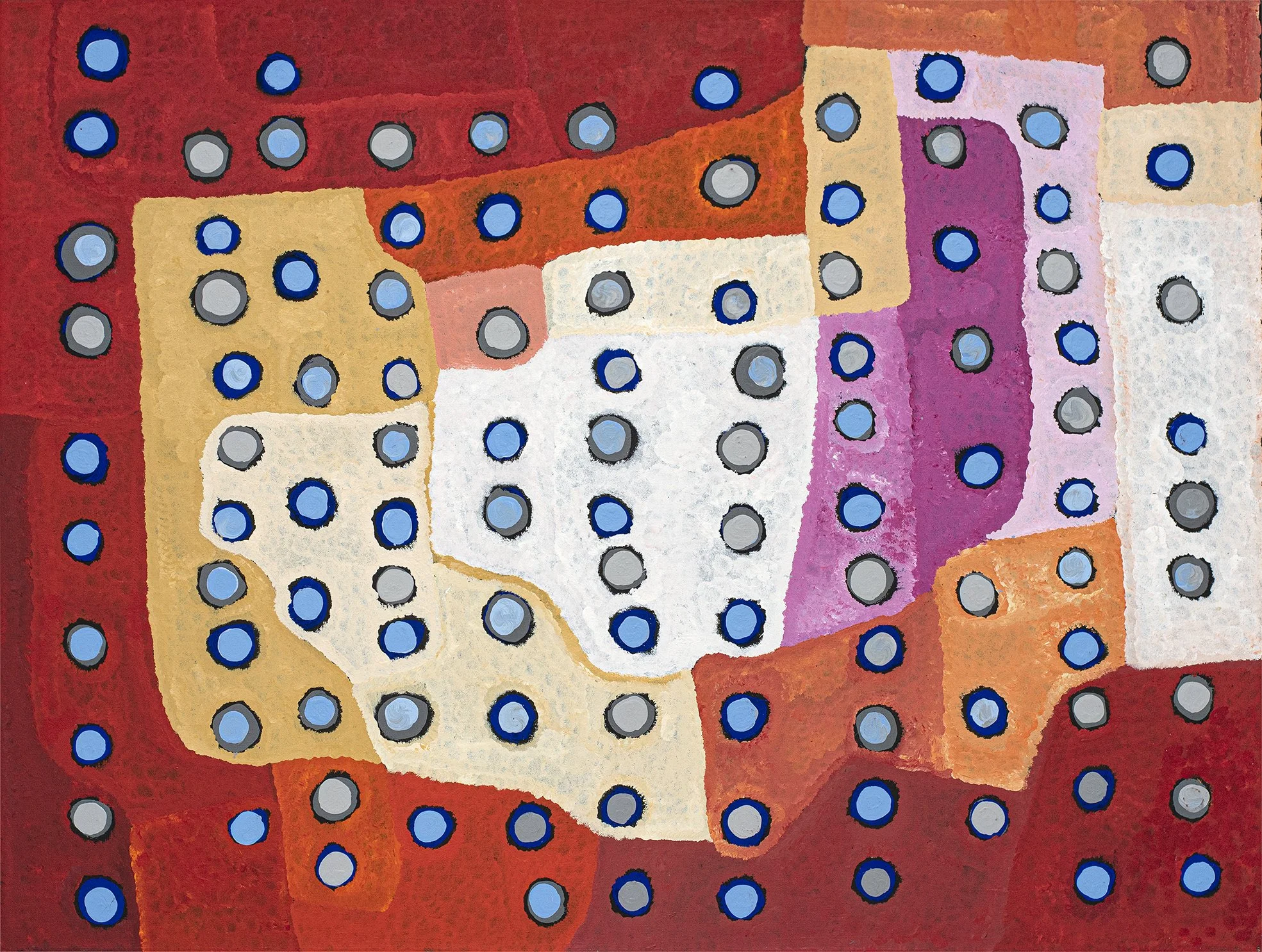
Artistes : Eric (Mungi) Barney (1973)
Titre de l'œuvre : Ngura (Country)
Format : 122 x 91 cm
Provenance et certificat : centre d'art aborigène d’Iwantja
Référence de cette peinture aborigène : 437-21
Explications pour cette peinture d'art Aborigène :
In Eric Barney’s paintings of Yankunytjatjara Country, mark-making is a form of mapping. Barney defines the terrain of his country by carving out sections of colour, the paint energetically applied to the canvas with a sense of rhythm and purpose. Barney interprets the rocky desert country around Indulkana Community through colour, tone and form. His powerfully understated paintings depict Tjukula (rock-holes), and the knowledge of these vitally important water sources that have sustained Anangu for generations.

Artistes : Rosalind Tjanyari (1971)
Titre de l'œuvre : Ngura Kuuti (Spirit Country)
Format : 122 x 91 cm
Provenance et certificat : centre d'art aborigène d’Iwantja
Référence de cette peinture aborigène : 849-21
Explications pour cette peinture d'art Aborigène :
Both Rosalind’s mother and grandmother were famous Ngangkari’s (traditional healers) in the western country of the APY Lands, she has many family members in the Amata community. Rosalind spent a life time outdoors with her mother and grandmother traveling to visit family and friends in need of healing.
Rosalind's' paintings allude to a healing energy and strive to encompass the desert landscape. Her artworks speak to a deep history of connection to both country and people. Richly coloured, her paintings reference hidden pathways across the lands, and subtly hint at the fluidity of movement and of journeys. Her painterly marks weave colour through the canvas, flickering with an energy and excitement.

Artistes : Alec Baker (1932) and Eric Barney
Titre de l'œuvre : Ngura (Country)
Format : 167 x 101 cm
Provenance et certificat : centre d'art aborigène d’Iwantja
Référence de cette peinture aborigène : 100-21
Explications pour cette peinture d'art Aborigène :
Collaborative painting by senior Law-man Alec Baker and younger artist Eric Barney
Baker says:
“I painted this together with this youngfella here – Barney. That’s one way that we teach our younger people, by sitting down painting together and talking and singing our stories. I always paint my country; kalaya tjina (emu tracks), tjukula (rock-holes), minyma (women) travelling. My country has a lot of story, a lot of history.”
Barney adds:
“Alec and the other old men taught me about riding horses, they taught me and continue to teach me about Law, they also teach me about painting. I’m proud to be painting Yankunytjatjara country together with this old man Alec.”

Artistes : Eric (Mungi) Barney (1973)
Titre de l'œuvre : Ngura (Country)
Format : 76 x 61 cm
Provenance et certificat : centre d'art aborigène d’Iwantja
Référence de cette peinture aborigène : 769-21
Explications pour cette peinture d'art Aborigène :
In Eric Barney’s paintings of Yankunytjatjara Country, mark-making is a form of mapping. Barney defines the terrain of his country by carving out sections of colour, the paint energetically applied to the canvas with a sense of rhythm and purpose. Barney interprets the rocky desert country around Indulkana Community through colour, tone and form. His powerfully understated paintings depict Tjukula (rock-holes), and the knowledge of these vitally important water sources that have sustained Anangu for generations.

Artistes : Emily Cullinan (1952)
Titre de l'œuvre : Ananyi Ngura (Traveling Country)
Format : 91 x 67 cm
Provenance et certificat : centre d'art aborigène d’Iwantja
Référence de cette peinture aborigène : 765-21
Explications pour cette peinture d'art Aborigène :
Emily was born in rugged bush land, close to the Eastern APY community of Mimili. Her father was a respected cultural law man, and taught her and her two young sisters to live a traditional life. Emily did not encounter European settlers until she was a teenager.
Emily and her family used to travel long distances by walking or occasionally hitching wagons to camels and donkeys, they would camp at night inside hand built wiltjas (shelters) in the bush, sleeping in the warm sand.
The walk between Indulkana and Mimili regions took her 5 days, she recalls traveling this route many times to visit family. Emily’s powerful paintings depict the iconic waterholes, majestic boulders, and river beds she would cross on her journey.

Artistes : Emily Cullinan (1952)
Titre de l'œuvre : Ananyi Ngura (Traveling Country)
Format : 91 x 67 cm
Provenance et certificat : centre d'art aborigène d’Iwantja
Référence de cette peinture aborigène : 778-21
Explications pour cette peinture d'art Aborigène :
Emily was born in rugged bush land, close to the Eastern APY community of Mimili. Her father was a respected cultural law man, and taught her and her two young sisters to live a traditional life. Emily did not encounter European settlers until she was a teenager.
Emily and her family used to travel long distances by walking or occasionally hitching wagons to camels and donkeys, they would camp at night inside hand built wiltjas (shelters) in the bush, sleeping in the warm sand.
The walk between Indulkana and Mimili regions took her 5 days, she recalls traveling this route many times to visit family. Emily’s powerful paintings depict the iconic waterholes, majestic boulders, and river beds she would cross on her journey.

Artistes : Rosalind Tjanyari (1971)
Titre de l'œuvre : Ngura Kuuti (Spirit Country)
Format : 91 x 67 cm
Provenance et certificat : centre d'art aborigène d’Iwantja
Référence de cette peinture aborigène : 773-21
Explications pour cette peinture d'art Aborigène :
Both Rosalind’s mother and grandmother were famous Ngangkari’s (traditional healers) in the western country of the APY Lands, she has many family members in the Amata community. Rosalind spent a life time outdoors with her mother and grandmother traveling to visit family and friends in need of healing.
Rosalind's' paintings allude to a healing energy and strive to encompass the desert landscape. Her artworks speak to a deep history of connection to both country and people. Richly coloured, her paintings reference hidden pathways across the lands, and subtly hint at the fluidity of movement and of journeys. Her painterly marks weave colour through the canvas, flickering with an energy and excitement.

Artistes : Priscilla Singer (1968)
Titre de l'œuvre : Ngura (Country)
Format : 152 x 122 cm
Provenance et certificat : centre d'art aborigène d’Iwantja
Référence de cette peinture aborigène : 67-22
Explications pour cette peinture d'art Aborigène :
In Pitjantjatjara language, the word Ngura is a definition for the physical geography of land and country. However Ngura also has a more richly embedded meaning as a place to which someone belongs; defining where an individual comes from, their family connections, skin groups, and language.
Paintings of Ngura often portray personal stories and memories of country that is significant to the artist. Iconography of georgaphic elements within the desert landscape; such as rock holes, underground springs, mountain and rock formations, and sacred sites are meticulously recorded from memory and often depicted from an aerial perspective.
Artistes : Alec Baker (1932)
Titre de l'œuvre : Ngura (Country)
Format : 198 x 152 cm
Provenance et certificat : centre d'art aborigène d’Iwantja
Référence de cette peinture aborigène : 350-19
Demander le prix de l'œuvre
Explications pour cette peinture d'art Aborigène :
Alec Baker's paintings and drawings map out the experienced story of his country. Alec draws on ancestry tjukurpa (stories), personal memories, and a rich lifetime spent travelling across vast desert lands as a stock man and cultural law man.
Alec’s detailed works reflects topographic map like imagery, utilising traditional doting techniques and a tactile palette to highlight and define forms and spaces within the landscape, outlining a strong sense of place within Alec's drawings.
"I teach my grandchildren the stories and knowledge about our culture, our land, Yankunytjatjara land. I paint my memories of country, I try to make the paintings strong, holding all the memories and keeping it strong."