
Exposition d’art Aborigène “Itjanu - Resplendissant” - Aboriginal art from Australia – Mimili Maku
A la galerie Aboriginal Signature Estrangin : 101 rue Jules Besme, 1081 Bruxelles.
Vernissage sur RDV le mercredi 12 avril 2023 de 11h à 21h30.
Visites sur RDV ensuite du jeudi 13 avril au samedi 13 mai 2023.
Notre galerie est ouverte à tous et vous reçoit sur RDV du mardi au samedi, de 11h à 19h.
Nous nous réjouissons de vous y accueillir et vous invitons à réserver votre visite dans notre agenda ici.

Les artistes Betty Campbell et Umatji Tjapalyi à côté de leur œuvre collaborative, réalisée à Mimili Maku Arts dans le Everard Ranges, au nord du grand désert du Victoria Australien.
© Photo with the courtesy of Mimili Maku
Itjanu - une saison florissante
L'exposition Itjanu souligne une saison florissante du bush australien, où la nature prospère et la vie éclot. Cette même vivacité se reflète dans les œuvres d'art présentées qui célèbrent les artistes émergents aux côtés des artistes établis de Mimili Maku comme l’impressionnante Tuppy Goodwin.
Dans le désert rouge d'Australie, le printemps est une période à couper le souffle. Le paysage se transforme en une œuvre d'art vibrante et colorée alors que les fleurs sauvages éclosent et que le terrain aride devient une toile de vie. C'est une période de renouveau et d'espoir, où la rudesse du désert cède la place à une saison nouvelle, vibrante et belle.
la beauté du désert
Les artistes de Mimili s'éveillent en même temps que la terre. Les œuvres exposées capturent l'essence de la saison, avec de nouvelles voix qui s'élèvent aux côtés des artistes confirmés, offrant chacun une perspective unique et distinctive sur la beauté du désert.
La vivacité de la saison est palpable, avec les couleurs et l'énergie du monde naturel reflétées dans les œuvres d'art. C'est une célébration de la vie et un témoignage de la résilience de l'esprit humain face à l'adversité. Dans le désert rouge, le printemps est un rappel que même dans les environnements les plus rudes, la beauté et la créativité peuvent s'épanouir.
Vivacité des jeunes talents
Des nouveaux talents remarquables sont apparus à Mimili, chacun avec son propre style et une esthétique unique. Nous sommes particulièrement impressionnés par les artistes Umatji Tjapalyi, Betty Campbell et Emma Singer, pour l’évolution de leur démarche exemplaire au cours des 12 derniers mois.
Emma Singer, la plus jeune artiste de la sélection, a remporté un prix d'art pour les artistes femmes les plus marquantes d'Australie (dans les moins de 35 ans).
A côté de la grande artiste Tuppy Goodwin, présidente du centre d’art, l’artiste Betty Campbell, une femme aînée et leader culturelle à Mimili, a eu sa première exposition avec il y a peu, et le retour sur son travail a été très marquant, avec un sens de l’innovation conjugué avec une célébration ancestrale des lieux.
Enfin, Umatji, qui est au centre d’art de Mimili depuis un peu plus d'un an, a déjà suivi les traces de sa mère et est devenue finaliste du prix Hadley, une réalisation sans précédent pour une artiste dès sa première année.
UN ART DE LA TRANSMISSION
Les œuvres sont l'expression des histoires collectives ancestrales sublimées par leurs expressions artistiques individuelles. « Des jeunes artistes comme Emma Singer et Josina Pumani ont appris de leurs mères et de leurs tantes en peignant à leurs côtés et créent leurs propres représentations visuelles des connaissances anciennes qui leur ont été transmises par leurs aînés », dans un fil de transmission ininterrompu depuis les origines.
Aujourd’hui les artistes vivent à Mimili, dans le grand centre de l’Australie, un petit village éloigné de près de 300 habitants, habité par les Pitjantjatjara et les Yankunytjatjara installés dans la région depuis des millénaires en harmonie avec la nature et agissant en tant que gardiens de la terre et des Tjukurpa (histoires de création). Mimili était autrefois connu sous le nom d'Everard Park, station d’élevage qui a été rendue à la propriété autochtone par l'AP Lands Act de 1981. La communauté Mimili a été constituée quant à elle en communauté autochtone en 1975.
Nous sommes très honorés d’accueillir cette grande exposition à Bruxelles, en partenariat avec le centre d’art de Mimili Maku dans le APY land,
A bientôt,
Bertrand Estrangin
Founder & Director
Découvrez les peintures disponibles à Bruxelles durant l’exposition :
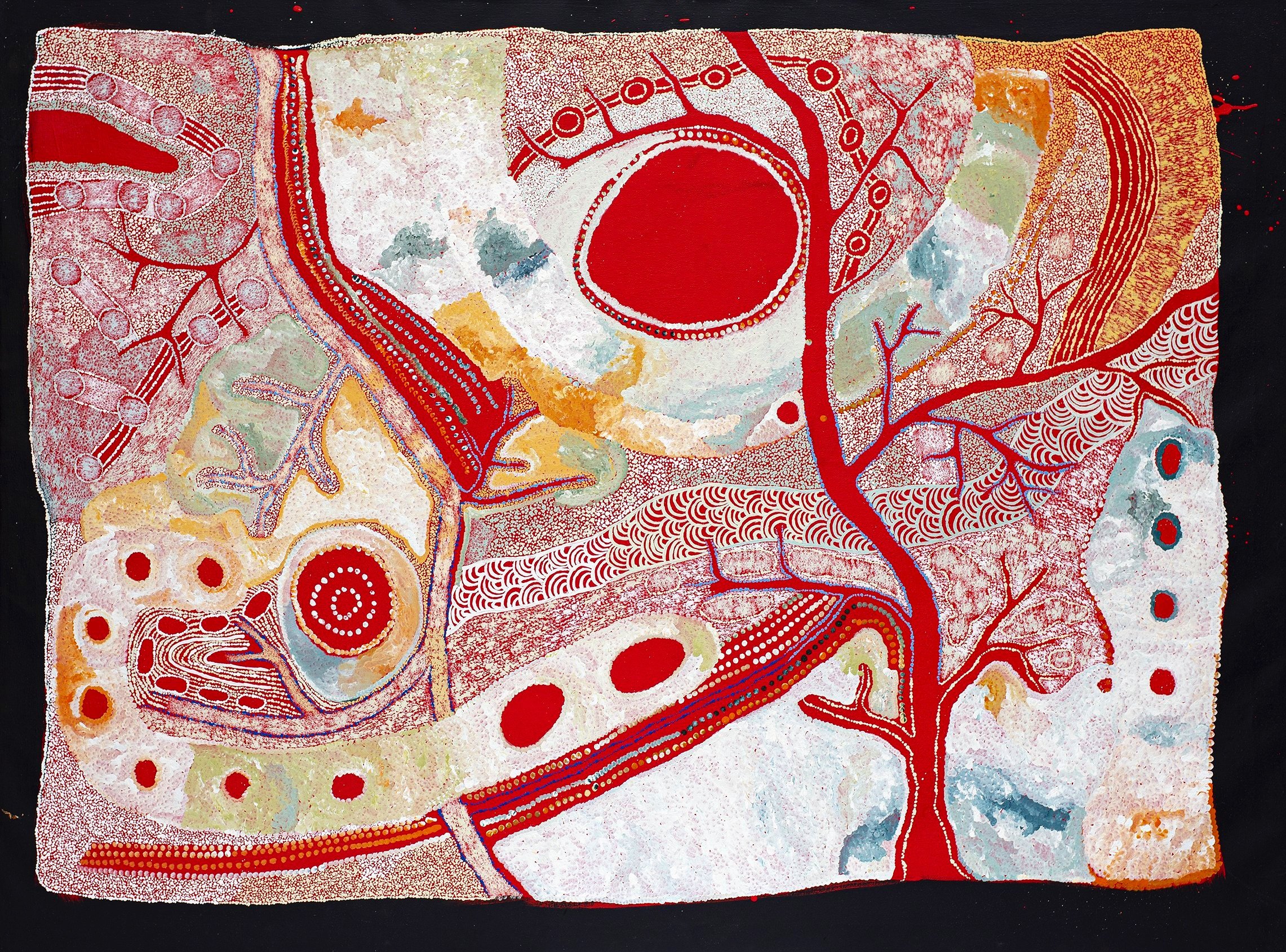
Artiste : Betty Campbell (1961) & Tanya Umatji Tjapalyi (1974)
Titre de l'œuvre : Tjungu - Walytjaku inma
Format : 200 cm x 150 cm
Provenance et certificat : centre d'art aborigène de Mimili Maku
Référence de cette peinture aborigène : 843-22
Demander le prix de cette œuvre
Explications pour cette peinture d'art Aborigène :
This painting is a collaboration between Umatji Tjapalyi and Betty Campbell. Both artists are senior women in Mimili Community, renown for being cultural leaders in their respective families and holding inma (song and dance) and traditional knowledge strong for the next generation.
"This is a painting for our family and community of Mimili. I've painted my mother's country, the punu (tree), maku (witchetty grubs) and kupi-kupi (whirlwinds) that make up this country. It all comes alive with our song and dance, and that is what Betty is painting: Maku inma, minymaku inma. (The witchetty grub songs, and the songs of the women.)" - Umatji Tjapalyi "Tjungu, together. That's what Anangu way is all about. We don't do things kutju kutju (by ourselves). It's about being with family, sharing, connecting with each other and our country. That's what this canvas is all about, coming together to make our stories stronger." - Betty Campbell
Mimili Community is home to 300 Pitjantjatjara and Yankunytjatjara people who have been living in the area for millennia in harmony with nature and acting as custodians of the land and the Tjukurpa (creation stories). Mimili was formerly known as Everard Park, which was a cattle station that was returned to Aboriginal ownership through the 1981 APY Lands Act. Mimili Community was incorporated as an Aboriginal Community in 1975.

Artiste : Tuppy Ngintja Goodwin (1952)
Titre de l'œuvre : Antara
Format : 200 cm x 150 cm
Provenance et certificat : centre d'art aborigène de Mimili Maku
Référence de cette peinture aborigène : 239-22
Enquiry / Demander le prix de l'œuvre
Explications pour cette peinture d'art Aborigène :
When I paint, it’s like inma (ceremonial dance and song). This is Antara, a sacred place for Anangu, and the Maku (witchetty grub) Tjukurpa. There’s a special rock hole at Antara where women perform inma – ‘inmaku pakani’ – and afterwards there’s enough maku to feed everyone. Antara and Maku Tjukurpa is really important for Mimili women, we paint this place and its stories, keeping them strong.
Tuppy lives in Mimili Community, home to 300 Pitjantjatjara and Yankunytjatjara people who have been living in the area for millennia in harmony with nature and acting as custodians of the land and the Tjukurpa (creation stories). Mimili was formerly known as Everard Park, which was a cattle station that was returned to Aboriginal ownership through the 1981 AP Lands Act.
Mimili Community was incorporated as an Aboriginal Community in 1975.

Artiste : Tuppy Ngintja Goodwin (1952)
Titre de l'œuvre : Antara
Format : 200 cm x 150 cm
Provenance et certificat : centre d'art aborigène de Mimili Maku
Référence de cette peinture aborigène : 235-22
Explications pour cette peinture d'art Aborigène :
When I paint, it’s like inma (ceremonial dance and song). This is Antara, a sacred place for Anangu, and the Maku (witchetty grub) Tjukurpa. There’s a special rock hole at Antara where women perform inma – ‘inmaku pakani’ – and afterwards there’s enough maku to feed everyone. Antara and Maku Tjukurpa is really important for Mimili women, we paint this place and its stories, keeping them strong.
Tuppy lives in Mimili Community, home to 300 Pitjantjatjara and Yankunytjatjara people who have been living in the area for millennia in harmony with nature and acting as custodians of the land and the Tjukurpa (creation stories). Mimili was formerly known as Everard Park, which was a cattle station that was returned to Aboriginal ownership through the 1981 AP Lands Act.
Mimili Community was incorporated as an Aboriginal Community in 1975.

Artiste : Tuppy Ngintja Goodwin (1952)
Titre de l'œuvre : Antara
Format : 152x152cm
Provenance et certificat : centre d'art aborigène de Mimili Maku
Référence de cette peinture aborigène : 526-22
Explications pour cette peinture d'art Aborigène :
When I paint, it’s like inma (ceremonial dance and song). This is Antara, a sacred place for Anangu, and the Maku (witchetty grub) Tjukurpa. There’s a special rock hole at Antara where women perform inma – ‘inmaku pakani’ – and afterwards there’s enough maku to feed everyone. Antara and Maku Tjukurpa is really important for Mimili women, we paint this place and its stories, keeping them strong.
Tuppy lives in Mimili Community, home to 300 Pitjantjatjara and Yankunytjatjara people who have been living in the area for millennia in harmony with nature and acting as custodians of the land and the Tjukurpa (creation stories). Mimili was formerly known as Everard Park, which was a cattle station that was returned to Aboriginal ownership through the 1981 AP Lands Act.
Mimili Community was incorporated as an Aboriginal Community in 1975.

Artiste : Josina Nyarpingku Pumani (1984)
Titre de l'œuvre : Ngura Walytja, Antara
Format : 198 cm x 122 cm
Provenance et certificat : centre d'art aborigène de Mimili Maku
Référence de cette peinture aborigène : 637-21
Demander le prix de cette œuvre
Explications pour cette peinture d'art Aborigène :
This painting is about Josina's home, family and culture. The country is Antara, a is a place not far from Mimili Community. Antara country belonged to Josina's grandmother, Milatjari. All women in Josina's family paint Antara. They hold its stories strong, particularly the Maku Tjukurpa, which is a significant songline for this area.
The women from Mimili would go to the waterhole north of Mimili. They would clean it out, then wait for the rain to come. When the waterhole was full with water they would tap on the waters surface and sing inma for Maku tjuta (enough Maku for everyone). The rock holes, hills and country are depicted in this painting.
Mimili Community is home to 300 Pitjantjatjara and Yankunytjatjara people who have been living in the area for millennia in harmony with nature and acting as custodians of the land and the Tjukurpa (creation stories). Mimili was formerly known as Everard Park, which was a cattle station that was returned to Aboriginal ownership through the 1981 APY Lands Act. Mimili Community was incorporated as an Aboriginal Community in 1975.

Artiste : Tuppy Ngintja Goodwin (1952)
Titre de l'œuvre : Antara
Format : 152 cm x 122 cm
Provenance et certificat : centre d'art aborigène de Mimili Maku
Référence de cette peinture aborigène : 646-22
Explications pour cette peinture d'art Aborigène :
When I paint, it’s like inma (ceremonial dance and song). This is Antara, a sacred place for Anangu, and the Maku (witchetty grub) Tjukurpa. There’s a special rock hole at Antara where women perform inma – ‘inmaku pakani’ – and afterwards there’s enough maku to feed everyone. Antara and Maku Tjukurpa is really important for Mimili women, we paint this place and its stories, keeping them strong.
Tuppy lives in Mimili Community, home to 300 Pitjantjatjara and Yankunytjatjara people who have been living in the area for millennia in harmony with nature and acting as custodians of the land and the Tjukurpa (creation stories). Mimili was formerly known as Everard Park, which was a cattle station that was returned to Aboriginal ownership through the 1981 AP Lands Act.
Mimili Community was incorporated as an Aboriginal Community in 1975.

Artiste : Josina Nyarpingku Pumani (1984)
Titre de l'œuvre : Ngura Walytja, Antara
Format : 200 cm x 150 cm
Provenance et certificat : centre d'art aborigène de Mimili Maku
Référence de cette peinture aborigène : 829-21
Demander le prix de cette œuvre
Explications pour cette peinture d'art Aborigène :
This painting is about Josina's home, family and culture. The country is Antara, a is a place not far from Mimili Community. Antara country belonged to Josina's grandmother, Milatjari. All women in Josina's family paint Antara. They hold its stories strong, particularly the Maku Tjukurpa, which is a significant songline for this area.
The women from Mimili would go to the waterhole north of Mimili. They would clean it out, then wait for the rain to come. When the waterhole was full with water they would tap on the waters surface and sing inma for Maku tjuta (enough Maku for everyone). The rock holes, hills and country are depicted in this painting.
Mimili Community is home to 300 Pitjantjatjara and Yankunytjatjara people who have been living in the area for millennia in harmony with nature and acting as custodians of the land and the Tjukurpa (creation stories). Mimili was formerly known as Everard Park, which was a cattle station that was returned to Aboriginal ownership through the 1981 APY Lands Act. Mimili Community was incorporated as an Aboriginal Community in 1975.

Artiste : Emma Singer (1986)
Titre de l'œuvre : Ngayuku Ngura
Format : 152 cm x 122 cm
Provenance et certificat : centre d'art aborigène de Mimili Maku
Référence de cette peinture aborigène : 486-22
Demander le prix de cette œuvre
Explications pour cette peinture d'art Aborigène :
Emma Singer is one of the strong emerging painters in Mimili. She works alongside her mother Pauline Wangin, and has collaborated with her on several paintings. Through the visual language passed from generation to generation, she explores her connection to manta (country) and Tjukurpa (an ongoing, eternal, life-giving transformative power that accounts for every aspect of existence).
This painting depicts the kapi tjukula (water holes), murpu and apu (mountains and rocks), tali (sand hills) and punu (trees) that surround Emma's home of Mimili Community. Mimili has many ancestral songlines that criss-cross the land. A really important place for Anangu from Mimili is Antara, a cermeonial site on top of a hill. This is a place for inma (ceremonial song and dance) relating to the Maku (witchetty grub) Tjukurpa.
Mimili Community is home to 300 Pitjantjatjara and Yankunytjatjara people who have been living in the area for millennia in harmony with nature and acting as custodians of the land and the Tjukurpa (creation stories). Mimili was formerly known as Everard Park, which was a cattle station that was returned to Aboriginal ownership through the 1981 APY Lands Act. Mimili Community was incorporated as an Aboriginal Community in 1975.

Artiste : Josina Nyarpingku Pumani (1984)
Titre de l'œuvre : Ngura Walytja, Antara
Format : 152 cm x 152 cm
Provenance et certificat : centre d'art aborigène de Mimili Maku
Référence de cette peinture aborigène : 880-21
Demander le prix de cette œuvre
Explications pour cette peinture d'art Aborigène :
This painting is about Josina's home, family and culture. The country is Antara, a is a place not far from Mimili Community. Antara country belonged to Josina's grandmother, Milatjari. All women in Josina's family paint Antara. They hold its stories strong, particularly the Maku Tjukurpa, which is a significant songline for this area.
The women from Mimili would go to the waterhole north of Mimili. They would clean it out, then wait for the rain to come. When the waterhole was full with water they would tap on the waters surface and sing inma for Maku tjuta (enough Maku for everyone). The rock holes, hills and country are depicted in this painting.
Mimili Community is home to 300 Pitjantjatjara and Yankunytjatjara people who have been living in the area for millennia in harmony with nature and acting as custodians of the land and the Tjukurpa (creation stories). Mimili was formerly known as Everard Park, which was a cattle station that was returned to Aboriginal ownership through the 1981 APY Lands Act. Mimili Community was incorporated as an Aboriginal Community in 1975.

Artiste : Emma Singer (1986)
Titre de l'œuvre : Ngayuku Ngura
Format : 152 cm x 122 cm
Provenance et certificat : centre d'art aborigène de Mimili Maku
Référence de cette peinture aborigène : 529-22
Demander le prix de cette œuvre
Explications pour cette peinture d'art Aborigène :
Emma Singer is one of the strong emerging painters in Mimili. She works alongside her mother Pauline Wangin, and has collaborated with her on several paintings. Through the visual language passed from generation to generation, she explores her connection to manta (country) and Tjukurpa (an ongoing, eternal, life-giving transformative power that accounts for every aspect of existence).
This painting depicts the kapi tjukula (water holes), murpu and apu (mountains and rocks), tali (sand hills) and punu (trees) that surround Emma's home of Mimili Community. Mimili has many ancestral songlines that criss-cross the land. A really important place for Anangu from Mimili is Antara, a cermeonial site on top of a hill. This is a place for inma (ceremonial song and dance) relating to the Maku (witchetty grub) Tjukurpa.
Mimili Community is home to 300 Pitjantjatjara and Yankunytjatjara people who have been living in the area for millennia in harmony with nature and acting as custodians of the land and the Tjukurpa (creation stories). Mimili was formerly known as Everard Park, which was a cattle station that was returned to Aboriginal ownership through the 1981 APY Lands Act. Mimili Community was incorporated as an Aboriginal Community in 1975.

Artiste : Emma Singer (1986)
Titre de l'œuvre : Ngayuku Ngura
Format : 152 cm x 122 cm
Provenance et certificat : centre d'art aborigène de Mimili Maku
Référence de cette peinture aborigène : 635-22
Demander le prix de cette œuvre
Explications pour cette peinture d'art Aborigène :
Emma Singer is one of the strong emerging painters in Mimili. She works alongside her mother Pauline Wangin, and has collaborated with her on several paintings. Through the visual language passed from generation to generation, she explores her connection to manta (country) and Tjukurpa (an ongoing, eternal, life-giving transformative power that accounts for every aspect of existence).
This painting depicts the kapi tjukula (water holes), murpu and apu (mountains and rocks), tali (sand hills) and punu (trees) that surround Emma's home of Mimili Community. Mimili has many ancestral songlines that criss-cross the land. A really important place for Anangu from Mimili is Antara, a cermeonial site on top of a hill. This is a place for inma (ceremonial song and dance) relating to the Maku (witchetty grub) Tjukurpa.
Mimili Community is home to 300 Pitjantjatjara and Yankunytjatjara people who have been living in the area for millennia in harmony with nature and acting as custodians of the land and the Tjukurpa (creation stories). Mimili was formerly known as Everard Park, which was a cattle station that was returned to Aboriginal ownership through the 1981 APY Lands Act. Mimili Community was incorporated as an Aboriginal Community in 1975.

Artiste : Tanya Umatji Tjapalyi (1974)
Titre de l'œuvre : Ngayuku Ngunytjunku Tjukurpa (My Mother’s story)
Format : 122 cm x 122 cm
Provenance et certificat : centre d'art aborigène de Mimili Maku
Référence de cette peinture aborigène : 503-22
Demander le prix de cette œuvre
Explications pour cette peinture d'art Aborigène :
Umatji is a Yankunytjatjara woman born in Indulkana Community on the Anangu Pitjantjatjara Yankunytjatjara (APY) Lands in the far north west of South Australia. Umatji’s mother, Kunmanara (Kathleen Injiki) Tjapalyi was one of the founders and senior artists at Mimili Maku Arts. Growing up, Umatji learned from her mother and father about their country and their storylines. Today, Umatji paints her mother’s country, which forms part of the Antara storyline, and is celebrated in Women’s Ceremony.
“I am proud to share what I was taught when I was a little girl. I am keeping my mother’s knowledge strong, keeping her country healthy and well. I was watching for a long time, watching country, watching my mother paint. Now I am ready to tell my own story.”
Mimili Community is home to 300 Pitjantjatjara and Yankunytjatjara people who have been living in the area for millennia in harmony with nature and acting as custodians of the land and the Tjukurpa (creation stories). Mimili was formerly known as Everard Park, which was a cattle station that was returned to Aboriginal ownership through the 1981 APY Lands Act. Mimili Community was incorporated as an Aboriginal Community in 1975.

Artiste : Emma Singer (1986)
Titre de l'œuvre : Ngayuku Ngura
Format : 152 cm x 122 cm
Provenance et certificat : centre d'art aborigène de Mimili Maku
Référence de cette peinture aborigène : 568-22
Demander le prix de cette œuvre
Explications pour cette peinture d'art Aborigène :
Emma Singer is one of the strong emerging painters in Mimili. She works alongside her mother Pauline Wangin, and has collaborated with her on several paintings. Through the visual language passed from generation to generation, she explores her connection to manta (country) and Tjukurpa (an ongoing, eternal, life-giving transformative power that accounts for every aspect of existence).
This painting depicts the kapi tjukula (water holes), murpu and apu (mountains and rocks), tali (sand hills) and punu (trees) that surround Emma's home of Mimili Community. Mimili has many ancestral songlines that criss-cross the land. A really important place for Anangu from Mimili is Antara, a cermeonial site on top of a hill. This is a place for inma (ceremonial song and dance) relating to the Maku (witchetty grub) Tjukurpa.
Mimili Community is home to 300 Pitjantjatjara and Yankunytjatjara people who have been living in the area for millennia in harmony with nature and acting as custodians of the land and the Tjukurpa (creation stories). Mimili was formerly known as Everard Park, which was a cattle station that was returned to Aboriginal ownership through the 1981 APY Lands Act. Mimili Community was incorporated as an Aboriginal Community in 1975.

Artiste : Tanya Umatji Tjapalyi (1974)
Titre de l'œuvre : Ngayuku Ngunytjunku Tjukurpa (My Mother’s story)
Format : 152 cm x 122 cm
Provenance et certificat : centre d'art aborigène de Mimili Maku
Référence de cette peinture aborigène : 559-22
Demander le prix de cette œuvre
Explications pour cette peinture d'art Aborigène :
Umatji is a Yankunytjatjara woman born in Indulkana Community on the Anangu Pitjantjatjara Yankunytjatjara (APY) Lands in the far north west of South Australia. Umatji’s mother, Kunmanara (Kathleen Injiki) Tjapalyi was one of the founders and senior artists at Mimili Maku Arts. Growing up, Umatji learned from her mother and father about their country and their storylines. Today, Umatji paints her mother’s country, which forms part of the Antara storyline, and is celebrated in Women’s Ceremony.
“I am proud to share what I was taught when I was a little girl. I am keeping my mother’s knowledge strong, keeping her country healthy and well. I was watching for a long time, watching country, watching my mother paint. Now I am ready to tell my own story.”
Mimili Community is home to 300 Pitjantjatjara and Yankunytjatjara people who have been living in the area for millennia in harmony with nature and acting as custodians of the land and the Tjukurpa (creation stories). Mimili was formerly known as Everard Park, which was a cattle station that was returned to Aboriginal ownership through the 1981 APY Lands Act. Mimili Community was incorporated as an Aboriginal Community in 1975.

Artiste : Tanya Umatji Tjapalyi (1974)
Titre de l'œuvre : Ngayuku Ngunytjunku Tjukurpa (My Mother’s story)
Format : 122 cm x 122 cm
Provenance et certificat : centre d'art aborigène de Mimili Maku
Référence de cette peinture aborigène : 668-22
Demander le prix de cette œuvre
Explications pour cette peinture d'art Aborigène :
Umatji is a Yankunytjatjara woman born in Indulkana Community on the Anangu Pitjantjatjara Yankunytjatjara (APY) Lands in the far north west of South Australia. Umatji’s mother, Kunmanara (Kathleen Injiki) Tjapalyi was one of the founders and senior artists at Mimili Maku Arts. Growing up, Umatji learned from her mother and father about their country and their storylines. Today, Umatji paints her mother’s country, which forms part of the Antara storyline, and is celebrated in Women’s Ceremony.
“I am proud to share what I was taught when I was a little girl. I am keeping my mother’s knowledge strong, keeping her country healthy and well. I was watching for a long time, watching country, watching my mother paint. Now I am ready to tell my own story.”
Mimili Community is home to 300 Pitjantjatjara and Yankunytjatjara people who have been living in the area for millennia in harmony with nature and acting as custodians of the land and the Tjukurpa (creation stories). Mimili was formerly known as Everard Park, which was a cattle station that was returned to Aboriginal ownership through the 1981 APY Lands Act. Mimili Community was incorporated as an Aboriginal Community in 1975.

Artiste : Tanya Umatji Tjapalyi (1974)
Titre de l'œuvre : Ngayuku Ngunytjunku Tjukurpa (My Mother’s story)
Format : 122 cm x 122 cm
Provenance et certificat : centre d'art aborigène de Mimili Maku
Référence de cette peinture aborigène : 644-22
Demander le prix de cette œuvre
Explications pour cette peinture d'art Aborigène :
Umatji is a Yankunytjatjara woman born in Indulkana Community on the Anangu Pitjantjatjara Yankunytjatjara (APY) Lands in the far north west of South Australia. Umatji’s mother, Kunmanara (Kathleen Injiki) Tjapalyi was one of the founders and senior artists at Mimili Maku Arts. Growing up, Umatji learned from her mother and father about their country and their storylines. Today, Umatji paints her mother’s country, which forms part of the Antara storyline, and is celebrated in Women’s Ceremony.
“I am proud to share what I was taught when I was a little girl. I am keeping my mother’s knowledge strong, keeping her country healthy and well. I was watching for a long time, watching country, watching my mother paint. Now I am ready to tell my own story.”
Mimili Community is home to 300 Pitjantjatjara and Yankunytjatjara people who have been living in the area for millennia in harmony with nature and acting as custodians of the land and the Tjukurpa (creation stories). Mimili was formerly known as Everard Park, which was a cattle station that was returned to Aboriginal ownership through the 1981 APY Lands Act. Mimili Community was incorporated as an Aboriginal Community in 1975.

Artiste : Betty Campbell (1961)
Titre de l'œuvre : Minymaku Tjukurpa (Women's Story)
Format : 122 cm x 122 cm
Provenance et certificat : centre d'art aborigène de Mimili Maku
Référence de cette peinture aborigène : 561-22
Demander le prix de cette œuvre
Explications pour cette peinture d'art Aborigène :
Betty is a senior cultural leader in Mimili Community. She knows a lot of storylines and the corresponding inma (song & dance). A lot of the inma is to be known by initiated women only, others can be celebrated by all. Betty loves to dance and teach the kids these stories that hold important lessons about the land and our relationship to it.
In her artwork, Betty paints Women's Story. This is a story that cannot be spoken about. The lines and markings on the canvas are the markings used as body painting in traditional song and dance. When inma is performed, there is separate songs, dances and paintings for men and women. Whilst the women dance, the men sit, sing and watch, and the other way around.
Mimili Community is home to 300 Pitjantjatjara and Yankunytjatjara people who have been living in the area for millennia in harmony with nature and acting as custodians of the land and the Tjukurpa (creation stories). Mimili was formerly known as Everard Park, which was a cattle station that was returned to Aboriginal ownership through the 1981 APY Lands Act. Mimili Community was incorporated as an Aboriginal Community in 1975.

Artiste : Betty Campbell (1961)
Titre de l'œuvre : Minymaku Tjukurpa (Women's Story)
Format : 198 cm x 198 cm
Provenance et certificat : centre d'art aborigène de Mimili Maku
Référence de cette peinture aborigène : 831-22
Demander le prix de cette œuvre
Explications pour cette peinture d'art Aborigène :
Betty is a senior cultural leader in Mimili Community. She knows a lot of storylines and the corresponding inma (song & dance). A lot of the inma is to be known by initiated women only, others can be celebrated by all. Betty loves to dance and teach the kids these stories that hold important lessons about the land and our relationship to it.
In her artwork, Betty paints Women's Story. This is a story that cannot be spoken about. The lines and markings on the canvas are the markings used as body painting in traditional song and dance. When inma is performed, there is separate songs, dances and paintings for men and women. Whilst the women dance, the men sit, sing and watch, and the other way around.
Mimili Community is home to 300 Pitjantjatjara and Yankunytjatjara people who have been living in the area for millennia in harmony with nature and acting as custodians of the land and the Tjukurpa (creation stories). Mimili was formerly known as Everard Park, which was a cattle station that was returned to Aboriginal ownership through the 1981 APY Lands Act. Mimili Community was incorporated as an Aboriginal Community in 1975.

Artiste : Betty Campbell (1961)
Titre de l'œuvre : Minymaku Tjukurpa (Women's Story)
Format : 122 cm x 122 cm
Provenance et certificat : centre d'art aborigène de Mimili Maku
Référence de cette peinture aborigène : 570-22
Demander le prix de cette œuvre
Explications pour cette peinture d'art Aborigène :
Betty is a senior cultural leader in Mimili Community. She knows a lot of storylines and the corresponding inma (song & dance). A lot of the inma is to be known by initiated women only, others can be celebrated by all. Betty loves to dance and teach the kids these stories that hold important lessons about the land and our relationship to it.
In her artwork, Betty paints Women's Story. This is a story that cannot be spoken about. The lines and markings on the canvas are the markings used as body painting in traditional song and dance. When inma is performed, there is separate songs, dances and paintings for men and women. Whilst the women dance, the men sit, sing and watch, and the other way around.
Mimili Community is home to 300 Pitjantjatjara and Yankunytjatjara people who have been living in the area for millennia in harmony with nature and acting as custodians of the land and the Tjukurpa (creation stories). Mimili was formerly known as Everard Park, which was a cattle station that was returned to Aboriginal ownership through the 1981 APY Lands Act. Mimili Community was incorporated as an Aboriginal Community in 1975.

Artiste : Betty Campbell (1961)
Titre de l'œuvre : Minymaku Tjukurpa (Women's Story)
Format : 122 cm x 122 cm
Provenance et certificat : centre d'art aborigène de Mimili Maku
Référence de cette peinture aborigène : 582-22
Demander le prix de cette œuvre
Explications pour cette peinture d'art Aborigène :
Betty is a senior cultural leader in Mimili Community. She knows a lot of storylines and the corresponding inma (song & dance). A lot of the inma is to be known by initiated women only, others can be celebrated by all. Betty loves to dance and teach the kids these stories that hold important lessons about the land and our relationship to it.
In her artwork, Betty paints Women's Story. This is a story that cannot be spoken about. The lines and markings on the canvas are the markings used as body painting in traditional song and dance. When inma is performed, there is separate songs, dances and paintings for men and women. Whilst the women dance, the men sit, sing and watch, and the other way around.
Mimili Community is home to 300 Pitjantjatjara and Yankunytjatjara people who have been living in the area for millennia in harmony with nature and acting as custodians of the land and the Tjukurpa (creation stories). Mimili was formerly known as Everard Park, which was a cattle station that was returned to Aboriginal ownership through the 1981 APY Lands Act. Mimili Community was incorporated as an Aboriginal Community in 1975.

Artiste : Puna Yanima (1955)
Titre de l'œuvre : Antara
Format : 152 cm x 122 cm
Provenance et certificat : centre d'art aborigène de Mimili Maku
Référence de cette peinture aborigène : 647-22
Explications pour cette peinture d'art Aborigène :
Antara is an important women’s ceremonial site near Mimili community. Many of the senior women at Mimili Maku Arts represent Antara and its significant Maku Tjukurpa (Witchetty Grub Dreaming) in their paintings. Puna Yanima has utilised the immediacy and loose fluidity of ink to map the ngura (country) of this sacred place, marking its kapi tjukula (rock holes), apu and murpu (rocks and mountains).

Artiste : Betty Campbell (1961)
Titre de l'œuvre : Minymaku Tjukurpa (Women's Story)
Format : 122 cm x 122 cm
Provenance et certificat : centre d'art aborigène de Mimili Maku
Référence de cette peinture aborigène : 637-22
Demander le prix de cette œuvre
Explications pour cette peinture d'art Aborigène :
Betty is a senior cultural leader in Mimili Community. She knows a lot of storylines and the corresponding inma (song & dance). A lot of the inma is to be known by initiated women only, others can be celebrated by all. Betty loves to dance and teach the kids these stories that hold important lessons about the land and our relationship to it.
In her artwork, Betty paints Women's Story. This is a story that cannot be spoken about. The lines and markings on the canvas are the markings used as body painting in traditional song and dance. When inma is performed, there is separate songs, dances and paintings for men and women. Whilst the women dance, the men sit, sing and watch, and the other way around.
Mimili Community is home to 300 Pitjantjatjara and Yankunytjatjara people who have been living in the area for millennia in harmony with nature and acting as custodians of the land and the Tjukurpa (creation stories). Mimili was formerly known as Everard Park, which was a cattle station that was returned to Aboriginal ownership through the 1981 APY Lands Act. Mimili Community was incorporated as an Aboriginal Community in 1975.

Artiste : Betty Campbell (1961)
Titre de l'œuvre : Minymaku Tjukurpa (Women's Story)
Format : 122 cm x 122 cm
Provenance et certificat : centre d'art aborigène de Mimili Maku
Référence de cette peinture aborigène : 665-22
Enquiry / Demander le prix de cette œuvre
Explications pour cette peinture d'art Aborigène :
Betty is a senior cultural leader in Mimili Community. She knows a lot of storylines and the corresponding inma (song & dance). A lot of the inma is to be known by initiated women only, others can be celebrated by all. Betty loves to dance and teach the kids these stories that hold important lessons about the land and our relationship to it.
In her artwork, Betty paints Women's Story. This is a story that cannot be spoken about. The lines and markings on the canvas are the markings used as body painting in traditional song and dance. When inma is performed, there is separate songs, dances and paintings for men and women. Whilst the women dance, the men sit, sing and watch, and the other way around.
Mimili Community is home to 300 Pitjantjatjara and Yankunytjatjara people who have been living in the area for millennia in harmony with nature and acting as custodians of the land and the Tjukurpa (creation stories). Mimili was formerly known as Everard Park, which was a cattle station that was returned to Aboriginal ownership through the 1981 APY Lands Act. Mimili Community was incorporated as an Aboriginal Community in 1975.

Artiste : Puna Yanima (1955)
Titre de l'œuvre : Antara
Format : 152 cm x 122 cm
Provenance et certificat : centre d'art aborigène de Mimili Maku
Référence de cette peinture aborigène : 648-22
Enquiry / Demander le prix de l'œuvre
Explications pour cette peinture d'art Aborigène :
Antara is an important women’s ceremonial site near Mimili community. Many of the senior women at Mimili Maku Arts represent Antara and its significant Maku Tjukurpa (Witchetty Grub Dreaming) in their paintings. Puna Yanima has utilised the immediacy and loose fluidity of ink to map the ngura (country) of this sacred place, marking its kapi tjukula (rock holes), apu and murpu (rocks and mountains).

Artiste : Marina Pumani Brown (1984)
Titre de l'œuvre : Ngayuku Ngura Kuwari (My Home Now)
Format : 152 cm x 122 cm
Provenance et certificat : centre d'art aborigène de Mimili Maku
Référence de cette peinture aborigène : 560-22
Explications pour cette peinture d'art Aborigène :
My name is Marina Pumani Brown, I am a 35-year-old Anangu woman. My family has lived around the present day location of Mimili Community on the APY lands of South Australia forever. My work captures a long line of cultural knowledge, knowledge that I am proud to be the custodian of, responsible for keeping it safe and passing it on to the next generation.
Whilst my mother strictly paints Antara, a sacred ceremonial site close to Mimili, I have broadened my practice to include other knowledge that is important to me. This knowledge speaks of traditions that are very much part of our day-to-day life out here in Mimili, traditions that are eternally old but ever present. My paintings are about trips to the area around Antara and Paralpii (Victory Well), where we collect Mingkulpa (bush tobacco) and care for the local tjukula (rock holes). Particularly after kapi pulka (big rains), the land becomes so fertile, and we harvest bush foods like the gnurru (lollie tree) and camp out on country like the old people used to.
My paintings are both literal maps of the landscape and objects of meaning removed from any physical representation. Though not always depicted, the importance of Antara is never lost in my work. The site has been integral to the existence of Anangu culture since the beginning of time. Today my life is different to that of my ancestors and my work is a tool to document my part in a story that spreads across timespans bigger than our imagination.

Artiste : Tuppy Ngintja Goodwin (1952)
Titre de l'œuvre : Antara
Format : 198cm x 152cm
Provenance et certificat : centre d'art aborigène de Mimili Maku
Référence de cette peinture aborigène : 80-21
Explications pour cette peinture d'art Aborigène :
When I paint, it’s like inma (ceremonial dance and song). This is Antara, a sacred place for Anangu, and the Maku (witchetty grub) Tjukurpa. There’s a special rock hole at Antara where women perform inma – ‘inmaku pakani’ – and afterwards there’s enough maku to feed everyone. Antara and Maku Tjukurpa is really important for Mimili women, we paint this place and its stories, keeping them strong.

Artiste : Marina Pumani Brown (1984)
Titre de l'œuvre : Ngayuku Ngura Kuwari (My Home Now)
Format : 152 cm x 122 cm
Provenance et certificat : centre d'art aborigène de Mimili Maku
Référence de cette peinture aborigène : 604-22
Explications pour cette peinture d'art Aborigène :
My name is Marina Pumani Brown, I am a 35-year-old Anangu woman. My family has lived around the present day location of Mimili Community on the APY lands of South Australia forever. My work captures a long line of cultural knowledge, knowledge that I am proud to be the custodian of, responsible for keeping it safe and passing it on to the next generation.
Whilst my mother strictly paints Antara, a sacred ceremonial site close to Mimili, I have broadened my practice to include other knowledge that is important to me. This knowledge speaks of traditions that are very much part of our day-to-day life out here in Mimili, traditions that are eternally old but ever present. My paintings are about trips to the area around Antara and Paralpii (Victory Well), where we collect Mingkulpa (bush tobacco) and care for the local tjukula (rock holes). Particularly after kapi pulka (big rains), the land becomes so fertile, and we harvest bush foods like the gnurru (lollie tree) and camp out on country like the old people used to.
My paintings are both literal maps of the landscape and objects of meaning removed from any physical representation. Though not always depicted, the importance of Antara is never lost in my work. The site has been integral to the existence of Anangu culture since the beginning of time. Today my life is different to that of my ancestors and my work is a tool to document my part in a story that spreads across timespans bigger than our imagination.

Artiste : Tuppy Ngintja Goodwin (1952)
Titre de l'œuvre : Antara
Format : 152cm x 152cm
Provenance et certificat : centre d'art aborigène de Mimili Maku
Référence de cette peinture aborigène : 168-21
Explications pour cette peinture d'art Aborigène :
When I paint, it’s like inma (ceremonial dance and song). This is Antara, a sacred place for Anangu, and the Maku (witchetty grub) Tjukurpa. There’s a special rock hole at Antara where women perform inma – ‘inmaku pakani’ – and afterwards there’s enough maku to feed everyone. Antara and Maku Tjukurpa is really important for Mimili women, we paint this place and its stories, keeping them strong.
Artiste : Betty Campbell (1961) & Tanya Umatji Tjapalyi (1974)
Titre de l'œuvre : Tjungu - Walytjaku inma
Format : 200 cm x 150 cm
Provenance et certificat : centre d'art aborigène de Mimili Maku
Référence de cette peinture aborigène : 903-22
Demander le prix de cette œuvre
Explications pour cette peinture d'art Aborigène :
This painting is a collaboration between Umatji Tjapalyi and Betty Campbell. Both artists are senior women in Mimili Community, renown for being cultural leaders in their respective families and holding inma (song and dance) and traditional knowledge strong for the next generation.
"This is a painting for our family and community of Mimili. I've painted my mother's country, the punu (tree), maku (witchetty grubs) and kupi-kupi (whirlwinds) that make up this country. It all comes alive with our song and dance, and that is what Betty is painting: Maku inma, minymaku inma. (The witchetty grub songs, and the songs of the women.)" - Umatji Tjapalyi "Tjungu, together. That's what Anangu way is all about. We don't do things kutju kutju (by ourselves). It's about being with family, sharing, connecting with each other and our country. That's what this canvas is all about, coming together to make our stories stronger." - Betty Campbell
Mimili Community is home to 300 Pitjantjatjara and Yankunytjatjara people who have been living in the area for millennia in harmony with nature and acting as custodians of the land and the Tjukurpa (creation stories). Mimili was formerly known as Everard Park, which was a cattle station that was returned to Aboriginal ownership through the 1981 APY Lands Act. Mimili Community was incorporated as an Aboriginal Community in 1975.