
Exposition d’art Aborigène “Celebrating the Dreaming” - Aboriginal art from Australia
En association avec les artistes du centre d’art de Warlukurlangu.
A la galerie Aboriginal Signature Estrangin : 101 rue Jules Besme, 1081 Bruxelles.
Vernissage sur RDV le mercredi 18 septembre de 11h30 à 21h30.
A 20h - discours du directeur de la galerie et drink.
RSVP - réserver votre visite
Ensuite la galerie vous reçoit sur RDV, du jeudi 19 septembre au samedi 12 octobre 2024, du mardi au samedi, de 11h à 19h : vous pouvez réserver votre visite dés à présent dans notre agenda ici.
“CELEBRATING the dreaming”
Nous vous invitons à une exploration fascinante des paysages mystiques de l'intérieur de l’Australie à travers les yeux des artistes Aborigènes du peuple Warlpiri. Découvrez des œuvres vibrantes, nées au cœur de communautés isolées, racontant l'histoire ancienne de la terre, et des ancêtres créateurs. Les "Songlines" sacrées, ces pistes invisibles chargées de mythes, tissent des histoires gravées dans le paysage bien avant les écrits bibliques. Elles sont ici associées aux lieux emblématiques de Mina Mina, du Faucon Brun, des Termites et de l’Émeu.
À partir des années 1970, l’expression artistique, d’abord masculine avec la maison musée de Yuendumu, s’enrichit progressivement des contributions féminines, donnant naissance en 1986 à l'Association des Artistes Warlukurlangu à Yuendumu. Les femmes ont dû se battre pour exprimer leur part du Jukurrpa (loi du Rêve), en passant des tracés épurés et formes fluides peintes sur leurs corps lors des danses et cérémonies rituelles, au pointillisme réservé jusque-là aux hommes.

Vue de l’exposition “Celebrating the Dreaming” © Photo : Aboriginal Signature Estrangin gallery with the courtesy of the artists.
La subtilité des nuances apportée par ces nouvelles techniques permettront aux femmes d’inviter au présent les différentes dimensions de leurs histoires du Jukurrpa (loi du Rêve), dont elles sont également les gardiennes, en cohérence avec leurs lieux de conception, et leurs lignées respectives. Aujourd'hui, plus de 60 % des artistes en activité à Yuendumu sont encore des femmes, preuve de leur engagement constant.
En juillet 2023, j'ai eu l'opportunité de me rendre à nouveau dans ce grand village au milieu de l’Australie rouge pour sélectionner les œuvres remarquables de l'exposition « Celebrating the Dreaming », en partenariat avec les artistes du centre d’art de Warlukurlangu.
Cette exposition rassemble des artistes emblématiques de Yuendumu, femmes et hommes, pour célébrer leur part du Jukurrpa.
Immersion avec les artistes
Julie Nangala Robertson, issue d'une grande lignée d'artistes, présente à Bruxelles avec sa sœur Sabrina Nangala Robertson, des peintures remarquables liées au site emblématique de Mina Mina dans le désert de Tanami, pays de sa mère, pour honorer sa mémoire et son savoir. C’est un site cérémoniel extrêmement important pour les femmes Napangardi et Napanangka, situé à environ 600 km à l'ouest de Yuendumu, juste à l'est du lac Mackay et de la frontière avec l'Australie-Occidentale.
Le Jukurrpa de Mina Mina est une source importante de savoir rituel et d’organisation sociale pour les Warlpiri, notamment en ce qui concerne les rôles respectifs des hommes et des femmes.
Les faiseurs de pluie
En 2023, Julie Nangala Robertson a remporté au Musée de Darwin le prix de peinture générale lors du NATSIAA, suivant les traces de sa mère Dorothy Napangardi, lauréate du même prix en 2001.
Sa sœur Sabrina Nangala Robertson expose quatre peintures dédiées au site sacré de Pirlinyarnu (Mont Farewell), situé à environ 165 km à l'ouest de Yuendumu.
Ce site est associé à une tempête évoquée par deux hommes Jangala, faiseurs de pluie, et un kirrkarlanji (faucon brun), symbolisant les aspects rituels du rêve de l'eau près de Kintore et de Pirlinyarnu, où se réunissent encore aujourd’hui des centaines de « ngapangarlpa » (canards sauvages) dès qu’il pleut.
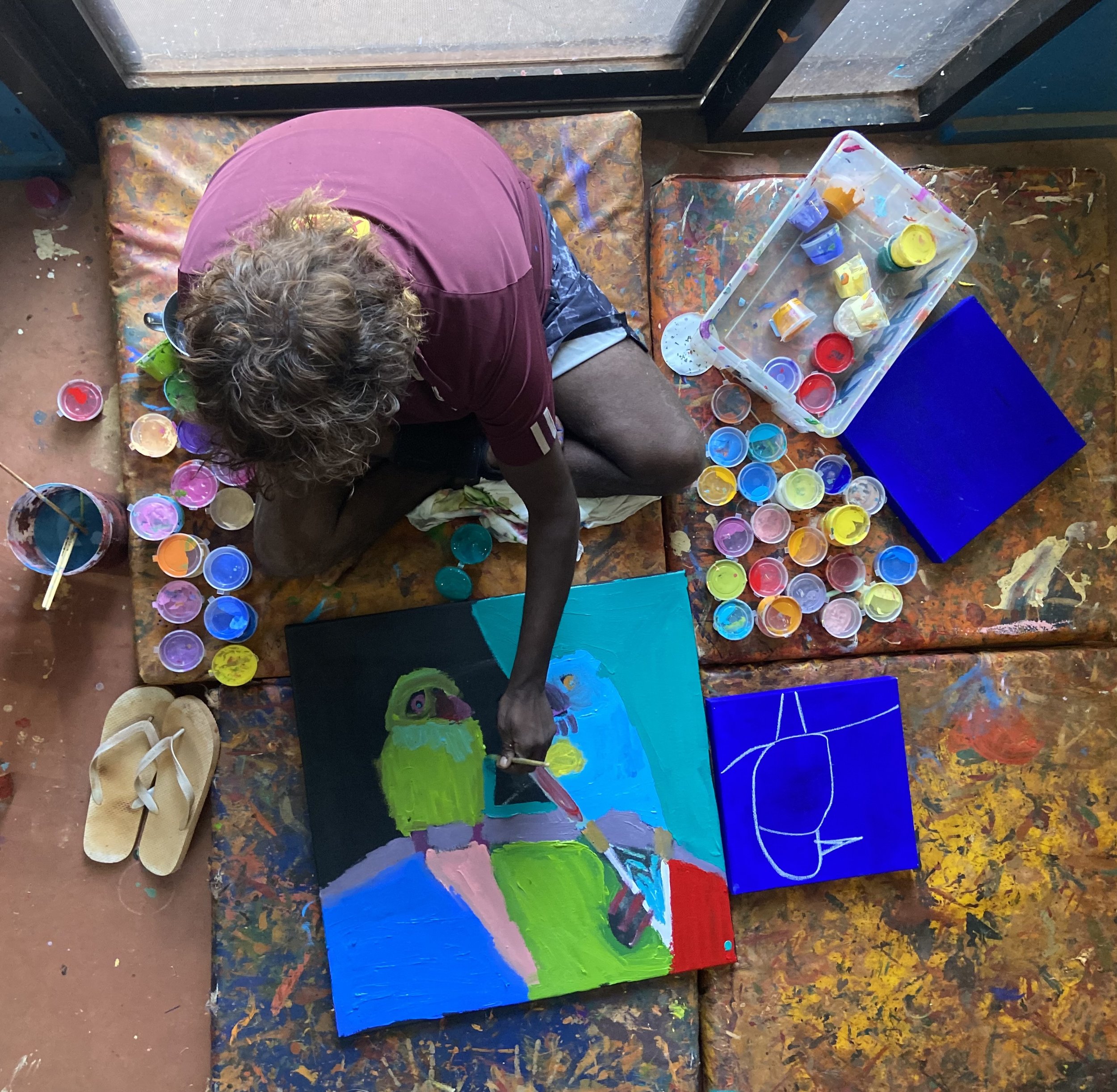
L’artiste Karen Napaljarri Barnes au centre d’art de Warlukurlangu. © Photo Warlukurlangu with the courtesy of the artists

Peinture de l’artiste Karen Napaljarri Barnes - Karen's Animal - 122 x 91 cm - 1470/23 © Photo Aboriginal Signature Gallery with the courtesy of the artist and Warlukurlangu.

Lieu sacré de Juka Juka près de Yuendumu © Photo : Aboriginal Signature Estrangin Gallery with the courtesy of the artist and Warlukurlangu.
L’artiste Athena Nangala Granites, célèbre dans plusieurs peintures l’histoire importante du Jukurrpa liée aux Seven Sisters, qui enseigne une histoire d’amour impossible, conduisant à un cheminement à travers le territoire, générant des lieux et laissant des stigmates dans la roche, dans un cheminement emblématique de la Création, avec l’énergie cosmique entre ciel et terre.

Peinture de l’artiste Athena Nangala Granites - Napaljarri-warnu Jukurrpa (Seven Sisters Dreaming) - 183 x 107 cm - 1316/24. © Photo Aboriginal Signature Gallery with the courtesy of the artist and Warlukurlangu.

Peinture de l’artiste Athena Nangala Granites - Napaljarri-warnu Jukurrpa (Seven Sisters Dreaming) - 183 x 107 cm - 1315/24. © Photo Aboriginal Signature Gallery with the courtesy of the artist and Warlukurlangu.
Les artistes Géraldine Napangardi Granites et Karen Napaljarri Barnes offrent une vision plus figurative en intégrant des animaux emblématiques comme les émeus, les coqs et les oiseaux, présents dans le village de Yuendumu et les histoires du Snake Vine Dreaming.
Les hommes Walter Jangala Brown et Michael Jangala Gallagher explorent les histoires sacrées du Rêve liées au cycle Tingari et au Yankirri Jukurrpa (Emu Dreaming). Leurs œuvres subtiles présentent des effets cinétiques vibratoires, révélant les dimensions spirituelles des lieux sacrés associés au Lac Mackay.

Peinture de l’artiste Walter Jangala Brown - Tingari Cycle sacred story - 122 x 91 cm - 3172/23 © Photo : Aboriginal Signature Estrangin Gallery with the courtesy of the artists and Warlukurlangu.
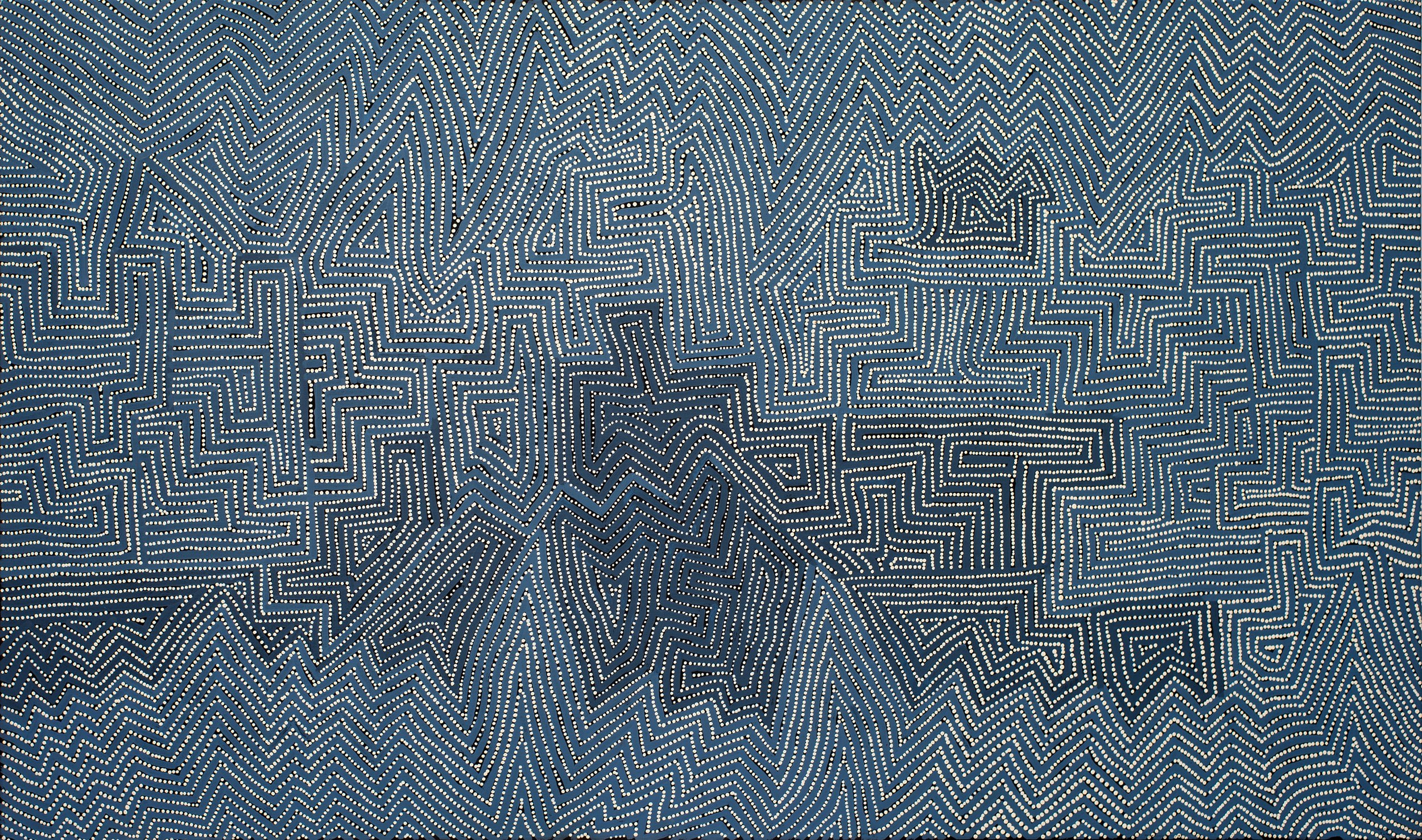
Peinture de l’artiste Michael Jangala Gallagher - Yankirri Jukurrpa (Emu Dreaming) - Ngarlikirlangu - 183 x 107 cm - 626/23ny © Photo : Aboriginal Signature Estrangin Gallery with the courtesy of the artists and Warlukurlangu.
L’artiste Lloyd Jampijinpa Brown, nous invite sur les traces de l’Emu, avec le Yankirri Jukurrpa, et ses subtiles compositions où se nichent de façon délicate et pudique les signes et symboles de cette épopée du Temps du Rêve.
Enfin, nous sommes ravis d’accueillir également une sélection audacieuse d’œuvres de la jeune artiste Tasha Nampijinpa Collins, qui rendent hommage au lieu de Puyurru, à l'ouest de Yuendumu. Deux hommes Jangala y ont chanté la pluie, déclenchant une tempête gigantesque traversant le pays d’est en ouest.

Vue de l’exposition” Celebrate the Dreaming” © Photo : Aboriginal Signature Estrangin Gallery with the courtesy of Warlukurlangu
À la galerie Aboriginal Signature Estrangin, nous attachons une grande importance à l’approche communautaire solidaire dans nos expositions. En réunissant à chaque fois plusieurs artistes d’une même communauté, nous souhaitons souligner la force de la transmission entre générations, des artistes seniors aux plus jeunes, dans une dynamique de partage du savoir millénaire australien.
Ici dans la capitale de l’Europe, nous vous convions pour célébrer la puissance de ces artistes qui perpétuent une tradition ancestrale tout en la réinventant pour le monde moderne. Les œuvres sélectionnées vibrent d'une énergie connectée, reflétant la beauté préservée de leur territoire, et la résilience de ces peuples premiers, gardiens de la terre.
Bertrand Estrangin
Directeur
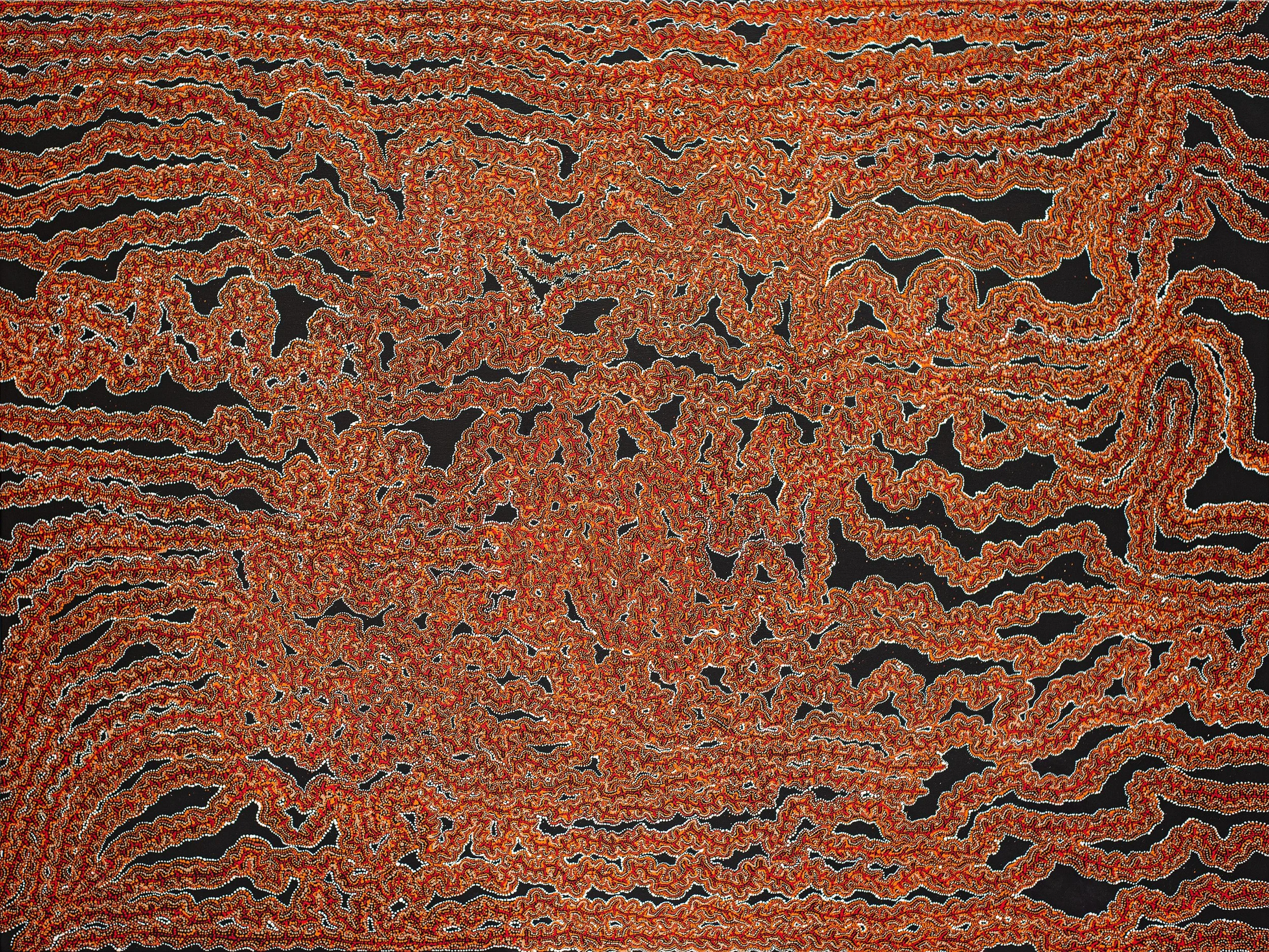
Peinture de l’artiste Sabrina Nangala Robertson - Ngapa Jukurrpa (Water Dreaming) - Pirlinyarnu - 203 x 152 cm - 5659/23 © Photo : Aboriginal Signature Estrangin Gallery with the courtesy of the artists and Warlukurlangu
Découvrez les peintures de l’exposition :
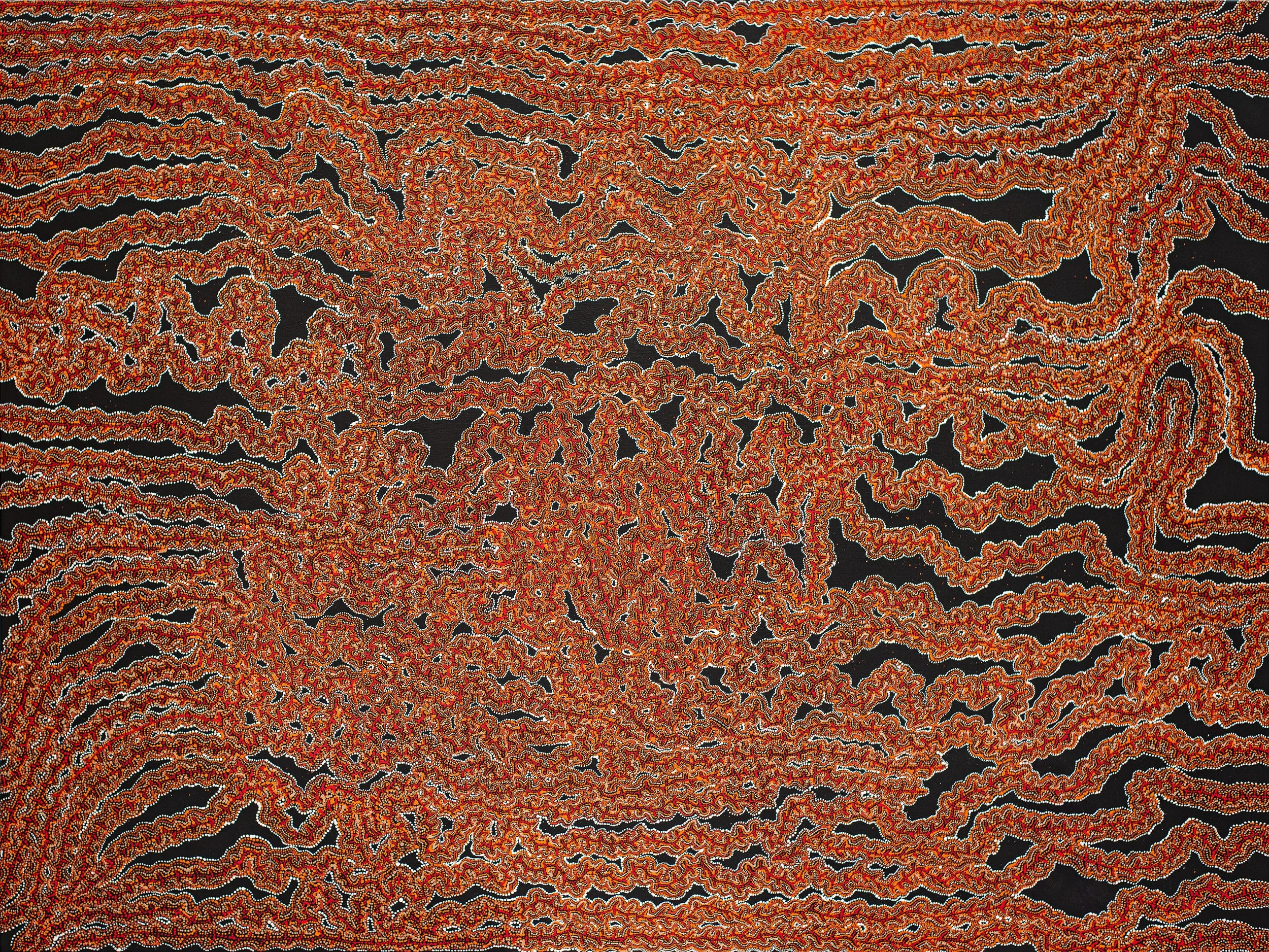
Artiste : Sabrina Nangala Robertson
Titre de l'œuvre : Ngapa Jukurrpa (Water Dreaming) - Pirlinyarnu
Format : 203 x 152 cm
Provenance et certificat : centre d'art aborigène de Yuendumu
Référence de cette peinture : 5659/23
Demander le prix de l'œuvre / Enquiry
Explications de l'œuvre :
The site depicted in this painting is Pirlinyarnu (Mt. Farewell), about 165 km west of Yuendumu in the Northern Territory. The ‘kirda’ (owners) for the water Dreaming site at Pirlinyarnu are Nangala/Nampijinpa women and Jangala/Jampijinpa men.
Two Jangala men, rainmakers, sang the rain, unleashing a giant storm that collided with another storm from Wapurtali at Mirawarri. A ‘kirrkarlanji’ (brown falcon [Falco berigora]) carried the storm further west from Mirawarri. The two storms travelled across the country from Karlipirnpa, a ceremonial site for the water Dreaming near Kintore that is owned by members of the Napaljarri/Japaljarri and Napanangka/Japanangka subsections. Along the way the storms passed through Juntiparnta, a site that is owned by Jampijinpa men. The storm eventually became too heavy for the falcon. It dropped the water at Pirlinyarnu, where it formed an enormous ‘maluri’ (claypan). A ‘mulju’ (soakage) exists in this place today.
Whenever it rains today, hundreds of ‘ngapangarlpa’ (bush ducks) still flock to Pirlinyarnu.
© Photo : Aboriginal Signature Estrangin gallery with the courtesy of the artists and Yuendumu
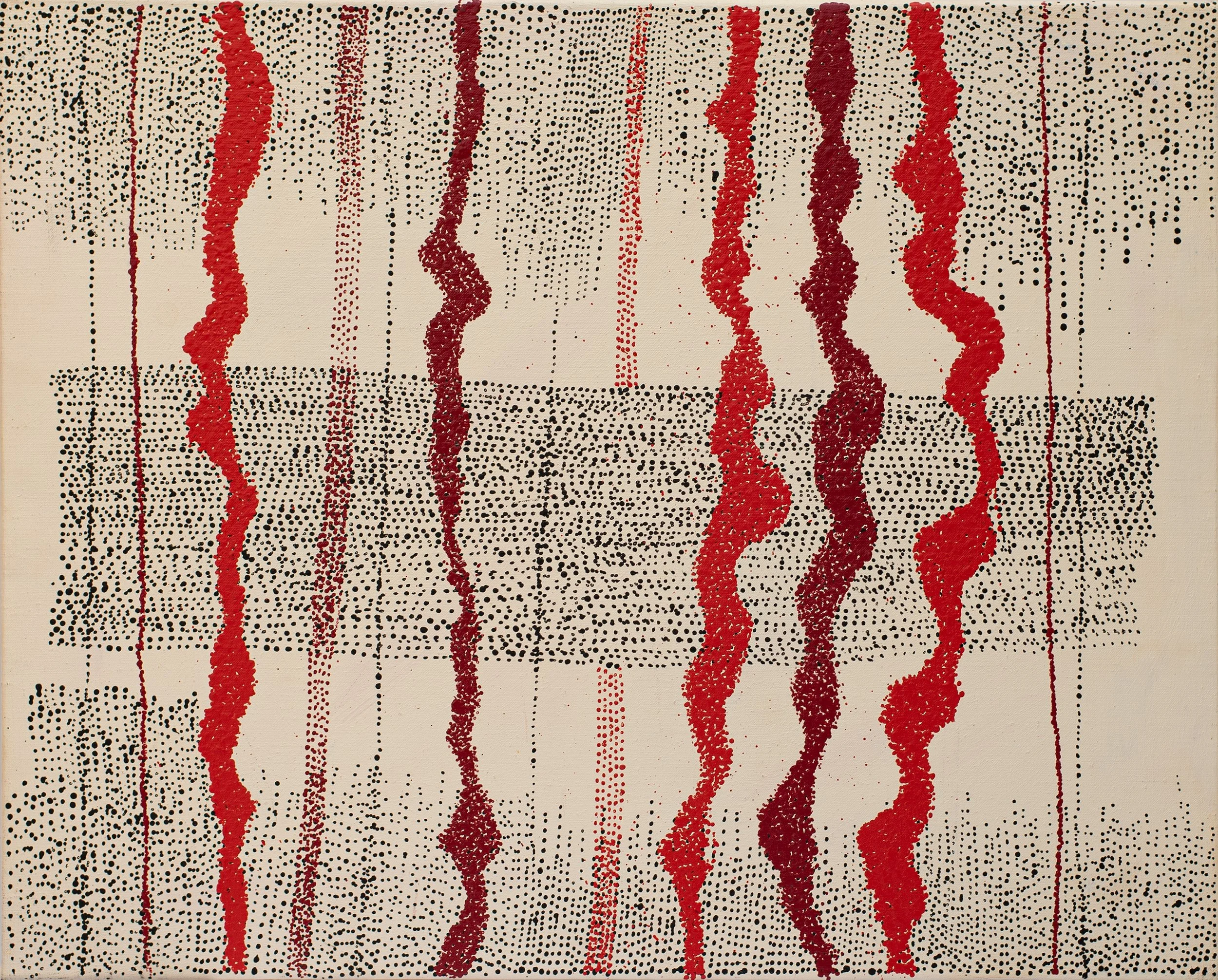
Artiste : Julie Nangala Robertson
Titre de l'œuvre : Mina Mina Jukurrpa - Mina Mina Dreaming
Format : 76 x 61 cm
Provenance et certificat : centre d'art aborigène de Yuendumu
Référence de cette peinture : 8064/23
Demander le prix de l'œuvre / Enquiry
Explications de l'œuvre :
Mina Mina is an extremely important ceremonial site for Napangardi and Napanangka women that is located approximately 600kms west of Yuendumu, just east of Lake
Mackay and the WA border. Mina Mina has a ‘marluri’ (salt lake or claypan) that is usually dry, without water. There are also a number of ‘mulju’ (soakages), sandhills, and a large stand of ‘kurrkara’ (desert oaks [Allocasuarina decaisneana]).
The Mina Mina Jukurrpa is an important source of Warlpiri ritual knowledge and social organization, particularly relating to the different roles performed by men and women. The ‘kirda’ (owners) of this country are Napangardi/Napanangka women and Japangardi/Japanangka men, who can depict portions of the Mina Mina Jukurrpa in their paintings. The artists mother, Dorothy Napangardi (c.1956–2013) painted Mina Mina and has passed down her Jukurrpa stories to her children and asked them to continue to paint for her. There are a number of different components of the Mina Mina Jukurrpa; artists usually choose to depict one particular aspect. These can include ‘karnta’ (women), ‘karlangu’ (digging sticks), ‘majardi’ (hairstring skirts/tassels), ‘ngalyipi’ (snakevine [Tinospora smilacina]), ‘jintiparnta’ (desert truffle [Elderia arenivaga]), and ‘kurrkara’ (desert oak [Allocasuarina decaisneana]).
In ancestral times a group of ‘karnta’ (women) traveled from Mina Mina on an epic journey to the east. These ancestral women danced at Mina Mina and ‘karlangu’ (digging sticks) rose up out of the ground. They collected these digging sticks and started travelling to the east. They carried their digging sticks over their shoulders, and they were adorned with ‘majardi’ (hairstring belts), white feathers, and necklaces made from ‘yinirnti’ (bean tree [Erythrina vespertilio]) seeds. They travelled east from Mina Mina, dancing, digging for bush tucker, and creating many places as they went. As they went east, they passed through Kimayi (a stand of ‘kurrkara’ (desert oak)). They passed through sandhill country where the ‘yarla’ (bush potato or ‘big yam’ [Ipomea costata]) ancestors from Yumurrpa and the ‘ngarlajiyi’ (pencil yam or ‘small yam’ [Vigna lanceolata]) ancestors from Yumurrpa were engaged in a huge battle over women. This battle is also a very important Warlpiri Jukurrpa narrative. The women went on to Janyinki and stopped at Wakakurrku (Mala Bore), where they stuck their digging sticks in the ground…
© Photo : Aboriginal Signature Estrangin gallery with the courtesy of the artists and Yuendumu
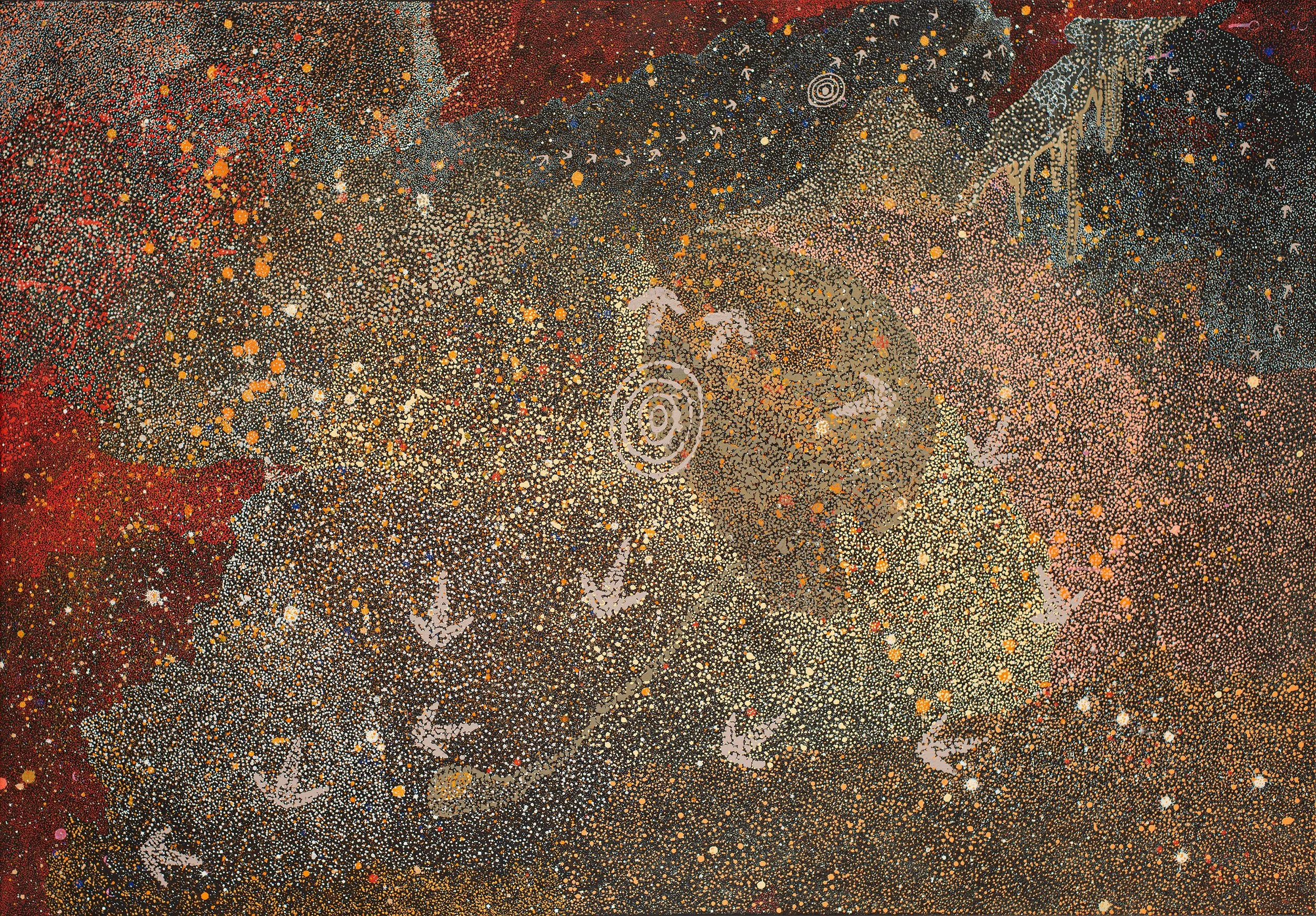
Artiste : Lloyd Jampijinpa Brown
Titre de l'œuvre : Yankirri Jukurrpa (Emu Dreaming) - Ngarlikirlangu
Format : 152 x 107 cm
Provenance et certificat : centre d'art aborigène de Yuendumu
Référence de cette peinture : 706/23
Demander le prix de l'œuvre / Enquiry
Explications pour cette œuvre :
This painting depicts a ‘yankirri Jukurrpa’ (emu [Dromaius novaehollandiae] Dreaming) from a place called Ngarlikurlangu, approximately 50kms north of Yuendumu. The ‘kirda’ (owners) of this Dreaming are Nangala/Nampijinpa women and Jangala/Jampijinpa men. This Jukurrpa tells the story of a ‘yankirri’ (emu) and a ‘wardilyka’ (bush turkey [Ardeotis australis]). ‘Yankirri’ lived at a soakage to the west called Warnirripanu (or Walangkamirirri), while ‘wardilyka’ lived at a soakage to the east called Parirri. The emu and bush turkey used to go around the country picking ‘yakajirri’ (bush raisins [Solanum centrale]) and mashing them into ‘kapurdu’ (fruit balls) to save in their nests for later. However, they were jealous of each other; the emu thought that the bush turkey was picking the best and juiciest ‘yakajirri’, and was leaving him with only the sour ‘yakajirri’.
The emu went to the bush turkey’s nest to the east while the bush turkey was out hunting and smashed up the ‘kapurdu’ that the bush turkey had saved there. When the bush turkey returned, he found his smashed ‘yakajirri’ balls and realized that the emu had destroyed them. He went to the west to confront the emu and when he found him, they got into a big fight. The bush turkey eventually flew away to the north, leaving behind the smashed ‘yakajirri’ balls.
This practice of making ‘kapurdu’ (fruit balls) is a traditional Warlpiri method of storing ‘yakajirri’; in the old days, people used to dry the ‘yakajirri’, grind them up with a rock in a coolamon, mix them with water and form balls from them, and cover the ‘kapurdu’ with red ochre so they would keep. Today at Ngarlikirlangu we can see round, red rocks which are the ‘kapurdu’ that the emu smashed up. There is also a dance for this ‘yankirri’ (emu) Jukurrpa that is performed during mens’ initiation ceremonies. A number of other Jukurrpa are also located at Ngarlikirlangu, including ‘wardilyka Jukurrpa’ (bush turkey Dreaming), ‘yardijiinypa Jukurrpa’ (meat ant Dreaming), and ‘pirntina Jukurrpa’ (woma or Ramsay’s python [Aspidites ramsayi] Dreaming). Lots of ‘yakajirri’ grow around the Ngarlikirlangu area today.
© Photo : Aboriginal Signature Estrangin gallery with the courtesy of the artists and Yuendumu

Artiste : Lloyd Jampijinpa Brown
Titre de l'œuvre : Yankirri Jukurrpa (Emu Dreaming) - Ngarlikirlangu
Format : 91 x 61 cm
Provenance et certificat : centre d'art aborigène de Yuendumu
Référence de cette peinture : 8080/23
Demander le prix de l'œuvre / Enquiry
Explications pour cette œuvre :
This painting depicts a ‘yankirri Jukurrpa’ (emu [Dromaius novaehollandiae] Dreaming) from a place called Ngarlikurlangu, approximately 50kms north of Yuendumu. The ‘kirda’ (owners) of this Dreaming are Nangala/Nampijinpa women and Jangala/Jampijinpa men. This Jukurrpa tells the story of a ‘yankirri’ (emu) and a ‘wardilyka’ (bush turkey [Ardeotis australis]). ‘Yankirri’ lived at a soakage to the west called Warnirripanu (or Walangkamirirri), while ‘wardilyka’ lived at a soakage to the east called Parirri. The emu and bush turkey used to go around the country picking ‘yakajirri’ (bush raisins [Solanum centrale]) and mashing them into ‘kapurdu’ (fruit balls) to save in their nests for later. However, they were jealous of each other; the emu thought that the bush turkey was picking the best and juiciest ‘yakajirri’, and was leaving him with only the sour ‘yakajirri’.
The emu went to the bush turkey’s nest to the east while the bush turkey was out hunting and smashed up the ‘kapurdu’ that the bush turkey had saved there. When the bush turkey returned, he found his smashed ‘yakajirri’ balls and realized that the emu had destroyed them. He went to the west to confront the emu and when he found him, they got into a big fight. The bush turkey eventually flew away to the north, leaving behind the smashed ‘yakajirri’ balls.
This practice of making ‘kapurdu’ (fruit balls) is a traditional Warlpiri method of storing ‘yakajirri’; in the old days, people used to dry the ‘yakajirri’, grind them up with a rock in a coolamon, mix them with water and form balls from them, and cover the ‘kapurdu’ with red ochre so they would keep. Today at Ngarlikirlangu we can see round, red rocks which are the ‘kapurdu’ that the emu smashed up. There is also a dance for this ‘yankirri’ (emu) Jukurrpa that is performed during mens’ initiation ceremonies. A number of other Jukurrpa are also located at Ngarlikirlangu, including ‘wardilyka Jukurrpa’ (bush turkey Dreaming), ‘yardijiinypa Jukurrpa’ (meat ant Dreaming), and ‘pirntina Jukurrpa’ (woma or Ramsay’s python [Aspidites ramsayi] Dreaming). Lots of ‘yakajirri’ grow around the Ngarlikirlangu area today.
© Photo : Aboriginal Signature Estrangin gallery with the courtesy of the artists and Yuendumu
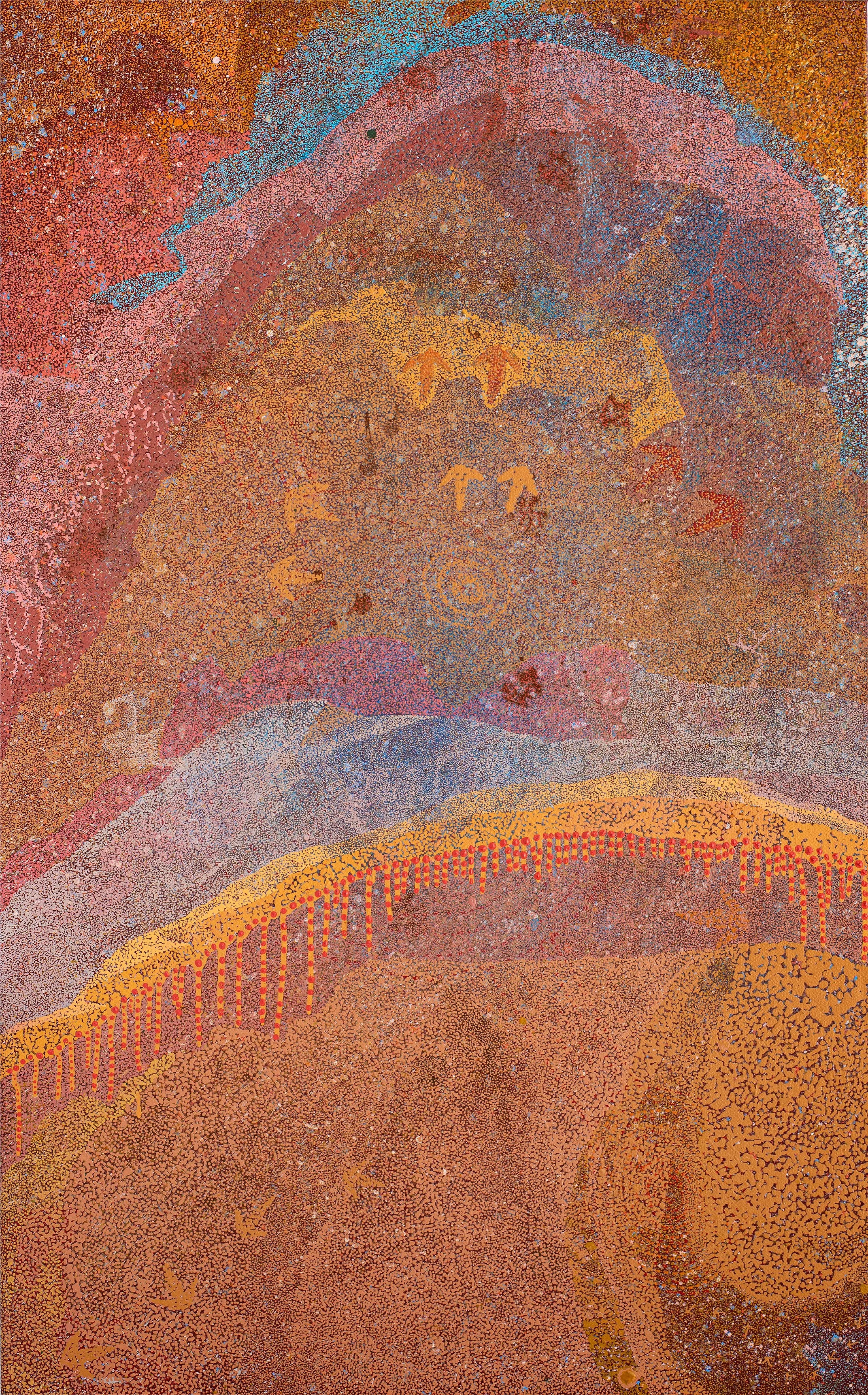
Artiste : Lloyd Jampijinpa Brown
Titre de l'œuvre : Yankirri Jukurrpa (Emu Dreaming) - Ngarlikirlangu
Format : 122 x 76 cm
Provenance et certificat : centre d'art aborigène de Yuendumu
Référence de cette peinture : 7738/23
Demander le prix de l'œuvre / Enquiry
Explications pour cette œuvre :
This painting depicts a ‘yankirri Jukurrpa’ (emu [Dromaius novaehollandiae] Dreaming) from a place called Ngarlikurlangu, approximately 50kms north of Yuendumu. The ‘kirda’ (owners) of this Dreaming are Nangala/Nampijinpa women and Jangala/Jampijinpa men. This Jukurrpa tells the story of a ‘yankirri’ (emu) and a ‘wardilyka’ (bush turkey [Ardeotis australis]). ‘Yankirri’ lived at a soakage to the west called Warnirripanu (or Walangkamirirri), while ‘wardilyka’ lived at a soakage to the east called Parirri. The emu and bush turkey used to go around the country picking ‘yakajirri’ (bush raisins [Solanum centrale]) and mashing them into ‘kapurdu’ (fruit balls) to save in their nests for later. However, they were jealous of each other; the emu thought that the bush turkey was picking the best and juiciest ‘yakajirri’, and was leaving him with only the sour ‘yakajirri’.
The emu went to the bush turkey’s nest to the east while the bush turkey was out hunting and smashed up the ‘kapurdu’ that the bush turkey had saved there. When the bush turkey returned, he found his smashed ‘yakajirri’ balls and realized that the emu had destroyed them. He went to the west to confront the emu and when he found him, they got into a big fight. The bush turkey eventually flew away to the north, leaving behind the smashed ‘yakajirri’ balls.
This practice of making ‘kapurdu’ (fruit balls) is a traditional Warlpiri method of storing ‘yakajirri’; in the old days, people used to dry the ‘yakajirri’, grind them up with a rock in a coolamon, mix them with water and form balls from them, and cover the ‘kapurdu’ with red ochre so they would keep. Today at Ngarlikirlangu we can see round, red rocks which are the ‘kapurdu’ that the emu smashed up. There is also a dance for this ‘yankirri’ (emu) Jukurrpa that is performed during mens’ initiation ceremonies. A number of other Jukurrpa are also located at Ngarlikirlangu, including ‘wardilyka Jukurrpa’ (bush turkey Dreaming), ‘yardijiinypa Jukurrpa’ (meat ant Dreaming), and ‘pirntina Jukurrpa’ (woma or Ramsay’s python [Aspidites ramsayi] Dreaming). Lots of ‘yakajirri’ grow around the Ngarlikirlangu area today.
© Photo : Aboriginal Signature Estrangin gallery with the courtesy of the artists and Yuendumu

Artiste : Walter Jangala Brown
Titre de l'œuvre : Tingari Cycle sacred story
Format : 122 x 91 cm
Provenance et certificat : centre d'art aborigène de Yuendumu
Référence de cette peinture : 2760/23
Demander le prix de l'œuvre / Enquiry
Explications pour cette œuvre :
This painting depicts a portion of the Tingari cycle, a very important collection of Dreaming narratives from the Western Desert region. The country that this painting depicts is located far to the west of Yuendumu, and spans a vast area of land across the Gibson and Great Sandy Deserts in Western Australia. Aboriginal groups that paint the Tingari cycle include the Pintupi, Kukatja, Ngarti, and Walmajarri peoples, among others.
The Tingari cycle consists of three major Dreaming tracks. One begins west of Jupiter Well and eventually runs due east, concluding south-east of Lake Mackay; another heads south-west from near Kintore for some 200 km, and then doubles back to end at Lake Macdonald; the third runs from south to north through Docker River and Kintore. The cycle tells the story of a group of ancient creation ancestors, the Tingari, who travelled across the country. The Tingari took different forms, some human and some animal. Humans were typically initiated men accompanied by ‘punyunyu’ (novices, uninitiated men). The men were sometimes accompanied by extremely powerful initiated women (called variously the ‘Kungka Tjuta,’ ‘Minyma Tjuta,’ or ‘Kanaputa’). Like the initiated men, these initiated women were accompanied by uninitiated women to whom they provided a ritual education. Animals featured in the Tingari cycle include the dingo, emu, kingfisher, and western quoll, among others.
As the Tingari travelled over vast areas of the country, they held initiations and other ceremonies, caused or encountered raging bushfires, hunted game, found and cooked bush-tucker, fought and killed one another, disposed of the dead or brought them back to life, interacted with totemic ancestors, copulated illicitly, made and used sacred objects, flew through the air, and died in hailstorms. In the course of these adventures, they either created or became the physical features of the sites they visited, forming rocky outcrops, waterholes, trees, salt lakes, ochre deposits, and so on. These sites which are now regarded as sacred by their descendants, today’s custodians of these places. The Tingari also laid down social custom and law as it should be practiced today. Their journeys form the basis of sacred and secret men’s and women’s laws. Public paintings of the Tingari cycle typically only show the unrestricted portions of these stories...
© Photo : Aboriginal Signature Estrangin gallery with the courtesy of the artists and Yuendumu
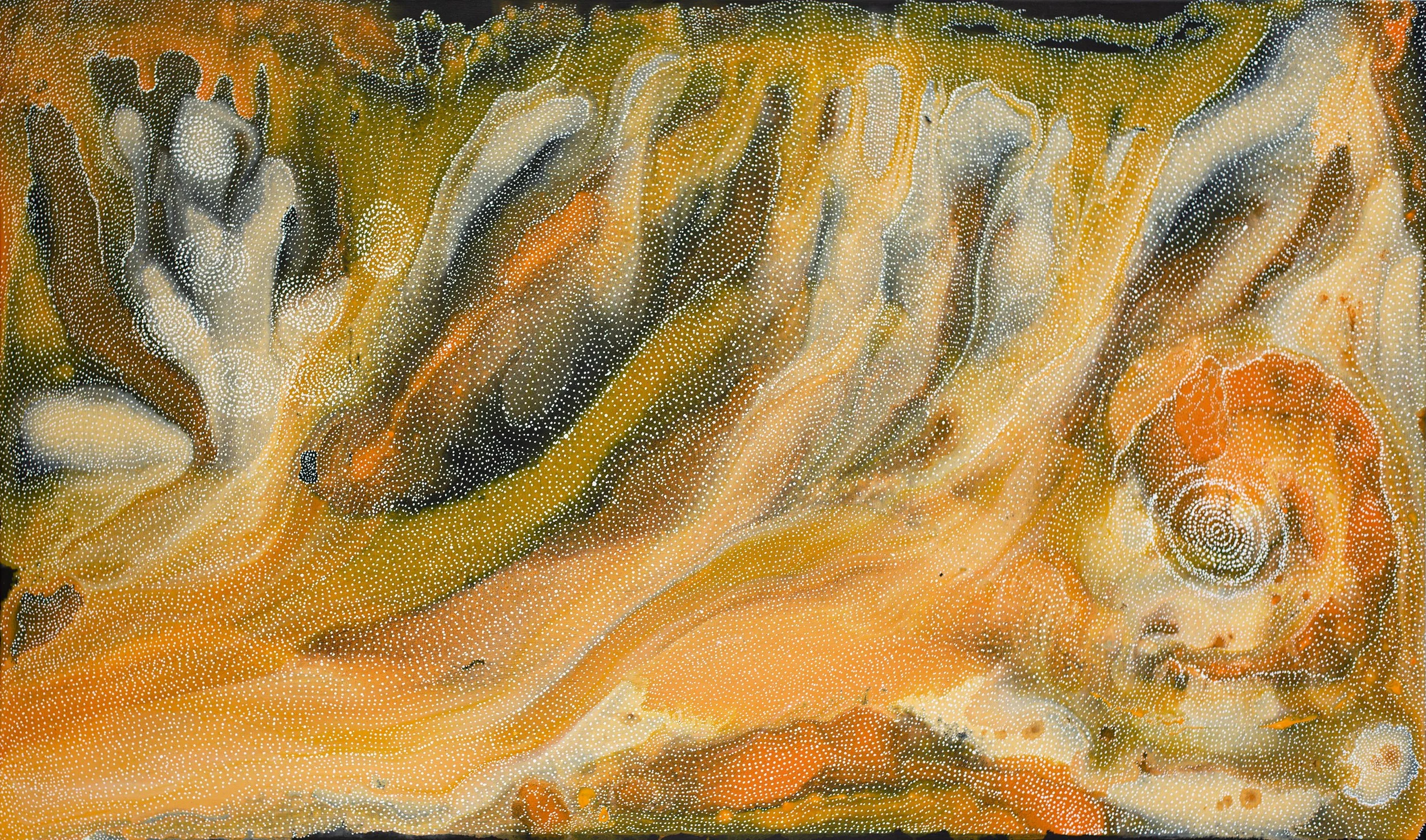
Artiste : Athena Nangala Granites
Titre de l'œuvre : Napaljarri-warnu Jukurrpa (Seven Sisters Dreaming)
Format : 183 x 107 cm
Provenance et certificat : centre d'art aborigène de Yuendumu
Référence de cette peinture : 1315/24
Demander le prix de l'œuvre / Enquiry
Explications de l'œuvre :
The Napaljarri-warnu Jukurrpa (seven sisters Dreaming) depicts the story of the seven ancestral Napaljarri sisters who are found in the night sky today in the cluster of seven stars in the constellation Taurus, more commonly known as the Pleiades. The Pleiades are seven women of the Napaljarri skin group and are often depicted in paintings of this Jukurrpa carrying the Jampijinpa man ‘wardilyka’ (the bush turkey [Ardeotis australias]) who is in love with the Napaljarri-warnu and who represents the Orion's Belt cluster of stars. Jukurra-jukurra, the morning star, is a Jakamarra man who is also in love with the seven Napaljarri sisters and is often shown chasing them across the night sky.
In a final attempt to escape from the Jakamarra the Napaljarri-warnu turned themselves into fire and ascended to the heavens to become stars. The custodians of the Napaljarri-warnu Jukurrpa are Japaljarri/Jungarrayi men and Napaljarri/Nungarrayi women. Some parts of the Napaljarri-warnu Jukurrpa are closely associated with men’s sacred ceremonies of a very secretive nature. In contemporary Warlpiri paintings traditional iconography is used to represent the Jukurrpa, associated sites and other elements. Often depicted in paintings for this Jukurrpa is the female star Yantarlarangi (Venus - the Evening Star) who chases the seven Napaljarri sisters for having stolen the night from her.
© Photo : Aboriginal Signature Estrangin gallery with the courtesy of the artists and Yuendumu
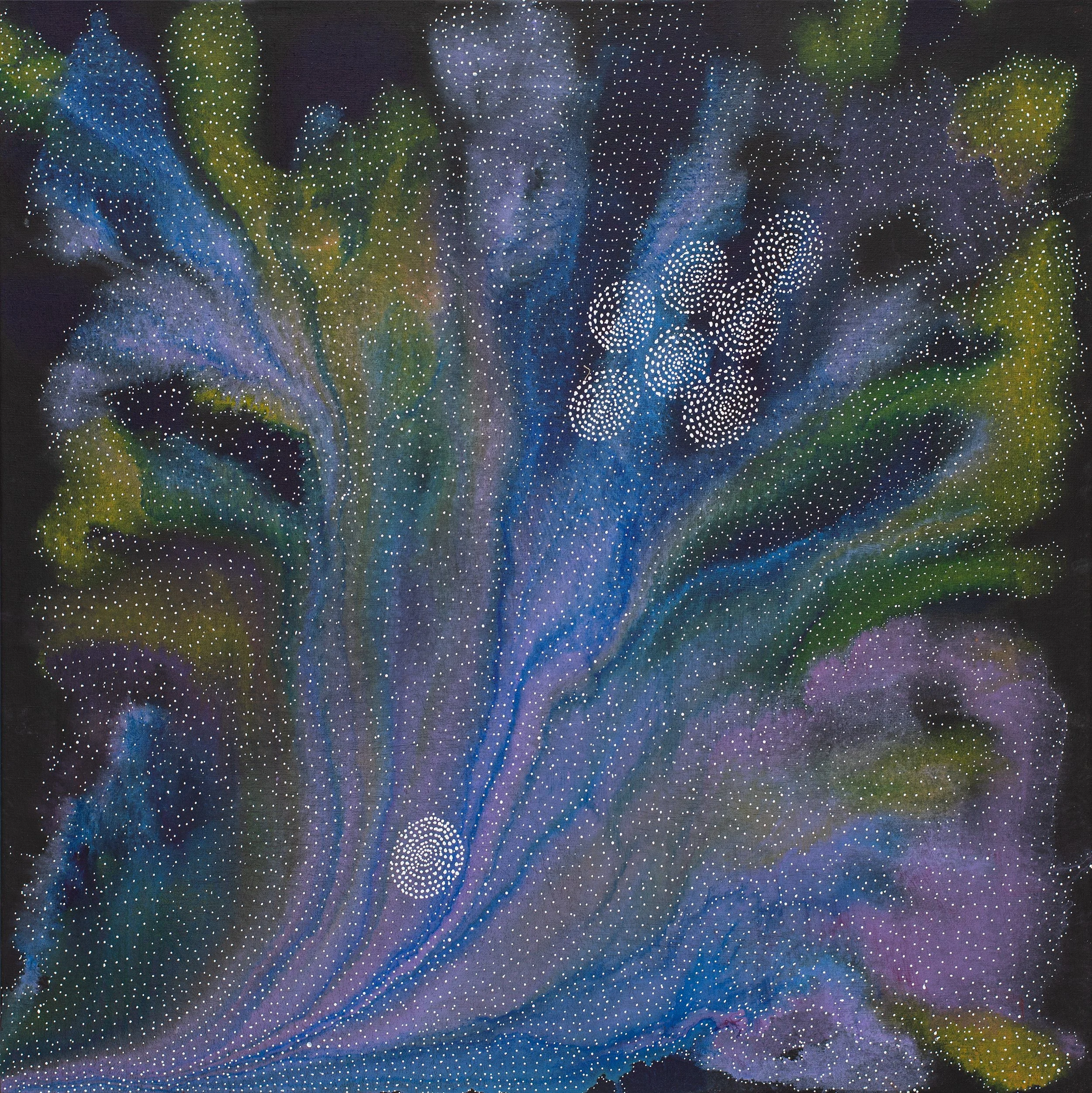
Artiste : Athena Nangala Granites
Titre de l'œuvre : Napaljarri-warnu Jukurrpa (Seven Sisters Dreaming)
Format : 91 x 91 cm
Provenance et certificat : centre d'art aborigène de Yuendumu
Référence de cette peinture : 4182/23
Demander le prix de l'œuvre / Enquiry
Explications de l'œuvre :
The Napaljarri-warnu Jukurrpa (seven sisters Dreaming) depicts the story of the seven ancestral Napaljarri sisters who are found in the night sky today in the cluster of seven stars in the constellation Taurus, more commonly known as the Pleiades. The Pleiades are seven women of the Napaljarri skin group and are often depicted in paintings of this Jukurrpa carrying the Jampijinpa man ‘wardilyka’ (the bush turkey [Ardeotis australias]) who is in love with the Napaljarri-warnu and who represents the Orion's Belt cluster of stars. Jukurra-jukurra, the morning star, is a Jakamarra man who is also in love with the seven Napaljarri sisters and is often shown chasing them across the night sky.
In a final attempt to escape from the Jakamarra the Napaljarri-warnu turned themselves into fire and ascended to the heavens to become stars. The custodians of the Napaljarri-warnu Jukurrpa are Japaljarri/Jungarrayi men and Napaljarri/Nungarrayi women. Some parts of the Napaljarri-warnu Jukurrpa are closely associated with men’s sacred ceremonies of a very secretive nature. In contemporary Warlpiri paintings traditional iconography is used to represent the Jukurrpa, associated sites and other elements. Often depicted in paintings for this Jukurrpa is the female star Yantarlarangi (Venus - the Evening Star) who chases the seven Napaljarri sisters for having stolen the night from her.
© Photo : Aboriginal Signature Estrangin gallery with the courtesy of the artists and Yuendumu

Artiste : Tasha Nampijinpa Collins
Titre de l'œuvre : Ngapa Jukurrpa (Water Dreaming) - Puyurru
Format : 91 x 91 cm
Provenance et certificat : centre d'art aborigène de Yuendumu
Référence de cette peinture : 6383/23
Demander le prix de l'œuvre / Enquiry
Explications de l'œuvre :
The site depicted in this painting is Puyurru, west of Yuendumu. In the usually dry creek beds are ‘mulju’ (soakages), or naturally occurring wells. The 'kirda' (owners) for this site are Nangala/Nampijinpa women and Jangala/Jampijinpa men. Two Jangala men, rainmakers, sang the rain, unleashing a giant storm. The storm travelled across the country from the east to the west, initially travelling with a ‘pamapardu Jukurrpa’ (termite Dreaming) from Warntungurru to Warlura, a waterhole 8 miles east of Yuendumu. At Warlura, a gecko called Yumariyumari blew the storm on to Lapurrukurra and Wilpiri. Bolts of lightning shot out at Wirnpa (also called Mardinymardinypa) and at Kanaralji.
At this point the Dreaming track also includes the ‘kurdukurdu mangkurdu Jukurrpa’ (children of the clouds Dreaming). The water Dreaming built hills at Ngamangama using baby clouds and also stuck long pointy clouds into the ground at Jukajuka, where they can still be seen today as rock formations. The termite Dreaming eventually continued west to Nyirripi, a community approximately 160 km west of Yuendumu. The water Dreaming then travelled from the south over Mikanji, a watercourse with soakages northwest of Yuendumu. At Mikanji, the storm was picked up by a ‘kirrkarlanji’ (brown falcon [Falco berigora]) and taken farther north. At Puyurru, the falcon dug up a giant ‘warnayarra’ (rainbow serpent). The serpent carried water with it to create another large lake, Jillyiumpa, close to an outstation in this country. The ‘kirda’ (owners) of this story are Jangala men and Nangala women.
After stopping at Puyurru, the water Dreaming travelled on through other locations including Yalyarilalku, Mikilyparnta, Katalpi, Lungkardajarra, Jirawarnpa, Kamira, Yurrunjuku, and Jikaya before moving on into Gurindji country to the north.
© Photo : Aboriginal Signature Estrangin gallery with the courtesy of the artists and Yuendumu
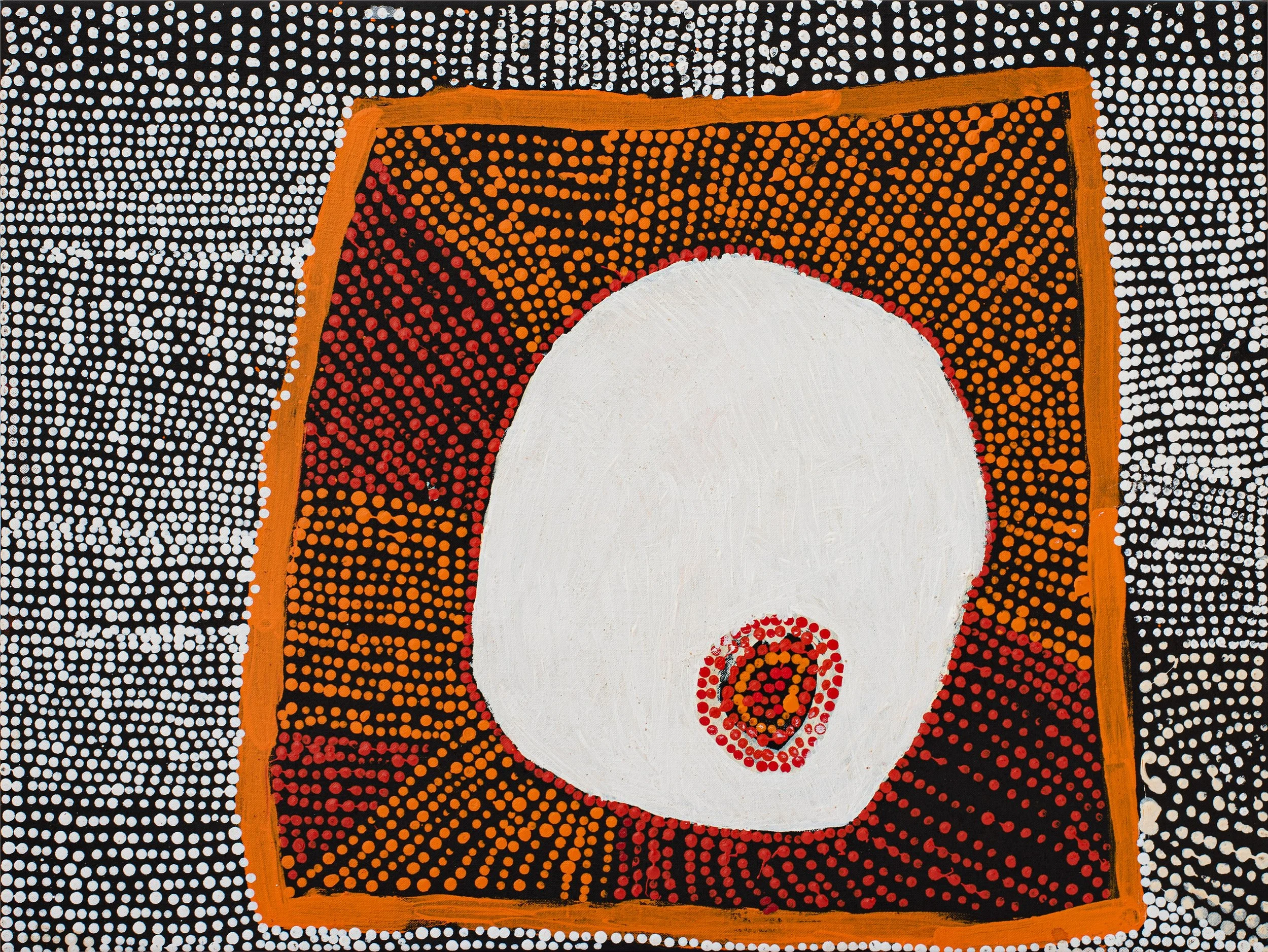
Artiste : Tasha Nampijinpa Collins
Titre de l'œuvre : Ngapa Jukurrpa (Water Dreaming) - Puyurru
Format : 61 x 46 cm
Provenance et certificat : centre d'art aborigène de Yuendumu
Référence de cette peinture : 4327/23
Demander le prix de l'œuvre / Enquiry
Explications de l'œuvre :
The site depicted in this painting is Puyurru, west of Yuendumu. In the usually dry creek beds are ‘mulju’ (soakages), or naturally occurring wells. The 'kirda' (owners) for this site are Nangala/Nampijinpa women and Jangala/Jampijinpa men. Two Jangala men, rainmakers, sang the rain, unleashing a giant storm. The storm travelled across the country from the east to the west, initially travelling with a ‘pamapardu Jukurrpa’ (termite Dreaming) from Warntungurru to Warlura, a waterhole 8 miles east of Yuendumu. At Warlura, a gecko called Yumariyumari blew the storm on to Lapurrukurra and Wilpiri. Bolts of lightning shot out at Wirnpa (also called Mardinymardinypa) and at Kanaralji.
At this point the Dreaming track also includes the ‘kurdukurdu mangkurdu Jukurrpa’ (children of the clouds Dreaming). The water Dreaming built hills at Ngamangama using baby clouds and also stuck long pointy clouds into the ground at Jukajuka, where they can still be seen today as rock formations. The termite Dreaming eventually continued west to Nyirripi, a community approximately 160 km west of Yuendumu. The water Dreaming then travelled from the south over Mikanji, a watercourse with soakages northwest of Yuendumu. At Mikanji, the storm was picked up by a ‘kirrkarlanji’ (brown falcon [Falco berigora]) and taken farther north. At Puyurru, the falcon dug up a giant ‘warnayarra’ (rainbow serpent). The serpent carried water with it to create another large lake, Jillyiumpa, close to an outstation in this country. The ‘kirda’ (owners) of this story are Jangala men and Nangala women.
After stopping at Puyurru, the water Dreaming travelled on through other locations including Yalyarilalku, Mikilyparnta, Katalpi, Lungkardajarra, Jirawarnpa, Kamira, Yurrunjuku, and Jikaya before moving on into Gurindji country to the north.
© Photo : Aboriginal Signature Estrangin gallery with the courtesy of the artists and Yuendumu
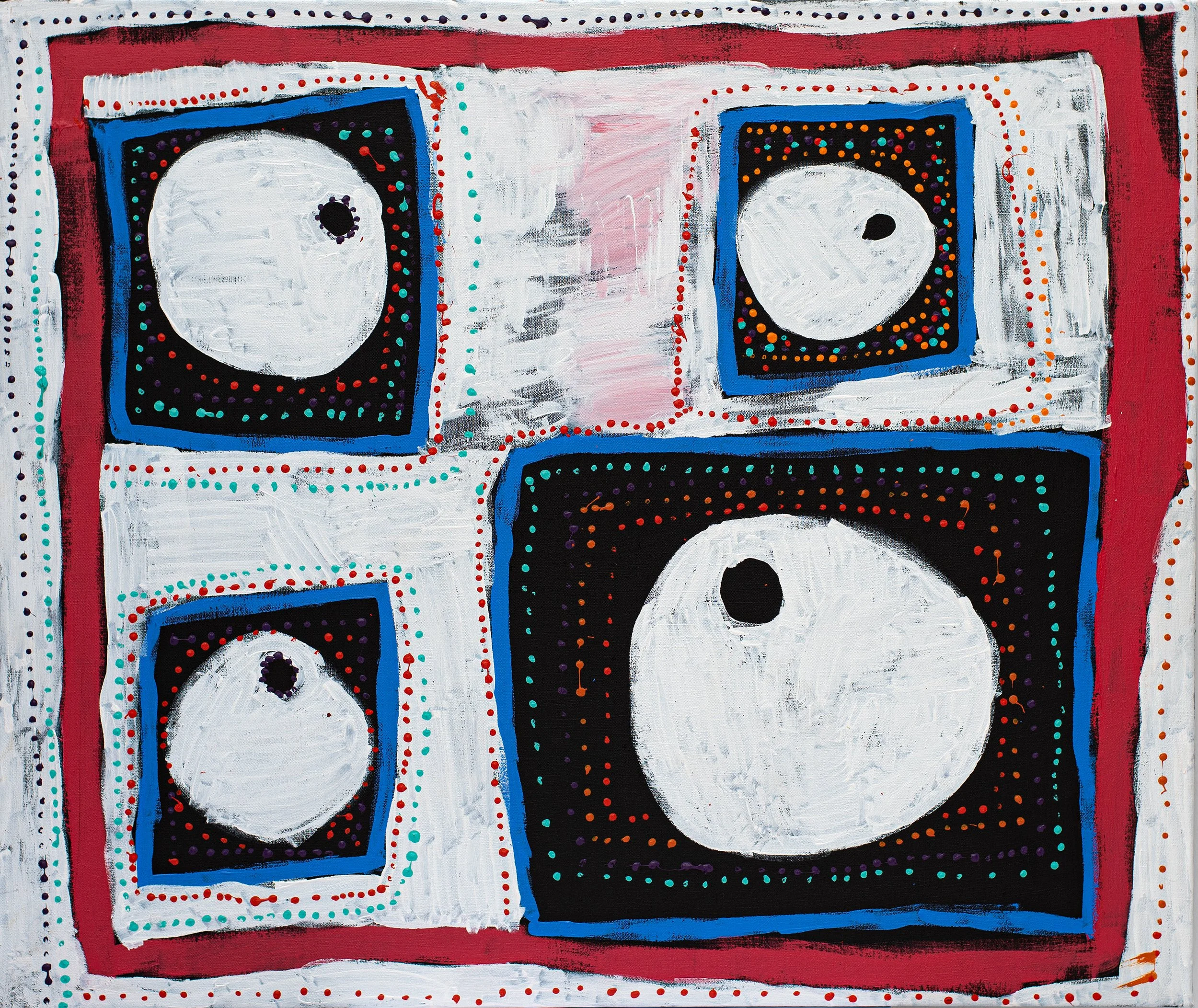
Artiste : Tasha Nampijinpa Collins
Titre de l'œuvre : Ngapa Jukurrpa (Water Dreaming) - Puyurru
Format : 91 x 76 cm
Provenance et certificat : centre d'art aborigène de Yuendumu
Référence de cette peinture : 4384/23
Demander le prix de l'œuvre / Enquiry
Explications de l'œuvre :
The site depicted in this painting is Puyurru, west of Yuendumu. In the usually dry creek beds are ‘mulju’ (soakages), or naturally occurring wells. The 'kirda' (owners) for this site are Nangala/Nampijinpa women and Jangala/Jampijinpa men. Two Jangala men, rainmakers, sang the rain, unleashing a giant storm. The storm travelled across the country from the east to the west, initially travelling with a ‘pamapardu Jukurrpa’ (termite Dreaming) from Warntungurru to Warlura, a waterhole 8 miles east of Yuendumu. At Warlura, a gecko called Yumariyumari blew the storm on to Lapurrukurra and Wilpiri. Bolts of lightning shot out at Wirnpa (also called Mardinymardinypa) and at Kanaralji.
At this point the Dreaming track also includes the ‘kurdukurdu mangkurdu Jukurrpa’ (children of the clouds Dreaming). The water Dreaming built hills at Ngamangama using baby clouds and also stuck long pointy clouds into the ground at Jukajuka, where they can still be seen today as rock formations. The termite Dreaming eventually continued west to Nyirripi, a community approximately 160 km west of Yuendumu. The water Dreaming then travelled from the south over Mikanji, a watercourse with soakages northwest of Yuendumu. At Mikanji, the storm was picked up by a ‘kirrkarlanji’ (brown falcon [Falco berigora]) and taken farther north. At Puyurru, the falcon dug up a giant ‘warnayarra’ (rainbow serpent). The serpent carried water with it to create another large lake, Jillyiumpa, close to an outstation in this country. The ‘kirda’ (owners) of this story are Jangala men and Nangala women.
After stopping at Puyurru, the water Dreaming travelled on through other locations including Yalyarilalku, Mikilyparnta, Katalpi, Lungkardajarra, Jirawarnpa, Kamira, Yurrunjuku, and Jikaya before moving on into Gurindji country to the north.
© Photo : Aboriginal Signature Estrangin gallery with the courtesy of the artists and Yuendumu
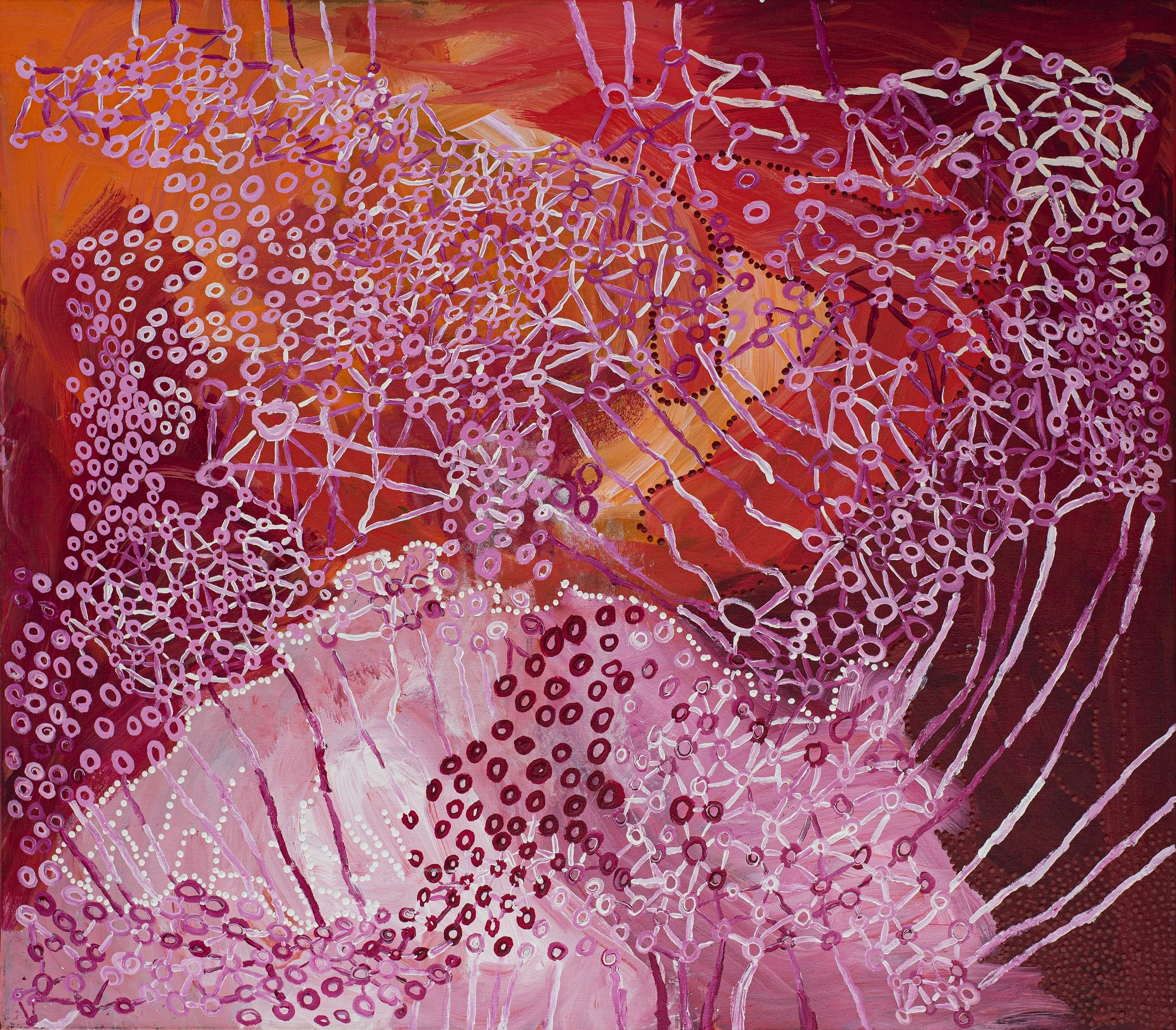
Artiste : Steven Jupurrurla Nelson
Titre de l'œuvre : Janganpa Jukurrpa Steven Nelson (common brush-tail possum [Trichosurus vulpecula] Dreaming)
Format : 122 x 107 cm
Provenance et certificat : centre d'art aborigène de Yuendumu
Référence de cette peinture : 7372/23
Demander le prix de l'œuvre / Enquiry
Explications de l'œuvre :
Janganpa Jukurrpa (common brush-tail possum [Trichosurus vulpecula] Dreaming) travels all over Warlpiri country. ‘Janganpa’ are nocturnal animals that often nest in the hollows of white gum trees (‘wapunungka’). This story comes from a big hill called Mawurrji, west of Yuendumu and north of Pikilyi (Vaughan Springs). A group of ‘janganpa’ ancestors resided there. Every night they would go out in search of food.
Their hunting trips took them to Wirlki and Wanapirdi, where they found ‘pamapardu’ (flying ants). They journeyed on to Ngarlkirdipini looking for water. A Nampijinpa women was living at Mawurrji with her two daughters. She gave her daughters in marriage to a Jupurrurla ‘janganpa’ but later decided to run away with them. The Jupurrurla angrily pursued the woman. He tracked them to Mawurrji where he killed them with a stone axe. Their bodies are now rocks at this place. Warlpiri people perform a young men’s initiation ceremony, which involves the Janganpa Jukurrpa.
The Janganpa Jukurrpa belongs to Jakamarra/Jupurrurla men and Nakamarra/Napurrurla women. In Warlpiri paintings traditional iconography is used to represent this Jukurrpa. ‘Janganpa’ tracks are often represented as 'E' shaped figures and concentric circles are used to depict the trees in which the ‘janganpa’ live, and also the sites at Mawurrji.
Steven Nelson has developed his own characteristic style in the depiction of the Jukurrpa, he is not using traditional iconography, his abstract representation of his dreaming is an exploration of the relationship of colour and form to depict the landscape and the story associated to his Jukurrpa.
© Photo : Aboriginal Signature Estrangin gallery with the courtesy of the artists and Yuendumu
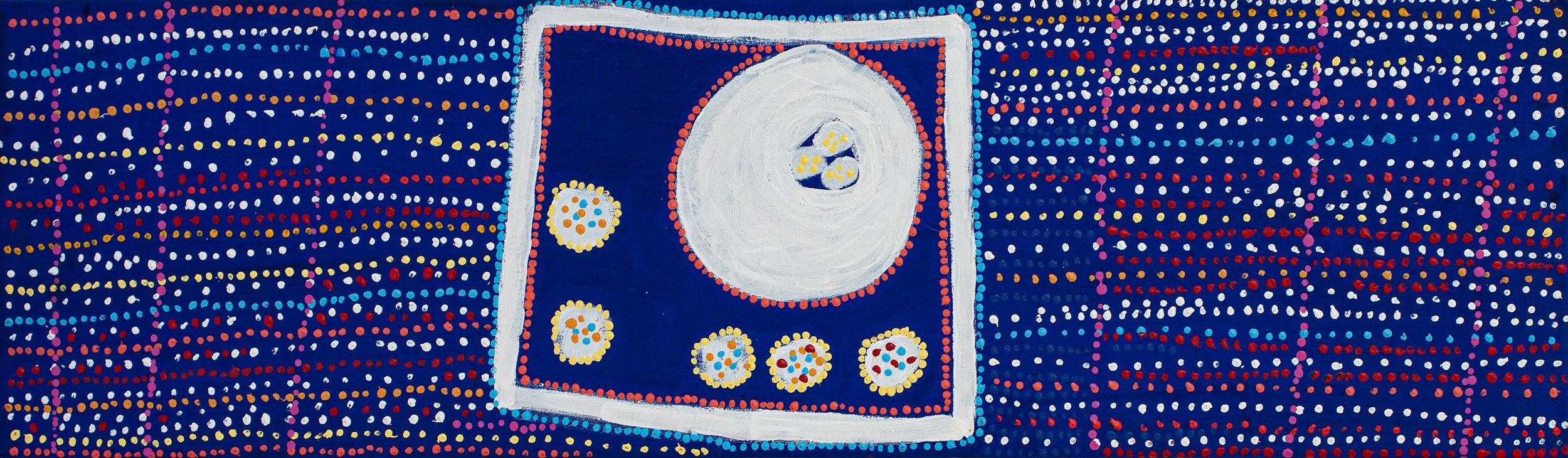
Artiste : Tasha Nampijinpa Collins
Titre de l'œuvre : Ngapa Jukurrpa (Water Dreaming) - Puyurru
Format : 107 x 30 cm
Provenance et certificat : centre d'art aborigène de Yuendumu
Référence de cette peinture : 240/23
Demander le prix de l'œuvre / Enquiry
Explications de l'œuvre :
The site depicted in this painting is Puyurru, west of Yuendumu. In the usually dry creek beds are ‘mulju’ (soakages), or naturally occurring wells. The 'kirda' (owners) for this site are Nangala/Nampijinpa women and Jangala/Jampijinpa men. Two Jangala men, rainmakers, sang the rain, unleashing a giant storm. The storm travelled across the country from the east to the west, initially travelling with a ‘pamapardu Jukurrpa’ (termite Dreaming) from Warntungurru to Warlura, a waterhole 8 miles east of Yuendumu. At Warlura, a gecko called Yumariyumari blew the storm on to Lapurrukurra and Wilpiri. Bolts of lightning shot out at Wirnpa (also called Mardinymardinypa) and at Kanaralji.
At this point the Dreaming track also includes the ‘kurdukurdu mangkurdu Jukurrpa’ (children of the clouds Dreaming). The water Dreaming built hills at Ngamangama using baby clouds and also stuck long pointy clouds into the ground at Jukajuka, where they can still be seen today as rock formations. The termite Dreaming eventually continued west to Nyirripi, a community approximately 160 km west of Yuendumu. The water Dreaming then travelled from the south over Mikanji, a watercourse with soakages northwest of Yuendumu. At Mikanji, the storm was picked up by a ‘kirrkarlanji’ (brown falcon [Falco berigora]) and taken farther north. At Puyurru, the falcon dug up a giant ‘warnayarra’ (rainbow serpent). The serpent carried water with it to create another large lake, Jillyiumpa, close to an outstation in this country. The ‘kirda’ (owners) of this story are Jangala men and Nangala women.
After stopping at Puyurru, the water Dreaming travelled on through other locations including Yalyarilalku, Mikilyparnta, Katalpi, Lungkardajarra, Jirawarnpa, Kamira, Yurrunjuku, and Jikaya before moving on into Gurindji country to the north.
© Photo : Aboriginal Signature Estrangin gallery with the courtesy of the artists and Yuendumu
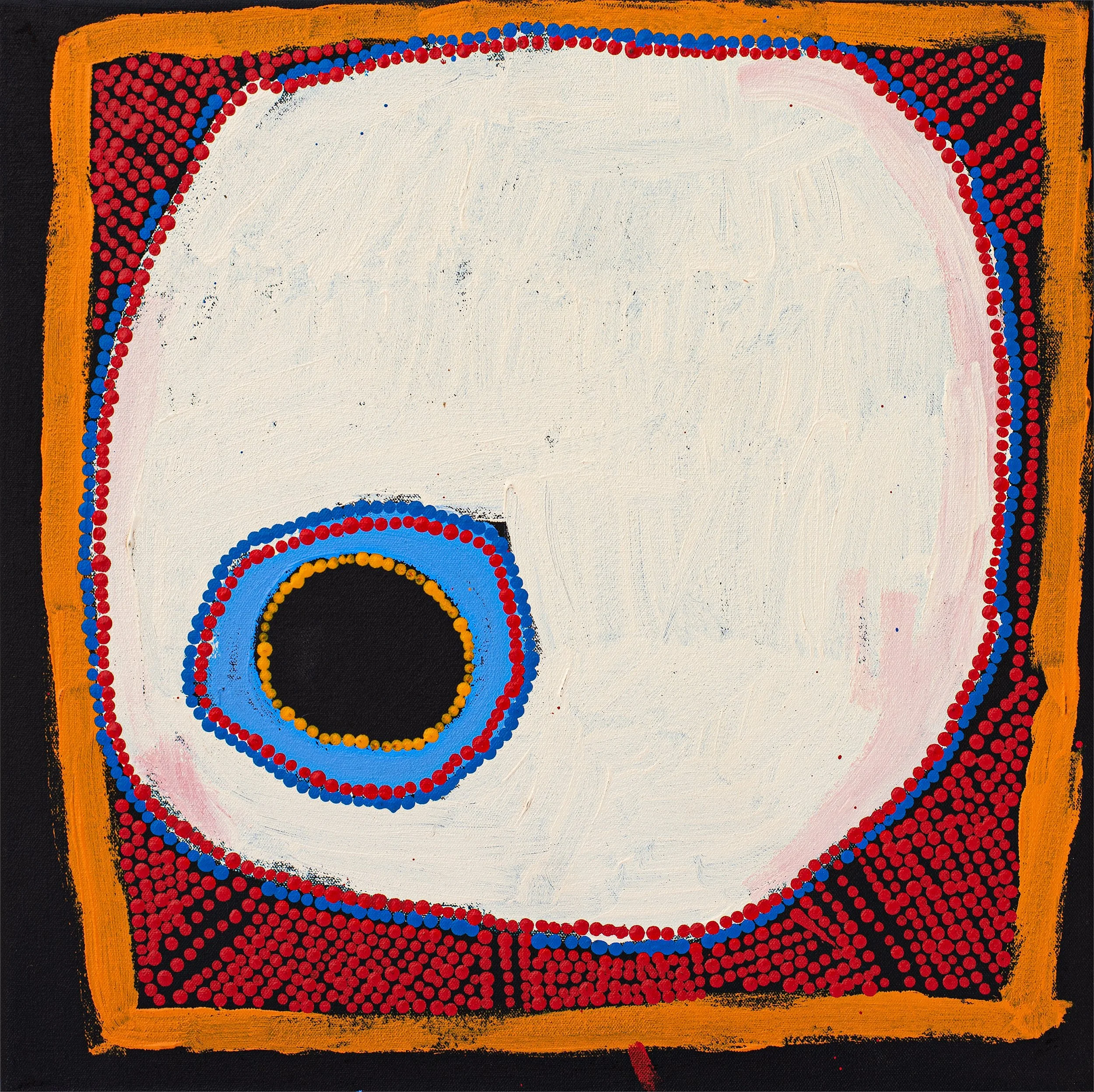
Artiste : Tasha Nampijinpa Collins
Titre de l'œuvre : Ngapa Jukurrpa (Water Dreaming) - Puyurru
Format : 46 x 46 cm
Provenance et certificat : centre d'art aborigène de Yuendumu
Référence de cette peinture : 10099/22
Demander le prix de l'œuvre / Enquiry
Explications de l'œuvre :
The site depicted in this painting is Puyurru, west of Yuendumu. In the usually dry creek beds are ‘mulju’ (soakages), or naturally occurring wells. The 'kirda' (owners) for this site are Nangala/Nampijinpa women and Jangala/Jampijinpa men. Two Jangala men, rainmakers, sang the rain, unleashing a giant storm. The storm travelled across the country from the east to the west, initially travelling with a ‘pamapardu Jukurrpa’ (termite Dreaming) from Warntungurru to Warlura, a waterhole 8 miles east of Yuendumu. At Warlura, a gecko called Yumariyumari blew the storm on to Lapurrukurra and Wilpiri. Bolts of lightning shot out at Wirnpa (also called Mardinymardinypa) and at Kanaralji.
At this point the Dreaming track also includes the ‘kurdukurdu mangkurdu Jukurrpa’ (children of the clouds Dreaming). The water Dreaming built hills at Ngamangama using baby clouds and also stuck long pointy clouds into the ground at Jukajuka, where they can still be seen today as rock formations. The termite Dreaming eventually continued west to Nyirripi, a community approximately 160 km west of Yuendumu. The water Dreaming then travelled from the south over Mikanji, a watercourse with soakages northwest of Yuendumu. At Mikanji, the storm was picked up by a ‘kirrkarlanji’ (brown falcon [Falco berigora]) and taken farther north. At Puyurru, the falcon dug up a giant ‘warnayarra’ (rainbow serpent). The serpent carried water with it to create another large lake, Jillyiumpa, close to an outstation in this country. The ‘kirda’ (owners) of this story are Jangala men and Nangala women.
After stopping at Puyurru, the water Dreaming travelled on through other locations including Yalyarilalku, Mikilyparnta, Katalpi, Lungkardajarra, Jirawarnpa, Kamira, Yurrunjuku, and Jikaya before moving on into Gurindji country to the north.
© Photo : Aboriginal Signature Estrangin gallery with the courtesy of the artists and Yuendumu
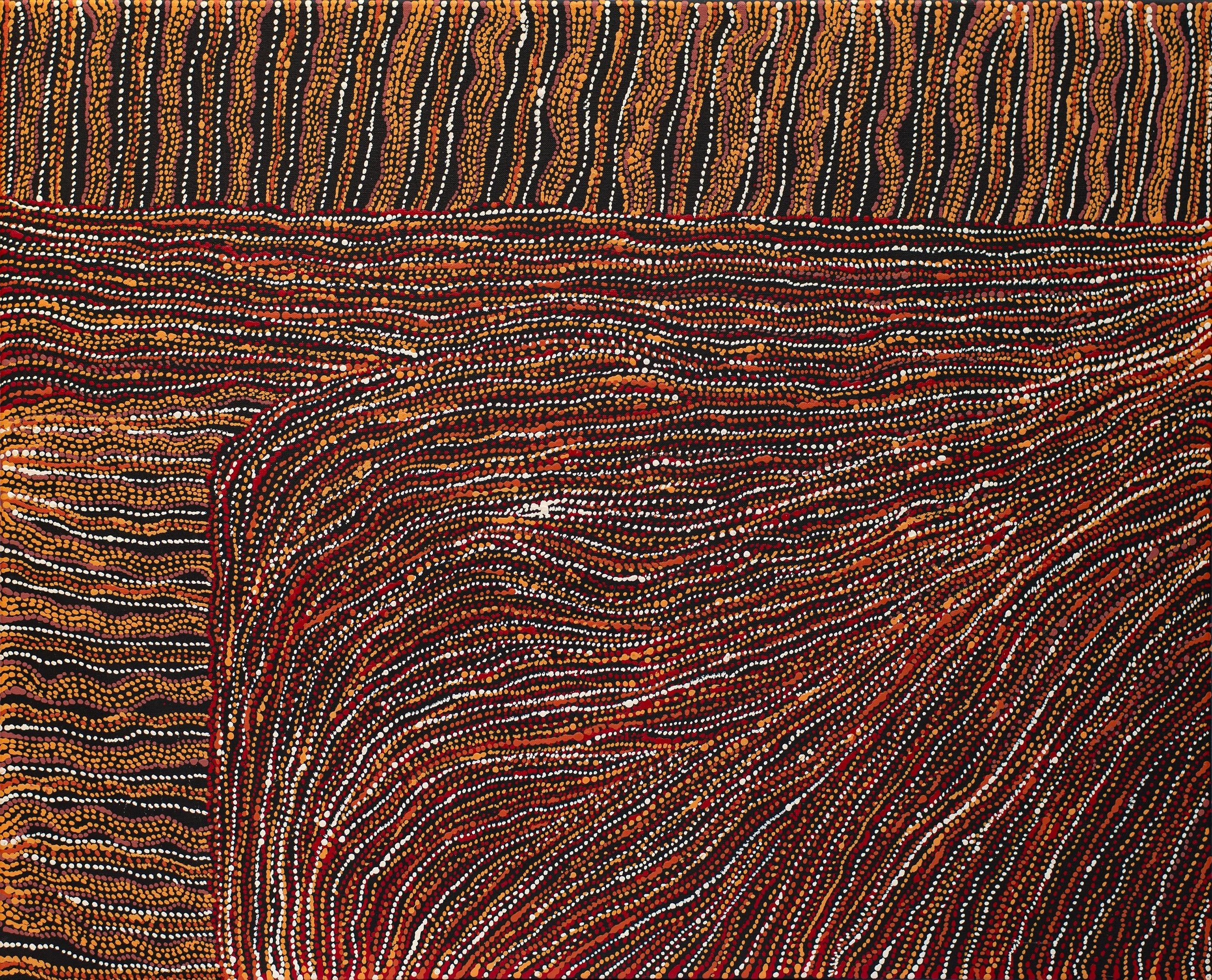
Artiste : Sabrina Nangala Robertson
Titre de l'œuvre : Ngapa Jukurrpa (Water Dreaming) - Pirlinyarnu
Format : 76 x 61 cm
Provenance et certificat : centre d'art aborigène de Yuendumu
Référence de cette peinture : 1405/24
Demander le prix de l'œuvre / Enquiry
Explications de l'œuvre :
The site depicted in this painting is Pirlinyarnu (Mt. Farewell), about 165 km west of Yuendumu in the Northern Territory. The ‘kirda’ (owners) for the water Dreaming site at Pirlinyarnu are Nangala/Nampijinpa women and Jangala/Jampijinpa men.
Two Jangala men, rainmakers, sang the rain, unleashing a giant storm that collided with another storm from Wapurtali at Mirawarri. A ‘kirrkarlanji’ (brown falcon [Falco berigora]) carried the storm further west from Mirawarri. The two storms travelled across the country from Karlipirnpa, a ceremonial site for the water Dreaming near Kintore that is owned by members of the Napaljarri/Japaljarri and Napanangka/Japanangka subsections. Along the way the storms passed through Juntiparnta, a site that is owned by Jampijinpa men. The storm eventually became too heavy for the falcon. It dropped the water at Pirlinyarnu, where it formed an enormous ‘maluri’ (claypan). A ‘mulju’ (soakage) exists in this place today.
Whenever it rains today, hundreds of ‘ngapangarlpa’ (bush ducks) still flock to Pirlinyarnu.
© Photo : Aboriginal Signature Estrangin gallery with the courtesy of the artists and Yuendumu
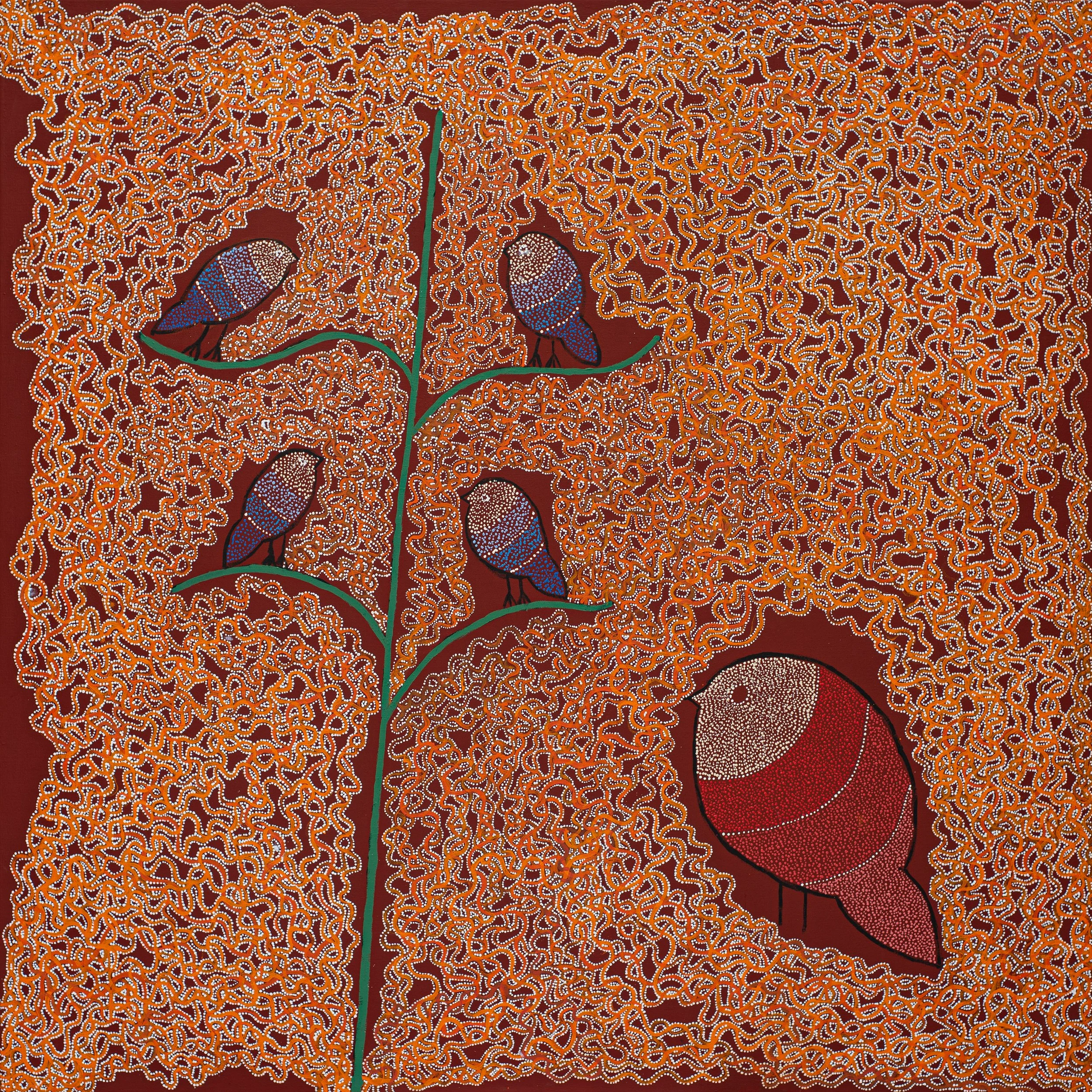
Artiste : Geraldine Napangardi Granites
Titre de l'œuvre : Ngalyipi Jukurrpa (Snake Vine Dreaming) - Purturlu
Format : 122 x 122 cm
Provenance et certificat : centre d'art aborigène de Yuendumu
Référence de cette peinture : 1041/23
Demander le prix de l'œuvre / Enquiry
Explications de l'œuvre :
The ‘ngalyipi Jukurrpa’ (snakevine [Tinospora smilacina] Dreaming) depicted in this painting comes from Purturlu (Mount Theo), located approximately 150kms north-northwest of Yuendumu. The ‘kirda’ (owners) of this Dreaming are Napanangka/Napangardi women and
Japanangka/Japangardi men. The ‘kurdungurlu’ (custodians) for this Dreaming are Nangala/Nakamarra women and Jangala/Jakamarra men.
A number of other Dreamings are also located in, or pass through, Purturlu; these include ‘wakurlpirri Jukurrpa’ (Dogwood tree Dreaming), ‘wardapi Jukurrpa’ (goanna Jukurrpa), and ‘kanta Jukurrpa’ (bush coconut Dreaming). ‘Ngalyipi’ (snakevine) is a green creeper that climbs up the trunks and branches of trees and shrubs. The plant is found on sandy spinifex plains and sandhills. ‘Ngalyipi’ is frequently depicted in paintings due to its many uses and its great importance in the initiation ceremonies of young Japanangka/Japangardi men. The vine can be used as a shoulder strap to carry ‘parraja’ (coolamons) and ‘ngami’ (water carriers). The plant also has medicinal uses; its vines are used as tourniquets, and its leaves and vines are used as bandages for wounds.
Warlpiri sometimes also chew the leaves to treat severe colds. ‘Ngalyipi’ stems can be pounded between stones and tied around the forehead to cure headaches. In men’s initiation, ‘ngalyipi’ is used to tie the ‘witi’ (ceremonial poles) to the shins of the dancing initiates, and to tie ‘yukurruyukurru’ (dancing boards) to dancers’ bodies. The initiation ceremonies associated with the ‘ngalyipi’ Dreaming at Purturlu are for the sons and grandsons of Japanangka and Japangardi men. Napanangka and Napangardi women dance at these ceremonies, and then look away and block their ears when the men dance. This ‘witi’ ceremony is performed at night under the stars.
© Photo : Aboriginal Signature Estrangin gallery with the courtesy of the artists and Yuendumu
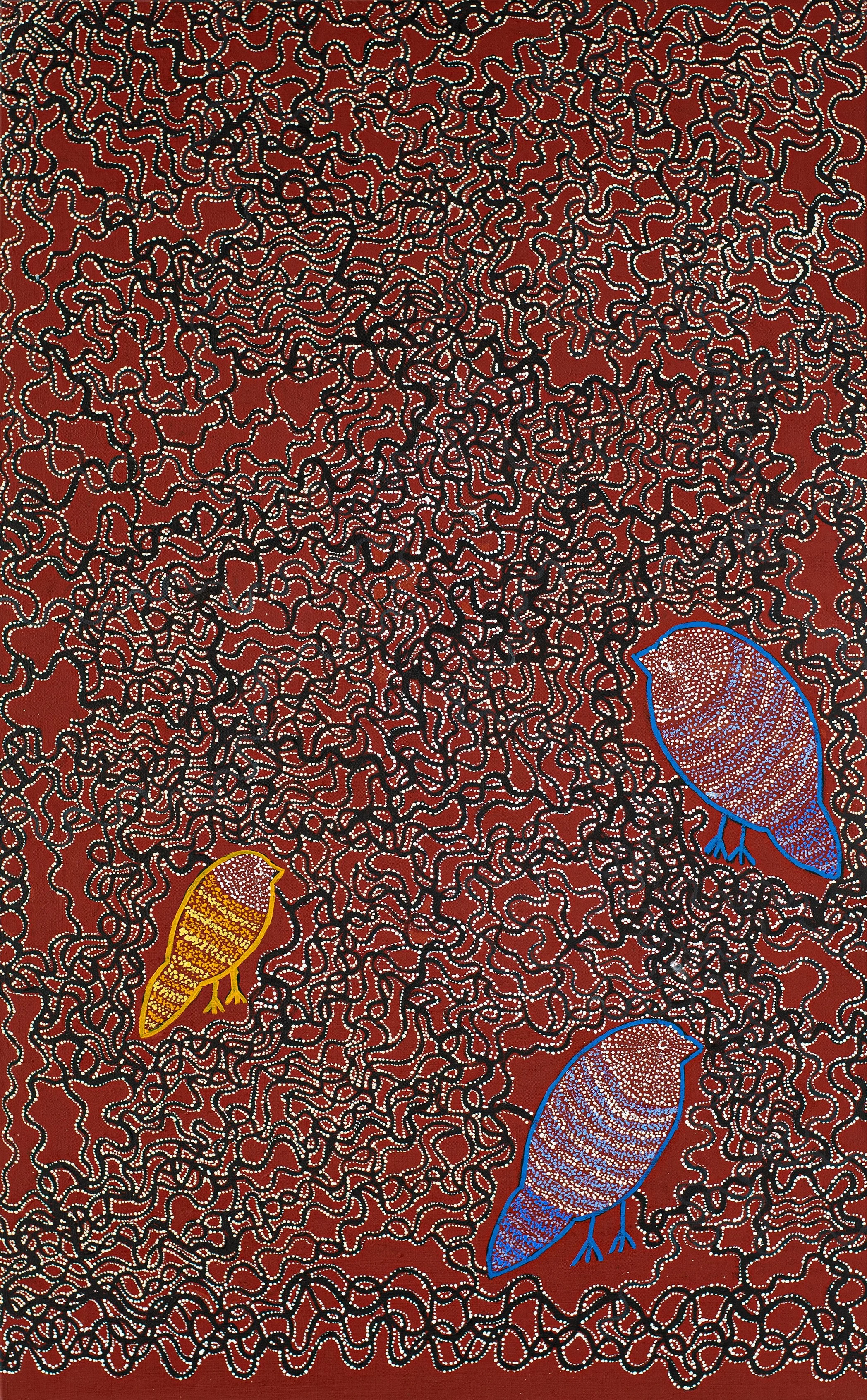
Artiste : Geraldine Napangardi Granites
Titre de l'œuvre : Ngalyipi Jukurrpa (Snake Vine Dreaming) - Purturlu
Format : 122 x 76 cm
Provenance et certificat : centre d'art aborigène de Yuendumu
Référence de cette peinture : 10054/22
Demander le prix de l'œuvre / Enquiry
Explications de l'œuvre :
The ‘ngalyipi Jukurrpa’ (snakevine [Tinospora smilacina] Dreaming) depicted in this painting comes from Purturlu (Mount Theo), located approximately 150kms north-northwest of Yuendumu. The ‘kirda’ (owners) of this Dreaming are Napanangka/Napangardi women and
Japanangka/Japangardi men. The ‘kurdungurlu’ (custodians) for this Dreaming are Nangala/Nakamarra women and Jangala/Jakamarra men.
A number of other Dreamings are also located in, or pass through, Purturlu; these include ‘wakurlpirri Jukurrpa’ (Dogwood tree Dreaming), ‘wardapi Jukurrpa’ (goanna Jukurrpa), and ‘kanta Jukurrpa’ (bush coconut Dreaming). ‘Ngalyipi’ (snakevine) is a green creeper that climbs up the trunks and branches of trees and shrubs. The plant is found on sandy spinifex plains and sandhills. ‘Ngalyipi’ is frequently depicted in paintings due to its many uses and its great importance in the initiation ceremonies of young Japanangka/Japangardi men. The vine can be used as a shoulder strap to carry ‘parraja’ (coolamons) and ‘ngami’ (water carriers). The plant also has medicinal uses; its vines are used as tourniquets, and its leaves and vines are used as bandages for wounds.
Warlpiri sometimes also chew the leaves to treat severe colds. ‘Ngalyipi’ stems can be pounded between stones and tied around the forehead to cure headaches. In men’s initiation, ‘ngalyipi’ is used to tie the ‘witi’ (ceremonial poles) to the shins of the dancing initiates, and to tie ‘yukurruyukurru’ (dancing boards) to dancers’ bodies. The initiation ceremonies associated with the ‘ngalyipi’ Dreaming at Purturlu are for the sons and grandsons of Japanangka and Japangardi men. Napanangka and Napangardi women dance at these ceremonies, and then look away and block their ears when the men dance. This ‘witi’ ceremony is performed at night under the stars.
© Photo : Aboriginal Signature Estrangin gallery with the courtesy of the artists and Yuendumu

Artiste : Margarina Napanangka Miller
Titre de l'œuvre : Lukarrara Jukurrpa (Desert Fringe-rush Seed Dreaming)
Format : 122 x 61 cm
Provenance et certificat : centre d'art aborigène de Yuendumu
Référence de cette peinture : 698/24
Demander le prix de l'œuvre / Enquiry
Explications de l'œuvre :
This Jukurrpa belongs to women of the Nakamarra/Napurrurla subsections and to Jakamarra/Jupurrurla men. This Dreaming is associated with a place called Jaralypari, north of Yuendumu. Lukarrara (desert fringe-rush [Fimbristylis oxystachya & Fimbristylis eremophila]) is a grass with an edible seed. The seeds are traditionally ground on a large stone (‘ngatinyanu’) with a smaller stone (‘ngalikirri’) to make flour.
This flour is mixed with water (‘ngapa’) to make damper cakes which are cooked and eaten. In Warlpiri traditional paintings iconography is used to represent the Jukurrpa, particular sites and other elements. Large concentric circles often represent the site of Jaralypari and also the seed bearing grass Lukurrara. ‘U’ shapes can depict the Karnta (women) collecting ‘lukarrara’ and straight lines are frequently used to portray seeds that fall down to the ground and are also collected by women using their ‘parrajas’ (wooden food carriers) and ‘karlangu’ (digging sticks).
© Photo : Aboriginal Signature Estrangin gallery with the courtesy of the artists and Yuendumu
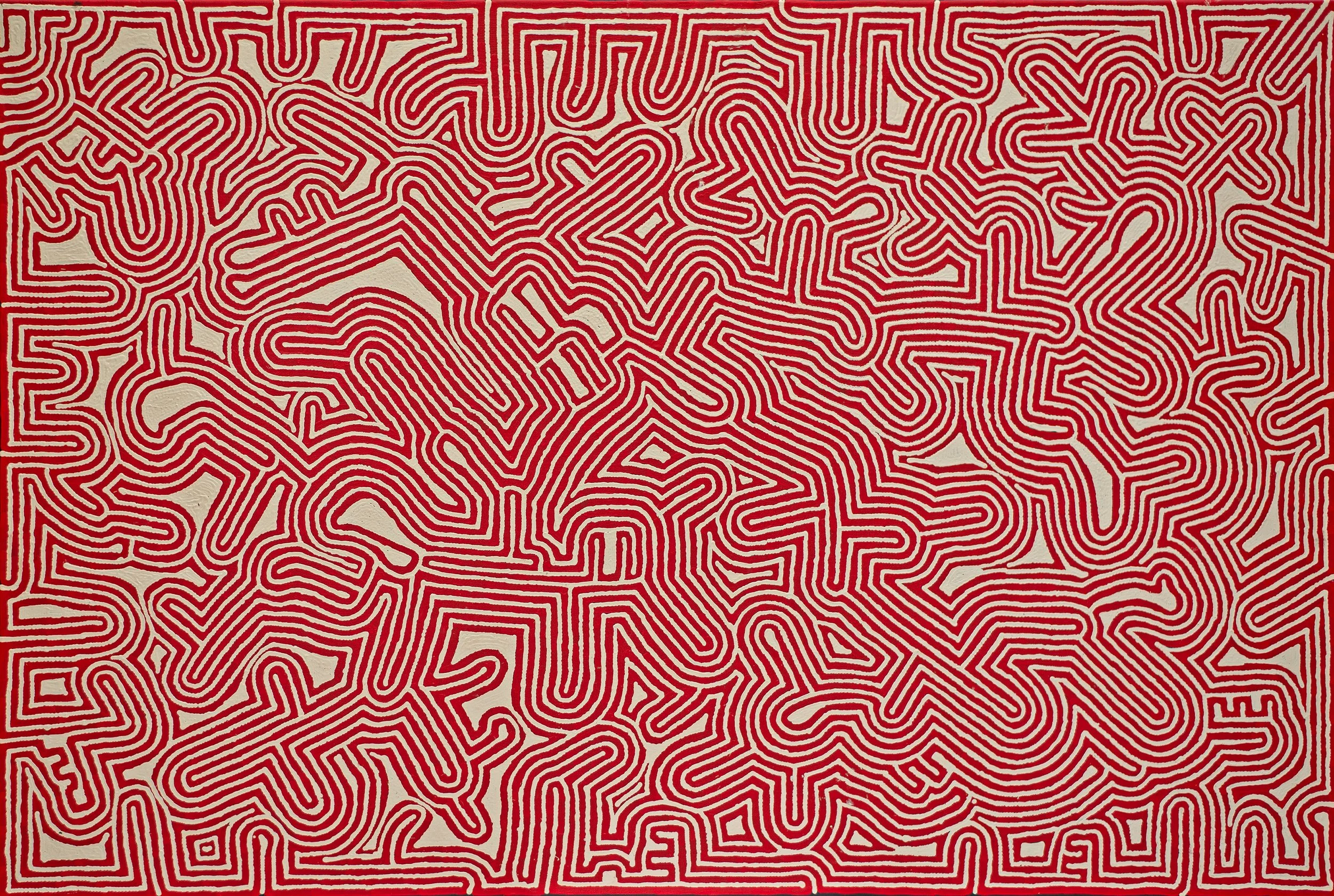
Artiste : Walter Jangala Brown
Titre de l'œuvre : Tingari Cycle sacred story
Format : 183 x 122 cm
Provenance et certificat : centre d'art aborigène de Yuendumu
Référence de cette peinture : 2821/23
Demander le prix de l'œuvre / Enquiry
Explications pour cette œuvre :
This painting depicts a portion of the Tingari cycle, a very important collection of Dreaming narratives from the Western Desert region. The country that this painting depicts is located far to the west of Yuendumu, and spans a vast area of land across the Gibson and Great Sandy Deserts in Western Australia. Aboriginal groups that paint the Tingari cycle include the Pintupi, Kukatja, Ngarti, and Walmajarri peoples, among others.
The Tingari cycle consists of three major Dreaming tracks. One begins west of Jupiter Well and eventually runs due east, concluding south-east of Lake Mackay; another heads south-west from near Kintore for some 200 km, and then doubles back to end at Lake Macdonald; the third runs from south to north through Docker River and Kintore. The cycle tells the story of a group of ancient creation ancestors, the Tingari, who travelled across the country. The Tingari took different forms, some human and some animal. Humans were typically initiated men accompanied by ‘punyunyu’ (novices, uninitiated men). The men were sometimes accompanied by extremely powerful initiated women (called variously the ‘Kungka Tjuta,’ ‘Minyma Tjuta,’ or ‘Kanaputa’). Like the initiated men, these initiated women were accompanied by uninitiated women to whom they provided a ritual education. Animals featured in the Tingari cycle include the dingo, emu, kingfisher, and western quoll, among others.
As the Tingari travelled over vast areas of the country, they held initiations and other ceremonies, caused or encountered raging bushfires, hunted game, found and cooked bush-tucker, fought and killed one another, disposed of the dead or brought them back to life, interacted with totemic ancestors, copulated illicitly, made and used sacred objects, flew through the air, and died in hailstorms. In the course of these adventures, they either created or became the physical features of the sites they visited, forming rocky outcrops, waterholes, trees, salt lakes, ochre deposits, and so on. These sites which are now regarded as sacred by their descendants, today’s custodians of these places. The Tingari also laid down social custom and law as it should be practiced today. Their journeys form the basis of sacred and secret men’s and women’s laws. Public paintings of the Tingari cycle typically only show the unrestricted portions of these stories...
© Photo : Aboriginal Signature Estrangin gallery with the courtesy of the artists and Yuendumu
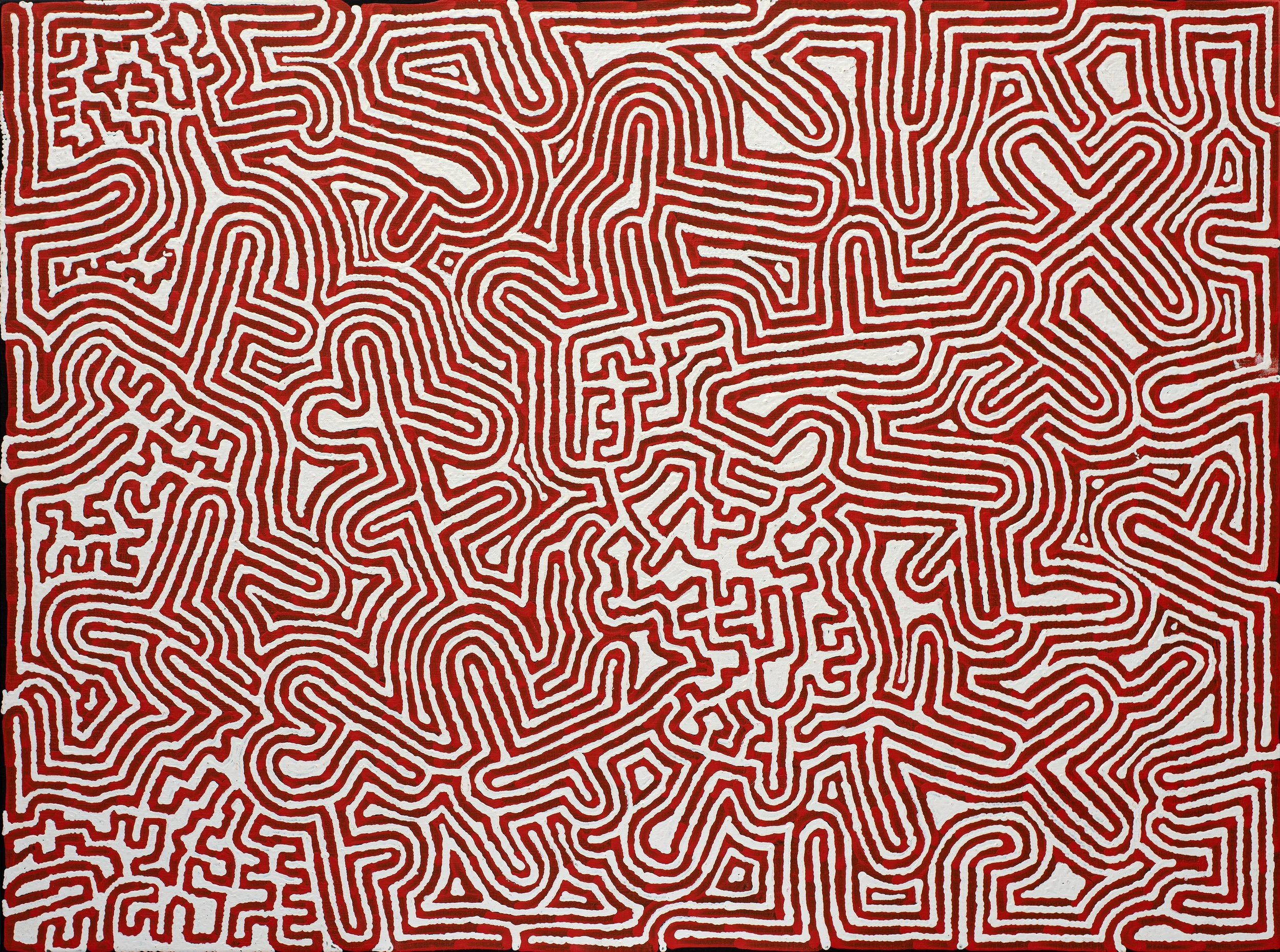
Artiste : Walter Jangala Brown
Titre de l'œuvre : Tingari Cycle sacred story
Format : 122 x 91 cm
Provenance et certificat : centre d'art aborigène de Yuendumu
Référence de cette peinture : 3172/23
Demander le prix de l'œuvre / Enquiry
Explications pour cette œuvre :
This painting depicts a portion of the Tingari cycle, a very important collection of Dreaming narratives from the Western Desert region. The country that this painting depicts is located far to the west of Yuendumu, and spans a vast area of land across the Gibson and Great Sandy Deserts in Western Australia. Aboriginal groups that paint the Tingari cycle include the Pintupi, Kukatja, Ngarti, and Walmajarri peoples, among others.
The Tingari cycle consists of three major Dreaming tracks. One begins west of Jupiter Well and eventually runs due east, concluding south-east of Lake Mackay; another heads south-west from near Kintore for some 200 km, and then doubles back to end at Lake Macdonald; the third runs from south to north through Docker River and Kintore. The cycle tells the story of a group of ancient creation ancestors, the Tingari, who travelled across the country. The Tingari took different forms, some human and some animal. Humans were typically initiated men accompanied by ‘punyunyu’ (novices, uninitiated men). The men were sometimes accompanied by extremely powerful initiated women (called variously the ‘Kungka Tjuta,’ ‘Minyma Tjuta,’ or ‘Kanaputa’). Like the initiated men, these initiated women were accompanied by uninitiated women to whom they provided a ritual education. Animals featured in the Tingari cycle include the dingo, emu, kingfisher, and western quoll, among others.
As the Tingari travelled over vast areas of the country, they held initiations and other ceremonies, caused or encountered raging bushfires, hunted game, found and cooked bush-tucker, fought and killed one another, disposed of the dead or brought them back to life, interacted with totemic ancestors, copulated illicitly, made and used sacred objects, flew through the air, and died in hailstorms. In the course of these adventures, they either created or became the physical features of the sites they visited, forming rocky outcrops, waterholes, trees, salt lakes, ochre deposits, and so on. These sites which are now regarded as sacred by their descendants, today’s custodians of these places. The Tingari also laid down social custom and law as it should be practiced today. Their journeys form the basis of sacred and secret men’s and women’s laws. Public paintings of the Tingari cycle typically only show the unrestricted portions of these stories...
© Photo : Aboriginal Signature Estrangin gallery with the courtesy of the artists and Yuendumu
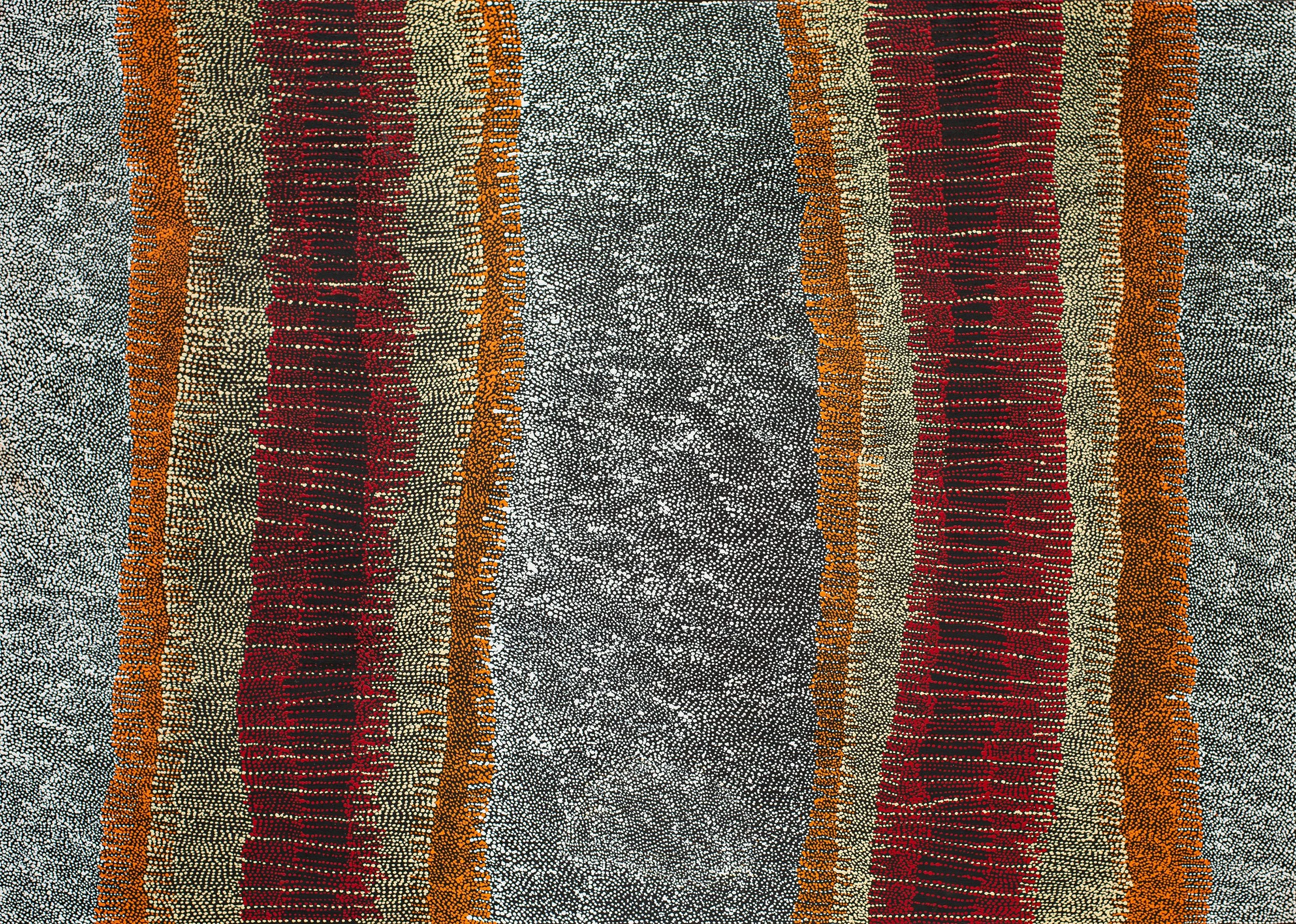
Artiste : Sabrina Nangala Robertson
Titre de l'œuvre : Ngapa Jukurrpa (Water Dreaming) - Pirlinyarnu
Format : 152 x 107 cm
Provenance et certificat : centre d'art aborigène de Yuendumu
Référence de cette peinture : 7441/22
Demander le prix de l'œuvre / Enquiry
Explications de l'œuvre :
The site depicted in this painting is Pirlinyarnu (Mt. Farewell), about 165 km west of Yuendumu in the Northern Territory. The ‘kirda’ (owners) for the water Dreaming site at Pirlinyarnu are Nangala/Nampijinpa women and Jangala/Jampijinpa men.
Two Jangala men, rainmakers, sang the rain, unleashing a giant storm that collided with another storm from Wapurtali at Mirawarri. A ‘kirrkarlanji’ (brown falcon [Falco berigora]) carried the storm further west from Mirawarri. The two storms travelled across the country from Karlipirnpa, a ceremonial site for the water Dreaming near Kintore that is owned by members of the Napaljarri/Japaljarri and Napanangka/Japanangka subsections. Along the way the storms passed through Juntiparnta, a site that is owned by Jampijinpa men. The storm eventually became too heavy for the falcon. It dropped the water at Pirlinyarnu, where it formed an enormous ‘maluri’ (claypan). A ‘mulju’ (soakage) exists in this place today.
Whenever it rains today, hundreds of ‘ngapangarlpa’ (bush ducks) still flock to Pirlinyarnu.
© Photo : Aboriginal Signature Estrangin gallery with the courtesy of the artists and Yuendumu
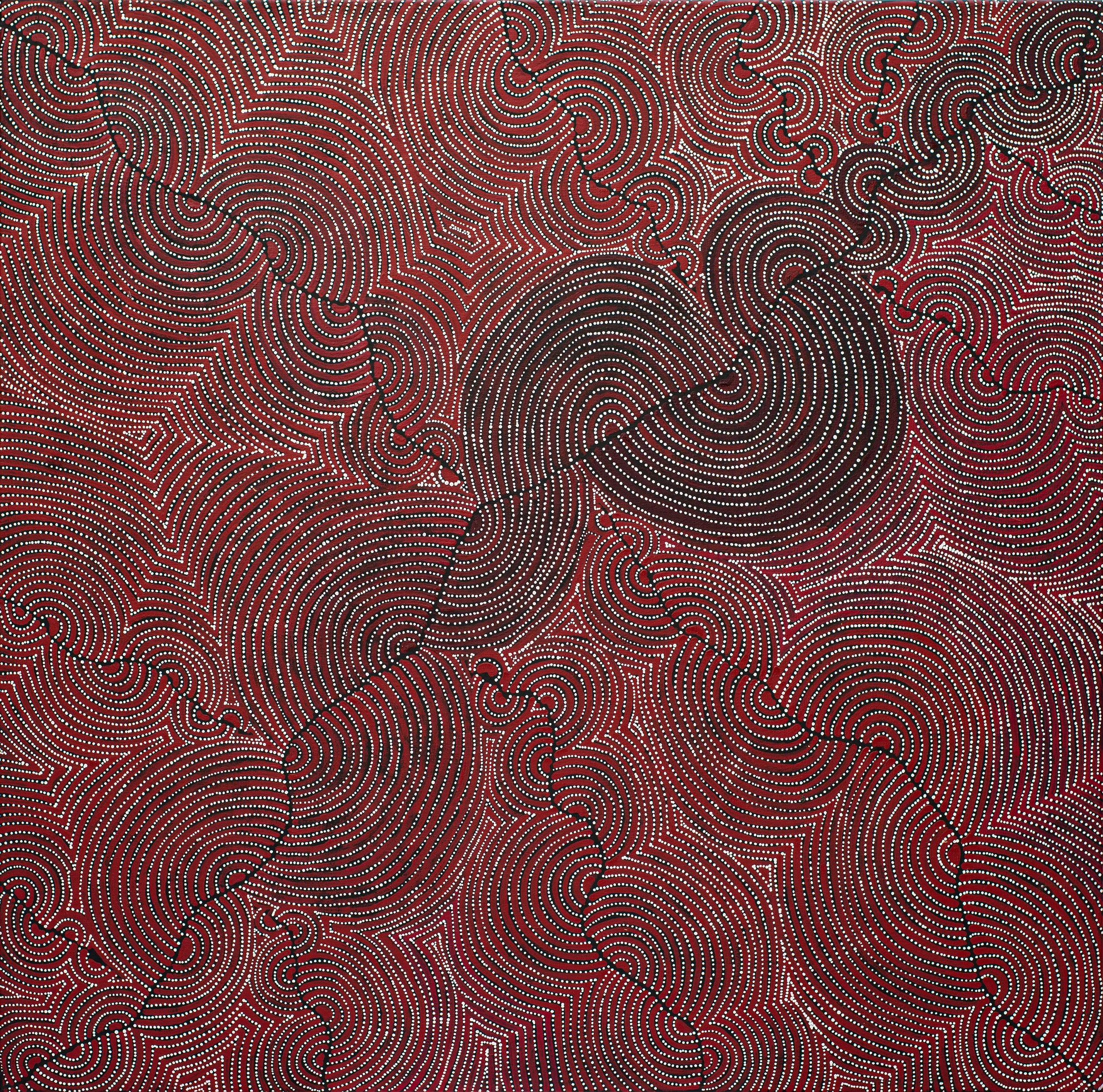
Artiste : Christine Nakamarra Curtis
Titre de l'œuvre : Mina Mina Jukurrpa (Mina Mina Dreaming)
Format : 107 x 107 cm
Provenance et certificat : centre d'art aborigène de Yuendumu
Référence de cette peinture : 803/23ny
Demander le prix de l'œuvre / Enquiry
Explications de l'œuvre :
Mina Mina is an extremely important ceremonial site for Napangardi and Napanangka women that is located approximately 600kms west of Yuendumu, just east of Lake Mackay and the WA border. The area has a ‘marluri’ (salt lake or claypan) that is usually dry, without water. There are also a number of ‘mulju’ (soakages), sandhills, and a large stand of ‘kurrkara’ (desert oaks [Allocasuarina decaisneana]). The Mina Mina Jukurrpa is an important source of Warlpiri ritual knowledge and social organization, particularly relating to the different roles performed by men and women.
The ‘kirda’ (owners) of this country are Napangardi/Napanangka women and Japangardi/Japanangka men, who can depict portions of the Mina Mina Jukurrpa in their paintings. There are a number of different components of the Mina Mina Jukurrpa; artists usually choose to depict one particular aspect. These can include ‘karnta’ (women), ‘karlangu’ (digging sticks), ‘majardi’ (hairstring skirts/tassels), ‘ngalyipi’ (snakevine [Tinospora smilacina]), ‘jintiparnta’ (desert truffle [Elderia arenivaga]), and ‘kurrkara’ (desert oak [Allocasuarina decaisneana]).
The Mina Mina Jukurrpa tells the story of a group of ancestral ‘karnta’ (women) who traveled from west to east. In the Dreamtime, these ancestral women danced at Mina Mina and ‘karlangu’ (digging sticks) rose up out of the ground. They collected these digging sticks and started travelling to the east. They carried their digging sticks over their shoulders and they were adorned with ‘majardi’ (hairstring belts), white feathers, and necklaces made from ‘yinirnti’ (bean tree [Erythrina vespertilio]) seeds. They continuously anointed themselves with ‘minyira’ (shiny fat) to increase their ritual powers as they went along. As the women travelled, they were followed by a ‘yinkardakurdaku’ (spotted nightjar [Eurostopodus argus]) from the Jakamarra subsection. The bird would call out and then hide in the bushes behind them as they travelled.
When the women danced at Mina Mina, they created a large dust cloud that swept up the ‘walyankarna’ (snake ancestors). The ‘walyankarna’ had previously transformed themselves from witchetty grubs into snakes at Kunajarrayi (Mount Nicker, 200km southwest of Yuendumu), and they had stopped at Mina Mina to watch the women dance. This dust cloud blew the ‘walyankarna’ further north to Yaturluyaturlu (near the Granites gold mine). In this way, the ‘karnta Jukurrpa’ (women’s Dreaming) and ‘ngarlkirdi Jukurrpa’ (witchetty grub Dreaming) intersect. This allowed the ancestral women to observe the witchetty grubs and learn how to best locate and cook them, which are skills that Warlpiri women still use today.
© Photo : Aboriginal Signature Estrangin gallery with the courtesy of the artists and Yuendumu

Artiste : Christine Napanangka Michaels
Titre de l'œuvre : Lappi Lappi Jukurrpa (Lappi Lappi Dreaming)
Format : 122 x 107 cm
Provenance et certificat : centre d'art aborigène de Yuendumu
Référence de cette peinture : 128/23ny
Demander le prix de l'œuvre / Enquiry
Explications de l'œuvre :
The subject of this work is Lappi Lappi, a rock hole near Lake Hazlett, about 90 km northwest of Lake Mackay in Western Australia. The country belongs to Nampijinpa/Jampijinpa and Nangala/Jangala skin groups. Located in a sheltered basin, the rock hole at Lappi Lappi is a permanent source of water, and is surrounded by country rich in bush tucker. In the time of the Jukurrpa (Dreamtime) many mothers with young children would gather there because it was a safe place to stay.
The rock hole at Lappi Lappi is home to a ‘warnayarra’, a rainbow serpent that travels underground between various rock holes. One day, women were gathered at the rock hole with their children, singing and dancing. When the ‘warnayarra’ heard the sound of voices, it travelled silently towards them, under the water. When it reached the edge of the rock hole, it rose out of the water and ate them all.
© Photo : Aboriginal Signature Estrangin gallery with the courtesy of the artists and Yuendumu

Artiste : Sadie Nakamarra Padoon
Titre de l'œuvre : Nguru Nyirrpi-wana (Country around Nyirrpi)
Format : 107 x 91 cm
Provenance et certificat : centre d'art aborigène de Yuendumu
Référence de cette peinture : 109/23ny
Demander le prix de l'œuvre / Enquiry
Explications de l'œuvre :
This Jukurrpa belongs to women of the Nakamarra/Napurrurla subsections and to Jakamarra/Jupurrurla men. This Dreaming is associated with a place called Jaralypari, north of Yuendumu. Lukarrara (desert fringe-rush [Fimbristylis oxystachya & Fimbristylis eremophila]) is a grass with an edible seed. The seeds are traditionally ground on a large stone (‘ngatinyanu’) with a smaller stone (‘ngalikirri’) to make flour.
This flour is mixed with water (‘ngapa’) to make damper cakes which are cooked and eaten. In Warlpiri traditional paintings iconography is used to represent the Jukurrpa, particular sites and other elements. Large concentric circles often represent the site of Jaralypari and also the seed bearing grass Lukurrara. ‘U’ shapes can depict the Karnta (women) collecting ‘lukarrara’ and straight lines are frequently used to portray seeds that fall down to the ground and are also collected by women using their ‘parrajas’ (wooden food carriers) and ‘karlangu’ (digging sticks).
© Photo : Aboriginal Signature Estrangin gallery with the courtesy of the artists and Yuendumu

Artiste : Sarah Napaljarri Sims
Titre de l'œuvre : Mina Mina Jukurrpa (Mina Mina Dreaming)
Format : 152 x 30 cm
Provenance et certificat : centre d'art aborigène de Yuendumu
Référence de cette peinture : 80/23ny
Demander le prix de l'œuvre / Enquiry
Explications de l'œuvre :
Mina Mina is an extremely important ceremonial site for Napangardi and Napanangka women that is located approximately 600kms west of Yuendumu, just east of Lake Mackay and the WA border. The area has a ‘marluri’ (salt lake or claypan) that is usually dry, without water. There are also a number of ‘mulju’ (soakages), sandhills, and a large stand of ‘kurrkara’ (desert oaks [Allocasuarina decaisneana]). The Mina Mina Jukurrpa is an important source of Warlpiri ritual knowledge and social organization, particularly relating to the different roles performed by men and women.
The ‘kirda’ (owners) of this country are Napangardi/Napanangka women and Japangardi/Japanangka men, who can depict portions of the Mina Mina Jukurrpa in their paintings. There are a number of different components of the Mina Mina Jukurrpa; artists usually choose to depict one particular aspect. These can include ‘karnta’ (women), ‘karlangu’ (digging sticks), ‘majardi’ (hairstring skirts/tassels), ‘ngalyipi’ (snakevine [Tinospora smilacina]), ‘jintiparnta’ (desert truffle [Elderia arenivaga]), and ‘kurrkara’ (desert oak [Allocasuarina decaisneana]).
The Mina Mina Jukurrpa tells the story of a group of ancestral ‘karnta’ (women) who traveled from west to east. In the Dreamtime, these ancestral women danced at Mina Mina and ‘karlangu’ (digging sticks) rose up out of the ground. They collected these digging sticks and started travelling to the east. They carried their digging sticks over their shoulders and they were adorned with ‘majardi’ (hairstring belts), white feathers, and necklaces made from ‘yinirnti’ (bean tree [Erythrina vespertilio]) seeds. They continuously anointed themselves with ‘minyira’ (shiny fat) to increase their ritual powers as they went along. As the women travelled, they were followed by a ‘yinkardakurdaku’ (spotted nightjar [Eurostopodus argus]) from the Jakamarra subsection. The bird would call out and then hide in the bushes behind them as they travelled.
When the women danced at Mina Mina, they created a large dust cloud that swept up the ‘walyankarna’ (snake ancestors). The ‘walyankarna’ had previously transformed themselves from witchetty grubs into snakes at Kunajarrayi (Mount Nicker, 200km southwest of Yuendumu), and they had stopped at Mina Mina to watch the women dance. This dust cloud blew the ‘walyankarna’ further north to Yaturluyaturlu (near the Granites gold mine). In this way, the ‘karnta Jukurrpa’ (women’s Dreaming) and ‘ngarlkirdi Jukurrpa’ (witchetty grub Dreaming) intersect. This allowed the ancestral women to observe the witchetty grubs and learn how to best locate and cook them, which are skills that Warlpiri women still use today.
© Photo : Aboriginal Signature Estrangin gallery with the courtesy of the artists and Yuendumu
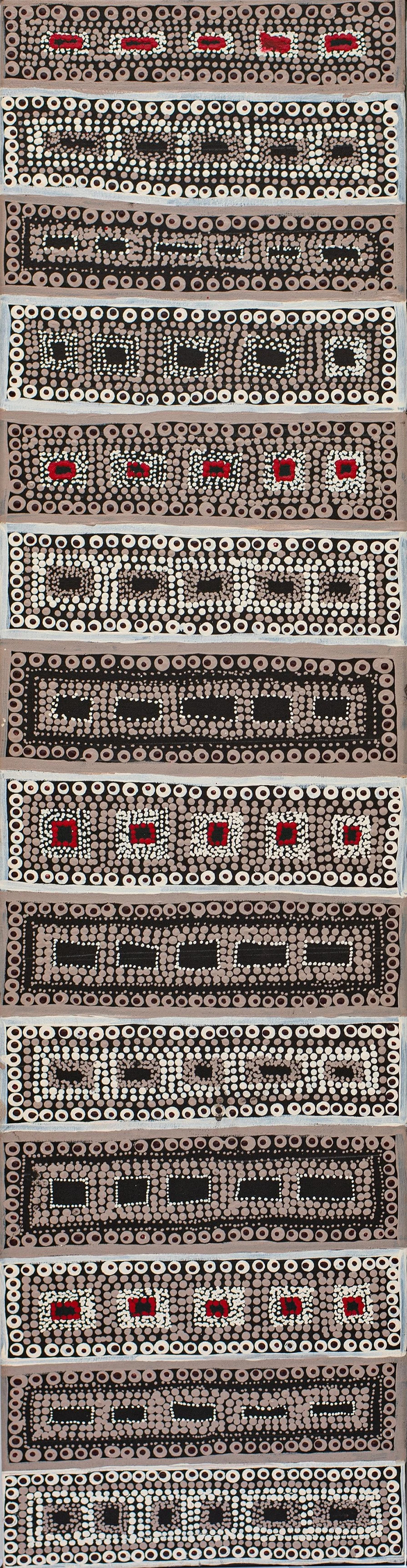
Artiste : Melissa Nampijinpa Karpa
Titre de l'œuvre : Ngapa Jukurrpa (Water Dreaming) - Puyurru
Format : 122 x 30 cm
Provenance et certificat : centre d'art aborigène de Yuendumu
Référence de cette peinture : 833/24
Demander le prix de l'œuvre / Enquiry
Explications de l'œuvre :
Yarrungkanyi is the Mt Doreen area north west of Yuendumu. Dreamtime people lived in the area, digging for ‘ngarlajiyi’ (bush carrot [Vigna lanceolata]). In doing so they created a creek that flows north to Jurlpungu.
Women are shown seated picking ‘ngamirdamirdi’ (lifesaver burr [Sida platycalyx]), which is a low-growing prickle. The women would thread the Ngamirdamirdi onto sticks to make hair combs. The women were travelling south to Yukurra.
© Photo : Aboriginal Signature Estrangin gallery with the courtesy of the artists and Yuendumu
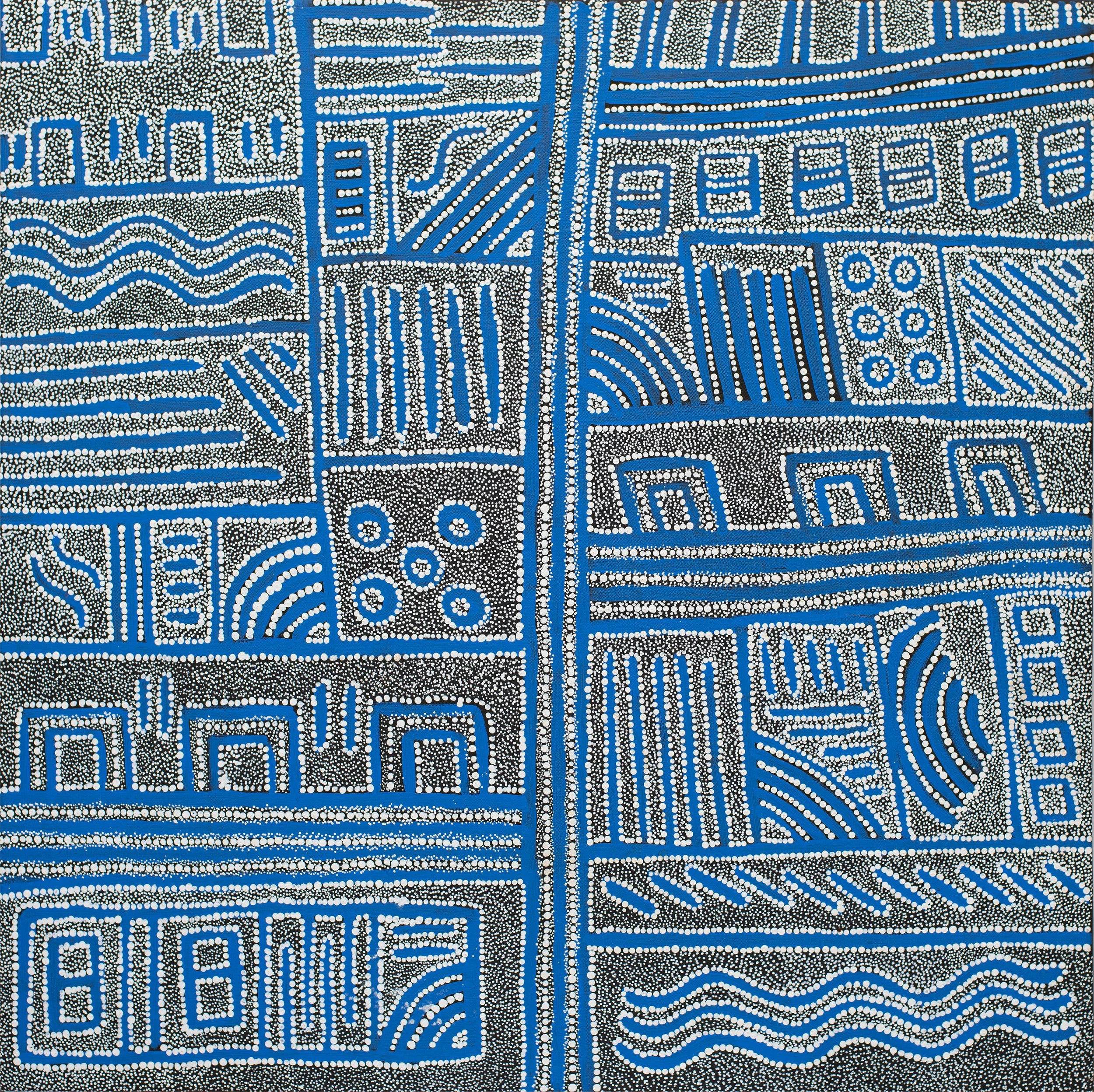
Artiste : Shakira Napaljarri Morris
Titre de l'œuvre : Yarungkanyi Jukurrpa (Mt Doreen Dreaming)
Format : 91 x 91 cm
Provenance et certificat : centre d'art aborigène de Yuendumu
Référence de cette peinture : 7092/23
Demander le prix de l'œuvre / Enquiry
Explications de l'œuvre :
Yarrungkanyi is the Mt Doreen area north west of Yuendumu. Dreamtime people lived in the area, digging for ‘ngarlajiyi’ (bush carrot [Vigna lanceolata]). In doing so they created a creek that flows north to Jurlpungu.
Women are shown seated picking ‘ngamirdamirdi’ (lifesaver burr [Sida platycalyx]), which is a low-growing prickle. The women would thread the Ngamirdamirdi onto sticks to make hair combs. The women were travelling south to Yukurra.
© Photo : Aboriginal Signature Estrangin gallery with the courtesy of the artists and Yuendumu

Artiste : Mitchell Japanangka Martin
Titre de l'œuvre : Mina Mina Jukurrpa (Mina Mina Dreaming)
Format : 107 x 46 cm
Provenance et certificat : centre d'art aborigène de Yuendumu
Référence de cette peinture : 61/24ny
Demander le prix de l'œuvre / Enquiry
Explications de l'œuvre :
Mina Mina is an extremely important ceremonial site for Napangardi and Napanangka women that is located approximately 600kms west of Yuendumu, just east of Lake Mackay and the WA border. The area has a ‘marluri’ (salt lake or claypan) that is usually dry, without water. There are also a number of ‘mulju’ (soakages), sandhills, and a large stand of ‘kurrkara’ (desert oaks [Allocasuarina decaisneana]). The Mina Mina Jukurrpa is an important source of Warlpiri ritual knowledge and social organization, particularly relating to the different roles performed by men and women.
The ‘kirda’ (owners) of this country are Napangardi/Napanangka women and Japangardi/Japanangka men, who can depict portions of the Mina Mina Jukurrpa in their paintings. There are a number of different components of the Mina Mina Jukurrpa; artists usually choose to depict one particular aspect. These can include ‘karnta’ (women), ‘karlangu’ (digging sticks), ‘majardi’ (hairstring skirts/tassels), ‘ngalyipi’ (snakevine [Tinospora smilacina]), ‘jintiparnta’ (desert truffle [Elderia arenivaga]), and ‘kurrkara’ (desert oak [Allocasuarina decaisneana]).
The Mina Mina Jukurrpa tells the story of a group of ancestral ‘karnta’ (women) who traveled from west to east. In the Dreamtime, these ancestral women danced at Mina Mina and ‘karlangu’ (digging sticks) rose up out of the ground. They collected these digging sticks and started travelling to the east. They carried their digging sticks over their shoulders and they were adorned with ‘majardi’ (hairstring belts), white feathers, and necklaces made from ‘yinirnti’ (bean tree [Erythrina vespertilio]) seeds. They continuously anointed themselves with ‘minyira’ (shiny fat) to increase their ritual powers as they went along. As the women travelled, they were followed by a ‘yinkardakurdaku’ (spotted nightjar [Eurostopodus argus]) from the Jakamarra subsection. The bird would call out and then hide in the bushes behind them as they travelled.
When the women danced at Mina Mina, they created a large dust cloud that swept up the ‘walyankarna’ (snake ancestors). The ‘walyankarna’ had previously transformed themselves from witchetty grubs into snakes at Kunajarrayi (Mount Nicker, 200km southwest of Yuendumu), and they had stopped at Mina Mina to watch the women dance. This dust cloud blew the ‘walyankarna’ further north to Yaturluyaturlu (near the Granites gold mine). In this way, the ‘karnta Jukurrpa’ (women’s Dreaming) and ‘ngarlkirdi Jukurrpa’ (witchetty grub Dreaming) intersect. This allowed the ancestral women to observe the witchetty grubs and learn how to best locate and cook them, which are skills that Warlpiri women still use today.
© Photo : Aboriginal Signature Estrangin gallery with the courtesy of the artists and Yuendumu
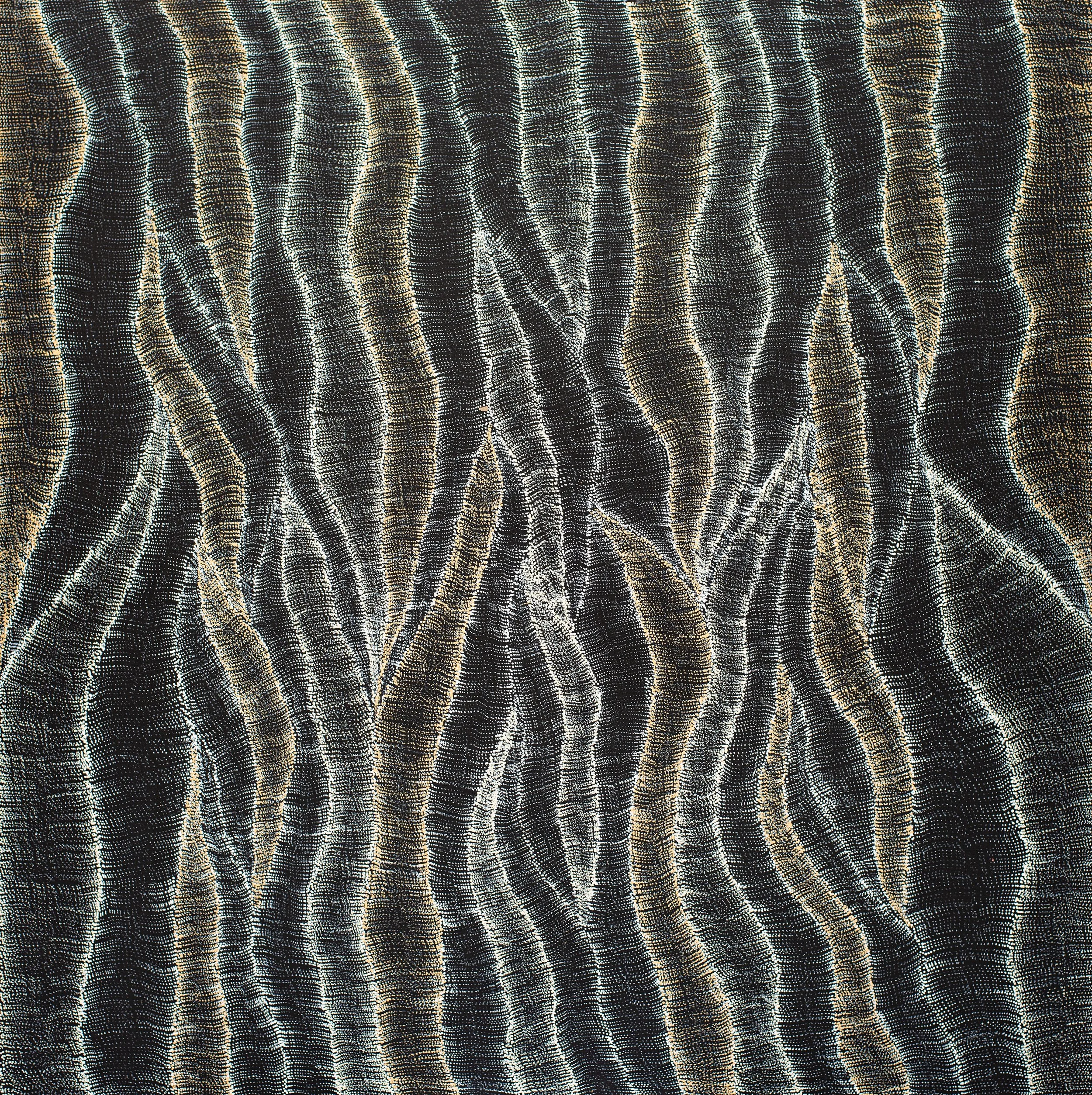
Artiste : Debbie Napaljarri Brown
Titre de l'œuvre : Wanakiji Jukurrpa (Bush Tomato Dreaming)
Format : 122 x 122 cm
Provenance et certificat : centre d'art aborigène de Yuendumu
Référence de cette peinture : 1264/23ny
Demander le prix de l'œuvre / Enquiry
Explications de l'œuvre :
The Wanakiji Jukurrpa (bush tomato [Solanum chippendalei] Dreaming) travels through Yaturlu (near Mount Theo, north of Yuendumu). “Wanakiji” grows in open spinifex country and is a small, prickly plant with purple flowers that bears green fleshy fruit with many small black seeds.
After collecting the fruit the seeds are removed with a small wooden spoon called ‘kajalarra’. The fruit then can be eaten raw or threaded onto skewers called ‘turlturrpa’ and then cooked over a fire. ‘Wanakiji’ can also be skewered and left to dry. When they are prepared in this way it is called ‘turlturrpa’ and the fruit can be kept for a long time.
In contemporary Warlpiri paintings traditional iconography is used to represent the Jukurrpa, particular sites and other elements. The Wanakiji Jukurrpa belongs to Napanangka/Napangardi women and Japanangka/Japangardi men.
© Photo : Aboriginal Signature Estrangin gallery with the courtesy of the artists and Yuendumu
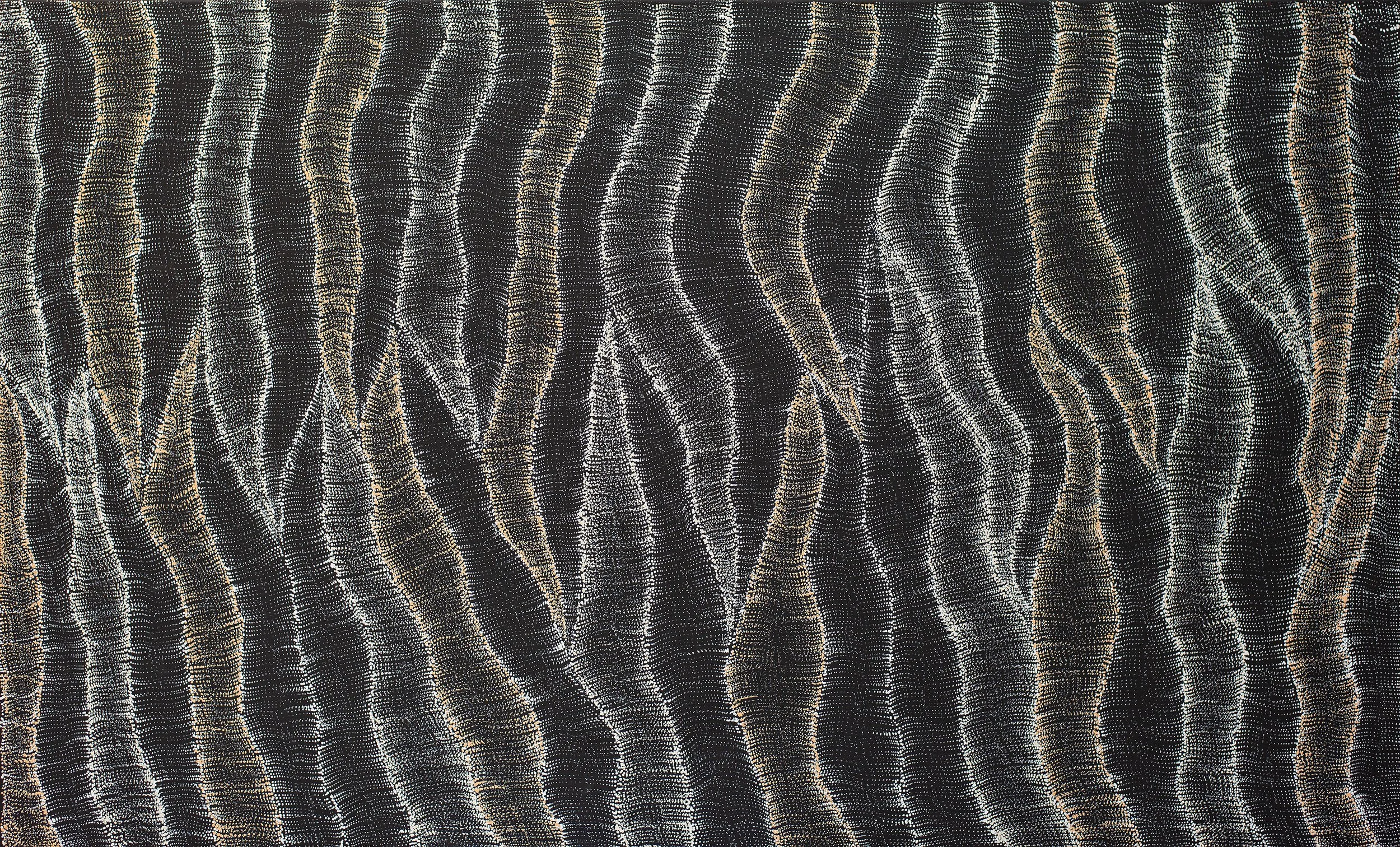
Artiste : Debbie Napaljarri Brown
Titre de l'œuvre : Wanakiji Jukurrpa (Bush Tomato Dreaming)
Format : 152 x 91 cm
Provenance et certificat : centre d'art aborigène de Yuendumu
Référence de cette peinture : 1224/23ny
Demander le prix de l'œuvre / Enquiry
Explications de l'œuvre :
The Wanakiji Jukurrpa (bush tomato [Solanum chippendalei] Dreaming) travels through Yaturlu (near Mount Theo, north of Yuendumu). “Wanakiji” grows in open spinifex country and is a small, prickly plant with purple flowers that bears green fleshy fruit with many small black seeds.
After collecting the fruit the seeds are removed with a small wooden spoon called ‘kajalarra’. The fruit then can be eaten raw or threaded onto skewers called ‘turlturrpa’ and then cooked over a fire. ‘Wanakiji’ can also be skewered and left to dry. When they are prepared in this way it is called ‘turlturrpa’ and the fruit can be kept for a long time.
In contemporary Warlpiri paintings traditional iconography is used to represent the Jukurrpa, particular sites and other elements. The Wanakiji Jukurrpa belongs to Napanangka/Napangardi women and Japanangka/Japangardi men.
© Photo : Aboriginal Signature Estrangin gallery with the courtesy of the artists and Yuendumu
Artiste : Julie Nangala Robertson
Titre de l'œuvre : Mina Mina Jukurrpa - Mina Mina Dreaming
Format : 152 x 122 cm
Provenance et certificat : centre d'art aborigène de Yuendumu
Référence de cette peinture : 1282/23
Demander le prix de l'œuvre / Enquiry
Explications de l'œuvre :
Mina Mina is an extremely important ceremonial site for Napangardi and Napanangka women that is located approximately 600kms west of Yuendumu, just east of Lake
Mackay and the WA border. Mina Mina has a ‘marluri’ (salt lake or claypan) that is usually dry, without water. There are also a number of ‘mulju’ (soakages), sandhills, and a large stand of ‘kurrkara’ (desert oaks [Allocasuarina decaisneana]).
The Mina Mina Jukurrpa is an important source of Warlpiri ritual knowledge and social organization, particularly relating to the different roles performed by men and women. The ‘kirda’ (owners) of this country are Napangardi/Napanangka women and Japangardi/Japanangka men, who can depict portions of the Mina Mina Jukurrpa in their paintings. The artists mother, Dorothy Napangardi (c.1956–2013) painted Mina Mina and has passed down her Jukurrpa stories to her children and asked them to continue to paint for her. There are a number of different components of the Mina Mina Jukurrpa; artists usually choose to depict one particular aspect. These can include ‘karnta’ (women), ‘karlangu’ (digging sticks), ‘majardi’ (hairstring skirts/tassels), ‘ngalyipi’ (snakevine [Tinospora smilacina]), ‘jintiparnta’ (desert truffle [Elderia arenivaga]), and ‘kurrkara’ (desert oak [Allocasuarina decaisneana]).
In ancestral times a group of ‘karnta’ (women) traveled from Mina Mina on an epic journey to the east. These ancestral women danced at Mina Mina and ‘karlangu’ (digging sticks) rose up out of the ground. They collected these digging sticks and started travelling to the east. They carried their digging sticks over their shoulders, and they were adorned with ‘majardi’ (hairstring belts), white feathers, and necklaces made from ‘yinirnti’ (bean tree [Erythrina vespertilio]) seeds. They travelled east from Mina Mina, dancing, digging for bush tucker, and creating many places as they went. As they went east, they passed through Kimayi (a stand of ‘kurrkara’ (desert oak)). They passed through sandhill country where the ‘yarla’ (bush potato or ‘big yam’ [Ipomea costata]) ancestors from Yumurrpa and the ‘ngarlajiyi’ (pencil yam or ‘small yam’ [Vigna lanceolata]) ancestors from Yumurrpa were engaged in a huge battle over women. This battle is also a very important Warlpiri Jukurrpa narrative. The women went on to Janyinki and stopped at Wakakurrku (Mala Bore), where they stuck their digging sticks in the ground…
© Photo : Aboriginal Signature Estrangin gallery with the courtesy of the artists and Yuendumu