
Exposition d’art Aborigène “PROFUNDITY” - Aboriginal art from Australia
A la galerie Aboriginal Signature Estrangin : 101 rue Jules Besme, 1081 Bruxelles.
Sur RDV du mercredi 15 juin au samedi 16 juillet 2022.
Vernissage sur RDV le mercredi 15 juin de 11h à 21h30.
Notre galerie vous reçoit sur RDV, du mardi au samedi, de 11h à 19h : vous pouvez réserver votre visite dans notre agenda ici.
Profundity
Du 15 juin au 16 juillet, la galerie Aboriginal Signature Estrangin est fière de vous présenter l’importante exposition « Profundity ». Montée en partenariat avec 30 artistes principalement des jeunes générations de la zone du Grand désert du Victoria, elle propose à Bruxelles 50 peintures d’art Aborigène et 15 céramiques qui ont traversé la terre.
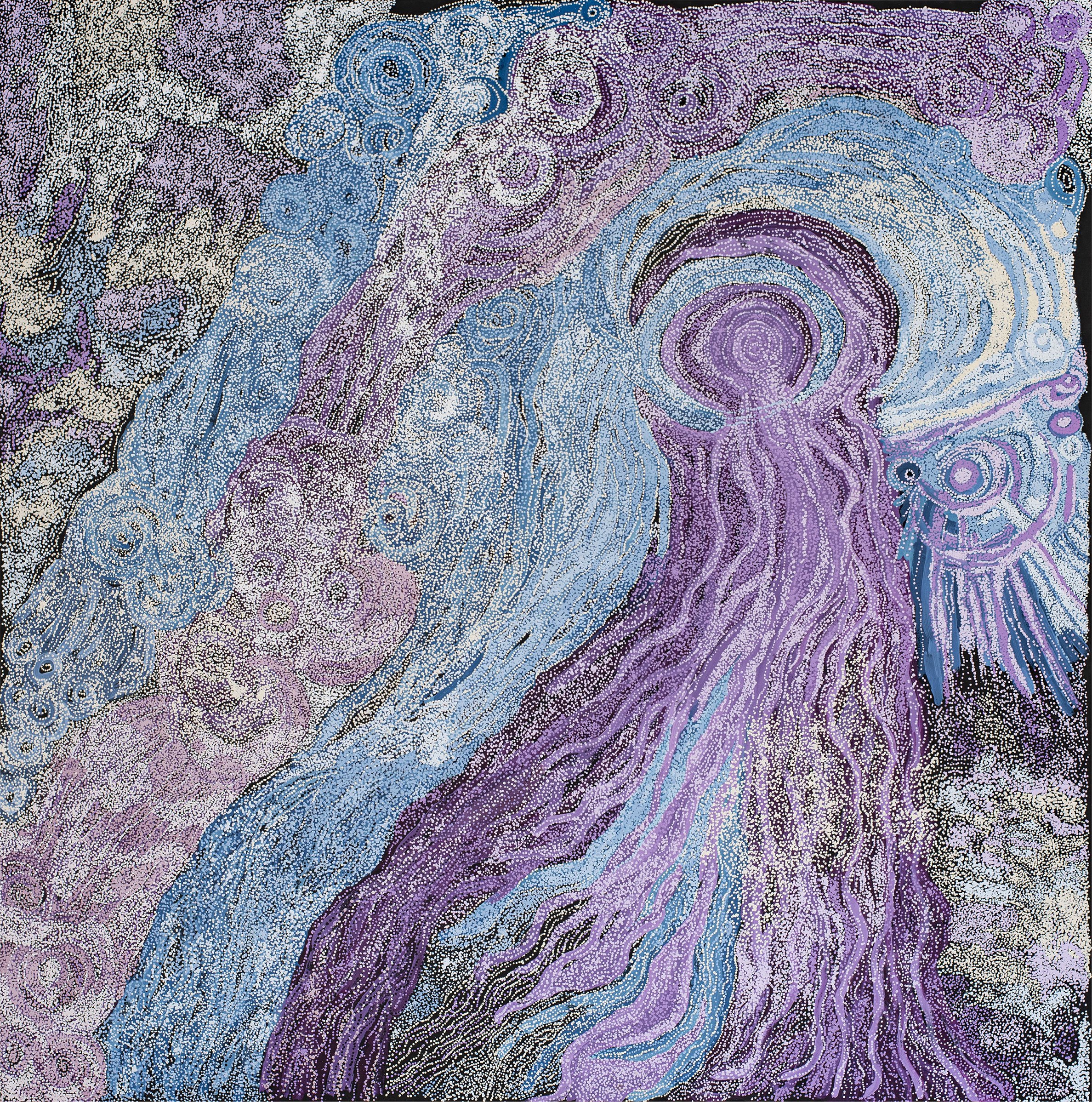
Œuvre de l’artiste Carolanne Ken. Titre : Minyma Makuli Tjukurpa. Format : 200 x 200cm. Ref : 100-22. © Photo Aboriginal Signature Estrangin Gallery with the courtesy of the artist and Kaltjiti Arts.
Profondeur et vibrations
Face aux œuvres, nous remontons aux temps telluriques de la Création impulsés par les grands ancêtres. Nous cheminons avec eux à travers le territoire quand ils modelaient la surface et pétrissaient la structure du paysage.
Nous ressentons les vibrations créatrices dans les effets cinétiques remarquables illustrés par les artistes Mukayi Baker et Tjulyata Kulyuru, avec juste deux à trois couleurs alternatives qui dessinent le chemin vers l’eau et développent l’écho des histoires au-delà du visible.
Chez Samuel Miller, les lignes perlées évoquent presque des partitions dont les pulsations soulignent l’importance des lieux et le caractère sacré de Ngayuku Ngura dont il est le gardien tutélaire.
Profondeur et autorité
Au-delà des jeux de matières, des coups de pinceau, rayonnent les cercles concentriques comme d’immenses rouages de l’horloge du monde. Délicatement recouverts de points perlés, ou juste bordés de rouge, ils soulignent chez la grande artiste Tuppy Goodwin toute son autorité, toute sa confiance pour aller sous la surface, dans les profondeurs où se glissent et émergent les ancêtres autour du lieu sacré d’Antara : « When I paint, it’s like inma (la danse cérémonielle et les chants associés au lieu)». On y ressent à l’arrière plan la fluidité du mouvement, la force des jets de peinture, comme le déhanchement souple d’un corps en mouvement.
Profondeur et abstraction
Dans la lecture des nuages de points et des niveaux de densité différents, l’artiste Nyayati Stanley Young nous dévoile les mystères des faiseurs de pluie dans le désert, à travers des césures significatives confinant à l’abstraction.
Chez les artistes Priscilla Singer et Yurpiya Lionel, des compositions en forme de mosaïque évoquent les nuances du territoire, les segments ondulants des chenilles comestibles et les partitions lors du tri des graines collectées dans le bush.
Chez Carolanne Ken et Josina Nyarpingku Pumani, des myriades de points distingués ourlent les contours, invitent la lumière ici ou là sur la toile, ou cachent avec pudeur certains signes comme le faisaient leurs mères et leurs grand-mères avant elles.
Profondeur et spiritualité
Peindre dans les régions éloignées en Australie oblige, responsabilise et exige des connaissances transmises lors des rites d’initiation suivis durant des années. Peindre appelle le respect des lieux et jamais personne ne peut évoquer ou représenter ce qui lui est étranger. En observant la richesse des signes et symboles chez l’artiste David Miller, l’on perçoit toute l’importance du rôle des passeurs de mémoire dans le champ spirituel. Comme chez l’artiste Keith Stevens où ses compositions de délicats nuages gris bleutés et perlés sont habitées par les signes du Temps du Rêve (Tjukurpa).
Profondeur et énergie
Chez les artistes plus âgés comme Atipalku Intjalki et Witjiti Georges, on perçoit l’urgence de dire et de transmettre. Le point est posé d’un main plus fragile. Il est presque juxtaposé aux autres avec un mince filet les reliant. Ou les points sont griffés ensemble dans l’amplitude du geste et du mouvement des corps sur l’écorce carbonisée du désert. On y ressent la puissance de la force créatrice de Mulayangu invitée sur la toile, comme une source d’énergie primordiale où puiser au fil des ans pour se revigorer et se nourrir.
Contempler ces peintures et céramiques face à face donne l’impression d’ouvrir les battants d’une porte monumentale vers les profondeurs de ces immenses territoires, et nous invite avec générosité à un voyage intérieur au cœur de la Création, célébrée comme ici depuis la nuit des temps.
Nous nous réjouissons de vous accueillir très bientôt à la galerie.
Bertrand Estrangin
Directeur de la galerie
N.B. : Cette exposition a été élaborée en partenariat avec les artistes et centres d’art du APY land, avec en particulier tous nos remerciements à Iwantja, Mimili Maku, Ernabella, Ninuku arts, et Kaltjiti arts que nous sommes très honorés de représenter directement ici en Europe.
Découvrez les peintures et céramiques disponibles à Bruxelles durant l’exposition :

Artiste : Witjiti George (1938)
Titre de l'œuvre : Malara: Wanampi Tjukurpa
Format : 152 cm x 152 cm
Provenance et certificat : centre d'art aborigène de Kaltjiti Arts
Référence de cette peinture aborigène : 630-21
Explications pour cette peinture d'art Aborigène :
Piltati is the well known tjukurpa story of the two water serpents who live in the Piltati Rockhole with their two wives. This is Witjiti's mother's country near Kanpi on the Anangu Pitjantjatjara/Yankunytjatjara Lands (APY Lands) in far north South Australia.
Witjiti fondly refers to this Tjurkurpa as a love story. "This is a story about two brothers and two sisters. The two 'wati's' (brothers) - two water snakes, are at the Piltati rockhole waiting for two sisters.
The two women had gone to find 'mai' ( food), they were gone a long time and the men were hungry. They all live there in this rockhole". - Witjiti George.
The rabbit burrows are depicted as lines with semi circles either side. Underground water flows through these channels and the connected circles are places where the sisters travelled looking for bushtucker.

Artiste : Keith Stevens
Titre : Nyapari Tjukurpa
Format : 100 x 100 cm
Provenance et certificat : centre d'art de Kaltjiti
Ref : 106-22
Explication de l’œuvre :
This is the Wanampi Tjukurpa (water snake men dreaming) for Nyapari. This place is called Piltati. Piltati rockhole is just in the hills, really close to the community. The two men are water snakes. Piltati is the main waterhole and those wanampi (snake men) go in one rockhole and can come up in another one, you can see smoke comimg up all of them.
Also here there is kuyi (harmless small snakes) that have ngura tjuta (many homes) The wanampi love to eat those kuyi. Minyma kutjara (two women) were digging for that big kunyia (carpet python) but it was only those wanampi (watersnake men) tricking. Those women speared the wanampi by accident and he got up and chased them and killed them.

Artiste : Keith Stevens
Titre : Nyapari Tjukurpa
Format : 102 x 76 cm
Provenance et certificat : centre d'art de Kaltjiti
Ref : 636-21
Explication de l’œuvre :
This is the Wanampi Tjukurpa (water snake men dreaming) for Nyapari. This place is called Piltatiti. Piltatiti rockhole is just in the hills, really close to the community. The two men are water snakes. Piltatiti is the main waterhole and those wanampi (snake men) go in one rockhole and can come up in another one, you can see smoke comimg up all of them.
Also here there is kuyi (harmless small snakes) that have ngura tjuta (many homes) The wanampi love to eat those kuyi. Minyma kutjara (two women) were digging for that big kunyia (carpet python) but it was only those wanampi (watersnake men) tricking. Those women speared the wanampi by accident and he got up and chased them and killed them.

Artiste : Keith Stevens
Titre : Nyapari Tjukurpa
Format : 91 x 76 cm
Provenance et certificat : centre d'art de Kaltjiti
Ref : 460-21
Explication de l’œuvre :
This is the Wanampi Tjukurpa (water snake men dreaming) for Nyapari. This place is called Piltatiti. Piltatiti rockhole is just in the hills, really close to the community. The two men are water snakes. Piltatiti is the main waterhole and those wanampi (snake men) go in one rockhole and can come up in another one, you can see smoke comimg up all of them.
Also here there is kuyi (harmless small snakes) that have ngura tjuta (many homes) The wanampi love to eat those kuyi. Minyma kutjara (two women) were digging for that big kunyia (carpet python) but it was only those wanampi (watersnake men) tricking. Those women speared the wanampi by accident and he got up and chased them and killed them.

Artiste : Keith Stevens
Titre : Nyapari Tjukurpa
Format : 121 x 75 cm
Provenance et certificat : centre d'art de Kaltjiti
Ref : 279-21
Explication de l’œuvre :
This is the Wanampi Tjukurpa (water snake men dreaming) for Nyapari. This place is called Piltatiti. Piltatiti rockhole is just in the hills, really close to the community. The two men are water snakes. Piltatiti is the main waterhole and those wanampi (snake men) go in one rockhole and can come up in another one, you can see smoke comimg up all of them.
Also here there is kuyi (harmless small snakes) that have ngura tjuta (many homes) The wanampi love to eat those kuyi. Minyma kutjara (two women) were digging for that big kunyia (carpet python) but it was only those wanampi (watersnake men) tricking. Those women speared the wanampi by accident and he got up and chased them and killed them.

Artiste : Rita Rolley
Titre : Ngayuku Ngura
Format : 151 x 76cm
Provenance et certificat : centre d'art de Kaltjiti
Ref : 78-22
Explication de l’œuvre :
Rita paints vivid topographical views of the colours and landforms of the desert country of the *APY Lands. Contour lines follow the small hills, ridges of sandhills, circular rockholes and winding creeks. Wildlflowers dot the vast plains. Vibrant colourful and bold interpretations of the bush, are typical of Rita's style.
Rita is a talented artist from Fregon on the *APY LAnds. Her unique composition and the contemporary edge to her work reflects a keen sense of place retaining the importance of traditional country as inspiraon for her art.
* Anangu Pitjantjatjara Lands in the far north of South Australia.

Artistes : Priscilla Singer (1968)
Titre de l'œuvre : Ngura (Country)
Format : 152 x 122 cm
Provenance et certificat : centre d'art aborigène d’Iwantja
Référence de cette peinture aborigène : 67-22
Explications pour cette peinture d'art Aborigène :
In Pitjantjatjara language, the word Ngura is a definition for the physical geography of land and country. However Ngura also has a more richly embedded meaning as a place to which someone belongs; defining where an individual comes from, their family connections, skin groups, and language.
Paintings of Ngura often portray personal stories and memories of country that is significant to the artist. Iconography of georgaphic elements within the desert landscape; such as rock holes, underground springs, mountain and rock formations, and sacred sites are meticulously recorded from memory and often depicted from an aerial perspective.

Artistes : Priscilla Singer (1968)
Titre de l'œuvre : Ngura (Country)
Format : 152 x 122 cm
Provenance et certificat : centre d'art aborigène d’Iwantja
Référence de cette peinture aborigène : 68-22
Explications pour cette peinture d'art Aborigène :
In Pitjantjatjara language, the word Ngura is a definition for the physical geography of land and country. However Ngura also has a more richly embedded meaning as a place to which someone belongs; defining where an individual comes from, their family connections, skin groups, and language.
Paintings of Ngura often portray personal stories and memories of country that is significant to the artist. Iconography of georgaphic elements within the desert landscape; such as rock holes, underground springs, mountain and rock formations, and sacred sites are meticulously recorded from memory and often depicted from an aerial perspective.

Artistes : Yatjiki Cullinan
Titre de l'œuvre : Ngura (Country)
Format : 198 x 152 cm
Provenance et certificat : centre d'art aborigène d’Iwantja
Référence de cette peinture aborigène : 68-22
Explications pour cette peinture d'art Aborigène :
I am a Yankunytjatjara woman from Indulkana Community on the Anangu Pitjantjatjara Yankunytjatjara (APY) Lands in South Australia. I’m an artist at Iwantja Arts, where I started painting over 20 years ago.
My paintings are of Tjukurpa (ancestral stories) and ngura (country) that have cultural significance for me and my family. They are a combination of landscape – specific locations and landmarks - and representations of the sky and stars. For Anangu the stars hold Tjukurpa (Ancestral cultural stories) just like the country - the rockholes, hills and creeks – have Tjukurpa. One main one is the Kungkarangkalpa (Seven Sisters) Tjukurpa where a specific constellation represents the sisters and the cheeky man chasing after them.

Artistes : Maringka Burton (1950)
Titre de l'œuvre : Anamaruku Tjuta (Many Caterpillars)
Format : 198 x 167 cm
Provenance et certificat : centre d'art aborigène d’Iwantja
Référence de cette peinture aborigène : 72-22
Explications pour cette peinture d'art Aborigène :
Maringka’s country is in the far western region of the APY Lands, close to the West Australian border. The dreaming story of the caterpillar is special to that area and Maringka often paints themes of this story into her canvas.
The small green and white caterpillars burrow tunnels and holes into the earth which leaves behind patterns on the surface of the desert sands. This intricate repetition of detailed twists and curls in the red dirt is portrayed in Maringka’s paintings.

Artiste : Alison Lionel
Titre de l'œuvre : Likara (bark)
Format : 180 x 100 cm
Provenance et certificat : centre d'art d'Ernabella
Référence de cette peinture d'art Aborigène : 150-22
Explanations of this Aboriginal painting :
Tree story. A depiction of the bark of the trees in the Ernabella creek

Artiste : Carlene Thompson (1950)
Titre de l'œuvre : Kalaya ngura
Format : 180 x 100 cm
Provenance et certificat : centre d'art d'Ernabella
Référence de cette peinture d'art Aborigène : 160-22
Explanations of this Aboriginal painting :
Emu Country. This painting depicts Carlene's family's country, near Kanypi in the Western APY Lands. It is the country of the emu, meaning the emu (kalaya) is the ancestral being who formed that part of the country.
That Kalaya travelled from Kanpi to Watarru. It is very typical for the Kalaya to have many children, like Carlene, who had six children.
Her artworks are in the prestigious following collections :
Goulburn Regional Art Gallery, 2016
Queensland Art Gallery, Brisbane, Qld
Awards :
2019 National Aboriginal and Torres Strait Islander Art Award, Finalist
2019 Australia Council for the Art: Art project for individuals recipient
2018 Quick Response Grant Country Arts SA: Contact, Connection and Conversation
2018 National Aboriginal and Torres Strait Islander Art Award, Finalist
2016 Finalist (collaborative), National Aboriginal and Torres Strait Islander Art Award

Artiste : Carlene Thompson (1950)
Titre de l'œuvre : Carlene's Mamu - Spirit Figures
Format : 100 x 82 cm
Provenance et certificat : centre d'art d'Ernabella
Référence de cette peinture d'art Aborigène : 91-22
Explanations of this Aboriginal painting :
Mamu are traditionally depicted as bad spirits or monsters in traditional Pitjantjatjara stories, particularly those told to children by adults in order to scare them and thus keep them close by and safe.
Carlene’s depiction of mamu has been told to her by her grandfather and grandmother. These mamu are the spirits of the ancestors who appear in the bush at night time.
Her artworks are in the prestigious following collections :
Goulburn Regional Art Gallery, 2016
Queensland Art Gallery, Brisbane, Qld
Awards :
2019 National Aboriginal and Torres Strait Islander Art Award, Finalist
2019 Australia Council for the Art: Art project for individuals recipient
2018 Quick Response Grant Country Arts SA: Contact, Connection and Conversation
2018 National Aboriginal and Torres Strait Islander Art Award, Finalist
2016 Finalist (collaborative), National Aboriginal and Torres Strait Islander Art Award

Artiste : Mukayi Baker
Titre de l'œuvre : Piltati
Format : 150 x 100cm
Provenance et certificat : centre d'art aborigène d’Ernabella
Référence de cette peinture aborigène : 138-22
Explication sur cette œuvre :
There were two sisters who married two brothers and they all lived together. One day the women went wandering and they went such a long way that they forgot about their husbands. Back at the camp, the two husbands were thinking, 'Where are our wives?' and they decided to go looking for them. One brother said to the other, 'What should we become to go looking for them?' and the other brother said 'Why don't we become Rainbow Serpents?' And they travelled in the sky looking down for their wives. Finally they see them hunting for carpet snakes and they put something in the hole where the women were digging. The women find it and then dig another hole and once again the men have put something in there. And this is how the men lure the women back to Piltati where the men make the sisters transform into Wanampi, swallow them and keep them in their throats. All four of them live together in the waterhole and still live there today.

Artiste : Mukayi Baker
Titre de l'œuvre : Piltati
Format : 152 x 81cm
Provenance et certificat : centre d'art aborigène d’Ernabella
Référence de cette peinture aborigène : 76-22
Explication sur cette œuvre :
There were two sisters who married two brothers and they all lived together. One day the women went wandering and they went such a long way that they forgot about their husbands. Back at the camp, the two husbands were thinking, 'Where are our wives?' and they decided to go looking for them. One brother said to the other, 'What should we become to go looking for them?' and the other brother said 'Why don't we become Rainbow Serpents?' And they travelled in the sky looking down for their wives. Finally they see them hunting for carpet snakes and they put something in the hole where the women were digging. The women find it and then dig another hole and once again the men have put something in there. And this is how the men lure the women back to Piltati where the men make the sisters transform into Wanampi, swallow them and keep them in their throats. All four of them live together in the waterhole and still live there today.

Artiste : Tjulyata Kulyuru
Titre de l'œuvre : Tjukula/Waterholes
Format : 150 x 99cm
Provenance et certificat : centre d'art aborigène d’Ernabella
Référence de cette peinture aborigène : 116-22
Explication sur cette œuvre :
For the Pitjantjatjara people living in the desert, knowledge of their water sources was critical to their survival.
This resulted in an intimate understanding of the landscape which continues today. Deep familiarity with the topography of their country and the way rain would interact with the land ensured constant sources of water could be found. 'Tjukula' means rock-holes, which are found with surprising frequency in the Musgrave ranges.
Between visits, Anangu (people) would use rocks and spinifex construction to guard these from spoilage by animals and, particularly in more recent times, from feral and stock animals, cattle, camels, horses and donkeys.

Artiste : Langaliki Lewis
Titre : Tjukula/Waterholes
Format : 169 x 84 cm
Provenance et certificat : centre d'art aborigène d’Ernabella
Référence de cette peinture aborigène : 115-22
Explication sur cette œuvre :
Painting by Langaliki Lewis (1973). For the Pitjantjatjara people living in the desert, knowledge of their water sources was critical to their survival.
This is a depiction of the artists' country. The different colours and designs represent variations in the landscape.
This resulted in an intimate understanding of the landscape which continues today. Deep familiarity with the topography of their country and the way rain would interact with the land ensured constant sources of water could be found. 'Tjukula' means rock-holes, which are found with surprising frequency in the Musgrave ranges.
Between visits, Anangu (people) would use rocks and spinifex construction to guard these from spoilage by animals and, particularly in more recent times, from feral and stock animals, cattle, camels, horses and donkeys.

Artiste : Atipalku Intjalki (1955)
Titre de l'œuvre : Tjukurpa Mulayangu
Format : 152 x 81cm
Provenance et certificat : centre d'art aborigène d’Ernabella
Référence de cette peinture aborigène : 114-22
Explication sur cette œuvre :
Tjukurpa Mulayangu is a men’s law place. They made this place and campsite. Mulayangu made this place. Over in the west is the other side of Amata which is my father’s country. This is a sacred place called Tankalanya. This is all I can say.

Artiste : Michelle Lewis
Titre de l'œuvre : Michelle's tjala dreaming (honey ant dreaming)
Format : 178 cm x 92cm
Provenance et certificat : centre d'art aborigène d’Ernabella
Référence de cette peinture aborigène : 75-22
Explication sur cette œuvre :
Michelle’s father's country is a place called Makiri located east of Ernabella near the Fregon community. This is country is tjala tjukurpa (honey ant dreaming). Michelle and her family still visit this country where she draws special attention to the natural elements on the land which are then represented in her paintings:
I am painting the landscape from above, as you might see it from an airplane or as a bird looking down. It is beautiful country both from on the ground and up above. When Michelle created her work, ngayuku mamku ngura ini Makiri (my father's country, a place called Makiri) she was thinking of Makiri and how the tjala (honeyants) tunnel though the sandy soil as well as about the waterholes, the assemblages of trees and shrubs and the country that is “quiet” (empty).
Tjala or Honey Ants are found about a metre underground beneath Mulga trees. The Honey Ant tunnels that lead down to the ant's nests are called nyinantu. The Honey Ant larvae are called ipilyka-ipilyka. When the Pitjantjatjara go looking for Honey Ants they look for the drill holes under the trees. When they see them, they shovel and dig down following the tunnels to find the Honey Ants inside. Honey Ants are a highly favoured food source. They suck the honey-like liquid from the abdomen of the Honey Ant. The story of the Honey Ant is told across the Northern Territory into South Australia. The Honey Ant is an important link between their mythology and inter-dependence on the environment.

Artiste : Michelle Lewis
Titre de l'œuvre : Michelle's tjala dreaming (honey ant dreaming)
Format : 178 cm x 99cm
Provenance et certificat : centre d'art aborigène d’Ernabella
Référence de cette peinture aborigène : 44-22
Explication sur cette œuvre :
Michelle’s father's country is a place called Makiri located east of Ernabella near the Fregon community. This is country is tjala tjukurpa (honey ant dreaming). Michelle and her family still visit this country where she draws special attention to the natural elements on the land which are then represented in her paintings:
I am painting the landscape from above, as you might see it from an airplane or as a bird looking down. It is beautiful country both from on the ground and up above. When Michelle created her work, ngayuku mamku ngura ini Makiri (my father's country, a place called Makiri) she was thinking of Makiri and how the tjala (honeyants) tunnel though the sandy soil as well as about the waterholes, the assemblages of trees and shrubs and the country that is “quiet” (empty).
Tjala or Honey Ants are found about a metre underground beneath Mulga trees. The Honey Ant tunnels that lead down to the ant's nests are called nyinantu. The Honey Ant larvae are called ipilyka-ipilyka. When the Pitjantjatjara go looking for Honey Ants they look for the drill holes under the trees. When they see them, they shovel and dig down following the tunnels to find the Honey Ants inside. Honey Ants are a highly favoured food source. They suck the honey-like liquid from the abdomen of the Honey Ant. The story of the Honey Ant is told across the Northern Territory into South Australia. The Honey Ant is an important link between their mythology and inter-dependence on the environment.

Artiste : Angela Watson
Titre de l'œuvre : Minyma Kutjara
Format : 122 x 122cm
Provenance et certificat : centre d'art aborigène de Ninuku
Référence de cette peinture : 22-39
Demander le prix de l'œuvre / Enquiry
Explications pour cette œuvre :
Minyma Kutjara (two women) travel from the otherside of Makura Piti heading north. The two sisters stop halfway near Wingellina. The younger one keeps looking back because she is homesick. The big sister said "why you looking back, why you crying? We are going long way." They travelled around all the different country. The younger sister realises that the older one is pregnant, she thinks how could that be there are no men. But there are men, sneaky men, and they camp with the older sister at night. This story is a women's and men's business story. The two girls keep travelling up past Docker River.
© Photo : Aboriginal Signature Estrangin gallery with the courtesy of the artists and Ninuku.

Artiste : Nyayati Stanley Young
Titre de l'œuvre : Patilpa Tjukurpa
Format : 122 x 61cm
Provenance et certificat : centre d'art aborigène de Ninuku
Référence de cette peinture : 21-508
Demander le prix de l'œuvre / Enquiry
Explications pour cette œuvre :
This is the dreamtime story of Patilpa (Port Lincoln ringneck parrot) that lives in the country around Pipalytjara. Wati Minu (a man called Minu) came from the west to Pipalytjara, he was a rainmaker. He hunted all the waru (black footed wallaby) and he got lots. The Patilpa people were hungry and went and stole all the fat Mala, leaving the skinny one's for Minu. Minu was angry at this and he made clouds and thunder. All the Patilpa were hiding in a cave, but the rain came and washed them all away. They became Chrysoprase a bright green rock that you can find in the hills surrounding Pipalyatjara.
© Photo : Aboriginal Signature Estrangin gallery with the courtesy of the artists and Ninuku.

Artiste : David Miller
Titre de l'œuvre : Wati Ngintaka munu Minyma Tjirilya
Format : 91 x 91 cm
Provenance et certificat : centre d'art aborigène de Ninuku
Référence de cette peinture : 21-168
Demander le prix de l'œuvre / Enquiry
Explications pour cette œuvre :
This is a story about Wati Ngintaka Tjukurpa (perentie lizard man creation story). That Wati Ngintaka (lizard man) heard the clapping sound of a beautiful grinding stone - a traditional tool used for grinding mai (food). He wanted that stone for himself, so he travelled from Arang’nga a long way east towards Wayatina, looking for the stone. He spotted Anangu tjuta (lots of Aboriginal people) at a camp. Some of the people gave him mai (food) in the form of a seed cake, but it was dry and he didn’t like it. Then one lady gave him delicious food and he knew that it had been made with seeds ground on the special grinding stone. He spied the grinding stone and stole it, hiding it in under his tail. When they all went hunting the next day, Wati Ngintaka stayed in camp, saying he had sore feet. Once they were gone, it was safe and he left, stealing the grinding stone. All the people were angry with the Wati Ngintaka and chased him. When they caught him they felt all over his body to see where he was hiding the grinding stone, but couldn’t find it. Wati Ngintaka held up his arms and claimed he didn’t have it, but they saw he was hiding it, wipungka (in his tail). They speared the Wati Ngintaka and retrieved the grinding stone. He passed away at a place called Aran’nga in the Northern Territory. Ngaltutjara (poor thing).
© Photo : Aboriginal Signature Estrangin gallery with the courtesy of the artists and Ninuku.

Artiste : Heather Watson
Titre de l'œuvre : Patilpa Tjukurpa
Format : 122 x 91 cm
Provenance et certificat : centre d'art aborigène de Ninuku
Référence de cette peinture : 20-26
Demander le prix de l'œuvre / Enquiry
Explications pour cette œuvre :
Heather paints Murray bore and the surrounding country. Murray bore is a rock hole that has water year round found just off the Tjuntjuntjara road in Western Australia, close to Irrunytju. This was the home of many old people. The Young, Brown, Roberts and Woods families all live here.
© Photo : Aboriginal Signature Estrangin gallery with the courtesy of the artists and Ninuku.

Artiste : Nyayati Stanley Young
Titre de l'œuvre : Patilpa Tjukurpa
Format : 122 x 91cm
Provenance et certificat : centre d'art aborigène de Ninuku
Référence de cette peinture : 21-608
Demander le prix de l'œuvre / Enquiry
Explications pour cette œuvre :
This is the dreamtime story of Patilpa (Port Lincoln ringneck parrot) that lives in the country around Pipalytjara. Wati Minu (a man called Minu) came from the west to Pipalytjara, he was a rainmaker. He hunted all the waru (black footed wallaby) and he got lots. The Patilpa people were hungry and went and stole all the fat Mala, leaving the skinny one's for Minu. Minu was angry at this and he made clouds and thunder. All the Patilpa were hiding in a cave, but the rain came and washed them all away. They became Chrysoprase a bright green rock that you can find in the hills surrounding Pipalyatjara.
© Photo : Aboriginal Signature Estrangin gallery with the courtesy of the artists and Ninuku.

Artiste : Carol Young
Titre de l'œuvre : Ngura Tjuta: Big Country - Carol
Format : 122 x 91 cm
Provenance et certificat : centre d'art aborigène de Ninuku
Référence de cette peinture : 22-33
Demander le prix de l'œuvre / Enquiry
Explications pour cette œuvre :
Carol paints in the style of her grandmother Nyankulya Watson. The story passed down to her is about Nyankulya's country and the many places she travelled to as a young girl. Carol learnt all the rock holes from her grandmother. "Mt Aloysius, good water there. 'Ngura tjuta' (lots of country) including: Altjurungka, Kunaltju, Wangkal, Tur, Wiltju, Wipuwarra, Warratjuntjun, Pitlja Piltj."
© Photo : Aboriginal Signature Estrangin gallery with the courtesy of the artists and Ninuku.

Artiste : Anyupa Nelson
Titre de l'œuvre : Kungkarangkalpa (Seven Sisters Story)
Format : 122 x 122 cm
Provenance et certificat : centre d'art aborigène de Ninuku
Référence de cette peinture : 22-37
Demander le prix de l'œuvre / Enquiry
Explications pour cette œuvre :
This is a major Tjukurpa for Irrunytju (Wingellina) and across the central Australian deserts. The seven sisters travelled from Kaliwarra to Wannan in Western Australia, stopping at significant sites and rockholes including Kuru Ala, a sacred place for women. They encountered a lustful man named Wati Nyiru, who chased them around the desert. Some of the details of this Tjukurpa (Dreaming story) are sacred and can’t be repeated.
© Photo : Aboriginal Signature Estrangin gallery with the courtesy of the artists and Ninuku.

Artiste : David Miller
Titre de l'œuvre : Wati Ngintaka Tjukurpa
Format : 122 x 61 cm
Provenance et certificat : centre d'art aborigène de Ninuku
Référence de cette peinture : 22-5
Demander le prix de l'œuvre / Enquiry
Explications pour cette œuvre :
This is a story about Wati Ngintaka Tjukurpa (perentie lizard man creation story). That Wati Ngintaka (lizard man) heard the clapping sound of a beautiful grinding stone - a traditional tool used for grinding mai (food). He wanted that stone for himself, so he travelled from Arang’nga a long way east towards Wayatina, looking for the stone. He spotted Anangu tjuta (lots of Aboriginal people) at a camp. Some of the people gave him mai (food) in the form of a seed cake, but it was dry and he didn’t like it. Then one lady gave him delicious food and he knew that it had been made with seeds ground on the special grinding stone. He spied the grinding stone and stole it, hiding it in under his tail. When they all went hunting the next day, Wati Ngintaka stayed in camp, saying he had sore feet. Once they were gone, it was safe and he left, stealing the grinding stone. All the people were angry with the Wati Ngintaka and chased him. When they caught him they felt all over his body to see where he was hiding the grinding stone, but couldn’t find it. Wati Ngintaka held up his arms and claimed he didn’t have it, but they saw he was hiding it, wipungka (in his tail). They speared the Wati Ngintaka and retrieved the grinding stone. He passed away at a place called Aran’nga in the Northern Territory. Ngaltutjara (poor thing).
© Photo : Aboriginal Signature Estrangin gallery with the courtesy of the artists and Ninuku.

Artiste : Angela Watson
Titre de l'œuvre : Minyma Kutjara
Format : 152 x 91cm
Provenance et certificat : centre d'art aborigène de Ninuku
Référence de cette peinture : 22-27
Demander le prix de l'œuvre / Enquiry
Explications pour cette œuvre :
Minyma Kutjara (two women) travel from the otherside of Makura Piti heading north. The two sisters stop halfway near Wingellina. The younger one keeps looking back because she is homesick. The big sister said "why you looking back, why you crying? We are going long way." They travelled around all the different country. The younger sister realises that the older one is pregnant, she thinks how could that be there are no men. But there are men, sneaky men, and they camp with the older sister at night. This story is a women's and men's business story. The two girls keep travelling up past Docker River.
© Photo : Aboriginal Signature Estrangin gallery with the courtesy of the artists and Ninuku.

Artiste : Phyllis Donegan
Titre de l'œuvre : Walka Wiru Ngura Wiru
Format : 122 x 91 cm
Provenance et certificat : centre d'art aborigène de Ninuku
Référence de cette peinture : 22-38
Demander le prix de l'œuvre / Enquiry
Explications pour cette œuvre :
Walka Wiru Ngura Wiru means lovely country, lovely drawing. This is a painting is a composition of dot patterns inspired by the sandy desert features around the Tompkinson ranges of Pipalyatjara, Kalka, and Irrunytju commnities where Ninuku artists work.
© Photo : Aboriginal Signature Estrangin gallery with the courtesy of the artists and Ninuku.

Artiste : David Miller
Titre de l'œuvre : Wati Ngintaka munu Minyma Tjirilya
Format : 91 x 91 cm
Provenance et certificat : centre d'art aborigène de Ninuku
Référence de cette peinture : 21-317
Demander le prix de l'œuvre / Enquiry
Explications pour cette œuvre :
This is a story about Wati Ngintaka Tjukurpa (perentie lizard man creation story). That Wati Ngintaka (lizard man) heard the clapping sound of a beautiful grinding stone - a traditional tool used for grinding mai (food). He wanted that stone for himself, so he travelled from Arang’nga a long way east towards Wayatina, looking for the stone. He spotted Anangu tjuta (lots of Aboriginal people) at a camp. Some of the people gave him mai (food) in the form of a seed cake, but it was dry and he didn’t like it. Then one lady gave him delicious food and he knew that it had been made with seeds ground on the special grinding stone. He spied the grinding stone and stole it, hiding it in under his tail. When they all went hunting the next day, Wati Ngintaka stayed in camp, saying he had sore feet. Once they were gone, it was safe and he left, stealing the grinding stone. All the people were angry with the Wati Ngintaka and chased him. When they caught him they felt all over his body to see where he was hiding the grinding stone, but couldn’t find it. Wati Ngintaka held up his arms and claimed he didn’t have it, but they saw he was hiding it, wipungka (in his tail). They speared the Wati Ngintaka and retrieved the grinding stone. He passed away at a place called Aran’nga in the Northern Territory. Ngaltutjara (poor thing).
© Photo : Aboriginal Signature Estrangin gallery with the courtesy of the artists and Ninuku.

Artiste : Anita Pumani (1982)
Titre de l'œuvre : Antara - Maku Dreaming
Format : 101 cm x 101 cm
Provenance et certificat : centre d'art aborigène de Mimili Maku
Référence de cette peinture aborigène : 138-22
Demander le prix de cette œuvre
Explications pour cette peinture d'art Aborigène :
This painting is about Antara, a site close to Mimili Community that is very important to my family. Kungka Kutjara ananyi tjukula. A long time ago two women went to apu katu, to the hill around Antara. They were singing inma (song) and hittng the rock with a punu (stick). Maku tjuta (a lot of witchetty grubs) came from the tree we call Maku Ilykuwara (Witchetty Bush).
When we go out to Antara and sing inma, we collect maku tjuta and other bush tucker the next day. My auntie Milatjari Pumani taught me how to respect Maku Tjurkurpa for Mimili Community. I also teach my daughters what Maku Tjurkurpa means. I am proud to be custodian of that country.
Mimili Community is home to 300 Pitjantjatjara and Yankunytjatjara people who have been living in the area for millennia in harmony with nature and acting as custodians of the land and the Tjukurpa (creation stories). Mimili was formerly known as Everard Park, which was a cattle station that was returned to Aboriginal ownership through the 1981 APY Lands Act. Mimili Community was incorporated as an Aboriginal Community in 1975.

Artiste : Amy Yilpi (1967)
Titre de l'œuvre : Maku
Format : 152 cm x 101 cm
Provenance et certificat : centre d'art aborigène de Mimili Maku
Référence de cette peinture aborigène : 137-22
Demander le prix de cette œuvre
Explications pour cette peinture d'art Aborigène :
Amy paints the Maku (Witchey Grub) Songline that shapes the land around Mimili. The Maku is an edible grub that lives in the roots of the Witchetty Bush. Particularly after big rains, it is a good time for Maku. Amy and the ladies from Mimili often go out bush to dig up Maku from the roots of the Witchetty Bush, and slowly roast it in the embers of the fire. It is a delicious bush food!
Mimili Community is home to 300 Pitjantjatjara and Yankunytjatjara people who have been living in the area for millennia in harmony with nature and acting as custodians of the land and the Tjukurpa (creation stories). Mimili was formerly known as Everard Park, which was a cattle station that was returned to Aboriginal ownership through the 1981 APY Lands Act. Mimili Community was incorporated as an Aboriginal Community in 1975.

Artiste : Josina Nyarpingku Pumani (1984)
Titre de l'œuvre : Ngura Walytja, Antara
Format : 122 cm x 122 cm
Provenance et certificat : centre d'art aborigène de Mimili Maku
Référence de cette peinture aborigène : 913-21
Demander le prix de cette œuvre
Explications pour cette peinture d'art Aborigène :
This painting is about Josina's home, family and culture. The country is Antara, a is a place not far from Mimili Community. Antara country belonged to Josina's grandmother, Milatjari. All women in Josina's family paint Antara. They hold its stories strong, particularly the Maku Tjukurpa, which is a significant songline for this area.
The women from Mimili would go to the waterhole north of Mimili. They would clean it out, then wait for the rain to come. When the waterhole was full with water they would tap on the waters surface and sing inma for Maku tjuta (enough Maku for everyone). The rock holes, hills and country are depicted in this painting.
Mimili Community is home to 300 Pitjantjatjara and Yankunytjatjara people who have been living in the area for millennia in harmony with nature and acting as custodians of the land and the Tjukurpa (creation stories). Mimili was formerly known as Everard Park, which was a cattle station that was returned to Aboriginal ownership through the 1981 APY Lands Act. Mimili Community was incorporated as an Aboriginal Community in 1975.

Artiste : Pauline Wangin (1970)
Titre de l'œuvre : Kapi Tjukula (Water Hole)
Format : 152 cm x 122 cm
Provenance et certificat : centre d'art aborigène de Mimili Maku
Référence de cette peinture aborigène : 22-22
Demander le prix de cette œuvre
Explications pour cette peinture d'art Aborigène :
Pauline is painting tjukurpa (story) about the journey of water, explaining how to care for kapi tjukula (water holes), particularly in the area around paralpii (Victory Well). This tjukurpa was passed on to her by her mother. “One time when I was a little girl, my mother and me went out driving to collect bush tucker. It was a very hot day, and our car broke down. We didn't have any water with us, and I was scared, but my mother led me away from the car to kapi tjukula really closeby. She taught me how to find it, and how to care for it. After emptying the kapi (water) with mara munu punu (hands and sticks) the empty tjukula is cleaned. We place punu tjuta (many sticks and branches) over the top of the tjukula and use puli pulka (big rock) to stop them blowing away. Now no animals can dirty the new water that will soon collect."
Mimili Community is home to 300 Pitjantjatjara and Yankunytjatjara people who have been living in the area for millennia in harmony with nature and acting as custodians of the land and the Tjukurpa (creation stories). Mimili was formerly known as Everard Park, which was a cattle station that was returned to Aboriginal ownership through the 1981 APY Lands Act. Mimili Community was incorporated as an Aboriginal Community in 1975.

Artiste : Marina Pumani Brown (1984)
Titre de l'œuvre : Ngayuku Ngura Kuwari (My Home Now)
Format : 168 cm x 152 cm
Provenance et certificat : centre d'art aborigène de Mimili Maku
Référence de cette peinture aborigène : 720-21
Explications pour cette peinture d'art Aborigène :
My name is Marina Pumani Brown, I am a 35-year-old Anangu woman. My family has lived around the present day location of Mimili Community on the APY lands of South Australia forever. My work captures a long line of cultural knowledge, knowledge that I am proud to be the custodian of, responsible for keeping it safe and passing it on to the next generation.
Whilst my mother strictly paints Antara, a sacred ceremonial site close to Mimili, I have broadened my practice to include other knowledge that is important to me. This knowledge speaks of traditions that are very much part of our day-to-day life out here in Mimili, traditions that are eternally old but ever present. My paintings are about trips to the area around Antara and Paralpii (Victory Well), where we collect Mingkulpa (bush tobacco) and care for the local tjukula (rock holes). Particularly after kapi pulka (big rains), the land becomes so fertile, and we harvest bush foods like the gnurru (lollie tree) and camp out on country like the old people used to.
My paintings are both literal maps of the landscape and objects of meaning removed from any physical representation. Though not always depicted, the importance of Antara is never lost in my work. The site has been integral to the existence of Anangu culture since the beginning of time. Today my life is different to that of my ancestors and my work is a tool to document my part in a story that spreads across timespans bigger than our imagination.

Artiste : Marina Pumani Brown (1984)
Titre de l'œuvre : Ngayuku Ngura Kuwari (My Home Now)
Format : 152 cm x 152 cm
Provenance et certificat : centre d'art aborigène de Mimili Maku
Référence de cette peinture aborigène : 242-20
Explications pour cette peinture d'art Aborigène :
My name is Marina Pumani Brown, I am a 35-year-old Anangu woman. My family has lived around the present day location of Mimili Community on the APY lands of South Australia forever. My work captures a long line of cultural knowledge, knowledge that I am proud to be the custodian of, responsible for keeping it safe and passing it on to the next generation.
Whilst my mother strictly paints Antara, a sacred ceremonial site close to Mimili, I have broadened my practice to include other knowledge that is important to me. This knowledge speaks of traditions that are very much part of our day-to-day life out here in Mimili, traditions that are eternally old but ever present. My paintings are about trips to the area around Antara and Paralpii (Victory Well), where we collect Mingkulpa (bush tobacco) and care for the local tjukula (rock holes). Particularly after kapi pulka (big rains), the land becomes so fertile, and we harvest bush foods like the gnurru (lollie tree) and camp out on country like the old people used to.
My paintings are both literal maps of the landscape and objects of meaning removed from any physical representation. Though not always depicted, the importance of Antara is never lost in my work. The site has been integral to the existence of Anangu culture since the beginning of time. Today my life is different to that of my ancestors and my work is a tool to document my part in a story that spreads across timespans bigger than our imagination.

Artiste : Tuppy Ngintja Goodwin (1952)
Titre de l'œuvre : Antara
Format : 150cm x 150cm
Provenance et certificat : centre d'art aborigène de Mimili Maku
Référence de cette peinture aborigène : 99-22
Explications pour cette peinture d'art Aborigène :
When I paint, it’s like inma (ceremonial dance and song). This is Antara, a sacred place for Anangu, and the Maku (witchetty grub) Tjukurpa. There’s a special rock hole at Antara where women perform inma – ‘inmaku pakani’ – and afterwards there’s enough maku to feed everyone. Antara and Maku Tjukurpa is really important for Mimili women, we paint this place and its stories, keeping them strong.
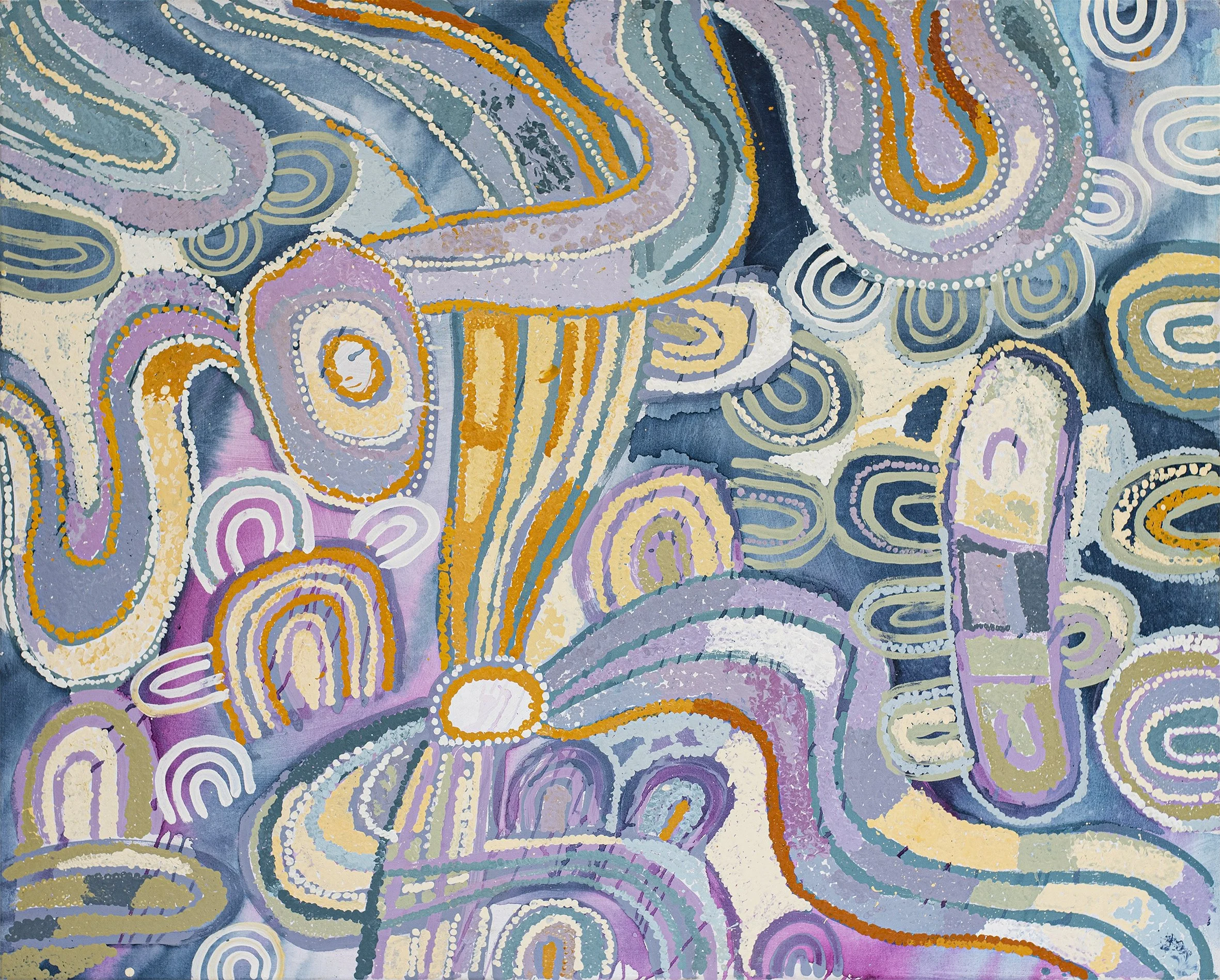
Artiste : Puna Yanima (1955)
Titre de l'œuvre : Antara
Format : 152 cm x 122 cm
Provenance et certificat : centre d'art aborigène de Mimili Maku
Référence de cette peinture aborigène : 95-22
Explications pour cette peinture d'art Aborigène :
Antara is an important women’s ceremonial site near Mimili community. Many of the senior women at Mimili Maku Arts represent Antara and its significant Maku Tjukurpa (Witchetty Grub Dreaming) in their paintings. Puna Yanima has utilised the immediacy and loose fluidity of ink to map the ngura (country) of this sacred place, marking its kapi tjukula (rock holes), apu and murpu (rocks and mountains).
Artiste : Carolanne Ken
Titre : Minyma Makuli Tjukurpa
Format : 200 x 200cm
Provenance et certificat : centre d'art de Kaltjiti
Ref : 100-22
Demander le prix de l'œuvre
Explication de l’œuvre :
This is the cave of Minyma Makuli), also known as Minyma Malilu) - minyma nymupu - she was crippled and had to crawl on her hands and knees across the ground. She dug out this cave with the piti (wooden bowl), to be her big wiltja (shelter). She camped here with her kungkawara kutjara, two daughters, young women.
One evening the girls returned from hunting with kuku pulka (large game), she wondered how they got it, and where it had come from? Two men had given it to the girls! Her girls left her alone for a long time and didn't help her, poor thing, poor old weak woman, so she decided to follow them.
She crawled after them, wanatjara anu, using a walking stick, following their tracks northwest back to the hills. When she reached their camp the men hit and killed her. They had called the girls in marriage and took them away.
This is Carolanne's grandmother's country. The underground cave at Kanypi is a permanent water supply. Carolanne is from Fregon on the *APY Lands. Precise, fine brushwork are characteristics of her work. Carolanne is a keen story teller and combining a traditional style with a contemporary edge to her work, reflects a keen sense of place retaining the importance of traditional country as inspiraon for her work.
*Anangu Pitjantjatjara/Yankunytjatjara Lands, in the far north-west of South Australia