
Exposition d’art Aborigène “The Dawn – L’Aube” - Aboriginal art from Australia – Buku-Larrŋgay
A la galerie Aboriginal Signature Estrangin : 101 rue Jules Besme, 1081 Bruxelles.
Sur RDV du jeudi 25 novembre au samedi 18 décembre 2021.
Vernissage sur RDV le jeudi 25 novembre de 11h à 21h30.
Dans le contexte actuel, notre galerie est ouverte et vous reçoit sur RDV du mardi au dimanche, de 11h à 19h.
Nous nous réjouissons de vous accueillir dans le respect des principes recommandés par le Conseil Fédéral (masque et gel à l’entrée) et vous invitons à réserver votre visite dans notre agenda ici.

Trois œuvres peintes en pigments naturels sur écorce de l’artiste Djambawa Marawili © Photo : Aboriginal Signature Estrangin Gallery with the courtesy of the artists and Buku-Larrngay art centre.
“The Dawn – L’Aube”
Nous vous invitons à l’autre bout du monde, aux confins des territoires du nord de l’Australie tropicale, bordée par la mer d’Arafura, pour une exposition extraordinaire à la galerie Aboriginal Signature, en partenariat avec la communauté artistique de Buku-Larrnggay Mulka.
C’est un honneur d’accueillir à Bruxelles près de septante œuvres comme autant de témoignages précieux et de questions brulantes pour notre humanité. A travers leurs représentations subtiles, savamment codifiées, en pigments naturels chatoyants sur écorces d’eucalyptus, les 25 artistes de l’exposition nous racontent leurs histoires.
Nous remontons avec eux l’espace-temps aux origines du monde dans ces rencontres fertiles entre eaux douces et eaux salés de la mer d’Arafura, sources de la Création.
Nous découvrons les alliances du peuple Yolngu avec les civilisations de l’Indonésie (Makassar) plus de 600 ans avant l’arrivée des Européens en Australie, et leurs échanges de métaux et céramiques, célébrées par l’artiste Dhuwarrwarr Marika Banuminy (1945).
Nous traversons la forêt tropicale comme un botaniste grâce au travail remarquable de l’artiste Mulkun Wirrpanda (1942-2021), toute entière dédiée à l’urgence préserver ce savoir féminin hérité depuis la nuit des temps, avant sa disparition cette année en 2021.
Nous sommes subjugués par les formes des sculptures, les oiseaux élancés, les poissons qui se fondent dans l’eau, les poteaux cérémoniels qui s’élancent vers le ciel et communiquent entre plusieurs univers.
Nous sommes happés par l’audace des explorations gravées sur métal, conjuguant ancestralité et modernité, dans les vibrations sublimées par la lumière, au sein des œuvres de Gunybi Ganambarr (1973) et Bandarr Wirrpanda (1980).
Nous tissons des passerelles entre nos mondes, conviés par l’artiste Dhuwarrwarr Marika (1945), au cœur de leur mythe de l’Atlantis Aborigène célébré dans ses magnifiques œuvres, dans une sorte de dialogue universel entre les peuples de la terre.
Je me réjouis de vous accueillir pour cette dernière exposition de l’année 2021, et cède la parole ci-dessous à Will Stubbs, Directeur de Buku-Larrngay, le prestigieux centre d'art de la communauté aborigène de Yirrkala, dans la péninsule de Gove.
Bertrand Estrangin

Exposition d’art Aborigène “The Dawn – L’Aube” - Aboriginal art from Australia – Communauté de Buku-Larrŋgay, jusqu’au 18 décembre 2021 à la galerie © Photo : Aboriginal Signature Estrangin gallery with the courtesy of the artist and Buku art.
The Dawn
by Will Stubbs, directeur de Buku-Larrŋgay
Our artist’s collective in Yirrkala is Aboriginal owned and began in 1975. It was established at a time of social change in Australia. The mission at Yirrkala which began in 1935 and was effectively the first European settlement in the region. And forty years later when Indigenous rights were starting to be recognised there was a sudden embrace of the principle of self-determination. This led to an almost overnight transformation in the way Yirrkala ran. The mission staff left and Yolŋu (Aboriginal people of Arnhem Land) were expected to start running their own affairs. One of the success stories of that change has been Buku-Larrŋgay Mulka Centre which forty six years later maintains its mission to promote and protect Yolŋu culture.
In naming the Centre all those years ago the elders chose a name which means ‘the first rays of the rising sun striking one’s forehead’ or dawn-lit face. This is the essence of the place. As the most easterly land in the Top End of the Northern Territory we sit at the meeting of the Gulf of Carpentaria and the Arafura Sea. The sun rises over this ocean and hits Yirrkala first. We are known as the Miwatj- the Sunrise country. And the spirit of the enterprise begun way back then was a new dawn of Indigenous agency and ownership.
In leading the way the artists of Yirrkala have constantly innovated whilst remaining true to the values and philosophies of Yolŋu culture.

Exposition d’art Aborigène “The Dawn – L’Aube” - Aboriginal art from Australia – centre d’art de Buku-Larrŋgay, jusqu’au 18 décembre 2021. © Photo : Aboriginal Signature Estrangin Gallery with the courtesy of the artists and Buku-Larrngay art centre.
Yolŋu regard all living things as enmeshed in an overarching system of family connections which assigns a specific identity to all elements of reality. They give true weight to the reality that all we humans are genetically related to each other and indeed to all living things. And the Yolŋu system of gurruṯu can describe the intricacies of all of these kinship relations precisely in ways that we can only struggle to understand.
And to express this through art and design they have explored beyond their natural media of ochres and bark to include recycled materials, prints and even digital algorithms through the groundbreaking Mulka Project. Wukun Wanambi recently referred to a recent show of artwork made from discarded metal on national TV,
“The Balanda (non-Indigenous) throw this metal away and they don’t care. Lets pick it up and turn this into an art. Its the same old songlines. The stories are still the same. In the Yolŋu way we know the country so we know the way to do the patterns with a dremel and we know how the style can come out. The art that we do is more like caring and sharing. Like a family way of doing it because it gives our culture the strength and the power. One painting is not enough. Three or four (artists showing together) is a family and that’s what we call the legacy that we pass on to our next generation”
The Yolŋu are a tiny tribe in terms of world population in numbering only 10000 but they are giants in the effect they have had in sharing their art and philosophy with a wider world. To date that influence has largely been contained within Australia but through our partnerships with Bertrand Estrangin and other leading international galleries a new dawn is rising. These ancient understandings exist to be shared within the whole human family. And whilst the minutia of the detailed culture is exhaustively complex the bedrock principle is simple. We are one.
Will Stubbs, Directeur de Buku-Larrngay,
le centre d'art de la communauté aborigène de Yirrkala, dans la péninsule de Gove.
Nous sommes très honorés d’accueillir cette grande exposition à Bruxelles, en partenariat avec le centre d’art de Buku-Larrngay chez le peuple Yolŋu de la Terre d’Arnhem en Australie.
Découvrez les peintures disponibles à Bruxelles durant l’exposition :

Artiste : Dhuwarrwarr Marika (1945)
Titre de l'œuvre : Yalaŋbara
Pigments naturels sur écorce
Format : 190 x 72cm
Provenance et certificat original : centre d'art aborigène de Yirrkala
Référence de la peinture : 1522-20
© Photo & text : Aboriginal signature with the courtesy of the artist, & Buku-Larrngay Mulka.
Explication de l’œuvre :
The songs which found this work’s meaning start as the Djaŋ’kawu Sisters journey from their mythical Atlantis-like island Burralku. They arrived in North-East Arnhem land at sunrise. Indeed, the name given to this part of Australia is Miwatj or Morning Side referring to the fact that this is the first part of the Top End to see the morning sun.
Matalatj (the elder sister who gives birth later in the story) and Bitjiwurrurru (her younger sister who acts as midwife) have just paddled their canoe a long way and then climbed the sand dunes to where they stop for a rest as the sun rises. The suns rays strike the Buwarta (English name Bustard ) and reflect off the water. As this happens the Sisters sing Buwarta and name it. They do the same as the sun strikes two other important Dhuwa birds related to the Rirratjingu clan , Lindirritj (rainbow lorikeet) and Ŋatili (black cockatoo).
The Sisters put their paddles down and it turned into the sacred djuta tree from which they hung their ceremonial bathi or sacred dili bags. Gowudalbudal (the male shining flycatcher) who sings the side coming in or going out sat on one of those trees.
The work has a representation of the sacred spring or Milŋurr that the Sisters found that morning. To Dhuwa people this motif represents knowledge. The pattern suggests the rippling outflowing waters. A child’s spirit resides in these waters until it gushes into existence and even then it remains watery for some time. Its fontanelle is a lingering manifestation of its origin…
A further stamp of clan ownership to Yalaŋbara is the use of the Rirratjiŋu clan crosshatched design. For those with the appropriate secret/sacred knowledge, the inner sanctums of Rirratjiŋu knowledge of ritual associated with the events of the Djaŋ’kawu can be read.
Her artworks are in the following prestigious collections :
Rautenstrauch Joest Museum, Cologne, Germany
Art Gallery of New South Wales, Sydney NSW
Artbank, Sydney NSW
Australian Capital Equity Collection, Perth WA
Berndt Museum, University of Western Australia, Perth WA
Charles Darwin University Art Collection
Estate of Kerry Packer Collection
Kerry Stokes Larrakitj Collection, WA
Kluge-Ruhe Aboriginal Art Collection of the University of Virginia. USA
South Australian Museum. Adelaide SA
Museum and Art Gallery of the Northern Territory, Darwin NT
Museum Natur und Mensch..

Artiste : Dhuwarrwarr Marika (1945)
Titre de l'œuvre : Yalaŋbara
Pigments naturels sur écorce
Format : 140 x 57 cm
Provenance et certificat original : centre d'art aborigène de Yirrkala
Référence de la peinture : 1196-21
© Photo & text : Aboriginal signature with the courtesy of the artist, & Buku-Larrngay Mulka.
Explication de l’œuvre :
The songs which found this work’s meaning start as the Djaŋ’kawu Sisters journey from their mythical Atlantis-like island Burralku. They arrived in North-East Arnhem land at sunrise. Indeed, the name given to this part of Australia is Miwatj or Morning Side referring to the fact that this is the first part of the Top End to see the morning sun.
Matalatj (the elder sister who gives birth later in the story) and Bitjiwurrurru (her younger sister who acts as midwife) have just paddled their canoe a long way and then climbed the sand dunes to where they stop for a rest as the sun rises. The suns rays strike the Buwarta (English name Bustard ) and reflect off the water. As this happens the Sisters sing Buwarta and name it. They do the same as the sun strikes two other important Dhuwa birds related to the Rirratjingu clan , Lindirritj (rainbow lorikeet) and Ŋatili (black cockatoo).
The Sisters put their paddles down and it turned into the sacred djuta tree from which they hung their ceremonial bathi or sacred dili bags. Gowudalbudal (the male shining flycatcher) who sings the side coming in or going out sat on one of those trees.
The work has a representation of the sacred spring or Milŋurr that the Sisters found that morning. To Dhuwa people this motif represents knowledge. The pattern suggests the rippling outflowing waters. A child’s spirit resides in these waters until it gushes into existence and even then it remains watery for some time. Its fontanelle is a lingering manifestation of its origin…
A further stamp of clan ownership to Yalaŋbara is the use of the Rirratjiŋu clan crosshatched design. For those with the appropriate secret/sacred knowledge, the inner sanctums of Rirratjiŋu knowledge of ritual associated with the events of the Djaŋ’kawu can be read.
Her artworks are in the following prestigious collections :
Rautenstrauch Joest Museum, Cologne, Germany
Art Gallery of New South Wales, Sydney NSW
Artbank, Sydney NSW
Australian Capital Equity Collection, Perth WA
Berndt Museum, University of Western Australia, Perth WA
Charles Darwin University Art Collection
Estate of Kerry Packer Collection
Kerry Stokes Larrakitj Collection, WA
Kluge-Ruhe Aboriginal Art Collection of the University of Virginia. USA
South Australian Museum. Adelaide SA
Museum and Art Gallery of the Northern Territory, Darwin NT
Museum Natur und Mensch..

Artiste : Djirrirra Wunuŋmurra (1968)
Titre de l'œuvre : Buyku
Pigments naturels sur écorce
Format : 105 x 63 cm
Provenance et certificat original : centre d'art aborigène de Yirrkala
Référence de la peinture : 4223-21
© Photo & text : Aboriginal signature with the courtesy of the artist, & Buku-Larrngay Mulka.
Explication de l’œuvre :
Artworks such as this have multiple layers of metaphor and meaning which give lessons about the connections between an individual and specific pieces of country (both land and sea), as well as the connections between various clans but also explaining the forces that act upon and within the environment and the mechanics of a spirit’s path through existence. The knowledge referred to by this imagery deepens in complexity and secrecy as a person progresses through a life long learning process.
A sacred expanse of water behind the Gangan outstation where this work was produced is referred to as Gulutji. The initial activities of Barama the great Ancestral Being for the Yirritja moiety took place here. From travelling from the seaside at Blue Mud Bay he emerged from the waters of Gulutji. Council was held with ‘Disciple’ Ancestors and Yirritja Law was ‘written’.
From this place the Yirritja (the Yirritja moiety together with the Dhuwa moiety forms a duality system that keeps all past, present and future life in balance) naon spread as it traversed its country establishing clan estates and governing policy including language, ceremonial ritual and miny’tji (signature of sacred design of event and place- this word describes the patterns employed in this work).
One of the metaphorical overviews of the work is the union between the different subgroups of the Dhalwangu clan in the ancestral cycle of regular fishtrap ceremonies they join together in celebrating. The last one of these was five years ago. These gatherings are ceremonial but also social and educational.
The sacred diamond design generally refers to the waters around Gangan but here are encased in a strong grid of vertical and horizontal lines which show the structure of the fishtrap made during Mirrawarr (early Dry Season) with Rangan (paperbark) and wooden stakes. This is the Buyku or fishtrap area which is ‘company’ land (ie. shared by all the people who live by/sing the river). The Dhalwangu and allied groups who participate in this song cycle and fishing activity are hunting Baypinga (Saratoga) as does the Gany’tjurr (Reef Heron) which they identify with as the archetypal Yirritja hunter.
Her artworks are in the following prestigious collections :
Art Gallery of New South Wales, Sydney NSW
Artbank, Sydney NSW
Australian Catholic University Art Collection, Melbourne VIC
Kerry Stokes Collection, Perth WA
Levi and Kaplan Collection, Seattle USA
Museum and Art Gallery of the Northern Territory, Darwin NT
National Gallery of Australia, Canberra ACT
Queensland Art Gallery and Gallery of Modern Art, Brisbane QLD
The Kluge-Ruhe Aboriginal Art Collection of the University of Virginia. USA
The Laverty Collection, Sydney NSW
TOGA Group Companies Art Collection
University of Newcastle Art Gallery collection
Woodside Energy Ltd. Art Collection
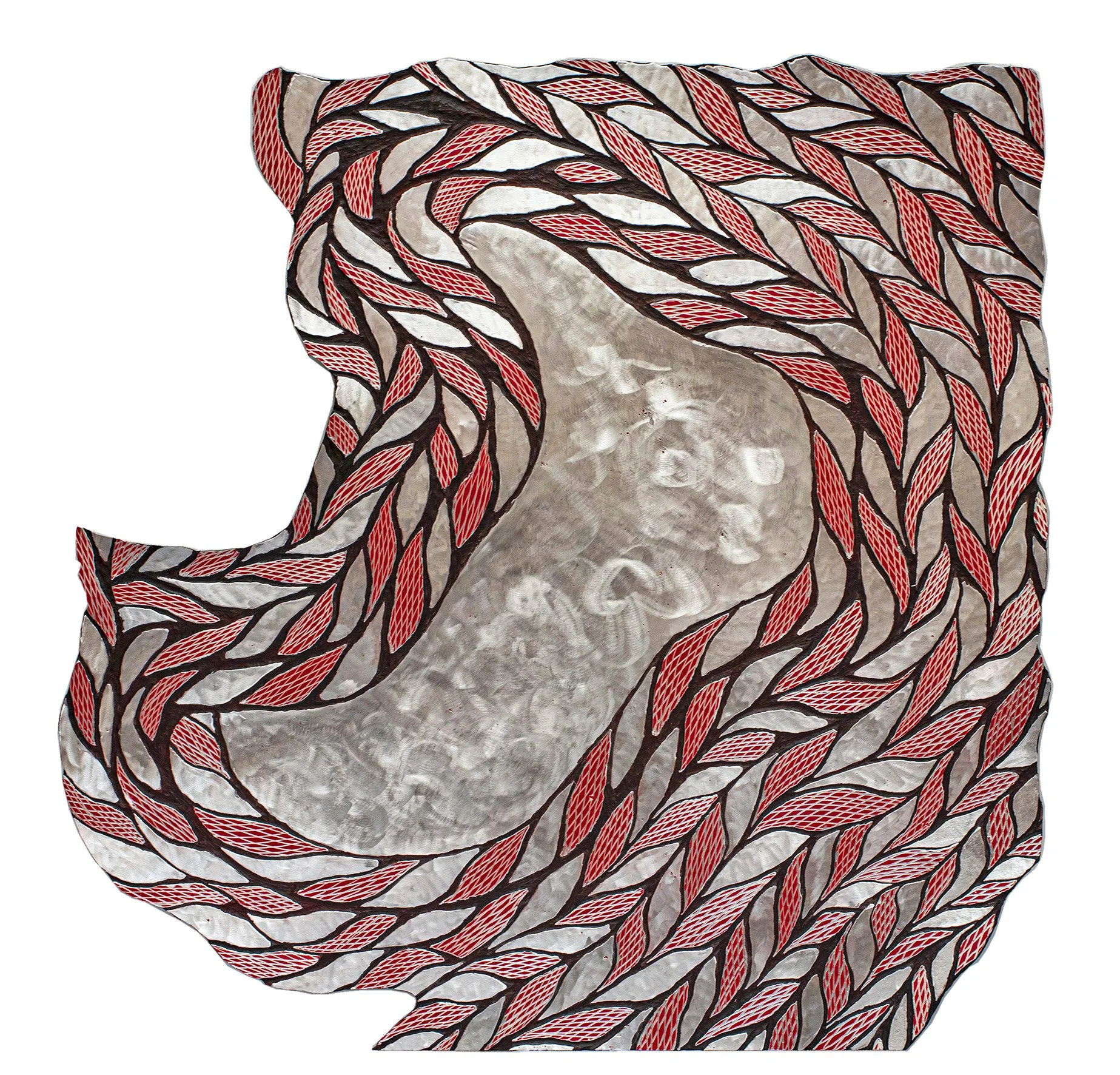
Artiste : Gunybi Ganambarr (1973)
Titre de l'œuvre : Ŋaymil font
Etched Aluminium
Format : 121 x 120 cm
Provenance et certificat original : centre d'art aborigène de Yirrkala
Référence de la peinture : 2543-19
© Photo & text : Aboriginal signature with the courtesy of the artist, & Buku-Larrngay Mulka.
Explication de l’œuvre :
This work identifies the reservoirs of the Ŋaymil/Datiwuy clan. Ŋalkan is an area on Ŋaymil land and sea between the Gurrumuru and Cato Rivers that run into the Arnhem Bay. Within this area is another watercourse that leads up into a sacred area of a freshwater spring or Milngurr with special qualities called Balawurru. Dhangultji or Brolga are dancing here. Here Djanda the sacred goanna also swim in the lagoon created by the spring, their actions as they swim causing rippling patterns to be made on the surface that is covered by the totemic water weed Ḏarra. Similarly the force of the water surging from under the ground ripples the surface. Ḻurr'yun is a Yolŋu word for the rippling flow of water.
This plant forms floating forests in only a few very sacred locations. It is a broad leaf emergent plant that sits within the water and flowers in September with a vibrant yellow flower mass.
Dhangultji or Guḏurrku (Brolga) inhabit the adjacent floodplains in huge numbers during the late Dry. They drink from subterranean springs which emerge in the vast flat plains. A safe place to rest, mate and nest. In their avian form they are a manifestation of the Djaŋ’kawu Sisters’ party which travel throughout the Eastern top end, shape shifting and giving birth to the various clans of the Dhuwa moiety. In this case the Ŋaymil.
Others inhabit these waters. Warrukay or Murrukula the Barracuda, the power totem for the Ŋaymil. It spends most of its time in the salt waters. At certain times Warrukay will make its way up to Balawurru bringing the ‘contamination’ of muddied water with it. This has connotations of fertility. It is a place of fertility. Souls of Ŋaymil are both delivered to and from this point between worlds real and spiritual. As the sacred songs used in mortuary are cyclic, narrating the Ancestral Events of the original Creator Beings, so is the journey of the Yolŋu soul. This place is also shared with Dhudi Djapu clan.

Artiste : Bandarr Wirrpanda (1980)
Titre de l'œuvre : Maŋgalili Story
Etched Aluminium
Format : 100 x 70cm
Provenance et certificat original : centre d'art aborigène de Yirrkala
Référence de la peinture : 3918-21
© Photo & text : Aboriginal signature with the courtesy of the artist, & Buku-Larrngay Mulka.
Explication de l’œuvre :
An understanding of this work relies upon a basic outline of the Maŋgalili clan’s ‘outside story’ as follows.
It was in the wangarr, ancestral times, when the Guwak (Koel Cuckoo) men, Munuminya and Yikawaŋa, sittng under the shade of the sacred Marawili (a Ganyawu or bush cashew) tree, instructed the ancestral koel cuckoo Guwak to lead the Maŋgalili people to this new place they had established for them at Djarrakpi. Having seen the people settled in their new homeland they announced to the Maŋgalili their farewell, that they, the Guwak men were to travel out to sea, to a place in the sky and that they would become stars which would shine out of the night sky.

Artiste : Bandarr Wirrpanda (1980)
Titre de l'œuvre : Yalata
Etched Aluminium
Format : 90 x 60 cm
Provenance et certificat original : centre d'art aborigène de Yirrkala
Référence de la peinture : 1452-21
© Photo & text : Aboriginal signature with the courtesy of the artist, & Buku-Larrngay Mulka.
Explication de l’œuvre :
This work depicts early events during Ancestral (and present) times at Yalata close to the Dhudi-Djapu clan homeland of Dhuruputjpi (about three hours drive South West from Yirrkala). It is a coastal fringe area, this Dhudi Djapu homeland, that has territory leading up a river through plains country behind an area of coast on Blue Mud Bay.
The plain is tidal and during the wet seasons it is flooded by the rains and tidal surge creating areas of brackish water. During the dry season the grass and black earth dry out. Then the fires come, turning a swamp into a huge plain of cracked black earth.
Fresh water springs dot this sun baked plain forming small islands of vegetation and as Rarrandada (the hot time) builds the thirsty wayin (birds) come to these sacred springs in their thousands. The noise of the guḏurrku or dhaŋgultji (brolgas) and gurrumaṯji (magpie geese) are deafening, the mud scored with their tracks and the sky dark with the flocks of wheeling birds.
In Ancestral times, activities of Mäna the shark and the Djaŋ’kawu took place here.
The Djaŋ’kawu - the Dhuwa moiety Creator Beings, in naming this country for the Dhudi Djapu, created these sacred fresh water springfed waterholes by plunging their sacred digging sticks in the ground. Freshwater sprung from these wells as did a sacred goanna, a manifestation in some circles of the Djaŋ’kawu themselves.
Story has it that on surfacing the goanna saw the first sun rise. Also on the wet clays around the wells the goanna observed the footprints of Daŋgultji the Brolga. The prints of the Brolga passing from spring to spring are an echo and a present day manifestation of the Sisters who adopted the form of the brolga in their travels between springs as portrayed by the roundrel.

Artiste : Noŋgirrŋa Marawili (1938)
Titre de l'œuvre : Lightning snake
Format : 211 x 78 cm
Provenance et certificat : Yirrkala
Référence de cette peinture : 4551K
Explications sur cette peinture Aborigène :
Noŋgirrŋa started life as one of the numerous children of Mundukul the Madarrpa warrior (c.1890-c.1950). He was a famed leader/warrior with uncountable wives of the Marrakulu, Dhudi Djapu and Galpu clans. She was a child of one of the four Galpu wives, Bulungguwuy. Life was a bountiful but disciplined subsistence amongst a working family group of closely related mothers, brothers and sisters. This was over fifty people! She was born on the beach at Darrpirra north of Cape Shield on the oceanside. But they were Wakir’ – camping- moving around. They went to Yilpara. They went to Djarrakpi. But their special place was Guwaŋarripa (Woodah Island). They were a fleet of canoes travelling all the way to Groote Island and back and forth from the mainland. They lived in this rich place. Their special spot on the mainland was Baratjula. A place to which she only returned after the creation of these paintings…
The looseness and large segments of plain colour,represent another departure. The strings of rough diamonds marks the classic miny’tji of the saltwater estate of Yathikpa.
Here Baru the ancestral crocodile, carrying and being burnt by the Ancestral fire crossed the beach from Garraŋali (crocodile’s nest) and entered the saltwater. Baru decided after being soothed of his burns that he would stay in these waters. His sacred powers in line with that of the fire imbues the water there today. There is also a graphic reference to the lightning which also arches over these waters from the Lightning Snake, Mundukul…
Demander le prix de l'œuvre / Enquiry
© Photo : Aboriginal Signature Estrangin gallery with the courtesy of the artists & Yiirkala.

Artiste : Djambawa Marawili (1953)
Titre de l'œuvre : Burrut'tji - Lightning Snake
Format : 104 x 74 cm
Pigments naturels sur écorce d'eucalyptus
Provenance et certificat : centre d'art aborigene de Yirrkala
Référence de la peinture : 1583-17
Explications sur cette œuvre :
Baraltja is the residence of Burrut’tji (also known as Mundukul) the lightning serpent. It is an area of flood plains that drain into northern Blue Mud Bay. It is on country belonging to the Madarrpa and denotes an area of special qualities pertaining to fertility and the mixing of waters. From Madarrpa (and Dhalwaŋu clan) land freshwater spreads onto the Baraltja flood plains with the onset of the Wet. A tidal creek into the Bay flows with the freshwater flushing the brackish mix into the sea over an ever shifting sandbar (the snake manifest). The deep hole that he lives in is Lorr…
It is from here that the water (soul) transmogrifies to vapour to enter the ‘pregnant’ Waŋupini (Wet Season storm clouds) which carry the life giving freshwater back to rain on the escarpment of the Mitchell Ranges- the watershed and the start of the cycle.
© Photo & text : Aboriginal signature with the courtesy of the artist, & Buku-Larrngay Mulka.

Artiste : Djambawa Marawili (1953)
Titre de l'œuvre : Metamorphosis/Dhakandjali
Format : 184 x 71 cm
Pigments naturels sur écorce d'eucalyptus
Provenance et certificat : centre d'art aborigene de Yirrkala
Référence de la peinture : 2918R
Explications sur cette œuvre :
This painting by Djambawa depicts the transformation of the ancestral warrior Bäru into the Madarrpa power totem of crocodile through the agency of fire. This motif of Baru holding fire sticks or clapsticks and generating fire or sacred song (manikay) appears again and again within Djambawa’s work for the Sydney Biennale show and feels like a multilayered self portrait. Djambawa is becoming the Baru through his observation of Madarrpa law in song and art.
He is himself being transformed by the act of painting as Baru was by fire. Here he is presiding over ceremony and generating/directing and being consumed by the fire of these designs, songs and law. As the fire spreads so does the song touch on these areas connected through manikay.
© Photo & text : Aboriginal signature with the courtesy of the artist, & Buku-Larrngay Mulka.

Artiste : Djambawa Marawili (1953)
Titre de l'œuvre : Baraltja
Format : 173 x 63 cm
Pigments naturels sur écorce d'eucalyptus
Provenance et certificat : centre d'art aborigene de Yirrkala
Référence de la peinture : 3707L
Explications sur cette œuvre :
This work was completed at Yilpara on Blue Mud Bay just a few months after Djambawa presided over the one year celebration of Yolngu victory in the Blue Mud Bay case in the High Court of Australia. Djambawa had been instrumental in bringing the Court case thirteen years earlier and in initiating the Saltwater Collection which was used as evidence in the claim. Baraltja is the residence of Burrut’tji (also known as Mundukul) the lightning serpent. It is an area of flood plains that drain into northern Blue Mud Bay…
The medium of this message is the deep horizon ocean. Although in the Dry Season there is no physical connection through water between the Dhalwangu clan Gangan River and their maternal granddaughter Madarrpa clan’s Baraltja Creek - in the Wet the inundation allows the possibility of water flowing from Gangan to emerge at Baraltja. This area is sung and painted by both clans because of the spiritual connection echoed by the physical reality. The colouring refers to Motu, the build up of red black and yellow , mangrove leaves in this mangrove creek. From Baraltja the waters migrate to Muŋurru the mighty undifferentiated Yirritja saltwater ocean that plays at the horizon which receives and unifies all the Yirritja coastal saltwaters in one. It is from here that the water (soul) transmogrifies to vapour to enter the ‘pregnant’ Waŋupini (Wet Season storm clouds) which carry the life giving freshwater back to rain on the escarpment of the Mitchell Ranges- the watershed and the start of the cycle.
© Photo & text : Aboriginal signature with the courtesy of the artist, & Buku-Larrngay Mulka.

Artiste : Garawan Wanambi (1965)
Titre de l'œuvre : Marraŋu
Pigments naturels sur écorce
Format : 139 x 39 cm
Provenance et certificat original : centre d'art aborigène de Yirrkala
Référence de la peinture : 3372G
© Photo & text : Aboriginal signature with the courtesy of the artist, & Buku-Larrngay Mulka.
Explication de l’œuvre :
This bark painting by Garawan Wanambi (1965) depicts country close to Raymangirr, on the coast of Arnhem Bay. It is a sacred and restricted area where freshwater is known to spring to the surface of the beach at the low tide region. Garawan a Marrakulu clansman says that “Wayuŋga brought me up so I’m also adopted to the Marraŋu clan” The Marrakulu and Marraŋu are closely related clans through madayin (sacred clan mythologies and law). Both tell of the felling of monumental trees by the honey ancestor Wuyal, the scouring out of a river course by the fallen log on its way to sea, deluge of honey, floods and other apocalyptic events.
For the Marraŋu at a site close to coastal Raymangirr is the mouth of this river and places of non secular danger where freshwater fonts spring up into this tidal region.
The designs represent the different character of the waters moving from anger and turbulence to the calm of resolution, bathed in the warmth of the sun’s rays. Manifest and central to the painting is the fallen trunk, this sacred larrakitj a manifestation of the same.
Collections :
Art Gallery of New South Wales, Sydney NSW. Kerry Stokes Larrakitj Collection, WA. The Kluge-Ruhe Aboriginal Art Collection of the University of Virginia. USA

Artiste : Garawan Wanambi (1965)
Titre de l'œuvre : Marraŋu
Pigments naturels sur écorce
Format : 121 x 39 cm
Provenance et certificat original : centre d'art aborigène de Yirrkala
Référence de la peinture : 3514P
© Photo & text : Aboriginal signature with the courtesy of the artist, & Buku-Larrngay Mulka.
Explication de l’œuvre :
This bark painting by Garawan Wanambi (1965) depicts country close to Raymangirr, on the coast of Arnhem Bay. It is a sacred and restricted area where freshwater is known to spring to the surface of the beach at the low tide region. Garawan a Marrakulu clansman says that “Wayuŋga brought me up so I’m also adopted to the Marraŋu clan” The Marrakulu and Marraŋu are closely related clans through madayin (sacred clan mythologies and law). Both tell of the felling of monumental trees by the honey ancestor Wuyal, the scouring out of a river course by the fallen log on its way to sea, deluge of honey, floods and other apocalyptic events.
For the Marraŋu at a site close to coastal Raymangirr is the mouth of this river and places of non secular danger where freshwater fonts spring up into this tidal region.
The designs represent the different character of the waters moving from anger and turbulence to the calm of resolution, bathed in the warmth of the sun’s rays. Manifest and central to the painting is the fallen trunk, this sacred larrakitj a manifestation of the same.
Collections :
Art Gallery of New South Wales, Sydney NSW. Kerry Stokes Larrakitj Collection, WA. The Kluge-Ruhe Aboriginal Art Collection of the University of Virginia. USA

Artiste : Mulkun Wirrpanda (1942-2021)
Titre de l'œuvre : The Ganguri plant
Format : 120 x 43 cm
Provenance et certificat : Yirrkala
Référence de cette peinture : 4925V
Explications sur cette peinture Aborigène :
This work is an extension of a phase where the artist of her own motion explored lesser known plant species which she feared were being forgotten by younger generations. This coincided with artist John Wolseley’s interest in returning to Yilpara (after they had met during the Djalkiri project of 2010) and the two spent an extended period exploring the botany of Blue Mud Bay.
John Wolseley spent a week at Yilpara with Mulkun in May 2012 and again at Yirrkala in June 2013, June 2014 and then May and December 2015.
Mulkun has been finding new ways to paint and promote nutritional plants that are no longer eaten widely. As a child there were very many healthy old people and now there are few. In those days old people lived for a long time without illness. She blames poor diet and the loss of knowledge.
In 2017 accompanying Mulkun and John Wolseley's NMA show Miḏawarr | Harvest, the book of the same name was published with words by Mulkun Wirrpanda (MW), Merrkiyawuy Ganambarr-Stubbs (MGS), Greg Leach (GL) and Glenn Wightman (GW).
This plant is Ganguri.
Below is the Yolŋu dictionary for this plant:
Meaning: Yam (collective term) Long Yam - found in monsoon rainforest, can be eaten raw or cooked.
Dioscorea sativa var. elongata, Vigna radiata
A synonym of ganguri is: baḻŋunda, bäḻtji, gulaka, gawatha, maṉmunda see maṉmuŋa
Language note: D
Part of speech: n
Moiety: Dhuwa
Enquiry / Demander le prix de l'œuvre
© Photo & text : Aboriginal Signature Estrangin gallery with the courtesy of the artists, & Buku-Larrnggay Mulka Centre

Artiste : Mulkun Wirrpanda (1942-2021)
Titre de l'œuvre : The Ṉämbarra plant
Format : 119 x 59 cm
Provenance et certificat : Yirrkala
Référence de cette peinture : 3074-16
Explications sur cette peinture Aborigène :
This work is an example of a phase where the artist of her own motion explored lesser known plant species which she feared were being forgotten by younger generations. This coincided with artist John Wolseley’s interest in returning to Yilpara (after they had met during the Djalkiri project of 2010) and the two spent an extended period exploring the botany of Blue Mud Bay.
She wants to renew the knowledge of these plants because when she was young this is the food that she grew up on. In those days old people lived for a long time without illness. John Wolseley spent a week at Yilpara with Mulkun in May 2012 and has visited to work together again at Yirrkala in June 2013, June 2014, May and December 2015 and October 2016.
Mulkun has been finding new ways to paint and promote nutritional plants that are no longer eaten widely. As a child there were very many healthy old people and now there are few. She blames poor diet and the loss of knowledge.
This work is a depiction of ṉämbarra the young leaves of Melaleuca are a prized medication for flus and colds as an inhalation as a poultice for sores and as a healthful body wash in solution.
Below is the Yolŋu dictionary entry for Ṉämbarra.
Meaning: tree - edible fruit leaves used medicinally. Paperbark sp., Melaleuca leucadendron. An abbreviation of ṉämbarra is:
barrtjaray, dhulwu', dhowirr, munuymunuy, walḏulu, wolk, wurrtjuḻu.
Language notes: D
Moiety: Dhuwa
Part of speech: n
Her artworks are in the following prestigious collections :
Art Gallery of New South Wales, Sydney NSW
Art Gallery of South Australia, Adelaide SA
Artbank, Sydney NSW
Berndt Museum, University of Western Australia, Perth WA
British Museum, London, UK
Buku-Larrnggay Mulka - Saltwater - Yirrkala Bark Paintings of Sea Country
Charles Darwin University Art Collection
Holmes a Court Collection
Kerry Stokes Larrakitj Collection, WA
National Maritime Museum, Darling Harbour, Sydney NSW
National Museum of Australia, Canberra ACT
RMIT University Art Collection
Enquiry / Demander le prix de l'œuvre
© Photo & text : Aboriginal Signature Estrangin gallery with the courtesy of the artists, & Buku-Larrnggay Mulka Centre

Artiste : Mulkun Wirrpanda (1942-2021)
Titre de l'œuvre : The Ṉämbarra plant
Format : 121 x 44,5 cm
Provenance et certificat : Yirrkala
Référence de cette peinture : 4511-16
Explications sur cette peinture Aborigène :
This work is an example of a phase where the artist of her own motion explored lesser known plant species which she feared were being forgotten by younger generations. This coincided with artist John Wolseley’s interest in returning to Yilpara (after they had met during the Djalkiri project of 2010) and the two spent an extended period exploring the botany of Blue Mud Bay.
She wants to renew the knowledge of these plants because when she was young this is the food that she grew up on. In those days old people lived for a long time without illness. John Wolseley spent a week at Yilpara with Mulkun in May 2012 and has visited to work together again at Yirrkala in June 2013, June 2014, May and December 2015 and October 2016.
Mulkun has been finding new ways to paint and promote nutritional plants that are no longer eaten widely. As a child there were very many healthy old people and now there are few. She blames poor diet and the loss of knowledge.
This work is a depiction of ṉämbarra the young leaves of Melaleuca are a prized medication for flus and colds as an inhalation as a poultice for sores and as a healthful body wash in solution.
Below is the Yolŋu dictionary entry for Ṉämbarra.
Meaning: tree - edible fruit leaves used medicinally. Paperbark sp., Melaleuca leucadendron. An abbreviation of ṉämbarra is:
barrtjaray, dhulwu', dhowirr, munuymunuy, walḏulu, wolk, wurrtjuḻu.
Language notes: D
Moiety: Dhuwa
Part of speech: n
Enquiry / Demander le prix de l'œuvre
© Photo & text : Aboriginal Signature Estrangin gallery with the courtesy of the artists, & Buku-Larrnggay Mulka Centre
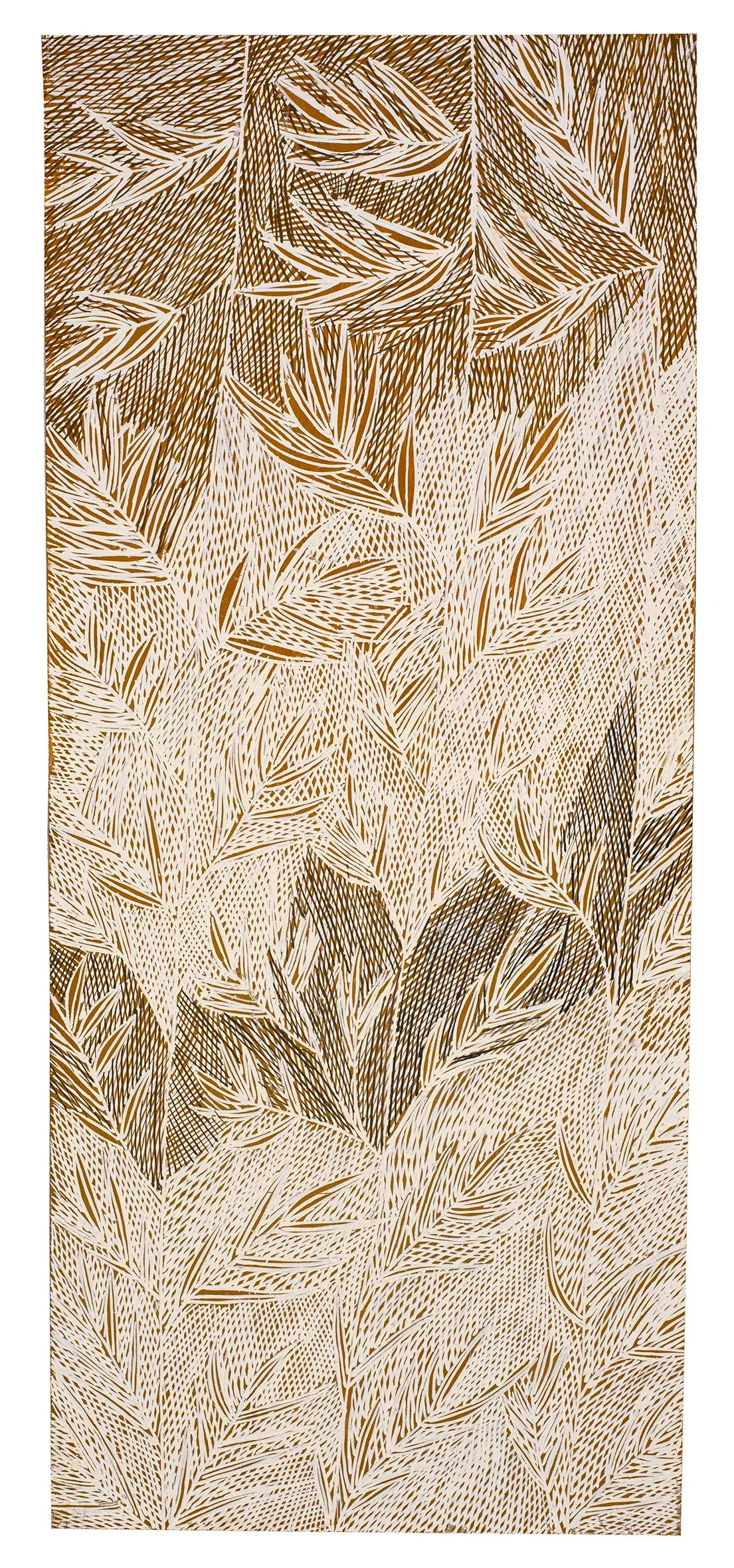
Artiste : Mulkun Wirrpanda (1942-2021)
Titre de l'œuvre : The Ṉämbarra plant
Format : 122 x 52 cm
Provenance et certificat : Yirrkala
Référence de cette peinture : 4585-16
Explications sur cette peinture Aborigène :
This work is an example of a phase where the artist of her own motion explored lesser known plant species which she feared were being forgotten by younger generations. This coincided with artist John Wolseley’s interest in returning to Yilpara (after they had met during the Djalkiri project of 2010) and the two spent an extended period exploring the botany of Blue Mud Bay.
She wants to renew the knowledge of these plants because when she was young this is the food that she grew up on. In those days old people lived for a long time without illness. John Wolseley spent a week at Yilpara with Mulkun in May 2012 and has visited to work together again at Yirrkala in June 2013, June 2014, May and December 2015 and October 2016.
Mulkun has been finding new ways to paint and promote nutritional plants that are no longer eaten widely. As a child there were very many healthy old people and now there are few. She blames poor diet and the loss of knowledge.
This work is a depiction of ṉämbarra the young leaves of Melaleuca are a prized medication for flus and colds as an inhalation as a poultice for sores and as a healthful body wash in solution.
Below is the Yolŋu dictionary entry for Ṉämbarra.
Meaning: tree - edible fruit leaves used medicinally. Paperbark sp., Melaleuca leucadendron. An abbreviation of ṉämbarra is:
barrtjaray, dhulwu', dhowirr, munuymunuy, walḏulu, wolk, wurrtjuḻu.
Language notes: D
Moiety: Dhuwa
Part of speech: n
Enquiry / Demander le prix de l'œuvre
© Photo & text : Aboriginal Signature Estrangin gallery with the courtesy of the artists, & Buku-Larrnggay Mulka Centre

Artiste : Mulkun Wirrpanda (1942-2021)
Titre de l'œuvre : Ŋäḏi ga Guṉdirr (Mulkun- meat ants and termites)
Format : 72 x 51 cm
Provenance et certificat : Yirrkala
Référence de cette peinture : 2723-20
Explications sur cette peinture Aborigène :
This work is an extension of a phase where the artist of her own motion explored lesser known plant species which she feared were being forgotten by younger generations. This coincided with artist John Wolseley’s interest in returning to Yilpara (after they had met during the Djalkiri project of 2010) and the two spent an extended period exploring the botany of Blue Mud Bay.
John Wolseley spent a week at Yilpara with Mulkun in May 2012 and again at Yirrkala in June 2013, June 2014 and then May and December 2015.
Mulkun has been finding new ways to paint and promote nutritional plants that are no longer eaten widely. As a child there were very many healthy old people and now there are few. In those days old people lived for a long time without illness. She blames poor diet and the loss of knowledge.
In 2017 accompanying Mulkun and John Wolseley's NMA show Miḏawarr | Harvest, the book of the same name was published with words by Mulkun Wirrpanda (MW), Merrkiyawuy Ganambarr-Stubbs (MGS), Greg Leach (GL) and Glenn Wightman (GW).
Following this theme she moved on to painting varieties of Maypal or shellfish and these were exhibited in a sold out show at Salon in Darwin in August 2018. This then morphed to a series of work where she painted shellfish which lived symbiotically with edible plants.
In this work she has continued with the concept of symbioses and in this case eusociality. She has depicted the relationship between munyukuluŋu Magnetic termites Amitermes meridionalis, or compass termite, a speciesof eusocial insect in the family Termitidae…
© Photo & text : Aboriginal Signature Estrangin gallery with the courtesy of the artists, & Buku-Larrnggay Mulka Centre
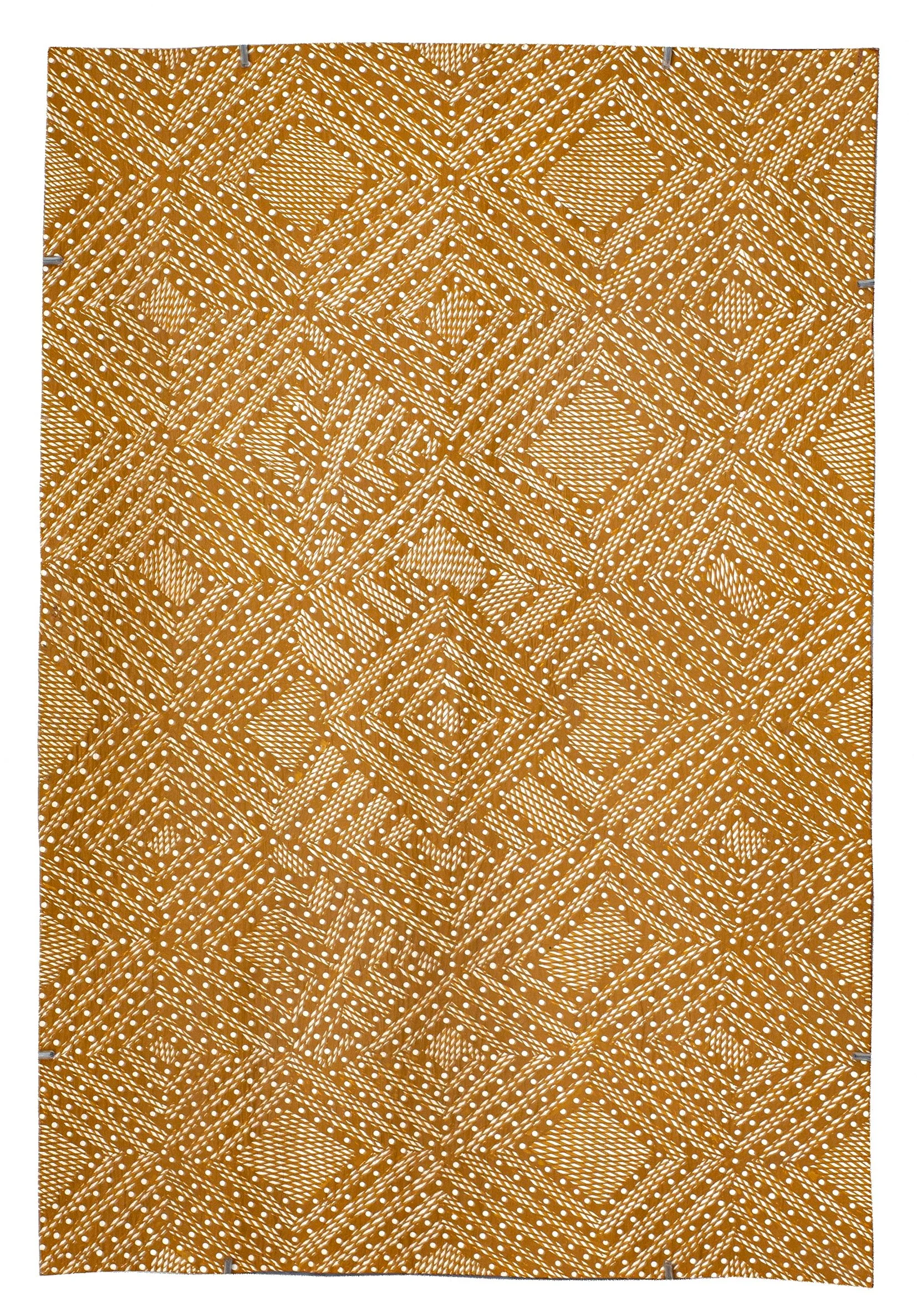
Artiste : Garawan Wanambi (1965)
Titre de l'œuvre : Marraŋu
Pigments naturels sur écorce
Format : 57 x 85 cm
Provenance et certificat original : centre d'art aborigène de Yirrkala
Référence de la peinture : 921-16
© Photo & text : Aboriginal signature with the courtesy of the artist, & Buku-Larrngay Mulka.
Explication de l’œuvre :
This bark painting by Garawan Wanambi (1965) depicts country close to Raymangirr, on the coast of Arnhem Bay. It is a sacred and restricted area where freshwater is known to spring to the surface of the beach at the low tide region. Garawan a Marrakulu clansman says that “Wayuŋga brought me up so I’m also adopted to the Marraŋu clan” The Marrakulu and Marraŋu are closely related clans through madayin (sacred clan mythologies and law). Both tell of the felling of monumental trees by the honey ancestor Wuyal, the scouring out of a river course by the fallen log on its way to sea, deluge of honey, floods and other apocalyptic events.
For the Marraŋu at a site close to coastal Raymangirr is the mouth of this river and places of non secular danger where freshwater fonts spring up into this tidal region.
The designs represent the different character of the waters moving from anger and turbulence to the calm of resolution, bathed in the warmth of the sun’s rays. Manifest and central to the painting is the fallen trunk, this sacred larrakitj a manifestation of the same.
Collections :
Art Gallery of New South Wales, Sydney NSW. Kerry Stokes Larrakitj Collection, WA. The Kluge-Ruhe Aboriginal Art Collection of the University of Virginia. USA
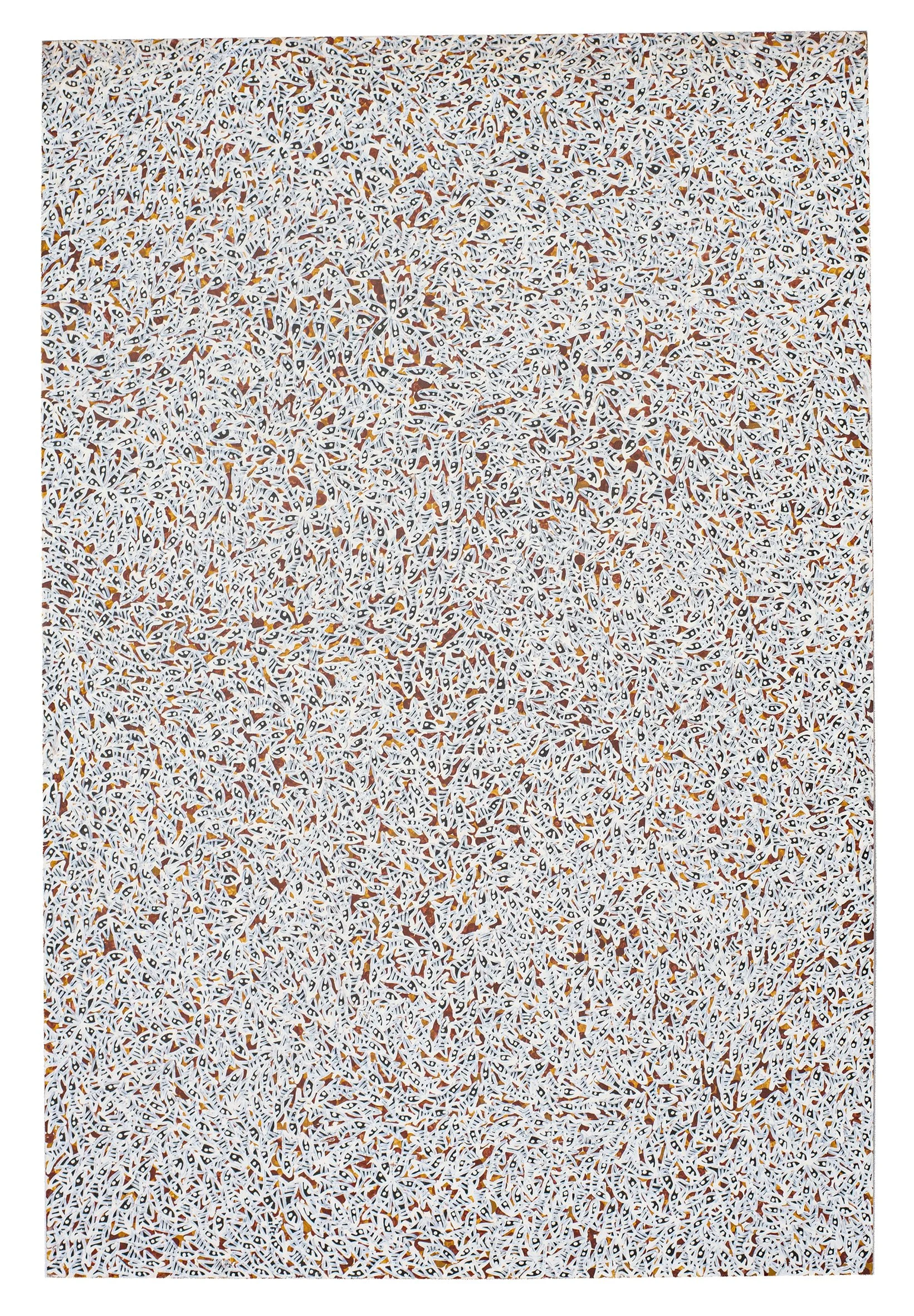
Artiste : Wukun Wanambi (1962)
Titre de l'œuvre : Destiny
Pigments naturels sur écorce
Format : 92 x 61 cm
Provenance et certificat original : centre d'art aborigène de Yirrkala
Référence de la peinture : 4568-16
© Photo & text : Aboriginal signature with the courtesy of the artist, & Buku-Larrngay Mulka.
Explication de l’œuvre :
Mullet travelled from river to river, ocean to ocean, looking for their destiny. This is at Gurka'wuy. They also travelled to other various communities. We sing a song, and dance as well, to carry the tide of Gurka'wuy water, bringing the guya (fish) into the river, to Trial Bay. There is a place called Marraŋu, Golumala, they sing the song there, where the three rivers come together.
The water is called Gudutja and they are looking for their destiny, just like you and I tracing our family tree on a computer, looking for our great, great grandfathers and grandmothers.
Collections :
Art Gallery of New South Wales, Sydney NSW. Art Gallery of South Australia, Adelaide SA. Musee de Lyon, Lyon France. Museum of the Northern Territory, Darwin. Museum Fünf Kontinente in Munich, Germany. Museum of Contemporary Art, Sydney. National Gallery of Australia, Canberra ACT. National Maritime Museum...

Artiste : Wukun Wanambi (1962)
Titre de l'œuvre : Wawurritjpal
Pigments naturels sur écorce
Format : 113 x 45 cm
Provenance et certificat original : centre d'art aborigène de Yirrkala
Référence de la peinture : 1328-21
© Photo & text : Aboriginal signature with the courtesy of the artist, & Buku-Larrngay Mulka.
Explication de l’œuvre :
A set of three rocks stand in the mouth of Trial Bay submerged either completely or partially within its waters. The waters of Gurkawuy River flow out through Trial Bay past these rocks conflicting and clashing in a turbulent unity with the incoming tidal waters from the deep ocean. In sacred song, Bamurruŋu, a sacred and solitary rock in the mouth of Trial Bay lies submerged,within its waters surrounded by these fish; Buku-Duŋgulmirri or Wawurritjpal, Sea Mullet. Yolŋu of this area speak of a hole submerged under the rocks, from where bubbles are seen rising to the surface, sometimes bursting forth with a rush. The bubbles are seen as a life force and a direct Ancestral connection for the Marrakulu. When the Marrakulu perform ritual dance for the events depicted in this painting participants move towards a held spear representing the steadfastness of the rock, spliting the dancers who then surround the rock known as Bamurruŋu moving as does the sea to song and rhythm of Yidaki and Bilma. The fish depicted jump the ‘trap’ created by the rock in the same way that the soul slips its earthly bonds…
Collections :
Art Gallery of New South Wales, Sydney NSW. Art Gallery of South Australia, Adelaide SA. Musee de Lyon, Lyon France. Museum of the Northern Territory, Darwin. Museum Fünf Kontinente in Munich, Germany. Museum of Contemporary Art, Sydney. National Gallery of Australia, Canberra ACT. National Maritime Museum...
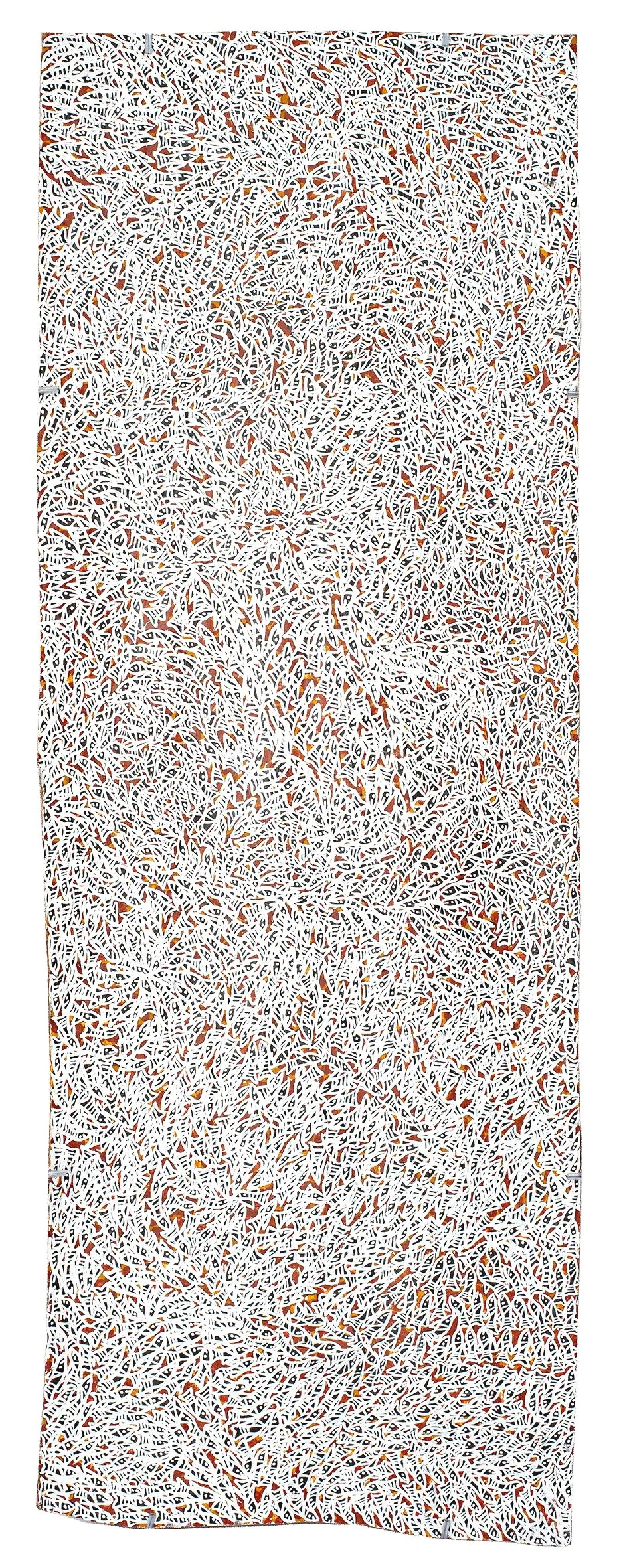
Artiste : Wukun Wanambi (1962)
Titre de l'œuvre : Wawurritjpal
Pigments naturels sur écorce
Format : 123x44 cm
Provenance et certificat original : centre d'art aborigène de Yirrkala
Référence de la peinture : 1421-21
© Photo & text : Aboriginal signature with the courtesy of the artist, & Buku-Larrngay Mulka.
Explication de l’œuvre :
A set of three rocks stand in the mouth of Trial Bay submerged either completely or partially within its waters. The waters of Gurkawuy River flow out through Trial Bay past these rocks conflicting and clashing in a turbulent unity with the incoming tidal waters from the deep ocean. In sacred song, Bamurruŋu, a sacred and solitary rock in the mouth of Trial Bay lies submerged,within its waters surrounded by these fish; Buku-Duŋgulmirri or Wawurritjpal, Sea Mullet. Yolŋu of this area speak of a hole submerged under the rocks, from where bubbles are seen rising to the surface, sometimes bursting forth with a rush. The bubbles are seen as a life force and a direct Ancestral connection for the Marrakulu. When the Marrakulu perform ritual dance for the events depicted in this painting participants move towards a held spear representing the steadfastness of the rock, spliting the dancers who then surround the rock known as Bamurruŋu moving as does the sea to song and rhythm of Yidaki and Bilma. The fish depicted jump the ‘trap’ created by the rock in the same way that the soul slips its earthly bonds…
Collections :
Art Gallery of New South Wales, Sydney NSW. Art Gallery of South Australia, Adelaide SA. Musee de Lyon, Lyon France. Museum of the Northern Territory, Darwin. Museum Fünf Kontinente in Munich, Germany. Museum of Contemporary Art, Sydney. National Gallery of Australia, Canberra ACT. National Maritime Museum...

Artiste : Gunybi Ganambarr (1973)
Titre de l'œuvre : Buyku
Pigments naturels sur écorce
Format : 178 x 72cm
Provenance et certificat original : centre d'art aborigène de Yirrkala
Référence de la peinture : 2868-18
© Photo & text : Aboriginal signature with the courtesy of the artist, & Buku-Larrngay Mulka.
Explication de l’œuvre :
This piece is painted in the miny’tji (sacred clan design) of the Dhalwaŋu clan which is one of the eight or so clans belonging to the Yirritja moiety (half) in North East Arnhem land. The sacred diamond design for the Dhalwaŋu clan reflects the patterning of the water streaming from the body of Ancestral Creator Being Barama as he emerged from these waters at Gäṉgaṉ, with weed hanging from his arms.
Today appropriately senior ritual participants wear sacred feathered strings from armbands, their chest painted with the Dhalwŋu design of freshwater. These totemic ancestors of the Dhalwaŋu clan are all associated with this site at Gäṉgaṉ from which all Yirritja creation began. They are seen as embodiments of the disciples or companions of Barama and himself. Black and white dots also representing the wake of the swimming tortoise.
The manifestation of Barama is the long neck tortoise and chief totem for the Dhalwaŋu - Minhala. His disciple is Dhakawa - freshwater crayfish. It was in a period called Wangarr, the world creation drives of the first mornings, when the Ancestral Beings came to country to give lore and title for the land and its people. The Yolŋu world is based on a duality, of two moieties of equal status that integrate through a complex system of kinship. Clan groups in this area known as Miwatj country belong to either the Yirritja or Dhuwa moieties. Barama came to Gäṉgaṉ from the saltwater country of Blue Mud Bay to emerge from the waterhole named Gulutji with the intention of establishing his law amongst the people there of that time. These original Dhalwaŋu referred to as the Banatja were said to be led by Galparimun who received council from Barama. A third player of law in these times was Lanytjaŋ who walked to Gäṉgaṉ meeting up with Barama.
This work is reminiscent in structure to the piece that was acquired by the Metropolitan Museum of art New York which also transformed the rectilinear design of the fishtrap into circular composition.

Artiste : Dhuwarrwarr Marika (1945)
Titre de l'œuvre : Makassan Swords and Long Knives
Pigments naturels sur écorce
Format : 187 x 75 cm
Provenance et certificat original : centre d'art aborigène de Yirrkala
Référence de la peinture : 744-21
© Photo & text : Aboriginal signature with the courtesy of the artist, & Buku-Larrngay Mulka.
Explication de l’œuvre :
“When the Makassan came, they tried to find the Aboriginal people at Melville Bay. The Yolngu wives and kids were asleep.
The men woke up and saw the boat. They thought it was the enemy and some Makassan jumped from their boat and swam to the shore to meet the Aboriginal people. They wanted to work with them. They explained to them about trepang and where they could find some trepang. They went and collected to show them. The Makassan showed them what to do, cooked them and dried them out, explained to them it’s good food and they paid the aboriginal people with swords, axes, material and tobacco. They invited the Makassan people to the camp and explained to them who they were and why they came because in their heart they were Yolgnu people. And the Makassan taught the Yolngu their song and traditions and the Yolngu taught the Makassan their culture and law and tradition.
This is the story and the painting from Dhuwarrwarr Marika, taught to me by my father when the Makassan came to Australia and learned about the Aboriginal people.”
Since the turn of the century the annual visitations of the Makassanese to the Top End shores of Australia were put to a stop by the South Australian Government. These sailors, gatherers of trepang from coastal waters, had for up to six centuries caught the seasonal winds back and forth from what is now known as Sulawesi.
Dhuwarrwarr’s father Mawalan Marika painted about these people in the 1940s and spoke some Makassan language. He always emphasised to her the importance of the relationship between Yolŋu and these allies. He was the leader of the Yirrkala people at the time of the coming of Europeans but never lost his fondness and respect for Makassans.

Artiste : Dhuwarrwarr Marika (1945)
Titre de l'œuvre : Makassan Swords and Long Knives
Pigments naturels sur écorce
Format : 104 x 51 cm
Provenance et certificat original : centre d'art aborigène de Yirrkala
Référence de la peinture : 1291-21
© Photo & text : Aboriginal signature with the courtesy of the artist, & Buku-Larrngay Mulka.
Explication de l’œuvre :
“When the Makassan came, they tried to find the Aboriginal people at Melville Bay. The Yolngu wives and kids were asleep.
The men woke up and saw the boat. They thought it was the enemy and some Makassan jumped from their boat and swam to the shore to meet the Aboriginal people. They wanted to work with them. They explained to them about trepang and where they could find some trepang. They went and collected to show them. The Makassan showed them what to do, cooked them and dried them out, explained to them it’s good food and they paid the aboriginal people with swords, axes, material and tobacco. They invited the Makassan people to the camp and explained to them who they were and why they came because in their heart they were Yolgnu people. And the Makassan taught the Yolngu their song and traditions and the Yolngu taught the Makassan their culture and law and tradition.
This is the story and the painting from Dhuwarrwarr Marika, taught to me by my father when the Makassan came to Australia and learned about the Aboriginal people.”
Since the turn of the century the annual visitations of the Makassanese to the Top End shores of Australia were put to a stop by the South Australian Government. These sailors, gatherers of trepang from coastal waters, had for up to six centuries caught the seasonal winds back and forth from what is now known as Sulawesi.
Dhuwarrwarr’s father Mawalan Marika painted about these people in the 1940s and spoke some Makassan language. He always emphasised to her the importance of the relationship between Yolŋu and these allies. He was the leader of the Yirrkala people at the time of the coming of Europeans but never lost his fondness and respect for Makassans.
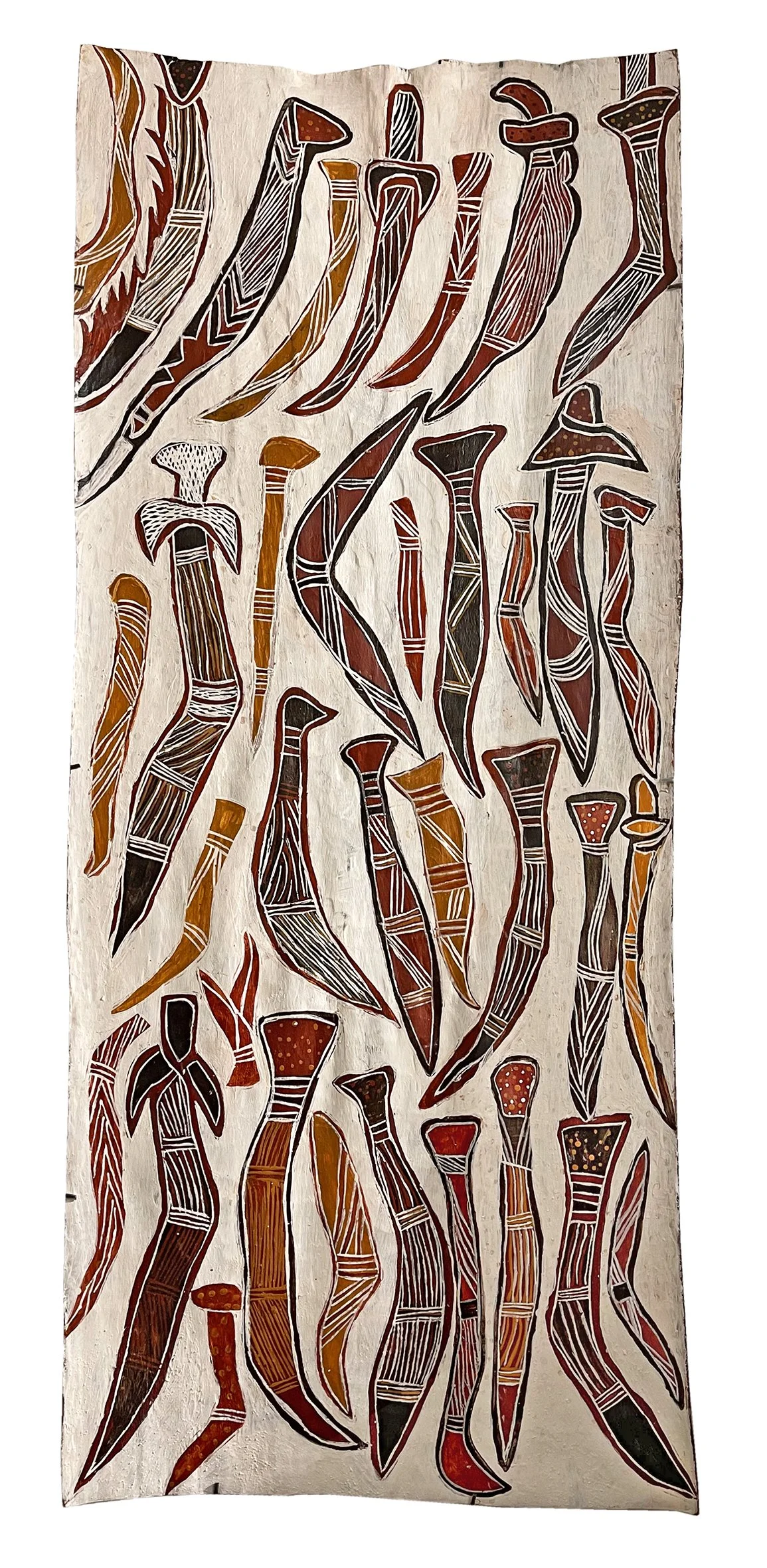
Artiste : Dhuwarrwarr Marika (1945)
Titre de l'œuvre : Makassan Swords and Long Knives
Pigments naturels sur écorce
Format : 186x77 cm
Provenance et certificat original : centre d'art aborigène de Yirrkala
Référence de la peinture : 2161-21
© Photo & text : Aboriginal signature with the courtesy of the artist, & Buku-Larrngay Mulka.
Explication de l’œuvre :
“When the Makassan came, they tried to find the Aboriginal people at Melville Bay. The Yolngu wives and kids were asleep.
The men woke up and saw the boat. They thought it was the enemy and some Makassan jumped from their boat and swam to the shore to meet the Aboriginal people. They wanted to work with them. They explained to them about trepang and where they could find some trepang. They went and collected to show them. The Makassan showed them what to do, cooked them and dried them out, explained to them it’s good food and they paid the aboriginal people with swords, axes, material and tobacco. They invited the Makassan people to the camp and explained to them who they were and why they came because in their heart they were Yolgnu people. And the Makassan taught the Yolngu their song and traditions and the Yolngu taught the Makassan their culture and law and tradition.
This is the story and the painting from Dhuwarrwarr Marika, taught to me by my father when the Makassan came to Australia and learned about the Aboriginal people.”
Since the turn of the century the annual visitations of the Makassanese to the Top End shores of Australia were put to a stop by the South Australian Government. These sailors, gatherers of trepang from coastal waters, had for up to six centuries caught the seasonal winds back and forth from what is now known as Sulawesi.
Dhuwarrwarr’s father Mawalan Marika painted about these people in the 1940s and spoke some Makassan language. He always emphasised to her the importance of the relationship between Yolŋu and these allies. He was the leader of the Yirrkala people at the time of the coming of Europeans but never lost his fondness and respect for Makassans.
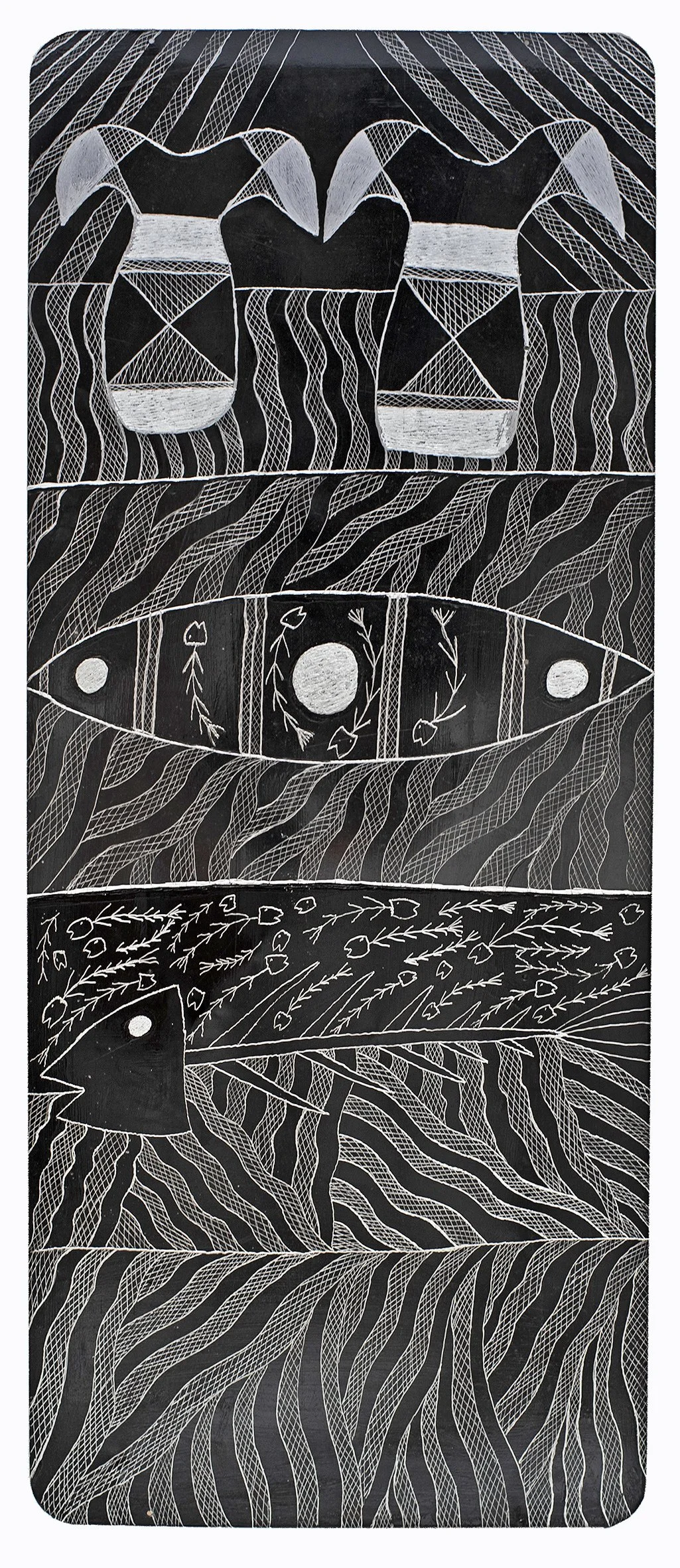
Artiste : Bandarr Wirrpanda (1980)
Titre de l'œuvre : Yiŋapuŋapu
Etched Aluminium
Format : 120 x 50 cm
Provenance et certificat original : centre d'art aborigène de Yirrkala
Référence de la peinture : 1019-21
© Photo & text : Aboriginal signature with the courtesy of the artist, & Buku-Larrngay Mulka.
Explication de l’œuvre :
The designs in this piece are tied to the saltwater estate and ritual focal point at Djarrakpi, the home of Bandarr and his clan.
This beautiful place is located on the Northern entrance of Blue Mud Bay on the Western coast of the Gulf of Carpentaria. It has its founding origins in the times of the first sunrises by the Guwak (a people, 2 men, a koel cuckoo) and a messenger in the form of ringtail possum called marrŋu. The koel at Djarrakpi made roost atop the Marawili (native cashew tree) and Marrŋu made his mark for the Maŋgalili clan by scratching into its trunk. Behind the massive coastal dunes, there is also a lake of freshwater and at the back of these dunes is said to reside the powerful maternal figure of Nyapaliŋu. She wore a possum furstring girdle crossing her chest; the levy bank of the lake was also of the same masculine and sacred fur, a great long shank.
The Guwak as two ancestral hunters left the shores of Djarrakpi in their canoe, testing themselves against the elements, unfathomable sea creatures, the distant horizon and the destructive wake of a giant turtle which eventually capsized their canoe. The Guwak drowned and with their canoe washed back to the Djarrakpi shore. This epiphany; original deaths of the original Maŋgalili gave birth to the original tradition of mortuary rites that nurtured the deceased, clearing the way for temporary release into the ether before reincarnation.
Above this shore - made sacred with this profound wash up - is the Djarrakpi yiŋapuŋapu ground. The yiŋapuŋapu is a low relief sand sculpture of feminine elliptical shape, and used in the context of mortuary for the Yirritja clans of Maŋgalili, Madarrpa and Dhalwaŋu. This painting includes the yiŋapuŋapu of these three sites. Its primary traditional function is to keep the contamination of death within the confines of the sculpture. Placement of the deceased with in the yiŋapuŋapu on the associated clan land in days before contact had been reserved originally for the creator ancestors. In these areas and by way of permanence for perpetuity, yiŋapuŋapu sites denoted indisputable land ownership.

Artiste : Djirrirra Wunuŋmurra (1968)
Titre de l'œuvre : Buyku
Pigments naturels sur écorce
Format : 93 x 47 cm
Provenance et certificat original : centre d'art aborigène de Yirrkala
Référence de la peinture : 4543-21
© Photo & text : Aboriginal signature with the courtesy of the artist, & Buku-Larrngay Mulka.
Explication de l’œuvre :
Artworks such as this have multiple layers of metaphor and meaning which give lessons about the connections between an individual and specific pieces of country (both land and sea), as well as the connections between various clans but also explaining the forces that act upon and within the environment and the mechanics of a spirit’s path through existence. The knowledge referred to by this imagery deepens in complexity and secrecy as a person progresses through a life long learning process.
A sacred expanse of water behind the Gangan outstation where this work was produced is referred to as Gulutji. The initial activities of Barama the great Ancestral Being for the Yirritja moiety took place here. From travelling from the seaside at Blue Mud Bay he emerged from the waters of Gulutji. Council was held with ‘Disciple’ Ancestors and Yirritja Law was ‘written’.
From this place the Yirritja (the Yirritja moiety together with the Dhuwa moiety forms a duality system that keeps all past, present and future life in balance) naon spread as it traversed its country establishing clan estates and governing policy including language, ceremonial ritual and miny’tji (signature of sacred design of event and place- this word describes the patterns employed in this work).
One of the metaphorical overviews of the work is the union between the different subgroups of the Dhalwangu clan in the ancestral cycle of regular fishtrap ceremonies they join together in celebrating. The last one of these was five years ago. These gatherings are ceremonial but also social and educational.
The sacred diamond design generally refers to the waters around Gangan but here are encased in a strong grid of vertical and horizontal lines which show the structure of the fishtrap made during Mirrawarr (early Dry Season) with Rangan (paperbark) and wooden stakes. This is the Buyku or fishtrap area which is ‘company’ land (ie. shared by all the people who live by/sing the river). The Dhalwangu and allied groups who participate in this song cycle and fishing activity are hunting Baypinga (Saratoga) as does the Gany’tjurr (Reef Heron) which they identify with as the archetypal Yirritja hunter.

Artiste : Ŋoŋu Ganambarr (1967)
Titre de l'œuvre : Wirrmu Moon
Etched Aluminium
Format : 85 x 45 cm
Provenance et certificat original : centre d'art aborigène de Yirrkala
Référence de la peinture : 2171-21
© Photo & text : Aboriginal signature with the courtesy of the artist, & Buku-Larrngay Mulka.
Explication de l’œuvre :
This Waŋgurri clan painting depicts the Wirrmu or new moon and Djurrpun the Evening Star and is the first painting in the modern era to so do. The elder who painted it had never revealed this design before.
Buwathay said “When the old man was geting sick he drew this in the sand for me and said ’Later paint this one.’” He was referring to his recently deceased father Mathulu’s words. Buwathay went on to say “This is my totem. The little stars are the other stars that you can see. There are songs and dances that go with this story. It relates to the milkarri- the keening of women.” The design on the work relates to the journey of such a pole through Wangurri clan waters. In saltwaters belonging to that clan from their homeland at Mutamul towards their freshwater homeland at Dhalinybuy. It is understood that this work relates to saltwater in Arnhem Bat=y and the floodplains which they inundate in Wet Season flooding and King Tides.
The minyjti or sacred clan design can have different meanings. One is a manifestation in the tracks left in timber from infestation from the boring mangrove worm Milka. Bands of miny’tji represents this and by the layering of hair brush strokes, that build up to a shimmering and brilliant state, itself a manifestation (we can only imagine) of the sublime and to the references this painting could have of the end results of supernatural events and the peace brought after as rays of sun on the calm waters, a condition called gunbilk. Out there in the still distance clouds line the horizon.
The waters that travel through the mangrove areas, (where the Milka infest the wood), that wash with the tides to be taken with the currents out deep to the horizons meet with associate waters from other estates relative to the Wangurri, such as the Maŋgalili. These waters contain the life forces and clan identity and are taken up into the maternal clouds and as dots amongst the waters supporting the totem octopus Manda and the yothu (child) cuttle fish shells floating on the surface.

Artiste : Rerrkirrwaŋa Munuŋgurr
Titre de l'œuvre : Gurtha
Pigments naturels sur écorce
Format : 42 x 23 cm
Provenance et certificat original : centre d'art aborigène de Yirrkala
Référence de la peinture : 1181-19
© Photo : Aboriginal signature with the courtesy of the artist & Buku-Larrngay Mulka.
Explication de l’œuvre :
This bark painting by Rerrkirrwaŋa Munuŋgurr (1971) depicts Gurtha. In ancestral times, the leaders of Yirritja moiety clans used fire for the first time during a ceremony at Ŋalarrwuy in Gumatj country. This came about as fire brought to the Madarrpa clan country by Bäru the ancestral crocodile, spread north and swept through the ceremonial ground. From this ceremonial ground the fire spread further to other sites. Various ancestral animals were affected and reacted in different ways. These animals became sacred totems of the Gumatj people and the areas associated with these events became important sites.
The creatures as cockatoo & Dugong are all associated with named sites which were burnt as the ancestral fire spread across the land. Where the sites described occur outside Gumatj clan country, the path of the fire represents important relationships held between these clans. The Gumatj clan design associated with these events, a diamond design, represents fire; the red flames, the white smoke and ash, the black charcoal and the yellow dust. Also the black skin, yellow fat, white bone and red blood of Gumatj people. Clans owning connected parts of this sequence of ancestral events share variations of this diamond design.
Collections :
2009 Telstra National Aboriginal and Torres Strait Islander Art Awards, Darwin NT - Winner Best Bark Painting.
Private collections.

Artiste : Rerrkirrwaŋa Munuŋgurr
Titre de l'œuvre : Gurtha
Pigments naturels sur écorce
Format : 79 x 33 cm
Provenance et certificat original : centre d'art aborigène de Yirrkala
Référence de la peinture : 3817-20
© Photo : Aboriginal signature with the courtesy of the artist & Buku-Larrngay Mulka.
Explication de l’œuvre :
This bark painting by Rerrkirrwaŋa Munuŋgurr (1971) depicts Gurtha. In ancestral times, the leaders of Yirritja moiety clans used fire for the first time during a ceremony at Ŋalarrwuy in Gumatj country. This came about as fire brought to the Madarrpa clan country by Bäru the ancestral crocodile, spread north and swept through the ceremonial ground. From this ceremonial ground the fire spread further to other sites. Various ancestral animals were affected and reacted in different ways. These animals became sacred totems of the Gumatj people and the areas associated with these events became important sites.
The creatures as cockatoo & Dugong are all associated with named sites which were burnt as the ancestral fire spread across the land. Where the sites described occur outside Gumatj clan country, the path of the fire represents important relationships held between these clans. The Gumatj clan design associated with these events, a diamond design, represents fire; the red flames, the white smoke and ash, the black charcoal and the yellow dust. Also the black skin, yellow fat, white bone and red blood of Gumatj people. Clans owning connected parts of this sequence of ancestral events share variations of this diamond design.
Collections :
2009 Telstra National Aboriginal and Torres Strait Islander Art Awards, Darwin NT - Winner Best Bark Painting.
Private collections.

Artiste : Buwathay Munyarryun (1962)
Titre de l'œuvre : Mäṉḏa - Octopus
Pigments naturels sur écorce
Format : 47 x 26 cm
Provenance et certificat original : centre d'art aborigène de Yirrkala
Référence de la peinture : 4909-19
© Photo & text : Aboriginal signature with the courtesy of the artist, & Buku-Larrngay Mulka.
Explication de l’œuvre :
The entire painting has been covered with the Wangurri clan design for an area of saltwater covering the country called Wulwala - close to what is know as Cape Wilberforce. Here the water is flat and clam creating a shimmer to the horizon. This condition of saltwater is called Gunbirrk, then to emphasis his knowledge as a senior man amongst the ranks of traditional lawmen he intoned the deeper names for the same area; Rakurrurru Madawuluwu Riŋgurram Mawalam Dhalatj Rakuna. The triangular shapes are the sunset striking the late Dry season Thunderheads on the horizon referencing the sails of the Macassan vistors departing to return again. Hidden under this water is the rock Dhukurrurra, its foundation cemented into the sea bed as is the totem giant clam Dhalimbu. At the base of this work are Wangurri totemic beings associated with the ocean floor and this foundation. They are depicted adorned with the sacred design of the sacred water that surrounds them as well as the triangular design for the clouds on the horizons that connect this place with others associated with the clans sharing aspects of Wangurri lore. The painting can also be seen as a cross section through this part of the ocean. In the songs Dhalimbu sits firm at the bottom with the turtle Malarrka having the job of a caretaker at this site as does Manda the octopus (featured iconography), then Madi the crayfish and Limin the squid. Shells of the cuttlefish floating on the surface of the water are on another level the Wangurri Yothu (child/unborn) held in the reservoir of Wangurri soul, held safely in the jaws of the sacred. In viewing the painting this way the state of the water changes from that of salt to fresh as the intimate knowledge the land owners have with their estates proclaim subterranean rivers of freshwater from the land, surface under sea at this place Wulwala. So from the bottom of the ocean to the surface of the sea and up to the stratosphere all is connected and part of the cycle through which the life force pulses through infinity. "This is very important to my people - you steal fish or camping in this area without permission. Its mine that area - I run the (sacred) business."
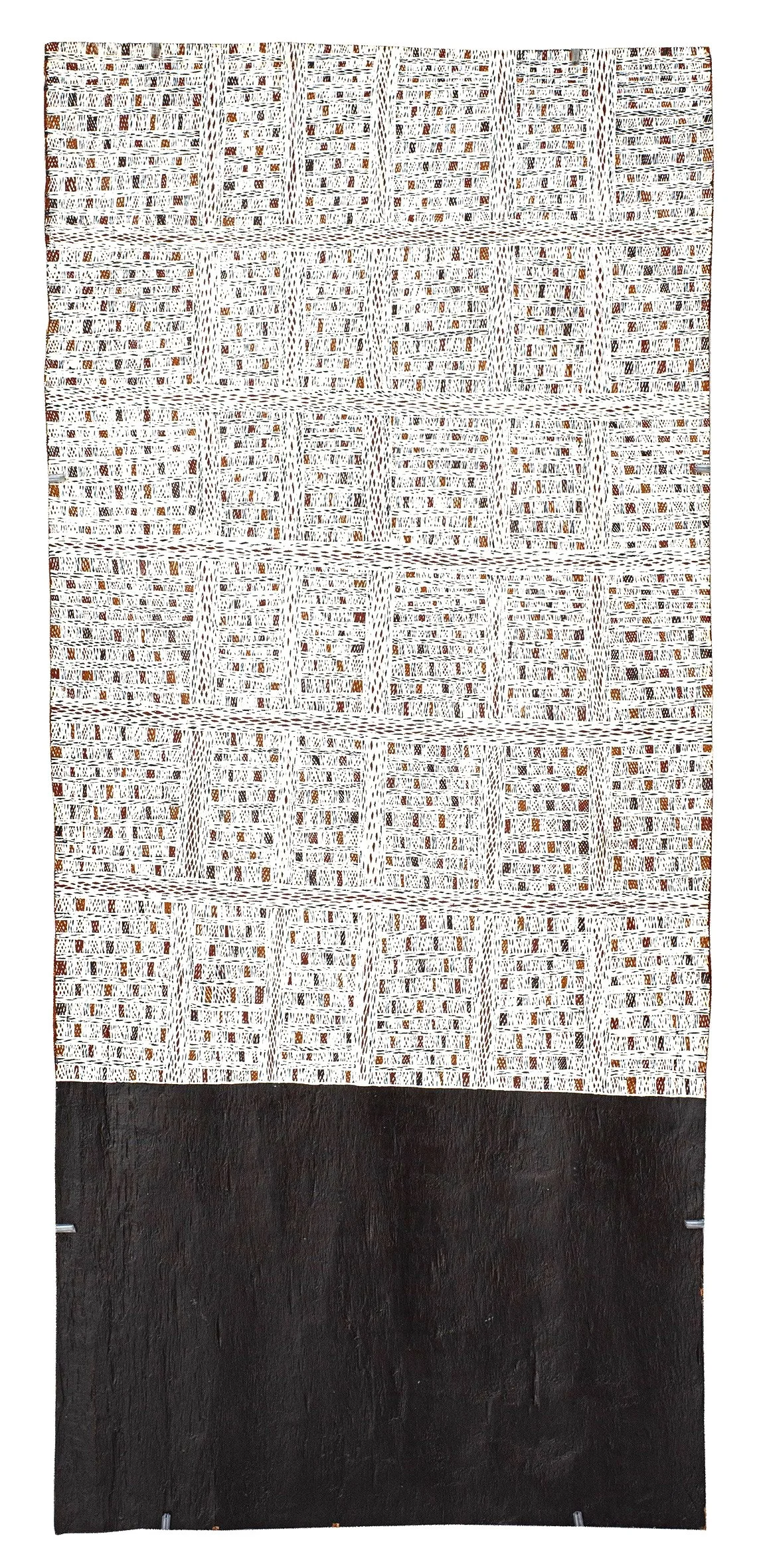
Artiste : Ḏirrpu Marawili (1994)
Titre de l'œuvre : Djapu
Pigments naturels sur écorce
Format : 104 x 46 cm
Provenance et certificat original : centre d'art aborigène de Yirrkala
Référence de la peinture : 5711-19
© Photo & text : Aboriginal signature with the courtesy of the artist, & Buku-Larrngay Mulka.
Explication de l’œuvre :
This bark painting depicts with this cross hatching grid pattern, the sacred design for the freshwaters of the Djapu clan at their homeland Wandawuy now an outstation about 150 kilometres south of Yirrkala and inland from Blue Mud Bay. This Djapu clan outstation (and spiritual residence for Ancestral Beings Mäna the Shark and Bol’ŋu the Thunderman) is surrounded by permanent freshwater. Rains inspired by the actions of Bol’ŋu feed the rivers and fill the billabongs. Catfish and mussels, freshwater crayfish and others feed the Yolŋu and wild life. The waters are home for the shark Mäna.
The grid refers to the landscape of Wandawuy - a network of billabongs surrounded by ridges and high banks. Its structure also having reference at one level to woven fish traps. Ancestral Hunters set a trap here to snare the Shark but to no avail. These Yolngu people are called Bärngbarng and Monu'a who came to cut the trees named Gu'uwu, Gathurrmakarr, Nyenyi, Rulwirrika and Gananyarra - all Dhuwa trees. They used straight young trees and cut them with their axes called Gayma`arri, Bitjutju.

Artiste : Buwathay Munyarryun (1962)
Titre de l'œuvre : Limin
Pigments naturels sur écorce
Format : 54 x 23 cm
Provenance et certificat original : centre d'art aborigène de Yirrkala
Référence de la peinture : 2245-21
© Photo & text : Aboriginal signature with the courtesy of the artist, & Buku-Larrngay Mulka.
Explication de l’œuvre :
The entire painting has been covered with the Wangurri clan design for an area of saltwater covering the country called Wulwala - close to what is know as Cape Wilberforce. Here the water is flat and clam creating a shimmer to the horizon. This condition of saltwater is called Gunbirrk, then to emphasis his knowledge as a senior man amongst the ranks of traditional lawmen he intoned the deeper names for the same area; Rakurrurru Madawuluwu Riŋgurram Mawalam Dhalatj Rakuna. The triangular shapes are the sunset striking the late Dry season Thunderheads on the horizon referencing the sails of the Macassan vistors departing to return again. Hidden under this water is the rock Dhukurrurra, its foundation cemented into the sea bed as is the totem giant clam Dhalimbu. At the base of this work are Wangurri totemic beings associated with the ocean floor and this foundation. They are depicted adorned with the sacred design of the sacred water that surrounds them as well as the triangular design for the clouds on the horizons that connect this place with others associated with the clans sharing aspects of Wangurri lore. The painting can also be seen as a cross section through this part of the ocean. In the songs Dhalimbu sits firm at the bottom with the turtle Malarrka having the job of a caretaker at this site as does Manda the octopus (featured iconography), then Madi the crayfish and Limin the squid. Shells of the cuttlefish floating on the surface of the water are on another level the Wangurri Yothu (child/unborn) held in the reservoir of Wangurri soul, held safely in the jaws of the sacred. In viewing the painting this way the state of the water changes from that of salt to fresh as the intimate knowledge the land owners have with their estates proclaim subterranean rivers of freshwater from the land, surface under sea at this place Wulwala. So from the bottom of the ocean to the surface of the sea and up to the stratosphere all is connected and part of the cycle through which the life force pulses through infinity. "This is very important to my people - you steal fish or camping in this area without permission. Its mine that area - I run the (sacred) business."
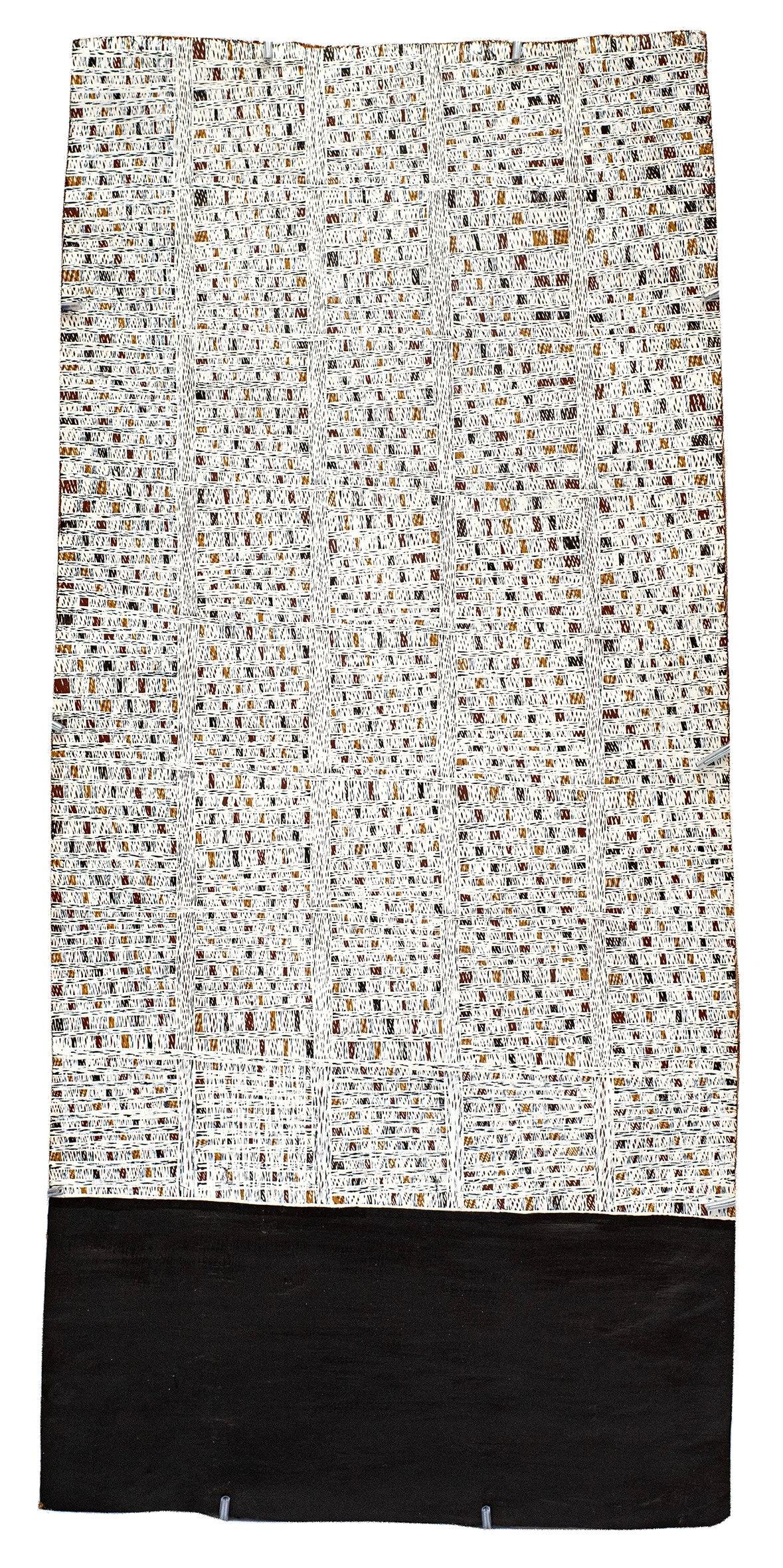
Artiste : Ḏirrpu Marawili (1994)
Titre de l'œuvre : Djapu
Pigments naturels sur écorce
Format : 93 x 44 cm
Provenance et certificat original : centre d'art aborigène de Yirrkala
Référence de la peinture : 2069-21
© Photo & text : Aboriginal signature with the courtesy of the artist, & Buku-Larrngay Mulka.
Explication de l’œuvre :
This bark painting depicts with this cross hatching grid pattern, the sacred design for the freshwaters of the Djapu clan at their homeland Wandawuy now an outstation about 150 kilometres south of Yirrkala and inland from Blue Mud Bay. This Djapu clan outstation (and spiritual residence for Ancestral Beings Mäna the Shark and Bol’ŋu the Thunderman) is surrounded by permanent freshwater. Rains inspired by the actions of Bol’ŋu feed the rivers and fill the billabongs. Catfish and mussels, freshwater crayfish and others feed the Yolŋu and wild life. The waters are home for the shark Mäna.
The grid refers to the landscape of Wandawuy - a network of billabongs surrounded by ridges and high banks. Its structure also having reference at one level to woven fish traps. Ancestral Hunters set a trap here to snare the Shark but to no avail. These Yolngu people are called Bärngbarng and Monu'a who came to cut the trees named Gu'uwu, Gathurrmakarr, Nyenyi, Rulwirrika and Gananyarra - all Dhuwa trees. They used straight young trees and cut them with their axes called Gayma`arri, Bitjutju.

Artiste : Ḏirrpu Marawili (1994)
Titre de l'œuvre : Djapu
Pigments naturels sur écorce
Format : 88 x 48 cm
Provenance et certificat original : centre d'art aborigène de Yirrkala
Référence de la peinture : 2344-21
© Photo & text : Aboriginal signature with the courtesy of the artist, & Buku-Larrngay Mulka.
Explication de l’œuvre :
This bark painting depicts with this cross hatching grid pattern, the sacred design for the freshwaters of the Djapu clan at their homeland Wandawuy now an outstation about 150 kilometres south of Yirrkala and inland from Blue Mud Bay. This Djapu clan outstation (and spiritual residence for Ancestral Beings Mäna the Shark and Bol’ŋu the Thunderman) is surrounded by permanent freshwater. Rains inspired by the actions of Bol’ŋu feed the rivers and fill the billabongs. Catfish and mussels, freshwater crayfish and others feed the Yolŋu and wild life. The waters are home for the shark Mäna.
The grid refers to the landscape of Wandawuy - a network of billabongs surrounded by ridges and high banks. Its structure also having reference at one level to woven fish traps. Ancestral Hunters set a trap here to snare the Shark but to no avail. These Yolngu people are called Bärngbarng and Monu'a who came to cut the trees named Gu'uwu, Gathurrmakarr, Nyenyi, Rulwirrika and Gananyarra - all Dhuwa trees. They used straight young trees and cut them with their axes called Gayma`arri, Bitjutju.

Artiste : Noŋgirrŋa Marawili
Titre de l'œuvre : Gurtha
Pigments naturels sur écorce
Format : 189 x 86 cm
Provenance et certificat original : centre d'art aborigène de Yirrkala
Référence de la peinture : 3540-18
© Photo : Aboriginal signature with the courtesy of the artist & Buku-Larrngay Mulka.
Explication de l’œuvre :
This Bark painting by Noŋgirrŋa Marawili (1938), depicts Their special spot on the mainland was Baratjula. A place to which she only returned after the creation of these paintings. Ṉoŋgirrŋa started life as one of the numerous children of Mundukul the Madarrpa warrior (c.1890-c.1950). He was a famed leader/warrior with uncountable wives of the Marrakulu, Dhudi Djapu and Galpu clans.
Baratjula is a Madarrpa clan estate adjacent to Cape Shield where the artist camped with her father and his many wives as a young girl. It is of the essence of Madarrpa but does not hold the high order sites that Yathikpa does. She lived nomadically as
part of a clan group with a flotilla of canoes between Groote Eyelandt and the mainland. This journey from the sacred to the descriptive shifts in these works. She has reduced the Law to its elements unclothed in sacred design. Her identity cannot be separated from her art and so although she disavows any sacred intent the echo of miny’tji persists.
Collections : Art Gallery of New South Wales, Sydney NSW. Berndt Museum, University of Western Australia, Perth WA. Chartwell Collection, Auckland Art Gallery, Auckland, New Zealand. Kluge-Ruhe Aboriginal Art Collection of the University of Virginia. USA Museum and Art Gallery of the Northern Territory, Darwin NT. Museum of Contemporary Art, Sydney NSW. National Gallery of Australia, Canberra ACT. National Gallery of Victoria, Melbourne VIC. The Metropolitan Museum of Art
Découvrez les sculptures disponibles à Bruxelles durant l’exposition :
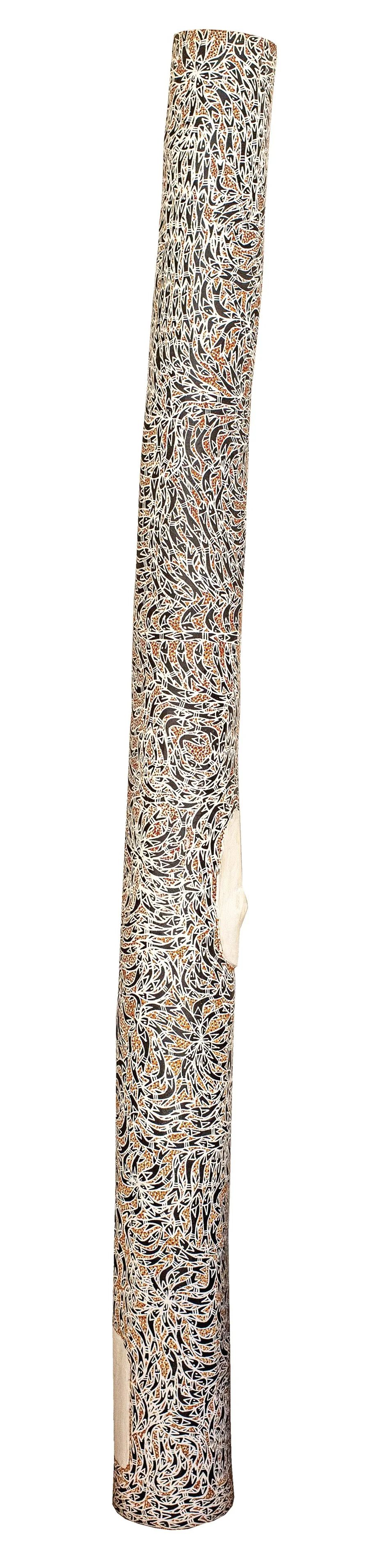
Artiste : Wukun Wanambi
Titre de la sculpture : Bamarruŋu
Format : 210 x 17cm
Pigments naturels sur tronc d'eucalyptus
Provenance et certificat : centre d'art aborigène de Yirrkala
Référence de l'œuvre: 3059Y
Explications pour cette œuvre :
Trial Bay is located between Caledon bay to the north and above the larger Blue Mud Bay on the western side of the Gulf of Carpentaria. Deep inside Trial Bay the Marrakulu clan claim ownership to land and sea though the actions and events of Ancestor Beings as they travelled into this country imbuing both land and sea. The mark of ownership is sung, danced and painted in Marrakulu ritual through the stringybark woodlands and stony country, through the freshwaters running into the Gurka’wuy River into trial Bay. Mixing with the saltwaters through sacred mangroves and froth and bubble and out deeper into the Bay with the outgoing tide, past boulders and rocky islets the power and knowledge associated with Marrakulu Rom (law) washes back to shore. This country is associated with the Wawalak Sisters, sacred goannas, Wuyal the Sugerbag Man and the original inhabitants of Gurka’wuy since these times, the Djuwany people. The Djuwany were the first people of this country who practised the ritual according to the Creators on the beaches, who hunted the stony country and waters of both the River and Trial Bay…
© Photo & text : Aboriginal signature with the courtesy of the artist, & Buku-Larrngay Mulka.

Artiste : Yimula Munuŋgurr
Titre de la sculpture : Djapu
Format : 196 x 24cm
Pigments naturels sur tronc d'eucalyptus
Provenance et certificat : centre d'art aborigène de Yirrkala
Référence de l'œuvre: 3072-16
Explications pour cette œuvre :
The cross hatching grid pattern is the sacred design for the freshwaters of the Djapu clan at their homeland Wandawuy now an outstation about 150 kilometres south of Yirrkala and inland from Blue Mud Bay. This Djapu clan outstation (and spiritual residence for Ancestral Beings Mäna the Shark and Bol’ŋu the Thunderman) is surrounded by permanent freshwater. Rains inspired by the actions of Bol’ŋu feed the rivers and fill the billabongs. Catfish and mussels, freshwater crayfish and others feed,the Yolŋu and wild life. The waters are home for the shark Mäna. The grid refers to the landscape of Wandawuy- a network of,billabongs surrounded by ridges and high banks. Its structure also having reference at one level to woven fish traps. Ancestral Hunters set a trap here to snare the Shark but to no avail.
The black lines having reference to the trap, the coloured verticals referring to differing states of the freshwater - the source of Djapu soul. At ceremony appropriate participants for mortuary rites enter,the shelter (woven together like the unsuccessful trap) where the deceased has been lying in state. Sacred spears tipped with stingray barbs, ,manifestations of Mäna’s teeth, stand up alongside the shelter. The sacred song cycles of Mäna in the water at Wandawuy are intoned with music from the Yidaki (didjeridu) and Bilma(clapsticks). At the prescribed time at the conclusion of ceremony the dancers crash through the deceased’s shelter imitating the actions of Mäna at the trap. This action has,reference to the release of the deceased’s soul, back to the sacred waters of Wandawuy to be reunited with its ancestors awaiting rebirth. Recent surveys by Anglo scientists in Top End rivers in Kakadu have revealed the existence of a species of shark whose life cycle takes place entirely in the freshwater.
© Photo & text : Aboriginal signature with the courtesy of the artist, & Buku-Larrngay Mulka.

Artiste : Yimula Munuŋgurr
Titre de la sculpture : Djapu
Format : 243 x 17 cm
Pigments naturels sur tronc d'eucalyptus
Provenance et certificat : centre d'art aborigène de Yirrkala
Référence de l'œuvre: 4411-19
Explications pour cette œuvre :
The cross hatching grid pattern is the sacred design for the freshwaters of the Djapu clan at their homeland Wandawuy now an outstation about 150 kilometres south of Yirrkala and inland from Blue Mud Bay. This Djapu clan outstation (and spiritual residence for Ancestral Beings Mäna the Shark and Bol’ŋu the Thunderman) is surrounded by permanent freshwater. Rains inspired by the actions of Bol’ŋu feed the rivers and fill the billabongs. Catfish and mussels, freshwater crayfish and others feed,the Yolŋu and wild life. The waters are home for the shark Mäna. The grid refers to the landscape of Wandawuy- a network of,billabongs surrounded by ridges and high banks. Its structure also having reference at one level to woven fish traps. Ancestral Hunters set a trap here to snare the Shark but to no avail.
The black lines having reference to the trap, the coloured verticals referring to differing states of the freshwater - the source of Djapu soul. At ceremony appropriate participants for mortuary rites enter,the shelter (woven together like the unsuccessful trap) where the deceased has been lying in state. Sacred spears tipped with stingray barbs, ,manifestations of Mäna’s teeth, stand up alongside the shelter. The sacred song cycles of Mäna in the water at Wandawuy are intoned with music from the Yidaki (didjeridu) and Bilma(clapsticks). At the prescribed time at the conclusion of ceremony the dancers crash through the deceased’s shelter imitating the actions of Mäna at the trap. This action has,reference to the release of the deceased’s soul, back to the sacred waters of Wandawuy to be reunited with its ancestors awaiting rebirth. Recent surveys by Anglo scientists in Top End rivers in Kakadu have revealed the existence of a species of shark whose life cycle takes place entirely in the freshwater.
© Photo & text : Aboriginal signature with the courtesy of the artist, & Buku-Larrngay Mulka.

Artiste : Yimula Munuŋgurr
Titre de la sculpture : Djapu
Format : 168 x 20 cm
Pigments naturels sur tronc d'eucalyptus
Provenance et certificat : centre d'art aborigène de Yirrkala
Référence de l'œuvre: 2086-21
Explications pour cette œuvre :
The cross hatching grid pattern is the sacred design for the freshwaters of the Djapu clan at their homeland Wandawuy now an outstation about 150 kilometres south of Yirrkala and inland from Blue Mud Bay. This Djapu clan outstation (and spiritual residence for Ancestral Beings Mäna the Shark and Bol’ŋu the Thunderman) is surrounded by permanent freshwater. Rains inspired by the actions of Bol’ŋu feed the rivers and fill the billabongs. Catfish and mussels, freshwater crayfish and others feed,the Yolŋu and wild life. The waters are home for the shark Mäna. The grid refers to the landscape of Wandawuy- a network of,billabongs surrounded by ridges and high banks. Its structure also having reference at one level to woven fish traps. Ancestral Hunters set a trap here to snare the Shark but to no avail.
The black lines having reference to the trap, the coloured verticals referring to differing states of the freshwater - the source of Djapu soul. At ceremony appropriate participants for mortuary rites enter,the shelter (woven together like the unsuccessful trap) where the deceased has been lying in state. Sacred spears tipped with stingray barbs, ,manifestations of Mäna’s teeth, stand up alongside the shelter. The sacred song cycles of Mäna in the water at Wandawuy are intoned with music from the Yidaki (didjeridu) and Bilma(clapsticks). At the prescribed time at the conclusion of ceremony the dancers crash through the deceased’s shelter imitating the actions of Mäna at the trap. This action has,reference to the release of the deceased’s soul, back to the sacred waters of Wandawuy to be reunited with its ancestors awaiting rebirth. Recent surveys by Anglo scientists in Top End rivers in Kakadu have revealed the existence of a species of shark whose life cycle takes place entirely in the freshwater.
© Photo & text : Aboriginal signature with the courtesy of the artist, & Buku-Larrngay Mulka.

Artiste : Yimula Munuŋgurr
Titre de la sculpture : Djapu
Format : 208 x 18 cm
Pigments naturels sur tronc d'eucalyptus
Provenance et certificat : centre d'art aborigène de Yirrkala
Référence de l'œuvre: 2251-21
Explications pour cette œuvre :
The cross hatching grid pattern is the sacred design for the freshwaters of the Djapu clan at their homeland Wandawuy now an outstation about 150 kilometres south of Yirrkala and inland from Blue Mud Bay. This Djapu clan outstation (and spiritual residence for Ancestral Beings Mäna the Shark and Bol’ŋu the Thunderman) is surrounded by permanent freshwater. Rains inspired by the actions of Bol’ŋu feed the rivers and fill the billabongs. Catfish and mussels, freshwater crayfish and others feed,the Yolŋu and wild life. The waters are home for the shark Mäna. The grid refers to the landscape of Wandawuy- a network of,billabongs surrounded by ridges and high banks. Its structure also having reference at one level to woven fish traps. Ancestral Hunters set a trap here to snare the Shark but to no avail.
The black lines having reference to the trap, the coloured verticals referring to differing states of the freshwater - the source of Djapu soul. At ceremony appropriate participants for mortuary rites enter,the shelter (woven together like the unsuccessful trap) where the deceased has been lying in state. Sacred spears tipped with stingray barbs, ,manifestations of Mäna’s teeth, stand up alongside the shelter. The sacred song cycles of Mäna in the water at Wandawuy are intoned with music from the Yidaki (didjeridu) and Bilma(clapsticks). At the prescribed time at the conclusion of ceremony the dancers crash through the deceased’s shelter imitating the actions of Mäna at the trap. This action has,reference to the release of the deceased’s soul, back to the sacred waters of Wandawuy to be reunited with its ancestors awaiting rebirth. Recent surveys by Anglo scientists in Top End rivers in Kakadu have revealed the existence of a species of shark whose life cycle takes place entirely in the freshwater.
© Photo & text : Aboriginal signature with the courtesy of the artist, & Buku-Larrngay Mulka.

Artiste : Buwathay Munyarryun
Titre de la sculpture : Waŋgurri
Format : 224 x 18 cm
Pigments naturels sur tronc d'eucalyptus
Provenance et certificat : centre d'art aborigène de Yirrkala
Référence de l'œuvre: 43-19
Explications pour cette œuvre :
The clan groups of the north east Arnhem Land region are structured around a complex system of kinship law. As with Yolŋu personal relationships, ie with mother, with father, uncle, grandfather or wife or child, a particular Yolŋu clan will have these same relationships with other clans. This creates a network that links the ancestral events of creation which is said to have its foundations laid down by the Waŋarr (creator beings) of this time.
This work belongs to the Wangurri clan. This is recognised by the fact that miny’tji (sacred clan design- the detailed cross hatching ‘behind’ the figurative imagery) belonging to the Wangurri covers the piece. This piece shows disguised representations of a mangrove log washed in from saltwater Maŋgalili country into the Wangurri clan freshwater area of Gularri, the Cato River.
It contained Milka or mangrove worms which died once it washed into the fresh water. This pattern was etched in the log and is here repeated as the Wangurri sacred clan design which appears throughout. The songs of the Wangurri invest this log with sacred power allowing it to make paths that other beings and landscape features could follow.
© Photo & text : Aboriginal signature with the courtesy of the artist, & Buku-Larrngay Mulka.

Artiste : Buwathay Munyarryun (1962)
Titre de la sculpture : Waŋgurri
Format : 250 x 16 cm
Pigments naturels sur tronc d'eucalyptus
Provenance et certificat : centre d'art aborigène de Yirrkala
Référence de l'œuvre: 361-19
Explications pour cette œuvre :
The clan groups of the north east Arnhem Land region are structured around a complex system of kinship law. As with Yolŋu personal relationships, ie with mother, with father, uncle, grandfather or wife or child, a particular Yolŋu clan will have these same relationships with other clans. This creates a network that links the ancestral events of creation which is said to have its foundations laid down by the Waŋarr (creator beings) of this time.
This work belongs to the Wangurri clan. This is recognised by the fact that miny’tji (sacred clan design- the detailed cross hatching ‘behind’ the figurative imagery) belonging to the Wangurri covers the piece. This piece shows disguised representations of a mangrove log washed in from saltwater Maŋgalili country into the Wangurri clan freshwater area of Gularri, the Cato River.
It contained Milka or mangrove worms which died once it washed into the fresh water. This pattern was etched in the log and is here repeated as the Wangurri sacred clan design which appears throughout. The songs of the Wangurri invest this log with sacred power allowing it to make paths that other beings and landscape features could follow.
© Photo & text : Aboriginal signature with the courtesy of the artist, & Buku-Larrngay Mulka.

Artiste : Gunybi Ganambarr (1973)
Titre de la sculpture : Buyku
Format : 223 x 13cm
Pigments naturels sur tronc d'eucalyptus
Provenance et certificat : centre d'art aborigène de Yirrkala
Référence de l'œuvre: 2856-19
Explications pour cette œuvre :
This piece is painted in the miny’tji (sacred clan design) of the Dhalwaŋu clan which is one of the eight or so clans belonging to the Yirritja moiety (half) in North East Arnhem land. The sacred diamond design for the Dhalwaŋu clan reflects the patterning of the water streaming from the body of Ancestral Creator Being Barama as he emerged from these waters at Gäṉgaṉ, with weed hanging from his arms.
Today appropriately senior ritual participants wear sacred feathered strings from armbands, their chest painted with the Dhalwŋu design of freshwater. These totemic ancestors of the Dhalwaŋu clan are all associated with this site at Gäṉgaṉ from which all Yirritja creation began. They are seen as embodiments of the disciples or companions of Barama and himself. Black and white dots also representing the wake of the swimming tortoise…
One of the metaphorical overviews of this work is the union between the different subgroups of the Dhaḻwaŋu clan in the ancestral cycle of regular fishtrap ceremonies they join together in celebrating. These gatherings are ceremonial but also social and educational…
This work is reminiscent in structure to the piece that was acquired by the Metropolitan Museum of art New York which also transformed the rectilinear design of the fishtrap into circular composition.
© Photo & text : Aboriginal signature with the courtesy of the artist, & Buku-Larrngay Mulka.

Artiste : Ŋoŋu Ganambarr (1967)
Titre de la sculpture : Ŋoŋu
Format : 220 x 14 cm
Pigments naturels sur tronc d'eucalyptus
Provenance et certificat : centre d'art aborigène de Yirrkala
Référence de l'œuvre: 761-19
Explications pour cette œuvre :
This work identifies the reservoirs of the Ŋaymil/Datiwuy clan. Ŋalkan is an area on Ŋaymil land and sea between the Gurrumuru and Cato Rivers that run into the Arnhem Bay. Within this area is another watercourse that leads up into a sacred area of a freshwater spring or Milŋurr with special qualities called Darrawuy. Here Djanda the sacred goanna swim in the lagoon created by the spring, their actions as they swim causing patterns to be made on the surface that is covered by the totemic water weed Darra. The sacred clan design is a manifestation of these patterns created at Darrawuy lagoon.
Others inhabit these waters. Warrukay or Murrukula the Barracuda, the power totem for the Ŋaymil. It spends most of its time in the salt waters. At certain times Warrukay will make its way up to Darrawuy bringing the ‘contamination’ of saltwater (the mother) with it. The mixing of this saltwater with the fresh has connotations of fertility. Darrawuy is a place of fertility. Souls of Ŋaymil are both delivered to and from this point between worlds real and spiritual. As the sacred songs used in mortuary are cyclic, narrating the Ancestral Events of the original Creator Beings, so is the journey of the Yolŋu soul.
The finials represent the brolgas which are a manifestation of the power of the Djaŋ'kawu Sisters who give birth to all Dhuwa nations including the Daṯiwuy. Their special creative powers bring life often in the form of sacred fonts of fresh water such as this.
© Photo & text : Aboriginal signature with the courtesy of the artist, & Buku-Larrngay Mulka.

Artiste : Dhuwarrwarr Marika (1945)
Titre de la sculpture : Ŋoŋu
Format : 263 x 27 cm
Pigments naturels sur tronc d'eucalyptus
Provenance et certificat : centre d'art aborigène de Yirrkala
Référence de l'œuvre: 6484-19
Explications pour cette œuvre :
This miny’tji represents Rulyapa, the rough saltwater country between Nhulunbuy and the large island of Dhambaliya (Bremer Island), ballooning up from the secret depths, around the sacred rock Manhala, which can be a manifestation of Daymirri.
Daymirri is the whale (or perhaps sea monster) that according to Rirratjiŋu and Djambarrpuyŋu clan manikay (sacred song) pertains to the saltwater country close to Yirrkala.
The dome-shaped rock Manhala exposes itself at the low tide, above the raŋ (tide marks), bleached white, a patina of brine and weather. Manhala is one of many names given to the rock. Djambarrpuyŋu and Rirratjiŋu clans have many ‘deep’ names that are intoned by the ritual specialists at the culmination of appropriate ceremony. The sea surrounding the rock, its tidal movements, differing states and the effect it had on Yolŋu visiting this site in Ancestral times is all recorded in the sacred song. As are all the totemic species of marine life that has these ancestral connections to the Rirratjiŋu and Djambarrpuyŋu.
Often painted in this design is Daymirri the whale, Balpa the rock cod, Djumbarr the red emperor, Ḏarrpa the king brown snake and Mutjalanydjal, the dolphin. All of these things and all of their meanings are implied simply by the presence of the miny’tji for the water. It’s not just Manhala and the power associated with deep seated knowledge that makes this area both sacred and dangerous to those entering with out authority. There are three other rocks in the area of same qualities but these ones; Wakwakbuy, Mulŋuwuy and Dharrpawuy, are submerged…
A further role for this cultural form is as a fine art object and an instructional tool for younger generations. Artworks of this nature have multiple layers of metaphor and meaning which give lessons about the connections between an individual and specific pieces of country (both land and sea), as well as the connections between various clans but also explaining the forces that act upon and within the environment and the mechanics of a spirit’s path through existence. The knowledge referred to by this imagery deepens in complexity and secrecy as a person progresses through a life long learning process.
© Photo & text : Aboriginal signature with the courtesy of the artist, & Buku-Larrngay Mulka.

Artiste : Dhuwarrwarr Marika (1945)
Titre de l'œuvre : Makassan Swords and Long Knives
Pigments naturels sur tronc
Format : 220 x 15 cm
Provenance et certificat original : centre d'art aborigène de Yirrkala
Référence de la peinture : 2435-20
© Photo & text : Aboriginal signature with the courtesy of the artist, & Buku-Larrngay Mulka.
Explication de l’œuvre :
“When the Makassan came, they tried to find the Aboriginal people at Melville Bay. The Yolngu wives and kids were asleep.
The men woke up and saw the boat. They thought it was the enemy and some Makassan jumped from their boat and swam to the shore to meet the Aboriginal people. They wanted to work with them. They explained to them about trepang and where they could find some trepang. They went and collected to show them. The Makassan showed them what to do, cooked them and dried them out, explained to them it’s good food and they paid the aboriginal people with swords, axes, material and tobacco. They invited the Makassan people to the camp and explained to them who they were and why they came because in their heart they were Yolgnu people. And the Makassan taught the Yolngu their song and traditions and the Yolngu taught the Makassan their culture and law and tradition.
This is the story and the painting from Dhuwarrwarr Marika, taught to me by my father when the Makassan came to Australia and learned about the Aboriginal people.”
Since the turn of the century the annual visitations of the Makassanese to the Top End shores of Australia were put to a stop by the South Australian Government. These sailors, gatherers of trepang from coastal waters, had for up to six centuries caught the seasonal winds back and forth from what is now known as Sulawesi.
Dhuwarrwarr’s father Mawalan Marika painted about these people in the 1940s and spoke some Makassan language. He always emphasised to her the importance of the relationship between Yolŋu and these allies. He was the leader of the Yirrkala people at the time of the coming of Europeans but never lost his fondness and respect for Makassans.

Artiste : Gunybi Ganambarr (1973)
Titre de la sculpture : Buyku
Format : 211 x 16cm
Pigments naturels sur tronc d'eucalyptus
Provenance et certificat : centre d'art aborigène de Yirrkala
Référence de l'œuvre: 3773-20
Explications pour cette œuvre :
This work identifies the reservoirs of the Ŋaymil/Datiwuy clan. Ŋalkan is an area on Ŋaymil land and sea between the Gurrumuru and Cato Rivers that run into the Arnhem Bay. Within this area is another watercourse that leads up into a sacred area of a freshwater spring or Milngurr with special qualities called Balawurru. Dhangultji or Brolga are dancing here. Here Djanda the sacred goanna also swim in the lagoon created by the spring, their actions as they swim causing patterns to be made on the surface that is covered by the totemic water weed Darra.
Dhangultji or Guḏurrku (Brolga) inhabit such floodplains in huge numbers during the late Dry. They drink from subterranean springs which emerge in the vast flat plains. A safe place to rest, mate and nest. In their avian form they are a manifestation of the Djaŋ’kawu Sisters’ party which travel throughout the Eastern top end, shape shifting and giving birth to the various clans of the Dhuwa moiety. In this case the Ŋaymil.
Others inhabit these waters. Warrukay or Murrukula the Barracuda, the power totem for the Ŋaymil. It spends most of its time in the salt waters. At certain times Warrukay will make its way up to Balawurru bringing the ‘contamination’ of muddied water with it. This has connotations of fertility. It is a place of fertility. Souls of Ŋaymil are both delivered to and from this point between worlds real and spiritual. As the sacred songs used in mortuary are cyclic, narrating the Ancestral Events of the original Creator Beings, so is the journey of the Yolŋu soul. This place is also shared with Dhudi Djapu clan.
© Photo & text : Aboriginal signature with the courtesy of the artist, & Buku-Larrngay Mulka.

Artiste : Bulthirrirri Wunuŋmurra (1981)
Titre de la sculpture : Mokuy
Format : 223 x 13 cm
Sculptures et pigments naturels sur tronc d'eucalyptus
Provenance et certificat : centre d'art aborigène de Yirrkala
Référence de l'œuvre: 5797-21
Explications pour cette œuvre :
The artist says about this work; “The mokuy or nanuk (spirits) come in together, Dhuwa and Yirritja to the sacred ground called Balambala, past Gangan, the other side for all the mokuy to get together. The spirits go there and that’s where they make the yidaki sound. It’s like showing Yukuwa (sacred yam emblem) and Morning Star feathers – they are different. Like same goes with yidaki, different sounds for Yirritja and Dhuwa. The Yirritja and Dhuwa play yidaki to call in the Mokuy to the same ground Balambala. The Yirritja mokuy come in on the birds, djilawurr (scub fowl) and bugutj-bugutj (banded fruit dove). The Dhuwa mokuy they come in from rangi side (saltwater).” He responds to the question whether this work is traditional in the affirmative. This indicates that there are sacred objects of the same appearance within the closed world of Yolngu cabinet (Ŋärra’)…
In 2016 Nawurapu took a monochromatic version of these triangular cloud designs (which are shared by all Yirritja clans and relate to the water cycle of souls going from ocean to vapour to cloud to freshwater rain rebirth) and used them to decorate his mokuy (spirit sculpture). He then also used them on larrakitj (memorial poles for the first time). In other contexts they speak of massive cumulo-nimbus thunderheads decorated with the blacks of storm, the yellow of the suns rays and the red of the sunset.
© Photo & text : Aboriginal signature with the courtesy of the artist, & Buku-Larrngay Mulka.

Artiste : Bulthirrirri Wunuŋmurra (1981)
Titre de la sculpture : Mokuy
Format : 260 x 15 cm
Sculptures et pigments naturels sur tronc d'eucalyptus
Provenance et certificat : centre d'art aborigène de Yirrkala
Référence de l'œuvre: 5799-21
Explications pour cette œuvre :
The artist says about this work; “The mokuy or nanuk (spirits) come in together, Dhuwa and Yirritja to the sacred ground called Balambala, past Gangan, the other side for all the mokuy to get together. The spirits go there and that’s where they make the yidaki sound. It’s like showing Yukuwa (sacred yam emblem) and Morning Star feathers – they are different. Like same goes with yidaki, different sounds for Yirritja and Dhuwa. The Yirritja and Dhuwa play yidaki to call in the Mokuy to the same ground Balambala. The Yirritja mokuy come in on the birds, djilawurr (scub fowl) and bugutj-bugutj (banded fruit dove). The Dhuwa mokuy they come in from rangi side (saltwater).” He responds to the question whether this work is traditional in the affirmative. This indicates that there are sacred objects of the same appearance within the closed world of Yolngu cabinet (Ŋärra’)…
In 2016 Nawurapu took a monochromatic version of these triangular cloud designs (which are shared by all Yirritja clans and relate to the water cycle of souls going from ocean to vapour to cloud to freshwater rain rebirth) and used them to decorate his mokuy (spirit sculpture). He then also used them on larrakitj (memorial poles for the first time). In other contexts they speak of massive cumulo-nimbus thunderheads decorated with the blacks of storm, the yellow of the suns rays and the red of the sunset.
© Photo & text : Aboriginal signature with the courtesy of the artist, & Buku-Larrngay Mulka.

Artiste : Bulthirrirri Wunuŋmurra (1981)
Titre de la sculpture : Mokuy
Format : 243 x 15 cm
Sculptures et pigments naturels sur tronc d'eucalyptus
Provenance et certificat : centre d'art aborigène de Yirrkala
Référence de l'œuvre: 5411-21
Explications pour cette œuvre :
The artist says about this work; “The mokuy or nanuk (spirits) come in together, Dhuwa and Yirritja to the sacred ground called Balambala, past Gangan, the other side for all the mokuy to get together. The spirits go there and that’s where they make the yidaki sound. It’s like showing Yukuwa (sacred yam emblem) and Morning Star feathers – they are different. Like same goes with yidaki, different sounds for Yirritja and Dhuwa. The Yirritja and Dhuwa play yidaki to call in the Mokuy to the same ground Balambala. The Yirritja mokuy come in on the birds, djilawurr (scub fowl) and bugutj-bugutj (banded fruit dove). The Dhuwa mokuy they come in from rangi side (saltwater).” He responds to the question whether this work is traditional in the affirmative. This indicates that there are sacred objects of the same appearance within the closed world of Yolngu cabinet (Ŋärra’)…
In 2016 Nawurapu took a monochromatic version of these triangular cloud designs (which are shared by all Yirritja clans and relate to the water cycle of souls going from ocean to vapour to cloud to freshwater rain rebirth) and used them to decorate his mokuy (spirit sculpture). He then also used them on larrakitj (memorial poles for the first time). In other contexts they speak of massive cumulo-nimbus thunderheads decorated with the blacks of storm, the yellow of the suns rays and the red of the sunset.
© Photo & text : Aboriginal signature with the courtesy of the artist, & Buku-Larrngay Mulka.

Artiste : Yimula Munuŋgurr
Titre de la sculpture : Djapu
Format : 184 x 18 cm
Pigments naturels sur tronc d'eucalyptus
Provenance et certificat : centre d'art aborigène de Yirrkala
Référence de l'œuvre: 4591-19
Explications pour cette œuvre :
The cross hatching grid pattern is the sacred design for the freshwaters of the Djapu clan at their homeland Wandawuy now an outstation about 150 kilometres south of Yirrkala and inland from Blue Mud Bay. This Djapu clan outstation (and spiritual residence for Ancestral Beings Mäna the Shark and Bol’ŋu the Thunderman) is surrounded by permanent freshwater. Rains inspired by the actions of Bol’ŋu feed the rivers and fill the billabongs. Catfish and mussels, freshwater crayfish and others feed,the Yolŋu and wild life. The waters are home for the shark Mäna. The grid refers to the landscape of Wandawuy- a network of,billabongs surrounded by ridges and high banks. Its structure also having reference at one level to woven fish traps. Ancestral Hunters set a trap here to snare the Shark but to no avail.
The black lines having reference to the trap, the coloured verticals referring to differing states of the freshwater - the source of Djapu soul. At ceremony appropriate participants for mortuary rites enter,the shelter (woven together like the unsuccessful trap) where the deceased has been lying in state. Sacred spears tipped with stingray barbs, ,manifestations of Mäna’s teeth, stand up alongside the shelter. The sacred song cycles of Mäna in the water at Wandawuy are intoned with music from the Yidaki (didjeridu) and Bilma(clapsticks). At the prescribed time at the conclusion of ceremony the dancers crash through the deceased’s shelter imitating the actions of Mäna at the trap. This action has,reference to the release of the deceased’s soul, back to the sacred waters of Wandawuy to be reunited with its ancestors awaiting rebirth. Recent surveys by Anglo scientists in Top End rivers in Kakadu have revealed the existence of a species of shark whose life cycle takes place entirely in the freshwater.
© Photo & text : Aboriginal signature with the courtesy of the artist, & Buku-Larrngay Mulka.
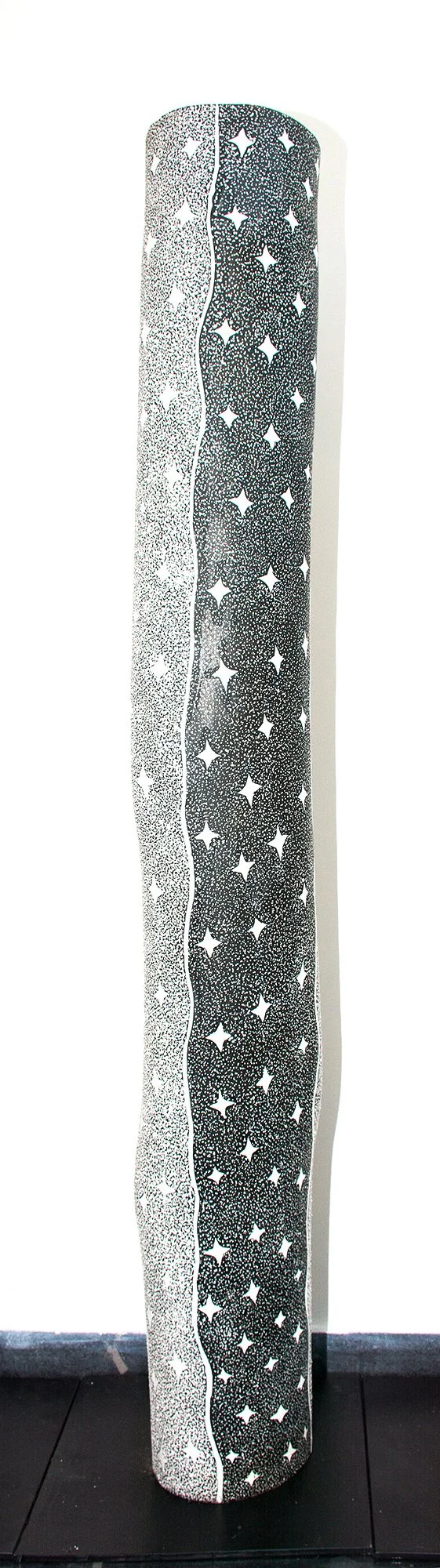
Artiste : Naminapy Maymuru-white
Titre de la sculpture : Guwak men travel in the sky
Format : 158 cm
Pigments naturels sur tronc d'eucalyptus
Provenance et certificat : centre d'art aborigène de Yirrkala
Référence de l'œuvre: 4648X
© Photo : Aboriginal signature with the courtesy of the artist & Buku-Larrngay Mulka.

Sculptures présentées dans le cadre de l’exposition The Dawn en partenariat avec Buku Art. © Aboriginal Signature Estrangin Gallery with the courtesy of the artists and Buku art.
Artiste : Noŋgirrŋa Marawili (1938)
Titre de l'œuvre : Mundukul / Burrut'tji - Lightning snake
Format : 170 x 64 cm
Provenance et certificat : Yirrkala
Référence de cette peinture : 4555X
Explications sur cette peinture Aborigène :
Noŋgirrŋa started life as one of the numerous children of Mundukul the Madarrpa warrior (c.1890-c.1950). He was a famed leader/warrior with uncountable wives of the Marrakulu, Dhudi Djapu and Galpu clans. She was a child of one of the four Galpu wives, Bulungguwuy. Life was a bountiful but disciplined subsistence amongst a working family group of closely related mothers, brothers and sisters. This was over fifty people! She was born on the beach at Darrpirra north of Cape Shield on the oceanside. But they were Wakir’ – camping- moving around. They went to Yilpara. They went to Djarrakpi. But their special place was Guwaŋarripa (Woodah Island). They were a fleet of canoes travelling all the way to Groote Island and back and forth from the mainland. They lived in this rich place. Their special spot on the mainland was Baratjula. A place to which she only returned after the creation of these paintings…
Baraltja is the residence of Burrut’tji (also known as Mundukul) the lightning serpent. It is an area of flood plains that drain into northern Blue Mud Bay. It is on country belonging to the Madarrpa and denotes an area of special qualities pertaining to fertility and the mixing of waters.
From Madarrpa (and Dhalwaŋu clan) land freshwater spreads onto the Baraltja flood plains with the onset of the Wet. A tidal creek into the Bay flows with the freshwater flushing the brackish mix into the sea over an ever shifting sandbar (the snake manifest). The deep hole that he lives in is Lorr.
Freshwater enters the tidal mud flats at Baraltja that is residence of the Lightning Snake for the Madarrpa. The lightning Snake facing upstream, upon tasting the freshwater coming down stands on his tail and by way of spiting lightning into the sky communicates with the Ṉuŋurrdulpuyŋu and his contemporaries from other associated clans.
The same can be said for the other who faces towards the south towards another Madarrpa area called Guminiyawiny, Numbulwar way, producing storm fronts and boomerang shaped jet streams with its message. These events are sung with the aid of Napunda the boomerang shaped click sticks that are represented by the same shapes of the jet-steams that feather the storms front. Songs associated with Baraltja are normally intoned at the completion of men's ceremony for the Madarrpa and associate clans.
So as a harpoon travels or does lightning the estates are connected spiritually in a multidirectional way - both to and from, a cyclic phenomenon which is chronicled in the sacred songs that narrate these Ancestral actions over land, through the sea and ether.
Her artworks are in the following prestigious collections :
Art Gallery of New South Wales, Sydney NSW
Art Gallery of South Australia, Adelaide SA
Berndt Museum, University of Western Australia, Perth WA
Charles Darwin University Art Collection
Chartwell Collection, Auckland Art Gallery, Auckland, New Zealand
Debra and Dennis Scholl Collection
Kluge-Ruhe Aboriginal Art Collection of the University of Virginia. USA
Museum and Art Gallery of the Northern Territory, Darwin NT
Museum Kunstwerk, Germany
Museum of Contemporary Art, Sydney NSW
National Gallery of Australia, Canberra ACT
National Gallery of Victoria, Melbourne VIC
National Maritime Museum, Saltwater Collection. Darling Harbour, Sydney NSW
Sammlung Klein, Eberdingen-Nussdorf, Germany
Tandanya National Aboriginal Institute, Adelaide SA
TATE Modern, London UK
The Metropolitan Museum of Art, New York, USA
Demander le prix de l'œuvre / Enquiry
© Photo & text : Aboriginal Signature Estrangin gallery with the courtesy of the artists, & Buku Art.