
Exposition “From the desert accross the sea” • Ngura -Nguru inyani ununka mankara • Art des artistes Aborigènes de Kaltjiti.
Du 10 octobre AU 2 novembre 2019 INCLUS, AU SEIN DE LA GALERIE ABORIGINAL SIGNATURE ESTRANGIN À BRUXELLES
Vernissage le jeudi 10 octobre 2019 de 14h30 à 22h.
Ouverture ensuite du Mercredi au Samedi 2 novembre, de 14h30 à 19h, à la galerie : 101 rue Jules Besme, 1081 Bruxelles.
Et sur RDV les autres jours au +32 (0) 475 55 08 54..

Œuvre collaborative majeure des artsites Aborigènes de Kaltjiti dans le grand Désert du Victoria (APY lands).
Peintre du savoir
L’acte de peindre participe à la dissémination du savoir au-delà des frontières chez les artistes Aborigènes de Fregon. A travers les océans, depuis le nord du Grand Désert du Victoria, ils nous offrent de magnifiques fresques épiques de leur Temps de la Création. « Ngura -Nguru inyani ununka mankara ».
Chacune des 25 peintures de l’exposition pourraient être comme des graines, sources de promesse et d’avenir, pour que ce savoir continue son chemin dans l’aventure humaine, comme il le fait déjà depuis 60 000 ans. En partageant leurs œuvres au-delà des mers, les Aborigènes d’Australie, posent des pierres blanches, comme un maillage subtil qui prolonge leurs cartes ancestrales, et tisse des liens entre les civilisations.
Peindre leurs connaissances, ouvre des fenêtres sur d’autres façons de vivre la terre, de résonner avec la nature, de questionner le vivant. Ici les 12 artistes de l’exposition, nées entre 1938 et 1980, évoquent des équilibres, des harmonies et symbioses, qui questionnent nos propres comportements. Leur message est délicat et sensible, par l’entremise d’une œuvre d’art qui invite dans le champ de l’émotion, au-delà des barrières des langues, à tutoyer les racines de notre humanité en marche.
Peindre consolide leur culture, cristallise leur mémoire ancestrale, arrime leur civilisation dans notre siècle, dans un concert plus vaste des peuples y compris premiers, pour y inventer ensemble notre propre futur.
Je vous invite à Bruxelles, durant les 4 prochaines semaines, à la découverte des magnifiques peintures et histoires du Temps du Rêve des artistes de Kaltjiti.
Peintures ABORIGènes proposées dans le cadre de l'exposition (publication dans les prochains jours) :
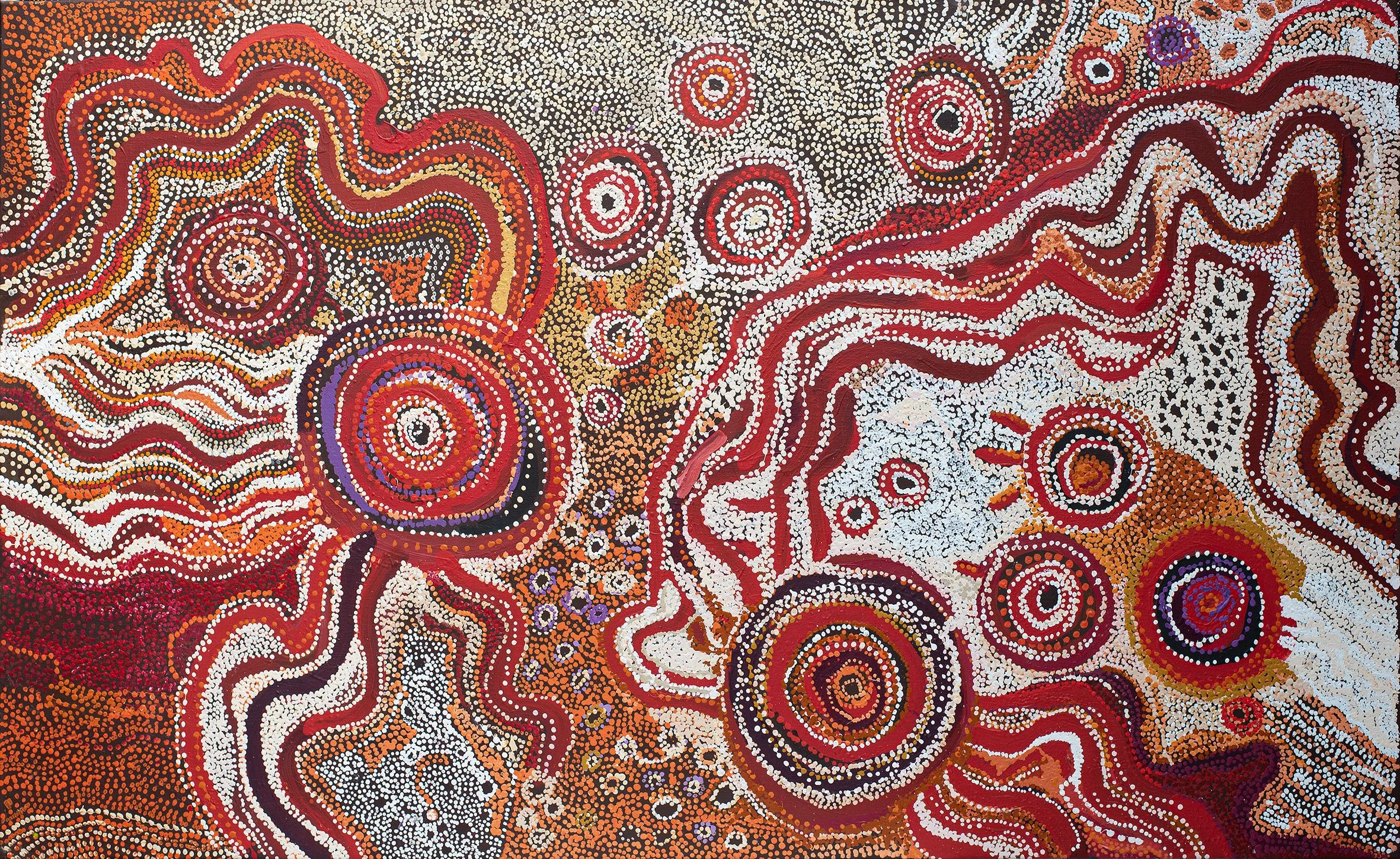
Artiste : Manyitjanu Lennon
Titre : Mamungari 'nya
Format : 200 x 122 cm
Provenance et certificat : centre d'art de Kaltjiti
Ref : 17-339
Explication de l’œuvre :
Tjukurpa mamu ngaranya ngauuku tjanmu tjutaku ngura nyangatja ngayuku ngunytju tjutangku munu
kuntilingku ngayuku kulypaipangku kulu. This is the story of many mamungari'nya. This is also my grandfather's country. This is also my mother, aunty and uncles and sisters country.
As Manyitjanu describes the country: “This is Mamungari’nya. The place Mamungari’nya is a long way away. It is over the other side of the sand dunes past Tipilnga. The place where many white trees are growing, many white marble gums. The place where women came turned into the white marble gums on the sand dune south of Watarru; this is a tjukurpa story. So this is Mamungari’nya where lots of little gum saplings and emu bush grow. This is a place of claypans.’ This is a women's site south
west of Watarru.

Artiste : Matjangka Norris (1956)
Titre : Ngura Pilti
Format : 198 x 198 cm
Provenance et certificat : centre d'art de Kaltjiti
Ref : 19-320
Vendue
Explication d’une œuvre :
Ngura Piltia. the country is very dry, 'ukuri wiya' - no green grass and 'mina wiya' - no water. Kamula (camels), Rabitah (rabbits), Malu (kangaroo), Donkeys, all the animals went to the waterhole looking for water, but there was none so they went away again. Tjukutji underground soak in the creek, there was a little water. The family went for dog skins, trapping, near Tjilpil and Alukumpa.
Matjangka was little girl, running around 'nikiti', no clothes. There was a big drought, there is no rain
coming.
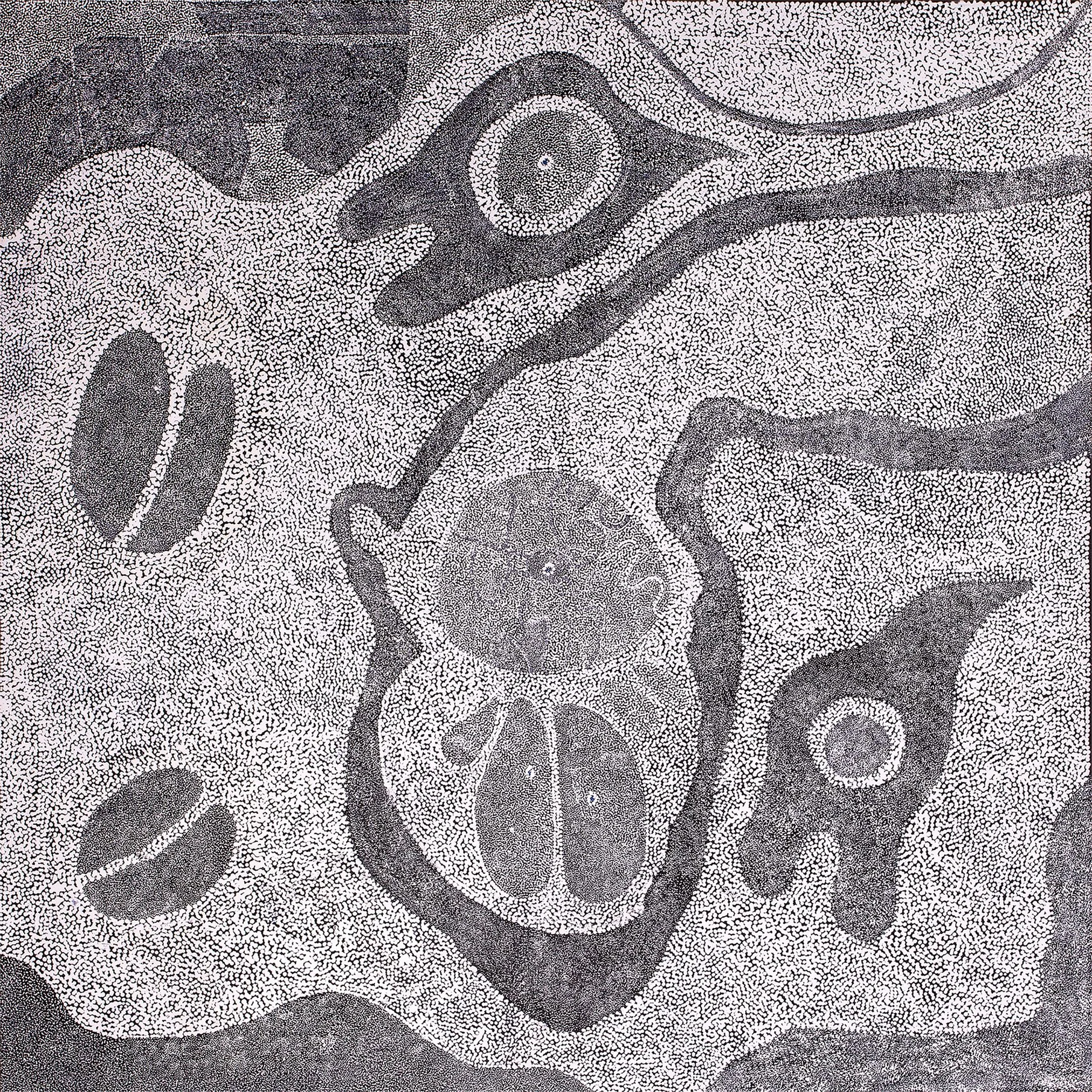
Artiste : Matjangka Norris Nyukana
Titre : Ngura Pilti
Format : 197 x 197 cm
Provenance et certificat : centre d'art de Kaltjiti
Ref : 18-1
Vendue
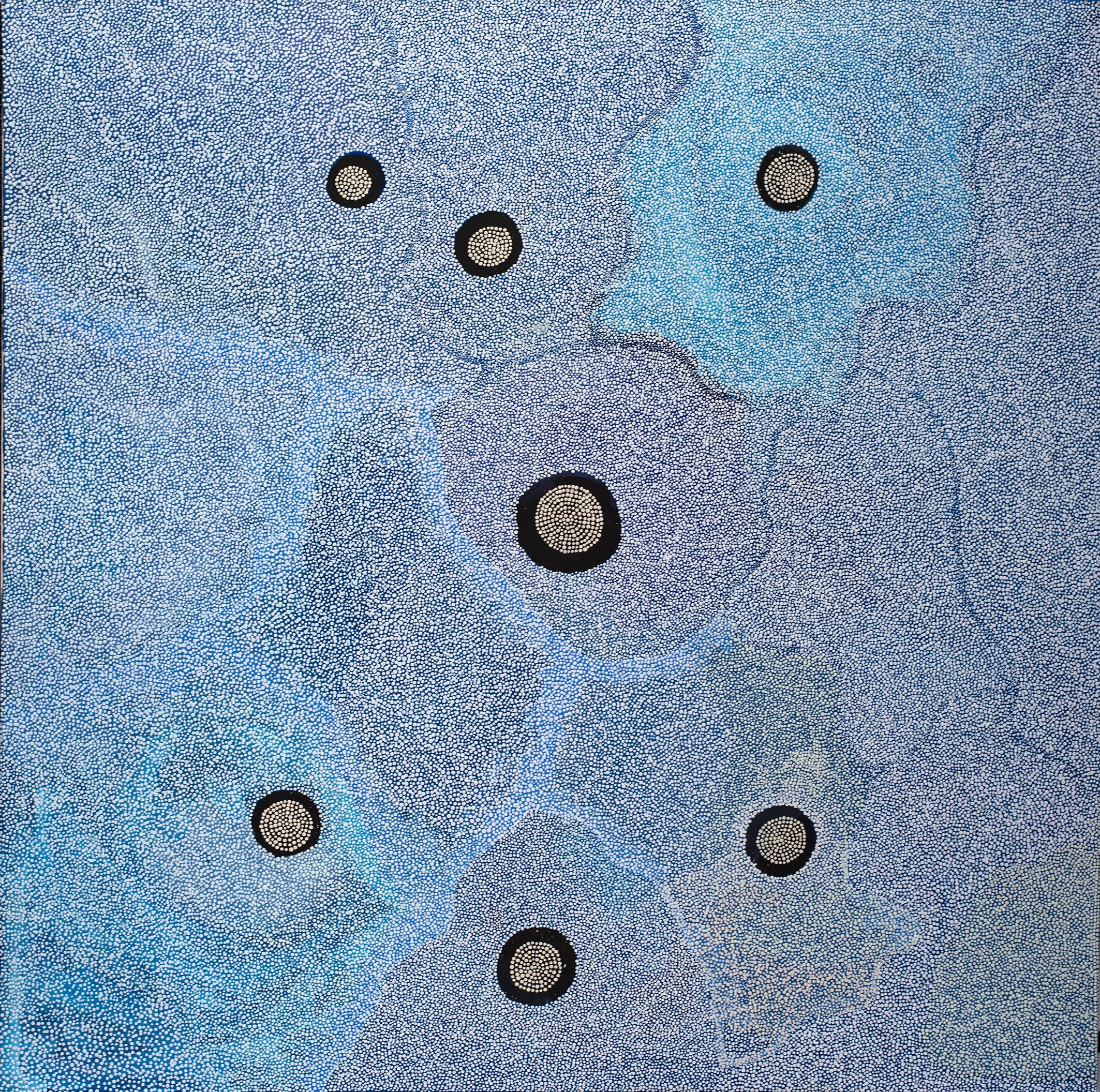
Artiste : Ingrid Treacle (1970)
Titre : Kungkarangkalpa - Seven Sisters
Format : 200 x 198 cm
Provenance et certificat : centre d'art de Kaltjiti
Ref : 19-371
Vendue
Explication d’une œuvre :
This painting depicts the the Milky Way, the star cluster known as the Pleiades, or Seven Sisters.
The seven sisters tjukrupa, traditional story, was passed on to Ingrid by her father. The story involves seven sisters who travelled from place to place to escape from the man called Nyirru.
He constantly changes his shape so they have to keep moving. He would like to marry the eldest sister but all the younger sisters do not like the idea of the bigger sister marrying the man because he is ugly and has six toes. Eventually the sisters fly up into the Milky Way and can be seen as the star cluster known as the Pleiades or Seven Sisters.

Artiste : Taylor Wanyima Cooper (1939)
Titre : Malara: Wanampi Tjukurpa
Format : 121 x 100 cm
Provenance et certificat : centre d'art de Kaltjiti
Ref : 19-308
Explication d’une œuvre :
Taylor was born at this important site of the Wanampi Tjukurpa, the Rainbow Serpent or Water Snake Dreaming. The Malara Wanampi is his Tjukurpa totemic ancestor, the place of the Water Serpent Dreaming. Taylor is Nguraritja, a tradional custodian of this Tjukurpa. There were many water holes that the Wanapmi travelled through.
“That Wanampi came from Malara. He went to Kunytjanu near Pipalyatjara. From Kunytjanu, that Wanampi kept walking, walking. He came to Tjuntun (kutjupa - different to Tjuntun at Fregon.) near Watarru. He threw one spear and made that rockhole. He went right in that rockhole and then travelled back to Malara". This is an interesting conflict story.

Artiste : Taylor Wanyima Cooper (1939)
Titre : Malara: Wanampi Tjukurpa
Format : 153 x 102 cm
Provenance et certificat : centre d'art de Kaltjiti
Ref : 19-290
Explication d’une œuvre :
Taylor was born at this important site of the Wanampi Tjukurpa, the Rainbow Serpent or Water Snake Dreaming. The Malara Wanampi is his Tjukurpa totemic ancestor, the place of the Water Serpent Dreaming. Taylor is Nguraritja, a tradional custodian of this Tjukurpa. There were many water holes that the Wanapmi travelled through.
“That Wanampi came from Malara. He went to Kunytjanu near Pipalyatjara. From Kunytjanu, that Wanampi kept walking, walking. He came to Tjuntun (kutjupa - different to Tjuntun at Fregon.) near Watarru. He threw one spear and made that rockhole. He went right in that rockhole and then travelled back to Malara". This is an interesting conflict story.

Artiste : Rita Rolley (1968)
Titre : Ngayuku Ngura
Format : 152 x 122 cm
Provenance et certificat : centre d'art de Kaltjiti
Ref : 19-368
Vendue
Explication de l’œuvre :
Rita paints vivid topographical views of the colours and landforms of the desert country of the *APY
Lands. Contour lines follow the small hills, ridges of sandhills, circular rockholes and winding creeks.
Wildlflowers dot the vast plains. Vibrant colourful and bold interpretaons of the bush, are typical of Rita's style.
Rita is a talented artist from Fregon on the *APY LAnds. Her unique composition and the
contemporary edge to her work reflects a keen sense of place retaining the importance of traditional
country as inspiration for her art.
* Anangu Pitjantjatjara Lands in the far north of South Australia.
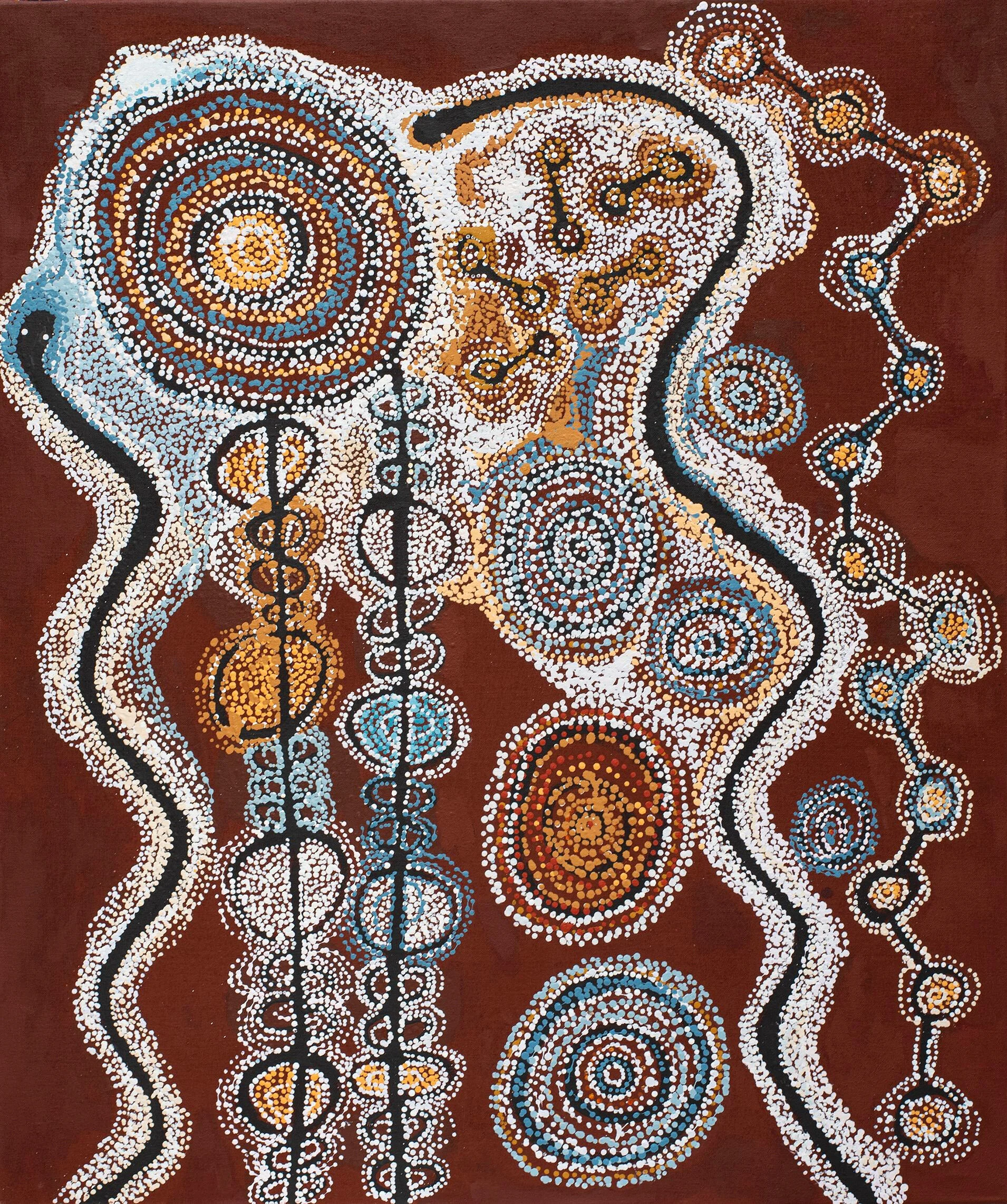
Artiste : Witjiti Georges (1938)
Titre : Pilati: Wanampi Tjukurpa
Format : 122 x 102 cm
Provenance et certificat : centre d'art de Kaltjiti
Ref : 19-294
Explication d’une œuvre :
Piltati is the well known tjukurpa story of the two water serpents who live in the Piltati Rockhole with their two wives. This is Witjiti's mother's country near Kanpi on the Anangu Pitjantjatjara Yankunytjatjara Lands (APY Lands) in far north South Australia.
Witjiti fondly refers to this Tjurkurpa as a love story. "This is a story about two brothers and two sisters. The two 'watis' (brothers) - two water snakes, are at the Piltati rockhole waiting for two sisters.
The two women had gone to find 'mai' ( food), they were gone a long time and the men were hungry. They all live there in this rockhole". - Witjiti George. The rabbit burrows are depicted as lines with semi circles either side. Underground water flows through these channels and the connected circles are places where the sisters travelled looking for bushtucker.
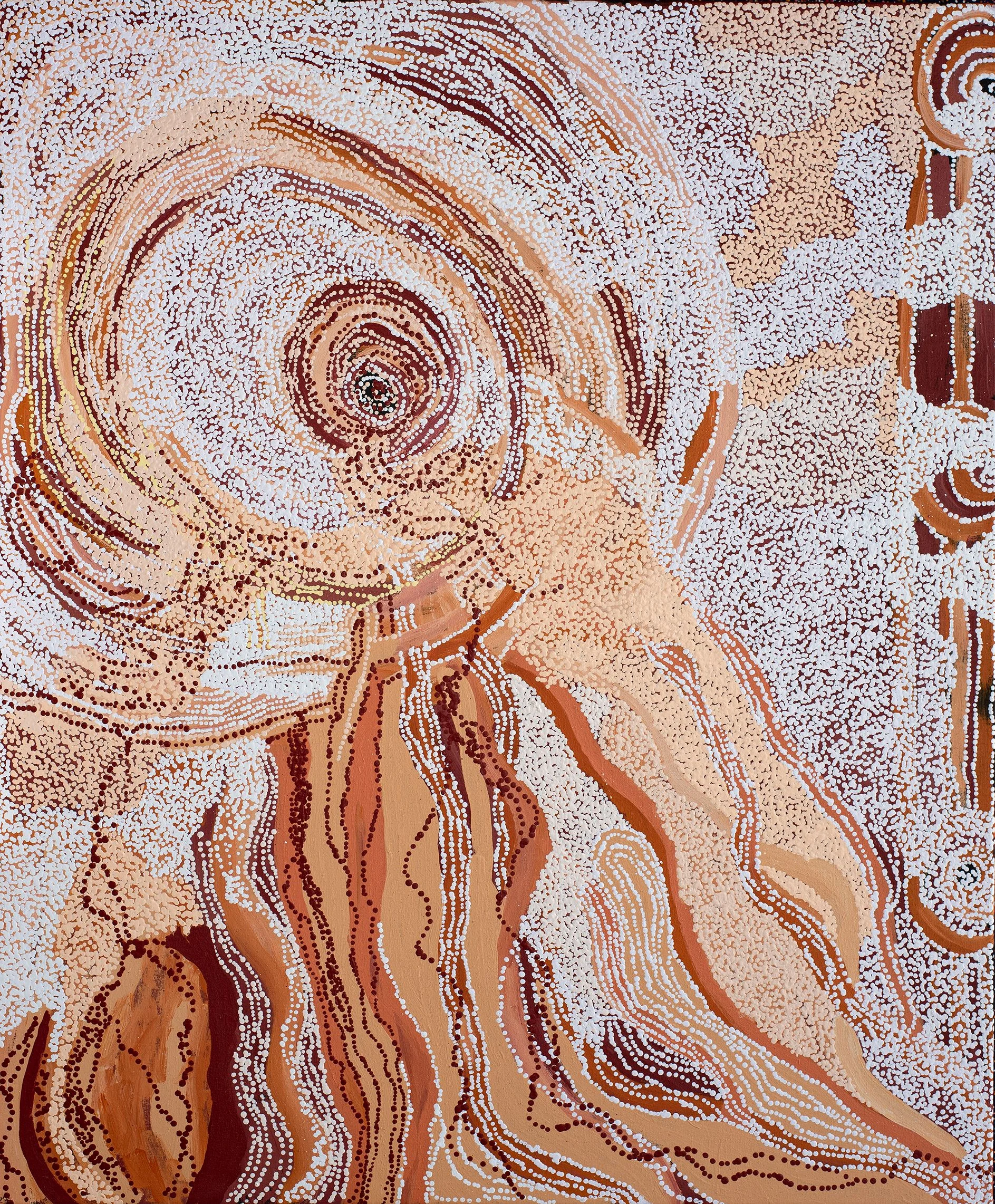
Artiste : Carolanne Ken (1971)
Titre de l'œuvre : Minyma Makuli Tjukurpa
Format : 122cm x 102cm
Provenance et certificat : centre d'art aborigène de Kaltjiti Arts
Référence de cette peinture aborigène : 19-296
Vendue
Explications pour cette peinture d'art Aborigène :
This is the cave of Minyma Makuli (also known as Minyma Malilu) minyma nyumpu- the crippled woman. During the raintime she dug out this cave with her pitt, to be her big wiltja, shelter. She camped here at Kanypi with her kungkawara kutjara, two daughters, young women. She left and moved on south to Kunumata and then further on to Tankaanu. This is Carolanne's grandmother's country. The underground cave at Kanypi is a permanent water supply. Carolanne is from Fregon on the *APY Lands. Precise, fine brushwork are characteristics of her work. Carolanne is a keen story teller and combining a traditional style with a contemporary edge to her work, reflects a keen sense of place retaining the importance of traditional country as inspiration for her work. *Anangu Pitjantjatjara/Yankunytjatjara Lands, in the far north-west of South Australia.

Artiste : Witjiti Georges (1938)
Titre : Pilati: Wanampi Tjukurpa
Format : 189 x 189 cm
Provenance et certificat : centre d'art de Kaltjiti
Ref : 18-437
Vendue
Explication d’une œuvre :
Piltati is the well known tjukurpa story of the two water serpents who live in the Piltati Rockhole with their two wives. This is Witjiti's mother's country near Kanpi on the Anangu Pitjantjatjara Yankunytjatjara Lands (APY Lands) in far north South Australia.
Witjiti fondly refers to this Tjurkurpa as a love story. "This is a story about two brothers and two sisters. The two 'watis' (brothers) - two water snakes, are at the Piltati rockhole waiting for two sisters.
The two women had gone to find 'mai' ( food), they were gone a long time and the men were hungry. They all live there in this rockhole". - Witjiti George. The rabbit burrows are depicted as lines with semi circles either side. Underground water flows through these channels and the connected circles are places where the sisters travelled looking for bushtucker.

Artiste : Imitjala Curley (1953)
Titre : Walytjitjata: Ngayuku ngunytjuku ngura
Format : 122 x 90 cm
Provenance et certificat : centre d'art de Kaltjiti
Ref : 19-355
Indisponible
Explication de l’œuvre :
Imitjala Curley is closely connected with Walytjitjata as it is her mother, Puni Puni's country -
Ngayuku ngunytjuku ngura. It is a small homeland just over the Northern Territory border about 46km
north of Kalka. Imitjala has said - Tjitji tjuta, this is part of the Minyma kututja Story of Walytjitjata.
Diana James recorded this story in the Kaltjiti Arts Book, Paintng the Song; The Minyma Kututja and her husband had many children. 'They travelled to Umutju (east of Walytjitjata). The oldest boy Wantama was homesick for their birth place, Kanpini, near Waltjitjata. They told their mother , "We're going back home with our brother." the mother sang a song to send them away. At Umutju they turned into stone and are still there today. Imitjala has painted the PITI'S - the wooden bowls used to carry the food they ate; the kampurarpa - desert raisens.
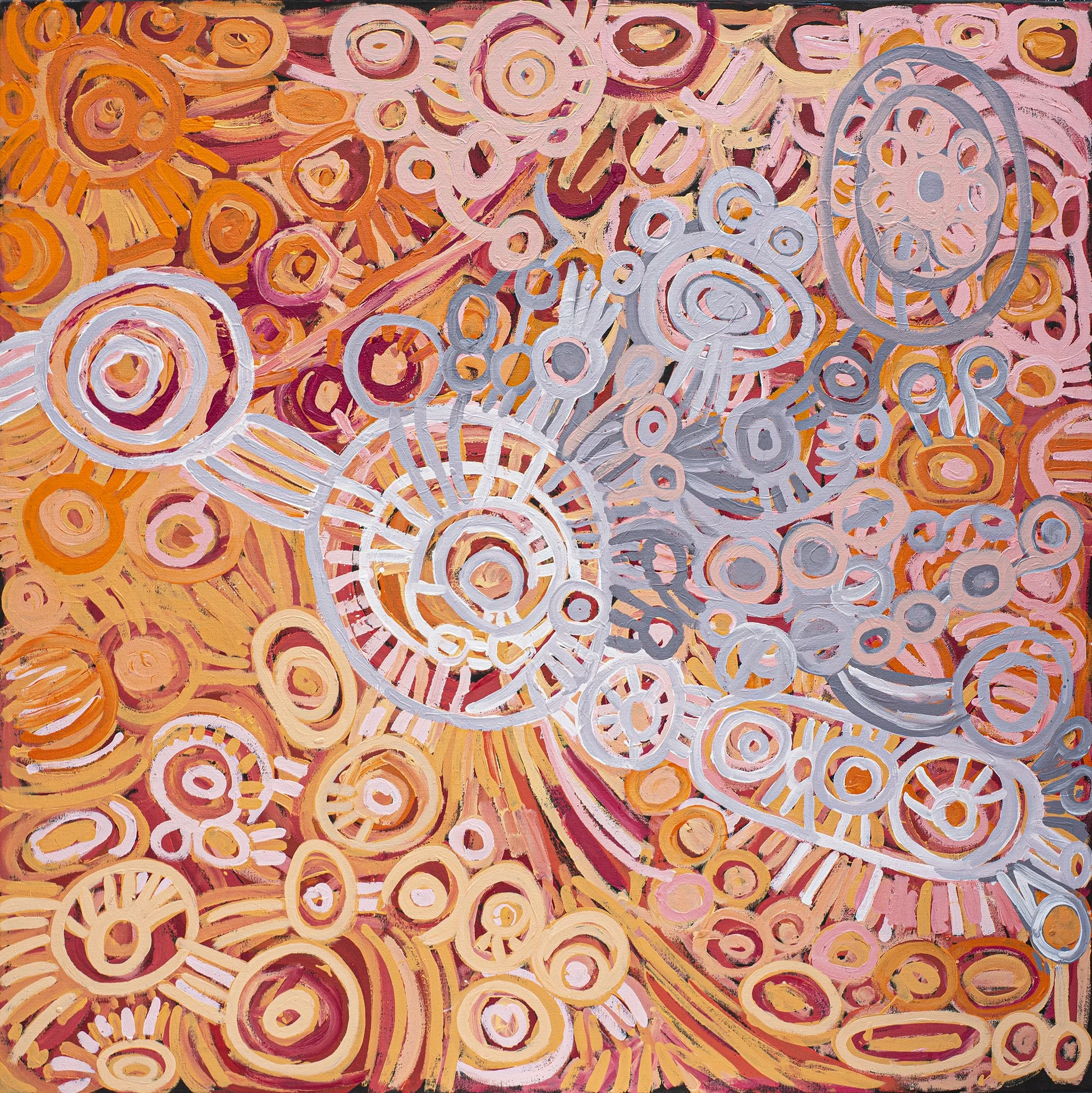
Artiste : Imitjala Curley (1953)
Titre : Walytjitjata: Ngayuku ngunytjuku ngura
Format : 152 x 152 cm
Provenance et certificat : centre d'art de Kaltjiti
Ref : 18-224
Indisponible
Explication de l’œuvre :
Imitjala Curley is closely connected with Walytjitjata as it is her mother, Puni Puni's country -
Ngayuku ngunytjuku ngura. It is a small homeland just over the Northern Territory border about 46km
north of Kalka. Imitjala has said - Tjitji tjuta, this is part of the Minyma kututja Story of Walytjitjata.
Diana James recorded this story in the Kaltjiti Arts Book, Paintng the Song; The Minyma Kututja and her husband had many children. 'They travelled to Umutju (east of Walytjitjata). The oldest boy Wantama was homesick for their birth place, Kanpini, near Waltjitjata. They told their mother , "We're going back home with our brother." the mother sang a song to send them away. At Umutju they turned into stone and are still there today. Imitjala has painted the PITI'S - the wooden bowls used to carry the food they ate; the kampurarpa - desert raisens.
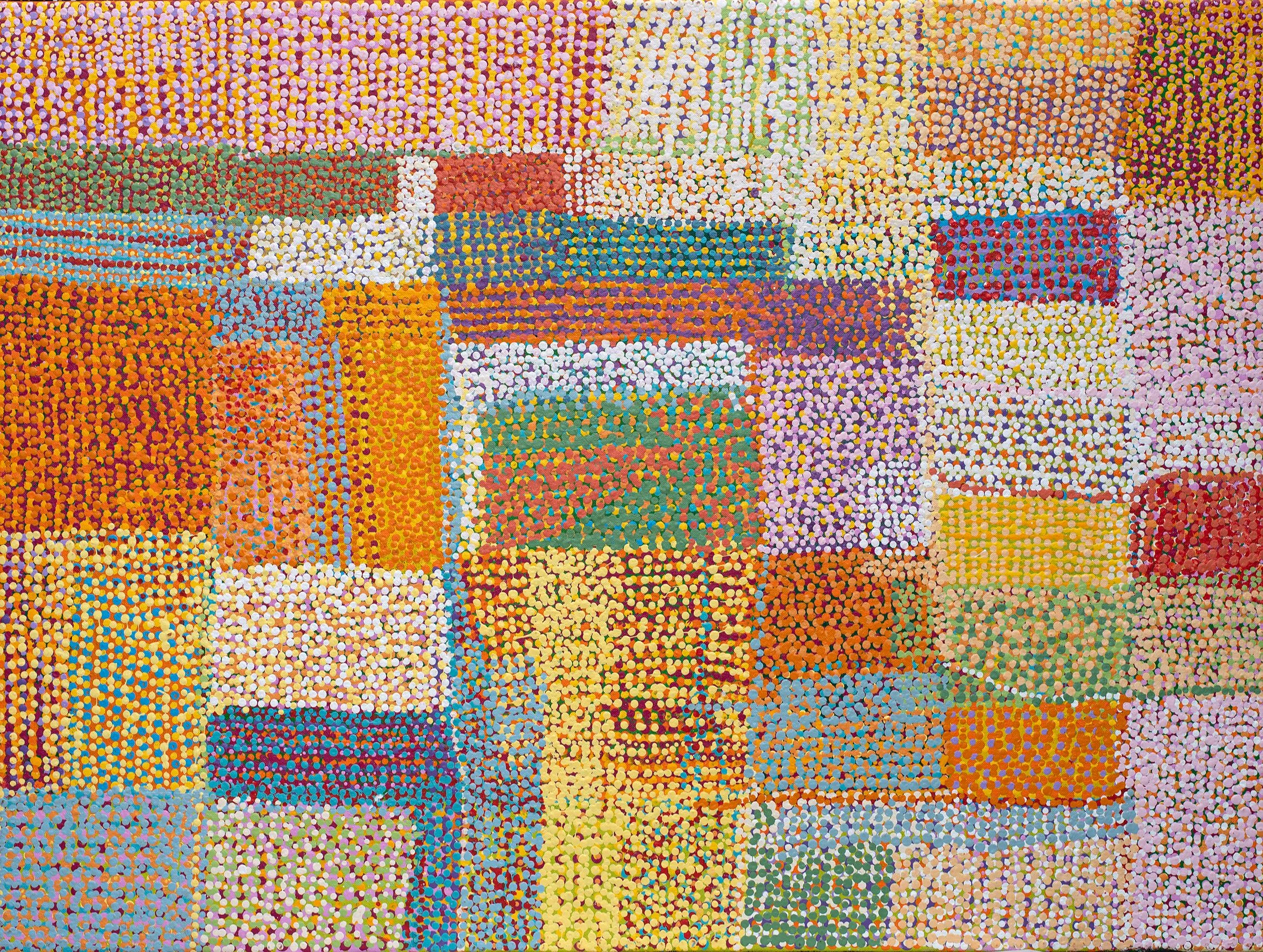
Artiste : Tjangili George (1950)
Titre : Tjulpuntjulpunpa Talitjara - Wildflowers in the Sandhills
Format : 102 x 76 cm
Provenance et certificat : centre d'art de Kaltjiti
Ref : 19-278
Vendue
Explication de l’œuvre :
Tjangili has fond memories as she paints of days long ago. She talks of being a young girl working as an artist at Ernabella weaving rugs out of wool dyed from the flowers of the desert.
"This painting reminds me of the tapestries I used to make and all the beautiful flowers in bright greens, pinks, blues, whites, yellows and purples in bloom after the rain. In those day's you could drink the water from the leaves of the flowers".
Flat plains are dotted with wild flowers and spinifex grass, The painting has captured the vibrancy and colour of the desert landscape in the APY Lands. The flat plains and long ridges of sandhills are typical of the desert country around Fregon and are dotted with wild flowers and spinifex grass. The painting has captured the vibrancy and colour of the desert landscape.
Tjangili is well known for fine brushwork and symmetrical composition Tjangili was born in Ernabella and her mother is Pitjantjatjara and her father is Yankuntjatjara. She married at Ernabella and then moved to Fregon. Tjangeli has three children. She is a senior traditional artist with responsibility for traditional knowledge of dance and country.
*Anangu Pitjantjatjara/Yankunytjatjara Lands, far north west of South Australia
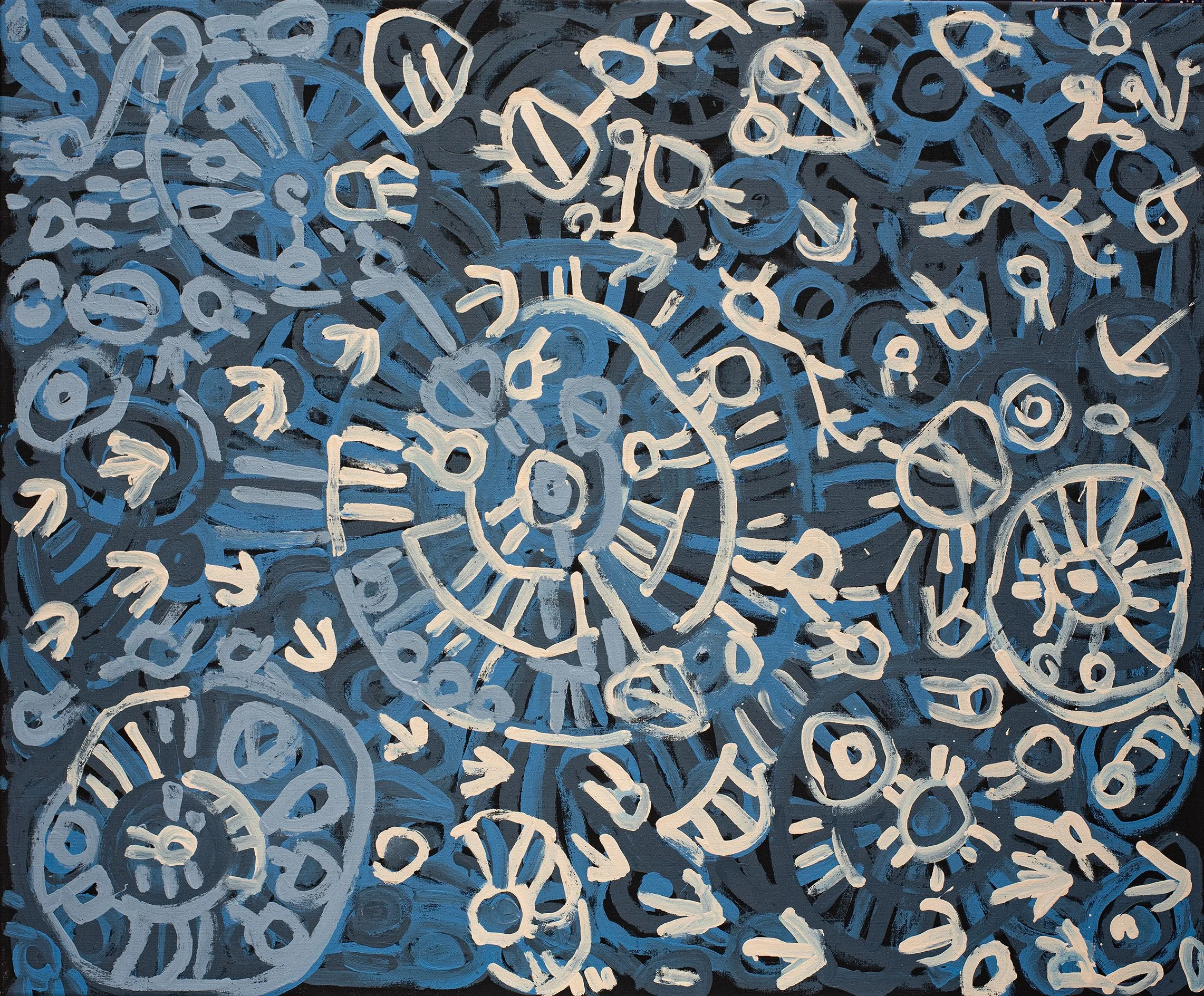
Artiste : Imitjala Curley (1953)
Titre : Walytjitjata: Ngayuku ngunytjuku ngura
Format : 122 x 102 cm
Provenance et certificat : centre d'art de Kaltjiti
Ref : 19-354
Explication de l’œuvre :
Imitjala Curley is closely connected with Walytjitjata as it is her mother, Puni Puni's country -
Ngayuku ngunytjuku ngura. It is a small homeland just over the Northern Territory border about 46km
north of Kalka. Imitjala has said - Tjitji tjuta, this is part of the Minyma kututja Story of Walytjitjata.
Diana James recorded this story in the Kaltjiti Arts Book, Paintng the Song; The Minyma Kututja and her husband had many children. 'They travelled to Umutju (east of Walytjitjata). The oldest boy Wantama was homesick for their birth place, Kanpini, near Waltjitjata. They told their mother , "We're going back home with our brother." the mother sang a song to send them away. At Umutju they turned into stone and are still there today. Imitjala has painted the PITI'S - the wooden bowls used to carry the food they ate; the kampurarpa - desert raisens.
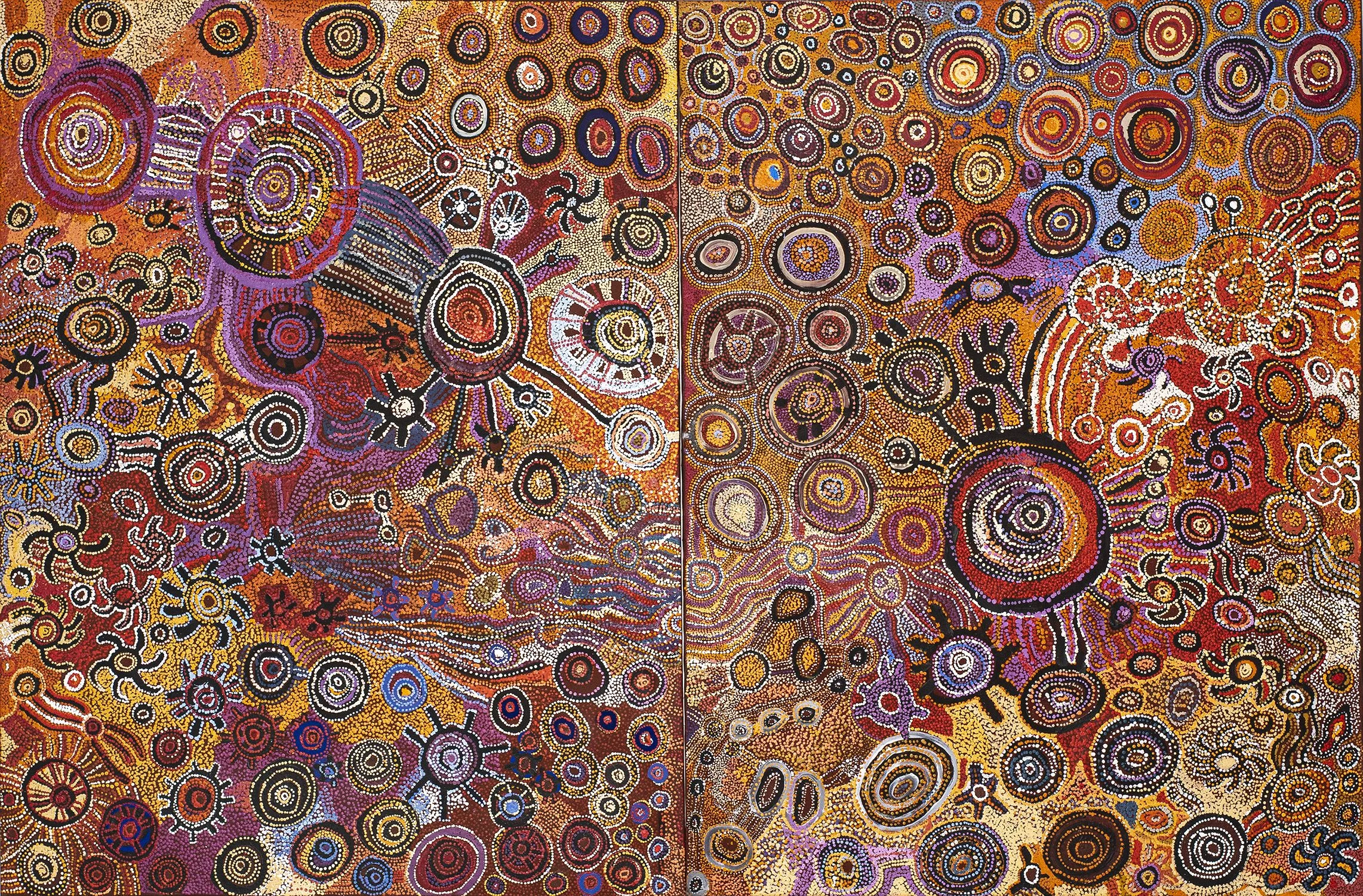
Artiste : Senior Women's collaborative
Format : 2 x 153 x 200 cm
Provenance et certificat : centre d'art de Kaltjiti
Ref : 17-13

Artiste : Manyitjanu Lennon
Titre : Mamungari’nya
Format : 152 x 152 cm
Provenance et certificat : centre d'art de Kaltjiti
Ref : KAL MLE 10771P
Not available
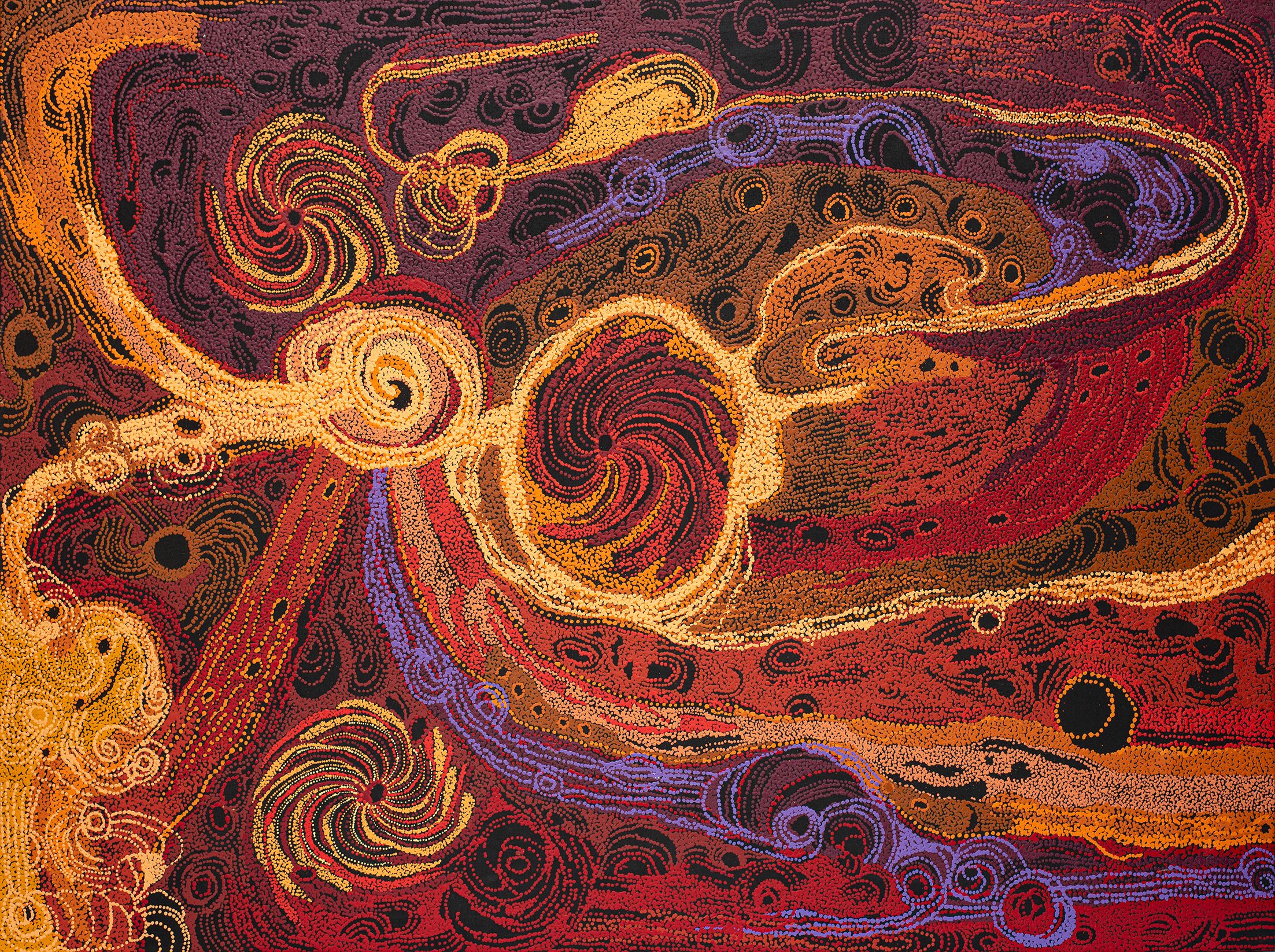
Artiste : Madeline Curley (1976)
Titre : Seven Sisters
Format : 198 x 150 cm
Provenance et certificat : centre d'art de Kaltjiti
Ref : 19-292
Explication de l’œuvre :
Seven Sisters. Those Kungas were travelling and saw the rockhole at ‘Kuli’. They sat down and had a rest and drank the water from the rockhole. That Nyiru was hiding behind the lile rock on the hill, they didn’t see him but they knew he was there.
After their rest they travelled toward Punti and Ililya (Minyma’s place), Alkara and kept travelling
Port Augusta way. This is a big Tjurkurpa story and is Madeline’s Tjamu (Grandfather’s) story.
Madeline has been passed this story by her father David Curley (dec)
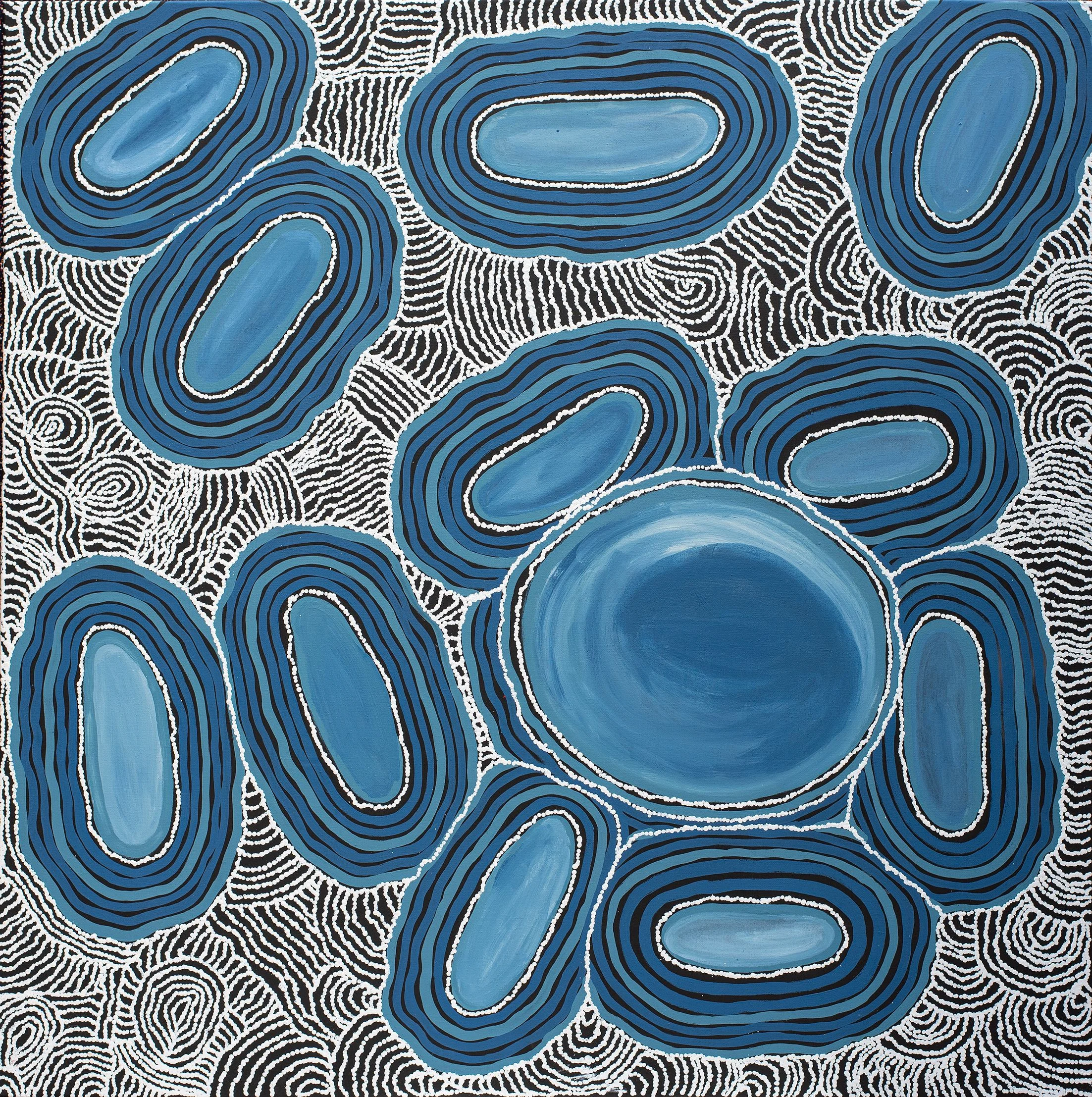
Artiste : Kani George (1980)
Titre : Piltati Tjukurpa
Format : 151 x 151 cm
Provenance et certificat : centre d'art de Kaltjiti
Ref : 19-319
Vendue
Explication d’une œuvre :
Piltati is the well known tjukurpa story of the two water serpents who live in the Piltati Rockhole with their two wives. This is grandmother's mother's country near Kanpi on the Anangu Pitjantjatjara/Yankunytjatjara Lands (APY Lands) in far north South Australia.
"This is a story about two brothers and two sisters. The two 'wati's' (brothers) - two water snakes,
are at the Piltati rockhole waiting for two sisters. The two women had gone to find 'mai' ( food), they were gone a long time and the men were hungry. They all live there in this rockhole".
The rabbit burrows are depicted as lines with semi circles either side. Underground water flows through these channels and the connected circles are places where the sisters travelled looking for
bushtucker.

Artiste : Anyupa Stevens (1981)
Titre : Piltati Tjukurpa
Format : 152 x 153 cm
Provenance et certificat : centre d'art de Kaltjiti
Ref : 19-350
Indisponible
Explication d’une œuvre :
This is my grandmothers country, my father's side. This is the country of the Piltati Tjukurpa; the
wanampi tjukurpa. The two watersnakes story. There are many waterholes here the Anangu Pitjantjatjara/ Yankunytjatjara Lands, 350km SE of ULURU.
It is good country for food and water. Nyapari Community is close to the Piltati waterhole.
Her paternal grandmother is the famed artist, the late Eileen Yaritja Stevens.

Artiste : Taylor Cooper
Titre : Malara: Wanampi Tjukurpa
Format : 122 x 102 cm
Provenance et certificat : centre d'art de Kaltjiti
Ref : 18-27
Explications de l'œuvre :
Taylor (1940) began painting at the Kaltjiti Arts centre in 2009. It was soon recognised that his paintings contained a strong representation of Tribal knowledge. His painting refers to the creation stories or Tjukurpa associated with the traditional homelands of his mother and father. An expert craftsman, Taylor continues to make the traditional hunting weapons of aboriginal men, particularly kulata (spears) and kulata miru (spear throwers).
Malara is the place of the Wanampi Tjukurpa - Water Serpent Dreaming - in the far west of the APY Lands. Taylor was born at this important site making the Malara Wanampi his Tjukurpa totemic ancestor. Taylor is Nguraritja, a traditional custodian of this story. Taylor explains: “That Wanampi came from Malara. He went to Kunytjanu near Pipalyatjara. From Kunytjanu that Wanampi kept walking, walking. He came to Tjuntun (Kutjupa – different to Tjuntun at Fregon.) near Watarru. He threw one spear and made that rockhole. He went right in that rockhole and then he travelled back to Malara."
Taylor is an important senior tribesman and he is a recognised custodian of traditional Aboriginal law and culture. He has never married and his disposition reflects a quiet dignity of a senior man. Taylor holds a responsibility as uncle to his two sisters’ children.
Collections : National Gallery of Victoria, Private Collections, Harriett & Richard England Collection, Sydney, Laverty Collection, Artbank Collection...
Vendue
En tant que partenaire et représentant des centres d’art Aborigène soutenus par le gouvernement Australien, la galerie Aboriginal Signature Estrangin vous permet d’avoir un accès privilégié en Europe (primary market) à des oeuvres recherchées, disposant des meilleures provenances éthiques reconnues par les grandes institutions et collections privées ou publiques. A travers notre programme d’exposition en Europe, nous vous invitons à voyager à travers le temps et les immensités Aborigènes pour apprivoiser toute l’amplitude et l’excellence de ce mouvement artistique contemporain.
Artiste : Carolanne Ken (1971) & Madeline Curley (1976)
Sans Titre
Format : 200 x 200 cm
Provenance et certificat : centre d'art de Kaltjiti
Ref : 19-18
Demander le prix de l'œuvre
Explication de l’œuvre :
This is the cave of Minyma Makuli), also known as Minyma Malilu) - minyma nymupu - she was
cripped and had to crawl on her hands and knees across the ground. She dug out this cave with the piti (wooden bowl), to be her big wiltja (shelter). She camped here with her kungkawara kutjara, two daughters, young women. One evening the girls returned from hunting with kuku pulka (large game), she wondered how they got it, and where it had come from? Two men had given it to the girls!
Her girls left her alone for a long time and didn't help her, poor thing, poor old weak woman, so she decided to follow them. She crawled after them, wanatjara anu, using a walking stick, following their tracks northwest back to the hills. When she reached their camp the men hit and killed her.
They had called the girls in marriage and took them away. This is Carolanne's grandmother's country. The underground cave at Kanypi is a permanent water supply. Carolanne is from Fregon on the *APY Lands. Precise, fine brushwork are characteristics of her work. Carolanne is a keen story teller and combining a traditional style with a contemporary edge to her work, reflects a keen sense of place retaining the importance of traditional country as inspiration for her work. *Anangu Pitjantjatjara/Yankunytjatjara Lands, in the far north-west of South Australia