Peintures d'art Aborigène de Ninuku Arts
Ninuku Art est situé sur le bord du désert occidental où l'Australie du Sud rencontre l'Australie occidentale et le Territoire du Nord. Ce territoire est celui du peuple Anangu depuis des millénaires.
A plus de 800 km d’Alice Springs, Ninuku Art est un centre artistique entièrement détenu et dirigé par les Aborigènes, qui soutient des artistes des deux communautés de Pipalyatjara et de Kalka, situées dans l'extrême nord-ouest de l'Australie-Méridionale, près de la frontière entre les trois États de l'Australie-Méridionale, de l'Australie-Occidentale et du Territoire du Nord. Ce territoire est celui du peuple Anangu depuis des millénaires.
(suite du texte ci-dessous).
Peintures des artistes Aborigènes de NINUKU ARTS disponibles au sein de la galerie :


Artiste : Jimmy Yanyatjari Donegan
Titre de l'œuvre : Pukara Rock Hole
Format : 91 x 61 cm
Provenance et certificat : centre d'art aborigène de Papunlankutja
Référence de cette toile aborigène : 28-19
Explication sur cette peinture :
Jimmy paints the Tjukurpa (Dreaming story) from an important site known as Pukara, south-west of Irrunytju (Wingellina community) in Western Australia. It is a story of Wati Kutjara Wanampi (two male water serpents) - a father and son - who are living at a waterhole. According to the story, Anangu tjuta (lots of people) went to that rockhole for the kapi (water), which is said to taste sweet. This upset the father and he told them to go back to their own country. Once the people left, the father and son travelled to Willuna, where they camped for weeks. They then return to Pukara. One day they were sleeping, but were awoken by a loud buzzing sound. The Minyma Punpunpa (the female flies) had been attracted to the honey grevillea plants found near the waterhole. It prompted the father and son to get up and go to collect the honey from the plants. It is there that the Wati Mututa (male black ants) appeared. They speared the son in his side. When the son started vomittng, he produced the seeds of all the different varieties of honey grevillea plants that are still found there today. They include kaliny-kalinypa, ultukunpa, piruwa and witjinti.

Artiste : Molly Miller
Titre de l'œuvre : Mamungara
Format : 91 x 91 cm
Provenance et certificat : centre d'art aborigène de Ninuku
Référence de cette peinture : 20-212
Explications pour cette œuvre :
Panya ngayulu tjitji kulapa tjina kutju parangarapai putu-wanu. Mutuka wiyangka. Tjina kutju parangarapai, parangala, paranangarapia. Nyangatja ngura pulkupa ngayuku. Tjitji Tjuta atunmananyi. Rapita tjuta, maku tjuta, tjala tjuta. Nganana pulkupa mulapa nyinangi irriti. Nyangatja ngura wirunya mulapa. “When I was a little girl we walked everywhere, there were no motorcars then. Always walking, around and around, and around. This is a happy place for me. Looking after children, lots of rabbits, lots of maku, lots of honey ants. We were really happy back then. This is a beautiful place" This canvas describes the features of the rocky country surrounding Wakapulkatjara, south east of Papulanktja, where Molly was born out bush in the 1940s. As a young woman, she travelled constantly through the ranges between Papulankatja to Mantumaru tracing the winding edges of puli, tali, kuru, ulyrunga, and tjukulu with her feet which she recalls as she puts dots to canvas, one in front of the next. Always "walking , walking, walking." A revered site for many Pitjantjatjara and Ngaanyatjarra speaking people on the Three Way Border of South Australia, Northern Territory, and Western Australia, Minyma Tjitu Pampa Tjukurpa and Papa Tjukurpa, Molly father’s dreaming also originate from this area.
© Photo : Aboriginal Signature Estrangin gallery with the courtesy of the artists and Ninuku.

Artiste : Angkaliya Nelson
Titre de l'œuvre : Kungkarangkalpa (Seven Sisters Story)
Format : 101 x 76 cm
Provenance et certificat : centre d'art aborigène de Ninuku
Référence de cette peinture : 22-410
Demander le prix de l'œuvre / Enquiry
Explications pour cette œuvre :
This is a major Tjukurpa for Irrunytju (Wingellina) and across the central Australian deserts. The seven sisters travelled from Kaliwarra to Wannan in Western Australia, stopping at significant sites and rockholes including Kuru Ala, a sacred place for women. They encountered a lustful man named Wati Nyiru, who chased them around the desert. Some of the details of this Tjukurpa (Dreaming story) are sacred and can’t be repeated.
© Photo : Aboriginal Signature Estrangin gallery with the courtesy of the artists and Ninuku.

Artiste : Samuel Miller
Titre de l'œuvre : Ngayuku Ngura
Format : 182 x 109.5cm
Provenance et certificat : centre d'art aborigène de Ninuku
Référence de cette peinture : 22-126
Demander le prix de l'œuvre / Enquiry
Explications pour cette œuvre :
Ngayuku Ngura means ‘My Place’. Samuel uses an extensive palee of colours to paint the country surrounding Kalka and Pipalyatjara. His paintings feature the various land formations from that area - rockholes, creeks and hills. His land is a sacred men’s rockhole, so sacred that the name is not allowed to be written down or spoken about.
© Photo : Aboriginal Signature Estrangin gallery with the courtesy of the artists and Ninuku.

Artiste : Angela Watson
Titre de l'œuvre : Minyma Kutjara
Format : 128 x 127 cm
Provenance et certificat : centre d'art aborigène de Ninuku
Référence de cette peinture : 22-243
Demander le prix de l'œuvre / Enquiry
Explications pour cette œuvre :
Minyma Kutjara (two women) travel from the otherside of Makura Piti heading north. The two sisters stop halfway near Wingellina. The younger one keeps looking back because she is homesick. The big sister said "why you looking back, why you crying? We are going long way." They travelled around all the different country. The younger sister realises that the older one is pregnant, she thinks how could that be there are no men. But there are men, sneaky men, and they camp with the older sister at night. This story is a women's and men's business story. The two girls keep travelling up past Docker River.
© Photo : Aboriginal Signature Estrangin gallery with the courtesy of the artists and Ninuku.

Artiste : Angela Watson
Titre de l'œuvre : Minyma Kutjara
Format : 122 x 122cm
Provenance et certificat : centre d'art aborigène de Ninuku
Référence de cette peinture : 22-39
Demander le prix de l'œuvre / Enquiry
Explications pour cette œuvre :
Minyma Kutjara (two women) travel from the otherside of Makura Piti heading north. The two sisters stop halfway near Wingellina. The younger one keeps looking back because she is homesick. The big sister said "why you looking back, why you crying? We are going long way." They travelled around all the different country. The younger sister realises that the older one is pregnant, she thinks how could that be there are no men. But there are men, sneaky men, and they camp with the older sister at night. This story is a women's and men's business story. The two girls keep travelling up past Docker River.
© Photo : Aboriginal Signature Estrangin gallery with the courtesy of the artists and Ninuku.

Artiste : Carol Young
Titre de l'œuvre : Ngura Tjuta: Big Country - Carol
Format : 122 x 91 cm
Provenance et certificat : centre d'art aborigène de Ninuku
Référence de cette peinture : 22-33
Demander le prix de l'œuvre / Enquiry
Explications pour cette œuvre :
Carol paints in the style of her grandmother Nyankulya Watson. The story passed down to her is about Nyankulya's country and the many places she travelled to as a young girl. Carol learnt all the rock holes from her grandmother. "Mt Aloysius, good water there. 'Ngura tjuta' (lots of country) including: Altjurungka, Kunaltju, Wangkal, Tur, Wiltju, Wipuwarra, Warratjuntjun, Pitlja Piltj."
© Photo : Aboriginal Signature Estrangin gallery with the courtesy of the artists and Ninuku.

Artiste : Tjulkiwa Atira Atira
Titre de l'œuvre : Arulya
Format : 183 x 167,5 cm
Provenance et certificat : centre d'art aborigène de Ninuku Arts
Référence de cette toile aborigène : 16-1
Demander le prix de l'œuvre / Enquiry
Explications pour cette peinture d'art Aborigène :
Cette œuvre évoque deux histoires ancestrales du temps du Rêve attachées au lieu d'Arulya. C'est un endroit très marquant avec une grotte du nom de Kuruyiti. Les enfants se cachaient dans cet endroit car une pluie intense arrivait. Le grand frère restait à l'extérieur, mangeant et dormant sans pourtant rentrer à l'intérieur. Quand la tempête arriva, des pierres se détachèrent et blessèrent le grand frère, ce qui affecta de façon définitive la naissance du paysage aux temps de la création.

Artiste : Monica Watson
Titre de l'œuvre : Pukara
Format : 120 x 120 cm
Provenance et certificat : centre d'art aborigène de Ninuku Arts
Référence de cette toile aborigène : 16-325
Explications pour cette peinture d'art Aborigène :
Cette œuvre évoque une histoire ancestrale du Temps du Rêve associée au lieu de Pukara, un trou d'eau très important dans le APY land. Ici un père et son fils, deux serpents d'eau mythologiques Wanampi, sont les gradiens des lieux.
L'eau à Pukara a une saveur particulière en raison du nectar d'une plante du bush qui s'y mélange, ce qui conduisait des Aborigènes à déborder de leurs frontières pour venir y boire.
Ces comportements déplaisaient profondément au serpent Wanampi père, qui devait souligner les droits à respecter en invitant les personnes à quitter ces lieux.
Le Père et son fils poursuivent ensuite leur périple vers Willuna dans le APY land. Quand ils reviendront par la suite à Pukara, le lieu sera envahi par des mouches femelles attirées à leur tour par le miel sauvage.
Le père et son fils s'empressent alors de récolter le miel, mais la fourmis noire les attaque et va blesser avec une lance les flancs du fils.
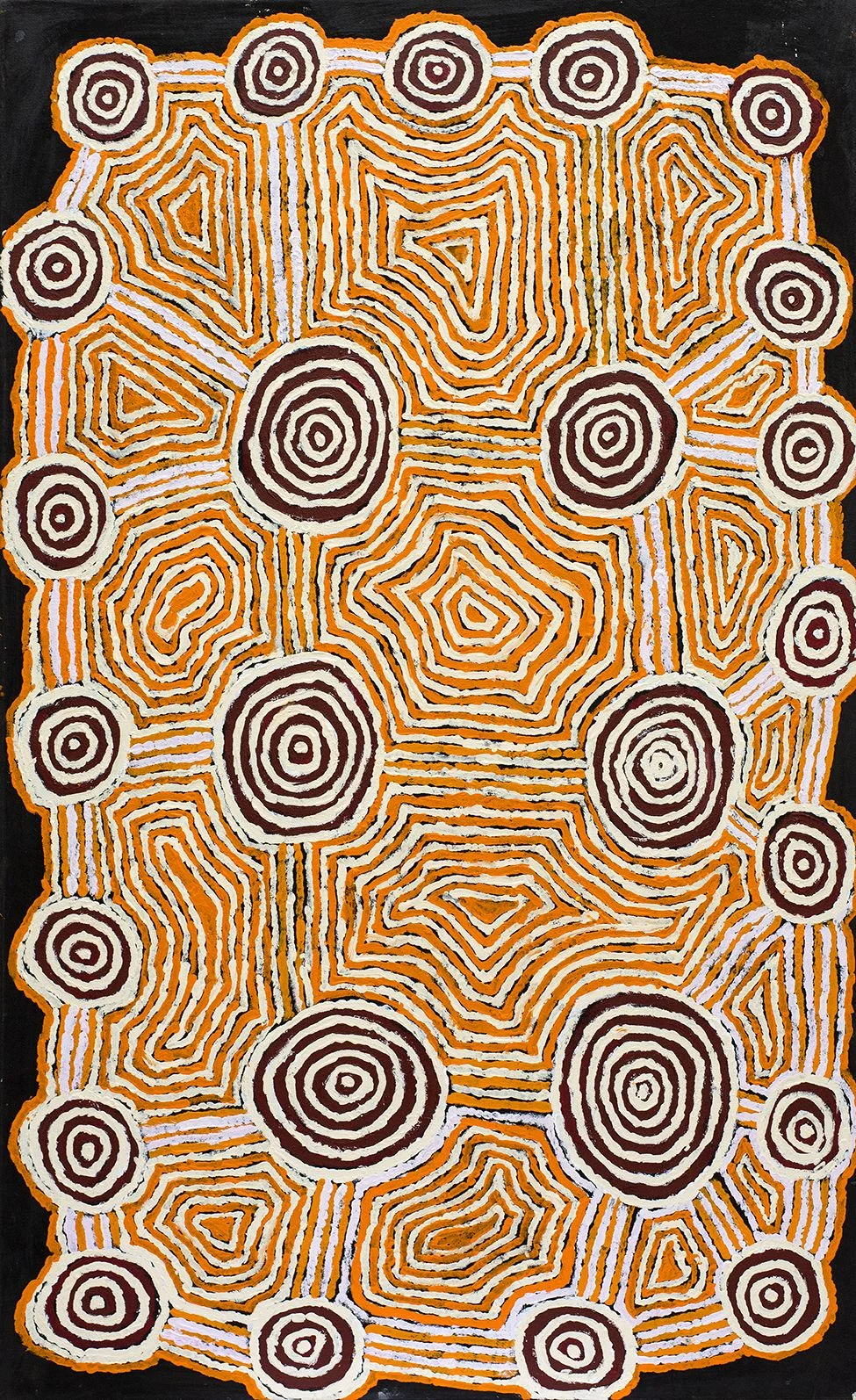
Artiste : Simon Butler
Titre de l'œuvre : Sacred story connected to country
Format : 127 x 78 cm
Provenance et certificat : centre d'art aborigène de Ninuku Arts
Référence de cette toile aborigène : 18-175

Artiste : Harry Tjutjuna
Titre de l'œuvre : Wanka Spider man dreaming
Format : 139.5 x 110 cm
Provenance et certificat : centre d'art aborigène de Ninuku Arts
Référence de cette toile aborigène : 0910
Demander le prix de l'œuvre / Enquiry
Explications pour cette peinture d'art Aborigène :
Wanka Kutjara, Minymaku Watiku (This is two spiders a man and a woman). "This is a big spider man. Wati paluru Ngankari (A male healer, traditional doctor). He is a powerful man. When rain comes he hides in his nest. He is a clever man. At night time he changes colour. His name is Wanka, spider. That's the story. Minyma wanka tjuta, these are all the women and children for this man (around him). I am the spider man, ngankari (healer, traditional doctor).

Artiste : Jimmy Yanyatjari Donegan
Titre de l'œuvre : Dingo Dreaming
Format : 101.6 x 50.8 cm
Provenance et certificat : centre d'art aborigène de Ninuku Arts
Référence de cette toile aborigène : 19-585
Explications pour cette peinture d'art Aborigène :
Dingo Dreaming shows the life of the Dingo family. The puppies playing and waiting or the return of the father. The mother is watching them, while the father is hunting kangaroos to feed the family.

Artiste : Nyankulya Watson
Titre de l'œuvre : Ngura Tjuta: Big Country - Rockholes in the traditional land
Format : 110 x 95 cm
Provenance et certificat : centre d'art aborigène de Ninuku Arts
Référence de cette toile aborigène : 10052
Explications pour cette peinture d'art Aborigène :
Cette œuvre évoque avec un sens de la composition tout à fait unique, les différentes pistes chantées - songlines - qui traversaient le territoire ancestral de l'artiste , entre les différents rockholes - trous d'eau dans la roche - ponctuant les étapes essentielles de la communauté des temps de la Création à nos jours. En ces lieux résident les grands ancêtres du Temps du Rêve.
Les deux communautés, distantes de quatorze kilomètres, sont entourées par les collines rocheuses et vallonnées des Tomkinson Ranges and are part of the Anangu Pitjantjatjara Yankunytjatjara (APY) Lands.
Le centre d'art est situé dans la communauté Aborigène de Kalka dans un bâtiment en briques de boue, qui a été construit au début des années 1980 par les Anangu et le personnel blanc pour le nombre croissant d'artistes désireux de peindre.
Le centre d'art joue un rôle déterminant dans la communauté en accueillant un nombre important d'artistes, à la fois des seniors aux plus jeunes générations, ce qui permet d'assurer la pérennité des communautés sur place dans cette implantation parmi les plus éloignée du APY land. Les œuvres de leurs artistes figurent dans de nombreuses collections à la fois privées et publiques en Australie mais également en Europe ou aux USA.
Artiste : Harry Tjutjuna
Titre de l'œuvre : Spider man dreaming
Format : 147 x 121 cm
Provenance et certificat : centre d'art aborigène de Ninuku Arts
Référence de cette toile aborigène : 17-247a
Demander le prix de cette œuvre
Explications pour cette peinture d'art Aborigène :
Cette œuvre convoque l'histoire du Temps du Rêve liée au Spider Man, totem de ce peintre, grand homme de loi. Cette créature emblématique a créé le pays de Tjutjuna aux temps des origines. La générosité du pinceau et la résonance des formes solaires de l'araignée, embrassent son territoire ancestral.