
Peintures d'art Aborigène de Yuendumu
Au milieu du centre de l'Australie, au nord-ouest de la ville d'Alice Springs se situe la communauté artistique de Yuendumu, où vivent de nombreux Aborigènes du peuple Warlpiri, probablement parmi les plus actifs d'Australie. Une dynamique de créativité permet une transmission remarquablement efficiente de la connaissance par l'entremise des peintures, entre les différentes générations des artistes Warlukurlangu.
Yuendumu a donné naissance à de grands artistes figurant dans les plus grandes institutions en Australie mais également à travers le monde... Suite du texte ci-dessous...
Peintures des artistes Aborigènes de Yuendumu (Warlukurlangu disponibles au sein de la galerie :
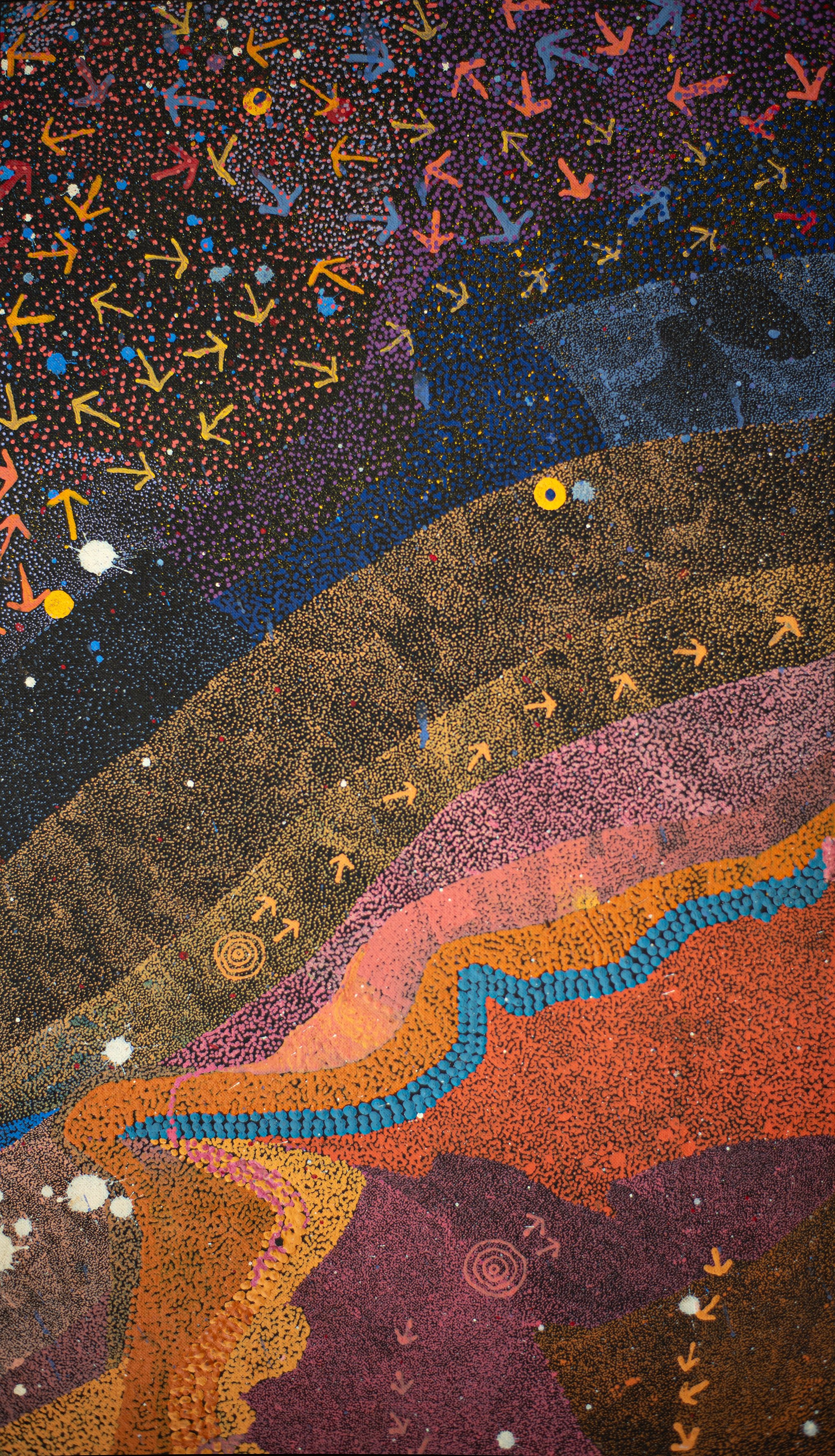
Artiste : Lloyd Jampijinpa Brown
Titre de l'œuvre : Yankirri Jukurrpa (Emu Dreaming) - Ngarlikirlangu
Format : 54 x 31 cm
Provenance et certificat : centre d'art aborigène de Yuendumu
Référence de cette peinture : 170/26
Demander le prix de l'œuvre / Enquiry
Explications pour cette œuvre :
This painting depicts a ‘yankirri Jukurrpa’ (emu [Dromaius novaehollandiae] Dreaming) from a place called Ngarlikurlangu, approximately 50kms north of Yuendumu. The ‘kirda’ (owners) of this Dreaming are Nangala/Nampijinpa women and Jangala/Jampijinpa men. This Jukurrpa tells the story of a ‘yankirri’ (emu) and a ‘wardilyka’ (bush turkey [Ardeotis australis]). ‘Yankirri’ lived at a soakage to the west called Warnirripanu (or Walangkamirirri), while ‘wardilyka’ lived at a soakage to the east called Parirri. The emu and bush turkey used to go around the country picking ‘yakajirri’ (bush raisins [Solanum centrale]) and mashing them into ‘kapurdu’ (fruit balls) to save in their nests for later. However, they were jealous of each other; the emu thought that the bush turkey was picking the best and juiciest ‘yakajirri’, and was leaving him with only the sour ‘yakajirri’.
The emu went to the bush turkey’s nest to the east while the bush turkey was out hunting and smashed up the ‘kapurdu’ that the bush turkey had saved there. When the bush turkey returned, he found his smashed ‘yakajirri’ balls and realized that the emu had destroyed them. He went to the west to confront the emu and when he found him, they got into a big fight. The bush turkey eventually flew away to the north, leaving behind the smashed ‘yakajirri’ balls.
This practice of making ‘kapurdu’ (fruit balls) is a traditional Warlpiri method of storing ‘yakajirri’; in the old days, people used to dry the ‘yakajirri’, grind them up with a rock in a coolamon, mix them with water and form balls from them, and cover the ‘kapurdu’ with red ochre so they would keep. Today at Ngarlikirlangu we can see round, red rocks which are the ‘kapurdu’ that the emu smashed up. There is also a dance for this ‘yankirri’ (emu) Jukurrpa that is performed during mens’ initiation ceremonies. A number of other Jukurrpa are also located at Ngarlikirlangu, including ‘wardilyka Jukurrpa’ (bush turkey Dreaming), ‘yardijiinypa Jukurrpa’ (meat ant Dreaming), and ‘pirntina Jukurrpa’ (woma or Ramsay’s python [Aspidites ramsayi] Dreaming). Lots of ‘yakajirri’ grow around the Ngarlikirlangu area today.
© Photo : Aboriginal Signature Estrangin gallery with the courtesy of the artists and Yuendumu
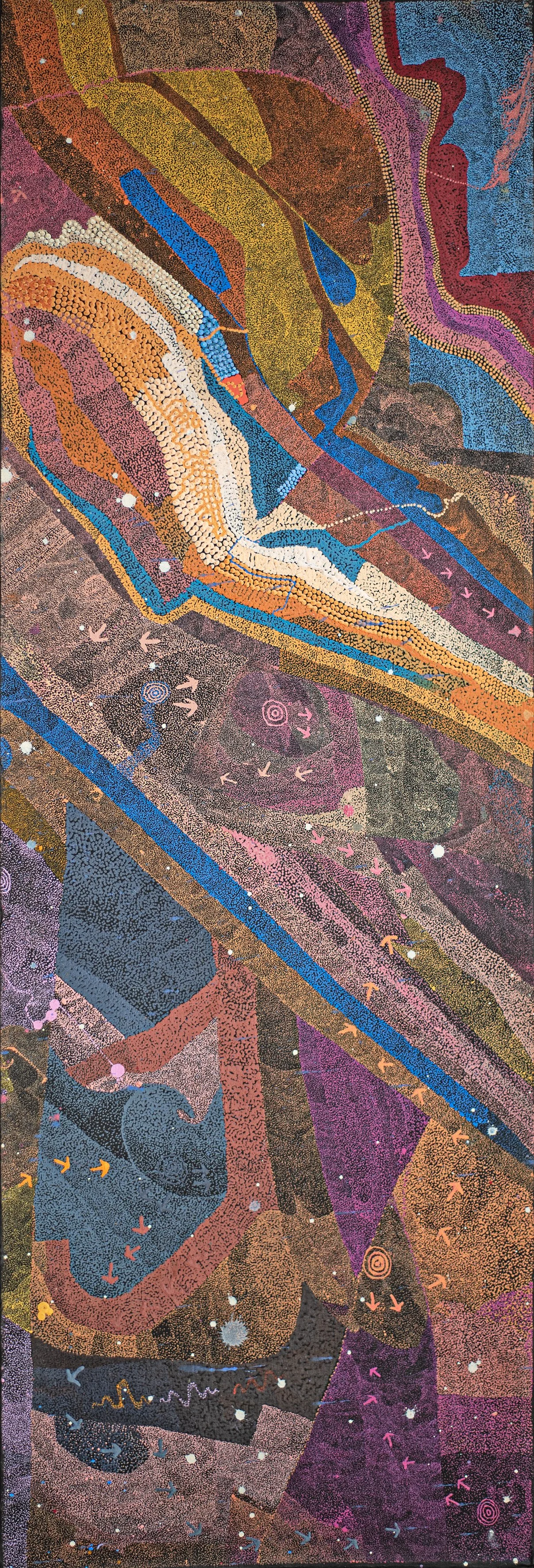
Artiste : Lloyd Jampijinpa Brown
Titre de l'œuvre : Yankirri Jukurrpa (Emu Dreaming) - Ngarlikirlangu
Format : 122 x 41 cm
Provenance et certificat : centre d'art aborigène de Yuendumu
Référence de cette peinture : 368/25
Demander le prix de l'œuvre / Enquiry
Explications pour cette œuvre :
This painting depicts a ‘yankirri Jukurrpa’ (emu [Dromaius novaehollandiae] Dreaming) from a place called Ngarlikurlangu, approximately 50kms north of Yuendumu. The ‘kirda’ (owners) of this Dreaming are Nangala/Nampijinpa women and Jangala/Jampijinpa men. This Jukurrpa tells the story of a ‘yankirri’ (emu) and a ‘wardilyka’ (bush turkey [Ardeotis australis]). ‘Yankirri’ lived at a soakage to the west called Warnirripanu (or Walangkamirirri), while ‘wardilyka’ lived at a soakage to the east called Parirri. The emu and bush turkey used to go around the country picking ‘yakajirri’ (bush raisins [Solanum centrale]) and mashing them into ‘kapurdu’ (fruit balls) to save in their nests for later. However, they were jealous of each other; the emu thought that the bush turkey was picking the best and juiciest ‘yakajirri’, and was leaving him with only the sour ‘yakajirri’.
The emu went to the bush turkey’s nest to the east while the bush turkey was out hunting and smashed up the ‘kapurdu’ that the bush turkey had saved there. When the bush turkey returned, he found his smashed ‘yakajirri’ balls and realized that the emu had destroyed them. He went to the west to confront the emu and when he found him, they got into a big fight. The bush turkey eventually flew away to the north, leaving behind the smashed ‘yakajirri’ balls.
This practice of making ‘kapurdu’ (fruit balls) is a traditional Warlpiri method of storing ‘yakajirri’; in the old days, people used to dry the ‘yakajirri’, grind them up with a rock in a coolamon, mix them with water and form balls from them, and cover the ‘kapurdu’ with red ochre so they would keep. Today at Ngarlikirlangu we can see round, red rocks which are the ‘kapurdu’ that the emu smashed up. There is also a dance for this ‘yankirri’ (emu) Jukurrpa that is performed during mens’ initiation ceremonies. A number of other Jukurrpa are also located at Ngarlikirlangu, including ‘wardilyka Jukurrpa’ (bush turkey Dreaming), ‘yardijiinypa Jukurrpa’ (meat ant Dreaming), and ‘pirntina Jukurrpa’ (woma or Ramsay’s python [Aspidites ramsayi] Dreaming). Lots of ‘yakajirri’ grow around the Ngarlikirlangu area today.
© Photo : Aboriginal Signature Estrangin gallery with the courtesy of the artists and Yuendumu
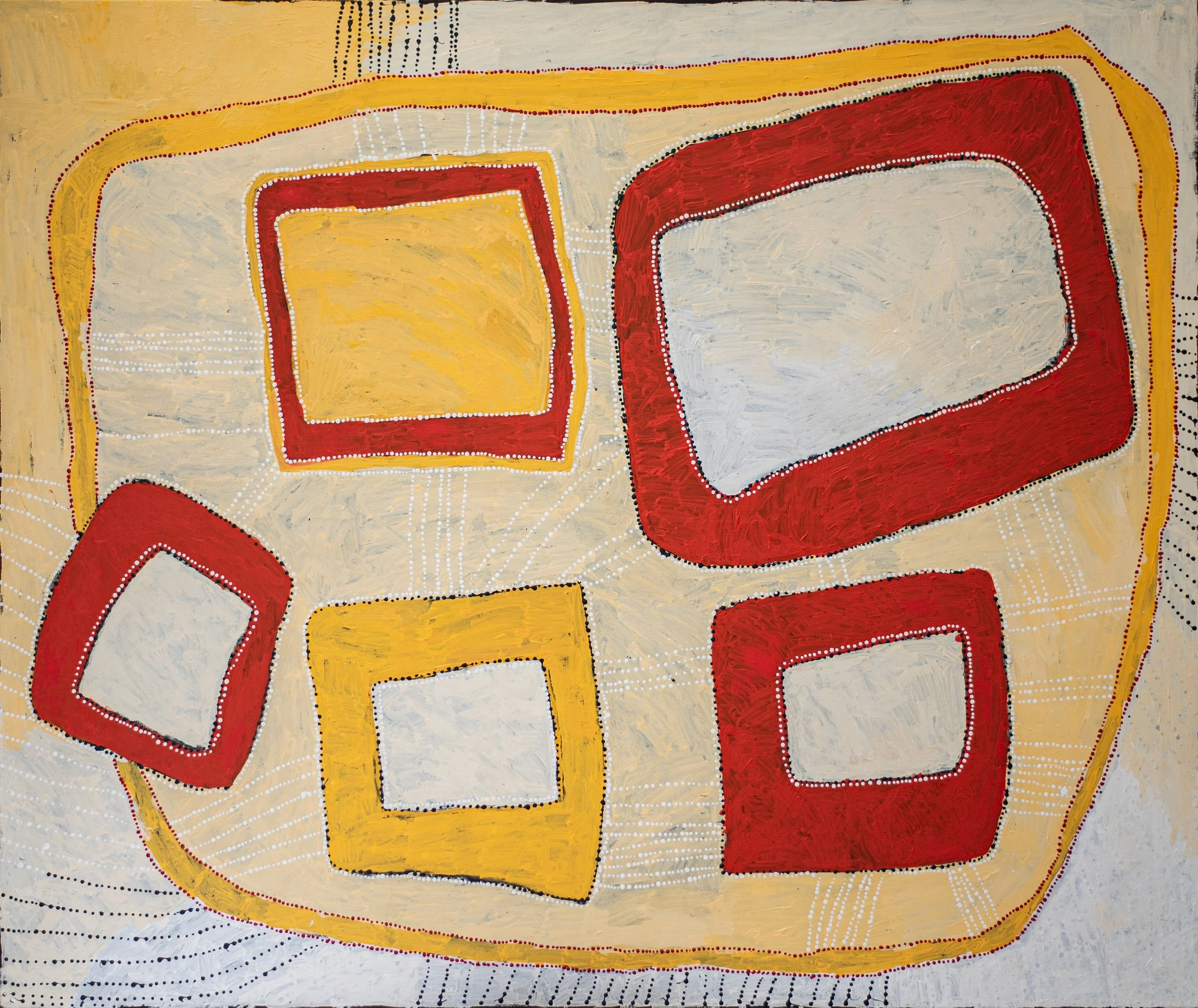
Artiste : Tasha Nampijinpa Collins
Titre de l'œuvre : Ngapa Jukurrpa (Water Dreaming) - Puyurru
Format : 183 x 152 cm
Provenance et certificat : centre d'art aborigène de Yuendumu
Référence de cette peinture : 1802/25
Demander le prix de l'œuvre / Enquiry
Explications de l'œuvre :
The site depicted in this painting is Puyurru, west of Yuendumu. In the usually dry creek beds are ‘mulju’ (soakages), or naturally occurring wells. The 'kirda' (owners) for this site are Nangala/Nampijinpa women and Jangala/Jampijinpa men. Two Jangala men, rainmakers, sang the rain, unleashing a giant storm. The storm travelled across the country from the east to the west, initially travelling with a ‘pamapardu Jukurrpa’ (termite Dreaming) from Warntungurru to Warlura, a waterhole 8 miles east of Yuendumu. At Warlura, a gecko called Yumariyumari blew the storm on to Lapurrukurra and Wilpiri. Bolts of lightning shot out at Wirnpa (also called Mardinymardinypa) and at Kanaralji.
At this point the Dreaming track also includes the ‘kurdukurdu mangkurdu Jukurrpa’ (children of the clouds Dreaming). The water Dreaming built hills at Ngamangama using baby clouds and also stuck long pointy clouds into the ground at Jukajuka, where they can still be seen today as rock formations. The termite Dreaming eventually continued west to Nyirripi, a community approximately 160 km west of Yuendumu. The water Dreaming then travelled from the south over Mikanji, a watercourse with soakages northwest of Yuendumu. At Mikanji, the storm was picked up by a ‘kirrkarlanji’ (brown falcon [Falco berigora]) and taken farther north. At Puyurru, the falcon dug up a giant ‘warnayarra’ (rainbow serpent). The serpent carried water with it to create another large lake, Jillyiumpa, close to an outstation in this country. The ‘kirda’ (owners) of this story are Jangala men and Nangala women.
After stopping at Puyurru, the water Dreaming travelled on through other locations including Yalyarilalku, Mikilyparnta, Katalpi, Lungkardajarra, Jirawarnpa, Kamira, Yurrunjuku, and Jikaya before moving on into Gurindji country to the north.
© Photo : Aboriginal Signature Estrangin gallery with the courtesy of the artists and Yuendumu
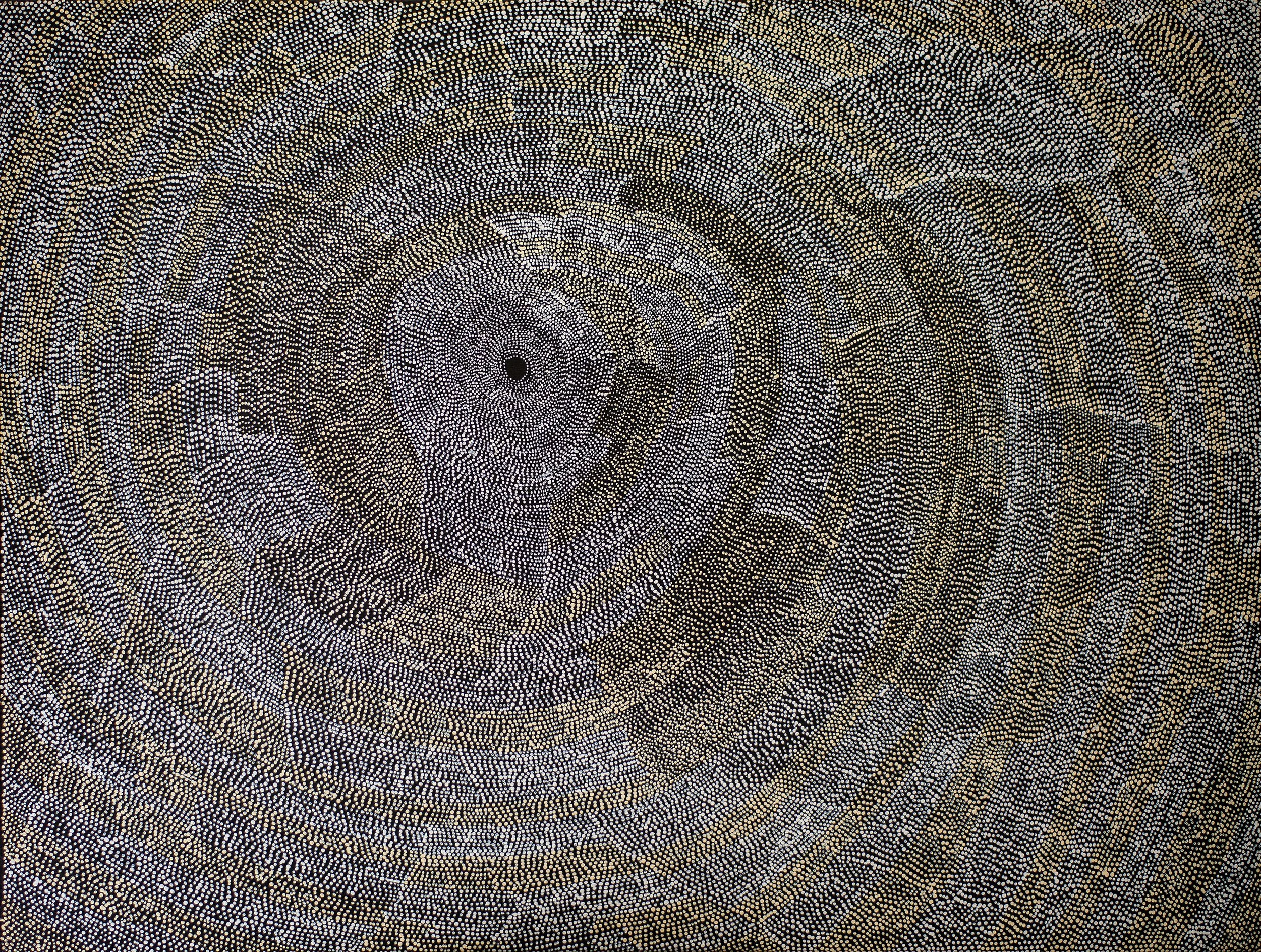
Artiste : Julie Nangala Robertson
Titre de l'œuvre : Mina Mina Jukurrpa - Mina Mina Dreaming
Format : 122 × 91 cm
Provenance et certificat : centre d'art aborigène de Yuendumu
Référence de cette peinture : 1364/25
Demander le prix de l'œuvre / Enquiry
Explications de l'œuvre :
Mina Mina is an extremely important ceremonial site for Napangardi and Napanangka women that is located approximately 600kms west of Yuendumu, just east of Lake
Mackay and the WA border. Mina Mina has a ‘marluri’ (salt lake or claypan) that is usually dry, without water. There are also a number of ‘mulju’ (soakages), sandhills, and a large stand of ‘kurrkara’ (desert oaks [Allocasuarina decaisneana]).
The Mina Mina Jukurrpa is an important source of Warlpiri ritual knowledge and social organization, particularly relating to the different roles performed by men and women. The ‘kirda’ (owners) of this country are Napangardi/Napanangka women and Japangardi/Japanangka men, who can depict portions of the Mina Mina Jukurrpa in their paintings. The artists mother, Dorothy Napangardi (c.1956–2013) painted Mina Mina and has passed down her Jukurrpa stories to her children and asked them to continue to paint for her. There are a number of different components of the Mina Mina Jukurrpa; artists usually choose to depict one particular aspect. These can include ‘karnta’ (women), ‘karlangu’ (digging sticks), ‘majardi’ (hairstring skirts/tassels), ‘ngalyipi’ (snakevine [Tinospora smilacina]), ‘jintiparnta’ (desert truffle [Elderia arenivaga]), and ‘kurrkara’ (desert oak [Allocasuarina decaisneana]).
In ancestral times a group of ‘karnta’ (women) traveled from Mina Mina on an epic journey to the east. These ancestral women danced at Mina Mina and ‘karlangu’ (digging sticks) rose up out of the ground. They collected these digging sticks and started travelling to the east. They carried their digging sticks over their shoulders, and they were adorned with ‘majardi’ (hairstring belts), white feathers, and necklaces made from ‘yinirnti’ (bean tree [Erythrina vespertilio]) seeds. They travelled east from Mina Mina, dancing, digging for bush tucker, and creating many places as they went. As they went east, they passed through Kimayi (a stand of ‘kurrkara’ (desert oak)). They passed through sandhill country where the ‘yarla’ (bush potato or ‘big yam’ [Ipomea costata]) ancestors from Yumurrpa and the ‘ngarlajiyi’ (pencil yam or ‘small yam’ [Vigna lanceolata]) ancestors from Yumurrpa were engaged in a huge battle over women. This battle is also a very important Warlpiri Jukurrpa narrative. The women went on to Janyinki and stopped at Wakakurrku (Mala Bore), where they stuck their digging sticks in the ground…
© Photo : Aboriginal Signature Estrangin gallery with the courtesy of the artists and Yuendumu
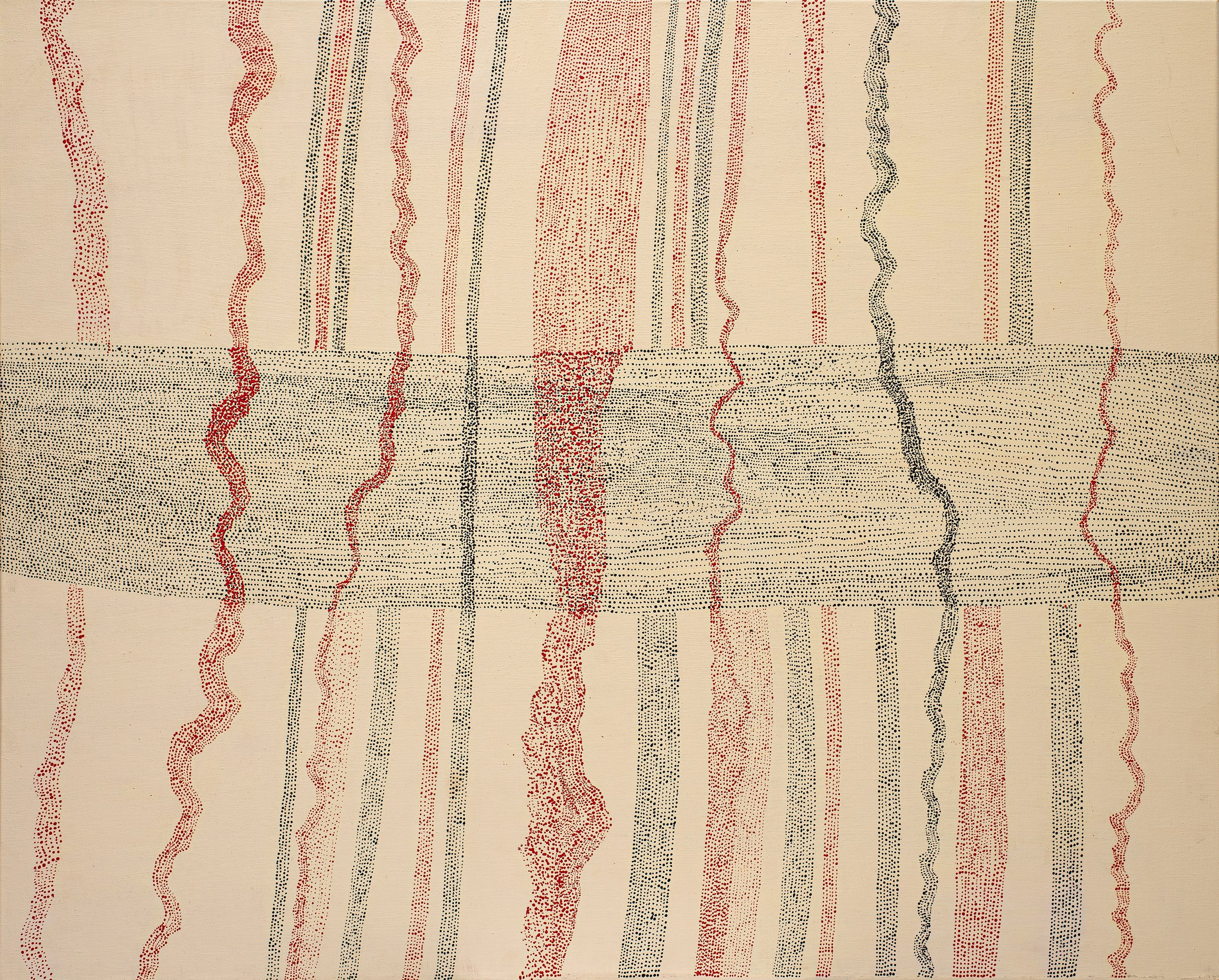
Artiste : Julie Nangala Robertson
Titre de l'œuvre : Mina Mina Jukurrpa - Mina Mina Dreaming
Format : 152 x 122 cm
Provenance et certificat : centre d'art aborigène de Yuendumu
Référence de cette peinture : 1282/23
Demander le prix de l'œuvre / Enquiry
Explications de l'œuvre :
Mina Mina is an extremely important ceremonial site for Napangardi and Napanangka women that is located approximately 600kms west of Yuendumu, just east of Lake
Mackay and the WA border. Mina Mina has a ‘marluri’ (salt lake or claypan) that is usually dry, without water. There are also a number of ‘mulju’ (soakages), sandhills, and a large stand of ‘kurrkara’ (desert oaks [Allocasuarina decaisneana]).
The Mina Mina Jukurrpa is an important source of Warlpiri ritual knowledge and social organization, particularly relating to the different roles performed by men and women. The ‘kirda’ (owners) of this country are Napangardi/Napanangka women and Japangardi/Japanangka men, who can depict portions of the Mina Mina Jukurrpa in their paintings. The artists mother, Dorothy Napangardi (c.1956–2013) painted Mina Mina and has passed down her Jukurrpa stories to her children and asked them to continue to paint for her. There are a number of different components of the Mina Mina Jukurrpa; artists usually choose to depict one particular aspect. These can include ‘karnta’ (women), ‘karlangu’ (digging sticks), ‘majardi’ (hairstring skirts/tassels), ‘ngalyipi’ (snakevine [Tinospora smilacina]), ‘jintiparnta’ (desert truffle [Elderia arenivaga]), and ‘kurrkara’ (desert oak [Allocasuarina decaisneana]).
In ancestral times a group of ‘karnta’ (women) traveled from Mina Mina on an epic journey to the east. These ancestral women danced at Mina Mina and ‘karlangu’ (digging sticks) rose up out of the ground. They collected these digging sticks and started travelling to the east. They carried their digging sticks over their shoulders, and they were adorned with ‘majardi’ (hairstring belts), white feathers, and necklaces made from ‘yinirnti’ (bean tree [Erythrina vespertilio]) seeds. They travelled east from Mina Mina, dancing, digging for bush tucker, and creating many places as they went. As they went east, they passed through Kimayi (a stand of ‘kurrkara’ (desert oak)). They passed through sandhill country where the ‘yarla’ (bush potato or ‘big yam’ [Ipomea costata]) ancestors from Yumurrpa and the ‘ngarlajiyi’ (pencil yam or ‘small yam’ [Vigna lanceolata]) ancestors from Yumurrpa were engaged in a huge battle over women. This battle is also a very important Warlpiri Jukurrpa narrative. The women went on to Janyinki and stopped at Wakakurrku (Mala Bore), where they stuck their digging sticks in the ground…
© Photo : Aboriginal Signature Estrangin gallery with the courtesy of the artists and Yuendumu
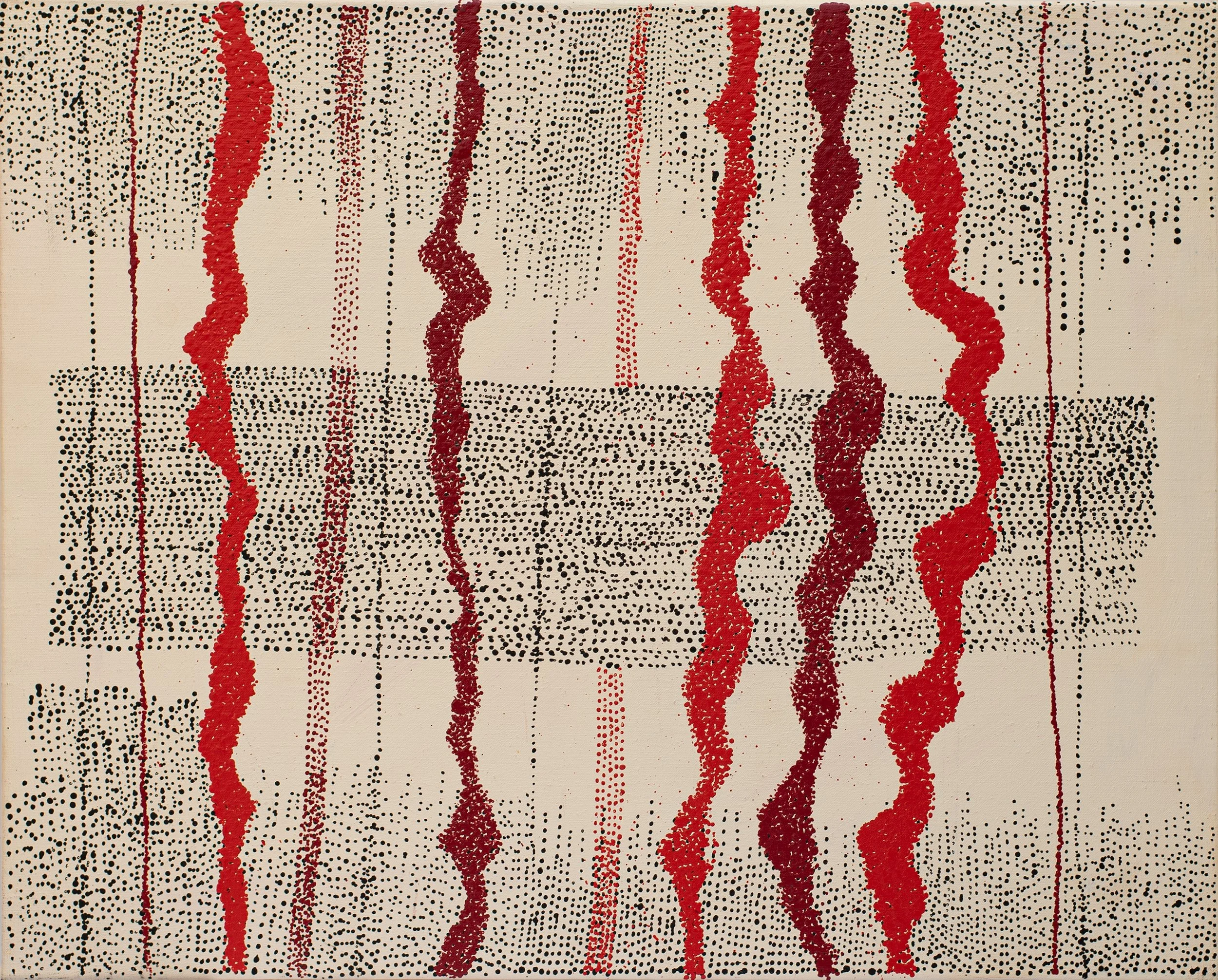
Artiste : Julie Nangala Robertson
Titre de l'œuvre : Mina Mina Jukurrpa - Mina Mina Dreaming
Format : 76 x 61 cm
Provenance et certificat : centre d'art aborigène de Yuendumu
Référence de cette peinture : 8064/23
Demander le prix de l'œuvre / Enquiry
Explications de l'œuvre :
Mina Mina is an extremely important ceremonial site for Napangardi and Napanangka women that is located approximately 600kms west of Yuendumu, just east of Lake
Mackay and the WA border. Mina Mina has a ‘marluri’ (salt lake or claypan) that is usually dry, without water. There are also a number of ‘mulju’ (soakages), sandhills, and a large stand of ‘kurrkara’ (desert oaks [Allocasuarina decaisneana]).
The Mina Mina Jukurrpa is an important source of Warlpiri ritual knowledge and social organization, particularly relating to the different roles performed by men and women. The ‘kirda’ (owners) of this country are Napangardi/Napanangka women and Japangardi/Japanangka men, who can depict portions of the Mina Mina Jukurrpa in their paintings. The artists mother, Dorothy Napangardi (c.1956–2013) painted Mina Mina and has passed down her Jukurrpa stories to her children and asked them to continue to paint for her. There are a number of different components of the Mina Mina Jukurrpa; artists usually choose to depict one particular aspect. These can include ‘karnta’ (women), ‘karlangu’ (digging sticks), ‘majardi’ (hairstring skirts/tassels), ‘ngalyipi’ (snakevine [Tinospora smilacina]), ‘jintiparnta’ (desert truffle [Elderia arenivaga]), and ‘kurrkara’ (desert oak [Allocasuarina decaisneana]).
In ancestral times a group of ‘karnta’ (women) traveled from Mina Mina on an epic journey to the east. These ancestral women danced at Mina Mina and ‘karlangu’ (digging sticks) rose up out of the ground. They collected these digging sticks and started travelling to the east. They carried their digging sticks over their shoulders, and they were adorned with ‘majardi’ (hairstring belts), white feathers, and necklaces made from ‘yinirnti’ (bean tree [Erythrina vespertilio]) seeds. They travelled east from Mina Mina, dancing, digging for bush tucker, and creating many places as they went. As they went east, they passed through Kimayi (a stand of ‘kurrkara’ (desert oak)). They passed through sandhill country where the ‘yarla’ (bush potato or ‘big yam’ [Ipomea costata]) ancestors from Yumurrpa and the ‘ngarlajiyi’ (pencil yam or ‘small yam’ [Vigna lanceolata]) ancestors from Yumurrpa were engaged in a huge battle over women. This battle is also a very important Warlpiri Jukurrpa narrative. The women went on to Janyinki and stopped at Wakakurrku (Mala Bore), where they stuck their digging sticks in the ground…
© Photo : Aboriginal Signature Estrangin gallery with the courtesy of the artists and Yuendumu
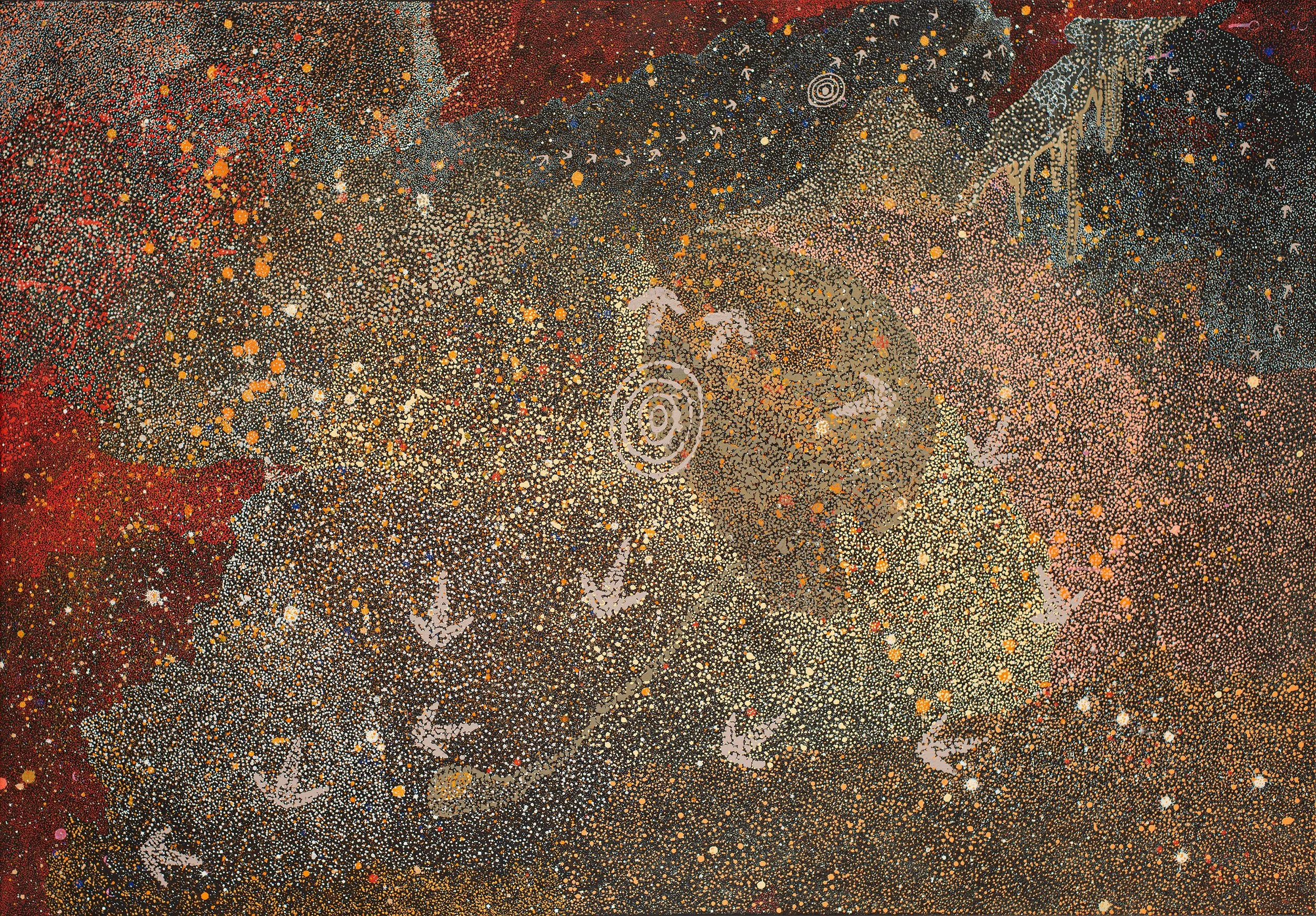
Artiste : Lloyd Jampijinpa Brown
Titre de l'œuvre : Yankirri Jukurrpa (Emu Dreaming) - Ngarlikirlangu
Format : 152 x 107 cm
Provenance et certificat : centre d'art aborigène de Yuendumu
Référence de cette peinture : 706/23
Demander le prix de l'œuvre / Enquiry
Explications pour cette œuvre :
This painting depicts a ‘yankirri Jukurrpa’ (emu [Dromaius novaehollandiae] Dreaming) from a place called Ngarlikurlangu, approximately 50kms north of Yuendumu. The ‘kirda’ (owners) of this Dreaming are Nangala/Nampijinpa women and Jangala/Jampijinpa men. This Jukurrpa tells the story of a ‘yankirri’ (emu) and a ‘wardilyka’ (bush turkey [Ardeotis australis]). ‘Yankirri’ lived at a soakage to the west called Warnirripanu (or Walangkamirirri), while ‘wardilyka’ lived at a soakage to the east called Parirri. The emu and bush turkey used to go around the country picking ‘yakajirri’ (bush raisins [Solanum centrale]) and mashing them into ‘kapurdu’ (fruit balls) to save in their nests for later. However, they were jealous of each other; the emu thought that the bush turkey was picking the best and juiciest ‘yakajirri’, and was leaving him with only the sour ‘yakajirri’.
The emu went to the bush turkey’s nest to the east while the bush turkey was out hunting and smashed up the ‘kapurdu’ that the bush turkey had saved there. When the bush turkey returned, he found his smashed ‘yakajirri’ balls and realized that the emu had destroyed them. He went to the west to confront the emu and when he found him, they got into a big fight. The bush turkey eventually flew away to the north, leaving behind the smashed ‘yakajirri’ balls.
This practice of making ‘kapurdu’ (fruit balls) is a traditional Warlpiri method of storing ‘yakajirri’; in the old days, people used to dry the ‘yakajirri’, grind them up with a rock in a coolamon, mix them with water and form balls from them, and cover the ‘kapurdu’ with red ochre so they would keep. Today at Ngarlikirlangu we can see round, red rocks which are the ‘kapurdu’ that the emu smashed up. There is also a dance for this ‘yankirri’ (emu) Jukurrpa that is performed during mens’ initiation ceremonies. A number of other Jukurrpa are also located at Ngarlikirlangu, including ‘wardilyka Jukurrpa’ (bush turkey Dreaming), ‘yardijiinypa Jukurrpa’ (meat ant Dreaming), and ‘pirntina Jukurrpa’ (woma or Ramsay’s python [Aspidites ramsayi] Dreaming). Lots of ‘yakajirri’ grow around the Ngarlikirlangu area today.
© Photo : Aboriginal Signature Estrangin gallery with the courtesy of the artists and Yuendumu

Artiste : Lloyd Jampijinpa Brown
Titre de l'œuvre : Yankirri Jukurrpa (Emu Dreaming) - Ngarlikirlangu
Format : 91 x 61 cm
Provenance et certificat : centre d'art aborigène de Yuendumu
Référence de cette peinture : 8080/23
Demander le prix de l'œuvre / Enquiry
Explications pour cette œuvre :
This painting depicts a ‘yankirri Jukurrpa’ (emu [Dromaius novaehollandiae] Dreaming) from a place called Ngarlikurlangu, approximately 50kms north of Yuendumu. The ‘kirda’ (owners) of this Dreaming are Nangala/Nampijinpa women and Jangala/Jampijinpa men. This Jukurrpa tells the story of a ‘yankirri’ (emu) and a ‘wardilyka’ (bush turkey [Ardeotis australis]). ‘Yankirri’ lived at a soakage to the west called Warnirripanu (or Walangkamirirri), while ‘wardilyka’ lived at a soakage to the east called Parirri. The emu and bush turkey used to go around the country picking ‘yakajirri’ (bush raisins [Solanum centrale]) and mashing them into ‘kapurdu’ (fruit balls) to save in their nests for later. However, they were jealous of each other; the emu thought that the bush turkey was picking the best and juiciest ‘yakajirri’, and was leaving him with only the sour ‘yakajirri’.
The emu went to the bush turkey’s nest to the east while the bush turkey was out hunting and smashed up the ‘kapurdu’ that the bush turkey had saved there. When the bush turkey returned, he found his smashed ‘yakajirri’ balls and realized that the emu had destroyed them. He went to the west to confront the emu and when he found him, they got into a big fight. The bush turkey eventually flew away to the north, leaving behind the smashed ‘yakajirri’ balls.
This practice of making ‘kapurdu’ (fruit balls) is a traditional Warlpiri method of storing ‘yakajirri’; in the old days, people used to dry the ‘yakajirri’, grind them up with a rock in a coolamon, mix them with water and form balls from them, and cover the ‘kapurdu’ with red ochre so they would keep. Today at Ngarlikirlangu we can see round, red rocks which are the ‘kapurdu’ that the emu smashed up. There is also a dance for this ‘yankirri’ (emu) Jukurrpa that is performed during mens’ initiation ceremonies. A number of other Jukurrpa are also located at Ngarlikirlangu, including ‘wardilyka Jukurrpa’ (bush turkey Dreaming), ‘yardijiinypa Jukurrpa’ (meat ant Dreaming), and ‘pirntina Jukurrpa’ (woma or Ramsay’s python [Aspidites ramsayi] Dreaming). Lots of ‘yakajirri’ grow around the Ngarlikirlangu area today.
© Photo : Aboriginal Signature Estrangin gallery with the courtesy of the artists and Yuendumu
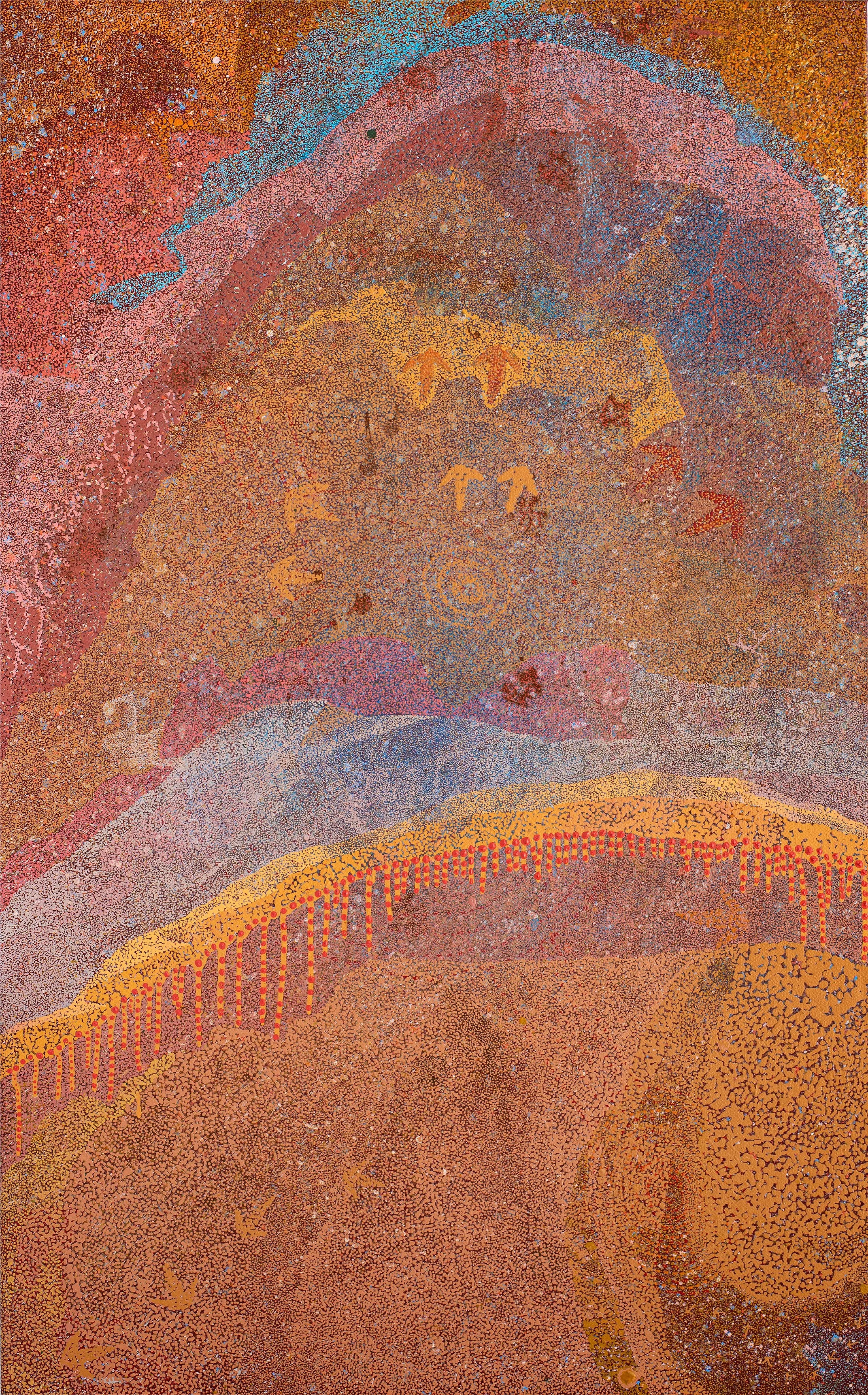
Artiste : Lloyd Jampijinpa Brown
Titre de l'œuvre : Yankirri Jukurrpa (Emu Dreaming) - Ngarlikirlangu
Format : 122 x 76 cm
Provenance et certificat : centre d'art aborigène de Yuendumu
Référence de cette peinture : 7738/23
Demander le prix de l'œuvre / Enquiry
Explications pour cette œuvre :
This painting depicts a ‘yankirri Jukurrpa’ (emu [Dromaius novaehollandiae] Dreaming) from a place called Ngarlikurlangu, approximately 50kms north of Yuendumu. The ‘kirda’ (owners) of this Dreaming are Nangala/Nampijinpa women and Jangala/Jampijinpa men. This Jukurrpa tells the story of a ‘yankirri’ (emu) and a ‘wardilyka’ (bush turkey [Ardeotis australis]). ‘Yankirri’ lived at a soakage to the west called Warnirripanu (or Walangkamirirri), while ‘wardilyka’ lived at a soakage to the east called Parirri. The emu and bush turkey used to go around the country picking ‘yakajirri’ (bush raisins [Solanum centrale]) and mashing them into ‘kapurdu’ (fruit balls) to save in their nests for later. However, they were jealous of each other; the emu thought that the bush turkey was picking the best and juiciest ‘yakajirri’, and was leaving him with only the sour ‘yakajirri’.
The emu went to the bush turkey’s nest to the east while the bush turkey was out hunting and smashed up the ‘kapurdu’ that the bush turkey had saved there. When the bush turkey returned, he found his smashed ‘yakajirri’ balls and realized that the emu had destroyed them. He went to the west to confront the emu and when he found him, they got into a big fight. The bush turkey eventually flew away to the north, leaving behind the smashed ‘yakajirri’ balls.
This practice of making ‘kapurdu’ (fruit balls) is a traditional Warlpiri method of storing ‘yakajirri’; in the old days, people used to dry the ‘yakajirri’, grind them up with a rock in a coolamon, mix them with water and form balls from them, and cover the ‘kapurdu’ with red ochre so they would keep. Today at Ngarlikirlangu we can see round, red rocks which are the ‘kapurdu’ that the emu smashed up. There is also a dance for this ‘yankirri’ (emu) Jukurrpa that is performed during mens’ initiation ceremonies. A number of other Jukurrpa are also located at Ngarlikirlangu, including ‘wardilyka Jukurrpa’ (bush turkey Dreaming), ‘yardijiinypa Jukurrpa’ (meat ant Dreaming), and ‘pirntina Jukurrpa’ (woma or Ramsay’s python [Aspidites ramsayi] Dreaming). Lots of ‘yakajirri’ grow around the Ngarlikirlangu area today.
© Photo : Aboriginal Signature Estrangin gallery with the courtesy of the artists and Yuendumu

Artiste : Walter Jangala Brown
Titre de l'œuvre : Tingari Cycle sacred story
Format : 122 x 91 cm
Provenance et certificat : centre d'art aborigène de Yuendumu
Référence de cette peinture : 2760/23
Demander le prix de l'œuvre / Enquiry
Explications pour cette œuvre :
This painting depicts a portion of the Tingari cycle, a very important collection of Dreaming narratives from the Western Desert region. The country that this painting depicts is located far to the west of Yuendumu, and spans a vast area of land across the Gibson and Great Sandy Deserts in Western Australia. Aboriginal groups that paint the Tingari cycle include the Pintupi, Kukatja, Ngarti, and Walmajarri peoples, among others.
The Tingari cycle consists of three major Dreaming tracks. One begins west of Jupiter Well and eventually runs due east, concluding south-east of Lake Mackay; another heads south-west from near Kintore for some 200 km, and then doubles back to end at Lake Macdonald; the third runs from south to north through Docker River and Kintore. The cycle tells the story of a group of ancient creation ancestors, the Tingari, who travelled across the country. The Tingari took different forms, some human and some animal. Humans were typically initiated men accompanied by ‘punyunyu’ (novices, uninitiated men). The men were sometimes accompanied by extremely powerful initiated women (called variously the ‘Kungka Tjuta,’ ‘Minyma Tjuta,’ or ‘Kanaputa’). Like the initiated men, these initiated women were accompanied by uninitiated women to whom they provided a ritual education. Animals featured in the Tingari cycle include the dingo, emu, kingfisher, and western quoll, among others.
As the Tingari travelled over vast areas of the country, they held initiations and other ceremonies, caused or encountered raging bushfires, hunted game, found and cooked bush-tucker, fought and killed one another, disposed of the dead or brought them back to life, interacted with totemic ancestors, copulated illicitly, made and used sacred objects, flew through the air, and died in hailstorms. In the course of these adventures, they either created or became the physical features of the sites they visited, forming rocky outcrops, waterholes, trees, salt lakes, ochre deposits, and so on. These sites which are now regarded as sacred by their descendants, today’s custodians of these places. The Tingari also laid down social custom and law as it should be practiced today. Their journeys form the basis of sacred and secret men’s and women’s laws. Public paintings of the Tingari cycle typically only show the unrestricted portions of these stories...
© Photo : Aboriginal Signature Estrangin gallery with the courtesy of the artists and Yuendumu

Artiste : Tasha Nampijinpa Collins
Titre de l'œuvre : Ngapa Jukurrpa (Water Dreaming) - Puyurru
Format : 91 x 91 cm
Provenance et certificat : centre d'art aborigène de Yuendumu
Référence de cette peinture : 6383/23
Demander le prix de l'œuvre / Enquiry
Explications de l'œuvre :
The site depicted in this painting is Puyurru, west of Yuendumu. In the usually dry creek beds are ‘mulju’ (soakages), or naturally occurring wells. The 'kirda' (owners) for this site are Nangala/Nampijinpa women and Jangala/Jampijinpa men. Two Jangala men, rainmakers, sang the rain, unleashing a giant storm. The storm travelled across the country from the east to the west, initially travelling with a ‘pamapardu Jukurrpa’ (termite Dreaming) from Warntungurru to Warlura, a waterhole 8 miles east of Yuendumu. At Warlura, a gecko called Yumariyumari blew the storm on to Lapurrukurra and Wilpiri. Bolts of lightning shot out at Wirnpa (also called Mardinymardinypa) and at Kanaralji.
At this point the Dreaming track also includes the ‘kurdukurdu mangkurdu Jukurrpa’ (children of the clouds Dreaming). The water Dreaming built hills at Ngamangama using baby clouds and also stuck long pointy clouds into the ground at Jukajuka, where they can still be seen today as rock formations. The termite Dreaming eventually continued west to Nyirripi, a community approximately 160 km west of Yuendumu. The water Dreaming then travelled from the south over Mikanji, a watercourse with soakages northwest of Yuendumu. At Mikanji, the storm was picked up by a ‘kirrkarlanji’ (brown falcon [Falco berigora]) and taken farther north. At Puyurru, the falcon dug up a giant ‘warnayarra’ (rainbow serpent). The serpent carried water with it to create another large lake, Jillyiumpa, close to an outstation in this country. The ‘kirda’ (owners) of this story are Jangala men and Nangala women.
After stopping at Puyurru, the water Dreaming travelled on through other locations including Yalyarilalku, Mikilyparnta, Katalpi, Lungkardajarra, Jirawarnpa, Kamira, Yurrunjuku, and Jikaya before moving on into Gurindji country to the north.
© Photo : Aboriginal Signature Estrangin gallery with the courtesy of the artists and Yuendumu
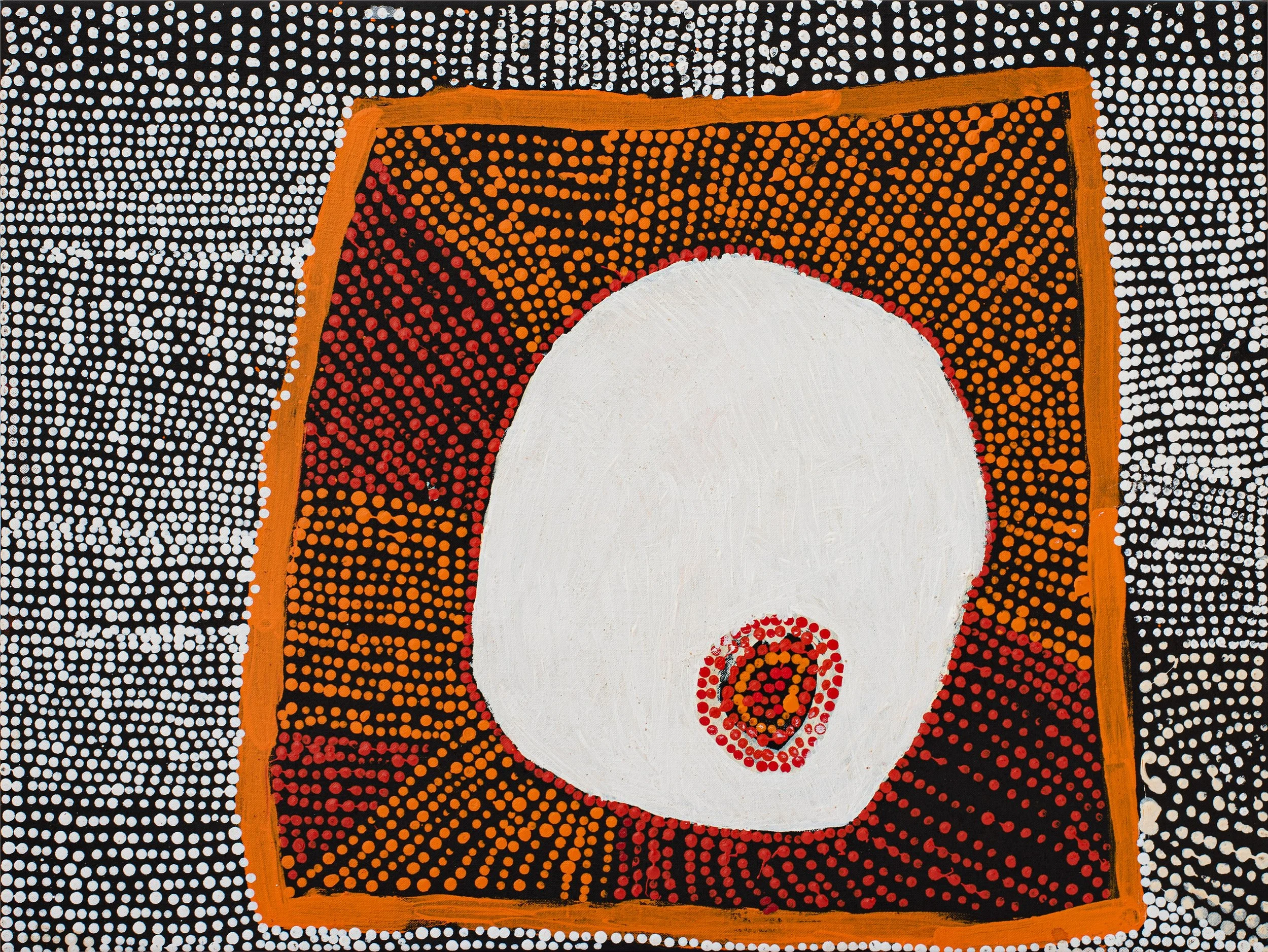
Artiste : Tasha Nampijinpa Collins
Titre de l'œuvre : Ngapa Jukurrpa (Water Dreaming) - Puyurru
Format : 61 x 46 cm
Provenance et certificat : centre d'art aborigène de Yuendumu
Référence de cette peinture : 4327/23
Demander le prix de l'œuvre / Enquiry
Explications de l'œuvre :
The site depicted in this painting is Puyurru, west of Yuendumu. In the usually dry creek beds are ‘mulju’ (soakages), or naturally occurring wells. The 'kirda' (owners) for this site are Nangala/Nampijinpa women and Jangala/Jampijinpa men. Two Jangala men, rainmakers, sang the rain, unleashing a giant storm. The storm travelled across the country from the east to the west, initially travelling with a ‘pamapardu Jukurrpa’ (termite Dreaming) from Warntungurru to Warlura, a waterhole 8 miles east of Yuendumu. At Warlura, a gecko called Yumariyumari blew the storm on to Lapurrukurra and Wilpiri. Bolts of lightning shot out at Wirnpa (also called Mardinymardinypa) and at Kanaralji.
At this point the Dreaming track also includes the ‘kurdukurdu mangkurdu Jukurrpa’ (children of the clouds Dreaming). The water Dreaming built hills at Ngamangama using baby clouds and also stuck long pointy clouds into the ground at Jukajuka, where they can still be seen today as rock formations. The termite Dreaming eventually continued west to Nyirripi, a community approximately 160 km west of Yuendumu. The water Dreaming then travelled from the south over Mikanji, a watercourse with soakages northwest of Yuendumu. At Mikanji, the storm was picked up by a ‘kirrkarlanji’ (brown falcon [Falco berigora]) and taken farther north. At Puyurru, the falcon dug up a giant ‘warnayarra’ (rainbow serpent). The serpent carried water with it to create another large lake, Jillyiumpa, close to an outstation in this country. The ‘kirda’ (owners) of this story are Jangala men and Nangala women.
After stopping at Puyurru, the water Dreaming travelled on through other locations including Yalyarilalku, Mikilyparnta, Katalpi, Lungkardajarra, Jirawarnpa, Kamira, Yurrunjuku, and Jikaya before moving on into Gurindji country to the north.
© Photo : Aboriginal Signature Estrangin gallery with the courtesy of the artists and Yuendumu
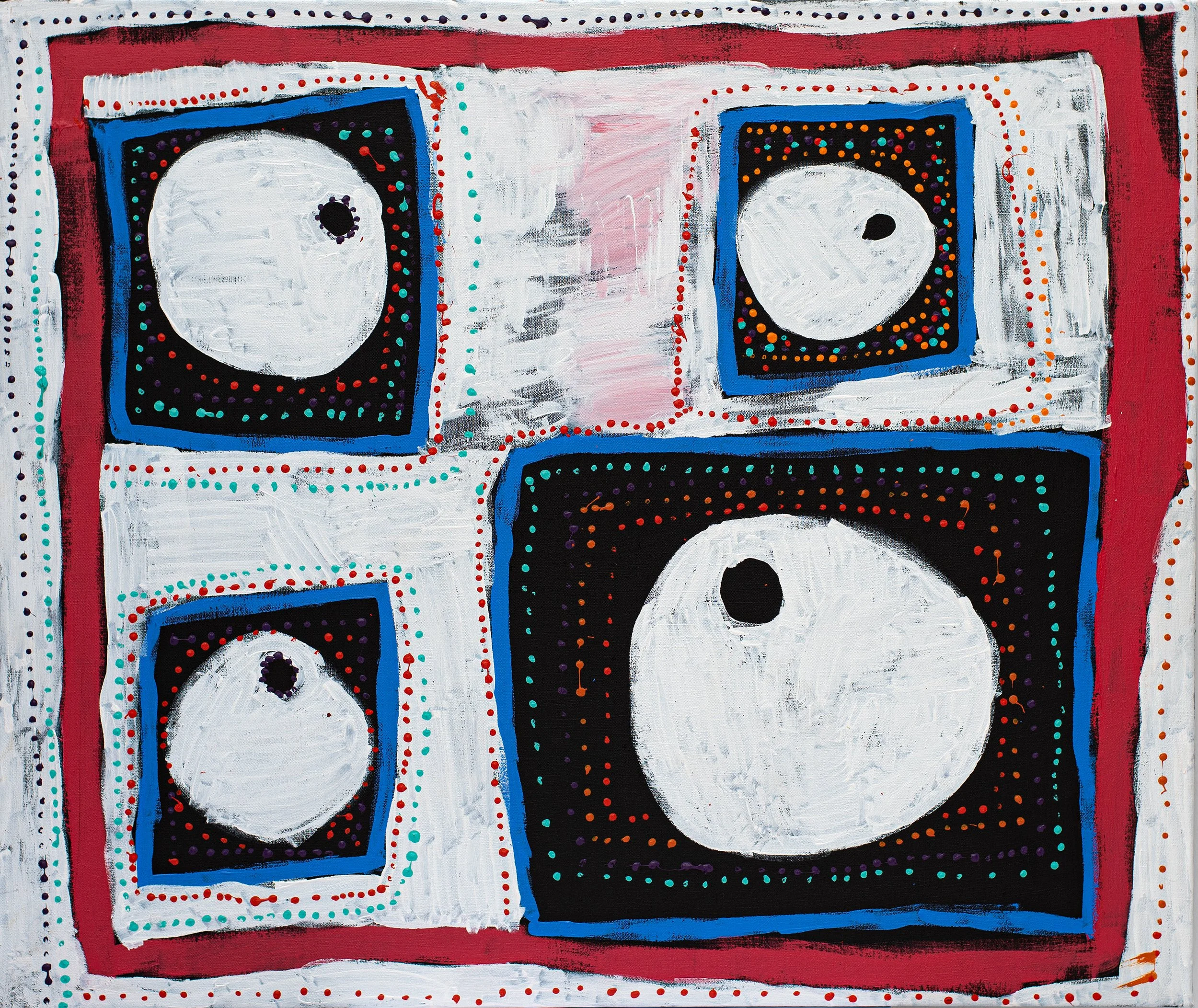
Artiste : Tasha Nampijinpa Collins
Titre de l'œuvre : Ngapa Jukurrpa (Water Dreaming) - Puyurru
Format : 91 x 76 cm
Provenance et certificat : centre d'art aborigène de Yuendumu
Référence de cette peinture : 4384/23
Demander le prix de l'œuvre / Enquiry
Explications de l'œuvre :
The site depicted in this painting is Puyurru, west of Yuendumu. In the usually dry creek beds are ‘mulju’ (soakages), or naturally occurring wells. The 'kirda' (owners) for this site are Nangala/Nampijinpa women and Jangala/Jampijinpa men. Two Jangala men, rainmakers, sang the rain, unleashing a giant storm. The storm travelled across the country from the east to the west, initially travelling with a ‘pamapardu Jukurrpa’ (termite Dreaming) from Warntungurru to Warlura, a waterhole 8 miles east of Yuendumu. At Warlura, a gecko called Yumariyumari blew the storm on to Lapurrukurra and Wilpiri. Bolts of lightning shot out at Wirnpa (also called Mardinymardinypa) and at Kanaralji.
At this point the Dreaming track also includes the ‘kurdukurdu mangkurdu Jukurrpa’ (children of the clouds Dreaming). The water Dreaming built hills at Ngamangama using baby clouds and also stuck long pointy clouds into the ground at Jukajuka, where they can still be seen today as rock formations. The termite Dreaming eventually continued west to Nyirripi, a community approximately 160 km west of Yuendumu. The water Dreaming then travelled from the south over Mikanji, a watercourse with soakages northwest of Yuendumu. At Mikanji, the storm was picked up by a ‘kirrkarlanji’ (brown falcon [Falco berigora]) and taken farther north. At Puyurru, the falcon dug up a giant ‘warnayarra’ (rainbow serpent). The serpent carried water with it to create another large lake, Jillyiumpa, close to an outstation in this country. The ‘kirda’ (owners) of this story are Jangala men and Nangala women.
After stopping at Puyurru, the water Dreaming travelled on through other locations including Yalyarilalku, Mikilyparnta, Katalpi, Lungkardajarra, Jirawarnpa, Kamira, Yurrunjuku, and Jikaya before moving on into Gurindji country to the north.
© Photo : Aboriginal Signature Estrangin gallery with the courtesy of the artists and Yuendumu

Artiste : Walter Jangala Brown
Titre de l'œuvre : Tingari Cycle sacred story
Format : 152 x 107 cm
Provenance et certificat : centre d'art aborigène de Yuendumu
Référence de cette peinture : 1301/22
Demander le prix de l'œuvre / Enquiry
© Photo : Aboriginal Signature Estrangin gallery with the courtesy of the artists and Yuendumu
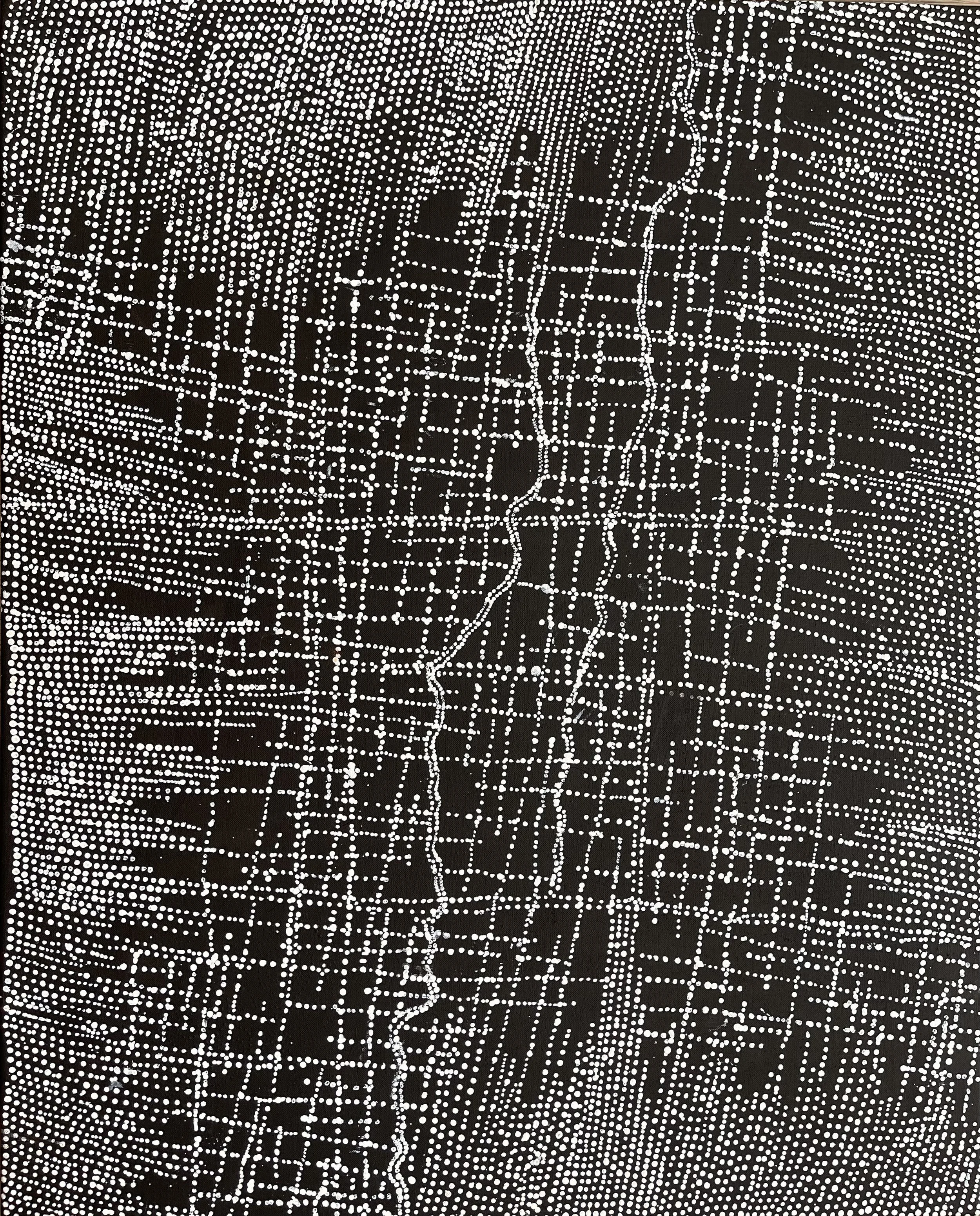
Artiste : Julie Nangala Robertson Shirley
Titre de l'œuvre : Ngapa Jukurrpa (Water Dreaming) - Pirlinyarnu
Format : 76x61cm
Provenance et certificat : centre d'art aborigène de Yuendumu
Référence de cette peinture : 987/21
Demander le prix de l'œuvre / Enquiry
© Photo : Aboriginal Signature Estrangin gallery with the courtesy of the artists and Yuendumu

Artiste : Julie Nangala Robertson Shirley
Titre de l'œuvre : Ngapa Jukurrpa (Water Dreaming) - Pirlinyarnu
Format : 183 x 91 cm
Provenance et certificat : centre d'art de Yuendumu
Référence de la peinture : 1731/21
Explications sur l’artiste et l'œuvre :
Julie Nangala Robertson is one of five daughters born in Yuendumu in 1973 to well-known Telstra Award winning artist, Dorothy Napangardi (Dec 2013). Since the late 1990’s, while often in the company of her talented mother, Julie has pursued and developed a creative visual language of her own, one which consists of a fascinating blend of stylised experimentation and ancient narrative.
Usually an aerial perspective along with a more recently and established distinctive monochromatic pallette, Julie’s current paintings (which depict the topographical features of her traditional country at the site of Pirlinyanu) have become works of extraordinary optical brilliance as she alternates the size of dots throughout her work as well as building up specific shapes or reference points often repeated with overdotting.
Julie has been painting with Warlukurlangu Artists Aboriginal Corporation, an Aboriginal owned and governed art centre located in Yuendumu, since 2007. She paints her mother’s Jukurrpa stories, stories that have been passed down to her by her mother and all the mothers before them for millennia. Her work has been included in numerous collections and exhibitions of Aboriginal Art in both Australia and overseas.
Since the late 1990’s, while often in the company of her talented mother, Julie has pursued and developed a creative visual language of her own, one which consists of a fascinating blend of stylised experimentation and ancient narrative.

Artiste : Julie Nangala Robertson
Titre de l'œuvre : Mina Mina Jukurrpa (Mina Mina Dreaming)
Format : 183 x 76 cm
Provenance et certificat : centre d'art de Yuendumu
Référence de la peinture : 1193/21
Explications sur l’artiste et l'œuvre :
Julie Nangala Robertson is one of five daughters born in Yuendumu in 1973 to well-known Telstra Award winning artist, Dorothy Napangardi (Dec 2013). Since the late 1990’s, while often in the company of her talented mother, Julie has pursued and developed a creative visual language of her own, one which consists of a fascinating blend of stylised experimentation and ancient narrative.
Usually an aerial perspective along with a more recently and established distinctive monochromatic pallette, Julie’s current paintings (which depict the topographical features of her traditional country at the site of Pirlinyanu) have become works of extraordinary optical brilliance as she alternates the size of dots throughout her work as well as building up specific shapes or reference points often repeated with overdotting.
Julie has been painting with Warlukurlangu Artists Aboriginal Corporation, an Aboriginal owned and governed art centre located in Yuendumu, since 2007. She paints her mother’s Jukurrpa stories, stories that have been passed down to her by her mother and all the mothers before them for millennia. Her work has been included in numerous collections and exhibitions of Aboriginal Art in both Australia and overseas.
Since the late 1990’s, while often in the company of her talented mother, Julie has pursued and developed a creative visual language of her own, one which consists of a fascinating blend of stylised experimentation and ancient narrative.

Artiste : Sabrina Nangala Robertson
Titre de l'œuvre : Ngapa Jukurrpa (Water Dreaming)
Format : 76x46cm
Provenance et certificat : centre d'art aborigène de Yuendumu
Référence de cette peinture : 1578-21
Demander le prix de l'œuvre / Enquiry
© Photo : Aboriginal Signature Estrangin gallery with the courtesy of the artists and Yuendumu

Artiste : Sabrina Nangala Robertson
Titre de l'œuvre : Ngapa Jukurrpa (Water Dreaming)
Format : 76x46cm
Provenance et certificat : centre d'art aborigène de Yuendumu
Référence de cette peinture : 1579/21
Demander le prix de l'œuvre / Enquiry
© Photo : Aboriginal Signature Estrangin gallery with the courtesy of the artists and Yuendumu

Artiste : Patrick Japangardi Williams
Titre de l'œuvre : Mina Mina Jukurrpa (Mina Mina Dreaming)
Format : 107 x 107 cm
Provenance et certificat : centre d'art aborigène de Yuendumu
Référence de cette peinture : 4314/17
Demander le prix de l'œuvre / Enquiry
© Photo : Aboriginal Signature Estrangin gallery with the courtesy of the artists and Yuendumu

Artiste : Chantelle Nampijinpa Robertson
Titre de l'œuvre : Ngapa Jukurrpa (Water Dreaming) - Puyurru
Format : 122 x 107 cm
Provenance et certificat : centre d'art aborigène de Yuendumu
Référence de cette peinture : 1270/21
Demander le prix de l'œuvre / Enquiry
© Photo : Aboriginal Signature Estrangin gallery with the courtesy of the artists and Yuendumu

Artiste : Jacob Jungarrayi Spencer
Titre de l'œuvre : Ngalyipi Jukurrpa (Snake Vine Dreaming) - Purturlu
Format : 183 x 76 cm
Provenance et certificat : centre d'art aborigène de Yuendumu
Référence de cette peinture : 2974/18ny
Demander le prix de l'œuvre / Enquiry
© Photo : Aboriginal Signature Estrangin gallery with the courtesy of the artists and Yuendumu

Artiste : Elsie Napanangka Granites
Titre de l'œuvre : Mina Mina Jukurrpa
Format : 152 x 107cm
Provenance et certificat : centre d'art aborigène de Yuendumu
Référence de cette peinture : 1387-21
Demander le prix de l'œuvre / Enquiry
© Photo : Aboriginal Signature Estrangin gallery with the courtesy of the artists and Yuendumu
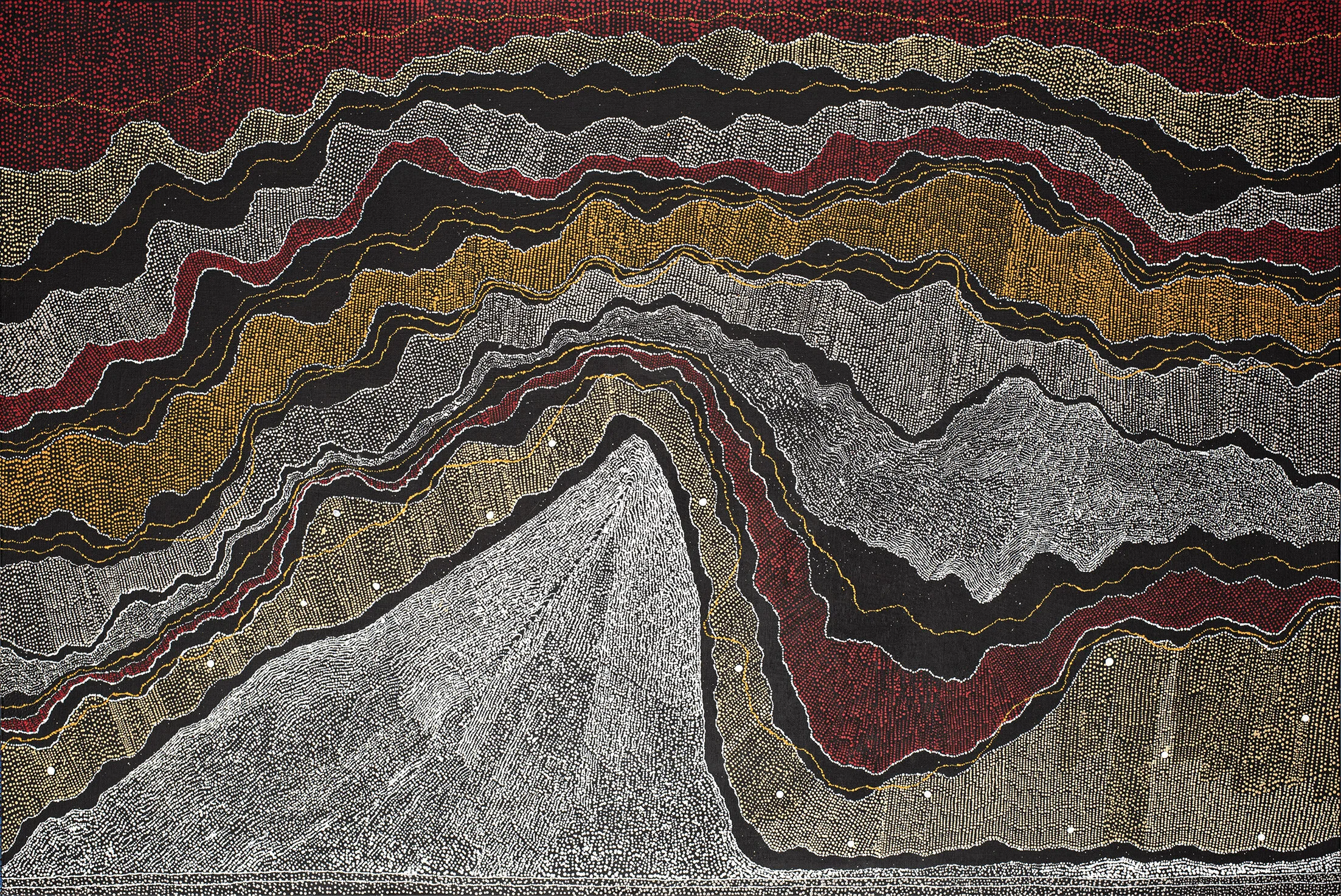
Artiste : Julie Nangala Robertson
Titre de l'œuvre : Ngapa Jukurrpa (Water Dreaming) - Pirlinyarnu
Format : 183 x 122 cm
Provenance et certificat : centre d'art de Yuendumu
Référence de la peinture : 1893/15
Explications sur l’artiste et l'œuvre :
Julie Nangala Robertson is one of five daughters born in Yuendumu in 1973 to well-known Telstra Award winning artist, Dorothy Napangardi (Dec 2013). Since the late 1990’s, while often in the company of her talented mother, Julie has pursued and developed a creative visual language of her own, one which consists of a fascinating blend of stylised experimentation and ancient narrative.
Usually an aerial perspective along with a more recently and established distinctive monochromatic pallette, Julie’s current paintings (which depict the topographical features of her traditional country at the site of Pirlinyanu) have become works of extraordinary optical brilliance as she alternates the size of dots throughout her work as well as building up specific shapes or reference points often repeated with overdotting.
Julie has been painting with Warlukurlangu Artists Aboriginal Corporation, an Aboriginal owned and governed art centre located in Yuendumu, since 2007. She paints her mother’s Jukurrpa stories, stories that have been passed down to her by her mother and all the mothers before them for millennia. Her work has been included in numerous collections and exhibitions of Aboriginal Art in both Australia and overseas.
Since the late 1990’s, while often in the company of her talented mother, Julie has pursued and developed a creative visual language of her own, one which consists of a fascinating blend of stylised experimentation and ancient narrative.

Artiste : Julie Nangala Robertson
Titre de l'œuvre : Ngapa Jukurrpa (Water Dreaming) - Pirlinyarnu
Format : 152 x 152 cm
Provenance et certificat : centre d'art de Yuendumu
Référence de la peinture : 4571/17
Explications sur l’artiste et l'œuvre :
Julie Nangala Robertson is one of five daughters born in Yuendumu in 1973 to well-known Telstra Award winning artist, Dorothy Napangardi (Dec 2013). Since the late 1990’s, while often in the company of her talented mother, Julie has pursued and developed a creative visual language of her own, one which consists of a fascinating blend of stylised experimentation and ancient narrative.
Usually an aerial perspective along with a more recently and established distinctive monochromatic pallette, Julie’s current paintings (which depict the topographical features of her traditional country at the site of Pirlinyanu) have become works of extraordinary optical brilliance as she alternates the size of dots throughout her work as well as building up specific shapes or reference points often repeated with overdotting.
Julie has been painting with Warlukurlangu Artists Aboriginal Corporation, an Aboriginal owned and governed art centre located in Yuendumu, since 2007. She paints her mother’s Jukurrpa stories, stories that have been passed down to her by her mother and all the mothers before them for millennia. Her work has been included in numerous collections and exhibitions of Aboriginal Art in both Australia and overseas.
Since the late 1990’s, while often in the company of her talented mother, Julie has pursued and developed a creative visual language of her own, one which consists of a fascinating blend of stylised experimentation and ancient narrative.
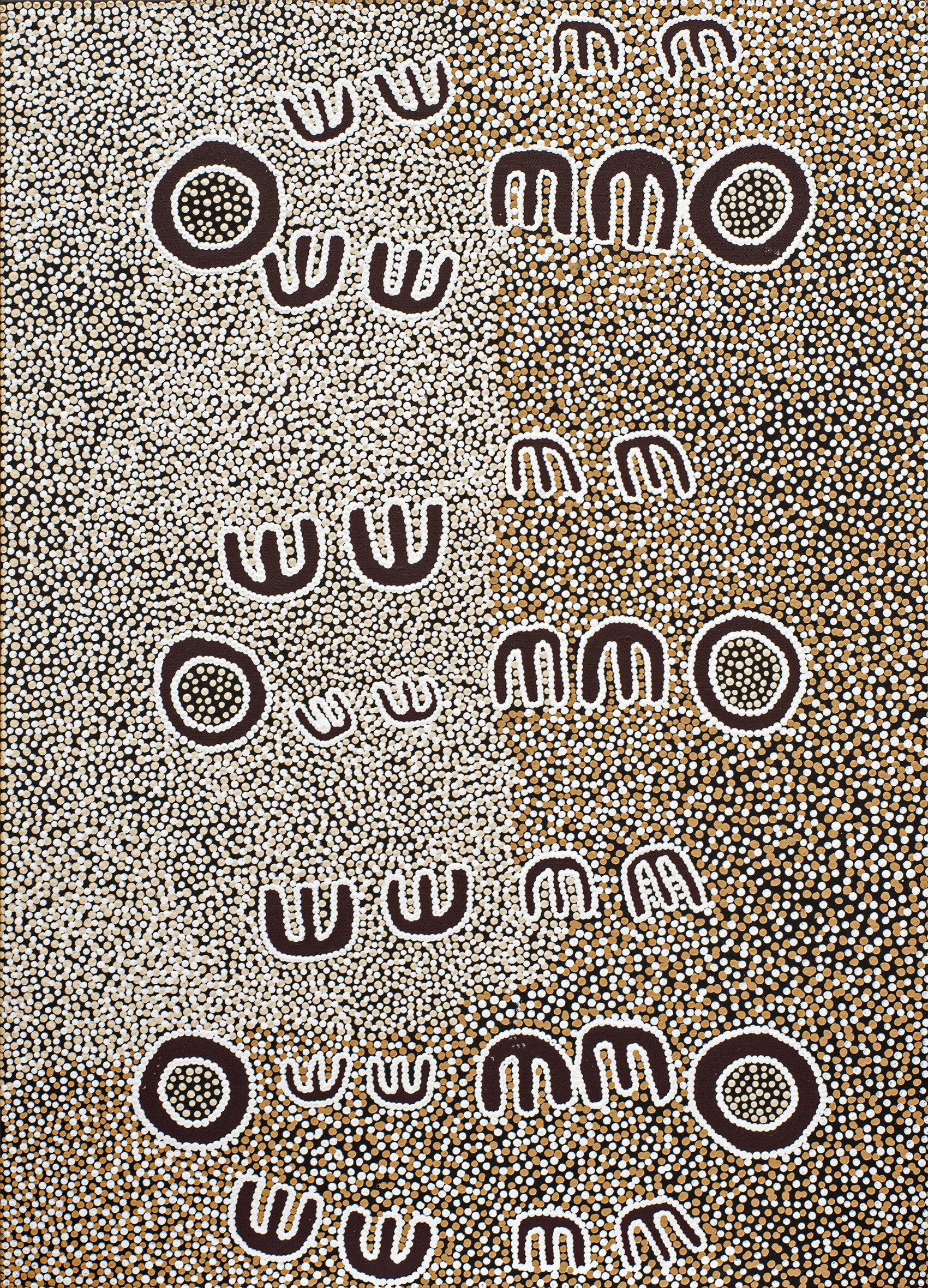
Artiste : Chris Japanangka Michaels
Titre de l'œuvre : Janganpa Jukurrpa (Brush-tail Possum Dreaming) - Mawurrji
Format : 107 x 76 cm
Provenance et certificat : centre d'art aborigène de Yuendumu
Référence de cette peinture : 2804/19ny
Demander le prix de l'œuvre / Enquiry
© Photo : Aboriginal Signature Estrangin gallery with the courtesy of the artists and Yuendumu
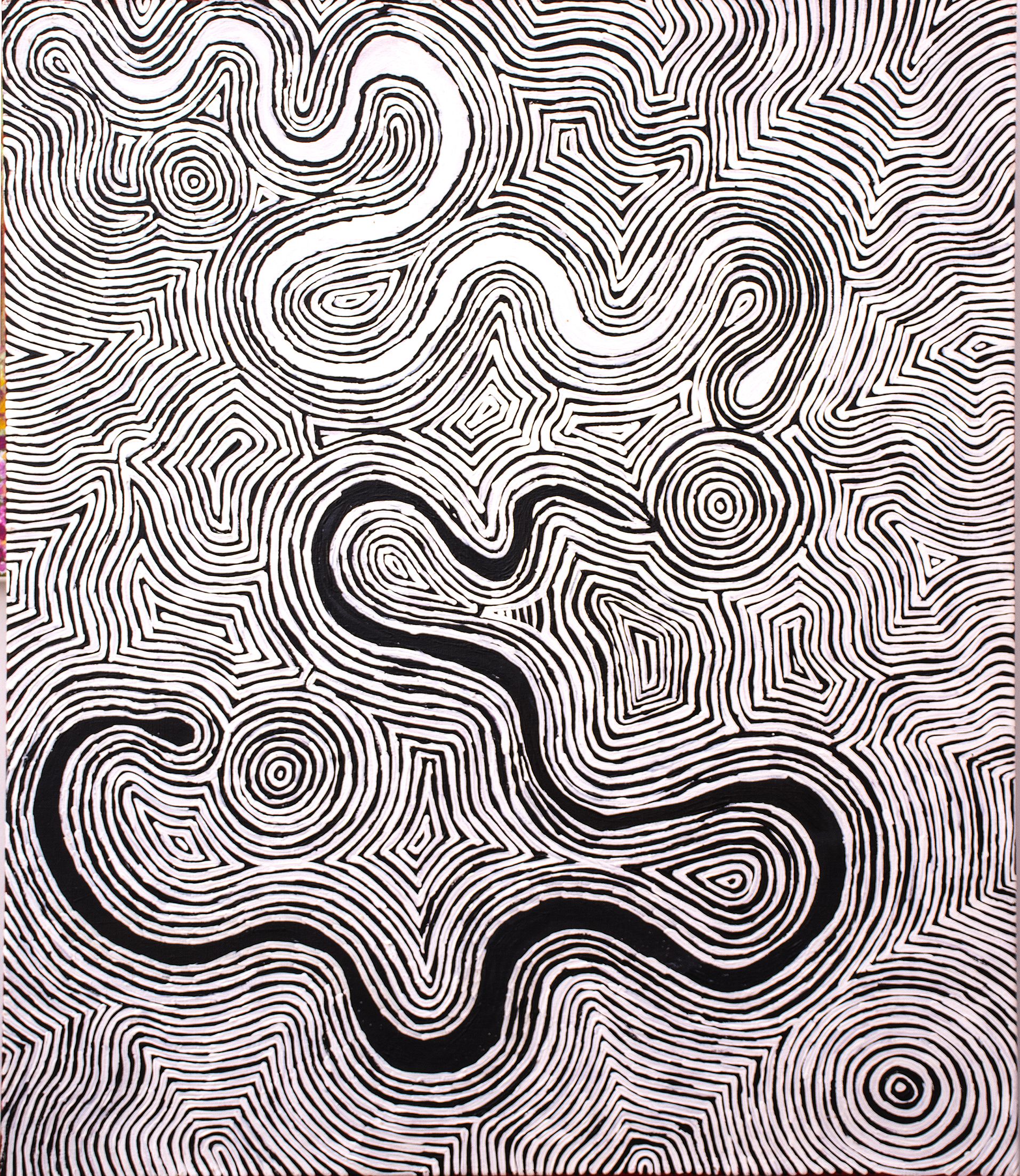
Artiste : Leston Japaljarri Spencer
Titre de l'œuvre : Warna Jukurrpa (Snake Dreaming)
Format : 107 x 91 cm
Provenance et certificat : centre d'art de Yuendumu
Référence de la peinture : 1538/17ny
Explications sur l'œuvre :
The place depicted in this painting, Ngama, is located south of Yuendumu in the Northern Territory. This Dreaming belongs to Nakamarra/Napurrurla women and Jakamarra/Jupurrurla men. This story describes the journey of Yarripiri, an ancestral 'warna' (snake). He travelled from Wirnparrku near Mt. Liebig to Yimparlu, and continued its way through the territories of Ngapanangka-jarra, Warlajirryi, Kurnmundu, Yinyirrinyi on to Ngama. Later Yar(piri travelled further north via Mijirlparnta (Mission Creek) and right through to the top end of Australia.Yarripiri was very sad as his family had left him behind at Wirnparrku. He was blind and crippled but he was determined to follow and search them out. He had to be carried.
This was the job undertaken by the 'kurdungurlu' (ceremonial police) of the Dreaming: the Nangala/Nampijinpa women and Jangala/Jampijinpa men. Where Yarripiri's tail slumped and touched the ground creeks were formed, such as M ijirlparnta, west of Yuendumu. Yarripiri tracks and paths are often represented by arc shapes or curved lines depicted across the canvas.

Artiste : Jacob Jungarrayi Spencer
Titre de l'œuvre : Ngalyipi Jukurrpa (Snake Vine Dreaming) - Purturlu
Format : 122 x 76 cm
Provenance et certificat : centre d'art aborigène de Yuendumu
Référence de cette peinture : 2186/19ny
Demander le prix de l'œuvre / Enquiry
© Photo : Aboriginal Signature Estrangin gallery with the courtesy of the artists and Yuendumu

Artiste : Justinna Napaljarri Sims
Titre de l'œuvre : Yanjirlpirri or Napaljarri-Warnu Jukurrpa (Star or Seven Sisters Dreaming)
Format : 152 x 61 cm
Provenance et certificat : centre d'art aborigène de Yuendumu
Référence de cette peinture : 3793/18
Demander le prix de l'œuvre / Enquiry
© Photo : Aboriginal Signature Estrangin gallery with the courtesy of the artists and Yuendumu
Cette communauté artistique est également reconnue pour des projets marquants dans l'histoire de l'art Aborigène, comme des peintures murales sur le magasin de la communauté hier, un musée des hommes avec des peintures murales historiques, et les extraordinaires portes peintes qui sont exposées en partie de façon permanente dans le musée d'Adelaïde.
Ces 30 portes de l'école de Yuendumu ont été peintes en 1984 par les Aborigènes Warlpiri, avec le même respect que leurs ancêtres peignant des parois rocheuses. Ce projet remarquable impulsé par une professeur de science de l'école de Yuendumu, Edith Coulshed (Edith Coombe aujourd'hui), reprend sur les portes plus de 100 sites sacrés liés au Temps du rêve (Jukurrpa) autour de Yuendumu.
Chaque porte raconte une histoire ancienne, témoin de leur culture ancestrale. Les portes ont été progressivement restaurées, avant d'être présentées à nouveau en Australie ou en Europe comme il y a quelques années dans le cadre dans une exposition temporaire au Musée d'Art Aborigène d'Utrecht (AAMU).
Artiste : Lloyd Jampijinpa Brown
Titre de l'œuvre : Yankirri Jukurrpa (Emu Dreaming) - Ngarlikirlangu
Format : 55 x 40 cm
Provenance et certificat : centre d'art aborigène de Yuendumu
Référence de cette peinture : 169/26
Demander le prix de l'œuvre / Enquiry
Explications pour cette œuvre :
This painting depicts a ‘yankirri Jukurrpa’ (emu [Dromaius novaehollandiae] Dreaming) from a place called Ngarlikurlangu, approximately 50kms north of Yuendumu. The ‘kirda’ (owners) of this Dreaming are Nangala/Nampijinpa women and Jangala/Jampijinpa men. This Jukurrpa tells the story of a ‘yankirri’ (emu) and a ‘wardilyka’ (bush turkey [Ardeotis australis]). ‘Yankirri’ lived at a soakage to the west called Warnirripanu (or Walangkamirirri), while ‘wardilyka’ lived at a soakage to the east called Parirri. The emu and bush turkey used to go around the country picking ‘yakajirri’ (bush raisins [Solanum centrale]) and mashing them into ‘kapurdu’ (fruit balls) to save in their nests for later. However, they were jealous of each other; the emu thought that the bush turkey was picking the best and juiciest ‘yakajirri’, and was leaving him with only the sour ‘yakajirri’.
The emu went to the bush turkey’s nest to the east while the bush turkey was out hunting and smashed up the ‘kapurdu’ that the bush turkey had saved there. When the bush turkey returned, he found his smashed ‘yakajirri’ balls and realized that the emu had destroyed them. He went to the west to confront the emu and when he found him, they got into a big fight. The bush turkey eventually flew away to the north, leaving behind the smashed ‘yakajirri’ balls.
This practice of making ‘kapurdu’ (fruit balls) is a traditional Warlpiri method of storing ‘yakajirri’; in the old days, people used to dry the ‘yakajirri’, grind them up with a rock in a coolamon, mix them with water and form balls from them, and cover the ‘kapurdu’ with red ochre so they would keep. Today at Ngarlikirlangu we can see round, red rocks which are the ‘kapurdu’ that the emu smashed up. There is also a dance for this ‘yankirri’ (emu) Jukurrpa that is performed during mens’ initiation ceremonies. A number of other Jukurrpa are also located at Ngarlikirlangu, including ‘wardilyka Jukurrpa’ (bush turkey Dreaming), ‘yardijiinypa Jukurrpa’ (meat ant Dreaming), and ‘pirntina Jukurrpa’ (woma or Ramsay’s python [Aspidites ramsayi] Dreaming). Lots of ‘yakajirri’ grow around the Ngarlikirlangu area today.
© Photo : Aboriginal Signature Estrangin gallery with the courtesy of the artists and Yuendumu