
Exposition d’art Aborigène “The Sovereigns of the Memory” - Aboriginal art from Australia
En partenariat avec les artistes du centre d’art du Spinifex Art Project
A la galerie Aboriginal Signature Estrangin : 101 rue Jules Besme, 1081 Bruxelles.
Vernissage sur RDV le mardi 22 octobre de 14h à 21h30.
A 20h - discours du directeur de la galerie et drink.
RSVP - réserver votre visite
Ensuite la galerie vous reçoit sur RDV, du mercredi 22 octobre au samedi 16 novembre 2024, du mardi au samedi, de 11h à 19h : vous pouvez réserver votre visite dés à présent dans notre agenda ici.
“The Sovereigns of the memory”
Nous avons le plaisir de vous convier à l'exposition exceptionnelle "The Sovereigns of the Memory", en partenariat avec le Spinifex Art Project. Plongez dans l'univers vibrant des artistes de Tjtuntjunjara, véritables souverains de la mémoire sur leur terre, qui nous rappellent l'importance vitale de la transmission et de la culture aborigène.
"The Sovereigns of the Memory" est une ode à l'autorité de ces artistes, porteurs de savoirs, de lois et de traditions ancestrales. Leur rôle en tant que gardiens de la mémoire et de la culture est essentiel pour assurer la transmission de cette richesse à l’avenir.
Cette exposition célèbre les liens profonds entre ces artistes, hommes et femmes, et leur territoire, souvent plus vaste que plusieurs pays d'Europe. Leur art va bien au-delà de la simple création : ils sont, hommes et femmes, les gardiens d'une mémoire collective, des princes sur des paysages chargés de signification.

Vue de l’exposition “Sovereigns of the Memory” à la galerie Aboriginal Signature Estrangin, en partenariat avec le Spinifex Art Project © Photo Aboriginal Signature Estrangin Gallery with the courtesy of the artist
Leurs œuvres font partie des collections du British Museum, où l’artiste Simon Hogan né en 1930 fut reçu par Sa Majesté Charles, soulignant l'importance de leur héritage.
Grâce à la loi sur le Native Title, les artistes de Tjtuntjunjara ont récupéré une partie de leurs terres, un symbole fort de leur continuité culturelle ininterrompue.
Les 18 artistes né(e)s entre 1930 et 1980 ont réalisé 45 œuvres pour cette exposition à Bruxelles, que j’allais sélectionner dans leur Grand Désert du Victoria en Juillet 2013. Ces peintures remarquables présentées à Koekelberg évoquent une mémoire ancienne et un engagement profond à préserver cette richesse pour les générations futures.
Juillet 2023 : sur la route des anciens océans
La journée commence avec des paysages que seuls les plus vastes déserts peuvent offrir. Je roule depuis l’aube sur une mer pétrifiée, jonchée de milliers de boules de pierre, les restes fossilisés d’un océan disparu. Les stromatolithes, ces mystérieuses compositions de pierre sphériques avec des bactéries primitives, ont autrefois peuplé les fonds de cet océan avant que les eaux ne se retirent, laissant place à l’étendue aride du grand désert du Victoria. Le moindre freinage brusque pourrait transformer cette piste en véritable patinoire pour mon 4x4. Ici, mieux vaut anticiper chaque mouvement, chaque virage.
Le fuseau horaire a changé : me voilà à l’heure de Perth, avec une heure trente de décalage sur le centre du pays. Le ciel s’assombrit tôt ici, et à 17h30, il est déjà d’un noir d’encre. Pas un bruit. Pas une lumière à l’horizon. Seulement le désert qui s’étend à perte de vue sous une voûte céleste constellée d’étoiles.
Ce matin, j’ai quitté la maison à 6h, accompagné par les dingos qui rôdent dans les environs. Ils sont devenus des habitués de ces terres, discrets mais omniprésents. La douche à l'extérieur a été une épreuve en soi : l'air était glacé, et avec seulement 3 degrés, chaque goutte d'eau semblait me figer sur place. Mon corps a mis du temps à se réchauffer, tremblant longtemps après que mes mains se soient enfin dégourdies au-dessus des flammes du feu de bois.

Vue de l’exposition “Sovereigns of the Memory” à la galerie Aboriginal Signature Estrangin, en partenariat avec le Spinifex Art Project © Photo Aboriginal Signature Estrangin Gallery with the courtesy of the artist

Vue de l’exposition “Sovereigns of the Memory” à la galerie Aboriginal Signature Estrangin, en partenariat avec le Spinifex Art Project © Photo Aboriginal Signature Estrangin Gallery with the courtesy of the artist

Vue de la piste dans le Grand Désert du Victoria © Photo Bertrand Estrangin
Le diesel : la ressource la plus précieuse
Ici, le carburant est une denrée rare et précieuse. Le diesel se négocie presque comme de l’or. Dans cette région reculée, où les pompes à essence sont aussi rares que les arbres, le prix est à plus de 3,65 dollars le litre. Peu importe si le réservoir est à moitié plein, chaque goutte compte. On ne peut jamais être trop prudent, car chaque arrêt pour remplir son réservoir est un pas de plus vers la survie et le chemin de retour. Ce matin, à la seul pompe égarée dans le désert à la Ilkurlka Roadhouse, j’ai fait le plein à ras bord, quitte à rajouter quelques litres de plus pour être sûr de ne jamais tomber à sec en plein désert. Cet endroit est habité par homme toute l’année, souvent seul, et il accueille juste quelques centaines de visiteurs par an, qui tentent l’aventure de traverser l’Australie d’Est en Ouest par la Anne Beadell Highway, qui n’a rien d’une autoroute, mais résiste aux éléments sous la forme d’une piste de sable par moment chaotique.

Peinture de l’artiste Winmati Roberts (1957), Titre : Sacred Tjara, Format : 137 x 90 cm. © Photo Aboriginal Signature Estrangin Gallery with the courtesy of the artist and the Spinifex Art Project

Peinture de l’artiste Winmati Roberts (1957), Titre : Sacred Tjara. Format : 137 x 90 cm. © Photo Aboriginal Signature Estrangin Gallery with the courtesy of the artist and the Spinifex Art Project
Dans le magasin de la station d’essence, mes deux livres sur le Spinifex Art Project publiés à Bruxelles sont en vente, accompagnés d'un grand panneau explicatif. Ils rencontrent un succès inattendu ici, loin de l’Europe. Cela me réchauffe le cœur, d’autant plus que j’ai récemment ressenti une certaine désaffection de la part des librairies belges. Une nouvel ouvrage est en préparation avec les artistes du Spinifex Art Project pour célébrer ces expositions inoubliables d’un peuple installé en ces lieux depuis plus de 25 000 ans.

Vue de l’exposition “Sovereigns of the Memory” à la galerie Aboriginal Signature Estrangin, en partenariat avec le Spinifex Art Project © Photo Aboriginal Signature Estrangin Gallery with the courtesy of the artist
24 juillet 2023 – Rencontre avec les sentinelles du désert
Aujourd’hui, c’est au tour des Rangers de prendre la route. Ces hommes et femmes veillent sur ce territoire immense et sauvage, avec un sens du devoir qui force l’admiration. À l’abri des regards, ils patrouillent pour s’assurer que la nature reste maîtresse de ces lieux. Phil, inquiet de possibles collisions sur les dunes, me conseille de partir tôt pour éviter de croiser les Rangers roulant en sens inverse. Une route privatisée pour moi seul, l’espace de ma traversé de 300 km sur une partie de la journée, avant que ces gardiens ne reprennent leur chemin en début d’après-midi.

Vue de l’exposition “Sovereigns of the Memory” à la galerie Aboriginal Signature Estrangin, en partenariat avec le Spinifex Art Project © Photo Aboriginal Signature Estrangin Gallery with the courtesy of the artist
Je suis fasciné par cette organisation minutieuse dans un environnement si hostile. Se mettre d'accord sur le sens de la piste par téléphone satellite avant de s’y aventurer est presque surréaliste, mais ici, c'est une question de survie. Nous ne sommes que quelques âmes à arpenter ces pistes. Il ne faudrait pas se heurter en gravissant en sens inverses ces 365 dunes de sable de 10 m de haut.

Vue de l’exposition “Sovereigns of the Memory” à la galerie Aboriginal Signature Estrangin, en partenariat avec le Spinifex Art Project © Photo Aboriginal Signature Estrangin Gallery with the courtesy of the artist
La rareté de l’eau
Le thermomètre n’affichera pas plus de 17 degrés aujourd’hui, ce qui semble presque clément pour cette période de l’année. Pourtant, le froid est mordant la nuit, surtout lorsque le vent se lève et balaie les plaines. Je continue d’inspecter les containers à eau de pluie installés à intervalles réguliers d'environ 50 km. Ces réservoirs sont vitaux pour quiconque s’aventure aussi loin. Sans eux, l’épuisement ou la déshydratation guettent, car sans eau, il ne faut guère plus d’une journée avant de s’éteindre. Certains des réservoirs fonctionnent bien, d’autres ont été endommagés par des chameaux sauvages, leurs mâchoires massives tentant en vain de déplacer les lourds contenants de plusieurs tonnes.

Peinture de l’artiste Lennard Walker (1946), Titre : Iwara Tali, Format : 200 x 137 cm. Ref : 24-339. © Photo Aboriginal Signature Estrangin Gallery with the courtesy of the artist and the Spinifex Art Project
L’accueil des rangers vers Tjuntjuntjara
À 40 kilomètres de Tjuntjuntjara, je croise enfin ces deux voitures de Rangers. Un senior et deux jeunes aborigènes de 20 à 30 ans, employés par l'État pour veiller sur ce territoire immense. Leurs visages sont marqués par le soleil et le vent, et leur accueil est chaleureux. C’est mon unique rencontre de la journée. Ils me conseillent quelques endroits pour camper la nuit. Cela les étonne un peu que je sois seul dans un endroit si reculé, mais ils ne me dissuadent pas, respectant mon besoin de solitude dans ces contrées désertiques. « Installez-vous où vous voulez », me dit l’un d’eux, dans un élan de bienveillance. Je ressens alors un immense soulagement, après avoir passé l’après-midi à redouter de me retrouver au mauvais endroit, dans un lieu sacré où je pourrais ne pas avoir ma place.

Vue de l’exposition “Sovereigns of the Memory” à la galerie Aboriginal Signature Estrangin, en partenariat avec le Spinifex Art Project © Photo Aboriginal Signature Estrangin Gallery with the courtesy of the artist
25 juillet 2023 – Le silence d’or de la nuit
Je prends une route latérale qui longe un lac salé avant de trouver une petite percée entre deux dunes pour installer mon camp. Le soleil couchant teinte le paysage d’une lumière dorée. Je m’aventure hors du 4x4 pour ramasser du bois de Mulga, ces arbres résistants qui offrent une chaleur longue et précieuse une fois réduits en braises. Un tronc lourd s’écrase par inadvertance sur mon pied et me rappelle la dureté du terrain. Heureusement, le Voltaren que j’ai emporté devrait m’éviter une grosse ecchymose.
La lune s’élève lentement dans un ciel pourpre. Le désert s'endort, et avec lui, les insectes et les oiseaux. Un silence assourdissant s’installe, seulement interrompu par le craquement des branches qui nourrissent mon feu. Les braises du bois de Mulga, bien plus denses que celles du chêne, diffusent une chaleur réconfortante à plusieurs mètres de distance. Les eucalyptus aux écorces blanches se dressent comme des sentinelles à l’horizon, veillant sur mon sommeil. Je m’enroule dans ma deuxième polaire et ajuste mon bonnet avant de m’endormir, seul, au milieu de cet océan de dunes rouges.
Demain, je retrouverai les derniers nomades d’Australie. Une autre étape dans ce voyage hors du temps.
Certains nous ont quitté il y a peu : Lawrence Pennington, Fred Grant, Myrtle Pennington, et nous sommes émus de vous montrer la quintessence de leurs créations artistiques. D’autres résistent et continuent de créer avec une main habile qui a gardé la mémoire tandis que les yeux s’affaiblissent, comme Simon Hogan né en 1930.
D’autres grands artistes manifestent leur maturité, et leur autorité sur ces paysages spirituels comme Lennard Walker, Ned Grant.
Mick, Ian et Noli Rictor continuent de manifester l’intensité des lieux chargés d’histoires de la Création, en tant que derniers nomades d’Australie en 1986, avec Tjaruwa Woods (dec).
Le fil de transmission se poursuit avec force et intensité, chez un peuple ancré en ces lieux depuis la nuit des temps, au moins depuis 25 000 ans, à une échelle peu appréhendable pour un monde plus occidental qui fut si souvent en migration et en mouvement, avec une génération plus jeune qui porte le flambeau, comme les artistes Timo Hogan avec sa connaissance et sa vision du lac Baker, Winmati Roberts avec ses œuvres vibrantes et luminescentes dans la nuit pour renforcer le sacré, et Jessica Veronica Brown avec ses créations remarquables autour des Seven Sisters.

Vue de l’exposition “Sovereigns of the Memory” à la galerie Aboriginal Signature Estrangin, en partenariat avec le Spinifex Art Project © Photo Aboriginal Signature Estrangin Gallery with the courtesy of the artist
A Bruxelles, venez découvrir comment ces œuvres puissantes nous invitent à réfléchir sur notre propre rapport à la mémoire, à la terre et à la culture. Rejoignez-nous pour une immersion inoubliable dans l'art aborigène et un hommage à ceux qui défendent leur héritage avec fierté et détermination.
Nous avons hâte de vous accueillir et de partager cette expérience unique en Europe avec vous !
À la galerie Aboriginal Signature Estrangin, nous attachons une grande importance à l’approche communautaire solidaire dans nos expositions. En réunissant à chaque fois plusieurs artistes d’une même communauté, nous souhaitons souligner la force de la transmission entre générations, des artistes seniors aux plus jeunes, dans une dynamique de partage du savoir millénaire australien.
Ici dans la capitale de l’Europe, nous vous convions pour célébrer la puissance de ces artistes qui perpétuent une tradition ancestrale tout en la réinventant pour le monde moderne. Les œuvres sélectionnées vibrent d'une énergie connectée, reflétant la beauté préservée de leur territoire, et la résilience de ces peuples premiers, gardiens de la terre.
Bertrand Estrangin
Directeur
Découvrez les peintures de l’exposition :
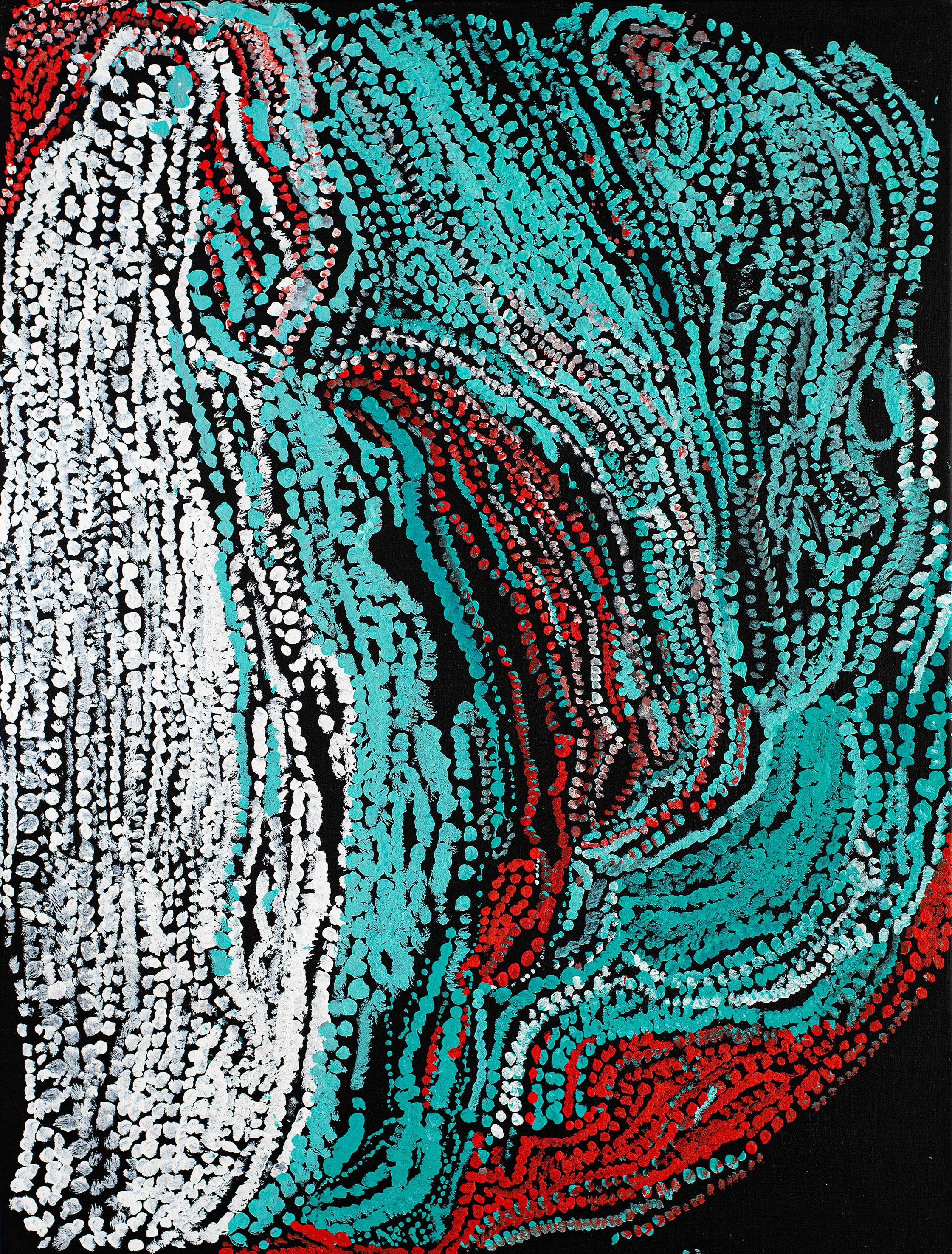
Artiste : Lawrence Pennington
Titre de l'œuvre : Pukara Dreaming Time story
Format : 110 × 85 cm
Provenance et certificat : centre d'art aborigène du Spinifex Art Project
Référence de cette peinture : 21-103
Enquiry / Demander le prix de l'œuvre
Explications pour cette œuvre :
Lawrence Pennington (1934) touches the deepest qualities of the Tjukurpa in the unseen, taking the broad brush to minimal resemblance of the characters that inhabited the first journey. He guides the significant site of Pukara effortlessly onto the canvas, channelling the essence of Wati Kutjara Tjukurpa (Two Men Creation Line) from a time before when Lawrence walked throughout Spinifex Country. A time when he walked with the Song, following the physical manifestation left by the creation beings in the landscape, of the stories that made it so and of the characters that played out the journey. It is from Pukara that the Two Men, a father and son powerful water serpent, depart on a significant ceremonial journey throughout Spinifex Country.
His artworks are in the following prestigious collections :
Araluen Gallery, Alice Springs, Northern Territory.
National Gallery Of Australia, Canberra, Act (Mens Collaborative)
Richard And Harriet England Collection
Seattle Art Museum, Seattle, Usa. (Mens Collaborative)
The Corrigan Collection, Australia (Mens Collaborative)
The National Gallery Of Victoria, Melbourne, Vic.
W. & V. Mcgeoch Collection, Melbourne, Vic.
Wagner And Owen Collection (Usa)
The Art Gallery Of New South Wales, Sydney, Nsw (Mens Collaborative)
Art Gallery Of South Australia, Adelaide, South Australia (Mens Collaborative)
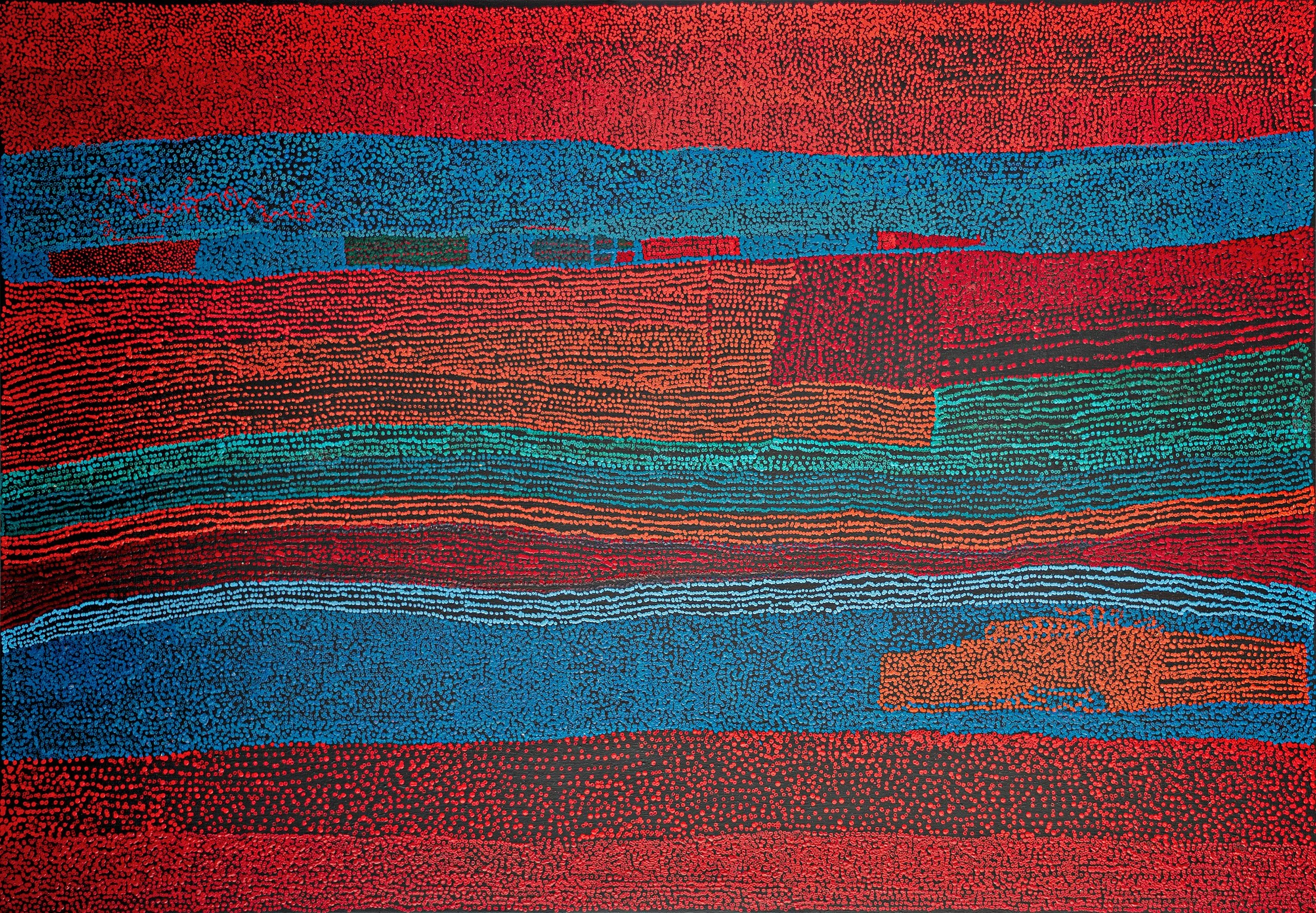
Artiste : Noli Rictor
Titre de l'œuvre : Kamanti
Format : 200 x 137 cm
Provenance et certificat : centre d'art aborigène du Spinifex Art Project
Référence de cette peinture : 24-263
Demander le prix de l'œuvre / Enquiry
Explications pour cette œuvre :
Noli has depicted the significant site of Kamanti situated in the north of traditional Spinifex lands. This site holds s the Wati Kutjara Tjukurpa (Two Men Creation Line) and is an epic narrative following the movement of a father and son water serpent who traverse the Spinifex Lands on ceremonial business. Noli depicts country he was born into and which formed his religious upbringing. The arid but spiritual environment was the birthplace of the creation beings who shaped the landscape as they moved through it. They left indelible physical reminders of their power in the form of creeks or rocky ridges or a type of tree.
But mostly they left their place of abode or the life giving sought after source of precious water, in some form of catchment. This water source is the embodiment of survival within the remote desert extremes with the sites being venerated as such and usually guarded by beings who shifted through the realms. They are the characters who dramatise the landscape and give rise to the formations through their movements. They leave behind a mapped moral landscape that holds an elaborate oral religion of song and performance that still permeates Noli's daily life.
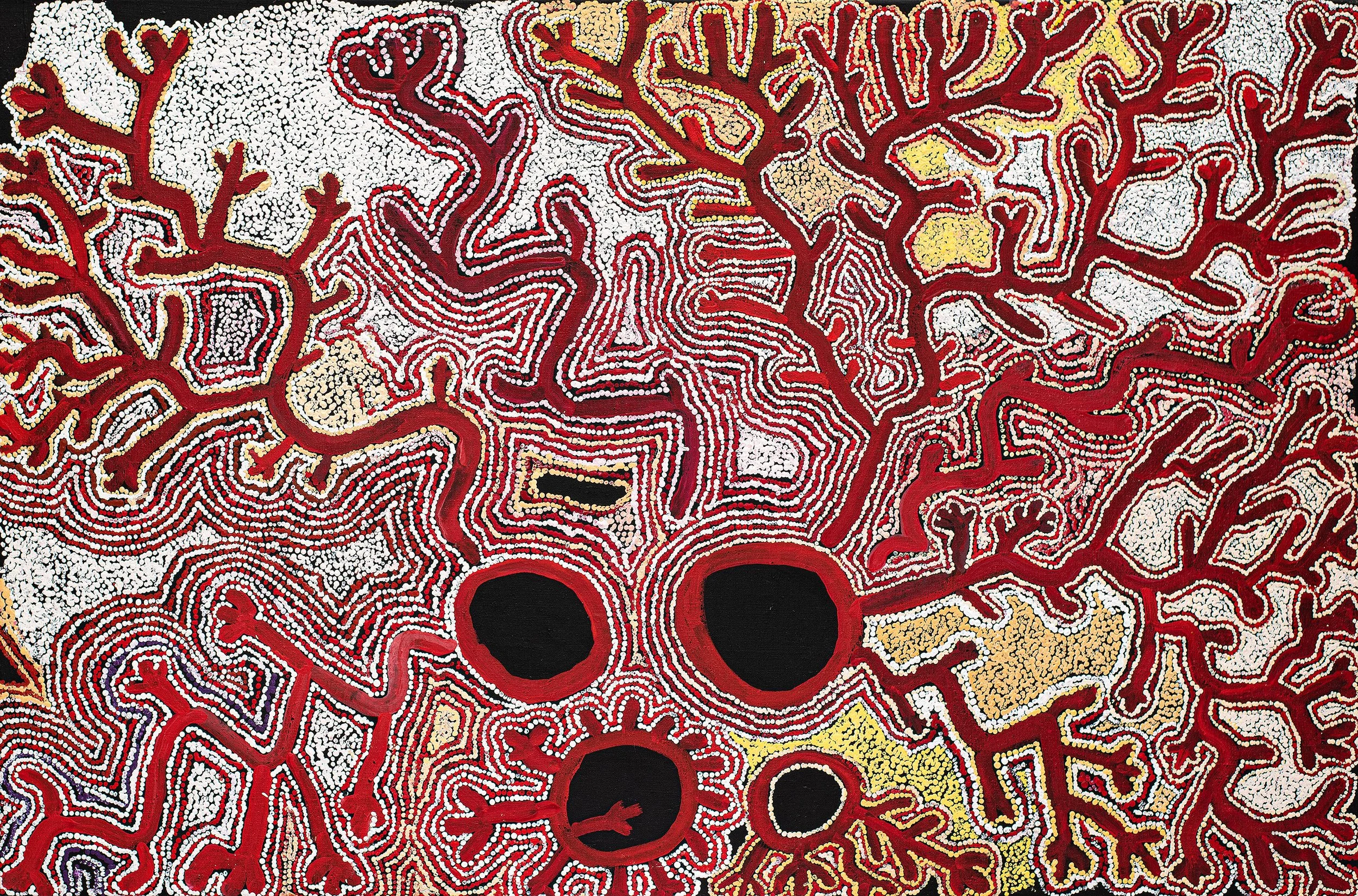
Artiste : Simon Hogan
Titre de l'œuvre : Lingka
Format : 137 x 90 cm
Provenance et certificat : centre d'art aborigène du Spinifex Art Project
Référence de cette peinture : 19-172
Enquiry / Demander le prix de l'œuvre
Explications pour cette œuvre :
Simon Hogan (1930) manifests his site of Lingka onto the two dimensional plane. When he paints, he transcends this world and is taken over soft sand ridges and vast Spinifex plains to the significant sites that formed him from birth. For Simon was born into a spiritual society where religion manifested in the immediate environment and where creation beings could move through different realms at will. It is these beings who shaped the landscape that Simon depicts and who left a moral compass that is still followed today. They gave to people the life giving water sites that were held with such reverence in an arid and remote land. It is these sites that were the means of survival and where religion unfolded in the form of sacred song and performance.
Simon Hogan was born circa 1930 in mid-western Spinifex between Paltju and Lingka. Simon’s exact age is unknown as dates of birth were estimated by the A.E.M. missionaries when the Spinifex people, on arrival at Cundeelee, were “sorted” into family groups, given English names and approximate dates of birth. During childhood two fathers, one born at Warakunu and the other at Munki raised Simon. Simon’s mother’s country is around Tjulya. The Spinifex people were a relatively discreet southern Pitjantjatjara tribal group with es to the north and east that lived a fully traditional hunter-gatherer life until the late1950’s to early 1960s when most people either walked in to Ooldea and Cundeelee or were taken by AEM missionaries to Cundeelee Mission…
From 1995 Simon Hogan was a prominent member of a group of senior traditional owners from Spinifex country who lobbied the WA State Government for Native Title. Although Simon spoke no English he was a confident, initiated Pitjantjatjara man who spoke to senior government officials regarding ownership of country and culture. Exclusive Native Title rights were granted to Simon Hogan and the Spinifex people in 2000 of over 55 000 sq kms of the Great Victoria Desert in WA.
His artworks are in the following prestigious collections :
Art Gallery Of South Australia, Adelaide, South Australia
British Museum, London, England.
Harriet And Richard England Collection
National Gallery Of Australia, Canberra, Act.
National Gallery Of Victoria, Melbourne, Victoria.
Seattle Art Museum, Seattle, Usa. (Mens Collaborative)
Staatliches Museum Fur Volkerkunde, Munich, Germany
The Lepley Collection, Perth, Western Australia.
The Patrick Corrigan Collection, Sydney, New South Wales.
W. & V. Mcgeoch Collection
Western Australian Museum, Perth, W.A.
Artbank, Australian Government Collection. Australia.
Art Gallery Of Western Australia, Perth, Western Australia.
The Art Gallery Of New South Wales, Sydney, Nsw (Mens Collaborative)
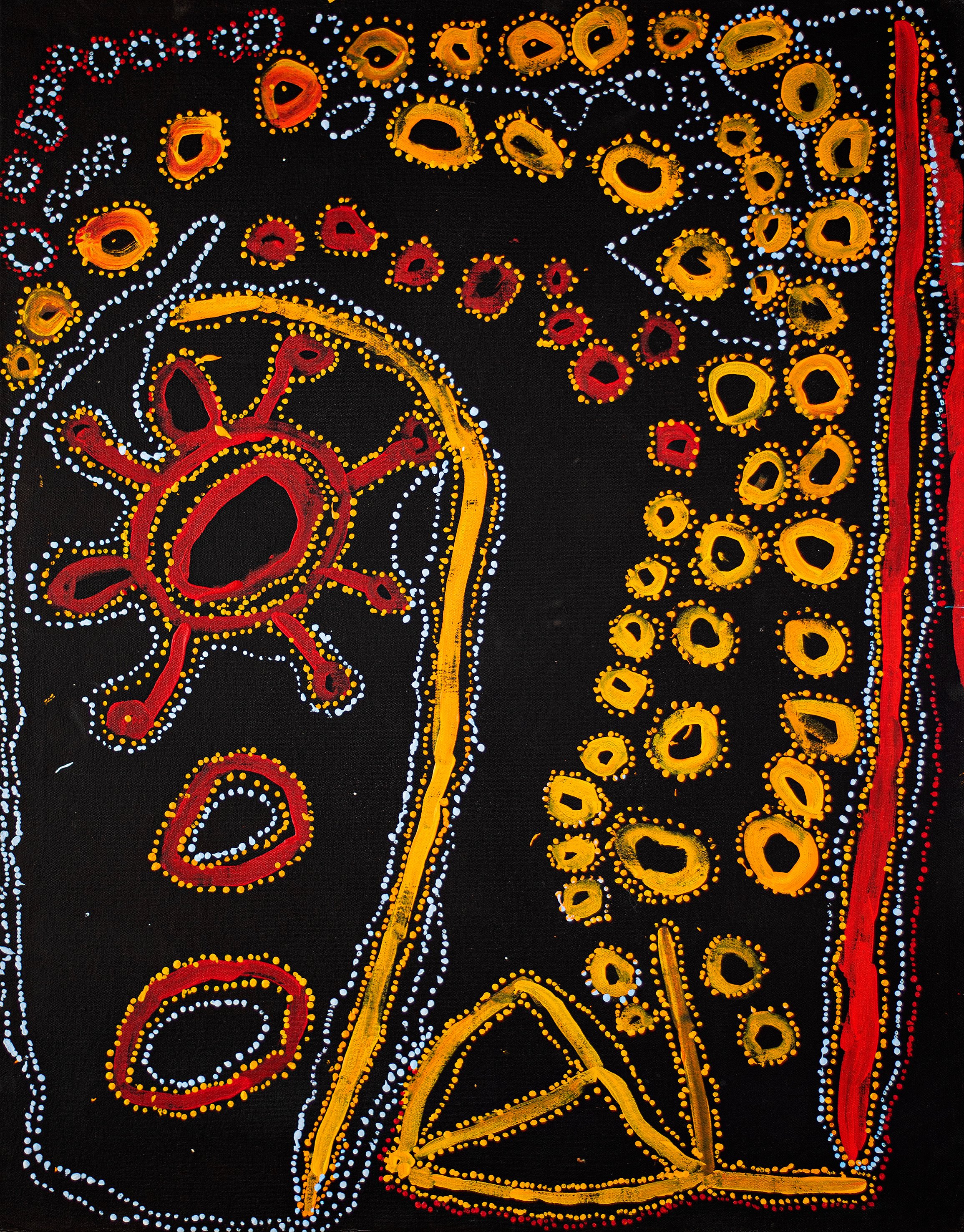
Artiste : Lawrence Pennington
Titre de l'œuvre : Pukara Dreaming Time story
Format : 110 × 85 cm
Provenance et certificat : centre d'art aborigène du Spinifex Art Project
Référence de cette peinture : 18-215
Enquiry / Demander le prix de l'œuvre
Explications pour cette œuvre :
Lawrence Pennington (1934) touches the deepest qualities of the Tjukurpa in the unseen, taking the broad brush to minimal resemblance of the characters that inhabited the first journey. He guides the significant site of Pukara effortlessly onto the canvas, channelling the essence of Wati Kutjara Tjukurpa (Two Men Creation Line) from a time before when Lawrence walked throughout Spinifex Country. A time when he walked with the Song, following the physical manifestation left by the creation beings in the landscape, of the stories that made it so and of the characters that played out the journey. It is from Pukara that the Two Men, a father and son powerful water serpent, depart on a significant ceremonial journey throughout Spinifex Country.
His artworks are in the following prestigious collections :
Araluen Gallery, Alice Springs, Northern Territory.
National Gallery Of Australia, Canberra, Act (Mens Collaborative)
Richard And Harriet England Collection
Seattle Art Museum, Seattle, Usa. (Mens Collaborative)
The Corrigan Collection, Australia (Mens Collaborative)
The National Gallery Of Victoria, Melbourne, Vic.
W. & V. Mcgeoch Collection, Melbourne, Vic.
Wagner And Owen Collection (Usa)
The Art Gallery Of New South Wales, Sydney, Nsw (Mens Collaborative)
Art Gallery Of South Australia, Adelaide, South Australia (Mens Collaborative)
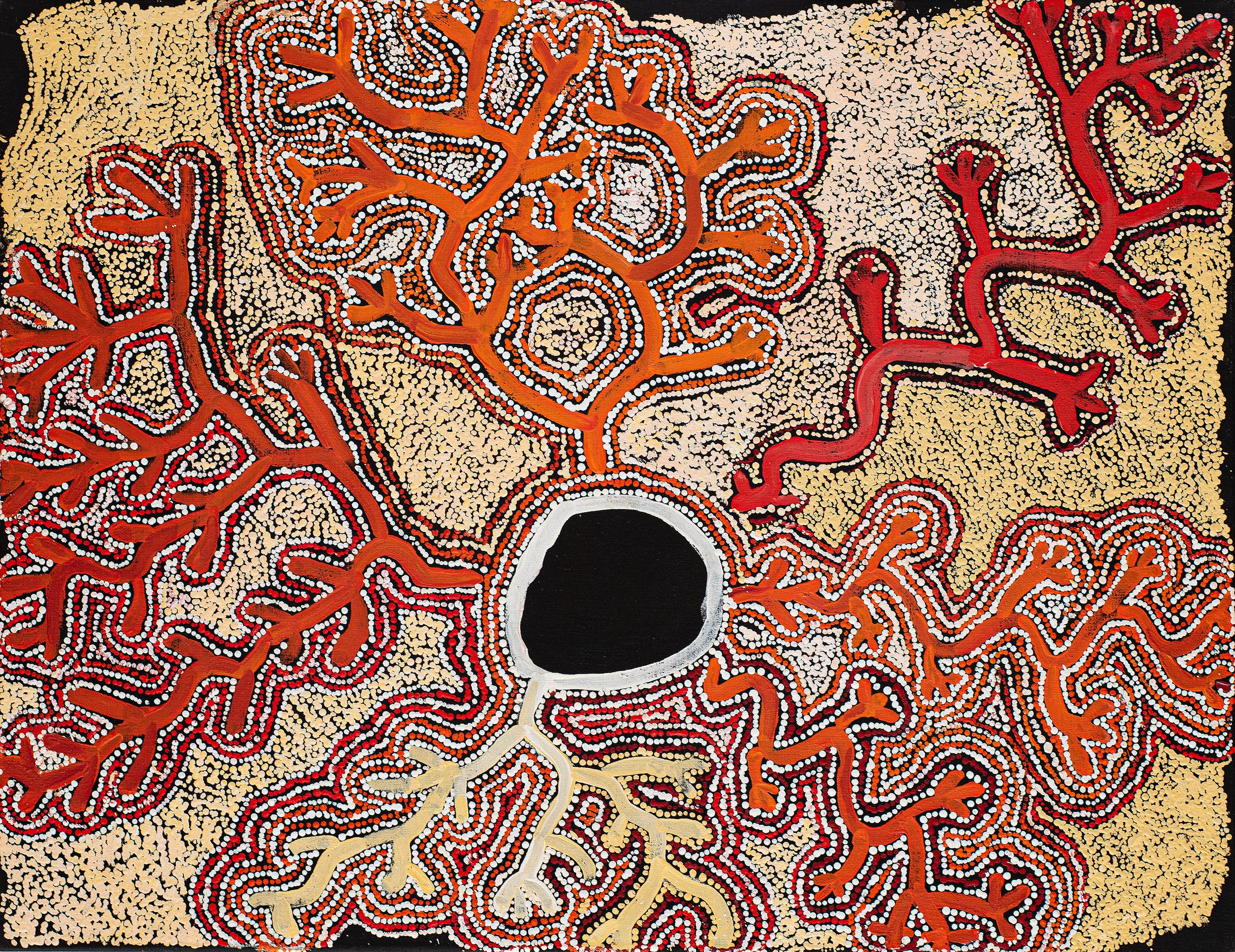
Artiste : Simon Hogan
Titre de l'œuvre : Lingka
Format : 110 × 85 cm
Provenance et certificat : centre d'art aborigène du Spinifex Art Project
Référence de cette peinture : 19-382
Enquiry / Demander le prix de l'œuvre
Explications pour cette œuvre :
Simon Hogan (1930) manifests his site of Lingka onto the two dimensional plane. When he paints, he transcends this world and is taken over soft sand ridges and vast Spinifex plains to the significant sites that formed him from birth. For Simon was born into a spiritual society where religion manifested in the immediate environment and where creation beings could move through different realms at will. It is these beings who shaped the landscape that Simon depicts and who left a moral compass that is still followed today. They gave to people the life giving water sites that were held with such reverence in an arid and remote land. It is these sites that were the means of survival and where religion unfolded in the form of sacred song and performance.
Simon Hogan was born circa 1930 in mid-western Spinifex between Paltju and Lingka. Simon’s exact age is unknown as dates of birth were estimated by the A.E.M. missionaries when the Spinifex people, on arrival at Cundeelee, were “sorted” into family groups, given English names and approximate dates of birth. During childhood two fathers, one born at Warakunu and the other at Munki raised Simon. Simon’s mother’s country is around Tjulya. The Spinifex people were a relatively discreet southern Pitjantjatjara tribal group with es to the north and east that lived a fully traditional hunter-gatherer life until the late1950’s to early 1960s when most people either walked in to Ooldea and Cundeelee or were taken by AEM missionaries to Cundeelee Mission…
From 1995 Simon Hogan was a prominent member of a group of senior traditional owners from Spinifex country who lobbied the WA State Government for Native Title. Although Simon spoke no English he was a confident, initiated Pitjantjatjara man who spoke to senior government officials regarding ownership of country and culture. Exclusive Native Title rights were granted to Simon Hogan and the Spinifex people in 2000 of over 55 000 sq kms of the Great Victoria Desert in WA.
His artworks are in the following prestigious collections :
Art Gallery Of South Australia, Adelaide, South Australia
British Museum, London, England.
Harriet And Richard England Collection
National Gallery Of Australia, Canberra, Act.
National Gallery Of Victoria, Melbourne, Victoria.
Seattle Art Museum, Seattle, Usa. (Mens Collaborative)
Staatliches Museum Fur Volkerkunde, Munich, Germany
The Lepley Collection, Perth, Western Australia.
The Patrick Corrigan Collection, Sydney, New South Wales.
W. & V. Mcgeoch Collection
Western Australian Museum, Perth, W.A.
Artbank, Australian Government Collection. Australia.
Art Gallery Of Western Australia, Perth, Western Australia.
The Art Gallery Of New South Wales, Sydney, Nsw (Mens Collaborative)

Artiste : Simon Hogan
Titre de l'œuvre : Lingka
Format : 137 x 90 cm
Provenance et certificat : centre d'art aborigène du Spinifex Art Project
Référence de cette peinture : 21-345
Enquiry / Demander le prix de l'œuvre
Explications pour cette œuvre :
Simon Hogan (1930) manifests his site of Lingka onto the two dimensional plane. When he paints, he transcends this world and is taken over soft sand ridges and vast Spinifex plains to the significant sites that formed him from birth. For Simon was born into a spiritual society where religion manifested in the immediate environment and where creation beings could move through different realms at will. It is these beings who shaped the landscape that Simon depicts and who left a moral compass that is still followed today. They gave to people the life giving water sites that were held with such reverence in an arid and remote land. It is these sites that were the means of survival and where religion unfolded in the form of sacred song and performance.
Simon Hogan was born circa 1930 in mid-western Spinifex between Paltju and Lingka. Simon’s exact age is unknown as dates of birth were estimated by the A.E.M. missionaries when the Spinifex people, on arrival at Cundeelee, were “sorted” into family groups, given English names and approximate dates of birth. During childhood two fathers, one born at Warakunu and the other at Munki raised Simon. Simon’s mother’s country is around Tjulya. The Spinifex people were a relatively discreet southern Pitjantjatjara tribal group with es to the north and east that lived a fully traditional hunter-gatherer life until the late1950’s to early 1960s when most people either walked in to Ooldea and Cundeelee or were taken by AEM missionaries to Cundeelee Mission…
From 1995 Simon Hogan was a prominent member of a group of senior traditional owners from Spinifex country who lobbied the WA State Government for Native Title. Although Simon spoke no English he was a confident, initiated Pitjantjatjara man who spoke to senior government officials regarding ownership of country and culture. Exclusive Native Title rights were granted to Simon Hogan and the Spinifex people in 2000 of over 55 000 sq kms of the Great Victoria Desert in WA.
His artworks are in the following prestigious collections :
Art Gallery Of South Australia, Adelaide, South Australia
British Museum, London, England.
Harriet And Richard England Collection
National Gallery Of Australia, Canberra, Act.
National Gallery Of Victoria, Melbourne, Victoria.
Seattle Art Museum, Seattle, Usa. (Mens Collaborative)
Staatliches Museum Fur Volkerkunde, Munich, Germany
The Lepley Collection, Perth, Western Australia.
The Patrick Corrigan Collection, Sydney, New South Wales.
W. & V. Mcgeoch Collection
Western Australian Museum, Perth, W.A.
Artbank, Australian Government Collection. Australia.
Art Gallery Of Western Australia, Perth, Western Australia.
The Art Gallery Of New South Wales, Sydney, Nsw (Mens Collaborative)
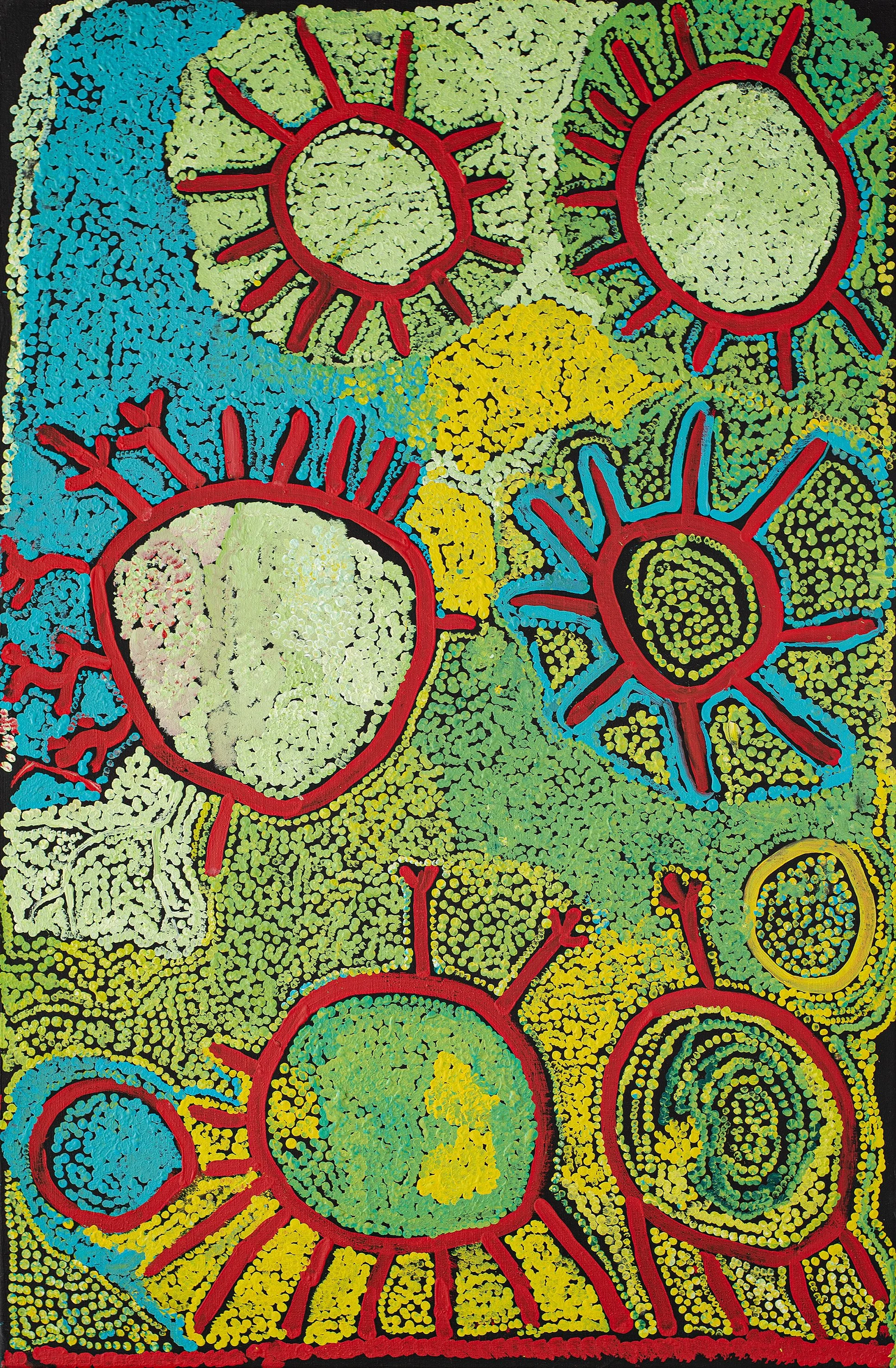
Artiste : Simon Hogan
Titre de l'œuvre : Lingka
Format : 137 x 90 cm
Provenance et certificat : centre d'art aborigène du Spinifex Art Project
Référence de cette peinture : 23-147
Enquiry / Demander le prix de l'œuvre
Explications pour cette œuvre :
Simon Hogan (1930) manifests his site of Lingka onto the two dimensional plane. When he paints, he transcends this world and is taken over soft sand ridges and vast Spinifex plains to the significant sites that formed him from birth. For Simon was born into a spiritual society where religion manifested in the immediate environment and where creation beings could move through different realms at will. It is these beings who shaped the landscape that Simon depicts and who left a moral compass that is still followed today. They gave to people the life giving water sites that were held with such reverence in an arid and remote land. It is these sites that were the means of survival and where religion unfolded in the form of sacred song and performance.
Simon Hogan was born circa 1930 in mid-western Spinifex between Paltju and Lingka. Simon’s exact age is unknown as dates of birth were estimated by the A.E.M. missionaries when the Spinifex people, on arrival at Cundeelee, were “sorted” into family groups, given English names and approximate dates of birth. During childhood two fathers, one born at Warakunu and the other at Munki raised Simon. Simon’s mother’s country is around Tjulya. The Spinifex people were a relatively discreet southern Pitjantjatjara tribal group with es to the north and east that lived a fully traditional hunter-gatherer life until the late1950’s to early 1960s when most people either walked in to Ooldea and Cundeelee or were taken by AEM missionaries to Cundeelee Mission…
From 1995 Simon Hogan was a prominent member of a group of senior traditional owners from Spinifex country who lobbied the WA State Government for Native Title. Although Simon spoke no English he was a confident, initiated Pitjantjatjara man who spoke to senior government officials regarding ownership of country and culture. Exclusive Native Title rights were granted to Simon Hogan and the Spinifex people in 2000 of over 55 000 sq kms of the Great Victoria Desert in WA.
His artworks are in the following prestigious collections :
Art Gallery Of South Australia, Adelaide, South Australia
British Museum, London, England.
Harriet And Richard England Collection
National Gallery Of Australia, Canberra, Act.
National Gallery Of Victoria, Melbourne, Victoria.
Seattle Art Museum, Seattle, Usa. (Mens Collaborative)
Staatliches Museum Fur Volkerkunde, Munich, Germany
The Lepley Collection, Perth, Western Australia.
The Patrick Corrigan Collection, Sydney, New South Wales.
W. & V. Mcgeoch Collection
Western Australian Museum, Perth, W.A.
Artbank, Australian Government Collection. Australia.
Art Gallery Of Western Australia, Perth, Western Australia.
The Art Gallery Of New South Wales, Sydney, Nsw (Mens Collaborative)
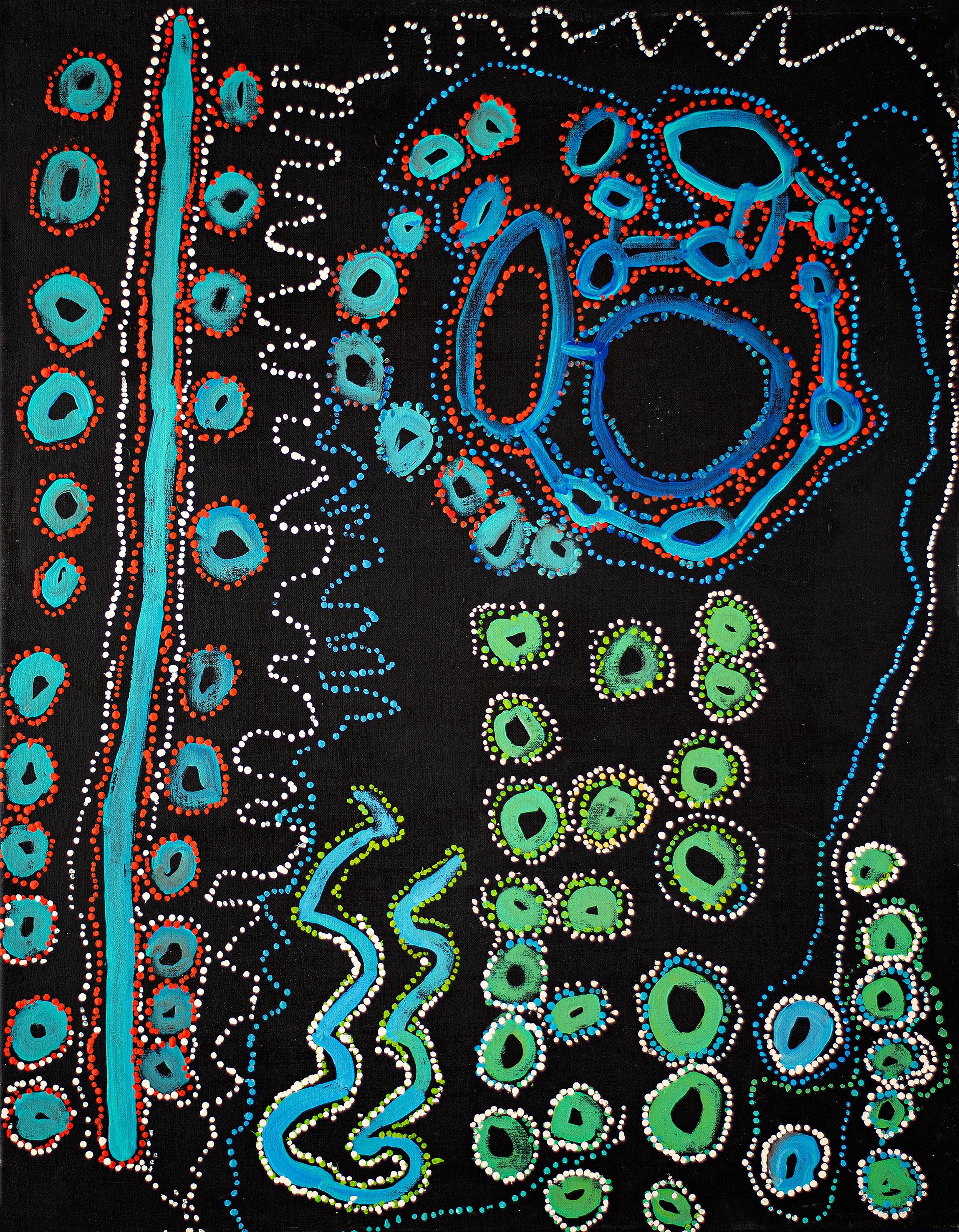
Artiste : Lawrence Pennington
Titre de l'œuvre : Pukara Dreaming Time story
Format : 110 × 85 cm
Provenance et certificat : centre d'art aborigène du Spinifex Art Project
Référence de cette peinture : 14210
Enquiry / Demander le prix de l'œuvre
Explications pour cette œuvre :
Lawrence Pennington (1934) touches the deepest qualities of the Tjukurpa in the unseen, taking the broad brush to minimal resemblance of the characters that inhabited the first journey. He guides the significant site of Pukara effortlessly onto the canvas, channelling the essence of Wati Kutjara Tjukurpa (Two Men Creation Line) from a time before when Lawrence walked throughout Spinifex Country. A time when he walked with the Song, following the physical manifestation left by the creation beings in the landscape, of the stories that made it so and of the characters that played out the journey. It is from Pukara that the Two Men, a father and son powerful water serpent, depart on a significant ceremonial journey throughout Spinifex Country.
His artworks are in the following prestigious collections :
Araluen Gallery, Alice Springs, Northern Territory.
National Gallery Of Australia, Canberra, Act (Mens Collaborative)
Richard And Harriet England Collection
Seattle Art Museum, Seattle, Usa. (Mens Collaborative)
The Corrigan Collection, Australia (Mens Collaborative)
The National Gallery Of Victoria, Melbourne, Vic.
W. & V. Mcgeoch Collection, Melbourne, Vic.
Wagner And Owen Collection (Usa)
The Art Gallery Of New South Wales, Sydney, Nsw (Mens Collaborative)
Art Gallery Of South Australia, Adelaide, South Australia (Mens Collaborative)
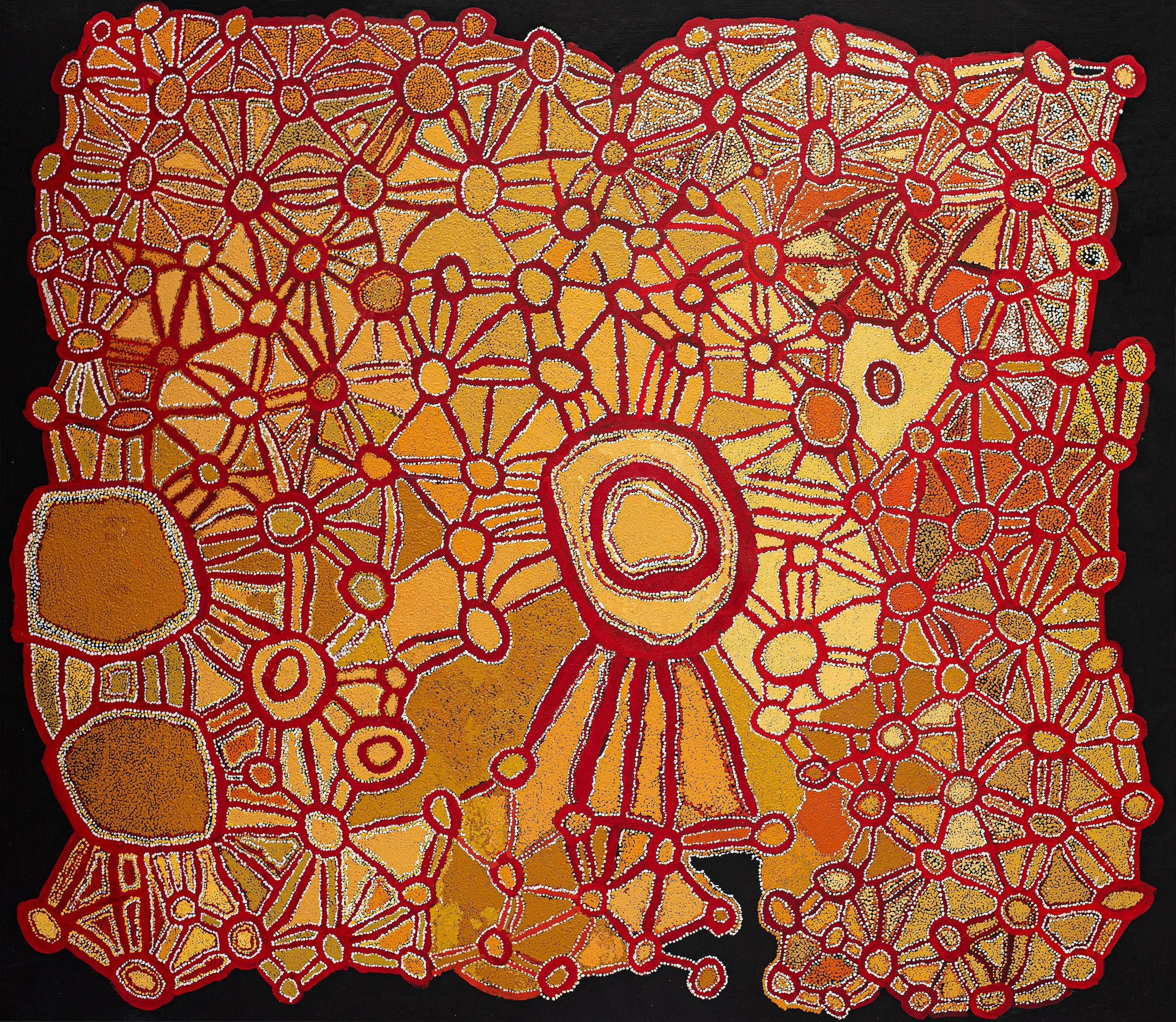
Artiste : Fred Grant
Titre de l'œuvre : Ukatatjara
Format : 230 x 200 cm
Provenance et certificat : centre d'art aborigène du Spinifex Art Project
Référence de cette peinture : 22-388
Enquiry / Demander le prix de l'œuvre
Explications pour cette œuvre :
Fred Grant (1943) knows the boundless sandhills, the endless skies and extensive forests of Spinifex Country. He's walked the rich cultural fabric that embraces his land wherever he looks and he has inmate knowledge of the life sustaining water sources that are its foundation of survival in an arid environment. Fred paints with the passive authority of someone that knows they belong to the intimacy of a landscape with a powerful religion at its heart. Here he depicts the significant site of Ukatatjara situated in the north of traditional Spinifex Lands. This site forms part of the Tjitji Ngataatjiri Tjukurpa (Giant Man Creaon Line) and follows the movement of a giant as he traverses different sites. These are creation beings, the ones that shaped all things and gave the physical landscape the religion that still guides Anangu today.
His artworks are in the following collections :
Harriett & Richard England Collection
National Gallery Of Australia, Canberra, Act (Mens Collaborative)
Seattle Art Museum, Seattle, Usa. (Mens Collaborative)
The Corrigan Collection, Australia (Mens Collaborative)
The Lepley Collection, Perth, Western Australia.
W. & V. Mcgeoch Collection, Melbourne, Vic.
Queensland Art Gallery Of Modern Art, Brisbane, Qld.
The Art Gallery Of New South Wales, Sydney, Nsw
Art Gallery Of South Australia, Adelaide, South Australia (Mens Collaborative)
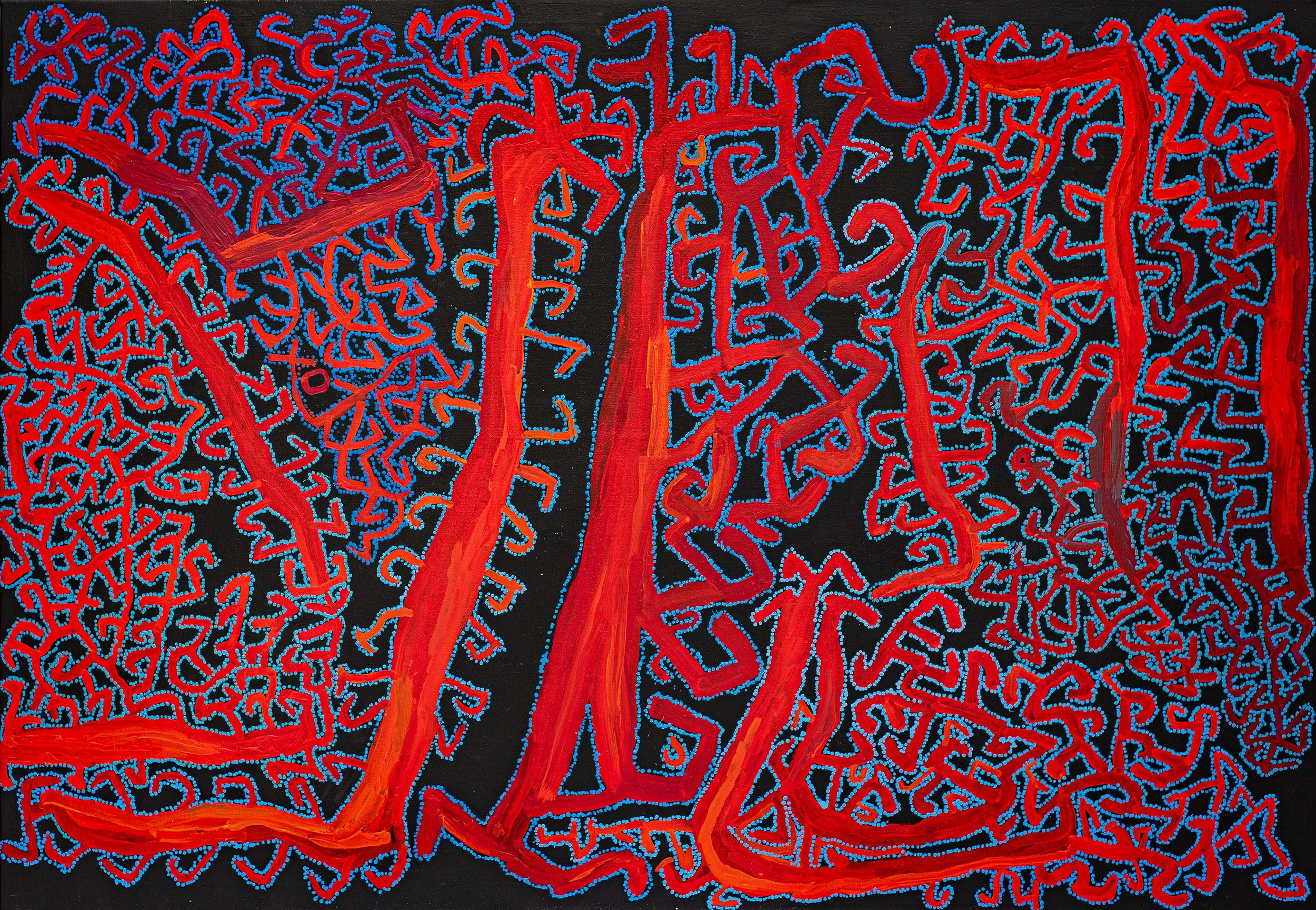
Artiste : Ned Grant
Titre de l'œuvre : Palpatatjara
Format : 200 x 137 cm
Provenance et certificat : centre d'art aborigène du Spinifex Art Project
Référence de cette peinture : 23-231
Enquiry / Demander le prix de l'œuvre
Explications pour cette œuvre :
Ned Grant (1941) intertwines himself within the landscape, unable to separate. He is a manifestation of the enormity of place that is Spinifex Land. With all of its labyrinthine religion within the physical, the flora, the fauna, the manta (ground). He moves under it, through it, above it, encompassing all. Religion is everywhere, it is sung, it is danced by firelight and it resides in and drives Ned Grant to paint.
Here he depicts the Ngalta (Desert Kurrajong) in its spiritual incarnation and the embodiment of his religion at the significant site of Palpatatjara. It is at this site that holds the Tjulpu Tjuta Tjukurpa (Many Birds Creation Line), a narrative that follows a group of Nyii- Nyii (Zebra Finch) as they journey south to the coast to save the world from rising seas.
These are creation beings who shape the immediate landscape as they move through it. It is they who made the physical and the moral compass that still guides Spinifex People today.
The artworks by Ned Grant are in the following prestigious collections :
National Gallery of Australia, Canberra
Art Gallery of New South Wales, Sydney
The Corrigan Collection, Sydney , Australien
W . & V. McGeoch Collection, Sydney , Australien
Seattle Art Museum, Seattle, USA
Greg Castillo Collection, Berkeley , USA
The British Museum, London
Museum Fünf Kontinente, München, Allemagne
Sammlung Alison und Peter W . Klein, Nussdorf, Allemagne
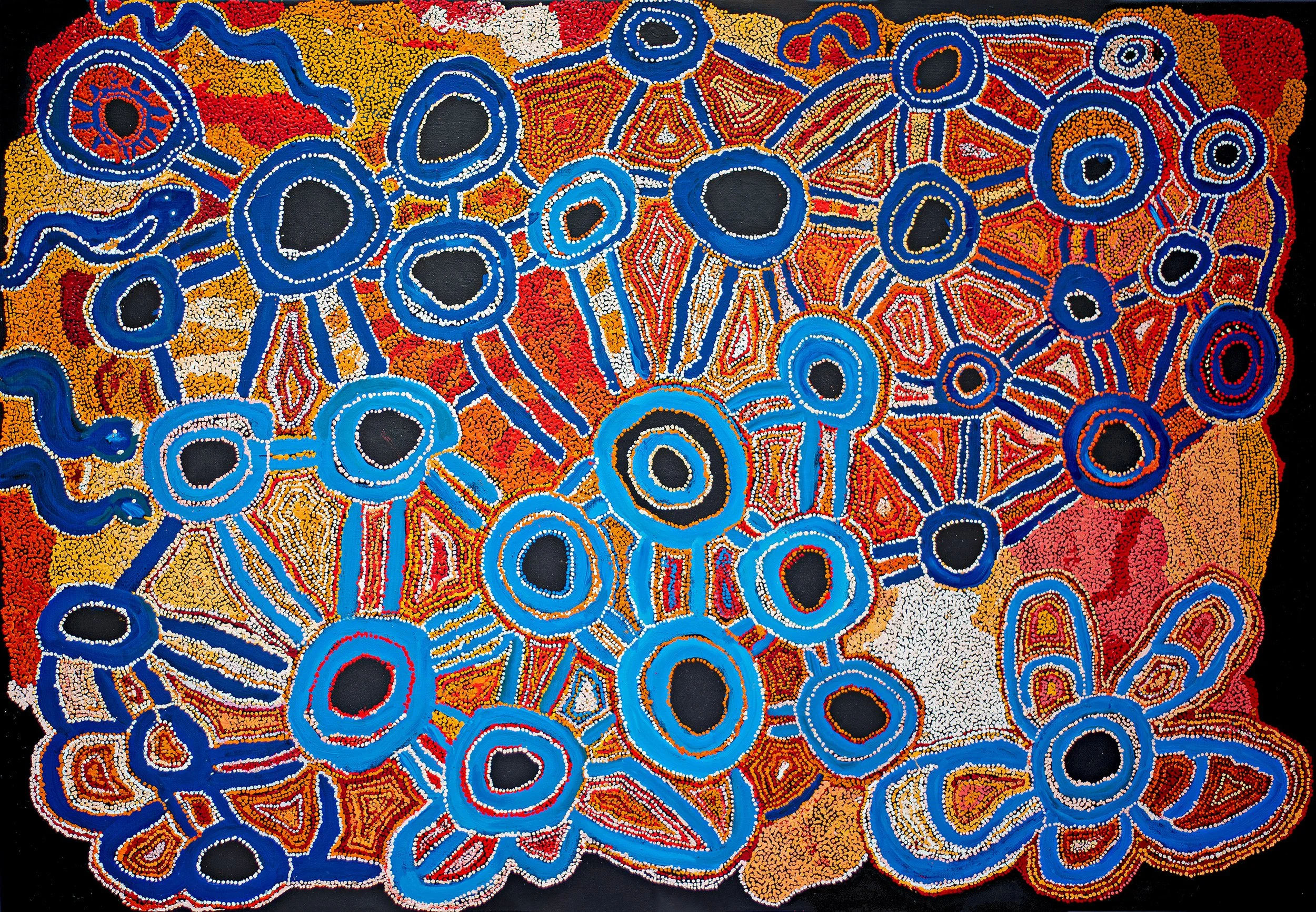
Artiste : Kanta Donnegan
Titre de l'œuvre : Kapi Piti Kutjara
Format : 200 x 137 cm
Provenance et certificat : centre d'art aborigène du Spinifex Art Project
Référence de cette peinture : 20-502
Demander le prix de l'œuvre / Enquiry
Explications pour cette œuvre :
Kanta (1944) Kanta was born at Kapi PitiKutjara, the place where WatiKutjara (Two Serpent Men) emerged and headed for Pukara. The Wati Kutjara story is one of the most important and wide ranging stories in Spinifex country. Although much of the specific detail is dangerous and secret the general actions and directions of the father and son are well known and understood to have been essential to the formation and activation of much of the country. Water is a precious resource and thus permanent waterholes have sacred associations. They are guarded by their creators, Wanampi (Water Serpent Beings) who have sorcerous abilities. Kathleen paints many such significant water sources including Ilkurlka, Pirapi, Upi, Tjawanya, Karnka, Warurungka, Unpun, Takari, Mulyaya, Talitjulpul, Mamatju and Wangalritja.
Kanta went into Cundeelee Mission in the late 1950s sweep a young married woman without children. Kanta had one son and three daughters by her first husband (dec.) in Cundeelee and returned to Spinifex in the first wave of resettlers in 1984. Apart from attending the odd exhibition or women’s trip to the outside Kanta has not left the desert lands since. Several years after the Rictor family came in from northern Spinifex she married one of the sons, Ian - her kuri pikitja, often translated as “promised one”. As if forged by the early years in her country Kanta is gentle soul and has assiduously painted with the Spinifex Art Project since representing her country in the women’s native title painting in 1997. Kathleen has painted on most of the women’s collaboratives.
Her artworks are in the following prestigious collections :
Collection Prince Stefan Of Liechtenstein, Embassy Of Liechtenstein In Germany.(Womens Collaborate)
Museum Of Western Australia
The Corrigan Collection, Australia. (Womens Collaborative)
The Lepley Collection, Perth, Western Australia. (Womens Collaborative)
The National Gallery Of Victoria, Melbourne, Vic. (Womens Collaborative)
The Sims Dickson Collection, Nsw (Collaborative With Ngalpingka Simms)
Artbank, Australian Government Collection. Australia.
Parliament House Art Collection, Canberra, Act (Womens Collaborative)
Art Gallery Of South Australia, Adelaide, South Australia (Womens Collaborative)
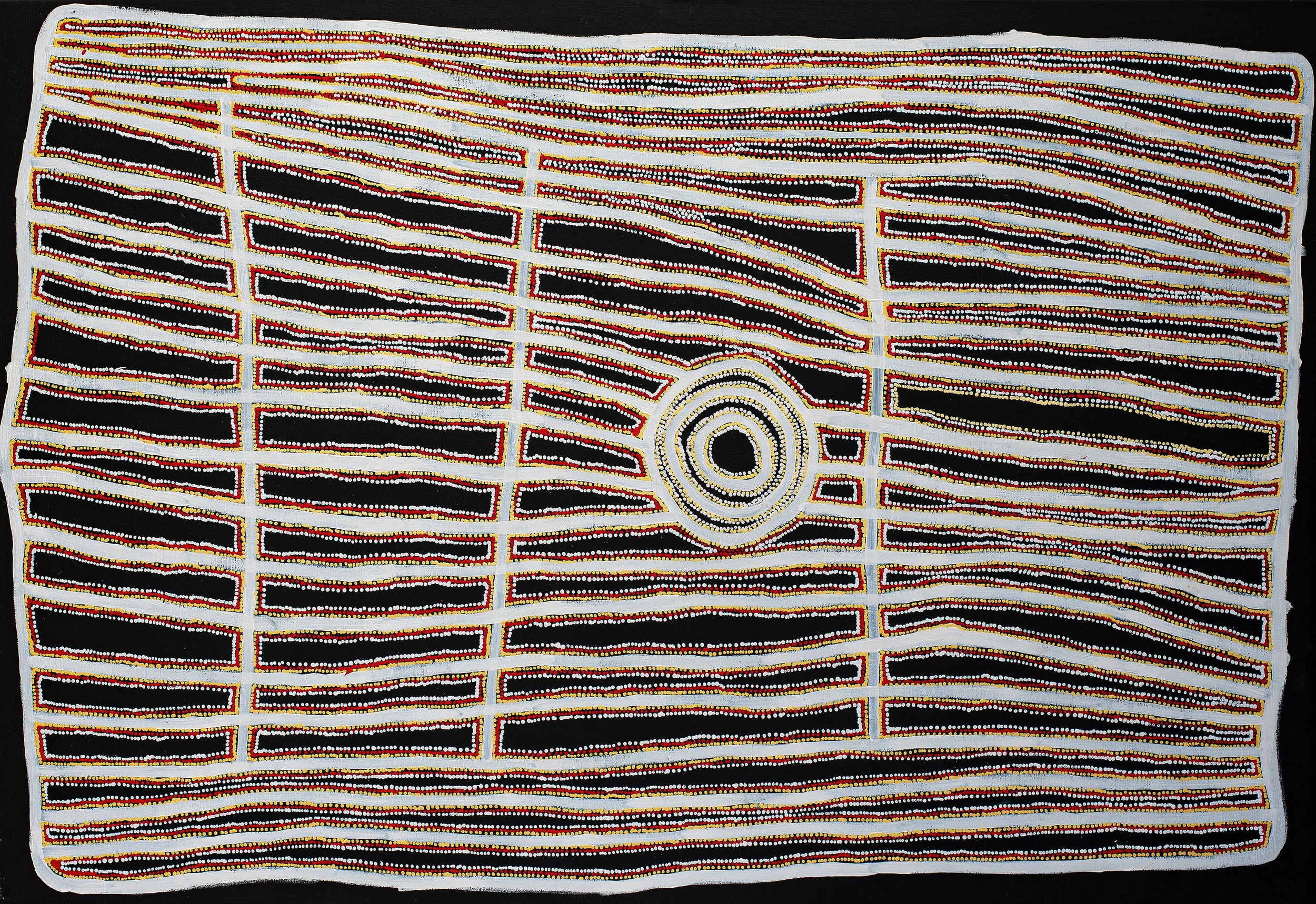
Artiste : Ian Rictor
Titre de l'œuvre : Wati Nyii-Nyii
Format : 200 x 137 cm
Provenance et certificat : centre d'art aborigène du Spinifex Art Project
Référence de cette peinture : 21-252
Enquiry / Demander le prix de l'œuvre
Explications pour cette œuvre :
Ian Rictor (1962) paints with a quiet reverence for the country that he depicts, from his relatively recent nomadic movements over the endless interior that makes up Spinifex Lands. Ian walked from water source to food source and beyond, this was a cultural and family existence for survival in an arid land before his family were found and' brought in' by relatives in 1986, making them the last known hunter gatherer in Australia. Ian's compositions center on the life affirming sites he depicts and each are multi layered with meaning. Many are surrounded with secrecy and only surface details can be recorded. Here he paints the significant site Tuwan, situated in the heart of traditional Spinifex Country and where Ian holds birth connection and custodial obligation. Tuwan is a significant site that holds the Nyii-Nyii Tjukurpa (Zebra Finch Creation Line), a Mens narrative of high sensitivity. It is from here at Tuwan, where a group of powerful Wati Nyii-Nyii (Zebra Finch Men) depart for the southern coast to save the world from the rising seas and eventually using their many spears as a barrier to the inundating water.
His artworks are in the following prestigious collection :
Collection Prince Stefan Of Liechtenstein, Embassy Of Liechtenstein In Germany. (Mens Collaborate)
National Gallery Of Australia, Canberra, Act (Mens Collaborative)
Seattle Art Museum, Seattle, Usa. (Mens Collaborative)
The Aboriginal Art Museum, Utrecht
The British Museum, London. (Mens Collaborative)
The Corrigan Collection, Australia (Mens Collaborative)
Wagner And Owen Collection, Usa.
W. & V. Mcgeoch Collection, Melbourne, Vic. (Mens Collaborative)
Art Gallery Of South Australia, Adelaide, South Australia (Mens Collaborative)

Artiste : Ian Rictor
Titre de l'œuvre : Tuwan
Format : 200 x 137 cm
Provenance et certificat : centre d'art aborigène du Spinifex Art Project
Référence de cette peinture : 21-251
Enquiry / Demander le prix de l'œuvre
Explications pour cette œuvre :
Ian Rictor (1962) paints with a quiet reverence for the country that he depicts, from his relatively recent nomadic movements over the endless interior that makes up Spinifex Lands. Ian walked from water source to food source and beyond, this was a cultural and family existence for survival in an arid land before his family were found and' brought in' by relatives in 1986, making them the last known hunter gatherer in Australia. Ian's compositions center on the life affirming sites he depicts and each are multi layered with meaning. Many are surrounded with secrecy and only surface details can be recorded. Here he paints the significant site Tuwan, situated in the heart of traditional Spinifex Country and where Ian holds birth connection and custodial obligation. Tuwan is a significant site that holds the Nyii-Nyii Tjukurpa (Zebra Finch Creation Line), a Mens narrative of high sensitivity. It is from here at Tuwan, where a group of powerful Wati Nyii-Nyii (Zebra Finch Men) depart for the southern coast to save the world from the rising seas and eventually using their many spears as a barrier to the inundating water.
His artworks are in the following prestigious collection :
Collection Prince Stefan Of Liechtenstein, Embassy Of Liechtenstein In Germany. (Mens Collaborate)
National Gallery Of Australia, Canberra, Act (Mens Collaborative)
Seattle Art Museum, Seattle, Usa. (Mens Collaborative)
The Aboriginal Art Museum, Utrecht
The British Museum, London. (Mens Collaborative)
The Corrigan Collection, Australia (Mens Collaborative)
Wagner And Owen Collection, Usa.
W. & V. Mcgeoch Collection, Melbourne, Vic. (Mens Collaborative)
Art Gallery Of South Australia, Adelaide, South Australia (Mens Collaborative)
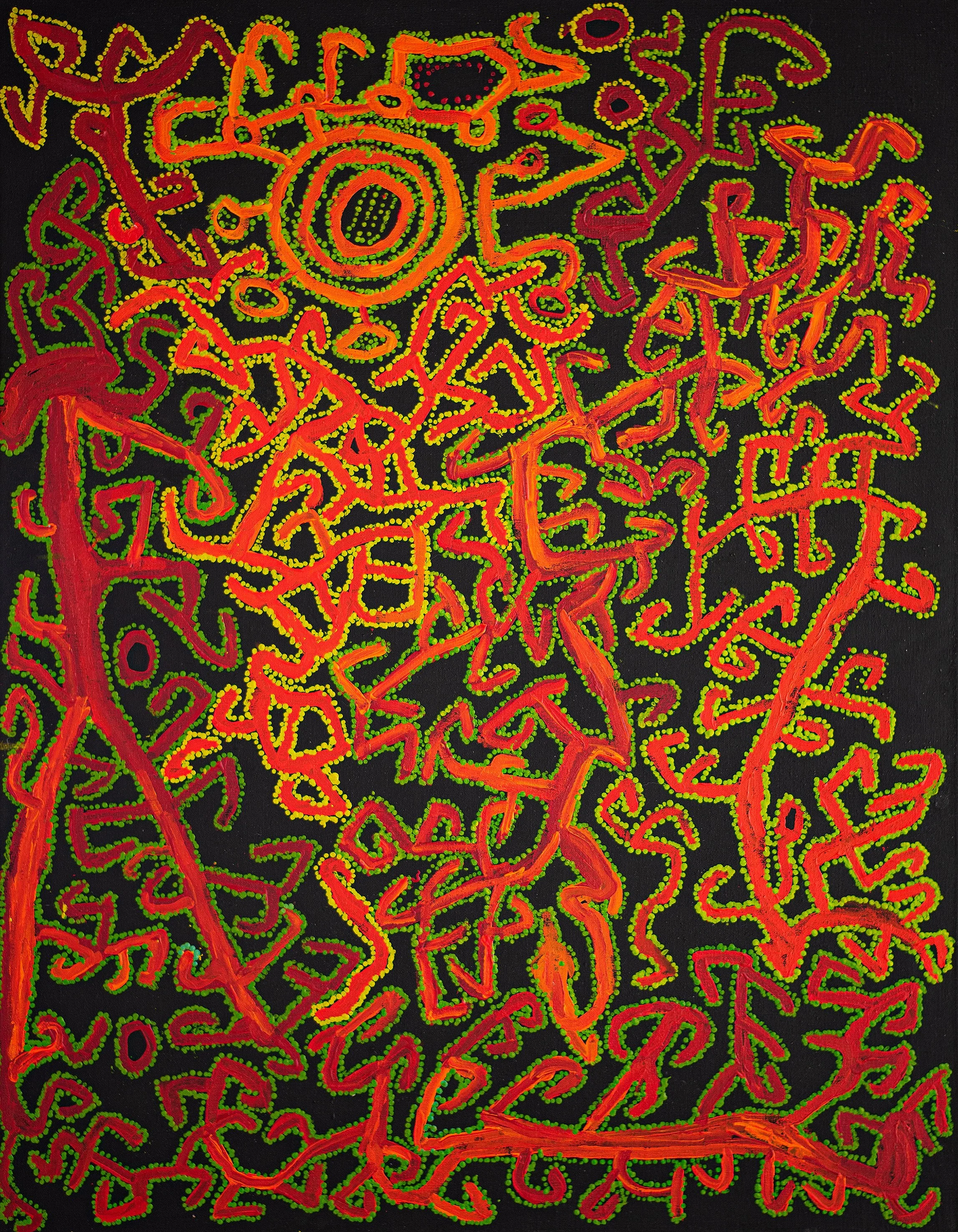
Artiste : Ned Grant
Titre de l'œuvre : Katutjara
Format : 110 × 85 cm
Provenance et certificat : centre d'art aborigène du Spinifex Art Project
Référence de cette peinture : 20-206
Enquiry / Demander le prix de l'œuvre
Explications pour cette œuvre :
Ned Grant (1941) intertwines himself within the landscape, unable to separate. He is a manifestation of the enormity of place that is Spinifex Land. With all of its labyrinthine religion within the physical, the flora, the fauna, the manta (ground). He moves under it, through it, above it, encompassing all. Religion is everywhere, it is sung, it is danced by firelight and it resides in and drives Ned Grant to paint.
Ned Grant moves underground through the wata (base of tree) drawing the aturu (root system) to life affirming water sites. Following the twists and turns as he weaves the Ngalta or Desert Kurrajong to fruition. He places the significant site of Katutjara in the east of traditional Spinifex Lands. Katutjara holds the Wati Kutjara Tjukurpa (Two Men Creation Line), a far reaching narrative that follows two brothers, mulya maru (black nosed monitor) and tinka (sand goanna). It is here at Katutjara that the men kill and cook an emu and the discarded bones of the game can be still be seen at this site today. These are creation beings and as such were able to shape the landscape as they moved through it leaving indelible physical reminders of their power and presence.
The artworks by Ned Grant are in the following prestigious collections :
National Gallery of Australia, Canberra
Art Gallery of New South Wales, Sydney
The Corrigan Collection, Sydney , Australien
W . & V. McGeoch Collection, Sydney , Australien
Seattle Art Museum, Seattle, USA
Greg Castillo Collection, Berkeley , USA
The British Museum, London
Museum Fünf Kontinente, München, Allemagne
Sammlung Alison und Peter W . Klein, Nussdorf, Allemagne
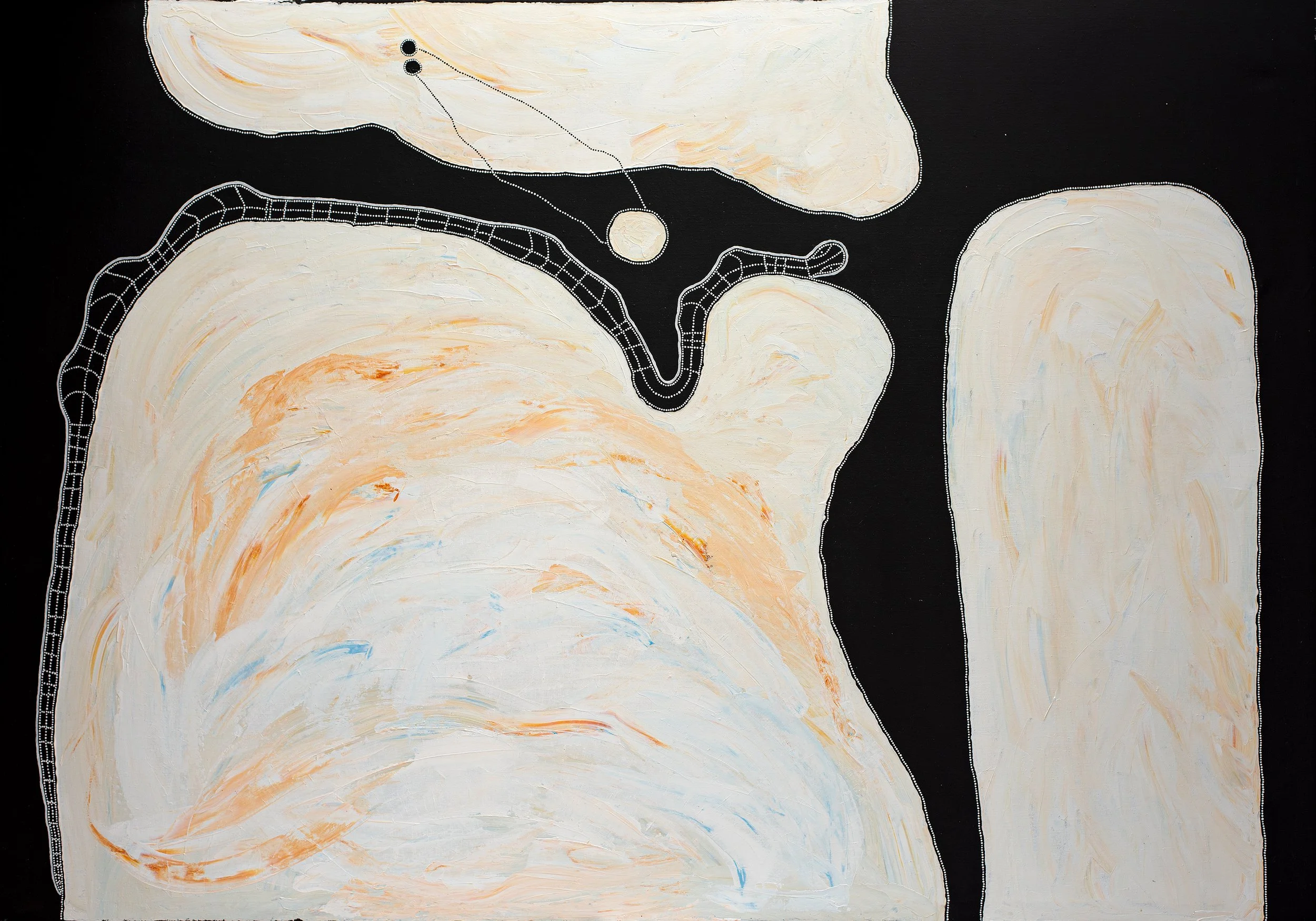
Artiste : Timo Hogan
Titre de l'œuvre : Lake Baker
Format : 290 × 200 cm
Provenance et certificat : centre d'art aborigène du Spinifex Art Project
Référence de cette peinture : 23-397
Enquiry / Demander le prix de l'œuvre
Explications pour cette œuvre :
Timo Hogan (1973) does not paint the picture. He paints the story. And the story is the big picture. For here at Lake Baker, Timo tells of the religion within the landscape and the inhabitants that made it so. Wati Kutjara Tjukurpa (Two Men Creation Line) is present for all to see. These two men watch carefully as the resident Wanampi (magical water serpent) departs his kapi ngura (home in the rock hole) and becomes the fearful, the all powerful, as he skirts the edge of the lake, always watching, aware of the Two Men.
These characters that Timo talks of are the Creation beings. Those that came before and shaped the
environment as they moved through it, leaving indelible physical reminders of their power and presence for all to see. But they also intertwined a religious moral framework within the habitat and covered it with song and dance.
His artworks are in the following prestigious collections :
Art Gallery of New South Wales, Sydney.
Art Gallery of South Australia, Adelaide
In 2017 He was the Finalist of the Hedland Art Awards
In 2021, Timo Hogan, was the winner of the 2021 Telstra Art Award at the Museum of Darwin
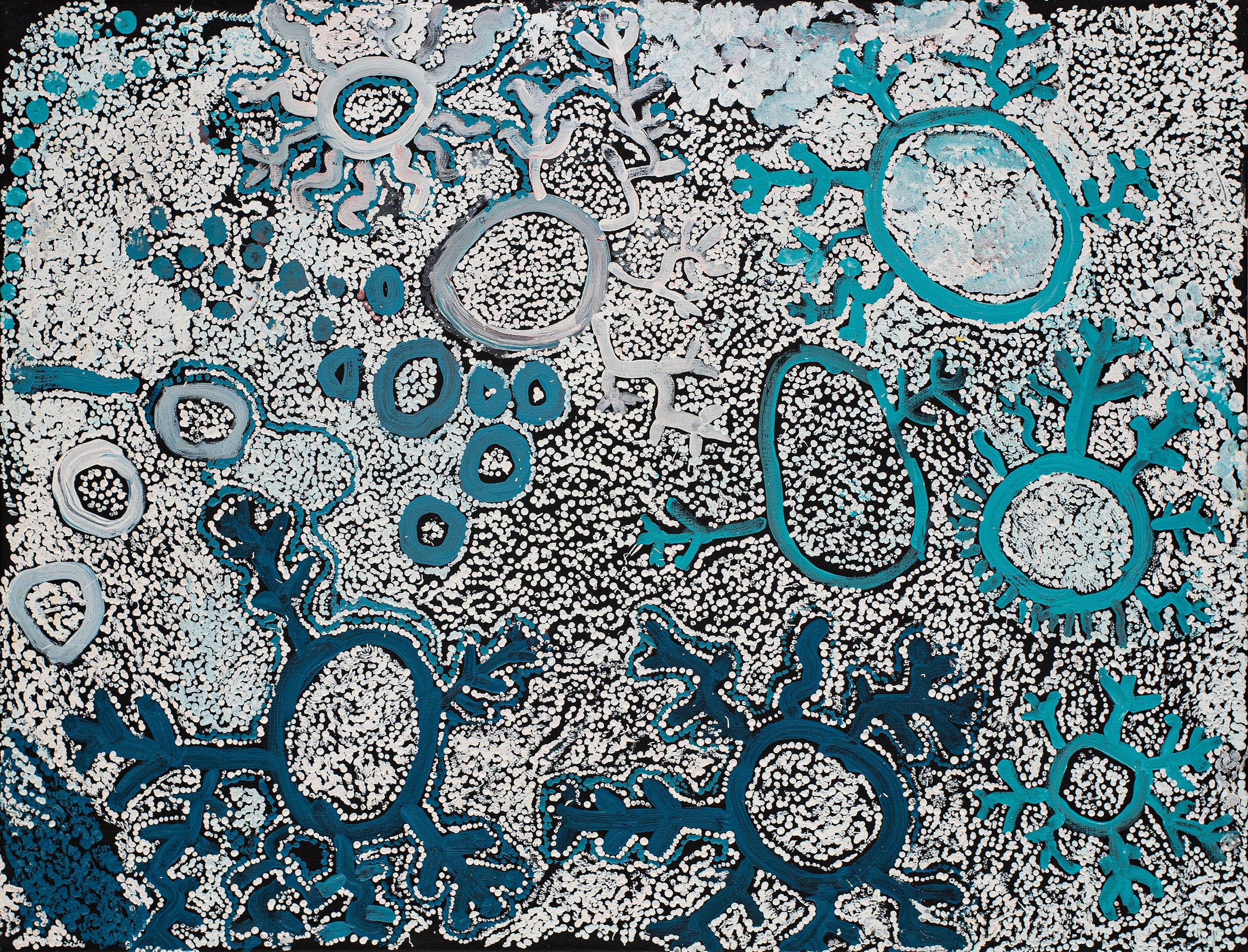
Artiste : Simon Hogan
Titre de l'œuvre : Lingka
Format : 110 × 85 cm
Provenance et certificat : centre d'art aborigène du Spinifex Art Project
Référence de cette peinture : 21-7
Enquiry / Demander le prix de l'œuvre
Explications pour cette œuvre :
Simon Hogan (1930) manifests his site of Lingka onto the two dimensional plane. When he paints, he transcends this world and is taken over soft sand ridges and vast Spinifex plains to the significant sites that formed him from birth. For Simon was born into a spiritual society where religion manifested in the immediate environment and where creation beings could move through different realms at will. It is these beings who shaped the landscape that Simon depicts and who left a moral compass that is still followed today. They gave to people the life giving water sites that were held with such reverence in an arid and remote land. It is these sites that were the means of survival and where religion unfolded in the form of sacred song and performance.
Simon Hogan was born circa 1930 in mid-western Spinifex between Paltju and Lingka. Simon’s exact age is unknown as dates of birth were estimated by the A.E.M. missionaries when the Spinifex people, on arrival at Cundeelee, were “sorted” into family groups, given English names and approximate dates of birth. During childhood two fathers, one born at Warakunu and the other at Munki raised Simon. Simon’s mother’s country is around Tjulya. The Spinifex people were a relatively discreet southern Pitjantjatjara tribal group with es to the north and east that lived a fully traditional hunter-gatherer life until the late1950’s to early 1960s when most people either walked in to Ooldea and Cundeelee or were taken by AEM missionaries to Cundeelee Mission…
From 1995 Simon Hogan was a prominent member of a group of senior traditional owners from Spinifex country who lobbied the WA State Government for Native Title. Although Simon spoke no English he was a confident, initiated Pitjantjatjara man who spoke to senior government officials regarding ownership of country and culture. Exclusive Native Title rights were granted to Simon Hogan and the Spinifex people in 2000 of over 55 000 sq kms of the Great Victoria Desert in WA.
His artworks are in the following prestigious collections :
Art Gallery Of South Australia, Adelaide, South Australia
British Museum, London, England.
Harriet And Richard England Collection
National Gallery Of Australia, Canberra, Act.
National Gallery Of Victoria, Melbourne, Victoria.
Seattle Art Museum, Seattle, Usa. (Mens Collaborative)
Staatliches Museum Fur Volkerkunde, Munich, Germany
The Lepley Collection, Perth, Western Australia.
The Patrick Corrigan Collection, Sydney, New South Wales.
W. & V. Mcgeoch Collection
Western Australian Museum, Perth, W.A.
Artbank, Australian Government Collection. Australia.
Art Gallery Of Western Australia, Perth, Western Australia.
The Art Gallery Of New South Wales, Sydney, Nsw (Mens Collaborative)
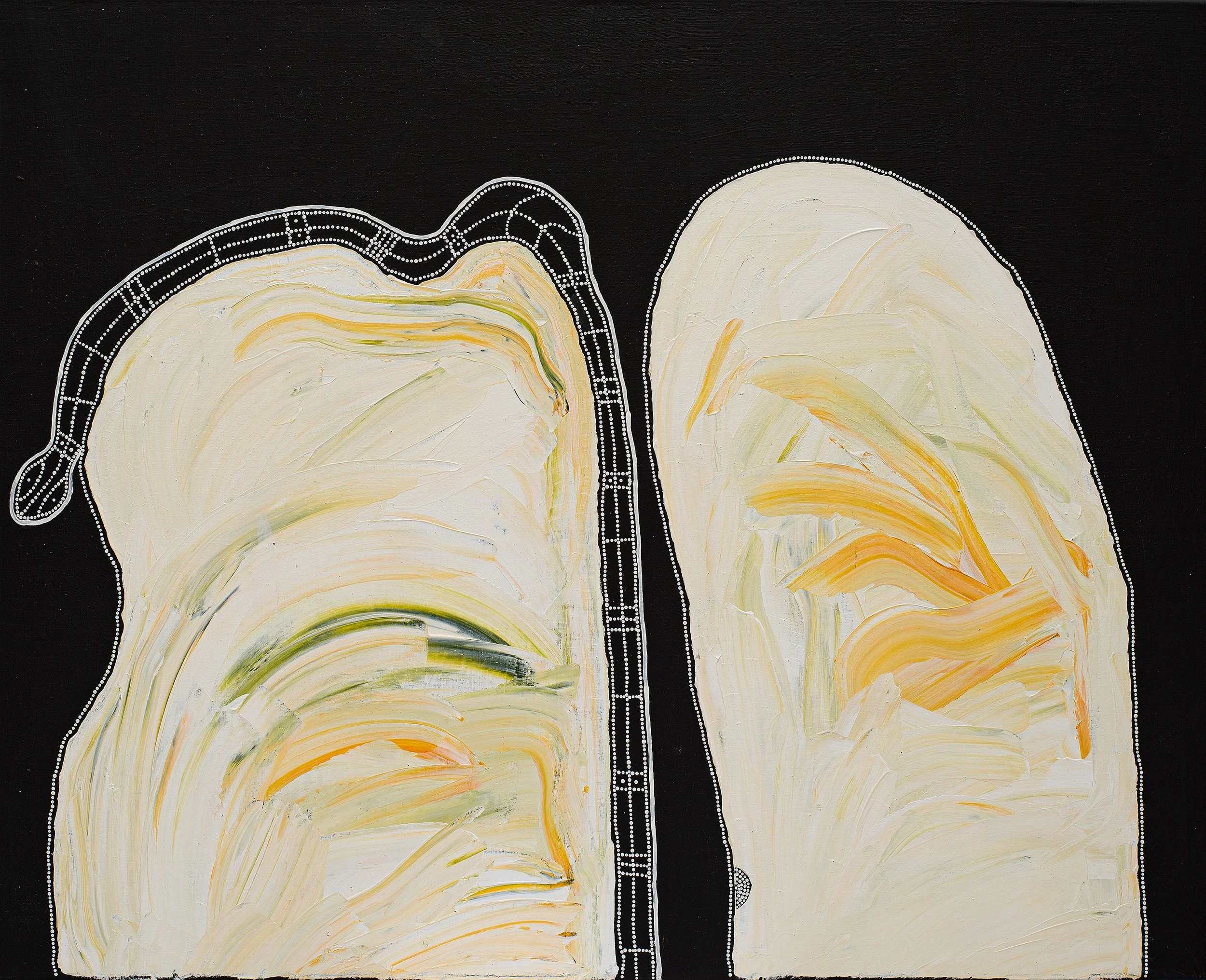
Artiste : Timo Hogan
Titre de l'œuvre : Lake Baker
Format : 137 × 110 cm
Provenance et certificat : centre d'art aborigène du Spinifex Art Project
Référence de cette peinture : 24-337
Enquiry / Demander le prix de l'œuvre
Explications pour cette œuvre :
Timo Hogan (1973) does not paint the picture. He paints the story. And the story is the big picture. For here at Lake Baker, Timo tells of the religion within the landscape and the inhabitants that made it so. Wati Kutjara Tjukurpa (Two Men Creation Line) is present for all to see. These two men watch carefully as the resident Wanampi (magical water serpent) departs his kapi ngura (home in the rock hole) and becomes the fearful, the all powerful, as he skirts the edge of the lake, always watching, aware of the Two Men.
These characters that Timo talks of are the Creation beings. Those that came before and shaped the
environment as they moved through it, leaving indelible physical reminders of their power and presence for all to see. But they also intertwined a religious moral framework within the habitat and covered it with song and dance.
His artworks are in the following prestigious collections :
Art Gallery of New South Wales, Sydney.
Art Gallery of South Australia, Adelaide
In 2017 He was the Finalist of the Hedland Art Awards
In 2021, Timo Hogan, was the winner of the 2021 Telstra Art Award at the Museum of Darwin

Artiste : Timo Hogan
Titre de l'œuvre : Lake Baker
Format : 230 × 200 cm
Provenance et certificat : centre d'art aborigène du Spinifex Art Project
Référence de cette peinture : 23-331
Enquiry / Demander le prix de l'œuvre
Explications pour cette œuvre :
Timo Hogan (1973) does not paint the picture. He paints the story. And the story is the big picture. For here at Lake Baker, Timo tells of the religion within the landscape and the inhabitants that made it so. Wati Kutjara Tjukurpa (Two Men Creation Line) is present for all to see. These two men watch carefully as the resident Wanampi (magical water serpent) departs his kapi ngura (home in the rock hole) and becomes the fearful, the all powerful, as he skirts the edge of the lake, always watching, aware of the Two Men.
These characters that Timo talks of are the Creation beings. Those that came before and shaped the
environment as they moved through it, leaving indelible physical reminders of their power and presence for all to see. But they also intertwined a religious moral framework within the habitat and covered it with song and dance.
His artworks are in the following prestigious collections :
Art Gallery of New South Wales, Sydney.
Art Gallery of South Australia, Adelaide
In 2017 He was the Finalist of the Hedland Art Awards
In 2021, Timo Hogan, was the winner of the 2021 Telstra Art Award at the Museum of Darwin
In 2024, Timo Hogan was Finalist of the Wynne Prize Award 2024, Art Gallery of New South Wales, Sydney, NSW
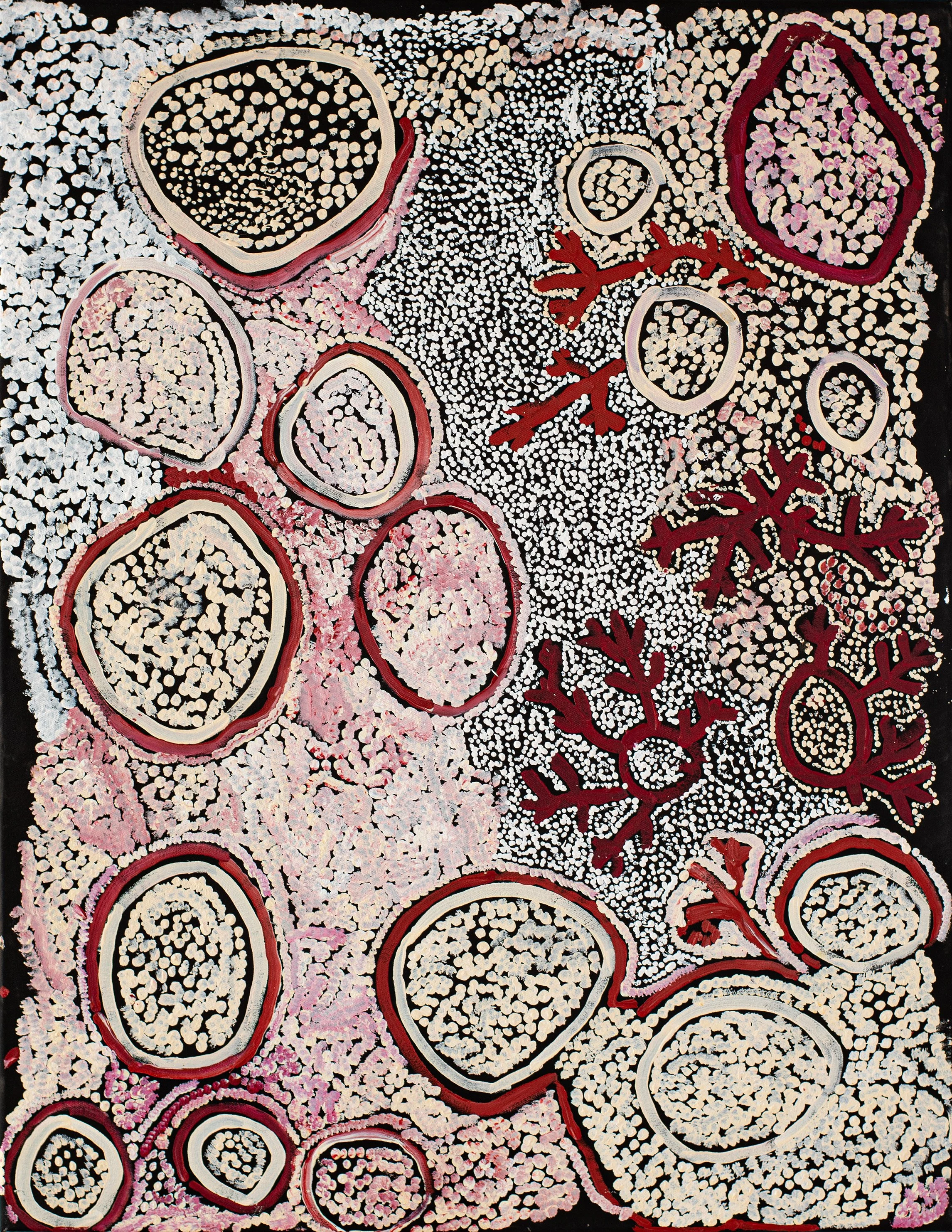
Artiste : Simon Hogan
Titre de l'œuvre : Lingka
Format : 110 × 85 cm
Provenance et certificat : centre d'art aborigène du Spinifex Art Project
Référence de cette peinture : 21-176
Enquiry / Demander le prix de l'œuvre
Explications pour cette œuvre :
Simon Hogan (1930) manifests his site of Lingka onto the two dimensional plane. When he paints, he transcends this world and is taken over soft sand ridges and vast Spinifex plains to the significant sites that formed him from birth. For Simon was born into a spiritual society where religion manifested in the immediate environment and where creation beings could move through different realms at will. It is these beings who shaped the landscape that Simon depicts and who left a moral compass that is still followed today. They gave to people the life giving water sites that were held with such reverence in an arid and remote land. It is these sites that were the means of survival and where religion unfolded in the form of sacred song and performance.
Simon Hogan was born circa 1930 in mid-western Spinifex between Paltju and Lingka. Simon’s exact age is unknown as dates of birth were estimated by the A.E.M. missionaries when the Spinifex people, on arrival at Cundeelee, were “sorted” into family groups, given English names and approximate dates of birth. During childhood two fathers, one born at Warakunu and the other at Munki raised Simon. Simon’s mother’s country is around Tjulya. The Spinifex people were a relatively discreet southern Pitjantjatjara tribal group with es to the north and east that lived a fully traditional hunter-gatherer life until the late1950’s to early 1960s when most people either walked in to Ooldea and Cundeelee or were taken by AEM missionaries to Cundeelee Mission…
From 1995 Simon Hogan was a prominent member of a group of senior traditional owners from Spinifex country who lobbied the WA State Government for Native Title. Although Simon spoke no English he was a confident, initiated Pitjantjatjara man who spoke to senior government officials regarding ownership of country and culture. Exclusive Native Title rights were granted to Simon Hogan and the Spinifex people in 2000 of over 55 000 sq kms of the Great Victoria Desert in WA.
His artworks are in the following prestigious collections :
Art Gallery Of South Australia, Adelaide, South Australia
British Museum, London, England.
Harriet And Richard England Collection
National Gallery Of Australia, Canberra, Act.
National Gallery Of Victoria, Melbourne, Victoria.
Seattle Art Museum, Seattle, Usa. (Mens Collaborative)
Staatliches Museum Fur Volkerkunde, Munich, Germany
The Lepley Collection, Perth, Western Australia.
The Patrick Corrigan Collection, Sydney, New South Wales.
W. & V. Mcgeoch Collection
Western Australian Museum, Perth, W.A.
Artbank, Australian Government Collection. Australia.
Art Gallery Of Western Australia, Perth, Western Australia.
The Art Gallery Of New South Wales, Sydney, Nsw (Mens Collaborative)

Artiste : Ian Rictor
Titre de l'œuvre : Tuwan munu Kamanti
Format : 200 x 137 cm
Provenance et certificat : centre d'art aborigène du Spinifex Art Project
Référence de cette peinture : 23-449
Enquiry / Demander le prix de l'œuvre
Explications pour cette œuvre :
Ian Rictor (1962) paints with a quiet reverence for the country that he depicts, from his relatively recent nomadic movements over the endless interior that makes up Spinifex Lands. Ian walked from water source to food source and beyond, this was a cultural and family existence for survival in an arid land before his family were found and' brought in' by relatives in 1986, making them the last known hunter gatherer in Australia. Ian's compositions center on the life affirming sites he depicts and each are multi layered with meaning. Many are surrounded with secrecy and only surface details can be recorded. Here he paints the significant site Tuwan, situated in the heart of traditional Spinifex Country and where Ian holds birth connection and custodial obligation. Tuwan is a significant site that holds the Nyii-Nyii Tjukurpa (Zebra Finch Creation Line), a Mens narrative of high sensitivity. It is from here at Tuwan, where a group of powerful Wati Nyii-Nyii (Zebra Finch Men) depart for the southern coast to save the world from the rising seas and eventually using their many spears as a barrier to the inundating water.
His artworks are in the following prestigious collection :
Collection Prince Stefan Of Liechtenstein, Embassy Of Liechtenstein In Germany. (Mens Collaborate)
National Gallery Of Australia, Canberra, Act (Mens Collaborative)
Seattle Art Museum, Seattle, Usa. (Mens Collaborative)
The Aboriginal Art Museum, Utrecht
The British Museum, London. (Mens Collaborative)
The Corrigan Collection, Australia (Mens Collaborative)
Wagner And Owen Collection, Usa.
W. & V. Mcgeoch Collection, Melbourne, Vic. (Mens Collaborative)
Art Gallery Of South Australia, Adelaide, South Australia (Mens Collaborative)
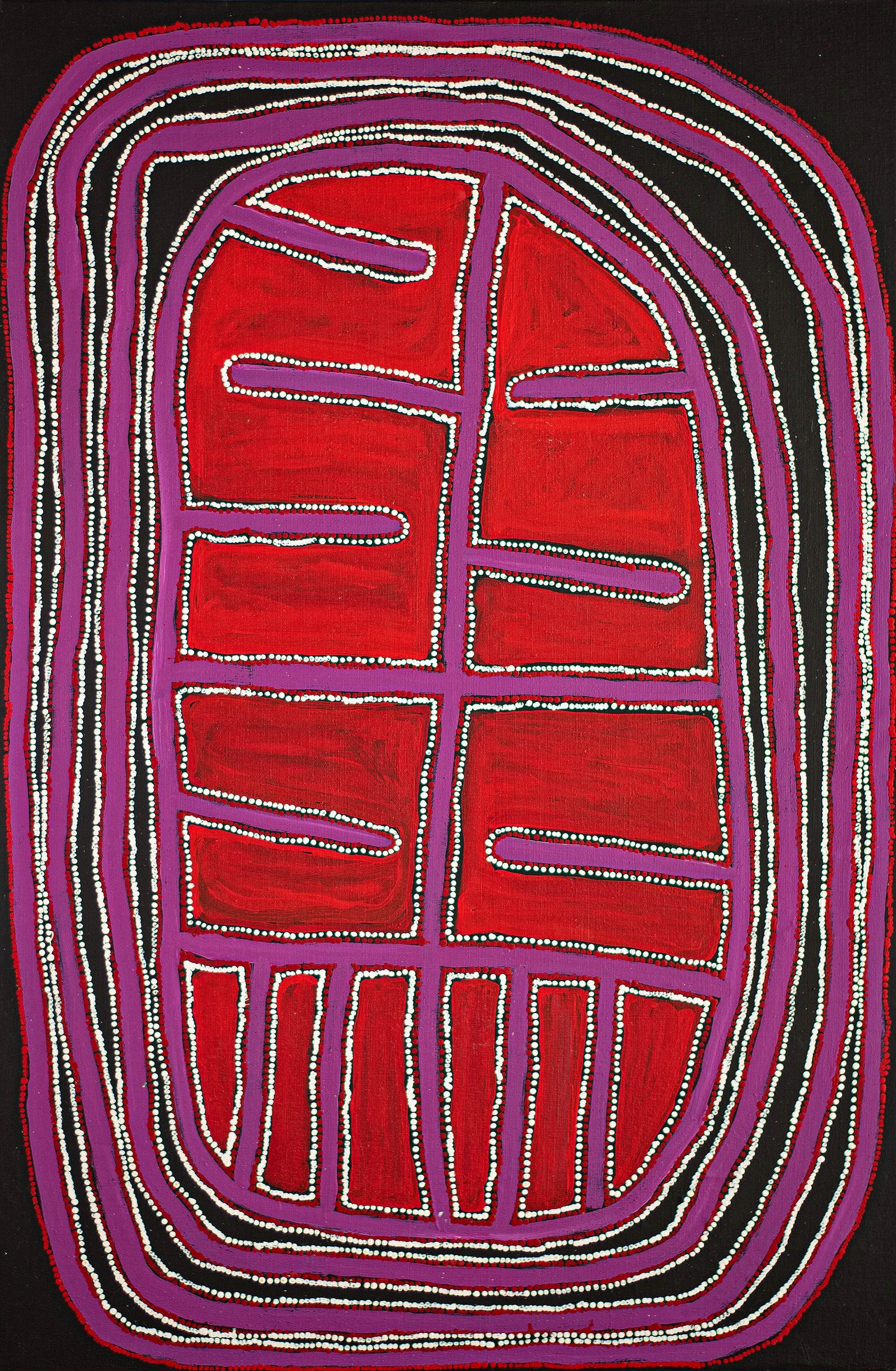
Artiste : Ian Rictor
Titre de l'œuvre : Tuwan munu Kamanti
Format : 137 × 90 cm
Provenance et certificat : centre d'art aborigène du Spinifex Art Project
Référence de cette peinture : 24-170
Enquiry / Demander le prix de l'œuvre
Explications pour cette œuvre :
Ian Rictor (1962) paints with a quiet reverence for the country that he depicts, from his relatively recent nomadic movements over the endless interior that makes up Spinifex Lands. Ian walked from water source to food source and beyond, this was a cultural and family existence for survival in an arid land before his family were found and' brought in' by relatives in 1986, making them the last known hunter gatherer in Australia. Ian's compositions center on the life affirming sites he depicts and each are multi layered with meaning. Many are surrounded with secrecy and only surface details can be recorded. Here he paints the significant site Tuwan, situated in the heart of traditional Spinifex Country and where Ian holds birth connection and custodial obligation. Tuwan is a significant site that holds the Nyii-Nyii Tjukurpa (Zebra Finch Creation Line), a Mens narrative of high sensitivity. It is from here at Tuwan, where a group of powerful Wati Nyii-Nyii (Zebra Finch Men) depart for the southern coast to save the world from the rising seas and eventually using their many spears as a barrier to the inundating water.
His artworks are in the following prestigious collection :
Collection Prince Stefan Of Liechtenstein, Embassy Of Liechtenstein In Germany. (Mens Collaborate)
National Gallery Of Australia, Canberra, Act (Mens Collaborative)
Seattle Art Museum, Seattle, Usa. (Mens Collaborative)
The Aboriginal Art Museum, Utrecht
The British Museum, London. (Mens Collaborative)
The Corrigan Collection, Australia (Mens Collaborative)
Wagner And Owen Collection, Usa.
W. & V. Mcgeoch Collection, Melbourne, Vic. (Mens Collaborative)
Art Gallery Of South Australia, Adelaide, South Australia (Mens Collaborative)
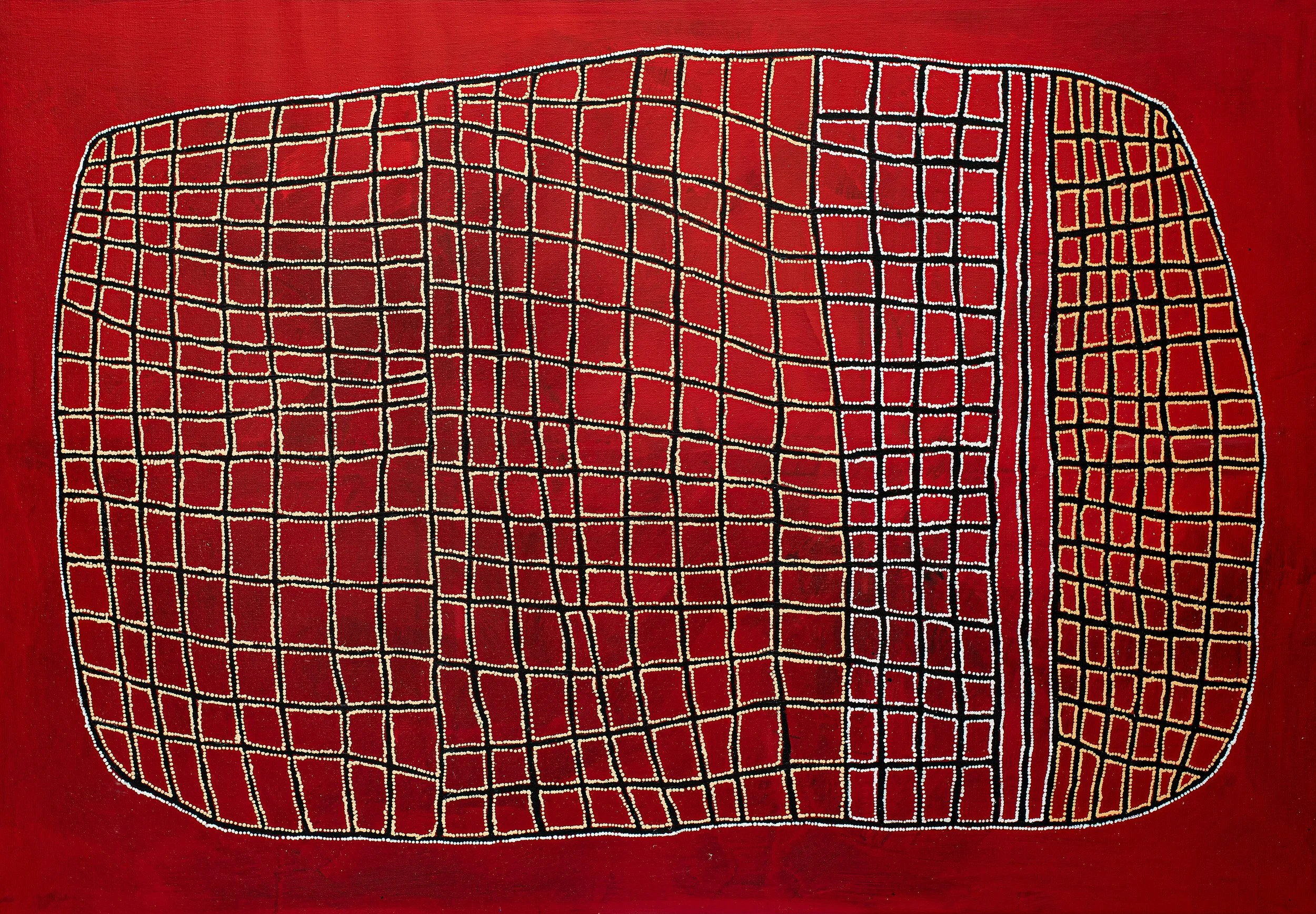
Artiste : Ian Rictor
Titre de l'œuvre : Kupanya
Format : 200 x 137 cm
Provenance et certificat : centre d'art aborigène du Spinifex Art Project
Référence de cette peinture : 24-193
Enquiry / Demander le prix de l'œuvre
Explications pour cette œuvre :
Ian Rictor (1962) paints with a quiet reverence for the country that he depicts, from his relatively recent nomadic movements over the endless interior that makes up Spinifex Lands. Ian walked from water source to food source and beyond, this was a cultural and family existence for survival in an arid land before his family were found and' brought in' by relatives in 1986, making them the last known hunter gatherer in Australia. Ian's compositions center on the life affirming sites he depicts and each are multi layered with meaning. Many are surrounded with secrecy and only surface details can be recorded.
Here he has painted the significant site of Kupanya. It is here that the Punyu Tjukurpa (a small marsupialprobably extinct). Ian states that he lives in the rocks around the site of Kupanya and there are numerous rock depressions that hold water.
His artworks are in the following prestigious collection :
Collection Prince Stefan Of Liechtenstein, Embassy Of Liechtenstein In Germany. (Mens Collaborate)
National Gallery Of Australia, Canberra, Act (Mens Collaborative)
Seattle Art Museum, Seattle, Usa. (Mens Collaborative)
The Aboriginal Art Museum, Utrecht
The British Museum, London. (Mens Collaborative)
The Corrigan Collection, Australia (Mens Collaborative)
Wagner And Owen Collection, Usa.
W. & V. Mcgeoch Collection, Melbourne, Vic. (Mens Collaborative)
Art Gallery Of South Australia, Adelaide, South Australia (Mens Collaborative)
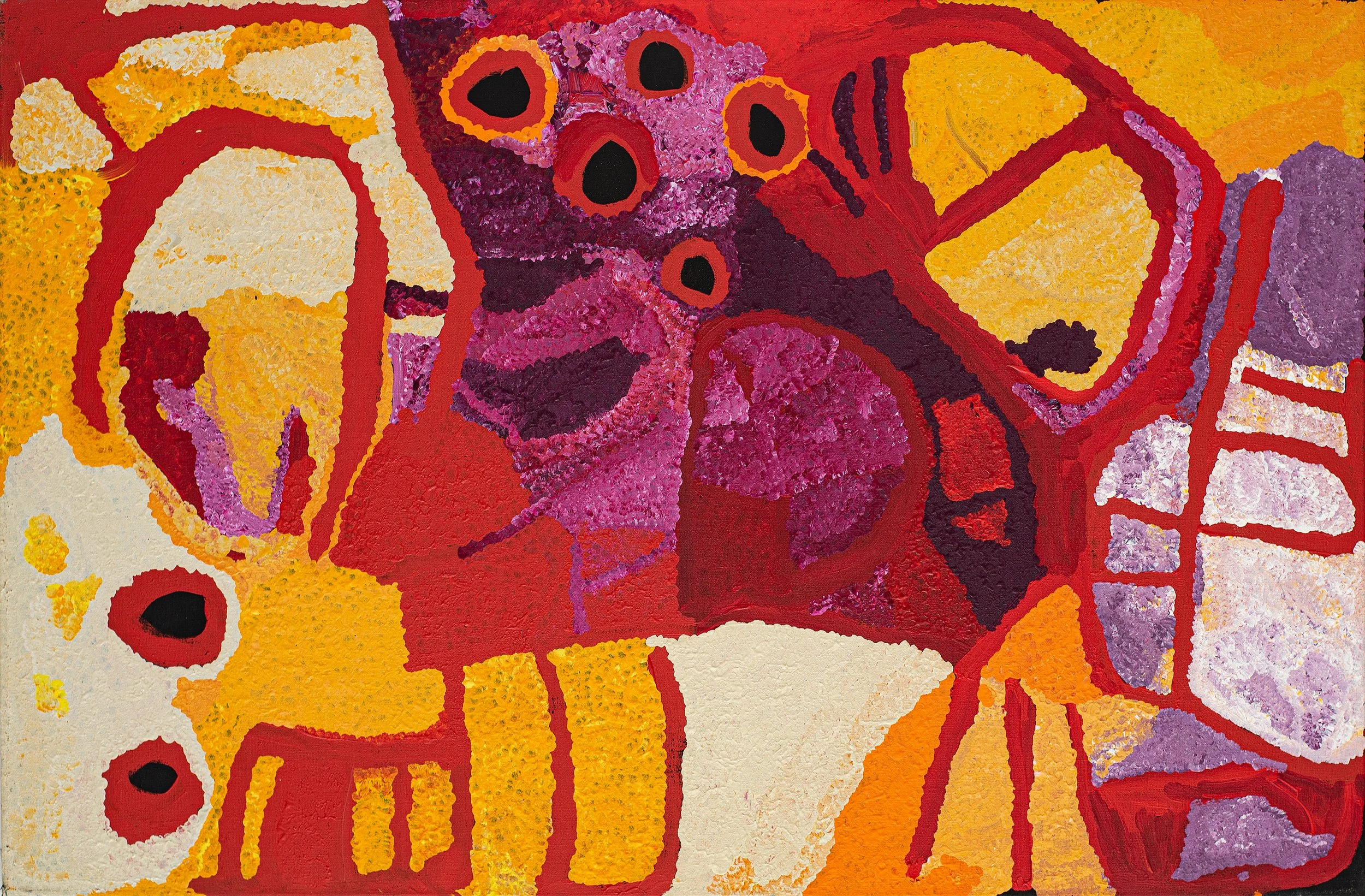
Artiste : Myrtle Pennington
Titre de l'œuvre : Kanpa
Format : 137 × 90 cm
Provenance et certificat : centre d'art aborigène du Spinifex Art Project
Référence de cette peinture : 18-88
Explications pour cette œuvre :
Myrtle was born c.1939 in the vicinity of a rock hole called Kanpa in central Spinifex. The rock hole itself is a point along a highly sensitive senior Men’s tjukurpa which Myrtle would not have seen or drawn water from. Myrtle’s journey out of Spinifex to Cundeelee Mission in the late 1950’s was particularly tragic for Myrtle and her family (a son and husband perished on the trip). Myrtle, with another son and daughter, were eventually located by Australian servicemen from an army base at Neale’s Junction, who held them until Cundeelee Mission staff arrived to take the family to Cundeelee.
The Spinifex People inhabited the Great Victoria Desert long before Europeans landed on this continent’s shoreline. They survived in an arid but beautiful environment, equipped with the necessary skills required for such a life.A spiritual people guided by cultural law were able to exist virtually unchallenged and unchanged until the 1950’s when the British atomic testing began at Emu Fields and later at Maralinga. These tests directly displaced the Spinifex People and it would be over thirty years before their traditional lands were finally returned to them in the form of native title and they were able to once again access the country that formed them from birth. For the landscape holds the culture of the Spinifex People and their daily interactions are governed by the moral compass of the first beings who created the physical realm. With story interwoven in song and dance, the country maps a tangible way forward for the people to reflect and learn upon.
It is this country, this spiritual landscape that defines and permeates Myrtle Pennington’s work. Although abstract in appearance each piece holds part history, part ceremony and part country. Myrtle assumes the vastness of the landscape imbued with the colourful light in profound yet simple compositions. She recalls the places that sustained her during those early formative years and gives rise to the sites of Mulpulya and Kanpa, surrounding them with sandhills and salt lakes or plains that lead to rocky escarpments. She reads the scene from a sense of belonging, of being interwoven into the fabric of the landscape she creates. All this Myrtle captures and conveys with ease, moving the brush and colour freely, building a textural quality that prompts one to walk with her through this vast Country.

Artiste : Lennard Walker (1946)
Titre de l'œuvre : Minyma Ngampi
Format : 230 x 200 cm
Provenance et certificat : centre d'art aborigène du Spinifex Art Project
Référence de cette peinture : 24-255
Enquiry / Demander le prix de l'œuvre
Explications pour cette œuvre :
Lennard Walker (1945) is the cultural ambassador, the elder statesman, the missing link between past and present who depicts his lived environment brimming with meaning. he allows us the insights into a world we can scarily perceive. He is a senior custodian for the site of Kuru Ala and Kulyuru.
Lennard paints Minyma Ngampi with clear intention - his responsibility for nearby Kuru Ala makes him a senior custodian for this place through birthright. Minyma Ngampi is a ‘Women’s Site” holding the Kungkarangkalpa Tjukurpa – Seven Sisters story. This is an epic songline, which follows a group of young women as they traverse Spinifex country all the while evading the lustful attention of a powerful sorcerer man named Nyiru. Nyiru has metamorphic powers of transformation. He is a quandong tree at one site and at another a kunyia (woman python).
The women make their way north, eventually flying into the night sky to become the star constellation of Pleiades the Seven Sisters at Minyma Ngampi. These characters are creation beings who transform the landscape as they move through it leaving indelible physical reminders of their power and presence for Anangu to follow.
His artworks are in the following prestigious collections :
Artbank Australian Government, Canberra. A.C.T.
Collection Prince Stefan Of Liechtenstein, Embassy Of Liechtenstein In Germany. (Mens Collaborate)
Kuntswerk Sammlung Alison Und Peter W. Klein, Germany Sammlung Alison Und Peter W. Klein, Germany
National Gallery Of Australia, Canberra, Act (Mens Collaborative)
Seattle Art Museum, Seattle, Usa. (Mens Collaborative)
The British Museum, London. (Mens Collaborative)
The Corrigan Collection, Australia (Mens Collaborative)
The Kaplan-Levi Collection, Usa
W. & V. Mcgeoch Collection, Melbourne, Vic.
Wagner And Owen Collection, Usa.
Queensland Art Gallery Of Modern Art, Brisbane, Qld.
The Art Gallery Of New South Wales, Sydney, Nsw (Mens Collaborative)
Art Gallery Of South Australia, Adelaide, South Australia (Mens Collaborative)
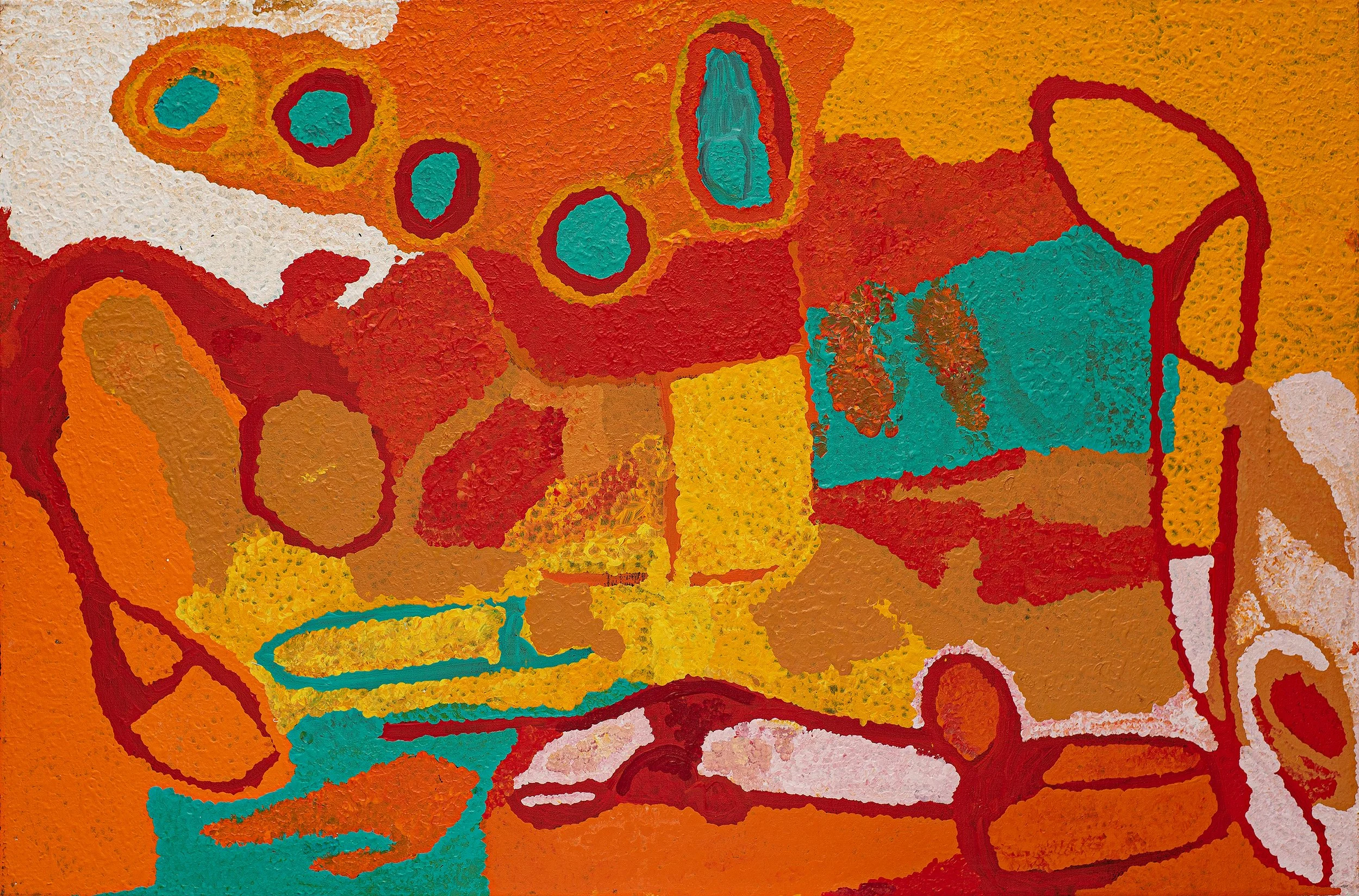
Artiste : Myrtle Pennington
Titre de l'œuvre : Kanpa
Format : 137 × 90 cm
Provenance et certificat : centre d'art aborigène du Spinifex Art Project
Référence de cette peinture : 18-71
Explications pour cette œuvre :
Myrtle was born c.1939 in the vicinity of a rock hole called Kanpa in central Spinifex. The rock hole itself is a point along a highly sensitive senior Men’s tjukurpa which Myrtle would not have seen or drawn water from. Myrtle’s journey out of Spinifex to Cundeelee Mission in the late 1950’s was particularly tragic for Myrtle and her family (a son and husband perished on the trip). Myrtle, with another son and daughter, were eventually located by Australian servicemen from an army base at Neale’s Junction, who held them until Cundeelee Mission staff arrived to take the family to Cundeelee.
The Spinifex People inhabited the Great Victoria Desert long before Europeans landed on this continent’s shoreline. They survived in an arid but beautiful environment, equipped with the necessary skills required for such a life.A spiritual people guided by cultural law were able to exist virtually unchallenged and unchanged until the 1950’s when the British atomic testing began at Emu Fields and later at Maralinga. These tests directly displaced the Spinifex People and it would be over thirty years before their traditional lands were finally returned to them in the form of native title and they were able to once again access the country that formed them from birth. For the landscape holds the culture of the Spinifex People and their daily interactions are governed by the moral compass of the first beings who created the physical realm. With story interwoven in song and dance, the country maps a tangible way forward for the people to reflect and learn upon.
It is this country, this spiritual landscape that defines and permeates Myrtle Pennington’s work. Although abstract in appearance each piece holds part history, part ceremony and part country. Myrtle assumes the vastness of the landscape imbued with the colourful light in profound yet simple compositions. She recalls the places that sustained her during those early formative years and gives rise to the sites of Mulpulya and Kanpa, surrounding them with sandhills and salt lakes or plains that lead to rocky escarpments. She reads the scene from a sense of belonging, of being interwoven into the fabric of the landscape she creates. All this Myrtle captures and conveys with ease, moving the brush and colour freely, building a textural quality that prompts one to walk with her through this vast Country.

Artiste : Myrtle Pennington
Titre de l'œuvre : Kanpala
Format : 137 × 90 cm
Provenance et certificat : centre d'art aborigène du Spinifex Art Project
Référence de cette peinture : 18-500
Explications pour cette œuvre :
Myrtle was born c.1939 in the vicinity of a rock hole called Kanpa in central Spinifex. The rock hole itself is a point along a highly sensitive senior Men’s tjukurpa which Myrtle would not have seen or drawn water from. Myrtle’s journey out of Spinifex to Cundeelee Mission in the late 1950’s was particularly tragic for Myrtle and her family (a son and husband perished on the trip). Myrtle, with another son and daughter, were eventually located by Australian servicemen from an army base at Neale’s Junction, who held them until Cundeelee Mission staff arrived to take the family to Cundeelee.
The Spinifex People inhabited the Great Victoria Desert long before Europeans landed on this continent’s shoreline. They survived in an arid but beautiful environment, equipped with the necessary skills required for such a life.A spiritual people guided by cultural law were able to exist virtually unchallenged and unchanged until the 1950’s when the British atomic testing began at Emu Fields and later at Maralinga. These tests directly displaced the Spinifex People and it would be over thirty years before their traditional lands were finally returned to them in the form of native title and they were able to once again access the country that formed them from birth. For the landscape holds the culture of the Spinifex People and their daily interactions are governed by the moral compass of the first beings who created the physical realm. With story interwoven in song and dance, the country maps a tangible way forward for the people to reflect and learn upon.
It is this country, this spiritual landscape that defines and permeates Myrtle Pennington’s work. Although abstract in appearance each piece holds part history, part ceremony and part country. Myrtle assumes the vastness of the landscape imbued with the colourful light in profound yet simple compositions. She recalls the places that sustained her during those early formative years and gives rise to the sites of Mulpulya and Kanpa, surrounding them with sandhills and salt lakes or plains that lead to rocky escarpments. She reads the scene from a sense of belonging, of being interwoven into the fabric of the landscape she creates. All this Myrtle captures and conveys with ease, moving the brush and colour freely, building a textural quality that prompts one to walk with her through this vast Country.
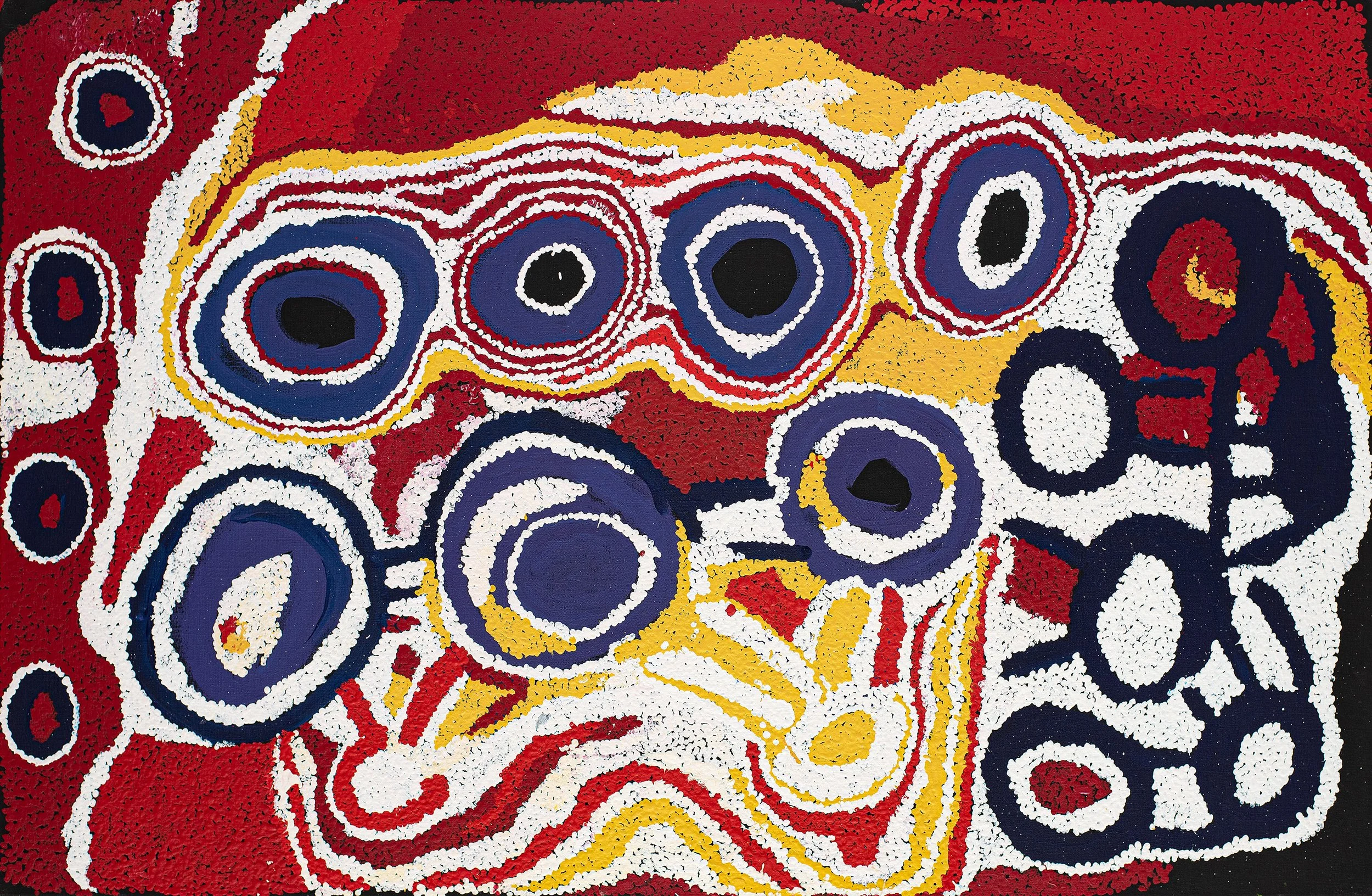
Artiste : Tjaruwa Woods
Titre de l'œuvre : Purpurnya
Format : 137 × 90 cm
Provenance et certificat : centre d'art aborigène du Spinifex Art Project
Référence de cette peinture : 15-006
Demander le prix de l'œuvre / Enquiry
Explications pour cette œuvre :
Tjaruwa (1954) paints with a knowledge and a devotion to the country that formed her. She was a young woman when she and her immediate family 'walked in' from the Great Victoria Desert in the remote east of Western Australia. This was deemed inhospitable country by the encroaching 'new world' and perceived as so vast and uninhabited, that it made the ideal site to detonate and observe the new wave of nuclear explosions conducted as part of the British Atomic Testing during the 1950's.
Tjaruwa and her family were there, living, breathing, hunting, walking over the soft red carpet of sand, learning the paths of the creation beings who shaped this landscape and made the moral world possible. She slept under a vast expanse by campfire and drank water from tree roots. She learnt the fine art of survival in an arid but spiritual world and how to navigate an environment full of meaning. Tjaruwa paints like she breathes, an almost innate required constant. As she depicts the significant site of Kamanti, she is well aware of the creation manifestation of the Wati Kutjara (Two Men Creation Line) and that these Two Men still reside in the well-formed water cavities that penetrate deep into middle earth. She knows with all her learned experience that these Two Men are to be feared but treated with reverence all the same, for they can travel underground as the enormous water serpents that they are, or walk the landscape in the form of mortal men. And as she sings the sites onto the two dimensional plane, let us appreciate through the panoramic composition that comes from a lifetime of breathing in this country.
Tjaruwa was born in 1954 outside the Spinifex Determination Area at Warutjara, the place of Minyma Tjilkamata - the Echidna Woman, near the current community of Jamieson (Manta Maru) within the Ngaanyatjarra Lands. Except for possession of a few pieces of iron, fashioned into implements and tin bowls Tjaruwa lived traditionally until the winter of 1986 when her family group of seven was located in northern Spinifex by a group of Spinifex people making a sortie into country to re-visit important Men’s sites after some 25 years of absence. Tjaruwa came in with a small son on her hip and camped with her family firstly at Yakatunya, 90 kilometres south of Tjuntjuntjara, joined the moving camp which accompanied the construction of a road, 300 kilometres through the length of the Spinifex Lands, before settling permanently at Tjuntjuntjara in 1989. Tjaruwa was adjudged to be about 32 years old in 1986 and was given the birth date 1/7/1954. At this point in time (2014),Tjaruwa’s family remains the last Aboriginal group in the country to make first contact with contemporary Australia.
It is difficult to even imagine the changes Tjaruwa was to encounter living in her new world. She had acquired an extended network of kin to establish relationships with, the daily activity of hunting and gathering was essentially replaced by the community store and water was abundant.
Tjaruwa’s immediate priority was to care for her mother and uncle living in their new circumstances and it was not until her mother passed away that she took up an interest in painting. At first she tended to paint as she observed other women painting and then the accumulated experience of her other life and her mother’s stories/designs poured out and Tjaruwa’s unique Spinifex perspective was translated with spectacular style and technique on to canvas.
Tjaruwa has painted her homeland of Yampil, an area in northern Spinifex. This is sandhill country, with Spinifex and Mulga trees and very sparse water deposits usually in the form of rockholes, which are quite small or soak water which you have to dig for. To survive in the Western Desert area it is essential to know where to find the water and this knowledge has been passed down over thousands of years from generation to generation. Tjaruwa has painted the rockholes of Kamanti, Waltjipi, Pur Purnya, Kapi Wiratjara and Tjiwara.
Her artworks are in the following prestigious collections :
Art Gallery Of South Australia, Adelaide Sa (Women’s Collaborative)
National Gallery Of Australia, Canberra
National Gallery Of Victoria, Melbourne Vic (Women’s Collaborative)
Richard And Harriet England Collection
Seattle Art Museum, Seattle Usa (Women’s Collaborative)
The British Museum, London, England.(Womens Collaborative)
The Corrigan Collection, Australia
The Lepley Collection, Perth, Western Australia.
The Sims Dickson Collection, Nsw
Parliament House Art Collection, Canberra, Act (Womens Collaborative)
W. & V. Mcgeoch Collection, Melbourne, Vic.
The Berndt Collection, University Of Western Australia.

Artiste : Tjaruwa Woods
Titre de l'œuvre : Yampil
Format : 140 x 137 cm
Provenance et certificat : centre d'art aborigène du Spinifex Art Project
Référence de cette peinture : 14149
Demander le prix de l'œuvre / Enquiry
Explications pour cette œuvre :
Tjaruwa (1954) paints with a knowledge and a devotion to the country that formed her. She was a young woman when she and her immediate family 'walked in' from the Great Victoria Desert in the remote east of Western Australia. This was deemed inhospitable country by the encroaching 'new world' and perceived as so vast and uninhabited, that it made the ideal site to detonate and observe the new wave of nuclear explosions conducted as part of the British Atomic Testing during the 1950's.
Tjaruwa and her family were there, living, breathing, hunting, walking over the soft red carpet of sand, learning the paths of the creation beings who shaped this landscape and made the moral world possible. She slept under a vast expanse by campfire and drank water from tree roots. She learnt the fine art of survival in an arid but spiritual world and how to navigate an environment full of meaning. Tjaruwa paints like she breathes, an almost innate required constant. As she depicts the significant site of Kamanti, she is well aware of the creation manifestation of the Wati Kutjara (Two Men Creation Line) and that these Two Men still reside in the well-formed water cavities that penetrate deep into middle earth. She knows with all her learned experience that these Two Men are to be feared but treated with reverence all the same, for they can travel underground as the enormous water serpents that they are, or walk the landscape in the form of mortal men. And as she sings the sites onto the two dimensional plane, let us appreciate through the panoramic composition that comes from a lifetime of breathing in this country.
Tjaruwa was born in 1954 outside the Spinifex Determination Area at Warutjara, the place of Minyma Tjilkamata - the Echidna Woman, near the current community of Jamieson (Manta Maru) within the Ngaanyatjarra Lands. Except for possession of a few pieces of iron, fashioned into implements and tin bowls Tjaruwa lived traditionally until the winter of 1986 when her family group of seven was located in northern Spinifex by a group of Spinifex people making a sortie into country to re-visit important Men’s sites after some 25 years of absence. Tjaruwa came in with a small son on her hip and camped with her family firstly at Yakatunya, 90 kilometres south of Tjuntjuntjara, joined the moving camp which accompanied the construction of a road, 300 kilometres through the length of the Spinifex Lands, before settling permanently at Tjuntjuntjara in 1989. Tjaruwa was adjudged to be about 32 years old in 1986 and was given the birth date 1/7/1954. At this point in time (2014),Tjaruwa’s family remains the last Aboriginal group in the country to make first contact with contemporary Australia.
It is difficult to even imagine the changes Tjaruwa was to encounter living in her new world. She had acquired an extended network of kin to establish relationships with, the daily activity of hunting and gathering was essentially replaced by the community store and water was abundant.
Tjaruwa’s immediate priority was to care for her mother and uncle living in their new circumstances and it was not until her mother passed away that she took up an interest in painting. At first she tended to paint as she observed other women painting and then the accumulated experience of her other life and her mother’s stories/designs poured out and Tjaruwa’s unique Spinifex perspective was translated with spectacular style and technique on to canvas.
Tjaruwa has painted her homeland of Yampil, an area in northern Spinifex. This is sandhill country, with Spinifex and Mulga trees and very sparse water deposits usually in the form of rockholes, which are quite small or soak water which you have to dig for. To survive in the Western Desert area it is essential to know where to find the water and this knowledge has been passed down over thousands of years from generation to generation. Tjaruwa has painted the rockholes of Kamanti, Waltjipi, Pur Purnya, Kapi Wiratjara and Tjiwara.
Her artworks are in the following prestigious collections :
Art Gallery Of South Australia, Adelaide Sa (Women’s Collaborative)
National Gallery Of Australia, Canberra
National Gallery Of Victoria, Melbourne Vic (Women’s Collaborative)
Richard And Harriet England Collection
Seattle Art Museum, Seattle Usa (Women’s Collaborative)
The British Museum, London, England.(Womens Collaborative)
The Corrigan Collection, Australia
The Lepley Collection, Perth, Western Australia.
The Sims Dickson Collection, Nsw
Parliament House Art Collection, Canberra, Act (Womens Collaborative)
W. & V. Mcgeoch Collection, Melbourne, Vic.
The Berndt Collection, University Of Western Australia.
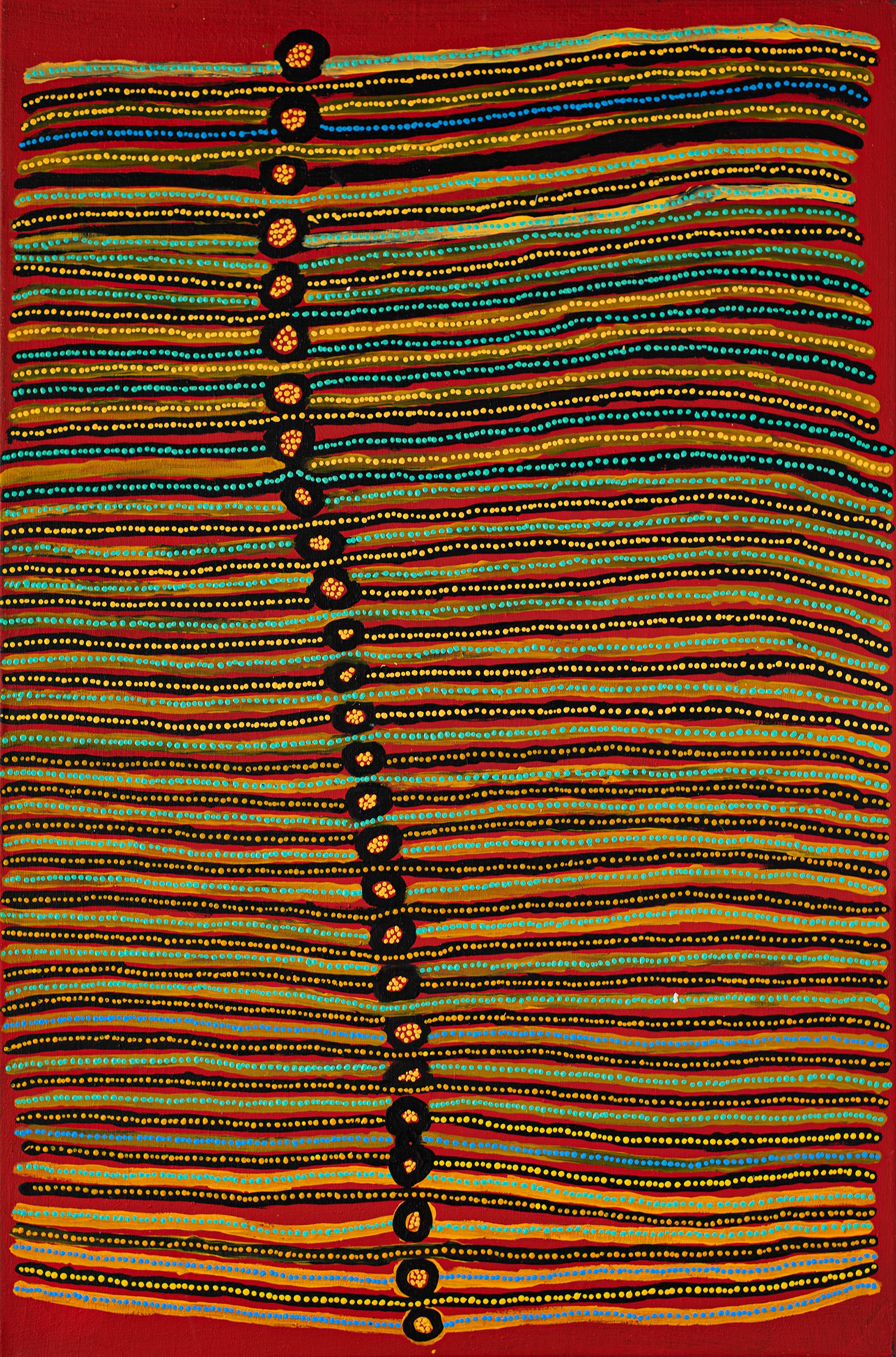
Artiste : Lennard Walker (1946)
Titre de l'œuvre : Road to Ilkurlka
Format : 137 × 90 cm
Provenance et certificat : centre d'art aborigène du Spinifex Art Project
Référence de cette peinture : 23-215
Enquiry / Demander le prix de l'œuvre
Explications pour cette œuvre :
This is the road north from Tjuntjuntjara. Tali tjuta (sand dunes) all along here. As you travel north past Ilkurlka you reach the country I am responsible for around Kuru Ala (located in the Great Victoria Desert of WA). There are small rock holes along the ridges of sand dunes. Lennard was born at Kuru Ala making him the senior custodian for this place. It is a ‘Women’s Site” holding the Kungkarangkalpa Tjukurpa – Seven Sisters story. As a man, there are places he cannot go but he sll holds authority and cultural responsibilies for Kuru Ala.
Before reaching Kuru Ala there are many sand dunes to pass over. Lennard has great knowledge for this country and lists the following rock holes; Purpurnya, Kapi Wiyatjara, Nyuman, Kaman, Tuwan and Wayatji.
Lennard was born at Kuru Ala making him the senior custodian for this place. It is a ‘Women’s Site holding the Kungkarangkalpa Tjukurpa – Seven Sisters story. This is an epic songline, which follows a group of young women as they traverse Spinifex country all the while evading the lustful attention of a powerful sorcerer man named Nyiru. Nyiru has metamorphic powers of transformation. He is a quandong tree at one site and at another a kunyia (woma python). The women make their way north, eventually flying into the night sky to become the star constellation of Pleiades the Seven Sisters. These characters are creation beings who transform the landscape as they move through it leaving indelible physical reminders of their power and presence for Anangu to follow.
As a man, there are places that Lennard cannot go but he still holds authority and cultural responsibilities for Kuru Ala. Before reaching Kuru Ala there are many sand dunes to pass over. Lennard has great knowledge for this country and lists the following rock holes; Purpurnya, Kapi Wiyatjara, Nyuman, Kamanti, Tuwan and Wayatji.
His artworks are in the following prestigious collections :
Artbank Australian Government, Canberra. A.C.T.
Collection Prince Stefan Of Liechtenstein, Embassy Of Liechtenstein In Germany. (Mens Collaborate)
Kuntswerk Sammlung Alison Und Peter W. Klein, Germany Sammlung Alison Und Peter W. Klein, Germany
National Gallery Of Australia, Canberra, Act (Mens Collaborative)
Seattle Art Museum, Seattle, Usa. (Mens Collaborative)
The British Museum, London. (Mens Collaborative)
The Corrigan Collection, Australia (Mens Collaborative)
The Kaplan-Levi Collection, Usa
W. & V. Mcgeoch Collection, Melbourne, Vic.
Wagner And Owen Collection, Usa.
Queensland Art Gallery Of Modern Art, Brisbane, Qld.
The Art Gallery Of New South Wales, Sydney, Nsw (Mens Collaborative)
Art Gallery Of South Australia, Adelaide, South Australia (Mens Collaborative)
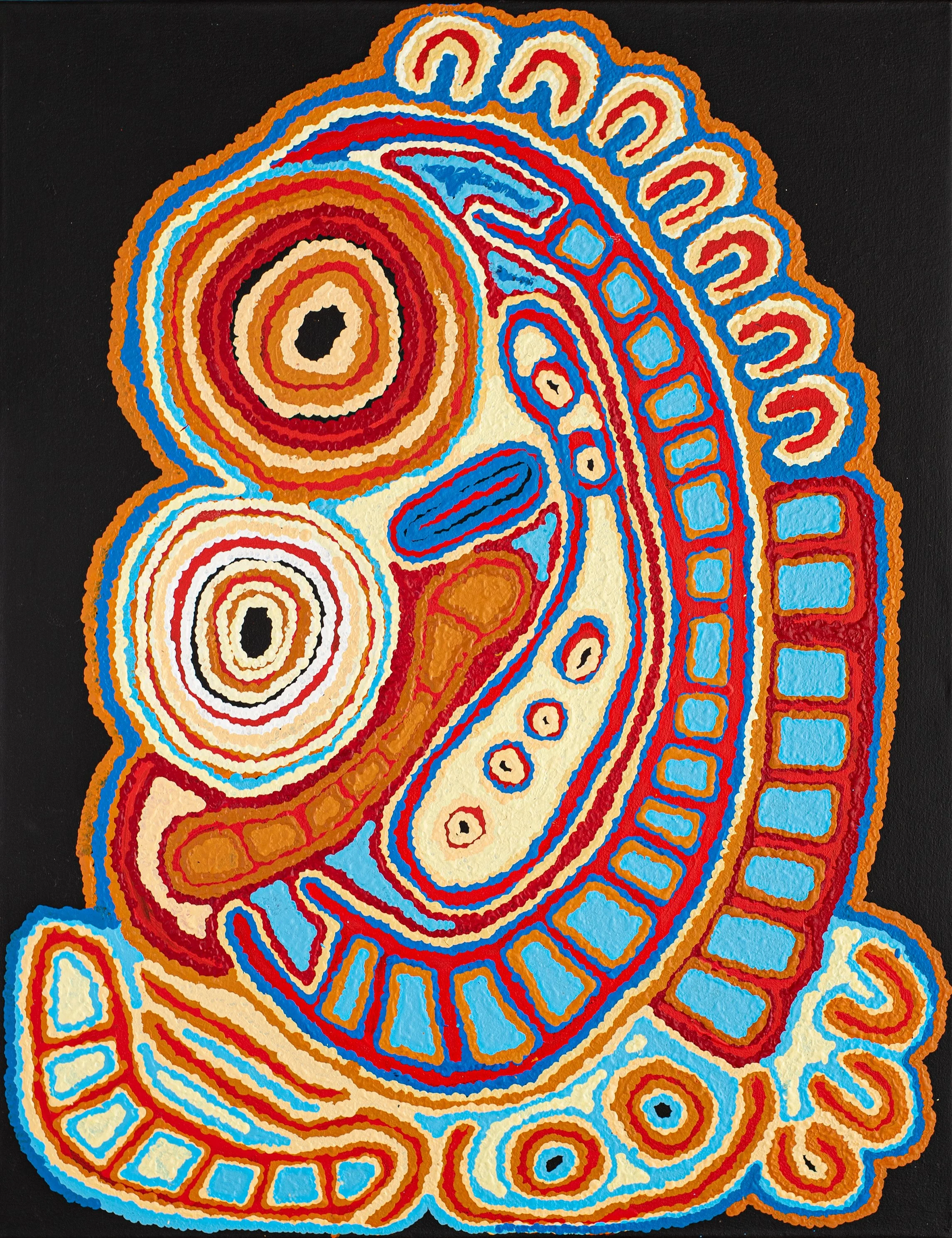
Artiste : Jessica Veronica Brown
Titre de l'œuvre : Seven Sisters
Format : 110 × 85 cm
Provenance et certificat : centre d'art aborigène du Spinifex Art Project
Référence de cette peinture : 23-171
Enquiry / Demander le prix de l'œuvre
Explications pour cette œuvre :
Kungkarangkalpa is a major Western Desert Tjukurpa also known as the Seven Sisters). Tjukurpa is the Pitjantjatjara concept for describing the formative creation where ancestral beings create the world. These beings are Anangu ancestors, who can take the form of people, plants or animals. They traverse the country; forming the world we live in, creating the waterholes, the trees, the clay pans, the rocky outcrops, the sand hills and the Spinifex plains. These land formations are the physical manifestation of the creation energy and tangible evidence that this Tjukurpa is true. This Tjukurpa of the Seven Sisters is an epic songline in the Western Desert and tells the story of many women traveling throughout the desert hunting and carrying out ritual obligations all the while being pursued by a cheeky old man in pursuit of a wife. Nyiru the man, is capable of changing form and does this on occasion in order to trick the women. Many parts of the story are secret and involve a sexual element. Only the public details of this story are allowed to be put down in paint.

Artiste : Anmanari Brown
Titre de l'œuvre : Kuru Ala
Format : 110 × 85 cm
Provenance et certificat : centre d'art aborigène du Spinifex Art Project
Référence de cette peinture : 15-405
Enquiry / Demander le prix de l'œuvre
Explications pour cette œuvre :
Anmanari Brown (1934) has painted the Seven Sisters at Kuru Ala. In this Tjukurpa the sisters are travelling across the desert all the me being pursued by Wa Nyiiru a lusul old man who is trying to get the older sister for his wife. They don’t want this old man and are frightened by his sinister and relentless tracking of them. This man is a creaon being and thus has magical powers. As a shape shifter he transforms himself into plants and animals in order to deceive the women and get close enough to steal Kampukurtja (the eldest sister) from them. Drawing on ancient tradition Anmanari's works are bold and powerful abstractions of country, visual maps tracing the journeying of the ancestor beings and the land formaons they created through their activities. Her recent works have moved away from any figurative representation found in her early works to broad brush strokes of colour; circles (representing water holes and or the women) and paterned lines (representing ceremonial dancing and travelling sand tracks).
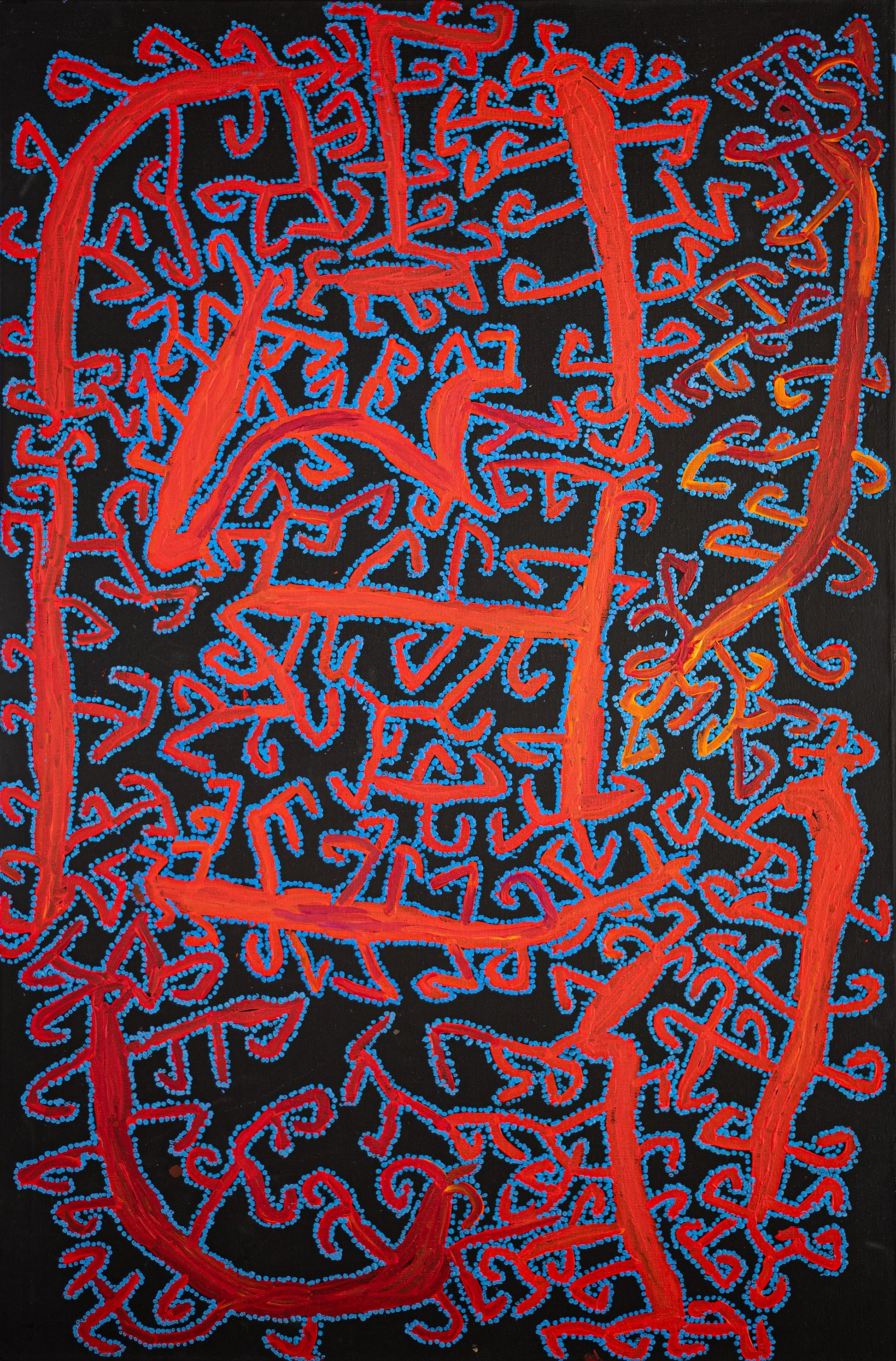
Artiste : Ned Grant
Titre de l'œuvre : Palpatatjara
Format : 137 × 90 cm
Provenance et certificat : centre d'art aborigène du Spinifex Art Project
Référence de cette peinture : 23-146
Enquiry / Demander le prix de l'œuvre
Explications pour cette œuvre :
Ned Grant (1941) intertwines himself within the landscape, unable to separate. He is a manifestation of the enormity of place that is Spinifex Land. With all of its labyrinthine religion within the physical, the flora, the fauna, the manta (ground). He moves under it, through it, above it, encompassing all. Religion is everywhere, it is sung, it is danced by firelight and it resides in and drives Ned Grant to paint.
Here he depicts the Ngalta (Desert Kurrajong) in its spiritual incarnation and the embodiment of his religion at the significant site of Palpatatjara. It is at this site that holds the Tjulpu Tjuta Tjukurpa (Many Birds Creation Line), a narrative that follows a group of Nyii- Nyii (Zebra Finch) as they journey south to the coast to save the world from rising seas.
These are creation beings who shape the immediate landscape as they move through it. It is they who made the physical and the moral compass that still guides Spinifex People today.
The artworks by Ned Grant are in the following prestigious collections :
National Gallery of Australia, Canberra
Art Gallery of New South Wales, Sydney
The Corrigan Collection, Sydney , Australien
W . & V. McGeoch Collection, Sydney , Australien
Seattle Art Museum, Seattle, USA
Greg Castillo Collection, Berkeley , USA
The British Museum, London
Museum Fünf Kontinente, München, Allemagne
Sammlung Alison und Peter W . Klein, Nussdorf, Allemagne

Artiste : Jessica Veronica Brown
Titre de l'œuvre : Seven Sisters
Format : 137 × 90 cm
Provenance et certificat : centre d'art aborigène du Spinifex Art Project
Référence de cette peinture : 23-98
Enquiry / Demander le prix de l'œuvre
Explications pour cette œuvre :
Kungkarangkalpa is a major Western Desert Tjukurpa also known as the Seven Sisters). Tjukurpa is the Pitjantjatjara concept for describing the formative creation where ancestral beings create the world. These beings are Anangu ancestors, who can take the form of people, plants or animals. They traverse the country; forming the world we live in, creating the waterholes, the trees, the clay pans, the rocky outcrops, the sand hills and the Spinifex plains. These land formations are the physical manifestation of the creation energy and tangible evidence that this Tjukurpa is true. This Tjukurpa of the Seven Sisters is an epic songline in the Western Desert and tells the story of many women traveling throughout the desert hunting and carrying out ritual obligations all the while being pursued by a cheeky old man in pursuit of a wife. Nyiru the man, is capable of changing form and does this on occasion in order to trick the women. Many parts of the story are secret and involve a sexual element. Only the public details of this story are allowed to be put down in paint.
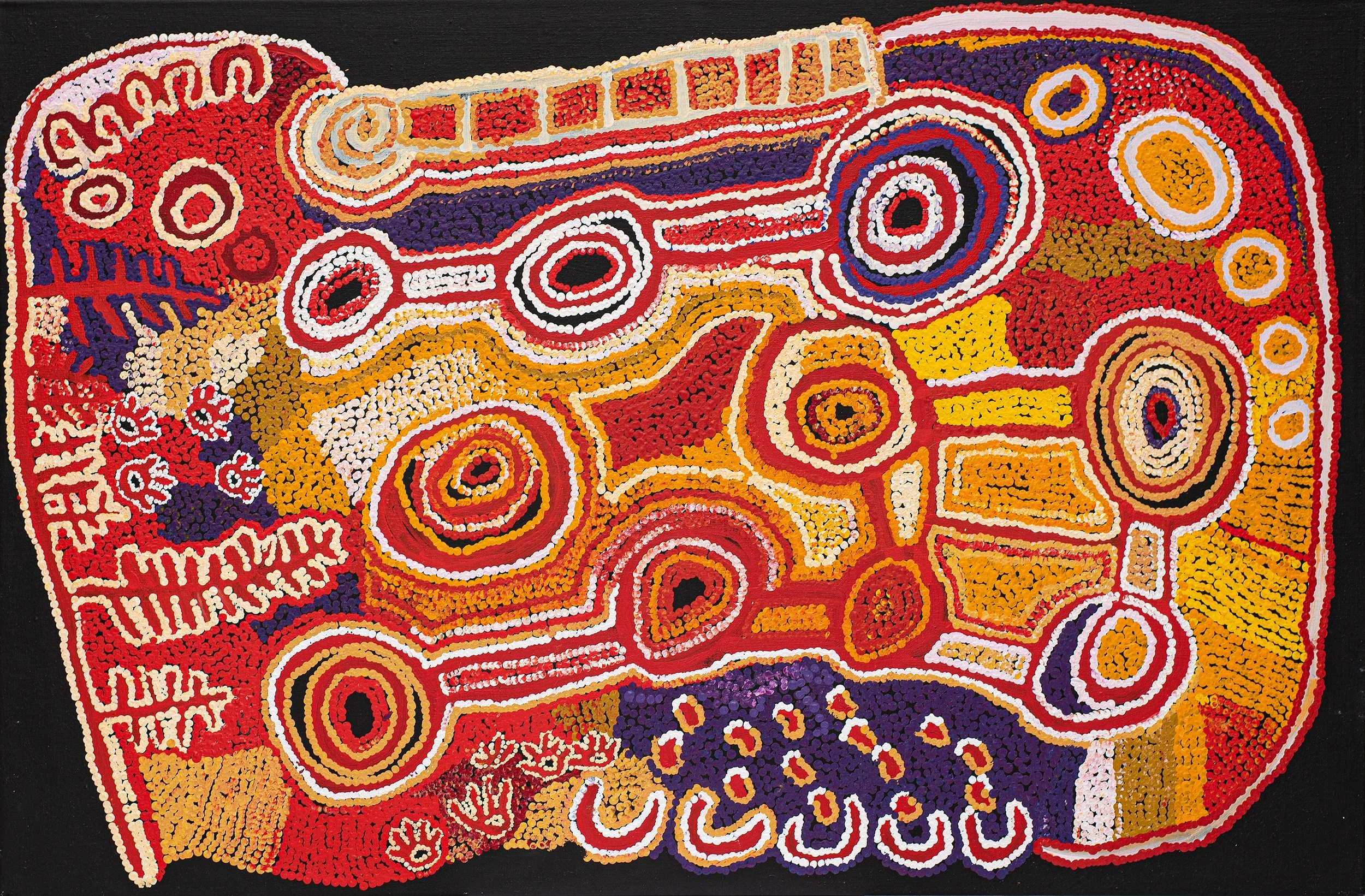
Artiste : Ngalpingka Simms (1945)
Titre de l'œuvre : Wayiyul
Format : 137 x 90 cm
Provenance et certificat : centre d'art aborigène du Spinifex Art Project
Référence de cette peinture : 23-27
Enquiry / Demander le prix de l'œuvre
Explications pour cette œuvre :
Ngalpingka has painted Wayiyul country associated with Minyma Tjuta Tjukurpa (Many Women Creation Line) and is a major women’s songline that traverses vast tracts of traditional Spinifex Land and beyond. This is a Creation narrative with a man at the center but it is truly a women’s story, full of spiritual insight and knowledge for the journey into adulthood. It recounts the long and arduous journey that a group of young women make whilst under constant pursuit of a lustful man (Wati Nyiru) who wishes to take the eldest girl (Kampukurta), for his wife.
Ngalpingka Simms (1945) is a senior artist whose country is Wayilul near present day Patjarr community in the north of Ngaanyatjarra Lands and the northern reaches of the Gibson Desert. Here, she depicts the significant site of Wayilul and nearby Tika-Tika where the women encounter footprints belonging to Wati Nyiru.
Her artworks are in the following prestigious collections :
Collection Prince Stefan Of Liechtenstein, Embassy Of Liechtenstein In Germany.(Women's Collaborate)
Seattle Art Museum, Seattle Usa (Women’s Collaborative)
The British Museum, London, England.(Women's Collaborative)
The National Gallery Of Victoria, Melbourne, Vic. (As Part Of The Women's Collaborative)
The Sims Dickson Collection, Nsw (Collaborative With Kathleen Donnegan)
University Of Queensland Art Museum, Brisbane, Qld.
Art Gallery Of South Australia, Adelaide Sa (Women’s Collaborative)
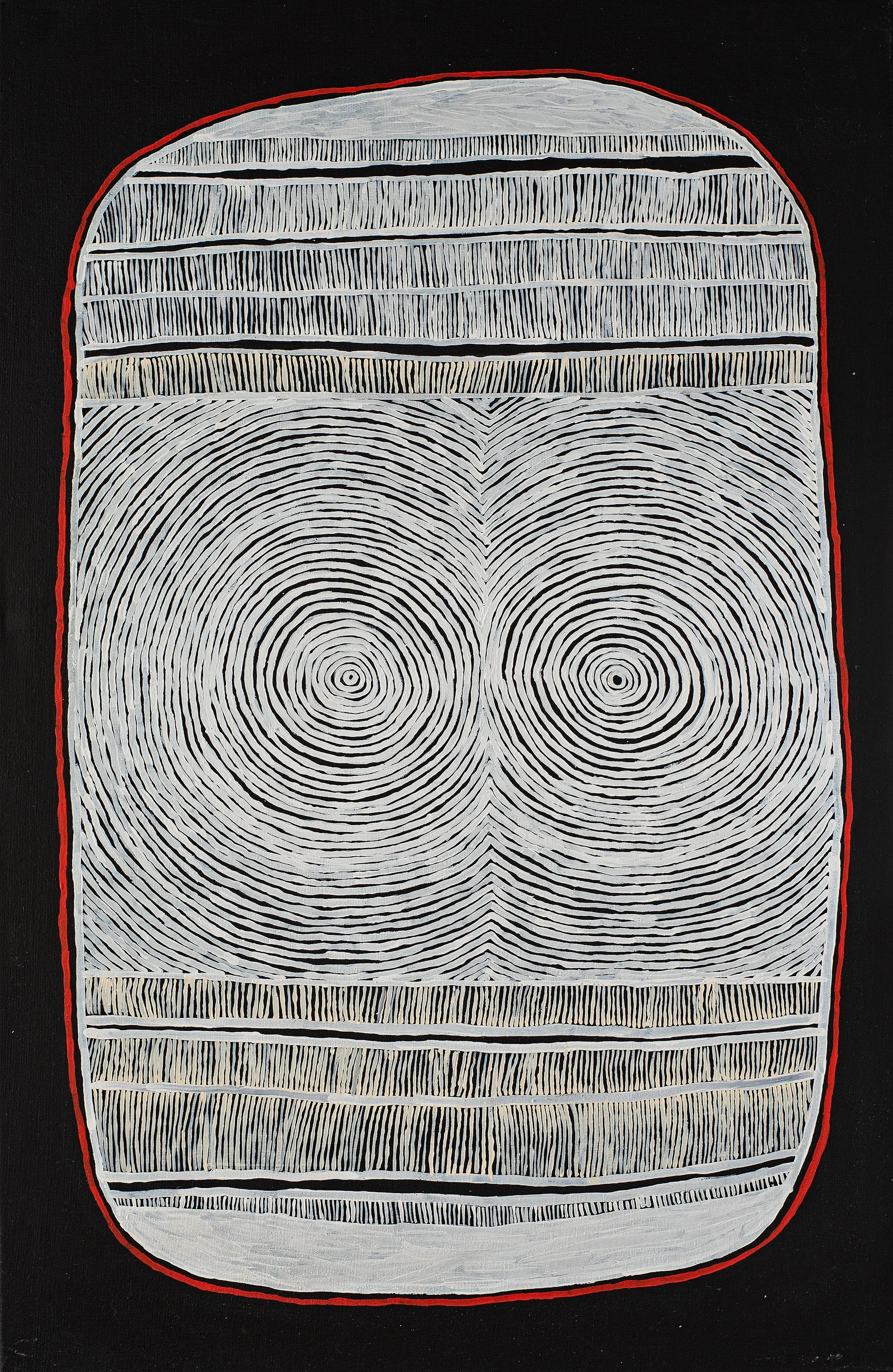
Artiste : Winmati Roberts (1957)
Titre de l'œuvre : Tjara
Format : 137 x 90 cm
Provenance et certificat : centre d'art aborigène du Spinifex Art Project
Référence de cette peinture : 22-296
Enquiry / Demander le prix de l'œuvre
Explications pour cette œuvre :
Winmati Roberts has drawn on the millennia of Spinifex cultural knowledge and experience, in his visual portrayal of the symbolism involved in the sacred Tjara (combat shield). Historically, young boys would watch as their fathers cut slabs from certain trees and spent long periods fashioning the tjara with precious stone tools. The men would then sculpt complex incisions and necessary motifs across the face of the shields in ownership and ritual. Winmati interprets this history with a contemporary creativity and dynamism but also a personal reverence for a fast disappearing practice. Winmati describes these depictions of the tjara markings belonging to Wati Kutjara Wanampi ( Two Watersnake Men). These men, a father or son from Pukara traverse the Spinifex Lands on ceremonial business. Here he talks of the design representing the significant sites of Pukara and Mituna where the men frequented. But to give even more gravitas to the compositions, Winmati has embraced the use of phosphorescent paint to bring the mapan (magic) to the surface but this can only be witnessed in the cover of darkness. Here he states, is the shield of the father.

Artiste : Kanta Donnegan
Titre de l'œuvre : Minyma Tjuta
Format : 110 × 85 cm
Provenance et certificat : centre d'art aborigène du Spinifex Art Project
Référence de cette peinture : 22-148
Demander le prix de l'œuvre / Enquiry
Explications pour cette œuvre :
Kanta (1944) Kanta was born at Kapi PitiKutjara, the place where WatiKutjara (Two Serpent Men) emerged and headed for Pukara.
This painting belongs to the Kungkarangkalpa Tjukurpa, a major Western Desert Tjukurpa also known as the Seven Sisters. Tjukurpa is the Pitjantjatjara concept for describing the formative creation where ancestral beings create the world. These beings are Anangu ancestors, who can take the form of people, plants or animals. They traverse the country; forming the world we live in, creating the waterholes, the trees, the clay pans, the rocky outcrops, the sand hills and the Spinifex plains. These land formations are the physical manifestation of the creation energy and tangible evidence that this Tjukurpa is true. This Tjukurpa of the Seven Sisters is an epic songline in the Western Desert and tells the story of many women traveling throughout the desert hunting and carrying out ritual obligations all the while being pursued by a cheeky old man in pursuit of a wife. Nyiru the man, is capable of changing form and does this on occasion in order to trick the women. Many parts of the story are secret and involve a sexual element. Only the public details of this story are allowed to be put down in paint. At Tjitjiti the young girls were ritualistically pung the salty water onto their nipples.
Kanta went into Cundeelee Mission in the late 1950s sweep a young married woman without children. Kanta had one son and three daughters by her first husband (dec.) in Cundeelee and returned to Spinifex in the first wave of resettlers in 1984. Apart from attending the odd exhibition or women’s trip to the outside Kanta has not left the desert lands since. Several years after the Rictor family came in from northern Spinifex she married one of the sons, Ian - her kuri pikitja, often translated as “promised one”. As if forged by the early years in her country Kanta is gentle soul and has assiduously painted with the Spinifex Art Project since representing her country in the women’s native title painting in 1997. Kathleen has painted on most of the women’s collaboratives.
Her artworks are in the following prestigious collections :
Collection Prince Stefan Of Liechtenstein, Embassy Of Liechtenstein In Germany.(Womens Collaborate)
Museum Of Western Australia
The Corrigan Collection, Australia. (Womens Collaborative)
The Lepley Collection, Perth, Western Australia. (Womens Collaborative)
The National Gallery Of Victoria, Melbourne, Vic. (Womens Collaborative)
The Sims Dickson Collection, Nsw (Collaborative With Ngalpingka Simms)
Artbank, Australian Government Collection. Australia.
Parliament House Art Collection, Canberra, Act (Womens Collaborative)
Art Gallery Of South Australia, Adelaide, South Australia (Womens Collaborative)
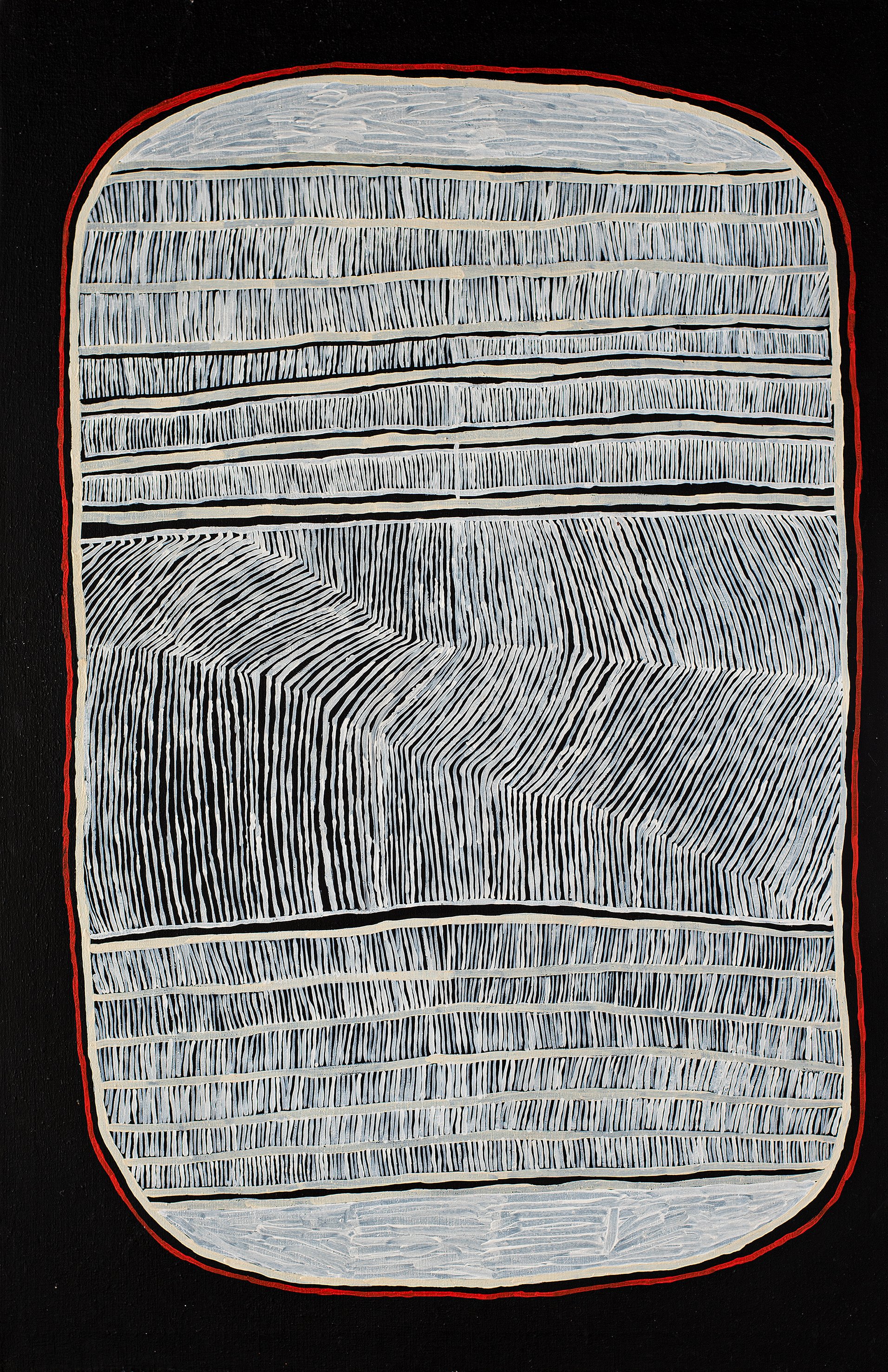
Artiste : Winmati Roberts (1957)
Titre de l'œuvre : Tjara
Format : 137 x 90 cm
Provenance et certificat : centre d'art aborigène du Spinifex Art Project
Référence de cette peinture : 22-321
Enquiry / Demander le prix de l'œuvre
Explications pour cette œuvre :
Winmati Roberts has drawn on the millennia of Spinifex cultural knowledge and experience, in his visual portrayal of the symbolism involved in the sacred Tjara (combat shield). Historically, young boys would watch as their fathers cut slabs from certain trees and spent long periods fashioning the tjara with precious stone tools. The men would then sculpt complex incisions and necessary motifs across the face of the shields in ownership and ritual. Winmati interprets this history with a contemporary creativity and dynamism but also a personal reverence for a fast disappearing practice. Winmati describes these depictions of the tjara markings belonging to Wati Kutjara Wanampi ( Two Watersnake Men). These men, a father or son from Pukara traverse the Spinifex Lands on ceremonial business. Here he talks of the design representing the significant sites of Pukara and Mituna where the men frequented. But to give even more gravitas to the compositions, Winmati has embraced the use of phosphorescent paint to bring the mapan (magic) to the surface but this can only be witnessed in the cover of darkness. Here he states, is the shield of the father.

Artiste : Fred Grant
Titre de l'œuvre : Tuwan
Format : 137 × 90 cm
Provenance et certificat : centre d'art aborigène du Spinifex Art Project
Référence de cette peinture : 20-92
Enquiry / Demander le prix de l'œuvre
Explications pour cette œuvre :
Fred Grant (1943) knows the boundless sandhills, the endless skies and extensive forests of Spinifex Country. He's walked the rich cultural fabric that embraces his land wherever he looks and he has inmate knowledge of the life sustaining water sources that are its foundation of survival in an arid environment. Fred paints with the passive authority of someone that knows they belong to the intimacy of a landscape with a powerful religion at its heart.
Here he depicts the site of Tuwan, situated in the heart of Spinifex Country. Tjaltunya holds the powerful Wati Kutjara Tjukurpa (Two Men Creation Line). This is a far reaching narrative that follows two brothers: a black nosed monitor lizard and a sand goanna- as they journey through Spinifex Country. These are creation beings who shaped the landscape as they moved through it leaving the guiding story etched in monolithic physical reminders of their power and presence.
His artworks are in the following collections :
Harriett & Richard England Collection
National Gallery Of Australia, Canberra, Act (Mens Collaborative)
Seattle Art Museum, Seattle, Usa. (Mens Collaborative)
The Corrigan Collection, Australia (Mens Collaborative)
The Lepley Collection, Perth, Western Australia.
W. & V. Mcgeoch Collection, Melbourne, Vic.
Queensland Art Gallery Of Modern Art, Brisbane, Qld.
The Art Gallery Of New South Wales, Sydney, Nsw
Art Gallery Of South Australia, Adelaide, South Australia (Mens Collaborative)
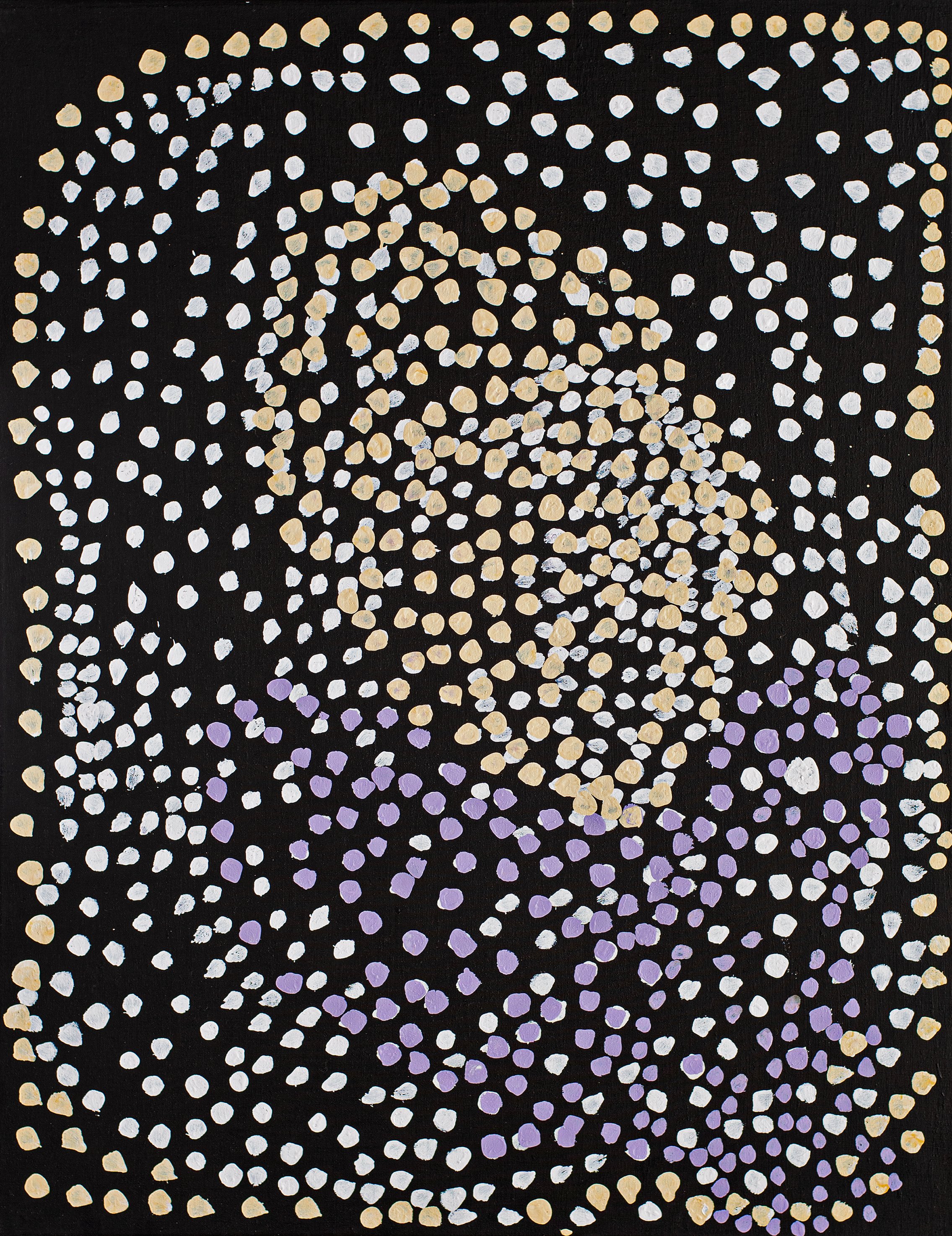
Artiste : Mick Rictor
Titre de l'œuvre : untitled
Format : 110 x 85 cm
Provenance et certificat : centre d'art aborigène du Spinifex Art Project
Référence de cette peinture : 21-128
Demander le prix de l'œuvre / Enquiry
Explications pour cette œuvre :
Mick Rictor (1957) was around thirty years of age when he walked into modern civilisation for the first time from deep in the heart of the Great Victoria Desert in 1986. A very remote and special place holding true wilderness character, like Mick himself. Other Anangu (Aboriginal people) refer to Mick as a wild man, ferocious like the old men used to be before people were softened by modern living.
Mick Rictor gives us freedom to contemplate. His compositions are both painterly and sparse leaving form and space intertwined and suspended. He is not quick to paint and peruses the blank canvas with hand on chin like Rodin's 'The Thinker' for a long period before selecting colour and brush to begin. But still it is a slow rhythmic placement of individual 'dots' that build up sometimes as a single colour, sometimes as multiple colours, one blanketing the other. His works reference the landscapes and changing colours of the Spinifex Country, the sweeping plains nestled in between parallel lines of sand dunes, the red rocky granite outcrops on the northern boundary, the sacred water holes and their ‘wanampi’ serpent guardians and 'mamu tjina' or scorer footprints from the Tjukurpa.
Mick was born at Kulpinya situated south of the significant site of Miramiratjara in the Great Victoria Desert sometime around 1956. This puts him in close proximity to the British Atomic Testing at Emu Fields and Maralinga during the '50s and '60s. Mick and his immediate family were living a nomadic life in and around traditional Spinifex Country up until 1986 when the family was located by relatives searching the area and taken to a then small settlement of Yakadunya and later Coonana. Mick is the eldest sibling of four with his other three siblings Ian and Noli Rictor and Tjaruwa Woods already established artists.
He started painting in 2016 and has a natural aesthetic with a painterly quality about his work.
Mick Rictor gives us freedom to contemplate. His compositions are both painterly and sparse, leaving form and space intertwined and suspended. He is not quick to paint and peruses the blank canvas with hand on chin like Rodin’s The Thinker for a long period before selecting colour and brush to begin. But still it is a slow rhythmic placement of individual ‘dots’ that build up somemes as a single colour, somemes as multiple colours, one blanketing the other. His works reference the landscapes and changing colours of the Spinifex Country, the sweeping plains nestled in between parallel lines of sand dunes, the red rocky granite outcrops on the northern boundary, the sacred waterholes and their wanampi (serpent guardians) and mamu tjina(sorcerer’s footprints) from the Tjukurpa.
His artworks are in the following prestigious collections :
Museum And Art Gallery Of The Northern Territory, Darwin, Australia.
Art Gallery Of South Australia, Adelaide, South Australia
Artbank, Australian Government Collection. Australia.
Araluen Gallery, Alice Springs, Northern Territory.
Charles Darwin University Art Collection, Darwin,Northern Territory
Richard And Harriett Collection, Australia
Arthur Roe Collection, Australia
The Sims Dickson Collection, Nsw
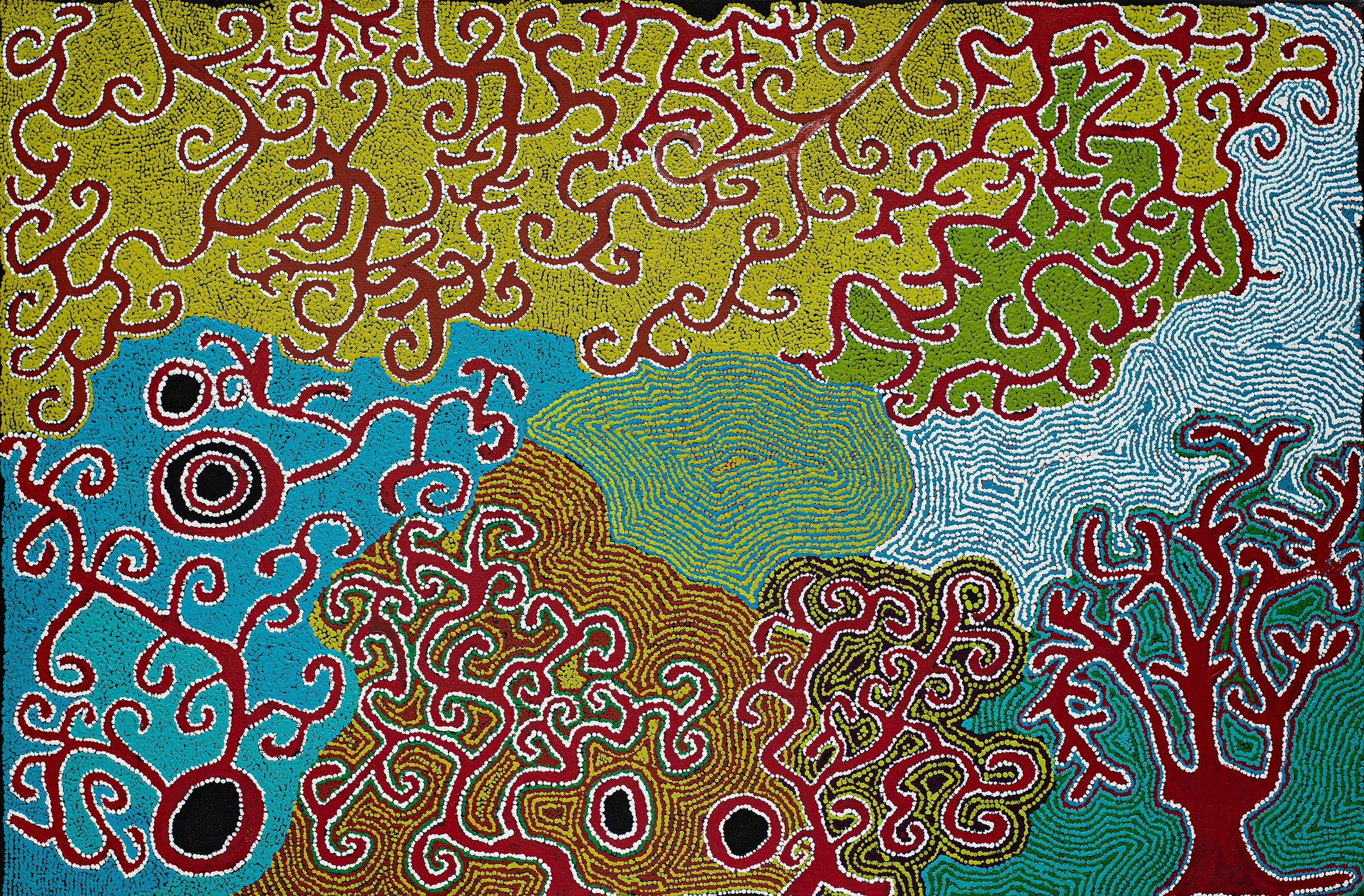
Artiste : Byron Brooks
Titre de l'œuvre : Tjutala
Format : 137 x 90 cm
Provenance et certificat : centre d'art aborigène du Spinifex Art Project
Référence de cette peinture : 19-284
Vendue
Explications pour cette œuvre :
Byron Brooks(1951), a senior spinifex man has outstanding knowledge of the numerous Tjukurpa that form a network through Spinifex country and beyond.
Byron has depicted country associate with the significant site of Tjutala situated in the east of traditional Spinifex Lands. Tjutala holds the Tjitji Kutjara Tjukurpa (Two Boy Creation Line) and is a far reaching narrative of two katja Wirutja (owl boys). These are creation beings and as such created the landscape as they moved through it, leaving indelible physical reminders of their power and presence. Byron has depicted the kukara tree (mallee) that flourishes in the region.
Tjukurpa is a deep and complex religious tradition generally referring to the energy of creation manifest in spirit beings, ancestors, animals, plants and geology. This Law is secret and privy only to initiated men and women. Tjukurpa is past, present and future all at the same time, a force equally active today. It is a guide for living life well, explaining the relationships between people, plants, animals and the physical features of the land.
His artworks are in the following prestigious collections :
Collection Prince Stefan Of Liechtenstein, Embassy Of Liechtenstein In Germany. (Mens Collaborate)
Gavan Fox Collection, Adelaide
Seattle Art Museum, Seattle, Usa. (Mens Collaborative)
The Corrigan Collection, Australia (Mens Collaborative)
The Lepley Collection, Perth, Western Australia. (Mens Collaborative)
Art Gallery Of South Australia, Adelaide, South Australia (Mens Collaborative)
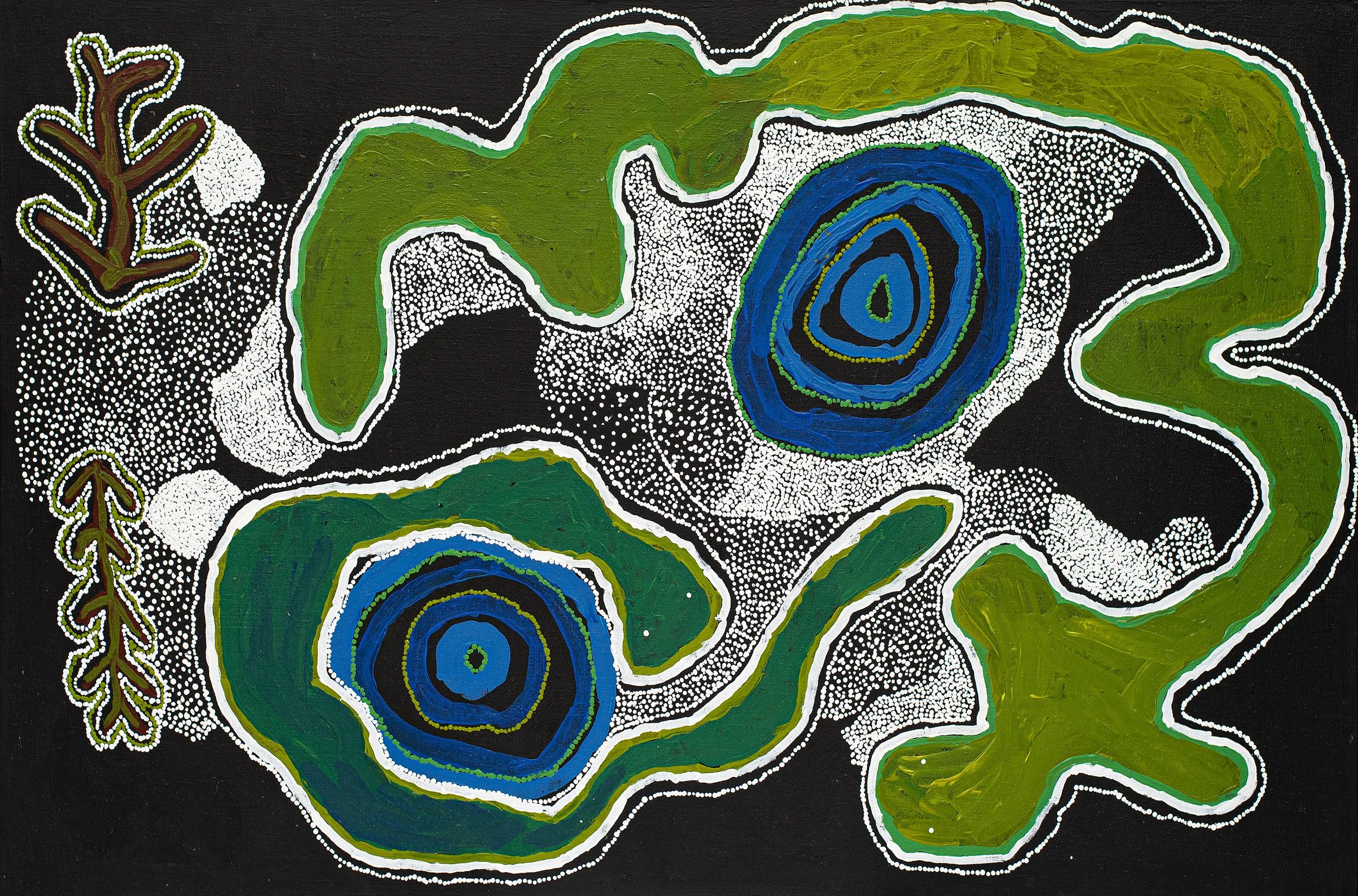
Artiste : Dora Parker
Titre de l'œuvre : Lingka
Format : 137 x 90 cm
Provenance et certificat : centre d'art aborigène du Spinifex Art Project
Référence de cette peinture : 23-316
Enquiry / Demander le prix de l'œuvre
Explications pour cette œuvre :
Dora Parker (1962) paints with a freedom of expression for the sites she depicts and claims her own identity in her painterly compositions.
She now depicts with confidence the significant site of Pukara situated in the north of traditional Spinifex Lands. It is here that Wati Kutjara Tjukurpa (Two Men Creation Line) manifests. This epic narrative follows a father and son Wanampi (water serpent) as they traverse the Spinifex Lands on ceremonial business. This particular Tjukurpa is one of the most prevalent Mens' creation narratives within Spinifex and can be painted by some women-as with Dora. These characters described are creation beings' with the power of transformation, not just of themselves but the landscape they moved through. They le indelible physical reminders in a mapped environment and wrapped it in song and dance for all to follow.

Artiste : Anmanari Brown
Titre de l'œuvre : Kuru Ala
Format : 137 × 90 cm
Provenance et certificat : centre d'art aborigène du Spinifex Art Project
Référence de cette peinture : 15-406
Enquiry / Demander le prix de l'œuvre
Explications pour cette œuvre :
Anmanari Brown (1934) has painted the Seven Sisters at Kuru Ala. In this Tjukurpa the sisters are travelling across the desert all the me being pursued by Wa Nyiiru a lusul old man who is trying to get the older sister for his wife. They don’t want this old man and are frightened by his sinister and relentless tracking of them. This man is a creaon being and thus has magical powers. As a shape shifter he transforms himself into plants and animals in order to deceive the women and get close enough to steal Kampukurtja (the eldest sister) from them. Drawing on ancient tradition Anmanari's works are bold and powerful abstractions of country, visual maps tracing the journeying of the ancestor beings and the land formaons they created through their activities. Her recent works have moved away from any figurative representation found in her early works to broad brush strokes of colour; circles (representing water holes and or the women) and paterned lines (representing ceremonial dancing and travelling sand tracks).
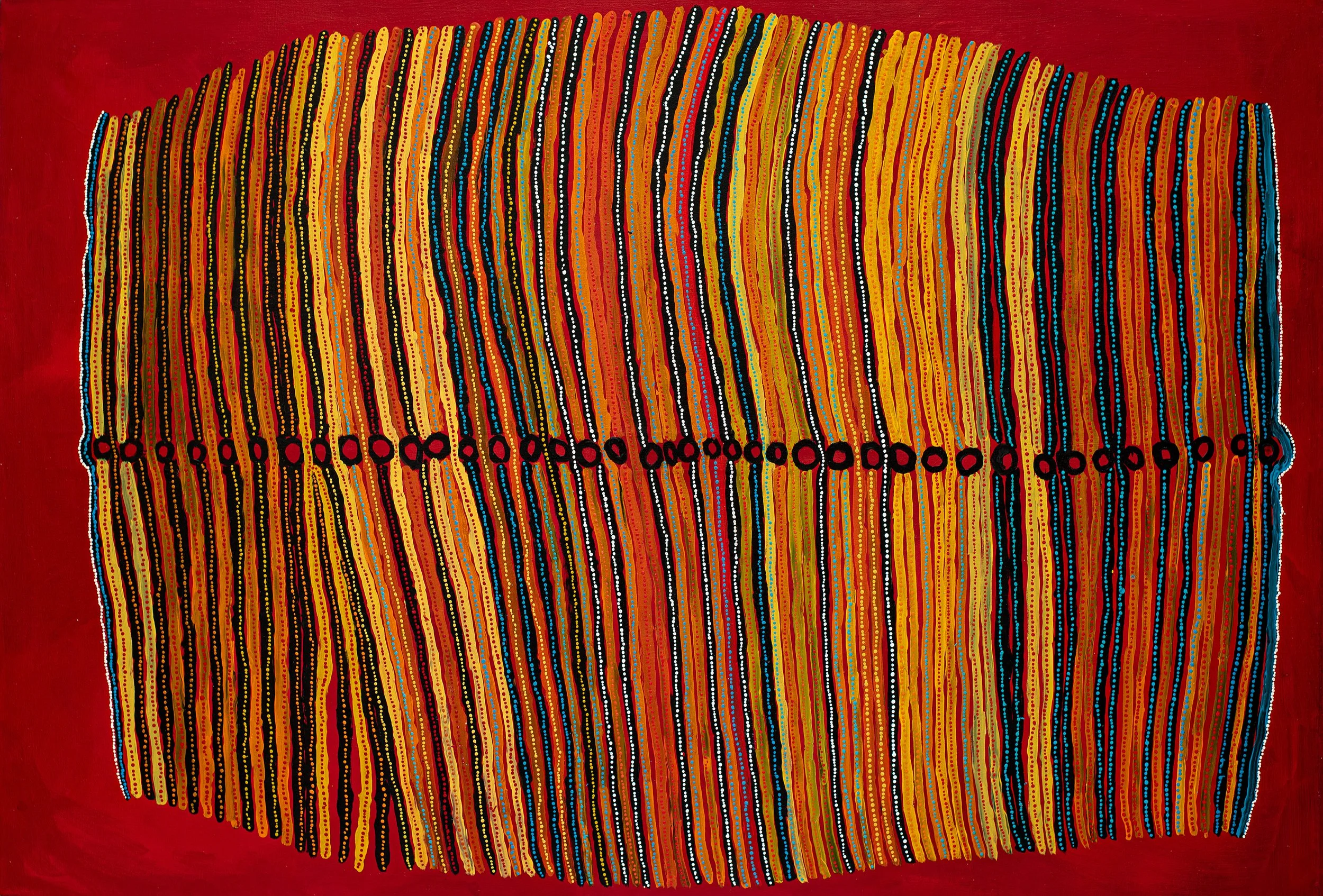
Artiste : Lennard Walker (1946)
Titre de l'œuvre : Road to Ilkurlka
Format : 200 × 137 cm
Provenance et certificat : centre d'art aborigène du Spinifex Art Project
Référence de cette peinture : 24-339
Enquiry / Demander le prix de l'œuvre
Explications pour cette œuvre :
This is the road north from Tjuntjuntjara. Tali tjuta (sand dunes) all along here. As you travel north past Ilkurlka you reach the country I am responsible for around Kuru Ala (located in the Great Victoria Desert of WA). There are small rock holes along the ridges of sand dunes. Lennard was born at Kuru Ala making him the senior custodian for this place. It is a ‘Women’s Site” holding the Kungkarangkalpa Tjukurpa – Seven Sisters story. As a man, there are places he cannot go but he sll holds authority and cultural responsibilies for Kuru Ala.
Before reaching Kuru Ala there are many sand dunes to pass over. Lennard has great knowledge for this country and lists the following rock holes; Purpurnya, Kapi Wiyatjara, Nyuman, Kaman, Tuwan and Wayatji.
Lennard was born at Kuru Ala making him the senior custodian for this place. It is a ‘Women’s Site holding the Kungkarangkalpa Tjukurpa – Seven Sisters story. This is an epic songline, which follows a group of young women as they traverse Spinifex country all the while evading the lustful attention of a powerful sorcerer man named Nyiru. Nyiru has metamorphic powers of transformation. He is a quandong tree at one site and at another a kunyia (woma python). The women make their way north, eventually flying into the night sky to become the star constellation of Pleiades the Seven Sisters. These characters are creation beings who transform the landscape as they move through it leaving indelible physical reminders of their power and presence for Anangu to follow.
As a man, there are places that Lennard cannot go but he still holds authority and cultural responsibilities for Kuru Ala. Before reaching Kuru Ala there are many sand dunes to pass over. Lennard has great knowledge for this country and lists the following rock holes; Purpurnya, Kapi Wiyatjara, Nyuman, Kamanti, Tuwan and Wayatji.
His artworks are in the following prestigious collections :
Artbank Australian Government, Canberra. A.C.T.
Collection Prince Stefan Of Liechtenstein, Embassy Of Liechtenstein In Germany. (Mens Collaborate)
Kuntswerk Sammlung Alison Und Peter W. Klein, Germany Sammlung Alison Und Peter W. Klein, Germany
National Gallery Of Australia, Canberra, Act (Mens Collaborative)
Seattle Art Museum, Seattle, Usa. (Mens Collaborative)
The British Museum, London. (Mens Collaborative)
The Corrigan Collection, Australia (Mens Collaborative)
The Kaplan-Levi Collection, Usa
W. & V. Mcgeoch Collection, Melbourne, Vic.
Wagner And Owen Collection, Usa.
Queensland Art Gallery Of Modern Art, Brisbane, Qld.
The Art Gallery Of New South Wales, Sydney, Nsw (Mens Collaborative)
Art Gallery Of South Australia, Adelaide, South Australia (Mens Collaborative)
Artiste : Simon Hogan
Titre de l'œuvre : Lingka
Format : 230 x 200 cm
Provenance et certificat : centre d'art aborigène du Spinifex Art Project
Référence de cette peinture : 23-276
Enquiry / Demander le prix de l'œuvre
Explications pour cette œuvre :
Simon Hogan (1930) manifests his site of Lingka onto the two dimensional plane. When he paints, he transcends this world and is taken over soft sand ridges and vast Spinifex plains to the significant sites that formed him from birth. For Simon was born into a spiritual society where religion manifested in the immediate environment and where creation beings could move through different realms at will. It is these beings who shaped the landscape that Simon depicts and who left a moral compass that is still followed today. They gave to people the life giving water sites that were held with such reverence in an arid and remote land. It is these sites that were the means of survival and where religion unfolded in the form of sacred song and performance.
Simon Hogan was born circa 1930 in mid-western Spinifex between Paltju and Lingka. Simon’s exact age is unknown as dates of birth were estimated by the A.E.M. missionaries when the Spinifex people, on arrival at Cundeelee, were “sorted” into family groups, given English names and approximate dates of birth. During childhood two fathers, one born at Warakunu and the other at Munki raised Simon. Simon’s mother’s country is around Tjulya. The Spinifex people were a relatively discreet southern Pitjantjatjara tribal group with es to the north and east that lived a fully traditional hunter-gatherer life until the late1950’s to early 1960s when most people either walked in to Ooldea and Cundeelee or were taken by AEM missionaries to Cundeelee Mission…
From 1995 Simon Hogan was a prominent member of a group of senior traditional owners from Spinifex country who lobbied the WA State Government for Native Title. Although Simon spoke no English he was a confident, initiated Pitjantjatjara man who spoke to senior government officials regarding ownership of country and culture. Exclusive Native Title rights were granted to Simon Hogan and the Spinifex people in 2000 of over 55 000 sq kms of the Great Victoria Desert in WA.
His artworks are in the following prestigious collections :
Art Gallery Of South Australia, Adelaide, South Australia
British Museum, London, England.
Harriet And Richard England Collection
National Gallery Of Australia, Canberra, Act.
National Gallery Of Victoria, Melbourne, Victoria.
Seattle Art Museum, Seattle, Usa. (Mens Collaborative)
Staatliches Museum Fur Volkerkunde, Munich, Germany
The Lepley Collection, Perth, Western Australia.
The Patrick Corrigan Collection, Sydney, New South Wales.
W. & V. Mcgeoch Collection
Western Australian Museum, Perth, W.A.
Artbank, Australian Government Collection. Australia.
Art Gallery Of Western Australia, Perth, Western Australia.
The Art Gallery Of New South Wales, Sydney, Nsw (Mens Collaborative)