
Exposition d’art Aborigène “Cornerstone - La Pierre Angulaire” - Aboriginal art from Australia
A la galerie Aboriginal Signature Estrangin : 101 rue Jules Besme, 1081 Bruxelles.
Vernissage sur RDV le jeudi 27 octobre de 11h à 21h30.
A 20h - discours du directeur de la galerie et drink.
RSVP - réserver votre visite
Ensuite la galerie vous reçoit sur RDV, du vendredi 28 octobre au samedi 19 novembre 2022, du mardi au samedi, de 11h à 19h : vous pouvez également réserver votre visite dés à présent dans notre agenda ici.
Cornerstone - La Pierre Angulaire
La galerie Aboriginal Signature Estrangin est fière de vous présenter l’exposition « Cornerstone », comme un hommage au monument invisible de la pensée développé par les Aborigènes d’Australie sur les pistes chantées du Temps du Rêve.
Le cœur de l’Australie recèle de trésors, des espaces immenses poudrés de rouge habités par des constructions rocheuses remarquables, bien plus nombreuses que l’emblématique rocher d’Uluru. Préservés de la curiosité de nos contemporains, et des convoitises humaines, ces terres et élévations épargnées et fermées au public illustrent et accompagnent les histoires du Temps du Rêve.
Elles ouvrent les chapitres d’un immense livre soumis à tous vents depuis la Création du monde.
Les élévations géologiques ici ou là ponctuent le récit. Elles offrent une beauté brute, intrinsèque, dans l’épure du modelage et geste sublime des ancêtres créateurs, dans les jeux des lumières invités, dans les perspectives infinies où se glisse le souffle des esprits.
Les blocs rocheux souvent arrondis en équilibre précaire sont les pierres angulaires du territoire, les éléments fondateurs de l’histoire, les traces indélébiles d’évènements épiques, et s’illustrent comme les lieux sacrés Aborigènes.

David Miller - Wati Ngintaka Tjukurpa - 127 x 117 cm - 22-104. © Photo Aboriginal Signature Estrangin Gallery with the courtesy of the artist and Ninuku Arts.
Etre invité à traverser leur territoire consiste à s’effacer pour tenter de ressentir l’invisible. L’ombre portée des histoires habite chaque espace et interstice, de l’immensité à l’infiniment petit dans les fissures de la roche, bien souvent le symbole du passage des ancêtres comme les Seven sisters conviées dans les peintures de cette nouvelle exposition avec les artistes de la communauté de Ninuku.

Nyayati Stanley Young - Patilpa Tjukurpa - 122 x 91cm - 22-234. © Photo Aboriginal Signature Estrangin Gallery with the courtesy of the artist and Ninuku Arts.
Leurs histoires sont les pierres angulaires de la culture, le ciment qui fonde leur société, le terreau qui embrasse l’avenir et cela depuis des milliers et milliers de générations.
Leurs histoires traversent la terre, empruntent les pistes, habitent les lieux, résonnent par les chants entonnés lors des cérémonies, ou pour annoncer son passage sans heurter les esprits sous-jacents dans le territoire.
Leurs histoires sont les pierres angulaires d’un immense monument de la pensée, construit autour des traces laissées dans une mémoire collective parmi les plus anciennes du monde.
Cette exposition avec la communauté de Ninuku se déroule au carrefour de nombreuses pistes chantées, véritable nœud signifiant au cœur du pays rouge.
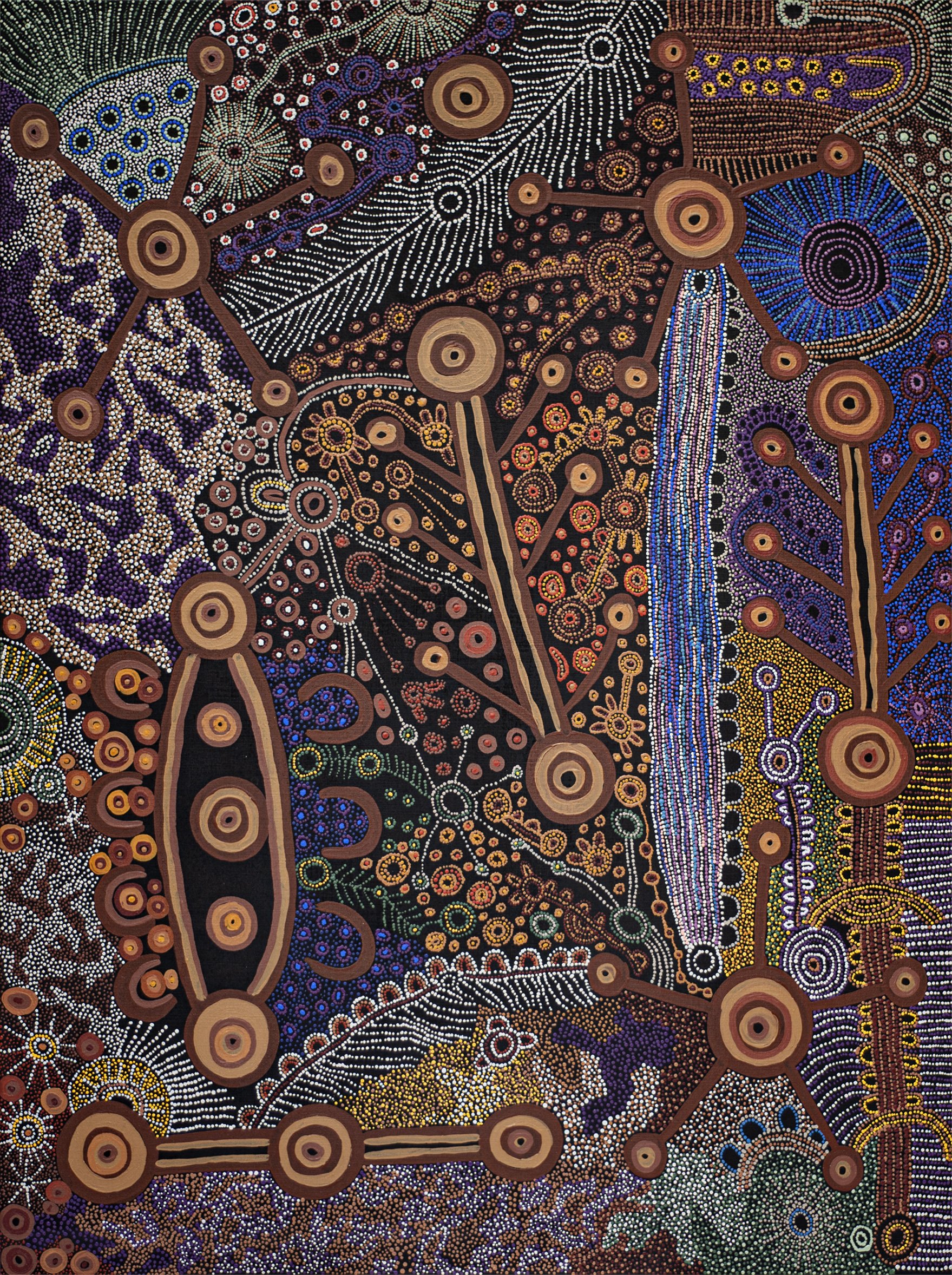
Anyupa Nelson - Kungkarangkalpa (Seven Sisters Story) - 122 x 91cm - 22-208. © Photo Aboriginal Signature Estrangin Gallery with the courtesy of the artist and Ninuku Arts.
En 2022, une peinture Ngintaka Wati de l’artiste David Miller, fut projetée sur l’Opéra de Sydney dans le cadre des commémorations de l’Australia Day, célébrant une histoire fameuse qui traverse le territoire de son père.
Nous sommes très honorés d’accueillir au sein de la galerie 25 œuvres remarquables réalisées par 6 artistes porteurs de la mémoire de leur peuple : Nyayati Stanley Young (1949), David Miller (1951), Samuel Miller (1966), Anyupa Nelson (1968), Angela Watson (1966), et Carol Young (1972). D’une génération à l’autre ils prennent le relais de cette œuvre partagée et continue, avec des individualités distinctes exprimées avec délicatesse sur la toile, chacun dans une révérence de l’histoire du Temps du Rêve dont ils ont la charge.
Nous nous réjouissons de vous accueillir au sein de la galerie à Bruxelles, dans notre espace de 250 m2 tout entier dédié à ces grands et petits trésors du bout du monde.
Bertrand Estrangin
Directeur de la galerie

Angkaliya Nelson - Kungkarangkalpa (Seven Sisters Story) - 122 x 91 cm - 22-256. © Photo Aboriginal Signature Estrangin Gallery with the courtesy of the artist and Ninuku Arts.
Découvrez les peintures disponibles à Bruxelles durant l’exposition :

Artiste : Anyupa Nelson
Titre de l'œuvre : Mittunya Ngura
Format : 122 x 91 cm
Provenance et certificat : centre d'art aborigène de Ninuku
Référence de cette peinture : 22-17
Demander le prix de l'œuvre / Enquiry
Explications pour cette œuvre :
I am painting a story my mother taught me. Mittunya Ngura, this is the country called Mittunya. My sister's country. This is a story about Kaliny-Kaliny(pa) (the honey grevillea). Wati Kutjara Wanampi (two male watersnakes), father and son, are living at Pukara, a waterhole in Western Australia south west of Irrunytju. Anangu tjuta, lot's of people, come to the rockhole for the sweet water and the father wanampi says "go back to your own country". The people leave and the father and son travel to Willuna where they camp for weeks. They return to Pukara and are sleeping when they hear a buzzing sound. Minyma Punpunpa the lady flies are making lots of noise as they buzz around the honey bush. Wati wanampi father and son get up and go to collect honey. It is there that the Wati Mututja (black ant) finds them and spears the Wati Wanampi son in the side. The young son starts vomiting, and he vomits up all different types of honey grevillea in yellows and orange. There is Kaliny-Kaliny(pa), Ultunkun(pa), Piruwa and Witjinti.
© Photo : Aboriginal Signature Estrangin gallery with the courtesy of the artists and Ninuku.

Artiste : Samuel Miller
Titre de l'œuvre : Ngayuku Ngura
Format : 183 x 111cm
Provenance et certificat : centre d'art aborigène de Ninuku
Référence de cette peinture : 22-125
Demander le prix de l'œuvre / Enquiry
Explications pour cette œuvre :
Ngayuku Ngura means ‘My Place’. Samuel uses an extensive palee of colours to paint the country surrounding Kalka and Pipalyatjara. His paintings feature the various land formations from that area - rockholes, creeks and hills. His land is a sacred men’s rockhole, so sacred that the name is not allowed to be written down or spoken about.
© Photo : Aboriginal Signature Estrangin gallery with the courtesy of the artists and Ninuku.

Artiste : Samuel Miller
Titre de l'œuvre : Nyuku NguruFormat : 153 x 91 cm
Provenance et certificat : centre d'art aborigène de Ninuku
Référence de cette peinture : 22-294
Demander le prix de l'œuvre / Enquiry
Explications pour cette œuvre :
Ngayuku Ngura means ‘My Place’. Samuel uses an extensive palee of colours to paint the country surrounding Kalka and Pipalyatjara. His paintings feature the various land formations from that area - rockholes, creeks and hills. His land is a sacred men’s rockhole, so sacred that the name is not allowed to be written down or spoken about.
© Photo : Aboriginal Signature Estrangin gallery with the courtesy of the artists and Ninuku.

Artiste : Angela Watson
Titre de l'œuvre : Minyma Kutjara
Format : 122 x 122cm
Provenance et certificat : centre d'art aborigène de Ninuku
Référence de cette peinture : 22-190
Demander le prix de l'œuvre / Enquiry
Explications pour cette œuvre :
Minyma Kutjara (two women) travel from the otherside of Makura Piti heading north. The two sisters stop halfway near Wingellina. The younger one keeps looking back because she is homesick. The big sister said "why you looking back, why you crying? We are going long way." They travelled around all the different country. The younger sister realises that the older one is pregnant, she thinks how could that be there are no men. But there are men, sneaky men, and they camp with the older sister at night. This story is a women's and men's business story. The two girls keep travelling up past Docker River.
© Photo : Aboriginal Signature Estrangin gallery with the courtesy of the artists and Ninuku.

Artiste : Angkaliya Nelson
Titre de l'œuvre : Kungkarangkalpa (Seven Sisters Story)
Format : 108 x 104 cm
Provenance et certificat : centre d'art aborigène de Ninuku
Référence de cette peinture : 22-191
Demander le prix de l'œuvre / Enquiry
Explications pour cette œuvre :
This is a major Tjukurpa for Irrunytju (Wingellina) and across the central Australian deserts. The seven sisters travelled from Kaliwarra to Wannan in Western Australia, stopping at significant sites and rockholes including Kuru Ala, a sacred place for women. They encountered a lustful man named Wati Nyiru, who chased them around the desert. Some of the details of this Tjukurpa (Dreaming story) are sacred and can’t be repeated.
© Photo : Aboriginal Signature Estrangin gallery with the courtesy of the artists and Ninuku.

Artiste : Samuel Miller
Titre de l'œuvre : Ngayuku Ngura
Format : 182 x 109.5cm
Provenance et certificat : centre d'art aborigène de Ninuku
Référence de cette peinture : 22-126
Demander le prix de l'œuvre / Enquiry
Explications pour cette œuvre :
Ngayuku Ngura means ‘My Place’. Samuel uses an extensive palee of colours to paint the country surrounding Kalka and Pipalyatjara. His paintings feature the various land formations from that area - rockholes, creeks and hills. His land is a sacred men’s rockhole, so sacred that the name is not allowed to be written down or spoken about.
© Photo : Aboriginal Signature Estrangin gallery with the courtesy of the artists and Ninuku.

Artiste : David Miller
Titre de l'œuvre : Ngintaka
Format : 91 x 91 cm
Provenance et certificat : centre d'art aborigène de Ninuku
Référence de cette peinture : 22-68
Demander le prix de l'œuvre / Enquiry
Explications pour cette œuvre :
This is a story about Wati Ngintaka Tjukurpa (perentie lizard man creation story). That Wati Ngintaka (lizard man) heard the clapping sound of a beautiful grinding stone - a traditional tool used for grinding mai (food). He wanted that stone for himself, so he travelled from Arang’nga a long way east towards Wayatina, looking for the stone. He spotted Anangu tjuta (lots of Aboriginal people) at a camp. Some of the people gave him mai (food) in the form of a seed cake, but it was dry and he didn’t like it. Then one lady gave him delicious food and he knew that it had been made with seeds ground on the special grinding stone. He spied the grinding stone and stole it, hiding it in under his tail. When they all went hunting the next day, Wati Ngintaka stayed in camp, saying he had sore feet. Once they were gone, it was safe and he left, stealing the grinding stone. All the people were angry with the Wati Ngintaka and chased him. When they caught him they felt all over his body to see where he was hiding the grinding stone, but couldn’t find it. Wati Ngintaka held up his arms and claimed he didn’t have it, but they saw he was hiding it, wipungka (in his tail). They speared the Wati Ngintaka and retrieved the grinding stone. He passed away at a place called Aran’nga in the Northern Territory. Ngaltutjara (poor thing).
© Photo : Aboriginal Signature Estrangin gallery with the courtesy of the artists and Ninuku.

Artiste : Carol Young
Titre de l'œuvre : Ngura Tjuta: Big Country - Carol
Format : 92 x 61cm
Provenance et certificat : centre d'art aborigène de Ninuku
Référence de cette peinture : 21-675
Demander le prix de l'œuvre / Enquiry
Explications pour cette œuvre :
Carol paints in the style of her grandmother Nyankulya Watson. The story passed down to her is about Nyankulya's country and the many places she travelled to as a young girl. Carol learnt all the rock holes from her grandmother. "Mt Aloysius, good water there. 'Ngura tjuta' (lots of country) including: Altjurungka, Kunaltju, Wangkal, Tur, Wiltju, Wipuwarra, Warratjuntjun, Pitlja Piltj."
© Photo : Aboriginal Signature Estrangin gallery with the courtesy of the artists and Ninuku.

Artiste : David Miller
Titre de l'œuvre : Wati Ngintaka Tjukurpa
Format : 127 x 117 cm
Provenance et certificat : centre d'art aborigène de Ninuku
Référence de cette peinture : 22-104
Demander le prix de l'œuvre / Enquiry
Explications pour cette œuvre :
This is a story about Wati Ngintaka Tjukurpa (perentie lizard man creation story). That Wati Ngintaka (lizard man) heard the clapping sound of a beautiful grinding stone - a traditional tool used for grinding mai (food). He wanted that stone for himself, so he travelled from Arang’nga a long way east towards Wayatina, looking for the stone. He spotted Anangu tjuta (lots of Aboriginal people) at a camp. Some of the people gave him mai (food) in the form of a seed cake, but it was dry and he didn’t like it. Then one lady gave him delicious food and he knew that it had been made with seeds ground on the special grinding stone. He spied the grinding stone and stole it, hiding it in under his tail. When they all went hunting the next day, Wati Ngintaka stayed in camp, saying he had sore feet. Once they were gone, it was safe and he left, stealing the grinding stone. All the people were angry with the Wati Ngintaka and chased him. When they caught him they felt all over his body to see where he was hiding the grinding stone, but couldn’t find it. Wati Ngintaka held up his arms and claimed he didn’t have it, but they saw he was hiding it, wipungka (in his tail). They speared the Wati Ngintaka and retrieved the grinding stone. He passed away at a place called Aran’nga in the Northern Territory. Ngaltutjara (poor thing).
© Photo : Aboriginal Signature Estrangin gallery with the courtesy of the artists and Ninuku.

Artiste : Angela Watson
Titre de l'œuvre : Minyma Kutjara
Format : 122 x 122 cm
Provenance et certificat : centre d'art aborigène de Ninuku
Référence de cette peinture : 22-209
Demander le prix de l'œuvre / Enquiry
Explications pour cette œuvre :
Minyma Kutjara (two women) travel from the otherside of Makura Piti heading north. The two sisters stop halfway near Wingellina. The younger one keeps looking back because she is homesick. The big sister said "why you looking back, why you crying? We are going long way." They travelled around all the different country. The younger sister realises that the older one is pregnant, she thinks how could that be there are no men. But there are men, sneaky men, and they camp with the older sister at night. This story is a women's and men's business story. The two girls keep travelling up past Docker River.
© Photo : Aboriginal Signature Estrangin gallery with the courtesy of the artists and Ninuku.

Artiste : David Miller
Titre de l'œuvre : Wati Ngintaka munu Minyma Tjirilya
Format : 122 x 122 cm
Provenance et certificat : centre d'art aborigène de Ninuku
Référence de cette peinture : 22-210
Demander le prix de l'œuvre / Enquiry
Explications pour cette œuvre :
This is a story about Wati Ngintaka Tjukurpa (perentie lizard man creation story). That Wati Ngintaka (lizard man) heard the clapping sound of a beautiful grinding stone - a traditional tool used for grinding mai (food). He wanted that stone for himself, so he travelled from Arang’nga a long way east towards Wayatina, looking for the stone. He spotted Anangu tjuta (lots of Aboriginal people) at a camp. Some of the people gave him mai (food) in the form of a seed cake, but it was dry and he didn’t like it. Then one lady gave him delicious food and he knew that it had been made with seeds ground on the special grinding stone. He spied the grinding stone and stole it, hiding it in under his tail. When they all went hunting the next day, Wati Ngintaka stayed in camp, saying he had sore feet. Once they were gone, it was safe and he left, stealing the grinding stone. All the people were angry with the Wati Ngintaka and chased him. When they caught him they felt all over his body to see where he was hiding the grinding stone, but couldn’t find it. Wati Ngintaka held up his arms and claimed he didn’t have it, but they saw he was hiding it, wipungka (in his tail). They speared the Wati Ngintaka and retrieved the grinding stone. He passed away at a place called Aran’nga in the Northern Territory. Ngaltutjara (poor thing).
© Photo : Aboriginal Signature Estrangin gallery with the courtesy of the artists and Ninuku.

Artiste : Angela Watson
Titre de l'œuvre : Minyma Kutjara
Format : 128 x 127 cm
Provenance et certificat : centre d'art aborigène de Ninuku
Référence de cette peinture : 22-243
Demander le prix de l'œuvre / Enquiry
Explications pour cette œuvre :
Minyma Kutjara (two women) travel from the otherside of Makura Piti heading north. The two sisters stop halfway near Wingellina. The younger one keeps looking back because she is homesick. The big sister said "why you looking back, why you crying? We are going long way." They travelled around all the different country. The younger sister realises that the older one is pregnant, she thinks how could that be there are no men. But there are men, sneaky men, and they camp with the older sister at night. This story is a women's and men's business story. The two girls keep travelling up past Docker River.
© Photo : Aboriginal Signature Estrangin gallery with the courtesy of the artists and Ninuku.

Artiste : Angkaliya Nelson
Titre de l'œuvre : Kungkarangkalpa (Seven Sisters Story)
Format : 91 x 76 cm
Provenance et certificat : centre d'art aborigène de Ninuku
Référence de cette peinture : 22-250
Demander le prix de l'œuvre / Enquiry
Explications pour cette œuvre :
This is a major Tjukurpa for Irrunytju (Wingellina) and across the central Australian deserts. The seven sisters travelled from Kaliwarra to Wannan in Western Australia, stopping at significant sites and rockholes including Kuru Ala, a sacred place for women. They encountered a lustful man named Wati Nyiru, who chased them around the desert. Some of the details of this Tjukurpa (Dreaming story) are sacred and can’t be repeated.
© Photo : Aboriginal Signature Estrangin gallery with the courtesy of the artists and Ninuku.

Artiste : Nyayati Stanley Young
Titre de l'œuvre : Patilpa Tjukurpa
Format : 122 x 91cm
Provenance et certificat : centre d'art aborigène de Ninuku
Référence de cette peinture : 22-234
Demander le prix de l'œuvre / Enquiry
Explications pour cette œuvre :
This is the dreamtime story of Patilpa (Port Lincoln ringneck parrot) that lives in the country around Pipalytjara. Wati Minu (a man called Minu) came from the west to Pipalytjara, he was a rainmaker. He hunted all the waru (black footed wallaby) and he got lots. The Patilpa people were hungry and went and stole all the fat Mala, leaving the skinny one's for Minu. Minu was angry at this and he made clouds and thunder. All the Patilpa were hiding in a cave, but the rain came and washed them all away. They became Chrysoprase a bright green rock that you can find in the hills surrounding Pipalyatjara.
© Photo : Aboriginal Signature Estrangin gallery with the courtesy of the artists and Ninuku.

Artiste : Angkaliya Nelson
Titre de l'œuvre : Kungkarangkalpa (Seven Sisters Story)
Format : 122 x 91 cm
Provenance et certificat : centre d'art aborigène de Ninuku
Référence de cette peinture : 22-256
Demander le prix de l'œuvre / Enquiry
Explications pour cette œuvre :
This is a major Tjukurpa for Irrunytju (Wingellina) and across the central Australian deserts. The seven sisters travelled from Kaliwarra to Wannan in Western Australia, stopping at significant sites and rockholes including Kuru Ala, a sacred place for women. They encountered a lustful man named Wati Nyiru, who chased them around the desert. Some of the details of this Tjukurpa (Dreaming story) are sacred and can’t be repeated.
© Photo : Aboriginal Signature Estrangin gallery with the courtesy of the artists and Ninuku.

Artiste : Anyupa Nelson
Titre de l'œuvre : Mittunya Ngura
Format : 122 x 91 cm
Provenance et certificat : centre d'art aborigène de Ninuku
Référence de cette peinture : 22-305
Demander le prix de l'œuvre / Enquiry
Explications pour cette œuvre :
I am painting a story my mother taught me. Mittunya Ngura, this is the country called Mittunya. My sister's country. This is a story about Kaliny-Kaliny(pa) (the honey grevillea). Wati Kutjara Wanampi (two male watersnakes), father and son, are living at Pukara, a waterhole in Western Australia south west of Irrunytju. Anangu tjuta, lot's of people, come to the rockhole for the sweet water and the father wanampi says "go back to your own country". The people leave and the father and son travel to Willuna where they camp for weeks. They return to Pukara and are sleeping when they hear a buzzing sound. Minyma Punpunpa the lady flies are making lots of noise as they buzz around the honey bush. Wati wanampi father and son get up and go to collect honey. It is there that the Wati Mututja (black ant) finds them and spears the Wati Wanampi son in the side. The young son starts vomiting, and he vomits up all different types of honey grevillea in yellows and orange. There is Kaliny-Kaliny(pa), Ultunkun(pa), Piruwa and Witjinti.
© Photo : Aboriginal Signature Estrangin gallery with the courtesy of the artists and Ninuku.

Artiste : Samuel Miller
Titre de l'œuvre : Ngayuku Ngura
Format : 122 x 122cm
Provenance et certificat : centre d'art aborigène de Ninuku
Référence de cette peinture : 22-181
Demander le prix de l'œuvre / Enquiry
Explications pour cette œuvre :
Ngayuku Ngura means ‘My Place’. Samuel uses an extensive palee of colours to paint the country surrounding Kalka and Pipalyatjara. His paintings feature the various land formations from that area - rockholes, creeks and hills. His land is a sacred men’s rockhole, so sacred that the name is not allowed to be written down or spoken about.
© Photo : Aboriginal Signature Estrangin gallery with the courtesy of the artists and Ninuku.

Artiste : Anyupa Nelson
Titre de l'œuvre : Kungkarangkalpa (Seven Sisters Story)
Format : 122 x 91 cm
Provenance et certificat : centre d'art aborigène de Ninuku
Référence de cette peinture : 22-208
Demander le prix de l'œuvre / Enquiry
Explications pour cette œuvre :
This is a major Tjukurpa for Irrunytju (Wingellina) and across the central Australian deserts. The seven sisters travelled from Kaliwarra to Wannan in Western Australia, stopping at significant sites and rockholes including Kuru Ala, a sacred place for women. They encountered a lustful man named Wati Nyiru, who chased them around the desert. Some of the details of this Tjukurpa (Dreaming story) are sacred and can’t be repeated.
© Photo : Aboriginal Signature Estrangin gallery with the courtesy of the artists and Ninuku.

Artiste : Angela Watson
Titre de l'œuvre : Minyma Kutjara
Format : 122 x 122cm
Provenance et certificat : centre d'art aborigène de Ninuku
Référence de cette peinture : 22-39
Demander le prix de l'œuvre / Enquiry
Explications pour cette œuvre :
Minyma Kutjara (two women) travel from the otherside of Makura Piti heading north. The two sisters stop halfway near Wingellina. The younger one keeps looking back because she is homesick. The big sister said "why you looking back, why you crying? We are going long way." They travelled around all the different country. The younger sister realises that the older one is pregnant, she thinks how could that be there are no men. But there are men, sneaky men, and they camp with the older sister at night. This story is a women's and men's business story. The two girls keep travelling up past Docker River.
© Photo : Aboriginal Signature Estrangin gallery with the courtesy of the artists and Ninuku.

Artiste : Rita Watson
Titre de l'œuvre : Irlupa
Format : 91 x 61 cm
Provenance et certificat : centre d'art aborigène de Ninuku
Référence de cette peinture : 22-306
Demander le prix de l'œuvre / Enquiry
Explications pour cette œuvre :
This is a story about Irlupa, a site near Papulankatja in Western Australia, a place where Western Ngaayatjara and east earn Pitjantjatjara dielects diverge.This is Rita's father's ngurra (camp and country) where she spent time as young person and is home to many important tjukurpa (dreaming) sites and stories and inma (songs) for Anangu in this area.
Rita paints the features of his camp such as tjukula (rockholes), kalyan kalyan (Honey grevilla plant), tjanpi (spinifex), Kampurarpa (Bush Tomatoes), Anangu (people), punu (trees) and wiltja (windbreaks) in an iconographic milpajunanyi (traditional sand drawing) style.
© Photo : Aboriginal Signature Estrangin gallery with the courtesy of the artists and Ninuku.

Artiste : Angkaliya Nelson
Titre de l'œuvre : Kungkarangkalpa (Seven Sisters Story)
Format : 122 x 91 cm
Provenance et certificat : centre d'art aborigène de Ninuku
Référence de cette peinture : 22-237
Demander le prix de l'œuvre / Enquiry
Explications pour cette œuvre :
This is a major Tjukurpa for Irrunytju (Wingellina) and across the central Australian deserts. The seven sisters travelled from Kaliwarra to Wannan in Western Australia, stopping at significant sites and rockholes including Kuru Ala, a sacred place for women. They encountered a lustful man named Wati Nyiru, who chased them around the desert. Some of the details of this Tjukurpa (Dreaming story) are sacred and can’t be repeated.
© Photo : Aboriginal Signature Estrangin gallery with the courtesy of the artists and Ninuku.
Artiste : Rita Watson
Titre de l'œuvre : Irlupa
Format : 102 x 61 cm
Provenance et certificat : centre d'art aborigène de Ninuku
Référence de cette peinture : 24-151
Demander le prix de l'œuvre / Enquiry
Explications pour cette œuvre :
This is a story about Irlupa, a site near Papulankatja in Western Australia, a place where Western Ngaayatjara and east earn Pitjantjatjara dielects diverge.This is Rita's father's ngurra (camp and country) where she spent time as young person and is home to many important tjukurpa (dreaming) sites and stories and inma (songs) for Anangu in this area.
Rita paints the features of his camp such as tjukula (rockholes), kalyan kalyan (Honey grevilla plant), tjanpi (spinifex), Kampurarpa (Bush Tomatoes), Anangu (people), punu (trees) and wiltja (windbreaks) in an iconographic milpajunanyi (traditional sand drawing) style.
© Photo : Aboriginal Signature Estrangin gallery with the courtesy of the artists and Ninuku.