
Peintures d'art Aborigène de Tjungu Palya , APY land
A plus de 450 km d’Alice Springs se trouve la communauté Aborigène Nyapari, pas très loin des Mann Ranges, où la communauté artistique joue un rôle essentiel pour assurer la pérennité des communautés sur place.... (suite du texte ci-dessous).
Peintures des artistes Aborigènes de Tjungu Palya disponibles au sein de la galerie :


Artiste : Watarru collaborative - œuvre collaborative réalisée par les artistes importants de Tjungu Palya
Titre de l'œuvre : Creation Story for Kuka Mamu
Format : 240 x 150 cm
Provenance et certificat : centre d'art aborigène de Tjungu Palya
Référence de cette peinture : 22-10
Enquiry / Demander le prix de l'œuvre
Explications pour cette peinture Aborigène :
The Watarru Collaborative consists of the 3 artists Wipana Jimmy and her daughters Beryl Jimmy and lmitjala Pellard, all from the very remote community of Watarru on the Anangu Pitjantjatjara Yankunytjatjara (APY) lands in South Australia. Together these three women depict Creation stories that have been passed down through countless generations. Their paintings show a particular sensitivity to the way these creation myths interact with and shape their beloved homeland.
Kuka mamu : there’s an animal crouching down there in Nyapari. Two men making (tjara) shields. They go to hunt that kuka by spearing him. Share with family and then we go down to Watarru way. Family sitting down the bottom rock hole (Iwarawara). There’s plenty of water there.

Artiste : Watarru collaborative - œuvre collaborative réalisée par les artistes importants de Tjungu Palya
Titre de l'œuvre : Creation Story for Ilpili
Format : 200 x 180 cm
Provenance et certificat : centre d'art aborigène de Tjungu Palya
Référence de cette peinture : 22-011
Enquiry / Demander le prix de l'œuvre
Explications pour cette peinture Aborigène :
Cette œuvre évoque une histoire de la Création des Deux Soeurs associées à Ilpili. Ces deux femmes escaladaient différents blocs rocheux pendant que l'Homme Wati était à leur recherche sans pouvoir les apercevoir. La jeune femme était enceinte et se cachait avec sa sœur dans une grotte aux pieds d'une colline.
L'homme grimpa tout en haut pour les appeler : Yaltji, minyma kutjara? "Où êtes-vous ?"

Artiste : Woods collaborative
Titre de l'œuvre : Creation Story for Ilpili
Format : 200 x 150 cm
Provenance et certificat : centre d'art aborigène de Tjungu Palya
Référence de cette peinture : 18-113
Explications pour cette peinture Aborigène :
Cette œuvre évoque "Minyma Kutjara Tjukurpa", un mythe Aborigène associé aux histoires de la Création des Deux Sœurs.
La sœur la plus vénérable voyage avec sa soeur plus jeune vers leur territoire traditionnel. Sur ce chemin, la plus jeune sœur ne souhaitait pas aller plus loin vers le nord, comme elle vivait auparavant dans une autre famille plus au sud proche de l'océan. Elle a été déracinée pendant une longue période et ne connaît pas la terre de sa grande sœur, qui profite de ce périple initiatique pour lui enseigner tout ce qu'elle sait.
Pour l'aider un temps, sa sœur la porte sur son dos durant leur cheminement. Pour moment elles s'arrêtent pour accomplir les cérémonies Inma qui consistent en des chants et danses sacrés. Puis elles poursuivent leur cheminement nomade au nord de la Docker River.

Artiste : Woods collaborative
Titre de l'œuvre : Creation Story for Ilpili
Format : 200 x 170 cm
Provenance et certificat : centre d'art aborigène de Tjungu Palya
Référence de cette peinture : 18-177
Explications pour cette peinture Aborigène :
Cette œuvre évoque "Minyma Kutjara Tjukurpa", un mythe Aborigène associé aux histoires de la Création des Deux Sœurs.
La sœur la plus vénérable voyage avec sa soeur plus jeune vers leur territoire traditionnel. Sur ce chemin, la plus jeune sœur ne souhaitait pas aller plus loin vers le nord, comme elle vivait auparavant dans une autre famille plus au sud proche de l'océan. Elle a été déracinée pendant une longue période et ne connaît pas la terre de sa grande sœur, qui profite de ce périple initiatique pour lui enseigner tout ce qu'elle sait.
Pour l'aider un temps, sa sœur la porte sur son dos durant leur cheminement. Pour moment elles s'arrêtent pour accomplir les cérémonies Inma qui consistent en des chants et danses sacrés. Puis elles poursuivent leur cheminement nomade au nord de la Docker River.

Artiste : Kani Patricia Tunkin
Titre de l'œuvre : Minyma Malilu Tjukurpa
Format : 150 x 121 cm
Provenance et certificat : centre d'art aborigène de Tjungu Palya
Référence de cette peinture : 19-109
Explications pour cette peinture Aborigène :
This is the country for Malilu. She is a creation being from the Tjukurpa (Dream me). Minyma Malilu nyinanyi wana ngka munu pi (the woman Malilu is sitting with her digging stick and collecting bowl). She has been dancing, performing Inma important ceremonial dancing for this country and she has le her dancing tracks behind in the sand. Malilu was a crippled woman and her two daughters had run off to get married, leaving her to fend for herself. It was very hard for her to collect bush foods and water because she had to drag her leg as she walked. Through much effort she collected kampurarpa, wiriny-wirinypa, tawalpa munu mai kutjupa-kutjupa ( desert raisins, bush tomatoes, berries and many different kinds of wild foods). Malilu dug out a cave in the earth, Katatjitj. It has a small opening, but is a huge underground cave. She would hide her surplus food there for when she was hungry or too red to go out hunting. She would make inma (ceremony) in the cave. This is my country close to Kanpi community.
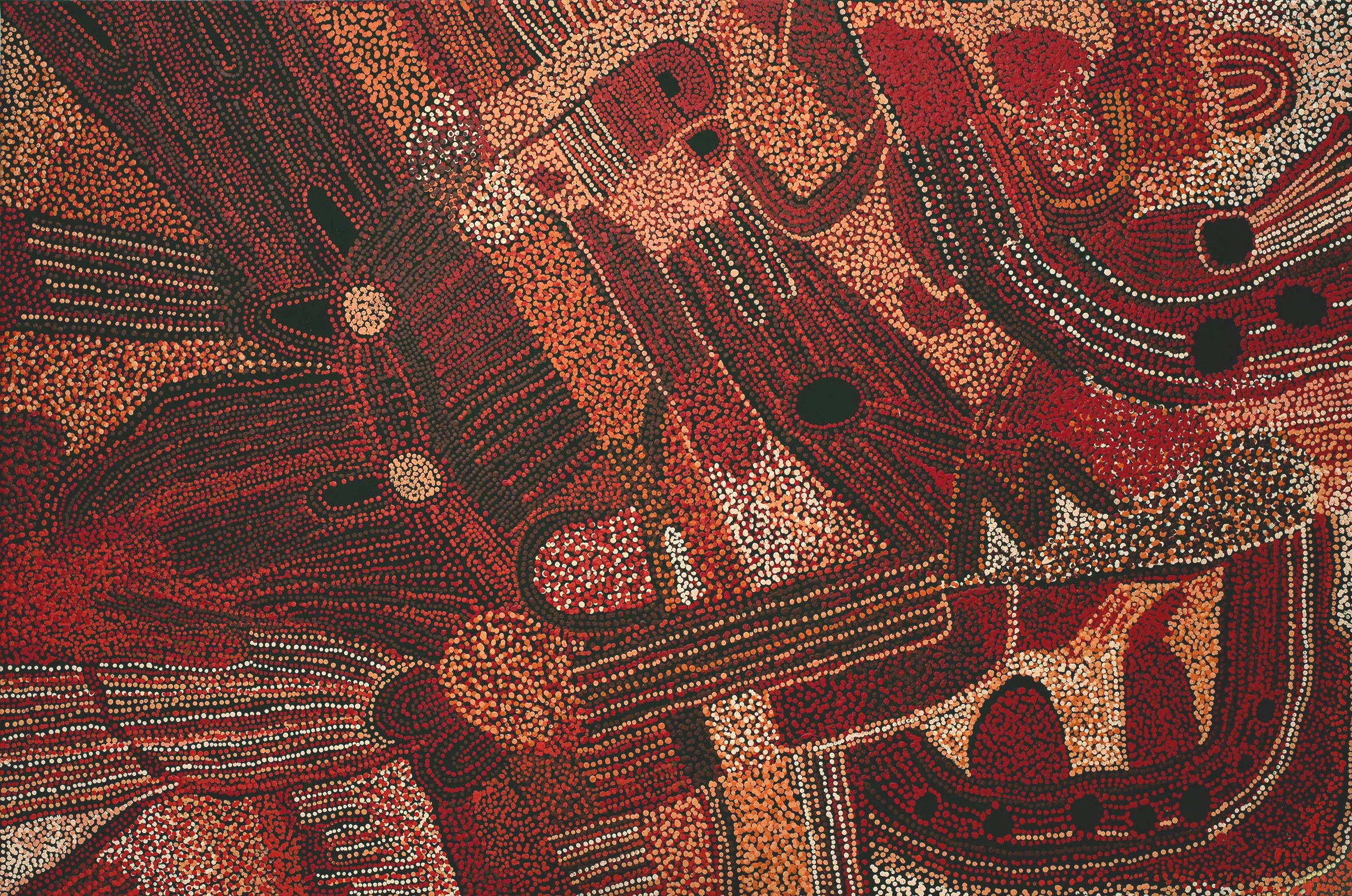
Artiste : Kani Patricia Tunkin
Titre de l'œuvre : Minyma Malilu Tjukurpa
Format : 151 x 100 cm
Provenance et certificat : centre d'art aborigène de Tjungu Palya
Référence de cette peinture : 18-153
Explications pour cette peinture Aborigène :
This is the country for Malilu. She is a creation being from the Tjukurpa (Dream me). Minyma Malilu nyinanyi wana ngka munu pi (the woman Malilu is sitting with her digging stick and collecting bowl). She has been dancing, performing Inma important ceremonial dancing for this country and she has le her dancing tracks behind in the sand. Malilu was a crippled woman and her two daughters had run off to get married, leaving her to fend for herself. It was very hard for her to collect bush foods and water because she had to drag her leg as she walked. Through much effort she collected kampurarpa, wiriny-wirinypa, tawalpa munu mai kutjupa-kutjupa ( desert raisins, bush tomatoes, berries and many different kinds of wild foods). Malilu dug out a cave in the earth, Katatjitj. It has a small opening, but is a huge underground cave. She would hide her surplus food there for when she was hungry or too red to go out hunting. She would make inma (ceremony) in the cave. This is my country close to Kanpi community.

Artiste : Angkaliya Curtis
Titre de l'œuvre : Cave hill - Ancestral country
Format : 199 x 117 cm
Provenance et certificat : centre d'art aborigène de Tjungu Palya
Référence de cette peinture : 18-159
Explications pour cette peinture Aborigène :
Cette œuvre évoque le territoire traditionnel de Cave Hill dont le mari d'Angkaliya Curtis est le gardien traditionnel. de nombreux animaux traversent ce territoire riche en eau souterraine. C'est un endroit précieux pour les Aborigènes et la faune de ces lieux.
Avec son mari Billynya elle a voyagé souvent du lieu d'Ernabella vers Cave Hill, montant des chameaux, afin de célébrer ce lieu emblématique.
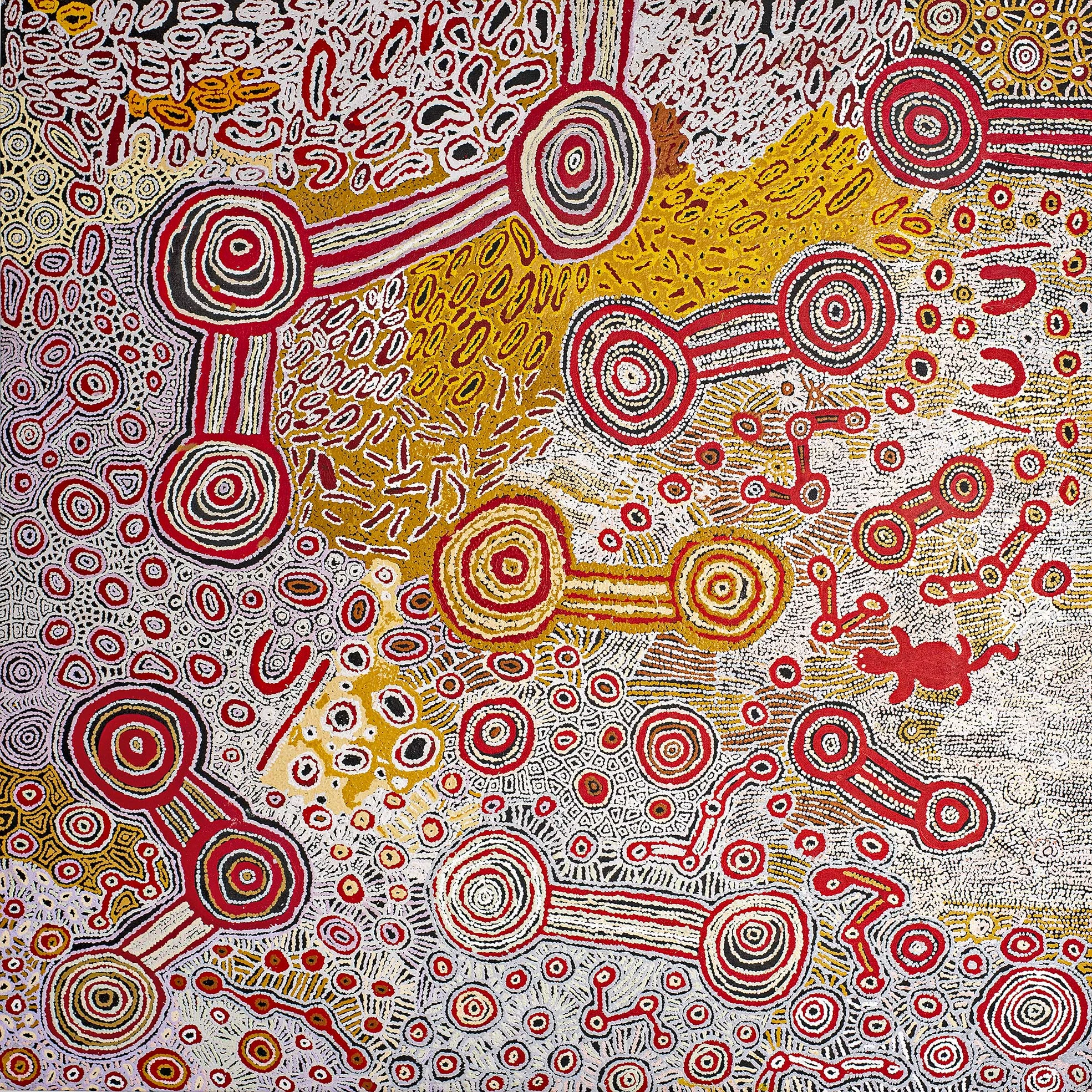
Artiste : Watarru collaborative - œuvre collaborative réalisée par les artistes importants de Tjungu Palya
Titre de l'œuvre : Creation Story for Ngura tjuta
Format : 200 x 200 cm
Provenance et certificat : centre d'art aborigène de Tjungu Palya
Référence de cette peinture : 12167
Explications pour cette peinture Aborigène :
Cette œuvre Ngura Tjuta (Big Country) évoque des mythes importants du temps du Rêve associés au lieu de Watarru. Watarru est le lieu ancestral traditionnel des femmes ayant contribué à cette œuvre dans la communauté Anangu.
En ces temps anciens les hommes et les femmes collectaient la nourriture et chassaient en ces lieux, pour rapporter la nourriture au camp pour les plus jeunes. Quand l'eau allait manquer sur un lieu, ces nomades continuaient leur périple vers un autre espace dans une dynamique itinérante codifiée.
Savoir trouver de l'eau était une connaissance tout à fait essentielle, transmise lors des initiations. Il était possible d'en trouver dans des lieux très inattendus et très diversifiés.
The artists of Watarru have received high acclaim for their collaborative paintings, with their
initial collaborative work commissioned by the Department for Environment and Heritage,
which now hangs on permanent display in the South Australian Parliament. These are the first paintings by Indigenous artists to hang in parliament house. In 2007 they won a major prize in the national 'Drawing Together' competition sponsored by the Australian Public Service Commission, a competitive award, which attracted over 570 entries from across Australia.
Wipana Jimmy, Imitjala Pollard and Beryl Jimmy are the women whose distinctive marks come together in the paintings of the Watarru Collaborative. Mother to Imitjala and Beryl, Wipana Jimmy was born in the bush at Makiri rockhole in the Western Desert in 1935. Her mother’s country is Watarru and her father’s place is Aparatjara. Beryl and Imitjala were born in Fregon where they spent their childhood before Wipana and her daughters returned to Watarru where Wipana helped to establish Watarru as a permanent community.
Collections
Art Gallery Of New South Wales, Sydney,
Private Collection, Usa
Nevada Art Mueseum, Nevada, Usa
Peter Cooke Collection, London
South Australian Parliament, Sa
The Bérengère Primat Collection, Switzerland.
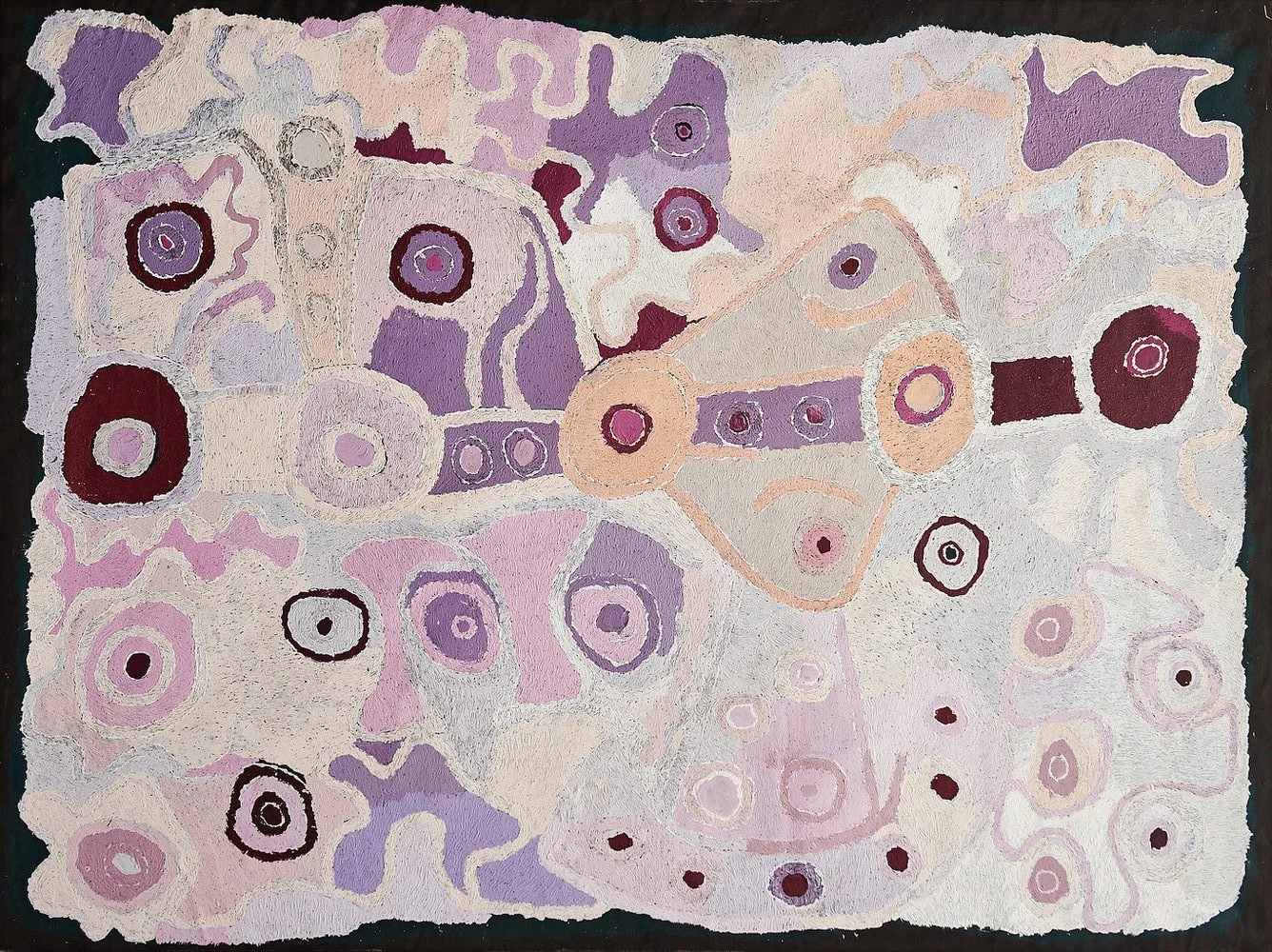
Artiste : Angkaliya Curtis
Titre de l'œuvre : Seven sisters dreaming
Format : 200 x 150 cm
Provenance et certificat : centre d'art aborigene de Tjungu Palya
Référence de cette peinture aborigene : 13149
© The artists, with the courtesy of the Art Centre.
Enquiry / Demander le prix de l'œuvre
Explications sur cette œuvre :
Angkaliya was born in 1928 at Miti in the South Australian Pitjantjatjara Lands. When she was small she travelled with her mother to Watarru (her mother's country). The family spent time at Ernabella mission and cattle station properties exchanging animal skins (dingoes and rabbits) for flour and sugar. She married and lived at the Ernabella where she worked in the craftroom spinning wool and making rugs. In the 1960's she moved closer to her traditional homeland when the community of Amata began. She used to live and works at Nyapari Community. Angkaliya lived a semi nomadic lifestyle often walking long distances in the desertwhere traditional knowledge of the country, its water holes and food supplies are vital to survival. She learned from her mother and grandmother the secrets of the land and aquired an intimate understanding of the environment and the ancestoral creation stories associated with it.
Ngayuku mitaku ngurangka (this is the country I have inherited from my husband) a wonderful place called Cave Hill. Cave Hill is an important site for the Seven Sisters dreaming story. When you come here you can see in the rock formations the story of seven sisters as they ran from Wati Nyiru (the cheeky man). The sisters hid in the darkness of the big cave and the oldest sister used her wana (digging stick) to make a hole to escape through the back of the cave, you can still see the scratching marks she made. Cave Hill ta tjukurla tjuta ngaranyi. There is a lot of water here too, many rock holes and connecting creeks and water courses. The abundance of water, food and tjurkupa makes Cave Hill a precious place. My husband Billynya and I travelled on a camel from the mission in Ernabella to this magical home.
This artwork has been finalist of the Darwin NATSIAA Award at the Museum of Darwin.
Collections
Artbank, Australian Government National Contemporary Art Rental
Australian National University, Canberra,
Australian Capital Territory.
Deakin University, Melbourne, Victoria.
Flinders University, Adelaide, South Australia.
Harriett And Richard England Collection, Sydney, New South Wales
Lagerberg-Swift Collection, Perth, Western Australia
Marshall Collection, Adelaide, South Australia
Museum And Art Gallery Of Northern Territory.
National Gallery Of Australia, Canberra, Australian Capital Territory
National Gallery Of Victoria, Melbourne, Victoria.
Queensland Art Gallery, Brisbane,
The Beat Knoblacuch Collection, Switzerland.
The Lepley Collection, Perth, Western Australia.
The Parliament House Collection, Canberra,
University Of Canberra, Australian Capital Territory
W & V Mcgeoch, Melbourne, Victoria
The Sims Dickson Collection
Dynamique, cette communauté accueille en son sein de multiples talents, exprimant leurs individualités à travers des œuvres profondément connectées au territoire et à leur mémoire ancestrale.
Le plus souvent dans des peintures confinant à l’abstrait, se retrouve une évocation subtile et puissante du paysage, avec des conjugaisons de lignes et de compartiments signifiants. Cette vision presque cadastrale souligne avec poésie et force l’autorité et le savoir des artistes, comme Maringka Baker ou Bernard Tjalkuri.
De nouveaux peintres plus émergents appréhendent de façon innovante d’autres formats et styles, offrant ainsi à cette communauté une extraordinaire diversité d’expressions, comme Teresa Baker, Venita Woods, Beryl Jimmy, Iyawi Wikilyiri…
Artiste : Bradley Tunkin
Titre de l'œuvre : Kalaya Tjukurpa
Format : 101 x 101 cm
Provenance et certificat : centre d'art aborigène de Tjungu Palya
Référence de cette peinture aborigène : 20-024
Demander le prix de l'œuvre / Enquiry
Explications pour cette œuvre :
Bradley is the grandson of renowned artist Jimmy Baker and the son and brother of Tjungu Palya painters Kaye Baker, Teresa & Kani Baker. Bradley is a traditional man and resides in Kanpi on his families country- the place of important Kalaya Tjukurpa (emu dreaming).
This painting is dealing about my grand father's story that I'am learning. He was very knowledgeable about the Kanpi area. Kalaya Tjukurpa (the story of the ancestoral Emu Man).
Father and Mother emu travel together to Kanpi. The mother emu layed her eggs in Kanpi then went away forever, leaving the father to take care of the young emu's. The father stayed with them and fed them. Also, he took them to them away with him to other lands such as Wattaru and Fregon. The young emu's grow strong and eventually they travelled back to kanpi where the father died by Anangu spear. The young emu's survived though and lived in Kanpi.
This is Kanpi. Ngayuku ngura, ngayuku ninti pulka (this is my country and I hold great knowledge for this place).
You can find artworks by the artists in the following prestigious collections :
Queensland Art Gallery | Gallery of Modern Art
© Photo : Aboriginal Signature Estrangin gallery with the courtesy of the artists and Tjungu Palya.