
Peintures d'art Aborigène de Martumili
Martumili Artists a été créé fin 2006 et soutient les artistes Martu des localités de Kunawarritji, Punmu, Parnngurr, Jigalong, Warralong, Irrungadji (Nullagine) et Parnpajinya (Newman). De nombreux artistes de Martu entretiennent des liens étroits avec les peuples de Yulparija, Kukatja et d'autres déserts occidentaux.
Ils sont les gardiens traditionnels de trois immenses déserts du centre de l'Australie : le Gibson, Great Sandy et le Tanami désert. Ces espaces parmi les plus éloignés d'Australie représentent à eux seuls plus de 13 millions d'hectares, soit près de 4 fois la taille de la Belgique.
Leur région traditionnelle fut bouleversée par la percement de la Canning Stock road au début du XXe siècle pour acheminer les troupeaux de bœufs de Perth à Darwin, à travers le désert. Un projet artistique majeur fut mené avec la National gallery de Canberra afin de cristalliser par l'entremise de leur art, la mémoire des Aborigènes sur cette piste si controversée.
Leurs œuvres reflètent la géographie dramatique et les espaces immenses de leur Homelands dans les régions du Great Sandy Desert et de la Rudall River au sein de l'Australie occidentale.
Leurs pratiques artistiques couvrent tout autant les peintures en acryliques sur toile de lin, mais également des paniers tressés et des sculptures sur bois. Le maintien de ces usages créatifs permet la transmission de la mémoire entre les générations tout en permettant aux artistes et grands initiés de continuer à perpétuer leurs obligations culturelles à travers l'immense territoire du peuple Martu.
Martumili Artists représente les locuteurs des clans de Manyjilyjarra, Warnman, Kartujarra, Pultjarra et Martu Wangka. Certains artistes ont rencontré pour la première fois les occidentaux en 1960 et reste ainsi parmi les derniers témoins de cette culture nomade d'Australie.
La réputation de la communauté artistique de Martumili n’a cessé de prendre de l’ampleur depuis leur création comme centre d'art en 2006, à travers une identité artistique singulière et remarquable au sein du mouvement de l'art Aborigène. Elle a très rapidement suscité l'intérêt des plus grandes institutions en Australie puis des collectionneurs à travers le monde.
Leurs œuvres sont présentes dans les grandes collections à la fois privées et nationales en Australie et à travers le monde, comme les musées de la National Gallery of Australia, the Art Gallery of New South Wales, the Art Gallery of South Australia, la Gallery of Modern Art, la KLUGE-RUHE Aboriginal Art collection de l'Université de Virginie aux USA, la collection de sa Magesté la Reine Elisabeth II.
Peintures Aborigènes de Martumili disponibles au sein de la galerie (mise à jour en cours) :

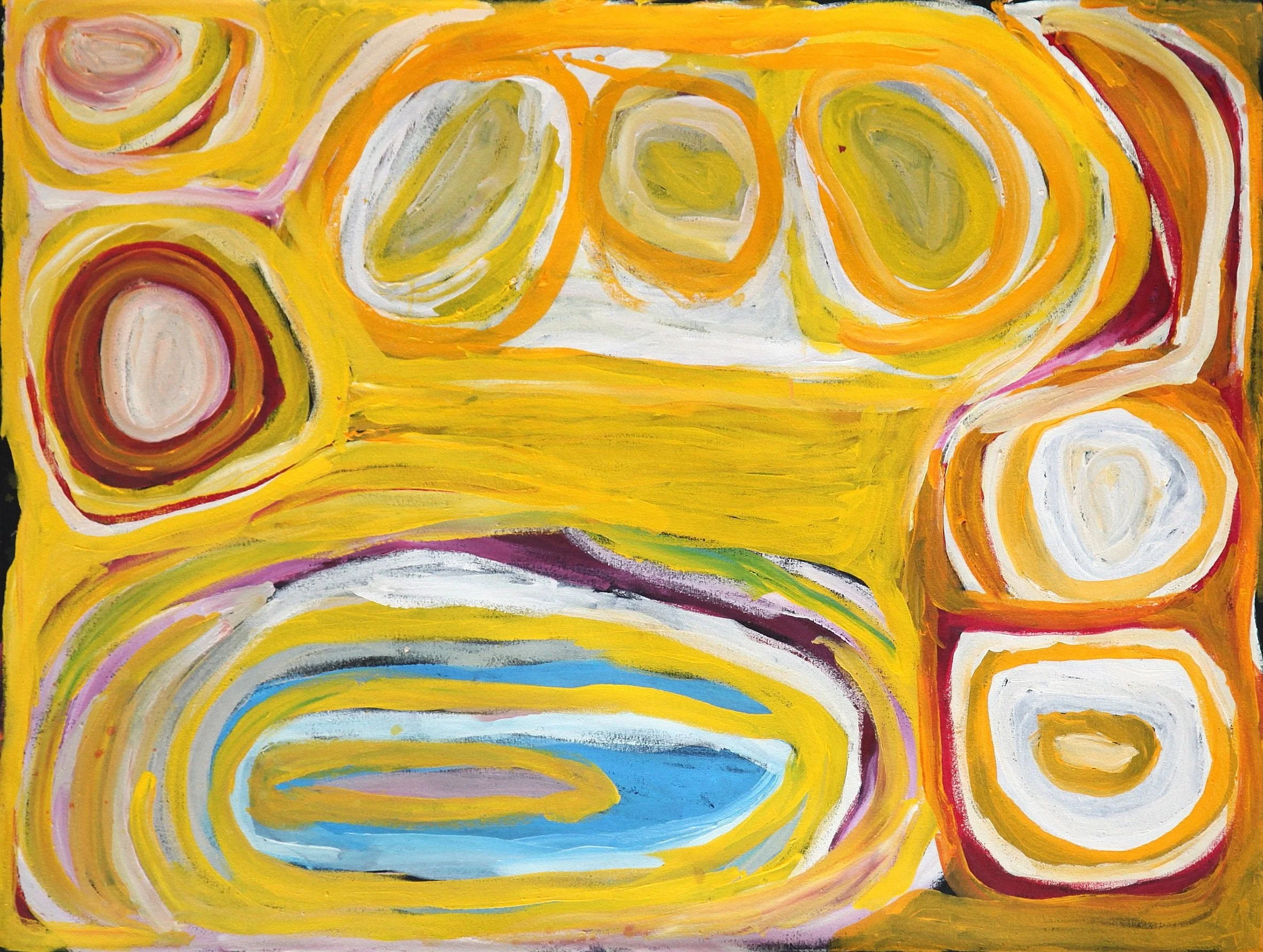
Artiste : Mabel Wakarta (1929)
Titre de l'œuvre : Yirajarra country
Format : 198 x 198 cm
Provenance et certificat : centre d'art aborigène de Martumili
Référence de cette peinture : 13-1012
Demander le prix de l'œuvre / Enquiry
Explications pour cette œuvre :
“Yirajarra, that’s my camp, that’s my place, that’s my country”. Yirajarra is the artists Ngurra (home); it is where the artist was born and is her place. It is a soak situated on the Canning Stock Route, there is Good fresh water there all year round and shade which makes it a decent camp spot. During the Pujiman (bush) days the artist was walking all of this country with her family.
© Photo : Aboriginal Signature Estrangin gallery with the courtesy of the artists and Martumili
Artiste : Nora Nungabar (1920)
Titre de l'œuvre : Pangkapirni Minyipuru (Seven Sisters Dreaming)
Format : 122 x 91 cm
Provenance et certificat : centre d'art aborigène de Martumili
Référence de cette peinture : 13-35
Demander le prix de l'œuvre / Enquiry
Explications pour cette œuvre :
This painting portrays the Minyipuru (Seven Sisters) when they travelled to Pangkapirni, a site close to Kunawarritji community. Minyipuru is an important Jukurrpa (dreamtime) story about seven sisters that are travelling through the desert as they run away from a lustful old man called Yurla. The man chases the wantis (women) all the way from Roebourne on the west coast right through Martu country before flying east.
Along the way they stop at many significant sites to camp, sing, dance and collect bush tucker. There are also many interactions with Yurla when he catches up with them along the way, creating an amazing abundance of stories and meaning with this culturally rich narrative.
The Seven Sisters rested at Pangkapirni during their journey from Pangkaringka. While the sisters slept Yurla caught one of them, and forced her to sleep with him. The women rescued their sister, and together they flew above the man. From the sky the women teased Yurla, telling him to come and get them. Yurla tried to reach the women using a janga (ladder made of wood), but the women just floated higher, and pushed the ladder over when he got too close. He eventually tired and went to sleep, and the women flew away, continuing their journey across the desert.
Pangkapirni was also a very significant site to Nungabar, forming part of her ngurra (home) country, where she lived and travelled throughout the pujiman (bush) days with her family. The area is sandy country with water sources all around in the form of rockholes, soaks, and claypans.
The artist primarily paints her country in the Canning Stock Route area. As a younger woman the artist lived and travelled traditionally with her family during the pujiman (bush) days. They travelled up and down the Stock Route from well 33 to well 38 and as far as Balgo. Well 33 is now known as Kunawarritji Community and is the artist's ngurra (home).
© Photo : Aboriginal Signature Estrangin gallery with the courtesy of the artists and Martumili

Artiste : Mabel Wakarta (1929)
Titre de l'œuvre : Parnngurr Ngurra
Format : 122 x 91 cm
Provenance et certificat : centre d'art aborigène de Martumili
Référence de cette peinture : 11-1329
Demander le prix de l'œuvre / Enquiry
Explications pour cette œuvre :
“Yirajarra, that’s my camp, that’s my place, that’s my country”. Yirajarra is the artists Ngurra (home); it is where the artist was born and is her place. It is a soak situated on the Canning Stock Route, there is Good fresh water there all year round and shade which makes it a decent camp spot. During the Pujiman (bush) days the artist was walking all of this country with her family.
© Photo : Aboriginal Signature Estrangin gallery with the courtesy of the artists and Martumili

Artiste : Nora Nungabar (1920)
Titre de l'œuvre : Kunawarritji (well 33 of the Canning stock road)
Format : 152 x 106 cm
Provenance et certificat : centre d'art aborigène de Martumili
Référence de cette peinture : 13-215
Demander le prix de l'œuvre / Enquiry
Explications pour cette œuvre :
Kunawarritji is an important site in the Great Sandy Desert where multiple stories and histories intersect. In the Jukurrpa (dreamtime) period, the Seven Sisters stopped here and shaped a number of landforms before continuing on their long journey east. During the pujiman (nomadic desert dweller) era, the site was an important yinta (permanent water source),
where families stopped and camped for long periods each year.
At the turn of the 20th century Kunawarritji was converted into a well (Well 33) along the 1850km long Canning Stock Route, created as a means to drove cattle through the harsh Western Australian desert. Each year throughout the 1930-50s, the well became a site of contact between drovers, their cattle, and desert families.
Today, Kunawarritji community is a site of return, a place where Martu people have come back to continue making their life in the desert.
Nungabar grew up in the country that became Wells 33-38 on the Canning Stock Route. From an early age she and her family had encounters with the white men who drove cattle along the route. As a young woman, together with her close friend Nora Wompi, Nungabar followed the drovers north to Balgo Mission, where she settled and raised a family. She eventually
relocated to her homelands at Kunawarritji, where she was considered a custodian of a great deal of cultural knowledge about the Kunawarritji area.
© Photo : Aboriginal Signature Estrangin gallery with the courtesy of the artists and Martumili

Artiste : Nora Nungabar (1920)
Titre de l'œuvre : Kinyu (well 35 of the Canning Stock Route)
Format : 152 x 76 cm
Provenance et certificat : centre d'art aborigène de Martumili
Référence de cette peinture : 13-282
Demander le prix de l'œuvre / Enquiry
Explications pour cette œuvre :
This painting depicts Kinyu, also known as Well 35 on the Canning Stock Route, and is the area for dingo dreaming. There is a small yinta (waterhole) at Kinyu, which made it an ideal camping spot in the Pujiman (nomadic desert dwelling) era.
In the Jukurrpa (dream time) two dingoes travelled to Wilarra, following the call of the moon. Wilarra, which also means ‘moon’ in Manyjilyjarra, is a very significant site lying on the edge of the large salt lake, Lake Dora. The dingoes gave birth to a litter of puppies at Wilarra, where they were looked after by the moon.
The dingoes stayed for a time at Wilarra, scratching into the earth to create several distinctive small salt water pools, which are still visited by the Martu for their healing properties. Later, the dingoes continued travelling east toward the rising moon, stopping finally at Kinyu.
In her youth, Nungabar walked all around this country with her family. She recalls "the whitefella Government came in a truck and killed all the jarntu (dogs) and then they ate the jarntu".
© Photo : Aboriginal Signature Estrangin gallery with the courtesy of the artists and Martumili

Artiste : Dadda Samson (1940) et Judith Anya Samson (1987)
Titre de l'œuvre : Puntawarri Rockholes
Format : 152 x 106 cm
Provenance et certificat : centre d'art aborigène de Martumili
Référence de cette peinture : 15-171
Demander le prix de l'œuvre / Enquiry
Explications pour cette œuvre :
This painting is a collaborative work between Dadda Samson and her granddaughter Judith Samson. It is an area of their country east of the Community of Jigalong where they both now live. While growing up at Jigalong mission Dadda returned to her home every weekend to hunt and camp. Dada is recognised as a great authority in Jigalong and is particularly knowledgeable about Country in that area. Dadda has been teaching Judith to paint for a number of years, sharing with her knowledge of country and jukurrpa (dreamtime) stories for those areas.
© Photo : Aboriginal Signature Estrangin gallery with the courtesy of the artists and Martumili

Artiste : Judith Anya Samson (1994)
Titre de l'œuvre : Puntawarri (near Well 17)
Format : 122 x 76 cm
Provenance et certificat : centre d'art aborigène de Martumili
Référence de cette peinture : 19-480
Demander le prix de l'œuvre / Enquiry
Explications pour cette œuvre :
This painting depicts Puntawarri, the artists’ mother’s family’s country. Puntawarri is on the middle stretches of the Canning Stock Route, near Well 17 also known as Durba Springs. Puntawarri is an important cultural area, east of the Jigalong Aboriginal Community, where the artist now lives with her grandmother. The artist's grandmother frequently travelled and hunted with her family in this area when she was a young girl, and is now teaching Judith the stories for this country.
© Photo Aboriginal Signatrure Estrangin Gallery, and text with the courtesy of the Artist and Martumili Arts

Artiste : Doreen Chapman (1970)
Titre de l'œuvre : Untitled
Format : 122 x 76 cm
Provenance et certificat : centre d'art aborigène de Martumili
Référence de cette peinture : 17-420
Demander le prix de l'œuvre / Enquiry
Explications pour cette œuvre :
Doreen first learned to paint alongside her mother, beginning her artistic career with Martumili Artists in March 2009 when she and the other women of Punmu painted a large collaborative artwork to raise funds for the community. Doreen is now an established artist in her own right, known for her loose, uninhibited painting style. As a deaf woman, painting is an important means of communication and expression for Doreen. As a deaf woman, painting is an important means of communication and expression for Doreen.
Doreen likes to paint the comings and goings of community life- the motorcars, aeroplanes and crillers that populate her homes of Warralong, Punmu and Port Hedland.
© Photo Aboriginal Signatrure Estrangin Gallery, and text with the courtesy of the Artist and Martumili Arts
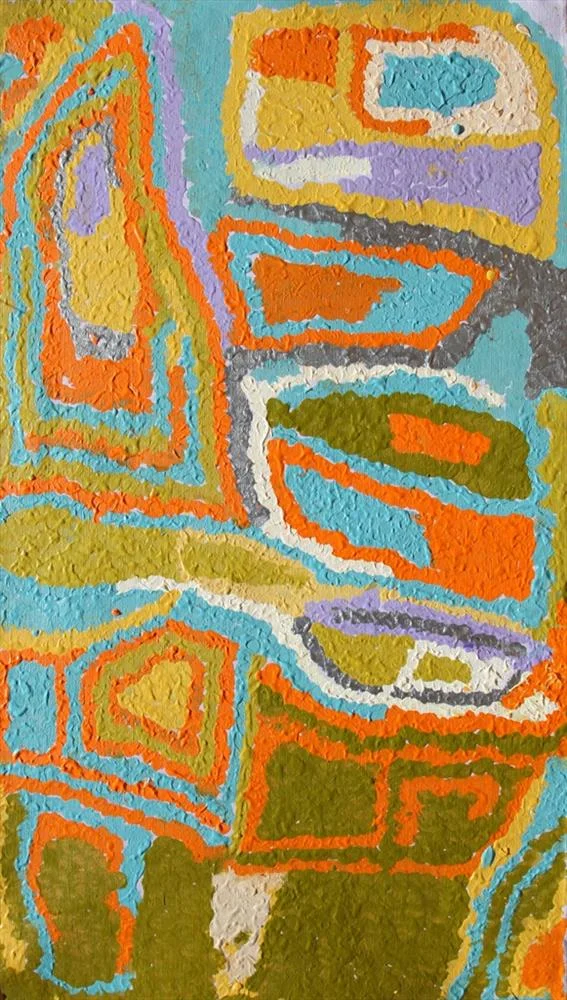
Artiste : Mabel Wakarta (1929)
Titre de l'œuvre : Yirajarra home country
Format : 107 x 61 cm
Provenance et certificat : centre d'art aborigène de Martumili
Référence de cette peinture : 13-544
Demander le prix de l'œuvre / Enquiry
Explications pour cette œuvre :
“Yirajarra, that’s my camp, that’s my place, that’s my country”. Yirajarra is the artists Ngurra (home); it is where the artist was born and is her place. It is a soak situated on the Canning Stock Route, there is Good fresh water there all year round and shade which makes it a decent camp spot. During the Pujiman (bush) days the artist was walking all of this country with her family.
© Photo : Aboriginal Signature Estrangin gallery with the courtesy of the artists and Martumili
Artiste : Nora Nungabar (1920)
Titre de l'œuvre : Kunawarritji (well 33 of the Canning stock road)
Format : 122 x 91 cm
Provenance et certificat : centre d'art aborigène de Martumili
Référence de cette peinture : 13-414
Demander le prix de l'œuvre / Enquiry
Explications pour cette œuvre :
Kunawarritji is an important site in the Great Sandy Desert where multiple stories and histories intersect. In the Jukurrpa (dreamtime) period, the Seven Sisters stopped here and shaped a number of landforms before continuing on their long journey east. During the pujiman (nomadic desert dweller) era, the site was an important yinta (permanent water source), where families stopped and camped for long periods each year.
At the turn of the 20th century Kunawarritji was converted into a well (Well 33) along the 1850km long Canning Stock Route, created as a means to drove cattle through the harsh Western Australian desert. Each year throughout the 1930-50s, the well became a site of contact between drovers, their cattle, and desert families.
Today, Kunawarritji community is a site of return, a place where Martu people have come back to continue making their life in the desert.
Nungabar grew up in the country that became Wells 33-38 on the Canning Stock Route. From an early age she and her family had encounters with the white men who drove cattle along the route. As a young woman, together with her close friend Nora Wompi, Nungabar followed the drovers north to Balgo Mission, where she settled and raised a family. She eventually
relocated to her homelands at Kunawarritji, where she was considered a custodian of a great deal of cultural knowledge about the Kunawarritji area.
© Photo : Aboriginal Signature Estrangin gallery with the courtesy of the artists and Martumili