
EXPLOSION
Masterpieces from the Spinifex Art Project
DU 28 mai AU 29 juin 2019 INCLUS, AU SEIN DE LA GALERIE ABORIGINAL SIGNATURE ESTRANGIN À BRUXELLES
Vernissage le mardi 28 mai de 14h30 à 22h.
Ouverture du Mercredi au Samedi de 14h30 à 19h, à la galerie : 101 rue Jules Besme, 1081 Bruxelles.
Et sur RDV tous les autres jours au (+32 (0) 475 55 08 54).
L’explosion d’une bombe atomique dans le désert du Grand Victoria, fut la première confrontation au monde occidental des artistes Aborigènes du Spinifex présentés à Bruxelles.
Pour ce peuple nomade, ce fut un bouleversement à nulle autre pareille. Dans le ciel s’éleva un immense champignon suivi par un souffle puissant et une poussière qui obscurcit tout le ciel.
Les familles Aborigènes eurent l’intuition de se cacher à l’intérieur des dunes de sable pour éviter les effets fatals des nuages radioactifs. Leur univers en fut bouleversé. Des zones de leur territoire autour de Maralinga, de la taille de la Belgique, furent condamnées pendant plus d’un demi siècle. Ils résistèrent dans tous les sens possibles de ce mot, pour transmettre la mémoire d’un peuple millénaire.
Explosion primordiale : les derniers nomades d'Australie
En 1986, dans ce territoire parmi les plus isolé du globe, des traces de pas repérés près d’un lieu sacré, conduisent à penser qu’une famille séparée des leurs depuis 1950, a survécu aux cataclysmes des essais nucléaires britanniques.
Les Aborigènes installés dans la petite communauté de Tjuntjunjara, montent une expédition dans le désert pour partir à leur recherche. La connaissance des pistes chantées, permet après plusieurs jours de retrouver les derniers nomades d’Australie. Ces retrouvailles sont bouleversantes et résonnent jusqu’ici à Bruxelles avec plusieurs œuvres de ceux qui deviendront artistes comme Mick Rictor, Ian Rictor, Noli Rictor et Tjaruwa Woods… Mick Rictor, frère aîné de la fratrie des derniers nomades a commencé à peindre il y a juste deux ans, partageant des œuvres d’une rare intensité.
Explosion identitaire : un art politique
Dix ans plus tard en 1997, ces Aborigènes Pitjantjara réalisent deux œuvres collaboratives masculine et féminine, pour démontrer l’existence tangibles de leurs lieux sacrés face aux tribunaux Australiens. Dans le cadre de la loi du Native Act Title, fort de ces éléments probants, attestant de leur présence continue sur ces terres depuis les origines, et bien avant la colonisation, ils vont récupérer 76 000 kilomètres carrés de leurs territoires ancestraux.
Ces hommes et ces femmes vont ainsi peindre pour le première fois, non pas pour le monde de l’art, mais pour défendre leurs droits inaliénables. Ensemble ils vont écrire une nouvelle page du mouvement de l’art Aborigène d’Australie.
Explosion narrative : une peinture vecteur de connaissances rares
Dans ce lieu improbable, constitué de 20 maisons en plein centre du grand désert du Victoria, va émerger le mouvement artistique du Spinifex Art Project dés les années 1997. Tous les artistes nés avant les années 50 et la dernière famille des nomades d’Australie de 1986, ont tous vécu la vie traditionnelle du désert, avec une lecture de la terre absolument unique et profonde, tellement différente du monde occidentale.
Leurs connaissances rayonnent dans leurs peintures connectées aux histoires d’un autre temps, et sont ainsi cristallisées et transmises aux générations à venir.
Pour monter cette exposition à Bruxelles, nous avons réalisé une expédition en 4x4 pour atteindre cet endroit très éloigné. Elle traversait plus de 180 dunes de sable de 10 m de haut, sans possibilité de trouver des ressources en eau ou en carburant. Isolé, bivouaquant dans leur désert si froid la nuit tombé, là où la terre craquelée semble pulvérisée, j’y ressentais la fragilité de la vie, les dimensions plus invisibles de la terre, et les capacités de résistance inouïes de ce peuple à travers les siècles.
Explosion mémorielle : au delà des mots et frontières
Rencontrer les artistes in situ est un moment de vie essentiel, d’une rare intensité bien que nous ne parlions par la même langue. Au delà des mots, ils partagent leur message par la profondeur des regards, l’inclinaison des têtes, les gestes démonstratifs pour raconter les tracés sur la toile. Ils nous aident ainsi à saisir une petite once de leurs histoires ancestrales. Leurs œuvres rayonnent de la joie d’un partage généreux et plus universel, comme un porte-voix à travers le globe dont les échos résonnent à travers leurs peintures accrochées aux cimaises des musées comme le British Museum. C’est une page de l’histoire de l’art qui s’écrit dans ce lieu si éloigné de l’Australie.
Peintures ABORIGènes dES Artistes du spinifex art project, proposées dans le cadre de l'exposition :
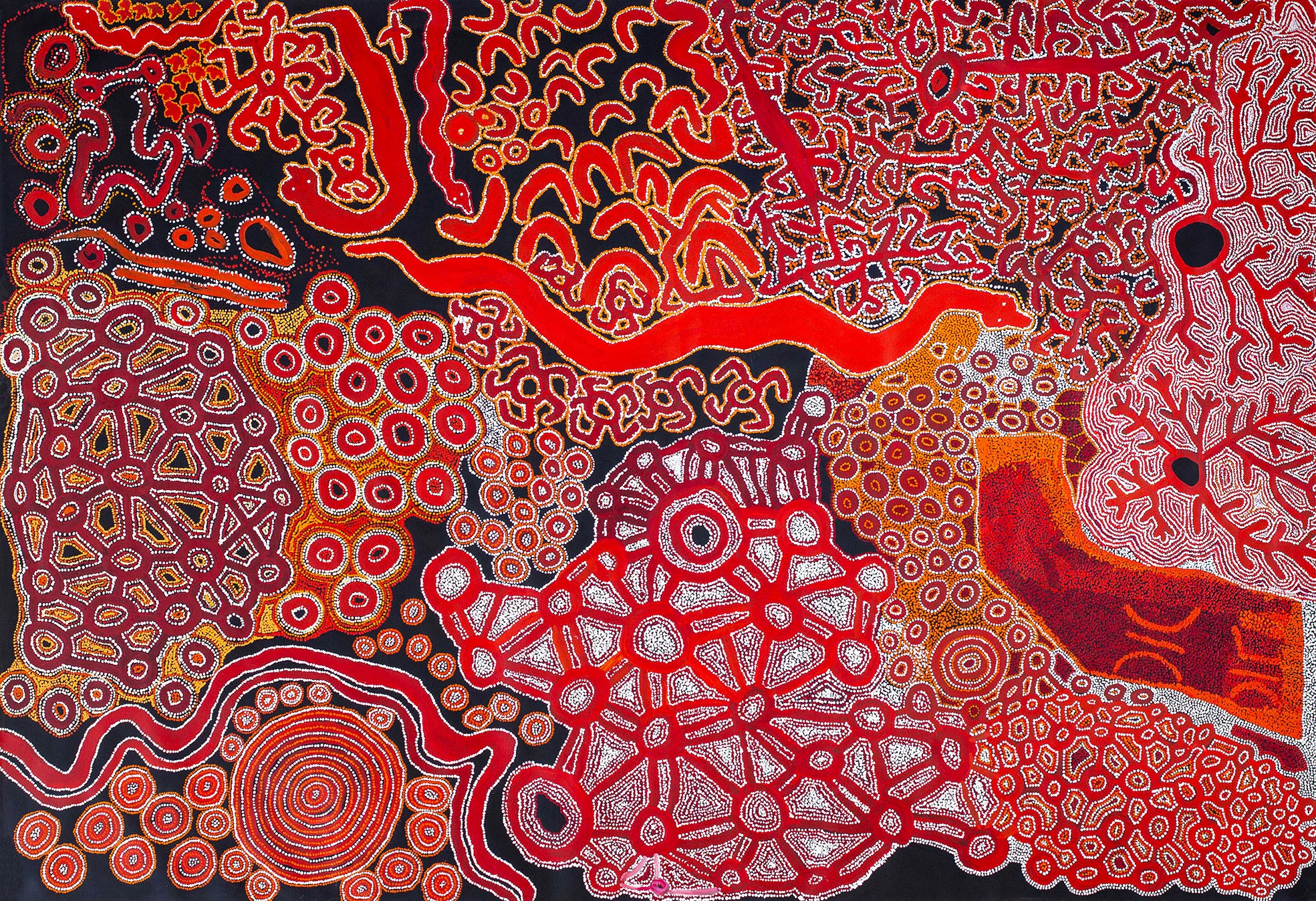
Artiste : Mens Collaborative
Titre de l'œuvre : Ngura Tjungunu
Format : 290 x 200 cm
Provenance et certificat : centre d'art aborigène du Spinifex Art Project
Référence de cette peinture : 18-282
Demander le prix de l'œuvre / Enquiry
Explications pour cette œuvre :
Nine senior Spinifex men (Fred Grant, Ned Grant, Roy Underwood, Simon Hogan, Lawrence Pennington, Simon Hogan, Ian Rictor, Noli Rictor, Patju Presley, Lennard Walker) have joined with their portrayal of Country in this large scale collaboration. Each artist paints an opening, an entrance into the significant sites that they hold cultural responsibility and authority for. And each is acutely aware of the others presence within the painting and the sites that they depict, with all having learnt from birth, the labyrinth of Tjukurpa or Creation Lines that weave through the landscape. These are the physical manifestations of the first beings and their journeys, the monolithic reminders of the power they possessed as they created the immediate environment and wrapped it in a cultural and moral fabric of prophetic proportions. Symbiotic within these lines is the engagement of the Inma, the sacred song and dance, the unparalleled oral creationist history that has survived for eons. This painting is the telling.
Their major collaborative paintings are in the prestigious collections :
The British Museum, London, England.
The Corrigan Collection, Australia.
The Lepley Collection, Perth, Western Australia.
The Luczo Collection, Usa
Western Australian Museum, Perth, Western Australia
W. & V. Mcgeoch Collection, Melbourne, Vic.
The Art Gallery Of New South Wales, Sydney, Nsw
Fondation Opale collection, Switzerland
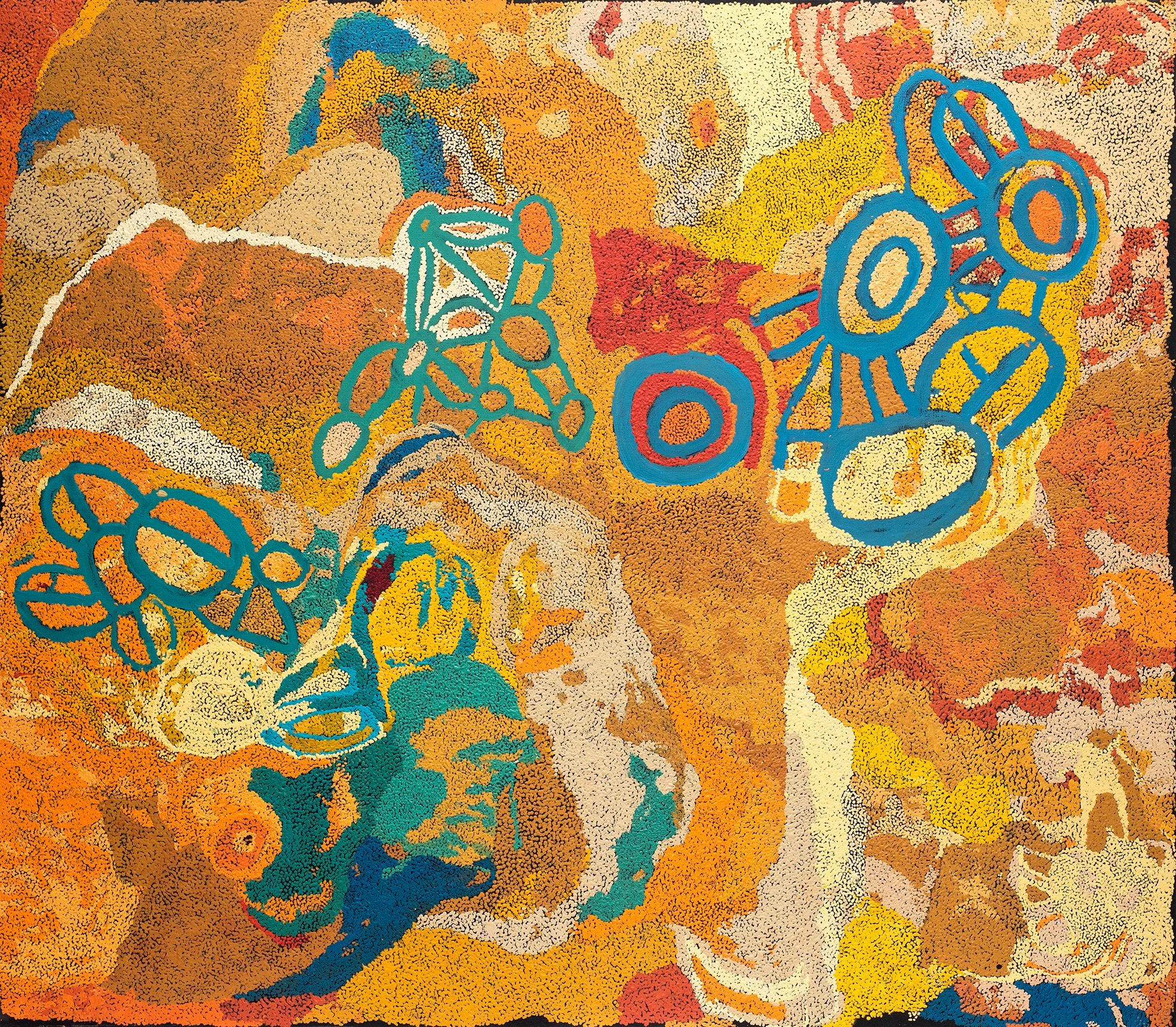
Artiste : Tjaruwa Woods
Titre de l'œuvre : Kamanti
Format : 230 x 200 cm
Provenance et certificat : centre d'art aborigène du Spinifex Art Project
Référence de cette peinture : 19-9
Vendue
Explications pour cette œuvre :
Tjaruwa (1954) paints with a knowledge and a devotion to the country that formed her. She was a young woman when she and her immediate family 'walked in' from the Great Victoria Desert in the remote east of Western Australia. This country was deemed inhospitable by the encroaching 'new world' and perceived as so vast and uninhabited, that it made the ideal site to detonate and observe the new wave of nuclear explosions conducted as part of the British Atomic Testing during the 1950's.
But Tjaruwa and her family were there, living, breathing, hunting, walking over the solo red carpet of sand, learning the paths of the creation beings who shaped this landscape and made the moral world possible. She slept under a vast expanse by campfire and drank water from tree roots. She learnt the fine art of survival in an arid but spiritual world and how to navigate an environment full of meaning. Tjaruwa paints like she breathes, an almost innate required constant. As she depicts the significant site of Kamanti, she is well aware of the creation manifestation of the Wati Kutjara (Two Men Creation Line) and that these Two Men still reside in the well-formed water cavities that penetrate deep into middle earth. She knows with all her learned experience that these Two Men are to be feared but treated with reverence all the same, for they can travel underground as the enormous water serpents that they are, or walk the landscape in the form of mortal men. And as she sings the sites onto the two dimensional plane, let us appreciate through the panoramic composition that comes from a lifetime of breathing in this country.
Tjauruwa was born in 1954 outside the Spinifex Determination Area at Warutjara, the place of Minyma Tjilkamata - the Echidna Woman, near the current community of Jamieson (Manta Maru) within the Ngaanyatjarra Lands. Except for possession of a few pieces of iron, fashioned into implements and tin bowls Tjaruwa lived traditionally until the winter of 1986 when her family group of seven was located in northern Spinifex by a group of Spinifex people making a sortie into country to re-visit important Men’s sites after some 25 years of absence. Tjaruwa came in with a small son on her hip and camped with her family firstly at Yakatunya, 90 kilometres south of Tjuntjuntjara, joined the moving camp which accompanied the construction of a road, 300 kilometres through the length of the Spinifex Lands, before settling permanently at Tjuntjuntjara in 1989. Tjaruwa was adjudged to be about 32 years old in 1986 and was given the birth date 1/7/1954. At this point in time (2014),Tjaruwa’s family remains the last Aboriginal group in the country to make first contact with contemporary Australia.
It is difficult to even imagine the changes Tjaruwa was to encounter living in her new world. She had acquired an extended network of kin to establish relationships with, the daily activity of hunting and gathering was essentially replaced by the community store and water was abundant.
Tjaruwa’s immediate priority was to care for her mother and uncle living in their new circumstances and it was not until her mother passed away that she took up an interest in painting. At first she tended to paint as she observed other women painting and then the accumulated experience of her other life and her mother’s stories/designs poured out and Tjaruwa’s unique Spinifex perspective was translated with spectacular style and technique on to canvas.
Her artworks are in the following prestigious collections :
Art Gallery Of South Australia, Adelaide Sa (Women’s Collaborative)
National Gallery Of Australia, Canberra
National Gallery Of Victoria, Melbourne Vic (Women’s Collaborative)
Richard And Harriet England Collection
Seattle Art Museum, Seattle Usa (Women’s Collaborative)
The British Museum, London, England.(Womens Collaborative)
The Corrigan Collection, Australia
The Lepley Collection, Perth, Western Australia.
The Sims Dickson Collection, Nsw
Parliament House Art Collection, Canberra, Act (Womens Collaborative)
W. & V. Mcgeoch Collection, Melbourne, Vic.
The Berndt Collection, University Of Western Australia.
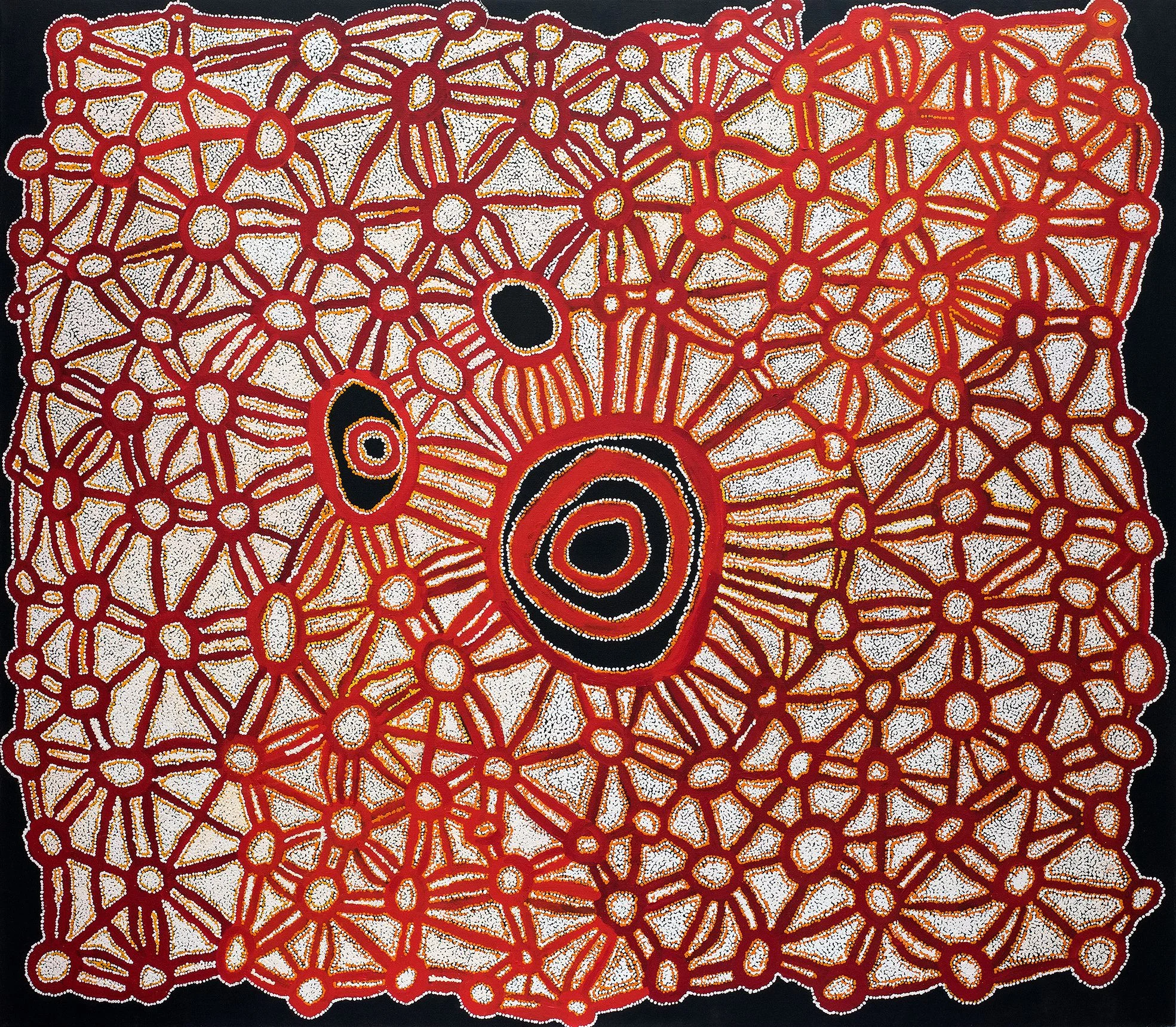
Artiste : Fred Grant
Titre de l'œuvre : Puutulu
Format : 230 x 200 cm
Provenance et certificat : centre d'art aborigène du Spinifex Art Project
Référence de cette peinture : 19-6
Demander le prix de l'œuvre / Enquiry
Explications pour cette œuvre :
Fred has depicted the significant site of Puutulu situated in the heart of traditional Spinifex Country. This site holds the Minyma Kaanka Tjukurpa (Crow Women Creation Line) and Fred tells of the creation events that unfolded here. Minyma Kaanka had a son who was married to a young girl. One day when Minyma Kaanka was out flying and her son went off hunting, the young girl’s mother, Minyma Mamu turned herself into a tree stump and waited for the son to return from hunting. Upon seeing the boy, she killed him and threw him in the fire. When Minyma Kaanka returned, she looked for her son before being offered some meat from the fire by Minyma Mamu. When she began chewing on the meat she had a strange sensation, thinking something is wrong and the meat smells funny. She left and went home and realised it was her son who Minyma Mamu had killed and cooked. Minyma Kaanka was so angry she grabbed a sharp spear and placed it in the ground pointing up. She then made the strongest most ferocious wind that picked up Minyma Mamu and her daughter and threw them down on the spear, impaling them.
His artworks are in the following prestigious collections :
Harriett & Richard England Collection
National Gallery Of Australia, Canberra, Act (Mens Collaborative)
Seattle Art Museum, Seattle, Usa. (Mens Collaborative)
The Corrigan Collection, Australia (Mens Collaborative)
The Lepley Collection, Perth, Western Australia.
W. & V. Mcgeoch Collection, Melbourne, Vic.
Queensland Art Gallery Of Modern Art, Brisbane, Qld.
The Art Gallery Of New South Wales, Sydney, Nsw
Art Gallery Of South Australia, Adelaide, South Australia (Mens Collaborative)

Artiste : Patju Presley
Titre de l'œuvre : Wati Ngintaka
Format : 200 x 137 cm
Provenance et certificat : centre d'art aborigène du Spinifex Art Project
Référence de cette peinture : 19-43
Vendue
Explications pour cette œuvre :
Patju has depicted the significant site of Ingkal situated to the north of traditional Spinifex Lands. This site forms a major part of the Wati Ngintaka Tjukurpa (Perentie Man Creation Line) and it is here, at Ingkal that Wati Ngintaka takes a wife in the form of Minyma Tjilkamata (Echidna Woman). Their marriage ends in tragedy, with Minyma Tjilkamata perishing at the hands of her husband. But nothing is that simple. These are creation beings who outline a moral and spiritual path that is also etched in the landscape that they themselves have shaped. They leave indelible monolithic reminders of their power and presence that give rise to Tjukurpa- the oral creationist religion that permeates the physical world that Anangu inhabit.
Patju Presley (1945) was born in the 1940s at Itaratjara, an important site between to the community settlement of Watarru and Kalayapiti in the Great Victoria Desert. He is a senior Pitjantjatjara Law man with great knowledge of the geography of the Western Desert and the associated Tjukurpa. His intimate knowledge of the country is directly related to survival in this beautiful but sometimes harsh environment learned from the generations of his ancestors.
His artworks are in the following prestigious collections :
Art Gallery Of Western Australia, Perth, Wa
The National Gallery Of Australia, Canberra, Act
National Gallery Of Victoria, Melbourne, Victoria.
The Art Gallery Of New South Wales, Sydney, Nsw
The Corrigan Collection, Australia
The Kaplan-Levi Collection, Usa
University Of Queensland Art Museum, Brisbane, Qld.
Art Gallery Of South Australia, Adelaide, South Australia (Mens Collaborative)
Queensland Art Gallery, Brisbane, Qld.
Murdoch University Collection, Perth, Wa
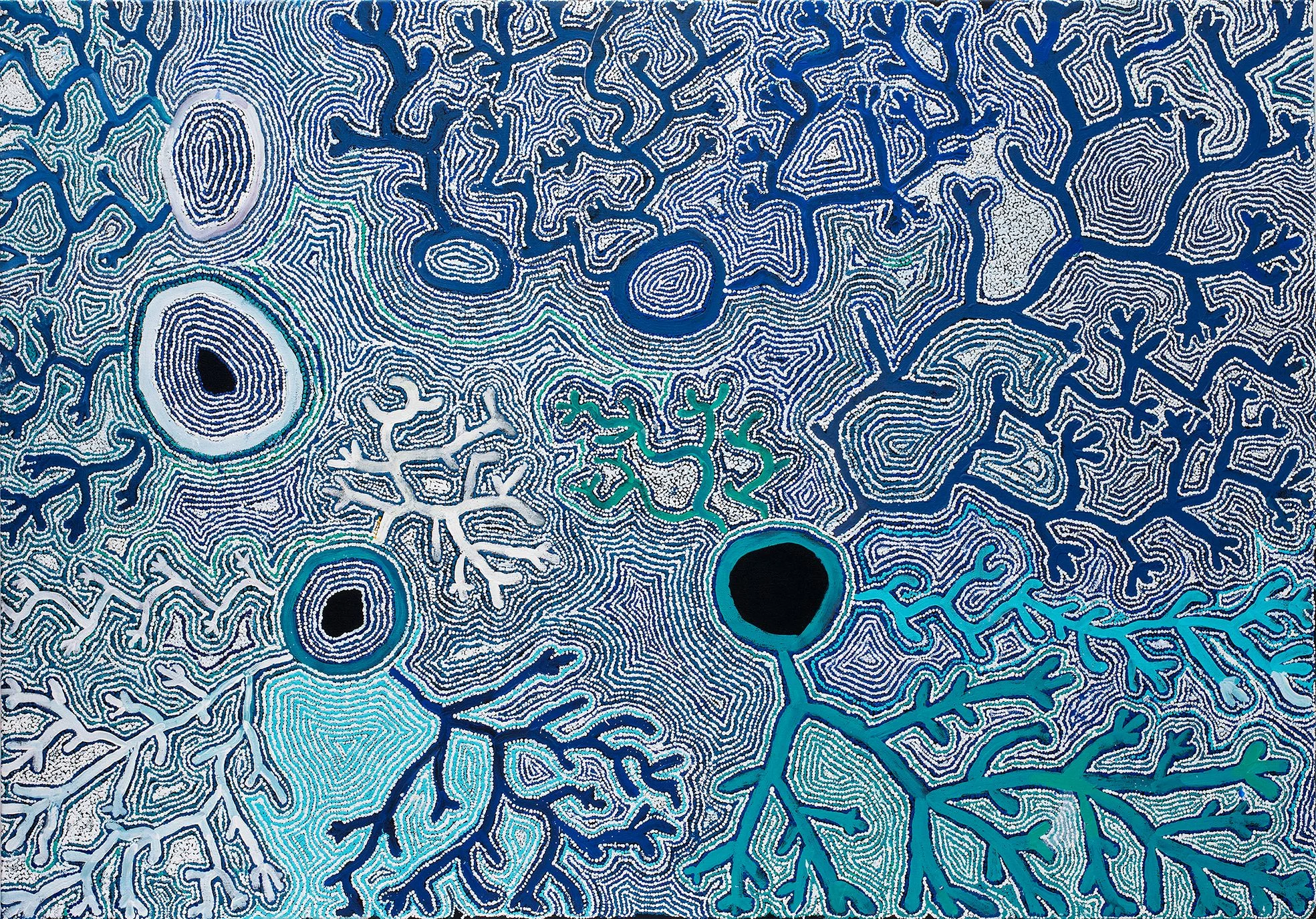
Artiste : Simon Hogan
Titre de l'œuvre : Lingka
Format : 200 x 137 cm
Provenance et certificat : centre d'art aborigène du Spinifex Art Project
Référence de cette peinture : 19-10
Vendue
Explications pour cette œuvre :
Simon Hogan (1930) manifests his site of Lingka onto the two dimensional plane. When he paints, he transcends this world and is taken over soft sand ridges and vast Spinifex plains to the significant sites that formed him from birth. For Simon was born into a spiritual society where religion manifested in the immediate environment and where creation beings could move through different realms at will. It is these beings who shaped the landscape that Simon depicts and who left a moral compass that is still followed today. They gave to people the life giving water sites that were held with such reverence in an arid and remote land. It is these sites that were the means of survival and where religion unfolded in the form of sacred song and performance.
Simon Hogan was born circa 1930 in mid-western Spinifex between Paltju and Lingka. Simon’s exact age is unknown as dates of birth were estimated by the A.E.M. missionaries when the Spinifex people, on arrival at Cundeelee, were “sorted” into family groups, given English names and approximate dates of birth. During childhood two fathers, one born at Warakunu and the other at Munki raised Simon. Simon’s mother’s country is around Tjulya. The Spinifex people were a relatively discreet southern Pitjantjatjara tribal group with es to the north and east that lived a fully traditional hunter-gatherer life until the late1950’s to early 1960s when most people either walked in to Ooldea and Cundeelee or were taken by AEM missionaries to Cundeelee Mission…
From 1995 Simon Hogan was a prominent member of a group of senior traditional owners from Spinifex country who lobbied the WA State Government for Native Title. Although Simon spoke no English he was a confident, initiated Pitjantjatjara man who spoke to senior government officials regarding ownership of country and culture. Exclusive Native Title rights were granted to Simon Hogan and the Spinifex people in 2000 of over 55 000 sq kms of the Great Victoria Desert in WA.
His artworks are in the following prestigious collections :
Art Gallery Of South Australia, Adelaide, South Australia
British Museum, London, England.
Harriet And Richard England Collection
National Gallery Of Australia, Canberra, Act.
National Gallery Of Victoria, Melbourne, Victoria.
Seattle Art Museum, Seattle, Usa. (Mens Collaborative)
Staatliches Museum Fur Volkerkunde, Munich, Germany
The Lepley Collection, Perth, Western Australia.
The Patrick Corrigan Collection, Sydney, New South Wales.
W. & V. Mcgeoch Collection
Western Australian Museum, Perth, W.A.
Artbank, Australian Government Collection. Australia.
Art Gallery Of Western Australia, Perth, Western Australia.
The Art Gallery Of New South Wales, Sydney, Nsw (Mens Collaborative)
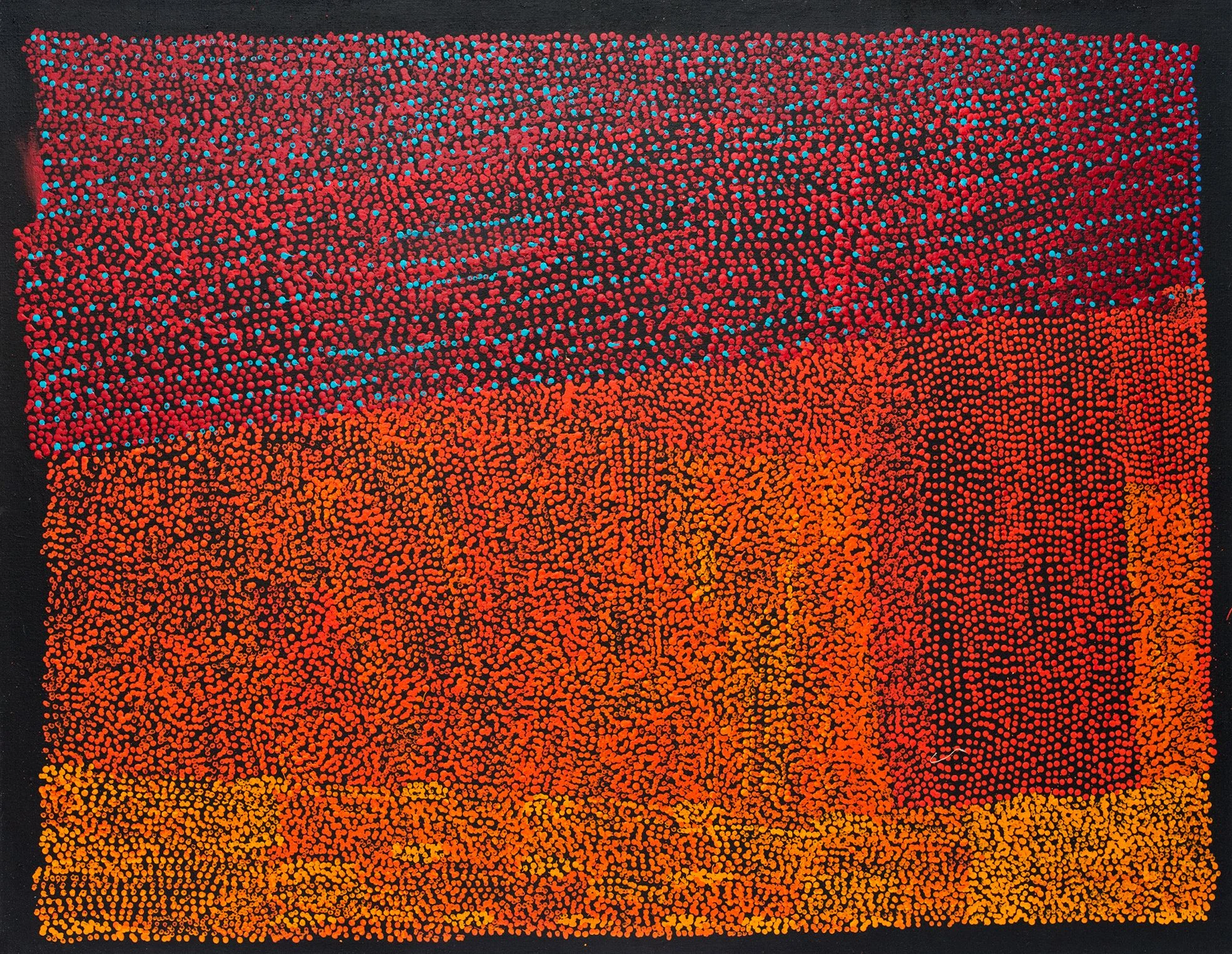
Artiste : Patju Presley
Titre de l'œuvre : Piltjitjara
Format : 110 x 85 cm
Provenance et certificat : centre d'art aborigène du Spinifex Art Project
Référence de cette peinture : 19-17
Vendue
Explications pour cette œuvre :
Patju has depicted the significant site of Piltjitjara. This site is highly sacred and details the movement of people as they traverse the country on initiation ceremony accompanying the young boys as they transform into men. Patju depicts country he was born into and which formed his religious upbringing. The arid but spiritual environment was the birthplace of the creation beings who shaped the landscape as they moved through it. They left indelible physical reminders of their power in the form of creeks or rocky ridges or a type of tree. But mostly they left their place of abode or the life giving sought after source of precious water, in some form of catchment. This water source is the embodiment of survival within the remote desert extremes with the sites being venerated as such and usually guarded by beings who are able to shift through the realms. They are the characters who dramatise the landscape and give rise to the formations through their movements. They leave behind a mapped moral landscape that holds an elaborate oral religion of song and performance that still permeates Patju's daily life.
Patju Presley (1945) was born in the 1940s at Itaratjara, an important site between to the community settlement of Watarru and Kalayapiti in the Great Victoria Desert. He is a senior Pitjantjatjara Law man with great knowledge of the geography of the Western Desert and the associated Tjukurpa. His intimate knowledge of the country is directly related to survival in this beautiful but sometimes harsh environment learned from the generations of his ancestors.
His artworks are in the following prestigious collections :
Art Gallery Of Western Australia, Perth, Wa
The National Gallery Of Australia, Canberra, Act
National Gallery Of Victoria, Melbourne, Victoria.
The Art Gallery Of New South Wales, Sydney, Nsw
The Corrigan Collection, Australia
The Kaplan-Levi Collection, Usa
University Of Queensland Art Museum, Brisbane, Qld.
Art Gallery Of South Australia, Adelaide, South Australia (Mens Collaborative)
Queensland Art Gallery, Brisbane, Qld.
Murdoch University Collection, Perth, Wa

Artiste : Mick Rictor
Titre de l'œuvre : Pila Nguru
Format : 110 x 85 cm
Provenance et certificat : centre d'art aborigène du Spinifex Art Project
Référence de cette peinture : 18-47
Demander le prix de l'œuvre / Enquiry
Explications pour cette œuvre :
Mick Rictor (1957) was around thirty years of age when he walked into modern civilisation for the first time from deep in the heart of the Great Victoria Desert in1986. A very remote and special place holding true wilderness character, like Mick himself. Other Anangu (Aboriginal people) refer to Mick as a wild man, ferocious like the old men used to be before people were softened by modern living.
Mick Rictor gives us freedom to contemplate. His compositions are both painterly and sparse leaving form and space intertwined and suspended. He is not quick to paint and peruses the blank canvas with hand on chin like Rodin's 'The Thinker' for a long period before selecting colour and brush to begin. But still it is a slow rhythmic placement of individual 'dots' that build up sometimes as a single colour, sometimes as multiple colours, one blanketing the other. His works reference the landscapes and changing colours of the Spinifex Country, the sweeping plains nestled in between parallel lines of sand dunes, the red rocky granite outcrops on the northern boundary, the sacred water holes and their ‘wanampi’ serpent guardians and 'mamu tjina' or scorer footprints from the Tjukurpa.
Mick was born at Kulpinya situated south of the significant site of Miramiratjara in the Great Victoria Desert sometime around 1956. This puts him in close proximity to the British Atomic Testing at Emu Fields and Maralinga during the '50s and '60s. Mick and his immediate family were living a nomadic life in and around traditional Spinifex Country up until 1986 when the family was located by relatives searching the area and taken to a then small settlement of Yakadunya and later Coonana. Mick is the eldest sibling of four with his other three siblings Ian and Noli Rictor and Tjaruwa Woods already established artists.
He started painting in 2016 and has a natural aesthetic with a painterly quality about his work. His works feature references to the Spinifex Country, the vast plains and sand hills, country holding secret water holes and 'Mamu Tjina' or scorer footprints. Mick lives a solitary life with a large contingent of dogs that he keeps as company.
His artworks are in the following prestigious collections :
Museum And Art Gallery Of The Northern Territory, Darwin, Australia.
Art Gallery Of South Australia, Adelaide, South Australia
Artbank, Australian Government Collection. Australia.
Araluen Gallery, Alice Springs, Northern Territory.
Charles Darwin University Art Collection, Darwin,Northern Territory
Richard And Harriett Collection, Australia
Arthur Roe Collection, Australia
The Sims Dickson Collection, Nsw
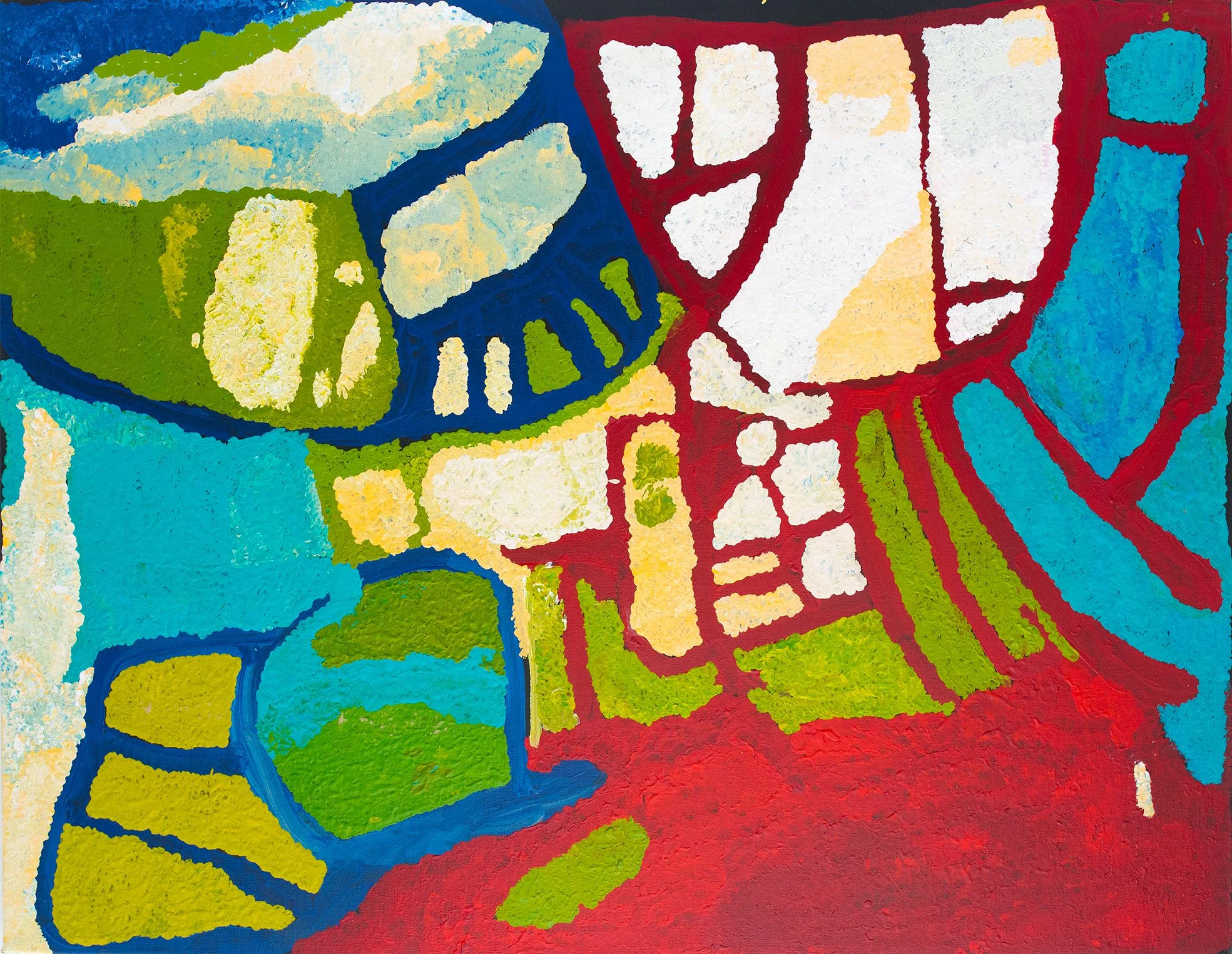
Artiste : Myrtle Pennington
Titre de l'œuvre : Kanpa
Format : 110 x 85 cm
Provenance et certificat : centre d'art aborigène du Spinifex Art Project
Référence de cette peinture : 18-165
Vendue
Explications pour cette œuvre :
The Spinifex People inhabited the Great Victoria Desert long before Europeans landed on this continent’s shoreline. They survived in an arid but beautiful environment, equipped with the necessary skills required for such a life. A spiritual people guided by cultural law were able to exist virtually unchallenged and unchanged until the 1950’s when the British atomic testing began at Emu Fields and later at Maralinga. These tests directly displaced the Spinifex People and it would be over thirty years before their traditional lands were finally returned to them in the form of native title and they were able to once again access the country that formed them from birth. For the landscape holds the culture of the Spinifex People and their daily interactions are governed by the moral compass of the first beings who created the physical realm. With story interwoven in song and dance, the country maps a tangible way forward for the people to reflect and learn upon.
It is this country, this spiritual landscape that defines and permeates Myrtle Pennington’s work. Although abstract in appearance each piece holds part history, part ceremony and part country. Myrtle assumes the vastness of the landscape imbued with the colourful light in profound yet simple compositions. She recalls the places that sustained her during those early formative years and gives rise to the sites of Mulpulya and Kanpa, surrounding them with sandhills and salt lakes or plains that lead to rocky escarpments. She reads the scene from a sense of belonging, of being interwoven into the fabric of the landscape she creates. All this Myrtle captures and conveys with ease, moving the brush and colour freely, building a textural quality that prompts one to walk with her through this vast Country.
Myrtle (1939) was born c. 1939 in the vicinity of a rock hole called Kanpa in central Spinifex. The rock hole itself is a point along a highly sensitive senior Men’s tjukurpa which Myrtle would not have seen or drawn water from.
Myrtle’s journey out of Spinifex to Cundeelee Mission in the late 1950’s was particularly tragic for Myrtle and her family (a son and husband perished on the trip). Myrtle, with another son and daughter, were eventually located by Australian servicemen from an army base at Neale’s Junction, who held them until Cundeelee Mission staff arrived to take the family to Cundeellee.
The story of Myrtle’s flight from the British atomic testing range at Maralinga was to become key evidence tendered to Royal Commission into the British Nuclear Tests in Australia in 1984 and sadly Myrtle had to re-live the tragic events.
Myrtle and her surviving son and daughter were awarded individual compensation from the Australian Government. Myrtle did not paint on the Women’s Native Title painting and gradually came into the Project through Women’s collaborative art. She was mostly an occasional painter until the past decade when almost overnight she developed a most striking, minimal style with bold symbols that leap out against a vividly plain background. Myrtle continues to paint regularly, seemingly unaffected by others styles evolving around her.
Her artworks are in the following prestigious collections :
National Gallery Of Victoria, Melbourne, Australia.
The Art Gallery Of South Australia, Adelaide, S.A (Womens Collaborative)
The British Museum, London, England.(Womens Collaborative)
The Corrigan Collection, Australia. (Womens Collaborative)
Artbank, Australian Government Collection. Australia.
Parliament House Art Collection, Canberra, Act (Womens Collaborative)
W. & V. Mcgeoch Collection, Melbourne, Vic.
The Art Gallery Of New South Wales, Sydney, Nsw
Kluge-Ruhe Aboriginal Art Collection Of The University Of Virginia, Usa.
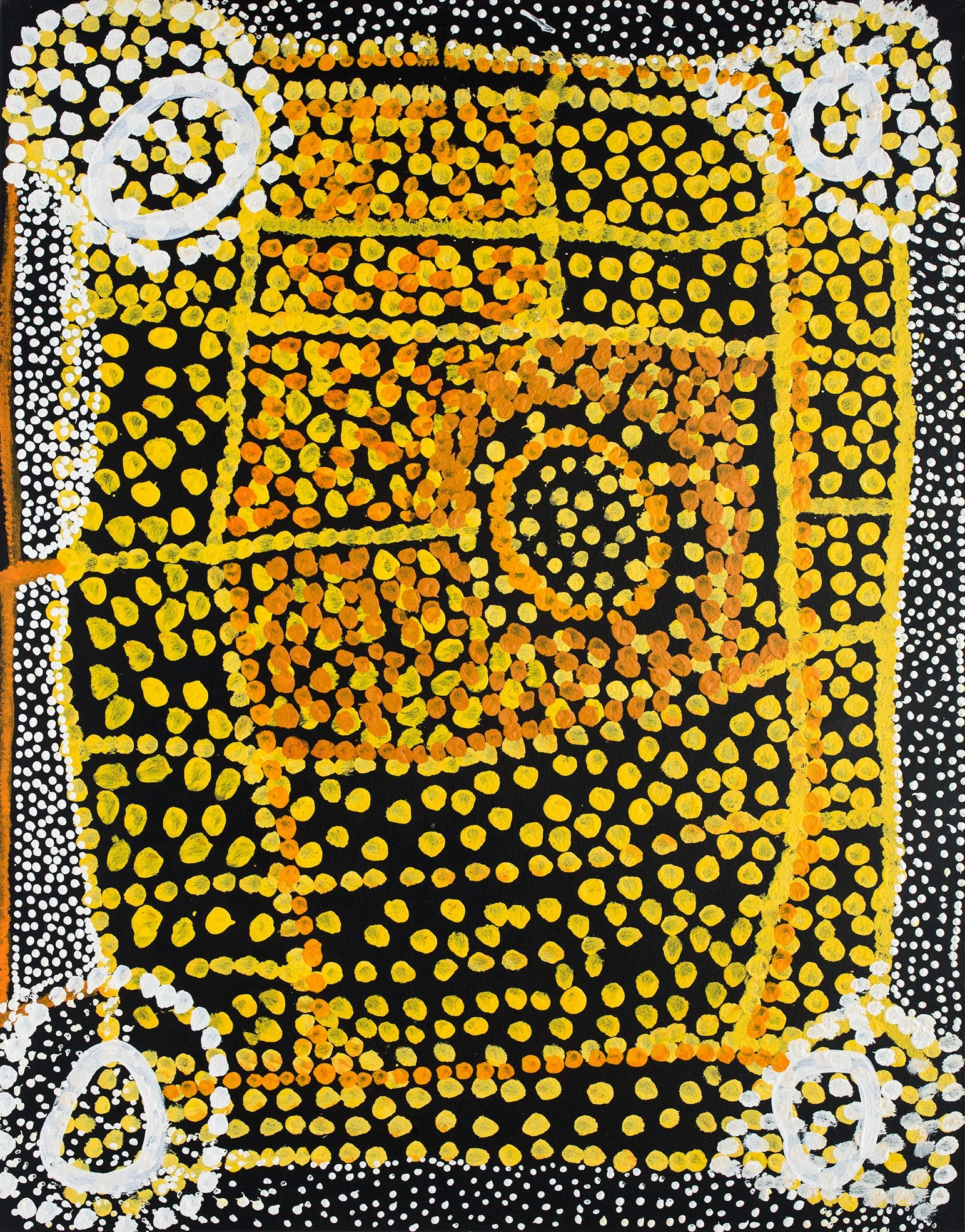
Artiste : Mick Rictor
Titre de l'œuvre : Untitled
Format : 110 x 85 cm
Provenance et certificat : centre d'art aborigène du Spinifex Art Project
Référence de cette peinture : 19-14
Vendue
Explications pour cette œuvre :
Mick Rictor (1957) was around thirty years of age when he walked into modern civilisation for the first time from deep in the heart of the Great Victoria Desert in1986. A very remote and special place holding true wilderness character, like Mick himself. Other Anangu (Aboriginal people) refer to Mick as a wild man, ferocious like the old men used to be before people were softened by modern living.
Mick Rictor gives us freedom to contemplate. His compositions are both painterly and sparse leaving form and space intertwined and suspended. He is not quick to paint and peruses the blank canvas with hand on chin like Rodin's 'The Thinker' for a long period before selecting colour and brush to begin. But still it is a slow rhythmic placement of individual 'dots' that build up sometimes as a single colour, sometimes as multiple colours, one blanketing the other. His works reference the landscapes and changing colours of the Spinifex Country, the sweeping plains nestled in between parallel lines of sand dunes, the red rocky granite outcrops on the northern boundary, the sacred water holes and their ‘wanampi’ serpent guardians and 'mamu tjina' or scorer footprints from the Tjukurpa.
Mick was born at Kulpinya situated south of the significant site of Miramiratjara in the Great Victoria Desert sometime around 1956. This puts him in close proximity to the British Atomic Testing at Emu Fields and Maralinga during the '50s and '60s. Mick and his immediate family were living a nomadic life in and around traditional Spinifex Country up until 1986 when the family was located by relatives searching the area and taken to a then small settlement of Yakadunya and later Coonana. Mick is the eldest sibling of four with his other three siblings Ian and Noli Rictor and Tjaruwa Woods already established artists.
He started painting in 2016 and has a natural aesthetic with a painterly quality about his work. His works feature references to the Spinifex Country, the vast plains and sand hills, country holding secret water holes and 'Mamu Tjina' or scorer footprints. Mick lives a solitary life with a large contingent of dogs that he keeps as company.
His artworks are in the following prestigious collections :
Museum And Art Gallery Of The Northern Territory, Darwin, Australia.
Art Gallery Of South Australia, Adelaide, South Australia
Artbank, Australian Government Collection. Australia.
Araluen Gallery, Alice Springs, Northern Territory.
Charles Darwin University Art Collection, Darwin,Northern Territory
Richard And Harriett Collection, Australia
Arthur Roe Collection, Australia
The Sims Dickson Collection, Nsw

Artiste : Myrtle Pennington
Titre de l'œuvre : Mulpulya
Format : 75 x 60 cm
Provenance et certificat : centre d'art aborigène du Spinifex Art Project
Référence de cette peinture : 19-36
Vendue
Explications pour cette œuvre :
The Spinifex People inhabited the Great Victoria Desert long before Europeans landed on this continent’s shoreline. They survived in an arid but beautiful environment, equipped with the necessary skills required for such a life. A spiritual people guided by cultural law were able to exist virtually unchallenged and unchanged until the 1950’s when the British atomic testing began at Emu Fields and later at Maralinga. These tests directly displaced the Spinifex People and it would be over thirty years before their traditional lands were finally returned to them in the form of native title and they were able to once again access the country that formed them from birth. For the landscape holds the culture of the Spinifex People and their daily interactions are governed by the moral compass of the first beings who created the physical realm. With story interwoven in song and dance, the country maps a tangible way forward for the people to reflect and learn upon.
It is this country, this spiritual landscape that defines and permeates Myrtle Pennington’s work. Although abstract in appearance each piece holds part history, part ceremony and part country. Myrtle assumes the vastness of the landscape imbued with the colourful light in profound yet simple compositions. She recalls the places that sustained her during those early formative years and gives rise to the sites of Mulpulya and Kanpa, surrounding them with sandhills and salt lakes or plains that lead to rocky escarpments. She reads the scene from a sense of belonging, of being interwoven into the fabric of the landscape she creates. All this Myrtle captures and conveys with ease, moving the brush and colour freely, building a textural quality that prompts one to walk with her through this vast Country.
Myrtle (1939) was born c. 1939 in the vicinity of a rock hole called Kanpa in central Spinifex. The rock hole itself is a point along a highly sensitive senior Men’s tjukurpa which Myrtle would not have seen or drawn water from.
Myrtle’s journey out of Spinifex to Cundeelee Mission in the late 1950’s was particularly tragic for Myrtle and her family (a son and husband perished on the trip). Myrtle, with another son and daughter, were eventually located by Australian servicemen from an army base at Neale’s Junction, who held them until Cundeelee Mission staff arrived to take the family to Cundeellee.
The story of Myrtle’s flight from the British atomic testing range at Maralinga was to become key evidence tendered to Royal Commission into the British Nuclear Tests in Australia in 1984 and sadly Myrtle had to re-live the tragic events.
Myrtle and her surviving son and daughter were awarded individual compensation from the Australian Government. Myrtle did not paint on the Women’s Native Title painting and gradually came into the Project through Women’s collaborative art. She was mostly an occasional painter until the past decade when almost overnight she developed a most striking, minimal style with bold symbols that leap out against a vividly plain background. Myrtle continues to paint regularly, seemingly unaffected by others styles evolving around her.
Her artworks are in the following prestigious collections :
National Gallery Of Victoria, Melbourne, Australia.
The Art Gallery Of South Australia, Adelaide, S.A (Womens Collaborative)
The British Museum, London, England.(Womens Collaborative)
The Corrigan Collection, Australia. (Womens Collaborative)
Artbank, Australian Government Collection. Australia.
Parliament House Art Collection, Canberra, Act (Womens Collaborative)
W. & V. Mcgeoch Collection, Melbourne, Vic.
The Art Gallery Of New South Wales, Sydney, Nsw
Kluge-Ruhe Aboriginal Art Collection Of The University Of Virginia, Usa.
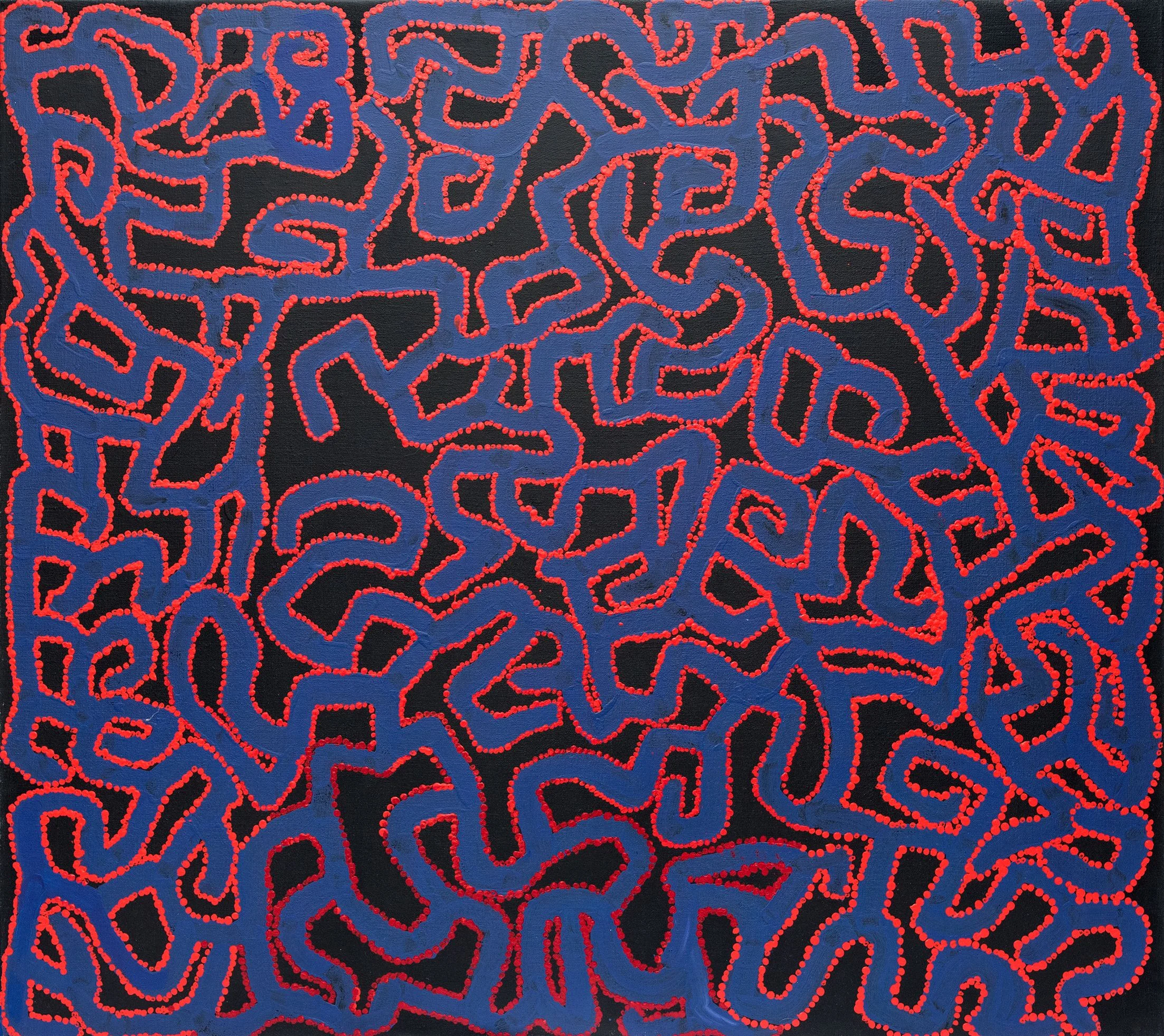
Artiste : Roy Underwood
Titre de l'œuvre : Miramiratjara
Format : 95 x 85 cm
Provenance et certificat : centre d'art aborigène du Spinifex Art Project
Référence de cette peinture : 17-93
Vendue
Explications pour cette œuvre :
Roy Underwood (1937) is a recognised senior custodian and keeper of Tjukurpa in the area of Miramiratjara in the Spinifex Lands. Tjukurpa is the Pitjantjatjara concept for describing the formative creation where ancestral beings create the world. These beings are Anangu ancestors, who can take the form of people, plants or animals. They traverse the country; forming the world we live in, creating the waterholes, the trees, the clay pans, the rocky outcrops, the sand hills and the Spinifex plains. These land formations are the physical manifestation of the creation energy and tangible evidence that this Tjukurpa is true. The area of Miramiratjara is an extremely important men’s site and much of the detail of this story cannot be publically discussed. As Roy says miil-miilpa, sacred. It revolves around Wati Kutjara, two ancestral men. One man had speared a malu,kangaroo, and cooked it up but when he went to eat it there was only a very small tail. "Hey how come no meat?" As he was holding the tail it kept catching fire and as he blew onto it the sparks landed in the country setting it ablaze. All Miramiratjara was on fire. All the snake men, the guardians who reside just below the surface came up furious, biting out in rage. Many men died in the fire.
Burning off in this area is not practiced by the Spinifex people as this country is miil-miilpa and too dangerous to disturb. Miramiratjara is an important soak, an often scarce source of water in the desert and a place associated with conflict. This site belongs to Roy through his Grandfather. As a child he remembers waking here in the night and all the men singing the inma – m iil-millpa pulka, a powerful and dangerous place.
His artworks are in the following prestigious collections :
Art Gallery Of South Australia, Adelaide, South Australia.
National Gallery Of Australia, Canberra, Act (Mens Collaborative)
National Gallery Of Victoria, Melbourne Vic
Seattle Art Museum, Seattle, Usa. (Mens Collaborative)
Sue And Ian Bernadt, Perth, Western Australia.
The British Museum, London. (Mens Collaborative)
The Lepley Collection, Perth, Western Australia.
Artbank Australian Government, Canberra. A.C.T.
W. & V. Mcgeoch Collection, Melbourne, Vic. (Mens Collaborative)
The Art Gallery Of New South Wales, Sydney, Nsw (Mens Collaborative)

Artiste : Byron Brooks
Titre de l'œuvre : Kaanka
Format : 137 x 90 cm
Provenance et certificat : centre d'art aborigène du Spinifex Art Project
Référence de cette peinture : 18-145
Vendue
Explications pour cette œuvre :
Byron Brooks(1951), a senior spinifex man has outstanding knowledge of the numerous Tjukurpa that form a network through Spinifex country and beyond. Here is has painted a site called Kaanka, The Crow Woman Tjukurpa. At Kaanka a few songlines intersect including The Two Men from Pukara, a father and son wanampi (one of the serpent men depicted here), who witness a woman looking for nits in the head of the Minyma Kaanka, Crow Woman. One of the wanampi men stepped onto a snake and cooked it up for a feed, but on tasting it became agitated, something was not right with that meat! He threw it away. Also passing by was Ituru, Wati Tinka from the Wati Kutjara songline at Papulankutja.
Tjukurpa is a deep and complex religious tradition generally referring to the energy of creation manifest in spirit beings, ancestors, animals, plants and geology. This Law is secret and privy only to initiated men and women. Tjukurpa is past, present and future all at the same time, a force equally active today. It is a guide for living life well, explaining the relationships between people, plants, animals and the physical features of the land.
Byron was born circa 1951 between Tjawarr and Tjinrkara between a significant men’s, Wati Kutjara ( Two Men) and women’s, Kungkarra (Seven Sisters) dreaming tracks adjacent to the SA border. Byron was transported to Cundeelee Mission via Kulkapin as a 10-12 year old boy.
His artworks are in the following prestigious collections :
Collection Prince Stefan Of Liechtenstein, Embassy Of Liechtenstein In Germany. (Mens Collaborate)
Gavan Fox Collection, Adelaide
Seattle Art Museum, Seattle, Usa. (Mens Collaborative)
The Corrigan Collection, Australia (Mens Collaborative)
The Lepley Collection, Perth, Western Australia. (Mens Collaborative)
Art Gallery Of South Australia, Adelaide, South Australia (Mens Collaborative)
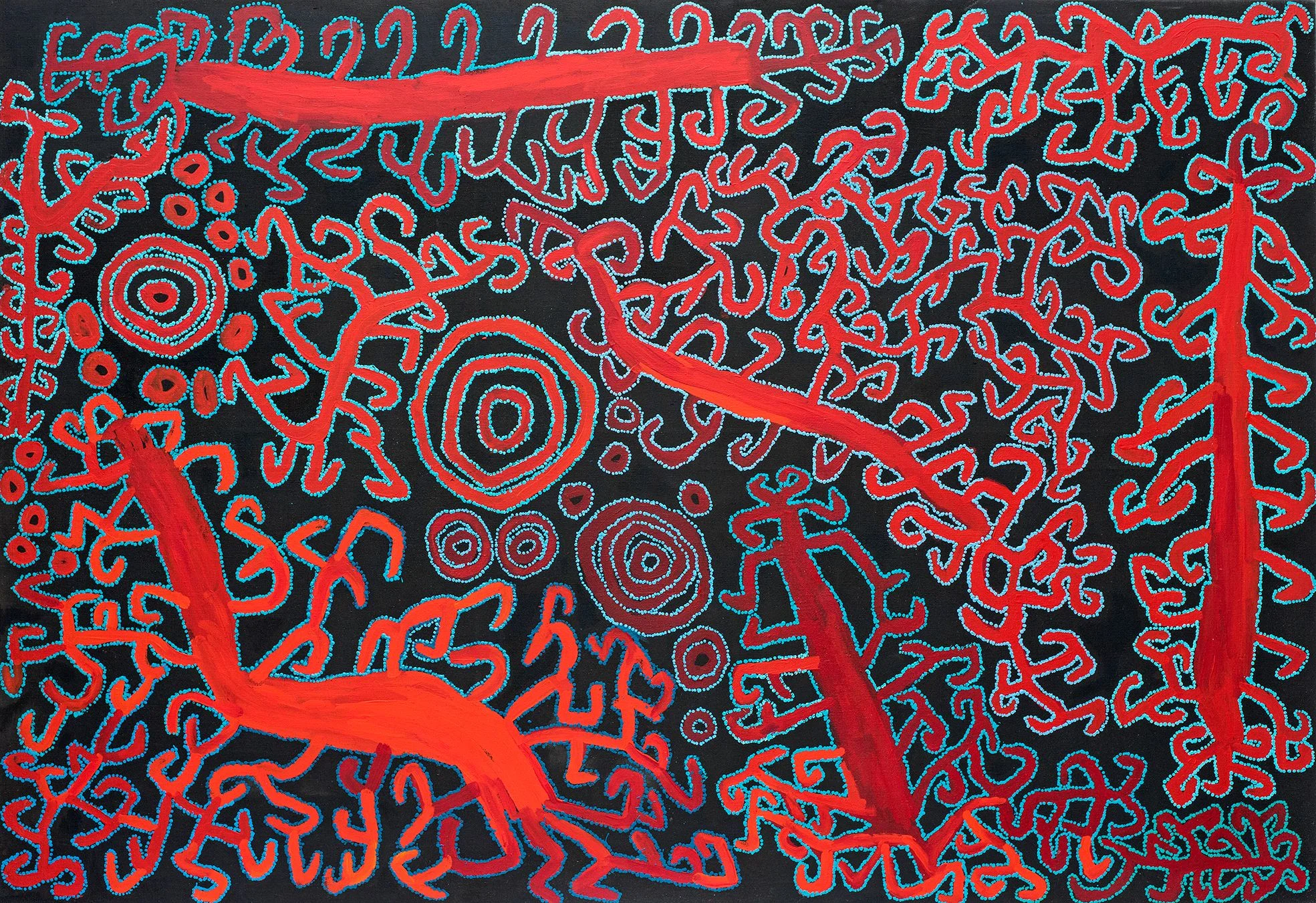
Artiste : Ned Grant
Titre de l'œuvre : Katutjara
Format : 200 x 137 cm
Provenance et certificat : centre d'art aborigène du Spinifex Art Project
Référence de cette peinture : 19-24
Vendue
Explications pour cette œuvre :
Ned Grant (1941) moves underground through the wata (base of tree) drawing the aturu (root system) to life affirming water sites. Following the twists and turns as he weaves the Ngalta or Desert Kurrajong to fruition. This is the tree of life and water can be sourced from its root system in times of drought or long journeys. Ned places the significant sites of Katutjara and Pirilyi in the east of traditional Spinifex Lands. Katutjara holds the Wati Kutjara Tjukurpa (Two Men Creation Line), a far reaching narrative that follows two brothers, a mulya maru (black nosed monitor) and tinka (sand goanna). It is here at Katutjara that the men kill and cook an emu and the discarded bones of the game can be still be seen at this site today. These are creation beings and as such were able to shape the landscape as they moved through it leaving indelible physical reminders of their power and presence.
Fred Grant was born in north eastern Spinifex at Ukatjatjara. Like his brother, Ned Grant, Fred went in to Cundeelee Mission a segregated bush boy (nyiingka) whose initiation into Men’s Law had been delayed because of the enduring drought at the time and the disturbance of traditional life by the Maralinga atomic testing and the rocket testing out of Woomera. Fred subsequently went ‘through’ the Law with older brother and ngalungku (contemporary initiate), Ned, in the ranges north of Laverton. Fred remained single in his younger years before marrying his life partner, Carlene West, from Tjitjiti.
With his extraordinary knowledge of Spinifex Tjukurpa and its myriad of inherent song lines Freds works are held in high esteem. They hang in prestigious collections nationally and internationally.
His artworks are in the following prestigious collections :
Harriett & Richard England Collection
National Gallery Of Australia, Canberra, Act (Mens Collaborative)
Seattle Art Museum, Seattle, Usa. (Mens Collaborative)
The Corrigan Collection, Australia (Mens Collaborative)
The Lepley Collection, Perth, Western Australia.
W. & V. Mcgeoch Collection, Melbourne, Vic.
Queensland Art Gallery Of Modern Art, Brisbane, Qld.
The Art Gallery Of New South Wales, Sydney, Nsw
Art Gallery Of South Australia, Adelaide, South Australia (Mens Collaborative)
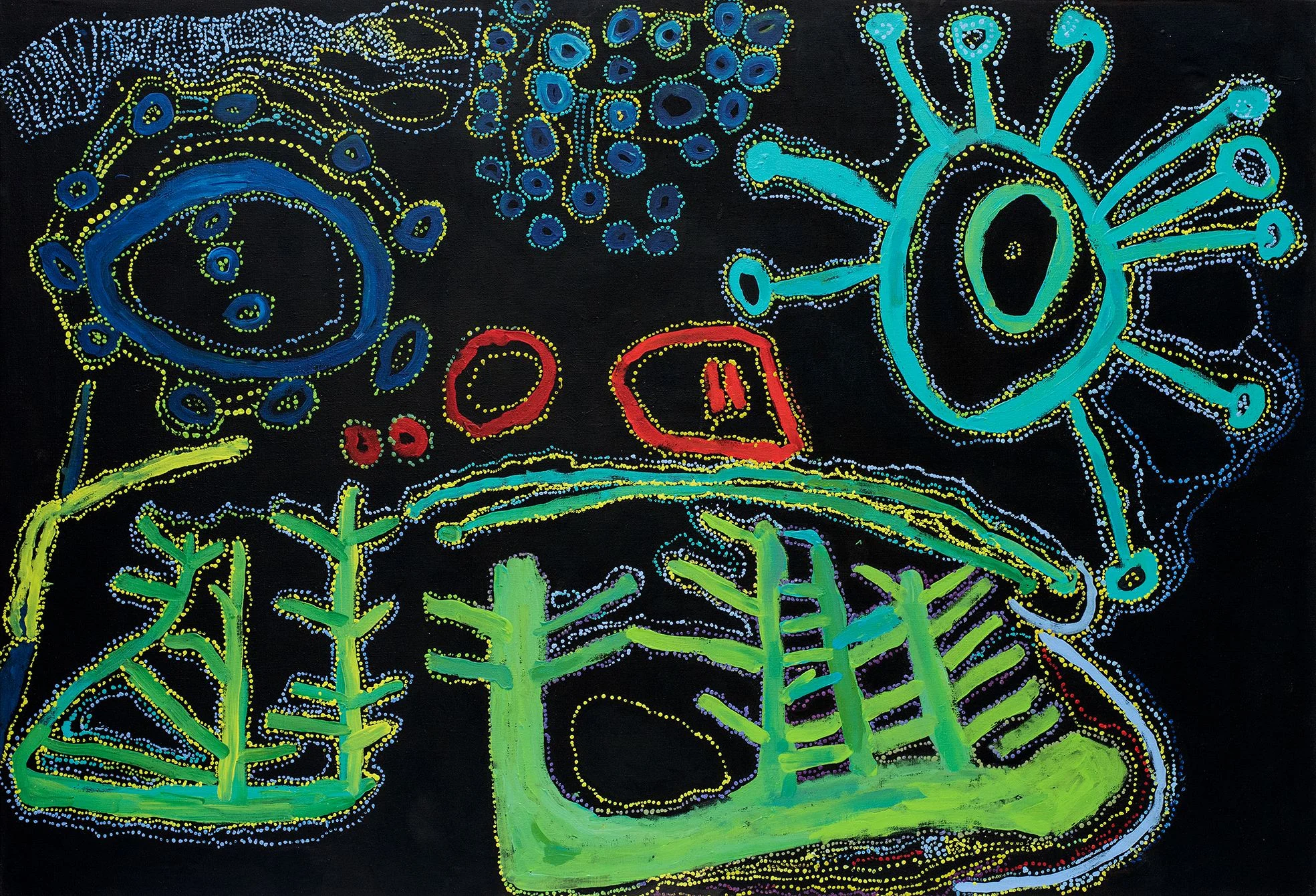
Artiste : SLawrence Pennington
Titre de l'œuvre : Mitunya munu Nyuman
Format : 200 x 137 cm
Provenance et certificat : centre d'art aborigène du Spinifex Art Project
Référence de cette peinture : 19-13
Vendue
Explications pour cette œuvre :
Lawrence Pennington (1934) touches the deepest qualities of the Tjukurpa in the unseen, taking the broad brush to minimal resemblance of the characters that inhabited the first journey. He guides the significant sites of Mitunya and Nyuman effortlessly onto the canvas, channelling the essence of Walawuru Tjukurpa (Eagle Creation Line) from a time before when Lawrence walked throughout Spinifex Country. A time when he walked with the Song, following the physical manifestation in the landscape, left by the creation beings, of the stories that made it so, of the characters that played out the journey.
At the time of Lawrence’s birth in the early 1930’s, his people, the Spinifex people had no contact with Western civilization. Lawrence grew up as a young boy living a fully traditional hunter-gatherer life. His initiations as a young man in this country have given Lawrence intimate knowledge in a physical as well as a spiritual sense of the sites and stories of the area he was born and responsible for.
He was born just outside of the north-eastern boundary of Spinifex at a place called Urlu circa 1934. Running through the length Lawrence’s stretch of country is the Walawuru (wedge-tailed eagle) Dreaming. Not surprisingly the dominant topographical feature in Lawrence’s country is a string of craggy topped breakaways. In parallel alignment off to the south run a series of thinly connected dry salt lakes and naturally underscoring these features reddish sand plains. Depending on the character of the light, Lawrence’s country can at different times appear hauntingly bleak or soaringly beautiful. His spacious, iconographic paintings vibrate with culture and beauty.
His artworks are in the following prestigious collections :
Araluen Gallery, Alice Springs, Northern Territory.
National Gallery Of Australia, Canberra, Act (Mens Collaborative)
Richard And Harriet England Collection
Seattle Art Museum, Seattle, Usa. (Mens Collaborative)
The Corrigan Collection, Australia (Mens Collaborative)
The National Gallery Of Victoria, Melbourne, Vic.
W. & V. Mcgeoch Collection, Melbourne, Vic.
Wagner And Owen Collection (Usa)
Geoff Hassal Collection, Australia
Arthur Roe Collection, Australia
The Art Gallery Of New South Wales, Sydney, Nsw (Mens Collaborative)
Art Gallery Of South Australia, Adelaide, South Australia (Mens Collaborative)
Musée La Grange, Moitiers, Switzerland
Kluge-Ruhe Aboriginal Art Collection Of The University Of Virginia, Usa
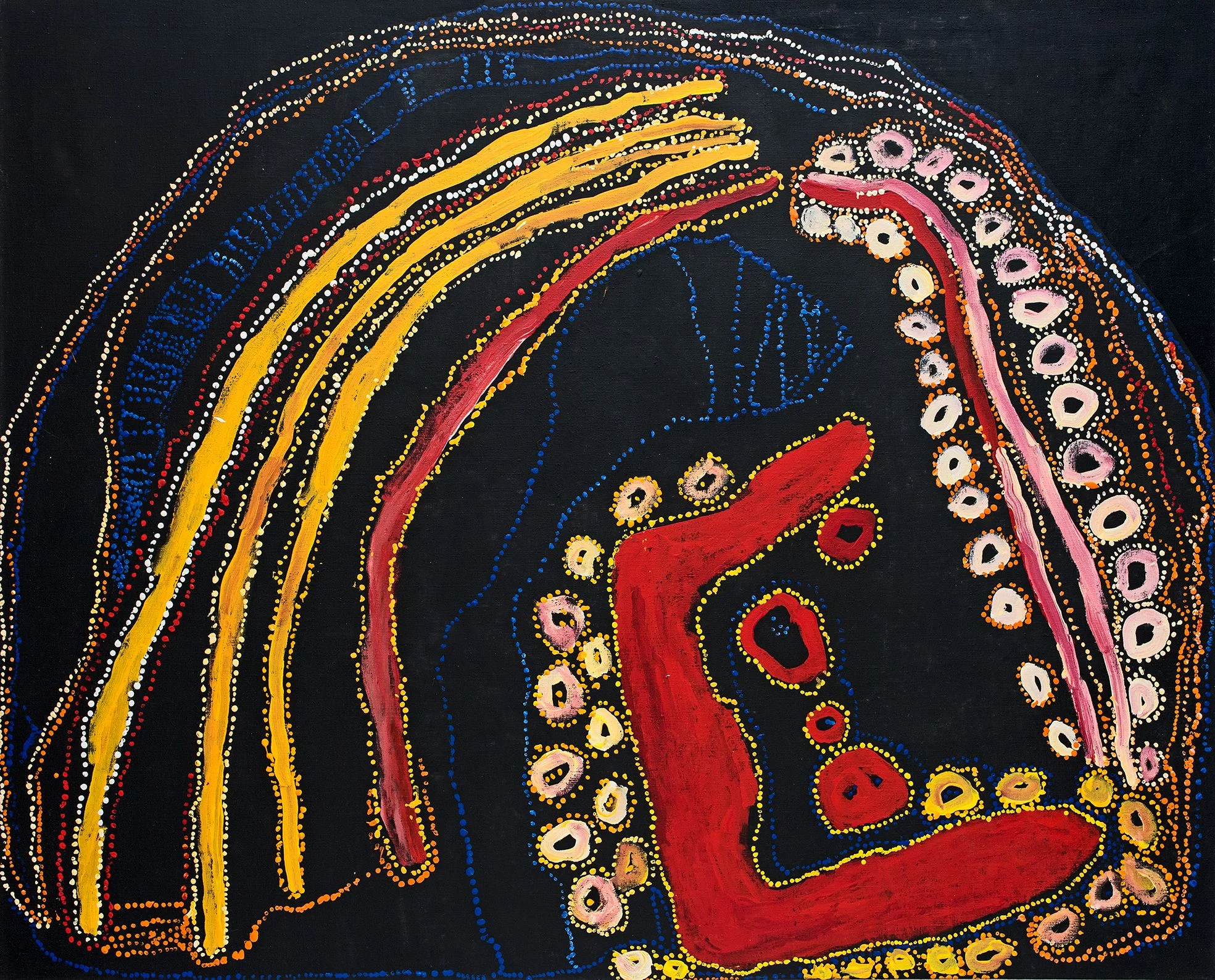
Artiste : Lawrence Pennington
Titre de l'œuvre : Pukara
Format : 137 x 110 cm
Provenance et certificat : centre d'art aborigène du Spinifex Art Project
Référence de cette peinture : 19-18
Vendue
Explications pour cette œuvre :
Lawrence Pennington (1934) touches the deepest qualities of the Tjukurpa in the unseen, taking the broad brush to minimal resemblance of the characters that inhabited the first journey. He guides the significant sites of Mitunya and Nyuman effortlessly onto the canvas, channelling the essence of Walawuru Tjukurpa (Eagle Creation Line) from a time before when Lawrence walked throughout Spinifex Country. A time when he walked with the Song, following the physical manifestation in the landscape, left by the creation beings, of the stories that made it so, of the characters that played out the journey.
At the time of Lawrence’s birth in the early 1930’s, his people, the Spinifex people had no contact with Western civilization. Lawrence grew up as a young boy living a fully traditional hunter-gatherer life. His initiations as a young man in this country have given Lawrence intimate knowledge in a physical as well as a spiritual sense of the sites and stories of the area he was born and responsible for.
He was born just outside of the north-eastern boundary of Spinifex at a place called Urlu circa 1934. Running through the length Lawrence’s stretch of country is the Walawuru (wedge-tailed eagle) Dreaming. Not surprisingly the dominant topographical feature in Lawrence’s country is a string of craggy topped breakaways. In parallel alignment off to the south run a series of thinly connected dry salt lakes and naturally underscoring these features reddish sand plains. Depending on the character of the light, Lawrence’s country can at different times appear hauntingly bleak or soaringly beautiful. His spacious, iconographic paintings vibrate with culture and beauty.
His artworks are in the following prestigious collections :
Araluen Gallery, Alice Springs, Northern Territory.
National Gallery Of Australia, Canberra, Act (Mens Collaborative)
Richard And Harriet England Collection
Seattle Art Museum, Seattle, Usa. (Mens Collaborative)
The Corrigan Collection, Australia (Mens Collaborative)
The National Gallery Of Victoria, Melbourne, Vic.
W. & V. Mcgeoch Collection, Melbourne, Vic.
Wagner And Owen Collection (Usa)
Geoff Hassal Collection, Australia
Arthur Roe Collection, Australia
The Art Gallery Of New South Wales, Sydney, Nsw (Mens Collaborative)
Art Gallery Of South Australia, Adelaide, South Australia (Mens Collaborative)
Musée La Grange, Moitiers, Switzerland
Kluge-Ruhe Aboriginal Art Collection Of The University Of Virginia, Usa

Artiste : Lawrence Pennington
Titre de l'œuvre : Nyuman
Format : 137 x 90 cm
Provenance et certificat : centre d'art aborigène du Spinifex Art Project
Référence de cette peinture : 19-15
Vendue
Explications pour cette œuvre :
Lawrence Pennington (1934) touches the deepest qualities of the Tjukurpa in the unseen, taking the broad brush to minimal resemblance of the characters that inhabited the first journey. He guides the significant sites of Mitunya and Nyuman effortlessly onto the canvas, channelling the essence of Walawuru Tjukurpa (Eagle Creation Line) from a time before when Lawrence walked throughout Spinifex Country. A time when he walked with the Song, following the physical manifestation in the landscape, left by the creation beings, of the stories that made it so, of the characters that played out the journey.
At the time of Lawrence’s birth in the early 1930’s, his people, the Spinifex people had no contact with Western civilization. Lawrence grew up as a young boy living a fully traditional hunter-gatherer life. His initiations as a young man in this country have given Lawrence intimate knowledge in a physical as well as a spiritual sense of the sites and stories of the area he was born and responsible for.
He was born just outside of the north-eastern boundary of Spinifex at a place called Urlu circa 1934. Running through the length Lawrence’s stretch of country is the Walawuru (wedge-tailed eagle) Dreaming. Not surprisingly the dominant topographical feature in Lawrence’s country is a string of craggy topped breakaways. In parallel alignment off to the south run a series of thinly connected dry salt lakes and naturally underscoring these features reddish sand plains. Depending on the character of the light, Lawrence’s country can at different times appear hauntingly bleak or soaringly beautiful. His spacious, iconographic paintings vibrate with culture and beauty.
His artworks are in the following prestigious collections :
Araluen Gallery, Alice Springs, Northern Territory.
National Gallery Of Australia, Canberra, Act (Mens Collaborative)
Richard And Harriet England Collection
Seattle Art Museum, Seattle, Usa. (Mens Collaborative)
The Corrigan Collection, Australia (Mens Collaborative)
The National Gallery Of Victoria, Melbourne, Vic.
W. & V. Mcgeoch Collection, Melbourne, Vic.
Wagner And Owen Collection (Usa)
Geoff Hassal Collection, Australia
Arthur Roe Collection, Australia
The Art Gallery Of New South Wales, Sydney, Nsw (Mens Collaborative)
Art Gallery Of South Australia, Adelaide, South Australia (Mens Collaborative)
Musée La Grange, Moitiers, Switzerland
Kluge-Ruhe Aboriginal Art Collection Of The University Of Virginia, Usa
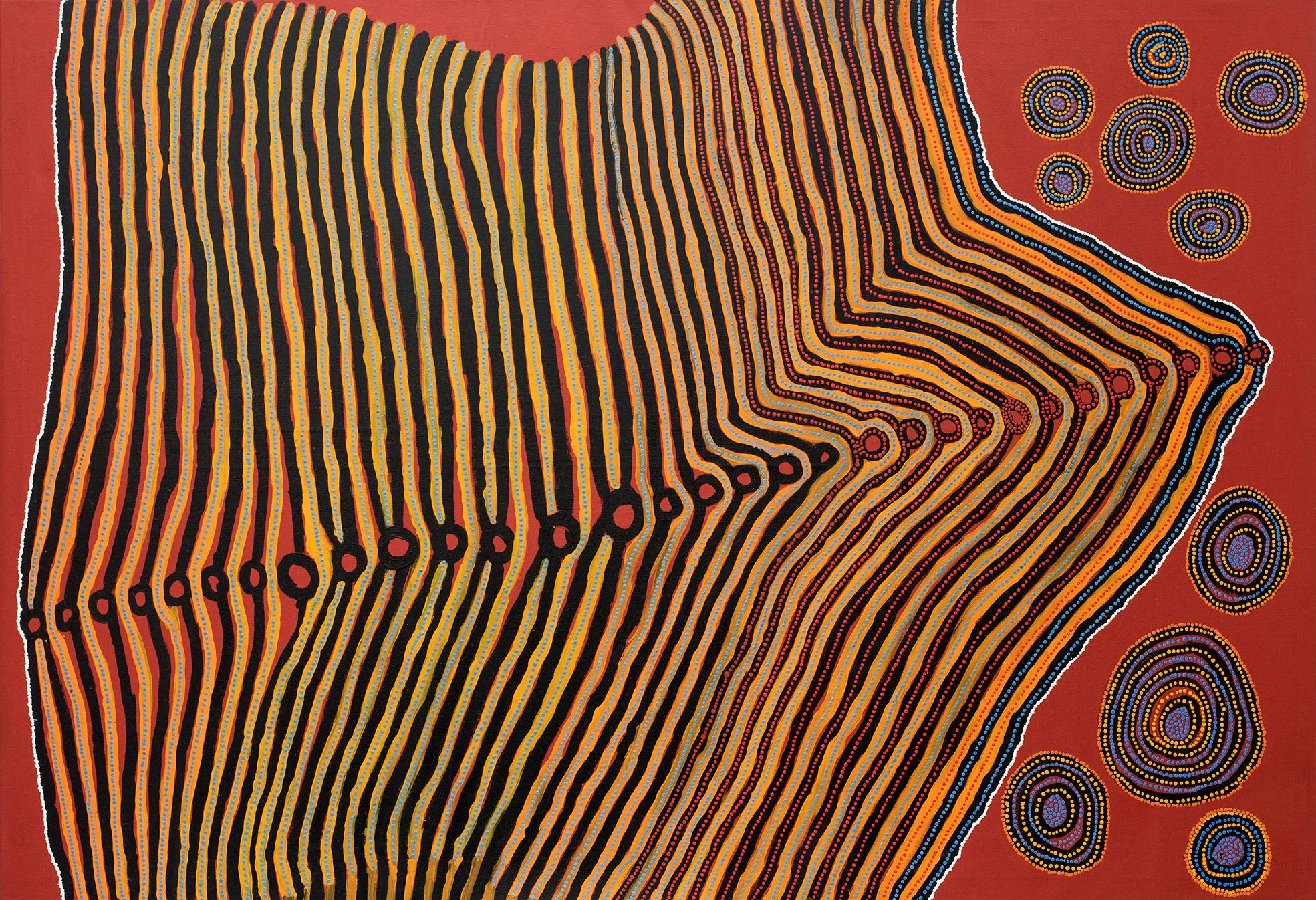
Artiste : Lennard Walker
Titre de l'œuvre : Tali
Format : 200 x 137 cm
Provenance et certificat : centre d'art aborigène du Spinifex Art Project
Référence de cette peinture : 19-1
Vendue
Explications pour cette œuvre :
Lennard Walker (1946) has depicted the Tali tjuta (sand dunes) all along here. This is country I am responsible for around Kuru Ala (located in the Great Victoria Desert of WA). There are small rock holes along the lines of sand dunes. Lennard has also painted the more permanent rock holes of Wiyatjara, a site belonging to the Wati Kutjara – Serpent Men from Pukara. The men travelled from Wiyatjara to Purpurnya close by to Kuru Ala. Lennard was born at Kuru Ala making him the senior custodian for this place. It is a ‘Women’s Site” holding the Kungkarangkalpa Tjukurpa – Seven Sisters story. As a man there are places he cannot go, but he still holds authority and cultural responsibilities for Kuru Ala. The women travel from Kuru Ala to Tjulkultjara and Nyuman, two rock holes also depicted in the work.
Lennard was born at Tjukaltjara on the central northern border of Spinifex circa 1946. Tjukaltjara is an extension of a massive Seven Sisters site centred at Kuru Ala (eyes open) which could describe the state of alertness required by the sisters being relentlessly stalked across great tracts of central Australia by the obsessively amorous Nyiiru. Lennard’s country lies at the crossover of the endless dunes of Spinifex and the ironstone ranges to the north punctuated by a series of spectacular breakaways and mesas. Women from the Ngaanyatjarra, Pitjantjatjara and Spinifex Lands regularly convene together at Kuru Ala to practice Women’s ceremonies. In keeping with strict protocol the women first must ask Mr. Walker for permission to enter his country. Diplomatically, Mr. Walker never refuses.
Unlike most born in country artists Lennard moved out of Spinifex with his extended family to the Warburton Mission, established in 1934. Lennard spent time at the Mission school and picked up a good deal of conversational English. This was to serve him well later during the new political era that ensued after the transfer from mission authority to Aboriginal “self-management”. Lennard’s family were comparative strangers in Warburton and took the first opportunity to move to Cundeelee Mission to join the other Spinifex families there.
His artworks are in the following prestigious collections :
Artbank Australian Government, Canberra. A.C.T.
Collection Prince Stefan Of Liechtenstein, Embassy Of Liechtenstein In Germany. (Mens Collaborate)
Kuntswerk Sammlung Alison Und Peter W. Klein, Germany Sammlung Alison Und Peter W. Klein, Germany
National Gallery Of Australia, Canberra, Act (Mens Collaborative)
Seattle Art Museum, Seattle, Usa. (Mens Collaborative)
The British Museum, London. (Mens Collaborative)
The Corrigan Collection, Australia (Mens Collaborative)
The Kaplan-Levi Collection, Usa
W. & V. Mcgeoch Collection, Melbourne, Vic.
Wagner And Owen Collection, Usa.
Queensland Art Gallery Of Modern Art, Brisbane, Qld.
The Art Gallery Of New South Wales, Sydney, Nsw (Mens Collaborative)
Art Gallery Of South Australia, Adelaide, South Australia (Mens Collaborative)

Artiste : Kanta Donnegan
Titre de l'œuvre : Minyma Tjuta
Format : 200 x 137 cm
Provenance et certificat : centre d'art aborigène du Spinifex Art Project
Référence de cette peinture : 19-12
Demander le prix de l'œuvre / Enquiry
Explications pour cette œuvre :
Kanta (1944) was born around the 1940's at a place called Kapi Piti Kutjara. Kanta, a senior Spinifex woman is knowledgeable about many areas in Spinifex country including the Minyma Tjuta (Seven Sisters) Tjukurpa, a central theme in the lives of Western Desert women. In this story seven women, all sisters are travelling through the country on a vast journey which takes them from Coolgardie right across the desert to Port Augusta in SA. Along the way the sisters are being pursued by Wati Nyiru, the cheeky old man in pursuit of a wife, preferably the oldest sister, Kampukurtja. During his pursuit, Nyiru disguises himself in various ways to trick the sisters but is eventually outsmarted by them. The women fly up into the sky to form the constellation of Pleiades seen in the southern sky.
Kanta was born circa 1944 in the gentle sand plain country of southern Spinifex between the Tjuntun and Unpun rock holes. The ubiquitous men’s tjukurpa, Wati Kutjara (Two Men) courses through the middle of Kanta's country on its way east to S.A. where it acts as the lynch pin for two other men’s tjukurpa heading to a common destination at Kaliwani (Lake Maurice).
Kanta went into Cundeelee Mission in the late 1950s sweep a young married woman without children. Kanta had one son and three daughters by her first husband (dec.) in Cundeelee and returned to Spinifex in the first wave of resettlers in 1984. Apart from attending the odd exhibition or women’s trip to the outside Kanta has not left the desert lands since. Several years after the Rictor family came in from northern Spinifex she married one of the sons, Ian - her kuri pikitja, often translated as “promised one”. As if forged by the early years in her country Kanta is gentle soul and has assiduously painted with the Spinifex Art Project since representing her country in the women’s native title painting in 1997. Kathleen has painted on most of the women’s collaboratives.
Her artworks are in the following prestigious collections :
Collection Prince Stefan Of Liechtenstein, Embassy Of Liechtenstein In Germany.(Womens Collaborate)
Museum Of Western Australia
The Corrigan Collection, Australia. (Womens Collaborative)
The Lepley Collection, Perth, Western Australia. (Womens Collaborative)
The National Gallery Of Victoria, Melbourne, Vic. (Womens Collaborative)
The Sims Dickson Collection, Nsw (Collaborative With Ngalpingka Simms)
Artbank, Australian Government Collection. Australia.
Parliament House Art Collection, Canberra, Act (Womens Collaborative)
Art Gallery Of South Australia, Adelaide, South Australia (Womens Collaborative)

Artiste : Ian Rictor
Titre de l'œuvre : Kamanti
Format : 200 x 137 cm
Provenance et certificat : centre d'art aborigène du Spinifex Art Project
Référence de cette peinture : 18-96
Demander le prix de l'œuvre / Enquiry
Explications pour cette œuvre :
Ian Rictor (1960) has painted the significant sites of Tuwan, Atult and Kamanti (2 rock holes), located in the north of Spinifex Lands. Tuwan is a major site for the Nyii-Nyii Tjuta Tjukurpa (Zebra Finch Creation Line). This epic songline tracks a sacred 'Men’s' story following the antics and journeying of a group of zebra finch men as they head south to the coast. Ian Rictor lived in the vicinity of Tuwan in the Great Victoria Desert of Western Australia for the early part of his life as a traditional hunter gatherer with his immediate family. He was in his 20's when he first walked into modern 'civilisation'.
Relatives had been tracking the family, who were rumoured to have perished long before, for many months before finally convincing them to join other family in the settlement.
Ian Rictor was born at Artulin / Tuwan and is a custodian and traditional owner of Tuwan. Ian emerged from the bush with his small family group in only 1986 and they are the last of the known Aboriginal people to have remained living traditionally in the Western Desert. In 1997 when the Spinifex Arts Project first began Ian was keen to join the group of painters. He took to the medium of paint on canvas with fluency and has been painting his birthplace and surrounding country since then. He has had increased success exhibiting with the Spinifex Artists in London, Utrecht and many galleries in Australia. Ian is an impressive and skilled hunter, bush mechanic and craftsman. Ian lives in Tjuntjuntjara with his wife Kathleen Donnegan, also an artist and their extended family.
His artworks are in the following prestigious collections :
Collection Prince Stefan Of Liechtenstein, Embassy Of Liechtenstein In Germany. (Mens Collaborate)
National Gallery Of Australia, Canberra, Act (Mens Collaborative)
Seattle Art Museum, Seattle, Usa. (Mens Collaborative)
The Aboriginal Art Museum, Utrecht
The British Museum, London. (Mens Collaborative)
The Corrigan Collection, Australia (Mens Collaborative)
Wagner And Owen Collection, Usa.
W. & V. Mcgeoch Collection, Melbourne, Vic. (Mens Collaborative)
Art Gallery Of South Australia, Adelaide, South Australia (Mens Collaborative)

Artiste : Kanta Donnegan
Titre de l'œuvre : Kapi Piti Tjuntjun
Format : 137 x 110 cm
Provenance et certificat : centre d'art aborigène du Spinifex Art Project
Référence de cette peinture : 18-79
Vendue
Explications pour cette œuvre :
Kanta (1944) has painted the Minyma Tjuta or Seven Sisters story as it passes through her homeland area Tjuntun. The Minyma Tjuta story is a powerful and pertinent story to women right across the Western Desert. In this story several women are travelling across country while being pursued by a lustful oder man who wants to catch himself a wife. In Spinifex country where the women have been present there will be a significant landmark or change in geographic terrain. Kanta has represented the women by the semi circular motif where they are siting down eating bush foods. The larger roundalls are the rockholes across Spinifex country in particular Tjuntun, Pirapi, Karnka, Upinya, Tjarki and Mamutu. The women finally left this area and headed north to a significant womens site called Tjintirkara. Nyiiru continued to follow them.
Kanta was born circa 1944 in the gentle sand plain country of southern Spinifex between the Tjuntun and Unpun rock holes. The ubiquitous men’s tjukurpa, Wati Kutjara (Two Men) courses through the middle of Kanta's country on its way east to S.A. where it acts as the lynch pin for two other men’s tjukurpa heading to a common destination at Kaliwani (Lake Maurice).
Kanta went into Cundeelee Mission in the late 1950s sweep a young married woman without children. Kanta had one son and three daughters by her first husband (dec.) in Cundeelee and returned to Spinifex in the first wave of resettlers in 1984. Apart from attending the odd exhibition or women’s trip to the outside Kanta has not left the desert lands since. Several years after the Rictor family came in from northern Spinifex she married one of the sons, Ian - her kuri pikitja, often translated as “promised one”. As if forged by the early years in her country Kanta is gentle soul and has assiduously painted with the Spinifex Art Project since representing her country in the women’s native title painting in 1997. Kathleen has painted on most of the women’s collaboratives.
Her artworks are in the following prestigious collections :
Collection Prince Stefan Of Liechtenstein, Embassy Of Liechtenstein In Germany.(Womens Collaborate)
Museum Of Western Australia
The Corrigan Collection, Australia. (Womens Collaborative)
The Lepley Collection, Perth, Western Australia. (Womens Collaborative)
The National Gallery Of Victoria, Melbourne, Vic. (Womens Collaborative)
The Sims Dickson Collection, Nsw (Collaborative With Ngalpingka Simms)
Artbank, Australian Government Collection. Australia.
Parliament House Art Collection, Canberra, Act (Womens Collaborative)
Art Gallery Of South Australia, Adelaide, South Australia (Womens Collaborative)
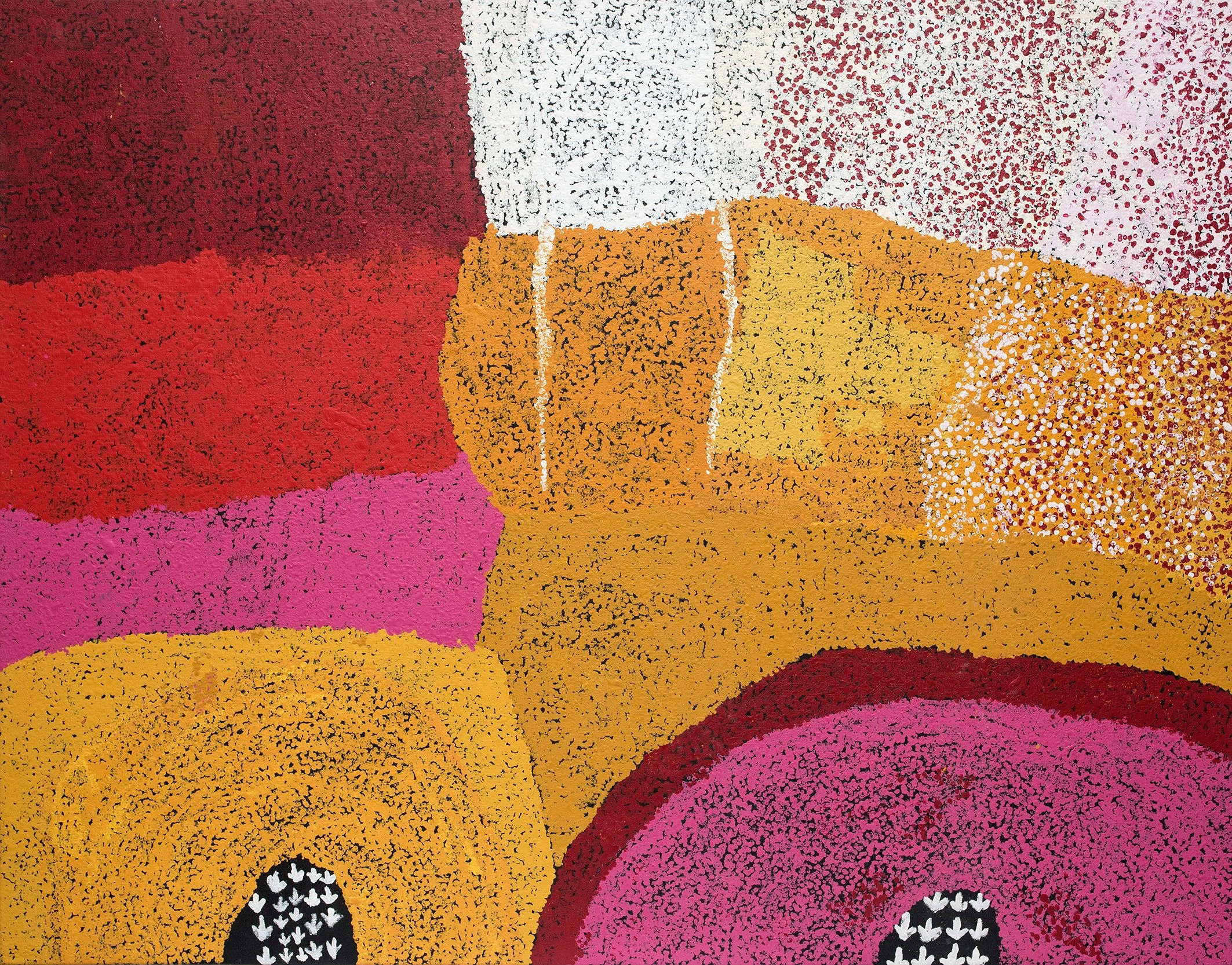
Artiste : Patju Presley
Titre de l'œuvre : Kalaya Piti
Format : 134 x 104 cm
Provenance et certificat : centre d'art aborigène du Spinifex Art Project
Référence de cette peinture : 13211
Vendue
Explications pour cette œuvre :
Nyangatja Kalaya Piti ka kalaya Tjukurpa ka kulpi kutjara kalayaku wilttja ka minymaku wiltja minyma kalaya munu watiku wiltja wati kalaya ka nyupali Tipillangaru ka nyangatja kulpingka walka tjunanyi kalaya tjinaka irriti Annangu tjuta ngura palyanu.
This painting is depicting part of the Emu Creation Story at the site of Kalaya Piti. It is here where there are two caves, one associated with the female emu and the other for the male emu. Both of these emus arrived at Kalaya Piti from a special place called Tipil. Inside the caves there are markings of emu footprints. In the early days Aboriginal people would stop and make camp here.
Patju Presley (1945) was born in the 1940s at Itaratjara, an important site between to the community settlement of Watarru and Kalayapiti in the Great Victoria Desert. He is a senior Pitjantjatjara Law man with great knowledge of the geography of the Western Desert and the associated Tjukurpa. His intimate knowledge of the country is directly related to survival in this beautiful but sometimes harsh environment learned from the generations of his ancestors.
His artworks are in the following prestigious collections :
Art Gallery Of Western Australia, Perth, Wa
The National Gallery Of Australia, Canberra, Act
National Gallery Of Victoria, Melbourne, Victoria.
The Art Gallery Of New South Wales, Sydney, Nsw
The Corrigan Collection, Australia
The Kaplan-Levi Collection, Usa
University Of Queensland Art Museum, Brisbane, Qld.
Art Gallery Of South Australia, Adelaide, South Australia (Mens Collaborative)
Queensland Art Gallery, Brisbane, Qld.
Murdoch University Collection, Perth, Wa
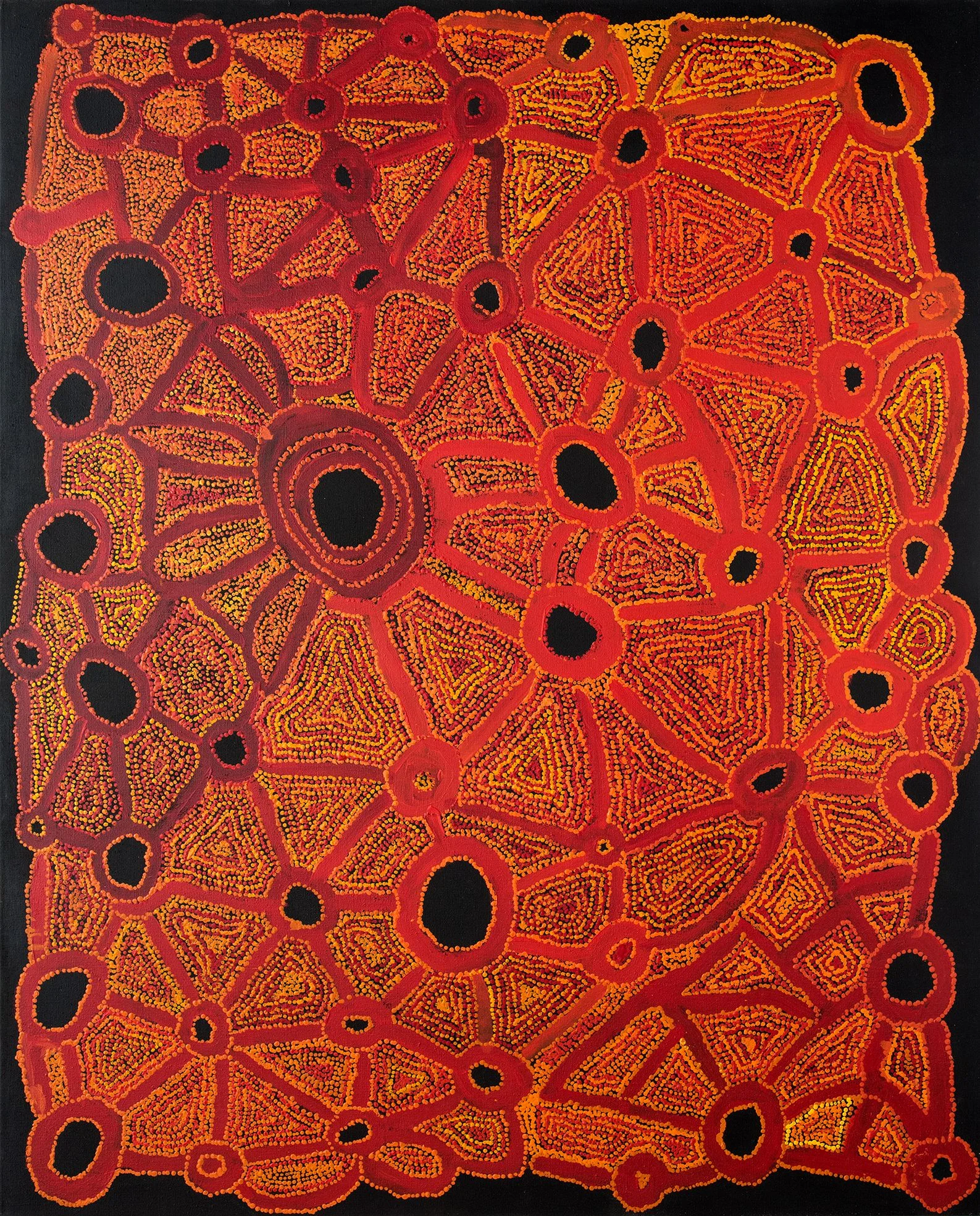
Artiste : Kanta Donnegan
Titre de l'œuvre : Tjuntjun
Format : 137 x 110 cm
Provenance et certificat : centre d'art aborigène du Spinifex Art Project
Référence de cette peinture : 18-220
Vendue
Explications pour cette œuvre :
Kanta (1944) has painted the Minyma Tjuta or Seven Sisters story as it passes through her homeland area Tjuntun. The Minyma Tjuta story is a powerful and pertinent story to women right across the Western Desert. In this story several women are travelling across country while being pursued by a lustful oder man who wants to catch himself a wife. In Spinifex country where the women have been present there will be a significant landmark or change in geographic terrain. Kanta has represented the women by the semi circular motif where they are siting down eating bush foods. The larger roundalls are the rockholes across Spinifex country in particular Tjuntun, Pirapi, Karnka, Upinya, Tjarki and Mamutu. The women finally left this area and headed north to a significant womens site called Tjintirkara. Nyiiru continued to follow them.
Kanta was born circa 1944 in the gentle sand plain country of southern Spinifex between the Tjuntun and Unpun rock holes. The ubiquitous men’s tjukurpa, Wati Kutjara (Two Men) courses through the middle of Kanta's country on its way east to S.A. where it acts as the lynch pin for two other men’s tjukurpa heading to a common destination at Kaliwani (Lake Maurice).
Kanta went into Cundeelee Mission in the late 1950s sweep a young married woman without children. Kanta had one son and three daughters by her first husband (dec.) in Cundeelee and returned to Spinifex in the first wave of resettlers in 1984. Apart from attending the odd exhibition or women’s trip to the outside Kanta has not left the desert lands since. Several years after the Rictor family came in from northern Spinifex she married one of the sons, Ian - her kuri pikitja, often translated as “promised one”. As if forged by the early years in her country Kanta is gentle soul and has assiduously painted with the Spinifex Art Project since representing her country in the women’s native title painting in 1997. Kathleen has painted on most of the women’s collaboratives.
Her artworks are in the following prestigious collections :
Collection Prince Stefan Of Liechtenstein, Embassy Of Liechtenstein In Germany.(Womens Collaborate)
Museum Of Western Australia
The Corrigan Collection, Australia. (Womens Collaborative)
The Lepley Collection, Perth, Western Australia. (Womens Collaborative)
The National Gallery Of Victoria, Melbourne, Vic. (Womens Collaborative)
The Sims Dickson Collection, Nsw (Collaborative With Ngalpingka Simms)
Artbank, Australian Government Collection. Australia.
Parliament House Art Collection, Canberra, Act (Womens Collaborative)
Art Gallery Of South Australia, Adelaide, South Australia (Womens Collaborative)
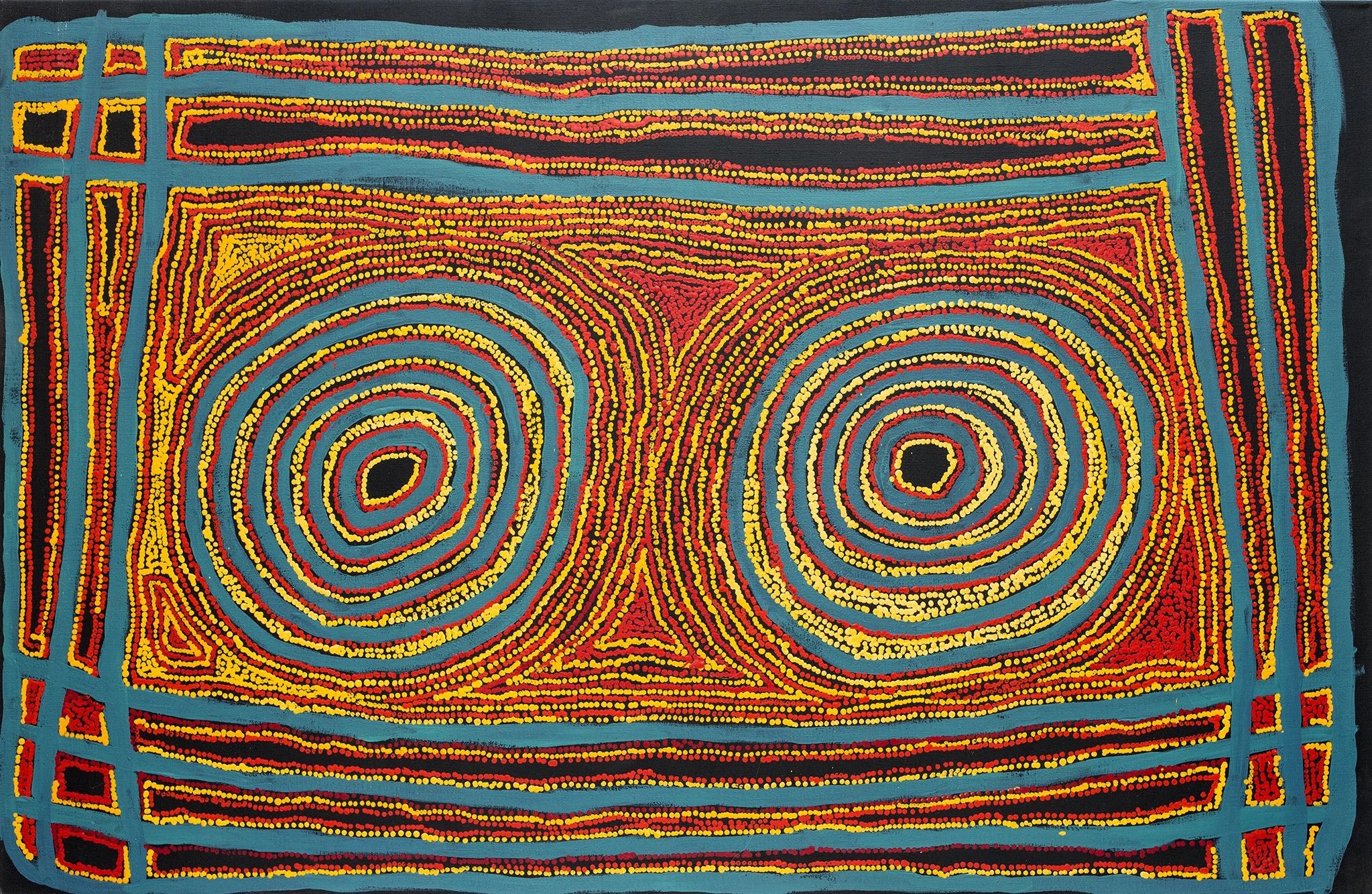
Artiste : Ian Rictor
Titre de l'œuvre : Kamanti
Format : 137 x 90 cm
Provenance et certificat : centre d'art aborigène du Spinifex Art Project
Référence de cette peinture : 17-174
Vendue
Explications pour cette œuvre :
Ian (1960) has depicted the significant site of Kamanti situated in the heart of traditional Spinifex Lands and a site that forms part of the Wati Kutjara Tjukurpa (Two Men Creation Line). This is a powerful epic that follows a father and son as they traverse Spinifex Country on Cultural Business. These two men take the form of Wanampi, magical water serpents and shape the landscape as they move through it, leaving behind the physical and spiritual reminders of their journey. At Kamanti, two rockholes appear side by side and are where the Two Men made camp on their travels. These beings are creation beings and as such held incredible metamorphic powers of transformation of the self and of the landscape they moved through. They left indelible physical mapped environment that people still follow today. These beings often made their abode in the life giving water sources that are so needed for survival in this arid land.
Ian Rictor was born at Artulin / Tuwan and is a custodian and traditional owner of Tuwan. Ian emerged from the bush with his small family group in only 1986 and they are the last of the known Aboriginal people to have remained living traditionally in the Western Desert. In 1997 when the Spinifex Arts Project first began Ian was keen to join the group of painters. He took to the medium of paint on canvas with fluency and has been painting his birthplace and surrounding country since then. He has had increased success exhibiting with the Spinifex Artists in London, Utrecht and many galleries in Australia. Ian is an impressive and skilled hunter, bush mechanic and craftsman. Ian lives in Tjuntjuntjara with his wife Kathleen Donnegan, also an artist and their extended family.
His artworks are in the following prestigious collections :
Collection Prince Stefan Of Liechtenstein, Embassy Of Liechtenstein In Germany. (Mens Collaborate)
National Gallery Of Australia, Canberra, Act (Mens Collaborative)
Seattle Art Museum, Seattle, Usa. (Mens Collaborative)
The Aboriginal Art Museum, Utrecht
The British Museum, London. (Mens Collaborative)
The Corrigan Collection, Australia (Mens Collaborative)
Wagner And Owen Collection, Usa.
W. & V. Mcgeoch Collection, Melbourne, Vic. (Mens Collaborative)
Art Gallery Of South Australia, Adelaide, South Australia (Mens Collaborative)
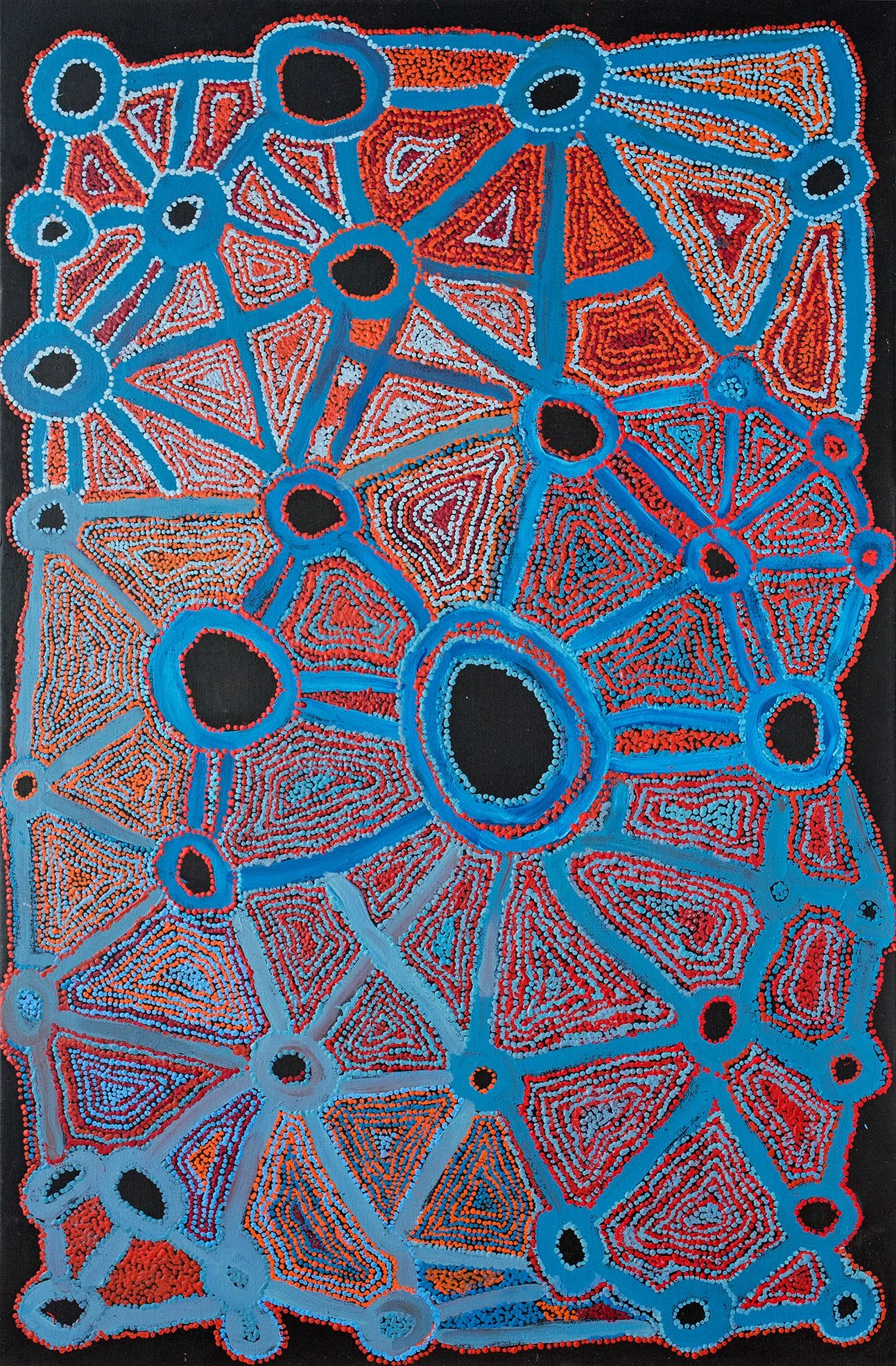
Artiste : Kanta Donnegan
Titre de l'œuvre : Tjuntjun
Format : 137 x 90 cm
Provenance et certificat : centre d'art aborigène du Spinifex Art Project
Référence de cette peinture : 18-222
Vendue
Explications pour cette œuvre :
Kanta (1944) has painted the Minyma Tjuta or Seven Sisters story as it passes through her homeland area Tjuntun. The Minyma Tjuta story is a powerful and pertinent story to women right across the Western Desert. In this story several women are travelling across country while being pursued by a lustful oder man who wants to catch himself a wife. In Spinifex country where the women have been present there will be a significant landmark or change in geographic terrain. Kanta has represented the women by the semi circular motif where they are siting down eating bush foods. The larger roundalls are the rockholes across Spinifex country in particular Tjuntun, Pirapi, Karnka, Upinya, Tjarki and Mamutu. The women finally left this area and headed north to a significant womens site called Tjintirkara. Nyiiru continued to follow them.
Kanta was born circa 1944 in the gentle sand plain country of southern Spinifex between the Tjuntun and Unpun rock holes. The ubiquitous men’s tjukurpa, Wati Kutjara (Two Men) courses through the middle of Kanta's country on its way east to S.A. where it acts as the lynch pin for two other men’s tjukurpa heading to a common destination at Kaliwani (Lake Maurice).
Kanta went into Cundeelee Mission in the late 1950s sweep a young married woman without children. Kanta had one son and three daughters by her first husband (dec.) in Cundeelee and returned to Spinifex in the first wave of resettlers in 1984. Apart from attending the odd exhibition or women’s trip to the outside Kanta has not left the desert lands since. Several years after the Rictor family came in from northern Spinifex she married one of the sons, Ian - her kuri pikitja, often translated as “promised one”. As if forged by the early years in her country Kanta is gentle soul and has assiduously painted with the Spinifex Art Project since representing her country in the women’s native title painting in 1997. Kathleen has painted on most of the women’s collaboratives.
Her artworks are in the following prestigious collections :
Collection Prince Stefan Of Liechtenstein, Embassy Of Liechtenstein In Germany.(Womens Collaborate)
Museum Of Western Australia
The Corrigan Collection, Australia. (Womens Collaborative)
The Lepley Collection, Perth, Western Australia. (Womens Collaborative)
The National Gallery Of Victoria, Melbourne, Vic. (Womens Collaborative)
The Sims Dickson Collection, Nsw (Collaborative With Ngalpingka Simms)
Artbank, Australian Government Collection. Australia.
Parliament House Art Collection, Canberra, Act (Womens Collaborative)
Art Gallery Of South Australia, Adelaide, South Australia (Womens Collaborative)

Artiste : Tjaruwa Woods
Titre de l'œuvre : Wati Kutjara
Format : 137 x 110 cm
Provenance et certificat : centre d'art aborigène du Spinifex Art Project
Référence de cette peinture : 19-32
Demander le prix de l'œuvre / Enquiry
Explications pour cette œuvre :
Tjaruwa (1954) paints with a knowledge and a devotion to the country that formed her. She was a young woman when she and her immediate family 'walked in' from the Great Victoria Desert in the remote east of Western Australia. This was deemed inhospitable country by the encroaching 'new world' and perceived as so vast and uninhabited, that it made the ideal site to detonate and observe the new wave of nuclear explosions conducted as part of the British Atomic Testing during the 1950's.
Tjaruwa and her family were there, living, breathing, hunting, walking over the soft red carpet of sand, learning the paths of the creation beings who shaped this landscape and made the moral world possible. She slept under a vast expanse by campfire and drank water from tree roots. She learnt the fine art of survival in an arid but spiritual world and how to navigate an environment full of meaning. Tjaruwa paints like she breathes, an almost innate required constant. As she depicts the significant site of Kamanti, she is well aware of the creation manifestation of the Wati Kutjara (Two Men Creation Line) and that these Two Men still reside in the well-formed water cavities that penetrate deep into middle earth. She knows with all her learned experience that these Two Men are to be feared but treated with reverence all the same, for they can travel underground as the enormous water serpents that they are, or walk the landscape in the form of mortal men. And as she sings the sites onto the two dimensional plane, let us appreciate through the panoramic composition that comes from a lifetime of breathing in this country.
Tjauruwa was born in 1954 outside the Spinifex Determination Area at Warutjara, the place of Minyma Tjilkamata - the Echidna Woman, near the current community of Jamieson (Manta Maru) within the Ngaanyatjarra Lands. Except for possession of a few pieces of iron, fashioned into implements and tin bowls Tjaruwa lived traditionally until the winter of 1986 when her family group of seven was located in northern Spinifex by a group of Spinifex people making a sortie into country to re-visit important Men’s sites after some 25 years of absence. Tjaruwa came in with a small son on her hip and camped with her family firstly at Yakatunya, 90 kilometres south of Tjuntjuntjara, joined the moving camp which accompanied the construction of a road, 300 kilometres through the length of the Spinifex Lands, before settling permanently at Tjuntjuntjara in 1989. Tjaruwa was adjudged to be about 32 years old in 1986 and was given the birth date 1/7/1954. At this point in time (2014),Tjaruwa’s family remains the last Aboriginal group in the country to make first contact with contemporary Australia.
It is difficult to even imagine the changes Tjaruwa was to encounter living in her new world. She had acquired an extended network of kin to establish relationships with, the daily activity of hunting and gathering was essentially replaced by the community store and water was abundant.
Tjaruwa’s immediate priority was to care for her mother and uncle living in their new circumstances and it was not until her mother passed away that she took up an interest in painting. At first she tended to paint as she observed other women painting and then the accumulated experience of her other life and her mother’s stories/designs poured out and Tjaruwa’s unique Spinifex perspective was translated with spectacular style and technique on to canvas.
Her artworks are in the following prestigious collections :
Art Gallery Of South Australia, Adelaide Sa (Women’s Collaborative)
National Gallery Of Australia, Canberra
National Gallery Of Victoria, Melbourne Vic (Women’s Collaborative)
Richard And Harriet England Collection
Seattle Art Museum, Seattle Usa (Women’s Collaborative)
The British Museum, London, England.(Womens Collaborative)
The Corrigan Collection, Australia
The Lepley Collection, Perth, Western Australia.
The Sims Dickson Collection, Nsw
Parliament House Art Collection, Canberra, Act (Womens Collaborative)
W. & V. Mcgeoch Collection, Melbourne, Vic.
The Berndt Collection, University Of Western Australia.

Artiste : Tjaruwa Woods
Titre de l'œuvre : Wati Kutjara
Format : 137 x 90 cm
Provenance et certificat : centre d'art aborigène du Spinifex Art Project
Référence de cette peinture : 19-33
Vendue
Explications pour cette œuvre :
Tjaruwa (1954) paints with a knowledge and a devotion to the country that formed her. She was a young woman when she and her immediate family 'walked in' from the Great Victoria Desert in the remote east of Western Australia. This was deemed inhospitable country by the encroaching 'new world' and perceived as so vast and uninhabited, that it made the ideal site to detonate and observe the new wave of nuclear explosions conducted as part of the British Atomic Testing during the 1950's.
Tjaruwa and her family were there, living, breathing, hunting, walking over the soft red carpet of sand, learning the paths of the creation beings who shaped this landscape and made the moral world possible. She slept under a vast expanse by campfire and drank water from tree roots. She learnt the fine art of survival in an arid but spiritual world and how to navigate an environment full of meaning. Tjaruwa paints like she breathes, an almost innate required constant. As she depicts the significant site of Kamanti, she is well aware of the creation manifestation of the Wati Kutjara (Two Men Creation Line) and that these Two Men still reside in the well-formed water cavities that penetrate deep into middle earth. She knows with all her learned experience that these Two Men are to be feared but treated with reverence all the same, for they can travel underground as the enormous water serpents that they are, or walk the landscape in the form of mortal men. And as she sings the sites onto the two dimensional plane, let us appreciate through the panoramic composition that comes from a lifetime of breathing in this country.
Tjauruwa was born in 1954 outside the Spinifex Determination Area at Warutjara, the place of Minyma Tjilkamata - the Echidna Woman, near the current community of Jamieson (Manta Maru) within the Ngaanyatjarra Lands. Except for possession of a few pieces of iron, fashioned into implements and tin bowls Tjaruwa lived traditionally until the winter of 1986 when her family group of seven was located in northern Spinifex by a group of Spinifex people making a sortie into country to re-visit important Men’s sites after some 25 years of absence. Tjaruwa came in with a small son on her hip and camped with her family firstly at Yakatunya, 90 kilometres south of Tjuntjuntjara, joined the moving camp which accompanied the construction of a road, 300 kilometres through the length of the Spinifex Lands, before settling permanently at Tjuntjuntjara in 1989. Tjaruwa was adjudged to be about 32 years old in 1986 and was given the birth date 1/7/1954. At this point in time (2014),Tjaruwa’s family remains the last Aboriginal group in the country to make first contact with contemporary Australia.
It is difficult to even imagine the changes Tjaruwa was to encounter living in her new world. She had acquired an extended network of kin to establish relationships with, the daily activity of hunting and gathering was essentially replaced by the community store and water was abundant.
Tjaruwa’s immediate priority was to care for her mother and uncle living in their new circumstances and it was not until her mother passed away that she took up an interest in painting. At first she tended to paint as she observed other women painting and then the accumulated experience of her other life and her mother’s stories/designs poured out and Tjaruwa’s unique Spinifex perspective was translated with spectacular style and technique on to canvas.
Her artworks are in the following prestigious collections :
Art Gallery Of South Australia, Adelaide Sa (Women’s Collaborative)
National Gallery Of Australia, Canberra
National Gallery Of Victoria, Melbourne Vic (Women’s Collaborative)
Richard And Harriet England Collection
Seattle Art Museum, Seattle Usa (Women’s Collaborative)
The British Museum, London, England.(Womens Collaborative)
The Corrigan Collection, Australia
The Lepley Collection, Perth, Western Australia.
The Sims Dickson Collection, Nsw
Parliament House Art Collection, Canberra, Act (Womens Collaborative)
W. & V. Mcgeoch Collection, Melbourne, Vic.
The Berndt Collection, University Of Western Australia.

Artiste : Tjaruwa Woods
Titre de l'œuvre : Kamanti
Format : 137 x 90 cm
Provenance et certificat : centre d'art aborigène du Spinifex Art Project
Référence de cette peinture : 19-34
Vendue
Explications pour cette œuvre :
Tjaruwa (1954) paints with a knowledge and a devotion to the country that formed her. She was a young woman when she and her immediate family 'walked in' from the Great Victoria Desert in the remote east of Western Australia. This country was deemed inhospitable by the encroaching 'new world' and perceived as so vast and uninhabited, that it made the ideal site to detonate and observe the new wave of nuclear explosions conducted as part of the British Atomic Testing during the 1950's.
But Tjaruwa and her family were there, living, breathing, hunting, walking over the solo red carpet of sand, learning the paths of the creation beings who shaped this landscape and made the moral world possible. She slept under a vast expanse by campfire and drank water from tree roots. She learnt the fine art of survival in an arid but spiritual world and how to navigate an environment full of meaning. Tjaruwa paints like she breathes, an almost innate required constant. As she depicts the significant site of Kamanti, she is well aware of the creation manifestation of the Wati Kutjara (Two Men Creation Line) and that these Two Men still reside in the well-formed water cavities that penetrate deep into middle earth. She knows with all her learned experience that these Two Men are to be feared but treated with reverence all the same, for they can travel underground as the enormous water serpents that they are, or walk the landscape in the form of mortal men. And as she sings the sites onto the two dimensional plane, let us appreciate through the panoramic composition that comes from a lifetime of breathing in this country.
Tjauruwa was born in 1954 outside the Spinifex Determination Area at Warutjara, the place of Minyma Tjilkamata - the Echidna Woman, near the current community of Jamieson (Manta Maru) within the Ngaanyatjarra Lands. Except for possession of a few pieces of iron, fashioned into implements and tin bowls Tjaruwa lived traditionally until the winter of 1986 when her family group of seven was located in northern Spinifex by a group of Spinifex people making a sortie into country to re-visit important Men’s sites after some 25 years of absence. Tjaruwa came in with a small son on her hip and camped with her family firstly at Yakatunya, 90 kilometres south of Tjuntjuntjara, joined the moving camp which accompanied the construction of a road, 300 kilometres through the length of the Spinifex Lands, before settling permanently at Tjuntjuntjara in 1989. Tjaruwa was adjudged to be about 32 years old in 1986 and was given the birth date 1/7/1954. At this point in time (2014),Tjaruwa’s family remains the last Aboriginal group in the country to make first contact with contemporary Australia.
It is difficult to even imagine the changes Tjaruwa was to encounter living in her new world. She had acquired an extended network of kin to establish relationships with, the daily activity of hunting and gathering was essentially replaced by the community store and water was abundant.
Tjaruwa’s immediate priority was to care for her mother and uncle living in their new circumstances and it was not until her mother passed away that she took up an interest in painting. At first she tended to paint as she observed other women painting and then the accumulated experience of her other life and her mother’s stories/designs poured out and Tjaruwa’s unique Spinifex perspective was translated with spectacular style and technique on to canvas.
Her artworks are in the following prestigious collections :
Art Gallery Of South Australia, Adelaide Sa (Women’s Collaborative)
National Gallery Of Australia, Canberra
National Gallery Of Victoria, Melbourne Vic (Women’s Collaborative)
Richard And Harriet England Collection
Seattle Art Museum, Seattle Usa (Women’s Collaborative)
The British Museum, London, England.(Womens Collaborative)
The Corrigan Collection, Australia
The Lepley Collection, Perth, Western Australia.
The Sims Dickson Collection, Nsw
Parliament House Art Collection, Canberra, Act (Womens Collaborative)
W. & V. Mcgeoch Collection, Melbourne, Vic.
The Berndt Collection, University Of Western Australia.
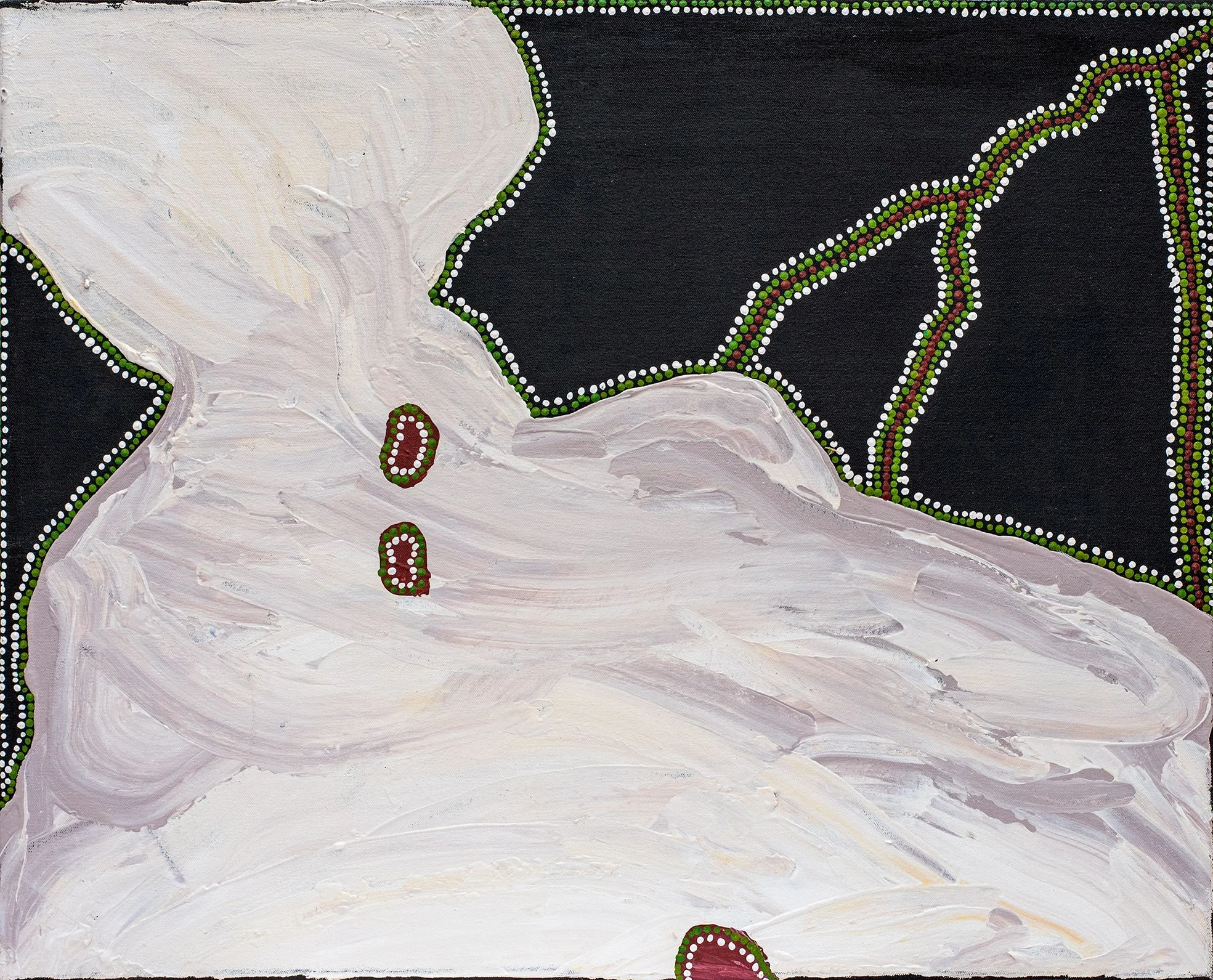
Artiste : Timo Hogan
Titre de l'œuvre : Lake Baker
Format : 75 x 60 cm
Provenance et certificat : centre d'art aborigène du Spinifex Art Project
Référence de cette peinture : 19-19
Vendue
Explications pour cette œuvre :
Timo (1973) has painted the site of Pukunkura (Lake Baker) which is situated on the north west boundary of traditional Spinifex Lands. He has authority to paint this country through his direct paternal line. There is a powerful Wanampi (Water Serpent) who today still resides in that rock hole and extreme caution must be observed when present here. There is a ritual of washing one’s feet and underarms and singing a sacred song to show respect to the Wanampi and to let him know you are family. This is still a dangerous place and is strictly a ‘Mens’ site and women must not stop here.
Timo grew up with stories of life in the Spinifex Lands. His mother and family dug themselves into the sand dunes to try to avoid the smoke from the Maralinga atomic bomb. Before he was born she walked to a location close to Tjuntjuntjara and found a pile of tin meat left by the patrol officer. A white man came and picked all the people up in an old Landrover and drove them into Cundeelee Mission. Later his mother was driven from Cundeelee to the old hospital in Kalgoorlie for Timo’s birth in 1973.
After his birth his mother succumbed to the lure of alcohol in Kalgoorlie and struggled to look after a new baby properly. Timo’s father came and took him to Mt Margret. He spent his formative years here with his father, Neville McCarthur and his stepmother Alkawari. They lived at Mt Margaret until Timo was about 14 when the family moved to Warburton, closer to his father’s traditional lands. Alkawari did not speak Pitjantjatjara or Ngaanyatjarra as she was from a different Aboriginal tribe, but spoke in English to Timo and he is now fluent in all three languages.
Once back in country Timo’s father took him to all the culturally significant places. He wanted to introduce him to the country, to the spirit caretakers and teach him the law. “ My father took me to Lake Baker, all around, rockhole and all. I know all these places but I can’t show them. Millmillpa (dangerously sacred). I’m taking over this country now, as my father is getting old. I’m the only son and people say we are like twins, my father and me. We look the same. I know how to use spears – he taught me everything.”
Timo went through Men’s Business initiation at Warburton. The group travelled down to Tjuntjuntjara on the business run. “ My father’s really a Spinifex Man. His brothers are Hogan and Jamieson”. After going through business Timo settled in Tjuntjuntjara and lived with his mother. His father visited regularly before he got too old to make the long journey.

Artiste : Ian Rictor
Titre de l'œuvre : Kamanti
Format : 137 x 90 cm
Provenance et certificat : centre d'art aborigène du Spinifex Art Project
Référence de cette peinture : 17-173
Vendue
Explications pour cette œuvre :
Ian (1960) has depicted the significant site of Kamanti situated in the heart of traditional Spinifex Lands and a site that forms part of the Wati Kutjara Tjukurpa (Two Men Creation Line). This is a powerful epic that follows a father and son as they traverse Spinifex Country on Cultural Business. These two men take the form of Wanampi, magical water serpents and shape the landscape as they move through it, leaving behind the physical and spiritual reminders of their journey. At Kamanti, two rockholes appear side by side and are where the Two Men made camp on their travels. These beings are creation beings and as such held incredible metamorphic powers of transformation of the self and of the landscape they moved through. They left indelible physical mapped environment that people still follow today. These beings often made their abode in the life giving water sources that are so needed for survival in this arid land.
Ian Rictor was born at Artulin / Tuwan and is a custodian and traditional owner of Tuwan. Ian emerged from the bush with his small family group in only 1986 and they are the last of the known Aboriginal people to have remained living traditionally in the Western Desert. In 1997 when the Spinifex Arts Project first began Ian was keen to join the group of painters. He took to the medium of paint on canvas with fluency and has been painting his birthplace and surrounding country since then. He has had increased success exhibiting with the Spinifex Artists in London, Utrecht and many galleries in Australia. Ian is an impressive and skilled hunter, bush mechanic and craftsman. Ian lives in Tjuntjuntjara with his wife Kathleen Donnegan, also an artist and their extended family.
His artworks are in the following prestigious collections :
Collection Prince Stefan Of Liechtenstein, Embassy Of Liechtenstein In Germany. (Mens Collaborate)
National Gallery Of Australia, Canberra, Act (Mens Collaborative)
Seattle Art Museum, Seattle, Usa. (Mens Collaborative)
The Aboriginal Art Museum, Utrecht
The British Museum, London. (Mens Collaborative)
The Corrigan Collection, Australia (Mens Collaborative)
Wagner And Owen Collection, Usa.
W. & V. Mcgeoch Collection, Melbourne, Vic. (Mens Collaborative)
Art Gallery Of South Australia, Adelaide, South Australia (Mens Collaborative)

Artiste : Ned Grant
Titre de l'œuvre : Sans titre
Format : 110 x 85 cm
Provenance et certificat : centre d'art aborigène du Spinifex Art Project
Référence de cette peinture : 18-211
Demander le prix de l'œuvre / Enquiry
Explications pour cette œuvre :
Ned Grant (1941) moves underground through the wata (base of tree) drawing the aturu (root system) to life affirming water sites. Following the twists and turns as he weaves the Ngalta or Desert Kurrajong to fruition. This is the tree of life and water can be sourced from its root system in times of drought or long journeys. Ned places the significant sites of Katutjara and Pirilyi in the east of traditional Spinifex Lands. Katutjara holds the Wati Kutjara Tjukurpa (Two Men Creation Line), a far reaching narrative that follows two brothers, a mulya maru (black nosed monitor) and tinka (sand goanna). It is here at Katutjara that the men kill and cook an emu and the discarded bones of the game can be still be seen at this site today. These are creation beings and as such were able to shape the landscape as they moved through it leaving indelible physical reminders of their power and presence.
Fred Grant was born in north eastern Spinifex at Ukatjatjara. Like his brother, Ned Grant, Fred went in to Cundeelee Mission a segregated bush boy (nyiingka) whose initiation into Men’s Law had been delayed because of the enduring drought at the time and the disturbance of traditional life by the Maralinga atomic testing and the rocket testing out of Woomera. Fred subsequently went ‘through’ the Law with older brother and ngalungku (contemporary initiate), Ned, in the ranges north of Laverton. Fred remained single in his younger years before marrying his life partner, Carlene West, from Tjitjiti.
With his extraordinary knowledge of Spinifex Tjukurpa and its myriad of inherent song lines Freds works are held in high esteem. They hang in prestigious collections nationally and internationally.
His artworks are in the following prestigious collections :
Harriett & Richard England Collection
National Gallery Of Australia, Canberra, Act (Mens Collaborative)
Seattle Art Museum, Seattle, Usa. (Mens Collaborative)
The Corrigan Collection, Australia (Mens Collaborative)
The Lepley Collection, Perth, Western Australia.
W. & V. Mcgeoch Collection, Melbourne, Vic.
Queensland Art Gallery Of Modern Art, Brisbane, Qld.
The Art Gallery Of New South Wales, Sydney, Nsw
Art Gallery Of South Australia, Adelaide, South Australia (Mens Collaborative)

Artiste : Ian Rictor
Titre de l'œuvre : Kamanti
Format : 110 x 85 cm
Provenance et certificat : centre d'art aborigène du Spinifex Art Project
Référence de cette peinture : 18-161
Vendue
Explications pour cette œuvre :
Ian (1960) has depicted the significant site of Kamanti situated in the heart of traditional Spinifex Lands and a site that forms part of the Wati Kutjara Tjukurpa (Two Men Creation Line). This is a powerful epic that follows a father and son as they traverse Spinifex Country on Cultural Business. These two men take the form of Wanampi, magical water serpents and shape the landscape as they move through it, leaving behind the physical and spiritual reminders of their journey. At Kamanti, two rockholes appear side by side and are where the Two Men made camp on their travels. These beings are creation beings and as such held incredible metamorphic powers of transformation of the self and of the landscape they moved through. They left indelible physical mapped environment that people still follow today. These beings often made their abode in the life giving water sources that are so needed for survival in this arid land.
Ian Rictor was born at Artulin / Tuwan and is a custodian and traditional owner of Tuwan. Ian emerged from the bush with his small family group in only 1986 and they are the last of the known Aboriginal people to have remained living traditionally in the Western Desert. In 1997 when the Spinifex Arts Project first began Ian was keen to join the group of painters. He took to the medium of paint on canvas with fluency and has been painting his birthplace and surrounding country since then. He has had increased success exhibiting with the Spinifex Artists in London, Utrecht and many galleries in Australia. Ian is an impressive and skilled hunter, bush mechanic and craftsman. Ian lives in Tjuntjuntjara with his wife Kathleen Donnegan, also an artist and their extended family.
His artworks are in the following prestigious collections :
Collection Prince Stefan Of Liechtenstein, Embassy Of Liechtenstein In Germany. (Mens Collaborate)
National Gallery Of Australia, Canberra, Act (Mens Collaborative)
Seattle Art Museum, Seattle, Usa. (Mens Collaborative)
The Aboriginal Art Museum, Utrecht
The British Museum, London. (Mens Collaborative)
The Corrigan Collection, Australia (Mens Collaborative)
Wagner And Owen Collection, Usa.
W. & V. Mcgeoch Collection, Melbourne, Vic. (Mens Collaborative)
Art Gallery Of South Australia, Adelaide, South Australia (Mens Collaborative)
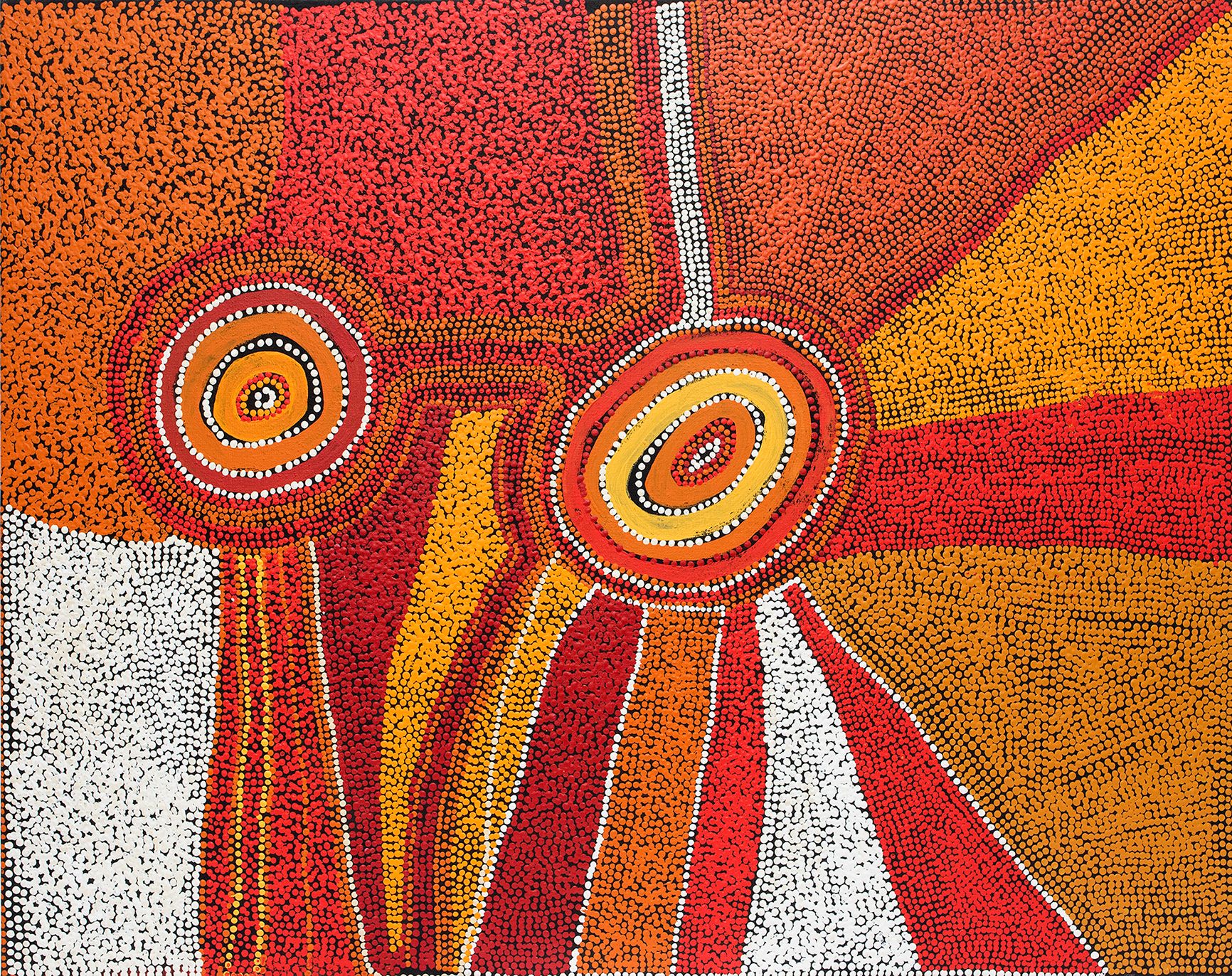
Artiste : Noli Rictor
Titre de l'œuvre : Kamanti
Format : 110 x 85 cm
Provenance et certificat : centre d'art aborigène du Spinifex Art Project
Référence de cette peinture : 18-227
Vendue
Explications pour cette œuvre :
Noli has depicted the significant site of Kamanti situated in the north of traditional Spinifex lands. This site holds s the Wati Kutjara Tjukurpa (Two Men Creation Line) and is an epic narrative following the movement of a father and son water serpent who traverse the Spinifex Lands on ceremonial business. Noli depicts country he was born into and which formed his religious upbringing. The arid but spiritual environment was the birthplace of the creation beings who shaped the landscape as they moved through it. They left indelible physical reminders of their power in the form of creeks or rocky ridges or a type of tree.
But mostly they left their place of abode or the life giving sought after source of precious water, in some form of catchment. This water source is the embodiment of survival within the remote desert extremes with the sites being venerated as such and usually guarded by beings who shifted through the realms. They are the characters who dramatise the landscape and give rise to the formations through their movements. They leave behind a mapped moral landscape that holds an elaborate oral religion of song and performance that still permeates Noli's daily life.
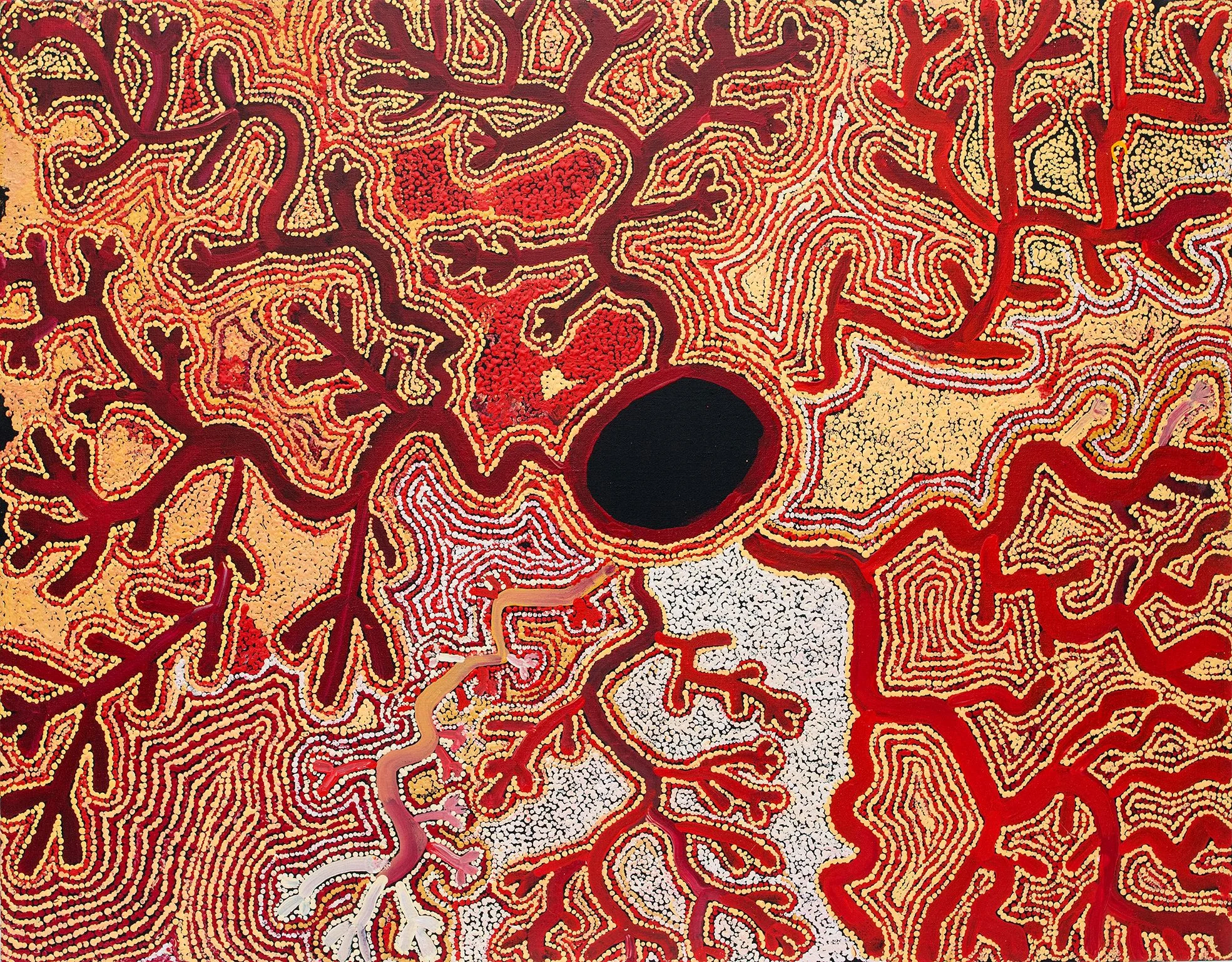
Artiste : Simon Hogan
Titre de l'œuvre : Lingka
Format : 110 x 85 cm
Provenance et certificat : centre d'art aborigène du Spinifex Art Project
Référence de cette peinture : 19-16
Vendue
Explications pour cette œuvre :
Simon Hogan (1930) manifests his site of Lingka onto the two dimensional plane. When he paints, he transcends this world and is taken over soft sand ridges and vast Spinifex plains to the significant sites that formed him from birth. For Simon was born into a spiritual society where religion manifested in the immediate environment and where creation beings could move through different realms at will. It is these beings who shaped the landscape that Simon depicts and who left a moral compass that is still followed today. They gave to people the life giving water sites that were held with such reverence in an arid and remote land. It is these sites that were the means of survival and where religion unfolded in the form of sacred song and performance.
Simon Hogan was born circa 1930 in mid-western Spinifex between Paltju and Lingka. Simon’s exact age is unknown as dates of birth were estimated by the A.E.M. missionaries when the Spinifex people, on arrival at Cundeelee, were “sorted” into family groups, given English names and approximate dates of birth. During childhood two fathers, one born at Warakunu and the other at Munki raised Simon. Simon’s mother’s country is around Tjulya. The Spinifex people were a relatively discreet southern Pitjantjatjara tribal group with es to the north and east that lived a fully traditional hunter-gatherer life until the late1950’s to early 1960s when most people either walked in to Ooldea and Cundeelee or were taken by AEM missionaries to Cundeelee Mission…
From 1995 Simon Hogan was a prominent member of a group of senior traditional owners from Spinifex country who lobbied the WA State Government for Native Title. Although Simon spoke no English he was a confident, initiated Pitjantjatjara man who spoke to senior government officials regarding ownership of country and culture. Exclusive Native Title rights were granted to Simon Hogan and the Spinifex people in 2000 of over 55 000 sq kms of the Great Victoria Desert in WA.
His artworks are in the following prestigious collections :
Art Gallery Of South Australia, Adelaide, South Australia
British Museum, London, England.
Harriet And Richard England Collection
National Gallery Of Australia, Canberra, Act.
National Gallery Of Victoria, Melbourne, Victoria.
Seattle Art Museum, Seattle, Usa. (Mens Collaborative)
Staatliches Museum Fur Volkerkunde, Munich, Germany
The Lepley Collection, Perth, Western Australia.
The Patrick Corrigan Collection, Sydney, New South Wales.
W. & V. Mcgeoch Collection
Western Australian Museum, Perth, W.A.
Artbank, Australian Government Collection. Australia.
Art Gallery Of Western Australia, Perth, Western Australia.
The Art Gallery Of New South Wales, Sydney, Nsw (Mens Collaborative)

Artiste : Noli Rictor
Titre de l'œuvre : Punyutjara
Format : 137 x 110 cm
Provenance et certificat : centre d'art aborigène du Spinifex Art Project
Référence de cette peinture : 19-22
Demander le prix de l'œuvre / Enquiry
Explications pour cette œuvre :
Noli has depicted the significant site of Punyutjara situated in the north of traditional Spinifex lands. Punyutjara holds the creation line for Wati Punyu a small marsupial similar to a bettong.
Noli depicts country he was born into and which formed his religious upbringing. The arid but spiritual environment was the birthplace of the creation beings who shaped the landscape as they moved through it. They left indelible physical reminders of their power in the form of creeks or rocky ridges or a type of tree.
But mostly they left their place of abode or the life giving sought after source of precious water, in some form of catchment. This water source is the embodiment of survival within the remote desert extremes with the sites being venerated as such and usually guarded by beings who shifted through the realms. They are the characters who dramatise the landscape and give rise to the formations through their movements. They leave behind a mapped moral landscape that holds an elaborate oral religion of song and performance that still permeates Noli's daily life.

Artiste : Roy Underwood
Titre de l'œuvre : Miramiratjara
Format : 75 x 60 cm
Provenance et certificat : centre d'art aborigène du Spinifex Art Project
Référence de cette peinture : 17-80
Vendue
Explications pour cette œuvre :
Roy Underwood is a recognised senior custodian and keeper of Tjukurpa in the area of Miramiratjara in the Spinifex Lands. Tjukurpa is the Pitjantjatjara concept for describing the formative creation where ancestral beings create the world. These beings are Anangu ancestors, who can take the form of people, plants or animals. They traverse the country; forming the world we live in, creating the waterholes, the trees, the clay pans, the rocky outcrops, the sand hills and the Spinifex plains. These land formations are the physical manifestation of the creation energy and tangible evidence that this Tjukurpa is true. The area of Miramiratjara is an extremely important men’s site and much of the detail of this story cannot be publically discussed. As Roy says miil-miilpa, sacred. It revolves around Wati Kutjara, two ancestral men. One man had speared a malu,kangaroo, and cooked it up but when he went to eat it there was only a very small tail. "Hey how come no meat?" As he was holding the tail it kept catching fire and as he blew onto it the sparks landed in the country setting it ablaze. All Miramiratjara was on fire. All the snake men, the guardians who reside just below the surface came up furious, biting out in rage. Many men died in the fire.
Burning off in this area is not practiced by the Spinifex people as this country is miil-miilpa and too dangerous to disturb. Miramiratjara is an important soak, an often scarce source of water in the desert and a place associated with conflict. This site belongs to Roy through his Grandfather. As a child he remembers waking here in the night and all the men singing the inma – m iil-millpa pulka, a powerful and dangerous place.
His artworks are in the following prestigious collections :
Art Gallery Of South Australia, Adelaide, South Australia.
National Gallery Of Australia, Canberra, Act (Mens Collaborative)
National Gallery Of Victoria, Melbourne Vic
Seattle Art Museum, Seattle, Usa. (Mens Collaborative)
Sue And Ian Bernadt, Perth, Western Australia.
The British Museum, London. (Mens Collaborative)
The Lepley Collection, Perth, Western Australia.
Artbank Australian Government, Canberra. A.C.T.
W. & V. Mcgeoch Collection, Melbourne, Vic. (Mens Collaborative)
The Art Gallery Of New South Wales, Sydney, Nsw (Mens Collaborative)

Artiste : Lawrence Pennington
Titre de l'œuvre : Pukara
Format : 75 x 60 cm
Provenance et certificat : centre d'art aborigène du Spinifex Art Project
Référence de cette peinture : 19-25
Demander le prix de l'œuvre / Enquiry
Explications pour cette œuvre :
Lawrence Pennington (1934) touches the deepest qualities of the Tjukurpa in the unseen, taking the broad brush to minimal resemblance of the characters that inhabited the first journey. He guides the significant sites of Mitunya and Nyuman effortlessly onto the canvas, channelling the essence of Walawuru Tjukurpa (Eagle Creation Line) from a time before when Lawrence walked throughout Spinifex Country. A time when he walked with the Song, following the physical manifestation in the landscape, left by the creation beings, of the stories that made it so, of the characters that played out the journey.
At the time of Lawrence’s birth in the early 1930’s, his people, the Spinifex people had no contact with Western civilization. Lawrence grew up as a young boy living a fully traditional hunter-gatherer life. His initiations as a young man in this country have given Lawrence intimate knowledge in a physical as well as a spiritual sense of the sites and stories of the area he was born and responsible for.
He was born just outside of the north-eastern boundary of Spinifex at a place called Urlu circa 1934. Running through the length Lawrence’s stretch of country is the Walawuru (wedge-tailed eagle) Dreaming. Not surprisingly the dominant topographical feature in Lawrence’s country is a string of craggy topped breakaways. In parallel alignment off to the south run a series of thinly connected dry salt lakes and naturally underscoring these features reddish sand plains. Depending on the character of the light, Lawrence’s country can at different times appear hauntingly bleak or soaringly beautiful. His spacious, iconographic paintings vibrate with culture and beauty.
His artworks are in the following prestigious collections :
Araluen Gallery, Alice Springs, Northern Territory.
National Gallery Of Australia, Canberra, Act (Mens Collaborative)
Richard And Harriet England Collection
Seattle Art Museum, Seattle, Usa. (Mens Collaborative)
The Corrigan Collection, Australia (Mens Collaborative)
The National Gallery Of Victoria, Melbourne, Vic.
W. & V. Mcgeoch Collection, Melbourne, Vic.
Wagner And Owen Collection (Usa)
Geoff Hassal Collection, Australia
Arthur Roe Collection, Australia
The Art Gallery Of New South Wales, Sydney, Nsw (Mens Collaborative)
Art Gallery Of South Australia, Adelaide, South Australia (Mens Collaborative)
Musée La Grange, Moitiers, Switzerland
Kluge-Ruhe Aboriginal Art Collection Of The University Of Virginia, Usa
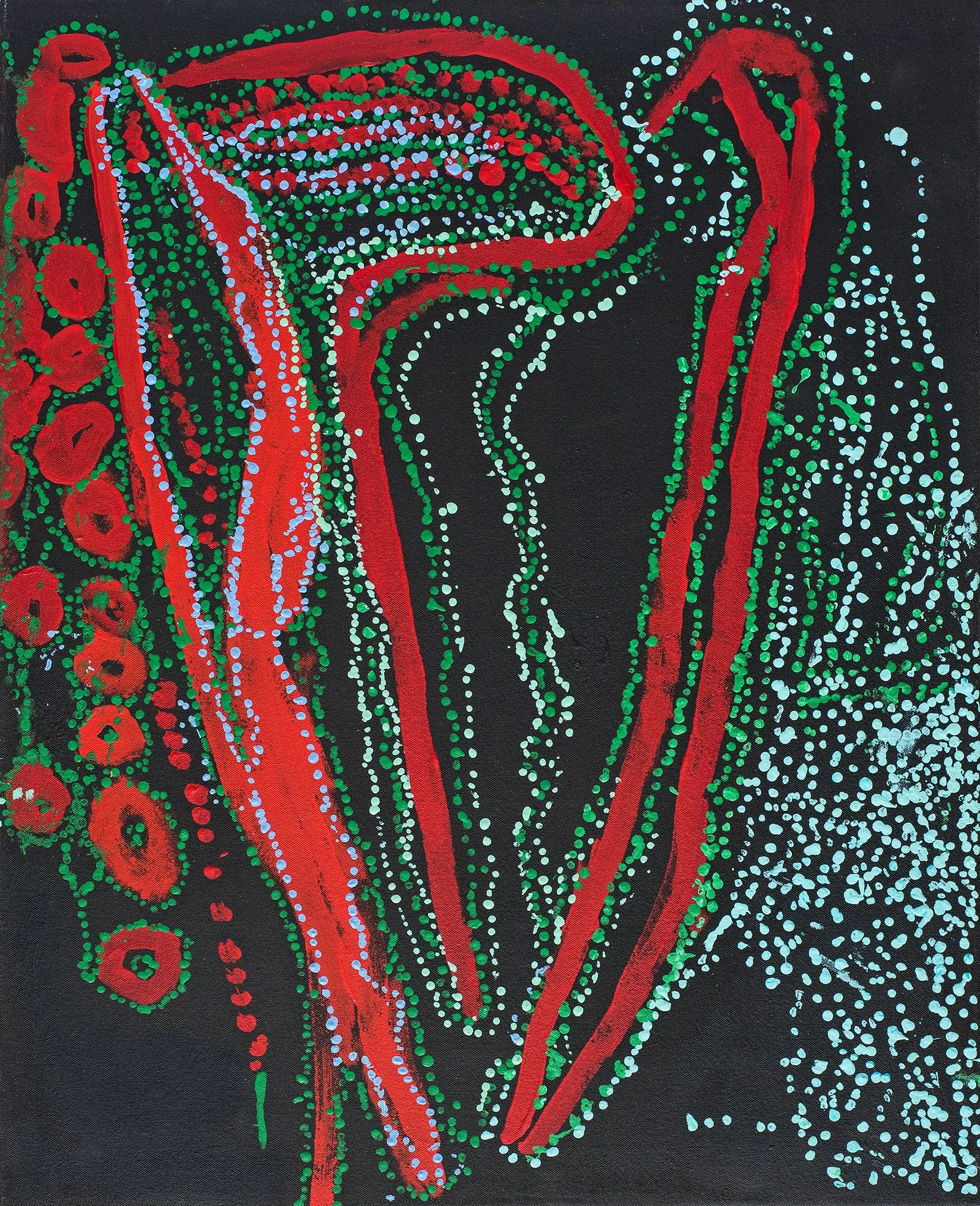
Artiste : Lawrence Pennington
Titre de l'œuvre : Wati Kutjara
Format : 75 x 60 cm
Provenance et certificat : centre d'art aborigène du Spinifex Art Project
Référence de cette peinture : 19-26
Vendue
Explications pour cette œuvre :
Lawrence Pennington (1934) touches the deepest qualities of the Tjukurpa in the unseen, taking the broad brush to minimal resemblance of the characters that inhabited the first journey. He guides the significant sites of Mitunya and Nyuman effortlessly onto the canvas, channelling the essence of Walawuru Tjukurpa (Eagle Creation Line) from a time before when Lawrence walked throughout Spinifex Country. A time when he walked with the Song, following the physical manifestation in the landscape, left by the creation beings, of the stories that made it so, of the characters that played out the journey.
At the time of Lawrence’s birth in the early 1930’s, his people, the Spinifex people had no contact with Western civilization. Lawrence grew up as a young boy living a fully traditional hunter-gatherer life. His initiations as a young man in this country have given Lawrence intimate knowledge in a physical as well as a spiritual sense of the sites and stories of the area he was born and responsible for.
He was born just outside of the north-eastern boundary of Spinifex at a place called Urlu circa 1934. Running through the length Lawrence’s stretch of country is the Walawuru (wedge-tailed eagle) Dreaming. Not surprisingly the dominant topographical feature in Lawrence’s country is a string of craggy topped breakaways. In parallel alignment off to the south run a series of thinly connected dry salt lakes and naturally underscoring these features reddish sand plains. Depending on the character of the light, Lawrence’s country can at different times appear hauntingly bleak or soaringly beautiful. His spacious, iconographic paintings vibrate with culture and beauty.
His artworks are in the following prestigious collections :
Araluen Gallery, Alice Springs, Northern Territory.
National Gallery Of Australia, Canberra, Act (Mens Collaborative)
Richard And Harriet England Collection
Seattle Art Museum, Seattle, Usa. (Mens Collaborative)
The Corrigan Collection, Australia (Mens Collaborative)
The National Gallery Of Victoria, Melbourne, Vic.
W. & V. Mcgeoch Collection, Melbourne, Vic.
Wagner And Owen Collection (Usa)
Geoff Hassal Collection, Australia
Arthur Roe Collection, Australia
The Art Gallery Of New South Wales, Sydney, Nsw (Mens Collaborative)
Art Gallery Of South Australia, Adelaide, South Australia (Mens Collaborative)
Musée La Grange, Moitiers, Switzerland
Kluge-Ruhe Aboriginal Art Collection Of The University Of Virginia, Usa

Artiste : Timo Hogan
Titre de l'œuvre : Lake Baker
Format : 60 x 60 cm
Provenance et certificat : centre d'art aborigène du Spinifex Art Project
Référence de cette peinture : 19-20
Vendue
Explications pour cette œuvre :
Timo (1973) has painted the site of Pukunkura (Lake Baker) which is situated on the north west boundary of traditional Spinifex Lands. He has authority to paint this country through his direct paternal line. There is a powerful Wanampi (Water Serpent) who today still resides in that rock hole and extreme caution must be observed when present here. There is a ritual of washing one’s feet and underarms and singing a sacred song to show respect to the Wanampi and to let him know you are family. This is still a dangerous place and is strictly a ‘Mens’ site and women must not stop here.
Timo grew up with stories of life in the Spinifex Lands. His mother and family dug themselves into the sand dunes to try to avoid the smoke from the Maralinga atomic bomb. Before he was born she walked to a location close to Tjuntjuntjara and found a pile of tin meat left by the patrol officer. A white man came and picked all the people up in an old Landrover and drove them into Cundeelee Mission. Later his mother was driven from Cundeelee to the old hospital in Kalgoorlie for Timo’s birth in 1973.
After his birth his mother succumbed to the lure of alcohol in Kalgoorlie and struggled to look after a new baby properly. Timo’s father came and took him to Mt Margret. He spent his formative years here with his father, Neville McCarthur and his stepmother Alkawari. They lived at Mt Margaret until Timo was about 14 when the family moved to Warburton, closer to his father’s traditional lands. Alkawari did not speak Pitjantjatjara or Ngaanyatjarra as she was from a different Aboriginal tribe, but spoke in English to Timo and he is now fluent in all three languages.
Once back in country Timo’s father took him to all the culturally significant places. He wanted to introduce him to the country, to the spirit caretakers and teach him the law. “ My father took me to Lake Baker, all around, rockhole and all. I know all these places but I can’t show them. Millmillpa (dangerously sacred). I’m taking over this country now, as my father is getting old. I’m the only son and people say we are like twins, my father and me. We look the same. I know how to use spears – he taught me everything.”
Timo went through Men’s Business initiation at Warburton. The group travelled down to Tjuntjuntjara on the business run. “ My father’s really a Spinifex Man. His brothers are Hogan and Jamieson”. After going through business Timo settled in Tjuntjuntjara and lived with his mother. His father visited regularly before he got too old to make the long journey.

Artiste : Lawrence Pennington
Titre de l'œuvre : Pukara
Format : 75 x 60 cm
Provenance et certificat : centre d'art aborigène du Spinifex Art Project
Référence de cette peinture : 19-28
Vendue
Explications pour cette œuvre :
Lawrence Pennington (1934) touches the deepest qualities of the Tjukurpa in the unseen, taking the broad brush to minimal resemblance of the characters that inhabited the first journey. He guides the significant sites of Mitunya and Nyuman effortlessly onto the canvas, channelling the essence of Walawuru Tjukurpa (Eagle Creation Line) from a time before when Lawrence walked throughout Spinifex Country. A time when he walked with the Song, following the physical manifestation in the landscape, left by the creation beings, of the stories that made it so, of the characters that played out the journey.
At the time of Lawrence’s birth in the early 1930’s, his people, the Spinifex people had no contact with Western civilization. Lawrence grew up as a young boy living a fully traditional hunter-gatherer life. His initiations as a young man in this country have given Lawrence intimate knowledge in a physical as well as a spiritual sense of the sites and stories of the area he was born and responsible for.
He was born just outside of the north-eastern boundary of Spinifex at a place called Urlu circa 1934. Running through the length Lawrence’s stretch of country is the Walawuru (wedge-tailed eagle) Dreaming. Not surprisingly the dominant topographical feature in Lawrence’s country is a string of craggy topped breakaways. In parallel alignment off to the south run a series of thinly connected dry salt lakes and naturally underscoring these features reddish sand plains. Depending on the character of the light, Lawrence’s country can at different times appear hauntingly bleak or soaringly beautiful. His spacious, iconographic paintings vibrate with culture and beauty.
His artworks are in the following prestigious collections :
Araluen Gallery, Alice Springs, Northern Territory.
National Gallery Of Australia, Canberra, Act (Mens Collaborative)
Richard And Harriet England Collection
Seattle Art Museum, Seattle, Usa. (Mens Collaborative)
The Corrigan Collection, Australia (Mens Collaborative)
The National Gallery Of Victoria, Melbourne, Vic.
W. & V. Mcgeoch Collection, Melbourne, Vic.
Wagner And Owen Collection (Usa)
Geoff Hassal Collection, Australia
Arthur Roe Collection, Australia
The Art Gallery Of New South Wales, Sydney, Nsw (Mens Collaborative)
Art Gallery Of South Australia, Adelaide, South Australia (Mens Collaborative)
Musée La Grange, Moitiers, Switzerland
Kluge-Ruhe Aboriginal Art Collection Of The University Of Virginia, Usa
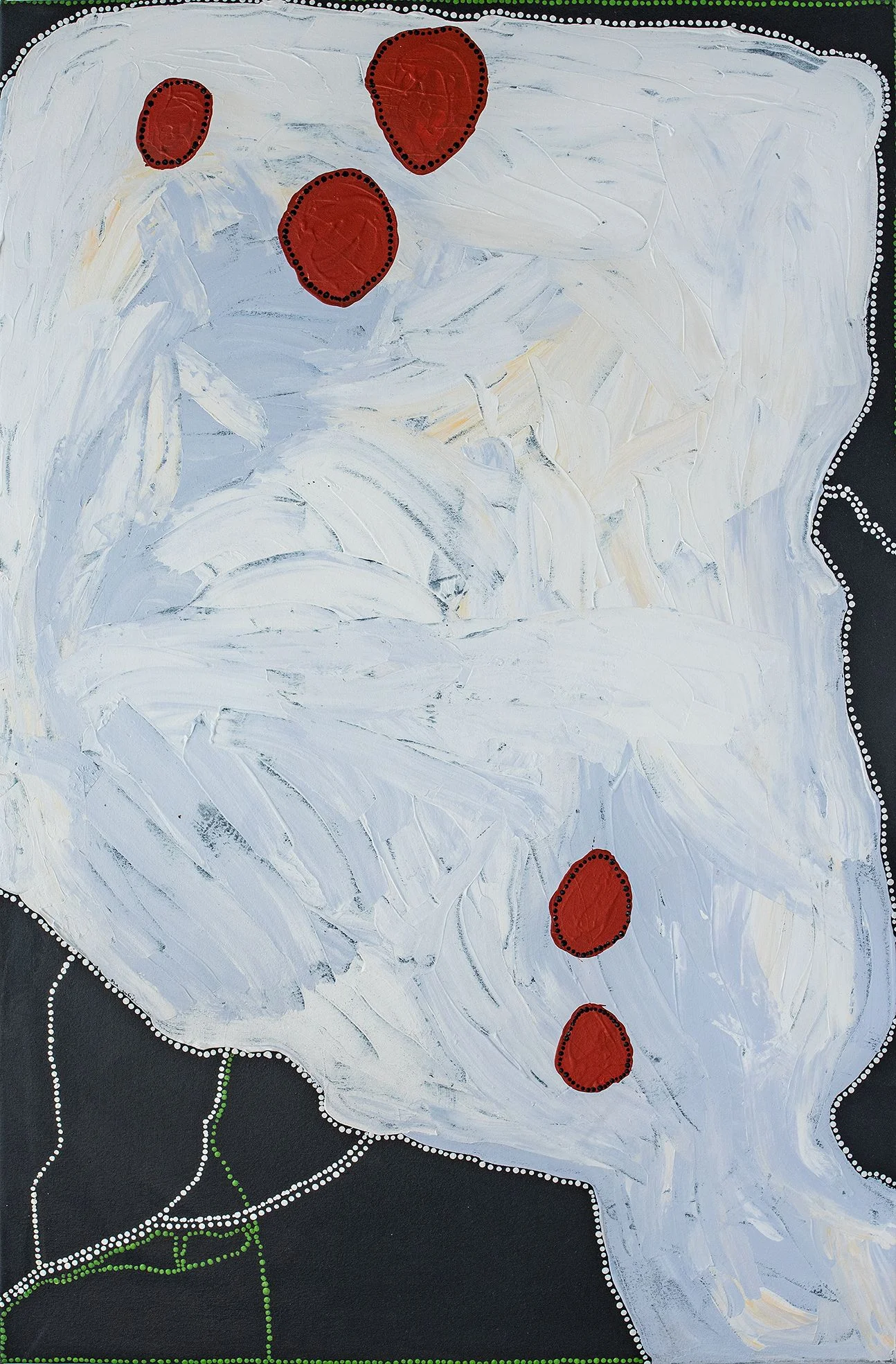
Artiste : Timo Hogan
Titre de l'œuvre : Lake Baker
Format : 137 x 90 cm
Provenance et certificat : centre d'art aborigène du Spinifex Art Project
Référence de cette peinture : 19-31
Demander le prix de l'œuvre / Enquiry
Explications pour cette œuvre :
Timo (1973) has painted the site of Pukunkura (Lake Baker) which is situated on the north west boundary of traditional Spinifex Lands. He has authority to paint this country through his direct paternal line. There is a powerful Wanampi (Water Serpent) who today still resides in that rock hole and extreme caution must be observed when present here. There is a ritual of washing one’s feet and underarms and singing a sacred song to show respect to the Wanampi and to let him know you are family. This is still a dangerous place and is strictly a ‘Mens’ site and women must not stop here.
Timo grew up with stories of life in the Spinifex Lands. His mother and family dug themselves into the sand dunes to try to avoid the smoke from the Maralinga atomic bomb. Before he was born she walked to a location close to Tjuntjuntjara and found a pile of tin meat left by the patrol officer. A white man came and picked all the people up in an old Landrover and drove them into Cundeelee Mission. Later his mother was driven from Cundeelee to the old hospital in Kalgoorlie for Timo’s birth in 1973.
After his birth his mother succumbed to the lure of alcohol in Kalgoorlie and struggled to look after a new baby properly. Timo’s father came and took him to Mt Margret. He spent his formative years here with his father, Neville McCarthur and his stepmother Alkawari. They lived at Mt Margaret until Timo was about 14 when the family moved to Warburton, closer to his father’s traditional lands. Alkawari did not speak Pitjantjatjara or Ngaanyatjarra as she was from a different Aboriginal tribe, but spoke in English to Timo and he is now fluent in all three languages.
Once back in country Timo’s father took him to all the culturally significant places. He wanted to introduce him to the country, to the spirit caretakers and teach him the law. “ My father took me to Lake Baker, all around, rockhole and all. I know all these places but I can’t show them. Millmillpa (dangerously sacred). I’m taking over this country now, as my father is getting old. I’m the only son and people say we are like twins, my father and me. We look the same. I know how to use spears – he taught me everything.”
Timo went through Men’s Business initiation at Warburton. The group travelled down to Tjuntjuntjara on the business run. “ My father’s really a Spinifex Man. His brothers are Hogan and Jamieson”. After going through business Timo settled in Tjuntjuntjara and lived with his mother. His father visited regularly before he got too old to make the long journey.

Artiste : Tjaruwa Woods
Titre de l'œuvre : Kamanti
Format : 110 x 85 cm
Provenance et certificat : centre d'art aborigène du Spinifex Art Project
Référence de cette peinture : 19-35
Vendue
Explications pour cette œuvre :
Tjaruwa (1954) paints with a knowledge and a devotion to the country that formed her. She was a young woman when she and her immediate family 'walked in' from the Great Victoria Desert in the remote east of Western Australia. This country was deemed inhospitable by the encroaching 'new world' and perceived as so vast and uninhabited, that it made the ideal site to detonate and observe the new wave of nuclear explosions conducted as part of the British Atomic Testing during the 1950's.
But Tjaruwa and her family were there, living, breathing, hunting, walking over the solo red carpet of sand, learning the paths of the creation beings who shaped this landscape and made the moral world possible. She slept under a vast expanse by campfire and drank water from tree roots. She learnt the fine art of survival in an arid but spiritual world and how to navigate an environment full of meaning. Tjaruwa paints like she breathes, an almost innate required constant. As she depicts the significant site of Kamanti, she is well aware of the creation manifestation of the Wati Kutjara (Two Men Creation Line) and that these Two Men still reside in the well-formed water cavities that penetrate deep into middle earth. She knows with all her learned experience that these Two Men are to be feared but treated with reverence all the same, for they can travel underground as the enormous water serpents that they are, or walk the landscape in the form of mortal men. And as she sings the sites onto the two dimensional plane, let us appreciate through the panoramic composition that comes from a lifetime of breathing in this country.
Tjauruwa was born in 1954 outside the Spinifex Determination Area at Warutjara, the place of Minyma Tjilkamata - the Echidna Woman, near the current community of Jamieson (Manta Maru) within the Ngaanyatjarra Lands. Except for possession of a few pieces of iron, fashioned into implements and tin bowls Tjaruwa lived traditionally until the winter of 1986 when her family group of seven was located in northern Spinifex by a group of Spinifex people making a sortie into country to re-visit important Men’s sites after some 25 years of absence. Tjaruwa came in with a small son on her hip and camped with her family firstly at Yakatunya, 90 kilometres south of Tjuntjuntjara, joined the moving camp which accompanied the construction of a road, 300 kilometres through the length of the Spinifex Lands, before settling permanently at Tjuntjuntjara in 1989. Tjaruwa was adjudged to be about 32 years old in 1986 and was given the birth date 1/7/1954. At this point in time (2014),Tjaruwa’s family remains the last Aboriginal group in the country to make first contact with contemporary Australia.
It is difficult to even imagine the changes Tjaruwa was to encounter living in her new world. She had acquired an extended network of kin to establish relationships with, the daily activity of hunting and gathering was essentially replaced by the community store and water was abundant.
Tjaruwa’s immediate priority was to care for her mother and uncle living in their new circumstances and it was not until her mother passed away that she took up an interest in painting. At first she tended to paint as she observed other women painting and then the accumulated experience of her other life and her mother’s stories/designs poured out and Tjaruwa’s unique Spinifex perspective was translated with spectacular style and technique on to canvas.
Her artworks are in the following prestigious collections :
Art Gallery Of South Australia, Adelaide Sa (Women’s Collaborative)
National Gallery Of Australia, Canberra
National Gallery Of Victoria, Melbourne Vic (Women’s Collaborative)
Richard And Harriet England Collection
Seattle Art Museum, Seattle Usa (Women’s Collaborative)
The British Museum, London, England.(Womens Collaborative)
The Corrigan Collection, Australia
The Lepley Collection, Perth, Western Australia.
The Sims Dickson Collection, Nsw
Parliament House Art Collection, Canberra, Act (Womens Collaborative)
W. & V. Mcgeoch Collection, Melbourne, Vic.
The Berndt Collection, University Of Western Australia.

Artiste : Myrtle Pennington
Titre de l'œuvre : Kanpa
Format : 75 x 60 cm
Provenance et certificat : centre d'art aborigène du Spinifex Art Project
Référence de cette peinture : 19-37
Vendue
Explications pour cette œuvre :
The Spinifex People inhabited the Great Victoria Desert long before Europeans landed on this continent’s shoreline. They survived in an arid but beautiful environment, equipped with the necessary skills required for such a life. A spiritual people guided by cultural law were able to exist virtually unchallenged and unchanged until the 1950’s when the British atomic testing began at Emu Fields and later at Maralinga. These tests directly displaced the Spinifex People and it would be over thirty years before their traditional lands were finally returned to them in the form of native title and they were able to once again access the country that formed them from birth. For the landscape holds the culture of the Spinifex People and their daily interactions are governed by the moral compass of the first beings who created the physical realm. With story interwoven in song and dance, the country maps a tangible way forward for the people to reflect and learn upon.
It is this country, this spiritual landscape that defines and permeates Myrtle Pennington’s work. Although abstract in appearance each piece holds part history, part ceremony and part country. Myrtle assumes the vastness of the landscape imbued with the colourful light in profound yet simple compositions. She recalls the places that sustained her during those early formative years and gives rise to the sites of Mulpulya and Kanpa, surrounding them with sandhills and salt lakes or plains that lead to rocky escarpments. She reads the scene from a sense of belonging, of being interwoven into the fabric of the landscape she creates. All this Myrtle captures and conveys with ease, moving the brush and colour freely, building a textural quality that prompts one to walk with her through this vast Country.
Myrtle (1939) was born c. 1939 in the vicinity of a rock hole called Kanpa in central Spinifex. The rock hole itself is a point along a highly sensitive senior Men’s tjukurpa which Myrtle would not have seen or drawn water from.
Myrtle’s journey out of Spinifex to Cundeelee Mission in the late 1950’s was particularly tragic for Myrtle and her family (a son and husband perished on the trip). Myrtle, with another son and daughter, were eventually located by Australian servicemen from an army base at Neale’s Junction, who held them until Cundeelee Mission staff arrived to take the family to Cundeellee.
The story of Myrtle’s flight from the British atomic testing range at Maralinga was to become key evidence tendered to Royal Commission into the British Nuclear Tests in Australia in 1984 and sadly Myrtle had to re-live the tragic events.
Myrtle and her surviving son and daughter were awarded individual compensation from the Australian Government. Myrtle did not paint on the Women’s Native Title painting and gradually came into the Project through Women’s collaborative art. She was mostly an occasional painter until the past decade when almost overnight she developed a most striking, minimal style with bold symbols that leap out against a vividly plain background. Myrtle continues to paint regularly, seemingly unaffected by others styles evolving around her.
Her artworks are in the following prestigious collections :
National Gallery Of Victoria, Melbourne, Australia.
The Art Gallery Of South Australia, Adelaide, S.A (Womens Collaborative)
The British Museum, London, England.(Womens Collaborative)
The Corrigan Collection, Australia. (Womens Collaborative)
Artbank, Australian Government Collection. Australia.
Parliament House Art Collection, Canberra, Act (Womens Collaborative)
W. & V. Mcgeoch Collection, Melbourne, Vic.
The Art Gallery Of New South Wales, Sydney, Nsw
Kluge-Ruhe Aboriginal Art Collection Of The University Of Virginia, Usa.

Artiste : Tjaruwa Woods
Titre de l'œuvre : Nguraku
Format : 75 x 60 cm
Provenance et certificat : centre d'art aborigène du Spinifex Art Project
Référence de cette peinture : 17-86
Vendue
Explications pour cette œuvre :
Tjaruwa (1954) has painted her homelands, an area to the north of the Spinifex lands where she grew up. Born at Warutjara, Tjaruwa lived in Spinifex Country with a small family group away from any other group until 1986, when relatives from Tjuntjuntjara decided to “bring them in.” She is a skilled and knowledgable bushwoman and has become an increasingly sought after artist.
In this painting Tjaruwa specifically mentions the sites of Yampil,Tjutatjipi, Wyara, Tjapin, Kamanti and Pirulungka. These are places Tjaruwa travelled around as a young girl with her family. She now lives at Tjuntjuntjara.
Tjauruwa was born in 1954 outside the Spinifex Determination Area at Warutjara, the place of Minyma Tjilkamata - the Echidna Woman, near the current community of Jamieson (Manta Maru) within the Ngaanyatjarra Lands. Except for possession of a few pieces of iron, fashioned into implements and tin bowls Tjaruwa lived traditionally until the winter of 1986 when her family group of seven was located in northern Spinifex by a group of Spinifex people making a sortie into country to re-visit important Men’s sites after some 25 years of absence. Tjaruwa came in with a small son on her hip and camped with her family firstly at Yakatunya, 90 kilometres south of Tjuntjuntjara, joined the moving camp which accompanied the construction of a road, 300 kilometres through the length of the Spinifex Lands, before settling permanently at Tjuntjuntjara in 1989. Tjaruwa was adjudged to be about 32 years old in 1986 and was given the birth date 1/7/1954. At this point in time (2014),Tjaruwa’s family remains the last Aboriginal group in the country to make first contact with contemporary Australia.
It is difficult to even imagine the changes Tjaruwa was to encounter living in her new world. She had acquired an extended network of kin to establish relationships with, the daily activity of hunting and gathering was essentially replaced by the community store and water was abundant.
Tjaruwa’s immediate priority was to care for her mother and uncle living in their new circumstances and it was not until her mother passed away that she took up an interest in painting. At first she tended to paint as she observed other women painting and then the accumulated experience of her other life and her mother’s stories/designs poured out and Tjaruwa’s unique Spinifex perspective was translated with spectacular style and technique on to canvas.
Her artworks are in the following prestigious collections :
Art Gallery Of South Australia, Adelaide Sa (Women’s Collaborative)
National Gallery Of Australia, Canberra
National Gallery Of Victoria, Melbourne Vic (Women’s Collaborative)
Richard And Harriet England Collection
Seattle Art Museum, Seattle Usa (Women’s Collaborative)
The British Museum, London, England.(Womens Collaborative)
The Corrigan Collection, Australia
The Lepley Collection, Perth, Western Australia.
The Sims Dickson Collection, Nsw
Parliament House Art Collection, Canberra, Act (Womens Collaborative)
W. & V. Mcgeoch Collection, Melbourne, Vic.
The Berndt Collection, University Of Western Australia.
En tant que partenaire et représentant des centres d’art Aborigène soutenus par le gouvernement Australien, la galerie Aboriginal Signature Estrangin vous permet d’avoir un accès privilégié en Europe (primary market) à des oeuvres recherchées, disposant des meilleures provenances éthiques reconnues par les grandes institutions et collections privées ou publiques. A travers notre programme d’exposition en Europe, nous vous invitons à voyager à travers le temps et les immensités Aborigènes pour apprivoiser toute l’amplitude et l’excellence de ce mouvement artistique contemporain.
Artiste : Womens Collaborative
Titre de l'œuvre : Kungkarangkalpa
Format : 230 x 200 cm
Provenance et certificat : centre d'art aborigène du Spinifex Art Project
Référence de cette peinture : 19-41
Vendue
Explications pour cette œuvre :
Four senior Spinifex women; Myrtle Pennington, Kanta Donnegan, Tjaruwa Woods and Ivy Laidlaw have collaborated on this major work, an epic story which covers a vast tract of Spinifex Lands. It is the Tjukurpa of Kungkarangkalpa, the Seven Sisters also referred to as Minyma Tjuta. Minyma Tjuta is perhaps the most substantial and overtly women's Tjukurpa from the Spinifex area that weaves across and through much of the country, profoundly affecting the sites, ceremonial connections and responsibilities of the people.
The song line travels out west and east far beyond the Spinifex territory into neighbouring lands. As such, Minyma Tjuta is intimate to the cultural cycles of the broader Western Desert region and features prominently in many Spinifex paintings as it traverses far across and through the country. This is 'm iil-miilpa' sacred and has numerous layers of knowledge and comprehension available depending on the status of the viewer according to Anangu Law. In this Tjukurpa a group of sisters are travelling and pursuing a large python which proves to be elusive and is followed through various important sites such as Kuru Ala and Kulyuru. The snake leaves in its wake several significant landforms such as deep ravines at Kulyuru where it escaped down a hole in the escarpment and heading north creating a large creek bed. The women are in turn being pursued by a lustful old man who wants Kampukura the eldest sister for a wife. He camps close to the sisters hiding and spying on them in order to strike out in surprise and catch the one he wants. The sisters take off to the east. They fly up into the sky thus creating the constellation known as Pleiades. This story is full of sexual innuendo pertinent to women and men in different aspects. It is present at literally hundreds of Spinifex sites. The women listed some of such sites in this work including Kuru Ala, Kulyuru, Pirapi, Tjuntunya, Wayiyul, Tika-tika, Tjintirkara, Mamutjunya, and Tjawanya.
Their major collaborative paintings are in the following prestigious collections :
Aboriginal Art Museum, Utrecht, The Netherlands
Art Gallery Of South Australia, Adelaide,S.A.
Prince Stefan Von Und Zu Liechtenstein, The Ambassador Of Liechtenstein In Germany
Seattle Art Museum, Seattle, Usa
Staatliches Museum Fur Volkerkunde, Munich, Germany
The British Museum, London, England.
The Corrigan Collection, Australia.
The National Gallery Of Victoria, Melbourne, Vic.
Western Australian Museum, Perth, Western Australia