
Peintures d'art Aborigène de Kaltjiti
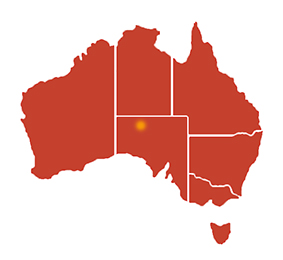
Les artistes de la commuanuté artistique de Kaltjiti vivent à Fregon, au nord-ouest de la partie sud de l’Australie, dans le APY land. On considère souvent cette région comme la dernière frontière du désert traditionnel.
En 2011, des peintures sublimes de Kaltjiti furent remarquées lors de l’exposition « Living water » au musée national central de Victoria. Depuis leurs artistes sont à nouveau particulièrement recherchés par les collectionneurs et galeries... (suite du texte ci-dessous).
Peintures des artistes Aborigènes de Kaltjiti disponibles au sein de la galerie :

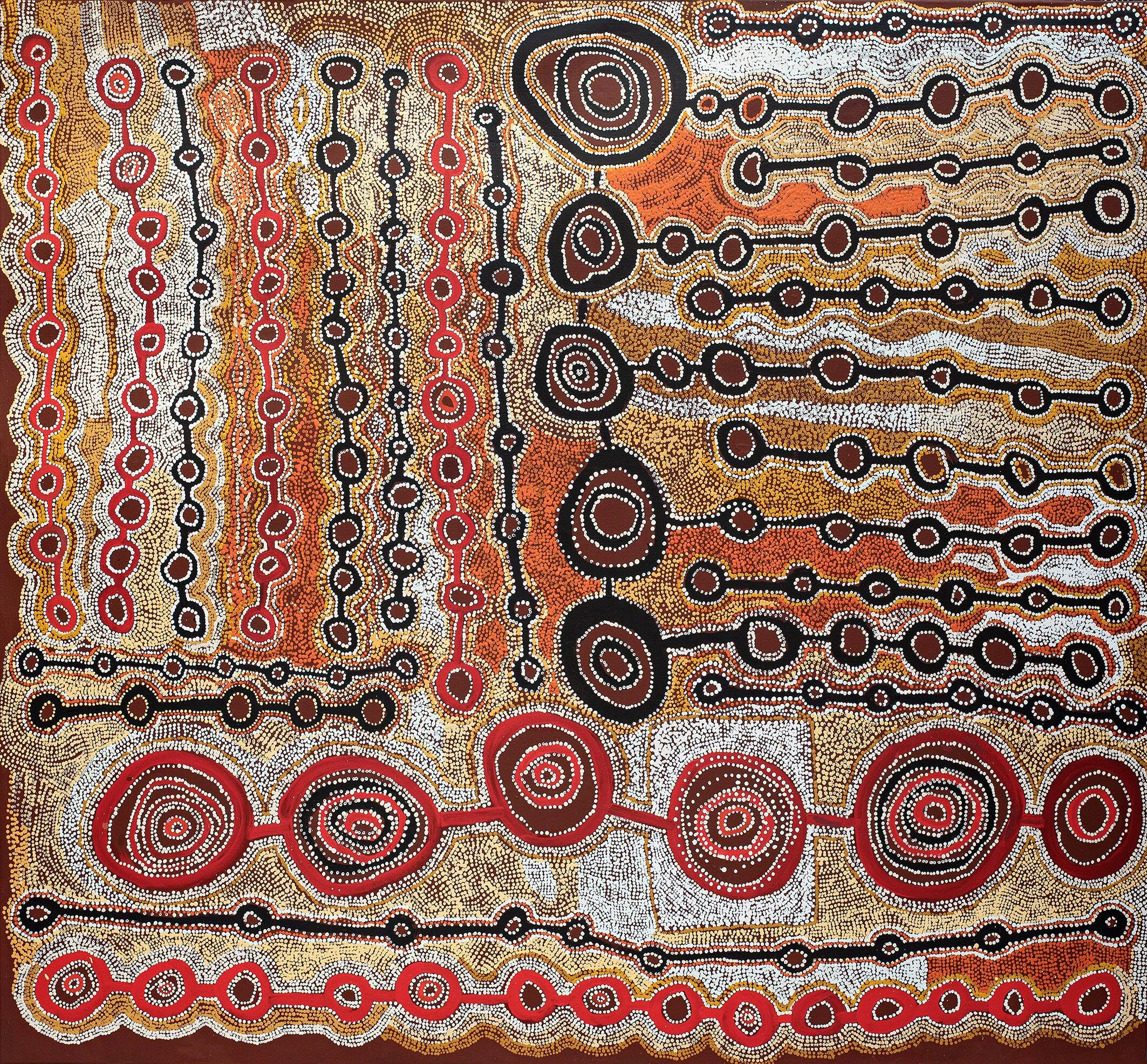
Artiste : Matjangka Norris (1956)
Titre : Ngura Pilti
Format : 196 x 183 cm
Provenance et certificat : centre d'art de Kaltjiti
Ref : 154-21
Explication d’une œuvre :
Ngura Piltia. the country is very dry, 'ukuri wiya' - no green grass and 'mina wiya' - no water. Kamula (camels), Rabitah (rabbits), Malu (kangaroo), Donkeys, all the animals went to the waterhole looking for water, but there was none so they went away again. Tjukutji underground soak in the creek, there was a little water. The family went for dog skins, trapping, near Tjilpil and Alukumpa.
Matjangka was little girl, running around 'nikiti', no clothes. There was a big drought, there is no rain
coming.
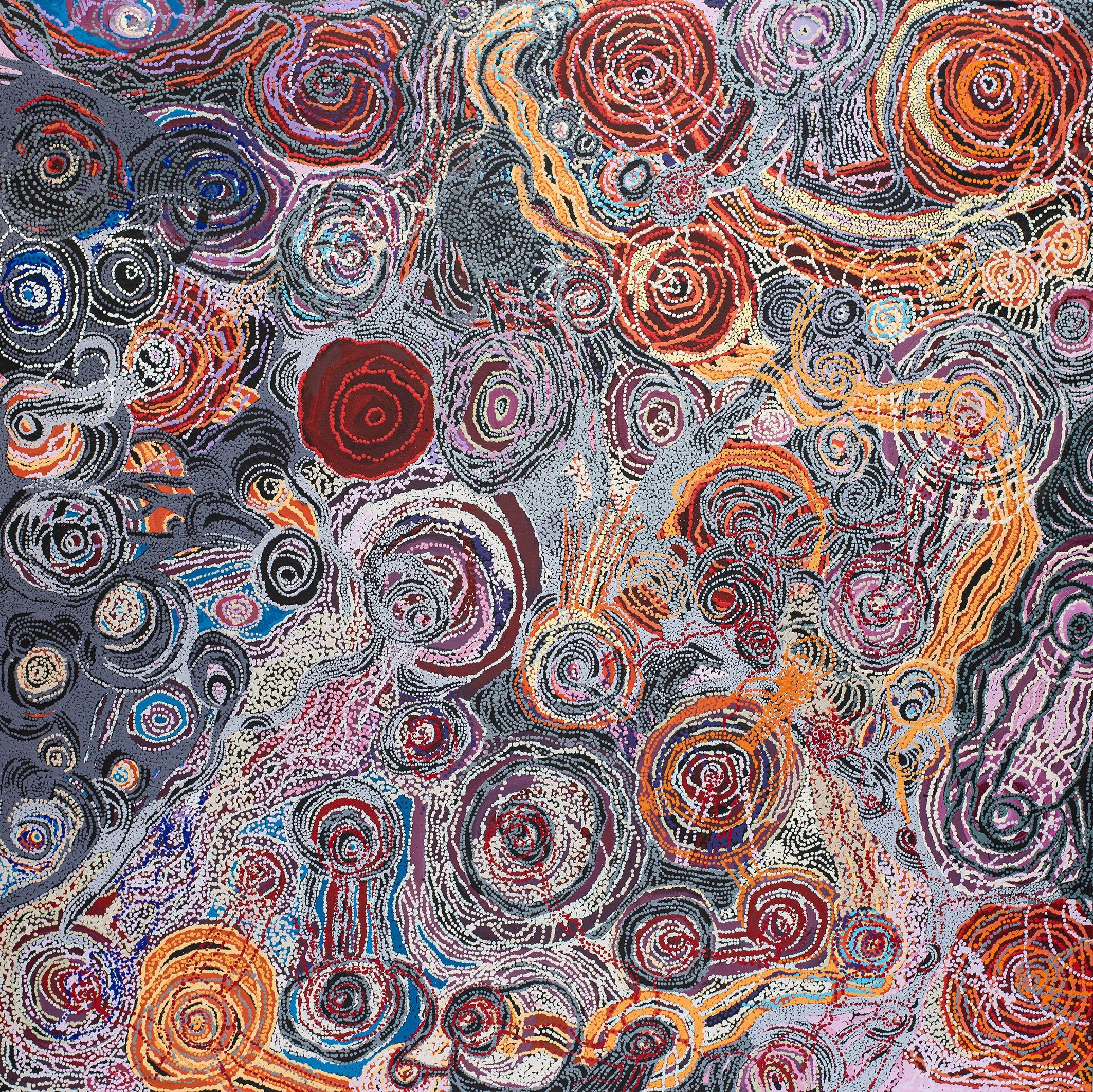
Artiste : Taylor Wanyima Cooper (1939)
Titre : Malara: Wanampi Tjukurpa
Format : 200 x 183 cm
Provenance et certificat : centre d'art de Kaltjiti
Ref : 19-50
Explication d’une œuvre :
Taylor was born at this important site of the Wanampi Tjukurpa, the Rainbow Serpent or Water Snake Dreaming. The Malara Wanampi is his Tjukurpa totemic ancestor, the place of the Water Serpent Dreaming. Taylor is Nguraritja, a tradional custodian of this Tjukurpa. There were many water holes that the Wanapmi travelled through.
“That Wanampi came from Malara. He went to Kunytjanu near Pipalyatjara. From Kunytjanu, that Wanampi kept walking, walking. He came to Tjuntun (kutjupa - different to Tjuntun at Fregon.) near Watarru. He threw one spear and made that rockhole. He went right in that rockhole and then travelled back to Malara". This is an interesting conflict story.
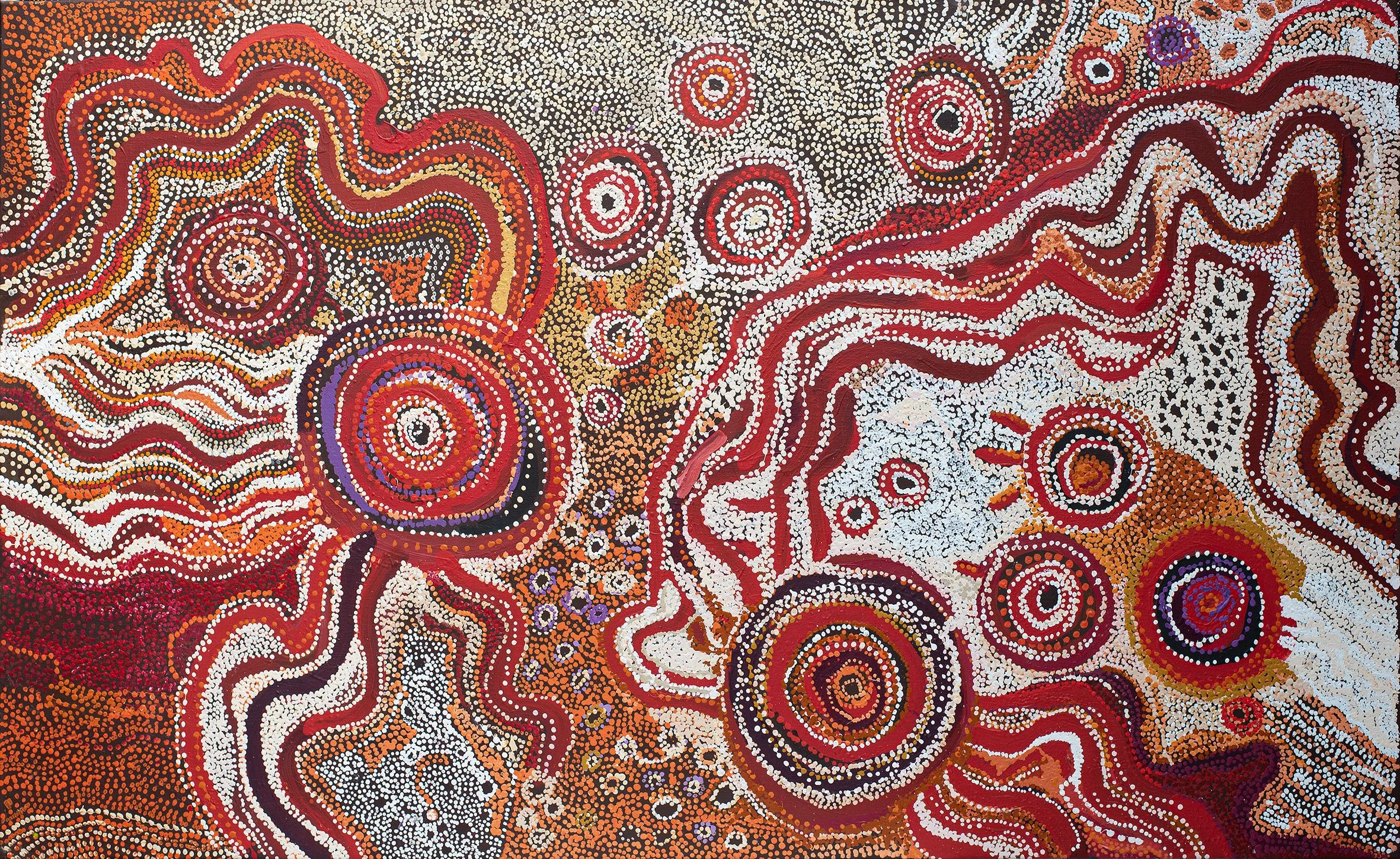
Artiste : Carolanne Ken (1971) & Madeline Curley (1976)
Sans Titre
Format : 200 x 200 cm
Provenance et certificat : centre d'art de Kaltjiti
Ref : 19-18
Explication de l’œuvre :
This is the cave of Minyma Makuli), also known as Minyma Malilu) - minyma nymupu - she was
cripped and had to crawl on her hands and knees across the ground. She dug out this cave with the piti (wooden bowl), to be her big wiltja (shelter). She camped here with her kungkawara kutjara, two daughters, young women. One evening the girls returned from hunting with kuku pulka (large game), she wondered how they got it, and where it had come from? Two men had given it to the girls!
Her girls left her alone for a long time and didn't help her, poor thing, poor old weak woman, so she decided to follow them. She crawled after them, wanatjara anu, using a walking stick, following their tracks northwest back to the hills. When she reached their camp the men hit and killed her.
They had called the girls in marriage and took them away. This is Carolanne's grandmother's country. The underground cave at Kanypi is a permanent water supply. Carolanne is from Fregon on the *APY Lands. Precise, fine brushwork are characteristics of her work. Carolanne is a keen story teller and combining a traditional style with a contemporary edge to her work, reflects a keen sense of place retaining the importance of traditional country as inspiration for her work. *Anangu Pitjantjatjara/Yankunytjatjara Lands, in the far north-west of South Australia
Artiste : Manyitjanu Lennon
Titre : Mamungari 'nya
Format : 200 x 122 cm
Provenance et certificat : centre d'art de Kaltjiti
Ref : 17-339
Explication de l’œuvre :
Tjukurpa mamu ngaranya ngauuku tjanmu tjutaku ngura nyangatja ngayuku ngunytju tjutangku munu
kuntilingku ngayuku kulypaipangku kulu. This is the story of many mamungari'nya. This is also my grandfather's country. This is also my mother, aunty and uncles and sisters country.
As Manyitjanu describes the country: “This is Mamungari’nya. The place Mamungari’nya is a long way away. It is over the other side of the sand dunes past Tipilnga. The place where many white trees are growing, many white marble gums. The place where women came turned into the white marble gums on the sand dune south of Watarru; this is a tjukurpa story. So this is Mamungari’nya where lots of little gum saplings and emu bush grow. This is a place of claypans.’ This is a women's site south
west of Watarru.

Artiste : Witjiti George (1938)
Titre de l'œuvre : Malara: Wanampi Tjukurpa
Format : 153cm x 122cm
Provenance et certificat : centre d'art aborigène de Kaltjiti Arts
Référence de cette peinture aborigène : 20-265
Explications pour cette peinture d'art Aborigène :
Piltati is the well known tjukurpa story of the two water serpents who live in the Piltati Rockhole with their two wives. This is Witjiti's mother's country near Kanpi on the Anangu Pitjantjatjara/Yankunytjatjara Lands (APY Lands) in far north South Australia.
Wtitjiti fondly refers to this Tjurkurpa as a love story. "This is a story about two brothers and two sisters. The two 'wati's' (brothers) - two water snakes, are at the Piltati rockhole waiting for two sisters.
The two women had gone to find 'mai' ( food), they were gone a long time and the men were hungry. They all live there in this rockhole". - Witjiti George.
The rabbit burrows are depicted as lines with semi circles either side. Underground water flows through these channels and the connected circles are places where the sisters travelled looking for bushtucker.
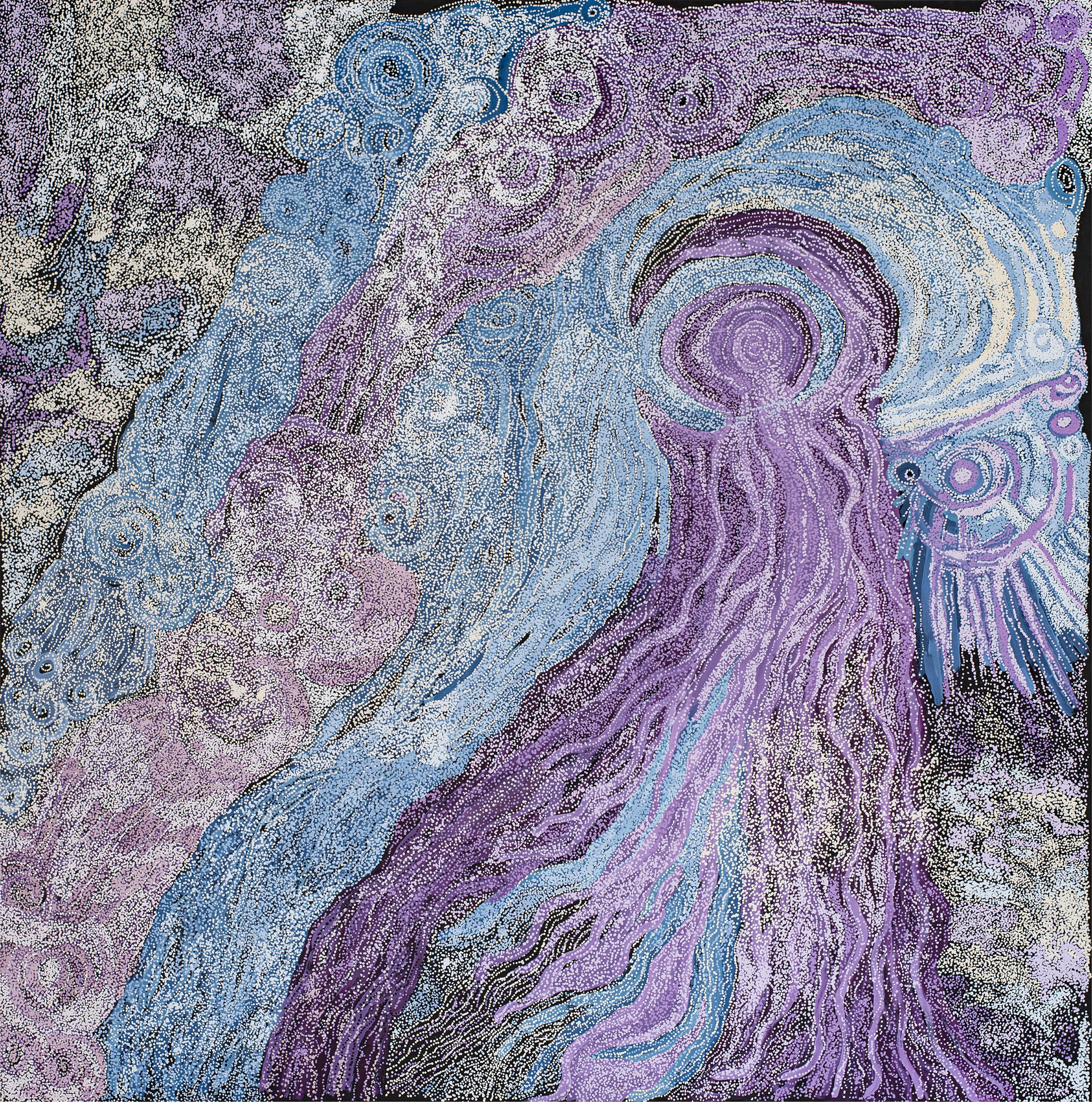
Artiste : Carolanne Ken
Titre : Minyma Makuli Tjukurpa
Format : 200 x 200cm
Provenance et certificat : centre d'art de Kaltjiti
Ref : 100-22
Explication de l’œuvre :
This is the cave of Minyma Makuli), also known as Minyma Malilu) - minyma nymupu - she was crippled and had to crawl on her hands and knees across the ground. She dug out this cave with the piti (wooden bowl), to be her big wiltja (shelter). She camped here with her kungkawara kutjara, two daughters, young women.
One evening the girls returned from hunting with kuku pulka (large game), she wondered how they got it, and where it had come from? Two men had given it to the girls! Her girls left her alone for a long time and didn't help her, poor thing, poor old weak woman, so she decided to follow them.
She crawled after them, wanatjara anu, using a walking stick, following their tracks northwest back to the hills. When she reached their camp the men hit and killed her. They had called the girls in marriage and took them away.
This is Carolanne's grandmother's country. The underground cave at Kanypi is a permanent water supply. Carolanne is from Fregon on the *APY Lands. Precise, fine brushwork are characteristics of her work. Carolanne is a keen story teller and combining a traditional style with a contemporary edge to her work, reflects a keen sense of place retaining the importance of traditional country as inspiraon for her work.
*Anangu Pitjantjatjara/Yankunytjatjara Lands, in the far north-west of South Australia

Artiste : Witjiti George (1938)
Titre de l'œuvre : Malara: Wanampi Tjukurpa
Format : 200 cm x 199 cm
Provenance et certificat : centre d'art aborigène de Kaltjiti Arts
Référence de cette peinture aborigène : 149-21
Explications pour cette peinture d'art Aborigène :
Piltati is the well known tjukurpa story of the two water serpents who live in the Piltati Rockhole with their two wives. This is Witjiti's mother's country near Kanpi on the Anangu Pitjantjatjara/Yankunytjatjara Lands (APY Lands) in far north South Australia.
Witjiti fondly refers to this Tjurkurpa as a love story. "This is a story about two brothers and two sisters. The two 'wati's' (brothers) - two water snakes, are at the Piltati rockhole waiting for two sisters.
The two women had gone to find 'mai' ( food), they were gone a long time and the men were hungry. They all live there in this rockhole". - Witjiti George.
The rabbit burrows are depicted as lines with semi circles either side. Underground water flows through these channels and the connected circles are places where the sisters travelled looking for bushtucker.

Artiste : Beverley Cameron
Titre : Minyma Kutjara - Mantarur
Format : 200 x 150 cm
Provenance et certificat : centre d'art de Kaltjiti
Ref : 135-21
Explication de l’œuvre :
It is a tjukurpa story of two women from Manturu. The women travelled on to the waterhole at Alice Springs, Bungalow Waterhole, a very important women's place. They live now in the waterhole. The Dreaming track of the Kungka Kutjara who travelled from Puka in the Mann Ranges to Katartitja north of Uluru, then to Parntu (Lake Amadeus) to Ulpunyali near Kings Canyon, and then to the waterhole at Alice Springs. This is a very significant Women's Dreaming track linking Pitjantjatjara, Yankunytjatjara and Arrernte women's country and law.
Beverley Camerson is from Fregon on the *APY Lands. An accomplished artist, Beverley works from the Kaltjiti Arts Centre in Fregon. Beverley has three children.
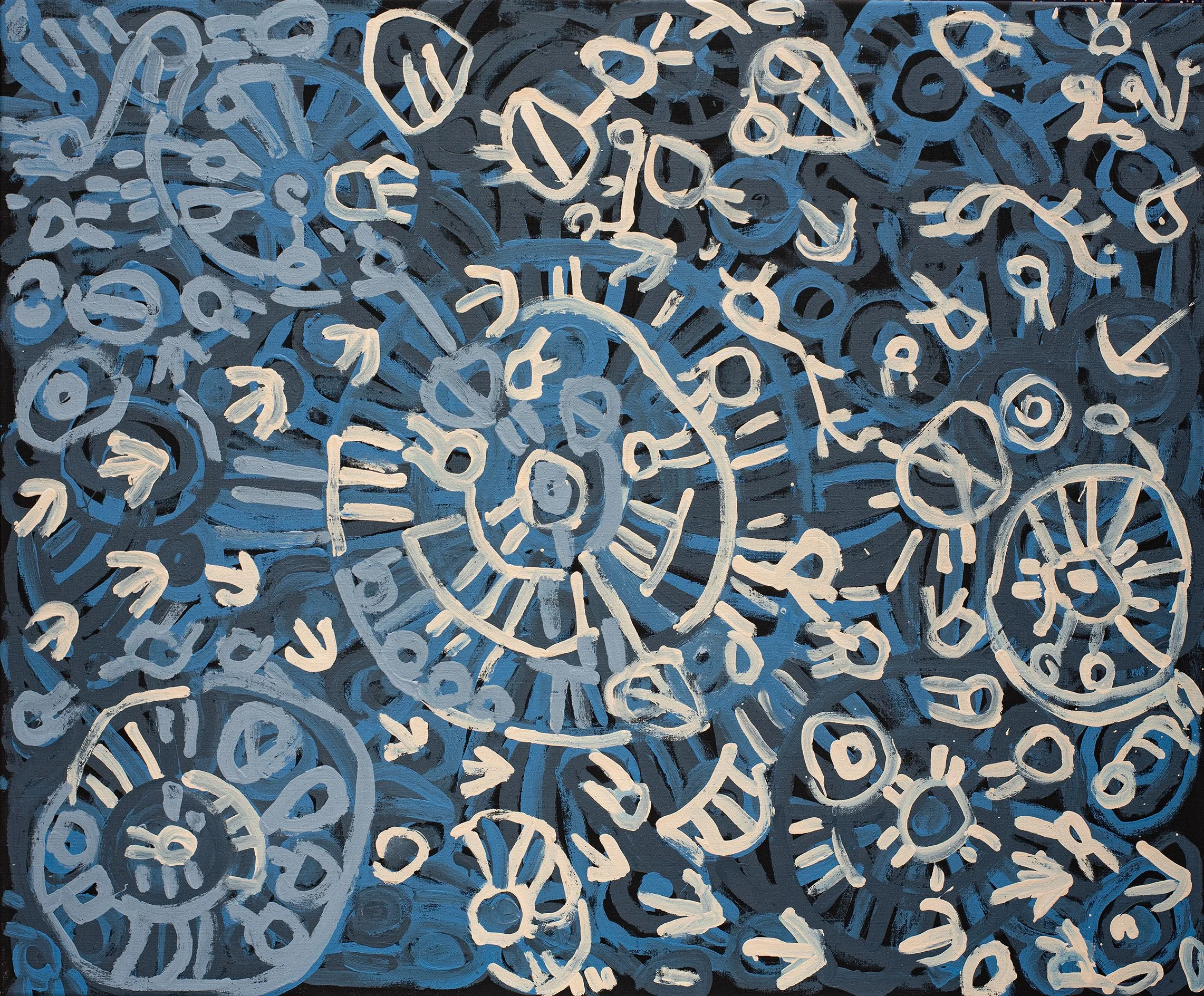
Artiste : Imitjala Curley (1953)
Titre : Walytjitjata: Ngayuku ngunytjuku ngura
Format : 122 x 102 cm
Provenance et certificat : centre d'art de Kaltjiti
Ref : 19-354
Explication de l’œuvre :
Imitjala Curley is closely connected with Walytjitjata as it is her mother, Puni Puni's country -
Ngayuku ngunytjuku ngura. It is a small homeland just over the Northern Territory border about 46km
north of Kalka. Imitjala has said - Tjitji tjuta, this is part of the Minyma kututja Story of Walytjitjata.
Diana James recorded this story in the Kaltjiti Arts Book, Paintng the Song; The Minyma Kututja and her husband had many children. 'They travelled to Umutju (east of Walytjitjata). The oldest boy Wantama was homesick for their birth place, Kanpini, near Waltjitjata. They told their mother , "We're going back home with our brother." the mother sang a song to send them away. At Umutju they turned into stone and are still there today. Imitjala has painted the PITI'S - the wooden bowls used to carry the food they ate; the kampurarpa - desert raisens.
Dans les peintures de Kaltjiti nous sommes particulièrement touchés par les connections avec le territoire dans toutes ses dimensions sensorielles, entre la touche sensible du pinceau, les jeux de couleurs et la musique qui accompagne et rythme souvent avec intensité la composition comme une célébration.
Cet été en 2014, nous avons eu l’occasion d’échanger sur place avec Beverly Peacock qui est la manager du centre d’art depuis plus de 22 ans. Cet engagement au service des artistes est exceptionnel en terme de continuité dans les centres d’art.
Les peintures qui émergent de Kaljiti sont multi-sensorielles, plurielles et chantent le territoire. Dernièrement notre galerie a placé une œuvre de l’artiste Steven Pompey au Musée Aborigène d’Urecht.
Artiste : Senior Women's collaborative with the following artists : Beverley Cameron, Ingrid Treacle, Meredith Treacle, Rita Rolley, Tjangili George.
Format : 2 x 200 x 153 cm
Provenance et certificat : centre d'art de Kaltjiti
Ref : 17-13
Demander le prix de l'œuvre
Explications sur cette œuvre magistrale :
The artists who collaborated on this painting are from the Kaltjiti Arts Centre of Kaltjiti Community, Fregon on the *APY Lands. They are all aboriginal women of various ages working together in their collective art centre.
These paintings are a valuable opportunity for younger women to learn from older women. The transfer of traditional knowledge is enabled by working together in this manner.
Inspiration for the artists' work comes from the surrounding traditional country. The use of strong colour and abstract imagery creates a contemporary interpretation of the vast, energetic and vibrant landscape. The bold use of colour is influenced by the intense red of the desert country creating a narrative based in the landscape. Fregon country is a vibrant landscape with long ridges of low sandhills interspersed by flat spinifex and vast, grassy plains. These in turn are criss-crossed by dry creeks lined with river red gum eucalypts creating a patchwork effect of colour and pattern and which flood during heavy rain. Rockholes are irregular, circular shaped depressions in the rocks which fill with water when it rains. Knowledge of their location was essential to survival in nomadic times.