
Exposition d’art Aborigène “The Rictor Family - Last nomads of Australia” Aboriginal art from remote Australia
A la galerie Aboriginal Signature Estrangin : 101 rue Jules Besme, 1081 Bruxelles.
Visites sur RDV ensuite jusqu’au samedi 14 octobre 2023.
Notre galerie est ouverte à tous et vous reçoit sur RDV du mardi au samedi, de 11h à 19h.
Nous nous réjouissons de vous y accueillir et vous invitons à réserver votre visite dans notre agenda ici.
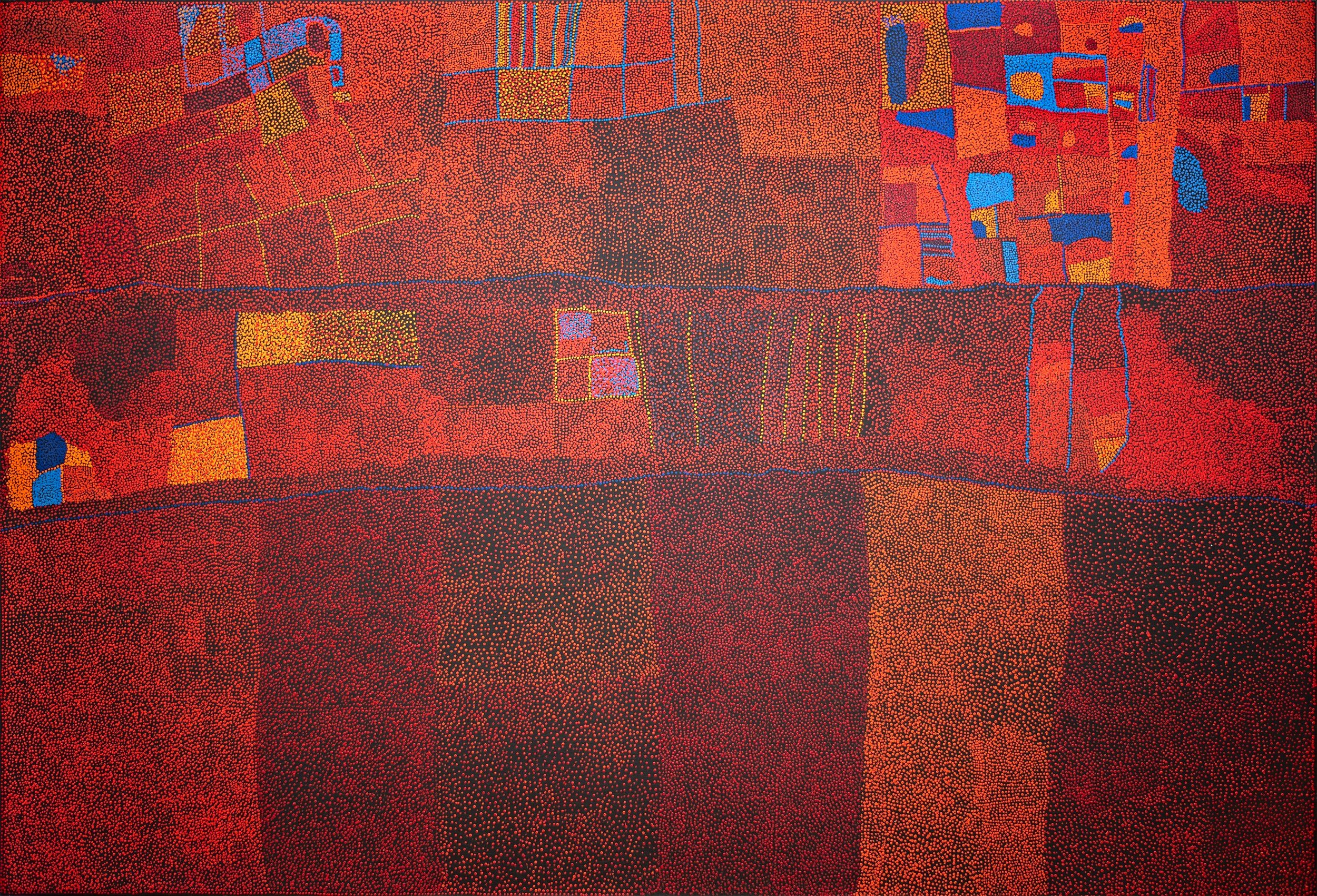
Exposition d’art Aborigène “The Last nomad of Australia - The Rictor Family” - Aboriginal art from Australia à Bruxelles. Œuvre magistrale de l’artiste Noli Rictor - 290 x 200 cm - Provenance : Centre d’art du Spinifex Art Project © Photo Aboriginal Signature Estrangin Gallery with the courtesy of the artist and the Spinifex Art Project
Last nomads of Australia - the Rictor Family
Spinifex Art Project
Nous vous invitons à l’autre bout du monde, dans le grand désert du Victoria au sud de l’Australie, pour une exposition sublime et rare à la galerie Aboriginal Signature Estrangin, sur les « derniers nomades d’Australie - the Rictor Family » en partenariat avec la communauté artistique du Spinifex Art Project.
Leur histoire est époustouflante. En 1986 sur un territoire parmi les plus isolés du globe, des traces de pas sont repérées près d’un lieu sacré. Elles intriguent et laissent penser qu’un clan a survécu à la dureté du désert, sans aucun contact avec le monde moderne, isolé de leur communauté d’origine depuis plus de 25 ans, date des premières sédentarisations ici.
Face aux sécheresses répétées, véritables dangers, les Aborigènes Anangu installés dans la petite communauté de Tjuntjunjara, montent alors une expédition pour partir dans le désert à leur recherche.
Grâce à leur connaissance des pistes chantées, ils suivent les pas des ancêtres, de trous d’eau en trous d’eau, des lieux éphémères à ceux plus permanents, en observant comme des trackers du bush les moindres témoignages visibles d’une famille encore vivante en ces lieux arides.
1986 : découverte des derniers chasseurs-cueilleurs d’Australie
Après un long périple, ils retrouvent quelques jours plus tard les 7 derniers nomades d’Australie, du groupe linguistique Wankatja, avec leur famille qui sera qualifiée plus tard par le nom de Rictor.
C’est un évènement national en Australie et au delà, qui fera la une de la presse il y a juste 37 ans : « Lost brothers awaken the civilization ».
C’est la découverte d’un nouveau monde pour leurs parents et les trois frères (Noli, Ian, Mick) dont l’âge est estimé à 19, 28 et 35 ans, et pour Tjaruwa Woods et son jeune fils Damien qui ignoraient alors l’existence des whitefellas (hommes blancs) jusqu’à ce jour.
Les retrouvailles furent émouvantes et marquantes et résonnent encore jusqu’ici à Bruxelles avec cette magnifique exposition montée en partenariat avec les artistes Ian Rictor (1960), Noli Rictor, Mick Rictor et Tjaruwa Wood du Spinifex Art Project. Ils deviendront chacun d’immenses artistes, à travers un parcours unique dans l’histoire de l’art, de ces dernières empreintes de pas avant le contact avec le monde moderne, aux cimaises des plus grands musées du monde aujourd’hui, comme dans un accélérateur temporel qui nous connecte directement aux origines du monde, à l’essence même de la Création.
Une peinture politique pour récupérer le territoire
Dix ans plus tard en 1998, la communauté du Spinifex à Tjuntjunjara, réalise deux œuvres collaboratives masculine et féminine, pour démontrer la continuité d’occupation de leurs lieux sacrés, sans interruption, avant la colonisation, pendant et après celle-ci. Cette preuve tangible sous forme de deux peintures, documentait les lieux de naissance de tous les demandeurs du Spinifex et leurs droits sur l’intégralité de la zone de revendication légale. Elle constituait un témoignage plus fort encore qu’un acte notarié, pour contester et récupérer leur territoire auprès des tribunaux.
Dans le cadre de la loi du « Native Act Title », ils vont réussir après un long processus à récupérer 76 000 kilomètres carrés de leurs territoires ancestraux dans le grand désert du Victoria. C’est une victoire et un évènement inimaginable pour les frères Rictor et Tjaruwa Woods, qui ignoraient 10 ans plus tôt l’existence même de blancs qui avaient pris leurs terres.
Ces hommes et ces femmes vont ainsi peindre pour le première fois, non pas pour le monde de l’art, mais pour défendre leurs droits inaliénables et immémoriaux. Ensemble ils vont écrire une nouvelle page de l’histoire de l’art et faire partie des plus grands artistes de cette île continent.
2023 : un cheminement initiatique à la rencontre de leur culture
Il y a un mois fin Juillet 2023, j’allais à nouveau à leur rencontre dans le Grand Désert du Victoria lors d’un périple solitaire en 4x4 sur 700 km de pistes, à travers des centaines de dunes de plus de 10 mètres de haut. J’étais leur invité pour préparer cette exposition avec leur communauté. En suivant la piste chantée du « Business » cérémoniel des Homme, sans possibilité de trouver des ressources en eau ou en carburant, isolé, bivouaquant dans le froid à la nuit tombé, là où la terre craquelée semble pulvérisée, j’y ressentais les dimensions plus invisibles de leur territoire, comme un cheminement initiatique à la rencontre de leur culture.
Leurs peintures sont bien souvent entourées de secrets et seuls les détails superficiels peuvent être partagés, avec des personnages décrits comme des êtres créateurs qui ont le pouvoir de transformation, non seulement d'eux-mêmes mais aussi du paysage qu'ils ont déplacé, en laissant des souvenirs physiques indélébiles dans un environnement cartographique enveloppé de chants et des danses pour que tous puissent les suivre encore aujourd’hui.
Tjaruwa Woods (1954-2019) issue de la famille des derniers chasseurs-cueilleurs d’Australie, vient d'une région comportant de nombreuses dunes et trous rocheux, qu'elle évoque avec révérence dans ses peintures. Son savoir ancestral lui donne autorité pour souligner les éléments structurants du Tjukurpa ou temps de Création, comme les sources d’eau, si précieuses dans le désert.
Elle a elle-même traversé durant toute sa jeunesse ces lieux emblématiques qui portent les histoires d'êtres Créateurs.
Leurs pouvoirs magiques ont formé le paysage au fur et à mesure de leurs périples qui s'entrecroisent dans le paysage désertique. Non figé dans le temps, ces êtres sont encore vivants dans le paysage et célébré par les artistes dépositaires du savoir.
Mick Rictor (1957) est un des artistes les plus énigmatiques du Spinifex Art Project, décrit par ses comparses Anangu, comme un homme sauvage, féroce, comme l'étaient les anciens nomades seniors avant que les gens ne soient adoucis par la vie moderne. Il commence à peindre fin 2016. Dans ses rares œuvres, il nous invite a contempler des compositions picturales épurées, laissant place aux éléments essentiels du territoire, sous la forme d’esquisse des contours, entrelacés et suspendus dans l’immensité de l'espace sauvage et vierge du Grand Désert du Victoria. Avant de se lancer sur la toile, il passe de longs moments à parcourir la toile vierge avec la main sur le menton comme Le Penseur de Rodin, avant de commencer la sélection de la couleur et du pinceau, puis après une longue période il se lance. Il place les points individuellement avec lenteur et attention, de façon rythmique, avec une seule couleur, ou des couleurs multiples, l'une masquant l'autre. Ses œuvres font référence aux paysages, et soulignent les vastes plaines nichées entre des lignes parallèles des dunes de sable, avec le rouge lie de vin soulignant les affleurements rocheux de granit à la limite nord, ponctués par les points d'eau sacrés gardés par les serpents Wanampi et les Mamu Tjina avec les empreintes de pas des sorciers du Tjukurpa.
Ian Rictor (1960) peint avec humilité et respect les sites essentiels du paysage chargés de sens, où certains sont entourés de secret, dont il ne peut alors révéler que les détails superficiels comme pour le site important de Tuwan situé au cœur du pays traditionnel Spinifex. Cette histoire du temps de la Création nous invite dans le récit épique du voyage d'un groupe d’oiseaux diamants mandarins qui se dirigent vers le sud pour sauver le monde de la montée des eaux lors du déluge. Les grands ancêtres créateurs utilisent leurs lances pour créer des remparts géants pour retenir la mer en élevant des falaises de pierre grâce à leur pouvoir de transformation, non seulement d'eux-mêmes mais aussi du paysage qu'ils ont déplacé. On retrouve dans les peintures de Ian les évocations des souvenirs physiques indélébiles des anciens dans un environnement cartographié, enveloppés de chants et de danses pour que tous puissent les suivre encore aujourd’hui.
Noli Rictor (1969) représente avec délicatesse et pudeur le territoire ancestral qui l’a vu naître, et dont il maîtrise l’histoire spirituelle. Il la révèle en partie avec différents niveaux de lecture soulignés par les effets de profondeur et de densité, les formes abstraites conjuguées sur la toile, qui évoquent les personnages incarnant le paysage et donnant naissance aux formations physiques à travers leurs mouvements. Les formes géométriques ébauchées dans ses œuvres font sens et soulignent les activités cérémonielles des grands ancêtres dans ces lieux arides. Elles dessinent l’image complexe du paysage physique et moral, qui abrite encore la religion orale composée des chants et des performances qui imprègnent toujours la vie quotidienne de Noli.
Avec leur pinceau, ces grands artistes, dont les œuvres rayonnent dans les plus grands musées du monde, du MET au British Museum, révèlent leurs connaissances rares et précieuses qui résonnent dans leurs peintures. Ils cristallisent leur savoir et le transmettent aux générations à venir. Ils tissent le lien avec le territoire. Leur geste devient le prolongement de la terre, et leurs œuvres des monuments de la mémoire.
Nous nous réjouissons de vous accueillir à la galerie pour cette rentrée.
A bientôt,
Bertrand Estrangin
Founder & Director
Découvrez les peintures disponibles à Bruxelles durant l’exposition :
Cette exposition a été montée en partenariat avec le centre d’art du Spinifex Art Project, afin de vous garantir une provenance éthique, respectueuse des artistes Aborigènes d’Australie.

Artiste : Noli Rictor
Titre de l'œuvre : Kuru Ala
Format : 137 x 90 cm
Provenance et certificat : centre d'art aborigène du Spinifex Art Project
Référence de cette peinture : 22-320
Demander le prix de l'œuvre / Enquiry
Explications pour cette œuvre :
Noli has depicted the significant site of Kuru Ala situated in the north of traditional Spinifex Lands. This site forms part of the Kungkarankalpa Tjukurpa or Seven Sister's Creation Line that follows a group of women as they traverse the country evading the pursuit of a lustful older man, Nyiru. Nyiru has metamorphic powers of transformation and changes into different flora and fauna to trick the women.
These are creation beings and as such shape the landscape as they move through it. At Kuru Ala there is the physical reminders of their presence in the form of monolithic rock formations depicting the characters. From Kuru Ala the women chase a Kuniya (Carpet Python) through Tjukaltjara to the site of Kulyuru.
Noli has depicted the red rocky outcrops of Kuru Ala and the Palka-Palka creek which crosses just to the south.

Artiste : Noli Rictor
Titre de l'œuvre : Kamanti
Format : 200 x 137 cm
Provenance et certificat : centre d'art aborigène du Spinifex Art Project
Référence de cette peinture : 19-403
Demander le prix de l'œuvre / Enquiry
Explications pour cette œuvre :
Noli has depicted the significant site of Kamanti situated in the north of traditional Spinifex lands. This site holds s the Wati Kutjara Tjukurpa (Two Men Creation Line) and is an epic narrative following the movement of a father and son water serpent who traverse the Spinifex Lands on ceremonial business. Noli depicts country he was born into and which formed his religious upbringing. The arid but spiritual environment was the birthplace of the creation beings who shaped the landscape as they moved through it. They left indelible physical reminders of their power in the form of creeks or rocky ridges or a type of tree.
But mostly they left their place of abode or the life giving sought after source of precious water, in some form of catchment. This water source is the embodiment of survival within the remote desert extremes with the sites being venerated as such and usually guarded by beings who shifted through the realms. They are the characters who dramatise the landscape and give rise to the formations through their movements. They leave behind a mapped moral landscape that holds an elaborate oral religion of song and performance that still permeates Noli's daily life.

Artiste : Noli Rictor
Titre de l'œuvre : Kupanya
Format : 200 x 137 cm
Provenance et certificat : centre d'art aborigène du Spinifex Art Project
Référence de cette peinture : 22-122
Demander le prix de l'œuvre / Enquiry
Explications pour cette œuvre :
Noli has depicted the significant site of Kupanya and country that forms part of the Wa Kutjara Tjukurpa (Two Men Creation Line). WatiMulamaru munu WatiTinka, the Black-nosed Monitor man and the Sand Goanna man. It is here at Kupunya that the Two Men interact with the Wati Punyu (A small desert marsupial). Karu pulkana, a big creek flows aer rain as this is rocky country. This is my brother Damien's place. There is a cave here and another not far, where Damien was born.
The Two Men are creaon beings and as such had the power to transform the landscape and themselves. They left behind a mapped environment that holds an oral religion full of drama and intrigue, that is played out in sacred song and performance. They traversed vast tracts of country from Spinifex lands all the way up to Blackstone in the Ngaanyatjarra Lands.

Artiste : Noli Rictor
Titre de l'œuvre : Manutju
Format : 137 x 140 cm
Provenance et certificat : centre d'art aborigène du Spinifex Art Project
Référence de cette peinture : 18-154
Demander le prix de l'œuvre / Enquiry
Explications pour cette œuvre :
Here he has painted the significant site of Mamutju located in the northern part of the Spinifex Lands and encompassing the area known as Palka Palka.
Noli states it is a large area of salt lakes, plains and rocky outcrops and also several rockholes. Noli traversed this area as a boy with his family.
Noli depicts country he was born into and which formed his religious upbringing. The arid but spiritual environment was the birthplace of the creation beings who shaped the landscape as they moved through it. They left indelible physical reminders of their power in the form of creeks or rocky ridges or a type of tree.
But mostly they left their place of abode or the life giving sought after source of precious water, in some form of catchment. This water source is the embodiment of survival within the remote desert extremes with the sites being venerated as such and usually guarded by beings who shifted through the realms. They are the characters who dramatise the landscape and give rise to the formations through their movements. They leave behind a mapped moral landscape that holds an elaborate oral religion of song and performance that still permeates Noli's daily life.

Artiste : Noli Rictor
Titre de l'œuvre : Kulimara
Format : 200 x 137 cm
Provenance et certificat : centre d'art aborigène du Spinifex Art Project
Référence de cette peinture : 22-267
Demander le prix de l'œuvre / Enquiry
Explications pour cette œuvre :
This is my place Kulimara. Tjilpu Tjuta Tjukurpa (Wa Nyii-Nyii Creation Line). I was born there. Apu tjukutjuku (small rocky outcrops) and is this side of Kuru Ala. This is my place.
Noli Rictor draws on a long childhood spent walking the myriad song paths and hunng tracks that make up Spinifex Country. Noli moved across vast distances with his immediate family who were the last group to be living a nomadic existence in the Great Victoria Desert of Western Australia and did not move into a sedentary community life until 1986.
Here Noli depicts country associated with the Wa Nyii-Nyii Tjukurpa (Zebra Finch Men Creation Line). This is an immense narrative that follows a group of powerful bird men who travel south to the Nullabor coast to stop the rising seas. They use their spears to form great barriers in holding back the seas. These characters are creaon beings who shaped the narrative within the landscape as they journeyed through it, leaving indelible physical reminders of their power and presence.

Artiste : Tjaruwa Woods
Titre de l'œuvre : Yampil
Format : 200 x 137 cm
Provenance et certificat : centre d'art aborigène du Spinifex Art Project
Référence de cette peinture : 19-421
Demander le prix de l'œuvre / Enquiry
Explications pour cette œuvre :
Tjaruwa (1954) paints with a knowledge and a devotion to the country that formed her. She was a young woman when she and her immediate family 'walked in' from the Great Victoria Desert in the remote east of Western Australia. This was deemed inhospitable country by the encroaching 'new world' and perceived as so vast and uninhabited, that it made the ideal site to detonate and observe the new wave of nuclear explosions conducted as part of the British Atomic Testing during the 1950's.
Tjaruwa and her family were there, living, breathing, hunting, walking over the soft red carpet of sand, learning the paths of the creation beings who shaped this landscape and made the moral world possible. She slept under a vast expanse by campfire and drank water from tree roots. She learnt the fine art of survival in an arid but spiritual world and how to navigate an environment full of meaning. Tjaruwa paints like she breathes, an almost innate required constant. As she depicts the significant site of Kamanti, she is well aware of the creation manifestation of the Wati Kutjara (Two Men Creation Line) and that these Two Men still reside in the well-formed water cavities that penetrate deep into middle earth. She knows with all her learned experience that these Two Men are to be feared but treated with reverence all the same, for they can travel underground as the enormous water serpents that they are, or walk the landscape in the form of mortal men. And as she sings the sites onto the two dimensional plane, let us appreciate through the panoramic composition that comes from a lifetime of breathing in this country.
Tjaruwa was born in 1954 outside the Spinifex Determination Area at Warutjara, the place of Minyma Tjilkamata - the Echidna Woman, near the current community of Jamieson (Manta Maru) within the Ngaanyatjarra Lands. Except for possession of a few pieces of iron, fashioned into implements and tin bowls Tjaruwa lived traditionally until the winter of 1986 when her family group of seven was located in northern Spinifex by a group of Spinifex people making a sortie into country to re-visit important Men’s sites after some 25 years of absence. Tjaruwa came in with a small son on her hip and camped with her family firstly at Yakatunya, 90 kilometres south of Tjuntjuntjara, joined the moving camp which accompanied the construction of a road, 300 kilometres through the length of the Spinifex Lands, before settling permanently at Tjuntjuntjara in 1989. Tjaruwa was adjudged to be about 32 years old in 1986 and was given the birth date 1/7/1954. At this point in time (2014),Tjaruwa’s family remains the last Aboriginal group in the country to make first contact with contemporary Australia.
It is difficult to even imagine the changes Tjaruwa was to encounter living in her new world. She had acquired an extended network of kin to establish relationships with, the daily activity of hunting and gathering was essentially replaced by the community store and water was abundant.
Tjaruwa’s immediate priority was to care for her mother and uncle living in their new circumstances and it was not until her mother passed away that she took up an interest in painting. At first she tended to paint as she observed other women painting and then the accumulated experience of her other life and her mother’s stories/designs poured out and Tjaruwa’s unique Spinifex perspective was translated with spectacular style and technique on to canvas.
Tjaruwa has painted her homeland of Yampil, an area in northern Spinifex. This is sandhill country, with Spinifex and Mulga trees and very sparse water deposits usually in the form of rockholes, which are quite small or soak water which you have to dig for. To survive in the Western Desert area it is essential to know where to find the water and this knowledge has been passed down over thousands of years from generation to generation. Tjaruwa has painted the rockholes of Kamanti, Waltjipi, Pur Purnya, Kapi Wiratjara and Tjiwara.
Her artworks are in the following prestigious collections :
Art Gallery Of South Australia, Adelaide Sa (Women’s Collaborative)
National Gallery Of Australia, Canberra
National Gallery Of Victoria, Melbourne Vic (Women’s Collaborative)
Richard And Harriet England Collection
Seattle Art Museum, Seattle Usa (Women’s Collaborative)
The British Museum, London, England.(Womens Collaborative)
The Corrigan Collection, Australia
The Lepley Collection, Perth, Western Australia.
The Sims Dickson Collection, Nsw
Parliament House Art Collection, Canberra, Act (Womens Collaborative)
W. & V. Mcgeoch Collection, Melbourne, Vic.
The Berndt Collection, University Of Western Australia.

Artiste : Tjaruwa Woods
Titre de l'œuvre : Anumarapiti
Format : 233 x 197 cm
Provenance et certificat : centre d'art aborigène du Spinifex Art Project
Référence de cette peinture : 13234
Demander le prix de l'œuvre / Enquiry
Explications pour cette œuvre :
Tjaruwa (1954) paints with a knowledge and a devotion to the country that formed her. She was a young woman when she and her immediate family 'walked in' from the Great Victoria Desert in the remote east of Western Australia. This was deemed inhospitable country by the encroaching 'new world' and perceived as so vast and uninhabited, that it made the ideal site to detonate and observe the new wave of nuclear explosions conducted as part of the British Atomic Testing during the 1950's.
Tjaruwa and her family were there, living, breathing, hunting, walking over the soft red carpet of sand, learning the paths of the creation beings who shaped this landscape and made the moral world possible. She slept under a vast expanse by campfire and drank water from tree roots. She learnt the fine art of survival in an arid but spiritual world and how to navigate an environment full of meaning. Tjaruwa paints like she breathes, an almost innate required constant. As she depicts the significant site of Kamanti, she is well aware of the creation manifestation of the Wati Kutjara (Two Men Creation Line) and that these Two Men still reside in the well-formed water cavities that penetrate deep into middle earth. She knows with all her learned experience that these Two Men are to be feared but treated with reverence all the same, for they can travel underground as the enormous water serpents that they are, or walk the landscape in the form of mortal men. And as she sings the sites onto the two dimensional plane, let us appreciate through the panoramic composition that comes from a lifetime of breathing in this country.
Tjaruwa was born in 1954 outside the Spinifex Determination Area at Warutjara, the place of Minyma Tjilkamata - the Echidna Woman, near the current community of Jamieson (Manta Maru) within the Ngaanyatjarra Lands. Except for possession of a few pieces of iron, fashioned into implements and tin bowls Tjaruwa lived traditionally until the winter of 1986 when her family group of seven was located in northern Spinifex by a group of Spinifex people making a sortie into country to re-visit important Men’s sites after some 25 years of absence. Tjaruwa came in with a small son on her hip and camped with her family firstly at Yakatunya, 90 kilometres south of Tjuntjuntjara, joined the moving camp which accompanied the construction of a road, 300 kilometres through the length of the Spinifex Lands, before settling permanently at Tjuntjuntjara in 1989. Tjaruwa was adjudged to be about 32 years old in 1986 and was given the birth date 1/7/1954. At this point in time (2014),Tjaruwa’s family remains the last Aboriginal group in the country to make first contact with contemporary Australia.
It is difficult to even imagine the changes Tjaruwa was to encounter living in her new world. She had acquired an extended network of kin to establish relationships with, the daily activity of hunting and gathering was essentially replaced by the community store and water was abundant.
Tjaruwa’s immediate priority was to care for her mother and uncle living in their new circumstances and it was not until her mother passed away that she took up an interest in painting. At first she tended to paint as she observed other women painting and then the accumulated experience of her other life and her mother’s stories/designs poured out and Tjaruwa’s unique Spinifex perspective was translated with spectacular style and technique on to canvas.
In this painting : Nyangatja ngura ini Anumarapi ka Kuru Ala munkara ka Pukara munkara ka iriti Anangula tjina ankupai ngura winki. This site is called Anumarapiti it is beyond Kuru Ala and Pukara. We would walk all around this country when I was young. This painting is showing the country around where Tjaruwa Woods was born and grew up. Her family were the last people to emerge from the Great Victoria Desert in 1986 where she maintained a traditional hunter gatherer lifestyle until the wider Spinifex group decided to "bring them in." Water sources are a precious resource in the desert and feature strongly in the Tjukurpa and thus the paintings of the Spinifex artists. These stories of Creation beings with magical powers forming country as the lived their lives criss cross over the desert landscape. These beings are alive in the country today. Wanampis (mythical water serpents) still guard the water holes. Anangu know to approach such places with reverance according to cultural law.
Her artworks are in the following prestigious collections :
Art Gallery Of South Australia, Adelaide Sa (Women’s Collaborative)
National Gallery Of Australia, Canberra
National Gallery Of Victoria, Melbourne Vic (Women’s Collaborative)
Richard And Harriet England Collection
Seattle Art Museum, Seattle Usa (Women’s Collaborative)
The British Museum, London, England.(Womens Collaborative)
The Corrigan Collection, Australia
The Lepley Collection, Perth, Western Australia.
The Sims Dickson Collection, Nsw
Parliament House Art Collection, Canberra, Act (Womens Collaborative)
W. & V. Mcgeoch Collection, Melbourne, Vic.
The Berndt Collection, University Of Western Australia.

Artiste : Tjaruwa Woods
Titre de l'œuvre : Ngura Wirunya
Format : 137 x 110 cm
Provenance et certificat : centre d'art aborigène du Spinifex Art Project
Référence de cette peinture : 14231
Demander le prix de l'œuvre / Enquiry
Explications pour cette œuvre :
Tjaruwa (1954) paints with a knowledge and a devotion to the country that formed her. She was a young woman when she and her immediate family 'walked in' from the Great Victoria Desert in the remote east of Western Australia. This was deemed inhospitable country by the encroaching 'new world' and perceived as so vast and uninhabited, that it made the ideal site to detonate and observe the new wave of nuclear explosions conducted as part of the British Atomic Testing during the 1950's.
Tjaruwa and her family were there, living, breathing, hunting, walking over the soft red carpet of sand, learning the paths of the creation beings who shaped this landscape and made the moral world possible. She slept under a vast expanse by campfire and drank water from tree roots. She learnt the fine art of survival in an arid but spiritual world and how to navigate an environment full of meaning. Tjaruwa paints like she breathes, an almost innate required constant. As she depicts the significant site of Kamanti, she is well aware of the creation manifestation of the Wati Kutjara (Two Men Creation Line) and that these Two Men still reside in the well-formed water cavities that penetrate deep into middle earth. She knows with all her learned experience that these Two Men are to be feared but treated with reverence all the same, for they can travel underground as the enormous water serpents that they are, or walk the landscape in the form of mortal men. And as she sings the sites onto the two dimensional plane, let us appreciate through the panoramic composition that comes from a lifetime of breathing in this country.
Tjaruwa was born in 1954 outside the Spinifex Determination Area at Warutjara, the place of Minyma Tjilkamata - the Echidna Woman, near the current community of Jamieson (Manta Maru) within the Ngaanyatjarra Lands. Except for possession of a few pieces of iron, fashioned into implements and tin bowls Tjaruwa lived traditionally until the winter of 1986 when her family group of seven was located in northern Spinifex by a group of Spinifex people making a sortie into country to re-visit important Men’s sites after some 25 years of absence. Tjaruwa came in with a small son on her hip and camped with her family firstly at Yakatunya, 90 kilometres south of Tjuntjuntjara, joined the moving camp which accompanied the construction of a road, 300 kilometres through the length of the Spinifex Lands, before settling permanently at Tjuntjuntjara in 1989. Tjaruwa was adjudged to be about 32 years old in 1986 and was given the birth date 1/7/1954. At this point in time (2014),Tjaruwa’s family remains the last Aboriginal group in the country to make first contact with contemporary Australia.
It is difficult to even imagine the changes Tjaruwa was to encounter living in her new world. She had acquired an extended network of kin to establish relationships with, the daily activity of hunting and gathering was essentially replaced by the community store and water was abundant.
Tjaruwa’s immediate priority was to care for her mother and uncle living in their new circumstances and it was not until her mother passed away that she took up an interest in painting. At first she tended to paint as she observed other women painting and then the accumulated experience of her other life and her mother’s stories/designs poured out and Tjaruwa’s unique Spinifex perspective was translated with spectacular style and technique on to canvas.
In this painting Tjaruwa specifically mentions the sites of Yampil, Tjutatjipi, Wyara, Tjapin, Kamanti and Pirulungka. These are places Tjaruwa travelled around as a young girl with her family. She used to live then at Tjuntjuntjara.
Her artworks are in the following prestigious collections :
Art Gallery Of South Australia, Adelaide Sa (Women’s Collaborative)
National Gallery Of Australia, Canberra
National Gallery Of Victoria, Melbourne Vic (Women’s Collaborative)
Richard And Harriet England Collection
Seattle Art Museum, Seattle Usa (Women’s Collaborative)
The British Museum, London, England.(Womens Collaborative)
The Corrigan Collection, Australia
The Lepley Collection, Perth, Western Australia.
The Sims Dickson Collection, Nsw
Parliament House Art Collection, Canberra, Act (Womens Collaborative)
W. & V. Mcgeoch Collection, Melbourne, Vic.
The Berndt Collection, University Of Western Australia.

Artiste : Mick Rictor
Titre de l'œuvre : Pila Nguru
Format : 110 x 85 cm
Provenance et certificat : centre d'art aborigène du Spinifex Art Project
Référence de cette peinture : 18-54
Demander le prix de l'œuvre / Enquiry
Explications pour cette œuvre :
Mick Rictor (1957) was around thirty years of age when he walked into modern civilisation for the first time from deep in the heart of the Great Victoria Desert in1986. A very remote and special place holding true wilderness character, like Mick himself. Other Anangu (Aboriginal people) refer to Mick as a wild man, ferocious like the old men used to be before people were softened by modern living.
Mick Rictor gives us freedom to contemplate. His compositions are both painterly and sparse leaving form and space intertwined and suspended. He is not quick to paint and peruses the blank canvas with hand on chin like Rodin's 'The Thinker' for a long period before selecting colour and brush to begin. But still it is a slow rhythmic placement of individual 'dots' that build up sometimes as a single colour, sometimes as multiple colours, one blanketing the other. His works reference the landscapes and changing colours of the Spinifex Country, the sweeping plains nestled in between parallel lines of sand dunes, the red rocky granite outcrops on the northern boundary, the sacred water holes and their ‘wanampi’ serpent guardians and 'mamu tjina' or scorer footprints from the Tjukurpa.
Mick was born at Kulpinya situated south of the significant site of Miramiratjara in the Great Victoria Desert sometime around 1956. This puts him in close proximity to the British Atomic Testing at Emu Fields and Maralinga during the '50s and '60s. Mick and his immediate family were living a nomadic life in and around traditional Spinifex Country up until 1986 when the family was located by relatives searching the area and taken to a then small settlement of Yakadunya and later Coonana. Mick is the eldest sibling of four with his other three siblings Ian and Noli Rictor and Tjaruwa Woods already established artists.
He started painting in 2016 and has a natural aesthetic with a painterly quality about his work.
Mick Rictor gives us freedom to contemplate. His compositions are both painterly and sparse, leaving form and space intertwined and suspended. He is not quick to paint and peruses the blank canvas with hand on chin like Rodin’s The Thinker for a long period before selecting colour and brush to begin. But still it is a slow rhythmic placement of individual ‘dots’ that build up somemes as a single colour, somemes as multiple colours, one blanketing the other. His works reference the landscapes and changing colours of the Spinifex Country, the sweeping plains nestled in between parallel lines of sand dunes, the red rocky granite outcrops on the northern boundary, the sacred waterholes and their wanampi (serpent guardians) and mamu tjina(sorcerer’s footprints) from the Tjukurpa.
His artworks are in the following prestigious collections :
Museum And Art Gallery Of The Northern Territory, Darwin, Australia.
Art Gallery Of South Australia, Adelaide, South Australia
Artbank, Australian Government Collection. Australia.
Araluen Gallery, Alice Springs, Northern Territory.
Charles Darwin University Art Collection, Darwin,Northern Territory
Richard And Harriett Collection, Australia
Arthur Roe Collection, Australia
The Sims Dickson Collection, Nsw

Artiste : Mick Rictor
Titre de l'œuvre : untitled
Format : 200 x 137 cm
Provenance et certificat : centre d'art aborigène du Spinifex Art Project
Référence de cette peinture : 20-117
Demander le prix de l'œuvre / Enquiry
Explications pour cette œuvre :
Mick Rictor (1957) was around thirty years of age when he walked into modern civilisation for the first time from deep in the heart of the Great Victoria Desert in1986. A very remote and special place holding true wilderness character, like Mick himself. Other Anangu (Aboriginal people) refer to Mick as a wild man, ferocious like the old men used to be before people were softened by modern living.
Mick Rictor gives us freedom to contemplate. His compositions are both painterly and sparse leaving form and space intertwined and suspended. He is not quick to paint and peruses the blank canvas with hand on chin like Rodin's 'The Thinker' for a long period before selecting colour and brush to begin. But still it is a slow rhythmic placement of individual 'dots' that build up sometimes as a single colour, sometimes as multiple colours, one blanketing the other. His works reference the landscapes and changing colours of the Spinifex Country, the sweeping plains nestled in between parallel lines of sand dunes, the red rocky granite outcrops on the northern boundary, the sacred water holes and their ‘wanampi’ serpent guardians and 'mamu tjina' or scorer footprints from the Tjukurpa.
Mick was born at Kulpinya situated south of the significant site of Miramiratjara in the Great Victoria Desert sometime around 1956. This puts him in close proximity to the British Atomic Testing at Emu Fields and Maralinga during the '50s and '60s. Mick and his immediate family were living a nomadic life in and around traditional Spinifex Country up until 1986 when the family was located by relatives searching the area and taken to a then small settlement of Yakadunya and later Coonana. Mick is the eldest sibling of four with his other three siblings Ian and Noli Rictor and Tjaruwa Woods already established artists.
He started painting in 2016 and has a natural aesthetic with a painterly quality about his work.
Mick Rictor gives us freedom to contemplate. His compositions are both painterly and sparse, leaving form and space intertwined and suspended. He is not quick to paint and peruses the blank canvas with hand on chin like Rodin’s The Thinker for a long period before selecting colour and brush to begin. But still it is a slow rhythmic placement of individual ‘dots’ that build up somemes as a single colour, somemes as multiple colours, one blanketing the other. His works reference the landscapes and changing colours of the Spinifex Country, the sweeping plains nestled in between parallel lines of sand dunes, the red rocky granite outcrops on the northern boundary, the sacred waterholes and their wanampi (serpent guardians) and mamu tjina(sorcerer’s footprints) from the Tjukurpa.
His artworks are in the following prestigious collections :
Museum And Art Gallery Of The Northern Territory, Darwin, Australia.
Art Gallery Of South Australia, Adelaide, South Australia
Artbank, Australian Government Collection. Australia.
Araluen Gallery, Alice Springs, Northern Territory.
Charles Darwin University Art Collection, Darwin,Northern Territory
Richard And Harriett Collection, Australia
Arthur Roe Collection, Australia
The Sims Dickson Collection, Nsw

Artiste : Mick Rictor
Titre de l'œuvre : untitled
Format : 110 x 85 cm
Provenance et certificat : centre d'art aborigène du Spinifex Art Project
Référence de cette peinture : 17-214
Demander le prix de l'œuvre / Enquiry
Explications pour cette œuvre :
Mick Rictor (1957) was around thirty years of age when he walked into modern civilisation for the first time from deep in the heart of the Great Victoria Desert in1986. A very remote and special place holding true wilderness character, like Mick himself. Other Anangu (Aboriginal people) refer to Mick as a wild man, ferocious like the old men used to be before people were softened by modern living.
Mick Rictor gives us freedom to contemplate. His compositions are both painterly and sparse leaving form and space intertwined and suspended. He is not quick to paint and peruses the blank canvas with hand on chin like Rodin's 'The Thinker' for a long period before selecting colour and brush to begin. But still it is a slow rhythmic placement of individual 'dots' that build up sometimes as a single colour, sometimes as multiple colours, one blanketing the other. His works reference the landscapes and changing colours of the Spinifex Country, the sweeping plains nestled in between parallel lines of sand dunes, the red rocky granite outcrops on the northern boundary, the sacred water holes and their ‘wanampi’ serpent guardians and 'mamu tjina' or scorer footprints from the Tjukurpa.
Mick was born at Kulpinya situated south of the significant site of Miramiratjara in the Great Victoria Desert sometime around 1956. This puts him in close proximity to the British Atomic Testing at Emu Fields and Maralinga during the '50s and '60s. Mick and his immediate family were living a nomadic life in and around traditional Spinifex Country up until 1986 when the family was located by relatives searching the area and taken to a then small settlement of Yakadunya and later Coonana. Mick is the eldest sibling of four with his other three siblings Ian and Noli Rictor and Tjaruwa Woods already established artists.
He started painting in 2016 and has a natural aesthetic with a painterly quality about his work.
Mick Rictor gives us freedom to contemplate. His compositions are both painterly and sparse, leaving form and space intertwined and suspended. He is not quick to paint and peruses the blank canvas with hand on chin like Rodin’s The Thinker for a long period before selecting colour and brush to begin. But still it is a slow rhythmic placement of individual ‘dots’ that build up somemes as a single colour, somemes as multiple colours, one blanketing the other. His works reference the landscapes and changing colours of the Spinifex Country, the sweeping plains nestled in between parallel lines of sand dunes, the red rocky granite outcrops on the northern boundary, the sacred waterholes and their wanampi (serpent guardians) and mamu tjina(sorcerer’s footprints) from the Tjukurpa.
His artworks are in the following prestigious collections :
Museum And Art Gallery Of The Northern Territory, Darwin, Australia.
Art Gallery Of South Australia, Adelaide, South Australia
Artbank, Australian Government Collection. Australia.
Araluen Gallery, Alice Springs, Northern Territory.
Charles Darwin University Art Collection, Darwin,Northern Territory
Richard And Harriett Collection, Australia
Arthur Roe Collection, Australia
The Sims Dickson Collection, Nsw

Artiste : Tjaruwa Woods
Titre de l'œuvre : Papara
Format : 110 x 85 cm
Provenance et certificat : centre d'art aborigène du Spinifex Art Project
Référence de cette peinture : 19-422
Demander le prix de l'œuvre / Enquiry
Explications pour cette œuvre :
Tjaruwa (1954) paints with a knowledge and a devotion to the country that formed her. She was a young woman when she and her immediate family 'walked in' from the Great Victoria Desert in the remote east of Western Australia. This was deemed inhospitable country by the encroaching 'new world' and perceived as so vast and uninhabited, that it made the ideal site to detonate and observe the new wave of nuclear explosions conducted as part of the British Atomic Testing during the 1950's.
Tjaruwa and her family were there, living, breathing, hunting, walking over the soft red carpet of sand, learning the paths of the creation beings who shaped this landscape and made the moral world possible. She slept under a vast expanse by campfire and drank water from tree roots. She learnt the fine art of survival in an arid but spiritual world and how to navigate an environment full of meaning. Tjaruwa paints like she breathes, an almost innate required constant. As she depicts the significant site of Kamanti, she is well aware of the creation manifestation of the Wati Kutjara (Two Men Creation Line) and that these Two Men still reside in the well-formed water cavities that penetrate deep into middle earth. She knows with all her learned experience that these Two Men are to be feared but treated with reverence all the same, for they can travel underground as the enormous water serpents that they are, or walk the landscape in the form of mortal men. And as she sings the sites onto the two dimensional plane, let us appreciate through the panoramic composition that comes from a lifetime of breathing in this country.
Tjaruwa was born in 1954 outside the Spinifex Determination Area at Warutjara, the place of Minyma Tjilkamata - the Echidna Woman, near the current community of Jamieson (Manta Maru) within the Ngaanyatjarra Lands. Except for possession of a few pieces of iron, fashioned into implements and tin bowls Tjaruwa lived traditionally until the winter of 1986 when her family group of seven was located in northern Spinifex by a group of Spinifex people making a sortie into country to re-visit important Men’s sites after some 25 years of absence. Tjaruwa came in with a small son on her hip and camped with her family firstly at Yakatunya, 90 kilometres south of Tjuntjuntjara, joined the moving camp which accompanied the construction of a road, 300 kilometres through the length of the Spinifex Lands, before settling permanently at Tjuntjuntjara in 1989. Tjaruwa was adjudged to be about 32 years old in 1986 and was given the birth date 1/7/1954. At this point in time (2014),Tjaruwa’s family remains the last Aboriginal group in the country to make first contact with contemporary Australia.
It is difficult to even imagine the changes Tjaruwa was to encounter living in her new world. She had acquired an extended network of kin to establish relationships with, the daily activity of hunting and gathering was essentially replaced by the community store and water was abundant.
Tjaruwa’s immediate priority was to care for her mother and uncle living in their new circumstances and it was not until her mother passed away that she took up an interest in painting. At first she tended to paint as she observed other women painting and then the accumulated experience of her other life and her mother’s stories/designs poured out and Tjaruwa’s unique Spinifex perspective was translated with spectacular style and technique on to canvas.
In this painting Tjaruwa has painted an area in the northern part of the Spinifex lands when she lived until the 1980's. She has an intimate knowledge of country and is expressed here by the numerous rockholes and travelling tracks in the area in which she was born and grew up. Many areas in Spinifex area are known as "miil-miilpa" (sacred) where only general details can be openly discussed. These Tjukurpa (Dreaming) sites hold the stories of the Creator Beings whose activies transformed the country. These 'Beings' possess supernatural powers and can be malevolent so great care must be taken not to offend them.
Her artworks are in the following prestigious collections :
Art Gallery Of South Australia, Adelaide Sa (Women’s Collaborative)
National Gallery Of Australia, Canberra
National Gallery Of Victoria, Melbourne Vic (Women’s Collaborative)
Richard And Harriet England Collection
Seattle Art Museum, Seattle Usa (Women’s Collaborative)
The British Museum, London, England.(Womens Collaborative)
The Corrigan Collection, Australia
The Lepley Collection, Perth, Western Australia.
The Sims Dickson Collection, Nsw
Parliament House Art Collection, Canberra, Act (Womens Collaborative)
W. & V. Mcgeoch Collection, Melbourne, Vic.
The Berndt Collection, University Of Western Australia.
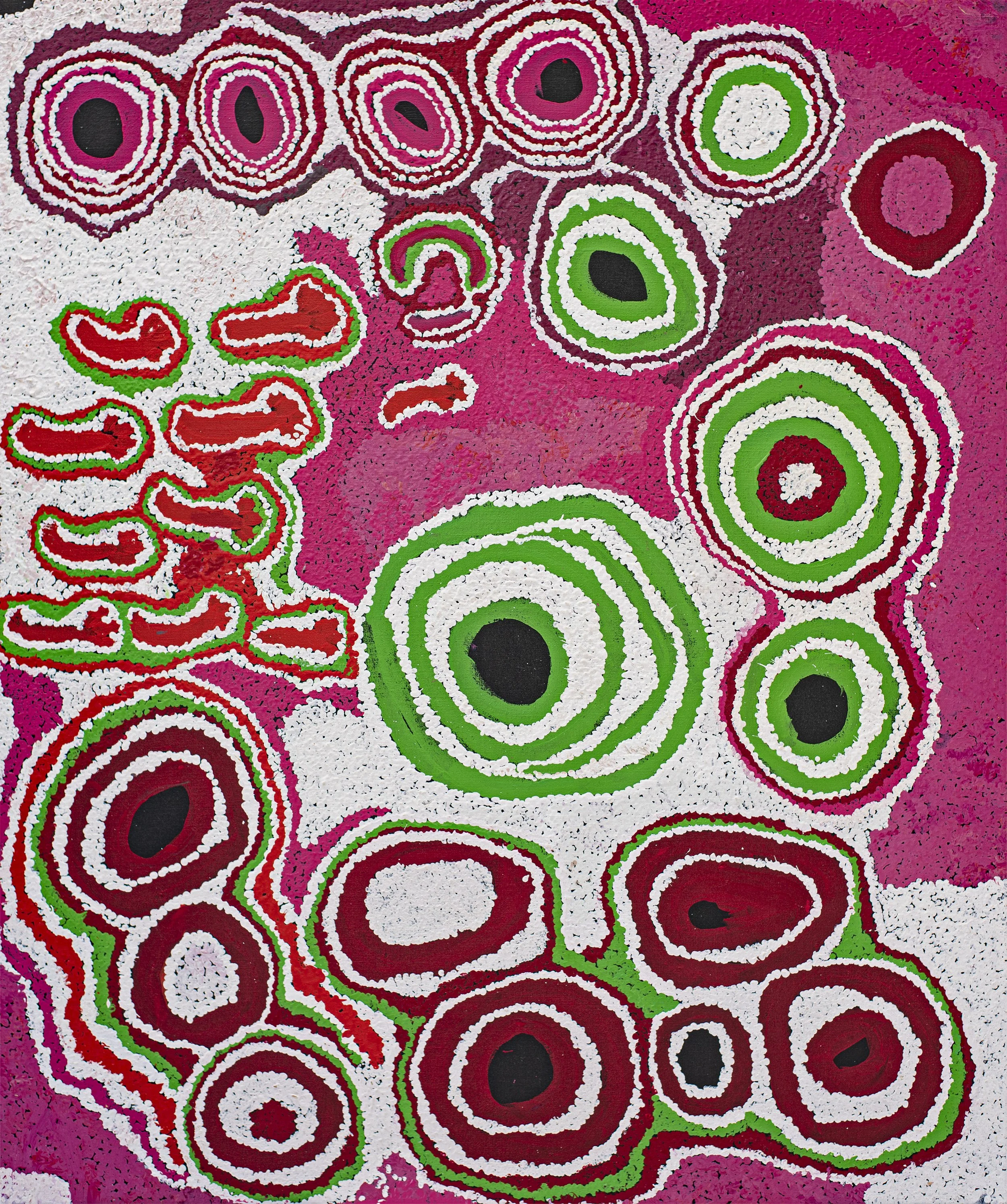
Artiste : Tjaruwa Woods
Titre de l'œuvre : Waratata
Format : 108 x 90 cm
Provenance et certificat : centre d'art aborigène du Spinifex Art Project
Référence de cette peinture : 13214
Demander le prix de l'œuvre / Enquiry
Explications pour cette œuvre :
Tjaruwa (1954) paints with a knowledge and a devotion to the country that formed her. She was a young woman when she and her immediate family 'walked in' from the Great Victoria Desert in the remote east of Western Australia. This was deemed inhospitable country by the encroaching 'new world' and perceived as so vast and uninhabited, that it made the ideal site to detonate and observe the new wave of nuclear explosions conducted as part of the British Atomic Testing during the 1950's.
Tjaruwa and her family were there, living, breathing, hunting, walking over the soft red carpet of sand, learning the paths of the creation beings who shaped this landscape and made the moral world possible. She slept under a vast expanse by campfire and drank water from tree roots. She learnt the fine art of survival in an arid but spiritual world and how to navigate an environment full of meaning. Tjaruwa paints like she breathes, an almost innate required constant. As she depicts the significant site of Kamanti, she is well aware of the creation manifestation of the Wati Kutjara (Two Men Creation Line) and that these Two Men still reside in the well-formed water cavities that penetrate deep into middle earth. She knows with all her learned experience that these Two Men are to be feared but treated with reverence all the same, for they can travel underground as the enormous water serpents that they are, or walk the landscape in the form of mortal men. And as she sings the sites onto the two dimensional plane, let us appreciate through the panoramic composition that comes from a lifetime of breathing in this country.
Tjaruwa was born in 1954 outside the Spinifex Determination Area at Warutjara, the place of Minyma Tjilkamata - the Echidna Woman, near the current community of Jamieson (Manta Maru) within the Ngaanyatjarra Lands. Except for possession of a few pieces of iron, fashioned into implements and tin bowls Tjaruwa lived traditionally until the winter of 1986 when her family group of seven was located in northern Spinifex by a group of Spinifex people making a sortie into country to re-visit important Men’s sites after some 25 years of absence. Tjaruwa came in with a small son on her hip and camped with her family firstly at Yakatunya, 90 kilometres south of Tjuntjuntjara, joined the moving camp which accompanied the construction of a road, 300 kilometres through the length of the Spinifex Lands, before settling permanently at Tjuntjuntjara in 1989. Tjaruwa was adjudged to be about 32 years old in 1986 and was given the birth date 1/7/1954. At this point in time (2014),Tjaruwa’s family remains the last Aboriginal group in the country to make first contact with contemporary Australia.
It is difficult to even imagine the changes Tjaruwa was to encounter living in her new world. She had acquired an extended network of kin to establish relationships with, the daily activity of hunting and gathering was essentially replaced by the community store and water was abundant.
Tjaruwa’s immediate priority was to care for her mother and uncle living in their new circumstances and it was not until her mother passed away that she took up an interest in painting. At first she tended to paint as she observed other women painting and then the accumulated experience of her other life and her mother’s stories/designs poured out and Tjaruwa’s unique Spinifex perspective was translated with spectacular style and technique on to canvas.
Nyangatja minyma kutju nyinanyi ka Minyma Tjilkamata nyinanyi ka kapi Waratata ka nyangatja ngura ngayuku nyuntjungku ngayulu itimantangka nyarinyi ka paluru mapitja ka minyma kutjupangku ngayulu makati. This painting is depicting the place of the echidna women from the time of creation. This place is called Waratata and she is sitting down here.
Her artworks are in the following prestigious collections :
Art Gallery Of South Australia, Adelaide Sa (Women’s Collaborative)
National Gallery Of Australia, Canberra
National Gallery Of Victoria, Melbourne Vic (Women’s Collaborative)
Richard And Harriet England Collection
Seattle Art Museum, Seattle Usa (Women’s Collaborative)
The British Museum, London, England.(Womens Collaborative)
The Corrigan Collection, Australia
The Lepley Collection, Perth, Western Australia.
The Sims Dickson Collection, Nsw
Parliament House Art Collection, Canberra, Act (Womens Collaborative)
W. & V. Mcgeoch Collection, Melbourne, Vic.
The Berndt Collection, University Of Western Australia.

Artiste : Tjaruwa Woods
Titre de l'œuvre : Watani
Format : 137 x 110 cm
Provenance et certificat : centre d'art aborigène du Spinifex Art Project
Référence de cette peinture : 14071
Demander le prix de l'œuvre / Enquiry
Explications pour cette œuvre :
Tjaruwa (1954) paints with a knowledge and a devotion to the country that formed her. She was a young woman when she and her immediate family 'walked in' from the Great Victoria Desert in the remote east of Western Australia. This was deemed inhospitable country by the encroaching 'new world' and perceived as so vast and uninhabited, that it made the ideal site to detonate and observe the new wave of nuclear explosions conducted as part of the British Atomic Testing during the 1950's.
Tjaruwa and her family were there, living, breathing, hunting, walking over the soft red carpet of sand, learning the paths of the creation beings who shaped this landscape and made the moral world possible. She slept under a vast expanse by campfire and drank water from tree roots. She learnt the fine art of survival in an arid but spiritual world and how to navigate an environment full of meaning. Tjaruwa paints like she breathes, an almost innate required constant. As she depicts the significant site of Kamanti, she is well aware of the creation manifestation of the Wati Kutjara (Two Men Creation Line) and that these Two Men still reside in the well-formed water cavities that penetrate deep into middle earth. She knows with all her learned experience that these Two Men are to be feared but treated with reverence all the same, for they can travel underground as the enormous water serpents that they are, or walk the landscape in the form of mortal men. And as she sings the sites onto the two dimensional plane, let us appreciate through the panoramic composition that comes from a lifetime of breathing in this country.
Tjaruwa was born in 1954 outside the Spinifex Determination Area at Warutjara, the place of Minyma Tjilkamata - the Echidna Woman, near the current community of Jamieson (Manta Maru) within the Ngaanyatjarra Lands. Except for possession of a few pieces of iron, fashioned into implements and tin bowls Tjaruwa lived traditionally until the winter of 1986 when her family group of seven was located in northern Spinifex by a group of Spinifex people making a sortie into country to re-visit important Men’s sites after some 25 years of absence. Tjaruwa came in with a small son on her hip and camped with her family firstly at Yakatunya, 90 kilometres south of Tjuntjuntjara, joined the moving camp which accompanied the construction of a road, 300 kilometres through the length of the Spinifex Lands, before settling permanently at Tjuntjuntjara in 1989. Tjaruwa was adjudged to be about 32 years old in 1986 and was given the birth date 1/7/1954. At this point in time (2014),Tjaruwa’s family remains the last Aboriginal group in the country to make first contact with contemporary Australia.
It is difficult to even imagine the changes Tjaruwa was to encounter living in her new world. She had acquired an extended network of kin to establish relationships with, the daily activity of hunting and gathering was essentially replaced by the community store and water was abundant.
Tjaruwa’s immediate priority was to care for her mother and uncle living in their new circumstances and it was not until her mother passed away that she took up an interest in painting. At first she tended to paint as she observed other women painting and then the accumulated experience of her other life and her mother’s stories/designs poured out and Tjaruwa’s unique Spinifex perspective was translated with spectacular style and technique on to canvas.
In this painting Tjaruwa Woods has painted Watani, an area in the northern section of the Spinifex Lands. It is sand hill country, with Spinifex and Mulga trees and very sparse water deposits usually in the form of rockholes which are quite small or soak water which you have to dig for. Tjanpi or Spinifex grasses were used to filter the water for drinking. To survive in this Western Desert area it is essential to know where to find the water and this knowledge has been passed down over thousands of years from generaon to generation. In the Tjukurpa the Emu Creator Beings possess great creative powers. They created numerous topographical features in the landscape as they passed through this area.
Her artworks are in the following prestigious collections :
Art Gallery Of South Australia, Adelaide Sa (Women’s Collaborative)
National Gallery Of Australia, Canberra
National Gallery Of Victoria, Melbourne Vic (Women’s Collaborative)
Richard And Harriet England Collection
Seattle Art Museum, Seattle Usa (Women’s Collaborative)
The British Museum, London, England.(Womens Collaborative)
The Corrigan Collection, Australia
The Lepley Collection, Perth, Western Australia.
The Sims Dickson Collection, Nsw
Parliament House Art Collection, Canberra, Act (Womens Collaborative)
W. & V. Mcgeoch Collection, Melbourne, Vic.
The Berndt Collection, University Of Western Australia.

Artiste : Mick Rictor
Titre de l'œuvre : untitled
Format : 110 x 85 cm
Provenance et certificat : centre d'art aborigène du Spinifex Art Project
Référence de cette peinture : 19-352
Demander le prix de l'œuvre / Enquiry
Explications pour cette œuvre :
Mick Rictor (1957) was around thirty years of age when he walked into modern civilisation for the first time from deep in the heart of the Great Victoria Desert in1986. A very remote and special place holding true wilderness character, like Mick himself. Other Anangu (Aboriginal people) refer to Mick as a wild man, ferocious like the old men used to be before people were softened by modern living.
Mick Rictor gives us freedom to contemplate. His compositions are both painterly and sparse leaving form and space intertwined and suspended. He is not quick to paint and peruses the blank canvas with hand on chin like Rodin's 'The Thinker' for a long period before selecting colour and brush to begin. But still it is a slow rhythmic placement of individual 'dots' that build up sometimes as a single colour, sometimes as multiple colours, one blanketing the other. His works reference the landscapes and changing colours of the Spinifex Country, the sweeping plains nestled in between parallel lines of sand dunes, the red rocky granite outcrops on the northern boundary, the sacred water holes and their ‘wanampi’ serpent guardians and 'mamu tjina' or scorer footprints from the Tjukurpa.
Mick was born at Kulpinya situated south of the significant site of Miramiratjara in the Great Victoria Desert sometime around 1956. This puts him in close proximity to the British Atomic Testing at Emu Fields and Maralinga during the '50s and '60s. Mick and his immediate family were living a nomadic life in and around traditional Spinifex Country up until 1986 when the family was located by relatives searching the area and taken to a then small settlement of Yakadunya and later Coonana. Mick is the eldest sibling of four with his other three siblings Ian and Noli Rictor and Tjaruwa Woods already established artists.
He started painting in 2016 and has a natural aesthetic with a painterly quality about his work.
Mick Rictor gives us freedom to contemplate. His compositions are both painterly and sparse, leaving form and space intertwined and suspended. He is not quick to paint and peruses the blank canvas with hand on chin like Rodin’s The Thinker for a long period before selecting colour and brush to begin. But still it is a slow rhythmic placement of individual ‘dots’ that build up somemes as a single colour, somemes as multiple colours, one blanketing the other. His works reference the landscapes and changing colours of the Spinifex Country, the sweeping plains nestled in between parallel lines of sand dunes, the red rocky granite outcrops on the northern boundary, the sacred waterholes and their wanampi (serpent guardians) and mamu tjina(sorcerer’s footprints) from the Tjukurpa.
His artworks are in the following prestigious collections :
Museum And Art Gallery Of The Northern Territory, Darwin, Australia.
Art Gallery Of South Australia, Adelaide, South Australia
Artbank, Australian Government Collection. Australia.
Araluen Gallery, Alice Springs, Northern Territory.
Charles Darwin University Art Collection, Darwin,Northern Territory
Richard And Harriett Collection, Australia
Arthur Roe Collection, Australia
The Sims Dickson Collection, Nsw

Artiste : Mick Rictor
Titre de l'œuvre : untitled
Format : 137 x 90 cm
Provenance et certificat : centre d'art aborigène du Spinifex Art Project
Référence de cette peinture : 22-205
Demander le prix de l'œuvre / Enquiry
Explications pour cette œuvre :
Mick Rictor (1957) was around thirty years of age when he walked into modern civilisation for the first time from deep in the heart of the Great Victoria Desert in1986. A very remote and special place holding true wilderness character, like Mick himself. Other Anangu (Aboriginal people) refer to Mick as a wild man, ferocious like the old men used to be before people were softened by modern living.
Mick Rictor gives us freedom to contemplate. His compositions are both painterly and sparse leaving form and space intertwined and suspended. He is not quick to paint and peruses the blank canvas with hand on chin like Rodin's 'The Thinker' for a long period before selecting colour and brush to begin. But still it is a slow rhythmic placement of individual 'dots' that build up sometimes as a single colour, sometimes as multiple colours, one blanketing the other. His works reference the landscapes and changing colours of the Spinifex Country, the sweeping plains nestled in between parallel lines of sand dunes, the red rocky granite outcrops on the northern boundary, the sacred water holes and their ‘wanampi’ serpent guardians and 'mamu tjina' or scorer footprints from the Tjukurpa.
Mick was born at Kulpinya situated south of the significant site of Miramiratjara in the Great Victoria Desert sometime around 1956. This puts him in close proximity to the British Atomic Testing at Emu Fields and Maralinga during the '50s and '60s. Mick and his immediate family were living a nomadic life in and around traditional Spinifex Country up until 1986 when the family was located by relatives searching the area and taken to a then small settlement of Yakadunya and later Coonana. Mick is the eldest sibling of four with his other three siblings Ian and Noli Rictor and Tjaruwa Woods already established artists.
He started painting in 2016 and has a natural aesthetic with a painterly quality about his work.
Mick Rictor gives us freedom to contemplate. His compositions are both painterly and sparse, leaving form and space intertwined and suspended. He is not quick to paint and peruses the blank canvas with hand on chin like Rodin’s The Thinker for a long period before selecting colour and brush to begin. But still it is a slow rhythmic placement of individual ‘dots’ that build up somemes as a single colour, somemes as multiple colours, one blanketing the other. His works reference the landscapes and changing colours of the Spinifex Country, the sweeping plains nestled in between parallel lines of sand dunes, the red rocky granite outcrops on the northern boundary, the sacred waterholes and their wanampi (serpent guardians) and mamu tjina(sorcerer’s footprints) from the Tjukurpa.
His artworks are in the following prestigious collections :
Museum And Art Gallery Of The Northern Territory, Darwin, Australia.
Art Gallery Of South Australia, Adelaide, South Australia
Artbank, Australian Government Collection. Australia.
Araluen Gallery, Alice Springs, Northern Territory.
Charles Darwin University Art Collection, Darwin,Northern Territory
Richard And Harriett Collection, Australia
Arthur Roe Collection, Australia
The Sims Dickson Collection, Nsw

Artiste : Mick Rictor
Titre de l'œuvre : untitled
Format : 95 x 85 cm
Provenance et certificat : centre d'art aborigène du Spinifex Art Project
Référence de cette peinture : 19-365
Demander le prix de l'œuvre / Enquiry
Explications pour cette œuvre :
Mick Rictor (1957) was around thirty years of age when he walked into modern civilisation for the first time from deep in the heart of the Great Victoria Desert in1986. A very remote and special place holding true wilderness character, like Mick himself. Other Anangu (Aboriginal people) refer to Mick as a wild man, ferocious like the old men used to be before people were softened by modern living.
Mick Rictor gives us freedom to contemplate. His compositions are both painterly and sparse leaving form and space intertwined and suspended. He is not quick to paint and peruses the blank canvas with hand on chin like Rodin's 'The Thinker' for a long period before selecting colour and brush to begin. But still it is a slow rhythmic placement of individual 'dots' that build up sometimes as a single colour, sometimes as multiple colours, one blanketing the other. His works reference the landscapes and changing colours of the Spinifex Country, the sweeping plains nestled in between parallel lines of sand dunes, the red rocky granite outcrops on the northern boundary, the sacred water holes and their ‘wanampi’ serpent guardians and 'mamu tjina' or scorer footprints from the Tjukurpa.
Mick was born at Kulpinya situated south of the significant site of Miramiratjara in the Great Victoria Desert sometime around 1956. This puts him in close proximity to the British Atomic Testing at Emu Fields and Maralinga during the '50s and '60s. Mick and his immediate family were living a nomadic life in and around traditional Spinifex Country up until 1986 when the family was located by relatives searching the area and taken to a then small settlement of Yakadunya and later Coonana. Mick is the eldest sibling of four with his other three siblings Ian and Noli Rictor and Tjaruwa Woods already established artists.
He started painting in 2016 and has a natural aesthetic with a painterly quality about his work.
Mick Rictor gives us freedom to contemplate. His compositions are both painterly and sparse, leaving form and space intertwined and suspended. He is not quick to paint and peruses the blank canvas with hand on chin like Rodin’s The Thinker for a long period before selecting colour and brush to begin. But still it is a slow rhythmic placement of individual ‘dots’ that build up somemes as a single colour, somemes as multiple colours, one blanketing the other. His works reference the landscapes and changing colours of the Spinifex Country, the sweeping plains nestled in between parallel lines of sand dunes, the red rocky granite outcrops on the northern boundary, the sacred waterholes and their wanampi (serpent guardians) and mamu tjina(sorcerer’s footprints) from the Tjukurpa.
His artworks are in the following prestigious collections :
Museum And Art Gallery Of The Northern Territory, Darwin, Australia.
Art Gallery Of South Australia, Adelaide, South Australia
Artbank, Australian Government Collection. Australia.
Araluen Gallery, Alice Springs, Northern Territory.
Charles Darwin University Art Collection, Darwin,Northern Territory
Richard And Harriett Collection, Australia
Arthur Roe Collection, Australia
The Sims Dickson Collection, Nsw

Artiste : Mick Rictor
Titre de l'œuvre : untitled
Format : 137 x 110 cm
Provenance et certificat : centre d'art aborigène du Spinifex Art Project
Référence de cette peinture : 22-206
Demander le prix de l'œuvre / Enquiry
Explications pour cette œuvre :
Mick Rictor (1957) was around thirty years of age when he walked into modern civilisation for the first time from deep in the heart of the Great Victoria Desert in1986. A very remote and special place holding true wilderness character, like Mick himself. Other Anangu (Aboriginal people) refer to Mick as a wild man, ferocious like the old men used to be before people were softened by modern living.
Mick Rictor gives us freedom to contemplate. His compositions are both painterly and sparse leaving form and space intertwined and suspended. He is not quick to paint and peruses the blank canvas with hand on chin like Rodin's 'The Thinker' for a long period before selecting colour and brush to begin. But still it is a slow rhythmic placement of individual 'dots' that build up sometimes as a single colour, sometimes as multiple colours, one blanketing the other. His works reference the landscapes and changing colours of the Spinifex Country, the sweeping plains nestled in between parallel lines of sand dunes, the red rocky granite outcrops on the northern boundary, the sacred water holes and their ‘wanampi’ serpent guardians and 'mamu tjina' or scorer footprints from the Tjukurpa.
Mick was born at Kulpinya situated south of the significant site of Miramiratjara in the Great Victoria Desert sometime around 1956. This puts him in close proximity to the British Atomic Testing at Emu Fields and Maralinga during the '50s and '60s. Mick and his immediate family were living a nomadic life in and around traditional Spinifex Country up until 1986 when the family was located by relatives searching the area and taken to a then small settlement of Yakadunya and later Coonana. Mick is the eldest sibling of four with his other three siblings Ian and Noli Rictor and Tjaruwa Woods already established artists.
He started painting in 2016 and has a natural aesthetic with a painterly quality about his work.
Mick Rictor gives us freedom to contemplate. His compositions are both painterly and sparse, leaving form and space intertwined and suspended. He is not quick to paint and peruses the blank canvas with hand on chin like Rodin’s The Thinker for a long period before selecting colour and brush to begin. But still it is a slow rhythmic placement of individual ‘dots’ that build up somemes as a single colour, somemes as multiple colours, one blanketing the other. His works reference the landscapes and changing colours of the Spinifex Country, the sweeping plains nestled in between parallel lines of sand dunes, the red rocky granite outcrops on the northern boundary, the sacred waterholes and their wanampi (serpent guardians) and mamu tjina(sorcerer’s footprints) from the Tjukurpa.
His artworks are in the following prestigious collections :
Museum And Art Gallery Of The Northern Territory, Darwin, Australia.
Art Gallery Of South Australia, Adelaide, South Australia
Artbank, Australian Government Collection. Australia.
Araluen Gallery, Alice Springs, Northern Territory.
Charles Darwin University Art Collection, Darwin,Northern Territory
Richard And Harriett Collection, Australia
Arthur Roe Collection, Australia
The Sims Dickson Collection, Nsw

Artiste : Mick Rictor
Titre de l'œuvre : untitled
Format : 137 x 90 cm
Provenance et certificat : centre d'art aborigène du Spinifex Art Project
Référence de cette peinture : 22-348
Demander le prix de l'œuvre / Enquiry
Explications pour cette œuvre :
Mick Rictor (1957) was around thirty years of age when he walked into modern civilisation for the first time from deep in the heart of the Great Victoria Desert in1986. A very remote and special place holding true wilderness character, like Mick himself. Other Anangu (Aboriginal people) refer to Mick as a wild man, ferocious like the old men used to be before people were softened by modern living.
Mick Rictor gives us freedom to contemplate. His compositions are both painterly and sparse leaving form and space intertwined and suspended. He is not quick to paint and peruses the blank canvas with hand on chin like Rodin's 'The Thinker' for a long period before selecting colour and brush to begin. But still it is a slow rhythmic placement of individual 'dots' that build up sometimes as a single colour, sometimes as multiple colours, one blanketing the other. His works reference the landscapes and changing colours of the Spinifex Country, the sweeping plains nestled in between parallel lines of sand dunes, the red rocky granite outcrops on the northern boundary, the sacred water holes and their ‘wanampi’ serpent guardians and 'mamu tjina' or scorer footprints from the Tjukurpa.
Mick was born at Kulpinya situated south of the significant site of Miramiratjara in the Great Victoria Desert sometime around 1956. This puts him in close proximity to the British Atomic Testing at Emu Fields and Maralinga during the '50s and '60s. Mick and his immediate family were living a nomadic life in and around traditional Spinifex Country up until 1986 when the family was located by relatives searching the area and taken to a then small settlement of Yakadunya and later Coonana. Mick is the eldest sibling of four with his other three siblings Ian and Noli Rictor and Tjaruwa Woods already established artists.
He started painting in 2016 and has a natural aesthetic with a painterly quality about his work.
Mick Rictor gives us freedom to contemplate. His compositions are both painterly and sparse, leaving form and space intertwined and suspended. He is not quick to paint and peruses the blank canvas with hand on chin like Rodin’s The Thinker for a long period before selecting colour and brush to begin. But still it is a slow rhythmic placement of individual ‘dots’ that build up somemes as a single colour, somemes as multiple colours, one blanketing the other. His works reference the landscapes and changing colours of the Spinifex Country, the sweeping plains nestled in between parallel lines of sand dunes, the red rocky granite outcrops on the northern boundary, the sacred waterholes and their wanampi (serpent guardians) and mamu tjina(sorcerer’s footprints) from the Tjukurpa.
His artworks are in the following prestigious collections :
Museum And Art Gallery Of The Northern Territory, Darwin, Australia.
Art Gallery Of South Australia, Adelaide, South Australia
Artbank, Australian Government Collection. Australia.
Araluen Gallery, Alice Springs, Northern Territory.
Charles Darwin University Art Collection, Darwin,Northern Territory
Richard And Harriett Collection, Australia
Arthur Roe Collection, Australia
The Sims Dickson Collection, Nsw

Artiste : Mick Rictor
Titre de l'œuvre : untitled
Format : 110 x 85 cm
Provenance et certificat : centre d'art aborigène du Spinifex Art Project
Référence de cette peinture : 22-347
Demander le prix de l'œuvre / Enquiry
Explications pour cette œuvre :
Mick Rictor (1957) was around thirty years of age when he walked into modern civilisation for the first time from deep in the heart of the Great Victoria Desert in1986. A very remote and special place holding true wilderness character, like Mick himself. Other Anangu (Aboriginal people) refer to Mick as a wild man, ferocious like the old men used to be before people were softened by modern living.
Mick Rictor gives us freedom to contemplate. His compositions are both painterly and sparse leaving form and space intertwined and suspended. He is not quick to paint and peruses the blank canvas with hand on chin like Rodin's 'The Thinker' for a long period before selecting colour and brush to begin. But still it is a slow rhythmic placement of individual 'dots' that build up sometimes as a single colour, sometimes as multiple colours, one blanketing the other. His works reference the landscapes and changing colours of the Spinifex Country, the sweeping plains nestled in between parallel lines of sand dunes, the red rocky granite outcrops on the northern boundary, the sacred water holes and their ‘wanampi’ serpent guardians and 'mamu tjina' or scorer footprints from the Tjukurpa.
Mick was born at Kulpinya situated south of the significant site of Miramiratjara in the Great Victoria Desert sometime around 1956. This puts him in close proximity to the British Atomic Testing at Emu Fields and Maralinga during the '50s and '60s. Mick and his immediate family were living a nomadic life in and around traditional Spinifex Country up until 1986 when the family was located by relatives searching the area and taken to a then small settlement of Yakadunya and later Coonana. Mick is the eldest sibling of four with his other three siblings Ian and Noli Rictor and Tjaruwa Woods already established artists.
He started painting in 2016 and has a natural aesthetic with a painterly quality about his work.
Mick Rictor gives us freedom to contemplate. His compositions are both painterly and sparse, leaving form and space intertwined and suspended. He is not quick to paint and peruses the blank canvas with hand on chin like Rodin’s The Thinker for a long period before selecting colour and brush to begin. But still it is a slow rhythmic placement of individual ‘dots’ that build up somemes as a single colour, somemes as multiple colours, one blanketing the other. His works reference the landscapes and changing colours of the Spinifex Country, the sweeping plains nestled in between parallel lines of sand dunes, the red rocky granite outcrops on the northern boundary, the sacred waterholes and their wanampi (serpent guardians) and mamu tjina(sorcerer’s footprints) from the Tjukurpa.
His artworks are in the following prestigious collections :
Museum And Art Gallery Of The Northern Territory, Darwin, Australia.
Art Gallery Of South Australia, Adelaide, South Australia
Artbank, Australian Government Collection. Australia.
Araluen Gallery, Alice Springs, Northern Territory.
Charles Darwin University Art Collection, Darwin,Northern Territory
Richard And Harriett Collection, Australia
Arthur Roe Collection, Australia
The Sims Dickson Collection, Nsw

Artiste : Mick Rictor
Titre de l'œuvre : untitled
Format : 110 x 85 cm
Provenance et certificat : centre d'art aborigène du Spinifex Art Project
Référence de cette peinture : 22-349
Demander le prix de l'œuvre / Enquiry
Explications pour cette œuvre :
Mick Rictor (1957) was around thirty years of age when he walked into modern civilisation for the first time from deep in the heart of the Great Victoria Desert in1986. A very remote and special place holding true wilderness character, like Mick himself. Other Anangu (Aboriginal people) refer to Mick as a wild man, ferocious like the old men used to be before people were softened by modern living.
Mick Rictor gives us freedom to contemplate. His compositions are both painterly and sparse leaving form and space intertwined and suspended. He is not quick to paint and peruses the blank canvas with hand on chin like Rodin's 'The Thinker' for a long period before selecting colour and brush to begin. But still it is a slow rhythmic placement of individual 'dots' that build up sometimes as a single colour, sometimes as multiple colours, one blanketing the other. His works reference the landscapes and changing colours of the Spinifex Country, the sweeping plains nestled in between parallel lines of sand dunes, the red rocky granite outcrops on the northern boundary, the sacred water holes and their ‘wanampi’ serpent guardians and 'mamu tjina' or scorer footprints from the Tjukurpa.
Mick was born at Kulpinya situated south of the significant site of Miramiratjara in the Great Victoria Desert sometime around 1956. This puts him in close proximity to the British Atomic Testing at Emu Fields and Maralinga during the '50s and '60s. Mick and his immediate family were living a nomadic life in and around traditional Spinifex Country up until 1986 when the family was located by relatives searching the area and taken to a then small settlement of Yakadunya and later Coonana. Mick is the eldest sibling of four with his other three siblings Ian and Noli Rictor and Tjaruwa Woods already established artists.
He started painting in 2016 and has a natural aesthetic with a painterly quality about his work.
Mick Rictor gives us freedom to contemplate. His compositions are both painterly and sparse, leaving form and space intertwined and suspended. He is not quick to paint and peruses the blank canvas with hand on chin like Rodin’s The Thinker for a long period before selecting colour and brush to begin. But still it is a slow rhythmic placement of individual ‘dots’ that build up somemes as a single colour, somemes as multiple colours, one blanketing the other. His works reference the landscapes and changing colours of the Spinifex Country, the sweeping plains nestled in between parallel lines of sand dunes, the red rocky granite outcrops on the northern boundary, the sacred waterholes and their wanampi (serpent guardians) and mamu tjina(sorcerer’s footprints) from the Tjukurpa.
His artworks are in the following prestigious collections :
Museum And Art Gallery Of The Northern Territory, Darwin, Australia.
Art Gallery Of South Australia, Adelaide, South Australia
Artbank, Australian Government Collection. Australia.
Araluen Gallery, Alice Springs, Northern Territory.
Charles Darwin University Art Collection, Darwin,Northern Territory
Richard And Harriett Collection, Australia
Arthur Roe Collection, Australia
The Sims Dickson Collection, Nsw

Artiste : Ian Rictor
Titre de l'œuvre : Tuwan Dreaming Time story
Format : 137 x 200 cm
Provenance et certificat : centre d'art aborigène du Spinifex Art Project
Référence de cette peinture : 22-175
Enquiry / Demander le prix de l'œuvre
Explications pour cette œuvre :
Ian Rictor (1960) paints with a quiet reverence for the country that he depicts, from his relatively recent nomadic movements over the endless interior that makes up Spinifex Lands. Ian walked from water source to food source and beyond, this was a cultural and family existence for survival in an arid land before his family were found and 'brought in' by relatives in 1986: making them the last known hunter gatherer in Australia.
Ian's compositions center on the life affirming sites he depicts and each are multi layered with meaning. Many are surrounded with secrecy and only surface details can be recorded.
Here he paints the significant site Tuwan situated in the heart of traditional Spinifex Country. It is at Tuwan, the Tjulpu Tjuta Tjukurpa (Many Birds Creation Line) manifests. This is an epic narrative following the journey of a group of Zebra Finch people as they journey south to save the world from rising seas. They use their spears to create giant ramparts to hold the sea back. These characters described are creation beings with the power of transformation, not just of themselves but the landscape they moved through. They left indelible physical reminders in a mapped environment and wrapped it in song and dance for all to follow.
His artworks are in the following prestigious collection :
Collection Prince Stefan Of Liechtenstein, Embassy Of Liechtenstein In Germany. (Mens Collaborate)
National Gallery Of Australia, Canberra, Act (Mens Collaborative)
Seattle Art Museum, Seattle, Usa. (Mens Collaborative)
The Aboriginal Art Museum, Utrecht
The British Museum, London. (Mens Collaborative)
The Corrigan Collection, Australia (Mens Collaborative)
Wagner And Owen Collection, Usa.
W. & V. Mcgeoch Collection, Melbourne, Vic. (Mens Collaborative)
Art Gallery Of South Australia, Adelaide, South Australia (Mens Collaborative)

Artiste : Ian Rictor
Titre de l'œuvre : Tuwan Dreaming Time story
Format : 137 x 90 cm
Provenance et certificat : centre d'art aborigène du Spinifex Art Project
Référence de cette peinture : 22-141
Enquiry / Demander le prix de l'œuvre
Explications pour cette œuvre :
Ian Rictor (1960) paints with a quiet reverence for the country that he depicts, from his relatively recent nomadic movements over the endless interior that makes up Spinifex Lands. Ian walked from water source to food source and beyond, this was a cultural and family existence for survival in an arid land before his family were found and 'brought in' by relatives in 1986: making them the last known hunter gatherer in Australia.
Ian's compositions center on the life affirming sites he depicts and each are multi layered with meaning. Many are surrounded with secrecy and only surface details can be recorded.
Here he paints the significant site Tuwan situated in the heart of traditional Spinifex Country. It is at Tuwan, the Tjulpu Tjuta Tjukurpa (Many Birds Creation Line) manifests. This is an epic narrative following the journey of a group of Zebra Finch people as they journey south to save the world from rising seas. They use their spears to create giant ramparts to hold the sea back. These characters described are creation beings with the power of transformation, not just of themselves but the landscape they moved through. They left indelible physical reminders in a mapped environment and wrapped it in song and dance for all to follow.
His artworks are in the following prestigious collection :
Collection Prince Stefan Of Liechtenstein, Embassy Of Liechtenstein In Germany. (Mens Collaborate)
National Gallery Of Australia, Canberra, Act (Mens Collaborative)
Seattle Art Museum, Seattle, Usa. (Mens Collaborative)
The Aboriginal Art Museum, Utrecht
The British Museum, London. (Mens Collaborative)
The Corrigan Collection, Australia (Mens Collaborative)
Wagner And Owen Collection, Usa.
W. & V. Mcgeoch Collection, Melbourne, Vic. (Mens Collaborative)
Art Gallery Of South Australia, Adelaide, South Australia (Mens Collaborative)

Artiste : Ian Rictor
Titre de l'œuvre : Tuwan Dreaming Time story
Format : 137 x 90 cm
Provenance et certificat : centre d'art aborigène du Spinifex Art Project
Référence de cette peinture : 22-110
Enquiry / Demander le prix de l'œuvre
Explications pour cette œuvre :
Ian Rictor (1960) paints with a quiet reverence for the country that he depicts, from his relatively recent nomadic movements over the endless interior that makes up Spinifex Lands. Ian walked from water source to food source and beyond, this was a cultural and family existence for survival in an arid land before his family were found and 'brought in' by relatives in 1986: making them the last known hunter gatherer in Australia.
Ian's compositions center on the life affirming sites he depicts and each are multi layered with meaning. Many are surrounded with secrecy and only surface details can be recorded.
Here he paints the significant site Tuwan situated in the heart of traditional Spinifex Country. It is at Tuwan, the Tjulpu Tjuta Tjukurpa (Many Birds Creation Line) manifests. This is an epic narrative following the journey of a group of Zebra Finch people as they journey south to save the world from rising seas. They use their spears to create giant ramparts to hold the sea back. These characters described are creation beings with the power of transformation, not just of themselves but the landscape they moved through. They left indelible physical reminders in a mapped environment and wrapped it in song and dance for all to follow.
His artworks are in the following prestigious collection :
Collection Prince Stefan Of Liechtenstein, Embassy Of Liechtenstein In Germany. (Mens Collaborate)
National Gallery Of Australia, Canberra, Act (Mens Collaborative)
Seattle Art Museum, Seattle, Usa. (Mens Collaborative)
The Aboriginal Art Museum, Utrecht
The British Museum, London. (Mens Collaborative)
The Corrigan Collection, Australia (Mens Collaborative)
Wagner And Owen Collection, Usa.
W. & V. Mcgeoch Collection, Melbourne, Vic. (Mens Collaborative)
Art Gallery Of South Australia, Adelaide, South Australia (Mens Collaborative)

Artiste : Ian Rictor
Titre de l'œuvre : Tuwan Dreaming Time story
Format : 137 x 90 cm
Provenance et certificat : centre d'art aborigène du Spinifex Art Project
Référence de cette peinture : 22-80
Enquiry / Demander le prix de l'œuvre
Explications pour cette œuvre :
Ian Rictor (1960) paints with a quiet reverence for the country that he depicts, from his relatively recent nomadic movements over the endless interior that makes up Spinifex Lands. Ian walked from water source to food source and beyond, this was a cultural and family existence for survival in an arid land before his family were found and 'brought in' by relatives in 1986: making them the last known hunter gatherer in Australia.
Ian's compositions center on the life affirming sites he depicts and each are multi layered with meaning. Many are surrounded with secrecy and only surface details can be recorded.
Here he paints the significant site Tuwan situated in the heart of traditional Spinifex Country. It is at Tuwan, the Tjulpu Tjuta Tjukurpa (Many Birds Creation Line) manifests. This is an epic narrative following the journey of a group of Zebra Finch people as they journey south to save the world from rising seas. They use their spears to create giant ramparts to hold the sea back. These characters described are creation beings with the power of transformation, not just of themselves but the landscape they moved through. They left indelible physical reminders in a mapped environment and wrapped it in song and dance for all to follow.
His artworks are in the following prestigious collection :
Collection Prince Stefan Of Liechtenstein, Embassy Of Liechtenstein In Germany. (Mens Collaborate)
National Gallery Of Australia, Canberra, Act (Mens Collaborative)
Seattle Art Museum, Seattle, Usa. (Mens Collaborative)
The Aboriginal Art Museum, Utrecht
The British Museum, London. (Mens Collaborative)
The Corrigan Collection, Australia (Mens Collaborative)
Wagner And Owen Collection, Usa.
W. & V. Mcgeoch Collection, Melbourne, Vic. (Mens Collaborative)
Art Gallery Of South Australia, Adelaide, South Australia (Mens Collaborative)

Artiste : Ian Rictor
Titre de l'œuvre : Tuwan Dreaming Time story
Format : 137 x 140 cm
Provenance et certificat : centre d'art aborigène du Spinifex Art Project
Référence de cette peinture : 22-294
Enquiry / Demander le prix de l'œuvre
Explications pour cette œuvre :
Ian Rictor (1960) paints with a quiet reverence for the country that he depicts, from his relatively recent nomadic movements over the endless interior that makes up Spinifex Lands. Ian walked from water source to food source and beyond, this was a cultural and family existence for survival in an arid land before his family were found and 'brought in' by relatives in 1986: making them the last known hunter gatherer in Australia.
Ian's compositions center on the life affirming sites he depicts and each are multi layered with meaning. Many are surrounded with secrecy and only surface details can be recorded.
Here he paints the significant site Tuwan situated in the heart of traditional Spinifex Country. It is at Tuwan, the Tjulpu Tjuta Tjukurpa (Many Birds Creation Line) manifests. This is an epic narrative following the journey of a group of Zebra Finch people as they journey south to save the world from rising seas. They use their spears to create giant ramparts to hold the sea back. These characters described are creation beings with the power of transformation, not just of themselves but the landscape they moved through. They left indelible physical reminders in a mapped environment and wrapped it in song and dance for all to follow.
His artworks are in the following prestigious collection :
Collection Prince Stefan Of Liechtenstein, Embassy Of Liechtenstein In Germany. (Mens Collaborate)
National Gallery Of Australia, Canberra, Act (Mens Collaborative)
Seattle Art Museum, Seattle, Usa. (Mens Collaborative)
The Aboriginal Art Museum, Utrecht
The British Museum, London. (Mens Collaborative)
The Corrigan Collection, Australia (Mens Collaborative)
Wagner And Owen Collection, Usa.
W. & V. Mcgeoch Collection, Melbourne, Vic. (Mens Collaborative)
Art Gallery Of South Australia, Adelaide, South Australia (Mens Collaborative)

Artiste : Ian Rictor
Titre de l'œuvre : Tuwan Dreaming Time story
Format : 200 x 137 cm
Provenance et certificat : centre d'art aborigène du Spinifex Art Project
Référence de cette peinture : 19-451
Enquiry / Demander le prix de l'œuvre
Explications pour cette œuvre :
Ian Rictor (1960) paints with a quiet reverence for the country that he depicts, from his relatively recent nomadic movements over the endless interior that makes up Spinifex Lands. Ian walked from water source to food source and beyond, this was a cultural and family existence for survival in an arid land before his family were found and 'brought in' by relatives in 1986: making them the last known hunter gatherer in Australia.
Ian's compositions center on the life affirming sites he depicts and each are multi layered with meaning. Many are surrounded with secrecy and only surface details can be recorded.
Here he paints the significant site Tuwan situated in the heart of traditional Spinifex Country. It is at Tuwan, the Tjulpu Tjuta Tjukurpa (Many Birds Creation Line) manifests. This is an epic narrative following the journey of a group of Zebra Finch people as they journey south to save the world from rising seas. They use their spears to create giant ramparts to hold the sea back. These characters described are creation beings with the power of transformation, not just of themselves but the landscape they moved through. They left indelible physical reminders in a mapped environment and wrapped it in song and dance for all to follow.
His artworks are in the following prestigious collection :
Collection Prince Stefan Of Liechtenstein, Embassy Of Liechtenstein In Germany. (Mens Collaborate)
National Gallery Of Australia, Canberra, Act (Mens Collaborative)
Seattle Art Museum, Seattle, Usa. (Mens Collaborative)
The Aboriginal Art Museum, Utrecht
The British Museum, London. (Mens Collaborative)
The Corrigan Collection, Australia (Mens Collaborative)
Wagner And Owen Collection, Usa.
W. & V. Mcgeoch Collection, Melbourne, Vic. (Mens Collaborative)
Art Gallery Of South Australia, Adelaide, South Australia (Mens Collaborative)

Artiste : Ian Rictor
Titre de l'œuvre : Tuwan Dreaming Time story
Format : 137 x 110 cm
Provenance et certificat : centre d'art aborigène du Spinifex Art Project
Référence de cette peinture : 22-214
Enquiry / Demander le prix de l'œuvre
Explications pour cette œuvre :
Ian Rictor (1960) paints with a quiet reverence for the country that he depicts, from his relatively recent nomadic movements over the endless interior that makes up Spinifex Lands. Ian walked from water source to food source and beyond, this was a cultural and family existence for survival in an arid land before his family were found and 'brought in' by relatives in 1986: making them the last known hunter gatherer in Australia.
Ian's compositions center on the life affirming sites he depicts and each are multi layered with meaning. Many are surrounded with secrecy and only surface details can be recorded.
Here he paints the significant site Tuwan situated in the heart of traditional Spinifex Country. It is at Tuwan, the Tjulpu Tjuta Tjukurpa (Many Birds Creation Line) manifests. This is an epic narrative following the journey of a group of Zebra Finch people as they journey south to save the world from rising seas. They use their spears to create giant ramparts to hold the sea back. These characters described are creation beings with the power of transformation, not just of themselves but the landscape they moved through. They left indelible physical reminders in a mapped environment and wrapped it in song and dance for all to follow.
His artworks are in the following prestigious collection :
Collection Prince Stefan Of Liechtenstein, Embassy Of Liechtenstein In Germany. (Mens Collaborate)
National Gallery Of Australia, Canberra, Act (Mens Collaborative)
Seattle Art Museum, Seattle, Usa. (Mens Collaborative)
The Aboriginal Art Museum, Utrecht
The British Museum, London. (Mens Collaborative)
The Corrigan Collection, Australia (Mens Collaborative)
Wagner And Owen Collection, Usa.
W. & V. Mcgeoch Collection, Melbourne, Vic. (Mens Collaborative)
Art Gallery Of South Australia, Adelaide, South Australia (Mens Collaborative)

Artiste : Ian Rictor
Titre de l'œuvre : Tuwan Dreaming Time story
Format : 110 x 95 cm
Provenance et certificat : centre d'art aborigène du Spinifex Art Project
Référence de cette peinture : 22-303
Enquiry / Demander le prix de l'œuvre
Explications pour cette œuvre :
Ian Rictor (1960) paints with a quiet reverence for the country that he depicts, from his relatively recent nomadic movements over the endless interior that makes up Spinifex Lands. Ian walked from water source to food source and beyond, this was a cultural and family existence for survival in an arid land before his family were found and 'brought in' by relatives in 1986: making them the last known hunter gatherer in Australia.
Ian's compositions center on the life affirming sites he depicts and each are multi layered with meaning. Many are surrounded with secrecy and only surface details can be recorded.
Here he paints the significant site Tuwan situated in the heart of traditional Spinifex Country. It is at Tuwan, the Tjulpu Tjuta Tjukurpa (Many Birds Creation Line) manifests. This is an epic narrative following the journey of a group of Zebra Finch people as they journey south to save the world from rising seas. They use their spears to create giant ramparts to hold the sea back. These characters described are creation beings with the power of transformation, not just of themselves but the landscape they moved through. They left indelible physical reminders in a mapped environment and wrapped it in song and dance for all to follow.
His artworks are in the following prestigious collection :
Collection Prince Stefan Of Liechtenstein, Embassy Of Liechtenstein In Germany. (Mens Collaborate)
National Gallery Of Australia, Canberra, Act (Mens Collaborative)
Seattle Art Museum, Seattle, Usa. (Mens Collaborative)
The Aboriginal Art Museum, Utrecht
The British Museum, London. (Mens Collaborative)
The Corrigan Collection, Australia (Mens Collaborative)
Wagner And Owen Collection, Usa.
W. & V. Mcgeoch Collection, Melbourne, Vic. (Mens Collaborative)
Art Gallery Of South Australia, Adelaide, South Australia (Mens Collaborative)

Artiste : Tjaruwa Woods
Titre de l'œuvre : Kamanti
Format : 200 x 137 cm
Provenance et certificat : centre d'art aborigène du Spinifex Art Project
Référence de cette peinture : 18-150
Demander le prix de l'œuvre / Enquiry
Explications pour cette œuvre :
Tjaruwa (1954) paints with a knowledge and a devotion to the country that formed her. She was a young woman when she and her immediate family 'walked in' from the Great Victoria Desert in the remote east of Western Australia. This was deemed inhospitable country by the encroaching 'new world' and perceived as so vast and uninhabited, that it made the ideal site to detonate and observe the new wave of nuclear explosions conducted as part of the British Atomic Testing during the 1950's.
Tjaruwa and her family were there, living, breathing, hunting, walking over the soft red carpet of sand, learning the paths of the creation beings who shaped this landscape and made the moral world possible. She slept under a vast expanse by campfire and drank water from tree roots. She learnt the fine art of survival in an arid but spiritual world and how to navigate an environment full of meaning. Tjaruwa paints like she breathes, an almost innate required constant. As she depicts the significant site of Kamanti, she is well aware of the creation manifestation of the Wati Kutjara (Two Men Creation Line) and that these Two Men still reside in the well-formed water cavities that penetrate deep into middle earth. She knows with all her learned experience that these Two Men are to be feared but treated with reverence all the same, for they can travel underground as the enormous water serpents that they are, or walk the landscape in the form of mortal men. And as she sings the sites onto the two dimensional plane, let us appreciate through the panoramic composition that comes from a lifetime of breathing in this country.
Tjaruwa was born in 1954 outside the Spinifex Determination Area at Warutjara, the place of Minyma Tjilkamata - the Echidna Woman, near the current community of Jamieson (Manta Maru) within the Ngaanyatjarra Lands. Except for possession of a few pieces of iron, fashioned into implements and tin bowls Tjaruwa lived traditionally until the winter of 1986 when her family group of seven was located in northern Spinifex by a group of Spinifex people making a sortie into country to re-visit important Men’s sites after some 25 years of absence. Tjaruwa came in with a small son on her hip and camped with her family firstly at Yakatunya, 90 kilometres south of Tjuntjuntjara, joined the moving camp which accompanied the construction of a road, 300 kilometres through the length of the Spinifex Lands, before settling permanently at Tjuntjuntjara in 1989. Tjaruwa was adjudged to be about 32 years old in 1986 and was given the birth date 1/7/1954. At this point in time (2014),Tjaruwa’s family remains the last Aboriginal group in the country to make first contact with contemporary Australia.
It is difficult to even imagine the changes Tjaruwa was to encounter living in her new world. She had acquired an extended network of kin to establish relationships with, the daily activity of hunting and gathering was essentially replaced by the community store and water was abundant.
Tjaruwa’s immediate priority was to care for her mother and uncle living in their new circumstances and it was not until her mother passed away that she took up an interest in painting. At first she tended to paint as she observed other women painting and then the accumulated experience of her other life and her mother’s stories/designs poured out and Tjaruwa’s unique Spinifex perspective was translated with spectacular style and technique on to canvas.
Tjaruwa comes from an area of many sandhills and rock holes which is what she paints in this painting. Kamanti is a major rockhole and within this vicinity are the water holes and significant sites of Nyuman, Kuru Ala and Tuwan. This area also has the presence of the Seven Sisters Tjukurpa running through it, an epic song line which traverses the Western Desert. The circles represent the rockholes whilst the lines of colour show the many sandhills and travelling tracks. Water sources are a precious resource in the desert and feature strongly in the Tjukurpa and thus the paintings of the Spinifex artists. These stories of Creation beings with magical powers forming country as the lived their lives criss cross over the desert landscape. These beings are alive in the country today.
Her artworks are in the following prestigious collections :
Art Gallery Of South Australia, Adelaide Sa (Women’s Collaborative)
National Gallery Of Australia, Canberra
National Gallery Of Victoria, Melbourne Vic (Women’s Collaborative)
Richard And Harriet England Collection
Seattle Art Museum, Seattle Usa (Women’s Collaborative)
The British Museum, London, England.(Womens Collaborative)
The Corrigan Collection, Australia
The Lepley Collection, Perth, Western Australia.
The Sims Dickson Collection, Nsw
Parliament House Art Collection, Canberra, Act (Womens Collaborative)
W. & V. Mcgeoch Collection, Melbourne, Vic.
The Berndt Collection, University Of Western Australia.

Artiste : Tjaruwa Woods
Titre de l'œuvre : Waratata
Format : 136 x 90 cm
Provenance et certificat : centre d'art aborigène du Spinifex Art Project
Référence de cette peinture : 13329
Demander le prix de l'œuvre / Enquiry
Explications pour cette œuvre :
Tjaruwa (1954) paints with a knowledge and a devotion to the country that formed her. She was a young woman when she and her immediate family 'walked in' from the Great Victoria Desert in the remote east of Western Australia. This was deemed inhospitable country by the encroaching 'new world' and perceived as so vast and uninhabited, that it made the ideal site to detonate and observe the new wave of nuclear explosions conducted as part of the British Atomic Testing during the 1950's.
Tjaruwa and her family were there, living, breathing, hunting, walking over the soft red carpet of sand, learning the paths of the creation beings who shaped this landscape and made the moral world possible. She slept under a vast expanse by campfire and drank water from tree roots. She learnt the fine art of survival in an arid but spiritual world and how to navigate an environment full of meaning. Tjaruwa paints like she breathes, an almost innate required constant. As she depicts the significant site of Kamanti, she is well aware of the creation manifestation of the Wati Kutjara (Two Men Creation Line) and that these Two Men still reside in the well-formed water cavities that penetrate deep into middle earth. She knows with all her learned experience that these Two Men are to be feared but treated with reverence all the same, for they can travel underground as the enormous water serpents that they are, or walk the landscape in the form of mortal men. And as she sings the sites onto the two dimensional plane, let us appreciate through the panoramic composition that comes from a lifetime of breathing in this country.
Tjaruwa was born in 1954 outside the Spinifex Determination Area at Warutjara, the place of Minyma Tjilkamata - the Echidna Woman, near the current community of Jamieson (Manta Maru) within the Ngaanyatjarra Lands. Except for possession of a few pieces of iron, fashioned into implements and tin bowls Tjaruwa lived traditionally until the winter of 1986 when her family group of seven was located in northern Spinifex by a group of Spinifex people making a sortie into country to re-visit important Men’s sites after some 25 years of absence. Tjaruwa came in with a small son on her hip and camped with her family firstly at Yakatunya, 90 kilometres south of Tjuntjuntjara, joined the moving camp which accompanied the construction of a road, 300 kilometres through the length of the Spinifex Lands, before settling permanently at Tjuntjuntjara in 1989. Tjaruwa was adjudged to be about 32 years old in 1986 and was given the birth date 1/7/1954. At this point in time (2014),Tjaruwa’s family remains the last Aboriginal group in the country to make first contact with contemporary Australia.
It is difficult to even imagine the changes Tjaruwa was to encounter living in her new world. She had acquired an extended network of kin to establish relationships with, the daily activity of hunting and gathering was essentially replaced by the community store and water was abundant.
Tjaruwa’s immediate priority was to care for her mother and uncle living in their new circumstances and it was not until her mother passed away that she took up an interest in painting. At first she tended to paint as she observed other women painting and then the accumulated experience of her other life and her mother’s stories/designs poured out and Tjaruwa’s unique Spinifex perspective was translated with spectacular style and technique on to canvas.
Nyangatja minyma kutju nyinanyi ka Minyma Tjilkamata nyinanyi ka kapi Waratata ka nyangatja ngura ngayuku nyuntjungku ngayulu itimantangka nyarinyi ka paluru mapitja ka minyma kutjupangku ngayulu makati. This painting is depicting the place of the echidna women from the time of creation. This place is called Waratata and she is sitting down here.
Her artworks are in the following prestigious collections :
Art Gallery Of South Australia, Adelaide Sa (Women’s Collaborative)
National Gallery Of Australia, Canberra
National Gallery Of Victoria, Melbourne Vic (Women’s Collaborative)
Richard And Harriet England Collection
Seattle Art Museum, Seattle Usa (Women’s Collaborative)
The British Museum, London, England.(Womens Collaborative)
The Corrigan Collection, Australia
The Lepley Collection, Perth, Western Australia.
The Sims Dickson Collection, Nsw
Parliament House Art Collection, Canberra, Act (Womens Collaborative)
W. & V. Mcgeoch Collection, Melbourne, Vic.
The Berndt Collection, University Of Western Australia.

Artiste : Tjaruwa Woods
Titre de l'œuvre : Kamanti
Format : 200 x 137 cm
Provenance et certificat : centre d'art aborigène du Spinifex Art Project
Référence de cette peinture : 18-139
Demander le prix de l'œuvre / Enquiry
Explications pour cette œuvre :
Tjaruwa (1954) paints with a knowledge and a devotion to the country that formed her. She was a young woman when she and her immediate family 'walked in' from the Great Victoria Desert in the remote east of Western Australia. This was deemed inhospitable country by the encroaching 'new world' and perceived as so vast and uninhabited, that it made the ideal site to detonate and observe the new wave of nuclear explosions conducted as part of the British Atomic Testing during the 1950's.
Tjaruwa and her family were there, living, breathing, hunting, walking over the soft red carpet of sand, learning the paths of the creation beings who shaped this landscape and made the moral world possible. She slept under a vast expanse by campfire and drank water from tree roots. She learnt the fine art of survival in an arid but spiritual world and how to navigate an environment full of meaning. Tjaruwa paints like she breathes, an almost innate required constant. As she depicts the significant site of Kamanti, she is well aware of the creation manifestation of the Wati Kutjara (Two Men Creation Line) and that these Two Men still reside in the well-formed water cavities that penetrate deep into middle earth. She knows with all her learned experience that these Two Men are to be feared but treated with reverence all the same, for they can travel underground as the enormous water serpents that they are, or walk the landscape in the form of mortal men. And as she sings the sites onto the two dimensional plane, let us appreciate through the panoramic composition that comes from a lifetime of breathing in this country.
Tjaruwa was born in 1954 outside the Spinifex Determination Area at Warutjara, the place of Minyma Tjilkamata - the Echidna Woman, near the current community of Jamieson (Manta Maru) within the Ngaanyatjarra Lands. Except for possession of a few pieces of iron, fashioned into implements and tin bowls Tjaruwa lived traditionally until the winter of 1986 when her family group of seven was located in northern Spinifex by a group of Spinifex people making a sortie into country to re-visit important Men’s sites after some 25 years of absence. Tjaruwa came in with a small son on her hip and camped with her family firstly at Yakatunya, 90 kilometres south of Tjuntjuntjara, joined the moving camp which accompanied the construction of a road, 300 kilometres through the length of the Spinifex Lands, before settling permanently at Tjuntjuntjara in 1989. Tjaruwa was adjudged to be about 32 years old in 1986 and was given the birth date 1/7/1954. At this point in time (2014),Tjaruwa’s family remains the last Aboriginal group in the country to make first contact with contemporary Australia.
It is difficult to even imagine the changes Tjaruwa was to encounter living in her new world. She had acquired an extended network of kin to establish relationships with, the daily activity of hunting and gathering was essentially replaced by the community store and water was abundant.
Tjaruwa’s immediate priority was to care for her mother and uncle living in their new circumstances and it was not until her mother passed away that she took up an interest in painting. At first she tended to paint as she observed other women painting and then the accumulated experience of her other life and her mother’s stories/designs poured out and Tjaruwa’s unique Spinifex perspective was translated with spectacular style and technique on to canvas.
Tjaruwa comes from an area of many sandhills and rock holes which is what she paints in this painting. Kamanti is a major rockhole and within this vicinity are the water holes and significant sites of Nyuman, Kuru Ala and Tuwan. This area also has the presence of the Seven Sisters Tjukurpa running through it, an epic song line which traverses the Western Desert. The circles represent the rockholes whilst the lines of colour show the many sandhills and travelling tracks. Water sources are a precious resource in the desert and feature strongly in the Tjukurpa and thus the paintings of the Spinifex artists. These stories of Creation beings with magical powers forming country as the lived their lives criss cross over the desert landscape. These beings are alive in the country today.
Her artworks are in the following prestigious collections :
Art Gallery Of South Australia, Adelaide Sa (Women’s Collaborative)
National Gallery Of Australia, Canberra
National Gallery Of Victoria, Melbourne Vic (Women’s Collaborative)
Richard And Harriet England Collection
Seattle Art Museum, Seattle Usa (Women’s Collaborative)
The British Museum, London, England.(Womens Collaborative)
The Corrigan Collection, Australia
The Lepley Collection, Perth, Western Australia.
The Sims Dickson Collection, Nsw
Parliament House Art Collection, Canberra, Act (Womens Collaborative)
W. & V. Mcgeoch Collection, Melbourne, Vic.
The Berndt Collection, University Of Western Australia.

Artiste : Tjaruwa Woods
Titre de l'œuvre : Kapi
Format : 95 x 85 cm
Provenance et certificat : centre d'art aborigène du Spinifex Art Project
Référence de cette peinture : 19-224
Demander le prix de l'œuvre / Enquiry
Explications pour cette œuvre :
Tjaruwa (1954) paints with a knowledge and a devotion to the country that formed her. She was a young woman when she and her immediate family 'walked in' from the Great Victoria Desert in the remote east of Western Australia. This was deemed inhospitable country by the encroaching 'new world' and perceived as so vast and uninhabited, that it made the ideal site to detonate and observe the new wave of nuclear explosions conducted as part of the British Atomic Testing during the 1950's.
Tjaruwa and her family were there, living, breathing, hunting, walking over the soft red carpet of sand, learning the paths of the creation beings who shaped this landscape and made the moral world possible. She slept under a vast expanse by campfire and drank water from tree roots. She learnt the fine art of survival in an arid but spiritual world and how to navigate an environment full of meaning. Tjaruwa paints like she breathes, an almost innate required constant. As she depicts the significant site of Kamanti, she is well aware of the creation manifestation of the Wati Kutjara (Two Men Creation Line) and that these Two Men still reside in the well-formed water cavities that penetrate deep into middle earth. She knows with all her learned experience that these Two Men are to be feared but treated with reverence all the same, for they can travel underground as the enormous water serpents that they are, or walk the landscape in the form of mortal men. And as she sings the sites onto the two dimensional plane, let us appreciate through the panoramic composition that comes from a lifetime of breathing in this country.
Tjaruwa was born in 1954 outside the Spinifex Determination Area at Warutjara, the place of Minyma Tjilkamata - the Echidna Woman, near the current community of Jamieson (Manta Maru) within the Ngaanyatjarra Lands. Except for possession of a few pieces of iron, fashioned into implements and tin bowls Tjaruwa lived traditionally until the winter of 1986 when her family group of seven was located in northern Spinifex by a group of Spinifex people making a sortie into country to re-visit important Men’s sites after some 25 years of absence. Tjaruwa came in with a small son on her hip and camped with her family firstly at Yakatunya, 90 kilometres south of Tjuntjuntjara, joined the moving camp which accompanied the construction of a road, 300 kilometres through the length of the Spinifex Lands, before settling permanently at Tjuntjuntjara in 1989. Tjaruwa was adjudged to be about 32 years old in 1986 and was given the birth date 1/7/1954. At this point in time (2014),Tjaruwa’s family remains the last Aboriginal group in the country to make first contact with contemporary Australia.
It is difficult to even imagine the changes Tjaruwa was to encounter living in her new world. She had acquired an extended network of kin to establish relationships with, the daily activity of hunting and gathering was essentially replaced by the community store and water was abundant.
Tjaruwa’s immediate priority was to care for her mother and uncle living in their new circumstances and it was not until her mother passed away that she took up an interest in painting. At first she tended to paint as she observed other women painting and then the accumulated experience of her other life and her mother’s stories/designs poured out and Tjaruwa’s unique Spinifex perspective was translated with spectacular style and technique on to canvas.
Tjaruwa has painted here the area around which she was born and grew up. "Water sources are a precious resource in the desert and feature strongly in the Tjukurpa and thus the paintings of the Spinifex artists. These stories of Creation beings with magical powers forming country as the lived their lives criss cross over the desert landscape. These beings are alive in the country today. Wanampis (mythical water serpents) still guard the water holes. Anangu know to approach such places with reverence according to cultural law.
Her artworks are in the following prestigious collections :
Art Gallery Of South Australia, Adelaide Sa (Women’s Collaborative)
National Gallery Of Australia, Canberra
National Gallery Of Victoria, Melbourne Vic (Women’s Collaborative)
Richard And Harriet England Collection
Seattle Art Museum, Seattle Usa (Women’s Collaborative)
The British Museum, London, England.(Womens Collaborative)
The Corrigan Collection, Australia
The Lepley Collection, Perth, Western Australia.
The Sims Dickson Collection, Nsw
Parliament House Art Collection, Canberra, Act (Womens Collaborative)
W. & V. Mcgeoch Collection, Melbourne, Vic.
The Berndt Collection, University Of Western Australia.

Artiste : Tjaruwa Woods
Titre de l'œuvre : Kamanti
Format : 110 x 85 cm
Provenance et certificat : centre d'art aborigène du Spinifex Art Project
Référence de cette peinture : 17-239
Demander le prix de l'œuvre / Enquiry
Explications pour cette œuvre :
Tjaruwa (1954) paints with a knowledge and a devotion to the country that formed her. She was a young woman when she and her immediate family 'walked in' from the Great Victoria Desert in the remote east of Western Australia. This was deemed inhospitable country by the encroaching 'new world' and perceived as so vast and uninhabited, that it made the ideal site to detonate and observe the new wave of nuclear explosions conducted as part of the British Atomic Testing during the 1950's.
Tjaruwa and her family were there, living, breathing, hunting, walking over the soft red carpet of sand, learning the paths of the creation beings who shaped this landscape and made the moral world possible. She slept under a vast expanse by campfire and drank water from tree roots. She learnt the fine art of survival in an arid but spiritual world and how to navigate an environment full of meaning. Tjaruwa paints like she breathes, an almost innate required constant. As she depicts the significant site of Kamanti, she is well aware of the creation manifestation of the Wati Kutjara (Two Men Creation Line) and that these Two Men still reside in the well-formed water cavities that penetrate deep into middle earth. She knows with all her learned experience that these Two Men are to be feared but treated with reverence all the same, for they can travel underground as the enormous water serpents that they are, or walk the landscape in the form of mortal men. And as she sings the sites onto the two dimensional plane, let us appreciate through the panoramic composition that comes from a lifetime of breathing in this country.
Tjaruwa was born in 1954 outside the Spinifex Determination Area at Warutjara, the place of Minyma Tjilkamata - the Echidna Woman, near the current community of Jamieson (Manta Maru) within the Ngaanyatjarra Lands. Except for possession of a few pieces of iron, fashioned into implements and tin bowls Tjaruwa lived traditionally until the winter of 1986 when her family group of seven was located in northern Spinifex by a group of Spinifex people making a sortie into country to re-visit important Men’s sites after some 25 years of absence. Tjaruwa came in with a small son on her hip and camped with her family firstly at Yakatunya, 90 kilometres south of Tjuntjuntjara, joined the moving camp which accompanied the construction of a road, 300 kilometres through the length of the Spinifex Lands, before settling permanently at Tjuntjuntjara in 1989. Tjaruwa was adjudged to be about 32 years old in 1986 and was given the birth date 1/7/1954. At this point in time (2014),Tjaruwa’s family remains the last Aboriginal group in the country to make first contact with contemporary Australia.
It is difficult to even imagine the changes Tjaruwa was to encounter living in her new world. She had acquired an extended network of kin to establish relationships with, the daily activity of hunting and gathering was essentially replaced by the community store and water was abundant.
Tjaruwa’s immediate priority was to care for her mother and uncle living in their new circumstances and it was not until her mother passed away that she took up an interest in painting. At first she tended to paint as she observed other women painting and then the accumulated experience of her other life and her mother’s stories/designs poured out and Tjaruwa’s unique Spinifex perspective was translated with spectacular style and technique on to canvas.
Tjaruwa comes from an area of many sandhills and rock holes which is what she paints in this painting. Kamanti is a major rockhole and within this vicinity are the water holes and significant sites of Nyuman, Kuru Ala and Tuwan. This area also has the presence of the Seven Sisters Tjukurpa running through it, an epic song line which traverses the Western Desert. The circles represent the rockholes whilst the lines of colour show the many sandhills and travelling tracks. Water sources are a precious resource in the desert and feature strongly in the Tjukurpa and thus the paintings of the Spinifex artists. These stories of Creation beings with magical powers forming country as the lived their lives criss cross over the desert landscape. These beings are alive in the country today.
Her artworks are in the following prestigious collections :
Art Gallery Of South Australia, Adelaide Sa (Women’s Collaborative)
National Gallery Of Australia, Canberra
National Gallery Of Victoria, Melbourne Vic (Women’s Collaborative)
Richard And Harriet England Collection
Seattle Art Museum, Seattle Usa (Women’s Collaborative)
The British Museum, London, England.(Womens Collaborative)
The Corrigan Collection, Australia
The Lepley Collection, Perth, Western Australia.
The Sims Dickson Collection, Nsw
Parliament House Art Collection, Canberra, Act (Womens Collaborative)
W. & V. Mcgeoch Collection, Melbourne, Vic.
The Berndt Collection, University Of Western Australia.

Artiste : Ian Rictor
Titre de l'œuvre : Kamanti Dreaming Time story
Format : 137 x 140 cm
Provenance et certificat : centre d'art aborigène du Spinifex Art Project
Référence de cette peinture : 21-126
Enquiry / Demander le prix de l'œuvre
Explications pour cette œuvre :
Ian Rictor (1960) paints with a quiet reverence for the country that he depicts, from his relatively recent nomadic movements over the endless interior that makes up Spinifex Lands. Ian walked from water source to food source and beyond, this was a cultural and family existence for survival in an arid land before his family were found and 'brought in' by relatives in 1986: making them the last known hunter gatherer in Australia.
Ian's compositions center on the life affirming sites he depicts and each are multi layered with meaning. Many are surrounded with secrecy and only surface details can be recorded.
Here, Ian depicts country associated with the Wati Kutjara Tjukurpa (Two Men Creation Line). This is an immense narrative that follows two Wanampi (Water Serpent), a father and son, as they traverse the Spinifex Lands on ceremonial business and the significant site of Kamanti situated in the heart of Spinifex country and where the two men stayed for a period. These characters are creation beings who shaped the narrative within the landscape as they journeyed through it, leaving indelible physical reminders of their power and presence.
His artworks are in the following prestigious collection :
Collection Prince Stefan Of Liechtenstein, Embassy Of Liechtenstein In Germany. (Mens Collaborate)
National Gallery Of Australia, Canberra, Act (Mens Collaborative)
Seattle Art Museum, Seattle, Usa. (Mens Collaborative)
The Aboriginal Art Museum, Utrecht
The British Museum, London. (Mens Collaborative)
The Corrigan Collection, Australia (Mens Collaborative)
Wagner And Owen Collection, Usa.
W. & V. Mcgeoch Collection, Melbourne, Vic. (Mens Collaborative)
Art Gallery Of South Australia, Adelaide, South Australia (Mens Collaborative)

Artiste : Ian Rictor
Titre de l'œuvre : Tuwan Dreaming Time story
Format : 200 x 137 cm
Provenance et certificat : centre d'art aborigène du Spinifex Art Project
Référence de cette peinture : 19-182
Enquiry / Demander le prix de l'œuvre
Explications pour cette œuvre :
Ian Rictor (1960) paints with a quiet reverence for the country that he depicts, from his relatively recent nomadic movements over the endless interior that makes up Spinifex Lands. Ian walked from water source to food source and beyond, this was a cultural and family existence for survival in an arid land before his family were found and 'brought in' by relatives in 1986: making them the last known hunter gatherer in Australia.
Ian's compositions center on the life affirming sites he depicts and each are multi layered with meaning. Many are surrounded with secrecy and only surface details can be recorded.
Here he paints the significant site Tuwan situated in the heart of traditional Spinifex Country. It is at Tuwan, the Tjulpu Tjuta Tjukurpa (Many Birds Creation Line) manifests. This is an epic narrative following the journey of a group of Zebra Finch people as they journey south to save the world from rising seas. They use their spears to create giant ramparts to hold the sea back. These characters described are creation beings with the power of transformation, not just of themselves but the landscape they moved through. They left indelible physical reminders in a mapped environment and wrapped it in song and dance for all to follow.
His artworks are in the following prestigious collection :
Collection Prince Stefan Of Liechtenstein, Embassy Of Liechtenstein In Germany. (Mens Collaborate)
National Gallery Of Australia, Canberra, Act (Mens Collaborative)
Seattle Art Museum, Seattle, Usa. (Mens Collaborative)
The Aboriginal Art Museum, Utrecht
The British Museum, London. (Mens Collaborative)
The Corrigan Collection, Australia (Mens Collaborative)
Wagner And Owen Collection, Usa.
W. & V. Mcgeoch Collection, Melbourne, Vic. (Mens Collaborative)
Art Gallery Of South Australia, Adelaide, South Australia (Mens Collaborative)

Artiste : Ian Rictor
Titre de l'œuvre : Tuwan Dreaming Time story
Format : 200 x 137 cm
Provenance et certificat : centre d'art aborigène du Spinifex Art Project
Référence de cette peinture : 19-450
Enquiry / Demander le prix de l'œuvre
Explications pour cette œuvre :
Ian Rictor (1960) paints with a quiet reverence for the country that he depicts, from his relatively recent nomadic movements over the endless interior that makes up Spinifex Lands. Ian walked from water source to food source and beyond, this was a cultural and family existence for survival in an arid land before his family were found and 'brought in' by relatives in 1986: making them the last known hunter gatherer in Australia.
Ian's compositions center on the life affirming sites he depicts and each are multi layered with meaning. Many are surrounded with secrecy and only surface details can be recorded.
Here he paints the significant site Tuwan situated in the heart of traditional Spinifex Country. It is at Tuwan, the Tjulpu Tjuta Tjukurpa (Many Birds Creation Line) manifests. This is an epic narrative following the journey of a group of Zebra Finch people as they journey south to save the world from rising seas. They use their spears to create giant ramparts to hold the sea back. These characters described are creation beings with the power of transformation, not just of themselves but the landscape they moved through. They left indelible physical reminders in a mapped environment and wrapped it in song and dance for all to follow.
His artworks are in the following prestigious collection :
Collection Prince Stefan Of Liechtenstein, Embassy Of Liechtenstein In Germany. (Mens Collaborate)
National Gallery Of Australia, Canberra, Act (Mens Collaborative)
Seattle Art Museum, Seattle, Usa. (Mens Collaborative)
The Aboriginal Art Museum, Utrecht
The British Museum, London. (Mens Collaborative)
The Corrigan Collection, Australia (Mens Collaborative)
Wagner And Owen Collection, Usa.
W. & V. Mcgeoch Collection, Melbourne, Vic. (Mens Collaborative)
Art Gallery Of South Australia, Adelaide, South Australia (Mens Collaborative)
Artiste : Noli Rictor
Titre de l'œuvre : Kamanti
Format : 290 x 200 cm
Provenance et certificat : centre d'art aborigène du Spinifex Art Project
Référence de cette peinture : 21-349
Demander le prix de l'œuvre / Enquiry
Explications pour cette œuvre :
Noli has depicted the significant site of Kamanti situated in the north of traditional Spinifex lands. This site holds s the Wati Kutjara Tjukurpa (Two Men Creation Line) and is an epic narrative following the movement of a father and son water serpent who traverse the Spinifex Lands on ceremonial business. Noli depicts country he was born into and which formed his religious upbringing. The arid but spiritual environment was the birthplace of the creation beings who shaped the landscape as they moved through it. They left indelible physical reminders of their power in the form of creeks or rocky ridges or a type of tree.
But mostly they left their place of abode or the life giving sought after source of precious water, in some form of catchment. This water source is the embodiment of survival within the remote desert extremes with the sites being venerated as such and usually guarded by beings who shifted through the realms. They are the characters who dramatise the landscape and give rise to the formations through their movements. They leave behind a mapped moral landscape that holds an elaborate oral religion of song and performance that still permeates Noli's daily life.