
Exposition d’art Aborigène “Miwatj Miyalk – Les femmes du lever du soleil” - Aboriginal art from Australia
En association with Buku-Larrnggay Mulka Centre.
A la galerie Aboriginal Signature Estrangin : 101 rue Jules Besme, 1081 Bruxelles.
Vernissage sur RDV le mercredi 29 Novembre de 11h à 21h30.
A 20h - discours du directeur de la galerie et drink.
RSVP - réserver votre visite
Ensuite la galerie vous reçoit sur RDV, du jeudi 30 novembre au samedi 23 décembre 2023, du mardi au samedi, de 11h à 19h : vous pouvez également réserver votre visite dés à présent dans notre agenda ici.
Miwatj Miyalk – Les femmes du lever du soleil
La galerie Aboriginal Signature Estrangin est fière de vous présenter l’exposition «Miwatj Miyalk - Femmes du lever du soleil », réunissant près de 60 œuvres peintes en pigments naturels sur écorces de bois ou gravées sur des panneaux de signalisation, par 17 femmes artistes indigènes du peuple Yolngu dans le Territoire côtier du Nord de l'Australie.
« Il y a de nombreuses résonances dans le titre de cette exposition. La référence au lever du soleil annonce que cette œuvre provient de la région la plus à l’est du « Top End » australien, dans le Territoire du Nord.
Cette zone isolée appartient aux Indigènes d’Australie et reste contrôlée par eux, et fait face à l’aube alors que le soleil se lève à l’est sur le golfe de Carpenteria. Les femmes ici sont vénérées comme des êtres sacrés qui sont également assimilés au pouvoir vivifiant du Soleil.

Vue de l’exposition “Miwatj Miyalk – Les femmes du lever du soleil” à la galerie Aboriginal Signature Estrangin, with the courtesy of the artists and Buku arts.
Le territoire contrôlé par la nation des Yolŋu s'étend sur la moitié supérieure de la Terre d'Arnhem, soit 97 000 km². Au sein de ce territoire, il existe environ soixante clans distincts mais liés qui délimitent leurs domaines à travers des cycles de chants épiques qui se manifestent dans des modèles codés tels que ceux que l'on voit dans ces œuvres.
Chacun des motifs ici est littéralement un texte, une carte, une histoire, un titre de propriété, une généalogie ainsi qu'un instantané géographique, botanique et zoologique de l'essence du domaine représenté. La nation Yolŋu, qui est plus grande que la Belgique, est en fait une mosaïque de domaines représentés par ces dessins « signatures ». Les dessins sont transmis par ceux qui détiennent l'autorité à ceux dont l'essence est liée à ce pays particulier.

Vue de l’exposition “Miwatj Miyalk – Les femmes du lever du soleil” à la galerie Aboriginal Signature Estrangin, with the courtesy of the artists and Buku arts.
À partir des années 1970, les anciens ont commencé à encourager les femmes à peindre également afin que ce savoir sacré survive aux assauts d'une mine de bauxite suisse imposée aux Yolŋu contre leur gré. Cette décision proactive a abouti à une floraison de créativité qui a permis aux femmes Yolŋu d'acquérir une reconnaissance mondiale pour leurs œuvres magnifiques », souligne Will Stubbs, co-ordinator of the Buku-Larrnggay Mulka Centre.
Peindre ici est bien au-delà d’un acte artistique, c’est une révérence aux anciens, c’est une invocation de l’histoire portée depuis la nuit des temps, c’est une prière délicatement posée avec un geste remarquable dans les vibrations codifiées des formes.
Dans ces œuvres, l’ancrage résonne au plus profond, au plus intime du territoire dans des jeux de matières des ocres combinés subtiles des rouges, aux roses, et blancs nacrés, aux miroitements des compositions de sables des lieux sacrés de la nation Yolŋu.
Les représentations traversent les millénaires, des évocations figuratives des serpents arc en ciel connectées ici aux plus anciennes représentations de l’humanité il y a 50 000 ans, à celles innovantes gravées sur des médias occidentaux comme les panneaux routiers en métal avec la célébration de l’histoire épique de Wuyal liée aux cycles de vie des abeilles et du miel dans les arbres, au sein de la terre natale de Marrakulu.
Aujourd’hui on retrouve leurs œuvres dont les écorces peintes dans les plus prestigieuses collections muséales aujourd’hui comme les musées Australiens, le MET à New York, la Tate à Londres, le British Museum…
Les plus jeunes artistes figurent également comme finalistes dans les prestigieux prix artistiques australiens comme le NATSIAA Telstra Award chaque année.
Nous nous réjouissons de vous accueillir au sein de la galerie à Bruxelles, dans notre espace de 250 m2 tout entier dédié à ces grands et petits trésors du bout du monde.
Bertrand Estrangin
Directeur de la galerie
English text
Miwatj Miyalk- Women of the Sunrise
The Aboriginal Signature Estrangin gallery is proud to present the exhibition “Miwatj Miyalk - Women of the Lever of the Sun”, bringing together nearly 60 works painted in natural pigments on wooden bark or engraved on signage panels, by 17 indigenous women artists of the Yolngu people in the Northern Coast Territory of Australia.
“There are many resonances in the title of this exhibition. Reference to the sunrise announces that this work is from the most easterly region of Australia’s ‘Top End’ in the Northern Territory.
This remote Indigenous owned and controlled area faces the dawn as the sun rises in the east across the Gulf of Carpenteria.
Women are revered as sacred beings who are also equated with the life giving power of the Sun. The territory controlled by the nation of the Yolŋu extends across the top half of Arnhem Land which is 97,000 square km. Within this bloc there are approximately sixty distinct but related clans who delineate their estates through epic song cycles which are manifest in coded patterns such as are seen in these works.
Each of the patterns here is literally a text, a map, a history, a title deed, a genealogy as well as being a geographical, botanic, zoological snapshot of the essence of the estate depicted. The Yolŋu nation, which is larger than Belgium, is in fact a tapestry patchwork of estates represented by these ‘signature’ designs. The designs are passed down by those with authority to those whose essence connects to that particular country. From the 1970s the elders began to encourage women to paint as well so that this sacred knowledge would survive the onslaught of a Swiss Bauxite mine which had been imposed on the Yolŋu against their will.
This proactive decision has resulted in a flowering of creativity which has seen Yolŋu women achieve global recognition for their fine art”, emphasized Will Stubbs, co-ordinator of the Buku-Larrnggay Mulka Centre.
Painting here is well beyond an artistic act, it is a reverence to the ancients, it is an invocation of history carried since the dawn of time, it is a prayer delicately posed with a remarkable gesture in the codified vibrations of forms.
In these works, the anchor resonates deep, in the most intimate of the territory in plays of materials from the subtle combined ochres of reds, pinks, and pearly whites, to the shimmer of the sand compositions of the sacred places of the Yolŋu nation.
The representations span the millennia, from figurative evocations of rainbow serpents connected here to the oldest representations of humanity 50,000 years ago, to innovative ones engraved on Western media such as metal road signs with the celebration of the Wuyal's epic story linked to the life cycles of bees and honey in the trees, within the native land of Marrakulu.
Today we find their artworks as the painted barks in the prestigious museum collections today such as the Australian Museums, the MET in New York, the Tate in London, the British Museum… Younger artists also feature as finalists in prestigious Australian art awards such as the NATSIAA Telstra Award each year.
Découvrez les peintures disponibles à Bruxelles durant l’exposition :

Artiste : Dhuwarrwarr Marika (1945)
Titre de l'œuvre : Gäma-Wukitj Rulyapa
Pigments naturels sur écorce
Format : 134 x 72cm
Provenance et certificat original : centre d'art aborigène de Yirrkala
Référence de la peinture : 2673-20
© Photo & text : Aboriginal signature with the courtesy of the artist, & Buku-Larrngay Mulka.
Explication de l’œuvre :
This miny’tji represents Rulyapa, the rough saltwater country between Nhulunbuy and the large island of Dhambaliya (Bremer Island), ballooning up from the secret depths, around the sacred rock Manhala, which can be a manifestation of Daymirri. Daymirri is an enigmatic giant sea being (perhaps a whale shark) that according to Rirratjiŋu and Djambarrpuyŋu clan manikay (sacred song) pertains to the saltwater country close to Yirrkala. It is echoed in the dome-shaped rock Manhala which exposes itself at the low tide, above the raŋ (tide marks), bleached white, a patina of brine and weather.
Manhala is one of many names given to the rock. Djambarrpuyŋu and Rirratjiŋu clans have many ‘deep’ names that are intoned by the ritual specialists at the culmination of appropriate ceremony. The sea surrounding the rock, its tidal movements, differing states and the effect it had on Yolŋu visiting this site in Ancestral times is all recorded in the sacred song. As are all the totemic species of marine life that have these ancestral connections to the Rirratjiŋu and Djambarrpuyŋu. Oen painted in this design is Daymirri the whale, Balpa the rock cod, Djumbarr the red emperor, Ḏarrpa the king brown snake and Mutjalanydjal, the dolphin. All of these things and all of their meanings are implied simply by the presence of the miny’tji (sacred clan design) for the water.
It’s not just Manhala and the power associated with deep seated knowledge that makes this area both sacred and dangerous to those entering without authority. There are three other rocks in the area of same qualities but these ones; Wakwakbuy, Mulŋuwuy and Dharrpawuy, are submerged.
Her artworks are in the following prestigious collections :
Rautenstrauch Joest Museum, Cologne, Germany
Art Gallery of New South Wales, Sydney NSW
Artbank, Sydney NSW
Australian Capital Equity Collection, Perth WA
Berndt Museum, University of Western Australia, Perth WA
Charles Darwin University Art Collection
Estate of Kerry Packer Collection
Kerry Stokes Larrakitj Collection, WA
Kluge-Ruhe Aboriginal Art Collection of the University of Virginia. USA
South Australian Museum. Adelaide SA
Museum and Art Gallery of the Northern Territory, Darwin NT
Museum Natur und Mensch..

Artiste : Dhuwarrwarr Marika (1945)
Titre de l'œuvre : Yalaŋbara
Pigments naturels sur écorce
Format : 190 x 72cm
Provenance et certificat original : centre d'art aborigène de Yirrkala
Référence de la peinture : 1522-20
© Photo & text : Aboriginal signature with the courtesy of the artist, & Buku-Larrngay Mulka.
Explication de l’œuvre :
The songs which found this work’s meaning start as the Djaŋ’kawu Sisters journey from their mythical Atlantis-like island Burralku. They arrived in North-East Arnhem land at sunrise. Indeed, the name given to this part of Australia is Miwatj or Morning Side referring to the fact that this is the first part of the Top End to see the morning sun.
Matalatj (the elder sister who gives birth later in the story) and Bitjiwurrurru (her younger sister who acts as midwife) have just paddled their canoe a long way and then climbed the sand dunes to where they stop for a rest as the sun rises. The suns rays strike the Buwarta (English name Bustard ) and reflect off the water. As this happens the Sisters sing Buwarta and name it. They do the same as the sun strikes two other important Dhuwa birds related to the Rirratjingu clan , Lindirritj (rainbow lorikeet) and Ŋatili (black cockatoo).
The Sisters put their paddles down and it turned into the sacred djuta tree from which they hung their ceremonial bathi or sacred dili bags. Gowudalbudal (the male shining flycatcher) who sings the side coming in or going out sat on one of those trees.
The work has a representation of the sacred spring or Milŋurr that the Sisters found that morning. To Dhuwa people this motif represents knowledge. The pattern suggests the rippling outflowing waters. A child’s spirit resides in these waters until it gushes into existence and even then it remains watery for some time. Its fontanelle is a lingering manifestation of its origin…
A further stamp of clan ownership to Yalaŋbara is the use of the Rirratjiŋu clan crosshatched design. For those with the appropriate secret/sacred knowledge, the inner sanctums of Rirratjiŋu knowledge of ritual associated with the events of the Djaŋ’kawu can be read.
Her artworks are in the following prestigious collections :
Rautenstrauch Joest Museum, Cologne, Germany
Art Gallery of New South Wales, Sydney NSW
Artbank, Sydney NSW
Australian Capital Equity Collection, Perth WA
Berndt Museum, University of Western Australia, Perth WA
Charles Darwin University Art Collection
Estate of Kerry Packer Collection
Kerry Stokes Larrakitj Collection, WA
Kluge-Ruhe Aboriginal Art Collection of the University of Virginia. USA
South Australian Museum. Adelaide SA
Museum and Art Gallery of the Northern Territory, Darwin NT
Museum Natur und Mensch..

Artiste : Dhuwarrwarr Marika (1945)
Titre de l'œuvre : Milngurr
Pigments naturels sur écorce
Format : 155 x 84cm
Provenance et certificat original : centre d'art aborigène de Yirrkala
Référence de la peinture : 2242-20
© Photo & text : Aboriginal signature with the courtesy of the artist, & Buku-Larrngay Mulka.
Explication de l’œuvre :
The Djang’kawu follow the morning star by canoe from their residence of Burralku, an island of ancestral dead. With them they carry dilly bags, mats and digging sticks that manifest into sacred objects through ritual of song and dance that starts on the sea of travel and into the sand dunes rimming the landing shores of Yalangbara.
From Yalangbara the Djang'kawu set out on their epic journey of eastern Arnhem Land, travelling on what they sanctified as Dhuwa land, singing the country and splitting it up into clan estates, designating sacred law (madayin) song, dance, totem, language to each as they went. Thus the one side of the duality that governs the Yolngu of Arnhem Land - the two moiety system of the Dhuwa and the Yirritja, emanated from Yalangbara.
Today on the sandy beach at Yalangbara freshwater is found. By digging at the right location the freshwater seeps through the sand pooling in the hole dug. Rirratjingu song cycles celebrate the Djang’kawu creating this well by plunging the sacred Mawalan (digging stick) into this area as they strode up the beach with their possessions to to the sand dunes further up. This well with water of sacred and special qualities called Milngurr.
These sisters gave birth to all Dhuwa clans starting here.
Affected by salt on their sea journey and the incursion of freshwater at Yalangbara, the mixing of the two was the catalyst for procreation. Today the tides of the sea and flow of freshwater are sung to explain and ensure the cycles of conception, birth and death of the Rirratjingu from their clan lands (Yalangbara) to relate specifically to the powers of the Djang’kawu and the land they affected for the Dhuwa.
Her artworks are in the following prestigious collections :
Rautenstrauch Joest Museum, Cologne, Germany
Art Gallery of New South Wales, Sydney NSW
Artbank, Sydney NSW
Australian Capital Equity Collection, Perth WA
Berndt Museum, University of Western Australia, Perth WA
Charles Darwin University Art Collection
Estate of Kerry Packer Collection
Kerry Stokes Larrakitj Collection, WA
Kluge-Ruhe Aboriginal Art Collection of the University of Virginia. USA
South Australian Museum. Adelaide SA
Museum and Art Gallery of the Northern Territory, Darwin NT
Museum Natur und Mensch..

Artiste : Lamangirra #2 Gumana (1977)
Titre de l'œuvre : Garrapara
Pigments naturels sur écorce
Format : 84.5 x 31cm
Provenance et certificat original : centre d'art aborigène de Yirrkala
Référence de la peinture : 3261-22
© Photo & text : Aboriginal signature with the courtesy of the artist, & Buku-Larrngay Mulka.
Explication de l’œuvre :
Garrapara is a coastal headland and bay area within Blue Mud Bay. It is known on the maps in English a Djalma Bay. It marks the spot of a sacred burial area for the Dhalwangu clan and a site where dispute was formally settled by Makarrata (a trial of ordeal by spear which settled serious grievance and sealed the peace forever). At Garrapara sacred Casuarina trees held these barbed spears whilst not in use.
Makani the Queenfish hugs the shore almost beaching itself as it attacks schools of baitfish and has actually formed the features of the coastline of Djalma Bay.
During the creation times of the ‘first mornings’ ancestral hunters left the shores of Garrapara in their canoe towards the horizon hunting for turtle. Sacred songs and dance narrate the heroic adventures of these two men as they passed sacred areas, rocks and saw ancestral totems on their way. Their hunting came to grief, with the canoe capsizing and the hunters being drowned. The bodies washed back to the shores of Garrapara with the currents and the tides, as the Wangupini (maternal Thunderhead cumulo- nimbus cloud) followed with its rain and wind. Their canoe with paddle and their totems Makani (Queenfish) and Minyga (Long Tom) and Gärun (Loggerhead Turtle) are all referred to in the songs and landscape.
Garrapara has been rendered by the wavy design for Yirritja saltwater in Blue Mud Bay called Mungurru. The Mungurru is deep water that has many states and connects with the sacred waters coming from the land estates by currents and tidal action. This sacred design shows the water of Djalma Bay chopped up by the blustery South Easterlies of the early Dry season.
The miny’tji (sacred clan design) on this piece identifies the Dhalwaŋu saltwater estate of Garrapara on Blue Mud Bay.
Her artworks are in the following prestigious collections :
Art Gallery of New South Wales, Sydney NSW
Private European collections

Artiste : Dhuwarrwarr Marika (1945)
Titre de l'œuvre : Yalaŋbara
Pigments naturels sur écorce
Format : 140 x 57 cm
Provenance et certificat original : centre d'art aborigène de Yirrkala
Référence de la peinture : 1196-21
© Photo & text : Aboriginal signature with the courtesy of the artist, & Buku-Larrngay Mulka.
Explication de l’œuvre :
The songs which found this work’s meaning start as the Djaŋ’kawu Sisters journey from their mythical Atlantis-like island Burralku. They arrived in North-East Arnhem land at sunrise. Indeed, the name given to this part of Australia is Miwatj or Morning Side referring to the fact that this is the first part of the Top End to see the morning sun.
Matalatj (the elder sister who gives birth later in the story) and Bitjiwurrurru (her younger sister who acts as midwife) have just paddled their canoe a long way and then climbed the sand dunes to where they stop for a rest as the sun rises. The suns rays strike the Buwarta (English name Bustard ) and reflect off the water. As this happens the Sisters sing Buwarta and name it. They do the same as the sun strikes two other important Dhuwa birds related to the Rirratjingu clan , Lindirritj (rainbow lorikeet) and Ŋatili (black cockatoo).
The Sisters put their paddles down and it turned into the sacred djuta tree from which they hung their ceremonial bathi or sacred dili bags. Gowudalbudal (the male shining flycatcher) who sings the side coming in or going out sat on one of those trees.
The work has a representation of the sacred spring or Milŋurr that the Sisters found that morning. To Dhuwa people this motif represents knowledge. The pattern suggests the rippling outflowing waters. A child’s spirit resides in these waters until it gushes into existence and even then it remains watery for some time. Its fontanelle is a lingering manifestation of its origin…
A further stamp of clan ownership to Yalaŋbara is the use of the Rirratjiŋu clan crosshatched design. For those with the appropriate secret/sacred knowledge, the inner sanctums of Rirratjiŋu knowledge of ritual associated with the events of the Djaŋ’kawu can be read.
Her artworks are in the following prestigious collections :
Rautenstrauch Joest Museum, Cologne, Germany
Art Gallery of New South Wales, Sydney NSW
Artbank, Sydney NSW
Australian Capital Equity Collection, Perth WA
Berndt Museum, University of Western Australia, Perth WA
Charles Darwin University Art Collection
Estate of Kerry Packer Collection
Kerry Stokes Larrakitj Collection, WA
Kluge-Ruhe Aboriginal Art Collection of the University of Virginia. USA
South Australian Museum. Adelaide SA
Museum and Art Gallery of the Northern Territory, Darwin NT
Museum Natur und Mensch..

Artiste : Lamangirra #2 Gumana (1977)
Titre de l'œuvre : Garrapara
Pigments naturels sur écorce
Format : 119 x 30 cm
Provenance et certificat original : centre d'art aborigène de Yirrkala
Référence de la peinture : 2088-23
© Photo & text : Aboriginal signature with the courtesy of the artist, & Buku-Larrngay Mulka.
Explication de l’œuvre :
Garrapara is a coastal headland and bay area within Blue Mud Bay. It is known on the maps in English a Djalma Bay. It marks the spot of a sacred burial area for the Dhalwangu clan and a site where dispute was formally settled by Makarrata (a trial of ordeal by spear which settled serious grievance and sealed the peace forever). At Garrapara sacred Casuarina trees held these barbed spears whilst not in use.
Makani the Queenfish hugs the shore almost beaching itself as it attacks schools of baitfish and has actually formed the features of the coastline of Djalma Bay.
During the creation times of the ‘first mornings’ ancestral hunters left the shores of Garrapara in their canoe towards the horizon hunting for turtle. Sacred songs and dance narrate the heroic adventures of these two men as they passed sacred areas, rocks and saw ancestral totems on their way. Their hunting came to grief, with the canoe capsizing and the hunters being drowned. The bodies washed back to the shores of Garrapara with the currents and the tides, as the Wangupini (maternal Thunderhead cumulo- nimbus cloud) followed with its rain and wind. Their canoe with paddle and their totems Makani (Queenfish) and Minyga (Long Tom) and Gärun (Loggerhead Turtle) are all referred to in the songs and landscape.
Garrapara has been rendered by the wavy design for Yirritja saltwater in Blue Mud Bay called Mungurru. The Mungurru is deep water that has many states and connects with the sacred waters coming from the land estates by currents and tidal action. This sacred design shows the water of Djalma Bay chopped up by the blustery South Easterlies of the early Dry season.
The miny’tji (sacred clan design) on this piece identifies the Dhalwaŋu saltwater estate of Garrapara on Blue Mud Bay.
Her artworks are in the following prestigious collections :
Art Gallery of New South Wales, Sydney NSW
Private European collections
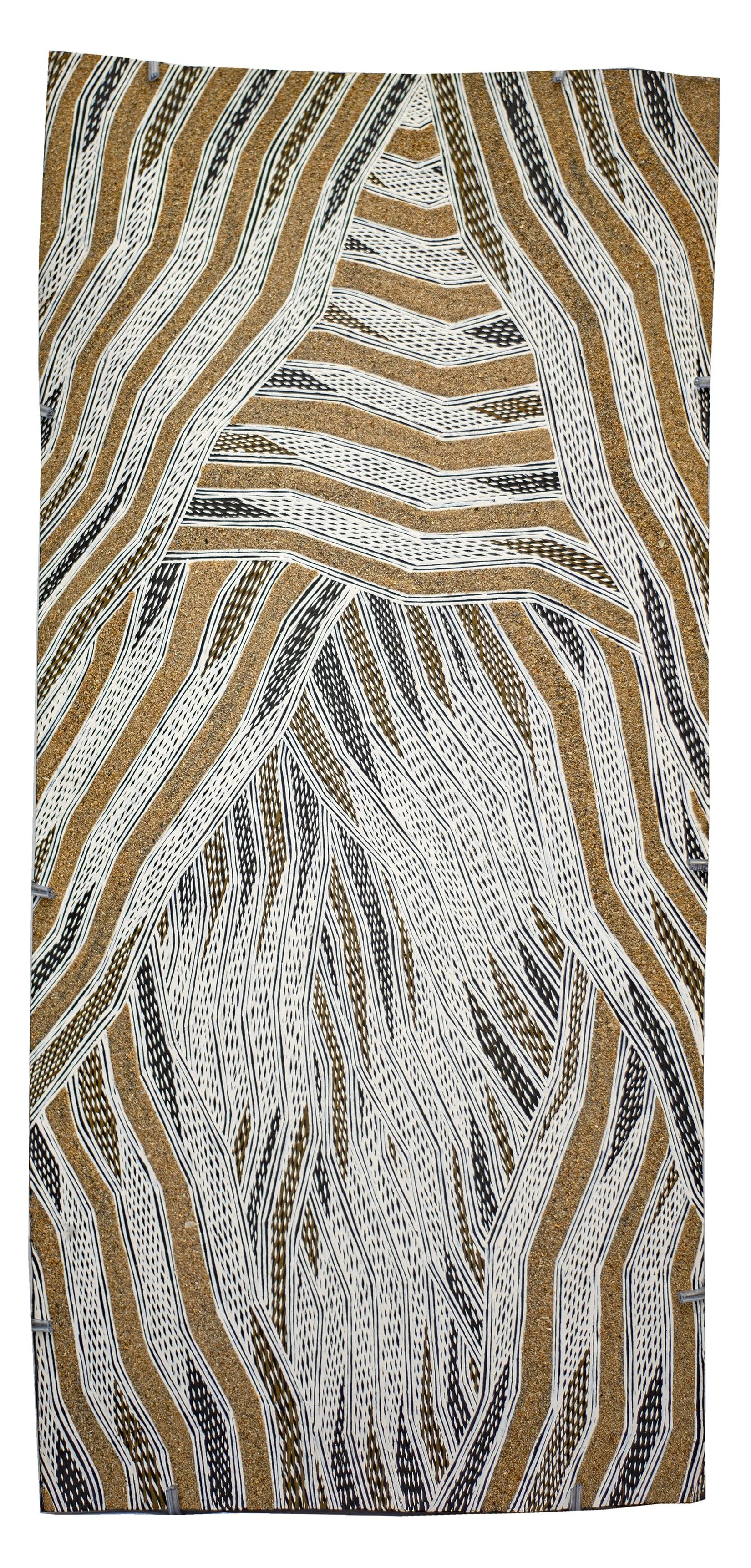
Artiste : Lamangirra #2 Gumana (1977)
Titre de l'œuvre : Garrapara
Pigments naturels sur écorce
Format : 68x33 cm
Provenance et certificat original : centre d'art aborigène de Yirrkala
Référence de la peinture : 3001-23
© Photo & text : Aboriginal signature with the courtesy of the artist, & Buku-Larrngay Mulka.
Explication de l’œuvre :
Garrapara is a coastal headland and bay area within Blue Mud Bay. It is known on the maps in English a Djalma Bay. It marks the spot of a sacred burial area for the Dhalwangu clan and a site where dispute was formally settled by Makarrata (a trial of ordeal by spear which settled serious grievance and sealed the peace forever). At Garrapara sacred Casuarina trees held these barbed spears whilst not in use.
Makani the Queenfish hugs the shore almost beaching itself as it attacks schools of baitfish and has actually formed the features of the coastline of Djalma Bay.
During the creation times of the ‘first mornings’ ancestral hunters left the shores of Garrapara in their canoe towards the horizon hunting for turtle. Sacred songs and dance narrate the heroic adventures of these two men as they passed sacred areas, rocks and saw ancestral totems on their way. Their hunting came to grief, with the canoe capsizing and the hunters being drowned. The bodies washed back to the shores of Garrapara with the currents and the tides, as the Wangupini (maternal Thunderhead cumulo- nimbus cloud) followed with its rain and wind. Their canoe with paddle and their totems Makani (Queenfish) and Minyga (Long Tom) and Gärun (Loggerhead Turtle) are all referred to in the songs and landscape.
Garrapara has been rendered by the wavy design for Yirritja saltwater in Blue Mud Bay called Mungurru. The Mungurru is deep water that has many states and connects with the sacred waters coming from the land estates by currents and tidal action. This sacred design shows the water of Djalma Bay chopped up by the blustery South Easterlies of the early Dry season.
The miny’tji (sacred clan design) on this piece identifies the Dhalwaŋu saltwater estate of Garrapara on Blue Mud Bay.
Her artworks are in the following prestigious collections :
Art Gallery of New South Wales, Sydney NSW
Private European collections

Artiste : Lamangirra #2 Gumana (1977)
Titre de l'œuvre : Garrapara
Pigments naturels sur écorce
Format : 90 x 42cm
Provenance et certificat original : centre d'art aborigène de Yirrkala
Référence de la peinture : 3666-23
© Photo & text : Aboriginal signature with the courtesy of the artist, & Buku-Larrngay Mulka.
Explication de l’œuvre :
Garrapara is a coastal headland and bay area within Blue Mud Bay. It is known on the maps in English a Djalma Bay. It marks the spot of a sacred burial area for the Dhalwangu clan and a site where dispute was formally settled by Makarrata (a trial of ordeal by spear which settled serious grievance and sealed the peace forever). At Garrapara sacred Casuarina trees held these barbed spears whilst not in use.
Makani the Queenfish hugs the shore almost beaching itself as it attacks schools of baitfish and has actually formed the features of the coastline of Djalma Bay.
During the creation times of the ‘first mornings’ ancestral hunters left the shores of Garrapara in their canoe towards the horizon hunting for turtle. Sacred songs and dance narrate the heroic adventures of these two men as they passed sacred areas, rocks and saw ancestral totems on their way. Their hunting came to grief, with the canoe capsizing and the hunters being drowned. The bodies washed back to the shores of Garrapara with the currents and the tides, as the Wangupini (maternal Thunderhead cumulo- nimbus cloud) followed with its rain and wind. Their canoe with paddle and their totems Makani (Queenfish) and Minyga (Long Tom) and Gärun (Loggerhead Turtle) are all referred to in the songs and landscape.
Garrapara has been rendered by the wavy design for Yirritja saltwater in Blue Mud Bay called Mungurru. The Mungurru is deep water that has many states and connects with the sacred waters coming from the land estates by currents and tidal action. This sacred design shows the water of Djalma Bay chopped up by the blustery South Easterlies of the early Dry season.
The miny’tji (sacred clan design) on this piece identifies the Dhalwaŋu saltwater estate of Garrapara on Blue Mud Bay.
Her artworks are in the following prestigious collections :
Art Gallery of New South Wales, Sydney NSW
Private European collections

Artiste : Lamangirra #2 Gumana (1977)
Titre de l'œuvre : Garrapara
Pigments naturels sur écorce
Format : 190x65 cm
Provenance et certificat original : centre d'art aborigène de Yirrkala
Référence de la peinture : 3201-21
© Photo & text : Aboriginal signature with the courtesy of the artist, & Buku-Larrngay Mulka.
Explication de l’œuvre :
Garrapara is a coastal headland and bay area within Blue Mud Bay. It is known on the maps in English a Djalma Bay. It marks the spot of a sacred burial area for the Dhalwangu clan and a site where dispute was formally settled by Makarrata (a trial of ordeal by spear which settled serious grievance and sealed the peace forever). At Garrapara sacred Casuarina trees held these barbed spears whilst not in use.
Makani the Queenfish hugs the shore almost beaching itself as it attacks schools of baitfish and has actually formed the features of the coastline of Djalma Bay.
During the creation times of the ‘first mornings’ ancestral hunters left the shores of Garrapara in their canoe towards the horizon hunting for turtle. Sacred songs and dance narrate the heroic adventures of these two men as they passed sacred areas, rocks and saw ancestral totems on their way. Their hunting came to grief, with the canoe capsizing and the hunters being drowned. The bodies washed back to the shores of Garrapara with the currents and the tides, as the Wangupini (maternal Thunderhead cumulo- nimbus cloud) followed with its rain and wind. Their canoe with paddle and their totems Makani (Queenfish) and Minyga (Long Tom) and Gärun (Loggerhead Turtle) are all referred to in the songs and landscape.
Garrapara has been rendered by the wavy design for Yirritja saltwater in Blue Mud Bay called Mungurru. The Mungurru is deep water that has many states and connects with the sacred waters coming from the land estates by currents and tidal action. This sacred design shows the water of Djalma Bay chopped up by the blustery South Easterlies of the early Dry season.
The miny’tji (sacred clan design) on this piece identifies the Dhalwaŋu saltwater estate of Garrapara on Blue Mud Bay.
Her artworks are in the following prestigious collections :
Art Gallery of New South Wales, Sydney NSW
Private European collections
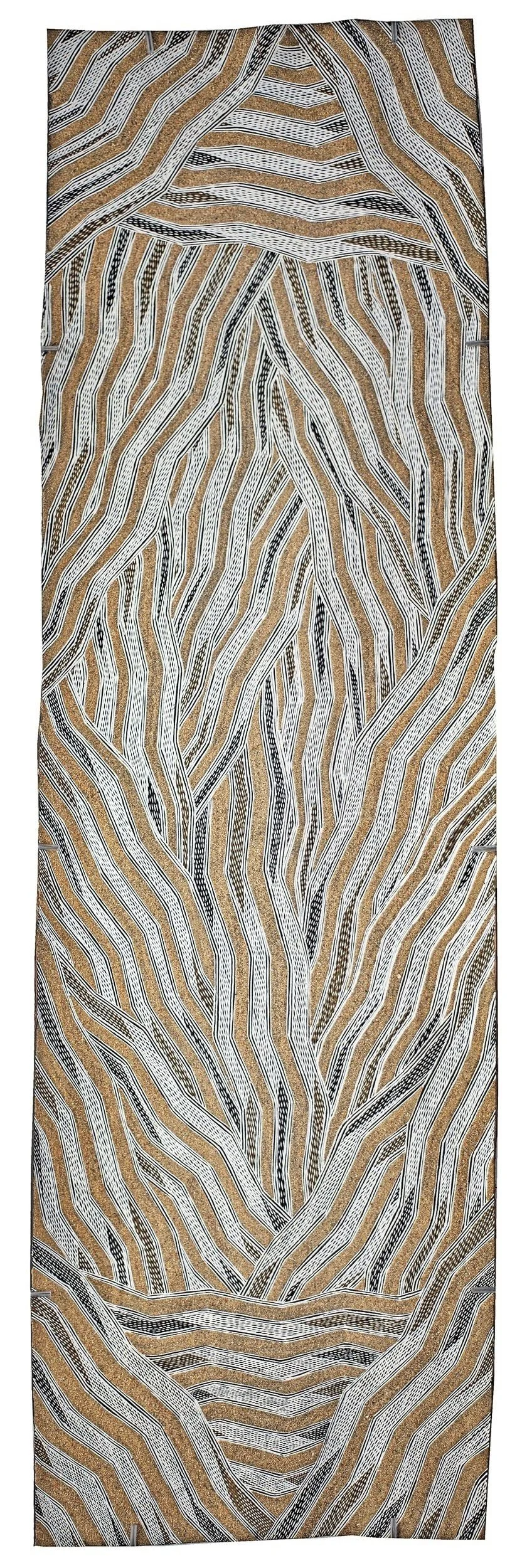
Artiste : Lamangirra #2 Gumana (1977)
Titre de l'œuvre : Garrapara
Pigments naturels sur écorce
Format : 136cm x 40cm
Provenance et certificat original : centre d'art aborigène de Yirrkala
Référence de la peinture : 2581-23
© Photo & text : Aboriginal signature with the courtesy of the artist, & Buku-Larrngay Mulka.
Explication de l’œuvre :
Garrapara is a coastal headland and bay area within Blue Mud Bay. It is known on the maps in English a Djalma Bay. It marks the spot of a sacred burial area for the Dhalwangu clan and a site where dispute was formally settled by Makarrata (a trial of ordeal by spear which settled serious grievance and sealed the peace forever). At Garrapara sacred Casuarina trees held these barbed spears whilst not in use.
Makani the Queenfish hugs the shore almost beaching itself as it attacks schools of baitfish and has actually formed the features of the coastline of Djalma Bay.
During the creation times of the ‘first mornings’ ancestral hunters left the shores of Garrapara in their canoe towards the horizon hunting for turtle. Sacred songs and dance narrate the heroic adventures of these two men as they passed sacred areas, rocks and saw ancestral totems on their way. Their hunting came to grief, with the canoe capsizing and the hunters being drowned. The bodies washed back to the shores of Garrapara with the currents and the tides, as the Wangupini (maternal Thunderhead cumulo- nimbus cloud) followed with its rain and wind. Their canoe with paddle and their totems Makani (Queenfish) and Minyga (Long Tom) and Gärun (Loggerhead Turtle) are all referred to in the songs and landscape.
Garrapara has been rendered by the wavy design for Yirritja saltwater in Blue Mud Bay called Mungurru. The Mungurru is deep water that has many states and connects with the sacred waters coming from the land estates by currents and tidal action. This sacred design shows the water of Djalma Bay chopped up by the blustery South Easterlies of the early Dry season.
The miny’tji (sacred clan design) on this piece identifies the Dhalwaŋu saltwater estate of Garrapara on Blue Mud Bay.
Her artworks are in the following prestigious collections :
Art Gallery of New South Wales, Sydney NSW
Private European collections

Artiste : Yimula Munuŋgurr
Titre de l'œuvre : Djapu Design
Pigments naturels sur écorce
Format : 95x56cm
Provenance et certificat original : centre d'art aborigène de Yirrkala
Référence de la peinture : 5641-21
© Photo : Aboriginal signature with the courtesy of the artist & Buku-Larrngay Mulka.
Explication de l’œuvre :
This bark painting by Yimula Munuŋgurr (1974) depicts with this cross hatching grid pattern, the sacred design for the freshwaters of the Djapu clan at their homeland Wandawuy now an outstation about 150 kilometres south of Yirrkala and inland from Blue Mud Bay. This Djapu clan outstation (and spiritual residence for Ancestral Beings Mäna the Shark and Bol’ŋu the Thunderman) is surrounded by permanent freshwater. Rains inspired by the actions of Bol’ŋu feed the rivers and fill the billabongs. Catfish and mussels, freshwater crayfish and others feed the Yolŋu and wild life. The waters are home for the shark Mäna.
The grid refers to the landscape of Wandawuy - a network of billabongs surrounded by ridges and high banks. Its structure also having reference at one level to woven fish traps. Ancestral Hunters set a trap here to snare the Shark but to no avail. These Yolngu people are called Bärngbarng and Monu'a who came to cut the trees named Gu'uwu, Gathurrmakarr, Nyenyi, Rulwirrika and Gananyarra - all Dhuwa trees. They used straight young trees nd cut them with their axes called Gayma`arri, Bitjutju…
Private collections.

Artiste : Yimula Munuŋgurr
Titre de l'œuvre : Djapu Design
Pigments naturels sur écorce
Format : 99cm x 56cm
Provenance et certificat original : centre d'art aborigène de Yirrkala
Référence de la peinture : 6449-22
© Photo : Aboriginal signature with the courtesy of the artist & Buku-Larrngay Mulka.
Explication de l’œuvre :
This bark painting by Yimula Munuŋgurr (1974) depicts with this cross hatching grid pattern, the sacred design for the freshwaters of the Djapu clan at their homeland Wandawuy now an outstation about 150 kilometres south of Yirrkala and inland from Blue Mud Bay. This Djapu clan outstation (and spiritual residence for Ancestral Beings Mäna the Shark and Bol’ŋu the Thunderman) is surrounded by permanent freshwater. Rains inspired by the actions of Bol’ŋu feed the rivers and fill the billabongs. Catfish and mussels, freshwater crayfish and others feed the Yolŋu and wild life. The waters are home for the shark Mäna.
The grid refers to the landscape of Wandawuy - a network of billabongs surrounded by ridges and high banks. Its structure also having reference at one level to woven fish traps. Ancestral Hunters set a trap here to snare the Shark but to no avail. These Yolngu people are called Bärngbarng and Monu'a who came to cut the trees named Gu'uwu, Gathurrmakarr, Nyenyi, Rulwirrika and Gananyarra - all Dhuwa trees. They used straight young trees nd cut them with their axes called Gayma`arri, Bitjutju…
Private collections.

Artiste : Dhopiya Yunupiŋu (1950)
Titre de l'œuvre : Galiku Buŋgul - Cloth Dance
Pigments naturels sur écorce
Format : 84cm x 40cm
Provenance et certificat original : centre d'art aborigène de Yirrkala
Référence de la peinture : 5835-22
© Photo : Aboriginal signature with the courtesy of the artist & Buku-Larrngay Mulka.
Explication de l’œuvre :
This piece was made for an exhibition by the artist Dhopiya Yunupiŋu at Sullivan & Strumpf in Sydney in 2023. Accompanying that exhibition was te following essay;
At the heart of the exhibition is a stark historical fact. English people were not the ‘first contact’ with Australians.
The evidence for this is itself contained in a painting. A rock art site at Djulirri in the Wellington Range of North Western Arnhem has a yellow Makassan prau (boat) which lies under a beeswax ‘snake’. The snake has been shown to have been laid down no later than AD 1664.
An expansive set of stone arrangements at Wurrwurrwuy near Ḏaliwuy Bay depict praus showing the internal arrangements of the vessels, which is rare in Aboriginal depictions of praus in any medium. The creators of the stone pictures would have acquired their knowledge of the internal arrangement of praus during visits to, or voyages on, such vessels.
Dhopiya’s father Muŋgurrawuy drew a crayon representation of Makassar City for the anthropologist Ronald Berndt in 1947.
Until the turn of the last century the annual visitations of the Makassanese to the Top End shores of Australia were a lynchpin of the Yolŋu economy and society.
These visits were banned by the newly formed Australian Government from 1901.
These sailors, gatherers of trepang from coastal waters, had for up to six centuries caught the seasonal winds back and forth from what is now known as Sulawesi…

Artiste : Yimula Munuŋgurr
Titre de l'œuvre : Djapu Design
Pigments naturels sur écorce
Format : 106 x 47cm
Provenance et certificat original : centre d'art aborigène de Yirrkala
Référence de la peinture : 3382-22
© Photo : Aboriginal signature with the courtesy of the artist & Buku-Larrngay Mulka.
Explication de l’œuvre :
This bark painting by Yimula Munuŋgurr (1974) depicts with this cross hatching grid pattern, the sacred design for the freshwaters of the Djapu clan at their homeland Wandawuy now an outstation about 150 kilometres south of Yirrkala and inland from Blue Mud Bay. This Djapu clan outstation (and spiritual residence for Ancestral Beings Mäna the Shark and Bol’ŋu the Thunderman) is surrounded by permanent freshwater. Rains inspired by the actions of Bol’ŋu feed the rivers and fill the billabongs. Catfish and mussels, freshwater crayfish and others feed the Yolŋu and wild life. The waters are home for the shark Mäna.
The grid refers to the landscape of Wandawuy - a network of billabongs surrounded by ridges and high banks. Its structure also having reference at one level to woven fish traps. Ancestral Hunters set a trap here to snare the Shark but to no avail. These Yolngu people are called Bärngbarng and Monu'a who came to cut the trees named Gu'uwu, Gathurrmakarr, Nyenyi, Rulwirrika and Gananyarra - all Dhuwa trees. They used straight young trees nd cut them with their axes called Gayma`arri, Bitjutju…
Private collections.

Artiste : Dhopiya Yunupiŋu (1950)
Titre de l'œuvre : Galiku Buŋgul - Cloth Dance
Pigments naturels sur écorce
Format : 76 x 65 cm
Provenance et certificat original : centre d'art aborigène de Yirrkala
Référence de la peinture : 1974-22
© Photo : Aboriginal signature with the courtesy of the artist & Buku-Larrngay Mulka.
Explication de l’œuvre :
This piece was made for an exhibition by the artist Dhopiya Yunupiŋu at Sullivan & Strumpf in Sydney in 2023. Accompanying that exhibition was te following essay;
At the heart of the exhibition is a stark historical fact. English people were not the ‘first contact’ with Australians.
The evidence for this is itself contained in a painting. A rock art site at Djulirri in the Wellington Range of North Western Arnhem has a yellow Makassan prau (boat) which lies under a beeswax ‘snake’. The snake has been shown to have been laid down no later than AD 1664.
An expansive set of stone arrangements at Wurrwurrwuy near Ḏaliwuy Bay depict praus showing the internal arrangements of the vessels, which is rare in Aboriginal depictions of praus in any medium. The creators of the stone pictures would have acquired their knowledge of the internal arrangement of praus during visits to, or voyages on, such vessels.
Dhopiya’s father Muŋgurrawuy drew a crayon representation of Makassar City for the anthropologist Ronald Berndt in 1947.
Until the turn of the last century the annual visitations of the Makassanese to the Top End shores of Australia were a lynchpin of the Yolŋu economy and society.
These visits were banned by the newly formed Australian Government from 1901.
These sailors, gatherers of trepang from coastal waters, had for up to six centuries caught the seasonal winds back and forth from what is now known as Sulawesi…

Artiste : Dhopiya Yunupiŋu (1950)
Titre de l'œuvre : Galiku Buŋgul - Cloth Dance
Pigments naturels sur écorce
Format : 111 x 69cm
Provenance et certificat original : centre d'art aborigène de Yirrkala
Référence de la peinture : 7769-22
© Photo : Aboriginal signature with the courtesy of the artist & Buku-Larrngay Mulka.
Explication de l’œuvre :
This piece was made for an exhibition by the artist Dhopiya Yunupiŋu at Sullivan & Strumpf in Sydney in 2023. Accompanying that exhibition was te following essay;
At the heart of the exhibition is a stark historical fact. English people were not the ‘first contact’ with Australians.
The evidence for this is itself contained in a painting. A rock art site at Djulirri in the Wellington Range of North Western Arnhem has a yellow Makassan prau (boat) which lies under a beeswax ‘snake’. The snake has been shown to have been laid down no later than AD 1664.
An expansive set of stone arrangements at Wurrwurrwuy near Ḏaliwuy Bay depict praus showing the internal arrangements of the vessels, which is rare in Aboriginal depictions of praus in any medium. The creators of the stone pictures would have acquired their knowledge of the internal arrangement of praus during visits to, or voyages on, such vessels.
Dhopiya’s father Muŋgurrawuy drew a crayon representation of Makassar City for the anthropologist Ronald Berndt in 1947.
Until the turn of the last century the annual visitations of the Makassanese to the Top End shores of Australia were a lynchpin of the Yolŋu economy and society.
These visits were banned by the newly formed Australian Government from 1901.
These sailors, gatherers of trepang from coastal waters, had for up to six centuries caught the seasonal winds back and forth from what is now known as Sulawesi…

Artiste : Djirrirra Wunuŋmurra (1968)
Titre de l'œuvre : Buyku
Pigments naturels sur écorce
Format : 151.5cm x 61cm
Provenance et certificat original : centre d'art aborigène de Yirrkala
Référence de la peinture : 3515-23
© Photo & text : Aboriginal signature with the courtesy of the artist, & Buku-Larrngay Mulka.
Explication de l’œuvre :
Artworks such as this have multiple layers of metaphor and meaning which give lessons about the connections between an individual and specific pieces of country (both land and sea), as well as the connections between various clans but also explaining the forces that act upon and within the environment and the mechanics of a spirit’s path through existence. The knowledge referred to by this imagery deepens in complexity and secrecy as a person progresses through a life long learning process.
A sacred expanse of water behind the Gangan outstation where this work was produced is referred to as Gulutji. The initial activities of Barama the great Ancestral Being for the Yirritja moiety took place here. From travelling from the seaside at Blue Mud Bay he emerged from the waters of Gulutji. Council was held with ‘Disciple’ Ancestors and Yirritja Law was ‘written’.
From this place the Yirritja (the Yirritja moiety together with the Dhuwa moiety forms a duality system that keeps all past, present and future life in balance) naon spread as it traversed its country establishing clan estates and governing policy including language, ceremonial ritual and miny’tji (signature of sacred design of event and place- this word describes the patterns employed in this work).
One of the metaphorical overviews of the work is the union between the different subgroups of the Dhalwangu clan in the ancestral cycle of regular fishtrap ceremonies they join together in celebrating. The last one of these was five years ago. These gatherings are ceremonial but also social and educational.
The sacred diamond design generally refers to the waters around Gangan but here are encased in a strong grid of vertical and horizontal lines which show the structure of the fishtrap made during Mirrawarr (early Dry Season) with Rangan (paperbark) and wooden stakes. This is the Buyku or fishtrap area which is ‘company’ land (ie. shared by all the people who live by/sing the river). The Dhalwangu and allied groups who participate in this song cycle and fishing activity are hunting Baypinga (Saratoga) as does the Gany’tjurr (Reef Heron) which they identify with as the archetypal Yirritja hunter.
Her artworks are in the following prestigious collections :
Art Gallery of New South Wales, Sydney NSW
Artbank, Sydney NSW
Australian Catholic University Art Collection, Melbourne VIC
Kerry Stokes Collection, Perth WA
Levi and Kaplan Collection, Seattle USA
Museum and Art Gallery of the Northern Territory, Darwin NT
National Gallery of Australia, Canberra ACT
Queensland Art Gallery and Gallery of Modern Art, Brisbane QLD
The Kluge-Ruhe Aboriginal Art Collection of the University of Virginia. USA
The Laverty Collection, Sydney NSW
TOGA Group Companies Art Collection
University of Newcastle Art Gallery collection
Woodside Energy Ltd. Art Collection

Artiste : Milminyina Dhamarrandji (1960)
Titre de l'œuvre : Dhambaḏiny
Pigments naturels sur écorce
Format : 85cm x 45cm
Provenance et certificat original : centre d'art aborigène de Yirrkala
Référence de la peinture : 3088-23
© Photo : Aboriginal signature with the courtesy of the artist & Buku-Larrngay Mulka.
Explication de l’œuvre :
This artwork wears Djambarrpuyŋu clan design that refers to Dhambaliya island, off the coast of Nhulunbuy town. Dhambaliya (Bremer island) is divided in to two clan areas, Gutjaŋan for the Warramirri clan and Ruwak for the Djambarrpuyŋu and Rirratjiŋu clans.
Within the Ruwak area is the ringitj (sacred ceremonial ground) referred to by the 'deep' Djambarrpuyŋu name of Ŋurruyurrdjurr. During ceremony, the men dance in this area with long spears made from mangrove shoots that grow on the island. These spears are named Dhumudal (Djambarrpuyŋu) and Warrarri (Rirratjiŋu). The ceremony refers to Darrpa (the King Brown snake), Wuwarku (Taipan) and Dhambaḏiny (Death Adder).
After the ceremony these bapi (snakes) move towards the coast, to a point called Rirrawutha, where they 'wash' their teeth in the water, symbolic of a spiritual cleansing. Rirrawutha can been seen from Wirrwawuy (the birthplace of Milminyina) as upstanding rocks on the Western side of Dhambaliya. These rocks also symbolise the snakes mentioned above.
The riŋgitj grounds Ŋurruyurrdjurr are also found on another small island off the coast of Galiwinku. These two places of the same name are sung by the Djambarrpuyŋu and connect through the saltwater Rulyapa (arc shaped miny'tji commonly painted by the Rirratjiŋu) and the spiritual movements of the above mentioned bäpi.
Milminyina noted that the miny'tji (sacred clan design) is similar to the beautiful camouflage of the actual snake.

Artiste : Djul’djul Gurruwiwi (1965)
Titre de l'œuvre : Garrimala
Pigments naturels sur écorce
Format : 121cm x 49cm
Provenance et certificat original : centre d'art aborigène de Yirrkala
Référence de la peinture : 9311-22
© Photo : Aboriginal signature with the courtesy of the artist & Buku-Larrngay Mulka.
Explication de l’œuvre :
This imagery refers to perhaps the oldest continuous human religious iconographical practice: the story of the Rainbow Serpent. Estimates vary from 40,000-60,000 years on the depictions of the Rainbow Serpent in West Arnhem rock shelters.
Amongst the Dhatam, waterlillies, two ancestral figures travelled Gälpu clan lands and on further, during the days of early times called Waŋarr: Wititj, the all powerful rainbow serpent (olive python) and Djaykuŋ the Javanese filesnake that is a companion and possibly alternate incarnation of Wititj, living in amongst the Dhatam, or waterlillies, causing ripples and rainbows (Djari) on the surface of the water (one reference in the cross hatch).
The story of Wititj is of storm and monsoon, in the ancestral past. It has particular reference to the mating of Wititj during the beginning of the wet season when the Djarrwa (square shaped thundercloud) begin forming and the lightning starts striking.
The Galpu clan miny’tji (sacred clan design behind the lillies) represents Djari (rainbows) and the power of the lightning within them. It also refers to the power of the storm created by Wititj, the diagonal lines representing trees that have been knocked down as Wititj moves from place to place. The ribs of the snake also form the basis of the sacred design here.
The sun shining against the scales of the snake form a prism of light like a rainbow. The arc which a snake in motion travels through holds to a rainbow shape but causes the oily shimmer to refract the colours of the rainbow. The power of the lightning is made manifest when they strike their tongue. The thunder being the sound they make as they move along the ground. The morning after a major cyclone there are swathes of stringybark bent over in snake trails through the bush in just the same way a normal scale snake leaves bent over grass traceable by trained trackers. Aer Cyclone Monica there was a path cleared through the stringybark forest almost from Maningrida to Jabiru…
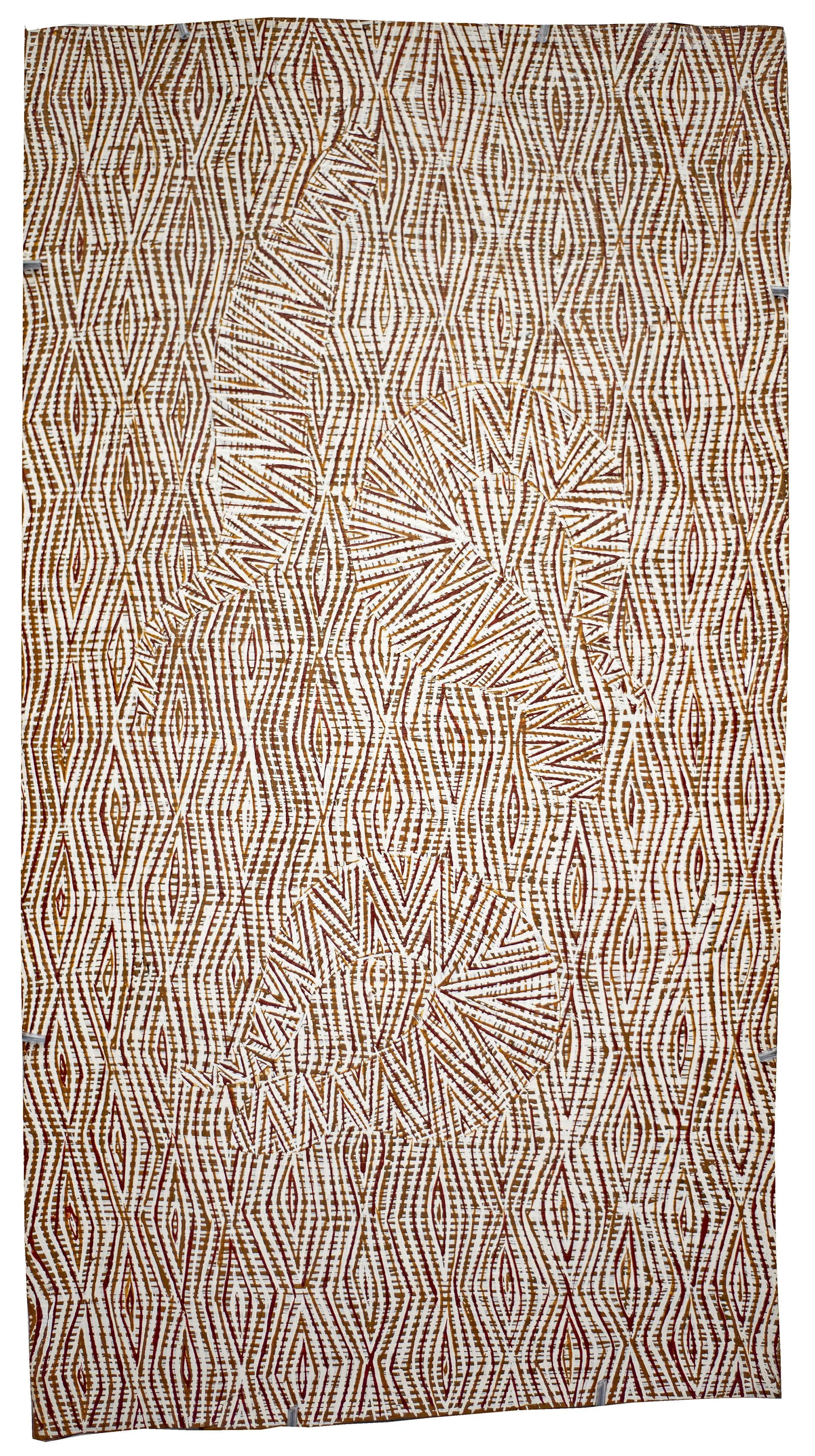
Artiste : Milminyina Dhamarrandji (1960)
Titre de l'œuvre : Dhambaḏiny
Pigments naturels sur écorce
Format : 82 x 44.5cm
Provenance et certificat original : centre d'art aborigène de Yirrkala
Référence de la peinture : 3062-23
© Photo : Aboriginal signature with the courtesy of the artist & Buku-Larrngay Mulka.
Explication de l’œuvre :
This artwork wears Djambarrpuyŋu clan design that refers to Dhambaliya island, off the coast of Nhulunbuy town. Dhambaliya (Bremer island) is divided in to two clan areas, Gutjaŋan for the Warramirri clan and Ruwak for the Djambarrpuyŋu and Rirratjiŋu clans.
Within the Ruwak area is the ringitj (sacred ceremonial ground) referred to by the 'deep' Djambarrpuyŋu name of Ŋurruyurrdjurr. During ceremony, the men dance in this area with long spears made from mangrove shoots that grow on the island. These spears are named Dhumudal (Djambarrpuyŋu) and Warrarri (Rirratjiŋu). The ceremony refers to Darrpa (the King Brown snake), Wuwarku (Taipan) and Dhambaḏiny (Death Adder).
After the ceremony these bapi (snakes) move towards the coast, to a point called Rirrawutha, where they 'wash' their teeth in the water, symbolic of a spiritual cleansing. Rirrawutha can been seen from Wirrwawuy (the birthplace of Milminyina) as upstanding rocks on the Western side of Dhambaliya. These rocks also symbolise the snakes mentioned above.
The riŋgitj grounds Ŋurruyurrdjurr are also found on another small island off the coast of Galiwinku. These two places of the same name are sung by the Djambarrpuyŋu and connect through the saltwater Rulyapa (arc shaped miny'tji commonly painted by the Rirratjiŋu) and the spiritual movements of the above mentioned bäpi.
Milminyina noted that the miny'tji (sacred clan design) is similar to the beautiful camouflage of the actual snake.

Artiste : Dhambit #2 Wanambi (dec)
Titre de l'œuvre : Yalanba
Pigments naturels sur écorce
Format : 86cm x 44cm
Provenance et certificat original : centre d'art aborigène de Yirrkala
Référence de la peinture : 4091-22
© Photo : Aboriginal signature with the courtesy of the artist & Buku-Larrngay Mulka.
Explication de l’œuvre :
Yalanba is the name of the artist's brother. But it is also the name of the shiny black sand that adorns this bark painting. It occurs in one spot only at Bayapula near Garthalala on Caledon Bay. The old base for Donald Thomson's NTSRU in the Second World War. Yalanba harvests it from this place because that area belongs to his clan the Marrakulu whose identity is depicted in this work. He created this work at Yilpara on Blue Mud bay.
The songs refer to Bamurruŋu, a sacred and solitary rock in Trial Bay. It is a white dome in the Bay - a round lump of granite its top coloured white by roosting birds, in the lapped by the molmulpa or white sea foam associated with turbulent and agitating waters created by particular tide and wind. The fish which swim up to Bamurruŋu are referred to as Marparrarr or milk fish, somewhat like a large mullet. These were once people of the stone country behind where the Marrakulu have now seled close the mouth of the Gurka’wuy river. They turned to Marparrarr on reaching the shore and following the feathered string to Bamurruŋu. The Beings of Marparrarr were the ‘same’ as the original inhabitants of Gurka’wuy, in this manifestation, populating Marrakulu sea country as land totems do in this area. Yolŋu of this area speak of a hole submerged under the rock, from where bubbles are seen rising to the surface, sometimes bursting forth with a rush. The bubbles are seen as a life force and a direct Ancestral connection for the Marrakulu.
The Marparrarr have knowledge of this special phenomenon as do the law men. The rock is like a ‘statue’ for Mali Djuluwa Makaratjpi. When the Marrakulu perform ritual dance for the events mentioned here. Participants move towards a held spear representing the steadfastness of the rock, spling the dancers who then surround Bamurruŋu moving as does the sea to song and rhythm of Yidaki and Bilma. Bamurrungu is seen as part of a set of three rocks which stand in the mouth of Trial Bay submerged either completely or partially within its waters. The waters of Gurka’wuy River flow out through Trial Bay past these rocks conflicting and clashing in a turbulent unity with the incoming tidal waters from the deep ocean. Their names rarely spoken are Dundiwuy, Bamurrungu and Yilpirr…

Artiste : Djul’djul Gurruwiwi (1965)
Titre de l'œuvre : Witij
Pigments naturels sur écorce
Format : 92 x 66.6cm
Provenance et certificat original : centre d'art aborigène de Yirrkala
Référence de la peinture : 5301-23
© Photo : Aboriginal signature with the courtesy of the artist & Buku-Larrngay Mulka.
Explication de l’œuvre :
This is something of a naturalistic reference to Wititj (Olive Python). In physical form, Wititj is manifest as the olive python, found in the monsoon rain forests in North East Arnhem Land. When olive pythons are mating, Dhamiḻiŋu is said to be present to to protect the snakes from potential predators such as brown snakes. In this sense Dhamiḻiŋu is seen as a protector for the creation rights and processes of the Wititj and therefore through association, with the Gälpu clan.
In a broader sense, this imagery refers to perhaps the oldest continuous human religious iconographical practice, the story of the Rainbow Serpent. Estimates vary from 40,000 to 60,000 years on the depictions of the Rainbow Serpent in West Arnhem rock shelters.
Wititj is the all powerful rainbow serpent (olive python) that traveled through Gälpu clan lands and on further, during the days of early times called Waŋarr. Djaykuŋ the Javanese file-snake is a companion and possibly alternate incarnation of Wititj, living in among the Dhatam, or waterlilies, causing ripples and rainbows (Djari) on the surface of the water (one reference in the cross hatch).
The story of Wititj is of storm and monsoon, in the ancestral past. It has particular reference to the mating of Wititj during the beginning of the wet season when the Djarrwa (square shaped thundercloud) begin forming and the lightning starts striking.
The sun shining against the scales of the snake form a prism of light like a rainbow. The arc which a snake in motion travels through holds to a rainbow shape but causes the oily shimmer to refract the colours of the rainbow. The power of the lightning is made manifest when they strike their tongue. The thunder being the sound they make as they move along the ground. The morning after a major cyclone there are swathes of stringy-bark bent over in snake trails through the bush in just the same way a normal scale snake leaves bent over grass traceable by trained trackers. Aer Cyclone Monica there was a path cleared through the stringy-bark forest almost from Maningrida to Jabiru.

Artiste : Dhambit #2 Wanambi (dec)
Titre de l'œuvre : Guḏultja with sand from Yalanba
Pigments naturels sur écorce
Format : 129.5 x 69cm
Provenance et certificat original : centre d'art aborigène de Yirrkala
Référence de la peinture : 5994-22
© Photo : Aboriginal signature with the courtesy of the artist & Buku-Larrngay Mulka.
Explication de l’œuvre :
A set of three rocks stand in the mouth of Trial Bay submerged either completely or partially within its waters. The waters of Gurka’wuy River flow out through Trial Bay past these rocks conflicting and clashing in a turbulent unity with the incoming tidal waters from the deep ocean. Their names rarely spoken are Dundiwuy, Bamurruŋu and Yilpirr.
Yalanba is the name of the place where the shiny black sand that adorns this pole comes from. The sand occurs in one spot only at Bayapula near Garthalala on Caledon Bay. Her brother is named after this site. The old base for Donald Thomson's NTSRU in the Second World War. Dhambit can harvest it from this place because that area belongs to her clan the Marrakulu whose identity is depicted in this work. She also pays a tribute to the elder at Garrthalala who is from the grandmother of this place- it's märi, the Djapu clan. The place described in the work is a separate Marrakulu estate which has the same relationship to the Djapu. It is at the mouth of Trial Bay to the South of Caledon Bay.
The sacred and monolithic rock Bamurruŋu lies in the mouth of this bay submerged in its waters. In manikay (sacred song) it is sung to be surrounded by the Buku-Duŋgulmirri or Wawurritjpal (Sea Mullet) fish.
Yolŋu of this area speak of a hole submerged under the rocks, from where bubbles are seen rising to the surface, sometimes bursting forth with a rush. The bubbles are seen as a life force and a direct Ancestral connection for the Marrakulu.
When the Marrakulu perform ritual dances (buŋgul) for the events depicted in this painting participants move towards a held spear representing the steadfastness of the rock, spling the dancers, who then surround the rock known as Bamurruŋu, moving as does the sea to song and rhythm of Yiḏaki and Bilma…

Artiste : Milminyina Dhamarrandji (1960)
Titre de l'œuvre : Dhambaḏiny
Pigments naturels sur écorce
Format : 83cm x 47cm
Provenance et certificat original : centre d'art aborigène de Yirrkala
Référence de la peinture : 3089-23
© Photo : Aboriginal signature with the courtesy of the artist & Buku-Larrngay Mulka.
Explication de l’œuvre :
This artwork wears Djambarrpuyŋu clan design that refers to Dhambaliya island, off the coast of Nhulunbuy town. Dhambaliya (Bremer island) is divided in to two clan areas, Gutjaŋan for the Warramirri clan and Ruwak for the Djambarrpuyŋu and Rirratjiŋu clans.
Within the Ruwak area is the ringitj (sacred ceremonial ground) referred to by the 'deep' Djambarrpuyŋu name of Ŋurruyurrdjurr. During ceremony, the men dance in this area with long spears made from mangrove shoots that grow on the island. These spears are named Dhumudal (Djambarrpuyŋu) and Warrarri (Rirratjiŋu). The ceremony refers to Darrpa (the King Brown snake), Wuwarku (Taipan) and Dhambaḏiny (Death Adder).
After the ceremony these bapi (snakes) move towards the coast, to a point called Rirrawutha, where they 'wash' their teeth in the water, symbolic of a spiritual cleansing. Rirrawutha can been seen from Wirrwawuy (the birthplace of Milminyina) as upstanding rocks on the Western side of Dhambaliya. These rocks also symbolise the snakes mentioned above.
The riŋgitj grounds Ŋurruyurrdjurr are also found on another small island off the coast of Galiwinku. These two places of the same name are sung by the Djambarrpuyŋu and connect through the saltwater Rulyapa (arc shaped miny'tji commonly painted by the Rirratjiŋu) and the spiritual movements of the above mentioned bäpi.
Milminyina noted that the miny'tji (sacred clan design) is similar to the beautiful camouflage of the actual snake.

Artiste : Djul’djul Gurruwiwi (1965)
Titre de l'œuvre : Garrimala
Pigments naturels sur écorce
Format : 116cm x 46.5cm
Provenance et certificat original : centre d'art aborigène de Yirrkala
Référence de la peinture : 881-23
© Photo : Aboriginal signature with the courtesy of the artist & Buku-Larrngay Mulka.
Explication de l’œuvre :
This imagery refers to perhaps the oldest continuous human religious iconographical practice: the story of the Rainbow Serpent. Estimates vary from 40,000-60,000 years on the depictions of the Rainbow Serpent in West Arnhem rock shelters.
Amongst the Dhatam, waterlillies, two ancestral figures travelled Gälpu clan lands and on further, during the days of early times called Waŋarr: Wititj, the all powerful rainbow serpent (olive python) and Djaykuŋ the Javanese filesnake that is a companion and possibly alternate incarnation of Wititj, living in amongst the Dhatam, or waterlillies, causing ripples and rainbows (Djari) on the surface of the water (one reference in the cross hatch).
The story of Wititj is of storm and monsoon, in the ancestral past. It has particular reference to the mating of Wititj during the beginning of the wet season when the Djarrwa (square shaped thundercloud) begin forming and the lightning starts striking.
The Galpu clan miny’tji (sacred clan design behind the lillies) represents Djari (rainbows) and the power of the lightning within them. It also refers to the power of the storm created by Wititj, the diagonal lines representing trees that have been knocked down as Wititj moves from place to place. The ribs of the snake also form the basis of the sacred design here.
The sun shining against the scales of the snake form a prism of light like a rainbow. The arc which a snake in motion travels through holds to a rainbow shape but causes the oily shimmer to refract the colours of the rainbow. The power of the lightning is made manifest when they strike their tongue. The thunder being the sound they make as they move along the ground. The morning after a major cyclone there are swathes of stringybark bent over in snake trails through the bush in just the same way a normal scale snake leaves bent over grass traceable by trained trackers. Aer Cyclone Monica there was a path cleared through the stringybark forest almost from Maningrida to Jabiru…

Artiste : Burŋanydji #2 Gaykamaŋu (1977)
Titre de l'œuvre : Wuyal
Pigments naturels sur écorce
Format : 119 x 42.5cm
Provenance et certificat original : centre d'art aborigène de Yirrkala
Référence de la peinture : 4844-23
© Photo : Aboriginal signature with the courtesy of the artist & Buku-Larrngay Mulka.
Explication de l’œuvre :
This work is about Wuyal, the ancestral sugarbag man, an important ancestor of the Marrakulu clan of northeast Arnhem Land. This painting symbolizes his journey during which he named important sites and certain animals. The painting refers also to the
continuation of the Marrakulu culture in dance, song and ceremony, which are performed by current generations who have inherited this knowledge and culture from ancestral figures such as Wuyal. This story refers also to important Dhuwa moiety ancestors called the Wawilak sisters.
Wuyal was the first man to look for any homeland for the Marrakulu people. He began a journey from Gurka’wuy traveling via Yuḏuyuḏu to Cape Shield, up to Trial Bay and along the course of the Goyder River until he came to Nhulun, or Mt. Saunders. Traveling along with Wuyal, was Ganyt'jalala. These men are symbolic of the Märi-Guthara (grandparent-grandchild) relationship which describes the relationship between Ḏäṯiwuy and Marrakulu clans.
Wuyal carried with him tools for hunting animals and for collecting wild honey or sugarbag. The dilly bag, Banduk, worn around his neck, was used to carry the sugarbag called guku. Wuyal used a stone axe, djalpaṯ, to cut down trees in his search for sugarbag. He also carried a stone headed spear for hunting rock wallabies, Ḏulaku. The stone head of the spear, Guyarra, is made from stone found at a place called Nilipitji. The shaft of the spear is called guṉḏit. Also carried was gaḻpu, a spearthrower.
In their ancestral travels these men traveled alone without wives and conducted what was mens’ business in ceremony. Wuyal’s ceremonial ground where he danced and conducted sacred ceremony, a place near Buffalo Creek and Mt. Saunders, is called Wandjipuy…

Artiste : Moyurrurra Wunuŋmurra (1971)
Titre de l'œuvre : Gäṉgän
Pigments naturels sur écorce
Format : 205 x 57.5cm
Provenance et certificat original : centre d'art aborigène de Yirrkala
Référence de la peinture : 5158-23
© Photo : Aboriginal signature with the courtesy of the artist & Buku-Larrngay Mulka.
Explication de l’œuvre :
This piece is painted in the miny’tji (sacred clan design) of the Dhalwaŋu clan which is one of the eight or so clans belonging to the Yirritja moiety (half) in North East Arnhem land. The sacred diamond design for the Dhalwaŋu clan reflects the patterning of the water streaming from the body of Ancestral Creator Being Barama as he emerged from these waters at Gäṉgaṉ, with weed hanging from his arms.
Today appropriately senior ritual participants wear sacred feathered strings from armbands, their chest painted with the Dhalwaŋu design of freshwater. These totemic ancestors of the Dhalwaŋu clan are all associated with this site at Gäṉgaṉ from which all Yirritja creation began. They are seen as embodiments of the disciples or companions of Barama and himself. Black and white dots also representing the wake of the swimming tortoise.
The manifestation of Barama is the long neck tortoise and chief totem for the Dhalwaŋu - Minhala. His disciple is Dhakawa -freshwater crayfish. Another Dhalwaŋu totem is Garkman (frog). It was in a period called Wangarr, the world creation drives of the first mornings, when the Ancestral Beings came to country to give lore and title for the land and its people. The Yolŋu world is based on a duality, of two moieties of equal status that integrate through a complex system of kinship. Clan groups in this area known as Miwatj country belong to either the Yirritja or Dhuwa moieties. Barama came to Gäṉgaṉ from the saltwater country of Blue Mud Bay to emerge from the waterhole named Gulutji with the intention of establishing his law amongst the people there of that time. These original Dhalwaŋu referred to as the Banatja were said to be led by Galparimun who received council from Barama. A third player of law in these times was Lanytjaŋ who walked to Gäṉgaṉ meeting up with Barama.
Barama brought with him to Gäṉgaṉ the hard wood raŋga (sacred objects) that had instilled in them the sacred knowledge pertaining to his law. Also on his body he had the marks left by the waters from where he had come, the sacred miny’tji that was later to become the sacred clan designs for the Yirritja moiety. His staff is a motif shared with his two brothers…

Artiste : Burŋanydji #2 Gaykamaŋu (1977)
Titre de l'œuvre : Yanawal
Pigments naturels sur écorce
Format : 108 x 43 cm
Provenance et certificat original : centre d'art aborigène de Yirrkala
Référence de la peinture : 4531-23
© Photo : Aboriginal signature with the courtesy of the artist & Buku-Larrngay Mulka.
Explication de l’œuvre :
Wuyal, the ancestral sugarbag man, is an important ancestor of the Marrakulu clan of North East Arnhem Land. The designs refer also to the continuation of the Marrakulu culture in dance, song and ceremony, which are performed by current generations who have inherited this knowledge and culture from ancestoral figures such as Wuyal. This story refers also to important Dhuwa moiety ancestors called the Wawilak sisters.
Wuyal was the first man to look for any homeland for the Marrakulu people. He came to Gurka’wuy from the distant quarry at Ŋilibidji, in a search for native honey. His felling of the stringybark trees searching for honey also created the present day landscape. Wuyal founded other Marrakulu lands away from Gurka’wuy, Nhulunbuy for example that is now the site of a large mining town. He journeyed from Gurka’wuy travelling via Yuduyudu to Cape Shield, up to Trial Bay and along the course of the Goyder River until he came to Mt. Saunders (Nhulun). Travelling along with Wuyal, was Ganyt'jalala. These men are symbolic of the Märi-Guthara
(grandparent-grandchild) relationship which describes the relationship between Ḏäṯiwuy and Marrakulu clans. Significant to this relationship is the fact that Ḏäṯiwuy men give their daughter's daughters away to Marrakulu men for marriage. Thus the two clans share an important relationship which involves reciprocal obligations.
Wuyal carried with him tools for hunting animals and for collecting wild honey or sugarbag. The dilly bag, Banduk, worn around his neck, was used to carry the sugarbag called guku. Wuyal used a stone axe, djalpaṯ, to cut down trees in his search for sugarbag. He also carried a stone headed spear for hunting rock wallabies, Ḏulaku.
The stone head of the spear, Guyarra and the axe are made from stone quarried at Ŋilipitji. The sha of the spear is called Guṉdit. Also carried was galpu, a spearthrower. In their ancestral travels these men travelled alone without wives and conducted what was mens’ business in ceremony. Wuyal’s ceremonial ground where he danced and conducted sacred ceremony, a place near Buffalo reek and Mt. Saunders, is called Wandjipuy. The tools were also used in shaping the land. Trees cut down by Wuyal in the search for sugarbag, turned into rivers. The Gurka’wuy river was made in this way. Wuyal also named places by throwing his boomerang, gunyalili, and giving names to the places where it fell to the ground. From Mt. Saunders he threw his Gunyalili and named a place called Gäluru in this way…

Artiste : Mulkun Wirrpanda (1942-2021)
Titre de l'œuvre : The Ṉämbarra plant
Format : 119 x 59 cm
Provenance et certificat : Yirrkala
Référence de cette peinture : 3074-16
Explications sur cette peinture Aborigène :
This work is an example of a phase where the artist of her own motion explored lesser known plant species which she feared were being forgotten by younger generations. This coincided with artist John Wolseley’s interest in returning to Yilpara (after they had met during the Djalkiri project of 2010) and the two spent an extended period exploring the botany of Blue Mud Bay.
She wants to renew the knowledge of these plants because when she was young this is the food that she grew up on. In those days old people lived for a long time without illness. John Wolseley spent a week at Yilpara with Mulkun in May 2012 and has visited to work together again at Yirrkala in June 2013, June 2014, May and December 2015 and October 2016.
Mulkun has been finding new ways to paint and promote nutritional plants that are no longer eaten widely. As a child there were very many healthy old people and now there are few. She blames poor diet and the loss of knowledge.
This work is a depiction of ṉämbarra the young leaves of Melaleuca are a prized medication for flus and colds as an inhalation as a poultice for sores and as a healthful body wash in solution.
Below is the Yolŋu dictionary entry for Ṉämbarra.
Meaning: tree - edible fruit leaves used medicinally. Paperbark sp., Melaleuca leucadendron. An abbreviation of ṉämbarra is:
barrtjaray, dhulwu', dhowirr, munuymunuy, walḏulu, wolk, wurrtjuḻu.
Language notes: D
Moiety: Dhuwa
Part of speech: n
Her artworks are in the following prestigious collections :
Art Gallery of New South Wales, Sydney NSW
Art Gallery of South Australia, Adelaide SA
Artbank, Sydney NSW
Berndt Museum, University of Western Australia, Perth WA
British Museum, London, UK
Buku-Larrnggay Mulka - Saltwater - Yirrkala Bark Paintings of Sea Country
Charles Darwin University Art Collection
Holmes a Court Collection
Kerry Stokes Larrakitj Collection, WA
National Maritime Museum, Darling Harbour, Sydney NSW
National Museum of Australia, Canberra ACT
RMIT University Art Collection
Enquiry / Demander le prix de l'œuvre
© Photo & text : Aboriginal Signature Estrangin gallery with the courtesy of the artists, & Buku-Larrnggay Mulka Centre

Artiste : Gaypalani Wanambi (1986)
Titre de l'œuvre : Ḏawurr
Etched Aluminium / gravure sur panneau d’aluminium
Format : 120cm x 45cm
Provenance et certificat original : centre d'art aborigène de Yirrkala
Référence de la peinture : 889-23
© Photo : Aboriginal signature with the courtesy of the artist & Buku-Larrngay Mulka.
Explication de l’œuvre :
This work is about Wuyal, the ancestral sugarbag man, an important ancestor of the Marrakulu clan of northeast Arnhem Land. This painting symbolizes his journey during which he named important sites and certain animals. The painting refers also to the
continuation of the Marrakulu culture in dance, song and ceremony, which are performed by current generations who have inherited this knowledge and culture from ancestral figures such as Wuyal. This story refers also to important Dhuwa moiety ancestors called the Wawilak sisters.
Wuyal was the first man to look for any homeland for the Marrakulu people. He began a journey from Gurka’wuy traveling via Yuḏuyuḏu to Cape Shield, up to Trial Bay and along the course of the Goyder River until he came to Nhulun, or Mt.
Saunders. Traveling along with Wuyal, was Ganyt'jalala. These men are symbolic of the Märi-Guthara (grandparent-grandchild) relationship which describes the relationship between Ḏäṯiwuy and Marrakulu clans.
Wuyal carried with him tools for hunting animals and for collecting wild honey or sugarbag. The dilly bag, Banduk, worn around his neck, was used to carry the sugarbag called guku. Wuyal used a stone axe, djalpaṯ, to cut down trees in his search for sugarbag. He also carried a stone headed spear for hunting rock wallabies, Ḏulaku. The stone head of the spear, Guyarra, is made from stone found at a place called Nilipitji. The shaft of the spear is called guṉḏit. Also carried was gaḻpu, a spearthrower.
In their ancestral travels these men traveled alone without wives and conducted what was mens’ business in ceremony. Wuyal’s ceremonial ground where he danced and conducted sacred ceremony, a place near Buffalo Creek and Mt. Saunders, is called Wandjipuy…

Artiste : Gaypalani Wanambi (1986)
Titre de l'œuvre : Ḏawurr
Etched Aluminium / gravure sur panneau d’aluminium
Format : 60cm x 45cm
Provenance et certificat original : centre d'art aborigène de Yirrkala
Référence de la peinture : 1261-23
© Photo : Aboriginal signature with the courtesy of the artist & Buku-Larrngay Mulka.
Explication de l’œuvre :
This work is about Wuyal, the ancestral sugarbag man, an important ancestor of the Marrakulu clan of northeast Arnhem Land. This painting symbolizes his journey during which he named important sites and certain animals. The painting refers also to the
continuation of the Marrakulu culture in dance, song and ceremony, which are performed by current generations who have inherited this knowledge and culture from ancestral figures such as Wuyal. This story refers also to important Dhuwa moiety ancestors called the Wawilak sisters.
Wuyal was the first man to look for any homeland for the Marrakulu people. He began a journey from Gurka’wuy traveling via Yuḏuyuḏu to Cape Shield, up to Trial Bay and along the course of the Goyder River until he came to Nhulun, or Mt.
Saunders. Traveling along with Wuyal, was Ganyt'jalala. These men are symbolic of the Märi-Guthara (grandparent-grandchild) relationship which describes the relationship between Ḏäṯiwuy and Marrakulu clans.
Wuyal carried with him tools for hunting animals and for collecting wild honey or sugarbag. The dilly bag, Banduk, worn around his neck, was used to carry the sugarbag called guku. Wuyal used a stone axe, djalpaṯ, to cut down trees in his search for sugarbag. He also carried a stone headed spear for hunting rock wallabies, Ḏulaku. The stone head of the spear, Guyarra, is made from stone found at a place called Nilipitji. The shaft of the spear is called guṉḏit. Also carried was gaḻpu, a spearthrower.
In their ancestral travels these men traveled alone without wives and conducted what was mens’ business in ceremony. Wuyal’s ceremonial ground where he danced and conducted sacred ceremony, a place near Buffalo Creek and Mt. Saunders, is called Wandjipuy…

Artiste : Gaypalani Wanambi (1986)
Titre de l'œuvre : Ḏawurr
Etched Aluminium / gravure sur panneau d’aluminium
Format : 100cm x 45cm
Provenance et certificat original : centre d'art aborigène de Yirrkala
Référence de la peinture : 9483-22
© Photo : Aboriginal signature with the courtesy of the artist & Buku-Larrngay Mulka.
Explication de l’œuvre :
This work is about Wuyal, the ancestral sugarbag man, an important ancestor of the Marrakulu clan of northeast Arnhem Land. This painting symbolizes his journey during which he named important sites and certain animals. The painting refers also to the
continuation of the Marrakulu culture in dance, song and ceremony, which are performed by current generations who have inherited this knowledge and culture from ancestral figures such as Wuyal. This story refers also to important Dhuwa moiety ancestors called the Wawilak sisters.
Wuyal was the first man to look for any homeland for the Marrakulu people. He began a journey from Gurka’wuy traveling via Yuḏuyuḏu to Cape Shield, up to Trial Bay and along the course of the Goyder River until he came to Nhulun, or Mt.
Saunders. Traveling along with Wuyal, was Ganyt'jalala. These men are symbolic of the Märi-Guthara (grandparent-grandchild) relationship which describes the relationship between Ḏäṯiwuy and Marrakulu clans.
Wuyal carried with him tools for hunting animals and for collecting wild honey or sugarbag. The dilly bag, Banduk, worn around his neck, was used to carry the sugarbag called guku. Wuyal used a stone axe, djalpaṯ, to cut down trees in his search for sugarbag. He also carried a stone headed spear for hunting rock wallabies, Ḏulaku. The stone head of the spear, Guyarra, is made from stone found at a place called Nilipitji. The shaft of the spear is called guṉḏit. Also carried was gaḻpu, a spearthrower.
In their ancestral travels these men traveled alone without wives and conducted what was mens’ business in ceremony. Wuyal’s ceremonial ground where he danced and conducted sacred ceremony, a place near Buffalo Creek and Mt. Saunders, is called Wandjipuy…

Artiste : Gaypalani Wanambi (1986)
Titre de l'œuvre : Ḏawurr
Etched Aluminium / gravure sur panneau d’aluminium
Format : 160cm x 60cm
Provenance et certificat original : centre d'art aborigène de Yirrkala
Référence de la peinture : 728-23
© Photo : Aboriginal signature with the courtesy of the artist & Buku-Larrngay Mulka.
Explication de l’œuvre :
This work is about Wuyal, the ancestral sugarbag man, an important ancestor of the Marrakulu clan of northeast Arnhem Land. This painting symbolizes his journey during which he named important sites and certain animals. The painting refers also to the
continuation of the Marrakulu culture in dance, song and ceremony, which are performed by current generations who have inherited this knowledge and culture from ancestral figures such as Wuyal. This story refers also to important Dhuwa moiety ancestors called the Wawilak sisters.
Wuyal was the first man to look for any homeland for the Marrakulu people. He began a journey from Gurka’wuy traveling via Yuḏuyuḏu to Cape Shield, up to Trial Bay and along the course of the Goyder River until he came to Nhulun, or Mt.
Saunders. Traveling along with Wuyal, was Ganyt'jalala. These men are symbolic of the Märi-Guthara (grandparent-grandchild) relationship which describes the relationship between Ḏäṯiwuy and Marrakulu clans.
Wuyal carried with him tools for hunting animals and for collecting wild honey or sugarbag. The dilly bag, Banduk, worn around his neck, was used to carry the sugarbag called guku. Wuyal used a stone axe, djalpaṯ, to cut down trees in his search for sugarbag. He also carried a stone headed spear for hunting rock wallabies, Ḏulaku. The stone head of the spear, Guyarra, is made from stone found at a place called Nilipitji. The shaft of the spear is called guṉḏit. Also carried was gaḻpu, a spearthrower.
In their ancestral travels these men traveled alone without wives and conducted what was mens’ business in ceremony. Wuyal’s ceremonial ground where he danced and conducted sacred ceremony, a place near Buffalo Creek and Mt. Saunders, is called Wandjipuy…

Artiste : Gaypalani Wanambi (1986)
Titre de l'œuvre : Ḏawurr
Etched Aluminium / gravure sur panneau d’aluminium
Format : 80cm x 60cm
Provenance et certificat original : centre d'art aborigène de Yirrkala
Référence de la peinture : 2131-23
© Photo : Aboriginal signature with the courtesy of the artist & Buku-Larrngay Mulka.
Explication de l’œuvre :
This work is about Wuyal, the ancestral sugarbag man, an important ancestor of the Marrakulu clan of northeast Arnhem Land. This painting symbolizes his journey during which he named important sites and certain animals. The painting refers also to the
continuation of the Marrakulu culture in dance, song and ceremony, which are performed by current generations who have inherited this knowledge and culture from ancestral figures such as Wuyal. This story refers also to important Dhuwa moiety ancestors called the Wawilak sisters.
Wuyal was the first man to look for any homeland for the Marrakulu people. He began a journey from Gurka’wuy traveling via Yuḏuyuḏu to Cape Shield, up to Trial Bay and along the course of the Goyder River until he came to Nhulun, or Mt.
Saunders. Traveling along with Wuyal, was Ganyt'jalala. These men are symbolic of the Märi-Guthara (grandparent-grandchild) relationship which describes the relationship between Ḏäṯiwuy and Marrakulu clans.
Wuyal carried with him tools for hunting animals and for collecting wild honey or sugarbag. The dilly bag, Banduk, worn around his neck, was used to carry the sugarbag called guku. Wuyal used a stone axe, djalpaṯ, to cut down trees in his search for sugarbag. He also carried a stone headed spear for hunting rock wallabies, Ḏulaku. The stone head of the spear, Guyarra, is made from stone found at a place called Nilipitji. The shaft of the spear is called guṉḏit. Also carried was gaḻpu, a spearthrower.
In their ancestral travels these men traveled alone without wives and conducted what was mens’ business in ceremony. Wuyal’s ceremonial ground where he danced and conducted sacred ceremony, a place near Buffalo Creek and Mt. Saunders, is called Wandjipuy…

Artiste : Gaypalani Wanambi (1986)
Titre de l'œuvre : Ḏawurr
Etched Aluminium / gravure sur panneau d’aluminium
Format : 90cm x 60cm
Provenance et certificat original : centre d'art aborigène de Yirrkala
Référence de la peinture : 3231-23
© Photo : Aboriginal signature with the courtesy of the artist & Buku-Larrngay Mulka.
Explication de l’œuvre :
This work is about Wuyal, the ancestral sugarbag man, an important ancestor of the Marrakulu clan of northeast Arnhem Land. This painting symbolizes his journey during which he named important sites and certain animals. The painting refers also to the
continuation of the Marrakulu culture in dance, song and ceremony, which are performed by current generations who have inherited this knowledge and culture from ancestral figures such as Wuyal. This story refers also to important Dhuwa moiety ancestors called the Wawilak sisters.
Wuyal was the first man to look for any homeland for the Marrakulu people. He began a journey from Gurka’wuy traveling via Yuḏuyuḏu to Cape Shield, up to Trial Bay and along the course of the Goyder River until he came to Nhulun, or Mt.
Saunders. Traveling along with Wuyal, was Ganyt'jalala. These men are symbolic of the Märi-Guthara (grandparent-grandchild) relationship which describes the relationship between Ḏäṯiwuy and Marrakulu clans.
Wuyal carried with him tools for hunting animals and for collecting wild honey or sugarbag. The dilly bag, Banduk, worn around his neck, was used to carry the sugarbag called guku. Wuyal used a stone axe, djalpaṯ, to cut down trees in his search for sugarbag. He also carried a stone headed spear for hunting rock wallabies, Ḏulaku. The stone head of the spear, Guyarra, is made from stone found at a place called Nilipitji. The shaft of the spear is called guṉḏit. Also carried was gaḻpu, a spearthrower.
In their ancestral travels these men traveled alone without wives and conducted what was mens’ business in ceremony. Wuyal’s ceremonial ground where he danced and conducted sacred ceremony, a place near Buffalo Creek and Mt. Saunders, is called Wandjipuy…
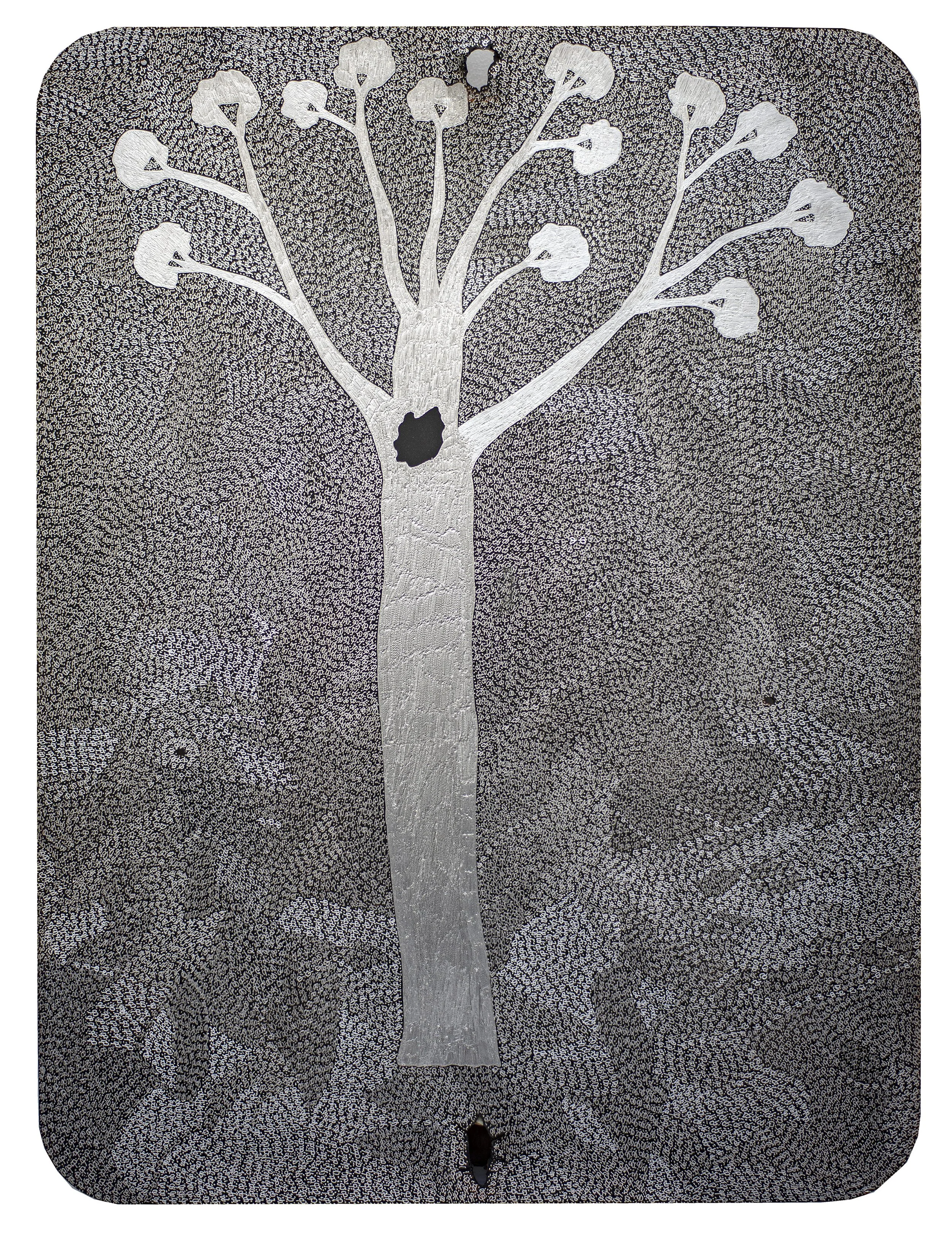
Artiste : Gaypalani Wanambi (1986)
Titre de l'œuvre : Ḏawurr
Etched Aluminium / gravure sur panneau d’aluminium
Format : 80 X 60cm
Provenance et certificat original : centre d'art aborigène de Yirrkala
Référence de la peinture : 4242-23
© Photo : Aboriginal signature with the courtesy of the artist & Buku-Larrngay Mulka.
Explication de l’œuvre :
This work is about Wuyal, the ancestral sugarbag man, an important ancestor of the Marrakulu clan of northeast Arnhem Land. This painting symbolizes his journey during which he named important sites and certain animals. The painting refers also to the
continuation of the Marrakulu culture in dance, song and ceremony, which are performed by current generations who have inherited this knowledge and culture from ancestral figures such as Wuyal. This story refers also to important Dhuwa moiety ancestors called the Wawilak sisters.
Wuyal was the first man to look for any homeland for the Marrakulu people. He began a journey from Gurka’wuy traveling via Yuḏuyuḏu to Cape Shield, up to Trial Bay and along the course of the Goyder River until he came to Nhulun, or Mt.
Saunders. Traveling along with Wuyal, was Ganyt'jalala. These men are symbolic of the Märi-Guthara (grandparent-grandchild) relationship which describes the relationship between Ḏäṯiwuy and Marrakulu clans.
Wuyal carried with him tools for hunting animals and for collecting wild honey or sugarbag. The dilly bag, Banduk, worn around his neck, was used to carry the sugarbag called guku. Wuyal used a stone axe, djalpaṯ, to cut down trees in his search for sugarbag. He also carried a stone headed spear for hunting rock wallabies, Ḏulaku. The stone head of the spear, Guyarra, is made from stone found at a place called Nilipitji. The shaft of the spear is called guṉḏit. Also carried was gaḻpu, a spearthrower.
In their ancestral travels these men traveled alone without wives and conducted what was mens’ business in ceremony. Wuyal’s ceremonial ground where he danced and conducted sacred ceremony, a place near Buffalo Creek and Mt. Saunders, is called Wandjipuy…

Artiste : Gaypalani Wanambi (1986)
Titre de l'œuvre : Ḏawurr
Etched Aluminium / gravure sur panneau d’aluminium
Format : 60.5 x 45 cm
Provenance et certificat original : centre d'art aborigène de Yirrkala
Référence de la peinture : 4544-23
© Photo : Aboriginal signature with the courtesy of the artist & Buku-Larrngay Mulka.
Explication de l’œuvre :
This work is about Wuyal, the ancestral sugarbag man, an important ancestor of the Marrakulu clan of northeast Arnhem Land. This painting symbolizes his journey during which he named important sites and certain animals. The painting refers also to the
continuation of the Marrakulu culture in dance, song and ceremony, which are performed by current generations who have inherited this knowledge and culture from ancestral figures such as Wuyal. This story refers also to important Dhuwa moiety ancestors called the Wawilak sisters.
Wuyal was the first man to look for any homeland for the Marrakulu people. He began a journey from Gurka’wuy traveling via Yuḏuyuḏu to Cape Shield, up to Trial Bay and along the course of the Goyder River until he came to Nhulun, or Mt.
Saunders. Traveling along with Wuyal, was Ganyt'jalala. These men are symbolic of the Märi-Guthara (grandparent-grandchild) relationship which describes the relationship between Ḏäṯiwuy and Marrakulu clans.
Wuyal carried with him tools for hunting animals and for collecting wild honey or sugarbag. The dilly bag, Banduk, worn around his neck, was used to carry the sugarbag called guku. Wuyal used a stone axe, djalpaṯ, to cut down trees in his search for sugarbag. He also carried a stone headed spear for hunting rock wallabies, Ḏulaku. The stone head of the spear, Guyarra, is made from stone found at a place called Nilipitji. The shaft of the spear is called guṉḏit. Also carried was gaḻpu, a spearthrower.
In their ancestral travels these men traveled alone without wives and conducted what was mens’ business in ceremony. Wuyal’s ceremonial ground where he danced and conducted sacred ceremony, a place near Buffalo Creek and Mt. Saunders, is called Wandjipuy…

Artiste : Djalinda Yunupiŋu (1954)
Titre de l'œuvre : Yathiny
Pigments naturels sur écorce
Format : 90x33 cm
Provenance et certificat original : centre d'art aborigène de Yirrkala
Référence de la peinture : 4004-22
© Photo & text : Aboriginal signature with the courtesy of the artist, & Buku-Larrngay Mulka.
Explication de l’œuvre :
Djalinda here has painted her mother’s Rirratjiŋu clan sea country at Yirrkala, the waters between the mainland and Bremer Island. These waters are shared with the Djambarrpuyngu clan. Here lies the sacred rock Manhala. Turtle swim here and feed on the Yathiny, a blue sea anemone that floats on the surface.
Looking left up the coast from Yirrkala about two kilometres is the rocky escarpment leading down into the sea known as Galariya by the Rirratjiŋu. Off shore from there the island of Dhambaliya can be seen. These two areas and the sea in between is an important site influenced by Djambawal the Thunder Man and Daymirri the Ancestral Whale.
The Ancestral hunters took turtle in these waters and also left their mark on the mainland at Galariya as well as Dhambaliya. The land and associate events connect the two clan groups of the Rirratjiŋu and Djambarrpuyŋu who have custodial rites to this country. Minyipa and Dhaŋgatjiya were young sons of Mururruma who is referred to as the Grandfather of the Rirratjiŋu family. Mururruma was killed in a ritual spearing by the family of his young wife who Mururruma had killed because she had constantly complained about being separated from her own family.
Aer killing Mururruma on the mainland, the warriors of the young wife’s family pursued his sons Minyipa and Dhaŋgatjiya across the sea to Dhambaliya but were themselves defeated. For their stealth and courage in the battle Minyipa and Dhangatjiya became renown Waŋarr (spirit forms living in times past), to the Rirratjiŋu and Djambarrpuyŋu people. As Gutharra (Grandchild/Rirratjiŋu) and Märi (Grandfather/Djambarrpuyŋu) clans to each other - “Gutharra is the body of the Märi” - these two clans share responsibility for areas of the mainland and Dhambaliya…
Her artworks are in the following prestigious collections :
Art Gallery of New South Wales, Sydney NSW
Art Gallery of South Australia, Adelaide SA
Charles Darwin University Art Collection
JW Kluge Collection, Virginia USA
Seattle Art Museum, Seattle USA

Artiste : Djalinda Yunupiŋu (1954)
Titre de l'œuvre : Yathiny
Pigments naturels sur écorce
Format : 50cm x 41cm
Provenance et certificat original : centre d'art aborigène de Yirrkala
Référence de la peinture : 2427-23
© Photo & text : Aboriginal signature with the courtesy of the artist, & Buku-Larrngay Mulka.
Explication de l’œuvre :
Djalinda here has painted her mother’s Rirratjiŋu clan sea country at Yirrkala, the waters between the mainland and Bremer Island. These waters are shared with the Djambarrpuyngu clan. Here lies the sacred rock Manhala. Turtle swim here and feed on the Yathiny, a blue sea anemone that floats on the surface.
Looking left up the coast from Yirrkala about two kilometres is the rocky escarpment leading down into the sea known as Galariya by the Rirratjiŋu. Off shore from there the island of Dhambaliya can be seen. These two areas and the sea in between is an important site influenced by Djambawal the Thunder Man and Daymirri the Ancestral Whale.
The Ancestral hunters took turtle in these waters and also left their mark on the mainland at Galariya as well as Dhambaliya. The land and associate events connect the two clan groups of the Rirratjiŋu and Djambarrpuyŋu who have custodial rites to this country. Minyipa and Dhaŋgatjiya were young sons of Mururruma who is referred to as the Grandfather of the Rirratjiŋu family. Mururruma was killed in a ritual spearing by the family of his young wife who Mururruma had killed because she had constantly complained about being separated from her own family.
Aer killing Mururruma on the mainland, the warriors of the young wife’s family pursued his sons Minyipa and Dhaŋgatjiya across the sea to Dhambaliya but were themselves defeated. For their stealth and courage in the battle Minyipa and Dhangatjiya became renown Waŋarr (spirit forms living in times past), to the Rirratjiŋu and Djambarrpuyŋu people. As Gutharra (Grandchild/Rirratjiŋu) and Märi (Grandfather/Djambarrpuyŋu) clans to each other - “Gutharra is the body of the Märi” - these two clans share responsibility for areas of the mainland and Dhambaliya…
Her artworks are in the following prestigious collections :
Art Gallery of New South Wales, Sydney NSW
Art Gallery of South Australia, Adelaide SA
Charles Darwin University Art Collection
JW Kluge Collection, Virginia USA
Seattle Art Museum, Seattle USA

Artiste : Djalinda Yunupiŋu (1954)
Titre de l'œuvre : Yathiny
Pigments naturels sur écorce
Format : 75cm x 36cm
Provenance et certificat original : centre d'art aborigène de Yirrkala
Référence de la peinture : 8748-22
© Photo & text : Aboriginal signature with the courtesy of the artist, & Buku-Larrngay Mulka.
Explication de l’œuvre :
Djalinda here has painted her mother’s Rirratjiŋu clan sea country at Yirrkala, the waters between the mainland and Bremer Island. These waters are shared with the Djambarrpuyngu clan. Here lies the sacred rock Manhala. Turtle swim here and feed on the Yathiny, a blue sea anemone that floats on the surface.
Looking left up the coast from Yirrkala about two kilometres is the rocky escarpment leading down into the sea known as Galariya by the Rirratjiŋu. Off shore from there the island of Dhambaliya can be seen. These two areas and the sea in between is an important site influenced by Djambawal the Thunder Man and Daymirri the Ancestral Whale.
The Ancestral hunters took turtle in these waters and also left their mark on the mainland at Galariya as well as Dhambaliya. The land and associate events connect the two clan groups of the Rirratjiŋu and Djambarrpuyŋu who have custodial rites to this country. Minyipa and Dhaŋgatjiya were young sons of Mururruma who is referred to as the Grandfather of the Rirratjiŋu family. Mururruma was killed in a ritual spearing by the family of his young wife who Mururruma had killed because she had constantly complained about being separated from her own family.
Aer killing Mururruma on the mainland, the warriors of the young wife’s family pursued his sons Minyipa and Dhaŋgatjiya across the sea to Dhambaliya but were themselves defeated. For their stealth and courage in the battle Minyipa and Dhangatjiya became renown Waŋarr (spirit forms living in times past), to the Rirratjiŋu and Djambarrpuyŋu people. As Gutharra (Grandchild/Rirratjiŋu) and Märi (Grandfather/Djambarrpuyŋu) clans to each other - “Gutharra is the body of the Märi” - these two clans share responsibility for areas of the mainland and Dhambaliya…
Her artworks are in the following prestigious collections :
Art Gallery of New South Wales, Sydney NSW
Art Gallery of South Australia, Adelaide SA
Charles Darwin University Art Collection
JW Kluge Collection, Virginia USA
Seattle Art Museum, Seattle USA

Artiste : Djalinda Yunupiŋu (1954)
Titre de l'œuvre : Yathiny
Pigments naturels sur écorce
Format : 65cm x 36cm
Provenance et certificat original : centre d'art aborigène de Yirrkala
Référence de la peinture : 8605-22
© Photo & text : Aboriginal signature with the courtesy of the artist, & Buku-Larrngay Mulka.
Explication de l’œuvre :
Djalinda here has painted her mother’s Rirratjiŋu clan sea country at Yirrkala, the waters between the mainland and Bremer Island. These waters are shared with the Djambarrpuyngu clan. Here lies the sacred rock Manhala. Turtle swim here and feed on the Yathiny, a blue sea anemone that floats on the surface.
Looking left up the coast from Yirrkala about two kilometres is the rocky escarpment leading down into the sea known as Galariya by the Rirratjiŋu. Off shore from there the island of Dhambaliya can be seen. These two areas and the sea in between is an important site influenced by Djambawal the Thunder Man and Daymirri the Ancestral Whale.
The Ancestral hunters took turtle in these waters and also left their mark on the mainland at Galariya as well as Dhambaliya. The land and associate events connect the two clan groups of the Rirratjiŋu and Djambarrpuyŋu who have custodial rites to this country. Minyipa and Dhaŋgatjiya were young sons of Mururruma who is referred to as the Grandfather of the Rirratjiŋu family. Mururruma was killed in a ritual spearing by the family of his young wife who Mururruma had killed because she had constantly complained about being separated from her own family.
Aer killing Mururruma on the mainland, the warriors of the young wife’s family pursued his sons Minyipa and Dhaŋgatjiya across the sea to Dhambaliya but were themselves defeated. For their stealth and courage in the battle Minyipa and Dhangatjiya became renown Waŋarr (spirit forms living in times past), to the Rirratjiŋu and Djambarrpuyŋu people. As Gutharra (Grandchild/Rirratjiŋu) and Märi (Grandfather/Djambarrpuyŋu) clans to each other - “Gutharra is the body of the Märi” - these two clans share responsibility for areas of the mainland and Dhambaliya…
Her artworks are in the following prestigious collections :
Art Gallery of New South Wales, Sydney NSW
Art Gallery of South Australia, Adelaide SA
Charles Darwin University Art Collection
JW Kluge Collection, Virginia USA
Seattle Art Museum, Seattle USA

Artiste : Milminyina Dhamarrandji (1960)
Titre de l'œuvre : Dhambaḏiny
Pigments naturels sur écorce - Larrakitj
Format : 253cm x 18cm
Provenance et certificat original : centre d'art aborigène de Yirrkala
Référence de la peinture : 9042-22
© Photo : Aboriginal signature with the courtesy of the artist & Buku-Larrngay Mulka.
Explication de l’œuvre :
This artwork wears Djambarrpuyŋu clan design that refers to Dhambaliya island, off the coast of Nhulunbuy town. Dhambaliya (Bremer island) is divided in to two clan areas, Gutjaŋan for the Warramirri clan and Ruwak for the Djambarrpuyŋu and Rirratjiŋu clans.
Within the Ruwak area is the ringitj (sacred ceremonial ground) referred to by the 'deep' Djambarrpuyŋu name of Ŋurruyurrdjurr. During ceremony, the men dance in this area with long spears made from mangrove shoots that grow on the island. These spears are named Dhumudal (Djambarrpuyŋu) and Warrarri (Rirratjiŋu). The ceremony refers to Darrpa (the King Brown snake), Wuwarku (Taipan) and Dhambaḏiny (Death Adder).
After the ceremony these bapi (snakes) move towards the coast, to a point called Rirrawutha, where they 'wash' their teeth in the water, symbolic of a spiritual cleansing. Rirrawutha can been seen from Wirrwawuy (the birthplace of Milminyina) as upstanding rocks on the Western side of Dhambaliya. These rocks also symbolise the snakes mentioned above.
The riŋgitj grounds Ŋurruyurrdjurr are also found on another small island off the coast of Galiwinku. These two places of the same name are sung by the Djambarrpuyŋu and connect through the saltwater Rulyapa (arc shaped miny'tji commonly painted by the Rirratjiŋu) and the spiritual movements of the above mentioned bäpi.
Milminyina noted that the miny'tji (sacred clan design) is similar to the beautiful camouflage of the actual snake.

Artiste : Burŋanydji #2 Gaykamaŋu (1977)
Titre de l'œuvre : Wuyal
Pigments naturels sur écorce - sculpture
Format : 128cm x 8cm
Provenance et certificat original : centre d'art aborigène de Yirrkala
Référence de la peinture : 4845-23
© Photo & text : Aboriginal signature with the courtesy of the artist, & Buku-Larrngay Mulka.
Explication de l’œuvre :
This work is about Wuyal, the ancestral sugarbag man, an important ancestor of the Marrakulu clan of northeast Arnhem Land. This painting on this carving symbolizes his journey during which he named important sites and certain animals. The painting refers also to the continuation of the Marrakulu culture in dance, song and ceremony, which are performed by current generations who have inherited this knowledge and culture from ancestral figures such as Wuyal. This story refers also to important Dhuwa moiety ancestors called the Wawilak sisters.
Wuyal was the first man to look for any homeland for the Marrakulu people. He began a journey from Gurka’wuy travelling via Yuduyudu to Cape Shield, up to Trial Bay and along the course of the Goyder River until he came to Mt. Saunders. Travelling along with Wuyal, was Ganyt'jalala. These men are symbolic of the Märi-Guthara (grandparent-grandchild) relationship which describes the relationship between Datiiwuy and Marrakulu clans. Significant to this relationship is the fact that Datiwuy men give their daughters daughters away to Marrakulu men for marriage. Thus the two clans share an important relationship which involves reciprocal obligations.
Wuyal carried with him tools for hunting animals and for collecting wild honey or sugarbag. The dilly bag, Bandak, worn around his neck, was used to carry the sugarbag called guku. Wuyal used a stone axe, djalpaṯ, to cut down trees in his search for sugarbag. He also carried a stone headed spear for hunting rock wallabies - Dhulaku (kangaroo adult male Arnhem Land Euro, Macropus robustus woodwardi). This is the creature depicted in this sculpture. The stone head of the spear, guyarra, is made from stone found at a place called Nilipitji. Nilipitji is the origin point of this songline and it is a quarry inland from Numbulwar. The sha of the spear is called gundit. Also carried was galpu, a spearthrower…

Artiste : Lamangirra #2 Gumana (1977)
Titre de l'œuvre : Garrapara
Pigments naturels sur écorce - Larrakitj
Format : 192 x 16cm
Provenance et certificat original : centre d'art aborigène de Yirrkala
Référence de la peinture : 7785-22
© Photo & text : Aboriginal signature with the courtesy of the artist, & Buku-Larrngay Mulka.
Explication de l’œuvre :
Garrapara is a coastal headland and bay area within Blue Mud Bay. It is known on the maps in English a Djalma Bay. It marks the spot of a sacred burial area for the Dhalwangu clan and a site where dispute was formally settled by Makarrata (a trial of ordeal by spear which settled serious grievance and sealed the peace forever). At Garrapara sacred Casuarina trees held these barbed spears whilst not in use.
Makani the Queenfish hugs the shore almost beaching itself as it attacks schools of baitfish and has actually formed the features of the coastline of Djalma Bay.
During the creation times of the ‘first mornings’ ancestral hunters left the shores of Garrapara in their canoe towards the horizon hunting for turtle. Sacred songs and dance narrate the heroic adventures of these two men as they passed sacred areas, rocks and saw ancestral totems on their way. Their hunting came to grief, with the canoe capsizing and the hunters being drowned. The bodies washed back to the shores of Garrapara with the currents and the tides, as the Wangupini (maternal Thunderhead cumulo- nimbus cloud) followed with its rain and wind. Their canoe with paddle and their totems Makani (Queenfish) and Minyga (Long Tom) and Gärun (Loggerhead Turtle) are all referred to in the songs and landscape.
Garrapara has been rendered by the wavy design for Yirritja saltwater in Blue Mud Bay called Mungurru. The Mungurru is deep water that has many states and connects with the sacred waters coming from the land estates by currents and tidal action. This sacred design shows the water of Djalma Bay chopped up by the blustery South Easterlies of the early Dry season.
The miny’tji (sacred clan design) on this piece identifies the Dhalwaŋu saltwater estate of Garrapara on Blue Mud Bay.

Artiste : Liyawaday Wirrpanda (1972)
Titre de l'œuvre : Wayawu/Dhuruputjpi/Yalata
Earth pigments on Stringybark hollow pole
Format : 265 cm x 10 cm
Provenance et certificat original : centre d'art aborigène de Yirrkala
Référence de la peinture : 664-19
© Photo & text : Aboriginal signature with the courtesy of the artist, & Buku-Larrngay Mulka.
Explication de l’œuvre :
There are two clan groups represented on this bark- the Maŋgalili clan and the Dhud-Djapu clan.
Hidden within these paerns are the two great ancestral beings, Ŋukal and Mäṉa.
The miny’tji (sacred clan designs) with parallel banding describes the Maŋgalili freshwater and talks of Ŋuykal the Kingfish, rotting wood raŋga (sacred object) under the water and the sacred yoku (corms of the water lily) representing the yothu (children) of the Maŋgalili fed on by the Bilthu (Rifle fish). The Ŋuykal: Turrum, carangoides emburyi , Kingfish, enters into freshwater to breed. A strong swimming fish seen seasonally cruising along shore lines are speared by Yolŋu. It is totem for the Maŋgalili clan. It is the journey of this fish (up freshwater rivers to breed) that created important ties with relative clans. Ŋuykal’s travelling included a path from Dhonydji to the Wayawu River, passed through Dhälinbuy, a site where the Wangurri clanspeople have settled. At Wayawuwuy, Ŋuykal changed into the hollow log Milkamirri. The sacred design represents the Yoku or lily corm eaten by Ŋoykal whilst at the Wayawu River.
He swims up stream towards the sacred rock Dhukurru from where ancestors once stood to spear the big fish. Ŋuykal people dance, with spear throwers the tail and sacred dilly bag in mouth. The concept of lily bulbs in dillybags has an echo in Maŋgalili children in the womb. Thus the Wayawu is the freshwater source of Maŋgalili souls and an analogy for the Milky Way which is also seen as the reservoir of Maŋgalili souls from which children spring to select their parents. This painting depicts in sacred abstraction the corms still aached to the plant, being washed from the lily beds by the flooding Wayawu and represents the Maŋgalili essence (of Ŋuykal) in this water. The Wayawu river also runs into the Dhudi Djapu clan country at Dhuruputjpi.
The herringbone pattern depicts this country around Dhuruputjpi. It has the freshwaters of the Wayawu River running through it…
Her artworks are in the following prestigious collections :
Art Gallery of Western Australia, Perth WA
Australian National Maritime Museum
Deakin University, Melbourne, VIC
National Museum of Australia, Canberra ACT
RMIT University Art Collection
Woodside Energy Ltd. Art Collection

Artiste : Burŋanydji #2 Gaykamaŋu (1977)
Titre de l'œuvre : Wuyal
Pigments naturels sur écorce - sculpture
Format : 120x13 cm
Provenance et certificat original : centre d'art aborigène de Yirrkala
Référence de la peinture : 5421-23
© Photo & text : Aboriginal signature with the courtesy of the artist, & Buku-Larrngay Mulka.
Explication de l’œuvre :
This work is about Wuyal, the ancestral sugarbag man, an important ancestor of the Marrakulu clan of northeast Arnhem Land. This painting on this carving symbolizes his journey during which he named important sites and certain animals. The painting refers also to the continuation of the Marrakulu culture in dance, song and ceremony, which are performed by current generations who have inherited this knowledge and culture from ancestral figures such as Wuyal. This story refers also to important Dhuwa moiety ancestors called the Wawilak sisters.
Wuyal was the first man to look for any homeland for the Marrakulu people. He began a journey from Gurka’wuy travelling via Yuduyudu to Cape Shield, up to Trial Bay and along the course of the Goyder River until he came to Mt. Saunders. Travelling along with Wuyal, was Ganyt'jalala. These men are symbolic of the Märi-Guthara (grandparent-grandchild) relationship which describes the relationship between Datiiwuy and Marrakulu clans. Significant to this relationship is the fact that Datiwuy men give their daughters daughters away to Marrakulu men for marriage. Thus the two clans share an important relationship which involves reciprocal obligations.
Wuyal carried with him tools for hunting animals and for collecting wild honey or sugarbag. The dilly bag, Bandak, worn around his neck, was used to carry the sugarbag called guku. Wuyal used a stone axe, djalpaṯ, to cut down trees in his search for sugarbag. He also carried a stone headed spear for hunting rock wallabies - Dhulaku (kangaroo adult male Arnhem Land Euro, Macropus robustus woodwardi). This is the creature depicted in this sculpture. The stone head of the spear, guyarra, is made from stone found at a place called Nilipitji. Nilipitji is the origin point of this songline and it is a quarry inland from Numbulwar. The sha of the spear is called gundit. Also carried was galpu, a spearthrower…

Artiste : Datjuluma Guyula (1973)
Titre de l'œuvre : Milŋiyawuy
Earth pigments on Stringybark hollow pole
Format : 189x18cm
Provenance et certificat original : centre d'art aborigène de Yirrkala
Référence de la peinture : 209-23
© Photo & text : Aboriginal signature with the courtesy of the artist, & Buku-Larrngay Mulka.
Explication de l’œuvre :
It was in the wangarr, ancestral times, when the Guwak men, Munuminya and Yikawanga, sitting under the shade of the sacred Marawili tree, instructed the ancestral koel cuckoo Guwak to lead the Maŋgalili people to this new place they had established for them at Djarrakpi.
Having seen the people settled in their new homeland they announced to the Maŋgalili their farewell, that they, the Guwak men were to travel out to sea, to a place in the sky and that they would become stars which would shine out of the night sky.
So a canoe and paddles were made and their journey began by paddling down the Milngiya River which flows into the Blue Mud Bay near Djarrakpi. In the bay, at a place of significance, strong winds developed and capsized the canoe - the men drowned.
At this place is the site of Yingalpiya, the freshwater crocodile’s nesting place. This same place is the spirit source for Maŋgalili people. The Guwak Men, it was said, had attempts made on them to be rescued.
A special log Milkamirri or Bandumul, containing mangrove worms offered itself as assistance. Ŋoykal the ancestral king fish is also manifest in this form. Even the rock cod they had caught for their journey offered assistance, as did Dhäla the sea creature…
Artiste : Noŋgirrŋa Marawili (1938)
Titre de l'œuvre : Mundukul / Burrut'tji - Lightning snake
Format : 170 x 64 cm
Provenance et certificat : Yirrkala
Référence de cette peinture : 4555X
Explications sur cette peinture Aborigène :
Noŋgirrŋa started life as one of the numerous children of Mundukul the Madarrpa warrior (c.1890-c.1950). He was a famed leader/warrior with uncountable wives of the Marrakulu, Dhudi Djapu and Galpu clans. She was a child of one of the four Galpu wives, Bulungguwuy. Life was a bountiful but disciplined subsistence amongst a working family group of closely related mothers, brothers and sisters. This was over fifty people! She was born on the beach at Darrpirra north of Cape Shield on the oceanside. But they were Wakir’ – camping- moving around. They went to Yilpara. They went to Djarrakpi. But their special place was Guwaŋarripa (Woodah Island). They were a fleet of canoes travelling all the way to Groote Island and back and forth from the mainland. They lived in this rich place. Their special spot on the mainland was Baratjula. A place to which she only returned after the creation of these paintings…
Baraltja is the residence of Burrut’tji (also known as Mundukul) the lightning serpent. It is an area of flood plains that drain into northern Blue Mud Bay. It is on country belonging to the Madarrpa and denotes an area of special qualities pertaining to fertility and the mixing of waters.
From Madarrpa (and Dhalwaŋu clan) land freshwater spreads onto the Baraltja flood plains with the onset of the Wet. A tidal creek into the Bay flows with the freshwater flushing the brackish mix into the sea over an ever shifting sandbar (the snake manifest). The deep hole that he lives in is Lorr.
Freshwater enters the tidal mud flats at Baraltja that is residence of the Lightning Snake for the Madarrpa. The lightning Snake facing upstream, upon tasting the freshwater coming down stands on his tail and by way of spiting lightning into the sky communicates with the Ṉuŋurrdulpuyŋu and his contemporaries from other associated clans.
The same can be said for the other who faces towards the south towards another Madarrpa area called Guminiyawiny, Numbulwar way, producing storm fronts and boomerang shaped jet streams with its message. These events are sung with the aid of Napunda the boomerang shaped click sticks that are represented by the same shapes of the jet-steams that feather the storms front. Songs associated with Baraltja are normally intoned at the completion of men's ceremony for the Madarrpa and associate clans.
So as a harpoon travels or does lightning the estates are connected spiritually in a multidirectional way - both to and from, a cyclic phenomenon which is chronicled in the sacred songs that narrate these Ancestral actions over land, through the sea and ether.
Her artworks are in the following prestigious collections :
Art Gallery of New South Wales, Sydney NSW
Art Gallery of South Australia, Adelaide SA
Berndt Museum, University of Western Australia, Perth WA
Charles Darwin University Art Collection
Chartwell Collection, Auckland Art Gallery, Auckland, New Zealand
Debra and Dennis Scholl Collection
Kluge-Ruhe Aboriginal Art Collection of the University of Virginia. USA
Museum and Art Gallery of the Northern Territory, Darwin NT
Museum Kunstwerk, Germany
Museum of Contemporary Art, Sydney NSW
National Gallery of Australia, Canberra ACT
National Gallery of Victoria, Melbourne VIC
National Maritime Museum, Saltwater Collection. Darling Harbour, Sydney NSW
Sammlung Klein, Eberdingen-Nussdorf, Germany
Tandanya National Aboriginal Institute, Adelaide SA
TATE Modern, London UK
The Metropolitan Museum of Art, New York, USA
Demander le prix de l'œuvre / Enquiry
© Photo & text : Aboriginal Signature Estrangin gallery with the courtesy of the artists, & Buku Art.