
Peintures d'art Aborigène de Yirrkala
Dans l’extrême nord tropical de l'Australie se situe la communauté artistique de Buku Larrngay Mulka à Yirrkala, où vivent de nombreux Aborigènes au bord de l'océan. Leurs œuvres remarquables sont réalisées en peinture de pigments naturels sur des écorces d'eucalyptus ou sur des troncs d'arbre. Différentes sculptures constituent également des figures marquantes des esprits.
Yirrkala a donné naissance à de grands artistes dont l'artiste Gulumbu Yunupingu qui fut invité par l'architecte Jean Nouvel dans le cadre du projet architectural du musée du Quai Branly à Paris. Ses œuvres constituées d'étoiles combinées figurent le dialogue entre les communautés Aborigènes, et fut reproduit avec l'artiste sur les plafonds du deuxième étage de l'institution, rue de l'université.
Peintures sur écorce des artistes Aborigènes de Yirrkala (Buku Larrngay Mulka) disponibles au sein de la galerie :

Artiste : Dhuwarrwarr Marika (1945)
Titre de l'œuvre : Gäma-Wukitj Rulyapa
Pigments naturels sur écorce
Format : 134 x 72cm
Provenance et certificat original : centre d'art aborigène de Yirrkala
Référence de la peinture : 2673-20
© Photo & text : Aboriginal signature with the courtesy of the artist, & Buku-Larrngay Mulka.
Explication de l’œuvre :
This miny’tji represents Rulyapa, the rough saltwater country between Nhulunbuy and the large island of Dhambaliya (Bremer Island), ballooning up from the secret depths, around the sacred rock Manhala, which can be a manifestation of Daymirri. Daymirri is an enigmatic giant sea being (perhaps a whale shark) that according to Rirratjiŋu and Djambarrpuyŋu clan manikay (sacred song) pertains to the saltwater country close to Yirrkala. It is echoed in the dome-shaped rock Manhala which exposes itself at the low tide, above the raŋ (tide marks), bleached white, a patina of brine and weather.
Manhala is one of many names given to the rock. Djambarrpuyŋu and Rirratjiŋu clans have many ‘deep’ names that are intoned by the ritual specialists at the culmination of appropriate ceremony. The sea surrounding the rock, its tidal movements, differing states and the effect it had on Yolŋu visiting this site in Ancestral times is all recorded in the sacred song. As are all the totemic species of marine life that have these ancestral connections to the Rirratjiŋu and Djambarrpuyŋu. Oen painted in this design is Daymirri the whale, Balpa the rock cod, Djumbarr the red emperor, Ḏarrpa the king brown snake and Mutjalanydjal, the dolphin. All of these things and all of their meanings are implied simply by the presence of the miny’tji (sacred clan design) for the water.
It’s not just Manhala and the power associated with deep seated knowledge that makes this area both sacred and dangerous to those entering without authority. There are three other rocks in the area of same qualities but these ones; Wakwakbuy, Mulŋuwuy and Dharrpawuy, are submerged.
Her artworks are in the following prestigious collections :
Rautenstrauch Joest Museum, Cologne, Germany
Art Gallery of New South Wales, Sydney NSW
Artbank, Sydney NSW
Australian Capital Equity Collection, Perth WA
Berndt Museum, University of Western Australia, Perth WA
Charles Darwin University Art Collection
Estate of Kerry Packer Collection
Kerry Stokes Larrakitj Collection, WA
Kluge-Ruhe Aboriginal Art Collection of the University of Virginia. USA
South Australian Museum. Adelaide SA
Museum and Art Gallery of the Northern Territory, Darwin NT
Museum Natur und Mensch..

Artiste : Dhuwarrwarr Marika (1945)
Titre de l'œuvre : Yalaŋbara
Pigments naturels sur écorce
Format : 190 x 72cm
Provenance et certificat original : centre d'art aborigène de Yirrkala
Référence de la peinture : 1522-20
© Photo & text : Aboriginal signature with the courtesy of the artist, & Buku-Larrngay Mulka.
Explication de l’œuvre :
The songs which found this work’s meaning start as the Djaŋ’kawu Sisters journey from their mythical Atlantis-like island Burralku. They arrived in North-East Arnhem land at sunrise. Indeed, the name given to this part of Australia is Miwatj or Morning Side referring to the fact that this is the first part of the Top End to see the morning sun.
Matalatj (the elder sister who gives birth later in the story) and Bitjiwurrurru (her younger sister who acts as midwife) have just paddled their canoe a long way and then climbed the sand dunes to where they stop for a rest as the sun rises. The suns rays strike the Buwarta (English name Bustard ) and reflect off the water. As this happens the Sisters sing Buwarta and name it. They do the same as the sun strikes two other important Dhuwa birds related to the Rirratjingu clan , Lindirritj (rainbow lorikeet) and Ŋatili (black cockatoo).
The Sisters put their paddles down and it turned into the sacred djuta tree from which they hung their ceremonial bathi or sacred dili bags. Gowudalbudal (the male shining flycatcher) who sings the side coming in or going out sat on one of those trees.
The work has a representation of the sacred spring or Milŋurr that the Sisters found that morning. To Dhuwa people this motif represents knowledge. The pattern suggests the rippling outflowing waters. A child’s spirit resides in these waters until it gushes into existence and even then it remains watery for some time. Its fontanelle is a lingering manifestation of its origin…
A further stamp of clan ownership to Yalaŋbara is the use of the Rirratjiŋu clan crosshatched design. For those with the appropriate secret/sacred knowledge, the inner sanctums of Rirratjiŋu knowledge of ritual associated with the events of the Djaŋ’kawu can be read.
Her artworks are in the following prestigious collections :
Rautenstrauch Joest Museum, Cologne, Germany
Art Gallery of New South Wales, Sydney NSW
Artbank, Sydney NSW
Australian Capital Equity Collection, Perth WA
Berndt Museum, University of Western Australia, Perth WA
Charles Darwin University Art Collection
Estate of Kerry Packer Collection
Kerry Stokes Larrakitj Collection, WA
Kluge-Ruhe Aboriginal Art Collection of the University of Virginia. USA
South Australian Museum. Adelaide SA
Museum and Art Gallery of the Northern Territory, Darwin NT
Museum Natur und Mensch..

Artiste : Dhuwarrwarr Marika (1945)
Titre de l'œuvre : Milngurr
Pigments naturels sur écorce
Format : 155 x 84cm
Provenance et certificat original : centre d'art aborigène de Yirrkala
Référence de la peinture : 2242-20
© Photo & text : Aboriginal signature with the courtesy of the artist, & Buku-Larrngay Mulka.
Explication de l’œuvre :
The Djang’kawu follow the morning star by canoe from their residence of Burralku, an island of ancestral dead. With them they carry dilly bags, mats and digging sticks that manifest into sacred objects through ritual of song and dance that starts on the sea of travel and into the sand dunes rimming the landing shores of Yalangbara.
From Yalangbara the Djang'kawu set out on their epic journey of eastern Arnhem Land, travelling on what they sanctified as Dhuwa land, singing the country and splitting it up into clan estates, designating sacred law (madayin) song, dance, totem, language to each as they went. Thus the one side of the duality that governs the Yolngu of Arnhem Land - the two moiety system of the Dhuwa and the Yirritja, emanated from Yalangbara.
Today on the sandy beach at Yalangbara freshwater is found. By digging at the right location the freshwater seeps through the sand pooling in the hole dug. Rirratjingu song cycles celebrate the Djang’kawu creating this well by plunging the sacred Mawalan (digging stick) into this area as they strode up the beach with their possessions to to the sand dunes further up. This well with water of sacred and special qualities called Milngurr.
These sisters gave birth to all Dhuwa clans starting here.
Affected by salt on their sea journey and the incursion of freshwater at Yalangbara, the mixing of the two was the catalyst for procreation. Today the tides of the sea and flow of freshwater are sung to explain and ensure the cycles of conception, birth and death of the Rirratjingu from their clan lands (Yalangbara) to relate specifically to the powers of the Djang’kawu and the land they affected for the Dhuwa.
Her artworks are in the following prestigious collections :
Rautenstrauch Joest Museum, Cologne, Germany
Art Gallery of New South Wales, Sydney NSW
Artbank, Sydney NSW
Australian Capital Equity Collection, Perth WA
Berndt Museum, University of Western Australia, Perth WA
Charles Darwin University Art Collection
Estate of Kerry Packer Collection
Kerry Stokes Larrakitj Collection, WA
Kluge-Ruhe Aboriginal Art Collection of the University of Virginia. USA
South Australian Museum. Adelaide SA
Museum and Art Gallery of the Northern Territory, Darwin NT
Museum Natur und Mensch..

Artiste : Lamangirra #2 Gumana (1977)
Titre de l'œuvre : Garrapara
Pigments naturels sur écorce
Format : 119 x 30 cm
Provenance et certificat original : centre d'art aborigène de Yirrkala
Référence de la peinture : 2088-23
© Photo & text : Aboriginal signature with the courtesy of the artist, & Buku-Larrngay Mulka.
Explication de l’œuvre :
Garrapara is a coastal headland and bay area within Blue Mud Bay. It is known on the maps in English a Djalma Bay. It marks the spot of a sacred burial area for the Dhalwangu clan and a site where dispute was formally settled by Makarrata (a trial of ordeal by spear which settled serious grievance and sealed the peace forever). At Garrapara sacred Casuarina trees held these barbed spears whilst not in use.
Makani the Queenfish hugs the shore almost beaching itself as it attacks schools of baitfish and has actually formed the features of the coastline of Djalma Bay.
During the creation times of the ‘first mornings’ ancestral hunters left the shores of Garrapara in their canoe towards the horizon hunting for turtle. Sacred songs and dance narrate the heroic adventures of these two men as they passed sacred areas, rocks and saw ancestral totems on their way. Their hunting came to grief, with the canoe capsizing and the hunters being drowned. The bodies washed back to the shores of Garrapara with the currents and the tides, as the Wangupini (maternal Thunderhead cumulo- nimbus cloud) followed with its rain and wind. Their canoe with paddle and their totems Makani (Queenfish) and Minyga (Long Tom) and Gärun (Loggerhead Turtle) are all referred to in the songs and landscape.
Garrapara has been rendered by the wavy design for Yirritja saltwater in Blue Mud Bay called Mungurru. The Mungurru is deep water that has many states and connects with the sacred waters coming from the land estates by currents and tidal action. This sacred design shows the water of Djalma Bay chopped up by the blustery South Easterlies of the early Dry season.
The miny’tji (sacred clan design) on this piece identifies the Dhalwaŋu saltwater estate of Garrapara on Blue Mud Bay.
Her artworks are in the following prestigious collections :
Art Gallery of New South Wales, Sydney NSW
Private European collections
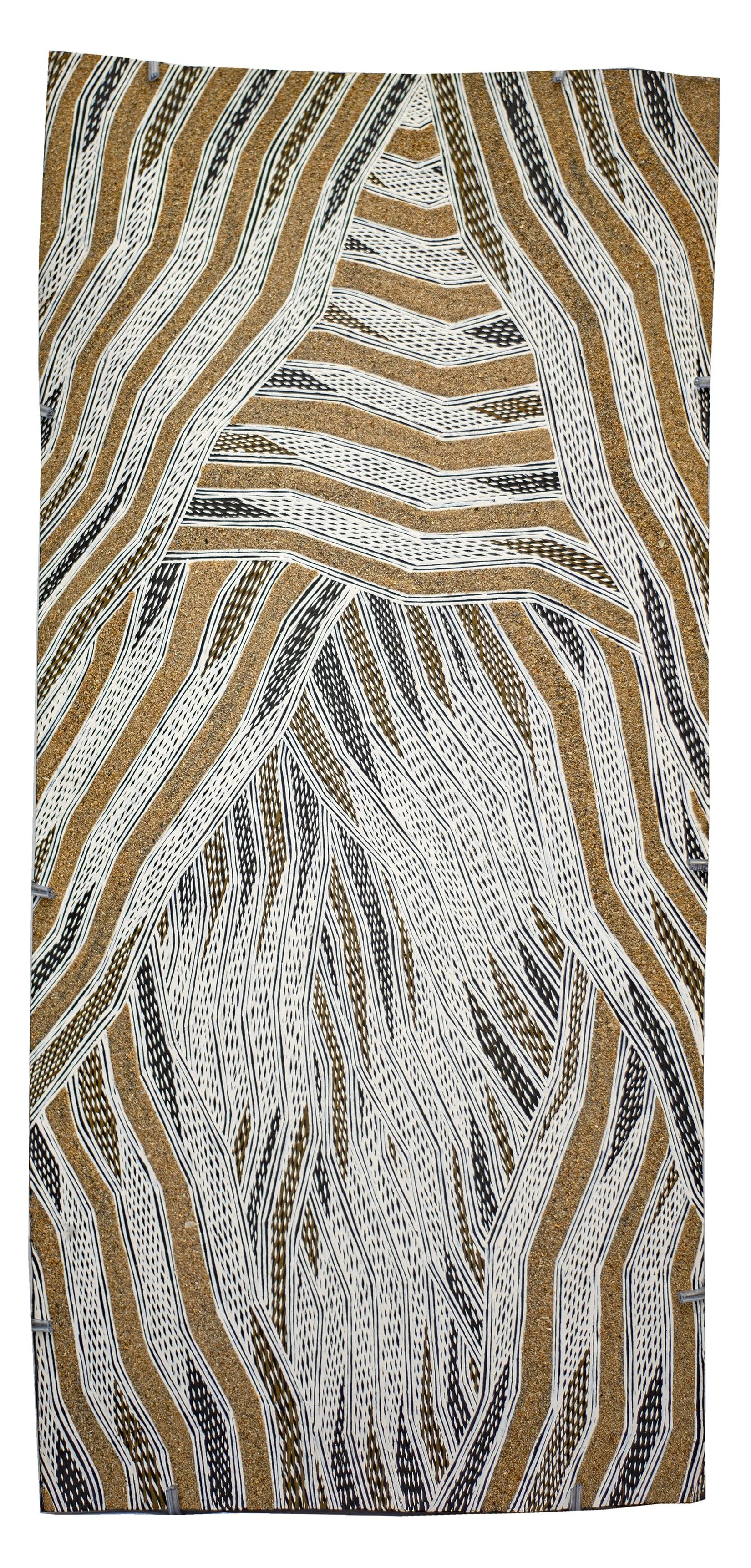
Artiste : Lamangirra #2 Gumana (1977)
Titre de l'œuvre : Garrapara
Pigments naturels sur écorce
Format : 68x33 cm
Provenance et certificat original : centre d'art aborigène de Yirrkala
Référence de la peinture : 3001-23
© Photo & text : Aboriginal signature with the courtesy of the artist, & Buku-Larrngay Mulka.
Explication de l’œuvre :
Garrapara is a coastal headland and bay area within Blue Mud Bay. It is known on the maps in English a Djalma Bay. It marks the spot of a sacred burial area for the Dhalwangu clan and a site where dispute was formally settled by Makarrata (a trial of ordeal by spear which settled serious grievance and sealed the peace forever). At Garrapara sacred Casuarina trees held these barbed spears whilst not in use.
Makani the Queenfish hugs the shore almost beaching itself as it attacks schools of baitfish and has actually formed the features of the coastline of Djalma Bay.
During the creation times of the ‘first mornings’ ancestral hunters left the shores of Garrapara in their canoe towards the horizon hunting for turtle. Sacred songs and dance narrate the heroic adventures of these two men as they passed sacred areas, rocks and saw ancestral totems on their way. Their hunting came to grief, with the canoe capsizing and the hunters being drowned. The bodies washed back to the shores of Garrapara with the currents and the tides, as the Wangupini (maternal Thunderhead cumulo- nimbus cloud) followed with its rain and wind. Their canoe with paddle and their totems Makani (Queenfish) and Minyga (Long Tom) and Gärun (Loggerhead Turtle) are all referred to in the songs and landscape.
Garrapara has been rendered by the wavy design for Yirritja saltwater in Blue Mud Bay called Mungurru. The Mungurru is deep water that has many states and connects with the sacred waters coming from the land estates by currents and tidal action. This sacred design shows the water of Djalma Bay chopped up by the blustery South Easterlies of the early Dry season.
The miny’tji (sacred clan design) on this piece identifies the Dhalwaŋu saltwater estate of Garrapara on Blue Mud Bay.
Her artworks are in the following prestigious collections :
Art Gallery of New South Wales, Sydney NSW
Private European collections

Artiste : Lamangirra #2 Gumana (1977)
Titre de l'œuvre : Garrapara
Pigments naturels sur écorce
Format : 90 x 42cm
Provenance et certificat original : centre d'art aborigène de Yirrkala
Référence de la peinture : 3666-23
© Photo & text : Aboriginal signature with the courtesy of the artist, & Buku-Larrngay Mulka.
Explication de l’œuvre :
Garrapara is a coastal headland and bay area within Blue Mud Bay. It is known on the maps in English a Djalma Bay. It marks the spot of a sacred burial area for the Dhalwangu clan and a site where dispute was formally settled by Makarrata (a trial of ordeal by spear which settled serious grievance and sealed the peace forever). At Garrapara sacred Casuarina trees held these barbed spears whilst not in use.
Makani the Queenfish hugs the shore almost beaching itself as it attacks schools of baitfish and has actually formed the features of the coastline of Djalma Bay.
During the creation times of the ‘first mornings’ ancestral hunters left the shores of Garrapara in their canoe towards the horizon hunting for turtle. Sacred songs and dance narrate the heroic adventures of these two men as they passed sacred areas, rocks and saw ancestral totems on their way. Their hunting came to grief, with the canoe capsizing and the hunters being drowned. The bodies washed back to the shores of Garrapara with the currents and the tides, as the Wangupini (maternal Thunderhead cumulo- nimbus cloud) followed with its rain and wind. Their canoe with paddle and their totems Makani (Queenfish) and Minyga (Long Tom) and Gärun (Loggerhead Turtle) are all referred to in the songs and landscape.
Garrapara has been rendered by the wavy design for Yirritja saltwater in Blue Mud Bay called Mungurru. The Mungurru is deep water that has many states and connects with the sacred waters coming from the land estates by currents and tidal action. This sacred design shows the water of Djalma Bay chopped up by the blustery South Easterlies of the early Dry season.
The miny’tji (sacred clan design) on this piece identifies the Dhalwaŋu saltwater estate of Garrapara on Blue Mud Bay.
Her artworks are in the following prestigious collections :
Art Gallery of New South Wales, Sydney NSW
Private European collections

Artiste : Djalinda Yunupiŋu (1954)
Titre de l'œuvre : Yathiny
Pigments naturels sur écorce
Format : 90x33 cm
Provenance et certificat original : centre d'art aborigène de Yirrkala
Référence de la peinture : 4004-22
© Photo & text : Aboriginal signature with the courtesy of the artist, & Buku-Larrngay Mulka.
Explication de l’œuvre :
Djalinda here has painted her mother’s Rirratjiŋu clan sea country at Yirrkala, the waters between the mainland and Bremer Island. These waters are shared with the Djambarrpuyngu clan. Here lies the sacred rock Manhala. Turtle swim here and feed on the Yathiny, a blue sea anemone that floats on the surface.
Looking left up the coast from Yirrkala about two kilometres is the rocky escarpment leading down into the sea known as Galariya by the Rirratjiŋu. Off shore from there the island of Dhambaliya can be seen. These two areas and the sea in between is an important site influenced by Djambawal the Thunder Man and Daymirri the Ancestral Whale.
The Ancestral hunters took turtle in these waters and also left their mark on the mainland at Galariya as well as Dhambaliya. The land and associate events connect the two clan groups of the Rirratjiŋu and Djambarrpuyŋu who have custodial rites to this country. Minyipa and Dhaŋgatjiya were young sons of Mururruma who is referred to as the Grandfather of the Rirratjiŋu family. Mururruma was killed in a ritual spearing by the family of his young wife who Mururruma had killed because she had constantly complained about being separated from her own family.
Aer killing Mururruma on the mainland, the warriors of the young wife’s family pursued his sons Minyipa and Dhaŋgatjiya across the sea to Dhambaliya but were themselves defeated. For their stealth and courage in the battle Minyipa and Dhangatjiya became renown Waŋarr (spirit forms living in times past), to the Rirratjiŋu and Djambarrpuyŋu people. As Gutharra (Grandchild/Rirratjiŋu) and Märi (Grandfather/Djambarrpuyŋu) clans to each other - “Gutharra is the body of the Märi” - these two clans share responsibility for areas of the mainland and Dhambaliya…
Her artworks are in the following prestigious collections :
Art Gallery of New South Wales, Sydney NSW
Art Gallery of South Australia, Adelaide SA
Charles Darwin University Art Collection
JW Kluge Collection, Virginia USA
Seattle Art Museum, Seattle USA

Artiste : Lamangirra #2 Gumana (1977)
Titre de l'œuvre : Garrapara
Pigments naturels sur écorce
Format : 190x65 cm
Provenance et certificat original : centre d'art aborigène de Yirrkala
Référence de la peinture : 3201-21
© Photo & text : Aboriginal signature with the courtesy of the artist, & Buku-Larrngay Mulka.
Explication de l’œuvre :
Garrapara is a coastal headland and bay area within Blue Mud Bay. It is known on the maps in English a Djalma Bay. It marks the spot of a sacred burial area for the Dhalwangu clan and a site where dispute was formally settled by Makarrata (a trial of ordeal by spear which settled serious grievance and sealed the peace forever). At Garrapara sacred Casuarina trees held these barbed spears whilst not in use.
Makani the Queenfish hugs the shore almost beaching itself as it attacks schools of baitfish and has actually formed the features of the coastline of Djalma Bay.
During the creation times of the ‘first mornings’ ancestral hunters left the shores of Garrapara in their canoe towards the horizon hunting for turtle. Sacred songs and dance narrate the heroic adventures of these two men as they passed sacred areas, rocks and saw ancestral totems on their way. Their hunting came to grief, with the canoe capsizing and the hunters being drowned. The bodies washed back to the shores of Garrapara with the currents and the tides, as the Wangupini (maternal Thunderhead cumulo- nimbus cloud) followed with its rain and wind. Their canoe with paddle and their totems Makani (Queenfish) and Minyga (Long Tom) and Gärun (Loggerhead Turtle) are all referred to in the songs and landscape.
Garrapara has been rendered by the wavy design for Yirritja saltwater in Blue Mud Bay called Mungurru. The Mungurru is deep water that has many states and connects with the sacred waters coming from the land estates by currents and tidal action. This sacred design shows the water of Djalma Bay chopped up by the blustery South Easterlies of the early Dry season.
The miny’tji (sacred clan design) on this piece identifies the Dhalwaŋu saltwater estate of Garrapara on Blue Mud Bay.
Her artworks are in the following prestigious collections :
Art Gallery of New South Wales, Sydney NSW
Private European collections
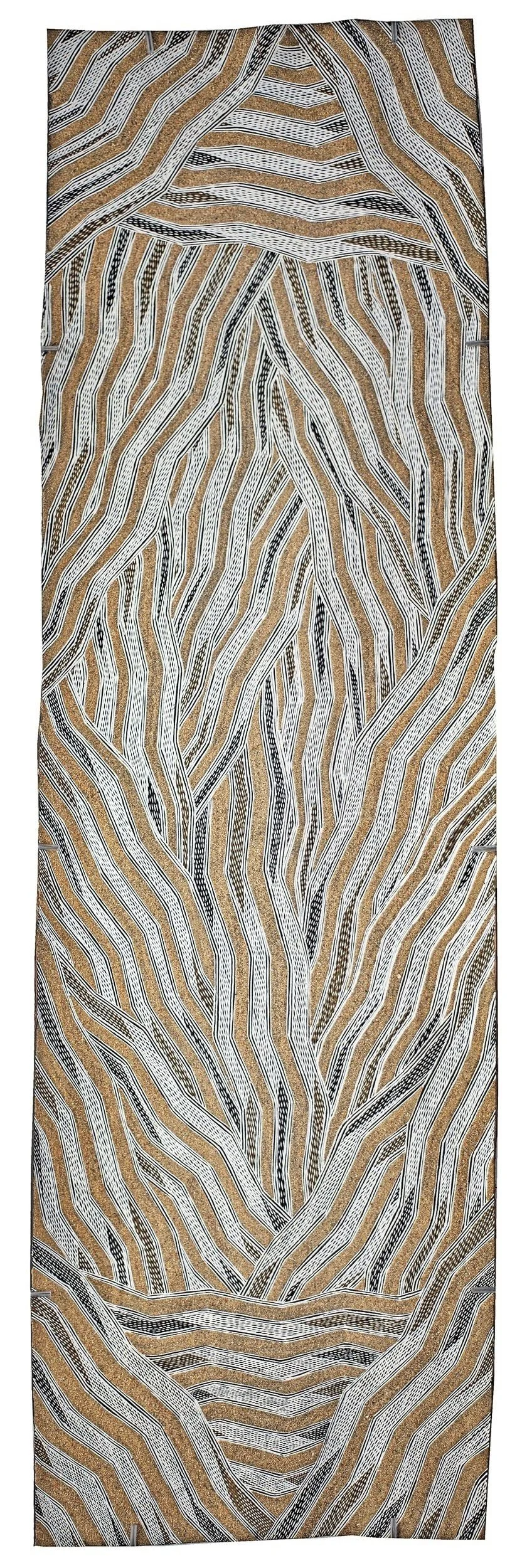
Artiste : Lamangirra #2 Gumana (1977)
Titre de l'œuvre : Garrapara
Pigments naturels sur écorce
Format : 136cm x 40cm
Provenance et certificat original : centre d'art aborigène de Yirrkala
Référence de la peinture : 2581-23
© Photo & text : Aboriginal signature with the courtesy of the artist, & Buku-Larrngay Mulka.
Explication de l’œuvre :
Garrapara is a coastal headland and bay area within Blue Mud Bay. It is known on the maps in English a Djalma Bay. It marks the spot of a sacred burial area for the Dhalwangu clan and a site where dispute was formally settled by Makarrata (a trial of ordeal by spear which settled serious grievance and sealed the peace forever). At Garrapara sacred Casuarina trees held these barbed spears whilst not in use.
Makani the Queenfish hugs the shore almost beaching itself as it attacks schools of baitfish and has actually formed the features of the coastline of Djalma Bay.
During the creation times of the ‘first mornings’ ancestral hunters left the shores of Garrapara in their canoe towards the horizon hunting for turtle. Sacred songs and dance narrate the heroic adventures of these two men as they passed sacred areas, rocks and saw ancestral totems on their way. Their hunting came to grief, with the canoe capsizing and the hunters being drowned. The bodies washed back to the shores of Garrapara with the currents and the tides, as the Wangupini (maternal Thunderhead cumulo- nimbus cloud) followed with its rain and wind. Their canoe with paddle and their totems Makani (Queenfish) and Minyga (Long Tom) and Gärun (Loggerhead Turtle) are all referred to in the songs and landscape.
Garrapara has been rendered by the wavy design for Yirritja saltwater in Blue Mud Bay called Mungurru. The Mungurru is deep water that has many states and connects with the sacred waters coming from the land estates by currents and tidal action. This sacred design shows the water of Djalma Bay chopped up by the blustery South Easterlies of the early Dry season.
The miny’tji (sacred clan design) on this piece identifies the Dhalwaŋu saltwater estate of Garrapara on Blue Mud Bay.
Her artworks are in the following prestigious collections :
Art Gallery of New South Wales, Sydney NSW
Private European collections

Artiste : Djalinda Yunupiŋu (1954)
Titre de l'œuvre : Yathiny
Pigments naturels sur écorce
Format : 75cm x 36cm
Provenance et certificat original : centre d'art aborigène de Yirrkala
Référence de la peinture : 8748-22
© Photo & text : Aboriginal signature with the courtesy of the artist, & Buku-Larrngay Mulka.
Explication de l’œuvre :
Djalinda here has painted her mother’s Rirratjiŋu clan sea country at Yirrkala, the waters between the mainland and Bremer Island. These waters are shared with the Djambarrpuyngu clan. Here lies the sacred rock Manhala. Turtle swim here and feed on the Yathiny, a blue sea anemone that floats on the surface.
Looking left up the coast from Yirrkala about two kilometres is the rocky escarpment leading down into the sea known as Galariya by the Rirratjiŋu. Off shore from there the island of Dhambaliya can be seen. These two areas and the sea in between is an important site influenced by Djambawal the Thunder Man and Daymirri the Ancestral Whale.
The Ancestral hunters took turtle in these waters and also left their mark on the mainland at Galariya as well as Dhambaliya. The land and associate events connect the two clan groups of the Rirratjiŋu and Djambarrpuyŋu who have custodial rites to this country. Minyipa and Dhaŋgatjiya were young sons of Mururruma who is referred to as the Grandfather of the Rirratjiŋu family. Mururruma was killed in a ritual spearing by the family of his young wife who Mururruma had killed because she had constantly complained about being separated from her own family.
Aer killing Mururruma on the mainland, the warriors of the young wife’s family pursued his sons Minyipa and Dhaŋgatjiya across the sea to Dhambaliya but were themselves defeated. For their stealth and courage in the battle Minyipa and Dhangatjiya became renown Waŋarr (spirit forms living in times past), to the Rirratjiŋu and Djambarrpuyŋu people. As Gutharra (Grandchild/Rirratjiŋu) and Märi (Grandfather/Djambarrpuyŋu) clans to each other - “Gutharra is the body of the Märi” - these two clans share responsibility for areas of the mainland and Dhambaliya…
Her artworks are in the following prestigious collections :
Art Gallery of New South Wales, Sydney NSW
Art Gallery of South Australia, Adelaide SA
Charles Darwin University Art Collection
JW Kluge Collection, Virginia USA
Seattle Art Museum, Seattle USA

Artiste : Djalinda Yunupiŋu (1954)
Titre de l'œuvre : Yathiny
Pigments naturels sur écorce
Format : 65cm x 36cm
Provenance et certificat original : centre d'art aborigène de Yirrkala
Référence de la peinture : 8605-22
© Photo & text : Aboriginal signature with the courtesy of the artist, & Buku-Larrngay Mulka.
Explication de l’œuvre :
Djalinda here has painted her mother’s Rirratjiŋu clan sea country at Yirrkala, the waters between the mainland and Bremer Island. These waters are shared with the Djambarrpuyngu clan. Here lies the sacred rock Manhala. Turtle swim here and feed on the Yathiny, a blue sea anemone that floats on the surface.
Looking left up the coast from Yirrkala about two kilometres is the rocky escarpment leading down into the sea known as Galariya by the Rirratjiŋu. Off shore from there the island of Dhambaliya can be seen. These two areas and the sea in between is an important site influenced by Djambawal the Thunder Man and Daymirri the Ancestral Whale.
The Ancestral hunters took turtle in these waters and also left their mark on the mainland at Galariya as well as Dhambaliya. The land and associate events connect the two clan groups of the Rirratjiŋu and Djambarrpuyŋu who have custodial rites to this country. Minyipa and Dhaŋgatjiya were young sons of Mururruma who is referred to as the Grandfather of the Rirratjiŋu family. Mururruma was killed in a ritual spearing by the family of his young wife who Mururruma had killed because she had constantly complained about being separated from her own family.
Aer killing Mururruma on the mainland, the warriors of the young wife’s family pursued his sons Minyipa and Dhaŋgatjiya across the sea to Dhambaliya but were themselves defeated. For their stealth and courage in the battle Minyipa and Dhangatjiya became renown Waŋarr (spirit forms living in times past), to the Rirratjiŋu and Djambarrpuyŋu people. As Gutharra (Grandchild/Rirratjiŋu) and Märi (Grandfather/Djambarrpuyŋu) clans to each other - “Gutharra is the body of the Märi” - these two clans share responsibility for areas of the mainland and Dhambaliya…
Her artworks are in the following prestigious collections :
Art Gallery of New South Wales, Sydney NSW
Art Gallery of South Australia, Adelaide SA
Charles Darwin University Art Collection
JW Kluge Collection, Virginia USA
Seattle Art Museum, Seattle USA

Artiste : Djirrirra Wunuŋmurra (1968)
Titre de l'œuvre : Buyku
Pigments naturels sur écorce
Format : 105 x 63 cm
Provenance et certificat original : centre d'art aborigène de Yirrkala
Référence de la peinture : 4223-21
© Photo & text : Aboriginal signature with the courtesy of the artist, & Buku-Larrngay Mulka.
Explication de l’œuvre :
Artworks such as this have multiple layers of metaphor and meaning which give lessons about the connections between an individual and specific pieces of country (both land and sea), as well as the connections between various clans but also explaining the forces that act upon and within the environment and the mechanics of a spirit’s path through existence. The knowledge referred to by this imagery deepens in complexity and secrecy as a person progresses through a life long learning process.
A sacred expanse of water behind the Gangan outstation where this work was produced is referred to as Gulutji. The initial activities of Barama the great Ancestral Being for the Yirritja moiety took place here. From travelling from the seaside at Blue Mud Bay he emerged from the waters of Gulutji. Council was held with ‘Disciple’ Ancestors and Yirritja Law was ‘written’.
From this place the Yirritja (the Yirritja moiety together with the Dhuwa moiety forms a duality system that keeps all past, present and future life in balance) naon spread as it traversed its country establishing clan estates and governing policy including language, ceremonial ritual and miny’tji (signature of sacred design of event and place- this word describes the patterns employed in this work).
One of the metaphorical overviews of the work is the union between the different subgroups of the Dhalwangu clan in the ancestral cycle of regular fishtrap ceremonies they join together in celebrating. The last one of these was five years ago. These gatherings are ceremonial but also social and educational.
The sacred diamond design generally refers to the waters around Gangan but here are encased in a strong grid of vertical and horizontal lines which show the structure of the fishtrap made during Mirrawarr (early Dry Season) with Rangan (paperbark) and wooden stakes. This is the Buyku or fishtrap area which is ‘company’ land (ie. shared by all the people who live by/sing the river). The Dhalwangu and allied groups who participate in this song cycle and fishing activity are hunting Baypinga (Saratoga) as does the Gany’tjurr (Reef Heron) which they identify with as the archetypal Yirritja hunter.
Her artworks are in the following prestigious collections :
Art Gallery of New South Wales, Sydney NSW
Artbank, Sydney NSW
Australian Catholic University Art Collection, Melbourne VIC
Kerry Stokes Collection, Perth WA
Levi and Kaplan Collection, Seattle USA
Museum and Art Gallery of the Northern Territory, Darwin NT
National Gallery of Australia, Canberra ACT
Queensland Art Gallery and Gallery of Modern Art, Brisbane QLD
The Kluge-Ruhe Aboriginal Art Collection of the University of Virginia. USA
The Laverty Collection, Sydney NSW
TOGA Group Companies Art Collection
University of Newcastle Art Gallery collection
Woodside Energy Ltd. Art Collection

Artiste : Bandarr Wirrpanda (1980)
Titre de l'œuvre : Yalata
Etched Aluminium
Format : 90 x 60 cm
Provenance et certificat original : centre d'art aborigène de Yirrkala
Référence de la peinture : 1452-21
© Photo & text : Aboriginal signature with the courtesy of the artist, & Buku-Larrngay Mulka.
Explication de l’œuvre :
This work depicts early events during Ancestral (and present) times at Yalata close to the Dhudi-Djapu clan homeland of Dhuruputjpi (about three hours drive South West from Yirrkala). It is a coastal fringe area, this Dhudi Djapu homeland, that has territory leading up a river through plains country behind an area of coast on Blue Mud Bay.
The plain is tidal and during the wet seasons it is flooded by the rains and tidal surge creating areas of brackish water. During the dry season the grass and black earth dry out. Then the fires come, turning a swamp into a huge plain of cracked black earth.
Fresh water springs dot this sun baked plain forming small islands of vegetation and as Rarrandada (the hot time) builds the thirsty wayin (birds) come to these sacred springs in their thousands. The noise of the guḏurrku or dhaŋgultji (brolgas) and gurrumaṯji (magpie geese) are deafening, the mud scored with their tracks and the sky dark with the flocks of wheeling birds.
In Ancestral times, activities of Mäna the shark and the Djaŋ’kawu took place here.
The Djaŋ’kawu - the Dhuwa moiety Creator Beings, in naming this country for the Dhudi Djapu, created these sacred fresh water springfed waterholes by plunging their sacred digging sticks in the ground. Freshwater sprung from these wells as did a sacred goanna, a manifestation in some circles of the Djaŋ’kawu themselves.
Story has it that on surfacing the goanna saw the first sun rise. Also on the wet clays around the wells the goanna observed the footprints of Daŋgultji the Brolga. The prints of the Brolga passing from spring to spring are an echo and a present day manifestation of the Sisters who adopted the form of the brolga in their travels between springs as portrayed by the roundrel.

Artiste : Napurrawuy #2 Wunuŋmurra
Titre de l'œuvre : Buyku
Pigments naturels sur écorce
Format : 133 x 58 cm
Provenance et certificat original : centre d'art aborigène de Yirrkala
Référence de la peinture : 2135-18
© Photo : Aboriginal signature with the courtesy of the artist & Buku-Larrngay Mulka.
Explication de l’œuvre :
This bark painting by Napurrawuy #2 Wunuŋmurra (1977), depicts the miny’tji (sacred clan design) of the Dhalwaŋu clan which is one of the eight or so clans belonging to
the Yirritja moiety (half) in North East Arnhem land. The sacred diamond design for the Dhalwaŋu clan reflects the patterning of the water streaming from the body of Ancestral Creator Being Barama as he emerged from these waters at Gäṉgaṉ, with weed hanging from his arms.
The sacred diamond design generally refers to the waters around Gangan but the triangles also show the structure of the fishtrap made during Mirrawarr (early Dry Season) with Rangan (paperbark) and wooden stakes. This is the Buyku or fishtrap area which is ‘company’ land (ie. shared by all the people who live by/sing the river). The Dhalwaŋu and allied groups who participate in this song cycle and fishing activity are hunting Baypinŋa (Saratoga) as does the Gany’tjurr (Reef Heron) which they identify with as the archetypal Yirritja hunter.

Artiste : Djurrayun Murrinyina
Titre de l'œuvre : Wukili
Pigments naturels sur écorce
Format : 107 x 43 cm
Provenance et certificat original : centre d'art aborigène de Yirrkala
Référence de la peinture : 2733-18
© Photo : Aboriginal signature with the courtesy of the artist & Buku-Larrngay Mulka.
Explication de l’œuvre :
This bark painting by Djurrayun Murrinyina (1974), evokes The area of sea country belonging to the Djarrwark clan is known as Wukili. It is between Baraltja and Garrapara on Blue Mud Bay.
During the time of the first morning, the Dhuwa Waŋarr, or creator ancestors, the Djaŋ’kawu paddled their canoe Malili (paddles Matiny) into this country. They saw catfish Balwaltja and ‘sheridan’s threadfin’ Malmuŋa and sang them as Dhuwa totems associated with the special qualities of the saltwater country of Wukili.
The miny’tji (sacred clan design) represents the Djarrwark saltwater itself. The Dhuwa saltwater country is marked by the straight and parallel ribbons of miny’tji of the Djarrwark. It is read to be water affected by the Ancestral presence of the Djaŋ’kawu Creators, the forebears of all Dhuwa people who laid down the law in the ancient past, including all the songs, dances, designs and deeds to land and water.
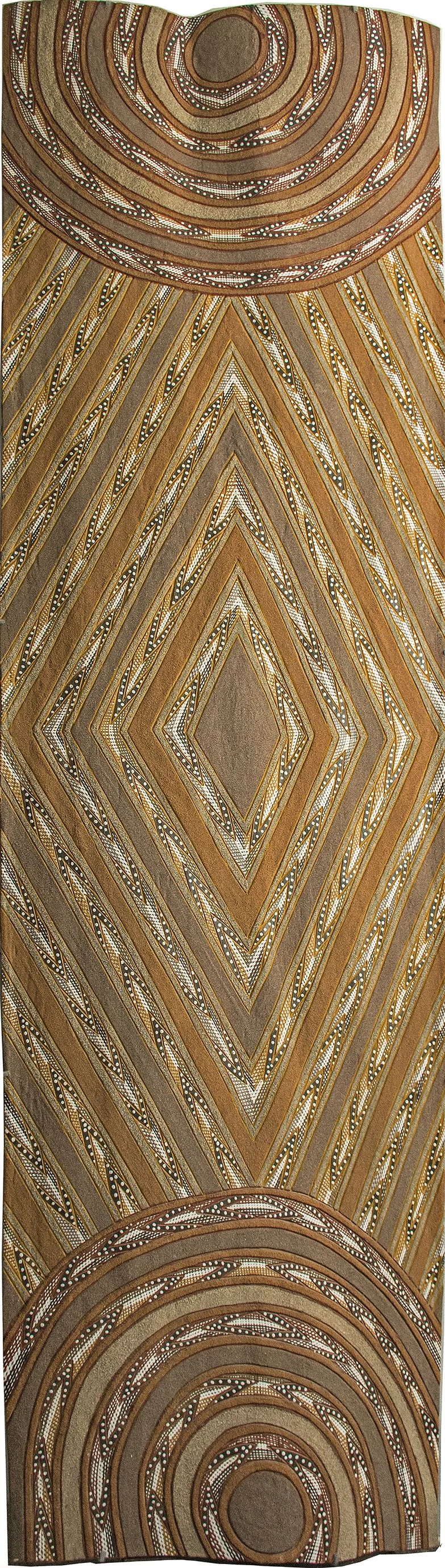
Artiste : Ralwurrandji Wanambi
Titre de l'œuvre : Bamurrungu in Trial Bay
Pigments naturels sur écorce
Format : 184 x 54 cm (72 1/2 x 21 1/4 in.)
Provenance et certificat : centre d'art aborigène de Yirrkala
Référence de la peinture : 4397r
© Photo : Aboriginal signature with the courtesy of the artist & Buku-Larrngay Mulka.

Artiste : Dhuwarrwarr Marika (1945)
Titre de l'œuvre : Makassan Swords and Long Knives
Pigments naturels sur écorce
Format : 187 x 75 cm
Provenance et certificat original : centre d'art aborigène de Yirrkala
Référence de la peinture : 744-21
© Photo & text : Aboriginal signature with the courtesy of the artist, & Buku-Larrngay Mulka.
Explication de l’œuvre :
“When the Makassan came, they tried to find the Aboriginal people at Melville Bay. The Yolngu wives and kids were asleep.
The men woke up and saw the boat. They thought it was the enemy and some Makassan jumped from their boat and swam to the shore to meet the Aboriginal people. They wanted to work with them. They explained to them about trepang and where they could find some trepang. They went and collected to show them. The Makassan showed them what to do, cooked them and dried them out, explained to them it’s good food and they paid the aboriginal people with swords, axes, material and tobacco. They invited the Makassan people to the camp and explained to them who they were and why they came because in their heart they were Yolgnu people. And the Makassan taught the Yolngu their song and traditions and the Yolngu taught the Makassan their culture and law and tradition.
This is the story and the painting from Dhuwarrwarr Marika, taught to me by my father when the Makassan came to Australia and learned about the Aboriginal people.”
Since the turn of the century the annual visitations of the Makassanese to the Top End shores of Australia were put to a stop by the South Australian Government. These sailors, gatherers of trepang from coastal waters, had for up to six centuries caught the seasonal winds back and forth from what is now known as Sulawesi.
Dhuwarrwarr’s father Mawalan Marika painted about these people in the 1940s and spoke some Makassan language. He always emphasised to her the importance of the relationship between Yolŋu and these allies. He was the leader of the Yirrkala people at the time of the coming of Europeans but never lost his fondness and respect for Makassans.

Artiste : Dhuwarrwarr Marika (1945)
Titre de l'œuvre : Makassan Swords and Long Knives
Pigments naturels sur écorce
Format : 104 x 51 cm
Provenance et certificat original : centre d'art aborigène de Yirrkala
Référence de la peinture : 1291-21
© Photo & text : Aboriginal signature with the courtesy of the artist, & Buku-Larrngay Mulka.
Explication de l’œuvre :
“When the Makassan came, they tried to find the Aboriginal people at Melville Bay. The Yolngu wives and kids were asleep.
The men woke up and saw the boat. They thought it was the enemy and some Makassan jumped from their boat and swam to the shore to meet the Aboriginal people. They wanted to work with them. They explained to them about trepang and where they could find some trepang. They went and collected to show them. The Makassan showed them what to do, cooked them and dried them out, explained to them it’s good food and they paid the aboriginal people with swords, axes, material and tobacco. They invited the Makassan people to the camp and explained to them who they were and why they came because in their heart they were Yolgnu people. And the Makassan taught the Yolngu their song and traditions and the Yolngu taught the Makassan their culture and law and tradition.
This is the story and the painting from Dhuwarrwarr Marika, taught to me by my father when the Makassan came to Australia and learned about the Aboriginal people.”
Since the turn of the century the annual visitations of the Makassanese to the Top End shores of Australia were put to a stop by the South Australian Government. These sailors, gatherers of trepang from coastal waters, had for up to six centuries caught the seasonal winds back and forth from what is now known as Sulawesi.
Dhuwarrwarr’s father Mawalan Marika painted about these people in the 1940s and spoke some Makassan language. He always emphasised to her the importance of the relationship between Yolŋu and these allies. He was the leader of the Yirrkala people at the time of the coming of Europeans but never lost his fondness and respect for Makassans.
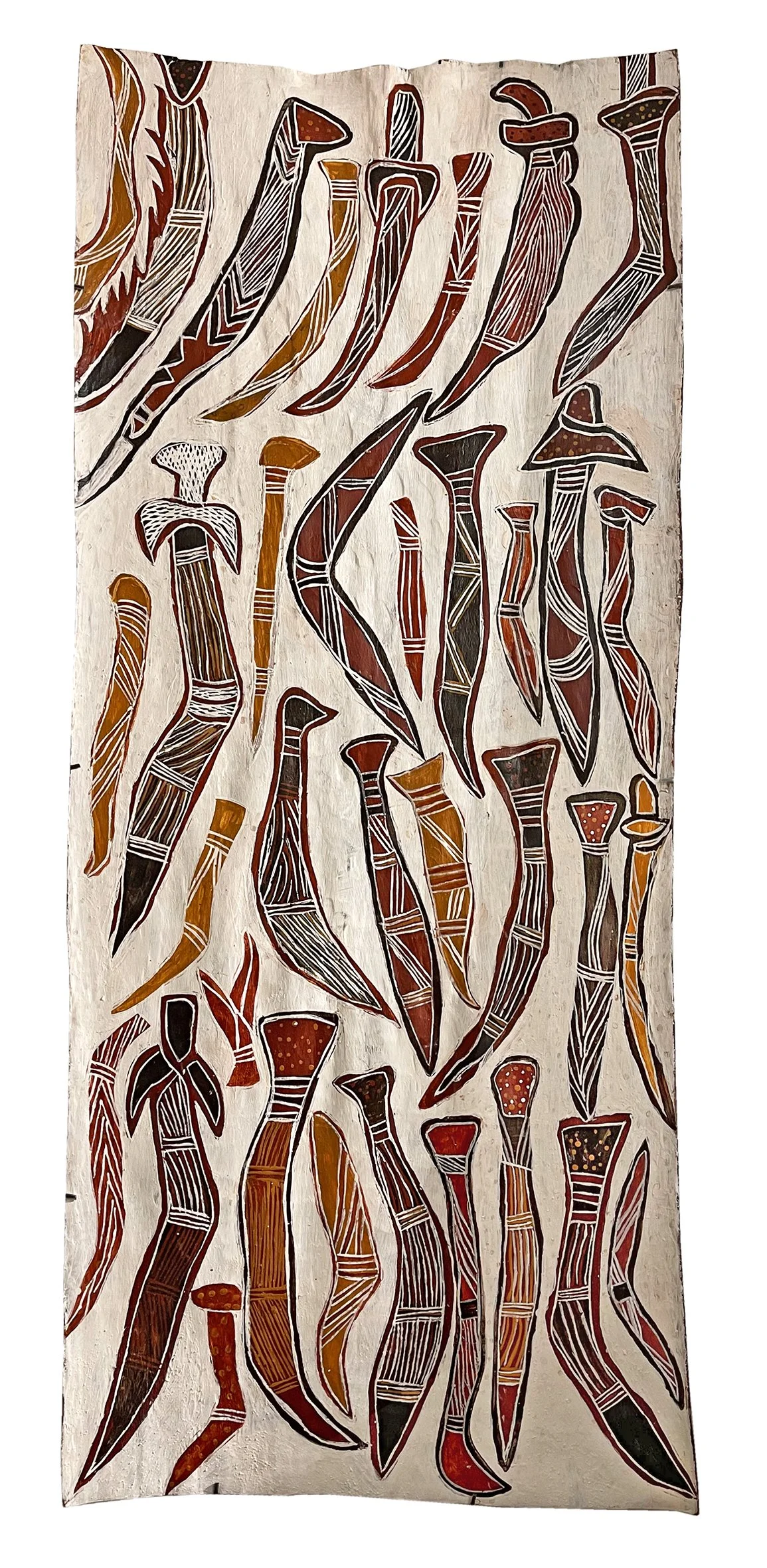
Artiste : Dhuwarrwarr Marika (1945)
Titre de l'œuvre : Makassan Swords and Long Knives
Pigments naturels sur écorce
Format : 186x77 cm
Provenance et certificat original : centre d'art aborigène de Yirrkala
Référence de la peinture : 2161-21
© Photo & text : Aboriginal signature with the courtesy of the artist, & Buku-Larrngay Mulka.
Explication de l’œuvre :
“When the Makassan came, they tried to find the Aboriginal people at Melville Bay. The Yolngu wives and kids were asleep.
The men woke up and saw the boat. They thought it was the enemy and some Makassan jumped from their boat and swam to the shore to meet the Aboriginal people. They wanted to work with them. They explained to them about trepang and where they could find some trepang. They went and collected to show them. The Makassan showed them what to do, cooked them and dried them out, explained to them it’s good food and they paid the aboriginal people with swords, axes, material and tobacco. They invited the Makassan people to the camp and explained to them who they were and why they came because in their heart they were Yolgnu people. And the Makassan taught the Yolngu their song and traditions and the Yolngu taught the Makassan their culture and law and tradition.
This is the story and the painting from Dhuwarrwarr Marika, taught to me by my father when the Makassan came to Australia and learned about the Aboriginal people.”
Since the turn of the century the annual visitations of the Makassanese to the Top End shores of Australia were put to a stop by the South Australian Government. These sailors, gatherers of trepang from coastal waters, had for up to six centuries caught the seasonal winds back and forth from what is now known as Sulawesi.
Dhuwarrwarr’s father Mawalan Marika painted about these people in the 1940s and spoke some Makassan language. He always emphasised to her the importance of the relationship between Yolŋu and these allies. He was the leader of the Yirrkala people at the time of the coming of Europeans but never lost his fondness and respect for Makassans.
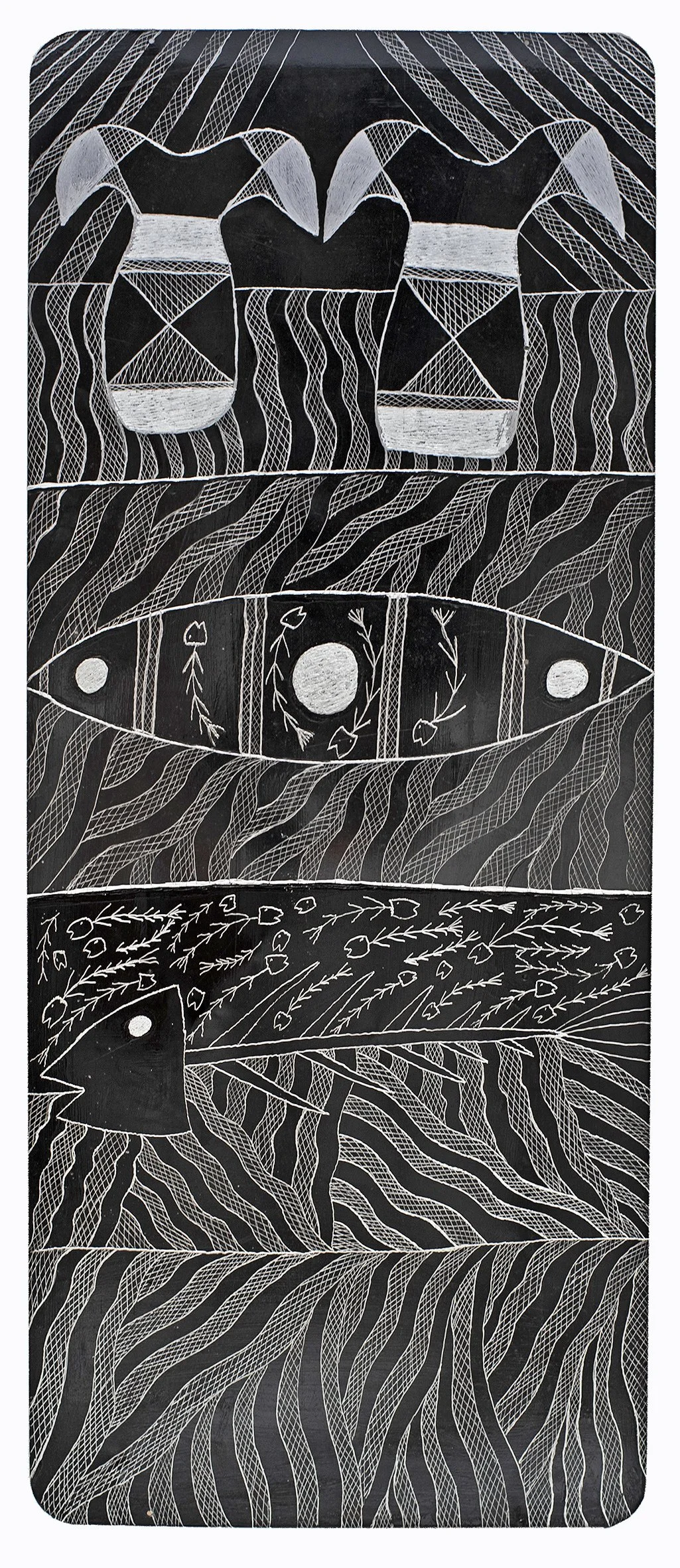
Artiste : Bandarr Wirrpanda (1980)
Titre de l'œuvre : Yiŋapuŋapu
Etched Aluminium
Format : 120 x 50 cm
Provenance et certificat original : centre d'art aborigène de Yirrkala
Référence de la peinture : 1019-21
© Photo & text : Aboriginal signature with the courtesy of the artist, & Buku-Larrngay Mulka.
Explication de l’œuvre :
The designs in this piece are tied to the saltwater estate and ritual focal point at Djarrakpi, the home of Bandarr and his clan.
This beautiful place is located on the Northern entrance of Blue Mud Bay on the Western coast of the Gulf of Carpentaria. It has its founding origins in the times of the first sunrises by the Guwak (a people, 2 men, a koel cuckoo) and a messenger in the form of ringtail possum called marrŋu. The koel at Djarrakpi made roost atop the Marawili (native cashew tree) and Marrŋu made his mark for the Maŋgalili clan by scratching into its trunk. Behind the massive coastal dunes, there is also a lake of freshwater and at the back of these dunes is said to reside the powerful maternal figure of Nyapaliŋu. She wore a possum furstring girdle crossing her chest; the levy bank of the lake was also of the same masculine and sacred fur, a great long shank.
The Guwak as two ancestral hunters left the shores of Djarrakpi in their canoe, testing themselves against the elements, unfathomable sea creatures, the distant horizon and the destructive wake of a giant turtle which eventually capsized their canoe. The Guwak drowned and with their canoe washed back to the Djarrakpi shore. This epiphany; original deaths of the original Maŋgalili gave birth to the original tradition of mortuary rites that nurtured the deceased, clearing the way for temporary release into the ether before reincarnation.
Above this shore - made sacred with this profound wash up - is the Djarrakpi yiŋapuŋapu ground. The yiŋapuŋapu is a low relief sand sculpture of feminine elliptical shape, and used in the context of mortuary for the Yirritja clans of Maŋgalili, Madarrpa and Dhalwaŋu. This painting includes the yiŋapuŋapu of these three sites. Its primary traditional function is to keep the contamination of death within the confines of the sculpture. Placement of the deceased with in the yiŋapuŋapu on the associated clan land in days before contact had been reserved originally for the creator ancestors. In these areas and by way of permanence for perpetuity, yiŋapuŋapu sites denoted indisputable land ownership.

Artiste : Ŋoŋu Ganambarr (1967)
Titre de l'œuvre : Wirrmu Moon
Etched Aluminium
Format : 85 x 45 cm
Provenance et certificat original : centre d'art aborigène de Yirrkala
Référence de la peinture : 2171-21
© Photo & text : Aboriginal signature with the courtesy of the artist, & Buku-Larrngay Mulka.
Explication de l’œuvre :
This Waŋgurri clan painting depicts the Wirrmu or new moon and Djurrpun the Evening Star and is the first painting in the modern era to so do. The elder who painted it had never revealed this design before.
Buwathay said “When the old man was geting sick he drew this in the sand for me and said ’Later paint this one.’” He was referring to his recently deceased father Mathulu’s words. Buwathay went on to say “This is my totem. The little stars are the other stars that you can see. There are songs and dances that go with this story. It relates to the milkarri- the keening of women.” The design on the work relates to the journey of such a pole through Wangurri clan waters. In saltwaters belonging to that clan from their homeland at Mutamul towards their freshwater homeland at Dhalinybuy. It is understood that this work relates to saltwater in Arnhem Bat=y and the floodplains which they inundate in Wet Season flooding and King Tides.
The minyjti or sacred clan design can have different meanings. One is a manifestation in the tracks left in timber from infestation from the boring mangrove worm Milka. Bands of miny’tji represents this and by the layering of hair brush strokes, that build up to a shimmering and brilliant state, itself a manifestation (we can only imagine) of the sublime and to the references this painting could have of the end results of supernatural events and the peace brought after as rays of sun on the calm waters, a condition called gunbilk. Out there in the still distance clouds line the horizon.
The waters that travel through the mangrove areas, (where the Milka infest the wood), that wash with the tides to be taken with the currents out deep to the horizons meet with associate waters from other estates relative to the Wangurri, such as the Maŋgalili. These waters contain the life forces and clan identity and are taken up into the maternal clouds and as dots amongst the waters supporting the totem octopus Manda and the yothu (child) cuttle fish shells floating on the surface.

Artiste : Lamangirra #2 Gumana (1977)
Titre de l'œuvre : Garrapara
Pigments naturels sur écorce - Larrakitj
Format : 192 x 16cm
Provenance et certificat original : centre d'art aborigène de Yirrkala
Référence de la peinture : 7785-22
© Photo & text : Aboriginal signature with the courtesy of the artist, & Buku-Larrngay Mulka.
Explication de l’œuvre :
Garrapara is a coastal headland and bay area within Blue Mud Bay. It is known on the maps in English a Djalma Bay. It marks the spot of a sacred burial area for the Dhalwangu clan and a site where dispute was formally settled by Makarrata (a trial of ordeal by spear which settled serious grievance and sealed the peace forever). At Garrapara sacred Casuarina trees held these barbed spears whilst not in use.
Makani the Queenfish hugs the shore almost beaching itself as it attacks schools of baitfish and has actually formed the features of the coastline of Djalma Bay.
During the creation times of the ‘first mornings’ ancestral hunters left the shores of Garrapara in their canoe towards the horizon hunting for turtle. Sacred songs and dance narrate the heroic adventures of these two men as they passed sacred areas, rocks and saw ancestral totems on their way. Their hunting came to grief, with the canoe capsizing and the hunters being drowned. The bodies washed back to the shores of Garrapara with the currents and the tides, as the Wangupini (maternal Thunderhead cumulo- nimbus cloud) followed with its rain and wind. Their canoe with paddle and their totems Makani (Queenfish) and Minyga (Long Tom) and Gärun (Loggerhead Turtle) are all referred to in the songs and landscape.
Garrapara has been rendered by the wavy design for Yirritja saltwater in Blue Mud Bay called Mungurru. The Mungurru is deep water that has many states and connects with the sacred waters coming from the land estates by currents and tidal action. This sacred design shows the water of Djalma Bay chopped up by the blustery South Easterlies of the early Dry season.
The miny’tji (sacred clan design) on this piece identifies the Dhalwaŋu saltwater estate of Garrapara on Blue Mud Bay.

Artiste : Liyawaday Wirrpanda (1972)
Titre de l'œuvre : Wayawu/Dhuruputjpi/Yalata
Earth pigments on Stringybark hollow pole
Format : 265 cm x 10 cm
Provenance et certificat original : centre d'art aborigène de Yirrkala
Référence de la peinture : 664-19
© Photo & text : Aboriginal signature with the courtesy of the artist, & Buku-Larrngay Mulka.
Explication de l’œuvre :
There are two clan groups represented on this bark- the Maŋgalili clan and the Dhud-Djapu clan.
Hidden within these paerns are the two great ancestral beings, Ŋukal and Mäṉa.
The miny’tji (sacred clan designs) with parallel banding describes the Maŋgalili freshwater and talks of Ŋuykal the Kingfish, rotting wood raŋga (sacred object) under the water and the sacred yoku (corms of the water lily) representing the yothu (children) of the Maŋgalili fed on by the Bilthu (Rifle fish). The Ŋuykal: Turrum, carangoides emburyi , Kingfish, enters into freshwater to breed. A strong swimming fish seen seasonally cruising along shore lines are speared by Yolŋu. It is totem for the Maŋgalili clan. It is the journey of this fish (up freshwater rivers to breed) that created important ties with relative clans. Ŋuykal’s travelling included a path from Dhonydji to the Wayawu River, passed through Dhälinbuy, a site where the Wangurri clanspeople have settled. At Wayawuwuy, Ŋuykal changed into the hollow log Milkamirri. The sacred design represents the Yoku or lily corm eaten by Ŋoykal whilst at the Wayawu River.
He swims up stream towards the sacred rock Dhukurru from where ancestors once stood to spear the big fish. Ŋuykal people dance, with spear throwers the tail and sacred dilly bag in mouth. The concept of lily bulbs in dillybags has an echo in Maŋgalili children in the womb. Thus the Wayawu is the freshwater source of Maŋgalili souls and an analogy for the Milky Way which is also seen as the reservoir of Maŋgalili souls from which children spring to select their parents. This painting depicts in sacred abstraction the corms still aached to the plant, being washed from the lily beds by the flooding Wayawu and represents the Maŋgalili essence (of Ŋuykal) in this water. The Wayawu river also runs into the Dhudi Djapu clan country at Dhuruputjpi.
The herringbone pattern depicts this country around Dhuruputjpi. It has the freshwaters of the Wayawu River running through it…
Her artworks are in the following prestigious collections :
Art Gallery of Western Australia, Perth WA
Australian National Maritime Museum
Deakin University, Melbourne, VIC
National Museum of Australia, Canberra ACT
RMIT University Art Collection
Woodside Energy Ltd. Art Collection
Artiste : Noŋgirrŋa Marawili (1938)
Titre de l'œuvre : Mundukul / Burrut'tji - Lightning snake
Format : 170 x 64 cm
Provenance et certificat : Yirrkala
Référence de cette peinture : 4555X
Explications sur cette peinture Aborigène :
Noŋgirrŋa started life as one of the numerous children of Mundukul the Madarrpa warrior (c.1890-c.1950). He was a famed leader/warrior with uncountable wives of the Marrakulu, Dhudi Djapu and Galpu clans. She was a child of one of the four Galpu wives, Bulungguwuy. Life was a bountiful but disciplined subsistence amongst a working family group of closely related mothers, brothers and sisters. This was over fifty people! She was born on the beach at Darrpirra north of Cape Shield on the oceanside. But they were Wakir’ – camping- moving around. They went to Yilpara. They went to Djarrakpi. But their special place was Guwaŋarripa (Woodah Island). They were a fleet of canoes travelling all the way to Groote Island and back and forth from the mainland. They lived in this rich place. Their special spot on the mainland was Baratjula. A place to which she only returned after the creation of these paintings…
Baraltja is the residence of Burrut’tji (also known as Mundukul) the lightning serpent. It is an area of flood plains that drain into northern Blue Mud Bay. It is on country belonging to the Madarrpa and denotes an area of special qualities pertaining to fertility and the mixing of waters.
From Madarrpa (and Dhalwaŋu clan) land freshwater spreads onto the Baraltja flood plains with the onset of the Wet. A tidal creek into the Bay flows with the freshwater flushing the brackish mix into the sea over an ever shifting sandbar (the snake manifest). The deep hole that he lives in is Lorr.
Freshwater enters the tidal mud flats at Baraltja that is residence of the Lightning Snake for the Madarrpa. The lightning Snake facing upstream, upon tasting the freshwater coming down stands on his tail and by way of spiting lightning into the sky communicates with the Ṉuŋurrdulpuyŋu and his contemporaries from other associated clans.
The same can be said for the other who faces towards the south towards another Madarrpa area called Guminiyawiny, Numbulwar way, producing storm fronts and boomerang shaped jet streams with its message. These events are sung with the aid of Napunda the boomerang shaped click sticks that are represented by the same shapes of the jet-steams that feather the storms front. Songs associated with Baraltja are normally intoned at the completion of men's ceremony for the Madarrpa and associate clans.
So as a harpoon travels or does lightning the estates are connected spiritually in a multidirectional way - both to and from, a cyclic phenomenon which is chronicled in the sacred songs that narrate these Ancestral actions over land, through the sea and ether.
Her artworks are in the following prestigious collections :
Art Gallery of New South Wales, Sydney NSW
Art Gallery of South Australia, Adelaide SA
Berndt Museum, University of Western Australia, Perth WA
Charles Darwin University Art Collection
Chartwell Collection, Auckland Art Gallery, Auckland, New Zealand
Debra and Dennis Scholl Collection
Kluge-Ruhe Aboriginal Art Collection of the University of Virginia. USA
Museum and Art Gallery of the Northern Territory, Darwin NT
Museum Kunstwerk, Germany
Museum of Contemporary Art, Sydney NSW
National Gallery of Australia, Canberra ACT
National Gallery of Victoria, Melbourne VIC
National Maritime Museum, Saltwater Collection. Darling Harbour, Sydney NSW
Sammlung Klein, Eberdingen-Nussdorf, Germany
Tandanya National Aboriginal Institute, Adelaide SA
TATE Modern, London UK
The Metropolitan Museum of Art, New York, USA
Demander le prix de l'œuvre / Enquiry
© Photo & text : Aboriginal Signature Estrangin gallery with the courtesy of the artists, & Buku Art.