
Exposition “Sur les pistes des Rêves” • Art des artistes Aborigènes des grands déserts Australiens
DU 13 septembre AU 5 octobre 2019 INCLUS, AU SEIN DE LA GALERIE ABORIGINAL SIGNATURE ESTRANGIN À BRUXELLES
Vernissage le vendredi 13 septembre de 14h30 à 22h.
Ouverture exceptionnelle de la galerie,les samedi 14 et dimanche 15 septembre de 10h à 18h, dans le cadre des Journées du Patrimoine de la capitale de l’Europe.
Ouverture ensuite du Mercredi au Samedi 5 octobre, de 14h30 à 19h, à la galerie : 101 rue Jules Besme, 1081 Bruxelles.
Et sur RDV les autres jours au +32 (0) 475 55 08 54..

Œuvre collaborative majeure de Wokka Taylor (1939) et Nancy Karnu Taylor (1941). Titre : Jantinti. Format : 300 x 122 cm. ref : 18-150. © Photo : Aboriginal Signature Estrangin gallery with the courtesy of the artists and Martumili. Plus d’informations sur cette peinture d’art Aborigène.
Cheminer à la rencontre des peuples Aborigènes d’Australie et de leur culture multi-millénaire, nous offrent une autre lecture de la planète et de notre relation avec le vivant. Depuis plus de 65 000 ans, les nomades d’Australie vivent dans les zones éloignés du bush, tropicales ou arides, en assurant un savant équilibre avec leur environnement, dans une sorte de symbiose respectueuse. Un jeune initié, préservera ainsi les ressources alimentaires, en évitant de consommer l’animal ou la plante, qui constitue son totem. Cette marque de respect contribue à disperser les modes de consommation afin d’assurer la pérennité du peuple sur son territoire.
Les Aborigènes d’Australie célèbrent dans leurs œuvres le lien oublié avec les débuts du monde, où l’homme est une part humble d’un tout. Dans leur intimité si particulière avec ce territoire ancestral, chaque pli géologique est comme habité et porte en lui une histoire connectée aux ancêtres.
Dans cette nouvelle exposition d’art Aborigène, inscrite aux Journées du Patrimoine à Bruxelles, nous vous invitons sur les pistes des Rêves, bien au-delà de l’onirisme occidental, vers l’intensité et la profondeur de leur Temps de la Création, aux racines de la mémoire.
A travers 50 peintures et écorces, vous pourrez découvrir à Bruxelles certains des plus grands artistes Aborigènes des 30 dernières années, comme Emily Kame Kngwarreye (1910-1996), Nonggirrnga Marawili (1938), Ronnie Tjampitjinpa (1943), Ningura Napurrula (1938)… Nous irons également explorer les régions artistiques les plus dynamiques de l’Australie, avec des peintures remarquables des peintres Mona Mitakiki (1954), Nancy & Wokka Taylor (1941 & 1939), Winnifred Nanala (1964), Jimmy et Angie Tchooga (1951 et 1953), Jimmy Donnegan (1940), Mulkun Wirrpanda (1942), Eva Nargoodah (1958), Sabrina Nangala Robertson (1976)…
Cette exposition marquante a été montée en partenariat avec les artistes et communautés artistiques prestigieuses de l’Australie que nous sommes très honorés de représenter ici en direct en Europe, avec du nord au sud de l’Australie Martumili, Tjala, Yirrkala, Papunya Tula, Ninuku, Utopia, Yuendumu, Mangkaja, Balgo.
Peintures ABORIGènes proposées dans le cadre de l'exposition :
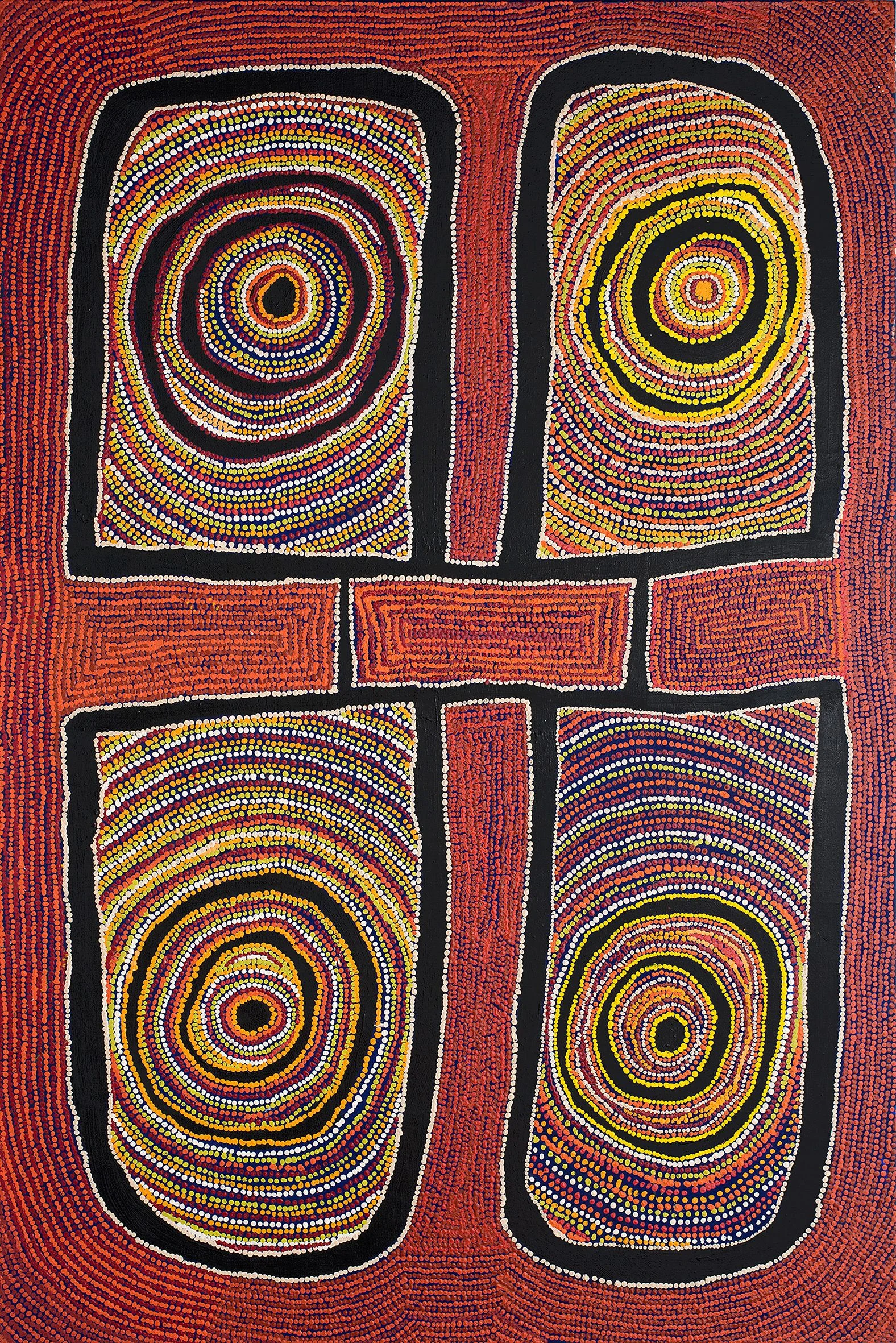
Artiste : Jimmy et Angie Tchooga
Titre de l'œuvre : Warlu Tjukurrpa
Format : 180 x 120 cm
Provenance et certificat : centre d'art aborigène de Balgo
Référence de cette peinture : 116-19
Explications sur cette peinture Aborigène :
Jimmy and Angie have painted Warlu Tjukurrpa (Fire Dreaming) in Western Yarra, around the Tanami Downs
area of the Tanami Desert. It was given to Jimmy by his father. As a senior Law man, it is the same painng
that Jimmy paints on men for ceremonial dancing and young male members of his family when they go out
hunng.
The warlu (fire) spontaneously started in the area where the yellow concentric circles are and travelled
across the country crossing many sacred sites (all the other circles). Flames are depicted as the black lines
emanang from the central circles and are heading from north to south in the direcon of the Karn
Tjukurrpa (bush potato Dreaming). Karn is bush potato which is collected in the cold months aer fire has
cleared the ground making the telling cracks in the ground visible which mark the locaon of the potatoes.
The fire stopped in Pupari, the lines represent the burnt areas.
Vendue
© Photo : Aboriginal Signature Estrangin gallery with the courtesy of the artists and Balgo

Artiste : Mick Wikilyiri
Titre de l'œuvre : Tjala tjukurpa - Honey ant story
Format : 152,5 x 122 cm
Provenance et certificat : centre d'art aborigène de Tjala
Référence de cette peinture : 600-18
Vendue
© Photo : Aboriginal Signature Estrangin gallery with the courtesy of the artists and Tjala.
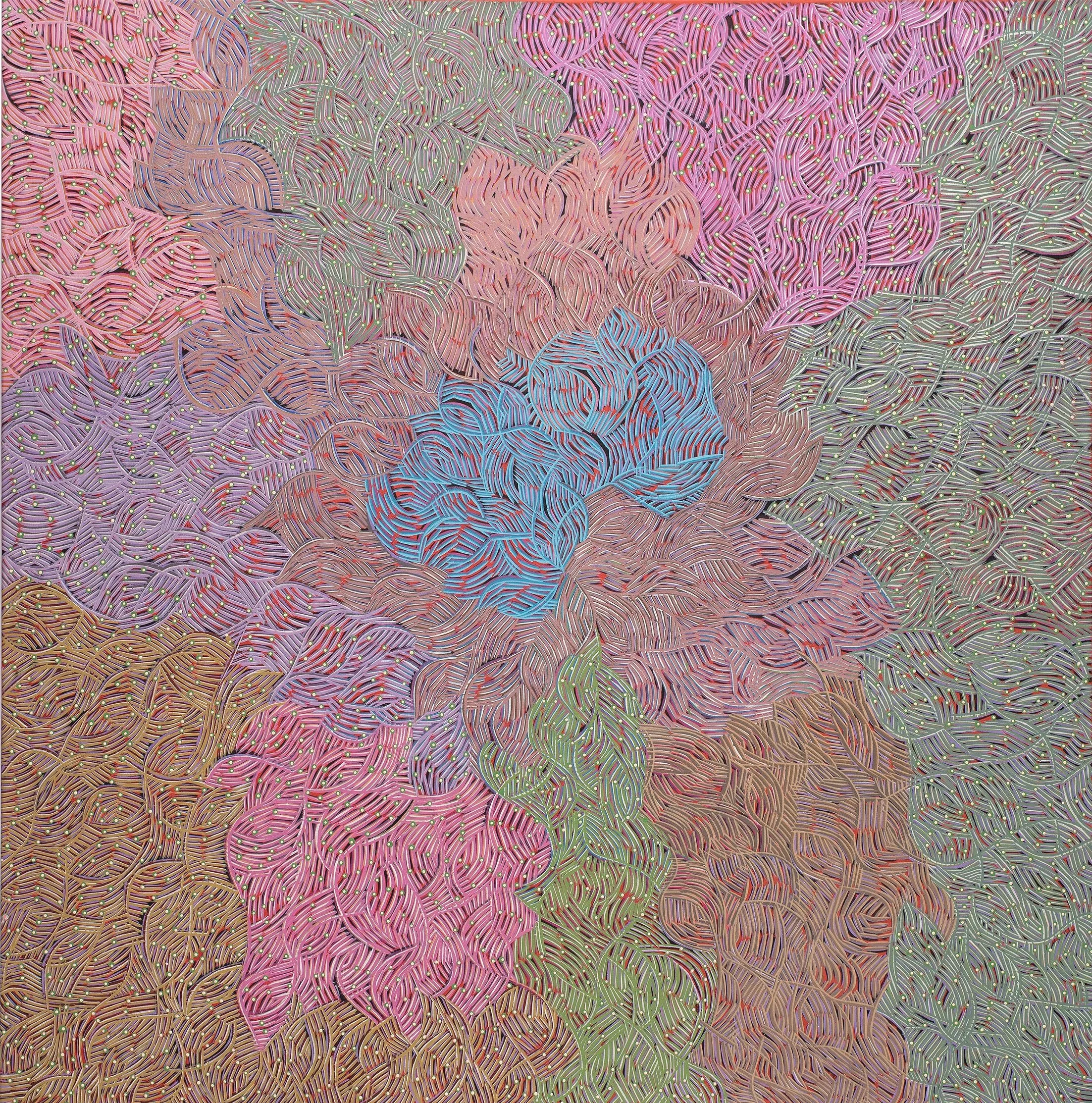
Artiste : Eva Nargoodah
Titre de l'œuvre : Kulawa
Format : 150 x 150 cm
Provenance et certificat : centre d'art aborigène de Mangkaja
Référence de cette peinture : 1364/18
Vendue
Explications pour cette œuvre :
© Photo : Aboriginal Signature Estrangin gallery with the courtesy of the artists and Mangkaja
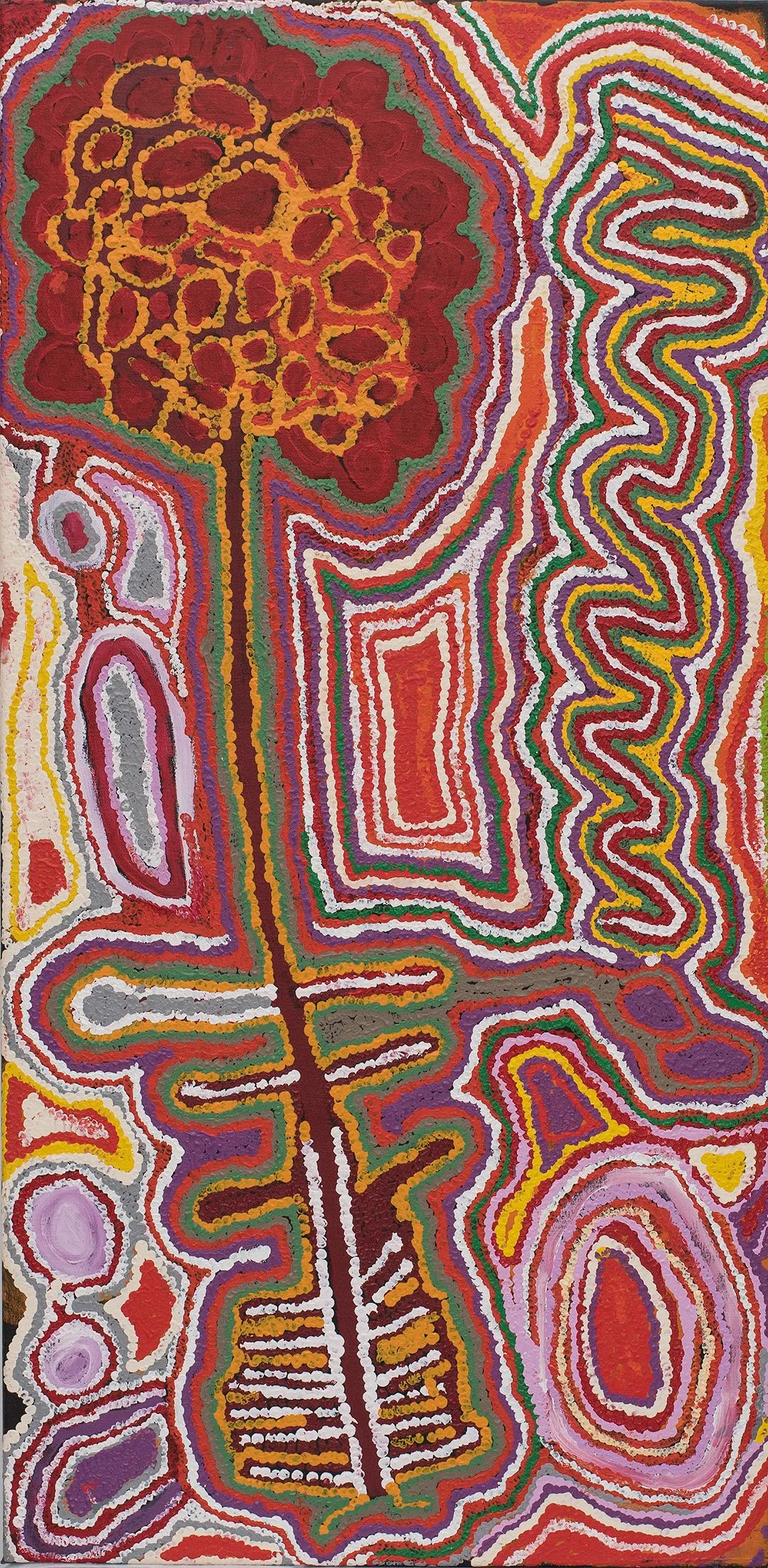
Artiste : Jimmy Donnegan
Titre de l'œuvre : Pukara
Format : 123 x 61 cm
Provenance et certificat : centre d'art aborigène de Ninuku
Référence de cette peinture : 15-326
Vendue
Explications pour cette œuvre :
This is a story about kaliny-kalinypa (honey grevillea plant), which Anangu (the term for people in Pitjantjatjara) use as a type of bush lolly, sucking the nectar out of the plant. In the Tjukurpa (Dreaming story) a father and son, Wati Kutjara Wanampi (two male water snakes), are living at Pukara, an important waterhole site near Irrunytju (Wingellina). Because of the kaliny-kalinypa which is found at the site the water there has a sweet taste and lots of people go there to access it. But father Wati Wanampi doesn’t like this and he tells them to go back to their own country.
The people leave and the father and son travel to Willuna, where they camp for weeks. When they return to Pukara, they are awoken by a buzzing sound. Minyma Punpunpa (the female flies) are making lots of noise as they buzz around the honey bush. This prompts the father and son to get up to go and collect honey. While they are doing this, a Wati Mututa (black ant) finds the father and son, and spears the son in his side. The young son starts spitting and he spits up the yellow and orange seeds of all the different types of honey grevillea. These plants can still be found at this site today. There is a big variety of honey grevillea plants including kaliny-kalinypa, ultunkunpa, piruwa and witjinti.
© Photo : Aboriginal Signature Estrangin gallery with the courtesy of the artists and Ninuku.
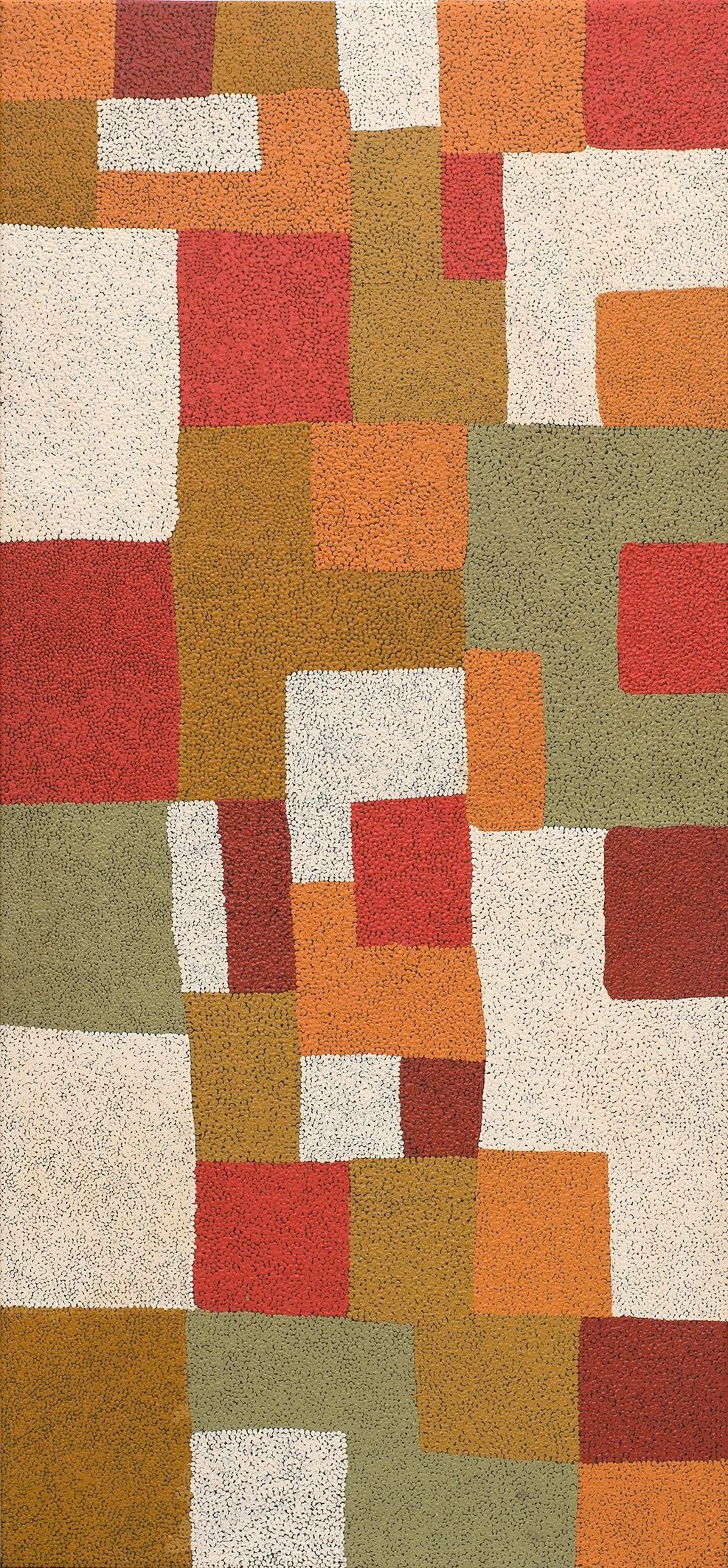
Artiste : Francis Marshall
Titre de l'œuvre : Snake Dreaming
Format : 182 x 71 cm
Provenance et certificat : centre d'art aborigène de Ninuku
Référence de cette peinture : 113FM085
Vendue
© Photo : Aboriginal Signature Estrangin gallery with the courtesy of the artists and Ikuntji

Artiste : Barbara Moore
Titre de l'œuvre : Ngayuku ngura - My Country
Format : 150 x 100 cm
Provenance et certificat : centre d'art aborigène de Tjala
Référence de cette peinture : Barbara-B
Vendue
© Photo : Aboriginal Signature Estrangin gallery with the courtesy of the artists and Tjala.

Artiste : Tjungkara Ken
Titre de l'œuvre : Seven Sisters
Format : 198 x 152,5 cm
Provenance et certificat : centre d'art aborigène de Tjala
Référence de cette peinture : 737-18
Explications pour cette œuvre :
This is a Tjukurpa Story (Creation Story) about the constellations of Pleiades and Orion. The sisters are the constellaton of Pleiades and the other star Orion is said to be Nyiru or Nyirunya (described as a lusty or bad man). Nyiru is forever chasing the sisters known as the Kunkarunkara women as it is said he wants to marry the eldest sister. The seven sisters travel again and again from the sky to the earth to escape Nyiru’s unwanted attentions. They turn into their human form to escape from the persistent Nyiru, but he always finds them and they flee back to the sky. As Nyiru is chasing the sisters he tries to catch them by using magic to turn into the most tempting kampurarpra (bush tomatoes) for the sisters to eat and the most beautiful Ili (fig) tree for them to camp under. However, the sisters are too clever for Nyiru and outwit him as they are knowledgeable about his magic. They go hungry and run through the night rather than be caught by Nyiru. Every now and again one of the women fall victim to his ways. It is said that he eventually captures the youngest sister, but with the help of the oldest sister, she escapes back to her sisters who are waiting for her.
Eventually the sisters fly back into the sky to escape Nyiru, reforming the constellation.
Vendue
© Photo : Aboriginal Signature Estrangin gallery with the courtesy of the artists and Tjala.

Artiste : Mitakiki Women's Collaborative
Titre de l'œuvre : Seven Sisters
Format : 152 x 122 cm
Provenance et certificat : centre d'art aborigène de Tjala
Référence de cette peinture : Tjala-ID1497
Explications pour cette œuvre :
This is a Tjukurpa Story (Creation Story) about the constellations of Pleiades and Orion. The sisters are the constellaton of Pleiades and the other star Orion is said to be Nyiru or Nyirunya (described as a lusty or bad man). Nyiru is forever chasing the sisters known as the Kunkarunkara women as it is said he wants to marry the eldest sister. The seven sisters travel again and again from the sky to the earth to escape Nyiru’s unwanted attentions. They turn into their human form to escape from the persistent Nyiru, but he always finds them and they flee back to the sky. As Nyiru is chasing the sisters he tries to catch them by using magic to turn into the most tempting kampurarpra (bush tomatoes) for the sisters to eat and the most beautiful Ili (fig) tree for them to camp under. However, the sisters are too clever for Nyiru and outwit him as they are knowledgeable about his magic. They go hungry and run through the night rather than be caught by Nyiru. Every now and again one of the women fall victim to his ways. It is said that he eventually captures the youngest sister, but with the help of the oldest sister, she escapes back to her sisters who are waiting for her.
Eventually the sisters fly back into the sky to escape Nyiru, reforming the constellation.
Vendue
© Photo : Aboriginal Signature Estrangin gallery with the courtesy of the artists and Tjala.
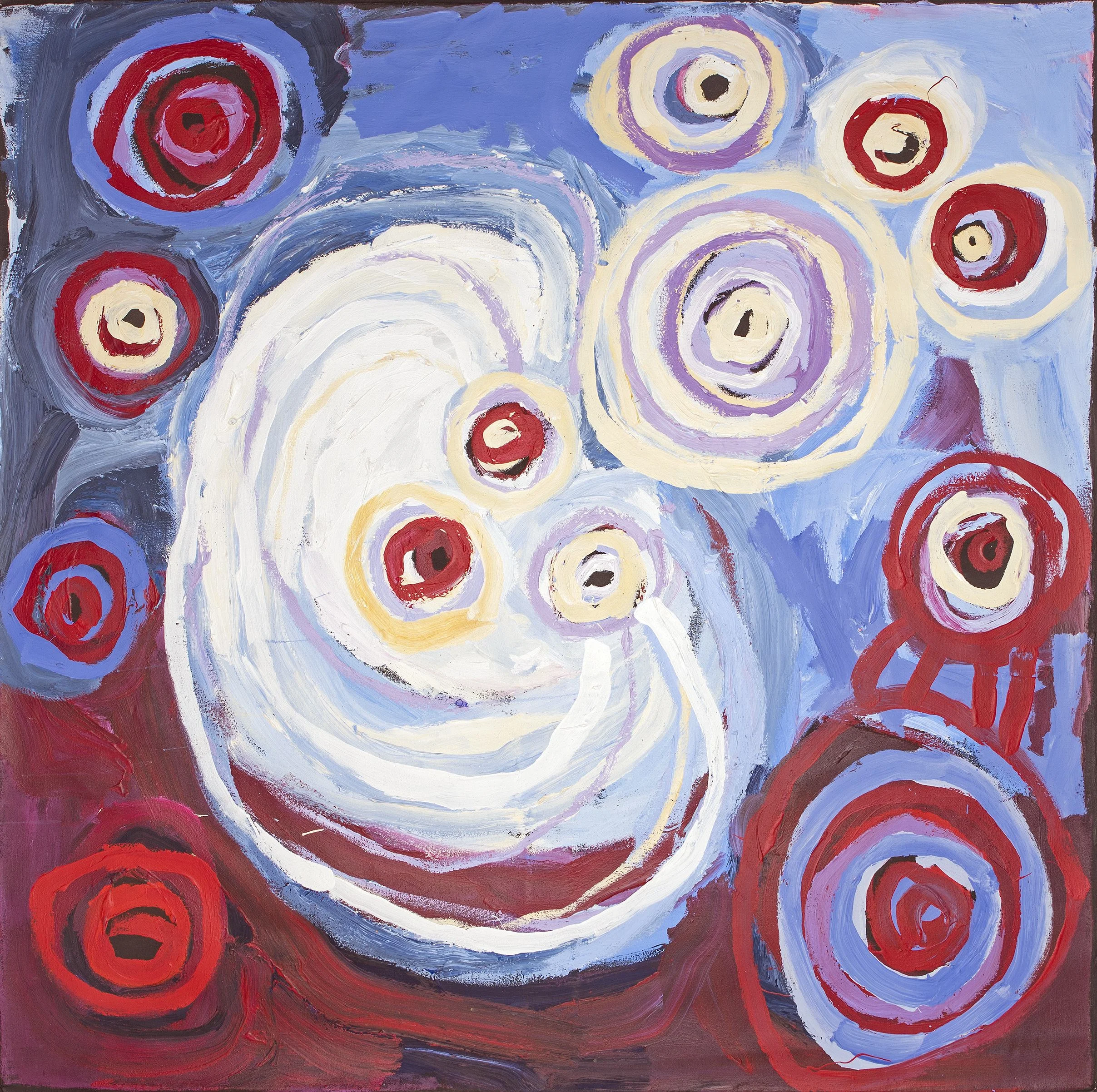
Artiste : Barbara Moore
Titre de l'œuvre : Ngayuku ngura - My Country
Format : 150 x 150 cm
Provenance et certificat : centre d'art aborigène de Tjala
Référence de cette peinture : 153-19
Vendue
© Photo : Aboriginal Signature Estrangin gallery with the courtesy of the artists and Tjala.
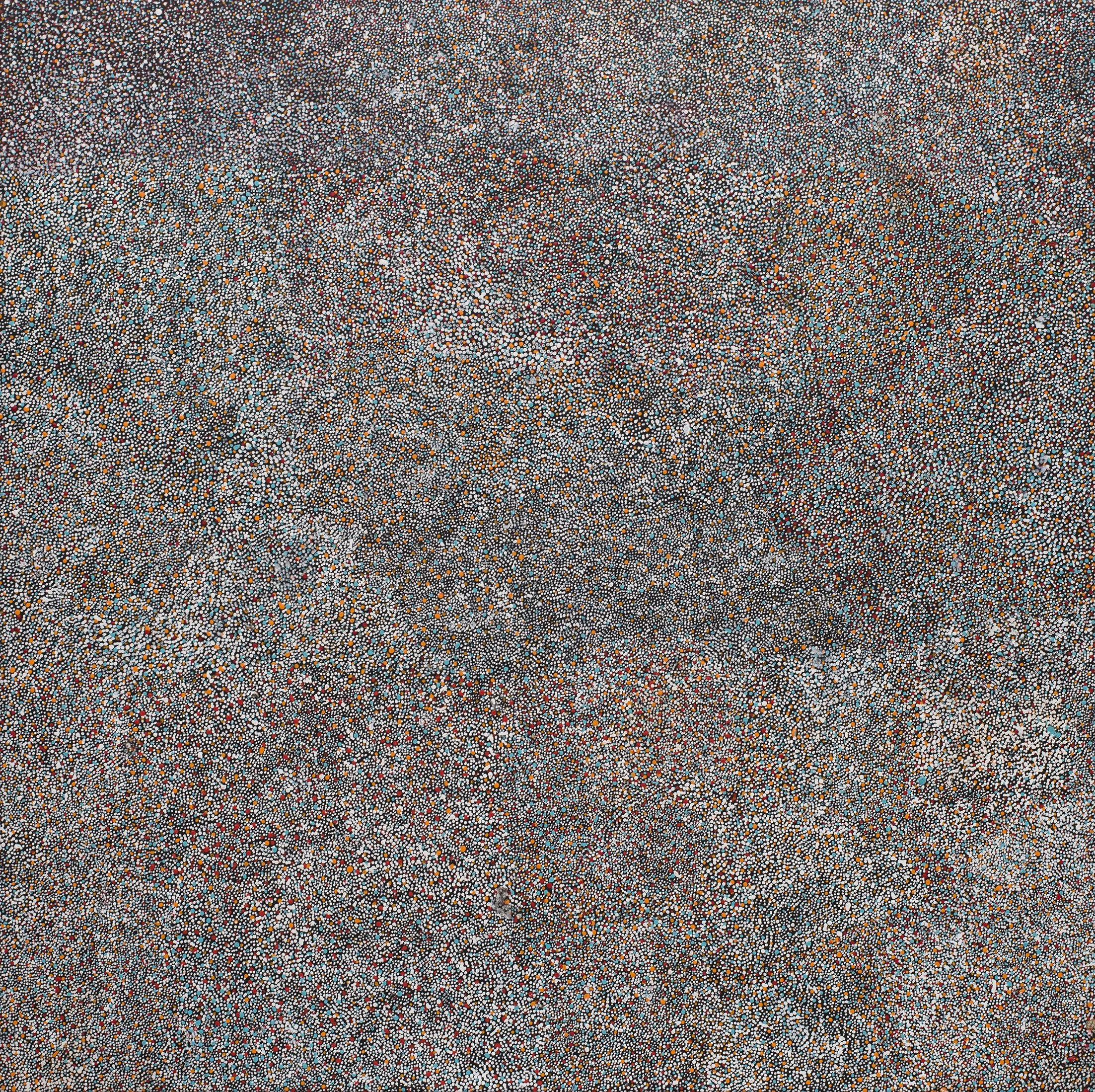
Artiste : Gladys Kemarre (1937-2017)
Titre de l'œuvre : Bush Plum
Format : 90 x 90 cm
Provenance et certificat : Delmore - réalisée en Janvier 2016.
Référence de cette peinture : 16B030b
Explications sur cette peinture Aborigène :
Gladys Kemarre (or Glady as she was known) was an Anmatyerre woman born in 1937 on Mount Swan, north east of Alice Springs. Gladys painted about the anwekety or blush plum Dreaming, passed down to her by her grandmother. Anwekety is a bush that grows on Gladys’ Country of Ahalpere in the Utopia region. The bush produces white flowers and berries which when ripe are edible and sweet to taste.
The fine dot work of this painting depicts the plum, the bush’s foliage and a topographical view of her Country. Gladys was influenced by all the natural colours of anwekety ; the greenery and white flowers of the bush and the intricate variations of the berry’s colour as it ripens from green through to bluish purple, pink, red, brown and then finally the deepest dark purple. The berries feed a variety of wildlife including emus, bush turkey and other native bird species. They are a highly valued traditional food source for the Anmatyerre people. As part of Gladys’ Dreaming, the women perform awelye (women's ceremonies), paying homage to the bush plum to ensure further germinations in years to come.
Demander le prix de l'œuvre / Enquiry
© Photo : Aboriginal Signature Estrangin gallery with the courtesy of the artists, Utopia and Delmore

Artiste : Elizabeth Mbitjana (1985)
Titre de l'œuvre : Bush Plum
Format : 90 x 62 cm
Provenance et certificat : Delmore - réalisée en Avril 2010.
Référence de cette peinture : 10D036
Explications sur cette peinture Aborigène :
Elizabeth Mbitjana paints the bush plum Dreaming, following in the footsteps of her mother Kathleen and her aunties, Polly and Angeline Ngale. Since Elizabeth began painting in 2007, she has developed her own meticulous style.
In traditional ceremonies, Elizabeth and her female relatives cover their torsos with emu oil and decorate each other in ochre powder, after which they dance and sing (called awelye, women’s ceremony). At particular times of the year, the designs smoothed onto their skin relate to the bush plum (anwekety ). These celebratory ceremonies are a vital part of nature's cycle and ensure the continued productivity of the valuable food source of anwekety , year on year.
As this painting exemplifies, the white flowers and varying shades of colour of the anwekety plum as it ripens are shown in the subtle variations of fine dotting and colour of Elizabeth’s works.
Vendue
© Photo : Aboriginal Signature Estrangin gallery with the courtesy of the artists, Utopia and Delmore
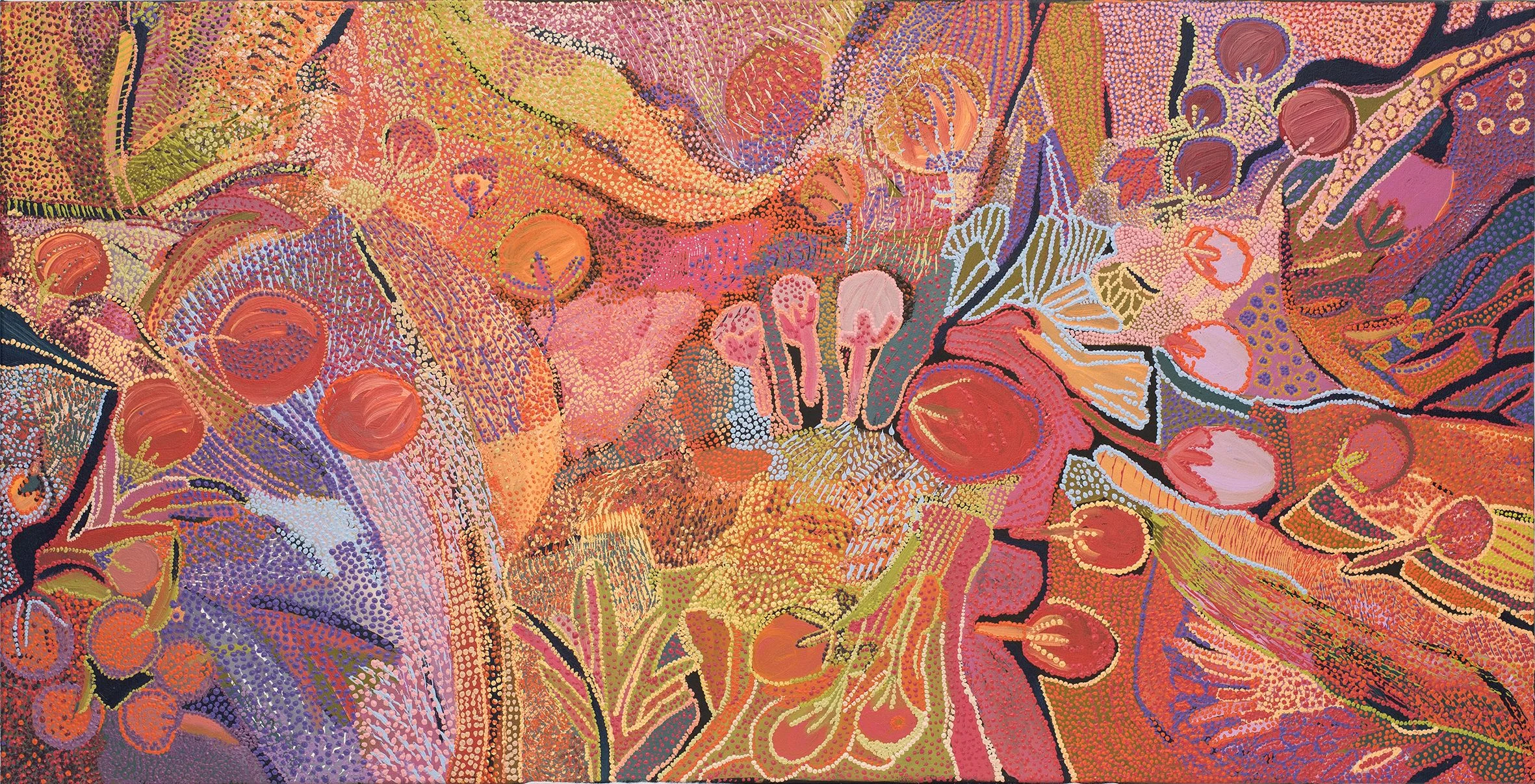
Artiste : Patsy Mudgebelle
Titre de l'œuvre : Bush Tucker Fusion
Format : 150 x 75 cm
Provenance et certificat : centre d'art aborigène de Balgo
Référence de cette peinture : 164-19
Explications sur cette peinture Aborigène :
This painting features mungari - food. Scattered across the canvas are the traditional foods of Patsy's family, seeds and fruits found in the desert. There is also the playful addition of one of Patsy's favourite foods - watermelon! Patsy says - we don't eat only traditional food now, we eat both the old food and new ones. We are creating new ways.
Demander le prix de l'œuvre / Enquiry
© Photo : Aboriginal Signature Estrangin gallery with the courtesy of the artists and Balgo

Artiste : Elizabeth Mbitjana (1985)
Titre de l'œuvre : Bush Plum
Format : 121 x 60 cm
Provenance et certificat : Delmore - réalisée en Décembre 2011.
Référence de cette peinture : 11L12
Explications sur cette peinture Aborigène :
Elizabeth Mbitjana paints the bush plum Dreaming, following in the footsteps of her mother Kathleen and her aunties, Polly and Angeline Ngale. Since Elizabeth began painting in 2007, she has developed her own meticulous style.
In traditional ceremonies, Elizabeth and her female relatives cover their torsos with emu oil and decorate each other in ochre powder, after which they dance and sing (called awelye, women’s ceremony). At particular times of the year, the designs smoothed onto their skin relate to the bush plum (anwekety ). These celebratory ceremonies are a vital part of nature's cycle and ensure the continued productivity of the valuable food source of anwekety , year on year.
As this painting exemplifies, the white flowers and varying shades of colour of the anwekety plum as it ripens are shown in the subtle variations of fine dotting and colour of Elizabeth’s works.
Vendue
© Photo : Aboriginal Signature Estrangin gallery with the courtesy of the artists, Utopia and Delmore

Artiste : Nyayati Stanley Young
Titre de l'œuvre : Kalaya Tjukurpa (Emu Dreaming)
Format : 122 x 122 cm
Provenance et certificat : centre d'art aborigène de Ninuku
Référence de cette peinture : 19-56
Vendue
Explications pour cette œuvre :
This is the story of Kalaya Tjukurpa, Emu Dreaming. The emu is traveling all the way from Wiluna to Stanley's grandfather Yanima's country Anall and traveling on south right through to Tipil. Tipil is south of Watarru, close to Ngura ngri.
This country is South of Kalka in South Australia.
© Photo : Aboriginal Signature Estrangin gallery with the courtesy of the artists and Ninuku.
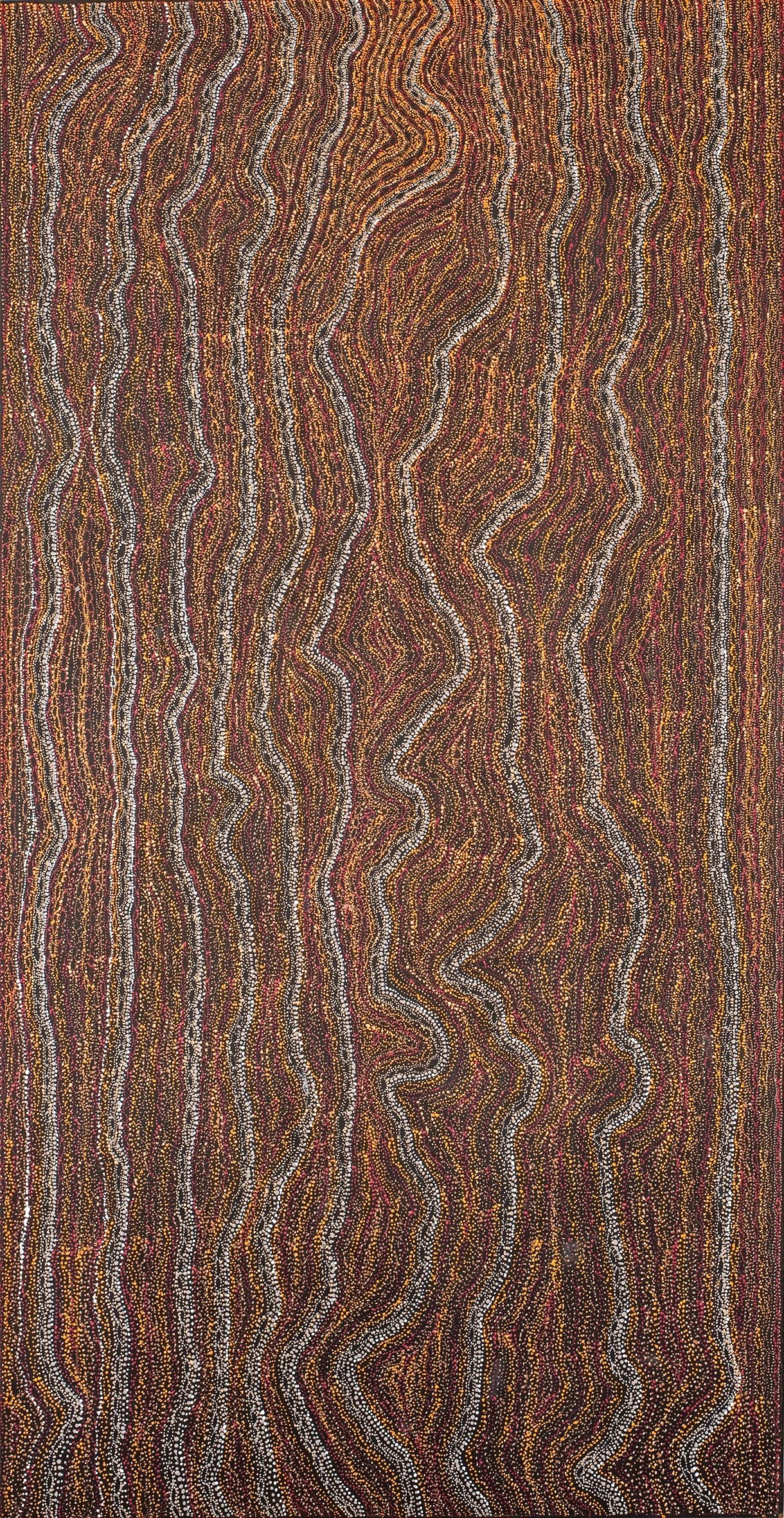
Artiste : Sabrina Nangala Robertson
Titre de l'œuvre : Ngapa Jukurrpa (Water Dreaming) - Pirlinyarnu
Format : 240 x 122 cm
Provenance et certificat : centre d'art aborigène de Yuendumu
Référence de cette peinture : 32/19
Vendue
© Photo : Aboriginal Signature Estrangin gallery with the courtesy of the artists and Yuendumu
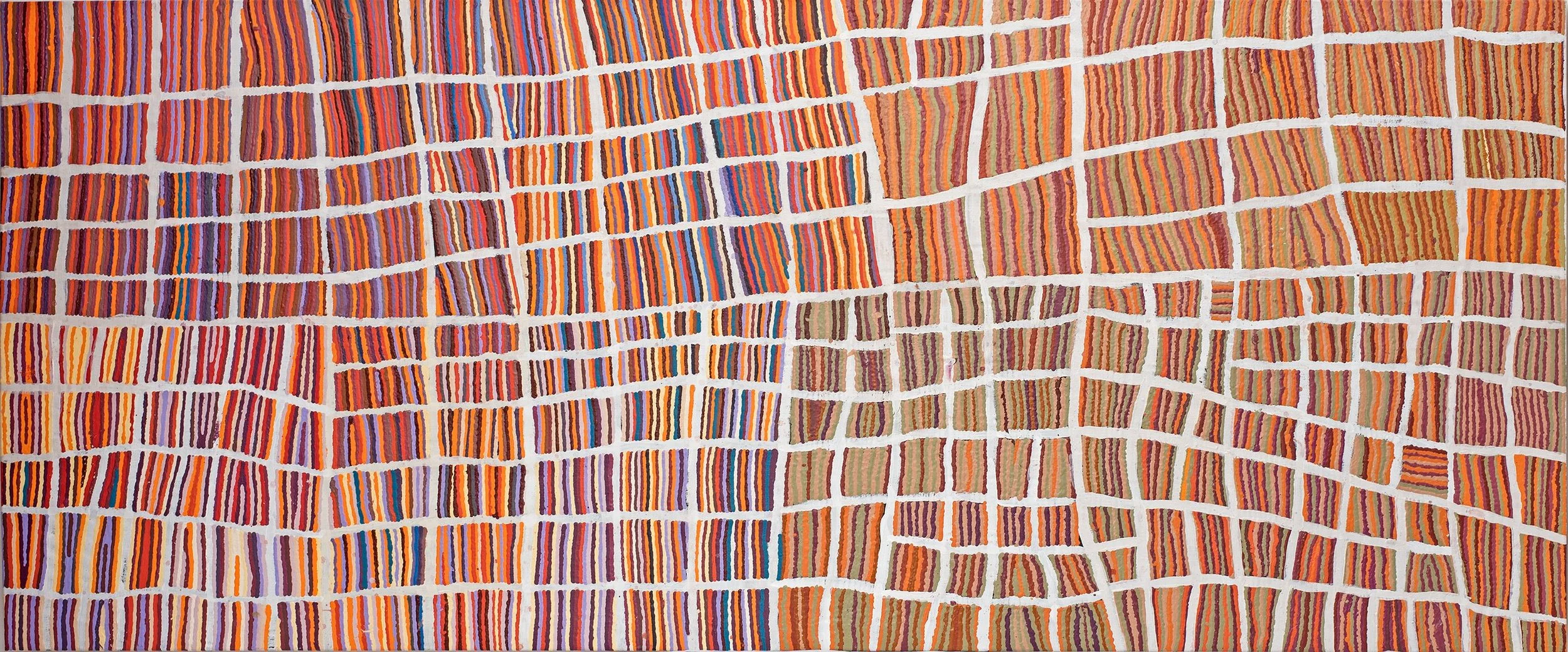
Artistes : Wokka Taylor (1939) et Nancy Karnu Taylor (1941)
Titre de l'œuvre : Jantinti
Format : 300 x 122 cm
Provenance et certificat : centre d'art aborigène de Martumili
Référence de cette peinture : 18-150
Vendue
Explications pour cette œuvre :
Jantinti, big claypan. Long way from here; no hospital, no school, no shop to buy food. But too much bush tucker! Minyarra (bush onion), kalaru (edible seeds ground to make a flour for damper) and yiwinji- too much! You can grind the seed from those ones and put him in the waru (fire), make a damper. You can’t have him like that, raw one. Kitirrpa, that’s another bush tucker. Little short one warta (bush, shrub), but plenty there. Jamarlpa, lungkunpa. You can also find him for huntng parnajalpa (goanna), jipuku (rabbit), pussycat. Wet time parnajalpa kurnu (sleeping). Plenty jipuku been there, but he finished now, gone. I like jipuku. Winjikirti there been plenty too, and mirtarra. Mirtarra, he finished now, all gone. He would make a home in the parna, in the grass. All the old people go there, go Jantinti to get kalaru.
Jantinti ngayu mili (my) country. I been grow up there from the little kid. Ngayu mili nyamu (grandfather's) country and ngayu mili nana (grandmother's) country. Same like that for Wokka [Taylor, Karnu’s nyupa (husband)], he been there from little kid too.
Wokka been grow up in Kulyakartu and Kirriwirri side, his country side. When he come down looking for people he come down Karlamily side. He came with his family. That time everybody all gone , only us living in the desert. He found us with a waru.
Light him up waru, [and it’s] just like a telephone. You see the smoke, know somebody there. His mummy and daddy been bring him and all his sisters, all his brothers, they came to Jantinti. Jantinti Country belong to everybody. Plenty time they been stay there, until Wokka been run away right up to Parnngurr rockhole. He met up with Ngamaru [Bidu’s] mob there. Then he kept going, run away to work in Ethel Creek.
[We had been living in Jantinti country for a time with Wokka's family] when we walk[ed] right up to Jigalong. We had already met up with [sisters] Mulyatingki, Nyanjilpayi and May Wokka, their two little brothers and their mummy. We been come through Yandicoogee, Stock River. Nobody been pick us up. We been walking; me and my brother Minyawe. My mummy and daddy were gone then. We been passing through Oakover River when whitefellas, women and man picked us up in a cattle truck, Christian mob. That whitefella, he from Kimberley. He been give us flour, he been cook plenty flour for us. We been tell him no good! We were bushmen people you know? Can’t have it [processed flour]!
They drove us all the way to Balfour Downs, where we stayed for one night. From Balfour Downs we got picked up in the Jigalong truck. When we got there to Jigalong I saw Wokka again. [He was] still young fella. That’s when he became my nyupa.
He’s been my nyupa since then, only one, good fella. We started working, mustering work. Together we went to Roy Hill Station. We worked there a long time together, but we finished when all the sheep died. No water. We went back home to Nullagine.
Then we went to Maralinga Station, we worked there too. Wokka been ride a horse, stockman Wokka. I been do the cleaning up in house and mustering up the sheep. We worked for many years on stations, too much time! [Eventually] we went to Strelley, everybody had their family there. We were there with Don Mcleod mob. I been stay there long time. We came down to Parnngurr after, staying in Parnngurr one way.
© Photo : Aboriginal Signature Estrangin gallery & text with the courtesy of the artists and Martumili
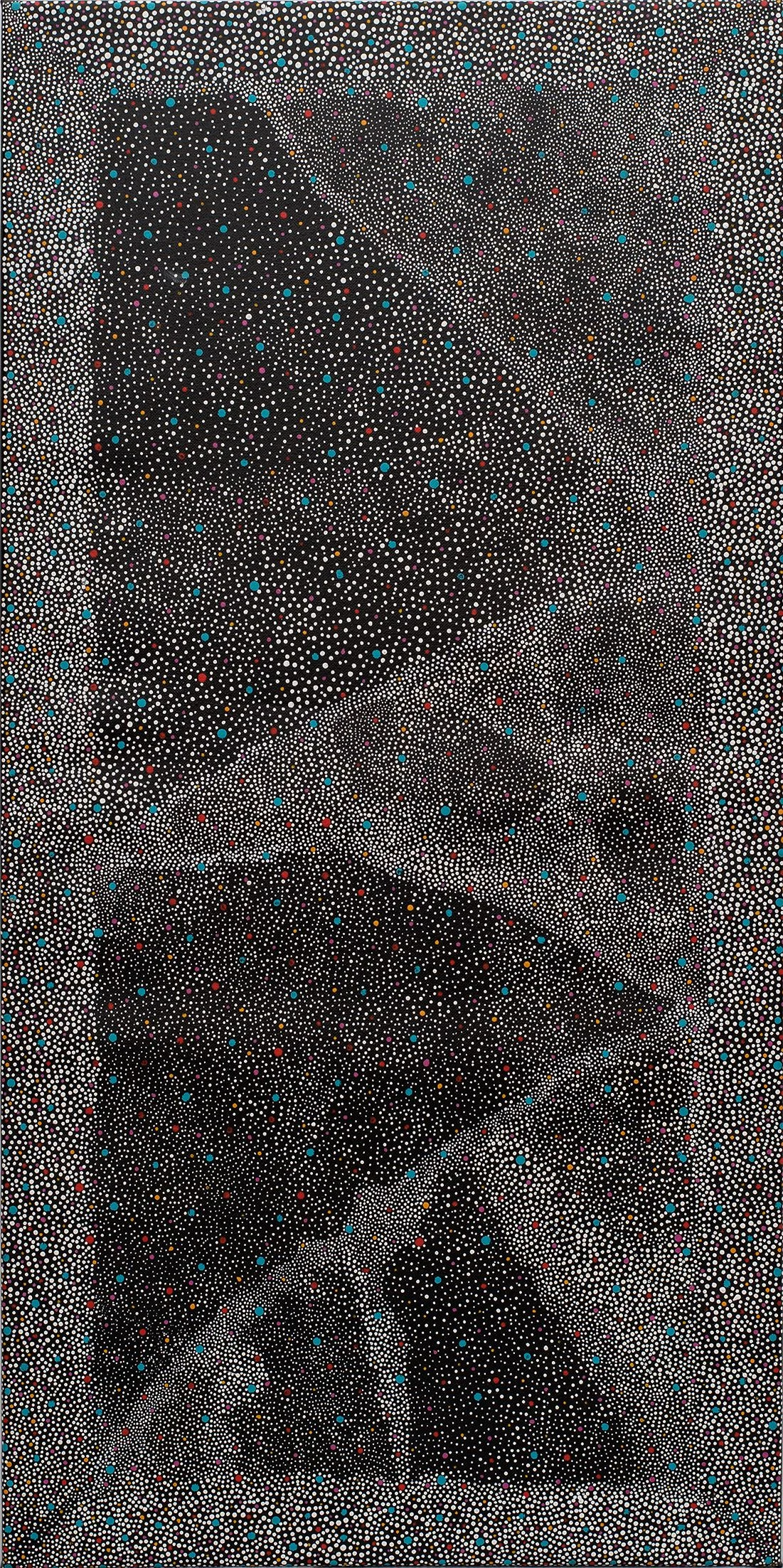
Artiste : Elizabeth Mbitjana (1985)
Titre de l'œuvre : Bush Plum
Format : 121 x 60 cm
Provenance et certificat : Delmore - réalisée en Mars 2012.
Référence de cette peinture : 12C05
Explications sur cette peinture Aborigène :
Elizabeth Mbitjana paints the bush plum Dreaming, following in the footsteps of her mother Kathleen and her aunties, Polly and Angeline Ngale. Since Elizabeth began painting in 2007, she has developed her own meticulous style.
In traditional ceremonies, Elizabeth and her female relatives cover their torsos with emu oil and decorate each other in ochre powder, after which they dance and sing (called awelye, women’s ceremony). At particular times of the year, the designs smoothed onto their skin relate to the bush plum (anwekety ). These celebratory ceremonies are a vital part of nature's cycle and ensure the continued productivity of the valuable food source of anwekety , year on year.
As this painting exemplifies, the white flowers and varying shades of colour of the anwekety plum as it ripens are shown in the subtle variations of fine dotting and colour of Elizabeth’s works.
Vendue
© Photo : Aboriginal Signature Estrangin gallery with the courtesy of the artists, Utopia and Delmore
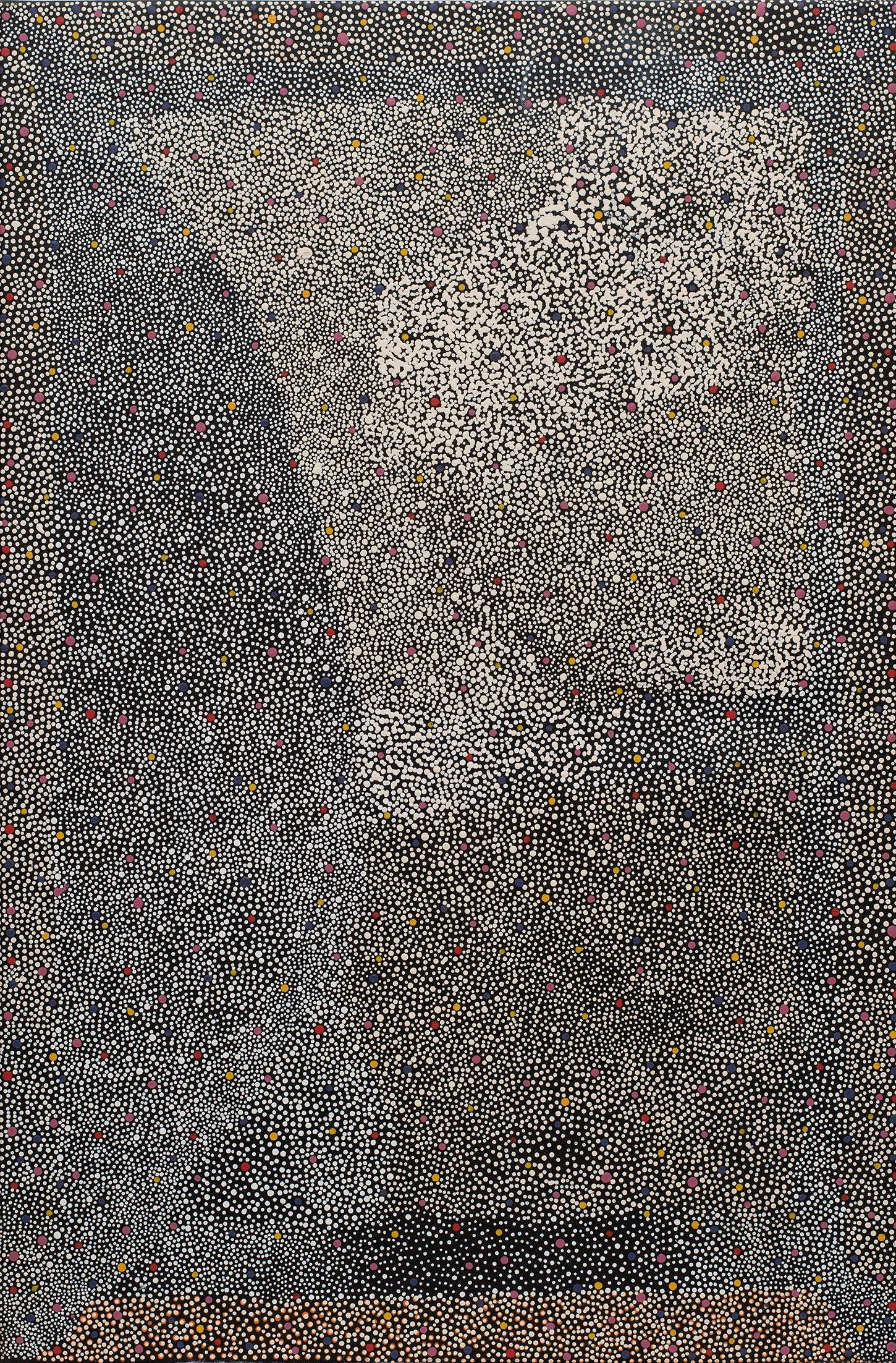
Artiste : Elizabeth Mbitjana (1985)
Titre de l'œuvre : Bush Plum
Format : 90 x 60 cm
Provenance et certificat : Delmore - réalisée en Novembre 2010.
Référence de cette peinture : 10K130
Explications sur cette peinture Aborigène :
Elizabeth Mbitjana paints the bush plum Dreaming, following in the footsteps of her mother Kathleen and her aunties, Polly and Angeline Ngale. Since Elizabeth began painting in 2007, she has developed her own meticulous style.
In traditional ceremonies, Elizabeth and her female relatives cover their torsos with emu oil and decorate each other in ochre powder, after which they dance and sing (called awelye, women’s ceremony). At particular times of the year, the designs smoothed onto their skin relate to the bush plum (anwekety ). These celebratory ceremonies are a vital part of nature's cycle and ensure the continued productivity of the valuable food source of anwekety , year on year.
As this painting exemplifies, the white flowers and varying shades of colour of the anwekety plum as it ripens are shown in the subtle variations of fine dotting and colour of Elizabeth’s works.
Vendue
© Photo : Aboriginal Signature Estrangin gallery with the courtesy of the artists, Utopia and Delmore
En tant que partenaire et représentant des centres d’art Aborigène soutenus par le gouvernement Australien, la galerie Aboriginal Signature Estrangin vous permet d’avoir un accès privilégié en Europe (primary market) à des oeuvres recherchées, disposant des meilleures provenances éthiques reconnues par les grandes institutions et collections privées ou publiques. A travers notre programme d’exposition en Europe, nous vous invitons à voyager à travers le temps et les immensités Aborigènes pour apprivoiser toute l’amplitude et l’excellence de ce mouvement artistique contemporain.

Peinture de l’artiste Sabrina Nangala Robertson, fille de l’artiste Dorothy Napangardi. Format : 240 x 120 cm. Titre : Mina Mina Dreaming time story. © Photo : Aboriginal Signature Estrangin gallery with the courtesy of the artists and Yuendumu.
Artiste : Mulkun Wirrpanda (1942)
Titre de l'œuvre : Ŋäḏi ga Guṉdirr (Mulkun- meat ants and termites)
Format : 128 x 67 cm
Provenance et certificat : Yirrkala
Référence de cette peinture : 557-19
Explications sur cette peinture Aborigène :
This work is an extension of a phase where the artist of her own motion explored lesser known plant species which she feared were being forgotten by younger generations. This coincided with artist John Wolseley’s interest in returning to Yilpara (after they had met during the Djalkiri project of 2010) and the two spent an extended period exploring the botany of Blue Mud Bay.
John Wolseley spent a week at Yilpara with Mulkun in May 2012 and again at Yirrkala in June 2013, June 2014 and then May and December 2015.
Mulkun has been finding new ways to paint and promote nutritional plants that are no longer eaten widely. As a child there were very many healthy old people and now there are few. In those days old people lived for a long time without illness. She blames poor diet and the loss of knowledge.
In 2017 accompanying Mulkun and John Wolseley's NMA show Miḏawarr | Harvest, the book of the same name was published with words by Mulkun Wirrpanda (MW), Merrkiyawuy Ganambarr-Stubbs (MGS), Greg Leach (GL) and Glenn Wightman (GW).
Following this theme she moved on to painting varieties of Maypal or shellfish and these were exhibited in a sold out show at Salon in Darwin in August 2018. This then morphed to a series of work where she painted shellfish which lived symbiotically with edible plants.
In this work she has continued with the concept of symbioses and in this case eusociality. She has depicted the relationship between munyukuluŋu Magnetic termites Amitermes meridionalis, or compass termite, a speciesof eusocial insect in the family Termitidae…
Vendue
© Photo : Aboriginal Signature Estrangin gallery with the courtesy of the artists & Yiirkala.