Peinture d'art Aborigène de Munupi (Tiwi Island)
Munupi Arts & Crafts Association est situé le long de la côte nord-ouest des îles Melville à Pirlangimpi (Garden Point) et est le centre d'art le plus récemment formé sur les îles Tiwi. En 1990, le Yikikini Women's Centre et Pirlangimpi Pottery ont été incorporés sous le nom de Munupi Arts and Crafts Association, donnant aux artistes locaux l'occasion de célébrer fièrement la culture Tiwi à travers les médias traditionnels et contemporains.
Eddie Puruntatameri fut le premier président de Munupi Arts and Crafts. Eddie a travaillé chez Tiwi Pottery à Nguiu pendant de nombreuses années jusqu'à ce qu'il déménage à Pirlangimpi à la fin de 1983 et crée un atelier de poterie dans la communauté.
Les premiers grands travaux de Munupi furent plusieurs grands panneaux muraux. Les panneaux peints ont été placés autour de la communauté à l'aéroport de Pirlangimpi, au bureau du conseil, à la poterie Pirlangimpi et au centre des femmes. Les artistes qui ont contribué à ce projet étaient Thelca Puruntatameri, Reppie Orsto, Fatima Kantilla, Donna Burak, Francesca Puruntatameri et Therese Ann Tipiloura.
Puisant leur inspiration dans leur environnement naturel luxuriant et leurs histoires de création Tiwi, les artistes Munupi emploient des ocres, de la gouache et de la peinture acrylique.
La première exposition Munupi Arts and Crafts 'Munupi Dreaming' a eu lieu en octobre 1990 à Shades of Ochre, Darwin. L'exposition comprenait des meubles peints, des peintures, des gravures en édition limitée et des pots en terre cuite. Les artistes Munupi ont continué à exposer en Australie et à l'étranger. De nombreux artistes de Munupi Arts and Craft ont participé à des ateliers au centre d'art et à l'étranger.
Peintures des artistes Aborigènes de Munupi disponibles au sein de la galerie :

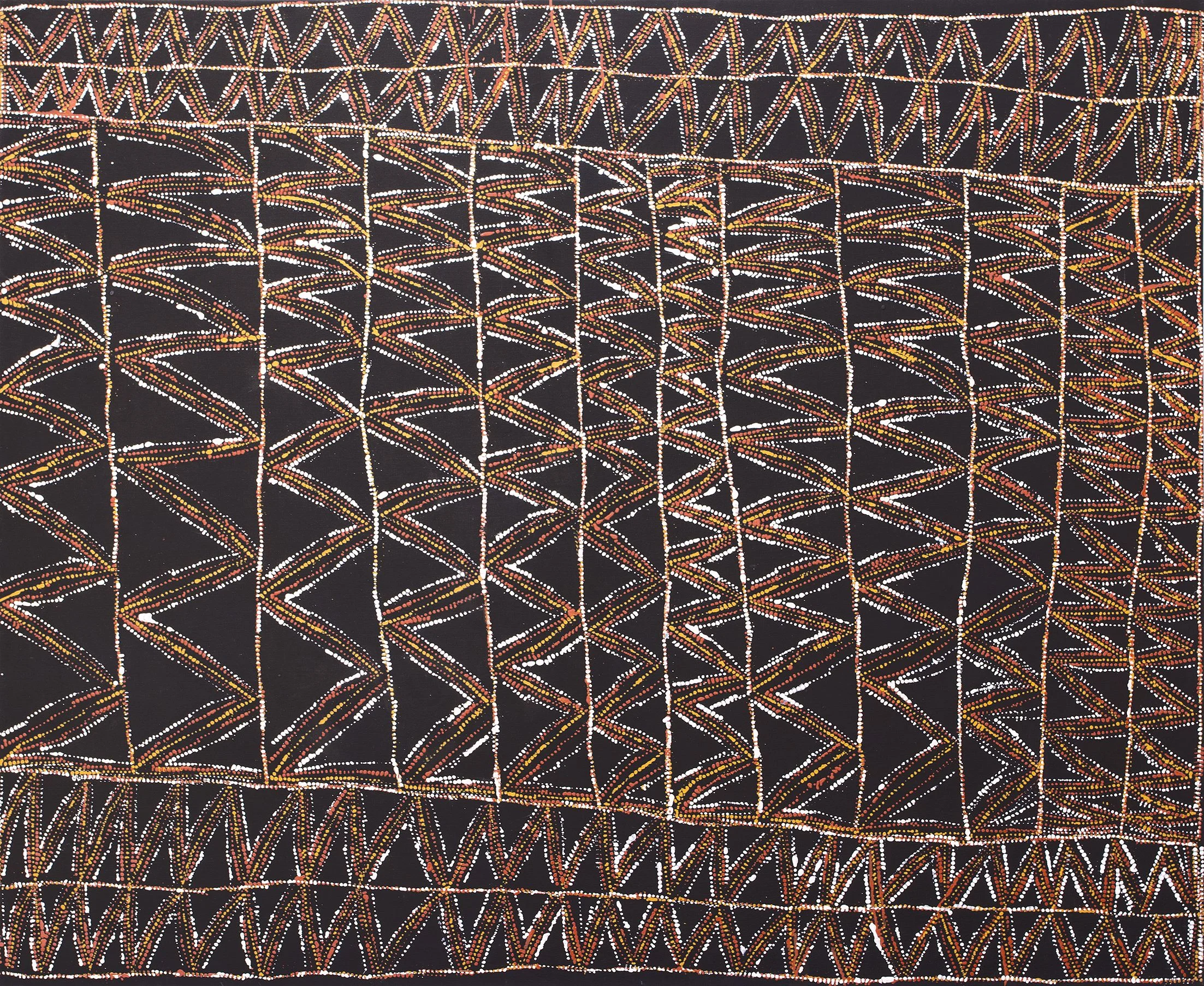
Artiste : Cornelia Tipuamantumirri
Titre de l'œuvre : Jilamara dances
Pigments naturels sur toile de lin Belge
Format : 180 x 150 cm
Provenance et certificat : centre d'art aborigène de Munupi (Tiwi Island)
Référence de la peinture : 14-317
© Photo : Aboriginal signature with the courtesy of the artist & Munupi Art centre (Tiwi Island)
Explications sur cette œuvre :
During ceremony on the Tiwi Islands a series of 'yoi' (dances), are performed; some are totemic (inherited from the person's Mother) and some serve to act out the narrative of newly composed songs.
Participants in these ceremonies are painted with turtiyanginari (the different natural ochre colours) in varying designs, transforming the dancers and, in some cases, providing protection against recognition by mapurtiti (spirits).
These designs can be applied in different ways. Ochre is applied to the body and face. These significant artistic designs collectively are called 'Jilamara'.

Artiste : Alison Puruntatameri
Titre de l'œuvre : Winga (Tidal Movement / Waves)
Pigments naturels sur toile de lin Belge
Format : 180 x 120 cm
Provenance et certificat : centre d'art aborigène de Munupi (Tiwi Island)
Référence de la peinture : 20-53
© Photo : Aboriginal signature with the courtesy of the artist & Munupi Art centre (Tiwi Island)
Explications sur cette œuvre :
Alison born in 1984 and has grown up in Pirlangimpi Commumnity on Melville Island which is the big island of the Tiwi's. She went to the local school and worked in child care. She has one daughter, Anette Orsto known locally as Sugar Plum who is a great favourite at the art centre studio where Alison paints with her mother Paulina (Jedda) sharing the care of Sugar while one or the other paints. It
was Alison’s grandfather, Justin Puruntatameri (dec) a senior law man that knew all the songs and remembered visits by the Macassans as a boy that told Alison she should have a go at painting- she would listen to his stories of his paintings at the art centre and in the village.. He used to take the family hunting when she was little. Alison started painting with Munupi Arts in late 2011.
This work depicts the tidal movement of waters in and around the seas and creeks of the Tiwi Islands. Not just influencing fishing and hunting opportunities, the movement of water carries masses of silt and sand, transforming the land and changing the coastal landscape. Winga can also be translated as 'waves', just one part of the changing tides. Tidal surges are at their most powerful when a king tide occurs during the Wet Season, especially during a full moon.Cornelia has a strong bond to the waters surrounding the Tiwi Islands, forged by a lifetime of memories living encircled within the tides of the Arafura Sea.
Awards
2015 Primavera Veolia Acquisitive Prize

Artiste : Alison Puruntatameri
Titre de l'œuvre : Takaringuwi (Scaly Mullet)
Pigments naturels sur toile de lin Belge
Format : 180 x 150 cm
Provenance et certificat : centre d'art aborigène de Munupi (Tiwi Island)
Référence de la peinture : 19-466
© Photo : Aboriginal signature with the courtesy of the artist & Munupi Art centre (Tiwi Island)
Explications sur cette œuvre :
Pupuni Jilamara During ceremony on the Tiwi Islands a series of ‘yoi’ (dances), are performed; some are totemic (inherited from the person's Mother) and some serve to act out the narrative of newly composed songs. Participants in these ceremonies are painted with turtiyanginari (the different natural ochre colours) in varying designs, transforming the dancers and, in some cases, providing protection against recognition by mapurtiti (spirits). These designs can be applied in different ways, one of which is using the finger, or in this case a brush. Painting of the face also occurs. These significant artistic designs collectively are called ‘Jilamara’.

Artiste : Alison Puruntatameri
Titre de l'œuvre : Winga (Tidal Movement / Waves)
Pigments naturels sur toile de lin Belge
Format : 180 x 120 cm
Provenance et certificat : centre d'art aborigène de Munupi (Tiwi Island)
Référence de la peinture : 20-76
© Photo : Aboriginal signature with the courtesy of the artist & Munupi Art centre (Tiwi Island)
Explications sur cette œuvre :
This work depicts the tidal movement of waters in and around the seas and creeks of the Tiwi Islands. Not justinfluencing fishing and hunting opportunities, the movement of water carries masses of silt and sand, transforming the land and changing the coastal landscape. Winga can also be translated as 'waves', just one part of the changing tides. Tidal surges are at their most powerful when a king tide occurs during the Wet Season, especially during a full moon.Cornelia has a strong bond to the waters surrounding the Tiwi Islands, forged by a lifetime of memories living encircled within the tides of the Arafura Sea.

Artiste : Miriam Stassi
Titre de l'œuvre : Pupuni Jilamara
Pigments naturels sur toile de lin
Format : 120 x 80 cm
Provenance et certificat : centre d'art aborigène de Munupi (Tiwi Island)
Référence de la peinture : 19-356
© Photo : Aboriginal signature with the courtesy of the artist & Munupi Art centre (Tiwi Island)
Explications sur cette œuvre :
Pupuni JilamaraDuring ceremony on the Tiwi Islands a series of ‘yoi’ (dances), are performed; some are totemic (inherited from the person's Mother) and some serve to act out the narrative of newly composed songs. Participants in these ceremonies are painted with turtiyanginari (the different natural ochre colours) in varying designs, transforming the dancers and, in some cases, providing protection against recognition by mapurtiti (spirits). These designs can be applied in different ways, one of which is using the finger, or in this case a brush. Painting of the face also occurs. These significant artistic designs collectively are called ‘Jilamara’.
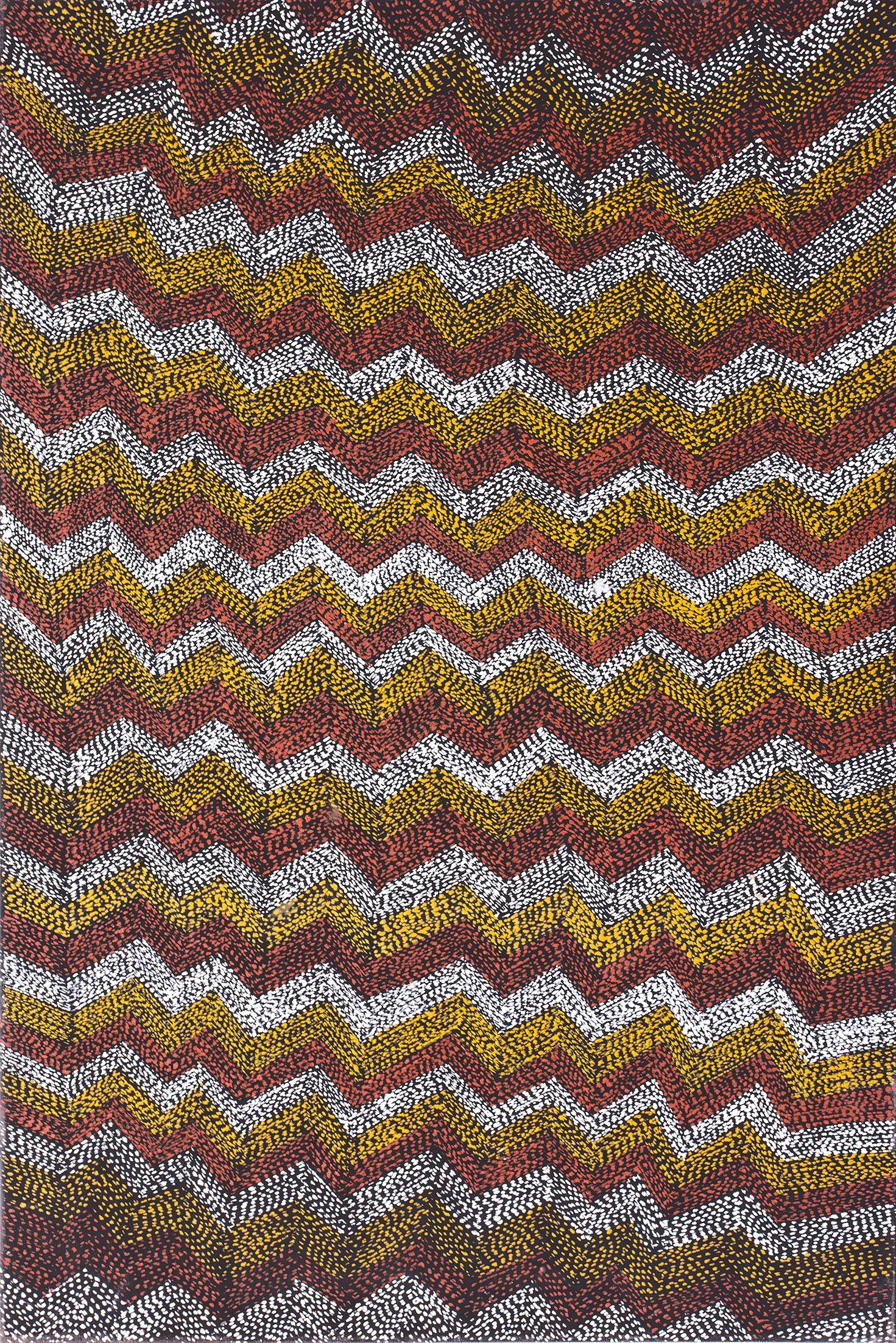
Artiste : Alison Puruntatameri
Titre de l'œuvre : Pwoja Jilamara
Pigments naturels sur toile de lin Belge
Format : 120 x 80 cm
Provenance et certificat : centre d'art aborigène de Munupi (Tiwi Island)
Référence de la peinture : 17-102
© Photo : Aboriginal signature with the courtesy of the artist & Munupi Art centre (Tiwi Island)
Explications sur cette œuvre :
During ceremony on the Tiwi Islands a series of ‘yoi’ (dances), are performed; some are totemic (inherited from the person's Mother) and some serve to act out the narrative of newly composed songs. Participants in these ceremonies are painted with turtiyanginari (the different natural ochre colours) in varying designs, transforming the dancers and, in some cases, providing protection against recognition by mapurtiti (spirits). These designs can be applied in different ways, one of which is using the pwoja (or kayimwagakimi), a traditional Tiwi ‘comb’ carved with a single row of teeth on one or both ends, usually made using ironwood or bloodwood. After being dipped in ochre and applied to the body a straight row of dots is imprinted. Once completed, these dots are then collectively called yirrinkiripwoja (body painting).
Painting of the face also occurs. These significant artistic designs collectively are called ‘Jilamara’.

Artiste : Josephine Burak
Titre de l'œuvre : Jilamara Design
Pigments naturels sur toile de lin Belge
Format : 160 x 100 cm
Provenance et certificat : centre d'art aborigène de Munupi (Tiwi Island)
Référence de la peinture : 15-414
© Photo : Aboriginal signature with the courtesy of the artist & Munupi Art centre (Tiwi Island)
Explications sur cette œuvre :
The Kulama design depicts this important ceremony of the Tiwi people; the dancers and singers create a circle and prepare the poisonous yam for eating, as indicated by the circles in the painting. The Kulama ceremony was given to the Tiwi people by the Nyingawi, who are little spirit people (as depicted in Tiwi mythology). It is a celebration of life and food, occurring at the end of the wet season. The Tiwi know when to perform Kulama when the last full moon of the wet season has a yellow halo surrounding it, which tells them that Japarra (the moon man) is ready for it to begin.

Artiste : Susan Wanji Wanji
Titre de l'œuvre : Jilamara Design
Pigments naturels sur toile de lin Belge
Format : 160 x 100 cm
Provenance et certificat : centre d'art aborigène de Munupi (Tiwi Island)
Référence de la peinture : 13sww127
© Photo : Aboriginal signature with the courtesy of the artist & Munupi Art centre (Tiwi Island)
Explications sur cette œuvre :
The Kulama design depicts this important ceremony of the Tiwi people; the dancers and singers create a circle and prepare the poisonous yam for eating, as indicated by the circles in the painting. The Kulama ceremony was given to the Tiwi people by the Nyingawi, who are little spirit people (as depicted in Tiwi mythology). It is a celebration of life and food, occurring at the end of the wet season. The Tiwi know when to perform Kulama when the last full moon of the wet season has a yellow halo surrounding it, which tells them that Japarra (the moon man) is ready for it to begin.

Artiste : Osmond Pangiraminni
Titre de l'œuvre : Tutini (Pukamani Pole)
Pigments naturels sur toile de lin
Format : 224 x 24 cm
Provenance et certificat : centre d'art aborigène de Munupi (Tiwi Island)
Référence de la peinture : 18-154
© Photo : Aboriginal signature with the courtesy of the artist & Munupi Art centre (Tiwi Island)
Explications sur cette œuvre :
This Tutini has an oustanding provenance, as it was exhibited at the Museum of South Australia in Adelaïde (2019-2020), within the Tarnanthi exhibition.
Relating to the passing of a Tiwi person, the Pukamani pole (or Tutini) is a ceremonial carving/sculpture positioned around the grave site of the deceased that tells the story of, and celebrates, the person's life. The burial ceremonies of the Tiwi, based on the Pukamani of the mythical man Purrukapali are by far the most important events in ceremonial life. These ceremonies allow full expression of grief and provide at the same time a complete cultural outlet for philosophical beliefs, through music, art and dance.

Artiste : Mario Walarmerpui
Titre de l'œuvre : Pupuni Jilamara
Pigments naturels sur toile de lin
Format : 120 x 80 cm
Provenance et certificat : centre d'art aborigène de Munupi (Tiwi Island)
Référence de la peinture : 20-25
© Photo : Aboriginal signature with the courtesy of the artist & Munupi Art centre (Tiwi Island)
Explications sur cette œuvre :
Pupuni JilamaraDuring ceremony on the Tiwi Islands a series of ‘yoi’ (dances), are performed; some are totemic (inherited from the person's Mother) and some serve to act out the narrative of newly composed songs. Participants in these ceremonies are painted with turtiyanginari (the different natural ochre colours) in varying designs, transforming the dancers and, in some cases, providing protection against recognition by mapurtiti (spirits). These designs can be applied in different ways, one of which is using the finger, or in this case a brush. Painting of the face also occurs. These significant artistic designs collectively are called ‘Jilamara’.
Artiste : Delores Tipuamantumirri
Titre de l'œuvre : Winga (Tidal Movement / Waves)
Pigments naturels sur toile de lin
Format : 180 x 120 cm
Provenance et certificat : centre d'art aborigène de Munupi (Tiwi Island)
Référence de la peinture : 20-52
© Photo : Aboriginal signature with the courtesy of the artist & Munupi Art centre (Tiwi Island)
Explications sur cette œuvre :
This work depicts the tidal movement of waters in and around the seas and creeks of the Tiwi Islands. Not just influencing fishing and hunting opportunities, the movement of water carries masses of silt and sand, transforming the land and changing the coastal landscape. Winga can also be translated as 'waves', just one part of the changing tides. Tidal surges are at their most powerful when a king tide occurs during the Wet Season, especially during a full moon. Delores has a strong bond to the waters surrounding the Tiwi Islands, forged by a lifetime of memories living encircled within the tides of the Arafura Sea.
Demander le prix de l'œuvre