Exposition d’art Aborigène “Claiming the Land” - Aboriginal art from Australia
A la galerie Aboriginal Signature Estrangin : 101 rue Jules Besme, 1081 Bruxelles.
Sur RDV du vendredi 16 septembre au samedi 15 octobre 2022.
Vernissage sur RDV le vendredi 16 septembre de 11h à 21h30.
Notre galerie vous reçoit sur RDV, du mardi au samedi, de 11h à 19h : vous pouvez réserver votre visite dans notre agenda ici.
Claiming the land
La galerie Aboriginal Signature Estrangin est fière de vous présenter l’importante exposition « Claiming the Land », comme un hommage au parcours exemplaire des artistes Aborigènes d’Australie dans leur processus de contestation pour récupérer leurs territoires.
Pendant près de 200 ans, les peuples des Premières Nations d’Australie ont perdu leurs droits sur leurs terres à mesure que la colonisation progressait. L’exposition «Claiming the Land» célèbre la démarche des peuples indigènes d’Australie pour récupérer ces terres ancestrales depuis 1976, avec 30 peintures réalisées par les acteurs de ce processus de restitution, des revendications du leader Djambawa Marawili en 1997, des artistes femmes liées au lieu de Watarru, des Martu et Yulparija en 2002 et 2017, aux peintres du Spinifex Arts project en 2000.
Cette exposition s’inscrit dans le cadre des Journées du Patrimoine (Heritage Days) consacrées aux démarches de décolonisation dans l’espace public de la région Bruxelloise, capitale de l’Europe, afin de souligner de quelle façon remarquable, comment des peuples et des artistes ont utilisé leurs œuvres d’art comme élément tangible pour prouver une continuité culturelle ancrée sur un territoire ancestral, si loin de nous, aux antipodes australes.

Œuvre collaborative féminine du Spinifex Art Project - Seven Sisters. Format : 230 x 200cm. Ref : 21-21. © Photo Aboriginal Signature Estrangin Gallery with the courtesy of the artist and Spinifex Art Project.
Cette démarche des Aborigènes d’Australie, unique au monde, rendue possible par la loi Australienne sur le Native Act Title, a permis à ces peuples de récupérer des territoires aussi vastes que près de 55 fois la taille de la Belgique, qui équivalent à près de 10 à 15 états américains, en prouvant la continuité d’occupation des terres par des moyens artistiques révélant les lois et histoires ancrées sur le territoire, afin de produire des effets juridiques et politiques
Nous sommes très honorés d’accueillir au sein de la galerie ces œuvres réalisées par 20 artistes, parmi les plus significatifs de ce combat juridique toujours autant d’actualité pour récupérer des terres souvent désertiques, mais aussi des territoires maritimes afin de préserver les droits de pêche des peuples indigènes.
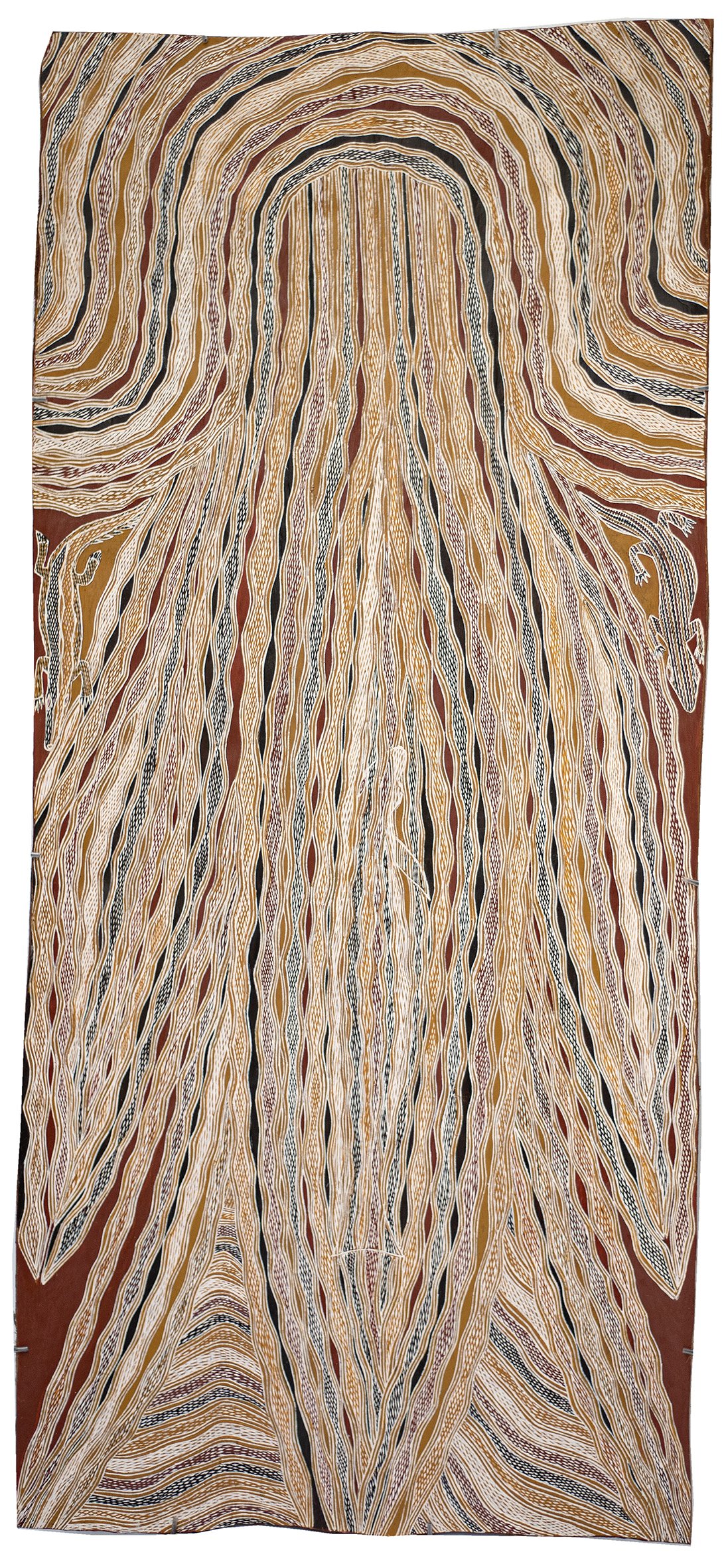
Peinture en pigments naturels de l’artiste Djambawa Marawili AM, Format : 164 x 73cm. Titre : Bäru at Yathikpa. Ref : 1365-17. © Photo Aboriginal Signature Estrangin Gallery with the courtesy of the artist and Buku Art.
Les écorces peintes par les artistes et leaders politiques Djambawa Marawili AM, Baluka Maymuru, Yinimala Gumana, Meŋa Munuŋgurr, de la communauté de Yirrkala font partie du “Saltwater project” et soulignent chacune à travers leurs représentations en pigments naturels, la poursuite de la lutte des peuples Yolŋu pour les droits à la terre/mer à travers leurs pratiques artistiques et culturelles.
Comme le souligne le leader Djambawa Marawili AM :
“Au pays de la mer, il y a des cérémonies rituelles. Elles nous apprennent à qui appartient le pays, qui est spirituellement lié à ce pays maritime. Ceci vaut pour chaque individu, tribu et clan”.
Ces œuvres montrent et révèlent publiquement des connaissances, afin de susciter un partage entre les peuples.
Djambawa Marawili AM ajoute :
”Nous souhaitons que vous puissiez les lire vous-même... afin que vous appreniez de nous… comme nous avons appris de vous. Vos connaissances, votre éducation, votre parcours, que nous utilisons. Une partie de la loi et une partie de votre culture”.
“De la même manière, vous devez apprendre… si nous vivons dans la voie de la réconciliation, vous devez également en savoir plus sur Native Title et SeaRights. Ça c'est comment qu'on apprend... À travers la maîtrise de l’écriture et pas seulement des écorces peintes, vous en apprendrez plus, des deux côtés, Yolnu et Balanda. C’est une aussi une façon à travers moi de vous le dire...”
Et de souligner l’importance “des patries, des peintures, des crues, des terrains de chasse, des demeures éternelles, de la souveraineté, des places, des ombres, des abris”.
Cela continuera à se faire par l’art et par l'édition de livres.
Nous nous réjouissons de vous accueillir au sein de la galerie à Bruxelles, dans notre espace de 250 m2 tout entier dédié à ces grands et petits trésors du bout du monde.
Bertrand Estrangin
Directeur de la galerie
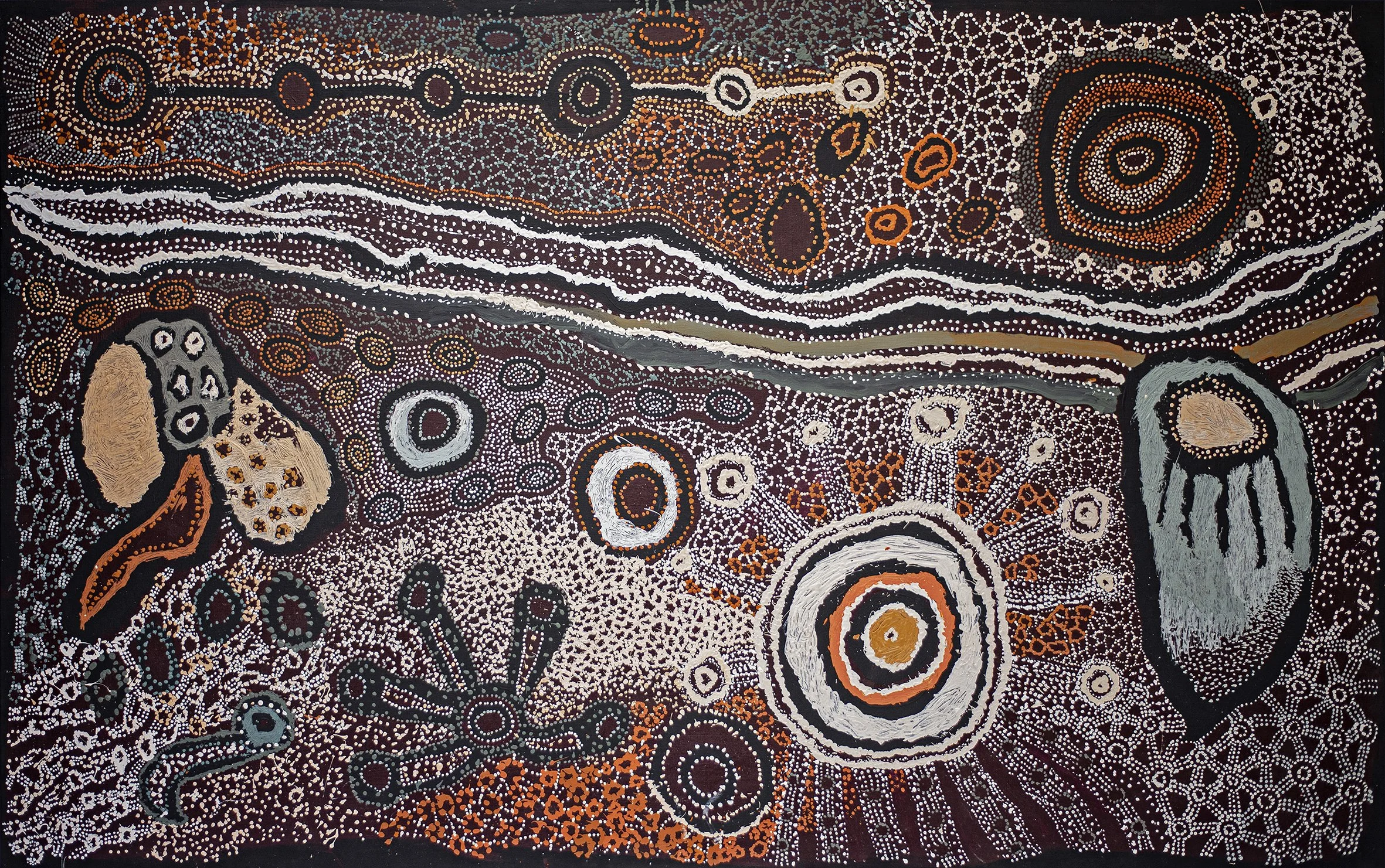
Œuvre collaborative féminine. Titre : Watarru - Kuka Mamu. Format : 240 x 200 cm. Ref : 22-10. © Photo Aboriginal Signature Estrangin Gallery with the courtesy of the artist and Tjungu Palya Arts.
Découvrez les peintures disponibles à Bruxelles durant l’exposition :

Artiste : Lennard Walker (1946)
Titre de l'œuvre : Iwara Tali
Format : 290 x 200 cm
Provenance et certificat : centre d'art aborigène du Spinifex Art Project
Référence de cette peinture : 21-172
Enquiry / Demander le prix de l'œuvre
Explications pour cette œuvre :
"This is the road north from Tjuntjuntjara. Tali tjuta (sand dunes) all along here. As you travel north past Ilkurlka you reach the country I am responsible for around Kuru Ala (located in the Great Victoria Desert of WA). There are small rock holes and the ridges of sand dunes".
Lennard was born at Kuru Ala making him the senior custodian for this place. It is a ‘Women’s SiteÓ holding the Kungkarangkalpa Tjukurpa – Seven Sisters story. This is an epic songline, which follows a group of young women as they traverse Spinifex country all the while evading the lustful attention of a powerful sorcerer man named Nyiru. Nyiru has metamorphic powers of transformation. He is a quandong tree at one site and at another a kunyia (woma python). The women make their way north, eventually flying into the night sky to become the star constellation of Pleiades the Seven Sisters. These characters are creation beings who transform the landscape as they move through it leaving indelible physical reminders of their power and presence for Anangu to follow.
As a man, there are places that Lennard cannot go but he still holds authority and cultural responsibilities for Kuru Ala. Before reaching Kuru Ala there are many sand dunes to pass over. Lennard has great knowledge for this country and lists the following rock holes; Purpurnya, Kapi Wiyatjara, Nyuman, Kamanti, Tuwan and Wayatji.
His artworks are in the following prestigious collections :
Artbank Australian Government, Canberra. A.C.T.
Collection Prince Stefan Of Liechtenstein, Embassy Of Liechtenstein In Germany. (Mens Collaborate)
Kuntswerk Sammlung Alison Und Peter W. Klein, Germany Sammlung Alison Und Peter W. Klein, Germany
National Gallery Of Australia, Canberra, Act (Mens Collaborative)
Seattle Art Museum, Seattle, Usa. (Mens Collaborative)
The British Museum, London. (Mens Collaborative)
The Corrigan Collection, Australia (Mens Collaborative)
The Kaplan-Levi Collection, Usa
W. & V. Mcgeoch Collection, Melbourne, Vic.
Wagner And Owen Collection, Usa.
Queensland Art Gallery Of Modern Art, Brisbane, Qld.
The Art Gallery Of New South Wales, Sydney, Nsw (Mens Collaborative)
Art Gallery Of South Australia, Adelaide, South Australia (Mens Collaborative)

Artiste : Ian Rictor
Titre de l'œuvre : Tuwan Dreaming Time story
Format : 200 x 137 cm
Provenance et certificat : centre d'art aborigène du Spinifex Art Project
Référence de cette peinture : 22-151
Enquiry / Demander le prix de l'œuvre
Explications pour cette œuvre :
Ian Rictor (1960) paints with the colourful confidence of someone who knows their spiritual place in the landscape. As a child, with his immediate family
Patju traversed on foot, the arid but bountiful country he paints. Here he depicts country associated the two Tjukurpa's Wati Pilalpa and Wati Kutjara, the stories of the Currawong Man and the Two Serpent Men.
Patju says ‘Good Country Hey! Ngayuku tjamuku ngura, My grandfathers place. North. Ngura wiru, good country, two rockholes here. Kulpi kutjara two caves, with water inside. Miil-miilpa, business, I can't say. Ngura pulka, We know. Mr Grant he know. Everybody know. Wati miil-miilpa men's business. This place my uncle (Roy Underwood). Good country!"
These characters that Patju depicts within a living, breathing landscape are the creation beings who shaped the immediate environment as they moved through it, leaving a moral narrative etched into the physical domain as testament to their power and presence. It is both this physical and spiritual existence that cannot be separated for Patju and is what gives his work the transcendent quality we experience from it.
His artworks are in the following prestigious collection :
Collection Prince Stefan Of Liechtenstein, Embassy Of Liechtenstein In Germany. (Mens Collaborate)
National Gallery Of Australia, Canberra, Act (Mens Collaborative)
Seattle Art Museum, Seattle, Usa. (Mens Collaborative)
The Aboriginal Art Museum, Utrecht
The British Museum, London. (Mens Collaborative)
The Corrigan Collection, Australia (Mens Collaborative)
Wagner And Owen Collection, Usa.
W. & V. Mcgeoch Collection, Melbourne, Vic. (Mens Collaborative)
Art Gallery Of South Australia, Adelaide, South Australia (Mens Collaborative)

Artiste : Ned Grant
Titre de l'œuvre : Mamu Piti Dreaming Time story
Format : 133x103 cm
Provenance et certificat : centre d'art aborigène du Spinifex Art Project
Référence de cette peinture : 13150
Demander le prix de l'œuvre / Enquiry
Explications pour cette œuvre :
Nyangatja kapi piti tjuta ka ini Mamupiti ka wamala pukanu palatja nguranguru ka Punuwaralakutu alinytjara ka wamala tjana Anangu army alatji kaya Palpatjatawanu munu Tatunyawanu ka ngura palatja wati liruku ngura ka wati kutju nyinanyi ngaltultjara.
This painting is depicting the place called Mamupiti. This is where the wamala, a powerfull group of Anangu men who have been likened to an 'army', started their journey north to a special place called Punuwara.
As the men moved northward they passed through the country of Palpatjata and Tatunya where the snake man resides all alone, a sad situation.

Artiste : Ned Grant
Titre de l'œuvre : Minyma Tjitu Pampa Dreaming Time story
Format : 137x90 cm
Provenance et certificat : centre d'art aborigène du Spinifex Art Project
Référence de cette peinture : 15-85
Enquiry / Demander le prix de l'œuvre
Explications pour cette œuvre :
Ned has painted the significant site of Pirilyinya and surrounding country. Pirilyinya forms part of the larger creation line of Minyma Tjitu Pampa (the Python Woman Elder) and cannot be elaborated on. Other sites of significance Ned stated were Makuratjara, Wakapukatjara, Tipil, Kalya and Mintul.
Ned Grant has cultural ownership over this swath of Spinifex Country and is the keeper of significant Tjukurpa. Tjukurpa is a deep and complex religious tradition generally referring to the energy of creation manifest in spirit beings, ancestors, animals, plants and geology. This Law is secret and privy only to initiated men and women. Tjukurpa is past, present and future all at the same time a force equally active today.
It is a guide for living life well explaining the relationships between people, plants, animals and the physical features of the land.

Artiste : Lawrence Pennington
Titre de l'œuvre : Mituna Pukara
Format : 110 x 85 cm
Provenance et certificat : centre d'art aborigene du Spinifex Art Project
Référence de cette peinture aborigene : 15-178

Artiste : Watarru collaborative - œuvre collaborative réalisée par les artistes importants de Tjungu Palya
Titre de l'œuvre : Creation Story for Kuka Mamu
Format : 240 x 150 cm
Provenance et certificat : centre d'art aborigène de Tjungu Palya
Référence de cette peinture : 22-10
Enquiry / Demander le prix de l'œuvre
Explications pour cette peinture Aborigène :
The Watarru Collaborative consists of the 3 artists Wipana Jimmy and her daughters Beryl Jimmy and lmitjala Pellard, all from the very remote community of Watarru on the Anangu Pitjantjatjara Yankunytjatjara (APY) lands in South Australia. Together these three women depict Creation stories that have been passed down through countless generations. Their paintings show a particular sensitivity to the way these creation myths interact with and shape their beloved homeland.
Kuka mamu : there’s an animal crouching down there in Nyapari. Two men making (tjara) shields. They go to hunt that kuka by spearing him. Share with family and then we go down to Watarru way. Family sitting down the bottom rock hole (Iwarawara). There’s plenty of water there.

Artiste : Watarru collaborative - œuvre collaborative réalisée par les artistes importants de Tjungu Palya
Titre de l'œuvre : Creation Story for Ilpili
Format : 200 x 180 cm
Provenance et certificat : centre d'art aborigène de Tjungu Palya
Référence de cette peinture : 22-011
Enquiry / Demander le prix de l'œuvre
Explications pour cette peinture Aborigène :
Cette œuvre évoque une histoire de la Création des Deux Soeurs associées à Ilpili. Ces deux femmes escaladaient différents blocs rocheux pendant que l'Homme Wati était à leur recherche sans pouvoir les apercevoir. La jeune femme était enceinte et se cachait avec sa sœur dans une grotte aux pieds d'une colline.
L'homme grimpa tout en haut pour les appeler : Yaltji, minyma kutjara? "Où êtes-vous ?"
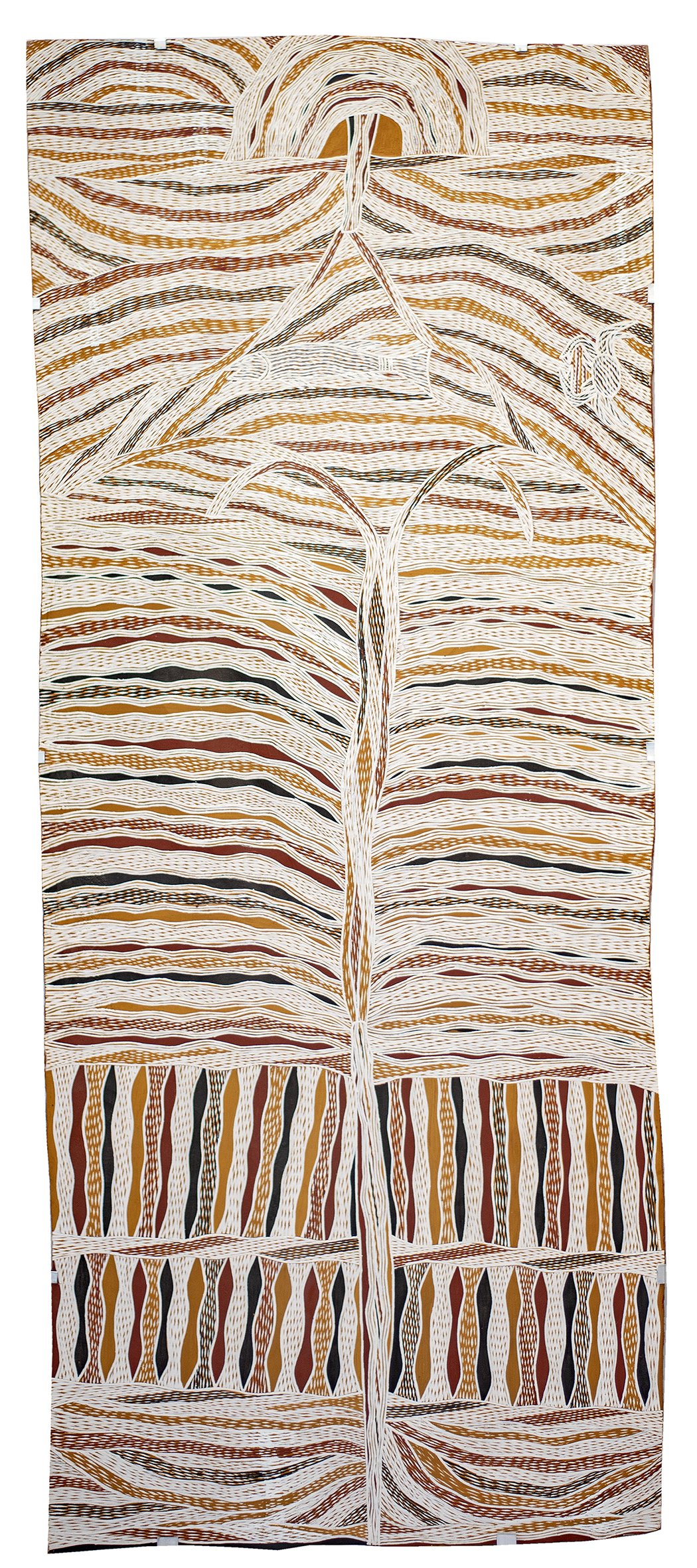
Artiste : Djambawa Marawili (1953)
Titre de l'œuvre : Baratjala
Format : 157 x 64 cm
Pigments naturels sur écorce d'eucalyptus
Provenance et certificat : centre d'art aborigene de Yirrkala
Référence de la peinture : 3451-19
Enquiry / Demander le prix de l'œuvre
Explications sur cette œuvre :
Baraltja is the residence of Burrut’tji (also known as Mundukul) the lightning serpent. It is an area of flood plains that drain into northern Blue Mud Bay. It is on country belonging to the Madarrpa and denotes an area of special qualities pertaining to fertility and the mixing of waters. From Madarrpa (and Dhalwaŋu clan) land freshwater spreads onto the Baraltja flood plains with the onset of the Wet. A tidal creek into the Bay flows with the freshwater flushing the brackish mix into the sea over an ever shifting sandbar (the snake manifest). The deep hole that he lives in is Lorr…
It is from here that the water (soul) transmogrifies to vapour to enter the ‘pregnant’ Waŋupini (Wet Season storm clouds) which carry the life giving freshwater back to rain on the escarpment of the Mitchell Ranges- the watershed and the start of the cycle.
© Photo & text : Aboriginal signature with the courtesy of the artist, & Buku-Larrngay Mulka.
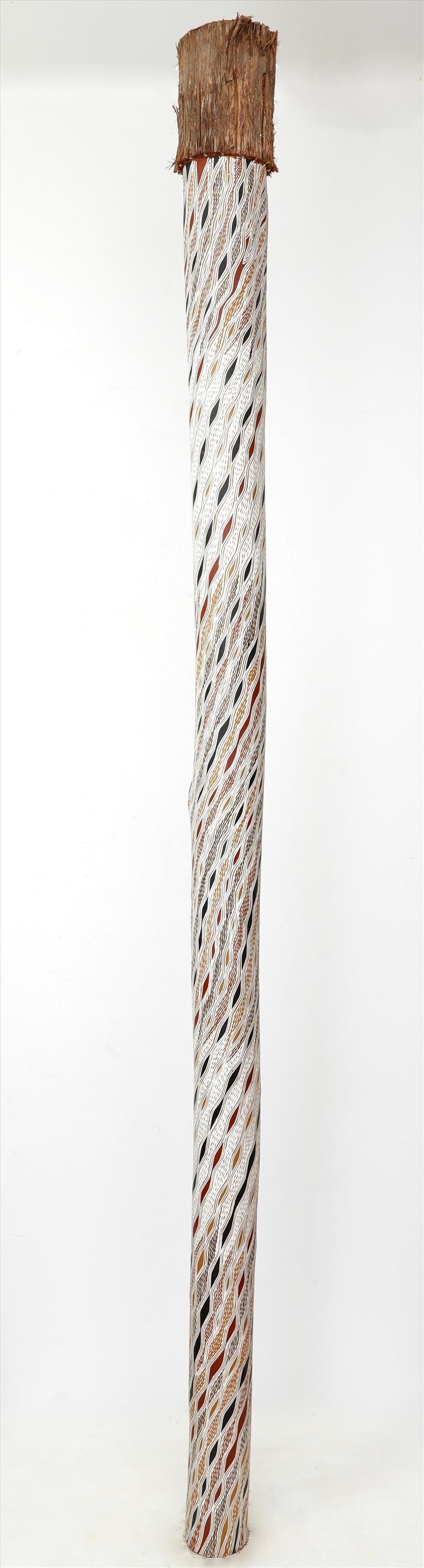
Artiste : Djambawa Marawili (1953)
Titre de l'œuvre : Larrakitj
Format : 269 x 20 cm
Pigments naturels sur écorce d'eucalyptus
Provenance et certificat : centre d'art aborigene de Yirrkala
Référence de la peinture : 4980A
© Photo & text : Aboriginal signature with the courtesy of the artist, & Buku-Larrngay Mulka.

Artiste : Djambawa Marawili (1953)
Titre de l'œuvre : Mundukul Lightning Snake
Format : 73 x 43 cm
Pigments naturels sur écorce d'eucalyptus
Provenance et certificat : centre d'art aborigene de Yirrkala
Référence de la peinture : 470-19
Explications sur cette œuvre :
Baraltja is the residence of Burrut’tji (also known as Mundukul) the lightning serpent. It is an area of flood plains that drain into northern Blue Mud Bay. It is on country belonging to the Madarrpa and denotes an area of special qualities pertaining to fertility and the mixing of waters. From Madarrpa (and Dhalwaŋu clan) land freshwater spreads onto the Baraltja flood plains with the onset of the Wet. A tidal creek into the Bay flows with the freshwater flushing the brackish mix into the sea over an ever shifting sandbar (the snake manifest). The deep hole that he lives in is Lorr…
It is from here that the water (soul) transmogrifies to vapour to enter the ‘pregnant’ Waŋupini (Wet Season storm clouds) which carry the life giving freshwater back to rain on the escarpment of the Mitchell Ranges- the watershed and the start of the cycle.
© Photo & text : Aboriginal signature with the courtesy of the artist, & Buku-Larrngay Mulka.

Artiste : Djambawa Marawili (1953)
Titre de l'œuvre : Garraŋali
Format : 91 x 65 cm
Pigments naturels sur écorce d'eucalyptus
Provenance et certificat : centre d'art aborigene de Yirrkala
Référence de la peinture : 3453-19
© Photo & text : Aboriginal signature with the courtesy of the artist, & Buku-Larrngay Mulka.

Artiste : Djambawa Marawili (1953)
Titre de l'œuvre : Larrakitj : Yathikpa
Format : 295 x 20 cm
Pigments naturels sur écorce d'eucalyptus
Provenance et certificat : centre d'art aborigene de Yirrkala
Référence de la peinture : 2710-19
© Photo & text : Aboriginal signature with the courtesy of the artist, & Buku-Larrngay Mulka.

Artiste : Djambawa Marawili (1953)
Titre de l'œuvre : Bäru at Yathikpa
Format : 164 x 73 cm
Pigments naturels sur écorce d'eucalyptus
Provenance et certificat : centre d'art aborigene de Yirrkala
Référence de la peinture : 1365-17
Explications sur cette œuvre :
This painting by Djambawa depicts the transformation of the ancestral warrior Bäru into the Madarrpa power totem of crocodile through the agency of fire. This motif of Baru holding fire sticks or clapsticks and generating fire or sacred song (manikay) appears again and again within Djambawa’s work for the Sydney Biennale show and feels like a multilayered self portrait. Djambawa is becoming the Baru through his observation of Madarrpa law in song and art.
He is himself being transformed by the act of painting as Baru was by fire. Here he is presiding over ceremony and generating/directing and being consumed by the fire of these designs, songs and law. As the fire spreads so does the song touch on these areas connected through manikay.
© Photo & text : Aboriginal signature with the courtesy of the artist, & Buku-Larrngay Mulka.
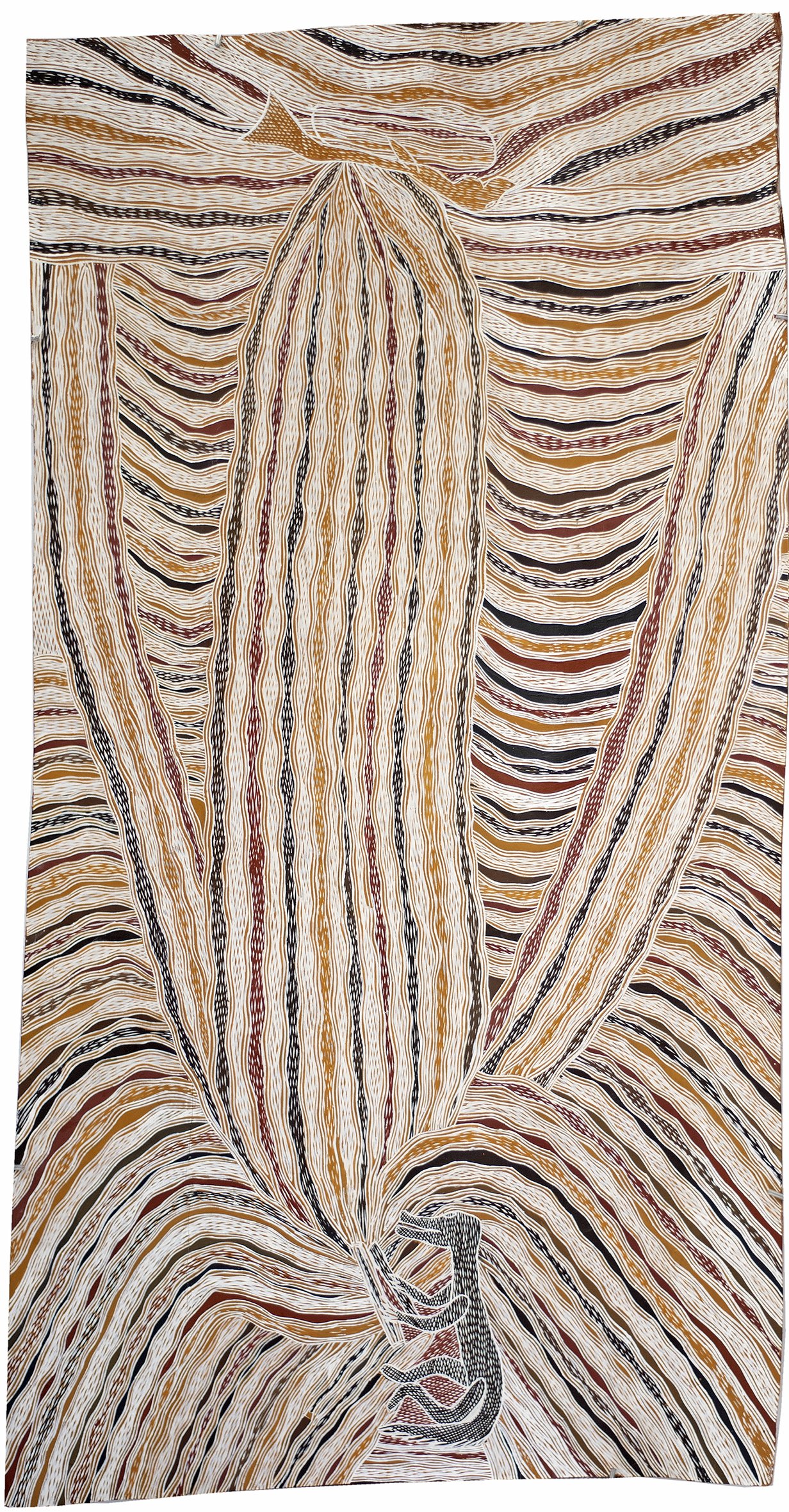
Artiste : Djambawa Marawili (1953)
Titre de l'œuvre : Metamorphosis/Dhakalmayi
Format : 120 x 70 cm
Pigments naturels sur écorce d'eucalyptus
Provenance et certificat : centre d'art aborigene de Yirrkala
Référence de la peinture : 2895U
Explications sur cette œuvre :
This painting by Djambawa depicts the transformation of the ancestral warrior Bäru into the Madarrpa power totem of crocodile through the agency of fire. This motif of Baru holding fire sticks or clapsticks and generating fire or sacred song (manikay) appears again and again within Djambawa’s work for the Sydney Biennale show and feels like a multilayered self portrait. Djambawa is becoming the Baru through his observation of Madarrpa law in song and art.
He is himself being transformed by the act of painting as Baru was by fire. Here he is presiding over ceremony and generating/directing and being consumed by the fire of these designs, songs and law. As the fire spreads so does the song touch on these areas connected through manikay.
© Photo & text : Aboriginal signature with the courtesy of the artist, & Buku-Larrngay Mulka.

Artiste : Djambawa Marawili (1953)
Titre de l'œuvre : Metamorphosis/Dhakandjali
Format : 184 x 71 cm
Pigments naturels sur écorce d'eucalyptus
Provenance et certificat : centre d'art aborigene de Yirrkala
Référence de la peinture : 2918R
Explications sur cette œuvre :
This painting by Djambawa depicts the transformation of the ancestral warrior Bäru into the Madarrpa power totem of crocodile through the agency of fire. This motif of Baru holding fire sticks or clapsticks and generating fire or sacred song (manikay) appears again and again within Djambawa’s work for the Sydney Biennale show and feels like a multilayered self portrait. Djambawa is becoming the Baru through his observation of Madarrpa law in song and art.
He is himself being transformed by the act of painting as Baru was by fire. Here he is presiding over ceremony and generating/directing and being consumed by the fire of these designs, songs and law. As the fire spreads so does the song touch on these areas connected through manikay.
© Photo & text : Aboriginal signature with the courtesy of the artist, & Buku-Larrngay Mulka.

Artiste : Djambawa Marawili (1953)
Titre de l'œuvre : Baraltja
Format : 173 x 63 cm
Pigments naturels sur écorce d'eucalyptus
Provenance et certificat : centre d'art aborigene de Yirrkala
Référence de la peinture : 3707L
Explications sur cette œuvre :
This work was completed at Yilpara on Blue Mud Bay just a few months after Djambawa presided over the one year celebration of Yolngu victory in the Blue Mud Bay case in the High Court of Australia. Djambawa had been instrumental in bringing the Court case thirteen years earlier and in initiating the Saltwater Collection which was used as evidence in the claim. Baraltja is the residence of Burrut’tji (also known as Mundukul) the lightning serpent. It is an area of flood plains that drain into northern Blue Mud Bay…
The medium of this message is the deep horizon ocean. Although in the Dry Season there is no physical connection through water between the Dhalwangu clan Gangan River and their maternal granddaughter Madarrpa clan’s Baraltja Creek - in the Wet the inundation allows the possibility of water flowing from Gangan to emerge at Baraltja. This area is sung and painted by both clans because of the spiritual connection echoed by the physical reality. The colouring refers to Motu, the build up of red black and yellow , mangrove leaves in this mangrove creek. From Baraltja the waters migrate to Muŋurru the mighty undifferentiated Yirritja saltwater ocean that plays at the horizon which receives and unifies all the Yirritja coastal saltwaters in one. It is from here that the water (soul) transmogrifies to vapour to enter the ‘pregnant’ Waŋupini (Wet Season storm clouds) which carry the life giving freshwater back to rain on the escarpment of the Mitchell Ranges- the watershed and the start of the cycle.
© Photo & text : Aboriginal signature with the courtesy of the artist, & Buku-Larrngay Mulka.

Artiste : Baluka Maymuru
Titre de l'œuvre : Yiŋapuŋapu
Format : 144 x 58 cm
Pigments naturels sur écorce d'eucalyptus
Provenance et certificat : centre d'art aborigene de Yirrkala
Explications sur cette peinture :
Baluka is an artist of truth. His art is of high integrity, solemn intent and most often hauntingly beautiful. In making his art he sees little distinction between realms of his sacred cultural practice and that of the art world. He is quite experienced in both, his artistic work layered with huge amounts of information contained in symbolic form. Baluka is the head man for the Maŋgalili and resides when he can at his homeland of Djarrakpi. His father was the great Nanyin, older brother of Narritjin who established the outstation for the Maŋgalili at Djarrakpi.
This designs in this piece are tied to the saltwater estate and ritual focal point at Djarrakpi, the home of Baluka and his clan. This beautiful place is located on the Northern entrance of Blue Mud Bay on the Western coast of the Gulf of Carpentaria. It has its founding origins in the times of the first sunrises by the Guwak (a people, 2 men, a koel cuckoo) and a messenger in the form of ringtail possum called marrŋu. The koel at Djarrakpi made roost atop the Marawili (native cashew tree) and Marrŋu made his mark for the Maŋgalili clan by scratching into its trunk. Behind the massive coastal dunes, there is also a lake of freshwater and at the back of these dunes is said to reside the powerful maternal figure of Nyapaliŋu. She wore a possum fur string girdle crossing her chest; the levy bank of the lake was also of the same masculine and sacred fur, a great long shank.
His artworks could be find in the following prestigious collections :
Berndt Museum, University of Western Australia, Perth WA
Charles Darwin University Art Collection
Kerry Stokes Collection, Perth WA
Kluge-Ruhe Aboriginal Art Collection of the University of Virginia. USA
Museum and Art Gallery of the Northern Territory, Darwin NT
National Gallery of Australia, Canberra ACT
National Gallery of Victoria, Melbourne VIC
National Museum of Australia, Canberra ACT
RMIT University Art Collection
Seattle Art Museum, Seattle USA
The Collection of the Australian Institute of Aboriginal and Torres Strait Islander Studies
The Collection of the Centre for Cross-Cultural Research, Canberra ACT
The Kelton Foundation Collection, Santa Monica, USA
The Laverty Collection, Sydney NSW
Wayne and Vicki McGeogh Collection
Référence de la peinture : 1031-21
© Photo & text : Aboriginal signature with the courtesy of the artist, & Buku-Larrngay Mulka.

Artiste : Meŋa Munuŋgurr
Titre de l'œuvre : Djapu Design
Pigments naturels sur écorce
Format : 144 x 60 cm
Provenance et certificat original : centre d'art aborigène de Yirrkala
Référence de la peinture : 2481-19
© Photo : Aboriginal signature with the courtesy of the artist & Buku-Larrngay Mulka.
Explication de l’œuvre :
This bark painting depicts with this cross hatching grid pattern, the sacred design for the freshwaters of the Djapu clan at their homeland Wandawuy now an outstation about 150 kilometres south of Yirrkala and inland from Blue Mud Bay. This Djapu clan outstation (and spiritual residence for Ancestral Beings Mäna the Shark and Bol’ŋu the Thunderman) is surrounded by permanent freshwater. Rains inspired by the actions of Bol’ŋu feed the rivers and fill the billabongs. Catfish and mussels, freshwater crayfish and others feed the Yolŋu and wild life. The waters are home for the shark Mäna.
The grid refers to the landscape of Wandawuy - a network of billabongs surrounded by ridges and high banks. Its structure also having reference at one level to woven fish traps. Ancestral Hunters set a trap here to snare the Shark but to no avail. These Yolngu people are called Bärngbarng and Monu'a who came to cut the trees named Gu'uwu, Gathurrmakarr, Nyenyi, Rulwirrika and Gananyarra - all Dhuwa trees. They used straight young trees and cut them with their axes called Gayma`arri, Bitjutju.

Artiste : Yinimala Gumana
Titre de l'œuvre : Buyku
Format : 177 x 44 cm
Pigments naturels sur écorce d'eucalyptus
Provenance et certificat : centre d'art aborigene de Yirrkala
Référence de la peinture : 1628-19
© Photo & text : Aboriginal signature with the courtesy of the artist, & Buku-Larrngay Mulka.

Artiste : Nora Wompi (1939)
Titre de l'œuvre : Kunawarritji Ngurra (Seven Sisters Dreaming)
Format : 91 x 91 cm
Provenance et certificat : centre d'art aborigène de Martumili
Référence de cette peinture : 14-313
Demander le prix de l'œuvre / Enquiry
Explications pour cette œuvre :
Wompi paints the Country around her homelands of Kunawarritji, a place associated with the Minyipuru Jukurrpa (Seven Sister Dreaming). In 1906, Kunawarrtiji also became the well 33 on the Canning Stock Route, and from an early age Wompi and her family had encounters with the white men who drove cattle along the route. As a young woman, Wompi followed the drovers north to Balgo Mission, where she stayed for many years. She learnt to paint there with her close friend, Eubena Nampitjin, and returned to Kunawarritji, where she lives and paints today, when it became a community in its own right.
© Photo : Aboriginal Signature Estrangin gallery with the courtesy of the artists and Martumili

Artiste : Nora Nungabar (1920)
Titre de l'œuvre : Kunawarritji (well 33 of the Canning stock road)
Format : 152 x 106 cm
Provenance et certificat : centre d'art aborigène de Martumili
Référence de cette peinture : 13-215
Demander le prix de l'œuvre / Enquiry
Explications pour cette œuvre :
Kunawarritji is an important site in the Great Sandy Desert where multiple stories and histories intersect. In the Jukurrpa (dreamtime) period, the Seven Sisters stopped here and shaped a number of landforms before continuing on their long journey east. During the pujiman (nomadic desert dweller) era, the site was an important yinta (permanent water source),
where families stopped and camped for long periods each year.
At the turn of the 20th century Kunawarritji was converted into a well (Well 33) along the 1850km long Canning Stock Route, created as a means to drove cattle through the harsh Western Australian desert. Each year throughout the 1930-50s, the well became a site of contact between drovers, their cattle, and desert families.
Today, Kunawarritji community is a site of return, a place where Martu people have come back to continue making their life in the desert.
Nungabar grew up in the country that became Wells 33-38 on the Canning Stock Route. From an early age she and her family had encounters with the white men who drove cattle along the route. As a young woman, together with her close friend Nora Wompi, Nungabar followed the drovers north to Balgo Mission, where she settled and raised a family. She eventually
relocated to her homelands at Kunawarritji, where she was considered a custodian of a great deal of cultural knowledge about the Kunawarritji area.
© Photo : Aboriginal Signature Estrangin gallery with the courtesy of the artists and Martumili

Artiste : Bugai Whyoulter (1940)
Titre de l'œuvre : Wantili Claypan
Format : 152 x 108 cm
Provenance et certificat : centre d'art aborigène de Martumili
Référence de cette peinture : 16-561
Demander le prix de l'œuvre / Enquiry
Explications pour cette œuvre :
Wantili is also known as Well 24 on the Canning Stock Route. The area is dominated by claypans surrounded by tuwa (sandhills). This is not far from the artist's home country. She returned her as a young woman, driving cattle along the Stock Route.

Artiste : Nora Nungabar (1920)
Titre de l'œuvre : Kinyu (well 35 of the Canning Stock Route)
Format : 152 x 76 cm
Provenance et certificat : centre d'art aborigène de Martumili
Référence de cette peinture : 13-282
Demander le prix de l'œuvre / Enquiry
Explications pour cette œuvre :
This painting depicts Kinyu, also known as Well 35 on the Canning Stock Route, and is the area for dingo dreaming. There is a small yinta (waterhole) at Kinyu, which made it an ideal camping spot in the Pujiman (nomadic desert dwelling) era.
In the Jukurrpa (dream time) two dingoes travelled to Wilarra, following the call of the moon. Wilarra, which also means ‘moon’ in Manyjilyjarra, is a very significant site lying on the edge of the large salt lake, Lake Dora. The dingoes gave birth to a litter of puppies at Wilarra, where they were looked after by the moon.
The dingoes stayed for a time at Wilarra, scratching into the earth to create several distinctive small salt water pools, which are still visited by the Martu for their healing properties. Later, the dingoes continued travelling east toward the rising moon, stopping finally at Kinyu.
In her youth, Nungabar walked all around this country with her family. She recalls "the whitefella Government came in a truck and killed all the jarntu (dogs) and then they ate the jarntu".
© Photo : Aboriginal Signature Estrangin gallery with the courtesy of the artists and Martumili

Artiste : Mrs Japulija
Titre de l'œuvre : Billabongs
Format : 2 x 120 x 60 cm
Provenance et certificat : centre d'art de Mangkaja
Référence de cette peinture Aborigène d'Australie : 40/19
Acrylic paint on polycarbonate.
Explications sur cette œuvre :
Daisy Japulja (1948) paints images of both Martuwarra (river country) and her parent's Jilji (sand hill) country. In these works Daisy relives the stories told of her mothers and fathers country, and retells those of Billabongs. Daisy uses lively colours and a thick brush to cover the canvas with a confident hand. The beautiful simplicity of her desert images are matched by her bold colour pallet as she portrays important Jila (waterholes) and Jumu (soak waters) from the Great Sandy Desert. Closer to home, her cheeky sense of humour rises from the canvas through her beautiful depictions of river country like Martuwarra in this artwork, and the various animals that dwell within it.
This artwork was finalist of the Telstra Natsiaa Award at the Museum of Darwin in 2019.
Collection :
Private collections in Australia and Europe
Art Awards exhibition :
2019 36th Telstra NATSIAA Award Finalist Darwin,
The National 2019, MCA Sydney
2018 Hadley’s Art Prize Highly Commended Hobart, Tas
2018 35th Telstra NATSIAA Award Finalist Darwin
2017 Cossack Art Awards City of Karratha, WA
2017 Port Hedland Art Award Finalist Port Hedland Courthouse Gallery, WA
2014 Port Hedland Art Award (Winner) Port Hedland, WA

Artiste : Sonia Kurarra
Titre de l'œuvre : MARTUWARRA
Format : 120 x 120 cm
Provenance et certificat : centre d'art de Mangkaja
Référence de la peinture : 575/13
Artiste : Patju Presley
Titre de l'œuvre : Kurparu
Format : 200 x 137 cm
Provenance et certificat : centre d'art aborigène du Spinifex Art Project
Référence de cette peinture : 22-116
Enquiry / Demander le prix de l'œuvre
Explications pour cette œuvre :
Patju Presley paints with the colourful confidence of someone who knows their spiritual place in the landscape. As a child, with his immediate family Patju traversed on foot, the arid but bountiful country he paints. Here he depicts country associated the two Tjukurpa's Wati Pilalpa and Wati Kutjara, the stories of the Currawong Man and the Two Serpent Men.
Patju says ‘Good Country Hey! Ngayuku tjamuku ngura, My grandfathers place. North. Ngura wiru, good country, two rockholes here. Kulpi kutjara two caves, with water inside. Miil-miilpa, business, I can't say. Ngura pulka, We know. Mr Grant he know. Everybody know. Wati miil-miilpa men's business. This place my uncle (Roy Underwood). Good country!"
These characters that Patju depicts within a living, breathing landscape are the creation beings who shaped the immediate environment as they moved through it, leaving a moral narrative etched into the physical domain as testament to their power and presence. It is both this physical and spiritual existence that cannot be separated for Patju and is what gives his work the transcendent quality we experience from it.
Patju Presley (1945) was born in the 1940s at Itaratjara, an important site between to the community settlement of Watarru and Kalayapiti in the Great Victoria Desert.
His artworks are in the following prestigious collections : Art Gallery Of Western Australia, Perth, Wa. The National Gallery Of Australia, Canberra, Act. National Gallery Of Victoria, Melbourne. The Art Gallery Of New South Wales, Sydney, Nsw. The Kaplan-Levi Collection, Usa. University Of Queensland Art Museum, Brisbane, Qld. Art Gallery Of South Australia, Adelaide, South Australia (Mens Collaborative). Queensland Art Gallery, Brisbane...