Peinture d'art Aborigène de Jilamara (Tiwi Island)
Jilamara Arts & Crafts Association est un centre d'art autochtone localisé à Milikapiti, Melville Island, à 100 km au nord de Darwin. Les artistes du centre ont apporté une contribution significative à l'art indigène contemporain en Australie depuis que l'association a été établie en 1989.
Le mot Tiwi «Jilamara», qui se traduit grossièrement par «design», fait référence aux motifs complexes d'ocre traditionnellement appliqués sur les corps des danseurs et à la surface des poteaux sculptés lors de la cérémonie funéraire de Pukamani. Cette cérémonie fait toujours partie de la vie communautaire et continue d’insuffler la pratique artistique actuelle du peuple Tiwi. Le travail des artistes des Iles Tiwi souligne sa propre identité, qui varie considérablement dans la forme et le contenu, par rapport à l'art indigène des régions d'Arnhem et du désert central d'Australie.
La Jilamara Arts & Crafts Association participe à des programmes d'expositions dans des galeries publiques et privées, tout en entreprenant des projets de développement communautaire, visant à renforcer la culture et la transmission de la mémoire entre générations. Les œuvres du centre d'art font partie des grandes collections publiques et privées en Australie, ainsi que dans les principales collections à l'étranger.
Peintures des artistes Aborigènes de Jilama (Tiwi) disponibles au sein de la galerie :

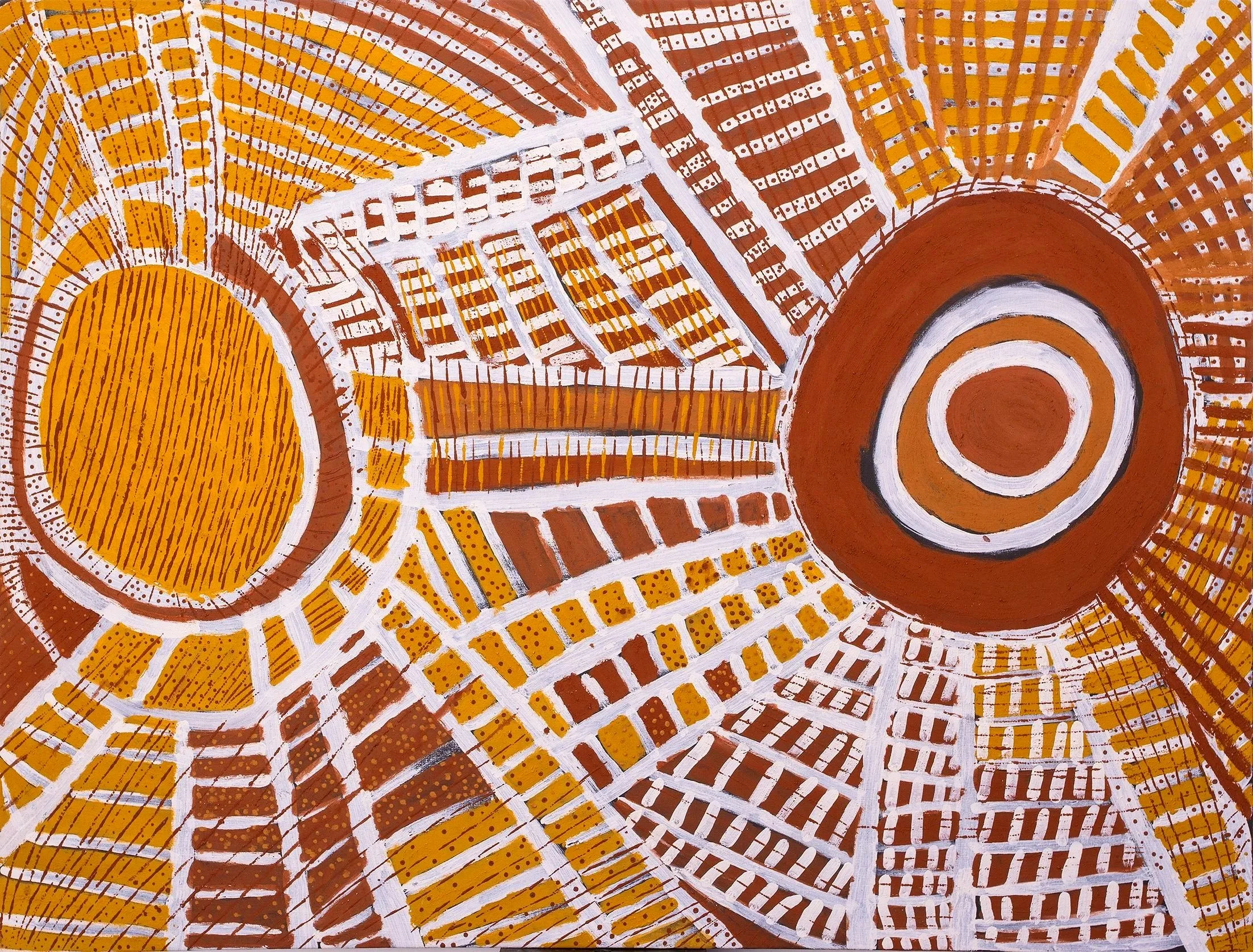
Artiste : Timothy Cook
Titre de l'œuvre : Japarra (Moon Man)
Pigments naturels sur toile de lin Belge
Format : 200 x 152 cm
Provenance et certificat : centre d'art aborigène de Jalimara (Tiwi Island)
Référence de la peinture : 138-17
© Photo : Aboriginal signature with the courtesy of the artist & Jilamara Art centre (Tiwi Island)
Explications sur cette œuvre :
Timothy Cook (1958) expresses himself through his loose and gestural designs. He paints exclusively with locally sourced ochre and his artworks are highly sort after by major collections both nationally and internationally.
Timothy won the National Aboriginal and Torres Strait Island Art Award in 2012 and has been shortlisted for many others, including the Hadley Art Award in 2019, the Wynne Prize in 2020 and Sulman in 2023.
Japarra the moon man is central to the Tiwi Creation Story. Purukapali's younger brother ran away with his wifwe Bima, her baby Jinani left alone to die from heat and neglect, a bitter struggle ensued between the brothers and the king proclaimed all life would be subject to mortality. Japarra escaped up into the moon where his body changed into a pale half moon.
You can find the artworks of the artist within the following prestigious collections :
Musee du quai Branly, France
National Gallery of Australia
Fondation Opale, Switzerland
University of Newcastle, NSW
National Gallery of Australia, Canberra
Art Gallery of New South Wales, Sydney
National Gallery of Victoria, Melbourne
University of New South Wales, Sydney
Museum and Art Gallery of the Northern Territory, Darwin
Charles Darwin University, Darwin
Queensland Art Gallery, Brisbane
Aboriginal Art Museum, Utrecht, Netherlands
Art Gallery of South Australia
Wesfarmers Collection of Australia, Western Australia
Murdoch University Collection, Western Australia
Edith Cowan University, Perth
Western Australian Art Gallery, Perth
Parliament House Collection, Canberra
Museum of Contemporary Art, Newcastle Art Gallery…

Artiste : Kaye Brown
Titre de l'œuvre : Kayimwagakimi jilamara
Pigments naturels sur toile de lin Belge
Format : 81 x 39 cm
Provenance et certificat : centre d'art aborigène de Jalimara (Tiwi Island)
Référence de la peinture : 81-25
© Photo : Aboriginal signature with the courtesy of the artist & Jilamara Art centre (Tiwi Island)
Explications pour cette œuvre :
Kaye (1954) is a senior Tiwi culture woman. She is well versed in the old ways, parlinarri (old) stories and speaks the ‘hard’ Tiwi language. She started painting at Jilamara Arts and Crafts later in life after she retired from work. Prior to this she taught at the local primary school and worked at the Milikapiti Library. She loves teaching culture to the local primary school children who come to Jilamara for culture classes in the Muluwurri Museum.
She has a wealth of local knowledge about Tiwi culture and the history of her ancestors. She uses the Kayimwagakimi (carved ironwood comb) and locally sourced ochres from Melville Island to paint. Her yirrinkiripwoja/jilamara (ochre body paint design) are layered and reminiscent of the design that wulimawi (old people) used to prepare for ceremony and yoyi (dance).
She has been a finalist in the Telstra NATSIA Awards three times and was a significant part of the major TIWI Exhibition at NGV Australia in 2020/21.
Kayimwagakimi is the traditional Tiwi painting 'comb'. Made from bloodwood or ironwood, it is about 15cm high with a single row of teeth. The comb is dabbed in ochre and applied to the painting surface resulting in a straight line of fine dots, a process which is repeated over and over.
Kayimwagakimi and marlipinyini (a fine stick or pandanus frond chewed to form a brush) have largely been replaced by modern brushes but a handful of Tiwi still use traditional tools.
You can find his artworks in the following prestigious collections :
National Gallery of Victoria
Art Gallery of South Australia
Wesfarmers Collection
Kluge-Ruhe Art Museum, USA

Artiste : Conrad Kamilowra Tipungwuti
Titre de l'œuvre : Warnarringa ( the sun)
Pigments naturels sur toile de lin Belge
Format : 120 × 120 cm
Provenance et certificat : centre d'art aborigène de Jalimara (Tiwi Island)
Référence de la peinture : 256-24
© Photo : Aboriginal signature with the courtesy of the artist & Jilamara Art centre (Tiwi Island)
Explications pour cette œuvre :
Conrad Tipungwuti (1966) has been painting and creating limited edition prints at Jilamara Arts and Crafts Association since the late 1990’s. Alongside Timothy Cook, Conrad is part of the Ngawa Mantawi (all of us together) program at Jilamara – a program that supports artists with special needs to have successful careers in the arts while remaining close to family and Country.
Conrad grew up in the “old camp” at Pirlangimpi (Garden Point) with his parents. While it no longer exists, the old camp is spoken about as a community of wulimawi (the old people) and Conrad was raised surrounded by strong culture and regular ceremonies. His Tiwi name is Kamilowra and this was given to him by the famous artist Cornelia Tipuamantumirri’s late husband Steven Tipuamantumirri.
Conrad paints using ochres or earth pigments sourced from around Milikapiti. The over-arching themes of his work depict the wet season Pakatiringa (rain), Warnarringa (Sun) and the Kulama (coming of age ceremony). This is represented by large concentric circles that refer both to the yams prepared during the ceremony and large rings that appear around the moon in late wet season signifying the beginning of the ceremony season.
The sun is very important to the Tiwi people. Parlingarri (creation time) it is believed that the whole world was in perpetual darkness and inhabited by yamparriparri (evil spirits). The wulimaka (old lady) Murtankala came up from underground with three children in a tunga (bark bag) on her back. As she moved around on the surface, she created grooves and crevices in the land with her body. Some of these filled with water and created the geographical shapes and channels of the Tiwi Islands. She made yikwani (fire) by rubbing grass and sticks together and lifted it up into the sky with her two hands to create light for her children, one of whom was Purukuparli (the first Tiwi man). This light became warnarringa (the sun). To this day contemporary Jilamara arsts sll use locally sourced earth pigments from Country to paint. The yellow ochre is burnt on the fire to make the red pigment – the colours of the land, the sun and fire applied to recall the old designs and creations stories of the Tiwi people.
You can find his artworks in the following prestigious collections :
National Gallery of Victoria, Melbourne Victoria.
National Gallery of Australia, Canberra.
Musee des Confluences, Paris, France
Charles Darwin University Collection
Murdoch University Collection, Perth
Edith Cowan University Art Collection, Perth
Artbank Australia
Queensland University Art Museum
Stokes Collection, Victoria…

Artiste : Timothy Cook
Titre de l'œuvre : Japarra
Pigments naturels sur toile de lin Belge
Format : 90 × 24 cm
Provenance et certificat : centre d'art aborigène de Jalimara (Tiwi Island)
Référence de la peinture : 359-18
© Photo : Aboriginal signature with the courtesy of the artist & Jilamara Art centre (Tiwi Island)
Explications sur cette œuvre :
Timothy Cook (1958) expresses himself through his loose and gestural designs. He paints exclusively with locally sourced ochre and his artworks are highly sort after by major collections both nationally and internationally.
Timothy won the National Aboriginal and Torres Strait Island Art Award in 2012 and has been shortlisted for many others, including the Hadley Art Award in 2019, the Wynne Prize in 2020 and Sulman in 2023.
In Tiwi ancestral memory, Japarra is Purukaparli’s deceitful brother. He and his sister-in-law Bima become lovers, and during one of their bush Bima and Purukaparli’s baby son dies of heatstroke, bringing mortality to the world.
Following the tragic discovery of his son’s death, Purukaparli fights his brother with the rage of grief, striking him with spears and throwing sticks.
You can find the artworks of the artist within the following prestigious collections :
Musee du quai Branly, France
National Gallery of Australia
Fondation Opale, Switzerland
University of Newcastle, NSW
National Gallery of Australia, Canberra
Art Gallery of New South Wales, Sydney
National Gallery of Victoria, Melbourne
University of New South Wales, Sydney
Museum and Art Gallery of the Northern Territory, Darwin
Charles Darwin University, Darwin
Queensland Art Gallery, Brisbane
Aboriginal Art Museum, Utrecht, Netherlands
Art Gallery of South Australia
Wesfarmers Collection of Australia, Western Australia
Murdoch University Collection, Western Australia
Edith Cowan University, Perth
Western Australian Art Gallery, Perth
Parliament House Collection, Canberra
Museum of Contemporary Art, Newcastle Art Gallery…

Artiste : Conrad Kamilowra Tipungwuti
Titre de l'œuvre : Kulama ceremonies
Pigments naturels sur toile de lin Belge
Format : 108 × 37 cm
Provenance et certificat : centre d'art aborigène de Jalimara (Tiwi Island)
Référence de la peinture : 103-24
© Photo : Aboriginal signature with the courtesy of the artist & Jilamara Art centre (Tiwi Island)
Explications pour cette œuvre :
Conrad Tipungwuti (1966) has been painting and creating limited edition prints at Jilamara Arts and Crafts Association since the late 1990’s. Alongside Timothy Cook, Conrad is part of the Ngawa Mantawi (all of us together) program at Jilamara – a program that supports artists with special needs to have successful careers in the arts while remaining close to family and Country.
Conrad grew up in the “old camp” at Pirlangimpi (Garden Point) with his parents. While it no longer exists, the old camp is spoken about as a community of wulimawi (the old people) and Conrad was raised surrounded by strong culture and regular ceremonies. His Tiwi name is Kamilowra and this was given to him by the famous artist Cornelia Tipuamantumirri’s late husband Steven Tipuamantumirri.
Conrad paints using ochres or earth pigments sourced from around Milikapiti. The over-arching themes of his work depict the wet season Pakatiringa (rain), Warnarringa (Sun) and the Kulama (coming of age ceremony). This is represented by large concentric circles that refer both to the yams prepared during the ceremony and large rings that appear around the moon in late wet season signifying the beginning of the ceremony season.
Kulama is the Tiwi coming of age ceremony which coincides with the harvest of wild yam. The ceremony is performed late in the wet season when a ring or halo appears around Japarra (the moon). Elders of both sexes sing and call out to the ancestors for three days, welcoming children into adulthood. The ceremony is held on a prepared ground of concentric circles at the centre of which round yams are prepared for eating. Circular motifs in Tiwi art oen symbolise the moon, yam and ritual circles of the Kulama ceremony, the pwanga (dots) reflect the japalinga (stars).
As Tiwi arst and cultural leader Pedro Wonaeamirri describes:
Japarra ( moon), warnarringa (sun) and the circles on the ground all important for Kulama. Three days and nights – Friday, Saturday and Sunday are the ceremony. No lile children at the Kulama. No dancing, just calling out to the ancestors, each direcon. This way, that way. Just singing, calling out and crawling in a circle calling out and sharing stories from parlingarri [old mes]. At the end of the Kulama, on Sunday we eat, then Monday morning everyone comes in, the children and old people. The cooked yam is mixed with red ochre and put on their bodies. Somemes people have one side of yam for eang and one side for mixing with red ochre and rubbing on the body – Pedro Wonaeamirri.
You can find his artworks in the following prestigious collections :
National Gallery of Victoria, Melbourne Victoria.
National Gallery of Australia, Canberra.
Musee des Confluences, Paris, France
Charles Darwin University Collection
Murdoch University Collection, Perth
Edith Cowan University Art Collection, Perth
Artbank Australia
Queensland University Art Museum
Stokes Collection, Victoria…

Artiste : Tina Patlas
Titre de l'œuvre : Kulama
Pigments naturels sur toile de lin Belge
Format : 120 × 90 cm
Provenance et certificat : centre d'art aborigène de Jalimara (Tiwi Island)
Référence de la peinture : 11-24
© Photo : Aboriginal signature with the courtesy of the artist & Jilamara Art centre (Tiwi Island)
Explications sur cette œuvre :
Tina Patlas (1968) began painting for Jilamara Arts and Craft Association in 2002. Although Tina’s traditional country spans areas of south west Melville Island and south east Bathurst Island (including Wurrumiyanga) she spent most of her youth growing up in Milikapiti on the north coast of the island.
Tina works in the local community for Territory Housing but has also painted at the art centre for many years. She held the position as Treasurer of the Jilamara Arts and Craft Association Executive Committee in 2003.
Tina paints her own Jilamara design about country, yoi (ceremonial dance), Kulama ceremony and the wildlife of the Tiwi Islands. She has a special interest in the parlini jilamara, the old stories handed down by her ancestors.
When she was growing up, she watched her Grandfather Holder Adams paint and carve where he lived at Timrambu – just south of Milikapiti. She says, “He used to sculpt toys for us to play with. This inspired me to become an artist.”
This artwork is dealing about Kulama. It is the Tiwi coming of age ceremony which coincides with the harvest of wild yam. The ceremony is performed late in the wet season when a ring or halo appears around Japarra (the moon). Elders of both sexes sing and call out to the ancestors for three days, welcoming children into adulthood. The ceremony is held on a prepared ground of concentric circles at the centre of which round yams are prepared for eang. Circular motifs in Tiwi art often symbolise the moon, yam and ritual circles of the Kulama ceremony, the pwanga (dots) reflect the japalinga (stars).
As Tiwi artist and cultural leader Pedro Wonaeamirri describes:
Japarra ( moon), warnarringa (sun) and the circles on the ground all important for Kulama. Three days and nights – Friday, Saturday and Sunday are the ceremony. No lile children at the Kulama. No dancing, just calling out to the ancestors, each direcon. This way, that way. Just singing, calling out and crawling in a circle calling out and sharing stories from parlingarri [old mes]. At the end of the Kulama, on Sunday we eat, then Monday morning everyone comes in, the children and old people. The cooked yam is mixed with red ochre and put on their bodies. Somemes people have one side of yam for eang and one side for mixing with red ochre and rubbing on the body – Pedro Wonaeamirri.
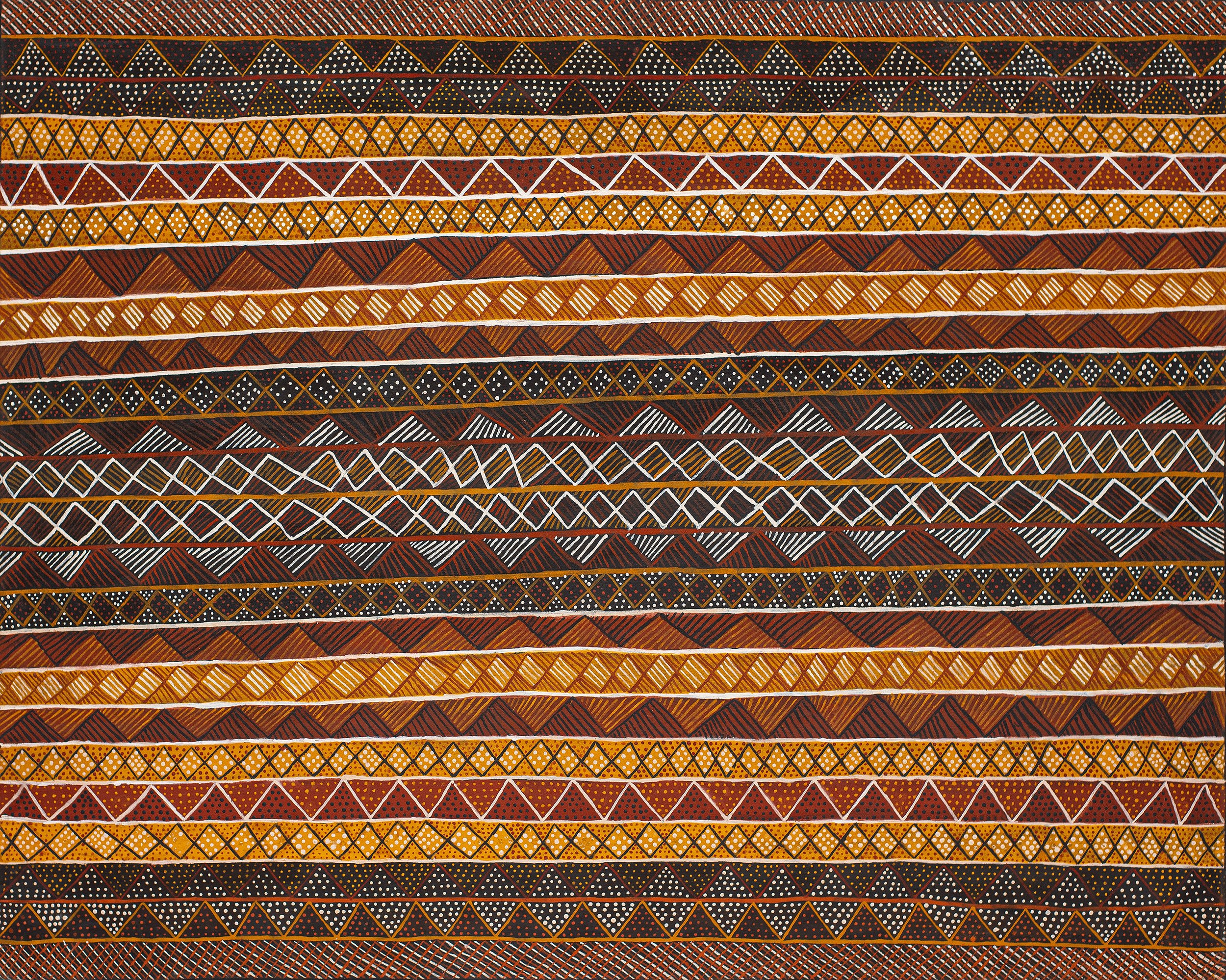
Artiste : Jacinta Lorenzo
Titre de l'œuvre : Yirrinkiri Jilamara
Pigments naturels sur toile de lin Belge
Format : 150 × 120 cm
Provenance et certificat : centre d'art aborigène de Jalimara (Tiwi Island)
Référence de la peinture : 136-17
© Photo : Aboriginal signature with the courtesy of the artist & Jilamara Art centre (Tiwi Island)
Explications sur cette œuvre :
Jacinta was born in 1958 in Darwin but has lived in Milikapiti on the island for many years.
Her work has been described by other Tiwi people as similar to old Tiwi patterns or jilamara (design). Jacinta feels that culture is very important particularly for the younger generations. She has 3 children who have given her 18 grandchildren and 3 great grandchildren.
Jacinta has been a member of Jilamara Arts for many years and has represented the organisation in group exhibitions since 1996.
This artwork is connected to the “design from our Pukumani burial ceremonies: it is the pattern we paint on tutuni or grave posts. We have conducted these ceremonies for centuries, well before the Dutch first came to Melville Island 300 years ago. It is hard for us to imagine how far those first Dutch sailors had to travel to get here, but when they got here my people were already doing Pukumani."
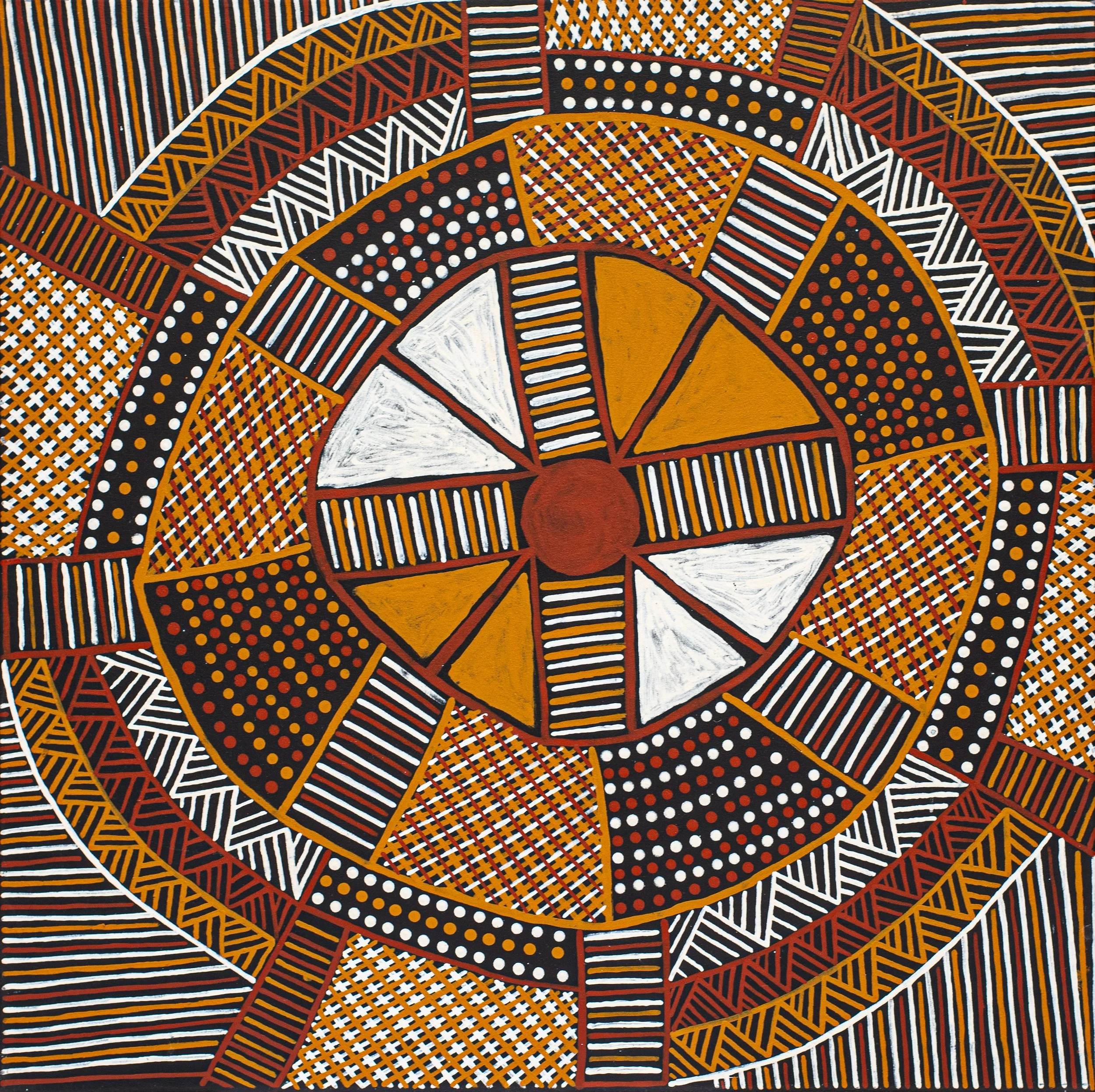
Artiste : Tina Patlas
Titre de l'œuvre : Kulama
Pigments naturels sur toile de lin Belge
Format : 90 × 90 cm
Provenance et certificat : centre d'art aborigène de Jalimara (Tiwi Island)
Référence de la peinture : 39-24
© Photo : Aboriginal signature with the courtesy of the artist & Jilamara Art centre (Tiwi Island)
Explications sur cette œuvre :
Tina Patlas (1968) began painting for Jilamara Arts and Craft Association in 2002. Although Tina’s traditional country spans areas of south west Melville Island and south east Bathurst Island (including Wurrumiyanga) she spent most of her youth growing up in Milikapiti on the north coast of the island.
Tina works in the local community for Territory Housing but has also painted at the art centre for many years. She held the position as Treasurer of the Jilamara Arts and Craft Association Executive Committee in 2003.
Tina paints her own Jilamara design about country, yoi (ceremonial dance), Kulama ceremony and the wildlife of the Tiwi Islands. She has a special interest in the parlini jilamara, the old stories handed down by her ancestors.
When she was growing up, she watched her Grandfather Holder Adams paint and carve where he lived at Timrambu – just south of Milikapiti. She says, “He used to sculpt toys for us to play with. This inspired me to become an artist.”
This artwork is dealing about Kulama. It is the Tiwi coming of age ceremony which coincides with the harvest of wild yam. The ceremony is performed late in the wet season when a ring or halo appears around Japarra (the moon). Elders of both sexes sing and call out to the ancestors for three days, welcoming children into adulthood. The ceremony is held on a prepared ground of concentric circles at the centre of which round yams are prepared for eang. Circular motifs in Tiwi art often symbolise the moon, yam and ritual circles of the Kulama ceremony, the pwanga (dots) reflect the japalinga (stars).
As Tiwi artist and cultural leader Pedro Wonaeamirri describes:
Japarra ( moon), warnarringa (sun) and the circles on the ground all important for Kulama. Three days and nights – Friday, Saturday and Sunday are the ceremony. No lile children at the Kulama. No dancing, just calling out to the ancestors, each direcon. This way, that way. Just singing, calling out and crawling in a circle calling out and sharing stories from parlingarri [old mes]. At the end of the Kulama, on Sunday we eat, then Monday morning everyone comes in, the children and old people. The cooked yam is mixed with red ochre and put on their bodies. Somemes people have one side of yam for eang and one side for mixing with red ochre and rubbing on the body – Pedro Wonaeamirri.
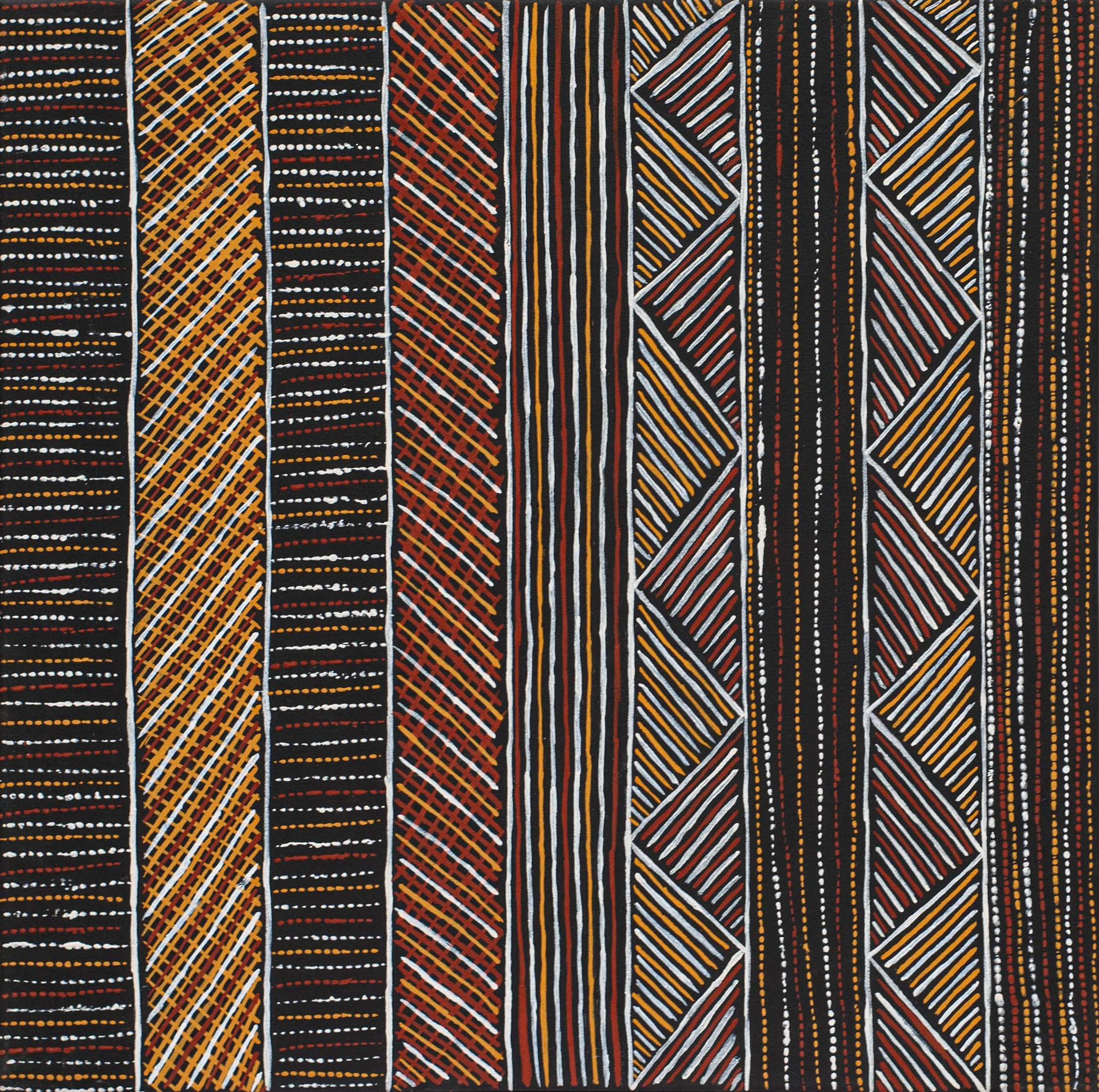
Artiste : Arthurina Moreen
Titre de l'œuvre : Ngiya jilamara I (body paint design)
Pigments naturels sur toile de lin Belge
Format : 60 × 60 cm
Provenance et certificat : centre d'art aborigène de Jalimara (Tiwi Island)
Référence de la peinture : 368-24
© Photo : Aboriginal signature with the courtesy of the artist & Jilamara Art centre (Tiwi Island)
Explications pour cette œuvre :
Arthurina Moreen (2000) is a young emerging artist and artsworker/gallery assistant at Jilamara Arts and Crafts Association. She oversees operations in the art centre gallery and studios as well as participates in organisational governance as an elected Executive Committee member. Her role includes artwork cataloguing with the SAM database, studio artwork photography, post-production image editing, pricing and sales, studio supports, working with the historical collection at the art centre’s keeping place and travelling for art fairs, exhibitions and events. She joined Jilamara Arts in 2021 as a screen printer in the workshop and she has quickly established herself as a key member of the organisation’s workforce.
After returning to the Tiwi Islands, she has held a few different employment positions in Milikapiti including being a support teacher at the primary school working with children with special needs and a parttime position at the Milikapiti Sports and Social Club.
In 2022 Arthurina travelled with Jilamara to take part in the King and Wood Malleson’s Indigenous Governance Conference and in 2023 she completed the ANKA Artsworker Extension Program where she travelled to Canberra, Sydney and Melbourne visiting relevant arts institutions including National Gallery of Australia, Art Gallery of New South Wales, University of Melbourne’s Grimwade centre and the National Gallery of Victoria.
This painting deals about Ngiya Jilamara which means my design. All jilamara (design) is originally drawn from the body painting which accompanied the pukumani (funeral) and kulama (initiation/yam) ceremonies. All the artists living at Milikapi are drawing on collective Tiwi memory, and the individual expression and aesthetic qualities of each artist's work is reflective of their personal interpretation of traditional Tiwi design or jilamara.
AWARDS AND QUALIFICATIONS :
2023 ANKA Artsworker Extension Program – VIC, NSW, ACT
Creative Regions National Summit, National Gallery of Australia
2022 Wake Up, King and Wood Malleson/Arts Law Governance Symposium, Melbourne

Artiste : Nancy Marie Kerinauia
Titre de l'œuvre : Jilamara (body paint design)
Pigments naturels sur toile de lin Belge
Format : 120 × 90 cm
Provenance et certificat : centre d'art aborigène de Jalimara (Tiwi Island)
Référence de la peinture : 275-24
© Photo : Aboriginal signature with the courtesy of the artist & Jilamara Art centre (Tiwi Island)
Explications pour cette œuvre :
Nancy Marie Kerinauia (1991) began working at Jilamara in 2018. She always wanted to join the art centre as she has strong family ties to many artists who have worked in Milikapiti and enjoyed successful careers at the art centre. Her grandfather was Black Joe and her mother Katrina Kerinauia, both have passed away but remain well known for their artwork.
Nancy is quickly establishing herself as a young and talented emerging artist at Jilamara Arts. She often paints using the kayimwagakimi – a hand crafted ironwood comb used to apply rows of dots instead of a stick or brush. She has a very fine style of jilamara (Tiwi body paint design) and applies this alongside images of her clan totems to create contemporary new work.
This painting deals about all jilamara (design) which are originally drawn from the body painting and accompanied the pukumani (funeral) and kulama (iniaon/yam) ceremonies.
An individual design and aesthetic is highly valued by Tiwi artists and is representative of their personal interpretation of the traditional Tiwi design or jilamara.
You can find his artworks in the following prestigious collections :
Art Gallery of South Australia
Kluge-Ruhe Art Museum, USA
Private collections
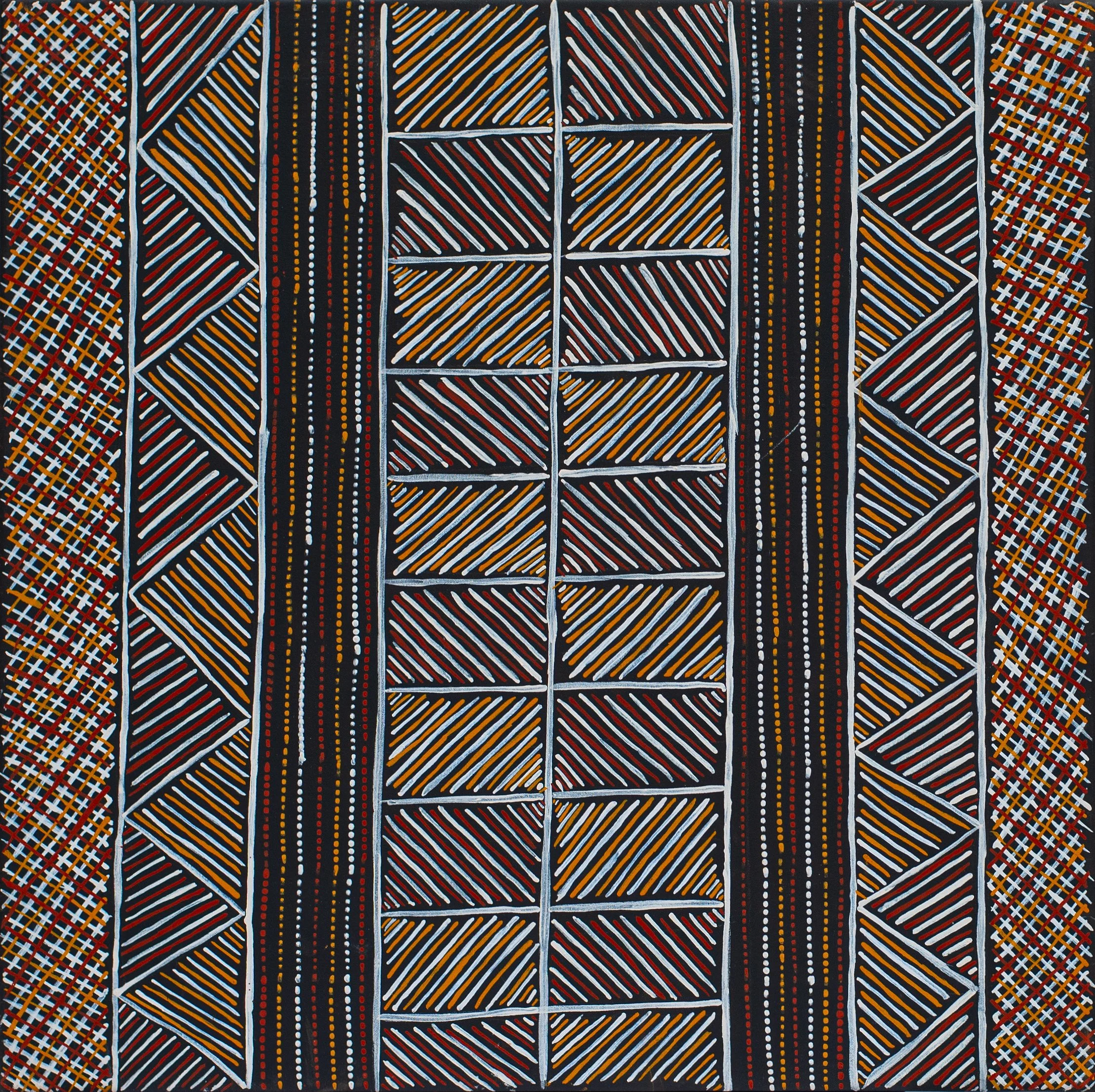
Artiste : Arthurina Moreen
Titre de l'œuvre : Ngiya jilamara I (body paint design)
Pigments naturels sur toile de lin Belge
Format : 60 × 60 cm
Provenance et certificat : centre d'art aborigène de Jalimara (Tiwi Island)
Référence de la peinture : 409-24
© Photo : Aboriginal signature with the courtesy of the artist & Jilamara Art centre (Tiwi Island)
Explications pour cette œuvre :
Arthurina Moreen (2000) is a young emerging artist and artsworker/gallery assistant at Jilamara Arts and Crafts Association. She oversees operations in the art centre gallery and studios as well as participates in organisational governance as an elected Executive Committee member. Her role includes artwork cataloguing with the SAM database, studio artwork photography, post-production image editing, pricing and sales, studio supports, working with the historical collection at the art centre’s keeping place and travelling for art fairs, exhibitions and events. She joined Jilamara Arts in 2021 as a screen printer in the workshop and she has quickly established herself as a key member of the organisation’s workforce.
After returning to the Tiwi Islands, she has held a few different employment positions in Milikapiti including being a support teacher at the primary school working with children with special needs and a parttime position at the Milikapiti Sports and Social Club.
In 2022 Arthurina travelled with Jilamara to take part in the King and Wood Malleson’s Indigenous Governance Conference and in 2023 she completed the ANKA Artsworker Extension Program where she travelled to Canberra, Sydney and Melbourne visiting relevant arts institutions including National Gallery of Australia, Art Gallery of New South Wales, University of Melbourne’s Grimwade centre and the National Gallery of Victoria.
This painting deals about Ngiya Jilamara which means my design. All jilamara (design) is originally drawn from the body painting which accompanied the pukumani (funeral) and kulama (initiation/yam) ceremonies. All the artists living at Milikapi are drawing on collective Tiwi memory, and the individual expression and aesthetic qualities of each artist's work is reflective of their personal interpretation of traditional Tiwi design or jilamara.
AWARDS AND QUALIFICATIONS :
2023 ANKA Artsworker Extension Program – VIC, NSW, ACT
Creative Regions National Summit, National Gallery of Australia
2022 Wake Up, King and Wood Malleson/Arts Law Governance Symposium, Melbourne
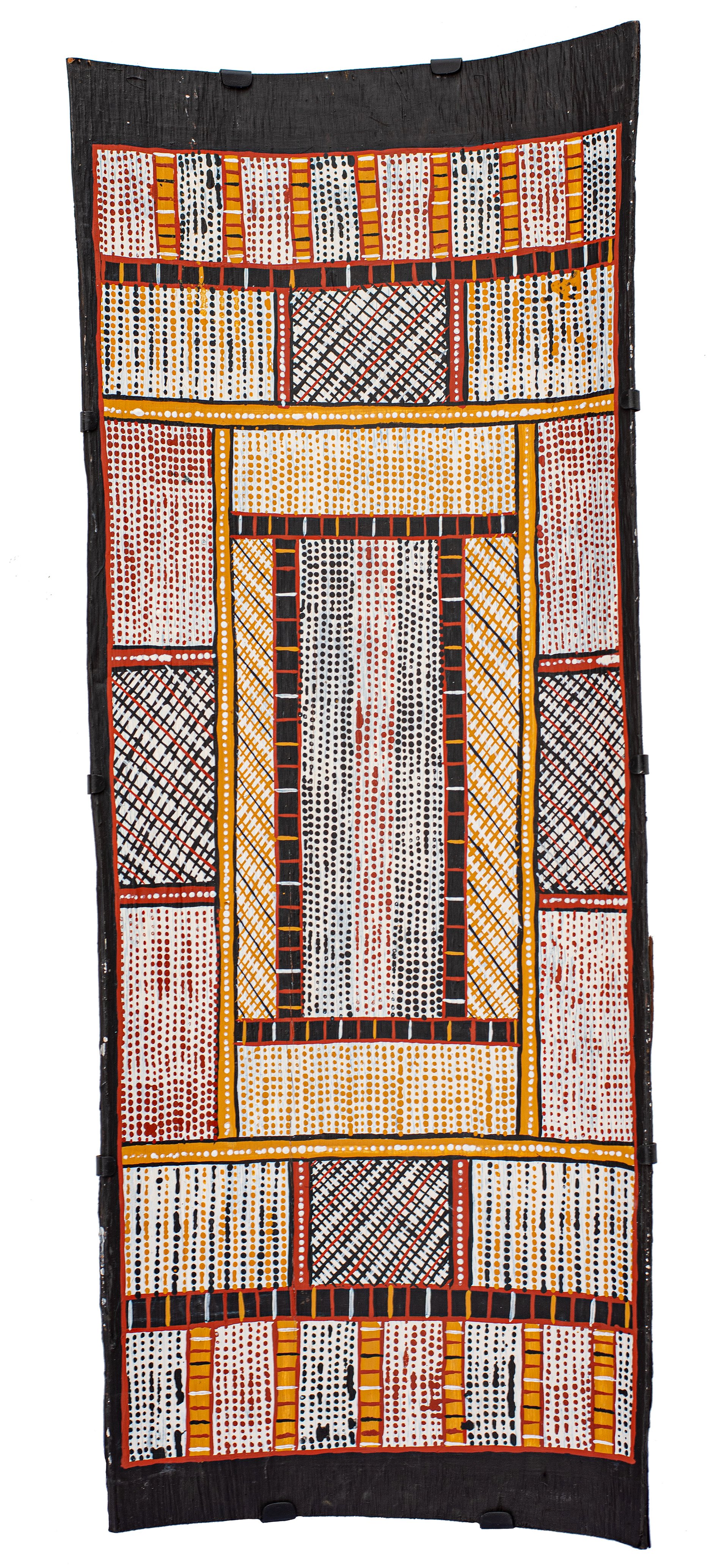
Artiste : Pedro Wonaeamirri
Titre de l'œuvre : Pwoja-Pukumani Body Paint Design
Pigments naturels sur toile de lin Belge
Format : 96 x 39 cm
Provenance et certificat : centre d'art aborigène de Jalimara (Tiwi Island)
Référence de la peinture : 444-24
© Photo : Aboriginal signature with the courtesy of the artist & Jilamara Art centre (Tiwi Island)
Explications pour cette œuvre :
Pedro Wonaeamirri (1974) grew up in Pirlangimpi (Pularumpi) on Melville Island. He was educated in Darwin and returned to the Tiwi Islands in 1989, where he moved to Milikapiti the same year that Jilamara Arts and Crafts was incorporated. He has been exhibiting since this time and his artworks are in many national, state and private collections Australia-wide and overseas.
Pedro is a senior cultural leader on the Tiwi Islands with a significant and strong knowledge of the old Tiwi language and all of the songs and dance important in Tiwi culture. With a seat on the board of many organisations, Pedro is the current Vice President of Jilamara Arts and Crafts Association and a Director for Arnhem, Northern and Kimberley Artists (ANKA). Alongside his esteemed visual art career he has also published many essays on Tiwi art, culture and ceremony. His country, Paluwiyanga/ Andranganoo (Goose Creek) is on the eastern side of Melville Island “the land or country where I come from is from my father’s father, my grandfather”.
Pedro’s contemporary art practice has its foundations in Jilamara – “design” derived from ceremonial body painting and the ornate decoration applied to tutini poles, tunga (bark baskets) and associated ritual objects made for Pukumani (mourning) ceremony and Tiwi Yoi (dance).
Pedro continues to exclusively use ochres sourced from in and around his place of work in Milikapiti. He applies these colours of Tiwi Country with meticulous fine detail and tools traditionally used to apply decoration to the skin. "The designs are already in my head and I use the Kayimwagakimi our traditional wooden comb made from ironwood and natural ochres from the island to paint."
Tiwi Culture places special significance on the Pukumani (funeral) ceremony. Mourners are decorated using natural ochres to disguise themselves from the spirit of the deceased and song and dance is performed to honour the dead. Yirrinkiripwoja (bodypaint) is the source of many contemporary
Tiwi designs and performance of the pukumani as ritual helps to reinvigorate the imagery. The shortening of the word to Pwoja - also refers to 'best'.
You can find his artworks in the following prestigious collections :
National Gallery of Australia, Canberra – Museum of Victoria, Melbourne – National Gallery of Victoria, Melbourne – Art Gallery of New South Wales, Sydney – Art Gallery of South Australia – Art Gallery of Western Australia, Perth – Queensland Art Gallery, Brisbane – National Maritime Museum, Darling Harbour, Sydney – Commonwealth Institute, London – Artbank, Sydney – Gantner Myer Collection – Gordon & Marilyn Darling Collection, Melbourne – Levi-Kaplan Collection, Seattle, USA – The British Museum, England – Murdoch University Collection, Perth – Edith Cowan University Art Collection, Perth – Wesfarmers Collection, Perth – Museum of Contemporary Art, Sydney – Kluge-Ruhe Art Museum, USA
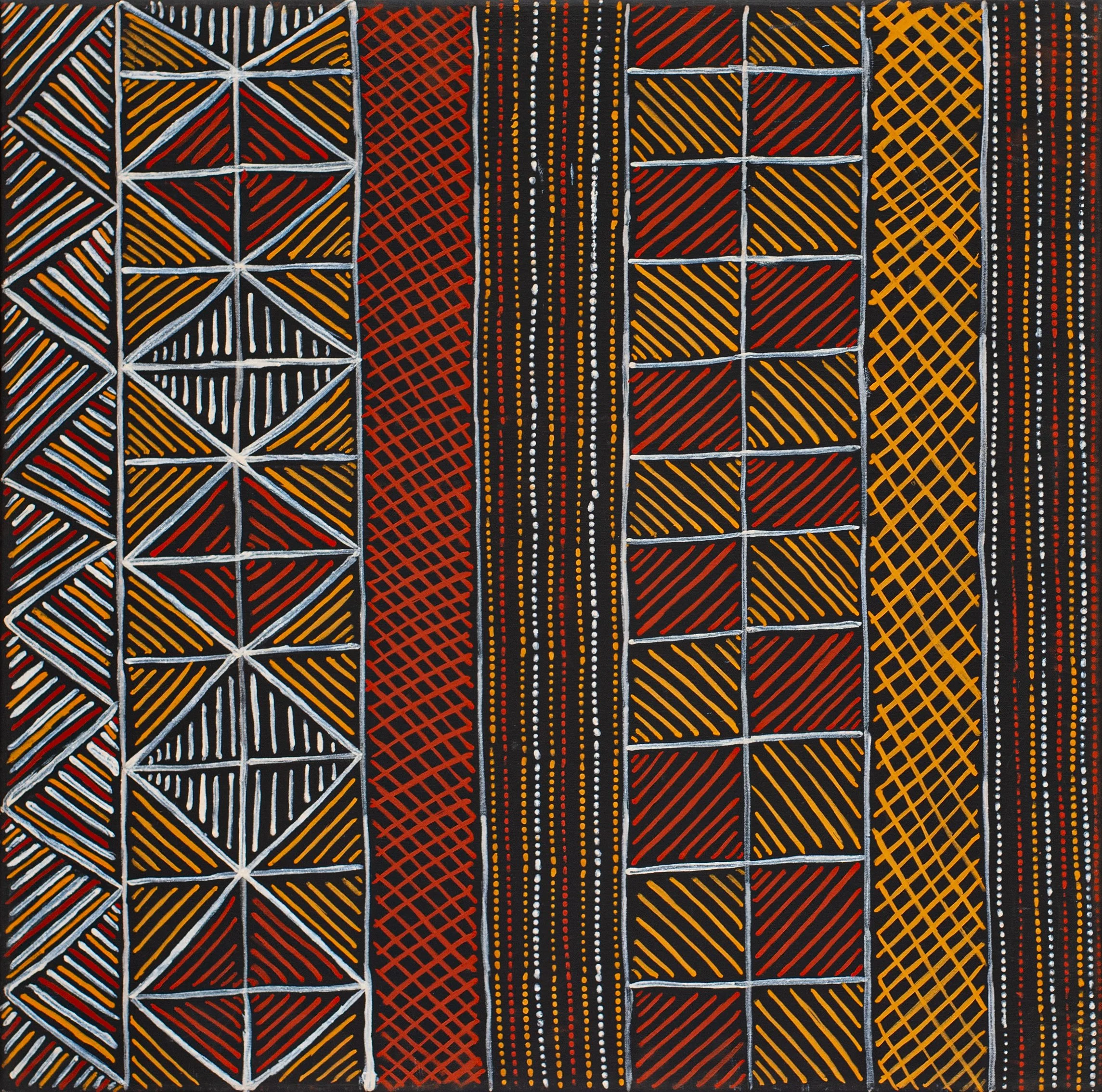
Artiste : Arthurina Moreen
Titre de l'œuvre : Ngiya jilamara I (body paint design)
Pigments naturels sur toile de lin Belge
Format : 60 × 60 cm
Provenance et certificat : centre d'art aborigène de Jalimara (Tiwi Island)
Référence de la peinture : 431-24
© Photo : Aboriginal signature with the courtesy of the artist & Jilamara Art centre (Tiwi Island)
Explications pour cette œuvre :
Arthurina Moreen (2000) is a young emerging artist and artsworker/gallery assistant at Jilamara Arts and Crafts Association. She oversees operations in the art centre gallery and studios as well as participates in organisational governance as an elected Executive Committee member. Her role includes artwork cataloguing with the SAM database, studio artwork photography, post-production image editing, pricing and sales, studio supports, working with the historical collection at the art centre’s keeping place and travelling for art fairs, exhibitions and events. She joined Jilamara Arts in 2021 as a screen printer in the workshop and she has quickly established herself as a key member of the organisation’s workforce.
After returning to the Tiwi Islands, she has held a few different employment positions in Milikapiti including being a support teacher at the primary school working with children with special needs and a parttime position at the Milikapiti Sports and Social Club.
In 2022 Arthurina travelled with Jilamara to take part in the King and Wood Malleson’s Indigenous Governance Conference and in 2023 she completed the ANKA Artsworker Extension Program where she travelled to Canberra, Sydney and Melbourne visiting relevant arts institutions including National Gallery of Australia, Art Gallery of New South Wales, University of Melbourne’s Grimwade centre and the National Gallery of Victoria.
This painting deals about Ngiya Jilamara which means my design. All jilamara (design) is originally drawn from the body painting which accompanied the pukumani (funeral) and kulama (initiation/yam) ceremonies. All the artists living at Milikapi are drawing on collective Tiwi memory, and the individual expression and aesthetic qualities of each artist's work is reflective of their personal interpretation of traditional Tiwi design or jilamara.
AWARDS AND QUALIFICATIONS :
2023 ANKA Artsworker Extension Program – VIC, NSW, ACT
Creative Regions National Summit, National Gallery of Australia
2022 Wake Up, King and Wood Malleson/Arts Law Governance Symposium, Melbourne

Artiste : Janelle Mungatopi
Titre de l'œuvre : Kayimwagakimi jilamara
Pigments naturels sur toile de lin Belge
Format : 90 × 90 cm
Provenance et certificat : centre d'art aborigène de Jalimara (Tiwi Island)
Référence de la peinture : 23-25
© Photo : Aboriginal signature with the courtesy of the artist & Jilamara Art centre (Tiwi Island)
Explications pour cette œuvre :
Janelle Mungatopi (1985) lived and grew up in Milikapiti with her mother and grandparents. long time ago she use to watching all of her grandfathers and great grandfathers carving big pole, painting on tuna and bark.
She started joining Jilamara 2022/23 as a screen printer and now she is developing her own skills, and working with the elders around the art centre. she is also enjoying making beautiful artworks and love engaging with everyone at Jilamara.
Kayimwagakimi is the traditional Tiwi painting 'comb'. Made from bloodwood or ironwood, it is about 15cm high with a single row of teeth. The comb is dabbed in ochre and applied to the painting surface resulting in a straight line of fine dots, a process which is repeated over and over.
Kayimwagakimi and marlipinyini (a fine stick or pandanus frond chewed to form a brush) have largely been replaced by modern brushes but a handful of Tiwi still use traditional tools.
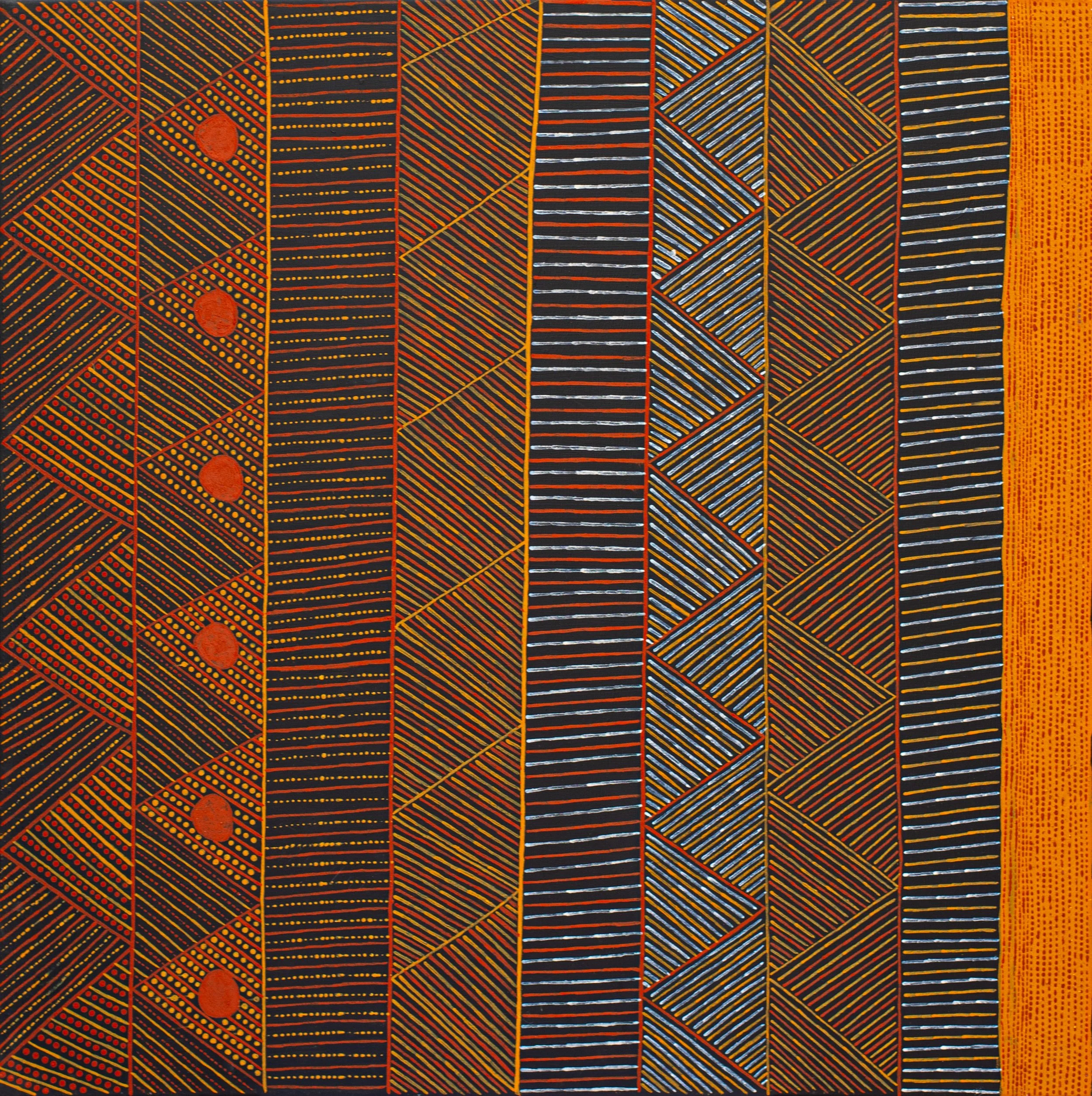
Artiste : Nancy Marie Kerinauia
Titre de l'œuvre : Jilamara (body paint design)
Pigments naturels sur toile de lin Belge
Format : 90 × 90 cm
Provenance et certificat : centre d'art aborigène de Jalimara (Tiwi Island)
Référence de la peinture : 20-25
© Photo : Aboriginal signature with the courtesy of the artist & Jilamara Art centre (Tiwi Island)
Explications pour cette œuvre :
Nancy Marie Kerinauia (1991) began working at Jilamara in 2018. She always wanted to join the art centre as she has strong family ties to many artists who have worked in Milikapiti and enjoyed successful careers at the art centre. Her grandfather was Black Joe and her mother Katrina Kerinauia, both have passed away but remain well known for their artwork.
Nancy is quickly establishing herself as a young and talented emerging artist at Jilamara Arts. She often paints using the kayimwagakimi – a hand crafted ironwood comb used to apply rows of dots instead of a stick or brush. She has a very fine style of jilamara (Tiwi body paint design) and applies this alongside images of her clan totems to create contemporary new work.
The term jilamara in Tiwi language actually describes the acon of painting, but is also used to describe designs in locally sourced ochres. Many of these designs are originally drawn from elaborate ochre body painting applied to the face and bodies of family and dancers during the Pukumani (mourning) and Kulama (coming-of-age/yam) ceremonies.
In Pukumani ceremonies it is believed the jilamara disguise the immediate family from the spirit of the dead, leading to very elaborate compositions on the body. In these ceremonies similar designs are also applied to the tutini ( carved ironwood Pukumani poles) and tunga (bark bags) which can form central parts of the ceremony. An individual design and aesthetic is highly valued by Tiwi artists and is representative of their personal interpretation of their family's Tiwi design or jilamara.
You can find his artworks in the following prestigious collections :
Art Gallery of South Australia
Kluge-Ruhe Art Museum, USA
Private collections

Artiste : Jacinta Lorenzo
Titre de l'œuvre : Jilamara (body paint designs)
Pigments naturels sur toile de lin Belge
Format : 150 × 150 cm
Provenance et certificat : centre d'art aborigène de Jalimara (Tiwi Island)
Référence de la peinture : 179-25
© Photo : Aboriginal signature with the courtesy of the artist & Jilamara Art centre (Tiwi Island)
Explications sur cette œuvre :
Jacinta was born in 1958 in Darwin but has lived in Milikapiti on the island for many years.
Her work has been described by other Tiwi people as similar to old Tiwi patterns or jilamara (design). Jacinta feels that culture is very important particularly for the younger generations. She has 3 children who have given her 18 grandchildren and 3 great grandchildren.
Jacinta has been a member of Jilamara Arts for many years and has represented the organisation in group exhibitions since 1996.
The term jilamara in Tiwi language actually describes the acon of painting, but is also used to describe designs in locally sourced ochres. Many of these designs are originally drawn from elaborate ochre body painting applied to the face and bodies of family and dancers during the Pukumani (mourning) and Kulama (coming-of-age/yam) ceremonies. In Pukumani ceremonies it is believed the jilamara disguise the immediate family from the spirit of the dead, leading to very elaborate compositions on the body. In these ceremonies similar designs are also applied to the tutini ( carved ironwood Pukumani poles) and tunga (bark bags) which can form central parts of the ceremony. An individual design and aesthetic is highly valued by Tiwi artists and is representative of their personal interpretation of their family's Tiwi design or jilamara.

Artiste : Timothy Cook
Titre de l'œuvre : Kulama Piyapiya II
Pigments naturels sur toile de lin Belge
Format : 120 x 90 cm
Provenance et certificat : centre d'art aborigène de Jalimara (Tiwi Island)
Référence de la peinture : 130-18
© Photo : Aboriginal signature with the courtesy of the artist & Jilamara Art centre (Tiwi Island)
Explications sur cette œuvre :
Kulama Piyapiya II (Kulama Dream II). The Kulama Ceremony is performed in the late wet season (March-April) when a ring appears around the moon. Kulama is a traditional initiation for young men which coincides with the harvest of a certain wild yam species. Elders of both sexes sing and
dance for three days welcoming the boys into adulthood. The boy is then renamed with his true man's name.

Artiste : Jacinta Lorenzo
Titre de l'œuvre : Jilamara - body painting
Pigments naturels sur toile de lin Belge
Format : 180 x 60 cm
Provenance et certificat : centre d'art aborigène de Jalimara (Tiwi Island)
Référence de la peinture : 207-19
© Photo : Aboriginal signature with the courtesy of the artist & Jilamara Art centre (Tiwi Island)
Explications sur cette œuvre :
All jilamara (design) are originally drawn from the body painting which accompanied the pukumani (funeral) and kulama (initiation/yam) ceremonies. An individual design and aesthetic is highly valued by Tiwi artists and is representative of their personal interpretation of the traditional Tiwi design or jilamara.

Artiste : Michelle Bush
Titre de l'œuvre : Jilamara
Pigments naturels sur toile de lin Belge
Format : 150 x 75 cm
Provenance et certificat : centre d'art aborigène de Jalimara (Tiwi Island)
Référence de la peinture : 93-18
© Photo : Aboriginal signature with the courtesy of the artist & Jilamara Art centre (Tiwi Island)
Explications sur cette œuvre :
All jilamara (design) are originally drawn from the body painting which accompanied the pukumani (funeral) and kulama (initiation/yam) ceremonies. An individual design and aesthetic is highly valued by Tiwi artists and is representative of their personal interpretation of the traditional Tiwi design or jilamara.

Artiste : Jacinta Lorenzo
Titre de l'œuvre : Jilamara - body painting
Pigments naturels sur toile de lin Belge
Format : 150 x 120 cm
Provenance et certificat : centre d'art aborigène de Jalimara (Tiwi Island)
Référence de la peinture : 71-18
© Photo : Aboriginal signature with the courtesy of the artist & Jilamara Art centre (Tiwi Island)
Explications sur cette œuvre :
All jilamara (design) are originally drawn from the body painting which accompanied the pukumani (funeral) and kulama (initiation/yam) ceremonies. An individual design and aesthetic is highly valued by Tiwi artists and is representative of their personal interpretation of the traditional Tiwi design or jilamara.

Artiste : Jacinta Lorenzo
Titre de l'œuvre : Jilamara - body painting
Pigments naturels sur toile de lin Belge
Format : 200 x 60 cm
Provenance et certificat : centre d'art aborigène de Jalimara (Tiwi Island)
Référence de la peinture : 127-19
© Photo : Aboriginal signature with the courtesy of the artist & Jilamara Art centre (Tiwi Island)
Explications sur cette œuvre :
All jilamara (design) are originally drawn from the body painting which accompanied the pukumani (funeral) and kulama (initiation/yam) ceremonies. An individual design and aesthetic is highly valued by Tiwi artists and is representative of their personal interpretation of the traditional Tiwi design or jilamara.

Artiste : Johnathon Bush
Titre de l'œuvre : Jilamara
Pigments naturels sur toile de lin Belge
Format : 150 x 150cm
Provenance et certificat : centre d'art aborigène de Jalimara (Tiwi Island)
Référence de la peinture : 361-17
© Photo : Aboriginal signature with the courtesy of the artist & Jilamara Art centre (Tiwi Island)
Explications pour cette œuvre :
All jilamara (design) are originally drawn from the body painting which accompanied the pukumani (funeral) and kulama (initiation/yam) ceremonies. An individual design and aesthetic is highly valued by Tiwi artists and is representative of their personal interpretation of the traditional Tiwi design or jilamara.
In this work Johnathon has explored the use of charcoal which was traditionally used by his ancestors when painting onto the body or pukamani poles, instead of black gesso as a base colour. Johnathon discovered Jackson Pollocks work in early 2017 and was really taken by the chaos of the splattered and dripped paint marks over the painted surface.

Artiste : Patrick Freddy Puruntatameri
Titre de l'œuvre : Tutini (Pukumani Pole)
Pigments naturels sur bois de fer.
Format : 223 cm
Provenance et certificat : centre d'art aborigène de Jilamara (Tiwi Island)
Référence de la peinture : 142-19
© Photo : Aboriginal signature with the courtesy of the artist & Jilamara Art centre (Tiwi Island)
Explications sur cette œuvre :
The Pukumani ceremony is the culmination of ritual mourning for a deceased person. Several months after the burial, family commission in-laws of the deceased to carve and decorate elaborate tutini. These are then placed at the gravesite during a showy performance of song and dance, and tunga (bark bags) are placed upside down on top of the poles to signify the end of life. These sculpturally beautiful 'artworks' are left to the elements, returning to the bush from which they are made.
Traditionally Tiwi use bloodwood for tutini, but cured ironwood is the prefered timber for commercial carvings thanks to its durability. Current practice of carving pukumani poles is an expression of the artist's cultural heritage through contemporary art. They are created as an artistic form of expression to be viewed and appreciated by a broader public with the intention to maintain and share Tiwi cultural knowledge. Tutini carved with a pronged or forked apex represents the fight between Purukuparli and his brother Taparra the moon man. Diamond and curved shapes are a female embodiment, but each pole represents all and everything that is Tiwi culture.
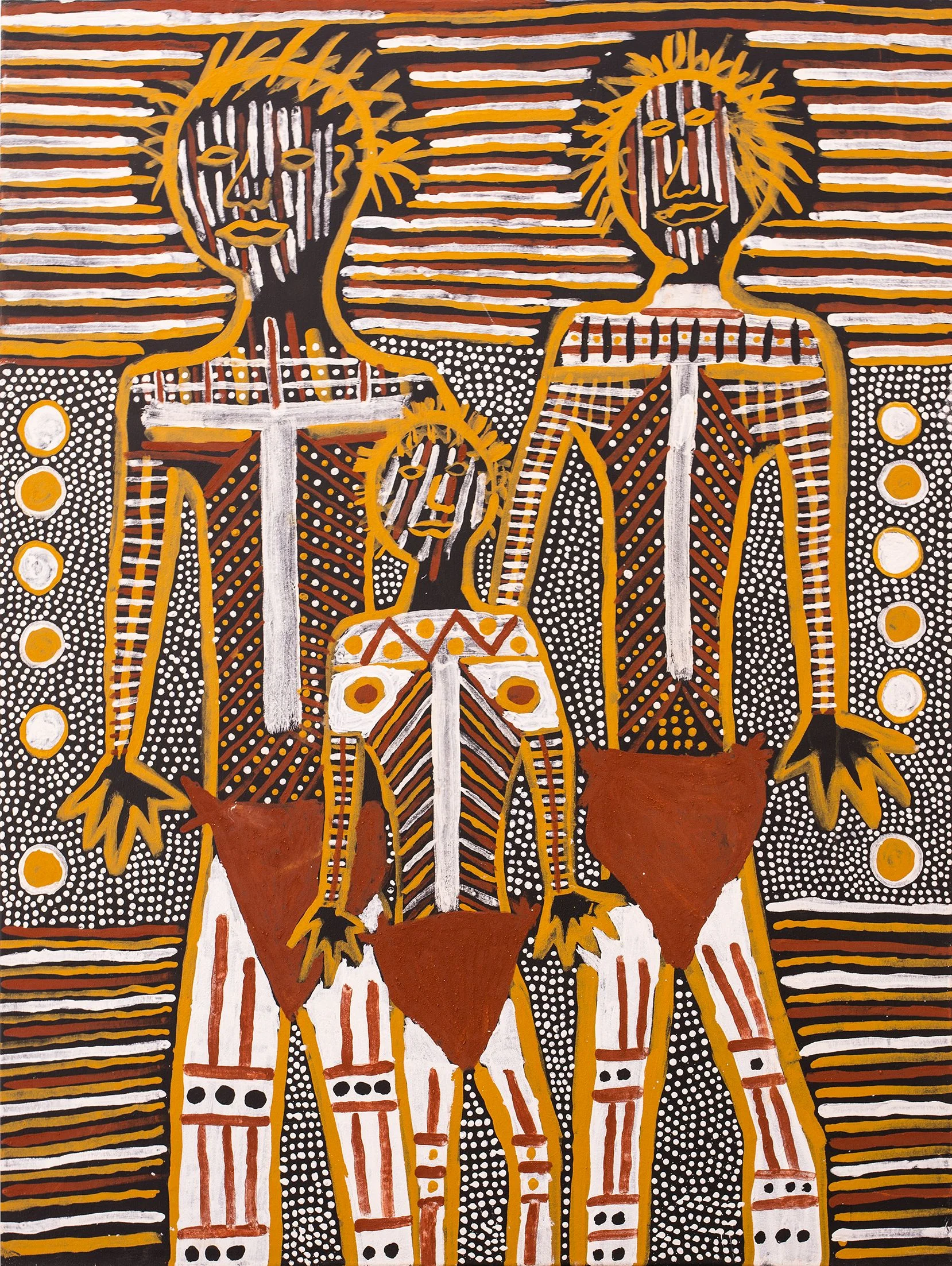
Artiste : Johnathon Bush
Titre de l'œuvre : Regeneration
Pigments naturels sur toile de lin Belge
Format : 120 x 90cm
Provenance et certificat : centre d'art aborigène de Jalimara (Tiwi Island)
Référence de la peinture : 44-17
© Photo : Aboriginal signature with the courtesy of the artist & Jilamara Art centre (Tiwi Island)

Artiste : Johnathon Bush
Titre de l'œuvre : Dream Time Warrior
Pigments naturels sur toile de lin Belge
Format : 120 x 90cm
Provenance et certificat : centre d'art aborigène de Jalimara (Tiwi Island)
Référence de la peinture : 311-17
© Photo : Aboriginal signature with the courtesy of the artist & Jilamara Art centre (Tiwi Island)
Explications pour cette œuvre :
My paintings are a retelling of our Tiwi stories and culture that were claimed in the form of black and white photography by white explorerers to the Tiwi Islands throughout history.
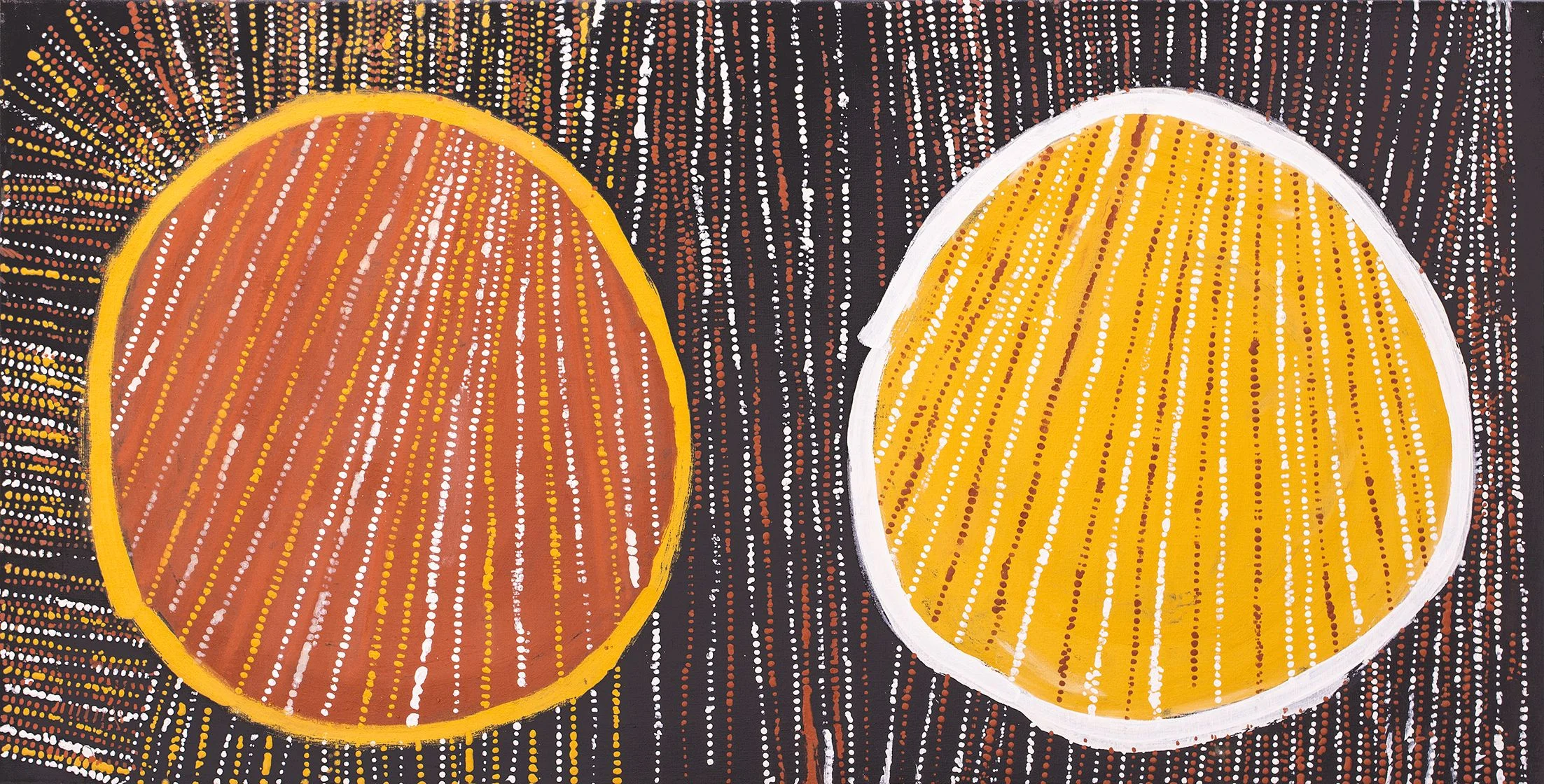
Artiste : Conrad Kamilowra Tipungwuti
Titre de l'œuvre : Kulama ceremonies
Pigments naturels sur toile de lin Belge
Format : 150 x 75 cm
Provenance et certificat : centre d'art aborigène de Jalimara (Tiwi Island)
Référence de la peinture : 132-14
© Photo : Aboriginal signature with the courtesy of the artist & Jilamara Art centre (Tiwi Island)
Explications pour cette œuvre :
The Kulama Ceremony is performed in the late wet season (March-April) when a ring appears around the moon. Kulama is a traditional initiation for young men which coincides with the harvest of a certain wild yam species. Elders of both sexes sing and dance for three days welcoming the boys into adulthood. The boy is then renamed with his true man's name.

Artiste : Conrad Kamilowra Tipungwuti
Titre de l'œuvre : Pakitiringa (rain)
Pigments naturels sur toile de lin Belge
Format : 150 x 75 cm
Provenance et certificat : centre d'art aborigène de Jalimara (Tiwi Island)
Référence de la peinture : 190-17
© Photo : Aboriginal signature with the courtesy of the artist & Jilamara Art centre (Tiwi Island)
Explications pour cette œuvre :
Pakitiringa is the Tiwi word for rain. The over-riding theme of Tipungwuti’s most recent work depicts the wet season and the heavy Pakatiringa that falls in the top end for months on end.

Artiste : Michelle Bush
Titre de l'œuvre : Jilamara
Pigments naturels sur toile de lin Belge
Format : 90 x 70 cm
Provenance et certificat : centre d'art aborigène de Jalimara (Tiwi Island)
Référence de la peinture : 358-19
© Photo : Aboriginal signature with the courtesy of the artist & Jilamara Art centre (Tiwi Island)
Explications sur cette œuvre :
All jilamara (design) are originally drawn from the body painting which accompanied the pukumani (funeral) and kulama (initiation/yam) ceremonies. An individual design and aesthetic is highly valued by Tiwi artists and is representative of their personal interpretation of the traditional Tiwi design or jilamara.

Artiste : Raymond Bush
Titre de l'œuvre : Mantuwujini (Dugong)
Pigments naturels sur toile de lin Belge
Format : 180 x 60 cm
Provenance et certificat : centre d'art aborigène de Jalimara (Tiwi Island)
Référence de la peinture : 241-19
© Photo : Aboriginal signature with the courtesy of the artist & Jilamara Art centre (Tiwi Island)
Explications sur cette œuvre :
Known alternatively in English as Sea Cow, Mantuwujini are hunted with harpoon spears along the northern coast of the Tiwi Islands, found in areas of sea grass, where they graze. A gentle and sadly endangered mammal, the animal is prized for it's tender rich flavoured meat and the fat produces oil which is reputed to be good for the hair.
Artiste : Kaye Brown
Titre de l'œuvre : Yirrinkiripwoja (body paint design)
Pigments naturels sur toile de lin Belge
Format : 109 × 41 cm
Provenance et certificat : centre d'art aborigène de Jalimara (Tiwi Island)
Référence de la peinture : 499-23
Demander le prix de l'œuvre
© Photo : Aboriginal signature with the courtesy of the artist & Jilamara Art centre (Tiwi Island)
Explications pour cette œuvre :
Kaye (1954) is a senior Tiwi culture woman. She is well versed in the old ways, parlinarri (old) stories and speaks the ‘hard’ Tiwi language. She started painting at Jilamara Arts and Crafts later in life after she retired from work. Prior to this she taught at the local primary school and worked at the Milikapiti Library. She loves teaching culture to the local primary school children who come to Jilamara for culture classes in the Muluwurri Museum.
She has a wealth of local knowledge about Tiwi culture and the history of her ancestors. She uses the Kayimwagakimi (carved ironwood comb) and locally sourced ochres from Melville Island to paint. Her yirrinkiripwoja/jilamara (ochre body paint design) are layered and reminiscent of the design that wulimawi (old people) used to prepare for ceremony and yoyi (dance).
She has been a finalist in the Telstra NATSIA Awards three times and was a significant part of the major TIWI Exhibition at NGV Australia in 2020/21.
Tiwi Culture places special significance on the Pukumani (funeral) ceremony. Mourners are decorated using natural ochres to disguise themselves from the spirit of the deceased and song and dance is performed to honour the dead. Yirrinkiripwoja (bodypaint) is the source of many contemporary Tiwi designs and performance of the pukumani as ritual helps to reinvigorate the imagery. The shortening of the word to Pwoja – also refers to the toothed ironwood comb used to apply the pwanga (dots) and is also used in Tiwi language to describe bones or even loose change.
You can find his artworks in the following prestigious collections :
National Gallery of Victoria
Art Gallery of South Australia
Wesfarmers Collection
Kluge-Ruhe Art Museum, USA