Exposition “Ninuku Tjilpi munu Pampangku ngura tjukurpa pulka palyani” - Les vénérables artistes de Ninuku, révèlent leurs histoires séculaires sur la toile.
Du 19 janvier au mardi 14 février 2021 au sein de la galerie Aboriginal Signature Estrangin à Bruxelles
Vernissage le mardi 19 janvier de 11h à 21h.
Dans le cadre du déconfinement, notre magasin vous reçoit sur RDV du mardi au dimanche, de 11h à 19h.
Nous nous réjouissons de vous accueillir dans ce contexte particulier. Dans le respect des principes de sécurité recommandées par le Conseil Fédéral et la région Bruxelloise nous vous invitons à réserver votre visite dans notre agenda ici.
A bientôt et Bonne année 2021.

Œuvres des artistes Josephine Mick et Jimmy Donnegan. © Photo : Aboriginal Signature Estrangin Gallery with the courtesy of the artist, Ninuku Art & APY collective
Nous nous réjouissons de débuter cette année 2021 un peu particulière avec une magnifique exposition en direct d’une des zones les plus éloignées du cœur de l’Australie, à Kalka, située dans des territoires non accessibles au public, à la frontière de South Australia, Western Australia et Northern Territory.
“Venez et apprenez”. Les cinq artistes les plus anciens de Ninuku nous invitent sur les chemins de la mémoire à la rencontre des histoires du pays et des lieux sacrés dont ils sont les gardiens. Aujourd’hui ils sont les anciens, tous nés de façon traditionnelle dans des lieux isolés du bush, entre 1948 et 1955, avant d’être nomades à leur tour. Merci à Jimmy Yanyatjari Donegan (1950), David Miller (around 1951), Molly Nampitjin Miller (1948), Nyayati Stanley Young (1949), Josephine Mick (1955), pour leurs superbes contributions à ce projet.
Un grand livre s’ouvre, face à leurs 30 œuvres remarquables sélectionnées par la galerie pour cette exposition d’un mois dans la capitale de l’Europe à Bruxelles.
Nous sommes installés avec eux auprès du feu dans le bush de l’outback Australien. En tant que grands parents et arrière grand parents, ils nous racontent avec l’émotion de leurs gestes d’artiste, leurs histoires séculaires.
« Nous traversions ces lieux emblématiques de sources d’eau en sources d’eau, campant pour un temps, puis partant à nouveau.
Le soir au bord du feu, les anciens racontaient les histoires du Tjukurpa (Dreaming Time), permettant aux plus jeunes d’apprendre les bases de la Loi et de la culture ».

Peinture de l’artiste Jimmy Donnegan. © Photo : Aboriginal Signature Estrangin Gallery with the courtesy of the artist and Ninuku Art.
« Certaines histoires sont tragiques et d’autres hilarantes. Elles sont le ciment de notre culture et nous permettent aujourd’hui de continuer à vivre sur cette terre, nous donnent un ancrage, une légitimité, et un attachement incontournable ».
Afin de préparer cette exposition, quand les voyages étaient encore possibles, nous avions eu la chance de passer du temps sur place avec la communauté des artistes de Ninuku, invité lors de différents périples dans leurs territoires.
Ninuku est installé dans un petit bâtiment en briques de terre à Kalka, situé dans l'extrême nord-ouest de l'Australie du Sud. Fondé en 2006 par un petit groupe d’hommes et de femmes Pitjantjatjara et des artistes Ngaanyatjarra, il réunit des artistes vivant à la fois à Kalka et à Pipalyatjara, parmi les communautés les plus reculées du peuple Anangu Pitjantjatjara et Yankunytjatjara.

Au cours de la dernière décennie, ces artistes ont exposé en Australie et à l’international, en étant reconnu pour leurs puissantes palettes de couleurs, les structures subtiles, délicates et signifiantes des compositions.
Dans leurs œuvres les artistes embrassent les immensités et tutoient également de façon intime et chaleureuse leurs lieux emblématiques chéris depuis la nuit des temps.
« Aux enfants d’aujourd’hui, les anciens disent, n’oubliez jamais, jamais, nos histoires fondatrices. Elles sont les piliers de notre culture et de notre identité ».
A très bientôt.
Meilleurs vœux à vous pour cette nouvelle année.
Œuvres proposées dans le cadre de l'exposition :

Artiste : Jimmy Yanyatjari Donegan
Titre de l'œuvre : Papa Tjukurpa
Format : 152 x 91 cm
Provenance et certificat : centre d'art aborigène de Ninuku Arts
Référence de cette toile aborigène : 20-348
Explications pour cette peinture d'art Aborigène :
Jimmy is painting Malu Tjukurpa for the Pipalyatjara area.
He couldn't tell any details of this story as it is Watiku tjukurpa (Mens story). It is strong and sacred Tjukurpa. Within Jimmys work lies a wealth of knowledge that only the iniated men have access to.

Artiste : Jimmy Yanyatjari Donegan
Titre de l'œuvre : Wati Kutjara Wanampi
Format : 91 x 61 cm
Provenance et certificat : centre d'art aborigène de Ninuku Arts
Référence de cette toile aborigène : 20-283
Explication sur cette peinture :
Jimmy paints the Tjukurpa (Dreaming story) from an important site known as Pukara, south-west of Irrunytju (Wingellina community) in Western Australia. It is a story of Wati Kutjara Wanampi (two male water serpents) - a father and son - who are living at a waterhole. According to the story, Anangu tjuta (lots of people) went to that rockhole for the kapi (water), which is said to taste sweet. This upset the father and he told them to go back to their own country. Once the people left, the father and son travelled to Willuna, where they camped for weeks. They then return to Pukara. One day they were sleeping, but were awoken by a loud buzzing sound. The Minyma Punpunpa (the female flies) had been attracted to the honey grevillea plants found near the waterhole. It prompted the father and son to get up and go to collect the honey from the plants. It is there that the Wati Mututa (male black ants) appeared. They speared the son in his side. When the son started vomittng, he produced the seeds of all the different varieties of honey grevillea plants that are still found there today. They include kaliny-kalinypa, ultukunpa, piruwa and witjinti.

Artiste : Jimmy Yanyatjari Donegan
Titre de l'œuvre : Papa Tjukurpa
Format : 122 x 122 cm
Provenance et certificat : centre d'art aborigène de Ninuku Arts
Référence de cette toile aborigène : 20-347
Explications pour cette peinture d'art Aborigène :
Papa Tjukurpa; Dingo Dreaming. "Ngayuku mamaku ngura Dulu", my father's country rockhole called Dulu. At this place there are lots of women and men dingo's living there, digging up the water and hunting at Pilantjara rockhole in the country area of Dulu. This is papa walka, dog design.

Artiste : Molly Miller
Titre de l'œuvre : Mamungara
Format : 122 x 122 cm
Provenance et certificat : centre d'art aborigène de Ninuku
Référence de cette peinture : 20-391
Demander le prix de cette œuvre
Explications pour cette œuvre :
Panya ngayulu tjitji kulapa tjina kutju parangarapai putu-wanu. Mutuka wiyangka. Tjina kutju parangarapai, parangala, paranangarapia. Nyangatja ngura pulkupa ngayuku. Tjitji Tjuta atunmananyi. Rapita tjuta, maku tjuta, tjala tjuta. Nganana pulkupa mulapa nyinangi irriti. Nyangatja ngura wirunya mulapa. “When I was a little girl we walked everywhere, there were no motorcars then. Always walking, around and around, and around. This is a happy place for me. Looking after children, lots of rabbits, lots of maku, lots of honey ants. We were really happy back then. This is a beautiful place" This canvas describes the features of the rocky country surrounding Wakapulkatjara, south east of Papulanktja, where Molly was born out bush in the 1940s. As a young woman, she travelled constantly through the ranges between Papulankatja to Mantumaru tracing the winding edges of puli, tali, kuru, ulyrunga, and tjukulu with her feet which she recalls as she puts dots to canvas, one in front of the next. Always "walking , walking, walking." A revered site for many Pitjantjatjara and Ngaanyatjarra speaking people on the Three Way Border of South Australia, Northern Territory, and Western Australia, Minyma Tjitu Pampa Tjukurpa and Papa Tjukurpa, Molly father’s dreaming also originate from this area.
© Photo : Aboriginal Signature Estrangin gallery with the courtesy of the artists and Ninuku.

Artiste : Molly Miller
Titre de l'œuvre : Wakapulkatjara
Format : 152 x 71 cm
Provenance et certificat : centre d'art aborigène de Ninuku
Référence de cette peinture : 20-245
Demander le prix de cette œuvre
Explications pour cette œuvre :
Panya ngayulu tjitji kulapa tjina kutju parangarapai putu-wanu. Mutuka wiyangka. Tjina kutju parangarapai, parangala, paranangarapia. Nyangatja ngura pulkupa ngayuku. Tjitji Tjuta atunmananyi. Rapita tjuta, maku tjuta, tjala tjuta. Nganana pulkupa mulapa nyinangi irriti. Nyangatja ngura wirunya mulapa. “When I was a little girl we walked everywhere, there were no motorcars then. Always walking, around and around, and around. This is a happy place for me. Looking after children, lots of rabbits, lots of maku, lots of honey ants. We were really happy back then. This is a beautiful place" This canvas describes the features of the rocky country surrounding Wakapulkatjara, south east of Papulanktja, where Molly was born out bush in the 1940s. As a young woman, she travelled constantly through the ranges between Papulankatja to Mantumaru tracing the winding edges of puli, tali, kuru, ulyrunga, and tjukulu with her feet which she recalls as she puts dots to canvas, one in front of the next. Always "walking , walking, walking." A revered site for many Pitjantjatjara and Ngaanyatjarra speaking people on the Three Way Border of South Australia, Northern Territory, and Western Australia, Minyma Tjitu Pampa Tjukurpa and Papa Tjukurpa, Molly father’s dreaming also originate from this area.
© Photo : Aboriginal Signature Estrangin gallery with the courtesy of the artists and Ninuku.
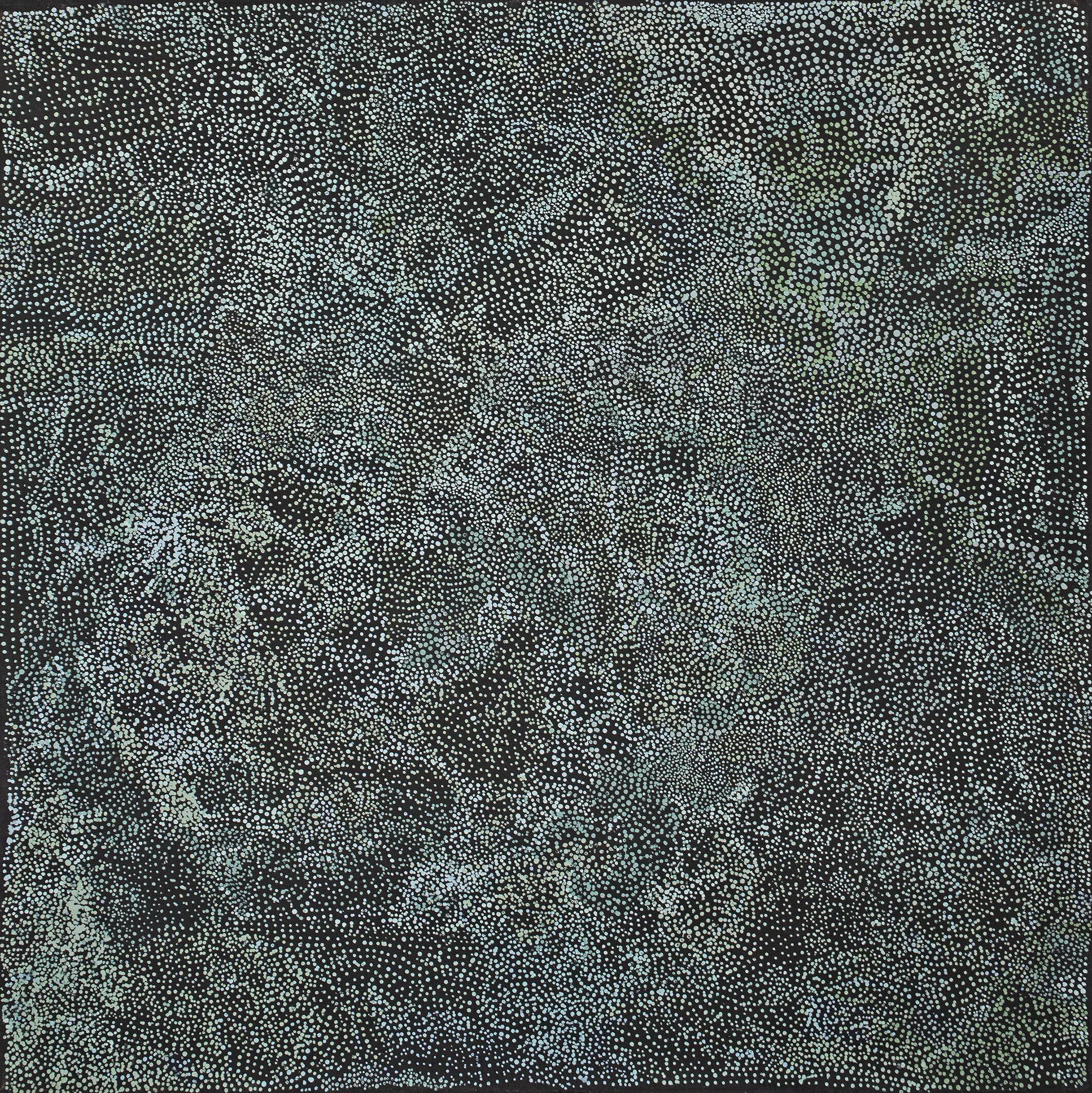
Artiste : Molly Miller
Titre de l'œuvre : Mamungara
Format : 91 x 91 cm
Provenance et certificat : centre d'art aborigène de Ninuku
Référence de cette peinture : 20-237
Demander le prix de cette œuvre
Explications pour cette œuvre :
Panya ngayulu tjitji kulapa tjina kutju parangarapai putu-wanu. Mutuka wiyangka. Tjina kutju parangarapai, parangala, paranangarapia. Nyangatja ngura pulkupa ngayuku. Tjitji Tjuta atunmananyi. Rapita tjuta, maku tjuta, tjala tjuta. Nganana pulkupa mulapa nyinangi irriti. Nyangatja ngura wirunya mulapa. “When I was a little girl we walked everywhere, there were no motorcars then. Always walking, around and around, and around. This is a happy place for me. Looking after children, lots of rabbits, lots of maku, lots of honey ants. We were really happy back then. This is a beautiful place" This canvas describes the features of the rocky country surrounding Wakapulkatjara, south east of Papulanktja, where Molly was born out bush in the 1940s. As a young woman, she travelled constantly through the ranges between Papulankatja to Mantumaru tracing the winding edges of puli, tali, kuru, ulyrunga, and tjukulu with her feet which she recalls as she puts dots to canvas, one in front of the next. Always "walking , walking, walking." A revered site for many Pitjantjatjara and Ngaanyatjarra speaking people on the Three Way Border of South Australia, Northern Territory, and Western Australia, Minyma Tjitu Pampa Tjukurpa and Papa Tjukurpa, Molly father’s dreaming also originate from this area.
© Photo : Aboriginal Signature Estrangin gallery with the courtesy of the artists and Ninuku.

Artiste : Josephine Mick
Titre de l'œuvre : Wati Tjakura
Format : 151 x 75 cm
Provenance et certificat : centre d'art aborigène APY collective
Référence de cette toile aborigène : 400-20
Explications pour cette œuvre :
Wati Tjakura, an edible skink lizard, is a creation story that took place at Arulya. The Wal Mala, army, of Wati Wanambi from Malara came and threw spears at Wati Tjakura. He tried to escape but they killed him. His family came down to bury him.
© Photo & text : Aboriginal Signature Gallery with the courtesy of the artist and APY art centre collective Adelaïde

Artiste : Josephine Mick
Titre de l'œuvre : Wati Tjakura
Format : 153 x 122 cm
Provenance et certificat : centre d'art aborigène APY collective
Référence de cette toile aborigène : 309-20
Explications pour cette œuvre :
Wati Tjakura, an edible skink lizard, is a creation story that took place at Arulya. The Wal Mala, army, of Wati Wanambi from Malara came and threw spears at Wati Tjakura. He tried to escape but they killed him. His family came down to bury him.
© Photo & text : Aboriginal Signature Gallery with the courtesy of the artist and APY art centre collective Adelaïde

Artiste : Josephine Mick
Titre de l'œuvre : Wati Tjakura
Format : 198 x 122 cm
Provenance et certificat : centre d'art aborigène APY collective
Référence de cette toile aborigène : 399-20
Explications pour cette œuvre :
Wati Tjakura, an edible skink lizard, is a creation story that took place at Arulya. The Wal Mala, army, of Wati Wanambi from Malara came and threw spears at Wati Tjakura. He tried to escape but they killed him. His family came down to bury him.
© Photo & text : Aboriginal Signature Gallery with the courtesy of the artist and APY art centre collective Adelaïde

Artiste : Nyayati Stanley Young
Titre de l'œuvre : Kalaya Tjukurpa (Emu Dreaming)
Format : 91 x 91 cm
Provenance et certificat : centre d'art aborigène de Ninuku
Référence de cette peinture : 20-449
Demander le prix de l'œuvre / Enquiry
Explications pour cette œuvre :
This is the story of Kalaya Tjukurpa, Emu Dreaming travelling from Anoll to Ti Pi otherside (south) of Watarru close to Ngurangri. This country is South of Kalka in South Australia. This is a mens story that Stanley can not go into any detail about. This country is his grandmothers country.
© Photo : Aboriginal Signature Estrangin gallery with the courtesy of the artists and Ninuku.

Artiste : Nyayati Stanley Young
Titre de l'œuvre : Patilpa Tjukurpa
Format : 151 x 91 cm
Provenance et certificat : centre d'art aborigène de Ninuku
Référence de cette peinture : 20-448
Demander le prix de l'œuvre / Enquiry
Explications pour cette œuvre :
This is the dreamtime story of Patilpa (Port Lincoln ringneck parrot) that lives in the country around Pipalytjara. Wati Minu (a man called Minu) came from the west to Pipalytjara, he was a rainmaker. He hunted all the waru (black footed wallaby) and he got lots. The Patilpa people were hungry and went and stole all the fat Mala, leaving the skinny one's for Minu. Minu was angry at this and he made clouds and thunder. All the Patilpa were hiding in a cave, but the rain came and washed them all away. They became Chrysoprase a bright green rock that you can find in the hills surrounding Pipalyatjara.
© Photo : Aboriginal Signature Estrangin gallery with the courtesy of the artists and Ninuku.

Artiste : Nyayati Stanley Young
Titre de l'œuvre : Patilpa Tjukurpa
Format : 152 x 91 cm
Provenance et certificat : centre d'art aborigène de Ninuku
Référence de cette peinture : 20-442
Demander le prix de l'œuvre / Enquiry
Explications pour cette œuvre :
This is the dreamtime story of Patilpa (Port Lincoln ringneck parrot) that lives in the country around Pipalytjara. Wati Minu (a man called Minu) came from the west to Pipalytjara, he was a rainmaker. He hunted all the waru (black footed wallaby) and he got lots. The Patilpa people were hungry and went and stole all the fat Mala, leaving the skinny one's for Minu. Minu was angry at this and he made clouds and thunder. All the Patilpa were hiding in a cave, but the rain came and washed them all away. They became Chrysoprase a bright green rock that you can find in the hills surrounding Pipalyatjara.
© Photo : Aboriginal Signature Estrangin gallery with the courtesy of the artists and Ninuku.

Artiste : Nyayati Stanley Young
Titre de l'œuvre : Punu Wara
Format : 91 x 91cm
Provenance et certificat : centre d'art aborigène de Ninuku
Référence de cette peinture : 20-301
Demander le prix de l'œuvre / Enquiry
Explications pour cette œuvre :
"Ngayuku Nguntjuku ngura, Punu Warra", this is my mother's country Punu Warra. Papa Tjukurpa, dingo dreaming..Two men are chasing a dingo, you can see his tracks in the painting, they are hungry and need him for tucker, they chase him down. 'Tjukurpa Mulapa', this is a true dreamtime story.
© Photo : Aboriginal Signature Estrangin gallery with the courtesy of the artists and Ninuku.

Artiste : David Miller
Titre de l'œuvre : Wati Ngintaka Tjukurpa
Format : 122 x 122 cm
Provenance et certificat : centre d'art aborigène de Ninuku
Référence de cette peinture : 20-349
Demander le prix de l'œuvre / Enquiry
Explications pour cette œuvre :
This is a story about Wati Ngintaka Tjukurpa (perentie lizard man creation story). That Wati Ngintaka (lizard man) heard the clapping sound of a beautiful grinding stone - a traditional tool used for grinding mai (food). He wanted that stone for himself, so he travelled from Arang’nga a long way east towards Wayatina, looking for the stone. He spotted Anangu tjuta (lots of Aboriginal people) at a camp. Some of the people gave him mai (food) in the form of a seed cake, but it was dry and he didn’t like it. Then one lady gave him delicious food and he knew that it had been made with seeds ground on the special grinding stone. He spied the grinding stone and stole it, hiding it in under his tail. When they all went hunting the next day, Wati Ngintaka stayed in camp, saying he had sore feet. Once they were gone, it was safe and he left, stealing the grinding stone. All the people were angry with the Wati Ngintaka and chased him. When they caught him they felt all over his body to see where he was hiding the grinding stone, but couldn’t find it. Wati Ngintaka held up his arms and claimed he didn’t have it, but they saw he was hiding it, wipungka (in his tail). They speared the Wati Ngintaka and retrieved the grinding stone. He passed away at a place called Aran’nga in the Northern Territory. Ngaltutjara (poor thing).
© Photo : Aboriginal Signature Estrangin gallery with the courtesy of the artists and Ninuku.

Artiste : David Miller
Titre de l'œuvre : wati tjilpi & minyma pampa hunting story
Format : 91 x 61 cm
Provenance et certificat : centre d'art aborigène de Ninuku
Référence de cette peinture : 20-252
Demander le prix de l'œuvre / Enquiry
Explications pour cette œuvre :
In the old days Anangu got up in the morning and sat down together to talk about a good place to hunt. They made a plan, drawing it in the sand. This is an old hunting plan.
© Photo : Aboriginal Signature Estrangin gallery with the courtesy of the artists and Ninuku.

Artiste : Nyayati Stanley Young
Titre de l'œuvre : Patilpa Tjukurpa
Format : 91 x 91 cm
Provenance et certificat : centre d'art aborigène de Ninuku
Référence de cette peinture : 20-353
Demander le prix de l'œuvre / Enquiry
Explications pour cette œuvre :
This is the dreamtime story of Patilpa (Port Lincoln ringneck parrot) that lives in the country around Pipalytjara. Wati Minu (a man called Minu) came from the west to Pipalytjara, he was a rainmaker. He hunted all the waru (black footed wallaby) and he got lots. The Patilpa people were hungry and went and stole all the fat Mala, leaving the skinny one's for Minu. Minu was angry at this and he made clouds and thunder. All the Patilpa were hiding in a cave, but the rain came and washed them all away. They became Chrysoprase a bright green rock that you can find in the hills surrounding Pipalyatjara.
© Photo : Aboriginal Signature Estrangin gallery with the courtesy of the artists and Ninuku.

Artiste : Nyayati Stanley Young
Titre de l'œuvre : Patilpa Tjukurpa
Format : 91 x 91 cm
Provenance et certificat : centre d'art aborigène de Ninuku
Référence de cette peinture : 20-350
Demander le prix de l'œuvre / Enquiry
Explications pour cette œuvre :
This is the dreamtime story of Patilpa (Port Lincoln ringneck parrot) that lives in the country around Pipalytjara. Wati Minu (a man called Minu) came from the west to Pipalytjara, he was a rainmaker. He hunted all the waru (black footed wallaby) and he got lots. The Patilpa people were hungry and went and stole all the fat Mala, leaving the skinny one's for Minu. Minu was angry at this and he made clouds and thunder. All the Patilpa were hiding in a cave, but the rain came and washed them all away. They became Chrysoprase a bright green rock that you can find in the hills surrounding Pipalyatjara.
© Photo : Aboriginal Signature Estrangin gallery with the courtesy of the artists and Ninuku.

Artiste : Nyayati Stanley Young
Titre de l'œuvre : Patilpa Tjukurpa
Format : 91 x 91 cm
Provenance et certificat : centre d'art aborigène de Ninuku
Référence de cette peinture : 20-331
Demander le prix de l'œuvre / Enquiry
Explications pour cette œuvre :
This is the dreamtime story of Patilpa (Port Lincoln ringneck parrot) that lives in the country around Pipalytjara. Wati Minu (a man called Minu) came from the west to Pipalytjara, he was a rainmaker. He hunted all the waru (black footed wallaby) and he got lots. The Patilpa people were hungry and went and stole all the fat Mala, leaving the skinny one's for Minu. Minu was angry at this and he made clouds and thunder. All the Patilpa were hiding in a cave, but the rain came and washed them all away. They became Chrysoprase a bright green rock that you can find in the hills surrounding Pipalyatjara.
© Photo : Aboriginal Signature Estrangin gallery with the courtesy of the artists and Ninuku.

Artiste : David Miller
Titre de l'œuvre : Wati Ngintaka Tjukurpa
Format : 152 x 71 cm
Provenance et certificat : centre d'art aborigène de Ninuku
Référence de cette peinture : 20-266
Demander le prix de l'œuvre / Enquiry
Explications pour cette œuvre :
This is a story about Wati Ngintaka Tjukurpa (perentie lizard man creation story). That Wati Ngintaka (lizard man) heard the clapping sound of a beautiful grinding stone - a traditional tool used for grinding mai (food). He wanted that stone for himself, so he travelled from Arang’nga a long way east towards Wayatina, looking for the stone. He spotted Anangu tjuta (lots of Aboriginal people) at a camp. Some of the people gave him mai (food) in the form of a seed cake, but it was dry and he didn’t like it. Then one lady gave him delicious food and he knew that it had been made with seeds ground on the special grinding stone. He spied the grinding stone and stole it, hiding it in under his tail. When they all went hunting the next day, Wati Ngintaka stayed in camp, saying he had sore feet. Once they were gone, it was safe and he left, stealing the grinding stone. All the people were angry with the Wati Ngintaka and chased him. When they caught him they felt all over his body to see where he was hiding the grinding stone, but couldn’t find it. Wati Ngintaka held up his arms and claimed he didn’t have it, but they saw he was hiding it, wipungka (in his tail). They speared the Wati Ngintaka and retrieved the grinding stone. He passed away at a place called Aran’nga in the Northern Territory. Ngaltutjara (poor thing).
© Photo : Aboriginal Signature Estrangin gallery with the courtesy of the artists and Ninuku.

Artiste : David Miller
Titre de l'œuvre : wati tjilpi & minyma pampa hunting story
Format : 91 x 61 cm
Provenance et certificat : centre d'art aborigène de Ninuku
Référence de cette peinture : 20-243
Demander le prix de l'œuvre / Enquiry
Explications pour cette œuvre :
In the old days Anangu got up in the morning and sat down together to talk about a good place to hunt. They made a plan, drawing it in the sand. This is an old hunting plan.
© Photo : Aboriginal Signature Estrangin gallery with the courtesy of the artists and Ninuku.
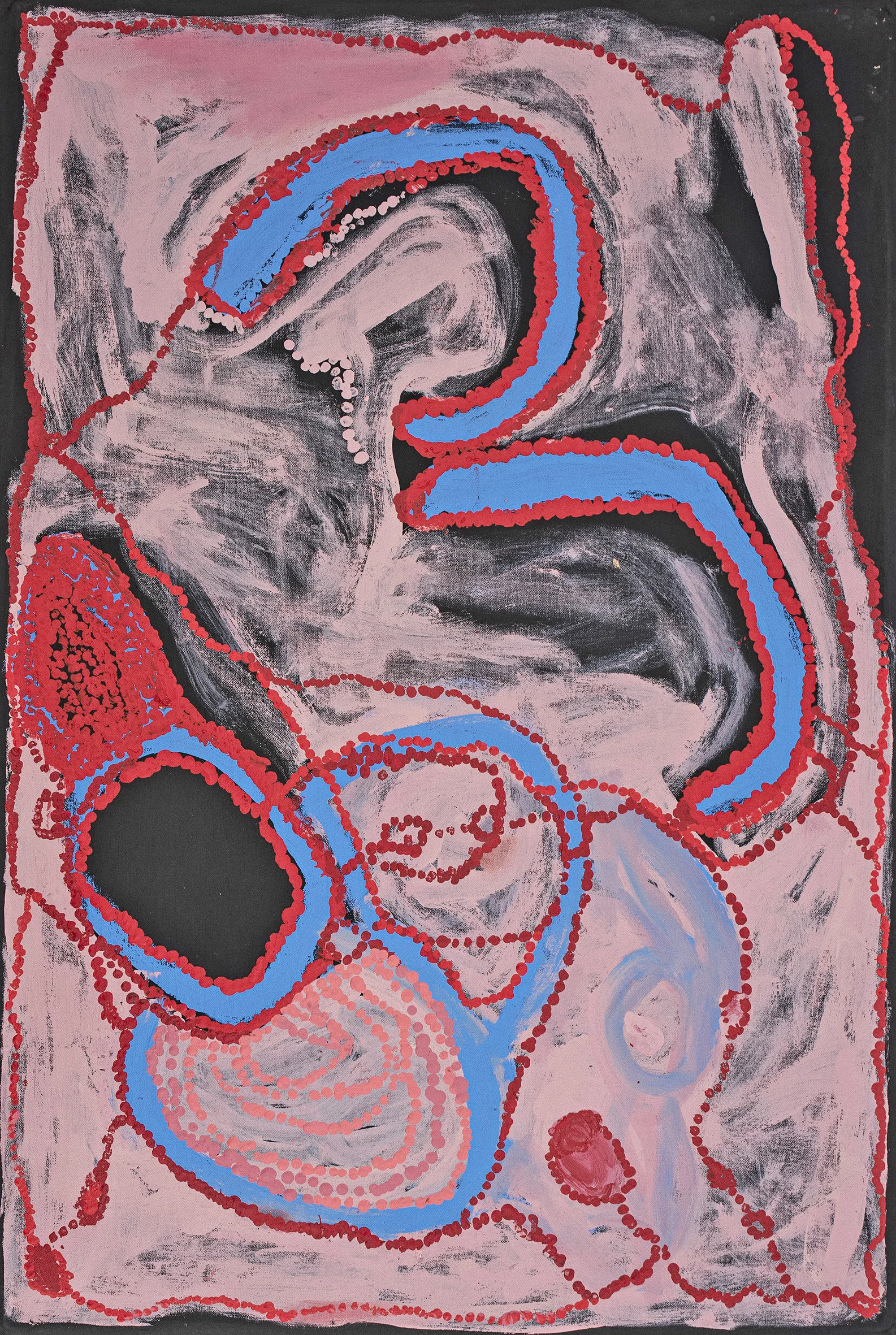
Artiste : Jimmy Yanyatjari Donegan
Titre de l'œuvre : Wati Kutjara Wanampi
Format : 91 x 61 cm
Provenance et certificat : centre d'art aborigène de Ninuku Arts
Référence de cette toile aborigène : 20-283
Explication sur cette peinture :
Jimmy paints the Tjukurpa (Dreaming story) from an important site known as Pukara, south-west of Irrunytju (Wingellina community) in Western Australia. It is a story of Wati Kutjara Wanampi (two male water serpents) - a father and son - who are living at a waterhole. According to the story, Anangu tjuta (lots of people) went to that rockhole for the kapi (water), which is said to taste sweet. This upset the father and he told them to go back to their own country. Once the people left, the father and son travelled to Willuna, where they camped for weeks. They then return to Pukara. One day they were sleeping, but were awoken by a loud buzzing sound. The Minyma Punpunpa (the female flies) had been attracted to the honey grevillea plants found near the waterhole. It prompted the father and son to get up and go to collect the honey from the plants. It is there that the Wati Mututa (male black ants) appeared. They speared the son in his side. When the son started vomittng, he produced the seeds of all the different varieties of honey grevillea plants that are still found there today. They include kaliny-kalinypa, ultukunpa, piruwa and witjinti.

Artiste : Jimmy Yanyatjari Donegan
Titre de l'œuvre : Malu Tjukurpa
Format : 91 x 61 cm
Provenance et certificat : centre d'art aborigène de Ninuku Arts
Référence de cette toile aborigène : 20-60
Explication sur cette peinture :
Jimmy is painting Malu Tjukurpa for the Pipalyatjara area.
He couldn't tell any details of this story as it is Watiku tjukurpa (Mens story). It is strong and sacred Tjukurpa. Within Jimmys work lies a wealth of knowledge that only the initiated men have access to.

Artiste : Jimmy Yanyatjari Donegan
Titre de l'œuvre : Papa Tjukurpa
Format : 91 x 61 cm
Provenance et certificat : centre d'art aborigène de Ninuku Arts
Référence de cette toile aborigène : 20-57

Artiste : Molly Miller
Titre de l'œuvre : Wakapulkatjara
Format : 152 x 71 cm
Provenance et certificat : centre d'art aborigène de Ninuku
Référence de cette peinture : 20-265
Demander le prix de cette œuvre
Explications pour cette œuvre :
Panya ngayulu tjitji kulapa tjina kutju parangarapai putu-wanu. Mutuka wiyangka. Tjina kutju parangarapai, parangala, paranangarapia. Nyangatja ngura pulkupa ngayuku. Tjitji Tjuta atunmananyi. Rapita tjuta, maku tjuta, tjala tjuta. Nganana pulkupa mulapa nyinangi irriti. Nyangatja ngura wirunya mulapa. “When I was a little girl we walked everywhere, there were no motorcars then. Always walking, around and around, and around. This is a happy place for me. Looking after children, lots of rabbits, lots of maku, lots of honey ants. We were really happy back then. This is a beautiful place" This canvas describes the features of the rocky country surrounding Wakapulkatjara, south east of Papulanktja, where Molly was born out bush in the 1940s. As a young woman, she travelled constantly through the ranges between Papulankatja to Mantumaru tracing the winding edges of puli, tali, kuru, ulyrunga, and tjukulu with her feet which she recalls as she puts dots to canvas, one in front of the next. Always "walking , walking, walking." A revered site for many Pitjantjatjara and Ngaanyatjarra speaking people on the Three Way Border of South Australia, Northern Territory, and Western Australia, Minyma Tjitu Pampa Tjukurpa and Papa Tjukurpa, Molly father’s dreaming also originate from this area.
© Photo : Aboriginal Signature Estrangin gallery with the courtesy of the artists and Ninuku.

Artiste : David Miller
Titre de l'œuvre : Wati Ngintaka Tjukurpa
Format : 91 x 91 cm
Provenance et certificat : centre d'art aborigène de Ninuku
Référence de cette peinture : 20-390
Demander le prix de l'œuvre / Enquiry
Explications pour cette œuvre :
This is a story about Wati Ngintaka Tjukurpa (perentie lizard man creation story). That Wati Ngintaka (lizard man) heard the clapping sound of a beautiful grinding stone - a traditional tool used for grinding mai (food). He wanted that stone for himself, so he travelled from Arang’nga a long way east towards Wayatina, looking for the stone. He spotted Anangu tjuta (lots of Aboriginal people) at a camp. Some of the people gave him mai (food) in the form of a seed cake, but it was dry and he didn’t like it. Then one lady gave him delicious food and he knew that it had been made with seeds ground on the special grinding stone. He spied the grinding stone and stole it, hiding it in under his tail. When they all went hunting the next day, Wati Ngintaka stayed in camp, saying he had sore feet. Once they were gone, it was safe and he left, stealing the grinding stone. All the people were angry with the Wati Ngintaka and chased him. When they caught him they felt all over his body to see where he was hiding the grinding stone, but couldn’t find it. Wati Ngintaka held up his arms and claimed he didn’t have it, but they saw he was hiding it, wipungka (in his tail). They speared the Wati Ngintaka and retrieved the grinding stone. He passed away at a place called Aran’nga in the Northern Territory. Ngaltutjara (poor thing).
© Photo : Aboriginal Signature Estrangin gallery with the courtesy of the artists and Ninuku.

Artiste : Jimmy Yanyatjari Donegan
Titre de l'œuvre : Papa Tjukurpa
Format : 91 x 61 cm
Provenance et certificat : centre d'art aborigène de Ninuku Arts
Référence de cette toile aborigène : 19-617
Explications pour cette peinture d'art Aborigène :
Papa Tjukurpa; Dingo Dreaming. "Ngayuku mamaku ngura Dulu", my father's country rockhole called Dulu. At this place there are lots of women and men dingo's living there, digging up the water and hunting at Pilantjara rockhole in the country area of Dulu. This is papa walka, dog design.
Artiste : Molly Miller
Titre de l'œuvre : Mamungara
Format : 91 x 91 cm
Provenance et certificat : centre d'art aborigène de Ninuku
Référence de cette peinture : 20-212
Demander le prix de l'œuvre
Explications pour cette œuvre :
Panya ngayulu tjitji kulapa tjina kutju parangarapai putu-wanu. Mutuka wiyangka. Tjina kutju parangarapai, parangala, paranangarapia. Nyangatja ngura pulkupa ngayuku. Tjitji Tjuta atunmananyi. Rapita tjuta, maku tjuta, tjala tjuta. Nganana pulkupa mulapa nyinangi irriti. Nyangatja ngura wirunya mulapa. “When I was a little girl we walked everywhere, there were no motorcars then. Always walking, around and around, and around. This is a happy place for me. Looking after children, lots of rabbits, lots of maku, lots of honey ants. We were really happy back then. This is a beautiful place" This canvas describes the features of the rocky country surrounding Wakapulkatjara, south east of Papulanktja, where Molly was born out bush in the 1940s. As a young woman, she travelled constantly through the ranges between Papulankatja to Mantumaru tracing the winding edges of puli, tali, kuru, ulyrunga, and tjukulu with her feet which she recalls as she puts dots to canvas, one in front of the next. Always "walking , walking, walking." A revered site for many Pitjantjatjara and Ngaanyatjarra speaking people on the Three Way Border of South Australia, Northern Territory, and Western Australia, Minyma Tjitu Pampa Tjukurpa and Papa Tjukurpa, Molly father’s dreaming also originate from this area.
© Photo : Aboriginal Signature Estrangin gallery with the courtesy of the artists and Ninuku.