
Exposition “Kujungka- Young and Old Together”
Martumili artists • Great Sandy Desert
Du 15 Janvier AU 15 février 2020 INCLUS, AU SEIN DE LA GALERIE ABORIGINAL SIGNATURE ESTRANGIN À BRUXELLES
Ouverture ensuite du Mercredi au Samedi, de 14h30 à 19h, à la galerie : 101 rue Jules Besme, 1081 Bruxelles.
Et sur RDV les autres jours au +32 (0) 475 55 08 54.

Vue d’un lieu de bivouac dans le Great Sandy Desert, lors de la sélection des œuvres en territoire Aborigène Martu en Juillet 2018 par Bertrand Estrangin © Photo : Aboriginal Signature Gallery with the courtesy of the Martu.
Kujungka- Young and Old Together

Œuvre magistrale de l’artiste Ngamaru Bidu. Titre : Wantili. Format : 125 x 300 cm, Acrylic on linen. Ref : 19-953.. © Photo : Aboriginal Signature Estrangin gallery with the courtesy of the artists and Martumili Art. Cette peinture proposée à Bruxelles fut finaliste du John Stringer Art Prize 2019, et exposée dans ce cadre à la prestigieuse John Curtin Gallery de l’université éponyme de la ville de Perth. Plus d’informations sur ces peintures d’art Aborigène.
Nous sommes très honorés d’accueillir à Bruxelles l’exposition “Kujungka- Young and Old Together” avec les grands artistes de Martumili situés dans les territoires éloignés du Great Sandy Desert de Western Australia.
Cette exposition montée en partenariat avec la communauté artistique de Martumili est assez rare en Europe et vous propose 40 œuvres réalisées par 12 artistes, hommes et femmes, nées entre 1930 et 1994. Peintres de tous premiers plans. ils traversent ensemble trois générations, avec les grands artistes seniors Jakayu Biljabu (1936), Bugai Whyoulter (1939), Yijartu Bumba (1939), Muuki Taylor (1944), et la plus jeune garde avec Judith Anya Samson (1988), Cyril Whyoulter (1985), Corban Clause Williams (1994).
Dans leurs œuvres, ils célèbrent leur connexion au territoire, honorent leurs lieux mémoriels éloignés du Great Sandy Desert, et traduisent leur savoir ancestral avec profondeur et densité.

L’artiste Ngamaru Bidu (1949) devant son œuvre à la Curtin Gallery de l’Université de Perth. © Photo : Martumili Art with the courtesy of the artist.
Derniers nomades entre 1960 et 1977 (Western Australia)
Martumili Artists représente les locuteurs des clans de Manyjilyjarra, Warnman, Kartujarra, Pultjarra et Martu Wangka.
Les œuvres de nombreux artistes sont ainsi imprégnées d’un savoir incommensurable, certains ayant rencontré pour la première fois le monde occidental en 1960.
Et jusqu’en 1977 lors d’une expédition conduite dans leur désert par un médecin pour retrouver Warri et Yatungka, un couple d’Aborigènes vivant depuis plusieurs décennies dans une autarcie de plus en plus précaire face aux sécheresses itératives.
Cette épopée et le sauvetage de ce couple fera l’objet d’un livre « Les derniers nomades d’Australie », soulignant la vie ancestrale multi-millénaires de leur clan.
Cobra et l’art Aborigène d’Australie

Une des œuvre de l’artiste Jakayu Biljabu (1936) présentée à Bruxelles. Titre : Pitu. Format : 152 x 76 cm. ref : 18-441. © Photo : with the courtesy of the artists and Martumili Art. Plus d’informations sur ces peintures d’art Aborigène.
Dans une dynamique de partage, les artistes cristallisent leur mémoire et transmettent ainsi aux jeunes générations leur savoir et la loi Aborigène, sous des formes graphiques déconcertantes. Leur vision va au delà des perspectives et des formes pour sublimer les lieux et leurs dimensions sacrées. Certaines parties de leurs peintures éludent, atténuent les formes, offrent des visions latérales des paysages, puis des vues d’oiseaux dans l’espace, pour ensuite plonger au cœur de la matière dans l’intimité des lieux.
En 2011 le Musée d’art Aborigène d’Utrecht organisa une importante exposition entre le mouvement Cobra et les artistes Aborigènes dont Martumili : Breaking with Tradition - Cobra and Aboriginal art.
Je garde un souvenir ému de cette exposition, où les cartels discrets ne permettaient pas immédiatement de distinguer ce qui appartenait au mouvement Cobra ou à l’art Aborigène d’Australie, nous offrant le cadeau d’appréhender les peintures dans leur intégralité la plus pure sans a-priori.
Les œuvres de ces grands artistes pourtant situés aux antipodes du globe, construisaient dans cet irremplaçable musée hollandais aujourd’hui fermé, un dialogue universel au delà des conventions et frontières dans un autre espace-temps.
Aujourd’hui, de part le monde, les œuvres des artistes de Matumili sont accrochées aussi bien aux cimaises des grands musées Australiens, que de l’Université de Virginie aux USA, et de nombreuses collections privées dont celle de la Reine d’Angleterre, Elisabeth II.

Œuvre de l’artiste Bugai Whyoulter présentée à Bruxelles.
Title : Wantili. Format :: 91 x 121 cm: Ref : 18-1127. © Photo : with the courtesy of the artists and Martumili

Vue incroyable des rivières et des lac salés au bord du désert, près de Wantili dans le territoire Martu lors de mon périple à travers le Great Sandy desert vers les centres d’art de Martumili, en juillet 2018. © Photo : Aboriginal Signature Estrangin Gallery.
Des œuvres magistrales finalistes des awards australiens

Peinture magistrale de l’artiste Bugai Whyoulter. Format : 125 x 300 cm. Titre : Wantili. Acrylic on linen. Ref : 19-1111. © Photo : with the courtesy of the artists and Martumili Art. Plus d’informations sur ces peintures d’art Aborigène.
Deux œuvres magistrales des artistes Bugai Whyoulter (1936) et Ngamaru Bidu (1949), de 300 x 125 cm évoquent le lieu sacré de Wantili et ses dunes de sable à perte de vue. Wantili est un site culturel fondamental aux temps de la Création. Il est tout proche du trou d’eau numéro 25 de l’emblématique Canning Stock Road. Cette route de transhumance créé par les occidentaux dans leur grand désert, est la plus longue au monde, et engendrera de difficiles confrontations autour des années 1920.. La peinture magistrale de Ngamaru Bidu fut finaliste du John Stringer Art Prize 2019, et exposée dans ce cadre à la prestigieuse John Curtin Gallery de l’université éponyme de la ville de Perth.
Nous vous invitons à découvrir ces peintures connectées au désert, issues de ces peuples anciens qui redonnent vie au Temps du Rêve, convoquent leurs signes, émoussent les contours des lieux sensibles, et célèbrent avec un talent audacieux leurs lieux séculaires situés dans les espaces les plus isolés de la planète.

Les dunes de sable proches du lieu de la Création de Wantili. Au loiin la croute des lacs salés. Expedition en territoire Martu en Juillet 2018 pour préparer l’exposition de Bruxelles. © Photo : Aboriginal Signature Estrangin Gallery.
Peintures ABORIGènes proposées dans le cadre de l'exposition :

Artiste : Bugai Whyoulter (1939)
Titre de l'œuvre : Wantili (near Well 25)
Format : 300 x 125 cm
Provenance et certificat : centre d'art aborigène de Martumili
Référence de cette peinture : 19-1111
Vendue
Explications pour cette œuvre :
(As translated by Bugai’s grandson, Cyril Whyoulter) “Bugai always tells about Wantili because she grew up around Wantili. Her family would travel between Wantili, Kaalpa, Juntujuntu, Raarki, and Wuranu Wells along the Canning Stock Route. She paints around Wantili. She saw whitefellas there for the first time, Canning mob when they were travelling up and down the stock route with the bullock. She was a young girl walking around at Wantili. Big mob of people they been walking around there. They were travelling making the road, Canning and his drovers. They were running away from those whitefellas, watching them from a long distance. She was a teenager when she was travelling around there with her four mothers and one daddy. Her mummy and daddy passed away in Jigalong. They used to travel around in family groups, Bugai and Jakayu (Biljabu), and Jakayu’s nyupa (partner) Phillip Biljabu. They met Kumpaya (Girgaba) coming from Kunkun (Kunawarritji) area.”
Bugai returned to the Wantili area as a young woman, when she worked driving cattle along the Stock Route.
Wantili is a large jurnu (soak) and lyinji (clay pan) near Well 25 on the Canning Stock Route. It lies close to Bugai’s birthplace, and is her ngurra (home country). The area is dominated by claypans surrounded by tuwa (sandhills). Following rain the claypans are filled with water, with the overflow from nearby waterholes flowing to Wantili. At that time, Wantili becomes an important place for obtaining fresh water for drinking and bathing. Wantili is significant for the fact that at this site Kartujarra, Manyjilyjarra, Putujarra and Warnman people would all come together for ceremonies. Many jiwa (stones used by women for grinding seeds) from these times can still be found there today.
Wantili is one of the many sites featured in the epic Minyipuru (Seven Sisters) jukurrpa (dreamtime) narrative. The story follows the movement of seven sisters travelling all the way across the desert, beginning at Roebourne on the coast of Western Australia, as they are pursued by a lusful old man, Yurla. As the women travel they stop to rest at many sites to eat, dance, rest and sing, on the way leaving behind an assortment of articles that become formations in the land.
The Seven Sisters rested at Wantili before throwing seeds, then continuing their journey on to Tiwa, Juntujuntu, and then onward to Pangkapini, where they finally escaped Yurla by flying into the sky to become the Pleaides constellation of stars.
© Photo Aboriginal Signatrure Estrangin Gallery, and text with the courtesy of the Artist and Martumili Arts

Artiste : Jakayu Biljabu (1936)
Titre de l'œuvre : Pitu (Separation Well)
Format : 152 x 76 cm
Provenance et certificat : centre d'art aborigène de Martumili
Référence de cette peinture : 18-441
Demander le prix de l'œuvre / Enquiry
Explications pour cette œuvre :
“Ngurra me, my ngurra (this is my country, my home).
This painting depicts Pitu (Separation Well), an area east of Parnngurr in the Western Desert, not far from the Canning Stock Route. Jakayu was born at Pitu. It is her country, as well as the site of a warla (lake) and large jurnu (rockhole).
© Photo Aboriginal Signatrure Estrangin Gallery, and text with the courtesy of the Artist and Martumili Arts

Artiste : Mulyatingki Marney (1940)
Titre de l'œuvre : Minyipuru, Seven sisters
Format : 91 x 61 cm
Provenance et certificat : centre d'art aborigène de Martumili
Référence de cette peinture : 18-378
Vendue
Explications pour cette œuvre :
"Seven Sister's way, Minyipuru (Seven Sisters) way. Pangkal painting, this Pangkal Country. Mima (women), [motions to semicircluar forms], all lot. All the mima been dancing there in that ngurra (camp), dancing jakulyukulyu (Seven Sisters), walkajunu (painted, decorated) there."
- Mulyatingki Marney
This painting depicts a part of the Minyipuru story located at the Pangkal rockhole near Telfer. Minyipuru is an important Jukurrpa (dreamtime) story about seven sisters that are travelling throughout the desert as they are pursued by Yurla, a lustful old man. The man chases the wanti (women) all the way from Roebourne on the west coast right through Martu country before flying east. Along the way they stop at many significant sites to camp, sing, dance and collect bush tucker. There are also many interactions with Yurla when he catches up with them along the way, creating an amazing abundance of stories and meaning with this culturally rich narrative. The story is associated with the Pleiades star constellation.
© Photo Aboriginal Signatrure Estrangin Gallery, and text with the courtesy of the Artist and Martumili Arts
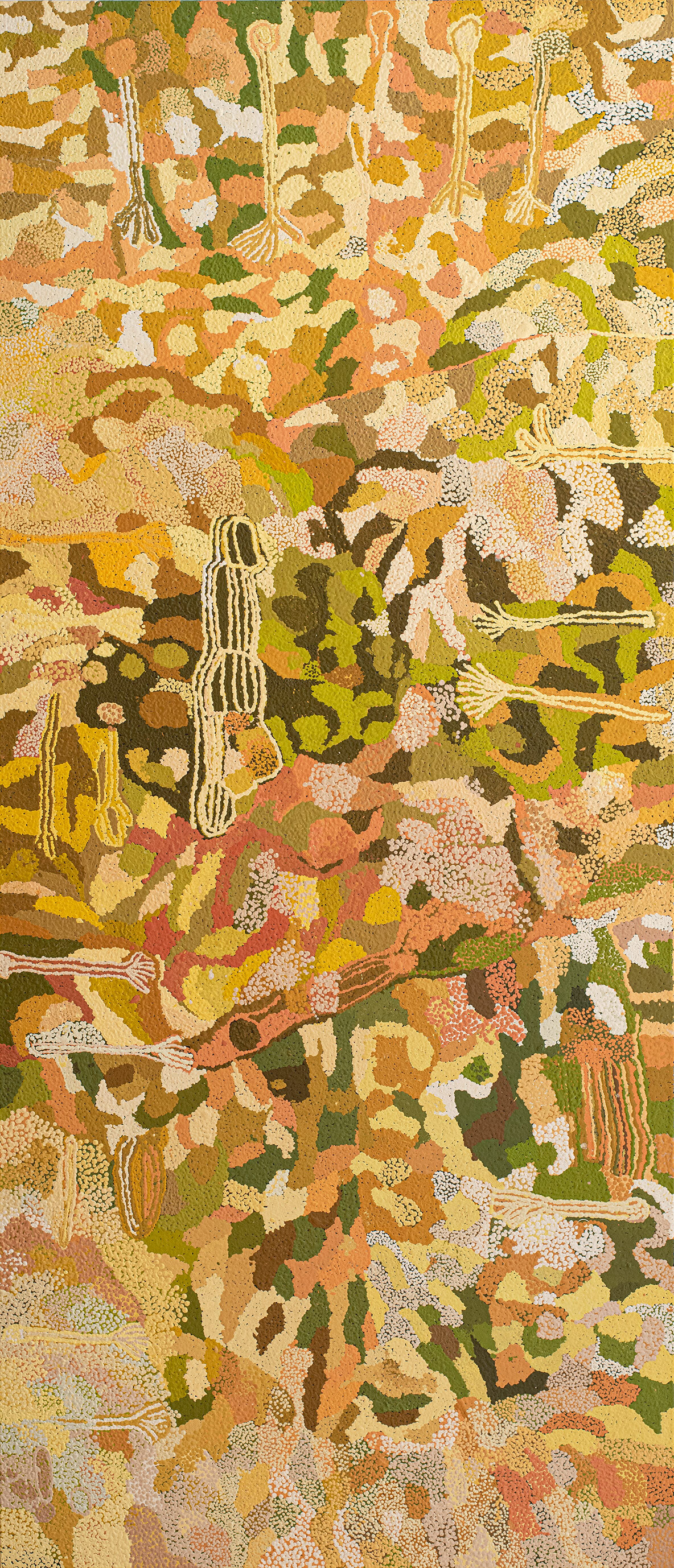
Artiste : Ngamaru Bidu (1949)
Titre de l'œuvre : Wantili
Format : 300 x 125 cm
Provenance et certificat : centre d'art aborigène de Martumili
Référence de cette peinture : 19-953
Demander le prix de l'œuvre / Enquiry
Explications pour cette œuvre :
"My ngurra (home Country), Wantili area. [Points to linear forms] Sandhill, sandhill, sandhill everywhere. Claypan there, in the middle. Good place for swimming and drinking, for hunting little kangaroo. When no water [we would] go to Well, when there rain we stay there at Wantili. Everywhere, we been walking everywhere.
Near to Wantili [there’s a] road going Kayili (North). Long time [ago] only horses and cale [travelled along that road], going Meekatharra and back in the cold time, gone right up to Jijai Bore. Half way, when he see water at Wantili, that mob would camp one night, bullock eating all the grass and mens drinking water. One Martu been working with that mob, droving bullock. Everytime he been give us meat, all the pujiman (nomadic bush dwellers)."
Wantili is dominated by claypans surrounded by tuwa (sandhills). Following rain the claypans are filled with water, with the overflow from nearby waterholes flowing to Wantili. At that time, Wantili becomes an important place for obtaining fresh water for drinking and bathing. Wantili is significant for the fact that at this site Kartujarra, Manyjilyjarra, Putujarra and Warnman people would all come together for ceremonies. Many jiwa (stones used by women for grinding seeds) from these times can still be found there today.
Wantili is an incredibly important cultural site, ‘‘where the creation started.’ The jukurrpa related to the creation at Wantili are just for Martu, but the site is open and anyone can go there. Wantili is one of the many sites featured in the epic Minyipuru (Seven Sisters) jukurrpa (dreamtime) narrative. The story follows the movement of seven sisters travelling all the way across the desert, beginning at Roebourne on the coast of Western Australia, as they are pursued by a lustful old man, Yurla. As the women travel they stop to rest at many sites to eat, dance, rest and sing, on the way leaving behind an assortment of articles that become formations in the land. The Seven Sisters rested at Wantili before throwing seeds, then continuing their journey on to Tiwa, Juntujuntu, and then onward to Pangkapini, where they finally escaped Yurla by flying into the sky to become the Pleaides constellation of stars.
Martumili Artists was established in late 2006 and supports Martu artists in Kunawarritji, Punmu, Parnngurr, Jigalong, Warralong, Irrungadji (Nullagine) and Parnpajinya (Newman). Many Martu artists have close relationships with established artists amongst Yulparija, Kukatja and other Western Desert peoples and are now gaining recognition in their own right for their diverse, energetic and unmediated painting styles. Their works reflect the dramatic geography and scale of their homelands in the Great Sandy Desert and Rudall River regions of Western Australia. Martumili Artists represents speakers of Manyjilyjarra, Warnman, Kartujarra, Putijarra and Martu Wangka languages, many of whom experienced first contact with Europeans in the 1960s. The artists include painters, working in acrylics and oils, as well as weavers coiling baskets and sculptors working in wood, grass and wool. Martu artists proudly maintain their creative practices whilst pursuing social and cultural obligations across the Martu homelands.

Artiste : Mulyatingki Marney (1940)
Titre de l'œuvre : Nyayartakujarra, or Lake Dora, Punmu warla (lake)
Format : 121 x 91 cm
Provenance et certificat : centre d'art aborigène de Martumili
Référence de cette peinture : 18-154
Vendue
Explications pour cette œuvre :
Punmu is an Aboriginal community located 670km North-East of Newman, in the Pilbara region of Western Australia. Created during the return to Country movement of the 1980s, with the recognition of Martu land rights and native title, the community was named after a nearby jukurrpa (dreamtime) story.
This work depicts the large salt lake known as Nyayartakujarra, or Lake Dora. Punmu community sits on the edge of this dramatic lake, which runs south into Karlamilyi River. A jukurrpa story describes the formation of Nyayartakujarra as occurring when two travelling snakes were first sung to sleep and then killed by magic men. The snakes’ fat was said to have burned away and melted into Nyayartakujarra.
© Photo Aboriginal Signatrure Estrangin Gallery, and text with the courtesy of the Artist and Martumili Arts

Artiste : Bugai Whyoulter (1939)
Titre de l'œuvre : Pukayiyirna (Balfour Downs Station)
Format : 76 x 46 cm
Provenance et certificat : centre d'art aborigène de Martumili
Référence de cette peinture : 19-169
Vendue
Explications pour cette œuvre :
Parnngurr was a very important site for the artist's family in the pujiman (bush) days as there is a permanent yinta (waterhole) there. The artist used to camp in this country with her family when she was young. They would meet up with a lot of their other family members here. They would all come together before travelling on to other places. This is where the artist and her family were picked up and a big mob taken to the mission in Jigalong. This area is now the site of the Parnngurr Aboriginal Community.
© Photo Aboriginal Signatrure Estrangin Gallery, and text with the courtesy of the Artist and Martumili Arts

Artiste : Bugai Whyoulter (1939)
Titre de l'œuvre : Wantili
Format : 121 x 91 cm
Provenance et certificat : centre d'art aborigène de Martumili
Référence de cette peinture : 18-1127
Vendue
Explications pour cette œuvre :
Wantili, which forms the focus of much of Bugai’s work, is a large round jurnu (soak) and lyinji (claypan) near Well 25 on the Canning Stock Route. It lies close to Bugai’s birthplace, and is her ngurra (home country). The area is dominated by claypans surrounded by tuwa (sandhills). Following rain the typically dry claypans are filled with water, with the overflow from nearby waterholes flowing to Wantili. At that time, Wantili becomes an important place for obtaining fresh water for drinking and bathing. Wantili is significant for the fact that at this site Kartujarra, Manyjilyjarra, Putujarra and Warnman people would all come together for ceremonies. Manyjiwa (stones used by women for grinding seeds) from these times can still be found there today.
(As translated by Bugai’s grandson, Cyril Whyoulter) “Bugai always tells about Wantili because she grew up around Wantili. Her family would travel between Wantili, Kaalpa, Juntujuntu, Raarki, and Wuranu Wells along the Canning Stock Route. She paints around Wantili. She saw whitefellas there for the first time, Canning mob when they were travelling up and down the stock route with the bullock. She was a young girl walking around at Wantili. Big mob of people they been walking around there. They were travelling making the road, Canning and his drovers. They were running away from those whitefellas, watching them from a long distance. She was a teenager when she was travelling around there with her four mothers and one daddy. Her mummy and daddy passed away in Jigalong. They used to travel around in family groups, Bugai and Jakayu (Biljabu), and Jakayu’s nyupa (partner) Phillip Biljabu. They met Kumpaya (Girgaba) coming from Kunkun (Kunawarritji) area.”
Bugai returned to the Wantili area as a young woman, when she worked driving cattle along the Stock Route.
Wantili is a large jurnu (soak) and lyinji (clay pan) near Well 25 on the Canning Stock Route. It lies close to Bugai’s birthplace, and is her ngurra (home country). The area is dominated by claypans surrounded by tuwa (sandhills). Following rain the claypans are filled with water, with the overflow from nearby waterholes flowing to Wantili. At that time, Wantili becomes an important place for obtaining fresh water for drinking and bathing. Wantili is significant for the fact that at this site Kartujarra, Manyjilyjarra, Putujarra and Warnman people would all come together for ceremonies. Many jiwa (stones used by women for grinding seeds) from these times can still be found there today.
Wantili is one of the many sites featured in the epic Minyipuru (Seven Sisters) jukurrpa (dreamtime) narrative. The story follows the movement of seven sisters travelling all the way across the desert, beginning at Roebourne on the coast of Western Australia, as they are pursued by a lusful old man, Yurla. As the women travel they stop to rest at many sites to eat, dance, rest and sing, on the way leaving behind an assortment of articles that become formations in the land.
The Seven Sisters rested at Wantili before throwing seeds, then continuing their journey on to Tiwa, Juntujuntu, and then onward to Pangkapini, where they finally escaped Yurla by flying into the sky to become the Pleaides constellation of stars.
© Photo Aboriginal Signatrure Estrangin Gallery, and text with the courtesy of the Artist and Martumili Arts

Artiste : Bugai Whyoulter (1939)
Titre de l'œuvre : Wantili
Format : 76 x 46 cm
Provenance et certificat : centre d'art aborigène de Martumili
Référence de cette peinture : 18-298
Vendue
Explications pour cette œuvre :
(As translated by Bugai’s grandson, Cyril Whyoulter) “Bugai always tells about Wantili because she grew up around Wantili. Her family would travel between Wantili, Kaalpa, Juntujuntu, Raarki, and Wuranu Wells along the Canning Stock Route. She paints around Wantili. She saw whitefellas there for the first time, Canning mob when they were travelling up and down the stock route with the bullock. She was a young girl walking around at Wantili. Big mob of people they been walking around there. They were travelling making the road, Canning and his drovers. They were running away from those whitefellas, watching them from a long distance. She was a teenager when she was travelling around there with her four mothers and one daddy. Her mummy and daddy passed away in Jigalong. They used to travel around in family groups, Bugai and Jakayu (Biljabu), and Jakayu’s nyupa (partner) Phillip Biljabu. They met Kumpaya (Girgaba) coming from Kunkun (Kunawarritji) area.”
Bugai returned to the Wantili area as a young woman, when she worked driving cattle along the Stock Route.
Wantili is a large jurnu (soak) and lyinji (clay pan) near Well 25 on the Canning Stock Route. It lies close to Bugai’s birthplace, and is her ngurra (home country). The area is dominated by claypans surrounded by tuwa (sandhills). Following rain the claypans are filled with water, with the overflow from nearby waterholes flowing to Wantili. At that time, Wantili becomes an important place for obtaining fresh water for drinking and bathing. Wantili is significant for the fact that at this site Kartujarra, Manyjilyjarra, Putujarra and Warnman people would all come together for ceremonies. Many jiwa (stones used by women for grinding seeds) from these times can still be found there today.
Wantili is one of the many sites featured in the epic Minyipuru (Seven Sisters) jukurrpa (dreamtime) narrative. The story follows the movement of seven sisters travelling all the way across the desert, beginning at Roebourne on the coast of Western Australia, as they are pursued by a lusful old man, Yurla. As the women travel they stop to rest at many sites to eat, dance, rest and sing, on the way leaving behind an assortment of articles that become formations in the land.
The Seven Sisters rested at Wantili before throwing seeds, then continuing their journey on to Tiwa, Juntujuntu, and then onward to Pangkapini, where they finally escaped Yurla by flying into the sky to become the Pleaides constellation of stars.
© Photo Aboriginal Signatrure Estrangin Gallery, and text with the courtesy of the Artist and Martumili Arts

Artiste : Muuki Taylor (1944)
Titre de l'œuvre : Kulyakartu
Format : 122 x 91 cm
Provenance et certificat : centre d'art aborigène de Martumili
Référence de cette peinture : 13-823
Demander le prix de l'œuvre / Enquiry
Explications pour cette œuvre :
“My Country, Kulyakartu. I grew up there, from little boy to big boy grew up there.”
This painting depicts Muuki’s Country, Kulyakartu; an area in the far north of the Martu homelands, near the Percival Lakes in the northern Great Sandy Desert. The artist has extensive knowledge of the Country in this region, where he grew up living traditionally during the pujiman (traditional, desert dwelling) days with his family. Kulyakartu is mostly grass Country where there is very good hunting. There is no permanent water source in Kulyakartu, so his family would walk here annually following the wet season.
Muuki paints his Country in all its different seasonal stages. Often visible in his work is the patchwork of nyurnma (burnt ground) depicting the regrowth subsequent to the practice of waru (fire) burning that assists with hunting, regenerates growth, and encourages greater diversity in plant and animal life.
© Photo Aboriginal Signatrure Estrangin Gallery, and text with the courtesy of the Artist and Martumili Arts

Artiste : Nola Ngalangka Taylor (1951)
Titre de l'œuvre : Kulyakartu (near Percival Lake)
Format : 76 x 36 cm
Provenance et certificat : centre d'art aborigène de Martumili
Référence de cette peinture : 19-1098
Vendue
Explications pour cette œuvre :
This painting depicts Nola's Country, Kulyakartu; an area in the far north of the Martu homelands, near the Percival Lakes in the northern Great Sandy Desert. The artist has extensive knowledge of the Country in this region, where she grew up living traditionally during the pujiman (traditional, desert dwelling) days with her family. Kulyakartu is mostly grass Country where there is very good hunting. There is no permanent water source in Kulyakartu, so her family would walk here annually following the wet season.
Nola paints her Country in all its different seasonal stages. Oen visible in her work is the patchwork of nyurnma (burnt ground) depicting the regrowth subsequent to the practice of waru (fire) burning that assists with hunting, regenerates growth, and encourages greater diversity in plant and animal life.
© Photo Aboriginal Signatrure Estrangin Gallery, and text with the courtesy of the Artist and Martumili Arts

Artiste : Muuki Taylor (1944)
Titre de l'œuvre : Kulyakartu
Format : 91 x 61 cm
Provenance et certificat : centre d'art aborigène de Martumili
Référence de cette peinture : 18-1048
Demander le prix de l'œuvre / Enquiry
Explications pour cette œuvre :
“My Country, Kulyakartu. I grew up there, from little boy to big boy grew up there.”
This painting depicts Muuki’s Country, Kulyakartu; an area in the far north of the Martu homelands, near the Percival Lakes in the northern Great Sandy Desert. The artist has extensive knowledge of the Country in this region, where he grew up living traditionally during the pujiman (traditional, desert dwelling) days with his family. Kulyakartu is mostly grass Country where there is very good hunting. There is no permanent water source in Kulyakartu, so his family would walk here annually following the wet season.
Muuki paints his Country in all its different seasonal stages. Often visible in his work is the patchwork of nyurnma (burnt ground) depicting the regrowth subsequent to the practice of waru (fire) burning that assists with hunting, regenerates growth, and encourages greater diversity in plant and animal life.
© Photo Aboriginal Signatrure Estrangin Gallery, and text with the courtesy of the Artist and Martumili Arts

Artiste : Yikartu Bumba (1939)
Titre de l'œuvre : Sans Titre
Format : 61 x 61 cm
Provenance et certificat : centre d'art aborigène de Martumili
Référence de cette peinture : 19-767
Vendue
Explications pour cette œuvre :
This painting portrays physical elements of Martu Country, such as the dominant tali (sandhills), warta (trees, vegetation), and water sources. Rock holes, waterholes, soaks and springs were all extremely important sites for Martu people during the pujiman (nomadic bush) era, with many important jukurrpa (dreamtime stories) chronicling the creation of these landmarks.
In the past the Martu lived nomadically, moving from water source to water source, and hunting and gathering bush tucker as they went. They would traverse very large distances annually, visiting specific areas in the dry and wet season depending on the availability of water. As they travelled and hunted they would also burn areas of country creating a larger diversity of plant and animal life.
© Photo Aboriginal Signatrure Estrangin Gallery, and text with the courtesy of the Artist and Martumili Arts

Artiste : Yikartu Bumba (1939)
Titre de l'œuvre : Talyji
Format : 91 x 61 cm
Provenance et certificat : centre d'art aborigène de Martumili
Référence de cette peinture : 19-449
Vendue
Explications pour cette œuvre :
"This one near my country side. It's kayili (north) of my country. Big one Talyji. Lots of tuwa (sandhills). My nana milli country, mama milli, daddy milli country. They walk around there, get kuyi (meat). The old people would cook em up! This a pujiman (desert-born) place. I was a young girl with my nana and mama, walking around there. I been loose them. They finished."
© Photo Aboriginal Signatrure Estrangin Gallery, and text with the courtesy of the Artist and Martumili Arts
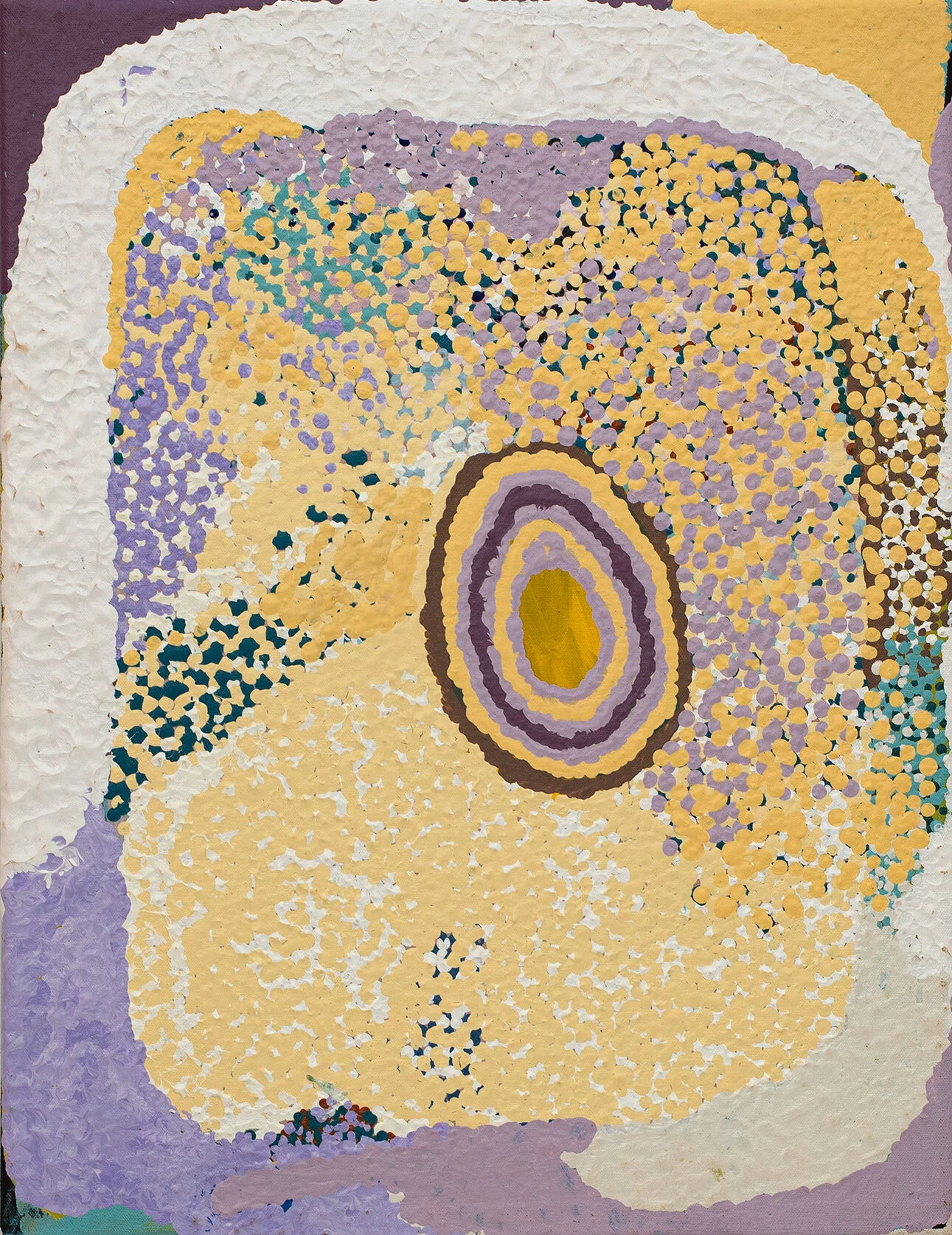
Artiste : Yikartu Bumba (1939)
Titre de l'œuvre : Sans Titre
Format : 61 x 46 cm
Provenance et certificat : centre d'art aborigène de Martumili
Référence de cette peinture : 19-773
Demander le prix de l'œuvre / Enquiry
Explications pour cette œuvre :
This painting portrays physical elements of Martu Country, such as the dominant tali (sandhills), warta (trees, vegetation), and water sources. Rock holes, waterholes, soaks and springs were all extremely important sites for Martu people during the pujiman (nomadic bush) era, with many important jukurrpa (dreamtime stories) chronicling the creation of these landmarks.
In the past the Martu lived nomadically, moving from water source to water source, and hunting and gathering bush tucker as they went. They would traverse very large distances annually, visiting specific areas in the dry and wet season depending on the availability of water. As they travelled and hunted they would also burn areas of country creating a larger diversity of plant and animal life.
© Photo Aboriginal Signatrure Estrangin Gallery, and text with the courtesy of the Artist and Martumili Arts

Artiste : Jakayu Biljabu (1936)
Titre de l'œuvre : Wantili (Well 25)
Format : 61 x 46 cm
Provenance et certificat : centre d'art aborigène de Martumili
Référence de cette peinture : 18-357
Demander le prix de l'œuvre / Enquiry
Explications pour cette œuvre :
Wantili is a large jurnu (soak) and lyinji (clay pan) near Well 25 on the Canning Stock Route. Wantili lies within Jakyu's ngurra (home country), and she travelled extensively around this site as a young girl.
The area is dominated by claypans surrounded by tuwa (sandhills). Following rain the claypans are filled with water, with the overflow from nearby waterholes flowing to Wantili. At that time, Wantili becomes an important place for obtaining fresh water for drinking and bathing. Wantili is significant for the fact that at this site Kartujarra, Manyjilyjarra, Putujarra and Warnman people would all come together for ceremonies. Many jiwa (stones used by women for grinding seeds) from these times can still be found there today.
Wantili is one of the many sites featured in the epic Minyipuru (Seven Sisters) jukurrpa (dreamtime) narrative. The story follows the movement of seven sisters travelling all the way across the desert, beginning at Roebourne on the coast of Western Australia, as they are pursued by a lustful old man, Yurla. As the women travel they stop to rest at many sites to eat, dance, rest and sing, on the way leaving behind an assortment of articles that become formations in the land.
The Seven Sisters rested at Wantili before throwing seeds, then continuing their journey on to Tiwa, Juntujuntu, and then onward to Pangkapini, where they finally escaped Yurla by flying into the sky to become the Pleaides constellation of stars.
© Photo Aboriginal Signatrure Estrangin Gallery, and text with the courtesy of the Artist and Martumili Arts

Artiste : Corban Clause Williams (1994)
Titre de l'œuvre : Kaalpa (Well 23)
Format : 91 x 61 cm
Provenance et certificat : centre d'art aborigène de Martumili
Référence de cette peinture : 19-1070
Demander le prix de l'œuvre / Enquiry
Explications pour cette œuvre :
“Kaalpa is my grandfather ngurra (home) where they walked, hunting bush tuckers. I went there for the first time this year [2018] on a Martumili KJ (Kanyirninpa Jukurrpa) trip. I went hunting there, got a parnajalpa (sand goanna).
When I went there I was pukurlpa (happy). It made you open up your spirt, it feels like home. It’s got kapi (water) there, a well, jurnu (soak) and tuwa (sandhills)” Kaalpa is a place of great cultural significance, is also referred to as Well 23 on the Canning Stock Route. It is a good hunting place as there is permanent kapi.
© Photo Aboriginal Signatrure Estrangin Gallery, and text with the courtesy of the Artist and Martumili Arts

Artiste : Corban Clause Williams (1994)
Titre de l'œuvre : Kaalpa (Well 23)
Format : 91 x 91 cm
Provenance et certificat : centre d'art aborigène de Martumili
Référence de cette peinture : 19-1184
Vendue
Explications pour cette œuvre :
“Kaalpa is my grandfather ngurra (home) where they walked, hunting bush tuckers. I went there for the first time this year [2018] on a Martumili KJ (Kanyirninpa Jukurrpa) trip. I went hunting there, got a parnajalpa (sand goanna).
When I went there I was pukurlpa (happy). It made you open up your spirt, it feels like home. It’s got kapi (water) there, a well, jurnu (soak) and tuwa (sandhills)” Kaalpa is a place of great cultural significance, is also referred to as Well 23 on the Canning Stock Route. It is a good hunting place as there is permanent kapi.
© Photo Aboriginal Signatrure Estrangin Gallery, and text with the courtesy of the Artist and Martumili Arts

Artiste : Corban Clause Williams (1994)
Titre de l'œuvre : Kaalpa (Well 23)
Format : 61 x 46 cm
Provenance et certificat : centre d'art aborigène de Martumili
Référence de cette peinture : 19-676
Demander le prix de l'œuvre / Enquiry
Explications pour cette œuvre :
“Kaalpa is my grandfather ngurra (home) where they walked, hunting bush tuckers. I went there for the first time this year [2018] on a Martumili KJ (Kanyirninpa Jukurrpa) trip. I went hunting there, got a parnajalpa (sand goanna).
When I went there I was pukurlpa (happy). It made you open up your spirt, it feels like home. It’s got kapi (water) there, a well, jurnu (soak) and tuwa (sandhills)” Kaalpa is a place of great cultural significance, is also referred to as Well 23 on the Canning Stock Route. It is a good hunting place as there is permanent kapi.
© Photo Aboriginal Signatrure Estrangin Gallery, and text with the courtesy of the Artist and Martumili Arts

Artiste : Derrick Butt (1976)
Titre de l'œuvre : Kulyakartu (near Percival Lake)
Format : 121 x 91 cm
Provenance et certificat : centre d'art aborigène de Martumili
Référence de cette peinture : 19-1100
Vendue
Explications pour cette œuvre :
This painting depicts Kulyakartu; an area in the far north of the Martu homelands, near the Percival Lakes in the northern Great Sandy Desert. The artist's elders has extensive knowledge of the Country in this region, where she grew up living traditionally during the pujiman (traditional, desert dwelling). Kulyakartu is mostly grass Country where there is very good hunting. There is no permanent water source in Kulyakartu, so the families would walk here annually following the wet season.
© Photo Aboriginal Signatrure Estrangin Gallery, and text with the courtesy of the Artist and Martumili Arts

Artiste : Judith Anya Samson (1994)
Titre de l'œuvre : Puntawarri (near Well 17)
Format : 122 x 76 cm
Provenance et certificat : centre d'art aborigène de Martumili
Référence de cette peinture : 19-480
Demander le prix de l'œuvre / Enquiry
Explications pour cette œuvre :
This painting depicts Puntawarri, the artists’ mother’s family’s country. Puntawarri is on the middle stretches of the Canning Stock Route, near Well 17 also known as Durba Springs. Puntawarri is an important cultural area, east of the Jigalong Aboriginal Community, where the artist now lives with her grandmother. The artist's grandmother frequently travelled and hunted with her family in this area when she was a young girl, and is now teaching Judith the stories for this country.
© Photo Aboriginal Signatrure Estrangin Gallery, and text with the courtesy of the Artist and Martumili Arts

Artiste : Cyril Whyoulter (1985)
Titre de l'œuvre : Wantili (Well 25)
Format : 152 x 75 cm
Provenance et certificat : centre d'art aborigène de Martumili
Référence de cette peinture : 19-200
Vendue
Explications pour cette œuvre :
This painting shows the creation story of Wantili, a big claypan east of Parrngurr close to Kartarru (Well 24) on the Canning Stock Route. This is my Grandmother’s (Bugai Whyoulter) country, my country. Wantili is old Law Grounds from Dreaming days and very important to Martu people.
My grandmother always tells me about Wantili because she grew up around Wantili. It is close to her birthplace and is her ngurra (home country).
She was a young girl walking around at Wantili. Her family would travel between Wantili, Kaalpa, Juntujuntu, Raarki, and Wuranu wells along the Canning Stock Route. Big mob of people they been walking around there. She saw whitefellas there for the first time, Canning mob when they were traveling up and down the stock route with the bullock. ‘They were running away from those whitefellas, watching them from a distance.
© Photo Aboriginal Signatrure Estrangin Gallery, and text with the courtesy of the Artist and Martumili Arts

Artiste : Cyril Whyoulter (1985)
Titre de l'œuvre : Wantili (Well 25)
Format : 61 x 46 cm
Provenance et certificat : centre d'art aborigène de Martumili
Référence de cette peinture : 18-379
Vendue
Explications pour cette œuvre :
This painting shows the creation story of Wantili, a big claypan east of Parrngurr close to Kartarru (Well 24) on the Canning Stock Route. This is my Grandmother’s (Bugai Whyoulter) country, my country. Wantili is old Law Grounds from Dreaming days and very important to Martu people.
My grandmother always tells me about Wantili because she grew up around Wantili. It is close to her birthplace and is her ngurra (home country).
She was a young girl walking around at Wantili. Her family would travel between Wantili, Kaalpa, Juntujuntu, Raarki, and Wuranu wells along the Canning Stock Route. Big mob of people they been walking around there. She saw whitefellas there for the first time, Canning mob when they were traveling up and down the stock route with the bullock. ‘They were running away from those whitefellas, watching them from a distance.
© Photo Aboriginal Signatrure Estrangin Gallery, and text with the courtesy of the Artist and Martumili Arts

Artiste : Cyril Whyoulter (1985)
Titre de l'œuvre : Wantili (Well 25)
Format : 152 x 76 cm
Provenance et certificat : centre d'art aborigène de Martumili
Référence de cette peinture : 19-421
Vendue
Explications pour cette œuvre :
This painting shows the creation story of Wantili, a big claypan east of Parrngurr close to Kartarru (Well 24) on the Canning Stock Route. This is my Grandmother’s (Bugai Whyoulter) country, my country. Wantili is old Law Grounds from Dreaming days and very important to Martu people.
My grandmother always tells me about Wantili because she grew up around Wantili. It is close to her birthplace and is her ngurra (home country).
She was a young girl walking around at Wantili. Her family would travel between Wantili, Kaalpa, Juntujuntu, Raarki, and Wuranu wells along the Canning Stock Route. Big mob of people they been walking around there. She saw whitefellas there for the first time, Canning mob when they were traveling up and down the stock route with the bullock. ‘They were running away from those whitefellas, watching them from a distance.
© Photo Aboriginal Signatrure Estrangin Gallery, and text with the courtesy of the Artist and Martumili Arts

Artiste : Doreen Chapman (1970)
Titre de l'œuvre : Untitled
Format : 122 x 76 cm
Provenance et certificat : centre d'art aborigène de Martumili
Référence de cette peinture : 17-420
Demander le prix de l'œuvre / Enquiry
Explications pour cette œuvre :
Doreen first learned to paint alongside her mother, beginning her artistic career with Martumili Artists in March 2009 when she and the other women of Punmu painted a large collaborative artwork to raise funds for the community. Doreen is now an established artist in her own right, known for her loose, uninhibited painting style. As a deaf woman, painting is an important means of communication and expression for Doreen. As a deaf woman, painting is an important means of communication and expression for Doreen.
Doreen likes to paint the comings and goings of community life- the motorcars, aeroplanes and crillers that populate her homes of Warralong, Punmu and Port Hedland.
© Photo Aboriginal Signatrure Estrangin Gallery, and text with the courtesy of the Artist and Martumili Arts

Artiste : Mulyatingki Marney (1940)
Titre de l'œuvre : Minyipuru, Pangkal area
Format : 120 x 76 cm
Provenance et certificat : centre d'art aborigène de Martumili
Référence de cette peinture : 16-511
Demander le prix de l'œuvre / Enquiry
Explications pour cette œuvre :
"Seven Sister's way, Minyipuru (Seven Sisters) way. Pangkal painting, this Pangkal Country. Mima (women), [motions to semicircluar forms], all lot. All the mima been dancing there in that ngurra (camp), dancing jakulyukulyu (Seven Sisters), walkajunu (painted, decorated) there."
- Mulyatingki Marney
This painting depicts a part of the Minyipuru story located at the Pangkal rockhole near Telfer. Minyipuru is an
important Jukurrpa (dreamtime) story about seven sisters that are travelling throughout the desert as they are pursued by Yurla, a lustful old man. The man chases the wanti (women) all the way from Roebourne on the west coast right through Martu country before flying east. Along the way they stop at many significant sites to camp, sing, dance and collect bush tucker. There are also many interactions with Yurla when he catches up with them along the way, creating an amazing abundance of stories and meaning with this culturally rich narrative. The story is associated with the Pleiades star constellation.
© Photo Aboriginal Signatrure Estrangin Gallery, and text with the courtesy of the Artist and Martumili Arts

Artiste : Bugai Whyoulter (1939)
Titre de l'œuvre : Wantili (near Well 25)
Format : 152 x 106 cm
Provenance et certificat : centre d'art aborigène de Martumili
Référence de cette peinture : 19-708
Demander le prix de l'œuvre / Enquiry
Explications pour cette œuvre :
(As translated by Bugai’s grandson, Cyril Whyoulter) “Bugai always tells about Wantili because she grew up around Wantili. Her family would travel between Wantili, Kaalpa, Juntujuntu, Raarki, and Wuranu Wells along the Canning Stock Route. She paints around Wantili. She saw whitefellas there for the first time, Canning mob when they were travelling up and down the stock route with the bullock. She was a young girl walking around at Wantili. Big mob of people they been walking around there. They were travelling making the road, Canning and his drovers. They were running away from those whitefellas, watching them from a long distance. She was a teenager when she was travelling around there with her four mothers and one daddy. Her mummy and daddy passed away in Jigalong. They used to travel around in family groups, Bugai and Jakayu (Biljabu), and Jakayu’s nyupa (partner) Phillip Biljabu. They met Kumpaya (Girgaba) coming from Kunkun (Kunawarritji) area.”
Bugai returned to the Wantili area as a young woman, when she worked driving cattle along the Stock Route.
Wantili is a large jurnu (soak) and lyinji (clay pan) near Well 25 on the Canning Stock Route. It lies close to Bugai’s birthplace, and is her ngurra (home country). The area is dominated by claypans surrounded by tuwa (sandhills). Following rain the claypans are filled with water, with the overflow from nearby waterholes flowing to Wantili. At that time, Wantili becomes an important place for obtaining fresh water for drinking and bathing. Wantili is significant for the fact that at this site Kartujarra, Manyjilyjarra, Putujarra and Warnman people would all come together for ceremonies. Many jiwa (stones used by women for grinding seeds) from these times can still be found there today.
Wantili is one of the many sites featured in the epic Minyipuru (Seven Sisters) jukurrpa (dreamtime) narrative. The story follows the movement of seven sisters travelling all the way across the desert, beginning at Roebourne on the coast of Western Australia, as they are pursued by a lusful old man, Yurla. As the women travel they stop to rest at many sites to eat, dance, rest and sing, on the way leaving behind an assortment of articles that become formations in the land.
The Seven Sisters rested at Wantili before throwing seeds, then continuing their journey on to Tiwa, Juntujuntu, and then onward to Pangkapini, where they finally escaped Yurla by flying into the sky to become the Pleaides constellation of stars.
© Photo Aboriginal Signatrure Estrangin Gallery, and text with the courtesy of the Artist and Martumili Arts
En tant que partenaire et représentant des centres d’art Aborigène soutenus par le gouvernement Australien, la galerie Aboriginal Signature Estrangin vous permet d’avoir un accès privilégié en Europe à des œuvres recherchées, disposant des meilleures provenances éthiques reconnues par les grandes institutions et collections privées ou publiques.
A travers notre programme d’exposition en Europe, nous vous invitons à voyager à travers le temps et les immensités Aborigènes pour apprivoiser toute l’amplitude et l’excellence de ce mouvement artistique contemporain.

Cette Exposition a été montée en partenariat avec les artistes et l’équipe du centre d’art de Martumili. Je tiens à les remercier particulièrement pour leur accueil en 2018 au sein des communautés Aborigènes éloignées de Western Australia.
Artiste : Jakayu Biljabu (1936)
Titre de l'œuvre : Pitu (Separation Well)
Format : 152 x 76 cm
Provenance et certificat : centre d'art aborigène de Martumili
Référence de cette peinture : 18-441
Vendue
Explications pour cette œuvre :
“Ngurra me, my ngurra (this is my country, my home).
This painting depicts Pitu (Separation Well), an area east of Parnngurr in the Western Desert, not far from the Canning Stock Route. Jakayu was born at Pitu. It is her country, as well as the site of a warla (lake) and large jurnu (rockhole).
This painting depicts Pitu (Separation Well), an area east of Parnngurr in the Western Desert, not far from the Canning Stock Route. Jakayu was born at Pitu. It is her country, as well as the site of a warla (lake) and large jurnu (rockhole). Bugai's family would regularly meet with Jakayu's family at Pitu during certain times of the year.
© Photo Aboriginal Signatrure Estrangin Gallery, and text with the courtesy of the Artist and Martumili Arts