Peintures d'art Aborigène d’Iwantja, APY land
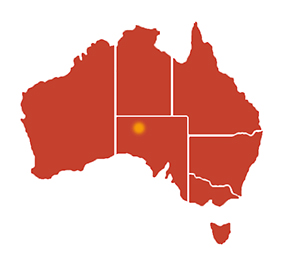
Iwantja Arts est un centre d'art aborigène détenu et géré par les Aborigènes, dans le pays rocheux et désertique de la communauté d’Indulkana sur les terres Anangu Pitjantjatjara Yankunytjatjara (APY) dans le nord-ouest reculé de l'Australie du Sud.
Iwantja Arts tire son nom du ruisseau Iwantja près de l'endroit où la communauté d’Indulkana a été fondée, sur le site fondateur de l’hibou indigène (Tjurki Tjukurpa), une histoire fondamentale du Temps du Rêve.
Le centre d'art a été créé au début des années 1980 par les artistes et directeurs Alec Baker et Sadie Singer. Depuis Iwantja Arts soutient le cheminement artistique de ses 40 membres, principalement des artistes Yankunytjatjara, en leur offrant un accès au développement artistique. Iwantja Arts est réputé pour ses projets innovants et culturellement riches avec des résultats prestigieux qui célèbrent la force culturelle et l'excellence artistique du peuple Anangu.
Peintures des artistes Aborigènes de Mimili Maku disponibles au sein de la galerie :
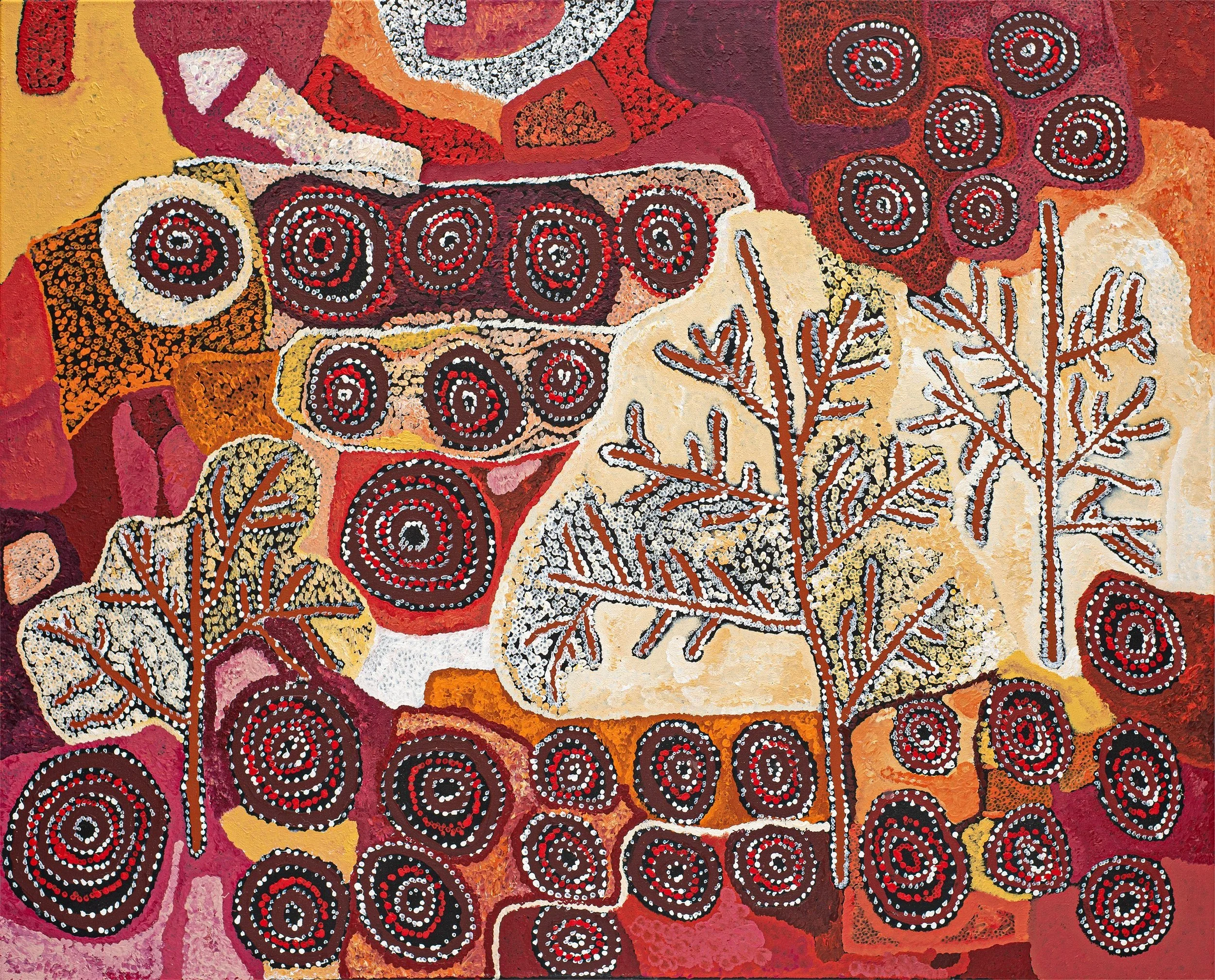
Artistes : Eric (Mungi) Barney (1973)
Titre de l'œuvre : Ngura (Country)
Format : 152 x 122 cm
Provenance et certificat : centre d'art aborigène d’Iwantja
Référence de cette peinture aborigène : 192-23
Explications pour cette peinture d'art Aborigène :
In Eric Barney’s paintings of Yankunytjatjara Country, mark-making is a form of mapping. Barney defines the terrain of his country by carving out sections of colour, the paint energetically applied to the canvas with a sense of rhythm and purpose. Barney interprets the rocky desert country around Indulkana Community through colour, tone and form. His powerfully understated paintings depict Tjukula (rock-holes), and the knowledge of these vitally important water sources that have sustained Anangu for generations.

Artistes : Maisie King (1932)
Titre de l'œuvre : Ngayuku Ngura (My Country)
Format : 91 x 67 cm
Provenance et certificat : centre d'art aborigène d’Iwantja
Référence de cette peinture aborigène : 801-21
Explications pour cette peinture d'art Aborigène :
“This is my artwork, this is Oodnadatta country. This is where I was born. The country there is beautiful and very good. The land is very old and the stories there are strong. This is Yankunytjatjara country.”
Maisie Kings paintings map out the boulders and rocky terrain of the Oodnadatta country east of Indulkana in Yankunytjatjara country. Her linear forms take on sculptural elements as she marks out the large boulders and the rockholes and springs surrounding the country. Painting out an inky background, she lays down thin painterly lines in luminous colours that glow off a deep background.

Artistes : Priscilla Singer (1968)
Titre de l'œuvre : Tali Tjitin-tjitinpa (Glowing Red Sand)
Format : 152 x 122 cm
Provenance et certificat : centre d'art aborigène d’Iwantja
Référence de cette peinture aborigène : 209-23
Explications pour cette peinture d'art Aborigène :
"I paint my ngura (Country) and its red sand. This land is my grandfather’s country, he stood on this ground before me. I feel that connection to my family as I paint. This land that has held its many generations. This land is always changing, the rains come, and the winds shift. The red sand never changes, it is always here. I love the strong colours of the sand. When the sun sets, you can see the glow of the earth. I paint this country so people can see my land, they can appreciate its beauty and understand its power.
Our culture is very strong here, we teach our children in the community school, and we also teach them through our paintings, and through our time spent on Country. It is very important that the next generation understands by heart the Tjukurpa that has been passed down to us from our ancestors over many years. We tell the young people, you must listen and learn. It is important to keep our culture alive and strong long into the future.
My mother Kunmanara (Sadie) Singer, started Iwantja Arts many years ago with Alec Baker. She had a strong vision for the future of our community and also for sharing our stories and keeping our culture strong through the art centre. I think about her when I make my paintings. When I paint my Country, when I dance and sing the songs of my Country, I feel the spirit of my family and ancestors close to me. Their presence continues to watch over us and keep us strong.”
Priscilla Singer is a Yankunytjatjara woman and senior Cultural Leader within the Indulkana community. The Yankunytjatjara Principle at the Indulkana Anangu School, Priscilla has played a significant role with bilingual learning strategies, and the integration of cultural activities into the school curriculum.

Artistes : Trisha Singer (1973)
Titre de l'œuvre : Tali Ngura (Sandhill Country)
Format : 167 x 152 cm
Provenance et certificat : centre d'art aborigène d’Iwantja
Référence de cette peinture aborigène : 214-23
Explications pour cette peinture d'art Aborigène :
"This is Yankunytjatjara Country. I paint this Country that is my home, Iwantja is a good place. It is an important place to me and my family. There are many rockholes and caves here, there is also sandhills and dry plains that stretch out very far. I paint the important places that I know well, that my mother shared with me. My mother started this art centre, I feel close to her when I am painng here amongst my aunties.
Trish Singer is a Yankunytjatjara woman and cultural leader within the Indulkana community. Her mother Kumanara (Sadie) Singer worked with fellow artist Alec Baker to petition the Australian government for assistance and funding in establishing the Iwantja Art arts centre where Trish continues to paint today.

Artistes : Priscilla Singer (1968)
Titre de l'œuvre : Tali Tjitin-tjitinpa (Glowing Red Sand)
Format : 152 x 167 cm
Provenance et certificat : centre d'art aborigène d’Iwantja
Référence de cette peinture aborigène : 408-23
Explications pour cette peinture d'art Aborigène :
"I paint my ngura (Country) and its red sand. This land is my grandfather’s country, he stood on this ground before me. I feel that connection to my family as I paint. This land that has held its many generations. This land is always changing, the rains come, and the winds shift. The red sand never changes, it is always here. I love the strong colours of the sand. When the sun sets, you can see the glow of the earth. I paint this country so people can see my land, they can appreciate its beauty and understand its power.
Our culture is very strong here, we teach our children in the community school, and we also teach them through our paintings, and through our time spent on Country. It is very important that the next generation understands by heart the Tjukurpa that has been passed down to us from our ancestors over many years. We tell the young people, you must listen and learn. It is important to keep our culture alive and strong long into the future.
My mother Kunmanara (Sadie) Singer, started Iwantja Arts many years ago with Alec Baker. She had a strong vision for the future of our community and also for sharing our stories and keeping our culture strong through the art centre. I think about her when I make my paintings. When I paint my Country, when I dance and sing the songs of my Country, I feel the spirit of my family and ancestors close to me. Their presence continues to watch over us and keep us strong.”
Priscilla Singer is a Yankunytjatjara woman and senior Cultural Leader within the Indulkana community. The Yankunytjatjara Principle at the Indulkana Anangu School, Priscilla has played a significant role with bilingual learning strategies, and the integration of cultural activities into the school curriculum.

Artistes : Yatjiki Cullinan
Titre de l'œuvre : Ngura (Country)
Format : 152 x 122 cm
Provenance et certificat : centre d'art aborigène d’Iwantja
Référence de cette peinture aborigène : 331-23
Explications pour cette peinture d'art Aborigène :
I am a Yankunytjatjara woman from Indulkana Community on the Anangu Pitjantjatjara Yankunytjatjara (APY) Lands in South Australia. I’m an artist at Iwantja Arts, where I started painting over 20 years ago.
My paintings are of Tjukurpa (ancestral stories) and ngura (country) that have cultural significance for me and my family. They are a combination of landscape – specific locations and landmarks - and representations of the sky and stars. For Anangu the stars hold Tjukurpa (Ancestral cultural stories) just like the country - the rockholes, hills and creeks – have Tjukurpa. One main one is the Kungkarangkalpa (Seven Sisters) Tjukurpa where a specific constellation represents the sisters and the cheeky man chasing after them.
I’m proud to be an artist and a leader in my community, working to keep our culture strong and passing on important knowledge to the next generations.

Artistes : Rosalind Tjanyari (1971)
Titre de l'œuvre : Ngura Kuuti (Spirit Country)
Format : 167 x 152 cm
Provenance et certificat : centre d'art aborigène d’Iwantja
Référence de cette peinture aborigène : 238-23
Explications pour cette peinture d'art Aborigène :
Both Rosalind’s mother and grandmother were famous Ngangkari’s (traditional healers) in the western country of the APY Lands, she has many family members in the Amata community. Rosalind spent a life time outdoors with her mother and grandmother traveling to visit family and friends in need of healing.
Rosalind's' paintings allude to a healing energy and strive to encompass the desert landscape. Her artworks speak to a deep history of connection to both country and people. Richly coloured, her paintings reference hidden pathways across the lands, and subtly hint at the fluidity of movement and of journeys. Her painterly marks weave colour through the canvas, flickering with an energy and excitement.
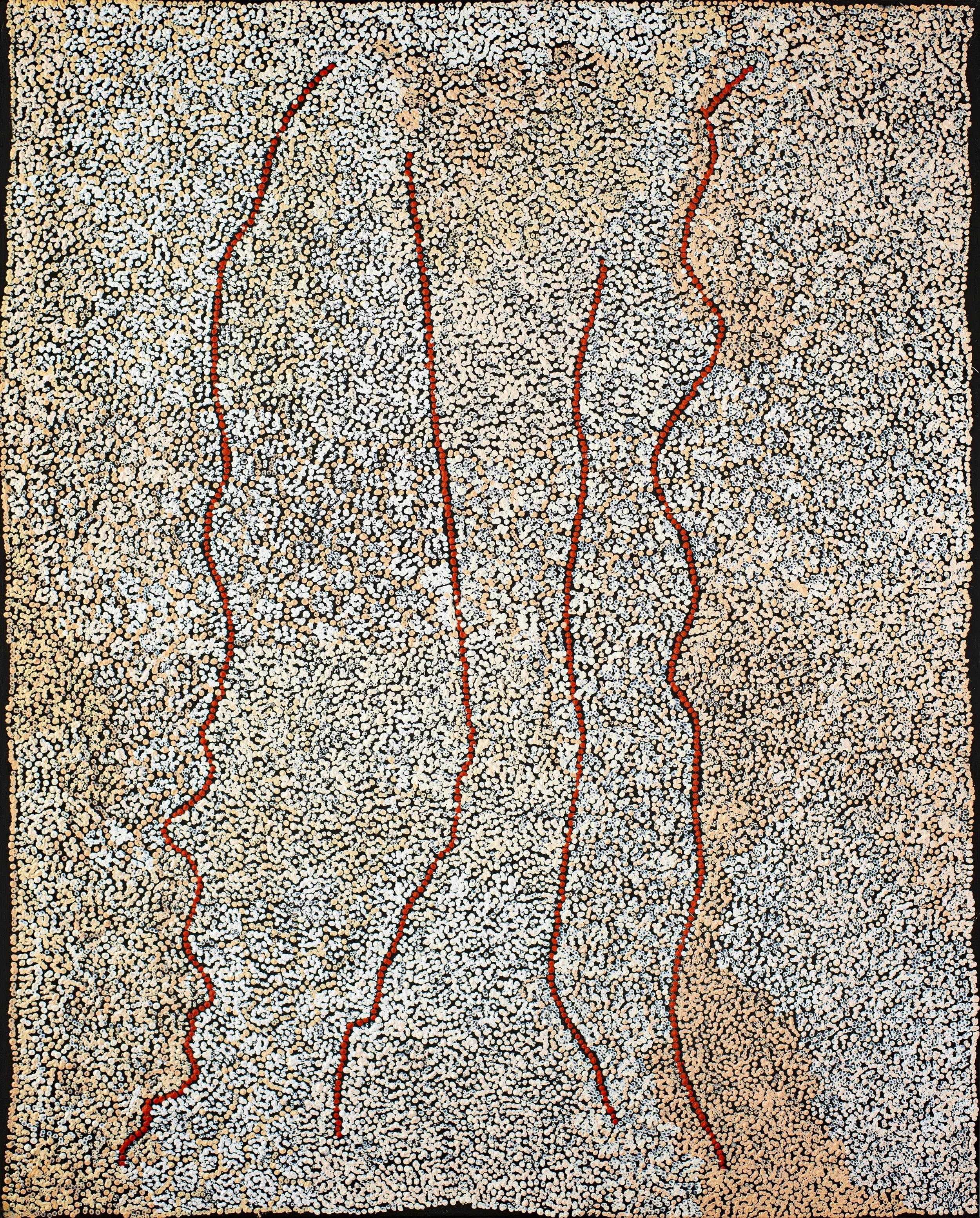
Artistes : Rene Sundown (1952)
Titre de l'œuvre : Ngura Tali - Sand dune Country
Format : 152 x 122 cm
Provenance et certificat : centre d'art aborigène d’Iwantja
Référence de cette peinture aborigène : 521-23
Explications pour cette peinture d'art Aborigène :
Rene was born in the bush land that surrounds Mt Ebenezer. Rene and her two older brothers were raised in the bush by her mother while her father worked as a stockman between Mt Ebenezer Station and Erldunda Station, which are both located along the Lasseter Hwy towards Uluru.
“I was raised at Erldunda Station, where my father was working. That’s where we lived. No school at all, I just grew up on the stations.
That place is all sand dune country. We would play in the sand dunes. We would just run around and roll down the sand dunes, down we would tumble, down the sand dune and roll down arriving at the bottom. it was really nice back then, playing. we would swim in the claypans after rain time and we would eat lots of bush onions.
These are the paintings I have been doing. This is my thinking and painting (sand dune) memories. Memories of what I saw, sand dunes that we played on. When I’m painting my feelings became strong. and all my memories come back. I’m thinking of those sand dunes and then painting them. This is the sand dunes and spinifex grass. Sand dune country was our home.”
Rene began painting at Iwantja Arts in the year 2000, painting memories of the long walks she would take along the sandhills and the salty river water near Erldunda Station that she played in as a child. Her paintings use a simple colour palette and gain complexity through her confident brush marks and intriguing iconography. Rene’s paintings evoke images of desert grasses, hidden pathways and sun-cracked riverbeds.

Artistes : Rene Sundown (1952)
Titre de l'œuvre : Ngura Tali - Sand dune Country
Format : 122 x 91 cm
Provenance et certificat : centre d'art aborigène d’Iwantja
Référence de cette peinture aborigène : 576-23
Explications pour cette peinture d'art Aborigène :
Rene was born in the bush land that surrounds Mt Ebenezer. Rene and her two older brothers were raised in the bush by her mother while her father worked as a stockman between Mt Ebenezer Station and Erldunda Station, which are both located along the Lasseter Hwy towards Uluru.
“I was raised at Erldunda Station, where my father was working. That’s where we lived. No school at all, I just grew up on the stations.
That place is all sand dune country. We would play in the sand dunes. We would just run around and roll down the sand dunes, down we would tumble, down the sand dune and roll down arriving at the bottom. it was really nice back then, playing. we would swim in the claypans after rain time and we would eat lots of bush onions.
These are the paintings I have been doing. This is my thinking and painting (sand dune) memories. Memories of what I saw, sand dunes that we played on. When I’m painting my feelings became strong. and all my memories come back. I’m thinking of those sand dunes and then painting them. This is the sand dunes and spinifex grass. Sand dune country was our home.”
Rene began painting at Iwantja Arts in the year 2000, painting memories of the long walks she would take along the sandhills and the salty river water near Erldunda Station that she played in as a child. Her paintings use a simple colour palette and gain complexity through her confident brush marks and intriguing iconography. Rene’s paintings evoke images of desert grasses, hidden pathways and sun-cracked riverbeds.

Artistes : Rene Sundown (1952)
Titre de l'œuvre : Ngura Tali - Sand dune Country
Format : 152 x 122 cm
Provenance et certificat : centre d'art aborigène d’Iwantja
Référence de cette peinture aborigène : 644-23
Explications pour cette peinture d'art Aborigène :
Rene was born in the bush land that surrounds Mt Ebenezer. Rene and her two older brothers were raised in the bush by her mother while her father worked as a stockman between Mt Ebenezer Station and Erldunda Station, which are both located along the Lasseter Hwy towards Uluru.
“I was raised at Erldunda Station, where my father was working. That’s where we lived. No school at all, I just grew up on the stations.
That place is all sand dune country. We would play in the sand dunes. We would just run around and roll down the sand dunes, down we would tumble, down the sand dune and roll down arriving at the bottom. it was really nice back then, playing. we would swim in the claypans after rain time and we would eat lots of bush onions.
These are the paintings I have been doing. This is my thinking and painting (sand dune) memories. Memories of what I saw, sand dunes that we played on. When I’m painting my feelings became strong. and all my memories come back. I’m thinking of those sand dunes and then painting them. This is the sand dunes and spinifex grass. Sand dune country was our home.”
Rene began painting at Iwantja Arts in the year 2000, painting memories of the long walks she would take along the sandhills and the salty river water near Erldunda Station that she played in as a child. Her paintings use a simple colour palette and gain complexity through her confident brush marks and intriguing iconography. Rene’s paintings evoke images of desert grasses, hidden pathways and sun-cracked riverbeds.

Artistes : Maringka Burton (1950)
Titre de l'œuvre : Anumara Piti
Format : 152 x 122 cm
Provenance et certificat : centre d'art aborigène d’Iwantja
Référence de cette peinture aborigène : 575-23
Explications pour cette peinture d'art Aborigène :
Maringka’s country is in the far western region of the APY Lands, close to the West Australian border. The dreaming story of the caterpillar is special to that area and Maringka often paints themes of this story into her canvas.
"I really always paint this Country, Anumara Piti. I paint the big rockholes with the linking paths taken by the green Anumara caterpillars, creating the Country, travelling in their long lines as always. Really, as I say, I have painted my Tjukurpa [ancestral creaon story] for a long time, the ‘Caterpillar Dreaming’ at Anumara Piti."

Artistes : Emily Cullinan (1952)
Titre de l'œuvre : Ananyi Ngura (Traveling Country)
Format : 91 x 67 cm
Provenance et certificat : centre d'art aborigène d’Iwantja
Référence de cette peinture aborigène : 465-23
Explications pour cette peinture d'art Aborigène :
Emily was born in rugged bush land, close to the Eastern APY community of Mimili. Her father was a respected cultural law man, and taught her and her two young sisters to live a traditional life. Emily did not encounter European settlers until she was a teenager.
Emily and her family used to travel long distances by walking or occasionally hitching wagons to camels and donkeys, they would camp at night inside hand built wiltjas (shelters) in the bush, sleeping in the warm sand.
The walk between Indulkana and Mimili regions took her 5 days, she recalls traveling this route many times to visit family. Emily’s powerful paintings depict the iconic waterholes, majestic boulders, and river beds she would cross on her journey.

Artistes : Rosalind Tjanyari (1971)
Titre de l'œuvre : Ngura Kuuti (Spirit Country)
Format : 198 x 198 cm
Provenance et certificat : centre d'art aborigène d’Iwantja
Référence de cette peinture aborigène : 357-23
Explications pour cette peinture d'art Aborigène :
Both Rosalind’s mother and grandmother were famous Ngangkari’s (traditional healers) in the western country of the APY Lands, she has many family members in the Amata community. Rosalind spent a life time outdoors with her mother and grandmother traveling to visit family and friends in need of healing.
Rosalind's' paintings allude to a healing energy and strive to encompass the desert landscape. Her artworks speak to a deep history of connection to both country and people. Richly coloured, her paintings reference hidden pathways across the lands, and subtly hint at the fluidity of movement and of journeys. Her painterly marks weave colour through the canvas, flickering with an energy and excitement.

Artistes : Emily Cullinan (1952)
Titre de l'œuvre : Ananyi Ngura (Traveling Country)
Format : 91 x 67 cm
Provenance et certificat : centre d'art aborigène d’Iwantja
Référence de cette peinture aborigène : 466-23
Explications pour cette peinture d'art Aborigène :
Emily was born in rugged bush land, close to the Eastern APY community of Mimili. Her father was a respected cultural law man, and taught her and her two young sisters to live a traditional life. Emily did not encounter European settlers until she was a teenager.
Emily and her family used to travel long distances by walking or occasionally hitching wagons to camels and donkeys, they would camp at night inside hand built wiltjas (shelters) in the bush, sleeping in the warm sand.
The walk between Indulkana and Mimili regions took her 5 days, she recalls traveling this route many times to visit family. Emily’s powerful paintings depict the iconic waterholes, majestic boulders, and river beds she would cross on her journey.

Artistes : Sallyanne Roberts (1986)
Titre de l'œuvre : Kuru Ala
Format : 152 x 167cm
Provenance et certificat : centre d'art aborigène d’Iwantja
Référence de cette peinture aborigène : 239-23
Explication pour cette œuvre :
Sallyanne Roberts (1986) said : “I grew up in my grandmothers country close to Nyapari, my grandmothers name is Wingu Tingima; she was a Ngangkari (traditional healer) and a famous painter. When she was getting very old, she taught me her stories, and how to paint them in our special family’s way. She taught me how to paint the pictures of Kuru Ala country – it’s a special place just for women. My paintings are about the country called Kura Ala, I’ve been there with my grandmother and other women before – it’s a special country only for women. My grandmother Wingu would say; “You can go there and travel through the area, but you shouldn’t stop there or you might get sick. It’s a special place where young girls go to become women, they can have special inma (ceremonies) there and have a time for healing.” In my paintings I show all the women out at Kura Ala gathering food from the bush to eat after the inma. The large curved shapes link colourful rings patterns and pathways together, they are the patterns made by the ladies footsteps from their special inma dance. The circles with thin lines reaching out of them are the wiltja’s (camp houses) the women have made from tree branches and sticks. Some areas of the canvas depict the special rock hole – but it’s not for swimming in, only the little yellow round rock holes shown in the middle of the canvas are for swimming. The ladies are shown by the semi circle shape, gathering together for dancing and teaching the young girls lessons.
This site forms part of the Kungkarankalpa Tjukurpa or Seven Sister's Creation Line that follows a group of women as they traverse the country evading the pursuit of a lustful older man, Nyiru. Nyiru has metamorphic powers of transformation and changes into different flora and fauna to trick the women.
These are creation beings and as such shape the landscape as they move through it. At Kuru Ala there is the physical reminders of their presence in the form of monolithic rock formations depicting the characters. From Kuru Ala the women chase a Kuniya (Carpet Python) through Tjukaltjara to the site of Kulyuru.

Artistes : Emily Cullinan (1952)
Titre de l'œuvre : Ananyi Ngura (Traveling Country)
Format : 91 x 67 cm
Provenance et certificat : centre d'art aborigène d’Iwantja
Référence de cette peinture aborigène : 494-23
Explications pour cette peinture d'art Aborigène :
Emily was born in rugged bush land, close to the Eastern APY community of Mimili. Her father was a respected cultural law man, and taught her and her two young sisters to live a traditional life. Emily did not encounter European settlers until she was a teenager.
Emily and her family used to travel long distances by walking or occasionally hitching wagons to camels and donkeys, they would camp at night inside hand built wiltjas (shelters) in the bush, sleeping in the warm sand.
The walk between Indulkana and Mimili regions took her 5 days, she recalls traveling this route many times to visit family. Emily’s powerful paintings depict the iconic waterholes, majestic boulders, and river beds she would cross on her journey.
Artistes : Trisha Singer (1973)
Titre de l'œuvre : Tali Ngura (Sandhill Country)
Format : 152 x 122 cm
Provenance et certificat : centre d'art aborigène d’Iwantja
Référence de cette peinture aborigène : 59-23
Demander le prix de l'œuvre
Explications pour cette peinture d'art Aborigène :
"This is Yankunytjatjara Country. I paint this Country that is my home, Iwantja is a good place. It is an important place to me and my family. There are many rockholes and caves here, there is also sandhills and dry plains that stretch out very far. I paint the important places that I know well, that my mother shared with me. My mother started this art centre, I feel close to her when I am painng here amongst my aunties.
Trish Singer is a Yankunytjatjara woman and cultural leader within the Indulkana community. Her mother Kumanara (Sadie) Singer worked with fellow artist Alec Baker to petition the Australian government for assistance and funding in establishing the Iwantja Art arts centre where Trish continues to paint today.