
Exposition d’art Aborigène “From the desert to the sea”
En partenariat avec les communautés aborigènes du désert central vers l’ocean
A la galerie Aboriginal Signature Estrangin : 101 rue Jules Besme, 1081 Bruxelles.
Vernissage sur RDV le mardi 1 décembre de 14h à 21h30.
Discours et drink à 20h.
Ensuite la galerie vous reçoit sur RDV, du mercredi 2 décembre au mardi 22 décembre 2026, du mardi au samedi, de 11h à 19h : vous pouvez réserver votre visite dés à présent dans notre agenda ici.
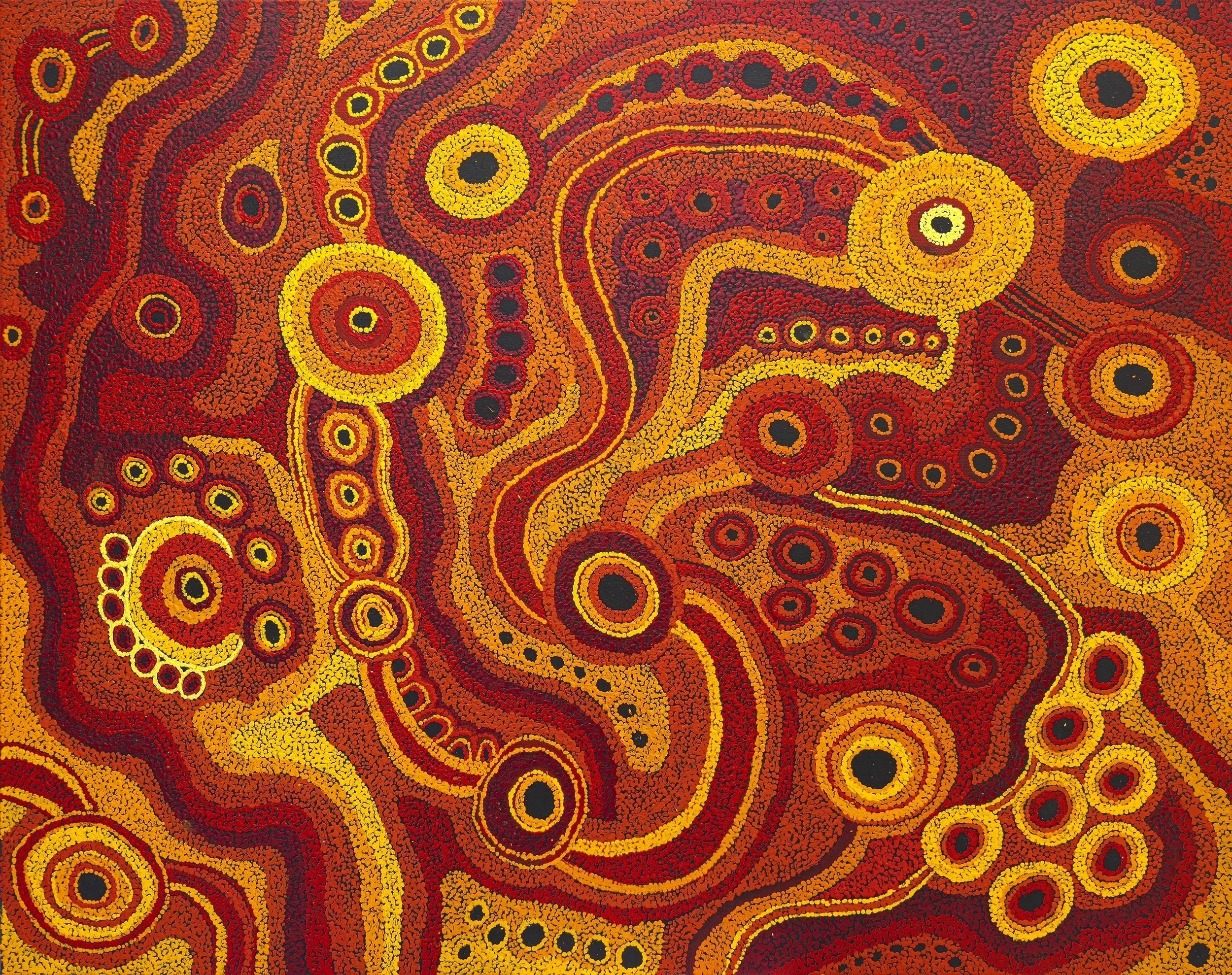
Peinture de l’artiste Sandra Ken - Seven Sisters - 152,5 x 122 cm - 476-23 © Photo Aboriginal Signature Estrangin Gallery with the courtesy of Tjala Arts
Toutes les œuvres proviennent directement de différents centre d’arts et sont accompagnées de leur certificat d'authenticité. Aboriginal Signature Estrangin, première galerie bruxelloise consacrée à l'art aborigène d'Australie et adhérente à l'Indigenous Art Code, travaille en partenariat direct avec les centres d'art. Chaque acquisition soutient la communauté de Mimili et la transmission de sa culture.
Ces œuvres ne sont pas des illustrations : elles sont, tout à la fois, une carte, une loi, une généalogie, une prière, une révérence. La cristallisation contemporaine de la plus ancienne tradition picturale vivante au monde — un art qui rayonne aujourd'hui du Metropolitan à la Tate Modern, du quai Branly au British Museum, et que nous sommes heureux d'accueillir à Bruxelles, à Koekelberg.
Leurs œuvres célèbrent leurs paysages grandioses et signifiants, porteurs d’une mémoire ancestrale, ancrée, et portée par les hommes et femmes extraordinaires qui résident dans ces contrées hors du temps, connectées à la terre, considérées par les Australiens comme les coins les plus éloignés de leur pays.
Nous nous réjouissons de vous accueillir au sein de la galerie à Bruxelles, dans notre espace de 250 m2 tout entier dédié à ces grands et petits trésors du bout du monde.
Vernissage le mardi 1er décembre 2026, de 14h à 21h30.
Exposition à découvrir ensuite sur rendez-vous ici, du mardi au samedi de 11h à 19h.
101 rue Jules Besme, 1081 Bruxelles — +32 (0)475 55 08 54
Découvrez l’ensemble des peintures de l’exposition ci-dessous

Artiste : Patrick Tjungurrayi
Titre de l'œuvre : Rockhole site of Wirrilpinya (ancestral Tingari cycle)
Format : 91 x 91 cm
Provenance et certificat : centre d'art aborigene de Papunya Tula Artists
Référence de cette peinture aborigene : PT1306081

Artiste : Sandra Ken
Titre de l'œuvre : Seven Sisters
Format : 152,5 x 122 cm
Provenance et certificat : centre d'art aborigène de Tjala Arts
Référence de cette peinture aborigène : 476-23
Explication pour cette œuvre :
This is a Tjukurpa Story (Creation Story) about the constellations of Pleiades and Orion. The sisters are the constellaton of Pleiades and the other star Orion is said to be Nyiru or Nyirunya (described as a lusty or bad man). Nyiru is forever chasing the sisters known as the Kunkarunkara women as it is said he wants to marry the eldest sister. The seven sisters travel again and again from the sky to the earth to escape Nyiru’s unwanted attentions. They turn into their human form to escape from the persistent Nyiru, but he always finds them and they flee back to the sky. As Nyiru is chasing the sisters he tries to catch them by using magic to turn into the most tempting kampurarpra (bush tomatoes) for the sisters to eat and the most beautiful Ili (fig) tree for them to camp under. However, the sisters are too clever for Nyiru and outwit him as they are knowledgeable about his magic. They go hungry and run through the night rather than be caught by Nyiru. Every now and again one of the women fall victim to his ways. It is said that he eventually captures the youngest sister, but with the help of the oldest sister, she escapes back to her sisters who are waiting for her. Eventually the sisters fly back into the sky to escape Nyiru, reforming the constellation.
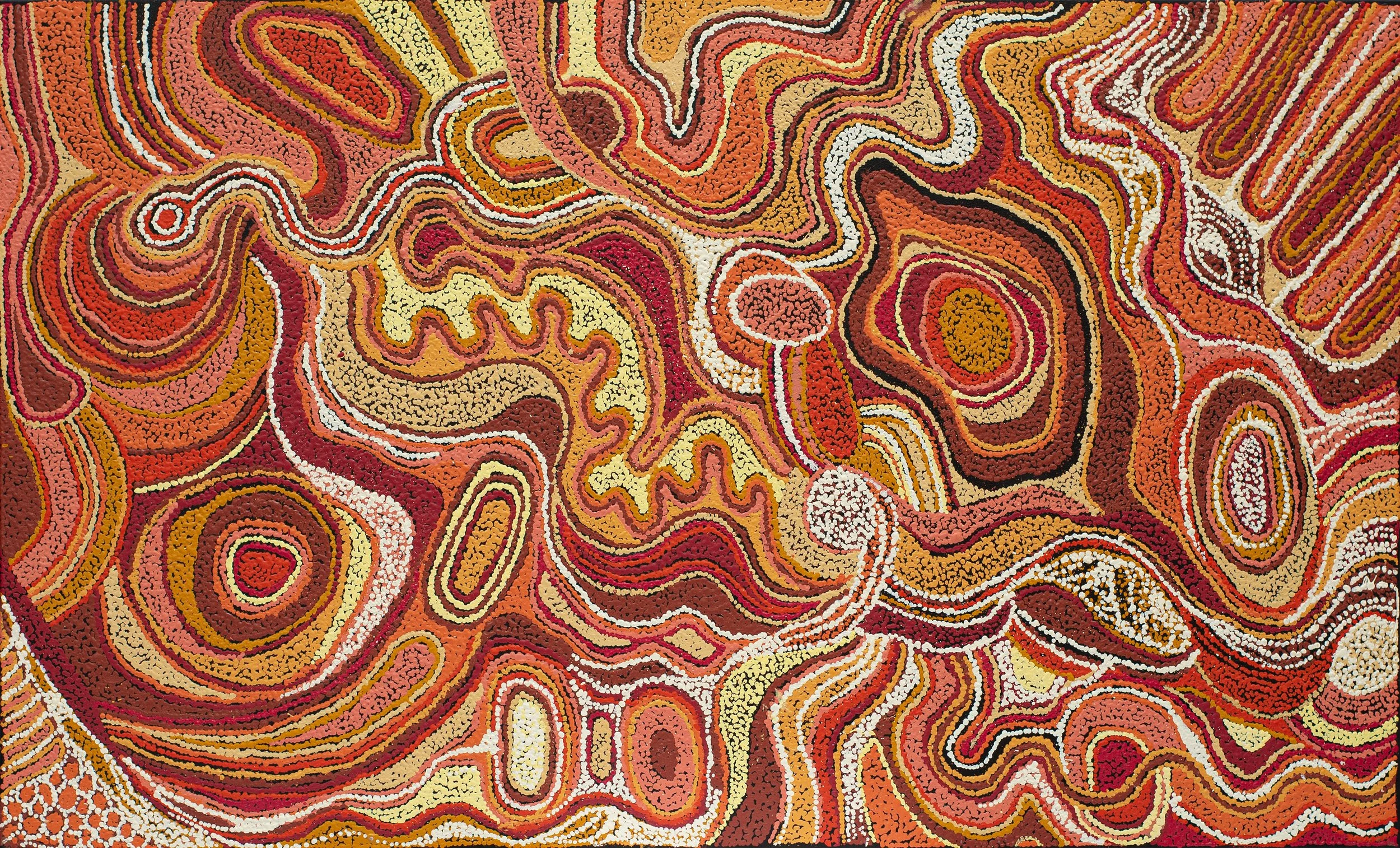
Artiste : Langaliki Lewis
Titre : Tjukula/Waterholes
Format : 148 × 99 cm
Provenance et certificat : centre d'art aborigène d’Ernabella
Référence de cette peinture aborigène : 210-25
Explication sur cette œuvre :
Painting by Langaliki Lewis (1973). For the Pitjantjatjara people living in the desert, knowledge of their water sources was critical to their survival.
This is a depiction of the artists' country. The different colours and designs represent variations in the landscape.
This design is inspired by the red sand dunes that are found throughout the central desert. There is a large red sand dune near Ernabella named Wamikata which is a popular place for looking for maku (witchetty grubs) and for teaching Milpatjunanyi (telling stories in the sand) to children.
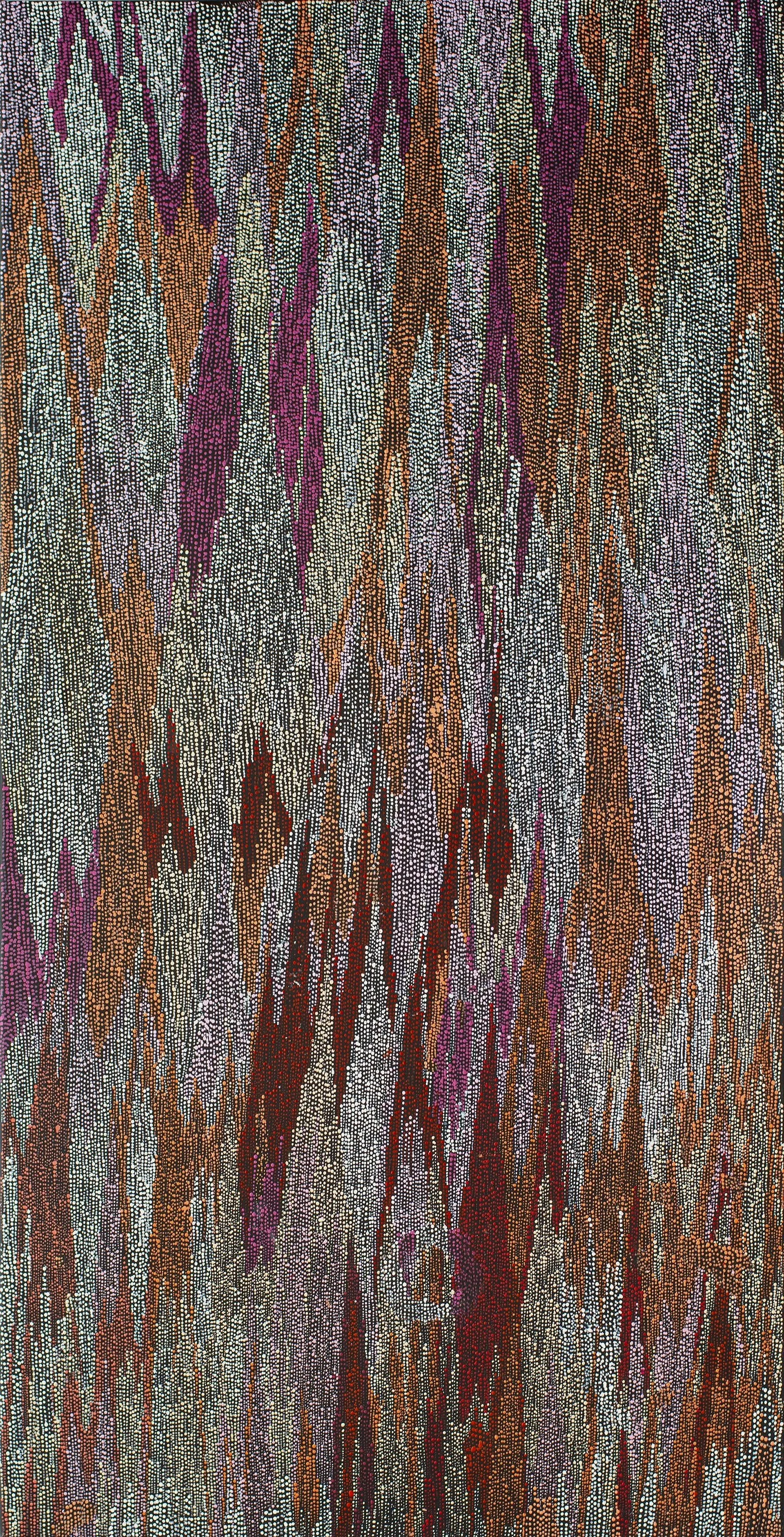
Artiste : Lynette Lewis
Titre de l'œuvre : Wamikata Walka Tali / Sand dune
Format : 149 × 75 cm
Provenance et certificat : centre d'art d'Ernabella
Référence de la peinture : 330-25
Explications sur cette peinture Aborigène :
Lynette's design is inspired by the ripples created by wind in the sand at the large, red sand dune named Wornikata near Ernabella. Womikata is a popular place for looking for maku (witchetty grubs) and also for teaching Milpatjunanyi (telling stories in the sand) to children.

Artiste : Langaliki Lewis
Titre : Tali / Sand dune
Format : 149 x 89 cm
Provenance et certificat : centre d'art aborigène d’Ernabella
Référence de cette peinture aborigène : 511-22
Explication sur cette œuvre :
Painting by Langaliki Lewis (1973). For the Pitjantjatjara people living in the desert, knowledge of their water sources was critical to their survival.
This is a depiction of the artists' country. The different colours and designs represent variations in the landscape.This resulted in an intimate understanding of the landscape which continues today.
This design is inspired by the red sand dunes that are found throughout the central desert. There is a large red sand dune near Ernabella named Wamikata which is a popular place for looking for maku (witchetty grubs) and for teaching Milpatjunanyi (telling stories in the sand) to children.

Artiste : Lydia Balbal
Titre de l'œuvre : Winpa Desert place
Format : 90 x 60 cm
Provenance et certificat : Short Street opérant pour les artistes Yulparija de Bidyadanga
Référence de cette peinture aborigène : 830467
Explications sur cette peinture d’art Aborigène :
Lydia Balbal (1958) is a Mangala woman. Lydia's country is near Punmu in the Great Sandy Desert of W.A. Her people's existence was threatened by severe drought so that they had little choice but to leave their traditional country. Her family were some of the last to walk out to the coastal town of Bidyadanga (then La Grange Mission) located two hours south of Broome in the early 70s. Lydia first began painting in 2007 but has already received significant attention from collectors and the media alike.
Winpa is jila (living water) located near the Percival Lakes in the Great Sandy Desert in WA. It is an important gathering of the Yulparija and neighbouring groups. they would gather for rain making ceremonial ceremonies.
Collections : Murdoch University Art Collection. Aboriginal Art Museum, The Netherlands. Thomas Vroom Collection, The Netherlands. National Gallery of Victoria Felton Collection. Queensland Art Gallery. Laverty Collection. Monash University Art Collection. Lepley Collection. Western Australian Art Gallery. National Gallery of Australia. Wesfarmers Collection. Australia Parliament House Collection. Brocard - Estrangin Collection. Kluge-Ruhe Aboriginal Art Collection of the University of Virginia.
© Photo : Aboriginal Signature Estrangin gallery with the courtesy of Short Street and the artist

Artiste : Ray James Jangala
Titre de l'œuvre : Rockhole site of Mukula ( Ancestral storie of Tingari cycle)
Format : 91 x 61 cm
Provenance et certificat : centre d'art aborigene de Papunya Tula Artists
Référence de cette peinture aborigène : RJ1404076
Explications sur cette œuvre :
Ray James Tjangala (1958) was born at Yunala rockhole, west of Kiwirrkura. He is the son of Anatjari Tjampitjinpa, one of the original Papunya Tula artists, and Tjungkaya Napangati. Tjangala was encountered by Jeremy Long's Northern Territory Welfare Branch patrols in 1963 at Wudungunya rockhole north-west of Puntujarrpa (Jupiter Well). The family subsequently moved to Papunya in April 1964 where Tjangala attended school. By the late 1990s he had moved further west to Kiwirrkura and this return to his home country, along with the passing of many of the senior artists, invigorated his art, making him one of the most recognisable artists of Papunya Tula.
Generally, the Tingari are a group of ancestral beings of the Dreaming who travelled over vast stretches of the country, performing rituals and creating and shaping particular sites. The Tingari men were usually followed by Tingari women and were accompanied by novices, and their travels and adventures are enshrined in a number of song cycles. These ancestral stories form part of the teachings of the post initiatory youths today as well as providing explanations for contemporary customs.
Les œuvres de l’artiste figurent dans les prestigieuses collections suivantes :
Flinders University Art Museum.
Art Gallery of New South Wales.
National Gallery of Victoria.
Art Gallery of South Australia.
Aboriginal Art Museum, The Netherlands.
Harvard Art Museum, Cambridge, Massachusetts, USA.
National Gallery of Australia.
Toledo Musuem of Art, Toledo, Ohio, USA.
Voituron Collection, Belgium.

Artiste : Lydia Balbal
Titre de l'œuvre : Winpa - Dreaming Time stories
Format : 91 x 60 cm
Provenance et certificat : Short Street opérant pour les artistes Yulparija de Bidyadanga
Référence de cette peinture aborigène : 785667
Vendue
Explications sur cette peinture d’art Aborigène :
Lydia Balbal (1958) is a Mangala woman. Lydia's country is near Punmu in the Great Sandy Desert of W.A. Her people's existence was threatened by severe drought so that they had little choice but to leave their traditional country. Her family were some of the last to walk out to the coastal town of Bidyadanga (then La Grange Mission) located two hours south of Broome in the early 70s. Lydia first began painting in 2007 but has already received significant attention from collectors and the media alike.
Winpa is jila (living water) located near the Percival Lakes in the Great Sandy Desert in WA. It is an important gathering of the Yulparija and neighbouring groups. they would gather for rain making ceremonial ceremonies.
Collections : Murdoch University Art Collection. Aboriginal Art Museum, The Netherlands. Thomas Vroom Collection, The Netherlands. National Gallery of Victoria Felton Collection. Queensland Art Gallery. Laverty Collection. Monash University Art Collection. Lepley Collection. Western Australian Art Gallery. National Gallery of Australia. Wesfarmers Collection. Australia Parliament House Collection. Brocard - Estrangin Collection. Kluge-Ruhe Aboriginal Art Collection of the University of Virginia.
© Photo : Aboriginal Signature Estrangin gallery with the courtesy of Short Street and the artist

Artiste : Atipalku Intjalki (1955)
Titre de l'œuvre : Piltati
Format : 150 x 81 cm
Provenance et certificat : centre d'art aborigène d’Ernabella
Référence de cette peinture aborigène : 634-22
Explication sur cette œuvre :
There were two sisters who married two brothers and they all lived together. One day the women went wandering and they went such a long way that they forgot about their husbands. Back at the camp, the two husbands were thinking, 'Where are our wives?' and they decided to go looking for them. One brother said to the other, 'What should we become to go looking for them?' and the other brother said 'Why don't we become Rainbow Serpents?' And they travelled in the sky looking down for their wives. Finally they see them hunting for carpet snakes and they put something in the hole where the women were digging. The women find it and then dig another hole and once again the men have put something in there. And this is how the men lure the women back to Piltati where the men make the sisters transform into Wanampi, swallow them and keep .them in their throats. All four of them live together in the waterhole and still live there today.

Artiste : Yurpiya Lionel
Titre de l'œuvre : Anumara
Format : 152 x 81 cm
Provenance et certificat : centre d'art d'Ernabella
Référence de la peinture : 577-22
Explications sur cette peinture Aborigène :
Yurpiya is painting a place called Anumara, which is a place near Irrunytju (Wingellina) in WA. This is Yurpiya's family's country. Anumara is also the name for a kind of caterpillar and Anumara is the tjukurpa (dreaming) place for this caterpillar. This caterpillar lives in the grass and can be eaten if the grass it eats is removed. The place shares the same colours of the caterpillar - brown, yellow and pale green. Keeping this place safe will ensure that the caterpillars multiply.
Awards
2020 Waterhouse Natural Science Art Prize, Finalist
2018 Wynne Prize, Finalist
2015 National Aboriginal and Torres Strait Islander Art Award, Finalist
2007 Special Mention, Alice Springs Beanie Festival, Araluen Cultural Precinct, Alice Springs
Her artworks are in the following collections :
Museum of the UNIVERSITY OF NEWCASTLE, 2011
Private collections in Switzerland, Germany, Australia, Belgium
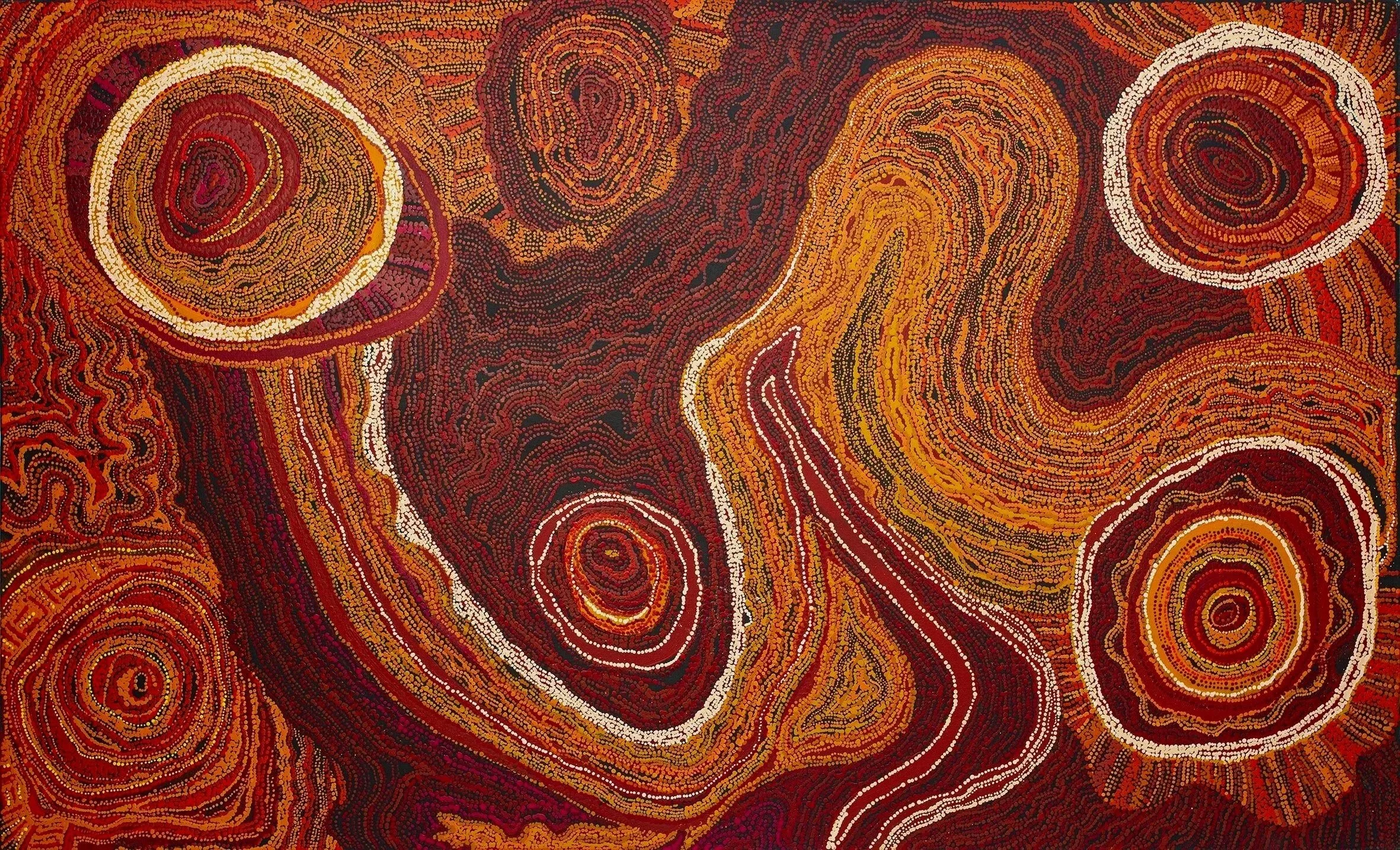
Artiste : Elizabeth Dunn
Titre de l'œuvre : Piltati, Elizabeth Dunn's story
Format : 202 x 122cm
Provenance et certificat : centre d'art aborigène d’Ernabella
Référence de cette peinture aborigène : 422-19
Explication sur cette œuvre :
Two brothers were married to two sisters and they all lived together. One day the two men go out hunting, looking for malu (kangaroo). They travel everywhere and find nothing. They start to worry. “What are we going to do, there is no meat on this land? One brother says, “maybe we should turn into something?”. They start to think about what they should turn into.
“Maybe firewood?”“No, the firewood burns.”
“Maybe emu or a bird?”.
“No, people eat them.”
They do a lot of talking and decide they should turn into Wanampi (rainbow serpents). A lot of smoke starts to come out of the ground, it is very scary and then the men become Wanampi. They travel into the land, towards a rockhole.
Meanwhile, the two women are waiting for their husbands to return from their hunting trip. They wait a very long time. They keep going on with their lives, collecting bush tucker, waiting…but the men never come back. So, they decide to set out to find their husbands. One day, they come across a hole in the ground. They start digging. Digging, digging, digging, they follow the tunnel inside the ground. They are so frantically digging they accidently hit one of the Wanampi in the back. The Wanampi chase the ladies and eat one of them, one women gets away.
Now, the Wanampi still live in the waterhole called Piltati. The Wanampi still live their today and provide rain for the bush tucker to grow and provide meat on the land. Piltati is Elizabeth’s great-grandfathers country and her dreaming story.
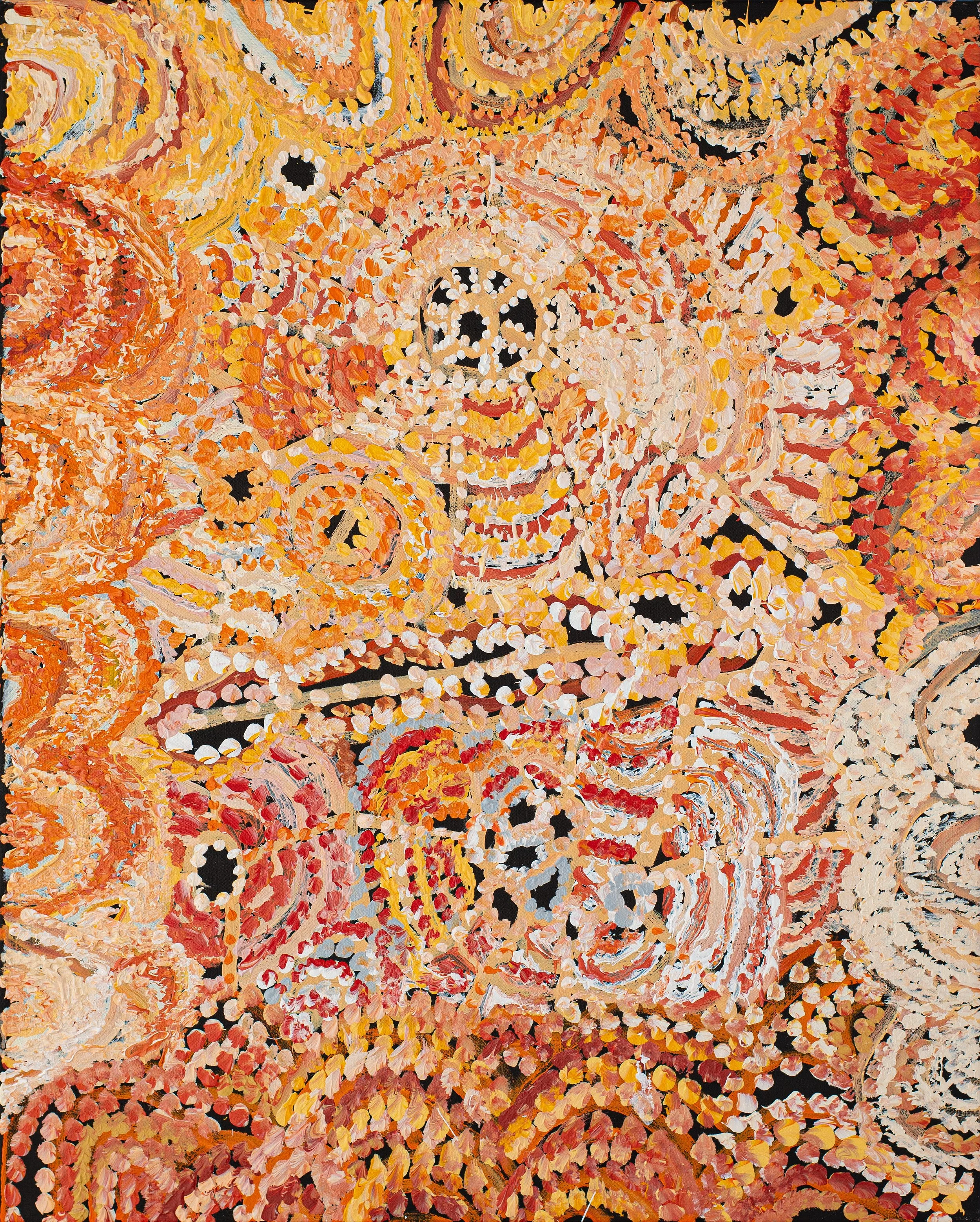
Artistes : Emily Cullinan (1952)
Titre de l'œuvre : Ananyi Ngura (Traveling Country)
Format : 101 x 81 cm
Provenance et certificat : centre d'art aborigène d’Iwantja
Référence de cette peinture aborigène : 775-25
Explications pour cette peinture d'art Aborigène :
Emily was born in rugged bush land, close to the Eastern APY community of Mimili. Her father was a respected cultural law man, and taught her and her two young sisters to live a traditional life. Emily did not encounter European settlers until she was a teenager.
Emily and her family used to travel long distances by walking or occasionally hitching wagons to camels and donkeys, they would camp at night inside hand built wiltjas (shelters) in the bush, sleeping in the warm sand.
The walk between Indulkana and Mimili regions took her 5 days, she recalls traveling this route many times to visit family. Emily’s powerful paintings depict the iconic waterholes, majestic boulders, and river beds she would cross on her journey.
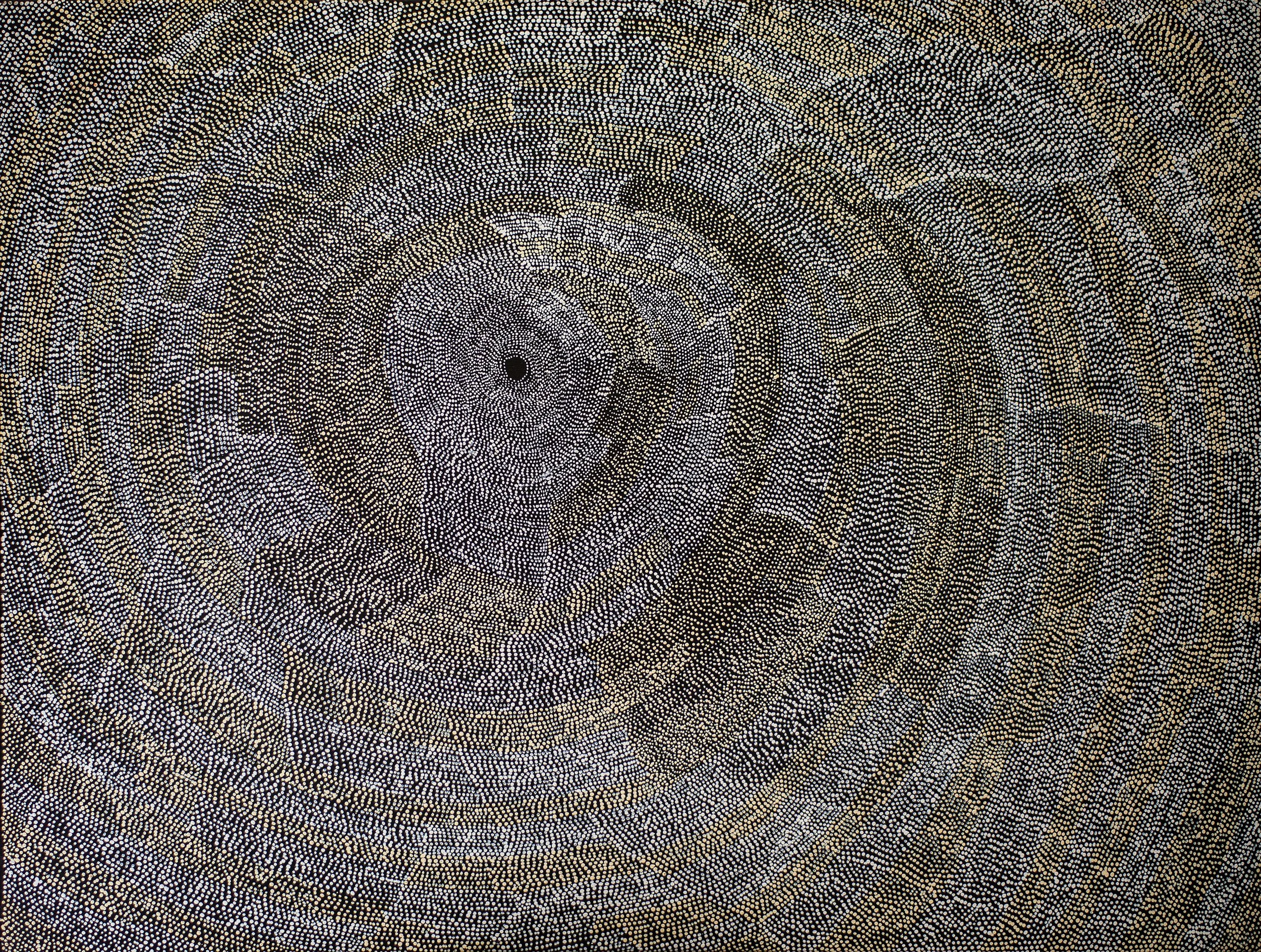
Artiste : Julie Nangala Robertson
Titre de l'œuvre : Mina Mina Jukurrpa - Mina Mina Dreaming
Format : 122 × 91 cm
Provenance et certificat : centre d'art aborigène de Yuendumu
Référence de cette peinture : 1364/25
Demander le prix de l'œuvre / Enquiry
Explications de l'œuvre :
Mina Mina is an extremely important ceremonial site for Napangardi and Napanangka women that is located approximately 600kms west of Yuendumu, just east of Lake
Mackay and the WA border. Mina Mina has a ‘marluri’ (salt lake or claypan) that is usually dry, without water. There are also a number of ‘mulju’ (soakages), sandhills, and a large stand of ‘kurrkara’ (desert oaks [Allocasuarina decaisneana]).
The Mina Mina Jukurrpa is an important source of Warlpiri ritual knowledge and social organization, particularly relating to the different roles performed by men and women. The ‘kirda’ (owners) of this country are Napangardi/Napanangka women and Japangardi/Japanangka men, who can depict portions of the Mina Mina Jukurrpa in their paintings. The artists mother, Dorothy Napangardi (c.1956–2013) painted Mina Mina and has passed down her Jukurrpa stories to her children and asked them to continue to paint for her. There are a number of different components of the Mina Mina Jukurrpa; artists usually choose to depict one particular aspect. These can include ‘karnta’ (women), ‘karlangu’ (digging sticks), ‘majardi’ (hairstring skirts/tassels), ‘ngalyipi’ (snakevine [Tinospora smilacina]), ‘jintiparnta’ (desert truffle [Elderia arenivaga]), and ‘kurrkara’ (desert oak [Allocasuarina decaisneana]).
In ancestral times a group of ‘karnta’ (women) traveled from Mina Mina on an epic journey to the east. These ancestral women danced at Mina Mina and ‘karlangu’ (digging sticks) rose up out of the ground. They collected these digging sticks and started travelling to the east. They carried their digging sticks over their shoulders, and they were adorned with ‘majardi’ (hairstring belts), white feathers, and necklaces made from ‘yinirnti’ (bean tree [Erythrina vespertilio]) seeds. They travelled east from Mina Mina, dancing, digging for bush tucker, and creating many places as they went. As they went east, they passed through Kimayi (a stand of ‘kurrkara’ (desert oak)). They passed through sandhill country where the ‘yarla’ (bush potato or ‘big yam’ [Ipomea costata]) ancestors from Yumurrpa and the ‘ngarlajiyi’ (pencil yam or ‘small yam’ [Vigna lanceolata]) ancestors from Yumurrpa were engaged in a huge battle over women. This battle is also a very important Warlpiri Jukurrpa narrative. The women went on to Janyinki and stopped at Wakakurrku (Mala Bore), where they stuck their digging sticks in the ground…
© Photo : Aboriginal Signature Estrangin gallery with the courtesy of the artists and Yuendumu
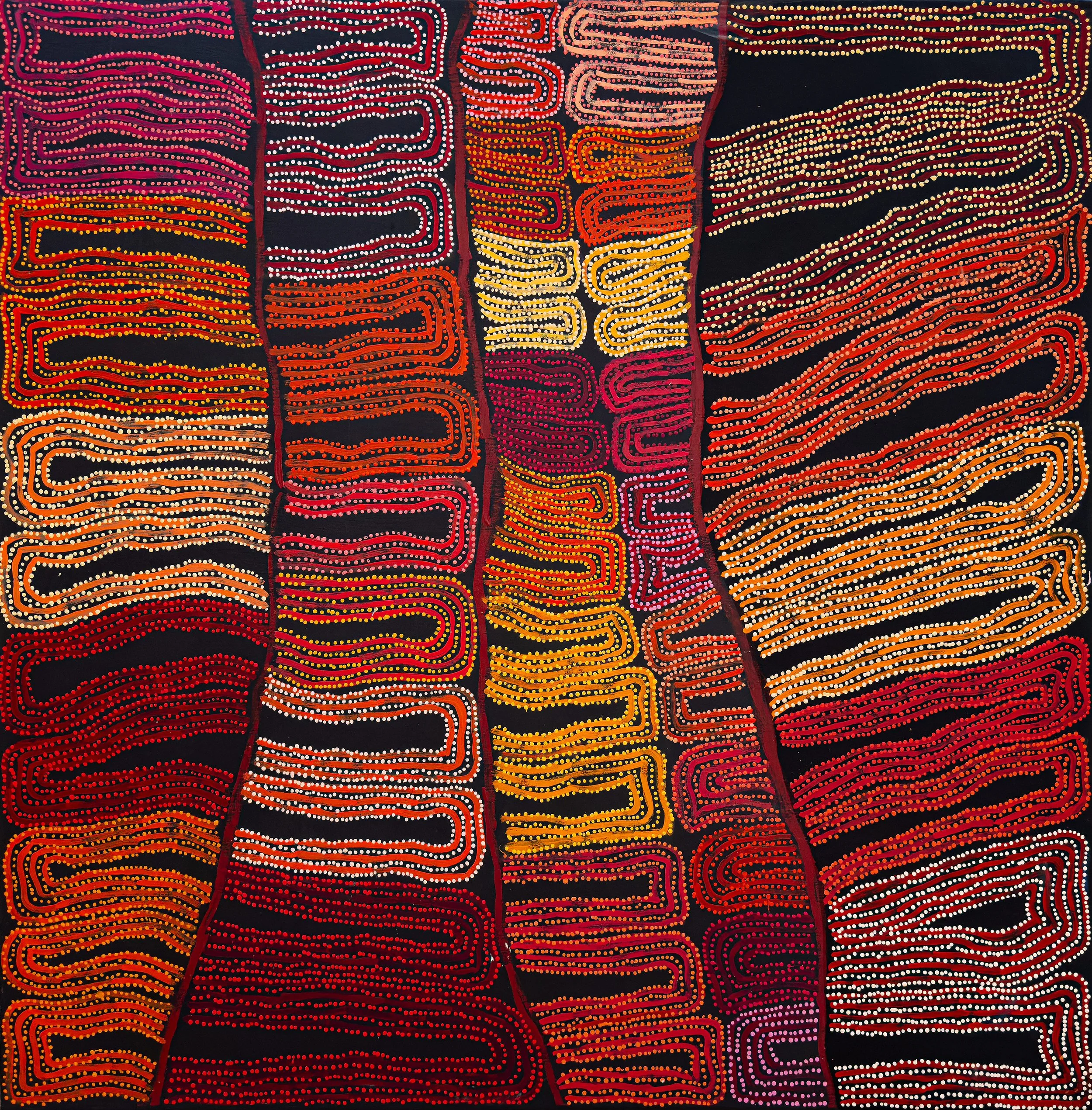
Artiste : Beverly Burton
Titre de l'œuvre : Ngayuku ngura - My Country
Format : 154 x 153 cm
Provenance et certificat : centre d'art aborigène de Tjala Arts
Référence de cette peinture aborigène : 359-23
Enquiry / Demander le prix de l'œuvre
Explication pour cette œuvre :
Beverly Burton is one of Tjala Arts strongest emerging painters who is dedicated to her practice and works in the studio daily. She comes from an influential family lineage of cultural leaders and artists. Her mother, Naomi Kantjuriny is known for her work with the Mitakiki Womens Collaborative and as a traditional Ngangkari Healer.
Her father, Kunmanara (Hector) Burton was a senior artist at Tjala Arts and as an elder revered as an extremely important caretaker of Anangu law and culture.
Beverlys paintings are powerful and dynamic, her use of brush and choice of palette creates vibrations and movement across the canvas the way the landscape shifts and changes across her country.
In this painting Beverley has depicted her country. The different colours and designs represent variations in the landscape.
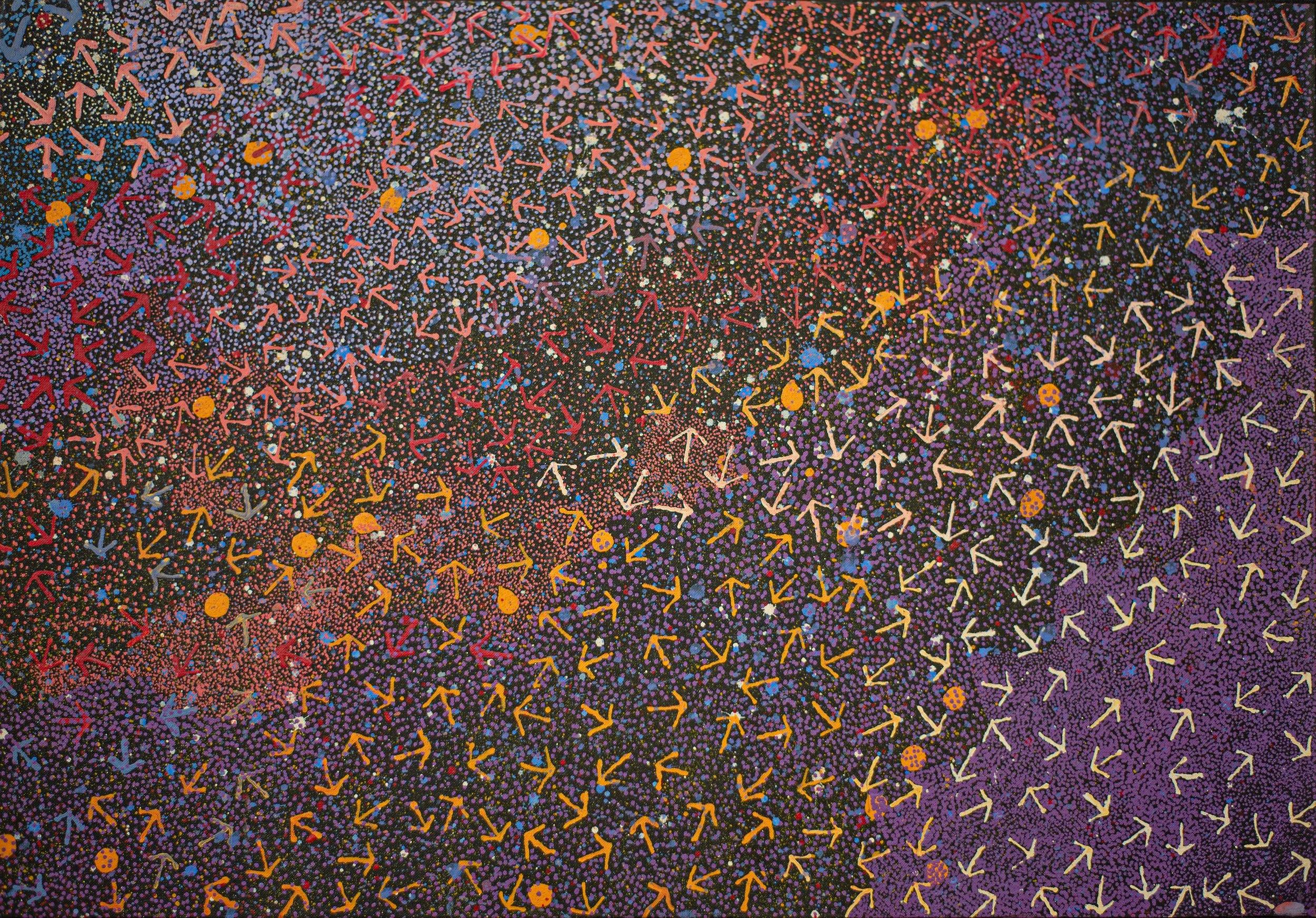
Artiste : Lloyd Jampijinpa Brown
Titre de l'œuvre : Yankirri Jukurrpa (Emu Dreaming) - Ngarlikirlangu
Format : 55 x 40 cm
Provenance et certificat : centre d'art aborigène de Yuendumu
Référence de cette peinture : 169/26
Demander le prix de l'œuvre / Enquiry
Explications pour cette œuvre :
This painting depicts a ‘yankirri Jukurrpa’ (emu [Dromaius novaehollandiae] Dreaming) from a place called Ngarlikurlangu, approximately 50kms north of Yuendumu. The ‘kirda’ (owners) of this Dreaming are Nangala/Nampijinpa women and Jangala/Jampijinpa men. This Jukurrpa tells the story of a ‘yankirri’ (emu) and a ‘wardilyka’ (bush turkey [Ardeotis australis]). ‘Yankirri’ lived at a soakage to the west called Warnirripanu (or Walangkamirirri), while ‘wardilyka’ lived at a soakage to the east called Parirri. The emu and bush turkey used to go around the country picking ‘yakajirri’ (bush raisins [Solanum centrale]) and mashing them into ‘kapurdu’ (fruit balls) to save in their nests for later. However, they were jealous of each other; the emu thought that the bush turkey was picking the best and juiciest ‘yakajirri’, and was leaving him with only the sour ‘yakajirri’.
The emu went to the bush turkey’s nest to the east while the bush turkey was out hunting and smashed up the ‘kapurdu’ that the bush turkey had saved there. When the bush turkey returned, he found his smashed ‘yakajirri’ balls and realized that the emu had destroyed them. He went to the west to confront the emu and when he found him, they got into a big fight. The bush turkey eventually flew away to the north, leaving behind the smashed ‘yakajirri’ balls.
This practice of making ‘kapurdu’ (fruit balls) is a traditional Warlpiri method of storing ‘yakajirri’; in the old days, people used to dry the ‘yakajirri’, grind them up with a rock in a coolamon, mix them with water and form balls from them, and cover the ‘kapurdu’ with red ochre so they would keep. Today at Ngarlikirlangu we can see round, red rocks which are the ‘kapurdu’ that the emu smashed up. There is also a dance for this ‘yankirri’ (emu) Jukurrpa that is performed during mens’ initiation ceremonies. A number of other Jukurrpa are also located at Ngarlikirlangu, including ‘wardilyka Jukurrpa’ (bush turkey Dreaming), ‘yardijiinypa Jukurrpa’ (meat ant Dreaming), and ‘pirntina Jukurrpa’ (woma or Ramsay’s python [Aspidites ramsayi] Dreaming). Lots of ‘yakajirri’ grow around the Ngarlikirlangu area today.
© Photo : Aboriginal Signature Estrangin gallery with the courtesy of the artists and Yuendumu
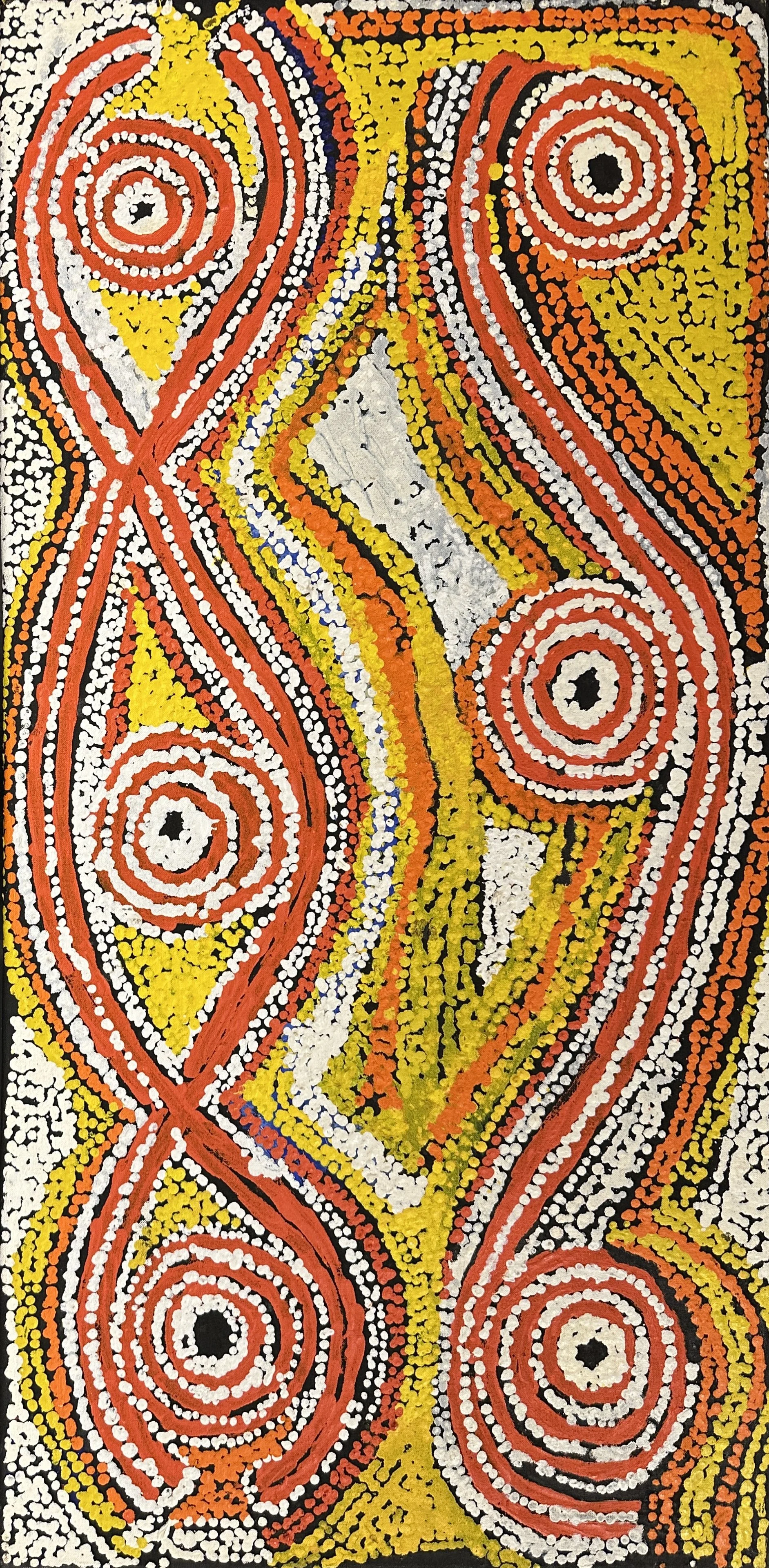
Artiste : Paddy Japaljarri Sims
Titre de l'œuvre : Warlu Jukurrpa (Fire Dreaming Time story)
Format : 91 x 46 cm
Provenance et certificat de cette peinture d'art Aborigène : centre d'art de Yuendumu
Référence de la peinture : 479/10
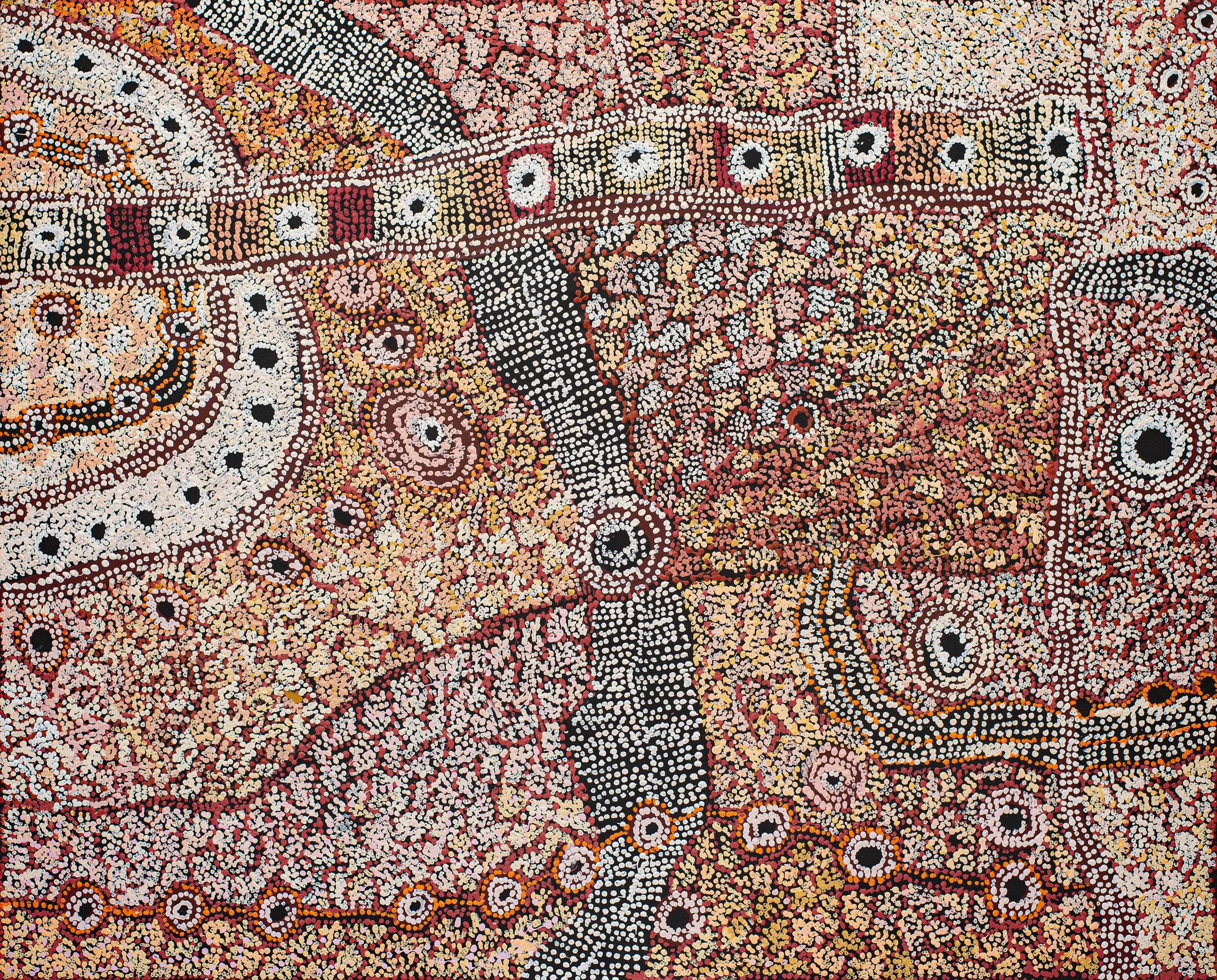
Artistes : Betty Chimney (1957)
Titre de l'œuvre : Ngayuku Ngura (My Country)
Format : 152 × 122 cm
Provenance et certificat : centre d'art aborigène d’Iwantja
Référence de cette peinture aborigène : 591-24
Explications pour cette peinture d'art Aborigène :
Betty Chimney's paintings are evocative of the vast and rugged desert country of Indulkana on the Eastern side of the Anangu Pitjantjatjara Yankunytjatjara (APY) Lands.
The country here is expansive, dotted with small shrubs and carpeted in clusters of rocks and pebbles.
Betty spent many years living near to Iwantja Creek at the newly established Indulkana community. As all of the members of Betty's family had passed away, she was raised by Alec Bakers father, a senior law man for the region.
In her striking paintings, Betty marks out the rugged and stoic country of Indulkana. She maps out the creeks, roads, rocks and dry creek-beds, highlighting changes in the landscapes through colour shifts.
Capturing beauty in the sparsity of shapes and tones, Betty's paintings reveal the true essence of Yankunytjatjara desert country.
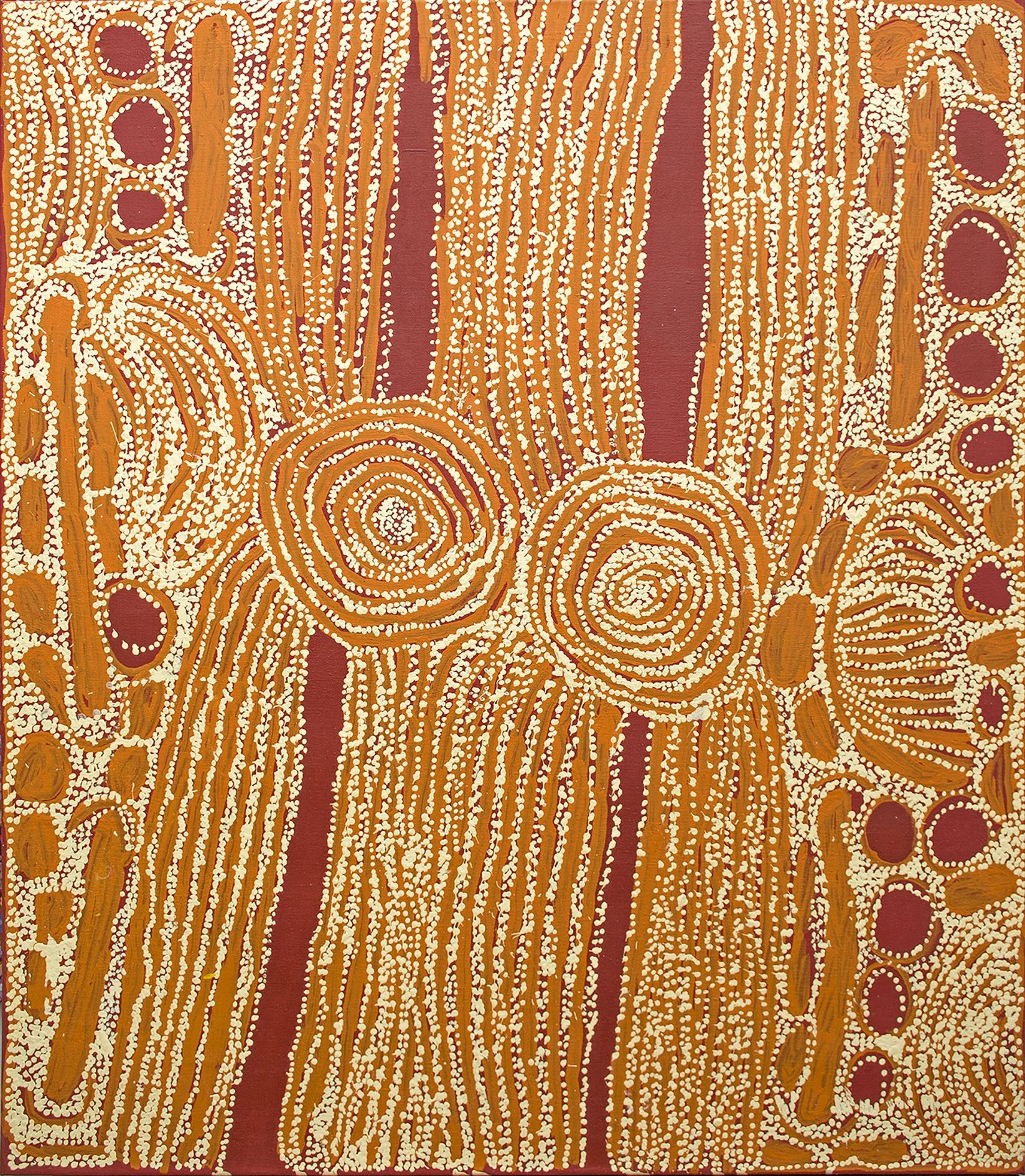
Artiste : Ningura Napurrula
Titre de l'œuvre : Rockhole site of Wirrulnga (women ceremonies)
Format : 122 x 107 cm
Provenance : centre d'art de Papunya Tula
Le certificat original du centre d'art Aborigène de Papunya Tula sera remis avec l'œuvre.
Référence de la peinture : NN0807198
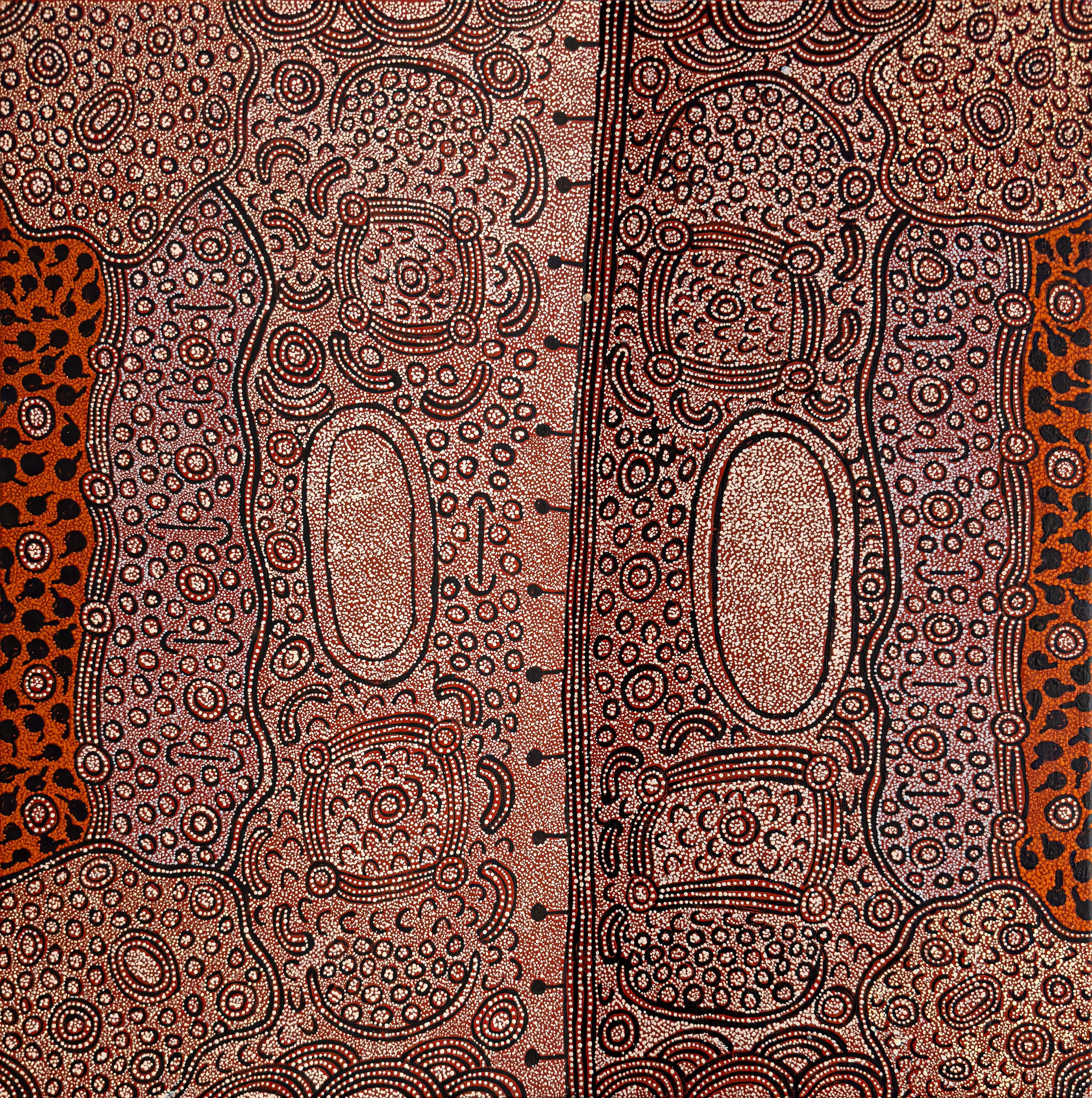
Artiste : Joy Gibson Napaltjarri
Titre de l'œuvre : Rockhole site of Mukula
Format : 91 x 91 cm
Provenance : centre d'art de Papunya Tula
Le certificat original du centre d'art Aborigène de Papunya Tula sera remis avec l'œuvre.
Référence de cette peinture : JN2303119
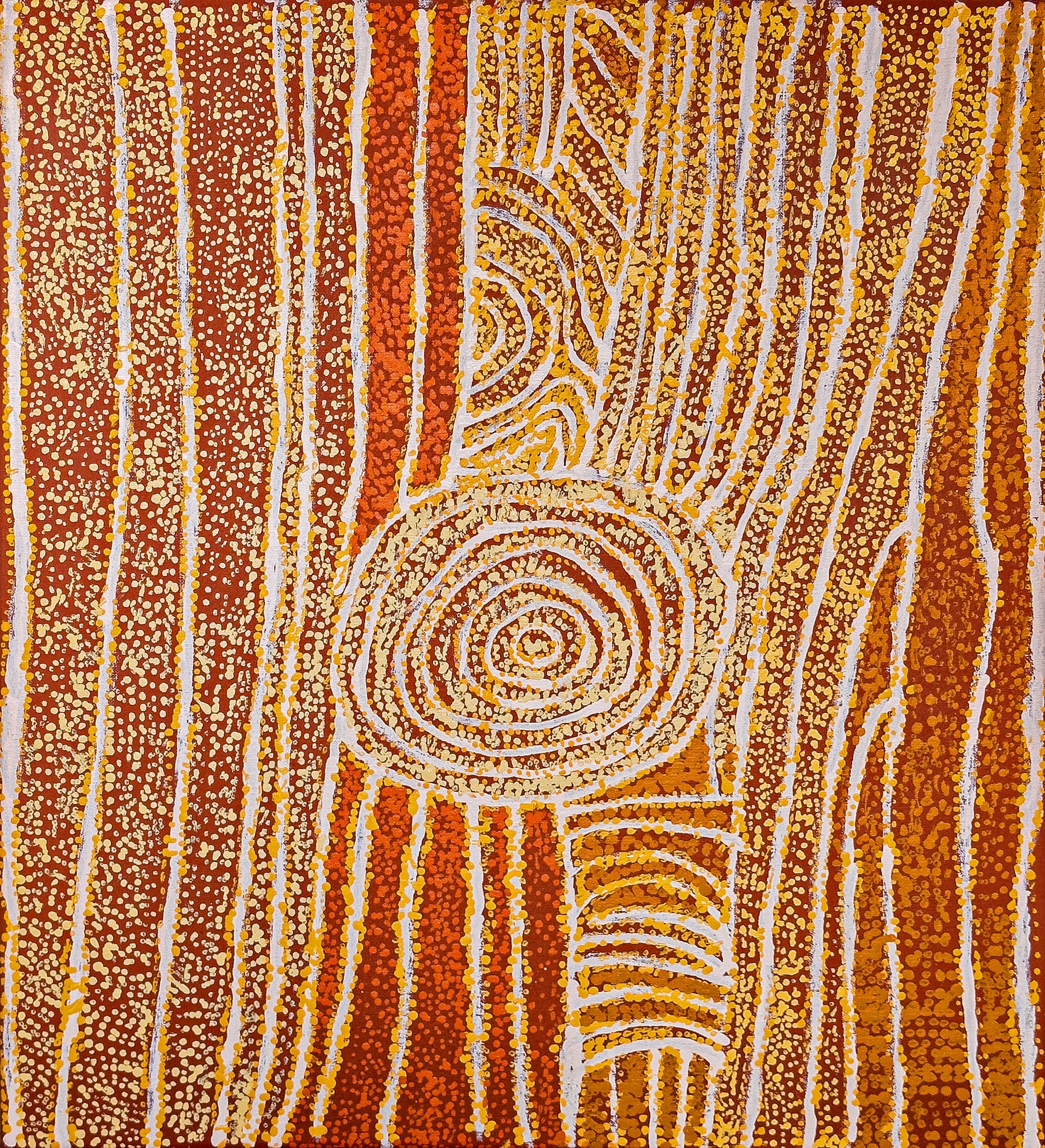
Artiste : Mary Napangati
Titre de l'œuvre : Rockhole site of Tjutalpi
Format : 61x55 cm
Provenance : centre d'art de Papunya Tula
Le certificat original du centre d'art Aborigène de Papunya Tula sera remis avec l'œuvre.
Référence de cette peinture : MN2305137
Enquiry/ Demander le prix de l'œuvre
Explications sur cette œuvre et l’artiste :
Mary Brown Napangati (Napangardi) was born near Wilkinkarra (Lake Mackay) circa 1955. Her family lived in the vicinity of Lappi Lappi, located towards the northern area of Lake Mackay, until they walked into the Mt Doreen cattle station west of Yuendumu, in the Northern Territory. She later moved to Yuendumu, married there and later moved further west to Nyirrpi. After her first husband passed away, Mary remarried the well known artist Ronnie Tjampitjinpa and moved to Kintore, where she now lives and paints.
This painting evokes the rockhole site of Tjutalpi. In ancestral times a group of men and women travelled to this site. While at Tjutalpi they performed the dances and songs associated with the area. During their travels the men and women gathered a variety of bush foods including pura or bush tomatoes (Solanum chippendalei) and kampurarrpa or desert raisins (Solanum centrale). They also gathered wood for the manufacture of wana (digging sticks). The roundels in the work represent the soakage waters found at this site, while the lines represent the tali (sandhills).
Collections :
Private collections in Australia and Europe.
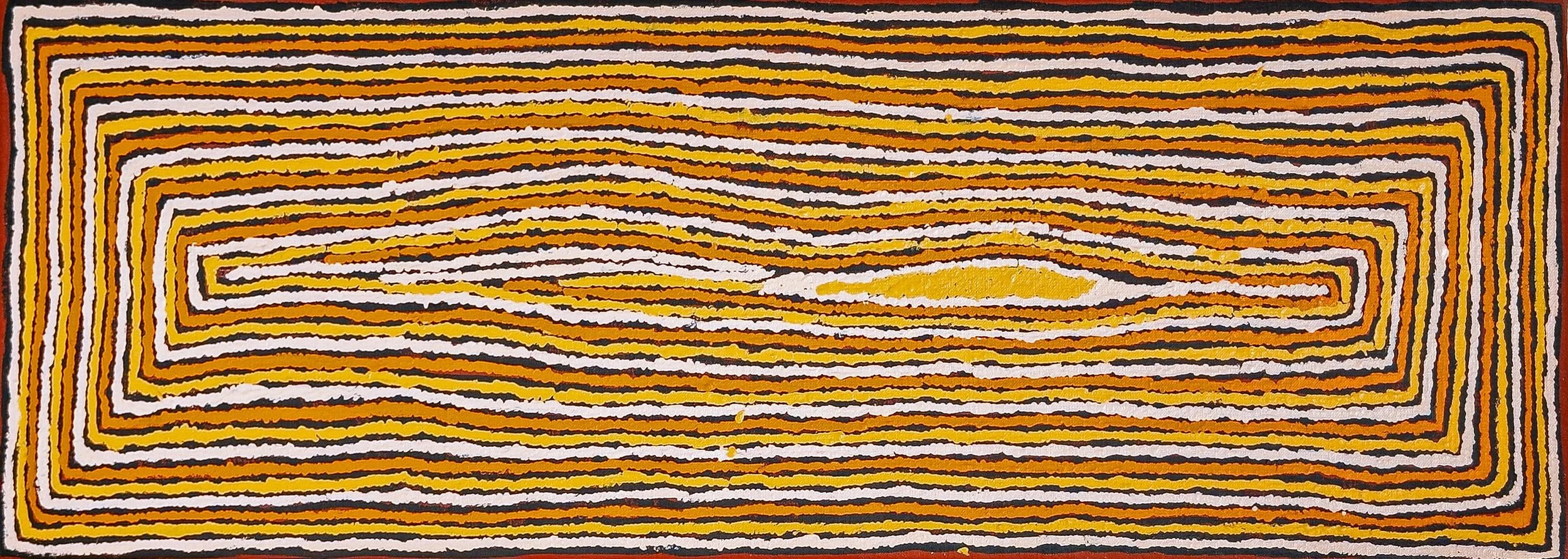
Artiste : Tatali Napurrula
Titre de l'œuvre : Rockhole site of Pinpirri
Format : 87 x 28 cm
Provenance et certificat : centre d'art aborigene de Papunya Tula Artists
Référence de cette peinture aborigène : TN2211018
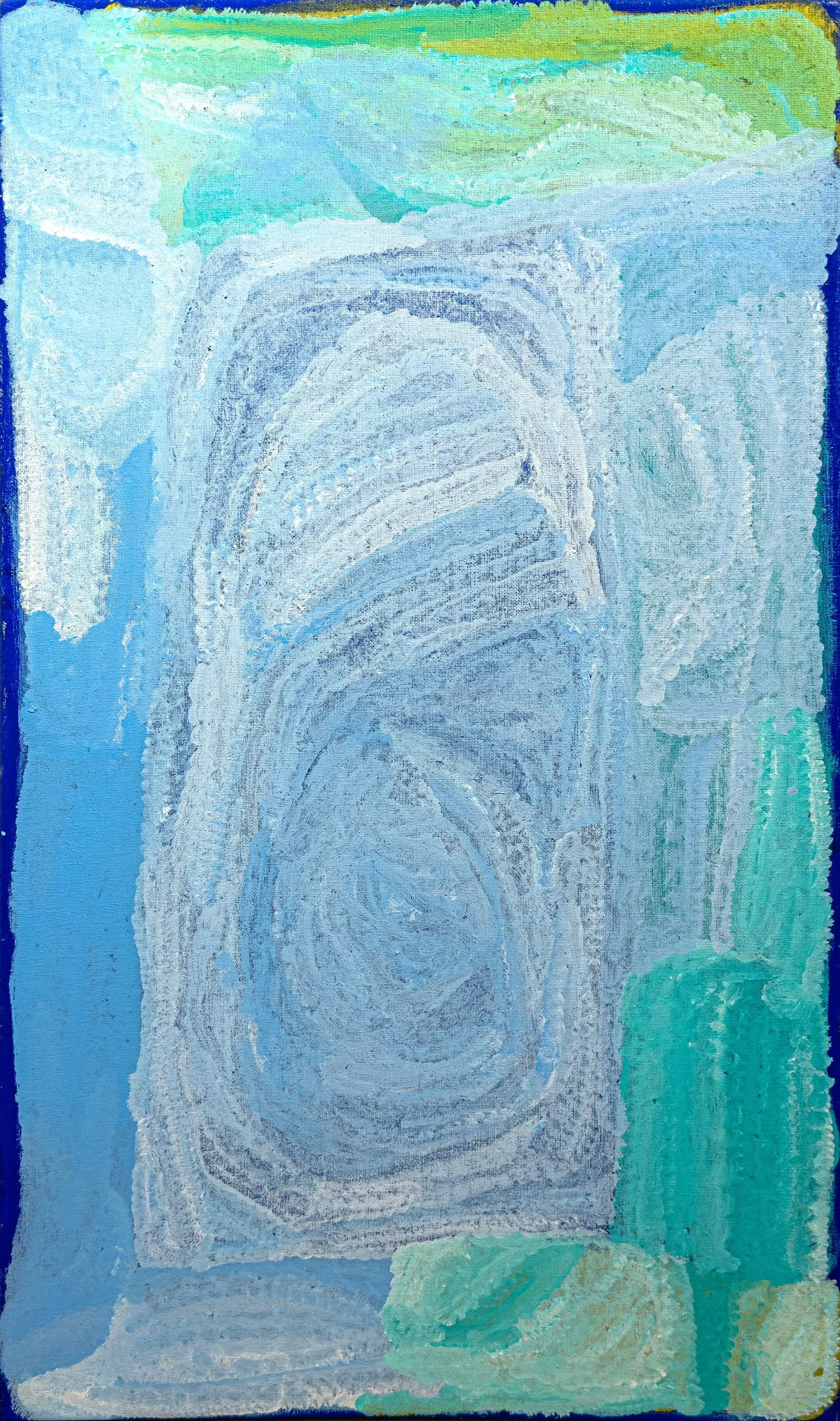
Artiste : Lydia Balbal
Titre de l'œuvre : Winpa - Dreaming Time stories
Format : 90 × 50 cm
Provenance et certificat : Short Street opérant pour les artistes Yulparija de Bidyadanga
Référence de cette peinture aborigène : 841452
Explications sur cette peinture d’art Aborigène :
Lydia Balbal (1958) is a Mangala woman. Lydia's country is near Punmu in the Great Sandy Desert of W.A. Her people's existence was threatened by severe drought so that they had little choice but to leave their traditional country. Her family were some of the last to walk out to the coastal town of Bidyadanga (then La Grange Mission) located two hours south of Broome in the early 70s. Lydia first began painting in 2007 but has already received significant attention from collectors and the media alike.
Winpa is jila (living water) located near the Percival Lakes in the Great Sandy Desert in WA. It is an important gathering of the Yulparija and neighbouring groups. they would gather for rain making ceremonial ceremonies.
Collections : Murdoch University Art Collection. Aboriginal Art Museum, The Netherlands. Thomas Vroom Collection, The Netherlands. National Gallery of Victoria Felton Collection. Queensland Art Gallery. Laverty Collection. Monash University Art Collection. Lepley Collection. Western Australian Art Gallery. National Gallery of Australia. Wesfarmers Collection. Australia Parliament House Collection. Brocard - Estrangin Collection. Kluge-Ruhe Aboriginal Art Collection of the University of Virginia.
© Photo : Aboriginal Signature Estrangin gallery with the courtesy of Short Street and the artist
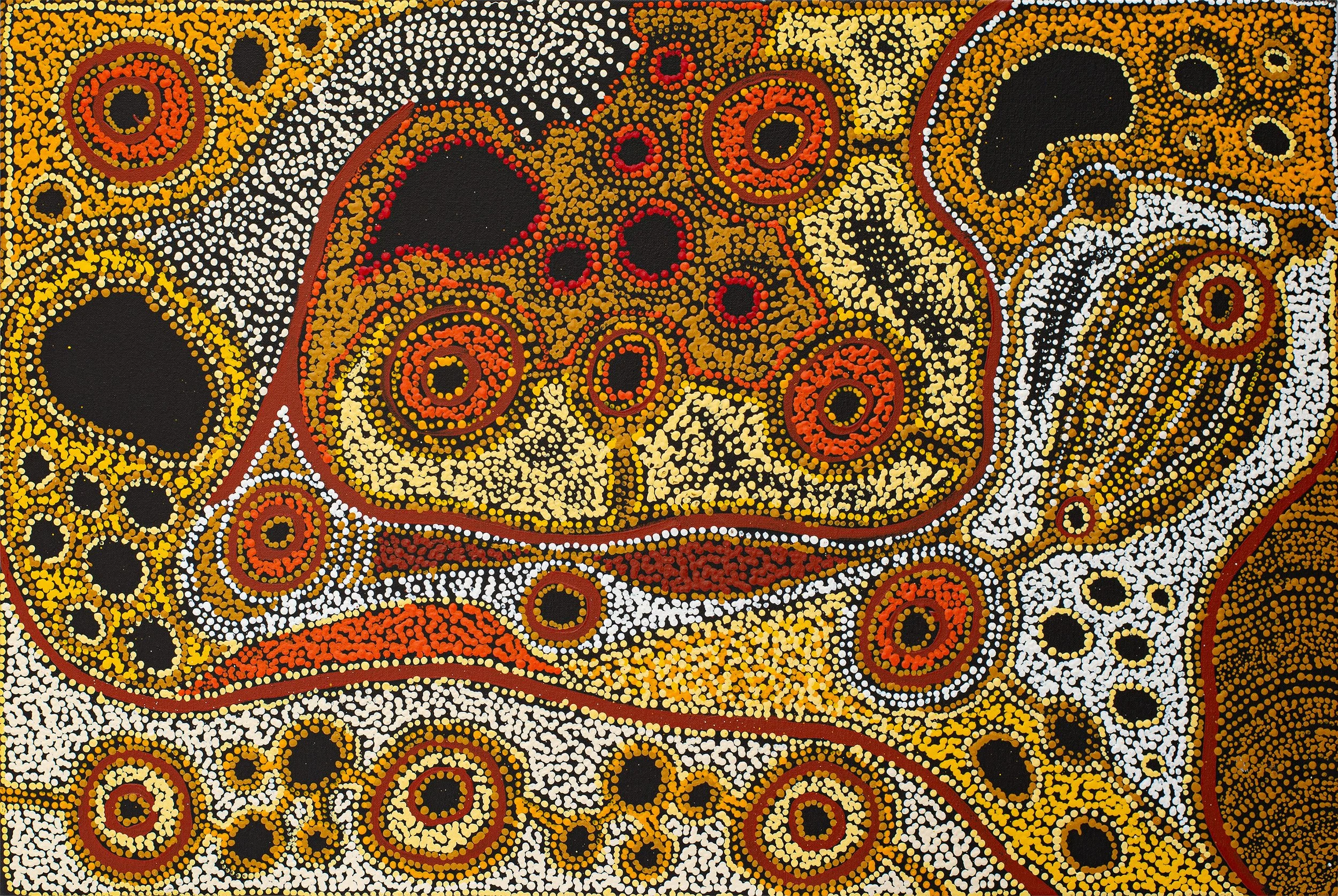
Artiste : Amy Scotty
Titre de l'œuvre : Kungkarangkalpa / Seven Sisters
Format : 90 x 60 cm
Provenance et certificat : centre d'art aborigène d’Ernabella
Référence de cette peinture aborigène : 119-24
Explication sur cette œuvre :
Kungkarangkalpa means the Seven Sisters. This is an extensive creation story that relates to the Pleiades constellation in the southern hemisphere. The story traverses Australia taking on different forms, however local women are privy to the part of the story which takes place in the country near Ernabella. For this part of the story, the man called Nyiru is chasing the sisters as he wants to sleep with the oldest sister. All the younger sisters are deeply afraid of him. As Nyiru is chasing the sisters, he tries to catch them by using magic to turn himself into the most tempting bush tomatoes for the sisters to eat and the most beautiful ili (fig) tree for the sisters to camp under. However, the sisters are aware of his magic and go hungry and run through the night rather than be caught by Nyiru. Eventually, to escape Nyiru, the sisters fly into the sky where they turn into stars and form the constellation.

Artistes : Sallyanne Roberts (1986)
Titre de l'œuvre : Kuru Ala
Format : 152 x 167cm
Provenance et certificat : centre d'art aborigène d’Iwantja
Référence de cette peinture aborigène : 212-23
Demander le prix de l'œuvre / Enquiry
Explication de l’œuvre :
Sallyanne Roberts (1986) said : “I grew up in my grandmothers country close to Nyapari, my grandmothers name is Wingu Tingima; she was a Ngangkari (traditional healer) and a famous painter. When she was getting very old, she taught me her stories, and how to paint them in our special family’s way. She taught me how to paint the pictures of Kuru Ala country – it’s a special place just for women. My paintings are about the country called Kura Ala, I’ve been there with my grandmother and other women before – it’s a special country only for women. My grandmother Wingu would say; “You can go there and travel through the area, but you shouldn’t stop there or you might get sick. It’s a special place where young girls go to become women, they can have special inma (ceremonies) there and have a time for healing.” In my paintings I show all the women out at Kura Ala gathering food from the bush to eat after the inma. The large curved shapes link colourful rings patterns and pathways together, they are the patterns made by the ladies footsteps from their special inma dance. The circles with thin lines reaching out of them are the wiltja’s (camp houses) the women have made from tree branches and sticks. Some areas of the canvas depict the special rock hole – but it’s not for swimming in, only the little yellow round rock holes shown in the middle of the canvas are for swimming. The ladies are shown by the semi circle shape, gathering together for dancing and teaching the young girls lessons.
This site forms part of the Kungkarankalpa Tjukurpa or Seven Sister's Creation Line that follows a group of women as they traverse the country evading the pursuit of a lustful older man, Nyiru. Nyiru has metamorphic powers of transformation and changes into different flora and fauna to trick the women.
These are creation beings and as such shape the landscape as they move through it. At Kuru Ala there is the physical reminders of their presence in the form of monolithic rock formations depicting the characters. From Kuru Ala the women chase a Kuniya (Carpet Python) through Tjukaltjara to the site of Kulyuru.
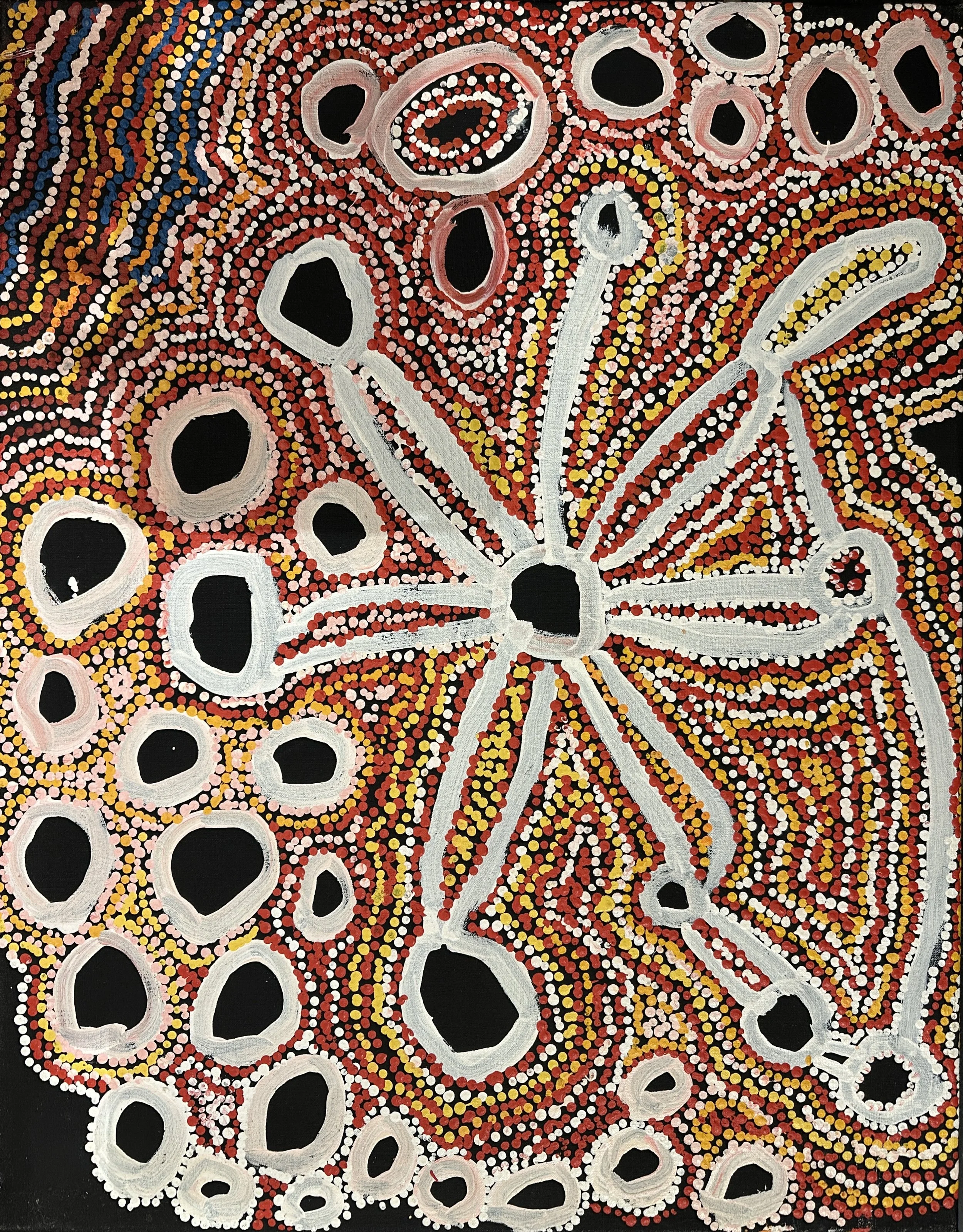
Artiste : Estelle Hogan
Titre de l'œuvre : Paltatatjara Dreaming Time story
Format : 75x60 cm
Provenance et certificat : centre d'art aborigène du Spinifex Art Project
Référence de cette peinture : 14020
Demander le prix de l'œuvre / Enquiry
Explications pour cette œuvre :
Estelle is a senior Spinifex artist whose country is Paltatatjara. Paltatatjara is an important place not only for the Minyma Tjuta (Seven Sisters) story but also a number of other Dreaming stories that cannot be elaborated in detail but include the Wati Kutjara (Two Serpent Men) and Kalaya (Emu) story.
Because Estelle is the senior owner of a place that has special significance for both men and women, documentation and detail of the paintings is carefully defined and public interpretation involves a level of ‘assumed’ knowledge.
The Kungkarangkalpa or Minyma Tjuta (Seven Sisters) Tjukurpa is an epic story, Here Estelle has depicted several Minyma Tjuta sites where she travelled around on foot before contact including Paltatatjara,
Minga, Tjuntjun and Tulu.
Like many Spinifex artists estelle clearly remembers her nomadic life in the desert. Estelle passed away in 2017, early this year.
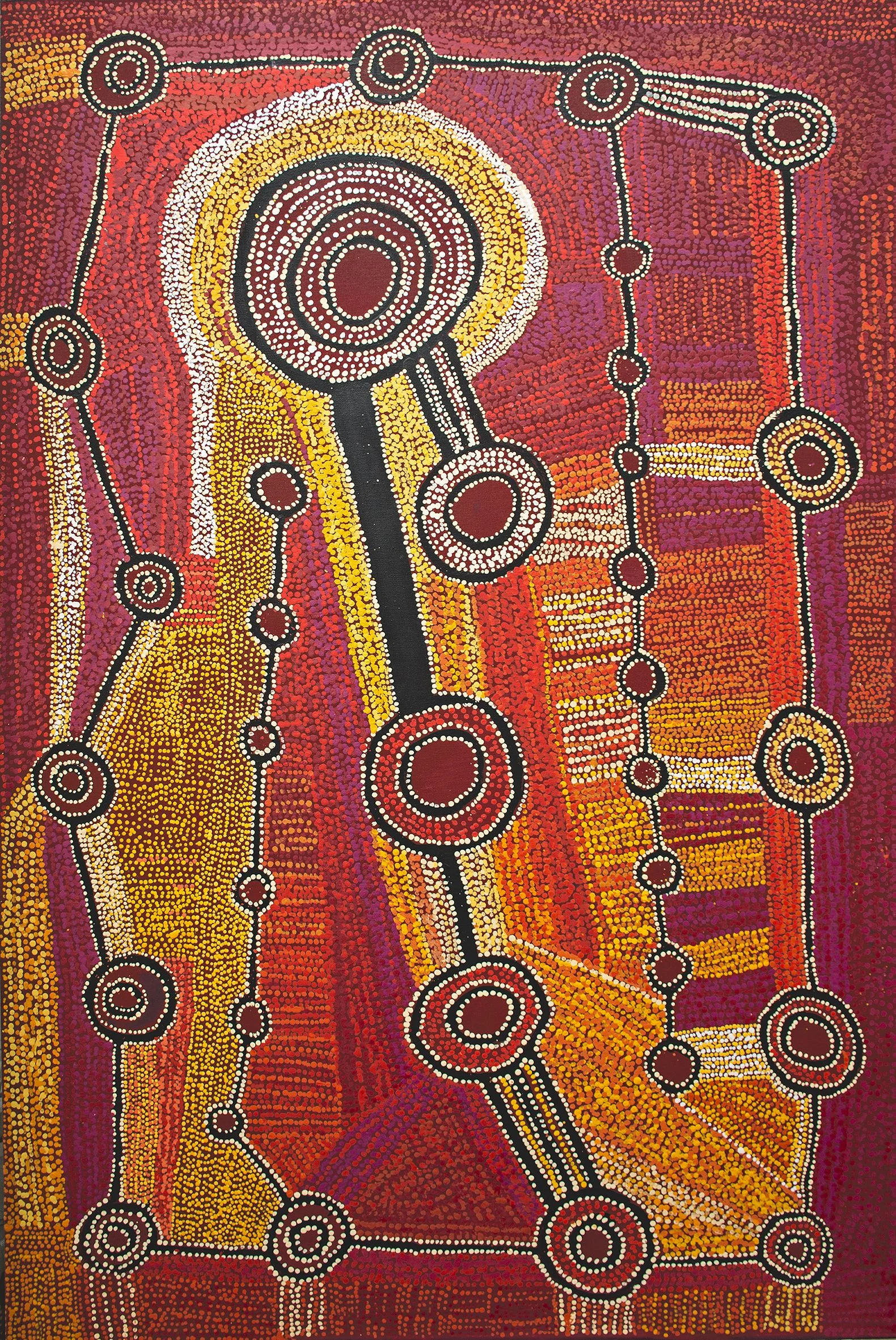
Artiste : Willy Mutjantji Martin
Titre de l'œuvre : Wanampi tjukurpa
Format : 181x121cm
Provenance et certificat : centre d'art aborigène de Mimili Maku Arts
Référence de cette peinture : 187-17
Enquiry - demander le prix de cette œuvre d'art Aborigène
Explications pour cette peinture Aborigène :
I paint the Wanampi Tjukurpa, or Water snake Dreaming. This is a story from Piltati, near Nyapari (on the Anangu Pitjantjatjara Yankunytjatjara {APY} Lands in the remote north-west of South Australia). There’s a special rockhole at Piltati where this creation story takes place. There’s two wati (men), brothers and their wives. There’s trickery and conflict, and the men change themselves into wanampi (water snakes). The story tells how the land was shaped and formed. It’s important that we hold our culture, our stories, our connection to country strong for malatja-malatja (future generations) – that’s why I make paintings.
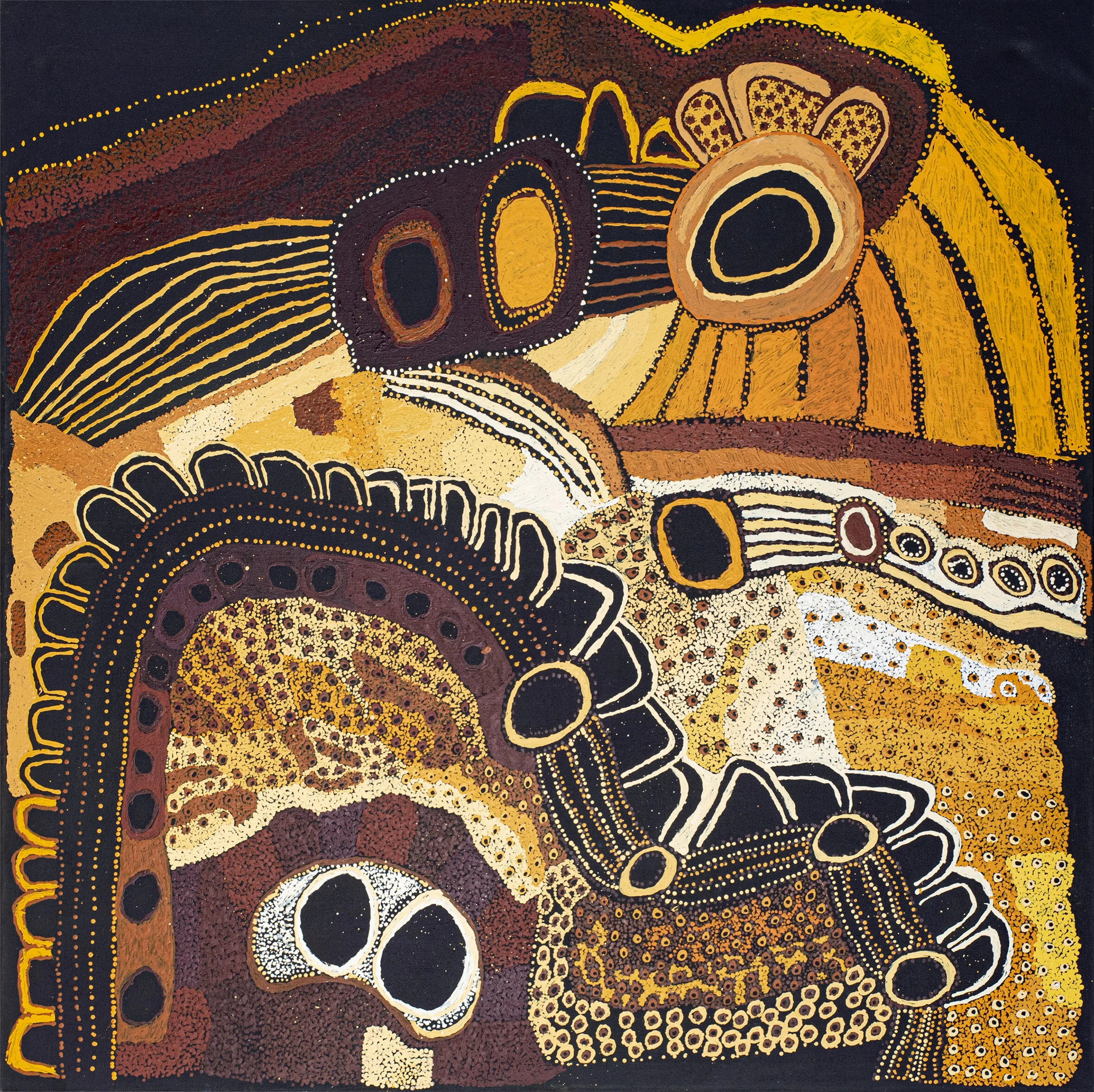
Artiste : Judy Martin (1963)
Titre de l'œuvre : Ngayuku Mamaku Ngura (My Father's Country)
Format : 152 cm x 152 cm
Provenance et certificat : centre d'art aborigène de Mimili Maku
Référence de cette peinture aborigène : 186-21
Demander le prix de cette œuvre
Explications pour cette peinture d'art Aborigène :
Judy paints her father's country, Wakura. Wakura is near Nyapari, on the Anangu Pitjantjatjara Yankunytjatjara (APY) Lands in remote North-Western South Australia.
Even though Judy lives in Mimili Community now, she is still a custodian of the land around Wakura. Her focus lies on the importance of the water sources in the area, which have been guarded and cared for by her father's family since the beginning of time. Judy maps the kapi tjukula amongst the puli (mountain ranges) and tali (sand hills) of Wakura.
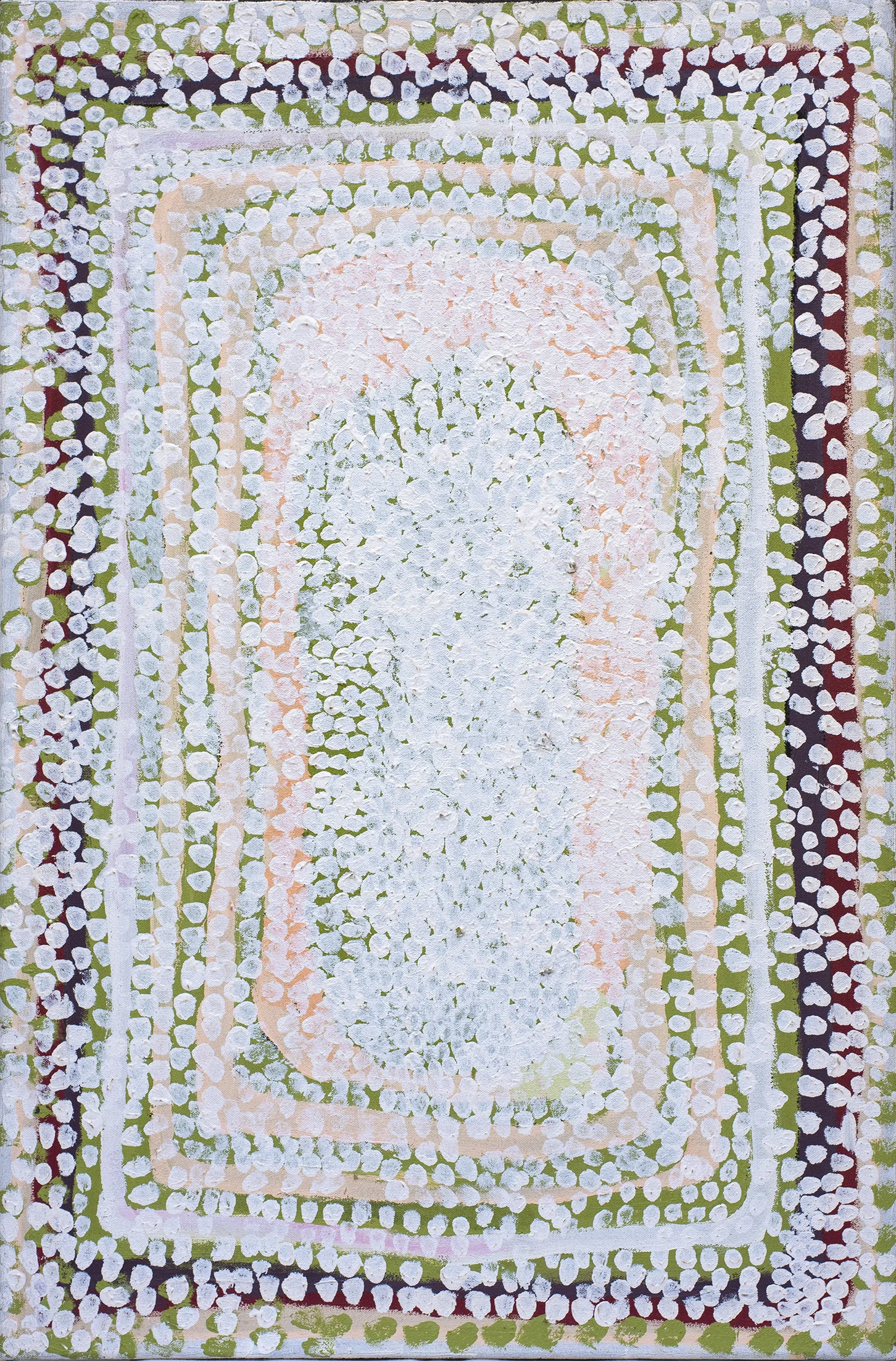
Artiste : Marie Meribida
Titre de l'œuvre : Martakulu
Format : 90 x 60 cm
Provenance et certificat : Short Street opérant pour les artistes Yulparija de Bidyadanga
Référence de cette peinture aborigène : 786415
Explications sur cette peinture d’art Aborigène :
Mary Meribida (1938) was born at Ilyara (Punmu) and lived there throughout her childhood. She travelled around her country with her family. Until the early 1970s, she lived a traditional life and says, "We been walk 'em, no clothes, nothing. We proper bush people, no English." Mary is a part of the Yulparija people who walked out of the desert to the coastal town of Bidyadanga in search of water after severe drought had plagued their land.
Martakulu is a soak out near Punmu near the Canning Stock Route in the Great Sandy Desert in Western Australia. It is strong womans country, it is part of the women's law line. Long time ago a law man he come up to this country, he went home and left his wife and baby. They make him fire and sit down, cook mayi (bush food) and then started to cry for her husband. Her tears made that soak. It is important country this one. Mary says "I been young girl walked all around here with my mummy and daddy. We camp and hunt here." This painting shows the rockhole with king brown snakes and their eggs.
Collections :
Canning Stock Route Project Collection
Notre Dame University
Laverty collection
Sam Barry collection
National Gallery of Australia
Parliament House Collection, Canberra
Kluge-Ruhe Aboriginal Art Collection of the University of Virginia
© Photo : Aboriginal Signature Estrangin gallery with the courtesy of Short Street and the artist
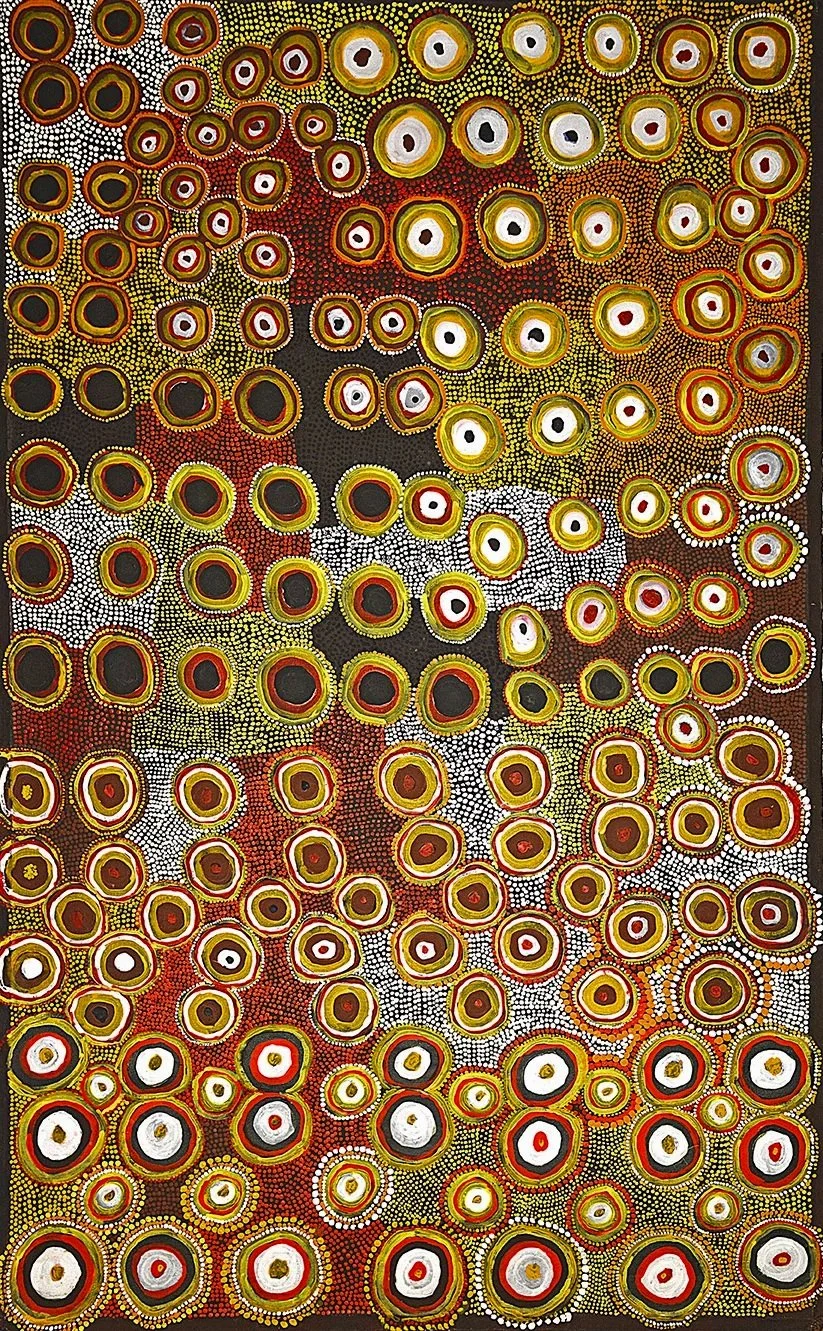
Artiste : Taylor Cooper
Titre de l'œuvre : Malara Tjurkurpa (dreaming)
Format : 200x122 cm
Provenance et certificat : centre d'art de Kaltjiti
Référence de la peinture : 8230
Demander le prix de l'œuvre
Explications pour cette œuvre :
Taylor Cooper (1939-40...) began painting at the Kaltjiti Arts centre in 2009. It was soon recognised that his paintings contained a strong representation of Tribal knowledge. His painting refers to the creation stories or Tjukurpa associated with the traditional homelands of his mother and father. An expert craftsman, Taylor continues to make the traditional hunting weapons of aboriginal men, particularly kulata (spears) and kulata miru (spear throwers).
Malara is the place of the Wanampi Tjukurpa - Water Serpent Dreaming - in the far west of the APY Lands. Taylor was born at this important site making the Malara Wanampi his Tjukurpa totemic ancestor. Taylor is Nguraritja, a traditional custodian of this story.
Taylor explains: “That Wanampi came from Malara. He went to Kunytjanu near Pipalyatjara. From Kunytjanu that Wanampi kept walking, walking. He came to Tjuntun (Kutjupa – different to Tjuntun at Fregon.) near Watarru. He threw one spear and made that rockhole. He went right in that rockhole and then he travelled back to Malara."
Taylor is an important senior tribesman and he is a recognised custodian of traditional Aboriginal law and culture. He has never married and his disposition reflects a quiet dignity of a senior man. Taylor holds a responsibility as uncle to his two sisters’ children.
His work has been acquired by major institutions and private collections across Australia and the world, as :
National Gallery of Victoria
Private Collections
Harriett & Richard England Collection, Sydney
Laverty Collection
Artbank Collection
Artiste : Freda Brady
Titre de l'œuvre : Ngayuku ngura - My Country
Format : 152,5 x 101,5 cm
Provenance et certificat : centre d'art aborigène de Tjala Arts
Référence de cette peinture aborigène : 152-23
Enquiry / Demander le prix de l'œuvre
Explication pour cette œuvre :
Freda Brady was born and raised in Amata. She is the daughter of the late Kunmanara (Paniny) Mick and Mick Wikilyiri, both senior and highly regarded painters at Tjala Arts. Freda began her artistic career in 2002 creating batik. Since then, Freda has committed to her painting practice with great vigour and is a highly skilled and respected artist working at the heart of the art centre.
A talented artist in her own right, Freda also paints on impressive large-scale collaborative canvases with her sisters Yaritji Young, Tjungkara Ken, Maringka Tunkin and Sandra Ken.
Freda is also a director and chairperson of Tjala Arts, her commitment to the art centre business extending well beyond her individual painting practice to support the ongoing strength and vitality of art centre business for her community.
In this painting Freda has depicted her country. The different colours and designs represent variations in the landscape.