
Exposition d’art Aborigène “From the desert to the sea”
En partenariat avec les communautés aborigènes du désert central vers l’ocean
A la galerie Aboriginal Signature Estrangin : 101 rue Jules Besme, 1081 Bruxelles.
Vernissage sur RDV le mercredi 2 décembre de 15h30 à 21h30.
Discours et drink à 20h.
Ensuite la galerie vous reçoit sur RDV, du mercredi 2 décembre au mardi 22 décembre 2026, du mardi au samedi, de 11h à 19h : vous pouvez réserver votre visite dés à présent dans notre agenda ici.
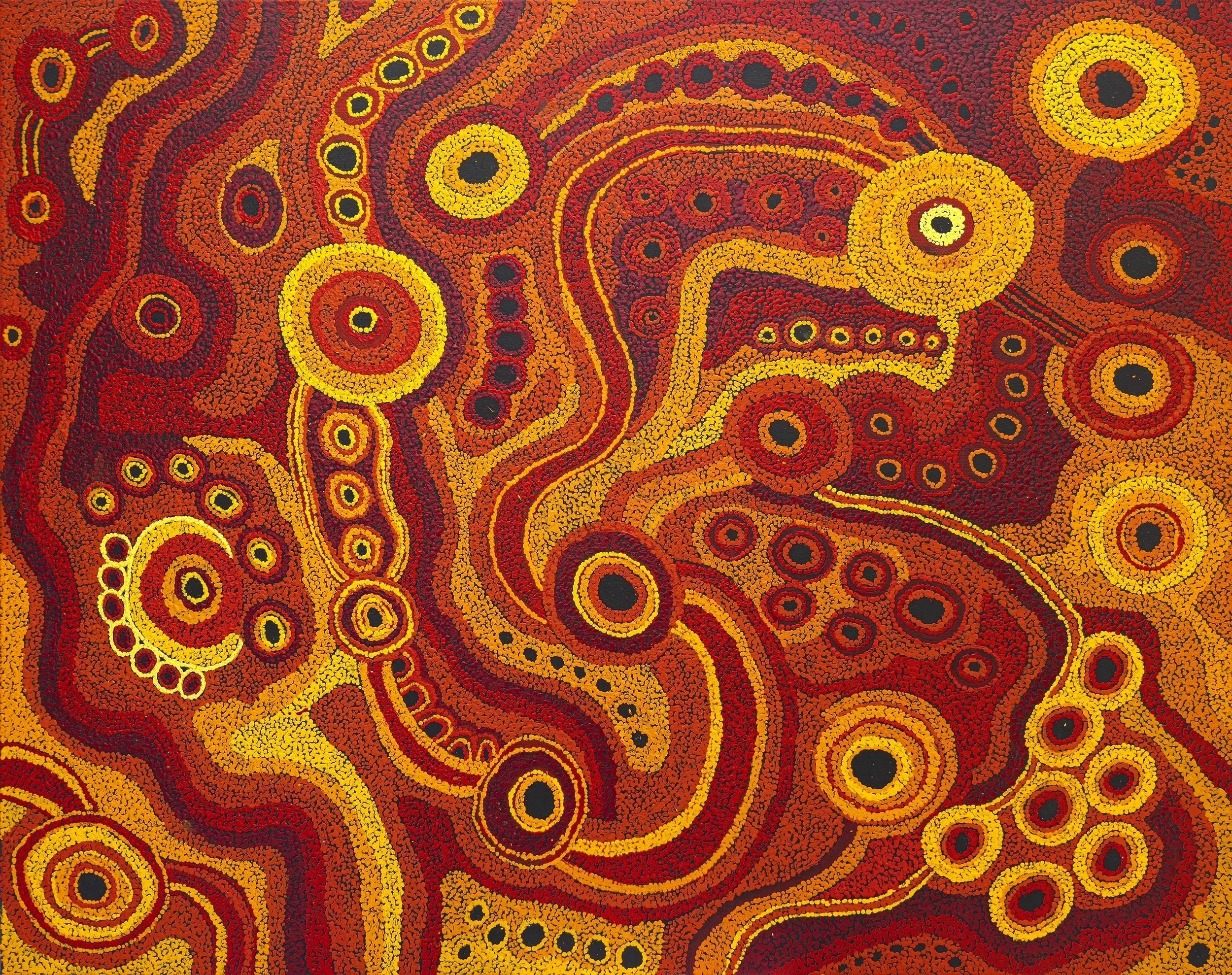
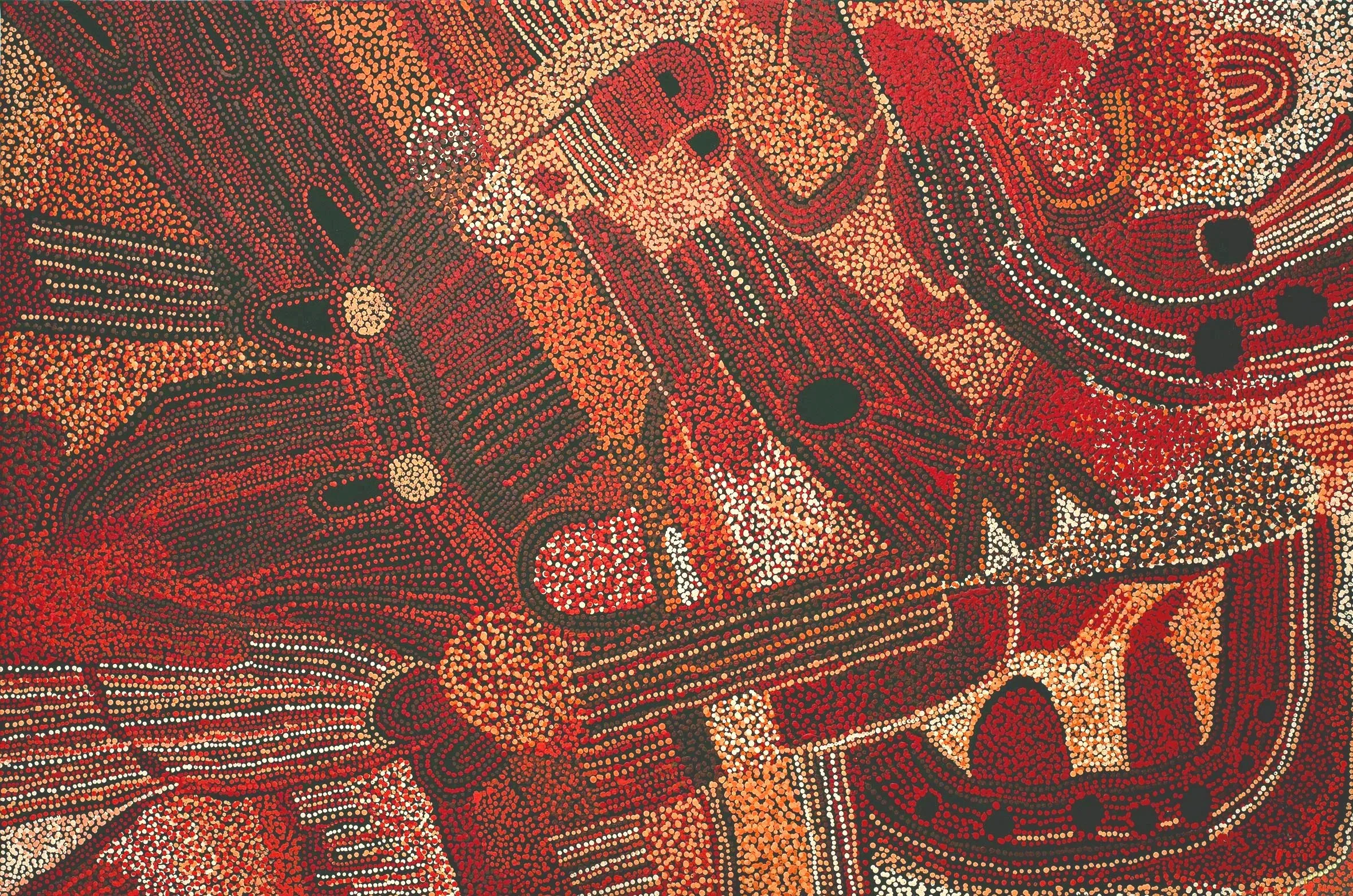
Peinture de l’artiste Sandra Ken - Seven Sisters - 152,5 x 122 cm - 476-23 © Photo Aboriginal Signature Estrangin Gallery with the courtesy of Tjala Arts
Des pépites venues de très loin
Quarante-neuf œuvres, quarante-quatre artistes, seize centres d'art parmi les communautés les plus éloignées d'Australie. Du cœur du désert aux rivages de l'océan Indien et de la mer d'Arafura, elles célèbrent l'équilibre établi au commencement du monde entre la terre, l'eau, les êtres vivants et le ciel. Du 2 au 22 décembre 2026, à Bruxelles (Koekelberg).
Avant d'arriver à Bruxelles, ces toiles ont fait un long voyage. Certaines viennent de Yuendumu, à 300 kilomètres au nord-ouest d'Alice Springs, au bord de la piste du Tanami. D'autres de Tjuntjuntjara, au cœur du Grand Désert de Victoria, à près de 1 300 kilomètres à l'est de Perth. D'autres viennent de Bidyadanga, face à l'océan Indien, à deux heures de route au sud de Broome, ou de Punmu, au bord du lac Dora, chez les Martu. D'autres encore descendent du Kimberley, de Balgo et de Warmun, au pied des Bungle Bungles. Les plus septentrionales viennent de la mer : des îles Tiwi, au large de Darwin, et de Yirrkala, en terre d'Arnhem.
Entre ces extrémités s'étendent les terres APY et les terres Ngaanyatjarra, où huit des centres d'art exposés sont au cœur de la vie de leur communauté. Ces centres appartiennent aux artistes. Ils sont à la fois un atelier, un lieu de rencontre et un lieu de transmission. À Yuendumu, comme ailleurs la vente des œuvres finance des projets pour toute la communauté.
Au commencement, l'équilibre
Au commencement, racontent les Aṉangu, le monde était sans relief. Les êtres ancestraux, sous la forme de femmes, d'hommes, d'animaux et de plantes, l'ont parcouru et façonné : chaque colline, chaque dune, chaque point d'eau garde la trace de leur passage. Les Pitjantjatjara nomment ce temps et cette loi Tjukurpa, les Warlpiri Jukurrpa ; nous disons « le Rêve ».
Ce temps-là n'est pas révolu. Le Rêve est une loi vivante, qui dit comment prendre soin les uns des autres et de la terre qui nous porte. Elle règle les liens entre les personnes, les plantes, les animaux et chaque relief du pays : un équilibre fixé à l'origine, que chaque génération reçoit et doit garder.
Ce lien est d'une intimité que nos langues peinent à dire. Les Aṉangu appellent certains lieux « ma grand-mère » ou « mon grand-père ». Et beaucoup de titres répètent simplement : Ngayuku ngura, « mon pays ».
C'est cet équilibre que célèbrent les œuvres, avec une infinie délicatesse. Yurpiya Lionel peint Anumara, le lieu d'une chenille : garder ce lieu intact, c'est permettre aux chenilles de se multiplier. Kunmanara (Judy) Martin peignait les points d'eau que la famille de son père garde et soigne depuis le commencement des temps.
Pauline Minmila Wangin peint ce que sa mère lui a appris, enfant, un jour où elles n'avaient plus d'eau : trouver le point d'eau tout proche, et en prendre soin. On le vide, on le nettoie, puis on le couvre de branches et d'une grosse pierre, pour qu'aucun animal ne salisse l'eau nouvelle.
Ailleurs, l'équilibre se dit par des récits. À Piltati, un partage rompu entre deux frères et deux sœurs change la face du pays : les hommes deviennent serpents d'eau, et la terre garde à jamais la trace de leur histoire. À Kuru Ala, les Sept Sœurs s'arrêtent pour soigner l'aînée, blessée par Nyiru.
Et l'on y entend une émotion profondément humaine. À Mina Mina, les femmes ancestrales et les serpents emportés par la poussière de leur danse finirent par avoir le mal de leur pays : ils revinrent parmi les chênes du désert, et y restèrent pour toujours.
Au bord de la mer, l'équilibre prend d'autres visages. Sur les îles Tiwi, Timothy Cook peint Japarra, l'homme-lune : « je vois Japarra dans le ciel, et dans la mer aussi », dit-il. Pour Pedro Wonaeamirri, la cérémonie funéraire Pukumani est d'abord une célébration, un au revoir : « à la prochaine fois, dans ton pays ».
Ces œuvres ne sont pas des illustrations : chacune est à la fois une carte, une loi, une généalogie, une prière. Le peuple Spinifex l'a démontré : ses premières peintures ont été conçues comme des preuves. Le 28 novembre 2000, la Cour fédérale a reconnu ses droits sur environ 55 000 km² du Grand Désert de Victoria, et deux grandes toiles collectives figurent dans le préambule de l'accord.
Kunmanara (Roy) Underwood, dont une toile est exposée, fut l'un des grands artisans de ce retour des Spinifex sur leurs terres. Plus au nord, à Yirrkala, les Yolŋu avaient ouvert la voie dès 1963, en adressant au gouvernement fédéral une pétition peinte sur écorce.
La loi impose aussi le silence. Certains récits, comme ceux du cycle Tingari, sont secrets : le cercle, le point et la ligne disent le lieu, et taisent ce qui doit le rester.
Des vies, des voix
Lydia Balbal est née en 1958 dans le Grand Désert de Sable. Enfant, elle a parcouru ce pays à pied avec sa famille, d'un point d'eau à l'autre. Au début des années 1970, une grande sécheresse a poussé les siens à marcher jusqu'à la mission de La Grange, sur la côte, aujourd'hui Bidyadanga.
Depuis le bord de la mer, elle peint toujours Winpa, l'« eau vivante » de son enfance, où les familles du désert se réunissaient pour appeler la pluie. Peindre Winpa, si loin de Winpa, c'est continuer d'en prendre soin. Du désert à la mer, c'est d'abord le chemin d'une vie, et celui d'une fidélité.
Julie Nangala Robertson peint Mina Mina, un lieu sacré des femmes warlpiri, comme le faisait sa mère. Celle-ci lui a transmis ses récits en lui demandant de continuer à les peindre. En 2023, Julie a reçu le prix de peinture générale des National Aboriginal and Torres Strait Islander Art Awards, à Darwin.
À Ernabella, tout a commencé en 1948, dans une petite salle où les femmes filaient la laine des moutons de la station. C'est aujourd'hui le plus ancien centre d'art autochtone d'Australie en activité continue. Langaliki Lewis, Elizabeth Dunn et Amy Scotty y peignent les dunes, les points d'eau, les serpents d'eau de Piltati et les Sept Sœurs.
Emily Cullinan, née en 1952 près de Mimili, se souvient des marches de son enfance : chaque jour, son père creusait avec son bâton pour trouver l'eau. Elle et Betty Chimney exposent aux côtés de Sallyanne Roberts, née en 1986. Le même pays passe ainsi d'une génération à l'autre, et chacune lui donne sa voix.
Les noms aussi racontent. Celui de Phyllis Thomas, Booljoonngali, signifie « grosse pluie qui tombe avec beaucoup de vent ». Nancy Chapman doit le sien, Nyanjilpayi, « celle qui se tient debout », à la petite fille qui guettait sans cesse le retour des anciens chargés de nourriture.
Un parcours du désert à la mer
L'exposition se parcourt comme une piste, qui est aussi une histoire. Elle part de Yuendumu, où Warlukurlangu Artists naît en 1985, avec plus de la moitié de femmes parmi ses fondateurs et, d'emblée, le goût de la couleur. Elle passe par Papunya, où des hommes commencent à peindre à l'acrylique en 1971 et fondent l'année suivante Papunya Tula, la première entreprise artistique aborigène.
Elle traverse ensuite les terres APY, avec Ernabella, le doyen, puis Tjala, Iwantja, Mimili Maku et Kaltjiti, jusqu'à l'ouest, où Tjungu Palya, Ninuku et Minyma Kutjara travaillent à Nyapari, Kalka et Irrunytju. Elle gagne le pays Spinifex, dont le centre d'art naît en 1997, puis celui des Martu, autour de Punmu. Elle rejoint la côte à Bidyadanga, où, en 1999, un jeune homme, Daniel Walbidi, se tourne vers la Short Street Gallery de Broome : grâce à lui, les anciens peignent pour la première fois avec des matériaux d'artiste.
Elle remonte enfin vers le nord : Balgo, au bord du Grand Désert de Sable, Warmun, dans le Kimberley, puis la mer d'Arafura, avec les îles Tiwi et Yirrkala. Là, les motifs des cérémonies et la peinture sur écorce prolongent, face à l'océan, la même mémoire.
En chemin, on croise les cercles et les lignes du cycle Tingari, qui marquent les sites et les trajets des ancêtres. À Mina Mina, les grands chênes du désert incarnent les bâtons à fouir et les femmes qui ont dansé. On y suit aussi les Sept Sœurs, qui fuient Nyiru à travers le désert, s'arrêtent à Kuru Ala pour soigner l'aînée, puis s'envolent pour devenir les Pléiades.
Ce qui relie les artistes
Quarante-quatre artistes, seize centres d'art, des milliers de kilomètres entre eux : à première vue, des mondes séparés. Regardées de près, les œuvres révèlent pourtant des fils qui les relient : des familles, des récits partagés, une même région d'origine et, presque partout, l'eau.
Des familles. Freda Brady et Sandra Ken sont sœurs. Avec trois autres sœurs Ken, à Amata, elles ont remporté en 2016 le prix Wynne pour une grande toile des Sept Sœurs, la première œuvre collective récompensée par ce prix. À Ernabella, Atipalku Intjalki expose aux côtés de ses deux filles, Langaliki et Lynette Lewis.
À Mimili, Kunmanara (Willy) Martin et Kunmanara (Judy) Martin partageaient leur vie. À Kiwirrkura, Joy Gibson Napaltjarri est la fille du peintre Yala Yala Gibbs Tjungurrayi, l'époux de Ningura Napurrula : tous deux avaient aidé à fonder Papunya Tula.
Chez les Martu, Nancy Chapman et Mulyatingki Marney sont sœurs ; leur frère, le peintre Donald Moko, est l'époux de Mary Meribida, à Bidyadanga. Et Mary Meribida peignait Martakulu, un point d'eau près de Punmu, là même où vivent ses belles-sœurs.
Les mêmes récits, d'un centre à l'autre. Les Sept Sœurs passent de Tjala à Ernabella, d'Iwantja au pays Spinifex, et jusqu'à Balgo, où Kathleen Paddoon peignait Nakarra Nakarra, des collines qui incarnent les sœurs. Une grande toile collective de Tjala suit leur voyage jusqu'à Kuru Ala, que peignent Angkaliya Mitchell et Sallyanne Roberts, qui tient ce lieu de sa grand-mère, Kunmanara (Wingu) Tingima. Kunmanara (Estelle) Hogan était née au point d'eau de Paltatatjara, où les sœurs ont campé dans leur fuite.
À Irrunytju, Ivy Laidlaw, l'une des fondatrices du centre d'art, et Cynthia Burke ont peint un autre grand récit de femmes, Minyma Kutjara, les Deux Femmes. Le feu, lui, porte deux noms : warlu en warlpiri, chez Paddy Japaljarri Sims, et waru en pitjantjatjara, chez Carol Young, à Ninuku.
Le récit des serpents d'eau, les wanampi, relie Ernabella, Mimili et Kaltjiti. Elizabeth Dunn peint Piltati, le pays de sa grand-mère, et Atipalku Intjalki le même lieu ; Kunmanara (Willy) Martin peignait ce récit à Mimili. Kunmanara (Taylor) Wanyima Cooper était né à Malara, autre point d'eau des wanampi, dont il était le gardien.
Une même région d'origine. Beaucoup vivent aujourd'hui à l'est des terres APY, mais leurs racines sont à l'ouest, autour de Nyapari, Kanpi et Pipalyatjara, jusqu'à Irrunytju (Wingellina). C'est là que se trouvent Piltati, Malara, Anumara, le pays familial de Yurpiya Lionel, Wakura, le pays du père de Kunmanara (Judy) Martin, et Kanpi, où Kani Patricia Tunkin peint Malilu, une femme ancêtre qui creusa une grotte pour y garder sa nourriture. Trois centres de l'exposition y travaillent aujourd'hui : Tjungu Palya à Nyapari, Ninuku à Kalka et Minyma Kutjara à Irrunytju.
L'eau, la dune, la marche. Plus de vingt artistes peignent un point d'eau : trou de roche, source, puits creusé dans le sable ou « eau vivante ». Le mot tali, la dune, revient chez les sœurs Lewis et Kunmanara (Judy) Martin dans les terres APY, chez Lydia Balbal à Bidyadanga et chez Kathleen Paddoon à Balgo, à des centaines de kilomètres les uns des autres.
Beaucoup ont aussi marché. Ningura Napurrula a quitté le désert de Gibson en 1962 pour Papunya. Lydia Balbal et Mary Meribida, nièce du grand peintre Rover Thomas, ont quitté le Grand Désert de Sable pour la côte ; Kunmanara (Estelle) Hogan et les siens ont dû quitter leur pays lors des essais nucléaires britanniques des années 1950, avant d'y revenir.
D'autres ont fait le chemin du retour. Kunmanara (Roy) Underwood, emmené à la mission de Cundeelee à la fin des années 1950, est reparti à pied dans le désert après son initiation. Nancy Chapman et Mulyatingki Marney se sont installées à Punmu au début des années 1980, pour vivre plus près de leur pays.
Vues ensemble, ces trente œuvres ne sont pas des îlots. Elles forment une seule trame, tissée de familles, de récits et de chemins, à l'image du pays lui-même : un monde où rien n'existe seul, et où chaque être tient à tous les autres.
Une démarche éthique
Toutes les œuvres viennent directement des centres d'art et sont accompagnées de leur certificat d'authenticité. La galerie adhère à l'Indigenous Art Code. Acquérir une œuvre, c'est entrer à son tour dans ce cercle d'échanges : soutenir une communauté, ses familles et la transmission de sa culture. C'est aussi accueillir chez soi un peu de ce pays lointain, et la mémoire de ceux qui en prennent soin.
Informations pratiques
• Vernissage : mercredi 2 décembre 2026, de 14 h à 21 h 30, sur rendez-vous. Discours et drink à 20 h.
• Exposition : jusqu'au 22 décembre 2026, du mardi au samedi, de 11 h à 19 h, sur rendez-vous.
• Lieu : Aboriginal Signature Estrangin, 101 rue Jules Besme, 1081 Koekelberg (Bruxelles).
• Contact : +32 (0)475 55 08 54 · info@aboriginalsignature.com
Nous nous réjouissons de vous accueillir au sein de la galerie à Bruxelles, dans notre espace de 250 m2 tout entier dédié à ces grands et petits trésors du bout du monde.
Avertissement culturel. Les visiteurs aborigènes et insulaires du détroit de Torres sont informés que cette page peut contenir les noms et les œuvres de personnes décédées.
Découvrez l’ensemble des peintures de l’exposition ci-dessous
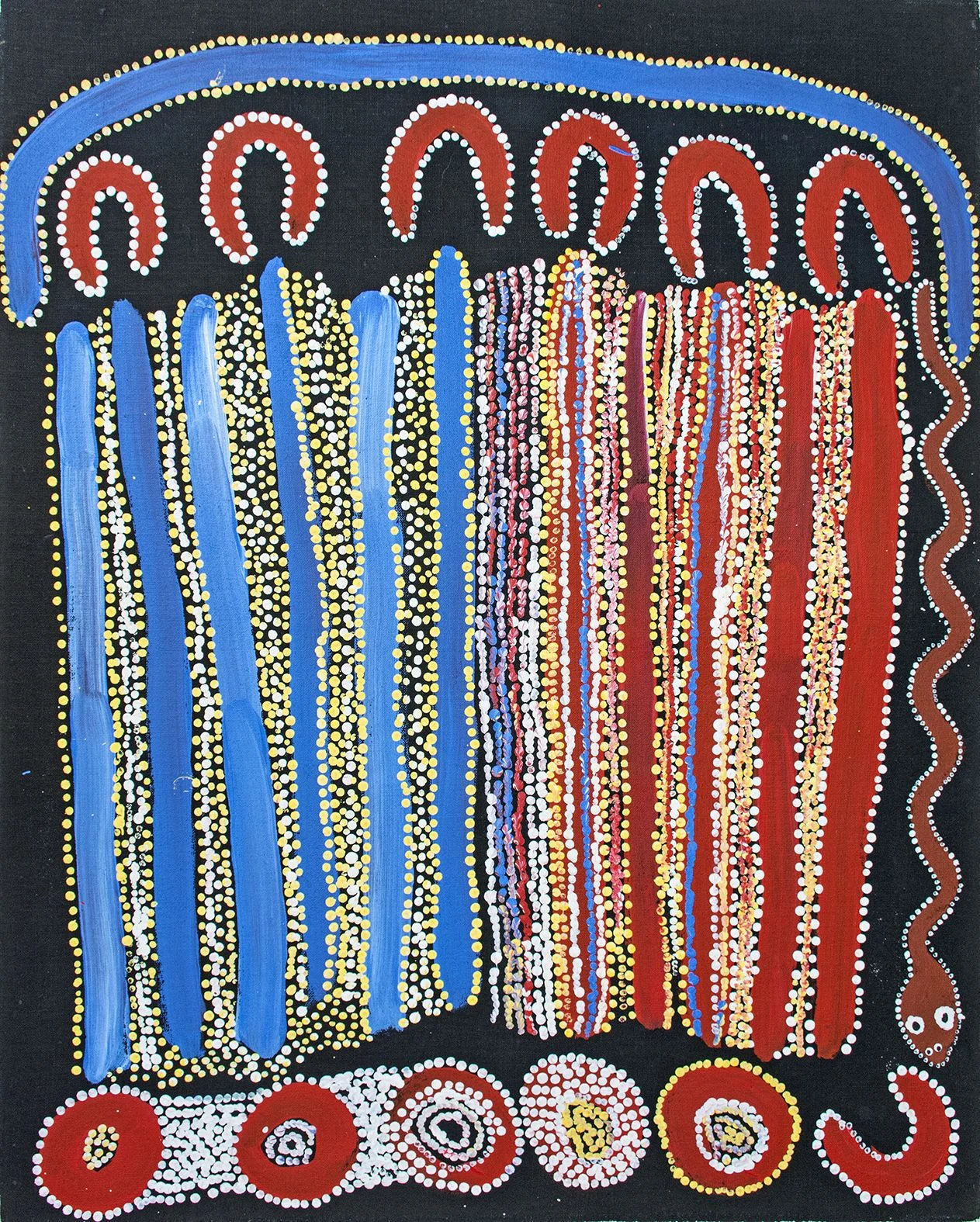
Artiste : Angkaliya Mitchell
Titre de cette œuvre d'art Aborigène : Kuru Ala Dreaming Time story (Seven sisters)
Format : 75 x 60 cm
Provenance et certificat : centre d'art aborigène du Spinifex Art Project
Référence de cette peinture : 14029

Artiste : Freda Brady
Titre de l'œuvre : Ngayuku ngura - My Country
Format : 152,5 x 101,5 cm
Provenance et certificat : centre d'art aborigène de Tjala Arts
Référence de cette peinture aborigène : 152-23
Enquiry / Demander le prix de l'œuvre
Explication pour cette œuvre :
Freda Brady was born and raised in Amata. She is the daughter of the late Kunmanara (Paniny) Mick and Mick Wikilyiri, both senior and highly regarded painters at Tjala Arts. Freda began her artistic career in 2002 creating batik. Since then, Freda has committed to her painting practice with great vigour and is a highly skilled and respected artist working at the heart of the art centre.
A talented artist in her own right, Freda also paints on impressive large-scale collaborative canvases with her sisters Yaritji Young, Tjungkara Ken, Maringka Tunkin and Sandra Ken.
Freda is also a director and chairperson of Tjala Arts, her commitment to the art centre business extending well beyond her individual painting practice to support the ongoing strength and vitality of art centre business for her community.
In this painting Freda has depicted her country. The different colours and designs represent variations in the landscape.
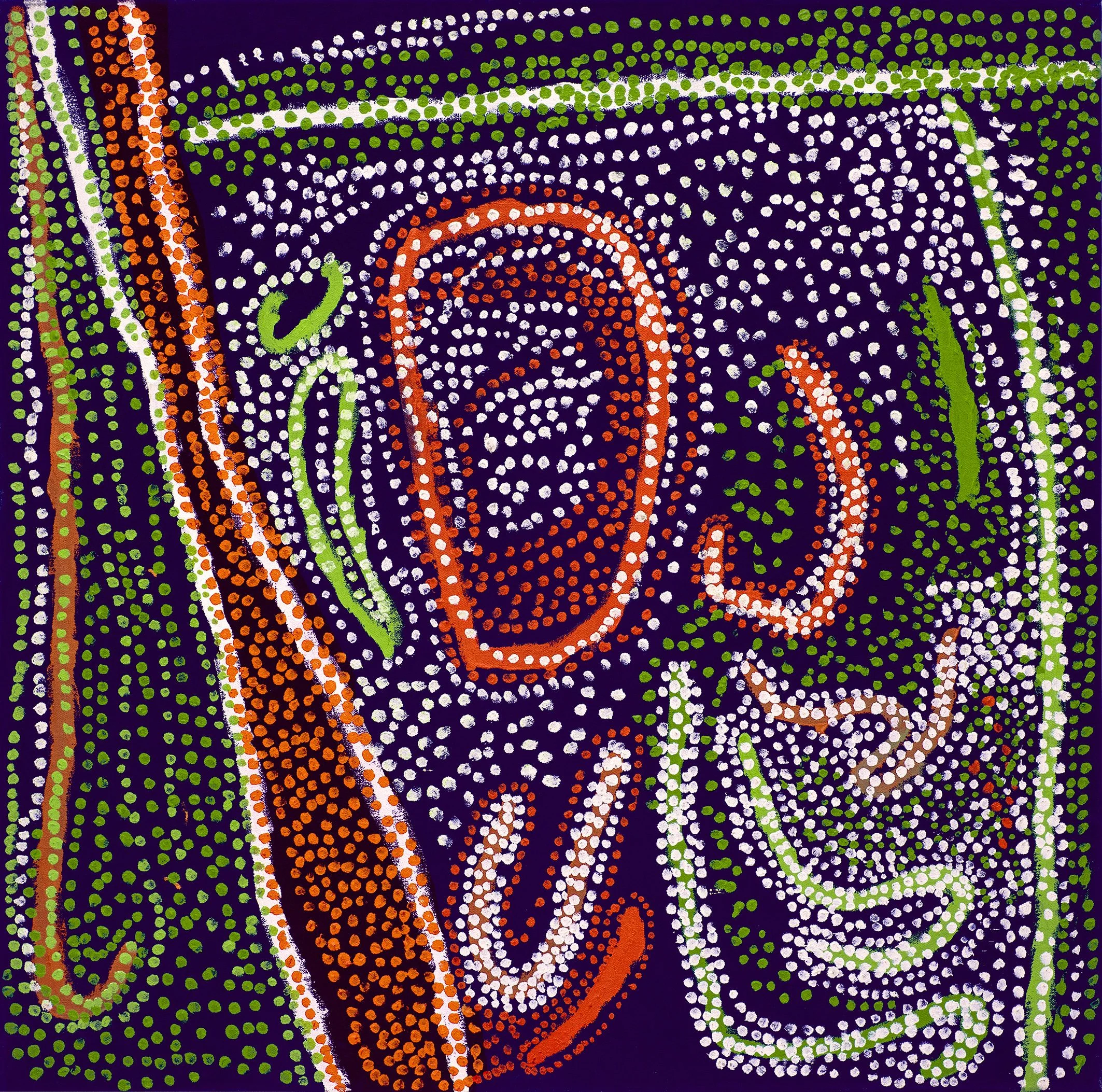
Artiste : Lydia Balbal
Titre de l'œuvre : Martakulu - Dreaming Time stories
Format : 91 x 91 cm
Provenance et certificat : Short Street opérant pour les artistes Yulparija de Bidyadanga
Référence de cette peinture aborigène : 783617
Explications sur cette peinture d’art Aborigène :
Lydia Balbal (1958) is a Mangala woman. Lydia's country is near Punmu in the Great Sandy Desert of W.A. Her people's existence was threatened by severe drought so that they had little choice but to leave their traditional country. Her family were some of the last to walk out to the coastal town of Bidyadanga (then La Grange Mission) located two hours south of Broome in the early 70s. Lydia first began painting in 2007 but has already received significant attention from collectors and the media alike.
Martakulu is a soak out near Punmu near the Canning Stock Route in the Great Sandy Desert in Western Australia. It is strong womans country, it is part of the women's law line. Long time ago a law man he come up to this country, he went home and left his wife and baby. They make him fire and sit down, cook mayi (bush food) and then started to cry for her husband. Her tears made that soak. It is important country this one. Lydia says "I been young girl walked all around here with my mummy and daddy. We camp and hunt here." This painting shows the rockhole with king brown snakes and their eggs.
Collections : Murdoch University Art Collection. Aboriginal Art Museum, The Netherlands. Thomas Vroom Collection, The Netherlands. National Gallery of Victoria Felton Collection. Queensland Art Gallery. Laverty Collection. Monash University Art Collection. Lepley Collection. Western Australian Art Gallery. National Gallery of Australia. Wesfarmers Collection. Australia Parliament House Collection. Brocard - Estrangin Collection. Kluge-Ruhe Aboriginal Art Collection of the University of Virginia…
© Photo : Aboriginal Signature Estrangin gallery with the courtesy of Short Street and the artist
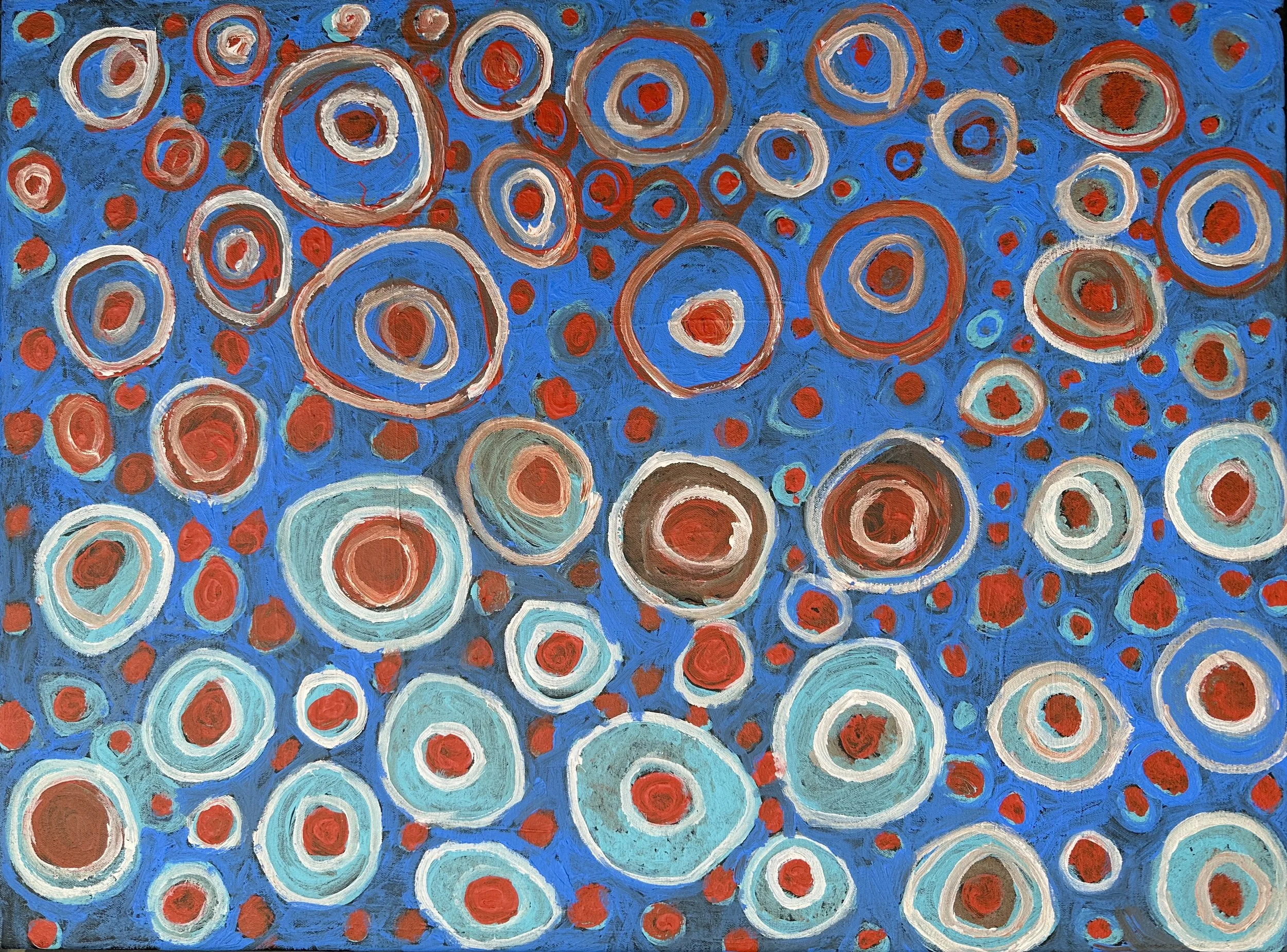
Artiste : Ivy Laidlaw (1945)
Titre de l'œuvre : Minyma Kutjara
Format : 9 x 56 cm
Provenance et certificat : centre d'art aborigene de Irrunytju Arts
Référence de cette peinture aborigène : 23-258
Explications sur cette œuvre :
In this artwork she is dealing about Minyma Kutjara Tjukurpa (the creation story of the two sisters). The big sister was travelling with her younger sister back to their homeland. The little sister was reluctant to head further and further north as she had been living with a different family near the ocean to the south. She had been lost for a long time and was unfamiliar with the landscape the big sister was showing her.
Eventually the older sister gave her a piggyback and tried to comfort her. She continued to teach her all about the country they travelled through. Sometimes when they stopped they performed Inma (sacred singing and dancing). They camped at Punuwara and Irrunytju rockhole before heading further north to Docker River.
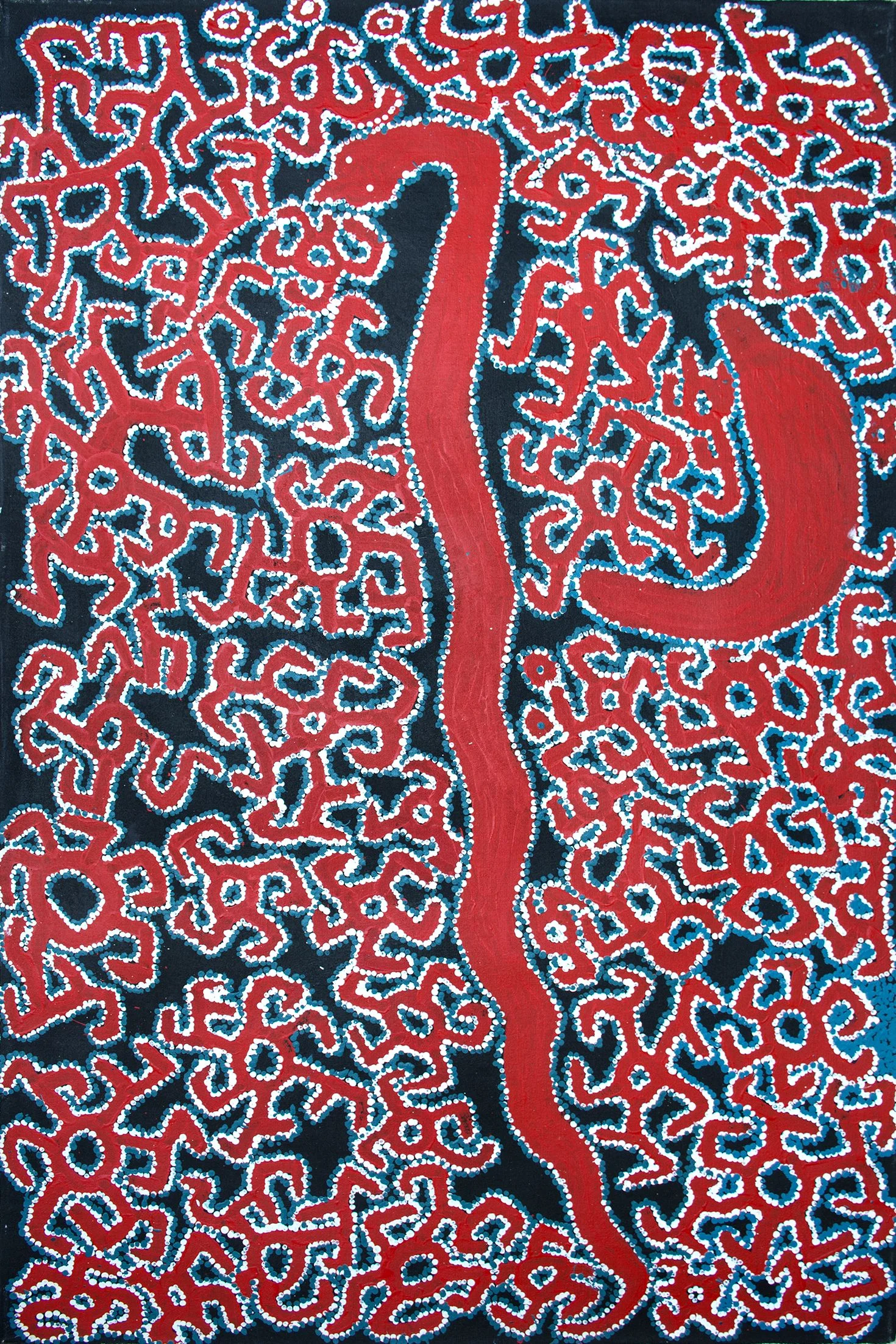
Artiste : Roy Underwood
Titre de l'œuvre : Wipuwara Dreaming Time story
Format : 136 x 91 cm
Provenance et certificat : centre d'art aborigène du Spinifex Art Project
Référence de cette peinture : 13144
Explications pour cette œuvre :
This painting represents a place called Wipuwara. This is where the Black Nosed Monitor Man and the Sand Goanna Man from creation time lived. They were cleaning their boomarang and feeling very hungry.
They decided to go out hunting and quick spotted a large Snake Man off in the distance. They threw the boomarang but failed to kill him. The Snake Man then bit both the other men and killed them. This is where they died.
Roy has painted the story of the Minyma Pitjitjarli (Scorpion Story) at Mulpulya and Kanpa. In the painting Roy has shown the tracks and holes of this minyma in her area. This story like many other Spinifex stories is sacred and only general detail is appropriate to discuss here. Myrtle Pennington was born in this area and Roy can paint this area through his family ties.
Roy has been a major driving force in returning the Spinifex people to their country and representing and negotiating the unbroken connection to country which was the key element in the Federal Court decision to grant the Spinifex people exclusive Native Title over 55,000 sq. km.
in 2000. Roy continues to be a venerated Elder and is routinely elected to Spinifex Land Council and Tjuntjuntjara Community Council.
Roy has a unique painting style somewhat reminiscent of Kiwirkurra mens’ designs from Pintupi country hundreds of kilometres to the northwest.
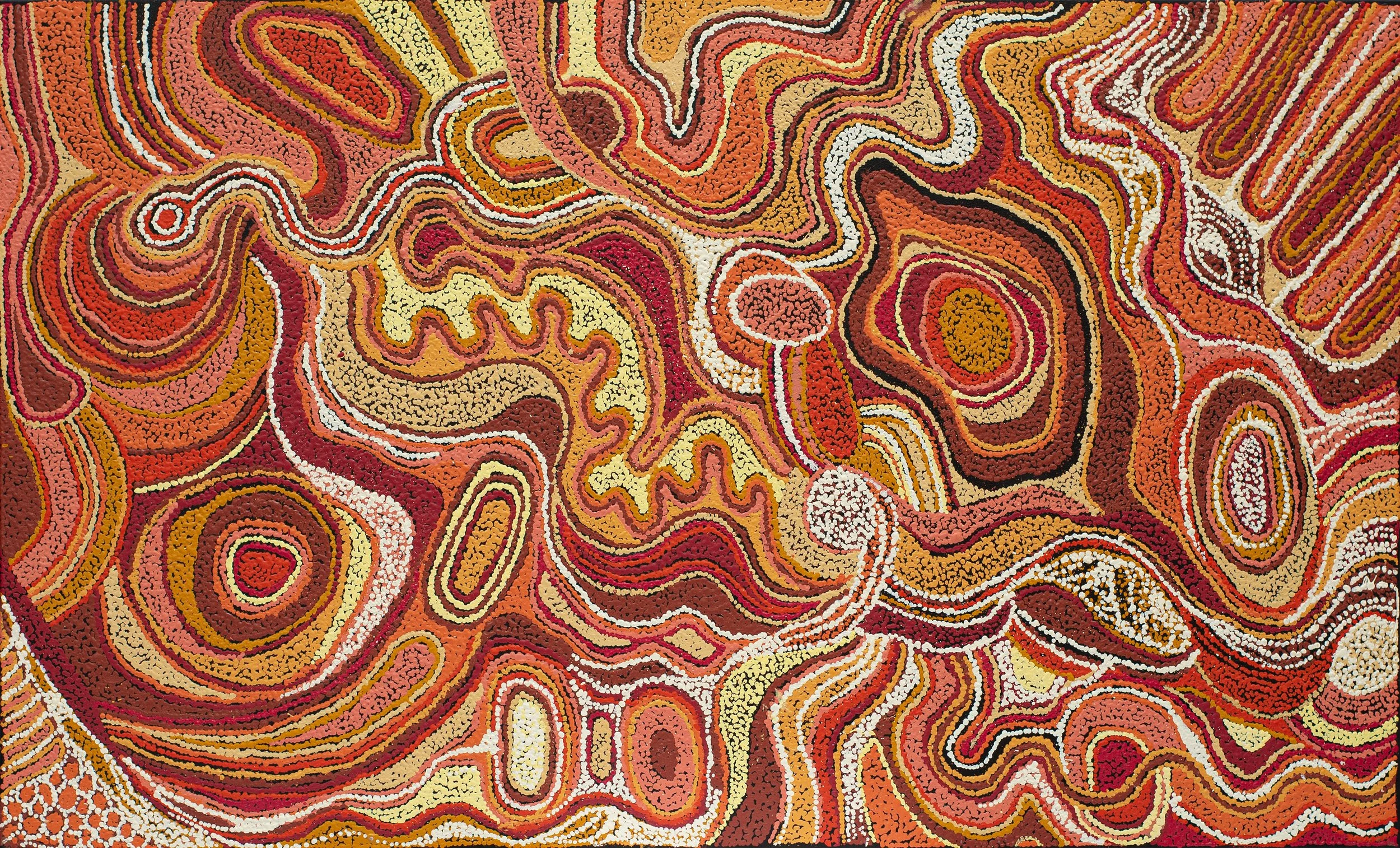
Artiste : Langaliki Lewis
Titre : Tjukula/Waterholes
Format : 148 × 99 cm
Provenance et certificat : centre d'art aborigène d’Ernabella
Référence de cette peinture aborigène : 210-25
Explication sur cette œuvre :
Painting by Langaliki Lewis (1973). For the Pitjantjatjara people living in the desert, knowledge of their water sources was critical to their survival.
This is a depiction of the artists' country. The different colours and designs represent variations in the landscape.
This design is inspired by the red sand dunes that are found throughout the central desert. There is a large red sand dune near Ernabella named Wamikata which is a popular place for looking for maku (witchetty grubs) and for teaching Milpatjunanyi (telling stories in the sand) to children.

Artiste : Patrick Tjungurrayi
Titre de l'œuvre : Rockhole site of Wirrilpinya (ancestral Tingari cycle)
Format : 91 x 91 cm
Provenance et certificat : centre d'art aborigene de Papunya Tula Artists
Référence de cette peinture aborigene : PT1306081

Artiste : Atipalku Intjalki (1955)
Titre de l'œuvre : Piltati
Format : 150 x 81 cm
Provenance et certificat : centre d'art aborigène d’Ernabella
Référence de cette peinture aborigène : 634-22
Explication sur cette œuvre :
There were two sisters who married two brothers and they all lived together. One day the women went wandering and they went such a long way that they forgot about their husbands. Back at the camp, the two husbands were thinking, 'Where are our wives?' and they decided to go looking for them. One brother said to the other, 'What should we become to go looking for them?' and the other brother said 'Why don't we become Rainbow Serpents?' And they travelled in the sky looking down for their wives. Finally they see them hunting for carpet snakes and they put something in the hole where the women were digging. The women find it and then dig another hole and once again the men have put something in there. And this is how the men lure the women back to Piltati where the men make the sisters transform into Wanampi, swallow them and keep .them in their throats. All four of them live together in the waterhole and still live there today.

Artiste : Lydia Balbal
Titre de l'œuvre : Winpa - Dreaming Time stories
Format : 91 x 60 cm
Provenance et certificat : Short Street opérant pour les artistes Yulparija de Bidyadanga
Référence de cette peinture aborigène : 785667
Vendue
Explications sur cette peinture d’art Aborigène :
Lydia Balbal (1958) is a Mangala woman. Lydia's country is near Punmu in the Great Sandy Desert of W.A. Her people's existence was threatened by severe drought so that they had little choice but to leave their traditional country. Her family were some of the last to walk out to the coastal town of Bidyadanga (then La Grange Mission) located two hours south of Broome in the early 70s. Lydia first began painting in 2007 but has already received significant attention from collectors and the media alike.
Winpa is jila (living water) located near the Percival Lakes in the Great Sandy Desert in WA. It is an important gathering of the Yulparija and neighbouring groups. they would gather for rain making ceremonial ceremonies.
Collections : Murdoch University Art Collection. Aboriginal Art Museum, The Netherlands. Thomas Vroom Collection, The Netherlands. National Gallery of Victoria Felton Collection. Queensland Art Gallery. Laverty Collection. Monash University Art Collection. Lepley Collection. Western Australian Art Gallery. National Gallery of Australia. Wesfarmers Collection. Australia Parliament House Collection. Brocard - Estrangin Collection. Kluge-Ruhe Aboriginal Art Collection of the University of Virginia.
© Photo : Aboriginal Signature Estrangin gallery with the courtesy of Short Street and the artist
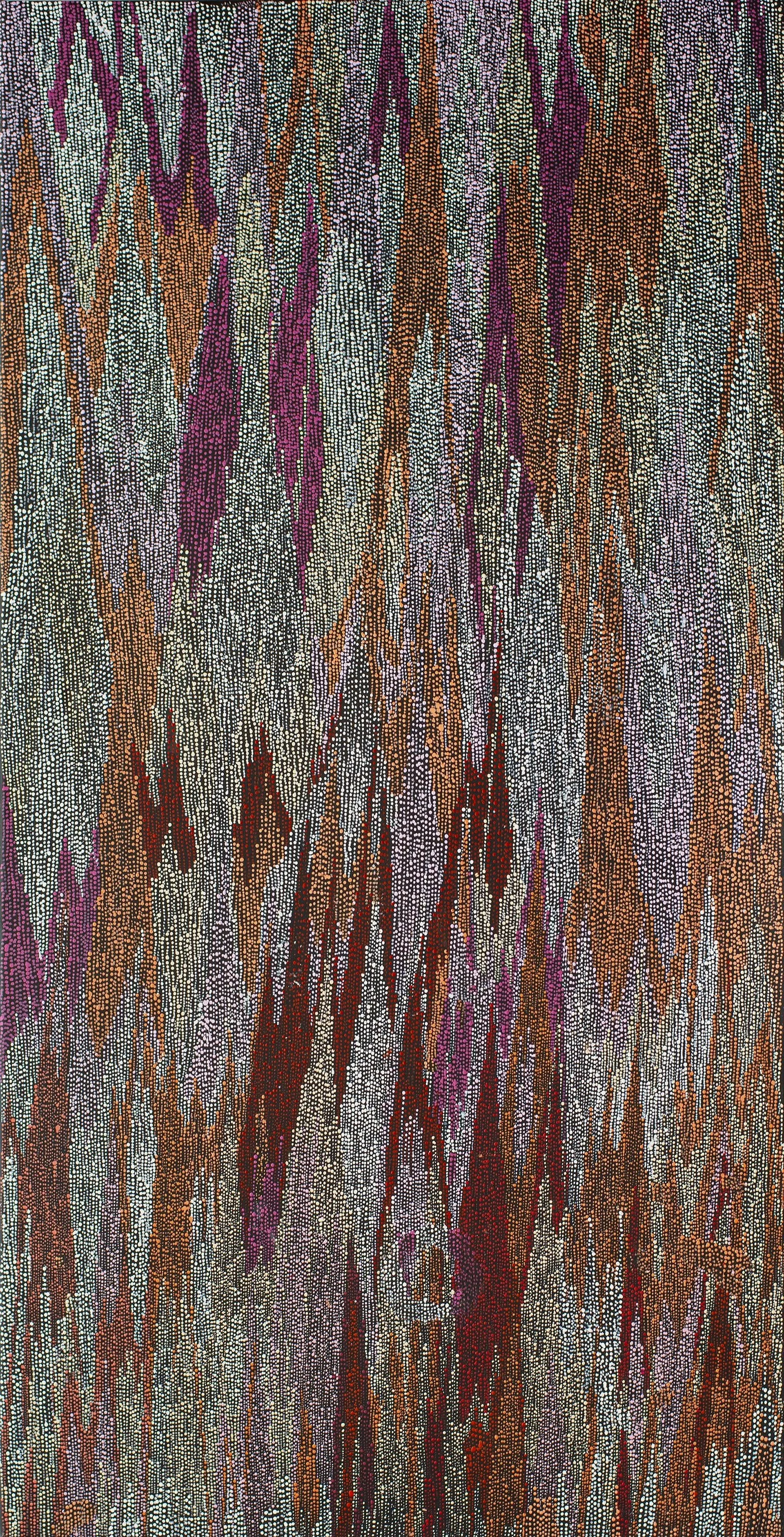
Artiste : Lynette Lewis
Titre de l'œuvre : Wamikata Walka Tali / Sand dune
Format : 149 × 75 cm
Provenance et certificat : centre d'art d'Ernabella
Référence de la peinture : 330-25
Explications sur cette peinture Aborigène :
Lynette's design is inspired by the ripples created by wind in the sand at the large, red sand dune named Wornikata near Ernabella. Womikata is a popular place for looking for maku (witchetty grubs) and also for teaching Milpatjunanyi (telling stories in the sand) to children.

Artiste : Lydia Balbal
Titre de l'œuvre : Winpa Desert place
Format : 90 x 60 cm
Provenance et certificat : Short Street opérant pour les artistes Yulparija de Bidyadanga
Référence de cette peinture aborigène : 830467
Explications sur cette peinture d’art Aborigène :
Lydia Balbal (1958) is a Mangala woman. Lydia's country is near Punmu in the Great Sandy Desert of W.A. Her people's existence was threatened by severe drought so that they had little choice but to leave their traditional country. Her family were some of the last to walk out to the coastal town of Bidyadanga (then La Grange Mission) located two hours south of Broome in the early 70s. Lydia first began painting in 2007 but has already received significant attention from collectors and the media alike.
Winpa is jila (living water) located near the Percival Lakes in the Great Sandy Desert in WA. It is an important gathering of the Yulparija and neighbouring groups. they would gather for rain making ceremonial ceremonies.
Collections : Murdoch University Art Collection. Aboriginal Art Museum, The Netherlands. Thomas Vroom Collection, The Netherlands. National Gallery of Victoria Felton Collection. Queensland Art Gallery. Laverty Collection. Monash University Art Collection. Lepley Collection. Western Australian Art Gallery. National Gallery of Australia. Wesfarmers Collection. Australia Parliament House Collection. Brocard - Estrangin Collection. Kluge-Ruhe Aboriginal Art Collection of the University of Virginia.
© Photo : Aboriginal Signature Estrangin gallery with the courtesy of Short Street and the artist

Artiste : Sandra Ken
Titre de l'œuvre : Seven Sisters
Format : 152,5 x 122 cm
Provenance et certificat : centre d'art aborigène de Tjala Arts
Référence de cette peinture aborigène : 476-23
Explication pour cette œuvre :
This is a Tjukurpa Story (Creation Story) about the constellations of Pleiades and Orion. The sisters are the constellaton of Pleiades and the other star Orion is said to be Nyiru or Nyirunya (described as a lusty or bad man). Nyiru is forever chasing the sisters known as the Kunkarunkara women as it is said he wants to marry the eldest sister. The seven sisters travel again and again from the sky to the earth to escape Nyiru’s unwanted attentions. They turn into their human form to escape from the persistent Nyiru, but he always finds them and they flee back to the sky. As Nyiru is chasing the sisters he tries to catch them by using magic to turn into the most tempting kampurarpra (bush tomatoes) for the sisters to eat and the most beautiful Ili (fig) tree for them to camp under. However, the sisters are too clever for Nyiru and outwit him as they are knowledgeable about his magic. They go hungry and run through the night rather than be caught by Nyiru. Every now and again one of the women fall victim to his ways. It is said that he eventually captures the youngest sister, but with the help of the oldest sister, she escapes back to her sisters who are waiting for her. Eventually the sisters fly back into the sky to escape Nyiru, reforming the constellation.

Artiste : Ray James Jangala
Titre de l'œuvre : Rockhole site of Mukula ( Ancestral storie of Tingari cycle)
Format : 91 x 61 cm
Provenance et certificat : centre d'art aborigene de Papunya Tula Artists
Référence de cette peinture aborigène : RJ1404076
Explications sur cette œuvre :
Ray James Tjangala (1958) was born at Yunala rockhole, west of Kiwirrkura. He is the son of Anatjari Tjampitjinpa, one of the original Papunya Tula artists, and Tjungkaya Napangati. Tjangala was encountered by Jeremy Long's Northern Territory Welfare Branch patrols in 1963 at Wudungunya rockhole north-west of Puntujarrpa (Jupiter Well). The family subsequently moved to Papunya in April 1964 where Tjangala attended school. By the late 1990s he had moved further west to Kiwirrkura and this return to his home country, along with the passing of many of the senior artists, invigorated his art, making him one of the most recognisable artists of Papunya Tula.
Generally, the Tingari are a group of ancestral beings of the Dreaming who travelled over vast stretches of the country, performing rituals and creating and shaping particular sites. The Tingari men were usually followed by Tingari women and were accompanied by novices, and their travels and adventures are enshrined in a number of song cycles. These ancestral stories form part of the teachings of the post initiatory youths today as well as providing explanations for contemporary customs.
Les œuvres de l’artiste figurent dans les prestigieuses collections suivantes :
Flinders University Art Museum.
Art Gallery of New South Wales.
National Gallery of Victoria.
Art Gallery of South Australia.
Aboriginal Art Museum, The Netherlands.
Harvard Art Museum, Cambridge, Massachusetts, USA.
National Gallery of Australia.
Toledo Musuem of Art, Toledo, Ohio, USA.
Voituron Collection, Belgium.

Artiste : Langaliki Lewis
Titre : Tali / Sand dune
Format : 149 x 89 cm
Provenance et certificat : centre d'art aborigène d’Ernabella
Référence de cette peinture aborigène : 511-22
Explication sur cette œuvre :
Painting by Langaliki Lewis (1973). For the Pitjantjatjara people living in the desert, knowledge of their water sources was critical to their survival.
This is a depiction of the artists' country. The different colours and designs represent variations in the landscape.This resulted in an intimate understanding of the landscape which continues today.
This design is inspired by the red sand dunes that are found throughout the central desert. There is a large red sand dune near Ernabella named Wamikata which is a popular place for looking for maku (witchetty grubs) and for teaching Milpatjunanyi (telling stories in the sand) to children.

Artiste : Yurpiya Lionel
Titre de l'œuvre : Anumara
Format : 152 x 81 cm
Provenance et certificat : centre d'art d'Ernabella
Référence de la peinture : 577-22
Explications sur cette peinture Aborigène :
Yurpiya is painting a place called Anumara, which is a place near Irrunytju (Wingellina) in WA. This is Yurpiya's family's country. Anumara is also the name for a kind of caterpillar and Anumara is the tjukurpa (dreaming) place for this caterpillar. This caterpillar lives in the grass and can be eaten if the grass it eats is removed. The place shares the same colours of the caterpillar - brown, yellow and pale green. Keeping this place safe will ensure that the caterpillars multiply.
Awards
2020 Waterhouse Natural Science Art Prize, Finalist
2018 Wynne Prize, Finalist
2015 National Aboriginal and Torres Strait Islander Art Award, Finalist
2007 Special Mention, Alice Springs Beanie Festival, Araluen Cultural Precinct, Alice Springs
Her artworks are in the following collections :
Museum of the UNIVERSITY OF NEWCASTLE, 2011
Private collections in Switzerland, Germany, Australia, Belgium
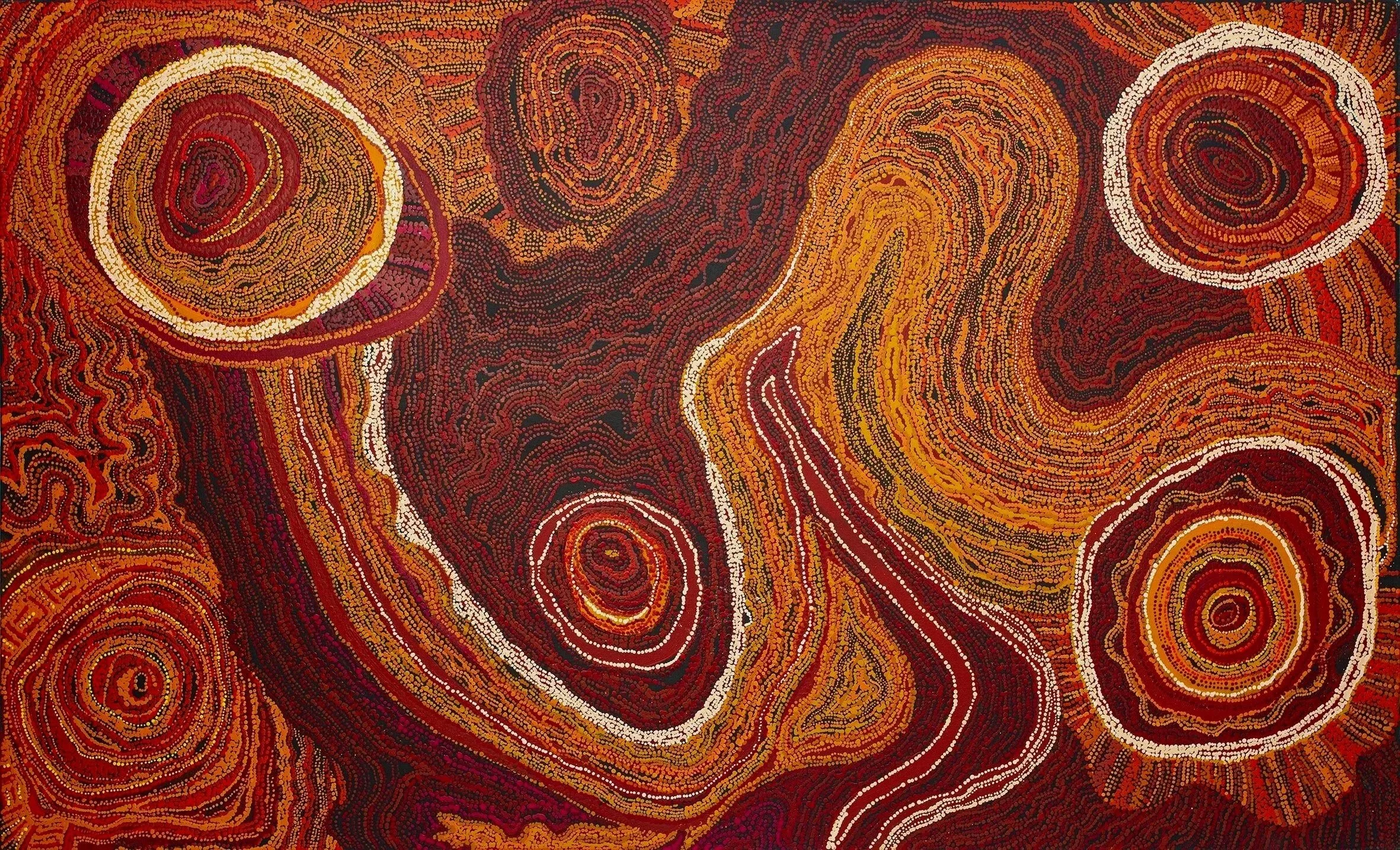
Artiste : Elizabeth Dunn
Titre de l'œuvre : Piltati, Elizabeth Dunn's story
Format : 202 x 122cm
Provenance et certificat : centre d'art aborigène d’Ernabella
Référence de cette peinture aborigène : 422-19
Explication sur cette œuvre :
Two brothers were married to two sisters and they all lived together. One day the two men go out hunting, looking for malu (kangaroo). They travel everywhere and find nothing. They start to worry. “What are we going to do, there is no meat on this land? One brother says, “maybe we should turn into something?”. They start to think about what they should turn into.
“Maybe firewood?”“No, the firewood burns.”
“Maybe emu or a bird?”.
“No, people eat them.”
They do a lot of talking and decide they should turn into Wanampi (rainbow serpents). A lot of smoke starts to come out of the ground, it is very scary and then the men become Wanampi. They travel into the land, towards a rockhole.
Meanwhile, the two women are waiting for their husbands to return from their hunting trip. They wait a very long time. They keep going on with their lives, collecting bush tucker, waiting…but the men never come back. So, they decide to set out to find their husbands. One day, they come across a hole in the ground. They start digging. Digging, digging, digging, they follow the tunnel inside the ground. They are so frantically digging they accidently hit one of the Wanampi in the back. The Wanampi chase the ladies and eat one of them, one women gets away.
Now, the Wanampi still live in the waterhole called Piltati. The Wanampi still live their today and provide rain for the bush tucker to grow and provide meat on the land. Piltati is Elizabeth’s great-grandfathers country and her dreaming story.
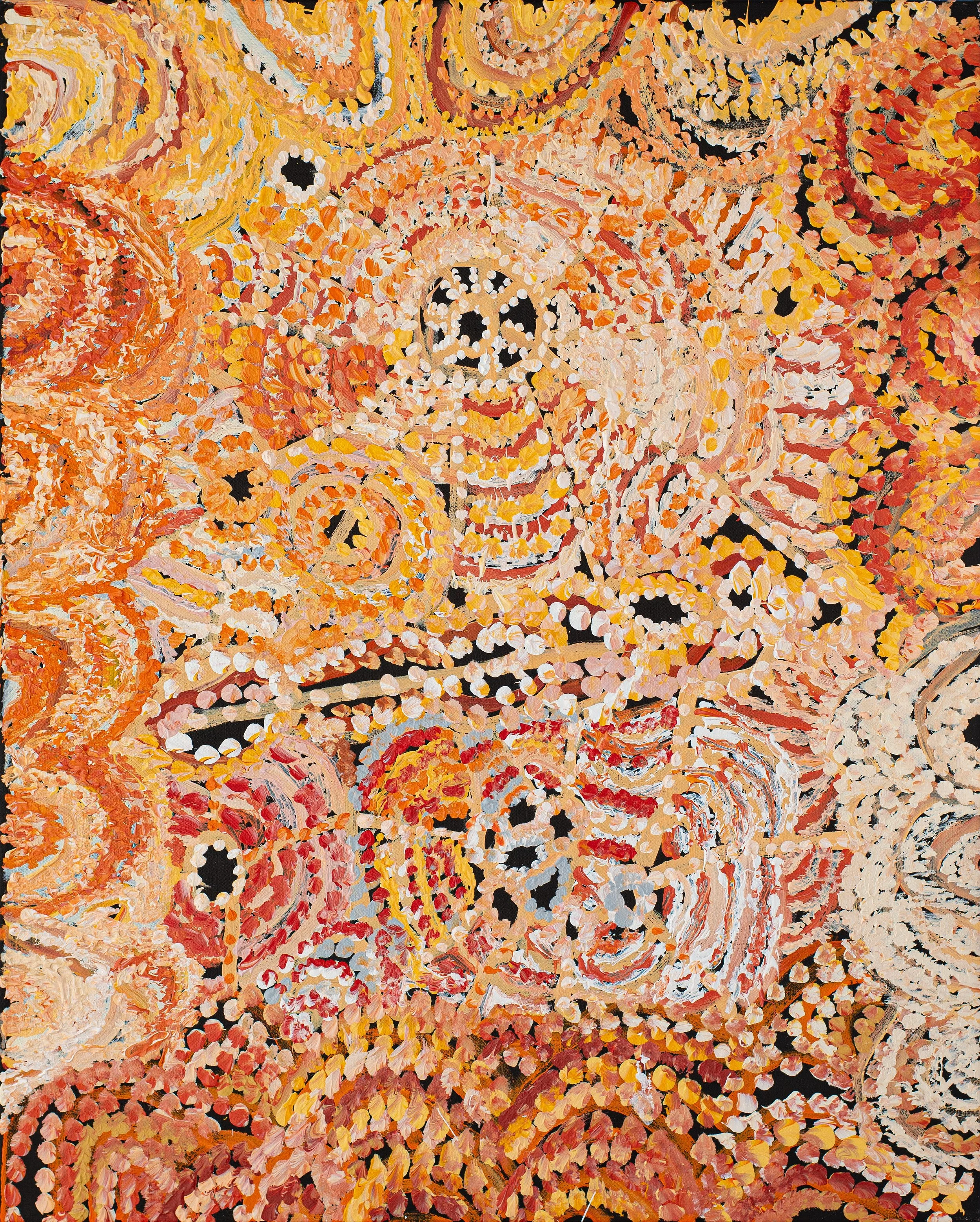
Artistes : Emily Cullinan (1952)
Titre de l'œuvre : Ananyi Ngura (Traveling Country)
Format : 101 x 81 cm
Provenance et certificat : centre d'art aborigène d’Iwantja
Référence de cette peinture aborigène : 775-25
Explications pour cette peinture d'art Aborigène :
Emily was born in rugged bush land, close to the Eastern APY community of Mimili. Her father was a respected cultural law man, and taught her and her two young sisters to live a traditional life. Emily did not encounter European settlers until she was a teenager.
Emily and her family used to travel long distances by walking or occasionally hitching wagons to camels and donkeys, they would camp at night inside hand built wiltjas (shelters) in the bush, sleeping in the warm sand.
The walk between Indulkana and Mimili regions took her 5 days, she recalls traveling this route many times to visit family. Emily’s powerful paintings depict the iconic waterholes, majestic boulders, and river beds she would cross on her journey.
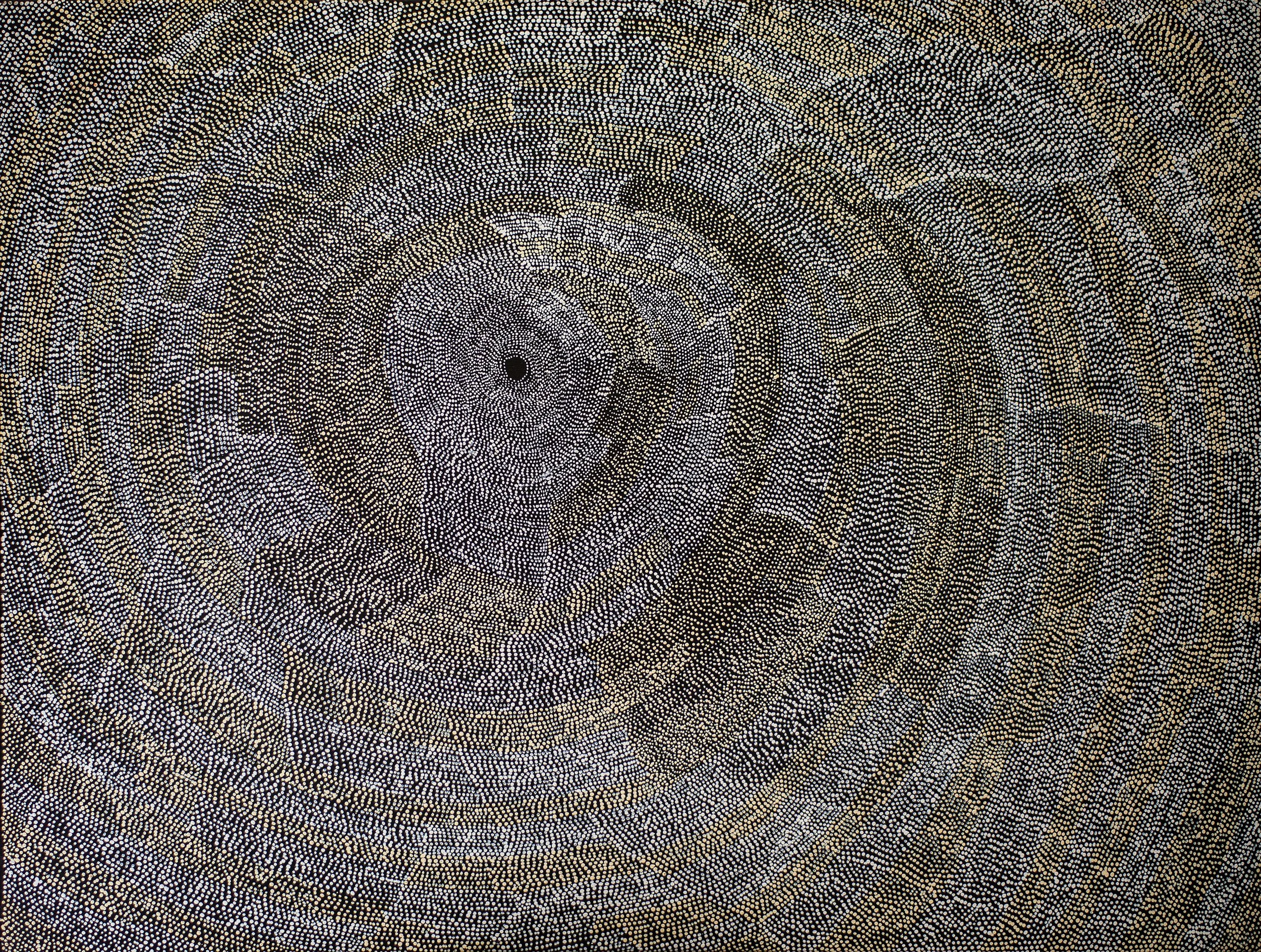
Artiste : Julie Nangala Robertson
Titre de l'œuvre : Mina Mina Jukurrpa - Mina Mina Dreaming
Format : 122 × 91 cm
Provenance et certificat : centre d'art aborigène de Yuendumu
Référence de cette peinture : 1364/25
Demander le prix de l'œuvre / Enquiry
Explications de l'œuvre :
Mina Mina is an extremely important ceremonial site for Napangardi and Napanangka women that is located approximately 600kms west of Yuendumu, just east of Lake
Mackay and the WA border. Mina Mina has a ‘marluri’ (salt lake or claypan) that is usually dry, without water. There are also a number of ‘mulju’ (soakages), sandhills, and a large stand of ‘kurrkara’ (desert oaks [Allocasuarina decaisneana]).
The Mina Mina Jukurrpa is an important source of Warlpiri ritual knowledge and social organization, particularly relating to the different roles performed by men and women. The ‘kirda’ (owners) of this country are Napangardi/Napanangka women and Japangardi/Japanangka men, who can depict portions of the Mina Mina Jukurrpa in their paintings. The artists mother, Dorothy Napangardi (c.1956–2013) painted Mina Mina and has passed down her Jukurrpa stories to her children and asked them to continue to paint for her. There are a number of different components of the Mina Mina Jukurrpa; artists usually choose to depict one particular aspect. These can include ‘karnta’ (women), ‘karlangu’ (digging sticks), ‘majardi’ (hairstring skirts/tassels), ‘ngalyipi’ (snakevine [Tinospora smilacina]), ‘jintiparnta’ (desert truffle [Elderia arenivaga]), and ‘kurrkara’ (desert oak [Allocasuarina decaisneana]).
In ancestral times a group of ‘karnta’ (women) traveled from Mina Mina on an epic journey to the east. These ancestral women danced at Mina Mina and ‘karlangu’ (digging sticks) rose up out of the ground. They collected these digging sticks and started travelling to the east. They carried their digging sticks over their shoulders, and they were adorned with ‘majardi’ (hairstring belts), white feathers, and necklaces made from ‘yinirnti’ (bean tree [Erythrina vespertilio]) seeds. They travelled east from Mina Mina, dancing, digging for bush tucker, and creating many places as they went. As they went east, they passed through Kimayi (a stand of ‘kurrkara’ (desert oak)). They passed through sandhill country where the ‘yarla’ (bush potato or ‘big yam’ [Ipomea costata]) ancestors from Yumurrpa and the ‘ngarlajiyi’ (pencil yam or ‘small yam’ [Vigna lanceolata]) ancestors from Yumurrpa were engaged in a huge battle over women. This battle is also a very important Warlpiri Jukurrpa narrative. The women went on to Janyinki and stopped at Wakakurrku (Mala Bore), where they stuck their digging sticks in the ground…
© Photo : Aboriginal Signature Estrangin gallery with the courtesy of the artists and Yuendumu
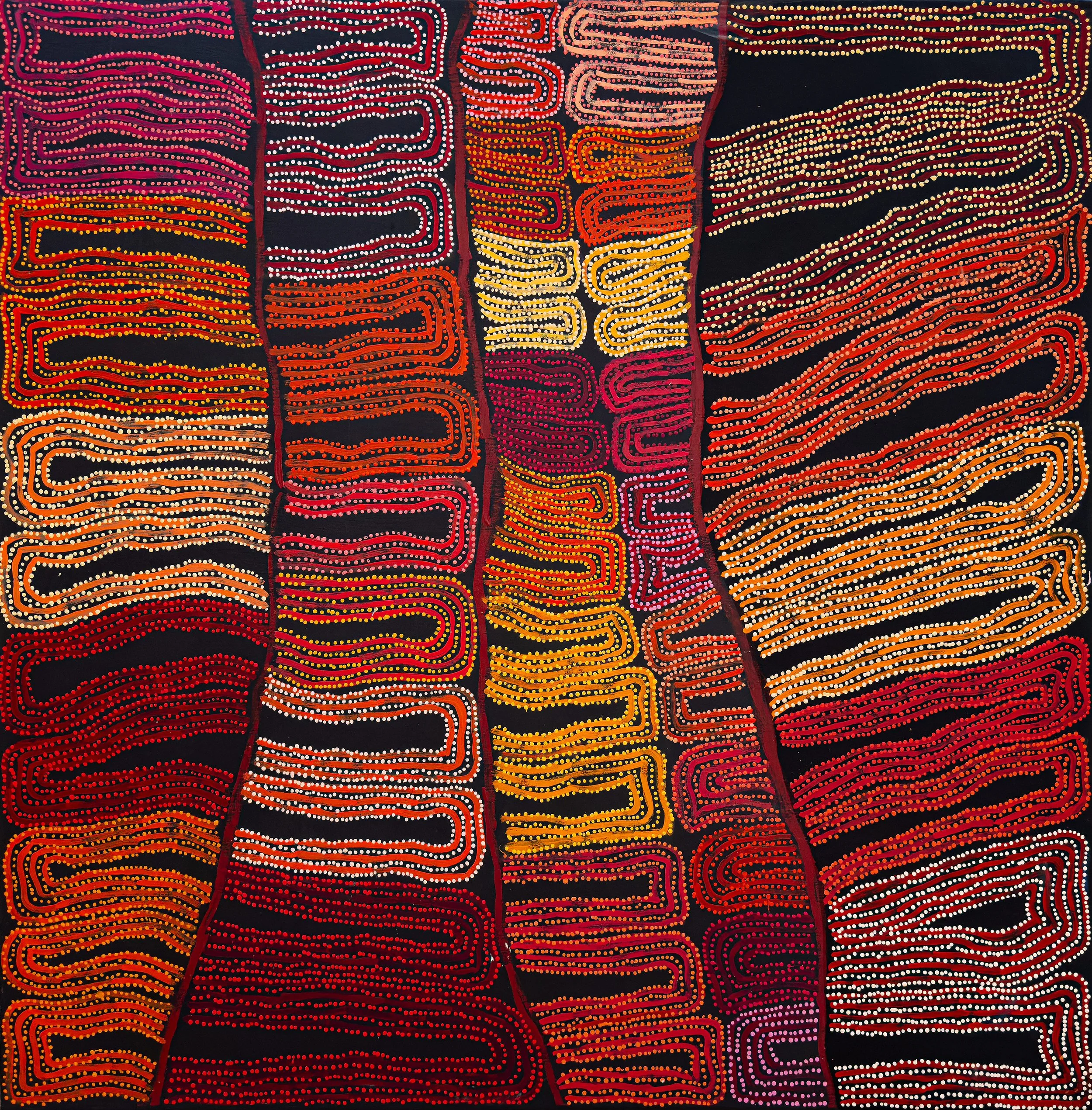
Artiste : Beverly Burton
Titre de l'œuvre : Ngayuku ngura - My Country
Format : 154 x 153 cm
Provenance et certificat : centre d'art aborigène de Tjala Arts
Référence de cette peinture aborigène : 359-23
Enquiry / Demander le prix de l'œuvre
Explication pour cette œuvre :
Beverly Burton is one of Tjala Arts strongest emerging painters who is dedicated to her practice and works in the studio daily. She comes from an influential family lineage of cultural leaders and artists. Her mother, Naomi Kantjuriny is known for her work with the Mitakiki Womens Collaborative and as a traditional Ngangkari Healer.
Her father, Kunmanara (Hector) Burton was a senior artist at Tjala Arts and as an elder revered as an extremely important caretaker of Anangu law and culture.
Beverlys paintings are powerful and dynamic, her use of brush and choice of palette creates vibrations and movement across the canvas the way the landscape shifts and changes across her country.
In this painting Beverley has depicted her country. The different colours and designs represent variations in the landscape.
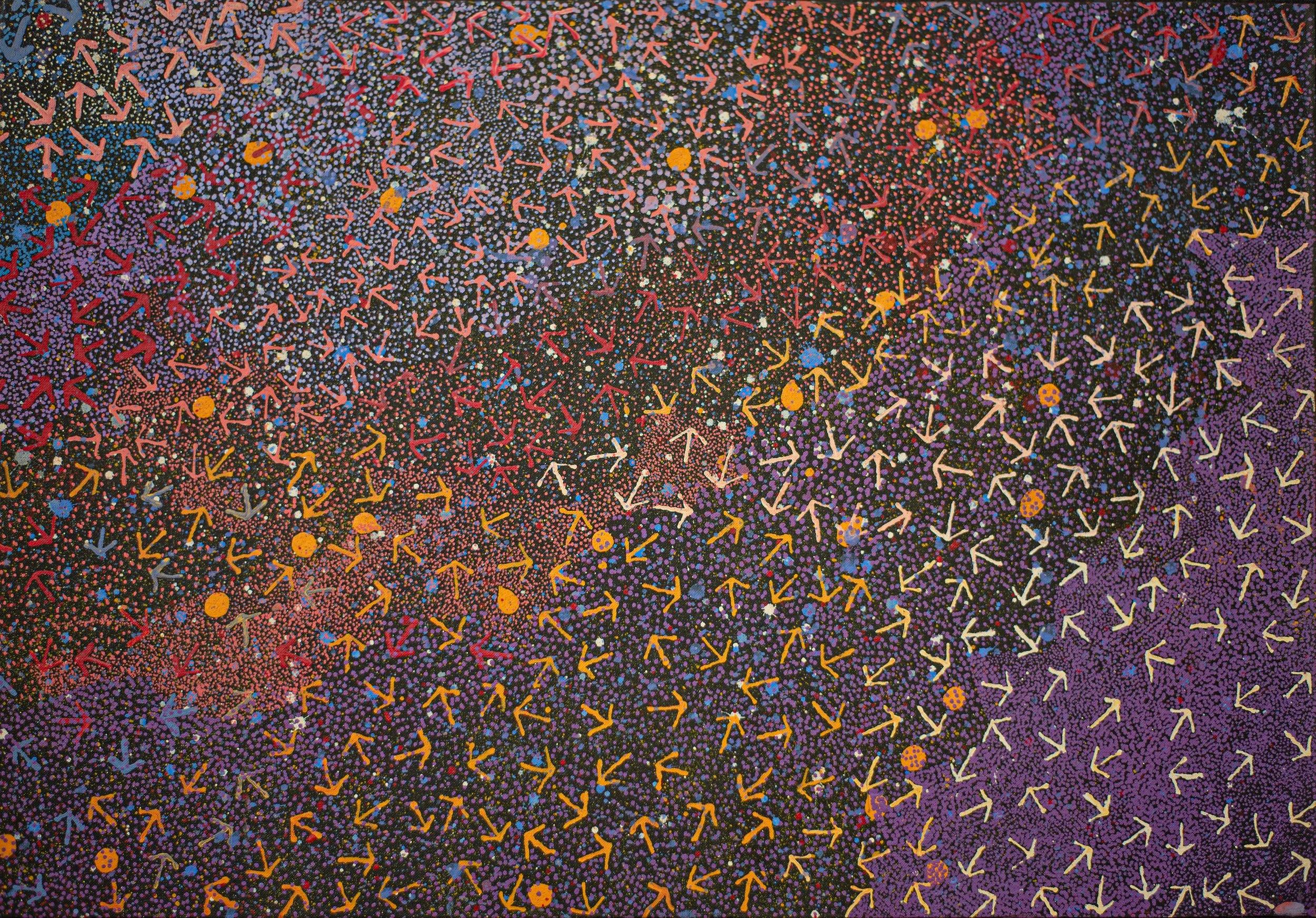
Artiste : Lloyd Jampijinpa Brown
Titre de l'œuvre : Yankirri Jukurrpa (Emu Dreaming) - Ngarlikirlangu
Format : 55 x 40 cm
Provenance et certificat : centre d'art aborigène de Yuendumu
Référence de cette peinture : 169/26
Demander le prix de l'œuvre / Enquiry
Explications pour cette œuvre :
This painting depicts a ‘yankirri Jukurrpa’ (emu [Dromaius novaehollandiae] Dreaming) from a place called Ngarlikurlangu, approximately 50kms north of Yuendumu. The ‘kirda’ (owners) of this Dreaming are Nangala/Nampijinpa women and Jangala/Jampijinpa men. This Jukurrpa tells the story of a ‘yankirri’ (emu) and a ‘wardilyka’ (bush turkey [Ardeotis australis]). ‘Yankirri’ lived at a soakage to the west called Warnirripanu (or Walangkamirirri), while ‘wardilyka’ lived at a soakage to the east called Parirri. The emu and bush turkey used to go around the country picking ‘yakajirri’ (bush raisins [Solanum centrale]) and mashing them into ‘kapurdu’ (fruit balls) to save in their nests for later. However, they were jealous of each other; the emu thought that the bush turkey was picking the best and juiciest ‘yakajirri’, and was leaving him with only the sour ‘yakajirri’.
The emu went to the bush turkey’s nest to the east while the bush turkey was out hunting and smashed up the ‘kapurdu’ that the bush turkey had saved there. When the bush turkey returned, he found his smashed ‘yakajirri’ balls and realized that the emu had destroyed them. He went to the west to confront the emu and when he found him, they got into a big fight. The bush turkey eventually flew away to the north, leaving behind the smashed ‘yakajirri’ balls.
This practice of making ‘kapurdu’ (fruit balls) is a traditional Warlpiri method of storing ‘yakajirri’; in the old days, people used to dry the ‘yakajirri’, grind them up with a rock in a coolamon, mix them with water and form balls from them, and cover the ‘kapurdu’ with red ochre so they would keep. Today at Ngarlikirlangu we can see round, red rocks which are the ‘kapurdu’ that the emu smashed up. There is also a dance for this ‘yankirri’ (emu) Jukurrpa that is performed during mens’ initiation ceremonies. A number of other Jukurrpa are also located at Ngarlikirlangu, including ‘wardilyka Jukurrpa’ (bush turkey Dreaming), ‘yardijiinypa Jukurrpa’ (meat ant Dreaming), and ‘pirntina Jukurrpa’ (woma or Ramsay’s python [Aspidites ramsayi] Dreaming). Lots of ‘yakajirri’ grow around the Ngarlikirlangu area today.
© Photo : Aboriginal Signature Estrangin gallery with the courtesy of the artists and Yuendumu
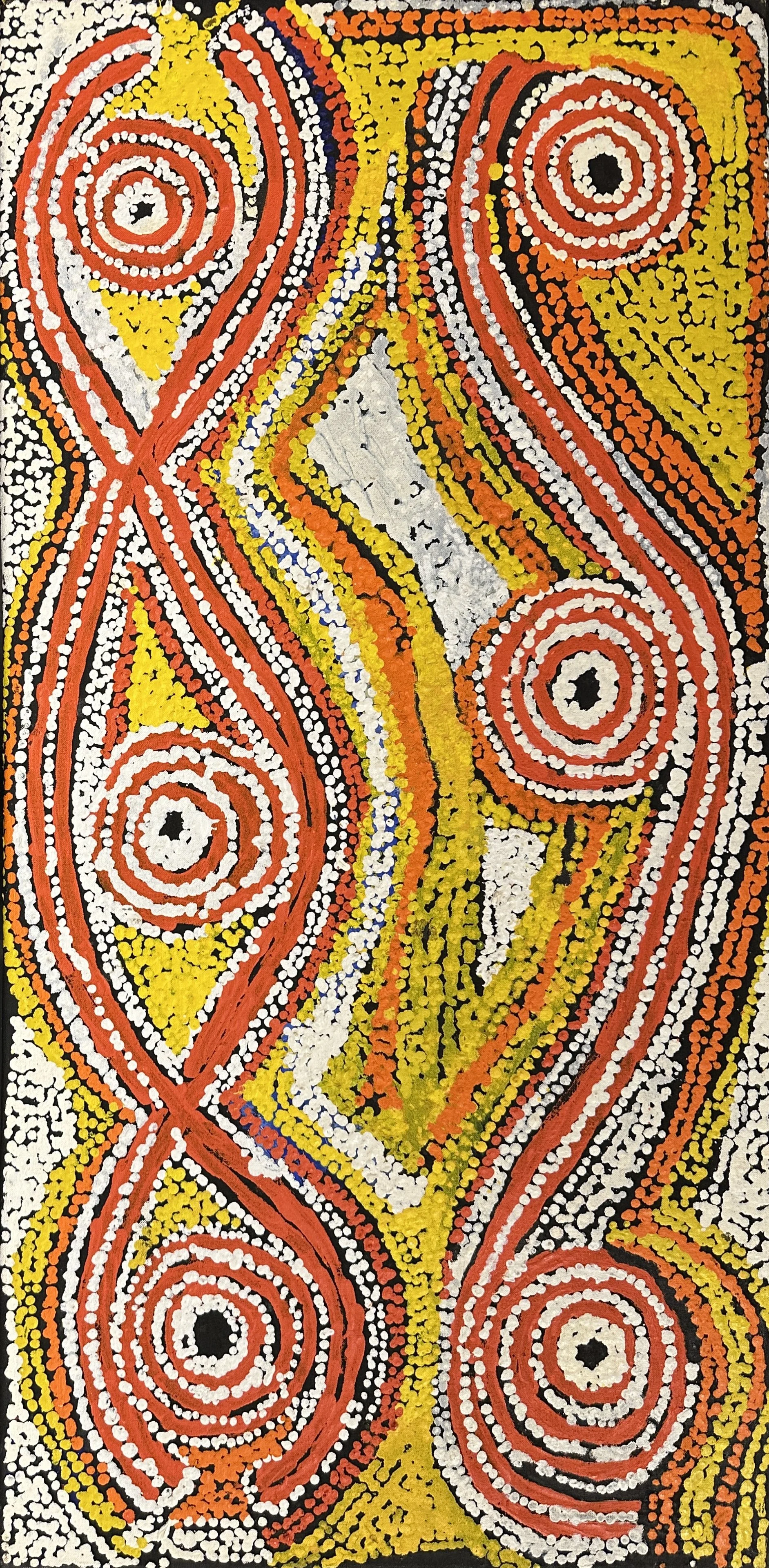
Artiste : Paddy Japaljarri Sims
Titre de l'œuvre : Warlu Jukurrpa (Fire Dreaming Time story)
Format : 91 x 46 cm
Provenance et certificat de cette peinture d'art Aborigène : centre d'art de Yuendumu
Référence de la peinture : 479/10
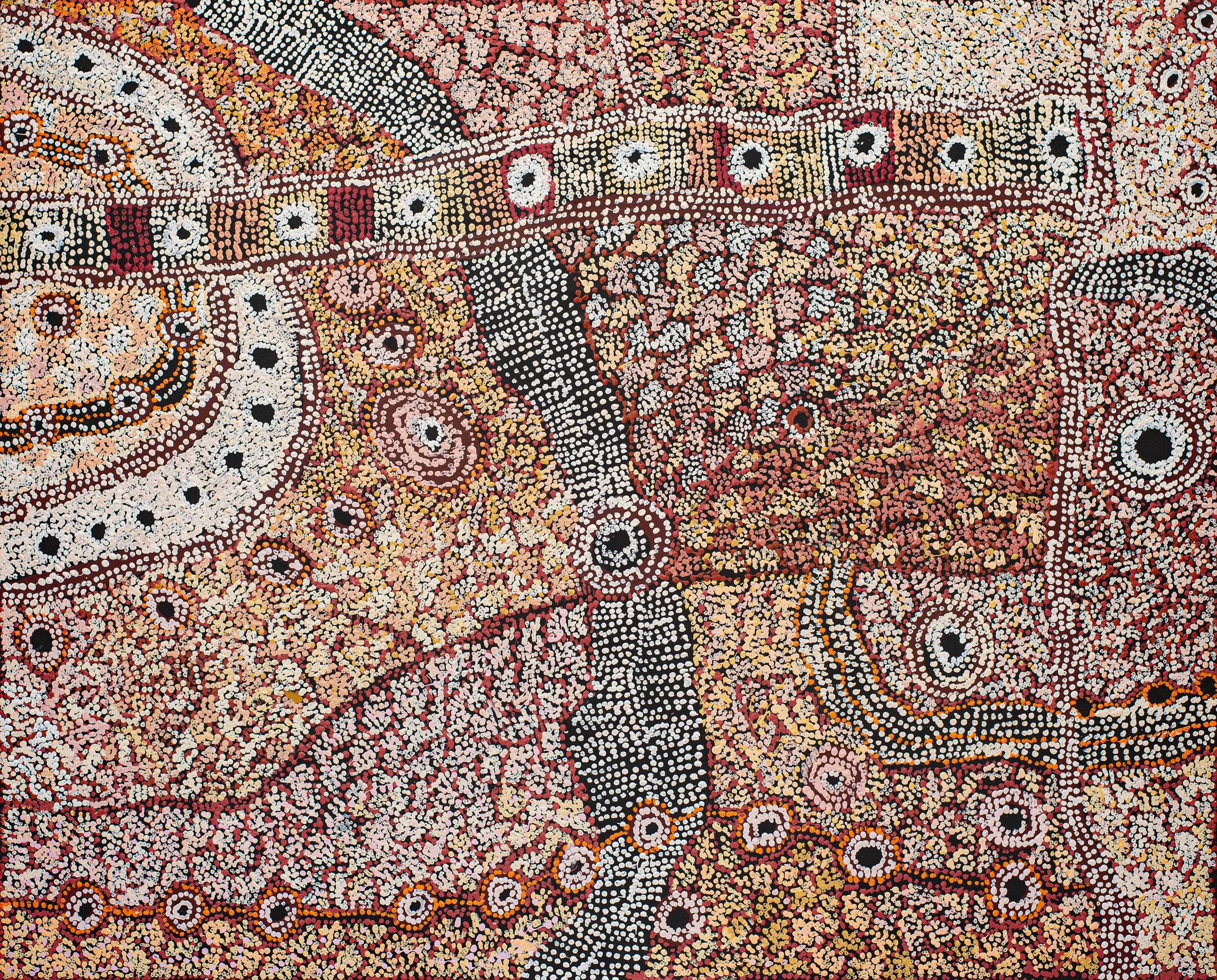
Artistes : Betty Chimney (1957)
Titre de l'œuvre : Ngayuku Ngura (My Country)
Format : 152 × 122 cm
Provenance et certificat : centre d'art aborigène d’Iwantja
Référence de cette peinture aborigène : 591-24
Explications pour cette peinture d'art Aborigène :
Betty Chimney's paintings are evocative of the vast and rugged desert country of Indulkana on the Eastern side of the Anangu Pitjantjatjara Yankunytjatjara (APY) Lands.
The country here is expansive, dotted with small shrubs and carpeted in clusters of rocks and pebbles.
Betty spent many years living near to Iwantja Creek at the newly established Indulkana community. As all of the members of Betty's family had passed away, she was raised by Alec Bakers father, a senior law man for the region.
In her striking paintings, Betty marks out the rugged and stoic country of Indulkana. She maps out the creeks, roads, rocks and dry creek-beds, highlighting changes in the landscapes through colour shifts.
Capturing beauty in the sparsity of shapes and tones, Betty's paintings reveal the true essence of Yankunytjatjara desert country.
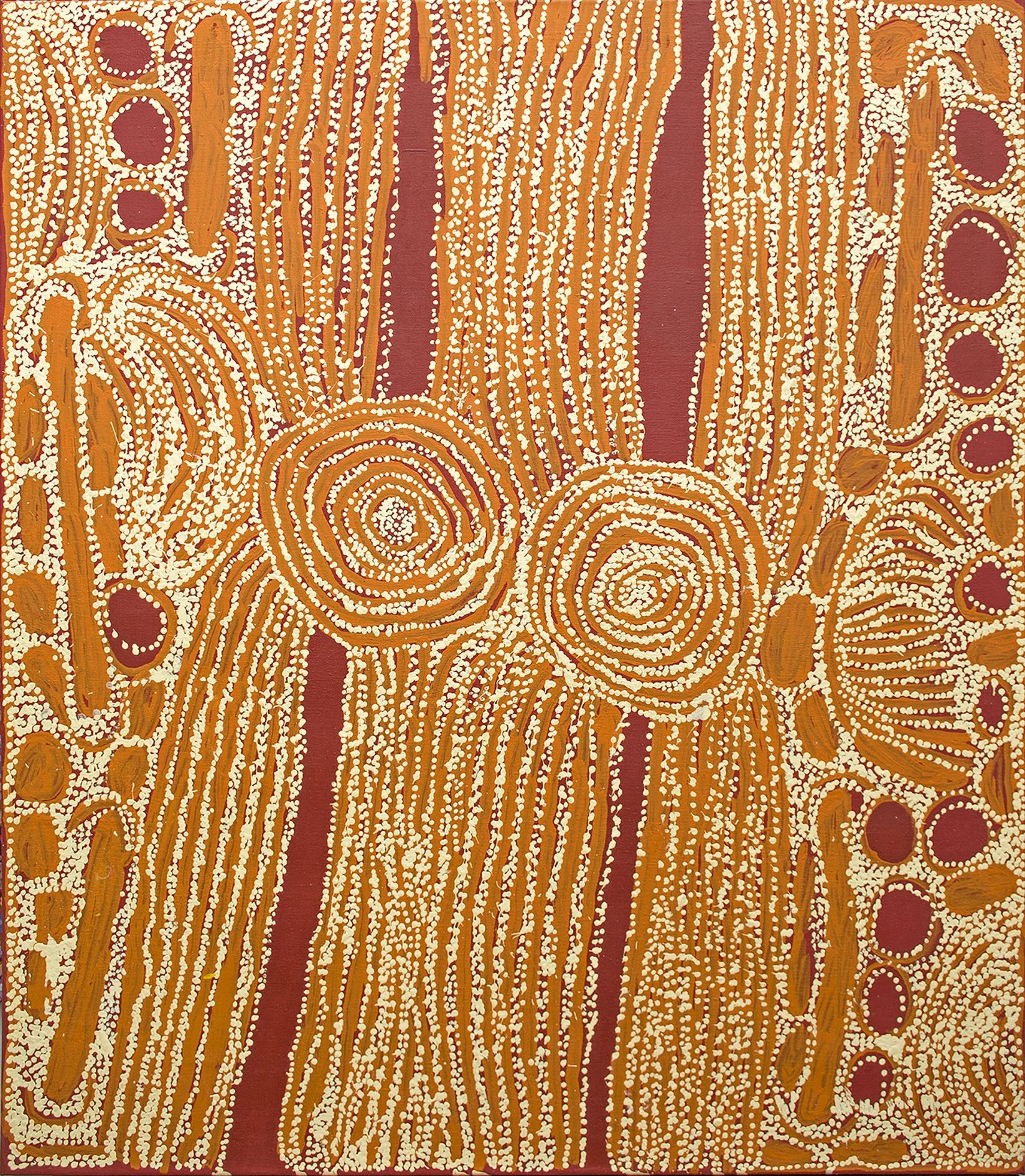
Artiste : Ningura Napurrula
Titre de l'œuvre : Rockhole site of Wirrulnga (women ceremonies)
Format : 122 x 107 cm
Provenance : centre d'art de Papunya Tula
Le certificat original du centre d'art Aborigène de Papunya Tula sera remis avec l'œuvre.
Référence de la peinture : NN0807198
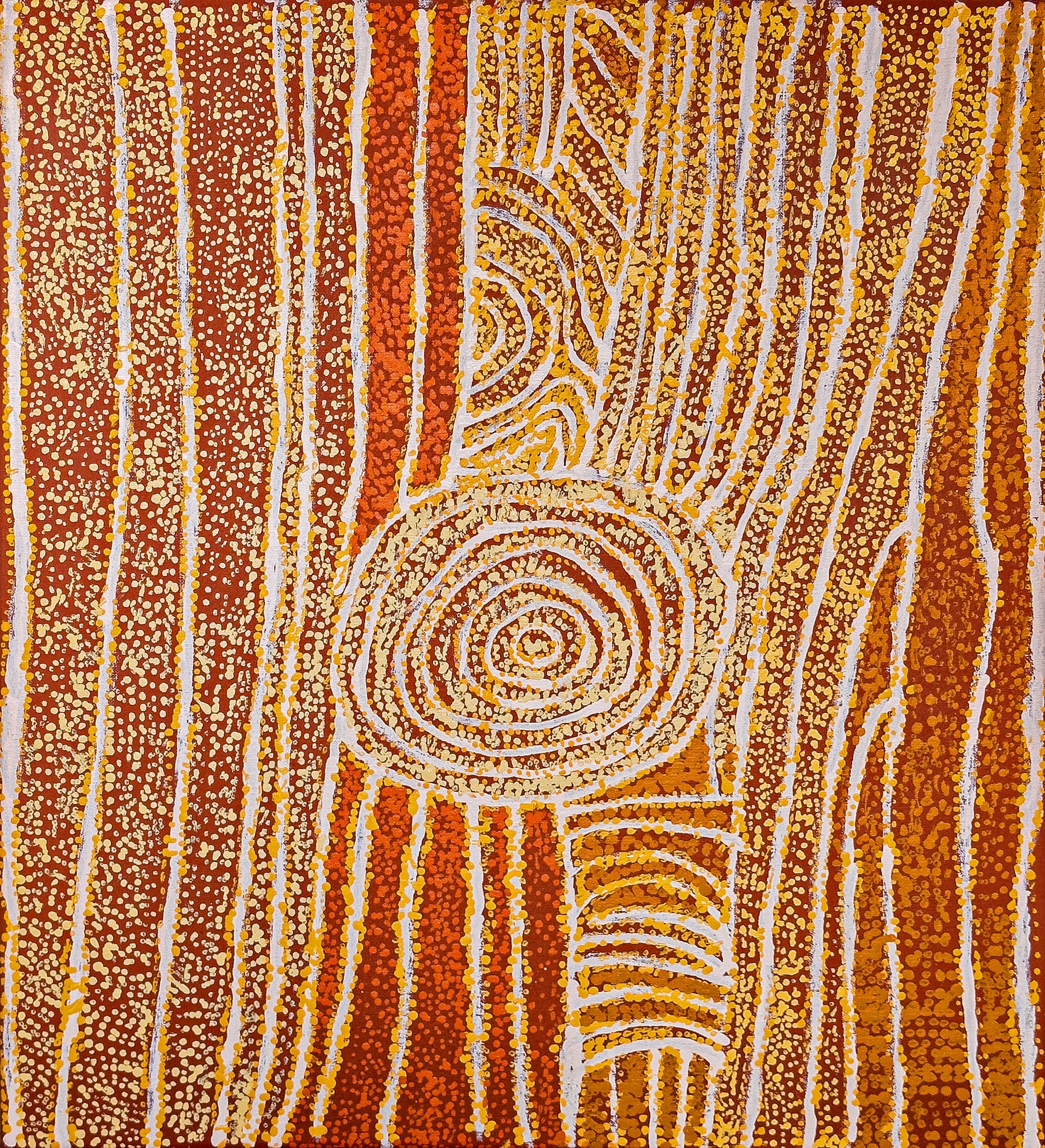
Artiste : Mary Napangati
Titre de l'œuvre : Rockhole site of Tjutalpi
Format : 61x55 cm
Provenance : centre d'art de Papunya Tula
Le certificat original du centre d'art Aborigène de Papunya Tula sera remis avec l'œuvre.
Référence de cette peinture : MN2305137
Enquiry/ Demander le prix de l'œuvre
Explications sur cette œuvre et l’artiste :
Mary Brown Napangati (Napangardi) was born near Wilkinkarra (Lake Mackay) circa 1955. Her family lived in the vicinity of Lappi Lappi, located towards the northern area of Lake Mackay, until they walked into the Mt Doreen cattle station west of Yuendumu, in the Northern Territory. She later moved to Yuendumu, married there and later moved further west to Nyirrpi. After her first husband passed away, Mary remarried the well known artist Ronnie Tjampitjinpa and moved to Kintore, where she now lives and paints.
This painting evokes the rockhole site of Tjutalpi. In ancestral times a group of men and women travelled to this site. While at Tjutalpi they performed the dances and songs associated with the area. During their travels the men and women gathered a variety of bush foods including pura or bush tomatoes (Solanum chippendalei) and kampurarrpa or desert raisins (Solanum centrale). They also gathered wood for the manufacture of wana (digging sticks). The roundels in the work represent the soakage waters found at this site, while the lines represent the tali (sandhills).
Collections :
Private collections in Australia and Europe.
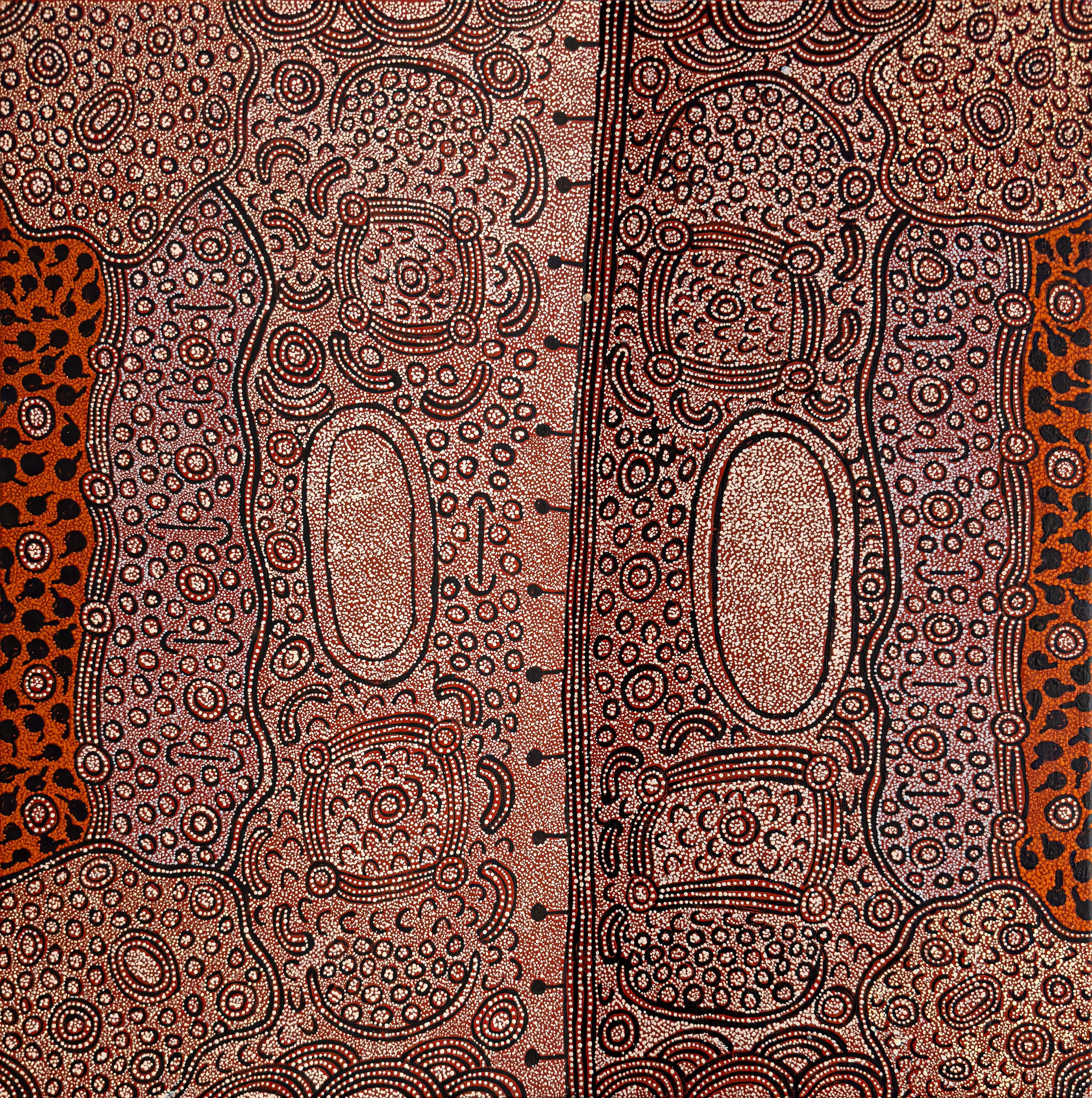
Artiste : Joy Gibson Napaltjarri
Titre de l'œuvre : Rockhole site of Mukula
Format : 91 x 91 cm
Provenance : centre d'art de Papunya Tula
Le certificat original du centre d'art Aborigène de Papunya Tula sera remis avec l'œuvre.
Référence de cette peinture : JN2303119
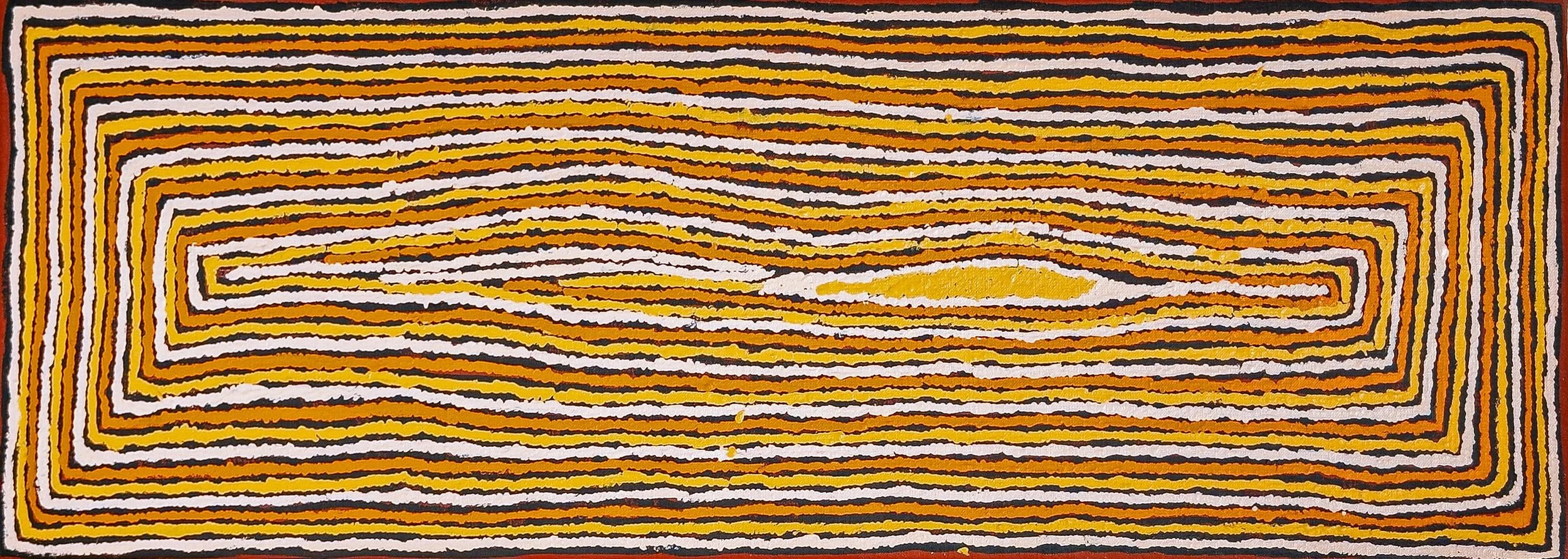
Artiste : Tatali Napurrula
Titre de l'œuvre : Rockhole site of Pinpirri
Format : 87 x 28 cm
Provenance et certificat : centre d'art aborigene de Papunya Tula Artists
Référence de cette peinture aborigène : TN2211018
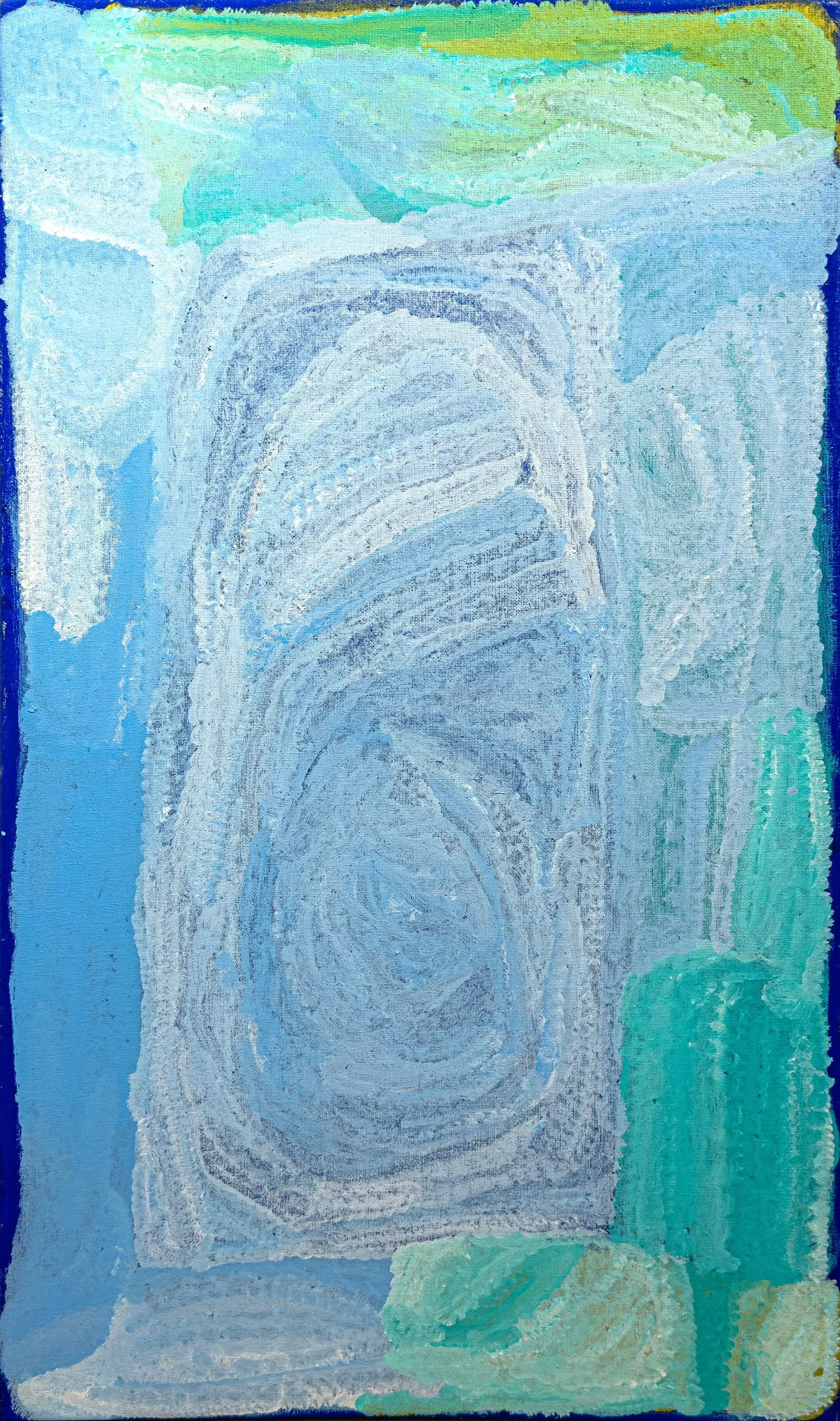
Artiste : Lydia Balbal
Titre de l'œuvre : Winpa - Dreaming Time stories
Format : 90 × 50 cm
Provenance et certificat : Short Street opérant pour les artistes Yulparija de Bidyadanga
Référence de cette peinture aborigène : 841452
Explications sur cette peinture d’art Aborigène :
Lydia Balbal (1958) is a Mangala woman. Lydia's country is near Punmu in the Great Sandy Desert of W.A. Her people's existence was threatened by severe drought so that they had little choice but to leave their traditional country. Her family were some of the last to walk out to the coastal town of Bidyadanga (then La Grange Mission) located two hours south of Broome in the early 70s. Lydia first began painting in 2007 but has already received significant attention from collectors and the media alike.
Winpa is jila (living water) located near the Percival Lakes in the Great Sandy Desert in WA. It is an important gathering of the Yulparija and neighbouring groups. they would gather for rain making ceremonial ceremonies.
Collections : Murdoch University Art Collection. Aboriginal Art Museum, The Netherlands. Thomas Vroom Collection, The Netherlands. National Gallery of Victoria Felton Collection. Queensland Art Gallery. Laverty Collection. Monash University Art Collection. Lepley Collection. Western Australian Art Gallery. National Gallery of Australia. Wesfarmers Collection. Australia Parliament House Collection. Brocard - Estrangin Collection. Kluge-Ruhe Aboriginal Art Collection of the University of Virginia.
© Photo : Aboriginal Signature Estrangin gallery with the courtesy of Short Street and the artist
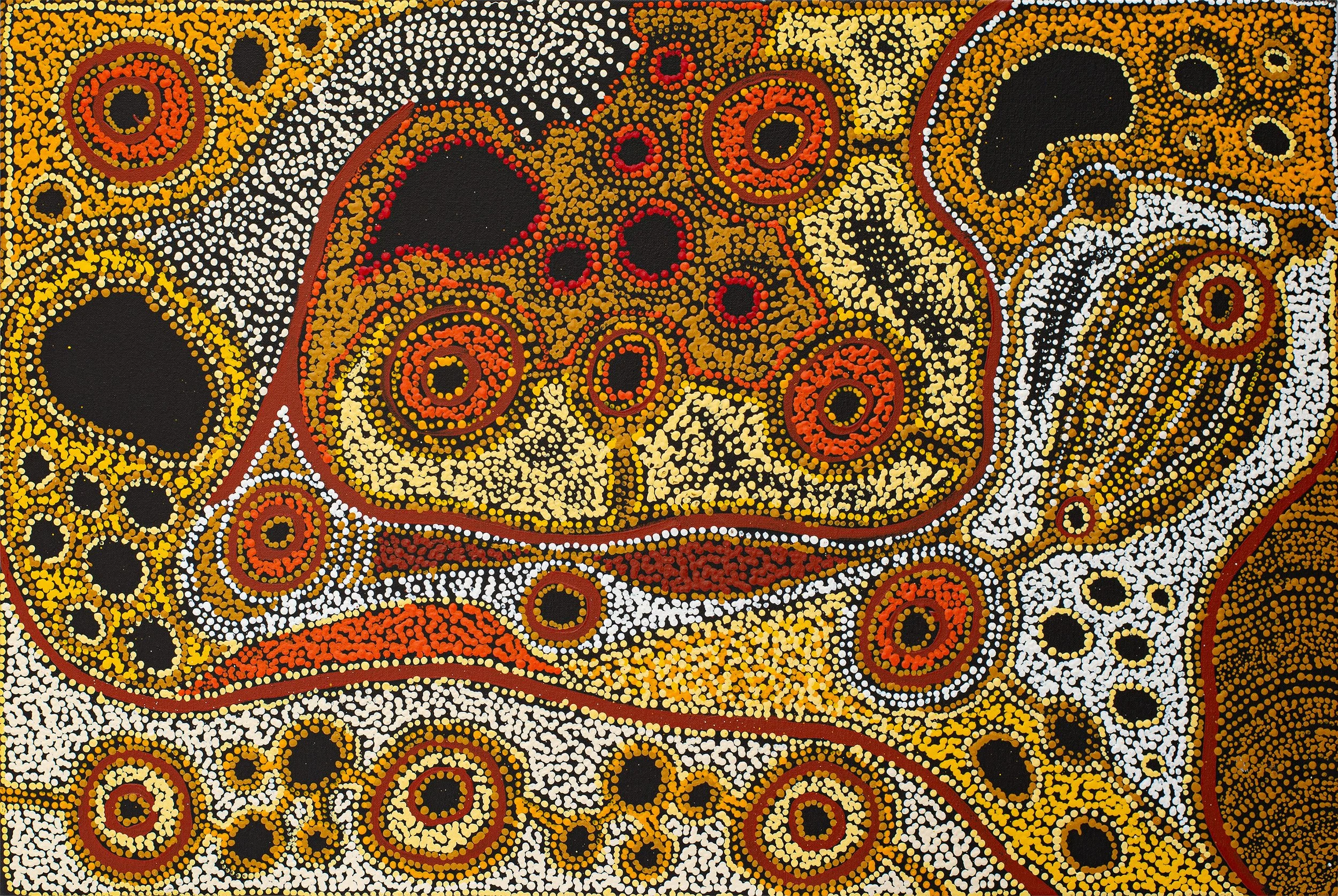
Artiste : Amy Scotty
Titre de l'œuvre : Kungkarangkalpa / Seven Sisters
Format : 90 x 60 cm
Provenance et certificat : centre d'art aborigène d’Ernabella
Référence de cette peinture aborigène : 119-24
Explication sur cette œuvre :
Kungkarangkalpa means the Seven Sisters. This is an extensive creation story that relates to the Pleiades constellation in the southern hemisphere. The story traverses Australia taking on different forms, however local women are privy to the part of the story which takes place in the country near Ernabella. For this part of the story, the man called Nyiru is chasing the sisters as he wants to sleep with the oldest sister. All the younger sisters are deeply afraid of him. As Nyiru is chasing the sisters, he tries to catch them by using magic to turn himself into the most tempting bush tomatoes for the sisters to eat and the most beautiful ili (fig) tree for the sisters to camp under. However, the sisters are aware of his magic and go hungry and run through the night rather than be caught by Nyiru. Eventually, to escape Nyiru, the sisters fly into the sky where they turn into stars and form the constellation.

Artistes : Sallyanne Roberts (1986)
Titre de l'œuvre : Kuru Ala
Format : 152 x 167cm
Provenance et certificat : centre d'art aborigène d’Iwantja
Référence de cette peinture aborigène : 212-23
Demander le prix de l'œuvre / Enquiry
Explication de l’œuvre :
Sallyanne Roberts (1986) said : “I grew up in my grandmothers country close to Nyapari, my grandmothers name is Wingu Tingima; she was a Ngangkari (traditional healer) and a famous painter. When she was getting very old, she taught me her stories, and how to paint them in our special family’s way. She taught me how to paint the pictures of Kuru Ala country – it’s a special place just for women. My paintings are about the country called Kura Ala, I’ve been there with my grandmother and other women before – it’s a special country only for women. My grandmother Wingu would say; “You can go there and travel through the area, but you shouldn’t stop there or you might get sick. It’s a special place where young girls go to become women, they can have special inma (ceremonies) there and have a time for healing.” In my paintings I show all the women out at Kura Ala gathering food from the bush to eat after the inma. The large curved shapes link colourful rings patterns and pathways together, they are the patterns made by the ladies footsteps from their special inma dance. The circles with thin lines reaching out of them are the wiltja’s (camp houses) the women have made from tree branches and sticks. Some areas of the canvas depict the special rock hole – but it’s not for swimming in, only the little yellow round rock holes shown in the middle of the canvas are for swimming. The ladies are shown by the semi circle shape, gathering together for dancing and teaching the young girls lessons.
This site forms part of the Kungkarankalpa Tjukurpa or Seven Sister's Creation Line that follows a group of women as they traverse the country evading the pursuit of a lustful older man, Nyiru. Nyiru has metamorphic powers of transformation and changes into different flora and fauna to trick the women.
These are creation beings and as such shape the landscape as they move through it. At Kuru Ala there is the physical reminders of their presence in the form of monolithic rock formations depicting the characters. From Kuru Ala the women chase a Kuniya (Carpet Python) through Tjukaltjara to the site of Kulyuru.
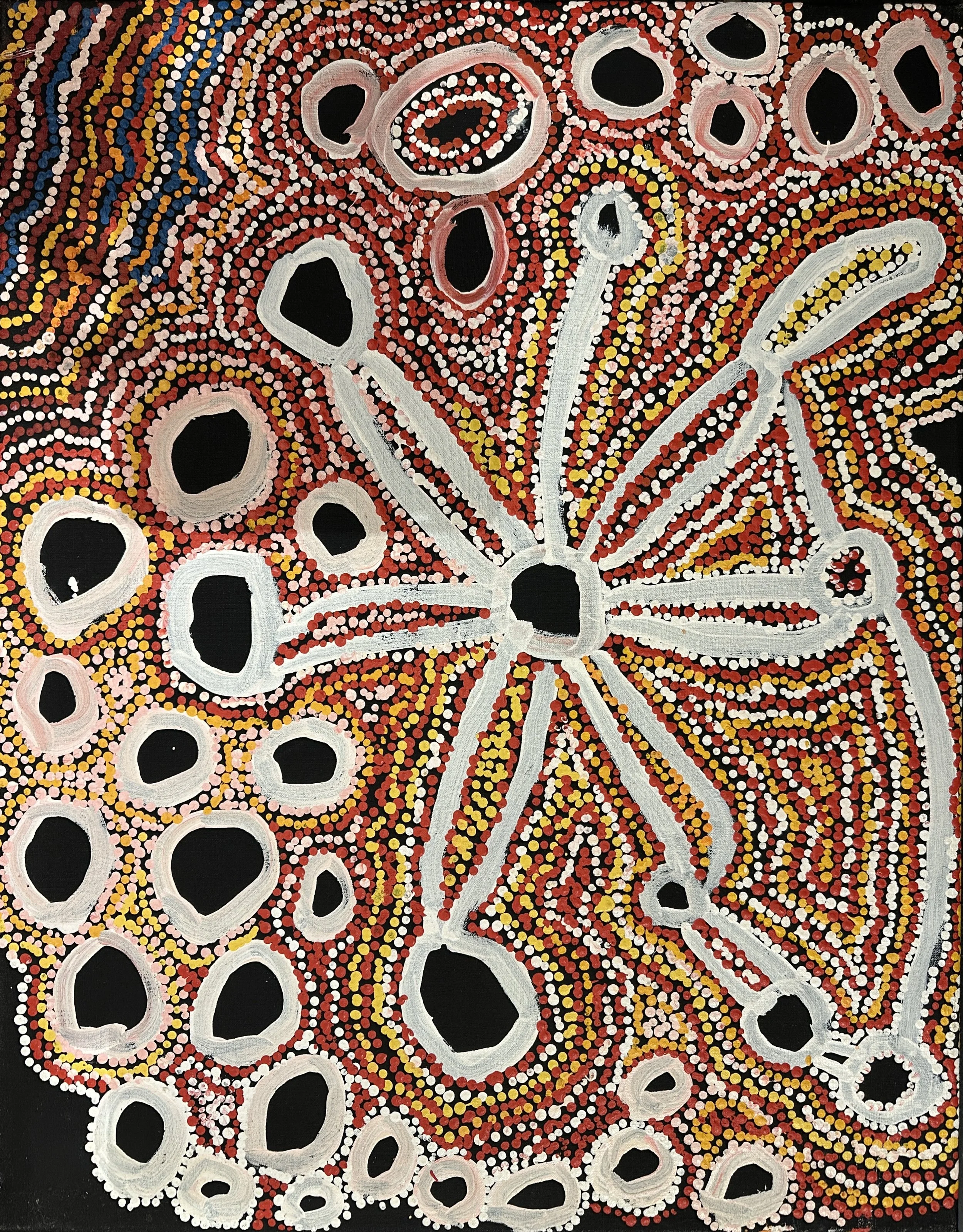
Artiste : Estelle Hogan
Titre de l'œuvre : Paltatatjara Dreaming Time story
Format : 75x60 cm
Provenance et certificat : centre d'art aborigène du Spinifex Art Project
Référence de cette peinture : 14020
Demander le prix de l'œuvre / Enquiry
Explications pour cette œuvre :
Estelle is a senior Spinifex artist whose country is Paltatatjara. Paltatatjara is an important place not only for the Minyma Tjuta (Seven Sisters) story but also a number of other Dreaming stories that cannot be elaborated in detail but include the Wati Kutjara (Two Serpent Men) and Kalaya (Emu) story.
Because Estelle is the senior owner of a place that has special significance for both men and women, documentation and detail of the paintings is carefully defined and public interpretation involves a level of ‘assumed’ knowledge.
The Kungkarangkalpa or Minyma Tjuta (Seven Sisters) Tjukurpa is an epic story, Here Estelle has depicted several Minyma Tjuta sites where she travelled around on foot before contact including Paltatatjara,
Minga, Tjuntjun and Tulu.
Like many Spinifex artists estelle clearly remembers her nomadic life in the desert. Estelle passed away in 2017, early this year.
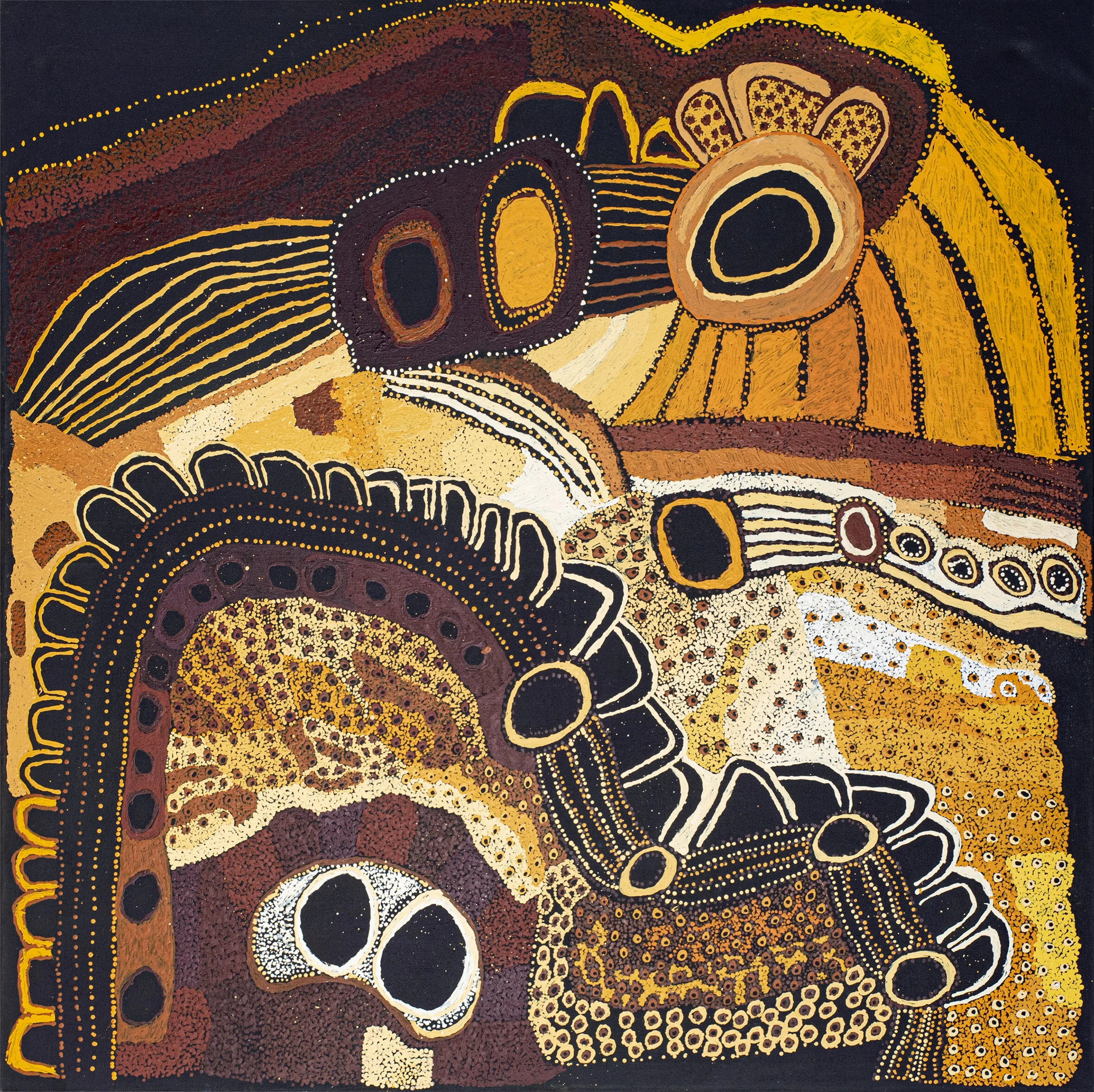
Artiste : Judy Martin (1963)
Titre de l'œuvre : Ngayuku Mamaku Ngura (My Father's Country)
Format : 152 cm x 152 cm
Provenance et certificat : centre d'art aborigène de Mimili Maku
Référence de cette peinture aborigène : 186-21
Demander le prix de cette œuvre
Explications pour cette peinture d'art Aborigène :
Judy paints her father's country, Wakura. Wakura is near Nyapari, on the Anangu Pitjantjatjara Yankunytjatjara (APY) Lands in remote North-Western South Australia.
Even though Judy lives in Mimili Community now, she is still a custodian of the land around Wakura. Her focus lies on the importance of the water sources in the area, which have been guarded and cared for by her father's family since the beginning of time. Judy maps the kapi tjukula amongst the puli (mountain ranges) and tali (sand hills) of Wakura.
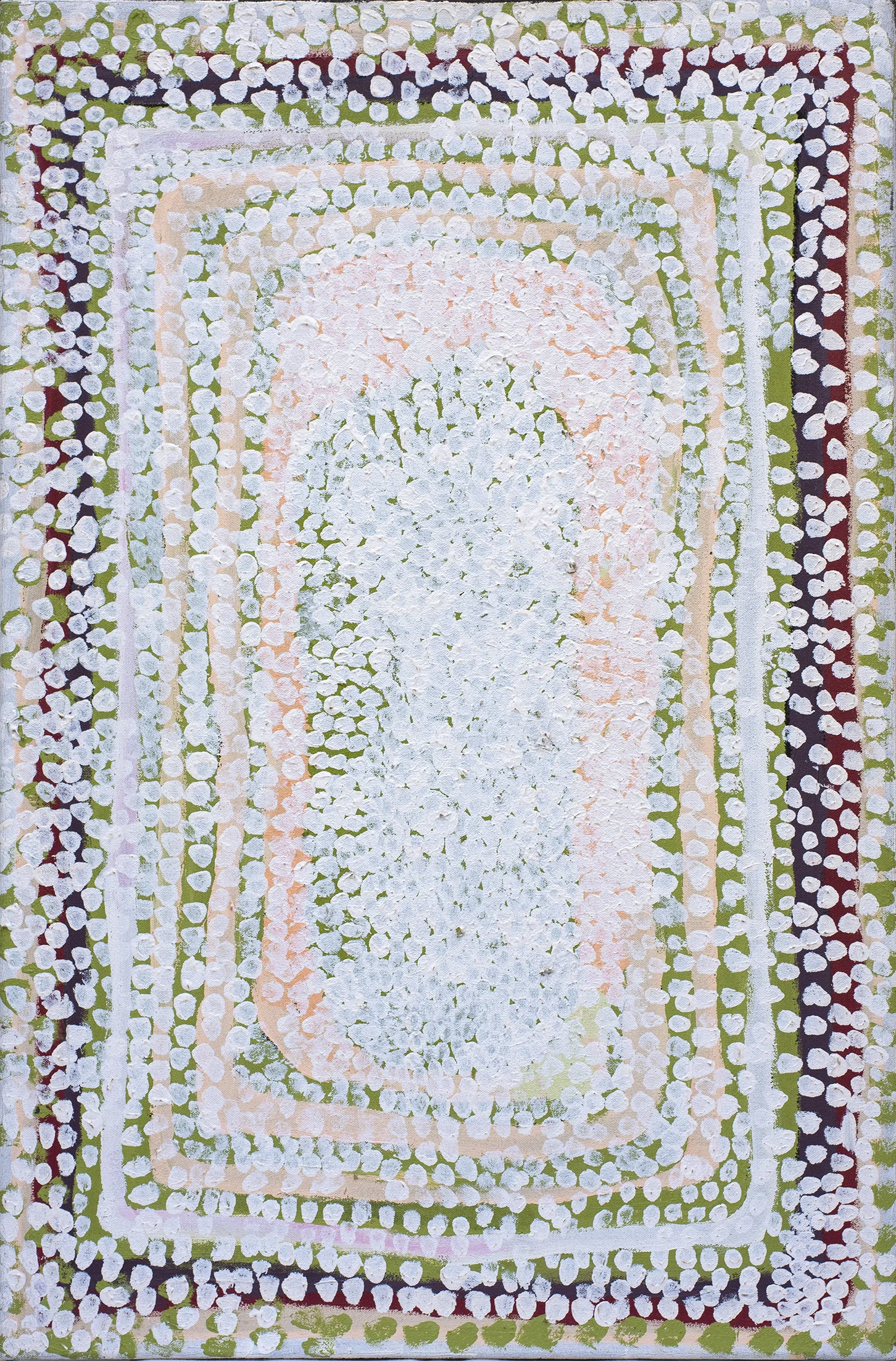
Artiste : Marie Meribida
Titre de l'œuvre : Martakulu
Format : 90 x 60 cm
Provenance et certificat : Short Street opérant pour les artistes Yulparija de Bidyadanga
Référence de cette peinture aborigène : 786415
Explications sur cette peinture d’art Aborigène :
Mary Meribida (1938) was born at Ilyara (Punmu) and lived there throughout her childhood. She travelled around her country with her family. Until the early 1970s, she lived a traditional life and says, "We been walk 'em, no clothes, nothing. We proper bush people, no English." Mary is a part of the Yulparija people who walked out of the desert to the coastal town of Bidyadanga in search of water after severe drought had plagued their land.
Martakulu is a soak out near Punmu near the Canning Stock Route in the Great Sandy Desert in Western Australia. It is strong womans country, it is part of the women's law line. Long time ago a law man he come up to this country, he went home and left his wife and baby. They make him fire and sit down, cook mayi (bush food) and then started to cry for her husband. Her tears made that soak. It is important country this one. Mary says "I been young girl walked all around here with my mummy and daddy. We camp and hunt here." This painting shows the rockhole with king brown snakes and their eggs.
Collections :
Canning Stock Route Project Collection
Notre Dame University
Laverty collection
Sam Barry collection
National Gallery of Australia
Parliament House Collection, Canberra
Kluge-Ruhe Aboriginal Art Collection of the University of Virginia
© Photo : Aboriginal Signature Estrangin gallery with the courtesy of Short Street and the artist
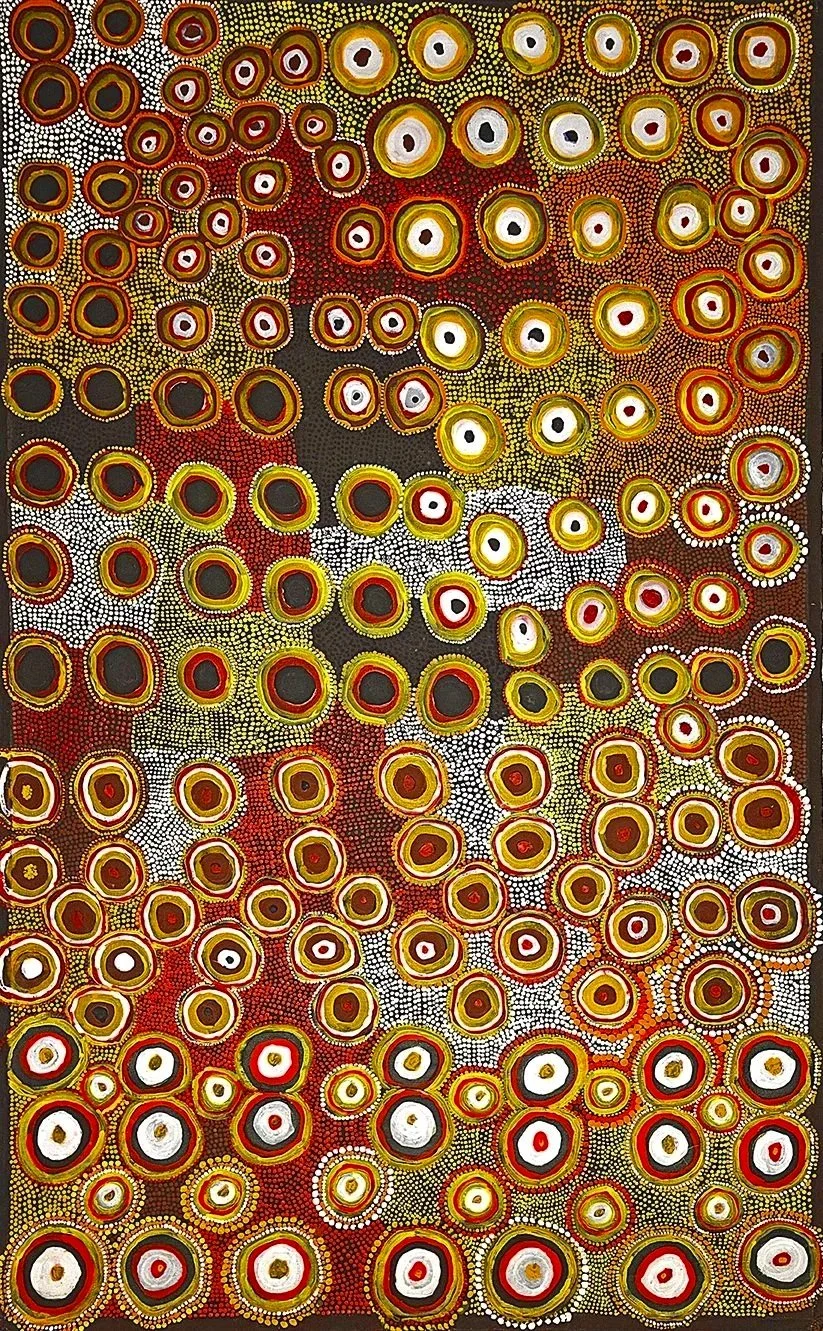
Artiste : Taylor Cooper
Titre de l'œuvre : Malara Tjurkurpa (dreaming)
Format : 200x122 cm
Provenance et certificat : centre d'art de Kaltjiti
Référence de la peinture : 8230
Demander le prix de l'œuvre
Explications pour cette œuvre :
Taylor Cooper (1939-40...) began painting at the Kaltjiti Arts centre in 2009. It was soon recognised that his paintings contained a strong representation of Tribal knowledge. His painting refers to the creation stories or Tjukurpa associated with the traditional homelands of his mother and father. An expert craftsman, Taylor continues to make the traditional hunting weapons of aboriginal men, particularly kulata (spears) and kulata miru (spear throwers).
Malara is the place of the Wanampi Tjukurpa - Water Serpent Dreaming - in the far west of the APY Lands. Taylor was born at this important site making the Malara Wanampi his Tjukurpa totemic ancestor. Taylor is Nguraritja, a traditional custodian of this story.
Taylor explains: “That Wanampi came from Malara. He went to Kunytjanu near Pipalyatjara. From Kunytjanu that Wanampi kept walking, walking. He came to Tjuntun (Kutjupa – different to Tjuntun at Fregon.) near Watarru. He threw one spear and made that rockhole. He went right in that rockhole and then he travelled back to Malara."
Taylor is an important senior tribesman and he is a recognised custodian of traditional Aboriginal law and culture. He has never married and his disposition reflects a quiet dignity of a senior man. Taylor holds a responsibility as uncle to his two sisters’ children.
His work has been acquired by major institutions and private collections across Australia and the world, as :
National Gallery of Victoria
Private Collections
Harriett & Richard England Collection, Sydney
Laverty Collection
Artbank Collection
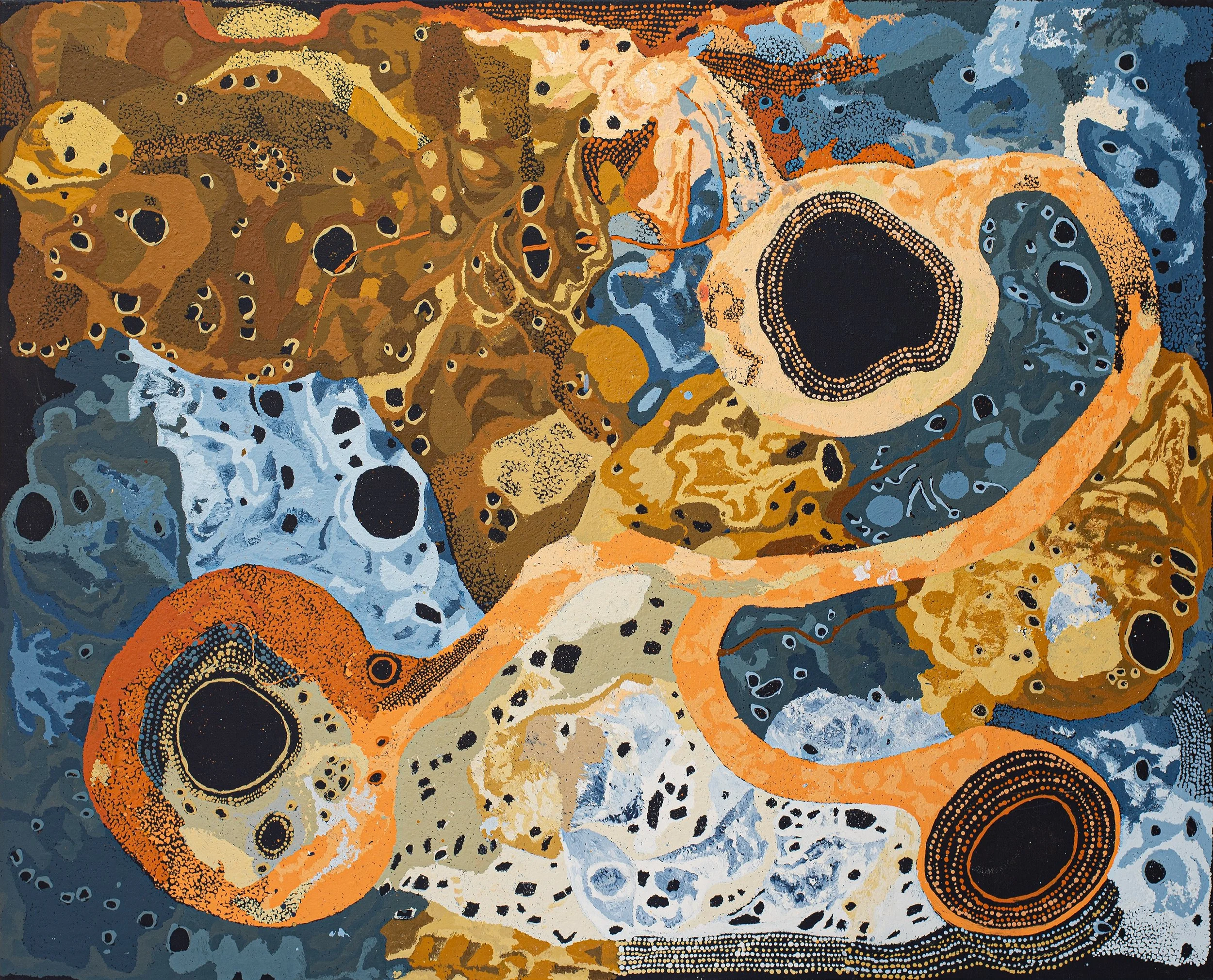
Artiste : Pauline Minmila Wangin (1970)
Titre de l'œuvre : Kapi Tjukula (Water Hole)
Format : 152cm x 122cm
Provenance et certificat : centre d'art aborigène de Mimili Maku
Référence de cette peinture aborigène : 737-24
Explications pour cette peinture d'art Aborigène :
Pauline is painting tjukurpa (story) about the journey of water, explaining how to care for kapi tjukula (water holes), particularly in the area around paralpii (Victory Well). This tjukurpa was passed on to her by her mother.
“One time when I was a little girl, my mother and me went out driving to collect bush tucker. It was a very hot day, and our car broke down. We didn't have any water with us, and I was scared, but my mother led me away from the car to kapi tjukula really closeby. She taught me how to find it, and how to care for it. After emptying the kapi (water) with mara munu punu (hands and sticks) the empty tjukula is cleaned. We place punu tjuta (many sticks and branches) over the top of the tjukula and use puli pulka (big rock) to stop them blowing away. Now no animals can dirty the new water that will soon collect."

Artiste : Nancy Chapman
Titre de l'œuvre : Pirkily Claipan
Format : 149 x 77 cm
Provenance et certificat : centre d'art aborigène de Martumili
Référence de cette peinture : 08-930
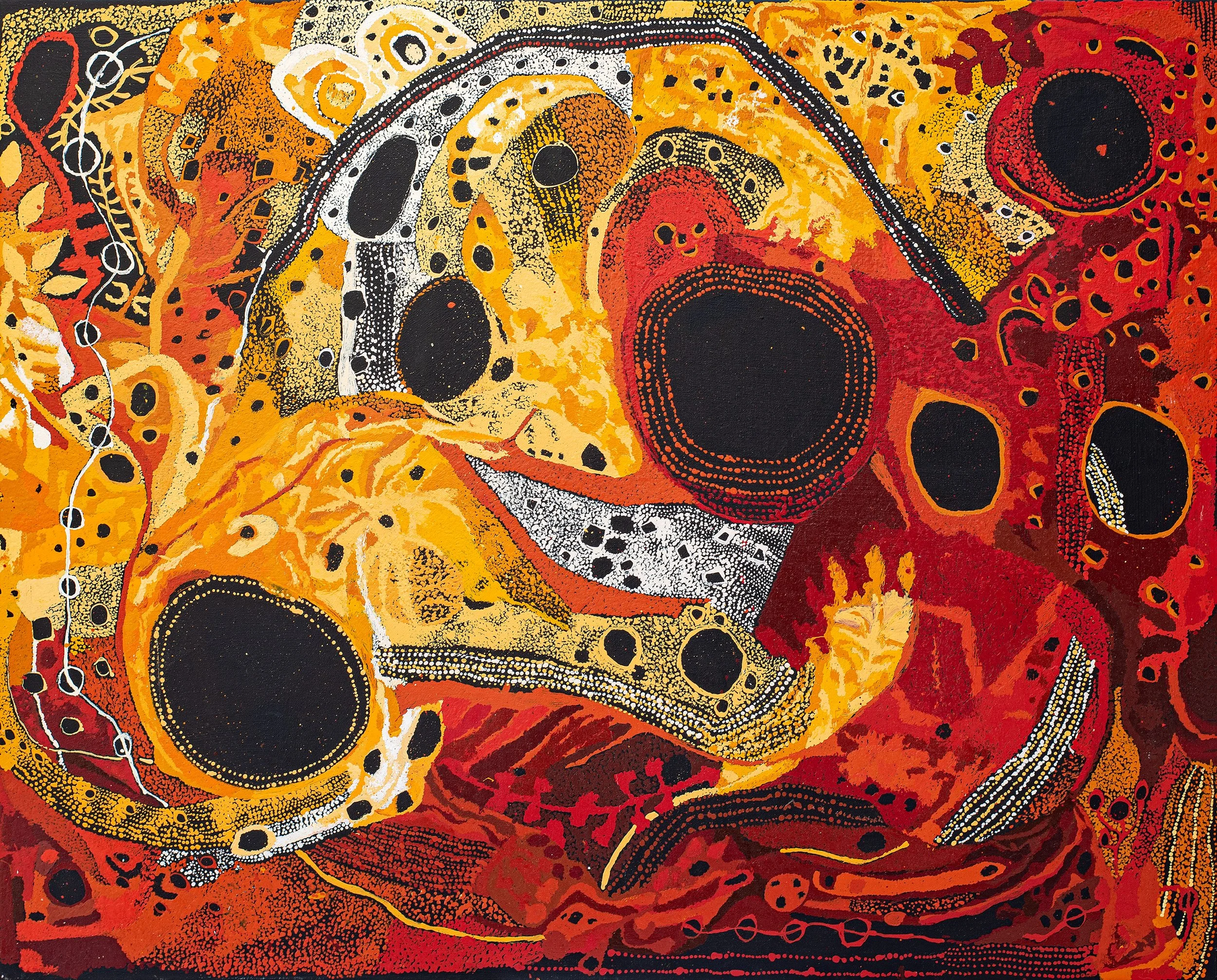
Artiste : Pauline Minmila Wangin (1970)
Titre de l'œuvre : Kapi Tjukula (Water Hole)
Format : 152cm x 122cm
Provenance et certificat : centre d'art aborigène de Mimili Maku
Référence de cette peinture aborigène : 967-24
Explications pour cette peinture d'art Aborigène :
Pauline is painting tjukurpa (story) about the journey of water, explaining how to care for kapi tjukula (water holes), particularly in the area around paralpii (Victory Well). This tjukurpa was passed on to her by her mother.
“One time when I was a little girl, my mother and me went out driving to collect bush tucker. It was a very hot day, and our car broke down. We didn't have any water with us, and I was scared, but my mother led me away from the car to kapi tjukula really closeby. She taught me how to find it, and how to care for it. After emptying the kapi (water) with mara munu punu (hands and sticks) the empty tjukula is cleaned. We place punu tjuta (many sticks and branches) over the top of the tjukula and use puli pulka (big rock) to stop them blowing away. Now no animals can dirty the new water that will soon collect."
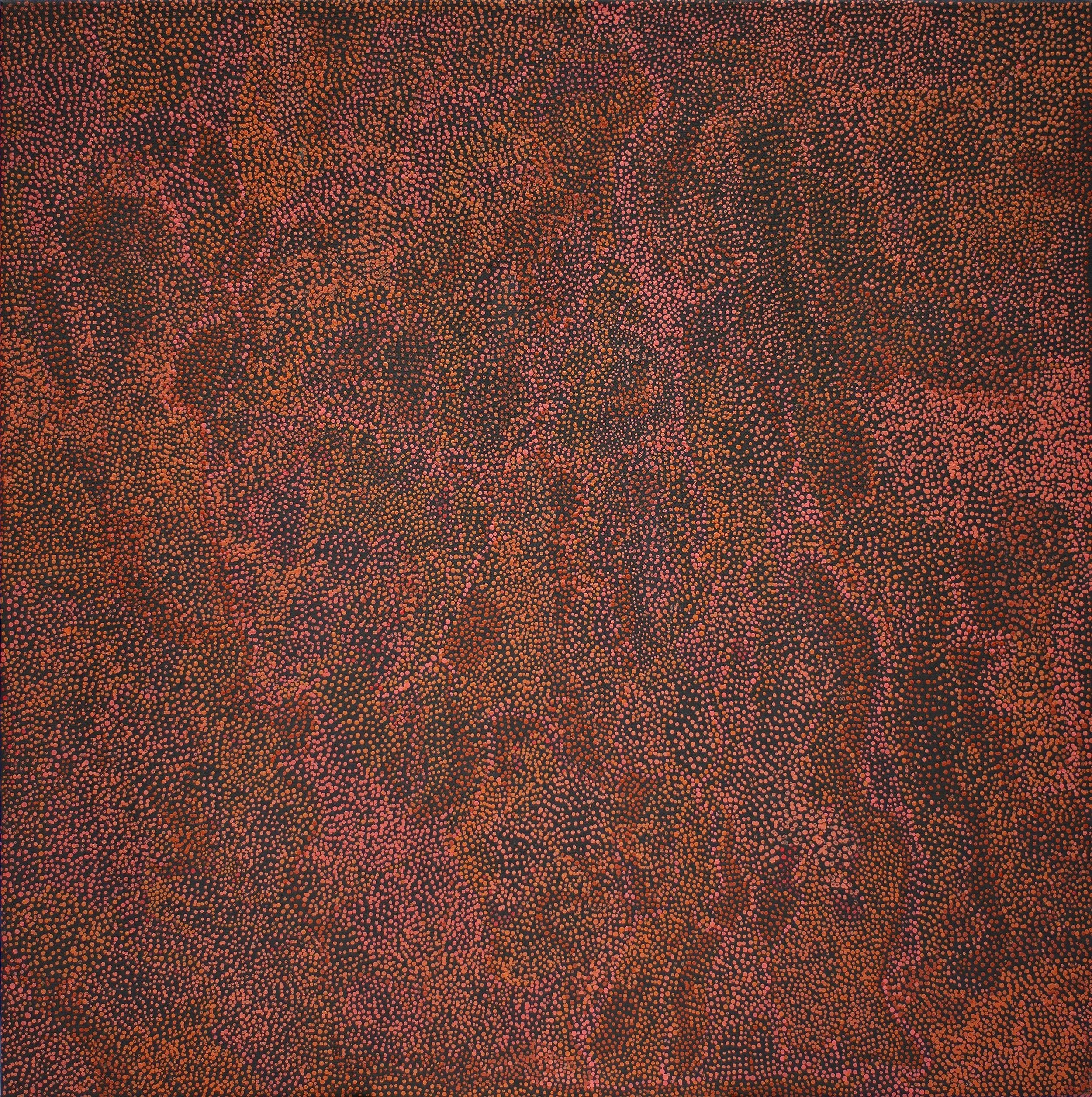
Artiste : Molly Miller
Titre de l'œuvre : Mamungara
Format : 91 x 91 cm
Provenance et certificat : centre d'art aborigène de Ninuku
Référence de cette peinture : 20-212
Explications pour cette œuvre :
Panya ngayulu tjitji kulapa tjina kutju parangarapai putu-wanu. Mutuka wiyangka. Tjina kutju parangarapai, parangala, paranangarapia. Nyangatja ngura pulkupa ngayuku. Tjitji Tjuta atunmananyi. Rapita tjuta, maku tjuta, tjala tjuta. Nganana pulkupa mulapa nyinangi irriti. Nyangatja ngura wirunya mulapa. “When I was a little girl we walked everywhere, there were no motorcars then. Always walking, around and around, and around. This is a happy place for me. Looking after children, lots of rabbits, lots of maku, lots of honey ants. We were really happy back then. This is a beautiful place" This canvas describes the features of the rocky country surrounding Wakapulkatjara, south east of Papulanktja, where Molly was born out bush in the 1940s. As a young woman, she travelled constantly through the ranges between Papulankatja to Mantumaru tracing the winding edges of puli, tali, kuru, ulyrunga, and tjukulu with her feet which she recalls as she puts dots to canvas, one in front of the next. Always "walking , walking, walking." A revered site for many Pitjantjatjara and Ngaanyatjarra speaking people on the Three Way Border of South Australia, Northern Territory, and Western Australia, Minyma Tjitu Pampa Tjukurpa and Papa Tjukurpa, Molly father’s dreaming also originate from this area.
© Photo : Aboriginal Signature Estrangin gallery with the courtesy of the artists and Ninuku.
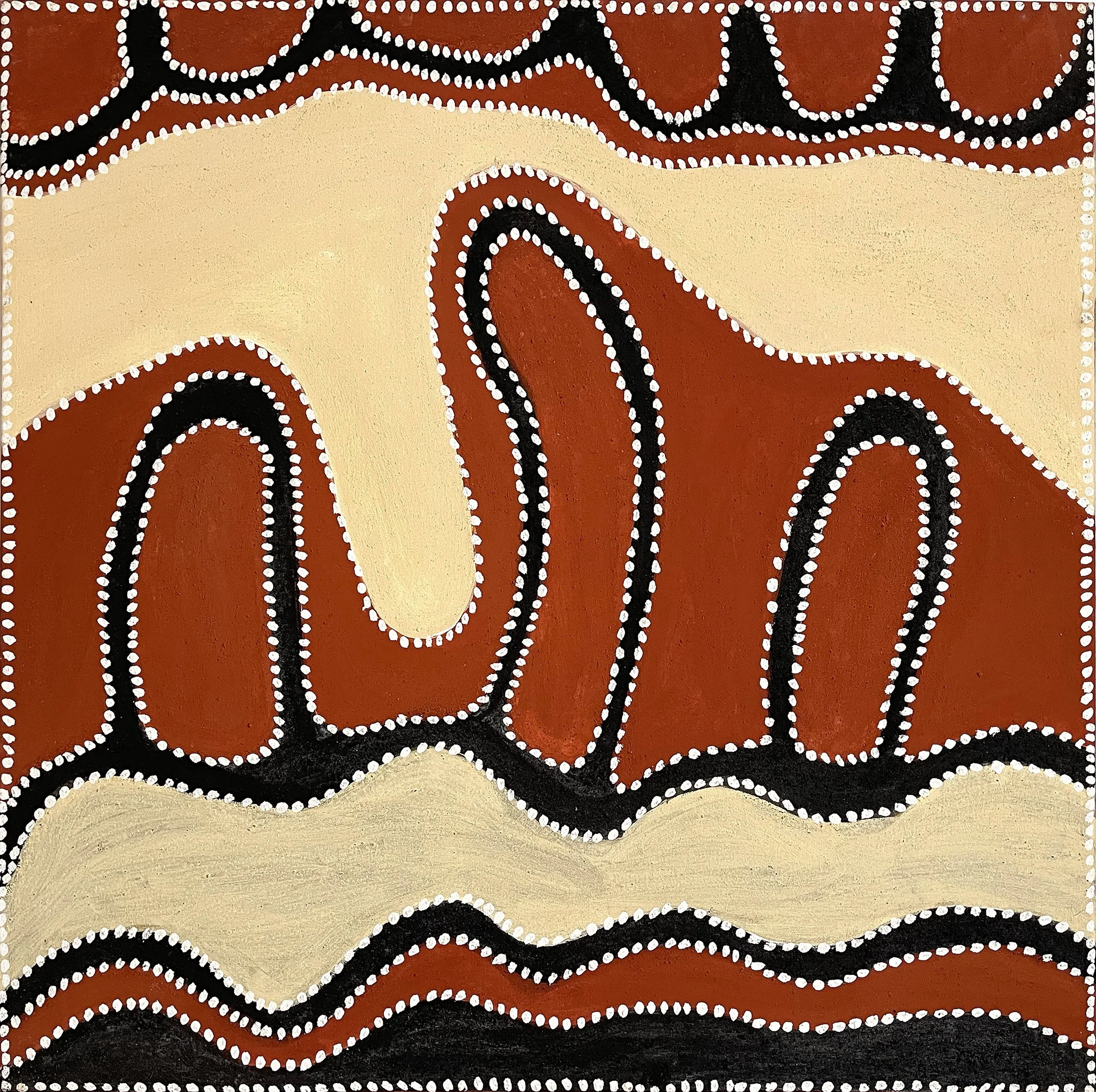
Titre de l'œuvre : Bungle Bungle Sugarbag
Artiste : Phyllis Thomas
Format : 80 x 80 cm
Provenance et certificat : centre d'art aborigène de Warmun
Référence de cette peinture d'art indigène d’Australie : 559/13
© Photo : Aboriginal Signature Estrangin gallery with the courtesy of the artist and Warmun Arts.

Artiste : Timothy Cook
Titre de l'œuvre : Japarra
Pigments naturels sur toile de lin Belge
Format : 90 × 24 cm
Provenance et certificat : centre d'art aborigène de Jalimara (Tiwi Island)
Référence de la peinture : 359-18
© Photo : Aboriginal signature with the courtesy of the artist & Jilamara Art centre (Tiwi Island)
Explications sur cette œuvre :
Timothy Cook (1958) expresses himself through his loose and gestural designs. He paints exclusively with locally sourced ochre and his artworks are highly sort after by major collections both nationally and internationally.
Timothy won the National Aboriginal and Torres Strait Island Art Award in 2012 and has been shortlisted for many others, including the Hadley Art Award in 2019, the Wynne Prize in 2020 and Sulman in 2023.
In Tiwi ancestral memory, Japarra is Purukaparli’s deceitful brother. He and his sister-in-law Bima become lovers, and during one of their bush Bima and Purukaparli’s baby son dies of heatstroke, bringing mortality to the world.
Following the tragic discovery of his son’s death, Purukaparli fights his brother with the rage of grief, striking him with spears and throwing sticks.
You can find the artworks of the artist within the following prestigious collections :
Musee du quai Branly, France
National Gallery of Australia
Fondation Opale, Switzerland
University of Newcastle, NSW
National Gallery of Australia, Canberra
Art Gallery of New South Wales, Sydney
National Gallery of Victoria, Melbourne
University of New South Wales, Sydney
Museum and Art Gallery of the Northern Territory, Darwin
Charles Darwin University, Darwin
Queensland Art Gallery, Brisbane
Aboriginal Art Museum, Utrecht, Netherlands
Art Gallery of South Australia
Wesfarmers Collection of Australia, Western Australia
Murdoch University Collection, Western Australia
Edith Cowan University, Perth
Western Australian Art Gallery, Perth
Parliament House Collection, Canberra
Museum of Contemporary Art, Newcastle Art Gallery…
Artiste : Kani Patricia Tunkin
Titre de l'œuvre : Minyma Malilu Tjukurpa
Format : 151 x 100 cm
Provenance et certificat : centre d'art aborigène de Tjungu Palya
Référence de cette peinture : 18-153
Explications pour cette peinture Aborigène :
This is the country for Malilu. She is a creation being from the Tjukurpa (Dream me). Minyma Malilu nyinanyi wana ngka munu pi (the woman Malilu is sitting with her digging stick and collecting bowl). She has been dancing, performing Inma important ceremonial dancing for this country and she has le her dancing tracks behind in the sand. Malilu was a crippled woman and her two daughters had run off to get married, leaving her to fend for herself. It was very hard for her to collect bush foods and water because she had to drag her leg as she walked. Through much effort she collected kampurarpa, wiriny-wirinypa, tawalpa munu mai kutjupa-kutjupa ( desert raisins, bush tomatoes, berries and many different kinds of wild foods). Malilu dug out a cave in the earth, Katatjitj. It has a small opening, but is a huge underground cave. She would hide her surplus food there for when she was hungry or too red to go out hunting. She would make inma (ceremony) in the cave. This is my country close to Kanpi community.

Artiste : Nyayati Stanley Young
Titre de l'œuvre : Patilpa Tjukurpa
Format : 101 x 91 cm
Provenance et certificat : centre d'art aborigène de Ninuku
Référence de cette peinture : 23-188
Demander le prix de l'œuvre / Enquiry
Explications pour cette œuvre :
This is the dreamtime story of Patilpa (Port Lincoln ringneck parrot) that lives in the country around Pipalytjara. Wati Minu (a man called Minu) came from the west to Pipalytjara, he was a rainmaker. He hunted all the waru (black footed wallaby) and he got lots. The Patilpa people were hungry and went and stole all the fat Mala, leaving the skinny one's for Minu. Minu was angry at this and he made clouds and thunder. All the Patilpa were hiding in a cave, but the rain came and washed them all away. They became Chrysoprase a bright green rock that you can find in the hills surrounding Pipalyatjara.
© Photo : Aboriginal Signature Estrangin gallery with the courtesy of the artists and Ninuku.
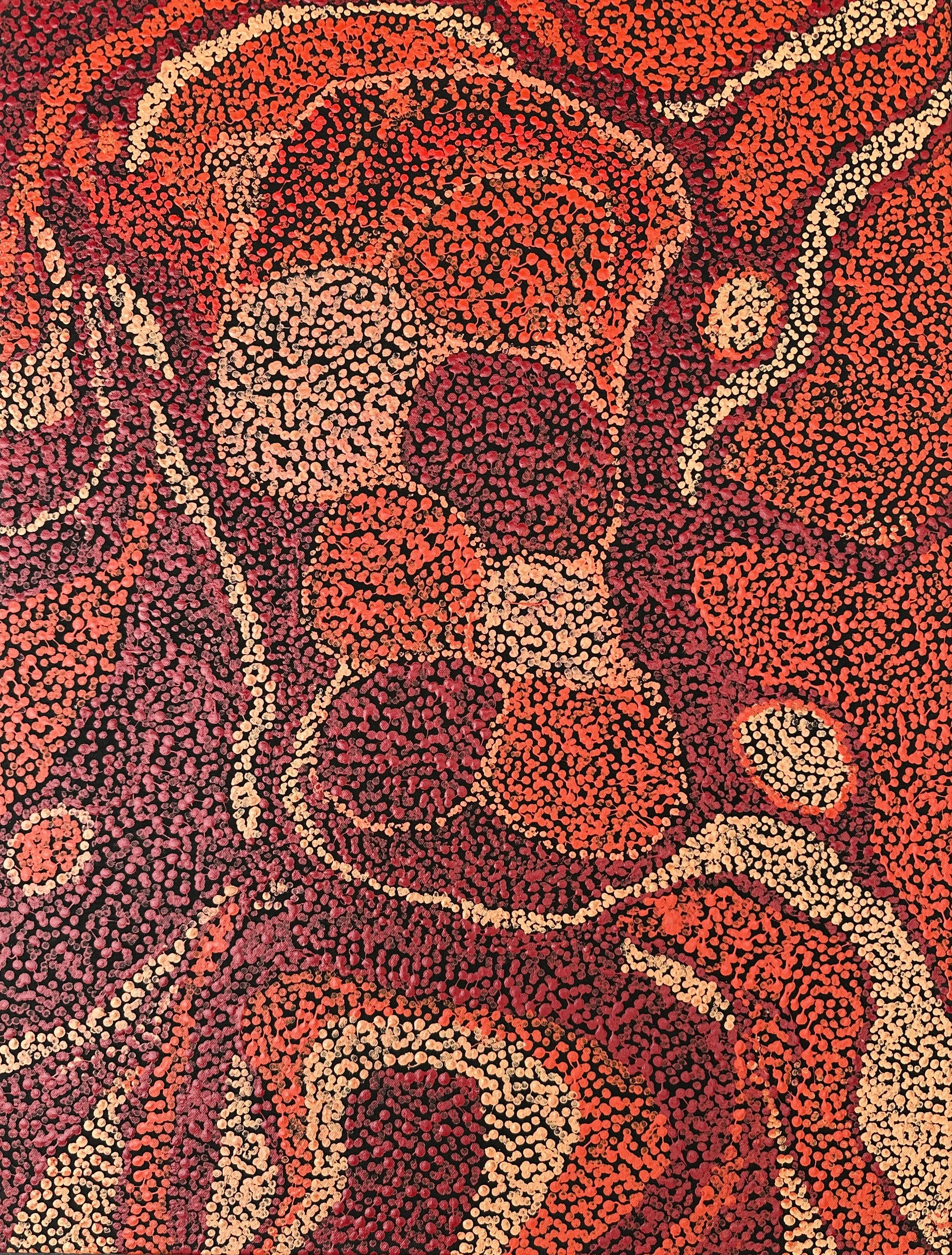
Artiste : Cynthia Burke
Titre de l'œuvre : Minyma Kutjara
Format : 90 × 70 cm
Provenance et certificat : centre d'art aborigene de Irrunytju Arts
Référence de cette peinture aborigène : 23-132
Explications sur cette œuvre :
In this artwork she is dealing about Minyma Kutjara Tjukurpa (the creation story of the two sisters). The big sister was travelling with her younger sister back to their homeland. The little sister was reluctant to head further and further north as she had been living with a different family near the ocean to the south. She had been lost for a long time and was unfamiliar with the landscape the big sister was showing her.
Eventually the older sister gave her a piggyback and tried to comfort her. She continued to teach her all about the country they travelled through. Sometimes when they stopped they performed Inma (sacred singing and dancing). They camped at Punuwara and Irrunytju rockhole before heading further north to Docker River.
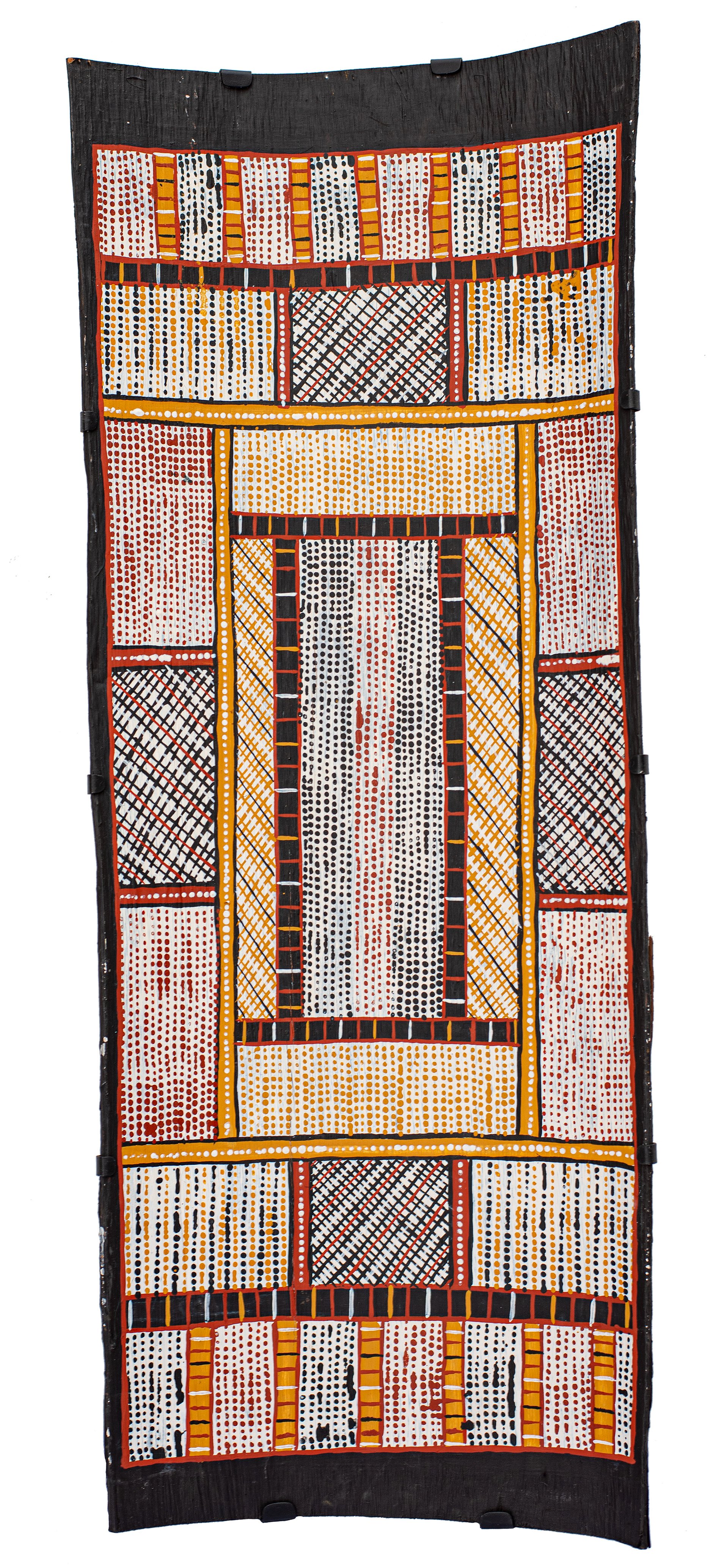
Artiste : Pedro Wonaeamirri
Titre de l'œuvre : Pwoja-Pukumani Body Paint Design
Pigments naturels sur toile de lin Belge
Format : 96 x 39 cm
Provenance et certificat : centre d'art aborigène de Jalimara (Tiwi Island)
Référence de la peinture : 444-24
© Photo : Aboriginal signature with the courtesy of the artist & Jilamara Art centre (Tiwi Island)
Explications pour cette œuvre :
Pedro Wonaeamirri (1974) grew up in Pirlangimpi (Pularumpi) on Melville Island. He was educated in Darwin and returned to the Tiwi Islands in 1989, where he moved to Milikapiti the same year that Jilamara Arts and Crafts was incorporated. He has been exhibiting since this time and his artworks are in many national, state and private collections Australia-wide and overseas.
Pedro is a senior cultural leader on the Tiwi Islands with a significant and strong knowledge of the old Tiwi language and all of the songs and dance important in Tiwi culture. With a seat on the board of many organisations, Pedro is the current Vice President of Jilamara Arts and Crafts Association and a Director for Arnhem, Northern and Kimberley Artists (ANKA). Alongside his esteemed visual art career he has also published many essays on Tiwi art, culture and ceremony. His country, Paluwiyanga/ Andranganoo (Goose Creek) is on the eastern side of Melville Island “the land or country where I come from is from my father’s father, my grandfather”.
Pedro’s contemporary art practice has its foundations in Jilamara – “design” derived from ceremonial body painting and the ornate decoration applied to tutini poles, tunga (bark baskets) and associated ritual objects made for Pukumani (mourning) ceremony and Tiwi Yoi (dance).
Pedro continues to exclusively use ochres sourced from in and around his place of work in Milikapiti. He applies these colours of Tiwi Country with meticulous fine detail and tools traditionally used to apply decoration to the skin. "The designs are already in my head and I use the Kayimwagakimi our traditional wooden comb made from ironwood and natural ochres from the island to paint."
Tiwi Culture places special significance on the Pukumani (funeral) ceremony. Mourners are decorated using natural ochres to disguise themselves from the spirit of the deceased and song and dance is performed to honour the dead. Yirrinkiripwoja (bodypaint) is the source of many contemporary
Tiwi designs and performance of the pukumani as ritual helps to reinvigorate the imagery. The shortening of the word to Pwoja - also refers to 'best'.
You can find his artworks in the following prestigious collections :
National Gallery of Australia, Canberra – Museum of Victoria, Melbourne – National Gallery of Victoria, Melbourne – Art Gallery of New South Wales, Sydney – Art Gallery of South Australia – Art Gallery of Western Australia, Perth – Queensland Art Gallery, Brisbane – National Maritime Museum, Darling Harbour, Sydney – Commonwealth Institute, London – Artbank, Sydney – Gantner Myer Collection – Gordon & Marilyn Darling Collection, Melbourne – Levi-Kaplan Collection, Seattle, USA – The British Museum, England – Murdoch University Collection, Perth – Edith Cowan University Art Collection, Perth – Wesfarmers Collection, Perth – Museum of Contemporary Art, Sydney – Kluge-Ruhe Art Museum, USA
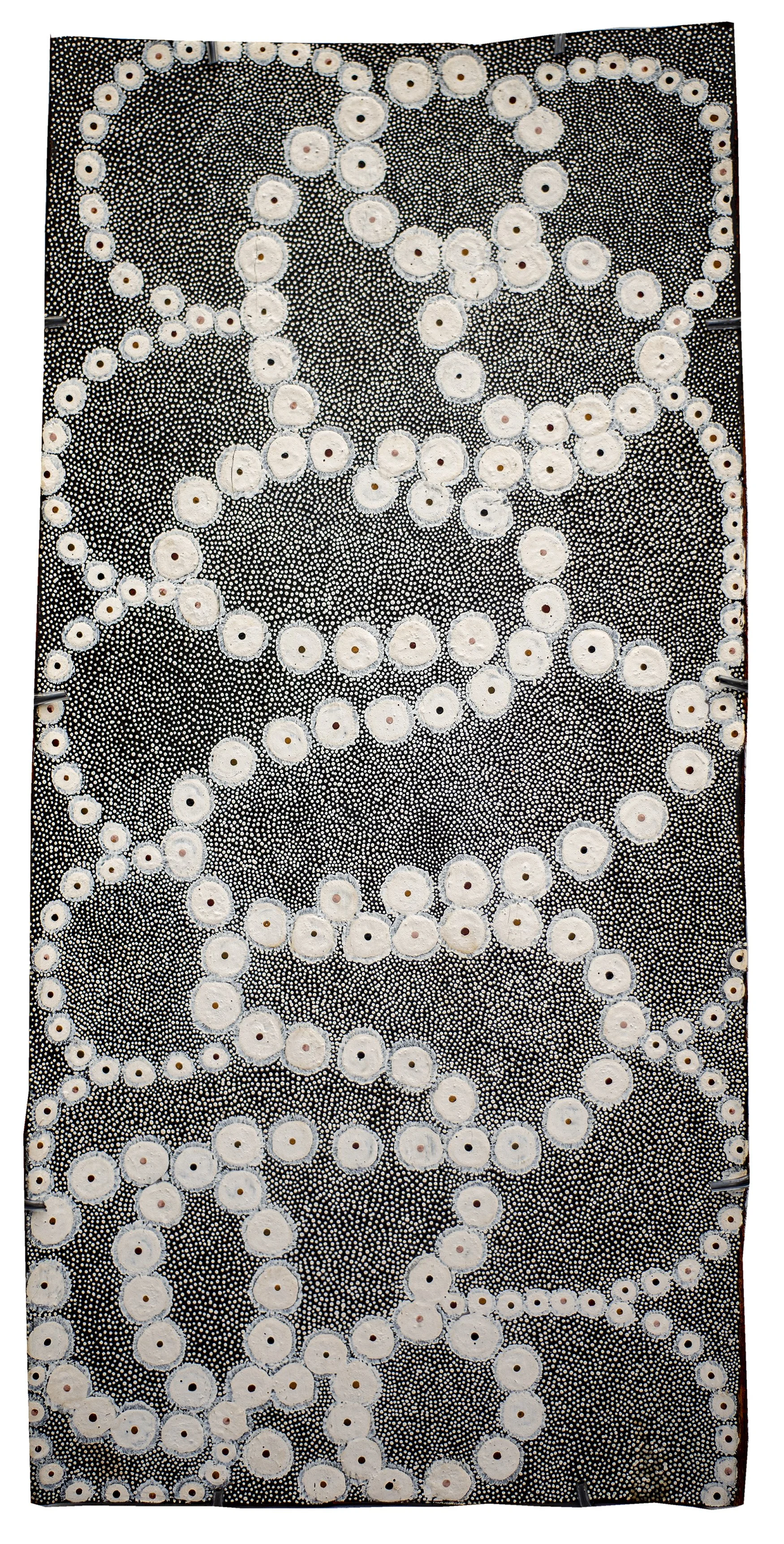
Artiste : Djalinda Yunupiŋu (1954)
Titre de l'œuvre : Yathiny
Pigments naturels sur écorce
Format : 75cm x 36cm
Provenance et certificat original : centre d'art aborigène de Yirrkala
Référence de la peinture : 8748-22
© Photo & text : Aboriginal signature with the courtesy of the artist, & Buku-Larrngay Mulka.
Explication de l’œuvre :
Djalinda here has painted her mother’s Rirratjiŋu clan sea country at Yirrkala, the waters between the mainland and Bremer Island. These waters are shared with the Djambarrpuyngu clan. Here lies the sacred rock Manhala. Turtle swim here and feed on the Yathiny, a blue sea anemone that floats on the surface.
Looking left up the coast from Yirrkala about two kilometres is the rocky escarpment leading down into the sea known as Galariya by the Rirratjiŋu. Off shore from there the island of Dhambaliya can be seen. These two areas and the sea in between is an important site influenced by Djambawal the Thunder Man and Daymirri the Ancestral Whale.
The Ancestral hunters took turtle in these waters and also left their mark on the mainland at Galariya as well as Dhambaliya. The land and associate events connect the two clan groups of the Rirratjiŋu and Djambarrpuyŋu who have custodial rites to this country. Minyipa and Dhaŋgatjiya were young sons of Mururruma who is referred to as the Grandfather of the Rirratjiŋu family. Mururruma was killed in a ritual spearing by the family of his young wife who Mururruma had killed because she had constantly complained about being separated from her own family.
Aer killing Mururruma on the mainland, the warriors of the young wife’s family pursued his sons Minyipa and Dhaŋgatjiya across the sea to Dhambaliya but were themselves defeated. For their stealth and courage in the battle Minyipa and Dhangatjiya became renown Waŋarr (spirit forms living in times past), to the Rirratjiŋu and Djambarrpuyŋu people. As Gutharra (Grandchild/Rirratjiŋu) and Märi (Grandfather/Djambarrpuyŋu) clans to each other - “Gutharra is the body of the Märi” - these two clans share responsibility for areas of the mainland and Dhambaliya…
Her artworks are in the following prestigious collections :
Art Gallery of New South Wales, Sydney NSW
Art Gallery of South Australia, Adelaide SA
Charles Darwin University Art Collection
JW Kluge Collection, Virginia USA
Seattle Art Museum, Seattle USA
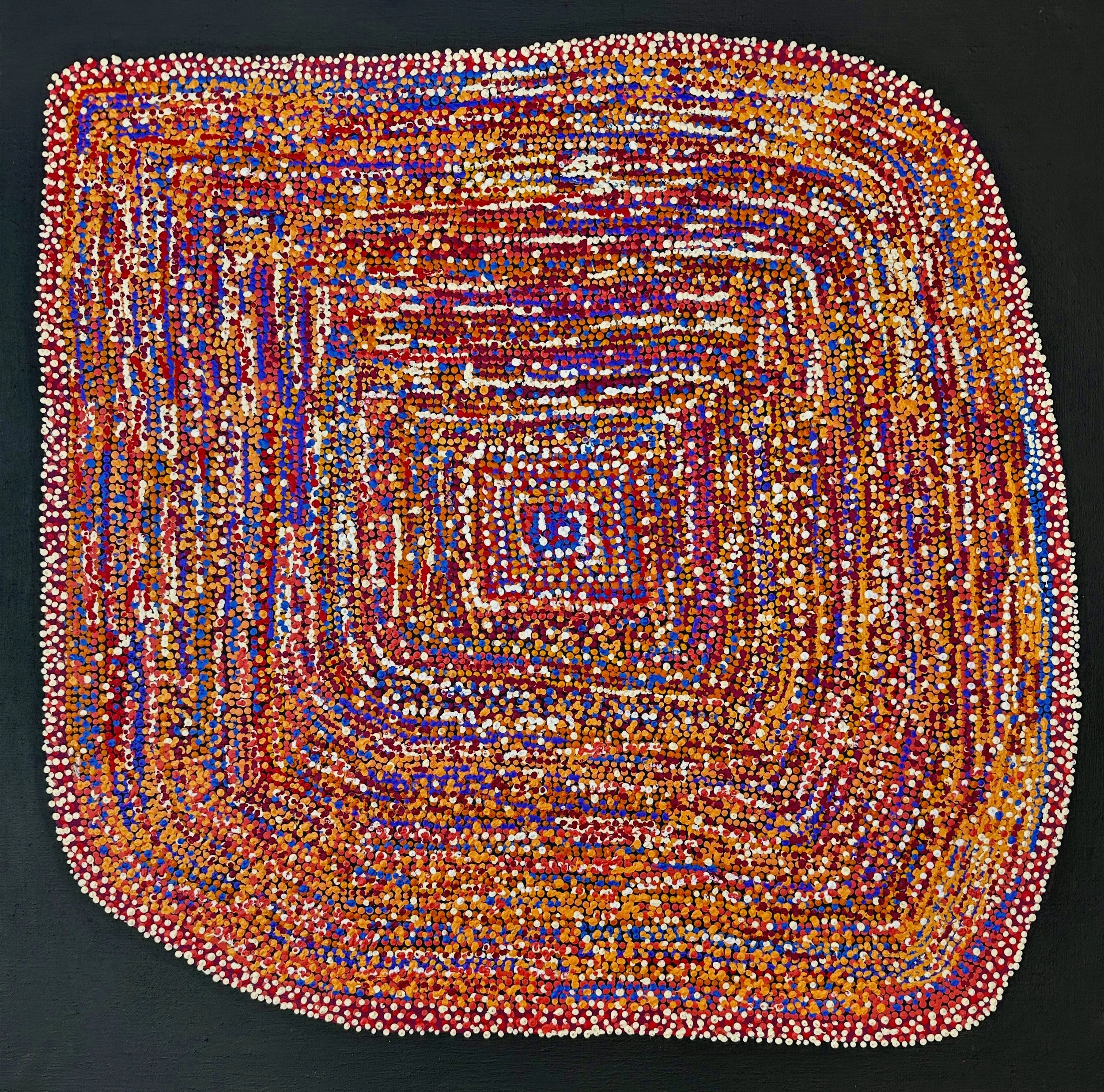
Artiste : Sabrina Nungarrayi Gibson
Titre de l'œuvre : Wirnpa Jukurrpa (lightning Dreaming)
Format : 91 x 91 cm
Provenance et certificat : centre d'art aborigene de Yuendumu
Référence de cette peinture aborigène : 468-25ny
Explications sur cette œuvre :
The country associated with this painting is Kiwirkurra, located in the ‘tali’ sandhill country of the Gibson Desert, south west of Lake McKay. The traditional iconography used to represent this dreaming are; concentric circles depicting the rock holes found in this area, the half circles the sandhills and the horizontal wavy lines the lightning. When the lightning comes the water birds, ‘Tjikaluk,’ come out and wade along the edge of the water.
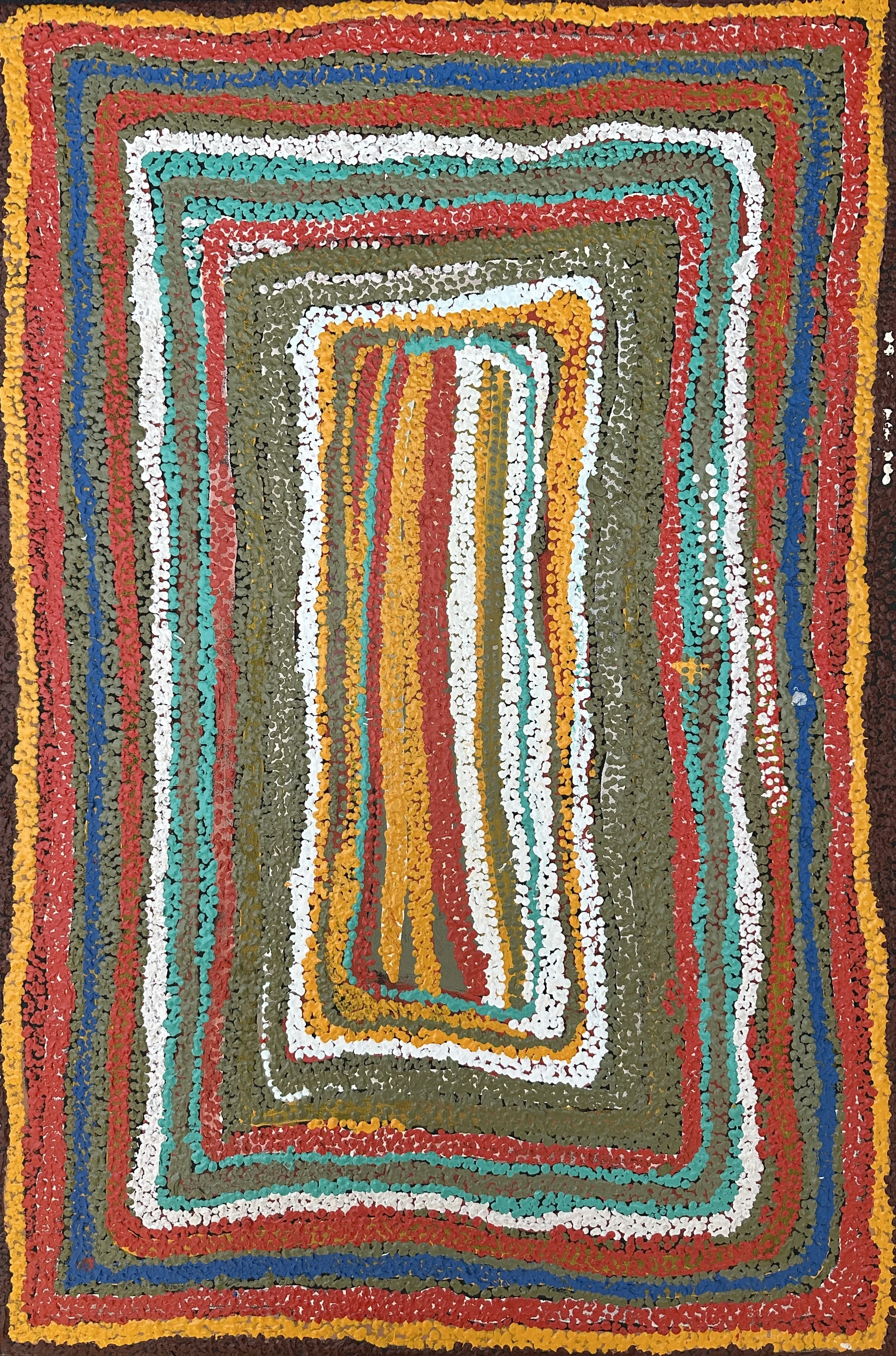
Artiste : Mulyatingki Marney
Titre de l'œuvre : Rockhole site of Wirrilpinya (ancestral Tingari cycle)
Format : 91 x 61 cm
Provenance et certificat : centre d'art aborigene de Papunya Tula Artists
Référence de cette peinture aborigene : 09-396
Demander le prix de l'œuvre
Explications de l’œuvre :
This work portrays an area around a lyinji (clay pan) named Jarntinti, not far from Punmu. Mulyatingki grew up around this area with her family and sisters, Nyanjilpayi Nancy Chapman and May Wokka Chapman. Mulyatingki’s sister Nyanjilpayi was born at Jarntinti. In the pujiman (bush dwelling) era, the black seeds from the kalaru (samphire, salt bush) plant were seasonally harvested from this area. Once collected a labour intensive process began to produce damper, a type of flat bread. The kalaru seeds were first washed several times before being ground with a jiwa (stones used by women for grinding seeds) to make a type of flour, which was then mixed with water to create a dough that was finally cooked in the ashes of a fire.
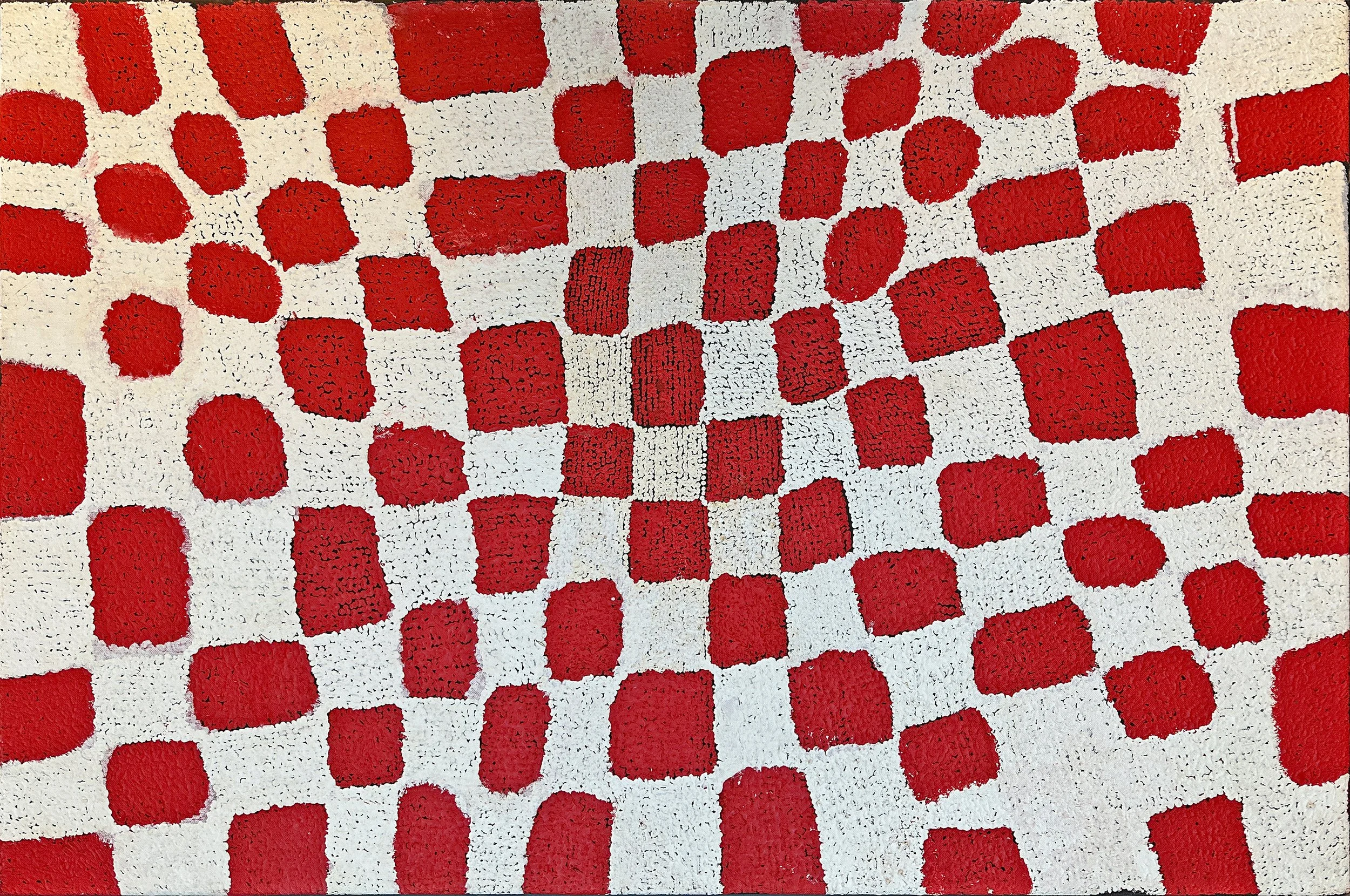
Titre de l'œuvre : Nakarra Nakarra (ancestral stories)
Artiste : Kathleen Paddoon
Format : 120 x 80 cm
Provenance et certificat : centre d'art aborigène de Balgo - Warlayiriti Artists Aboriginal Corporation
Référence de cette peinture aborigene : 1125/08
© with the courtesy of the artist & the Aboriginal art centre. Photo : Aboriginal Signature
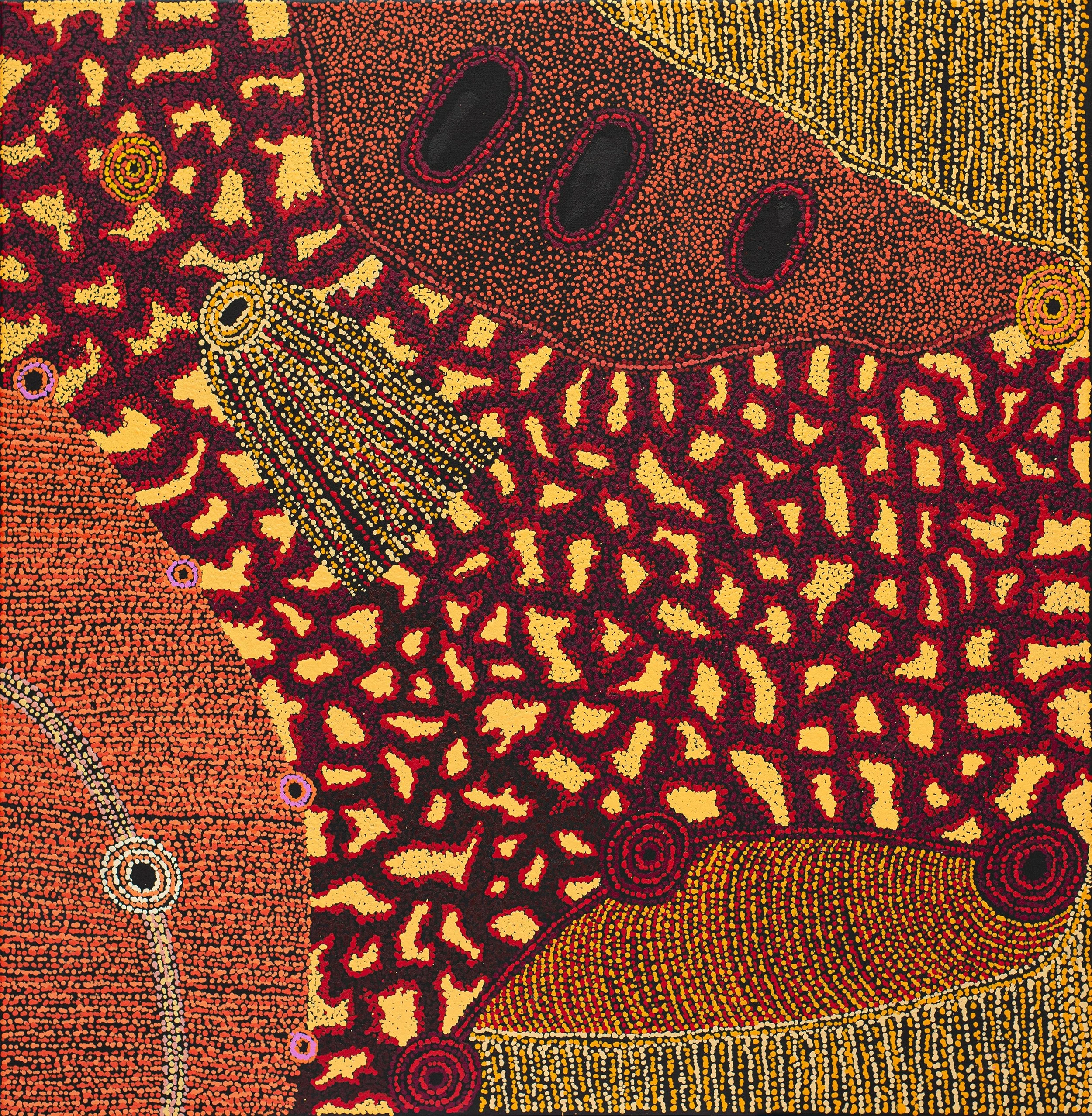
Artiste : Carol Young
Titre de l'œuvre : Waru Dreaming
Format : 105 × 103 cm
Provenance et certificat : centre d'art aborigène de Ninuku
Référence de cette peinture : 25-212
Demander le prix de l'œuvre / Enquiry
Explications pour cette œuvre :
At Watarru, there are many large and beautiful rocks. In these rocks lived the bush turkey. Anangu had no waru (fire) as the bush turkey stole the fire, and ran all the way to the sea with it.
© Photo : Aboriginal Signature Estrangin gallery with the courtesy of the artists and Ninuku.
Artiste : Willy Mutjantji Martin
Titre de l'œuvre : Wanampi tjukurpa
Format : 181x121cm
Provenance et certificat : centre d'art aborigène de Mimili Maku Arts
Référence de cette peinture : 187-17
Enquiry - demander le prix de cette œuvre d'art Aborigène
Explications pour cette peinture Aborigène :
I paint the Wanampi Tjukurpa, or Water snake Dreaming. This is a story from Piltati, near Nyapari (on the Anangu Pitjantjatjara Yankunytjatjara {APY} Lands in the remote north-west of South Australia). There’s a special rockhole at Piltati where this creation story takes place. There’s two wati (men), brothers and their wives. There’s trickery and conflict, and the men change themselves into wanampi (water snakes). The story tells how the land was shaped and formed. It’s important that we hold our culture, our stories, our connection to country strong for malatja-malatja (future generations) – that’s why I make paintings.